EP2534103B1 - Method for making high purity metal oxide particles and materials made therof - Google Patents
Method for making high purity metal oxide particles and materials made therof Download PDFInfo
- Publication number
- EP2534103B1 EP2534103B1 EP11740398.0A EP11740398A EP2534103B1 EP 2534103 B1 EP2534103 B1 EP 2534103B1 EP 11740398 A EP11740398 A EP 11740398A EP 2534103 B1 EP2534103 B1 EP 2534103B1
- Authority
- EP
- European Patent Office
- Prior art keywords
- acid
- catalyst
- metal
- phase
- alcohol
- Prior art date
- Legal status (The legal status is an assumption and is not a legal conclusion. Google has not performed a legal analysis and makes no representation as to the accuracy of the status listed.)
- Active
Links
Images




Classifications
-
- C—CHEMISTRY; METALLURGY
- C01—INORGANIC CHEMISTRY
- C01B—NON-METALLIC ELEMENTS; COMPOUNDS THEREOF; METALLOIDS OR COMPOUNDS THEREOF NOT COVERED BY SUBCLASS C01C
- C01B33/00—Silicon; Compounds thereof
- C01B33/113—Silicon oxides; Hydrates thereof
- C01B33/12—Silica; Hydrates thereof, e.g. lepidoic silicic acid
-
- C—CHEMISTRY; METALLURGY
- C01—INORGANIC CHEMISTRY
- C01B—NON-METALLIC ELEMENTS; COMPOUNDS THEREOF; METALLOIDS OR COMPOUNDS THEREOF NOT COVERED BY SUBCLASS C01C
- C01B13/00—Oxygen; Ozone; Oxides or hydroxides in general
- C01B13/14—Methods for preparing oxides or hydroxides in general
- C01B13/36—Methods for preparing oxides or hydroxides in general by precipitation reactions in aqueous solutions
- C01B13/363—Mixtures of oxides or hydroxides by precipitation
-
- C—CHEMISTRY; METALLURGY
- C01—INORGANIC CHEMISTRY
- C01B—NON-METALLIC ELEMENTS; COMPOUNDS THEREOF; METALLOIDS OR COMPOUNDS THEREOF NOT COVERED BY SUBCLASS C01C
- C01B33/00—Silicon; Compounds thereof
- C01B33/113—Silicon oxides; Hydrates thereof
- C01B33/12—Silica; Hydrates thereof, e.g. lepidoic silicic acid
- C01B33/18—Preparation of finely divided silica neither in sol nor in gel form; After-treatment thereof
- C01B33/187—Preparation of finely divided silica neither in sol nor in gel form; After-treatment thereof by acidic treatment of silicates
-
- C—CHEMISTRY; METALLURGY
- C01—INORGANIC CHEMISTRY
- C01P—INDEXING SCHEME RELATING TO STRUCTURAL AND PHYSICAL ASPECTS OF SOLID INORGANIC COMPOUNDS
- C01P2004/00—Particle morphology
- C01P2004/01—Particle morphology depicted by an image
- C01P2004/02—Particle morphology depicted by an image obtained by optical microscopy
-
- C—CHEMISTRY; METALLURGY
- C01—INORGANIC CHEMISTRY
- C01P—INDEXING SCHEME RELATING TO STRUCTURAL AND PHYSICAL ASPECTS OF SOLID INORGANIC COMPOUNDS
- C01P2004/00—Particle morphology
- C01P2004/01—Particle morphology depicted by an image
- C01P2004/03—Particle morphology depicted by an image obtained by SEM
-
- C—CHEMISTRY; METALLURGY
- C01—INORGANIC CHEMISTRY
- C01P—INDEXING SCHEME RELATING TO STRUCTURAL AND PHYSICAL ASPECTS OF SOLID INORGANIC COMPOUNDS
- C01P2004/00—Particle morphology
- C01P2004/60—Particles characterised by their size
- C01P2004/61—Micrometer sized, i.e. from 1-100 micrometer
-
- Y—GENERAL TAGGING OF NEW TECHNOLOGICAL DEVELOPMENTS; GENERAL TAGGING OF CROSS-SECTIONAL TECHNOLOGIES SPANNING OVER SEVERAL SECTIONS OF THE IPC; TECHNICAL SUBJECTS COVERED BY FORMER USPC CROSS-REFERENCE ART COLLECTIONS [XRACs] AND DIGESTS
- Y10—TECHNICAL SUBJECTS COVERED BY FORMER USPC
- Y10T—TECHNICAL SUBJECTS COVERED BY FORMER US CLASSIFICATION
- Y10T428/00—Stock material or miscellaneous articles
- Y10T428/12—All metal or with adjacent metals
- Y10T428/12014—All metal or with adjacent metals having metal particles
-
- Y—GENERAL TAGGING OF NEW TECHNOLOGICAL DEVELOPMENTS; GENERAL TAGGING OF CROSS-SECTIONAL TECHNOLOGIES SPANNING OVER SEVERAL SECTIONS OF THE IPC; TECHNICAL SUBJECTS COVERED BY FORMER USPC CROSS-REFERENCE ART COLLECTIONS [XRACs] AND DIGESTS
- Y10—TECHNICAL SUBJECTS COVERED BY FORMER USPC
- Y10T—TECHNICAL SUBJECTS COVERED BY FORMER US CLASSIFICATION
- Y10T428/00—Stock material or miscellaneous articles
- Y10T428/12—All metal or with adjacent metals
- Y10T428/12181—Composite powder [e.g., coated, etc.]
-
- Y—GENERAL TAGGING OF NEW TECHNOLOGICAL DEVELOPMENTS; GENERAL TAGGING OF CROSS-SECTIONAL TECHNOLOGIES SPANNING OVER SEVERAL SECTIONS OF THE IPC; TECHNICAL SUBJECTS COVERED BY FORMER USPC CROSS-REFERENCE ART COLLECTIONS [XRACs] AND DIGESTS
- Y10—TECHNICAL SUBJECTS COVERED BY FORMER USPC
- Y10T—TECHNICAL SUBJECTS COVERED BY FORMER US CLASSIFICATION
- Y10T428/00—Stock material or miscellaneous articles
- Y10T428/29—Coated or structually defined flake, particle, cell, strand, strand portion, rod, filament, macroscopic fiber or mass thereof
- Y10T428/2982—Particulate matter [e.g., sphere, flake, etc.]
Definitions
- the disclosed technology is directed to a method of making particles of metal oxides and the production of materials made therefrom, and finds particular applicability in the synthesis of synthetic silica particles for fused synthetic silica materials.
- Metal and mixed metal oxides are useful as functional materials to provide heat resistance/conduction, as structural materials, composite membranes for fuel cells, solar cells, catalysts, controlled delivery, coatings, light diffusers, cosmetics, ceramic glasses, etc, wherein the particle size and morphology such as shape, internal porosity, and surface area may be important. Included among the metals used in such compounds are tetravalent metals such as zirconium, vanadium, titanium, silicon, and yttrium, although lower valence metals such as aluminum are also particularly useful. Because of its relative abundance, silicon oxides have been the material of choice for a wide variety of commercial usages from nanoparticles used in polymer composites to synthetic silica for production of ultrahigh purity fused quartz materials for semiconductor applications.
- Controlled particle size, target surface areas, and target porosities have been a matter of interest in recent years due to wide commercial applications.
- Current techniques for producing metal oxides have a number of limitations and do not offer a single chemistry for providing a wide range of properties.
- silica powder More specifically for silicon metal and its corresponding silicon dioxide (silica), current techniques for synthesis of synthetic silica powder are based on sol-gel methods, ion-exchange of sodium silicate glass, and sol-gel pore filling of fumed silica from flame hydrolysis of silicon tetrachloride in the presence of oxygen and hydrogen.
- Commercially available synthetic silica glass is primarily made utilizing; (1) a method in which a fume generated by decomposition of silicon tetrachloride or an organosilicon material in an oxyhydrogen flame is deposited and grown on a substrate; (2) a method in which a silica gel obtained by e.g. hydrolysis and gelation of e.g. a silicon alkoxide, is baked and a synthetic silica powder thereby obtained is further densified to make a glass; or (3) direct sol-gel processing usually used for smaller parts.
- the method (1) has a problem in that the production cost is extremely high.
- the method (2) employing a silica gel, particularly a silica gel derived from a silicon alkoxide it is possible to obtain a synthetic silica powder having relatively low content of minor impurities, but the desired impurity level is not necessarily satisfied.
- Silica sol has been conventionally made by using a sodium silicate solution called water glass as starting material.
- sodium silicate solution is treated using a cation-exchange resin so that ions, such as sodium ion in sodium silicate, are removed in order to increase the purity of the starting material.
- the resultant is used for producing silica sol.
- Such a technique is disclosed in U.S. Publication No. 2007/0237701 .
- the above method employs an ion-exchange resin for purification, its purity is limited to some degree.
- metal impurities such as alkali metals (e.g., sodium), copper, nickel, and/or aluminum, which is required for use with electronic materials.
- methods for making relatively high purity synthetic silica particles include hydrolyzing and condensing alkoxysilanes and using pulverization techniques.
- An example of a method using pulverization techniques for preparation of silica particles useful for high purity synthetic silica applications is disclosed in U.S. Patent No. 6,131,409 . Because of restrictions with respect to the purity of the starting material and the many process steps required to achieve the final particle size, various other processes have been attempted.
- US 2010/297545 A1 describes a preparation method of composite silica nanoparticles with monodispersity.
- the present invention is directed to a method of making high purity metal oxide and/or mixed metal oxide particles.
- the method is particularly suitable for making synthetic silica.
- the method includes treating a mixture formed from a water suspension containing a metal source, a surfactant system, and a phase enhancer.
- the mixture is reacted with a catalyst to form metal oxide particles having a desired size without gellification of said mixture at high solids content.
- the present invention provides, in one aspect, a method for making particles comprising forming a first phase comprising a mixture of water, a metal source, a first catalyst, a first surfactant, and a first alcohol; adding the first phase to a second phase comprising water, a second alcohol, and a second surfactant to form a blend; treating the blend with a phase enhancer; and reacting the blend with a second catalyst to form particles.
- the particles are condensed to metal oxide particles with a base catalyst to form particles of a desired size without gellification of the suspension.
- phase enhancers prevents excessive particle agglomeration during the addition of the second catalyst and further curing.
- the amount and type of phase enhancer(s) can be used to control the rate and degree of particle agglomeration. For example, it has been found that less phase enhancer can cause gellification of the entire reaction mass.
- the present method is directed to generating a high yield of high purity synthetic metal oxide particles for use in various applications.
- the method is used to form synthetic silica particles that may be used in the production of fused synthetic silica products.
- other metal oxides that can be formed from the present method include, for example, TiO 2 , Fe 2 O 3 , SiO 2 , Al 2 O 3 , ZrO 2 , Nb 2 O 3 , Y 2 O 3 , rare earth oxides, molecular mixtures and compounds thereof, and composite and decorated structures thereof.
- the following description may recite or refer to the specific embodiment where the particles being synthesized are silica particles and the materials used in the inventive process and generated therefrom are thus specific to this embodiment.
- the general process will be similar for the synthesis of all metal oxide particles, and thus these descriptions and process steps should be considered as applying in a general sense to any metal oxide particle made from the present process, with only the corresponding raw materials and products as the significant differences.
- the present method is capable of forming high purity synthetic particles having a particle size in a desired range.
- controlling synthetic particle growth to a desired size can be accomplished by controlling at least one of following properties: particle reactor pH; temperature of the particle reactor; molecular weight of the nonionic surfactant; concentration and rate of addition of the base catalyst to the particle reactor; the type and amount of phase enhancer; and/or temperature during acid hydrolysis.
- the present method can include adding a phase enhancer, such as a non-highly polar or slightly polar alcohol, to create a stable emulsion as an enabler for particle growth from micellar particles.
- a phase enhancer such as a non-highly polar or slightly polar alcohol
- the present method further includes a measured addition rate of a second catalyst that allows for gradual particle growth without gellification of the reaction mass. This measured addition rate of a second catalyst allows for particle growth to a desired size and is a function of the type of phase enhancer molecular weight.
- the present method provides high purity metal oxide particulars without the need to form gel blocks and then subsequently grind or pulverize those gel blocks to form particles.
- FIGURES 1 and 2 illustrate aspects of a method for making metal oxide particles.
- a method 10 of forming a metal hydroxide includes, as shown in block 20, providing a first phase comprising water, a metal source, a first catalyst, a first surfactant, and a first alcohol.
- the method includes providing a second phase comprising water, a second alcohol, and a second surfactant.
- the first phase is added to the second phase to form a blend.
- the blend formed from the first and second phases is treated with a phase enhancer.
- a second catalyst is added to the blend to form metal oxide particles.
- FIGURE 2 illustrates further aspects of the method 10 described in FIGURE 1 .
- Providing the first and second phases may include, in one aspect, preparing the first and/or second phases. Preparing the first and second phases may be accomplished by adding the appropriate components to a system, which may also be referred to herein as a container, vessel, reactor, and the like.
- the method 10 can include forming a metal oxide.
- the method may employ a system 100 for providing or preparing a hydrolysate reactor 110 comprising the first phase and a particle reactor 120 comprising the second phase. The contents of the hydrolysate reactor are charged to or added to the particle reactor to carry out the reaction, which will be discussed in greater detail below.
- the method employs a hydrolysate reactor 110 to form or prepare the first phase.
- the first phase may be formed in the hydrolysate reactor 110 by adding a first surfactant 112, a first catalyst 114, a first alcohol 116, and water to the reactor 110 in proportion to the amount of metal source that promotes the formation of oligomers.
- the first catalyst comprises an acid catalyst or a base catalyst.
- the first catalyst is an acid type catalyst.
- suitable acid catalysts include, but are not limited to, hydrochloric acid, nitric acid, sulfuric acid, phosphoric acid, fluoric acid, formic acid, acetic acid, propionic acid, butanoic acid, pentanoic acid, hexanoic acid, monochloroacetic acid, dichloroacetic acid, trichloroacetic acid, trifluoroacetic acid, oxalic acid, malonic acid, sulfonic acid, phthalic acid, fumaric acid, citric acid, maleic acid, methylmalonic acid, adipic acid, p-toluenesulfonic acid, or combinations of two or more thereof.
- the first catalyst comprises a base catalyst chosen from ammonium hydroxide, quaternary ammonium hydroxides, hydroxylamines, derivatives of hydroxylamines, amino pyridines, or combinations of two or more thereof.
- the base catalyst has a concentration of 0.01% to 10% by weight.
- the first alcohol may be chosen from a primary alcohol, a secondary alcohol, or a combination of two or more thereof.
- the primary alcohol is an alcohol having one to ten carbons.
- Suitable alcohols include, but are not limited to, methanol, ethanol, propanol, butanol, pentanol, hexanol, heptanol, octanol, nonanol, decanol, or combinations of two or more thereof.
- the first surfactant is a co-surfactant system.
- the co-surfactant can aid in transporting solution to the micelle containing metal oxide oligomers such as, for example, low molecular weight polymethoxysiloxanes.
- the co-surfactant system includes a mixture of a non-polar compound and a slightly polar compound.
- the non-polar compound may be a hydrocarbon such as cyclic hydrocarbons including cyclopentane, cyclohexane, cyclooctane, and even derivatives thereof such as methyl cyclohexane, p-alkyl cyclohexane, and the like, and linear or branched aliphatic hydrocarbon having carbon numbers from 5 to 12 and alkyl derivatives thereof such as isopentane, isohexane, isooctane, and the like, or a combination of two or more non-polar compounds.
- the slightly polar compound of the co-surfactant system is a slightly polar alcohol chosen from tertiary alcohols, cyclic alcohols, or combinations of two or more thereof.
- Suitable tertiary alcohols include, for example, tertiary butyl alcohol, 2-methyl 2-butanol or tertiary amyl alcohol, or derivatives thereof such as 2-methyl 2-pentanol, 2-methyl 2-hexanol, and the like.
- suitable cyclic alcohols include cyclopentanol, cyclohexanol, cyclooctanol and alkyl derivatives thereof such as 4-methylcyclohexanol, and the like.
- surfactants suitable for the co-surfactant include, for example, alcoholic solvents and ketonic solvents.
- suitable alcoholic solvents include, for example, tertiary amyl alcohols, methyl alcohol, ethyl alcohol, n-propanol, i-propanol, n-butanol, i-butanol, sec-butanol, t-butanol, 4-methyl 2-pentanol, cyclohexanol, methylcyclohexanol, and/or glycerol.
- ketonic solvents examples include acetone, methyl ethyl ketone, methyl-n-propyl ketone, methyl-n-butyl ketone, methyl-i-butyl ketone, diethyl ketone, cyclohexanone, methylcyclohexanone or acetylacetone.
- the first phase includes, a metal source 118.
- the metal source may include a single metal based material or a plurality of metal based materials.
- the metal source may be any hydrolysable metal source.
- the metal source includes a metal alkoxide, a hydrolysable organometallic compound, oxo metal oligomers, or mixtures of two or more thereof.
- the metal oxide desired as a final product will determine the identity of the metal source.
- the metal source 118 is a silicon alkoxide.
- silica sources include, but are not limited to, tetramethylorthosilicate (TMOS), tetraethylorthosilicate (TEOS), tetrapropylorthosilicate (TPOS), tetraethoxy silane, tetramethoxy silane, tetrabutoxy silane, methyl trimethoxy silane (MTMS), methyl triethoxy silane (MTES), phenyl trimethoxy silane and isobutyl trimethoxy silane, and higher tetraalkoxysilanes, siloxane oligomers derived from alkoxysilanes, and pre-polymerized alkoxysilanes such as polymethoxysiloxane so long as it is amenable to micelle formation, including a tetramer of polymethoxysiloxane such as methylsilicate.
- TMOS tetramethylorthosilicate
- TEOS tetra
- the first phase has a molar ratio of water to siloxane oligomer derived from alkoxysilane to provide at least a siloxane heptamer, a cyclic siloxane, or mixtures thereof.
- a high purity silica source such as alkoxysilane, can be obtained from a crude source such as those formed from the reaction of silicon metal with methanol in the presence of a metal catalyst such as copper such as those exemplified in E.G. Rochow, "Methyl Silicate from Silicon and Methanol", J. Am. Chem. Soc. 70, 2170-2171 (1948 ), U.S. Patent Nos. 4,727,173 , 4,999,446 , and 5,084,590 . Purification of alkoxysilane can be accomplished by distillation as provided in U.S. Patent No. 5,902,893 .
- Examples of other metal sources for the production of other metal oxide particles include metal compounds as isopropoxides, acetates, acetylacetonate, oxylates, butoxides, methoxides, ethoxides, chloromethoxy, chloroethoxy, methyls, ethyls, and the like.
- Examples of other suitable metals include, but are not limited to, Ti, Fe, Al, Zr, Nb, Y, rare earth metals and combinations of two or more thereof.
- the first phase may be formed, in one embodiment, by first charging water, the first surfactant 112, the first catalyst 114, and the first alcohol 116 to the hydrolysate reactor 110.
- the metal source 118 can be added in a controlled or measured manner to the hydrolysate reactor 110.
- the metal source reacts in the hydrolysate reactor to form a metal oxide oligomer.
- the metal source may be added to the hydrolysate reactor to control the temperature rise of the system.
- a silica source is added to the hydrolysate reactor at a rate so that the adiabatic temperature rise is at a temperature range from 10° to 100°C, and preferably the temperature rise is to 72°C.
- the silica source can react in the hydrolysate reactor 110 to form oligomers of methoxysiloxanes when a methoxy silane is employed.
- the rate of adding a silica source can be 5-15 gm/min for a 2300 gm batch size.
- metal source may be added to the first phase over a period of from 20 to 120 minutes.
- the metal source comprises a metal alkoxide, and the molar ratio of water to metal alkoxide source in the first phase is from 0.5 to 4.0.
- the first surfactant 112 can be added to the hydrolysate reactor 110 after the addition of the metal source 118.
- the first surfactant such as, for example, a co-surfactant can be added in a measured or controlled manner or added after all the metal source is added to the hydrolysate reactor 110.
- the co-surfactant facilitates in forming the metal oxide polymers within a micellar structure as dictated by phase equilibrium.
- the second phase may be formed in a particle reactor 120. This may be accomplished by adding water, a second surfactant 122, and a second alcohol 124 to the particle reactor.
- the second surfactant 122 is a nonionic surfactant.
- the molecular weight of the nonionic surfactant including, but not limited to those based on ethoxylate, polyethoxylate, polypropoxylate, phenolate, or polyol and the like, may be from 400 to 100,000.
- suitable nonionic surfactants include, but are not limited to, polyethylene glycol, polypropylene glycol, phenolates, polyols, polyoxyethylene stearate, polyoxyethylene sorbitan monooleate, polyoxyethylene lauryl ether, nonylphenoxypoly(ethyleneoxy)ethanol, nonylphenyoxypoly(ethyleneoxy)ethanol, and combinations of two or more thereof.
- the second alcohol 124 may be chosen from a primary alcohol, a secondary alcohol, or a combination of two or more thereof.
- Suitable primary alcohols include, primary alcohols having from one to ten carbon atoms such as those previously described with respect to the first alcohol.
- the second alcohol may be the same or different than the first alcohol.
- suitable materials for the phase enhancer include those materials that are suitable for enhancing the stability of particle formation and preventing gellification of the suspension.
- suitable for the phase enhancer 126 include, for example, slightly polar alcohols.
- Exemplary slightly polar alcohols for use as the second phase enhancer include low carbon alcohols.
- the phase enhancer 126 includes primary alcohols of one to ten carbons such as methanol, ethanol, propanol, butanol, pentanol, hexanol, and the like.
- the phase enhancer may also be chosen from alkyl derivatives of alcohols of one to ten carbon atoms including, but not limited to, isopropanol, isobutanol, isopentanol, and the like.
- secondary alcohols are also suitable for use as a phase enhancer.
- the phase enhancer 126 is added to the system after the first phase is added by adding the contents of the hydrolysate reactor 110 to the particle reactor 120.
- the phase enhancer 126 is added to the particle reactor and allowed to equilibrate. The addition of the phase enhancer 126 prior to adding the catalyst to the particle reactor, enhances the stability of large particle formation, allows for the generation of consistent particle growth and prevents the gellification of the suspension.
- the method includes adding the contents of the hydrolysate reactor 110 to the particle reactor 120.
- the first and second phases are then mixed together in the particle reactor 120 to form a blend.
- Mixing influences the size of the initial micellar diameter as well as particle growth and final particle size. Turbulent mixing tends to generate smaller particles and nearly uniform particle size distribution. Slower mixing with less turbulence tends to: (1) generate a wide particle size distribution; and (2) cause metal oxide particles to settle prematurely at the bottom of the particle reactor before attaining further particle growth to form unwanted packed solid particles. Therefore, a suitable mixing regime is desirable to effectively suspend large particles as the clusters grow from micelles to a final stable particle size and distribution. This suitable mixing regime further may be dictated by the type of agitator and the tip speed impeller velocity. The tip speed impeller velocity may be 6.1 to 24.4 cm per second (0.2 to 0.8 feet per second). In one embodiment, the first phase may be added to the second phase over a period of 30 minutes to 150 minutes.
- a biphasic system forms as shown by the presence of a suspension or emulsion.
- the second surfactant aids in forming micelles to a size dictated by phase equilibrium.
- the particle reactor contains a biphasic system that allows particle growth from micelles.
- the temperature of the first phase may be from 30° to 80°C, and the temperature of the second phase may be from 30° to 100°C.
- the temperature of the initial emulsion can be 30-80 °C to further enhance the biphasic system formed in the particle reactor. In one embodiment, the temperature is 50-60°C, which is the cloud point for the nonionic surfactant PEG.
- the phase enhancer 126 may be added to the system after the first phase from the hydrolysate reactor is added to the particle reactor.
- the method includes a measured or programmed addition of a second catalyst 128 to the particle reactor 120.
- the second catalyst 128 is added in a measured or programmed manner to the particle reactor 120 so that the metal oxide oligomer within the mixture forms the desired metal oxide particle as opposed to forming an undesirable gellified suspension or particle to particle adhesion by hydrogen bonding.
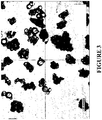
- a measured addition of the second catalyst 128 aids in partially opening up the layer of a nonionic surfactant to allow the particles to interact and form metal oxide bonds with other particles as a mode of particle growth as shown in FIGURE 3 and FIGURE 4 .
- the formation of siloxane bonds between the silica particles allows the formation of larger particles while oligomers are undergoing internal self-condensation or curing. Otherwise, the addition of too much catalyst at one time may cause the surfactant to fragment and expose the micellar particles containing partially converted polymethoxysiloxane or higher oligomers therefrom which results in formation of a highly cross-linked gel containing water and organics and soluble silicates. This results in a permanent gellification of the suspension with no recovery of micellar particles. Therefore, the measured or programmed addition of the catalyst allows the controlled description of the surfactant from the surface of the particle.
- the second catalyst 128 may be chosen from an acid or base.
- the second catalyst 128 is a base.
- Suitable base catalyst materials include, for example, non-alkaline metal bases such, organic bases, non-metal bases that promote nucleophilic substitution or combinations of two or more thereof.
- suitable non-alkaline metal bases include ammonium hydroxide, as well as aqueous solution of ammonium carbonate or ammonium bicarbonate.
- suitable organic bases include quartenary alkyl ammonium hydroxides such as tetramethylammonium hydroxide.
- An acid catalyst can also be used, but the reactivity is slower towards particle growth.
- suitable acid catalysts include inorganic acids such as hydrochloric acid, nitric acid and sulfuric acid, and the like.
- the base catalyst has a concentration of 0.01% to 10% by weight. In another embodiment, the base catalyst can have a concentration of 0.05% to 5% by weight. In one embodiment in which the method is employed for forming silica particles, the base catalyst desirably has a relatively low concentration so that it will allow the silica particle within the micelle to form via self-condensation of polymethoxysiloxane or its oligomers to silica; otherwise undesirable cross-linking and gellification of the suspension will occur and concomitant formation of soluble silicates.
- the base catalyst is added to the mixture until a mean silica particle size desired is obtained.
- the silica particle size increases with the amount of catalyst added to the particle reactor up to a critical pH.
- the silica particle size is measured as the particle diameter using a measuring system such as, for example, a Horiba LA950 system.
- the pH of the suspension may be 1.3.
- the pH of the mixture may increase to a pH of 5, depending upon the level of alkoxysilane and acid catalyst used in the hydrolysate. Desirably, the pH of the mixture is no greater than 3.5 prior to treating with the second catalyst, and no greater than 6 during the treatment step with the second catalyst.
- the organics After aging the suspended metal oxide particles, the organics are removed or stripped to obtain essentially an aqueous slurry or suspension 130 of metal oxide particles 140.
- the organics are mainly alcohols and non-polar hydrocarbon that can be recycled. Removing the organics can be accomplished in a variety of ways such as high temperature evaporation past the highest boiling compound or by use of low temperature and negative pressure stripping as are known in the art.
- the metal oxide particle obtained is a high purity metal oxide particle suspended in water.
- the concentration of water in this solution may be from 50% to 99% by weight.
- the concentration of metal oxide particles in this aqueous slurry may be 1% to 50% by weight. In one embodiment, the concentration of metal oxide particles is 25%.
- the metal oxide particle obtained is highly pure and is generally free of impurities such as metals, alkalis, and boron.
- the metal oxide particle(s) have total impurities of less than 100 ppb, and in another embodiment, the total impurities may be less than 50 ppb. In still another embodiment, the total metal impurities may be less than 10 ppb. In yet another embodiment, the total impurities may be less than 1 ppb.
- the method provides silica particles having less than 1 ppb of Fe.
- the majority of contamination is expected to come from the raw materials such as the alkoxysilanes and facilitating chemical agents such as acids/bases or organics - which typically are prepared without the use of metals or metal assisted reactions.
- the latter can be purified by simple distillation and, when recovered, recycled back to the process, these organics are essentially metal-free when run in a glass separation column.
- the metal oxide particles formed by the present method may have a primary particle size of from 0.5 microns to 100 microns. In one embodiment, at least 80% of the primary particles are within +/- 15% of the mean diameter of the primary particle size. It will also be appreciated that primary particles may agglomerate. In one embodiment, the primary particles may agglomerate to sizes of from 5 microns to 1000 microns with a mean particle size that ranges from 150 microns to 350 microns.
- the metal oxide particles obtained using the disclosed method may range from 50 microns to 600 microns.
- the yield in known grinding and pulverization techniques is no more than 70% of theoretical metal oxide yield, whereas in the present method the particle yield may be better than 95% in the 60 to 600 micron range.
- at least 80% of the metal oxide particles have a size of 70 to 350 microns.
- the metal oxide particle size may be measured as the particle diameter using a suitable measuring system such as, for example, a Horiba LA950 system.
- the surface area of silica particles prior to calcination and densification obtained via the method may be for example, from 150 to 800 m 2 /g, the average pore radius may be 15-45 Angstroms.
- the metal oxide particles formed having a desired size can then be further treated to form fused, synthetic metal oxide. Any number of known steps can be performed on the metal oxide particles to form the synthetic metal oxide, such as washing, dewatering by fast settling, heating to dryness, calcining, and densifying (or sintering) the silica particles to form the fused synthetic silica materials.
- a hydrolysate reactor was prepared as follows: 40.89 grams of butanol is added to 21 grams of water and 0.8 grams of 37% HCl. High purity tetramethylorthosilicate (TMOS) is added slowly so that the temperature rise achieves about 72°C. The total amount of TMOS added is such that a 25% silica results on an organics-free basis. After all TMOS is added, a co-surfactant formed separately with 23.6 grams of cyclohexane and 76.02 grams of high purity tertiary amyl alcohol is added and mixed thoroughly.
- TMOS tetramethylorthosilicate
- the hydrolysate is added to the particle reactor at a rate of 52 to 54 ml in 5 minutes.
- the temperature is approximately isothermal at 52°C under continuous reflux.
- about 150 grams of butanol is added and aged for 20 minutes.
- controlled rate of aqueous ammonium hydroxide e.g. 7% ammonium hydroxide, is added to promote condensation and particle growth.
- a typical rate is 3 gm/min.
- the pH is still acidic at about 3.0.
- FIGURE 5 An example of the particle size distribution in the early stages of ammonium hydroxide addition is shown in FIGURE 5 .
- the ammonium hydroxide continued to be added slowly until the mean particle size is obtained as shown in FIGURE 6 .
- the final pH was about 4.0 and the condensation reaction/particle growth occurred in about 1.5 hours.
- the silica particles were allowed to age to a point where the particle size distribution was stabilized.
- the resulting mixture was vacuum stripped to remove the organic phase, which is mostly butanol, along with the co-surfactant.
- the remaining water and silica was further treated to subsequent water washing to remove residual organics, mainly polyethylene glycol.
- the silica yield was about 25 wt.% whereas the water was the remaining 75 wt.%.
- the silica particle recovery was nearly 100% based on the amount of TMOS, unlike sol-gel techniques obtained by pulverization where there is significant amount of silica particles lost due to classification via sieving of fines and larges.
- the following example illustrates the synthesis of titanium silicate, which may be useful, for example, as photocatalysts and in optics applications such as ultra low expansion glass for extreme UV lithography, space satellites, grated refractive index, and also for machine tool reference blocks.
- a particle reactor was formed as follows: 577.45 grams high purity water is added to 5.625 grams of electronic grade 1500 MW polyethylene glycol. To this, 42.1875 grams of butanol is added to form the particle reactor as shown by the presence of an emulsion. This mixture was kept at 52°C under reflux.
- a hydrosylate reactor was prepared as follows: 54.76 grams of butanol is added to 28.125 grams of water and 0.9813 grams of 37% HCI.
- the metal alkoxides in this example are TMOS and tetraisopropyl orthotitanate.
- the tetraisopropyl orthotitanate is provided as a solution comprising 20.9431 grams of tetraisopropyl orthotitanate and 271.0744 grams of butanol.
- the tetraisopropyl orthotitanate solution and 240 grams of TMOS are added simultaneously to the butanol/water/HCI mixture at a rate such that the addition to the hydrosylate precursor is completed in 69 minutes.
- a co-surfactant formed separately with 73.9113 grams of tertiary amyl alcohol and 44.775 grams of cyclohexane is added and mixed thoroughly.
- the hydrosylate reactor is added to the particle reactor at a rate of 13.93 grams per minute; the particle reactor agitator is set at 205 RPM. After all the hydrolysate is added, about 169 grams of butanol is added. The temperature is approximately isothermal at 52°C under continuous reflux. After equilibration, a 0.5% solution of aqueous ammonium hydroxide is added at a controlled rate to promote condensation and particle growth and the mixture is agitated (the speed of the particle reactor agitator being increased to 240 RPM) to obtain titanium silicate particles.
- FIGURE 7 illustrates the particle size distribution of the titanium silicate obtained in Example 2. As shown in FIGURE 7 , the particles have a near unimodal particle size of 237 microns.
- the following example illustrates the synthesis of methylated silica having a relatively narrow particle size distribution, which may be useful for applications in cosmetics and as light diffusers for flat panel screens.
- a particle reactor was prepared as follows: 1016.028 grams of water is added to 25.857 grams of 300 MW polyethylene glycol. To this, 38.025 grams of butanol is added to form the particle reactor as shown by the presence of an emulsion. This mixture was kept at 56°C under reflux.
- a hydrolysate reactor was prepared as follows: 45.63 grams of butanol is added to 17.49 grams of water and 0.5628 grams of 37% HCI.
- the silicon alkoxide in this example is a mixture prepared from 1.35 moles of methyltrimethoxysilane and 0.14 moles of tetramethylsiloxane.
- the silicon alkoxide composition is added to the hydrolysate reactor such that the solid loadings of the final methylated silica is about 7.33% of the final batch (in the particle reactor).
- the silicon alkoxide mixture is added to the hydrolysate reactor in 34 minutes and the hydrolysis is kept at adiabatic conditions under vigorous mixing.
- the hydrolysate was allowed to cool to room temperature and then 114.08 grams of tertiary amyl alcohol and 38.03 grams of cyclohexane were added, mixed thoroughly, and aged for several minutes.
- the hydrolysate was fed to the particle reactor at a rate of 22.73 grams per minute with constant agitation using a 4-blade, 45° pitch agitator at 360 RPM.
- 150 grams of butanol was added to the particle reactor, which was kept at 56°C under reflux. Once the temperature was equilibrated, a 0.37% solution of ammonium hydroxide was slowly added to the particle reactor until the desired particle size is obtained.
- FIGURE 8 shows the particle size distribution after 33 minutes of adding the butanol. As shown in FIGURE 8 , the particles had a mean particle size of 6.8 microns.
- FIGURE 9 shows the particle size distribution after the reaction was completed (after about 118 minutes). As shown in FIGURE 9 , the particles had an average particle size of 11.73 microns. The final particles had a near uniform particle size and a narrow particle size distribution (with a standard deviation of only 0.81 microns).
Landscapes
- Chemical & Material Sciences (AREA)
- Organic Chemistry (AREA)
- Inorganic Chemistry (AREA)
- Chemical Kinetics & Catalysis (AREA)
- Silicon Compounds (AREA)
- Oxygen, Ozone, And Oxides In General (AREA)
Description
- The disclosed technology is directed to a method of making particles of metal oxides and the production of materials made therefrom, and finds particular applicability in the synthesis of synthetic silica particles for fused synthetic silica materials.
- Metal and mixed metal oxides are useful as functional materials to provide heat resistance/conduction, as structural materials, composite membranes for fuel cells, solar cells, catalysts, controlled delivery, coatings, light diffusers, cosmetics, ceramic glasses, etc, wherein the particle size and morphology such as shape, internal porosity, and surface area may be important. Included among the metals used in such compounds are tetravalent metals such as zirconium, vanadium, titanium, silicon, and yttrium, although lower valence metals such as aluminum are also particularly useful. Because of its relative abundance, silicon oxides have been the material of choice for a wide variety of commercial usages from nanoparticles used in polymer composites to synthetic silica for production of ultrahigh purity fused quartz materials for semiconductor applications.
- Controlled particle size, target surface areas, and target porosities have been a matter of interest in recent years due to wide commercial applications. Current techniques for producing metal oxides, however, have a number of limitations and do not offer a single chemistry for providing a wide range of properties.
- More specifically for silicon metal and its corresponding silicon dioxide (silica), current techniques for synthesis of synthetic silica powder are based on sol-gel methods, ion-exchange of sodium silicate glass, and sol-gel pore filling of fumed silica from flame hydrolysis of silicon tetrachloride in the presence of oxygen and hydrogen. Commercially available synthetic silica glass is primarily made utilizing; (1) a method in which a fume generated by decomposition of silicon tetrachloride or an organosilicon material in an oxyhydrogen flame is deposited and grown on a substrate; (2) a method in which a silica gel obtained by e.g. hydrolysis and gelation of e.g. a silicon alkoxide, is baked and a synthetic silica powder thereby obtained is further densified to make a glass; or (3) direct sol-gel processing usually used for smaller parts.
- However, the method (1) has a problem in that the production cost is extremely high. On the other hand, in the method (2) employing a silica gel, particularly a silica gel derived from a silicon alkoxide, it is possible to obtain a synthetic silica powder having relatively low content of minor impurities, but the desired impurity level is not necessarily satisfied.
- Silica sol has been conventionally made by using a sodium silicate solution called water glass as starting material. In this way, sodium silicate solution is treated using a cation-exchange resin so that ions, such as sodium ion in sodium silicate, are removed in order to increase the purity of the starting material. Then, the resultant is used for producing silica sol. Such a technique is disclosed in
U.S. Publication No. 2007/0237701 . However, because the above method employs an ion-exchange resin for purification, its purity is limited to some degree. Thus, it is difficult to produce silica sol having 1 ppm or lower content of metal impurities, such as alkali metals (e.g., sodium), copper, nickel, and/or aluminum, which is required for use with electronic materials. - Alternatively, methods for making relatively high purity synthetic silica particles include hydrolyzing and condensing alkoxysilanes and using pulverization techniques. An example of a method using pulverization techniques for preparation of silica particles useful for high purity synthetic silica applications is disclosed in
U.S. Patent No. 6,131,409 . Because of restrictions with respect to the purity of the starting material and the many process steps required to achieve the final particle size, various other processes have been attempted. - These methods and techniques, however, also have a number of limitations. For example, they do not appear to produce very high yields of silica. Also, as disclosed in
U.S. Patent No. 4,767,433 , these methods and techniques do not form silica having a desired particle size, such as the particle size of 200 to 300 microns required by some fusion processes. These relatively larger particle size ranges also would be useful in the production of crucibles for semiconductor and glass articles useful to semiconductor processing such as, for example, racks, windows and containments, and fiber optics. - C. J. R. Gonzalez-Oliver et al., Journal of Non-Crystalline Solids 1988, 100, 274-277, describes the sol-gel preparation of porous spherical beads in the system SiO2-ZrO2-TiO2-Al2O3.
-
US 2010/297545 A1 describes a preparation method of composite silica nanoparticles with monodispersity. - Y. Li et al., China Particuology 2005, 3, 240-242, describes the synthesis of high purity TiO2 nanoparticles from Ti(SO4)2 in presence of EDTA as complexing agent.
- The present invention is directed to a method of making high purity metal oxide and/or mixed metal oxide particles. In one embodiment, the method is particularly suitable for making synthetic silica. The method includes treating a mixture formed from a water suspension containing a metal source, a surfactant system, and a phase enhancer. The mixture is reacted with a catalyst to form metal oxide particles having a desired size without gellification of said mixture at high solids content.
- More specifically, the present invention provides, in one aspect, a method for making particles comprising forming a first phase comprising a mixture of water, a metal source, a first catalyst, a first surfactant, and a first alcohol; adding the first phase to a second phase comprising water, a second alcohol, and a second surfactant to form a blend; treating the blend with a phase enhancer; and reacting the blend with a second catalyst to form particles.
- In one aspect, the particles are condensed to metal oxide particles with a base catalyst to form particles of a desired size without gellification of the suspension.
- Applicants have found that the use of slightly polar alcohols, such as, for example, butanol and the like as phase enhancers prevents excessive particle agglomeration during the addition of the second catalyst and further curing. The amount and type of phase enhancer(s) can be used to control the rate and degree of particle agglomeration. For example, it has been found that less phase enhancer can cause gellification of the entire reaction mass.
-
-
FIGURE 1 shows a flowchart illustrating a method for making high purity metal oxide particles; -
FIGURE 2 shows a flow chart illustrating aspects of the method ofFIGURE 1 ; -
FIGURE 3 shows an optical microscope of high purity silica particles formed in one embodiment of the method; -
FIGURE 4 shows a scanning electron microscopy of high purity silica particles derived from the method; -
FIGURE 5 shows a graph identifying the particle size distribution of high purity synthetic silica formed early during the addition of a second catalyst in accordance with one embodiment of the method; -
FIGURE 6 shows a graph identifying the particle size distribution of high purity synthetic silica formed following the complete addition of the second catalyst in accordance with one embodiment of the method; -
FIGURE 7 shows a graph identifying the particle size distribution of high purity titanium silicate formed in one embodiment of the method; -
FIGURE 8 shows a graph identifying the particle size distribution of high purity methylated silica early during the addition of a second catalyst in one embodiment of the method; and -
FIGURE 9 shows a graph identifying the particle size distribution of high purity methylated silica following the complete addition of the second catalyst in accordance with one embodiment of the method. - The present method is directed to generating a high yield of high purity synthetic metal oxide particles for use in various applications. In one embodiment, the method is used to form synthetic silica particles that may be used in the production of fused synthetic silica products. Non-limiting examples of other metal oxides that can be formed from the present method include, for example, TiO2, Fe2O3, SiO2, Al2O3, ZrO2, Nb2O3, Y2O3, rare earth oxides, molecular mixtures and compounds thereof, and composite and decorated structures thereof. For convenience, the following description may recite or refer to the specific embodiment where the particles being synthesized are silica particles and the materials used in the inventive process and generated therefrom are thus specific to this embodiment. However, the general process will be similar for the synthesis of all metal oxide particles, and thus these descriptions and process steps should be considered as applying in a general sense to any metal oxide particle made from the present process, with only the corresponding raw materials and products as the significant differences.
- The present method is capable of forming high purity synthetic particles having a particle size in a desired range. In this method, controlling synthetic particle growth to a desired size can be accomplished by controlling at least one of following properties: particle reactor pH; temperature of the particle reactor; molecular weight of the nonionic surfactant; concentration and rate of addition of the base catalyst to the particle reactor; the type and amount of phase enhancer; and/or temperature during acid hydrolysis.
- Contrary to existing methods or techniques for producing synthetic silica and other metal oxide particles, the present method can include adding a phase enhancer, such as a non-highly polar or slightly polar alcohol, to create a stable emulsion as an enabler for particle growth from micellar particles. Also contrary to known methods or techniques, the present method further includes a measured addition rate of a second catalyst that allows for gradual particle growth without gellification of the reaction mass. This measured addition rate of a second catalyst allows for particle growth to a desired size and is a function of the type of phase enhancer molecular weight.
- In further contrast to known methods or techniques, the present method provides high purity metal oxide particulars without the need to form gel blocks and then subsequently grind or pulverize those gel blocks to form particles.
-
FIGURES 1 and2 illustrate aspects of a method for making metal oxide particles. Referring toFIGURE 1 , amethod 10 of forming a metal hydroxide includes, as shown inblock 20, providing a first phase comprising water, a metal source, a first catalyst, a first surfactant, and a first alcohol. Atblock 30, the method includes providing a second phase comprising water, a second alcohol, and a second surfactant. Atblock 40, the first phase is added to the second phase to form a blend. Atblock 50, the blend formed from the first and second phases is treated with a phase enhancer. Atblock 60, a second catalyst is added to the blend to form metal oxide particles. -
FIGURE 2 illustrates further aspects of themethod 10 described inFIGURE 1 . Providing the first and second phases may include, in one aspect, preparing the first and/or second phases. Preparing the first and second phases may be accomplished by adding the appropriate components to a system, which may also be referred to herein as a container, vessel, reactor, and the like. Themethod 10 can include forming a metal oxide. The method may employ asystem 100 for providing or preparing ahydrolysate reactor 110 comprising the first phase and aparticle reactor 120 comprising the second phase. The contents of the hydrolysate reactor are charged to or added to the particle reactor to carry out the reaction, which will be discussed in greater detail below. - The method employs a
hydrolysate reactor 110 to form or prepare the first phase. The first phase may be formed in thehydrolysate reactor 110 by adding afirst surfactant 112, a first catalyst 114, afirst alcohol 116, and water to thereactor 110 in proportion to the amount of metal source that promotes the formation of oligomers. - The first catalyst comprises an acid catalyst or a base catalyst. In one embodiment, the first catalyst is an acid type catalyst. Examples of suitable acid catalysts include, but are not limited to, hydrochloric acid, nitric acid, sulfuric acid, phosphoric acid, fluoric acid, formic acid, acetic acid, propionic acid, butanoic acid, pentanoic acid, hexanoic acid, monochloroacetic acid, dichloroacetic acid, trichloroacetic acid, trifluoroacetic acid, oxalic acid, malonic acid, sulfonic acid, phthalic acid, fumaric acid, citric acid, maleic acid, methylmalonic acid, adipic acid, p-toluenesulfonic acid, or combinations of two or more thereof. In one embodiment, the first catalyst comprises a base catalyst chosen from ammonium hydroxide, quaternary ammonium hydroxides, hydroxylamines, derivatives of hydroxylamines, amino pyridines, or combinations of two or more thereof. In one embodiment, the base catalyst has a concentration of 0.01% to 10% by weight.
- The first alcohol may be chosen from a primary alcohol, a secondary alcohol, or a combination of two or more thereof. In one embodiment, the primary alcohol is an alcohol having one to ten carbons. Suitable alcohols include, but are not limited to, methanol, ethanol, propanol, butanol, pentanol, hexanol, heptanol, octanol, nonanol, decanol, or combinations of two or more thereof.
- Herein, the first surfactant is a co-surfactant system. The co-surfactant can aid in transporting solution to the micelle containing metal oxide oligomers such as, for example, low molecular weight polymethoxysiloxanes. According to the present invention, the co-surfactant system includes a mixture of a non-polar compound and a slightly polar compound. The non-polar compound may be a hydrocarbon such as cyclic hydrocarbons including cyclopentane, cyclohexane, cyclooctane, and even derivatives thereof such as methyl cyclohexane, p-alkyl cyclohexane, and the like, and linear or branched aliphatic hydrocarbon having carbon numbers from 5 to 12 and alkyl derivatives thereof such as isopentane, isohexane, isooctane, and the like, or a combination of two or more non-polar compounds. The slightly polar compound of the co-surfactant system is a slightly polar alcohol chosen from tertiary alcohols, cyclic alcohols, or combinations of two or more thereof. Suitable tertiary alcohols include, for example, tertiary butyl alcohol, 2-methyl 2-butanol or tertiary amyl alcohol, or derivatives thereof such as 2-methyl 2-pentanol, 2-methyl 2-hexanol, and the like. Non-limiting examples of suitable cyclic alcohols include cyclopentanol, cyclohexanol, cyclooctanol and alkyl derivatives thereof such as 4-methylcyclohexanol, and the like.
- Additional examples of surfactants suitable for the co-surfactant include, for example, alcoholic solvents and ketonic solvents. Examples of suitable alcoholic solvents include, for example, tertiary amyl alcohols, methyl alcohol, ethyl alcohol, n-propanol, i-propanol, n-butanol, i-butanol, sec-butanol, t-butanol, 4-methyl 2-pentanol, cyclohexanol, methylcyclohexanol, and/or glycerol. Examples of suitable ketonic solvents include acetone, methyl ethyl ketone, methyl-n-propyl ketone, methyl-n-butyl ketone, methyl-i-butyl ketone, diethyl ketone, cyclohexanone, methylcyclohexanone or acetylacetone.
- The first phase includes, a
metal source 118. The metal source may include a single metal based material or a plurality of metal based materials. In one aspect, the metal source may be any hydrolysable metal source. Herein, the metal source includes a metal alkoxide, a hydrolysable organometallic compound, oxo metal oligomers, or mixtures of two or more thereof. Of course, the metal oxide desired as a final product will determine the identity of the metal source. Thus, in one embodiment wherein synthetic silica is the desired product, themetal source 118 is a silicon alkoxide. Examples of silica sources include, but are not limited to, tetramethylorthosilicate (TMOS), tetraethylorthosilicate (TEOS), tetrapropylorthosilicate (TPOS), tetraethoxy silane, tetramethoxy silane, tetrabutoxy silane, methyl trimethoxy silane (MTMS), methyl triethoxy silane (MTES), phenyl trimethoxy silane and isobutyl trimethoxy silane, and higher tetraalkoxysilanes, siloxane oligomers derived from alkoxysilanes, and pre-polymerized alkoxysilanes such as polymethoxysiloxane so long as it is amenable to micelle formation, including a tetramer of polymethoxysiloxane such as methylsilicate. In one embodiment, the first phase has a molar ratio of water to siloxane oligomer derived from alkoxysilane to provide at least a siloxane heptamer, a cyclic siloxane, or mixtures thereof. A high purity silica source, such as alkoxysilane, can be obtained from a crude source such as those formed from the reaction of silicon metal with methanol in the presence of a metal catalyst such as copper such as those exemplified in E.G. Rochow, "Methyl Silicate from Silicon and Methanol", J. Am. Chem. Soc. 70, 2170-2171 (1948),U.S. Patent Nos. 4,727,173 ,4,999,446 , and5,084,590 . Purification of alkoxysilane can be accomplished by distillation as provided inU.S. Patent No. 5,902,893 . - Examples of other metal sources for the production of other metal oxide particles include metal compounds as isopropoxides, acetates, acetylacetonate, oxylates, butoxides, methoxides, ethoxides, chloromethoxy, chloroethoxy, methyls, ethyls, and the like. Examples of other suitable metals include, but are not limited to, Ti, Fe, Al, Zr, Nb, Y, rare earth metals and combinations of two or more thereof.
- The first phase may be formed, in one embodiment, by first charging water, the
first surfactant 112, the first catalyst 114, and thefirst alcohol 116 to thehydrolysate reactor 110. Themetal source 118 can be added in a controlled or measured manner to thehydrolysate reactor 110. The metal source reacts in the hydrolysate reactor to form a metal oxide oligomer. The metal source may be added to the hydrolysate reactor to control the temperature rise of the system. For example, in one embodiment, a silica source is added to the hydrolysate reactor at a rate so that the adiabatic temperature rise is at a temperature range from 10° to 100°C, and preferably the temperature rise is to 72°C. The silica source can react in thehydrolysate reactor 110 to form oligomers of methoxysiloxanes when a methoxy silane is employed. In one embodiment, the rate of adding a silica source can be 5-15 gm/min for a 2300 gm batch size. In one embodiment, metal source may be added to the first phase over a period of from 20 to 120 minutes. In one embodiment, the metal source comprises a metal alkoxide, and the molar ratio of water to metal alkoxide source in the first phase is from 0.5 to 4.0. - While not depicted as a separate addition, in
FIGURE 2 , it will be appreciated that thefirst surfactant 112 can be added to thehydrolysate reactor 110 after the addition of themetal source 118. The first surfactant such as, for example, a co-surfactant can be added in a measured or controlled manner or added after all the metal source is added to thehydrolysate reactor 110. As with the surfactant in the particle reactor, the co-surfactant facilitates in forming the metal oxide polymers within a micellar structure as dictated by phase equilibrium. - The second phase may be formed in a
particle reactor 120. This may be accomplished by adding water, asecond surfactant 122, and asecond alcohol 124 to the particle reactor. - Herein, the
second surfactant 122 is a nonionic surfactant. The molecular weight of the nonionic surfactant, including, but not limited to those based on ethoxylate, polyethoxylate, polypropoxylate, phenolate, or polyol and the like, may be from 400 to 100,000. Examples of suitable nonionic surfactants include, but are not limited to, polyethylene glycol, polypropylene glycol, phenolates, polyols, polyoxyethylene stearate, polyoxyethylene sorbitan monooleate, polyoxyethylene lauryl ether, nonylphenoxypoly(ethyleneoxy)ethanol, nonylphenyoxypoly(ethyleneoxy)ethanol, and combinations of two or more thereof. - The
second alcohol 124 may be chosen from a primary alcohol, a secondary alcohol, or a combination of two or more thereof. Suitable primary alcohols include, primary alcohols having from one to ten carbon atoms such as those previously described with respect to the first alcohol. The second alcohol may be the same or different than the first alcohol. - Applicants have found that suitable materials for the phase enhancer include those materials that are suitable for enhancing the stability of particle formation and preventing gellification of the suspension. Suitable for the
phase enhancer 126 include, for example, slightly polar alcohols. Exemplary slightly polar alcohols for use as the second phase enhancer include low carbon alcohols. Herein, thephase enhancer 126 includes primary alcohols of one to ten carbons such as methanol, ethanol, propanol, butanol, pentanol, hexanol, and the like. The phase enhancer may also be chosen from alkyl derivatives of alcohols of one to ten carbon atoms including, but not limited to, isopropanol, isobutanol, isopentanol, and the like. Herein, secondary alcohols are also suitable for use as a phase enhancer. - In one embodiment, the
phase enhancer 126 is added to the system after the first phase is added by adding the contents of thehydrolysate reactor 110 to theparticle reactor 120. Thephase enhancer 126 is added to the particle reactor and allowed to equilibrate. The addition of thephase enhancer 126 prior to adding the catalyst to the particle reactor, enhances the stability of large particle formation, allows for the generation of consistent particle growth and prevents the gellification of the suspension. - The method includes adding the contents of the
hydrolysate reactor 110 to theparticle reactor 120. The first and second phases are then mixed together in theparticle reactor 120 to form a blend. Mixing influences the size of the initial micellar diameter as well as particle growth and final particle size. Turbulent mixing tends to generate smaller particles and nearly uniform particle size distribution. Slower mixing with less turbulence tends to: (1) generate a wide particle size distribution; and (2) cause metal oxide particles to settle prematurely at the bottom of the particle reactor before attaining further particle growth to form unwanted packed solid particles. Therefore, a suitable mixing regime is desirable to effectively suspend large particles as the clusters grow from micelles to a final stable particle size and distribution. This suitable mixing regime further may be dictated by the type of agitator and the tip speed impeller velocity. The tip speed impeller velocity may be 6.1 to 24.4 cm per second (0.2 to 0.8 feet per second). In one embodiment, the first phase may be added to the second phase over a period of 30 minutes to 150 minutes. - After addition of the first phase to the second phase, a biphasic system forms as shown by the presence of a suspension or emulsion. The second surfactant aids in forming micelles to a size dictated by phase equilibrium. The particle reactor contains a biphasic system that allows particle growth from micelles. The temperature of the first phase may be from 30° to 80°C, and the temperature of the second phase may be from 30° to 100°C. The temperature of the initial emulsion can be 30-80 °C to further enhance the biphasic system formed in the particle reactor. In one embodiment, the temperature is 50-60°C, which is the cloud point for the nonionic surfactant PEG.
- As described above, the
phase enhancer 126 may be added to the system after the first phase from the hydrolysate reactor is added to the particle reactor. After addition of thephase enhancer 126, the method includes a measured or programmed addition of asecond catalyst 128 to theparticle reactor 120. Thesecond catalyst 128 is added in a measured or programmed manner to theparticle reactor 120 so that the metal oxide oligomer within the mixture forms the desired metal oxide particle as opposed to forming an undesirable gellified suspension or particle to particle adhesion by hydrogen bonding. Thus, a measured addition of thesecond catalyst 128 aids in partially opening up the layer of a nonionic surfactant to allow the particles to interact and form metal oxide bonds with other particles as a mode of particle growth as shown inFIGURE 3 andFIGURE 4 . - Considering the specific example of forming silica particles, the formation of siloxane bonds between the silica particles allows the formation of larger particles while oligomers are undergoing internal self-condensation or curing. Otherwise, the addition of too much catalyst at one time may cause the surfactant to fragment and expose the micellar particles containing partially converted polymethoxysiloxane or higher oligomers therefrom which results in formation of a highly cross-linked gel containing water and organics and soluble silicates. This results in a permanent gellification of the suspension with no recovery of micellar particles. Therefore, the measured or programmed addition of the catalyst allows the controlled description of the surfactant from the surface of the particle.
- The
second catalyst 128 may be chosen from an acid or base. In an exemplary embodiment, thesecond catalyst 128 is a base. Suitable base catalyst materials include, for example, non-alkaline metal bases such, organic bases, non-metal bases that promote nucleophilic substitution or combinations of two or more thereof. Examples of suitable non-alkaline metal bases include ammonium hydroxide, as well as aqueous solution of ammonium carbonate or ammonium bicarbonate. Examples of suitable organic bases include quartenary alkyl ammonium hydroxides such as tetramethylammonium hydroxide. Examples of suitable non-metal bases that promote nucleophilic substitution include hydroxylamines and organic hydroxylamines such as N,N-dimethylhydroxylamine, N,N-diethylhyrdoxylamine; and 4-dimethylaminopyridine. - An acid catalyst can also be used, but the reactivity is slower towards particle growth. Examples of suitable acid catalysts include inorganic acids such as hydrochloric acid, nitric acid and sulfuric acid, and the like.
- In one embodiment, the base catalyst has a concentration of 0.01% to 10% by weight. In another embodiment, the base catalyst can have a concentration of 0.05% to 5% by weight. In one embodiment in which the method is employed for forming silica particles, the base catalyst desirably has a relatively low concentration so that it will allow the silica particle within the micelle to form via self-condensation of polymethoxysiloxane or its oligomers to silica; otherwise undesirable cross-linking and gellification of the suspension will occur and concomitant formation of soluble silicates.
- The base catalyst is added to the mixture until a mean silica particle size desired is obtained. Generally, the silica particle size increases with the amount of catalyst added to the particle reactor up to a critical pH. The silica particle size is measured as the particle diameter using a measuring system such as, for example, a Horiba LA950 system. During the initial addition of the catalyst, the pH of the suspension may be 1.3. Depending on the amount of base catalyst added, the pH of the mixture may increase to a pH of 5, depending upon the level of alkoxysilane and acid catalyst used in the hydrolysate. Desirably, the pH of the mixture is no greater than 3.5 prior to treating with the second catalyst, and no greater than 6 during the treatment step with the second catalyst. Once the silica particles grow to the desired size, the catalyst is no longer added and the silica particles are allowed to age at the temperature of the particle reactor.
- Again, while the above conditions were described with respect to forming silica particles, it will be appreciated that such operating conditions and procedures may be suitable in the formation of other metal oxide particles.
- After aging the suspended metal oxide particles, the organics are removed or stripped to obtain essentially an aqueous slurry or suspension 130 of
metal oxide particles 140. The organics are mainly alcohols and non-polar hydrocarbon that can be recycled. Removing the organics can be accomplished in a variety of ways such as high temperature evaporation past the highest boiling compound or by use of low temperature and negative pressure stripping as are known in the art. - The metal oxide particle obtained is a high purity metal oxide particle suspended in water. The concentration of water in this solution may be from 50% to 99% by weight. The concentration of metal oxide particles in this aqueous slurry may be 1% to 50% by weight. In one embodiment, the concentration of metal oxide particles is 25%. Further, the metal oxide particle obtained is highly pure and is generally free of impurities such as metals, alkalis, and boron. In one embodiment, the metal oxide particle(s) have total impurities of less than 100 ppb, and in another embodiment, the total impurities may be less than 50 ppb. In still another embodiment, the total metal impurities may be less than 10 ppb. In yet another embodiment, the total impurities may be less than 1 ppb. In a specific embodiment, the method provides silica particles having less than 1 ppb of Fe. The majority of contamination is expected to come from the raw materials such as the alkoxysilanes and facilitating chemical agents such as acids/bases or organics - which typically are prepared without the use of metals or metal assisted reactions. Moreover, the latter can be purified by simple distillation and, when recovered, recycled back to the process, these organics are essentially metal-free when run in a glass separation column.
- The foregoing method allows for and is capable of providing yields up to 100% of the metal source or oligomers derived from it to metal oxide and a high yield on particles at the desired particle size and range. In one embodiment, the metal oxide particles formed by the present method may have a primary particle size of from 0.5 microns to 100 microns. In one embodiment, at least 80% of the primary particles are within +/- 15% of the mean diameter of the primary particle size. It will also be appreciated that primary particles may agglomerate. In one embodiment, the primary particles may agglomerate to sizes of from 5 microns to 1000 microns with a mean particle size that ranges from 150 microns to 350 microns. In one embodiment, the metal oxide particles obtained using the disclosed method may range from 50 microns to 600 microns. In contrast, the yield in known grinding and pulverization techniques is no more than 70% of theoretical metal oxide yield, whereas in the present method the particle yield may be better than 95% in the 60 to 600 micron range. In one embodiment, at least 80% of the metal oxide particles have a size of 70 to 350 microns. The metal oxide particle size may be measured as the particle diameter using a suitable measuring system such as, for example, a Horiba LA950 system. The surface area of silica particles prior to calcination and densification obtained via the method may be for example, from 150 to 800 m2/g, the average pore radius may be 15-45 Angstroms.
- The metal oxide particles formed having a desired size can then be further treated to form fused, synthetic metal oxide. Any number of known steps can be performed on the metal oxide particles to form the synthetic metal oxide, such as washing, dewatering by fast settling, heating to dryness, calcining, and densifying (or sintering) the silica particles to form the fused synthetic silica materials.
- The following examples for the production of synthetic metal oxides are intended only to illustrate methods and embodiments in accordance with the invention, and as such should not be construed as imposing limitations upon the claims. Unless specified otherwise, all ingredients or substrates identified are commercially available from common chemical suppliers.
- The following illustrates the production of a particle reactor formed as follows: 350.7 grams high purity water is added to 5.25 grams of electronic grade 1500 MW polyethylene glycol. To this, 39.4 grams of butanol is added to form the particle reactor as shown by the presence of an emulsion. This mixture was kept at 52°C under reflux.
- A hydrolysate reactor was prepared as follows: 40.89 grams of butanol is added to 21 grams of water and 0.8 grams of 37% HCl. High purity tetramethylorthosilicate (TMOS) is added slowly so that the temperature rise achieves about 72°C. The total amount of TMOS added is such that a 25% silica results on an organics-free basis. After all TMOS is added, a co-surfactant formed separately with 23.6 grams of cyclohexane and 76.02 grams of high purity tertiary amyl alcohol is added and mixed thoroughly.
- The hydrolysate is added to the particle reactor at a rate of 52 to 54 ml in 5 minutes. The temperature is approximately isothermal at 52°C under continuous reflux. After all the hydrolysate is added, about 150 grams of butanol is added and aged for 20 minutes. After ageing, controlled rate of aqueous ammonium hydroxide, e.g. 7% ammonium hydroxide, is added to promote condensation and particle growth. A typical rate is 3 gm/min. At this stage in the reaction, the pH is still acidic at about 3.0. An example of the particle size distribution in the early stages of ammonium hydroxide addition is shown in
FIGURE 5 . - The ammonium hydroxide continued to be added slowly until the mean particle size is obtained as shown in
FIGURE 6 . The final pH was about 4.0 and the condensation reaction/particle growth occurred in about 1.5 hours. The silica particles were allowed to age to a point where the particle size distribution was stabilized. - The resulting mixture was vacuum stripped to remove the organic phase, which is mostly butanol, along with the co-surfactant. The remaining water and silica was further treated to subsequent water washing to remove residual organics, mainly polyethylene glycol. In this remaining mixture, the silica yield was about 25 wt.% whereas the water was the remaining 75 wt.%. There was no need to classify the dried silica particles to obtain the desired particle size distribution. Moreover, the silica particle recovery was nearly 100% based on the amount of TMOS, unlike sol-gel techniques obtained by pulverization where there is significant amount of silica particles lost due to classification via sieving of fines and larges.
- The following example illustrates the synthesis of titanium silicate, which may be useful, for example, as photocatalysts and in optics applications such as ultra low expansion glass for extreme UV lithography, space satellites, grated refractive index, and also for machine tool reference blocks. A particle reactor was formed as follows: 577.45 grams high purity water is added to 5.625 grams of electronic grade 1500 MW polyethylene glycol. To this, 42.1875 grams of butanol is added to form the particle reactor as shown by the presence of an emulsion. This mixture was kept at 52°C under reflux.
- A hydrosylate reactor was prepared as follows: 54.76 grams of butanol is added to 28.125 grams of water and 0.9813 grams of 37% HCI. The metal alkoxides in this example are TMOS and tetraisopropyl orthotitanate. The tetraisopropyl orthotitanate is provided as a solution comprising 20.9431 grams of tetraisopropyl orthotitanate and 271.0744 grams of butanol. The tetraisopropyl orthotitanate solution and 240 grams of TMOS are added simultaneously to the butanol/water/HCI mixture at a rate such that the addition to the hydrosylate precursor is completed in 69 minutes. After the metal alkoxides are added, a co-surfactant formed separately with 73.9113 grams of tertiary amyl alcohol and 44.775 grams of cyclohexane is added and mixed thoroughly.
- The hydrosylate reactor is added to the particle reactor at a rate of 13.93 grams per minute; the particle reactor agitator is set at 205 RPM. After all the hydrolysate is added, about 169 grams of butanol is added. The temperature is approximately isothermal at 52°C under continuous reflux. After equilibration, a 0.5% solution of aqueous ammonium hydroxide is added at a controlled rate to promote condensation and particle growth and the mixture is agitated (the speed of the particle reactor agitator being increased to 240 RPM) to obtain titanium silicate particles.
FIGURE 7 illustrates the particle size distribution of the titanium silicate obtained in Example 2. As shown inFIGURE 7 , the particles have a near unimodal particle size of 237 microns. - The following example illustrates the synthesis of methylated silica having a relatively narrow particle size distribution, which may be useful for applications in cosmetics and as light diffusers for flat panel screens.
- A particle reactor was prepared as follows: 1016.028 grams of water is added to 25.857 grams of 300 MW polyethylene glycol. To this, 38.025 grams of butanol is added to form the particle reactor as shown by the presence of an emulsion. This mixture was kept at 56°C under reflux.
- A hydrolysate reactor was prepared as follows: 45.63 grams of butanol is added to 17.49 grams of water and 0.5628 grams of 37% HCI. The silicon alkoxide in this example is a mixture prepared from 1.35 moles of methyltrimethoxysilane and 0.14 moles of tetramethylsiloxane. The silicon alkoxide composition is added to the hydrolysate reactor such that the solid loadings of the final methylated silica is about 7.33% of the final batch (in the particle reactor). The silicon alkoxide mixture is added to the hydrolysate reactor in 34 minutes and the hydrolysis is kept at adiabatic conditions under vigorous mixing. The hydrolysate was allowed to cool to room temperature and then 114.08 grams of tertiary amyl alcohol and 38.03 grams of cyclohexane were added, mixed thoroughly, and aged for several minutes.
- Once aged, the hydrolysate was fed to the particle reactor at a rate of 22.73 grams per minute with constant agitation using a 4-blade, 45° pitch agitator at 360 RPM. At the end of the hydrolysate feed, 150 grams of butanol was added to the particle reactor, which was kept at 56°C under reflux. Once the temperature was equilibrated, a 0.37% solution of ammonium hydroxide was slowly added to the particle reactor until the desired particle size is obtained.
-
FIGURE 8 shows the particle size distribution after 33 minutes of adding the butanol. As shown inFIGURE 8 , the particles had a mean particle size of 6.8 microns.FIGURE 9 shows the particle size distribution after the reaction was completed (after about 118 minutes). As shown inFIGURE 9 , the particles had an average particle size of 11.73 microns. The final particles had a near uniform particle size and a narrow particle size distribution (with a standard deviation of only 0.81 microns). - Embodiments of the invention have been described above and, obviously, modifications and alterations will occur to others upon the reading and understanding of this specification, including altering the identity of the metal alkoxide source to produce other metal oxide particles.
Claims (16)
- A method for making metal oxide and/or mixed metal oxide particles comprising:forming a first phase comprising a mixture of water, a metal source, a first catalyst, a first surfactant, and a first alcohol,wherein the metal source comprises a metal alkoxide, a hydrolyzable organometallic compound, oxo metal oligomers, or mixtures of two or more thereof,wherein the first catalyst is chosen from an acid type catalyst, preferably hydrochloric acid, nitric acid, sulfuric acid, phosphoric acid, fluoric acid, formic acid, acetic acid, propionic acid, butanoic acid, pentanoic acid, hexanoic acid, monochloroacetic acid, dichloroacetic acid, trichloroacetic acid, trifluoroacetic acid, oxalic acid, malonic acid, sulfonic acid, phthalic acid, fumaric acid, citric acid, maleic acid, methylmalonic acid, adipic acid, p-toluenesulfonic acid, or combinations of two or more thereof, or a base catalyst, preferably chosen from ammonium hydroxide, quaternary ammonium hydroxides, hydroxylamines, derivatives of hydroxylamines, amino pyridines, or combinations of two or more thereof, andwherein the first surfactant is a co-surfactant system comprising a non-polar compound and a slightly polar compound chosen from tertiary alcohols, cyclic alcohols, or combinations of two or more thereof, preferably a tertiary alcohol; adding the first phase to a second phase comprising water, a second alcohol, and a second surfactant to form a blend,wherein the second surfactant comprises a nonionic surfactant, wherein the nonionic surfactant is preferably chosen from a polyethoxylate, a polypropoxylate, a phenolate, a polyol having a molecular weight of 400-100,000, or a combination of two or more thereof;treating the blend with a phase enhancer, the phase enhancer being chosen from a primary alcohol of one to ten carbons, or a secondary alcohol; and reacting the blend with a second catalyst to form particles.
- The method of claim 1, wherein the metal containing particles comprise total cationic impurities of less than 100 ppb, preferably less than 10 ppb.
- The method of claim 1, wherein the metal source comprises a metal alkoxide, and the molar ratio of water to metal alkoxide source in the first phase is from 0.5 to 4.0.
- The method of claim 1, wherein the metal source comprises a silica source.
- The method of claim 4, wherein the silica source comprises a siloxane oligomer derived from alkoxysilane, and the molar ratio of water to siloxane oligomer derived from alkoxysilane provides at least a siloxane heptamer, a cyclic siloxane, or mixtures thereof.
- The method of claim 4, wherein the silica source comprises at least one of tetramethylorthosilicate, and tetraethylorthosilicate or a tetra-alkyl orthosilicate, a vinyl orthosilicate, an aryl orthosilicate, or a combination of two thereof.
- The method in claim 1, wherein the first and/or second alcohol comprises a linear alcohol having a structure of 1-10 carbon atoms.
- The method of claim 1, wherein forming the first phase comprises adding the metal source to a mixture comprising water, the first surfactant, and the first alcohol.
- The method in claim 1, wherein forming the first phase comprises adding the metal source to a mixture of water, the first catalyst, and the first alcohol, and adding the first surfactant after the addition of the metal source.
- The method of claim 1, wherein the pH of the blend prior to reacting the blend with the second catalyst is no greater than 3.5, and the pH of the mixture during the reacting step is no greater than 6.
- The method of claim 10, where primary particles agglomerate to sizes from 5 microns to 1000 microns.
- The method of claim 1, wherein the metal oxide particles have a primary particle size of 0.5 microns to 100 microns, wherein preferably at least 80% of the metal oxide particles have a size of 70 to 350 microns.
- The method of claim 1, wherein the first catalyst comprises an acid catalyst or a base catalyst, preferably chosen from ammonium hydroxide, quaternary ammonium hydroxides, hydroxylamines, derivatives of hydroxylamines, amino pyridines, or combinations of two or more thereof.
- The method of claim 13, wherein the base catalyst has a concentration of 0.01% to 10% by weight.
- The method of claim 1, wherein the metal oxide particles are formed in an aqueous solution for which the amount of water is from 50% to 99% by weight.
- The method in claim 1, where the blend is mixed with an agitator at a tip speed of 6.1 to 24.4 cm per second (0.2 to 0.8 feet per second).
Applications Claiming Priority (2)
| Application Number | Priority Date | Filing Date | Title |
|---|---|---|---|
| US12/701,862 US8197782B2 (en) | 2010-02-08 | 2010-02-08 | Method for making high purity metal oxide particles and materials made thereof |
| PCT/US2011/023695 WO2011097444A1 (en) | 2010-02-08 | 2011-02-04 | Method for making high purity metal oxide particles and materials made therof |
Publications (3)
| Publication Number | Publication Date |
|---|---|
| EP2534103A1 EP2534103A1 (en) | 2012-12-19 |
| EP2534103A4 EP2534103A4 (en) | 2014-03-19 |
| EP2534103B1 true EP2534103B1 (en) | 2019-04-17 |
Family
ID=44353888
Family Applications (1)
| Application Number | Title | Priority Date | Filing Date |
|---|---|---|---|
| EP11740398.0A Active EP2534103B1 (en) | 2010-02-08 | 2011-02-04 | Method for making high purity metal oxide particles and materials made therof |
Country Status (6)
| Country | Link |
|---|---|
| US (2) | US8197782B2 (en) |
| EP (1) | EP2534103B1 (en) |
| JP (1) | JP5870040B2 (en) |
| CN (1) | CN102781839B (en) |
| BR (1) | BR112012019897A2 (en) |
| WO (1) | WO2011097444A1 (en) |
Families Citing this family (13)
| Publication number | Priority date | Publication date | Assignee | Title |
|---|---|---|---|---|
| KR20140044903A (en) | 2011-07-29 | 2014-04-15 | 모멘티브 퍼포먼스 머티리얼즈 인크. | Method for making high purity metal oxide particles and materials made thereof |
| EP2782693A4 (en) * | 2011-11-23 | 2015-08-19 | Momentive Performance Mat Inc | Functionalized metal-containing particles and methods of making the same |
| IN2015DN02055A (en) | 2012-09-17 | 2015-08-14 | Grace W R & Co | |
| RU2545288C1 (en) * | 2013-08-27 | 2015-03-27 | Федеральное государственное унитарное предприятие "Государственный ордена Трудового Красного Знамени научно-исследовательский институт химии и технологии элементоорганических соединений" (ФГУП "ГНИИХТЭОС") | Method of producing nano- and microstructured hybrid sols |
| US9825205B2 (en) | 2014-01-17 | 2017-11-21 | Pacific Light Technologies Corp. | Quantum dot (QD) polymer composites for on-chip light emitting diode (LED) applications |
| EP3137209B1 (en) | 2014-05-02 | 2022-10-05 | W.R. Grace & CO. - CONN. | Functionalized support material and methods of making and using functionalized support material |
| SG10201911134QA (en) | 2015-06-05 | 2020-01-30 | Grace W R & Co | Adsorbent bioprocessing clarification agents and methods of making and using the same |
| US10428241B2 (en) | 2017-10-05 | 2019-10-01 | Fujifilm Electronic Materials U.S.A., Inc. | Polishing compositions containing charged abrasive |
| CN108946828B (en) * | 2018-08-16 | 2020-08-11 | 济南大学 | A kind of synthetic method of NiO/In2O3 multi-level structure and product thereof |
| JP7084847B2 (en) * | 2018-11-02 | 2022-06-15 | 株式会社トクヤマ | Silica-titania composite oxide particles |
| CN112939043A (en) * | 2021-03-19 | 2021-06-11 | 山东大学 | Preparation method and application of alpha-alumina with reduced phase transition temperature |
| JP7490895B2 (en) * | 2021-12-06 | 2024-05-27 | 三井金属鉱業株式会社 | Composite metal acid compound dispersing solution, composite metal acid compound powder, composite metal acid compound film, and methods for producing the same |
| CN115433419B (en) * | 2022-09-30 | 2023-12-15 | 浙江华正新材料股份有限公司 | Resin glue solution, prepreg, circuit substrate and printed circuit board |
Family Cites Families (103)
| Publication number | Priority date | Publication date | Assignee | Title |
|---|---|---|---|---|
| JPS5858292B2 (en) * | 1980-01-21 | 1983-12-24 | 株式会社日立製作所 | Silica glass manufacturing method |
| US4767433A (en) * | 1986-05-22 | 1988-08-30 | Asahi Glass Company Ltd. | Spherical silica glass powder particles and process for their production |
| US4727173A (en) | 1987-03-31 | 1988-02-23 | Union Carbide Corporation | Process for producing trialkoxysilanes from the reaction of silicon metal and alcohol |
| US5256386A (en) * | 1987-06-29 | 1993-10-26 | Eka Nobel Ab | Method for preparation of silica particles |
| GB8715679D0 (en) * | 1987-07-03 | 1987-08-12 | Shaw R D | Ethyl silicate bonding |
| US4943542A (en) * | 1987-10-31 | 1990-07-24 | Hitachi Chemical Company, Ltd. | Process for producing silica glass |
| DE3873512T2 (en) * | 1988-02-19 | 1992-12-03 | Tohru Yamamoto | CATALYST FOR THE SOL GEL METHOD USING A METAL ALKOXIDE AND THE SOL GEL METHOD USING OXIDE. |
| US4940571A (en) * | 1988-04-01 | 1990-07-10 | Gte Laboratories Incorporated | Method of making large particle size, high purity dense silica |
| US4943425A (en) * | 1988-04-01 | 1990-07-24 | Gte Laboratories Incorporated | Method of making high purity dense silica of large particle size |
| US5030433A (en) * | 1988-07-18 | 1991-07-09 | International Minerals & Chemical Corp. | Process for producing pure and dense amorphous synthetic silica particles |
| US5017354A (en) * | 1988-09-02 | 1991-05-21 | Akzo America Inc. | Process for production of high purity silica gel |
| US4979973A (en) * | 1988-09-13 | 1990-12-25 | Shin-Etsu Chemical Co., Ltd. | Preparation of fused silica glass by hydrolysis of methyl silicate |
| JPH02172830A (en) * | 1988-12-26 | 1990-07-04 | Hoya Corp | Production of glass |
| US5328645A (en) * | 1989-01-04 | 1994-07-12 | Ppg Industries, Inc. | Gel promoters for silica sols |
| US5637507A (en) * | 1989-01-05 | 1997-06-10 | The United States Of America As Represented By The United States Department Of Energy | Tetraethyl orthosilicate-based glass composition and method |
| JPH02196015A (en) * | 1989-01-25 | 1990-08-02 | Chisso Corp | Production of silica |
| US5207814A (en) * | 1989-02-10 | 1993-05-04 | Enichem S.P.A. | Process for preparing monoliths of aerogels of metal oxides |
| DE69008892T2 (en) * | 1989-02-20 | 1994-09-29 | Nitto Chemical Industry Co Ltd | Process for the production of silica with a low silanol content. |
| JPH02293333A (en) * | 1989-04-28 | 1990-12-04 | Hoya Corp | Production of glass |
| JPH02307830A (en) * | 1989-05-18 | 1990-12-21 | Chisso Corp | Production of quartz glass powder |
| JPH0393638A (en) * | 1989-09-04 | 1991-04-18 | Shin Etsu Chem Co Ltd | Production of synthetic quarts glass powder |
| US4983369A (en) * | 1989-11-22 | 1991-01-08 | Allied-Signal Inc. | Process for forming highly uniform silica spheres |
| US5063179A (en) * | 1990-03-02 | 1991-11-05 | Cabot Corporation | Process for making non-porous micron-sized high purity silica |
| US4999446A (en) | 1990-06-21 | 1991-03-12 | Union Carbide Chemicals And Plastics Company Inc. | Trimethoxysilane preparation via the methanol-silicon reaction with recycle |
| DE69109026T2 (en) * | 1990-09-07 | 1995-12-07 | Mitsubishi Chem Corp | Silica glass powder and method of its manufacture and silica glass article made therefrom. |
| EP0486004B1 (en) * | 1990-11-16 | 1996-09-11 | Mitsubishi Chemical Corporation | Method for producing a high-purity silica glass powder |
| US5186745A (en) * | 1991-02-04 | 1993-02-16 | Motorola, Inc. | Teos based spin-on-glass and processes for making and using the same |
| US5084590A (en) | 1991-06-24 | 1992-01-28 | Union Carbide Chemicals & Plastics Technology Corporation | Trimethoxysilane preparation via the methanol-silicon reaction using a continuous process and multiple reactors |
| US5312613A (en) * | 1991-07-09 | 1994-05-17 | Akzo N.V. | Process for producing ceramic precursor powders without gel formation |
| IT1251939B (en) * | 1991-10-17 | 1995-05-27 | Donegani Guido Ist | PROCEDURE FOR THE PREPARATION OF INORGANIC OXIDE BASED MATERIALS WITH SINGLE DISPERSED GRANULOMETRY AND MATERIALS SO OBTAINED. |
| WO1993023333A1 (en) * | 1992-05-20 | 1993-11-25 | E.I. Du Pont De Nemours And Company | Process for making inorganic gels |
| US5372796A (en) * | 1993-04-13 | 1994-12-13 | Southwest Research Institute | Metal oxide-polymer composites |
| JPH072513A (en) * | 1993-06-15 | 1995-01-06 | Kimmon Mfg Co Ltd | Method for producing synthetic quartz glass powder |
| US5480582A (en) * | 1993-06-30 | 1996-01-02 | Pope; Edward J. A. | Process for synthesizing amorphous silica microspheres with fluorescence behavior |
| US5376449A (en) * | 1993-07-09 | 1994-12-27 | Martin Marietta Energy Systems, Inc. | Silica powders for powder evacuated thermal insulating panel and method |
| US5425930A (en) * | 1993-09-17 | 1995-06-20 | Alliedsignal Inc. | Process for forming large silica spheres by low temperature nucleation |
| IT1266660B1 (en) * | 1993-11-04 | 1997-01-09 | Eniricerche Spa | PROCEDURE FOR THE PREPARATION OF POROUS SILICA XEROGELS IN SPHERICAL FORM |
| JP3760471B2 (en) * | 1993-12-21 | 2006-03-29 | 三菱化学株式会社 | Reactive ultrafine silica, suspension containing the same, and composition for hard coat |
| US6591634B1 (en) * | 1994-02-25 | 2003-07-15 | Toshinori Morizane | Method for production of metal oxide glass film at a low temperature |
| FR2721615A1 (en) * | 1994-06-24 | 1995-12-29 | Rhone Poulenc Chimie | Process for the preparation of organophilic metal oxide particles |
| JP2580537B2 (en) * | 1994-06-27 | 1997-02-12 | 工業技術院長 | Three-dimensional network composed of silica spherical particles |
| JPH0826742A (en) * | 1994-07-11 | 1996-01-30 | Mitsubishi Chem Corp | Synthetic quartz glass powder |
| WO1996004210A1 (en) * | 1994-08-04 | 1996-02-15 | Hitachi Chemical Company, Ltd. | Process for producing silica glass |
| JP3751326B2 (en) * | 1994-10-14 | 2006-03-01 | 三菱レイヨン株式会社 | Manufacturing method of high purity transparent quartz glass |
| US6110852A (en) * | 1994-12-26 | 2000-08-29 | Mitsubishi Chemical Corporation | Process for producing synthetic quartz glass powder |
| US6296826B1 (en) * | 1994-12-30 | 2001-10-02 | Shin-Etsu Quartz Products Co., Ltd. | Method for the preparation of vitrified silica particles |
| KR19980701375A (en) * | 1995-01-12 | 1998-05-15 | 미우라 아끼라 | Silica gel, synthetic quartz glass powder, quartz glass molded body, and production method thereof (SILICA GEL, SYNTHETIC QUARTZ GLASS POWDER, QUARTZ GLASSMOLDING, AND PROCESSES FOR PRODUCING THESE) |
| KR19990008146A (en) | 1995-04-28 | 1999-01-25 | 미우라아끼라 | Manufacturing method of synthetic quartz powder and manufacturing method of quartz glass molded body |
| KR100434572B1 (en) * | 1995-05-26 | 2004-08-18 | 미쓰비시 가가꾸 가부시키가이샤 | Synthetic quartz glass powder, quartz glass moldings, high purity tetraalkoxysilane, and production methods thereof |
| DE19520448C2 (en) * | 1995-06-03 | 1997-09-04 | Schott Glaswerke | Process for the production of finely divided multicomponent glass powders for use as a glass flow for the production of layers and decorations on glass, glass ceramic or ceramic |
| US6130152A (en) * | 1995-11-16 | 2000-10-10 | Texas Instruments Incorporated | Aerogel thin film formation from multi-solvent systems |
| US5879649A (en) * | 1995-12-19 | 1999-03-09 | Corning Incorporated | Method for purifying polyalkylsiloxanes and the resulting products |
| US6645908B1 (en) * | 1996-09-30 | 2003-11-11 | Ut-Battelle, Llc | Sol-gel derived sorbents |
| EP0844212B1 (en) * | 1996-11-20 | 2002-04-24 | Mitsubishi Chemical Corporation | Silica gel, synthetic quartz glass powder and shaped product of quartz glass |
| EP1626108A1 (en) * | 1996-12-17 | 2006-02-15 | Tosoh Corporation | Low hydrogen overvoltage cathode and process for production thereof |
| US5902893A (en) | 1997-05-20 | 1999-05-11 | Air Products And Chemicals, Inc. | Purification of organosilanes of group 13 (IIIA) and 15 (VA) impurities |
| DE19729505A1 (en) * | 1997-07-10 | 1999-01-14 | Heraeus Quarzglas | Process for the production of Si0¶2¶ granules |
| JPH11127423A (en) * | 1997-10-20 | 1999-05-11 | Toshiba Corp | Video signal processing device |
| JP2000012314A (en) * | 1998-06-25 | 2000-01-14 | Tosoh Corp | Large pore magnetic silica particles and method for producing the same |
| TW421670B (en) * | 1999-04-02 | 2001-02-11 | Ind Tech Res Inst | Fast-cured sol materials |
| JP2001064009A (en) * | 1999-08-26 | 2001-03-13 | Kansai Research Institute | Inorganic micro-structure and its production |
| KR100329123B1 (en) * | 1999-08-28 | 2002-03-21 | 윤덕용 | Preparations of silica slurry for wafer polishing |
| EP1088789A3 (en) * | 1999-09-28 | 2002-03-27 | Heraeus Quarzglas GmbH & Co. KG | Porous silica granule, its method of production and its use in a method for producing quartz glass |
| US6360564B1 (en) * | 2000-01-20 | 2002-03-26 | Corning Incorporated | Sol-gel method of preparing powder for use in forming glass |
| DE60123878T2 (en) * | 2000-06-28 | 2007-05-24 | Japan Super Quartz Corp. | Synthetic quartz powder, method of manufacture and synthetic quartz crucible |
| US6838068B2 (en) * | 2000-06-30 | 2005-01-04 | Mitsubishi Chemical Corporation | Silica gel |
| WO2003008332A1 (en) * | 2001-07-19 | 2003-01-30 | Mitsubishi Chemical Corporation | High purity quartz powder and method for production thereof, and formed glass article from the powder |
| CN1166448C (en) * | 2001-07-27 | 2004-09-15 | 鞍山钢铁学院 | Liquid phase nano powder body and preparation method of nano particle agglutinative structure material |
| US7101523B2 (en) * | 2001-09-25 | 2006-09-05 | Mitsubishi Chemical Corporation | Silica |
| US20030069347A1 (en) * | 2001-09-28 | 2003-04-10 | Hideki Oishi | Calcined silica particle and manufacturing method of same |
| TWI247795B (en) * | 2001-11-15 | 2006-01-21 | Catalysts & Chem Ind Co | Silica particles for polishing and a polishing agent |
| JP4117641B2 (en) * | 2001-11-26 | 2008-07-16 | ジャパンスーパークォーツ株式会社 | Method for treating synthetic quartz powder and quartz glass product thereof |
| US20030157011A1 (en) * | 2001-11-27 | 2003-08-21 | Yutaka Mori | Silica and method for producing the same |
| KR20040058331A (en) * | 2001-11-28 | 2004-07-03 | 아크조 노벨 엔.브이. | Neutral carbonated alkaline earth metal carboxylates |
| JP2003165952A (en) * | 2001-11-29 | 2003-06-10 | Asahi Kasei Corp | Coating composition for producing insulating thin film |
| US20040056376A1 (en) * | 2002-09-23 | 2004-03-25 | The Regents Of The University Of California | Method for preparing precursors for producing monolithic metal oxide aerogels |
| US20040091411A1 (en) * | 2002-11-08 | 2004-05-13 | Bijan Modrek-Najafabadi | High surface area, high porosity silica packing with narrow particle and pore diameter distribution and methods of making same |
| US20060150860A1 (en) * | 2003-02-18 | 2006-07-13 | Toshio Nozaki | Alkali-resistant cocoon-shaped colloidal silica particle and process for producing the same |
| JP2004269287A (en) * | 2003-03-06 | 2004-09-30 | Shinetsu Quartz Prod Co Ltd | Optical synthetic quartz glass member and method of manufacturing the same |
| ITNO20030005A1 (en) * | 2003-03-21 | 2004-09-22 | Novara Technology Srl | HIGH HOMOGENEITY SiO2 GLASSES. |
| KR100529059B1 (en) * | 2003-06-11 | 2005-11-16 | 재단법인 포항산업과학연구원 | Fabrication method of porous silica sphere |
| US7232556B2 (en) * | 2003-09-26 | 2007-06-19 | Nanoproducts Corporation | Titanium comprising nanoparticles and related nanotechnology |
| JP4470479B2 (en) * | 2003-12-17 | 2010-06-02 | 旭硝子株式会社 | Synthetic quartz glass for optical members and method for producing the same |
| WO2005075068A1 (en) * | 2004-02-05 | 2005-08-18 | Taiyo Kagaku Co., Ltd. | Adsorptivity imparting agent containing porous silica |
| US7534733B2 (en) * | 2004-02-23 | 2009-05-19 | Corning Incorporated | Synthetic silica glass optical material having high resistance to laser induced damage |
| DE102004011110A1 (en) * | 2004-03-08 | 2005-09-22 | Merck Patent Gmbh | Process for producing monodisperse SiO 2 particles |
| TW200604097A (en) * | 2004-07-26 | 2006-02-01 | Fuso Chemical Co Ltd | Silica sol and manufacturing method therefor |
| US20060099130A1 (en) * | 2004-11-08 | 2006-05-11 | Rolando Roque-Malherbe | Silica mesoporous materials |
| US7452518B2 (en) * | 2004-12-28 | 2008-11-18 | Momentive Performance Materials Inc. | Process for treating synthetic silica powder and synthetic silica powder treated thereof |
| US7589039B2 (en) * | 2004-12-29 | 2009-09-15 | Corning Incorporated | Synthetic silica having low polarization-induced birefringence, method of making same and lithographic device comprising same |
| US7506521B2 (en) * | 2004-12-29 | 2009-03-24 | Corning Incorporated | High transmission synthetic silica glass and method of making same |
| JP4643314B2 (en) * | 2005-03-10 | 2011-03-02 | 独立行政法人科学技術振興機構 | Regularly arranged nanoparticulate silica and method for producing the same |
| US7731110B2 (en) * | 2005-06-29 | 2010-06-08 | J.M. Huber Corporation | Method for making precipitated silica compositions and products thereof |
| US20100003182A1 (en) * | 2006-06-02 | 2010-01-07 | Lorenzo Costa | Pellitized silica |
| JP5270344B2 (en) | 2006-07-31 | 2013-08-21 | 扶桑化学工業株式会社 | Silica sol and method for producing the same |
| US20080070146A1 (en) * | 2006-09-15 | 2008-03-20 | Cabot Corporation | Hydrophobic-treated metal oxide |
| WO2008072637A1 (en) | 2006-12-12 | 2008-06-19 | Fuso Chemical Co. Ltd. | Method for producing colloidal silica |
| US20080206562A1 (en) | 2007-01-12 | 2008-08-28 | The Regents Of The University Of California | Methods of generating supported nanocatalysts and compositions thereof |
| CN100586851C (en) * | 2007-01-15 | 2010-02-03 | 苏州纳迪微电子有限公司 | Preparation method of alkali-resistant ultra-high-purity silica sol with metal impurity content less than 1PPM |
| CN102351201B (en) * | 2007-03-13 | 2013-07-31 | 三菱化学株式会社 | Porous silica body, layered body and composition for optical use, and method for producing porous silica body |
| WO2009010945A2 (en) * | 2007-07-13 | 2009-01-22 | University College Cork - National University Of Ireland, Cork | A method for synthesising microparticles |
| US20100003204A1 (en) * | 2008-07-02 | 2010-01-07 | Energy Materials Corporation | Nanoparticle hybrid sunscreens |
| KR101183831B1 (en) * | 2009-05-25 | 2012-09-18 | (주)석경에이티 | Preparation method of composite silica microparticles with monodispersity |
-
2010
- 2010-02-08 US US12/701,862 patent/US8197782B2/en active Active
-
2011
- 2011-02-04 WO PCT/US2011/023695 patent/WO2011097444A1/en not_active Ceased
- 2011-02-04 EP EP11740398.0A patent/EP2534103B1/en active Active
- 2011-02-04 JP JP2012552097A patent/JP5870040B2/en active Active
- 2011-02-04 BR BR112012019897A patent/BR112012019897A2/en not_active Application Discontinuation
- 2011-02-04 CN CN201180008793.6A patent/CN102781839B/en active Active
-
2012
- 2012-04-25 US US13/455,824 patent/US8568898B2/en active Active
Non-Patent Citations (1)
| Title |
|---|
| None * |
Also Published As
| Publication number | Publication date |
|---|---|
| US20110195011A1 (en) | 2011-08-11 |
| JP2013518801A (en) | 2013-05-23 |
| WO2011097444A1 (en) | 2011-08-11 |
| US20120208024A1 (en) | 2012-08-16 |
| EP2534103A1 (en) | 2012-12-19 |
| JP5870040B2 (en) | 2016-02-24 |
| EP2534103A4 (en) | 2014-03-19 |
| CN102781839B (en) | 2015-08-19 |
| US8197782B2 (en) | 2012-06-12 |
| CN102781839A (en) | 2012-11-14 |
| US8568898B2 (en) | 2013-10-29 |
| BR112012019897A2 (en) | 2016-05-03 |
Similar Documents
| Publication | Publication Date | Title |
|---|---|---|
| US8197782B2 (en) | Method for making high purity metal oxide particles and materials made thereof | |
| EP2736846B1 (en) | Method for making high purity metal oxide particles | |
| JP6481599B2 (en) | Inorganic particle-polysiloxane composite, dispersion containing the same, solid material, and method for producing the inorganic particle-polysiloxane composite | |
| US6699316B2 (en) | Process for the preparation of nano-zinc oxide dispersions stabilized by hydroxyl group-containing inorganic polymers | |
| EP1641867A1 (en) | Silane formulation with high filler content | |
| JP6428588B2 (en) | Surface-treated inorganic oxide particles, dispersion containing the particles, and method for producing the same | |
| US9249028B2 (en) | Method for making high purity metal oxide particles and materials made thereof | |
| US8070079B2 (en) | Method for producing a silane modified surface nano-corundum | |
| JPH09110989A (en) | Formed organopolysiloxane containing sulfonate and mercapto groups, production thereof, and condensation catalyst and bisphenol a synthesis catalyst which comprise the oranosiloxane or contain it | |
| JP5962612B2 (en) | Method for producing organosol | |
| CN109562973B (en) | Continuous sol-gel process for producing silicate-containing glass and glass-ceramics | |
| US20090226726A1 (en) | Surface-modified nanoparticles from aluminum oxide and oxides of the elements of the first and second main group of the periodic system, and the production thereof | |
| US7943116B1 (en) | High-yield synthesis of brookite TiO2 nanoparticles | |
| KR100977409B1 (en) | Preparation method of organic solvent type titania sol and its titania sol | |
| JP3878113B2 (en) | Method for producing silica-titania composite oxide | |
| CN101589050A (en) | Preparation method of novel silsesquioxane filler | |
| JP5004492B2 (en) | Silica-based composite oxide fine particles and method for producing the same | |
| CN116940619A (en) | Process for preparing prehydrolyzed polysilicates | |
| TW201016605A (en) | Silicon-based green bodies | |
| JP6751578B2 (en) | A coating liquid for forming a film and a base material with a coating using the coating liquid. | |
| JP7429137B2 (en) | Method for producing silica-titania composite oxide particles and silica-titania composite oxide particles | |
| JPH01275409A (en) | Production of particulate metallic compound | |
| JP2005041722A (en) | Method for producing aluminum-doped powder granular synthetic silica | |
| HK40001560B (en) | Continuous sol-gel process for producing silicate-containing glasses or glass ceramics | |
| HK40001560A (en) | Continuous sol-gel process for producing silicate-containing glasses or glass ceramics |
Legal Events
| Date | Code | Title | Description |
|---|---|---|---|
| PUAI | Public reference made under article 153(3) epc to a published international application that has entered the european phase |
Free format text: ORIGINAL CODE: 0009012 |
|
| 17P | Request for examination filed |
Effective date: 20120816 |
|
| AK | Designated contracting states |
Kind code of ref document: A1 Designated state(s): AL AT BE BG CH CY CZ DE DK EE ES FI FR GB GR HR HU IE IS IT LI LT LU LV MC MK MT NL NO PL PT RO RS SE SI SK SM TR |
|
| DAX | Request for extension of the european patent (deleted) | ||
| A4 | Supplementary search report drawn up and despatched |
Effective date: 20140213 |
|
| RIC1 | Information provided on ipc code assigned before grant |
Ipc: C01B 33/12 20060101ALI20140207BHEP Ipc: C01G 9/02 20060101AFI20140207BHEP |
|
| RAP1 | Party data changed (applicant data changed or rights of an application transferred) |
Owner name: MOMENTIVE PERFORMANCE MATERIALS INC. |
|
| STAA | Information on the status of an ep patent application or granted ep patent |
Free format text: STATUS: EXAMINATION IS IN PROGRESS |
|
| 17Q | First examination report despatched |
Effective date: 20161213 |
|
| GRAP | Despatch of communication of intention to grant a patent |
Free format text: ORIGINAL CODE: EPIDOSNIGR1 |
|
| STAA | Information on the status of an ep patent application or granted ep patent |
Free format text: STATUS: GRANT OF PATENT IS INTENDED |
|
| RIC1 | Information provided on ipc code assigned before grant |
Ipc: C01B 33/12 20060101ALI20181003BHEP Ipc: C01B 13/36 20060101ALI20181003BHEP Ipc: C01B 33/187 20060101ALI20181003BHEP Ipc: C01G 9/02 20060101AFI20181003BHEP |
|
| INTG | Intention to grant announced |
Effective date: 20181105 |
|
| GRAS | Grant fee paid |
Free format text: ORIGINAL CODE: EPIDOSNIGR3 |
|
| GRAA | (expected) grant |
Free format text: ORIGINAL CODE: 0009210 |
|
| STAA | Information on the status of an ep patent application or granted ep patent |
Free format text: STATUS: THE PATENT HAS BEEN GRANTED |
|
| AK | Designated contracting states |
Kind code of ref document: B1 Designated state(s): AL AT BE BG CH CY CZ DE DK EE ES FI FR GB GR HR HU IE IS IT LI LT LU LV MC MK MT NL NO PL PT RO RS SE SI SK SM TR |
|
| REG | Reference to a national code |
Ref country code: GB Ref legal event code: FG4D |
|
| REG | Reference to a national code |
Ref country code: CH Ref legal event code: EP |
|
| REG | Reference to a national code |
Ref country code: DE Ref legal event code: R096 Ref document number: 602011058131 Country of ref document: DE |
|
| REG | Reference to a national code |
Ref country code: AT Ref legal event code: REF Ref document number: 1121352 Country of ref document: AT Kind code of ref document: T Effective date: 20190515 Ref country code: IE Ref legal event code: FG4D |
|
| REG | Reference to a national code |
Ref country code: NL Ref legal event code: MP Effective date: 20190417 |
|
| REG | Reference to a national code |
Ref country code: LT Ref legal event code: MG4D |
|
| PG25 | Lapsed in a contracting state [announced via postgrant information from national office to epo] |
Ref country code: NL Free format text: LAPSE BECAUSE OF FAILURE TO SUBMIT A TRANSLATION OF THE DESCRIPTION OR TO PAY THE FEE WITHIN THE PRESCRIBED TIME-LIMIT Effective date: 20190417 |
|
| PG25 | Lapsed in a contracting state [announced via postgrant information from national office to epo] |
Ref country code: FI Free format text: LAPSE BECAUSE OF FAILURE TO SUBMIT A TRANSLATION OF THE DESCRIPTION OR TO PAY THE FEE WITHIN THE PRESCRIBED TIME-LIMIT Effective date: 20190417 Ref country code: NO Free format text: LAPSE BECAUSE OF FAILURE TO SUBMIT A TRANSLATION OF THE DESCRIPTION OR TO PAY THE FEE WITHIN THE PRESCRIBED TIME-LIMIT Effective date: 20190717 Ref country code: PT Free format text: LAPSE BECAUSE OF FAILURE TO SUBMIT A TRANSLATION OF THE DESCRIPTION OR TO PAY THE FEE WITHIN THE PRESCRIBED TIME-LIMIT Effective date: 20190817 Ref country code: AL Free format text: LAPSE BECAUSE OF FAILURE TO SUBMIT A TRANSLATION OF THE DESCRIPTION OR TO PAY THE FEE WITHIN THE PRESCRIBED TIME-LIMIT Effective date: 20190417 Ref country code: HR Free format text: LAPSE BECAUSE OF FAILURE TO SUBMIT A TRANSLATION OF THE DESCRIPTION OR TO PAY THE FEE WITHIN THE PRESCRIBED TIME-LIMIT Effective date: 20190417 Ref country code: SE Free format text: LAPSE BECAUSE OF FAILURE TO SUBMIT A TRANSLATION OF THE DESCRIPTION OR TO PAY THE FEE WITHIN THE PRESCRIBED TIME-LIMIT Effective date: 20190417 Ref country code: ES Free format text: LAPSE BECAUSE OF FAILURE TO SUBMIT A TRANSLATION OF THE DESCRIPTION OR TO PAY THE FEE WITHIN THE PRESCRIBED TIME-LIMIT Effective date: 20190417 Ref country code: LT Free format text: LAPSE BECAUSE OF FAILURE TO SUBMIT A TRANSLATION OF THE DESCRIPTION OR TO PAY THE FEE WITHIN THE PRESCRIBED TIME-LIMIT Effective date: 20190417 |
|
| PG25 | Lapsed in a contracting state [announced via postgrant information from national office to epo] |
Ref country code: LV Free format text: LAPSE BECAUSE OF FAILURE TO SUBMIT A TRANSLATION OF THE DESCRIPTION OR TO PAY THE FEE WITHIN THE PRESCRIBED TIME-LIMIT Effective date: 20190417 Ref country code: BG Free format text: LAPSE BECAUSE OF FAILURE TO SUBMIT A TRANSLATION OF THE DESCRIPTION OR TO PAY THE FEE WITHIN THE PRESCRIBED TIME-LIMIT Effective date: 20190717 Ref country code: RS Free format text: LAPSE BECAUSE OF FAILURE TO SUBMIT A TRANSLATION OF THE DESCRIPTION OR TO PAY THE FEE WITHIN THE PRESCRIBED TIME-LIMIT Effective date: 20190417 Ref country code: GR Free format text: LAPSE BECAUSE OF FAILURE TO SUBMIT A TRANSLATION OF THE DESCRIPTION OR TO PAY THE FEE WITHIN THE PRESCRIBED TIME-LIMIT Effective date: 20190718 Ref country code: PL Free format text: LAPSE BECAUSE OF FAILURE TO SUBMIT A TRANSLATION OF THE DESCRIPTION OR TO PAY THE FEE WITHIN THE PRESCRIBED TIME-LIMIT Effective date: 20190417 |
|
| REG | Reference to a national code |
Ref country code: AT Ref legal event code: MK05 Ref document number: 1121352 Country of ref document: AT Kind code of ref document: T Effective date: 20190417 |
|
| PG25 | Lapsed in a contracting state [announced via postgrant information from national office to epo] |
Ref country code: IS Free format text: LAPSE BECAUSE OF FAILURE TO SUBMIT A TRANSLATION OF THE DESCRIPTION OR TO PAY THE FEE WITHIN THE PRESCRIBED TIME-LIMIT Effective date: 20190817 |
|
| REG | Reference to a national code |
Ref country code: DE Ref legal event code: R097 Ref document number: 602011058131 Country of ref document: DE |
|
| PG25 | Lapsed in a contracting state [announced via postgrant information from national office to epo] |
Ref country code: SK Free format text: LAPSE BECAUSE OF FAILURE TO SUBMIT A TRANSLATION OF THE DESCRIPTION OR TO PAY THE FEE WITHIN THE PRESCRIBED TIME-LIMIT Effective date: 20190417 Ref country code: DK Free format text: LAPSE BECAUSE OF FAILURE TO SUBMIT A TRANSLATION OF THE DESCRIPTION OR TO PAY THE FEE WITHIN THE PRESCRIBED TIME-LIMIT Effective date: 20190417 Ref country code: AT Free format text: LAPSE BECAUSE OF FAILURE TO SUBMIT A TRANSLATION OF THE DESCRIPTION OR TO PAY THE FEE WITHIN THE PRESCRIBED TIME-LIMIT Effective date: 20190417 Ref country code: EE Free format text: LAPSE BECAUSE OF FAILURE TO SUBMIT A TRANSLATION OF THE DESCRIPTION OR TO PAY THE FEE WITHIN THE PRESCRIBED TIME-LIMIT Effective date: 20190417 Ref country code: RO Free format text: LAPSE BECAUSE OF FAILURE TO SUBMIT A TRANSLATION OF THE DESCRIPTION OR TO PAY THE FEE WITHIN THE PRESCRIBED TIME-LIMIT Effective date: 20190417 Ref country code: CZ Free format text: LAPSE BECAUSE OF FAILURE TO SUBMIT A TRANSLATION OF THE DESCRIPTION OR TO PAY THE FEE WITHIN THE PRESCRIBED TIME-LIMIT Effective date: 20190417 |
|
| PLBE | No opposition filed within time limit |
Free format text: ORIGINAL CODE: 0009261 |
|
| STAA | Information on the status of an ep patent application or granted ep patent |
Free format text: STATUS: NO OPPOSITION FILED WITHIN TIME LIMIT |
|
| PG25 | Lapsed in a contracting state [announced via postgrant information from national office to epo] |
Ref country code: IT Free format text: LAPSE BECAUSE OF FAILURE TO SUBMIT A TRANSLATION OF THE DESCRIPTION OR TO PAY THE FEE WITHIN THE PRESCRIBED TIME-LIMIT Effective date: 20190417 Ref country code: SM Free format text: LAPSE BECAUSE OF FAILURE TO SUBMIT A TRANSLATION OF THE DESCRIPTION OR TO PAY THE FEE WITHIN THE PRESCRIBED TIME-LIMIT Effective date: 20190417 |
|
| 26N | No opposition filed |
Effective date: 20200120 |
|
| PG25 | Lapsed in a contracting state [announced via postgrant information from national office to epo] |
Ref country code: TR Free format text: LAPSE BECAUSE OF FAILURE TO SUBMIT A TRANSLATION OF THE DESCRIPTION OR TO PAY THE FEE WITHIN THE PRESCRIBED TIME-LIMIT Effective date: 20190417 |
|
| PG25 | Lapsed in a contracting state [announced via postgrant information from national office to epo] |
Ref country code: SI Free format text: LAPSE BECAUSE OF FAILURE TO SUBMIT A TRANSLATION OF THE DESCRIPTION OR TO PAY THE FEE WITHIN THE PRESCRIBED TIME-LIMIT Effective date: 20190417 |
|
| REG | Reference to a national code |
Ref country code: CH Ref legal event code: PL |
|
| REG | Reference to a national code |
Ref country code: BE Ref legal event code: MM Effective date: 20200229 |
|
| PG25 | Lapsed in a contracting state [announced via postgrant information from national office to epo] |
Ref country code: LU Free format text: LAPSE BECAUSE OF NON-PAYMENT OF DUE FEES Effective date: 20200204 Ref country code: MC Free format text: LAPSE BECAUSE OF FAILURE TO SUBMIT A TRANSLATION OF THE DESCRIPTION OR TO PAY THE FEE WITHIN THE PRESCRIBED TIME-LIMIT Effective date: 20190417 |
|
| PG25 | Lapsed in a contracting state [announced via postgrant information from national office to epo] |
Ref country code: LI Free format text: LAPSE BECAUSE OF NON-PAYMENT OF DUE FEES Effective date: 20200229 Ref country code: CH Free format text: LAPSE BECAUSE OF NON-PAYMENT OF DUE FEES Effective date: 20200229 |
|
| PG25 | Lapsed in a contracting state [announced via postgrant information from national office to epo] |
Ref country code: IE Free format text: LAPSE BECAUSE OF NON-PAYMENT OF DUE FEES Effective date: 20200204 |
|
| PG25 | Lapsed in a contracting state [announced via postgrant information from national office to epo] |
Ref country code: BE Free format text: LAPSE BECAUSE OF NON-PAYMENT OF DUE FEES Effective date: 20200229 |
|
| PG25 | Lapsed in a contracting state [announced via postgrant information from national office to epo] |
Ref country code: MT Free format text: LAPSE BECAUSE OF FAILURE TO SUBMIT A TRANSLATION OF THE DESCRIPTION OR TO PAY THE FEE WITHIN THE PRESCRIBED TIME-LIMIT Effective date: 20190417 Ref country code: CY Free format text: LAPSE BECAUSE OF FAILURE TO SUBMIT A TRANSLATION OF THE DESCRIPTION OR TO PAY THE FEE WITHIN THE PRESCRIBED TIME-LIMIT Effective date: 20190417 |
|
| PG25 | Lapsed in a contracting state [announced via postgrant information from national office to epo] |
Ref country code: MK Free format text: LAPSE BECAUSE OF FAILURE TO SUBMIT A TRANSLATION OF THE DESCRIPTION OR TO PAY THE FEE WITHIN THE PRESCRIBED TIME-LIMIT Effective date: 20190417 |
|
| PGFP | Annual fee paid to national office [announced via postgrant information from national office to epo] |
Ref country code: GB Payment date: 20260223 Year of fee payment: 16 |
|
| PGFP | Annual fee paid to national office [announced via postgrant information from national office to epo] |
Ref country code: DE Payment date: 20260220 Year of fee payment: 16 |
|
| PGFP | Annual fee paid to national office [announced via postgrant information from national office to epo] |
Ref country code: FR Payment date: 20260224 Year of fee payment: 16 |