EP2533256A1 - Magnetventil mit einer Magnetbaugruppe - Google Patents
Magnetventil mit einer Magnetbaugruppe Download PDFInfo
- Publication number
- EP2533256A1 EP2533256A1 EP12169076A EP12169076A EP2533256A1 EP 2533256 A1 EP2533256 A1 EP 2533256A1 EP 12169076 A EP12169076 A EP 12169076A EP 12169076 A EP12169076 A EP 12169076A EP 2533256 A1 EP2533256 A1 EP 2533256A1
- Authority
- EP
- European Patent Office
- Prior art keywords
- air gap
- residual air
- solenoid valve
- magnetic core
- magnetic
- Prior art date
- Legal status (The legal status is an assumption and is not a legal conclusion. Google has not performed a legal analysis and makes no representation as to the accuracy of the status listed.)
- Withdrawn
Links
- 230000005291 magnetic effect Effects 0.000 title claims abstract description 38
- 239000005300 metallic glass Substances 0.000 claims abstract description 12
- 238000004519 manufacturing process Methods 0.000 claims abstract description 6
- 239000002178 crystalline material Substances 0.000 claims abstract description 5
- 239000011248 coating agent Substances 0.000 claims description 4
- 238000000576 coating method Methods 0.000 claims description 4
- 238000002347 injection Methods 0.000 claims description 4
- 239000007924 injection Substances 0.000 claims description 4
- 239000000463 material Substances 0.000 claims description 4
- 230000035699 permeability Effects 0.000 claims description 2
- 239000000446 fuel Substances 0.000 description 11
- 238000002485 combustion reaction Methods 0.000 description 8
- 229910052751 metal Inorganic materials 0.000 description 4
- 239000002184 metal Substances 0.000 description 4
- 238000011161 development Methods 0.000 description 3
- 230000018109 developmental process Effects 0.000 description 3
- 238000000034 method Methods 0.000 description 3
- 210000002105 tongue Anatomy 0.000 description 2
- 230000001133 acceleration Effects 0.000 description 1
- 239000000956 alloy Substances 0.000 description 1
- 229910045601 alloy Inorganic materials 0.000 description 1
- 238000005260 corrosion Methods 0.000 description 1
- 230000007797 corrosion Effects 0.000 description 1
- 239000002283 diesel fuel Substances 0.000 description 1
- 230000005294 ferromagnetic effect Effects 0.000 description 1
- 239000011888 foil Substances 0.000 description 1
- 238000011900 installation process Methods 0.000 description 1
- 239000000696 magnetic material Substances 0.000 description 1
- 150000002739 metals Chemical class 0.000 description 1
- 230000000704 physical effect Effects 0.000 description 1
- 230000006641 stabilisation Effects 0.000 description 1
- 238000011105 stabilization Methods 0.000 description 1
Images
Classifications
-
- H—ELECTRICITY
- H01—ELECTRIC ELEMENTS
- H01F—MAGNETS; INDUCTANCES; TRANSFORMERS; SELECTION OF MATERIALS FOR THEIR MAGNETIC PROPERTIES
- H01F7/00—Magnets
- H01F7/06—Electromagnets; Actuators including electromagnets
- H01F7/08—Electromagnets; Actuators including electromagnets with armatures
- H01F7/16—Rectilinearly-movable armatures
- H01F7/1638—Armatures not entering the winding
-
- F—MECHANICAL ENGINEERING; LIGHTING; HEATING; WEAPONS; BLASTING
- F02—COMBUSTION ENGINES; HOT-GAS OR COMBUSTION-PRODUCT ENGINE PLANTS
- F02M—SUPPLYING COMBUSTION ENGINES IN GENERAL WITH COMBUSTIBLE MIXTURES OR CONSTITUENTS THEREOF
- F02M47/00—Fuel-injection apparatus operated cyclically with fuel-injection valves actuated by fluid pressure
- F02M47/02—Fuel-injection apparatus operated cyclically with fuel-injection valves actuated by fluid pressure of accumulator-injector type, i.e. having fuel pressure of accumulator tending to open, and fuel pressure in other chamber tending to close, injection valves and having means for periodically releasing that closing pressure
- F02M47/027—Electrically actuated valves draining the chamber to release the closing pressure
-
- F—MECHANICAL ENGINEERING; LIGHTING; HEATING; WEAPONS; BLASTING
- F02—COMBUSTION ENGINES; HOT-GAS OR COMBUSTION-PRODUCT ENGINE PLANTS
- F02M—SUPPLYING COMBUSTION ENGINES IN GENERAL WITH COMBUSTIBLE MIXTURES OR CONSTITUENTS THEREOF
- F02M63/00—Other fuel-injection apparatus having pertinent characteristics not provided for in groups F02M39/00 - F02M57/00 or F02M67/00; Details, component parts, or accessories of fuel-injection apparatus, not provided for in, or of interest apart from, the apparatus of groups F02M39/00 - F02M61/00 or F02M67/00; Combination of fuel pump with other devices, e.g. lubricating oil pump
- F02M63/0012—Valves
- F02M63/0014—Valves characterised by the valve actuating means
- F02M63/0015—Valves characterised by the valve actuating means electrical, e.g. using solenoid
- F02M63/0017—Valves characterised by the valve actuating means electrical, e.g. using solenoid using electromagnetic operating means
- F02M63/0021—Valves characterised by the valve actuating means electrical, e.g. using solenoid using electromagnetic operating means characterised by the arrangement of mobile armatures
-
- F—MECHANICAL ENGINEERING; LIGHTING; HEATING; WEAPONS; BLASTING
- F02—COMBUSTION ENGINES; HOT-GAS OR COMBUSTION-PRODUCT ENGINE PLANTS
- F02M—SUPPLYING COMBUSTION ENGINES IN GENERAL WITH COMBUSTIBLE MIXTURES OR CONSTITUENTS THEREOF
- F02M63/00—Other fuel-injection apparatus having pertinent characteristics not provided for in groups F02M39/00 - F02M57/00 or F02M67/00; Details, component parts, or accessories of fuel-injection apparatus, not provided for in, or of interest apart from, the apparatus of groups F02M39/00 - F02M61/00 or F02M67/00; Combination of fuel pump with other devices, e.g. lubricating oil pump
- F02M63/0012—Valves
- F02M63/0031—Valves characterized by the type of valves, e.g. special valve member details, valve seat details, valve housing details
- F02M63/0033—Lift valves, i.e. having a valve member that moves perpendicularly to the plane of the valve seat
-
- F—MECHANICAL ENGINEERING; LIGHTING; HEATING; WEAPONS; BLASTING
- F02—COMBUSTION ENGINES; HOT-GAS OR COMBUSTION-PRODUCT ENGINE PLANTS
- F02M—SUPPLYING COMBUSTION ENGINES IN GENERAL WITH COMBUSTIBLE MIXTURES OR CONSTITUENTS THEREOF
- F02M63/00—Other fuel-injection apparatus having pertinent characteristics not provided for in groups F02M39/00 - F02M57/00 or F02M67/00; Details, component parts, or accessories of fuel-injection apparatus, not provided for in, or of interest apart from, the apparatus of groups F02M39/00 - F02M61/00 or F02M67/00; Combination of fuel pump with other devices, e.g. lubricating oil pump
- F02M63/0012—Valves
- F02M63/007—Details not provided for in, or of interest apart from, the apparatus of the groups F02M63/0014 - F02M63/0059
- F02M63/0073—Pressure balanced valves
-
- H—ELECTRICITY
- H01—ELECTRIC ELEMENTS
- H01F—MAGNETS; INDUCTANCES; TRANSFORMERS; SELECTION OF MATERIALS FOR THEIR MAGNETIC PROPERTIES
- H01F7/00—Magnets
- H01F7/06—Electromagnets; Actuators including electromagnets
- H01F7/08—Electromagnets; Actuators including electromagnets with armatures
- H01F7/16—Rectilinearly-movable armatures
- H01F2007/1661—Electromagnets or actuators with anti-stick disc
Definitions
- the present invention relates to a solenoid valve having a magnet assembly, comprising an armature coil and an armature core consisting of a magnetic core inner pole and a Magnetkernau hybrid, further comprising an anchor plate and an anchor bolt, formed by a residual air gap stop in the region of an end face of the armature plate side magnetic core, wherein further between the Anchor plate and the magnetic core is a residual air gap. Furthermore, the invention relates to a manufacturing method for such a solenoid valve.
- Such a solenoid valve is out of DE 10 2008 040 073 A1 known.
- this solenoid valve is a stabilization, that is, a significant improvement in the reproducibility of the switching operations of a solenoid valve for actuating a fuel injector to be achieved without requiring special process steps are required and additional costs are effected.
- This is achieved in that the end face of the magnetic core or an end face of an armature plate surface opposite to the magnet core has, at least in a certain region, an inclined and / or curved surface deviating from a flat surface.
- This solenoid valve is out of the DE 10 2009 003 213 A1 known.
- This solenoid valve has a residual air gap disc, which is fixed by frictional connection at Einklemmstellen on the armature plate assigning front side of the magnetic core adjacent to a magnet sleeve.
- the residual air gap disc is made of a ferromagnetic or non-magnetic material, such as a metallic foil, made with a simple geometry.
- the residual air gap disc is installed after the assembly of the magnet assembly and before injector mounting, whereby the entire assembly process is not disturbed and therefore simplified.
- the residual air gap disc has projecting tongues, which are bent up during the installation process at the Einklemmstellen. In addition to the tongues and the outer circumference of the residual air gap, a gap remains to the magnet sleeve.
- the invention has for its object to provide a solenoid valve, which is improved in terms of its durability. Furthermore, a corresponding manufacturing method for such a solenoid valve is to be specified.
- At least one subregion of at least one component made of a non-crystalline material group which cooperates in the region of the residual air gap is made of a magnetic core inner pole, magnetic core outer pole, residual air gap disk, armature disk.
- the corresponding manufacturing method for a solenoid valve provides to manufacture at least one component of the component group magnetic core inner pole, magnetic core outer pole, residual air gap disk, armature plate, which cooperates in the region of the residual air gap, from a noncrystalline material.
- the non-crystalline material in a preferred embodiment is an amorphous metal.
- An amorphous metal, or also called metallic glass, is an alloy which does not have a crystalline but an amorphous structure at the atomic level.
- This very unusual arrangement of atoms for a metal has a unique combination of physical properties.
- an amorphous metal or metallic glass is harder, more corrosion resistant, and stronger than a common metal.
- the amorphous metal has a high magnetic permeability.
- the amorphous metal is selected specifically from the group of magnetic metals.
- the amorphous metal has a low magnetic hysteresis.
- the residual air gap disc has a thickness of 0.01 mm to 0.05 mm, in particular from 0.02 mm to 0.04 mm.
- the magnetic core inner pole and / or the magnetic core outer pole on the residual air gap side has a coating with a thickness of 0.01 mm to 0.05 mm, in particular from 0.02 mm to 0.04 mm.
- the anchor plate on the residual air gap disc side has a coating with a thickness of 0.01 mm to 0.05 mm, in particular from 0.02 mm to 0.04 mm.
- the inventively designed or manufactured solenoid valve is used in an injector of a common rail injection system of an internal combustion engine, with the fuel removed from a storage reservoir is injected with a pressure from preferably more than 1600 bar in a combustion chamber of an internal combustion engine.
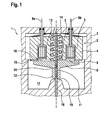
- the figure shows a section through an inventively designed solenoid valve.
- the single FIGURE shows a section through a solenoid valve 1, with which in particular a fuel injector of a common rail injection system is operated for a particular diesel engine fueled internal combustion engine.
- the fuel diesel fuel
- the solenoid valve 1 has a magnet assembly 2, which consists of a Magnetkerninnenpol 3 and a Magnetkernau touchpol 4. Between the Magnetkerninnenpol 3 and the Magnetkernau touchpol 4 a solenoid 5 is arranged.
- Their electrical connections 6a, 6b are liquid-tight by a housing 7, in which the magnet assembly 2 and the other components of the solenoid valve 1 are arranged out.
- the end face 8 of Magnetkerninnenpols 3 and the Magnetkernau combinpols 4 opposite is an anchor plate 9, in which a central through hole 10 is recessed and an anchor bolt 11 is inserted.
- An anchor seat 12 of the anchor plate 9 closes a fuel system under pressure control chamber or relieves the control room in a valve chamber 17.
- the valve chamber 17 is connected via a connecting line 18 to the control room. Due to the switching positions of the solenoid valve 1, the control chamber is pressurized or depressurized.
- the control chamber further cooperates with a valve needle of the fuel injector, which is axially displaced as a result of the different pressures in the control chamber and in an open position injection openings in the fuel injector releases through which standing under system pressure fuel flows into the associated combustion chamber of the internal combustion engine.
- the anchor bolt 11 protrudes through a central opening 13 of the Magnetkerninnenpols 3 and is surrounded in this area by a valve spring 14.
- the valve spring 14 is supported on an example removable cover wall of the housing 7 and exerts a compressive force on the anchor plate 9, which is thus moved away from the magnet assembly 2 and is pressed with the anchor seat 12 on a seat 19.
- the armature plate 9 is moved against the force of the valve spring 14 on the magnet assembly 2.
- the anchor plate 9 can only be moved so far in the direction of the magnet assembly 2 until it rests against a disposed between the magnet assembly 2 and the anchor plate 7 residual air gap disk 15.
- the residual air gap disk 15 sealingly abuts against the magnetic core outer pole 4 and prevents, among other things, an afterflow of fuel through the gap existing between the armature plate 9 and the housing 7 into a residual air gap 16.
- This embodiment avoids seat bouncing of the armature plate 9 moved towards the magnet assembly 2 . It should be noted that the sometimes very large pressure differences between the magnet assembly 2 facing anchor plate top and anchor plate underside can lead to the closing process of the anchor plate 9 from the outside nachströmende fuel large forces and accelerations on the anchor plate 9 exerts, for example, to a Seat bouncing of the anchor plate 9 can lead.
- the residual air gap disk 15 is now preferably made entirely from an amorphous material.
- the anchor plate 9 are coated on the side facing the residual air gap 16, as well as the outer region of the Magnetkerninnenpols 3 and / or the Magnetkernau touchpols 4 facing the residual air gap disk 15 with an amorphous material.
- the coating thickness or the thickness of the entire residual air gap disk 15 is in a range of 0.01 mm to 0.05 mm, in particular in the range of 0.02 mm to 0.04 mm.
- a residual air gap 16 is realized with a thickness of about 0.02 mm. This is achieved here by means of a residual air gap disk 15 with a thickness of 0.05 mm with an armature plate 9 (or magnet assembly 2) stepped in the vicinity of the residual air gap 16, stepped by 0.03 mm. Because of the lower processing costs, the first variant is usually more advantageous. It is finally pointed out that the representation of the thickness of the residual air gap 16 on the left and the right side of the drawing is not shown to scale to each other.
Landscapes
- Engineering & Computer Science (AREA)
- Physics & Mathematics (AREA)
- Chemical & Material Sciences (AREA)
- Combustion & Propulsion (AREA)
- Mechanical Engineering (AREA)
- General Engineering & Computer Science (AREA)
- Electromagnetism (AREA)
- Power Engineering (AREA)
- Fluid Mechanics (AREA)
- Magnetically Actuated Valves (AREA)
Abstract
Description
- Die vorliegende Erfindung betrifft ein Magnetventil mit einer Magnetbaugruppe, aufweisen eine Ankerspule und einen Ankerkern bestehend aus einem Magnetkerninnenpol und einem Magnetkernaußenpol, ferner aufweisen eine Ankerplatte sowie einen Ankerbolzen, einen durch eine Restluftspaltscheibe gebildeten Anschlag im Bereich einer Stirnseite des ankerplattenseitigen Magnetkerns, wobei weiterhin zwischen der Ankerplatte und dem Magnetkern ein Restluftspalt besteht. Ferner betrifft die Erfindung ein Herstellungsverfahren für ein derartiges Magnetventil.
- Ein derartiges Magnetventil ist aus der
DE 10 2008 040 073 A1 bekannt. Mit diesem Magnetventil soll eine Stabilisierung, dass heißt eine erhebliche Verbesserung der Reproduzierbarkeit der Schaltvorgänge eines Magnetventils zur Betätigung eines Kraftstoffinjektors erreicht werden, ohne dass hierzu spezielle Prozessschritte erforderlich sind und zusätzliche Kosten bewirkt werden. Dies wird dadurch erreicht, dass die Stirnseite des Magnetkerns oder eine Stirnseite einer dem Magnetkern gegenüberliegenden Ankerplattenfläche zumindest in einem bestimmten Bereich eine von einer planen Fläche abweichende geneigte und/oder kurvenförmig verlaufende Fläche aufweist. - Ein weiteres Magnetventil ist aus der
DE 10 2009 003 213 A1 bekannt. Dieses Magnetventil weist eine Restluftspaltscheibe auf, die durch Kraftschluss an Einklemmstellen an der der Ankerplatte zuweisenden Stirnseite des Magnetkerns anliegend an einer Magnethülse fixiert ist. Die Restluftspaltscheibe ist aus einem ferromagnetischen oder nicht-magnetischen Material, beispielsweise einer metallischen Folie, mit einer einfachen Geometrie hergestellt. Durch die Fixierung der Restluftspaltscheibe an Einklemmstellen durch Kraftschluss wird die Restluftspaltscheibe nach der Montage der Magnetbaugruppe und vor der Injektormontage eingebaut, wodurch der gesamte Montageablauf nicht gestört wird und demnach vereinfacht ist. Zur Befestigung weist die Restluftspaltscheibe vorstehende Zungen auf, die bei dem Einbauvorgang an den Einklemmstellen aufgebogen werden. Neben den Zungen und am äußeren Umfang des Restluftspalts verbleibt ein Spalt zur Magnethülse. - Der Erfindung liegt die Aufgabe zugrunde, ein Magnetventil bereitzustellen, das hinsichtlich seiner Haltbarkeit verbessert ist. Weiterhin soll ein entsprechendes Herstellungsverfahren für ein derartiges Magnetventil angegeben werden.
- Diese Aufgabe wird dadurch gelöst, dass zumindest ein Teilbereich zumindest eines Bauteils aus der in dem Bereich des Restluftspalts zusammenwirkenden Bauteilgruppe Magnetkerninnenpol, Magnetkernaußenpol, Restluftspaltscheibe, Ankerscheibe, aus einem nicht-kristallinen Material gefertigt ist. Das entsprechende Herstellungsverfahren für ein Magnetventil sieht vor, zumindest einen Teilbereich zumindest eines Bauteils aus der in dem Bereich des Restluftspalts zusammenwirkenden Bauteilgruppe Magnetkerninnenpol, Magnetkernaußenpol, Restluftspaltscheibe, Ankerplatte, aus einem nicht-kristallinen Material zu fertigen. Dabei ist das nicht-kristalline Material in bevorzugter Weiterbildung ein amorphes Metall. Ein amorphes Metall, oder auch metallisches Glas genannt, ist eine Legierung, die auf atomarer Ebene keine kristalline, sondern eine amorphe Struktur aufweist. Diese für ein Metall sehr ungewöhnliche Atomanordnung hat eine einzigartige Kombination physikalischer Eigenschaften zur Folge. Insbesondere ist ein amorphes Metall oder metallisches Glas härter, korrosionsbeständiger und fester als ein gewöhnliches Metall. Diese Eigenschaften gewährleisten, dass ein Magnetventil in dem durch abwechselndes Aufeinanderschlagen und wieder Lösen der Bauteile hochbelasteten Bereich hinsichtlich seiner Haltbarkeit deutlich verbessert ist.
- In Weiterbildung der Erfindung weist das amorphe Metall eine hohe magnetische Permeabilität auf. Hierzu wird das amorphe Metall gezielt aus der Gruppe der magnetischen Metalle ausgewählt.
- In weiterer Ausgestaltung weist das amorphe Metall eine geringe magnetische Hysterese auf.
- Durch diese erfindungsgemäße Ausbildung bzw. Auswahl werden zusammenfassend folgende nicht zu erwartende Vorteile erreicht:
- es wird eine gegenüber einem aus einem kristallinen Metall gefertigten Bauteil eines Magnetventils deutlich verbesserte Haltbarkeit der belasteten Teile, insbesondere der periodisch zueinander bewegten Bauteile erreicht,
- es wird ein Magnetventil mit optimalen magnetischen Eigenschaften ohne Hysterese-Einfluss und mit zumindest stark reduzierten Wirbelstromverlusten beim Bestromen des Magnetkreises dargestellt,
- durch die höhere Festigkeit der Bauteile kann bei gleichbleibender Belastung mit reduzierter Masse konstruiert werden, wodurch kürzere Schaltzeiten des Magnetventils ermöglicht werden.
- In Weiterbildung der Erfindung weist die Restluftspaltscheibe eine Dicke von 0,01 mm bis 0,05 mm, insbesondere von 0,02 mm bis 0,04 mm auf. Zusätzlich oder alternativ weist der Magnetkerninnenpol und/oder der Magnetkernaußenpol auf der Restluftspaltseite eine Beschichtung mit einer Dicke von 0,01 mm bis 0,05 mm, insbesondere von 0,02 mm bis 0,04 mm auf.
- Schließlich weist in alternativer oder weiterer Ausgestaltung die Ankerplatte auf der Restluftspaltscheibenseite eine Beschichtung mit einer Dicke von 0,01 mm bis 0,05 mm, insbesondere von 0,02 mm bis 0,04 mm auf. Allen diesen Ausgestaltungen, die ausdrücklich als Einzelausgestaltungen oder beliebige Kombinationen darstellbar sind, gewährleisten die zuvor genannten Vorteile hinsichtlich der Haltbarkeit und auch der magnetischen Eigenschaften. Insbesondere ist es durch diese Ausgestaltungen - ohne die Haltbarkeit des Magnetventils zu beeinträchtigen - möglich, den Restluftspalt bis auf ein Maß von circa 0,02 mm zu reduzieren. Dies erfolgt entweder durch eine Restluftspaltscheibe mit einer Dicke von 0,02 mm bei einer ebenen Ankerplatte oder Magnetbaugruppe im Bereich des Restluftspalts oder aber durch eine Restluftspaltscheibe mit einer Dicke von 0,05 mm bei einer um 0,03 mm gestuften Ankerplatte oder Magnetbaugruppe im Bereich des Restluftspalts. Im Rahmen der Erfindung sind aber auch beliebige andere Kombinationen in dem angegebenen Maßbereich denkbar.
- In vorteilhafter Weiterbildung der Erfindung wird das erfindungsgemäß ausgestaltete bzw. hergestellte Magnetventil bei einem Injektor eines Common-Rail-Einspritzsystems einer Brennkraftmaschine eingesetzt, mit dem aus einem Vorratsspeicher entnommener Kraftstoff mit einem Druck ab vorzugsweise mehr als 1600 bar in einen Brennraum einer Brennkraftmaschine eingespritzt wird.
- Vorteilhafte Weiterbildungen der Erfindung sind der Zeichnungsbeschreibung zu entnehmen, in der ein in der Figur dargestelltes Ausführungsbeispiel näher beschrieben ist.
- Die Figur zeigt einen Schnitt durch ein erfindungsgemäß ausgestaltetes Magnetventil.
- Die einzige Figur zeigt einen Schnitt durch ein Magnetventil 1, mit dem insbesondere ein Kraftstoffinjektor eines Common-Rail-Einspritzsystems für eine insbesondere mit Dieselkraftstoff betriebene Brennkraftmaschine betätigt wird. Der Kraftstoff (Dieselkraftstoff) wird einem Hochdruckspeicher unter einem Druck ab 1600 bar entnommen und von dem Kraftstoffinjektor in einen zugeordneten Brennraum der Brennkraftmaschine eingespritzt. Das Magnetventil 1 weist eine Magnetbaugruppe 2 auf, die aus einem Magnetkerninnenpol 3 und aus einem Magnetkernaußenpol 4 besteht. Zwischen dem Magnetkerninnenpol 3 und dem Magnetkernaußenpol 4 ist eine Magnetspule 5 angeordnet. Deren elektrische Anschlüsse 6a, 6b sind flüssigkeitsdicht durch ein Gehäuse 7, in dem die Magnetbaugruppe 2 und die weiteren Bauteile des Magnetventils 1 angeordnet sind, geführt.
- Der Stirnseite 8 des Magnetkerninnenpols 3 und des Magnetkernaußenpols 4 gegenüberliegend befindet sich eine Ankerplatte 9, in die eine zentrale Durchgangsöffnung 10 eingelassen ist und die ein Ankerbolzen 11 eingesetzt ist. Ein Ankersitz 12 der Ankerplatte 9 verschließt einen unter Kraftstoffsystemdruck stehenden Steuerraum oder entlastet den Steuerraum in einen Ventilraum 17. Der Ventilraum 17 ist über eine Verbindungsleitung 18 mit dem Steuerraum verschaltet. Durch die Schaltstellungen des Magnetventils 1 ist der Steuerraum druckbeaufschlagt oder druckentlastet. Der Steuerraum wirkt weiter mit einer Ventilnadel des Kraftstoffinjektors zusammen, die in Folge der unterschiedlichen Drucke in dem Steuerraum axial verschoben wird und in einer geöffneten Position Einspritzöffnungen in dem Kraftstoffinjektor freigibt, durch die unter Systemdruck stehender Kraftstoff in den zugehörigen Brennraum der Brennkraftmaschine einströmt.
- Der Ankerbolzen 11 ragt durch eine zentrale Öffnung 13 des Magnetkerninnenpols 3 hindurch und ist in diesem Bereich von einer Ventilfeder 14 umgeben. Die Ventilfeder 14 ist an einer beispielsweise abnehmbaren Deckelwand des Gehäuses 7 abgestützt und übt eine Druckkraft auf die Ankerplatte 9 aus, die somit von der Magnetbaugruppe 2 wegbewegt wird und mit dem Ankersitz 12 auf einen Sitz 19 gepresst wird.
- Wird die Magnetspule 5 bestromt, wird die Ankerplatte 9 gegen die Kraft der Ventilfeder 14 auf die Magnetbaugruppe 2 zubewegt. Dabei kann die Ankerplatte 9 nur soweit in Richtung auf die Magnetbaugruppe 2 bewegt werden, bis sie an einer zwischen der Magnetbaugruppe 2 und der Ankerplatte 7 angeordneten Restluftspaltscheibe 15 anliegt. Die Restluftspaltscheibe 15 liegt dichtend an dem Magnetkernaußenpol 4 an und verhindert unter Anderem ein Nachströmen von Kraftstoff durch den zwischen der Ankerplatte 9 und dem Gehäuse 7 bestehenden Spalt in einen Restluftspalt 16. Durch diese Ausgestaltung wird ein Sitzprellen der auf die Magnetbaugruppe 2 zubewegten Ankerplatte 9 vermieden. Hierbei ist zu berücksichtigen, dass die zum Teil sehr großen Druckunterschiede zwischen der der Magnetbaugruppe 2 zugewandten Ankerplattenoberseite und Ankerplattenunterseite dazu führen können, dass beim Schließvorgang der Ankerplatte 9 der von außen nachströmende Kraftstoff große Kräfte und Beschleunigungen auf die Ankerplatte 9 ausübt, die beispielsweise zu einem Sitzprellen der Ankerplatte 9 führen können.
- Im Rahmen der Erfindung ist nun die Restluftspaltscheibe 15 vorzugsweise vollständig aus einem amorphen Material gefertigt. Alternativ oder zusätzlich sind die Ankerplatte 9 auf der dem Restluftspalt 16 zugewandten Seite ebenso wie der der Restluftspaltscheibe 15 zugewandte Außenbereich des Magnetkerninnenpols 3 und/oder des Magnetkernaußenpols 4 mit einem amorphen Material beschichtet. Die Beschichtungsdicke bzw. die Dicke der gesamten Restluftspaltscheibe 15 liegt in einem Bereich von 0,01 mm bis 0,05 mm, insbesondere im Bereich von 0,02 mm bis 0,04 mm. Dadurch wird die Haltbarkeit der genannten Bauteile in dem zusammenwirkenden Bereich deutlich verbessert und auch werden die magnetischen Eigenschaften des Magnetventils 1 insgesamt verbessert.
- Insbesondere ist es durch diese Ausgestaltungen - ohne die Haltbarkeit des Magnetventils zu beeinträchtigen - möglich, den Restluftspalt 16 bis auf ein Maß von circa 0,02 mm zu reduzieren. Dies erfolgt entweder durch eine Restluftspaltscheibe 15 mit einer Dicke von 0,02 mm bei einer ebenen Ankerplatte 9 oder Magnetbaugruppe 2 im Bereich des Restluftspalts 16. Diese Ausführung ist auf der linken Seite der
Figur 1 dargestellt. - Auf der rechten Seite der
Figur 1 wird ebenfalls ein Restluftspalt 16 mit einer Dicke von circa 0,02 mm realisiert. Dies wird hier durch eine Restluftspaltscheibe 15 mit einer Dicke von 0,05 mm bei einer um 0,03 mm gestuften Ankerplatte 9 (oder Magnetbaugruppe2) im Bereich des Restluftspalts 16 erreicht. Wegen der geringeren Bearbeitungskosten ist die erste Variante normalerweise vorteilhafter. Es wird abschließend darauf hingewiesen, dass die Darstellung der Dicke des Restluftspalts 16 auf der linken und der rechten Seite der Zeichnung nicht maßstäblich zueinander dargestellt ist.
Claims (8)
- Magnetventil (1) mit einer Magnetbaugruppe (2), aufweisend eine Magnetspule (5) und einen Magnetkern bestehend aus einem Magnetkerninnenpol (3) und einem Magnetkernaußenpol (4), ferner aufweisend eine Ankerplatte (9) sowie einen Ankerbolzen (11), einen durch eine Restluftspaltscheibe (15) gebildeten Anschlag im Bereich einer Stirnseite (8) des ankerplattenseitigen Magnetkerns, wobei weiterhin zwischen der Ankerplatte (9) und dem Magnetkern ein Restluftspalt (16) besteht,
dadurch gekennzeichnet, dass zumindest ein Teilbereich zumindest eines Bauteils aus der in dem Bereich des Restluftspalts (16) zusammenwirkenden Bauteilgruppe Magnetkerninnenpol (3), Magnetkernaußenpol (4), Restluftspaltscheibe (15) und/oder Ankerplatte (9) aus einem nicht-kristallinen Material gefertigt ist. - Magnetventil (1) nach Anspruch 1,
dadurch gekennzeichnet, dass das Material ein amorphes Metall ist. - Magnetventil (1) nach Anspruch 2,
dadurch gekennzeichnet, dass das amorphe Metall eine hohe magnetische Permeabilität aufweist. - Magnetventil (1) nach Anspruch 2 oder 3,
dadurch gekennzeichnet, dass das amorphe Metall eine geringe Hysterese aufweist. - Magnetventil (1) nach einem der Ansprüche 2 bis 4,
dadurch gekennzeichnet, dass die Restluftspaltscheibe (15) eine Dicke von 0,01 mm bis 0,05 mm, insbesondere von 0,02 mm bis 0,04 mm aufweist. - Magnetventil (1) nach einem der Ansprüche 2 bis 5,
dadurch gekennzeichnet, dass der Magnetkerninnenpol (3) und der Magnetkernaußenpol (4) auf der Restluftspaltseite eine Beschichtung mit einer Dicke von 0,01 mm bis 0,05 mm, insbesondere von 0,02 mm bis 0,04 mm aufweisen. - Magnetventil (1) nach einem der vorherigen Ansprüche für einen Injektor eines Common-Rail-Einspritzsystems.
- Herstellungsverfahren für ein Magnetventil (1) mit einer Magnetbaugruppe (2), aufweisend eine Magnetspule (5) und einen Magnetkern bestehend aus einem Magnetkerninnenpol (3) und einem Magnetkernaußenpol (4), ferner aufweisend eine Ankerplatte (9) sowie einen Ankerbolzen (11), einen durch eine Restluftspaltscheibe (15) gebildeten Anschlag im Bereich einer Stirnseite (8) des ankerplattenseitigen Magnetkerns, wobei weiterhin zwischen der Ankerplatte (9) und dem Magnetkern ein Restluftspalt (16) besteht, dadurch gekennzeichnet, dass zumindest ein Teilbereich zumindest eines Bauteils aus der in dem Bereich des Restluftspalts (16) zusammenwirkenden Bauteilgruppe Magnetkerninnenpol (3), Magnetkernaußenpol (4), Restluftspaltscheibe (15) und/oder Ankerplatte (9) aus einem nicht-kristallinen Material gefertigt wird.
Applications Claiming Priority (1)
| Application Number | Priority Date | Filing Date | Title |
|---|---|---|---|
| DE102011077350A DE102011077350A1 (de) | 2011-06-10 | 2011-06-10 | Magnetventil mit einer Magnetbaugruppe |
Publications (1)
| Publication Number | Publication Date |
|---|---|
| EP2533256A1 true EP2533256A1 (de) | 2012-12-12 |
Family
ID=46275688
Family Applications (1)
| Application Number | Title | Priority Date | Filing Date |
|---|---|---|---|
| EP12169076A Withdrawn EP2533256A1 (de) | 2011-06-10 | 2012-05-23 | Magnetventil mit einer Magnetbaugruppe |
Country Status (2)
| Country | Link |
|---|---|
| EP (1) | EP2533256A1 (de) |
| DE (1) | DE102011077350A1 (de) |
Cited By (1)
| Publication number | Priority date | Publication date | Assignee | Title |
|---|---|---|---|---|
| WO2023001498A1 (de) * | 2021-07-23 | 2023-01-26 | Robert Bosch Gmbh | Ventilvorrichtung zum steuern eines gasförmigen mediums |
Families Citing this family (2)
| Publication number | Priority date | Publication date | Assignee | Title |
|---|---|---|---|---|
| DE102013100440A1 (de) | 2013-01-16 | 2014-07-17 | Kendrion (Villingen) Gmbh | Hochdruckventil |
| DE102021133281A1 (de) | 2021-12-15 | 2023-06-15 | Liebherr-Components Deggendorf Gmbh | Elektromagnetventil, insbesondere zum Schalten eines Kraftstoffinjektors |
Citations (4)
| Publication number | Priority date | Publication date | Assignee | Title |
|---|---|---|---|---|
| JPS60151477A (ja) * | 1984-01-18 | 1985-08-09 | Fuji Electric Corp Res & Dev Ltd | 電磁弁 |
| DE60017427T2 (de) * | 2000-12-19 | 2006-01-26 | Fluid Automation Systems S.A. | Elektromagnetventil |
| DE102008040073A1 (de) | 2008-07-02 | 2010-01-07 | Robert Bosch Gmbh | Luftspaltbegrenzung bei Magnetventil |
| DE102009003213A1 (de) | 2009-05-19 | 2010-11-25 | Robert Bosch Gmbh | Restluftspaltscheibe |
-
2011
- 2011-06-10 DE DE102011077350A patent/DE102011077350A1/de not_active Withdrawn
-
2012
- 2012-05-23 EP EP12169076A patent/EP2533256A1/de not_active Withdrawn
Patent Citations (4)
| Publication number | Priority date | Publication date | Assignee | Title |
|---|---|---|---|---|
| JPS60151477A (ja) * | 1984-01-18 | 1985-08-09 | Fuji Electric Corp Res & Dev Ltd | 電磁弁 |
| DE60017427T2 (de) * | 2000-12-19 | 2006-01-26 | Fluid Automation Systems S.A. | Elektromagnetventil |
| DE102008040073A1 (de) | 2008-07-02 | 2010-01-07 | Robert Bosch Gmbh | Luftspaltbegrenzung bei Magnetventil |
| DE102009003213A1 (de) | 2009-05-19 | 2010-11-25 | Robert Bosch Gmbh | Restluftspaltscheibe |
Non-Patent Citations (2)
| Title |
|---|
| ASAMI K ET AL: "Surface vitrification of Fe-based alloys by laser treatment", JOURNAL OF NON-CRYSTALLINE SOLIDS, NORTH-HOLLAND PHYSICS PUBLISHING. AMSTERDAM, NL, vol. 68, no. 2-3, 1 November 1984 (1984-11-01), pages 261 - 269, XP022841657, ISSN: 0022-3093, [retrieved on 19841101], DOI: 10.1016/0022-3093(84)90010-3 * |
| BECKER R ET AL: "Production of amorphous Fe-Ni-P-B alloy by means of a high-power CO2 laser", SCRIPTA METALLURGICA, ELSEVIER SCIENCE LTD., KIDLINGTON, GB, vol. 14, no. 12, 1 December 1980 (1980-12-01), pages 1283 - 1285, XP022738535, ISSN: 0036-9748, [retrieved on 19801201], DOI: 10.1016/0036-9748(80)90179-9 * |
Cited By (1)
| Publication number | Priority date | Publication date | Assignee | Title |
|---|---|---|---|---|
| WO2023001498A1 (de) * | 2021-07-23 | 2023-01-26 | Robert Bosch Gmbh | Ventilvorrichtung zum steuern eines gasförmigen mediums |
Also Published As
| Publication number | Publication date |
|---|---|
| DE102011077350A1 (de) | 2012-12-13 |
Similar Documents
| Publication | Publication Date | Title |
|---|---|---|
| EP2586042B1 (de) | MINIMIERUNG DES ANKERSCHLIEßPRELLENS DURCH EIN VERZÖGERUNGSGLIED IM RESTLUFTSPALT | |
| EP2634412B1 (de) | Einspritzventil | |
| DE102007060395A1 (de) | Schaltventil für Injektoren | |
| DE102009001706A1 (de) | Restluftspaltscheibe | |
| DE102011013702A1 (de) | Elektromagnetischer Aktor | |
| DE112011104463T5 (de) | Solenoidaktuator und Kraftstoffinjektor mit demselben | |
| DE102009012688B3 (de) | Ventil zum Einblasen von Gas | |
| DE102011078407A1 (de) | Schaltventil zur Steuerung eines Kraftstoffinjektors und Kraftstoffinjektor | |
| DE102016205358A1 (de) | Injektor zum Einblasen eines gasförmigen Brennstoffs in einen Brennraum | |
| DE102007044356A1 (de) | Injektor | |
| EP2533256A1 (de) | Magnetventil mit einer Magnetbaugruppe | |
| DE102010040401A1 (de) | Kraftstoffinjektor | |
| DE102010041109A1 (de) | Kraftstoffinjektor | |
| EP2855916A1 (de) | Kraftstoffinjektor | |
| DE102007044361A1 (de) | Steuerventil für einen Kraftstoffinjektor | |
| DE102015218293A1 (de) | Magnetventil mit einem Anker mit beweglicher Stufe | |
| DE102012206215A1 (de) | Magnetbaugruppe, insbesondere für ein Magnetventil eines Kraftstoffinjektors | |
| DE102012220031A1 (de) | Kraftstoffinjektor | |
| EP2859216A1 (de) | Druckregelventil | |
| DE102011086284A1 (de) | Magnetventil mit einer Magnetbaugruppe | |
| DE102010030429A1 (de) | Injektor, insbesondere Common-Rail-Injektor | |
| DE102007001550A1 (de) | Injektor zum Einspritzen von Kraftstoff | |
| DE102006020724A1 (de) | Magnetventil mit selbstzentrierendem Ankerbolzen | |
| EP2438288B1 (de) | Schaltventil | |
| DE102011004008A1 (de) | Zumesseinheit sowie Kraftstoffhochdruckpumpe mit einer solchen Zumesseinheit |
Legal Events
| Date | Code | Title | Description |
|---|---|---|---|
| PUAI | Public reference made under article 153(3) epc to a published international application that has entered the european phase |
Free format text: ORIGINAL CODE: 0009012 |
|
| AK | Designated contracting states |
Kind code of ref document: A1 Designated state(s): AL AT BE BG CH CY CZ DE DK EE ES FI FR GB GR HR HU IE IS IT LI LT LU LV MC MK MT NL NO PL PT RO RS SE SI SK SM TR |
|
| AX | Request for extension of the european patent |
Extension state: BA ME |
|
| 17P | Request for examination filed |
Effective date: 20130612 |
|
| RBV | Designated contracting states (corrected) |
Designated state(s): AL AT BE BG CH CY CZ DE DK EE ES FI FR GB GR HR HU IE IS IT LI LT LU LV MC MK MT NL NO PL PT RO RS SE SI SK SM TR |
|
| 17Q | First examination report despatched |
Effective date: 20171130 |
|
| STAA | Information on the status of an ep patent application or granted ep patent |
Free format text: STATUS: THE APPLICATION IS DEEMED TO BE WITHDRAWN |
|
| 18D | Application deemed to be withdrawn |
Effective date: 20180612 |