EP2531342B1 - Procede de realisation par soudure d'un article textile enduit - Google Patents
Procede de realisation par soudure d'un article textile enduit Download PDFInfo
- Publication number
- EP2531342B1 EP2531342B1 EP11705924.6A EP11705924A EP2531342B1 EP 2531342 B1 EP2531342 B1 EP 2531342B1 EP 11705924 A EP11705924 A EP 11705924A EP 2531342 B1 EP2531342 B1 EP 2531342B1
- Authority
- EP
- European Patent Office
- Prior art keywords
- elastic
- textile
- article
- connecting piece
- material layer
- Prior art date
- Legal status (The legal status is an assumption and is not a legal conclusion. Google has not performed a legal analysis and makes no representation as to the accuracy of the status listed.)
- Active
Links
Images
Classifications
-
- B—PERFORMING OPERATIONS; TRANSPORTING
- B29—WORKING OF PLASTICS; WORKING OF SUBSTANCES IN A PLASTIC STATE IN GENERAL
- B29C—SHAPING OR JOINING OF PLASTICS; SHAPING OF MATERIAL IN A PLASTIC STATE, NOT OTHERWISE PROVIDED FOR; AFTER-TREATMENT OF THE SHAPED PRODUCTS, e.g. REPAIRING
- B29C66/00—General aspects of processes or apparatus for joining preformed parts
- B29C66/80—General aspects of machine operations or constructions and parts thereof
- B29C66/83—General aspects of machine operations or constructions and parts thereof characterised by the movement of the joining or pressing tools
- B29C66/834—General aspects of machine operations or constructions and parts thereof characterised by the movement of the joining or pressing tools moving with the parts to be joined
- B29C66/8341—Roller, cylinder or drum types; Band or belt types; Ball types
- B29C66/83411—Roller, cylinder or drum types
-
- B—PERFORMING OPERATIONS; TRANSPORTING
- B29—WORKING OF PLASTICS; WORKING OF SUBSTANCES IN A PLASTIC STATE IN GENERAL
- B29C—SHAPING OR JOINING OF PLASTICS; SHAPING OF MATERIAL IN A PLASTIC STATE, NOT OTHERWISE PROVIDED FOR; AFTER-TREATMENT OF THE SHAPED PRODUCTS, e.g. REPAIRING
- B29C65/00—Joining or sealing of preformed parts, e.g. welding of plastics materials; Apparatus therefor
- B29C65/02—Joining or sealing of preformed parts, e.g. welding of plastics materials; Apparatus therefor by heating, with or without pressure
- B29C65/08—Joining or sealing of preformed parts, e.g. welding of plastics materials; Apparatus therefor by heating, with or without pressure using ultrasonic vibrations
- B29C65/083—Joining or sealing of preformed parts, e.g. welding of plastics materials; Apparatus therefor by heating, with or without pressure using ultrasonic vibrations using a rotary sonotrode or a rotary anvil
- B29C65/086—Joining or sealing of preformed parts, e.g. welding of plastics materials; Apparatus therefor by heating, with or without pressure using ultrasonic vibrations using a rotary sonotrode or a rotary anvil using a rotary anvil
-
- B—PERFORMING OPERATIONS; TRANSPORTING
- B29—WORKING OF PLASTICS; WORKING OF SUBSTANCES IN A PLASTIC STATE IN GENERAL
- B29C—SHAPING OR JOINING OF PLASTICS; SHAPING OF MATERIAL IN A PLASTIC STATE, NOT OTHERWISE PROVIDED FOR; AFTER-TREATMENT OF THE SHAPED PRODUCTS, e.g. REPAIRING
- B29C65/00—Joining or sealing of preformed parts, e.g. welding of plastics materials; Apparatus therefor
- B29C65/48—Joining or sealing of preformed parts, e.g. welding of plastics materials; Apparatus therefor using adhesives, i.e. using supplementary joining material; solvent bonding
- B29C65/4805—Joining or sealing of preformed parts, e.g. welding of plastics materials; Apparatus therefor using adhesives, i.e. using supplementary joining material; solvent bonding characterised by the type of adhesives
- B29C65/481—Non-reactive adhesives, e.g. physically hardening adhesives
- B29C65/4815—Hot melt adhesives, e.g. thermoplastic adhesives
-
- B—PERFORMING OPERATIONS; TRANSPORTING
- B29—WORKING OF PLASTICS; WORKING OF SUBSTANCES IN A PLASTIC STATE IN GENERAL
- B29C—SHAPING OR JOINING OF PLASTICS; SHAPING OF MATERIAL IN A PLASTIC STATE, NOT OTHERWISE PROVIDED FOR; AFTER-TREATMENT OF THE SHAPED PRODUCTS, e.g. REPAIRING
- B29C65/00—Joining or sealing of preformed parts, e.g. welding of plastics materials; Apparatus therefor
- B29C65/48—Joining or sealing of preformed parts, e.g. welding of plastics materials; Apparatus therefor using adhesives, i.e. using supplementary joining material; solvent bonding
- B29C65/50—Joining or sealing of preformed parts, e.g. welding of plastics materials; Apparatus therefor using adhesives, i.e. using supplementary joining material; solvent bonding using adhesive tape, e.g. thermoplastic tape; using threads or the like
- B29C65/5007—Joining or sealing of preformed parts, e.g. welding of plastics materials; Apparatus therefor using adhesives, i.e. using supplementary joining material; solvent bonding using adhesive tape, e.g. thermoplastic tape; using threads or the like characterised by the structure of said adhesive tape, threads or the like
- B29C65/5021—Joining or sealing of preformed parts, e.g. welding of plastics materials; Apparatus therefor using adhesives, i.e. using supplementary joining material; solvent bonding using adhesive tape, e.g. thermoplastic tape; using threads or the like characterised by the structure of said adhesive tape, threads or the like being multi-layered
-
- B—PERFORMING OPERATIONS; TRANSPORTING
- B29—WORKING OF PLASTICS; WORKING OF SUBSTANCES IN A PLASTIC STATE IN GENERAL
- B29C—SHAPING OR JOINING OF PLASTICS; SHAPING OF MATERIAL IN A PLASTIC STATE, NOT OTHERWISE PROVIDED FOR; AFTER-TREATMENT OF THE SHAPED PRODUCTS, e.g. REPAIRING
- B29C65/00—Joining or sealing of preformed parts, e.g. welding of plastics materials; Apparatus therefor
- B29C65/48—Joining or sealing of preformed parts, e.g. welding of plastics materials; Apparatus therefor using adhesives, i.e. using supplementary joining material; solvent bonding
- B29C65/50—Joining or sealing of preformed parts, e.g. welding of plastics materials; Apparatus therefor using adhesives, i.e. using supplementary joining material; solvent bonding using adhesive tape, e.g. thermoplastic tape; using threads or the like
- B29C65/5007—Joining or sealing of preformed parts, e.g. welding of plastics materials; Apparatus therefor using adhesives, i.e. using supplementary joining material; solvent bonding using adhesive tape, e.g. thermoplastic tape; using threads or the like characterised by the structure of said adhesive tape, threads or the like
- B29C65/5028—Joining or sealing of preformed parts, e.g. welding of plastics materials; Apparatus therefor using adhesives, i.e. using supplementary joining material; solvent bonding using adhesive tape, e.g. thermoplastic tape; using threads or the like characterised by the structure of said adhesive tape, threads or the like being textile in woven or non-woven form
-
- B—PERFORMING OPERATIONS; TRANSPORTING
- B29—WORKING OF PLASTICS; WORKING OF SUBSTANCES IN A PLASTIC STATE IN GENERAL
- B29C—SHAPING OR JOINING OF PLASTICS; SHAPING OF MATERIAL IN A PLASTIC STATE, NOT OTHERWISE PROVIDED FOR; AFTER-TREATMENT OF THE SHAPED PRODUCTS, e.g. REPAIRING
- B29C65/00—Joining or sealing of preformed parts, e.g. welding of plastics materials; Apparatus therefor
- B29C65/48—Joining or sealing of preformed parts, e.g. welding of plastics materials; Apparatus therefor using adhesives, i.e. using supplementary joining material; solvent bonding
- B29C65/50—Joining or sealing of preformed parts, e.g. welding of plastics materials; Apparatus therefor using adhesives, i.e. using supplementary joining material; solvent bonding using adhesive tape, e.g. thermoplastic tape; using threads or the like
- B29C65/5042—Joining or sealing of preformed parts, e.g. welding of plastics materials; Apparatus therefor using adhesives, i.e. using supplementary joining material; solvent bonding using adhesive tape, e.g. thermoplastic tape; using threads or the like covering both elements to be joined
-
- B—PERFORMING OPERATIONS; TRANSPORTING
- B29—WORKING OF PLASTICS; WORKING OF SUBSTANCES IN A PLASTIC STATE IN GENERAL
- B29C—SHAPING OR JOINING OF PLASTICS; SHAPING OF MATERIAL IN A PLASTIC STATE, NOT OTHERWISE PROVIDED FOR; AFTER-TREATMENT OF THE SHAPED PRODUCTS, e.g. REPAIRING
- B29C65/00—Joining or sealing of preformed parts, e.g. welding of plastics materials; Apparatus therefor
- B29C65/72—Joining or sealing of preformed parts, e.g. welding of plastics materials; Apparatus therefor by combined operations or combined techniques, e.g. welding and stitching
-
- B—PERFORMING OPERATIONS; TRANSPORTING
- B29—WORKING OF PLASTICS; WORKING OF SUBSTANCES IN A PLASTIC STATE IN GENERAL
- B29C—SHAPING OR JOINING OF PLASTICS; SHAPING OF MATERIAL IN A PLASTIC STATE, NOT OTHERWISE PROVIDED FOR; AFTER-TREATMENT OF THE SHAPED PRODUCTS, e.g. REPAIRING
- B29C65/00—Joining or sealing of preformed parts, e.g. welding of plastics materials; Apparatus therefor
- B29C65/74—Joining or sealing of preformed parts, e.g. welding of plastics materials; Apparatus therefor by welding and severing, or by joining and severing, the severing being performed in the area to be joined, next to the area to be joined, in the joint area or next to the joint area
- B29C65/743—Joining or sealing of preformed parts, e.g. welding of plastics materials; Apparatus therefor by welding and severing, or by joining and severing, the severing being performed in the area to be joined, next to the area to be joined, in the joint area or next to the joint area using the same tool for both joining and severing, said tool being monobloc or formed by several parts mounted together and forming a monobloc
- B29C65/7435—Joining or sealing of preformed parts, e.g. welding of plastics materials; Apparatus therefor by welding and severing, or by joining and severing, the severing being performed in the area to be joined, next to the area to be joined, in the joint area or next to the joint area using the same tool for both joining and severing, said tool being monobloc or formed by several parts mounted together and forming a monobloc the tool being a roller
-
- B—PERFORMING OPERATIONS; TRANSPORTING
- B29—WORKING OF PLASTICS; WORKING OF SUBSTANCES IN A PLASTIC STATE IN GENERAL
- B29C—SHAPING OR JOINING OF PLASTICS; SHAPING OF MATERIAL IN A PLASTIC STATE, NOT OTHERWISE PROVIDED FOR; AFTER-TREATMENT OF THE SHAPED PRODUCTS, e.g. REPAIRING
- B29C65/00—Joining or sealing of preformed parts, e.g. welding of plastics materials; Apparatus therefor
- B29C65/74—Joining or sealing of preformed parts, e.g. welding of plastics materials; Apparatus therefor by welding and severing, or by joining and severing, the severing being performed in the area to be joined, next to the area to be joined, in the joint area or next to the joint area
- B29C65/743—Joining or sealing of preformed parts, e.g. welding of plastics materials; Apparatus therefor by welding and severing, or by joining and severing, the severing being performed in the area to be joined, next to the area to be joined, in the joint area or next to the joint area using the same tool for both joining and severing, said tool being monobloc or formed by several parts mounted together and forming a monobloc
- B29C65/7443—Joining or sealing of preformed parts, e.g. welding of plastics materials; Apparatus therefor by welding and severing, or by joining and severing, the severing being performed in the area to be joined, next to the area to be joined, in the joint area or next to the joint area using the same tool for both joining and severing, said tool being monobloc or formed by several parts mounted together and forming a monobloc by means of ultrasonic vibrations
-
- B—PERFORMING OPERATIONS; TRANSPORTING
- B29—WORKING OF PLASTICS; WORKING OF SUBSTANCES IN A PLASTIC STATE IN GENERAL
- B29C—SHAPING OR JOINING OF PLASTICS; SHAPING OF MATERIAL IN A PLASTIC STATE, NOT OTHERWISE PROVIDED FOR; AFTER-TREATMENT OF THE SHAPED PRODUCTS, e.g. REPAIRING
- B29C66/00—General aspects of processes or apparatus for joining preformed parts
- B29C66/01—General aspects dealing with the joint area or with the area to be joined
- B29C66/03—After-treatments in the joint area
- B29C66/032—Mechanical after-treatments
- B29C66/0324—Reforming or reshaping the joint, e.g. folding over
- B29C66/03241—Flattening
- B29C66/03242—Flattening of sheets being positioned in abutment, e.g. after folding open of an overlap joint
-
- B—PERFORMING OPERATIONS; TRANSPORTING
- B29—WORKING OF PLASTICS; WORKING OF SUBSTANCES IN A PLASTIC STATE IN GENERAL
- B29C—SHAPING OR JOINING OF PLASTICS; SHAPING OF MATERIAL IN A PLASTIC STATE, NOT OTHERWISE PROVIDED FOR; AFTER-TREATMENT OF THE SHAPED PRODUCTS, e.g. REPAIRING
- B29C66/00—General aspects of processes or apparatus for joining preformed parts
- B29C66/01—General aspects dealing with the joint area or with the area to be joined
- B29C66/03—After-treatments in the joint area
- B29C66/038—Covering the joint by a coating material
-
- B—PERFORMING OPERATIONS; TRANSPORTING
- B29—WORKING OF PLASTICS; WORKING OF SUBSTANCES IN A PLASTIC STATE IN GENERAL
- B29C—SHAPING OR JOINING OF PLASTICS; SHAPING OF MATERIAL IN A PLASTIC STATE, NOT OTHERWISE PROVIDED FOR; AFTER-TREATMENT OF THE SHAPED PRODUCTS, e.g. REPAIRING
- B29C66/00—General aspects of processes or apparatus for joining preformed parts
- B29C66/01—General aspects dealing with the joint area or with the area to be joined
- B29C66/03—After-treatments in the joint area
- B29C66/038—Covering the joint by a coating material
- B29C66/0384—Covering the joint by a coating material the coating material being in tape, strip or band form
-
- B—PERFORMING OPERATIONS; TRANSPORTING
- B29—WORKING OF PLASTICS; WORKING OF SUBSTANCES IN A PLASTIC STATE IN GENERAL
- B29C—SHAPING OR JOINING OF PLASTICS; SHAPING OF MATERIAL IN A PLASTIC STATE, NOT OTHERWISE PROVIDED FOR; AFTER-TREATMENT OF THE SHAPED PRODUCTS, e.g. REPAIRING
- B29C66/00—General aspects of processes or apparatus for joining preformed parts
- B29C66/01—General aspects dealing with the joint area or with the area to be joined
- B29C66/05—Particular design of joint configurations
- B29C66/10—Particular design of joint configurations particular design of the joint cross-sections
- B29C66/11—Joint cross-sections comprising a single joint-segment, i.e. one of the parts to be joined comprising a single joint-segment in the joint cross-section
- B29C66/112—Single lapped joints
- B29C66/1122—Single lap to lap joints, i.e. overlap joints
-
- B—PERFORMING OPERATIONS; TRANSPORTING
- B29—WORKING OF PLASTICS; WORKING OF SUBSTANCES IN A PLASTIC STATE IN GENERAL
- B29C—SHAPING OR JOINING OF PLASTICS; SHAPING OF MATERIAL IN A PLASTIC STATE, NOT OTHERWISE PROVIDED FOR; AFTER-TREATMENT OF THE SHAPED PRODUCTS, e.g. REPAIRING
- B29C66/00—General aspects of processes or apparatus for joining preformed parts
- B29C66/01—General aspects dealing with the joint area or with the area to be joined
- B29C66/05—Particular design of joint configurations
- B29C66/10—Particular design of joint configurations particular design of the joint cross-sections
- B29C66/11—Joint cross-sections comprising a single joint-segment, i.e. one of the parts to be joined comprising a single joint-segment in the joint cross-section
- B29C66/114—Single butt joints
- B29C66/1142—Single butt to butt joints
-
- B—PERFORMING OPERATIONS; TRANSPORTING
- B29—WORKING OF PLASTICS; WORKING OF SUBSTANCES IN A PLASTIC STATE IN GENERAL
- B29C—SHAPING OR JOINING OF PLASTICS; SHAPING OF MATERIAL IN A PLASTIC STATE, NOT OTHERWISE PROVIDED FOR; AFTER-TREATMENT OF THE SHAPED PRODUCTS, e.g. REPAIRING
- B29C66/00—General aspects of processes or apparatus for joining preformed parts
- B29C66/01—General aspects dealing with the joint area or with the area to be joined
- B29C66/05—Particular design of joint configurations
- B29C66/10—Particular design of joint configurations particular design of the joint cross-sections
- B29C66/13—Single flanged joints; Fin-type joints; Single hem joints; Edge joints; Interpenetrating fingered joints; Other specific particular designs of joint cross-sections not provided for in groups B29C66/11 - B29C66/12
-
- B—PERFORMING OPERATIONS; TRANSPORTING
- B29—WORKING OF PLASTICS; WORKING OF SUBSTANCES IN A PLASTIC STATE IN GENERAL
- B29C—SHAPING OR JOINING OF PLASTICS; SHAPING OF MATERIAL IN A PLASTIC STATE, NOT OTHERWISE PROVIDED FOR; AFTER-TREATMENT OF THE SHAPED PRODUCTS, e.g. REPAIRING
- B29C66/00—General aspects of processes or apparatus for joining preformed parts
- B29C66/01—General aspects dealing with the joint area or with the area to be joined
- B29C66/05—Particular design of joint configurations
- B29C66/10—Particular design of joint configurations particular design of the joint cross-sections
- B29C66/13—Single flanged joints; Fin-type joints; Single hem joints; Edge joints; Interpenetrating fingered joints; Other specific particular designs of joint cross-sections not provided for in groups B29C66/11 - B29C66/12
- B29C66/133—Fin-type joints, the parts to be joined being flexible
-
- B—PERFORMING OPERATIONS; TRANSPORTING
- B29—WORKING OF PLASTICS; WORKING OF SUBSTANCES IN A PLASTIC STATE IN GENERAL
- B29C—SHAPING OR JOINING OF PLASTICS; SHAPING OF MATERIAL IN A PLASTIC STATE, NOT OTHERWISE PROVIDED FOR; AFTER-TREATMENT OF THE SHAPED PRODUCTS, e.g. REPAIRING
- B29C66/00—General aspects of processes or apparatus for joining preformed parts
- B29C66/40—General aspects of joining substantially flat articles, e.g. plates, sheets or web-like materials; Making flat seams in tubular or hollow articles; Joining single elements to substantially flat surfaces
- B29C66/41—Joining substantially flat articles ; Making flat seams in tubular or hollow articles
- B29C66/43—Joining a relatively small portion of the surface of said articles
- B29C66/432—Joining a relatively small portion of the surface of said articles for making tubular articles or closed loops, e.g. by joining several sheets ; for making hollow articles or hollow preforms
- B29C66/4322—Joining a relatively small portion of the surface of said articles for making tubular articles or closed loops, e.g. by joining several sheets ; for making hollow articles or hollow preforms by joining a single sheet to itself
-
- B—PERFORMING OPERATIONS; TRANSPORTING
- B29—WORKING OF PLASTICS; WORKING OF SUBSTANCES IN A PLASTIC STATE IN GENERAL
- B29C—SHAPING OR JOINING OF PLASTICS; SHAPING OF MATERIAL IN A PLASTIC STATE, NOT OTHERWISE PROVIDED FOR; AFTER-TREATMENT OF THE SHAPED PRODUCTS, e.g. REPAIRING
- B29C66/00—General aspects of processes or apparatus for joining preformed parts
- B29C66/40—General aspects of joining substantially flat articles, e.g. plates, sheets or web-like materials; Making flat seams in tubular or hollow articles; Joining single elements to substantially flat surfaces
- B29C66/41—Joining substantially flat articles ; Making flat seams in tubular or hollow articles
- B29C66/43—Joining a relatively small portion of the surface of said articles
- B29C66/432—Joining a relatively small portion of the surface of said articles for making tubular articles or closed loops, e.g. by joining several sheets ; for making hollow articles or hollow preforms
- B29C66/4324—Joining a relatively small portion of the surface of said articles for making tubular articles or closed loops, e.g. by joining several sheets ; for making hollow articles or hollow preforms for making closed loops, e.g. belts
-
- B—PERFORMING OPERATIONS; TRANSPORTING
- B29—WORKING OF PLASTICS; WORKING OF SUBSTANCES IN A PLASTIC STATE IN GENERAL
- B29C—SHAPING OR JOINING OF PLASTICS; SHAPING OF MATERIAL IN A PLASTIC STATE, NOT OTHERWISE PROVIDED FOR; AFTER-TREATMENT OF THE SHAPED PRODUCTS, e.g. REPAIRING
- B29C66/00—General aspects of processes or apparatus for joining preformed parts
- B29C66/70—General aspects of processes or apparatus for joining preformed parts characterised by the composition, physical properties or the structure of the material of the parts to be joined; Joining with non-plastics material
- B29C66/72—General aspects of processes or apparatus for joining preformed parts characterised by the composition, physical properties or the structure of the material of the parts to be joined; Joining with non-plastics material characterised by the structure of the material of the parts to be joined
- B29C66/723—General aspects of processes or apparatus for joining preformed parts characterised by the composition, physical properties or the structure of the material of the parts to be joined; Joining with non-plastics material characterised by the structure of the material of the parts to be joined being multi-layered
-
- B—PERFORMING OPERATIONS; TRANSPORTING
- B29—WORKING OF PLASTICS; WORKING OF SUBSTANCES IN A PLASTIC STATE IN GENERAL
- B29C—SHAPING OR JOINING OF PLASTICS; SHAPING OF MATERIAL IN A PLASTIC STATE, NOT OTHERWISE PROVIDED FOR; AFTER-TREATMENT OF THE SHAPED PRODUCTS, e.g. REPAIRING
- B29C66/00—General aspects of processes or apparatus for joining preformed parts
- B29C66/70—General aspects of processes or apparatus for joining preformed parts characterised by the composition, physical properties or the structure of the material of the parts to be joined; Joining with non-plastics material
- B29C66/72—General aspects of processes or apparatus for joining preformed parts characterised by the composition, physical properties or the structure of the material of the parts to be joined; Joining with non-plastics material characterised by the structure of the material of the parts to be joined
- B29C66/729—Textile or other fibrous material made from plastics
- B29C66/7292—Textile or other fibrous material made from plastics coated
-
- B—PERFORMING OPERATIONS; TRANSPORTING
- B29—WORKING OF PLASTICS; WORKING OF SUBSTANCES IN A PLASTIC STATE IN GENERAL
- B29C—SHAPING OR JOINING OF PLASTICS; SHAPING OF MATERIAL IN A PLASTIC STATE, NOT OTHERWISE PROVIDED FOR; AFTER-TREATMENT OF THE SHAPED PRODUCTS, e.g. REPAIRING
- B29C66/00—General aspects of processes or apparatus for joining preformed parts
- B29C66/70—General aspects of processes or apparatus for joining preformed parts characterised by the composition, physical properties or the structure of the material of the parts to be joined; Joining with non-plastics material
- B29C66/73—General aspects of processes or apparatus for joining preformed parts characterised by the composition, physical properties or the structure of the material of the parts to be joined; Joining with non-plastics material characterised by the intensive physical properties of the material of the parts to be joined, by the optical properties of the material of the parts to be joined, by the extensive physical properties of the parts to be joined, by the state of the material of the parts to be joined or by the material of the parts to be joined being a thermoplastic or a thermoset
- B29C66/739—General aspects of processes or apparatus for joining preformed parts characterised by the composition, physical properties or the structure of the material of the parts to be joined; Joining with non-plastics material characterised by the intensive physical properties of the material of the parts to be joined, by the optical properties of the material of the parts to be joined, by the extensive physical properties of the parts to be joined, by the state of the material of the parts to be joined or by the material of the parts to be joined being a thermoplastic or a thermoset characterised by the material of the parts to be joined being a thermoplastic or a thermoset
- B29C66/7392—General aspects of processes or apparatus for joining preformed parts characterised by the composition, physical properties or the structure of the material of the parts to be joined; Joining with non-plastics material characterised by the intensive physical properties of the material of the parts to be joined, by the optical properties of the material of the parts to be joined, by the extensive physical properties of the parts to be joined, by the state of the material of the parts to be joined or by the material of the parts to be joined being a thermoplastic or a thermoset characterised by the material of the parts to be joined being a thermoplastic or a thermoset characterised by the material of at least one of the parts being a thermoplastic
- B29C66/73921—General aspects of processes or apparatus for joining preformed parts characterised by the composition, physical properties or the structure of the material of the parts to be joined; Joining with non-plastics material characterised by the intensive physical properties of the material of the parts to be joined, by the optical properties of the material of the parts to be joined, by the extensive physical properties of the parts to be joined, by the state of the material of the parts to be joined or by the material of the parts to be joined being a thermoplastic or a thermoset characterised by the material of the parts to be joined being a thermoplastic or a thermoset characterised by the material of at least one of the parts being a thermoplastic characterised by the materials of both parts being thermoplastics
-
- A—HUMAN NECESSITIES
- A41—WEARING APPAREL
- A41B—SHIRTS; UNDERWEAR; BABY LINEN; HANDKERCHIEFS
- A41B11/00—Hosiery; Panti-hose
- A41B11/12—Means at the upper end to keep the stockings up
- A41B11/126—Means at the upper end to keep the stockings up having friction increasing means
- A41B11/128—Means at the upper end to keep the stockings up having friction increasing means in discontinuous form
-
- B—PERFORMING OPERATIONS; TRANSPORTING
- B29—WORKING OF PLASTICS; WORKING OF SUBSTANCES IN A PLASTIC STATE IN GENERAL
- B29C—SHAPING OR JOINING OF PLASTICS; SHAPING OF MATERIAL IN A PLASTIC STATE, NOT OTHERWISE PROVIDED FOR; AFTER-TREATMENT OF THE SHAPED PRODUCTS, e.g. REPAIRING
- B29C65/00—Joining or sealing of preformed parts, e.g. welding of plastics materials; Apparatus therefor
- B29C65/02—Joining or sealing of preformed parts, e.g. welding of plastics materials; Apparatus therefor by heating, with or without pressure
- B29C65/08—Joining or sealing of preformed parts, e.g. welding of plastics materials; Apparatus therefor by heating, with or without pressure using ultrasonic vibrations
- B29C65/083—Joining or sealing of preformed parts, e.g. welding of plastics materials; Apparatus therefor by heating, with or without pressure using ultrasonic vibrations using a rotary sonotrode or a rotary anvil
- B29C65/087—Joining or sealing of preformed parts, e.g. welding of plastics materials; Apparatus therefor by heating, with or without pressure using ultrasonic vibrations using a rotary sonotrode or a rotary anvil using both a rotary sonotrode and a rotary anvil
-
- B—PERFORMING OPERATIONS; TRANSPORTING
- B29—WORKING OF PLASTICS; WORKING OF SUBSTANCES IN A PLASTIC STATE IN GENERAL
- B29C—SHAPING OR JOINING OF PLASTICS; SHAPING OF MATERIAL IN A PLASTIC STATE, NOT OTHERWISE PROVIDED FOR; AFTER-TREATMENT OF THE SHAPED PRODUCTS, e.g. REPAIRING
- B29C66/00—General aspects of processes or apparatus for joining preformed parts
- B29C66/01—General aspects dealing with the joint area or with the area to be joined
- B29C66/05—Particular design of joint configurations
- B29C66/20—Particular design of joint configurations particular design of the joint lines, e.g. of the weld lines
- B29C66/21—Particular design of joint configurations particular design of the joint lines, e.g. of the weld lines said joint lines being formed by a single dot or dash or by several dots or dashes, i.e. spot joining or spot welding
-
- B—PERFORMING OPERATIONS; TRANSPORTING
- B29—WORKING OF PLASTICS; WORKING OF SUBSTANCES IN A PLASTIC STATE IN GENERAL
- B29C—SHAPING OR JOINING OF PLASTICS; SHAPING OF MATERIAL IN A PLASTIC STATE, NOT OTHERWISE PROVIDED FOR; AFTER-TREATMENT OF THE SHAPED PRODUCTS, e.g. REPAIRING
- B29C66/00—General aspects of processes or apparatus for joining preformed parts
- B29C66/70—General aspects of processes or apparatus for joining preformed parts characterised by the composition, physical properties or the structure of the material of the parts to be joined; Joining with non-plastics material
- B29C66/71—General aspects of processes or apparatus for joining preformed parts characterised by the composition, physical properties or the structure of the material of the parts to be joined; Joining with non-plastics material characterised by the composition of the plastics material of the parts to be joined
-
- B—PERFORMING OPERATIONS; TRANSPORTING
- B29—WORKING OF PLASTICS; WORKING OF SUBSTANCES IN A PLASTIC STATE IN GENERAL
- B29C—SHAPING OR JOINING OF PLASTICS; SHAPING OF MATERIAL IN A PLASTIC STATE, NOT OTHERWISE PROVIDED FOR; AFTER-TREATMENT OF THE SHAPED PRODUCTS, e.g. REPAIRING
- B29C66/00—General aspects of processes or apparatus for joining preformed parts
- B29C66/80—General aspects of machine operations or constructions and parts thereof
- B29C66/81—General aspects of the pressing elements, i.e. the elements applying pressure on the parts to be joined in the area to be joined, e.g. the welding jaws or clamps
- B29C66/814—General aspects of the pressing elements, i.e. the elements applying pressure on the parts to be joined in the area to be joined, e.g. the welding jaws or clamps characterised by the design of the pressing elements, e.g. of the welding jaws or clamps
- B29C66/8141—General aspects of the pressing elements, i.e. the elements applying pressure on the parts to be joined in the area to be joined, e.g. the welding jaws or clamps characterised by the design of the pressing elements, e.g. of the welding jaws or clamps characterised by the surface geometry of the part of the pressing elements, e.g. welding jaws or clamps, coming into contact with the parts to be joined
- B29C66/81433—General aspects of the pressing elements, i.e. the elements applying pressure on the parts to be joined in the area to be joined, e.g. the welding jaws or clamps characterised by the design of the pressing elements, e.g. of the welding jaws or clamps characterised by the surface geometry of the part of the pressing elements, e.g. welding jaws or clamps, coming into contact with the parts to be joined being toothed, i.e. comprising several teeth or pins, or being patterned
-
- B—PERFORMING OPERATIONS; TRANSPORTING
- B29—WORKING OF PLASTICS; WORKING OF SUBSTANCES IN A PLASTIC STATE IN GENERAL
- B29C—SHAPING OR JOINING OF PLASTICS; SHAPING OF MATERIAL IN A PLASTIC STATE, NOT OTHERWISE PROVIDED FOR; AFTER-TREATMENT OF THE SHAPED PRODUCTS, e.g. REPAIRING
- B29C66/00—General aspects of processes or apparatus for joining preformed parts
- B29C66/80—General aspects of machine operations or constructions and parts thereof
- B29C66/83—General aspects of machine operations or constructions and parts thereof characterised by the movement of the joining or pressing tools
- B29C66/834—General aspects of machine operations or constructions and parts thereof characterised by the movement of the joining or pressing tools moving with the parts to be joined
- B29C66/8341—Roller, cylinder or drum types; Band or belt types; Ball types
- B29C66/83411—Roller, cylinder or drum types
- B29C66/83413—Roller, cylinder or drum types cooperating rollers, cylinders or drums
-
- B—PERFORMING OPERATIONS; TRANSPORTING
- B29—WORKING OF PLASTICS; WORKING OF SUBSTANCES IN A PLASTIC STATE IN GENERAL
- B29L—INDEXING SCHEME ASSOCIATED WITH SUBCLASS B29C, RELATING TO PARTICULAR ARTICLES
- B29L2009/00—Layered products
-
- B—PERFORMING OPERATIONS; TRANSPORTING
- B29—WORKING OF PLASTICS; WORKING OF SUBSTANCES IN A PLASTIC STATE IN GENERAL
- B29L—INDEXING SCHEME ASSOCIATED WITH SUBCLASS B29C, RELATING TO PARTICULAR ARTICLES
- B29L2031/00—Other particular articles
- B29L2031/48—Wearing apparel
- B29L2031/4871—Underwear
-
- B—PERFORMING OPERATIONS; TRANSPORTING
- B29—WORKING OF PLASTICS; WORKING OF SUBSTANCES IN A PLASTIC STATE IN GENERAL
- B29L—INDEXING SCHEME ASSOCIATED WITH SUBCLASS B29C, RELATING TO PARTICULAR ARTICLES
- B29L2031/00—Other particular articles
- B29L2031/48—Wearing apparel
- B29L2031/4871—Underwear
- B29L2031/4892—Garters; Suspenders
Definitions
- the invention relates to a lingerie textile article coated with a non-weldable elastomeric material, for example a silicone layer, and in particular an article in the form of a silicone elastic textile strip intended to serve as a garter at a bottom.
- a non-weldable elastomeric material for example a silicone layer
- an article in the form of a silicone elastic textile strip intended to serve as a garter at a bottom intended to serve as a garter at a bottom.
- the two ends of the section must be firmly joined because the ring is subjected to very large extension forces once it is worn. We know only two joining processes that offer these guarantees, sewing and welding. Sewing is not appreciated because of the discomfort felt by the users.
- the welding generally performed on an overlap of the two ends of sections, is impossible here because of the presence of the non-weldable silicone itself which covers the two ends of overlapping strip and which is not weldable.
- the object of the invention is to solve this problem and to propose a method for joining textile parts coated with a non-heat-sealable material that nevertheless makes it possible to firmly assemble the two textile pieces, and thus to make, for example, a solid welded textile article.
- the invention achieves its goal through a method of making textile articles according to the appended claim 1.
- the elastomeric material is silicone, especially the teasing type usually used to prevent slipping of stockings.
- the textile piece is made of an elastic knit, preferably a charmeuse, made largely based on thermoplastic fibers such as polyamide, and comprising elastic fibers such as polyelastane.
- the textile part is advantageously in the form of a band, preferably a few centimeters wide, for example between 3 and 5 cm.
- edges of the band may be straight or scalloped, including fish scales. In this case, it is advantageous to take account of the scalloped pattern during the initial superimposition of step a.
- Operation b cutting and heat sealing is performed simultaneously in an ultrasonic cutting installation comprising a wheel cooperating with a fixed or rotary sonotrode, and to obtain a fine temporary weld.
- Such installations are known per se, for example by the document US 5,562,790 , and are marketed under different brands, for example by SONOBOND.
- the material constituting the pieces contains at least 20%, but advantageously at least 50% (cf. EP 0 015 871 ) and preferably at least 70% of thermoplastic fibers.
- the strength of the ultrasonic weld performed depends on the percentage but is not fundamental insofar as it is a question here of a temporary weld, the real definitive bond being that which will then be obtained with the reinforcement piece thermocollée then welded.
- hot-melt fibers can therefore be established in a fairly wide range and this makes it possible to use as a main material numerous fiber blends comprising hot-melt fibers such as polyamide, polyester, acrylic and more generally thermoplastic fibers, within other natural fibers such as cotton or synthetic.
- the connecting piece of step c intended to be thermally bonded is advantageously in the form of a complex comprising a film or a grid of thermoadhesive adhesive, for example of the copolyamide type, chosen so as to avoid interactions with the elastomeric material coating the textile article.
- the connecting piece is advantageously in the form of a relatively narrow complexed strip (for example about one centimeter) that can be cut to length to cover the temporary weld of the article.
- a spot bonding attachment is particularly advantageous for maintaining a certain elasticity in the assembly in the longitudinal direction of the temporary weld.
- the connecting piece can be made in the same textile as the article or in another material. It is chosen so as to ensure with the article a good connection by ultrasonic welding.
- the materials are chosen to be stable washing and heat, with a limited shrinkage (less than a few percent).
- the weight per square meter of the materials used both for the parts as well as for the connecting strip is preferably between 150 and 250 g / m 2 , and more advantageously between 185 and 205 g / m 2 .
- the material constituting the textile article in particular in the case of a garter, preferably has an elasticity of between 90% and 120% under 15 N.
- the elasticity difference between the two materials is advantageously less than 30%. under 15N and preferably 15% under 15N.
- the invention also relates to the textile article obtained by the method of the invention, namely a textile article according to the appended claim 5.
- the textile article is advantageously a garter ring.
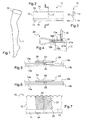
- a garter 10 it is necessary to realize a garter 10 to be assembled at the top of a bottom 1, for example by making or other suitable means.
- This garter 10 is formed from a silicone band 11 manufactured per kilometer, composed of an elastic knitted textile material 12, preferably a charmeuse, on which has been coated a thickness of silicone teasing 13 which leaves one or more zones not overlapped 14, for example near the lower edge 15 to serve for the subsequent assembly of the garter 10 on the bottom 1.
- the upper edge 16 may be scalloped in fish scales, as shown, this edge 16 being preferably obtained by ultrasonic cutting in the already silicone part.
- ultrasound is cut along a line 17 transverse to the general direction of the strip, and passing for example in the middle of the ridge of a scallop, a silicone strip 20 which has two ends 21a and 21b are just arranged one on the other, respecting the patterns of the festoons, so that the textile thicknesses 12a and 12b are against each other, and therefore the silicone 13a, 13b is placed outside (but we can adopt the opposite arrangement, the choice of a direction or the other being rather guided by the drive of the surfaces placed outside in the ultrasonic cutting tool if it does not this is not a fixed position).
- This assembly is placed in an ultrasonic cutting machine, between the cutting wheel 30 and the lower table 31, so as to cleanly cut the two ends 21a, 21b at a line 32 along which will form a temporary fine welding 22 in the textile material thicknesses 12a, 12b, given the instantaneous melting of thermoplastic fibers.
- a ring 20 temporarily closed by this weld 22 is obtained.
- This thin weld line 22 (its width can range from 0.05 mm to 0.3 mm but is advantageously of the order of 0, 15 mm) is sufficient to temporarily retain the two thicknesses 12a, 12b and allow their localized flattening.
- a wheeled cutting station one can have a Branson 2000EAD type stationary ultrasound machine.
- the ring is deployed at the level of the weld 22 on a working surface of a heating press (not shown) so as to end-to-end the textile thicknesses 12a, 12b, welded by the provisional weld 22, and the silicone thicknesses. 13a, 13b not welded but contiguous.
- a connecting piece 25 for example in the form of a section obtained from a strip of textile material 26 complexed with a layer of adhesive 27 sensitive to heat and with pressure.
- the heating press is closed for the time necessary for the adhesive of the layer 27 to flow into an area 28 and adhere to each other the textile surfaces 26 of the reinforcement piece and 12a, 12b of the ring.
- the complex obtained is then placed between the sonotrodes of a stationary ultrasonic welding machine, for example a machine marketed under the trademark Branson 2000 so as to weld one to the other by fusion of the fibers, the antagonistic surfaces. textile surfaces 26 on the one hand and 12a, 12b on the other hand.
- the width of the upper sonotrode is equal to or less than the width of the connecting piece 25 (in the longitudinal direction of the ring) and may be transversely wider than the ring.
- a weld preferably in the form of a network of points or weld lines, in a zone 33 represented by a grid on the figure 7 , corresponding to the part of the tape covered with silicone.
- the remaining portion 34 may not be welded during this operation because it does not necessarily have the thickness sufficient to be in contact with the two sonotrodes and therefore to be subjected to ultrasound. Nevertheless the ultrasonic weld interesting part 33 is sufficient to ensure the final strength of the junction of the ring and its resistance even under high tensile forces.
- the welding machine is set low enough so that the energy and the amplitude of the ultrasonic waves does not degrade the silicone.
- the width of the connecting strip 25 is advantageously between 8 mm and 12 mm so as to allow a sufficient surface to ensure the attachment by welding, but nevertheless not excessive to the point of creating discomfort to wear.
Landscapes
- Engineering & Computer Science (AREA)
- Mechanical Engineering (AREA)
- Textile Engineering (AREA)
- Treatments For Attaching Organic Compounds To Fibrous Goods (AREA)
- Laminated Bodies (AREA)
- Lining Or Joining Of Plastics Or The Like (AREA)
- Treatment Of Fiber Materials (AREA)
Description
- L'invention concerne un article textile de lingerie enduit d'une matière élastomère non soudable, par exemple d'une couche de silicone, et notamment un article sous forme de bande textile élastique siliconée destinée à servir de jarretière à un bas.
- On connaît par les documents
EP 1 491 105 ,FR 2 898 016 WO 2009/027701 des techniques de renforcement de couture ou de soudure aux ultrasons par des bandes collées. - Il est connu de prévoir sur un haut de bas, ou jarretière, une enduction de silicone assez taquante, c'est-à-dire d'une consistance entre collante et poisseuse (« tacky »), destinée à maintenir le bas en place sur la jambe sans glisser. Cette enduction se fait de préférence sur toute la périphérie intérieure de la jarretière, sous forme d'un dépôt surfacique continu, qui peut avoir quelques centimètres de largeur, et qui est assez épais pour avoir son plein effet. Grâce à la grande surface concernée, la pression sur la peau est mieux répartie et l'effet anti-glissement plus assuré.
- Il existe des procédés permettant d'enduire de silicone le haut d'un bas déjà constitué. Ces procédés sont assez difficiles à mettre en oeuvre du fait qu'il convient de traiter de manière plus ou moins automatique le bas entier dans une installation d'enduction, même si seul le bord est enduit.
- Il est aussi connu d'enduire sur leur périphérie intérieure des anneaux textiles destinés à former la jarretière, et de les assembler ensuite par confection ou autre méthode au reste du bas. Il n'en demeure pas moins que l'enduction d'une surface interne cylindrique n'est pas facile à réaliser.
- On a déjà pensé à produire la jarretière à partir de bande textile siliconée au kilomètre, à couper un tronçon de cette bande, à en réunir les deux extrémités pour former un anneau fermé, et à assembler cet anneau par confection ou autrement sur le reste du bas.
- Il convient de joindre solidement les deux extrémités du tronçon, car l'anneau est soumis à des forces d'extension très importantes une fois qu'il est porté. On ne connaît que deux procédés de jonction qui offrent ces garanties, la couture et la soudure. La couture n'est pas appréciée du fait de l'inconfort ressenti par les utilisatrices. La soudure, pratiquée généralement sur un chevauchement des deux extrémités de tronçons, est impossible ici du fait de la présence du silicone non soudable lui-même qui recouvre les deux extrémités de bande en chevauchement et qui n'est pas soudable.
- Le but de l'invention est de résoudre ce problème et de proposer un procédé de jonction de pièces textiles enduites d'une matière non soudable à chaud qui permette néanmoins d'assembler solidement les deux pièces textiles, et donc de faire, par exemple un article textile enduit soudé solide.
- L'invention atteint son but grâce à un procédé de réalisation d'articles textiles conforme à la revendication 1 annexée.
- De manière avantageuse, la matière élastomérique est du silicone, notamment du type taquant employé usuellement pour empêcher le glissement des bas.
- De manière avantageuse, la pièce textile est réalisée en un tricot élastique, de préférence une charmeuse, réalisée en grande partie à base de fibres thermoplastiques telles que du polyamide, et comprenant des fibres élastiques telles que du polyélasthanne.
- La pièce textile est avantageusement sous forme de bande, de préférence de quelques centimètres de largeur, par exemple entre 3 et 5 cm.
- Les bords de la bande peuvent être droits ou festonnés, notamment en écaille de poisson. Dans ce cas, il est avantageux de tenir compte du motif festonné lors de la superposition initiale de l'étape a.
- L'opération b de découpe et de thermosoudure est réalisée simultanément dans une installation de découpe ultrasonique comportant une molette coopérant avec une sonotrode fixe ou rotative, et permettant d'obtenir une soudure provisoire fine. De telles installations sont connues en soi, par exemple par le document
US 5 562 790 , et sont commercialisées sous différentes marques, par exemple par la société SONOBOND. Pour permettre la soudure, la matière constituant les pièces contient au moins 20%, mais avantageusement au moins 50% (cf.EP 0 015 871 ) et de préférence au moins 70% de fibres thermoplastiques. La solidité de la soudure ultrasonore réalisée dépend du pourcentage mais n'est pas fondamentale dans la mesure où il s'agit ici d'une soudure provisoire, la véritable liaison définitive étant celle qui sera ensuite obtenue avec la pièce de renforcement thermocollée puis soudée. La proportion de fibres thermofusibles peut donc s'établir dans une gamme assez large et cela permet d'utiliser comme matière principale de nombreux mélanges de fibres comprenant des fibres thermofusibles telles que des fibres polyamide, polyester, acryliques et plus généralement thermoplastiques, au sein d'autres fibres naturelles comme le coton ou synthétique. - La pièce de raccordement de l'étape c destinée à être thermocollée est avantageusement sous forme d'un complexe comprenant un film ou une grille de colle thermoadhésive, par exemple de type copolyamide, choisie de manière à éviter les interactions avec la matière élastomérique enduisant l'article textile. La pièce de raccordement est avantageusement sous forme de ruban complexé relativement étroit (par exemple environ un centimètre) qu'il suffit de couper à longueur pour couvrir la soudure provisoire de l'article. Une fixation de thermocollage par points est particulièrement avantageuse pour conserver une certaine élasticité à l'assemblage dans le sens longitudinal de la soudure provisoire.
- La pièce de raccordement peut être réalisée dans le même textile que l'article ou dans une autre matière. Elle est choisie de manière à permettre d'assurer avec l'article une bonne liaison par soudure aux ultrasons.
- De préférence, compte tenu notamment de l'utilisation en lingerie, les matières sont choisies pour être stables au lavage et à la chaleur, avec un retrait limité (inférieur à quelques pourcents).
- Avantageusement, le poids au mètre carré des matières utilisées tant pour les pièces ainsi que pour la bande de raccordement est de préférence compris entre 150 et 250 g/m2, et plus avantageusement entre 185 et 205 g/m2.
- La matière constituant l'article textile, en particulier dans le cas d'une jarretière, a de préférence une élasticité comprise entre 90% et 120% sous 15 N. L'écart d'élasticité entre les deux matières est avantageusement inférieur à 30% sous 15N et de préférence à 15% sous 15N.
- L'invention concerne également l'article textile obtenu par le procédé de l'invention, à savoir un article textile conforme à la revendication 5 annexée. L'article textile est avantageusement un anneau de jarretière.
- D'autres caractéristiques et avantages de l'invention apparaîtront à la lecture de la description suivante d'un mode particulier de réalisation (jarretière de bas), en référence aux dessins annexés sur lesquels :
- la
figure 1 est une vue schématique d'un bas auquel est destinée la jarretière obtenue conformément à l'invention, - les
figures 2 et 3 sont des vues schématiques de face et en coupe II-II d'un ruban siliconé destiné à former la jarretière de l'invention, - la
figure 4 est une vue schématique d'une installation de découpe et soudure du ruban siliconé pour former un anneau fermé, - la
figure 5 est une vue schématique de détail en coupe montrant la mise en place de la pièce de renfort sur l'anneau fermé, - la
figure 6 est une vue schématique analogue à lafigure 5 du même détail, après thermocollage de la pièce de renfort sur l'anneau fermé, - la
figure 7 est une vue en plan du même détail que lesfigures 5 et 6 , après soudure de la pièce de renfort. - Dans l'exemple préféré de réalisation de l'invention, il s'agit de réaliser une jarretière 10 destinée à être assemblée au haut d'un bas 1, par exemple par confection ou tout autre moyen approprié. Cette jarretière 10 est formée à partir d'une bande siliconée 11 fabriquée au kilomètre, composée d'une épaisseur de textile tricoté élastique 12, de préférence une charmeuse, sur laquelle a été enduite une épaisseur de silicone taquant 13 qui laisse une ou plusieurs zones non recouvertes 14, par exemple près du bord inférieur 15 pour servir à l'assemblage ultérieur de la jarretière 10 sur le bas 1. Le bord supérieur 16 peut être festonné en écailles de poisson, comme représenté, ce bord 16 étant obtenu de préférence par une découpe aux ultrasons dans la partie déjà siliconée.
- Dans cette bande 11, on découpe aux ultrasons le long d'une ligne 17 transversale à la direction générale de la bande, et passant par exemple au milieu de la crête d'un feston, un tronçon 20 de bande siliconée, qui comporte deux extrémités 21a et 21b qu'on vient disposer l'une sur l'autre, en respectant les motifs des festons, de telle sorte que les épaisseurs textiles 12a et 12b soient l'une contre l'autre, et donc le silicone 13a, 13b soit placé à l'extérieur (mais on peut adopter la disposition inverse, le choix d'un sens ou l'autre étant plutôt guidé par l'entraînement des surfaces placées à l'extérieur dans l'outil de découpe aux ultrasons s'il ne s'agit pas d'un poste fixe). On place cet ensemble dans une machine de découpe aux ultrasons, entre la roulette de découpe 30 et la table inférieure 31, de manière à couper proprement les deux extrémités 21a, 21b au niveau d'une ligne 32 le long de laquelle va se former une soudure fine provisoire 22 dans la matière textile des épaisseurs 12a, 12b, compte tenu de la fusion instantanée des fibres thermoplastiques. On obtient donc à ce stade un anneau 20 fermé de manière provisoire par cette soudure 22. Cette mince ligne de soudure 22 (sa largeur peut aller de 0,05 mm à 0,3 mm mais elle est avantageusement de l'ordre de 0,15 mm) est suffisante pour retenir provisoirement l'une à l'autre les deux épaisseurs 12a, 12b et permettre leur mise à plat localisée. Au lieu d'un poste de découpe à roulette, on peut avoir une machine à ultrason à poste fixe de type Branson 2000EAD.
- On déploie l'anneau au niveau de la soudure 22 sur une surface de travail d'une presse chauffante non représentée de manière à avoir bout à bout les épaisseurs de textiles 12a, 12b, soudées par la soudure provisoire 22, et les épaisseurs de silicone 13a, 13b non soudées mais contiguës. Sur cet ensemble on vient disposer à cheval sur la soudure provisoire 22, une pièce de raccordement 25, par exemple sous forme de tronçon obtenu à partir d'une bande de matière textile 26 complexée à une couche d'adhésif 27 sensible à la chaleur et à la pression. On referme la presse chauffante le temps nécessaire pour que l'adhésif de la couche 27 flue en une zone 28 et vienne faire adhérer entre elles les surfaces textiles 26 de la pièce de renfort et 12a, 12b de l'anneau.
- On place ensuite le complexe obtenu entre les sonotrodes d'une machine de soudure à ultrasons à poste fixe, par exemple une machine commercialisée sous la marque Branson 2000 de manière à souder l'une à l'autre par fusion des fibres, les surfaces antagonistes des surfaces textiles 26 d'une part et 12a, 12b d'autre part. La largeur de la sonotrode supérieure est égale ou inférieure à la largeur de la pièce de raccordement 25 (dans le sens longitudinal de l'anneau) et peut être transversalement plus large que l'anneau. Il s'opère donc une soudure, de préférence en forme de réseau de points ou de lignes de soudure, dans une zone 33 représentée par un quadrillage sur la
figure 7 , correspondant à la partie du ruban couverte de silicone. La partie restante 34, correspondant à la bordure 14 non siliconée, peut n'être pas soudée lors de cette opération du fait qu'elle n'a pas nécessairement l'épaisseur suffisante pour être en contact avec les deux sonotrodes et donc pour être soumise aux ultrasons. Néanmoins la soudure ultrasonore intéressant la partie 33 est suffisante pour assurer la solidité définitive de la jonction de l'anneau et sa résistance même sous des efforts de traction élevés. La machine de soudure est réglée à un niveau suffisamment bas pour que l'énergie et l'amplitude des ondes ultrasonores ne dégradent pas le silicone. - La largeur de la bande de raccordement 25 est avantageusement comprise entre 8 mm et 12 mm de manière à permettre une surface suffisante pour assurer la fixation par soudure, mais néanmoins pas excessive au point de créer une gêne au porter.
Claims (4)
- Procédé de réalisation d'article textile (10) constitué d'une matière textile élastique (12) réalisée avec au moins une partie de fibres thermoplastiques et sur laquelle est enduite une couche (13) de matière élastomérique non soudable, l'article (10) présentant deux bords qui doivent être assemblés l'un à l'autre, procédé selon lequel :a) on dispose l'article en deux épaisseurs superposées (12a, 13a ; 12b, 13b) au niveau des deux bords à joindre, couche de matière élastique (12a) contre couche de matière élastique (12b),b) on découpe aux ultrasons les deux épaisseurs (12a, 13a ; 12b, 13b) au niveau des deux bords à joindre de manière à souder provisoirement les deux couches de matière élastique (12a, 12b) le long d'une ligne de soudure provisoire (22),c) on déploie l'article provisoirement assemblé et on superpose au-dessus de la ligne de soudure provisoire (22), du côté de la couche de matière textile élastique (12), une pièce de raccordement (25) en matière textile réalisée avec au moins une partie de fibres thermoplastiques, et on thermocolle cette pièce de raccordement (25) sous pression et à chaud,d) on soude aux ultrasons le complexe ainsi obtenu de manière à solidariser définitivement la pièce de raccordement (25) à la couche de matière textile élastique (12), dans des conditions énergétiques ne détériorant pas la couche de matière élastomérique (13).
- Procédé selon la revendication 1, caractérisée en ce que la matière élastomérique est du silicone.
- Procédé selon l'une quelconque des revendications 1 ou 2, caractérisé en ce que la matière textile élastique (12) est réalisée en un tricot élastique.
- Procédé selon l'une quelconque des revendications 1 à 3, caractérisé en ce que la pièce de raccordement (25) est réalisée en un tricot élastique.
Applications Claiming Priority (2)
| Application Number | Priority Date | Filing Date | Title |
|---|---|---|---|
| FR1050728A FR2955746B1 (fr) | 2010-02-02 | 2010-02-02 | Article textile enduit soude, notamment pour jarretiere de bas, et son procede de realisation |
| PCT/FR2011/050137 WO2011095724A1 (fr) | 2010-02-02 | 2011-01-25 | Article textile enduit, notamment pour jarretiere de bas, et son procede realisation par soudure |
Publications (2)
| Publication Number | Publication Date |
|---|---|
| EP2531342A1 EP2531342A1 (fr) | 2012-12-12 |
| EP2531342B1 true EP2531342B1 (fr) | 2015-05-20 |
Family
ID=42702546
Family Applications (1)
| Application Number | Title | Priority Date | Filing Date |
|---|---|---|---|
| EP11705924.6A Active EP2531342B1 (fr) | 2010-02-02 | 2011-01-25 | Procede de realisation par soudure d'un article textile enduit |
Country Status (6)
| Country | Link |
|---|---|
| EP (1) | EP2531342B1 (fr) |
| ES (1) | ES2545333T3 (fr) |
| FR (1) | FR2955746B1 (fr) |
| PT (1) | PT2531342E (fr) |
| RU (1) | RU2012137133A (fr) |
| WO (1) | WO2011095724A1 (fr) |
Families Citing this family (1)
| Publication number | Priority date | Publication date | Assignee | Title |
|---|---|---|---|---|
| GB2500645A (en) * | 2012-03-28 | 2013-10-02 | Stretchline Intellectual Properties Ltd | Garments comprising bands of cured silicone elastomer |
Family Cites Families (6)
| Publication number | Priority date | Publication date | Assignee | Title |
|---|---|---|---|---|
| EP0015871A1 (fr) | 1979-02-22 | 1980-09-17 | Battelle Development Corporation | Soudage d'un matériau textile et procédé de soudage de ce matériau |
| US5552013A (en) | 1994-06-29 | 1996-09-03 | Kimberly-Clark Corporation | Apparatus and method for rotary bonding |
| EP1714567A3 (fr) * | 2003-06-27 | 2007-09-19 | W.L. GORE & ASSOCIATES GmbH | Ligne de petite dimension |
| JP2005025613A (ja) | 2003-07-04 | 2005-01-27 | Alps Electric Co Ltd | 信号処理回路モジュール |
| FR2898016B1 (fr) * | 2006-03-03 | 2008-06-27 | Dim S A Sa | Procede de realisation d'article textile de forme concave, notamment de bonnets de soutien-gorge, par assemblage bord a bord de deux pieces a au moins un bord courbe et article ainsi forme |
| WO2009027701A1 (fr) * | 2007-08-31 | 2009-03-05 | Stretchline Intellectual Properties Limited | Procédé de renforcement d'une couture |
-
2010
- 2010-02-02 FR FR1050728A patent/FR2955746B1/fr active Active
-
2011
- 2011-01-25 ES ES11705924.6T patent/ES2545333T3/es active Active
- 2011-01-25 RU RU2012137133/12A patent/RU2012137133A/ru not_active Application Discontinuation
- 2011-01-25 EP EP11705924.6A patent/EP2531342B1/fr active Active
- 2011-01-25 WO PCT/FR2011/050137 patent/WO2011095724A1/fr not_active Ceased
- 2011-01-25 PT PT117059246T patent/PT2531342E/pt unknown
Also Published As
| Publication number | Publication date |
|---|---|
| WO2011095724A1 (fr) | 2011-08-11 |
| ES2545333T3 (es) | 2015-09-10 |
| FR2955746A1 (fr) | 2011-08-05 |
| EP2531342A1 (fr) | 2012-12-12 |
| FR2955746B1 (fr) | 2012-05-18 |
| PT2531342E (pt) | 2015-09-02 |
| RU2012137133A (ru) | 2014-03-10 |
Similar Documents
| Publication | Publication Date | Title |
|---|---|---|
| EP0886480B1 (fr) | Coulisse de froncage et son procede de fabrication | |
| EP1589839B1 (fr) | Procédé d'assemblage bord à bord de deux pièces textiles | |
| EP0189351B1 (fr) | Produit nouveau destiné à être collé à chaud par pression sur des articles plats et procédé de fabrication d'un tel produit | |
| EP0048011B1 (fr) | Couche-culotte et procédé de fabrication de telles couches-culottes | |
| FR2590125A1 (fr) | Change complet avec matelas absorbant ramifie et son procede de fabrication | |
| EP1778034A2 (fr) | Procede d'assemblage de panneaux textiles et produits obtenus a l'aide de ce procede | |
| FR3010631A1 (fr) | Articles absorbants avec canaux et signaux | |
| FR3007626A1 (fr) | Sous-vetement tricote elastique masculin | |
| EP1993390A2 (fr) | Procédé de réalisation d'article textile de lingerie de forme concave, notamment de bonnet de soutien-gorge, par assemblage bord à bord de deux pièces à au moins un bord courbe et article ainsi formé | |
| FR2873545A1 (fr) | Vetement de sport | |
| WO2011095724A1 (fr) | Article textile enduit, notamment pour jarretiere de bas, et son procede realisation par soudure | |
| FR2828998A1 (fr) | Procede d'assemblage de deux zones de bord d'au moins une piece de tissu, et application a la realisation d'une bretelle | |
| FR2609424A1 (fr) | Joint soude de pieces en matiere plastique contenant un agent de contraste aux rayons x | |
| FR2797622A1 (fr) | Feuille d'emballage stratifiee permettant la refermeture et emballage la comportant | |
| JP5544160B2 (ja) | 吸収性物品の製造方法 | |
| WO2008117196A1 (fr) | Zone de dechirure orientee pour film en plastique | |
| FR2738845A1 (fr) | Materiau non-tisse composite, son procede de fabrication et son application a tout article d'hygiene absorbant | |
| EP1885929B1 (fr) | Complexe textile base de non tisse et son procede de realisation | |
| FR2861752A1 (fr) | Procede de fabrication d'un materiau complexe obtenu par lamination d'un film elastique pris en sandwich entre deux nappes de non-tisse. | |
| FR3028208A1 (fr) | Materiau multicouche sterilisable | |
| WO2015173343A1 (fr) | Sachet a rubans fixes mecaniquement aux feuilles | |
| WO2024121467A1 (fr) | Culotte menstruelle | |
| FR2725879A1 (fr) | Culotte absorbante jetable | |
| FR2717349A1 (fr) | Article coiffant jetable du genre charlotte ronde. | |
| FR2801285A1 (fr) | Sachet d'emballage |
Legal Events
| Date | Code | Title | Description |
|---|---|---|---|
| PUAI | Public reference made under article 153(3) epc to a published international application that has entered the european phase |
Free format text: ORIGINAL CODE: 0009012 |
|
| 17P | Request for examination filed |
Effective date: 20120717 |
|
| AK | Designated contracting states |
Kind code of ref document: A1 Designated state(s): AL AT BE BG CH CY CZ DE DK EE ES FI FR GB GR HR HU IE IS IT LI LT LU LV MC MK MT NL NO PL PT RO RS SE SI SK SM TR |
|
| DAX | Request for extension of the european patent (deleted) | ||
| 17Q | First examination report despatched |
Effective date: 20131209 |
|
| GRAP | Despatch of communication of intention to grant a patent |
Free format text: ORIGINAL CODE: EPIDOSNIGR1 |
|
| RIC1 | Information provided on ipc code assigned before grant |
Ipc: D06H 5/00 20060101ALI20150203BHEP Ipc: B29L 31/48 20060101ALN20150203BHEP Ipc: B29C 65/08 20060101AFI20150203BHEP Ipc: B29C 65/74 20060101ALI20150203BHEP Ipc: B29C 65/72 20060101ALI20150203BHEP Ipc: B29C 65/50 20060101ALI20150203BHEP Ipc: B29L 9/00 20060101ALN20150203BHEP Ipc: A41B 11/12 20060101ALI20150203BHEP Ipc: A41F 11/16 20060101ALI20150203BHEP Ipc: A41D 27/24 20060101ALI20150203BHEP Ipc: A41F 13/00 20060101ALI20150203BHEP |
|
| INTG | Intention to grant announced |
Effective date: 20150217 |
|
| GRAS | Grant fee paid |
Free format text: ORIGINAL CODE: EPIDOSNIGR3 |
|
| GRAA | (expected) grant |
Free format text: ORIGINAL CODE: 0009210 |
|
| AK | Designated contracting states |
Kind code of ref document: B1 Designated state(s): AL AT BE BG CH CY CZ DE DK EE ES FI FR GB GR HR HU IE IS IT LI LT LU LV MC MK MT NL NO PL PT RO RS SE SI SK SM TR |
|
| REG | Reference to a national code |
Ref country code: GB Ref legal event code: FG4D Free format text: NOT ENGLISH |
|
| REG | Reference to a national code |
Ref country code: CH Ref legal event code: EP |
|
| REG | Reference to a national code |
Ref country code: AT Ref legal event code: REF Ref document number: 727512 Country of ref document: AT Kind code of ref document: T Effective date: 20150615 Ref country code: CH Ref legal event code: NV Representative=s name: CABINET GERMAIN AND MAUREAU, CH |
|
| REG | Reference to a national code |
Ref country code: IE Ref legal event code: FG4D Free format text: LANGUAGE OF EP DOCUMENT: FRENCH |
|
| REG | Reference to a national code |
Ref country code: DE Ref legal event code: R096 Ref document number: 602011016575 Country of ref document: DE Effective date: 20150702 |
|
| REG | Reference to a national code |
Ref country code: PT Ref legal event code: SC4A Free format text: AVAILABILITY OF NATIONAL TRANSLATION Effective date: 20150716 |
|
| REG | Reference to a national code |
Ref country code: ES Ref legal event code: FG2A Ref document number: 2545333 Country of ref document: ES Kind code of ref document: T3 Effective date: 20150910 |
|
| REG | Reference to a national code |
Ref country code: LT Ref legal event code: MG4D |
|
| REG | Reference to a national code |
Ref country code: NL Ref legal event code: MP Effective date: 20150520 |
|
| PG25 | Lapsed in a contracting state [announced via postgrant information from national office to epo] |
Ref country code: FI Free format text: LAPSE BECAUSE OF FAILURE TO SUBMIT A TRANSLATION OF THE DESCRIPTION OR TO PAY THE FEE WITHIN THE PRESCRIBED TIME-LIMIT Effective date: 20150520 Ref country code: NO Free format text: LAPSE BECAUSE OF FAILURE TO SUBMIT A TRANSLATION OF THE DESCRIPTION OR TO PAY THE FEE WITHIN THE PRESCRIBED TIME-LIMIT Effective date: 20150820 Ref country code: LT Free format text: LAPSE BECAUSE OF FAILURE TO SUBMIT A TRANSLATION OF THE DESCRIPTION OR TO PAY THE FEE WITHIN THE PRESCRIBED TIME-LIMIT Effective date: 20150520 Ref country code: HR Free format text: LAPSE BECAUSE OF FAILURE TO SUBMIT A TRANSLATION OF THE DESCRIPTION OR TO PAY THE FEE WITHIN THE PRESCRIBED TIME-LIMIT Effective date: 20150520 |
|
| PG25 | Lapsed in a contracting state [announced via postgrant information from national office to epo] |
Ref country code: BG Free format text: LAPSE BECAUSE OF FAILURE TO SUBMIT A TRANSLATION OF THE DESCRIPTION OR TO PAY THE FEE WITHIN THE PRESCRIBED TIME-LIMIT Effective date: 20150820 Ref country code: IS Free format text: LAPSE BECAUSE OF FAILURE TO SUBMIT A TRANSLATION OF THE DESCRIPTION OR TO PAY THE FEE WITHIN THE PRESCRIBED TIME-LIMIT Effective date: 20150920 Ref country code: RS Free format text: LAPSE BECAUSE OF FAILURE TO SUBMIT A TRANSLATION OF THE DESCRIPTION OR TO PAY THE FEE WITHIN THE PRESCRIBED TIME-LIMIT Effective date: 20150520 Ref country code: GR Free format text: LAPSE BECAUSE OF FAILURE TO SUBMIT A TRANSLATION OF THE DESCRIPTION OR TO PAY THE FEE WITHIN THE PRESCRIBED TIME-LIMIT Effective date: 20150821 Ref country code: LV Free format text: LAPSE BECAUSE OF FAILURE TO SUBMIT A TRANSLATION OF THE DESCRIPTION OR TO PAY THE FEE WITHIN THE PRESCRIBED TIME-LIMIT Effective date: 20150520 |
|
| PG25 | Lapsed in a contracting state [announced via postgrant information from national office to epo] |
Ref country code: EE Free format text: LAPSE BECAUSE OF FAILURE TO SUBMIT A TRANSLATION OF THE DESCRIPTION OR TO PAY THE FEE WITHIN THE PRESCRIBED TIME-LIMIT Effective date: 20150520 Ref country code: DK Free format text: LAPSE BECAUSE OF FAILURE TO SUBMIT A TRANSLATION OF THE DESCRIPTION OR TO PAY THE FEE WITHIN THE PRESCRIBED TIME-LIMIT Effective date: 20150520 |
|
| REG | Reference to a national code |
Ref country code: DE Ref legal event code: R097 Ref document number: 602011016575 Country of ref document: DE |
|
| PG25 | Lapsed in a contracting state [announced via postgrant information from national office to epo] |
Ref country code: SK Free format text: LAPSE BECAUSE OF FAILURE TO SUBMIT A TRANSLATION OF THE DESCRIPTION OR TO PAY THE FEE WITHIN THE PRESCRIBED TIME-LIMIT Effective date: 20150520 Ref country code: RO Free format text: LAPSE BECAUSE OF NON-PAYMENT OF DUE FEES Effective date: 20150520 Ref country code: CZ Free format text: LAPSE BECAUSE OF FAILURE TO SUBMIT A TRANSLATION OF THE DESCRIPTION OR TO PAY THE FEE WITHIN THE PRESCRIBED TIME-LIMIT Effective date: 20150520 Ref country code: PL Free format text: LAPSE BECAUSE OF FAILURE TO SUBMIT A TRANSLATION OF THE DESCRIPTION OR TO PAY THE FEE WITHIN THE PRESCRIBED TIME-LIMIT Effective date: 20150520 |
|
| PLBE | No opposition filed within time limit |
Free format text: ORIGINAL CODE: 0009261 |
|
| STAA | Information on the status of an ep patent application or granted ep patent |
Free format text: STATUS: NO OPPOSITION FILED WITHIN TIME LIMIT |
|
| 26N | No opposition filed |
Effective date: 20160223 |
|
| PG25 | Lapsed in a contracting state [announced via postgrant information from national office to epo] |
Ref country code: SI Free format text: LAPSE BECAUSE OF FAILURE TO SUBMIT A TRANSLATION OF THE DESCRIPTION OR TO PAY THE FEE WITHIN THE PRESCRIBED TIME-LIMIT Effective date: 20150520 |
|
| REG | Reference to a national code |
Ref country code: FR Ref legal event code: PLFP Year of fee payment: 6 |
|
| PG25 | Lapsed in a contracting state [announced via postgrant information from national office to epo] |
Ref country code: LU Free format text: LAPSE BECAUSE OF FAILURE TO SUBMIT A TRANSLATION OF THE DESCRIPTION OR TO PAY THE FEE WITHIN THE PRESCRIBED TIME-LIMIT Effective date: 20160125 |
|
| PG25 | Lapsed in a contracting state [announced via postgrant information from national office to epo] |
Ref country code: MC Free format text: LAPSE BECAUSE OF FAILURE TO SUBMIT A TRANSLATION OF THE DESCRIPTION OR TO PAY THE FEE WITHIN THE PRESCRIBED TIME-LIMIT Effective date: 20150520 |
|
| REG | Reference to a national code |
Ref country code: IE Ref legal event code: MM4A |
|
| REG | Reference to a national code |
Ref country code: FR Ref legal event code: PLFP Year of fee payment: 7 |
|
| PG25 | Lapsed in a contracting state [announced via postgrant information from national office to epo] |
Ref country code: IE Free format text: LAPSE BECAUSE OF NON-PAYMENT OF DUE FEES Effective date: 20160125 |
|
| REG | Reference to a national code |
Ref country code: AT Ref legal event code: UEP Ref document number: 727512 Country of ref document: AT Kind code of ref document: T Effective date: 20150520 |
|
| REG | Reference to a national code |
Ref country code: FR Ref legal event code: CD Owner name: HANES OPERATIONS EUROPE SAS, FR Effective date: 20170419 |
|
| PG25 | Lapsed in a contracting state [announced via postgrant information from national office to epo] |
Ref country code: NL Free format text: LAPSE BECAUSE OF FAILURE TO SUBMIT A TRANSLATION OF THE DESCRIPTION OR TO PAY THE FEE WITHIN THE PRESCRIBED TIME-LIMIT Effective date: 20150520 Ref country code: SE Free format text: LAPSE BECAUSE OF FAILURE TO SUBMIT A TRANSLATION OF THE DESCRIPTION OR TO PAY THE FEE WITHIN THE PRESCRIBED TIME-LIMIT Effective date: 20150520 |
|
| PG25 | Lapsed in a contracting state [announced via postgrant information from national office to epo] |
Ref country code: MT Free format text: LAPSE BECAUSE OF FAILURE TO SUBMIT A TRANSLATION OF THE DESCRIPTION OR TO PAY THE FEE WITHIN THE PRESCRIBED TIME-LIMIT Effective date: 20150520 |
|
| REG | Reference to a national code |
Ref country code: CH Ref legal event code: PFA Owner name: HANES OPERATIONS EUROPE SAS, FR Free format text: FORMER OWNER: DBAPPAREL OPERATIONS, FR |
|
| REG | Reference to a national code |
Ref country code: FR Ref legal event code: PLFP Year of fee payment: 8 |
|
| REG | Reference to a national code |
Ref country code: BE Ref legal event code: HC Owner name: HANES OPERATIONS EUROPE SAS; FR Free format text: DETAILS ASSIGNMENT: CHANGE OF OWNER(S), CHANGEMENT NOM PROPRIETAIRE; FORMER OWNER NAME: DBAPPAREL OPERATIONS Effective date: 20171023 |
|
| REG | Reference to a national code |
Ref country code: AT Ref legal event code: HC Ref document number: 727512 Country of ref document: AT Kind code of ref document: T Owner name: HANES OPERATIONS EUROPE SAS, FR Effective date: 20180201 |
|
| PG25 | Lapsed in a contracting state [announced via postgrant information from national office to epo] |
Ref country code: SM Free format text: LAPSE BECAUSE OF FAILURE TO SUBMIT A TRANSLATION OF THE DESCRIPTION OR TO PAY THE FEE WITHIN THE PRESCRIBED TIME-LIMIT Effective date: 20150520 Ref country code: HU Free format text: LAPSE BECAUSE OF FAILURE TO SUBMIT A TRANSLATION OF THE DESCRIPTION OR TO PAY THE FEE WITHIN THE PRESCRIBED TIME-LIMIT; INVALID AB INITIO Effective date: 20110125 Ref country code: CY Free format text: LAPSE BECAUSE OF FAILURE TO SUBMIT A TRANSLATION OF THE DESCRIPTION OR TO PAY THE FEE WITHIN THE PRESCRIBED TIME-LIMIT Effective date: 20150520 |
|
| PG25 | Lapsed in a contracting state [announced via postgrant information from national office to epo] |
Ref country code: TR Free format text: LAPSE BECAUSE OF FAILURE TO SUBMIT A TRANSLATION OF THE DESCRIPTION OR TO PAY THE FEE WITHIN THE PRESCRIBED TIME-LIMIT Effective date: 20150520 Ref country code: MK Free format text: LAPSE BECAUSE OF FAILURE TO SUBMIT A TRANSLATION OF THE DESCRIPTION OR TO PAY THE FEE WITHIN THE PRESCRIBED TIME-LIMIT Effective date: 20150520 |
|
| PG25 | Lapsed in a contracting state [announced via postgrant information from national office to epo] |
Ref country code: AL Free format text: LAPSE BECAUSE OF FAILURE TO SUBMIT A TRANSLATION OF THE DESCRIPTION OR TO PAY THE FEE WITHIN THE PRESCRIBED TIME-LIMIT Effective date: 20150520 |
|
| PGFP | Annual fee paid to national office [announced via postgrant information from national office to epo] |
Ref country code: AT Payment date: 20200102 Year of fee payment: 10 |
|
| REG | Reference to a national code |
Ref country code: ES Ref legal event code: PC2A Owner name: HANES OPERATIONS EUROPE SAS Effective date: 20201028 |
|
| REG | Reference to a national code |
Ref country code: AT Ref legal event code: MM01 Ref document number: 727512 Country of ref document: AT Kind code of ref document: T Effective date: 20210125 |
|
| PG25 | Lapsed in a contracting state [announced via postgrant information from national office to epo] |
Ref country code: AT Free format text: LAPSE BECAUSE OF NON-PAYMENT OF DUE FEES Effective date: 20210125 |
|
| REG | Reference to a national code |
Ref country code: DE Ref legal event code: R081 Ref document number: 602011016575 Country of ref document: DE Owner name: HANES OPERATIONS EUROPE SAS, FR Free format text: FORMER OWNER: DBAPPAREL OPERATIONS, RUEIL MALMAISON, FR Ref country code: DE Ref legal event code: R081 Ref document number: 602011016575 Country of ref document: DE Owner name: DBI OPERATIONS EUROPE SAS, FR Free format text: FORMER OWNER: DBAPPAREL OPERATIONS, RUEIL MALMAISON, FR Ref country code: DE Ref legal event code: R082 Ref document number: 602011016575 Country of ref document: DE Representative=s name: FISH & RICHARDSON P.C., DE |
|
| REG | Reference to a national code |
Ref country code: DE Ref legal event code: R082 Ref document number: 602011016575 Country of ref document: DE |
|
| REG | Reference to a national code |
Ref country code: BE Ref legal event code: HC Owner name: DBI OPERATIONS EUROPE SAS; FR Free format text: DETAILS ASSIGNMENT: CHANGE OF OWNER(S), CHANGE OF OWNER(S) NAME; FORMER OWNER NAME: HANES OPERATIONS EUROPE SAS Effective date: 20240508 |
|
| REG | Reference to a national code |
Ref country code: DE Ref legal event code: R081 Ref document number: 602011016575 Country of ref document: DE Owner name: DBI OPERATIONS EUROPE SAS, FR Free format text: FORMER OWNER: HANES OPERATIONS EUROPE SAS, RUEIL-MALMAISON, FR |
|
| REG | Reference to a national code |
Ref country code: ES Ref legal event code: PC2A Owner name: DBI OPERATIONS EUROPE SAS Effective date: 20241203 |
|
| PGFP | Annual fee paid to national office [announced via postgrant information from national office to epo] |
Ref country code: GB Payment date: 20251204 Year of fee payment: 16 |
|
| PGFP | Annual fee paid to national office [announced via postgrant information from national office to epo] |
Ref country code: FR Payment date: 20251128 Year of fee payment: 16 |
|
| REG | Reference to a national code |
Ref country code: CH Ref legal event code: U11 Free format text: ST27 STATUS EVENT CODE: U-0-0-U10-U11 (AS PROVIDED BY THE NATIONAL OFFICE) Effective date: 20260201 |
|
| PGFP | Annual fee paid to national office [announced via postgrant information from national office to epo] |
Ref country code: ES Payment date: 20260206 Year of fee payment: 16 |
|
| PGFP | Annual fee paid to national office [announced via postgrant information from national office to epo] |
Ref country code: DE Payment date: 20251203 Year of fee payment: 16 |
|
| PGFP | Annual fee paid to national office [announced via postgrant information from national office to epo] |
Ref country code: BE Payment date: 20260106 Year of fee payment: 16 Ref country code: IT Payment date: 20251219 Year of fee payment: 16 |
|
| PGFP | Annual fee paid to national office [announced via postgrant information from national office to epo] |
Ref country code: PT Payment date: 20260123 Year of fee payment: 16 Ref country code: CH Payment date: 20260201 Year of fee payment: 16 |