EP2513017B1 - Process for the resolution of enantiomers by preferential evaporative crystallization - Google Patents
Process for the resolution of enantiomers by preferential evaporative crystallization Download PDFInfo
- Publication number
- EP2513017B1 EP2513017B1 EP10798054.2A EP10798054A EP2513017B1 EP 2513017 B1 EP2513017 B1 EP 2513017B1 EP 10798054 A EP10798054 A EP 10798054A EP 2513017 B1 EP2513017 B1 EP 2513017B1
- Authority
- EP
- European Patent Office
- Prior art keywords
- solvent
- enantiomers
- enantiomer
- point
- racemic mixture
- Prior art date
- Legal status (The legal status is an assumption and is not a legal conclusion. Google has not performed a legal analysis and makes no representation as to the accuracy of the status listed.)
- Active
Links
- 238000000034 method Methods 0.000 title claims description 66
- 238000002425 crystallisation Methods 0.000 title claims description 55
- 230000008025 crystallization Effects 0.000 title claims description 55
- HBAQYPYDRFILMT-UHFFFAOYSA-N 8-[3-(1-cyclopropylpyrazol-4-yl)-1H-pyrazolo[4,3-d]pyrimidin-5-yl]-3-methyl-3,8-diazabicyclo[3.2.1]octan-2-one Chemical class C1(CC1)N1N=CC(=C1)C1=NNC2=C1N=C(N=C2)N1C2C(N(CC1CC2)C)=O HBAQYPYDRFILMT-UHFFFAOYSA-N 0.000 title claims description 44
- 239000002904 solvent Substances 0.000 claims description 92
- 239000000203 mixture Substances 0.000 claims description 86
- 238000001704 evaporation Methods 0.000 claims description 44
- 239000013078 crystal Substances 0.000 claims description 32
- 239000000243 solution Substances 0.000 claims description 26
- OKKJLVBELUTLKV-UHFFFAOYSA-N Methanol Chemical compound OC OKKJLVBELUTLKV-UHFFFAOYSA-N 0.000 claims description 24
- 239000000725 suspension Substances 0.000 claims description 23
- 238000001914 filtration Methods 0.000 claims description 22
- 238000010586 diagram Methods 0.000 claims description 17
- 238000003306 harvesting Methods 0.000 claims description 16
- 239000012452 mother liquor Substances 0.000 claims description 16
- 238000003756 stirring Methods 0.000 claims description 15
- CSCPPACGZOOCGX-UHFFFAOYSA-N Acetone Chemical compound CC(C)=O CSCPPACGZOOCGX-UHFFFAOYSA-N 0.000 claims description 9
- WEVYAHXRMPXWCK-UHFFFAOYSA-N Acetonitrile Chemical compound CC#N WEVYAHXRMPXWCK-UHFFFAOYSA-N 0.000 claims description 9
- LFQSCWFLJHTTHZ-UHFFFAOYSA-N Ethanol Chemical compound CCO LFQSCWFLJHTTHZ-UHFFFAOYSA-N 0.000 claims description 8
- 238000010899 nucleation Methods 0.000 claims description 8
- YHRUSWKIWCVSRL-UHFFFAOYSA-M sodium;2-(2-chlorophenyl)-2-hydroxyacetate Chemical compound [Na+].[O-]C(=O)C(O)C1=CC=CC=C1Cl YHRUSWKIWCVSRL-UHFFFAOYSA-M 0.000 claims description 8
- YMWUJEATGCHHMB-UHFFFAOYSA-N Dichloromethane Chemical compound ClCCl YMWUJEATGCHHMB-UHFFFAOYSA-N 0.000 claims description 6
- XEKOWRVHYACXOJ-UHFFFAOYSA-N Ethyl acetate Chemical compound CCOC(C)=O XEKOWRVHYACXOJ-UHFFFAOYSA-N 0.000 claims description 6
- 238000010992 reflux Methods 0.000 claims description 6
- JNGWGQUYLVSFND-UHFFFAOYSA-N 5-methyl-5-phenylimidazolidine-2,4-dione Chemical compound C=1C=CC=CC=1C1(C)NC(=O)NC1=O JNGWGQUYLVSFND-UHFFFAOYSA-N 0.000 claims description 4
- IMNFDUFMRHMDMM-UHFFFAOYSA-N N-Heptane Chemical compound CCCCCCC IMNFDUFMRHMDMM-UHFFFAOYSA-N 0.000 claims description 4
- TZIHFWKZFHZASV-UHFFFAOYSA-N methyl formate Chemical compound COC=O TZIHFWKZFHZASV-UHFFFAOYSA-N 0.000 claims description 4
- 239000012047 saturated solution Substances 0.000 claims description 4
- 238000009835 boiling Methods 0.000 claims description 3
- 238000004090 dissolution Methods 0.000 claims description 3
- 238000000605 extraction Methods 0.000 claims description 2
- 239000012456 homogeneous solution Substances 0.000 claims description 2
- XLYOFNOQVPJJNP-UHFFFAOYSA-N water Substances O XLYOFNOQVPJJNP-UHFFFAOYSA-N 0.000 claims description 2
- 230000006340 racemization Effects 0.000 claims 1
- 230000008020 evaporation Effects 0.000 description 31
- 239000012071 phase Substances 0.000 description 13
- 239000007788 liquid Substances 0.000 description 11
- 239000007787 solid Substances 0.000 description 7
- 239000007789 gas Substances 0.000 description 6
- 229920006395 saturated elastomer Polymers 0.000 description 6
- 239000007791 liquid phase Substances 0.000 description 5
- 239000007790 solid phase Substances 0.000 description 5
- 150000001875 compounds Chemical class 0.000 description 3
- 238000001816 cooling Methods 0.000 description 3
- 239000012530 fluid Substances 0.000 description 3
- 238000011084 recovery Methods 0.000 description 3
- 238000000926 separation method Methods 0.000 description 3
- XKRFYHLGVUSROY-UHFFFAOYSA-N Argon Chemical compound [Ar] XKRFYHLGVUSROY-UHFFFAOYSA-N 0.000 description 2
- IJGRMHOSHXDMSA-UHFFFAOYSA-N Atomic nitrogen Chemical compound N#N IJGRMHOSHXDMSA-UHFFFAOYSA-N 0.000 description 2
- 229910001873 dinitrogen Inorganic materials 0.000 description 2
- 238000010438 heat treatment Methods 0.000 description 2
- 230000006911 nucleation Effects 0.000 description 2
- 230000003287 optical effect Effects 0.000 description 2
- 230000001105 regulatory effect Effects 0.000 description 2
- 150000003839 salts Chemical class 0.000 description 2
- UWCWUCKPEYNDNV-LBPRGKRZSA-N 2,6-dimethyl-n-[[(2s)-pyrrolidin-2-yl]methyl]aniline Chemical compound CC1=CC=CC(C)=C1NC[C@H]1NCCC1 UWCWUCKPEYNDNV-LBPRGKRZSA-N 0.000 description 1
- SUBDBMMJDZJVOS-UHFFFAOYSA-N 5-methoxy-2-{[(4-methoxy-3,5-dimethylpyridin-2-yl)methyl]sulfinyl}-1H-benzimidazole Chemical class N=1C2=CC(OC)=CC=C2NC=1S(=O)CC1=NC=C(C)C(OC)=C1C SUBDBMMJDZJVOS-UHFFFAOYSA-N 0.000 description 1
- 102000004190 Enzymes Human genes 0.000 description 1
- 108090000790 Enzymes Proteins 0.000 description 1
- 239000011149 active material Substances 0.000 description 1
- 239000013543 active substance Substances 0.000 description 1
- 229910052786 argon Inorganic materials 0.000 description 1
- 230000015572 biosynthetic process Effects 0.000 description 1
- 239000003054 catalyst Substances 0.000 description 1
- 230000003197 catalytic effect Effects 0.000 description 1
- 150000005829 chemical entities Chemical class 0.000 description 1
- 238000004587 chromatography analysis Methods 0.000 description 1
- 230000006735 deficit Effects 0.000 description 1
- 230000001419 dependent effect Effects 0.000 description 1
- 229910003460 diamond Inorganic materials 0.000 description 1
- 239000010432 diamond Substances 0.000 description 1
- 230000035784 germination Effects 0.000 description 1
- 238000003760 magnetic stirring Methods 0.000 description 1
- 230000008018 melting Effects 0.000 description 1
- 238000002844 melting Methods 0.000 description 1
- 230000004048 modification Effects 0.000 description 1
- 238000012986 modification Methods 0.000 description 1
- 230000007935 neutral effect Effects 0.000 description 1
- 229960000381 omeprazole Drugs 0.000 description 1
- 238000000711 polarimetry Methods 0.000 description 1
- 238000002360 preparation method Methods 0.000 description 1
- 230000001737 promoting effect Effects 0.000 description 1
- 238000000746 purification Methods 0.000 description 1
- 239000000376 reactant Substances 0.000 description 1
- 238000004064 recycling Methods 0.000 description 1
- 238000003303 reheating Methods 0.000 description 1
- 230000010076 replication Effects 0.000 description 1
- 239000012453 solvate Substances 0.000 description 1
- 238000000935 solvent evaporation Methods 0.000 description 1
- 230000002269 spontaneous effect Effects 0.000 description 1
- 239000012808 vapor phase Substances 0.000 description 1
Images


Classifications
-
- C—CHEMISTRY; METALLURGY
- C07—ORGANIC CHEMISTRY
- C07B—GENERAL METHODS OF ORGANIC CHEMISTRY; APPARATUS THEREFOR
- C07B57/00—Separation of optically-active compounds
Definitions
- the present invention relates to the field of the separation of two enantiomers (optical antipodes) of a chemical entity by preferential crystallization.
- the commonest method consists in reacting a racemic compound with an optically active substance in order to obtain diastereoisomers capable of subsequently being separated by crystallization or chromatography, for example.
- Other methods for the resolution of enantiomers comprise kinetic separation, which uses the difference in reaction rate of each enantiomer with a chiral reactant, and, similarly, catalytic separation, which makes use of a chiral catalyst, such as an enzyme.
- a preferential crystallization process comprising: (a) the preparation of a mixture of crystals in the conglomerate form, of a first enantiomer and of a solvent, (b) the cooling of the mixture according to certain temperature kinetics and under increasing stirring, to promote the growth of said enantiomer while avoiding nucleation of the other enantiomer, and (c) the recovery of the crystals of the first enantiomer.
- the conglomerate is subsequently added, in a weight equal to the crop, to the mother liquors, in order to obtain a two-phase mixture, from which the second enantiomer is crystallized in its turn by cooling.
- AS3PC auto-seeded programmed polythermic preferential crystallization
- the Inventors have developed a process which makes it possible to meet the above requirements, insofar as it does not require temperature modification.
- the preferential crystallization of an enantiomer is obtained by evaporation of solvent. This is because it has been demonstrated that it is possible to promote the crystallization of one enantiomer by adjusting the composition of the mixture of the two enantiomers with the solvent by evaporation of the latter.
- the interfaces created by the gas bubbles generated by this evaporation do not affect the stereoselectivity of the process.
- the turbulence brought about by this evaporation and the associated risk of attrition of the crystals do not bring about crystallization of the undesired enantiomer (by heterogeneous germination).
- This process furthermore offers a substantial advantage with respect to the processes of the prior art in the case where the solvent is volatile. This is because the preferential crystallization is then much faster, while retaining comparable results to the prior methods, with regard to the weight of solids harvested, the final enantiomeric excess of the mother liquor and the weight of pure enantiomer per cycle, which is reflected by an increased productive output for a given pair of enantiomers, at an identical scale.
- a specific subject matter of the present invention is a process for the resolution of two enantiomers, the racemic mixture of which crystallizes in the form of a stable conglomerate in at least one solvent at, at least, one working temperature T, wherein said process is conducted by auto-seeded preferential evaporative crystallization and comprises the stages consisting in:
- Another subject matter of the present invention is a process for the resolution of two enantiomers, the racemic mixture of which crystallizes in the form of a stable conglomerate in at least one solvent at, at least, one working temperature T, wherein said process is conducted by seeded preferential evaporative crystallization, which comprises the stages consisting in:
- the process according to the present invention makes possible the resolution of any pair of chiral compounds (denoted R and S), the racemic mixture of which crystallizes in the form of a stable conglomerate in at least one solvent at, at least, one working temperature T.
- This expression is understood to mean that, at the temperature T, any mixture in thermodynamic equilibrium of the two enantiomers where the solvent is composed of two types of crystals immiscible in the solid state (or having a limited region of miscibility in the solid state), each containing only molecules of the same configuration (or homochiral molecules) and incorporating or not incorporating solvent molecules (solvates).
- the process according to the invention can be applied, for example, to the resolution of the enantiomers of sodium 2-chloromandelate or of 5-methyl-5-phenylhydantoin.
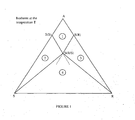
- the change in the composition of the system consisting of the enantiomers and the solvent can be monitored on a diagram such as that illustrated in figure 1 .
- the solid phases are assumed to be nonsolvated and no miscibility in the solid state is supposed to be present.
- the section illustrated is located at a temperature where the solvent is in the liquid form, the melting point of the solvent being markedly lower than that of the enantiomers.
- the pair of enantiomers crystallizes in the conglomerate form.
- This section of the ternary diagram can be divided into four regions:
- a suspension or solution is prepared from a conglomerate of the enantiomers, from an excess of the first of the enantiomers and either from a single solvent or from a mixture of solvents, preferably an azeotropic mixture.
- solvents which can be used comprise, without limitation: ethanol, methanol, acetone, acetonitrile, water, heptane, ethyl acetate, dichloromethane, methyl formate and their mixtures.
- the suspension produced can be in the two-phase region of the enantiomer in excess at the working temperature T.
- preferential dissolution of the enantiomer in deficit takes place, so that only the enantiomer in excess is present in the solid form and is used for the auto-seeding of the process.
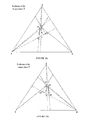
- FIG 2A This situation is illustrated in figure 2A , where E i represents the overall composition of the suspension and L i represents the point representative of the liquid saturated with the enantiomer S. The latter is placed on the line representing the solubility of the enantiomer S.
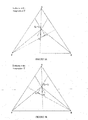
- the solution obtained on conclusion of the first stage is in the single-phase region, as illustrated by the point E i in figure 3A .
- the points E i and L i are in this case coincident since no crystal is present.
- a partial evaporation of the solvent is carried out, preferably but not limitingly according to one of the three following techniques:
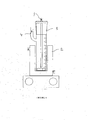
- the first of the above techniques can be employed in a tube (1) which is graduated, in order to measure the remaining volume of the suspension, and which is provided with a jacket (2) comprising a temperature-regulated ( ⁇ 0.1°C) heat-exchange fluid.
- a temperature-regulated ( ⁇ 0.1°C) heat-exchange fluid During the stages necessary for the evaporation of the solvent, the gas supplied by a bottle (not represented) is thermostatically controlled at the working temperature T, before being conveyed into the tube (1) via a hollow needle (3) immersed in the liquid. The stream of gas is then charged with solvent and is then discharged via the outlet (4).
- the suspension is placed in a round-bottom flask (10), where the solvent is maintained at its boiling point, corresponding to the working temperature T, using an oil bath (11) and a heating plate (12).
- the vapor phase is condensed in a reflux condenser (13) and then falls into a Dean & Stark apparatus (14).
- the Dean & Stark apparatus is filled with solvent.
- the condensed solvent then falls back into the round-bottom flask (10).
- the Dean & Stark apparatus (14) is emptied by virtue of a valve (15).
- the condensed solvent then falls into the Dean & Stark apparatus (14), so that it is isolated from the suspension present in the round-bottom flask (10).
- the Dean & Stark apparatus (14) is graduated, it is easier to measure the volume of solvent evaporated.
- a septum (16) makes it possible to sample the suspension during the evaporation.
- the suspension is placed in a container (20).
- the working temperature T is controlled inside the container by virtue of a jacket (21) comprising a temperature-regulated ( ⁇ 0.1°C) heat-exchange fluid.
- the pressure is reduced using a pump connected at (22).
- the solvent evaporated from the tube (20) is condensed in a condenser (23) and then falls into a graduated container (24).
- the condenser (23) and the container (24) are thermostatically controlled using a heat-exchange fluid at the temperature T c (T c ⁇ T), in order to limit the losses of solvent.
- the volume of solvent evaporated is measure by virtue of the graduations of the container (24).
- a septum (25) makes it possible to sample the suspension.
- the evaporation of the solvent can be coupled with a temperature gradient, which can be induced by the loss in heat brought about by the evaporation of the solvent.
- the evaporation process selected depends in particular on the vapor pressure of the solvent used. It is preferable in general to use the first and third techniques above for certain solvents, in particular volatile solvents, such as methanol, acetone or acetonitrile, for example.
- the volume of solvent evaporated is sufficient for the overall synthetic mixture of the composition to be in the three-phase region at the temperature T, without, however, reaching the supersaturation limit of the second enantiomer, at which the spontaneous nucleation of the second enantiomer occurs.
- the amount of solvent evaporated is advantageously chosen so that twice the initial enantiomeric excess is crystallized at the time of the filtration.
- the point representative of the liquid in the case of an auto-seeded process, tends to be displaced along the straight line A - L i in the direction of the point K during the evaporation of the solvent. At the same time, the point representative of the liquid gets closer to the metastable solubility (dotted line) of the enantiomer R, due to the crystallization of the latter.
- the path of the point representative of the liquid is different and depends on the rates of evaporation and of crystallization.
- the evaporation is interrupted when the point representative of the overall composition reaches the point E f .
- the crystallization is interrupted when the point representative of the liquid has reached the point L f .
- the crystals of the first enantiomer are subsequently harvested.
- the rate of filtration is adjusted in order to prevent it from crystallizing.
- An amount by weight of racemic mixture, in the form of crystals, substantially identical to the weight of enantiomer collected above, and also solvent, are then added to the remaining mother liquor.
- the solvent is conventionally the same solvent or mixture of solvents as that used in stage 1, which can either be in the form of fresh solvent or of solvent resulting from the recovery of the solvent evaporated in stage 2.
- the amount of solvent added is adjusted so that the new overall synthetic mixture of the system is located in the two-phase region of the second enantiomer, at the working temperature T, in equilibrium with its saturated solution (auto-seeded process), or in the single-phase region (seeded process).
- the new overall synthetic mixture E' i illustrated in figures 2B and 3B , is positioned symmetrically to the point E i , with respect to the median straight line passing through A on the isothermal section, at the temperature T, of the ternary diagram S - R - A.
- the replication of the preceding stages makes it possible to alternately obtain each of the two enantiomers.
- the distomer (undesired enantiomer) is preferentially racemized during an additional stage, in order to increase the yield of the process.
- the racemic mixture thus obtained can be reintroduced into the process described above, which makes it possible to achieve a yield of eutomer (desired enantiomer) of approximately 100%.
- the productive output according to the invention is equal to 0.1079 g enantiomer /g racemic mixture /h.
- the productive output was 0.1359 g enantiomer /g racemic mixture /h.
- the productive output was 0.166 g enantiomer /g racemic mixture /h.
- the productive output was 0.0470 g enantiomer /g racemic mixture /h.
- the productive output was 0.1503 g enantiomer /g racemic mixture /h.
Landscapes
- Chemical & Material Sciences (AREA)
- Organic Chemistry (AREA)
- Organic Low-Molecular-Weight Compounds And Preparation Thereof (AREA)
Applications Claiming Priority (3)
| Application Number | Priority Date | Filing Date | Title |
|---|---|---|---|
| FR0959170A FR2954310B1 (fr) | 2009-12-18 | 2009-12-18 | Procede de dedoublement d'enantiomeres par evapocristallisation preferentielle |
| US28855609P | 2009-12-21 | 2009-12-21 | |
| PCT/EP2010/069860 WO2011073300A1 (en) | 2009-12-18 | 2010-12-16 | Process for the resolution of enantiomers by preferential evaporative crystallization |
Publications (2)
| Publication Number | Publication Date |
|---|---|
| EP2513017A1 EP2513017A1 (en) | 2012-10-24 |
| EP2513017B1 true EP2513017B1 (en) | 2015-07-01 |
Family
ID=42396635
Family Applications (1)
| Application Number | Title | Priority Date | Filing Date |
|---|---|---|---|
| EP10798054.2A Active EP2513017B1 (en) | 2009-12-18 | 2010-12-16 | Process for the resolution of enantiomers by preferential evaporative crystallization |
Country Status (6)
| Country | Link |
|---|---|
| US (1) | US8907106B2 (enExample) |
| EP (1) | EP2513017B1 (enExample) |
| CA (1) | CA2784236C (enExample) |
| FR (1) | FR2954310B1 (enExample) |
| IN (1) | IN2012DN06281A (enExample) |
| WO (1) | WO2011073300A1 (enExample) |
Families Citing this family (4)
| Publication number | Priority date | Publication date | Assignee | Title |
|---|---|---|---|---|
| GB201417644D0 (en) * | 2014-10-06 | 2014-11-19 | Nucana Biomed Ltd | Method of separating phosphate diastereoisomers |
| CN108135920A (zh) | 2015-10-05 | 2018-06-08 | 努卡那有限公司 | 组合疗法 |
| GB201522771D0 (en) | 2015-12-23 | 2016-02-03 | Nucana Biomed Ltd | Crystalline form of a phosphate derivative |
| FR3054218B1 (fr) * | 2016-07-22 | 2020-03-06 | Universite De Rouen | Procede de dedoublement de sels de baclofene |
Family Cites Families (2)
| Publication number | Priority date | Publication date | Assignee | Title |
|---|---|---|---|---|
| FR2710337B1 (fr) * | 1993-09-23 | 1995-12-08 | Gerard Coquerel | Procédé de dédoublement de deux antipodes optiques par entraînement polythermique programmé et autoensemencé. |
| FR2920428B1 (fr) | 2007-08-29 | 2012-06-15 | Univ Rouen | Procede de dedoublement de sels de l'omeprazole |
-
2009
- 2009-12-18 FR FR0959170A patent/FR2954310B1/fr not_active Expired - Fee Related
-
2010
- 2010-12-16 US US13/516,861 patent/US8907106B2/en active Active
- 2010-12-16 WO PCT/EP2010/069860 patent/WO2011073300A1/en not_active Ceased
- 2010-12-16 EP EP10798054.2A patent/EP2513017B1/en active Active
- 2010-12-16 IN IN6281DEN2012 patent/IN2012DN06281A/en unknown
- 2010-12-16 CA CA2784236A patent/CA2784236C/en active Active
Also Published As
| Publication number | Publication date |
|---|---|
| CA2784236C (en) | 2018-01-02 |
| US20120259127A1 (en) | 2012-10-11 |
| FR2954310B1 (fr) | 2014-07-25 |
| CA2784236A1 (en) | 2011-06-23 |
| FR2954310A1 (fr) | 2011-06-24 |
| EP2513017A1 (en) | 2012-10-24 |
| IN2012DN06281A (enExample) | 2015-09-25 |
| US8907106B2 (en) | 2014-12-09 |
| WO2011073300A1 (en) | 2011-06-23 |
Similar Documents
| Publication | Publication Date | Title |
|---|---|---|
| US6022985A (en) | Process for the preparation of 4-acetoxy-2α-benzoyloxy-5β, 20-epoxy-1, 7β-10β-trihydroxy-9-oxo-tax-11-en-13α-yl(2R,3S)-3-tert-b utoxy-carbonYlamino-2-hydroxy-3-phenylpropionate trihydrate | |
| JP2875894B2 (ja) | イブプロフェンリシネートの生成及び分割 | |
| EP2513017B1 (en) | Process for the resolution of enantiomers by preferential evaporative crystallization | |
| US3943181A (en) | Separating optically pure d-l-isomers of menthol, neomenthol and isomenthol | |
| CN107033079B (zh) | 醋酸艾司利卡西平的制备方法 | |
| EP3617191B9 (en) | Method for manufacturing diastereomer of citric acid derivative | |
| US8822721B2 (en) | Method for separation of racemic compound-forming chiral substances by a cyclic crystallization process and a crystallization device | |
| CA2178369C (en) | Process for the purification and crystallisation of iopamidol | |
| WO2003011886A1 (fr) | Procede de production de cristal mixte de 5'-guanylate disodique et de 5'-inosinate disodique | |
| US4340751A (en) | Method of optical resolution of (±)-2-amino-1-butanol and/or (±)-mandelic acid | |
| JPS62164672A (ja) | 1,2−ジメチルイミダゾ−ルの製造法 | |
| US7820860B2 (en) | Method for separating compound-forming chiral systems | |
| EP0030871A1 (en) | Method of optical resolution of (+/-)-phenyl glycin and/or (+/-)-camphor sulfonic acid | |
| US3158648A (en) | Direct resolution of alpha-methyl-3, 4-dihydroxyphenylalanine | |
| KR100342148B1 (ko) | 6-클로로-α-메틸-카르바졸-2-아세트산의 카르바졸 에스테르 전구체의 정제 방법 | |
| JPS62242692A (ja) | モラノリン誘導体の製造法 | |
| Wang et al. | Study of the characterization and crystallization of 4‐hydroxy‐2‐pyrrolidone | |
| Nagamatsu et al. | Highly stereocontrolled photodimerization of tetramethyluracil by smectic liquid crystalline phase | |
| CN109689620A (zh) | 拆分巴氯芬盐的方法 | |
| CN109970822B (zh) | 一种合成埃格列净中间体的制备方法 | |
| WO2023209033A1 (en) | Method for crystallizing tapentadol intermediate, tapentadol intermediate of high purity, method of making tapentadol and tapentadol of high purity | |
| WO2016039141A1 (ja) | 共結晶を分割する方法 | |
| CN118930603A (zh) | 一种精氨酸培哚普利的精制方法 | |
| CN120757516A (zh) | 一种高纯度的多替诺雷制备方法 | |
| JPS59116250A (ja) | 光学活性α―p―トリルエチルアミンの製造方法 |
Legal Events
| Date | Code | Title | Description |
|---|---|---|---|
| PUAI | Public reference made under article 153(3) epc to a published international application that has entered the european phase |
Free format text: ORIGINAL CODE: 0009012 |
|
| 17P | Request for examination filed |
Effective date: 20120605 |
|
| AK | Designated contracting states |
Kind code of ref document: A1 Designated state(s): AL AT BE BG CH CY CZ DE DK EE ES FI FR GB GR HR HU IE IS IT LI LT LU LV MC MK MT NL NO PL PT RO RS SE SI SK SM TR |
|
| DAX | Request for extension of the european patent (deleted) | ||
| 17Q | First examination report despatched |
Effective date: 20130614 |
|
| GRAP | Despatch of communication of intention to grant a patent |
Free format text: ORIGINAL CODE: EPIDOSNIGR1 |
|
| INTG | Intention to grant announced |
Effective date: 20150122 |
|
| GRAS | Grant fee paid |
Free format text: ORIGINAL CODE: EPIDOSNIGR3 |
|
| GRAA | (expected) grant |
Free format text: ORIGINAL CODE: 0009210 |
|
| AK | Designated contracting states |
Kind code of ref document: B1 Designated state(s): AL AT BE BG CH CY CZ DE DK EE ES FI FR GB GR HR HU IE IS IT LI LT LU LV MC MK MT NL NO PL PT RO RS SE SI SK SM TR |
|
| REG | Reference to a national code |
Ref country code: GB Ref legal event code: FG4D |
|
| REG | Reference to a national code |
Ref country code: AT Ref legal event code: REF Ref document number: 733857 Country of ref document: AT Kind code of ref document: T Effective date: 20150715 Ref country code: CH Ref legal event code: EP |
|
| REG | Reference to a national code |
Ref country code: IE Ref legal event code: FG4D |
|
| REG | Reference to a national code |
Ref country code: DE Ref legal event code: R096 Ref document number: 602010025620 Country of ref document: DE |
|
| REG | Reference to a national code |
Ref country code: NL Ref legal event code: T3 |
|
| REG | Reference to a national code |
Ref country code: SE Ref legal event code: TRGR |
|
| REG | Reference to a national code |
Ref country code: FR Ref legal event code: PLFP Year of fee payment: 6 |
|
| REG | Reference to a national code |
Ref country code: AT Ref legal event code: MK05 Ref document number: 733857 Country of ref document: AT Kind code of ref document: T Effective date: 20150701 |
|
| REG | Reference to a national code |
Ref country code: LT Ref legal event code: MG4D |
|
| PG25 | Lapsed in a contracting state [announced via postgrant information from national office to epo] |
Ref country code: LT Free format text: LAPSE BECAUSE OF FAILURE TO SUBMIT A TRANSLATION OF THE DESCRIPTION OR TO PAY THE FEE WITHIN THE PRESCRIBED TIME-LIMIT Effective date: 20150701 Ref country code: GR Free format text: LAPSE BECAUSE OF FAILURE TO SUBMIT A TRANSLATION OF THE DESCRIPTION OR TO PAY THE FEE WITHIN THE PRESCRIBED TIME-LIMIT Effective date: 20151002 Ref country code: NO Free format text: LAPSE BECAUSE OF FAILURE TO SUBMIT A TRANSLATION OF THE DESCRIPTION OR TO PAY THE FEE WITHIN THE PRESCRIBED TIME-LIMIT Effective date: 20151001 Ref country code: LV Free format text: LAPSE BECAUSE OF FAILURE TO SUBMIT A TRANSLATION OF THE DESCRIPTION OR TO PAY THE FEE WITHIN THE PRESCRIBED TIME-LIMIT Effective date: 20150701 |
|
| PG25 | Lapsed in a contracting state [announced via postgrant information from national office to epo] |
Ref country code: RS Free format text: LAPSE BECAUSE OF FAILURE TO SUBMIT A TRANSLATION OF THE DESCRIPTION OR TO PAY THE FEE WITHIN THE PRESCRIBED TIME-LIMIT Effective date: 20150701 Ref country code: AT Free format text: LAPSE BECAUSE OF FAILURE TO SUBMIT A TRANSLATION OF THE DESCRIPTION OR TO PAY THE FEE WITHIN THE PRESCRIBED TIME-LIMIT Effective date: 20150701 Ref country code: PL Free format text: LAPSE BECAUSE OF FAILURE TO SUBMIT A TRANSLATION OF THE DESCRIPTION OR TO PAY THE FEE WITHIN THE PRESCRIBED TIME-LIMIT Effective date: 20150701 Ref country code: PT Free format text: LAPSE BECAUSE OF FAILURE TO SUBMIT A TRANSLATION OF THE DESCRIPTION OR TO PAY THE FEE WITHIN THE PRESCRIBED TIME-LIMIT Effective date: 20151102 Ref country code: IS Free format text: LAPSE BECAUSE OF FAILURE TO SUBMIT A TRANSLATION OF THE DESCRIPTION OR TO PAY THE FEE WITHIN THE PRESCRIBED TIME-LIMIT Effective date: 20151101 Ref country code: HR Free format text: LAPSE BECAUSE OF FAILURE TO SUBMIT A TRANSLATION OF THE DESCRIPTION OR TO PAY THE FEE WITHIN THE PRESCRIBED TIME-LIMIT Effective date: 20150701 Ref country code: ES Free format text: LAPSE BECAUSE OF FAILURE TO SUBMIT A TRANSLATION OF THE DESCRIPTION OR TO PAY THE FEE WITHIN THE PRESCRIBED TIME-LIMIT Effective date: 20150701 |
|
| REG | Reference to a national code |
Ref country code: DE Ref legal event code: R097 Ref document number: 602010025620 Country of ref document: DE |
|
| PG25 | Lapsed in a contracting state [announced via postgrant information from national office to epo] |
Ref country code: DK Free format text: LAPSE BECAUSE OF FAILURE TO SUBMIT A TRANSLATION OF THE DESCRIPTION OR TO PAY THE FEE WITHIN THE PRESCRIBED TIME-LIMIT Effective date: 20150701 Ref country code: SK Free format text: LAPSE BECAUSE OF FAILURE TO SUBMIT A TRANSLATION OF THE DESCRIPTION OR TO PAY THE FEE WITHIN THE PRESCRIBED TIME-LIMIT Effective date: 20150701 Ref country code: EE Free format text: LAPSE BECAUSE OF FAILURE TO SUBMIT A TRANSLATION OF THE DESCRIPTION OR TO PAY THE FEE WITHIN THE PRESCRIBED TIME-LIMIT Effective date: 20150701 Ref country code: CZ Free format text: LAPSE BECAUSE OF FAILURE TO SUBMIT A TRANSLATION OF THE DESCRIPTION OR TO PAY THE FEE WITHIN THE PRESCRIBED TIME-LIMIT Effective date: 20150701 |
|
| PLBE | No opposition filed within time limit |
Free format text: ORIGINAL CODE: 0009261 |
|
| STAA | Information on the status of an ep patent application or granted ep patent |
Free format text: STATUS: NO OPPOSITION FILED WITHIN TIME LIMIT |
|
| PG25 | Lapsed in a contracting state [announced via postgrant information from national office to epo] |
Ref country code: RO Free format text: LAPSE BECAUSE OF FAILURE TO SUBMIT A TRANSLATION OF THE DESCRIPTION OR TO PAY THE FEE WITHIN THE PRESCRIBED TIME-LIMIT Effective date: 20150701 |
|
| 26N | No opposition filed |
Effective date: 20160404 |
|
| PG25 | Lapsed in a contracting state [announced via postgrant information from national office to epo] |
Ref country code: LU Free format text: LAPSE BECAUSE OF FAILURE TO SUBMIT A TRANSLATION OF THE DESCRIPTION OR TO PAY THE FEE WITHIN THE PRESCRIBED TIME-LIMIT Effective date: 20151216 Ref country code: MC Free format text: LAPSE BECAUSE OF FAILURE TO SUBMIT A TRANSLATION OF THE DESCRIPTION OR TO PAY THE FEE WITHIN THE PRESCRIBED TIME-LIMIT Effective date: 20150701 |
|
| PG25 | Lapsed in a contracting state [announced via postgrant information from national office to epo] |
Ref country code: SI Free format text: LAPSE BECAUSE OF FAILURE TO SUBMIT A TRANSLATION OF THE DESCRIPTION OR TO PAY THE FEE WITHIN THE PRESCRIBED TIME-LIMIT Effective date: 20150701 |
|
| REG | Reference to a national code |
Ref country code: FR Ref legal event code: PLFP Year of fee payment: 7 |
|
| PG25 | Lapsed in a contracting state [announced via postgrant information from national office to epo] |
Ref country code: BG Free format text: LAPSE BECAUSE OF FAILURE TO SUBMIT A TRANSLATION OF THE DESCRIPTION OR TO PAY THE FEE WITHIN THE PRESCRIBED TIME-LIMIT Effective date: 20150701 Ref country code: HU Free format text: LAPSE BECAUSE OF FAILURE TO SUBMIT A TRANSLATION OF THE DESCRIPTION OR TO PAY THE FEE WITHIN THE PRESCRIBED TIME-LIMIT; INVALID AB INITIO Effective date: 20101216 Ref country code: SM Free format text: LAPSE BECAUSE OF FAILURE TO SUBMIT A TRANSLATION OF THE DESCRIPTION OR TO PAY THE FEE WITHIN THE PRESCRIBED TIME-LIMIT Effective date: 20150701 |
|
| PG25 | Lapsed in a contracting state [announced via postgrant information from national office to epo] |
Ref country code: CY Free format text: LAPSE BECAUSE OF FAILURE TO SUBMIT A TRANSLATION OF THE DESCRIPTION OR TO PAY THE FEE WITHIN THE PRESCRIBED TIME-LIMIT Effective date: 20150701 |
|
| PG25 | Lapsed in a contracting state [announced via postgrant information from national office to epo] |
Ref country code: MT Free format text: LAPSE BECAUSE OF FAILURE TO SUBMIT A TRANSLATION OF THE DESCRIPTION OR TO PAY THE FEE WITHIN THE PRESCRIBED TIME-LIMIT Effective date: 20150701 |
|
| REG | Reference to a national code |
Ref country code: FR Ref legal event code: PLFP Year of fee payment: 8 |
|
| PG25 | Lapsed in a contracting state [announced via postgrant information from national office to epo] |
Ref country code: TR Free format text: LAPSE BECAUSE OF FAILURE TO SUBMIT A TRANSLATION OF THE DESCRIPTION OR TO PAY THE FEE WITHIN THE PRESCRIBED TIME-LIMIT Effective date: 20150701 Ref country code: MK Free format text: LAPSE BECAUSE OF FAILURE TO SUBMIT A TRANSLATION OF THE DESCRIPTION OR TO PAY THE FEE WITHIN THE PRESCRIBED TIME-LIMIT Effective date: 20150701 |
|
| REG | Reference to a national code |
Ref country code: FR Ref legal event code: PLFP Year of fee payment: 9 |
|
| PG25 | Lapsed in a contracting state [announced via postgrant information from national office to epo] |
Ref country code: AL Free format text: LAPSE BECAUSE OF FAILURE TO SUBMIT A TRANSLATION OF THE DESCRIPTION OR TO PAY THE FEE WITHIN THE PRESCRIBED TIME-LIMIT Effective date: 20150701 |
|
| PGFP | Annual fee paid to national office [announced via postgrant information from national office to epo] |
Ref country code: DE Payment date: 20241210 Year of fee payment: 15 |
|
| PGFP | Annual fee paid to national office [announced via postgrant information from national office to epo] |
Ref country code: NL Payment date: 20241219 Year of fee payment: 15 Ref country code: BE Payment date: 20241219 Year of fee payment: 15 Ref country code: FI Payment date: 20241219 Year of fee payment: 15 |
|
| PGFP | Annual fee paid to national office [announced via postgrant information from national office to epo] |
Ref country code: GB Payment date: 20241224 Year of fee payment: 15 |
|
| PGFP | Annual fee paid to national office [announced via postgrant information from national office to epo] |
Ref country code: FR Payment date: 20241223 Year of fee payment: 15 |
|
| PGFP | Annual fee paid to national office [announced via postgrant information from national office to epo] |
Ref country code: IE Payment date: 20241223 Year of fee payment: 15 |
|
| PGFP | Annual fee paid to national office [announced via postgrant information from national office to epo] |
Ref country code: SE Payment date: 20241219 Year of fee payment: 15 |
|
| PGFP | Annual fee paid to national office [announced via postgrant information from national office to epo] |
Ref country code: CH Payment date: 20250101 Year of fee payment: 15 |
|
| PGFP | Annual fee paid to national office [announced via postgrant information from national office to epo] |
Ref country code: IT Payment date: 20241227 Year of fee payment: 15 |