EP2510949A1 - Therapeutic agent for fibromyalgia - Google Patents
Therapeutic agent for fibromyalgia Download PDFInfo
- Publication number
- EP2510949A1 EP2510949A1 EP10836055A EP10836055A EP2510949A1 EP 2510949 A1 EP2510949 A1 EP 2510949A1 EP 10836055 A EP10836055 A EP 10836055A EP 10836055 A EP10836055 A EP 10836055A EP 2510949 A1 EP2510949 A1 EP 2510949A1
- Authority
- EP
- European Patent Office
- Prior art keywords
- alkyl
- benzazepine
- tetrahydro
- ethyl
- heteroaryl
- Prior art date
- Legal status (The legal status is an assumption and is not a legal conclusion. Google has not performed a legal analysis and makes no representation as to the accuracy of the status listed.)
- Withdrawn
Links
- 0 CCc1cc(c(N(CC(*)=N*)N)c(c(N)c2)S*)c2[o]1 Chemical compound CCc1cc(c(N(CC(*)=N*)N)c(c(N)c2)S*)c2[o]1 0.000 description 2
Images



Classifications
-
- C—CHEMISTRY; METALLURGY
- C07—ORGANIC CHEMISTRY
- C07D—HETEROCYCLIC COMPOUNDS
- C07D491/00—Heterocyclic compounds containing in the condensed ring system both one or more rings having oxygen atoms as the only ring hetero atoms and one or more rings having nitrogen atoms as the only ring hetero atoms, not provided for by groups C07D451/00 - C07D459/00, C07D463/00, C07D477/00 or C07D489/00
- C07D491/02—Heterocyclic compounds containing in the condensed ring system both one or more rings having oxygen atoms as the only ring hetero atoms and one or more rings having nitrogen atoms as the only ring hetero atoms, not provided for by groups C07D451/00 - C07D459/00, C07D463/00, C07D477/00 or C07D489/00 in which the condensed system contains two hetero rings
- C07D491/04—Ortho-condensed systems
-
- A—HUMAN NECESSITIES
- A61—MEDICAL OR VETERINARY SCIENCE; HYGIENE
- A61K—PREPARATIONS FOR MEDICAL, DENTAL OR TOILETRY PURPOSES
- A61K31/00—Medicinal preparations containing organic active ingredients
-
- A—HUMAN NECESSITIES
- A61—MEDICAL OR VETERINARY SCIENCE; HYGIENE
- A61K—PREPARATIONS FOR MEDICAL, DENTAL OR TOILETRY PURPOSES
- A61K31/00—Medicinal preparations containing organic active ingredients
- A61K31/13—Amines
- A61K31/135—Amines having aromatic rings, e.g. ketamine, nortriptyline
- A61K31/137—Arylalkylamines, e.g. amphetamine, epinephrine, salbutamol, ephedrine or methadone
-
- A—HUMAN NECESSITIES
- A61—MEDICAL OR VETERINARY SCIENCE; HYGIENE
- A61K—PREPARATIONS FOR MEDICAL, DENTAL OR TOILETRY PURPOSES
- A61K31/00—Medicinal preparations containing organic active ingredients
- A61K31/33—Heterocyclic compounds
- A61K31/335—Heterocyclic compounds having oxygen as the only ring hetero atom, e.g. fungichromin
-
- A—HUMAN NECESSITIES
- A61—MEDICAL OR VETERINARY SCIENCE; HYGIENE
- A61K—PREPARATIONS FOR MEDICAL, DENTAL OR TOILETRY PURPOSES
- A61K31/00—Medicinal preparations containing organic active ingredients
- A61K31/33—Heterocyclic compounds
- A61K31/335—Heterocyclic compounds having oxygen as the only ring hetero atom, e.g. fungichromin
- A61K31/34—Heterocyclic compounds having oxygen as the only ring hetero atom, e.g. fungichromin having five-membered rings with one oxygen as the only ring hetero atom, e.g. isosorbide
- A61K31/343—Heterocyclic compounds having oxygen as the only ring hetero atom, e.g. fungichromin having five-membered rings with one oxygen as the only ring hetero atom, e.g. isosorbide condensed with a carbocyclic ring, e.g. coumaran, bufuralol, befunolol, clobenfurol, amiodarone
-
- A—HUMAN NECESSITIES
- A61—MEDICAL OR VETERINARY SCIENCE; HYGIENE
- A61K—PREPARATIONS FOR MEDICAL, DENTAL OR TOILETRY PURPOSES
- A61K31/00—Medicinal preparations containing organic active ingredients
- A61K31/33—Heterocyclic compounds
- A61K31/335—Heterocyclic compounds having oxygen as the only ring hetero atom, e.g. fungichromin
- A61K31/35—Heterocyclic compounds having oxygen as the only ring hetero atom, e.g. fungichromin having six-membered rings with one oxygen as the only ring hetero atom
- A61K31/352—Heterocyclic compounds having oxygen as the only ring hetero atom, e.g. fungichromin having six-membered rings with one oxygen as the only ring hetero atom condensed with carbocyclic rings, e.g. methantheline
- A61K31/353—3,4-Dihydrobenzopyrans, e.g. chroman, catechin
-
- A—HUMAN NECESSITIES
- A61—MEDICAL OR VETERINARY SCIENCE; HYGIENE
- A61K—PREPARATIONS FOR MEDICAL, DENTAL OR TOILETRY PURPOSES
- A61K31/00—Medicinal preparations containing organic active ingredients
- A61K31/33—Heterocyclic compounds
- A61K31/395—Heterocyclic compounds having nitrogen as a ring hetero atom, e.g. guanethidine or rifamycins
- A61K31/397—Heterocyclic compounds having nitrogen as a ring hetero atom, e.g. guanethidine or rifamycins having four-membered rings, e.g. azetidine
-
- A—HUMAN NECESSITIES
- A61—MEDICAL OR VETERINARY SCIENCE; HYGIENE
- A61K—PREPARATIONS FOR MEDICAL, DENTAL OR TOILETRY PURPOSES
- A61K31/00—Medicinal preparations containing organic active ingredients
- A61K31/33—Heterocyclic compounds
- A61K31/395—Heterocyclic compounds having nitrogen as a ring hetero atom, e.g. guanethidine or rifamycins
- A61K31/40—Heterocyclic compounds having nitrogen as a ring hetero atom, e.g. guanethidine or rifamycins having five-membered rings with one nitrogen as the only ring hetero atom, e.g. sulpiride, succinimide, tolmetin, buflomedil
- A61K31/4025—Heterocyclic compounds having nitrogen as a ring hetero atom, e.g. guanethidine or rifamycins having five-membered rings with one nitrogen as the only ring hetero atom, e.g. sulpiride, succinimide, tolmetin, buflomedil not condensed and containing further heterocyclic rings, e.g. cromakalim
-
- A—HUMAN NECESSITIES
- A61—MEDICAL OR VETERINARY SCIENCE; HYGIENE
- A61K—PREPARATIONS FOR MEDICAL, DENTAL OR TOILETRY PURPOSES
- A61K31/00—Medicinal preparations containing organic active ingredients
- A61K31/33—Heterocyclic compounds
- A61K31/395—Heterocyclic compounds having nitrogen as a ring hetero atom, e.g. guanethidine or rifamycins
- A61K31/40—Heterocyclic compounds having nitrogen as a ring hetero atom, e.g. guanethidine or rifamycins having five-membered rings with one nitrogen as the only ring hetero atom, e.g. sulpiride, succinimide, tolmetin, buflomedil
- A61K31/403—Heterocyclic compounds having nitrogen as a ring hetero atom, e.g. guanethidine or rifamycins having five-membered rings with one nitrogen as the only ring hetero atom, e.g. sulpiride, succinimide, tolmetin, buflomedil condensed with carbocyclic rings, e.g. carbazole
- A61K31/4035—Isoindoles, e.g. phthalimide
-
- A—HUMAN NECESSITIES
- A61—MEDICAL OR VETERINARY SCIENCE; HYGIENE
- A61K—PREPARATIONS FOR MEDICAL, DENTAL OR TOILETRY PURPOSES
- A61K31/00—Medicinal preparations containing organic active ingredients
- A61K31/33—Heterocyclic compounds
- A61K31/395—Heterocyclic compounds having nitrogen as a ring hetero atom, e.g. guanethidine or rifamycins
- A61K31/40—Heterocyclic compounds having nitrogen as a ring hetero atom, e.g. guanethidine or rifamycins having five-membered rings with one nitrogen as the only ring hetero atom, e.g. sulpiride, succinimide, tolmetin, buflomedil
- A61K31/407—Heterocyclic compounds having nitrogen as a ring hetero atom, e.g. guanethidine or rifamycins having five-membered rings with one nitrogen as the only ring hetero atom, e.g. sulpiride, succinimide, tolmetin, buflomedil condensed with other heterocyclic ring systems, e.g. ketorolac, physostigmine
-
- A—HUMAN NECESSITIES
- A61—MEDICAL OR VETERINARY SCIENCE; HYGIENE
- A61K—PREPARATIONS FOR MEDICAL, DENTAL OR TOILETRY PURPOSES
- A61K31/00—Medicinal preparations containing organic active ingredients
- A61K31/33—Heterocyclic compounds
- A61K31/395—Heterocyclic compounds having nitrogen as a ring hetero atom, e.g. guanethidine or rifamycins
- A61K31/41—Heterocyclic compounds having nitrogen as a ring hetero atom, e.g. guanethidine or rifamycins having five-membered rings with two or more ring hetero atoms, at least one of which being nitrogen, e.g. tetrazole
- A61K31/415—1,2-Diazoles
-
- A—HUMAN NECESSITIES
- A61—MEDICAL OR VETERINARY SCIENCE; HYGIENE
- A61K—PREPARATIONS FOR MEDICAL, DENTAL OR TOILETRY PURPOSES
- A61K31/00—Medicinal preparations containing organic active ingredients
- A61K31/33—Heterocyclic compounds
- A61K31/395—Heterocyclic compounds having nitrogen as a ring hetero atom, e.g. guanethidine or rifamycins
- A61K31/41—Heterocyclic compounds having nitrogen as a ring hetero atom, e.g. guanethidine or rifamycins having five-membered rings with two or more ring hetero atoms, at least one of which being nitrogen, e.g. tetrazole
- A61K31/415—1,2-Diazoles
- A61K31/416—1,2-Diazoles condensed with carbocyclic ring systems, e.g. indazole
-
- A—HUMAN NECESSITIES
- A61—MEDICAL OR VETERINARY SCIENCE; HYGIENE
- A61K—PREPARATIONS FOR MEDICAL, DENTAL OR TOILETRY PURPOSES
- A61K31/00—Medicinal preparations containing organic active ingredients
- A61K31/33—Heterocyclic compounds
- A61K31/395—Heterocyclic compounds having nitrogen as a ring hetero atom, e.g. guanethidine or rifamycins
- A61K31/41—Heterocyclic compounds having nitrogen as a ring hetero atom, e.g. guanethidine or rifamycins having five-membered rings with two or more ring hetero atoms, at least one of which being nitrogen, e.g. tetrazole
- A61K31/415—1,2-Diazoles
- A61K31/4162—1,2-Diazoles condensed with heterocyclic ring systems
-
- A—HUMAN NECESSITIES
- A61—MEDICAL OR VETERINARY SCIENCE; HYGIENE
- A61K—PREPARATIONS FOR MEDICAL, DENTAL OR TOILETRY PURPOSES
- A61K31/00—Medicinal preparations containing organic active ingredients
- A61K31/33—Heterocyclic compounds
- A61K31/395—Heterocyclic compounds having nitrogen as a ring hetero atom, e.g. guanethidine or rifamycins
- A61K31/435—Heterocyclic compounds having nitrogen as a ring hetero atom, e.g. guanethidine or rifamycins having six-membered rings with one nitrogen as the only ring hetero atom
- A61K31/4353—Heterocyclic compounds having nitrogen as a ring hetero atom, e.g. guanethidine or rifamycins having six-membered rings with one nitrogen as the only ring hetero atom ortho- or peri-condensed with heterocyclic ring systems
- A61K31/437—Heterocyclic compounds having nitrogen as a ring hetero atom, e.g. guanethidine or rifamycins having six-membered rings with one nitrogen as the only ring hetero atom ortho- or peri-condensed with heterocyclic ring systems the heterocyclic ring system containing a five-membered ring having nitrogen as a ring hetero atom, e.g. indolizine, beta-carboline
-
- A—HUMAN NECESSITIES
- A61—MEDICAL OR VETERINARY SCIENCE; HYGIENE
- A61K—PREPARATIONS FOR MEDICAL, DENTAL OR TOILETRY PURPOSES
- A61K31/00—Medicinal preparations containing organic active ingredients
- A61K31/33—Heterocyclic compounds
- A61K31/395—Heterocyclic compounds having nitrogen as a ring hetero atom, e.g. guanethidine or rifamycins
- A61K31/435—Heterocyclic compounds having nitrogen as a ring hetero atom, e.g. guanethidine or rifamycins having six-membered rings with one nitrogen as the only ring hetero atom
- A61K31/44—Non condensed pyridines; Hydrogenated derivatives thereof
- A61K31/445—Non condensed piperidines, e.g. piperocaine
- A61K31/4523—Non condensed piperidines, e.g. piperocaine containing further heterocyclic ring systems
- A61K31/4525—Non condensed piperidines, e.g. piperocaine containing further heterocyclic ring systems containing a five-membered ring with oxygen as a ring hetero atom
-
- A—HUMAN NECESSITIES
- A61—MEDICAL OR VETERINARY SCIENCE; HYGIENE
- A61K—PREPARATIONS FOR MEDICAL, DENTAL OR TOILETRY PURPOSES
- A61K31/00—Medicinal preparations containing organic active ingredients
- A61K31/33—Heterocyclic compounds
- A61K31/395—Heterocyclic compounds having nitrogen as a ring hetero atom, e.g. guanethidine or rifamycins
- A61K31/435—Heterocyclic compounds having nitrogen as a ring hetero atom, e.g. guanethidine or rifamycins having six-membered rings with one nitrogen as the only ring hetero atom
- A61K31/44—Non condensed pyridines; Hydrogenated derivatives thereof
- A61K31/445—Non condensed piperidines, e.g. piperocaine
- A61K31/4523—Non condensed piperidines, e.g. piperocaine containing further heterocyclic ring systems
- A61K31/4535—Non condensed piperidines, e.g. piperocaine containing further heterocyclic ring systems containing a heterocyclic ring having sulfur as a ring hetero atom, e.g. pizotifen
-
- A—HUMAN NECESSITIES
- A61—MEDICAL OR VETERINARY SCIENCE; HYGIENE
- A61K—PREPARATIONS FOR MEDICAL, DENTAL OR TOILETRY PURPOSES
- A61K31/00—Medicinal preparations containing organic active ingredients
- A61K31/33—Heterocyclic compounds
- A61K31/395—Heterocyclic compounds having nitrogen as a ring hetero atom, e.g. guanethidine or rifamycins
- A61K31/435—Heterocyclic compounds having nitrogen as a ring hetero atom, e.g. guanethidine or rifamycins having six-membered rings with one nitrogen as the only ring hetero atom
- A61K31/47—Quinolines; Isoquinolines
- A61K31/473—Quinolines; Isoquinolines ortho- or peri-condensed with carbocyclic ring systems, e.g. acridines, phenanthridines
-
- A—HUMAN NECESSITIES
- A61—MEDICAL OR VETERINARY SCIENCE; HYGIENE
- A61K—PREPARATIONS FOR MEDICAL, DENTAL OR TOILETRY PURPOSES
- A61K31/00—Medicinal preparations containing organic active ingredients
- A61K31/33—Heterocyclic compounds
- A61K31/395—Heterocyclic compounds having nitrogen as a ring hetero atom, e.g. guanethidine or rifamycins
- A61K31/495—Heterocyclic compounds having nitrogen as a ring hetero atom, e.g. guanethidine or rifamycins having six-membered rings with two or more nitrogen atoms as the only ring heteroatoms, e.g. piperazine or tetrazines
-
- A—HUMAN NECESSITIES
- A61—MEDICAL OR VETERINARY SCIENCE; HYGIENE
- A61K—PREPARATIONS FOR MEDICAL, DENTAL OR TOILETRY PURPOSES
- A61K31/00—Medicinal preparations containing organic active ingredients
- A61K31/33—Heterocyclic compounds
- A61K31/395—Heterocyclic compounds having nitrogen as a ring hetero atom, e.g. guanethidine or rifamycins
- A61K31/495—Heterocyclic compounds having nitrogen as a ring hetero atom, e.g. guanethidine or rifamycins having six-membered rings with two or more nitrogen atoms as the only ring heteroatoms, e.g. piperazine or tetrazines
- A61K31/496—Non-condensed piperazines containing further heterocyclic rings, e.g. rifampin, thiothixene or sparfloxacin
-
- A—HUMAN NECESSITIES
- A61—MEDICAL OR VETERINARY SCIENCE; HYGIENE
- A61K—PREPARATIONS FOR MEDICAL, DENTAL OR TOILETRY PURPOSES
- A61K31/00—Medicinal preparations containing organic active ingredients
- A61K31/33—Heterocyclic compounds
- A61K31/395—Heterocyclic compounds having nitrogen as a ring hetero atom, e.g. guanethidine or rifamycins
- A61K31/495—Heterocyclic compounds having nitrogen as a ring hetero atom, e.g. guanethidine or rifamycins having six-membered rings with two or more nitrogen atoms as the only ring heteroatoms, e.g. piperazine or tetrazines
- A61K31/4965—Non-condensed pyrazines
- A61K31/497—Non-condensed pyrazines containing further heterocyclic rings
-
- A—HUMAN NECESSITIES
- A61—MEDICAL OR VETERINARY SCIENCE; HYGIENE
- A61K—PREPARATIONS FOR MEDICAL, DENTAL OR TOILETRY PURPOSES
- A61K31/00—Medicinal preparations containing organic active ingredients
- A61K31/33—Heterocyclic compounds
- A61K31/395—Heterocyclic compounds having nitrogen as a ring hetero atom, e.g. guanethidine or rifamycins
- A61K31/495—Heterocyclic compounds having nitrogen as a ring hetero atom, e.g. guanethidine or rifamycins having six-membered rings with two or more nitrogen atoms as the only ring heteroatoms, e.g. piperazine or tetrazines
- A61K31/4985—Pyrazines or piperazines ortho- or peri-condensed with heterocyclic ring systems
-
- A—HUMAN NECESSITIES
- A61—MEDICAL OR VETERINARY SCIENCE; HYGIENE
- A61K—PREPARATIONS FOR MEDICAL, DENTAL OR TOILETRY PURPOSES
- A61K31/00—Medicinal preparations containing organic active ingredients
- A61K31/33—Heterocyclic compounds
- A61K31/395—Heterocyclic compounds having nitrogen as a ring hetero atom, e.g. guanethidine or rifamycins
- A61K31/535—Heterocyclic compounds having nitrogen as a ring hetero atom, e.g. guanethidine or rifamycins having six-membered rings with at least one nitrogen and one oxygen as the ring hetero atoms, e.g. 1,2-oxazines
- A61K31/5365—Heterocyclic compounds having nitrogen as a ring hetero atom, e.g. guanethidine or rifamycins having six-membered rings with at least one nitrogen and one oxygen as the ring hetero atoms, e.g. 1,2-oxazines ortho- or peri-condensed with heterocyclic ring systems
-
- A—HUMAN NECESSITIES
- A61—MEDICAL OR VETERINARY SCIENCE; HYGIENE
- A61K—PREPARATIONS FOR MEDICAL, DENTAL OR TOILETRY PURPOSES
- A61K31/00—Medicinal preparations containing organic active ingredients
- A61K31/33—Heterocyclic compounds
- A61K31/395—Heterocyclic compounds having nitrogen as a ring hetero atom, e.g. guanethidine or rifamycins
- A61K31/535—Heterocyclic compounds having nitrogen as a ring hetero atom, e.g. guanethidine or rifamycins having six-membered rings with at least one nitrogen and one oxygen as the ring hetero atoms, e.g. 1,2-oxazines
- A61K31/5375—1,4-Oxazines, e.g. morpholine
-
- A—HUMAN NECESSITIES
- A61—MEDICAL OR VETERINARY SCIENCE; HYGIENE
- A61K—PREPARATIONS FOR MEDICAL, DENTAL OR TOILETRY PURPOSES
- A61K31/00—Medicinal preparations containing organic active ingredients
- A61K31/33—Heterocyclic compounds
- A61K31/395—Heterocyclic compounds having nitrogen as a ring hetero atom, e.g. guanethidine or rifamycins
- A61K31/55—Heterocyclic compounds having nitrogen as a ring hetero atom, e.g. guanethidine or rifamycins having seven-membered rings, e.g. azelastine, pentylenetetrazole
-
- A—HUMAN NECESSITIES
- A61—MEDICAL OR VETERINARY SCIENCE; HYGIENE
- A61K—PREPARATIONS FOR MEDICAL, DENTAL OR TOILETRY PURPOSES
- A61K31/00—Medicinal preparations containing organic active ingredients
- A61K31/33—Heterocyclic compounds
- A61K31/395—Heterocyclic compounds having nitrogen as a ring hetero atom, e.g. guanethidine or rifamycins
- A61K31/55—Heterocyclic compounds having nitrogen as a ring hetero atom, e.g. guanethidine or rifamycins having seven-membered rings, e.g. azelastine, pentylenetetrazole
- A61K31/551—Heterocyclic compounds having nitrogen as a ring hetero atom, e.g. guanethidine or rifamycins having seven-membered rings, e.g. azelastine, pentylenetetrazole having two nitrogen atoms, e.g. dilazep
-
- A—HUMAN NECESSITIES
- A61—MEDICAL OR VETERINARY SCIENCE; HYGIENE
- A61P—SPECIFIC THERAPEUTIC ACTIVITY OF CHEMICAL COMPOUNDS OR MEDICINAL PREPARATIONS
- A61P21/00—Drugs for disorders of the muscular or neuromuscular system
-
- C—CHEMISTRY; METALLURGY
- C07—ORGANIC CHEMISTRY
- C07D—HETEROCYCLIC COMPOUNDS
- C07D209/00—Heterocyclic compounds containing five-membered rings, condensed with other rings, with one nitrogen atom as the only ring hetero atom
- C07D209/02—Heterocyclic compounds containing five-membered rings, condensed with other rings, with one nitrogen atom as the only ring hetero atom condensed with one carbocyclic ring
- C07D209/04—Indoles; Hydrogenated indoles
- C07D209/10—Indoles; Hydrogenated indoles with substituted hydrocarbon radicals attached to carbon atoms of the hetero ring
- C07D209/14—Radicals substituted by nitrogen atoms, not forming part of a nitro radical
-
- C—CHEMISTRY; METALLURGY
- C07—ORGANIC CHEMISTRY
- C07D—HETEROCYCLIC COMPOUNDS
- C07D209/00—Heterocyclic compounds containing five-membered rings, condensed with other rings, with one nitrogen atom as the only ring hetero atom
- C07D209/02—Heterocyclic compounds containing five-membered rings, condensed with other rings, with one nitrogen atom as the only ring hetero atom condensed with one carbocyclic ring
- C07D209/52—Heterocyclic compounds containing five-membered rings, condensed with other rings, with one nitrogen atom as the only ring hetero atom condensed with one carbocyclic ring condensed with a ring other than six-membered
-
- C—CHEMISTRY; METALLURGY
- C07—ORGANIC CHEMISTRY
- C07D—HETEROCYCLIC COMPOUNDS
- C07D213/00—Heterocyclic compounds containing six-membered rings, not condensed with other rings, with one nitrogen atom as the only ring hetero atom and three or more double bonds between ring members or between ring members and non-ring members
- C07D213/02—Heterocyclic compounds containing six-membered rings, not condensed with other rings, with one nitrogen atom as the only ring hetero atom and three or more double bonds between ring members or between ring members and non-ring members having three double bonds between ring members or between ring members and non-ring members
- C07D213/04—Heterocyclic compounds containing six-membered rings, not condensed with other rings, with one nitrogen atom as the only ring hetero atom and three or more double bonds between ring members or between ring members and non-ring members having three double bonds between ring members or between ring members and non-ring members having no bond between the ring nitrogen atom and a non-ring member or having only hydrogen or carbon atoms directly attached to the ring nitrogen atom
- C07D213/60—Heterocyclic compounds containing six-membered rings, not condensed with other rings, with one nitrogen atom as the only ring hetero atom and three or more double bonds between ring members or between ring members and non-ring members having three double bonds between ring members or between ring members and non-ring members having no bond between the ring nitrogen atom and a non-ring member or having only hydrogen or carbon atoms directly attached to the ring nitrogen atom with hetero atoms or with carbon atoms having three bonds to hetero atoms with at the most one bond to halogen, e.g. ester or nitrile radicals, directly attached to ring carbon atoms
- C07D213/72—Nitrogen atoms
- C07D213/74—Amino or imino radicals substituted by hydrocarbon or substituted hydrocarbon radicals
-
- C—CHEMISTRY; METALLURGY
- C07—ORGANIC CHEMISTRY
- C07D—HETEROCYCLIC COMPOUNDS
- C07D223/00—Heterocyclic compounds containing seven-membered rings having one nitrogen atom as the only ring hetero atom
- C07D223/02—Heterocyclic compounds containing seven-membered rings having one nitrogen atom as the only ring hetero atom not condensed with other rings
- C07D223/04—Heterocyclic compounds containing seven-membered rings having one nitrogen atom as the only ring hetero atom not condensed with other rings with only hydrogen atoms, halogen atoms, hydrocarbon or substituted hydrocarbon radicals, directly attached to ring carbon atoms
-
- C—CHEMISTRY; METALLURGY
- C07—ORGANIC CHEMISTRY
- C07D—HETEROCYCLIC COMPOUNDS
- C07D231/00—Heterocyclic compounds containing 1,2-diazole or hydrogenated 1,2-diazole rings
- C07D231/54—Heterocyclic compounds containing 1,2-diazole or hydrogenated 1,2-diazole rings condensed with carbocyclic rings or ring systems
- C07D231/56—Benzopyrazoles; Hydrogenated benzopyrazoles
-
- C—CHEMISTRY; METALLURGY
- C07—ORGANIC CHEMISTRY
- C07D—HETEROCYCLIC COMPOUNDS
- C07D239/00—Heterocyclic compounds containing 1,3-diazine or hydrogenated 1,3-diazine rings
- C07D239/70—Heterocyclic compounds containing 1,3-diazine or hydrogenated 1,3-diazine rings condensed with carbocyclic rings or ring systems
-
- C—CHEMISTRY; METALLURGY
- C07—ORGANIC CHEMISTRY
- C07D—HETEROCYCLIC COMPOUNDS
- C07D307/00—Heterocyclic compounds containing five-membered rings having one oxygen atom as the only ring hetero atom
- C07D307/77—Heterocyclic compounds containing five-membered rings having one oxygen atom as the only ring hetero atom ortho- or peri-condensed with carbocyclic rings or ring systems
- C07D307/78—Benzo [b] furans; Hydrogenated benzo [b] furans
- C07D307/79—Benzo [b] furans; Hydrogenated benzo [b] furans with only hydrogen atoms, hydrocarbon or substituted hydrocarbon radicals, directly attached to carbon atoms of the hetero ring
- C07D307/81—Radicals substituted by nitrogen atoms not forming part of a nitro radical
-
- C—CHEMISTRY; METALLURGY
- C07—ORGANIC CHEMISTRY
- C07D—HETEROCYCLIC COMPOUNDS
- C07D311/00—Heterocyclic compounds containing six-membered rings having one oxygen atom as the only hetero atom, condensed with other rings
- C07D311/02—Heterocyclic compounds containing six-membered rings having one oxygen atom as the only hetero atom, condensed with other rings ortho- or peri-condensed with carbocyclic rings or ring systems
- C07D311/04—Benzo[b]pyrans, not hydrogenated in the carbocyclic ring
-
- C—CHEMISTRY; METALLURGY
- C07—ORGANIC CHEMISTRY
- C07D—HETEROCYCLIC COMPOUNDS
- C07D471/00—Heterocyclic compounds containing nitrogen atoms as the only ring hetero atoms in the condensed system, at least one ring being a six-membered ring with one nitrogen atom, not provided for by groups C07D451/00 - C07D463/00
- C07D471/02—Heterocyclic compounds containing nitrogen atoms as the only ring hetero atoms in the condensed system, at least one ring being a six-membered ring with one nitrogen atom, not provided for by groups C07D451/00 - C07D463/00 in which the condensed system contains two hetero rings
- C07D471/04—Ortho-condensed systems
-
- C—CHEMISTRY; METALLURGY
- C07—ORGANIC CHEMISTRY
- C07D—HETEROCYCLIC COMPOUNDS
- C07D471/00—Heterocyclic compounds containing nitrogen atoms as the only ring hetero atoms in the condensed system, at least one ring being a six-membered ring with one nitrogen atom, not provided for by groups C07D451/00 - C07D463/00
- C07D471/02—Heterocyclic compounds containing nitrogen atoms as the only ring hetero atoms in the condensed system, at least one ring being a six-membered ring with one nitrogen atom, not provided for by groups C07D451/00 - C07D463/00 in which the condensed system contains two hetero rings
- C07D471/06—Peri-condensed systems
-
- C—CHEMISTRY; METALLURGY
- C07—ORGANIC CHEMISTRY
- C07D—HETEROCYCLIC COMPOUNDS
- C07D487/00—Heterocyclic compounds containing nitrogen atoms as the only ring hetero atoms in the condensed system, not provided for by groups C07D451/00 - C07D477/00
- C07D487/02—Heterocyclic compounds containing nitrogen atoms as the only ring hetero atoms in the condensed system, not provided for by groups C07D451/00 - C07D477/00 in which the condensed system contains two hetero rings
- C07D487/04—Ortho-condensed systems
-
- C—CHEMISTRY; METALLURGY
- C07—ORGANIC CHEMISTRY
- C07D—HETEROCYCLIC COMPOUNDS
- C07D491/00—Heterocyclic compounds containing in the condensed ring system both one or more rings having oxygen atoms as the only ring hetero atoms and one or more rings having nitrogen atoms as the only ring hetero atoms, not provided for by groups C07D451/00 - C07D459/00, C07D463/00, C07D477/00 or C07D489/00
- C07D491/02—Heterocyclic compounds containing in the condensed ring system both one or more rings having oxygen atoms as the only ring hetero atoms and one or more rings having nitrogen atoms as the only ring hetero atoms, not provided for by groups C07D451/00 - C07D459/00, C07D463/00, C07D477/00 or C07D489/00 in which the condensed system contains two hetero rings
- C07D491/06—Peri-condensed systems
-
- C—CHEMISTRY; METALLURGY
- C07—ORGANIC CHEMISTRY
- C07D—HETEROCYCLIC COMPOUNDS
- C07D495/00—Heterocyclic compounds containing in the condensed system at least one hetero ring having sulfur atoms as the only ring hetero atoms
- C07D495/02—Heterocyclic compounds containing in the condensed system at least one hetero ring having sulfur atoms as the only ring hetero atoms in which the condensed system contains two hetero rings
- C07D495/04—Ortho-condensed systems
-
- C—CHEMISTRY; METALLURGY
- C07—ORGANIC CHEMISTRY
- C07D—HETEROCYCLIC COMPOUNDS
- C07D513/00—Heterocyclic compounds containing in the condensed system at least one hetero ring having nitrogen and sulfur atoms as the only ring hetero atoms, not provided for in groups C07D463/00, C07D477/00 or C07D499/00 - C07D507/00
- C07D513/02—Heterocyclic compounds containing in the condensed system at least one hetero ring having nitrogen and sulfur atoms as the only ring hetero atoms, not provided for in groups C07D463/00, C07D477/00 or C07D499/00 - C07D507/00 in which the condensed system contains two hetero rings
- C07D513/06—Peri-condensed systems
Definitions
- the present invention relates to a drug, particularly, to an agent for treating fibromyalgia.
- Fibromyalgia is a chronic pain disease that induces intolerable chronic pain throughout the whole body as a main symptom accompanied by various concomitant symptoms such as insomnia, generalized fatigue, and depression. Symptoms of fibromyalgia are very diverse. The pain symptoms of fibromyalgia are characterized by being accompanied by chronic pain of deep tissues such as muscle tissues and pain caused by finger pressure. In many cases, the symptoms are also accompanied by pain called tactile allodynia or cold allodynia caused by a tactile stimulus or a cold stimulus that does not in general cause pain. In addition, the symptoms are accompanied by thermal hyperalgesia caused by hypersensitivity to a thermal stimulus in many cases.
- a higher proportion of patients with fibromyalgia suffer from the concomitant symptoms such as emotional disturbance like depression and anxiety, fatigue, sleep disturbance, and irritable bowel syndrome compared to patients with other pain diseases (such as peripheral neuropathy, post-herpetic pain, complex regional pain syndrome, diabetic neuropathy, cancer pain, rheumatism, osteoarthritis, acute postoperative pain, and the like). While organic and functional disorders as the cause of the pain are clear in other pain diseases, the causes of the pain are not clearly explicable for patients with fibromyalgia.
- fibromyalgia is an independent chronic disease that is clearly distinguished from other pain diseases from the viewpoints of symptoms, the cause of pain, the diagnosis criterion, and the like.
- the pathological mechanism of fibromyalgia has not been sufficiently clarified.
- the intolerable chronic pain of the whole body that is a characteristic of fibromyalgia and various concomitant symptoms such as insomnia, generalized fatigue, and depression cannot be sufficiently explained from the disorders at the peripheral level. Consequently, it is considered that a disorder in a pain control system in the central nervous system is involved in the pathological mechanism of fibromyalgia (for example, see Non-Patent Document 1).
- results of research using functional magnetic resonance imaging (fMRI) or single-photon emission tomography (SPET) shows that there are abnormalities in the brain function of patients with fibromyalgia (for example, see Non-Patent Documents 2 and 3).
- Non-Patent Document 5 There is a report reporting that the amount of excitatory amino acid which is an brain excitatory transmitter in the insula of the brain is correlated with the pain level of patients with fibromyalgia (for example, see Non-Patent Document 5). In addition, there is a report reporting that patients with fibromyalgia show an abnormality in a brain mechanism of releasing dopamine in response to a pain stimulation (for example, see Non-Patent Document 4). From the skin tissue of patients with fibromyalgia, cytokines such as interleukin-1 or a tumor necrosis factor are detected (for example, see Non-Patent Document 6).
- Non-Patent Document 4 a possibility that many neurotransmitters, cytokines, hormones, and the like may be involved in the pathological mechanism of fibromyalgia has been suggested.
- cytokines cytokines
- hormones hormones, and the like may be involved in the pathological mechanism of fibromyalgia.
- it is unclear what type of change is the cause of onset and which is the concomitant phenomenon.
- the pathological mechanism of fibromyalgia has not been clarified (for example, see Non-Patent Document 6).
- a drug for example, reserpine
- the present inventors administered a drug (for example, reserpine) reducing biogenic amine level in the body to a mammal so as to continuously induce chronic pain symptoms (myalgia and tactile allodynia) and depression which are characteristic symptoms of fibromyalgia and developed animal models of fibromyalgia by which clinical effects of a therapeutic agent is excellently predicted (for example, see Non-Patent Document 10).
- a drug for example, reserpine
- a 5-HT 2C receptor is one of 14 serotonin receptor subtypes which exist at least in this number and is a G protein-coupled receptor. While almost not being expressed in peripheral tissues, the 5-HT 2C receptor is expressed in the central nervous system over a wide range. In the central nervous system, the 5-HT 2C receptor is distributed in the choroid plexus, prefrontal cortex, anterior olfactory nucleus, hippocampus, amygdala, basal ganglia, nucleus accumbens, ventral tegmental area, hypothalamus, and the like.
- Non-Patent Documents 11 and 12 From the distribution pattern expressed in the central nervous system, analysis results of knockout mouse of the 5-HT 2C receptor, and the like, a possibility that the 5-HT 2C receptor may be involved in various disease conditions such as obesity, metabolism disorders, epilepsy, anxiety, sleep disorders, drug dependence, dyskinesia, obsessive-compulsive disorder, schizophrenia, and depression has been suggested (for example, see Non-Patent Documents 11 and 12).
- 5-HT 2C receptor may be involved in various pathological conditions, there is a possibility that a 5-HT 2C receptor agonist may be useful as a therapeutic or prophylactic agent for various diseases.
- a large number of 5-HT 2C receptor agonists are known (for example, see Non-Patent Documents 11, 12, and 13).
- Examples of diseases likely to be applicable include central nervous system disorders (for example, depression, atypical depression, bipolar disorder, anxiety disorders, obsessive-compulsive disorder, social phobia, panic disorder, sleep disturbance, sexual dysfunction, schizophrenia, migraine, headache, other conditions accompanying other pains, intracranial hypertension, epilepsy, personality disorders, age-related behavioral abnormalities, behavior disorder accompanied by dementia, organic mental disorders, mental disorder in infancy, agitation, age-related memory disorder, chronic fatigue syndrome, drug addiction, alcoholism, drug dependence, obesity, hyperphagia, anorexia nervosa, premenstrual tension; damage to the central nervous system); cardiovascular disorders (for example, thrombosis); gastrointestinal disorders (for example, gastrointestinal motility insufficiency); uremia; sleep apnea; obesity; ocular hypertension; diabetes, and the like (for example, see Patent Documents 1 to 6 and the like, or Non-Patent Documents 11 and 12).
- central nervous system disorders for example, depression,
- Serotonin which is an intrinsic agonist of the 5-HT 2C receptor is considered to play an important role in an endogenous pain control mechanism in the spine.
- exogenous administration of the 5-HT 2C receptor agonist may show an analgesic action by activating the endogenous pain control mechanism.
- the exogenous administration of the 5-HT 2C receptor agonist shows analgesic action in an animal model of inflammatory pain (formalin-administered model or the like) or in an animal model of neuropathic pain (spinal nerve-ligated model or the like) (for example, see Non-Patent Documents 14 and 15).
- Non-Patent Document 10 In order to create a therapeutic agent for fibromyalgia having a novel mechanism of action by the screening method using disease animal models of fibromyalgia reported in Non-Patent Document 10, the present inventors performed thorough research.
- the present invention relates to an agent for treating fibromyalgia, including a 5-HT 2C receptor agonist as an active ingredient.
- the present invention also relates to a pharmaceutical composition for treating fibromyalgia, including a 5-HT 2C receptor agonist as an active ingredient.
- the present invention also relates to the use of 5-HT 2C receptor agonist for producing the agent for treating fibromyalgia.
- the present invention also relates to a 5-HT 2C receptor agonist for treating fibromyalgia.
- the present invention also relates to a method for treating fibromyalgia, wherein a 5-HT 2C receptor agonist is administered to a patient at an effective dose.
- an agent for treating fibromyalgia which is a refractory chronic disease for which a sufficiently effective therapeutic method has not been found.
- the 5-HT 2C receptor agonist is a substance causing a pharmacological reaction by binding to the 5-HT 2C receptor.
- the 5-HT 2C receptor agonist includes a full agonist that maximally activates the receptor and a partial agonist that partially activates the receptor compared to the full agonist.
- the 5-HT 2C receptor agonist preferably has an EC 50 of less than 10 ⁇ M, more preferably has an EC 50 of less than 1 ⁇ M, even more preferably has an EC 50 of less than 100 nM, and still more preferably has an EC 50 of less than 10 nM.
- the EC 50 can be measured by, for example, a functional assay or the like in a cellular system that measures the change in intracellular calcium ion concentration by using fluorescence intensity as an index.
- a 50% inhibitory concentration (IC 50 ) in a 5-HT 2C receptor binding test is preferably about less than 10 ⁇ M, more preferably about less than 1 ⁇ M, even more preferably less than 100 nM, and still more preferably less than 10 nM.
- the 5-HT 2C receptor agonist compounds disclosed in EP 0572863 , EP 0863136 , EP 1213017 , USP 3253989 , USP 3676558 , USP 3652588 , USP 4082844 , USP 4971969 , USP 5494928 , USP 5646173 , USP 6310208 , WO 97/42183 , WO 98/30546 , WO 98/30548 , WO 98/33504 , WO 98/56768 , WO 99/02159 , WO 99/43647 ( USP 6281243 ), WO 00/12475 ( USP 6380238 ), WO 00/12502 ( USP 6365598 ), WO 00/12510 ( USP 6433175 ), WO 00/12475 , WO 00/12481 ( USP 6552062 ), WO 00/12482 , WO 00/12502
- compounds (1) to (89) and (76) to (84) are preferable, compounds (1) to (54) are more preferable, and compounds (1) to (31) are most preferable.
- the 5-HT 2C receptor agonist preferably and appropriately used for the present invention also includes the compounds included in Patent Document 1 (preferably the compounds exemplified in Patent Document 1). These include a compound represented by Formula (I) or a pharmaceutically acceptable salt thereof, (symbols in the formula mean the following:
- the compounds included in Patent Document 2 are more preferable. These include a compound represented by Formula (I') or a pharmaceutically acceptable salt thereof. (symbols in the formula mean the following:
- the 5-HT 2C receptor agonist preferably and appropriately used for the present invention also includes the compounds included in Patent Document 3 (preferably, the compounds exemplified in Patent Document 3). These include a compound represented by Formula (II) or a pharmaceutically acceptable salt thereof, (symbols in the formula mean the following:
- Examples of preferable compounds represented by Formula (II) include, but are not limited to, the following compounds or pharmaceutically acceptable salts thereof, 8-chloro-1-methyl-2,3,4,5-tetrahydro-1H-3-benzazepine; 8-bromo-1-methyl-2,3,4,5-tetrahydro-1H-3-benzazepine; 8-iodo-1-methyl-2,3,4,5-tetrahydro-1H-3-benzazepine; 8-trifluoromethyl-1-methyl-2,3,4,5-tetrahydro-1H-3-benzazepine; 8-trifluoromethyl-1-ethyl-2,3,4,5-tetrahydro-1H-3-benzazepine; 8-chloro-1-ethyl-2,3,4,5-tetrahydro-1H-3-benzazepine; 8-bromo-1-ethyl-2,3,4,5-tetrahydro-1H-3-benzazepine; 8-iodo-1-ethyl-2
- 5-HT 2C receptor agonists represented by Formula (II) (1R)-8-chloro-1-methyl-2,3,4,5-tetrahydro-1H-3-benzazepine (generic name: lorcaserin) or a pharmaceutically acceptable salt thereof is particularly preferable.
- Examples of the preferable compound represented by Formula (III) include, but are not limited to, the following compounds or pharmaceutically acceptable salts thereof. 4,5,6,7,9,9a,10,11,12,12a-decahydrocyclopenta[c][1,4]diazepino[6,7,1-ij]quinoline; 2-bromo-4,5,6,7,9,9a, 10,11,12,12a-decahydrocyclopenta[c] [1,4]diazepino[6,7,1-ij]quinoline; 2-chloro-4,5,6,7,9,9a,10,11,12,12a-decahydrocyclopenta[c] [1,4]diazepino[6,7,1-ij]quinoline; 2-phenyl-4,5,6,7,9,9a, 10,11,12,12a-decahydrocyclopenta[c] [1,4]diazepino[6,7,1-ij]quinoline; 2-
- the 5-HT 2C receptor agonist particularly preferably and appropriately used for the present invention is (S)-2-(7-ethyl-1H-furo[2,3-g]indazol-1-yl)-1-methylethylamine (YM348); (1R)-8-chloro-1-methyl-2,3,4,5-tetrahydro-1H-3-benzazepine (generic name: lorcaserin); (-)-(9aR, 12aS)-4,5,6,7,9,9a,10,11,12,12a-decahydrocyclopenta[c][1,4]diazepino[6,7,1-ij]quinoline (generic name: vabicaserin); or a pharmaceutically acceptable salt thereof.
- Alkyl is a linear or branched aliphatic saturated hydrocarbon group, and examples thereof include methyl, ethyl, n-propyl, isopropyl, n-butyl, isobutyl, sec-butyl, tert-butyl, n-pentyl, n-hexyl, and the like.
- Alkenyl is a linear or branched aliphatic saturated hydrocarbon group, and examples thereof include vinyl, propenyl, butenyl, pentenyl, 1-methylvinyl, 1-methyl-2-propenyl, 1,3-butadienyl, 1,3-pentadienyl, and the like.
- Cycloalkyl is an aliphatic saturated hydrocarbon ring group which may have a bridge, and examples thereof include cyclopropyl, cyclobutyl, cyclopentyl, cyclohexyl, cycloheptyl, cyclooctyl, adamantyl, and the like.
- Cycloalkane is an aliphatic saturated C 3-10 hydrocarbon ring which may have a bridge and includes monocyclic C 4-8 alkane or bridged bicyclic C 5-10 alkane.
- Cycloalkene is an aliphatic unsaturated C 3-10 hydrocarbon ring which may have a bridge and includes monocyclic C 4-8 alkene or bridged bicyclic C 5-10 alkene.
- Aryl is a mono- to tricyclic aromatic C 6-14 hydrocarbon ring group, and examples thereof include phenyl and naphthyl. As another embodiment, aryl is phenyl.
- a hetero ring is a 3- to 15-membered mono- to tricyclic hetero ring group having 1 to 4 hetero atoms selected from N, O, and S and includes a saturated ring, an aromatic ring, and a partially hydrogenated ring group thereof.
- S or N which is a ring atom may form an oxide or a dioxide by being oxidized.
- Heteroaryl is a monocyclic aromatic ring group or a bi- or tricyclic unsaturated ring group having at least one aromatic ring as a constituent element, among the above hetero rings.
- a hetero ring is specifically monocylcic heteroaryl such as pyridyl, pyrrolyl, pyrazinyl, pyrimidinyl, pyridazinyl, imidazolyl, triazolyl, triazinyl, tetrazolyl, thiazolyl, pyrazolyl, isothiazolyl, oxazolyl, isoxazolyl, thiadiazolyl, oxadiazolyl, thienyl, or furyl; bicyclic heteroaryl such as indolyl, isoindolyl, benzimidazolyl, indazolyl, quinolyl, isoquinolyl, quinazolinyl, quinoxalinyl, phthalazinyl, benzothiazolyl, benzisothiazolyl, benzothiadiazolyl, benzoxazolyl, benzisoxazolyl, benzofuranyl, or
- the unsaturated 5-membered hetero ring which may have 1 to 3 of 1 or 2 or more kinds of hetero atoms selected from N, O and S atoms include pentene, pentadiene, thiophene, furan, pyrrole, imidazole, pyrazole, thiazole, oxazole, isothiazole, isoxazole, triazole, thiadiazole, oxadiazole, and the like.
- Specific examples of the unsaturated 6-membered hetero ring having 1 to 2 N atoms include pyridine, pyridazine, pyrimidine, pyrazine, and the like.
- Examples of the 3- to 8-membered nitrogen-containing saturated hetero ring include aziridine, azetidine, pyrrolidine, piperidine, hexahydroazepine, octahydroazocine, and the like.
- Halogen or halo means a Cl, Br, F, or I atom.
- Perhalo-C 1-6 alkyl means alkyl having 1 to 6 carbon atoms in which 3 or more of the hydrogen atoms are substituted with halogen.
- a pharmaceutically acceptable salt means a pharmaceutically acceptable acid or base addition salt with an organic or inorganic acid or base, and examples thereof include a mineral acid salt with hydrochloric acid, sulfuric acid, phosphoric acid, hydrobromic acid, or the like; a salt with an organic acid such as acetic acid, oxalic acid, succinic acid, citric acid, maleic acid, malic acid, fumaric acid, tartaric acid, or methanesulfonic acid; and a salt with an acidic amino acid such as glutamic acid or asparaginic acid.
- 5-HT 2C receptor agonists which are existing compounds can be easily obtained by the method disclosed in the above documents or obtained based on the method.
- the dose of the active ingredient of the present invention is appropriately determined for each medicinal agent on a case by case basis in consideration of the route of administration, the symptoms of a disease, the age, sex, and the like of an administration target, within a range of a daily dose of from 0.01 mg to 1000 mg.
- a clinically effective dose for a patient is converted into the following preferable range.
- YM348 is preferably administered at about 0.1 mg to 100 mg/day to an adult in a single dose or in several separate doses per day.
- lorcaserin is preferably administered at about 0.1 mg to 1000 mg/day to an adult in a single dose or in several divided doses per day.
- vabicaserin is preferably administered at about 1 mg to 1000 mg/day to an adult in a single dose or in several divided doses per day.
- the medicinal agent of the present invention can be prepared as an oral solid preparation, an oral liquid preparation, or an injection according to common methods by using an organic or inorganic carrier, an excipient, and other additives appropriate for oral or parenteral administration.
- an oral solid preparation that can easily be taken by patient him or herself and can be conveniently stored and carried is preferable.
- Specific examples of the oral solid administration include a tablet, powder, granules, fine granules, a capsule, a pill, and the like.
- an active substance is mixed with at least an inactive diluent, for example, lactose, mannitol, glucose, microcrystalline cellulose, starch, polyvinyl pyrrolidone, or magnesium metasilicate aluminate.
- an inactive diluent for example, lactose, mannitol, glucose, microcrystalline cellulose, starch, polyvinyl pyrrolidone, or magnesium metasilicate aluminate.
- the composition may contain additives other than the inactive diluents, for example, a binder such as hydroxypropyl cellulose or hydroxypropyl methylcellulose, a lubricant such as magnesium stearate, calcium stearate, polyethylene glycol, starch, or talc, a disintegrator such as calcium cellulose glycolate, a stabilizer such as lactose, a dissolution adjuvant such as glutamic acid or asparaginic acid, Tween 80, a plasticizer such as triacetin, and a colorant such as titanium oxide or iron sesquioxide, according to common methods.
- a binder such as hydroxypropyl cellulose or hydroxypropyl methylcellulose
- a lubricant such as magnesium stearate, calcium stearate, polyethylene glycol, starch, or talc
- a disintegrator such as calcium cellulose glycolate
- a stabilizer such as lactose
- a dissolution adjuvant such as glut
- the tablet or pill may be optionally coated with a sugar film or a film of a gastric-soluble or an enteric-soluble substance such as sucrose, gelatin, agar, pectin, hydroxypropyl cellulose, or hydroxypropyl methylcellulose phthalate.
- a sugar film or a film of a gastric-soluble or an enteric-soluble substance such as sucrose, gelatin, agar, pectin, hydroxypropyl cellulose, or hydroxypropyl methylcellulose phthalate.
- the therapeutic effect of the 5-HT 2C receptor agonist on fibromyalgia can be confirmed by the effect of improving the muscle tenderness threshold that is an index of chronic myalgia for the disease animal model of Non-Patent Document 10, as shown in examples.
- the effect can be evaluated by measuring one or two or more items among the muscle tenderness threshold as in index of chronic myalgia, the cutaneous nociception threshold as an index of tactile allodynia, cold sensitivity as an index of cold allodynia, and thermosensitivity as an index of thermal hyperalgesia.
- the effect can also be evaluated by plantar stimulation caused by a Randall Selitto instrument, the lowering of a reaction threshold with respect to mechanical stimulation such as pinch stimulation, the lowering of a reaction threshold with respect to thermal stimulation, the lowering of a reaction threshold with respect to cold stimulation, the lowering of a reaction threshold with respect to electric stimulation, the increase in pain behavior caused by chemical stimulation, the increase in spontaneous pain behavior caused when a stimulus is not input, such as the fluctuation of spontaneous motor activity or limb-lifting behavior, and the like.
- the muscle tenderness threshold refers to the magnitude of a minimum pressure stimulus that causes an animal to show a withdrawal response when a slowly increasing pressure stimulus is applied to the muscle. In order to measure the threshold, it is possible to select and use various known methods according to the type of animals.
- the method of Schafers et al that is, a method of applying a slowly increasing pressure stimulus to the gastrocnemius of a right rear foot and measuring the magnitude of the minimum pressure stimulus at which the rat shows the withdrawal response as the muscle tenderness threshold, as shown in examples and the like described later.
- the threshold of cutaneous nociception refers to the magnitude of a minimum tactile stimulus that causes an animal to show a withdrawal reflex when a gradually increasing tactile stimulus is applied to the skin.
- a von Frey hair method in which von Frey filaments differing in thickness are applied to the plantar surface of a right rear foot of a rat, whereby a filament having the smallest thickness that causes the rat to show the withdrawal response can be measured as the cutaneous nociception threshold, as shown in examples and the like described later.
- the cold sensitivity refers to the responsiveness of an animal shown when a cold stimulus is applied. In order to measure the cold sensitivity, it is possible to select and use various known methods according to the type of animals.
- thermosensitivity refers to the responsiveness of an animal shown when a thermal stimulus is applied.
- thermosensitivity it is possible to select and use various known methods according to the type of animals.
- thermosensitivity it is possible to measure the thermosensitivity as latency of a foot withdrawal response shown when a rear foot of a rat is stimulated with heat of infrared by the method of Hargreaves et al, as shown in examples and the like described later.
- depression can be evaluated using the increase in the immobility time in a forced swimming test as an index.
- the measurement of depression is not limited to this index, and another index, for example, the immobility time at the time of tail suspension, spontaneous motor activity, or the like can also be used.
- the therapeutic effect of 5-HT 2C receptor agonist on fibromyalgia can be confirmed by an experiment using other appropriate disease animal models and can also be confirmed by a clinical test on patients with fibromyalgia.
- the medicinal agent of the present invention can be concurrently used with an anxiolytic (flurazepam or the like), an antidepressant (duloxetine, milnacipran, amitriptyline, fluvoxamine, or the like), an anticonvulsant (pregabalin, gabapentin, or the like), a sleep improving drug (sodium oxybate, ramelteon, melatonin, or the like), or with a general analgesic (morphine, tramadol, diclofenac, naproxen, acetaminophene, or the like), or the like, which are used for alleviating the symptoms of patients with fibromyalgia, at the same time or at a time interval.
- anxiolytic flurazepam or the like
- an antidepressant duloxetine, milnacipran, amitriptyline, fluvoxamine, or the like
- an anticonvulsant pregabalin, gabapent
- Reference Example 1 Preparing Disease Animal Model of Fibromyalgia Induced by Repeated Reserpine Administration (Lowering of Muscle Tenderness Threshold and Cutaneous Nociception Threshold)
- the muscle tenderness threshold was measured according to the method of Schafers et al ( Schafers M et al,. Pain, 104, 579-588, 2003 ).
- a pressure stimulus gradually increasing up to 250 g was applied to the gastrocnemius of the right rear foot of the rat.
- the magnitude of a minimum pressure stimulus at which the rat showed a withdrawal response with respect to the pressure stimulus of the right rear foot was measured as a muscle tenderness threshold (g). The measurement was performed for three times for each point in time, and the average thereof was taken as a measured value.
- the cutaneous nociception threshold was measured according to the method of Chaplan et al ( Chaplan et al., J Neurosci Methods, 53, 55-63, 1994 ). The measurement was performed using a series of von Frey filaments differing in thickness, which made it possible to apply a constant pressure.
- the rats were adapted to a cage for measurement having a wire mesh bottom, and then von Frey filaments (0.42 g, 0.74 g, 1.2 g, 2.1 g, 3.5 g, 6.0 g, 9.3 g, and 15.8 g) were applied to the plantar surface of a right rear foot of the rat until the withdrawal response was caused in the right rear foot or until 6 seconds elapsed without the response.
- the von Frey filament was applied using an up and down method. That is, a filament having about a medium thickness was applied initially, and when the withdrawal response was observed, a filament having a thickness which is one level lower than the initial filament was applied, and when the response was not observed, a filament having a thickness which is one level higher than the initial filament was applied.
- the cutaneous nociception threshold at the respective points in time was calculated as a threshold (g) of a foot withdrawal response by using a calculation formula reported by Chaplan et al (Chaplan et al. described above).
- Chaplan et al Chaplan et al. described above.
- the influence of reserpine on the muscle tenderness threshold and the threshold of cutaneous nociception was examined according to the following protocol. 24 rats were used for male and female rats respectively.
- the muscle tenderness threshold and the cutaneous nociception threshold before the reserpine administration were measured, and then the rats were assigned to any of a vehicle (0.5% aqueous acetic acid) group, a 0.1 mg/kg reserpine group, a 0.3 mg/kg group, and a 1 mg/kg group based on the dose of reserpine (6 rats per group).
- a vehicle or reserpine was subcutaneously administered to the back of rats of the respective groups once a day for three days.
- the volume of the vehicle or reserpine was set to 1 ml per a weight of a rat of 1 kg for all groups.
- the muscle tenderness threshold and the cutaneous nociception threshold were measured for the respective rats.
- the muscle tenderness threshold and the cutaneous nociception threshold were measured by an experimenter who did not know the dose of reserpine administered to the animal. All measured values were indicated as an average ⁇ standard error.
- the statistical significant difference in the measured value at the respective points in time between the reserpine-administered group and the vehicle-administered group was verified by two way ANOVA and a Bonferroni method. A significance level (P) less than 5% was determined as statistical significance (P ⁇ 0.05 was indicated as * in the drawings).
- Figs. 1A and 1B respectively show the results in the male and female rats.
- the reserpine administration significantly lowered the muscle tenderness threshold in all of the male and female rats (two way ANOVA).
- the muscle tenderness threshold was markedly lowered in the 1 mg/kg reserpine group.
- the muscle tenderness threshold in the 1 mg/kg reserpine group was statistically significantly lower for 10 days after the final administration of reserpine in male rats and for 7 days after the final administration of reserpine in female rats (two way ANOVA and Bonferroni method).
- Figs. 2A and 2B respectively show the results in the male and female rats.
- the reserpine administration significantly lowered the cutaneous nociception threshold in all of the male and female rats (two way ANOVA).
- the cutaneous nociception threshold was markedly lowered in the 1 mg/kg reserpine group.
- the cutaneous nociception threshold in the 1 mg/kg reserpine group was statistically significantly lower for 21 days after the final administration of reserpine in male rats and for 14 days after the final administration of reserpine in female rats (two way ANOVA and Bonferroni method).
- each rats in total were divided into 5 experiment schedules (measuring the immobility time on the first, third, fifth, seventh, and fourteenth day after the final administration), and the rats were divided into a vehicle (0.5% aqueous acetic acid)-administered group and a 1 mg/kg reserpine-administered group such that each group included 8 rats.
- the vehicle or reserpine was repeatedly subcutaneously administered at 1 mg/kg once a day for 3 days.
- Each forced swimming test includes a pretest session (15 minutes of swimming) and a test session (5 minutes of swimming) 24 hours after the pretest session, and the immobility time was measured in the test session.
- the pretest session was performed on the day of final administration (that is, immediately after the final administration) and on the second, fourth, sixth, and thirteenth days after the final administration of the vehicle or reserpine, and the test session was performed on the first, third, fifth, seventh, and fourteenth days after the final administration of the vehicle or reserpine.
- the forced swimming test was performed only once for each rat. All of the measured values were indicated as an average ⁇ standard error. The statistical significant difference in the measured value at the respective test schedules between the reserpine-administered group and the vehicle-administered group was verified by a Student's t-test. A significance level (P) less than 5% was determined as statistical significance (P ⁇ 0.05 was indicated as * in the drawings).
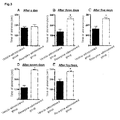
- Figs. 3A, 3B, 3C, 3D, and 3E respectively show the results of the forced swimming test performed on the first, third, fifth, seventh, and fourteenth days after the final administration of reserpine.
- P 0.625, Student's t-test.
- depression was induced by reserpine repeatedly administered at 1 mg/kg once a day for 3 days. It is well known that depression is also induced in a high proportion of patients with fibromyalgia, so the present disease animal model has a high similarity to patients with fibromyalgia in respect that the depression is induced as a concomitant symptom.
- reserpine Male Sprague-Dawley rats (Japan SLC, Hamamatsu, Japan) were used. Thirty rats were used for each drug. As shown in Reference Example 1, reserpine was repeatedly administered at 1 mg/kg once a day for 3 days for 24 rats, thereby causing the lowering of the muscle tenderness threshold and the cutaneous nociception threshold. The other 6 rats were not administered with reserpine and provided for the experiment as a healthy control. The drug efficacy was evaluated 5 days after the final administration of reserpine for all groups.
- the lowering of the muscle tenderness threshold and the cutaneous nociception threshold was marked at a statistically significant level (Reference Example 1), and the immobility time of the forced swimming test, which is an index of depression, was significantly lengthened compared to the control (Reference Example 2).
- the muscle tenderness threshold of the rats 24 reserpine-administered rats and 6 healthy rats
- the 24 reserpine-administered rats were assigned to 4 groups according to the dose of the test drug.
- the muscle tenderness threshold was measured 30, 60, and 120 minutes after the administration.
- the muscle tenderness threshold was measured 60, 120, and 240 minutes after the administration.
- the muscle tenderness threshold was measured 30, 60, 120, and 240 minutes after the administration.
- the muscle tenderness threshold was measured without administering the drug.
- the drug efficacy was measured by an experimenter who did not know how the drug was administered to the animal.
- the vehicle, dose, and route of administration of the respective test drugs are shown in the following table.
- Fig. 4 shows the effect of YM348 on the lowering of the muscle tenderness threshold induced by reserpine.
- YM348 restored the lowering of the muscle tenderness threshold induced by reserpine in a dose dependent manner.
- the effect of YM348 was statistically significant at a dose of 0.1 mg/kg or 0.3 mg/kg (two way ANOVA and Bonferroni method).
- Fig. 5 shows the effect of lorcaserin on the lowering of the muscle tenderness threshold induced by reserpine.
- Lorcaserin restored the lowering of the muscle tenderness threshold induced by reserpine in a dose dependent manner.
- the effect of lorcaserin was statistically significant at a dose of 1 mg/kg or 3 mg/kg (two way ANOVA and Bonferroni method).
- Fig. 6 shows the effect of vabicaserin on the lowering of the muscle tenderness threshold induced by reserpine.
- Vabicaserin restored the lowering of the muscle tenderness threshold induced by reserpine in a dose dependent manner.
- the effect of vabicaserin was statistically significant at a dose of 1 mg/kg or 3 mg/kg (two way ANOVA and Bonferroni method).
- Example 2 Antagonism against Action of Compound of Example 1 Caused by 5-HT 2C Receptor Antagonist
- reserpine was repeatedly subcutaneously administered at 1 mg/kg once a day for 3 days for 24 rats, thereby causing the lowering of the muscle tenderness threshold.
- the other 6 rats were not administered with reserpine and provided for the experiment as a healthy control.
- the drug efficacy was evaluated 5 days after the final administration of reserpine.
- SB242084 as a selective 5-HT 2C receptor antagonist and lorcaserin as a 5-HT 2C receptor agonist were used.
- Fig. 7 shows the antagonistic action of SB242084 against the action of lorcaserin.
- lorcaserin Lor+v
- the SB242084 showed a statistically significant antagonistic action in a dose dependent manner against the action of lorcaserin (Dunnett's multiple range test).
- This result showed that the action of the 5-HT 2C receptor agonist of Example 1 restoring the lowering of the muscle tenderness threshold is inhibited by the 5-HT 2C receptor antagonist. That is, the result showed that the action of the 5-HT 2C receptor agonist of Example 1 restoring the lowering of the muscle tenderness threshold is mediated by the action of the 5-HT 2C receptor agonist.
- an agent for treating fibromyalgia which is a refractory chronic disease for which a sufficiently effective therapeutic method has not been found.
Landscapes
- Health & Medical Sciences (AREA)
- Chemical & Material Sciences (AREA)
- Organic Chemistry (AREA)
- Medicinal Chemistry (AREA)
- Pharmacology & Pharmacy (AREA)
- Life Sciences & Earth Sciences (AREA)
- Animal Behavior & Ethology (AREA)
- General Health & Medical Sciences (AREA)
- Public Health (AREA)
- Veterinary Medicine (AREA)
- Epidemiology (AREA)
- Emergency Medicine (AREA)
- Nuclear Medicine, Radiotherapy & Molecular Imaging (AREA)
- Neurology (AREA)
- Orthopedic Medicine & Surgery (AREA)
- Physical Education & Sports Medicine (AREA)
- Chemical Kinetics & Catalysis (AREA)
- General Chemical & Material Sciences (AREA)
- Bioinformatics & Cheminformatics (AREA)
- Engineering & Computer Science (AREA)
- Pharmaceuticals Containing Other Organic And Inorganic Compounds (AREA)
- Nitrogen Condensed Heterocyclic Rings (AREA)
- Indole Compounds (AREA)
- Heterocyclic Compounds That Contain Two Or More Ring Oxygen Atoms (AREA)
- Heterocyclic Carbon Compounds Containing A Hetero Ring Having Nitrogen And Oxygen As The Only Ring Hetero Atoms (AREA)
- Pyrane Compounds (AREA)
- Pyrrole Compounds (AREA)
- Heterocyclic Carbon Compounds Containing A Hetero Ring Having Oxygen Or Sulfur (AREA)
- Pyridine Compounds (AREA)
- Plural Heterocyclic Compounds (AREA)
- Furan Compounds (AREA)
- Nitrogen And Oxygen Or Sulfur-Condensed Heterocyclic Ring Systems (AREA)
- Medicines That Contain Protein Lipid Enzymes And Other Medicines (AREA)
- Acyclic And Carbocyclic Compounds In Medicinal Compositions (AREA)
- Other In-Based Heterocyclic Compounds (AREA)
- Heterocyclic Compounds Containing Sulfur Atoms (AREA)
Abstract
Description
- The present invention relates to a drug, particularly, to an agent for treating fibromyalgia.
- Fibromyalgia is a chronic pain disease that induces intolerable chronic pain throughout the whole body as a main symptom accompanied by various concomitant symptoms such as insomnia, generalized fatigue, and depression. Symptoms of fibromyalgia are very diverse. The pain symptoms of fibromyalgia are characterized by being accompanied by chronic pain of deep tissues such as muscle tissues and pain caused by finger pressure. In many cases, the symptoms are also accompanied by pain called tactile allodynia or cold allodynia caused by a tactile stimulus or a cold stimulus that does not in general cause pain. In addition, the symptoms are accompanied by thermal hyperalgesia caused by hypersensitivity to a thermal stimulus in many cases. A higher proportion of patients with fibromyalgia suffer from the concomitant symptoms such as emotional disturbance like depression and anxiety, fatigue, sleep disturbance, and irritable bowel syndrome compared to patients with other pain diseases (such as peripheral neuropathy, post-herpetic pain, complex regional pain syndrome, diabetic neuropathy, cancer pain, rheumatism, osteoarthritis, acute postoperative pain, and the like). While organic and functional disorders as the cause of the pain are clear in other pain diseases, the causes of the pain are not clearly explicable for patients with fibromyalgia.
According to the diagnosis criterion defined by the American College of Rheumatology, if pain continues for 3 months or longer over a wide area of the body, and tenderness is perceived in 11 or more sites among tender points of 18 sites throughout the whole body (ligaments close to bones, tendons, muscles, and the like), it is diagnosed as fibromyalgia. This diagnosis criterion is clearly distinguished from the diagnosis criterion of other pain diseases. That is, fibromyalgia is an independent chronic disease that is clearly distinguished from other pain diseases from the viewpoints of symptoms, the cause of pain, the diagnosis criterion, and the like. - The prevalence rate of fibromyalgia accounts for about 2% of the population, so there are a great number of patients. However, since there is no sufficiently effective therapeutic method, the development of a highly effective new therapeutic method is strongly desired.
- The pathological mechanism of fibromyalgia has not been sufficiently clarified. The intolerable chronic pain of the whole body that is a characteristic of fibromyalgia and various concomitant symptoms such as insomnia, generalized fatigue, and depression cannot be sufficiently explained from the disorders at the peripheral level. Consequently, it is considered that a disorder in a pain control system in the central nervous system is involved in the pathological mechanism of fibromyalgia (for example, see Non-Patent Document 1). Actually, results of research using functional magnetic resonance imaging (fMRI) or single-photon emission tomography (SPET) shows that there are abnormalities in the brain function of patients with fibromyalgia (for example, see Non-Patent Documents 2 and 3).
- In patients with fibromyalgia, quantitative fluctuation and functional abnormalities of various neurotransmitters, cytokines, or hormones are observed. The concentration of excitatory amino acids, substance P, or nerve growth factor in the cerebrospinal fluid of patients with fibromyalgia is higher than that of a non-patient group. On the other hand, the concentration of the metabolites of serotonin, dopamine, or norepinephrine in the cerebrospinal fluid of patients with fibromyalgia is lower than that of a non-patient group (for example, see Non-Patent Document 4). There is a report reporting that the amount of excitatory amino acid which is an brain excitatory transmitter in the insula of the brain is correlated with the pain level of patients with fibromyalgia (for example, see Non-Patent Document 5).
In addition, there is a report reporting that patients with fibromyalgia show an abnormality in a brain mechanism of releasing dopamine in response to a pain stimulation (for example, see Non-Patent Document 4). From the skin tissue of patients with fibromyalgia, cytokines such as interleukin-1 or a tumor necrosis factor are detected (for example, see Non-Patent Document 6). Moreover, it is suggested that the function of secreting growth hormone or insulin-like growth factor is depressed in patients with fibromyalgia (for example, see Non-Patent Document 4). As described so far, a possibility that many neurotransmitters, cytokines, hormones, and the like may be involved in the pathological mechanism of fibromyalgia has been suggested. However, at this point in time, it is unclear what type of change is the cause of onset and which is the concomitant phenomenon. In other words, the pathological mechanism of fibromyalgia has not been clarified (for example, see Non-Patent Document 6). - In recent years, there has been a report reporting that pregabalin as a neuronal Ca2+ channel ligand, duloxetine as a selective serotonin-norepinephrine reuptake inhibitor, or pramipexole as a dopamine receptor agonist statistically significantly reduces the score of pain symptoms of patients with fibromyalgia, compared to a placebo group (for example, see Non-Patent
Documents 7 to 9).
However, the effect of these drugs is limited, and a therapeutic method that is sufficiently effective for the symptoms of patients with fibromyalgia including pain as a main symptom has not been found so far. Therefore, the development of a superior therapeutic agent having sufficient effects and few side effects is strongly required. - In order to create an agent for treating fibromyalgia, disease animal models which make it possible to sufficiently reflect disease conditions of fibromyalgia from the viewpoints of face validity, construct validity, and predictive validity and to efficiently screen test substances are indispensable. The present inventors administered a drug (for example, reserpine) reducing biogenic amine level in the body to a mammal so as to continuously induce chronic pain symptoms (myalgia and tactile allodynia) and depression which are characteristic symptoms of fibromyalgia and developed animal models of fibromyalgia by which clinical effects of a therapeutic agent is excellently predicted (for example, see Non-Patent Document 10).
- A 5-HT2C receptor is one of 14 serotonin receptor subtypes which exist at least in this number and is a G protein-coupled receptor. While almost not being expressed in peripheral tissues, the 5-HT2C receptor is expressed in the central nervous system over a wide range. In the central nervous system, the 5-HT2C receptor is distributed in the choroid plexus, prefrontal cortex, anterior olfactory nucleus, hippocampus, amygdala, basal ganglia, nucleus accumbens, ventral tegmental area, hypothalamus, and the like. From the distribution pattern expressed in the central nervous system, analysis results of knockout mouse of the 5-HT2C receptor, and the like, a possibility that the 5-HT2C receptor may be involved in various disease conditions such as obesity, metabolism disorders, epilepsy, anxiety, sleep disorders, drug dependence, dyskinesia, obsessive-compulsive disorder, schizophrenia, and depression has been suggested (for example, see Non-Patent Documents 11 and 12).
- Since there is a suggestion that the 5-HT2C receptor may be involved in various pathological conditions, there is a possibility that a 5-HT2C receptor agonist may be useful as a therapeutic or prophylactic agent for various diseases. A large number of 5-HT2C receptor agonists are known (for example, see Non-Patent Documents 11, 12, and 13). Examples of diseases likely to be applicable include central nervous system disorders (for example, depression, atypical depression, bipolar disorder, anxiety disorders, obsessive-compulsive disorder, social phobia, panic disorder, sleep disturbance, sexual dysfunction, schizophrenia, migraine, headache, other conditions accompanying other pains, intracranial hypertension, epilepsy, personality disorders, age-related behavioral abnormalities, behavior disorder accompanied by dementia, organic mental disorders, mental disorder in infancy, agitation, age-related memory disorder, chronic fatigue syndrome, drug addiction, alcoholism, drug dependence, obesity, hyperphagia, anorexia nervosa, premenstrual tension; damage to the central nervous system); cardiovascular disorders (for example, thrombosis); gastrointestinal disorders (for example, gastrointestinal motility insufficiency); uremia; sleep apnea; obesity; ocular hypertension; diabetes, and the like (for example, see
Patent Documents 1 to 6 and the like, or Non-Patent Documents 11 and 12). In addition, there is a report regarding a therapeutic effect on urinary incontinence (for example, seePatent Documents 7 and 8). - Serotonin which is an intrinsic agonist of the 5-HT2C receptor is considered to play an important role in an endogenous pain control mechanism in the spine. There is a possibility that exogenous administration of the 5-HT2C receptor agonist may show an analgesic action by activating the endogenous pain control mechanism. Hitherto, it has been found that the exogenous administration of the 5-HT2C receptor agonist shows analgesic action in an animal model of inflammatory pain (formalin-administered model or the like) or in an animal model of neuropathic pain (spinal nerve-ligated model or the like) (for example, see Non-Patent
Documents 14 and 15). Meanwhile, there have been no disease animal models which make it possible to sufficiently reflect disease conditions of fibromyalgia and to efficiently screen test substances, until the present inventors administered a drug (for example, reserpine) reducing biogenic amine level in the body to a mammal so as to continuously induce chronic pain symptoms (myalgia and tactile allodynia) and depression which are characteristic symptoms of fibromyalgia and developed animal models of fibromyalgia by which clinical effects of a therapeutic agent is excellently predicted (for example, see Non-Patent Document 10). Consequently, it had been very difficult to verify the therapeutic effect of the 5-HT2C receptor agonist on fibromyalgia, until the present inventors developed the animal model of fibromyalgia. In other words, the therapeutic effect of the 5-HT2C receptor agonist on fibromyalgia was unclarified. -
- [Patent Document 1]
WO 98/56768 - [Patent Document 2]
WO 01/83487 - [Patent Document 3]
WO 03/86306 - [Patent Document 4]
WO 03/91250 - [Patent Document 5]
WO 03/33497 - [Patent Document 6]
WO 06/19886 - [Patent Document 7]
WO 04/96196 - [Patent Document 8]
WO 06/22420 -
- [Non-Patent Document 1] Nature Clinical Practice Rheumatology, 2006, vol. 2, pp. 90-97
- [Non-Patent Document 2] Journal of Rheumatology, 2004, vol. 31, pp. 364-378
- [Non-Patent Document 3] American Journal of the Medical Sciences, 1998, vol. 315, pp. 385-396
- [Non-Patent Document 4] Current Opinion in Investigational Drugs, 2007, vol. 16, pp.829-841
- [Non-Patent Document 5] Arthritis & Rheumatism, 2008, vol. 58, pp.903-907
- [Non-Patent Document 6] Joint Bone Spine, 2008, vol. 75, pp.273-279
- [Non-Patent Document 7] The Journal of Rheumatology, 2008, vol. 35, pp.502-514
- [Non-Patent Document 8] Pain, 2008, vol. 136, pp.432-444
- [Non-Patent Document 9] Arthritis & Rheumatism, 2005, vol. 52, pp.2495-2505
- [Non-Patent Document 10] Pain, 2009, vol. 146, No. 1-2, pp.26-33
- [Non-Patent Document 11] Pharmacology & Therapeutics, 2008, vol. 119, No. 1, pp.7-23
- [Non-Patent Document 12] Current opinion in drug discovery & development, 2008, vol. 11, No. 4, pp.43 8-445
- [Non-Patent Document 13] Current Topics in Medical Chemistry, 2006, vol. 6, pp.1927-1970
- [Non-Patent Document 14] Anesthesia & Analgesia, 2003, vol. 96, No. 4, pp. 1072-1078
- [Non-Patent Document 15] Pain, 2004, vol. 108, No. 1-2, pp.163-169
- In order to create a therapeutic agent for fibromyalgia having a novel mechanism of action by the screening method using disease animal models of fibromyalgia reported in
Non-Patent Document 10, the present inventors performed thorough research. - As a result, they confirmed that the administration of the 5-HT2C receptor agonist produced an excellent effect of improving chronic pain in disease animal models of fibromyalgia, thereby completing the invention.
That is, the present invention relates to an agent for treating fibromyalgia, including a 5-HT2C receptor agonist as an active ingredient.
The present invention also relates to a pharmaceutical composition for treating fibromyalgia, including a 5-HT2C receptor agonist as an active ingredient.
The present invention also relates to the use of 5-HT2C receptor agonist for producing the agent for treating fibromyalgia.
The present invention also relates to a 5-HT2C receptor agonist for treating fibromyalgia.
The present invention also relates to a method for treating fibromyalgia, wherein a 5-HT2C receptor agonist is administered to a patient at an effective dose. - According to the present invention, it is possible to provide an agent for treating fibromyalgia which is a refractory chronic disease for which a sufficiently effective therapeutic method has not been found.
-
-
Fig. 1 is a view showing the influence of repeated reserpine administration on the muscle tenderness threshold in male rats (A) and female rats (B). -
Fig. 2 is a view showing the influence of repeated reserpine administration on the cutaneous nociception threshold in male rats (A) and female rats (B). -
Fig. 3 is a view showing immobility time in forced swimming test on the first (A), third (B), fifth (C), seventh (D), and fourteenth (E) days after the repeated reserpine administration. -
Fig. 4 is a view showing the effect of YM348 on the lowering of the muscle tenderness threshold induced by the repeated reserpine administration. -
Fig. 5 is a view showing the effect of lorcaserin on the lowering of the muscle tenderness threshold induced by the repeated reserpine administration. -
Fig. 6 is a view showing the effect of vabicaserin on the lowering of the muscle tenderness threshold induced by the repeated reserpine administration. -
Fig. 7 is a view showing the antagonistic action of SB242084 on the effect of lorcaserin on the lowering of the muscle tenderness threshold induced by the repeated reserpine administration. - Hereinbelow, the present invention will be described in more detail.
- The 5-HT2C receptor agonist is a substance causing a pharmacological reaction by binding to the 5-HT2C receptor. The 5-HT2C receptor agonist includes a full agonist that maximally activates the receptor and a partial agonist that partially activates the receptor compared to the full agonist.
In a functional assay measuring the 5-HT2C receptor activation, the 5-HT2C receptor agonist preferably has an EC50 of less than 10 µM, more preferably has an EC50 of less than 1 µM, even more preferably has an EC50 of less than 100 nM, and still more preferably has an EC50 of less than 10 nM. The EC50 can be measured by, for example, a functional assay or the like in a cellular system that measures the change in intracellular calcium ion concentration by using fluorescence intensity as an index.
In the inhibitory activity of the 5-HT2C receptor agonist, for example, a 50% inhibitory concentration (IC50) in a 5-HT2C receptor binding test is preferably about less than 10 µM, more preferably about less than 1 µM, even more preferably less than 100 nM, and still more preferably less than 10 nM. - Specifically, as the 5-HT2C receptor agonist, compounds disclosed in
EP 0572863 ,EP 0863136 ,EP 1213017 ,USP 3253989 ,USP 3676558 ,USP 3652588 ,USP 4082844 ,USP 4971969 ,USP 5494928 ,USP 5646173 ,USP 6310208 ,WO 97/42183 WO 98/30546 WO 98/30548 WO 98/33504 WO 98/56768 WO 99/02159 WO 99/43647 USP 6281243 ),WO 00/12475 USP 6380238 ),WO 00/12502 USP 6365598 ),WO 00/12510 USP 6433175 ),WO 00/12475 WO 00/12481 USP 6552062 ),WO 00/12482 WO 00/12502 WO 00/16761 WO 00/17170 WO 00/28993 WO 00/35922 USP 6372745 ),WO 00/44737 WO 00/44753 WO 00/64899 WO 00/77001 WO 00/77002 WO 00/77010 WO 00/76984 USP 6465467 ),WO 01/09111 WO 01/09122 WO 01/09123 USP 6638936 ),WO 01/09126 WO 01/12602 WO 01/12603 USP 6706750 ),WO 01/40183 WO 01/66548 USP 6583134 ),WO 01/70207 WO 01/70223 WO 01/72752 USP 6734301 ),WO 01/83487 WO 02/04456 WO 02/04457 WO 02/08178 WO 02/10169 WO 02/24700 WO 02/24701 WO 02/36596 WO 02/40456 WO 02/40457 WO 02/42304 WO 02/44152 USP 6479534 ),WO 02/48124 WO 02/51844 USP 6610685 ),WO 02/59124 WO 02/59127 WO 02/59129 WO 02/72584 WO 02/74746 WO 02/83863 WO 02/98350 WO 02/98400 WO 02/98860 WO 03/00663 WO 03/00666 WO 03/04501 WO 03/06466 WO 03/11281 WO 03/14118 WO 03/14125 WO 03/24976 WO 03/28733 WO 03/57161 WO 03/57213 WO 03/57673 WO 03/57674 WO 03/62205 WO 03/64423 WO 03/86306 USP 6953787 ),WO 03/87086 WO 03/89409 WO 03/91250 USP 7129237 ),WO 03/91251 WO 03/91257 WO 03/97636 WO 04/00829 WO 04/00830 USP 6667303 ),WO 04/16256 WO 04/56324 WO 04/78718 WO 04/81010 WO 04/087156 WO 04/87662 WO 04/87692 WO 04/89897 WO 04/096196 WO 04/96201 WO 04/112769 US 2004192754 ,WO 05/00849 WO 05/03096 EP 1500391 ,WO 05/16902 WO 05/19180 US 2005080074 ,WO 05/35533 WO 05/40146 WO 05/41856 WO 05/42490 WO 05/42491 WO 05/44812 WO 06/04931 WO 06/28961 WO 06/65600 WO 06/65706 WO 06/86464 WO 06/103511 WO 06/116148 WO 06/116149 WO 06/116150 WO 06/116165 WO 06/116170 WO 06/116171 WO 07/25144 WO 07/84622 WO 07/123941 WO 08/09125 WO 08/52086 WO 08/52087 WO 08/52088 USP 3652543 ,WO 08/117169 WO 09/79765 - Among these, particularly the following compounds (1) to (89) and the like are preferably used. The chemical structures are shown in Tables 1 to 8.
- (1) YM348
- (2) Lorcaserin hydrochloride (APD-356)
- (3) Vabicaserin hydrochloride (SCA-136)
- (4) Compound represented by the structural formula in Table 1 disclosed in
WO 07/84622 - (5) Compound represented by the structural formula in Table 1 disclosed in
WO 06/04931 - (6) Compound represented by the structural formula in Table 1 disclosed in
WO 06/86464 - (7) PF-3246799
- (8) WAY-211229
- (9) WAY-261240
- (10) WAY-163909
- (11) Compound represented by the structural formula of Table 2 disclosed in
WO 05/42491 - (12) PNU-22394A
- (13) Ro60-0175
- (14) ORG-12962
- (15) ALX-2226
- (16) Ro60-0332
- (17) VER-2692
- (18) VER-3993
- (19) VER-5593
- (20) VER-5384
- (21) VER-3323
- (22) PNU-57378E
- (23) WAY-629
- (24) WAY-161503
- (25) Compound represented by the structural formula of Table 3 disclosed in
WO 06/65706 - (26) Compound represented by the structural formula of Table 3 disclosed in
WO 06/65600 - (27) Compound represented by the structural formula of Table 3 disclosed in
WO 06/28961 - (28) Compound represented by the structural formula of Table 3 disclosed in
WO 09/76765 - (29) Compound represented by the structural formula of Table 3 disclosed in
WO 08/09125 - (30) Compound represented by the structural formula of Table 3 disclosed in
WO 06/116150 - (31) Compound represented by the structural formula of Table 3 disclosed in
WO 08/52086 - (32) m-Chlorophenylpiperazine (m-CPP)
- (33) PAL-287
- (34) MK-212
- (35) ALX-2218
- (36) VER-6925
- (37) VER-7397
- (38) VER-7499
- (39) VER-7443
- (40) PNU-243922
- (41) Org-37684
- (42) Org-36262 (Ro60-0527)
- (43) Ro60-0017 (Org-35013)
- (44) VER-3881
- (45) Ro0721256
- (46) PNU-181731A
- (47) IL-639
- (48) IK-264
- (49) Ro60-0759
- (50) Ro60-0869
- (51) WAY-470
- (52) WAY-162545
- (53) IX-065
- (54) A-37215
- (55) Compound represented by the structural formula of Table 6 disclosed in
WO 00/12510 - (56) Compound represented by the structural formula of Table 6 disclosed in
WO 02/51844 - (57) Compound represented by the structural formula of Table 6 disclosed in
WO 01/66548 - (58) Compound represented by the structural formula of Table 6 disclosed in
WO 00/12482 - (59) Compound represented by the structural formula of Table 6 disclosed in
WO 03/24976 - (60) Compound represented by the structural formula of Table 6 disclosed in
WO 03/57213 - (61) Compound represented by the structural formula of Table 6 disclosed in
WO 03/57674 - (62) Compound represented by the structural formula of Table 6 disclosed in
WO 02/98860 - (63) Compound represented by the structural formula of Table 6 disclosed in
WO 02/44152 - (64) Compound represented by the structural formula of Table 6 disclosed in
WO 02/44737 - (65) Compound represented by the structural formula of Table 7 disclosed in
WO 02/40456 - (66) Compound represented by the structural formula of Table 7 disclosed in
WO 02/08178 - (67) Compound represented by the structural formula of Table 7 disclosed in
WO 03/00666 - (68) Compound represented by the structural formula of Table 7 disclosed in
WO 01/09123 - (69) Compound represented by the structural formula of Table 7 disclosed in
WO 01/09122 - (70) Compound represented by the structural formula of Table 7 disclosed in
WO 01/09126 - (71) Compound represented by the structural formula of Table 7 disclosed in
EP 0572863 - (72) Compound represented by the structural formula of Table 7 disclosed in
WO 02/72584 - (73) Compound represented by the structural formula of Table 7 disclosed in
WO 02/59127 - (74) Compound represented by the structural formula of Table 7 disclosed in
WO 03/14118 - (76) Compound represented by the structural formula of Table 8 disclosed in
WO 00/64899 - (77) Compound represented by the structural formula of Table 8 disclosed in
WO 03/06466 - (78) Compound represented by the structural formula of Table 8 disclosed in
WO 02/74746 - (79) Compound represented by the structural formula of Table 8 disclosed in
WO 02/42304 - (80) Compound represented by the structural formula of Table 8 disclosed in
WO 97/42183 - (81) Compound represented by the structural formula of Table 8 disclosed in
WO 02/48124 - (82) Compound represented by the structural formula of Table 8 disclosed in
WO 05/16902 - (83) Compound represented by the structural formula of Table 8 disclosed in
WO 04/99150 - (84) Compound represented by the structural formula of Table 8 disclosed in
USP 3652543 - (85) Nordexfenfluramine
- (86) Oxaflozane
- (87) AR-10A
- (88) BVT-933
- (89) VR-1065
-

-

-

-

-

-

-
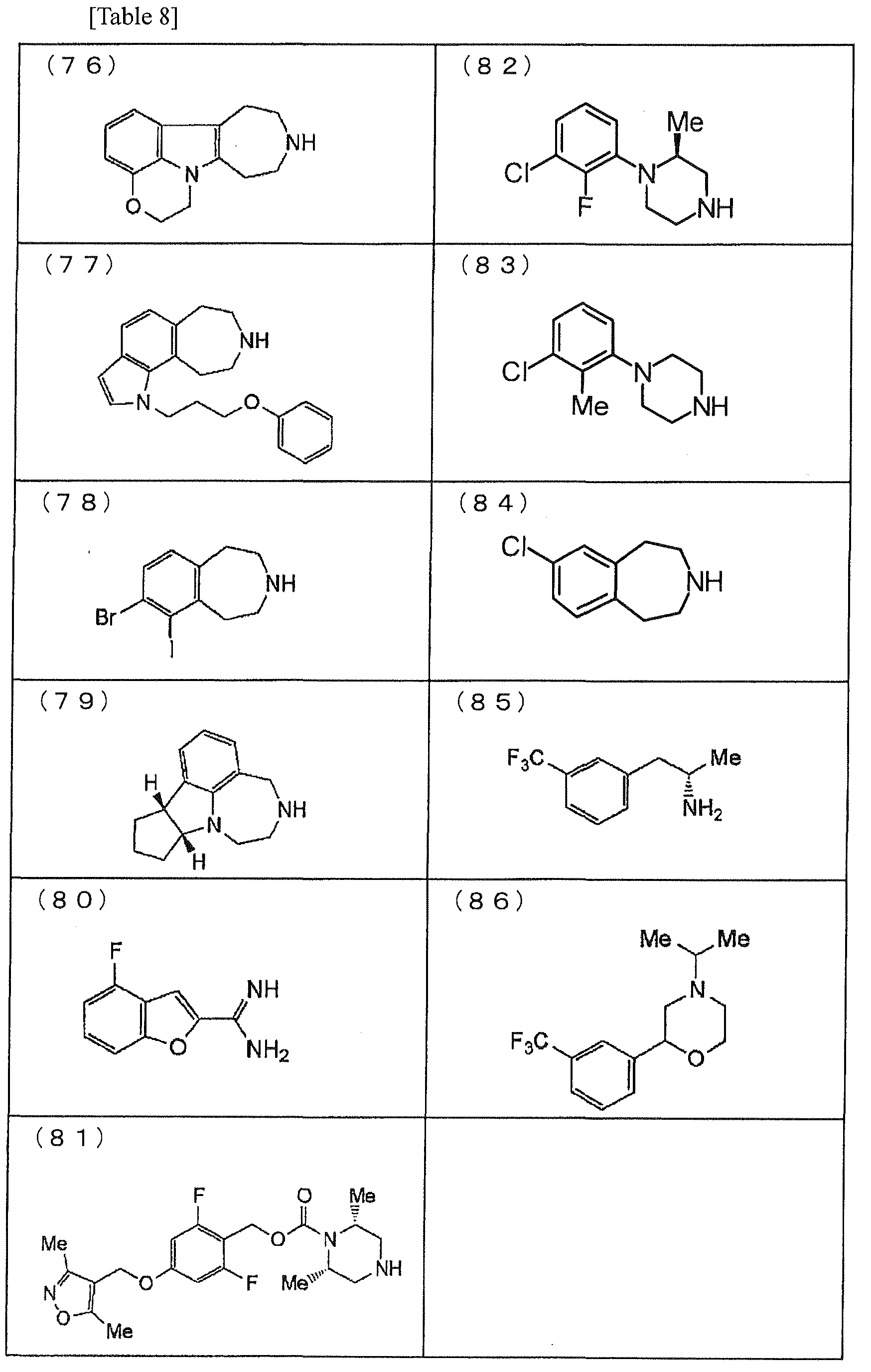
- Among the compounds (1) to (89), compounds (1) to (74) and (76) to (84) are preferable, compounds (1) to (54) are more preferable, and compounds (1) to (31) are most preferable.
- The 5-HT2C receptor agonist preferably and appropriately used for the present invention also includes the compounds included in Patent Document 1 (preferably the compounds exemplified in Patent Document 1). These include a compound represented by Formula (I) or a pharmaceutically acceptable salt thereof,

- ring Y represents an unsaturated 5-membered hetero ring which may have 1 to 3 of one or two or more kinds of hetero atoms selected from N, O and S atoms, or represents an unsaturated 6-membered hetero ring having 1 to 2 N atoms;
- X represents a bond or C;
- V represents N or CH;
- A represents linear or branched C1-6 alkylene which may be substituted with halogen or C3-8 cycloalkyl;
- R1 and R2 may be the same as or different from each other and represent H or C1-6 alkyl, alternatively, R1 and R2 or R1 and A may form a 3- to 8-membered nitrogen-containing saturated hetero ring together with an N atom to which R1 and R2 or R1 and A bind;
- R3 and R4 may be the same as or different from each other and represent H, C1-6 alkyl, OH, C1-6 alkyl-O-, amino, C1-6 alkyl-NH-, (C1-6 alkyl)2-N-, C1-6 alkyl-CO-NH-, or halogen;
- R5 to R9 may be the same as or different from each other and represent H, C1-6 alkyl, OH, or C1-6 alkyl-O-; and
- Among compounds represented by Formula (I), the compounds included in Patent Document 2 (preferably, the compounds exemplified in Patent Document 2) are more preferable. These include a compound represented by Formula (I') or a pharmaceutically acceptable salt thereof.

- R11, R12, R14, and R15 may be the same as or different from each other and represent H or C1-6 alkyl; and
- R13 represents C1-5 alkyl)
- Among the 5-HT2C receptor agonists represented by Formula (I'), (S)-2-(7-ethyl-1H-furo[2,3-g]indazol-1-yl)-1-methylethylamine (YM348) or a pharmaceutically acceptable salt thereof is particularly preferable.
- The 5-HT2C receptor agonist preferably and appropriately used for the present invention also includes the compounds included in Patent Document 3 (preferably, the compounds exemplified in Patent Document 3). These include a compound represented by Formula (II) or a pharmaceutically acceptable salt thereof,


- R21 represents H or C1-8 alkyl;
- R22 represents C1-8 alkyl, -CH2-O-C1-8 alkyl, -C(=O)-O-C1-8 alkyl, -C(=O)-NH-C1-8 alkyl, OH, or CH2OH;
- R22a represents H, alternatively, R22 and R2a form -CH2-CH2- together;
- R23 represents halogen, perhalo-C1-8 alkyl, CN, -SR25, -NHR25, -N(R25)2, aryl, or heteroaryl, wherein the aryl may be optionally substituted with one or two substituents selected from C1-8 alkyl, halogen, perhalo-C1-8 alkyl, and C1-8 alkyl-O-, and the heteroaryl may be optionally substituted with one or two substituents selected from halogen and C1-8 alkyl;
- R24 represents H, halogen, perhalo-C1-8 alkyl, CN, -SR25, -NHR25, -N(R25)2, aryl, or heteroaryl, whrein the aryl may be optionally substituted with one or two substituents selected from C1-8 alkyl, halogen, perhalo-C1-8 alkyl, and C1-8 alkyl-O-, and the heteroaryl may be optionally substituted with one or two substituents selected from halogen and C1-8 alkyl;
- alternatively, R23 and R24 may form a 5- or 6-membered hetero ring having one O atom together with an atom to which R23 and R24 bind;
- R25 independently represents C1-8 alkyl, C1-8 alkenyl, aryl, heteroaryl, aryl-C1-8 alkyl-, heteroaryl-C1-8 alkyl- or perhalo-C1-8 alkyl, or allyl; and
- R26 represents H or C1-8 alkyl;
- Examples of preferable compounds represented by Formula (II) include, but are not limited to, the following compounds or pharmaceutically acceptable salts thereof,
8-chloro-1-methyl-2,3,4,5-tetrahydro-1H-3-benzazepine;
8-bromo-1-methyl-2,3,4,5-tetrahydro-1H-3-benzazepine;
8-iodo-1-methyl-2,3,4,5-tetrahydro-1H-3-benzazepine;
8-trifluoromethyl-1-methyl-2,3,4,5-tetrahydro-1H-3-benzazepine;
8-trifluoromethyl-1-ethyl-2,3,4,5-tetrahydro-1H-3-benzazepine;
8-chloro-1-ethyl-2,3,4,5-tetrahydro-1H-3-benzazepine;
8-bromo-1-ethyl-2,3,4,5-tetrahydro-1H-3-benzazepine;
8-iodo-1-ethyl-2,3,4,5-tetrahydro-1H-3-benzazepine;
7,8-dichloro-1-methyl-2,3,4,5-tetrahydro-1H-3-benzazepine;
7,8-dichloro-1-ethyl-2,3,4,5-tetrahydro-1H-3-benzazepine;
8-chloro-7-fluoro-1-methyl-2,3,4,5-tetrahydro-1H-3-benzazepine; or
8-chloro-7-fluoro-1-ethyl-2,3,4,5-tetrahydro-1H-3-benzazepine. - Among the 5-HT2C receptor agonists represented by Formula (II), (1R)-8-chloro-1-methyl-2,3,4,5-tetrahydro-1H-3-benzazepine (generic name: lorcaserin) or a pharmaceutically acceptable salt thereof is particularly preferable.
- The 5-HT2C receptor agonist preferably and appropriately used for the present invention also includes the compounds included in Patent Document 4 (preferably, the compounds exemplified in Patent Document 4). These include a compound represented by Formula (III) or a pharmaceutically acceptable salt thereof,

R31 represents H, C1-6 alkyl, C1-5 alkyl-C(=O)-, or phenyl-C1-6 alkyl-O-C(=O)-;
each of R32 and R33 independently represents H, OH, C1-6 alkyl, C1-6 alkyl-O-, halogen, NH2-C(=O)-, C1-5 alkyl-O-C(=O)-, perfluoro-C1-6 alkyl, cyano, C1-6 alkyl-S(O)2-NH-, C1-6 alkyl-S(O)2-, C1-5 alkyl-C(=O)-NH-, amino, C1-6 alkyl-NH-, (C1-6 alkyl)2-N-, perfluoro-C1-6 alkyl-O-, C1-5 alkyl-C(=O)-O-, C1-5 alkyl-C(=O)-, phenyl-C(=O)-, phenyl, phenyl-C1-6 alkyl-, heteroaryl, or heteroaryl-C1-6 alkyl-, wherein , a phenyl or heteroaryl portion of all substituents having the phenyl or heteroaryl portion may be substituted with 1 to 3 substituents independently selected from halogen, C1-6 alkyl, or C1-6 alkyl-O-;
each of R34 and R35 independently represents H or C1-6 alkyl, alternatively, R34 and R35 may form a cyclic portion selected from monocyclic C4-8 alkane, monocyclic C4-8 alkene, bridged bicyclic C5-10 alkane, bridged bicyclic C5-10 alkene, pyran, and thiopyran (wherein, a S atom may be oxidized to SO or SO2) together with carbon to which R34 and R35 bind, wherein, the cyclic portion formed by R34 and R35 may be substituted with 1 to 3 substituents selected from halogen, C1-6 alkyl and C1-6 alkyl-O-;
each of R36 and R37 independently represents H or C1-6 alkyl; and
n represents 1 or 2;
provided that, the portion of a dotted line represents an arbitrary double bond;
wherein, heteroaryl means a 5- to 7-membered monocyclic aromatic ring group having 1 or 2 hetero atoms selected from N, O, and S). - Examples of the preferable compound represented by Formula (III) include, but are not limited to, the following compounds or pharmaceutically acceptable salts thereof.
4,5,6,7,9,9a,10,11,12,12a-decahydrocyclopenta[c][1,4]diazepino[6,7,1-ij]quinoline;
2-bromo-4,5,6,7,9,9a, 10,11,12,12a-decahydrocyclopenta[c] [1,4]diazepino[6,7,1-ij]quinoline;
2-chloro-4,5,6,7,9,9a,10,11,12,12a-decahydrocyclopenta[c] [1,4]diazepino[6,7,1-ij]quinoline;
2-phenyl-4,5,6,7,9,9a, 10,11,12,12a-decahydrocyclopenta[c] [1,4]diazepino[6,7,1-ij]quinoline;
2-methoxy-4,5,6,7,9,9a,10,11,12,12a-decahydrocyclopenta[c][1,4]diazepino[6,7,1-ij]quinoline;
1-fluoro-4,5,6,7,9,9a,10,11,12,12a-decahydrocyclopenta[c][1,4]diazepino[6,7,1 - ij]quinoline;
1-(trifluoromethyl)-4,5,6,7,9,9a,10,11,12,12a-decahydrocyclopenta[c][1,4]diazepino[6,7,1-ij]quinoline; or
1-fluoro-2-methoxy-4,5,6,7,9,9a,10,11,12,12a-decahydrocyclopenta[c][1,4]diazepino[6,7,1-ij]quinoline - Among the 5-HT2C receptor agonists represented by Formula (III), (-)-(9aR, 12aS)-4,5,6,7,9,9a, 10,11,12,12a-decahydrocyclopenta[c][1,4]diazepino[6,7,1-ij]quinoline (generic name: vabicaserin) or a pharmaceutically acceptable salt thereof is particularly preferable.
- The 5-HT2C receptor agonist particularly preferably and appropriately used for the present invention is
(S)-2-(7-ethyl-1H-furo[2,3-g]indazol-1-yl)-1-methylethylamine (YM348);
(1R)-8-chloro-1-methyl-2,3,4,5-tetrahydro-1H-3-benzazepine (generic name: lorcaserin);
(-)-(9aR, 12aS)-4,5,6,7,9,9a,10,11,12,12a-decahydrocyclopenta[c][1,4]diazepino[6,7,1-ij]quinoline (generic name: vabicaserin);
or a pharmaceutically acceptable salt thereof. - The various terms in the definitions of the above general formulae mean the following unless otherwise sepcified.
Alkyl is a linear or branched aliphatic saturated hydrocarbon group, and examples thereof include methyl, ethyl, n-propyl, isopropyl, n-butyl, isobutyl, sec-butyl, tert-butyl, n-pentyl, n-hexyl, and the like.
Alkenyl is a linear or branched aliphatic saturated hydrocarbon group, and examples thereof include vinyl, propenyl, butenyl, pentenyl, 1-methylvinyl, 1-methyl-2-propenyl, 1,3-butadienyl, 1,3-pentadienyl, and the like.
Cycloalkyl is an aliphatic saturated hydrocarbon ring group which may have a bridge, and examples thereof include cyclopropyl, cyclobutyl, cyclopentyl, cyclohexyl, cycloheptyl, cyclooctyl, adamantyl, and the like.
Cycloalkane is an aliphatic saturated C3-10 hydrocarbon ring which may have a bridge and includes monocyclic C4-8 alkane or bridged bicyclic C5-10 alkane.
Cycloalkene is an aliphatic unsaturated C3-10 hydrocarbon ring which may have a bridge and includes monocyclic C4-8 alkene or bridged bicyclic C5-10 alkene.
Aryl is a mono- to tricyclic aromatic C6-14 hydrocarbon ring group, and examples thereof include phenyl and naphthyl. As another embodiment, aryl is phenyl.
A hetero ring is a 3- to 15-membered mono- to tricyclic hetero ring group having 1 to 4 hetero atoms selected from N, O, and S and includes a saturated ring, an aromatic ring, and a partially hydrogenated ring group thereof. S or N which is a ring atom may form an oxide or a dioxide by being oxidized. Heteroaryl is a monocyclic aromatic ring group or a bi- or tricyclic unsaturated ring group having at least one aromatic ring as a constituent element, among the above hetero rings. Accordingly, a hetero ring is specifically monocylcic heteroaryl such as pyridyl, pyrrolyl, pyrazinyl, pyrimidinyl, pyridazinyl, imidazolyl, triazolyl, triazinyl, tetrazolyl, thiazolyl, pyrazolyl, isothiazolyl, oxazolyl, isoxazolyl, thiadiazolyl, oxadiazolyl, thienyl, or furyl; bicyclic heteroaryl such as indolyl, isoindolyl, benzimidazolyl, indazolyl, quinolyl, isoquinolyl, quinazolinyl, quinoxalinyl, phthalazinyl, benzothiazolyl, benzisothiazolyl, benzothiadiazolyl, benzoxazolyl, benzisoxazolyl, benzofuranyl, or benzothienyl; tricyclic heteroaryl such as carbazolyl, dibenzo[b,d]furanyl, or dibenzo[b,d]thienyl; a non-aromatic monocyclic hetero ring such as azetidinyl, pyrrolidinyl, piperidinyl, piperazinyl, azepanyl, diazepanyl, morpholinyl, thiomorpholinyl, tetrahydropyridinyl, oxetanyl, tetrahydrofuranyl, tetrahydropyranyl, dioxolanyl, dioxanyl, or tetrahydrothiopyranyl; a non-aromatic bicyclic hetero ring such as indolinyl, tetrahydroquinolyl, tetrahydroisoquinolyl, dihydrobenzimidazolyl, tetrahydrobenzimidazolyl, tetrahydroquinoxalinyl, dihydroquinoxalinyl, dihydrobenzoxazolyl, dihydrobenzoxazinyl, dihydrobenzofuryl, chromanyl, chromenyl, methylenedioxyphenyl, or ethylenedioxyphenyl; a bridged hetero ring such as quinuclidinyl, or the like.
Specific examples of the unsaturated 5-membered hetero ring which may have 1 to 3 of 1 or 2 or more kinds of hetero atoms selected from N, O and S atoms include pentene, pentadiene, thiophene, furan, pyrrole, imidazole, pyrazole, thiazole, oxazole, isothiazole, isoxazole, triazole, thiadiazole, oxadiazole, and the like.
Specific examples of the unsaturated 6-membered hetero ring having 1 to 2 N atoms include pyridine, pyridazine, pyrimidine, pyrazine, and the like.
Examples of the 3- to 8-membered nitrogen-containing saturated hetero ring include aziridine, azetidine, pyrrolidine, piperidine, hexahydroazepine, octahydroazocine, and the like.
Halogen or halo means a Cl, Br, F, or I atom.
Perhalo-C1-6 alkyl means alkyl having 1 to 6 carbon atoms in which 3 or more of the hydrogen atoms are substituted with halogen.
A pharmaceutically acceptable salt means a pharmaceutically acceptable acid or base addition salt with an organic or inorganic acid or base, and examples thereof include a mineral acid salt with hydrochloric acid, sulfuric acid, phosphoric acid, hydrobromic acid, or the like; a salt with an organic acid such as acetic acid, oxalic acid, succinic acid, citric acid, maleic acid, malic acid, fumaric acid, tartaric acid, or methanesulfonic acid; and a salt with an acidic amino acid such as glutamic acid or asparaginic acid. - These 5-HT2C receptor agonists which are existing compounds can be easily obtained by the method disclosed in the above documents or obtained based on the method.
- The dose of the active ingredient of the present invention is appropriately determined for each medicinal agent on a case by case basis in consideration of the route of administration, the symptoms of a disease, the age, sex, and the like of an administration target, within a range of a daily dose of from 0.01 mg to 1000 mg. In addition, from the results of experiments performed on disease animal models shown in Example 1 described later, a clinically effective dose for a patient is converted into the following preferable range. In a case of oral administration, YM348 is preferably administered at about 0.1 mg to 100 mg/day to an adult in a single dose or in several separate doses per day. In a case of oral administration, lorcaserin is preferably administered at about 0.1 mg to 1000 mg/day to an adult in a single dose or in several divided doses per day. In a case of oral administration, vabicaserin is preferably administered at about 1 mg to 1000 mg/day to an adult in a single dose or in several divided doses per day.
- The medicinal agent of the present invention can be prepared as an oral solid preparation, an oral liquid preparation, or an injection according to common methods by using an organic or inorganic carrier, an excipient, and other additives appropriate for oral or parenteral administration. Among these, an oral solid preparation that can easily be taken by patient him or herself and can be conveniently stored and carried is preferable. Specific examples of the oral solid administration include a tablet, powder, granules, fine granules, a capsule, a pill, and the like.
In the solid preparation, an active substance is mixed with at least an inactive diluent, for example, lactose, mannitol, glucose, microcrystalline cellulose, starch, polyvinyl pyrrolidone, or magnesium metasilicate aluminate. The composition may contain additives other than the inactive diluents, for example, a binder such as hydroxypropyl cellulose or hydroxypropyl methylcellulose, a lubricant such as magnesium stearate, calcium stearate, polyethylene glycol, starch, or talc, a disintegrator such as calcium cellulose glycolate, a stabilizer such as lactose, a dissolution adjuvant such as glutamic acid or asparaginic acid, Tween 80, a plasticizer such as triacetin, and a colorant such as titanium oxide or iron sesquioxide, according to common methods. The tablet or pill may be optionally coated with a sugar film or a film of a gastric-soluble or an enteric-soluble substance such as sucrose, gelatin, agar, pectin, hydroxypropyl cellulose, or hydroxypropyl methylcellulose phthalate. - The therapeutic effect of the 5-HT2C receptor agonist on fibromyalgia can be confirmed by the effect of improving the muscle tenderness threshold that is an index of chronic myalgia for the disease animal model of
Non-Patent Document 10, as shown in examples. In addition, the effect can be evaluated by measuring one or two or more items among the muscle tenderness threshold as in index of chronic myalgia, the cutaneous nociception threshold as an index of tactile allodynia, cold sensitivity as an index of cold allodynia, and thermosensitivity as an index of thermal hyperalgesia. The effect can also be evaluated by plantar stimulation caused by a Randall Selitto instrument, the lowering of a reaction threshold with respect to mechanical stimulation such as pinch stimulation, the lowering of a reaction threshold with respect to thermal stimulation, the lowering of a reaction threshold with respect to cold stimulation, the lowering of a reaction threshold with respect to electric stimulation, the increase in pain behavior caused by chemical stimulation, the increase in spontaneous pain behavior caused when a stimulus is not input, such as the fluctuation of spontaneous motor activity or limb-lifting behavior, and the like.
The muscle tenderness threshold refers to the magnitude of a minimum pressure stimulus that causes an animal to show a withdrawal response when a slowly increasing pressure stimulus is applied to the muscle. In order to measure the threshold, it is possible to select and use various known methods according to the type of animals. For example, in a case of a rat, it is possible to use the method of Schafers et al, that is, a method of applying a slowly increasing pressure stimulus to the gastrocnemius of a right rear foot and measuring the magnitude of the minimum pressure stimulus at which the rat shows the withdrawal response as the muscle tenderness threshold, as shown in examples and the like described later.
The threshold of cutaneous nociception refers to the magnitude of a minimum tactile stimulus that causes an animal to show a withdrawal reflex when a gradually increasing tactile stimulus is applied to the skin. In order to measure the threshold, it is possible to select and use various known methods according to the type of animals. For example, in a case of a rat, it is possible to use a von Frey hair method in which von Frey filaments differing in thickness are applied to the plantar surface of a right rear foot of a rat, whereby a filament having the smallest thickness that causes the rat to show the withdrawal response can be measured as the cutaneous nociception threshold, as shown in examples and the like described later.
The cold sensitivity refers to the responsiveness of an animal shown when a cold stimulus is applied. In order to measure the cold sensitivity, it is possible to select and use various known methods according to the type of animals. For example, in a case of a rat, it is possible to measure the cold sensitivity as the frequency of response obtained when acetone is applied to a rear foot of the rat by an acetone method, as shown in examples and the like described later.
The thermosensitivity refers to the responsiveness of an animal shown when a thermal stimulus is applied. In order to measure the thermosensitivity, it is possible to select and use various known methods according to the type of animals. For example, in a case of a rat, it is possible to measure the thermosensitivity as latency of a foot withdrawal response shown when a rear foot of a rat is stimulated with heat of infrared by the method of Hargreaves et al, as shown in examples and the like described later.
Meanwhile, depression can be evaluated using the increase in the immobility time in a forced swimming test as an index. However, the measurement of depression is not limited to this index, and another index, for example, the immobility time at the time of tail suspension, spontaneous motor activity, or the like can also be used.
The therapeutic effect of 5-HT2C receptor agonist on fibromyalgia can be confirmed by an experiment using other appropriate disease animal models and can also be confirmed by a clinical test on patients with fibromyalgia. - Although producing sufficient effects even when being administered singly, the medicinal agent of the present invention can be concurrently used with an anxiolytic (flurazepam or the like), an antidepressant (duloxetine, milnacipran, amitriptyline, fluvoxamine, or the like), an anticonvulsant (pregabalin, gabapentin, or the like), a sleep improving drug (sodium oxybate, ramelteon, melatonin, or the like), or with a general analgesic (morphine, tramadol, diclofenac, naproxen, acetaminophene, or the like), or the like, which are used for alleviating the symptoms of patients with fibromyalgia, at the same time or at a time interval.
- Hereinbelow, the present invention will be described in more detail based on examples and the like, but the present invention is not limited to the examples and the like.
- Male and female Sprague-Dawley rats (Japan SLC, Hamamatsu, Japan) were used.
The muscle tenderness threshold was measured according to the method of Schafers et al (Schafers M et al,. Pain, 104, 579-588, 2003). A pressure stimulus gradually increasing up to 250 g was applied to the gastrocnemius of the right rear foot of the rat. The magnitude of a minimum pressure stimulus at which the rat showed a withdrawal response with respect to the pressure stimulus of the right rear foot was measured as a muscle tenderness threshold (g). The measurement was performed for three times for each point in time, and the average thereof was taken as a measured value. The cutaneous nociception threshold was measured according to the method of Chaplan et al (Chaplan et al., J Neurosci Methods, 53, 55-63, 1994). The measurement was performed using a series of von Frey filaments differing in thickness, which made it possible to apply a constant pressure. The rats were adapted to a cage for measurement having a wire mesh bottom, and then von Frey filaments (0.42 g, 0.74 g, 1.2 g, 2.1 g, 3.5 g, 6.0 g, 9.3 g, and 15.8 g) were applied to the plantar surface of a right rear foot of the rat until the withdrawal response was caused in the right rear foot or until 6 seconds elapsed without the response. The von Frey filament was applied using an up and down method. That is, a filament having about a medium thickness was applied initially, and when the withdrawal response was observed, a filament having a thickness which is one level lower than the initial filament was applied, and when the response was not observed, a filament having a thickness which is one level higher than the initial filament was applied. The cutaneous nociception threshold at the respective points in time was calculated as a threshold (g) of a foot withdrawal response by using a calculation formula reported by Chaplan et al (Chaplan et al. described above). The influence of reserpine on the muscle tenderness threshold and the threshold of cutaneous nociception was examined according to the following protocol. 24 rats were used for male and female rats respectively. The muscle tenderness threshold and the cutaneous nociception threshold before the reserpine administration (base line) were measured, and then the rats were assigned to any of a vehicle (0.5% aqueous acetic acid) group, a 0.1 mg/kg reserpine group, a 0.3 mg/kg group, and a 1 mg/kg group based on the dose of reserpine (6 rats per group). A vehicle or reserpine was subcutaneously administered to the back of rats of the respective groups once a day for three days. The volume of the vehicle or reserpine was set to 1 ml per a weight of a rat of 1 kg for all groups. On the first, third, fifth, seventh, tenth, fourteenth, and twenty-first days after the final administration of the vehicle or reserpine, the muscle tenderness threshold and the cutaneous nociception threshold were measured for the respective rats. The muscle tenderness threshold and the cutaneous nociception threshold were measured by an experimenter who did not know the dose of reserpine administered to the animal.
All measured values were indicated as an average±standard error. The statistical significant difference in the measured value at the respective points in time between the reserpine-administered group and the vehicle-administered group was verified by two way ANOVA and a Bonferroni method. A significance level (P) less than 5% was determined as statistical significance (P<0.05 was indicated as * in the drawings). -
Figs. 1A and 1B respectively show the results in the male and female rats. The reserpine administration significantly lowered the muscle tenderness threshold in all of the male and female rats (two way ANOVA). The muscle tenderness threshold was markedly lowered in the 1 mg/kg reserpine group. Compared to the vehicle group, the muscle tenderness threshold in the 1 mg/kg reserpine group was statistically significantly lower for 10 days after the final administration of reserpine in male rats and for 7 days after the final administration of reserpine in female rats (two way ANOVA and Bonferroni method). -
Figs. 2A and 2B respectively show the results in the male and female rats. The reserpine administration significantly lowered the cutaneous nociception threshold in all of the male and female rats (two way ANOVA). The cutaneous nociception threshold was markedly lowered in the 1 mg/kg reserpine group. Compared to the vehicle group, the cutaneous nociception threshold in the 1 mg/kg reserpine group was statistically significantly lower for 21 days after the final administration of reserpine in male rats and for 14 days after the final administration of reserpine in female rats (two way ANOVA and Bonferroni method).
From these results, it was confirmed that disease animal models of fibromyalgia were prepared in which the muscle tenderness threshold and the cutaneous nociception threshold were markedly and consistently lowered (tactile allodynia: pain induced by a tactile stimulus generally not causing pain) in the male and female rats by reserpine that was repeatedly subcutaneously administered at 1 mg/kg once a day for three days. In addition, 5 days after the final administration of reserpine, the effect of diclofenac which is a non-steroidal anti-inflammatory drug on the reserpine-induced lowering of the muscle tenderness threshold and the lowering of cutaneous nociception threshold was measured. As a result, the lowering of the muscle tenderness threshold or the lowering of cutaneous nociception threshold was not restored by the diclofenac administered up to a dose of 10 mg/kg. This result was consistent with the findings that ibuprofen (Yunus MB et al., J Rheumatol, 16, 527-532, 1989) or naproxen (Goldenberg DL et al., Arthritis Rheum, 29, 1371-1377, 1986) which is a non-steroidal anti-inflammatory drug is not significantly effective for treating patients with fibromyalgia. Accordingly, it was more clearly confirmed that the disease animal model of fibromyalgia was prepared. - Male Sprague-Dawley rats (7-week old, Japan SLC, Hamamatsu, Japan) were used as animals. A forced swimming test was performed by modifying the method of Porsolt (1977) et al in the following manner. Soft wires including a magnet (a diameter of 1 mm and a length of 3 mm) were mounted on both the forelimbs of the animal, and the animals were caused to swim one by one in a cylindrical plastic water tank (a diameter of 20 cm and a height of 45 cm) filled with water (24±1°C) up to 30 cm depth. In this experiment, an automatic measurement instrument for forced swimming (MicroAct Scratching Test version 1.06; Neuroscience, Tokyo, Japan) that detects the movement of the magnet-mounted forelimb through a coil provided around the cylinder was used, thereby measuring the immobility time of the respective animals.
The influence of reserpine on the immobility time in the forced swimming test was examined according to the following protocol. 80 rats in total were divided into 5 experiment schedules (measuring the immobility time on the first, third, fifth, seventh, and fourteenth day after the final administration), and the rats were divided into a vehicle (0.5% aqueous acetic acid)-administered group and a 1 mg/kg reserpine-administered group such that each group included 8 rats. As shown in Reference Example 1, the vehicle or reserpine was repeatedly subcutaneously administered at 1 mg/kg once a day for 3 days. Each forced swimming test includes a pretest session (15 minutes of swimming) and a test session (5 minutes of swimming) 24 hours after the pretest session, and the immobility time was measured in the test session. The pretest session was performed on the day of final administration (that is, immediately after the final administration) and on the second, fourth, sixth, and thirteenth days after the final administration of the vehicle or reserpine, and the test session was performed on the first, third, fifth, seventh, and fourteenth days after the final administration of the vehicle or reserpine. The forced swimming test was performed only once for each rat. All of the measured values were indicated as an average±standard error. The statistical significant difference in the measured value at the respective test schedules between the reserpine-administered group and the vehicle-administered group was verified by a Student's t-test. A significance level (P) less than 5% was determined as statistical significance (P<0.05 was indicated as * in the drawings). -
Figs. 3A, 3B, 3C, 3D, and 3E respectively show the results of the forced swimming test performed on the first, third, fifth, seventh, and fourteenth days after the final administration of reserpine. On the first day after the final administration, a significant increase in the immobility time caused by the reserpine administration was not confirmed (P=0.625, Student's t-test). On the other hand, on the third, fifth, seventh, and fourteenth days after the final administration, all of the reserpine-administered group showed a significant increase in the immobility time (P=0.0007, P=0.004, P<0.0001, and P=0.0008 respectively, Student's t-test) compared to the vehicle-administered group. These results show that at least 3 to 14 days after the final administration, depression was induced by reserpine repeatedly administered at 1 mg/kg once a day for 3 days. It is well known that depression is also induced in a high proportion of patients with fibromyalgia, so the present disease animal model has a high similarity to patients with fibromyalgia in respect that the depression is induced as a concomitant symptom. - Male Sprague-Dawley rats (Japan SLC, Hamamatsu, Japan) were used. Thirty rats were used for each drug. As shown in Reference Example 1, reserpine was repeatedly administered at 1 mg/kg once a day for 3 days for 24 rats, thereby causing the lowering of the muscle tenderness threshold and the cutaneous nociception threshold. The other 6 rats were not administered with reserpine and provided for the experiment as a healthy control.
The drug efficacy was evaluated 5 days after the final administration of reserpine for all groups. At this time, the lowering of the muscle tenderness threshold and the cutaneous nociception threshold was marked at a statistically significant level (Reference Example 1), and the immobility time of the forced swimming test, which is an index of depression, was significantly lengthened compared to the control (Reference Example 2).
In evaluating the respective test drugs (5-HT2C receptor agonists), the muscle tenderness threshold of the rats (24 reserpine-administered rats and 6 healthy rats) before the administration of the test drug was initially measured. The 24 reserpine-administered rats were assigned to 4 groups according to the dose of the test drug. For YM348 or a vehicle thereof, the muscle tenderness threshold was measured 30, 60, and 120 minutes after the administration. For lorcaserin or a vehicle thereof, the muscle tenderness threshold was measured 60, 120, and 240 minutes after the administration. For vabicaserin or a vehicle thereof, the muscle tenderness threshold was measured 30, 60, 120, and 240 minutes after the administration. For the 6 healthy rats, only the muscle tenderness threshold was measured without administering the drug. The drug efficacy was measured by an experimenter who did not know how the drug was administered to the animal.
The vehicle, dose, and route of administration of the respective test drugs are shown in the following table.[Table 101 Drug to be tested Vehicle Route of administration Dose YM348 Distilled water Oral administration 0, 0.03, 0.1, 0.3 mg/kg Lorcaserin Distilled water Oral administration 0, 0.3, 1, 3 mg/kg Vabicaserin Physiological saline Dorsal subcutaneous administration 0, 0.3, 1, 3 mg/kg - All measured values were indicated as an average±standard error. The statistical significant difference in the measured value at the respective points in time between the group administered with a test drug and the vehicle-administered group was verified by two way ANOVA and a Bonferroni method. A significance level (P) less than 5% was determined as statistical significance (P<0.05 was indicated as * in the drawings).
-
Fig. 4 shows the effect of YM348 on the lowering of the muscle tenderness threshold induced by reserpine. YM348 restored the lowering of the muscle tenderness threshold induced by reserpine in a dose dependent manner. The effect of YM348 was statistically significant at a dose of 0.1 mg/kg or 0.3 mg/kg (two way ANOVA and Bonferroni method). -
Fig. 5 shows the effect of lorcaserin on the lowering of the muscle tenderness threshold induced by reserpine. Lorcaserin restored the lowering of the muscle tenderness threshold induced by reserpine in a dose dependent manner. The effect of lorcaserin was statistically significant at a dose of 1 mg/kg or 3 mg/kg (two way ANOVA and Bonferroni method). -
Fig. 6 shows the effect of vabicaserin on the lowering of the muscle tenderness threshold induced by reserpine. Vabicaserin restored the lowering of the muscle tenderness threshold induced by reserpine in a dose dependent manner. The effect of vabicaserin was statistically significant at a dose of 1 mg/kg or 3 mg/kg (two way ANOVA and Bonferroni method). - These results showed that a plurality of different 5-HT2C receptor agonists restored the lowering of the muscle tenderness threshold in the disease animal model of fibromyalgia. These results also showed that the 5-HT2C receptor agonist has effects of alleviating chronic pain of deep tissues such as muscle tissues that is a main symptom of patients with fibromyalgia, and alleviating pain caused by a pressure stimulus that is a characteristic symptom of fibromyalgia and used as a diagnosis criterion. That is, these results showed that a medicinal agent containing the 5-HT2C receptor agonist as an active ingredient is useful for treating patients with fibromyalgia.
- Thirty male Sprague-Dawley rats (Japan SLC) were used. As shown in Example 1, reserpine was repeatedly subcutaneously administered at 1 mg/kg once a day for 3 days for 24 rats, thereby causing the lowering of the muscle tenderness threshold. The other 6 rats were not administered with reserpine and provided for the experiment as a healthy control. The drug efficacy was evaluated 5 days after the final administration of reserpine.
As drugs, SB242084 as a selective 5-HT2C receptor antagonist and lorcaserin as a 5-HT2C receptor agonist were used. Twenty four reserpine-administered rats were divided into four groups (n=6/group), and the drug was administered to the respective groups in the following manner. - Group 1: 10% β cyclodextrin (vehicle of SB242084)+distilled water (vehicle of lorcaserin)
- Group 2: 10% β cyclodextrin+lorcaserin at 3 mg/kg
- Group 3: SB242084 at 0.1 mg/kg+lorcaserin at 3 mg/kg
- Group 4: SB242084 at 1 mg/kg+lorcaserin at 3 mg/kg
-
Fig. 7 shows the antagonistic action of SB242084 against the action of lorcaserin. Compared to the vehicle administered group (v+v), lorcaserin (Lor+v) statistically significantly restored the lowering of the muscle tenderness threshold induced by reserpine (Student's t-test). The SB242084 (Lor+SB) showed a statistically significant antagonistic action in a dose dependent manner against the action of lorcaserin (Dunnett's multiple range test).
This result showed that the action of the 5-HT2C receptor agonist of Example 1 restoring the lowering of the muscle tenderness threshold is inhibited by the 5-HT2C receptor antagonist. That is, the result showed that the action of the 5-HT2C receptor agonist of Example 1 restoring the lowering of the muscle tenderness threshold is mediated by the action of the 5-HT2C receptor agonist. - According to the present invention, it is possible to provide an agent for treating fibromyalgia which is a refractory chronic disease for which a sufficiently effective therapeutic method has not been found.

provided that, when the portion of a dotted line is a double bond, R6 and R8 do not exist, and when X is a bond, the portion of a dotted line is a single bond, and R7 and R8 do not exist).
(S)-2-(7-ethyl-1H-furo[2,3-g]indazol-1-yl)-1-methylethylamine;
(S)-2-(7-ethyl-3-methyl-1H-furo[2,3-g]indazol-1-yl)-1-methylethylamine;
(S)-2-(3,7-diethyl-1H-furo[2,3-g]indazol-1-yl)-1-methylethylamine;
(S)-1-methyl-2-(7-propyl-1H-furo[2,3-g]indazol-1-yl)ethylamine;
(S)-N-ethyl-2-(7-ethyl-1H-furo[2,3-g]indazol-1-yl)-methylethylamine;
(S)-2-(4,7-diethyl-1H-furo[2,3-g]indazol-1-yl)-1-methylethylamine;
(S)-2-(7-butyl-1H-furo[2,3-g]indazol-1-yl)-1-methylethylamine; or
(S)-2-(7-isopentyl-1H-furo[2,3-g]indazol-1-yl)-1-methylethylamine.
All measured values were indicated as an average±standard error. The statistically significant difference in the measured value between the
Claims (12)
- An agent for treating fibromyalgia, comprising:a 5-HT2C receptor agonist as an active ingredient.
- The treatment agent according to Claim 1,
wherein the active ingredient is a compound represented by the following Formula (I) or a pharmaceutically acceptable salt thereof, ring Y represents an unsaturated 5-membered hetero ring which may have 1 to 3 of one or two or more kinds of hetero atoms selected from N, O and S atoms, or represents an unsaturated 6-membered hetero ring having 1 to 2 N atoms;X represents a bond or C;V represents N or CH;A represents linear or branched C1-6 alkylene which may be substituted with halogen or C3-8 cycloalkyl;R1 and R2 may be the same as or different from each other and represent H or C1-6 alkyl, alternatively, R1 and R2 or R1 and A may form a 3- to 8-membered nitrogen-containing saturated hetero ring together with an N atom to which R1 and R2 or R1 and A bind;R3 and R4 may be the same as or different from each other and represent H, C1-6 alkyl, OH, C1-6 alkyl-O-, amino, C1-6 alkyl-NH-, (C1-6 alkyl)2-N-, C1-6 alkyl-CO-NH-, or halogen;R5 to R9 may be the same as or different from each other and represent H, C1-6 alkyl, OH, or C1-6 alkyl-O-; andthe portion of a dotted line represents an arbitrary double bond;provided that when the portion of a dotted line is a double bond, R6 and R8 do not exist, and when X is a bond, the portion of a dotted line is a single bond, and R7 and R8 do not exist).
 - The treatment agent according to Claim 2,
wherein the active ingredient is a compound represented by the following Formula (I') or a pharmaceutically acceptable salt thereof, R11, R12, R14, and R15 may be the same as or different from each other and represent H or C1-6 alkyl; andR13 represents C1-5 alkyl).
 - The treatment agent according to Claim 3,
wherein the active ingredient is one of the following compounds or a pharmaceutically acceptable salt thereof:(S)-2-(7-ethyl-1H-furo[2,3-g]indazol-1-yl)-1-methylethylamine;(S)-2-(7-ethyl-3-methyl-1H-furo[2,3-g]indazol-1-yl)-1-methylethylamine;(S)-2-(3,7-diethyl-1H-furo[2,3-g]indazol-1-yl)-1-methylethylamine;(S)-1-methyl-2-(7-propyl-1H-furo[2,3-g]indazol-1-yl)ethylamine;(S)-N-ethyl-2-(7-ethyl-1H-furo[2,3-g]indazol-1-yl)-methylethylamine;(S)-2-(4,7-diethyl-1H-furo[2,3-g]indazol-1-yl)-1-methylethylamine;(S)-2-(7-butyl-1H-furo[2,3-g]indazol-1-yl)-1-methylethylamine; or(S)-2-(7-isopentyl-1H-furo[2,3-g]indazol-1-yl)-1-methylethylamine. - The treatment agent according to Claim 4,
wherein the active ingredient is (S)-2-(7-ethyl-1H-furo[2,3-g]indazol-1-yl)-1-methylethylamine or a pharmaceutically acceptable salt thereof. - The treatment agent according to Claim 1,
wherein the active ingredient is a compound represented by the following Formula (II) or a pharmaceutically acceptable salt thereof,
 R21 represents H or C1-8 alkyl;R22 represents C1-8 alkyl, -CH2-O-C1-8 alkyl, -C(=O)-O-C1-8 alkyl, -C(=O)-NH-C1-8 alkyl, OH, or CH2OH;R22a represents H, alternatively, R22 and R22a form -CH2-CH2- together;R23 represents halogen, perhalo-C1-8 alkyl, CN, -SR25, -NHR25, -N(R25)2, aryl, or heteroaryl, wherein the aryl may be optionally substituted with one or two substituents selected from C1-8 alkyl, halogen, perhalo-C1-8 alkyl, and C1-8 alkyl-O-, and the heteroaryl may be optionally substituted with one or two substituents selected from halogen and C1-8 alkyl;R24 represents H, halogen, perhalo-C1-8 alkyl, CN, -SR25, -NHR25, -N(R25)2, aryl, or heteroaryl, wherein the aryl may be optionally substituted with one or two substituents selected from C1-8 alkyl, halogen, perhalo-C1-8 alkyl, and C1-8 alkyl-O-, and the heteroaryl may be optionally substituted with one or two substituents selected from halogen and C1-8 alkyl;alternatively, R23 and R24 may form a 5- or 6-membered hetero ring having one O atom together with an atom to which R23 and R24 bind;R25 independently represents C1-8 alkyl, C1-8 alkenyl, aryl, heteroaryl, aryl-C1-8 alkyl-, heteroaryl-C1-8 alkyl- or perhalo-C1-8 alkyl, or allyl; andR26 represents H or C1-8 alkyl;provided that when R26 is C1-8 alkyl, R24 represents a group other than H).
 - The treatment agent according to Claim 6,
wherein the active ingredient is one of the following compounds or a pharmaceutically acceptable salt thereof,
8-chloro-1-methyl-2,3,4,5-tetrahydro-1H-3-benzazepine;
8-bromo-1-methyl-2,3,4,5-tetrahydro-1H-3-benzazepine;
8-iodo-1-methyl-2,3,4,5-tetrahydro-1H-3-benzazepine;
8-trifluoromethyl-1-methyl-2,3,4,5-tetrahydro-1H-3-benzazepine;
8-trifluoromethyl-1-ethyl-2,3,4,5-tetrahydro-1H-3-benzazepine;
8-chloro-1-ethyl-2,3,4,5-tetrahydro-1H-3-benzazepine;
8-bromo-1-ethyl-2,3,4,5-tetrahydro-1H-3-benzazepine;
8-iodo-1-ethyl-2,3,4,5-tetrahydro-1H-3-benzazepine;
7,8-dichloro-1-methyl-2,3,4,5-tetrahydro-1H-3-benzazepine;
7,8-dichloro-1-ethyl-2,3,4,5-tetrahydro-1H-3-benzazepine
8-chloro-7-fluoro-1-methyl-2,3,4,5-tetrahydro-1H-3-benzazepine; or 8-chloro-7-fluoro-1-ethyl-2,3,4,5-tetrahydro-1H-3-benzazepine. - The treatment agent according to Claim 7,
wherein the active ingredient is (R)-8-chloro-1-methyl-2,3,4,5-tetrahydro-1H-3-benzazepine or a pharmaceutically acceptable salt thereof. - The treatment agent according to Claim 1,
wherein the active ingredient is a compound represented by the following Formula (III) or a pharmaceutically acceptable salt thereof,
R31 represents H, C1-6 alkyl, C1-5 alkyl-C(=O)-, or phenyl-C1-6 alkyl-O-C(=O)-;
each of R32 and R33 independently represents H, OH, C1-6 alkyl, C1-6 alkyl-O-, halogen, NH2-C(=O)-, C1-5 alkyl-O-C(=O)-, perfluoro-C1-6 alkyl, cyano, C1-6 alkyl-S(O)2-NH-, C1-6 alkyl-S(O)2-, C1-5 alkyl-C(=O)-NH-, amino, C1-6 alkyl-NH-, (C1-6 alkyl)2-N-, perfluoro-C1-6 alkyl-O-, C1-5 alkyl-C(=O)-O-, C1-5 alkyl-C(=O)-, phenyl-C(=O)-, phenyl, phenyl-C1-6 alkyl-, heteroaryl, or heteroaryl-C1-6 alkyl-, wherein a phenyl or heteroaryl portion of all substituents having the phenyl or heteroaryl portion may be substituted with 1 to 3 substituents independently selected from halogen, C1-6 alkyl, or C1-6 alkyl-O-;
each of R34 and R35 independently represents H or C1-6 alkyl, alternatively, R34 and R35 may form a cyclic portion selected from monocyclic C4-8 alkane, monocyclic C4-8 alkene, bridged bicyclic C5-10 alkane, bridged bicyclic C5-10 alkene, pyran, and thiopyran (wherein, a S atom may be oxidized to SO or SO2) together with carbon to which R34 and R35 bind, wherein the cyclic portion formed by R34 and R35 may be substituted with 1 to 3 substituents selected from halogen, C1-6 alkyl, and C1-6 alkyl-O-;
each of R36 and R37 independently represents H or C1-6 alkyl; and
n represents 1 or 2;
provided that, the portion of a dotted line represents an arbitrary double bond;
wherein, heteroaryl means a 5- to 7-membered monocyclic aromatic ring group having 1 or 2 hetero atoms selected from N, O, and S). - The treatment agent according to Claim 9,
wherein the active ingredient is one of the following compounds or a pharmaceutically acceptable salt thereof,
4,5,6,7,9,9a,10,11,12,12a-decahydrocyclopenta[c][1,4]diazepino[6,7,1-ij]quinoline;
2-bromo-4,5,6,7,9,9a,10,11,12,12a-decahydrocyclopenta[c][1,4]diazepino[6,7,1 - ij]quinoline;
2-chloro-4,5,6,7,9,9a,10,11,12,12a-decahydrocyclopenta[c][1,4]diazepino[6,7,1 - ij]quinoline;
2-phenyl-4,5,6,7,9,9a,10,11,12,12a-decahydrocyclopenta[c][1,4]diazepino[6,7,1-ij]quinoline;
2-methoxy-4,5,6,7,9,9a,10,11,12,12a-decahydrocyclopenta[c][1,4]diazepino[6,7,1-ij]quinoline;
1-fluoro-4,5,6,7,9,9a,10,11,12,12a-decahydrocyclopenta[c][1,4]diazepino[6,7,1 - ij]quinoline;
1-(trifluoromethyl)-4,5,6,7,9,9a,10,11,12,12a-decahydrocyclopenta[c][1,4]diazepino[6,7,1-ij]quinoline; or
1-fluoro-2-methoxy-4,5,6,7,9,9a,10,11,12,12a-decahydrocyclopenta[c][1,4]diazepino[6,7,1-ij]quinoline. - The treatment agent according to Claim 10,
wherein the active ingredient is (-)-(9aR, 12aS)-4,5,6,7,9,9a,10,11,12,12a-decahydrocyclopenta[c][1,4]diazepino[6,7,1-ij]quinoline or a pharmaceutically acceptable salt thereof. - The treatment agent according to Claim 1,
wherein the active ingredient is
(S)-2-(7-ethyl-1H-furo[2,3-g]indazol-1-yl)-1-methylethylamine;
(1R)-8-chloro-1-methyl-2,3,4,5-tetrahydro-1H-3-benzazepine;
(-)-(9aR, 12aS)-4,5,6,7,9,9a,10,11,12,12a-decahydrocyclopenta[c][1,4]diazepino[6,7,1-ij]quinoline;
or a pharmaceutically acceptable salt thereof.
Applications Claiming Priority (2)
| Application Number | Priority Date | Filing Date | Title |
|---|---|---|---|
| JP2009281490 | 2009-12-11 | ||
| PCT/JP2010/072194 WO2011071136A1 (en) | 2009-12-11 | 2010-12-10 | Therapeutic agent for fibromyalgia |
Publications (2)
| Publication Number | Publication Date |
|---|---|
| EP2510949A1 true EP2510949A1 (en) | 2012-10-17 |
| EP2510949A4 EP2510949A4 (en) | 2013-11-13 |
Family
ID=44145679
Family Applications (1)
| Application Number | Title | Priority Date | Filing Date |
|---|---|---|---|
| EP10836055.3A Withdrawn EP2510949A4 (en) | 2009-12-11 | 2010-12-10 | THERAPEUTIC AGENT FOR FIBROMYALGIA |
Country Status (4)
| Country | Link |
|---|---|
| US (1) | US20120253036A1 (en) |
| EP (1) | EP2510949A4 (en) |
| JP (1) | JPWO2011071136A1 (en) |
| WO (1) | WO2011071136A1 (en) |
Families Citing this family (10)
| Publication number | Priority date | Publication date | Assignee | Title |
|---|---|---|---|---|
| US20130267500A1 (en) | 2010-09-01 | 2013-10-10 | Arena Pharmaceuticals, Inc. | 5-ht2c receptor agonists in the treatment of disorders ameliorated by reduction of norepinephrine level |
| EP2824106B1 (en) | 2012-03-06 | 2016-11-23 | Takeda Pharmaceutical Company Limited | Tricyclic compound |
| JP2014201578A (en) * | 2013-04-09 | 2014-10-27 | 武田薬品工業株式会社 | Fibromyalgia therapeutic agent |
| JP6789578B2 (en) * | 2015-07-31 | 2020-11-25 | アリーナ ファーマシューティカルズ, インコーポレイテッド | 5-HT2C receptor agonists and compositions, and usage |
| WO2017096148A1 (en) * | 2015-12-03 | 2017-06-08 | Katz Robert S | Methods and systems for diagnosing and treating fibromyalgia |
| EP3824906A1 (en) | 2016-12-21 | 2021-05-26 | Amgen Inc. | Anti-tnf alpha antibody formulations |
| PH12022551509A1 (en) | 2019-12-19 | 2023-04-24 | Bayer Ag | Furoindazole derivatives |
| WO2022179940A1 (en) | 2021-02-23 | 2022-09-01 | Bayer Aktiengesellschaft | Furoindazole derivatives as gpr84 antagonists |
| WO2022229061A1 (en) | 2021-04-29 | 2022-11-03 | Bayer Aktiengesellschaft | Furoindazole derivatives as antagonists or inhibitors of gpr84 |
| WO2024083705A1 (en) | 2022-10-18 | 2024-04-25 | Bayer Aktiengesellschaft | Furoindazole derivatives for the treatment of pain |
Family Cites Families (146)
| Publication number | Priority date | Publication date | Assignee | Title |
|---|---|---|---|---|
| US3253989A (en) | 1963-02-11 | 1966-05-31 | American Cyanamid Co | Process for producing anorexia |
| CH481110A (en) | 1967-02-17 | 1969-11-15 | Geigy Ag J R | Process for the preparation of 1,2,4,5-tetrahydro-3-azepines |
| US3652588A (en) | 1969-10-23 | 1972-03-28 | Upjohn Co | 6-alkyl-1 2 3 4 5 6-hexahydroazepino(4 5-b)indoles |
| US3676558A (en) | 1970-08-28 | 1972-07-11 | Upjohn Co | Anorexigenic compositions comprising 6-alkyl-1,2,3,4,5,6-hexahydroazepino 4,5-indoles as active ingredient and process of treatment |
| US4082844A (en) | 1976-02-09 | 1978-04-04 | Merck & Co., Inc. | 6-chloro-2-(1-piperazinyl)pyrazine |
| ES2061953T3 (en) | 1988-11-24 | 1994-12-16 | Akzo Nv | A PROCEDURE FOR PREPARING A PHARMACEUTICAL COMPOSITION. |
| EP0572863A1 (en) | 1992-06-05 | 1993-12-08 | F. Hoffmann-La Roche Ag | CNS pyrazinoindoles |
| TW334423B (en) | 1993-10-22 | 1998-06-21 | Hoffmann La Roche | Tricyclic 1-aminoethylpyrrole-derivatives |
| TW270114B (en) | 1993-10-22 | 1996-02-11 | Hoffmann La Roche | |
| US5955495A (en) | 1996-05-03 | 1999-09-21 | Hoffmann-La Roche Inc. | Method of treating diseases of the CNS |
| WO1998030546A1 (en) | 1997-01-08 | 1998-07-16 | F. Hoffmann-La Roche Ag | TRICYCLIC BENZO[e]ISOINDOLES AND BENZO[h]ISOQUINOLINES |
| MA26461A1 (en) | 1997-01-08 | 2004-12-20 | Hoffmann La Roche | NOVEL BENZO (E) ISOINDOLES AND BENZO (H) ISOQUINOLEINS, MEDICAMENTS CONTAINING SAME, PROCESSES FOR THEIR PREPARATION, AND THEIR USE IN THE TREATMENT OR PREVENTION OF CENTRAL NERVOUS SYSTEM DISORDERS. |
| AU5343298A (en) | 1997-01-13 | 1998-08-03 | Yamanouchi Pharmaceutical Co., Ltd. | 5-ht2c receptor agonists and aminoalkylindazole derivatives |
| WO1998033504A1 (en) | 1997-02-03 | 1998-08-06 | Akzo Nobel N.V. | Treatment of urinary incontinence |
| PT863136E (en) | 1997-02-25 | 2004-01-30 | Akzo Nobel Nv | AZETIDINE AND PYRROLIDINE DERIVATIVES |
| AU727654B2 (en) | 1997-06-13 | 2000-12-21 | Yamanouchi Pharmaceutical Co., Ltd. | Tricyclic pyrazole derivative |
| US6399618B1 (en) | 1997-07-09 | 2002-06-04 | Cardiome Pharma Corp | Compositions and methods for modulating sexual activity |
| US6281243B1 (en) | 1998-02-26 | 2001-08-28 | Akzo Nobel N.V. | Derivatives of azetidine and pyrrolidine |
| GB9819020D0 (en) | 1998-09-01 | 1998-10-28 | Cerebrus Ltd | Chemical compounds III |
| GB9819032D0 (en) | 1998-09-01 | 1998-10-28 | Cerebrus Ltd | Chemical compounds IV |
| GB9819033D0 (en) | 1998-09-01 | 1998-10-28 | Cerebrus Ltd | Chemical compounds VI |
| GB9819035D0 (en) | 1998-09-01 | 1998-10-28 | Cerebrus Res Ltd | Chemical compounds VII |
| GB9819019D0 (en) | 1998-09-01 | 1998-10-28 | Cerebrus Ltd | Chemical compounds II |
| AU755119B2 (en) | 1998-09-18 | 2002-12-05 | Alcon Laboratories, Inc. | Serotonergic 5HT2 agonists for treating glaucoma |
| GB9820767D0 (en) | 1998-09-23 | 1998-11-18 | Cerebrus Ltd | Chemical compounds VIII |
| AU1738900A (en) | 1998-11-19 | 2000-06-05 | Nortran Pharmaceuticals Inc. | Serotonin ligands as pro-erectile compounds |
| HUP0104773A3 (en) | 1998-12-17 | 2004-10-28 | Wyeth Corp | 2,3,4,4a-tetrahydro-1h-pyrazino(1,2-a)quinoxalin-5(6h)one derivates being 5ht2c agonists, process for their preparation and medicaments containing them |
| US6372745B1 (en) | 1999-12-06 | 2002-04-16 | American Home Products Corporation | 2,3,4,4A-tetrahydro-1H-pyrazino[1,2-A]quinoxalin-5(6H)one derivatives |
| CA2361516A1 (en) | 1999-01-27 | 2000-08-03 | Jeffrey Thomas Mullaney | Aminoalkylbenzofurans as serotonin (5-ht(2c)) agonists |
| GB9902047D0 (en) | 1999-01-29 | 1999-03-17 | Cerebrus Ltd | Chemical compounds XI |
| PE20010052A1 (en) | 1999-04-23 | 2001-01-27 | Upjohn Co | AZEPININDOL TETRACYCLIC COMPOUNDS AS AGONISTS OR ANTAGONISTS OF THE 5-HT RECEPTOR |
| US6465467B1 (en) | 1999-05-21 | 2002-10-15 | Biovitrum Ab | Certain aryl-aliphatic and heteroaryl-aliphatic piperazinyl pyrazines and their use in the treatment of serotonin-related diseases |
| CA2374898C (en) | 1999-05-21 | 2009-12-08 | Biovitrum Ab | Pyrazinyl-piperazine compounds, their use and preparation |
| WO2000077001A1 (en) | 1999-06-15 | 2000-12-21 | Du Pont Pharmaceuticals Company | Substituted heterocycle fused gamma-carbolines |
| CA2378878A1 (en) | 1999-07-29 | 2001-02-08 | Jeffrey Thomas Mullaney | Benzofurylpiperazines and benzofurylhomopiperazines: serotonin agonists |
| AU6339000A (en) | 1999-07-29 | 2001-02-19 | Eli Lilly And Company | Serotonergic benzothiophenes |
| DK1204658T3 (en) | 1999-07-29 | 2003-09-01 | Lilly Co Eli | Benzofurylpiperazine-serotonin agonists |
| WO2001009122A2 (en) | 1999-07-29 | 2001-02-08 | Eli Lilly And Company | Serotonergic benzofurans |
| GB9918965D0 (en) | 1999-08-11 | 1999-10-13 | Cerebrus Ltd | Chemical compounds xxi |
| GB9918962D0 (en) | 1999-08-11 | 1999-10-13 | Cerebrus Ltd | Chemical compounds xxii |
| AU2042301A (en) | 1999-12-03 | 2001-06-12 | Alcon Universal Limited | 1-aminoalkyl-1H-indoles for treating glaucoma |
| EP1132389A1 (en) | 2000-03-06 | 2001-09-12 | Vernalis Research Limited | New aza-indolyl derivatives for the treatment of obesity |
| NZ521389A (en) | 2000-03-14 | 2005-06-24 | Upjohn Co | 2,3,4,5-tetrahydro-1H-[1,4]diazepino[1,7-a]indole compounds |
| BR0017158A (en) | 2000-03-17 | 2003-06-03 | Alcon Inc | 5ht2 Agonists to Control Iop and Treat Glaucoma |
| EP1263434A1 (en) | 2000-03-17 | 2002-12-11 | Alcon, Inc | Compounds with 5-ht 2 and 5-ht 1a agonist activity for treating glaucoma |
| WO2001083487A1 (en) | 2000-04-28 | 2001-11-08 | Yamanouchi Pharmaceutical Co., Ltd. | Froindazole derivative |
| WO2002004456A1 (en) | 2000-07-06 | 2002-01-17 | Pharmacia & Upjohn Company | SUBSTITUTED 2,3,7,8,9,10,11,12-OCTAHYDROAZEPINO[4,5-b]PYRANO[3,2-e]INDOLES |
| SE0002754D0 (en) | 2000-07-21 | 2000-07-21 | Pharmacia & Upjohn Ab | New pharmaceutical combination formulation and method of treatment with the combination |
| WO2002010169A1 (en) | 2000-07-31 | 2002-02-07 | F. Hoffmann-La Roche Ag | Piperazine derivatives |
| JP2004509894A (en) | 2000-09-20 | 2004-04-02 | ファルマシア・アンド・アップジョン・カンパニー | Substituted azepino [4,5-b] indoline derivatives |
| WO2002044152A1 (en) | 2000-10-16 | 2002-06-06 | F. Hoffmann-La Roche Ag | Indoline derivatives and their use as 5-ht2 receptor ligands |
| WO2002036596A2 (en) | 2000-11-03 | 2002-05-10 | Wyeth | CYCLOALKYL[b][1,4]DIAZEPINO[6,7,1-hi]INDOLES AND DERIVATIVES |
| DE60106641T2 (en) | 2000-11-03 | 2005-12-01 | Wyeth | CYCLOPENTA [B] [1,4] DIAZEPINO [6,7,1-HI] INDOLE AS 5HT2C ANTAGONISTS |
| JP4204315B2 (en) | 2000-11-20 | 2009-01-07 | ビオヴィトルム・アクチボラゲット(プブリクト) | Piperazinyl pyrazine compounds as antagonists of serotonin 5-HT2 receptors |
| AU2426602A (en) | 2000-11-20 | 2002-05-27 | Biovitrum Ab | Piperazinylpyrazine compounds as agonist or antagonist of serotonin 5ht-2 receptor |
| AU2002239417A1 (en) | 2000-11-29 | 2002-06-11 | Lifespan Biosciences, Inc. | Diagnostic and therapeutic compositions and methods related to anaphylatoxin c3a receptor |
| EP1213017A3 (en) | 2000-12-05 | 2003-11-12 | Akzo Nobel N.V. | Use of a 5-HT2C receptor agonist for the treatment of hot flushes |
| GB0030710D0 (en) | 2000-12-15 | 2001-01-31 | Hoffmann La Roche | Piperazine derivatives |
| RU2003121304A (en) | 2000-12-20 | 2005-01-27 | Бристол-Маерс Сквибб Компани (Us) | SUBSTITUTED PYRIDOINDOLES AS SEROTONIN AGONISTS AND ANTAGONISTS |
| HUP0303513A3 (en) | 2000-12-20 | 2005-12-28 | Bristol Myers Squibb Pharma Co | Substituted pyrazinoquinoxaline derivatives as serotonin receptor agonists and antagonists, their use and pharmaceutical compositions containing them |
| MXPA03005355A (en) | 2000-12-20 | 2004-05-27 | Bristol Myers Squibb Co | Substituted pyrroloquinolines and pyridoquinolines as serotonin agonists and antagonists. |
| BR0116605A (en) | 2000-12-27 | 2003-09-30 | Hoffmann La Roche | Compound, process for the preparation of a compound, pharmaceutical composition comprising the same, its use and process for the treatment and prophylaxis of central nervous system disorders, cardiovascular disorders, gastrointestinal disorders and sleep apnea |
| GB0106177D0 (en) | 2001-03-13 | 2001-05-02 | Hoffmann La Roche | Piperazine derivatives |
| JPWO2002074746A1 (en) | 2001-03-16 | 2004-07-08 | 山之内製薬株式会社 | Benzoazepine derivatives |
| US6699866B2 (en) | 2001-04-17 | 2004-03-02 | Sepracor Inc. | Thiazole and other heterocyclic ligands for mammalian dopamine, muscarinic and serotonin receptors and transporters, and methods of use thereof |
| CA2447156A1 (en) | 2001-06-01 | 2002-12-12 | Alcon, Inc. | Novel fused indazoles and indoles and their use for the treatment of glaucoma |
| ATE318821T1 (en) | 2001-06-01 | 2006-03-15 | Alcon Inc | PYRANOINDAZOLES AND THEIR USE IN GLAUCOMA TREATMENT |
| AU2002259312B2 (en) | 2001-06-01 | 2007-01-04 | Alcon, Inc. | Novel arylaminopropane analogues and their use for the treatment of glaucoma |
| US6825198B2 (en) | 2001-06-21 | 2004-11-30 | Pfizer Inc | 5-HT receptor ligands and uses thereof |
| MXPA04000036A (en) | 2001-07-05 | 2004-05-21 | Upjohn Co | (hetero) aryl substituted benzofurans as 5-ht ligands. |
| BR0211140A (en) | 2001-07-13 | 2005-10-25 | Upjohn Co | Compounds and compositions of hexahydroazepine (4,5-g) indoles and indolines as 5-ht receptor binders |
| US6667303B1 (en) | 2001-07-30 | 2003-12-23 | Wyeth | Aryl substituted 1,4-diazepanes and method of use thereof |
| GB0118892D0 (en) | 2001-08-02 | 2001-09-26 | Vernalis Res Ltd | Method of treatment |
| US20030060462A1 (en) | 2001-08-06 | 2003-03-27 | Hoffman Robert L. | Therapeutic compounds |
| US6720316B2 (en) | 2001-08-06 | 2004-04-13 | Pharmacia & Upjohn Company | Therapeutic 5-HT ligand compounds |
| US6849640B2 (en) | 2001-08-08 | 2005-02-01 | Pharmacia & Upjohn Company | Therapeutic 1H-pyrido [4,3-b] indoles |
| BR0212676A (en) | 2001-09-21 | 2006-05-23 | Upjohn Co | 5-ht ligand therapeutic compounds, pharmaceutical compositions comprising such compounds and their uses |
| EP1436294A1 (en) | 2001-10-18 | 2004-07-14 | PHARMACIA & UPJOHN COMPANY | Tetracyclic azaindoles and -indolines having serotonin 5-ht2c activity |
| EP1456178A1 (en) | 2001-12-21 | 2004-09-15 | Smithkline Beecham Plc | 7-sulfonyl-3-benzazepine derivatives as modulators of the dopamine receptor and their use for the treatment of cns disorders |
| WO2003057674A1 (en) | 2001-12-28 | 2003-07-17 | Bayer Pharmaceuticals Corporation | 4-sulfide / sulfoxide / sulfonyl-1h-pyrazolyl derivative compounds, for use in diseases associated with the 5-ht2c receptor |
| AU2002360818A1 (en) | 2001-12-28 | 2003-07-24 | Bayer Pharmaceuticals Corporation | 1h-pyrazolyl derivative compounds, for use in diseases associated with the 5-ht2c receptor |
| WO2003057213A2 (en) | 2001-12-28 | 2003-07-17 | Bayer Pharmaceuticals Corporation | Cyclohexano- and cycloheptapyrazole derivative compounds, for use in diseases associated with the 5-ht2c receptor |
| AU2002367323A1 (en) | 2001-12-28 | 2003-07-24 | Bayer Pharmaceuticals Corporation | Benzothieno (3,2- |
| GB0202015D0 (en) | 2002-01-29 | 2002-03-13 | Hoffmann La Roche | Piperazine Derivatives |
| US6953787B2 (en) | 2002-04-12 | 2005-10-11 | Arena Pharmaceuticals, Inc. | 5HT2C receptor modulators |
| DE10217006A1 (en) | 2002-04-16 | 2003-11-06 | Merck Patent Gmbh | Substituted indoles |
| ATE423094T1 (en) | 2002-04-19 | 2009-03-15 | Glaxo Group Ltd | COMPOUNDS WITH AFFINITY FOR THE 5HT2C RECEPTOR AND THEIR THERAPEUTIC USE |
| TWI312781B (en) | 2002-04-25 | 2009-08-01 | [1,4]diazepino[6,7,1-ij]quinoline derivatives as antipsychotic and antiobesity agents | |
| TW200307540A (en) | 2002-04-25 | 2003-12-16 | Wyeth Corp | [1, 4]Diazocino[7, 8, 1-hi] indole derivatives as antipsychotic and antiobesity agents |
| TW200307682A (en) | 2002-04-25 | 2003-12-16 | Wyeth Corp | 1,2,3,4,7,8-Hexahydro-6H-[1,4]diazepino[6,7,1-ij]quinoline derivatives as antipsychotic and antiobesity agents |
| SE0201544D0 (en) | 2002-05-17 | 2002-05-17 | Biovitrum Ab | Novel compounds and thier use |
| BR0311970A (en) | 2002-06-19 | 2005-03-29 | Biovitrum Ab | New compounds, their use and preparation |
| WO2004000829A1 (en) | 2002-06-19 | 2003-12-31 | Biovitrum Ab | Novel process |
| RU2340333C2 (en) | 2002-08-15 | 2008-12-10 | Вайет | Agonism of 5нт2a-receptor for treatment of disturbance of thermoregulation function |
| WO2004056324A2 (en) | 2002-12-19 | 2004-07-08 | Bristol-Myers Squibb Company | Substituted tricyclic gamma-carbolines as serotonin receptor agonists and antagonists |
| GB0305024D0 (en) | 2003-03-05 | 2003-04-09 | Glaxo Group Ltd | Compounds |
| GB0305553D0 (en) | 2003-03-11 | 2003-04-16 | Glaxo Group Ltd | Compounds |
| WO2004084905A2 (en) | 2003-03-24 | 2004-10-07 | University Of Florida | Use of 5-ht2c receptor activity affecting compounds for treating idiopathic hyperhidrosis and associated conditions |
| WO2004087156A1 (en) | 2003-04-04 | 2004-10-14 | H. Lundbeck A/S | 4-(2-phenylsulfanyl-phenyl)-piperidine derivatives as serotonin reuptake inhibitors |
| DE10315285A1 (en) | 2003-04-04 | 2004-10-14 | Merck Patent Gmbh | Chromenonindole |
| UA81300C2 (en) | 2003-04-04 | 2007-12-25 | Lundbeck & Co As H | Derivates of 4-(2-fenilsulfanilfenil)-1,2,3,6-tetrahydropiridin as retarding agents of serotonin recapture |
| GB0308025D0 (en) | 2003-04-07 | 2003-05-14 | Glaxo Group Ltd | Compounds |
| CL2004000826A1 (en) | 2003-04-25 | 2005-03-04 | Pfizer | USE OF AN AGONIST FOR THE 5-HT2C RECEPTOR TO PREPARE A USEFUL MEDICINAL PRODUCT IN THE TREATMENT OF URINARY INCONTINENCE CAUSED BY STRESS, WITH THE CONDITION THAT THE AGONIST IS NOT 1- [6-CHLORINE-5- (TRIFLUOROMETIL) -2- PIRIDINIL] PIPERAZINA (ORG-129 |
| KR101167579B1 (en) | 2003-04-29 | 2012-07-27 | 오렉시젠 세러퓨틱스 인크. | Compositions for affecting weight loss |
| US20050004164A1 (en) | 2003-04-30 | 2005-01-06 | Caggiano Thomas J. | 2-Cyanopropanoic acid amide and ester derivatives and methods of their use |
| CN1805938B (en) | 2003-06-17 | 2010-06-16 | 艾尼纳制药公司 | Benzazepine derivatives for the treatment of 5HT2C receptor-related diseases |
| MXPA05013365A (en) | 2003-06-20 | 2006-04-05 | Arena Pharm Inc | N-phenyl-piperazine derivatives and methods of prophylaxis or treatment of 5ht2c. |
| HUP0301906A3 (en) | 2003-06-23 | 2006-03-28 | Egis Gyogyszergyar Nyilvanosan | Use of bicyclo[2.2.1]heptane derivatives for producing of pharmaceutical compositions having neuroprotectiv activity |
| GB0314967D0 (en) | 2003-06-26 | 2003-07-30 | Hoffmann La Roche | Piperazine derivatives |
| EP1500391A1 (en) | 2003-07-24 | 2005-01-26 | Neuro3D | Therapeutic use of bicycloheptane derivatives |
| TW200510324A (en) | 2003-08-11 | 2005-03-16 | Lilly Co Eli | 6-(2,2,2-trifluoroethylamino)-7-chiloro-2, 3, 4, 5-tetrahydro-1h-benzo[d]azepine as a 5-ht2c receptor agonist |
| US7244843B2 (en) | 2003-10-07 | 2007-07-17 | Bristol-Myers Squibb Company | Modulators of serotonin receptors |
| WO2005042491A1 (en) | 2003-10-22 | 2005-05-12 | Arena Pharmaceuticals, Inc. | Benzazepine derivatives and methods of prophylaxis or treatment of 5ht2c receptor associated diseases |
| WO2005042490A1 (en) | 2003-10-22 | 2005-05-12 | Arena Pharmaceuticals, Inc. | Benzazepine derivatives and methods of prophylaxis or treatment of 5ht2c receptor associated diseases |
| EP1680132A4 (en) * | 2003-10-24 | 2009-01-14 | Celgene Corp | Methods of using and compositions comprising thalidomide for treatment, modification and management of fibromyalgia |
| US7728155B2 (en) | 2003-10-24 | 2010-06-01 | Wyeth Llc | Dihydrobenzofuranyl alkanamines and methods for using same as cns agents |
| US7435837B2 (en) | 2003-10-24 | 2008-10-14 | Wyeth | Dihydrobenzofuranyl alkanamine derivatives and methods for using same |
| HRP20030885A2 (en) | 2003-11-03 | 2005-08-31 | Pliva-Istra�iva�ki institut d.o.o. | USE OF 2-THIA-DIBENZO[e,h]AZULENES FOR THE MANUFACTURE OF PHARMACEUTICAL FORMULATIONS FOR THE TREATMENT AND PREVENTION OF CENTRAL NERVOUS SYYTEM DISEASES AND DISORDERS |
| KR101216984B1 (en) | 2004-06-30 | 2013-01-02 | 아더시스 인코포레이티드 | Substituted azepine derivatives as serotonin receptor modulators |
| US7572805B2 (en) | 2004-07-14 | 2009-08-11 | Bristol-Myers Squibb Company | Pyrrolo(oxo)isoquinolines as 5HT ligands |
| JP5173190B2 (en) | 2004-08-25 | 2013-03-27 | 武田薬品工業株式会社 | Preventive and therapeutic agent for stress urinary incontinence and screening method thereof |
| JP4960235B2 (en) | 2004-09-03 | 2012-06-27 | アサーシス, インク. | Tricyclic heteroaryl piperazine, pyrrolidine and azetidine compounds as serotonin receptor modulators |
| WO2006065600A2 (en) | 2004-12-13 | 2006-06-22 | Arena Pharmaceuticals, Inc. | N-biaryl and n-arylheteroaryl piperazine derivatives as modulators of the 5ht2c receptor useful for the treatment of disorders related thereto |
| JP2008523100A (en) | 2004-12-13 | 2008-07-03 | アリーナ ファーマシューティカルズ, インコーポレイテッド | N-biaryl and N-arylheteroaryl 2-substituted piperazine derivatives as modulators of 5HT2C receptors useful for the treatment of diseases associated with 5HT2C receptors |
| WO2006086464A2 (en) | 2005-02-10 | 2006-08-17 | Bristol-Myers Squibb Company | Dihydroquinazolinones as 5ht modulators |
| NZ560917A (en) | 2005-03-31 | 2011-01-28 | Pfizer Prod Inc | Cyclopentapyridine and tetrahydroquinoline derivatives |
| CA2605117A1 (en) * | 2005-04-22 | 2006-11-02 | Wyeth | Treatment of pain |
| JP2008538577A (en) | 2005-04-22 | 2008-10-30 | ワイス | Dihydrobenzofuran derivatives and uses thereof |
| TW200718692A (en) | 2005-04-22 | 2007-05-16 | Wyeth Corp | Dihydrobenzofuran derivatives and uses thereof |
| JP2008538576A (en) | 2005-04-22 | 2008-10-30 | ワイス | Chroman and chromene derivatives and uses thereof |
| CN101198322A (en) | 2005-04-22 | 2008-06-11 | 惠氏公司 | Novel therapeutic combinations for the treatment or prevention of depression |
| BRPI0610509A2 (en) | 2005-04-22 | 2010-06-29 | Wyeth Corp | drug addiction treatment |
| US20090203750A1 (en) | 2005-08-24 | 2009-08-13 | Alan Kozikowski | 5-HT2C Receptor Agonists as Anorectic Agents |
| EP1981337B1 (en) | 2006-01-19 | 2015-09-02 | Athersys, Inc. | Thiophenyl azepines as serotonin 5-ht2c receptor ligands and uses thereof |
| EP1998781A2 (en) * | 2006-03-24 | 2008-12-10 | Wyeth a Corporation of the State of Delaware | Treatment of pain |
| TW200815388A (en) | 2006-04-18 | 2008-04-01 | Wyeth Corp | Chromane and chromene derivatives and uses thereof |
| US7893053B2 (en) * | 2006-06-16 | 2011-02-22 | Theracos, Inc. | Treating psychological conditions using muscarinic receptor M1 antagonists |
| WO2008009125A1 (en) | 2006-07-20 | 2008-01-24 | Cascade Therapeutics Inc. | Tetrahydro-5h-pyrido[2,3-d]azepines as 5-ht2c ligands |
| CL2007003043A1 (en) | 2006-10-24 | 2008-05-30 | Wyeth Corp | CHROMAN DERIVATIVE COMPOUNDS; PHARMACEUTICAL COMPOSITION THAT UNDERSTANDS THEM; AND USE FOR THE TREATMENT OF A PSYCHOTIC, BIPOLAR, DEPRESSIVE AND ANXIETY DISORDER BETWEEN OTHERS. |
| TW200823187A (en) | 2006-10-24 | 2008-06-01 | Wyeth Corp | Benzodioxane derivatives and uses thereof |
| TW200831478A (en) | 2006-10-25 | 2008-08-01 | Wyeth Corp | Chromane derivatives, synthesis thereof, and intermediates thereto |
| CA2681536A1 (en) | 2007-03-23 | 2008-10-02 | Pfizer Limited | Pyrimido[4,5-d]azepine derivatives as 5-ht2c agonists |
| JP2008260728A (en) * | 2007-04-13 | 2008-10-30 | St Marianna Univ School Of Medicine | Fibromyalgia treatment |
| CN101896264A (en) | 2007-12-14 | 2010-11-24 | 特洛伊科技有限公司 | Radiation Source Components and Fluid Handling Systems |
| WO2009079765A1 (en) | 2007-12-21 | 2009-07-02 | Cascade Therapeutics Inc. | Compounds with activity at the 5-ht2c receptor |
| JP5274071B2 (en) * | 2008-03-28 | 2013-08-28 | 旭化成ファーマ株式会社 | Fibromyalgia treatment |
-
2010
- 2010-12-10 WO PCT/JP2010/072194 patent/WO2011071136A1/en not_active Ceased
- 2010-12-10 US US13/514,870 patent/US20120253036A1/en not_active Abandoned
- 2010-12-10 JP JP2011545254A patent/JPWO2011071136A1/en not_active Withdrawn
- 2010-12-10 EP EP10836055.3A patent/EP2510949A4/en not_active Withdrawn
Also Published As
| Publication number | Publication date |
|---|---|
| US20120253036A1 (en) | 2012-10-04 |
| WO2011071136A1 (en) | 2011-06-16 |
| EP2510949A4 (en) | 2013-11-13 |
| JPWO2011071136A1 (en) | 2013-04-22 |
Similar Documents
| Publication | Publication Date | Title |
|---|---|---|
| US20120253036A1 (en) | Agent for treating fibromyalgia | |
| US8940902B2 (en) | Treatment of central nervous system disorders | |
| JP7514534B2 (en) | Benzodiazepine derivatives, compositions and methods for treating cognitive disorders | |
| EP3606525B1 (en) | Compositions for treating aging-associated impairments using ccr3-inhibitors | |
| JP2007516941A (en) | Benzazepine derivatives useful for the treatment of 5HT2C receptor related diseases | |
| CA2237582C (en) | Use of 5ht4 receptor antagonists for overcoming gastrointestinal effects of serotonin reuptake inhibitors | |
| TW201105677A (en) | Enantiomers of spiro-oxindole compounds and their uses as therapeutic agents | |
| WO2007147330A1 (en) | The application of the bakuchiol compounds | |
| BR122017023795B1 (en) | METHOD FOR PREPARING PHARMACEUTICAL COMPOSITION | |
| US20220008414A1 (en) | Pharmaceutical composition comprising histone deacetylase 6 inhibitors | |
| EP3307260A1 (en) | Diaryl and arylheteroaryl urea derivatives useful for the prophylaxis and treatment of rem sleep behavior disorder | |
| WO2019174577A1 (en) | Phthalazine isoxazole alkoxy derivatives, preparation method thereof, pharmaceutical composition and use thereof | |
| JP7749896B2 (en) | Novel gamma-aminobutyric acid receptor modulators for mood disorders | |
| RU2632889C2 (en) | Metabolites (1r-trans)-n-[[2-(2,3-digidro-4-benzofuranyl)cyclopropyl]-methyl]propanamide | |
| US12508244B2 (en) | Therapeutic agent for non-motor symptoms associated with Parkinson's disease | |
| JP2008523075A (en) | N-biarylpiperazine derivatives and N-arylheteroarylpiperazine derivatives as modulators of 5HT2C receptors useful in the treatment of 5HT2C receptor related disorders | |
| JP2024153742A (en) | Methods and compositions for treating age-related dysfunction using CCR3 inhibitors | |
| CN114828856B (en) | Therapeutic agent with fused pyrimidine compound as active ingredient | |
| JP2025532594A (en) | Cycloalkylcarboxylic acid derivatives as inhibitors of glycogen synthase 1 (GYS1) and methods of use thereof | |
| CN118695858A (en) | Pharmaceutical composition for preventing or treating mental disorders | |
| HK40073574A (en) | Therapeutic agent containing fused pyrimidine compound as active ingredient |
Legal Events
| Date | Code | Title | Description |
|---|---|---|---|
| PUAI | Public reference made under article 153(3) epc to a published international application that has entered the european phase |
Free format text: ORIGINAL CODE: 0009012 |
|
| 17P | Request for examination filed |
Effective date: 20120608 |
|
| AK | Designated contracting states |
Kind code of ref document: A1 Designated state(s): AL AT BE BG CH CY CZ DE DK EE ES FI FR GB GR HR HU IE IS IT LI LT LU LV MC MK MT NL NO PL PT RO RS SE SI SK SM TR |
|
| DAX | Request for extension of the european patent (deleted) | ||
| STAA | Information on the status of an ep patent application or granted ep patent |
Free format text: STATUS: THE APPLICATION HAS BEEN WITHDRAWN |
|
| RIC1 | Information provided on ipc code assigned before grant |
Ipc: A61K 31/343 20060101ALI20130918BHEP Ipc: A61K 31/353 20060101ALI20130918BHEP Ipc: A61K 31/397 20060101ALI20130918BHEP Ipc: A61K 31/415 20060101ALI20130918BHEP Ipc: A61K 45/00 20060101AFI20130918BHEP Ipc: A61K 31/4035 20060101ALI20130918BHEP Ipc: A61K 31/335 20060101ALI20130918BHEP Ipc: A61K 31/137 20060101ALI20130918BHEP Ipc: A61K 31/4025 20060101ALI20130918BHEP Ipc: A61K 31/407 20060101ALI20130918BHEP |
|
| 18W | Application withdrawn |
Effective date: 20131007 |
|
| A4 | Supplementary search report drawn up and despatched |
Effective date: 20131014 |