EP2504093B1 - Composition comprenant un charbon actif, une zeolithe et des ions fe pour filtre a air d'habitacle de vehicule. - Google Patents
Composition comprenant un charbon actif, une zeolithe et des ions fe pour filtre a air d'habitacle de vehicule. Download PDFInfo
- Publication number
- EP2504093B1 EP2504093B1 EP10782311.4A EP10782311A EP2504093B1 EP 2504093 B1 EP2504093 B1 EP 2504093B1 EP 10782311 A EP10782311 A EP 10782311A EP 2504093 B1 EP2504093 B1 EP 2504093B1
- Authority
- EP
- European Patent Office
- Prior art keywords
- zeolite
- composition
- activated carbon
- ions
- filtration
- Prior art date
- Legal status (The legal status is an assumption and is not a legal conclusion. Google has not performed a legal analysis and makes no representation as to the accuracy of the status listed.)
- Active
Links
Images




Classifications
-
- B—PERFORMING OPERATIONS; TRANSPORTING
- B01—PHYSICAL OR CHEMICAL PROCESSES OR APPARATUS IN GENERAL
- B01J—CHEMICAL OR PHYSICAL PROCESSES, e.g. CATALYSIS OR COLLOID CHEMISTRY; THEIR RELEVANT APPARATUS
- B01J20/00—Solid sorbent compositions or filter aid compositions; Sorbents for chromatography; Processes for preparing, regenerating or reactivating thereof
- B01J20/02—Solid sorbent compositions or filter aid compositions; Sorbents for chromatography; Processes for preparing, regenerating or reactivating thereof comprising inorganic material
- B01J20/10—Solid sorbent compositions or filter aid compositions; Sorbents for chromatography; Processes for preparing, regenerating or reactivating thereof comprising inorganic material comprising silica or silicate
- B01J20/16—Alumino-silicates
- B01J20/18—Synthetic zeolitic molecular sieves
- B01J20/186—Chemical treatments in view of modifying the properties of the sieve, e.g. increasing the stability or the activity, also decreasing the activity
-
- B—PERFORMING OPERATIONS; TRANSPORTING
- B01—PHYSICAL OR CHEMICAL PROCESSES OR APPARATUS IN GENERAL
- B01D—SEPARATION
- B01D53/00—Separation of gases or vapours; Recovering vapours of volatile solvents from gases; Chemical or biological purification of waste gases, e.g. engine exhaust gases, smoke, fumes, flue gases, aerosols
- B01D53/02—Separation of gases or vapours; Recovering vapours of volatile solvents from gases; Chemical or biological purification of waste gases, e.g. engine exhaust gases, smoke, fumes, flue gases, aerosols by adsorption, e.g. preparative gas chromatography
-
- B—PERFORMING OPERATIONS; TRANSPORTING
- B01—PHYSICAL OR CHEMICAL PROCESSES OR APPARATUS IN GENERAL
- B01D—SEPARATION
- B01D53/00—Separation of gases or vapours; Recovering vapours of volatile solvents from gases; Chemical or biological purification of waste gases, e.g. engine exhaust gases, smoke, fumes, flue gases, aerosols
- B01D53/02—Separation of gases or vapours; Recovering vapours of volatile solvents from gases; Chemical or biological purification of waste gases, e.g. engine exhaust gases, smoke, fumes, flue gases, aerosols by adsorption, e.g. preparative gas chromatography
- B01D53/04—Separation of gases or vapours; Recovering vapours of volatile solvents from gases; Chemical or biological purification of waste gases, e.g. engine exhaust gases, smoke, fumes, flue gases, aerosols by adsorption, e.g. preparative gas chromatography with stationary adsorbents
-
- B—PERFORMING OPERATIONS; TRANSPORTING
- B01—PHYSICAL OR CHEMICAL PROCESSES OR APPARATUS IN GENERAL
- B01J—CHEMICAL OR PHYSICAL PROCESSES, e.g. CATALYSIS OR COLLOID CHEMISTRY; THEIR RELEVANT APPARATUS
- B01J20/00—Solid sorbent compositions or filter aid compositions; Sorbents for chromatography; Processes for preparing, regenerating or reactivating thereof
- B01J20/02—Solid sorbent compositions or filter aid compositions; Sorbents for chromatography; Processes for preparing, regenerating or reactivating thereof comprising inorganic material
- B01J20/20—Solid sorbent compositions or filter aid compositions; Sorbents for chromatography; Processes for preparing, regenerating or reactivating thereof comprising inorganic material comprising free carbon; comprising carbon obtained by carbonising processes
-
- B—PERFORMING OPERATIONS; TRANSPORTING
- B01—PHYSICAL OR CHEMICAL PROCESSES OR APPARATUS IN GENERAL
- B01D—SEPARATION
- B01D2253/00—Adsorbents used in seperation treatment of gases and vapours
- B01D2253/10—Inorganic adsorbents
- B01D2253/102—Carbon
-
- B—PERFORMING OPERATIONS; TRANSPORTING
- B01—PHYSICAL OR CHEMICAL PROCESSES OR APPARATUS IN GENERAL
- B01D—SEPARATION
- B01D2253/00—Adsorbents used in seperation treatment of gases and vapours
- B01D2253/10—Inorganic adsorbents
- B01D2253/106—Silica or silicates
-
- B—PERFORMING OPERATIONS; TRANSPORTING
- B01—PHYSICAL OR CHEMICAL PROCESSES OR APPARATUS IN GENERAL
- B01D—SEPARATION
- B01D2253/00—Adsorbents used in seperation treatment of gases and vapours
- B01D2253/10—Inorganic adsorbents
- B01D2253/106—Silica or silicates
- B01D2253/108—Zeolites
-
- B—PERFORMING OPERATIONS; TRANSPORTING
- B01—PHYSICAL OR CHEMICAL PROCESSES OR APPARATUS IN GENERAL
- B01D—SEPARATION
- B01D2253/00—Adsorbents used in seperation treatment of gases and vapours
- B01D2253/10—Inorganic adsorbents
- B01D2253/112—Metals or metal compounds not provided for in B01D2253/104 or B01D2253/106
- B01D2253/1122—Metals
-
- B—PERFORMING OPERATIONS; TRANSPORTING
- B01—PHYSICAL OR CHEMICAL PROCESSES OR APPARATUS IN GENERAL
- B01D—SEPARATION
- B01D2253/00—Adsorbents used in seperation treatment of gases and vapours
- B01D2253/30—Physical properties of adsorbents
- B01D2253/302—Dimensions
- B01D2253/306—Surface area, e.g. BET-specific surface
-
- B—PERFORMING OPERATIONS; TRANSPORTING
- B01—PHYSICAL OR CHEMICAL PROCESSES OR APPARATUS IN GENERAL
- B01D—SEPARATION
- B01D2253/00—Adsorbents used in seperation treatment of gases and vapours
- B01D2253/30—Physical properties of adsorbents
- B01D2253/302—Dimensions
- B01D2253/311—Porosity, e.g. pore volume
Definitions
- the invention relates to compositions comprising an activated carbon, a zeolite and Fe ions used in air filters for a ventilation system, heating and / or air conditioning of a motor vehicle.
- the invention also relates to air filters comprising such a composition.
- Passenger compartment filtration is used to filter both particulate pollutants and gaseous pollutants.
- combined filters having the dual function of filtering the particles, but also the gases and odors coming from outside the passenger compartment, or from the passenger compartment itself when the entry flap air of the ventilation system, heating and / or air conditioning is placed in recirculation position.
- the combined filters now use activated carbon to purify the air of gases and odors (a layer of nonwoven sandwiching this layer of coal following different methods of assembly).
- the activated carbons used are commonly chosen for their affinity for retaining four test gases: toluene, n-butane, nitrogen dioxide and sulfur dioxide. These tests are carried out mainly according to ISO-11 155 part 2. This standard describes a method using the above mentioned 4 gases at high concentrations. The performance of the filters is tested gas by gas and not in mixture.
- zeolites have a good affinity for filtering gaseous pollutants such as aldehydes.
- gaseous pollutants such as aldehydes.
- An example of such use is described in the document EP1121978 .
- the use of zeolite with crystalline structure ZSM-5 (or Pentasil) with Si / Al ratios of between 30 and 190 and preferably between 55 and 90 is described.
- the zeolites used include quaternary ammoniums (NH 4 + ) for improve their affinity for aldehydes.
- Other documents also mention the use of zeolite for filtration solutions. So the patent US2005075238 proposes the use of zeolite mixed with coal and lithium for the combined filtration of VOC, CO, CO2 and dehumidification.
- zeolite has the sole function of dehumidification and has no adsorption function VOCs (Volatile Organic compounds, family of which aldehydes is part), the latter being made by coal.
- VOCs Volatile Organic compounds, family of which aldehydes is part
- KR20080045818 SAMCHULLY CO discloses a composition for the separation of sulfur compounds comprising a mixture of activated charcoal and zeolite to which is added a compound selected from NaOH, Na 2 CO 3 , KOH, KI, I 2 , CuO, Fe 2 O 3 , ZnO, CuCl 2 .2H 2 O and FeCl 2 .
- the document JP2003020489 discloses a filter for the separation of sulfur compounds comprising a zeolite exchanged with one or more transition metals selected from Ag, Cu, Zn, Fe, Co and Ni metals.
- This filter comprises a second adsorbent such as activated carbon or manganese dioxide.
- the document WO2008 / 133181 discloses a NOx adsorbent material based on zeolite exchanged with Fe ions.
- the document US 4604110 discloses an air filter for the separation of gaseous pollutants comprising a mixture of activated carbon and zeolite.
- SE FRAZIER discloses an air filter for the separation of gaseous pollutants comprising a mixture of activated carbon and zeolite.
- the applicant has sought to improve the filtration of particulate pollutants and especially gaseous pollutants.
- the Applicant has sought to obtain a composition for filtering the largest number of gaseous pollutants, and with a satisfactory life without reducing the intrinsic filtration performance of each component forming the composition.
- the invention therefore relates to a composition comprising an activated carbon and a zeolite, characterized in that the zeolite comprises 0.1 to 1.2% by weight of Fe ions and the mass ratio between the zeolite and the active carbon is included between 5 and 35%.
- the Fe ions are ferric or ferrous ions.
- the Fe ions are retained inside the zeolite.
- the zeolite has a crystalline structure ZSM-5.
- the zeolite has a molar ratio of SiO 2 / Al 2 O 3 of between 60 and 20.
- the zeolite has a molar ratio of SiO 2 / Al 2 O 3 of between 50 and 30.
- the zeolite has a molar ratio of SiO 2 / Al 2 O 3 of 40.
- the zeolite is hydrophobic.
- the mass ratio between the zeolite and the activated carbon is between 10 and 20%.
- the mass ratio between the zeolite and the activated carbon is 15%.
- the activated carbon has a BET surface area of 1004 m 2 / g, a microporous volume of 0.356 cm 3 / g, a total pore volume of 0.422 cm 3 / g and a median pore diameter of 4.6 ⁇ .
- the activated carbon has a BET surface area of 960 m 2 / g, a microporous volume of 0.344 cm 3 / g, a total pore volume of 0.404 cm 3 / g and a median pore diameter of 5.0 ⁇ .
- the activated carbon has a BET surface area of 969 m 2 / g, a microporous volume of 0.327 cm 3 / g, a total pore volume of 0.346 cm 3 / g and a median pore diameter of 6.8 ⁇ .
- the activated carbon is a mixture of distinct activated carbons.
- the invention also relates to an air filter for a ventilation, heating and / or air conditioning system comprising the composition according to any one of the preceding characteristics.
- the zeolite and the active carbon are arranged in a single layer.
- the composition 1 according to the invention comprises at least two adsorbents.
- the composition 1 comprises a first adsorbent, a zeolite 2 and a second adsorbent, an activated carbon 4.
- This composition is used for the filtration of polluting gases inside a ventilation system, heating and / or air conditioning for a motor vehicle . More particularly, this composition is used for a motor vehicle air filter.
- Zeolite 2 is of crystalline structure ZSM-5.
- This structure ZSM-5 (structure also called pentasil) comprises several pentasil units 6 linked together by oxygen bridges.
- a pentasil unit 6 comprises eight rings 8 of pentagonal shape. The vertices of these cycles 8 are formed by Al aluminum or by Si silicon. Oxygen O atoms provide the bond between the peaks.
- zeolite ZSM-5 comprises Al 2 O 3 molecules and SiO 2 molecules.
- the figure 1 is a representation of a pentasil unit 6 comprising eight cycles 8.
- All pentasil units 6 of zeolite 2 form cages 10 in which ions can be accommodated.
- iron ions hereinafter referred to as Fe ions
- Fe ions are housed therein.
- the term "Fe ion” is understood to mean both ferrous ions (Fe 2+ ions) and ferric ions (Fe 3+ ions).
- the figure 2 illustrates the formation of cages 10 by linking the pentasil units.
- the cages have a size of between 5.4 and 5.6 ⁇ (angstrom).
- the zeolite 2 according to the invention is a hydrophobic zeolite.
- the zeolite 2 has an SiO 2 / Al 2 O 3 ratio of between 20 and 60. Preferably, this ratio is between 30 and 50.
- the zeolite 2 having a SiO 2 / Al 2 ratio O 3 of 40 provides the best results with regard to pollutant gas filtration tests. These results will be discussed later.
- the zeolite 2 comprises Fe ions.
- the mass ratio between the Fe ions and the zeolite is between 0.1 and 1.2%. Preferably, the mass ratio is 0.5%.
- the term "zeolite" is used for zeolite of ZSM-5 crystal structure comprising Fe ions.
- Composition 1 is formed by granules of zeolite 2 and activated carbon 4.
- the particle size of composition 1 is between 300 and 600 ⁇ m in diameter.
- the active carbon has, for its particle size, a distribution mode of 300 microns and the zeolite has, for its particle size, a distribution mode of 600 microns.
- the active carbon generally has a diameter of 300 ⁇ m and the zeolite a diameter of 600 ⁇ m.
- the diametric values of zeolite and activated carbon were chosen to allow homogeneous mixing and better shaping during the manufacturing process.
- the mixture of zeolite with coal active does not entail any additional loss of burden or difficulties of implementation.
- Composition 1 comprises an activated carbon 4. Two different activated carbons were tested.
- a first activated carbon 4a used has the following physical properties: BET surface of 1004 m 2 / g, microporous volume of 0.356 cm 3 / g, total pore volume of 0.422 cm 3 / g and median pore diameter of 4.6 AT.
- a second activated carbon 4b used has the following physical properties: BET surface area of 960 m 2 / g, microporous volume of 0.344 cm 3 / g, total pore volume of 0.404 cm 3 / g and median pore diameter of 5.0 AT.
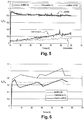
- the Figures 3 to 7 are tables illustrating the breakthrough curves of a pollutant gas, for activated carbon 4 alone, zeolite 2 alone and the composition comprising zeolite and activated carbon 4.
- a breakthrough curve illustrates the efficiency of gas filtration pollutant by the selected adsorbent (s).
- a ratio between the downstream pollutant gas concentration (Cs) of a filter comprising the adsorbent (s) and the pollutant gas concentration upstream (Ce) of the filter is given.
- the terms “downstream” and “upstream” refer to the direction of travel of a flow of air passing through the filter and conveying the polluting gas. Consequently, the higher the pollutant gas concentration, the more adsorption of the pollutant gas by the adsorbent (s) is ineffective. It is recalled that the results of the tests presented in these tables were made with low concentration mixtures.
- the polluting gas is toluene.
- Activated carbon 4 has a good capacity for filtering toluene since the concentration of the latter never exceeds 0.3.
- the zeolite alone shows a very clear lack of filtration of toluene with peaks of Cs / Ce above 1.2.
- the composition according to the invention it has a filtration efficiency greater than that of activated carbon 4 alone.
- the polluting gas is n-butane.
- the combination of zeolite 2 and activated carbon 4 has a better efficiency on the filtration of n-butane than that of activated carbon 4 alone or zeolite alone. More specifically, the filtration of the composition according to the invention is better than the cumulative filtrations of activated carbon 4 and zeolite 2. There is therefore a synergy to combine the activated carbon 4 with zeolite 2.
- the pollutant gas is nitrogen dioxide (NO 2 ).
- the action of zeolite 2 alone or that of activated carbon 4 alone on the filtration of nitrogen dioxide is substantially less than the action of the composition according to the invention.
- the results of the filtration of nitrogen dioxide show that there is a synergy in the composition according to the invention and that this composition is not the simple juxtaposition of two adsorbents. Indeed, composition 1 has a Cs / Ce ratio of less than 0.2 after 60 hours of exposure of adsorbents to the air stream containing nitrogen dioxide, while zeolite 2 has a Cs / Ce ratio greater than 0.8 and that the activated carbon 4 has a Cs / Ce ratio greater than 0.3.
- the polluting gas is acetaldehyde.
- Composition 1 has a better filtration of acetaldehyde than activated carbon alone 4 or zeolite 2 alone. As such, the composition 1 has a Cs / Ce ratio of less than 0.7 while the zeolite alone has a Cs / Ce ratio of 0.7. It is therefore understood that the mixture of zeolite and activated carbon 4 improves the action of the zeolite itself with respect to acetaldehyde.
- the polluting gas is hydrogen sulphide (H 2 S).
- H 2 S hydrogen sulphide
- the mixture of the two adsorbents thus makes it possible to increase the efficiency of the adsorbent material with respect to certain specific pollutants while maintaining the performances on the other pollutants.
- the proportion of zeolite In order not to decrease the performance of the activated carbon and benefit from the zeolite, the proportion of zeolite must be between 5 and 35% by weight, preferably between 10 and 20%. More preferably, the proportion of zeolite is 15% by weight.
- the figure 8 illustrates the breakthrough curve of hydrogen sulfide (H 2 S) for a first composition 1a comprising zeolite 2 and the first activated carbon 4a and for a second composition 1b comprising zeolite 2 and the second activated carbon 4b.
- H 2 S hydrogen sulfide
- the choice of activated charcoal makes it possible to further improve the synergy of the adsorbents of the composition 1.
- the mixture of zeolite 2 with the second activated carbon 4b have the best filtration performance on all the pollutant gases tested.
- the first composition 1a comprising zeolite 2 and the first activated carbon 4a provides performance beyond that of zeolite 2 and activated carbon 4 taken alone. This first composition 1a therefore also has a synergy with respect to a zeolite alone and to an active carbon alone.
- the Figures 9 to 12 illustrate comparative results between different compositions according to the invention.
- the first composition 1a comprises the first active carbon 4a and the zeolite 2, the mass ratio between the zeolite 2 and the first activated carbon 4a is 33%.
- the second composition 1b comprises the second active carbon 4b and the zeolite 2, the mass ratio between the zeolite and the second activated carbon 4b is 33%.
- the third composition 1c comprises the second active carbon 4b and the zeolite 2, the mass ratio between the zeolite and the second activated carbon 4b is 15%.
- figure 9 is provided the adsorption capacity of each composition tested for different gaseous pollutants.
- the third composition 1c is the one that has the best adsorption capacity, especially for acetaldehyde, hydrogen sulfide, nitrogen dioxide, n-butane and toluene.
- the tests giving the filtration performance results of Figures 10 to 12 are at low concentration (of the order of a few tens of ⁇ g / m 3 for use in a motor vehicle) and mixed together. So, a the same air flow containing all the pollutant gases to be tested passes through the air filter comprising the composition according to the invention.
- the pollutant gases tested are: toluene, n-butane, nitrogen dioxide, acetaldehyde and hydrogen sulfide.
- the third composition 1c provides a better filtration than that of the zeolite alone and that of the activated carbon 4 only at 0 hours, that is to say at the moment when the flow of air passes through the air filter.
- the filtration performance of the third composition 1c is 83 while that of zeolite 2 is 60 and that of activated carbon 4 is 80.
- This also applies to n-butane and sulfide hydrogen.
- the performance between the third composition 1c and the activated carbon 4 is identical (value: 92) and the performance of the third composition 1c is clearly greater than that of the zeolite 2.
- the third composition 1c has higher performance than the other compositions 1a, 1b and that of zeolite 2 alone and activated carbon 4 alone for toluene, nitrogen dioxide and hydrogen sulfide.
- the filtration of the third composition 1c is equivalent to that of the zeolite alone.
- the filtration performance results at 60 hours illustrate that the third composition 1c has the best filtration performance for toluene, n-butane, nitrogen dioxide, acetaldehyde and hydrogen sulfide relative to other compositions 1a, 1b, zeolite alone and activated carbon alone.
- the invention therefore also relates to an air filter 12 for ventilation, heating and / or air conditioning system comprising the composition according to the invention.
- the air filter 12, illustrated in figure 13 comprises a filter media 14 in which is housed the composition 1.
- the filter media 14 is a nonwoven fabric with several folds.
- composition 1 is a mixture of zeolite 2 and activated carbon 4, the mixture making it possible to obtain better filtration performance than those obtained by zeolite 2 alone and activated carbon 4 alone.
- Zeolite 2 comprises Fe ions.
- Composition 1 is therefore formed by a single layer as described in figure 13 .
- the term "single layer" means that the zeolite and the activated carbon are mixed with each other and that no physical obstacle separates them.
- the composition is distributed either inside the entire filter media ( figure 14 ) by strips within the filter media ( figure 15 ).
- the composition is disposed on the filter medium.
- the composition comprises at least a third adsorbent.
- the composition comprises zeolite, activated carbon, the active carbon being a mixture of distinct activated carbons.
- the composition comprises three adsorbents: the zeolite and two different active carbons.
- the term "distinct" means that the active carbons forming the mixture have different physical properties.
- the active carbon mixture is formed by the first activated carbon 4a and the second activated carbon 4b.
- a third activated carbon 4c having the following characteristics is also used.
- This third activated carbon 4c exhibits as physical properties: microporous volume of 0.327 cm 3 / g, total pore volume of 0.346 cm 3 / g, percentage of microporous volume of 95%, median pore diameter of 6.8 ⁇ and a BET surface of 969 m 2 / g. this active carbon is commonly referenced by the name "active carbon NC60".
- the activated carbon mixture is either the mixture of the first 4a and the second 4b activated carbon, the first 4a and the third 4c activated carbon, the second 4b and the third 4c activated carbon.
Landscapes
- Chemical & Material Sciences (AREA)
- Chemical Kinetics & Catalysis (AREA)
- Analytical Chemistry (AREA)
- General Chemical & Material Sciences (AREA)
- Organic Chemistry (AREA)
- Engineering & Computer Science (AREA)
- Inorganic Chemistry (AREA)
- Oil, Petroleum & Natural Gas (AREA)
- Solid-Sorbent Or Filter-Aiding Compositions (AREA)
- Separation Of Gases By Adsorption (AREA)
- Air Filters, Heat-Exchange Apparatuses, And Housings Of Air-Conditioning Units (AREA)
- Treating Waste Gases (AREA)
- Disinfection, Sterilisation Or Deodorisation Of Air (AREA)
Description
- L'invention se rapporte aux compositions comprenant un charbon actif, une zéolithe et des ions Fe utilisées dans les filtres à air pour système de ventilation, chauffage et/ou climatisation de véhicule automobile. L'invention se rapporte également aux filtres à air comprenant une telle composition.
- La filtration habitacle sert à filtrer à la fois les polluants sous forme de particules et les polluants gazeux. Deux types de filtre existent aujourd'hui sur le marché. D'une part, les filtres particules ayant pour objectif uniquement une filtration des particules de l'air entre 0,1 et 10µm et plus. D'autre part, des filtres combinés ayant la double fonction de filtrer les particules, mais aussi les gaz et les odeurs venant soit de l'extérieur de l'habitacle, soit de l'habitacle lui-même lorsque le volet d'entrée d'air du système de ventilation, chauffage et/ou climatisation est placé en position de recirculation.
- Les filtres combinés utilisent aujourd'hui des charbons actifs pour purifier l'air des gaz et des odeurs (une couche de non-tissé prenant en sandwich cette couche de charbon suivant différentes méthodes d'assemblage). Les charbons actifs utilisés sont communément choisis pour leur affinité à retenir quatre gaz d'essais : le toluène, le n-butane, le dioxyde d'azote et le dioxyde de soufre. Ces essais sont réalisés majoritairement suivant L'ISO-11 155 partie 2. Cette norme décrit une méthode utilisant les 4 gaz précités à fortes concentrations. La performance des filtres est testée gaz par gaz et non pas en mélange.
- Les résultats d'essais obtenus suivant cette norme, montrent des affinités variables entre les charbons utilisés et les polluants servant à évaluer la performance globale du filtre. Ainsi, un certain nombre de polluants -gaz standards d'essais ou gaz complémentaires- ne sont que partiellement arrêtés par les charbons classiquement utilisés. Par ailleurs, les performances au cours du vieillissement du charbon actif, c'est-à-dire - au fur et à mesure qu'il adsorbe des polluants - diminuent de façon plus ou moins rapide au fur et à mesure que les sites actifs du charbon sont occupés. Cette diminution est là encore plus ou moins rapide suivant les charbons et les gaz testés ainsi que les conditions d'hygrométrie et les températures auxquelles sont soumis les charbons.
Pour améliorer les performances de filtration des filtres à air, il a été proposé d'utiliser à la fois un charbon actif et une zéolithe. En effet, certaines zéolithes ont une bonne affinité de filtration des polluants gazeux tels que les aldéhydes. Un exemple d'une telle utilisation est décrit dans le documentEP1121978 . On y décrit l'utilisation de zéolite de structure cristalline ZSM-5 (ou Pentasil) avec des rapports Si/Al compris entre 30 et 190 et de préférence entre 55 et 90. Les zéolithes utilisées comprennent des ammoniums quaternaires (NH4 +) pour améliorer leur affinité envers les aldéhydes.
D'autres documents mentionnent aussi l'utilisation de zéolithe pour des solutions de filtration. Ainsi le brevetUS2005075238 propose l'utilisation de zéolithe mélangée à du charbon et du lithium pour la filtration combinée des VOC, CO, CO2 et la déshumidification. Cependant dans ce document la zéolithe a pour unique fonction la déshumidification et n'a pas de fonction d'adsorption des COV (composés Organiques Volatiles, famille dont les aldéhydes fait partie), celle-ci étant faite par le charbon. Le documentKR20080045818 - Le document
JP2003020489 - Le document
WO2008/133181 (TOYOTA JIDOSHA KABUSHIKI KAISHA) divulgue un matériau adsorbant de NOx à base de zéolithe échangée par des ions Fe. - Le document
US 4604110 (S.E. FRAZIER) divulgue un filtre à air pour la séparation de polluants gazeux comprenant un mélange de charbon actif et de zéolithe. La demanderesse a cherché à améliorer la filtration des polluants particulaires et surtout des polluants gazeux. En particulier, la demanderesse a cherché à obtenir une composition permettant de filtrer le plus grand nombre de polluants gazeux, et ce avec une durée de vie satisfaisante sans pour autant diminuer les performances intrinsèques de filtration de chaque composant formant la composition. - Pour cela, elle a mené une étude consistant à évaluer des charbons actifs et des nouveaux adsorbants suivant la norme ISO citée précédemment, mais aussi à les évaluer suivant une nouvelle méthode utilisant une série de polluants à basses concentrations et en mélange, tout en contrôlant la température et l'hygrométrie des essais. Cette étude a permis de simuler des conditions d'utilisation réalistes telles que celles rencontrées en zone polluée. Cette étude a permis d'évaluer les performances de nouveaux charbons, mais aussi, de sélectionner une zéolithe ayant une affinité particulière pour les polluants sélectionnés.
L'invention porte donc sur une composition comprenant un charbon actif et une zéolithe, caractérisée en ce que la zéolithe comprend 0,1 à 1,2% en masse d'ions Fe et le rapport massique entre la zéolithe et le charbon actif est compris entre 5 et 35%. Les résultats ont permis de sélectionner une combinaison particulière d'une zéolithe, d'un ion et d'un charbon actif. Cette combinaison particulière a révélée des effets surprenants quant à la qualité de filtration de gaz polluants. Il existe une synergie quant à la filtration de gaz polluants de la composition. En effet, cette composition fournit des résultats de filtration de gaz polluants meilleurs que l'addition des résultats respectifs du charbon actif et de la zéolithe. - Avantageusement, les ions Fe sont des ions ferriques ou ferreux.
Avantageusement, les ions Fe sont retenus à l'intérieur de la zéolithe.
Avantageusement, la zéolithe a une structure cristalline ZSM-5.
Avantageusement, la zéolithe a un rapport molaire de SiO2/Al2O3 compris entre 60 et 20.
Avantageusement, la zéolithe a un rapport molaire de SiO2/Al2O3 compris entre 50 et 30.
Avantageusement, la zéolithe a un rapport molaire de SiO2/Al2O3 de 40.
Avantageusement, la zéolithe est hydrophobe.
Avantageusement, le rapport massique entre la zéolithe et le charbon actif est compris entre 10 et 20%. - Avantageusement, le rapport massique entre la zéolithe et le charbon actif est de 15%.
Avantageusement, le charbon actif a une surface B.E.T de 1004 m2/g, un volume microporeux de 0,356 cm3/g, un volume poreux total de 0,422 cm3/g et un diamètre médian de pores de 4,6 Ǻ.
Avantageusement, le charbon actif a une surface B.E.T de 960 m2/g, un volume microporeux de 0,344 cm3/g, un volume poreux total de 0,404 cm3/g et un diamètre médian de pores de 5,0 Ǻ.
Avantageusement, le charbon actif a une surface B.E.T de 969 m2/g, un volume microporeux de 0,327 cm3/g, un volume poreux total de 0,346 cm3/g et un diamètre médian de pores de 6,8 Ǻ.
Avantageusement, le charbon actif est un mélange de charbons actifs distincts. - L'invention porte également sur un filtre à air pour système de ventilation, chauffage et/ou climatisation comprenant la composition selon l'une quelconque des caractéristiques précédentes.
Avantageusement, la zéolithe et le charbon actif sont disposés selon une unique couche. - D'autres caractéristiques, détails et avantages de l'invention ressortiront plus clairement à la lecture de la description donnée ci-après à titre indicatif en relation avec des dessins dans lesquels :
- la
figure 1 représente la structure d'une unité pentasil - la
figure 2 représente la structure d'une zéolithe - la
figure 3 représente des courbes de percée du toluène pour une température de 22°C et un taux d'humidité de 50% - la
figure 4 représente des courbes de percée du n-butane pour une température de 22°C et un taux d'humidité de 50% - la
figure 5 représente des courbes de percée du dioxyde d'azote pour une température de 22°C et un taux d'humidité de 50% - la
figure 6 représente des courbes de percée de l'acétaldéhyde pour une température de 22°C et un taux d'humidité de 50% - la
figure 7 représente des courbes de percée du sulfure d'hydrogène pour une température de 22°C et un taux d'humidité de 50% - la
figure 8 représente d'autres courbes de percée du sulfure d'hydrogène pour une température de 22°C et un taux d'humidité de 50% - la
figure 9 représente la capacité d'adsorption de différentes compositions selon l'invention - la
figure 10 représente un histogramme des performances de filtration à 0 heures - la
figure 11 représente un histogramme des performances de filtration à 30 heures - la
figure 12 représente un histogramme des performances de filtration à 60 heures - la
figure 13 représente une vue d'un filtre comprenant la composition - la
figure 14 représente une vue en coupe de lafigure 14 selon une première variante - la
figure 15 représente une vue en coupe de lafigure 15 selon une deuxième variante de réalisation - La composition 1 selon l'invention comprend au moins deux adsorbants. La composition 1 comprend un premier adsorbant, une zéolithe 2 et un deuxième adsorbant, un charbon actif 4. Cette composition est utilisée pour la filtration de gaz polluants à l'intérieur d'un système de ventilation, chauffage et/ou climatisation pour véhicule automobile. Plus particulièrement, cette composition est utilisée pour un filtre à air de véhicule automobile.
- La zéolithe 2 est de structure cristalline ZSM-5. Cette structure ZSM-5 (structure également appelée pentasil) comprend plusieurs unités pentasil 6 liées entre elles par des ponts oxygène. Une unité pentasil 6 comprend huit cycles 8 de forme pentagonale. Les sommets de ces cycles 8 sont formés par l'aluminium Al ou par le silicium Si. Les atomes d'oxygène O assurent la liaison entre les sommets. Ainsi, la zéolithe ZSM-5 comprend des molécules Al2O3 et des molécules SiO2. La
figure 1 est une représentation d'une unité pentasil 6 comprenant huit cycles 8. - L'ensemble des unités pentasil 6 de la zéolithe 2 forme des cages 10 dans lesquelles des ions peuvent être logés. Selon l'invention, des ions fer (ci-après nommés ions Fe) s'y logent. On entend par « ion Fe » à la fois des ions ferreux (ions Fe2+) ou des ions ferriques (ions Fe3+). La
figure 2 illustre la formation de cages 10 par la liaison des unités pentasil. Les cages ont une dimension comprise entre 5,4 et 5,6 Ǻ (angström). - La zéolithe 2 selon l'invention est une zéolithe hydrophobe. En outre, la zéolithe 2 présente un rapport SiO2/Al2O3 compris entre 20 et 60. De préférence, ce rapport est compris entre 30 et 50. Selon l'invention, la zéolithe 2 présentant un rapport SiO2/Al2O3 de 40 fournit les meilleurs résultats vis-à-vis des tests de filtration des gaz polluants. Ces résultats seront commentés ultérieurement.
- La zéolithe 2 comprend des ions Fe. Le rapport massique entre les ions Fe et la zéolithe est compris entre 0,1 et 1,2%. De préférence, le rapport massique est de 0,5%. Dans le reste de la description, le terme « zéolithe » est employé pour la zéolithe de structure cristalline ZSM-5 comprenant des ions Fe.
- La composition 1 est formée par des granules de zéolithe 2 et de charbon actif 4. La granulométrie de la composition 1 est comprise entre 300 et 600 µm de diamètre. En particulier, le charbon actif présente, pour sa granulométrie, un mode de distribution de 300 µm et la zéolithe présente, pour sa granulométrie, un mode de distribution de 600 µm. En d'autres termes, le charbon actif présente généralement un diamètre de 300 µm et la zéolithe un diamètre de 600 µm. Les valeurs des diamètres de la zéolithe et du charbon actif ont été choisi pour permettre un mélange homogène et une meilleure mise en forme lors du procédé de fabrication. Ainsi, le mélange de la zéolithe avec le charbon actif n'entraîne pas de perte de charge additionnelle ni de difficultés de mise en oeuvre.
La composition 1 comprend un charbon actif 4. Deux charbons actifs différents ont été testés. Un premier charbon actif 4a utilisé a les propriétés physiques sont les suivantes : surface B.E.T de 1004 m2/g, volume microporeux de 0,356 cm3/g, volume poreux total de 0,422 cm3/g et diamètre médian de pores de 4,6 Å. Un deuxième charbon actif 4b utilisé a les propriétés physiques sont les suivantes : surface B.E.T de 960 m2/g, volume microporeux de 0,344 cm3/g, volume poreux total de 0,404 cm3/g et diamètre médian de pores de 5,0 Å. Lesfigures 3 à 7 sont des tableaux illustrant les courbes de percée d'un gaz polluant, pour le charbon actif 4 seul, la zéolithe 2 seule et la composition comprenant la zéolithe et le charbon actif 4. Une courbe de percée illustre l'efficacité de la filtration du gaz polluant par le ou les adsorbant(s) sélectionné(s). En ordonnée, un rapport entre la concentration en gaz polluant en aval (Cs) d'un filtre comprenant le ou les adsorbants et la concentration en gaz polluant en amont (Ce) du filtre est donnée. Les termes « aval » et « amont » s'entendent selon le sens de parcours d'un flux d'air traversant le filtre et véhiculant le gaz polluant. En conséquence, plus la concentration en gaz polluant est élevée, plus l'adsorption du gaz polluant par le ou les adsorbant(s) est inefficace. Il est rappelé que les résultats des tests présentés dans ces tableaux ont été réalisés avec des mélanges basses concentrations.
Sur lafigure 3 , le gaz polluant est le toluène. Le charbon actif 4 présente une bonne capacité de filtration du toluène puisque la concentration de ce dernier n'excède jamais 0,3. La zéolithe seule présente une très nette insuffisance de filtration du toluène avec des pics du rapport Cs/Ce au-delà de 1,2. Quant à la composition selon l'invention, elle présente une efficacité de filtration supérieure à celle du charbon actif 4 seul. - Sur la
figure 4 , le gaz polluant est n-butane. Selon ce tableau, on constate que la combinaison de la zéolithe 2 et du charbon actif 4 présente une meilleure efficacité sur la filtration du n-butane que celle du charbon actif 4 seul ou de la zéolithe seule. Plus précisément, la filtration de la composition selon l'invention est meilleure que les filtrations cumulées du charbon actif 4 et de la zéolithe 2. Il existe donc une synergie à combiner le charbon actif 4 avec la zéolithe 2. - Sur la
figure 5 , le gaz polluant est le dioxyde d'azote (NO2). L'action de la zéolithe 2 seule ou celle du charbon actif 4 seul sur la filtration du dioxyde d'azote est sensiblement moindre que l'action de la composition selon l'invention. Les résultats de la filtration du dioxyde d'azote montrent qu'il existe une synergie dans la composition selon l'invention et que cette composition n'est pas la simple juxtaposition de deux adsorbants. En effet, la composition 1 présente un rapport Cs/Ce inférieur à 0,2 après 60 heures d'exposition des adsorbants au flux d'air contenant le dioxyde d'azote, alors que la zéolithe 2 présente un rapport Cs/Ce supérieur à 0,8 et que le charbon actif 4 présente un rapport Cs/Ce supérieur à 0,3. - Sur la
figure 6 , le gaz polluant est l'acétaldéhyde. La composition 1 présente une meilleure filtration de l'acétaldéhyde que le charbon actif 4 seul ou la zéolithe 2 seule. A ce titre, la composition 1 possède un rapport Cs/Ce inférieur à 0,7 tandis que la zéolithe seul possède un rapport Cs/Ce de 0,7. On comprend donc que le mélange de la zéolithe et du charbon actif 4 améliore l'action de la zéolithe en elle-même vis-à-vis de l'acétaldéhyde. - Sur la
figure 7 , le gaz polluant est le sulfure d'hydrogène (H2S). Le mélange de zéolithe 2 et de charbon actif 4 montre une réelle amélioration de la filtration de ce gaz polluant par rapport à une simple juxtaposition des résultats de filtration de la zéolithe seule ou du charbon actif 4 seul. - A la lumière des
figures 3 à 7 , on comprend que le fait de mélanger la zéolithe avec du charbon actif améliore considérablement le pouvoir de filtration vis-à-vis de différents gaz polluants. Autrement dit, la composition selon l'invention améliore l'efficacité de filtration des gaz polluants en comparaison avec un filtre comprenant une couche de zéolithe et une couche de charbon actif, les deux couches étant physiquement séparées à l'intérieur du filtre. L'utilisation de charbon actif seul permet d'éliminer convenablement des gaz polluants (Toluène, n-butane, NO2). La zéolithe est loin des performances du charbon actif sur les gaz cités ci-dessus, par contre, elle présente un intérêt sur l'adsorption d'aldéhydes, et plus particulièrement de l'acétaldéhyde et le sulfure d'hydrogène. - Le mélange des deux adsorbants permet donc d'accroître l'efficacité du matériau adsorbant vis-à-vis de certains polluants spécifiques tout en conservant les performances sur les autres polluants.
- Ainsi, les performances sur toluène, n-butane et NO2 sont maintenues malgré l'ajout de la zéolithe. Les performances sur acétaldéhyde sont sensiblement améliorées. Le mélange est également efficace sur H2S. Cette solution permet alors une protection accrue de la santé humaine et du confort, en réduisant les nuisances olfactives.
- Afin de ne pas diminuer les performances du charbon actif et de bénéficier de l'apport de la zéolithe, la proportion de zéolithe doit être comprise entre 5 et 35% en masse, préférentiellement entre 10 et 20%. De préférence encore, la proportion de zéolithe est de 15% en masse.
- La
figure 8 illustre la courbe de percée du sulfure d'hydrogène (H2S) pour une première composition 1a comprenant la zéolithe 2 et le premier charbon actif 4a et pour une deuxième composition 1b comprenant la zéolithe 2 et le deuxième charbon actif 4b. Bien que la première composition 1a donne de bons résultats de filtration du sulfure d'hydrogène après 30 heures, la deuxième composition 1b présente une efficacité à la filtration plus importante. Après 30 heures, la première composition 1a présente un rapport Cs/Ce inférieur à 0,4 et la deuxième composition 1b présente un rapport Cs/Ce inférieur à 0,2. Il émerge de ces résultats que le choix de chaque adsorbant de la composition 1 est fait délibérément et s'appuie sur des résultats de filtration de gaz polluants probants. Ainsi, au-delà du choix particulier de la zéolithe 2 ayant une structure ZSM-5 et comprenant les ions Fe, le choix du charbon actif permet d'améliorer encore la synergie des adsorbants de la composition 1. En effet, il apparaît à la lumière desfigures 3 à 8 que le mélange de la zéolithe 2 avec le deuxième charbon actif 4b présentent les meilleures performances de filtration sur tous les gaz polluants testés. Néanmoins, la première composition 1a comprenant la zéolithe 2 et le premier charbon actif 4a fournit des performances au-delà de celles de la zéolithe 2 et du charbon actif 4 pris isolément. Cette première composition 1a présente donc également une synergie par rapport à une zéolithe seule et à un charbon actif seul.
Lesfigures 9 à 12 illustrent des résultats comparatifs entre différentes compositions selon l'invention. La première composition 1a comprend le premier charbon actif 4a et la zéolithe 2, le rapport massique entre la zéolithe 2 et le premier charbon actif 4a est de 33%. La deuxième composition 1b comprend le deuxième charbon actif 4b et la zéolithe 2, le rapport massique entre la zéolithe et le deuxième charbon actif 4b est de 33%. La troisième composition 1c comprend le deuxième charbon actif 4b et la zéolithe 2, le rapport massique entre la zéolithe et le deuxième charbon actif 4b est de 15%.
Enfigure 9 est fournie la capacité d'adsorption de chaque composition testée pour différents gaz polluants. Il en découle que la troisième composition 1c est celle qui possède les meilleures capacités d'adsorption, notamment pour l'acétaldéhyde, le sulfure d'hydrogène, le dioxyde d'azote, le n-butane et le toluène.
Les essais donnant les résultats de performance de filtration desfigures 10 à 12 sont à basse concentration (de l'ordre de quelques dizaines de µg/m3 pour une utilisation dans un véhicule automobile) et mélangés entre eux. Ainsi, un même flux d'air contenant l'ensemble des gaz polluants à tester traverse le filtre à air comprenant la composition selon l'invention. En outre, les gaz polluants testés sont les suivants : toluène, n-butane, dioxyde d'azote, acétaldéhyde et sulfure d'hydrogène. - En
figure 10 , il ressort que la troisième composition 1c procure une filtration meilleure que celle de la zéolithe seule et celle du charbon actif 4 seul à 0 heures, c'est-à-dire au moment où le flux d'air traverse le filtre à air. En effet, pour le toluène, la performance de filtration de la troisième composition 1c est de 83 tandis que celle de la zéolithe 2 est de 60 et celle du charbon actif 4 est de 80. Cela vaut également pour le n-butane et le sulfure d'hydrogène. Pour le dioxyde d'azote, la performance entre la troisième composition 1c et le charbon actif 4 est identique (valeur : 92) et la performance de la troisième composition 1c est nettement supérieure à celle de la zéolithe 2. - En
figure 11 , sont donnés les résultats de performance de filtration à 30 heures. La troisième composition 1c a des performances supérieures à celle des autres compositions 1a, 1b et à celle de la zéolithe 2 seule et du charbon actif 4 seul pour le toluène, le dioxyde d'azote et le sulfure d'hydrogène. Pour l'acétaldéhyde, la filtration de la troisième composition 1c est équivalente à celle de la zéolithe seule. - En
figure 12 , les résultats de performance de filtration à 60 heures illustrent le fait que la troisième composition 1c possède la meilleure performance de filtration pour le toluène, le n-butane, le dioxyde d'azote, l'acétaldéhyde et le sulfure d'hydrogène par rapport aux autres compositions 1a, 1b, à la zéolithe seule et au charbon actif seul. - L'invention porte donc également sur un filtre à air 12 pour système de ventilation, chauffage et/ou climatisation comprenant la composition selon l'invention. Le filtre à air 12, illustré en
figure 13 , comprend un média filtrant 14 dans lequel est logé la composition 1. Le média filtrant 14 est un tissu non-tissé comportant plusieurs plis. Comme décrit précédemment, la composition 1 est un mélange de la zéolithe 2 et du charbon actif 4, le mélange permettant d'obtenir de meilleures performances de filtration que celles obtenues par la zéolithe 2 seule et le charbon actif 4 seul. La zéolithe 2 comprend les ions Fe. La composition 1 est donc formée par une couche unique telle que décrite enfigure 13 . On entend par « couche unique » le fait que la zéolithe et le charbon actif soient mélangés l'un à l'autre et qu'aucun obstacle physique ne les sépare. A l'intérieur du filtre à air, la composition est répartie soit à l'intérieur de l'ensemble du média filtrant (figure 14 ) soit par bandes à l'intérieur du média filtrant (figure 15 ). En variante, la composition est disposée sur le média filtrant.
En variante, la composition comprend au moins un troisième adsorbant. Par exemple, la composition comprend la zéolithe, le charbon actif, le charbon actif étant un mélange de charbons actifs distincts. Ainsi, la composition comprend trois adsorbants : la zéolithe et deux charbons actifs distincts. On entend par « distinct » le fait que les charbons actifs formant le mélange ont des propriétés physiques différentes. Par exemple, le mélange de charbons actifs est formé par le premier charbon actif 4a et le deuxième charbon actif 4b. Un troisième charbon actif 4c présentant les caractéristiques suivantes est également utilisé. Ce troisième charbon actif 4c présente comme propriétés physiques : volume microporeux de 0,327 cm3/g, volume poreux total de 0,346 cm3/g, pourcentage de volume microporeux de 95%, diamètre médian des pores de 6,8 Ǻ et une surface B.E.T. de 969 m2/g. ce charbon actif est couramment référencé par l'appellation « charbon actif NC60 ». Le mélange de charbon actif est donc soit le mélange du premier 4a et du deuxième 4b charbon actif, soit le premier 4a et le troisième 4c charbon actif, soit le deuxième 4b et le troisième 4c charbon actif.
Claims (16)
- Composition (1) comprenant un charbon actif (4) et une zéolithe (2), caractérisée en ce que la zéolithe (2) comprend 0,1 à 1,2% en masse d'ions Fe et le rapport massique entre la zéolithe (2) et le charbon actif (4) est compris entre 5 et 35%.
- Composition (1) selon la revendication précédente, dans laquelle les ions Fe sont des ions ferriques ou ferreux.
- Composition (1) selon l'une quelconque des revendications précédentes, dans laquelle les ions Fe sont retenus à l'intérieur de la zéolithe (2).
- Composition (1) selon l'une quelconque des revendications précédentes, dans laquelle la zéolithe (2) a une structure cristalline ZSM-5.
- Composition (1) selon l'une quelconque des revendications précédentes, dans laquelle la zéolithe (2) a un rapport molaire de SiO2/Al2O3 compris entre 60 et 20.
- Composition (1) selon l'une quelconque des revendications précédentes, dans laquelle la zéolithe a un rapport molaire de SiO2/Al2O3 compris entre 50 et 30.
- Composition (1) selon l'une quelconque des revendications précédentes, dans laquelle la zéolithe (2) a un rapport molaire de SiO2/Al2O3 de 40.
- Composition (1) selon l'une quelconque des revendications précédentes, dans laquelle la zéolithe (2) est hydrophobe.
- Composition (1) selon l'une quelconque des revendications précédentes, dans laquelle le rapport massique entre la zéolithe et le charbon actif est compris entre 10 et 20%.
- Composition (1) selon l'une quelconque des revendications précédentes, dans laquelle le rapport massique entre la zéolithe et le charbon actif est de 15%.
- Composition (1) selon l'une quelconque des revendications précédentes, dans laquelle le charbon actif a une surface B.E.T de 1004 m2/g, un volume microporeux de 0,356 cm3/g, un volume poreux total de 0,422 cm3/g et un diamètre médian de pores de 4,6 Ǻ.
- Composition (1) selon l'une quelconque des revendications 1 à 10, dans laquelle le charbon actif a une surface B.E.T de 960 m2/g, un volume microporeux de 0,344 cm3/g, un volume poreux total de 0,404 cm3/g et un diamètre médian de pores de 5,0 Ǻ.
- Composition (1) selon l'une quelconque des revendications 1 à 10, dans laquelle le charbon actif a une surface B.E.T de 969 m2/g, un volume microporeux de 0,327 cm3/g, un volume poreux total de 0,346 cm3/g et un diamètre médian de pores de 6,8 Ǻ.
- Composition (1) selon l'une quelconque des revendications précédentes, dans laquelle le charbon actif est un mélange de charbons actifs distincts.
- Filtre à air (12) pour système de ventilation, chauffage et/ou climatisation comprenant la composition (1) selon l'une quelconque des revendications précédentes.
- Filtre à air selon la revendication précédente, dans lequel la zéolithe et le charbon actif sont disposés selon une unique couche.
Applications Claiming Priority (2)
| Application Number | Priority Date | Filing Date | Title |
|---|---|---|---|
| FR0905736A FR2953152B1 (fr) | 2009-11-27 | 2009-11-27 | Composition comprenant un charbon actif, une zeolithe et des ions fe pour filtre a air d'habitacle de vehicule |
| PCT/EP2010/068339 WO2011064346A1 (fr) | 2009-11-27 | 2010-11-26 | Composition comprenant un charbon actif, une zeolithe et des ions fe pour filtre a air d'habitacle de vehicule. |
Publications (2)
| Publication Number | Publication Date |
|---|---|
| EP2504093A1 EP2504093A1 (fr) | 2012-10-03 |
| EP2504093B1 true EP2504093B1 (fr) | 2019-01-02 |
Family
ID=42227725
Family Applications (1)
| Application Number | Title | Priority Date | Filing Date |
|---|---|---|---|
| EP10782311.4A Active EP2504093B1 (fr) | 2009-11-27 | 2010-11-26 | Composition comprenant un charbon actif, une zeolithe et des ions fe pour filtre a air d'habitacle de vehicule. |
Country Status (5)
| Country | Link |
|---|---|
| US (2) | US9968908B2 (fr) |
| EP (1) | EP2504093B1 (fr) |
| JP (1) | JP5956343B2 (fr) |
| FR (1) | FR2953152B1 (fr) |
| WO (1) | WO2011064346A1 (fr) |
Families Citing this family (20)
| Publication number | Priority date | Publication date | Assignee | Title |
|---|---|---|---|---|
| KR20150011071A (ko) * | 2013-07-22 | 2015-01-30 | 삼성전자주식회사 | 제올라체트 복합체 |
| US9662637B2 (en) * | 2013-10-31 | 2017-05-30 | Xiwang Qi | Nano-structured composite absorber for air detoxing and deodoring |
| WO2018144463A1 (fr) | 2017-01-31 | 2018-08-09 | Purewick Corporation | Appareil et procédés pour la réception d'urine excrétée |
| WO2019212956A1 (fr) | 2018-05-02 | 2019-11-07 | Purewick Corporation | Dispositifs, systèmes et procédés de collecte de fluide |
| EP3986344B1 (fr) | 2019-06-21 | 2023-08-09 | Purewick Corporation | Dispositifs de collecte de fluide comprenant une zone de fixation de base, et systèmes et procédés associés |
| WO2021086868A1 (fr) | 2019-10-28 | 2021-05-06 | Purewick Corporation | Ensembles de collecte de fluide comprenant un orifice d'échantillon |
| EP4125746B1 (fr) | 2020-03-26 | 2024-05-15 | Purewick Corporation | Dispositif de capture d'urine multicouche et procédés associés |
| WO2021211599A1 (fr) | 2020-04-17 | 2021-10-21 | Purewick Corporation | Dispositifs cathéters féminins externes comprenant une coupelle urétrale et systèmes et procédés associés |
| WO2021211729A1 (fr) | 2020-04-17 | 2021-10-21 | Purewick Corporation | Dispositifs de collecte de fluide, systèmes, et procédés de fixation solide d'une partie en saillie en position permettant l'utilisation |
| WO2021211801A1 (fr) | 2020-04-17 | 2021-10-21 | Purewick Corporation | Ensembles de collecte de fluide comprenant une barrière imperméable aux fluides comportant une cuvette et une base |
| US12491104B2 (en) | 2020-04-20 | 2025-12-09 | Purewick Corporation | Fluid collection devices adjustable between a vacuum-based orientation and a gravity-based orientation, and related systems and methods |
| JP2022033008A (ja) * | 2020-08-13 | 2022-02-25 | 東ソー株式会社 | ゼオライト組成物、ポリスルフィド吸着材及びその製造方法 |
| US12440370B2 (en) | 2020-10-21 | 2025-10-14 | Purewick Corporation | Apparatus with compressible casing for receiving discharged urine |
| US12569365B2 (en) | 2020-10-21 | 2026-03-10 | Purewick Corporation | Fluid collection assemblies including at least one shape memory material disposed in the conduit |
| EP4274522A1 (fr) | 2021-01-07 | 2023-11-15 | Purewick Corporation | Systèmes de collecte d'urine pouvant être fixés à un fauteuil roulant et méthodes associées |
| US12551385B2 (en) | 2021-03-05 | 2026-02-17 | Purewick Corporation | Fluid collection assembly including a tube having porous wicking material for improved fluid transport |
| US12558472B2 (en) | 2021-03-05 | 2026-02-24 | Purewick Corporation | Portable fluid collection systems with storage and related methods |
| US12575960B2 (en) | 2021-06-24 | 2026-03-17 | Purewick Corporation | Urine collection systems having one or more of volume, pressure, or flow indicators, and related methods |
| US20220409419A1 (en) * | 2021-06-28 | 2022-12-29 | Purewick Corporation | Odor treatment for a urine collection system |
| US12594062B2 (en) | 2021-09-08 | 2026-04-07 | Purewick Corporation | Fluid collection assemblies including an extension |
Citations (1)
| Publication number | Priority date | Publication date | Assignee | Title |
|---|---|---|---|---|
| US4604110A (en) * | 1984-04-19 | 1986-08-05 | General Time Corporation | Filter element, filter, and method for removing odors from indoor air |
Family Cites Families (18)
| Publication number | Priority date | Publication date | Assignee | Title |
|---|---|---|---|---|
| DD299622A5 (de) * | 1990-10-01 | 1992-04-30 | Karl-Marx-Universitaet,De | Geformte hydrophobe mischadsorbentien und verfahren zu ihrer herstellung |
| DE19727376C2 (de) * | 1997-06-27 | 2002-07-18 | Daimler Chrysler Ag | Verfahren zur Adsorption von organischen Stoffen in der Luft |
| US6344071B1 (en) * | 2000-05-22 | 2002-02-05 | 3M Innovative Properties Company | Broad spectrum filter system for filtering contaminants from air or other gases |
| JP3766771B2 (ja) * | 1999-11-08 | 2006-04-19 | 日本エンバイロケミカルズ株式会社 | 吸着剤 |
| JP3829600B2 (ja) * | 2000-01-31 | 2006-10-04 | マツダ株式会社 | 吸着剤とそれを用いた吸着装置及びその他の物品並びに吸着方法 |
| JP4812194B2 (ja) * | 2000-08-11 | 2011-11-09 | 大阪瓦斯株式会社 | 天然ガスの吸着貯蔵装置および吸着貯蔵方法 |
| JP3895134B2 (ja) * | 2001-07-05 | 2007-03-22 | 東京瓦斯株式会社 | 燃料ガスの脱硫装置及び脱硫方法 |
| US7282464B2 (en) | 2003-08-11 | 2007-10-16 | Nancy Lydia Kimmel | Activated carbon mesh fiber matrix embedded with lithium hydroxide and zeolite crystals |
| JP4641408B2 (ja) * | 2003-11-11 | 2011-03-02 | ヤマトヨ産業株式会社 | フィルター |
| US7531029B2 (en) * | 2005-06-01 | 2009-05-12 | Basf Catalysts Llc | Coated screen adsorption unit for controlling evaporative hydrocarbon emissions |
| JP2006341150A (ja) * | 2005-06-07 | 2006-12-21 | Osaka Gas Chem Kk | 酸性ガス除去用処理剤及び酸性ガス除去用フィルタ |
| KR100610468B1 (ko) * | 2005-06-24 | 2006-08-08 | 주식회사 엘지생활건강 | 자동차 내부의 유입되는 유해가스 흡착제 조성물 |
| JP4724544B2 (ja) | 2005-12-05 | 2011-07-13 | 美和ロック株式会社 | 錠箱操作部材の取付構造 |
| DE102006022178A1 (de) * | 2006-04-18 | 2007-10-25 | BLüCHER GMBH | Mit Adsorbentien beaufschlagte Plattenmaterialien für den Trockenbau |
| KR100855772B1 (ko) * | 2006-11-21 | 2008-09-01 | 주식회사 삼천리 | 연료가스에 함유된 유황성분 제거부재 및 이를 이용한연료전지 시스템의 탈황장치 |
| JP2008264702A (ja) * | 2007-04-20 | 2008-11-06 | Toyota Motor Corp | NOx吸着材の製造方法及びNOx吸着材 |
| WO2009020688A1 (fr) * | 2007-05-21 | 2009-02-12 | University Of Maine System Board Of Trustees | Matériaux composites à base de zéolithe pour contrôler les odeurs de déchets |
| JP5205588B2 (ja) * | 2008-03-12 | 2013-06-05 | 森藤 博仁 | 人工ゼオライトを含む培養土改良材及び培養土 |
-
2009
- 2009-11-27 FR FR0905736A patent/FR2953152B1/fr active Active
-
2010
- 2010-11-26 EP EP10782311.4A patent/EP2504093B1/fr active Active
- 2010-11-26 WO PCT/EP2010/068339 patent/WO2011064346A1/fr not_active Ceased
- 2010-11-26 US US13/511,922 patent/US9968908B2/en not_active Expired - Fee Related
- 2010-11-26 JP JP2012540446A patent/JP5956343B2/ja active Active
-
2018
- 2018-04-20 US US15/958,570 patent/US20180297007A1/en not_active Abandoned
Patent Citations (1)
| Publication number | Priority date | Publication date | Assignee | Title |
|---|---|---|---|---|
| US4604110A (en) * | 1984-04-19 | 1986-08-05 | General Time Corporation | Filter element, filter, and method for removing odors from indoor air |
Also Published As
| Publication number | Publication date |
|---|---|
| JP2013512083A (ja) | 2013-04-11 |
| CN102725062A (zh) | 2012-10-10 |
| FR2953152A1 (fr) | 2011-06-03 |
| US20180297007A1 (en) | 2018-10-18 |
| FR2953152B1 (fr) | 2013-08-16 |
| EP2504093A1 (fr) | 2012-10-03 |
| JP5956343B2 (ja) | 2016-07-27 |
| US20130040804A1 (en) | 2013-02-14 |
| US9968908B2 (en) | 2018-05-15 |
| WO2011064346A1 (fr) | 2011-06-03 |
Similar Documents
| Publication | Publication Date | Title |
|---|---|---|
| WO2011064346A1 (fr) | Composition comprenant un charbon actif, une zeolithe et des ions fe pour filtre a air d'habitacle de vehicule. | |
| US8172925B2 (en) | Multi-functional cabin air filter | |
| FR2639846A1 (fr) | Composite de charbon et alumine actives et procede pour sa preparation | |
| EP2015861B1 (fr) | Structure de purification incorporant un systeme de catalyse electrochimique | |
| TW200914115A (en) | Process for producing purified natural gas from natural gas comprising water and carbon dioxide | |
| EP0930089A1 (fr) | Procédé de purification par adsorption de l'air avant distillation cryogenique | |
| DK3119495T3 (en) | PROCEDURE FOR RECYCLING HEAVY METAL AND MATERIAL USE IN SUCH PROCEDURE | |
| EP0880989B1 (fr) | Procédé de séparation d'un flux gazeux par un procédé PSA | |
| EP1729879B1 (fr) | Composition zeolitique adsorbante, son procede de preparation et son utilisation pour l'elimination de h2o et/ou co2 et/ou h2s contenus dans des melanges gazeux ou liquides | |
| EP3777992B1 (fr) | Matériau filtrant multicouche | |
| AU2005280411A1 (en) | Process for the removal of heavy metals from gases, and compositions therefor and therewith | |
| FR3040636B1 (fr) | Utilisation de tamis moleculaires pour la decarbonatation de gaz naturel | |
| EP4065253A1 (fr) | Séparation des gaz de l'air | |
| WO2011064371A1 (fr) | Zeolithe hydrophobe echangee avec un metal de transition en tant qu'adsorbant d'aldehydes | |
| FR3098731A1 (fr) | Dispositif de dépollution d’air comprenant un mélange de matériaux adsorbants et véhicule comprenant un tel dispositif | |
| KR20170060810A (ko) | 담배 필터용 흡착제 및 그 제조방법과 이를 포함하는 담배 필터 | |
| WO2019186013A1 (fr) | Procédé de décarbonatation de flux gazeux | |
| JP2007000605A (ja) | 自動車内部に流入する有害ガスの吸着剤組成物 | |
| FR2678522A1 (fr) | Filtre pour la purification de l'air envoye dans la cabine des passagers d'un vehicule. | |
| CN102725062B (zh) | 用于车辆乘坐室空气过滤器的包括活性炭、沸石和Fe离子的组合物 | |
| DE202005020008U1 (de) | Filterelement für eine Luftansaugeinrichtung eines Fahrzeug-Verbrennungsmotors | |
| WO2014206789A1 (fr) | Filtre antibacterien et systeme de ventilation d'air de l'habitacle d'un vehicule automobile associe | |
| FR2891007A1 (fr) | Dispositif de traitement du methane contenu dans les gaz d'echappement emis par un moteur diesel et procede associe | |
| CN121697417A (zh) | 车辆内部空间的污染物减少 | |
| EP4673397A1 (fr) | Purification d'oxygène électrolytique |
Legal Events
| Date | Code | Title | Description |
|---|---|---|---|
| PUAI | Public reference made under article 153(3) epc to a published international application that has entered the european phase |
Free format text: ORIGINAL CODE: 0009012 |
|
| 17P | Request for examination filed |
Effective date: 20120611 |
|
| AK | Designated contracting states |
Kind code of ref document: A1 Designated state(s): AL AT BE BG CH CY CZ DE DK EE ES FI FR GB GR HR HU IE IS IT LI LT LU LV MC MK MT NL NO PL PT RO RS SE SI SK SM TR |
|
| DAX | Request for extension of the european patent (deleted) | ||
| GRAP | Despatch of communication of intention to grant a patent |
Free format text: ORIGINAL CODE: EPIDOSNIGR1 |
|
| STAA | Information on the status of an ep patent application or granted ep patent |
Free format text: STATUS: GRANT OF PATENT IS INTENDED |
|
| INTG | Intention to grant announced |
Effective date: 20180726 |
|
| GRAS | Grant fee paid |
Free format text: ORIGINAL CODE: EPIDOSNIGR3 |
|
| GRAA | (expected) grant |
Free format text: ORIGINAL CODE: 0009210 |
|
| STAA | Information on the status of an ep patent application or granted ep patent |
Free format text: STATUS: THE PATENT HAS BEEN GRANTED |
|
| AK | Designated contracting states |
Kind code of ref document: B1 Designated state(s): AL AT BE BG CH CY CZ DE DK EE ES FI FR GB GR HR HU IE IS IT LI LT LU LV MC MK MT NL NO PL PT RO RS SE SI SK SM TR |
|
| REG | Reference to a national code |
Ref country code: GB Ref legal event code: FG4D Free format text: NOT ENGLISH |
|
| REG | Reference to a national code |
Ref country code: CH Ref legal event code: EP Ref country code: AT Ref legal event code: REF Ref document number: 1083671 Country of ref document: AT Kind code of ref document: T Effective date: 20190115 |
|
| REG | Reference to a national code |
Ref country code: IE Ref legal event code: FG4D Free format text: LANGUAGE OF EP DOCUMENT: FRENCH |
|
| REG | Reference to a national code |
Ref country code: DE Ref legal event code: R096 Ref document number: 602010056266 Country of ref document: DE |
|
| REG | Reference to a national code |
Ref country code: NL Ref legal event code: MP Effective date: 20190102 |
|
| REG | Reference to a national code |
Ref country code: LT Ref legal event code: MG4D |
|
| REG | Reference to a national code |
Ref country code: AT Ref legal event code: MK05 Ref document number: 1083671 Country of ref document: AT Kind code of ref document: T Effective date: 20190102 |
|
| PG25 | Lapsed in a contracting state [announced via postgrant information from national office to epo] |
Ref country code: NL Free format text: LAPSE BECAUSE OF FAILURE TO SUBMIT A TRANSLATION OF THE DESCRIPTION OR TO PAY THE FEE WITHIN THE PRESCRIBED TIME-LIMIT Effective date: 20190102 |
|
| PG25 | Lapsed in a contracting state [announced via postgrant information from national office to epo] |
Ref country code: NO Free format text: LAPSE BECAUSE OF FAILURE TO SUBMIT A TRANSLATION OF THE DESCRIPTION OR TO PAY THE FEE WITHIN THE PRESCRIBED TIME-LIMIT Effective date: 20190402 Ref country code: FI Free format text: LAPSE BECAUSE OF FAILURE TO SUBMIT A TRANSLATION OF THE DESCRIPTION OR TO PAY THE FEE WITHIN THE PRESCRIBED TIME-LIMIT Effective date: 20190102 Ref country code: SE Free format text: LAPSE BECAUSE OF FAILURE TO SUBMIT A TRANSLATION OF THE DESCRIPTION OR TO PAY THE FEE WITHIN THE PRESCRIBED TIME-LIMIT Effective date: 20190102 Ref country code: PT Free format text: LAPSE BECAUSE OF FAILURE TO SUBMIT A TRANSLATION OF THE DESCRIPTION OR TO PAY THE FEE WITHIN THE PRESCRIBED TIME-LIMIT Effective date: 20190502 Ref country code: LT Free format text: LAPSE BECAUSE OF FAILURE TO SUBMIT A TRANSLATION OF THE DESCRIPTION OR TO PAY THE FEE WITHIN THE PRESCRIBED TIME-LIMIT Effective date: 20190102 Ref country code: PL Free format text: LAPSE BECAUSE OF FAILURE TO SUBMIT A TRANSLATION OF THE DESCRIPTION OR TO PAY THE FEE WITHIN THE PRESCRIBED TIME-LIMIT Effective date: 20190102 Ref country code: ES Free format text: LAPSE BECAUSE OF FAILURE TO SUBMIT A TRANSLATION OF THE DESCRIPTION OR TO PAY THE FEE WITHIN THE PRESCRIBED TIME-LIMIT Effective date: 20190102 |
|
| PG25 | Lapsed in a contracting state [announced via postgrant information from national office to epo] |
Ref country code: LV Free format text: LAPSE BECAUSE OF FAILURE TO SUBMIT A TRANSLATION OF THE DESCRIPTION OR TO PAY THE FEE WITHIN THE PRESCRIBED TIME-LIMIT Effective date: 20190102 Ref country code: HR Free format text: LAPSE BECAUSE OF FAILURE TO SUBMIT A TRANSLATION OF THE DESCRIPTION OR TO PAY THE FEE WITHIN THE PRESCRIBED TIME-LIMIT Effective date: 20190102 Ref country code: IS Free format text: LAPSE BECAUSE OF FAILURE TO SUBMIT A TRANSLATION OF THE DESCRIPTION OR TO PAY THE FEE WITHIN THE PRESCRIBED TIME-LIMIT Effective date: 20190502 Ref country code: GR Free format text: LAPSE BECAUSE OF FAILURE TO SUBMIT A TRANSLATION OF THE DESCRIPTION OR TO PAY THE FEE WITHIN THE PRESCRIBED TIME-LIMIT Effective date: 20190403 Ref country code: BG Free format text: LAPSE BECAUSE OF FAILURE TO SUBMIT A TRANSLATION OF THE DESCRIPTION OR TO PAY THE FEE WITHIN THE PRESCRIBED TIME-LIMIT Effective date: 20190402 Ref country code: RS Free format text: LAPSE BECAUSE OF FAILURE TO SUBMIT A TRANSLATION OF THE DESCRIPTION OR TO PAY THE FEE WITHIN THE PRESCRIBED TIME-LIMIT Effective date: 20190102 |
|
| REG | Reference to a national code |
Ref country code: DE Ref legal event code: R097 Ref document number: 602010056266 Country of ref document: DE |
|
| PG25 | Lapsed in a contracting state [announced via postgrant information from national office to epo] |
Ref country code: DK Free format text: LAPSE BECAUSE OF FAILURE TO SUBMIT A TRANSLATION OF THE DESCRIPTION OR TO PAY THE FEE WITHIN THE PRESCRIBED TIME-LIMIT Effective date: 20190102 Ref country code: EE Free format text: LAPSE BECAUSE OF FAILURE TO SUBMIT A TRANSLATION OF THE DESCRIPTION OR TO PAY THE FEE WITHIN THE PRESCRIBED TIME-LIMIT Effective date: 20190102 Ref country code: AT Free format text: LAPSE BECAUSE OF FAILURE TO SUBMIT A TRANSLATION OF THE DESCRIPTION OR TO PAY THE FEE WITHIN THE PRESCRIBED TIME-LIMIT Effective date: 20190102 Ref country code: CZ Free format text: LAPSE BECAUSE OF FAILURE TO SUBMIT A TRANSLATION OF THE DESCRIPTION OR TO PAY THE FEE WITHIN THE PRESCRIBED TIME-LIMIT Effective date: 20190102 Ref country code: IT Free format text: LAPSE BECAUSE OF FAILURE TO SUBMIT A TRANSLATION OF THE DESCRIPTION OR TO PAY THE FEE WITHIN THE PRESCRIBED TIME-LIMIT Effective date: 20190102 Ref country code: RO Free format text: LAPSE BECAUSE OF FAILURE TO SUBMIT A TRANSLATION OF THE DESCRIPTION OR TO PAY THE FEE WITHIN THE PRESCRIBED TIME-LIMIT Effective date: 20190102 Ref country code: SK Free format text: LAPSE BECAUSE OF FAILURE TO SUBMIT A TRANSLATION OF THE DESCRIPTION OR TO PAY THE FEE WITHIN THE PRESCRIBED TIME-LIMIT Effective date: 20190102 Ref country code: AL Free format text: LAPSE BECAUSE OF FAILURE TO SUBMIT A TRANSLATION OF THE DESCRIPTION OR TO PAY THE FEE WITHIN THE PRESCRIBED TIME-LIMIT Effective date: 20190102 |
|
| PLBE | No opposition filed within time limit |
Free format text: ORIGINAL CODE: 0009261 |
|
| STAA | Information on the status of an ep patent application or granted ep patent |
Free format text: STATUS: NO OPPOSITION FILED WITHIN TIME LIMIT |
|
| PG25 | Lapsed in a contracting state [announced via postgrant information from national office to epo] |
Ref country code: SM Free format text: LAPSE BECAUSE OF FAILURE TO SUBMIT A TRANSLATION OF THE DESCRIPTION OR TO PAY THE FEE WITHIN THE PRESCRIBED TIME-LIMIT Effective date: 20190102 |
|
| 26N | No opposition filed |
Effective date: 20191003 |
|
| PG25 | Lapsed in a contracting state [announced via postgrant information from national office to epo] |
Ref country code: SI Free format text: LAPSE BECAUSE OF FAILURE TO SUBMIT A TRANSLATION OF THE DESCRIPTION OR TO PAY THE FEE WITHIN THE PRESCRIBED TIME-LIMIT Effective date: 20190102 |
|
| PG25 | Lapsed in a contracting state [announced via postgrant information from national office to epo] |
Ref country code: TR Free format text: LAPSE BECAUSE OF FAILURE TO SUBMIT A TRANSLATION OF THE DESCRIPTION OR TO PAY THE FEE WITHIN THE PRESCRIBED TIME-LIMIT Effective date: 20190102 |
|
| REG | Reference to a national code |
Ref country code: CH Ref legal event code: PL |
|
| PG25 | Lapsed in a contracting state [announced via postgrant information from national office to epo] |
Ref country code: LU Free format text: LAPSE BECAUSE OF NON-PAYMENT OF DUE FEES Effective date: 20191126 Ref country code: CH Free format text: LAPSE BECAUSE OF NON-PAYMENT OF DUE FEES Effective date: 20191130 Ref country code: MC Free format text: LAPSE BECAUSE OF FAILURE TO SUBMIT A TRANSLATION OF THE DESCRIPTION OR TO PAY THE FEE WITHIN THE PRESCRIBED TIME-LIMIT Effective date: 20190102 Ref country code: LI Free format text: LAPSE BECAUSE OF NON-PAYMENT OF DUE FEES Effective date: 20191130 |
|
| REG | Reference to a national code |
Ref country code: BE Ref legal event code: MM Effective date: 20191130 |
|
| GBPC | Gb: european patent ceased through non-payment of renewal fee |
Effective date: 20191126 |
|
| PG25 | Lapsed in a contracting state [announced via postgrant information from national office to epo] |
Ref country code: GB Free format text: LAPSE BECAUSE OF NON-PAYMENT OF DUE FEES Effective date: 20191126 Ref country code: IE Free format text: LAPSE BECAUSE OF NON-PAYMENT OF DUE FEES Effective date: 20191126 |
|
| PG25 | Lapsed in a contracting state [announced via postgrant information from national office to epo] |
Ref country code: BE Free format text: LAPSE BECAUSE OF NON-PAYMENT OF DUE FEES Effective date: 20191130 |
|
| PG25 | Lapsed in a contracting state [announced via postgrant information from national office to epo] |
Ref country code: CY Free format text: LAPSE BECAUSE OF FAILURE TO SUBMIT A TRANSLATION OF THE DESCRIPTION OR TO PAY THE FEE WITHIN THE PRESCRIBED TIME-LIMIT Effective date: 20190102 |
|
| PG25 | Lapsed in a contracting state [announced via postgrant information from national office to epo] |
Ref country code: HU Free format text: LAPSE BECAUSE OF FAILURE TO SUBMIT A TRANSLATION OF THE DESCRIPTION OR TO PAY THE FEE WITHIN THE PRESCRIBED TIME-LIMIT; INVALID AB INITIO Effective date: 20101126 Ref country code: MT Free format text: LAPSE BECAUSE OF FAILURE TO SUBMIT A TRANSLATION OF THE DESCRIPTION OR TO PAY THE FEE WITHIN THE PRESCRIBED TIME-LIMIT Effective date: 20190102 |
|
| PG25 | Lapsed in a contracting state [announced via postgrant information from national office to epo] |
Ref country code: MK Free format text: LAPSE BECAUSE OF FAILURE TO SUBMIT A TRANSLATION OF THE DESCRIPTION OR TO PAY THE FEE WITHIN THE PRESCRIBED TIME-LIMIT Effective date: 20190102 |
|
| P01 | Opt-out of the competence of the unified patent court (upc) registered |
Effective date: 20230528 |
|
| PGFP | Annual fee paid to national office [announced via postgrant information from national office to epo] |
Ref country code: DE Payment date: 20251117 Year of fee payment: 16 |
|
| PGFP | Annual fee paid to national office [announced via postgrant information from national office to epo] |
Ref country code: FR Payment date: 20251128 Year of fee payment: 16 |