EP2501437B1 - Flash-röntgenstrahler - Google Patents
Flash-röntgenstrahler Download PDFInfo
- Publication number
- EP2501437B1 EP2501437B1 EP09747778.0A EP09747778A EP2501437B1 EP 2501437 B1 EP2501437 B1 EP 2501437B1 EP 09747778 A EP09747778 A EP 09747778A EP 2501437 B1 EP2501437 B1 EP 2501437B1
- Authority
- EP
- European Patent Office
- Prior art keywords
- anode
- cathode
- ray
- flash
- grid
- Prior art date
- Legal status (The legal status is an assumption and is not a legal conclusion. Google has not performed a legal analysis and makes no representation as to the accuracy of the status listed.)
- Active
Links
Images




Classifications
-
- H—ELECTRICITY
- H01—ELECTRIC ELEMENTS
- H01J—ELECTRIC DISCHARGE TUBES OR DISCHARGE LAMPS
- H01J35/00—X-ray tubes
- H01J35/02—Details
- H01J35/04—Electrodes ; Mutual position thereof; Constructional adaptations therefor
- H01J35/06—Cathodes
- H01J35/065—Field emission, photo emission or secondary emission cathodes
-
- A—HUMAN NECESSITIES
- A23—FOODS OR FOODSTUFFS; TREATMENT THEREOF, NOT COVERED BY OTHER CLASSES
- A23B—PRESERVATION OF FOODS, FOODSTUFFS OR NON-ALCOHOLIC BEVERAGES; CHEMICAL RIPENING OF FRUIT OR VEGETABLES
- A23B2/00—Preservation of foods or foodstuffs, in general
- A23B2/50—Preservation of foods or foodstuffs, in general by irradiation without heating
- A23B2/503—Preservation of foods or foodstuffs, in general by irradiation without heating with corpuscular or ionising radiation, i.e. X, alpha, beta or omega radiation
-
- A—HUMAN NECESSITIES
- A61—MEDICAL OR VETERINARY SCIENCE; HYGIENE
- A61L—METHODS OR APPARATUS FOR STERILISING MATERIALS OR OBJECTS IN GENERAL; DISINFECTION, STERILISATION OR DEODORISATION OF AIR; CHEMICAL ASPECTS OF BANDAGES, DRESSINGS, ABSORBENT PADS OR SURGICAL ARTICLES; MATERIALS FOR BANDAGES, DRESSINGS, ABSORBENT PADS OR SURGICAL ARTICLES
- A61L11/00—Methods specially adapted for refuse
-
- A—HUMAN NECESSITIES
- A61—MEDICAL OR VETERINARY SCIENCE; HYGIENE
- A61L—METHODS OR APPARATUS FOR STERILISING MATERIALS OR OBJECTS IN GENERAL; DISINFECTION, STERILISATION OR DEODORISATION OF AIR; CHEMICAL ASPECTS OF BANDAGES, DRESSINGS, ABSORBENT PADS OR SURGICAL ARTICLES; MATERIALS FOR BANDAGES, DRESSINGS, ABSORBENT PADS OR SURGICAL ARTICLES
- A61L2/00—Disinfection or sterilisation of materials or objects, in general; Accessories therefor
- A61L2/02—Disinfection or sterilisation of materials or objects, in general; Accessories therefor using physical processes
-
- A—HUMAN NECESSITIES
- A61—MEDICAL OR VETERINARY SCIENCE; HYGIENE
- A61L—METHODS OR APPARATUS FOR STERILISING MATERIALS OR OBJECTS IN GENERAL; DISINFECTION, STERILISATION OR DEODORISATION OF AIR; CHEMICAL ASPECTS OF BANDAGES, DRESSINGS, ABSORBENT PADS OR SURGICAL ARTICLES; MATERIALS FOR BANDAGES, DRESSINGS, ABSORBENT PADS OR SURGICAL ARTICLES
- A61L2/00—Disinfection or sterilisation of materials or objects, in general; Accessories therefor
- A61L2/02—Disinfection or sterilisation of materials or objects, in general; Accessories therefor using physical processes
- A61L2/08—Radiation
- A61L2/082—X-rays
-
- B—PERFORMING OPERATIONS; TRANSPORTING
- B09—DISPOSAL OF SOLID WASTE; RECLAMATION OF CONTAMINATED SOIL
- B09C—RECLAMATION OF CONTAMINATED SOIL
- B09C1/00—Reclamation of contaminated soil
- B09C1/002—Reclamation of contaminated soil involving in-situ ground water treatment
-
- B—PERFORMING OPERATIONS; TRANSPORTING
- B09—DISPOSAL OF SOLID WASTE; RECLAMATION OF CONTAMINATED SOIL
- B09C—RECLAMATION OF CONTAMINATED SOIL
- B09C1/00—Reclamation of contaminated soil
- B09C1/08—Reclamation of contaminated soil chemically
-
- C—CHEMISTRY; METALLURGY
- C02—TREATMENT OF WATER, WASTE WATER, SEWAGE, OR SLUDGE
- C02F—TREATMENT OF WATER, WASTE WATER, SEWAGE, OR SLUDGE
- C02F1/00—Treatment of water, waste water, or sewage
- C02F1/008—Control or steering systems not provided for elsewhere in subclass C02F
-
- C—CHEMISTRY; METALLURGY
- C02—TREATMENT OF WATER, WASTE WATER, SEWAGE, OR SLUDGE
- C02F—TREATMENT OF WATER, WASTE WATER, SEWAGE, OR SLUDGE
- C02F1/00—Treatment of water, waste water, or sewage
- C02F1/30—Treatment of water, waste water, or sewage by irradiation
- C02F1/305—Treatment of water, waste water, or sewage by irradiation with electrons
-
- H—ELECTRICITY
- H01—ELECTRIC ELEMENTS
- H01J—ELECTRIC DISCHARGE TUBES OR DISCHARGE LAMPS
- H01J35/00—X-ray tubes
- H01J35/02—Details
- H01J35/04—Electrodes ; Mutual position thereof; Constructional adaptations therefor
- H01J35/045—Electrodes for controlling the current of the cathode ray, e.g. control grids
-
- H—ELECTRICITY
- H01—ELECTRIC ELEMENTS
- H01J—ELECTRIC DISCHARGE TUBES OR DISCHARGE LAMPS
- H01J35/00—X-ray tubes
- H01J35/02—Details
- H01J35/04—Electrodes ; Mutual position thereof; Constructional adaptations therefor
- H01J35/08—Anodes; Anti cathodes
- H01J35/112—Non-rotating anodes
-
- H—ELECTRICITY
- H01—ELECTRIC ELEMENTS
- H01J—ELECTRIC DISCHARGE TUBES OR DISCHARGE LAMPS
- H01J35/00—X-ray tubes
- H01J35/02—Details
- H01J35/16—Vessels; Containers; Shields associated therewith
-
- H—ELECTRICITY
- H01—ELECTRIC ELEMENTS
- H01J—ELECTRIC DISCHARGE TUBES OR DISCHARGE LAMPS
- H01J35/00—X-ray tubes
- H01J35/22—X-ray tubes specially designed for passing a very high current for a very short time, e.g. for flash operation
-
- H—ELECTRICITY
- H05—ELECTRIC TECHNIQUES NOT OTHERWISE PROVIDED FOR
- H05G—X-RAY TECHNIQUE
- H05G1/00—X-ray apparatus involving X-ray tubes; Circuits therefor
- H05G1/08—Electrical details
- H05G1/10—Power supply arrangements for feeding the X-ray tube
- H05G1/22—Power supply arrangements for feeding the X-ray tube with single pulses
- H05G1/24—Obtaining pulses by using energy storage devices
-
- A—HUMAN NECESSITIES
- A61—MEDICAL OR VETERINARY SCIENCE; HYGIENE
- A61L—METHODS OR APPARATUS FOR STERILISING MATERIALS OR OBJECTS IN GENERAL; DISINFECTION, STERILISATION OR DEODORISATION OF AIR; CHEMICAL ASPECTS OF BANDAGES, DRESSINGS, ABSORBENT PADS OR SURGICAL ARTICLES; MATERIALS FOR BANDAGES, DRESSINGS, ABSORBENT PADS OR SURGICAL ARTICLES
- A61L2103/00—Materials or objects being the target of disinfection or sterilisation
- A61L2103/05—Living organisms or biological materials
-
- C—CHEMISTRY; METALLURGY
- C02—TREATMENT OF WATER, WASTE WATER, SEWAGE, OR SLUDGE
- C02F—TREATMENT OF WATER, WASTE WATER, SEWAGE, OR SLUDGE
- C02F1/00—Treatment of water, waste water, or sewage
- C02F1/30—Treatment of water, waste water, or sewage by irradiation
- C02F1/307—Treatment of water, waste water, or sewage by irradiation with X-rays or gamma radiation
-
- C—CHEMISTRY; METALLURGY
- C02—TREATMENT OF WATER, WASTE WATER, SEWAGE, OR SLUDGE
- C02F—TREATMENT OF WATER, WASTE WATER, SEWAGE, OR SLUDGE
- C02F2201/00—Apparatus for treatment of water, waste water or sewage
- C02F2201/008—Mobile apparatus and plants, e.g. mounted on a vehicle
-
- C—CHEMISTRY; METALLURGY
- C02—TREATMENT OF WATER, WASTE WATER, SEWAGE, OR SLUDGE
- C02F—TREATMENT OF WATER, WASTE WATER, SEWAGE, OR SLUDGE
- C02F2201/00—Apparatus for treatment of water, waste water or sewage
- C02F2201/32—Details relating to UV-irradiation devices
- C02F2201/326—Lamp control systems
-
- C—CHEMISTRY; METALLURGY
- C02—TREATMENT OF WATER, WASTE WATER, SEWAGE, OR SLUDGE
- C02F—TREATMENT OF WATER, WASTE WATER, SEWAGE, OR SLUDGE
- C02F2303/00—Specific treatment goals
- C02F2303/04—Disinfection
-
- H—ELECTRICITY
- H01—ELECTRIC ELEMENTS
- H01J—ELECTRIC DISCHARGE TUBES OR DISCHARGE LAMPS
- H01J2235/00—X-ray tubes
- H01J2235/06—Cathode assembly
- H01J2235/062—Cold cathodes
-
- H—ELECTRICITY
- H01—ELECTRIC ELEMENTS
- H01J—ELECTRIC DISCHARGE TUBES OR DISCHARGE LAMPS
- H01J2235/00—X-ray tubes
- H01J2235/06—Cathode assembly
- H01J2235/068—Multi-cathode assembly
-
- H—ELECTRICITY
- H01—ELECTRIC ELEMENTS
- H01J—ELECTRIC DISCHARGE TUBES OR DISCHARGE LAMPS
- H01J2235/00—X-ray tubes
- H01J2235/08—Targets (anodes) and X-ray converters
- H01J2235/086—Target geometry
-
- H—ELECTRICITY
- H01—ELECTRIC ELEMENTS
- H01J—ELECTRIC DISCHARGE TUBES OR DISCHARGE LAMPS
- H01J35/00—X-ray tubes
- H01J35/02—Details
- H01J35/04—Electrodes ; Mutual position thereof; Constructional adaptations therefor
- H01J35/08—Anodes; Anti cathodes
- H01J35/112—Non-rotating anodes
- H01J35/116—Transmissive anodes
Definitions
- the present invention relates to apparatus for irradiation of materials.
- the invention relates more particularly to an apparatus that produces a high speed X-ray pulse or pulses for irradiation of materials.
- Sterilization of various materials by irradiation with high-energy radiation is a well-established technology.
- High-energy irradiation can break molecular bonds in various materials and decompose the toxic compounds into more benign compounds.
- Gamma sterilization has been considered the norm up until now because of the high energy and fluence (amount of radiation delivered per unit of time) of the source.
- Use of X-ray irradiation for manufacturing purposes such as the manufacture of heat-shrink tubing for electronics is also known.
- 60 Cobalt For sterilization with gamma radiation, 60 Cobalt has been the standard radioisotope of choice. 60 Cobalt emits gamma rays at energies of 1.17 MeV and 1.33 MeV. The efficacy of radiation at these energies has been long established for these applications.
- One of the drawbacks to the use of 60 Cobalt is that its higher energy line (1.33 MeV) is above the energy level at which radioactivity is induced.
- an irradiation apparatus whose maximum energy output is below the threshold of 60 Cobalt, so as to avoid the problem of inducing radioactivity in material being irradiated. It would further be desirable to provide an apparatus for irradiation that altogether avoids the use of radioisotopes, so as simplify operation and licensing, and eliminate the possibility of diversion of such radioisotopes for illegal purposes.
- Prior X-ray sources have not achieved a position of dominance due to the fact that although they can easily achieve higher energies, they have heretofore been unable to economically achieve the fluence of gamma sources.
- the invention provides an apparatus for Flash X-ray irradiation of material, referred to in this description as a Flash X-ray Irradiator r (FXI) as defined in claim 1.
- FXI Flash X-ray Irradiator r
- the Flash X-ray Irradiator has a maximum energy output below the threshold of 60 Cobalt, so as to avoid the problem of inducing radioactivity in material being irradiated.
- the Flash X-ray Irradiator also avoids the use of radioisotopes, as in the prior art use of 60 Cobalt for irradiation, so as simplify operation and licensing, and eliminate the possibility of diversion of such radioisotopes for illegal purposes.
- the Flash X-ray Irradiator can simultaneously achieve both the high energy and fluence necessary for practical sterilization, decontamination, and environmental remediation applications. It can also be used for various manufacturing processes.
- FIGS. 1 and 2 show two different embodiments of a Flash X-Ray Irradiator (FXI).
- An FXI is generally a transmission type X-ray tube. It is differentiated from the prior art by several features. The first is its electron gun, which, in FIG. 1 , comprises a cathode 111 and a grid 113, and in FIG. 2 comprises a cathode 112 and a grid 114. These electron guns can achieve current densities up to 80,000 Amps/cm 2 in the pulse mode, which ultimately result in high levels of irradiation.
- the FXI can achieve high energy of typically 0.1 - 5 MeV, a high beam current of typically 50 KiloAmp - 1 MegaAmp pulses, a high fluence of typically 16 KiloGrey/pulse, and a repetition rate typically up to 100 Hz.
- the Flash X-ray Irradiator 109 of FIG. 1 may advantageously include a supplementary energy storage capacitor 124a which would be coaxially wound around the cathode 111. This allows local storage of substantially greater amounts of energy without changing the physical size of the Flash X-ray Irradiator 109.
- a planar implementation of a supplementary energy storage capacitor may be advantageously incorporated in the planar Flash X-ray Irradiator 110.
- FIG. 2A which is modified to include a supplementary storage capacitor 124b between cathode support 144 and the cathode 112, for the same purpose as the supplementary storage capacitor 124a of FIG. 1 .
- the cathode 111 or 112 is charged by the power supply 130a or 130b or 130c of FIGS. 3 or 4A or 4B , respectively.
- a bias resistor (not shown) is connected between the cathode 111 or 112 and the grid 113 or 114 and is used to create a voltage on the grid so that the tube is normally in a standoff condition (not conducting).
- a control signal of ground potential is applied to the grid, it releases control of the cathode and the cathode discharges. Electrons then travel from the cathode to the anode 115 or 116. When they strike the anode, the create Bremsstrahlung X-radiation.
- Bremsstrahlung is German for "braking radiation” and is created when electrons 134 with a potential in excess of 23 kiloVolts are suddenly stopped, in this case by striking the anode. When they hit the anode, a mixture of X-radiation 136 and secondary electrons (not shown) are liberated from an X-ray emitting surface of the anode in an isotropic fashion. Since the anode is thin in comparison to the penetration depth of the incident electrons, there is a preponderance of X-radiation transmitted from an electron-receiving surface of the anode, through the anode, to an irradiation volume beyond.
- the thickness of the anode of the X-ray tube 109 or 110 is chosen to enable generation of a desired level of X-radiation.
- the thickness of the anode depends on a combination of factors, including the desired output voltage, the incident electron voltage, and the atomic number of the material from which it is fabricated, which number is typically over 50.
- the cathode and grid are fabricated to extremely tight tolerances, typically on the order of 25 microns on any dimension, even if the structure is meters long.
- the X-ray tube 109 or 110 is pumped to an extremely high vacuum, typically on the order of 1 x 10 -9 Torr ( i.e. 1.33 x 10 -7 Pa).
- X-ray tube 109 or 110 incorporate radiation shielding for protection of persons in the vicinity of the device.
- the material and thickness of the radiation shield is a function of the voltage applied to the tube.
- the anode 116 is preferably flat.
- the anode 116 can be formed in various shapes, such as arcuate in cross section as long as the X-ray emitting surface of the anode 116 is shaped so as to not enclose the irradiation volume.
- the anode is thin, by which is meant that one dimension is much smaller than the other two orthogonal dimensions, and receives electrons from the cathode on one main surface and emits X-rays from a second, oppositely facing main surface.
- FIG. 1 is particularly adapted to the first way (1)
- FIG. 2 is particularly adapted to the first (1) and second (2) ways.
- the X-ray emitting surface of the anode 116 is shaped so as to not enclose the irradiation volume.
- the irradiation volume is enclosed.
- FIG. 1A diagrammatically shows electrons 134 that strike anode 117 on an electron-receiving surface of the anode. This results in an opposite, main X-ray emitting surface of the anode 117 emitting X-radiation 136 within the cylindrical inner volume of the anode.
- electrons 134 that strike anode 116 cause a lower-shown, X-ray emitting surface of the anode to emit X-rays 136 that extend, typically below the depth shown, through an irradiation volume of material 148.
- the X-ray emitting surface of the anode 115 ( FIG. 1 ), 116 ( FIG. 2 ) preferably has orthogonally oriented first and second dimensions of greater than 2 millimeters each.
- first and second dimensions of greater than 2 millimeters each.
- the electron gun 111, 113 ( FIG. 1 ) or 112, 114 ( FIG. 2 ), anode 115 ( FIG. 1 ) or 116 ( FIG. 2 ) and high voltage pulse power supply 130 are so constructed as to create sufficient X-radiation in the irradiation volume mentioned above to achieve a desired level of irradiation of material 148 in that volume.
- vacuum-sealed insulated feedthroughs 118 and 120 are used.
- the anode 115 or 116 is connected to ground to complete the circuit.
- a cathode electrical lead (not shown) and a grid electrical lead (not shown) can be used to interconnect the vacuum-sealed insulated feedthroughs 118 and 120 to the cathode 111 or 112 and the grid 113 or 114, respectively.
- the material to be irradiated 148 has motion relative to the irradiation volume and constitutes flowing material 128 through the irradiation volume.
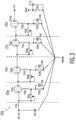
- the Cascade Voltage Amplifier 130a of FIG. 3 provides a novel way to obtain high voltage pulses for operating the Flash X-Ray Irradiators described herein, and is far more reliable and compact than the Marx generator circuit traditionally used for generating high voltage pulses.
- the circuit of 130a is the preferred embodiment for generating high voltage pulses for the FXI system.
- a negative high voltage power supply (not shown) is connected to input terminal 162 and is used to charge energy storage capacitor 152.
- Cold Cathode Field Emission Triode 150a in conjunction with inductor 156a, resistor 158a, capacitor 154a and variable resistor 160a has dual functions. They are used to both form the pulse and to amplify it by anywhere from 3dB to 10dB depending on the gain of the tube 150a as manufactured.
- the variable resistor 160a is used to set the standoff bias voltage of the tube 150a.
- the inductor 156a is used to block DC components from reaching the grid of tube 150a.
- the RC network of 158a and 154a is used to create a time constant to delay the conduction of the tube 150a.
- stages 135b, 135c and 135d are identical in function and operate as Class A amplifiers. The only differences are the voltage ratings. It is obvious that the voltage ratings of the components must be commensurate with the voltages anticipated in that stage of the circuit. Similarly, the tubes 150b, 150c and 150d are progressively larger in size to accommodate the increasing voltage.
- All stages of the circuit are connected to a common RF ground 164 in accordance with good RF design practice.
- a current shunt 168 makes possible a monitored ground return 164a.
- the inductor 156e is used to prevent reverse voltage from reaching the charging power supply. This may be augmented by a series diode (not shown) of appropriate voltage for additional protection.
- the current shunt 168 is an extremely low inductance low value resistor, typically in the 50 to 100 micro-Ohm range. It is necessary to apply a skin depth calculation to the output of this shunt present at the jack 171 a to obtain a corrected and accurate current reading.
- the jack 171a is of a type that supports the anticipated bandwidth of the signal generated by the current shunt 168 based on the rise time of such signal.
- the output signal of the current shunt 168 is typically matched to 50 Ohms impedance.
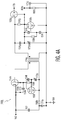
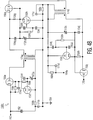
- Asynchronous Pulse Modulator 130b or 130c of FIGS. 4A and 4B An alternative to the Cascade Voltage Amplifier 130a of FIG. 3 is the Asynchronous Pulse Modulator 130b or 130c of FIGS. 4A and 4B .
- the following description of the Asynchronous Pulse Modulator refers to both FIGS. 4A and 4B .
- a negative high voltage power supply (not shown) is connected to terminal 162.
- This power supply charges energy storage capacitor 152.
- a voltage-monitoring circuit consisting of resistor 158e, capacitor 154e, resistor 158f, capacitor 154f, variable capacitor 172a and cold cathode field emission triode 150f is used to detect the charge state of energy storage capacitor 152.
- This measurement is made using a capacitive voltage divider consisting is 154e, 154f and 172a.
- a capacitive voltage divider consisting is 154e, 154f and 172a.
- Cold Cathode Field Emission Triode 150f conducts and pulls the grid of cold cathode field emission triode 150e to ground. This causes Cold Cathode Field Emission Triode 150e to go into conduction which, in turn, discharges energy storage capacitor 152 to discharge in to the primary of the pulse transformer 174a.
- the second stage starts at the secondary of the pulse transformer 174a, which typically has a turns ratio in excess of 1:10.
- This transformer steps the voltage up to a desired value.
- This is detected by a second capacitive voltage divider consisting of capacitor 154g and variable capacitor 172b.
- the network consisting of capacitor 154g, variable resistor 172b, resistor 158h, capacitor 154i, capacitor 154h, and Cold Cathode Field Emission Triode 150h reaches a predetermined voltage
- the tube 150h conducts, pulling the grid of Cold Cathode Field Emission Triode 150g to ground and causes this triode to go into conduction, allowing the pulse present from the secondary of the pulse transformer 174 to reach the output terminal.
- resistors 158e and 159g are bias resistors used to keep their respective Cold Cathode Field Emission Triodes 150e and 150g in a standoff state in until triggered by the Cold Cathode Field Emission Triodes 158f and 158h respectively.
- the current shunt 168c is a extremely low inductance low value resistor, typically in the 50 to 100 micro-Ohm range. It is necessary to apply a skin depth calculation to the output of this shunt(s) present at the jack(s) 171 b or 171 c to obtain a corrected and accurate current reading.
- stages are separated by pulse transformers 174a and 174b.
- the additional stage following transformer 174b is the same as the stage between transformers 174a and 174b other than voltage ratings of components. Care must be taken to ensure that the voltage ratings and insulation designs are commensurate with the voltages encountered. It is not uncommon to put a circuit of this type in an insulating oil tank for higher reliability.
- a practical configuration 176 of the Flash X-Ray Irradiator places a cylindrical FXI 109 in a standard shipping container 192 with all its support equipment integrated.
- a small turbo-jet engine 188 is mounted to the floor of the container 192.
- the rotating shaft of the engine 188 is connected to an electrical generator 190 having an internal gearbox speed reducer.
- This configuration is well-known in the electric utility industry as a means for generating power to compensate for peak power surges.
- the exhaust of turbo-jet engine 188 is connected to a Venturi vacuum pump 180, which is, in turn connected to the input port of the FXI 109.
- This configuration of engine 188, pump 180 and generator 190 makes use of both the motive power of the pump for running the generator and of the exhaust of the pump to power a Venturi vacuum pump.
- Fuel tanks 186 provide a local source of fuel to allow independent operation for some number of hours, which depends on the size of the jet engine and the fuel tanks.
- the material to be irradiated 148 is drawn by suction into the Venturi inlet port 182. This flowing material 128 passes through the device 109 and is exposed to high-intensity X-rays 136 in the interior space of the FXI 109 and then exhausted through the output port 194.
- the material 148 may be of any form which will flow through a pipe.
- a high voltage power supply 130a, 130b or 130c etc. provides the necessary operating energy for the FXI 109.
- the high voltage power supply is powered by the output of the electrical generator 190.
- the air inlet 198 draws in outside air and flows it over the generator 190 to cool said generator 190 prior to this air entering the air inlet 198 of the turbo-jet engine 188.
- This arrangement promotes energy efficiency in operating the FXI.
- the configuration 176 is mounted in a standard shipping container 192, it can be transported by tractor trailer, ship or air with great ease.
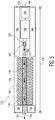
- a practical configuration 200 of the Flash X-Ray Irradiator places a FXI 110 of FIG. 2 in a mail-receiving device.
- a person opens door 226 as shown by dashed-line arrow 226a and places some mail or other items 137 in the inlet chute 204.
- the inlet door 226 closes, the upper door 208 to the irradiation chamber 205 opens as shown by dashed-line arrow 208a and the mail 137 drops into the irradiation chamber 205, and then the upper door 208 closes.
- the X-ray tube 110 turns on and saturates the mail 137 with high energy X-ray radiation such as that circled at 136.
- a dosage monitor 218 embedded in the rear wall of the chamber detects the irradiation 136, and when the irradiation has reached a satisfactory level, shuts off the X-ray tube 110.
- the lower door 210 to the irradiation chamber 205 then opens as shown by dashed-line arrow 210a and the sterilized mail 137 drops into the storage bin 220 below to await collection by the postal carrier.
- the lower door 210 then closes, and the configuration 200 resets for the next use.
- the upper door 208 is hinged and opens upward, while the lower door 210 is hinged and opens downward by actuators (not shown). There are seals on both the upper door 208 and the lower door 210 which ensure an air-tight seal when the door is closed, to prevent biological contaminants from entering the storage bin 220.
- the storage bin may optionally be under slight positive pressure provided by the pressurizer 224 to further prevent secondary contamination of the mail.
- the sterilized mail is removed from the large front-access door 222.
- a high voltage power supply 130a etc. provides the operating voltages for the X-ray tube 110.
- the X-ray tube 110 and the irradiation chamber 205 are surrounded with radiation shields front shield 212, rear shield 216, left and right shields (not shown) and upper door 208 and lower door 210, which contain shielding.
- the control circuitry will quarantine mail or other items 137 in the irradiation chamber 205 if a preset minimum dosage of X-rays 136 is not achieved, to prevent contamination of previously sterilized mail for any of several reasons.
- One such reason would be failure of the irradiation system, for any reason.
- Another reason is to prevent biotoxins contained in a shielded package from entering the storage bin.
- the entire system may be housed in an enclosure that resembles a standard postal mailbox, vertical mail chutes as found in office and residential buildings, or mail slots as found in post offices and other locations.
- a practical configuration 290 of the FXI is to mount it on the underside of a truck as shown in FIG. 7 .
- This configuration allows rapid decontamination of underground contamination in material 148 with X-rays 136. This is particularly useful for remediation of leaking gasoline and oil tanks at gasoline filling stations, refineries and storage yards.
- a preferably planar FXI 110 is mounted to the underside of a truck 292 of sufficient load-bearing capacity.
- the FXI 110 is mounted to allow sufficient ground clearance when the truck is driven.
- X-rays 136 from an X-ray emitting surface of the anode (not shown) extend, typically below the depth shown, through an irradiation volume of material 148.
- a flexible multi-layer radiation shield 234 may be mounted around the periphery of the FXI.
- This radiation shield is made from overlapping strips of a rubberized material that has a high content of lead, tungsten, molybdenum, or bismuth. There is a plurality of layers of such strips disposed in such a fashion that one layer covers the slight gaps between strips on the adjacent layer.
- a radiation shield of this design is sufficiently flexible to allow the shield to confirm to obstacles without compromising the radiation integrity of the system.
- the high voltage power supply 130, generator 190 and fuel tank 186 are mounted on the bed of the truck 292.
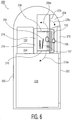
- FIG. 8 a practical implementation of the FXI is a waterproof configuration 240 designed for operation submerged in water. This version is particularly useful in decontamination and remediation of river bottoms and coastal waters by passing X-rays into material 148 to be irradiated.
- FIG. 8 shows X-rays 136 from an X-ray emitting surface of the anode (not shown) extend, typically below the depth shown, through an irradiation volume of material 148.
- the high intensity radiation degrades organic hydrocarbon contaminants into more benign compounds.
- a boat 242 contains a generator 190, a fuel tank 186, and a high voltage power supply 130. There is a crane and winch 246 mounted on the boat to allow raising and lowering the waterproof FXI 310.
- a cable 244 is connected between the winch and crane 246 and the FXI 310 to raise and lower the FXI 310, including raising it entirely out of the water.
- the winch and crane is capable of placing the FXI 310 on the deck of the boat 242.
- the waterproof FXI 310 may be nearly identical to the standard planar FXI 110, except that it is has fully waterproofed electrical connections (not shown).
- This radiation shield is made from overlapping strips of a rubberized material that has a high content of lead, tungsten, molybdenum, or bismuth. There is a plurality of layers of such strips disposed in such a fashion that one layer covers the slight gaps between strips on the adjacent layer.
- a radiation shield of this design is sufficiently flexible to allow the shield to conform to obstacles without compromising the radiation integrity of the system. The rubberized material is not damaged by exposure to water.
- FIG. 9 It is possible to build the FXI in a spherical geometry as shown in FIG. 9 . It is similar in construction to the cylindrical geometry version of the X-ray tube 109 of FIG. 1 except that it is curved in two dimensions instead of one. Operation is the same as the cylindrical FXI.
- the spherical FXI 250 is contained within a housing 252.
- a spherical cathode 258 which concentrically surrounds a spherical grid 256, which in turn concentrically surrounds a spherical anode 254.
- the interior volume of the spherical anode 254 is the irradiation volume 278.
- An electrical connection to the cathode 258 is provided via feedthrough 270 which contains the cathode terminal 272 that provides a connection to the cathode 258.
- An electrical connection is provided via feedthrough 266 for the grid 256 which contains the grid terminal 268 that provides a connection to the grid 256.
- An electrical connection is provided via feedthrough 262 for the anode 254 which contains the anode terminal 264 that provides a connection to the anode 254 via the internal anode lead 260.
- An inlet pipe 274 provides a means of introducing material 148 to be irradiated into the irradiation volume 278, and an outlet pipe 276 provides a means of egress for materials that have been irradiated.
- the cathode 258 is charged by an external high voltage power supply 130a, 130b or 130c, etc.
- the grid 256 is connected to the cathode 258 by a bias resistor (not shown) to establish a standoff condition.
- the grid terminal 264 is grounded, the electrons 134 flow to the anode 154.
- the electrons strike the anode 254, they produce an X-ray flux 136 in the irradiation volume 278..
- the anode 154 is connected to ground 164 by internal anode lead 260 and anode terminal 264 contained within anode feedthrough 262.
- the entire interior volume of the housing 252 is held at a vacuum 132 of typically 1 x 10⁻⁹ Torr (i.e., 1.33 x 10⁻⁷ pascals).
- the Flash X-ray Irradiator uses this principle in the decomposition of organic compounds. By breaking the bonds holding complex organics together, these compounds can be reduced to simpler, less hazardous and mostly benign compounds. An example of this is found in the decomposition of dioxin, which along with other higher organic compounds, cause pollution of the waterways. Dioxin is a heterocyclic organic compound with the chemical formula C 4 H 4 O 2 . Exposure to high energy radiation breaks this down to H 2 O, CO 2 and HCl.
- the Flash X-ray Irradiator can also be implemented in an underwater housing and used to decontaminate river bottoms in situ (without dredging). The quality of remediation is significantly higher as a result of the elimination of the release of plumes of contaminated material by the dredging process.
- the Flash X-Ray Irradiator in various configurations can be used in the areas of Decontamination and Remediation in applications such as sterilization of water, in-situ remediation of hydrocarbon contaminated soils (such as gas stations), safe decomposition of all known hydrocarbon compounds, volatile organic compounds (VOCs) polychlorinated biphenyls (PCBs), dioxins, sewage outfall treatment, stormwater runoff treatment, in-situ remediation of riverbed contamination, medical waste stream treatment, oil and chemical spill cleanup, organic dye contaminated runoff, biologically contaminated gaseous waste streams such as output air from biohazard research facilities and hospitals which may contain highly virulent species, decontamination of fish farming pens, decontamination of postal mail, decontamination of animal factory farm waste streams, sterilization of potable water, food processing waste treatment, sterilization of bilgewater of ocean-going vessels to prevent migration of alien biological species, sterilization of medical products, sterilization of pharmaceuticals, sterilization of large swimming pools, sterilization of food products, ir
- the applications can be further categorized into the four major sections of 1. Hydrocarbon Remediation, 2. Decontamination, 3. Sterilization and 4. Manufacturing.
- Hydrocarbon contaminated soils such as beneath gas stations and refineries:
- One of the largest environmental problems that he global community faces is contamination of the ground beneath gas stations, oil terminals, or any oil handling facility due to leaking tanks.
- Hundreds of millions of dollars are both spent and wasted in the U.S. due to the inefficient remediation techniques currently available.
- a portable system based on the Flash X-ray Irradiator technology is expected to be able to decompose all hydrocarbons in the soil either in situ or excavated from an average gas station in under one day. This compares favorably to the amount of time, often months to years, it currently takes to achieve the same end result.
- This reduction in remediation time leads to a dramatic savings in effective cost for the service stations, oil terminals or any oil handling facility.
- Volatile Organic Components Volatile Organic Components represent a large regulated class of environmental contaminants.
- the Flash X-ray Irradiator safely decomposes VOCs rapidly and economically. This class of environmental contaminants is very large as the U.S. Environmental Protection Agency has reported at least 487 contaminants.
- PCBs Polychlorinated Biphenyls
- PCBs Polychlorinated Biphenyls
- Dioxin is a heterocyclic organic compound with the chemical formula C 4 H 4 O 2 .
- Dioxins are a particularly noxious and toxic series of compounds. They are generally byproducts of other organic processes. Previous attempts to destroy dioxins by incineration have produced its own set of byproducts that are damaging the environment.
- Current scientific literature uses the name "dioxins” commonly for simplification to denote the chlorinated derivatives of dibenzo- p -dioxin, more precisely the polychlorinated dibenzodioxins (PCDDs).
- PCDDs polychlorinated dibenzodioxins
- the polychlorinated dibenzodioxins which can also be classified in the family of halogenated organic compounds (halocarbons), have been shown to bioaccumulate in humans and wildlife due to their lipophilic (the ability of a chemical compound to dissolve in fats, oils, lipids, and nonpolar solvents) properties, and are known teratogens, mutagens, and carcinogens.
- the Flash X-ray Irradiation process will efficiently decompose these dioxins into harmless compounds and gases.
- Sewage Treatment plants are not completely effective in the removal of organic and biological contaminants. Most sewage treatment plants have some form of treatment process at the end of the process cycle to address this problem. Many known technologies such as the commonly used ultraviolet treatment are energy-inefficient and maintenance-intensive and none achieve total decontamination. The sludge (sewage outfall) contaminates the area into which it is discharged. The Flash X-ray Irradiator has the capability to resolve these problems by completely sterilizing the sludge, thereby mitigating the issues associated with its disposal.
- Oil and Chemical Spill Cleanup Traditional approaches to oil spill cleanup are relatively crude. They consist of using floating booms to contain the spill and using slow-moving boats with specialized pickup systems (skimmers) to remove the oil from the surface of the water. However, these systems are only successful if promptly applied and used on calm water. With pumping velocities of 25,000 gallons per minute which allow for cleanup, the high volume processing capacity of the cylindrical Flash X-ray Irradiator changes the paradigm of oil and chemical spill mitigation.
- Organic Dye Contaminated Runoff Treatment Factories that either produce or use organic-based dyes represent another pollution source, which in some areas of the world constitutes the predominant source of pollution. Because these dyes (mostly used in fabric coloring and printing inks) are complex hydrocarbons, they can be readily decomposed into safe compounds for disposal.
- Flash X-ray Irradiator A novel application for the Flash X-ray Irradiator is in sterilizing the water in fish farming pens.
- the high throughput of the Flash X-ray Irradiator coupled with its high sterilizing efficiency offers a means to rescue this industry. Norway has had to cut down its production of farmed salmon due to contamination of the fish.
- the Flash X-ray Irradiator coupled with an efficient water pumping system will be effective in removing the biological contaminants, allowing farmers to produce a higher yield of healthy fish.
- the Flash X-ray Irradiation technology can sterilize water more effectively than currently-used chlorine and ultraviolet remediation technologies. Its ability to process large volumes of water and its low maintenance requirements make it the preferred technology for potable water treatment.
- the pipe that the water flows through during the irradiation cycle is a stainless shell thus complying with all regulatory requirements for potable water systems.
- the Flash X-ray Irradiator is available in standard sizes up to 1 meter internal diameter. Larger sizes can be accommodated.
- Flash X-ray Irradiator can effectively penetrate this market due to its lower operating cost and higher throughput.
- current systems using electron beams or X-rays can generate a beam current of about 2 Amperes.
- the similarly-sized Flash X-ray Irradiator system will produce a beam current in excess of 20,000 Amperes. This means that the time required to achieve the same level of processing is cut by a factor of 10,000. This factor, when combined with the significantly higher reliability, will solve the problem at a greatly reduced cost.
- Sterilization of Medical Products Surgical instruments, bandages, sutures, medical procedure kits and a wide array of other medical products which are routinely sterilized by exposure to 60 Cobalt can be treated with the Flash X-ray Irradiator.
- the systems for sterilization with 60 Cobalt are expensive and cumbersome.
- the Flash X-ray Irradiator can replace these systems with both lower installed and operating costs and with equal sterilization efficiency.
- Sterilization of Pharmaceuticals The same techniques for sterilization of medical products and other bio-decontamination applications can be applied to pharmaceutical production.
- a wide array of pharmaceutical products is currently sterilized using various radiation and electron-beam sources.
- the Flash X-ray Irradiator offers higher throughput and lower operating and installed costs than existing technologies.
- Sterilization of Food Products The same arguments for sterilization of medical products, and other bio-decontamination applications can be applied to the processing of food products. Irradiation has been shown to increase the shelf life of products, eliminate the need for refrigeration in some products (by killing the bacteria that cause spoilage), and increase the safety of packaged foods in general. The same set of advantages applies here as in other applications: higher throughput, lower operating and installed cost.
- the Flash X-ray Irradiator can combat air pollution caused by combustion gases from industrial plants. Typical byproducts of the decomposition of combustion gases are sulfur dioxide (SO 2 ) and nitrous oxides (NO x ).
- SO 2 sulfur dioxide
- NO x nitrous oxides
- the Flash X-ray Irradiator is capable of reformation of certain waste products, for instance cellulosic waste, a byproduct of paper-making, into higher order hydrocarbons.
- Asynchronous Pulse Modulator 130c ( Fig. 4B only) Input terminal 162 HV Output Terminal 170 Ground 164 Monitored ground 164a Energy Storage Capacitor 152 Circuit Capacitor 154 (a, b, c, d, etc.) Variable Capacitor 172a, 172b Resistor 158 (a, b, c, d, etc.) Current Measuring Shunt 168 Pulse Transformer 174 Cold Cathode Field Emission Triode 150 (a, b, c, d, etc.) Current Shunt Output Jacks 171 b, c, d Figure 5 Fig.
Landscapes
- Life Sciences & Earth Sciences (AREA)
- Engineering & Computer Science (AREA)
- Health & Medical Sciences (AREA)
- Environmental & Geological Engineering (AREA)
- Chemical & Material Sciences (AREA)
- Public Health (AREA)
- Veterinary Medicine (AREA)
- General Health & Medical Sciences (AREA)
- Animal Behavior & Ethology (AREA)
- Hydrology & Water Resources (AREA)
- Water Supply & Treatment (AREA)
- Epidemiology (AREA)
- Soil Sciences (AREA)
- Organic Chemistry (AREA)
- Wood Science & Technology (AREA)
- Toxicology (AREA)
- Zoology (AREA)
- Food Science & Technology (AREA)
- Polymers & Plastics (AREA)
- Apparatus For Disinfection Or Sterilisation (AREA)
- X-Ray Techniques (AREA)
- Medicines Containing Antibodies Or Antigens For Use As Internal Diagnostic Agents (AREA)
- Non-Silver Salt Photosensitive Materials And Non-Silver Salt Photography (AREA)
- Inks, Pencil-Leads, Or Crayons (AREA)
- Electron Sources, Ion Sources (AREA)
- Amplifiers (AREA)
Claims (16)
- Vorrichtung zum Flash-Röntgenbestrahlen von Material, umfassend,a) eine Flash-Röntgenquelle, umfassend eine Elektronenquelle (111,112) und eine Anode (115, 116);b) wobei die Elektronenquelle eine Feldemissions-Kaltkathode mit einer Elektronen emittierenden Fläche umfasst, und ein Gitter (113, 114), um den Elektronenflusses von der Kathode zur Anode zu steuern; eine elektrische Verbindung, um das Gitter vorzuspannen;c) wobei die Anode eine Elektronen aufnehmende Hauptfläche und eine Röntgenstrahlen emittierende gegenüber liegende Hauptfläche aufweist; wobei die Röntgenstrahlen emittierende Fläche X-Strahlung in ein Strahlungsvolumen (128) emittiert;d) die Röntgenstrahlen emittierende Fläche der Anode orthogonal ausgerichtete erste und zweite Abmessungen von jeweils mehr als 2 Millimeter aufweist;e) eine gepulste Hochspannungs-Energieversorgung, um die Flash-Röntgenstrahlenquelle zu speisen; wobei die gepulste Hochspannungs-Energieversorgung ein Eingangsendgerät (162) und einem Ausgangsendgerät und eine Schaltung umfasst, darin eingeschlossen einen oder mehrere Kathoden-Feldemissions-Elektronentrioden (150a,150b,150c,150d;150e,150g) zwischen dem Eingangsendgerät und dem Ausgangsendgerät;f) wobei die Elektronenquelle, die Anode und gepulste Hochspannungs-Stromversorgung eine X-Strahlung in dem Strahlungsvolumen erzeugen, um Material (148) in dem Volumen zu bestrahlen, wobei das Material ionisiert wird und molekulare Bindungen in organischen Verbindungen, die in dem Material enthalten sind, gebrochen werden; undg) ein Vakuumgehäuse für die Kathode, das Gitter und die Anode der Flash-Röntgenstrahlenquelle, die in einem Vakuum gehalten (132) wird.
- Vorrichtung nach Anspruch 1, weiter umfassend Mittel, um zu verursachen, dass das Material durch das Strahlungsvolumen verläuft.
- Vorrichtung nach Anspruch 2, wobei:a) die Anode eine längliche zylindrische Form mit einem zylindrischen Inneren aufweist, wobei sich das Strahlungsvolumen im zylindrischen Inneren der Anode befindet; wobei die Anode aus einem Rohr gebildet ist, das ein verhältnismäßig dickes erstes und zweites Ende aufweist, wobei zwischen diesen Enden ein einstückiger, verhältnismäßig dünner mittlerer Bereich vorhanden ist, der die Elektronen aufnehmende Hauptfläche enthält;b) die Kathode eine längliche zylindrische Form aufweist;c) das Gitter eine zylindrische Form aufweist und als Gate dient, das zwischen der Kathode und der Anode angeordnet ist; undd) die Kathode axial symmetrisch mit der Anode und dem Gitter ist und diese umgibt.
- Vorrichtung nach Anspruch 3, wobei ein zusätzlicher Energiespeicher-Kondensator auf der Seite der Kathode positioniert ist, die vom Gitter abgewendet ist; wobei der Kondensator innerhalb des Vakuumgehäuses mit der Kathode angeordnet ist.
- Vorrichtung nach Anspruch 3, wobeia) das Mittel, um zu verursachen, dass das Material durch das Strahlungsvolumen verläuft, eine im Fahrzeug montierte Vakuumpumpe umfasst; undb) die gepulste Hochspannungs-Stromversorgung Mittel zur Verbindung mit einem im Fahrzeug montierten elektrischen Generator aufweist.
- Vorrichtung nach Anspruch 5, wobeic) der Generator und die Vakuumpumpe durch ein Turbostrahltriebwerk angetrieben werden; undd) der Turbostrahl Luft aufnimmt, die über den Generator strömt, um den Generator zu kühlen
- Vorrichtung nach Anspruch 6, wobei die Vakuumpumpe ein Venturi-Pumpe ist.
- Vorrichtung nach Anspruch 2, wobeia) die Röntgenstrahl emittierende Fläche der Anode ohne einen geschlossenen Regelkreis geformt ist, und so geformt ist, um zu vermeiden, dass der Abschnitt des Strahlungsvolumens senkrecht zu der Röntgenstrahlen emittierenden Fläche der Anode eingeschlossen wird; undb) das Mittel, um zu verursachen, dass das Material durch das Strahlungsvolumen verläuft, ein Fahrzeug umfasst, um die Flash-Röntgenstrahlenquelle derart zu transportieren, um zu verursachen, dass das Strahlungsvolumen durch in situ Material verläuft.
- Vorrichtung nach Anspruch 8, wobei die Anode, das Gitter und die Kathode flach sind.
- Vorrichtung nach Anspruch 8, wobei der Flash-Röntgenstrahlenquelle für die Verwendung unter Wasser ausgelegt ist, wobei die Röntgenstrahlen emittierende Fläche vorwiegend nach unten gerichtet ist.
- Vorrichtung nach Anspruch 10, wobei das Mittel, um zu verursachen, dass das Material durch das Strahlungsvolumen verläuft, Mittel umfasst, um die Röntgenstrahlen emittierende Fläche vertikal und horizontal über dem Material zu positionieren, das bestrahlt werden soll.
- Vorrichtung nach Anspruch 2, wobeia) die Röntgenstrahl emittierende Fläche der Anode ohne einen geschlossenen Regelkreis geformt ist, und so geformt ist, um zu vermeiden, dass der Abschnitt des Strahlungsvolumens senkrecht zu der Röntgenstrahlen emittierenden Fläche der Anode eingeschlossen wird; undb) das Mittel, um zu verursachen, dass das Material durch das Strahlungsvolumen verläuft, eine Rutsche umfasst, um von der Schwerkraft bewegt Elemente zu empfanden; wobei die Rutsche, die die Flash-Röntgenstrahlenquelle enthält, Seitenflächen und alternativ zu öffnende obere und untere Türen umfasst, um die Elemente innerhalb des Strahlungsvolumens zu empfangen; und das Strahlungsvolumen einen Dosierungssensor enthält, um zu bestimmen, wann eine ausreichende Dosierung von X-Strahlung innerhalb des Strahlungsvolumens aufgetreten ist.
- Vorrichtung nach Anspruch 1, wobeia) die Röntgenstrahl emittierende Fläche der Anode ohne einen geschlossenen Regelkreis geformt ist, und so geformt ist, um zu vermeiden, dass der Abschnitt des Strahlungsvolumens senkrecht zu der Röntgenstrahlen emittierenden Fläche der Anode eingeschlossen wird; undb) zusätzlicher Energiespeicher-Kondensator auf der Seite der Kathode positioniert ist, die vom Gitter abgewendet ist; wobei der Kondensator innerhalb des Vakuumgehäuses mit der Kathode angeordnet ist.
- Vorrichtung nach Anspruch 1, wobei die gepulste Hochspannungs-Stromversorgung Hochspannungsimpulse im Bereich von 1 bis 100 Nanosekunden bereitstellt.
- Vorrichtung nach Anspruch 1, wobei die Kaltkathode und das Gitter der Elektronenquelle eine Elektronenkanone bilden, die derart gebaut ist, um die Fähigkeit zu besitzen, Stromdichten von bis zu 80.000 Ampere pro Quadratzentimeter zu erzielen.
- Vorrichtung nach einem der vorhergehenden Ansprüche, wobei das Vakuum im Bereich von 1,33 x 10⁻⁷ Pa liegt.
Priority Applications (2)
| Application Number | Priority Date | Filing Date | Title |
|---|---|---|---|
| SI200931462A SI2501437T1 (sl) | 2008-05-16 | 2009-05-18 | Bliskavični sevalnik rentgenskih žarkov |
| HRP20160861TT HRP20160861T1 (hr) | 2008-05-16 | 2009-05-18 | Uređaj za zračenje treptajućih rengenskih zraka |
Applications Claiming Priority (2)
| Application Number | Priority Date | Filing Date | Title |
|---|---|---|---|
| US12784508P | 2008-05-16 | 2008-05-16 | |
| PCT/US2009/044410 WO2009140697A1 (en) | 2008-05-16 | 2009-05-18 | Flash x-ray irradiator |
Publications (3)
| Publication Number | Publication Date |
|---|---|
| EP2501437A1 EP2501437A1 (de) | 2012-09-26 |
| EP2501437A4 EP2501437A4 (de) | 2013-08-07 |
| EP2501437B1 true EP2501437B1 (de) | 2016-04-13 |
Family
ID=41316159
Family Applications (1)
| Application Number | Title | Priority Date | Filing Date |
|---|---|---|---|
| EP09747778.0A Active EP2501437B1 (de) | 2008-05-16 | 2009-05-18 | Flash-röntgenstrahler |
Country Status (14)
| Country | Link |
|---|---|
| US (1) | US8019047B2 (de) |
| EP (1) | EP2501437B1 (de) |
| AU (1) | AU2009246084C1 (de) |
| BR (1) | BRPI0924249A2 (de) |
| CA (1) | CA2754622C (de) |
| DK (1) | DK2501437T3 (de) |
| ES (3) | ES2581390T3 (de) |
| HR (1) | HRP20160861T1 (de) |
| HU (1) | HUE030327T2 (de) |
| MX (1) | MX2011010276A (de) |
| PL (1) | PL2501437T3 (de) |
| PT (1) | PT2501437T (de) |
| SI (1) | SI2501437T1 (de) |
| WO (1) | WO2009140697A1 (de) |
Families Citing this family (19)
| Publication number | Priority date | Publication date | Assignee | Title |
|---|---|---|---|---|
| EP2588430B1 (de) * | 2010-07-01 | 2017-03-08 | Advanced Fusion Systems LLC | Verfahren und system zur herbeiführung chemischer reaktionen mit röntgenstrahlen |
| BR112013007799A2 (pt) | 2010-10-05 | 2016-06-07 | Advanced Fusion Systems Llc | regulador de circuito de corrente elevada de alta voltagem |
| CN103503110A (zh) * | 2011-06-08 | 2014-01-08 | 康姆艾德控股公司 | X射线发射器 |
| AT12862U1 (de) * | 2011-08-05 | 2013-01-15 | Plansee Se | Anode mit linearer haupterstreckungsrichtung |
| GB201303517D0 (en) * | 2013-02-27 | 2013-04-10 | Enxray Ltd | Apparatus for the generation of low-energy x-rays |
| US20150343367A1 (en) * | 2014-05-27 | 2015-12-03 | Edward Allen Zdunek | CO2 modification |
| US20150343380A1 (en) * | 2014-05-28 | 2015-12-03 | Edward Allen Zdunek | CO2 modification |
| WO2016137550A1 (en) * | 2015-02-27 | 2016-09-01 | Mazra Incorporated | Air treatment system |
| JP6998327B2 (ja) * | 2016-05-31 | 2022-01-18 | コーニンクレッカ フィリップス エヌ ヴェ | X線を生成するための装置 |
| EP3527230B1 (de) * | 2018-02-20 | 2024-04-10 | Bühler AG | Vorrichtung und verfahren zum pasteurisieren und/oder sterilisieren von partikelförmigem gut |
| JP6637569B1 (ja) * | 2018-10-17 | 2020-01-29 | 浜松ホトニクス株式会社 | フラッシュランプ及びフラッシュランプの製造方法 |
| EP3933881A1 (de) | 2020-06-30 | 2022-01-05 | VEC Imaging GmbH & Co. KG | Röntgenquelle mit mehreren gittern |
| US11623196B1 (en) | 2021-10-22 | 2023-04-11 | Advanced Fusion Systems Llc | Universal chemical processor with radioisotope source |
| US11471848B1 (en) | 2021-10-22 | 2022-10-18 | Advanced Fusion Systems Llc | Universal chemical processor |
| US12104223B2 (en) | 2021-10-22 | 2024-10-01 | Advanced Fusion Systems Llc | Advanced beneficiation process for beneficiation, mobilization, extraction, separation, and concentration of mineralogical resources |
| US12230468B2 (en) | 2022-06-30 | 2025-02-18 | Varex Imaging Corporation | X-ray system with field emitters and arc protection |
| US20240284579A1 (en) * | 2023-02-21 | 2024-08-22 | Xelera Research LLC | Non-radioisotope x-ray device |
| US20250201506A1 (en) * | 2023-12-18 | 2025-06-19 | Varex Imaging Corporation | Field emitter apparatuses and x-ray systems |
| WO2025181643A1 (en) * | 2024-02-27 | 2025-09-04 | Nano-X Imaging Ltd | System and method for generating x-rays at multiple energy levels by a single device |
Family Cites Families (16)
| Publication number | Priority date | Publication date | Assignee | Title |
|---|---|---|---|---|
| US2984751A (en) * | 1958-07-28 | 1961-05-16 | Thompson Ramo Wooldridge Inc | Integral turbine-generator unit |
| GB1166051A (en) * | 1966-06-22 | 1969-10-01 | Atomic Energy Authority Uk | Improvements in or relating to Flash X-Ray Generation Methods and Apparatus |
| US3527942A (en) * | 1967-11-09 | 1970-09-08 | Atlantic Richfield Co | Automatic sample changer for positioning a plurality of pellets in an x-ray analyzer |
| US4151419A (en) * | 1977-10-20 | 1979-04-24 | The United States Of America As Represented By The United States Department Of Energy | Solids irradiator |
| US4396580A (en) * | 1981-03-18 | 1983-08-02 | Avco Everett Research Laboratory, Inc. | Fluid-dynamic means for efficaceous use of ionizing beams in treating process flows |
| US4670894A (en) * | 1985-05-20 | 1987-06-02 | Quantum Diagnostics Ltd. | X-ray source employing cold cathode gas discharge tube with collimated beam |
| US4950962A (en) * | 1985-05-20 | 1990-08-21 | Quantum Diagnostics, Ltd. | High voltage switch tube |
| US4723263A (en) * | 1985-05-20 | 1988-02-02 | Quantum Diagnostics, Ltd. | X-ray source |
| US5323442A (en) * | 1992-02-28 | 1994-06-21 | Ruxam, Inc. | Microwave X-ray source and methods of use |
| US5311566A (en) * | 1992-09-22 | 1994-05-10 | The Titan Corporation | In-situ x-ray treatment of organically contaminated material |
| DE19532129A1 (de) * | 1995-08-31 | 1997-03-06 | Clouth Gummiwerke Ag | System zur aktiven Verringerung von Drehungleichförmigkeiten einer Welle, insbesondere der Triebwelle eines Verbrennungsmotors, und Verfahren hierzu |
| US6320935B1 (en) * | 2000-02-28 | 2001-11-20 | X-Technologies, Ltd. | Dosimeter for a miniature energy transducer for emitting X-ray radiation |
| US7447298B2 (en) * | 2003-04-01 | 2008-11-04 | Cabot Microelectronics Corporation | Decontamination and sterilization system using large area x-ray source |
| EP1644723B1 (de) * | 2003-06-17 | 2019-11-06 | X-Ray Optical Systems, Inc. | Bewegliche transparente schranke zur röntgenanalyse einer unter druck stehenden probe |
| US7274772B2 (en) * | 2004-05-27 | 2007-09-25 | Cabot Microelectronics Corporation | X-ray source with nonparallel geometry |
| US9036765B2 (en) * | 2006-05-30 | 2015-05-19 | Advanced Fusion Systems Llc | Method and system for inertial confinement fusion reactions |
-
2009
- 2009-05-18 HR HRP20160861TT patent/HRP20160861T1/hr unknown
- 2009-05-18 US US12/467,974 patent/US8019047B2/en active Active
- 2009-05-18 SI SI200931462A patent/SI2501437T1/sl unknown
- 2009-05-18 DK DK09747778.0T patent/DK2501437T3/en active
- 2009-05-18 ES ES09747778.0T patent/ES2581390T3/es active Active
- 2009-05-18 CA CA2754622A patent/CA2754622C/en active Active
- 2009-05-18 PT PT97477780T patent/PT2501437T/pt unknown
- 2009-05-18 EP EP09747778.0A patent/EP2501437B1/de active Active
- 2009-05-18 AU AU2009246084A patent/AU2009246084C1/en active Active
- 2009-05-18 PL PL09747778.0T patent/PL2501437T3/pl unknown
- 2009-05-18 HU HUE09747778A patent/HUE030327T2/en unknown
- 2009-05-18 MX MX2011010276A patent/MX2011010276A/es active IP Right Grant
- 2009-05-18 WO PCT/US2009/044410 patent/WO2009140697A1/en not_active Ceased
- 2009-11-16 ES ES16191333.0T patent/ES2692768T3/es active Active
- 2009-11-16 BR BRPI0924249-0A patent/BRPI0924249A2/pt not_active Application Discontinuation
- 2009-11-16 ES ES09845045.5T patent/ES2635295T3/es active Active
Also Published As
| Publication number | Publication date |
|---|---|
| US8019047B2 (en) | 2011-09-13 |
| WO2009140697A8 (en) | 2009-12-23 |
| PT2501437T (pt) | 2016-07-13 |
| WO2009140697A1 (en) | 2009-11-19 |
| HUE030327T2 (en) | 2017-05-29 |
| HRP20160861T1 (hr) | 2016-09-23 |
| SI2501437T1 (sl) | 2016-08-31 |
| DK2501437T3 (en) | 2016-08-01 |
| CA2754622A1 (en) | 2009-11-19 |
| CA2754622C (en) | 2013-11-19 |
| ES2635295T3 (es) | 2017-10-03 |
| AU2009246084C1 (en) | 2014-02-13 |
| PL2501437T3 (pl) | 2016-10-31 |
| EP2501437A4 (de) | 2013-08-07 |
| AU2009246084A1 (en) | 2012-02-16 |
| EP2501437A1 (de) | 2012-09-26 |
| MX2011010276A (es) | 2011-10-24 |
| ES2581390T3 (es) | 2016-09-05 |
| BRPI0924249A2 (pt) | 2019-09-24 |
| AU2009246084B2 (en) | 2012-11-15 |
| US20090285362A1 (en) | 2009-11-19 |
| ES2692768T3 (es) | 2018-12-05 |
Similar Documents
| Publication | Publication Date | Title |
|---|---|---|
| EP2501437B1 (de) | Flash-röntgenstrahler | |
| US5457269A (en) | Oxidizing enhancement electron beam process and apparatus for contaminant treatment | |
| Borrely et al. | Radiation processing of sewage and sludge. A review | |
| EP0659297B1 (de) | System und verfahren zur entsorgung giftiger abfälle | |
| CN112517599B (zh) | 一种医疗废物处理装置及其处理方法 | |
| TW457511B (en) | Electron beam plasma formation for surface chemistry | |
| DE19619022C2 (de) | Wassertankanordnung | |
| KR100996382B1 (ko) | 방사선 조사와 설페이트 라디칼을 동시에 이용한 병원성 미생물 또는 독성 유기 오염물질의 제거방법 | |
| Al-Saedi et al. | Ecological Impacts, Management and Disposal Methods for Medical Wastes-A Review | |
| US20040262235A1 (en) | Energy-based process for fluid treatment and system therefor | |
| RU3060U1 (ru) | Радиационно-технологический комплекс | |
| Lubicki et al. | Removal of volatile organic compounds in water using low-energy electron beam | |
| Qadir et al. | Health Care Waste: Pollution Potential from Generation to Disposal, Management, and Treatment | |
| IACOBONI et al. | A NEW SEMI-MOBILE PLANT FOR XA9847735 RADIATION PROCESSING OF WASTE | |
| Zabulonov et al. | Destruction of trihalomethanes and disinfection of drinking water by electric discharge plasma | |
| KR100731802B1 (ko) | 전자선을 이용한 하수 또는 폐수 처리장 방류수의 살균방법 | |
| Pachan et al. | Use of accelerators for environmental protection | |
| US7522702B2 (en) | Soft x-ray radiation for biological pathogen decontamination and medical sterilization applications | |
| KR20040010902A (ko) | 전자빔 조사에 의한 오염토양 및 지하수 정화장치 및 방법 | |
| TRUMP et al. | Experiences at Deer Island with Electron Disinfection of Sludge at High Flow Rates | |
| Godio et al. | AquaConSoil 2013–List of Papers | |
| JP2001087753A (ja) | 有害な塩素系有機物質を無害化するための装置 | |
| Wang et al. | Irradiation and Solid Substances Disinfection | |
| Tata et al. | A new semi-mobile plant for radiation processing of waste | |
| Urban | Can earth funeral cause environmental pollution, soil contamination and health endangerment? |
Legal Events
| Date | Code | Title | Description |
|---|---|---|---|
| PUAI | Public reference made under article 153(3) epc to a published international application that has entered the european phase |
Free format text: ORIGINAL CODE: 0009012 |
|
| 17P | Request for examination filed |
Effective date: 20111118 |
|
| AK | Designated contracting states |
Kind code of ref document: A1 Designated state(s): AT BE BG CH CY CZ DE DK EE ES FI FR GB GR HR HU IE IS IT LI LT LU LV MC MK MT NL NO PL PT RO SE SI SK TR |
|
| DAX | Request for extension of the european patent (deleted) | ||
| RAP1 | Party data changed (applicant data changed or rights of an application transferred) |
Owner name: ADVANCED FUSION SYSTEMS LLC |
|
| A4 | Supplementary search report drawn up and despatched |
Effective date: 20130705 |
|
| RIC1 | Information provided on ipc code assigned before grant |
Ipc: A61N 5/10 20060101AFI20130701BHEP Ipc: H01J 35/04 20060101ALI20130701BHEP Ipc: H01J 35/22 20060101ALI20130701BHEP Ipc: H05G 1/24 20060101ALI20130701BHEP |
|
| 17Q | First examination report despatched |
Effective date: 20140516 |
|
| REG | Reference to a national code |
Ref country code: DE Ref legal event code: R079 Ref document number: 602009037788 Country of ref document: DE Free format text: PREVIOUS MAIN CLASS: A61N0005100000 Ipc: A61L0002080000 |
|
| GRAP | Despatch of communication of intention to grant a patent |
Free format text: ORIGINAL CODE: EPIDOSNIGR1 |
|
| RIC1 | Information provided on ipc code assigned before grant |
Ipc: B09C 1/00 20060101ALI20151207BHEP Ipc: H01J 35/22 20060101ALI20151207BHEP Ipc: A61L 11/00 20060101ALI20151207BHEP Ipc: C02F 1/30 20060101ALI20151207BHEP Ipc: A23L 3/26 20060101ALI20151207BHEP Ipc: H05G 1/24 20060101ALI20151207BHEP Ipc: A61L 2/08 20060101AFI20151207BHEP |
|
| INTG | Intention to grant announced |
Effective date: 20160104 |
|
| GRAS | Grant fee paid |
Free format text: ORIGINAL CODE: EPIDOSNIGR3 |
|
| GRAA | (expected) grant |
Free format text: ORIGINAL CODE: 0009210 |
|
| AK | Designated contracting states |
Kind code of ref document: B1 Designated state(s): AT BE BG CH CY CZ DE DK EE ES FI FR GB GR HR HU IE IS IT LI LT LU LV MC MK MT NL NO PL PT RO SE SI SK TR |
|
| REG | Reference to a national code |
Ref country code: GB Ref legal event code: FG4D |
|
| REG | Reference to a national code |
Ref country code: AT Ref legal event code: REF Ref document number: 789393 Country of ref document: AT Kind code of ref document: T Effective date: 20160415 Ref country code: CH Ref legal event code: EP |
|
| REG | Reference to a national code |
Ref country code: IE Ref legal event code: FG4D |
|
| REG | Reference to a national code |
Ref country code: FR Ref legal event code: PLFP Year of fee payment: 8 |
|
| REG | Reference to a national code |
Ref country code: DE Ref legal event code: R096 Ref document number: 602009037788 Country of ref document: DE |
|
| REG | Reference to a national code |
Ref country code: HR Ref legal event code: TUEP Ref document number: P20160861 Country of ref document: HR Ref country code: PT Ref legal event code: SC4A Ref document number: 2501437 Country of ref document: PT Date of ref document: 20160713 Kind code of ref document: T Free format text: AVAILABILITY OF NATIONAL TRANSLATION Effective date: 20160704 Ref country code: RO Ref legal event code: EPE |
|
| REG | Reference to a national code |
Ref country code: DK Ref legal event code: T3 Effective date: 20160726 |
|
| REG | Reference to a national code |
Ref country code: NL Ref legal event code: FP |
|
| REG | Reference to a national code |
Ref country code: SE Ref legal event code: TRGR |
|
| REG | Reference to a national code |
Ref country code: NO Ref legal event code: T2 Effective date: 20160413 |
|
| REG | Reference to a national code |
Ref country code: ES Ref legal event code: FG2A Ref document number: 2581390 Country of ref document: ES Kind code of ref document: T3 Effective date: 20160905 |
|
| REG | Reference to a national code |
Ref country code: EE Ref legal event code: FG4A Ref document number: E012169 Country of ref document: EE Effective date: 20160712 |
|
| REG | Reference to a national code |
Ref country code: HR Ref legal event code: T1PR Ref document number: P20160861 Country of ref document: HR |
|
| REG | Reference to a national code |
Ref country code: GR Ref legal event code: EP Ref document number: 20160401345 Country of ref document: GR Effective date: 20160729 |
|
| REG | Reference to a national code |
Ref country code: SK Ref legal event code: T3 Ref document number: E 21429 Country of ref document: SK |
|
| REG | Reference to a national code |
Ref country code: DE Ref legal event code: R097 Ref document number: 602009037788 Country of ref document: DE |
|
| PG25 | Lapsed in a contracting state [announced via postgrant information from national office to epo] |
Ref country code: MC Free format text: LAPSE BECAUSE OF FAILURE TO SUBMIT A TRANSLATION OF THE DESCRIPTION OR TO PAY THE FEE WITHIN THE PRESCRIBED TIME-LIMIT Effective date: 20160413 |
|
| PLBE | No opposition filed within time limit |
Free format text: ORIGINAL CODE: 0009261 |
|
| STAA | Information on the status of an ep patent application or granted ep patent |
Free format text: STATUS: NO OPPOSITION FILED WITHIN TIME LIMIT |
|
| 26N | No opposition filed |
Effective date: 20170116 |
|
| REG | Reference to a national code |
Ref country code: FR Ref legal event code: PLFP Year of fee payment: 9 |
|
| REG | Reference to a national code |
Ref country code: HU Ref legal event code: AG4A Ref document number: E030327 Country of ref document: HU |
|
| REG | Reference to a national code |
Ref country code: FR Ref legal event code: PLFP Year of fee payment: 10 |
|
| PG25 | Lapsed in a contracting state [announced via postgrant information from national office to epo] |
Ref country code: CY Free format text: LAPSE BECAUSE OF FAILURE TO SUBMIT A TRANSLATION OF THE DESCRIPTION OR TO PAY THE FEE WITHIN THE PRESCRIBED TIME-LIMIT Effective date: 20160413 |
|
| PG25 | Lapsed in a contracting state [announced via postgrant information from national office to epo] |
Ref country code: MK Free format text: LAPSE BECAUSE OF FAILURE TO SUBMIT A TRANSLATION OF THE DESCRIPTION OR TO PAY THE FEE WITHIN THE PRESCRIBED TIME-LIMIT Effective date: 20160413 Ref country code: MT Free format text: LAPSE BECAUSE OF NON-PAYMENT OF DUE FEES Effective date: 20160531 |
|
| REG | Reference to a national code |
Ref country code: HR Ref legal event code: ODRP Ref document number: P20160861 Country of ref document: HR Payment date: 20190429 Year of fee payment: 11 |
|
| REG | Reference to a national code |
Ref country code: AT Ref legal event code: UEP Ref document number: 789393 Country of ref document: AT Kind code of ref document: T Effective date: 20160413 |
|
| REG | Reference to a national code |
Ref country code: HR Ref legal event code: ODRP Ref document number: P20160861 Country of ref document: HR Payment date: 20200512 Year of fee payment: 12 |
|
| REG | Reference to a national code |
Ref country code: HR Ref legal event code: ODRP Ref document number: P20160861 Country of ref document: HR Payment date: 20210513 Year of fee payment: 13 |
|
| REG | Reference to a national code |
Ref country code: HR Ref legal event code: ODRP Ref document number: P20160861 Country of ref document: HR Payment date: 20220513 Year of fee payment: 14 |
|
| REG | Reference to a national code |
Ref country code: HR Ref legal event code: ODRP Ref document number: P20160861 Country of ref document: HR Payment date: 20230510 Year of fee payment: 15 |
|
| P01 | Opt-out of the competence of the unified patent court (upc) registered |
Effective date: 20230606 |
|
| REG | Reference to a national code |
Ref country code: HR Ref legal event code: ODRP Ref document number: P20160861 Country of ref document: HR Payment date: 20240510 Year of fee payment: 16 |
|
| REG | Reference to a national code |
Ref country code: HR Ref legal event code: ODRP Ref document number: P20160861 Country of ref document: HR Payment date: 20250508 Year of fee payment: 17 |
|
| PGFP | Annual fee paid to national office [announced via postgrant information from national office to epo] |
Ref country code: NL Payment date: 20250521 Year of fee payment: 17 |
|
| PGFP | Annual fee paid to national office [announced via postgrant information from national office to epo] |
Ref country code: FI Payment date: 20250526 Year of fee payment: 17 |
|
| PGFP | Annual fee paid to national office [announced via postgrant information from national office to epo] |
Ref country code: PL Payment date: 20250509 Year of fee payment: 17 Ref country code: DE Payment date: 20250521 Year of fee payment: 17 |
|
| PGFP | Annual fee paid to national office [announced via postgrant information from national office to epo] |
Ref country code: GB Payment date: 20250526 Year of fee payment: 17 Ref country code: ES Payment date: 20250627 Year of fee payment: 17 Ref country code: DK Payment date: 20250526 Year of fee payment: 17 |
|
| PGFP | Annual fee paid to national office [announced via postgrant information from national office to epo] |
Ref country code: LT Payment date: 20250424 Year of fee payment: 17 |
|
| PGFP | Annual fee paid to national office [announced via postgrant information from national office to epo] |
Ref country code: IS Payment date: 20250512 Year of fee payment: 17 Ref country code: HU Payment date: 20250523 Year of fee payment: 17 Ref country code: NO Payment date: 20250523 Year of fee payment: 17 |
|
| PGFP | Annual fee paid to national office [announced via postgrant information from national office to epo] |
Ref country code: BE Payment date: 20250521 Year of fee payment: 17 Ref country code: LU Payment date: 20250521 Year of fee payment: 17 Ref country code: IT Payment date: 20250527 Year of fee payment: 17 |
|
| PGFP | Annual fee paid to national office [announced via postgrant information from national office to epo] |
Ref country code: HR Payment date: 20250508 Year of fee payment: 17 |
|
| PGFP | Annual fee paid to national office [announced via postgrant information from national office to epo] |
Ref country code: LV Payment date: 20250514 Year of fee payment: 17 Ref country code: PT Payment date: 20250508 Year of fee payment: 17 |
|
| PGFP | Annual fee paid to national office [announced via postgrant information from national office to epo] |
Ref country code: EE Payment date: 20250528 Year of fee payment: 17 Ref country code: FR Payment date: 20250528 Year of fee payment: 17 |
|
| PGFP | Annual fee paid to national office [announced via postgrant information from national office to epo] |
Ref country code: GR Payment date: 20250523 Year of fee payment: 17 Ref country code: BG Payment date: 20250521 Year of fee payment: 17 |
|
| PGFP | Annual fee paid to national office [announced via postgrant information from national office to epo] |
Ref country code: CH Payment date: 20250601 Year of fee payment: 17 |
|
| PGFP | Annual fee paid to national office [announced via postgrant information from national office to epo] |
Ref country code: RO Payment date: 20250514 Year of fee payment: 17 Ref country code: AT Payment date: 20250522 Year of fee payment: 17 |
|
| PGFP | Annual fee paid to national office [announced via postgrant information from national office to epo] |
Ref country code: SK Payment date: 20250512 Year of fee payment: 17 Ref country code: TR Payment date: 20250512 Year of fee payment: 17 |
|
| PGFP | Annual fee paid to national office [announced via postgrant information from national office to epo] |
Ref country code: CZ Payment date: 20250514 Year of fee payment: 17 |
|
| PGFP | Annual fee paid to national office [announced via postgrant information from national office to epo] |
Ref country code: IE Payment date: 20250521 Year of fee payment: 17 |
|
| PGFP | Annual fee paid to national office [announced via postgrant information from national office to epo] |
Ref country code: SE Payment date: 20250521 Year of fee payment: 17 Ref country code: SI Payment date: 20250508 Year of fee payment: 17 |