EP2500218A1 - Multi-function camera system - Google Patents
Multi-function camera system Download PDFInfo
- Publication number
- EP2500218A1 EP2500218A1 EP10829816A EP10829816A EP2500218A1 EP 2500218 A1 EP2500218 A1 EP 2500218A1 EP 10829816 A EP10829816 A EP 10829816A EP 10829816 A EP10829816 A EP 10829816A EP 2500218 A1 EP2500218 A1 EP 2500218A1
- Authority
- EP
- European Patent Office
- Prior art keywords
- vehicle
- door
- function
- camera
- unit
- Prior art date
- Legal status (The legal status is an assumption and is not a legal conclusion. Google has not performed a legal analysis and makes no representation as to the accuracy of the status listed.)
- Granted
Links
Images




Classifications
-
- B—PERFORMING OPERATIONS; TRANSPORTING
- B60—VEHICLES IN GENERAL
- B60R—VEHICLES, VEHICLE FITTINGS, OR VEHICLE PARTS, NOT OTHERWISE PROVIDED FOR
- B60R1/00—Optical viewing arrangements; Real-time viewing arrangements for drivers or passengers using optical image capturing systems, e.g. cameras or video systems specially adapted for use in or on vehicles
- B60R1/02—Rear-view mirror arrangements
- B60R1/06—Rear-view mirror arrangements mounted on vehicle exterior
-
- E—FIXED CONSTRUCTIONS
- E05—LOCKS; KEYS; WINDOW OR DOOR FITTINGS; SAFES
- E05B—LOCKS; ACCESSORIES THEREFOR; HANDCUFFS
- E05B81/00—Power-actuated vehicle locks
- E05B81/54—Electrical circuits
- E05B81/64—Monitoring or sensing, e.g. by using switches or sensors
- E05B81/76—Detection of handle operation; Detection of a user approaching a handle; Electrical switching actions performed by door handles
- E05B81/78—Detection of handle operation; Detection of a user approaching a handle; Electrical switching actions performed by door handles as part of a hands-free locking or unlocking operation
-
- B—PERFORMING OPERATIONS; TRANSPORTING
- B60—VEHICLES IN GENERAL
- B60R—VEHICLES, VEHICLE FITTINGS, OR VEHICLE PARTS, NOT OTHERWISE PROVIDED FOR
- B60R1/00—Optical viewing arrangements; Real-time viewing arrangements for drivers or passengers using optical image capturing systems, e.g. cameras or video systems specially adapted for use in or on vehicles
- B60R1/20—Real-time viewing arrangements for drivers or passengers using optical image capturing systems, e.g. cameras or video systems specially adapted for use in or on vehicles
- B60R1/22—Real-time viewing arrangements for drivers or passengers using optical image capturing systems, e.g. cameras or video systems specially adapted for use in or on vehicles for viewing an area outside the vehicle, e.g. the exterior of the vehicle
- B60R1/23—Real-time viewing arrangements for drivers or passengers using optical image capturing systems, e.g. cameras or video systems specially adapted for use in or on vehicles for viewing an area outside the vehicle, e.g. the exterior of the vehicle with a predetermined field of view
- B60R1/25—Real-time viewing arrangements for drivers or passengers using optical image capturing systems, e.g. cameras or video systems specially adapted for use in or on vehicles for viewing an area outside the vehicle, e.g. the exterior of the vehicle with a predetermined field of view to the sides of the vehicle
-
- B—PERFORMING OPERATIONS; TRANSPORTING
- B60—VEHICLES IN GENERAL
- B60R—VEHICLES, VEHICLE FITTINGS, OR VEHICLE PARTS, NOT OTHERWISE PROVIDED FOR
- B60R25/00—Fittings or systems for preventing or indicating unauthorised use or theft of vehicles
- B60R25/10—Fittings or systems for preventing or indicating unauthorised use or theft of vehicles actuating a signalling device
-
- B—PERFORMING OPERATIONS; TRANSPORTING
- B60—VEHICLES IN GENERAL
- B60R—VEHICLES, VEHICLE FITTINGS, OR VEHICLE PARTS, NOT OTHERWISE PROVIDED FOR
- B60R25/00—Fittings or systems for preventing or indicating unauthorised use or theft of vehicles
- B60R25/20—Means to switch the anti-theft system on or off
- B60R25/25—Means to switch the anti-theft system on or off using biometry
-
- B—PERFORMING OPERATIONS; TRANSPORTING
- B60—VEHICLES IN GENERAL
- B60R—VEHICLES, VEHICLE FITTINGS, OR VEHICLE PARTS, NOT OTHERWISE PROVIDED FOR
- B60R25/00—Fittings or systems for preventing or indicating unauthorised use or theft of vehicles
- B60R25/30—Detection related to theft or to other events relevant to anti-theft systems
- B60R25/305—Detection related to theft or to other events relevant to anti-theft systems using a camera
-
- B—PERFORMING OPERATIONS; TRANSPORTING
- B60—VEHICLES IN GENERAL
- B60R—VEHICLES, VEHICLE FITTINGS, OR VEHICLE PARTS, NOT OTHERWISE PROVIDED FOR
- B60R11/00—Arrangements for holding or mounting articles, not otherwise provided for
- B60R11/04—Mounting of cameras operative during drive; Arrangement of controls thereof relative to the vehicle
-
- B—PERFORMING OPERATIONS; TRANSPORTING
- B60—VEHICLES IN GENERAL
- B60R—VEHICLES, VEHICLE FITTINGS, OR VEHICLE PARTS, NOT OTHERWISE PROVIDED FOR
- B60R21/00—Arrangements or fittings on vehicles for protecting or preventing injuries to occupants or pedestrians in case of accidents or other traffic risks
- B60R21/34—Protecting non-occupants of a vehicle, e.g. pedestrians
-
- B—PERFORMING OPERATIONS; TRANSPORTING
- B60—VEHICLES IN GENERAL
- B60R—VEHICLES, VEHICLE FITTINGS, OR VEHICLE PARTS, NOT OTHERWISE PROVIDED FOR
- B60R2300/00—Details of viewing arrangements using cameras and displays, specially adapted for use in a vehicle
- B60R2300/40—Details of viewing arrangements using cameras and displays, specially adapted for use in a vehicle characterised by the details of the power supply or the coupling to vehicle components
-
- B—PERFORMING OPERATIONS; TRANSPORTING
- B60—VEHICLES IN GENERAL
- B60R—VEHICLES, VEHICLE FITTINGS, OR VEHICLE PARTS, NOT OTHERWISE PROVIDED FOR
- B60R2300/00—Details of viewing arrangements using cameras and displays, specially adapted for use in a vehicle
- B60R2300/70—Details of viewing arrangements using cameras and displays, specially adapted for use in a vehicle characterised by an event-triggered choice to display a specific image among a selection of captured images
-
- B—PERFORMING OPERATIONS; TRANSPORTING
- B60—VEHICLES IN GENERAL
- B60R—VEHICLES, VEHICLE FITTINGS, OR VEHICLE PARTS, NOT OTHERWISE PROVIDED FOR
- B60R2300/00—Details of viewing arrangements using cameras and displays, specially adapted for use in a vehicle
- B60R2300/80—Details of viewing arrangements using cameras and displays, specially adapted for use in a vehicle characterised by the intended use of the viewing arrangement
- B60R2300/802—Details of viewing arrangements using cameras and displays, specially adapted for use in a vehicle characterised by the intended use of the viewing arrangement for monitoring and displaying vehicle exterior blind spot views
-
- B—PERFORMING OPERATIONS; TRANSPORTING
- B60—VEHICLES IN GENERAL
- B60R—VEHICLES, VEHICLE FITTINGS, OR VEHICLE PARTS, NOT OTHERWISE PROVIDED FOR
- B60R2300/00—Details of viewing arrangements using cameras and displays, specially adapted for use in a vehicle
- B60R2300/80—Details of viewing arrangements using cameras and displays, specially adapted for use in a vehicle characterised by the intended use of the viewing arrangement
- B60R2300/8093—Details of viewing arrangements using cameras and displays, specially adapted for use in a vehicle characterised by the intended use of the viewing arrangement for obstacle warning
-
- E—FIXED CONSTRUCTIONS
- E05—LOCKS; KEYS; WINDOW OR DOOR FITTINGS; SAFES
- E05Y—INDEXING SCHEME ASSOCIATED WITH SUBCLASSES E05D AND E05F, RELATING TO CONSTRUCTION ELEMENTS, ELECTRIC CONTROL, POWER SUPPLY, POWER SIGNAL OR TRANSMISSION, USER INTERFACES, MOUNTING OR COUPLING, DETAILS, ACCESSORIES, AUXILIARY OPERATIONS NOT OTHERWISE PROVIDED FOR, APPLICATION THEREOF
- E05Y2201/00—Constructional elements; Accessories therefor
- E05Y2201/60—Suspension or transmission members; Accessories therefor
- E05Y2201/622—Suspension or transmission members elements
- E05Y2201/676—Transmission of human force
- E05Y2201/68—Handles, cranks
-
- E—FIXED CONSTRUCTIONS
- E05—LOCKS; KEYS; WINDOW OR DOOR FITTINGS; SAFES
- E05Y—INDEXING SCHEME ASSOCIATED WITH SUBCLASSES E05D AND E05F, RELATING TO CONSTRUCTION ELEMENTS, ELECTRIC CONTROL, POWER SUPPLY, POWER SIGNAL OR TRANSMISSION, USER INTERFACES, MOUNTING OR COUPLING, DETAILS, ACCESSORIES, AUXILIARY OPERATIONS NOT OTHERWISE PROVIDED FOR, APPLICATION THEREOF
- E05Y2400/00—Electronic control; Electrical power; Power supply; Power or signal transmission; User interfaces
- E05Y2400/80—User interfaces
- E05Y2400/85—User input means
- E05Y2400/8505—User authentication, e.g. biometric
-
- E—FIXED CONSTRUCTIONS
- E05—LOCKS; KEYS; WINDOW OR DOOR FITTINGS; SAFES
- E05Y—INDEXING SCHEME ASSOCIATED WITH SUBCLASSES E05D AND E05F, RELATING TO CONSTRUCTION ELEMENTS, ELECTRIC CONTROL, POWER SUPPLY, POWER SIGNAL OR TRANSMISSION, USER INTERFACES, MOUNTING OR COUPLING, DETAILS, ACCESSORIES, AUXILIARY OPERATIONS NOT OTHERWISE PROVIDED FOR, APPLICATION THEREOF
- E05Y2600/00—Mounting or coupling arrangements for elements provided for in this subclass
- E05Y2600/40—Mounting location; Visibility of the elements
- E05Y2600/46—Mounting location; Visibility of the elements in or on the wing
Definitions
- the present invention relates to a multi-function camera system for applying an onboard camera to multiple uses.
- Patent Document 1 discloses an authentication system for photographing the face of a person standing in the outside of a driver's side door of a vehicle from the inside of the vehicle to authenticate the person's face biometrically.
- Patent Document 2 discloses technique for detecting whether or not an obstacle is present in the vicinity of a vehicle when a front door is opened or whether or not an obstacle is approaching from behind the vehicle based on an image captured by a camera mounted on a side view mirror.
- Patent Document 3 Japanese Unexamined Patent Application Publication No. 2005-88759
- Patent Document 4 Japanese Unexamined Patent Application Publication No. 2006-182234
- Patent Document 3 disclose technique for putting a camera mounted on a door mirror to various uses depending on a scene.
- the camera is used for checking a side of a vehicle when the vehicle is pulled over to the side of the road and for photographing the face of the user.
- the camera is designed to photograph an area below the door mirror when the vehicle is traveling and to change the direction of the camera to photograph the interior of the vehicle when the vehicle is stopped and the door mirror is folded.
- the camera disclosed in Patent Document 4 is designed to function as a side blind-spot camera for photographing a scene in a forward side area of a vehicle that falls in the driver's blind spot when the vehicle is used and to function as a surveillance camera for the interior of the vehicle by being rotated by 180 degrees within a housing of the door mirror for photographing the interior of the vehicle when the vehicle is not used.
- the technique is required to apply an onboard camera to multiple uses with low cost without providing any mechanism that might increase the weight of the vehicle.
- a characteristic feature of a multi-function camera system lies in comprising a camera fixed to a vehicle component on a side of a vehicle for photographing a side area of the vehicle; a condition determination unit for determining execution conditions of a plurality of function units; an obstacle detection unit acting as one of the function units to function based on a determination result from the condition determination unit for detecting, through image recognition, an obstacle present in the vicinity of the vehicle or approaching the vehicle based on a captured image of the camera; and an individual authentication unit acting as one of the function units to function based on the determination result from the condition determination unit for ascertaining, through the image recognition, whether or not a person having reached the vehicle matches with a user who has been registered at the vehicle beforehand based on the captured image of the camera.
- the above-noted arrangement can dispense with any additional mechanism for changing the photographing direction of the camera since the camera is fixed to the vehicle component. This saves the cost for providing the additional mechanism and prevents the weight of the vehicle from being increased.
- the multi-function camera system has the plurality of function units including the obstacle detection unit and the individual authentication unit, each of the function units is not designed to perform its function all the time, but configured to perform the function as necessary based on the determination result on the execution condition from the condition determination unit.
- a calculating burden is not increased even if the plurality of function units are provided, which can provide the multi-function camera system with low cost without using any high-performance calculating device.
- this system would not hinder the plurality of function units from simultaneously performing their functions depending on the execution conditions.
- condition determination unit of the multi-function camera system of the present invention determines that the execution condition for the obstacle detection unit is established when the vehicle is traveling including making a short stop, or stopped and unlocked, and determines that the execution condition for the individual authentication unit is established when the vehicle is not traveling but stopped and locked. With such an arrangement, it is possible to allow each function unit to effectively perform its function based on the proper execution condition corresponding to the state of the vehicle.
- the multi-function camera system of the present invention comprises a blind-spot monitor unit acting as one of the function units to function based on the determination result from the condition determination unit for outputting an image captured by the camera including a scene falling in the driver's blind spot to a display unit provided in the interior of the vehicle, and that the condition determination unit determines that the execution condition for the blind-spot monitor unit is established when the user of the vehicle including the driver gives an instruction to display the captured image, or when the obstacle is detected by the obstacle detection unit.
- each of the function units may perform its function properly based on the determination result from the condition determination unit on the execution condition corresponding to the state of the vehicle.
- the blind-spot monitor unit with great usefulness is provided, as a result of which the multi-function camera system may be designed with low cost without using any high-performance calculating device.
- the blind-spot monitor unit and any other function unit may be simultaneously in action in response to the execution condition.
- the condition determination unit determines a preferential condition as to which of image recognition of a forward side area of the vehicle and image recognition of a rearward side area of the vehicle should be preferentially performed, and that the obstacle detection unit preferentially performs the image recognition of either of the forward side area and the rearward side area based on the determination result from the condition determination unit.
- a camera should preferably be a wide-angle camera that includes the driver's blind spot in the shooting range. An image to be captured by the wide-angle camera naturally targets a wide range area.
- the condition determination unit of the multi-function camera system of the present invention determines the preferential condition depending on an opening degree of the swingable door to give priority to the image recognition of the forward side area when the opening degree of the swingable door is less than a predetermined opening degree and give priority to the image recognition of the rearward side area when the opening degree of the swingable door is or greater than the predetermined opening degree.
- the image recognition of the forward side area is given priority when the opening degree of the swingable door is less than the predetermined opening degree such as when the door is started to open, an obstacle that might come into contact with the end portion of the door is highly likely to be detected reliably and quickly. Since such an obstacle may be present at a lower position such as a curb and fall in the user's blind spot, it is preferably detected through the image recognition.
- the door is opened to the predetermined opening degree or greater, it is necessary to prevent the moving object (obstacle) that approaches from behind the vehicle and is about to pass through the side area of the vehicle from coming into contact with the swingable door that projects laterally of the vehicle. Since the user faces the front and thus is less aware of the moving object approaching from behind of the vehicle than the moving object approaching from ahead of the vehicle, it is preferable that the approach of the moving object is detected by the image recognition.
- the multi-function camera system of the present invention comprises an opening degree calculating unit for calculating the opening degree of the swingable door based on the captured image of the camera, that the camera is mounted on the swingable door or on the vehicle component provided in the swingable door.
- the camera moves along with the swingable door.
- the positions of part of the vehicle and the vehicle components other than the swingable door are moved (changed) in the captured image.
- the opening degree of the swingable door can be calculated based on the amount of movement (variance) of those positions.
- the camera, condition determination unit and plurality of function units of the multi-function camera unit of the present invention are configured to function when a main power supply of the vehicle is active, and the multi-function camera system further comprises a power supply control system configured to function regardless whether or not the main power supply of the vehicle is active and to allow at least one of the camera, condition determination unit and plurality of function units to function in response to an operation relative to a door of the vehicle even if the main power supply of the vehicle is not active.
- the multi-function camera system has a function unit that is desired to function when the main power supply of the vehicle is not activated such as when the user rides on the parked vehicle, or when the main power supply is cut off such as when the user parks the vehicle to get off, for example.
- the power supply control unit of the vehicle is functioned when the main power supply is not activated to supply electric power to any proper function unit in response to the operation relative to the door of the vehicle. As a result, energy-saving and highly convenient multi-function camera system may be provided.
- the operation relative to the door of the vehicle may be a condition in which the person having reached the vehicle touches a door handle provided in the outside of the vehicle. Further, it may be a condition in which the user including the driver of the vehicle touches a door handle provided in the interior of the vehicle.
- the detection of the touch on the door handle leads to more quick detection of the operation relative to the door of the vehicle, and power supply to the function units including the camera and condition determination unit is started early through the power supply control unit to make those units active.
- An onboard camera may be applied to multiple uses with low cost without providing any mechanism that might increase the weight of a vehicle.
- a multi-function camera system 10 is fixed to a door handle 61 on a side surface of a vehicle 100, and includes a camera 1 for photographing a side area of the vehicle 100.
- the camera 1 is fixed to the door handle 61, which is one of vehicle components, in the current embodiment, but may naturally be fixed to any other vehicle component.
- a vehicle component includes a door panel of a door 60, a side view mirror or a fender.
- the vehicle 100 has four doors 60 on its sides. More particularly, the vehicle 100 has a driver's side door 60A, a passenger's side door 60B, a driver's side rear door 60C, and a passenger's side rear door 60D. Although the form of each door 60 is not limited to the one shown in the current embodiment, the driver's side door 60A and passenger's side door 60B are swingable doors each pivotable about an axis defined forwardly of the vehicle 100 in the current embodiment. On the other hand, the driver's side rear door 60C and the passenger's side rear door 60D are sliding doors.
- the camera 1 is provided in each of the driver's side door 60A and passenger's side door 60B. Naturally, the number of cameras to be provided is not limited to two, but three or more cameras in total may be mounted on the vehicle 100 including the one mounted on the rear door 60C or 60D.
- the camera 1A is mounted with its optical axis being fixed to the door handle 61A of the driver's side door 60A
- the camera 1B is mounted with its optical axis being fixed to the door handle 61 B of the passenger's side door 60B.
- the camera 1 is a wide-angle camera with a view angle of approximately 180 degrees, and is favorably provided with an angle of depression of approximately 5 to 10 degrees.
- the camera 1 has a shooting range up to a level of approximately 2 meters from the ground in the vicinity of the door 60 regardless of the angle of depression so as to photograph the head of a person standing by the side of the door 60. Further, the camera 1 is a digital camera for digitally capturing moving images of 15 to 60 frames per second. As shown in Fig. 3 , the shooting range E of the camera 1 includes the side area, forward side-end area and rearward side-end area of the vehicle 100. While a detailed description will follow, the shooting range E includes a forward shooting range F and a rearward shooting range R.
- the shooting range of the camera 1A is marked as E1
- the forward shooting range thereof is marked as F1
- the rearward shooting range thereof is marked as R1.
- the shooting range of the camera 1B is marked as E2
- the forward shooting range thereof is marked as F2
- the rearward shooting range thereof is marked as R2.
- the multi-function camera system 10 includes a plurality of function units such as a condition determination unit 3, a blind-spot monitor unit 4, an obstacle detection unit 5 and an individual authentication unit 6.
- the function units used in the present invention represent sections constituting the multi-function camera system 10, and include the camera 1 per se in a broad sense.
- Each of the blind-spot monitor unit 4, obstacle detection unit 5 and individual authentication unit 6 is configured to achieve "each use” when the camera 1 is applied to various uses, and is termed "a use function unit” when distinctively indicated. While only the blind-spot monitor unit 4, obstacle detection unit 5 and individual authentication unit 6 are introduced in the current embodiment, any use function unit for achieving any other use may naturally be included in the multi-function camera unit 10.
- a parking assistance unit for guiding the driver in parking the vehicle 100 may be included in the multi-function camera system 10.
- the multi-function camera system 10 for applying the camera 1 to various uses includes at least two use function units, and thus may include only the obstacle detecting unit 5 and the individual authentication unit 6 as the use function units, for example.
- the blind-spot monitor unit 4 is a function unit for outputting an image captured by the camera 1 including a scene of the shooting range E to a display unit 20 provided in the interior of the vehicle.
- the captured image includes a sight falling in the driver's blind spot.
- the driver's blind spot is represented by a side of the fender or a lower side of the fender or the door 60, for example.
- the display unit 20 is a monitor device such as a liquid crystal display provided in the interior of the vehicle. While the display unit 20 may be for exclusive use for the blind-spot monitor unit 4, an information display unit of a car audio system or a display unit of a car navigation system may be used as well.
- the obstacle detection unit 5 is a function unit configured to detect an object present around the vehicle 100 or a moving object approaching the vehicle 100 as an obstacle through image recognition based on the captured image.
- the object is represented by a curb and pole, for example, and the moving object is represented by a pedestrian, bicycle, motorcycle and automobile, for example.
- the image recognition of a still object or moving object is performed through any known image processing technique.
- the individual authentication unit 6 is a function unit configured to ascertain, through the image recognition based on the captured image, whether or not a person having reached the vehicle 100 matches with a user who has been registered at the system of the vehicle 100 beforehand.
- the authentication is performed by any known technique including face recognition, iris recognition, fingerprint recognition or vein recognition, for example.
- Each of the blind-spot monitor unit 4, obstacle detection unit 5 and individual authentication unit 6 performs each function based on a result obtained from the condition determination unit 3 for determining an execution condition for each function unit.
- the condition determination unit 3 determines that the execution condition for the blind-spot monitor unit 4 is established when one of the users including the driver in the vehicle 100 gives an instruction to display the captured image.
- the instruction from the user is given by operating a display switch 21 (see Fig. 1 ) provided in the interior of the vehicle, for example.
- the display switch 21 may be for exclusive use or may be incorporated in a touch screen of the display unit 20, if any.
- the instruction given through the display switch 21 also includes an instruction to select either the image captured by the camera 1A or the image captured by the camera 1B, an instruction to display both images captured by the camera 1A and the camera 1B, or an instruction to enlarge part of the captured image, for example.
- condition determination unit 3 determines that the execution condition for the blind-spot monitor unit 4 is established when an obstacle is detected by the obstacle detection unit 5.
- the obstacle detection unit 5 generates a demand for display of the captured image when the obstacle is detected.
- the condition determination unit 3 determines that the execution condition for the blind-spot monitor unit 4 is established based on the demand for display. The driver may promptly confirm the detection result from the obstacle detection unit 5 including the authenticity of the result by viewing the captured image.
- the condition determination unit 3 determines that the execution condition for the obstacle detection unit 5 is established when the vehicle 100 is traveling including making a short stop. More particularly, when a main power supply for the vehicle 100 is active as when an ignition switch is on, the condition determination unit 3 determines that the execution condition for the obstacle detection unit 5 is established based on an ignition signal or the like.
- a hybrid vehicle with an internal combustion engine and a motor acting as a drive power source or an electric vehicle with a motor acting as the drive power source may not have the ignition switch for starting the internal combustion engine. However, even those vehicles have the main power supply (main switch) for making the drive power source of the vehicle active.
- the condition determination unit 3 determines that the vehicle 100 is traveling including making a short stop and that the execution condition for the obstacle detection unit 5 is established.
- the condition determination unit 3 determines that the execution condition for the obstacle detection unit 5 is established if the vehicle 100 is stopped and unlocked.
- An example of such a situation is a condition when the user is alighting from the vehicle with the main power supply being cut off.
- condition determination unit 3 determines that the execution condition for the individual authentication unit 6 is established when the vehicle 100 is not traveling but stopped and locked.
- the main power source is not active as noted above, which hinders the vehicle 100 from traveling even with the accelerating operation or the brake releasing operation.
- the condition determination unit 3 determines that the execution condition for the individual authentication unit 6 is established.
- condition determination unit 3 determines a preferential condition as to which of image recognition of the forward side area corresponding to the shooting range F of the vehicle 100 and image recognition of the rearward side area corresponding to the shooting area R of the vehicle 100 should be preferentially performed.
- the obstacle detection unit 5 preferentially executes the image recognition either of the forward side area F and the rearward side area R based on the determination result for the preferential condition from the condition determination unit 3.
- the vehicle 100 includes the swingable doors (door 60A and 60B) pivotable about the axis defined forwardly of the vehicle 100 in the current embodiment.
- the condition determination unit 3 determines the preferential condition in response to an opening degree of the swingable door 60A or 60B.
- a predetermined opening degree preferential threshold value
- the opening degree of the swingable door 60A or 60B is the predetermined opening degree (preferential threshold value) or greater, it is determined that preference is given to the image recognition of the rearward side area R.
- the cameras 1A and 1B are mounted on the swingable doors 60A and 60B, respectively. More specifically, they are mounted on the door handles 61A and 61B that are the vehicle components provided in the swingable doors 60A and 60B.
- the camera 1 (1A or 1B) with its optical axis being fixed to the door is moved in response to pivotal movement of the swingable door 60 (60A or 60B), and the captured image changes along with the movement of the camera 1.
- the multi-function camera system 10 in the current embodiment further includes an opening degree calculation unit 7 for calculating the opening degree of the swingable door 60 by image processing based on the captured image.
- the opening degree calculation unit 7 calculates the opening degree of the swingable door based on an amount of relative movement (amount of variance) of the positions of part of the vehicle body and the vehicle components other than the door 60 and the door handle 61 moving within the captured image along with the movement of the camera 1.
- the part of the vehicle body and the vehicle components other than the door 60 and the door handle 61 correspond to a bumper, tire, wheel, and a gap or end portion of an outer panel of the vehicle body, for example.
- the opening degree calculation unit 7 is configured to calculate the opening degree of the swingable door 60 based on the image processing, which can dispense with such a sensor and reduce the manufacturing cost.
- the function units of the multi-function camera system 10, specifically, the camera 1, condition determination unit 3, blind-spot monitor unit 4, obstacle detection unit 5, individual authentication unit 6 and opening degree calculation unit 7 are configured to function with power being supplied when the main power supply of the vehicle 100 is active.
- the execution condition is established when the vehicle 100 is not traveling, but stopped and locked. However, when the main power supply is not active and there is no power supply, the individual authentication unit 6 is not capable of achieving any function.
- the execution condition is established when the vehicle 100 is stopped and unlocked even when the main power supply is cut off and the vehicle is not ready for running. However, any function cannot be achieved since there is no power supply.
- the condition determination unit 3 for determining the execution condition cannot receive power supply when the main power is not active, and is prevented from making determination.
- the multi-function camera system 10 is provided with a power supply control unit 8 for supplying power to a predetermined function unit under a predetermined condition even when the main power supply of the vehicle 100 is not active.
- the power supply control unit 8 is designed to function properly regardless of whether or not the main power supply of the vehicle 100 is active, and is also designed to activate at least one of the function units in response to an operation relative to the door 60 even when the main power supply of the vehicle 100 is not active. More particularly, the power supply control unit 8 is configured to allow at least one of the camera 1, condition determination unit 3 and respective use function units to function.
- the power supply control unit 8 is configured to allow at least one of the camera 1, condition determination unit 3, blind-spot monitor unit 4, obstacle detection unit 5 and individual authentication unit 6 to function.
- the "operation relative to the door 60" means a state in which the person having reached the vehicle 100 touches the door handle 61 mounted on the outside of the vehicle, for example.
- the "operation relative to the door 60” means a state in which the user including the driver of the vehicle 100 touches a door handle provided in the interior of the vehicle. The “operation relative to the door 60" will be described later using more specific examples.
- Each of the function units of the multi-function camera system 10, in particular, the use function units such as the blind-spot monitor unit 4, obstacle detection unit 5 and individual authentication unit 6 may be provided as separate devices. In the current embodiment, however, they are incorporated into an ECU (electronic control unit) 12 having a microcomputer (CPU) 12c and acting as a core. More specifically, each of the function units achieves its function by hardware having the microcomputer (CPU) 12c as the core in cooperation with software stored in a program memory 12p.
- the image captured by the camera 1 is inputted to the ECU 12 through an image interface unit 11.
- the ECU 12 has a work memory 12w and configured to store the captured image or other temporary data and perform arithmetic processing such as image processing properly.
- the CPU 12c, program memory 12p and work memory 12w may be integrated as a single processor.
- the ECU 12 is also linked to an alarm device 30 such as a buzzer and the display unit 20.
- the ECU 12 is also linked to any other ECU through an in-vehicle network 50 such as CAN (controller area network).
- the ECU 12 is linked to door control systems 40 for controlling the four doors 60 through the in-vehicle network 50.
- the four door control systems 40 include a driver's side door control system 40A, passenger's side door control system 40B, driver's side rear door control system 40C and passenger's side rear door control system 40D.
- Each of the four door control systems 40 is provided with a door ECU 41 (41A, 41 B, 41C, 41 D) acting as a core of the system, door sensor 42 (42A, 42B, 42C, 42D9 for detecting whether or not the door is open, for example, lock actuator 43 (43A, 43B, 43C, 43D) for electrically locking or unlocking the door, and open/close actuator 44 (44A, 44B, 44C, 44D) for electrically opening and closing the door.
- the ECU 12 is linked to the door control systems 40 through the in-vehicle network 50. Naturally, the ECU 12 may be connected to each of the door control systems 40 through a dedicated line.
- the door ECU 41 is formed having a microcomputer acting as a core in the same manner as the ECU 12 of the multi-function camera system 10.
- the door sensor 42 may be a door switch for simply detecting whether the door 60 is connected to or disconnected from the vehicle body. Further, it may be a sensor for detecting the opening degree of the swingable door 60A or 60B, or may be a sensor for detecting whether or not a door handle (door knob) provided in the interior of the vehicle is operated.
- the lock actuator 43 may be a solenoid, for example, for locking and unlocking the door 60 by control of the door ECU 41.
- the open/close actuator 44 may be a motor, for example.
- the open/close actuator 44 functions to open and close the doors 60C and 60D between a full-opened state and a tight-closed state by control of the door ECU 41.
- the open/close actuator 44 may be designed to open and close the door within a limited range between the tight-closed state and a partly-opened state, for example, instead of opening and closing the door between the full-opened state and the tight-closed state.
- the open/close actuator 44 may not be limited to the mechanism for automatic opening and closing operation, but may be used for controlling manual opening and closing operation.
- Each of the driver's side door control system 40A and passenger's side door control system 40B further includes a touch sensor 45 (45A, 45B) provided in the outside of the vehicle.
- the touch sensor 45 may be a capacitance sensor, for example, and is built in a side of the door handle 61 facing the door 60 as shown in Fig. 2 .
- the passenger's side door 60B is constructed in the same manner.
- the touch sensor 45 detects that a hand of the user touches the door handle 61 when he or she opens the door 60. It is preferable that weak electric power or intermittent electric power is constantly supplied to the touch sensor 45 regardless of whether or not the main power supply of the vehicle 100 is active.
- the arrangement of the touch sensor 45 is not limited to the current embodiment.
- a switch may be provided in a side of the door handle 61 facing away from the door 60 to detect whether or not the user operates the switch.
- the multi-function camera system 10 achieves various functions in various situations in cooperation with the equipment provided in the vehicle 100 as noted above.
- the operation of the multi-function camera system 10 in the various situations will be described hereinafter in reference to flowcharts shown in Figs. 4 to 7 and illustrative representations shown in Figs. 8 and 9 .
- FIG. 4 An example of the operation of the multi-function camera system 10 when the user rides on the vehicle will be described first in reference to Fig. 4 .
- the vehicle 100 is locked and stopped, not in a traveling state.
- weak electric power or intermittent electric power is constantly supplied to the touch sensor 45 as noted above. Therefore, it is possible to detect an operation relative to the door handle 61 by the user regardless of whether or not the main power supply for the vehicle 100 is active.
- a detected result from the touch sensor 45 is transmitted to the ECU 12 through the in-vehicle network 50.
- the CPU 12c of the ECU 12 accepts the detected result from the touch sensor 45 as an interrupt.
- the CPU 12c is restarted (waked up) by accepting the detected result from the touch sensor 45 even if it is temporarily shut off in a saving mode.
- the acceptance of the interrupt or restart of the CPU 12c are executed primarily by the power supply control unit 8.
- the power supply control unit 8 instructs the camera 1, condition determination unit 3 and individual authentication unit 6 to perform the functions for a predetermined period of time when it determines that there is detection by the touch sensor 45 (#11, #12).
- the power supply control unit 8 activates only the camera 1A when the detected result from the touch sensor 45A of the driver's side door 60A is received and activates only the camera 1B when the detected result form the touch sensor 45B of the passenger's side door 60B is received. Further, good security is provided since inadvertent authentication can be avoided by not executing any individual authentication on the side in which the touch sensor 45 does not detect the operation by the user.
- the condition determination unit 3 that has been started up determines that the execution condition for the individual authentication unit 6 is established since the vehicle 100 is not traveling, but stopped and locked. With the execution condition being established, the individual authentication unit 6 recognizes the captured image to ascertain whether or not the person in the captured image matches the user who has been registered at the vehicle 100 in advance.
- an unlocking instruction is transmitted form the ECU 12 to the door control system 40 (40A to 40D) (#13 and #14).
- the ECU 12 completes the process after transmitting the unlocking instruction.
- Each lock actuator 43 (43A to 43D) is controlled by each door ECU 41 (41 A to 41 D) of the door control system 40 to unlock the vehicle 100.
- the ECU 12 completes the process.
- the camera 1, condition determination unit 3 and individual authentication unit 6 fall into the temporary shutoff state again due to the power-saving mode after having performed the executions for the predetermined period of time through the power supply control unit 8 and after the lapse of a predetermined period of time. If electric power is supplied to the camera 1 when the individual authentication is unsuccessful, power may be wasted. Also, even when the individual authentication is successful and the user opens the door 60 to get into the vehicle, the main power supply is not necessarily immediately activated to start the vehicle 100.
- the temporary shutoff state is preferably established again by the effect of the power-saving mode once the individual authentication is completed regardless of whether the results are positive or negative.
- each unit performs the function for the "predetermined period of time," which is not limitative. Instead, each unit may remain in normal operation continuously and return to the temporary shutoff state when triggered by any other event in which the individual authentication is unsuccessful, or the individual authentication is successful and the door 60 is opened, for example.
- the blind-spot monitor unit 4 will be described in reference to Fig. 5 .
- the main power supply of the vehicle 100 is active, that is to say, the vehicle 100 is traveling including making a short stop.
- Each of the units such as the camera 1 and ECU 12 of the multi-function camera system 10 is not in the temporary shutoff state, but in a normal operative state.
- the condition determination unit 3 determines whether or not there is any demand for display (#21), and instructs the blind-spot monitor unit 4 to display the captured image (#22) if there is a demand for display.
- the blind-spot monitor unit 4 instructs the image interface unit 11 and the display unit 20 to display the captured image, as a result of which the captured image is displayed on the display unit 20.
- the instruction to display the capture image includes an instruction to select either of the image captured by the camera 1A and the image captured by the camera 1B, an instruction to display both of them, and an instruction to enlarge part of the captured image.
- the condition determination unit 3 determines that the execution condition for the blind-spot monitor unit 4 is established when an obstacle is recognized by the obstacle detection unit 5.
- the condition determination unit 3 also determines that the execution condition for the blind-spot monitor unit 4 is established when an instruction to display the captured image is given such as when the display switch 21 is operated by the user of the vehicle 100 including the driver. For example, if the power supply control unit 8 is designed to restart the ECU 12 when the display switch 21 is operated, it is possible to allow the blind-spot monitor unit 4 to perform the function according to the steps shown in Fig. 4 even when the main power supply for the vehicle 100 is not active.
- the condition determination unit 3 determines that the execution condition for the obstacle detection unit 5 is established when the vehicle 100 is traveling including making a short stop.
- the obstacle detection unit 5 detects the presence or approach of the obstacle in the captured image based on a difference between the respective frames (captured images) or the known image recognition technique including pattern matching performed within a single frame.
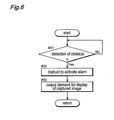
- the obstacle detection unit 5 instructs the alarm device 30 such as a buzzer to generate an alarm (#32).
- the blind-spot monitor unit 4 demands the blind-spot monitor unit 4 to display the captured image (#33). In this, an additional instruction may be given to enlarge the forward side area F or the rearward side area R depending on the position of the detected obstacle.
- the blind-spot monitor unit 4 allows the display unit 20 to display the enlarged captured image in cooperation with the image interface unit 11. The operation of the blind-spot monitor unit 4 having received the demand for display of the captured image was described above in reference to Fig. 5 .
- the condition determination unit 3 determines that the execution condition for the obstacle detection unit 5 is established when the vehicle 100 is stopped and unlocked even when the main power supply is not active and the vehicle 100 is not ready for traveling. This state corresponds to a situation in which the user is about to alight from the vehicle with the main power supply being cut off, for example.
- An example of the operation of the multi-function camera system when the user is alighting from the vehicle will be described hereinafter in reference to Fig. 7 .
- the door sensor 42 may be the door switch for simply detecting whether the door 60 is connected to or disconnected from the vehicle body, or the sensor for detecting whether or not the door handle (door knob) provided in the interior of the vehicle is operated.
- the detection of the operation may be the detection that the user including the driver touches the door handle (door knob) provided in the interior of the vehicle.
- the door sensor 42 may be any detecting means for detecting that the user is about to get out of the vehicle preferably before the door 60 starts to open.
- the power supply control unit 8 next determines whether or not the main power supply is active (#42). When the main power supply is not active, the power supply control unit 8 instructs at least one of the camera 1, condition determination unit 3, blind-spot monitor unit 4 and obstacle detection unit 5 to perform the function for the predetermined period of time (#43). That is to say, the power supply control unit 8 allows the CPU 12c that has been falling in the temporary shutoff state to start up in the same manner as described in reference to the individual authentication unit 6.
- the predetermined period of time may be or may not be the same period of time as the period in which the individual authentication unit 6 functions.
- the unit performs the function for the "predetermined period of time," which is not limitative. Instead, the unit may remain in normal operation continuously after the CPU 12c is started up and return to the temporary shutoff state when triggered by any other event in which the door 60 is closed or the door 60 is locked, for example.
- the system for allowing the camera having the door sensor 42 that has detected that the user is about to alight from the vehicle to start up from the temporary shutoff state in order to save electric power.
- the camera 1A mounted on the driver's side door 60A is activated.
- the door sensor 42B provided in the passenger's side door 60B or the door sensor 42D provided in the passenger's side rear door 60D the camera 1B mounted on the passenger's side door 60B is activated.
- condition determination unit 3 or obstacle detection unit 5 instead of the power supply control unit 8, may determine whether or not there is detection made by the door sensor 42 at the step #41. This is because the condition determination unit 3 determines that the execution condition for the obstacle detection unit 5 is established when the main power supply is active and thus the condition determination unit 3 and the obstacle detection unit 5 have already been in operation as well.
- the interrupt accepting function of the CPU 12 accepts the detected result from the door sensor 42, it is not required to strictly limit the function unit for performing the determination step #41 to any one of the function units.
- the process may be performed by two or more of the function units as necessary depending on the progress of the program.
- the condition determination unit 3 determines whether or not the opening degree of the door 60 is less than the preferential threshold value (#44). More particularly, it determines whether or not the opening degree of the door 60A (or 60B) is less than the preferential threshold value representing the predetermined opening degree.
- the opening degree of the door 60A is small, the door 60A will be opened further in a direction Y in Fig. 8 in order for the user to alight from the vehicle.
- condition determination unit 3 determines the preferential condition depending on the opening degree of the door 60A (or 60B) to place priority to the image recognition of the forward side area F of the shooting area E (#44, #46).
- the condition determination unit 3 determines the preferential condition depending on the opening degree of the door 60A (or 60B) to place priority to the image recognition of the rearward side area R of the shooting range E (#44, #47).
- a moving object such as a pedestrian, bicycle or any other vehicle approaching from a direction Z (from behind the vehicle 100) in Fig. 8 may come into contact with the opened door 60A (or 60B), which requires to detect such a moving object.
- the obstacle detection becomes less significant when the opening degree of the door 60A (or 60B) is the predetermined threshold value or greater, as shown in Fig. 9 .
- the moving object approaching from behind the vehicle 100 does not fall in the shooting range E, as a result of which the vehicle 100 would be photographed at the forward side area F of the shooting range E.
- the opening degree of the door 60A (or 60B) reaches the predetermined threshold value or becomes greater, the obstacle detection process is completed (#45).
- the obstacle detection unit 5 generates a door-opening restraint instruction to the door control system 40 when the obstacle is detected (#48, #49).
- the door ECU 41 controls the open/close actuator 44 to restrain opening of the door 60.
- the obstacle detection unit 5 instructs the alarm device 30 such as a buzzer to generate an alarm (#50), and outputs the demand for display of the captured image to the blind-spot monitor unit 4 (#51) as describe above in reference to Fig. 6 .
- the user may voluntarily give an instruction to the blind-spot monitor unit 4 to display the captured image on the display unit 20 in order to check whether or not there is a ditch or the like in the lateral side of the vehicle 100 when alighting from the vehicle, as described above in reference to Fig. 5 .
- the user alights from the vehicle from the driver's side door 60A or the passenger's side door 60B that is the swingable door.
- the obstacle detection unit 5 similarly detects the obstacle when the user alights from the vehicle from the rear door 60C or 60D that is the sliding door.
- the determination based on the opening degree of the door is not necessary, and thus the entire shooting range E may be regarded as a range to be detected.
- the step #44 may be skipped to proceed to the steps #45 and #47 to give priority to detection in the rearward side area R. Which of the doors 60 is used is obvious from the door sensor 42 having outputted the detected result, the obstacle detection is possible for the door 60 in use.
- the camera 1 is mounted on the door handle 61 for facilitating understanding of the arrangement of the multi-function camera system 10 and its functions.
- Any person of ordinary skill in the art may design a similar multi-function camera system 10 with the camera 1 being mounted on a side view mirror.
- Such a modification also falls in the technical scope of the present invention.
- the shooting range E varies between a using position and a folded position of the mirror.
- the multi-function camera system 10 for performing multiple functions may be achieved by allowing the system to detect the position of the side view mirror and perform the image processing using the captured image associated with the detected position of the side view mirror.
- the position of the side view mirror may also be detected by recognizing the position of the vehicle 100 in the captured image based on the image processing in the same manner as the opening degree calculating unit 7.
- the multi-function camera system 10 using the camera 1 fixed to the vehicle component so as not to change its position can be satisfactorily achieved, though part of the functions described in the above-noted embodiment is limited depending on the position of the side view mirror.
- the present invention can achieve the technique for applying the onboard camera to various uses with low cost without providing any mechanism for possibly increasing the weight of the vehicle.
- the present invention may be applied to a multi-function camera system for applying an onboard camera to multiple uses.
Landscapes
- Engineering & Computer Science (AREA)
- Mechanical Engineering (AREA)
- Multimedia (AREA)
- Human Computer Interaction (AREA)
- Lock And Its Accessories (AREA)
- Fittings On The Vehicle Exterior For Carrying Loads, And Devices For Holding Or Mounting Articles (AREA)
- Closed-Circuit Television Systems (AREA)
Abstract
Description
- The present invention relates to a multi-function camera system for applying an onboard camera to multiple uses.
- Owing to the spread of image pickup devices such as a CCD (charge-coupled device) and a CIS (CMOS image sensor), an increasing number of cases provide a vehicle with an onboard camera. Japanese Unexamined Patent Application Publication No.
2006-168553 2007-153193 2005-88759 2006-182234 Patent Document 3, the camera is used for checking a side of a vehicle when the vehicle is pulled over to the side of the road and for photographing the face of the user. In this, the camera is designed to photograph an area below the door mirror when the vehicle is traveling and to change the direction of the camera to photograph the interior of the vehicle when the vehicle is stopped and the door mirror is folded. The camera disclosed inPatent Document 4 is designed to function as a side blind-spot camera for photographing a scene in a forward side area of a vehicle that falls in the driver's blind spot when the vehicle is used and to function as a surveillance camera for the interior of the vehicle by being rotated by 180 degrees within a housing of the door mirror for photographing the interior of the vehicle when the vehicle is not used. -
- Patent Document 1: Japanese Unexamined Patent Application Publication No.
2006-168553 paragraphs 23 and 31 to 33) - Patent Document 2: Japanese Unexamined Patent Application Publication No.
2007-153193 - Patent Document 3: Japanese Unexamined Patent Application Publication No.
2005-88759 paragraphs 21, 24 to 28) - Patent Document 4: Japanese Unexamined Patent Application Publication No.
2006-182234 paragraphs 11 to 14 and 17) - It is expected that various functions are provided in the vehicle by using the camera. Meanwhile, in order to provide various functions, a number of cameras are required to be provided. The provision of numerous cameras would boost the manufacturing cost and additionally may reduce a fuel consumption rate and deteriorate motion performance due to increase of the weight of the vehicle. Thus, it is preferable to allow as few cameras as possible to achieve as many functions as possible. The cameras disclosed in
Patent Document 3 andPatent Document 4 noted above are put to the two uses, which provide a preferable mode in terms of reducing the number of cameras. On the other hand, it is necessary to change the photographing direction of the camera because a single camera is used for multiple purposes, which requires an additional mechanism for changing the photographing direction. As a result, even if the number of camera is reduced, the cost for providing such an additional mechanism is incurred, and further the weight of the vehicle is likely to increase because of the additional mechanism. - Thus, the technique is required to apply an onboard camera to multiple uses with low cost without providing any mechanism that might increase the weight of the vehicle.
- A characteristic feature of a multi-function camera system according to the present invention lies in comprising a camera fixed to a vehicle component on a side of a vehicle for photographing a side area of the vehicle; a condition determination unit for determining execution conditions of a plurality of function units; an obstacle detection unit acting as one of the function units to function based on a determination result from the condition determination unit for detecting, through image recognition, an obstacle present in the vicinity of the vehicle or approaching the vehicle based on a captured image of the camera; and an individual authentication unit acting as one of the function units to function based on the determination result from the condition determination unit for ascertaining, through the image recognition, whether or not a person having reached the vehicle matches with a user who has been registered at the vehicle beforehand based on the captured image of the camera.
- The above-noted arrangement can dispense with any additional mechanism for changing the photographing direction of the camera since the camera is fixed to the vehicle component. This saves the cost for providing the additional mechanism and prevents the weight of the vehicle from being increased. While the multi-function camera system has the plurality of function units including the obstacle detection unit and the individual authentication unit, each of the function units is not designed to perform its function all the time, but configured to perform the function as necessary based on the determination result on the execution condition from the condition determination unit. Hence, a calculating burden is not increased even if the plurality of function units are provided, which can provide the multi-function camera system with low cost without using any high-performance calculating device. Naturally, this system would not hinder the plurality of function units from simultaneously performing their functions depending on the execution conditions.
- It is preferable that the condition determination unit of the multi-function camera system of the present invention determines that the execution condition for the obstacle detection unit is established when the vehicle is traveling including making a short stop, or stopped and unlocked, and determines that the execution condition for the individual authentication unit is established when the vehicle is not traveling but stopped and locked. With such an arrangement, it is possible to allow each function unit to effectively perform its function based on the proper execution condition corresponding to the state of the vehicle.
- Further, it is preferable that the multi-function camera system of the present invention comprises a blind-spot monitor unit acting as one of the function units to function based on the determination result from the condition determination unit for outputting an image captured by the camera including a scene falling in the driver's blind spot to a display unit provided in the interior of the vehicle, and that the condition determination unit determines that the execution condition for the blind-spot monitor unit is established when the user of the vehicle including the driver gives an instruction to display the captured image, or when the obstacle is detected by the obstacle detection unit. With such an arrangement, even if the multi-function camera system includes further function units, each of the function units may perform its function properly based on the determination result from the condition determination unit on the execution condition corresponding to the state of the vehicle. Further, increase in calculating burden is restrained even if the blind-spot monitor unit with great usefulness is provided, as a result of which the multi-function camera system may be designed with low cost without using any high-performance calculating device. Naturally, the blind-spot monitor unit and any other function unit may be simultaneously in action in response to the execution condition.
- Further, in the multi-function camera system of the present invention, it is preferable that the condition determination unit determines a preferential condition as to which of image recognition of a forward side area of the vehicle and image recognition of a rearward side area of the vehicle should be preferentially performed, and that the obstacle detection unit preferentially performs the image recognition of either of the forward side area and the rearward side area based on the determination result from the condition determination unit. When the onboard camera is applied to multiple uses, such a camera should preferably be a wide-angle camera that includes the driver's blind spot in the shooting range. An image to be captured by the wide-angle camera naturally targets a wide range area. Thus, it is more effective in terms of time and calculating burden to perform the image recognition in a limited region than to perform the image recognition over the entire captured image to detect an obstacle. With the above-noted arrangement, since it is determined which of the forward side area and rearward side area should have priority in performing the image recognition, the obstacle detection may be effectively performed.
- Further, when the vehicle includes a swingable door pivotable about an axis defined forwardly of the vehicle, it is preferable that the condition determination unit of the multi-function camera system of the present invention determines the preferential condition depending on an opening degree of the swingable door to give priority to the image recognition of the forward side area when the opening degree of the swingable door is less than a predetermined opening degree and give priority to the image recognition of the rearward side area when the opening degree of the swingable door is or greater than the predetermined opening degree. When the swingable door that is pivotable about the axis defined forwardly of the vehicle is open, an end portion of the door is moved forwardly. If the image recognition of the forward side area is given priority when the opening degree of the swingable door is less than the predetermined opening degree such as when the door is started to open, an obstacle that might come into contact with the end portion of the door is highly likely to be detected reliably and quickly. Since such an obstacle may be present at a lower position such as a curb and fall in the user's blind spot, it is preferably detected through the image recognition. On the other hand, when the door is opened to the predetermined opening degree or greater, it is necessary to prevent the moving object (obstacle) that approaches from behind the vehicle and is about to pass through the side area of the vehicle from coming into contact with the swingable door that projects laterally of the vehicle. Since the user faces the front and thus is less aware of the moving object approaching from behind of the vehicle than the moving object approaching from ahead of the vehicle, it is preferable that the approach of the moving object is detected by the image recognition.
- Further, it is preferable that the multi-function camera system of the present invention comprises an opening degree calculating unit for calculating the opening degree of the swingable door based on the captured image of the camera, that the camera is mounted on the swingable door or on the vehicle component provided in the swingable door. With such an arrangement, the camera moves along with the swingable door. On the other hand, since the vehicle is still, the positions of part of the vehicle and the vehicle components other than the swingable door are moved (changed) in the captured image. The opening degree of the swingable door can be calculated based on the amount of movement (variance) of those positions. Thus, it becomes possible to obtain the opening degree of the swingable door with high accuracy without providing any separate sensor in the swingable door.
- Further, it is preferable that the camera, condition determination unit and plurality of function units of the multi-function camera unit of the present invention are configured to function when a main power supply of the vehicle is active, and the multi-function camera system further comprises a power supply control system configured to function regardless whether or not the main power supply of the vehicle is active and to allow at least one of the camera, condition determination unit and plurality of function units to function in response to an operation relative to a door of the vehicle even if the main power supply of the vehicle is not active. The multi-function camera system has a function unit that is desired to function when the main power supply of the vehicle is not activated such as when the user rides on the parked vehicle, or when the main power supply is cut off such as when the user parks the vehicle to get off, for example. However, if electric power is constantly supplied to all of the function units even when the vehicle is parked, the battery of the vehicle is unfavorably consumed. With the above-noted arrangement, the power supply control unit of the vehicle is functioned when the main power supply is not activated to supply electric power to any proper function unit in response to the operation relative to the door of the vehicle. As a result, energy-saving and highly convenient multi-function camera system may be provided.
- Here, the operation relative to the door of the vehicle may be a condition in which the person having reached the vehicle touches a door handle provided in the outside of the vehicle. Further, it may be a condition in which the user including the driver of the vehicle touches a door handle provided in the interior of the vehicle. The detection of the touch on the door handle leads to more quick detection of the operation relative to the door of the vehicle, and power supply to the function units including the camera and condition determination unit is started early through the power supply control unit to make those units active.
- An onboard camera may be applied to multiple uses with low cost without providing any mechanism that might increase the weight of a vehicle.
-
-
Fig. 1 is a schematic diaphragm showing an example of a multi-function camera system; -
Fig. 2 is a perspective view showing an example of a mounting position of a camera; -
Fig. 3 is an illustrative view showing an example of a camera shooting range; -
Fig. 4 is a flowchart showing an example of an operation of the multi-function camera system when the user rides on a vehicle; -
Fig. 5 is a flowchart showing an example of an operation of a blind-spot monitor unit; -
Fig. 6 is a flowchart of an example of an operation of an obstacle detection unit; -
Fig. 7 is a flowchart showing an operation of the multi-function camera system when the user alights from the vehicle; -
Fig. 8 is an illustrative view showing the relationship between the operation of the multi-function camera system and the shooting range; and -
Fig. 9 is another illustrative view showing the relationship between the operation of the multi-function camera system and the shooting range. - A preferred embodiment of the present invention will be described hereinafter in reference to the accompanying drawings. As shown in
Figs. 1 to 3 , amulti-function camera system 10 is fixed to adoor handle 61 on a side surface of avehicle 100, and includes acamera 1 for photographing a side area of thevehicle 100. Thecamera 1 is fixed to thedoor handle 61, which is one of vehicle components, in the current embodiment, but may naturally be fixed to any other vehicle component. For instance, such a vehicle component includes a door panel of adoor 60, a side view mirror or a fender. Even when thecamera 1 is fixed to thedoor handle 61 as in the current embodiment, it may be mounted either on ahandle body 61 a or ahandle cap 61 b. - According to the current embodiment, the
vehicle 100 has fourdoors 60 on its sides. More particularly, thevehicle 100 has a driver'sside door 60A, a passenger'sside door 60B, a driver's siderear door 60C, and a passenger's siderear door 60D. Although the form of eachdoor 60 is not limited to the one shown in the current embodiment, the driver'sside door 60A and passenger'sside door 60B are swingable doors each pivotable about an axis defined forwardly of thevehicle 100 in the current embodiment. On the other hand, the driver's siderear door 60C and the passenger's siderear door 60D are sliding doors. - The
camera 1 is provided in each of the driver'sside door 60A and passenger'sside door 60B. Naturally, the number of cameras to be provided is not limited to two, but three or more cameras in total may be mounted on thevehicle 100 including the one mounted on therear door camera 1A is mounted with its optical axis being fixed to thedoor handle 61A of the driver'sside door 60A, while thecamera 1B is mounted with its optical axis being fixed to thedoor handle 61 B of the passenger'sside door 60B. Thecamera 1 is a wide-angle camera with a view angle of approximately 180 degrees, and is favorably provided with an angle of depression of approximately 5 to 10 degrees. Thecamera 1 has a shooting range up to a level of approximately 2 meters from the ground in the vicinity of thedoor 60 regardless of the angle of depression so as to photograph the head of a person standing by the side of thedoor 60. Further, thecamera 1 is a digital camera for digitally capturing moving images of 15 to 60 frames per second. As shown inFig. 3 , the shooting range E of thecamera 1 includes the side area, forward side-end area and rearward side-end area of thevehicle 100. While a detailed description will follow, the shooting range E includes a forward shooting range F and a rearward shooting range R. When the shooting range E needs to be distinguished between thecamera 1A and thecamera 1B, the shooting range of thecamera 1A is marked as E1, the forward shooting range thereof is marked as F1 and the rearward shooting range thereof is marked as R1. Similarly, the shooting range of thecamera 1B is marked as E2, the forward shooting range thereof is marked as F2 and the rearward shooting range thereof is marked as R2. - As shown in
Fig. 1 , themulti-function camera system 10 includes a plurality of function units such as acondition determination unit 3, a blind-spot monitor unit 4, anobstacle detection unit 5 and anindividual authentication unit 6. The function units used in the present invention represent sections constituting themulti-function camera system 10, and include thecamera 1 per se in a broad sense. Each of the blind-spot monitor unit 4,obstacle detection unit 5 andindividual authentication unit 6 is configured to achieve "each use" when thecamera 1 is applied to various uses, and is termed "a use function unit" when distinctively indicated. While only the blind-spot monitor unit 4,obstacle detection unit 5 andindividual authentication unit 6 are introduced in the current embodiment, any use function unit for achieving any other use may naturally be included in themulti-function camera unit 10. For example, a parking assistance unit for guiding the driver in parking thevehicle 100 may be included in themulti-function camera system 10. On the other hand, it is sufficient that themulti-function camera system 10 for applying thecamera 1 to various uses includes at least two use function units, and thus may include only theobstacle detecting unit 5 and theindividual authentication unit 6 as the use function units, for example. - The blind-
spot monitor unit 4 is a function unit for outputting an image captured by thecamera 1 including a scene of the shooting range E to adisplay unit 20 provided in the interior of the vehicle. The captured image includes a sight falling in the driver's blind spot. The driver's blind spot is represented by a side of the fender or a lower side of the fender or thedoor 60, for example. Thedisplay unit 20 is a monitor device such as a liquid crystal display provided in the interior of the vehicle. While thedisplay unit 20 may be for exclusive use for the blind-spot monitor unit 4, an information display unit of a car audio system or a display unit of a car navigation system may be used as well. - The
obstacle detection unit 5 is a function unit configured to detect an object present around thevehicle 100 or a moving object approaching thevehicle 100 as an obstacle through image recognition based on the captured image. Here, the object is represented by a curb and pole, for example, and the moving object is represented by a pedestrian, bicycle, motorcycle and automobile, for example. The image recognition of a still object or moving object is performed through any known image processing technique. - The
individual authentication unit 6 is a function unit configured to ascertain, through the image recognition based on the captured image, whether or not a person having reached thevehicle 100 matches with a user who has been registered at the system of thevehicle 100 beforehand. The authentication is performed by any known technique including face recognition, iris recognition, fingerprint recognition or vein recognition, for example. - Each of the blind-
spot monitor unit 4,obstacle detection unit 5 andindividual authentication unit 6 performs each function based on a result obtained from thecondition determination unit 3 for determining an execution condition for each function unit. Thecondition determination unit 3 determines that the execution condition for the blind-spot monitor unit 4 is established when one of the users including the driver in thevehicle 100 gives an instruction to display the captured image. Here, the instruction from the user is given by operating a display switch 21 (seeFig. 1 ) provided in the interior of the vehicle, for example. Thedisplay switch 21 may be for exclusive use or may be incorporated in a touch screen of thedisplay unit 20, if any. The instruction given through thedisplay switch 21 also includes an instruction to select either the image captured by thecamera 1A or the image captured by thecamera 1B, an instruction to display both images captured by thecamera 1A and thecamera 1B, or an instruction to enlarge part of the captured image, for example. - Further, the
condition determination unit 3 determines that the execution condition for the blind-spot monitor unit 4 is established when an obstacle is detected by theobstacle detection unit 5. Theobstacle detection unit 5 generates a demand for display of the captured image when the obstacle is detected. Thecondition determination unit 3 determines that the execution condition for the blind-spot monitor unit 4 is established based on the demand for display. The driver may promptly confirm the detection result from theobstacle detection unit 5 including the authenticity of the result by viewing the captured image. - Also, the
condition determination unit 3 determines that the execution condition for theobstacle detection unit 5 is established when thevehicle 100 is traveling including making a short stop. More particularly, when a main power supply for thevehicle 100 is active as when an ignition switch is on, thecondition determination unit 3 determines that the execution condition for theobstacle detection unit 5 is established based on an ignition signal or the like. A hybrid vehicle with an internal combustion engine and a motor acting as a drive power source or an electric vehicle with a motor acting as the drive power source may not have the ignition switch for starting the internal combustion engine. However, even those vehicles have the main power supply (main switch) for making the drive power source of the vehicle active. Thus, when the main power supply is in action and thevehicle 100 is ready for traveling with an accelerating operation or a brake releasing operation, thecondition determination unit 3 determines that thevehicle 100 is traveling including making a short stop and that the execution condition for theobstacle detection unit 5 is established. On the other hand, even when the main power supply is not active and thevehicle 100 is not ready for traveling, thecondition determination unit 3 determines that the execution condition for theobstacle detection unit 5 is established if thevehicle 100 is stopped and unlocked. An example of such a situation is a condition when the user is alighting from the vehicle with the main power supply being cut off. - Also, the
condition determination unit 3 determines that the execution condition for theindividual authentication unit 6 is established when thevehicle 100 is not traveling but stopped and locked. When thevehicle 100 is not traveling, the main power source is not active as noted above, which hinders thevehicle 100 from traveling even with the accelerating operation or the brake releasing operation. When thevehicle 100 is stopped and locked or parked in this state, thecondition determination unit 3 determines that the execution condition for theindividual authentication unit 6 is established. - Further, the
condition determination unit 3 determines a preferential condition as to which of image recognition of the forward side area corresponding to the shooting range F of thevehicle 100 and image recognition of the rearward side area corresponding to the shooting area R of thevehicle 100 should be preferentially performed. Although described in detail later, theobstacle detection unit 5 preferentially executes the image recognition either of the forward side area F and the rearward side area R based on the determination result for the preferential condition from thecondition determination unit 3. As noted above, thevehicle 100 includes the swingable doors (door vehicle 100 in the current embodiment. Thecondition determination unit 3 determines the preferential condition in response to an opening degree of theswingable door swingable door swingable door - As noted above, the
cameras swingable doors swingable doors camera 1. On the other hand, since the vehicle is still, positions of part of the vehicle body and vehicle components other than theswingable door 60 and the door handle 61 (61A or 61B) are moved within the captured image. Here, themulti-function camera system 10 in the current embodiment further includes an opening degree calculation unit 7 for calculating the opening degree of theswingable door 60 by image processing based on the captured image. - The opening degree calculation unit 7 calculates the opening degree of the swingable door based on an amount of relative movement (amount of variance) of the positions of part of the vehicle body and the vehicle components other than the
door 60 and thedoor handle 61 moving within the captured image along with the movement of thecamera 1. Here, the part of the vehicle body and the vehicle components other than thedoor 60 and thedoor handle 61 correspond to a bumper, tire, wheel, and a gap or end portion of an outer panel of the vehicle body, for example. Although it is naturally possible to provide a separate sensor in theswingable door 60 to detect the opening degree, the opening degree calculation unit 7 is configured to calculate the opening degree of theswingable door 60 based on the image processing, which can dispense with such a sensor and reduce the manufacturing cost. - The function units of the
multi-function camera system 10, specifically, thecamera 1,condition determination unit 3, blind-spot monitor unit 4,obstacle detection unit 5,individual authentication unit 6 and opening degree calculation unit 7 are configured to function with power being supplied when the main power supply of thevehicle 100 is active. In theindividual authentication unit 6, for example, the execution condition is established when thevehicle 100 is not traveling, but stopped and locked. However, when the main power supply is not active and there is no power supply, theindividual authentication unit 6 is not capable of achieving any function. Similarly, in theobstacle detection unit 5, the execution condition is established when thevehicle 100 is stopped and unlocked even when the main power supply is cut off and the vehicle is not ready for running. However, any function cannot be achieved since there is no power supply. Further, thecondition determination unit 3 for determining the execution condition cannot receive power supply when the main power is not active, and is prevented from making determination. - In view of the above, the
multi-function camera system 10 is provided with a powersupply control unit 8 for supplying power to a predetermined function unit under a predetermined condition even when the main power supply of thevehicle 100 is not active. The powersupply control unit 8 is designed to function properly regardless of whether or not the main power supply of thevehicle 100 is active, and is also designed to activate at least one of the function units in response to an operation relative to thedoor 60 even when the main power supply of thevehicle 100 is not active. More particularly, the powersupply control unit 8 is configured to allow at least one of thecamera 1,condition determination unit 3 and respective use function units to function. In the current embodiment, the powersupply control unit 8 is configured to allow at least one of thecamera 1,condition determination unit 3, blind-spot monitor unit 4,obstacle detection unit 5 andindividual authentication unit 6 to function. Here, the "operation relative to thedoor 60" means a state in which the person having reached thevehicle 100 touches thedoor handle 61 mounted on the outside of the vehicle, for example. Alternatively, the "operation relative to thedoor 60" means a state in which the user including the driver of thevehicle 100 touches a door handle provided in the interior of the vehicle. The "operation relative to thedoor 60" will be described later using more specific examples. - Each of the function units of the
multi-function camera system 10, in particular, the use function units such as the blind-spot monitor unit 4,obstacle detection unit 5 andindividual authentication unit 6 may be provided as separate devices. In the current embodiment, however, they are incorporated into an ECU (electronic control unit) 12 having a microcomputer (CPU) 12c and acting as a core. More specifically, each of the function units achieves its function by hardware having the microcomputer (CPU) 12c as the core in cooperation with software stored in aprogram memory 12p. The image captured by thecamera 1 is inputted to theECU 12 through animage interface unit 11. TheECU 12 has awork memory 12w and configured to store the captured image or other temporary data and perform arithmetic processing such as image processing properly. Naturally, theCPU 12c,program memory 12p andwork memory 12w may be integrated as a single processor. TheECU 12 is also linked to analarm device 30 such as a buzzer and thedisplay unit 20. - The
ECU 12 is also linked to any other ECU through an in-vehicle network 50 such as CAN (controller area network). In the current embodiment, theECU 12 is linked todoor control systems 40 for controlling the fourdoors 60 through the in-vehicle network 50. The fourdoor control systems 40 include a driver's sidedoor control system 40A, passenger's sidedoor control system 40B, driver's side reardoor control system 40C and passenger's side reardoor control system 40D. Each of the fourdoor control systems 40 is provided with a door ECU 41 (41A, 41 B, 41C, 41 D) acting as a core of the system, door sensor 42 (42A, 42B, 42C, 42D9 for detecting whether or not the door is open, for example, lock actuator 43 (43A, 43B, 43C, 43D) for electrically locking or unlocking the door, and open/close actuator 44 (44A, 44B, 44C, 44D) for electrically opening and closing the door. In the current embodiment, theECU 12 is linked to thedoor control systems 40 through the in-vehicle network 50. Naturally, theECU 12 may be connected to each of thedoor control systems 40 through a dedicated line. - The
door ECU 41 is formed having a microcomputer acting as a core in the same manner as theECU 12 of themulti-function camera system 10. Thedoor sensor 42 may be a door switch for simply detecting whether thedoor 60 is connected to or disconnected from the vehicle body. Further, it may be a sensor for detecting the opening degree of theswingable door lock actuator 43 may be a solenoid, for example, for locking and unlocking thedoor 60 by control of thedoor ECU 41. The open/close actuator 44 may be a motor, for example. When thedoors close actuator 44 functions to open and close thedoors door ECU 41. When the door is a swingable door such as the driver'sside door 60A or passenger'sside door 60B, the open/close actuator 44 may be designed to open and close the door within a limited range between the tight-closed state and a partly-opened state, for example, instead of opening and closing the door between the full-opened state and the tight-closed state. Further, the open/close actuator 44 may not be limited to the mechanism for automatic opening and closing operation, but may be used for controlling manual opening and closing operation. - Each of the driver's side
door control system 40A and passenger's sidedoor control system 40B further includes a touch sensor 45 (45A, 45B) provided in the outside of the vehicle. Thetouch sensor 45 may be a capacitance sensor, for example, and is built in a side of thedoor handle 61 facing thedoor 60 as shown inFig. 2 . Although the driver'sside door 60A is shown inFig. 2 , the passenger'sside door 60B is constructed in the same manner. Thetouch sensor 45 detects that a hand of the user touches thedoor handle 61 when he or she opens thedoor 60. It is preferable that weak electric power or intermittent electric power is constantly supplied to thetouch sensor 45 regardless of whether or not the main power supply of thevehicle 100 is active. The arrangement of thetouch sensor 45 is not limited to the current embodiment. A switch may be provided in a side of thedoor handle 61 facing away from thedoor 60 to detect whether or not the user operates the switch. - The
multi-function camera system 10 achieves various functions in various situations in cooperation with the equipment provided in thevehicle 100 as noted above. The operation of themulti-function camera system 10 in the various situations will be described hereinafter in reference to flowcharts shown inFigs. 4 to 7 and illustrative representations shown inFigs. 8 and 9 . - An example of the operation of the
multi-function camera system 10 when the user rides on the vehicle will be described first in reference toFig. 4 . Thevehicle 100 is locked and stopped, not in a traveling state. As noted above, weak electric power or intermittent electric power is constantly supplied to thetouch sensor 45 as noted above. Therefore, it is possible to detect an operation relative to thedoor handle 61 by the user regardless of whether or not the main power supply for thevehicle 100 is active. A detected result from thetouch sensor 45 is transmitted to theECU 12 through the in-vehicle network 50. - Here, it is preferable that the
CPU 12c of theECU 12 accepts the detected result from thetouch sensor 45 as an interrupt. TheCPU 12c is restarted (waked up) by accepting the detected result from thetouch sensor 45 even if it is temporarily shut off in a saving mode. The acceptance of the interrupt or restart of theCPU 12c are executed primarily by the powersupply control unit 8. The powersupply control unit 8 instructs thecamera 1,condition determination unit 3 andindividual authentication unit 6 to perform the functions for a predetermined period of time when it determines that there is detection by the touch sensor 45 (#11, #12). It would be power-saving if the powersupply control unit 8 activates only thecamera 1A when the detected result from thetouch sensor 45A of the driver'sside door 60A is received and activates only thecamera 1B when the detected result form thetouch sensor 45B of the passenger'sside door 60B is received. Further, good security is provided since inadvertent authentication can be avoided by not executing any individual authentication on the side in which thetouch sensor 45 does not detect the operation by the user. - The
condition determination unit 3 that has been started up determines that the execution condition for theindividual authentication unit 6 is established since thevehicle 100 is not traveling, but stopped and locked. With the execution condition being established, theindividual authentication unit 6 recognizes the captured image to ascertain whether or not the person in the captured image matches the user who has been registered at thevehicle 100 in advance. When the authentication result is positive, an unlocking instruction is transmitted form theECU 12 to the door control system 40 (40A to 40D) (#13 and #14). TheECU 12 completes the process after transmitting the unlocking instruction. Each lock actuator 43 (43A to 43D) is controlled by each door ECU 41 (41 A to 41 D) of thedoor control system 40 to unlock thevehicle 100. When the authentication result is negative, theECU 12 completes the process. - The
camera 1,condition determination unit 3 andindividual authentication unit 6 fall into the temporary shutoff state again due to the power-saving mode after having performed the executions for the predetermined period of time through the powersupply control unit 8 and after the lapse of a predetermined period of time. If electric power is supplied to thecamera 1 when the individual authentication is unsuccessful, power may be wasted. Also, even when the individual authentication is successful and the user opens thedoor 60 to get into the vehicle, the main power supply is not necessarily immediately activated to start thevehicle 100. Thus, the temporary shutoff state is preferably established again by the effect of the power-saving mode once the individual authentication is completed regardless of whether the results are positive or negative. In the current embodiment, each unit performs the function for the "predetermined period of time," which is not limitative. Instead, each unit may remain in normal operation continuously and return to the temporary shutoff state when triggered by any other event in which the individual authentication is unsuccessful, or the individual authentication is successful and thedoor 60 is opened, for example. - Next, an example of the operation of the blind-
spot monitor unit 4 will be described in reference toFig. 5 . Here, it is presumed that the main power supply of thevehicle 100 is active, that is to say, thevehicle 100 is traveling including making a short stop. Each of the units such as thecamera 1 andECU 12 of themulti-function camera system 10 is not in the temporary shutoff state, but in a normal operative state. Thecondition determination unit 3 determines whether or not there is any demand for display (#21), and instructs the blind-spot monitor unit 4 to display the captured image (#22) if there is a demand for display. The blind-spot monitor unit 4 instructs theimage interface unit 11 and thedisplay unit 20 to display the captured image, as a result of which the captured image is displayed on thedisplay unit 20. It should be noted that the instruction to display the capture image includes an instruction to select either of the image captured by thecamera 1A and the image captured by thecamera 1B, an instruction to display both of them, and an instruction to enlarge part of the captured image. - The
condition determination unit 3 determines that the execution condition for the blind-spot monitor unit 4 is established when an obstacle is recognized by theobstacle detection unit 5. Thecondition determination unit 3 also determines that the execution condition for the blind-spot monitor unit 4 is established when an instruction to display the captured image is given such as when thedisplay switch 21 is operated by the user of thevehicle 100 including the driver. For example, if the powersupply control unit 8 is designed to restart theECU 12 when thedisplay switch 21 is operated, it is possible to allow the blind-spot monitor unit 4 to perform the function according to the steps shown inFig. 4 even when the main power supply for thevehicle 100 is not active. - Nest, an example of the operation of the
obstacle detection unit 5 will be described in reference toFig. 6 . Here, it is presumed that the main power supply for thevehicle 100 is active, or the unit is in operation with electric power being supplied for the predetermined period of time and with the main power supply being not active, as noted above. Thecondition determination unit 3 determines that the execution condition for theobstacle detection unit 5 is established when thevehicle 100 is traveling including making a short stop. Theobstacle detection unit 5 detects the presence or approach of the obstacle in the captured image based on a difference between the respective frames (captured images) or the known image recognition technique including pattern matching performed within a single frame. When the obstacle is detected, theobstacle detection unit 5 instructs thealarm device 30 such as a buzzer to generate an alarm (#32). Further, it demands the blind-spot monitor unit 4 to display the captured image (#33). In this, an additional instruction may be given to enlarge the forward side area F or the rearward side area R depending on the position of the detected obstacle. The blind-spot monitor unit 4 allows thedisplay unit 20 to display the enlarged captured image in cooperation with theimage interface unit 11. The operation of the blind-spot monitor unit 4 having received the demand for display of the captured image was described above in reference toFig. 5 . - As described above, the
condition determination unit 3 determines that the execution condition for theobstacle detection unit 5 is established when thevehicle 100 is stopped and unlocked even when the main power supply is not active and thevehicle 100 is not ready for traveling. This state corresponds to a situation in which the user is about to alight from the vehicle with the main power supply being cut off, for example. An example of the operation of the multi-function camera system when the user is alighting from the vehicle will be described hereinafter in reference toFig. 7 . - Firstly, it is determined by the power
supply control unit 8 whether or not there is any detection by the door sensor 42 (#41). As noted above, thedoor sensor 42 may be the door switch for simply detecting whether thedoor 60 is connected to or disconnected from the vehicle body, or the sensor for detecting whether or not the door handle (door knob) provided in the interior of the vehicle is operated. For example, the detection of the operation may be the detection that the user including the driver touches the door handle (door knob) provided in the interior of the vehicle. - In other words, the
door sensor 42 may be any detecting means for detecting that the user is about to get out of the vehicle preferably before thedoor 60 starts to open. When there is detection by thedoor sensor 42 that the user is about to get off the vehicle, the powersupply control unit 8 next determines whether or not the main power supply is active (#42). When the main power supply is not active, the powersupply control unit 8 instructs at least one of thecamera 1,condition determination unit 3, blind-spot monitor unit 4 andobstacle detection unit 5 to perform the function for the predetermined period of time (#43). That is to say, the powersupply control unit 8 allows theCPU 12c that has been falling in the temporary shutoff state to start up in the same manner as described in reference to theindividual authentication unit 6. The predetermined period of time may be or may not be the same period of time as the period in which theindividual authentication unit 6 functions. In the current embodiment, the unit performs the function for the "predetermined period of time," which is not limitative. Instead, the unit may remain in normal operation continuously after theCPU 12c is started up and return to the temporary shutoff state when triggered by any other event in which thedoor 60 is closed or thedoor 60 is locked, for example. - It is preferable to design the system for allowing the camera having the
door sensor 42 that has detected that the user is about to alight from the vehicle to start up from the temporary shutoff state in order to save electric power. For example, when the detection is made by the door sensor 42A provided in the driver'sside door 60A or thedoor sensor 42C provided in the driver's siderear door 60C, thecamera 1A mounted on the driver'sside door 60A is activated. On the other hand, when the detection is made by thedoor sensor 42B provided in the passenger'sside door 60B or thedoor sensor 42D provided in the passenger's siderear door 60D, thecamera 1B mounted on the passenger'sside door 60B is activated. - In the above description, it is presumed that the user is alighting from the vehicle with the main power supply being cut off. Instead, the user may temporarily leave the vehicle with the main power supply being active, that is, with the
vehicle 100 making a short stop. In that case, thecondition determination unit 3 orobstacle detection unit 5, instead of the powersupply control unit 8, may determine whether or not there is detection made by thedoor sensor 42 at thestep # 41. This is because thecondition determination unit 3 determines that the execution condition for theobstacle detection unit 5 is established when the main power supply is active and thus thecondition determination unit 3 and theobstacle detection unit 5 have already been in operation as well. Since it is virtually sufficient that the interrupt accepting function of theCPU 12 accepts the detected result from thedoor sensor 42, it is not required to strictly limit the function unit for performing thedetermination step # 41 to any one of the function units. The process may be performed by two or more of the function units as necessary depending on the progress of the program. - The description will continue hereinafter, assuming that the user who is about to alight from the vehicle uses the swingable door, that is, the driver's
side door 60A or the passenger'sside door 60B. Thecondition determination unit 3 determines whether or not the opening degree of thedoor 60 is less than the preferential threshold value (#44). More particularly, it determines whether or not the opening degree of thedoor 60A (or 60B) is less than the preferential threshold value representing the predetermined opening degree. When the opening degree of thedoor 60A is small, thedoor 60A will be opened further in a direction Y inFig. 8 in order for the user to alight from the vehicle. In that time, if there is any obstacle such as a curb in the vicinity of thedoor 60A, thedoor 60A may come into contact with the obstacle. Thus, thecondition determination unit 3 determines the preferential condition depending on the opening degree of thedoor 60A (or 60B) to place priority to the image recognition of the forward side area F of the shooting area E (#44, #46). - On the other hand, when the opening degree of the
door 60A (or 60B) is the preferential threshold value representing the predetermined opening degree or greater, thecondition determination unit 3 determines the preferential condition depending on the opening degree of thedoor 60A (or 60B) to place priority to the image recognition of the rearward side area R of the shooting range E (#44, #47). This is because a moving object such as a pedestrian, bicycle or any other vehicle approaching from a direction Z (from behind the vehicle 100) inFig. 8 may come into contact with the openeddoor 60A (or 60B), which requires to detect such a moving object. It should be noted that the obstacle detection becomes less significant when the opening degree of thedoor 60A (or 60B) is the predetermined threshold value or greater, as shown inFig. 9 . More particularly, the moving object approaching from behind thevehicle 100 does not fall in the shooting range E, as a result of which thevehicle 100 would be photographed at the forward side area F of the shooting range E. Thus, when the opening degree of thedoor 60A (or 60B) reaches the predetermined threshold value or becomes greater, the obstacle detection process is completed (#45). - The
obstacle detection unit 5 generates a door-opening restraint instruction to thedoor control system 40 when the obstacle is detected (#48, #49). Thedoor ECU 41 controls the open/close actuator 44 to restrain opening of thedoor 60. Further, theobstacle detection unit 5 instructs thealarm device 30 such as a buzzer to generate an alarm (#50), and outputs the demand for display of the captured image to the blind-spot monitor unit 4 (#51) as describe above in reference toFig. 6 . Meanwhile, the user may voluntarily give an instruction to the blind-spot monitor unit 4 to display the captured image on thedisplay unit 20 in order to check whether or not there is a ditch or the like in the lateral side of thevehicle 100 when alighting from the vehicle, as described above in reference toFig. 5 . - In the above-described example, the user alights from the vehicle from the driver's
side door 60A or the passenger'sside door 60B that is the swingable door. It is preferable that theobstacle detection unit 5 similarly detects the obstacle when the user alights from the vehicle from therear door rear door camera 1, the determination based on the opening degree of the door is not necessary, and thus the entire shooting range E may be regarded as a range to be detected. Alternatively, thestep # 44 may be skipped to proceed to thesteps # 45 and #47 to give priority to detection in the rearward side area R. Which of thedoors 60 is used is obvious from thedoor sensor 42 having outputted the detected result, the obstacle detection is possible for thedoor 60 in use. - In the above-noted embodiment, the
camera 1 is mounted on thedoor handle 61 for facilitating understanding of the arrangement of themulti-function camera system 10 and its functions. Any person of ordinary skill in the art may design a similarmulti-function camera system 10 with thecamera 1 being mounted on a side view mirror. Such a modification also falls in the technical scope of the present invention. When thecamera 1 is mounted to the side view mirror, the shooting range E varies between a using position and a folded position of the mirror. Nonetheless, themulti-function camera system 10 for performing multiple functions may be achieved by allowing the system to detect the position of the side view mirror and perform the image processing using the captured image associated with the detected position of the side view mirror. The position of the side view mirror may also be detected by recognizing the position of thevehicle 100 in the captured image based on the image processing in the same manner as the opening degree calculating unit 7. - For example, when the
camera 1 is mounted on the outermost side of the side view mirror in the using position with a view angle of 180 to 190 degrees, substantially the same shooting range E as in the case where thecamera 1 is mounted on thedoor handle 61 can be secured. Further, even if the side view mirror is in the folded position, substantially the same shooting range E as in the case where thecamera 1 is mounted on thedoor handle 61 can be secured in the area rearwardly of the side view mirror (rearward side area R). Therefore, themulti-function camera system 10 using thecamera 1 fixed to the vehicle component so as not to change its position can be satisfactorily achieved, though part of the functions described in the above-noted embodiment is limited depending on the position of the side view mirror. - As described above, the present invention can achieve the technique for applying the onboard camera to various uses with low cost without providing any mechanism for possibly increasing the weight of the vehicle.
- The present invention may be applied to a multi-function camera system for applying an onboard camera to multiple uses.
-
- 1, 1A, 1B:
- camera
- 3:
- condition determination unit
- 4:
- blind-spot monitor unit
- 5:
- obstacle detection unit
- 6:
- individual authentication unit
- 7:
- opening degree calculating unit
- 8:
- power supply control unit
- 10:
- multi-function camera system
- 20:
- display unit
- 60, 60A, 60B, 60C, 60D:
- door (vehicle component)
- 60A, 60B
- swingable door
- 61:
- door handle (vehicle component)
- 100:
- vehicle
- E, E1, E2:
- shooting range
- F, F1, F2:
- forward side area
- R, R1, R2:
- rearward side area
Claims (9)
- A multi-function camera system comprising:a camera fixed to a vehicle component on a side of a vehicle for photographing a side area of the vehicle;a condition determination unit for determining execution conditions of a plurality of function units;an obstacle detection unit acting as one of the function units to function based on a determination result from the condition determination unit for detecting, through image recognition, an obstacle present in the vicinity of the vehicle or approaching the vehicle based on a captured image of the camera; andan individual authentication unit acting as one of the function units to function based on the determination result from the condition determination unit for ascertaining, through the image recognition, whether or not a person having reached the vehicle matches with a user who has been registered at the vehicle beforehand based on the captured image of the camera.
- The multi-function camera system as claimed in claim 1, wherein the condition determination unit determines that the execution condition for the obstacle detection unit is established when the vehicle is traveling including making a short stop, or stopped and unlocked, and determines that the execution condition for the individual authentication unit is established when the vehicle is not traveling but stopped and locked.
- The multi-function camera system as claimed in claim 1 or 2 comprises a blind-spot monitor unit acting as one of the function units to function based on the determination result from the condition determination unit for outputting an image captured by the camera including a scene falling in the driver's blind spot to a display unit provided in the interior of the vehicle, wherein the condition determination unit determines that the execution condition for the blind-spot monitor unit is established when the user of the vehicle including the driver gives an instruction to display the captured image, or when the obstacle is detected by the obstacle detection unit.
- The multi-function camera system as claimed in any one of claims 1 to 3, wherein the condition determination unit determines a preferential condition as to which of image recognition of a forward side area of the vehicle and image recognition of a rearward side area of the vehicle should be preferentially performed, and wherein the obstacle detection unit preferentially performs the image recognition of either of the forward side area and the rearward side area based on the determination result from the condition determination unit.
- The multi-function camera system as claimed in claim 4, wherein the vehicle includes a swingable door pivotable about an axis defined forwardly of the vehicle, and wherein the condition determination unit determines the preferential condition depending on an opening degree of the swingable door to give priority to the image recognition of the forward side area when the opening degree of the swingable door is less than a predetermined opening degree and give priority to the image recognition of the rearward side area when the opening degree of the swingable door is or greater than the predetermined opening degree.
- The multi-function camera system as claimed in claim 5 comprises an opening degree calculating unit for calculating the opening degree of the swingable door based on the captured image of the camera, wherein the camera is mounted on the swingable door or on the vehicle component provided in the swingable door.
- The multi-function camera system as claimed in any one of claims 1 to 6, wherein the camera, condition determination unit and plurality of function units are configured to function when a main power supply of the vehicle is active, and wherein the multi-function camera system further comprises a power supply control system configured to function regardless whether or not the main power supply of the vehicle is active and to allow at least one of the camera, condition determination unit and plurality of function units to function in response to an operation relative to a door of the vehicle even if the main power supply of the vehicle is not active.
- The multi-function camera system as claimed in claim 7, wherein the operation relative to the door of the vehicle is a condition in which the person having reached the vehicle touches a door handle provided in the outside of the vehicle.
- The multi-function camera system as claimed in claim 7, wherein the operation relative to the door of the vehicle is a condition in which the user including the driver of the vehicle touches a door handle provided in the interior of the vehicle.
Applications Claiming Priority (2)
| Application Number | Priority Date | Filing Date | Title |
|---|---|---|---|
| JP2009259767A JP5360491B2 (en) | 2009-11-13 | 2009-11-13 | Multifunctional camera system |
| PCT/JP2010/068507 WO2011058856A1 (en) | 2009-11-13 | 2010-10-20 | Multi-function camera system |
Publications (3)
| Publication Number | Publication Date |
|---|---|
| EP2500218A1 true EP2500218A1 (en) | 2012-09-19 |
| EP2500218A4 EP2500218A4 (en) | 2013-05-08 |
| EP2500218B1 EP2500218B1 (en) | 2014-04-23 |
Family
ID=43991516
Family Applications (1)
| Application Number | Title | Priority Date | Filing Date |
|---|---|---|---|
| EP20100829816 Not-in-force EP2500218B1 (en) | 2009-11-13 | 2010-10-20 | Multi-function camera system |
Country Status (6)
| Country | Link |
|---|---|
| US (1) | US20120217764A1 (en) |
| EP (1) | EP2500218B1 (en) |
| JP (1) | JP5360491B2 (en) |
| KR (1) | KR101369866B1 (en) |
| CN (1) | CN102596656B (en) |
| WO (1) | WO2011058856A1 (en) |
Cited By (13)
| Publication number | Priority date | Publication date | Assignee | Title |
|---|---|---|---|---|
| EP2757001A1 (en) * | 2013-01-18 | 2014-07-23 | Ford Global Technologies, LLC | Method and device for vehicle access control |
| EP2738337A4 (en) * | 2011-07-29 | 2014-12-31 | Panasonic Corp | APPARATUS FOR CONTROLLING A VEHICLE OPENING / CLOSING ELEMENT |
| WO2015062832A1 (en) * | 2013-10-29 | 2015-05-07 | Volkswagen Aktiengesellschaft | Vehicle system for activating a vehicle component |
| WO2016162225A1 (en) * | 2015-04-10 | 2016-10-13 | Jaguar Land Rover Limited | Door access system for a vehicle |
| DE202016000477U1 (en) * | 2016-01-27 | 2017-04-28 | Gm Global Technology Operations, Llc | Side door of a motor vehicle with integrated camera |
| EP3173299A1 (en) * | 2015-11-27 | 2017-05-31 | Aisin Seiki Kabushiki Kaisha | Vehicle door locking system |
| WO2018108899A1 (en) * | 2016-12-12 | 2018-06-21 | Continental Automotive Gmbh | Access and/or starting device for a vehicle |
| WO2018166861A1 (en) * | 2017-03-16 | 2018-09-20 | Robert Bosch Gmbh | Intelligent event system and method for a vehicle |
| GB2562143A (en) * | 2017-02-20 | 2018-11-07 | Ford Global Tech Llc | Object detection for vehicles |
| WO2018206450A1 (en) * | 2017-05-12 | 2018-11-15 | Bayerische Motoren Werke Aktiengesellschaft | System for triggering a user specific function of a motor vehicle and a method therefor and an automobile comprising such system |
| WO2019115264A1 (en) * | 2017-12-13 | 2019-06-20 | HELLA GmbH & Co. KGaA | Vehicle having a camera for detecting a body part of a user and method for the operation of the vehicle |
| EP3584099A4 (en) * | 2017-02-20 | 2020-12-30 | Alpha Corporation | DEVICE FOR MONITORING THE ENVIRONMENT AROUND A VEHICLE |
| US11535242B2 (en) | 2017-12-19 | 2022-12-27 | Volkswagen Aktiengesellschaft | Method for detecting at least one object present on a motor vehicle, control device, and motor vehicle |
Families Citing this family (44)
| Publication number | Priority date | Publication date | Assignee | Title |
|---|---|---|---|---|
| JP5619873B2 (en) * | 2010-03-26 | 2014-11-05 | 本田技研工業株式会社 | Device for supporting driving of a vehicle |
| JP5270779B1 (en) * | 2012-05-24 | 2013-08-21 | スキルネット株式会社 | Vehicle rearview mirror and vehicle |
| US9451062B2 (en) * | 2013-09-30 | 2016-09-20 | Verizon Patent And Licensing Inc. | Mobile device edge view display insert |
| KR102092625B1 (en) | 2013-10-15 | 2020-04-14 | 현대모비스 주식회사 | Method for alarming status of vehicle and Apparatus for the same |
| CN103552506B (en) * | 2013-11-06 | 2017-09-29 | 武汉双微电气股份有限公司 | Automobile solar energy panorama monitors safety pre-warning system |
| CN103711414A (en) * | 2013-12-04 | 2014-04-09 | 阿格柏格内诺·迪塞尔·阿格波佐豪 | window tinting pad |
| CN104063991B (en) * | 2014-06-28 | 2017-06-30 | 宁波吉利汽车研究开发有限公司 | One kind is got off safety reminding device and its detection method |
| US20160026881A1 (en) * | 2014-07-22 | 2016-01-28 | Vislab S.R.L. | Lateral obstacle detection apparatus for a motor vehicle, motor vehicle comprising that apparatus and process for detecting lateral obstacles during the travel of a motor vehicle |
| DE102014220646A1 (en) * | 2014-10-13 | 2016-04-14 | Bayerische Motoren Werke Aktiengesellschaft | Use of a bus line for transmitting alternative signal codes |
| JP6211506B2 (en) * | 2014-12-03 | 2017-10-11 | アイシン精機株式会社 | Open / close detection device for vehicle opening / closing body |
| US9815385B2 (en) * | 2015-03-27 | 2017-11-14 | Ford Global Technologies, Llc | Vehicle front seat adjustment based on anthropometric characteristics of a rear passenger |
| DE102015206453A1 (en) * | 2015-04-10 | 2016-10-13 | Conti Temic Microelectronic Gmbh | MONITORING DEVICE AND METHOD FOR MONITORING A AREA BEFORE A VEHICLE DOOR |
| WO2016186255A1 (en) * | 2015-05-18 | 2016-11-24 | 엘지전자 주식회사 | Notification system and control method of vehicle |
| US20170036599A1 (en) * | 2015-08-06 | 2017-02-09 | Ford Global Technologies, Llc | Vehicle display and mirror |
| KR102503945B1 (en) * | 2015-12-01 | 2023-02-27 | 엘지전자 주식회사 | Watch-type mobile terminal and method for controlling the same |
| WO2017178859A1 (en) * | 2016-04-15 | 2017-10-19 | Volvo Truck Corporation | Camera used as a vehicle size reference and vehicle equipped with the same |
| CN105966357A (en) * | 2016-05-10 | 2016-09-28 | 北京新能源汽车股份有限公司 | Vehicle control method and device and vehicle |
| JP6583688B2 (en) | 2016-05-27 | 2019-10-02 | 三井金属アクト株式会社 | Image information authentication system |
| CN109715423B (en) | 2016-08-23 | 2022-12-09 | 株式会社阿尔发 | Door outside handle device, door and vehicle |
| JP6807771B2 (en) * | 2017-02-20 | 2021-01-06 | 株式会社アルファ | Vehicle monitoring device |
| JP2018144686A (en) * | 2017-03-07 | 2018-09-20 | オムロン株式会社 | Passenger support apparatus, method and program |
| JP6534711B2 (en) * | 2017-09-07 | 2019-06-26 | 本田技研工業株式会社 | Body structure and vehicle |
| JP7091798B2 (en) * | 2018-04-13 | 2022-06-28 | トヨタ自動車株式会社 | Vehicle charging system and vehicle charging system certification method |
| CN108846924A (en) * | 2018-05-31 | 2018-11-20 | 上海商汤智能科技有限公司 | Vehicle and car door solution lock control method, device and car door system for unlocking |
| CN108983620B (en) * | 2018-06-22 | 2021-10-22 | 联想(北京)有限公司 | Control method and device and electronic equipment |
| JP7103146B2 (en) * | 2018-10-12 | 2022-07-20 | トヨタ自動車株式会社 | Mobile terminal device and vehicle control system |
| KR102570058B1 (en) * | 2018-12-17 | 2023-08-23 | 현대자동차주식회사 | Vehicle and controlling method for the same |
| JP7237684B2 (en) * | 2019-03-27 | 2023-03-13 | 本田技研工業株式会社 | VEHICLE CONTROL DEVICE, VEHICLE CONTROL METHOD, AND PROGRAM |
| JP7100604B2 (en) * | 2019-03-29 | 2022-07-13 | 本田技研工業株式会社 | Vehicle control system |
| US12033433B2 (en) | 2019-06-25 | 2024-07-09 | Nec Corporation | Iris recognition apparatus, iris recognition method, computer program and recording medium |
| JP7151643B2 (en) * | 2019-06-28 | 2022-10-12 | 株式会社デンソー | vehicle equipment |
| JP7411420B2 (en) * | 2020-01-15 | 2024-01-11 | 本田技研工業株式会社 | Vehicle control device and opening/closing body operation method |
| JP7358263B2 (en) * | 2020-02-12 | 2023-10-10 | 本田技研工業株式会社 | Vehicle control device, vehicle control method, and vehicle control program |
| JP7436230B2 (en) * | 2020-02-12 | 2024-02-21 | トヨタ自動車株式会社 | vehicle ramp system |
| JP7419122B2 (en) * | 2020-03-18 | 2024-01-22 | 本田技研工業株式会社 | Vehicle control device, vehicle control method, and vehicle control program |
| JP7399790B2 (en) * | 2020-05-27 | 2023-12-18 | 本田技研工業株式会社 | Entry support system, entry support method, and entry support program |
| JP7354056B2 (en) * | 2020-05-27 | 2023-10-02 | 本田技研工業株式会社 | Vehicle control system and vehicle control method |
| US12252095B2 (en) * | 2020-08-25 | 2025-03-18 | Deere & Company | Work vehicle, door state determination system, and method of determining state of work vehicle door |
| JP6999761B2 (en) * | 2020-09-03 | 2022-01-19 | 株式会社アルファ | Vehicle peripheral monitoring device |
| JP2022133769A (en) | 2021-03-02 | 2022-09-14 | 本田技研工業株式会社 | VEHICLE CONTROL DEVICE AND VEHICLE CONTROL METHOD |
| JP7604949B2 (en) * | 2021-03-03 | 2024-12-24 | 富士通株式会社 | DISPLAY CONTROL PROGRAM, DISPLAY CONTROL METHOD, AND DISPLAY CONTROL DEVICE |
| CN116201439B (en) * | 2021-11-30 | 2025-04-08 | 比亚迪股份有限公司 | Control method and control device for opening vehicle door and vehicle controller |
| CN115891912A (en) * | 2022-10-09 | 2023-04-04 | 广州汽车集团股份有限公司 | Vehicle control method and device, electronic equipment and storage medium |
| EP4629204A1 (en) * | 2024-04-04 | 2025-10-08 | Valeo Comfort and Driving Assistance | Unlocking system, method implemented in an electronic system, computer program product and non-transitory information storage medium |
Family Cites Families (23)
| Publication number | Priority date | Publication date | Assignee | Title |
|---|---|---|---|---|
| JP3298851B2 (en) * | 1999-08-18 | 2002-07-08 | 松下電器産業株式会社 | Multi-function vehicle camera system and image display method of multi-function vehicle camera |
| US6323761B1 (en) * | 2000-06-03 | 2001-11-27 | Sam Mog Son | Vehicular security access system |
| US6498970B2 (en) * | 2001-04-17 | 2002-12-24 | Koninklijke Phillips Electronics N.V. | Automatic access to an automobile via biometrics |
| JPWO2003034738A1 (en) * | 2001-10-10 | 2005-02-10 | 松下電器産業株式会社 | Image processing device |
| JP2003301639A (en) * | 2002-04-12 | 2003-10-24 | Kenwood Corp | User authentication device for vehicle, and vehicle theft prevention method |
| DE10229033A1 (en) * | 2002-06-28 | 2004-01-22 | Robert Bosch Gmbh | Method and device for recognizing an accident risk |
| JP2005088759A (en) | 2003-09-17 | 2005-04-07 | Calsonic Kansei Corp | Camera for lateral shifting of vehicle |
| JP4385871B2 (en) * | 2004-06-30 | 2009-12-16 | トヨタ自動車株式会社 | Vehicle anti-theft device |
| DE102004049054A1 (en) * | 2004-10-08 | 2006-04-20 | Conti Temic Microelectronic Gmbh | Accident warning system for vehicles, registers obstacles within reach of door when swung open and warns occupants of danger or impending hazard |
| JP2006117198A (en) * | 2004-10-25 | 2006-05-11 | Toyota Motor Corp | Vehicle control device |
| US7493202B2 (en) * | 2004-11-12 | 2009-02-17 | Takata Corporation | Vehicle safety control system by image processing |
| US8924078B2 (en) * | 2004-11-18 | 2014-12-30 | Gentex Corporation | Image acquisition and processing system for vehicle equipment control |
| JP4161963B2 (en) | 2004-12-16 | 2008-10-08 | トヨタ自動車株式会社 | Image information authentication system |
| JP2006182234A (en) | 2004-12-28 | 2006-07-13 | Nissan Motor Co Ltd | In-vehicle camera system, photographing method, and door mirror |
| JP2006224873A (en) * | 2005-02-18 | 2006-08-31 | Denso Corp | Vehicle periphery monitoring device |
| DE102005014581A1 (en) * | 2005-03-24 | 2006-09-28 | Valeo Schalter Und Sensoren Gmbh | Obstacles, e.g. bicyclist, warning method for vehicle occupants, involves detecting intention to open door from signal of proximity sensor, which detects approaching of hand to vehicle door-inner handle before contacting of handle |
| JP2007153193A (en) | 2005-12-07 | 2007-06-21 | Nissan Motor Co Ltd | Vehicle door opening / closing control device |
| JP4929869B2 (en) * | 2006-06-21 | 2012-05-09 | 三菱電機株式会社 | In-vehicle driving assistance camera device |
| JP2008195268A (en) * | 2007-02-14 | 2008-08-28 | Denso Corp | Vehicle periphery monitoring device |
| JP2008207627A (en) * | 2007-02-23 | 2008-09-11 | Auto Network Gijutsu Kenkyusho:Kk | In-vehicle imaging system, imaging device, and display control device |
| US8694195B2 (en) * | 2007-12-04 | 2014-04-08 | Volkswagen Ag | Motor vehicle having a wheel-view camera and method for controlling a wheel-view camera system |
| JP2009190463A (en) * | 2008-02-12 | 2009-08-27 | Toyota Motor Corp | Parking assistance device |
| JP2009208741A (en) * | 2008-03-06 | 2009-09-17 | Aisin Seiki Co Ltd | Supporting system |
-
2009
- 2009-11-13 JP JP2009259767A patent/JP5360491B2/en not_active Expired - Fee Related
-
2010
- 2010-10-20 KR KR1020127014779A patent/KR101369866B1/en not_active Expired - Fee Related
- 2010-10-20 CN CN201080051506.5A patent/CN102596656B/en not_active Expired - Fee Related
- 2010-10-20 EP EP20100829816 patent/EP2500218B1/en not_active Not-in-force
- 2010-10-20 US US13/509,186 patent/US20120217764A1/en not_active Abandoned
- 2010-10-20 WO PCT/JP2010/068507 patent/WO2011058856A1/en not_active Ceased
Cited By (23)
| Publication number | Priority date | Publication date | Assignee | Title |
|---|---|---|---|---|
| EP2738337A4 (en) * | 2011-07-29 | 2014-12-31 | Panasonic Corp | APPARATUS FOR CONTROLLING A VEHICLE OPENING / CLOSING ELEMENT |
| EP2757001A1 (en) * | 2013-01-18 | 2014-07-23 | Ford Global Technologies, LLC | Method and device for vehicle access control |
| WO2015062832A1 (en) * | 2013-10-29 | 2015-05-07 | Volkswagen Aktiengesellschaft | Vehicle system for activating a vehicle component |
| US9499125B2 (en) | 2013-10-29 | 2016-11-22 | Volkswagen Aktiengesellschaft | Vehicle system for activating a vehicle component to provide vehicle access |
| WO2016162225A1 (en) * | 2015-04-10 | 2016-10-13 | Jaguar Land Rover Limited | Door access system for a vehicle |
| EP3173299A1 (en) * | 2015-11-27 | 2017-05-31 | Aisin Seiki Kabushiki Kaisha | Vehicle door locking system |
| US9945160B2 (en) | 2015-11-27 | 2018-04-17 | Aisin Seiki Kabushiki Kaisha | Vehicle door locking system |
| DE202016000477U1 (en) * | 2016-01-27 | 2017-04-28 | Gm Global Technology Operations, Llc | Side door of a motor vehicle with integrated camera |
| WO2018108899A1 (en) * | 2016-12-12 | 2018-06-21 | Continental Automotive Gmbh | Access and/or starting device for a vehicle |
| GB2562143A (en) * | 2017-02-20 | 2018-11-07 | Ford Global Tech Llc | Object detection for vehicles |
| US10173643B2 (en) | 2017-02-20 | 2019-01-08 | Ford Global Technologies, Llc | Object detection for vehicles |
| RU2699168C2 (en) * | 2017-02-20 | 2019-09-03 | ФОРД ГЛОУБАЛ ТЕКНОЛОДЖИЗ, ЭлЭлСи | Object detection for vehicles |
| EP3584099A4 (en) * | 2017-02-20 | 2020-12-30 | Alpha Corporation | DEVICE FOR MONITORING THE ENVIRONMENT AROUND A VEHICLE |
| US11008783B2 (en) | 2017-02-20 | 2021-05-18 | Alpha Corporation | Vehicle periphery monitoring apparatus |
| EP4559704A3 (en) * | 2017-02-20 | 2025-07-30 | Alpha Corporation | Vehicular periphery monitoring device |
| CN110612236B (en) * | 2017-03-16 | 2024-05-24 | 罗伯特·博世有限公司 | Intelligent event system and method for vehicles |
| WO2018166861A1 (en) * | 2017-03-16 | 2018-09-20 | Robert Bosch Gmbh | Intelligent event system and method for a vehicle |
| CN110612236A (en) * | 2017-03-16 | 2019-12-24 | 罗伯特·博世有限公司 | Intelligent event system and method for vehicles |
| US10752192B2 (en) | 2017-03-16 | 2020-08-25 | Robert Bosch Gmbh | Intelligent event system and method for a vehicle |
| WO2018206450A1 (en) * | 2017-05-12 | 2018-11-15 | Bayerische Motoren Werke Aktiengesellschaft | System for triggering a user specific function of a motor vehicle and a method therefor and an automobile comprising such system |
| WO2019115264A1 (en) * | 2017-12-13 | 2019-06-20 | HELLA GmbH & Co. KGaA | Vehicle having a camera for detecting a body part of a user and method for the operation of the vehicle |
| US11364917B2 (en) | 2017-12-13 | 2022-06-21 | HELLA GmbH & Co. KGaA | Vehicle having a camera for detecting a body part of a user and method for the operation of the vehicle |
| US11535242B2 (en) | 2017-12-19 | 2022-12-27 | Volkswagen Aktiengesellschaft | Method for detecting at least one object present on a motor vehicle, control device, and motor vehicle |
Also Published As
| Publication number | Publication date |
|---|---|
| KR20120091330A (en) | 2012-08-17 |
| CN102596656A (en) | 2012-07-18 |
| EP2500218B1 (en) | 2014-04-23 |
| US20120217764A1 (en) | 2012-08-30 |
| JP5360491B2 (en) | 2013-12-04 |
| JP2011105058A (en) | 2011-06-02 |
| WO2011058856A1 (en) | 2011-05-19 |
| CN102596656B (en) | 2014-05-07 |
| EP2500218A4 (en) | 2013-05-08 |
| KR101369866B1 (en) | 2014-03-05 |
Similar Documents
| Publication | Publication Date | Title |
|---|---|---|
| EP2500218B1 (en) | Multi-function camera system | |
| US9731714B2 (en) | Vehicle apparatus | |
| US10166922B2 (en) | On-vehicle image display device, on-vehicle image display method for vehicle, and on-vehicle image setting device | |
| US20150009010A1 (en) | Vehicle vision system with driver detection | |
| JP7410764B2 (en) | Vehicle control device, vehicle control method, and vehicle control program | |
| US10815704B2 (en) | Vehicle door outside handle device, vehicle door, and vehicle | |
| CN113165667A (en) | Panoramic monitoring system for vehicle and method for adjusting visual angle of camera | |
| JP2006248364A (en) | Mobile driver authentication device | |
| CN111634232A (en) | Control device | |
| JP7399762B2 (en) | Vehicle control device, vehicle control method, and vehicle control program | |
| KR20220123159A (en) | Vehicle control device and method using side camera | |
| CN118323107A (en) | Driving assistance devices | |
| EP4711574A1 (en) | Vehicle door control device | |
| EP4714756A1 (en) | Vehicle door control device | |
| EP4711575A1 (en) | Vehicle door control device | |
| US20220286600A1 (en) | Image-capturing assistance device and image-capturing assistance method | |
| JP7020077B2 (en) | Anti-theft device | |
| JP2026055083A (en) | Vehicle door control device | |
| JP2025085280A (en) | Authentication System | |
| CN118457435A (en) | Rearview mirror control method and device and vehicle | |
| CN118618200A (en) | Method for displaying underbody image, vehicle-mounted terminal and vehicle | |
| KR20110082815A (en) | Car camera system |
Legal Events
| Date | Code | Title | Description |
|---|---|---|---|
| PUAI | Public reference made under article 153(3) epc to a published international application that has entered the european phase |
Free format text: ORIGINAL CODE: 0009012 |
|
| 17P | Request for examination filed |
Effective date: 20120425 |
|
| AK | Designated contracting states |
Kind code of ref document: A1 Designated state(s): AL AT BE BG CH CY CZ DE DK EE ES FI FR GB GR HR HU IE IS IT LI LT LU LV MC MK MT NL NO PL PT RO RS SE SI SK SM TR |
|
| DAX | Request for extension of the european patent (deleted) | ||
| A4 | Supplementary search report drawn up and despatched |
Effective date: 20130410 |
|
| RIC1 | Information provided on ipc code assigned before grant |
Ipc: B60R 11/02 20060101ALI20130404BHEP Ipc: E05B 65/12 20060101ALI20130404BHEP Ipc: E05B 49/00 20060101ALI20130404BHEP Ipc: B60R 25/10 20130101AFI20130404BHEP Ipc: B60R 1/00 20060101ALI20130404BHEP |
|
| GRAP | Despatch of communication of intention to grant a patent |
Free format text: ORIGINAL CODE: EPIDOSNIGR1 |
|
| RIC1 | Information provided on ipc code assigned before grant |
Ipc: B60R 1/00 20060101ALI20131029BHEP Ipc: E05B 49/00 20060101ALI20131029BHEP Ipc: E05B 65/12 20060101ALI20131029BHEP Ipc: B60R 11/02 20060101ALI20131029BHEP Ipc: B60R 25/10 20130101AFI20131029BHEP |
|
| INTG | Intention to grant announced |
Effective date: 20131113 |
|
| GRAS | Grant fee paid |
Free format text: ORIGINAL CODE: EPIDOSNIGR3 |
|
| GRAA | (expected) grant |
Free format text: ORIGINAL CODE: 0009210 |
|
| AK | Designated contracting states |
Kind code of ref document: B1 Designated state(s): AL AT BE BG CH CY CZ DE DK EE ES FI FR GB GR HR HU IE IS IT LI LT LU LV MC MK MT NL NO PL PT RO RS SE SI SK SM TR |
|
| REG | Reference to a national code |
Ref country code: GB Ref legal event code: FG4D |
|
| RIC1 | Information provided on ipc code assigned before grant |
Ipc: B60R 25/10 20130101AFI20140319BHEP Ipc: B60R 1/00 20060101ALI20140319BHEP Ipc: B60R 11/02 20060101ALI20140319BHEP Ipc: E05B 49/00 20060101ALI20140319BHEP |
|
| REG | Reference to a national code |
Ref country code: CH Ref legal event code: EP |
|
| REG | Reference to a national code |
Ref country code: AT Ref legal event code: REF Ref document number: 663635 Country of ref document: AT Kind code of ref document: T Effective date: 20140515 |
|
| REG | Reference to a national code |
Ref country code: IE Ref legal event code: FG4D |
|
| REG | Reference to a national code |
Ref country code: DE Ref legal event code: R096 Ref document number: 602010015486 Country of ref document: DE Effective date: 20140605 |
|
| REG | Reference to a national code |
Ref country code: AT Ref legal event code: MK05 Ref document number: 663635 Country of ref document: AT Kind code of ref document: T Effective date: 20140423 |
|
| REG | Reference to a national code |
Ref country code: NL Ref legal event code: VDEP Effective date: 20140423 |
|
| REG | Reference to a national code |
Ref country code: LT Ref legal event code: MG4D |
|
| PG25 | Lapsed in a contracting state [announced via postgrant information from national office to epo] |
Ref country code: FI Free format text: LAPSE BECAUSE OF FAILURE TO SUBMIT A TRANSLATION OF THE DESCRIPTION OR TO PAY THE FEE WITHIN THE PRESCRIBED TIME-LIMIT Effective date: 20140423 Ref country code: GR Free format text: LAPSE BECAUSE OF FAILURE TO SUBMIT A TRANSLATION OF THE DESCRIPTION OR TO PAY THE FEE WITHIN THE PRESCRIBED TIME-LIMIT Effective date: 20140724 Ref country code: NO Free format text: LAPSE BECAUSE OF FAILURE TO SUBMIT A TRANSLATION OF THE DESCRIPTION OR TO PAY THE FEE WITHIN THE PRESCRIBED TIME-LIMIT Effective date: 20140723 Ref country code: IS Free format text: LAPSE BECAUSE OF FAILURE TO SUBMIT A TRANSLATION OF THE DESCRIPTION OR TO PAY THE FEE WITHIN THE PRESCRIBED TIME-LIMIT Effective date: 20140823 Ref country code: CY Free format text: LAPSE BECAUSE OF FAILURE TO SUBMIT A TRANSLATION OF THE DESCRIPTION OR TO PAY THE FEE WITHIN THE PRESCRIBED TIME-LIMIT Effective date: 20140423 Ref country code: BG Free format text: LAPSE BECAUSE OF FAILURE TO SUBMIT A TRANSLATION OF THE DESCRIPTION OR TO PAY THE FEE WITHIN THE PRESCRIBED TIME-LIMIT Effective date: 20140723 Ref country code: NL Free format text: LAPSE BECAUSE OF FAILURE TO SUBMIT A TRANSLATION OF THE DESCRIPTION OR TO PAY THE FEE WITHIN THE PRESCRIBED TIME-LIMIT Effective date: 20140423 Ref country code: LT Free format text: LAPSE BECAUSE OF FAILURE TO SUBMIT A TRANSLATION OF THE DESCRIPTION OR TO PAY THE FEE WITHIN THE PRESCRIBED TIME-LIMIT Effective date: 20140423 |
|
| PG25 | Lapsed in a contracting state [announced via postgrant information from national office to epo] |
Ref country code: SE Free format text: LAPSE BECAUSE OF FAILURE TO SUBMIT A TRANSLATION OF THE DESCRIPTION OR TO PAY THE FEE WITHIN THE PRESCRIBED TIME-LIMIT Effective date: 20140423 Ref country code: HR Free format text: LAPSE BECAUSE OF FAILURE TO SUBMIT A TRANSLATION OF THE DESCRIPTION OR TO PAY THE FEE WITHIN THE PRESCRIBED TIME-LIMIT Effective date: 20140423 Ref country code: RS Free format text: LAPSE BECAUSE OF FAILURE TO SUBMIT A TRANSLATION OF THE DESCRIPTION OR TO PAY THE FEE WITHIN THE PRESCRIBED TIME-LIMIT Effective date: 20140423 Ref country code: AT Free format text: LAPSE BECAUSE OF FAILURE TO SUBMIT A TRANSLATION OF THE DESCRIPTION OR TO PAY THE FEE WITHIN THE PRESCRIBED TIME-LIMIT Effective date: 20140423 Ref country code: LV Free format text: LAPSE BECAUSE OF FAILURE TO SUBMIT A TRANSLATION OF THE DESCRIPTION OR TO PAY THE FEE WITHIN THE PRESCRIBED TIME-LIMIT Effective date: 20140423 Ref country code: PL Free format text: LAPSE BECAUSE OF FAILURE TO SUBMIT A TRANSLATION OF THE DESCRIPTION OR TO PAY THE FEE WITHIN THE PRESCRIBED TIME-LIMIT Effective date: 20140423 Ref country code: ES Free format text: LAPSE BECAUSE OF FAILURE TO SUBMIT A TRANSLATION OF THE DESCRIPTION OR TO PAY THE FEE WITHIN THE PRESCRIBED TIME-LIMIT Effective date: 20140423 |
|
| PG25 | Lapsed in a contracting state [announced via postgrant information from national office to epo] |
Ref country code: PT Free format text: LAPSE BECAUSE OF FAILURE TO SUBMIT A TRANSLATION OF THE DESCRIPTION OR TO PAY THE FEE WITHIN THE PRESCRIBED TIME-LIMIT Effective date: 20140825 |
|
| REG | Reference to a national code |
Ref country code: DE Ref legal event code: R097 Ref document number: 602010015486 Country of ref document: DE |
|
| PG25 | Lapsed in a contracting state [announced via postgrant information from national office to epo] |
Ref country code: DK Free format text: LAPSE BECAUSE OF FAILURE TO SUBMIT A TRANSLATION OF THE DESCRIPTION OR TO PAY THE FEE WITHIN THE PRESCRIBED TIME-LIMIT Effective date: 20140423 Ref country code: BE Free format text: LAPSE BECAUSE OF FAILURE TO SUBMIT A TRANSLATION OF THE DESCRIPTION OR TO PAY THE FEE WITHIN THE PRESCRIBED TIME-LIMIT Effective date: 20140423 Ref country code: CZ Free format text: LAPSE BECAUSE OF FAILURE TO SUBMIT A TRANSLATION OF THE DESCRIPTION OR TO PAY THE FEE WITHIN THE PRESCRIBED TIME-LIMIT Effective date: 20140423 Ref country code: EE Free format text: LAPSE BECAUSE OF FAILURE TO SUBMIT A TRANSLATION OF THE DESCRIPTION OR TO PAY THE FEE WITHIN THE PRESCRIBED TIME-LIMIT Effective date: 20140423 Ref country code: RO Free format text: LAPSE BECAUSE OF FAILURE TO SUBMIT A TRANSLATION OF THE DESCRIPTION OR TO PAY THE FEE WITHIN THE PRESCRIBED TIME-LIMIT Effective date: 20140423 Ref country code: SK Free format text: LAPSE BECAUSE OF FAILURE TO SUBMIT A TRANSLATION OF THE DESCRIPTION OR TO PAY THE FEE WITHIN THE PRESCRIBED TIME-LIMIT Effective date: 20140423 |
|
| PLBE | No opposition filed within time limit |
Free format text: ORIGINAL CODE: 0009261 |
|
| STAA | Information on the status of an ep patent application or granted ep patent |
Free format text: STATUS: NO OPPOSITION FILED WITHIN TIME LIMIT |
|
| PG25 | Lapsed in a contracting state [announced via postgrant information from national office to epo] |
Ref country code: IT Free format text: LAPSE BECAUSE OF FAILURE TO SUBMIT A TRANSLATION OF THE DESCRIPTION OR TO PAY THE FEE WITHIN THE PRESCRIBED TIME-LIMIT Effective date: 20140423 |
|
| 26N | No opposition filed |
Effective date: 20150126 |
|
| REG | Reference to a national code |
Ref country code: DE Ref legal event code: R097 Ref document number: 602010015486 Country of ref document: DE Effective date: 20150126 |
|
| PG25 | Lapsed in a contracting state [announced via postgrant information from national office to epo] |
Ref country code: MC Free format text: LAPSE BECAUSE OF FAILURE TO SUBMIT A TRANSLATION OF THE DESCRIPTION OR TO PAY THE FEE WITHIN THE PRESCRIBED TIME-LIMIT Effective date: 20140423 Ref country code: LU Free format text: LAPSE BECAUSE OF FAILURE TO SUBMIT A TRANSLATION OF THE DESCRIPTION OR TO PAY THE FEE WITHIN THE PRESCRIBED TIME-LIMIT Effective date: 20141020 |
|
| REG | Reference to a national code |
Ref country code: CH Ref legal event code: PL |
|
| GBPC | Gb: european patent ceased through non-payment of renewal fee |
Effective date: 20141020 |
|
| REG | Reference to a national code |
Ref country code: IE Ref legal event code: MM4A |
|
| PG25 | Lapsed in a contracting state [announced via postgrant information from national office to epo] |
Ref country code: SI Free format text: LAPSE BECAUSE OF FAILURE TO SUBMIT A TRANSLATION OF THE DESCRIPTION OR TO PAY THE FEE WITHIN THE PRESCRIBED TIME-LIMIT Effective date: 20140423 Ref country code: CH Free format text: LAPSE BECAUSE OF NON-PAYMENT OF DUE FEES Effective date: 20141031 Ref country code: LI Free format text: LAPSE BECAUSE OF NON-PAYMENT OF DUE FEES Effective date: 20141031 Ref country code: GB Free format text: LAPSE BECAUSE OF NON-PAYMENT OF DUE FEES Effective date: 20141020 |
|
| PG25 | Lapsed in a contracting state [announced via postgrant information from national office to epo] |
Ref country code: IE Free format text: LAPSE BECAUSE OF NON-PAYMENT OF DUE FEES Effective date: 20141020 |
|
| PG25 | Lapsed in a contracting state [announced via postgrant information from national office to epo] |
Ref country code: SM Free format text: LAPSE BECAUSE OF FAILURE TO SUBMIT A TRANSLATION OF THE DESCRIPTION OR TO PAY THE FEE WITHIN THE PRESCRIBED TIME-LIMIT Effective date: 20140423 |
|
| PG25 | Lapsed in a contracting state [announced via postgrant information from national office to epo] |
Ref country code: MT Free format text: LAPSE BECAUSE OF FAILURE TO SUBMIT A TRANSLATION OF THE DESCRIPTION OR TO PAY THE FEE WITHIN THE PRESCRIBED TIME-LIMIT Effective date: 20140423 Ref country code: HU Free format text: LAPSE BECAUSE OF FAILURE TO SUBMIT A TRANSLATION OF THE DESCRIPTION OR TO PAY THE FEE WITHIN THE PRESCRIBED TIME-LIMIT; INVALID AB INITIO Effective date: 20101020 Ref country code: TR Free format text: LAPSE BECAUSE OF FAILURE TO SUBMIT A TRANSLATION OF THE DESCRIPTION OR TO PAY THE FEE WITHIN THE PRESCRIBED TIME-LIMIT Effective date: 20140423 |
|
| REG | Reference to a national code |
Ref country code: FR Ref legal event code: PLFP Year of fee payment: 7 |
|
| REG | Reference to a national code |
Ref country code: FR Ref legal event code: PLFP Year of fee payment: 8 |
|
| PG25 | Lapsed in a contracting state [announced via postgrant information from national office to epo] |
Ref country code: MK Free format text: LAPSE BECAUSE OF FAILURE TO SUBMIT A TRANSLATION OF THE DESCRIPTION OR TO PAY THE FEE WITHIN THE PRESCRIBED TIME-LIMIT Effective date: 20140423 |
|
| REG | Reference to a national code |
Ref country code: FR Ref legal event code: PLFP Year of fee payment: 9 |
|
| PG25 | Lapsed in a contracting state [announced via postgrant information from national office to epo] |
Ref country code: AL Free format text: LAPSE BECAUSE OF FAILURE TO SUBMIT A TRANSLATION OF THE DESCRIPTION OR TO PAY THE FEE WITHIN THE PRESCRIBED TIME-LIMIT Effective date: 20140423 |
|
| PGFP | Annual fee paid to national office [announced via postgrant information from national office to epo] |
Ref country code: FR Payment date: 20190913 Year of fee payment: 10 |
|
| PGFP | Annual fee paid to national office [announced via postgrant information from national office to epo] |
Ref country code: DE Payment date: 20191008 Year of fee payment: 10 |
|
| REG | Reference to a national code |
Ref country code: DE Ref legal event code: R119 Ref document number: 602010015486 Country of ref document: DE |
|
| PG25 | Lapsed in a contracting state [announced via postgrant information from national office to epo] |
Ref country code: DE Free format text: LAPSE BECAUSE OF NON-PAYMENT OF DUE FEES Effective date: 20210501 Ref country code: FR Free format text: LAPSE BECAUSE OF NON-PAYMENT OF DUE FEES Effective date: 20201031 |