EP2487755A1 - Klemmschraube - Google Patents
Klemmschraube Download PDFInfo
- Publication number
- EP2487755A1 EP2487755A1 EP11305125A EP11305125A EP2487755A1 EP 2487755 A1 EP2487755 A1 EP 2487755A1 EP 11305125 A EP11305125 A EP 11305125A EP 11305125 A EP11305125 A EP 11305125A EP 2487755 A1 EP2487755 A1 EP 2487755A1
- Authority
- EP
- European Patent Office
- Prior art keywords
- clamping screw
- contact
- predetermined breaking
- breaking point
- actuating
- Prior art date
- Legal status (The legal status is an assumption and is not a legal conclusion. Google has not performed a legal analysis and makes no representation as to the accuracy of the status listed.)
- Granted
Links
- 238000010008 shearing Methods 0.000 claims abstract description 6
- 239000004020 conductor Substances 0.000 claims description 24
- 229910052751 metal Inorganic materials 0.000 claims description 4
- 239000002184 metal Substances 0.000 claims description 4
- 238000010276 construction Methods 0.000 claims description 3
- 230000002093 peripheral effect Effects 0.000 claims description 2
- 229910000838 Al alloy Inorganic materials 0.000 description 3
- 229910001369 Brass Inorganic materials 0.000 description 1
- RYGMFSIKBFXOCR-UHFFFAOYSA-N Copper Chemical compound [Cu] RYGMFSIKBFXOCR-UHFFFAOYSA-N 0.000 description 1
- 229910000831 Steel Inorganic materials 0.000 description 1
- 208000012886 Vertigo Diseases 0.000 description 1
- 229910052782 aluminium Inorganic materials 0.000 description 1
- XAGFODPZIPBFFR-UHFFFAOYSA-N aluminium Chemical compound [Al] XAGFODPZIPBFFR-UHFFFAOYSA-N 0.000 description 1
- 230000004323 axial length Effects 0.000 description 1
- 239000010951 brass Substances 0.000 description 1
- 229910052802 copper Inorganic materials 0.000 description 1
- 239000010949 copper Substances 0.000 description 1
- 230000001771 impaired effect Effects 0.000 description 1
- 230000037431 insertion Effects 0.000 description 1
- 238000003780 insertion Methods 0.000 description 1
- 239000010959 steel Substances 0.000 description 1
Images

Classifications
-
- H—ELECTRICITY
- H01—ELECTRIC ELEMENTS
- H01R—ELECTRICALLY-CONDUCTIVE CONNECTIONS; STRUCTURAL ASSOCIATIONS OF A PLURALITY OF MUTUALLY-INSULATED ELECTRICAL CONNECTING ELEMENTS; COUPLING DEVICES; CURRENT COLLECTORS
- H01R4/00—Electrically-conductive connections between two or more conductive members in direct contact, i.e. touching one another; Means for effecting or maintaining such contact; Electrically-conductive connections having two or more spaced connecting locations for conductors and using contact members penetrating insulation
- H01R4/28—Clamped connections, spring connections
- H01R4/30—Clamped connections, spring connections utilising a screw or nut clamping member
- H01R4/36—Conductive members located under tip of screw
Definitions
- the invention relates to a clamping screw for fastening an electrical conductor in a designed as a piece of pipe clamp made of metal, which has in its wall at least one threaded through hole for receiving the clamping screw, which has at least one predetermined breaking point for limiting the force in its construction which is exerted thereon by means of a tool acting on the clamping screw and causing it to rotate about its axis ( EP 0750723 B1 ).
- Such, also referred to as “tear-off screw” or “shear screw” clamping screw - hereinafter referred to as “screw” - is used, for example, in power engineering for connecting the electrical conductors of two power cables.
- screw screw
- screw screw
- screw screw
- screw screw
- the screw can be equipped as a shear screw with at least one predetermined breaking point, which is arranged in its axial course as a circumferential groove.
- the upper part of the screw is sheared off when the strength of its predetermined breaking point is reached or exceeded.
- the missing screw head is an indication that the screw is sufficient is firmly tightened.
- the screw protrudes after shearing off the screw head not or only slightly out of the clamp out.
- An insulating element to be mounted above the same is therefore neither mechanically damaged nor impaired in its insulating properties.
- the predetermined breaking point interrupts the thread of the screw, so that its load capacity is weakened.
- the screw according to the above-mentioned EP 0 750 723 B1 has in its course a plurality of trained as circumferential grooves predetermined breaking points, which are arranged parallel to each other and at an axial distance in the threaded portion of the screw.
- the screw is also equipped with a central blind hole with a polygonal cross section, which lies close to the predetermined breaking point closest to the screw tip.
- a rotary body is provided, which consists of a predetermine in the blind hole pin with a polygonal cross-section and the same by far surrounding a surrounding hood on which the pin is attached and the outside has a hex nut for applying a tool.
- this screw can only be used for the setting of conductors with predetermined dimensions, if it is to be prevented that parts of the sheared screw disturbing protrude from the terminal.
- the invention has for its object to make the initially described screw so that it is suitable without limiting its carrying capacity for setting located in a terminal conductors with any dimensions.
- the contact part which is the actual screw for fixing a conductor in a terminal, while the operating part is to be regarded only as an aid with which the contact member is brought into its end position in which a conductor is fixed in a clamp.
- the contact part has only one of the shearing serving predetermined breaking point, whose position in the course of the contact part is almost arbitrary and in particular independent of the diameter of a conductor to be determined in a terminal.
- the predetermined breaking point need only be far enough away from the contact surface of the contact part, so that after the shearing of the upper part of the same remains a sufficient length, on which the lower part of the actuating part can be rotated.
- the contact member is continuously rotated by means of an attacking on the upper part of the screwed actuator operating tool in the threaded hole of a terminal until its contact surface is located on a located in the terminal, having any diameter conductor and is pressed with a predetermined force against the same.
- the upper part of the contact part is sheared off. It is basically irrelevant how long the remaining part of the contact part is and how far the same protrudes from the terminal, as long as the lower part of the operating part can remain rotatably on the same.
- This part of the contact part is finally torn off by the lower part of the operating part, as soon as it rests on the clamp and is further rotated by means of the tool.
- the actuating part is made in one piece, with a lying between the upper part and the lower part, circumferential predetermined breaking point. But it can also consist of two separate from one another mecanical in the contact part parts, one of which is again a shell and the other is a lower part.
- the contact part of the screw consists of a sufficiently strong, preferably highly electrically conductive metal, such as brass or an aluminum alloy.
- the operating part of the screw may for example consist of steel. It also takes into account the one-piece embodiment of the fastening part, also representative of the above-mentioned two-part embodiment.
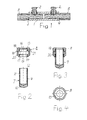
- Fig. 1 is an existing example of a tinned aluminum alloy, designed as a pipe piece terminal 1 shown. It has two threaded holes, in each of which an externally threaded screw 2 is arranged.
- electrical conductors 3 and 4 of two electrical cables 5 and 6, which are in particular energy cables. They are fixed in the mounting position by the screws 2 in the terminal 1 and thereby electrically conductively connected to each other.
- the electrical conductors 3 and 4 are designed in a preferred embodiment as a stranded conductor. They are preferably made of aluminum or copper.
- the conductors 3 and 4 may also be constructed of segments in which individual wires are combined.
- the screw 2 consists of two parts to be screwed together, a contact part 7 and an actuating part 8.
- the contact part 7 is designed as a cylindrical hollow body with an external thread 9. It has an intended for contact with an electrical conductor 3 or 4 contact surface 10.
- a circumferential predetermined breaking point 11 is attached, whose position is arbitrary in itself. It only needs to have a clear distance from the constructional surface 10 on the one hand and also from its end face 12 remote from the contact surface 10 on the other hand, so that the actuating part 8 can be screwed onto the contact part 7.
- the actuating part 8 is designed as a cap with a transverse to its axial direction bottom portion 13.
- the bottom portion 13 may be made closed. He can according to the representation in the Fig. 2 and 4 but also be designed as a circumferential, a central through hole releasing collar.
- the collar may also be interrupted at least once in the circumferential direction.
- the actuating member 8 has an external thread 9 of the contact part 7 matching internal thread 14, which is interrupted in its course by a clear diameter of the operating part 8 enlarging extension 15.
- the extension 15 extends in the axial direction of the operating part 8. It has an upper edge 16 and a lower edge 17.
- a circumferential predetermined breaking point 18 is also attached, which is located at the level of the upper edge 16 of the extension 15 with advantage. Due to the predetermined breaking point 18, the one-piece actuating part 8 is divided into a lying above the same upper part 19 and below the predetermined breaking point 18 lower part 20.
- the operating part 8 can according to Fig. 4 a peripheral surface designed as a polygon, in particular as a hexagon, for engaging a tool suitable for rotating the screw.
- the through hole optionally present in the upper part 19 of the actuating part 8 may also have a polygonal, preferably hexagonal, cross section for insertion of a corresponding tool.
- a preferably circumferential, radially outwardly projecting projection 21 may be attached to the upper part 19 of the Betöt Trent Inc.tells 8, which may serve as a contact surface for the tool.
- the two sheared off parts can be removed so that only the lower part of the contact part 7 and the lower part 20 of the operating part 8 screwed onto it remain ( Fig. 7 ).
- a further rotation of the lower part 20 of the actuating part 8 on the contact part 7 it reaches until it rests against the terminal 1. If it is further rotated in this position by means of the tool with sufficient force, then the protruding from the terminal 1 part of the contact part. 7 tore off ( Fig. 9 ). It can be lifted together with the lower part 20 of the operating part 8 of the terminal 1.
- the wall thickness of the contact part 7 is to be dimensioned as a function of the size of the force to be applied by the tool.
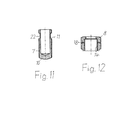
- the contact part 7 can according to Fig. 11 also have an extending in the axial direction, reducing its diameter constriction 22 through which the external thread 9 is interrupted.
- the axial length of the constriction 22 is short in relation to the length of the contact part 7.
- the predetermined breaking point 11 is attached to the contact surface 10 facing the end of the constriction 22.
- Fig. 12 apparent operating part 8 are used, which has a continuous internal thread 14. Again, however, a two-part actuator 8 can be used again.
- the definition of a conductor 3 in a terminal 1 also takes place when using a contact part 7 Fig. 11 in the same way as it is for them on the basis of Fig. 5 to 10 is described.
Landscapes
- Connections Effected By Soldering, Adhesion, Or Permanent Deformation (AREA)
Abstract
Description
- Die Erfindung bezieht sich auf eine Klemmschraube zum Befestigen eines elektrischen Leiters in einer als Rohrstück ausgeführten Klemme aus Metall, welche in ihrer Wandung mindestens ein mit einem Gewinde versehenes Durchgangsloch zur Aufnahme der Klemmschraube hat, die in ihrem Aufbau mindestens eine Sollbruchstelle zur Begrenzung der Kraft aufweist, welche mittels eines an der Klemmschraube angreifenden, eine Drehung um ihre Achse bewirkenden Werkzeugs auf dieselbe ausgeübt wird (
EP 0750723 B1 ). - Eine derartige, auch als "Abreißschraube" bzw. "Abscherschraube" bezeichnete Klemmschraube - im folgenden kurz "Schraube" genannt - wird beispielsweise in der Starkstromtechnik zum Verbinden der elektrischen Leiter zweier Starkstromkabel eingesetzt. Zur Erzielung und Aufrechterhaltung eines elektrisch gut leitenden Kontakts, ist eine feste Verbindung zwischen den Leitern zweier Kabel und einer rohrförmigen Klemme aus Metall erforderlich, in welche die Leiter eingesteckt sind. Eine solche Klemme besteht mit Vorteil aus einer Aluminiumlegierung. Die feste Verbindung könnte durch Verwendung eines sogenannten Drehmomentschlüssels sichergestellt werden, der beim Anziehen der Schraube dann "durchdreht", wenn ein ausreichender Festsitz derselben erreicht ist. So ein Drehmomentschlüssel steht aber auf einer Baustelle oft nicht zur Verfügung. Die Schraube wird daher in der Regel mit einem anderen Werkzeug festgedreht, beispielsweise mit einem einfachen Schraubenschlüssel. Um sicherzustellen und auch um überprüfen zu können, daß die Schraube ausreichend fest angezogen ist, kann sie als Abscherschraube mit mindestens einer Sollbruchstelle ausgerüstet sein, die in ihrem axialen Verlauf als umlaufende Nut angeordnet ist. Der obere Teil der Schraube wird dann abgeschert, wenn die Festigkeit ihrer Sollbruchstelle erreicht ist bzw. überschritten wird. Der danach fehlende Schraubenkopf ist ein Indiz dafür, daß die Schraube ausreichend fest angezogen ist. Die Schraube ragt nach dem Abscheren des Schraubenkopfes nicht oder nur unwesentlich aus der Klemme heraus. Ein über derselben zu montierendes Isolierelement wird daher weder mechanisch beschädigt, noch in seinen Isoliereigenschaften beeinträchtigt. Die Sollbruchstelle unterbricht aber das Gewinde der Schraube, so daß dessen Tragfähigkeit geschwächt wird. Das macht sich um so mehr ungünstig bemerkbar, je mehr derartige Sollbruchstellen bei einer Schraube vorhanden sind. Ein universeller Einsatz solcher Schrauben für Leiter unterschiedlichster Durchmesser ist daher nur mit Einschränkungen möglich. Es ist außerdem oft nicht zu vermeiden, daß Teile der abgescherten Schraube störend aus der Klemme herausragen.
- Die Schraube nach der eingangs erwähnten
EP 0 750 723 B1 weist in ihrem Verlauf mehrere, als umlaufende Nuten ausgebildete Sollbruchstellen auf, die parallel und mit axialem Abstand zueinander im Gewindeteil der Schraube angeordnet sind. Die Schraube ist außerdem mit einem zentralen Sackloch mit polygonalem Querschnitt ausgerüstet, das bis in die Nähe der am nächsten zur Schraubenspitze liegenden Sollbruchstelle liegt. Zur Betätigung der Schraube ist ein Drehkörper vorgesehen, der aus einem zur Einführung in das Sackloch bestimmen Stift mit polygonalem Querschnitt und einer denselben mit Abstand rundum umgebenden Haube besteht, an welcher der Stift befestigt ist und die außen eine Sechskantmutter zum Anlegen eines Werkzeugs aufweist. Für diese bekannte Schraube gilt wegen der größeren Anzahl von Sollbruchstellen der bereits beschriebene Mangel der verminderten Tragfähigkeit in erhöhtem Maße. Außerdem ist auch diese Schraube nur für das Festlegen von Leitern mit vorgegebenen Abmessungen einsetzbar, wenn verhindert werden soll, daß Teile der abgescherten Schraube störend aus der Klemme herausragen. - Der Erfindung liegt die Aufgabe zugrunde, die eingangs geschilderte Schraube so zu gestalten, daß sie ohne Einschränkung ihrer Tragfähigkeit zum Festlegen von in einer Klemme befindlichen Leitern mit beliebigen Abmessungen geeignet ist.
- Diese Aufgabe wird gemäß der Erfindung dadurch gelöst,
- daß die Klemmschraube ein rohrförmiges, mit einem Außengewinde versehenes und in das Durchgangsloch der Klemme einschraubbares Kontaktteil aufweist, das an seinem einen axialen Ende eine zur Anlage an einem in der Klemme befindlichen elektrischen Leiter bestimmte Kontaktfläche und in seinem Verlauf mit deutlichem Abstand zu dieser Kontaktfläche eine umlaufende Sollbruchstelle hat,
- daß die Klemmschraube außerdem ein aus einem Oberteil und einem Unterteil bestehendes, auf das Kontaktteil aufschraubbares, mit einem Innengewinde und einer Anlagefläche für das Werkzeug ausgerüstetes Betätigungsteil aufweist, bei dem das Oberteil als Kappe mit einem quer zu ihrer Achsrichtung verlaufenden Bodenbereich ausgeführt ist,
- daß das Betätigungsteil in Montageposition derart auf das Kontaktteil aufgeschraubt ist, daß dessen der Kontaktfläche abgewandte Stirnseite am Bodenbereich des Oberteils des Betätigungsteils anliegt und
- daß das Kontaktteil eine definierte Wandstärke hat, die nach Erreichen des Festsitzes der Klemmschraube in der Klemme durch ihre Drehung mittels des Werkzeugs und dadurch bedingtem Abscheren des oberhalb der Sollbruchstelle liegenden Teils des Kontaktteils sowie des Oberteils des Betätigungsteils zum Abreißen des aus der Klemme herausragenden Bereichs des Kontaktteils durch das mittels des Werkzeugs gedrehte Unterteil des Betätigungsteils führt.
- Wesentlicher Teil dieser Schraube ist das Kontaktteil, welches die eigentlich Schraube zum Festlegen eines Leiters in einer Klemme ist, während das Betätigungsteil nur als Hilfsmittel anzusehen ist, mit dem das Kontaktteil in seine Endposition gebracht wird, in welcher ein Leiter in einer Klemme festgelegt ist. Das Kontaktteil hat nur eine der Abscherung dienende Sollbruchstelle, deren Position im Verlauf des Kontaktteils nahezu beliebig und insbesondere vom Durchmesser eines in einer Klemme festzulegenden Leiters unabhängig ist. Die Sollbruchstelle muß nur weit genug von der Kontaktfläche des Kontaktteils entfernt sein, damit nach dem Abscheren des oberen Teils desselben eine ausreichende Länge verbleibt, auf welcher das Unterteil des Betätigungsteils gedreht werden kann. Das Kontaktteil wird mittels eines am Oberteil des aufgeschraubten Betätigungsteils angreifenden Werkzeugs kontinuierlich solange im Gewindeloch einer Klemme gedreht, bis seine Kontaktfläche an einem in der Klemme befindlichen, einen beliebigen Durchmesser aufweisenden Leiter anliegt und mit vorgegebener Kraft gegen denselben gepreßt wird. Sobald der gewünschte Festsitz des Kontaktteils bzw. der Schraube erreicht ist, wird der obere Teil des Kontaktteils abgeschert. Es ist dabei grundsätzlich ohne Bedeutung, wie lang der verbleibende Teil des Kontaktteils ist und wie weit derselbe aus der Klemme herausragt, solange das Unterteil des Betätigungsteils drehbar auf demselben verbleiben kann. Dieser Teil des Kontaktteils wird abschließend durch das Unterteil des Betätigungsteils abgerissen, sobald derselbe auf der Klemme aufliegt und mittels des Werkzeugs weitergedreht wird.
- In bevorzugter Ausführungsform ist das Betätigungsteil einteilig ausgeführt, mit einer zwischen dem Oberteil und dem Unterteil liegenden, umlaufenden Sollbruchstelle. Es kann aber auch von vornherein aus zwei getrennt voneinander auf das Kontaktteil aufzuschraubenden Teilen bestehen, von denen eines wieder ein Oberteil und das andere ein Unterteil ist.
- Ein Ausführungsbeispiel des Erfindungsgegenstandes ist in den Zeichnungen dargestellt.
- Es zeigen:
-
Fig. 1 schematisch eine Verbindungsstelle zwischen den Leitern zweier elektrischer Kabel im Schnitt. -
Fig. 2 die beiden Teile einer Klemmschraube nach der Erfindung voneinander getrennt. -
Fig. 3 die Klemmschraube mit zusammengefügten Teilen. -
Fig. 4 eine Draufsicht auf das Betätigungsteil der Klemmschraube. -
Fig. 5 bis 10 unterschiedliche Positionen der Klemmschraube bei ihrer Betätigung. -
Fig. 11 ein gegenüber der in denFig. 1 bis 10 beschriebenen Ausführungsform geänderte Ausführungsform des Kontaktteils. -
Fig. 12 ein zum Kontaktteil nachFig. 11 passendes Betätigungsteil. - Im folgenden wird weiter statt des Wortes "Klemmschraube" das kürzere Wort "Schraube" verwendet. Das Kontaktteil der Schraube besteht aus einem ausreichend festen, vorzugsweise elektrisch gut leitenden Metall, beispielsweise aus Messing oder einer Aluminiumlegierung. Das Betätigungsteil der Schraube kann beispielsweise aus Stahl bestehen. Es wird außerdem die einteilige Ausführungsform des Befestigungsteils berücksichtigt, stellvertretend auch für die weiter oben erwähnte zweiteilige Ausführungsform.
- In
Fig. 1 ist eine beispielsweise aus einer verzinnten Aluminiumlegierung bestehende, als Rohrstück ausgeführte Klemme 1 dargestellt. Sie hat zwei Gewindebohrungen, in denen jeweils eine mit einem Außengewinde versehene Schraube 2 angeordnet ist. In die Klemme 1 ragen von zwei unterschiedlichen Seiten her elektrischen Leiter 3 und 4 zweier elektrischer Kabel 5 und 6 hinein, bei denen es sich insbesondere um Energiekabel handelt. Sie sind in Montageposition durch die Schrauben 2 in der Klemme 1 festgelegt und dadurch elektrisch leitend miteinander verbunden. Die elektrischen Leiter 3 und 4 sind in bevorzugter Ausführungsform als mehrdrähtige Leiter ausgeführt. Sie bestehen vorzugsweise aus Aluminium oder Kupfer. Die Leiter 3 und 4 können auch aus Segmenten aufgebaut sein, in denen jeweils Einzeldrähte zusammengefaßt sind. - Die Schraube 2 besteht aus zwei miteinander zu verschraubenden Teilen, einem Kontaktteil 7 und einem Betätigungsteil 8. Das Kontaktteil 7 ist als zylindrischer Hohlkörper mit einem Außengewinde 9 ausgeführt. Es hat eine zur Anlage an einem elektrischen Leiter 3 bzw. 4 bestimmte Kontaktfläche 10. Im Verlauf des Kontaktteils 7 ist eine umlaufende Sollbruchstelle 11 angebracht, deren Position an sich beliebig ist. Sie muß nur einen deutlichen Abstand von der Konfaktfläche 10 einerseits sowie auch von ihrer der Kontaktfläche 10 abgewandten Stirnseite 12 andererseits haben, damit das Betätigungsteil 8 auf das Kontaktteil 7 aufgeschraubt werden kann.
- Das Betätigungsteil 8 ist als Kappe mit einem quer zu seiner Achsrichtung verlaufenden Bodenbereich 13 ausgeführt. Der Bodenbereich 13 kann geschlossen ausgeführt sein. Er kann gemäß der Darstellung in den
Fig. 2 und 4 aber auch als umlaufender, ein zentrales Durchgangsloch freilassender Kragen ausgebildet sein. Der Kragen kann außerdem in Umfangsrichtung mindestens einmal unterbrochen sein. Das Betätigungsteil 8 hat ein zum Außengewinde 9 des Kontaktteils 7 passendes Innengewinde 14, das in seinem Verlauf durch eine den lichten Durchmesser des Betätigungsteils 8 vergrößernde Erweiterung 15 unterbrochen ist. Die Erweiterung 15 erstreckt sich in Achsrichtung des Betätigungsteils 8. Sie hat eine Oberkante 16 und eine Unterkante 17. Im Betätigungsteil 8 ist außerdem eine umlaufende Sollbruchstelle 18 angebracht, die mit Vorteil in Höhe der Oberkante 16 der Erweiterung 15 liegt. Durch die Sollbruchstelle 18 ist das einteilige Betätigungsteil 8 in ein oberhalb derselben liegendes Oberteil 19 und ein unterhalb der Sollbruchstelle 18 liegendes Unterteil 20 aufgeteilt. - Das Betätigungsteil 8 kann gemäß
Fig. 4 eine als Polygon, insbesondere als Sechseck, ausgeführte Umfangsfläche zur Anlage eines zum Drehen der Schraube geeigneten Werkzeugs aufweisen. Das gegebenenfalls im Oberteil 19 des Betätigungsteils 8 vorhandene Durchgangsloch kann aber auch einen polygonalen, vorzugsweise sechseckigen, Querschnitt zum Einsetzen eines entsprechenden Werkzeugs aufweisen. Oberhalb der Sollbruchstelle 18 kann ein vorzugsweise umlaufender, radial nach außen abstehender Vorsprung 21 am Oberteil 19 des Betötigungstells 8 angebracht sein, der als Anlagefläche für das Werkzeug dienen kann. - Die Schraube 2 geht im Montagezustand aus
Fig. 3 hervor. Das Betätigungsteil 8 ist dabei so weit auf das Kontaktteil 7 aufgeschraubt, daß die Stirnseite 12 des Kontaktteils 7 am Bodenbereich 13 des Betätigungsteils 8 anliegt. Die Sollbruchstelle 11 des Kontaktteils 7 liegt dabei im Bereich der Erweiterung 15 des Betätigungsteils 8. Die so fertiggestellte Schraube 2 wird entsprechend denFig. 5 bis 10 beispielsweise wie folgt zum Befestigen eines elektrischen Leiters 3 in einer Klemme 1 gehandhabt: - Zunächst wird die gemäß
Fig. 3 zusammengebaute Schraube 2 in ein Gewindeloch der Klemme 1 eingeschraubt, bis sie die ausFig. 5 ersichtliche Position hat. Sie kann dann von Hand oder bereits mittels eines Werkzeugs - einem handelsüblichen Schraubenschlüssel - bis zur Anlage am Leiter 3 gebracht werden. Beim weiteren Drehen der Schraube 2 mittels des Werkzeugs wird der Leiter 3 zusammengedrückt (Fig. 6 ). Wenn die für den Festsitz der Schraube 2 in der Klemme 1 erforderliche Anpreßkraft bei ihrem weiteren Anziehen erreicht ist oder überschritten wird, wird das Kontaktteil 7 an der Sollbruchstelle 11 abgeschert. Gleichzeitig wird das auf dem Kontaktteil 7 befindliche Oberteil 19 des Betätigungsteils 8 abgeschert (Fig. 6 ). - Die beiden abgescherten Teile können entfernt werden, so daß nur noch der untere Teil des Kontaktteils 7 und das auf denselben aufgeschraubte Unterteil 20 des Betätigungsteils 8 verbleiben (
Fig. 7 ). Bei einer weiteren Drehung des Unterteils 20 des Betätigungsteils 8 auf dem Kontaktteil 7, gelangt es bis zur Anlage an der Klemme 1. Wird es in dieser Position mittels des Werkzeugs mit ausreichender Kraft weitergedreht, dann wird der aus der Klemme 1 herausragende Teil des Kontaktteils 7 abgerissen (Fig. 9 ). Er kann zusammen mit dem Unterteil 20 des Betätigungsteils 8 von der Klemme 1 abgehoben werden. - Damit der aus der Klemme 1 herausragende Teil des Kontaktteils 7 im geschilderten Sinne abgetrennt bzw. abgerissen werden kann, muß seine Wandstärke entsprechend bemessen sein. Sie muß nur groß genug sein, damit das Kontaktteil 7 die für den Festsitz der Schraube 2 auf dem Leiter 3 erforderliche Kraft überfragen kann. Eine größere Wandstärke ist nicht erforderlich. In diesem Sinne ist die Wandstärke des Kontaktteils 7 in Abhängigkeit von der Größe der durch das Werkzeug aufzubringenden Kraft zu bemessen. Die abschließende Position des festlegenden Teils des Kontaktteils 7 bzw. der Schraube 2 geht aus
Fig. 10 hervor. - Das Kontaktteil 7 kann gemäß
Fig. 11 auch eine sich in axialer Richtung erstreckende, seinen Durchmesser verringernde Einengung 22 aufweisen, durch welche das Außengewinde 9 unterbrochen ist. Die axiale Länge der Einengung 22 ist kurz im Verhältnis zur Länge des Kontaktteils 7. Die Sollbruchstelle 11 ist an dem der Kontaktfläche 10 zugewandten Ende der Einengung 22 angebracht. - Zum Festlegen des Kontaktteils 7 in einer Klemme 1, so wie es anhand der
Fig. 5 bis 10 beschrieben ist, kann ein ausFig. 12 ersichtliches Betätigungsteil 8 eingesetzt werden, das ein durchgehendes Innengewinde 14 hat. Auch hier kann aber wieder ein zweiteiliges Betätigungsteil 8 eingesetzt werden. Die Festlegung eines Leiters 3 in einer Klemme 1 erfolgt auch beim Einsatz eines Kontaktteils 7 nachFig. 11 in gleicher Weise, wie es für sie anhand derFig. 5 bis 10 beschrieben ist.
Claims (8)
- Klemmschraube zum Befestigen eines elektrischen Leiters in einer als Rohrstück ausgeführten Klemme aus Metall, welche in ihrer Wandung mindestens ein mit einem Gewinde versehenes Durchgangsloch zur Aufnahme der Klemmschraube hat, die in ihrem Aufbau mindestens eine Sollbruchstelle zur Begrenzung der Kraft aufweist, welche mittels eines an der Klemmschraube angreifenden, eine Drehung um ihre Achse bewirkenden Werkzeugs auf dieselbe ausgeübt wird, dadurch gekennzeichnet,- daß die Klemmschraube ein rohrförmiges, mit einem Außengewinde (9) versehenes und in das Durchgangsloch der Klemme (1) einschraubbares Kontaktteil (7) aufweist, das an seinem einen axialen Ende eine zur Anlage an einem in der Klemme befindlichen elektrischen Leiter (3,4) bestimmte Kontaktfläche (10) und in seinem Verlauf mit deutlichem Abstand zu dieser Kontaktfläche eine umlaufende Sollbruchstelle (11) hat,- daß die Klemmschraube außerdem ein aus einem Oberteil (19) und einem Unterteil (20) bestehendes, auf das Kontaktteil (7) aufschraubbares, mit einem Innengewinde (14) und einer Anlagefläche für das Werkzeug ausgerüstetes Betätigungsteil (8) aufweist, bei dem das Oberteil (19) als Kappe mit einem quer zu ihrer Achsrichtung verlaufenden Bodenbereich (13) ausgeführt ist,- daß das Betätigungsteil (8) in Montageposition derart auf das Kontaktteil (7) aufgeschraubt ist, daß dessen der Kontaktfläche (10) abgewandte Stirnseite (12) am Bodenbereich (13) des Oberteils (19) des Betätigungsteils (8) anliegt, und- daß das Kontaktteil (7) eine definierte Wandstärke hat, die nach Erreichen des Festsitzes der Klemmschraube in der Klemme durch ihre Drehung mittels des Werkzeugs und dadurch bedingtem Abscheren des oberhalb der Sollbruchstelle liegenden Teils des Kontaktteils (7) sowie des Oberteils (19) des Betätigungsteils (8) zum Abreißen des aus der Klemme (1) herausragenden Bereichs des Kontaktteils durch das mittels des Werkzeugs gedrehte Unterteil (20) des Betätigungsteils führt.
- Klemmschraube nach Anspruch 1, dadurch gekennzeichnet, daß Oberteil (19) und Unterteil (20) des Betätigungsteils (8) zu einer einteiligen Einheit zusammengefaßt sind, mit einer zwischen den beiden Teilen liegenden, umlaufenden Sollbruchstelle (18).
- Klemmschraube nach Anspruch 2, dadurch gekennzeichnet, daß das Innengewinde (14) des einteiligen Betätigungsteils (8) etwa im mittleren Bereich desselben durch eine den lichten Durchmesser des Betätigungsteils (8) vergrößernde, sich in axialer Richtung desselben zwischen einer Oberkante (16) und einer Unterkante (17) erstreckende Erweiterung (15) unterbrochen ist.
- Klemmschraube nach Anspruch 3, dadurch gekennzeichnet, daß die Sollbruchstelle (18) des einteiligen Betätigungsteils (8) etwa in Höhe der Oberkante (16) der Erweiterung liegt.
- Klemmschraube nach Anspruch 3 oder 4, dadurch gekennzeichnet, daß die Sollbruchstelle (11) des Kontaktteils (7) in Montageposition in Höhe der Erweiterung (15) des Betätigungsteils (8) liegt.
- Klemmschraube nach einem der Ansprüche 2 bis 5, dadurch gekennzeichnet, daß am Betätigungsteil (8) oberhalb der Sollbruchstelle (18) desselben ein radial nach außen abstehender, umlaufender Vorsprung (21) angebracht ist.
- Klemmschraube nach einem der Ansprüche 1 bis 6, dadurch gekennzeichnet, daß der Bodenbereich (13) des Oberteils (19) des Betätigungsteils (8) als ein zentrales Durchgangsloch freilassender, umlaufender Kragen ausgeführt ist.
- Klemmschraube nach Anspruch 1, dadurch gekennzeichnet, daß das Außengewinde (9) des Kontaktteils (7) durch eine den Durchmesser desselben verringernde, sich über eine im Verhältnis zur Lage des Kontaktteils (7) kurze Länge in axialer Richtung erstreckende Einengung (22) unterbrochen ist, an deren der Kontaktfläche (10) zugewandtem Ende die Sollbruchstelle (11) liegt.
Priority Applications (6)
| Application Number | Priority Date | Filing Date | Title |
|---|---|---|---|
| EP11305125.4A EP2487755B1 (de) | 2011-02-08 | 2011-02-08 | Klemmschraube |
| PL11305125T PL2487755T3 (pl) | 2011-02-08 | 2011-02-08 | Śruba zaciskowa |
| AU2012200645A AU2012200645A1 (en) | 2011-02-08 | 2012-02-03 | Arrangement with a Clamp of Metal Constructed as a Pipe Piece |
| BR102012002802A BR102012002802A2 (pt) | 2011-02-08 | 2012-02-07 | disposiÇço com um grampo de metal conformado como segmento tubular |
| RU2012104230/07A RU2495519C1 (ru) | 2011-02-08 | 2012-02-07 | Система с выполненной в виде отрезка трубы клеммой из металла |
| CN201210027588.0A CN102637966B (zh) | 2011-02-08 | 2012-02-08 | 具有设计为管件的金属接线夹的装置 |
Applications Claiming Priority (1)
| Application Number | Priority Date | Filing Date | Title |
|---|---|---|---|
| EP11305125.4A EP2487755B1 (de) | 2011-02-08 | 2011-02-08 | Klemmschraube |
Publications (2)
| Publication Number | Publication Date |
|---|---|
| EP2487755A1 true EP2487755A1 (de) | 2012-08-15 |
| EP2487755B1 EP2487755B1 (de) | 2013-09-18 |
Family
ID=43837968
Family Applications (1)
| Application Number | Title | Priority Date | Filing Date |
|---|---|---|---|
| EP11305125.4A Not-in-force EP2487755B1 (de) | 2011-02-08 | 2011-02-08 | Klemmschraube |
Country Status (2)
| Country | Link |
|---|---|
| EP (1) | EP2487755B1 (de) |
| PL (1) | PL2487755T3 (de) |
Cited By (3)
| Publication number | Priority date | Publication date | Assignee | Title |
|---|---|---|---|---|
| CN105449390A (zh) * | 2015-12-16 | 2016-03-30 | 国网浙江省电力公司湖州供电公司 | 一种低压抢修用抗拉力线夹 |
| US20210310511A1 (en) * | 2020-04-01 | 2021-10-07 | Hubbell Incorporated | Breakaway threaded fasteners and electrical connectors having such fasteners |
| US12546357B2 (en) | 2022-04-07 | 2026-02-10 | Hubbell Incorporated | Breakaway threaded fasteners |
Citations (4)
| Publication number | Priority date | Publication date | Assignee | Title |
|---|---|---|---|---|
| GB2295871A (en) * | 1994-03-15 | 1996-06-12 | Sicame Electrical Dev Ltd | Screw shank for clamping |
| EP1626187A1 (de) * | 2004-08-11 | 2006-02-15 | Pfisterer Kontaktsysteme GmbH & Co. KG | Befestigungsmittel, insbesondere Abreissschraube, zugehöriges System und Verfahren zum Eindrehen des Befestigungsmittels |
| EP2071201A1 (de) * | 2007-12-11 | 2009-06-17 | Nexans | Abscherschraube |
| EP2148392A1 (de) * | 2008-07-25 | 2010-01-27 | Nexans | Klemmschraube |
-
2011
- 2011-02-08 PL PL11305125T patent/PL2487755T3/pl unknown
- 2011-02-08 EP EP11305125.4A patent/EP2487755B1/de not_active Not-in-force
Patent Citations (4)
| Publication number | Priority date | Publication date | Assignee | Title |
|---|---|---|---|---|
| GB2295871A (en) * | 1994-03-15 | 1996-06-12 | Sicame Electrical Dev Ltd | Screw shank for clamping |
| EP1626187A1 (de) * | 2004-08-11 | 2006-02-15 | Pfisterer Kontaktsysteme GmbH & Co. KG | Befestigungsmittel, insbesondere Abreissschraube, zugehöriges System und Verfahren zum Eindrehen des Befestigungsmittels |
| EP2071201A1 (de) * | 2007-12-11 | 2009-06-17 | Nexans | Abscherschraube |
| EP2148392A1 (de) * | 2008-07-25 | 2010-01-27 | Nexans | Klemmschraube |
Cited By (5)
| Publication number | Priority date | Publication date | Assignee | Title |
|---|---|---|---|---|
| CN105449390A (zh) * | 2015-12-16 | 2016-03-30 | 国网浙江省电力公司湖州供电公司 | 一种低压抢修用抗拉力线夹 |
| US20210310511A1 (en) * | 2020-04-01 | 2021-10-07 | Hubbell Incorporated | Breakaway threaded fasteners and electrical connectors having such fasteners |
| US11953043B2 (en) * | 2020-04-01 | 2024-04-09 | Hubbell Incorporated | Breakaway threaded fasteners and electrical connectors having such fasteners |
| US12546356B2 (en) | 2020-04-01 | 2026-02-10 | Hubbell Incorporated | Breakaway threaded fasteners and electrical connectors having such fasteners |
| US12546357B2 (en) | 2022-04-07 | 2026-02-10 | Hubbell Incorporated | Breakaway threaded fasteners |
Also Published As
| Publication number | Publication date |
|---|---|
| PL2487755T3 (pl) | 2014-02-28 |
| EP2487755B1 (de) | 2013-09-18 |
Similar Documents
| Publication | Publication Date | Title |
|---|---|---|
| EP2071201B1 (de) | Abscherschraube | |
| EP2828932B1 (de) | Verdrehsicherer elektrischer anschluss, insbesondere für einen elektrisch beheizbaren wabenkörper | |
| EP0692643B1 (de) | Abreissschraube | |
| DE102010046410B3 (de) | Elektrischer Steckverbinder mit einer Überwurfmutter | |
| DE4323434C1 (de) | Abscherschraube | |
| EP2498338B1 (de) | Anordnung mit einer als Rohrstück ausgeführten Klemme aus Metall und mindestens einer Klemmschraube | |
| EP2657548A2 (de) | Abreißschraube | |
| WO2010097309A1 (de) | Vorrichtung zum verbinden von zwei elektrischen leitern | |
| DE4113242C2 (de) | Abscherschraube | |
| EP2148392A1 (de) | Klemmschraube | |
| DE102015102223A1 (de) | Befestigungsmittel für Verbindungselemente für elektrische Leiter und Verbindungselement mit einem solchen Befestigungsmittel | |
| EP2381534B1 (de) | Klemmschraube | |
| EP2487755B1 (de) | Klemmschraube | |
| EP2381535B1 (de) | Anordnung zum Befestigen eines elektrischen Leiters in einer Klemme | |
| EP4304900A1 (de) | Elektrische verbindung für kraftfahrzeugleitung | |
| EP2498339B1 (de) | Anordnung mit einer Klemme und mindestens eine Klemmschraube | |
| DE102015102224B4 (de) | Befestigungsmittel für Verbindungselemente für elektrische Leiter und Verbindungselement mit einem solchen Befestigungsmittel | |
| DE102018130746A1 (de) | Stromleiterbrücke und Verfahren zum Ausbilden einer Stromleiterbrücke | |
| WO2026033051A1 (de) | Vorrichtung und verfahren zum ausüben einer kraft auf einen zielbereich eines elektrischen leiters, sowie verbindungssystem | |
| EP2322816A1 (de) | Klemmschraube | |
| EP3333982B1 (de) | Anschlussadapter zum verbinden eines elektrischen gerätes sowie system und elektrische anlage | |
| EP2940803B1 (de) | Verbinder für elektrische Energiekabel | |
| EP0514924B1 (de) | Kontaktschraube | |
| EP3551403B1 (de) | Austrennwerkzeug | |
| EP2088645B1 (de) | Befestigungssystem |
Legal Events
| Date | Code | Title | Description |
|---|---|---|---|
| PUAI | Public reference made under article 153(3) epc to a published international application that has entered the european phase |
Free format text: ORIGINAL CODE: 0009012 |
|
| 17P | Request for examination filed |
Effective date: 20110825 |
|
| AK | Designated contracting states |
Kind code of ref document: A1 Designated state(s): AL AT BE BG CH CY CZ DE DK EE ES FI FR GB GR HR HU IE IS IT LI LT LU LV MC MK MT NL NO PL PT RO RS SE SI SK SM TR |
|
| AX | Request for extension of the european patent |
Extension state: BA ME |
|
| GRAP | Despatch of communication of intention to grant a patent |
Free format text: ORIGINAL CODE: EPIDOSNIGR1 |
|
| INTG | Intention to grant announced |
Effective date: 20130503 |
|
| GRAS | Grant fee paid |
Free format text: ORIGINAL CODE: EPIDOSNIGR3 |
|
| GRAA | (expected) grant |
Free format text: ORIGINAL CODE: 0009210 |
|
| AK | Designated contracting states |
Kind code of ref document: B1 Designated state(s): AL AT BE BG CH CY CZ DE DK EE ES FI FR GB GR HR HU IE IS IT LI LT LU LV MC MK MT NL NO PL PT RO RS SE SI SK SM TR |
|
| REG | Reference to a national code |
Ref country code: GB Ref legal event code: FG4D Free format text: NOT ENGLISH |
|
| REG | Reference to a national code |
Ref country code: CH Ref legal event code: EP |
|
| REG | Reference to a national code |
Ref country code: IE Ref legal event code: FG4D Free format text: LANGUAGE OF EP DOCUMENT: GERMAN |
|
| REG | Reference to a national code |
Ref country code: AT Ref legal event code: REF Ref document number: 633204 Country of ref document: AT Kind code of ref document: T Effective date: 20131015 |
|
| REG | Reference to a national code |
Ref country code: DE Ref legal event code: R096 Ref document number: 502011001366 Country of ref document: DE Effective date: 20131107 |
|
| REG | Reference to a national code |
Ref country code: SE Ref legal event code: TRGR |
|
| PG25 | Lapsed in a contracting state [announced via postgrant information from national office to epo] |
Ref country code: NO Free format text: LAPSE BECAUSE OF FAILURE TO SUBMIT A TRANSLATION OF THE DESCRIPTION OR TO PAY THE FEE WITHIN THE PRESCRIBED TIME-LIMIT Effective date: 20131218 Ref country code: CY Free format text: LAPSE BECAUSE OF FAILURE TO SUBMIT A TRANSLATION OF THE DESCRIPTION OR TO PAY THE FEE WITHIN THE PRESCRIBED TIME-LIMIT Effective date: 20130911 Ref country code: HR Free format text: LAPSE BECAUSE OF FAILURE TO SUBMIT A TRANSLATION OF THE DESCRIPTION OR TO PAY THE FEE WITHIN THE PRESCRIBED TIME-LIMIT Effective date: 20130918 Ref country code: LT Free format text: LAPSE BECAUSE OF FAILURE TO SUBMIT A TRANSLATION OF THE DESCRIPTION OR TO PAY THE FEE WITHIN THE PRESCRIBED TIME-LIMIT Effective date: 20130918 |
|
| REG | Reference to a national code |
Ref country code: NL Ref legal event code: VDEP Effective date: 20130918 |
|
| REG | Reference to a national code |
Ref country code: LT Ref legal event code: MG4D |
|
| PG25 | Lapsed in a contracting state [announced via postgrant information from national office to epo] |
Ref country code: SI Free format text: LAPSE BECAUSE OF FAILURE TO SUBMIT A TRANSLATION OF THE DESCRIPTION OR TO PAY THE FEE WITHIN THE PRESCRIBED TIME-LIMIT Effective date: 20130918 Ref country code: FI Free format text: LAPSE BECAUSE OF FAILURE TO SUBMIT A TRANSLATION OF THE DESCRIPTION OR TO PAY THE FEE WITHIN THE PRESCRIBED TIME-LIMIT Effective date: 20130918 Ref country code: RS Free format text: LAPSE BECAUSE OF FAILURE TO SUBMIT A TRANSLATION OF THE DESCRIPTION OR TO PAY THE FEE WITHIN THE PRESCRIBED TIME-LIMIT Effective date: 20130918 Ref country code: LV Free format text: LAPSE BECAUSE OF FAILURE TO SUBMIT A TRANSLATION OF THE DESCRIPTION OR TO PAY THE FEE WITHIN THE PRESCRIBED TIME-LIMIT Effective date: 20130918 Ref country code: GR Free format text: LAPSE BECAUSE OF FAILURE TO SUBMIT A TRANSLATION OF THE DESCRIPTION OR TO PAY THE FEE WITHIN THE PRESCRIBED TIME-LIMIT Effective date: 20131219 |
|
| REG | Reference to a national code |
Ref country code: PL Ref legal event code: T3 |
|
| PG25 | Lapsed in a contracting state [announced via postgrant information from national office to epo] |
Ref country code: CY Free format text: LAPSE BECAUSE OF FAILURE TO SUBMIT A TRANSLATION OF THE DESCRIPTION OR TO PAY THE FEE WITHIN THE PRESCRIBED TIME-LIMIT Effective date: 20130918 |
|
| PG25 | Lapsed in a contracting state [announced via postgrant information from national office to epo] |
Ref country code: EE Free format text: LAPSE BECAUSE OF FAILURE TO SUBMIT A TRANSLATION OF THE DESCRIPTION OR TO PAY THE FEE WITHIN THE PRESCRIBED TIME-LIMIT Effective date: 20130918 Ref country code: NL Free format text: LAPSE BECAUSE OF FAILURE TO SUBMIT A TRANSLATION OF THE DESCRIPTION OR TO PAY THE FEE WITHIN THE PRESCRIBED TIME-LIMIT Effective date: 20130918 Ref country code: SK Free format text: LAPSE BECAUSE OF FAILURE TO SUBMIT A TRANSLATION OF THE DESCRIPTION OR TO PAY THE FEE WITHIN THE PRESCRIBED TIME-LIMIT Effective date: 20130918 Ref country code: IS Free format text: LAPSE BECAUSE OF FAILURE TO SUBMIT A TRANSLATION OF THE DESCRIPTION OR TO PAY THE FEE WITHIN THE PRESCRIBED TIME-LIMIT Effective date: 20140118 Ref country code: CZ Free format text: LAPSE BECAUSE OF FAILURE TO SUBMIT A TRANSLATION OF THE DESCRIPTION OR TO PAY THE FEE WITHIN THE PRESCRIBED TIME-LIMIT Effective date: 20130918 |
|
| PGFP | Annual fee paid to national office [announced via postgrant information from national office to epo] |
Ref country code: SE Payment date: 20140218 Year of fee payment: 4 |
|
| PG25 | Lapsed in a contracting state [announced via postgrant information from national office to epo] |
Ref country code: ES Free format text: LAPSE BECAUSE OF FAILURE TO SUBMIT A TRANSLATION OF THE DESCRIPTION OR TO PAY THE FEE WITHIN THE PRESCRIBED TIME-LIMIT Effective date: 20130918 |
|
| REG | Reference to a national code |
Ref country code: DE Ref legal event code: R097 Ref document number: 502011001366 Country of ref document: DE |
|
| PG25 | Lapsed in a contracting state [announced via postgrant information from national office to epo] |
Ref country code: PT Free format text: LAPSE BECAUSE OF FAILURE TO SUBMIT A TRANSLATION OF THE DESCRIPTION OR TO PAY THE FEE WITHIN THE PRESCRIBED TIME-LIMIT Effective date: 20140120 |
|
| PLBE | No opposition filed within time limit |
Free format text: ORIGINAL CODE: 0009261 |
|
| STAA | Information on the status of an ep patent application or granted ep patent |
Free format text: STATUS: NO OPPOSITION FILED WITHIN TIME LIMIT |
|
| 26N | No opposition filed |
Effective date: 20140619 |
|
| BERE | Be: lapsed |
Owner name: NEXANS Effective date: 20140228 |
|
| PG25 | Lapsed in a contracting state [announced via postgrant information from national office to epo] |
Ref country code: LU Free format text: LAPSE BECAUSE OF FAILURE TO SUBMIT A TRANSLATION OF THE DESCRIPTION OR TO PAY THE FEE WITHIN THE PRESCRIBED TIME-LIMIT Effective date: 20140208 Ref country code: DK Free format text: LAPSE BECAUSE OF FAILURE TO SUBMIT A TRANSLATION OF THE DESCRIPTION OR TO PAY THE FEE WITHIN THE PRESCRIBED TIME-LIMIT Effective date: 20130918 Ref country code: MC Free format text: LAPSE BECAUSE OF FAILURE TO SUBMIT A TRANSLATION OF THE DESCRIPTION OR TO PAY THE FEE WITHIN THE PRESCRIBED TIME-LIMIT Effective date: 20130918 |
|
| REG | Reference to a national code |
Ref country code: CH Ref legal event code: PL |
|
| REG | Reference to a national code |
Ref country code: DE Ref legal event code: R097 Ref document number: 502011001366 Country of ref document: DE Effective date: 20140619 |
|
| PG25 | Lapsed in a contracting state [announced via postgrant information from national office to epo] |
Ref country code: LI Free format text: LAPSE BECAUSE OF NON-PAYMENT OF DUE FEES Effective date: 20140228 Ref country code: CH Free format text: LAPSE BECAUSE OF NON-PAYMENT OF DUE FEES Effective date: 20140228 |
|
| REG | Reference to a national code |
Ref country code: IE Ref legal event code: MM4A |
|
| PG25 | Lapsed in a contracting state [announced via postgrant information from national office to epo] |
Ref country code: IE Free format text: LAPSE BECAUSE OF NON-PAYMENT OF DUE FEES Effective date: 20140208 Ref country code: BE Free format text: LAPSE BECAUSE OF NON-PAYMENT OF DUE FEES Effective date: 20140228 |
|
| REG | Reference to a national code |
Ref country code: SE Ref legal event code: EUG |
|
| GBPC | Gb: european patent ceased through non-payment of renewal fee |
Effective date: 20150208 |
|
| PG25 | Lapsed in a contracting state [announced via postgrant information from national office to epo] |
Ref country code: SE Free format text: LAPSE BECAUSE OF NON-PAYMENT OF DUE FEES Effective date: 20150209 |
|
| PG25 | Lapsed in a contracting state [announced via postgrant information from national office to epo] |
Ref country code: GB Free format text: LAPSE BECAUSE OF NON-PAYMENT OF DUE FEES Effective date: 20150208 |
|
| REG | Reference to a national code |
Ref country code: FR Ref legal event code: PLFP Year of fee payment: 6 |
|
| PG25 | Lapsed in a contracting state [announced via postgrant information from national office to epo] |
Ref country code: MT Free format text: LAPSE BECAUSE OF FAILURE TO SUBMIT A TRANSLATION OF THE DESCRIPTION OR TO PAY THE FEE WITHIN THE PRESCRIBED TIME-LIMIT Effective date: 20130918 |
|
| PG25 | Lapsed in a contracting state [announced via postgrant information from national office to epo] |
Ref country code: SM Free format text: LAPSE BECAUSE OF FAILURE TO SUBMIT A TRANSLATION OF THE DESCRIPTION OR TO PAY THE FEE WITHIN THE PRESCRIBED TIME-LIMIT Effective date: 20130918 |
|
| PGFP | Annual fee paid to national office [announced via postgrant information from national office to epo] |
Ref country code: IT Payment date: 20160223 Year of fee payment: 6 |
|
| PG25 | Lapsed in a contracting state [announced via postgrant information from national office to epo] |
Ref country code: RO Free format text: LAPSE BECAUSE OF FAILURE TO SUBMIT A TRANSLATION OF THE DESCRIPTION OR TO PAY THE FEE WITHIN THE PRESCRIBED TIME-LIMIT Effective date: 20130918 |
|
| PGFP | Annual fee paid to national office [announced via postgrant information from national office to epo] |
Ref country code: FR Payment date: 20160218 Year of fee payment: 6 Ref country code: PL Payment date: 20160122 Year of fee payment: 6 |
|
| PG25 | Lapsed in a contracting state [announced via postgrant information from national office to epo] |
Ref country code: BG Free format text: LAPSE BECAUSE OF FAILURE TO SUBMIT A TRANSLATION OF THE DESCRIPTION OR TO PAY THE FEE WITHIN THE PRESCRIBED TIME-LIMIT Effective date: 20130918 |
|
| PG25 | Lapsed in a contracting state [announced via postgrant information from national office to epo] |
Ref country code: HU Free format text: LAPSE BECAUSE OF FAILURE TO SUBMIT A TRANSLATION OF THE DESCRIPTION OR TO PAY THE FEE WITHIN THE PRESCRIBED TIME-LIMIT; INVALID AB INITIO Effective date: 20110208 Ref country code: TR Free format text: LAPSE BECAUSE OF FAILURE TO SUBMIT A TRANSLATION OF THE DESCRIPTION OR TO PAY THE FEE WITHIN THE PRESCRIBED TIME-LIMIT Effective date: 20130918 |
|
| REG | Reference to a national code |
Ref country code: AT Ref legal event code: MM01 Ref document number: 633204 Country of ref document: AT Kind code of ref document: T Effective date: 20160208 |
|
| PG25 | Lapsed in a contracting state [announced via postgrant information from national office to epo] |
Ref country code: AT Free format text: LAPSE BECAUSE OF NON-PAYMENT OF DUE FEES Effective date: 20160208 |
|
| REG | Reference to a national code |
Ref country code: FR Ref legal event code: ST Effective date: 20171031 |
|
| PG25 | Lapsed in a contracting state [announced via postgrant information from national office to epo] |
Ref country code: FR Free format text: LAPSE BECAUSE OF NON-PAYMENT OF DUE FEES Effective date: 20170228 |
|
| PG25 | Lapsed in a contracting state [announced via postgrant information from national office to epo] |
Ref country code: IT Free format text: LAPSE BECAUSE OF NON-PAYMENT OF DUE FEES Effective date: 20170208 |
|
| PGFP | Annual fee paid to national office [announced via postgrant information from national office to epo] |
Ref country code: DE Payment date: 20180219 Year of fee payment: 8 |
|
| PG25 | Lapsed in a contracting state [announced via postgrant information from national office to epo] |
Ref country code: MK Free format text: LAPSE BECAUSE OF FAILURE TO SUBMIT A TRANSLATION OF THE DESCRIPTION OR TO PAY THE FEE WITHIN THE PRESCRIBED TIME-LIMIT Effective date: 20130918 |
|
| PG25 | Lapsed in a contracting state [announced via postgrant information from national office to epo] |
Ref country code: PL Free format text: LAPSE BECAUSE OF NON-PAYMENT OF DUE FEES Effective date: 20170208 |
|
| PG25 | Lapsed in a contracting state [announced via postgrant information from national office to epo] |
Ref country code: AL Free format text: LAPSE BECAUSE OF FAILURE TO SUBMIT A TRANSLATION OF THE DESCRIPTION OR TO PAY THE FEE WITHIN THE PRESCRIBED TIME-LIMIT Effective date: 20130918 |
|
| REG | Reference to a national code |
Ref country code: DE Ref legal event code: R119 Ref document number: 502011001366 Country of ref document: DE |
|
| PG25 | Lapsed in a contracting state [announced via postgrant information from national office to epo] |
Ref country code: DE Free format text: LAPSE BECAUSE OF NON-PAYMENT OF DUE FEES Effective date: 20190903 |