EP3551403B1 - Austrennwerkzeug - Google Patents
Austrennwerkzeug Download PDFInfo
- Publication number
- EP3551403B1 EP3551403B1 EP17811881.6A EP17811881A EP3551403B1 EP 3551403 B1 EP3551403 B1 EP 3551403B1 EP 17811881 A EP17811881 A EP 17811881A EP 3551403 B1 EP3551403 B1 EP 3551403B1
- Authority
- EP
- European Patent Office
- Prior art keywords
- cut
- tool
- out tool
- housing wall
- removal tool
- Prior art date
- Legal status (The legal status is an assumption and is not a legal conclusion. Google has not performed a legal analysis and makes no representation as to the accuracy of the status listed.)
- Not-in-force
Links
Images




Classifications
-
- B—PERFORMING OPERATIONS; TRANSPORTING
- B26—HAND CUTTING TOOLS; CUTTING; SEVERING
- B26F—PERFORATING; PUNCHING; CUTTING-OUT; STAMPING-OUT; SEVERING BY MEANS OTHER THAN CUTTING
- B26F1/00—Perforating; Punching; Cutting-out; Stamping-out; Apparatus therefor
- B26F1/32—Hand-held perforating or punching apparatus, e.g. awls
-
- B—PERFORMING OPERATIONS; TRANSPORTING
- B26—HAND CUTTING TOOLS; CUTTING; SEVERING
- B26D—CUTTING; DETAILS COMMON TO MACHINES FOR PERFORATING, PUNCHING, CUTTING-OUT, STAMPING-OUT OR SEVERING
- B26D5/00—Arrangements for operating and controlling machines or devices for cutting, cutting-out, stamping-out, punching, perforating, or severing by means other than cutting
- B26D5/08—Means for actuating the cutting member to effect the cut
- B26D5/10—Hand or foot actuated means
-
- B—PERFORMING OPERATIONS; TRANSPORTING
- B26—HAND CUTTING TOOLS; CUTTING; SEVERING
- B26D—CUTTING; DETAILS COMMON TO MACHINES FOR PERFORATING, PUNCHING, CUTTING-OUT, STAMPING-OUT OR SEVERING
- B26D7/00—Details of apparatus for cutting, cutting-out, stamping-out, punching, perforating, or severing by means other than cutting
- B26D7/0006—Means for guiding the cutter
-
- B—PERFORMING OPERATIONS; TRANSPORTING
- B26—HAND CUTTING TOOLS; CUTTING; SEVERING
- B26F—PERFORATING; PUNCHING; CUTTING-OUT; STAMPING-OUT; SEVERING BY MEANS OTHER THAN CUTTING
- B26F1/00—Perforating; Punching; Cutting-out; Stamping-out; Apparatus therefor
- B26F1/38—Cutting-out; Stamping-out
- B26F1/3846—Cutting-out; Stamping-out cutting out discs or the like
Definitions
- the invention relates to a removal tool for removing an opening in a housing wall.
- the starting point for the invention are completely closed electrical empty housings with so-called knock-out areas. These knock-out areas can be knocked out of a prepared housing area with a tool such as a screwdriver.
- the prerequisites for this are a sufficiently small wall thickness and sufficiently brittle housing material properties of the empty electrical housing. Knocking out the knock-out area thus harbors the risk of unwanted damage to the empty electrical housing, the sealing surfaces and fragments remaining inside the housing. Anything can lead to general sealing problems and malfunctions.
- the break edge can have increased sharpness, which can lead to damage to the line insulation when the line is pulled in.
- the freedom of movement for knocking out the knock-out area can be severely restricted, which can result in significant practical problems.
- an improved construction of an anchor dowel which consists primarily of a drill screw rod, an anchor sleeve and a screw nut.
- the pamphlet DE 103 53 617 A1 teaches a method for removing solids from tubes of a shell and tube heat exchanger.
- the object is achieved by a removal tool for removing an opening in a housing wall, with a removal device which is arranged on an end section of the removal tool, and a thread for screwing the removal tool into a threaded connector in or on a housing wall to make an opening in a housing wall.
- the removal tool In order to screw the removal tool into the housing wall in a controlled manner and with appropriate force and to simplify the removal of the opening for a user of the removal tool, the removal tool has an actuation area for driving the removal tool by means of a tool.
- Any manually operable tool such as a screwdriver, as well as a cordless screwdriver or a drill with a corresponding adapter, can be used as a tool.
- the actuation area is designed to be radially or axially drivable from the inside or outside with a socket, ring or open-end wrench, screwdriver, Allen key or a cylindrical pin-like tool. This enables in particular that no special tool has to be available for driving the removal tool. Simple and commonly used tools can therefore be used.
- the actuation area has lateral openings in order to radially surround the removal tool with a rod-shaped tool to drive.
- the technical advantage is achieved that the actuation of the removal tool can additionally be simplified by radially inserting a rod-shaped tool. This could be of particular importance, for example, if the thread of the removal tool is fully screwed into the threaded connector of the housing wall and the removal of the opening involves increased effort or the axial space conditions for the use of frontal drive tools are not available.
- a screwdriver can be inserted into the side opening of the actuation area in order to enable easier removal with a larger lever or, in the case of axially limited space, better screwing in and unscrewing.
- the lateral openings extend completely through the actuation area of the removal tool. As a result, the tool can be guided completely through the removal tool, thus ensuring that the tool does not slip.
- the front-side cutting device is designed as a multiple cutting edge. This increases the service life of the separating device and increases the maintenance intervals.
- the front-side separating device is formed by several penetrating cylinder contours.
- the cutting device In order to implement the production and regrinding of the cutting device in a particularly simple and reliable manner, the cutting device has two cylinder contours which are arranged rotated by 90 ° with respect to one another.
- the cutting device comprises a wave-like contour.
- the removal device comprises a sawtooth-shaped contour.
- the cutting device comprises a punch-iron-like cylinder contour for punching out the opening.
- At least the separating device is made of metal.
- Metal offers particularly suitable properties for the purpose according to the invention.
- a metallic separating device can be produced in a simple manner, but it can also be reground very easily.
- the removal tool is designed in one piece.
- the technical advantage is achieved that a constant or standardized actuation area can be combined with different thread sizes or with different variants of separating devices.
- the actuation area and the removal tool are designed to be connectable by means of a plug connection.
- This connector can be designed in any conceivable way. It is only essential that the necessary torque can be transmitted through the tool to the actuation area and from the actuation area to the cutting device. This enables the cutting device to be exchangeable and exchanged if necessary. Reasons for this can be that different cutting geometries or other cutting sizes have to be used for other housing materials or a worn cutting device has to be replaced with a new cutting device.
- the object is achieved by an assembly device for cutting out an opening in a housing wall, with a removal tool according to one of the preceding embodiments and a housing wall with a threaded connector, the threaded connector having an internal thread which corresponds to the thread of the removal tool .
- the object is achieved by a method for cutting out an opening in a housing wall with a removal tool according to one of the preceding embodiments, with the provision of a threaded connector on a housing wall, the screwing of a removal tool into the threaded connector, and the removal the opening in the housing wall through the cutting device, which is arranged on the frontal section of the cutting tool.
- This results in a damage-free and chip-free production on the housing wall.
- simple operation and easy accessibility are achieved in the case of limited space, with no need to knock out housing areas. As a consequence, the risk of damage to the housing wall is reduced and sealing problems are prevented.
- FIG. 11 shows a perspective illustration of a removal tool 100.
- the removal tool 100 has a removal device 105 at one end of the removal tool 100 and a thread 107.
- the thread 107 is designed to correspond to a threaded connector 110 (not shown) which is formed on a housing wall 103 of an empty electrical housing.
- actuation area 109 for driving the removal tool 100 with a tool.
- This actuation area 109 can, for example, be actuated particularly easily with a socket, ring or open-end wrench.
- the actuation area 109 is formed correspondingly hexagonal.
- an embodiment for actuation by means of an Allen key or a screwdriver is also conceivable.
- the actuation area 109 has lateral openings 111. The lateral openings 111 are located on each side surface of the actuation region 109 formed by the hexagonal basic shape, whereby the driving of the removal tool 100 is possible by means of a simple rod-shaped tool.
- the cutting device 105 on the frontal section of the cutting tool 100 has two penetrating cylinder contours. These cylinder contours are arranged rotated by 90 ° with respect to one another and comprise a wave-like contour.
- the removal tool 100 is formed in one piece and consists of a metal. For cost reasons, steel or a brass alloy is particularly suitable for this.
- the Figure 2a shows a representation of a removal tool 100 with a protective cap 115.
- the removal tool 100 comprises the removal device 105, the thread 107 for screwing the removal tool 100 into a threaded connector 110 of a housing wall 103 and the actuation area 109 with the laterally arranged openings 111.
- the protective cap 115 can be arranged over the separating device 105 on the front side.
- the protective cap 115 comprises a corresponding internal thread which corresponds to the thread 107 of the removal tool 100.
- the protective cap 115 can simply be screwed onto the removal tool 100.
- the Figure 2b shows an illustration of a further removal tool 100 with a protective cap 115.
- the thread 107 and the removal device 105 comprise one opposite the removal tool 100 from FIG Figure 2a different size on, whereby the size of the corresponding protective cap 115 is also adapted.
- the Figure 2c shows a representation of yet another removal tool 100. Compared to Figures 2a and 2b the thread 107, the separating device 105 and the protective cap 115 have a different further size.
- FIGS. 2d to 2f correspond to the Figures 2a to 2c , wherein the respective protective cap 115 is arranged screwed onto the corresponding removal tool 100.
- the Figure 3 shows a schematic representation of a mounting device 101 in a side view.
- the removal tool 100 comprises the removal device 105, the thread 107 and the actuation area 109 with the laterally arranged openings 111.
- the removal tool 100 is located in a housing wall 103 immediately in front of a threaded connector 110, the threaded connector 110 comprising an internal thread 113 which is connected to the The thread 107 of the removal tool 100 corresponds.
- the bottom of the threaded connector 110 is in a closed state, with a cutout 104 being able to be cut out by cutting the cutting device 105 into the housing wall 103.
- the Figure 4 shows a further schematic illustration of a mounting device 101 in a side view.
- the removal tool 100 is in a state screwed into the threaded connector 110 of the housing wall 103.
- the cutting device 105 of the cutting tool 100 has cut out the cutout 104 of the threaded connector 110, as a result of which the opening 102 is formed in the housing wall 103. Due to the securing device 117, the cutout 104 cannot remain in the interior of the housing in an uncontrolled manner or be lost there. Instead, the cutout 104 is secured immediately adjacent to the opening 102 and can remain there or be removed manually.
- the securing device 117 would be, for example, with a thin plastic compound possible. This would completely prevent possible malfunctions of the empty electrical housing and the remaining of fragments inside the housing.
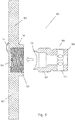
- the Figure 5 shows a perspective view of an assembly device 101.
- the removal tool 100 is screwed into the threaded connector 110 of the housing wall 103, the removal device 105 of the removal tool 100 having cut out the cutout 104 of the threaded connector 110 and thereby forming the opening 102 in the housing wall 103 is.
- the Figure 6a shows another perspective view of a removal tool 100.
- the removal tool 100 comprises the removal device 105, the thread 107 for screwing the removal tool 100 into a threaded connector 110 of a housing wall 103 and the actuation area 109 with the laterally arranged openings 111 Hexagon socket arranged in order to be able to drive the separating device 100 axially, for example with an Allen key.
- the Figure 6b shows yet another perspective illustration of a removal tool 100.
- a square socket is arranged on the front end of the removal tool 100 in order to be able to drive the removal device 100 axially with a square socket wrench.
- the Figure 6c shows yet another perspective view of a cutting tool 100.
- a cross-shaped slot is arranged at the front end of the cutting tool 100 in order to be able to drive the cutting device 100 axially with a screwdriver or a correspondingly held sheet metal strip.
- the Figure 7a shows an end-face representation of a removal tool 100.
- the end face of the removal tool 100 corresponds to the representation with a hexagon socket from FIG Figure 6a .
- the Figure 7b shows a further end-face representation of a removal tool 100.
- the end face of the removal tool 100 corresponds to the representation with an internal square from FIG Figure 6b .
- the Figure 7c shows yet another end-face representation of a removal tool 100.
- the end face of the removal tool 100 corresponds to the representation with a cross-shaped slot in FIG Figure 6c .
Landscapes
- Life Sciences & Earth Sciences (AREA)
- Forests & Forestry (AREA)
- Engineering & Computer Science (AREA)
- Mechanical Engineering (AREA)
- Hand Tools For Fitting Together And Separating, Or Other Hand Tools (AREA)
- Drilling Tools (AREA)
- Portable Nailing Machines And Staplers (AREA)
Description
- Die Erfindung betrifft ein Austrennwerkzeug zum Austrennen einer Öffnung in eine Gehäusewandung.
- Ausgangspunkt für die Erfindung sind vollständig geschlossene Elektro-Leergehäuse mit sogenannten Knock out - Bereichen. Diese Knock out - Bereiche können mit einem Werkzeug, wie beispielsweise einem Schraubendreher, aus einem vorbereiteten Gehäusebereich herausgeschlagen werden. Voraussetzungen hierfür sind eine hinreichend geringe Wandstärke und hinreichend spröde Gehäusewerkstoffeigenschaften des Elektro-Leergehäuses. Das Herausschlagen des Knock out - Bereichs birgt somit das Risiko von ungewollten Beschädigungen des Elektro-Leergehäuses, der Dichtflächen und vom Verbleib von Bruchstücken im Gehäuseinneren. Alles kann zu allgemeinen Dichtungsproblemen und Störungen führen. Des Weiteren kann die Bruchkante eine erhöhte Scharfkantigkeit aufweisen, was beim Einziehen der Leitung zur Verletzung von Leitungsisolationen führen kann. Zudem kann der Bewegungsspielraum zum Herausschlagen des Knock out - Bereichs stark eingeschränkt sein, wodurch sich deutliche praktische Probleme ergeben können.
- Aus der Druckschrift
DE 20 2014 105 792 U1 ist eine verbesserte Konstruktion eines Ankerdübels bekannt, der primär aus einer Bohrschraubenstange, einer Ankerhülse und einer Schraubenmutter besteht. - Die Druckschrift
DE 103 53 617 A1 lehrt ein Verfahren zum Entfernen von Feststoffen aus Rohren eines Rohrbündel-Wärmetauschers. - Aus der Druckschrift
DE 199 11 876 A1 ist ein Verfahren zur Herstellung eines Anschlussstutzens an einem Rohr bekannt. - Es ist die Aufgabe der vorliegenden Erfindung die Nachteile aus dem Stand der Technik zu überwinden und ein verbessertes Austrennwerkzeug zum Austrennen einer Öffnung in eine Gehäusewandung bereitzustellen.
- Diese Aufgabe wird durch den Gegenstand mit den Merkmalen nach den unabhängigen Ansprüchen gelöst. Vorteilhafte Ausführungsformen der Erfindung sind Gegenstand der Figuren, der Beschreibung und der abhängigen Ansprüche.
- Gemäß einem Aspekt der Erfindung wird die Aufgabe durch ein Austrennwerkzeug zum Austrennen einer Öffnung in eine Gehäusewandung gelöst, mit einer Austrennvorrichtung, welche an einem stirnseitigen Abschnitt des Austrennwerkzeugs angeordnet ist, und einem Gewinde zum Einschrauben des Austrennwerkzeugs in einen Gewindestutzen in oder an einer Gehäusewandung um eine Öffnung in eine Gehäusewandung einzubringen. Dadurch wird beispielsweise der technische Vorteil erreicht, dass ein beschädigungsfreies und spanfreies Arbeiten an der Gehäusewandung möglich ist. Hierbei wird zusätzlich eine einfache Bedienung sowie eine einfache Zugänglichkeit bei eingeschränkten Platzverhältnissen realisiert, wobei kein Herausschlagen von Gehäusebereichen notwendig ist. In der Konsequenz wird das Risiko von Beschädigungen der Gehäusewandung reduziert und Dichtungsprobleme können verhindert werden.
- Um das Austrennwerkzeug kontrollierter und mit angemessenem Kraftaufwand in die Gehäusewandung einzudrehen und um das Austrennen der Öffnung für einen Nutzer des Austrennwerkzeugs zu vereinfachen, weist das Austrennwerkzeug einen Betätigungsbereich zum Antreiben des Austrennwerkzeugs mittels eines Werkzeugs auf. Als Werkzeug kann hier sowohl jedes manuell betätigbare Werkzeug, wie beispielsweise ein Schraubendreher, als auch ein Akkuschrauber oder eine Bohrmaschine mit entsprechendem Adapter genutzt werden.
- Um den Betätigungsbereich möglichst mit standardisierten Werkzeugen kompatibel zu gestalten, ist der Betätigungsbereich mit einem Steck-, Ring- oder Gabelschlüssel, Schraubendreher, Innensechskantschlüssel oder einem zylinderstiftartigem Werkzeug von innen oder von außen radial oder axial antreibbar ausgebildet. Dies ermöglicht insbesondere, dass zum Antreiben des Austrennwerkzeugs kein spezielles Werkzeug verfügbar sein muss. Es lässt sich somit auf einfache und allgemein verwendete Werkzeuge zurückgreifen.
- Gemäß einer bevorzugten Ausführungsform, weist der Betätigungsbereich seitliche Öffnungen auf, um das Austrennwerkzeug mit einem stabförmigen Werkzeug radial anzutreiben. Dadurch wird beispielsweise der technische Vorteil erreicht, dass das Betätigen des Austrennwerkzeugs zusätzlich durch radiales Einstecken eines stabförmigen Werkzeugs vereinfacht werden kann. Dies könnte beispielsweise dann von besonderer Bedeutung sein, wenn das Gewinde des Austrennwerkzeugs vollständig in den Gewindestutzen der Gehäusewandung eingedreht ist und das Austrennen der Öffnung mit einem erhöhten Kraftaufwand einhergeht oder die axialen Platzverhältnisse für die Verwendung von stirnseitigen Antriebswerkzeugen nicht vorhanden sind. Hier kann ein Schraubendreher in die seitliche Öffnung des Betätigungsbereichs eingebracht werden, um dann mit einem größeren Hebel ein vereinfachtes Austrennen oder bei axial begrenzten Platzverhältnissen ein besseres Ein- und Ausschrauben zu ermöglichen.
- Um das Betätigen des Austrennwerkzeugs durch radiales Einstecken eines stabförmigen Werkzeugs zusätzlich zu vereinfachen, erstrecken sich die seitlichen Öffnungen vollständig durch den Betätigungsbereich des Austrennwerkzeugs hindurch. Dadurch kann das Werkzeug vollständig durch das Austrennwerkzeug hindurchgeführt und somit ein Abrutschen des Werkzeugs sichergestellt werden.
- Um die Zuverlässigkeit der Austrennvorrichtung zu verbessern, ist die stirnseitige Austrennvorrichtung als Mehrfachschneide ausgebildet. Dies erhöht die Lebensdauer der Austrennvorrichtung und lässt die Wartungsintervalle größer werden.
- Nach einer weiteren bevorzugten Ausführungsform, ist die stirnseitige Austrennvorrichtung durch mehrere sich durchdringende Zylinderkonturen ausgebildet. Dadurch wird beispielsweise der technische Vorteil erreicht, dass das Austrennwerkzeug besonders einfach herzustellen ist.
Um die Herstellung und ein Nachschleifen der Austrennvorrichtung besonders einfach und zuverlässig zu realisieren, weist die Austrennvorrichtung zwei Zylinderkonturen auf, die zueinander um 90° gedreht angeordnet sind. - Um ein spanfreies und splitterfreies Austrennen einer Öffnung zu gewährleisten, umfasst die Austrennvorrichtung eine wellenartige Kontur.
- Um das Austrennwerkzeug auch für besonders harte Gehäusewandungen auszubilden, umfasst die Austrennvorrichtung eine sägezahnförmige Kontur. In einer alternativen Ausführungsform umfasst die Austrennvorrichtung eine locheisenartige Zylinderkontur zum Ausstanzen der Öffnung.
- Gemäß einer weiteren besonders bevorzugten Ausführungsform, ist zumindest die Austrennvorrichtung aus Metall ausgebildet. Metall bietet für den erfindungsgemäßen Anwendungszweck besonders geeignete Eigenschaften mit sich. So kann eine metallische Austrennvorrichtung einfach hergestellt aber auch sehr leicht nachgeschliffen werden. Alternativ ist es jedoch ebenfalls denkbar die Austrennvorrichtung oder die Austrennvorrichtung aus einem keramischen Material oder einem besonders harten Kunststoff herzustellen.
- Um den Herstellungsaufwand und die Herstellungskosten gering zu halten, ist das Austrennwerkzeug einstückig ausgebildet. Alternativ ist es jedoch ebenso denkbar, das Austrennwerkzeug modular auszubilden, um den Betätigungsbereich von dem Austrennwerkzeug zu trennen. Dadurch wird beispielsweise der technische Vorteil erreicht, dass ein gleichbleibender oder standardisierter Betätigungsbereich mit unterschiedlichen Gewindegrößen oder mit unterschiedlichen Varianten von Austrennvorrichtungen kombinierbar ist. Somit kann mit einem gleichbleibenden Betätigungsbereich und somit mit einem gleichbleibenden Werkzeug unterschiedliche Austrennwerkzeuge mit verschiedenen Varianten von Gewindegröße und Austrennvorrichtung betätigt werden.
- Gemäß einer besonders bevorzugten Ausführungsform, sind der Betätigungsbereich und das Austrennwerkzeug mittels einer Steckverbindung verbindbar ausgebildet. Diese Steckverbindung kann auf jede denkbare Art ausgebildet sein. Wesentlich ist nur, dass das notwendige Drehmoment durch das Werkzeug auf den Betätigungsbereich und von dem Betätigungsbereich auf die Austrennvorrichtung übertragbar ist. Das ermöglicht, dass die Austrennvorrichtung wechselbar ist und bei Bedarf ausgetauscht werden kann. Gründe dafür können sein, dass andere Austrenngeometrien oder andere Austrenngrößen für andere Gehäusewerkstoffe eingesetzt werden müssen oder eine verschlissene Austrennvorrichtung gegen eine neue Austrennvorrichtung ausgetauscht werden muss.
- Gemäß einem weiteren Aspekt der Erfindung wird die Aufgabe durch eine Montagevorrichtung zum Austrennen einer Öffnung in eine Gehäusewandung, mit einem Austrennwerkzeug gemäß einer der vorangehenden Ausführungsformen und einer Gehäusewandung mit einem Gewindestutzen gelöst, wobei der Gewindestutzen ein Innengewinde aufweist, welches mit dem Gewinde des Austrennwerkzeugs korrespondiert.
- Gemäß einem noch weiteren Aspekt der Erfindung wird die Aufgabe durch ein Verfahren zum Austrennen einer Öffnung in eine Gehäusewandung mit einem Austrennwerkzeug gemäß einem der vorangehenden Ausführungsformen gelöst, mit dem Bereitstellen eines Gewindestutzens an einer Gehäusewandung, dem Eindrehen eines Austrennwerkzeugs in den Gewindestutzen, und dem Austrennen der Öffnung in die Gehäusewandung durch die Austrennvorrichtung, welche an dem stirnseitigen Abschnitt des Austrennwerkzeugs angeordnet ist. Dadurch erfolgt ein beschädigungsfreies und spanfreies Herstellen an der Gehäusewandung. Zusätzlich wird eine einfache Bedienung sowie eine einfache Zugänglichkeit bei eingeschränkten Platzverhältnissen realisiert, wobei kein Herausschlagen von Gehäusebereichen notwendig ist. In der Konsequenz wird das Risiko von Beschädigungen der Gehäusewandung reduziert und Dichtungsprobleme werden verhindert.
- Weitere Ausführungsbeispiele der Erfindung sind in den Zeichnungen dargestellt und werden im Folgenden näher beschrieben.
- Es zeigen:
- Fig. 1
- eine perspektivische Darstellung eines Austrennwerkzeugs,
- Fig. 2A
- eine Darstellung eines Austrennwerkzeugs,
- Fig. 2B
- eine Darstellung eines weiteren Austrennwerkzeugs,
- Fig. 2C
- eine Darstellung eines noch weiteren Austrennwerkzeugs,
- Fig. 2D
- eine Darstellung eines Austrennwerkzeugs mit Schutzkappe,
- Fig. 2E
- eine Darstellung eines weiteren Austrennwerkzeugs mit Schutzkappe,
- Fig. 2F
- eine Darstellung eines noch weiteren Austrennwerkzeugs mit Schutzkappe,
- Fig. 3
- eine schematische Darstellung einer Montagevorrichtung,
- Fig. 4
- eine weitere schematische Darstellung einer Montagevorrichtung,
- Fig. 5
- eine perspektivische Darstellung einer Montagevorrichtung,
- Fig. 6A
- eine weitere perspektivische Darstellung eines Austrennwerkzeugs,
- Fig. 6B
- eine noch weitere perspektivische Darstellung eines Austrennwerkzeugs,
- Fig. 6C
- eine noch weitere perspektivische Darstellung eines Austrennwerkzeugs,
- Fig. 7A
- eine stirnseitige Darstellung eines Austrennwerkzeugs,
- Fig. 7B
- eine weitere stirnseitige Darstellung eines Austrennwerkzeugs, und
- Fig. 7C
- eine noch weitere stirnseitige Darstellung eines Austrennwerkzeugs.
- Die
Figur 1 zeigt eine perspektivische Darstellung eines Austrennwerkzeugs 100. Das Austrennwerkzeug 100 weist eine Austrennvorrichtung 105 an einem Ende des Austrennwerkzeugs 100 und ein Gewinde 107 auf. Das Gewinde 107 ist korrespondierend mit einem Gewindestutzen 110 ausgebildet (nicht gezeigt), welcher an einer Gehäusewandung 103 eines Elektro-Leergehäuses ausgebildet ist. Durch das Eindrehen des Austrennwerkzeugs 100 in den Gewindestutzen 110 ist es möglich, mittels der angeordneten Austrennvorrichtung 105 eine definierte Öffnung 102 in die Gehäusewandung 103 zu schneiden. Hierbei besteht ein deutlich reduziertes Risiko ungewollter Beschädigungen des Elektro-Leergehäuses und es besteht kein Verbleib von Bruchstücken in dem Gehäuseinneren. An einem der Austrennvorrichtung 105 entgegengesetzten Ende des Austrennwerkzeugs 100, befindet sich ein Betätigungsbereich 109 zum Antreiben des Austrennwerkzeugs 100 mit einem Werkzeug. Dieser Betätigungsbereich 109 kann beispielsweise besonders einfach mit einem Steck-, Ring- oder einem Gabelschlüssel betätigt werden. Somit ist der Betätigungsbereich 109 entsprechend sechseckig ausgebildet. Ebenso ist jedoch auch eine Ausbildung zum Betätigen mittels eines Inbusschlüssels oder eines Schraubendrehers denkbar. Zusätzlich weist der Betätigungsbereich 109 seitliche Öffnungen 111 auf. Die seitlichen Öffnungen 111 befinden sich an jeder durch die sechseckige Grundform ausgebildeten Seitenfläche des Betätigungsbereichs 109, wodurch das Antreiben des Austrennwerkzeugs 100 mittels eines einfachen stabförmigen Werkzeugs möglich ist. Hier muss lediglich ein stabförmiges Werkzeug, wie beispielsweise ein Schraubendreher, in eine der seitlichen Öffnungen 111 eingeführt werden. Hierdurch entsteht eine verbesserte Hebelwirkung um das Einschneiden oder Austrennen und Öffnen der Gehäusewandung 103 für einen Nutzer zu vereinfachen. Die Austrennvorrichtung 105 an dem stirnseitigen Abschnitt des Austrennwerkzeugs 100 weist zwei sich durchdringende Zylinderkonturen auf. Diese Zylinderkonturen sind zueinander um 90° gedreht angeordnet und umfassen eine wellenartige Kontur. Das Austrennwerkzeug 100 ist einstückig ausgebildet und besteht aus einem Metall. Aus Kostengründen bietet sich hierfür besonders Stahl oder eine Messinglegierung an. - Die
Figur 2a zeigt eine Darstellung eines Austrennwerkzeugs 100 mit einer Schutzkappe 115. Das Austrennwerkzeug 100 umfasst die Austrennvorrichtung 105, das Gewinde 107 zum Einschrauben des Austrennwerkzeugs 100 in einen Gewindestutzen 110 einer Gehäusewandung 103 und den Betätigungsbereich 109 mit den seitlich angeordneten Öffnungen 111. Zum Schutz vor Transportschäden und als Korrosionsschutz der Austrennvorrichtung 105 kann die Schutzkappe 115 stirnseitig über der Austrennvorrichtung 105 angeordnet werden. Hierbei umfasst die Schutzkappe 115 ein entsprechendes Innengewinde, welches mit dem Gewinde 107 des Austrennwerkzeugs 100 korrespondiert. Somit kann die Schutzkappe 115 einfach auf das Austrennwerkzeug 100 aufgeschraubt werden. - Die
Figur 2b zeigt eine Darstellung eines weiteren Austrennwerkzeugs 100 mit einer Schutzkappe 115. Das Gewinde 107 und die Austrennvorrichtung 105 umfassen eine gegenüber dem Austrennwerkzeug 100 aus derFigur 2a abweichende Größe auf, wodurch auch die Größe der korrespondierenden Schutzkappe 115 angepasst ausgebildet ist. - Die
Figur 2c zeigt eine Darstellung eines noch weiteren Austrennwerkzeugs 100. Gegenüber denFiguren 2a und 2b weisen das Gewinde 107, die Austrennvorrichtung 105 und die Schutzkappe 115 eine abweichende weitere Größe auf. - Die
Figuren 2d bis 2f entsprechen derFiguren 2a bis 2c , wobei die jeweilige Schutzkappe 115 auf das entsprechende Austrennwerkzeug 100 aufgeschraubt angeordnet ist. - Die
Figur 3 zeigt eine schematische Darstellung einer Montagevorrichtung 101 in einer Seitenansicht. Das Austrennwerkzeug 100 umfasst die Austrennvorrichtung 105, das Gewinde 107 und den Betätigungsbereich 109 mit den seitlich angeordneten Öffnungen 111. Das Austrennwerkzeug 100 befindet sich in einer unmittelbar vor einem Gewindestutzen 110 einer Gehäusewandung 103, wobei der Gewindestutzen 110 ein Innengewinde 113 umfasst, welches mit dem Gewinde 107 des Austrennwerkzeugs 100 korrespondiert. Der Boden des Gewindestutzens 110 befindet sich einem verschlossenen Zustand, wobei durch das Einschneiden der Austrennvorrichtung 105 in die Gehäusewandung 103 ein Ausschnitt 104 heraustrennbar ist. Auf einer dem Gewindestutzen 110 entgegengesetzten Seite der Gehäusewandung 103 befindet sich eine Sicherungsvorrichtung 117, welche den Ausschnitt 104 mit der Gehäusewandung 103 zusätzlich verbindet. - Die
Figur 4 zeigt eine weitere schematische Darstellung einer Montagevorrichtung 101 in einer Seitenansicht. Das Austrennwerkzeug 100 befindet sich in einem in den Gewindestutzen 110 der Gehäusewandung 103 eingeschraubten Zustand. Die Austrennvorrichtung 105 des Austrennwerkzeugs 100 hat den Ausschnitt 104 des Gewindestutzens 110 herausgeschnitten, wodurch die Öffnung 102 in der Gehäusewandung 103 ausgebildet ist. Durch die Sicherungsvorrichtung 117 kann der Ausschnitt 104 nicht unkontrolliert in dem Gehäuseinneren verbleiben oder dort verloren gehen. Stattdessen wird der Ausschnitt 104 unmittelbar an die Öffnung 102 angrenzend gesichert und kann dort verbleiben oder manuell entfernt werden. Die Sicherungsvorrichtung 117 wäre beispielsweise mit einer dünnen Kunststoffverbindung möglich. Dies würde mögliche Störungen des Elektro-Leergehäuses und den Verbleib von Bruchstücken im Gehäuseinneren vollständig verhindern. - Die
Figur 5 zeigt eine perspektivische Darstellung einer Montagevorrichtung 101. Das Austrennwerkzeug 100 befindet sich in dem in den Gewindestutzen 110 der Gehäusewandung 103 eingeschraubten Zustand, wobei die Austrennvorrichtung 105 des Austrennwerkzeugs 100 den Ausschnitt 104 des Gewindestutzens 110 herausgeschnitten hat und wodurch die Öffnung 102 in der Gehäusewandung 103 ausgebildet ist. - Die
Figur 6a zeigt eine weitere perspektivische Darstellung eines Austrennwerkzeugs 100. Das Austrennwerkzeug 100 umfasst die Austrennvorrichtung 105, das Gewinde 107 zum Einschrauben des Austrennwerkzeugs 100 in einen Gewindestutzen 110 einer Gehäusewandung 103 und den Betätigungsbereich 109 mit den seitlich angeordneten Öffnungen 111. Stirnseitig ist an dem Austrennwerkzeug 100 ein Innensechskant angeordnet, um die Austrennvorrichtung 100 beispielsweise mit einem Innensechskantschlüssel, axial anzutreiben zu können. - Die
Figur 6b zeigt eine noch weitere perspektivische Darstellung eines Austrennwerkzeugs 100. An dem stirnseitigen Ende des Austrennwerkzeugs 100 ist ein Innenvierkant angeordnet, um die Austrennvorrichtung 100 mit einem Innenvierkantschlüssel axial anzutreiben zu können. - Die
Figur 6c zeigt eine noch weitere perspektivische Darstellung eines Austrennwerkzeugs 100. An dem stirnseitigen Ende des Austrennwerkzeugs 100 ist ein kreuzförmiger Schlitz angeordnet, um die Austrennvorrichtung 100 mit einem Schraubendreher oder einem entsprechend gehaltenen Blechstreifen axial anzutreiben zu können. - Die
Figur 7a zeigt eine stirnseitige Darstellung eines Austrennwerkzeugs 100. Die Stirnseite des Austrennwerkzeugs 100 entspricht der Darstellung mit Innensechskant ausFigur 6a . - Die
Figur 7b zeigt eine weitere stirnseitige Darstellung eines Austrennwerkzeugs 100. Die Stirnseite des Austrennwerkzeugs 100 entspricht der Darstellung mit Innenvierkant ausFigur 6b . - Die
Figur 7c zeigt eine noch weitere stirnseitige Darstellung eines Austrennwerkzeugs 100. Die Stirnseite des Austrennwerkzeugs 100 entspricht der Darstellung mit kreuzförmigem Schlitz ausFigur 6c . - Alle in Verbindung mit einzelnen Ausführungsformen der Erfindung erläuterten und gezeigten Merkmale können in unterschiedlicher Kombination in dem erfindungsgemäßen Gegenstand vorgesehen sein, um gleichzeitig deren vorteilhafte Wirkungen zu realisieren.
-
- 100
- Austrennwerkzeug
- 101
- Montagevorrichtung
- 102
- Öffnung
- 103
- Gehäusewandung
- 104
- Ausschnitt
- 105
- Austrennvorrichtung
- 107
- Gewinde
- 109
- Betätigungsbereich
- 110
- Gewindestutzen
- 111
- Seitliche Öffnungen
- 113
- Innengewinde
- 115
- Schutzkappe
Claims (15)
- Austrennwerkzeug (100) zum Austrennen einer Öffnung (102) in eine Gehäusewandung (103), mit:einer Austrennvorrichtung (105), welche an einem stirnseitigen Abschnitt des Austrennwerkzeugs (100) angeordnet ist, gekennzeichnet durch ein Gewinde (107) zum Einschraubendes Austrennwerkzeugs (100) in einen Gewindestutzen (110) in oder an einer Gehäusewandung (103) um eine Öffnung (102) in eine Gehäusewandung (103) einzubringen.
- Austrennwerkzeug (100) nach Anspruch 1, wobei das Austrennwerkzeug (100) einen Betätigungsbereich (109) zum Antreiben des Austrennwerkzeugs (100) mittels eines Werkzeugs aufweist.
- Austrennwerkzeug (100) nach Anspruch 2, wobei der Betätigungsbereich (109) mit einem Steck-, Ring- oder Gabelschlüssel, Schraubendreher, Innensechskantschlüssel oder einem zylinderstiftartigem Werkzeug von innen oder von außen radial oder axial antreibbar ausgebildet ist.
- Austrennwerkzeug (100) nach einem der Ansprüche 2 oder 3, wobei der Betätigungsbereich (109) seitliche Öffnungen (111) aufweist, um das Austrennwerkzeug (100) mit einem stabförmigen Werkzeug radial anzutreiben.
- Austrennwerkzeug (100) nach einem der vorstehenden Ansprüche, wobei die stirnseitige Austrennvorrichtung (105) als Mehrfachschneide ausgebildet ist.
- Austrennwerkzeug (100) nach einem der vorstehenden Ansprüche, wobei die stirnseitige Austrennvorrichtung (105) durch mehrere sich durchdringende Zylinderkonturen gebildet ist.
- Austrennwerkzeug (100) nach einem der vorstehenden Ansprüche, wobei die Austrennvorrichtung (105) eine wellenartige Kontur umfasst.
- Austrennwerkzeug (100) nach einem der Ansprüche 1 bis 6, wobei die Austrennvorrichtung (105) eine sägezahnförmige Kontur umfasst.
- Austrennwerkzeug (100) nach einem der Ansprüche 1 bis 6, wobei die Austrennvorrichtung (105) eine locheisenartige Zylinderkontur zum Ausstanzen der Öffnung umfasst.
- Austrennwerkzeug (100) nach einem der vorstehenden Ansprüche, wobei zumindest die Austrennvorrichtung (105) aus Metall ausgebildet ist.
- Austrennwerkzeug (100) nach einem der vorstehenden Ansprüche, wobei das Austrennwerkzeug (100) einstückig ausgebildet ist.
- Austrennwerkzeug (100) nach einem der Ansprüche 1 bis 10, wobei das Austrennwerkzeug (100) modular ausgebildet ist, um den Betätigungsbereich (109) von dem Austrennwerkzeug (100) zu trennen.
- Austrennwerkzeug (100) nach Anspruch 12, wobei der Betätigungsbereich (109) und das Austrennwerkzeug (100) mittels einer Steckverbindung verbindbar ausgebildet sind.
- Montagevorrichtung (101) zum Austrennen einer Öffnung (102) in eine Gehäusewandung (103) mit einem Austrennwerkzeug (100) gemäß einem der Ansprüche 1 bis 13, und einer Gehäusewandung (103) mit einem Gewindestutzen (110), wobei der Gewindestutzen (110) ein Innengewinde (113) aufweist, welches mit dem Gewinde (107) des Austrennwerkzeugs (100) korrespondiert.
- Verfahren zum Austrennen einer Öffnung (102) in eine Gehäusewandung (103) mit einem Austrennwerkzeug (100) gemäß einem der Ansprüche 1 bis 13, mit:Bereitstellen eines Gewindestutzens (110) an einer Gehäusewandung (103);Eindrehen eines Austrennwerkzeugs (100) in den Gewindestutzen (110); undAustrennen der Öffnung (102) in die Gehäusewandung (103) durch die Austrennvorrichtung (105), welche an dem stirnseitigen Abschnitt des Austrennwerkzeugs (100) angeordnet ist.
Applications Claiming Priority (2)
| Application Number | Priority Date | Filing Date | Title |
|---|---|---|---|
| DE102016123760.4A DE102016123760B4 (de) | 2016-12-08 | 2016-12-08 | Austrennwerkzeug |
| PCT/EP2017/080563 WO2018104096A1 (de) | 2016-12-08 | 2017-11-27 | Austrennwerkzeug |
Publications (2)
| Publication Number | Publication Date |
|---|---|
| EP3551403A1 EP3551403A1 (de) | 2019-10-16 |
| EP3551403B1 true EP3551403B1 (de) | 2020-12-23 |
Family
ID=60654936
Family Applications (1)
| Application Number | Title | Priority Date | Filing Date |
|---|---|---|---|
| EP17811881.6A Not-in-force EP3551403B1 (de) | 2016-12-08 | 2017-11-27 | Austrennwerkzeug |
Country Status (5)
| Country | Link |
|---|---|
| US (1) | US20190329439A1 (de) |
| EP (1) | EP3551403B1 (de) |
| CN (1) | CN110035875A (de) |
| DE (1) | DE102016123760B4 (de) |
| WO (1) | WO2018104096A1 (de) |
Families Citing this family (1)
| Publication number | Priority date | Publication date | Assignee | Title |
|---|---|---|---|---|
| US11473870B2 (en) * | 2020-06-11 | 2022-10-18 | Silencerco, Llc | Wipe-cutting tool |
Family Cites Families (17)
| Publication number | Priority date | Publication date | Assignee | Title |
|---|---|---|---|---|
| DE847166C (de) * | 1951-01-05 | 1952-08-21 | Hoppmann & Mulsow | Einfuehrungsoeffnungen an Kaesten, Dosen, Leuchten u. dgl. aus Isolierstoff |
| DE1797813U (de) * | 1959-06-23 | 1959-10-15 | Wilhelm Quante Fa | Schneidvorrichtung. |
| DD135548A1 (de) * | 1977-12-22 | 1979-05-09 | Eckhard Froehlich | Vorrichtung zur bearbeitung von aufbau-installations-und abzweigdosen |
| CN2198086Y (zh) * | 1994-09-15 | 1995-05-24 | 邱德盛 | 一种可钻多种材料的管刀 |
| US6330738B1 (en) * | 1998-08-28 | 2001-12-18 | Ricoh Company, Ltd. | Dismounting method for fastening member, dismounting device for fastening member, attachment construction of fastening member and production system using the dismounting method for fastening member |
| DE19911876A1 (de) * | 1999-03-17 | 2000-09-21 | Mannesmann Vdo Ag | Verfahren zur Herstellung eines Anschlußstutzens an einem Rohr und Rohr |
| ES1053484Y (es) * | 2002-11-22 | 2003-08-01 | Fornes Antonio Settier | Broca extractora de tacos |
| DE10353617A1 (de) * | 2003-11-17 | 2005-01-20 | Basf Ag | Verfahren zum Entfernen von Feststoffen aus Rohren eines Rohrbündel-Wärmetauschers |
| GB2426220B (en) * | 2005-05-18 | 2007-05-02 | Hilcrest Design Ltd | Improved pipe cutter |
| GR1005678B (el) * | 2006-05-09 | 2007-10-11 | Νικολαος Ζαπρουδης | Οδοντωτο κυλινδρικο εξαρτημα διανοιξης οπων |
| CN201195179Y (zh) * | 2008-05-12 | 2009-02-18 | 中冶东北建设有限公司电气安装工程公司 | 液压开孔装置 |
| DE102011103853B4 (de) * | 2010-06-18 | 2021-01-14 | Sew-Eurodrive Gmbh & Co Kg | Elektromotor und Verfahren zum Herstellen eines Elektromotors |
| US20140250703A1 (en) * | 2013-03-08 | 2014-09-11 | David R. Aden | Portable device for puncturing metal cans |
| CA2855404C (en) * | 2013-07-02 | 2016-09-13 | Irwin Industrial Tool Company | Hole cutter |
| DE202014105792U1 (de) * | 2014-12-02 | 2014-12-11 | Shih Ting Lu | Verbesserte Konstruktion eines Ankerdübels |
| CN205343296U (zh) * | 2016-02-02 | 2016-06-29 | 中国兵器工业集团第五三研究所 | 一种脆性材料专用打孔器 |
| CN205704470U (zh) * | 2016-05-09 | 2016-11-23 | 杭州联络互动信息科技股份有限公司 | 一种开孔器 |
-
2016
- 2016-12-08 DE DE102016123760.4A patent/DE102016123760B4/de not_active Expired - Fee Related
-
2017
- 2017-11-27 EP EP17811881.6A patent/EP3551403B1/de not_active Not-in-force
- 2017-11-27 CN CN201780075439.2A patent/CN110035875A/zh active Pending
- 2017-11-27 WO PCT/EP2017/080563 patent/WO2018104096A1/de not_active Ceased
- 2017-11-27 US US16/467,844 patent/US20190329439A1/en not_active Abandoned
Non-Patent Citations (1)
| Title |
|---|
| None * |
Also Published As
| Publication number | Publication date |
|---|---|
| CN110035875A (zh) | 2019-07-19 |
| EP3551403A1 (de) | 2019-10-16 |
| WO2018104096A1 (de) | 2018-06-14 |
| DE102016123760B4 (de) | 2021-02-25 |
| DE102016123760A1 (de) | 2018-06-14 |
| US20190329439A1 (en) | 2019-10-31 |
Similar Documents
| Publication | Publication Date | Title |
|---|---|---|
| EP2699388B1 (de) | Anziehwerkzeug für ein schraubelement mit einer leitung sowie kopplungsteil und schraubelement | |
| EP2715201B1 (de) | Kombination aus einem kunststoffschlauch für laborgeräte und einem schraubelement | |
| DE2009428C3 (de) | Handwerkzeug zum Setzen oder Installieren von Blindankermuttern | |
| DE202012005594U1 (de) | Knochenschraubenanordnung variabler Länge | |
| DE102015113676A1 (de) | Blindnietelement | |
| EP2178183A2 (de) | Kabeldurchführung für Gehäuse elektronischer Komponenten | |
| EP2228577B1 (de) | Dichtungsvorrichtung zum Abdichten eines Durchbruchs | |
| DE102008049029A1 (de) | Gewindebohrer | |
| EP2498338B1 (de) | Anordnung mit einer als Rohrstück ausgeführten Klemme aus Metall und mindestens einer Klemmschraube | |
| WO2017016819A1 (de) | Explosionsgeschützte anordnung und verfahren zu deren herstellung | |
| DE102009012243B4 (de) | Stanzmutter, Stanzmutter-Vorrichtung und Stanzmutter-Blechverbindung | |
| EP1563963A1 (de) | Schraubendreher mit einer Haltevorrichtung | |
| DE102016123760B4 (de) | Austrennwerkzeug | |
| EP2381535B1 (de) | Anordnung zum Befestigen eines elektrischen Leiters in einer Klemme | |
| EP2381534B1 (de) | Klemmschraube | |
| DE102014014273A1 (de) | Eine Kühlrohrverbindung zur Motorkühlung und eine mit einer Kühlrohrverbindung ausgestattete Motorkühlvorrichtung | |
| EP0546637B1 (de) | Kombination aus einer elektrischen Verbindungsdose und einer Überwurfmutter | |
| EP2487755B1 (de) | Klemmschraube | |
| DE102007025745B4 (de) | Werkzeugsatz, Bohrer und Verfahren zum Ausbohren von defekten Glühkerzen | |
| EP3015223B1 (de) | Demontagewerkzeug für glühkerzen | |
| DE730710C (de) | Steckschluessel fuer Einschraubstehbolzen | |
| EP3589432B1 (de) | Stanzstempel | |
| DE102010041165A1 (de) | Bohrschraube | |
| EP2322816A1 (de) | Klemmschraube | |
| DE202016103046U1 (de) | Ausdrückwerkzeug für einen Elektromotor |
Legal Events
| Date | Code | Title | Description |
|---|---|---|---|
| STAA | Information on the status of an ep patent application or granted ep patent |
Free format text: STATUS: UNKNOWN |
|
| STAA | Information on the status of an ep patent application or granted ep patent |
Free format text: STATUS: THE INTERNATIONAL PUBLICATION HAS BEEN MADE |
|
| PUAI | Public reference made under article 153(3) epc to a published international application that has entered the european phase |
Free format text: ORIGINAL CODE: 0009012 |
|
| STAA | Information on the status of an ep patent application or granted ep patent |
Free format text: STATUS: REQUEST FOR EXAMINATION WAS MADE |
|
| 17P | Request for examination filed |
Effective date: 20190614 |
|
| AK | Designated contracting states |
Kind code of ref document: A1 Designated state(s): AL AT BE BG CH CY CZ DE DK EE ES FI FR GB GR HR HU IE IS IT LI LT LU LV MC MK MT NL NO PL PT RO RS SE SI SK SM TR |
|
| AX | Request for extension of the european patent |
Extension state: BA ME |
|
| DAV | Request for validation of the european patent (deleted) | ||
| DAX | Request for extension of the european patent (deleted) | ||
| GRAP | Despatch of communication of intention to grant a patent |
Free format text: ORIGINAL CODE: EPIDOSNIGR1 |
|
| STAA | Information on the status of an ep patent application or granted ep patent |
Free format text: STATUS: GRANT OF PATENT IS INTENDED |
|
| INTG | Intention to grant announced |
Effective date: 20200812 |
|
| GRAS | Grant fee paid |
Free format text: ORIGINAL CODE: EPIDOSNIGR3 |
|
| GRAA | (expected) grant |
Free format text: ORIGINAL CODE: 0009210 |
|
| STAA | Information on the status of an ep patent application or granted ep patent |
Free format text: STATUS: THE PATENT HAS BEEN GRANTED |
|
| AK | Designated contracting states |
Kind code of ref document: B1 Designated state(s): AL AT BE BG CH CY CZ DE DK EE ES FI FR GB GR HR HU IE IS IT LI LT LU LV MC MK MT NL NO PL PT RO RS SE SI SK SM TR |
|
| REG | Reference to a national code |
Ref country code: GB Ref legal event code: FG4D Free format text: NOT ENGLISH |
|
| REG | Reference to a national code |
Ref country code: DE Ref legal event code: R096 Ref document number: 502017008792 Country of ref document: DE |
|
| REG | Reference to a national code |
Ref country code: AT Ref legal event code: REF Ref document number: 1347295 Country of ref document: AT Kind code of ref document: T Effective date: 20210115 |
|
| REG | Reference to a national code |
Ref country code: IE Ref legal event code: FG4D Free format text: LANGUAGE OF EP DOCUMENT: GERMAN |
|
| PG25 | Lapsed in a contracting state [announced via postgrant information from national office to epo] |
Ref country code: NO Free format text: LAPSE BECAUSE OF FAILURE TO SUBMIT A TRANSLATION OF THE DESCRIPTION OR TO PAY THE FEE WITHIN THE PRESCRIBED TIME-LIMIT Effective date: 20210323 Ref country code: GR Free format text: LAPSE BECAUSE OF FAILURE TO SUBMIT A TRANSLATION OF THE DESCRIPTION OR TO PAY THE FEE WITHIN THE PRESCRIBED TIME-LIMIT Effective date: 20210324 Ref country code: RS Free format text: LAPSE BECAUSE OF FAILURE TO SUBMIT A TRANSLATION OF THE DESCRIPTION OR TO PAY THE FEE WITHIN THE PRESCRIBED TIME-LIMIT Effective date: 20201223 Ref country code: FI Free format text: LAPSE BECAUSE OF FAILURE TO SUBMIT A TRANSLATION OF THE DESCRIPTION OR TO PAY THE FEE WITHIN THE PRESCRIBED TIME-LIMIT Effective date: 20201223 |
|
| REG | Reference to a national code |
Ref country code: NL Ref legal event code: MP Effective date: 20201223 |
|
| PG25 | Lapsed in a contracting state [announced via postgrant information from national office to epo] |
Ref country code: SE Free format text: LAPSE BECAUSE OF FAILURE TO SUBMIT A TRANSLATION OF THE DESCRIPTION OR TO PAY THE FEE WITHIN THE PRESCRIBED TIME-LIMIT Effective date: 20201223 Ref country code: LV Free format text: LAPSE BECAUSE OF FAILURE TO SUBMIT A TRANSLATION OF THE DESCRIPTION OR TO PAY THE FEE WITHIN THE PRESCRIBED TIME-LIMIT Effective date: 20201223 Ref country code: BG Free format text: LAPSE BECAUSE OF FAILURE TO SUBMIT A TRANSLATION OF THE DESCRIPTION OR TO PAY THE FEE WITHIN THE PRESCRIBED TIME-LIMIT Effective date: 20210323 |
|
| PG25 | Lapsed in a contracting state [announced via postgrant information from national office to epo] |
Ref country code: HR Free format text: LAPSE BECAUSE OF FAILURE TO SUBMIT A TRANSLATION OF THE DESCRIPTION OR TO PAY THE FEE WITHIN THE PRESCRIBED TIME-LIMIT Effective date: 20201223 Ref country code: NL Free format text: LAPSE BECAUSE OF FAILURE TO SUBMIT A TRANSLATION OF THE DESCRIPTION OR TO PAY THE FEE WITHIN THE PRESCRIBED TIME-LIMIT Effective date: 20201223 |
|
| REG | Reference to a national code |
Ref country code: LT Ref legal event code: MG9D |
|
| PG25 | Lapsed in a contracting state [announced via postgrant information from national office to epo] |
Ref country code: RO Free format text: LAPSE BECAUSE OF FAILURE TO SUBMIT A TRANSLATION OF THE DESCRIPTION OR TO PAY THE FEE WITHIN THE PRESCRIBED TIME-LIMIT Effective date: 20201223 Ref country code: PT Free format text: LAPSE BECAUSE OF FAILURE TO SUBMIT A TRANSLATION OF THE DESCRIPTION OR TO PAY THE FEE WITHIN THE PRESCRIBED TIME-LIMIT Effective date: 20210423 Ref country code: SK Free format text: LAPSE BECAUSE OF FAILURE TO SUBMIT A TRANSLATION OF THE DESCRIPTION OR TO PAY THE FEE WITHIN THE PRESCRIBED TIME-LIMIT Effective date: 20201223 Ref country code: SM Free format text: LAPSE BECAUSE OF FAILURE TO SUBMIT A TRANSLATION OF THE DESCRIPTION OR TO PAY THE FEE WITHIN THE PRESCRIBED TIME-LIMIT Effective date: 20201223 Ref country code: EE Free format text: LAPSE BECAUSE OF FAILURE TO SUBMIT A TRANSLATION OF THE DESCRIPTION OR TO PAY THE FEE WITHIN THE PRESCRIBED TIME-LIMIT Effective date: 20201223 Ref country code: CZ Free format text: LAPSE BECAUSE OF FAILURE TO SUBMIT A TRANSLATION OF THE DESCRIPTION OR TO PAY THE FEE WITHIN THE PRESCRIBED TIME-LIMIT Effective date: 20201223 Ref country code: LT Free format text: LAPSE BECAUSE OF FAILURE TO SUBMIT A TRANSLATION OF THE DESCRIPTION OR TO PAY THE FEE WITHIN THE PRESCRIBED TIME-LIMIT Effective date: 20201223 |
|
| PG25 | Lapsed in a contracting state [announced via postgrant information from national office to epo] |
Ref country code: PL Free format text: LAPSE BECAUSE OF FAILURE TO SUBMIT A TRANSLATION OF THE DESCRIPTION OR TO PAY THE FEE WITHIN THE PRESCRIBED TIME-LIMIT Effective date: 20201223 |
|
| REG | Reference to a national code |
Ref country code: DE Ref legal event code: R097 Ref document number: 502017008792 Country of ref document: DE |
|
| PG25 | Lapsed in a contracting state [announced via postgrant information from national office to epo] |
Ref country code: IS Free format text: LAPSE BECAUSE OF FAILURE TO SUBMIT A TRANSLATION OF THE DESCRIPTION OR TO PAY THE FEE WITHIN THE PRESCRIBED TIME-LIMIT Effective date: 20210423 |
|
| PG25 | Lapsed in a contracting state [announced via postgrant information from national office to epo] |
Ref country code: AL Free format text: LAPSE BECAUSE OF FAILURE TO SUBMIT A TRANSLATION OF THE DESCRIPTION OR TO PAY THE FEE WITHIN THE PRESCRIBED TIME-LIMIT Effective date: 20201223 Ref country code: IT Free format text: LAPSE BECAUSE OF FAILURE TO SUBMIT A TRANSLATION OF THE DESCRIPTION OR TO PAY THE FEE WITHIN THE PRESCRIBED TIME-LIMIT Effective date: 20201223 |
|
| PLBE | No opposition filed within time limit |
Free format text: ORIGINAL CODE: 0009261 |
|
| STAA | Information on the status of an ep patent application or granted ep patent |
Free format text: STATUS: NO OPPOSITION FILED WITHIN TIME LIMIT |
|
| PG25 | Lapsed in a contracting state [announced via postgrant information from national office to epo] |
Ref country code: DK Free format text: LAPSE BECAUSE OF FAILURE TO SUBMIT A TRANSLATION OF THE DESCRIPTION OR TO PAY THE FEE WITHIN THE PRESCRIBED TIME-LIMIT Effective date: 20201223 |
|
| 26N | No opposition filed |
Effective date: 20210924 |
|
| PG25 | Lapsed in a contracting state [announced via postgrant information from national office to epo] |
Ref country code: ES Free format text: LAPSE BECAUSE OF FAILURE TO SUBMIT A TRANSLATION OF THE DESCRIPTION OR TO PAY THE FEE WITHIN THE PRESCRIBED TIME-LIMIT Effective date: 20201223 |
|
| PG25 | Lapsed in a contracting state [announced via postgrant information from national office to epo] |
Ref country code: SI Free format text: LAPSE BECAUSE OF FAILURE TO SUBMIT A TRANSLATION OF THE DESCRIPTION OR TO PAY THE FEE WITHIN THE PRESCRIBED TIME-LIMIT Effective date: 20201223 |
|
| PG25 | Lapsed in a contracting state [announced via postgrant information from national office to epo] |
Ref country code: IS Free format text: LAPSE BECAUSE OF FAILURE TO SUBMIT A TRANSLATION OF THE DESCRIPTION OR TO PAY THE FEE WITHIN THE PRESCRIBED TIME-LIMIT Effective date: 20210423 |
|
| PG25 | Lapsed in a contracting state [announced via postgrant information from national office to epo] |
Ref country code: MC Free format text: LAPSE BECAUSE OF FAILURE TO SUBMIT A TRANSLATION OF THE DESCRIPTION OR TO PAY THE FEE WITHIN THE PRESCRIBED TIME-LIMIT Effective date: 20201223 |
|
| REG | Reference to a national code |
Ref country code: CH Ref legal event code: PL |
|
| GBPC | Gb: european patent ceased through non-payment of renewal fee |
Effective date: 20211127 |
|
| PG25 | Lapsed in a contracting state [announced via postgrant information from national office to epo] |
Ref country code: LU Free format text: LAPSE BECAUSE OF NON-PAYMENT OF DUE FEES Effective date: 20211127 Ref country code: BE Free format text: LAPSE BECAUSE OF NON-PAYMENT OF DUE FEES Effective date: 20211130 |
|
| REG | Reference to a national code |
Ref country code: BE Ref legal event code: MM Effective date: 20211130 |
|
| PG25 | Lapsed in a contracting state [announced via postgrant information from national office to epo] |
Ref country code: IE Free format text: LAPSE BECAUSE OF NON-PAYMENT OF DUE FEES Effective date: 20211127 Ref country code: GB Free format text: LAPSE BECAUSE OF NON-PAYMENT OF DUE FEES Effective date: 20211127 |
|
| PG25 | Lapsed in a contracting state [announced via postgrant information from national office to epo] |
Ref country code: FR Free format text: LAPSE BECAUSE OF NON-PAYMENT OF DUE FEES Effective date: 20211130 |
|
| P01 | Opt-out of the competence of the unified patent court (upc) registered |
Effective date: 20230424 |
|
| PG25 | Lapsed in a contracting state [announced via postgrant information from national office to epo] |
Ref country code: CY Free format text: LAPSE BECAUSE OF FAILURE TO SUBMIT A TRANSLATION OF THE DESCRIPTION OR TO PAY THE FEE WITHIN THE PRESCRIBED TIME-LIMIT Effective date: 20201223 |
|
| PG25 | Lapsed in a contracting state [announced via postgrant information from national office to epo] |
Ref country code: LI Free format text: LAPSE BECAUSE OF NON-PAYMENT OF DUE FEES Effective date: 20220701 Ref country code: HU Free format text: LAPSE BECAUSE OF FAILURE TO SUBMIT A TRANSLATION OF THE DESCRIPTION OR TO PAY THE FEE WITHIN THE PRESCRIBED TIME-LIMIT; INVALID AB INITIO Effective date: 20171127 Ref country code: CH Free format text: LAPSE BECAUSE OF NON-PAYMENT OF DUE FEES Effective date: 20220701 |
|
| REG | Reference to a national code |
Ref country code: AT Ref legal event code: MM01 Ref document number: 1347295 Country of ref document: AT Kind code of ref document: T Effective date: 20221127 |
|
| PG25 | Lapsed in a contracting state [announced via postgrant information from national office to epo] |
Ref country code: AT Free format text: LAPSE BECAUSE OF NON-PAYMENT OF DUE FEES Effective date: 20221127 |
|
| PG25 | Lapsed in a contracting state [announced via postgrant information from national office to epo] |
Ref country code: MK Free format text: LAPSE BECAUSE OF FAILURE TO SUBMIT A TRANSLATION OF THE DESCRIPTION OR TO PAY THE FEE WITHIN THE PRESCRIBED TIME-LIMIT Effective date: 20201223 |
|
| PG25 | Lapsed in a contracting state [announced via postgrant information from national office to epo] |
Ref country code: MT Free format text: LAPSE BECAUSE OF FAILURE TO SUBMIT A TRANSLATION OF THE DESCRIPTION OR TO PAY THE FEE WITHIN THE PRESCRIBED TIME-LIMIT Effective date: 20201223 |
|
| PGFP | Annual fee paid to national office [announced via postgrant information from national office to epo] |
Ref country code: DE Payment date: 20250129 Year of fee payment: 8 |
|
| PG25 | Lapsed in a contracting state [announced via postgrant information from national office to epo] |
Ref country code: TR Free format text: LAPSE BECAUSE OF FAILURE TO SUBMIT A TRANSLATION OF THE DESCRIPTION OR TO PAY THE FEE WITHIN THE PRESCRIBED TIME-LIMIT Effective date: 20201223 |
|
| REG | Reference to a national code |
Ref country code: DE Ref legal event code: R119 Ref document number: 502017008792 Country of ref document: DE |