EP2477258A1 - Cathode active material, cathode and lithium battery including cathode active material, and method of preparing the cathode active material - Google Patents
Cathode active material, cathode and lithium battery including cathode active material, and method of preparing the cathode active material Download PDFInfo
- Publication number
- EP2477258A1 EP2477258A1 EP11196019A EP11196019A EP2477258A1 EP 2477258 A1 EP2477258 A1 EP 2477258A1 EP 11196019 A EP11196019 A EP 11196019A EP 11196019 A EP11196019 A EP 11196019A EP 2477258 A1 EP2477258 A1 EP 2477258A1
- Authority
- EP
- European Patent Office
- Prior art keywords
- active material
- cathode active
- cathode
- lithium
- ppm
- Prior art date
- Legal status (The legal status is an assumption and is not a legal conclusion. Google has not performed a legal analysis and makes no representation as to the accuracy of the status listed.)
- Granted
Links
Images


Classifications
-
- H—ELECTRICITY
- H01—ELECTRIC ELEMENTS
- H01M—PROCESSES OR MEANS, e.g. BATTERIES, FOR THE DIRECT CONVERSION OF CHEMICAL ENERGY INTO ELECTRICAL ENERGY
- H01M4/00—Electrodes
- H01M4/02—Electrodes composed of, or comprising, active material
- H01M4/13—Electrodes for accumulators with non-aqueous electrolyte, e.g. for lithium-accumulators; Processes of manufacture thereof
- H01M4/131—Electrodes based on mixed oxides or hydroxides, or on mixtures of oxides or hydroxides, e.g. LiCoOx
-
- H—ELECTRICITY
- H01—ELECTRIC ELEMENTS
- H01M—PROCESSES OR MEANS, e.g. BATTERIES, FOR THE DIRECT CONVERSION OF CHEMICAL ENERGY INTO ELECTRICAL ENERGY
- H01M4/00—Electrodes
- H01M4/02—Electrodes composed of, or comprising, active material
- H01M4/36—Selection of substances as active materials, active masses, active liquids
- H01M4/48—Selection of substances as active materials, active masses, active liquids of inorganic oxides or hydroxides
- H01M4/50—Selection of substances as active materials, active masses, active liquids of inorganic oxides or hydroxides of manganese
- H01M4/505—Selection of substances as active materials, active masses, active liquids of inorganic oxides or hydroxides of manganese of mixed oxides or hydroxides containing manganese for inserting or intercalating light metals, e.g. LiMn2O4 or LiMn2OxFy
-
- C—CHEMISTRY; METALLURGY
- C01—INORGANIC CHEMISTRY
- C01G—COMPOUNDS CONTAINING METALS NOT COVERED BY SUBCLASSES C01D OR C01F
- C01G45/00—Compounds of manganese
- C01G45/12—Complex oxides containing manganese and at least one other metal element
- C01G45/1221—Manganates or manganites with trivalent manganese, tetravalent manganese or mixtures thereof
- C01G45/1242—Manganates or manganites with trivalent manganese, tetravalent manganese or mixtures thereof of the type (Mn2O4)-, e.g. LiMn2O4 or Li(MxMn2-x)O4
-
- C—CHEMISTRY; METALLURGY
- C01—INORGANIC CHEMISTRY
- C01G—COMPOUNDS CONTAINING METALS NOT COVERED BY SUBCLASSES C01D OR C01F
- C01G51/00—Compounds of cobalt
- C01G51/20—Complexes with ammonia
-
- C—CHEMISTRY; METALLURGY
- C01—INORGANIC CHEMISTRY
- C01G—COMPOUNDS CONTAINING METALS NOT COVERED BY SUBCLASSES C01D OR C01F
- C01G53/00—Compounds of nickel
- C01G53/40—Complex oxides containing nickel and at least one other metal element
- C01G53/42—Complex oxides containing nickel and at least one other metal element containing alkali metals, e.g. LiNiO2
- C01G53/44—Complex oxides containing nickel and at least one other metal element containing alkali metals, e.g. LiNiO2 containing manganese
- C01G53/54—Complex oxides containing nickel and at least one other metal element containing alkali metals, e.g. LiNiO2 containing manganese of the type (Mn2O4)-, e.g. Li(NixMn2-x)O4 or Li(MyNixMn2-x-y)O4
-
- H—ELECTRICITY
- H01—ELECTRIC ELEMENTS
- H01M—PROCESSES OR MEANS, e.g. BATTERIES, FOR THE DIRECT CONVERSION OF CHEMICAL ENERGY INTO ELECTRICAL ENERGY
- H01M10/00—Secondary cells; Manufacture thereof
- H01M10/05—Accumulators with non-aqueous electrolyte
- H01M10/052—Li-accumulators
- H01M10/0525—Rocking-chair batteries, i.e. batteries with lithium insertion or intercalation in both electrodes; Lithium-ion batteries
-
- H—ELECTRICITY
- H01—ELECTRIC ELEMENTS
- H01M—PROCESSES OR MEANS, e.g. BATTERIES, FOR THE DIRECT CONVERSION OF CHEMICAL ENERGY INTO ELECTRICAL ENERGY
- H01M4/00—Electrodes
- H01M4/02—Electrodes composed of, or comprising, active material
- H01M4/04—Processes of manufacture in general
- H01M4/0471—Processes of manufacture in general involving thermal treatment, e.g. firing, sintering, backing particulate active material, thermal decomposition, pyrolysis
-
- H—ELECTRICITY
- H01—ELECTRIC ELEMENTS
- H01M—PROCESSES OR MEANS, e.g. BATTERIES, FOR THE DIRECT CONVERSION OF CHEMICAL ENERGY INTO ELECTRICAL ENERGY
- H01M4/00—Electrodes
- H01M4/02—Electrodes composed of, or comprising, active material
- H01M4/13—Electrodes for accumulators with non-aqueous electrolyte, e.g. for lithium-accumulators; Processes of manufacture thereof
- H01M4/139—Processes of manufacture
- H01M4/1391—Processes of manufacture of electrodes based on mixed oxides or hydroxides, or on mixtures of oxides or hydroxides, e.g. LiCoOx
-
- H—ELECTRICITY
- H01—ELECTRIC ELEMENTS
- H01M—PROCESSES OR MEANS, e.g. BATTERIES, FOR THE DIRECT CONVERSION OF CHEMICAL ENERGY INTO ELECTRICAL ENERGY
- H01M4/00—Electrodes
- H01M4/02—Electrodes composed of, or comprising, active material
- H01M4/36—Selection of substances as active materials, active masses, active liquids
- H01M4/362—Composites
- H01M4/364—Composites as mixtures
-
- H—ELECTRICITY
- H01—ELECTRIC ELEMENTS
- H01M—PROCESSES OR MEANS, e.g. BATTERIES, FOR THE DIRECT CONVERSION OF CHEMICAL ENERGY INTO ELECTRICAL ENERGY
- H01M4/00—Electrodes
- H01M4/02—Electrodes composed of, or comprising, active material
- H01M4/36—Selection of substances as active materials, active masses, active liquids
- H01M4/48—Selection of substances as active materials, active masses, active liquids of inorganic oxides or hydroxides
-
- H—ELECTRICITY
- H01—ELECTRIC ELEMENTS
- H01M—PROCESSES OR MEANS, e.g. BATTERIES, FOR THE DIRECT CONVERSION OF CHEMICAL ENERGY INTO ELECTRICAL ENERGY
- H01M4/00—Electrodes
- H01M4/02—Electrodes composed of, or comprising, active material
- H01M4/36—Selection of substances as active materials, active masses, active liquids
- H01M4/48—Selection of substances as active materials, active masses, active liquids of inorganic oxides or hydroxides
- H01M4/485—Selection of substances as active materials, active masses, active liquids of inorganic oxides or hydroxides of mixed oxides or hydroxides for inserting or intercalating light metals, e.g. LiTi2O4 or LiTi2OxFy
-
- H—ELECTRICITY
- H01—ELECTRIC ELEMENTS
- H01M—PROCESSES OR MEANS, e.g. BATTERIES, FOR THE DIRECT CONVERSION OF CHEMICAL ENERGY INTO ELECTRICAL ENERGY
- H01M4/00—Electrodes
- H01M4/02—Electrodes composed of, or comprising, active material
- H01M4/36—Selection of substances as active materials, active masses, active liquids
- H01M4/48—Selection of substances as active materials, active masses, active liquids of inorganic oxides or hydroxides
- H01M4/52—Selection of substances as active materials, active masses, active liquids of inorganic oxides or hydroxides of nickel, cobalt or iron
- H01M4/525—Selection of substances as active materials, active masses, active liquids of inorganic oxides or hydroxides of nickel, cobalt or iron of mixed oxides or hydroxides containing iron, cobalt or nickel for inserting or intercalating light metals, e.g. LiNiO2, LiCoO2 or LiCoOxFy
-
- C—CHEMISTRY; METALLURGY
- C01—INORGANIC CHEMISTRY
- C01P—INDEXING SCHEME RELATING TO STRUCTURAL AND PHYSICAL ASPECTS OF SOLID INORGANIC COMPOUNDS
- C01P2002/00—Crystal-structural characteristics
- C01P2002/70—Crystal-structural characteristics defined by measured X-ray, neutron or electron diffraction data
- C01P2002/72—Crystal-structural characteristics defined by measured X-ray, neutron or electron diffraction data by d-values or two theta-values, e.g. as X-ray diagram
-
- C—CHEMISTRY; METALLURGY
- C01—INORGANIC CHEMISTRY
- C01P—INDEXING SCHEME RELATING TO STRUCTURAL AND PHYSICAL ASPECTS OF SOLID INORGANIC COMPOUNDS
- C01P2004/00—Particle morphology
- C01P2004/01—Particle morphology depicted by an image
- C01P2004/03—Particle morphology depicted by an image obtained by SEM
-
- C—CHEMISTRY; METALLURGY
- C01—INORGANIC CHEMISTRY
- C01P—INDEXING SCHEME RELATING TO STRUCTURAL AND PHYSICAL ASPECTS OF SOLID INORGANIC COMPOUNDS
- C01P2006/00—Physical properties of inorganic compounds
- C01P2006/12—Surface area
-
- C—CHEMISTRY; METALLURGY
- C01—INORGANIC CHEMISTRY
- C01P—INDEXING SCHEME RELATING TO STRUCTURAL AND PHYSICAL ASPECTS OF SOLID INORGANIC COMPOUNDS
- C01P2006/00—Physical properties of inorganic compounds
- C01P2006/40—Electric properties
-
- H—ELECTRICITY
- H01—ELECTRIC ELEMENTS
- H01M—PROCESSES OR MEANS, e.g. BATTERIES, FOR THE DIRECT CONVERSION OF CHEMICAL ENERGY INTO ELECTRICAL ENERGY
- H01M4/00—Electrodes
- H01M4/02—Electrodes composed of, or comprising, active material
- H01M2004/021—Physical characteristics, e.g. porosity, surface area
-
- H—ELECTRICITY
- H01—ELECTRIC ELEMENTS
- H01M—PROCESSES OR MEANS, e.g. BATTERIES, FOR THE DIRECT CONVERSION OF CHEMICAL ENERGY INTO ELECTRICAL ENERGY
- H01M4/00—Electrodes
- H01M4/02—Electrodes composed of, or comprising, active material
- H01M2004/026—Electrodes composed of, or comprising, active material characterised by the polarity
- H01M2004/028—Positive electrodes
-
- Y—GENERAL TAGGING OF NEW TECHNOLOGICAL DEVELOPMENTS; GENERAL TAGGING OF CROSS-SECTIONAL TECHNOLOGIES SPANNING OVER SEVERAL SECTIONS OF THE IPC; TECHNICAL SUBJECTS COVERED BY FORMER USPC CROSS-REFERENCE ART COLLECTIONS [XRACs] AND DIGESTS
- Y02—TECHNOLOGIES OR APPLICATIONS FOR MITIGATION OR ADAPTATION AGAINST CLIMATE CHANGE
- Y02E—REDUCTION OF GREENHOUSE GAS [GHG] EMISSIONS, RELATED TO ENERGY GENERATION, TRANSMISSION OR DISTRIBUTION
- Y02E60/00—Enabling technologies; Technologies with a potential or indirect contribution to GHG emissions mitigation
- Y02E60/10—Energy storage using batteries
-
- Y—GENERAL TAGGING OF NEW TECHNOLOGICAL DEVELOPMENTS; GENERAL TAGGING OF CROSS-SECTIONAL TECHNOLOGIES SPANNING OVER SEVERAL SECTIONS OF THE IPC; TECHNICAL SUBJECTS COVERED BY FORMER USPC CROSS-REFERENCE ART COLLECTIONS [XRACs] AND DIGESTS
- Y02—TECHNOLOGIES OR APPLICATIONS FOR MITIGATION OR ADAPTATION AGAINST CLIMATE CHANGE
- Y02T—CLIMATE CHANGE MITIGATION TECHNOLOGIES RELATED TO TRANSPORTATION
- Y02T10/00—Road transport of goods or passengers
- Y02T10/60—Other road transportation technologies with climate change mitigation effect
- Y02T10/70—Energy storage systems for electromobility, e.g. batteries
Definitions
- One or more embodiments relate to a cathode active material, a cathode including the cathode active material, a lithium battery including the cathode, and a method of preparing the cathode active material.
- a lithium transition metal oxide is used as a cathode active material for a lithium battery, and examples of such a lithium transition metal oxide are LiNiO 2 , LiCoO 2 , LiMn 2 O 4 , LiFePO 4 , LiNi x Co 1-x O 2 (0 ⁇ x ⁇ 1), and LiNi 1-x- yCo x Mn y O 2 (0 ⁇ x ⁇ 0.5, 0 ⁇ y ⁇ 0.5).
- a lithium cobalt oxide, for example, LiCoO 2 is relatively expensive and has a limited electric capacity of about 140 mAh/g.
- a charged voltage for LiCoO 2 is increased to 4.2 V or more, 50% or more of lithium is removed and is present in the form of Li 1-x CoO 2 (1>x>0.5) in a battery.
- Li 1-x CoO 2 (x>0.5) is structurally unstable and its electric capacity is rapidly reduced over a charge and discharge cycle.
- a compound that is formed by substituting some of cobalt atoms with other metals in the lithium cobalt oxide, for example, LiNi x Co 1-x O 2 (0 ⁇ x ⁇ 1) or LiNi 1-x-y Co x Mn y O 2 (0 ⁇ x ⁇ 0.5, 0 ⁇ y ⁇ 0.5) has poor swelling suppression characteristics.
- a lithium manganese oxide for example, LiMn 2 O 4
- LiMn 2 O 4 is relatively inexpensive and stable at room temperature.
- a lithium manganese oxide is prepared through a solid state reaction method or a molten salt synthesis method at high temperature.
- a lithium manganese oxide that is formed at high temperature has an unstable structure. Meanwhile, if a lithium manganese oxide is formed at low temperature, its primary particle diameter is reduced and thus its specific surface area is increased. Thus, cycle characteristics and stability of the lithium manganese oxide that is formed at low temperature may be lowered during high-temperature charge and discharge.
- One or more embodiments include a cathode active material.
- One or more embodiments include a cathode including the cathode active material.
- One or more embodiments include a lithium battery including the cathode.
- One or more embodiments include a method of preparing the cathode active material.
- a cathode active material includes: a lithium manganese oxide of which primary particles have a diameter of about 1 ⁇ m or more and which has a spinel structure in which an X-ray diffraction (XRD) peak intensity ratio of I(111)/I(311) is about 1.0 or more; and a boron element disposed on at least one position selected from the group consisting of inside the primary particles and on surfaces of the primary particles.
- XRD X-ray diffraction
- a cathode includes the cathode active material as described above.
- a lithium battery includes the cathode as described above.
- a method of preparing a cathode active material includes: mixing a lithium precursor, a manganese precursor, a boron-based compound, and optionally, a dopant precursor to prepare a mixture; and calcinating the mixture at a temperature of about 700 to about 900°C.
- FIG. 1A is an X-ray diffraction (XRD) spectrum of a cathode active material powder prepared according to Example 1;
- FIG. 1B is an XRD spectrum of a cathode active material powder prepared according to Comparative Example 1;
- FIG. 2A is a scanning electron microscope (SEM) image of a cathode active material powder prepared according to Example 1;
- FIG. 2B is a SEM image of a cathode active material powder prepared according to Comparative Example 1;
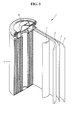
- FIG. 3 is a schematic view of a lithium battery according to an embodiment.
- cathode active material a cathode active material, a cathode including the cathode active material, a lithium battery including the cathode, and a method of preparing the cathode active material, according to one or more embodiments, will be described in detail.
- a cathode active material includes a lithium manganese oxide of which primary particles have a diameter of about 1 ⁇ m or more and which has a spinel structure in which an X-ray diffraction (XRD) peak intensity ratio of I(111)/I(311) is about 1.0 or more; and a boron element disposed on at least one position selected from the group consisting of inside the primary particles and on surfaces of the primary particles.
- XRD X-ray diffraction
- FIG. 1A shows an XRD spectrum of the cathode active material, having a peak corresponding to a (111) crystal plane at a Bragg angle 2 ⁇ of 18.5 ⁇ 1° and a peak corresponding to a (311) crystal plane at a Bragg angle 2 ⁇ of 36.2 ⁇ 0.2°.
- a peak intensity ratio of the peak corresponding to the (111) crystal plane to the peak corresponding to the (311) crystal plane, for example, I(111)/I(311) is 1.0 or more.
- a peak intensity ratio of I(111)/I(311) may be about 1.0 to about 3.0.
- a peak intensity ratio of I(111)/I(311) may be about 1.5 to about 3.0.
- a peak intensity ratio of I(111)/I(311) may be from about 2.0 to about 3.0.
- the cathode active material includes, in addition to the lithium manganese oxide, a boron element inside primary particles of the lithium manganese oxide or on surfaces of primary particles of the lithium manganese oxide.
- the boron element is a residue of a boron compound that is used in preparing the cathode active material.
- Crystallinity of the cathode active material may be improved by increasing the primary particle diameter of the lithium manganese oxide. All or a portion of the lithium manganese oxide may have crystallinity. Due to high crystallinity of the lithium manganese oxide, a battery including the cathode active material may have good charge and discharge characteristics. In addition, leakage of manganese (Mn) may be suppressed and thus, a battery including the cathode active material may have good high-temperature charge and discharge characteristics and high stability at high-temperatures.
- the primary particle diameter of the lithium manganese oxide may be from about 5 ⁇ m or more.
- the primary particle diameter of the lithium manganese oxide may be from about 6 ⁇ m or more.
- the primary particle diameter of the lithium manganese oxide may be from about 5 to about 20 ⁇ m.
- the primary particle diameter of the lithium manganese oxide may be from about 5 to about 10 ⁇ m.
- the primary particle diameter of the lithium manganese oxide may be from about 6 to about 10 ⁇ m.
- a battery including the cathode active material may have good charge and discharge characteristics and high high-temperature stability.
- a full wide at half maximum (FWHM) of a peak at a Bragg angle 2 ⁇ of 36.2 ⁇ 0.2° with respect to a CuK-alpha characteristic X-ray wavelength of 1.541 ⁇ may be about 0.6 or less.
- the lithium manganese oxide according to the present embodiment has a sharper peak than a lithium manganese oxide that has low crystallinity or is amorphous.
- the FWHM may be from about 0.01 to about 0.6.
- the FWHM may be from about 0.2 to about 0.5.
- the FWHM may be from about 0.2 to about 0.4.
- the FWHM may be from about 0.25 to about 0.35.
- a specific surface area of the cathode active material may be from about 0.2 to about 1.3 m 2 /g. When the specific surface area of the cathode active material is within the range described above, a battery including the cathode active material may have enhanced charge and discharge characteristics and high-temperature stability.
- Secondary particles of the lithium manganese oxide may have an average particle diameter (D50) of about 10 to about 20 ⁇ m.
- the secondary particles refer to behavior particles formed by an agglomeration of a plurality of primary particles.
- the average particle diameter (D50) of the secondary particles may be measured by using a laser-type particle distribution measurement apparatus. When the average particle diameter (D50) of the secondary particles is within the range described above, a battery including the cathode active material may have enhanced charge and discharge characteristics and high-temperature stability.
- An amount of the boron element disposed either inside the primary particles or on surfaces of the primary particles or both inside the primary particles and on surfaces of the primary particles may be about 1 to about 2000 ppm based on the total weight of the cathode active material.
- the amount of the boron element may be about 100 to about 2000 ppm.
- the amount of the boron element may be about 400 to about 1800 ppm.
- the amount of the boron element may be about 400 to about 1000 ppm.
- the amount of the boron element may be about 400 to about 800 ppm.
- the lithium manganese oxide may be represented by Formula 1 below: Li x Mn 2-y M y O 4 ⁇ Formula 1> where 0.9 ⁇ x ⁇ 1.4, 0 ⁇ y ⁇ 1, and M includes one or more metal selected from the group consisting of Al, Co, Ni, Cr, Fe, Zn, Mg, and Li.
- the lithium manganese oxide may be represented by Formula 2 below: Li x Mn 2-y Al y O 4 ⁇ Formula 2> where 0.9 ⁇ x ⁇ 1.4 and 0 ⁇ y ⁇ 1.
- the lithium manganese oxide may be LiMn 2 O 4 , or Li a Mn 2 - b Al b O 4 (where 0.9 ⁇ a ⁇ 1.2, 0 ⁇ b ⁇ 0.2).
- a cathode according to an embodiment includes the cathode active material.
- the cathode may be formed by, for example, molding a cathode active material composition including a cathode active material and a binder in a predetermined form, or depositing the cathode active material composition on a current collector, such as a copper foil or an aluminum foil.
- the cathode active material as described above, a conducting agent, a binder, and a solvent are mixed to prepare a cathode active material composition.
- the cathode active material composition is directly coated on a metal current collector to form a cathode plate.
- the cathode active material composition may be cast on a separate support, and a film separated from the support is laminated on a metal current collector to form a cathode plate.
- the cathode may not be limited thereto.
- a conducting agent for use in the cathode may be carbon black or graphite particles, but is not limited thereto.
- the conducting agent may be any one of various materials that are used as a conducting agent in the art.
- a binder for use in the cathode may be a vinylidenefluoride/hexafluoropropylene copolymer, polyvinylidenefluoride(PVDF), polyacrylonitrile, polymethylmetacrylate, polytetrafluoroethylene, a mixture thereof, or a styrene butadiene rubber-based polymer, but is not limited thereto.
- the binder may be any one of various materials that are used as a binder in the art.
- the solvent may be N-methylpyrrolidone (NMP), acetone, or water, but is not limited thereto.
- NMP N-methylpyrrolidone
- acetone or water, but is not limited thereto.
- the solvent may be any one of various materials that are used in the art.
- Amounts of the cathode active material, the conductive agent, the binder, and the solvent used herein may be used at the same levels as used in a traditional lithium battery. According to purpose or structure of the lithium battery, at least one selected from the group consisting of the conducting agent, the binder, and the solvent may be omitted herein.
- a lithium battery according to an embodiment includes a cathode including the cathode active material.
- a cathode is prepared by using the method described above of forming a cathode.
- an anode active material a conducting agent, a binder, and a solvent are mixed to prepare an anode active material composition.
- the anode active material composition may be directly coated and dried on a metal current collector to prepare an anode plate.
- the anode active material composition may be cast on a separate support, and a film separated from the support is laminated on a metal current collector to form an anode plate.
- the anode active material may be a compound that enables intercalation and deintercalation of lithium, and may be any one of various materials that are used as an anode active material in the art.
- Examples of the anode active material are a lithium metal, a lithium alloy, a carbonaceous material, a graphite, and a mixture thereof.
- the conducting agent, the binder, and the solvent for use in the anode active material composition may be the same as those used in the cathode active material composition. Also, at least one selected from the group consisting of the cathode active material composition and the anode active material composition may further include a plasticizer to form pores in the cathode or anode plate.
- Amounts of the anode active material, the conductive agent, the binder, and the solvent used herein may be used at the same levels as used in a traditional lithium battery. According to a purpose or structure of a lithium battery, at least one selected from the group consisting of the conducting agent, the binder, and the solvent may not be used herein.
- the separator may be any one of various separators conventionally used in a lithium battery.
- the separator may have a low resistance to ion flow and a high electrolytic solution-retaining capability.
- Examples of the separator are glass fiber, polyester, Teflon®, polyethylene, polypropylene, polytetrafluoroethylene (PTFE), and a combination thereof, and these separators may be in a non-woven or woven fabric form.
- a separator suitable for a lithium ion battery may be a rollable separator comprising, for example, polyethylene or polypropylene
- a separator suitable for a lithium ion polymer battery may be a separator that has an excellent organic electrolytic solution-retaining capability.
- a polymer resin, a filler, and a solvent are mixed to prepare a separator composition.
- the separator composition may be directly coated on an electrode and dried to form a separator.
- the separator composition may be cast on a support, dried, and then separated from the support as a separator film and then the separator film may be laminated on an electrode, thereby forming a separator.
- the polymer resin used in forming the separator may not be particularly limited and may be any one of various materials that are used as a binder of an electrode plate in the art.
- examples of the polymer are a vinylidenefluoride/hexafluoropropylene copolymer, polyvinylidenefluoride(PVDF), polyacrylonitrile, polymethylmetacrylate, and a mixture thereof.
- the electrolyte may be an organic electrolytic solution.
- the electrolyte may instead be solid.
- Examples of the solid electrolyte are boron oxide and lithium oxynitride, but are not limited thereto.
- the solid electrolyte may be any one of various solid electrolytes used in the art.
- the solid electrolyte may be formed on the anode by, for example, sputtering.
- an organic electrolytic solution may be used as the electrolyte.
- the organic electrolytic solution may be prepared by dissolving a lithium salt in an organic solvent.
- the organic solvent may be any one of various organic solvents used in the art.
- the organic solvent are propylenecarbonate, ethylenecarbonate, fluoroethylenecarbonate, butylenecarbonate, dimethylcarbonate, diethylcarbonate, methylethylcarbonate, methylpropylcarbonate, ethylpropylcarbonate, methylisopropylcarbonate, dipropylcarbonate, dibutylcarbonate, benzonitrile, acetonitrile, tetrahydrofurane, 2-methyltetrahydrofurane, ⁇ -butyrolactone, dioxorane, 4-methyldioxorane, N,N-dimethylformamide, dimethylacetamide, dimethylsulfoxide, dioxane, 1,2-dimethoxyethane, sulforane, dichloroethane, chlorobenzene, nitrobenzene, diethyleneglycol, dimethylether, and a mixture thereof.
- the lithium salt may be any one of various lithium salts used in the art.
- the lithium salt are LiPF 6 , LiBF 4 , LiSbF 6 , LiAsF 6 , LiClO 4 , LiCF 3 SO 3 , Li(CF 3 SO 2 ) 2 N, LiC 4 F 9 SO 3 , LiAlO 2 , LiAlCl 4 , LiN(C x F 2x+1 SO 2 )(C y F 2y+1 SO 2 )(where each of x and y is a natural number), LiCl, LiI, and a mixture thereof.
- a lithium battery 1 includes a cathode 3, an anode 2, and a separator 4.
- the cathode 3, the anode 2, and the separator 4 are wound or folded to be housed in a battery case 5.
- an organic electrolytic solution is injected into the battery case 5 and the resultant structure is sealed with a cap assembly 6, thereby completely manufacturing the lithium battery 1.
- the battery case may have a cylindrical, rectangular, or thin-film form.
- the lithium battery 1 may be a large thin-film type battery.
- the lithium battery 1 may be a lithium ion battery.
- a battery assembly may be formed by interposing the separator between the cathode and the anode.
- a plurality of the battery assemblies may be stacked in a bi-cell structure, and then impregnated with an organic electrolytic solution, and the resultant structure is housed in a pouch and sealed, thereby completing manufacturing of a lithium ion polymer battery.
- the battery assemblies may be stacked on each other to form a battery pack, and the battery pack may be used in high-capacity and high-performance devices, such as a notebook computer, a smart phone, an electric vehicle (EV), etc.
- a notebook computer such as a notebook computer, a smart phone, an electric vehicle (EV), etc.
- EV electric vehicle
- the lithium battery Since the lithium battery has enhanced high-temperature charge and discharge characteristics and high-temperature stability, the lithium battery is suitable for use in an EV.
- the lithium battery may be used in a hybrid vehicle such as a plug-in hybrid electric vehicle (PHEV).
- PHEV plug-in hybrid electric vehicle
- a method of preparing a cathode active material comprises mixing a lithium precursor, a manganese precursor, a boron-based compound, and optionally a dopant precursor to prepare a mixture; and calcinating the mixture at a temperature of from about 700 to about 900°C.
- the addition of the boron-based compound in the manufacturing process as described above enables production of an active material powder having an increased particle diameter and crystallinity even at low temperature.
- a lithium precursor, a manganese precursor, and a boron-based compound are mixed to prepare a mixture, and a dopant precursor is additionally added to the mixture.
- a dopant precursor is optional.
- the method may not include a separate process of mixing the manganese precursor and the dopant precursor.
- An amount of the boron-based compound may be about 0.1 to about 10 weight (wt.) % based on the total weight of the mixture.
- an amount of the boron-based compound may be from about 0.5 to about 10 wt.% based on the total weight of the mixture.
- an amount of the boron-based compound may be about 0.5 to 5 wt.% based on the total weight of the mixture.
- an amount of the boron-based compound may be from about 0.5 to about 2 wt.% based on the total weight of the mixture.
- the boron-based compound may include one or more compounds selected from the group consisting of B 2 O 3 , H 3 BO 3 , and Li 2 B 4 O 7 , but is not limited thereto.
- the boron-based compound may be any one of various compounds that include a boron element in the art.
- the dopant precursor which is optionally used in the method, may include at least one metal selected from the group consisting of Al, Co, Ni, Cr, Fe, Zn, Mg, and Li.
- the dopant may include Al 2 O 3 .
- An amount of the dopant precursor may be about 0.5 to about 2.5 wt.% based on the total weight of the mixture, but is not limited thereto.
- the calcination may be performed at a temperature of about 700 to about 900°C.
- the calcination may be performed at a temperature of about 800 to about 900°C.
- the calcination may be performed at a temperature of about 700 to about 800°C.
- the calcination in the method may be performed in air for about 5 to about 30 hours.
- the calcination may be performed in dry air for about 15 to about 25 hours.
- the cathode active material may be prepared by calcinating a mixture including Li 2 CO 3 as a lithium precursor; MnO 2 , Mn 3 O 4 , or Mn 2 O 3 as a manganese precursor; Li 2 B 4 O 7 or H 3 BO 3 as a boron-based compound; and optionally, MgO, NiO, or Al 2 O 3 in air at a temperature of about 700 to about 900°C for about 5 to about 30 hours.
- a lithium carbonate (Li 2 CO 3 ), a manganese dioxide (MnO 2 ), an alumina (Al 2 O 3 ), and a boric acid (H 3 BO 3 ) were used as starting materials.
- Li 1.05 Mn 1.85 Al 0.1 O 4 In order to prepare 175.81 mol of Li 1.05 Mn 1.85 Al 0.1 O 4 , a lithium carbonate (Li 2 CO 3 ), a manganese dioxide (MnO 2 ), and an alumina (Al 2 O 3 ) were mixed in such amounts that a mole ratio of Li:Mn:Al was 1.05:1.85:0.1, and then, a boric acid was added thereto to prepare a mixture. An amount of the boric acid in the mixture was 0.5 wt.% based on the total weight of the mixture.
- FIG. 2A shows an SEM image of primary particles of the cathode active material prepared according to Example 1.
- a cathode active material primary particle was prepared in the same manner as in Example 1, except that an amount of the boric acid was 0.3 wt.%. A diameter of the cathode active material primary particle was 1 ⁇ m.
- a cathode active material primary particle was prepared in the same manner as in Example 1, except that an amount of the boric acid was 0.7 wt.%.
- a diameter of the cathode active material primary particle was 8 ⁇ m.
- a cathode active material primary particle was prepared in the same manner as in Example 1, except that an amount of the boric acid was 1.0 wt.%. A diameter of the cathode active material primary particle was 9 ⁇ m.
- a cathode active material primary particle was prepared in the same manner as in Example 1, except that a heat treatment temperature was 700°C.
- a diameter of the cathode active material primary particle was 3 ⁇ m.
- a cathode active material primary particle was prepared in the same manner as in Example 1, except that a heat treatment temperature was 900°C. A diameter of the cathode active material primary particle was 7 ⁇ m.
- a cathode active material primary particle was prepared in the same manner as in Example 1, except that a boric acid was not used.
- a diameter of the cathode active material primary particle was 0.2 ⁇ m.
- FIG. 2B shows an SEM image of primary particles of the cathode active material prepared according to Comparative Example 1.
- a cathode active material primary particle was prepared in the same manner as in Example 1, except that AlF 3 was used instead of a boric acid.
- a diameter of the cathode active material primary particle was 0.2 ⁇ m.
- manganese hydroxide 0.5 mole of manganese sulfate was added to 3.5 mole of sodium hydroxide at a nitrogen atmosphere to produce a manganese hydroxide. In this regard, the entire amount of the mixture was set to 1 L.
- the manganese hydroxide was matured at a temperature of 90 °C for 1 hour. After the maturation, air was supplied thereto to oxidize the manganese at a temperature of 90 °C. Then, the resultant product was washed and dried to produce manganese oxide particle powder.
- a water suspension including the manganese oxide particles was washed with water having a weight 5 times greater than a weight of the manganese oxide by using a filter press, and then diluted until a concentration of the manganese oxide particles was 10 wt.%.
- 0.2 mol/l of a sodium aluminate aqueous solution was continuously supplied to the resultant suspension in a reaction vessel until a ratio of Mn:Al was 95:5.
- stirring was continuously performed by using a stirrer, and at the same time, 0.2 mol/l sulfuric acid aqueous solution was automatically supplied thereto to adjust a pH to be 8 ⁇ 0.5, thereby preparing a suspension including manganese oxide coated with aluminum hydroxide.
- the suspension was washed with water having a weight 10 times greater than a weight of the manganese oxide by using a filter press, and then dried, thereby preparing manganese oxide particles coated with aluminum hydroxide.
- the aluminum hydroxide-coated Mn 3 O 4 particle powder, a lithium carbonate, and a boric acid were dry-mixed for 1 hour to prepare a uniform mixture.
- amounts of the aluminum hydroxide-coated Mn 3 O 4 particle powder, the lithium carbonate, and the boric acid were controlled such that a ratio of Li:Mn:Al was 1.072:1.828:0.10 and a ratio of boron in the boric acid to Mn was 2.0 mol%.
- 30 g of the obtained mixture was placed in an alumina crucible, and maintained at a temperature of 960 °C in air for 3 hours.
- a cathode active material particle powder was obtained.
- a diameter of the cathode active material primary particle was 5.0 ⁇ m.
- the cathode active material powder prepared according to Example 1 and a carbonaceous conducting agent (Ketjen Black; EC-600JD) were uniformly mixed at a weight ratio of 93:3 and then, a polyvinylidene fluoride (PVDF) binder solution was added thereto, thereby preparing a cathode active material slurry in which a weight ratio of the cathode active material: carbon conductive agent: binder was 93:3:4.
- PVDF polyvinylidene fluoride
- An aluminum foil having a thickness of 15 ⁇ m was coated with the active material slurry and dried to prepare a cathode plate, and then the cathode plate was additionally vacuum dried to manufacture a coin cell having a diameter of 12 mm.
- metal lithium was used as a counter electrode
- a polypropylene separator (Cellgard ® 3510) was used as a separator
- Lithium batteries were manufactured in the same manner as in Example 7, except that the cathode active material powders prepared according to Examples 2 to 6 were used in the same manner as in Example 7.
- a lithium battery was manufactured in the same manner as in Example 7, except that the cathode active material powder prepared according to Comparative Example 1 was used.
- Lithium batteries were manufactured in the same manner as in Comparative Example 4, except that the cathode active material powders prepared according to Comparative Examples 2 and 3 were used.
- the cathode active material primary particles prepared according to Example 1 and Comparative Example 1 have a peak corresponding to a (111) crystal plane at Bragg angle 2 ⁇ of 18.5 ⁇ 1° and a peak corresponding to a (311) crystal plane at a Bragg angle 2 ⁇ of 36.2 ⁇ 0.2°.
- a peak intensity ratio of the peak corresponding to the (111) crystal plane to the peak corresponding to the (311) crystal plane, that is, I (111)/I (311) was 2.53, and a FWHM of a peak at a Bragg angle 2 ⁇ of 36.2 ⁇ 0.2° was 0.3 ⁇ 0.05°.
- the cathode active material of Example 1 has better crystallinity and thus smaller FWHM than the cathode active material of Comparative Example 1.
- the cathode active materials prepared according to Examples 1 to 6 had smaller specific surface areas than the cathode active materials prepared according to Comparative Examples 1 and 2.
- An average particle diameter (D50) of a secondary particle which was determined based on a volume, of each of the cathode active materials prepared according to Examples 1 to 4, and 6 and Comparative Examples 1 and 2 was evaluated by using a laser particle size distribution evaluation apparatus, and the results are shown in Table 2 below.
- the secondary particle refers to a particle formed by an agglomeration a plurality of primary particles to each other.
- the cathode active materials prepared according to Examples 1 to 4, and 6 had greater secondary particle average particle diameter than the cathode active materials prepared according to Comparative Examples 1 and 2.
- the cathode active materials of Examples 1 to 4 included about 400 to about 2000 ppm of the boron element. However, the cathode active material of Comparative Example 1 did not include boron.
- the lithium batteries prepared according to Examples 7 to 12 and Comparative Examples 4 to 6 were charged and discharged twice with a constant current at a 0.1C rate within a voltage range of 3 to 4.3 V with respect to lithium metal at a temperature of 25°C (formation process).
- the lithium batteries were charged and discharged 100 times with a constant current at a 1C rate within a voltage range of about 3 to about 4.3V with respect to lithium metal at a temperature of 60°C, and the results are shown in Table 4 below.
- Capacity retention rate % discharge capacity in a 100 th cycle / discharge capacity in a first cycle ⁇ 100 ⁇ Table 4> Capacity retention rate [%]
- Example 7 98.2 95.7
- Example 9 97.8 Example 10 96.1
- Example 11 97.3
- the lithium batteries of Examples 7 to 12 had better high-temperature lifetime characteristics than the lithium batteries of Comparative Examples 4 to 6.
- the lithium batteries prepared according to Examples 7 to 12 and Comparative Examples 4 to 6 were charged and discharged twice with a constant current at a 0.1C rate within a voltage range of 3 to 4.3 V with respect to lithium metal at a temperature of 25°C (formation process).
- the lithium batteries that had been subjected to the formation process were charged with 0.1C rate of a constant current at a temperature of 25°C until a voltage with respect to lithium metal reached 4.3 V, and then discharged with a constant current at a 0.1C rate until a voltage reached 3.0 V.
- the discharge capacity was used as a reference capacity.
- the charge and discharge cycle was regarded as a first cycle.
- the lithium batteries were charged with a constant current at a 0.1 C rate until a voltage with respect to lithium metal reached 4.3 V, and placed in an oven at a temperature of 60°C for 4 weeks, and then, discharged with a constant current at a 0.1C rate at a temperature of 25°C until a voltage with respect to lithium metal reached 3.0 V.
- the charge and discharge cycle was regarded as a second cycle.
- the lithium batteries were charged with a constant current at a 0.1C rate until a voltage with respect to lithium metal reached 4.3 V, and then discharged with a constant current at a 0.1C rate until a voltage reached 3.0 V.
- the charge and discharge cycle was regarded as a third cycle.
- the lithium batteries of Examples 7 to 12 had enhanced high-temperature stability compared to the lithium batteries of Comparative Examples 4 to 6.
- a cathode active material has an increased primary particle diameter, and thus, a lithium battery including the cathode active material has enhanced high-temperature cycle characteristics and high-temperature stability.
Landscapes
- Chemical & Material Sciences (AREA)
- Chemical Kinetics & Catalysis (AREA)
- Electrochemistry (AREA)
- General Chemical & Material Sciences (AREA)
- Engineering & Computer Science (AREA)
- Inorganic Chemistry (AREA)
- Organic Chemistry (AREA)
- Materials Engineering (AREA)
- Manufacturing & Machinery (AREA)
- Composite Materials (AREA)
- Battery Electrode And Active Subsutance (AREA)
Abstract
Description
- One or more embodiments relate to a cathode active material, a cathode including the cathode active material, a lithium battery including the cathode, and a method of preparing the cathode active material.
- A lithium transition metal oxide is used as a cathode active material for a lithium battery, and examples of such a lithium transition metal oxide are LiNiO2, LiCoO2, LiMn2O4, LiFePO4, LiNixCo1-xO2(0≤x≤1), and LiNi1-x-yCoxMnyO2(0≤x≤0.5, 0≤y≤0.5).
- A lithium cobalt oxide, for example, LiCoO2 is relatively expensive and has a limited electric capacity of about 140 mAh/g. When a charged voltage for LiCoO2 is increased to 4.2 V or more, 50% or more of lithium is removed and is present in the form of Li1-xCoO2 (1>x>0.5) in a battery. Li1-xCoO2 (x>0.5) is structurally unstable and its electric capacity is rapidly reduced over a charge and discharge cycle.
- A compound that is formed by substituting some of cobalt atoms with other metals in the lithium cobalt oxide, for example, LiNixCo1-xO2(0≤x≤1) or LiNi1-x-yCoxMnyO2(0≤x≤0.5, 0≤y≤0.5) has poor swelling suppression characteristics.
- A lithium manganese oxide, for example, LiMn2O4, is relatively inexpensive and stable at room temperature. In general, a lithium manganese oxide is prepared through a solid state reaction method or a molten salt synthesis method at high temperature. A lithium manganese oxide that is formed at high temperature has an unstable structure. Meanwhile, if a lithium manganese oxide is formed at low temperature, its primary particle diameter is reduced and thus its specific surface area is increased. Thus, cycle characteristics and stability of the lithium manganese oxide that is formed at low temperature may be lowered during high-temperature charge and discharge.
- One or more embodiments include a cathode active material.
- One or more embodiments include a cathode including the cathode active material.
- One or more embodiments include a lithium battery including the cathode.
- One or more embodiments include a method of preparing the cathode active material.
- Additional aspects will be set forth in part in the description which follows and, in part, will be apparent from the description, or may be learned by practice of the presented embodiments.
- According to one or more embodiments, a cathode active material includes: a lithium manganese oxide of which primary particles have a diameter of about 1µm or more and which has a spinel structure in which an X-ray diffraction (XRD) peak intensity ratio of I(111)/I(311) is about 1.0 or more; and a boron element disposed on at least one position selected from the group consisting of inside the primary particles and on surfaces of the primary particles.
- According to one or more embodiments, a cathode includes the cathode active material as described above.
- According to one or more embodiments, a lithium battery includes the cathode as described above.
- According to one or more embodiments, a method of preparing a cathode active material includes: mixing a lithium precursor, a manganese precursor, a boron-based compound, and optionally, a dopant precursor to prepare a mixture; and calcinating the mixture at a temperature of about 700 to about 900°C.
- These and/or other aspects will become apparent and more readily appreciated from the following description of the embodiments, taken in conjunction with the accompanying drawings of which:
-
FIG. 1A is an X-ray diffraction (XRD) spectrum of a cathode active material powder prepared according to Example 1; -
FIG. 1B is an XRD spectrum of a cathode active material powder prepared according to Comparative Example 1; -
FIG. 2A is a scanning electron microscope (SEM) image of a cathode active material powder prepared according to Example 1; -
FIG. 2B is a SEM image of a cathode active material powder prepared according to Comparative Example 1; and -
FIG. 3 is a schematic view of a lithium battery according to an embodiment. - Reference will now be made to embodiments, examples of which are illustrated in the accompanying drawings, wherein like reference numerals refer to the like elements throughout. In this regard, the present embodiments may have different forms and should not be construed as being limited to the descriptions set forth herein. Accordingly, the embodiments are merely described below, by referring to the figures, to explain aspects of the present description.
- Hereinafter, a cathode active material, a cathode including the cathode active material, a lithium battery including the cathode, and a method of preparing the cathode active material, according to one or more embodiments, will be described in detail.
- A cathode active material according to an embodiment includes a lithium manganese oxide of which primary particles have a diameter of about 1µm or more and which has a spinel structure in which an X-ray diffraction (XRD) peak intensity ratio of I(111)/I(311) is about 1.0 or more; and a boron element disposed on at least one position selected from the group consisting of inside the primary particles and on surfaces of the primary particles.
-
FIG. 1A shows an XRD spectrum of the cathode active material, having a peak corresponding to a (111) crystal plane at a Bragg angle 2θ of 18.5±1° and a peak corresponding to a (311) crystal plane at a Bragg angle 2θ of 36.2±0.2°. A peak intensity ratio of the peak corresponding to the (111) crystal plane to the peak corresponding to the (311) crystal plane, for example, I(111)/I(311) is 1.0 or more. For example, a peak intensity ratio of I(111)/I(311) may be about 1.0 to about 3.0. For example, a peak intensity ratio of I(111)/I(311) may be about 1.5 to about 3.0. For example, a peak intensity ratio of I(111)/I(311) may be from about 2.0 to about 3.0. - The cathode active material includes, in addition to the lithium manganese oxide, a boron element inside primary particles of the lithium manganese oxide or on surfaces of primary particles of the lithium manganese oxide. The boron element is a residue of a boron compound that is used in preparing the cathode active material.
- Crystallinity of the cathode active material may be improved by increasing the primary particle diameter of the lithium manganese oxide. All or a portion of the lithium manganese oxide may have crystallinity. Due to high crystallinity of the lithium manganese oxide, a battery including the cathode active material may have good charge and discharge characteristics. In addition, leakage of manganese (Mn) may be suppressed and thus, a battery including the cathode active material may have good high-temperature charge and discharge characteristics and high stability at high-temperatures.
- The primary particle diameter of the lithium manganese oxide may be from about 5µm or more. For example, the primary particle diameter of the lithium manganese oxide may be from about 6µm or more. For example, the primary particle diameter of the lithium manganese oxide may be from about 5 to about 20µm. For example, the primary particle diameter of the lithium manganese oxide may be from about 5 to about 10µm. For example, the primary particle diameter of the lithium manganese oxide may be from about 6 to about 10µm. When the primary particle diameter of the lithium manganese oxide is about 5µm or more, a battery including the cathode active material may have good charge and discharge characteristics and high high-temperature stability.
- In the XRD spectrum of the cathode active material, a full wide at half maximum (FWHM) of a peak at a Bragg angle 2θ of 36.2±0.2° with respect to a CuK-alpha characteristic X-ray wavelength of 1.541Å may be about 0.6 or less. For example, the lithium manganese oxide according to the present embodiment has a sharper peak than a lithium manganese oxide that has low crystallinity or is amorphous. For example, the FWHM may be from about 0.01 to about 0.6. For example, the FWHM may be from about 0.2 to about 0.5. For example, the FWHM may be from about 0.2 to about 0.4. For example, the FWHM may be from about 0.25 to about 0.35.
- A specific surface area of the cathode active material may be from about 0.2 to about 1.3 m2/g. When the specific surface area of the cathode active material is within the range described above, a battery including the cathode active material may have enhanced charge and discharge characteristics and high-temperature stability.
- Secondary particles of the lithium manganese oxide may have an average particle diameter (D50) of about 10 to about 20µm. The secondary particles refer to behavior particles formed by an agglomeration of a plurality of primary particles. The average particle diameter (D50) of the secondary particles may be measured by using a laser-type particle distribution measurement apparatus. When the average particle diameter (D50) of the secondary particles is within the range described above, a battery including the cathode active material may have enhanced charge and discharge characteristics and high-temperature stability.
- An amount of the boron element disposed either inside the primary particles or on surfaces of the primary particles or both inside the primary particles and on surfaces of the primary particles may be about 1 to about 2000 ppm based on the total weight of the cathode active material. For example, the amount of the boron element may be about 100 to about 2000 ppm. For example, the amount of the boron element may be about 400 to about 1800 ppm. For example, the amount of the boron element may be about 400 to about 1000 ppm. For example, the amount of the boron element may be about 400 to about 800 ppm.
- The lithium manganese oxide may be represented by
Formula 1 below:
LixMn2-yMyO4 <Formula 1>
where 0.9≤x≤1.4, 0≤y≤1, and M includes one or more metal selected from the group consisting of Al, Co, Ni, Cr, Fe, Zn, Mg, and Li. - For example, the lithium manganese oxide may be represented by
Formula 2 below:
LixMn2-yAlyO4 <Formula 2>
where 0.9≤x≤1.4 and 0≤y≤1. - For example, the lithium manganese oxide may be LiMn2O4, or LiaMn2-bAlbO4 (where 0.9≤a≤1.2, 0≤b≤0.2).
- A cathode according to an embodiment includes the cathode active material. The cathode may be formed by, for example, molding a cathode active material composition including a cathode active material and a binder in a predetermined form, or depositing the cathode active material composition on a current collector, such as a copper foil or an aluminum foil.
- For example, the cathode active material as described above, a conducting agent, a binder, and a solvent are mixed to prepare a cathode active material composition. The cathode active material composition is directly coated on a metal current collector to form a cathode plate. Alternatively, the cathode active material composition may be cast on a separate support, and a film separated from the support is laminated on a metal current collector to form a cathode plate. However, the cathode may not be limited thereto.
- A conducting agent for use in the cathode may be carbon black or graphite particles, but is not limited thereto. For example, the conducting agent may be any one of various materials that are used as a conducting agent in the art.
- A binder for use in the cathode may be a vinylidenefluoride/hexafluoropropylene copolymer, polyvinylidenefluoride(PVDF), polyacrylonitrile, polymethylmetacrylate, polytetrafluoroethylene, a mixture thereof, or a styrene butadiene rubber-based polymer, but is not limited thereto. For example, the binder may be any one of various materials that are used as a binder in the art.
- The solvent may be N-methylpyrrolidone (NMP), acetone, or water, but is not limited thereto. For example, the solvent may be any one of various materials that are used in the art.
- Amounts of the cathode active material, the conductive agent, the binder, and the solvent used herein may be used at the same levels as used in a traditional lithium battery. According to purpose or structure of the lithium battery, at least one selected from the group consisting of the conducting agent, the binder, and the solvent may be omitted herein.
- A lithium battery according to an embodiment includes a cathode including the cathode active material. An example of a method of manufacturing the lithium battery will now be described in detail.
- First, a cathode is prepared by using the method described above of forming a cathode.
- Then, an anode active material, a conducting agent, a binder, and a solvent are mixed to prepare an anode active material composition. The anode active material composition may be directly coated and dried on a metal current collector to prepare an anode plate. Alternatively, the anode active material composition may be cast on a separate support, and a film separated from the support is laminated on a metal current collector to form an anode plate.
- The anode active material may be a compound that enables intercalation and deintercalation of lithium, and may be any one of various materials that are used as an anode active material in the art. Examples of the anode active material are a lithium metal, a lithium alloy, a carbonaceous material, a graphite, and a mixture thereof.
- The conducting agent, the binder, and the solvent for use in the anode active material composition may be the same as those used in the cathode active material composition. Also, at least one selected from the group consisting of the cathode active material composition and the anode active material composition may further include a plasticizer to form pores in the cathode or anode plate.
- Amounts of the anode active material, the conductive agent, the binder, and the solvent used herein may be used at the same levels as used in a traditional lithium battery. According to a purpose or structure of a lithium battery, at least one selected from the group consisting of the conducting agent, the binder, and the solvent may not be used herein.
- Then, a separator that is to be interposed between the cathode and the anode is prepared. The separator may be any one of various separators conventionally used in a lithium battery. The separator may have a low resistance to ion flow and a high electrolytic solution-retaining capability. Examples of the separator are glass fiber, polyester, Teflon®, polyethylene, polypropylene, polytetrafluoroethylene (PTFE), and a combination thereof, and these separators may be in a non-woven or woven fabric form. For example, a separator suitable for a lithium ion battery may be a rollable separator comprising, for example, polyethylene or polypropylene, and a separator suitable for a lithium ion polymer battery may be a separator that has an excellent organic electrolytic solution-retaining capability. An example of a method of forming the separator will now be described in detail.
- A polymer resin, a filler, and a solvent are mixed to prepare a separator composition. The separator composition may be directly coated on an electrode and dried to form a separator. Alternatively, the separator composition may be cast on a support, dried, and then separated from the support as a separator film and then the separator film may be laminated on an electrode, thereby forming a separator.
- The polymer resin used in forming the separator may not be particularly limited and may be any one of various materials that are used as a binder of an electrode plate in the art. Examples of the polymer are a vinylidenefluoride/hexafluoropropylene copolymer, polyvinylidenefluoride(PVDF), polyacrylonitrile, polymethylmetacrylate, and a mixture thereof.
- Then, an electrolyte is prepared.
- The electrolyte may be an organic electrolytic solution. In addition, the electrolyte may instead be solid. Examples of the solid electrolyte are boron oxide and lithium oxynitride, but are not limited thereto. The solid electrolyte may be any one of various solid electrolytes used in the art. The solid electrolyte may be formed on the anode by, for example, sputtering.
- For example, an organic electrolytic solution may be used as the electrolyte. The organic electrolytic solution may be prepared by dissolving a lithium salt in an organic solvent.
- The organic solvent may be any one of various organic solvents used in the art. Examples of the organic solvent are propylenecarbonate, ethylenecarbonate, fluoroethylenecarbonate, butylenecarbonate, dimethylcarbonate, diethylcarbonate, methylethylcarbonate, methylpropylcarbonate, ethylpropylcarbonate, methylisopropylcarbonate, dipropylcarbonate, dibutylcarbonate, benzonitrile, acetonitrile, tetrahydrofurane, 2-methyltetrahydrofurane, γ-butyrolactone, dioxorane, 4-methyldioxorane, N,N-dimethylformamide, dimethylacetamide, dimethylsulfoxide, dioxane, 1,2-dimethoxyethane, sulforane, dichloroethane, chlorobenzene, nitrobenzene, diethyleneglycol, dimethylether, and a mixture thereof.
- The lithium salt may be any one of various lithium salts used in the art. Examples of the lithium salt are LiPF6, LiBF4, LiSbF6, LiAsF6, LiClO4, LiCF3SO3, Li(CF3SO2)2N, LiC4F9SO3, LiAlO2, LiAlCl4, LiN(CxF2x+1SO2)(CyF2y+1SO2)(where each of x and y is a natural number), LiCl, LiI, and a mixture thereof.
- Referring to
FIG. 3 , alithium battery 1 includes acathode 3, ananode 2, and a separator 4. Thecathode 3, theanode 2, and the separator 4 are wound or folded to be housed in abattery case 5. Then, an organic electrolytic solution is injected into thebattery case 5 and the resultant structure is sealed with acap assembly 6, thereby completely manufacturing thelithium battery 1. The battery case may have a cylindrical, rectangular, or thin-film form. For example, thelithium battery 1 may be a large thin-film type battery. In another embodiment, thelithium battery 1 may be a lithium ion battery. - Meanwhile, a battery assembly may be formed by interposing the separator between the cathode and the anode. A plurality of the battery assemblies may be stacked in a bi-cell structure, and then impregnated with an organic electrolytic solution, and the resultant structure is housed in a pouch and sealed, thereby completing manufacturing of a lithium ion polymer battery.
- In addition, the battery assemblies may be stacked on each other to form a battery pack, and the battery pack may be used in high-capacity and high-performance devices, such as a notebook computer, a smart phone, an electric vehicle (EV), etc.
- Since the lithium battery has enhanced high-temperature charge and discharge characteristics and high-temperature stability, the lithium battery is suitable for use in an EV. For example, the lithium battery may be used in a hybrid vehicle such as a plug-in hybrid electric vehicle (PHEV).
- A method of preparing a cathode active material, according to an embodiment, comprises mixing a lithium precursor, a manganese precursor, a boron-based compound, and optionally a dopant precursor to prepare a mixture; and calcinating the mixture at a temperature of from about 700 to about 900°C.
- The addition of the boron-based compound in the manufacturing process as described above enables production of an active material powder having an increased particle diameter and crystallinity even at low temperature.
- In the method, a lithium precursor, a manganese precursor, and a boron-based compound are mixed to prepare a mixture, and a dopant precursor is additionally added to the mixture. In this regard, the addition of the dopant precursor is optional.
- For example, the method may not include a separate process of mixing the manganese precursor and the dopant precursor.
- An amount of the boron-based compound may be about 0.1 to about 10 weight (wt.) % based on the total weight of the mixture. For example, an amount of the boron-based compound may be from about 0.5 to about 10 wt.% based on the total weight of the mixture. For example, an amount of the boron-based compound may be about 0.5 to 5 wt.% based on the total weight of the mixture. For example, an amount of the boron-based compound may be from about 0.5 to about 2 wt.% based on the total weight of the mixture. When an amount of the boron-based compound is 0.5 wt.% or more based on the total weight of the mixture, a battery including the cathode active material has more enhanced charge and discharge characteristics and high high-temperature stability.
- The boron-based compound may include one or more compounds selected from the group consisting of B2O3, H3BO3, and Li2B4O7, but is not limited thereto. For example, the boron-based compound may be any one of various compounds that include a boron element in the art.
- The dopant precursor, which is optionally used in the method, may include at least one metal selected from the group consisting of Al, Co, Ni, Cr, Fe, Zn, Mg, and Li. For example, the dopant may include Al2O3. An amount of the dopant precursor may be about 0.5 to about 2.5 wt.% based on the total weight of the mixture, but is not limited thereto.
- For example, the calcination may be performed at a temperature of about 700 to about 900°C. For example, the calcination may be performed at a temperature of about 800 to about 900°C. For example, the calcination may be performed at a temperature of about 700 to about 800°C.
- The calcination in the method may be performed in air for about 5 to about 30 hours. For example, the calcination may be performed in dry air for about 15 to about 25 hours.
- For example, the cathode active material may be prepared by calcinating a mixture including Li2CO3 as a lithium precursor; MnO2, Mn3O4, or Mn2O3 as a manganese precursor; Li2B4O7 or H3BO3 as a boron-based compound; and optionally, MgO, NiO, or Al2O3 in air at a temperature of about 700 to about 900°C for about 5 to about 30 hours.
- The present embodiments will be described in further detail with reference to the following examples. These examples are for illustrative purposes only and are not intended to limit the scope of the present embodiments.
- A lithium carbonate (Li2CO3), a manganese dioxide (MnO2), an alumina (Al2O3), and a boric acid (H3BO3) were used as starting materials.
- In order to prepare 175.81 mol of Li1.05Mn1.85Al0.1O4, a lithium carbonate (Li2CO3), a manganese dioxide (MnO2), and an alumina (Al2O3) were mixed in such amounts that a mole ratio of Li:Mn:Al was 1.05:1.85:0.1, and then, a boric acid was added thereto to prepare a mixture. An amount of the boric acid in the mixture was 0.5 wt.% based on the total weight of the mixture.
- The starting materials were mixed in a mortar, and the mixture was heat treated in a furnace while dry air was supplied thereto at a temperature of 800°C for 20 hours to prepare a cathode active material. The cathode active material was cooled in the furnace. An average primary particle diameter of the cathode active material powder was 6µm. The average primary particle diameter was measured based on a SEM image of the cathode active material.
FIG. 2A shows an SEM image of primary particles of the cathode active material prepared according to Example 1. - A cathode active material primary particle was prepared in the same manner as in Example 1, except that an amount of the boric acid was 0.3 wt.%. A diameter of the cathode active material primary particle was 1µm.
- A cathode active material primary particle was prepared in the same manner as in Example 1, except that an amount of the boric acid was 0.7 wt.%. A diameter of the cathode active material primary particle was 8µm.
- A cathode active material primary particle was prepared in the same manner as in Example 1, except that an amount of the boric acid was 1.0 wt.%. A diameter of the cathode active material primary particle was 9µm.
- A cathode active material primary particle was prepared in the same manner as in Example 1, except that a heat treatment temperature was 700°C. A diameter of the cathode active material primary particle was 3µm.
- A cathode active material primary particle was prepared in the same manner as in Example 1, except that a heat treatment temperature was 900°C. A diameter of the cathode active material primary particle was 7µm.
- A cathode active material primary particle was prepared in the same manner as in Example 1, except that a boric acid was not used. A diameter of the cathode active material primary particle was 0.2µm.
FIG. 2B shows an SEM image of primary particles of the cathode active material prepared according to Comparative Example 1. - A cathode active material primary particle was prepared in the same manner as in Example 1, except that AlF3 was used instead of a boric acid. A diameter of the cathode active material primary particle was 0.2µm.
- 0.5 mole of manganese sulfate was added to 3.5 mole of sodium hydroxide at a nitrogen atmosphere to produce a manganese hydroxide. In this regard, the entire amount of the mixture was set to 1 L. The manganese hydroxide was matured at a temperature of 90 °C for 1 hour. After the maturation, air was supplied thereto to oxidize the manganese at a temperature of 90 °C. Then, the resultant product was washed and dried to produce manganese oxide particle powder.
- A water suspension including the manganese oxide particles was washed with water having a
weight 5 times greater than a weight of the manganese oxide by using a filter press, and then diluted until a concentration of the manganese oxide particles was 10 wt.%. 0.2 mol/l of a sodium aluminate aqueous solution was continuously supplied to the resultant suspension in a reaction vessel until a ratio of Mn:Al was 95:5. In the reaction vessel, stirring was continuously performed by using a stirrer, and at the same time, 0.2 mol/l sulfuric acid aqueous solution was automatically supplied thereto to adjust a pH to be 8±0.5, thereby preparing a suspension including manganese oxide coated with aluminum hydroxide. - The suspension was washed with water having a
weight 10 times greater than a weight of the manganese oxide by using a filter press, and then dried, thereby preparing manganese oxide particles coated with aluminum hydroxide. - The aluminum hydroxide-coated Mn3O4 particle powder, a lithium carbonate, and a boric acid were dry-mixed for 1 hour to prepare a uniform mixture. In this regard, amounts of the aluminum hydroxide-coated Mn3O4 particle powder, the lithium carbonate, and the boric acid were controlled such that a ratio of Li:Mn:Al was 1.072:1.828:0.10 and a ratio of boron in the boric acid to Mn was 2.0 mol%. 30 g of the obtained mixture was placed in an alumina crucible, and maintained at a temperature of 960 °C in air for 3 hours. As a result, a cathode active material particle powder was obtained. A diameter of the cathode active material primary particle was 5.0 µm.
- The cathode active material powder prepared according to Example 1 and a carbonaceous conducting agent (Ketjen Black; EC-600JD) were uniformly mixed at a weight ratio of 93:3 and then, a polyvinylidene fluoride (PVDF) binder solution was added thereto, thereby preparing a cathode active material slurry in which a weight ratio of the cathode active material: carbon conductive agent: binder was 93:3:4.
- An aluminum foil having a thickness of 15µm was coated with the active material slurry and dried to prepare a cathode plate, and then the cathode plate was additionally vacuum dried to manufacture a coin cell having a diameter of 12 mm.
- In manufacturing the coin cell, metal lithium was used as a counter electrode, a polypropylene separator (Cellgard® 3510) was used as a separator, and 1.3M LiPF6 dissolved in a mixed solvent including ethylene carbonate (EC) and diethylene carbonate (DEC) at a volumetric ratio of 3:7 was used as an electrolyte.
- Lithium batteries were manufactured in the same manner as in Example 7, except that the cathode active material powders prepared according to Examples 2 to 6 were used in the same manner as in Example 7.
- A lithium battery was manufactured in the same manner as in Example 7, except that the cathode active material powder prepared according to Comparative Example 1 was used.
- Lithium batteries were manufactured in the same manner as in Comparative Example 4, except that the cathode active material powders prepared according to Comparative Examples 2 and 3 were used.
- An XRD test was performed on the cathode active material powders prepared according to Example 1 and Comparative Example 1. The test was performed using a CuK-alpha characteristic X-ray wavelength of 1.541 Å.
- As shown in
FIGS. 1A and 1B , the cathode active material primary particles prepared according to Example 1 and Comparative Example 1 have a peak corresponding to a (111) crystal plane at Bragg angle 2θ of 18.5±1° and a peak corresponding to a (311) crystal plane at a Bragg angle 2θ of 36.2±0.2°. - As shown in
FIG. 1A , regarding the cathode active material primary particle of Example 1, a peak intensity ratio of the peak corresponding to the (111) crystal plane to the peak corresponding to the (311) crystal plane, that is, I (111)/I (311) was 2.53, and a FWHM of a peak at a Bragg angle 2θ of 36.2±0.2° was 0.3±0.05°. - On the other hand, as shown in
FIG. 1B , regarding the cathode active material primary particle of Comparative Example 1, a FWHM of a peak at a Bragg angle 2θ of 36.2±0.2° was 0.7±0.05°. - For example, the cathode active material of Example 1 has better crystallinity and thus smaller FWHM than the cathode active material of Comparative Example 1.
- A BET specific surface area of each of the cathode active material powders prepared according to Examples 1 to 6 and Comparative Examples 1 and 2 was evaluated and the results are shown in Table. 1 below.
<Table 1> Specific surface area [m2/g] Example 1 0.461 Example 2 0.824 Example 3 0.385 Example 4 0.298 Example 5 0.622 Example 6 0.378 Comparative Example 1 2.879 Comparative Example 2 1.465 - As shown in Table 1, the cathode active materials prepared according to Examples 1 to 6 had smaller specific surface areas than the cathode active materials prepared according to Comparative Examples 1 and 2.
- An average particle diameter (D50) of a secondary particle, which was determined based on a volume, of each of the cathode active materials prepared according to Examples 1 to 4, and 6 and Comparative Examples 1 and 2 was evaluated by using a laser particle size distribution evaluation apparatus, and the results are shown in Table 2 below. The secondary particle refers to a particle formed by an agglomeration a plurality of primary particles to each other.
<Table 2> Secondary particle average diameter (D50) [µm] Example 1 13.9 Example 2 13.7 Example 3 15.3 Example 4 14.5 Example 6 14.4 Comparative Example 1 5.26 Comparative Example 2 8.95 - As shown in Table 2, the cathode active materials prepared according to Examples 1 to 4, and 6 had greater secondary particle average particle diameter than the cathode active materials prepared according to Comparative Examples 1 and 2.
- An amount of a boron element included in each of the cathode active materials prepared according to Examples 1 to 4 and Comparative Example 1 was measured by using ion coupled plasma (ICP), and the results are shown in Table 3 below.
<Table 3> Amount of residual boron element [ppm] Example 1 882 Example 2 456 Example 3 1326 Example 4 1761 Comparative Example 1 - - As shown in Table 3, the cathode active materials of Examples 1 to 4 included about 400 to about 2000 ppm of the boron element. However, the cathode active material of Comparative Example 1 did not include boron.
- The lithium batteries prepared according to Examples 7 to 12 and Comparative Examples 4 to 6 were charged and discharged twice with a constant current at a 0.1C rate within a voltage range of 3 to 4.3 V with respect to lithium metal at a temperature of 25°C (formation process).
- Subsequently, the lithium batteries were charged and discharged 100 times with a constant current at a 1C rate within a voltage range of about 3 to about 4.3V with respect to lithium metal at a temperature of 60°C, and the results are shown in Table 4 below.
- A capacity retention rate is represented by
Equation 1 below.
<Table 4> Capacity retention rate [%] Example 7 98.2 Example 8 95.7 Example 9 97.8 Example 10 96.1 Example 11 97.3 Example 12 95.4 Comparative Example 4 93.6 Comparative Example 5 94.2 Comparative Example 6 91.4 - As shown in Table 4, the lithium batteries of Examples 7 to 12 had better high-temperature lifetime characteristics than the lithium batteries of Comparative Examples 4 to 6.
- The lithium batteries prepared according to Examples 7 to 12 and Comparative Examples 4 to 6 were charged and discharged twice with a constant current at a 0.1C rate within a voltage range of 3 to 4.3 V with respect to lithium metal at a temperature of 25°C (formation process).
- The lithium batteries that had been subjected to the formation process were charged with 0.1C rate of a constant current at a temperature of 25°C until a voltage with respect to lithium metal reached 4.3 V, and then discharged with a constant current at a 0.1C rate until a voltage reached 3.0 V. The discharge capacity was used as a reference capacity. The charge and discharge cycle was regarded as a first cycle.
- Then, the lithium batteries were charged with a constant current at a 0.1 C rate until a voltage with respect to lithium metal reached 4.3 V, and placed in an oven at a temperature of 60°C for 4 weeks, and then, discharged with a constant current at a 0.1C rate at a temperature of 25°C until a voltage with respect to lithium metal reached 3.0 V. The charge and discharge cycle was regarded as a second cycle.
- Then, the lithium batteries were charged with a constant current at a 0.1C rate until a voltage with respect to lithium metal reached 4.3 V, and then discharged with a constant current at a 0.1C rate until a voltage reached 3.0 V. The charge and discharge cycle was regarded as a third cycle.
- The charge and discharge results are shown in Table 5 below. Recovery ratio is calculated by using
Equation 3.
<Table 5> Capacity recovery ratio [%] Example 7 99.1 Example 8 97.9 Example 9 98.8 Example 10 98.3 Example 11 98.9 Example 12 97.8 Comparative Example 4 96.8 Comparative Example 5 97.1 Comparative Example 6 93.4 - As shown in Table 5, the lithium batteries of Examples 7 to 12 had enhanced high-temperature stability compared to the lithium batteries of Comparative Examples 4 to 6.
- As described above, according to the one or more of the above embodiments, a cathode active material has an increased primary particle diameter, and thus, a lithium battery including the cathode active material has enhanced high-temperature cycle characteristics and high-temperature stability.
- It should be understood that the example embodiments described therein should be considered in a descriptive sense only and not for purposes of limitation. Descriptions of features or aspects within each embodiment should typically be considered as available for other similar features or aspects in other embodiments.
Claims (15)
- A cathode active material comprising:a lithium manganese oxide comprising primary particles having a diameter of about 1µm or more and which has a spinel structure in which an X-ray diffraction (XRD) peak intensity ratio of I(111)/I(311) is about 1.0 or more; anda boron element disposed on at least one position selected from the group consisting of inside the primary particles and on surfaces of the primary particles.
- The cathode active material of claim 1, wherein the primary particles have a diameter of from about 5 µm or more, preferably from about 5 µm to about 20 µm, more preferably from about 5µm to about 10µm and still more preferably from about 6 µm to about 10 µm.
- The cathode active material of claim 1 or 2, wherein the XRD peak intensity ratio of I(111)/I(311) is from about 1.0 or more, preferably from about 1.0 to about 3.0, more preferably from about 1.5 to about 3.0 and still more preferably from about 2.0 to about 3.0.
- The cathode active material of anyone of claims 1 to 3, wherein a full wide at half maximum (FWHM) of a peak at a Bragg angle 2θ of 36.2±0.2° with respect to a CuK-alpha characteristic X-ray wavelength of 1.541Å is about 0.6 or less, preferably from about 0.01 to about 0.6, more preferably from about 0.2 to about 0.5, still more preferably from about 0.2 to about 0.4 and even more preferably from about 0.25 to about 0.35.
- The cathode active material of anyone of claims 1 to 4, wherein a specific surface area of the cathode active material is from about 0.2 m2/g to about 1.3 m2/g.
- The cathode active material of anyone of claims 1 to 5, wherein an average secondary particle diameter (D50) of the lithium manganese oxide is from about 10µm to about 20µm.
- The cathode active material of anyone of claims 1 to 6, wherein an amount of the boron element is from about 1 ppm to about 2000 ppm based on the total weight of the cathode active material, preferably from about 100 ppm to about 2000 ppm, more preferably from about 400 ppm to about 1800 ppm, still more preferably from about 400 ppm to about 1000 ppm and even more preferably from about 400 ppm to about 800 ppm.
- The cathode active material of anyone of claims 1 to 7, wherein the lithium manganese oxide is represented by Formula 1 below:
LixMn2-yMyO4 <Formula 1>
where 0.9≤x≤1.4 and 0≤y≤1, and
wherein M comprises one or more metal selected from the group consisting of Al, Co, Ni, Cr, Fe, Zn, Mg, and Li, M being preferably Al. - A cathode comprising the cathode active material of anyone of claims 1 to 8.
- A lithium battery comprising the cathode of claim9.
- A method of preparing a cathode active material, the method comprising:mixing a lithium precursor, a manganese precursor, a boron-based compound, and optionally a dopant precursor, to prepare a mixture; andcalcinating the mixture at a temperature of from about 700 °C to about 900°C.
- The method of claim 11, wherein the amount of the boron-based compound is from about 0.1 wt.% to about 10 wt.% based on the total weight of the mixture, preferably from about 0,5 wt.% to about 10 wt.%, more preferably from about 0.5 wt.% to about 5 wt.%, and still more preferably from about 0.5 wt.% to about 2 wt.%.
- The method of claim 11 or 12, wherein the boron-based compound comprises at least one material selected from the group consisting of B2O3, H3BO3, and Li2B4O7.
- The method of anyone of claims 11 to 13, wherein the dopant precursor comprises at least one metal selected from the group consisting of Al, Co, Ni, Cr, Fe, Zn, Mg, and Li.
- The method of anyone of claims 11 to 14, wherein the calcination is performed in air for about 5 to about 30 hours, preferably in dry air for about 15 to about 25 hours.
Applications Claiming Priority (1)
| Application Number | Priority Date | Filing Date | Title |
|---|---|---|---|
| KR1020110003151A KR101264333B1 (en) | 2011-01-12 | 2011-01-12 | Cathode active material, cathode and lithium battery containing the same, and preparation method thereof |
Publications (2)
| Publication Number | Publication Date |
|---|---|
| EP2477258A1 true EP2477258A1 (en) | 2012-07-18 |
| EP2477258B1 EP2477258B1 (en) | 2021-06-23 |
Family
ID=45463397
Family Applications (1)
| Application Number | Title | Priority Date | Filing Date |
|---|---|---|---|
| EP11196019.1A Active EP2477258B1 (en) | 2011-01-12 | 2011-12-29 | Cathode active material, cathode and lithium battery including cathode active material, and method of preparing the cathode active material |
Country Status (5)
| Country | Link |
|---|---|
| US (1) | US9077023B2 (en) |
| EP (1) | EP2477258B1 (en) |
| JP (1) | JP6116800B2 (en) |
| KR (1) | KR101264333B1 (en) |
| CN (1) | CN102593456B (en) |
Cited By (3)
| Publication number | Priority date | Publication date | Assignee | Title |
|---|---|---|---|---|
| EP2725642A4 (en) * | 2012-08-24 | 2015-04-01 | Mitsui Mining & Smelting Co | COMPOSITE OXIDE CONTAINING LITHIUM, MANGANESE AND SPINELLE NICKEL |
| CN107004849A (en) * | 2014-11-20 | 2017-08-01 | 户田工业株式会社 | Positive electrode active material for nonaqueous electrolyte secondary battery particle powder and its manufacture method and rechargeable nonaqueous electrolytic battery |
| CN107004850A (en) * | 2014-11-20 | 2017-08-01 | 户田工业株式会社 | Positive electrode active material for nonaqueous electrolyte secondary battery particle powder and its manufacture method and rechargeable nonaqueous electrolytic battery |
Families Citing this family (19)
| Publication number | Priority date | Publication date | Assignee | Title |
|---|---|---|---|---|
| WO2014126416A1 (en) * | 2013-02-14 | 2014-08-21 | 주식회사 엘지화학 | Cathode active material for lithium secondary battery and lithium secondary battery comprising same |
| JP6129993B2 (en) | 2013-02-14 | 2017-05-17 | エルジー・ケム・リミテッド | Positive electrode active material for lithium secondary battery and lithium secondary battery including the same |
| JP6177554B2 (en) * | 2013-03-19 | 2017-08-09 | 日揮触媒化成株式会社 | Method for producing lithium manganate |
| CN103311531A (en) * | 2013-05-20 | 2013-09-18 | 无锡晶石新型能源有限公司 | Method for preparing lithium manganate through adding sintering aid by means of low temperature sintering |
| WO2015012650A1 (en) | 2013-07-26 | 2015-01-29 | 주식회사 엘지화학 | Anode active material and method for manufacturing same |
| CN104781960B (en) * | 2013-10-29 | 2018-03-06 | 株式会社Lg 化学 | Preparation method of positive electrode active material and positive electrode active material for lithium secondary battery prepared by the method |
| KR101977995B1 (en) * | 2013-12-24 | 2019-05-13 | 경북대학교 산학협력단 | Positive electrode active material coated with boron compounds for lithium secondary battery and preparation method thereof |
| CN109153011B (en) * | 2016-06-02 | 2022-03-01 | 日清纺控股株式会社 | Carbon catalysts, battery electrodes, and batteries |
| CN107507976B (en) * | 2017-07-21 | 2020-05-26 | 中南大学 | Lithium aluminum boron composite doped lithium manganate cathode material and preparation method thereof |
| EP3683873B1 (en) | 2017-11-06 | 2023-04-12 | LG Energy Solution, Ltd. | Lithium secondary battery |
| WO2019088806A1 (en) * | 2017-11-06 | 2019-05-09 | 주식회사 엘지화학 | Positive electrode material comprising lithium manganese positive electrode active material having spinel structure, positive electrode and lithium secondary battery |
| WO2019088805A2 (en) * | 2017-11-06 | 2019-05-09 | 주식회사 엘지화학 | Lithium manganese positive electrode active material having spinel structure, and positive electrode and lithium secondary battery comprising same |
| CN109411722A (en) * | 2018-10-16 | 2019-03-01 | 中国人民解放军国防科技大学 | Spinel type lithium ion battery positive electrode active material, preparation method thereof, positive electrode plate and lithium ion battery |
| KR102781582B1 (en) | 2019-09-09 | 2025-03-12 | 에스케이온 주식회사 | Cathode active material for lithium secondary battery and methode of manufacturing the same |
| JP7655618B2 (en) * | 2019-12-05 | 2025-04-02 | エルジー エナジー ソリューション リミテッド | Positive electrode active material for lithium secondary battery and method for producing said positive electrode active material |
| KR102649190B1 (en) * | 2020-12-21 | 2024-03-18 | 포스코홀딩스 주식회사 | Positive active material for rechargeable lithium battery, method of preparing the same, and rechargeable lithium battery including the same |
| CN115667892B (en) * | 2020-12-22 | 2025-05-27 | 株式会社Lg化学 | Analytical method for content and distribution of boron introduced into positive electrode active material |
| KR102562647B1 (en) * | 2020-12-22 | 2023-08-02 | 주식회사 엘지화학 | Method for analyzing content and distribution of boron used in cathode active material |
| EP4545482A1 (en) * | 2023-10-25 | 2025-04-30 | Zentrum für Sonnenenergie- und Wasserstoff-Forschung Baden-Württemberg Gemeinnützige Stiftung | Boron modified spinel lnmo cathode material |
Citations (6)
| Publication number | Priority date | Publication date | Assignee | Title |
|---|---|---|---|---|
| EP1035075A1 (en) * | 1997-05-07 | 2000-09-13 | Fuji Chemical Industry Co., Ltd. | Novel process for preparing spinel type lithium manganese composite oxide and cathode active material for rechargeable battery |
| EP1491504A1 (en) * | 2002-02-21 | 2004-12-29 | Tosoh Corporation | Lithium manganese composite oxide granular secondary particle, method for production thereof and use thereof |
| WO2009156119A1 (en) * | 2008-06-24 | 2009-12-30 | Süd-Chemie AG | Mixed oxide containing a lithium-manganese spinel and process for producing it |
| WO2010032449A1 (en) * | 2008-09-18 | 2010-03-25 | 戸田工業株式会社 | Method for producing lithium manganate particle powder and nonaqueous electrolyte secondary battery |
| EP2214233A1 (en) * | 2007-11-12 | 2010-08-04 | Toda Kogyo Corporation | Lithium manganate particle powder for nonaqueous electrolyte secondary battery, method for producing the same, and nonaqueous electrolyte secondary battery |
| EP2214232A1 (en) * | 2007-10-23 | 2010-08-04 | Mitsui Mining & Smelting Co., Ltd | Spinel type lithium-transition metal oxide |
Family Cites Families (13)
| Publication number | Priority date | Publication date | Assignee | Title |
|---|---|---|---|---|
| JP3036674B2 (en) * | 1995-01-17 | 2000-04-24 | 日本電池株式会社 | Positive active material for non-aqueous electrolyte secondary battery and non-aqueous electrolyte secondary battery provided therewith |
| JPH11240721A (en) * | 1997-05-07 | 1999-09-07 | Fuji Chem Ind Co Ltd | New production of spinel type lithium manganese compound oxide and positive electrode active substance for secondary battery |
| KR100434547B1 (en) | 1997-05-12 | 2004-09-18 | 삼성전자주식회사 | Lithium metal oxide cathode and lithium secondary battery using the same |
| JP3563268B2 (en) * | 1998-07-13 | 2004-09-08 | 日本碍子株式会社 | Lithium secondary battery |
| JP2001076727A (en) | 1999-09-08 | 2001-03-23 | Sony Corp | Positive active material for non-aqueous electrolyte battery and non-aqueous electrolyte battery |
| JP2002151070A (en) * | 2000-11-06 | 2002-05-24 | Japan Storage Battery Co Ltd | Non-aqueous electrolyte secondary battery |
| JP2002203550A (en) | 2000-12-28 | 2002-07-19 | Shin Kobe Electric Mach Co Ltd | Lithium secondary battery |
| EP1357616B1 (en) | 2002-03-25 | 2012-11-28 | Sumitomo Chemical Company, Limited | Positive electrode active material for non-aqueous secondary battery |
| JP4940530B2 (en) * | 2003-02-05 | 2012-05-30 | 日亜化学工業株式会社 | Cathode active material for non-aqueous electrolyte secondary battery |
| EP1909346A4 (en) | 2005-07-21 | 2010-01-27 | Sumitomo Chemical Co | ACTIVE MATERIAL FOR POSITIVE ELECTRODE FOR NONAQUEOUS ELECTROLYTE SECONDARY BATTERY |
| US20090050841A1 (en) | 2005-07-21 | 2009-02-26 | Sumitomo Chemical Company, Limited | Positive electrode active material for non-aqueous electrolyte secondary battery |
| JP5229472B2 (en) * | 2007-11-12 | 2013-07-03 | 戸田工業株式会社 | Lithium manganate particles for non-aqueous electrolyte secondary battery, method for producing the same, and non-aqueous electrolyte secondary battery |
| JP5716923B2 (en) * | 2011-03-31 | 2015-05-13 | 戸田工業株式会社 | Nonaqueous electrolyte secondary battery active material powder and nonaqueous electrolyte secondary battery |
-
2011
- 2011-01-12 KR KR1020110003151A patent/KR101264333B1/en active Active
- 2011-09-23 US US13/244,109 patent/US9077023B2/en active Active
- 2011-12-28 CN CN201110448009.5A patent/CN102593456B/en active Active
- 2011-12-29 EP EP11196019.1A patent/EP2477258B1/en active Active
-
2012
- 2012-01-11 JP JP2012002856A patent/JP6116800B2/en active Active
Patent Citations (7)
| Publication number | Priority date | Publication date | Assignee | Title |
|---|---|---|---|---|
| EP1035075A1 (en) * | 1997-05-07 | 2000-09-13 | Fuji Chemical Industry Co., Ltd. | Novel process for preparing spinel type lithium manganese composite oxide and cathode active material for rechargeable battery |
| EP1491504A1 (en) * | 2002-02-21 | 2004-12-29 | Tosoh Corporation | Lithium manganese composite oxide granular secondary particle, method for production thereof and use thereof |
| EP2214232A1 (en) * | 2007-10-23 | 2010-08-04 | Mitsui Mining & Smelting Co., Ltd | Spinel type lithium-transition metal oxide |
| EP2214233A1 (en) * | 2007-11-12 | 2010-08-04 | Toda Kogyo Corporation | Lithium manganate particle powder for nonaqueous electrolyte secondary battery, method for producing the same, and nonaqueous electrolyte secondary battery |
| WO2009156119A1 (en) * | 2008-06-24 | 2009-12-30 | Süd-Chemie AG | Mixed oxide containing a lithium-manganese spinel and process for producing it |
| WO2010032449A1 (en) * | 2008-09-18 | 2010-03-25 | 戸田工業株式会社 | Method for producing lithium manganate particle powder and nonaqueous electrolyte secondary battery |
| EP2330079A1 (en) * | 2008-09-18 | 2011-06-08 | Toda Kogyo Corporation | Method for producing lithium manganate particle powder and nonaqueous electrolyte secondary battery |
Cited By (6)
| Publication number | Priority date | Publication date | Assignee | Title |
|---|---|---|---|---|
| EP2725642A4 (en) * | 2012-08-24 | 2015-04-01 | Mitsui Mining & Smelting Co | COMPOSITE OXIDE CONTAINING LITHIUM, MANGANESE AND SPINELLE NICKEL |
| US9240595B2 (en) | 2012-08-24 | 2016-01-19 | Mitsui Mining & Smelting Co., Ltd. | Spinel type lithium-manganese-nickel-containing composite oxide |
| CN107004849A (en) * | 2014-11-20 | 2017-08-01 | 户田工业株式会社 | Positive electrode active material for nonaqueous electrolyte secondary battery particle powder and its manufacture method and rechargeable nonaqueous electrolytic battery |
| CN107004850A (en) * | 2014-11-20 | 2017-08-01 | 户田工业株式会社 | Positive electrode active material for nonaqueous electrolyte secondary battery particle powder and its manufacture method and rechargeable nonaqueous electrolytic battery |
| CN107004850B (en) * | 2014-11-20 | 2021-03-19 | 户田工业株式会社 | Positive electrode active material particle powder for non-aqueous electrolyte secondary battery, method for producing the same, and non-aqueous electrolyte secondary battery |
| US11127940B2 (en) | 2014-11-20 | 2021-09-21 | Toda Kogyo Corp. | Positive electrode active material particle powder for non-aqueous electrolyte secondary battery, method for producing same, and non-aqueous electrolyte secondary battery |
Also Published As
| Publication number | Publication date |
|---|---|
| CN102593456B (en) | 2016-03-02 |
| KR101264333B1 (en) | 2013-05-14 |
| US9077023B2 (en) | 2015-07-07 |
| JP2012146662A (en) | 2012-08-02 |
| JP6116800B2 (en) | 2017-04-19 |
| CN102593456A (en) | 2012-07-18 |
| US20120177994A1 (en) | 2012-07-12 |
| EP2477258B1 (en) | 2021-06-23 |
| KR20120081808A (en) | 2012-07-20 |
Similar Documents
| Publication | Publication Date | Title |
|---|---|---|
| EP2477258B1 (en) | Cathode active material, cathode and lithium battery including cathode active material, and method of preparing the cathode active material | |
| US11177468B2 (en) | High-compacted-density positive electrode material and electrochemical energy storage apparatus | |
| US11973209B2 (en) | Positive electrode active material including single particles of lithium nickel composite transition metal oxide, method of preparing the same, and lithium secondary battery including the same | |
| KR102402388B1 (en) | Positive active material, lithium secondary battery containing the material, and method of manufacturing the material | |
| US10147943B2 (en) | Positive electrode active material for nonaqueous electrolyte secondary battery, and nonaqueous electrolyte secondary battery | |
| KR101858763B1 (en) | Positive electrode material for lithium secondary battery, method for producing the same, positive electrode for lithium secondary battery, and lithium secondary battery | |
| KR102183996B1 (en) | Positive active material and manufacturing method thereof, positive electrode and lithium battery containing the material | |
| KR102473532B1 (en) | Positive active material, and positive electrode and lithium battery containing the material | |
| KR20170073217A (en) | Composite positive active material, preparing method thereof, positive electrode including the same, and lithium battery including the positive electrode | |
| KR20120030774A (en) | Positive active material, method for preparing the same and lithium battery comprising the same | |
| US20240105916A1 (en) | Coatings for battery cathode materials | |
| JP2025502227A (en) | Positive electrode active material, its manufacturing method, and positive electrode and lithium secondary battery including the same | |
| US9455443B2 (en) | Lithium titanium oxide, method of preparing the same, negative electrode including the same, and lithium battery including the negative electrode | |
| US20240282951A1 (en) | Cathode active material precursor for lithium secondary battery, cathode active material for lithium secondary battery and lithium secondary battery | |
| US11362333B2 (en) | Cobalt-free layered oxide cathodes | |
| JP2024531219A (en) | Positive electrode active material, its manufacturing method and lithium secondary battery including the same | |
| EP4632843A1 (en) | Cathode active material, and cathode and lithium secondary battery comprising same | |
| US10256463B2 (en) | Composite anode active material, anode and lithium battery containing the material, and method of preparing the composite anode active material | |
| US12170368B2 (en) | Method of manufacturing positive electrode active material for lithium ion secondary battery | |
| US20130316241A1 (en) | Positive Electrode Active Material for a Lithium Secondary Battery, Method for Preparing Same, and Lithium Secondary Battery Comprising Same | |
| KR101224618B1 (en) | Positive active material for rechargeable lithium battery, cathod for rechargeable lithium battery, rechargeable lithium battery and method for manufacturing thereof | |
| CN120129963A (en) | Positive electrode active material for lithium ion secondary battery, lithium ion secondary battery | |
| KR102954866B1 (en) | Cathode active material for lithium secondary battery, and lithium secondary batterty comprising same | |
| KR20260041743A (en) | Cathode active material for lithium secondary battery, and lithium secondary battery comprising same | |
| CA3286642A1 (en) | Positive electrode active material, preparation method thereof, and positive electrode and lithium secondary battery which include the positive electrode active material |
Legal Events
| Date | Code | Title | Description |
|---|---|---|---|
| PUAI | Public reference made under article 153(3) epc to a published international application that has entered the european phase |
Free format text: ORIGINAL CODE: 0009012 |
|
| AK | Designated contracting states |
Kind code of ref document: A1 Designated state(s): AL AT BE BG CH CY CZ DE DK EE ES FI FR GB GR HR HU IE IS IT LI LT LU LV MC MK MT NL NO PL PT RO RS SE SI SK SM TR |
|
| AX | Request for extension of the european patent |
Extension state: BA ME |
|
| 17P | Request for examination filed |
Effective date: 20130115 |
|
| 17Q | First examination report despatched |
Effective date: 20140131 |
|
| STAA | Information on the status of an ep patent application or granted ep patent |
Free format text: STATUS: EXAMINATION IS IN PROGRESS |
|
| REG | Reference to a national code |
Ref country code: DE Ref legal event code: R079 Ref document number: 602011071198 Country of ref document: DE Free format text: PREVIOUS MAIN CLASS: H01M0004040000 Ipc: H01M0004360000 |
|
| GRAP | Despatch of communication of intention to grant a patent |
Free format text: ORIGINAL CODE: EPIDOSNIGR1 |
|
| STAA | Information on the status of an ep patent application or granted ep patent |
Free format text: STATUS: GRANT OF PATENT IS INTENDED |
|
| RIC1 | Information provided on ipc code assigned before grant |
Ipc: H01M 4/485 20100101ALI20201208BHEP Ipc: H01M 4/505 20100101ALI20201208BHEP Ipc: H01M 10/0525 20100101ALI20201208BHEP Ipc: H01M 4/131 20100101ALI20201208BHEP Ipc: H01M 4/04 20060101ALI20201208BHEP Ipc: C01G 51/12 20060101ALI20201208BHEP Ipc: H01M 4/1391 20100101ALI20201208BHEP Ipc: C01G 53/00 20060101ALI20201208BHEP Ipc: H01M 4/36 20060101AFI20201208BHEP Ipc: C01G 45/12 20060101ALI20201208BHEP Ipc: H01M 4/525 20100101ALI20201208BHEP |
|
| INTG | Intention to grant announced |
Effective date: 20210113 |
|
| RIN1 | Information on inventor provided before grant (corrected) |
Inventor name: PARK, YONG-CHUL Inventor name: YOO, NA-LEUM Inventor name: SONG, MI-RAN Inventor name: SEO, JIN-HYOUNG Inventor name: KIM, MIN-JU Inventor name: HEO, GYEONG-JAE Inventor name: LEE, HYUN-DEOK |
|
| GRAS | Grant fee paid |
Free format text: ORIGINAL CODE: EPIDOSNIGR3 |
|
| GRAA | (expected) grant |
Free format text: ORIGINAL CODE: 0009210 |
|
| STAA | Information on the status of an ep patent application or granted ep patent |
Free format text: STATUS: THE PATENT HAS BEEN GRANTED |
|
| AK | Designated contracting states |
Kind code of ref document: B1 Designated state(s): AL AT BE BG CH CY CZ DE DK EE ES FI FR GB GR HR HU IE IS IT LI LT LU LV MC MK MT NL NO PL PT RO RS SE SI SK SM TR |
|
| REG | Reference to a national code |
Ref country code: GB Ref legal event code: FG4D |
|
| REG | Reference to a national code |
Ref country code: CH Ref legal event code: EP |
|
| REG | Reference to a national code |
Ref country code: DE Ref legal event code: R096 Ref document number: 602011071198 Country of ref document: DE |
|
| REG | Reference to a national code |
Ref country code: AT Ref legal event code: REF Ref document number: 1405091 Country of ref document: AT Kind code of ref document: T Effective date: 20210715 |
|
| REG | Reference to a national code |
Ref country code: IE Ref legal event code: FG4D |
|
| REG | Reference to a national code |
Ref country code: LT Ref legal event code: MG9D |
|
| PG25 | Lapsed in a contracting state [announced via postgrant information from national office to epo] |
Ref country code: BG Free format text: LAPSE BECAUSE OF FAILURE TO SUBMIT A TRANSLATION OF THE DESCRIPTION OR TO PAY THE FEE WITHIN THE PRESCRIBED TIME-LIMIT Effective date: 20210923 Ref country code: HR Free format text: LAPSE BECAUSE OF FAILURE TO SUBMIT A TRANSLATION OF THE DESCRIPTION OR TO PAY THE FEE WITHIN THE PRESCRIBED TIME-LIMIT Effective date: 20210623 Ref country code: LT Free format text: LAPSE BECAUSE OF FAILURE TO SUBMIT A TRANSLATION OF THE DESCRIPTION OR TO PAY THE FEE WITHIN THE PRESCRIBED TIME-LIMIT Effective date: 20210623 Ref country code: FI Free format text: LAPSE BECAUSE OF FAILURE TO SUBMIT A TRANSLATION OF THE DESCRIPTION OR TO PAY THE FEE WITHIN THE PRESCRIBED TIME-LIMIT Effective date: 20210623 |
|
| REG | Reference to a national code |
Ref country code: AT Ref legal event code: MK05 Ref document number: 1405091 Country of ref document: AT Kind code of ref document: T Effective date: 20210623 |
|
| PG25 | Lapsed in a contracting state [announced via postgrant information from national office to epo] |
Ref country code: SE Free format text: LAPSE BECAUSE OF FAILURE TO SUBMIT A TRANSLATION OF THE DESCRIPTION OR TO PAY THE FEE WITHIN THE PRESCRIBED TIME-LIMIT Effective date: 20210623 Ref country code: RS Free format text: LAPSE BECAUSE OF FAILURE TO SUBMIT A TRANSLATION OF THE DESCRIPTION OR TO PAY THE FEE WITHIN THE PRESCRIBED TIME-LIMIT Effective date: 20210623 Ref country code: LV Free format text: LAPSE BECAUSE OF FAILURE TO SUBMIT A TRANSLATION OF THE DESCRIPTION OR TO PAY THE FEE WITHIN THE PRESCRIBED TIME-LIMIT Effective date: 20210623 Ref country code: GR Free format text: LAPSE BECAUSE OF FAILURE TO SUBMIT A TRANSLATION OF THE DESCRIPTION OR TO PAY THE FEE WITHIN THE PRESCRIBED TIME-LIMIT Effective date: 20210924 Ref country code: NO Free format text: LAPSE BECAUSE OF FAILURE TO SUBMIT A TRANSLATION OF THE DESCRIPTION OR TO PAY THE FEE WITHIN THE PRESCRIBED TIME-LIMIT Effective date: 20210923 |
|
| REG | Reference to a national code |
Ref country code: NL Ref legal event code: MP Effective date: 20210623 |
|
| PG25 | Lapsed in a contracting state [announced via postgrant information from national office to epo] |
Ref country code: PT Free format text: LAPSE BECAUSE OF FAILURE TO SUBMIT A TRANSLATION OF THE DESCRIPTION OR TO PAY THE FEE WITHIN THE PRESCRIBED TIME-LIMIT Effective date: 20211025 Ref country code: NL Free format text: LAPSE BECAUSE OF FAILURE TO SUBMIT A TRANSLATION OF THE DESCRIPTION OR TO PAY THE FEE WITHIN THE PRESCRIBED TIME-LIMIT Effective date: 20210623 Ref country code: RO Free format text: LAPSE BECAUSE OF FAILURE TO SUBMIT A TRANSLATION OF THE DESCRIPTION OR TO PAY THE FEE WITHIN THE PRESCRIBED TIME-LIMIT Effective date: 20210623 Ref country code: ES Free format text: LAPSE BECAUSE OF FAILURE TO SUBMIT A TRANSLATION OF THE DESCRIPTION OR TO PAY THE FEE WITHIN THE PRESCRIBED TIME-LIMIT Effective date: 20210623 Ref country code: AT Free format text: LAPSE BECAUSE OF FAILURE TO SUBMIT A TRANSLATION OF THE DESCRIPTION OR TO PAY THE FEE WITHIN THE PRESCRIBED TIME-LIMIT Effective date: 20210623 Ref country code: SM Free format text: LAPSE BECAUSE OF FAILURE TO SUBMIT A TRANSLATION OF THE DESCRIPTION OR TO PAY THE FEE WITHIN THE PRESCRIBED TIME-LIMIT Effective date: 20210623 Ref country code: SK Free format text: LAPSE BECAUSE OF FAILURE TO SUBMIT A TRANSLATION OF THE DESCRIPTION OR TO PAY THE FEE WITHIN THE PRESCRIBED TIME-LIMIT Effective date: 20210623 Ref country code: EE Free format text: LAPSE BECAUSE OF FAILURE TO SUBMIT A TRANSLATION OF THE DESCRIPTION OR TO PAY THE FEE WITHIN THE PRESCRIBED TIME-LIMIT Effective date: 20210623 Ref country code: CZ Free format text: LAPSE BECAUSE OF FAILURE TO SUBMIT A TRANSLATION OF THE DESCRIPTION OR TO PAY THE FEE WITHIN THE PRESCRIBED TIME-LIMIT Effective date: 20210623 |
|
| PG25 | Lapsed in a contracting state [announced via postgrant information from national office to epo] |
Ref country code: PL Free format text: LAPSE BECAUSE OF FAILURE TO SUBMIT A TRANSLATION OF THE DESCRIPTION OR TO PAY THE FEE WITHIN THE PRESCRIBED TIME-LIMIT Effective date: 20210623 |
|
| REG | Reference to a national code |
Ref country code: DE Ref legal event code: R097 Ref document number: 602011071198 Country of ref document: DE |
|
| PG25 | Lapsed in a contracting state [announced via postgrant information from national office to epo] |
Ref country code: DK Free format text: LAPSE BECAUSE OF FAILURE TO SUBMIT A TRANSLATION OF THE DESCRIPTION OR TO PAY THE FEE WITHIN THE PRESCRIBED TIME-LIMIT Effective date: 20210623 |
|
| PLBE | No opposition filed within time limit |
Free format text: ORIGINAL CODE: 0009261 |
|
| STAA | Information on the status of an ep patent application or granted ep patent |
Free format text: STATUS: NO OPPOSITION FILED WITHIN TIME LIMIT |
|
| 26N | No opposition filed |
Effective date: 20220324 |
|
| PG25 | Lapsed in a contracting state [announced via postgrant information from national office to epo] |
Ref country code: AL Free format text: LAPSE BECAUSE OF FAILURE TO SUBMIT A TRANSLATION OF THE DESCRIPTION OR TO PAY THE FEE WITHIN THE PRESCRIBED TIME-LIMIT Effective date: 20210623 |
|
| PG25 | Lapsed in a contracting state [announced via postgrant information from national office to epo] |
Ref country code: MC Free format text: LAPSE BECAUSE OF FAILURE TO SUBMIT A TRANSLATION OF THE DESCRIPTION OR TO PAY THE FEE WITHIN THE PRESCRIBED TIME-LIMIT Effective date: 20210623 Ref country code: IT Free format text: LAPSE BECAUSE OF FAILURE TO SUBMIT A TRANSLATION OF THE DESCRIPTION OR TO PAY THE FEE WITHIN THE PRESCRIBED TIME-LIMIT Effective date: 20210623 |
|
| REG | Reference to a national code |
Ref country code: CH Ref legal event code: PL |
|
| REG | Reference to a national code |
Ref country code: BE Ref legal event code: MM Effective date: 20211231 |
|
| PG25 | Lapsed in a contracting state [announced via postgrant information from national office to epo] |
Ref country code: LU Free format text: LAPSE BECAUSE OF NON-PAYMENT OF DUE FEES Effective date: 20211229 Ref country code: IE Free format text: LAPSE BECAUSE OF NON-PAYMENT OF DUE FEES Effective date: 20211229 |
|
| PG25 | Lapsed in a contracting state [announced via postgrant information from national office to epo] |
Ref country code: BE Free format text: LAPSE BECAUSE OF NON-PAYMENT OF DUE FEES Effective date: 20211231 |
|
| PG25 | Lapsed in a contracting state [announced via postgrant information from national office to epo] |
Ref country code: LI Free format text: LAPSE BECAUSE OF NON-PAYMENT OF DUE FEES Effective date: 20211231 Ref country code: CH Free format text: LAPSE BECAUSE OF NON-PAYMENT OF DUE FEES Effective date: 20211231 |
|
| PG25 | Lapsed in a contracting state [announced via postgrant information from national office to epo] |
Ref country code: HU Free format text: LAPSE BECAUSE OF FAILURE TO SUBMIT A TRANSLATION OF THE DESCRIPTION OR TO PAY THE FEE WITHIN THE PRESCRIBED TIME-LIMIT; INVALID AB INITIO Effective date: 20111229 Ref country code: CY Free format text: LAPSE BECAUSE OF FAILURE TO SUBMIT A TRANSLATION OF THE DESCRIPTION OR TO PAY THE FEE WITHIN THE PRESCRIBED TIME-LIMIT Effective date: 20210623 |
|
| P01 | Opt-out of the competence of the unified patent court (upc) registered |
Effective date: 20230528 |
|
| PG25 | Lapsed in a contracting state [announced via postgrant information from national office to epo] |
Ref country code: MK Free format text: LAPSE BECAUSE OF FAILURE TO SUBMIT A TRANSLATION OF THE DESCRIPTION OR TO PAY THE FEE WITHIN THE PRESCRIBED TIME-LIMIT Effective date: 20210623 |
|
| PG25 | Lapsed in a contracting state [announced via postgrant information from national office to epo] |
Ref country code: TR Free format text: LAPSE BECAUSE OF FAILURE TO SUBMIT A TRANSLATION OF THE DESCRIPTION OR TO PAY THE FEE WITHIN THE PRESCRIBED TIME-LIMIT Effective date: 20210623 |
|
| PG25 | Lapsed in a contracting state [announced via postgrant information from national office to epo] |
Ref country code: MT Free format text: LAPSE BECAUSE OF FAILURE TO SUBMIT A TRANSLATION OF THE DESCRIPTION OR TO PAY THE FEE WITHIN THE PRESCRIBED TIME-LIMIT Effective date: 20210623 |
|
| PGFP | Annual fee paid to national office [announced via postgrant information from national office to epo] |
Ref country code: DE Payment date: 20251126 Year of fee payment: 15 |
|
| PGFP | Annual fee paid to national office [announced via postgrant information from national office to epo] |
Ref country code: GB Payment date: 20251127 Year of fee payment: 15 |
|
| PGFP | Annual fee paid to national office [announced via postgrant information from national office to epo] |
Ref country code: FR Payment date: 20251128 Year of fee payment: 15 |