EP2471930A1 - Verfahren zur Herstellung von Aminosäuren - Google Patents
Verfahren zur Herstellung von Aminosäuren Download PDFInfo
- Publication number
- EP2471930A1 EP2471930A1 EP11194084A EP11194084A EP2471930A1 EP 2471930 A1 EP2471930 A1 EP 2471930A1 EP 11194084 A EP11194084 A EP 11194084A EP 11194084 A EP11194084 A EP 11194084A EP 2471930 A1 EP2471930 A1 EP 2471930A1
- Authority
- EP
- European Patent Office
- Prior art keywords
- seq
- nucleic acid
- lysine
- transgenic
- threonine
- Prior art date
- Legal status (The legal status is an assumption and is not a legal conclusion. Google has not performed a legal analysis and makes no representation as to the accuracy of the status listed.)
- Withdrawn
Links
- 150000001413 amino acids Chemical class 0.000 title claims abstract description 222
- 235000001014 amino acid Nutrition 0.000 title claims description 207
- 238000004519 manufacturing process Methods 0.000 title claims description 44
- 108090000623 proteins and genes Proteins 0.000 claims abstract description 277
- 150000007523 nucleic acids Chemical class 0.000 claims abstract description 226
- 238000000034 method Methods 0.000 claims abstract description 214
- 102000039446 nucleic acids Human genes 0.000 claims abstract description 119
- 108020004707 nucleic acids Proteins 0.000 claims abstract description 119
- 239000013598 vector Substances 0.000 claims abstract description 115
- 102000004169 proteins and genes Human genes 0.000 claims abstract description 114
- 230000009261 transgenic effect Effects 0.000 claims abstract description 113
- 235000018102 proteins Nutrition 0.000 claims abstract description 109
- 230000001105 regulatory effect Effects 0.000 claims abstract description 42
- 230000015556 catabolic process Effects 0.000 claims abstract description 11
- 238000006731 degradation reaction Methods 0.000 claims abstract description 11
- 241000196324 Embryophyta Species 0.000 claims description 256
- 229940024606 amino acid Drugs 0.000 claims description 202
- 230000014509 gene expression Effects 0.000 claims description 115
- AYFVYJQAPQTCCC-GBXIJSLDSA-N L-threonine Chemical compound C[C@@H](O)[C@H](N)C(O)=O AYFVYJQAPQTCCC-GBXIJSLDSA-N 0.000 claims description 71
- 230000008569 process Effects 0.000 claims description 70
- FFEARJCKVFRZRR-BYPYZUCNSA-N L-methionine Chemical compound CSCC[C@H](N)C(O)=O FFEARJCKVFRZRR-BYPYZUCNSA-N 0.000 claims description 68
- 229960004452 methionine Drugs 0.000 claims description 68
- 108091028043 Nucleic acid sequence Proteins 0.000 claims description 60
- 239000004473 Threonine Substances 0.000 claims description 48
- 229960002898 threonine Drugs 0.000 claims description 48
- 244000005700 microbiome Species 0.000 claims description 46
- FFEARJCKVFRZRR-UHFFFAOYSA-N L-Methionine Natural products CSCCC(N)C(O)=O FFEARJCKVFRZRR-UHFFFAOYSA-N 0.000 claims description 44
- 229930195722 L-methionine Natural products 0.000 claims description 41
- 230000015572 biosynthetic process Effects 0.000 claims description 37
- 239000004472 Lysine Substances 0.000 claims description 36
- KDXKERNSBIXSRK-UHFFFAOYSA-N Lysine Natural products NCCCCC(N)C(O)=O KDXKERNSBIXSRK-UHFFFAOYSA-N 0.000 claims description 23
- 235000018977 lysine Nutrition 0.000 claims description 23
- 241000186216 Corynebacterium Species 0.000 claims description 21
- 240000008042 Zea mays Species 0.000 claims description 19
- 235000002017 Zea mays subsp mays Nutrition 0.000 claims description 18
- 229920001184 polypeptide Polymers 0.000 claims description 18
- 241000186146 Brevibacterium Species 0.000 claims description 17
- 240000007594 Oryza sativa Species 0.000 claims description 17
- 235000007164 Oryza sativa Nutrition 0.000 claims description 17
- 238000002360 preparation method Methods 0.000 claims description 17
- 108090000765 processed proteins & peptides Proteins 0.000 claims description 17
- WPLOVIFNBMNBPD-ATHMIXSHSA-N subtilin Chemical compound CC1SCC(NC2=O)C(=O)NC(CC(N)=O)C(=O)NC(C(=O)NC(CCCCN)C(=O)NC(C(C)CC)C(=O)NC(=C)C(=O)NC(CCCCN)C(O)=O)CSC(C)C2NC(=O)C(CC(C)C)NC(=O)C1NC(=O)C(CCC(N)=O)NC(=O)C(CC(C)C)NC(=O)C(NC(=O)C1NC(=O)C(=C/C)/NC(=O)C(CCC(N)=O)NC(=O)C(CC(C)C)NC(=O)C(C)NC(=O)CNC(=O)C(NC(=O)C(NC(=O)C2NC(=O)CNC(=O)C3CCCN3C(=O)C(NC(=O)C3NC(=O)C(CC(C)C)NC(=O)C(=C)NC(=O)C(CCC(O)=O)NC(=O)C(NC(=O)C(CCCCN)NC(=O)C(N)CC=4C5=CC=CC=C5NC=4)CSC3)C(C)SC2)C(C)C)C(C)SC1)CC1=CC=CC=C1 WPLOVIFNBMNBPD-ATHMIXSHSA-N 0.000 claims description 17
- 235000004977 Brassica sinapistrum Nutrition 0.000 claims description 16
- 235000013305 food Nutrition 0.000 claims description 16
- 102000004196 processed proteins & peptides Human genes 0.000 claims description 16
- 235000009566 rice Nutrition 0.000 claims description 15
- 235000010469 Glycine max Nutrition 0.000 claims description 14
- 240000005979 Hordeum vulgare Species 0.000 claims description 14
- 235000005824 Zea mays ssp. parviglumis Nutrition 0.000 claims description 14
- 235000005822 corn Nutrition 0.000 claims description 14
- 241000193830 Bacillus <bacterium> Species 0.000 claims description 13
- 235000007340 Hordeum vulgare Nutrition 0.000 claims description 13
- 241000222120 Candida <Saccharomycetales> Species 0.000 claims description 12
- 235000003255 Carthamus tinctorius Nutrition 0.000 claims description 12
- 244000020518 Carthamus tinctorius Species 0.000 claims description 12
- 241000588722 Escherichia Species 0.000 claims description 12
- 235000021307 Triticum Nutrition 0.000 claims description 12
- 230000004071 biological effect Effects 0.000 claims description 12
- 240000002791 Brassica napus Species 0.000 claims description 11
- 241000235648 Pichia Species 0.000 claims description 11
- 239000001963 growth medium Substances 0.000 claims description 11
- 235000006008 Brassica napus var napus Nutrition 0.000 claims description 10
- 241000223252 Rhodotorula Species 0.000 claims description 10
- 244000061456 Solanum tuberosum Species 0.000 claims description 10
- 108091035707 Consensus sequence Proteins 0.000 claims description 9
- 235000002595 Solanum tuberosum Nutrition 0.000 claims description 9
- 230000002829 reductive effect Effects 0.000 claims description 9
- 235000014698 Brassica juncea var multisecta Nutrition 0.000 claims description 8
- 235000006618 Brassica rapa subsp oleifera Nutrition 0.000 claims description 8
- 244000068988 Glycine max Species 0.000 claims description 8
- 235000003222 Helianthus annuus Nutrition 0.000 claims description 8
- 235000004431 Linum usitatissimum Nutrition 0.000 claims description 8
- 240000006240 Linum usitatissimum Species 0.000 claims description 8
- 241000235070 Saccharomyces Species 0.000 claims description 8
- 235000007238 Secale cereale Nutrition 0.000 claims description 8
- 244000105624 Arachis hypogaea Species 0.000 claims description 7
- 235000010777 Arachis hypogaea Nutrition 0.000 claims description 7
- 235000007319 Avena orientalis Nutrition 0.000 claims description 7
- 244000075850 Avena orientalis Species 0.000 claims description 7
- 241000219310 Beta vulgaris subsp. vulgaris Species 0.000 claims description 7
- 240000003183 Manihot esculenta Species 0.000 claims description 7
- 235000016735 Manihot esculenta subsp esculenta Nutrition 0.000 claims description 7
- 235000021536 Sugar beet Nutrition 0.000 claims description 7
- 235000017060 Arachis glabrata Nutrition 0.000 claims description 6
- 235000018262 Arachis monticola Nutrition 0.000 claims description 6
- 241000221760 Claviceps Species 0.000 claims description 6
- 241000235346 Schizosaccharomyces Species 0.000 claims description 6
- 244000062793 Sorghum vulgare Species 0.000 claims description 6
- 235000019714 Triticale Nutrition 0.000 claims description 6
- 239000002537 cosmetic Substances 0.000 claims description 6
- 230000002068 genetic effect Effects 0.000 claims description 6
- 235000020232 peanut Nutrition 0.000 claims description 6
- 241000228158 x Triticosecale Species 0.000 claims description 6
- 244000144725 Amygdalus communis Species 0.000 claims description 5
- 235000011437 Amygdalus communis Nutrition 0.000 claims description 5
- 235000007689 Borago officinalis Nutrition 0.000 claims description 5
- 240000009226 Corylus americana Species 0.000 claims description 5
- 235000001543 Corylus americana Nutrition 0.000 claims description 5
- 235000007466 Corylus avellana Nutrition 0.000 claims description 5
- 235000009854 Cucurbita moschata Nutrition 0.000 claims description 5
- 241000380130 Ehrharta erecta Species 0.000 claims description 5
- 241000589565 Flavobacterium Species 0.000 claims description 5
- 235000007688 Lycopersicon esculentum Nutrition 0.000 claims description 5
- 240000007817 Olea europaea Species 0.000 claims description 5
- 244000025272 Persea americana Species 0.000 claims description 5
- 235000008673 Persea americana Nutrition 0.000 claims description 5
- 240000006711 Pistacia vera Species 0.000 claims description 5
- 235000003434 Sesamum indicum Nutrition 0.000 claims description 5
- 244000040738 Sesamum orientale Species 0.000 claims description 5
- 240000003768 Solanum lycopersicum Species 0.000 claims description 5
- 244000061458 Solanum melongena Species 0.000 claims description 5
- 235000020224 almond Nutrition 0.000 claims description 5
- 239000004459 forage Substances 0.000 claims description 5
- 235000019713 millet Nutrition 0.000 claims description 5
- 235000020233 pistachio Nutrition 0.000 claims description 5
- 235000000832 Ayote Nutrition 0.000 claims description 4
- 240000004244 Cucurbita moschata Species 0.000 claims description 4
- 235000009804 Cucurbita pepo subsp pepo Nutrition 0.000 claims description 4
- 235000003447 Pistacia vera Nutrition 0.000 claims description 4
- 235000015136 pumpkin Nutrition 0.000 claims description 4
- 241000206602 Eukaryota Species 0.000 claims description 3
- 244000020551 Helianthus annuus Species 0.000 claims description 3
- 240000008415 Lactuca sativa Species 0.000 claims description 3
- 235000003228 Lactuca sativa Nutrition 0.000 claims description 3
- 240000004658 Medicago sativa Species 0.000 claims description 3
- 235000017587 Medicago sativa ssp. sativa Nutrition 0.000 claims description 3
- 240000004713 Pisum sativum Species 0.000 claims description 3
- 235000010582 Pisum sativum Nutrition 0.000 claims description 3
- 244000038559 crop plants Species 0.000 claims description 3
- 239000003814 drug Substances 0.000 claims description 3
- 235000004426 flaxseed Nutrition 0.000 claims description 2
- 240000004355 Borago officinalis Species 0.000 claims 2
- 244000188595 Brassica sinapistrum Species 0.000 claims 2
- 241000209056 Secale Species 0.000 claims 2
- 244000098338 Triticum aestivum Species 0.000 claims 2
- 240000001980 Cucurbita pepo Species 0.000 claims 1
- 235000009852 Cucurbita pepo Nutrition 0.000 claims 1
- 235000020354 squash Nutrition 0.000 claims 1
- 210000004027 cell Anatomy 0.000 description 106
- KDXKERNSBIXSRK-YFKPBYRVSA-N L-lysine Chemical compound NCCCC[C@H](N)C(O)=O KDXKERNSBIXSRK-YFKPBYRVSA-N 0.000 description 49
- 230000000694 effects Effects 0.000 description 45
- 230000009466 transformation Effects 0.000 description 44
- 230000001965 increasing effect Effects 0.000 description 37
- 108010043428 Glycine hydroxymethyltransferase Proteins 0.000 description 35
- 108010048581 Lysine decarboxylase Proteins 0.000 description 35
- 102000002667 Glycine hydroxymethyltransferase Human genes 0.000 description 34
- 239000000047 product Substances 0.000 description 32
- 108020004414 DNA Proteins 0.000 description 29
- 240000004808 Saccharomyces cerevisiae Species 0.000 description 29
- IJGRMHOSHXDMSA-UHFFFAOYSA-N Atomic nitrogen Chemical compound N#N IJGRMHOSHXDMSA-UHFFFAOYSA-N 0.000 description 28
- 241000186226 Corynebacterium glutamicum Species 0.000 description 28
- 239000013612 plasmid Substances 0.000 description 28
- 235000014680 Saccharomyces cerevisiae Nutrition 0.000 description 27
- AYFVYJQAPQTCCC-UHFFFAOYSA-N Threonine Natural products CC(O)C(N)C(O)=O AYFVYJQAPQTCCC-UHFFFAOYSA-N 0.000 description 27
- 229930182817 methionine Natural products 0.000 description 27
- 235000006109 methionine Nutrition 0.000 description 27
- 235000008521 threonine Nutrition 0.000 description 27
- 102000004190 Enzymes Human genes 0.000 description 26
- 108090000790 Enzymes Proteins 0.000 description 26
- 229940088598 enzyme Drugs 0.000 description 26
- 239000000203 mixture Substances 0.000 description 26
- 125000003729 nucleotide group Chemical group 0.000 description 25
- 241000588724 Escherichia coli Species 0.000 description 24
- 239000002773 nucleotide Substances 0.000 description 24
- 239000013615 primer Substances 0.000 description 24
- 241000894006 Bacteria Species 0.000 description 23
- 238000012546 transfer Methods 0.000 description 22
- OKKJLVBELUTLKV-UHFFFAOYSA-N Methanol Chemical compound OC OKKJLVBELUTLKV-UHFFFAOYSA-N 0.000 description 21
- 150000001875 compounds Chemical class 0.000 description 21
- 239000002609 medium Substances 0.000 description 21
- 241000589158 Agrobacterium Species 0.000 description 20
- 125000003275 alpha amino acid group Chemical group 0.000 description 20
- 239000013604 expression vector Substances 0.000 description 19
- 210000001519 tissue Anatomy 0.000 description 19
- 241000233866 Fungi Species 0.000 description 18
- 238000000855 fermentation Methods 0.000 description 18
- 230000004151 fermentation Effects 0.000 description 18
- 238000009396 hybridization Methods 0.000 description 18
- FWMNVWWHGCHHJJ-SKKKGAJSSA-N 4-amino-1-[(2r)-6-amino-2-[[(2r)-2-[[(2r)-2-[[(2r)-2-amino-3-phenylpropanoyl]amino]-3-phenylpropanoyl]amino]-4-methylpentanoyl]amino]hexanoyl]piperidine-4-carboxylic acid Chemical compound C([C@H](C(=O)N[C@H](CC(C)C)C(=O)N[C@H](CCCCN)C(=O)N1CCC(N)(CC1)C(O)=O)NC(=O)[C@H](N)CC=1C=CC=CC=1)C1=CC=CC=C1 FWMNVWWHGCHHJJ-SKKKGAJSSA-N 0.000 description 17
- 239000003550 marker Substances 0.000 description 17
- 238000004458 analytical method Methods 0.000 description 16
- 238000010367 cloning Methods 0.000 description 16
- 230000002255 enzymatic effect Effects 0.000 description 16
- 238000000605 extraction Methods 0.000 description 16
- 238000003786 synthesis reaction Methods 0.000 description 16
- 241000219195 Arabidopsis thaliana Species 0.000 description 14
- DHMQDGOQFOQNFH-UHFFFAOYSA-N Glycine Chemical compound NCC(O)=O DHMQDGOQFOQNFH-UHFFFAOYSA-N 0.000 description 14
- 230000001404 mediated effect Effects 0.000 description 14
- 229910052757 nitrogen Inorganic materials 0.000 description 14
- 235000013311 vegetables Nutrition 0.000 description 14
- 241000589155 Agrobacterium tumefaciens Species 0.000 description 13
- 235000019766 L-Lysine Nutrition 0.000 description 13
- COLNVLDHVKWLRT-QMMMGPOBSA-N L-phenylalanine Chemical compound OC(=O)[C@@H](N)CC1=CC=CC=C1 COLNVLDHVKWLRT-QMMMGPOBSA-N 0.000 description 13
- 229910052799 carbon Inorganic materials 0.000 description 13
- 230000001939 inductive effect Effects 0.000 description 13
- 235000000346 sugar Nutrition 0.000 description 13
- LWTDZKXXJRRKDG-KXBFYZLASA-N (-)-phaseollin Chemical compound C1OC2=CC(O)=CC=C2[C@H]2[C@@H]1C1=CC=C3OC(C)(C)C=CC3=C1O2 LWTDZKXXJRRKDG-KXBFYZLASA-N 0.000 description 12
- 241000219194 Arabidopsis Species 0.000 description 12
- OKTJSMMVPCPJKN-UHFFFAOYSA-N Carbon Chemical compound [C] OKTJSMMVPCPJKN-UHFFFAOYSA-N 0.000 description 12
- 230000033228 biological regulation Effects 0.000 description 12
- 235000021374 legumes Nutrition 0.000 description 12
- 230000000670 limiting effect Effects 0.000 description 12
- 239000000523 sample Substances 0.000 description 12
- 235000002639 sodium chloride Nutrition 0.000 description 12
- 239000000243 solution Substances 0.000 description 12
- 238000013518 transcription Methods 0.000 description 12
- 230000035897 transcription Effects 0.000 description 12
- WHUUTDBJXJRKMK-VKHMYHEASA-N L-glutamic acid Chemical compound OC(=O)[C@@H](N)CCC(O)=O WHUUTDBJXJRKMK-VKHMYHEASA-N 0.000 description 11
- QIVBCDIJIAJPQS-VIFPVBQESA-N L-tryptophane Chemical compound C1=CC=C2C(C[C@H](N)C(O)=O)=CNC2=C1 QIVBCDIJIAJPQS-VIFPVBQESA-N 0.000 description 11
- 238000010561 standard procedure Methods 0.000 description 11
- OUYCCCASQSFEME-QMMMGPOBSA-N L-tyrosine Chemical compound OC(=O)[C@@H](N)CC1=CC=C(O)C=C1 OUYCCCASQSFEME-QMMMGPOBSA-N 0.000 description 10
- 241000209140 Triticum Species 0.000 description 10
- 230000001580 bacterial effect Effects 0.000 description 10
- 238000006243 chemical reaction Methods 0.000 description 10
- 230000006870 function Effects 0.000 description 10
- 239000000543 intermediate Substances 0.000 description 10
- 150000003839 salts Chemical class 0.000 description 10
- 230000014616 translation Effects 0.000 description 10
- 229960004799 tryptophan Drugs 0.000 description 10
- 108091032973 (ribonucleotides)n+m Proteins 0.000 description 9
- LFQSCWFLJHTTHZ-UHFFFAOYSA-N Ethanol Chemical compound CCO LFQSCWFLJHTTHZ-UHFFFAOYSA-N 0.000 description 9
- ROHFNLRQFUQHCH-YFKPBYRVSA-N L-leucine Chemical compound CC(C)C[C@H](N)C(O)=O ROHFNLRQFUQHCH-YFKPBYRVSA-N 0.000 description 9
- 241000209504 Poaceae Species 0.000 description 9
- HEMHJVSKTPXQMS-UHFFFAOYSA-M Sodium hydroxide Chemical compound [OH-].[Na+] HEMHJVSKTPXQMS-UHFFFAOYSA-M 0.000 description 9
- YXFVVABEGXRONW-UHFFFAOYSA-N Toluene Chemical compound CC1=CC=CC=C1 YXFVVABEGXRONW-UHFFFAOYSA-N 0.000 description 9
- QIVBCDIJIAJPQS-UHFFFAOYSA-N Tryptophan Natural products C1=CC=C2C(CC(N)C(O)=O)=CNC2=C1 QIVBCDIJIAJPQS-UHFFFAOYSA-N 0.000 description 9
- 239000003242 anti bacterial agent Substances 0.000 description 9
- 238000005516 engineering process Methods 0.000 description 9
- 238000002474 experimental method Methods 0.000 description 9
- 239000000284 extract Substances 0.000 description 9
- 238000004128 high performance liquid chromatography Methods 0.000 description 9
- 238000003780 insertion Methods 0.000 description 9
- 230000037431 insertion Effects 0.000 description 9
- 108020004999 messenger RNA Proteins 0.000 description 9
- 239000012071 phase Substances 0.000 description 9
- 229960005190 phenylalanine Drugs 0.000 description 9
- 229920001817 Agar Polymers 0.000 description 8
- QGZKDVFQNNGYKY-UHFFFAOYSA-N Ammonia Chemical compound N QGZKDVFQNNGYKY-UHFFFAOYSA-N 0.000 description 8
- 241000208173 Apiaceae Species 0.000 description 8
- 241000208838 Asteraceae Species 0.000 description 8
- 241000219193 Brassicaceae Species 0.000 description 8
- 241000219104 Cucurbitaceae Species 0.000 description 8
- 241000220485 Fabaceae Species 0.000 description 8
- 235000004789 Rosa xanthina Nutrition 0.000 description 8
- 241000220222 Rosaceae Species 0.000 description 8
- 241000208292 Solanaceae Species 0.000 description 8
- 238000007792 addition Methods 0.000 description 8
- 239000008272 agar Substances 0.000 description 8
- 125000000539 amino acid group Chemical group 0.000 description 8
- 230000003321 amplification Effects 0.000 description 8
- 229940088710 antibiotic agent Drugs 0.000 description 8
- 230000006696 biosynthetic metabolic pathway Effects 0.000 description 8
- 235000010633 broth Nutrition 0.000 description 8
- 239000000872 buffer Substances 0.000 description 8
- 238000003199 nucleic acid amplification method Methods 0.000 description 8
- 241000894007 species Species 0.000 description 8
- 238000013519 translation Methods 0.000 description 8
- 239000004471 Glycine Substances 0.000 description 7
- 108030003182 L-allo-threonine aldolases Proteins 0.000 description 7
- CKLJMWTZIZZHCS-REOHCLBHSA-N L-aspartic acid Chemical compound OC(=O)[C@@H](N)CC(O)=O CKLJMWTZIZZHCS-REOHCLBHSA-N 0.000 description 7
- 241000234280 Liliaceae Species 0.000 description 7
- 241000218180 Papaveraceae Species 0.000 description 7
- 241000607142 Salmonella Species 0.000 description 7
- 239000012491 analyte Substances 0.000 description 7
- 235000020776 essential amino acid Nutrition 0.000 description 7
- 239000003797 essential amino acid Substances 0.000 description 7
- 230000012010 growth Effects 0.000 description 7
- 230000010354 integration Effects 0.000 description 7
- 239000007788 liquid Substances 0.000 description 7
- 239000012092 media component Substances 0.000 description 7
- 230000004060 metabolic process Effects 0.000 description 7
- 239000002207 metabolite Substances 0.000 description 7
- 238000002703 mutagenesis Methods 0.000 description 7
- 231100000350 mutagenesis Toxicity 0.000 description 7
- 235000015097 nutrients Nutrition 0.000 description 7
- COLNVLDHVKWLRT-UHFFFAOYSA-N phenylalanine Natural products OC(=O)C(N)CC1=CC=CC=C1 COLNVLDHVKWLRT-UHFFFAOYSA-N 0.000 description 7
- 210000002706 plastid Anatomy 0.000 description 7
- 229910052717 sulfur Inorganic materials 0.000 description 7
- 229960004441 tyrosine Drugs 0.000 description 7
- XLYOFNOQVPJJNP-UHFFFAOYSA-N water Chemical compound O XLYOFNOQVPJJNP-UHFFFAOYSA-N 0.000 description 7
- 239000012138 yeast extract Substances 0.000 description 7
- QTBSBXVTEAMEQO-UHFFFAOYSA-N Acetic acid Chemical compound CC(O)=O QTBSBXVTEAMEQO-UHFFFAOYSA-N 0.000 description 6
- 240000000385 Brassica napus var. napus Species 0.000 description 6
- 108090000489 Carboxy-Lyases Proteins 0.000 description 6
- 108010068561 Fructose-Bisphosphate Aldolase Proteins 0.000 description 6
- 102000001390 Fructose-Bisphosphate Aldolase Human genes 0.000 description 6
- XEEYBQQBJWHFJM-UHFFFAOYSA-N Iron Chemical compound [Fe] XEEYBQQBJWHFJM-UHFFFAOYSA-N 0.000 description 6
- HNDVDQJCIGZPNO-YFKPBYRVSA-N L-histidine Chemical compound OC(=O)[C@@H](N)CC1=CN=CN1 HNDVDQJCIGZPNO-YFKPBYRVSA-N 0.000 description 6
- AGPKZVBTJJNPAG-WHFBIAKZSA-N L-isoleucine Chemical compound CC[C@H](C)[C@H](N)C(O)=O AGPKZVBTJJNPAG-WHFBIAKZSA-N 0.000 description 6
- KZSNJWFQEVHDMF-BYPYZUCNSA-N L-valine Chemical compound CC(C)[C@H](N)C(O)=O KZSNJWFQEVHDMF-BYPYZUCNSA-N 0.000 description 6
- 101710163504 Phaseolin Proteins 0.000 description 6
- 244000082988 Secale cereale Species 0.000 description 6
- MTCFGRXMJLQNBG-UHFFFAOYSA-N Serine Natural products OCC(N)C(O)=O MTCFGRXMJLQNBG-UHFFFAOYSA-N 0.000 description 6
- NINIDFKCEFEMDL-UHFFFAOYSA-N Sulfur Chemical compound [S] NINIDFKCEFEMDL-UHFFFAOYSA-N 0.000 description 6
- XSQUKJJJFZCRTK-UHFFFAOYSA-N Urea Chemical compound NC(N)=O XSQUKJJJFZCRTK-UHFFFAOYSA-N 0.000 description 6
- KZSNJWFQEVHDMF-UHFFFAOYSA-N Valine Natural products CC(C)C(N)C(O)=O KZSNJWFQEVHDMF-UHFFFAOYSA-N 0.000 description 6
- 238000013459 approach Methods 0.000 description 6
- 229940041514 candida albicans extract Drugs 0.000 description 6
- KRKNYBCHXYNGOX-UHFFFAOYSA-N citric acid Chemical compound OC(=O)CC(O)(C(O)=O)CC(O)=O KRKNYBCHXYNGOX-UHFFFAOYSA-N 0.000 description 6
- 235000014113 dietary fatty acids Nutrition 0.000 description 6
- 235000013399 edible fruits Nutrition 0.000 description 6
- 229930195729 fatty acid Natural products 0.000 description 6
- 239000000194 fatty acid Substances 0.000 description 6
- 150000004665 fatty acids Chemical class 0.000 description 6
- 239000012634 fragment Substances 0.000 description 6
- 229960002989 glutamic acid Drugs 0.000 description 6
- HNDVDQJCIGZPNO-UHFFFAOYSA-N histidine Natural products OC(=O)C(N)CC1=CN=CN1 HNDVDQJCIGZPNO-UHFFFAOYSA-N 0.000 description 6
- 229960002885 histidine Drugs 0.000 description 6
- 235000014304 histidine Nutrition 0.000 description 6
- AGPKZVBTJJNPAG-UHFFFAOYSA-N isoleucine Natural products CCC(C)C(N)C(O)=O AGPKZVBTJJNPAG-UHFFFAOYSA-N 0.000 description 6
- 229960000310 isoleucine Drugs 0.000 description 6
- 229960003136 leucine Drugs 0.000 description 6
- -1 manganese, magnesium salts Chemical class 0.000 description 6
- 239000000463 material Substances 0.000 description 6
- 238000010369 molecular cloning Methods 0.000 description 6
- 230000035772 mutation Effects 0.000 description 6
- 210000000056 organ Anatomy 0.000 description 6
- LWTDZKXXJRRKDG-UHFFFAOYSA-N phaseollin Natural products C1OC2=CC(O)=CC=C2C2C1C1=CC=C3OC(C)(C)C=CC3=C1O2 LWTDZKXXJRRKDG-UHFFFAOYSA-N 0.000 description 6
- 230000002441 reversible effect Effects 0.000 description 6
- 238000012552 review Methods 0.000 description 6
- 229960001153 serine Drugs 0.000 description 6
- 235000004400 serine Nutrition 0.000 description 6
- 239000000126 substance Substances 0.000 description 6
- 239000000758 substrate Substances 0.000 description 6
- 150000008163 sugars Chemical class 0.000 description 6
- 239000011593 sulfur Substances 0.000 description 6
- OUYCCCASQSFEME-UHFFFAOYSA-N tyrosine Natural products OC(=O)C(N)CC1=CC=C(O)C=C1 OUYCCCASQSFEME-UHFFFAOYSA-N 0.000 description 6
- 235000002374 tyrosine Nutrition 0.000 description 6
- 238000011144 upstream manufacturing Methods 0.000 description 6
- 239000004474 valine Substances 0.000 description 6
- 229960004295 valine Drugs 0.000 description 6
- 229940088594 vitamin Drugs 0.000 description 6
- 229930003231 vitamin Natural products 0.000 description 6
- 235000013343 vitamin Nutrition 0.000 description 6
- 239000011782 vitamin Substances 0.000 description 6
- 241000006382 Bacillus halodurans Species 0.000 description 5
- 102000004031 Carboxy-Lyases Human genes 0.000 description 5
- 241000208818 Helianthus Species 0.000 description 5
- XUJNEKJLAYXESH-REOHCLBHSA-N L-Cysteine Chemical compound SC[C@H](N)C(O)=O XUJNEKJLAYXESH-REOHCLBHSA-N 0.000 description 5
- ROHFNLRQFUQHCH-UHFFFAOYSA-N Leucine Natural products CC(C)CC(N)C(O)=O ROHFNLRQFUQHCH-UHFFFAOYSA-N 0.000 description 5
- 235000010627 Phaseolus vulgaris Nutrition 0.000 description 5
- 244000046052 Phaseolus vulgaris Species 0.000 description 5
- FAPWRFPIFSIZLT-UHFFFAOYSA-M Sodium chloride Chemical compound [Na+].[Cl-] FAPWRFPIFSIZLT-UHFFFAOYSA-M 0.000 description 5
- 108090000848 Ubiquitin Proteins 0.000 description 5
- 235000010749 Vicia faba Nutrition 0.000 description 5
- 240000006677 Vicia faba Species 0.000 description 5
- 239000002253 acid Substances 0.000 description 5
- 229960005261 aspartic acid Drugs 0.000 description 5
- 230000003115 biocidal effect Effects 0.000 description 5
- 239000012539 chromatography resin Substances 0.000 description 5
- XUJNEKJLAYXESH-UHFFFAOYSA-N cysteine Natural products SCC(N)C(O)=O XUJNEKJLAYXESH-UHFFFAOYSA-N 0.000 description 5
- 235000018417 cysteine Nutrition 0.000 description 5
- 229960002433 cysteine Drugs 0.000 description 5
- 238000004520 electroporation Methods 0.000 description 5
- 230000004927 fusion Effects 0.000 description 5
- 230000034659 glycolysis Effects 0.000 description 5
- 238000011534 incubation Methods 0.000 description 5
- 230000008488 polyadenylation Effects 0.000 description 5
- 238000001556 precipitation Methods 0.000 description 5
- 239000002243 precursor Substances 0.000 description 5
- 238000000746 purification Methods 0.000 description 5
- 238000003259 recombinant expression Methods 0.000 description 5
- 238000000926 separation method Methods 0.000 description 5
- 238000006467 substitution reaction Methods 0.000 description 5
- 238000001890 transfection Methods 0.000 description 5
- YBJHBAHKTGYVGT-ZKWXMUAHSA-N (+)-Biotin Chemical compound N1C(=O)N[C@@H]2[C@H](CCCCC(=O)O)SC[C@@H]21 YBJHBAHKTGYVGT-ZKWXMUAHSA-N 0.000 description 4
- 241001143500 Aceraceae Species 0.000 description 4
- 241000233788 Arecaceae Species 0.000 description 4
- 239000004475 Arginine Substances 0.000 description 4
- 244000063299 Bacillus subtilis Species 0.000 description 4
- 235000014469 Bacillus subtilis Nutrition 0.000 description 4
- 241000228439 Bipolaris zeicola Species 0.000 description 4
- 240000007124 Brassica oleracea Species 0.000 description 4
- 235000003899 Brassica oleracea var acephala Nutrition 0.000 description 4
- 235000011301 Brassica oleracea var capitata Nutrition 0.000 description 4
- 235000001169 Brassica oleracea var oleracea Nutrition 0.000 description 4
- 241000234670 Bromeliaceae Species 0.000 description 4
- 241000219357 Cactaceae Species 0.000 description 4
- 241000219321 Caryophyllaceae Species 0.000 description 4
- 239000003155 DNA primer Substances 0.000 description 4
- 235000001950 Elaeis guineensis Nutrition 0.000 description 4
- 244000127993 Elaeis melanococca Species 0.000 description 4
- 241000588914 Enterobacter Species 0.000 description 4
- 241000208421 Ericaceae Species 0.000 description 4
- 241000221017 Euphorbiaceae Species 0.000 description 4
- ZHNUHDYFZUAESO-UHFFFAOYSA-N Formamide Chemical compound NC=O ZHNUHDYFZUAESO-UHFFFAOYSA-N 0.000 description 4
- 241001071804 Gentianaceae Species 0.000 description 4
- WQZGKKKJIJFFOK-GASJEMHNSA-N Glucose Natural products OC[C@H]1OC(O)[C@H](O)[C@@H](O)[C@@H]1O WQZGKKKJIJFFOK-GASJEMHNSA-N 0.000 description 4
- WHUUTDBJXJRKMK-UHFFFAOYSA-N Glutamic acid Natural products OC(=O)C(N)CCC(O)=O WHUUTDBJXJRKMK-UHFFFAOYSA-N 0.000 description 4
- 241001113425 Iridaceae Species 0.000 description 4
- 241000731961 Juncaceae Species 0.000 description 4
- 241000588748 Klebsiella Species 0.000 description 4
- ONIBWKKTOPOVIA-BYPYZUCNSA-N L-Proline Chemical compound OC(=O)[C@@H]1CCCN1 ONIBWKKTOPOVIA-BYPYZUCNSA-N 0.000 description 4
- QNAYBMKLOCPYGJ-REOHCLBHSA-N L-alanine Chemical compound C[C@H](N)C(O)=O QNAYBMKLOCPYGJ-REOHCLBHSA-N 0.000 description 4
- ODKSFYDXXFIFQN-BYPYZUCNSA-P L-argininium(2+) Chemical compound NC(=[NH2+])NCCC[C@H]([NH3+])C(O)=O ODKSFYDXXFIFQN-BYPYZUCNSA-P 0.000 description 4
- ZDXPYRJPNDTMRX-VKHMYHEASA-N L-glutamine Chemical compound OC(=O)[C@@H](N)CCC(N)=O ZDXPYRJPNDTMRX-VKHMYHEASA-N 0.000 description 4
- 241000218377 Magnoliaceae Species 0.000 description 4
- 241000219071 Malvaceae Species 0.000 description 4
- 241001465754 Metazoa Species 0.000 description 4
- 241000192041 Micrococcus Species 0.000 description 4
- 101710202365 Napin Proteins 0.000 description 4
- PVNIIMVLHYAWGP-UHFFFAOYSA-N Niacin Chemical compound OC(=O)C1=CC=CN=C1 PVNIIMVLHYAWGP-UHFFFAOYSA-N 0.000 description 4
- 241000209477 Nymphaeaceae Species 0.000 description 4
- 241000233855 Orchidaceae Species 0.000 description 4
- NBIIXXVUZAFLBC-UHFFFAOYSA-N Phosphoric acid Chemical compound OP(O)(O)=O NBIIXXVUZAFLBC-UHFFFAOYSA-N 0.000 description 4
- 108700001094 Plant Genes Proteins 0.000 description 4
- 241000013557 Plantaginaceae Species 0.000 description 4
- ONIBWKKTOPOVIA-UHFFFAOYSA-N Proline Natural products OC(=O)C1CCCN1 ONIBWKKTOPOVIA-UHFFFAOYSA-N 0.000 description 4
- 241000589517 Pseudomonas aeruginosa Species 0.000 description 4
- JUJWROOIHBZHMG-UHFFFAOYSA-N Pyridine Chemical compound C1=CC=NC=C1 JUJWROOIHBZHMG-UHFFFAOYSA-N 0.000 description 4
- 241000218201 Ranunculaceae Species 0.000 description 4
- AUNGANRZJHBGPY-SCRDCRAPSA-N Riboflavin Chemical compound OC[C@@H](O)[C@@H](O)[C@@H](O)CN1C=2C=C(C)C(C)=CC=2N=C2C1=NC(=O)NC2=O AUNGANRZJHBGPY-SCRDCRAPSA-N 0.000 description 4
- 241001107098 Rubiaceae Species 0.000 description 4
- MEFKEPWMEQBLKI-AIRLBKTGSA-N S-adenosyl-L-methioninate Chemical compound O[C@@H]1[C@H](O)[C@@H](C[S+](CC[C@H](N)C([O-])=O)C)O[C@H]1N1C2=NC=NC(N)=C2N=C1 MEFKEPWMEQBLKI-AIRLBKTGSA-N 0.000 description 4
- 241000218998 Salicaceae Species 0.000 description 4
- 241000607720 Serratia Species 0.000 description 4
- 102000044159 Ubiquitin Human genes 0.000 description 4
- 241001106476 Violaceae Species 0.000 description 4
- 241000700605 Viruses Species 0.000 description 4
- 235000016383 Zea mays subsp huehuetenangensis Nutrition 0.000 description 4
- 150000007513 acids Chemical class 0.000 description 4
- 229960001570 ademetionine Drugs 0.000 description 4
- 235000004279 alanine Nutrition 0.000 description 4
- 229960003767 alanine Drugs 0.000 description 4
- ODKSFYDXXFIFQN-UHFFFAOYSA-N arginine Natural products OC(=O)C(N)CCCNC(N)=N ODKSFYDXXFIFQN-UHFFFAOYSA-N 0.000 description 4
- 235000009697 arginine Nutrition 0.000 description 4
- 235000003704 aspartic acid Nutrition 0.000 description 4
- 230000008901 benefit Effects 0.000 description 4
- OQFSQFPPLPISGP-UHFFFAOYSA-N beta-carboxyaspartic acid Natural products OC(=O)C(N)C(C(O)=O)C(O)=O OQFSQFPPLPISGP-UHFFFAOYSA-N 0.000 description 4
- 230000001851 biosynthetic effect Effects 0.000 description 4
- 239000006227 byproduct Substances 0.000 description 4
- 125000004432 carbon atom Chemical group C* 0.000 description 4
- YCIMNLLNPGFGHC-UHFFFAOYSA-N catechol Chemical compound OC1=CC=CC=C1O YCIMNLLNPGFGHC-UHFFFAOYSA-N 0.000 description 4
- 230000001413 cellular effect Effects 0.000 description 4
- 239000002738 chelating agent Substances 0.000 description 4
- 238000012217 deletion Methods 0.000 description 4
- 230000037430 deletion Effects 0.000 description 4
- 238000001035 drying Methods 0.000 description 4
- 239000003623 enhancer Substances 0.000 description 4
- 210000003527 eukaryotic cell Anatomy 0.000 description 4
- 239000012847 fine chemical Substances 0.000 description 4
- OVBPIULPVIDEAO-LBPRGKRZSA-N folic acid Chemical compound C=1N=C2NC(N)=NC(=O)C2=NC=1CNC1=CC=C(C(=O)N[C@@H](CCC(O)=O)C(O)=O)C=C1 OVBPIULPVIDEAO-LBPRGKRZSA-N 0.000 description 4
- BRZYSWJRSDMWLG-CAXSIQPQSA-N geneticin Natural products O1C[C@@](O)(C)[C@H](NC)[C@@H](O)[C@H]1O[C@@H]1[C@@H](O)[C@H](O[C@@H]2[C@@H]([C@@H](O)[C@H](O)[C@@H](C(C)O)O2)N)[C@@H](N)C[C@H]1N BRZYSWJRSDMWLG-CAXSIQPQSA-N 0.000 description 4
- 239000011521 glass Substances 0.000 description 4
- 239000008103 glucose Substances 0.000 description 4
- 235000013922 glutamic acid Nutrition 0.000 description 4
- 239000004220 glutamic acid Substances 0.000 description 4
- ZDXPYRJPNDTMRX-UHFFFAOYSA-N glutamine Natural products OC(=O)C(N)CCC(N)=O ZDXPYRJPNDTMRX-UHFFFAOYSA-N 0.000 description 4
- 235000004554 glutamine Nutrition 0.000 description 4
- 239000003102 growth factor Substances 0.000 description 4
- 230000002363 herbicidal effect Effects 0.000 description 4
- 230000006872 improvement Effects 0.000 description 4
- 230000008595 infiltration Effects 0.000 description 4
- 238000001764 infiltration Methods 0.000 description 4
- 238000004255 ion exchange chromatography Methods 0.000 description 4
- JVTAAEKCZFNVCJ-UHFFFAOYSA-N lactic acid Chemical compound CC(O)C(O)=O JVTAAEKCZFNVCJ-UHFFFAOYSA-N 0.000 description 4
- 150000002632 lipids Chemical class 0.000 description 4
- 229960003646 lysine Drugs 0.000 description 4
- 235000009973 maize Nutrition 0.000 description 4
- 238000005259 measurement Methods 0.000 description 4
- 230000004048 modification Effects 0.000 description 4
- 238000012986 modification Methods 0.000 description 4
- 235000013379 molasses Nutrition 0.000 description 4
- 235000016709 nutrition Nutrition 0.000 description 4
- 150000007524 organic acids Chemical class 0.000 description 4
- 235000005985 organic acids Nutrition 0.000 description 4
- 210000001236 prokaryotic cell Anatomy 0.000 description 4
- 229960002429 proline Drugs 0.000 description 4
- 235000013930 proline Nutrition 0.000 description 4
- LXNHXLLTXMVWPM-UHFFFAOYSA-N pyridoxine Chemical compound CC1=NC=C(CO)C(CO)=C1O LXNHXLLTXMVWPM-UHFFFAOYSA-N 0.000 description 4
- 230000006798 recombination Effects 0.000 description 4
- 238000005215 recombination Methods 0.000 description 4
- 239000011347 resin Substances 0.000 description 4
- 229920005989 resin Polymers 0.000 description 4
- 239000013605 shuttle vector Substances 0.000 description 4
- 239000002689 soil Substances 0.000 description 4
- 239000006228 supernatant Substances 0.000 description 4
- 239000000725 suspension Substances 0.000 description 4
- 230000001131 transforming effect Effects 0.000 description 4
- 238000010626 work up procedure Methods 0.000 description 4
- MTCFGRXMJLQNBG-REOHCLBHSA-N (2S)-2-Amino-3-hydroxypropansäure Chemical compound OC[C@H](N)C(O)=O MTCFGRXMJLQNBG-REOHCLBHSA-N 0.000 description 3
- OWEGMIWEEQEYGQ-UHFFFAOYSA-N 100676-05-9 Natural products OC1C(O)C(O)C(CO)OC1OCC1C(O)C(O)C(O)C(OC2C(OC(O)C(O)C2O)CO)O1 OWEGMIWEEQEYGQ-UHFFFAOYSA-N 0.000 description 3
- 241000208223 Anacardiaceae Species 0.000 description 3
- DCXYFEDJOCDNAF-UHFFFAOYSA-N Asparagine Natural products OC(=O)C(N)CC(N)=O DCXYFEDJOCDNAF-UHFFFAOYSA-N 0.000 description 3
- 241000228212 Aspergillus Species 0.000 description 3
- 239000002028 Biomass Substances 0.000 description 3
- 101000972350 Bombyx mori Lebocin-4 Proteins 0.000 description 3
- 241001072256 Boraginaceae Species 0.000 description 3
- 108091026890 Coding region Proteins 0.000 description 3
- 108020004705 Codon Proteins 0.000 description 3
- 241000186031 Corynebacteriaceae Species 0.000 description 3
- 241000195493 Cryptophyta Species 0.000 description 3
- 241000234646 Cyperaceae Species 0.000 description 3
- WQZGKKKJIJFFOK-QTVWNMPRSA-N D-mannopyranose Chemical compound OC[C@H]1OC(O)[C@@H](O)[C@@H](O)[C@@H]1O WQZGKKKJIJFFOK-QTVWNMPRSA-N 0.000 description 3
- 102000004163 DNA-directed RNA polymerases Human genes 0.000 description 3
- 102100031780 Endonuclease Human genes 0.000 description 3
- 240000008620 Fagopyrum esculentum Species 0.000 description 3
- 235000009419 Fagopyrum esculentum Nutrition 0.000 description 3
- 108700028146 Genetic Enhancer Elements Proteins 0.000 description 3
- 108010068370 Glutens Proteins 0.000 description 3
- PEDCQBHIVMGVHV-UHFFFAOYSA-N Glycerine Chemical compound OCC(O)CO PEDCQBHIVMGVHV-UHFFFAOYSA-N 0.000 description 3
- 244000299507 Gossypium hirsutum Species 0.000 description 3
- 235000003230 Helianthus tuberosus Nutrition 0.000 description 3
- 240000008892 Helianthus tuberosus Species 0.000 description 3
- 241000238631 Hexapoda Species 0.000 description 3
- VEXZGXHMUGYJMC-UHFFFAOYSA-N Hydrochloric acid Chemical compound Cl VEXZGXHMUGYJMC-UHFFFAOYSA-N 0.000 description 3
- DGAQECJNVWCQMB-PUAWFVPOSA-M Ilexoside XXIX Chemical class C[C@@H]1CC[C@@]2(CC[C@@]3(C(=CC[C@H]4[C@]3(CC[C@@H]5[C@@]4(CC[C@@H](C5(C)C)OS(=O)(=O)[O-])C)C)[C@@H]2[C@]1(C)O)C)C(=O)O[C@H]6[C@@H]([C@H]([C@@H]([C@H](O6)CO)O)O)O.[Na+] DGAQECJNVWCQMB-PUAWFVPOSA-M 0.000 description 3
- DCXYFEDJOCDNAF-REOHCLBHSA-N L-asparagine Chemical compound OC(=O)[C@@H](N)CC(N)=O DCXYFEDJOCDNAF-REOHCLBHSA-N 0.000 description 3
- FFFHZYDWPBMWHY-VKHMYHEASA-N L-homocysteine Chemical compound OC(=O)[C@@H](N)CCS FFFHZYDWPBMWHY-VKHMYHEASA-N 0.000 description 3
- 235000014647 Lens culinaris subsp culinaris Nutrition 0.000 description 3
- 244000043158 Lens esculenta Species 0.000 description 3
- 241000219745 Lupinus Species 0.000 description 3
- 241001300479 Macroptilium Species 0.000 description 3
- GUBGYTABKSRVRQ-PICCSMPSSA-N Maltose Natural products O[C@@H]1[C@@H](O)[C@H](O)[C@@H](CO)O[C@@H]1O[C@@H]1[C@@H](CO)OC(O)[C@H](O)[C@H]1O GUBGYTABKSRVRQ-PICCSMPSSA-N 0.000 description 3
- 244000062780 Petroselinum sativum Species 0.000 description 3
- OAICVXFJPJFONN-UHFFFAOYSA-N Phosphorus Chemical compound [P] OAICVXFJPJFONN-UHFFFAOYSA-N 0.000 description 3
- 241000219050 Polygonaceae Species 0.000 description 3
- KWYUFKZDYYNOTN-UHFFFAOYSA-M Potassium hydroxide Chemical compound [OH-].[K+] KWYUFKZDYYNOTN-UHFFFAOYSA-M 0.000 description 3
- 108010092799 RNA-directed DNA polymerase Proteins 0.000 description 3
- 241000589771 Ralstonia solanacearum Species 0.000 description 3
- 102000018120 Recombinases Human genes 0.000 description 3
- 108010091086 Recombinases Proteins 0.000 description 3
- 229930006000 Sucrose Natural products 0.000 description 3
- CZMRCDWAGMRECN-UGDNZRGBSA-N Sucrose Chemical compound O[C@H]1[C@H](O)[C@@H](CO)O[C@@]1(CO)O[C@@H]1[C@H](O)[C@@H](O)[C@H](O)[C@@H](CO)O1 CZMRCDWAGMRECN-UGDNZRGBSA-N 0.000 description 3
- 108010006785 Taq Polymerase Proteins 0.000 description 3
- 241000219793 Trifolium Species 0.000 description 3
- 241000219873 Vicia Species 0.000 description 3
- 235000002098 Vicia faba var. major Nutrition 0.000 description 3
- 229910021529 ammonia Inorganic materials 0.000 description 3
- 229960001230 asparagine Drugs 0.000 description 3
- 235000009582 asparagine Nutrition 0.000 description 3
- QVGXLLKOCUKJST-UHFFFAOYSA-N atomic oxygen Chemical compound [O] QVGXLLKOCUKJST-UHFFFAOYSA-N 0.000 description 3
- 239000004202 carbamide Substances 0.000 description 3
- 238000005119 centrifugation Methods 0.000 description 3
- 229960005091 chloramphenicol Drugs 0.000 description 3
- WIIZWVCIJKGZOK-RKDXNWHRSA-N chloramphenicol Chemical compound ClC(Cl)C(=O)N[C@H](CO)[C@H](O)C1=CC=C([N+]([O-])=O)C=C1 WIIZWVCIJKGZOK-RKDXNWHRSA-N 0.000 description 3
- 238000011210 chromatographic step Methods 0.000 description 3
- 230000021615 conjugation Effects 0.000 description 3
- 238000011161 development Methods 0.000 description 3
- 230000018109 developmental process Effects 0.000 description 3
- 235000021186 dishes Nutrition 0.000 description 3
- 238000001952 enzyme assay Methods 0.000 description 3
- 238000001704 evaporation Methods 0.000 description 3
- 230000008020 evaporation Effects 0.000 description 3
- 238000001914 filtration Methods 0.000 description 3
- 238000004108 freeze drying Methods 0.000 description 3
- 230000002538 fungal effect Effects 0.000 description 3
- 229960002449 glycine Drugs 0.000 description 3
- 239000012535 impurity Substances 0.000 description 3
- 238000000338 in vitro Methods 0.000 description 3
- 230000005764 inhibitory process Effects 0.000 description 3
- 150000002500 ions Chemical class 0.000 description 3
- 229910052742 iron Inorganic materials 0.000 description 3
- 229930027917 kanamycin Natural products 0.000 description 3
- 229960000318 kanamycin Drugs 0.000 description 3
- SBUJHOSQTJFQJX-NOAMYHISSA-N kanamycin Chemical compound O[C@@H]1[C@@H](O)[C@H](O)[C@@H](CN)O[C@@H]1O[C@H]1[C@H](O)[C@@H](O[C@@H]2[C@@H]([C@@H](N)[C@H](O)[C@@H](CO)O2)O)[C@H](N)C[C@@H]1N SBUJHOSQTJFQJX-NOAMYHISSA-N 0.000 description 3
- 229930182823 kanamycin A Natural products 0.000 description 3
- 238000011005 laboratory method Methods 0.000 description 3
- 235000013372 meat Nutrition 0.000 description 3
- 230000007246 mechanism Effects 0.000 description 3
- 230000002503 metabolic effect Effects 0.000 description 3
- 230000035764 nutrition Effects 0.000 description 3
- 239000001301 oxygen Substances 0.000 description 3
- 229910052760 oxygen Inorganic materials 0.000 description 3
- 235000011197 perejil Nutrition 0.000 description 3
- 229910052698 phosphorus Inorganic materials 0.000 description 3
- 239000011574 phosphorus Substances 0.000 description 3
- 230000035479 physiological effects, processes and functions Effects 0.000 description 3
- 239000013600 plasmid vector Substances 0.000 description 3
- 229920001223 polyethylene glycol Polymers 0.000 description 3
- 238000003752 polymerase chain reaction Methods 0.000 description 3
- 230000010076 replication Effects 0.000 description 3
- 238000011160 research Methods 0.000 description 3
- 230000000717 retained effect Effects 0.000 description 3
- 239000011734 sodium Chemical class 0.000 description 3
- 229910052708 sodium Inorganic materials 0.000 description 3
- 239000007787 solid Substances 0.000 description 3
- 239000002904 solvent Substances 0.000 description 3
- 238000009331 sowing Methods 0.000 description 3
- 238000004611 spectroscopical analysis Methods 0.000 description 3
- 239000007921 spray Substances 0.000 description 3
- 238000013517 stratification Methods 0.000 description 3
- 239000005720 sucrose Substances 0.000 description 3
- 150000003467 sulfuric acid derivatives Chemical class 0.000 description 3
- 238000004809 thin layer chromatography Methods 0.000 description 3
- 239000011573 trace mineral Substances 0.000 description 3
- 235000013619 trace mineral Nutrition 0.000 description 3
- 230000002103 transcriptional effect Effects 0.000 description 3
- 238000011426 transformation method Methods 0.000 description 3
- 230000001052 transient effect Effects 0.000 description 3
- 230000004102 tricarboxylic acid cycle Effects 0.000 description 3
- 241000701447 unidentified baculovirus Species 0.000 description 3
- 230000003612 virological effect Effects 0.000 description 3
- UCTWMZQNUQWSLP-VIFPVBQESA-N (R)-adrenaline Chemical compound CNC[C@H](O)C1=CC=C(O)C(O)=C1 UCTWMZQNUQWSLP-VIFPVBQESA-N 0.000 description 2
- HNSDLXPSAYFUHK-UHFFFAOYSA-N 1,4-bis(2-ethylhexyl) sulfosuccinate Chemical compound CCCCC(CC)COC(=O)CC(S(O)(=O)=O)C(=O)OCC(CC)CCCC HNSDLXPSAYFUHK-UHFFFAOYSA-N 0.000 description 2
- QKNYBSVHEMOAJP-UHFFFAOYSA-N 2-amino-2-(hydroxymethyl)propane-1,3-diol;hydron;chloride Chemical compound Cl.OCC(N)(CO)CO QKNYBSVHEMOAJP-UHFFFAOYSA-N 0.000 description 2
- YQUVCSBJEUQKSH-UHFFFAOYSA-N 3,4-dihydroxybenzoic acid Chemical compound OC(=O)C1=CC=C(O)C(O)=C1 YQUVCSBJEUQKSH-UHFFFAOYSA-N 0.000 description 2
- OSJPPGNTCRNQQC-UWTATZPHSA-N 3-phospho-D-glyceric acid Chemical compound OC(=O)[C@H](O)COP(O)(O)=O OSJPPGNTCRNQQC-UWTATZPHSA-N 0.000 description 2
- 108091000044 4-hydroxy-tetrahydrodipicolinate synthase Proteins 0.000 description 2
- XVMSFILGAMDHEY-UHFFFAOYSA-N 6-(4-aminophenyl)sulfonylpyridin-3-amine Chemical compound C1=CC(N)=CC=C1S(=O)(=O)C1=CC=C(N)C=N1 XVMSFILGAMDHEY-UHFFFAOYSA-N 0.000 description 2
- IKHGUXGNUITLKF-UHFFFAOYSA-N Acetaldehyde Chemical compound CC=O IKHGUXGNUITLKF-UHFFFAOYSA-N 0.000 description 2
- 241000607552 Aeromonas jandaei Species 0.000 description 2
- 102000003677 Aldehyde-Lyases Human genes 0.000 description 2
- 108090000072 Aldehyde-Lyases Proteins 0.000 description 2
- 244000291564 Allium cepa Species 0.000 description 2
- 235000002732 Allium cepa var. cepa Nutrition 0.000 description 2
- GUBGYTABKSRVRQ-XLOQQCSPSA-N Alpha-Lactose Chemical compound O[C@@H]1[C@@H](O)[C@@H](O)[C@@H](CO)O[C@H]1O[C@@H]1[C@@H](CO)O[C@H](O)[C@H](O)[C@H]1O GUBGYTABKSRVRQ-XLOQQCSPSA-N 0.000 description 2
- NLXLAEXVIDQMFP-UHFFFAOYSA-N Ammonia chloride Chemical compound [NH4+].[Cl-] NLXLAEXVIDQMFP-UHFFFAOYSA-N 0.000 description 2
- VHUUQVKOLVNVRT-UHFFFAOYSA-N Ammonium hydroxide Chemical compound [NH4+].[OH-] VHUUQVKOLVNVRT-UHFFFAOYSA-N 0.000 description 2
- 241000272814 Anser sp. Species 0.000 description 2
- XKRFYHLGVUSROY-UHFFFAOYSA-N Argon Chemical compound [Ar] XKRFYHLGVUSROY-UHFFFAOYSA-N 0.000 description 2
- 241000186063 Arthrobacter Species 0.000 description 2
- 241000193752 Bacillus circulans Species 0.000 description 2
- 241000194110 Bacillus sp. (in: Bacteria) Species 0.000 description 2
- 244000177578 Bacterium linens Species 0.000 description 2
- 235000012539 Bacterium linens Nutrition 0.000 description 2
- 241000589174 Bradyrhizobium japonicum Species 0.000 description 2
- 235000011331 Brassica Nutrition 0.000 description 2
- 241000219198 Brassica Species 0.000 description 2
- 241001025270 Brevibacterium album Species 0.000 description 2
- 241001430355 Brevibacterium iodinum Species 0.000 description 2
- 241000186312 Brevibacterium sp. Species 0.000 description 2
- 241001148106 Brucella melitensis Species 0.000 description 2
- 241000244203 Caenorhabditis elegans Species 0.000 description 2
- OYPRJOBELJOOCE-UHFFFAOYSA-N Calcium Chemical class [Ca] OYPRJOBELJOOCE-UHFFFAOYSA-N 0.000 description 2
- VEXZGXHMUGYJMC-UHFFFAOYSA-M Chloride anion Chemical compound [Cl-] VEXZGXHMUGYJMC-UHFFFAOYSA-M 0.000 description 2
- HEDRZPFGACZZDS-UHFFFAOYSA-N Chloroform Chemical compound ClC(Cl)Cl HEDRZPFGACZZDS-UHFFFAOYSA-N 0.000 description 2
- 241000221751 Claviceps purpurea Species 0.000 description 2
- RYGMFSIKBFXOCR-UHFFFAOYSA-N Copper Chemical compound [Cu] RYGMFSIKBFXOCR-UHFFFAOYSA-N 0.000 description 2
- 241001517047 Corynebacterium acetoacidophilum Species 0.000 description 2
- 241000186145 Corynebacterium ammoniagenes Species 0.000 description 2
- 241000133018 Corynebacterium melassecola Species 0.000 description 2
- 241000186249 Corynebacterium sp. Species 0.000 description 2
- 229920000742 Cotton Polymers 0.000 description 2
- 241000501813 Curtobacterium albidum Species 0.000 description 2
- 241000235646 Cyberlindnera jadinii Species 0.000 description 2
- AUNGANRZJHBGPY-UHFFFAOYSA-N D-Lyxoflavin Natural products OCC(O)C(O)C(O)CN1C=2C=C(C)C(C)=CC=2N=C2C1=NC(=O)NC2=O AUNGANRZJHBGPY-UHFFFAOYSA-N 0.000 description 2
- HMFHBZSHGGEWLO-SOOFDHNKSA-N D-ribofuranose Chemical compound OC[C@H]1OC(O)[C@H](O)[C@@H]1O HMFHBZSHGGEWLO-SOOFDHNKSA-N 0.000 description 2
- ZAQJHHRNXZUBTE-NQXXGFSBSA-N D-ribulose Chemical compound OC[C@@H](O)[C@@H](O)C(=O)CO ZAQJHHRNXZUBTE-NQXXGFSBSA-N 0.000 description 2
- ZAQJHHRNXZUBTE-UHFFFAOYSA-N D-threo-2-Pentulose Natural products OCC(O)C(O)C(=O)CO ZAQJHHRNXZUBTE-UHFFFAOYSA-N 0.000 description 2
- SRBFZHDQGSBBOR-IOVATXLUSA-N D-xylopyranose Chemical compound O[C@@H]1COC(O)[C@H](O)[C@H]1O SRBFZHDQGSBBOR-IOVATXLUSA-N 0.000 description 2
- 102000053602 DNA Human genes 0.000 description 2
- 238000001712 DNA sequencing Methods 0.000 description 2
- 108010014303 DNA-directed DNA polymerase Proteins 0.000 description 2
- 102000016928 DNA-directed DNA polymerase Human genes 0.000 description 2
- 241000192091 Deinococcus radiodurans Species 0.000 description 2
- 108010054576 Deoxyribonuclease EcoRI Proteins 0.000 description 2
- 108010014468 Dihydrodipicolinate Reductase Proteins 0.000 description 2
- 241000255601 Drosophila melanogaster Species 0.000 description 2
- YQYJSBFKSSDGFO-UHFFFAOYSA-N Epihygromycin Natural products OC1C(O)C(C(=O)C)OC1OC(C(=C1)O)=CC=C1C=C(C)C(=O)NC1C(O)C(O)C2OCOC2C1O YQYJSBFKSSDGFO-UHFFFAOYSA-N 0.000 description 2
- 241001465328 Eremothecium gossypii Species 0.000 description 2
- 241001646716 Escherichia coli K-12 Species 0.000 description 2
- 241000192125 Firmicutes Species 0.000 description 2
- 229930091371 Fructose Natural products 0.000 description 2
- 239000005715 Fructose Substances 0.000 description 2
- RFSUNEUAIZKAJO-ARQDHWQXSA-N Fructose Chemical compound OC[C@H]1O[C@](O)(CO)[C@@H](O)[C@@H]1O RFSUNEUAIZKAJO-ARQDHWQXSA-N 0.000 description 2
- 108700007698 Genetic Terminator Regions Proteins 0.000 description 2
- 229930182566 Gentamicin Natural products 0.000 description 2
- CEAZRRDELHUEMR-URQXQFDESA-N Gentamicin Chemical compound O1[C@H](C(C)NC)CC[C@@H](N)[C@H]1O[C@H]1[C@H](O)[C@@H](O[C@@H]2[C@@H]([C@@H](NC)[C@@](C)(O)CO2)O)[C@H](N)C[C@@H]1N CEAZRRDELHUEMR-URQXQFDESA-N 0.000 description 2
- 108010070675 Glutathione transferase Proteins 0.000 description 2
- 102000005720 Glutathione transferase Human genes 0.000 description 2
- 241000204942 Halobacterium sp. Species 0.000 description 2
- 244000286779 Hansenula anomala Species 0.000 description 2
- 235000014683 Hansenula anomala Nutrition 0.000 description 2
- 241000282412 Homo Species 0.000 description 2
- 101000836261 Homo sapiens U4/U6.U5 tri-snRNP-associated protein 2 Proteins 0.000 description 2
- LKDRXBCSQODPBY-AMVSKUEXSA-N L-(-)-Sorbose Chemical compound OCC1(O)OC[C@H](O)[C@@H](O)[C@@H]1O LKDRXBCSQODPBY-AMVSKUEXSA-N 0.000 description 2
- 150000008575 L-amino acids Chemical class 0.000 description 2
- LEVWYRKDKASIDU-IMJSIDKUSA-N L-cystine Chemical compound [O-]C(=O)[C@@H]([NH3+])CSSC[C@H]([NH3+])C([O-])=O LEVWYRKDKASIDU-IMJSIDKUSA-N 0.000 description 2
- GUBGYTABKSRVRQ-QKKXKWKRSA-N Lactose Natural products OC[C@H]1O[C@@H](O[C@H]2[C@H](O)[C@@H](O)C(O)O[C@@H]2CO)[C@H](O)[C@@H](O)[C@H]1O GUBGYTABKSRVRQ-QKKXKWKRSA-N 0.000 description 2
- 108090000364 Ligases Proteins 0.000 description 2
- 102000003960 Ligases Human genes 0.000 description 2
- 108091000076 Lysine 2,3-aminomutase Proteins 0.000 description 2
- FYYHWMGAXLPEAU-UHFFFAOYSA-N Magnesium Chemical class [Mg] FYYHWMGAXLPEAU-UHFFFAOYSA-N 0.000 description 2
- 241000218922 Magnoliophyta Species 0.000 description 2
- 241000124008 Mammalia Species 0.000 description 2
- 241000219823 Medicago Species 0.000 description 2
- 241000589195 Mesorhizobium loti Species 0.000 description 2
- ZOKXTWBITQBERF-UHFFFAOYSA-N Molybdenum Chemical class [Mo] ZOKXTWBITQBERF-UHFFFAOYSA-N 0.000 description 2
- OVBPIULPVIDEAO-UHFFFAOYSA-N N-Pteroyl-L-glutaminsaeure Natural products C=1N=C2NC(N)=NC(=O)C2=NC=1CNC1=CC=C(C(=O)NC(CCC(O)=O)C(O)=O)C=C1 OVBPIULPVIDEAO-UHFFFAOYSA-N 0.000 description 2
- MSPCIZMDDUQPGJ-UHFFFAOYSA-N N-methyl-N-(trimethylsilyl)trifluoroacetamide Chemical compound C[Si](C)(C)N(C)C(=O)C(F)(F)F MSPCIZMDDUQPGJ-UHFFFAOYSA-N 0.000 description 2
- 244000061176 Nicotiana tabacum Species 0.000 description 2
- 235000002637 Nicotiana tabacum Nutrition 0.000 description 2
- 241000187654 Nocardia Species 0.000 description 2
- 101710089395 Oleosin Proteins 0.000 description 2
- 108700026244 Open Reading Frames Proteins 0.000 description 2
- 241000209094 Oryza Species 0.000 description 2
- 238000012408 PCR amplification Methods 0.000 description 2
- 101150101414 PRP1 gene Proteins 0.000 description 2
- 108010002747 Pfu DNA polymerase Proteins 0.000 description 2
- ZLMJMSJWJFRBEC-UHFFFAOYSA-N Potassium Chemical class [K] ZLMJMSJWJFRBEC-UHFFFAOYSA-N 0.000 description 2
- 241000589776 Pseudomonas putida Species 0.000 description 2
- MUPFEKGTMRGPLJ-RMMQSMQOSA-N Raffinose Natural products O(C[C@H]1[C@@H](O)[C@H](O)[C@@H](O)[C@@H](O[C@@]2(CO)[C@H](O)[C@@H](O)[C@@H](CO)O2)O1)[C@@H]1[C@H](O)[C@@H](O)[C@@H](O)[C@@H](CO)O1 MUPFEKGTMRGPLJ-RMMQSMQOSA-N 0.000 description 2
- 108020004511 Recombinant DNA Proteins 0.000 description 2
- 241000316848 Rhodococcus <scale insect> Species 0.000 description 2
- 241000187561 Rhodococcus erythropolis Species 0.000 description 2
- PYMYPHUHKUWMLA-LMVFSUKVSA-N Ribose Natural products OC[C@@H](O)[C@@H](O)[C@@H](O)C=O PYMYPHUHKUWMLA-LMVFSUKVSA-N 0.000 description 2
- 241000235344 Saccharomycetaceae Species 0.000 description 2
- 241000235347 Schizosaccharomyces pombe Species 0.000 description 2
- 102100028623 Serine/threonine-protein kinase BRSK1 Human genes 0.000 description 2
- 235000019764 Soybean Meal Nutrition 0.000 description 2
- 108010073771 Soybean Proteins Proteins 0.000 description 2
- 241000191967 Staphylococcus aureus Species 0.000 description 2
- 229920002472 Starch Polymers 0.000 description 2
- 241000282887 Suidae Species 0.000 description 2
- QAOWNCQODCNURD-UHFFFAOYSA-N Sulfuric acid Chemical compound OS(O)(=O)=O QAOWNCQODCNURD-UHFFFAOYSA-N 0.000 description 2
- JZRWCGZRTZMZEH-UHFFFAOYSA-N Thiamine Natural products CC1=C(CCO)SC=[N+]1CC1=CN=C(C)N=C1N JZRWCGZRTZMZEH-UHFFFAOYSA-N 0.000 description 2
- 108010006873 Threonine Dehydratase Proteins 0.000 description 2
- 108010022394 Threonine synthase Proteins 0.000 description 2
- 102000006843 Threonine synthase Human genes 0.000 description 2
- 102100033451 Thyroid hormone receptor beta Human genes 0.000 description 2
- 241000723873 Tobacco mosaic virus Species 0.000 description 2
- MUPFEKGTMRGPLJ-UHFFFAOYSA-N UNPD196149 Natural products OC1C(O)C(CO)OC1(CO)OC1C(O)C(O)C(O)C(COC2C(C(O)C(O)C(CO)O2)O)O1 MUPFEKGTMRGPLJ-UHFFFAOYSA-N 0.000 description 2
- 241000607626 Vibrio cholerae Species 0.000 description 2
- 241000607272 Vibrio parahaemolyticus Species 0.000 description 2
- 108020000999 Viral RNA Proteins 0.000 description 2
- HCHKCACWOHOZIP-UHFFFAOYSA-N Zinc Chemical compound [Zn] HCHKCACWOHOZIP-UHFFFAOYSA-N 0.000 description 2
- 241000319304 [Brevibacterium] flavum Species 0.000 description 2
- 230000009471 action Effects 0.000 description 2
- HMFHBZSHGGEWLO-UHFFFAOYSA-N alpha-D-Furanose-Ribose Natural products OCC1OC(O)C(O)C1O HMFHBZSHGGEWLO-UHFFFAOYSA-N 0.000 description 2
- WQZGKKKJIJFFOK-PHYPRBDBSA-N alpha-D-galactose Chemical compound OC[C@H]1O[C@H](O)[C@H](O)[C@@H](O)[C@H]1O WQZGKKKJIJFFOK-PHYPRBDBSA-N 0.000 description 2
- 230000004075 alteration Effects 0.000 description 2
- 229910052782 aluminium Inorganic materials 0.000 description 2
- XAGFODPZIPBFFR-UHFFFAOYSA-N aluminium Chemical compound [Al] XAGFODPZIPBFFR-UHFFFAOYSA-N 0.000 description 2
- 229910000147 aluminium phosphate Inorganic materials 0.000 description 2
- 235000011114 ammonium hydroxide Nutrition 0.000 description 2
- 150000003863 ammonium salts Chemical class 0.000 description 2
- BFNBIHQBYMNNAN-UHFFFAOYSA-N ammonium sulfate Chemical compound N.N.OS(O)(=O)=O BFNBIHQBYMNNAN-UHFFFAOYSA-N 0.000 description 2
- 229910052921 ammonium sulfate Inorganic materials 0.000 description 2
- 235000011130 ammonium sulphate Nutrition 0.000 description 2
- 230000000433 anti-nutritional effect Effects 0.000 description 2
- PYMYPHUHKUWMLA-UHFFFAOYSA-N arabinose Natural products OCC(O)C(O)C(O)C=O PYMYPHUHKUWMLA-UHFFFAOYSA-N 0.000 description 2
- 229940009098 aspartate Drugs 0.000 description 2
- 238000003556 assay Methods 0.000 description 2
- 238000003287 bathing Methods 0.000 description 2
- SRBFZHDQGSBBOR-UHFFFAOYSA-N beta-D-Pyranose-Lyxose Natural products OC1COC(O)C(O)C1O SRBFZHDQGSBBOR-UHFFFAOYSA-N 0.000 description 2
- WQZGKKKJIJFFOK-VFUOTHLCSA-N beta-D-glucose Chemical compound OC[C@H]1O[C@@H](O)[C@H](O)[C@@H](O)[C@@H]1O WQZGKKKJIJFFOK-VFUOTHLCSA-N 0.000 description 2
- GUBGYTABKSRVRQ-QUYVBRFLSA-N beta-maltose Chemical compound OC[C@H]1O[C@H](O[C@H]2[C@H](O)[C@@H](O)[C@H](O)O[C@@H]2CO)[C@H](O)[C@@H](O)[C@@H]1O GUBGYTABKSRVRQ-QUYVBRFLSA-N 0.000 description 2
- 238000010364 biochemical engineering Methods 0.000 description 2
- 230000008238 biochemical pathway Effects 0.000 description 2
- 235000020958 biotin Nutrition 0.000 description 2
- 239000011616 biotin Substances 0.000 description 2
- 229960002685 biotin Drugs 0.000 description 2
- 210000004556 brain Anatomy 0.000 description 2
- 229940038698 brucella melitensis Drugs 0.000 description 2
- VHRGRCVQAFMJIZ-UHFFFAOYSA-N cadaverine Chemical compound NCCCCCN VHRGRCVQAFMJIZ-UHFFFAOYSA-N 0.000 description 2
- 239000011575 calcium Substances 0.000 description 2
- 229910052791 calcium Inorganic materials 0.000 description 2
- 125000002915 carbonyl group Chemical group [*:2]C([*:1])=O 0.000 description 2
- 239000005018 casein Substances 0.000 description 2
- BECPQYXYKAMYBN-UHFFFAOYSA-N casein, tech. Chemical compound NCCCCC(C(O)=O)N=C(O)C(CC(O)=O)N=C(O)C(CCC(O)=N)N=C(O)C(CC(C)C)N=C(O)C(CCC(O)=O)N=C(O)C(CC(O)=O)N=C(O)C(CCC(O)=O)N=C(O)C(C(C)O)N=C(O)C(CCC(O)=N)N=C(O)C(CCC(O)=N)N=C(O)C(CCC(O)=N)N=C(O)C(CCC(O)=O)N=C(O)C(CCC(O)=O)N=C(O)C(COP(O)(O)=O)N=C(O)C(CCC(O)=N)N=C(O)C(N)CC1=CC=CC=C1 BECPQYXYKAMYBN-UHFFFAOYSA-N 0.000 description 2
- 235000021240 caseins Nutrition 0.000 description 2
- 238000004113 cell culture Methods 0.000 description 2
- 239000001913 cellulose Substances 0.000 description 2
- 229920002678 cellulose Polymers 0.000 description 2
- 239000007795 chemical reaction product Substances 0.000 description 2
- 239000003795 chemical substances by application Substances 0.000 description 2
- 238000004140 cleaning Methods 0.000 description 2
- 238000003776 cleavage reaction Methods 0.000 description 2
- 239000010941 cobalt Chemical class 0.000 description 2
- 229910017052 cobalt Inorganic materials 0.000 description 2
- GUTLYIVDDKVIGB-UHFFFAOYSA-N cobalt atom Chemical class [Co] GUTLYIVDDKVIGB-UHFFFAOYSA-N 0.000 description 2
- 239000002299 complementary DNA Substances 0.000 description 2
- 229910052802 copper Inorganic materials 0.000 description 2
- 239000010949 copper Substances 0.000 description 2
- CVSVTCORWBXHQV-UHFFFAOYSA-N creatine Chemical compound NC(=[NH2+])N(C)CC([O-])=O CVSVTCORWBXHQV-UHFFFAOYSA-N 0.000 description 2
- 238000002425 crystallisation Methods 0.000 description 2
- 230000008025 crystallization Effects 0.000 description 2
- 239000012228 culture supernatant Substances 0.000 description 2
- 230000007423 decrease Effects 0.000 description 2
- 230000002950 deficient Effects 0.000 description 2
- 230000000593 degrading effect Effects 0.000 description 2
- 238000001212 derivatisation Methods 0.000 description 2
- 235000005911 diet Nutrition 0.000 description 2
- 230000037213 diet Effects 0.000 description 2
- 239000003480 eluent Substances 0.000 description 2
- 238000010828 elution Methods 0.000 description 2
- 210000002257 embryonic structure Anatomy 0.000 description 2
- 238000006911 enzymatic reaction Methods 0.000 description 2
- 238000012262 fermentative production Methods 0.000 description 2
- 230000004907 flux Effects 0.000 description 2
- 235000019152 folic acid Nutrition 0.000 description 2
- 239000011724 folic acid Substances 0.000 description 2
- 229960000304 folic acid Drugs 0.000 description 2
- 229930182830 galactose Natural products 0.000 description 2
- 239000007789 gas Substances 0.000 description 2
- 238000004817 gas chromatography Methods 0.000 description 2
- 238000002290 gas chromatography-mass spectrometry Methods 0.000 description 2
- 238000001502 gel electrophoresis Methods 0.000 description 2
- 229940049906 glutamate Drugs 0.000 description 2
- 229930195712 glutamate Natural products 0.000 description 2
- 150000004676 glycans Chemical class 0.000 description 2
- 108020004445 glyceraldehyde-3-phosphate dehydrogenase Proteins 0.000 description 2
- XDDAORKBJWWYJS-UHFFFAOYSA-N glyphosate Chemical compound OC(=O)CNCP(O)(O)=O XDDAORKBJWWYJS-UHFFFAOYSA-N 0.000 description 2
- 239000005090 green fluorescent protein Substances 0.000 description 2
- 239000007952 growth promoter Substances 0.000 description 2
- 238000010438 heat treatment Methods 0.000 description 2
- 239000004009 herbicide Substances 0.000 description 2
- IPCSVZSSVZVIGE-UHFFFAOYSA-N hexadecanoic acid Chemical compound CCCCCCCCCCCCCCCC(O)=O IPCSVZSSVZVIGE-UHFFFAOYSA-N 0.000 description 2
- 108010071598 homoserine kinase Proteins 0.000 description 2
- XNXVOSBNFZWHBV-UHFFFAOYSA-N hydron;o-methylhydroxylamine;chloride Chemical compound Cl.CON XNXVOSBNFZWHBV-UHFFFAOYSA-N 0.000 description 2
- 230000001976 improved effect Effects 0.000 description 2
- 238000001727 in vivo Methods 0.000 description 2
- 239000000411 inducer Substances 0.000 description 2
- 238000001802 infusion Methods 0.000 description 2
- 238000002347 injection Methods 0.000 description 2
- 239000007924 injection Substances 0.000 description 2
- 238000011081 inoculation Methods 0.000 description 2
- 229910017053 inorganic salt Inorganic materials 0.000 description 2
- 238000002955 isolation Methods 0.000 description 2
- 239000004310 lactic acid Substances 0.000 description 2
- 235000014655 lactic acid Nutrition 0.000 description 2
- 239000008101 lactose Substances 0.000 description 2
- 244000144972 livestock Species 0.000 description 2
- 239000011777 magnesium Chemical class 0.000 description 2
- 229910052749 magnesium Inorganic materials 0.000 description 2
- 210000001161 mammalian embryo Anatomy 0.000 description 2
- WPBNNNQJVZRUHP-UHFFFAOYSA-L manganese(2+);methyl n-[[2-(methoxycarbonylcarbamothioylamino)phenyl]carbamothioyl]carbamate;n-[2-(sulfidocarbothioylamino)ethyl]carbamodithioate Chemical class [Mn+2].[S-]C(=S)NCCNC([S-])=S.COC(=O)NC(=S)NC1=CC=CC=C1NC(=S)NC(=O)OC WPBNNNQJVZRUHP-UHFFFAOYSA-L 0.000 description 2
- 238000004949 mass spectrometry Methods 0.000 description 2
- 239000011159 matrix material Substances 0.000 description 2
- 239000012528 membrane Substances 0.000 description 2
- 101150043924 metXA gene Proteins 0.000 description 2
- 230000037353 metabolic pathway Effects 0.000 description 2
- 229910052751 metal Inorganic materials 0.000 description 2
- 239000002184 metal Substances 0.000 description 2
- 229910021645 metal ion Inorganic materials 0.000 description 2
- VNWKTOKETHGBQD-UHFFFAOYSA-N methane Chemical compound C VNWKTOKETHGBQD-UHFFFAOYSA-N 0.000 description 2
- XIUXKAZJZFLLDQ-UHFFFAOYSA-N methyl pentadecanoate Chemical compound CCCCCCCCCCCCCCC(=O)OC XIUXKAZJZFLLDQ-UHFFFAOYSA-N 0.000 description 2
- 229910052750 molybdenum Inorganic materials 0.000 description 2
- 239000011733 molybdenum Chemical class 0.000 description 2
- LPUQAYUQRXPFSQ-DFWYDOINSA-M monosodium L-glutamate Chemical compound [Na+].[O-]C(=O)[C@@H](N)CCC(O)=O LPUQAYUQRXPFSQ-DFWYDOINSA-M 0.000 description 2
- 235000013923 monosodium glutamate Nutrition 0.000 description 2
- 238000001320 near-infrared absorption spectroscopy Methods 0.000 description 2
- 235000001968 nicotinic acid Nutrition 0.000 description 2
- 229960003512 nicotinic acid Drugs 0.000 description 2
- 239000011664 nicotinic acid Substances 0.000 description 2
- 150000002823 nitrates Chemical class 0.000 description 2
- 229910017464 nitrogen compound Inorganic materials 0.000 description 2
- 150000002830 nitrogen compounds Chemical class 0.000 description 2
- 230000000050 nutritive effect Effects 0.000 description 2
- 101150029798 ocs gene Proteins 0.000 description 2
- 238000005457 optimization Methods 0.000 description 2
- 239000003960 organic solvent Substances 0.000 description 2
- 239000002245 particle Substances 0.000 description 2
- 229930029653 phosphoenolpyruvate Natural products 0.000 description 2
- DTBNBXWJWCWCIK-UHFFFAOYSA-N phosphoenolpyruvic acid Chemical compound OC(=O)C(=C)OP(O)(O)=O DTBNBXWJWCWCIK-UHFFFAOYSA-N 0.000 description 2
- 229920001282 polysaccharide Polymers 0.000 description 2
- 239000005017 polysaccharide Substances 0.000 description 2
- 239000011591 potassium Chemical class 0.000 description 2
- 229910052700 potassium Inorganic materials 0.000 description 2
- 238000004382 potting Methods 0.000 description 2
- FPWMCUPFBRFMLH-UHFFFAOYSA-N prephenic acid Chemical compound OC1C=CC(CC(=O)C(O)=O)(C(O)=O)C=C1 FPWMCUPFBRFMLH-UHFFFAOYSA-N 0.000 description 2
- 238000012545 processing Methods 0.000 description 2
- 238000001243 protein synthesis Methods 0.000 description 2
- 210000001938 protoplast Anatomy 0.000 description 2
- 239000012264 purified product Substances 0.000 description 2
- UMJSCPRVCHMLSP-UHFFFAOYSA-N pyridine Natural products COC1=CC=CN=C1 UMJSCPRVCHMLSP-UHFFFAOYSA-N 0.000 description 2
- 235000008160 pyridoxine Nutrition 0.000 description 2
- 239000011677 pyridoxine Substances 0.000 description 2
- WQGWDDDVZFFDIG-UHFFFAOYSA-N pyrogallol Chemical class OC1=CC=CC(O)=C1O WQGWDDDVZFFDIG-UHFFFAOYSA-N 0.000 description 2
- MUPFEKGTMRGPLJ-ZQSKZDJDSA-N raffinose Chemical compound O[C@H]1[C@H](O)[C@@H](CO)O[C@@]1(CO)O[C@@H]1[C@H](O)[C@@H](O)[C@H](O)[C@@H](CO[C@@H]2[C@@H]([C@@H](O)[C@@H](O)[C@@H](CO)O2)O)O1 MUPFEKGTMRGPLJ-ZQSKZDJDSA-N 0.000 description 2
- 238000011084 recovery Methods 0.000 description 2
- 230000009467 reduction Effects 0.000 description 2
- 238000006722 reduction reaction Methods 0.000 description 2
- 238000007670 refining Methods 0.000 description 2
- 230000008929 regeneration Effects 0.000 description 2
- 238000011069 regeneration method Methods 0.000 description 2
- 230000037425 regulation of transcription Effects 0.000 description 2
- 108091008146 restriction endonucleases Proteins 0.000 description 2
- 235000019192 riboflavin Nutrition 0.000 description 2
- 229960002477 riboflavin Drugs 0.000 description 2
- 239000002151 riboflavin Substances 0.000 description 2
- 238000005070 sampling Methods 0.000 description 2
- 230000007017 scission Effects 0.000 description 2
- 238000012163 sequencing technique Methods 0.000 description 2
- 230000035939 shock Effects 0.000 description 2
- IFGCUJZIWBUILZ-UHFFFAOYSA-N sodium 2-[[2-[[hydroxy-(3,4,5-trihydroxy-6-methyloxan-2-yl)oxyphosphoryl]amino]-4-methylpentanoyl]amino]-3-(1H-indol-3-yl)propanoic acid Chemical compound [Na+].C=1NC2=CC=CC=C2C=1CC(C(O)=O)NC(=O)C(CC(C)C)NP(O)(=O)OC1OC(C)C(O)C(O)C1O IFGCUJZIWBUILZ-UHFFFAOYSA-N 0.000 description 2
- 239000011780 sodium chloride Substances 0.000 description 2
- 229940001941 soy protein Drugs 0.000 description 2
- 239000004455 soybean meal Substances 0.000 description 2
- 239000008107 starch Substances 0.000 description 2
- 235000019698 starch Nutrition 0.000 description 2
- 230000003068 static effect Effects 0.000 description 2
- 238000011146 sterile filtration Methods 0.000 description 2
- 230000001954 sterilising effect Effects 0.000 description 2
- 238000004659 sterilization and disinfection Methods 0.000 description 2
- 238000003860 storage Methods 0.000 description 2
- 125000005480 straight-chain fatty acid group Chemical group 0.000 description 2
- UCSJYZPVAKXKNQ-HZYVHMACSA-N streptomycin Chemical compound CN[C@H]1[C@H](O)[C@@H](O)[C@H](CO)O[C@H]1O[C@@H]1[C@](C=O)(O)[C@H](C)O[C@H]1O[C@@H]1[C@@H](NC(N)=N)[C@H](O)[C@@H](NC(N)=N)[C@H](O)[C@H]1O UCSJYZPVAKXKNQ-HZYVHMACSA-N 0.000 description 2
- 238000010189 synthetic method Methods 0.000 description 2
- 239000008399 tap water Substances 0.000 description 2
- 235000020679 tap water Nutrition 0.000 description 2
- 230000008685 targeting Effects 0.000 description 2
- 238000012360 testing method Methods 0.000 description 2
- KYMBYSLLVAOCFI-UHFFFAOYSA-N thiamine Chemical compound CC1=C(CCO)SCN1CC1=CN=C(C)N=C1N KYMBYSLLVAOCFI-UHFFFAOYSA-N 0.000 description 2
- 235000019157 thiamine Nutrition 0.000 description 2
- 229960003495 thiamine Drugs 0.000 description 2
- 239000011721 thiamine Substances 0.000 description 2
- JNDDPBOKWCBQSM-UHFFFAOYSA-N tridecanoic acid monomethyl ester Natural products CCCCCCCCCCCCC(=O)OC JNDDPBOKWCBQSM-UHFFFAOYSA-N 0.000 description 2
- 238000000108 ultra-filtration Methods 0.000 description 2
- 229940118696 vibrio cholerae Drugs 0.000 description 2
- 239000013603 viral vector Substances 0.000 description 2
- 229940011671 vitamin b6 Drugs 0.000 description 2
- 239000011701 zinc Substances 0.000 description 2
- 229910052725 zinc Inorganic materials 0.000 description 2
- JDMCEGLQFSOMQH-ZETCQYMHSA-N (2s)-2-acetamidohexanoic acid Chemical compound CCCC[C@@H](C(O)=O)NC(C)=O JDMCEGLQFSOMQH-ZETCQYMHSA-N 0.000 description 1
- OSUIUMQSEFFIKM-WCCKRBBISA-N (2s)-2-amino-4-methylsulfanylbutanoic acid;hydrochloride Chemical compound Cl.CSCC[C@H](N)C(O)=O OSUIUMQSEFFIKM-WCCKRBBISA-N 0.000 description 1
- VRYALKFFQXWPIH-PBXRRBTRSA-N (3r,4s,5r)-3,4,5,6-tetrahydroxyhexanal Chemical compound OC[C@@H](O)[C@@H](O)[C@H](O)CC=O VRYALKFFQXWPIH-PBXRRBTRSA-N 0.000 description 1
- KRZJRNZICWNMOA-GXSJLCMTSA-N (3s,4r)-4,8-dihydroxy-3-methoxy-3,4-dihydro-2h-naphthalen-1-one Chemical compound C1=CC=C2[C@@H](O)[C@@H](OC)CC(=O)C2=C1O KRZJRNZICWNMOA-GXSJLCMTSA-N 0.000 description 1
- MSTNYGQPCMXVAQ-RYUDHWBXSA-N (6S)-5,6,7,8-tetrahydrofolic acid Chemical compound C([C@H]1CNC=2N=C(NC(=O)C=2N1)N)NC1=CC=C(C(=O)N[C@@H](CCC(O)=O)C(O)=O)C=C1 MSTNYGQPCMXVAQ-RYUDHWBXSA-N 0.000 description 1
- 102000040650 (ribonucleotides)n+m Human genes 0.000 description 1
- NILQLFBWTXNUOE-UHFFFAOYSA-N 1-aminocyclopentanecarboxylic acid Chemical compound OC(=O)C1(N)CCCC1 NILQLFBWTXNUOE-UHFFFAOYSA-N 0.000 description 1
- QHDHNVFIKWGRJR-UHFFFAOYSA-N 1-cyclohexenol Chemical compound OC1=CCCCC1 QHDHNVFIKWGRJR-UHFFFAOYSA-N 0.000 description 1
- PAWQVTBBRAZDMG-UHFFFAOYSA-N 2-(3-bromo-2-fluorophenyl)acetic acid Chemical compound OC(=O)CC1=CC=CC(Br)=C1F PAWQVTBBRAZDMG-UHFFFAOYSA-N 0.000 description 1
- JKMHFZQWWAIEOD-UHFFFAOYSA-N 2-[4-(2-hydroxyethyl)piperazin-1-yl]ethanesulfonic acid Chemical compound OCC[NH+]1CCN(CCS([O-])(=O)=O)CC1 JKMHFZQWWAIEOD-UHFFFAOYSA-N 0.000 description 1
- IAJOBQBIJHVGMQ-UHFFFAOYSA-N 2-amino-4-[hydroxy(methyl)phosphoryl]butanoic acid Chemical compound CP(O)(=O)CCC(N)C(O)=O IAJOBQBIJHVGMQ-UHFFFAOYSA-N 0.000 description 1
- KFHRMMHGGBCRIV-UHFFFAOYSA-N 2-azaniumyl-4-methoxybutanoate Chemical compound COCCC(N)C(O)=O KFHRMMHGGBCRIV-UHFFFAOYSA-N 0.000 description 1
- KPGXRSRHYNQIFN-UHFFFAOYSA-N 2-oxoglutaric acid Chemical compound OC(=O)CCC(=O)C(O)=O KPGXRSRHYNQIFN-UHFFFAOYSA-N 0.000 description 1
- 101710099475 3'-phosphoadenosine 5'-phosphate phosphatase Proteins 0.000 description 1
- BIIYRTLYJCFEFQ-UHFFFAOYSA-N 3,4-diaminopyridine-2-carboxylic acid Chemical compound NC1=CC=NC(C(O)=O)=C1N BIIYRTLYJCFEFQ-UHFFFAOYSA-N 0.000 description 1
- CAAMSDWKXXPUJR-UHFFFAOYSA-N 3,5-dihydro-4H-imidazol-4-one Chemical compound O=C1CNC=N1 CAAMSDWKXXPUJR-UHFFFAOYSA-N 0.000 description 1
- 108010075604 5-Methyltetrahydrofolate-Homocysteine S-Methyltransferase Proteins 0.000 description 1
- 102000011848 5-Methyltetrahydrofolate-Homocysteine S-Methyltransferase Human genes 0.000 description 1
- PQGCEDQWHSBAJP-TXICZTDVSA-N 5-O-phosphono-alpha-D-ribofuranosyl diphosphate Chemical compound O[C@H]1[C@@H](O)[C@@H](O[P@](O)(=O)OP(O)(O)=O)O[C@@H]1COP(O)(O)=O PQGCEDQWHSBAJP-TXICZTDVSA-N 0.000 description 1
- OTIAVLWNTIXJDO-UHFFFAOYSA-N 5-aminopentanamide Chemical compound NCCCCC(N)=O OTIAVLWNTIXJDO-UHFFFAOYSA-N 0.000 description 1
- OPIFSICVWOWJMJ-AEOCFKNESA-N 5-bromo-4-chloro-3-indolyl beta-D-galactoside Chemical compound O[C@@H]1[C@@H](O)[C@@H](O)[C@@H](CO)O[C@H]1OC1=CNC2=CC=C(Br)C(Cl)=C12 OPIFSICVWOWJMJ-AEOCFKNESA-N 0.000 description 1
- LDCYZAJDBXYCGN-VIFPVBQESA-N 5-hydroxy-L-tryptophan Chemical compound C1=C(O)C=C2C(C[C@H](N)C(O)=O)=CNC2=C1 LDCYZAJDBXYCGN-VIFPVBQESA-N 0.000 description 1
- 239000007991 ACES buffer Substances 0.000 description 1
- RZVAJINKPMORJF-UHFFFAOYSA-N Acetaminophen Chemical compound CC(=O)NC1=CC=C(O)C=C1 RZVAJINKPMORJF-UHFFFAOYSA-N 0.000 description 1
- 101710197633 Actin-1 Proteins 0.000 description 1
- 235000009434 Actinidia chinensis Nutrition 0.000 description 1
- 235000009436 Actinidia deliciosa Nutrition 0.000 description 1
- 102000007469 Actins Human genes 0.000 description 1
- 108010085238 Actins Proteins 0.000 description 1
- 101710146995 Acyl carrier protein Proteins 0.000 description 1
- UCTWMZQNUQWSLP-UHFFFAOYSA-N Adrenaline Natural products CNCC(O)C1=CC=C(O)C(O)=C1 UCTWMZQNUQWSLP-UHFFFAOYSA-N 0.000 description 1
- 101000889837 Aeropyrum pernix (strain ATCC 700893 / DSM 11879 / JCM 9820 / NBRC 100138 / K1) Protein CysO Proteins 0.000 description 1
- 101100298079 African swine fever virus (strain Badajoz 1971 Vero-adapted) pNG2 gene Proteins 0.000 description 1
- 241000589156 Agrobacterium rhizogenes Species 0.000 description 1
- 241000743339 Agrostis Species 0.000 description 1
- 108010041525 Alanine racemase Proteins 0.000 description 1
- 101710161120 Alanine racemase TOXG Proteins 0.000 description 1
- 102100039239 Amidophosphoribosyltransferase Human genes 0.000 description 1
- 108010039224 Amidophosphoribosyltransferase Proteins 0.000 description 1
- 235000010585 Ammi visnaga Nutrition 0.000 description 1
- 244000153158 Ammi visnaga Species 0.000 description 1
- ATRRKUHOCOJYRX-UHFFFAOYSA-N Ammonium bicarbonate Chemical compound [NH4+].OC([O-])=O ATRRKUHOCOJYRX-UHFFFAOYSA-N 0.000 description 1
- 239000004254 Ammonium phosphate Substances 0.000 description 1
- 108091093088 Amplicon Proteins 0.000 description 1
- 101150086876 Amy gene Proteins 0.000 description 1
- 244000105975 Antidesma platyphyllum Species 0.000 description 1
- 108700021822 Arabidopsis oleosin Proteins 0.000 description 1
- 101100337028 Arabidopsis thaliana GLX2-1 gene Proteins 0.000 description 1
- 101100478627 Arabidopsis thaliana S-ACP-DES2 gene Proteins 0.000 description 1
- 102000009133 Arylsulfatases Human genes 0.000 description 1
- 244000003416 Asparagus officinalis Species 0.000 description 1
- 235000005340 Asparagus officinalis Nutrition 0.000 description 1
- 108010055400 Aspartate kinase Proteins 0.000 description 1
- 108020004652 Aspartate-Semialdehyde Dehydrogenase Proteins 0.000 description 1
- 241000193738 Bacillus anthracis Species 0.000 description 1
- 241000193755 Bacillus cereus Species 0.000 description 1
- 101100290837 Bacillus subtilis (strain 168) metAA gene Proteins 0.000 description 1
- 101100076641 Bacillus subtilis (strain 168) metE gene Proteins 0.000 description 1
- 241000606125 Bacteroides Species 0.000 description 1
- 241000606123 Bacteroides thetaiotaomicron Species 0.000 description 1
- 241000335053 Beta vulgaris Species 0.000 description 1
- 235000021533 Beta vulgaris Nutrition 0.000 description 1
- 102100026189 Beta-galactosidase Human genes 0.000 description 1
- 108010006654 Bleomycin Proteins 0.000 description 1
- 235000006463 Brassica alba Nutrition 0.000 description 1
- 244000140786 Brassica hirta Species 0.000 description 1
- 244000178993 Brassica juncea Species 0.000 description 1
- 235000011332 Brassica juncea Nutrition 0.000 description 1
- 235000014700 Brassica juncea var napiformis Nutrition 0.000 description 1
- 235000011293 Brassica napus Nutrition 0.000 description 1
- 241001148111 Brucella suis Species 0.000 description 1
- UXVMQQNJUSDDNG-UHFFFAOYSA-L Calcium chloride Chemical compound [Cl-].[Cl-].[Ca+2] UXVMQQNJUSDDNG-UHFFFAOYSA-L 0.000 description 1
- 241000253373 Caldanaerobacter subterraneus subsp. tengcongensis Species 0.000 description 1
- 241000222122 Candida albicans Species 0.000 description 1
- 244000025254 Cannabis sativa Species 0.000 description 1
- 235000012766 Cannabis sativa ssp. sativa var. sativa Nutrition 0.000 description 1
- 235000012765 Cannabis sativa ssp. sativa var. spontanea Nutrition 0.000 description 1
- 102000014914 Carrier Proteins Human genes 0.000 description 1
- 102000053642 Catalytic RNA Human genes 0.000 description 1
- 108090000994 Catalytic RNA Proteins 0.000 description 1
- 241000701489 Cauliflower mosaic virus Species 0.000 description 1
- 241001495673 Cenchrus ciliaris Species 0.000 description 1
- 235000010523 Cicer arietinum Nutrition 0.000 description 1
- 244000045195 Cicer arietinum Species 0.000 description 1
- 244000298479 Cichorium intybus Species 0.000 description 1
- 235000007542 Cichorium intybus Nutrition 0.000 description 1
- 108020004638 Circular DNA Proteins 0.000 description 1
- 244000241235 Citrullus lanatus Species 0.000 description 1
- 235000012828 Citrullus lanatus var citroides Nutrition 0.000 description 1
- 241000207199 Citrus Species 0.000 description 1
- 241000193449 Clostridium tetani Species 0.000 description 1
- 244000060011 Cocos nucifera Species 0.000 description 1
- 235000013162 Cocos nucifera Nutrition 0.000 description 1
- 241000723377 Coffea Species 0.000 description 1
- 241000218631 Coniferophyta Species 0.000 description 1
- 241001362614 Crassa Species 0.000 description 1
- IGXWBGJHJZYPQS-SSDOTTSWSA-N D-Luciferin Chemical compound OC(=O)[C@H]1CSC(C=2SC3=CC=C(O)C=C3N=2)=N1 IGXWBGJHJZYPQS-SSDOTTSWSA-N 0.000 description 1
- CKLJMWTZIZZHCS-UHFFFAOYSA-N D-OH-Asp Natural products OC(=O)C(N)CC(O)=O CKLJMWTZIZZHCS-UHFFFAOYSA-N 0.000 description 1
- NGHMDNPXVRFFGS-IUYQGCFVSA-N D-erythrose 4-phosphate Chemical compound O=C[C@H](O)[C@H](O)COP(O)(O)=O NGHMDNPXVRFFGS-IUYQGCFVSA-N 0.000 description 1
- 108010066133 D-octopine dehydrogenase Proteins 0.000 description 1
- 230000033616 DNA repair Effects 0.000 description 1
- 230000008265 DNA repair mechanism Effects 0.000 description 1
- 108090000626 DNA-directed RNA polymerases Proteins 0.000 description 1
- 240000004585 Dactylis glomerata Species 0.000 description 1
- 244000000626 Daucus carota Species 0.000 description 1
- 235000002767 Daucus carota Nutrition 0.000 description 1
- CYCGRDQQIOGCKX-UHFFFAOYSA-N Dehydro-luciferin Natural products OC(=O)C1=CSC(C=2SC3=CC(O)=CC=C3N=2)=N1 CYCGRDQQIOGCKX-UHFFFAOYSA-N 0.000 description 1
- 229920002307 Dextran Polymers 0.000 description 1
- 108030003594 Diaminopimelate decarboxylases Proteins 0.000 description 1
- 108010001625 Diaminopimelate epimerase Proteins 0.000 description 1
- 101100465553 Dictyostelium discoideum psmB6 gene Proteins 0.000 description 1
- RWSOTUBLDIXVET-UHFFFAOYSA-N Dihydrogen sulfide Chemical class S RWSOTUBLDIXVET-UHFFFAOYSA-N 0.000 description 1
- 101100498063 Emericella nidulans (strain FGSC A4 / ATCC 38163 / CBS 112.46 / NRRL 194 / M139) cysB gene Proteins 0.000 description 1
- 241000194032 Enterococcus faecalis Species 0.000 description 1
- 241001465321 Eremothecium Species 0.000 description 1
- 244000166124 Eucalyptus globulus Species 0.000 description 1
- 108091029865 Exogenous DNA Proteins 0.000 description 1
- 241000234643 Festuca arundinacea Species 0.000 description 1
- BJGNCJDXODQBOB-UHFFFAOYSA-N Fivefly Luciferin Natural products OC(=O)C1CSC(C=2SC3=CC(O)=CC=C3N=2)=N1 BJGNCJDXODQBOB-UHFFFAOYSA-N 0.000 description 1
- 101710196411 Fructose-1,6-bisphosphatase Proteins 0.000 description 1
- 101710186733 Fructose-1,6-bisphosphatase, chloroplastic Proteins 0.000 description 1
- 101710109119 Fructose-1,6-bisphosphatase, cytosolic Proteins 0.000 description 1
- 101710198902 Fructose-1,6-bisphosphate aldolase/phosphatase Proteins 0.000 description 1
- 241000605909 Fusobacterium Species 0.000 description 1
- 101150108526 GLY1 gene Proteins 0.000 description 1
- 241000287828 Gallus gallus Species 0.000 description 1
- 108010061711 Gliadin Proteins 0.000 description 1
- 239000005561 Glufosinate Substances 0.000 description 1
- 102100031181 Glyceraldehyde-3-phosphate dehydrogenase Human genes 0.000 description 1
- 239000005562 Glyphosate Substances 0.000 description 1
- 235000009432 Gossypium hirsutum Nutrition 0.000 description 1
- 108010043121 Green Fluorescent Proteins Proteins 0.000 description 1
- 102000004144 Green Fluorescent Proteins Human genes 0.000 description 1
- 239000007995 HEPES buffer Substances 0.000 description 1
- 241001235200 Haemophilus influenzae Rd KW20 Species 0.000 description 1
- 206010019708 Hepatic steatosis Diseases 0.000 description 1
- 101000927999 Homo sapiens Diacylglycerol O-acyltransferase 2-like protein 6 Proteins 0.000 description 1
- 108010020869 Homocysteine S-Methyltransferase Proteins 0.000 description 1
- 101710083973 Homocysteine synthase Proteins 0.000 description 1
- 108010064711 Homoserine dehydrogenase Proteins 0.000 description 1
- 206010020649 Hyperkeratosis Diseases 0.000 description 1
- 108020003285 Isocitrate lyase Proteins 0.000 description 1
- SAUCHDKDCUROAO-VKHMYHEASA-N L-2-amino-3-oxobutanoic acid Chemical compound CC(=O)[C@H](N)C(O)=O SAUCHDKDCUROAO-VKHMYHEASA-N 0.000 description 1
- CKLJMWTZIZZHCS-UWTATZPHSA-N L-Aspartic acid Natural products OC(=O)[C@H](N)CC(O)=O CKLJMWTZIZZHCS-UWTATZPHSA-N 0.000 description 1
- PWKSKIMOESPYIA-BYPYZUCNSA-N L-N-acetyl-Cysteine Chemical compound CC(=O)N[C@@H](CS)C(O)=O PWKSKIMOESPYIA-BYPYZUCNSA-N 0.000 description 1
- ZDGJAHTZVHVLOT-UHFFFAOYSA-N L-Saccharopine Natural products OC(=O)C(N)CCCCNC(C(O)=O)CCC(O)=O ZDGJAHTZVHVLOT-UHFFFAOYSA-N 0.000 description 1
- QNAYBMKLOCPYGJ-IALWIIEESA-N L-alanine-2,3,3,3-d4 Chemical compound [2H]C([2H])([2H])[C@]([2H])(N)C(O)=O QNAYBMKLOCPYGJ-IALWIIEESA-N 0.000 description 1
- 239000004158 L-cystine Substances 0.000 description 1
- 235000019393 L-cystine Nutrition 0.000 description 1
- GGLZPLKKBSSKCX-YFKPBYRVSA-N L-ethionine Chemical compound CCSCC[C@H](N)C(O)=O GGLZPLKKBSSKCX-YFKPBYRVSA-N 0.000 description 1
- 239000004395 L-leucine Substances 0.000 description 1
- 235000019454 L-leucine Nutrition 0.000 description 1
- LRQKBLKVPFOOQJ-YFKPBYRVSA-N L-norleucine Chemical compound CCCC[C@H]([NH3+])C([O-])=O LRQKBLKVPFOOQJ-YFKPBYRVSA-N 0.000 description 1
- ZDGJAHTZVHVLOT-YUMQZZPRSA-N L-saccharopine Chemical compound OC(=O)[C@@H](N)CCCCN[C@H](C(O)=O)CCC(O)=O ZDGJAHTZVHVLOT-YUMQZZPRSA-N 0.000 description 1
- 108010043075 L-threonine 3-dehydrogenase Proteins 0.000 description 1
- 108030001992 L-threonine aldolases Proteins 0.000 description 1
- 101710094902 Legumin Proteins 0.000 description 1
- 240000004322 Lens culinaris Species 0.000 description 1
- 235000010666 Lens esculenta Nutrition 0.000 description 1
- 241000589929 Leptospira interrogans Species 0.000 description 1
- 241000186805 Listeria innocua Species 0.000 description 1
- 241000209082 Lolium Species 0.000 description 1
- 108030003181 Low-specificity L-threonine aldolases Proteins 0.000 description 1
- 108060001084 Luciferase Proteins 0.000 description 1
- 239000005089 Luciferase Substances 0.000 description 1
- DDWFXDSYGUXRAY-UHFFFAOYSA-N Luciferin Natural products CCc1c(C)c(CC2NC(=O)C(=C2C=C)C)[nH]c1Cc3[nH]c4C(=C5/NC(CC(=O)O)C(C)C5CC(=O)O)CC(=O)c4c3C DDWFXDSYGUXRAY-UHFFFAOYSA-N 0.000 description 1
- 102000004317 Lyases Human genes 0.000 description 1
- 108090000856 Lyases Proteins 0.000 description 1
- 239000007993 MOPS buffer Substances 0.000 description 1
- 244000151018 Maranta arundinacea Species 0.000 description 1
- 235000010804 Maranta arundinacea Nutrition 0.000 description 1
- 235000010624 Medicago sativa Nutrition 0.000 description 1
- 101710141619 Meso-diaminopimelate D-dehydrogenase Proteins 0.000 description 1
- 102000005954 Methylenetetrahydrofolate Reductase (NADPH2) Human genes 0.000 description 1
- 108010030837 Methylenetetrahydrofolate Reductase (NADPH2) Proteins 0.000 description 1
- 240000005561 Musa balbisiana Species 0.000 description 1
- 108010021466 Mutant Proteins Proteins 0.000 description 1
- 102000008300 Mutant Proteins Human genes 0.000 description 1
- FZQOIMPLZAYIKU-YFKPBYRVSA-N N(6)-hydroxy-L-lysine Chemical compound [O-]C(=O)[C@@H]([NH3+])CCCCNO FZQOIMPLZAYIKU-YFKPBYRVSA-N 0.000 description 1
- 101150005851 NOS gene Proteins 0.000 description 1
- 241000221960 Neurospora Species 0.000 description 1
- 101100329389 Neurospora crassa (strain ATCC 24698 / 74-OR23-1A / CBS 708.71 / DSM 1257 / FGSC 987) cre-1 gene Proteins 0.000 description 1
- 101100396751 Neurospora crassa (strain ATCC 24698 / 74-OR23-1A / CBS 708.71 / DSM 1257 / FGSC 987) ilv-2 gene Proteins 0.000 description 1
- 239000000020 Nitrocellulose Substances 0.000 description 1
- 108091092724 Noncoding DNA Proteins 0.000 description 1
- 238000000636 Northern blotting Methods 0.000 description 1
- 101100278084 Nostoc sp. (strain PCC 7120 / SAG 25.82 / UTEX 2576) dnaK1 gene Proteins 0.000 description 1
- 108091005461 Nucleic proteins Proteins 0.000 description 1
- 241001072247 Oceanobacillus iheyensis Species 0.000 description 1
- 108091034117 Oligonucleotide Proteins 0.000 description 1
- 102000043276 Oncogene Human genes 0.000 description 1
- 108700020796 Oncogene Proteins 0.000 description 1
- 229910019142 PO4 Inorganic materials 0.000 description 1
- 235000021314 Palmitic acid Nutrition 0.000 description 1
- 235000019483 Peanut oil Nutrition 0.000 description 1
- 241001494479 Pecora Species 0.000 description 1
- 244000038248 Pennisetum spicatum Species 0.000 description 1
- 235000007195 Pennisetum typhoides Nutrition 0.000 description 1
- 108010069013 Phenylalanine Hydroxylase Proteins 0.000 description 1
- 102100038223 Phenylalanine-4-hydroxylase Human genes 0.000 description 1
- 101100462488 Phlebiopsis gigantea p2ox gene Proteins 0.000 description 1
- 108091000041 Phosphoenolpyruvate Carboxylase Proteins 0.000 description 1
- 102000011755 Phosphoglycerate Kinase Human genes 0.000 description 1
- 102100021762 Phosphoserine phosphatase Human genes 0.000 description 1
- 241000218657 Picea Species 0.000 description 1
- 235000005205 Pinus Nutrition 0.000 description 1
- 241000218602 Pinus <genus> Species 0.000 description 1
- 239000002202 Polyethylene glycol Substances 0.000 description 1
- 241000219000 Populus Species 0.000 description 1
- 241001304248 Progne modesta Species 0.000 description 1
- 108010009736 Protein Hydrolysates Proteins 0.000 description 1
- 108010076504 Protein Sorting Signals Proteins 0.000 description 1
- 241000589615 Pseudomonas syringae Species 0.000 description 1
- 101100169519 Pyrococcus abyssi (strain GE5 / Orsay) dapAL gene Proteins 0.000 description 1
- LCTONWCANYUPML-UHFFFAOYSA-M Pyruvate Chemical compound CC(=O)C([O-])=O LCTONWCANYUPML-UHFFFAOYSA-M 0.000 description 1
- 108010053763 Pyruvate Carboxylase Proteins 0.000 description 1
- 108010042687 Pyruvate Oxidase Proteins 0.000 description 1
- 102100039895 Pyruvate carboxylase, mitochondrial Human genes 0.000 description 1
- 241001632427 Radiola Species 0.000 description 1
- 101100368710 Rattus norvegicus Tacstd2 gene Proteins 0.000 description 1
- 108700005075 Regulator Genes Proteins 0.000 description 1
- 108020005091 Replication Origin Proteins 0.000 description 1
- JVWLUVNSQYXYBE-UHFFFAOYSA-N Ribitol Natural products OCC(C)C(O)C(O)CO JVWLUVNSQYXYBE-UHFFFAOYSA-N 0.000 description 1
- 108010003581 Ribulose-bisphosphate carboxylase Proteins 0.000 description 1
- 235000004443 Ricinus communis Nutrition 0.000 description 1
- 102100026115 S-adenosylmethionine synthase isoform type-1 Human genes 0.000 description 1
- 108050008511 S-adenosylmethionine synthases Proteins 0.000 description 1
- GBFLZEXEOZUWRN-VKHMYHEASA-M S-carboxylatomethyl-L-cysteine(1-) Chemical compound [O-]C(=O)[C@@H]([NH3+])CSCC([O-])=O GBFLZEXEOZUWRN-VKHMYHEASA-M 0.000 description 1
- 101150038966 SAD2 gene Proteins 0.000 description 1
- 229910003798 SPO2 Inorganic materials 0.000 description 1
- 101100434411 Saccharomyces cerevisiae (strain ATCC 204508 / S288c) ADH1 gene Proteins 0.000 description 1
- 101100505075 Saccharomyces cerevisiae (strain ATCC 204508 / S288c) GLY1 gene Proteins 0.000 description 1
- 101100342406 Saccharomyces cerevisiae (strain ATCC 204508 / S288c) PRS1 gene Proteins 0.000 description 1
- 101100488594 Saccharomyces cerevisiae (strain ATCC 204508 / S288c) YJL055W gene Proteins 0.000 description 1
- 241000209051 Saccharum Species 0.000 description 1
- 241001138501 Salmonella enterica Species 0.000 description 1
- 101100478210 Schizosaccharomyces pombe (strain 972 / ATCC 24843) spo2 gene Proteins 0.000 description 1
- RJFAYQIBOAGBLC-BYPYZUCNSA-N Selenium-L-methionine Chemical compound C[Se]CC[C@H](N)C(O)=O RJFAYQIBOAGBLC-BYPYZUCNSA-N 0.000 description 1
- RJFAYQIBOAGBLC-UHFFFAOYSA-N Selenomethionine Natural products C[Se]CCC(N)C(O)=O RJFAYQIBOAGBLC-UHFFFAOYSA-N 0.000 description 1
- 238000012300 Sequence Analysis Methods 0.000 description 1
- 108091022908 Serine O-acetyltransferase Proteins 0.000 description 1
- 241000607762 Shigella flexneri Species 0.000 description 1
- 108020004682 Single-Stranded DNA Proteins 0.000 description 1
- 241000589196 Sinorhizobium meliloti Species 0.000 description 1
- 235000007230 Sorghum bicolor Nutrition 0.000 description 1
- 241000191963 Staphylococcus epidermidis Species 0.000 description 1
- 235000021355 Stearic acid Nutrition 0.000 description 1
- 241000187747 Streptomyces Species 0.000 description 1
- 101100116199 Streptomyces lavendulae dcsE gene Proteins 0.000 description 1
- 241000271567 Struthioniformes Species 0.000 description 1
- 108010056371 Succinyl-diaminopimelate desuccinylase Proteins 0.000 description 1
- 101710198996 Sucrose-binding protein Proteins 0.000 description 1
- QAOWNCQODCNURD-UHFFFAOYSA-L Sulfate Chemical compound [O-]S([O-])(=O)=O QAOWNCQODCNURD-UHFFFAOYSA-L 0.000 description 1
- 229940100389 Sulfonylurea Drugs 0.000 description 1
- 235000019486 Sunflower oil Nutrition 0.000 description 1
- 101100117145 Synechocystis sp. (strain PCC 6803 / Kazusa) dnaK2 gene Proteins 0.000 description 1
- 235000012308 Tagetes Nutrition 0.000 description 1
- 241000736851 Tagetes Species 0.000 description 1
- 241000255588 Tephritidae Species 0.000 description 1
- 239000004098 Tetracycline Substances 0.000 description 1
- 235000012419 Thalia geniculata Nutrition 0.000 description 1
- 244000299461 Theobroma cacao Species 0.000 description 1
- 235000009470 Theobroma cacao Nutrition 0.000 description 1
- 241000204666 Thermotoga maritima Species 0.000 description 1
- 101001099217 Thermotoga maritima (strain ATCC 43589 / DSM 3109 / JCM 10099 / NBRC 100826 / MSB8) Triosephosphate isomerase Proteins 0.000 description 1
- 241001149960 Tolypocladium inflatum Species 0.000 description 1
- 102000003929 Transaminases Human genes 0.000 description 1
- 108090000340 Transaminases Proteins 0.000 description 1
- 108700019146 Transgenes Proteins 0.000 description 1
- 244000042324 Trifolium repens Species 0.000 description 1
- 235000010729 Trifolium repens Nutrition 0.000 description 1
- 102000005924 Triose-Phosphate Isomerase Human genes 0.000 description 1
- 108700015934 Triose-phosphate isomerases Proteins 0.000 description 1
- 239000013504 Triton X-100 Substances 0.000 description 1
- 229920004890 Triton X-100 Polymers 0.000 description 1
- 101710196023 Vicilin Proteins 0.000 description 1
- 108010067390 Viral Proteins Proteins 0.000 description 1
- 208000036142 Viral infection Diseases 0.000 description 1
- 241000219094 Vitaceae Species 0.000 description 1
- 241000520892 Xanthomonas axonopodis Species 0.000 description 1
- 241000589636 Xanthomonas campestris Species 0.000 description 1
- 235000007244 Zea mays Nutrition 0.000 description 1
- 229920002494 Zein Polymers 0.000 description 1
- 241000588902 Zymomonas mobilis Species 0.000 description 1
- JLCPHMBAVCMARE-UHFFFAOYSA-N [3-[[3-[[3-[[3-[[3-[[3-[[3-[[3-[[3-[[3-[[3-[[5-(2-amino-6-oxo-1H-purin-9-yl)-3-[[3-[[3-[[3-[[3-[[3-[[5-(2-amino-6-oxo-1H-purin-9-yl)-3-[[5-(2-amino-6-oxo-1H-purin-9-yl)-3-hydroxyoxolan-2-yl]methoxy-hydroxyphosphoryl]oxyoxolan-2-yl]methoxy-hydroxyphosphoryl]oxy-5-(5-methyl-2,4-dioxopyrimidin-1-yl)oxolan-2-yl]methoxy-hydroxyphosphoryl]oxy-5-(6-aminopurin-9-yl)oxolan-2-yl]methoxy-hydroxyphosphoryl]oxy-5-(6-aminopurin-9-yl)oxolan-2-yl]methoxy-hydroxyphosphoryl]oxy-5-(6-aminopurin-9-yl)oxolan-2-yl]methoxy-hydroxyphosphoryl]oxy-5-(6-aminopurin-9-yl)oxolan-2-yl]methoxy-hydroxyphosphoryl]oxyoxolan-2-yl]methoxy-hydroxyphosphoryl]oxy-5-(5-methyl-2,4-dioxopyrimidin-1-yl)oxolan-2-yl]methoxy-hydroxyphosphoryl]oxy-5-(4-amino-2-oxopyrimidin-1-yl)oxolan-2-yl]methoxy-hydroxyphosphoryl]oxy-5-(5-methyl-2,4-dioxopyrimidin-1-yl)oxolan-2-yl]methoxy-hydroxyphosphoryl]oxy-5-(5-methyl-2,4-dioxopyrimidin-1-yl)oxolan-2-yl]methoxy-hydroxyphosphoryl]oxy-5-(6-aminopurin-9-yl)oxolan-2-yl]methoxy-hydroxyphosphoryl]oxy-5-(6-aminopurin-9-yl)oxolan-2-yl]methoxy-hydroxyphosphoryl]oxy-5-(4-amino-2-oxopyrimidin-1-yl)oxolan-2-yl]methoxy-hydroxyphosphoryl]oxy-5-(4-amino-2-oxopyrimidin-1-yl)oxolan-2-yl]methoxy-hydroxyphosphoryl]oxy-5-(4-amino-2-oxopyrimidin-1-yl)oxolan-2-yl]methoxy-hydroxyphosphoryl]oxy-5-(6-aminopurin-9-yl)oxolan-2-yl]methoxy-hydroxyphosphoryl]oxy-5-(4-amino-2-oxopyrimidin-1-yl)oxolan-2-yl]methyl [5-(6-aminopurin-9-yl)-2-(hydroxymethyl)oxolan-3-yl] hydrogen phosphate Polymers Cc1cn(C2CC(OP(O)(=O)OCC3OC(CC3OP(O)(=O)OCC3OC(CC3O)n3cnc4c3nc(N)[nH]c4=O)n3cnc4c3nc(N)[nH]c4=O)C(COP(O)(=O)OC3CC(OC3COP(O)(=O)OC3CC(OC3COP(O)(=O)OC3CC(OC3COP(O)(=O)OC3CC(OC3COP(O)(=O)OC3CC(OC3COP(O)(=O)OC3CC(OC3COP(O)(=O)OC3CC(OC3COP(O)(=O)OC3CC(OC3COP(O)(=O)OC3CC(OC3COP(O)(=O)OC3CC(OC3COP(O)(=O)OC3CC(OC3COP(O)(=O)OC3CC(OC3COP(O)(=O)OC3CC(OC3COP(O)(=O)OC3CC(OC3COP(O)(=O)OC3CC(OC3COP(O)(=O)OC3CC(OC3COP(O)(=O)OC3CC(OC3CO)n3cnc4c(N)ncnc34)n3ccc(N)nc3=O)n3cnc4c(N)ncnc34)n3ccc(N)nc3=O)n3ccc(N)nc3=O)n3ccc(N)nc3=O)n3cnc4c(N)ncnc34)n3cnc4c(N)ncnc34)n3cc(C)c(=O)[nH]c3=O)n3cc(C)c(=O)[nH]c3=O)n3ccc(N)nc3=O)n3cc(C)c(=O)[nH]c3=O)n3cnc4c3nc(N)[nH]c4=O)n3cnc4c(N)ncnc34)n3cnc4c(N)ncnc34)n3cnc4c(N)ncnc34)n3cnc4c(N)ncnc34)O2)c(=O)[nH]c1=O JLCPHMBAVCMARE-UHFFFAOYSA-N 0.000 description 1
- 101150057540 aar gene Proteins 0.000 description 1
- 230000036579 abiotic stress Effects 0.000 description 1
- 229960004308 acetylcysteine Drugs 0.000 description 1
- 230000002378 acidificating effect Effects 0.000 description 1
- 206010000496 acne Diseases 0.000 description 1
- 239000004480 active ingredient Substances 0.000 description 1
- 101150102866 adc1 gene Proteins 0.000 description 1
- 229940102884 adrenalin Drugs 0.000 description 1
- 238000005273 aeration Methods 0.000 description 1
- 239000003570 air Substances 0.000 description 1
- 150000001298 alcohols Chemical class 0.000 description 1
- 108010027591 aleurain Proteins 0.000 description 1
- 108090000637 alpha-Amylases Proteins 0.000 description 1
- 102000004139 alpha-Amylases Human genes 0.000 description 1
- PMMURAAUARKVCB-UHFFFAOYSA-N alpha-D-ara-dHexp Natural products OCC1OC(O)CC(O)C1O PMMURAAUARKVCB-UHFFFAOYSA-N 0.000 description 1
- 229940024171 alpha-amylase Drugs 0.000 description 1
- ZYVMPHJZWXIFDQ-LURJTMIESA-N alpha-methylmethionine Chemical compound CSCC[C@](C)(N)C(O)=O ZYVMPHJZWXIFDQ-LURJTMIESA-N 0.000 description 1
- 239000012080 ambient air Substances 0.000 description 1
- 230000037354 amino acid metabolism Effects 0.000 description 1
- 229940126575 aminoglycoside Drugs 0.000 description 1
- 239000001099 ammonium carbonate Substances 0.000 description 1
- 235000012501 ammonium carbonate Nutrition 0.000 description 1
- 235000019270 ammonium chloride Nutrition 0.000 description 1
- 229910000148 ammonium phosphate Inorganic materials 0.000 description 1
- 235000019289 ammonium phosphates Nutrition 0.000 description 1
- 229960000723 ampicillin Drugs 0.000 description 1
- AVKUERGKIZMTKX-NJBDSQKTSA-N ampicillin Chemical compound C1([C@@H](N)C(=O)N[C@H]2[C@H]3SC([C@@H](N3C2=O)C(O)=O)(C)C)=CC=CC=C1 AVKUERGKIZMTKX-NJBDSQKTSA-N 0.000 description 1
- 238000002266 amputation Methods 0.000 description 1
- 230000003698 anagen phase Effects 0.000 description 1
- 238000012435 analytical chromatography Methods 0.000 description 1
- 239000003674 animal food additive Substances 0.000 description 1
- 230000000340 anti-metabolite Effects 0.000 description 1
- 230000000692 anti-sense effect Effects 0.000 description 1
- 239000002518 antifoaming agent Substances 0.000 description 1
- 229940100197 antimetabolite Drugs 0.000 description 1
- 239000002256 antimetabolite Substances 0.000 description 1
- 239000012062 aqueous buffer Substances 0.000 description 1
- 229910052786 argon Inorganic materials 0.000 description 1
- 125000003118 aryl group Chemical group 0.000 description 1
- 239000012298 atmosphere Substances 0.000 description 1
- 230000002238 attenuated effect Effects 0.000 description 1
- 229940065181 bacillus anthracis Drugs 0.000 description 1
- 235000004251 balanced diet Nutrition 0.000 description 1
- 235000021015 bananas Nutrition 0.000 description 1
- 150000007514 bases Chemical class 0.000 description 1
- 230000009286 beneficial effect Effects 0.000 description 1
- 108010019077 beta-Amylase Proteins 0.000 description 1
- 108010005774 beta-Galactosidase Proteins 0.000 description 1
- UUQMNUMQCIQDMZ-UHFFFAOYSA-N betahistine Chemical compound CNCCC1=CC=CC=N1 UUQMNUMQCIQDMZ-UHFFFAOYSA-N 0.000 description 1
- 229910002056 binary alloy Inorganic materials 0.000 description 1
- 108091008324 binding proteins Proteins 0.000 description 1
- 239000012620 biological material Substances 0.000 description 1
- 230000001486 biosynthesis of amino acids Effects 0.000 description 1
- 230000004790 biotic stress Effects 0.000 description 1
- 229930189065 blasticidin Natural products 0.000 description 1
- 229960001561 bleomycin Drugs 0.000 description 1
- OYVAGSVQBOHSSS-UAPAGMARSA-O bleomycin A2 Chemical compound N([C@H](C(=O)N[C@H](C)[C@@H](O)[C@H](C)C(=O)N[C@@H]([C@H](O)C)C(=O)NCCC=1SC=C(N=1)C=1SC=C(N=1)C(=O)NCCC[S+](C)C)[C@@H](O[C@H]1[C@H]([C@@H](O)[C@H](O)[C@H](CO)O1)O[C@@H]1[C@H]([C@@H](OC(N)=O)[C@H](O)[C@@H](CO)O1)O)C=1N=CNC=1)C(=O)C1=NC([C@H](CC(N)=O)NC[C@H](N)C(N)=O)=NC(N)=C1C OYVAGSVQBOHSSS-UAPAGMARSA-O 0.000 description 1
- 239000001110 calcium chloride Substances 0.000 description 1
- 229910001628 calcium chloride Inorganic materials 0.000 description 1
- 239000001506 calcium phosphate Substances 0.000 description 1
- 229910000389 calcium phosphate Inorganic materials 0.000 description 1
- 235000011010 calcium phosphates Nutrition 0.000 description 1
- 235000009120 camo Nutrition 0.000 description 1
- 229940095731 candida albicans Drugs 0.000 description 1
- 229940077731 carbohydrate nutrients Drugs 0.000 description 1
- 150000001720 carbohydrates Chemical class 0.000 description 1
- 235000014633 carbohydrates Nutrition 0.000 description 1
- 230000006652 catabolic pathway Effects 0.000 description 1
- 230000003915 cell function Effects 0.000 description 1
- 230000010267 cellular communication Effects 0.000 description 1
- 230000008614 cellular interaction Effects 0.000 description 1
- 230000004715 cellular signal transduction Effects 0.000 description 1
- 235000013339 cereals Nutrition 0.000 description 1
- 230000008859 change Effects 0.000 description 1
- 235000005607 chanvre indien Nutrition 0.000 description 1
- 239000012707 chemical precursor Substances 0.000 description 1
- 235000013330 chicken meat Nutrition 0.000 description 1
- 210000003763 chloroplast Anatomy 0.000 description 1
- 108010031100 chloroplast transit peptides Proteins 0.000 description 1
- 229960001231 choline Drugs 0.000 description 1
- OEYIOHPDSNJKLS-UHFFFAOYSA-N choline Chemical compound C[N+](C)(C)CCO OEYIOHPDSNJKLS-UHFFFAOYSA-N 0.000 description 1
- 238000004587 chromatography analysis Methods 0.000 description 1
- 235000020971 citrus fruits Nutrition 0.000 description 1
- 101150074451 clpP gene Proteins 0.000 description 1
- 101150043719 clpP1 gene Proteins 0.000 description 1
- 101150102296 clpP2 gene Proteins 0.000 description 1
- 238000000975 co-precipitation Methods 0.000 description 1
- 239000003240 coconut oil Substances 0.000 description 1
- 235000019864 coconut oil Nutrition 0.000 description 1
- 230000002860 competitive effect Effects 0.000 description 1
- 230000000295 complement effect Effects 0.000 description 1
- 238000009833 condensation Methods 0.000 description 1
- 230000005494 condensation Effects 0.000 description 1
- 108091036078 conserved sequence Proteins 0.000 description 1
- 238000010276 construction Methods 0.000 description 1
- 238000007796 conventional method Methods 0.000 description 1
- 238000001816 cooling Methods 0.000 description 1
- 238000012937 correction Methods 0.000 description 1
- 229960003624 creatine Drugs 0.000 description 1
- 239000006046 creatine Substances 0.000 description 1
- 238000012364 cultivation method Methods 0.000 description 1
- 238000012258 culturing Methods 0.000 description 1
- 238000005520 cutting process Methods 0.000 description 1
- PQANGXXSEABURG-UHFFFAOYSA-N cyclohexenol Natural products OC1CCCC=C1 PQANGXXSEABURG-UHFFFAOYSA-N 0.000 description 1
- 101150111114 cysE gene Proteins 0.000 description 1
- 101150094831 cysK gene Proteins 0.000 description 1
- 101150112941 cysK1 gene Proteins 0.000 description 1
- 101150029709 cysM gene Proteins 0.000 description 1
- 229960003067 cystine Drugs 0.000 description 1
- 230000037416 cystogenesis Effects 0.000 description 1
- 230000001086 cytosolic effect Effects 0.000 description 1
- 101150011371 dapA gene Proteins 0.000 description 1
- 101150073654 dapB gene Proteins 0.000 description 1
- 238000010908 decantation Methods 0.000 description 1
- 230000007123 defense Effects 0.000 description 1
- 230000018044 dehydration Effects 0.000 description 1
- 238000006297 dehydration reaction Methods 0.000 description 1
- 238000013461 design Methods 0.000 description 1
- 238000001514 detection method Methods 0.000 description 1
- MNNHAPBLZZVQHP-UHFFFAOYSA-N diammonium hydrogen phosphate Chemical compound [NH4+].[NH4+].OP([O-])([O-])=O MNNHAPBLZZVQHP-UHFFFAOYSA-N 0.000 description 1
- ZPWVASYFFYYZEW-UHFFFAOYSA-L dipotassium hydrogen phosphate Chemical compound [K+].[K+].OP([O-])([O-])=O ZPWVASYFFYYZEW-UHFFFAOYSA-L 0.000 description 1
- NEKNNCABDXGBEN-UHFFFAOYSA-L disodium;4-(4-chloro-2-methylphenoxy)butanoate;4-(2,4-dichlorophenoxy)butanoate Chemical compound [Na+].[Na+].CC1=CC(Cl)=CC=C1OCCCC([O-])=O.[O-]C(=O)CCCOC1=CC=C(Cl)C=C1Cl NEKNNCABDXGBEN-UHFFFAOYSA-L 0.000 description 1
- 239000012153 distilled water Substances 0.000 description 1
- 101150052825 dnaK gene Proteins 0.000 description 1
- 101150036185 dnaQ gene Proteins 0.000 description 1
- 238000011143 downstream manufacturing Methods 0.000 description 1
- 210000002472 endoplasmic reticulum Anatomy 0.000 description 1
- 229940032049 enterococcus faecalis Drugs 0.000 description 1
- 230000007613 environmental effect Effects 0.000 description 1
- 210000002615 epidermis Anatomy 0.000 description 1
- 239000000469 ethanolic extract Substances 0.000 description 1
- 241001233957 eudicotyledons Species 0.000 description 1
- 210000001723 extracellular space Anatomy 0.000 description 1
- 239000011552 falling film Substances 0.000 description 1
- 230000008713 feedback mechanism Effects 0.000 description 1
- 230000009123 feedback regulation Effects 0.000 description 1
- 239000000835 fiber Substances 0.000 description 1
- 239000012467 final product Substances 0.000 description 1
- 239000012530 fluid Substances 0.000 description 1
- 238000005187 foaming Methods 0.000 description 1
- 235000013355 food flavoring agent Nutrition 0.000 description 1
- 238000007710 freezing Methods 0.000 description 1
- 230000008014 freezing Effects 0.000 description 1
- 238000010230 functional analysis Methods 0.000 description 1
- 108020001507 fusion proteins Proteins 0.000 description 1
- 102000037865 fusion proteins Human genes 0.000 description 1
- 239000000499 gel Substances 0.000 description 1
- 238000012239 gene modification Methods 0.000 description 1
- 238000003208 gene overexpression Methods 0.000 description 1
- 230000030279 gene silencing Effects 0.000 description 1
- 230000005017 genetic modification Effects 0.000 description 1
- 235000013617 genetically modified food Nutrition 0.000 description 1
- 229960002518 gentamicin Drugs 0.000 description 1
- 229960002743 glutamine Drugs 0.000 description 1
- 108010050792 glutenin Proteins 0.000 description 1
- 101150097303 glyA gene Proteins 0.000 description 1
- 101150079604 glyA1 gene Proteins 0.000 description 1
- 102000006602 glyceraldehyde-3-phosphate dehydrogenase Human genes 0.000 description 1
- 108010083391 glycinin Proteins 0.000 description 1
- 229940097068 glyphosate Drugs 0.000 description 1
- 238000005469 granulation Methods 0.000 description 1
- 230000003179 granulation Effects 0.000 description 1
- 235000021021 grapes Nutrition 0.000 description 1
- 238000000227 grinding Methods 0.000 description 1
- ZJYYHGLJYGJLLN-UHFFFAOYSA-N guanidinium thiocyanate Chemical compound SC#N.NC(N)=N ZJYYHGLJYGJLLN-UHFFFAOYSA-N 0.000 description 1
- 235000009424 haa Nutrition 0.000 description 1
- 150000003278 haem Chemical class 0.000 description 1
- 210000004209 hair Anatomy 0.000 description 1
- 238000003306 harvesting Methods 0.000 description 1
- 239000011487 hemp Substances 0.000 description 1
- 239000012145 high-salt buffer Substances 0.000 description 1
- 238000002744 homologous recombination Methods 0.000 description 1
- 230000006801 homologous recombination Effects 0.000 description 1
- 108010034653 homoserine O-acetyltransferase Proteins 0.000 description 1
- 229940088597 hormone Drugs 0.000 description 1
- 239000005556 hormone Substances 0.000 description 1
- 229930195733 hydrocarbon Natural products 0.000 description 1
- 150000002430 hydrocarbons Chemical class 0.000 description 1
- 230000007062 hydrolysis Effects 0.000 description 1
- 238000006460 hydrolysis reaction Methods 0.000 description 1
- 239000003501 hydroponics Substances 0.000 description 1
- QJHBJHUKURJDLG-UHFFFAOYSA-N hydroxy-L-lysine Natural products NCCCCC(NO)C(O)=O QJHBJHUKURJDLG-UHFFFAOYSA-N 0.000 description 1
- 101150095957 ilvA gene Proteins 0.000 description 1
- 230000001771 impaired effect Effects 0.000 description 1
- 230000008676 import Effects 0.000 description 1
- 230000006698 induction Effects 0.000 description 1
- 208000015181 infectious disease Diseases 0.000 description 1
- 239000003978 infusion fluid Substances 0.000 description 1
- 230000000977 initiatory effect Effects 0.000 description 1
- 230000003993 interaction Effects 0.000 description 1
- 230000002452 interceptive effect Effects 0.000 description 1
- 239000013067 intermediate product Substances 0.000 description 1
- 238000011835 investigation Methods 0.000 description 1
- 238000001638 lipofection Methods 0.000 description 1
- 230000004807 localization Effects 0.000 description 1
- 238000004020 luminiscence type Methods 0.000 description 1
- 101150033534 lysA gene Proteins 0.000 description 1
- 101150035025 lysC gene Proteins 0.000 description 1
- 239000013028 medium composition Substances 0.000 description 1
- HEBKCHPVOIAQTA-UHFFFAOYSA-N meso ribitol Natural products OCC(O)C(O)C(O)CO HEBKCHPVOIAQTA-UHFFFAOYSA-N 0.000 description 1
- 101150086633 metAA gene Proteins 0.000 description 1
- 101150003180 metB gene Proteins 0.000 description 1
- 101150117293 metC gene Proteins 0.000 description 1
- 101150051471 metF gene Proteins 0.000 description 1
- 101150095438 metK gene Proteins 0.000 description 1
- 101150115974 metX gene Proteins 0.000 description 1
- 101150059195 metY gene Proteins 0.000 description 1
- SXTAYKAGBXMACB-UHFFFAOYSA-N methionine S-imide-S-oxide Natural products CS(=N)(=O)CCC(N)C(O)=O SXTAYKAGBXMACB-UHFFFAOYSA-N 0.000 description 1
- 150000002741 methionine derivatives Chemical class 0.000 description 1
- 150000004702 methyl esters Chemical class 0.000 description 1
- 125000002496 methyl group Chemical group [H]C([H])([H])* 0.000 description 1
- WGNBXLBBAVTMCK-UHFFFAOYSA-N methyl nonacosanoate Chemical compound CCCCCCCCCCCCCCCCCCCCCCCCCCCCC(=O)OC WGNBXLBBAVTMCK-UHFFFAOYSA-N 0.000 description 1
- BDXAHSJUDUZLDU-UHFFFAOYSA-N methyl nonadecanoate Chemical compound CCCCCCCCCCCCCCCCCCC(=O)OC BDXAHSJUDUZLDU-UHFFFAOYSA-N 0.000 description 1
- 230000000813 microbial effect Effects 0.000 description 1
- 230000007269 microbial metabolism Effects 0.000 description 1
- 230000002906 microbiologic effect Effects 0.000 description 1
- 238000013048 microbiological method Methods 0.000 description 1
- 238000012009 microbiological test Methods 0.000 description 1
- 238000000520 microinjection Methods 0.000 description 1
- 210000003470 mitochondria Anatomy 0.000 description 1
- 238000001823 molecular biology technique Methods 0.000 description 1
- 229910000402 monopotassium phosphate Inorganic materials 0.000 description 1
- 235000019796 monopotassium phosphate Nutrition 0.000 description 1
- 239000004223 monosodium glutamate Substances 0.000 description 1
- 230000000921 morphogenic effect Effects 0.000 description 1
- 239000006870 ms-medium Substances 0.000 description 1
- 239000003471 mutagenic agent Substances 0.000 description 1
- WQEPLUUGTLDZJY-UHFFFAOYSA-N n-Pentadecanoic acid Natural products CCCCCCCCCCCCCCC(O)=O WQEPLUUGTLDZJY-UHFFFAOYSA-N 0.000 description 1
- 238000001728 nano-filtration Methods 0.000 description 1
- 230000018791 negative regulation of catalytic activity Effects 0.000 description 1
- 229930027945 nicotinamide-adenine dinucleotide Natural products 0.000 description 1
- BOPGDPNILDQYTO-NNYOXOHSSA-N nicotinamide-adenine dinucleotide Chemical compound C1=CCC(C(=O)N)=CN1[C@H]1[C@H](O)[C@H](O)[C@@H](COP(O)(=O)OP(O)(=O)OC[C@@H]2[C@H]([C@@H](O)[C@@H](O2)N2C3=NC=NC(N)=C3N=C2)O)O1 BOPGDPNILDQYTO-NNYOXOHSSA-N 0.000 description 1
- 229920001220 nitrocellulos Polymers 0.000 description 1
- 108091027963 non-coding RNA Proteins 0.000 description 1
- 102000042567 non-coding RNA Human genes 0.000 description 1
- 235000014571 nuts Nutrition 0.000 description 1
- QIQXTHQIDYTFRH-UHFFFAOYSA-N octadecanoic acid Chemical compound CCCCCCCCCCCCCCCCCC(O)=O QIQXTHQIDYTFRH-UHFFFAOYSA-N 0.000 description 1
- OQCDKBAXFALNLD-UHFFFAOYSA-N octadecanoic acid Natural products CCCCCCCC(C)CCCCCCCCC(O)=O OQCDKBAXFALNLD-UHFFFAOYSA-N 0.000 description 1
- 239000003921 oil Substances 0.000 description 1
- 235000019198 oils Nutrition 0.000 description 1
- 235000014593 oils and fats Nutrition 0.000 description 1
- FZQOIMPLZAYIKU-UHFFFAOYSA-N omega-N-hydroxy-lysine Natural products OC(=O)C(N)CCCCNO FZQOIMPLZAYIKU-UHFFFAOYSA-N 0.000 description 1
- 125000001477 organic nitrogen group Chemical group 0.000 description 1
- 239000012074 organic phase Substances 0.000 description 1
- 150000002898 organic sulfur compounds Chemical class 0.000 description 1
- 230000008520 organization Effects 0.000 description 1
- 238000009401 outcrossing Methods 0.000 description 1
- KHPXUQMNIQBQEV-UHFFFAOYSA-L oxaloacetate(2-) Chemical compound [O-]C(=O)CC(=O)C([O-])=O KHPXUQMNIQBQEV-UHFFFAOYSA-L 0.000 description 1
- 230000003647 oxidation Effects 0.000 description 1
- 238000007254 oxidation reaction Methods 0.000 description 1
- LDCYZAJDBXYCGN-UHFFFAOYSA-N oxitriptan Natural products C1=C(O)C=C2C(CC(N)C(O)=O)=CNC2=C1 LDCYZAJDBXYCGN-UHFFFAOYSA-N 0.000 description 1
- 238000006213 oxygenation reaction Methods 0.000 description 1
- 230000036961 partial effect Effects 0.000 description 1
- 244000052769 pathogen Species 0.000 description 1
- 230000001717 pathogenic effect Effects 0.000 description 1
- 230000037361 pathway Effects 0.000 description 1
- 239000000312 peanut oil Substances 0.000 description 1
- 239000008188 pellet Substances 0.000 description 1
- 230000004108 pentose phosphate pathway Effects 0.000 description 1
- 230000002093 peripheral effect Effects 0.000 description 1
- 210000002824 peroxisome Anatomy 0.000 description 1
- 238000005191 phase separation Methods 0.000 description 1
- NBIIXXVUZAFLBC-UHFFFAOYSA-K phosphate Chemical compound [O-]P([O-])([O-])=O NBIIXXVUZAFLBC-UHFFFAOYSA-K 0.000 description 1
- 239000010452 phosphate Substances 0.000 description 1
- PJNZPQUBCPKICU-UHFFFAOYSA-N phosphoric acid;potassium Chemical compound [K].OP(O)(O)=O PJNZPQUBCPKICU-UHFFFAOYSA-N 0.000 description 1
- 102000030592 phosphoserine aminotransferase Human genes 0.000 description 1
- 108010088694 phosphoserine aminotransferase Proteins 0.000 description 1
- 108010076573 phosphoserine phosphatase Proteins 0.000 description 1
- 229930195732 phytohormone Natural products 0.000 description 1
- 239000001739 pinus spp. Substances 0.000 description 1
- 230000008121 plant development Effects 0.000 description 1
- 238000013492 plasmid preparation Methods 0.000 description 1
- 239000004033 plastic Substances 0.000 description 1
- 229920003023 plastic Polymers 0.000 description 1
- 229920000151 polyglycol Polymers 0.000 description 1
- 239000010695 polyglycol Substances 0.000 description 1
- 230000008092 positive effect Effects 0.000 description 1
- 239000008057 potassium phosphate buffer Substances 0.000 description 1
- 244000144977 poultry Species 0.000 description 1
- 235000013594 poultry meat Nutrition 0.000 description 1
- 101150060030 poxB gene Proteins 0.000 description 1
- 238000003825 pressing Methods 0.000 description 1
- 230000019525 primary metabolic process Effects 0.000 description 1
- 238000011027 product recovery Methods 0.000 description 1
- 108060006613 prolamin Proteins 0.000 description 1
- 230000000644 propagated effect Effects 0.000 description 1
- 201000005484 prostate carcinoma in situ Diseases 0.000 description 1
- 230000004952 protein activity Effects 0.000 description 1
- 230000013777 protein digestion Effects 0.000 description 1
- 239000003531 protein hydrolysate Substances 0.000 description 1
- 230000020978 protein processing Effects 0.000 description 1
- 230000002285 radioactive effect Effects 0.000 description 1
- 238000006268 reductive amination reaction Methods 0.000 description 1
- 230000010666 regulation of catalytic activity Effects 0.000 description 1
- 230000022532 regulation of transcription, DNA-dependent Effects 0.000 description 1
- 230000003252 repetitive effect Effects 0.000 description 1
- 230000001850 reproductive effect Effects 0.000 description 1
- 238000001223 reverse osmosis Methods 0.000 description 1
- 230000033764 rhythmic process Effects 0.000 description 1
- HEBKCHPVOIAQTA-ZXFHETKHSA-N ribitol Chemical compound OC[C@H](O)[C@H](O)[C@H](O)CO HEBKCHPVOIAQTA-ZXFHETKHSA-N 0.000 description 1
- 108091092562 ribozyme Proteins 0.000 description 1
- JQXXHWHPUNPDRT-WLSIYKJHSA-N rifampicin Chemical compound O([C@](C1=O)(C)O/C=C/[C@@H]([C@H]([C@@H](OC(C)=O)[C@H](C)[C@H](O)[C@H](C)[C@@H](O)[C@@H](C)\C=C\C=C(C)/C(=O)NC=2C(O)=C3C([O-])=C4C)C)OC)C4=C1C3=C(O)C=2\C=N\N1CC[NH+](C)CC1 JQXXHWHPUNPDRT-WLSIYKJHSA-N 0.000 description 1
- 229960001225 rifampicin Drugs 0.000 description 1
- 108020000318 saccharopine dehydrogenase Proteins 0.000 description 1
- 102000002774 saccharopine dehydrogenase Human genes 0.000 description 1
- 239000000565 sealant Substances 0.000 description 1
- 238000010187 selection method Methods 0.000 description 1
- 229960002718 selenomethionine Drugs 0.000 description 1
- 101150003830 serC gene Proteins 0.000 description 1
- 230000001743 silencing effect Effects 0.000 description 1
- 238000002741 site-directed mutagenesis Methods 0.000 description 1
- 239000001509 sodium citrate Substances 0.000 description 1
- NLJMYIDDQXHKNR-UHFFFAOYSA-K sodium citrate Chemical compound O.O.[Na+].[Na+].[Na+].[O-]C(=O)CC(O)(CC([O-])=O)C([O-])=O NLJMYIDDQXHKNR-UHFFFAOYSA-K 0.000 description 1
- 239000011877 solvent mixture Substances 0.000 description 1
- 210000001082 somatic cell Anatomy 0.000 description 1
- 239000003549 soybean oil Substances 0.000 description 1
- 235000012424 soybean oil Nutrition 0.000 description 1
- 229960000268 spectinomycin Drugs 0.000 description 1
- UNFWWIHTNXNPBV-WXKVUWSESA-N spectinomycin Chemical compound O([C@@H]1[C@@H](NC)[C@@H](O)[C@H]([C@@H]([C@H]1O1)O)NC)[C@]2(O)[C@H]1O[C@H](C)CC2=O UNFWWIHTNXNPBV-WXKVUWSESA-N 0.000 description 1
- 238000001228 spectrum Methods 0.000 description 1
- 238000001694 spray drying Methods 0.000 description 1
- 238000010186 staining Methods 0.000 description 1
- 238000007447 staining method Methods 0.000 description 1
- 239000007858 starting material Substances 0.000 description 1
- 239000008117 stearic acid Substances 0.000 description 1
- 238000003756 stirring Methods 0.000 description 1
- 229960005322 streptomycin Drugs 0.000 description 1
- 230000004960 subcellular localization Effects 0.000 description 1
- 150000005846 sugar alcohols Polymers 0.000 description 1
- 108060007951 sulfatase Proteins 0.000 description 1
- LSNNMFCWUKXFEE-UHFFFAOYSA-L sulfite Chemical class [O-]S([O-])=O LSNNMFCWUKXFEE-UHFFFAOYSA-L 0.000 description 1
- YROXIXLRRCOBKF-UHFFFAOYSA-N sulfonylurea Chemical class OC(=N)N=S(=O)=O YROXIXLRRCOBKF-UHFFFAOYSA-N 0.000 description 1
- 125000004434 sulfur atom Chemical group 0.000 description 1
- 239000002600 sunflower oil Substances 0.000 description 1
- 239000012134 supernatant fraction Substances 0.000 description 1
- 239000013589 supplement Substances 0.000 description 1
- 239000004094 surface-active agent Substances 0.000 description 1
- 230000002194 synthesizing effect Effects 0.000 description 1
- 230000009885 systemic effect Effects 0.000 description 1
- 230000002123 temporal effect Effects 0.000 description 1
- 229960002180 tetracycline Drugs 0.000 description 1
- 229930101283 tetracycline Natural products 0.000 description 1
- 235000019364 tetracycline Nutrition 0.000 description 1
- 150000003522 tetracyclines Chemical class 0.000 description 1
- 239000005460 tetrahydrofolate Substances 0.000 description 1
- 239000010409 thin film Substances 0.000 description 1
- 150000003568 thioethers Chemical class 0.000 description 1
- 125000003396 thiol group Chemical group [H]S* 0.000 description 1
- 150000003573 thiols Chemical class 0.000 description 1
- 150000004764 thiosulfuric acid derivatives Chemical class 0.000 description 1
- 101150072448 thrB gene Proteins 0.000 description 1
- 101150000850 thrC gene Proteins 0.000 description 1
- 238000005891 transamination reaction Methods 0.000 description 1
- 238000010361 transduction Methods 0.000 description 1
- 230000026683 transduction Effects 0.000 description 1
- 230000010474 transient expression Effects 0.000 description 1
- 230000007723 transport mechanism Effects 0.000 description 1
- QORWJWZARLRLPR-UHFFFAOYSA-H tricalcium bis(phosphate) Chemical compound [Ca+2].[Ca+2].[Ca+2].[O-]P([O-])([O-])=O.[O-]P([O-])([O-])=O QORWJWZARLRLPR-UHFFFAOYSA-H 0.000 description 1
- 150000003627 tricarboxylic acid derivatives Chemical class 0.000 description 1
- YLJLTSVBCXYTQK-VKHMYHEASA-N trifluoro-L-methionine Chemical compound OC(=O)[C@@H](N)CCSC(F)(F)F YLJLTSVBCXYTQK-VKHMYHEASA-N 0.000 description 1
- 238000002525 ultrasonication Methods 0.000 description 1
- 230000004143 urea cycle Effects 0.000 description 1
- 210000003934 vacuole Anatomy 0.000 description 1
- 239000003981 vehicle Substances 0.000 description 1
- 230000009385 viral infection Effects 0.000 description 1
- 230000001018 virulence Effects 0.000 description 1
- 230000000007 visual effect Effects 0.000 description 1
- 238000005406 washing Methods 0.000 description 1
- 238000001262 western blot Methods 0.000 description 1
- 101150093896 xylS gene Proteins 0.000 description 1
- 239000005019 zein Substances 0.000 description 1
- 229940093612 zein Drugs 0.000 description 1
Images

Classifications
-
- C—CHEMISTRY; METALLURGY
- C12—BIOCHEMISTRY; BEER; SPIRITS; WINE; VINEGAR; MICROBIOLOGY; ENZYMOLOGY; MUTATION OR GENETIC ENGINEERING
- C12P—FERMENTATION OR ENZYME-USING PROCESSES TO SYNTHESISE A DESIRED CHEMICAL COMPOUND OR COMPOSITION OR TO SEPARATE OPTICAL ISOMERS FROM A RACEMIC MIXTURE
- C12P13/00—Preparation of nitrogen-containing organic compounds
- C12P13/04—Alpha- or beta- amino acids
- C12P13/12—Methionine; Cysteine; Cystine
-
- C—CHEMISTRY; METALLURGY
- C12—BIOCHEMISTRY; BEER; SPIRITS; WINE; VINEGAR; MICROBIOLOGY; ENZYMOLOGY; MUTATION OR GENETIC ENGINEERING
- C12N—MICROORGANISMS OR ENZYMES; COMPOSITIONS THEREOF; PROPAGATING, PRESERVING, OR MAINTAINING MICROORGANISMS; MUTATION OR GENETIC ENGINEERING; CULTURE MEDIA
- C12N15/00—Mutation or genetic engineering; DNA or RNA concerning genetic engineering, vectors, e.g. plasmids, or their isolation, preparation or purification; Use of hosts therefor
- C12N15/09—Recombinant DNA-technology
- C12N15/63—Introduction of foreign genetic material using vectors; Vectors; Use of hosts therefor; Regulation of expression
- C12N15/79—Vectors or expression systems specially adapted for eukaryotic hosts
- C12N15/82—Vectors or expression systems specially adapted for eukaryotic hosts for plant cells, e.g. plant artificial chromosomes (PACs)
-
- C—CHEMISTRY; METALLURGY
- C12—BIOCHEMISTRY; BEER; SPIRITS; WINE; VINEGAR; MICROBIOLOGY; ENZYMOLOGY; MUTATION OR GENETIC ENGINEERING
- C12N—MICROORGANISMS OR ENZYMES; COMPOSITIONS THEREOF; PROPAGATING, PRESERVING, OR MAINTAINING MICROORGANISMS; MUTATION OR GENETIC ENGINEERING; CULTURE MEDIA
- C12N15/00—Mutation or genetic engineering; DNA or RNA concerning genetic engineering, vectors, e.g. plasmids, or their isolation, preparation or purification; Use of hosts therefor
- C12N15/09—Recombinant DNA-technology
- C12N15/63—Introduction of foreign genetic material using vectors; Vectors; Use of hosts therefor; Regulation of expression
- C12N15/79—Vectors or expression systems specially adapted for eukaryotic hosts
- C12N15/82—Vectors or expression systems specially adapted for eukaryotic hosts for plant cells, e.g. plant artificial chromosomes (PACs)
- C12N15/8241—Phenotypically and genetically modified plants via recombinant DNA technology
- C12N15/8242—Phenotypically and genetically modified plants via recombinant DNA technology with non-agronomic quality (output) traits, e.g. for industrial processing; Value added, non-agronomic traits
- C12N15/8243—Phenotypically and genetically modified plants via recombinant DNA technology with non-agronomic quality (output) traits, e.g. for industrial processing; Value added, non-agronomic traits involving biosynthetic or metabolic pathways, i.e. metabolic engineering, e.g. nicotine, caffeine
- C12N15/8251—Amino acid content, e.g. synthetic storage proteins, altering amino acid biosynthesis
-
- C—CHEMISTRY; METALLURGY
- C12—BIOCHEMISTRY; BEER; SPIRITS; WINE; VINEGAR; MICROBIOLOGY; ENZYMOLOGY; MUTATION OR GENETIC ENGINEERING
- C12N—MICROORGANISMS OR ENZYMES; COMPOSITIONS THEREOF; PROPAGATING, PRESERVING, OR MAINTAINING MICROORGANISMS; MUTATION OR GENETIC ENGINEERING; CULTURE MEDIA
- C12N15/00—Mutation or genetic engineering; DNA or RNA concerning genetic engineering, vectors, e.g. plasmids, or their isolation, preparation or purification; Use of hosts therefor
- C12N15/09—Recombinant DNA-technology
- C12N15/63—Introduction of foreign genetic material using vectors; Vectors; Use of hosts therefor; Regulation of expression
- C12N15/79—Vectors or expression systems specially adapted for eukaryotic hosts
- C12N15/82—Vectors or expression systems specially adapted for eukaryotic hosts for plant cells, e.g. plant artificial chromosomes (PACs)
- C12N15/8241—Phenotypically and genetically modified plants via recombinant DNA technology
- C12N15/8242—Phenotypically and genetically modified plants via recombinant DNA technology with non-agronomic quality (output) traits, e.g. for industrial processing; Value added, non-agronomic traits
- C12N15/8243—Phenotypically and genetically modified plants via recombinant DNA technology with non-agronomic quality (output) traits, e.g. for industrial processing; Value added, non-agronomic traits involving biosynthetic or metabolic pathways, i.e. metabolic engineering, e.g. nicotine, caffeine
- C12N15/8251—Amino acid content, e.g. synthetic storage proteins, altering amino acid biosynthesis
- C12N15/8253—Methionine or cysteine
-
- C—CHEMISTRY; METALLURGY
- C12—BIOCHEMISTRY; BEER; SPIRITS; WINE; VINEGAR; MICROBIOLOGY; ENZYMOLOGY; MUTATION OR GENETIC ENGINEERING
- C12N—MICROORGANISMS OR ENZYMES; COMPOSITIONS THEREOF; PROPAGATING, PRESERVING, OR MAINTAINING MICROORGANISMS; MUTATION OR GENETIC ENGINEERING; CULTURE MEDIA
- C12N9/00—Enzymes; Proenzymes; Compositions thereof; Processes for preparing, activating, inhibiting, separating or purifying enzymes
- C12N9/10—Transferases (2.)
- C12N9/1003—Transferases (2.) transferring one-carbon groups (2.1)
- C12N9/1014—Hydroxymethyl-, formyl-transferases (2.1.2)
-
- C—CHEMISTRY; METALLURGY
- C12—BIOCHEMISTRY; BEER; SPIRITS; WINE; VINEGAR; MICROBIOLOGY; ENZYMOLOGY; MUTATION OR GENETIC ENGINEERING
- C12N—MICROORGANISMS OR ENZYMES; COMPOSITIONS THEREOF; PROPAGATING, PRESERVING, OR MAINTAINING MICROORGANISMS; MUTATION OR GENETIC ENGINEERING; CULTURE MEDIA
- C12N9/00—Enzymes; Proenzymes; Compositions thereof; Processes for preparing, activating, inhibiting, separating or purifying enzymes
- C12N9/88—Lyases (4.)
-
- C—CHEMISTRY; METALLURGY
- C12—BIOCHEMISTRY; BEER; SPIRITS; WINE; VINEGAR; MICROBIOLOGY; ENZYMOLOGY; MUTATION OR GENETIC ENGINEERING
- C12N—MICROORGANISMS OR ENZYMES; COMPOSITIONS THEREOF; PROPAGATING, PRESERVING, OR MAINTAINING MICROORGANISMS; MUTATION OR GENETIC ENGINEERING; CULTURE MEDIA
- C12N9/00—Enzymes; Proenzymes; Compositions thereof; Processes for preparing, activating, inhibiting, separating or purifying enzymes
- C12N9/90—Isomerases (5.)
- C12N9/92—Glucose isomerase (5.3.1.5; 5.3.1.9; 5.3.1.18)
Definitions
- the present invention relates to a process for the production of amino acids in transgenic organisms.
- the invention relates to nucleic acid constructs, vectors and transgenic organisms and their use.
- Amino acids are the basic structural unit of all proteins and are therefore essential for normal cell function.
- the term "amino acid” is known in the art.
- the proteinogenic amino acids of which there are 20 species, serve as structural units for proteins in which they are linked by peptide bonds, whereas the nonproteinogenic amino acids (of which hundreds are known) usually do not occur in proteins [see Ullmann's Encyclopedia of Industrial Chemistry, Vol. A2, pp. 57-97 VCH: Weinheim (1985 )].
- the amino acids may be in the D or L conformation, although L-amino acids are usually the only type found in naturally occurring proteins. Biosynthesis and degradation pathways of each of the 20 proteinogenic amino acids are well characterized in both prokaryotic and eukaryotic cells (see, e.g.
- the "essential" amino acids histidine, isoleucine, leucine, lysine, methionine, phenylalanine, threonine, tryptophan and valine
- the "essential" amino acids so called because they have to be taken up in nutrition due to the complexity of their biosynthesis, are converted into the remaining 11 by simple biosynthetic pathways "nonessential" amino acids (alanine, arginine, asparagine, aspartic acid, cysteine, glutamic acid, glutamine, glycine, proline, serine and tyrosine).
- Higher animals have the ability to synthesize some of these amino acids, however, the essential amino acids must be ingested with food for normal protein synthesis to occur.
- Amino acids are used in many industries, including the food, feed, cosmetics, pharmaceutical and chemical industries.
- L-glutamic acid is used in infusion solutions.
- Amino acids such as D, L-methionine, L-lysine or L-threonine are used in the feed industry.
- Methionine, tyrosine, phenylalanine and tryptophan are also an important amino acid for human nutrition, but also for monogastric animals such as poultry and pigs.
- L-lysine is the limiting amino acid, which means that in order to make optimal use of such plant foods, it makes sense to supplement the diet or feed with L-lysine.
- Glutamate is most commonly used as a flavor additive (monosodium glutamate, Seq MSG) and widely used in the food industry, as well as aspartate, phenylalanine, glycine and cysteine.
- Glycine, L-methionine and tryptophan are all used in the pharmaceutical industry.
- Glutamine, valine, leucine, isoleucine, histidine, arginine, proline, serine and alanine are used in the pharmaceutical and cosmetics industries.
- Threonine, tryptophan and D- / L-methionine are widely used feed additives [ Leuchtenberger, W. (1996) Amino acids - technical production and use, pages 466-502 in Rehm et al., (Ed.) Biotechnology Vol. 6, chapter 14a, VCH: Weinheim ].
- amino acids are useful in the chemical industry as precursors for the synthesis of synthetic amino acids and proteins such as N-acetylcysteine, S-carboxymethyl-L-cysteine, (S) -5-hydroxytryptophan and others, in Ullmann's Encyclopedia of Industrial Chemistry, Vol. A2, pp. 57-97, VCH, Weinheim. 1985 substances described are suitable.
- Cysteine and glycine are each produced from serine, the former by condensation of homocysteine with serine, and the latter by transfer of the side-chain ⁇ -carbon atom to tetrahydrofolate, in a reaction catalyzed by serine transhydroxymethylase.
- Phenylalanine and tyrosine are synthesized from the precursors of the glycolysis and pentose phosphate pathway, erythrose-4-phosphate and phosphoenolpyruvate in a 9-step biosynthetic pathway that differs only in the last two steps after the synthesis of prephenate. Tryptophan also becomes from these two starting molecules produced, but its synthesis takes place in an 11-step route.
- Tyrosine can also be prepared from phenylalanine in a reaction catalyzed by phenylalanine hydroxylase.
- Alanine, valine and leucine are biosynthetic products of pyruvate, the end product of glycolysis.
- Aspartic acid is formed from oxalacetate, an intermediate of the citric acid cycle.
- Asparagine, methionine, threonine and lysine are each produced by the conversion of aspartic acid.
- Isoleucine is Formed from Threonine In a complex 9-step pathway, histidine is formed from 5-phosphoribosyl-1-pyrophosphate, an activated sugar.
- amino acids are produced by fermentation of strains of coryneform bacteria, in particular Corynebacterium glutamicum. Because of the great importance is constantly working to improve the existing manufacturing process. Process improvements may relate to fermentation techniques such as stirring and oxygen supply, or nutrient media composition, such as sugar concentration during fermentation, or product processing, for example, by ion exchange chromatography, or the intrinsic performance characteristics of the microorganism itself. Also bacteria of other genera such as Escherichia of Bacillus are used for the production of amino acids.
- EP-A-0 066 129 describes by way of example a process for the production of threonine with corynebacteria. Corresponding methods have also been used for the preparation of methionine processed in this way, for example, strains that are resistant to antimetabolites such.
- the methionine analogues ⁇ -methyl-methionine, ethionine, norleucine, N-acetylnorleucine, S-trifluoromethylhomocysteine, 2-amino-5-heprenoic acid, seleno-methionine, Methioninsulfoximin, methoxine, 1-aminocyclopentane-carboxylic acid or auxotrophic for regulatory importance Metabolites are and sulfur-containing fine chemicals such. As L-methionine produce. Such methods developed for the production of methionine have the disadvantage that they have too low yields for economic use and therefore are not competitive with respect to chemical synthesis.
- Von Zeh et al. Plant Physiol., Vol. 127, 2001: 792-602
- the disadvantage is that this technology is very complex and can not be used on a technical scale or only very poorly.
- the inhibition of enzyme activity must be very differentiated, otherwise an auxotrophy for the amino acid occurs and the plant no longer grows.
- Amino acids the amount of which exceeds the protein biosynthetic needs of the cell, can not be stored, and instead are degraded to provide intermediates for the cell's major metabolic pathways [for review see Stryer, L., Biochemistry, 3rd Ed. 21 "Amino Acid Degradation and the Urea Cycle”; S 495-516 (1988 )].
- the cell is capable of converting unwanted amino acids into useful metabolic intermediates, amino acid production is costly in terms of energy, precursor molecules, and the enzymes necessary for their synthesis.
- amino acid biosynthesis is regulated by feedback inhibition, with the presence of a particular amino acid slowing or completely stopping its own production [for a review of the feedback mechanism in amino acid biosynthesis pathways, see Stryer, L., Biochemistry, 3rd Ed., Chap. 24, "Biosynthesis of Amino Acids and Heme", pp. 575-600 (1988 )].
- the release of a particular amino acid is therefore limited by the amount of this amino acid in the cell.
- Improvements in the fermentative production of fine chemicals usually correlate with improvements in material fluxes and yields. It is important to prevent or reduce intermediate or end product inhibitions of important synthetic enzymes. It is also advantageous to prevent or reduce carbon flow discharges into unwanted products or side products.
- L-methionine is important as a methyl group supplier for biosynthesis, e.g. of choline, creatine, adrenalin, bases u. RNA u. DNA, histidine as well as for the transmethylation after formation of S-adenosylmethionine or as a sulfhydryl group supplier for cyst formation.
- Improving the quality of food and feed is therefore an important task of the food and feed industry. This is necessary since, for example, in plants, amino acids such as L-lysine and L-tryptophan are limiting for the supply of mammals. Particularly advantageous for the quality of food and feed is balanced as possible amino acid balance, since a high excess of an amino acid such as L-lysine from a certain concentration in the food has no further positive effect on the utilization of the food, since other amino acids suddenly limiting become. A further increase in quality is only possible by adding further amino acids which limit these conditions. Lysine is limiting in growing pigs. If sufficient lysine is included in the feed, threonine becomes the limiting amino acid.
- the next amino acid is tryptophan.
- methionine, lysine and then threonine is methionine, lysine and then threonine. This shows that these amino acids have an important function for optimal nutrition and must be present in a balanced diet.
- Targeted administration of the limiting amino acid in the form of synthetic products must therefore be carried out very carefully in order to avoid amino acid imbalances.
- the protein digestion is stimulated, which can cause especially deficient situations in the second or third limiting amino acid.
- liver fatty deposits have been identified which could only be corrected after additional administration of tryptophan.
- Threonine-degrading proteins are advantageously understood as meaning proteins such as threonine aldolase (EC 4.1.2.5) or serine hydroxymethyltransferase (EC 2.1.2.1), which convert threonine into acetaldehyde and glycine, the threonine dehydrogenase, which forms NADH + H + threonine to L-2-amino-acetoacetate, or the threonine dehydratase, which converts threonine under NH 3 and dehydration to oxobutyrates.
- the threonine aldolase used in the method according to the invention as the thrombin-degrading activity.
- the activity of the abovementioned proteins and / or the nucleic acid sequences coding for them can be increased in various ways.
- the nucleic acid sequences are expressed in an organism and thus the activity in an organism is increased by the gene copy number and / or the stability of the expressed mRNA is increased and / or the stability of the gene product is increased.
- the regulation of the aforementioned nucleic acid sequences can be altered so that the expression of the genes is increased. This can be achieved advantageously by heterologous regulatory sequences or by alteration, for example via mutation of the existing natural regulatory sequences. Both advantageous methods can also be combined with each other.
- FIG. 1 gives the consensus of the threonine aldolase, which can be used advantageously in the process according to the invention again. In the FIG.
- T24108 is a hypothetical protein R102.4b from Caenorhabditis elegans
- Q87I10 is a putative L-allo-threonine aldolase from Vibrio parahaemolyticus
- GLY1_YEAST is a low-specificity L- Threonin aldolase from Saccharomyces cerevisiae (Baker's yeast)
- P1; T38302 is a possible threonine aldolase from Schizosaccharomyces pombe
- P1; E75410 is a L-allo-threonine aldolase from Deinococcus radiodurans.
- Q9VCK6 is called CG10184 protein and is derived from Drosophila melanogaster (Fruit fly), Q885J1 is a low specificity threonine aldolase from Pseudomonas syringae.
- P1; G83533 is a hypothetical protein PA0902 from Pseudomonas aeruginosa, Q83S08 is a putative arylsulfatase from Shigella flexneri, P1; F64825 is an Escherichia coli L-allo-threonine aldolase, as is P1; AF0608 derived from Salmonella enterica.
- Q87HF4 is an L-allo-threonine aldolase from Vibrio parahaemolyticus.
- the following proteins are L-allo-threonine aldolases: P1, E82418 (Vibrio cholerae), P1, T46877 (Aeromonas jandaei), O9M835 (Arabidopsis thaliana, Mouse-ear cress), Q8RCY7 (Thermoanaerobacter tengcongensis), P1 C72215 (Thermotoga maritima), Q896G8 (Clostridium tetani), P1; C84080 (Bacillus halodurans.
- Q89N26 is a Bil4016 protein from Bradyrhizobium japonicum.
- Q9X8S4 is a low specificity L-threonine aldolase from Zymomonas mobilis, P1; D84395 is an L- allo-threonine aldolase from Halobacterium sp. NRC-1.
- CAA02484 is sequence 33 from the PCT application WO 94/25606 , The sequence is from Tolypocladium inflatum.
- TOXG_COCCA is an alanine racemase TOXG from Cochliobolus carbonum (Bipolaris zeicola), P1; AF1474 is from Listeria innocua and is a low-specificity L-allo-threonine aldolase.
- Lysine-degrading proteins are advantageously understood as meaning proteins such as lysine decarboxylase (EC 4.1.1.18), L-lysine 6-monooxygenase (EC 1.14.13.59), L-lysine 2-monooxygenase (EC 1.13.12.2), Lysine ketoglutarate reductase (EC 1.5.1.7) or the lysine 2,3-aminomutase (EC 5.4.3.2), the L-lysine to cadaverine, N6-hydroxy-L-lysine, 5-aminopentanamide, saccharopin or (3S) -3
- lysine-degrading activity lysine decarboxylase alone or in combination with a threonine-degrading activity of threonine aldolase is advantageously used in the method according to the invention.
- the activity of the aforementioned proteins and / or of the nucleic acid sequences coding for them can be be increased in different ways.
- the nucleic acid sequences are expressed in an organism and thus the activity in an organism is increased by the gene copy number and / or the stability of the expressed mRNA is increased and / or the stability of the gene product is increased.
- the regulation of the aforementioned nucleic acid sequences can be changed so that the expression of the genes be changed so that the expression of genes is increased. This can be achieved advantageously by heterologous regulatory sequences or by alteration, for example via mutation of the existing natural regulatory sequences. Both advantageous methods can also be combined with each other.
- FIG. 2 gives the consensus of the lysine degrading protein that can be used to advantage in the method of the invention.
- the amino acid sequences listed are numbered (1st, 2nd, 3rd, etc) and represent the following abbreviations of the proteins or their accession numbers:
- Q871Q6 [2] is a hypothetical protein from Neurospa crassa.
- Q815T3 [3] is a lysine decarboxylase from Bacillus cereus.
- Q81XE4 [4] codes for a hypothetical protein from Bacillus anthracis, as does P1; D70033 [5] codes for a hypothetical protein from Bacillus subtilis
- Q8H7U8 [6] is a putative lysine decarboxylase from Oryza sativa.
- Q8L8B8 [7] codes for a hypothetical protein from Arabidopsis thaliana. Also in Q8XXM6 [8] it is a hypothetical protein from Ralstonia solanacearum.
- the following proteins are also hypothetical proteins: Q88DF4 [9] (Pseudomonas putida), P1, A83031 [10] (Pseudomonas aeruginosa), Q8PAJ9 [11] (Xanthomonas campestris), and Q8PMA0 [12] (Xanthomonas axonopodis).
- Q8NN34 [13] codes for a predicted Rossmann Fold Nucleotide Binding Protein (1 segment) from Corynebacterium glutamicum.
- P1; Al3438 [14] codes for a Brucella melitensis lysine decarboxylase
- Q8G289 [15] codes for a hypothetical Brucella suis protein, as does Q984W8 [16] (Rhizobium loti).
- P1; B97490 [17] is a lysine decarboxylase from Agrobacterium tumefaciens.
- P1; B83993 [18] codes for a Bacillus halodurans lysine decarboxylase Q8A2T1 [19] is believed to be a putative lysine decarboxylase from Bacteroides thetaiotaomicron.
- the following proteins encode hypothetical proteins: Q92R13 [20] (Rhizobium meliloti), Q8ETC2 [21] (Oceanobacillus iheyensis), Q8NXQ6 [22] (Staphylococcus aureus), Q8CTK0 [23] (Staphylococcus epidermidis) and P1; F55578 [24] (Rhadococous fascians).
- Q839D0 [25] codes for a protein of the decarboxylase family from Enterococcus faecalis.
- P1; D84035 [26] is a hypothetical protein from Bacillus halodurans.
- Q8EZ03 [27] is a lysine decarboxylase from Leptospira interrogans.
- Q89NP4 [28] Is a hypothetical protein from Bradyrhizobium japonicum as well as Q8RFZ1 [29] (Fusobacterium nucleotum).
- the numbers in the square brackets indicate the in FIG. 2 shown numbering and thus the order of the proteins.
- the clone YJL055w which is advantageously used in the method according to the invention, is numbered 1.
- the consensus sequence is reproduced in number 30.
- a further advantageous embodiment of the method for producing amino acids advantageously of L-methionine in transgenic organisms is characterized in that in the above method step (a) or (b) nucleic acid sequences in combination with each other or in combination with other nucleic acid sequences, the synthesis of L-lysine and / or L-threonine in a transgenic organism.
- nucleic acid sequences in combination with each other or in combination with other nucleic acid sequences, the synthesis of L-lysine and / or L-threonine in a transgenic organism.
- genes involved in the synthesis of amino acids from aspartate are also included.
- the transgenic organism is advantageously cultured and subsequently harvested.
- the transgenic organism is a microorganism such as a eukaryotic organism such as a fungus, an alga or a yeast or a prokaryotic organism such as a bacterium such as a bacterium of the genera Escherichia, Bacillus, Serratia, Salmonella, Klebsiella, Enterobacter, Corynebacterium or Brevibacterium this is cultured in a known to the expert and customary depending on the organism solid or liquid medium After cultivation, the organisms are optionally harvested.
- amino acids can then be used directly in food or feed or for other applications, for example, according to the in EP-B-0 533 039 or EP-A-0 615 693 disclosed disclosures, which are expressly referred to here, further processed or further purified in usually on extraction and precipitation or crystallization or on ion exchangers or combinations of these methods.
- Products of these different workups are amino acids or amino acid compositions which still contain amounts of the fermentation broth and the cells in different amounts, advantageously in the range from 0 to 100% by weight, preferably from 1 to 80% by weight, particularly preferably from 5 to 50% by weight .-%, most preferably between 5 and 40 wt .-%.
- the organism is a plant whose amino acid content is advantageously changed by the introduced nucleic acid sequence.
- This is important for plant breeders because, for example, for monogastric animals, the nutritional value of plants is limited by some essential amino acids such as lysine or methionine. Threonine also plays an important role in this context.
- This transgenic plant produced in this way is introduced after introduction of the nucleic acid or nucleic acid combination used in the method according to the invention on or in a nutrient medium or else in solid culture, e.g. attracted to a soil culture and then harvested. The plants can then be used directly as food or feed or be further processed.
- the amino acids can be further purified in the usual way by extraction, crystallization and / or precipitation or by ion exchangers or combinations of these methods.
- Products of these various workups are amino acids or amino acid compositions which still contain amounts of the plant in varying amounts, advantageously in the range from 0 to 100% by weight, preferably from 20 to 80% by weight, particularly preferably from 50 to 90% by weight. , most preferably between 80 and 99 wt .-%.
- the plants are used directly without further workup.
- the organism is a microorganism such as bacteria of the genera Corynebacterium, Brevibacterium, Escherichia, Serratia, Salmonella, Klebsiella, Enterobacter, or Bacillus. Microorganisms of the genera Corynebacterium, Brevibacterium, Escherichia or Bacillus are preferably used.
- SEQ ID NO: 1 SEQ ID NO: 11
- SEQ ID NO: 13 SEQ ID NO: 15, SEQ ID NO: 17, SEQ ID NO: 19, SEQ ID NO: 21, SEC ID NO: 23 and / or SEQ ID NO: 25
- SEQ ID NO: 3 SEQ ID NO: 4
- SEQ ID NO: 5 SEQ ID NO: 6
- SEQ ID NO: 7 SEQ ID NO: 8
- SEQ ID NO: 9 SEQ ID NO: 10 or derivatives thereof expressing and / or mutating other genes.
- the organisms such as plants or microorganisms, it is particularly advantageous to additionally express at least one further gene of the biosynthetic pathway of L-lysine, L-threonine and / or L-methionine and / or express genes whose regulation has been altered.
- the regulation of the natural genes may have been altered so that the gene and / or its gene product is no longer subject to the regulatory circuits present in organisms. This leads to an increased synthesis of the desired amino acids, since, for example, feedback regulations are no longer or no longer present to the same extent.
- Amino acids such as L-lysine, L-threonine and / or L-methionine, preferably L-methionine, are advantageously produced in the process according to the invention
- organisms are advantageously bacteria of the genera Corynebacterium, Brevibacterium.
- Bacillus or Escherichia or plants are grown in which simultaneously at least one nucleic acid or one of the genes encoding proteins selected from the group of gene products consisting of the aspartate kinase (lysC), the aspartate semialdehyde dehydrogenase (asd), the dihydrodipicolinate Synthase, the dihydrodipicolinate reductase, the tetrahydrodipiconate succinyltransferase, the N-succinyl-L-diaminopimelic acid glutamic acid transaminase, the succinyl-diaminopimelate desuccinylase, the diaminopimelate epimerase, the diaminopimelate decarboxylase, the glyceraldehyde-3-phosphate dehydrogenase (lysC), the aspartate semialde
- organisms are used in the process in which at least one of the aforementioned genes or one of the aforementioned nucleic acids is mutated, so that the corresponding proteins, compared with the non-mutated proteins, to a lesser extent or not at all are influenced by metabolic metabolites in their activity and that in particular the production according to the invention of the amino acids is not impaired, or so that their specific increased enzymatic activity.
- Under slight influence is compared to the starting organism by at least 10%, preferably at least 20, 30 or 40%, more preferably at least 50, 60 or 70% lower regulation of enzyme activity, that is influencing their enzymatic activity by metabolites Metabolite and thus to this gen mandat numbers to understand increased activity of the enzyme over the parent organism.
- Increasing the enzymatic activity is understood to mean an enzymatic activity which is at least 10%, advantageously at least 20, 30 or 40%, particularly advantageously at least 50, 60 or 70% higher than the starting organism. This results in increased productivity of the desired amino acid or amino acids.
- organisms are used in the process in which at least one of the genes which codes for an enzymatic activity is selected from homoserine kinase (thrB), threonine dehydratase (ilvA), threonine synthesis (thrC ), meso-diaminopimelate D-dehydrogenase (ddh), phosphoenolpyruvate carboxykinase (pck), glucose-6-phosphate-6-isomerase (pgi), pyruvate oxidase (poxB), dihydrodipicolinate synthase (dapA), the dihydrodipicolinate reductase (dapB) and the diaminopicolinate decarboxylase (lysA) is attenuated, in particular by reducing the expression rate of the corresponding gene.
- thrB homoserine kinase
- ilvA threonine dehydratase
- thrC
- organisms are used in the process in which at least one of the aforementioned nucleic acids or the aforementioned genes is mutated so that the enzymatic activity of the korespondierenden protein is partially reduced or completely blocked.
- Reduction of the enzymatic activity is understood to mean an enzymatic activity reduced by at least 10%, advantageously at least 20, 30 or 40%, particularly preferably at least 50, 60 or 70%, compared with the starting organism.
- Enzymes may be affected in their activity such that there is a reduction or increase in the rate of reaction, or a change (decrease or increase) in affinity for the substrate.
- Microorganisms of the genera Corynebacterium or Brevibacterium or plants are preferably used in the process according to the invention.
- chemically pure amino acids or amino acid compositions can be prepared according to the methods described above.
- the amino acids or the amino acid compositions from the organism such as the microorganisms or plants or the culture medium in which or on which the organisms were grown, or from the organism and the culture medium are isolated in a known manner.
- These chemically pure amino acids or amino acid compositions are advantageous for applications in the food, cosmetics or pharmaceutical industries.
- Amino acids such as methionine, lysine or mixtures thereof, preferably methionine, are advantageously prepared by the process according to the invention.
- the abovementioned amino acids can be increased at least by a factor of 3, preferably by at least a factor of 5, more preferably by at least a factor of 10, most preferably by at least a factor of 50 compared to the wild type of the organisms. It is particularly advantageous in the method according to the invention on the amino acid productivity, if a combination of genes is used, which encode for a threonine aldolase or threonine aldolase-like protein or a lysine decarboxylase or a lysine decarboxylase-like protein.
- the amino acids produced in the organisms used in the process can in principle be increased in two ways.
- the pool of free amino acids and / or the proportion of amino acids produced in the proteins by the process can be increased.
- the process according to the invention increases the pool of free amino acids in the transgenic organisms.
- the amino acids are enriched in the medium.
- the organisms used in the process are microorganisms such as bacteria, fungi, yeasts or algae or plants such as dicotyledonous or monocotyledonous plants such as plants of the families Aceraceae, Anacardiaceae, Apiaceae, Asteraceae, Brassicaceae, Cactaceae, Cucurbitaceae, Euphorbiaceae, Fabaceae, Malvaceae , Nymphaeaceae, Papaveraceae, Rosaceae, Salicaceae, Solanaceae, Arecaceae, Bromeliaceae, Cyperaceae, Iridaceae, Liliaceae, Orchidaceae, Gentianaceae, Labiaceae, Magnoliaceae, Ranunculaceae, Caprifolaceae, Rubiace
- transgenic microorganisms such as fungi such as the genus Claviceps or Aspergillus or gram-positive bacteria such as the genera Bacillus, Corynebacterium, Micrococcus, Brevibacterium, Rhodococcus, Nocardia, Caseobacter or Arthrobacter or gram-negative bacteria such as the genera Escherichia, Flavobacterium or Salmonella or yeasts such as the genera Rhodotorula, Hansenula or Candida.
- Organisms selected from the group of the genera Corynebacterium, Brevibacterium, are particularly advantageous.
- transgenic plants selected from the group of crops are used in the process according to the invention.
- Vegetables (cabbage, root vegetables, tubers, canned vegetables, fruit vegetables, onion vegetables, leaf and stalk vegetables). Buckwheat, Jerusalem artichoke, broad bean, vetch, lentil, bush bean, alfaalfa, lupine, clover and luceme.
- the nucleic acid sequence (s) used in the process for producing amino acids in transgenic organisms advantageously come from a eukaryote (for the invention, the plural is to include the singular and vice versa), but may also be selected from a prokaryote such as bacteria selected from the genera Brevibacterium , Escherichia, Salmonella, Bacillus, Corynebacterium, Serratia, Klebsiella or Enterobacter.
- the nucleic acid sequences are derived from a plant such as a plant selected from the families Aceraceae, Anacardiaceae, Apiaceae, Asteraceae, Brassicaceae, Cactaceae, Cucurbitaceae.
- Euphorbiaceae Fabaceae, Malvaceae, Nymphaeaceae, Papaveraceae, Rosaceae, Salicaceae, Solanaceae, Arecaceae, Bromeliaceae, Cyperaceaa, Iridaceae, Liliaceae, Orchidaceae, Gentianaceae, Labiaceae, Magnoliaceae, Ranunculaceae, Carifolaceae, Rubiaceae, Scrophulariaceae, Caryophyllaceae, Ericaceae, Polygonaceae, Violaceae, Juncaceae or Poaceae prefers a plant selected from the group of the families Apiaceae, Asteraceae, Brassicaceae, Cucurbitaceae, Fabaceae, Papaveraceae, Rosaceae, Solanaceae, Lillaceae or Poaceae; a fungus such as the genera Aspergillus, Penicillum or Claviceps or
- sequences are particularly advantageously derived from yeasts such as the genera Pichia, Torulopsis, Kansenula, Schizosaccharomyces, Candida, Rhodotorula or Saccharomyces, very particularly advantageous from the yeast of the family Saccharomycetaceae as the advantageous genus Saccharomyces and the particularly advantageous genus and species Saccharomyces cerevisiae.
- the nucleic acid sequences having the sequence SEQ ID NO: 1, SEQ ID NO: 13 and / or SEQ ID NO: 15 used in the method according to the invention encode a threonine aldolase.
- This aldolase (SEQ ID NO: 1) shows the highest homology to the A. gossypii GLY1 protein [Eremothecium ashbii, Eremothecium gossypii] (EMBL database Accession No. AJ005442, CAA06545.1 , GENSEQ_PROT: AAY25338, Identity at amino acid level to SEQ ID NO: 1 of 76%).
- threonine aldolases which are derived from rice, soy, wheat and in US 2002123118 A1
- homologies to a variety of nucleic acids can be found.
- yeasts such as Candida albicans (EMBL database Accession No. AF009967, AAB64198.1, amino acid-level identity to SEQ ID NO: 1 of 56%). from Schizosaccharomyces pombe (EMBL database Accession No. Z99163, CAB16235.1, identity at the amino acid level to SEQ ID NO: 1 of 49%), or from bacteria such as Aeromonas jandaei (EMBL database Accession No.
- AF169478, AAD47837.1 Identity at the amino acid level to SEQ ID NO: 1 of 41%), Pseudomonas aeruginosa (EMBL database, accession no. AF011922, AAC46016.1, identity at the amino acid level to SEQ ID NO: 1 of 38%), Vibrio cholerae (EMBL). Accession No. AE004405, AAF96663.1, amino acid identity to SEQ ID NO: 1 of 38%), Escherichia coli (EMBL database Accession No. AB005050, BAA20882.1, amino acid identity to SEQ ID NO: 1 of 38%), Deinococcus radiodurans (EMBL database Accession No.
- AF325033 AAG40385.1, AC022287, AAF63783.1, AC003981, AAC14037.1, amino acid identity to SEQ ID NO: 1 of 40, 42 and 37% respectively
- non-human animals as Caenorhabditis elegans (EMBL database Accession No. Z70309, CAA94358.1, amino acid identity to SEQ ID NO: 1 of 41%) or Drosophila melanogaster (EMBL database Accession No. AE003744, AAF56152.1, identity at the amino acid level to SEQ ID NO: 1 of 39%) or the alanine racemase of fungi such as Cochliobolus carbonum / Bipolaris zeicola (EMBL database Accession No.
- AF169478 AAD47837.1, identity at the amino acid level to SEQ ID NO: 1 of 38%).
- Nucleic acid sequences and proteins coded by these, which originate from yeasts of the genera Candida, Hansenula, Rhodotorula, Schizosaccharomyces or Saccharomyces, are advantageously used in the process according to the invention.
- the aldolase advantageously used in the method according to the invention shows a high degree of homology to that under SEQ ID NO: 3 (identity at the amino acid level to SEQ ID NO: 1 of 35%), SEQ ID NO: 4 (identity at the amino acid level to SEQ ID NO: 1 of 35%), SEQ ID NO: 5 (identity at the amino acid level to SEQ ID NO: 1 of 27%), SEQ ID NO: 6 (identity at the amino acid level to SEQ ID NO: 1 of 43%), SEQ ID NO: 7 (identity at the amino acid level to SEQ ID NO: 1 of 39%), SEQ ID NO: 8 (identity at the amino acid level to SEQ ID NO: 1 of 32%), SEQ ID NO: 9 (identity at the amino acid level to SEQ ID NO: 1 of 35%) or SEQ ID NO: 10 (identity at the amino acid level to SEQ ID NO: 1 of 36%) derived from soya (SEQ ID NOS: 3-5), rice (SEQ ID NOS: 6 and 7),
- nucleic acid sequences which are different from the amino acid sequences SEQ ID NO: 3, SEQ ID NO: 4, SEQ ID NO: 5, SEQ ID NO: 6, SEQ ID NO: 7, SEQ ID NO: 8, SEQ Derive ID NO: 9 or SEQ ID NO: 10.
- the nucleic acid sequences having the sequence SEQ ID NO: 11, SEQ ID NO: 17, SEQ ID NO: 19, SEQ ID NO: 21, SEQ ID NO: 23 or SEQ ID NO: 25 and their derivatives used in the method according to the invention encode one Lysine decarboxylase or for a lysine decarboxylase-like protein.
- lysine decarboxylases of Oryza sative show identity at the amino acid level to SEQ ID NO: 11 of 41% and 37%, respectively
- proteins of Arabidopsis thaliana show identity at the amino acid level to SEQ ID NO: 11 of 41% and 37%, respectively
- the proteins of Arabidopsis thaliana show identity at the amino acid level to SEQ ID NO: 11 of 41% and 37%, respectively
- the proteins of Arabidopsis thaliana EMBL database Accession No.
- PIR Al3438, identity at the amino acid level to SEQ ID NO: 11 of 43%), Bacillus subtilis (EMBL database Accession No. PIR: D70033, identity at the amino acid level to SEQ ID NO: 11 of 36%), Rhizobium Loti or Rhisobium meliloti (EMBL database Accession No. STREMBL: Q984W8 or STREMBL: Q92R13, identity at amino acid level to SEQ ID NO: 11 of 39% and 36%, respectively).
- Bacillus halodurans (EMBL database Accession No. PIR: B83993, identity at the amino acid level to SEQ ID NO: 11 of 37%), Agrobacterium tumefaciens (EMBL database Accession No.
- PIR Al2707 or PIR: B97490, identity at the amino acid level to SEQ ID NO: 11 of 41% each), Staphylococcus aureus (EMBL database, Accession No. PIR: A89839, amino acid-level identity to SEQ ID NO: 11 of in each case 34%), homologies to the lysine decarboxylase sequence SEQ ID NO: 11 used in accordance with the invention are advantageously used.
- Nucleic acid sequences and proteins encoded by these are derived from yeasts of the genera Candida, Hansenula, Rhodotorula, Schizosaccharomyces or Saccharomyces , Furthermore, the lysine decarboxylase used advantageously in the process according to the invention shows a high degree of homology to that of SEQ ID NO: 21 (identity at the amino acid level to SEQ ID NO: 11 of 42%), SEQ ID NO: 23 (identity at the amino acid level to SEQ ID NO : 11 of 43%) or SEQ ID NO: 25 (identity at the amino acid level to SEQ ID NO: 11 of 37%) derived from rapeseed, rice and Maiz.
- Nucleic acid sequences which are derived from the amino acid sequences SEQ ID NO: 11, SEQ ID NO: 17, SEQ ID NO: 19, SEQ ID NO: 21, SEQ ID NO: 23 or SEQ ID NO: 25 and can advantageously be used in the method have a lysine decarboxylase activity.
- Nucleic acid sequences which are advantageous for the method according to the invention and which code for polypeptides having threonine aldolase activity or lysine decarboxylase activity can be determined from generally accessible databases.
- generic gene databases such as the EMBL database ( Stoesser G et al., Nucleic Acids Res 2001, Vol. 29, 17-21 ), the GenBank database ( Benson DA et al., Nucleic Acids Res 2000, Vol. 28, 15-18 ), or the PIR database ( Barker WC et al., Nucleic Acids Res. 1999, Vol. 27, 39-43 ).
- organism-specific gene databases can be used to determine advantageous sequences, for example, advantageously for yeast the SGD database ( Cherry JM et al., Nucleic Acids Res. 1998, Vol. 26, 73-80 ) or the MIPS database ( Mewes HW et al., Nucleic Acids Res. 1999, Vol. 27, 44-48 ), for E. coli the GenProtEC database (http://web.bham.ac.uk/bcm4ght6/res.html), for Arabidopsis the TAIR database ( Huala, E. et al., Nucleic Acids Res. 2001 Vol. 29 (1), 102-5 ) or the MIPS database.
- nucleic acid sequences are incorporated into a nucleic acid construct and / or a vector
- nucleic acid construct or nucleic acid construct in the nucleic acid construct or nucleic acid construct
- nucleic acid construct or nucleic acid construct in the nucleic acid construct or nucleic acid construct
- nucleic acid construct or nucleic acid construct in the nucleic acid construct or nucleic acid construct
- nucleic acid construct or nucleic acid construct in the nucleic acid construct or nucleic acid construct
- nucleic acid construct in the vector further nucleic acid sequences may advantageously be present of biosynthesis genes of the amino acid produced in the process, which are introduced together into the organism.
- these additional sequences can also be introduced into the organisms directly or via other separate nucleic acid constructs or vectors.
- Advantageous genes for threonine aldolases or lysine decarboxylase encode, alone or in combination into an organism, advantageously a microorganism or a plant introduced
- nucleic acid sequences used in the method of the invention are isolated nucleic acid sequences encoding polypeptides having threonine aldolase activity or lysine decarboxylase activity.
- Nucleic acids in the process according to the invention are DNA or RNA sequences which may be single-stranded or double-stranded or may optionally have synthetic, non-natural or modified nucleotide bases which can be incorporated into DNA or RNA.
- the term "expression” means the transcription and / or translation of a codogenic gene segment or gene.
- the resulting product is a protein.
- the products also include functional RNAs such as e.g. Ribozymes.
- the expression may be systemic or local, e.g. limited to certain cell types, tissues or organs.
- the expression products of the nucleic acids used in the method of the invention can be characterized by their function. These include, for example, functions in the areas of metabolism, energy, transcription. Protein synthesis, protein processing, cellular trans, port and transport mechanisms, cellular communication and signal transduction, cell rescue, cell defense and cell virulence, regulation of the cellular environment and cell interaction with its environment, cell fate, transposable elements, viral proteins and plasmid proteins, cellular organization control, subcellular localization, Regulation of protein activity, proteins with binding function or cofactor requirement and transport facilitation. Genes of the same function are combined to form so-called functional gene families
- nucleic acids used in the method according to the invention which code for polypeptides with threonine aldolase activity or lysine decarboxylase activity
- different amino acids can be produced or their production improved and / or increased.
- the organism used for the process according to the invention for example a microorganism or a plant
- mixtures of the various amino acids for example a microorganism or a plant
- L-lysine and / or L-methionine is advantageously prepared as amino acid or amino acid mixture.
- L-methionine is particularly preferably produced in the process.
- transgenic organisms when it comes to plants also plant cells, tissues, organs such as root, shoot, stems, seed, flower, To understand tuber or leaf or whole plants that are grown to produce amino acids.
- Cultivation is, for example, the cultivation of the transgenic plant cells, tissues or organs on or in a nutrient medium or the whole plant on or in a substrate, for example in hydroponics, potting soil or on arable land.
- this plant may in principle have any phylogenetic relationship with the recipient plant.
- donor and recipient plants of the same family, genus, species, variety or line may be associated with increasing homology between the nucleic acids to be integrated and corresponding portions of the genome of the recipient plant. The same applies to microorganisms as donor and recipient organisms.
- nucleic acid sequence having the sequence shown in SEQ ID NO: 1, SEQ ID NO: 11, SEQ ID NO: 13, SEQ ID NO: 15, SEQ ID NO: 17, SEQ ID NO: 19, SEQ ID NO: 21, SEQ ID NO: 23 and / or SEQ ID NO: 25, nucleic acid sequences which are different from the amino acid sequences SEQ ID NO: 3, SEQ ID NO: 4, SEQ ID NO: 5, SEQ ID NO: 6, SEQ ID NO: 7, SEQ ID NO: 8, SEQ ID NO: 9 or SEQ ID NO: 10, or derivatives thereof or homologs encoding polypeptides still having the enzymatic activity or biological activity used individually or in combination in expression constructs cloned.
- expression constructs enable optimal synthesis of the amino acids produced in the process according to the invention.
- this method further comprises the step of recovering the amino acid (s) or the amino acid mixture from the culture and / or the organism.
- the cell thus produced is advantageously a cell of a plant or microorganism described above as being advantageous.
- transgenic organism such as a plant or a transgenic microorganism
- the nucleic acids used in the method are not in their natural position in the genome of an organism, in which case the nucleic acids can be expressed homologously or heterologously.
- transgene also means that the nucleic acids according to the invention are in their natural place in the genome of an organism however, the sequence was altered from the natural sequence and / or the regulatory sequences of the natural sequences were altered.
- Transgenic is preferably understood to mean the expression of the nucleic acids used in the method according to the invention at a non-natural site in the genome, that is to say a homologous or preferably heterologous expression of the nucleic acids is present.
- the expression can be transient or from a stably integrated genome in the sequence from.
- Preferred transgenic plants are, for example, the following plants selected from the families Aceraceae, Anacardiaoeae, Apiaceae, Asteraceae, Brassicaceae, Cactaceae, Cucurbitaceae, Euphorbiaceae, Fabaceae, Malvaceae.
- Nymphaeaceae Papaveraceae, Rosaceae, Salicaceae, Solanaceae, Arecaceae, Bromeliaceae, Cyperaceae, Iridaceae, Liliaceae, Orchidaceae, Gentianaceae, Labiaceae, Magnoliaceae, Ranunculaceae, Carifolaceae, Rubiaceae, Scrophulariaceae, Caryophyllaceae, Ericaceae, Polygonaceae, Violaceae, Juncaceae or Poaceae, preferably a plant selected from the family Apiaceae, Asteraceae, Brassicaceae, Cucurbitaceae, Fabaceae, Papaveraceae, Rosaceae, Solanaceae, Liliaceae or Poaceae.
- Further advantageous preferred plants are crops advantageously selected from the group of the genus of peanut, oilseed rape, canola, sunflower, safflower (safflower), olive, sesame, hazelnut, almond, avocado, bay leaf, pumpkin, flax, soy, pistachio, borage, corn , Wheat, rye, oats, millet, triticale, rice, barley, cassava, potato, sugar beet, aubergine, alfaalfa and perennial grasses and forage crops, oil palm, vegetables (cabbage, root vegetables, tubers, leguminous vegetables, fruit vegetables, vegetables, leafy and stalk vegetables ), Buckwheat, Jerusalem artichoke, broad bean, vetches, lentil, bush bean, lupine, clover and alfalfa.
- transgenic plant used according to the invention also refers to the progeny of a transgenic plant, for example the T 1 , T 2 , T 3 and subsequent plant generations or the BC 1 , BC 2 , BC 3 and subsequent plant generations ,
- the transgenic plants according to the invention can be reared and crossed with themselves or with other individuals in order to obtain further transgenic plants according to the invention.
- transgenic plants can be obtained by vegetative propagation of transgenic plant cells.
- the present invention also relates to a transgenic plant material which can be derived from a population according to the invention of transgenic plants.
- transgenic plants include plant cells and certain tissues, organs and parts of plants in all their forms such as seeds, leaves, anthers, fibers, roots, root hairs, stems, embryos, calli, kotelydons, petioles, crops, plant tissue, reproductive tissue and cell cultures. which is derived from the actual transgenic plant and / or can be used to produce the transgenic plant.
- Transgenic plants containing the amino acids synthesized in the method of the present invention can be marketed directly without isolating the synthesized compounds.
- plants in the process according to the invention are all plant parts, plant organs such as Leaf, stalk, root, tuber or seed or to understand the entire plant.
- the seed includes all seed parts such as the seed shells, epidermis and sperm cells, endosperm or embryonic tissue.
- the amino acids or the advantageously prepared amino acid L-methionine produced in the process according to the invention can also be isolated from the plants in the form of their free amino acids or bound in proteins.
- Amino acids produced by this process can be harvested by harvesting the organisms either from the culture in which they grow or from the field. This can be done by pressing, grinding and / or extraction, salt precipitation and / or ion exchange chromatography of the plant parts preferably the plant seeds, fruits, tubers, etc.
- amino acids produced in the process are isolated. Subsequently, the amino acids thus obtained may optionally be further purified, if desired blended with other active ingredients such as vitamins, amino acids, carbohydrates, antibiotics, etc., and optionally formulated.
- Another embodiment of the invention is the use of the amino acids or transgenic organisms in feeds produced in the process. Food, cosmetics or pharmaceuticals.
- the nucleic acids used in the method, after introduction into a plant cell or plant can be integrated either in the plastid genome or preferably in the genome of the host cell.
- Transient expression is also possible and can be used to advantage.
- a production by, for example, a viral infection with recombinant virus is possible in principle, thereby advantageously the expression of the gene or genes is increased.
- nucleic acids are delivered to the plants via multi-expression cassettes or constructs for multiparallel expression of genes.
- the nucleic acid sequence is introduced into the plant in a simple expression cassette or a simple construct, that is to say without any other other nucleic acid sequences.
- heterologous nucleic acid sequences are introduced
- the nucleic acids can be used to engineer a broad variety of plants so that they become a better or more efficient producer of the amino acids produced in the process of the invention.
- This improved production or efficiency of production of the amino acids or products derived therefrom, such as altered proteins, may be caused by direct action of the manipulation or an indirect effect of this manipulation.
- the modification of the threonine aldolase or lysine decarboxylase protein used in the method of the invention may increase the yield, production and / or efficiency of production of the amino acids from one of the transgenic plants or microorganisms such as yeast, can directly affect a fungus or a bacterium due to an altered protein.
- the number or activity of the threonine aldolase or lysine decarboxylase protein or gene may be increased, so that this enzyme activity de novo produced larger amounts of the desired product, because the organisms, for example, the introduced enzymatic activity and thus the ability to Increased biosynthesis before introduction of the corresponding gene was missing.
- the yield, production and / or efficiency of production of amino acids in the host organism can be increased.
- sulfur-containing compounds which contain at least one covalently bonded sulfur atom.
- examples of such compounds are, in addition to methionine, homocysteine, S-adenosylmethionine, cysteine, advantageously methionine and S-adenosylmethionine.
- L-methionine also include the corresponding salts, such as.
- methionine hydrochloride or methionine sulfate As methionine hydrochloride or methionine sulfate.
- methionine or threonine are also intended to include the terms L-methionine or L-threonine.
- proteins are included, in which the methionine produced in the process are bound.
- the isolated nucleic acid molecules used in the method of the invention encode proteins or parts thereof, wherein the proteins or the single protein or parts thereof contain an amino acid sequence sufficiently homologous to an amino acid sequence of the sequence SEQ ID NO: 2, SEQ ID NO: 12, SEQ ID NO: 14, SEQ ID NO: 16, SEQ ID NO: 18, SEQ ID NO: 20, SEQ ID NO: 22, SEQ ID NO: 24 or SEQ ID NO: 26 such that the protein or portion thereof Retains Threonine Aldolase or Lysine Decarboxylase Activity
- the protein or portion thereof encoded by the nucleic acid molecule has its essential enzymatic or biological activity and ability to interfere with the metabolism of amino acids in plants or microorganisms generally participate in plant or microbial metabolism or in the transport of molecules across membranes.
- the protein encoded by the nucleic acid molecules is at least about 30%, 35%, 40%, 45% or 50%, preferably at least about 60%, and more preferably at least about 70%, 80% or 90%, and most preferably at least about 95%, 96%, 97%, 98%, 99% or more homologous to an amino acid sequence of the sequence SEQ ID NO: 2.
- the protein is a full-length protein which is substantially in part homologous to an entire amino acid sequence of SEQ ID NO: 2, SEQ ID NO: 12, SEQ ID NO: 14, SEQ ID NO: 16, SEQ ID NO: 18, SEQ ID NO: 20, SEQ ID NO: 22, SEQ ID NO: 24 or SEQ ID NO: 26 (which is as defined in SEQ ID NO: 1, SEQ ID NO: 11, SEQ ID NO: 13, SEQ ID NO: 15, SEQ ID NO: 17, SEQ ID NO: 19, SEQ ID NO: 21, SEQ ID NO: 23 or SEQ ID NO: 25 resulting in open reading frame) is Further advantageous further in the inventive method Nucleic acid sequences used are derived from the amino acid sequences SEQ ID NO: 3, SEQ ID NO: 4, SEQ ID NO: 5, SEQ ID NO: 6, SEQ ID NO: 7, SEQ ID NO: 8, SEQ ID NO: 9 or SEQ ID NO: 10 from.
- the proteins encoded by these derived nucleic acid molecules are at least about 70% or 75%, preferably at least 80% or 85%, more preferably at least about 90%, 91%, 92% or 94%, and most preferably at least about 95%. , 96%, 97%, 98%, 99% or more homologous to the amino acid sequences encoded by them or an amino acid sequence of the sequence SEQ ID NO: 3, SEQ ID NO: 4, SEQ ID NO: 5, SEQ ID NO: 6 , SEQ ID NO: 7, SEQ ID NO: 8, SEQ ID NO: 9 or SEQ ID NO: 10.
- SEQ ID NO: 3 amino acid sequence of the sequence SEQ ID NO: 4
- SEQ ID NO: 5 amino acid sequence of the sequence SEQ ID NO: 6 , SEQ ID NO: 7, SEQ ID NO: 8, SEQ ID NO: 9 or SEQ ID NO: 10.
- Substantial enzymatic or biological activity of the enzymes used is to be understood as meaning that they differ from those represented by the sequences represented by SEQ ID NO: 1, SEQ ID NO: 11, SEQ ID NO: 13, SEQ ID NO: 15, SEQ ID NO: 17, SEQ ID NO: 19, SEQ ID NO: 21, SEQ ID NO: 23 or SEQ ID NO: 25 or that of the sequences SEQ ID NO: 3, SEQ ID NO: 4, SEQ ID NO: 5, SEQ ID NO: 6, SEQ ID NO: 7, SEQ ID NO: 8, SEQ ID NO: 9 or SEQ ID NO: 10 derived sequences and their derivatives coded proteins / enzymes compared at least one enzymatic or biological activity of at least 10% , preferably 20%, more preferably 30% and very particularly 40% and thus participate in the metabolism of amino acids in a plant or microorganism cell necessary compounds or the transport of molecules across membranes, which are advantageously meant the amino acids methionine or lysine.
- Nucleic acids useful in the method are advantageously derived from yeasts such as the family Saccharomycetaceae such as the advantageous genus Saccharomyces or yeast genera such as Candida, Hansenula, Rhodotorula or Schizosaccharomyces and the particularly advantageous genus and species Saccharomyces cerevisiae.
- yeasts such as the family Saccharomycetaceae such as the advantageous genus Saccharomyces or yeast genera such as Candida, Hansenula, Rhodotorula or Schizosaccharomyces and the particularly advantageous genus and species Saccharomyces cerevisiae.
- isolated nucleotide sequences coding for putative aldolases or decarboxylases which correspond to a nucleotide sequence of SEQ ID NO: 1, SEQ ID NO: 11, SEQ ID NO: 13, SEQ ID NO: 15, SEQ ID NO : 17, SEQ ID NO: 19, SEQ ID NO: 21, SEQ ID NO: 23 or SEQ ID NO: 25 or in another advantageous embodiment to a sequence which is different from the sequences SEQ ID NO: 3, SEQ ID NO 4, SEQ ID NO: 5, SEQ ID NO: 6, SEQ ID NO: 7, SEQ ID NO: 8, SEQ ID NO: 9 or SEQ ID NO: 10, hybridize, eg hybridize under stringent conditions.
- the hybridization should advantageously be carried out with fragments of a length of at least 200 bp, advantageously at least 400 bp, preferably at least 600 bp, particularly preferably at least 800 bp, very particularly preferably at least 1000 bp. In a particularly preferred embodiment, the hybridization should be carried out with the entire nucleic acid sequence.
- the codogenic gene segment is advantageously subjected to amplification and ligation in a known manner.
- the procedure is based on the protocol of the Pfu DNA polymerase or of a Pfu / Taq DNA polymerase mixture.
- the primers are selected on the basis of the sequence to be amplified. Conveniently, the primers should be chosen so that the amplificate comprises the entire codogenic sequence from the start to the stop codon.
- the amplificate is expediently analyzed. For example, the analysis can be carried out after gel electrophoretic separation with regard to quality and quantity. Subsequently, the amplificate can be purified according to a standard protocol (eg Qiagen).
- Suitable cloning vectors are generally known to the person skilled in the art. These include, in particular, vectors which can be replicated in bacterial systems, that is, above all, vectors which ensure efficient cloning in E. coli and which enable stable transformation of plants.
- vectors which can be replicated in bacterial systems that is, above all, vectors which ensure efficient cloning in E. coli and which enable stable transformation of plants.
- various suitable for the T-DNA-mediated transformation binary and co-integrated vector systems.
- Such vector systems are usually characterized in that they contain at least the vir genes required for the Agrobacterium-mediated transformation as well as the T-DNA limiting sequences (T-DNA border).
- these vector systems also include other cis-regulatory regions, such as promoters and terminators and / or selection markers, with which appropriately transformed organisms can be identified.
- cis-regulatory regions such as promoters and terminators and / or selection markers, with which appropriately transformed organisms can be identified.
- binary systems While in co-integrated vector systems vit genes and T-DNA sequences are located on the same vector, binary systems are based on at least two vectors, one of them vir genes, but no T-DNA and a second T-DNA, but no Thus, the latter vectors are relatively small, easy to manipulate and replicate in both E. coll and Agrobacterium.
- These binary vectors include vectors of the series pBIB-HYG, pPZP, pBecks, pGreen.
- Bin19, pBI101, pBinAR, pGPTV and pCAMBIA are preferably used in accordance with the invention.
- An overview of binary vectors and their use is given Hellens et al, Trends in Plant Science (2000) 5, 446-451 .
- the vectors can first be linearized with restriction endonuclease (s) and then enzymatically modified in a suitable manner. Subsequently, the vector is purified and an aliquot for cloning used. In the cloning, the enzymatically cut and, if necessary, purified amplicon is cloned with similarly prepared vector fragments using ligase.
- a specific nucleic acid construct or vector or plasmid construct may have one or more codogenic gene segments.
- the codogenic gene segments in these constructs are functionally linked to regulatory sequences.
- the regulatory sequences include, in particular, plant sequences such as the promoters and terminators described above.
- the constructs can advantageously be stably propagated in microorganisms, in particular Escherichia coli and Agrobacterium tumefaciens, under selective conditions and enable a transfer of heterologous DNA into plants or other microorganisms.
- the constructs are based on binary vectors (overview of binary vectors in Hellens et al., 2000).
- prokaryotic regulatory sequences such as replication origin and selection markers, for propagation in microorganisms such as Escherichia coli and Agrobacterium tumefaciens, and Agrobacterium T-DNA sequences for the transfer of DNA into plant genomes.
- the entire T-DNA sequence from Agrobacterium requires at least the right border sequence comprising about 25 base pairs.
- the vector constructs of the invention include T-DNA sequences from both the right and the left bounding regions, which are convenient site-specific recognition sites Enzymes, which in turn are encoded by a portion of the vir genes.
- Suitable host organisms are known to the person skilled in the art. Advantageous organisms are described above in this application.
- microorganisms such as fungi such as the genus Claviceps or Aspergillus or gram-positive bacteria such as the genera Bacillus, Corynebacterium, Micrococcus, Brevibacterium, Rhodococcus, Nocardia , Caseobacter or Arthrobacter or gram-negative bacteria such as the genera Escherichia, Flavobacterium or Salmonella or yeasts such as the genera Rhodotorula, Hansenula or Candida.
- fungi such as the genus Claviceps or Aspergillus
- gram-positive bacteria such as the genera Bacillus, Corynebacterium, Micrococcus, Brevibacterium, Rhodococcus, Nocardia , Caseobacter or Arthrobacter or gram-negative bacteria
- Escherichia Flavobacterium or Salmonella or yeasts
- yeasts such as the genera Rhodotorula, Hansenula or Candida.
- Organisms selected from the group of the genera Corynebacterium, Brevibacterium, Escherichia, Bacillus, Rhodotorula, Hansenula, Candida, Claviceps or Flavobacterium are particularly advantageous.
- Goose is particularly advantageous in the process according to the invention microorganisms selected from the group of genera and species consisting of Hansenula anomala, Candida utilis, Claviceps purpurea, Bacillus circulans, Bacillus subtilis, Bacillus sp., Brevibacterium albidum, Brevibacterium album, Brevibacterium cerinum, Brevibacterium flavum, Brevibacterium glutamigenes, Brevibacterium iodinum, Brevibacterium ketoglutamicum, Brevibacterium lactofermentum, Brevibacterium linens, Brevibacterium roseum, Brevibacterium saccharolyticum, Brevibacterium sp., Corynebacterium acetoacidophilum, Corynebacterium
- Escherichia coli specifically Escherichia coli K12 and its described strains used according to the invention
- host organisms of the genus Escherichia in particular Escherichia coli
- Agrobacterium in particular Agrobacterium tumefaciens or plants selected from the families Aceraceae, Anacardiaceae, Apiaceae, Asteraceae, Brassicaceae, Cactaceae, Cucurbitaceae, Euphorbiaceae, Fabaceae, Malvaceae, Nymphaeaceae, Papaveraceae, Rosaceae, Salicaceae, Solanaceae, Arecaceae, Bromeliaceae, Cyperaceae, Iridaceae, Liliaceae, Orchidaceae, Gentianaceae, Labiaceae, Magnoliaceae, Ranunculaceae, Carifolaceae, Rubiaceae, Scrophulariaceae, Caryophyllace
- the transformation has been found in E. coli, which can be carried out in a conventional manner, for example by means of heat shock or electroporation.
- E. coli E. coli colonies can be examined for cloning efficiency. This can be done with the help of a PCR.
- both the identity and the integrity of the plasmid construct can be checked on the basis of a defined colony number by subjecting an aliquot of the colonies of said PCR.
- plasmid constructs are subsequently used for the transformation of the plants. For this, it may first be necessary to obtain the constructs from the intermediate host. For example, the constructs can be obtained as plasmids from bacterial hosts based on conventional plasmid isolation. Numerous methods of transforming plants are known.
- the T-DNA-mediated transformation has proven to be expedient.
- suitable vehicles in particular agrobacteria
- the codogenic gene segment or the corresponding plasmid construct can be transformed into competent agrobacteria by means of electroporation or heat shock.
- a distinction must be made here between the formation of co-integrated vectors on the one hand and the transformation with binary vectors on the other hand.
- the vector constructs comprising the codogenic gene section have no T-DNA sequences, but the formation of the co-integrated vectors takes place in the Agrobacteria by homologous recombination of the vector construct with T-DNA.
- the T-DNA is present in the agrobacteria in the form of Ti or Ri plasmids in which the oncogenes have been expediently replaced by exogenous DNA.
- binary vectors these can be transferred to Agrobacteria by bacterial conjugation or direct transfer.
- These agrobacteria conveniently already contain the vector carrying the vir genes (often referred to as helper Ti (Ri) plasmid).
- markers are expedient to use one or more markers together with the plasmid construct and the T-DNA, by means of which the selection of transformed agrobacteria and transformed plant cells is possible.
- markers include, for example, those which confer resistance to chloramphenicol, kanamycin, the aminoglycoside G418, hygromycin and the like.
- the plasmid constructs be located on one or both sides of the codogenic gene segment flanked by T-DNA. This is particularly useful when bacteria of the species Agrobacterium tumefaciens or Agrobacterium rhizogenes are used for the transformation.
- a preferred method according to the invention is the transformation with the aid of Agrobacterium tumefaciens.
- biolistic methods can also be advantageously used for introducing the sequences in the method according to the invention; introduction by means of PEG is also possible.
- the transformed agrobacteria can be cultivated in a manner known per se and are thus ready for a suitable transformation of the plants.
- the plants or plant parts to be transformed are attracted or provided in a conventional manner. Subsequently, the transformed agrobacteria are allowed to act on the plants or plant parts until a sufficient transformation rate has been reached.
- the action of the agrobacteria on the plants or plant parts can take place in different ways. For example, one can use a culture of morphogenic plant cells or tissue.
- An advantageous transformation method is transformation into planta.
- the Agrobacteria act on plant seeds or inoculate plant meristem with Agrobacteria.
- the plant material obtained from the transformation is usually subjected to selective conditions, so that transformed can be distinguished from non-transformed plants.
- the seeds obtained in the manner described above can be reapplied and subjected to a suitable spray selection after culturing.
- Another possibility is to grow the seeds, if necessary after sterilization, on agar plates using a suitable selection agent so that only the transformed seeds can grow to plants.
- the nucleic acid sequences coding for the threonine aldolase and / or lysine decarboxylase used in the method according to the invention are advantageously linked functionally with one or more regulatory signals in order to increase gene expression.
- these regulatory sequences are sequences that bind to the inducers or repressors and thus regulate the expression of the nucleic acid.
- the natural regulation of these sequences may still be present before the actual structural genes and may have been genetically altered so that natural regulation is eliminated and gene expression increased.
- the expression cassette can also be constructed more simply, that is, no additional regulatory signals were inserted before the nucleic acid sequence or its derivatives and the natural promoter with its regulation was not removed. Instead, the natural regulatory sequence has been mutated to no longer regulate and / or increase gene expression.
- the gene construct may advantageously also contain one or more so-called enhancer sequences functionally linked to the promoter, which allow increased expression of the nucleic acid sequence. Additional advantageous sequences can also be inserted at the 3 'end of the DNA sequences, such as further regulatory elements or terminators.
- nucleic acid construct or the nucleic acid constructs can expressed together in the host organism.
- the nucleic acid construct or the nucleic acid constructs can be inserted in one or more vectors and be freely present in the cell or else be inserted in the genome.
- integration into the plastid genome or preferably into the cell genome may have occurred. It is advantageous for the insertion of additional genes in the host genome when the genes to be expressed are present together in a gene construct.
- Regulatory sequences are typically located upstream (5 '), within and / or downstream (3') with respect to a particular nucleic acid or codogenic gene segment. In particular, they control the transcription and / or translation as well as the transcript stability of the codogenic gene segment, optionally in interaction with further cell-specific functional systems such as the protein blosynthesis apparatus of the cell.
- Regulatory sequences include, above all, upstream (5 ') sequences which particularly relate to the regulation of transcription initiation, such as promoters, and downstream (3') sequences, which primarily relate to the regulation of transcription termination, such as polyadanylation signals.
- promoters can be used which can stimulate the transcription of genes in organisms such as microorganisms, plants or non-human animals.
- Suitable promoters operable in these organisms are well known. It may be constitutive or inducible promoters. Suitable promoters can enable developmentally and / or tissue-specific expression in multicellular eukaryotes, so leaf, root, flower, seed, guard cell or fruit-specific promoters can advantageously be used in plants.
- the regulatory sequences or factors can, as described above, preferably positively influence the gene expression of the introduced genes and thereby increase them.
- enhancement of the regulatory elements can advantageously be done at the transcriptional level by using strong transcription signals such as promoters and / or enhancers.
- an enhancement of the translation is possible, for example, by introducing translational enhancer sequences or by improving the stability of the mRNA.
- a further embodiment of the invention is one or more nucleic acid constructs which contain one or more nucleic acid sequences represented by SEQ ID NO: 1, SEQ ID NO: 11, SEQ ID NO: 13, SEQ ID NO: 15, SEC ID NO: 17, SEQ ID NO: 19, SEQ ID NO: 21, SEQ ID NO: 23 or SEQ ID NO: 25 are defined and for which in SEQ ID NO: 2, SEQ ID NO: 12, SEQ ID NO: 14, SEQ ID NO 16, SEQ ID NO: 18, SEQ ID NO: 20, SEQ ID NO: 22, SEQ ID NO: 24 or SEQ ID NO: 26.
- the invention relates to one or more nucleic acid constructs which contain one or more nucleic acid sequences which are different from the sequences SEQ ID NO: 3, SEQ ID NO: 4, SEQ ID NO: 5, SEQ ID NO: 6, SEQ ID NO: 7 according to the invention , SEQ ID NO: 8, SEQ ID NO: 9 or SEQ ID NO: 10.
- the said polypeptides advantageously have a threonine aldolase activity. The same applies to their homologs, derivatives or analogs which are operably linked to one or more regulatory signals, advantageously to increase gene expression.
- Advantageous regulatory sequences for the novel process are, for example, in promoters, such as the cos, tac, rha, trp, tet, trp-tet, lpp, lac, lpp-lac, lacl q , T7 , T5, T3, gal, tro, ara, SP6, ⁇ -P R or ⁇ -P L promoter, which are advantageously used in Gram-negative bacteria.
- promoters such as the cos, tac, rha, trp, tet, trp-tet, lpp, lac, lpp-lac, lacl q , T7 , T5, T3, gal, tro, ara, SP6, ⁇ -P R or ⁇ -P L promoter, which are advantageously used in Gram-negative bacteria.
- Further advantageous regulatory sequences are, for example, in the Gram-positive promoters amy, dnaK, xylS and SPO2, in the yeast or fungal promoters ADC1, MF ⁇ , AC, P-60, UASH, MCB, PHO, CYC1, GAPDH, TEF, rp28, ADH or in the plant promoters CaMV / 35S [ Franck et al., Cell 21 (1980) 285-294 . US 5,352,605 ], PRP1 [ Ward et al., Plant. Mol. Biol.
- inducible promoters such as those in EP-A-0 388 186 (Benzylsulfonamidinduzierbar) Plant J. 2, 1992: 397-404 (Gatz et al., tetracycline-inducible), EP-A-0 335 528 (Abzisinklare inducible) or WO 93/21334 (Ethanol or cyclohexenol inducible) promoters described.
- suitable plant promoters are the cytosolic FBPase promoter or the potato ST-LSI promoter (Stockhaus et al., EMBO J.
- promoters which allow expression in specific tissues or show preferential expression in certain tissues.
- seed-specific promoters such as the USP promoter according to the implementation but also other promoters such as LeB4, DC3, SAD1. Phaseolin or napin promoter.
- promoters are seed-specific promoters which can be used for monocotyledonous or dicotyledonous plants and in US 5,608,152 (Napin promoter from rapeseed), WO 98/45461 (Oleosin promoter from Arobidopsis), US 5,504,200 (Phaseolin promoter from Phaseolus vulgaris), WO 91/13980 (Brassica Bce4 promoter), from Baeumlein et al., Plant J., 2, 2, 1992: 233-239 (LeB4 promoter from a legume) are described, these promoters are suitable for dicotyledons.
- promoters are suitable, for example, for barley monocotyledon Ipt-2 or Ipt-1 promoters ( WO 95/15389 and WO 95/23230 ), Hordein promoter from barley, the ubiquitin promoter from maize and others, in WO 99/16890 described suitable promoters.
- the encoded biosynthesis genes can advantageously be expressed constitutively and / or seed-, fruit- or tuber-specific in plants. In a further advantageous embodiment, however, they can also be expressed inducible so that they are specifically induced and thus expressed in a desired growth phase of the plant.
- seed-specific promoters can be used, or such promoters that are active in the embryo and / or in the endosperm. In principle, seed-specific promoters can be isolated from both dicotolydone and monocotolydone plants.
- Preferred promoters listed below are USP (unknown seed protein) and Vicilin (Vicia faba) [Bäumlein et al., Mol. Gen. Genet., 1991, 225 (3)], napin (rape seed) [ US 5,608,152 ], Acyl carrier protein (rapeseed) [ US 5,315,001 and WO 92/18634 ], Oleosin (Arabidopsis thaliana) [ WO 98/45461 and WO 93/20216 ], Phaseolin (Phaseolus vulgaris) [ US 5,504,200 ], Bce4 [ WO 91/13980 ], Legumes B4 (LegB4 promoter) [ Bäumlein et al., Plant J., 2,2, 1992 ], Lpt2 and Ipt1 (barley) [ WO 95/15389 u.
- WO95 / 23230 Seed-specific promoters from rice, corn, and the like.
- Wheat [ WO 99/16890 ], Amy32b, Amy 6-6 and Aleurain [ US 5,677,474 ], Bce4 (rape) [ US 5,530,149 ], Glycinin (soybean) [ EP 571 741 ], Phosphoenol pyruvate carboxylase (soybean) [ JP 06/62870 ], ADR12-2 (soy) [ WO 98/08962 ], Isocitrate lyase (rapeseed) [ US 5,689,040 ] or ⁇ -amylase (barley) [ EP 781 849 ].
- Plant gene expression can also be facilitated by a chemically inducible promoter (see Review in Gatz 1997, Annu. Rev. Plant Physiol. Plant Mol. Biol., 48: 89-108 ).
- Chemically inducible promoters are particularly suitable when it is desired that gene expression is carried out in a time-specific manner Examples of such promoters are a salicylic acid-inducible promoter ( WO 95/19443 ), a tetracycline-inducible promoter ( Gatz et al. (1892) Plant J. 2, 397-404 ) and an ethanol-inducible promoter.
- each of the nucleic acids coding for the aldolases and / or decarboxylases should be under the control of its own preferably a different promoter can be expressed because repetitive sequence motifs can lead to instability of the T-DNA or to recombination events or to silencing.
- the expression cassette is advantageously constructed so that a promoter, a suitable interface for insertion of the nucleic acid to be expressed follows advantageously in a polylinker, optionally followed by a terminator behind the polylinker.
- each nucleic acid sequence has its own promoter and optionally its own terminator. However, it is also possible to insert several nucleic acid sequences behind a promoter and possibly in front of a terminator.
- the insertion site or the sequence of the inserted nucleic acids in the expression cassette is not of decisive importance, that is to say a nucleic acid sequence can be inserted at the first or last position in the cassette, without this significantly affecting the expression.
- different promoters in the expression cassette such as, for example, the USP, the LegB4, the DC3 promoter or the parsley ubiquitin promoter and different terminators.
- nucleic acid sequence that can be expressed in combination with the sequences used in the method and / or the aforementioned biosynthesis genes is the sequence for an ATP / ADP translocator as described in US Pat WO 01/20009 is described. This ATP / ADP translocator leads to an increase in the synthesis of the essential amino acids lysine and / or methionine advantageous from methionine.
- the transcription of the introduced genes should advantageously be stopped by suitable terminators at the 3 'end of the introduced biosynthesis genes (behind the stop codon). It can be used here e.g. the OCS1 terminator. As with the promoters, each gene should have different terminator sequences.
- the gene construct may, as described above, also include other genes to be introduced into the organisms. It is possible and advantageous to introduce into the host organisms regulatory genes, such as genes for inducers, repressors or enzymes, which intervene by their enzyme activity in the regulation of one or more genes of a biosynthetic pathway and to express it. These genes may be of heterologous or homologous origin. Furthermore, further biosynthesis genes can advantageously be contained in the nucleic acid construct or gene construct, or else these genes can be located on a further or several further nucleic acid constructs. Genes of amino acid metabolism, glycolysis, tricarboxylic acid metabolism or combinations thereof are advantageously used as biosynthesis genes.
- polypeptides or enzymes may be cloned in combination with other genes in the nucleic acid constructs or vectors and used to transform microorganisms or plants by means of e.g. Agrobacterium be used.
- the regulatory sequences or factors can, as described above, preferably positively influence the gene expression of the introduced genes and thereby increase them.
- enhancement of the regulatory elements can advantageously be done at the transcriptional level by using strong transcription signals such as promoters and / or enhancers.
- a translation enhancement is also possible, for example by improving the stability of the mRNA or by inserting a translation enhancer sequence.
- the expression cassettes can in principle be used directly for introduction into the plant or else introduced into a vector.
- vectors contain the nucleic acids used in the method, which code for threonine aldolase and / or lysine decarboxylase proteins, or a nucleic acid construct which contains the nucleic acid used alone or in combination with other genes, such as the biosynthesis genes of the amino acid metabolite contains.
- vector refers to a nucleic acid molecule that can transport another nucleic acid to which it is attached.
- plasmid which is a circular double-stranded DNA loop into which additional DNA segments can be ligated.
- viral vector Another type of vector, where additional DNA segments can be ligated into the viral genome.
- vectors may autonomously replicate in a host cell into which they have been introduced (eg bacterial vectors of bacterial origin of replication). Other preferred vectors are advantageously integrated into the genome of a host cell upon introduction into the host cell and thereby replicated together with the host genome. In addition, certain vectors may direct the expression of genes to which they are operably linked. These vectors are referred to herein as "expression vectors". As mentioned above, they can replicate autonomously or be integrated into the host genome. Usually, expression vectors suitable for recombinant DNA techniques are in the form of plasmids. In the present specification, "plasmid” and “vector” can be used interchangeably because the plasmid is the most commonly used vector form.
- vector is also intended to encompass other vectors known to those skilled in the art, such as phages, viruses such as SV40, CMV, TMV, transposons, IS elements, phasmids, phagemids, cosmids, linear or circular DNA.
- the recombinant expression vectors advantageously used in the method comprise the nucleic acids according to the invention or the nucleic acid construct according to the invention in a form suitable for expression of the nucleic acids used in a host cell, which means that the recombinant expression vectors contain one or more regulatory sequences selected on the basis of expression
- "operably linked" means that the nucleotide sequence of interest is bound to the regulatory sequence (s) such that expression of the nucleotide sequence is possible and adjacent to each other so that both sequences fulfill the predicted function ascribed to the sequence (eg in an in vitro transcription / translation system or in a host cell when the vector enters the host cell) is brought).
- regulatory sequence is intended to include promoters, enhancers, and other expression control elements (eg, polyadenylation signals). These regulatory sequences are described, for example, in Goeddel: Gene Expression Technology: Methods in Enzymology 185, Academic Press, San Diego, CA (1990 ), or see: Gruber and Crosby, in: Methods in Plant Molecular Biology and Biotechnolgy, CRC Press, Boca Raton, Florida, Eds .: Glick and Thompson, Chapter 7, 89-108 including the references therein. Regulatory sequences include those that direct the constitutive expression of a nucleotide sequence in many types of host cells, and those that direct the direct expression of the nucleotide sequence only in certain host cells under certain conditions. One skilled in the art will appreciate that the design of the expression vector may depend on factors such as the selection of the host cell to be transformed, the level of expression of the desired protein, etc.
- the recombinant expression vectors used can be designed specifically for the expression of nucleic acid sequences used in the method in prokaryotic or eukaryotic cells. This is advantageous since intermediate steps of the vector construction are often carried out in microorganisms for the sake of simplicity.
- the amino acid, lysine decarboxylase and / or threonine aldoalse genes can be expressed in bacterial cells, insect cells (using baculovirus expression vectors), yeast and other fungal cells [see Romanos, MA, et al. (1992) "Foreign gene expression in yeast: a review", Yeast 8: 423-488 ; van den Hondel, CAMJJ, et al.
- fusion expression vectors include pGEX ( Pharmacia Biotech Inc, Smith, DB, and Johnson, KS (1988) Gene 67: 31-40 ), pMAL (New England Biolabs, Beverly, MA) and pRIT5 (Pharmacia, Piscataway, NJ), in which glutathione-S-transferase (GST), maltose E-binding protein and protein A, respectively, are fused to the recombinant target protein.
- GST glutathione-S-transferase
- Suitable inducible non-fusion E. coli expression vectors include pTrc ( Amann et al. (1988) Gene 69: 301-315 ) and pET 11d [ Studier et al., Gene Expression Technology: Methods in Enzymology 185, Academic Press, San Diego, California (1990) 60-89 ].
- Target gene expression from the pTrc vector is based on transcription by host RNA polymerase from a hybrid trp-lac fusion promoter.
- Target gene expression from the pET 11d vector is based on transcription from a T7 gn10-lac fusion promoter mediated by a co-expressed viral RNA polymerase (T7 gn1). This viral polymerase is provided by the host strains BL21 (DE3) or HMS174 (DE3) from a resident ⁇ prophage harboring a T7 gn1 gene under the transcriptional control of the lacUV 5 promoter.
- vectors in prokaryotic organisms are known to those skilled in the art, these vectors are, for example, in E. coli pLG338, pACYC184, the pBR series, such as pBR322, the pUC series, such as pUC18 or pUC19, the M113mp series, pKC30, pRep4, pHS1, pHS2, pPLc236, pMBL24, pLG200, pUR290, pIN-III 113 -B1, ⁇ gt11 or pBdCl, In Streptomyces plJ101, pIJ364, pIJ702 or pIJ361, in Bacillus pUB110, pC194 or pBD214, in Corynebacterium pSA77 or pAJ667.
- the expression vector is a yeast expression vector.
- yeast expression vectors for expression in the yeast S. cerevisiae include pYeDesaturasec1 ( Baldari et al. (1987) Embo J. 6: 229-234 ), pMFa ( Kurjan and Herskowitz (1982) Cell 30: 933-843 ), pJRY88 ( Schultz et al. (1987) Gene 54: 113-123 ) and pYES2 (Invitrogen Corporation, San Diego, CA).
- Vectors and methods for constructing vectors suitable for use in other fungi, such as filamentous fungi include those described in detail in: van den Hondel, CAMJJ, & Punt, PJ [(1991), Gene transfer systems and vector development for filamentous fungi, Applied Molecular Genetics of Fungi, JF Peberdy et al., Eds., 1-28, Cambridge University Press: Cambridge ; or in: More Gene Manipulations in Fungi; JW Bennet & LL Lasure, eds., Pp. 396-428: Academic Press: San Diego ].
- Other suitable yeast vectors are for example 2 ⁇ M, pAG-1, YEp6, YEp13 or pEMBLYe23.
- vectors which may be mentioned by way of example in fungi are pALS1, pIL2 or pBB116 or in plants pLGV23, pGHlac *, pBIN19, pAK2004 or pDH51.
- nucleic acid sequences can be expressed in insect cells using baculovirus expression vectors.
- Baculovirus vectors available for expression of proteins in cultured insect cells include the pAc series ( Smith et al. (1983) Mol. Cell Biol., 3: 2156-2165 ) and the pVL series ( Lucklow and Summers (1989) Virology 170: 31-39 ).
- nucleic acid sequences in unicellular plant cells such as algae
- unicellular plant cells such as algae
- plant cells from higher plants eg, spermatophytes, such as crops
- plant expression vectors include those described in detail in: Becker, D., Kemper, E., Schell. J., and Masterson, R. [1992] "New plant binary vectors with selectable markers located proximal to the left border”. Plant Mol. Biol. 20: 1195-1197 ] and Bevan, MW [(1984) "Binary Agrobacterium vectors for plant transformation", Nucl. Acids Res.
- a plant expression cassette preferably contains regulatory sequences that can direct gene expression in plant cells and are operably linked so that each sequence can perform its function, such as termination of transcription, for example, polyadenylation signals.
- Preferred polyadenylation signals are those derived from Agrobacterium tumefaciens T-DNA, such as the gene 3 of the Ti plasmid pTiACH5 known as octopine synthase ( Gielen et al., EMBO J. 3 (1984) 835ff .) or functional equivalents thereof, but also all other terminators functionally active in plants are suitable.
- a plant expression cassette preferably contains other operably linked sequences, such as translation enhancers, for example the overdrive sequence containing the 5'-untranslated tobacco mosaic virus leader sequence, which has the protein / RNA ratio increases, contains ( Gallie et al., 1987, Nucl. Acids Research 15: 8693-8711 ).
- the nucleic acid sequences as described above must be operably linked to a suitable promoter that performs gene expression in a timely, cell or tissue-specific manner.
- useful promoters are constitutive promoters ( Benfey et al., EMBO J. 8 (1989) 2195-2202 ), such as those derived from plant viruses, such as 35S CAMV ( Franck et al., Cell 21 (1980) 285-294 ), 19S CaMV (see also US 5352605 and WO 84/02913 ), 34S FMV ( Sanger et al., Plant Mol. Biol., 14, 1990: 433-443 ), the parsley ubiquitin promoter or plant promoters, such as those described in U.S. Pat US 4,962,028 described the small subunit of Rubisco.
- telomeres are preferred sequences necessary to direct the gene product into its corresponding cell compartment (see review in FIG Kermode, Crit. Rev. Plant Sci. 15, 4 (1996) 285-423 and references cited therein), for example, the vacuole, the nucleus, all types of plastids such as amyloplasts, chloroplasts, chromoplasts, extracellular space, mitochondria, endoplasmic reticulum, oily bodies, peroxisomes and other compartments of plant cells.
- plastids such as amyloplasts, chloroplasts, chromoplasts, extracellular space, mitochondria, endoplasmic reticulum, oily bodies, peroxisomes and other compartments of plant cells.
- Plant gene expression can also be facilitated via a chemically inducible promoter as described above (see an overview in FIG Gatz 1997, Annu. Rev. Plant Physiol. Plant Mol. Biol., 48: 89-108 ).
- Chemically inducible promoters are particularly useful when it is desired that gene expression be in a time-specific manner. Examples of such promoters are a salicylic acid-inducible promoter ( WO 95/19443 ), a tetracycline-inducible Promoter ( Gatz et al. (1992) Plant J. 2, 397-404 ) and an ethanol-inducible promoter.
- Promoters which react to biotic or abiotic stress conditions are also suitable promoters, for example the pathogen-induced PRP1 gene promoter ( Ward et al., Plant. Mol. Biol. 22 (1993) 361-366 ), the heat-inducible hsp80 promoter from tomato ( US 5,187,267 ), the potash-inducible alpha-amylase promoter from potato ( WO 96/12814 ) or the wound inducible pinII promoter ( EP-A-0 375 091 ).
- the pathogen-induced PRP1 gene promoter Ward et al., Plant. Mol. Biol. 22 (1993) 361-366
- the heat-inducible hsp80 promoter from tomato US 5,187,267
- the potash-inducible alpha-amylase promoter from potato
- the wound inducible pinII promoter EP-A-0 375 091 .
- promoters which induce gene expression in tissues and organs in which amino acid biosynthesis takes place are preferred in sperm cells, such as the cells of the endosperm and the developing embryo.
- Suitable promoters are the Napingen promoter from rapeseed ( US 5,608,152 ), the USP promoter from Vicia faba ( Baeumlein et al., Mol Gen Genet, 1991, 225 (3): 459-67 ), the Arabidopsis oleosin promoter ( WO 98/45461 ), the phaseolin promoter from Phaseolus vulgaris ( US 5,504,200 ), the Bce4 promoter from Brassica ( WO 91/13980 ), the bean-derived arc5 promoter, the carrot DcG3 promoter, or the legumin B4 promoter (LeB4; Baeumlein et al., 1992, Plant Journal, 2 (2): 233-9 ) as well as promoters which induce seed-specific expression in monocotyledonous plants, such as
- Advantageous seed-specific promoters are the sucrose-binding protein promoter ( WO 00/26388 ), the phaseolin promoter and the napin promoter.
- Suitable noteworthy promoters are the lpt2 or Ipt1 gene promoter from barley ( WO 95/15389 and WO 95/23230 ) or the in WO 99/16890 (promoters from the barley hordein gene, the rice glutelin gene, the rice oryzine gene, the rice prolamin gene, the wheat gliadin gene, the wheat glutelin gene, the corn zein, Gene, the oat glutelin gene, the sorghum-kasirin gene, the rye-secalin gene).
- the multiparallel expression of the nucleic acids used in the method may be desired alone or in combination with other genes or nucleic acids.
- the introduction of such expression cassettes can be carried out via a simultaneous transformation of several single expression constructs or preferably by combining a plurality of expression cassettes on a construct. It is also possible to transform a plurality of vectors each having a plurality of expression cassettes and to transfer them to the host cell.
- Promoters which bring about plastid-specific expression are also particularly suitable. Suitable promoters, such as the viral RNA polymerase promoter, are described in US-A-5,677,786 WO 95/16783 and WO 97/06250 , and the clpP promoter from Arabidopsis described in WO 99/46394 ,
- plant promoters of actin or ubiquitin genes such as the Actin1 promoter from rice used.
- constitutive plant promoters is the sugar beet V-ATPase promoters ( WO 01/14572 ).
- Exemplary of synthetic constitutive promoters are the super promoter ( WO 95/14096 ) and G-box derived promoters ( WO 94/12015 ) to call.
- chemically inducible promoters can also be used, cf. EP-A 388186 .
- WO 97/06268 also, for the expression of genes in plants are leaf-specific promoters such as in DE-A 19644478 described, or light-regulated promoters, such as the petE promoter from pea available.
- the poly-A addition sequence from the ocs gene or nos gene from Agrobacterium tumefaciens should be mentioned in particular.
- Other optionally useful regulatory sequences include sequences that direct the transport and / or localization of the expression products (targeting). Particular mention should be made here of the signal peptide or transit peptide coding sequences known per se. For example, it is possible with the aid of plastid transit peptide encoding sequences to direct the expression product into the plastids of a plant cell.
- recipient plants as described above, in particular plants are preferred, which can be transformed in an appropriate manner. These include mono- and dikotelydone plants.
- agricultural crops such as cereals and grasses, eg, Triticum spp., Zea mays, Hordeum vulgare, oats, Secale cereale, Oryza sativa, Pennisetum glaucum, Sorghum bicolor, Triticale, Agrostis spp., Cenchrus ciliaris, Dactylis glomerata, Festuca arundinacea, Lolium spp ., Medicago spp.
- Triticum spp. Zea mays, Hordeum vulgare, oats, Secale cereale, Oryza sativa, Pennisetum glaucum, Sorghum bicolor, Triticale, Agrostis spp., Cenchrus ciliaris, Dactylis glomerata, Festuca arundinacea, Lolium spp ., Medicago spp.
- legumes and oilseeds eg Brassica juncea, Brassica napus, Glycine max, Arachis hypogaea, Gossypium hirsutum, Cicer arietinum, Helianthus annuus, Lens culinaris, Linum usitatissimum, Sinapis alba, Trifolium repens and Vicla narbonensis, vegetables and fruits, eg bananas, grapes, Lycopersicon esculentum, asparagus, cabbage, watermelons, kiwis, Solanum tuberosum, Beta vulgaris, Cassava and Chicory, trees, z.
- legumes and oilseeds eg Brassica juncea, Brassica napus, Glycine max, Arachis hypogaea, Gossypium hirsutum, Cicer arietinum, Helianthus annuus, Lens culinaris, Linum usitatissimum, Sinapis alba, Trifolium
- the present invention relates to transgenic plants of the genus Arabidopsis such as Arabidopsis thaliana and of the genus Oryza.
- Vector DNA can be introduced into prokaryotic or eukaryotic cells via conventional transformation or transfection techniques.
- transformation and “transfection”, conjugation and transduction are intended to encompass a variety of methods known in the art for introducing foreign nucleic acid (eg DNA) into a host cell, including calcium phosphate or calcium chloride coprecipitation, DEAE- dextran-mediated Transfection, PEG-mediated transfection, lipofection, natural competence, chemically mediated transfer, electroporation or particle bombardment.
- Suitable methods for transforming or transfecting host cells, including plant cells, can be found in US Pat Sambrook et al.
- nucleic acid (molecule) may further include the untranslated sequence located at the 3 'and 5' ends of the coding gene region: at least 500, preferably 200, more preferably 100 nucleotides upstream of the sequence of the 5 'end of the coding region and at least 100, preferably 50, more preferably 20 nucleotides of the sequence downstream of the 3' end of the coding gene region.
- the coding region is taken for cloning and expression.
- An "isolated" nucleic acid molecule is separated from other nucleic acid molecules present in the natural source of the nucleic acid.
- an "isolated" nucleic acid preferably does not have sequences that naturally flank the nucleic acid in the genomic DNA of the organism from which the nucleic acid is derived (e.g., sequences located at the 5 'and 3' ends of the nucleic acid).
- the isolated nucleic acid molecule used in the method of the invention may contain less than about 5 kb, 4 kb, 3 kb, 2 kb, 1 kb, 0.5 kb, or 0.1 kb of nucleotide sequences that naturally contain the nucleic acid molecule in the flanking genomic DNA of the cell from which the nucleic acid is derived.
- nucleic acid molecules used in the method for example a nucleic acid molecule having a nucleotide sequence of SEQ ID NO: 1, SEQ ID NO: 11, SEQ ID NO: 13, SEQ ID NO: 15, SEQ ID NO: 17, SEQ ID NO: 19, SEQ ID NO: 21, SEQ ID NO: 23 or SEQ ID NO: 25 or a part thereof can be isolated using standard molecular biology techniques and the sequence information provided herein. Also, by comparison algorithms, for example, a homologous sequence or homologous, conserved sequence regions at the DNA or amino acid level can be identified. These can be used as a hybridization probe as well as standard hybridization techniques (such as described in, for example, US Pat Sambrook et al., Molecular Cloning: A Laboratory Manual.
- nucleic acid molecule comprising a complete sequence of SEQ ID NO: 1, SEQ ID NO: 11, SEQ ID NO: 13, SEQ ID NO: 15, SEQ ID NO: 17, SEQ ID NO: 19, SEQ ID NO: 21, SEQ ID NO: 23 or SEQ ID NO: 25 or a part thereof, by polymerase chain reaction, using oligonucleotide primers based on this sequence or parts thereof (eg, a nucleic acid molecule, comprising the complete sequence or a part thereof, isolated by polymerase chain reaction using oligonucleotide primers prepared on the basis of this same sequence).
- mRNA can be isolated from cells (eg by the guanidinium thiocyanate extraction method by Chirgwin et al. (1979) Biochemistry 18: 5294-5299 ) and cDNA by reverse transcriptase (eg, Moloney MLV reverse transcriptase, available from Gibco / BRL, Bethesda, MD, or AMV reverse transcriptase, available from Seikagaku America, Inc., St. Russia, FL).
- reverse transcriptase eg, Moloney MLV reverse transcriptase, available from Gibco / BRL, Bethesda, MD, or AMV reverse transcriptase, available from Seikagaku America, Inc., St. Russia, FL.
- Synthetic oligonucleotide primers for amplification by means of a polymerase chain reaction can be prepared on the basis of one of the sequences shown in SEQ ID NO: 1, SEQ ID NO: 11, SEQ ID NO: 13, SEQ ID NO: 15, SEQ ID NO: 17, SEQ ID NO: 19. SEQ ID NO: 21, SEQ ID NO: 23 or SEQ ID NO: 25 or by means of SEQ ID NO: 2, SEQ ID NO: 12, SEQ ID NO: 14, SEQ ID NO: 16, SEQ ID NO: 18 , SEQ ID NO: 20, SEQ ID NO: 22, SEQ ID NO: 24 or SEQ ID NO: 26.
- degenerate primers can be obtained from the consensus sequences H [x] 2 G [X] R [X] 19 D [X] 7 K [X] 27 G, HXDGAR [X] 3 A [X] 15 D [X] 4 CXSK [X] 4 PXGS [X] 3 G [X] 7 A [X] 4 K [X] 2 GGGXRQXG, G [X] 4 GIM [X] 45 M [X] 2 RK [X] 2 M [ X] 11 GGXG [X] 3 E [X] 2 E [X] 3 W, or LG [X] 9 LVYGG [X] 3 GIMGXVA [X] 9 G [X] 3 GXIP [X] 24 MHXRK [X] 2 M [X] 8 F [X] 9 PGGX
- a nucleic acid of the invention may be ampfified using cDNA or, alternatively, genomic DNA as a template and appropriate oligonucleotide primers according to standard PCR amputation techniques. The thus amplified nucleic acid can be cloned into a suitable vector and characterized by DNA sequence analysis. Oligonucleotides corresponding to any of the nucleotide sequences used in the method can be prepared by standard synthetic methods, for example, with an automated DNA synthesizer.
- Nucleic acid monolacs beneficial to the method of the invention can be isolated on the basis of their homology to the nucleic acids disclosed herein using the sequences or a portion thereof as a hybridization probe according to standard hybridization techniques under stringent hybridization conditions.
- isolated nucleic acid molecules can be used that are at least 15 nucleotides in length and under stringent conditions with the nucleic acid molecules containing a nucleotide sequence of the SEQ ID NO: 1, SEQ ID NO: 11, SEQ ID NO: 13, SEQ ID NO: 15, SEQ ID NO: 17.
- SEQ ID NO: 19, SEQ ID NO: 21, SEQ ID NO: 23 or SEQ ID NO: 25 include hybridize.
- Nucleic acids of at least 25, 50, 100, 250 or more nucleotides may also be used.
- hybridized under stringent conditions as used herein is intended to describe hybridization and washing conditions under which nucleofide sequences that are at least 60% homologous to one another usually remain hybridized to one another.
- the conditions are preferably such that sequences that are at least about 65%, more preferably at least about 70%, and even more preferably at least about 75% or more homologous, are usually hybridized to each other. Under homolog or homology is to be understood in the sense of the invention identical or identity.
- a preferred, non-limiting example of stringent hybridization conditions is hybridizations in 6x sodium chloride / sodium citrate (SSC) at about 45 ° C, followed by one or more washes in 0.2x SSC, 0.1% SDS 50 to 65 ° C. It is known to the person skilled in the art that these hybridization conditions differ depending on the type of nucleic acid and, for example, if organic solvents are present, with regard to the temperature and the concentration of the buffer. The temperature differs, for example under "standard hybridization conditions” depending on the type of nucleic acid between 42 ° C and 58 ° C in aqueous buffer with a concentration of 0.1 to 5 x SSC (pH 7.2).
- the temperature is about 42 ° C under standard conditions.
- the hybridization conditions for DNA: DNA hybrids are, for example, 0.1 x SSC and 20 ° C to 45 ° C, preferably between 30 ° C and 45 ° C.
- the hybridization conditions for DNA: RNA hybrids are, for example, 0.1 x SSC and 30 ° C to 55 ° C, preferably between 45 ° C and 55 ° C.
- the abovementioned hybridization temperatures are determined, for example, for a nucleic acid of about 100 bp (base pairs) in length and a G + C content of 50% in the absence of formamide.
- amino acid residues or nucleotides at the corresponding amino acid positions or nucleotide positions are then compared. If a position in one sequence is occupied by the same amino acid residue or nucleotide as the corresponding site in the other sequence, then the molecules are homologous at that position (ie, amino acid or nucleic acid "homology” as used herein corresponds to amino acid or nucleic acid "identity").
- An isolated nucleic acid molecule which encodes a threomin aldoalse or lysine decarboxylase corresponding to a protein sequence of SEQ ID NO: 2, SEQ ID NO: 12, SEQ ID NO: 14, SEQ ID NO: 16, SEQ ID NO: 18 , SEQ ID NO: 20, SEQ ID NO: 22, SEQ ID NO, 24 or SEQ ID NO: 26 or the sequences SEQ ID NO: 3, SEQ ID NO: 4, SEQ ID NO: 5, SEQ ID NO: 6 , SEQ ID NO: 7, SEQ ID NO: 8, SEQ ID NO: 9 or SEQ ID NO: 10 may be homologated by introducing one or more nucleotide substitutions, additions or deletions into a nucleotide sequence of SEQ ID NO: 1, SEQ ID NO: 11, SEQ ID NO: 13, SEQ ID NO: 15, SEQ ID NO: 17, SEQ ID NO: 19, SEQ ID NO: 21, SEQ ID NO: 23 or SEQ ID NO: 25 or in the the nucleic acid sequences derived
- Mutations may be made into any of the sequences of SEQ ID NO: 1, SEQ ID NO: 11, SEQ ID NO: 13, SEQ ID NO: 15, SEQ ID NO: 17, SEQ ID NO: 19, SEQ ID NO: 21, SEQ ID NO: 23 or SEQ ID NO: 25 by standard techniques such as site-directed mutagenesis and PCR-mediated mutagenesis.
- conservative amino acid substitutions are made on one or more of the predicted nonessential amino acid residues.
- the amino acid residue is replaced with an amino acid residue having a similar side chain.
- families of amino acid residues have been defined with similar side chains.
- amino acids with basic side chains eg, lysine, arginine, histidine
- acidic side chains eg, aspartic acid, glutamic acid
- uncharged polar side chains eg, glycine, asparagine, glutamine, serine, threonine, tyrosine, cysteine
- nonpolar side chains eg alanine, valine, leucine, isoleucine, proline, phenylalanine, methionine, tryptophan
- beta-branched side chains eg threonine, valine, isoleucine
- aromatic side chains eg tyrosine, phenylalanine, tryptophan, histidine
- a predicted nonessential amino acid residue in a protein sequence such as SEQ ID NO: 2, SEQ ID NO: 3, SEQ ID NO: 4, SEQ ID NO: 5, SEQ ID NO: 6, SEQ ID NO: 7, SEQ ID NO: 8, SEQ ID NO: 9 or SEQ ID NO: 10, SEQ ID NO: 12, SEQ ID NO: 14, SEQ ID NO: 16, SEQ ID NO: 18, SEQ ID NO: 20, SEQ ID NO: 22, SEQ ID NO: 24 or SEQ ID NO: 26 is thus preferably replaced by a different amino acid residue exchanged from the same side chain family.
- the mutations may be introduced randomly over all or part of the coding sequence, eg.
- the encoded protein can be recombinantly expressed, and the activity of the protein can be determined, for example, using the assays described herein.
- deduced nucleic acid sequences means allelic variants having at least about 30 to 50%, preferably at least about 50 to 70%, more preferably at least about 70 to 80%, 80 to 90% or 90 to 95%, and even more preferably at least about 95%, 96 %, 97%.
- SEQ ID NO: 1 SEQ ID NO: 11
- SEQ ID NO: 13 SEQ ID NO: 15, SEQ ID NO: 17, SEQ ID NO: 19, SEQ ID NO: 21, SEQ ID NO: 23 or SEQ ID NO: 25 shown nucleotide sequences or the aforementioned derived nucleic acid sequences or their homologs, derivatives or analogs or parts thereof.
- nucleic acid molecules of a nucleotide sequence which correspond to one of the amino acid sequences shown in SEQ ID NO: 1, SEQ ID NO: 11, SEQ ID NO: 13, SEQ ID NO: 15, SEQ ID NO: 17, SEQ ID NO: 19, SEQ ID NO: 21, SEQ ID NO: 23 or SEQ ID NO: 25 hybridize to the deduced nucleic acid sequences or a portion thereof, eg hybridized under stringent conditions
- Allelic variants include in particular functional variants resulting from deletion, insertion or substitution of nucleotides from / in SEQ ID NO: 1, SEQ ID NO: 11, SEQ ID NO: 13, SEQ ID NO: 15, SEQ ID NO: 17, SEQ ID NO: 19, SEQ ID NO: 21, SEQ ID NO: 23 or SEQ ID NO: 25, but it is intended that the enzyme activity or biological activity of the resulting synthesized proteins for the insertion of one or more genes be advantageously maintained.
- Proteins which still possess the essential enzymatic activity of threonine aldolase, ie whose activity is essentially not reduced means proteins with at least 10%, preferably 20%, more preferably 30%, very preferably 40% of the original biological or Enzyme activity, advantageously compared to that represented by SEQ ID NO: 2, SEQ ID NO: 12, SEQ ID NO: 14, SEQ ID NO: 16, SEQ ID NO: 18, SEQ ID NO: 20, SEQ ID NO: 22, SEQ ID NO: 24 or SEQ ID NO: 26 encoded protein.
- SEQ ID NO: 25 or derived sequences also refer to bacterial, fungal and plant homologs, truncated sequences, single-stranded DNA or RNA of the coding and non-coding DNA sequence.
- homologs of SEQ ID NO: 1, SEQ ID NO: 11, SEQ ID NO: 13, SEQ ID NO: 15, SEQ ID NO: 17, SEQ ID NO: 19, SEQ ID NO: 21, SEQ ID NO: 23 or SEQ ID NO: 25 or the deduced sequences are also derivatives, such as promoter variants to understand.
- the promoters upstream of the indicated nucleotide sequences may be modified by one or more nucleotide exchanges, insertion (s) and / or deletion (s), without, however, interfering with the functionality or activity of the promoters. It is also possible that the activity of the promoters is increased by modification of their sequence or that they are completely replaced by more active promoters, even from heterologous organisms.
- nucleic acids and protein molecules having threonine aldolase activity and / or lysine decarboxytase activity which are involved in the metabolism of amino acids, are used to increase the yield, production and / or efficiency of production of a desired compound or decrease unwanted compounds
- the organisms used in the process according to the invention are grown or cultivated in a manner known to the person skilled in the art.
- Microorganisms are generally obtained in a liquid medium, usually a carbon source in the form of sugars, a nitrogen source mostly in the form of organic nitrogen sources such as yeast extract or salts as ammonium sulfate contains trace elements such as iron, manganese, magnesium salts and optionally vitamins, at temperatures between 0 ° C and 100 ° C, preferably between 10 ° C to 60 ° C attracted under oxygenation.
- the pH of the nutrient fluid can be kept at a fixed value, that is regulated during the cultivation or not.
- the cultivation can be batchwise, semi-batch wise or continuous.
- Nutrients can be presented at the beginning of the fermentation or semi-nutrient-fed or continuously re-fed.
- the amino acids produced can be isolated from the organisms by methods known to those skilled in the art. For example, via extraction, salt precipitation and / or ion exchange chromatography. The organisms can be unlocked beforehand.
- the process according to the invention is advantageously carried out at a temperature between 0.degree. C. and 95.degree. preferably between 10 ° C to 85 ° C, more preferably between 15 ° C to 75 ° C, most preferably carried out between 15 ° C to 45 ° C.
- the pH is advantageously maintained between pH 4 and 12, preferably between pH 6 and 9, more preferably between pH 7 and 8.
- the process according to the invention can be operated batchwise, semi-batchwise or continuously.
- a summary of known cultivation methods is in the textbook von Chmiel (Bloreatechnik 1. Introduction to bioprocess engineering (Gustav Fischer Verlag, Stuttgart, 1991 )) or in the textbook von Storhas (bioreactors and peripheral facilities (Vieweg Verlag, Braunschwelg / Wiesbaden, 1994 )) to find.
- the culture medium to be used must suitably satisfy the requirements of the respective strains. Descriptions of culture media of various microorganisms are in the handbook " Manual of Methods for General Bacteriology of the American Society of Bacteriology (Washington DC, USA, 1981 ) contain.
- these media which can be used according to the invention usually comprise one or more carbon sources, nitrogen sources, inorganic salts, vitamins and / or trace elements.
- Preferred carbon sources are sugars, such as mono-. Di- or polysaccharides. Examples of very good carbon sources are glucose, fructose, mannose, galactose, ribose, sorbose, ribulose, lactose, maltose, sucrose, raffinose, starch or cellulose. Sugar can also be added to the media via complex compounds, such as molasses, or other by-products of sugar refining. It may also be advantageous to add mixtures of different carbon sources. Other possible sources of carbon are oils and fats such. As soybean oil, sunflower oil, peanut oil and / or coconut oil, fatty acids such.
- stearic acid and / or linoleic acid As palmitic acid, stearic acid and / or linoleic acid, alcohols and / or polyhydric alcohols such as. 8. glycerol, methanol and / or ethanol and / or organic acids such as. As acetic acid and / or lactic acid.
- Nitrogen sources are usually organic or inorganic nitrogen compounds or materials containing these compounds.
- Exemplary nitrogen sources include ammonia in liquid or gaseous form or ammonium salts such as ammonium sulfate, ammonium chloride, ammonium phosphate, ammonium carbonate or ammonium nitrate, nitrates, urea, amino acids or complex nitrogen sources such as corn steep liquor, soybean meal, soy protein, yeast extract, meat extract and others.
- the nitrogen sources can be used singly or as a mixture.
- Inorganic salt compounds which may be included in the media include the chloride, phosphorus or sulfate salts of calcium, magnesium, sodium, cobalt, molybdenum, potassium, manganese, zinc, copper and iron.
- sulfur-containing fine chemicals in particular methionine
- inorganic sulfur-containing compounds such as sulfates, sulfites, dithionites, tetrathionates, thiosulfates, sulfides but also organic sulfur compounds, such as mercaptans and thiols can be used.
- Phosphoric acid potassium dihydrogen phosphate or dipotassium hydrogen phosphate or the corresponding sodium-containing salts can be used as the phosphorus source.
- Chelating agents can be added to the medium to keep the metal ions in solution.
- Particularly suitable chelating agents include dihydroxyphenols, such as catechol or protocatechuate, or organic acids, such as citric acid.
- the fermentation media used according to the invention for the cultivation of microorganisms usually also contain other growth factors, such as vitamins or growth promoters, which include, for example, biotin, riboflavin, thiamine, folic acid, nicotinic acid, panthothenate and pyridoxine.
- growth factors and salts are often derived from complex media components, such as yeast extract. Molasses, corn steep liquor and dergelchen.
- suitable precursors can be added to the culture medium.
- the exact composition of the media compounds will depend heavily on the particular experiment and will be decided on a case by case basis. Information about media optimization is available from the textbook " Apptied Microbiol. Physiology, A Practical Approach "(Ed.
- Growth media may also be obtained from commercial suppliers such as Standard 1 (Merck) or BHI (Brain heart infusion, DIFCO) and the like.
- All media components are sterilized either by heat (20 min at 1.5 bar and 121 ° C) or by sterile filtration.
- the components can either be sterilized together or, if necessary, sterilized separately. All media components may be present at the beginning of the culture or added randomly or batchwise, as desired.
- the temperature of the culture is usually between 15 ° C and 45 ° C, preferably 25 ° C to 40 ° C and can be kept constant or changed during the experiment.
- the pH of the medium should be in the range of 5 to 8.5, preferably around 7.0.
- the pH for cultivation can be controlled during cultivation by addition of basic compounds such as sodium hydroxide, potassium hydroxide, ammonia or ammonia water or acidic compounds such as phosphoric acid or sulfuric acid.
- To control foaming can anti-foaming agents such.
- As fatty acid polyglycol are used.
- the medium can be selected selectively acting substances such. As antibiotics, are added.
- oxygen or oxygen-containing gas mixtures such.
- the temperature of the culture is usually from 20 ° C to 45 ° C, and preferably from 25 ° C to 40 ° C.
- the culture is continued until a maximum of the desired product has formed. This goal is usually reached within 10 hours to 160 hours.
- fermentation broths usually have a dry matter content of 7.5 to 25 wt .-%.
- the fermentation is driven sugar-limited at least at the end, but especially over at least 30% of the fermentation period. This means that during this time the concentration of utilizable sugar in the fermentation medium is kept at ⁇ 0 to 3 g / l, or lowered.
- the fermentation broth is then further processed.
- the biomass may be wholly or partly separated by separation methods, such. As centrifugation, filtration, decantation or a combination of these methods are removed from the fermentation broth or completely left in it.
- the fermentation broth with known methods, such as. B. with the aid of a rotary evaporator, thin film evaporator, falling film evaporator, by reverse osmosis, or by nanofiltration, thickened or concentrated.
- This concentrated fermentation broth may then be applied by lyophilization, spray drying, spray granulation or otherwise.
- the product-containing After separation of the biomass, broth is subjected to chromatography with a suitable resin, the desired product or impurities being wholly or partly retained on the chromatographic resin. These chromatographic steps may be repeated if necessary, using the same or different chromatography resins.
- the person skilled in the art is familiar with the choice of suitable chromatography resins and their most effective use.
- the purified product may be concentrated by filtration or ultrafiltration and stored at a temperature at which the stability of the product is maximized.
- the identity and purity of the isolated compound (s) can be determined by techniques of the prior art. These include high performance liquid chromatography (HPLC), spectroscopic methods, mass spectrometry, color method. Thin layer chromatography, NIRS, enzyme assay or microbiological tests. These analytical methods are summarized in: Patek et al. (1984) Appl. Environ. Microbiol. 60: 133-140 ; Malakhova et al. (1996) Biotekhnologiya 11 27-32 : and Schmidt et al. (1998) Bioprocess Engineer. 19: 67-70 , Ulmann's Encyclopedia of Industrial Chemistry (1996) Vol. A27, VCH: Weinheim, pp. 89-90, pp. 521-540, pp.
- amino acids obtained in the process are suitable as starting material for the synthesis of further products of value. They may be used, for example, in combination with each other or solely for the manufacture of pharmaceuticals, foods, animal feed or cosmetics.
- transformation The transfer of foreign genes into the genome of a plant is referred to as transformation as described above.
- the described methods for transformation and regeneration of plants from plant tissues or plant cells are used for transient or stable transformation. Suitable methods are the protoplast transformation by polyethylene glycol-induced DNA uptake, the biolistic method with the gene gun - the so-called particle bombardment method, electroporation, incubation of dry embryos in DNA-containing solution, microinjection and Agrobacterium -mediated gene transfer.
- the methods mentioned are, for example, in Techniques for Gene Transfer, Transgenic Plants, Vol. 1, Engineering and Utilization, edited by SD Kung and R. Wu, Academic Press (1993) 128-143 as in Potrykus Annu. Rev. Plant Physiol. Plant Molec Biol.
- the construct to be expressed is cloned into a vector suitable for transforming Agrobacterium tumefaciens, for example pBin19 (FIG. Bevan et al., Nucl. Acids Res. 12 (1984) 8711 ).
- Agrobacteria transformed with such a vector can then be used in a known manner for the transformation of plants, in particular of crop plants, such as tobacco plants, for example by bathing wounded leaves or leaf pieces in an Agrobacterium solution and subsequently cultivating them in suitable media.
- the transformation of plants with Agrobacterium tumefaciens for example from Hofgen and Willmitzer in Nucl. Acid Res.
- Marker genes are advantageously used for the selection of a successful introduction of the nucleic acids according to the invention into a host organism. These marker genes make it possible to identify a successful introduction of the nucleic acids according to the invention via a number of different principles, for example via a visual recognition using fluorescence, luminescence or visible to the human waveband of light, a herbicidal or antibiotic resistance, so-called nutritive (auxotrophic marker) or anti-nutritive markers, enzyme assays or phytohormones.
- GFP Green Fluorescent Protein
- Luciferin / Luceferacesystem the ⁇ -galactosidase with its colored substrates, for example X-Gal
- the herbicidal resistance to, for example, imidazolinone, glyphosate, phosphothrlcine or sulfonylurea, antibiotic resistance to, for example, bleomycin, hygromycin, streptomycin, kanamycin, tetracycline, chloramphenicol, ampicillin, gentamicin, geneticin (G418), spectinomycin or blasticidin to name a few
- nutritive markers such as mannose or xylose utilization or anti-nutritive markers such as 2-deoxyglucose resistance.
- This list gives a small selection of possible markers. Those skilled in the art are well aware of such markers. Depending on the organism and selection method different markers are preferred
- a gene encoding a selectable marker (eg, resistance to antibiotics) is usually introduced into the host cells along with the gene of interest.
- selectable markers in plants include those which confer resistance to a herbicide such as glyphosphate or Glufosinate, confer.
- Other suitable markers are, for example, markers which encode genes involved in biosynthetic pathways of, for example, sugars or amino acids, such as ⁇ -galactodsidase, ura3 or ilv2.
- markers encoding genes such as luciferase, gfp or other fluorescent genes are also suitable. These markers can be used in mutants in which these genes are not functional, since they have been deleted, for example, by conventional methods.
- markers encoding a nucleic acid encoding a selectable marker may be introduced into a host cell on the same vector as that encoding the threonine aldolases and / or lysine decarboxylases used in the method, or may be on a separate cell Vector be introduced. For example, cells stably transfected with the incorporated nucleic acid can be identified by selection (e.g., cells that have integrated the selectable marker survive, whereas the other cells die).
- the marker genes in particular the antibiotic and herbicide resistance gene in the transgenic host cell, are no longer required or undesirable after successful introduction of the nucleic acids, advantageous techniques are used in the method according to the invention for introducing the nucleic acids, the removal or excision of these marker genes allows.
- One such method is the so-called co-transformation.
- co-transformation For the transformation, two vectors are used simultaneously, one vector carrying the nucleic acids according to the invention and a second one or the marker genes. A high proportion of the transformants receive or contain both vectors in plants (up to 40% of the transformants and more). By crossing the marker genes can then be removed from the transformed plant.
- Another method uses marker genes, which have been integrated into a transposon, for transformation together with the desired nucleic acids (so-called Ac / Ds technology). In some cases (about 10%) the transposon jumps out of the genome of the host cell after successful transformation and is lost. In another number of cases, the transposon jumps to another location. In these cases, the marker gene must be crossed out again. Techniques have been developed in microbiology. which enables or facilitates a detection of such events. Another advantageous method uses so-called recombination systems, which have the advantage that it is possible to dispense with an outcrossing. The best known such system is the so-called Cre / lox system.
- Cre1 is a recombinase that removes the sequences that lie between the loxP sequence. If the marker gene is integrated between the loxP sequence, it is removed after successful transformation by expression of the recombinase.
- Further recombinase systems are the HIN / HIX, the FLP / FRT and the REP / STB system ( Tribble et al., J. Biol. Chem., 275, 2000: 22255-22267 ; Velmurugan et al., J. Cell Biol., 149, 2000: 553-566 ).
- Targeted integration of the nucleic acid sequences of the invention in the plant genome is possible in principle, but less preferred due to the high workload. Of course, these methods are also applicable to microorganisms such as yeasts, fungi or bacteria.
- Agrobacteria transformed with an expression vector according to the invention can likewise be used in a known manner to transform plants such as test plants such as Arabidopsis or crop plants such as corn, maize, oats, rye, barley, wheat, soy, rice, cotton, sugarbeet, canola, sunflower, flax, hemp , Potato, Tobacco, Tomato, Carrot, Pepper, Rape, Tapioca, Manlok, Arrowroot, Tagetes, Alfalfa, Lettuce and the various tree, nut and wine species, in particular of oil-containing crops such as soybean, peanut, castor, sunflower , Corn, cotton, flax, oilseed rape, coconut, oil palm, safflower (Carthamus tinctorius) or cocoa bean, eg by bathing wounded leaves or pieces of leaf in an agrobacteria solution and then cultivating in suitable media.
- test plants such as Arabidopsis or crop plants such as corn, maize, oats, rye,
- the genetically modified plant cells can be regenerated by all methods known to those skilled in the art. Corresponding methods can be found in the abovementioned publications by S.D. Kung and R. Wu, Potrykus or Höfgen and Willmitzer are taken.
- somatic cells which then have to be regenerated into plants
- cells of plant meristems and, in particular, those cells which develop into gametes be transformed.
- the transformed gametes lead to transgenic plants by way of natural plant development.
- seeds of Arabidopsis are treated with Agrobacteria and seeds are obtained from the plants that develop therefrom which are then transformed at a certain rate and are therefore transgenic ( Feldman, KA and Marks MD (1987), Agrobacterium mediated transformation of germinating seeds of Arabidopsis thaliana: a non-tissue culture approach.
- Floral dip a simple method for Agrobacterium-mediated transformation of Arabidopsis thaliana. The Plant J. 16, 735-743 ). In both cases, transgenic seeds are harvested to a certain percentage, which can be differentiated from non-transgenic seeds by cultivation under the selective conditions already described.
- a further aspect of the invention therefore relates to transgenic organisms, transformed with at least one nucleic acid sequence according to the invention, expression cassette or a vector according to the invention, as well as cells, cell cultures, tissues, parts such as leaves, roots, etc. of plant organisms derived from such organisms .
- the terms "host organism”"hostcell”,”recombinant (host) organism”, “recombinant (host) cell”, “transgenic (host) organism” and “transgenic (host) cell” are used interchangeably herein. Of course, these terms do not only refer to the particular host organism or target cell, but also to the progeny or potential progeny of those organisms or cells. Because certain modifications may occur in successive generations due to mutation or environmental influences, these offspring are not necessarily identical to the parental cell, but are still within the scope of the term as used herein.
- SEQ ID NO: 3 Another aspect of the invention are as set forth in SEQ ID NO: 4, SEQ ID NO: 5, SEQ ID NO: 6, SEQ ID NO: 7, SEQ ID NO: 8, SEQ ID NO: 9 or SEQ ID NO: 10 mentioned amino acid sequences.
- SEQ ID NO: 1 was prepared according to known and well-established methods (see, for example, US Pat. Sambrook, J. et al. (1989) "Molecular Cloning: A Laboratory Manual”. Cold Spring Harbor Laboratory Press or Ausubel, FM et al. (1994) "Current Protocols in Molecular Biology", John Wiley & Sons ) into plasmids pBR322 ( Sutcliffe, JG (1979) Proc. Natl Acad. Sci. USA, 75: 3737-3741 ); pACYC177 ( Change & Cohen (1978) J. Bacteriol.
- Plasmids of the pBS series (pBSSK +, pBSSK and others, Stratagene, LaJolla, USA) or cosmids, such as SuperCos1 (Stratagene, LaJolla, USA) or Lorist6 ( Gibson, TJ Rosenthal, A., and Waterson, RH (1987) Gene 53: 283-286 ) for expression in E. coli.
- DNA sequencing was carried out according to standard methods, in particular the chain termination method with ABI377 sequencing machines (see, for example, US Pat Fleischman, RD et al. (1995) "Whole Genome Random Sequencing and Assembly of Haemophilus Influenzae Rd., Science 269; 496-512 ) carried out'.
- In vivo mutagenesis of Corynebacterium glutamicum can be performed by passing a plasmid (or other vector) DNA through E. coli or other microorganisms (eg, Bacillus spp., Or yeasts such as Saccharomyces cerevisiae) that enhance the integrity of their genetic information can not sustain.
- E. coli or other microorganisms eg, Bacillus spp., Or yeasts such as Saccharomyces cerevisiae
- Common mutator strains have mutations in the genes for the DNA repair system [eg, mutHLS, mutD. mutT, etc., for comparison see Rupp. WD (1996) DNA repair mechanisms in Escherichia coli and Salmonella, S. 2277-2294, ASM: Washingt on]. These strains are known in the art. The use of these strains is, for example, in Greener, A. and Callahan, M. (1994) Strategies 7; 32-34 illustrated.
- Example 4 DNA transfer between Escherichia coli and Corynebacterium glutamicum
- Corynebacterium and Brevibacterium contain endogenous plasmids (such as pHM1519 or pBL1) that replicate autonomously (for an overview see, e.g. Martin, JF et al. (1987) Biotechnology 5: 137-146 ).
- Shuttle vectors for Escherichia coli and Corynebacterium glutamicum can be easily constructed using standard vectors for E. coli ( Sambrook, J. et al., (1989), Molecular Cloning: A Laboratory Manual, Cold Spring Harbor Laboratory Press or Ausubel, FM et al.
- glutamicum and that can be used for a variety of purposes, including gene overexpression (see, e.g. Yoshihama, M. et al. (1885) J. Bacteriol. 162: 591-597 . Martin, JF et al., (1987) Biotechnology, 5: 137-146 and Eikmanns, BJ et al. (1992) Gene 102: 93-98 ).
- Suitable vectors which replicate in coryneform bacteria are, for example, pZ1 ( Menkel et al., Appl. Environ.
- pEkEx1 Eikmanns et al., Gene 102, 1991: 93-98
- pHS2-1 Claret al, Gene 107, 1991: 69-74
- pG4 US 4,489,160
- pNG2 Serwold-Davis et al., FEMS Microbiol. Lett., 66, 1990: 119-124
- pAG1 US 5,158,891
- Plasmid vectors for example, are used for this purpose by Remscheid et al. (Appl. Environ., Microbiol., 60, 1994: 126-132 ) were described for duplication or Ampilfikation the hom-thrB operon. In this method, the complete gene is cloned into a plasmid vector which can replicate in a host such as E. coli but not in C. glutamicum.
- pSUP301 Simon et al., Bio / Technology 1, 1983: 784-791
- pKIBmob or pK19mob Schulfer et al., Gene 145. 1994: 69-73
- pGEM-T Promega Corp., Madison, WI, USA
- pCR2.1-TOPO Schuman, J. Biol. Chem., 269, 1994: 32678-32684 .
- US 5,487,993 (), PCR ® Blunt (Invitrogen, Groningen, Niderouche) or pEM1 Schrumpf et al., J. Bacteriol., 173, 1991: 4510-4516 ) in question.
- Example 5 Determination of the expression of the mutant / transgenic protein
- the observations of the activity of a mutant or transgenic protein in a transformed host cell are based on the fact that the protein is expressed in a similar manner and in a similar amount as the wild-type protein.
- One suitable method for determining the transcript level of the mutant or transgenic gene is the performance of a Northern blot (see, e.g.
- Example 6 Growth of genetically modified Corynebacterium glutamicum - Media and growing conditions
- corynebacteria are found in synthetic or natural growth. bred media. A number of different growth media for corynebacteria are known and readily available ( Lieb et al. (1989) Appl. Microbiol. Biotechnol. 32: 205-210 ; from the East et al. (1998) Biotechnology Letters 11: 11-16 ; patent DE 4 120 867 : Liebl (1992) "The Genus Corynebacterium", in: The Procaryotes, Vol. II, Balows, A., et al., Ed. Springer-Verlag ). These media consist of one or more carbon sources, nitrogen sources, inorganic salts, vitamins and trace elements.
- Preferred carbon sources are sugars, such as mono-, di- or polysaccharides.
- Very good carbon sources are, for example, glucose, fructose, mannose, galactose, ribose, sorbose, ribulose, lactose, maltose, sucrose, raffinose, starch or cellulose.
- Sugar can also be added to the media via complex compounds, such as molasses, or other by-products from sugar refining. It may also be advantageous to add mixtures of different carbon sources.
- Other possible carbon sources are alcohols and / or organic acids, such as methanol, ethanol, acetic acid or lactic acid.
- Nitrogen sources are usually organic or inorganic nitrogen compounds or materials containing these compounds.
- Exemplary nitrogen sources include ammonia gas, aqueous ammonia solutions or ammonium salts such as NH 4 Cl or (NH 4 ) 2 SO 4 , NH 4 OH, nitrates, urea, amino acids or complex nitrogen sources such as corn steep liquor, soybean meal, soy protein, yeast extracts, meat extracts and others , Mixtures of the aforementioned nitrogen sources can be used advantageously.
- Inorganic salt compounds that may be included in the media include the chloride, phosphorus, or sulfate salts of calcium, magnesium, sodium, cobalt, molybdenum, potassium, manganese, zinc, copper, and iron.
- Chelating agents can be added to the medium to keep the metal ions in solution.
- Particularly suitable chelating agents include dihydroxyphenols such as catechol or protocatechuate or organic acids such as citric acid.
- the media usually also contain other growth factors, such as vitamins or growth promoters, which include, for example, biotin, riboflavin, thiamine, folic acid, nicotinic acid, panthothenate and pyridoxine.
- Growth factors and salts are often derived from complex media components, such as yeast extract, molasses, corn steep liquor, and the like.
- the exact composition of the media compounds depends strongly on the respective experiment and is decided individually for each case. Information about the media optimization is available for example from the textbook " Applied Microbiol. Physiology, A Practical Approach "(Ed. PM Rhodes. PF Stanbury, IRL Press (1997) pp. 53-73, ISBN 0 19 963577 3 ).
- Growth media may also be obtained from commercial suppliers such as Standard 1 (Merck) or BHI (Brain heart infusion, DIFCO) and the like.
- All media components are sterilized, either by heat (20 min at 1.5 bar and 121 ° C) or by sterile filtration.
- the components can either be sterilized together or, if necessary, sterilized separately. All media components may be present at the beginning of the culture or added randomly or batchwise, as desired.
- the culture conditions are defined separately for each experiment.
- the temperature should be between 15 ° C and 45 ° C and can be kept constant or changed during the experiment.
- the pH of the medium should be in the range of 5 to 8.5, preferably around 7.0, and can be maintained by adding buffers to the media.
- An exemplary buffer for this purpose is a potassium phosphate buffer.
- Synthetic buffers such as MOPS, HEPES; ACES, etc., can be used alternatively or simultaneously.
- the culture pH can also be kept constant during cultivation by adding eg NaOH or NH 4 OH.
- complex media components such as yeast extract, reduces the need for additional buffers as many complex compounds have high buffer capacity.
- the pH can also be regulated with gaseous ammonia.
- the incubation period is usually in the range of several hours to several days. This time is chosen so that the maximum amount of product accumulates in the fermentation broth.
- the disclosed growth experiments can be performed in a variety of containers such as microtiter plates, glass tubes, glass flasks or glass or metal fermenters of different sizes.
- the microorganisms in microciter plates, glass tubes or Schottel flasks should be cultured either with or without baffles.
- 100 ml shake flasks are used which are filled with 10% (by volume) of the required growth medium.
- the flasks should be shaken on a rotary shaker (25 mm amplitude) at a speed in the range of 100-300 rpm. Evaporation losses can be reduced by maintaining a humid atmosphere; Alternatively, a mathematical correction should be made for the evaporation losses.
- the medium is advantageously seeded to an OD600 of 0.5-1.5 using cells grown on agar plates, such as CM plates (10 g / l glucose, 2.5 g / l NaCl, 2 g / l urea, 10 g / l polypeptone, 5 g / l yeast extract, 5 g / l meat extract, 22 g / l agar pH 6.8 with 2M NaOH) incubated at 30 ° C.
- the inoculation of the media is carried out either by introducing a saline solution of C. glutamicum cells from CM plates or by adding a liquid preculture of this bacterium.
- Example 7 In vitro analysis of the function of the proteins encoded by the transformed sequences
- the effect of genetic modification in C. glutamicum on the production of an amino acid can be determined by cultivating the modified microorganisms under appropriate conditions (such as those described above) and increasing the medium and / or cellular components to the increased production of the Amino acid is examined.
- Such analysis techniques are well known to those skilled in the art and include spectroscopy, mass spectrometry, thin layer chromatography, staining methods of various types, enzymatic and microbiological methods, and analytical chromatography such as high performance liquid chromatography (see, e.g. Ullman, Encyclopedia of Industrial Chemistry, Vol. A2, pp. 89-90 and pp.
- the analytical methods include measurements of nutrient levels in the medium (eg, sugars, hydrocarbons, nitrogen sources, phosphate and other ions), measurements of biomass composition and growth, analysis of production of common metabolites from biosynthetic pathways, and measurements of gases generated during fermentation. Standard methods for these measurements are in Applied Microbial Physiology; A Practical Approach, PM Rhodes and PF Stanbury, Eds. IRL Press, pp. 103-129; 131-163 and 165-192 (ISBN: 0199635773 ) and the references cited therein.
- Recovery of the amino acid from C. glutamicum cells and / or from the supernatant of the culture described above can be accomplished by various methods known in the art.
- the culture supernatant is obtained, for this purpose the cells are harvested from the culture by slow centrifugation, the cells can then be smashed or lysed by standard techniques, such as mechanical force or ultrasonication.
- the cell debris is removed by centrifugation, and the supernatant fraction is taken together with the culture supernatant for welterer purification of the amino acid.
- the amino acid or the amino acid mixture can then be further purified by, for example, extraction and / or salt precipitation or by ion exchange chromatography.
- chromatography steps may be followed with a suitable resin with the amino acid either retained on the chromatography resin, but many impurities in the sample not or with the impurities remaining on the resin but not the sample with the product (amino acid)
- chromatographic steps may be repeated if necessary, using the same or different chromatography resins.
- One skilled in the art will be skilled in selecting the appropriate chromatography resins and the most effective application for a particular molecule to be purified.
- the purified product may be concentrated by filtration or ultrafiltration and stored at a temperature at which the stability of the product is maximized
- Many cleaning methods are known in the art that are not limited to the previous cleaning method. These are, for example, described in Bailey, JE & Ollis, DF Biochemical Engineering Fundamentals, McGraw-HIII: New York (1986 ).
- the identity and purity of the isolated amino acid can be determined by standard techniques in the art. These include high performance liquid chromatography (HPLC), spectroscopic methods, staining procedures, thin layer chromatography, NIRS, enzyme assay or microbiological assays. These analytical methods are summarized in: Patek et al. (1994) Appl. Environ. Microbiol. 60: 133-140 ; Malakhova et al. (1996) Biotekhnologiya 11: 27-32 ; and Schmidt et al. (1998) Bioprocess Engineer. 19: 67-70 , Ulmann's Encyclopedia of Industrial Chemistry (1996) Vol. A27, VCH: Weinheim, pp. 89-90, pp. 521-540, pp.
- the first 19 nucleotides of the above-mentioned forward pimers contain as universal part of the primer cleavage sites for the genes.
- the following part of the primer in the given case 25 nucleotides, are specific for the gene to be cloned.
- the universal part of the reverse primer again contains cloning sites at the 5 'end (20 nucleotides).
- the specific part here 26 nucleotides, is again specific for the gene to be cloned.
- the universal part of the forward pimple contains an EcoRI site, while the unversal part of the reverse primer contains a Smar site. Both cleavage sites were used to clone the nucleic acid sequences. The restriction was performed as described below. The amplificate was then purified using QIAquick columns according to the standard protocol (Qiagen Co.).
- the restriction of the vector DNA (30 ng) was cut with Eco RI and Sma l according to the standard protocol, the Eco RI interface according to the standard protocol filled (MBI Fermentas) and stopped by addition of high salt buffer. Purification of the cut vector fragments was carried out using Nucleobond columns according to standard protocol (Machery nail).
- a binary vector was used which contained between the T-DNA border sequences a selection cassette (promoter, selection marker, terminator) and a promoter, cloning cassette and terminator sequence expression cassette. Except in the cloning cassette, the binary vector has no EcoRI and SmaI sites.
- Useful binary vectors that can be used are known to those skilled in the art and provide an overview of binary vectors and their use Hellens, R., Mullineaux, P. and Klee H., [(2000) "A guide to Agrobacterium binary vectors, Trends in Plant Science, Vol. 5, No.10, 446-451 , Depending on the vector used, the cloning can also be advantageously carried out via other restriction enzymes. Corresponding advantageous interfaces can be added to the ORF by using appropriate primers for PCR amplification.
- the transformation of the ligated vectors was carried out in the same reaction vessel by adding competent E. col i cells (strain DH5alpha) and incubation for 20 ° in 1 ° C, followed by a Hltzeschock for 90 "at 42 ° C and cooling to 4 ° C. Then, by the addition of complete medium (SOC) and incubation for 45 at 37 ° C. Subsequently, the entire batch was plated on an agar plate with antibiotics (selected, depending on the binary vector used) and incubated at 37 ° C. overnight.
- competent E. col i cells strain DH5alpha
- Hltzeschock for 90 "at 42 ° C and cooling to 4 ° C.
- SOC complete medium
- the entire batch was plated on an agar plate with antibiotics (selected, depending on the binary vector used) and incubated at 37 ° C. overnight.
- the amplification cycles were 1 cycle for 5 'at 94 ° C as follows, followed by 35 cycles each at 15 "94 ° C, 15" 66 ° C and 5' 72 ° C, followed by 1 cycle for 10 'at 72 ° C , then 4 ° C.
- the plasmid preparation was carried out according to the specifications of the Qlaprep standard protocol (Qiagen).
- Agrobacterium tumefaciens for example the strain GV 3101 pMP90 ( Koncz and Schell, Mol. Gen. Gent. 204, 383-396, 1986 )
- the selection of the Agrobacterium strain depends on the choice of the binary vector. An overview of possible strains and their properties can be found in Hellens, R., Mullineaux, P. and Klee H., [(2000) "A guide to Agrobacterium binary vectors, Trends in Plant Science, Vol. 5, No.10, 446-451 , This was followed by the addition of complete medium (YEP) and transfer to a new reaction vessel for 3 h at 28 ° C.
- YEP complete medium
- the entire batch was then plated on YEP agar plates containing the respective antibiotics, eg rifampicin and gentamycin for GV3101 pMP90, and another antibiotic for selection on the binary vector and incubated for 48 h at 28 ° C.
- the respective antibiotics eg rifampicin and gentamycin for GV3101 pMP90, and another antibiotic for selection on the binary vector and incubated for 48 h at 28 ° C.
- the agrobacteria with the plasmid construct produced according to Example 10 were then used for plant transformation.
- a colony was picked from the agar plate and taken up in 3 ml of TB medium liquid, which also contained corresponding antibiotics, depending on the Agrobacterium strain and binary plasmid.
- the preculture grew for 48 h at 28 ° C and 120 rpm.
- the dishes were covered with a hood and placed in the stratification (8 h, 110 ⁇ ⁇ mol / m 2 / s -1 , 22 ° C, 16 h, dark, 6 ° C). After 5 days, the dishes were placed in the short day phytotron (8h 130 ⁇ mol / m 2 / s -1 , 22 ° C, 18 h, dark 20 ° C). Here they stayed for about 10 days until the first leaves were formed.
- the seedlings were transferred into pots containing the same substrate (Teku pots, 7 or 10 cm, series LC, manufacturer Pöppelmann GmbH & Co, Germany). Five or nine plants were potted in a pot. The pots were then returned to the short-day phytotron for further growth.
- the plants After 10 days, the plants then came into the greenhouse cabin (additional lighting, 16 h, 340 ⁇ E, 22 ° C, 8 h, dark, 20 ° C). Here they continued to grow for 17 days.
- the plants were then placed in a humid chamber for 18 h. Thereafter, the pots were returned to the greenhouse for further growth. Here the plants remained for 10 weeks until the seeds could be harvested.
- the harvested seeds were applied in the greenhouse and subjected to spray selection or, after sterilization, grown on agar plates with the respective selection agent. After about 10-14 days, the transformed resistant plants differed markedly from the dead wild-type seedlings and could be poked into 6 cm pots.
- the seeds of the transgenic A. thaliana plants were kept in the freezer (at -20 ° C.)
- Example 12 Cultivation of the plants for bioanalytical investigations.
- the transgenic plants were cultivated uniformly in a special cultivation.
- the GS-90 substrate was placed in the potting machine (Lalble System GmbH, Singen, Germany) as a soil mixture and filled into the pots.
- 35 pots were put into a bowl and treated with Previcur.
- 25 ml of Previcur were taken up in 10 liters of tap water. This amount was enough to handle about 200 pots.
- the pots were placed in the Previcur solution and watered from above with tap water without Previcur. The sowing took place on the same or within three days.
- the seeds stored in the refrigerator were removed from the Eppendorf tubes using a toothpick and transferred to the pots with the soil. In total, about 5-12 seeds were distributed in the middle of the pot.
- the sheep were covered with the pots with a matching plastic hood and placed in the stratification chamber for 4 days in a dark and 4 ° C.
- the humidity was about 80-90%.
- the test plants were cultured for 22-23 days with a 16 h light and 8 h dark rhythm at 20 ° C., a relative humidity of 60% and a CO 2 concentration of 400 ppm.
- the light source used was Osram's Powerstar HQI-T 250 W / D Daylight lamps, which produce light that resembles the sun's color spectrum with a light intensity of approx. 220 ⁇ E / m 2 / s -1 .
- the plants were subjected to selection for the resistance marker.
- the transgenic, resistant seedlings plantlets in the four-leaf stage
- the non-transgenic seedlings were bleached or died.
- the transgenic resistant plants were separated at 14 days of age. The most optimal in the middle plants grown on the pot were considered as the target plant. With the help of metal tweezers all other plants were carefully removed and discarded.
- the plants were poured with distilled water from above (on the ground) and from below into the Aufstellrinnen. At the age of 23 days, the grown plants were harvested.
- the aluminum rack with the plant samples in the extraction tubes was placed in the pre-cooled (-40 ° C) freeze dryer.
- the initial temperature during the main drying was -35 ° C, the pressure was 0.120 mbar.
- the parameters were changed according to a pressure and temperature program.
- the final temperature after 12 hours was +30 ° C, and the final pressure was 0.001 to 0.004 mbar.
- the system was vented with air (dried through a drying tube) or argon
- the extraction tubes containing the lyophilized plant material were placed in the 5 mL extraction cartridges of an ASE apparatus immediately after aeration of the lyophilizer (Acceleratad Solvent Extractor ASE 200 with Solvent Controller and AutoASE software (DIONEX)).
- the 24 sample positions of the ASE device were filled with plant samples.
- the whole extract was mixed with 8 ml of water.
- the solid residue of the plant sample and the extraction tube were discarded.
- the extract was shaken and then centrifuged at least 1400 g for 5 to 10 minutes to accelerate the phase separation.
- 1 mL of the supernatant methanol / water phase ("polar phase", colorless) was taken for further GC analysis, 1 mL was taken for LC analysis. The remainder of the methanol / water phase was discarded.
- 0.5 mL of the organic phase (“lipid phase”, dark green) was taken for further GC analysis, 0.5 mL was taken for LC analysis. All removed aliquots were evaporated to dryness with the IR-Dancer Infrared Vacuum Evaporator (Hettich). The maximum temperature during the evaporation process did not exceed 40 ° C. The pressure in the device was not less than 10 mbar.
- the evaporated for drying lipid extract was taken up in eluent.
- the HPLC run was performed with gradient elution.
- the methoximation of the carbonyl groups was carried out by reaction with methoxyamine hydrochloride (5 mg / ml in pyridine, 100 ⁇ L for 1.5 h at 60 ° C. in a tightly sealed vessel.) 20 ⁇ L of a solution of odd-numbered, straight-chain fatty acids (0.3 mg / mL of fatty acids containing 7 to 25 carbon atoms and 0.6 mg / mL each of fatty acids containing 27, 29 and 31 carbon atoms dissolved in a mixture of 30% pyridine in toluene v / v) were added as time standards Finally, with 100 ⁇ L N-methyl-N- (trimethylsilyl) -2,2,2-trifluoroacetamide (MSTFA) was derivatized for 30 min at 60 ° C. in a resealed vessel The final volume before GC injection was 220 ⁇ L.
- methoxyamine hydrochloride 5 mg / ml in pyridine, 100 ⁇ L
- the methoximation of the carbonyl groups was carried out by reaction with methoxyamine hydrochloride (5 mg / ml in pyridine, 50 ⁇ L for 1.5 h at 60 ° C. in a tightly sealed vessel.) 10 ⁇ L of a solution of odd-numbered, straight-chain fatty acids (0.3 mg / mL of fatty acids containing 7 to 25 carbon atoms and 0.6 mg / mL each of fatty acids containing 27, 29 and 31 carbon atoms dissolved in a mixture of 30% pyridine in toluene v / v) were added as time standards.
- methoxyamine hydrochloride 5 mg / ml in pyridine, 50 ⁇ L for 1.5 h at 60 ° C. in a tightly sealed vessel.
- 10 ⁇ L of a solution of odd-numbered, straight-chain fatty acids 0.3 mg / mL of fatty acids containing 7 to 25 carbon atoms and 0.6 mg / mL each of fatty acids
- N Methyl-N- (trimethylsilyl) -2,2,2-trifluoroacetamide (MSTFA) was derivatized for 30 min at 60 ° C in a resealed vessel
- the final volume before GC injection was 110 ⁇ L.
- the samples were measured in individual series of 20 plant samples (so-called sequences), each sequence containing at least 5 wild-type plants as a control.
- sequences each sequence containing at least 5 wild-type plants as a control.
- the peak area or peak height of each analyte was divided by the peak area of the respective internal standard.
- the data were normalized to the fresh weight weighed for the plant.
- the values thus calculated were related to the wild-type control group by dividing it by the mean of the corresponding data of the wild type control group of the same sequence.
- the values obtained were designated as x times, are comparable across the sequence and indicate how much the analyte concentration in the mutant differs relative to the control of the type of virus.
- amino acids may be advantageous after HPLC separation in ethanolic extracts Geigenberger et al. (Plant Cell & Environ, 19, 1996: 43-55 ) be detected.
- Column 1 of the table shows the sample number.
- Column 2 shows the analyzed amino acid.
- Column 3 shows the ratio of the analyzed amino acid between the transgenic plant and the wild-type.
- Column 4 represents the ratio of the transgenic plant to the median of other transgenic plants that were not transformed with the threonine aldolase gene.
- Column 5 shows the analysis method.
- Column 1 of the table represents the analyte number.
- Column 2 shows the analyzed amino acid.
- Column 3 shows the ratio of the analyzed amino acid between the transgenic ones Plant and the wild type (x times according to the Ratio_by_WT method).
- Column 4 shows the analysis method.
Landscapes
- Life Sciences & Earth Sciences (AREA)
- Health & Medical Sciences (AREA)
- Genetics & Genomics (AREA)
- Engineering & Computer Science (AREA)
- Chemical & Material Sciences (AREA)
- Organic Chemistry (AREA)
- Zoology (AREA)
- Wood Science & Technology (AREA)
- Bioinformatics & Cheminformatics (AREA)
- Biotechnology (AREA)
- General Engineering & Computer Science (AREA)
- Biomedical Technology (AREA)
- Molecular Biology (AREA)
- Biochemistry (AREA)
- Microbiology (AREA)
- General Health & Medical Sciences (AREA)
- Medicinal Chemistry (AREA)
- Biophysics (AREA)
- Physics & Mathematics (AREA)
- Cell Biology (AREA)
- Plant Pathology (AREA)
- Proteomics, Peptides & Aminoacids (AREA)
- Nutrition Science (AREA)
- Chemical Kinetics & Catalysis (AREA)
- General Chemical & Material Sciences (AREA)
- Preparation Of Compounds By Using Micro-Organisms (AREA)
- Micro-Organisms Or Cultivation Processes Thereof (AREA)
Abstract
Description
- Die vorliegende Erfindung betrifft ein Verfahren zur Herstellung von Aminosäuren in transgenen Organismen.
- Weiterhin betrifft die Erfindung Nukleinsäurekonstrukte, Vektoren und transgene Organismen sowie deren Verwendung.
- Aminosäuren bilden die grundlegende Struktureinheit sämtlicher Proteine und sind somit für die normale Zellfunktionen essentiell. Der Begriff "Aminosäure" ist im Fachgebiet bekannt. Die proteinogenen Aminosäuren, von denen es 20 Arten gibt, dienen als Struktureinheiten für Proteine, in denen sie über Peptidbindungen miteinander verknüpft sind, wohingegen die nichtproteinogenen Aminosäuren (von denen Hunderte bekannt sind) gewöhnlich nicht In Proteinen vorkommen [siehe Ullmann's Encyclopedia of Industrial Chemistry, Bd. A2, S. 57-97 VCH: Weinheim (1985)]. Die Aminosäuren können in der D- oder L-Konflguration vorliegen, obwohl L-Aminosäuren gewöhnlich der einzige Typ sind, den man in natürlich vorkommenden Proteinen vorfindet. Biosynthese- und Abbauwege von jeder der 20 proteinogenen Aminosäuren sind sowohl bei prokaryotischen als auch eukaryotischen Zellen gut charakterisiert (siehe bspw. Stryer, L. Biochemistry, 3. Auflage, S. 578-590 (1988)). Die "essentiellen" Aminosäuren (Histidin, Isoleucin, Leucin, Lysin, Methionin, Phenylalanin, Threonin, Tryptophan und Valin), so bezeichnet, da sie aufgrund der Komplexität ihrer Biosynthese mit der Ernährung aufgenommen werden müssen, werden durch einfache Biosynthesewege in die übrigen 11 "nichtessentiellen" Aminosäuren (Alanin, Arginin, Asparagin, Asparaginsäure, Cystein, Glutaminsäure, Glutamin, Glycin, Prolin, Serin und Tyrosin) umgewandelt. Höhere Tiere besitzen die Fähigkeit, einige dieser Aminosäuren zu synthetisieren, jedoch müssen die essentiellen Aminosäuren mit der Nahrung aufgenommen werden, damit eine normale Proteinsynthese stattfindet.
- Aminosäuren werden in vielen Industriezweigen verwendet, einschließlich der Nahrungsmittel-, Futtermittel-, Kosmetik-, pharmazeutischen und chemischen Industrie. So wird L-Glutaminsäure beispielsweise in infusionslösungen verwendet. Aminosäuren wie D;L-Methionln, L-Lysin oder L-Threonin werden in der Futtermittelindustrie verwendet. Von besonderer Wichtigkeit für die Ernährung von Menschen und vielen Nutztieren sind die essentiellen Aminosäuren Valin, Leucin, Isoleucin, Lysin, Threonin. Methionin, Tyrosin, Phenylalanin und Tryptophan. So ist Lysin beispielweise nicht nur für die Ernährung des Menschen eine wichtige Aminosäure, sondern auch für monogastrische Tiere, wie Geflügel und Schweine. In Pflanzen, wie Mais oder Weizen, ist L-Lysin die limitierende Aminosäure, das heißt um eine optimale Ausnutzung derartiger Pflanzennahrung zu ermöglichen, ist es sinnvoll die Nahrung oder das Futtermittel mit L-Lysin zu supplementieren. Glutamat wird am häufigsten als Geschmacksadditiv (Mononatriumglutamat, Seq MSG) sowie weithin in der Nahrungsmittelindustrie verwendet, wie auch Aspartat, Phenylalanin, Glycin und Cystein. Glycin, L-Methionin und Tryptophan werden sämtlich in der pharmazeutischen Industrie verwendet Glutamin, Valin, Leucin, Isoleucin, Histidin, Arginin, Prolin, Serin und Alanin werden in der pharmazeutischen Industrie und der Kosmetikindustrie verwendet. Threonin, Tryptophan und D-/L-Methionin sind weitverbreitete Futtermittelzusätze [Leuchtenberger, W. (1996) Amino acids - technical production and use, S. 466-502 in Rehm et al., (Hrsg.) Biotechnology Bd. 6, Kapitel 14a, VCH: Weinheim]. Außerdem eignen sich Aminosäuren für die chemischen Industrie als Vorstufen für die Synthese von synthetischen Aminosäuren und Proteinen, wie N-Acetylcystein, S-Carboxymethyl-L-cystein, (S)-5-Hydroxytryptophan und anderen, in Ullmann's Encyclopedia of Industrial Chemistry, Bd. A2, S. 57-97, VCH, Weinheim. 1985 beschriebenen Substanzen eignen.
- Die Jahresproduktion von Aminosäuren beläuft sich derzeit auf Ober 1 Mio. t/a mit einem Marktwert von Ober 2 Mrd. US-$. Ihre Produktion erfolgt heutzutage durch vier konkurrierende Verfahren:
- 1. Extraktion aus Proteinhydrolysaten beispielsweise von L-Cystin, L-Leucin oder L-Tyrosin,
- 2. chemische Synthese beispielsweise von D,L-Methionin,
- 3. Umwandlung chemischer Vorstufen im Enzym- oder Zellreaktor beispielsweise L-Phenylalanin und
- 4. fermentative Herstellung mittels Anzucht von Bakterien im Großmaßstab, die entwickelt wurden, um große Mengen des jeweils gewünschten Moleküls zu produzieren und sezernieren. Ein für diesen Zweck besonders geeigneter Organismus ist Corynebacterium glutamicum, der beispielsweise für die Herstellung von L-Lysin oder L-Glutaminsäure verwendet wird. Weitere fermentativ hergestellte Aminosäuren sind beispielsweise L-Threonin, L-Tryptophan, L-Aspareginsäure und L-Phenylalanin.
- Die Biosynthese der natürlichen Aminosäuren in Organismen, die sie produzieren können, bspw. Bakterien, ist gut charakterisiert worden [für einen Überblick der bakteriellen Aminosäure-Biosynthese und ihrer Regulation, s. Umbarger, H.E. (1978) Ann. Rev. Biochem. 47: 533 - 606]. Glutaminsäure wird durch reduktive Aminierung von α-Ketoglutarat, einem Zwischenprodukt im Citronensäure-Zyklus, synthetisiert. Glutamin, Prolin und Arginin werden jeweils nacheinander aus Glutamat erzeugt. Die Biosynthese von Serin erfolgt in einem Dreischritt-Verfahren und beginnt mit 3-Phosphoglycerat (einem Zwischenprodukt bei der Glykolyse), und ergibt nach Oxidations-, Transaminierungs- und Hydrolyseschritten diese Aminosäure. Cystein und Glycin werden jeweils aus Serin produziert, und zwar die erstere durch Kondensation von Homocystein mit Serin, und die letztere durch Übertragung des Seitenketten-β-Kohlenstoffatoms auf Tetrahydrofolat, in einer durch Serintranshydroxymethylase katalysierten Reaktion. Phenylalanin und Tyrosin werden aus den Vorstufen des Glycolyse- und Pentosephosphatweges, Erythrose-4-phosphat und Phosphoenolpyruvat in einem 9-Schritt-Biosyntheseweg synthetisiert, der sich nur in den letzten beiden Schritten nach der Synthese von Prephenat unterscheidet Tryptophan wird ebenfalls aus diesen beiden Ausgangsmolekolen produziert, jedoch erfolgt dessen Synthese in einem 11-Schritt-Weg. Tyrosin lässt sich in einer durch Phenylalaninhydroxylase katalysierten Reaktion auch aus Phenylalanin herstellen. Alanin, Valin und Leucin sind jeweils Biosyntheseprodukte aus Pyruvat, dem Endprodukt der Glykolyse. Asparaginsäure wird aus Oxalacetat, einem Zwischenprodukt des Citronensäure-Zyklus, gebildet. Asparagin, Methionin, Threonin und Lysin werden jeweils durch Umwandlung von Asparaginsäure produziert. Isoleucin wird aus Threonin gebildet In einem komplexen 9-Schritt-Weg erfolgt die Bildung von Histidin aus 5-Phosphoribosyl-1-pyrophosphat, einem aktivierten Zucker.
- Es ist bekannt, dass Aminosäuren durch Fermentation von Stammen coryneformer Bakterien, insbesondere Corynebacterium glutamicum, hergestellt werden. Wegen der großen Bedeutung wird ständig an der Verbesserung der bestehenden Herstellverfahren gearbeitet. Verfahrensverbesserungen können fermentationstechnische Maßnahmen, wie zum Beispiel Rührung und Versorgung mit Sauerstoff, oder die Zusammensetzung der Nährmedien, wie zum Beispiel die Zuckerkonzentration wahrend der Fermentation, oder die Aufarbeitung zum Produkt, beispielsweise durch Ionenaustauschchromatographie, oder die intrinsischen Leistungseigenschaften des Mikroorganismus selbst betreffen. Auch Bakterien anderer Gattungen wie Escherichia of Bacillus werden für die Herstellung von Aminosäuren verwendet.
- Über Stammselektion sind eine Reihe von Mutantenstämmen entwickelt worden, die ein Sortiment wünschenswerter Verbindungen aus der Reihe der schwefelhaltigen Feinchemikalien produzieren. Zur Verbesserung der Leistungseigenschaften dieser Mikroorganismen hinsichtlich der Produktion eines bestimmten Moleküls werden Methoden der Mutagenese, Selektion und Mutantenauswahl angewendet. Dies ist jedoch ein zeitaufwendiges und schwieriges Verfahren.
EP-A-0 066 129 beschreibt beispielhaft ein Verfahren zur Herstellung von Threonin mit Corynebakterien. Entsprechende Verfahren wurden auch zur Herstellung von Methionin bearbeitet Auf diese Weise erhält man z.B. Stämme, die resistent gegen Antimetabolite, wie z. B. die Methionin-Analoga α-Methyl-Methionin, Ethionin, Norleucin, N-Acetylnorleucin, S-Trifluoromethylhomocystein, 2-Amino-5-heprenoitsäure, Seleno-Methionin, Methioninsulfoximin, Methoxin, 1-Aminocyclopentan-Carboxylsaure oder auxotroph für regulatorisch bedeutsame Metabolite sind und schwefelhaltige Feinchemikalien, wie z. B. L-Methionin, produzieren. Derartige zur Herstellung von Methionin entwickelte Verfahren haben den Nachteil, dass sie für eine wirtschaftliche Nutzung zu geringe Ausbeuten aufweisen und deshalb gegenüber der chemischen Synthese nicht konkurrenzfähig sind. - Von Zeh et al.(Plant Physiol., Vol. 127, 2001:792-602) wird eine Erhöhung des Methioningehalts in Kartoffelpflanzen durch die Hemmung der Threoninsynthase über die sogenannte Antisense-Technologie beschrieben. Dies führt zu einer verringerten Aktivität der Threoninsynthase, ohne dass der Threoningehalt in den Pflanzen reduziert wird. Von Nachteil ist, dass diese Technologie sehr komplex ist und in einem technischen Maßstab nicht oder nur sehr schlecht verwendet werden kann. Außerdem muss die Hemmung des Enzymaktivität sehr differenziert erfolgen, da sonst eine Auxotrophie für die Aminosäure auftritt und die Pflanze nicht mehr wächst.
- Seit einigen Jahren werden ebenfalls Methoden der rekombinanten DNA-Technik zur Stammverbesserung von L-Aminosäure produzierender Stämme von Corynebacterium eingesetzt, indem man einzelne Aminosäure-Biosynthesegene amplifiziert und die Auswirkung auf die Aminosäure-Produktion untersucht.
- Aminosäuren, deren Menge den Proteinbiosynthesebedarf der Zelle übersteigt, können nicht gespeichert werden, und werden stattdessen abgebaut, so dass Zwischenprodukte für die Haupt-Stoffwechselwege der Zelle bereitgestellt werden [für einen Überblick siehe Stryer, L., Biochemistry, 3. Aufl. Kap. 21 "Amino Acid Degradation and the Urea Cycle"; S 495-516 (1988)]. Die Zelle ist zwar in der Lage, unerwünschte Aminosäuren in nützliche Stoffwechsel-Zwischenprodukte umzuwandeln, jedoch ist die Aminosäureproduktion hinsichtlich der Energie, der Vorstufenmoleküle und der für ihre Synthese nötigen Enzyme aufwendig. Es überrascht daher nicht, dass die Aminosäure-Biosynthese durch Feedback-Hemmung reguliert wird, wobei das Vorliegen einer bestimmten Aminosäure ihre eigene Produktion verlangsamt oder ganz beendet [für einen Überblick über den Rückkopplungs-Mechanismus bei Aminosäure-Biosynthesewegen, siehe Stryer, L., Biochemistry, 3. Aufl., Kap. 24, "Biosynthesis of Amino Acids and Heme", S. 575-600 (1988)]. Der Ausstoß einer bestimmten Aminosäure wird daher durch die Menge dieser Aminosäure in der Zelle eingeschränkt.
- Verbesserungen der fermentativen Herstellung von Feinchemikalien korrelieren in der Regel mit Verbesserungen von Stoffflüssen und Ausbeuten. Wichtig dabei ist es, Zwischen- oder Endprodukthemmungen wichtiger Syntheseenzyme zu verhindern oder zu verringern. Ebenso ist es von Vorteil, Abflüsse des Kohlenstoffflusses in ungewünschte Produkte oder Seitenprodukte zu verhindern oder zu verringern.
- Die essentiellen Aminosäuren sind wie oben beschrieben für den Menschen und viele Säugetiere beispielsweise für Nutztiere notwendig. L-Methionin ist dabei wichtig als Methylgruppen-Lieferant für die Biosynthese z.B. von Cholin, Creatin, Adrenalin, Basen u. RNS u. DNS, Histidin sowie für die Transmethylierung nach Bildung von S-Adenosylmethionin oder als Sulfhydrylgruppen-Lieferant für die Cysten-Bildung.
- L-Methionin scheint außerdem einen positiven Einfluss bei Depressionen zu haben
- Die Verbesserung der Qualität von Nahrungs- und Futtermitteln ist daher eine wichtige Aufgabe der Nahrungs- und Futtermittelindustrie. Diese ist notwendig, da beispielsweise in Pflanzen Aminosäuren wie L-Lysin und L-Tryptophan für die Versorgung von Säugetieren limitierend sind. Besonders vorteilhaft für die Qualität von Nahrungs- und Futtermittel ist eine möglichst ausgewogene Aminosäurebalance, da ein hoher Überschuss an einer Aminosäure wie beispielsweise L-Lysin ab einer bestimmten Konzentration im Lebensmittel keinen weiteren positiven Effekt auf die Verwertung des Lebensmittels hat, da andere Aminosäuren plötzlich limitierend werden. Eine weitere Steigerung der Qualität ist nur über Zugabe weiterer unter diesen Bedingungen limitierenden Aminosäuren möglich. So ist in wachsenden Schweinen zunächst Lysin limitierend. Ist ausreichend Lysin im Futtermittel enthalten, so wird Threonin zur limitierenden Aminosäure. Wird auch Threonin ausreichend zum Futtermittel gegeben, so ist als nächste Aminosäure Tryptophan limitiert Für Hühner ist die Reihenfolge der ersten drei limitierenden Aminosäuren wie folgt Methionin, Lysin und dann Threonin. Dies zeigt, dass diese Aminosäuren für eine optimale Ernährung wichtige Funktion haben und in einem ausgewogenen Verhältnis in der Nahrung vorliegen müssen.
- Eine gezielte Gabe der limitierenden Aminosäure in Form synthetischer Produkte muss deshalb sehr vorsichtig vorgenommen werden, um Aminosäure-Imbalanzen zu vermeiden. Durch Zugabe einer essentiellen Aminosäure wird nämlich die Proteinverdauung angeregt, was besonders Mangelsituationen bei der in zweiter oder dritter Stelle limitierenden Aminosäure hervorrufen kann.
- So hat man bei Fütterungsversuchen beispielsweise von Casein durch zusätzliche Gaben von Methionin, das im Casein limitiert ist, Leberverfettungen festgestellt, die erst nach zusätzlicher Gabe von Tryptophan behoben werden konnten.
- Für eine hohe Nahrungs- und Futtermittelqualität ist deshalb die je nach Organismus ausgewogene Zugabe mehrerer Aminosäuren notwendig. Die vorgenannten fermentativen sowie anderen Syntheseverfahren ermöglichen in der Regel nur den Zugang zu einer einzelnen Aminosäure.
- Es bestand daher die Aufgabe für die vorliegende Erfindung ein kostengünstiges Verfahren zur Synthese von Aminosäuren vorteilhaft der essentiellen Aminosäuren L-Lysin und L-Methionin bevorzugt von L-Methionin zu entwickeln, die zu den zwei häufigsten limitierenden Aminosäuren gehören.
- Diese Aufgabe wurde durch das erfindungsgemäße Verfahren zur Herstellung von Aminosäuren vorteilhaft von L-Methionin in transgenen Organismen gelöst, wobei das Verfahren dadurch gekennzeichnet ist, dass das Verfahren folgende Schritte umfasst:
- a) Einbringen einer Nukleinsäuresequenz, die für ein Threonin-abbauendes Protein und/oder Lysin-abbauendes Protein codiert, oder
- b) Einbringen einer Nukleinsäuresequenz, die den Threoninabbau und/oder Lysinabbau in den transgenen Organismen erhöht und
- c) Expression einer unter (a) oder (b) genannten Nukleinsäuresequenz im transgenen Organismus.
- Unter Threonin-abbauenden Proteinen sind vorteilhaft Proteine zu verstehen wie die Threonin-Aldolase (EC 4.1.2.5) oder die Serin-Hydroxymethyltransferase (EC 2.1.2.1), die Threonin zu Acetaldehyd und Glycin umsetzen, die Threonindehydrogenase, die unter Bildung von NADH + H+ Threonin zu L-2-Amino-Acetoacetat umsetzt, oder die Threonindehydratase, die Threonin unter NH3 und Wasserabspaltung zu Oxobutyrate umsetzt. Vorteilhaft wird als Throninabbauende Aktivität die Threonin-Aldolase im erfindungsgemäßen Verfahren verwendet Die Aktivität der vorgenannten Proteine und/oder der für sie codierenden Nukleinsäuresequenzen kann auf verschiedenen Wegen erhöht werden. Vorteilhaft werden die Nukleinsäuresequenzen in einem Organismus exprimiert und so die Aktivität in einem Organismus über die Genkopienzahl erhöht und/oder aber es wird die Stabilität der exprimierten mRNA erhöht und/oder es wird die Stabilität des Genprodukts erhöht Weiterhin kann die Regulation der vorgenannten Nukleinsauresequenzen verändert werden, so dass die Expression der Gene erhöht wird. Dies kann vorteilhaft durch heterologe Regulationssequenzen oder durch Veränderung z.B. über Mutation der vorhandenen natürlichen Regulationssequenzen erreicht werden. Beide vorteilhaften Methoden können auch miteinander kombiniert werden.
- Eine vorteilhafte Ausführungsform des erfindungsgemäßen Verfahrens ist ein Verfahren zur Herstellung von Aminosäuren vorteilhaft von L-Methionin in transgenen Organismen dadurch gekennzeichnet, dass das Verfahren folgende Schritte umfasst:
- a) Einbringen einer Nukleinsäuresequenz, die für ein Threonin-abbauendes Protein codiert, das folgende Consensus-Sequenz enthält
H[-x]2G[X]R[X]19D[X]K[X]27G, oder
HXDGAR[X]3A[X]15D[X]4CXSK[X]4PXGS[X]3G[X]7A[X]4K[X]2GGGXRQXG - b) Einbringen einer Nukleinsäuresequenz, die den Threoninabbau In den transgenen Organismen erhöht und
- c) Expression einer unter (a) oder (b) genannten Nukleinsäuresequenz im transgenen Organismus.
- Wobei in der Consensus-Sequenz der ein Buchstaben Aminosäurecode verwendet wurde. An Stellen an denen ein X steht, kann eine beliebige Aminosäure stehen.
Figur 1 gibt den Consensus der Threonin-Aldolase, die im erfindungsgemäßen Verfahren vorteilhaft verwendet werden können, wieder. Die inFigur 1 genannten Abkürzungen der Proteine bzw. deren Accession-Nummern bedeuten das folgende: P1:T24108 ist ein hypothetisches Protein R102.4b aus Caenorhabditis elegans, Q87I10 ist eine putative L-allo-Threonin Aldolase aus Vibrio parahaemolyticus, GLY1_YEAST ist eine low-specificity L-Threonin Aldolase aus Saccharomyces cerevisiae (Baker's yeast), P1;T38302 ist eine mögliche Threonin Aldolase aus Schizosaccharomyces pombe, P1;E75410 ist eine L-allo-Threonin Aldolase aus Deinococcus radiodurans. Q9VCK6 wird als CG10184 Protein bezeichnet und stammt aus Drosophila melanogaster (Fruit fly), Q885J1 ist eine Threonin Aldolase mit geringer Spezifität aus Pseudomonas syringae. P1;G83533 ist ein hypothetisches Protein PA0902 aus Pseudomonas aeruginosa, Q83S08 ist eine putative Arylsulfatase aus Shigella flexneri, P1;F64825 ist eine L-allo-Threonin Aldolase aus Escherichia coli, ebenso wie P1;AF0608, das aus Salmonella enterica stammi. Q87HF4 ist eine L-allo-Threonin Aldolase aus Vibrio parahaemolyticus. Auch bei den folgenden Proteinen handelt es sich um L-allo-Threonin Aldolasen: P1;E82418 (Vibrio cholerae), P1;T46877 (Aeromonas jandaei), O9M835 (Arabidopsis thaliana; Mouse-ear cress), Q8RCY7 (Thermoanaerobacter tengcongensis), P1;C72215 (Thermotoga maritima), Q896G8 (Clostridium tetani), P1;C84080 (Bacillus halodurans. Q89N26 ist ein Bil4016 Protein aus Bradyrhizobium japonicum.Q9X8S4 ist eine L-Threonin Aldolase mit geringer Spezifität aus Zymomonas mobilis, P1;D84395 ist eine L-allo-Threonin Aldolase aus Halobacterium sp. NRC-1. Bei CAA02484 handelt es sich um Sequenz 33 aus derPCT-Anmeldung WO 94/25606 - Unter Lysin-abbauenden Proteinen sind vorteilhaft Proteine zu verstehen wie die Lysin-Decarboxylase (EC 4.1.1.18), die L-lysine 6-monooxygenase (EC 1.14.13.59), die L-Lysine 2-monooxygenase (EC 1.13.12.2), Lysin-Ketoglutaratreductase (EC 1.5.1.7) oder die Lysine 2,3-aminomutase (EC 5.4.3.2), die L-Lysin zu Cadaverin, N6-hydroxy-L-lysine, 5-Aminopentanamid, Saccharopin oder (3S)-3,6-Aminohexanoat umsetzen, Vorteilhaft wird als Lysin-abbauende Aktivität die Lysin-Decarboxylase allein oder in Kombination mit einer Threonin-abbauenden Aktivität vorteilhaft der Threonin-Aldolase im erfindungsgemäßen Verfahren verwendet Die Aktivität der vorgenannten Proteine und/oder der für sie codierenden Nukleinsäuresequenzen kann auf verschiedenen Wegen erhöht werden. Vorteilhaft werden die Nukleinsäuresequenzen in einem Organismus exprimiert und so die Aktivität in einem Organismus über die Genkopienzahl erhöht und/oder aber es wird die Stabilität der exprimierten mRNA erhöht und/oder es wird die Stabilität des Genprodukts erhöht. Weiterhin kann die Regulation der vorgenannten Nukleinsäuresequenzen verändert werden, so dass die Expression der Gene zen verändert werden, so dass die Expression der Gene erhöht wird. Dies kann vorteilhaft durch heterologe Regulationssequenzen oder durch Veränderung z.B. über Mutation der vorhandenen natürlichen Regulationssequenzen erreicht werden. Beide vorteilhaften Methoden können auch miteinander kombiniert werden.
- Eine vorteilhafte Ausführungsform des erfindungsgemäßen Verfahrens ist ein Verfahren zur Herstellung von Aminosäuren vorteilhaft von L-Methionin in transgenen Organismen dadurch gekennzeichnet, dass das Verfahren folgende Schritte umfasst, gelöst
- a) Einbringen einer Nukleinsäuresequenz, die für ein Lysin-abbauendes Protein codiert, das folgende Consensus-Sequenz enthält
G[X]4GIM[X]45 M[X]2RK[X]2M[X]11GGXG[X]3E[X]2E[X]3 W, oder
LG[X]9 LVYGG[X]3GIMGXVA[X]9G[X]3GXIP[X]24 MHXRK[X]2M[X]5F[X]3PGGXGTXEE[X]2 E[X]2TW[X]2IG[X]3KP[X]4N[X]3FY[X]14F - b) Einbringen einer Nukleinsäuresequenz, die den Lysinabbau in den transgenen Organismen erhöht und
- c) Expression einer unter (a) oder (b) genannten Nukleinsäuresequenz im transgenen Organismus.
- Wobei in der Consensus-Sequenz der ein Buchstaben Aminosäurecode verwendet wurde. An Stellen an denen ein X steht, kann eine beliebige Aminosäure stehen.
Figur 2 gibt den Consensus der Lysin-abbauendes Protein , die im erfindungsgemäßen Verfahren vorteilhaft verwendet werden können, wieder. Die inFigur 2 aufgeführten Aminosäuresequenzen sind nummeriert (1., 2., 3., usw) und bedeuten folgendeAbkürzungen der Proteine bzw. deren Accession-Nummem: Q871Q6 [2] ist ein hypothetisches Protein aus Neurospa crassa. Bei Q815T3 [3] handelt es sich um eine Lysin-Decarboxylase aus Bacillus cereus. Q81XE4 [4] codiert für ein hypothetisches Protein aus Bacillus anthracis, ebenso wie P1;D70033 [5] für ein hypothetisches Protein aus Bacillus subtilis codiert Q8H7U8 [6] ist eine putative Lysin-Decarboxylase aus Oryza sativa. Q8L8B8 [7] codiert für ein hypothetisches Protein aus Arabidopsis thaliana. Auch bei Q8XXM6 [8] handelts es sich um ein hypothetisches Protein aus Ralstonia solanacearum. Auch bei den folgenden Proteinen handelt es sich um hypothetische Proteine: Q88DF4 [9] (Pseudomonas putida), P1;A83031 [10] (Pseudomonas aeruginosa),Q8PAJ9 [11] (Xanthomonas campestris) und Q8PMA0 [12] (Xanthomonas axonopodis). Q8NN34 [13] codiert für ein vorhergesagtes Rossmann Fold Nucleotide Binding-Protein (1 segment) aus Corynebacterium glutamicum. P1;Al3438 [14] codiert für eine Lysin-Decarboxylase aus Brucella melitensis, Q8G289 [15] codiert für ein hypothetisches Protein aus Brucella suis, ebenso wie Q984W8 [16] (Rhizobium loti). P1;B97490 [17] ist eine Lysin-Decarboxylase aus Agrobacterium tumefaciens. Auch P1;B83993 [18] codiert für eine Lysin-Decarboxylase aus Bacillus halodurans Von Q8A2T1 [19] wird angenommen, dass es sich um eine putative Lysin-Decarboxylase aus Bacteroides thetaiotaomicron handelt. Die folgenden Proteine codieren für hypothetische Proteien: Q92R13 [20] (Rhizobium meliloti), Q8ETC2 [21] (Oceanobacillus iheyensis), Q8NXQ6 [22] (Staphylococcus aureus), Q8CTK0 [23] (Staphylococcus epidermidis) und P1;F55578 [24] (Rhadococous fascians). Q839D0 [25] codiert für ein Protein der Decarboxylase-Familie aus Enterococcus faecalis. P1;D84035 [26] ist ein hypothetisches Protein aus Bacillus halodurans. Q8EZ03 [27] ist eine Lysin-Decarboxylase aus Leptospira interrogans. Q89NP4 [28] Ist ein hypothetisches Protein aus Bradyrhizobium japonicum ebenso wie Q8RFZ1 [29] (Fusobacterium nucleotum). Die in den eckigen Klammern wiedergegebenen Nummern geben die inFigur 2 gezeigte Nummerierung und damit die Reihenfolge der Proteine an. Der Klon YJL055w, der vorteilhaft im erfindungsgemäßen Verfahren verwendet wird, trägt die Nummer 1. Die Consensussequenz ist in Nummer 30 wiedergegeben. - In einer weiteren Ausführungsform des Verfahrens handelt es sich um ein Verfahren zur Herstellung von Aminosäuren vorteilhaft von L-Methionin in transgenen Organismen, dadurch gekennzeichnet, dass das Verfahren folgende Schritte umfasst:
- a) Einbringen einer Nukleinsäuresequenz, die für ein Threonin-abbauendes Protein codiert, das folgende Consensus-Sequenz enthält
H[x]2G[X]R[X]19D[X]7K[X]27G, oder
HXDGAR[X]3A[X]15D[X]4CXSK[X]4PXGS[X]3G[X]7A[X]4K[X]2GGGXRQXG
und Einbringen einer Nukleinsäuresequenz, die für ein Lysin-abbauendes Protein codiert, das folgende Consensus-Sequenz enthält
G[X]4GIM[X]45 M[X]2RK[X]2M[X]11,GGXG[X]3E[X]2E[X]3W, oder
LG[X]9 LVYGG[X]3GIMGXVA[X]9G[X]3GXIP[X]24 MHXRK[X]2M[X]6F[X]3PGGXGTXEE[X]2 E[X]2TW[X]2IG[X]3KP[X]4N[X]3FY[X]14F, oder - b) Einbringen einer Nukleinsäuresequenz, die für Proteine codiert, die den Threoninabbau und Lysinabbau in den transgenen Organismen erhöhen, und
- c) Expression einer unter (a) oder (b) genannten Nukleinsäuresequenz im transgenen Organismus.
- In einer vorteilhaften Ausführungsform des Verfahrens zur Herstellung von Aminosäuren Vorteilhaft von L-Methionin in transgenen Organismen ist das Verfahren dadurch gekennzeichnet, dass im oben genannten Verfahrensschritt (a) eine Nukleinsäuresequenz, eingebracht wird, die ausgewählt ist aus der Gruppe der Nukleinsäuresequenzen
- i) einer Nukleinsäuresequenz mit der in SEQ ID NO: 1, SEQ ID NO: 11, SEQ ID NO: 13, SEQ ID NO: 15, SEQ ID NO: 17, SEQ ID NO: 19, SEQ ID NO: 21, SEQ ID NO: 23 oder SEQ ID NO: 25 dargestellten Sequenz;
- ii) einer Nukleinsäuresequenz, die aufgrund des degenerierten genetischen Codes durch Rückübersetzung der in SEQ ID NO: 2, SEQ ID NO: 12, SEQ ID NO: 14, SEQ ID NO: 16, SEQ ID NO: 18, SEQ ID NO: 20, SEQ ID NO: 22, SEQ ID NO: 24 oder SEQ ID NO: 26 dargestellten Aminosäuresequenz erhalten wird und
- iii) eines Derivats der in SEQ ID NO: 1, SEQ ID NO: 11, SEQ ID NO:13, SEQ ID NO: 15, SEQ ID NO: 17, SEQ ID NO: 19, SEQ ID NO: 21, SEQ ID NO: 23 oder SEQ ID NO: 25 dargestellten Nukleinsäuresequenz, die für ein Polypeptid codiert, welches mindestens 50 % Homologie auf Aminosäureebene zu der in SEQ ID NO: 2, SEQ ID NO: 12, SEQ ID NO: 14, SEQ ID NO: 16, SEQ ID NO: 18, SEQ ID NO: 20, SEQ ID NO: 22, SEQ ID NO: 24 oder SEQ ID NO: 26 dargestellten Aminosäuresequenz aufweist, ohne dass die biologische Aktivität der Polypeptide wesentlich reduziert ist; und
- Eine weitere vorteilhafte Ausführungsform des Verfahrens zur Herstellung von Aminosäuren vorteilhaft von L-Methionin in transgenen Organismen ist das Verfahren dadurch gekennzeichnet, dass im oben genannten Verfahrensschritt (a) oder (b) Nukleinsäuresequenzen in Kombination miteinander oder in Kombination mit anderen Nukleinsäuresequenzen, die die Synthese von L-Lysin und/oder L-Threonin in einem transgenen Organismus steigern können. Hierzu gehören neben Genen, die für den Zentralstoffwechsel wie der Verwertung von Zuckern wie Glucose innerhalb der Glykolyse oder des Citratzykluses codieren, auch Gene, die ausgehend von Aspartat an der Synthese der Aminosäuren beteiligt sind.
- Diese vorteilhaften Ausführungsformen des Verfahrens zur Herstellung von Aminosäuren vorteilhaft von L-Methionin in transgenen Organismen stellt sich damit wie folgt dar:
- a) Einbringen einer Nukleinsäuresequenz ausgewählt aus der Gruppe
- i) einer Nukleinsäuresequenz mit der in SEQ ID NO: 1, SEQ ID NO: 11, SEQ ID NO: 13, SEQ ID NO: 15, SEQ ID NO: 17, SEQ ID NO: 19, SEQ ID NO: 21, SEQ ID NO: 23 und/oder SEQ ID NO: 25 dargestellten Sequenz;
- ii) einer Nukleinsäuresequenz, die aufgrund des degenerierten genetischen Codes durch Rückübersetzung der in SEQ ID NO: 2, SEQ ID NO: 12, SEQ ID NO: 14, SEQ ID NO: 16, SEQ ID NO: 18, SEQ ID NO: 20, SEQ ID NO: 22, SEQ ID NO: 24 und/oder SEQ ID NO: 26 dargestellten Aminosäuresequenz erhalten wird und
- iii) eines Derivats der in SEQ ID NO: 1, SEQ ID NO: 11, SEQ ID NO: 13, SEQ ID NO: 15, SEQ ID NO: 17, SEQ ID NO: 19, SEQ ID NO: 21, SEQ ID NO: 23 und/oder SEQ ID NO: 25 dargestellten Nukleinsäuresequenz, die für ein Polypeptid codiert, welches mindestens 50 % Homologie auf Aminosäureebene zu der in SEQ ID NO: 2, SEQ ID NO: 12, SEQ ID NO: 14, SEQ ID NO: 16, SEQ ID NO: 18, SEQ ID NO: 20, SEQ ID NO: 22, SEQ ID NO: 24 und/oder SEQ ID NO: 26 dargestellten Aminosäuresequenz aufweist, ohne dass die biologische Aktivität der Polypeptide wesentlich reduziert ist; und
- b) Expression einer unter (a) genannten Nukleinsäuresequenz in einem transgenen Organismus.
- In einer weiteren vorteilhaften Ausführungsform des Verfahrens zur Herstellung von Aminosäuren vorteilhaft von L-Methionin in transgenen Organismen ist das Verfahren dadurch gekennzeichnet, dass im oben genannten Verfahrensschritt (a) eine oder mehrere Nukleinsäuresequenz(en) eingebracht wird/werden, die ausgewählt sind aus der Gruppe der Nukleinsäuresequenzen
- i) einer Nukleinsäuresequenz, die sich aufgrund des degenerierten genetischen Codes durch Rückübersetzung der in SEQ ID NO: 3, SEQ ID NO: 4, SEQ ID NO: 5, SEQ ID NO: 6, SEQ ID NO: 7, SEQ ID NO: 8, SEQ ID NO: 9 oder SEQ ID NO: 10 dargestellten Aminosäuresequenz erhalten wird;
- ii) eines Derivats der Nukleinsäuresequenz, die durch Rückübersetzung der in SEQ ID NO: 3, SEQ ID NO: 4, SEQ ID NO: 5, SEQ ID NO: 6, SEQ ID NO: 7, SEQ ID NO: 8, SEQ ID NO: 9 oder SEQ ID NO:10 dargestellten Aminosäuresequenz erhalten wird und welche mindestens 70 % Homologie auf Aminosäureebene zu den vorgenannten Aminosäuresequenzen aufweist, ohne dass die biologische Aktivität der Polypeptide wesentlich reduziert ist; eingebracht wird und
- Nach dem Einbringen und der Expression der in den erfindungsgemäßen Verfahren verwendeten Nukleinsäuresequenzen wird der transgene Organismus vorteilhaft kultiviert und anschließend geerntet. Im Falle, dass es sich bei dem transgenen Organismus um einen Mikroorganismus wie einem eukaryotischen Organismus wie einem Pilz, einer Alge oder einer Hefe oder einem prokaryotischen Organismus wie einem Bakterium wie einem Bakterium der Gattungen Escherichia, Bacillus, Serratia, Salmonella, Klebsiella, Enterobacter, Corynebacterium oder Brevibacterium handelt wird dieser in einem dem Fachmann bekannten und je nach Organismus üblichen Fest- oder Flüssigmedium kultiviert Nach Anzucht werden die Organismen gegebenenfalls geerntet. Die Aminosäuren können dann direkt in Nahrungsmittel oder Futtermittel oder für sonstige Anwendungen beispielsweise gemäß den in
EP-B-0 533 039 oderEP-A-0 615 693 gemachten Offenbarungen, auf die hier ausdrücklich verwiesen wird, weiter verarbeitet werden oder aber weiter in üblicherweise über Extraktion und Fällung oder Kristallisation oder über Ionenaustauscher oder Kombinationen dieser Methoden weiter aufgereinigt werden. Produkte dieser unterschiedlichen Aufarbeitungen sind Aminosäuren oder Aminosäurezusammensetzungen, die noch Anteile der Fermentationsbrühe und der Zellen in unterschiedlichen Mengen vorteilhaft im Bereich von 0 bis 100 Gew.-%, bevorzugt von 1 bis 80 % Gew.-%, besonders bevorzugt zwischen 5 und 50 Gew.-%, ganz besonders bevorzugt zwischen 5 und 40 Gew.-% enthalten. - In einer vorteilhaften Ausführungsform der Erfindung handelt es sich bei dem Organismus um eine Pflanze, deren Aminosäuregehalt durch die eingebrachte Nukleinsäuresequenz vorteilhaft verändert wird. Dies ist für Pflanzenzüchter wichtig, da beispielsweise für monogastrische Tiere der Nährwert von Pflanzen durch einige essentielle Aminosäuren wie Lysin oder Methionin limitiert ist. Auch Threonin spielt in diesem Zusammenhang eine wichtige Rolle. Diese so hergestellte transgene Pflanze wird nach dem Einbringen der im erfindungsgemäßen Verfahren vewendeten Nukleinsäure bzw. Nukleinsäurekombination auf oder in einem Nährmedium oder aber in Festkultur z.B. einer Erdkultur angezogen und anschließend geerntet. Die Pflanzen können dann direkt als Lebens- oder Futtermittel verwendet werden oder aber weiter verarbeitet werden. Auch in diesem Fall können die Aminosäuren in üblicher Weise über Extraktion, Kristallisation und/oder Fällung oder über Ionenaustauscher oder Kombinationen dieser Methoden weiter aufgereinigt werden. Produkte dieser unterschiedlichen Aufarbeitungen sind Aminosäuren oder Aminosäurezusammensetzungen, die noch Anteile der Pflanze in unterschiedlichen Mengen vorteilhaft im Bereich von 0 bis 100 Gew.-%, bevorzugt von 20 bis 80 % Gew.-%, besonders bevorzugt zwischen 50 und 90 Gew.-%, ganz besonders bevorzugt zwischen 80 und 99 Gew.-% enthalten. Vorteilhaft werden die Pflanzen direkt ohne weitere Aufarbeitung verwendet.
- In einer weiteren Ausführungsform der Erfindung handelt es sich bei dem Organismus um einen Mikroorganismus wie Bakterien der Gattungen Corynebacterium, Brevibacterium, Escherichia, Serratia, Salmonella, Klebsiella, Enterobacter, oder Bacillus. Bevorzugt werden Mikroorganismen der Gattungen Corynebacterium, Brevibacterium, Escherichia oder Bacillus verwendet. Diese Mikroorganismen werden vorteilhaft in einem fermentativen Verfahren verwendet Vorteilhaft werden in den Organismen neben der In SEQ ID NO: 1, SEQ ID NO: 11, SEQ ID NO: 13, SEQ ID NO: 15, SEQ ID NO: 17, SEQ ID NO: 19, SEQ ID NO: 21, SEC ID NO: 23 und/oder SEQ ID NO: 25 genannten Sequenz, den Nukleinsäuresequenzen, die sich von den Sequenzen SEC ID NO: 3, SEQ ID NO: 4, SEQ ID NO: 5, SEQ ID NO: 6, SEQ ID NO: 7, SEQ ID NO: 8, SEQ ID NO: 9 oder SEQ ID NO: 10 ableiten lassen, oder deren Derivaten noch weitere Gene exprimiert und/oder mutiert. Besonders vorteilhaft wird in den Organismen wie Pflanzen oder Mikroorganismen zusätzlich wenigstens ein weiteres Gen des Biosyntheseweges des L-Lysins, L-Threonins und/oder L-Methionins exprimiert und/oder es werden Gene exprimiert, deren Regulation verändert wurden. Vorteilhaft kann auch die Regulation der natürlichen Gene verändert worden sein, so dass das Gen und/oder dessen Genprodukt nicht mehr der den in Organismen vorhandenen Regelkreisläufen unterliegt. Dadurch kommt es zu einer verstärkten Synthese der gewünschten Aminosäuren, da z.B. Feedback-Regulationen nicht mehr oder nicht mehr in dem Maße vorhanden sind. Vorteilhaft werden im erfindungsgemäßen Verfahren Aminosäuren wie L-Lysin, L-Threonin und/oder L-Methionin, bevorzugt L-Methionin produziert
- Gemäß einer weiteren Ausführungsform des erfindungsgemäßen Verfahrens werden deshalb Organismen vorteilhaft Bakterien der Gattungen Corynebacterium, Brevibacterium. Bacillus oder Escherichia oder Pflanzen angezogen, in denen gleichzeitig wenigstens eine Nukleinsäure bzw. eines der Gene, die für Proteine kodieren, ausgewählt aus der Gruppe der Genprodukte bestehend aus der Aspartatkinase (lysC), der Aspartat-Semialdehyd-Dehydrogenase (asd), der Dihydrodipicolinat Synthase, der Dihydrodipicolinat Reductase, der Tetrahydrodipiconat Succinyltransferase, der N-Succinyl-L-Diaminopimelinsäure-Glutaminsäure Transaminase, der Succinyl-diaminopimelat Desuccinylase, der Diaminopimelat Epimerase, der Diaminopimelat Decarboxylase, der Glycerinaldehyd-3-Phosphat Dehydrogenase (gap), der 3-Phosphoglycerat Kinase (pgk), der Pyruvat Carboxylase (pyc), der Triosephosphat Isomerase (tpl), der Homoserin O-Acetyltransferase (metA), der Cystahionin-γ-Synthase (metB), der Cystahionin-gamma-Lyase (metC), Cystahionin-β-Lyase, der Methionin-Synthase (metH), der Serin-Hydroxymethyltransferase (glyA), der O-Acetylhomoserin-Sulfhydrylase (metY), der Methylen-Tetrahydrofolat-Reduktase (metF), der Phosphoserin-Aminotransferase (serC), der Phosphoserin-Phosphatase (serB), der Serine Acetyl-Transferase (cysE), der Cystein-Synthase (cysK), der Homoserin-Dehydrogenase (horn), Homoserin-Kinase, Homocysteine S-Methyltransferase und S-Adenosylmethionin Synthase (metX) überexprimiert ist
- In einer weiteren vorteilhaften Ausführungsform des erfindungsgemäßen Verfahrens werden im Verfahren Organismen verwendet, in denen gleichzeitig wenigstens eines der vorgenannten Gene bzw. eine der vorgenannten Nukleinsäuren mutiert ist, so dass die korrespondierenden Proteine, verglichen mit den nicht mutierten Proteinen, in geringerem Maße oder gar nicht durch Stoffwechselmetabolite in ihrer Aktivität beeinflusst werden und dass insbesondere die erfindungsgemäße Produktion der Aminosäuren nicht beeinträchtigt wird, oder so dass ihre spezifische enzymatische Aktivität gesteigert wird. Unter geringer Beeinflussung ist dabei eine gegenüber dem Ausgangsorganismus um mindestens 10 %, vorteilhaft mindestens 20, 30 oder 40 %, besonders vorteilhaft um mindestens 50, 60 oder 70 % geringere Regulierung der Enzymaktivitat, das heißt Beeinflussung ihrer enzymatischen Aktivität durch Stoftwechselmetabolite und damit um diese genanten Zahlen erhöhte Aktivität des Enzyms gegenüber dem Ausgangsorganismus zu verstehen. Unter Steigerung der enzymatischen Aktivität ist eine gegenüber dem Ausgangsorganismus um mindestens 10 %, vorteilhaft mindestens 20, 30 oder 40 %, besonders vorteilhaft um mindestens 50, 60 oder 70 % gesteigerte enzymatische Aktivität zu verstehen. Dies führt zu einer erhöhten Produktivität der gewünschten Aminosäure oder der gewünschten Aminosäuren.
- In einer weiteren vorteilhaften Ausführungsform des erfindungsgemäßen Verfahrens werden im Verfahren Organismen verwendet, in denen gleichzeitig wenigstens eines der Gene, die für eine enzymatische Aktivität codiert ausgewählt unter der Homoserine-Kinase (thrB), der Threonin Dehydratase (ilvA), der Threonin Synthese (thrC), der Meso-Diaminopimelat D-Dehydrogenase (ddh), der Phosphoenolpyruvat-Carboxykinase (pck), der Glucose-6-Phosphat-6-isomerase (pgi), der Pyruvat-Oxidase (poxB), der Dihydrodipicolinat Synthase (dapA), der Dihydrodipicolinat Reduktase (dapB) und der Diaminopicolinat Decarboxylase (lysA) abschwächt ist, insbesondere durch Verringerung der Expressionsrate des korrespondierenden Gens.
- Gemäß einer anderen Ausführungsform des erfindungsgemäßen Verfahrens werden im Verfahren Organismen verwendet, in denen gleichzeitig wenigstens eine der vorgenannten Nukleinsäuren bzw. der vorgenannten Gene so mutiert ist, dass die enzymatische Aktivität des korespondierenden Proteins teilweise verringert wird oder vollständig blockiert ist. Unter Verringerung der enzymatischen Aktivität ist eine gegenüber dem Ausgangsorganismus um mindestens 10 %, vorteilhaft mindestens 20, 30 oder 40 %, besonders vorteilhaft um mindestens 50, 60 oder 70 % verringerte enzymatische Aktivität zu verstehen.
- Enzyme können derart in ihrer Aktivität beeinflusst werden, dass es zu einer Verringerung oder Erhöhung der Reaktionsgeschwindigkeit, oder zu einer Veränderung (Verringerung oder Erhöhung) der Affinität gegenüber dem Substrat kommt.
- Vorzugsweise werden in dem erfindungsgemäßen Verfahren Mikroorganismen der Gattungen Corynebacterium oder Brevibacterium oder Pflanzen eingesetzt
- Auch chemisch reine Aminosäuren oder Aminosäurezusammensetzungen sind nach den vorbeschriebenen Verfahren darstellbar. Dazu werden die Aminosäuren oder die Aminosäurezusammensetzungen aus dem Organismus wie den Mikroorganismen oder den Pflanzen oder dem Kulturmedium, in dem oder auf dem die Organismen angezogen wurden, oder aus dem Organismus und dem Kulturmedium in bekannter Weise isoliert. Diese chemisch reinen Aminosäuren oder Aminosäurezusammensetzungen sind für Anwendungen im Bereich der Lebensmittelindustrie, der Kosmetikindustrie oder der Pharmaindustrie vorteilhaft.
- Vorteilhaft werden nach dem erfindungsgemäßen Verfahren Aminosäuren wie Methionin, Lysin oder deren Mischungen bevorzugt Methionin hergestellt.
- Dabei können im erfindungsgemäßen Verfahren die vorgenannten Aminosäuren mindestens um den Faktor 3, bevorzugt mindestens um den Faktor 5, besonders bevorzugt mindestens um den Faktor 10, ganz besonders bevorzugt um mindestens den Faktor 50 gegenüber dem Wildtyp der Organismen erhöht werden. Besonders vorteilhaft wirkt es sich im erfindungsgemäßen Verfahren auf die Aminosäureproduktivität aus, wenn eine Kombination von Genen verwendet wird, die für eine Threonin-Aldolase oder Threonin-Aldolase ähnliches Protein oder eine Lysin-Decarboxylase oder ein Lysin-Decarboxylase ähnliches Protein codieren.
- Durch das erfindungsgemäße Verfahren können die hergestellten Aminosäuren in den im Verfahren verwendeten Organismen prinzipiell auf zwei Arten erhöht werden. Es kann vorteilhaft der Pool an freien Aminosäuren und/oder der Anteil der über das Verfahren hergestellten Aminosäuren in den Proteinen erhöht werden. Vorteilhaft wird durch das erfindungsgemäße Verfahren der Pool an freien Aminosäuren in den transgenen Organismen erhöht. Im vorteilhaften Falle der Fermentation von Mikroorganismen werden die Aminosäuren im Medium angereichert.
- Prinzipiell sind für das erfindungsgemäße Verfahren alle eukaryotischen oder prokaryotischen Organismen geeignet, die in der Lage sind, Methionin und/oder Lysin zu synthetisieren. Vorteilhaft handelt es sich bei den im Verfahren verwendeten Organismen um Mikroorganismen wie Bakterien, Pilze, Hefen oder Algen oder Pflanzen wie dicotyledone oder monocotyledone Pflanzen wie Pflanzen der Familien Aceraceae, Anacardiaceae, Apiaceae, Asteraceae, Brassicaceae, Cactaceae, Cucurbitaceae, Euphorbiaceae, Fabaceae, Malvaceae, Nymphaeaceae, Papaveraceae, Rosaceae, Salicaceae, Solanaceae, Arecaceae, Bromeliaceae, Cyperaceae, Iridaceae, Liliaceae, Orchidaceae, Gentianaceae, Labiaceae, Magnoliaceae, Ranunculaceae, Caprifolaceae, Rubiaceae, Scrophulariaceae, Caryophyllaceae, Ericaceae, Polyganaceae, Violaceae, Juncaceae oder Poaceae bevorzugt einer Pflanze ausgewählt aus den Gruppe der Familien Apiaceae, Asteraceae, Brassicaceae, Cucurbitaceae, Fabaceae, Papaverareae, Rosaceae, Solanaceae, Liliaceae oder Poaceae.
- Vorteilhaft werden im erfindungsgemäßen Verfahren transgene Mikroorganismen wie Pilze wie die Gattung Claviceps oder Aspergillus oder gram-positive Bakterien wie die Gattungen Bacillus, Corynebacterium, Micrococcus, Brevibacterium, Rhodococcus, Nocardia, Caseobacter oder Arthrobacter oder gram-negative Bakterien wie die Gattungen Escherichia, Flavobacterium oder Salmonella oder Hefen wie die Gattungen Rhodotorula, Hansenula oder Candida. Besonders vorteilhaft sind Organismen ausgewählt aus der Gruppe der Gattungen Corynebacterium, Brevibacterium, Escherichia, Bacillus, Serratia, Salmonella, Klebsiella, Enterobacter, Rhodotorula, Hansenula, Candida, Claviceps oder Flavobacterium. Gans besonders vorteilhaft werden im erfindungsgemäßen Verfahren Mikroorganismen ausgewählt aus der Gruppe der Gattungen und Arten bestehend aus Hansenula anomala, Candida utilis, Claviceps purpurea, Bacillus circulans, Bacillus subtilis, Bacillus sp., Brevibacterium albidum, Brevibacterium album, Brevibacterium cerinum, Brevibacterium flavum, Brevibacterium glutamigenes, Brevibacterium iodinum, Brevibacterium ketoglutamicum, Brevibacterium lactofermentum, Brevibacterium linens, Brevibacterium roseum, Brevibacterium saccharolyticum, Brevibacterium sp., Corynebacterium acetoacidophilum, Corynebacterium acetoglutamicum, Corynebacterium ammoniagenes, Corynebacterium glutamicum (= Micrococcus glutamicum), Corynebacterium melassecola, Corynebacterium sp. oder Escherichia coli speziell Escherichia coli K12 und dessen beschriebene Stämme verwendet.
- Vorteilhaft werden im erfindungsgemäßen Verfahren transgene Pflanze ausgewählt aus der Gruppe der Nutzpflanzen verwendet. Wie Pflanzen ausgewählt aus der Gruppe der Erdnuss, Raps, Canola, Sonnenblume, Safflor (Färberdistel), Olive, Sesam, Haselnuss, Mandel, Avocado, Lorbeer, Kürbis, Lein, Soja, Pistazlen, Borretsch, Mais, Weizen, Roggen, Hafer, Hirse, Triticale, Reis, Gerste, Maniok, Kartoffel, Zuckerrübe, Futterrübe, Aubergine, sowie ausdauernde Gräser und Futterfeldfrüchte, Ölpalme. Gemüse (Kohlgemüse, Wurzelgemüse, Knollengernüse, Hülsengernüse. Fruchtgemüse. Zwiebelgemüse, Blatt- und Stielgemüse). Buchweizen, Topinambur, Ackerbohne, Wicken, Linse, Buschbohne, Alfaalfa, Lupine, Klee und Luzeme.
- Die im Verfahren zur Herstellung von Aminosäuren in transgenen Organismen verwendete(n) Nukleinsäuresequenz(en) stammen vorteilhaft aus einem Eukaryont (für die Erfindung soll der Plural den Singular und umgekehrt umfassen), können aber auch aus einem Prokaryont wie Bakterien ausgewählt aus den Gattungen Brevibacterium, Escherichia, Salmonella, Bacillus, Corynebacterium, Serratia, Klebsiella oder Enterobacter stammen. Vorteilhaft stammen die Nukleinsäuresequenzen aus einer Pflanze wie einer Pflanze ausgewählt aus den Familien Aceraceae, Anacardiaceae, Apiaceae, Asteraceae, Brassicaceae, Cactaceae, Cucurbitaceae. Euphorbiaceae, Fabaceae, Malvaceae, Nymphaeaceae, Papaveraceae, Rosaceae, Salicaceae, Solanaceae, Arecaceae, Bromeliaceae, Cyperaceaa, Iridaceae, Liliaceae, Orchidaceae, Gentianaceae, Labiaceae, Magnoliaceae, Ranunculaceae, Carifolaceae, Rubiaceae, Scrophulariaceae, Caryophyllaceae, Ericaceae, Polygonaceae, Violaceae, Juncaceae oder Poaceae bevorzugt einer Pflanze ausgewählt aus den Gruppe der Familien Apiaceae, Asteraceae, Brassicaceae, Cucurbitaceae, Fabaceae, Papaveraceae, Rosaceae, Solanaceae, Lillaceae oder Poaceae; einem Pilz wie den Gattungen Aspergillus, Penicillum oder Claviceps oder einer Hefe wie den Gattungen Pichia, Torulopsis, Hansenula, Schizosaccharomyces, Candida, Rhodotorula oder Saccharomyces. Besonders vorteilhaft stammen die Sequenzen aus Hefen wie den Gattungen Pichia, Torulopsis, Kansenula, Schizosaccharomyces, Candida, Rhodotorula oder Saccharomyces, ganz besonders vorteilhaft aus der Hefe der Familie Saccharomycetaceae wie der vorteilhaften Gattung Saccharomyces und der besonders vorteilhaften Gattung und Art Saccharomyces cerevisiae.
- Die im erfindungsgemäßen Verfahren verwendeten Nukleinsauresequenzen mit der Sequenz SEQ ID NO: 1, SEQ ID NO: 13 und/oder SEQ ID NO: 15 kodieren für eine Threonin-Aldolase. Diese Aldolase (SEQ ID NO: 1) zeigt die höchste Homologie zum GLY1 Protein von A. gossypii [Eremothecium ashbii, Eremothecium gossypii] (EMBL-Datenbank. Accession Nr. AJ005442, CAA06545.1, GENSEQ_PROT: AAY25338, Identität auf Aminosäureebene zu SEQ ID NO: 1 von 76 %). Auch zu Threonin-Aldolasen, die aus Reis, Soja, Weizen stammen und die in
US 2002123118 A1 offenbart wurde, besteht eine hohe Homologie, Darüber hinaus lassen sich Homologien zu einer Vielzahl von Nukleinsäuren finden. Die Threonin-Aldolase von Hefen wie Candida albicans (EMBL-Datenbank. Accession Nr. AF009967, AAB64198.1, Identität auf Aminosaureebene zu SEQ ID NO: 1 von 56 %). von Schizosaccharomyces pombe (EMBL-Datenbank. Accession Nr. Z99163, CAB16235.1, identität auf Aminosäureebene zu SEQ ID NO: 1 von 49 %), oder von Bakterien wie Aeromonas jandaei (EMBL-Datenbank. Accession Nr. AF169478, AAD47837.1, Identität auf Aminosäureebene zu SEQ ID NO: 1 von 41 %), Pseudomonas aeruginosa (EMBL-Datenbank, Accession Nr. AF011922, AAC46016.1, Identität auf Aminosäureebene zu SEQ ID NO: 1 von 38 %), Vibrio cholerae (EMBL-Datenbank. Accession Nr. AE004405, AAF96663.1, Identität auf Aminosäureebene zu SEQ ID NO: 1 von 38 %), Escherichia coli (EMBL-Datenbank. Accession Nr. AB005050, BAA20882.1, Identität auf Aminosäureebene zu SEQ ID NO: 1 von 38 %), Deinococcus radiodurans (EMBL-Datenbank. Accession Nr. AE001978, AAF10885.1, Identität auf Aminosäureebene zu SEQ ID NO: 1 von 38 %), Bacillus halodurans (EMBL-Datenbank. Accession Nr. AP001518, BAB07002.1, Identitat auf Aminosäureebene zu SEQ ID NO: 1 von 34 %), Halobacterium sp. (EMBL-Datenbank. Accession Nr. AE005124, AAG20528.1), Thermologa maritima (EMBL-Datenbank. Accession Nr. AE001813, AAD36809.1, Identität auf Aminosäureebene zu SEQ ID NO: 1 von 40 %) oder den Pflanzen Arabidopsis thaliana (EMBL-Datenbank. Accession Nr. AF325033, AAG40385.1, AC022287, AAF63783.1, AC003981, AAC14037.1, Identität auf Aminosäureebene zu SEQ ID NO: 1 von jeweils 40, 42 bzw. 37 %) oder von nicht-humanen Tieren wie Caenorhabditis elegans (EMBL-Datenbank. Accession Nr. Z70309, CAA94358.1, Identität auf Aminosaureebene zu SEQ ID NO: 1 von 41 %) oder Drosophila melanogaster (EMBL-Datenbank Accession Nr. AE003744, AAF56152.1, Identität auf Aminosäureebene zu SEQ ID NO: 1 von 39 %) oder die Alaninracemase von Pilzen wie Cochliobolus carbonum/Bipolaris zeicola (EMBL-Datenbank. Accession Nr. AF169478, AAD47837.1, Identität auf Aminosäureebene zu SEQ ID NO: 1 von 38 %). Vorteilhaft werden im erfindungsgemäßen Verfahren Nukleinsäuresequenzen und durch diese codierte Proteine verwendet, die aus Hefen der Gattungen Candida, Hansenula, Rhodotorula, Schizosaccharomyces oder Saccharomyces stammen. Weiterhin zeigt die vorteilhaft im erfindungsgemäßen Verfahren verwendete Aldolase eine hohe Homologie zu den unter SEQ ID NO: 3 (Identität auf Aminosäureebene zu SEQ ID NO: 1 von 35 %), SEQ ID NO: 4 (Identität auf Aminosäureebene zu SEQ ID NO: 1 von 35 %), SEQ ID NO: 5 (Identität auf Aminosäureebene zu SEQ ID NO: 1 von 27 %), SEQ ID NO: 6 (Identität auf Aminosäureebene zu SEQ ID NO: 1 von 43 %), SEQ ID NO: 7 (Identität auf Aminosäureebene zu SEQ ID NO: 1 von 39 %), SEQ ID NO: 8 (Identität auf Aminosäureebene zu SEQ ID NO: 1 von 32 %), SEQ ID NO: 9 (Identität auf Aminosäureebene zu SEQ ID NO: 1 von 35 %) oder SEQ ID NO: 10 (Identität auf Aminosäureebene zu SEQ ID NO: 1 von 36 %) genannten Sequenzen, die aus Soja (SEQ ID NO: 3 - 5), Reis (SEQ ID NO: 6 und 7) bzw. aus Canola (SEQ ID NO: 8 -10) stammen. Vorteilhaft können im Verfahren Nukleinsauresequenzen verwendet werden, die sich von den Aminosäuresequenzen SEQ ID NO: 3, SEQ ID NO: 4, SEQ ID NO: 5, SEQ ID NO: 6, SEQ ID NO: 7, SEQ 10 NO: 8, SEQ ID NO: 9 oder SEQ ID NO: 10 ableiten. - Die im erfindungsgemäßen Verfahren verwendeten Nukleinsäuresequenzen mit der Sequenz SEQ ID NO: 11, SEQ ID NO: 17, SEQ ID NO: 19, SEQ ID NO: 21, SEQ ID NO: 23 oder SEQ ID NO: 25 sowie deren Derivate kodieren für eine Lysin-Decarboxylase bzw. für ein Lysin-Decarboxylase ähnliches Protein. Diese vorteilhafte Lysin-Decarboxylase (SEQ ID NO: 11) zeigt die höchste Homologie zu einem Protein von Neurospora crasa (EMBL-Datenbank. Accession Nr. TREMBL_NEW:CAD70937, Identität auf Aminosäureebene zu SEQ ID NO: 11 von 45 °C über ein maximale Länge von 231 Aminosäuren = AS). Auch die Lysin-Decarboxylasen von Oryza sative (EMBL-Datenbank, Accession Nr. SPTREMBL:Q9FWG6, TREMBL_NEW:AA019380, zeigen Identität auf Aminosäureebene zu SEQ ID NO: 11 von jeweils 41 % bzw. 37 %) bzw. die Proteine von Arabidopsis thaliana (EMBL-Datenbank. Accession Nr. SPTREMBL:Q9ASW6, PIR:T45885, SPTREMBL:Q9FNH8, PIR:H84789, PIR:T48348, SPTREMBL:Q9FYM7, PIR:T48554, PIR:T04966 und PIR:E84775, Identität auf Aminosäureebene zu SEQ ID NO: 11 jeweils von 42 %, 42 %, 41 %, 39 %, 39 %, 39 %, 39 %, 36 %, und 35 %,) oder von Bakterien wie Ralstonia solanacearum [= Pseudomonas solanacearum] (EMBL-Datenbank. Accession Nr. SPTREMBL:Q8XXM6, Identität auf Aminosäureebene zu SEQ ID NO: 11 von 43 %), Pseudomonas putida (EMBL-Datenbank. Accession Nr. TREMBL_NEW:AAN70440. Identität auf Aminosäureebene zu SEQ ID NO: 11 von 40 %), Pseudomonas aeruginosa (EMBL-Datenbank. Accession Nr. PIR:A83031, Identität auf Aminosäureebene zu SEQ ID NO: 11 von 40 %), Bacteroides thetalotaomicron (EMBL-Datenbank Accession Nr. TREMBL_NEW:AA078330, Identität auf Aminosäureebene zu SEQ ID NO: 11 von 39 %), Brucella melitensis (EMBL-Datenbank. Accession Nr. PIR:Al3438, Identität auf Aminosäureebene zu SEQ ID NO: 11 von 43 %), Bacillus subtilis (EMBL-Datenbank. Accession Nr. PIR:D70033, Identität auf Aminosäureebene zu SEQ ID NO: 11 von 36 %), Rhizobium loti bzw. Rhisobium meliloti (EMBL-Datenbank. Accession Nr. STREMBL:Q984W8 bzw. STREMBL:Q92R13, Identität aufAminosaureebene zu SEQ ID NO: 11 von 39 % bzw. 36 %). Bacillus halodurans. (EMBL-Datenbank. Accession Nr. PIR:B83993, Identität auf Aminosäureebene zu SEQ ID NO: 11 von 37 %), Agrobacterium tumefaciens (EMBL-Datenbank. Accession Nr. PIR:Al2707 bzw. PIR:B97490, Identität auf Aminosäureebene zu SEQ ID NO: 11 von jeweils 41 %), Staphylococcus aureus (EMBL-Datenbank. Accession Nr. PIR:A89839, Identität auf Aminosaureebene zu SEQ ID NO: 11 von jeweils 34 %), zeigen Homologien zur im erfindungsgemäß verwendeten Lysin-Decarboxylase-Sequenz SEQ ID NO: 11. Vorteilhaft werden im erfindungsgemäßen Verfahren Nukleinsäuresequenzen und durch diese codierte Proteine verwendet, die aus Hefen der Gattungen Candida, Hansenula, Rhodotorula, Schizosaccharomyces oder Saccharomyces stammen. Weiterhin zeigt die vorteilhaft im erfindungsgemäßen Verfahren verwendete Lysin-Decarboxylase eine hohe Homologie zu den unter SEQ ID NO: 21 (Identität auf Aminosäureebene zu SEQ ID NO: 11 von 42 %), SEQ ID NO: 23 (Identität auf Aminosäureebene zu SEQ ID NO: 11 von 43 %) oder SEQ ID NO: 25 (Identität auf Aminosäureebene zu SEQ ID NO: 11 von 37%), die aus Raps, Reis und Maiz stammen. Vorteilhaft können im Verfahren Nukleinsäuresequenzen verwendet werden, die sich von den Aminosäuresequenzen SEQ ID NO: 11, SEQ ID NO: 17, SEQ ID NO: 19, SEQ ID NO: 21, SEQ ID NO: 23 oder SEQ ID NO: 25 ableiten und eine Lysin-Decarboxylase-Aktivität aufweisen.
- Für das erfindungsgemäße Verfahren vorteilhafte Nukleinsäuresequenzen, die für Polypeptide mit Threonin-Aldolase-Aktivität oder Lysin-Decarboxylase-Aktivität codieren, lassen sich aus allgemein zugänglich Datenbanken ermitteln. Insbesondere sind hier allgemeine Gen-Datenbanken zu nennen, wie die EMBL-Datenbank (Stoesser G. et al., Nucleic Acids Res 2001, Vol. 29, 17-21), die GenBank-Datenbank (Benson D.A. et al., Nucleic Acids Res 2000, Vol. 28,15-18), oder die PIR-Datenbank (Barker W. C. et al., Nucleic Acids Res. 1999, Vol. 27, 39-43).
- Weiterhin können Organismen-spezifische Gen-Datenbanken zur Ermittlung vorteilhafter Sequenzen verwendet werden, so z.B. vorteilhaft für Hefe die SGD-Datenbank (Cherry J. M. et al., Nucleic Acids Res. 1998, Vol. 26, 73-80) oder die MIPS-Datenbank (Mewes H.W. et al., Nucleic Acids Res. 1999, Vol. 27, 44-48), für E. coli die GenProtEC-Datenbank (http://web.bham.ac.uk/bcm4ght6/res.html), für Arabidopsis die TAIR-Datenbank (Huala, E. et al., Nucleic Acids Res. 2001 Vol. 29(1), 102-5) oder die MIPS-Datenbank.
- Um das Einbringen der Nukleinsäuresequenzen und die Expression der Sequenzen in den transgenen Organismen, die im Verfahren verwendet werden, zu verbessern, werden die Nukleinsäuresequenzen in ein Nukleinsäurekonstrukt und/oder einen Vektor eingebaut Zusätzlich zu den im erfindungsgemäßen Verfahren verwendeten oben beschriebenen Sequenzen können im Nukleinsäurekonstrukt bzw. im Vektor noch weitere Nukleinsäuresequenzen vorteilhaft von Biosynthesegene der im Verfahren hergestellten Aminosäure vorhanden sein, die zusammen in den Organismus eingebracht werden. Diese zusätzlichen Sequenzen können aber auch direkt oder über andere getrennte Nukleinsäurekonstrukte oder Vektoren in die Organismen eingebracht werden. Vorteilhaft werden Gene, die für Threonin-Aldolasen oder Lysin-Decarboxylase codieren, allein oder in Kombination in einen Organismus vorteilhaft einen Mikroorganismus oder einer Pflanze eingebracht
- Bei den im erfindungsgemäßen Verfahren verwendeten Nukleinsäuresequenzen handelt es sich um isolierte Nukleinsäuresequenzen, die für Polypeptide mit Threonin-Aldolase-Aktivität oder Lysin-Decarboxylase-Aktivität codieren.
- Unter Nukleinsäuren sind im erfindungsgemäßen Verfahren DNA oder RNA-Sequenzen, die einzel- oder doppelsträngig sein oder gegebenenfalls synthetische, nicht natürliche oder veränderte, in DNA oder RNA einbaubare Nukleotidbasen aufweisen können, zu verstehen.
- Der Begriff "Expression" meint die Transkription und/oder Translation eines kodogenen Genabschnitts bzw. Gens. In der Regel ist das resultierende Produkt ein Protein. Zu den Produkten gehören aber auch funktionelle RNAs wie z.B. Ribozyme. Die Expression kann systemisch oder lokal, z.B. auf bestimmte Zelltypen, Gewebe oder Organe beschränkt, erfolgen.
- Die Expressionsprodukte der im erfindungsgemaßen Verfahren verwendeten Nukleinsäuren z.B. der kodogenen Genabschnitte (ORFs) und ihrer regulatorischen Elemente lassen sich durch ihre Funktion kennzeichnen. Hierzu gehören beispielsweise Funktionen in den Bereichen Metabolismus, Energie, Transkription. Proteinsynthese, Proteinprozessierung, zellulärer Trans, port und Transportmechanismen, zelluläre Kommunikation und Signaltransduktion, Zellrettung, Zellverteidigung und Zellvirulenz, Regulation der zellulären Umgebung und Interaktion der Zelle mit ihrer Umgebung, Zeilschicksal, transponierbare Elemente, virale Proteine und Plasmidproteine, zelluläre Organisationskontrolle, subzelluläre Lokalisation, Regulation der Proteinaktivität, Proteine mit Bindungsfunktion oder Cofaktor-Erfordernis und Transporterleichterung. Gene gleicher Funktion werden zu sogenannten funktionellen Genfamilien zusammengefasst
- Durch die biologische Aktivität der im erfindungsgemäßen Verfahren verwendeten Nukleinsäuren, die für Polypeptide mit Threonin-Aldolase-Aktivität oder Lysin-Decarboxylase-Aktivität codieren, können unterschiedliche Aminosäuren hergestellt bzw. deren Herstellung verbessert und/oder gesteigert werden. Je nach Auswahl des für das erfindungsgemäße Verfahren verwendeten Organismus beispielsweise eines Mikroorganismus oder einer Pflanze lassen sich Mischungen der verschiedenen Aminosäuren herstellen. Vorteilhaft wird im erfindungsgemäßen Verfahren L-Lysin und/oder L-Methionin als Aminosäure oder Aminosäuregemisch hergestellt. Besonders bevorzugt wird im Verfahren L-Methionin hergestellt Diese hergestellten Aminosäuren können in den Zellen der transgenen Organismen als freie Aminosäuren und/oder gebunden in Proteinen vorliegen.
- Im erfindungsgemäßen Verfahren sind unter transgenen Organismen wenn es sich um Pflanzen handelt auch Pflanzenzellen, -gewebe, -organe wie Wurzel, Spross, Stängel, Same, Blüte, Knolle oder Blatt oder ganze Pflanzen zu verstehen, die zur Herstellung von Aminosäuren angezüchtet werden. Unter Anzucht ist beispielsweise die Kultivierung der transgenen Pflanzenzellen, -gewebe oder -organe auf oder in einem Nahrmedium oder der ganzen Pflanze auf bzw. in einem Substrat beispielsweise in Hydrokultur, Blumentopferde oder auf einem Ackerboden zu verstehen.
- Werden Pflanzen im erfindungsgemäßen Verfahren als Spenderorganismus gewählt, so kann diese Pflanze im Prinzip eine beliebige phylogenetische Verwandtschaft mit der Empfängerpflanze aufweisen. So können Spender- und Empfängerpflanze derselben Familie, Gattung, Spezies, Sorte oder Linie angehören, wobei sich eine zunehmende Homologie zwischen den zu integrierenden Nukleinsäuren und entsprechenden Teilen des Genoms der Empfängerpflanze ergibt Gleiches gilt auch für Mikroorganismen als Spender- und Empfängerorganismus.
- Vorteilhaft wird im erfindungsgemäßen Verfahren eine Nukleinsäuresequenz mit der in SEQ ID NO: 1, SEQ ID NO: 11, SEQ ID NO: 13, SEQ ID NO: 15, SEQ ID NO: 17, SEQ ID NO: 19, SEQ ID NO: 21, SEQ ID NO: 23 und/oder SEQ ID NO: 25 dargestellten Sequenz, Nukleinsäuresequenzen, die sich von den Aminosäuresequenzen SEQ ID NO: 3, SEQ ID NO: 4, SEQ ID NO: 5, SEQ ID NO: 6, SEQ ID NO: 7, SEQ ID NO: 8, SEQ ID NO: 9 oder SEQ ID NO: 10 ableiten, oder deren Derivat oder Homologe, die für Polypeptide codieren, die noch die enzymatische Aktivität bzw. biologische Aktivität besitzen, verwendet Diese Sequenzen werden einzeln oder in Kombination in Expressionskonstrukte cloniert. Diese Expressionskonstrukte ermöglichen eine optimale Synthese der im erfindungsgemäßen Verfahren produzierten Aminosäuren.
- Bei einer bevorzugten Ausführungsform umfasst das Verfahren ferner den Schritt des Gewinnens einer Zelle, die die im Verfahren verwendeten Nukleinsäuresequenzen, die für ein Enzym mit Threonin-Aldolase-Aktivität oder Lysin-Decarboxylase-Aktivität codieren, enthält, wobei eine Zelle mit den Nukleinsäuresequenzen, einem Genkonstrukt (= Nukleinsäurekonstrukt) oder einem Vektor, weiche die Expression der Aldolase- oder Decarboxylase-Nukleinsäure allein oder in Kombination mit anderen Genen bzw. Sequenzen herbeiführen, transformiert wird. Bei einer weiteren bevorzugten Ausführungsform umfasst dieses Verfahren ferner den Schritt des Gewinnens der Aminosäure(n) bzw. des Aminosäuregemisches aus der Kultur und/oder dem Organismus. Die so hergestellte Zelle ist vorteilhaft eine Zelle einer wie oben als vorteilhaft beschriebenen Pflanze oder eines Mikroorganismus.
- Unter transgenem Organismus wie einer Pflanze oder eines transgenen Mikroorganismus im Sinne der Erfindung ist zu verstehen, dass die im Verfahren verwendeten Nukleinsäuren nicht an ihrer natürliche Stelle im Genom eines Organismus sind, dabei können die Nukleinsäuren homolog oder heterolog exprimiert werden. Transgen bedeutet aber auch, dass die erfindungsgemäßen Nukleinsäuren an ihrem natürlichen Platz im Genom eines Organismus sind, dass jedoch die Sequenz gegenüber der natürlichen Sequenz verändert wurde und/oder das die Regulationssequenzen, der natürlichen Sequenzen verändert wurden. Bevorzugt ist unter transgen die Expression der im erfindungsgemäßen Verfahren verwendeten Nukleinsäuren an nicht natürlicher Stelle im Genom zu verstehen, das heißt eine homologe oder bevorzugt heterologe Expression der Nukleinsäuren liegt vor. Die Expression kann dabei transient oder von einer stabil im Genom integrieten Sequenz aus erfolgen. Bevorzugte transgene Pflanzen sind beispielhaft folgende Pflanzen, ausgewählt aus den Familien Aceraceae, Anacardiaoeae, Apiaceae, Asteraceae, Brassicaceae, Cactaceae, Cucurbitaceae, Euphorbiaceae, Fabaceae, Malvaceae. Nymphaeaceae, Papaveraceae, Rosaceae, Salicaceae, Solanaceae, Arecaceae, Bromeliaceae, Cyperaceae, Iridaceae, Liliaceae, Orchidaceae, Gentianaceae, Labiaceae, Magnoliaceae, Ranunculaceae, Carifolaceae, Rubiaceae, Scrophulariaceae, Caryophyllaceae, Ericaceae, Polygonaceae, Violaceae, Juncaceae oder Poaceae bevorzugt einer Pflanze ausgewählt aus den Gruppe der Familien Apiaceae, Asteraceae, Brassicaceae, Cucurbitaceae, Fabaceae, Papaveraceae, Rosaceae, Solanaceae, Liliaceae oder Poaceae. Weitere vorteilhafte bevorzugte Pflanzen sind Nutzpflanzen vorteilhaft ausgewählt aus der Gruppe der Gattung der Erdnuss, Raps, Canola, Sonnenblume, Safflor (Färberdistel), Olive, Sesam, Haselnuss, Mandel, Avocado, Lorbeer, Kürbis, Lein, Soja, Pistazien, Borretsch, Mais, Weizen, Roggen, Hafer, Hirse, Triticale, Reis, Gerste, Maniok, Kartoffel, Zuckerrübe, Aubergine, Alfaalfa sowie ausdauemde Gräser und Futterfeldfrüchte, Ölpalme, Gemüse (Kohlgemüse, Wurzelgemüse, Knollengemüse, Hülsengemüse, Fruchtgemüse, Zwiebeigemüse, Blatt- und Stielgemüse), Buchweizen, Topinambur, Ackerbohne, Wicken, Linse, Buschbohne, Lupine, Klee und Luzerne.
- Der erfindungsgemäß verwendete Begriff "transgene Pflanze" bezieht sich auch auf die Nachkommenschaft einer transgenen Pflanze, z.B. die T1-, T2-, T3- und nachfolgende Pflanzengenerationen oder die BC1-, BC2-, BC3- und nachfolgende Pflanzengenerationen. So können die erfindungsgemäßen transgenen Pflanzen aufgezogen und mit sich selbst oder anderen Individuen gekreuzt werden, um weitere erfindungsgemäße transgene Pflanzen zu erhalten. Auch können transgene Pflanzen durch vegetative Propagation transgener Pflanzenzellen erhalten werden. Gegenstand der vorliegenden Erfindung ist auch von einer erfindungsgemäßen Population transgener Pflanzen ableitbares transgenes pflanzliches Material. Hierzu gehören Pflanzenzellen und bestimmte Gewebe, Organe und Teile von Pflanzen in all ihren Erscheinungsformen, wie Samen, Blätter, Antheren, Fasern, Wurzeln, Wurzelhaare, Stängel, Embryos, Kalli, Kotelydonen, Petiolen, Erntematerial, pflanzliches Gewebe, reproduktives Gewebe und Zellkulturen, das von der eigentlichen transgenen Pflanze abgeleitet ist und/oder dazu verwendet werden kann, die transgene Pflanze hervorzubringen.
- Transgene Pflanzen, die die im erfindungsgemäßen Verfahren synthetisierten Aminosäuren enthalten, können direkt vermarktet werden ohne die synthetisierten Verbindungen zu isolieren. Unter Pflanzen im erfindungsgemäßen Verfahren sind alle Pflanzenteile, Pflanzenorgane wie Blatt, Stiel, Wurzel, Knollen oder Samen oder die gesamte Pflanze zu verstehen. Der Samen umfasst dabei alle Samenteile wie die Samenhüllen, Epidermis- und Samenzellen, Endosperm oder Embyrogewebe. Die im erfindungsgemäßen Verfahren hergestellten Aminosäuren bzw. die vorteilhaft hergestellte Aminosäure L-Methionin können aber auch aus den Pflanzen in Form ihrer freien Aminosäuren oder gebunden in Proteinen isoliert werden. Durch dieses Verfahren hergestellte Aminosäuren lassen sich durch Ernten der Organismen entweder aus der Kultur, in der sie wachsen, oder vom Feld ernten. Dies kann über Pressen, Mahlen und/oder Extraktion, Salzfällung und/oder Ionenaustauscherchromatographie der Pflanzenteile bevorzugt der Pflanzensamen, -früchte, -knollen etc. erfolgen.
- Auf diese Weise können mehr als 50 Gew.-%, vorteilhaft mehr als 60 Gew.-%, bevorzugt mehr als 70 Gew.-%, besonders bevorzugt mehr als 80 Gew.-%, ganz besonders bevorzugt mehr als 90 Gew.-% der im Verfahren hergestellten Aminosäuren isoliert werden. Anschließend können die so erhaltenen Aminosäuren ggf. weiter gereinigt, falls gewünscht mit anderen Wirkstoffen wie Vitaminen, Aminosäuren, Kohlenhydraten, Antibiotika etc. abgemischt werden und gegebenenfalls formuliert werden.
- Eine weitere erfindungsgemäße Ausführungsform ist die Verwendung der im Verfahren hergestellten Aminosäuren oder der transgenen Organismen in Futtermitteln. Nahrungsmitteln, Kosmetika oder Pharmazeutika.
- Die im Verfahren verwendeten Nukleinsäuren können nach Einbringung in eine Pflanzenzelle bzw. Pflanze entweder im Plastidengenom oder bevorzugt in das Genom der Wirtszelle integriert sein auch eine transiente Expression ist möglich und kann vorteilhaft verwendet werden. Auch eine Produktion durch beispielsweise eine Virusinfektion mit rekombinanten Virus ist prinzipiell möglich, dabei wird vorteilhaft die Expression des Gens bzw. der Gene erhöht. Bei Integration in das Genom kann die Integration zufallsgemäß sein oder durch derartige Rekombination erfolgen, dass das native Gen durch die eingebrachte Kopie ersetzt wird, wodurch die Produktion der gewünschten Verbindung durch die Zelle moduliert wird, oder durch Verwendung eines Gens in trans, so dass das Gen mit einer funktionellen Expressionseinheit, welche mindestens eine die Expression eines Gens gewährleistende Sequenz und mindestens eine die Polyadenylierung eines funktionell transkribierten Gens gewährleistende Sequenz enthält, funktionell verbunden ist. Vorteilhaft werden die Nukleinsäuren über Multiexpressionskassetten oder Konstrukte zur multiparallelen Expression von Genen in die Pflanzen gebracht. In einer weiteren vorteilhaften Ausführungsform wird die Nukleinsäuresequenz in einer einfachen Expressionskassette oder einem einfachen Konstrukt, das heißt ohne weitere andere Nukleinsäuresequenzen in die Pflanze eingebracht. Bevorzugt werden heterologe Nukleinsäuresequenzen eingebracht
- Unter der Verwendung von Klonierungsvektoren in Pflanzen und bei der Pflanzentransformation, wie denjenigen, die veröffentlicht sind in und dort zitiert sind: Plant Molecular Biology and Biotechnology (CRC Press, Boca Raton, Florida), Kapitel 6/7, S. 71-119 (1993); F.F. White, Vectors for Gene Transfer in Higher Plants; in: Transgenic Plants, Bd. 1, Engineering and Utilization, Hrsgb.: Kung und R. Wu, Academic Press, 1993, 15-38; B. Jenes et al., Techniques for Gene Transfer, in: Transgenic Plants, Bd. 1, Engineering and Utitization, Hrsgb.: Kung und R. Wu, Academic Press (1993), 128-143; Potrykus, Annu. Rev. Plant Physiol. Plant Molec. Biol. 42 (1991), 205-225)), lassen sich die Nukleinsäuren zurgentechnologischen Veränderung eines breiten Spektrums an Pflanzen verwenden, so dass diese ein besserer oder effizienterer Produzent von den im erfindungsgemäßen Verfahren hergestellten Aminosäuren wird. Diese verbesserte Produktion oder Effizienz der Produktion der Aminosäuren oder davon abgeleitete Produkte, wie veränderte Proteine, kann durch direkte Wirkung der Manipulation oder eine indirekte Wirkung dieser Manipulation hervorgerufen werden.
- Es gibt eine Reihe von Mechanismen, durch die die Veränderung des im erfindungsgemäßen Verfahren verwendeten Threonin-Aldolase- oder Lysin-Decarboxylase-Proteins die Ausbeute, Produktion und/oder Effizienz der Produktion der Aminosäuren aus einer den transgenen Pflanzen oder den Mikroorganismen wie einer Hefe, einem Pilz oder einem Bakterium aufgrund eines veränderten Proteins direkt beeinflussen kann. Die Anzahl oder Aktivität des Threonin-Aldolase-oder Lysin-Decarboxylase-Proteins oder -Gens kann erhöht sein, so dass durch diese Enzymaktivität größere Mengen des gewünschtes Produkts de novo hergestellt werden, weil den Organismen beispielsweise die eingebrachte enzymatische Aktivität und damit die Fähigkeit zur Erhöhung der Biosynthese vor dem Einbringen des entsprechenden Gens fehlte. Es kann aber auch die Expression des natürlich in den Organismen vorhandenen Gens beispielsweise durch eine veränderte Regulation des Gens erhöht werden oder es kann die Stabilität der mRNA oder des Genproduktes, das heißt der Aldolase oder der Carboxylase erhöht werden. Entsprechendes gilt für die Kombination mit weiteren für die Synthese der Aminosäuren nützlichen Enzymen aus dem Biosynthesestoffwechsel. Auch die Verwendung verschiedener divergenter, d.h. auf DNA-Sequenzebene unterschiedlicher Sequenzen kann dabei vorteilhaft sein bzw. die Verwendung von Promotoren zur Genexpression, die eine andere zeitliche Genexpression ermöglicht.
- Durch das Einbringen eines Threonin-Aldolase- oder Lysin-Decarboxylase-Gens oder mehrerer Aldolase- und/oder Decarboxylase-Gene in einen Organismus allein oder in Kombination mit anderen Genen kann nicht nur der Biosynthesefluss zum Endprodukt erhöht werden, sondern auch eine im Organismus vorhandene Produkt-Zusammensetzung erhöht, verändert oder de novo geschaffen werden. Ebenso kann die Anzahl oder Aktivität anderer Gene, die am Im- oder Export von Nährstoffen der Zelle(n), die zur Biosynthese der Aminosäuren nötig sind, erhöht sein, so dass die Konzentration dieser vorläufer, Cofaktoren oder Zwischenverbindungen innerhalb der Zelle(n) oder innerhalb des Speicherkompartiments erhöht ist, wodurch die Fähigkeit der Zellen zur Produktion von Aminosäuren, wie im folgenden beschrieben, weiter gesteigert wird. Durch die Optimierung der Aktivität oder Erhöhung der Anzahl von Threonin-Aldolase-und/oder Lysin-Decarboxylasenukleinsäuresequenzen und/oder weiteren Genen, die an der Biosynthese der Aminosäuren beteiligt sind, oder durch Zerstören der Aktivität einer oder mehrerer Gene, die am Abbau der Aminosäuren beteiligt sind, kann die Ausbeute, Produktion und/oder Effizienz der Produktion von Aminosäuren im Wirtsorganismus wie der Pflanzen oder der Mikroorganismen gesteigert werden.
- Durch diese Beeinflussung des Stoffwechsels lassen sich im erfindungsgemäßen Verfahren weitere vorteilhafte schwefelhaltige Verbindungen herstellen, die wenigstens ein Schwefelatom kovalent gebunden enthalten. Beispiele für derartige Verbindungen sind neben Methionin, Homocystein, S-Adenosylmethionin, Cystein, vorteilhaft Methionin und S-Adenosylmethionin.
- Im Rahmen der vorliegenden Erfindung umfassen die Begriffe "L-Methionin", "Methionin", "Homocystein" und "S-Adenosylmethionin" auch die korrespondierenden Salze, wie z. B. Methionin-Hydrochlorid oder Methionin-Sulfat. Die Bezeichnungen Methionin oder Threonin sollen auch die Bezeichnungen L-Methionin oder L-Threonin mit umfassen. Weiterhin sind Proteine umfasst, in die das im Verfahren hergestellte Methionin gebunden sind.
- Die im erfindungsgemäßen Verfahren verwendeten isolierten Nukleinsäuremoleküle codieren für Proteine oder Teilen von diesen, wobei die Proteine oder das einzelne Protein oder Teilen davon eine Aminosäuresequenz enthält, die ausreichend homolog zu einer Aminosäuresequenz der Sequenz SEQ ID NO: 2, SEQ ID NO: 12, SEQ ID NO: 14, SEQ ID NO: 16, SEQ ID NO: 18, SEQ ID NO: 20, SEQ ID NO: 22, SEQ ID NO: 24 oder SEQ ID NO: 26 ist, so dass das Protein oder der Teil davon eine Threonin-Aldolase- oder Lysin-Decarboxylase-Aktivität beibehält Vorzugsweise hat das Protein oder der Teil davon, das/der von dem Nukleinsäuremolekül kodiert wird, seine wesentliche enzymatische bzw. biologische Aktivität und die Fähigkeit, am Stoffwechsel von Aminosäuren in Pflanzen oder Mikroorganismen bzw. allgemein am Pflanzen- oder Mikroorganismenstoffwechsel oder am Transport von Molekülen Ober Membranen teilzunehmen. Vorteilhaft ist das von den Nukleinsäuremolekülen kodierte Protein zu mindestens etwa 30 %, 35 %, 40 %, 45 % oder 50 %, vorzugsweise mindestens etwa 60 % und stärker bevorzugt mindestens etwa 70 %, 80 % oder 90 % und am stärksten bevorzugt mindestens etwa 95 %, 96 %, 97 %, 98 %, 99 % oder mehr homolog zu einer Aminosäuresequenz der Sequenz SEQ ID NO: 2. Bevorzugt ist das Protein ein Vollängen-Protein, das im wesentlichen in Teilen homolog zu einer gesamten Aminosäuresequenz der SEQ ID NO: 2, SEQ ID NO: 12, SEQ ID NO: 14, SEQ ID NO: 16, SEQ ID NO: 18, SEQ ID NO: 20, SEQ ID NO: 22, SEQ ID NO: 24 oder SEQ ID NO: 26 (die von dem in SEQ ID NO: 1, SEQ ID NO: 11, SEQ ID NO: 13, SEQ ID NO: 15, SEQ ID NO: 17, SEQ ID NO: 19, SEQ ID NO: 21, SEQ ID NO: 23 oder SEQ ID NO: 25 gezeigten offenen Leserahmen herrührt) ist Weitere vorteilhafte weitere im erfindungsgemäßen Verfahren verwendete Nukleinsäuresequenzen leiten sich von den Aminosäuresequenzen SEQ ID NO: 3, SEQ ID NO: 4, SEQ ID NO: 5, SEQ ID NO: 6, SEQ ID NO: 7, SEQ ID NO: 8, SEQ ID NO: 9 oder SEQ ID NO: 10 ab. Vorteilhaft sind die von diesen abgeleiteten Nukleinsäuremoleküle codierten Proteine zu mindestens etwa 70 % oder 75 %, vorzugsweise etwa mindestens 80 % oder 85 %, stärker bevorzugt mindestens etwa 90 %, 91 %, 92 % oder 94 % und am stärksten bevorzugt mindestens etwa 95 %, 96 %, 97 %, 98 %, 99 % oder mehr homolog zu den durch sie codierten Aminosäuresequenzen bzw. einer Aminosäuresequenz der Sequenz SEQ ID NO: 3, SEQ ID NO: 4, SEQ ID NO: 5, SEQ ID NO: 6, SEQ ID NO: 7, SEQ ID NO: 8, SEQ ID NO: 9 oder SEQ ID NO: 10. Im Sinne der Erfindung ist unter Homologie oder homolog, Identität oder identisch zu verstehen.
- Unter wesentlicher enzymatischer bzw. biologischer Aktivität der verwendeten Enzyme ist zu verstehen, dass sie gegenüber den durch die Sequenzen mit SEQ ID NO: 1, SEQ ID NO: 11, SEQ ID NO: 13, SEQ ID NO: 15, SEQ ID NO: 17, SEQ ID NO: 19, SEQ ID NO: 21, SEQ ID NO: 23 oder SEQ ID NO: 25 oder den von den Sequenzen SEQ ID NO: 3, SEQ ID NO: 4, SEQ ID NO: 5, SEQ ID NO: 6, SEQ ID NO: 7, SEQ ID NO: 8, SEQ ID NO: 9 oder SEQ ID NO: 10 abgeleiteten Sequenzen und deren Derivate codierten Proteinen/Enzymen im Vergleich noch mindestens eine enzymatische bzw. biologische Aktivität von mindestens 10 %, bevorzugt 20 %, besonders bevorzugt 30 % und ganz besonders 40 % aufweisen und damit am Stoffwechsel von Aminosäuren in einer Pflanzen- oder Mikroorganismenzelle notwendigen Verbindungen oder am Transport von Molekülen über Membranen teilnehmen können, wobei vorteilhaft die Aminosäuren Methionin oder Lysin gemeint sind.
- Im Verfahren verwendbare Nukleinsäuren stammen vorteilhaft aus Hefen wie der Familie Saccharomycetaceae wie der vorteilhaften Gattung Saccharomyces oder Hefegattungen wie Candida, Hansenula, Rhodotorula oder Schizosaccharomyces und der besonders vorteilhaften Gattung und Art Saccharomyces cerevisiae. Ihre Sequenz ist unter den EMBL-Accession Nummern Z49330, Y13136 bzw. YJL055W in der EMBL-Datenbank als "hypothetical 26.9 kDa Protein oder U18779, L10830 bzw. U00092 in der EMBL-Datenbank als Produkt Gly1 p (protein required for glycine prototrophy), CDS complement (14603..15766), mit der Protein ID ="AAB64996.1" und db_xref="Gl: 603634" hinterlegt
- Alternativ können im erfindungsgemäßen Verfahren isolierte Nukleotidsequenzen verwendet werden, die für putative Aldolasen oder Decarboxylasen codieren und die an eine Nukleotidsequenz der SEQ ID NO: 1, SEQ ID NO: 11, SEQ ID NO: 13, SEQ ID NO: 15, SEQ ID NO: 17, SEQ ID NO: 19, SEQ ID NO: 21, SEQ ID NO: 23 oder SEQ ID NO: 25 oder in einer anderen vorteilhaften Ausführungsform an eine Sequenz, die sich von den Sequenzen SEQ ID NO: 3, SEQ ID NO: 4, SEQ ID NO: 5, SEQ ID NO: 6, SEQ ID NO: 7, SEQ ID NO: 8, SEQ ID NO: 9 oder SEQ ID NO: 10 ableitet, hybridisieren, z.B. unter stringenten Bedingungen hybridisieren.
- Die Hybridisierung sollte vorteilhaft mit Fragmenten von einer Länge von mindestens 200 bp, vorteilhaft mindestens 400 bp, bevorzugt mindestens 600 bp, besonders bevorzugt von mindestens 800 bp, ganz besonders bevorzugt von mindestens 1000 bp durchgeführt werden. In einer besonders bevorzugten Ausführungsform sollte die Hybridisierung mit der gesamten Nukleinsäuresequenz durchgeführt werden.
- Die im Verfahren verwendeten Nukleinsäuresequenzen werden vorteilhaft in einer Expressionskassette (= Nukleinsäurekonstrukt), die die Expression der Nukleinsäuren in einem Organismus vorteilhaft einer Pflanze oder einem Mikroorganismus ermöglicht, eingebracht.
- Zum Einbringen wird der kodogene Genabschnitt vorteilhaft einer Amplifikation und ligation in bekannter Weise unterworfen. Vorzugsweise geht man in Anlehnung an das Protokoll der Pfu-DNA-Polymerase oder eines Pfu/Taq-DNA-Polymerasegemisches vor. Die Primer werden in Anlehnung an die zu amplifizierende Sequenz gewählt. Zweckmäßigerweise sollten die Primer so gewählt werden, dass das Amplifikat die gesamte kodogene Sequenz vom Start- bis zum Stop-Kodon umfasst. Im Anschluss an die Amplifikation wird das Amplifikat zweckmäßigerweise analysiert Beispielsweise kann die Analyse nach gelelektrophoretischer Auftrennung hinsichtlich Qualität und Quantität erfolgen. Im Anschluss kann das Amplifikat nach einem Standardprotokoll gereinigt werden (z.B. Qiagen). Ein Aliquot des gereinigten Amplifikats steht dann für die nachfolgende Klonierung zur Verfügung. Geeignete Klonierungsvektoren sind dem Fachmann allgemein bekannt Hierzu gehören insbesondere Vektoren, die in bakteriellen Systemen replizierbar sind, also vor allem Vektoren, die eine effiziente Klonierung in E. coli gewährleisten, und die stabile Transformation von Pflanzen ermöglichen. Zu nennen sind Insbesondere verschiedene für die T-DNA-vermittelte Transformation geeignete, binäre und co-integrierte Vektorsysteme. Derartige Vektorsysteme sind in der Regel dadurch gekennzeichnet, dass sie zumindest die für die Agrobakterium-vermittelte Transformation benötigten vir-Gene sowie die T-DNA begrenzenden Sequenzen (T-DNA-Border) beinhalten. Vorzugsweise umfassen diese Vektorsysteme auch weitere cis-regulatorische Regionen wie Promotoren und Terminatoren und/oder Selektionsmarker, mit denen entsprechend transformierte Organismen identifiziert werden können. Während bei co-integrierten Vektorsystemen vit-Gene und T-DNA-Sequenzen auf demselben Vektor angeordnet sind, basieren binäre Systeme auf wenigstens zwei Vektoren, von denen einer vir-Gene, aber keine T-DNA und ein zweiter T-DNA, jedoch kein vir-Gen trägt Dadurch sind letztere Vektoren relativ klein, leicht zu manipulieren und sowohl in E.-coll als auch in Agrobacterium zu replizieren. Zu diesen binären Vektoren gehören Vektoren der Serien pBIB-HYG, pPZP, pBecks, pGreen. Erfindungsgemäß bevorzugt verwendet werden Bin19, pBI101, pBinAR, pGPTV und pCAMBIA Eine Übersicht über binäre Vektoren und ihre Verwendung gibt Hellens et al, Trends in Plant Science (2000) 5, 446-451. Für die Vektorpräparation können die Vektoren zunächst mit Restriktionsendonuklease(n) linearisiert und dann in geeigneter Weise enzymatisch modifiziert werden. Im Anschluss wird der Vektor gereinigt und ein Aliquot für die Klonierung eingesetzt. Bei der Klonierung wird das enzymatisch geschnittenen und erforderlichenfalls gereinigten Amplifikat mit ähnlich präparierten Vektorfragmenten mit Einsatz von Ligase kloniert Dabei kann ein bestimmtes Nukleinsäurekonstrukt bzw. Vektor- oder Plasmidkonstrukt einen oder auch mehrere kodogene Genabschnitte aufweisen. Vorzugsweise sind die kodogenen Genabschnitte in diesen Konstrukten mit regulatorischen Sequenzen funktional verknüpft. Zu den regulatorischen Sequenzen gehören insbesondere pflanzliche Sequenzen wie die oben beschriebenen Promotoren und Terminatoren. Die Konstrukte lassen sich vorteilhafterweise in Mikroorganismen, Insbesondere Escherichia coli und Agrobacterium tumefaciens, unter selektiven Bedingungen stabil propagieren und ermöglichen einen Transfer von heterologer DNA in Pflanzen oder andere Mikroorganismen. Gemäß einer besonderen Ausführungsform basieren die Konstrukte auf binären Vektoren (Übersicht zu binären Vektoren in Hellens et al., 2000). Diese beinhalten in der Regel prokaryotische regulatorische Sequenzen, wie Replikationsursprung und Selektionsmarker, zur Vermehrung in Mikroorganismen wie Escherichia coli und Agrobacterium tumefaciens, und Agrobakterium-T-DNA-Sequenzen zwecks Transfer von DNA in Pflanzengenome. Von der gesamtern T-DNA-Sequenz aus Agrobacterium wird zumindest die rechte, etwa 25 Basenpaare umfassende Border-Sequenz benötigt Gewöhnlich beinhalten die erfnäungsgemäßen Vektorkonstrukte T-DNA-Sequenzen sowohl aus dem rechten wie auch aus dem linken Begrenzungsbereich, welche zweckmäßige Erkennungsstellen für ortsspezifisch agierende Enzyme, die wiederum von einem Teil der vir-Gene kodiert werden, beinhalten. Geeignete Wirtsorganismen sind dem Fachmann bekannt Vorteilhafte Organismen sind in dieser Anmeldung weiter oben beschrieben. Hierzu zählen vor allem bakterielle Wirte, von denen einige bereits oben im Rahmen von Spender-Mikroorganismen genannt sind, z.B. Mikroorganismen wie Pilze wie die Gattung Claviceps oder Aspergillus oder gram-positive Bakterien wie die Gattungen Bacillus, Corynebacterium, Micrococcus, Brevibacterium, Rhodococcus, Nocardia, Caseobacter oder Arthrobacter oder gram-negative Bakterien wie die Gattungen Escherichia, Flavobacterium oder Salmonella oder Hefen wie die Gattungen Rhodotorula, Hansenula oder Candida. Besonders vorteilhaft sind Organismen ausgewählt aus der Gruppe der Gattungen Corynebacterium, Brevibacterium, Escherichia, Bacillus, Rhodotorula, Hansenula, Candida, Claviceps oder Flavobacterium. Gans besonders vorteilhaft werden im erfindungsgemäßen Verfahren Mikroorganismen ausgewählt aus der Gruppe der Gattungen und Arten bestehend aus Hansenula anomala, Candida utilis, Claviceps purpurea, Bacillus circulans, Bacillus subtilis, Bacillus sp., Brevibacterium albidum, Brevibacterium album, Brevibacterium cerinum, Brevibacterium flavum, Brevibacterium glutamigenes, Brevibacterium iodinum, Brevibacterium ketoglutamicum, Brevibacterium lactofermentum, Brevibacterium linens, Brevibacterium roseum, Brevibacterium saccharolyticum, Brevibacterium sp., Corynebacterium acetoacidophilum, Corynebacterium acetoglutamicum, Corynebacterium ammoniagenes, Corynebacterium glutamicum (= Micrococcus glutamicum), Corynebacterium melassecola, Corynebacterium sp. oder Escherichia coli speziell Escherichia coli K12 und dessen beschriebene Stämme verwendet Erfindungsgemäß vorteilhaft bevorzugt sind Wirtsorganismen der Gattung Escherichia, Insbesondere Escherichia coli, und Agrobacterium, insbesondere Agrobacterium tumefaciens oder Pflanzen ausgewählt aus den Familien Aceraceae, Anacardiaceae, Apiaceae, Asteraceae, Brassicaceae, Cactaceae, Cucurbitaceae, Euphorbiaceae, Fabaceae, Malvaceae, Nymphaeaceae, Papaveraceae, Rosaceae, Salicaceae, Solanaceae, Arecaceae, Bromeliaceae, Cyperaceae, Iridaceae, Liliaceae, Orchidaceae, Gentianaceae, Labiaceae, Magnoliaceae, Ranunculaceae, Carifolaceae, Rubiaceae, Scrophulariaceae, Caryophyllaceae, Ericaceae, Polygonaceae, Violaceae, Juncaceae oder Poaceae bevorzugt einer Pflanze ausgewählt aus den Gruppe der Familien Apiaceae, Asteraceae, Brassicaceae, Cucurbitaceae, Fabaceae, Papaveraceae, Rosaceae, Solanaceae, Liliaceae oder Poaceae. Weitere vorteilhafte bevorzugte Pflanzen sind Nutzpflanzen vorteilhaft ausgewählt aus der Gruppe der Gattung der Erdnuss, Raps, Canola, Sonnenblume, Safflor (Farberdistel), Olive, Sesam, Haselnuss, Mandel, Avocado, Lorbeer, Kürbis, Lein, Soja, Pistazien, Borretsch, Mais, Weizen, Roggen, Hafer, Hirse, Triticale, Reis, Gerste, Maniok, Kartoffel, Zuckerrübe, Futterrübe, Aubergine sowie ausdauernde Gräser und Futterfeldfrüchte, Ölpalme, Gemüse (Kohlgemüse, Wurtelgemüse, Knollengemüse, Hülsengemüse, Fruchtgemüse, Zwiebelgemüse, Blatt- und Stielgemüse), Buchweizen, Topinambur, Ackerbohne, Wicken, Linse, , Alfaalfa, Buschbohne, Lupine, Klee und Luzeme. Zum Einbringen der im erfindungsgemäßen Verfahren verwendeten Nukleinsäuren in eine Pflanze hat es sich als vorteilhaft erwiesen diese zunächst in einen Zwischenwirt, z.B. ein Bakterium, zu übertragen. Als zweckmäßig hat sich hierbei die Transformation in E. coli erwiesen, die in an sich bekannter Weise, z.B. mittels Hitzeschock oder Elektroporation, durchgeführt werden kann. So können die transformierten E. coli-Kolonien hinsichtlich der Klonierungsefflzienz untersucht werden. Dies kann mit Hilfe einer PCR erfolgen. Dabei kann sowohl die Identität als auch die Integrität des Plasmidkonstrukts anhand einer definierten Kolonienzahl überprüft werden, indem man ein Aliquot der Kolonien besagter PCR unterwirft. Hierfür werden in der Regel universelle, von Vektorsequenzen abgeleitete Primer eingesetzt, wobei der forward-Primer stromaufwärts vom Start-ATG und der reverse-Primer stromabwärts vom Stop-Kodon des kodogenen Genabschnitts angeordnet ist Die Amplifikate werden elektrophoretisch aufgetrennt und hinsichtlich Quantität und Qualität bewertet. Wird ein Fragment in der entsprechenden Größe detektiert, erfolgt eine positive Bewertung. Die gegebenenfalls überprüften Plasmldkonstrukte werden anschließend für die Transformation der Pflanzen verwendet Hierfür kann es zunächst erforderlich sein, die Konstrukte aus dem Zwischenwirt zu gewinnen. Beispielsweise lassen sich die Konstrukte als Plasmide aus bakteriellen Wirten in Anlehnung an eine herkömmliche Plasmidisolierung gewinnen. Es sind zahlreiche Verfahren zur Transformation von Pflanzen bekannt. Da erfindungsgemäß eine stabile Integration heterologer DNA in das Genom von Pflanzen von Vorteil ist, hat sich insbesondere die T-DNA-vermittelte Transformation als zweckmäßig erwiesen. Hierzu ist es zunächst erforderlich, geeignete Vehikel, insbesondere Agrobakterien, mit dem kodogenen Genabschnitt bzw. dem entsprechenden Plasmidkonstrukt zu transformieren. Dies kann in an sich bekannter Weise erfolgen. Beispielsweise kann man das obigen Ausführungen entsprechend erzeugte Plasmidkonstrukt mittels Elektroporation oder Hitzeschock in kompetente Agrobakterien transformieren. Prinzipiell ist hierbei zwischen der Bildung co-integrierter Vektoren einerseits und der Transformation mit binären Vektoren zu unterscheiden. Bei der ersten Alternative weisen die den kodogenen Genschnitt umfassenden Vektorkonstrukte keine T-DNA-Sequenzen auf, sondern die Bildung der co-integrierten Vektoren erfolgt in den Agrobakterien durch homologe Rekombination des Vektorkonstruktes mit T-DNA. Die T-DNA liegt in den Agrobakterien in Form von Ti- oder Ri-Plasmiden, in denen die Onkogene zweckmäßigerweise durch exogene DNA ersetzt wurden, vor. Verwendet man binäre Vektoren, so können diese durch bakterielle Konjugation oder direkten Transfer auf Agrobakterien übertragen werden. Diese Agrobakterien enthalten zweckmäßigerweise bereits den Vektor, der die vir-Gene trägt (häufig als Helfer-Ti(Ri)-Plasmid bezeichnet). Zusammen mit dem Plasmidkonstrukt und der T-DNA können zweckmäßigerweise auch ein oder mehrere Marker verwendet werden, anhand derer die Selektion transformierter Agrobakterien und transformierter Pflanzenzellen möglich ist. Für diesen Zweck wurde eine Vielzahl von Markern entwickelt Hierzu gehören beispielsweise solche, die eine Resistenz gegen Chloramphenicol, Kanamycin, dem Aminoglykosid G418, Hygromycin und ähnliches verleihen.. In der Regel ist es erwünscht, dass die Plasmidkonstrukte an einer oder beiden Seiten des kodogenen Genabschnitts durch T-DNA flankiert sind. Dies ist insbesondere dann von Nutzen, wenn Bakterien der Arten Agrobacterium tumefaciens oder Agrobacterium rhizogenes für die Transformation verwendet werden. Eine erfindungsgemäß bevorzugte Methode ist die Transformation mit Hilfe von Agrobacterium tumefaciens. Aber auch biolistische Methoden können vorteilhaft zum Einbringen der Sequenzen im erfindungsgemäßen Verfahren verwendet werden, auch das Einbringen mittels PEG ist möglich. Die transformierten Agrobakterien können in an sich bekannter Weise kultiviert werden und stehen damit für eine zweckmäßige Transformation der Pflanzen bereit Die zu transformierenden Pflanzen oder Pflanzenteile werden in herkömmlicher Weise angezogen bzw. bereitgestellt. Anschließend lässt man die transformierten Agrobakterien so lange auf die Pflanzen bzw. Pflanzenteile einwirken, bis eine hinreichende Transformationsrate erreicht ist Das Einwirken der Agrobakterien auf die Pflanzen bzw. Pflanzenteile kann in unterschiedlicher Art und Weise erfolgen. Beispielsweise kann man eine Kultur morphogener pflanzlicher Zellen oder Gewebe verwenden. Im Anschluss an den T-DNA-Transfer werden die Bakterien in der Regel durch Antibiotika eliminiert und die Regeneration pflanzlichen Gewebes induziert. Insbesondere verwendet man hierzu geeignete pflanzliche Hormone, um nach anfänglicher Kallus-Bildung die Sprossentwicklung zu fördern. Eine vorteilhafte Transformationsmethode ist die Transformation in planta. Hierzu kann man beispielsweise die Agrobakterien auf pflanzliche Samen einwirken lassen oder Pflanzenmeristem mit Agrobakterien inokulieren. Erfindungsgemäß hat es sich insbesondere als zweckmäßig erwiesen, eine Suspension transformierter Agrobakterien auf die gesamte Pflanze oder zumindest die Blütenanlagen einwirken zu lassen. Diese wird anschließend weiter angezogen, bis Samen der behandelten Pflanze gewonnen werden (Clough und Bent, Plant J. (1998) 16, 735-743). Zur Auswahl transformierter Pflanzen wird das aus der Transformation gewonnene pflanzliche Material in der Regel selektiven Bedingungen unterworfen, so dass transformierte von nichttransformierten Pflanzen unterschieden werden können. Beispielsweise können die in der vorstehend beschriebenen Art und Weise gewonnenen Samen erneut ausgebracht und nach Anzucht einer geeigneten Sprühselektion unterworfen werden. Eine weitere Möglichkeit besteht darin, die Samen, erforderlichenfalls nach Sterilisation, auf Agarplatten unter Verwendung eines geeigneten Selektionsagens so anzuziehen, dass lediglich die transformierten Samen zu Pflanzen anwachsen können. Weitere vorteilhafte Transformationsmethoden insbesondere von Pflanzen sind dem Fachmann bekannt und werden im folgenden beschrieben.
- Im erfindungsgemäßen Verfahren werden die für im erfindungsgemäßen Verfahren verwendeten Threonin-Aldolase und/oder Lysin-Decarboxylase codierenden Nukleinsäuresequenzen mit einem oder mehreren Regulationssignalen vorteilhafterweise zur Erhöhung der Genexpression funktionell verknüpft. Diese regulatorischen Sequenzen sollen die gezielte Expression der Gene und die Proteinexpression ermöglichen. Dies kann beispielsweise je nach Wirtsorganismus (= transgener Organismus z.B. Pflanze oder Mikroorganismus) bedeuten, dass das Gen erst nach Induktion exprimiert und/oder überexprimiert wird, oder dass es sofort exprimiert und/oder überexprimiert wird. Beispielsweise handelt es sich bei diesen regulatorischen Sequenzen um Sequenzen an die Induktoren oder Repressoren binden und so die Expression der Nukleinsäure regulieren. Zusätzlich zu diesen neuen Regulationssequenzen oder anstelle dieser Sequenzen kann die natürliche Regulation dieser Sequenzen vor den eigentlichen Strukturgenen noch vorhanden sein und gegebenenfalls genetisch verändert worden sein, so dass die natürliche Regulation ausgeschaltet und die Expression der Gene erhöht wurde. Die Expressionskassette (= Expressionskonstrukt = Genkonstrukt = Nukleinsäurekonstrukt) kann aber auch einfacher aufgebaut sein, das heißt es wurden keine zusätzlichen Regulationssignale vor die Nukleinsäuresequenz oder dessen Derivate inseriert und der natürliche Promotor mit seiner Regulation wurde nicht entfernt. Stattdessen wurde die natürliche Regulationssequenz so mutiert, dass keine Regulation mehr erfolgt und/oder die Genexpression gesteigert wird. Diese veränderten Promotoren können in Form von Teilsequenzen (= Promotor mit Teilen der erfindungsgemäßen Nukleinsäuresequenzen) auch allein vor das natürliche Gen zur Steigerung der Aktivität gebracht werden. Das Genkonstrukt kann außerdem vorteilhafterweise auch eine oder mehrere sogenannte "enhancer Sequenzen" funktionell verknüpft mit dem Promotor enthalten, die eine erhöhte Expression der Nukleinsäuresequenz ermöglichen. Auch am 3'-Ende der DNA-Sequenzen können zusätzliche vorteilhafte Sequenzen Inseriert werden wie weitere regulatorische Elemente oder Terminatoren. Die Nukleinsäuresequenz(en), die für die Threonin-Aldolase-Proteine codiert(en), kann (können) in einer oder mehreren Kopien in der Expressionskassette (= Nukleinsäurekonstrukt) enthalten sein. Vorteilhaft liegt nur jeweils eine Kopie der Gene in der Expressionskassette vor. Dieses Nukleinsäurekonstrukt oder die Nukleinsäurekonstrukte können zusammen im Wirtsorganismus exprimiert werden. Dabei kann das Nukleinsäurekonstrukt oder die Nukleinsäurekonstrukte in einem oder mehreren Vektoren inseriert sein und frei in der Zelle vorliegen oder aber im Genom inseriert sein, vorteilhaft. Im Falle von Pflanzen kann eine Integration ins Plastidengenom oder bevorzugt in das Zellgenom erfolgt sein. Es ist vorteilhaft für die Insertion weiterer Gene im Wirtsgenom, wenn die zu exprimierenden Gene zusammen in einem Genkonstrukt vorliegen.
- Regulatorische Sequenzen sind in der Regel stromaufwärts (5'), innerhalb und/oder stromabwärts (3') in Bezug auf eine bestimmte Nukleinsäure bzw. einen bestimmten kodogenen Genabschnitts angeordnet. Sie kontrollieren insbesondere die Transkription und/oder Translation sowie die Transkriptstabilität des kodogenen Genabschnitts, gegebenenfalls in Zusammenspiel mit weiteren zelleigenen funktionellen Systemen wie dem Proteinblosynthese-Apparat der Zelle.
- Zu regulatorischen Sequenzen gehören vor allem stromaufwärts (5') angeordnete Sequenzen, welche insbesondere die Regulation der Transkriptionsinitiation betreffen, wie Promotoren, und stromabwärts (3') angeordnete Sequenzen, welche vor allem die Regulation der Transkriptionstermination betreffen, wie Polyadanylierungssignale.
- Grundsätzlich sind alle Promotoren einsetzbar, welche die Transkription von Genen in Organismen wie Mikroorganismen, Pflanzen oder Nicht-humanen Tieren stimulieren können. Geeignete in diesen Organismen funktionsfähige Promotoren sind allgemein bekannt. Es kann sich um konstitutive oder induzierbare Promotoren handeln. Geeignete Promotoren können in mehrzelligen Eukaryonten eine entwicklungs- und/oder gewebespezifisch Expression ermöglichen, so können In Pflanzen vorteilhaft Blatt-, Wurzel-, Blüten-, Samen-, Schließzellen- oder Fruchtspezifische Promotoren verwendet werden.
- Die regulatorischen Sequenzen bzw. Faktoren können dabei wie oben beschrieben vorzugsweise die Genexpression der eingeführten Gene positiv beeinflussen und dadurch erhöhen. So kann eine Verstärkung der regulatorischen Elemente vorteilhafterweise auf der Transkriptionsebene erfolgen, indem starke Transkriptionssignale wie Promotoren und/oder "Enhancer" verwendet werden. Daneben ist aber auch eine Verstärkung der Translation möglich, indem z B. Translationsenhancersequenzen eingeführt werden oder die Stabilität der mRNA verbessert wird.
- Eine weitere Ausführungsform der Erfindung sind ein oder mehrere Nukleinsäurakonstrukte, die eine oder mehrere Nukleinsäuresequenzen enthalten, die durch SEQ ID NO: 1, SEQ ID NO: 11, SEQ ID NO: 13, SEQ ID NO: 15, SEC ID NO: 17, SEQ ID NO: 19, SEQ ID NO: 21, SEQ ID NO: 23 oder SEQ ID NO: 25 definiert sind und für die in SEQ ID NO: 2, SEQ ID NO: 12, SEQ ID NO: 14, SEQ ID NO: 16, SEQ ID NO: 18, SEQ ID NO: 20, SEQ ID NO: 22, SEQ ID NO: 24 oder SEQ ID NO: 26 wiedergegebenen Polypeptide kodieren. Eine weitere vorteilhafte Ausführungsform der Erfindung sind ein oder mehrere Nukleinsäurekonstrukte, die eine oder mehrere Nukleinsäuresequenzen enthalten, die sich von den erfindungsgemäßen Sequenzen SEQ ID NO: 3, SEQ ID NO: 4, SEQ ID NO: 5, SEQ ID NO: 6, SEQ ID NO: 7, SEQ ID NO: 8, SEQ ID NO: 9 oder SEQ ID NO: 10 ableiten lassen. Die genannten Polypeptide haben vorteilhaft eine Threonin-Aldolase- Aktivität. Gleiches gilt für ihre Homologen, Derivate oder Analoga, die funktionsfähig mit einem oder mehreren Regulationssignalen, vorteilhafterweise zur Steigerung der Genexpression, verbunden sind.
- Vorteilhafte Regulationssequenzen für das neue Verfahren liegen beispielsweise in Promotoren vor, wie dem cos-, tac-, rha-, trp-, tet-, trp-tet-, Ipp-, lac-, Ipp-lac-, laclq-, T7-, T5-, T3-, gal-, tro-, ara-, SP6-, λ-PR- oder λ-PL-Promotor, die vorteilhafterweise in Gram-negativen Bakterien verwendet werden. Weitere vorteilhafte Regulationssequenzen liegen beispielsweise in den Gram-positiven Promotoren amy, dnaK, xylS und SPO2, in den Hefe- oder Pilzpromotoren ADC1, MFα, AC, P-60, UASH, MCB, PHO, CYC1, GAPDH, TEF, rp28, ADH oder in den Pflanzenpromotoren CaMV/35S [Franck et al., Cell 21 (1980) 285-294,
US 5,352,605 ], PRP1 [Ward et al., Plant. Mol. Biol. 22 (1993)], SSU, PGEL1, OCS [Leisner and Gelvin (1988) Proc Natl Acad Sci USA 85(5):2553-2557], lib4, usp, mas [Comai et al. (1990) Plant Mol Biol 15 (3):373-381], STLS1, ScBV Schenk et al. (1999) Plant Mol Biol 39(6):1221-1230, B33, SAD1 oder SAD2 (Flachspromotoren, Jain et al., Crop Science, 39 (6), 1999: 1696 - 1701) oder nos [Shaw et al. (1984) Nucleic Acids Res. 12(20):7831-7846]. Auch die verschiedenen Ubiquitinpromotoren aus Arabidopsis [Callis et al.(1990) J. Biol. Chem., 265:12486-12493; Holtorf S et al. (1995) Plant. Mol. Biol., 29:637-747], Pinus, Mais [(Ubi1 und Ubi2),US 5,510,474 ;US 6,020,190 undUS 6,054574 ] oder Petersilie [Kawalleck et al., Plant Molecular Biology, 21, 1993: 673 - 684] oder Phaseolin-Promotor können vorteilhaft verwandt werden. In diesem Zusammenhang vorteilhaft sind ebenfalls induzierbare Promotoren, wie die inEP-A-0 388 186 (Benzylsulfonamidinduzierbar), Plant J. 2, 1992:397-404 (Gatz et al., Tetracyclin-induzierbar),EP-A-0 335 528 (Abzisinsäure-induzierbar) oderWO 93/21334 EP-A-0 249 676 beschriebene nodienspezifische Promotor. Besonders vorteilhafte Promotoren sind Promotoren, welche die Expression in spezifischen Geweben ermöglichen oder eine präferenzielle Expression in bestimmten Geweben zeigen. Vorteilhaft sind auch samenspezifische Promotoren, wie der ausführungsgemäße USP Promotor aber auch andere Promotoren wie der LeB4-, DC3-, SAD1-. Phaseolin- oder Napin-Promotor. Weitere besonders vorteilhafte Promotoren sind samenspezifische Promotoren, die für monokotyle oder dikotyle Pflanzen verwendet werden können und inUS 5,608,152 (Napin-Promotor aus Raps),WO 98/45461 US 5,504,200 (Phaseolin-Promotor aus Phaseolus vulgaris),WO 91/13980 WO 95/15389 WO 95/23230 WO 99/16890 - Es ist im Prinzip möglich, alle natürlichen Promotoren mit ihren Regulationssequenzen, wie die oben genannten, für das neue Verfahren zu verwenden. Es ist ebenfalls möglich und vorteilhaft, zusätzlich oder alleine synthetische Promotoren zu verwenden, besonders wenn sie eine Samen-spezifische Expression vermitteln, wie z.B. beschrieben in
WO 99/16890 - Um einen besonders effektiven Gehalt an Threonin-Aldolase- und/oder Lysin-Decarboxylase-Proteinen in transgenen Pflanzen zu erzielen, können die codierten Biosynthesegene vorteilhaft konstitutiv und/oder samen-, frucht- oder knollenspezifisch in Pflanzen exprimiert werden. In einer weiteren vorteilhaften Ausführungsform können sie aber auch induzierbar exprimiert werden, so dass sie gezielt in einer gewünschten Wachstumsphase der Pflanze induziert und damit exprimiert werden. Hierzu können Samen-spezifische Promotoren verwendet werden, bzw. solche Promotoren die im Embryo und/oder im Endosperm aktiv sind. Samen-spezifische Promotoren können prinzipiell sowohl aus dikotolydonen als auch aus monokotolydonen Pflanzen isoliert werden. Im folgenden sind vorteilhafte bevorzugte Promotoren aufgeführt USP (= unknown seed protein) und Vicilin (Vicia faba) [Bäumlein et al., Mol. Gen Genet., 1991, 225(3)], Napin (Raps) [
US 5,608,152 ], Acyl-Carrier Protein (Raps) [US 5,315,001 undWO 92/18634 WO 98/45461 WO 93/20216 US 5,504,200 ], Bce4 [WO 91/13980 WO 95/15389 WO95/23230 WO 99/16890 US 5,677,474 ], Bce4 (Raps) [US 5,530,149 ], Glycinin (Soja) [EP 571 741 JP 06/62870 WO 98/08962 US 5,689,040 ] oder β-Amylase (Gerste) [EP 781 849 - Die Pflanzengenexpression lässt sich auch über einen chemisch Induzierbaren Promotor erleichtern (siehe eine Übersicht in Gatz 1997, Annu. Rev. Plant Physiol. Plant Mol. Biol., 48:89-108). Chemisch induzierbare Promotoren eignen sich besonders, wenn gewünscht wird, dass die Genexpression auf zeitspezifische Weise erfolgt Beispiele für solche Promotoren sind ein Salicylsäure-induzierbarer Promotor (
WO 95/19443 - Auch eine Expression spezifisch in Gymnospermen oder Angiospermen ist prinzipiell möglich Um eine stabile Integration im erfindungsgemäßen Verfahren verwendeten Nukleinsäuresequenzen in Kombination mit weiteren Biosynthesegene in die transgene Pflanze über mehrere Generation sicherzustellen, sollte jede der im Verfahren verwendeten Nukleinsäuren, die für die Aldolasen und/oder Decarboxylasen codieren, unter der Kontrolle eines eigenen bevorzugt eines unterschiedlichen Promotors exprimiert werden, da sich wiederholende Sequenzmotive zu instabilität der T-DNA bzw. zu Rekombinationsereignissen bzw zu Silencing führen können. Die Expressionskassette ist dabei vorteilhaft so aufgebaut, dass einem Promotor eine geeignete Schnittstelle zur Insertion der zu expremierenden Nukleinsäure folgt vorteilhaft in einem Polylinker anschließend gegebenenfalls ein Terminator hinter dem Polylinker liegt. Diese Abfolge wiederholt sich mehrfach bevorzugt drei-, vier- oder fünfmal, so dass bis zu fünf Gene in einem Konstrukt zusammengeführt werden und so zur Expression In die transgene Pflanze eingebracht werden können. Vorteilhaft wiederholt sich die Abfolge bis zu dreimal. Die Nukleinsäuresequenzen werden zur Expression über die geeignete Schnittstelle beispielsweise im Polylinker hinter den Promotor inseriert. Vorteilhaft hat jede Nukleinsäuresequenz ihren eigenen Promotor und gegebenenfalls ihren eigenen Terminator. Es ist aber auch möglich mehrere Nukleinsäuresequenzen hinter einem Promotor und ggf. vor einem Terminator zu inserieren. Dabei ist die insertionsstelle bzw. die Abfolge der inserierten Nukleinsäuren in der Expressionskassette nicht von entscheidender Bedeutung, das heißt eine Nukleinsäuresequenz kann an erster oder letzter Stelle in der Kassette inseriert sein, ohne dass dadurch die Expression wesentlich beeinflusst wird. Es können in der Expressionskassette vorteilhaft unterschiedliche Promotoren wie beispielsweise der USP-, der LegB4-, der DC3-Promotor oder der Ubiquitin-Promotor aus Petersilie und unterschiedliche Terminatoren verwendet werden. Es ist aber auch möglich nur einen Promotortyp in der Kassette zu verwenden. Dies kann jedoch zu unerwünschten Rekombinationsereignissen oder Silencingeffekten führen. Eine weitere vorteilhafte Nukleinsäuresequenz, die in Kombination mit den im Verfahren verwendeten Sequenzen und/oder den vorgenannten Biosynthesegenen exprimiert werden kann, ist die Sequenz für einen ATP/ADP-Translokator wie sie in
WO 01/20009 - Wie oben beschrieben sollte die Transkription der eingebrachten Gene vorteilhaft durch geeignete Terminatoren am 3'-Ende der eingebrachten Biosynthesegene (hinter dem Stopcodon) abgebrochen werden. Verwendet werden kann hier z.B. der OCS1 Terminator. Wie auch für die Promotoren, so sollten hierfür jedes Gen unterschiedliche Terminatorsequenzen verwendet werden.
- Das Genkonstrukt kann, wie oben beschrieben, auch weitere Gene umfassen, die in die Organismen eingebracht werden sollen. Es ist möglich und vorteilhaft, in die Wirtsorganismen Regulationsgene, wie Gene für Induktoren, Repressoren oder Enzyme, welche durch ihre Enzymaktivität in die Regulation eines oder mehrerer Gene eines Biosynthesewegs eingreifen, einzubringen und darin zu exprimieren. Diese Gene können heterologen oder homologen Ursprungs sein. Weiterhin können vorteilhaft im Nukleinsäurekonstrukt bzw. Genkonstrukt weitere Biosynthesegene enthalten sein oder aber diese Gene können auf einem weiteren oder mehreren weiteren Nukleinsäurekonstrukten liegen. Vorteilhaft werden als Biosynthesegene Gene des Aminosäurestoffwechsels, der Glykolyse, des Tricarbonsäurestoffwechsels oder deren Kombinationen verwendet.
- Dabei können die vorgenannten Polypeptide bzw. Enzyme in Kombination mit weiteren Genen in den Nukleinsaurekonstrukten oder Vektoren kloniert werden und zur Transformation von Mikroorganismen oder Pflanzen mithilfe von z.B. Agrobacterium eingesetzt werden.
- Die regulatorischen Sequenzen bzw. Faktoren können dabei wie oben beschrieben vorzugsweise die Genexpression der eingeführten Gene positiv beeinflussen und dadurch erhöhen. So kann eine Verstärkung der regulatorischen Elemente vorteilhafterweise auf der Transkriptionsebene erfolgen, indem starke Transkriptionssignale wie Promotoren und/oder "Enhancer" verwendet werden. Daneben ist aber auch eine Verstärkung der Translation möglich, indem beispielsweise die Stabilität der mRNA verbessert oder eine Translationsenhancersequenz eingefügt wird. Die Expressionskassetten können prinzipiell direkt zum Einbringen in die Pflanze verwendet werden oder aber in einen Vektoren eingebracht werden.
- Diese vorteilhaften Vektoren, vorzugsweise Expressionsvektoren, enthalten die im Verfahren verwendeten Nukleinsäure, die für Threonin-Aldolase- und/oder Lysin-Decarboxylase-Proteine codieren, oder ein Nukleinsäurekonstrukt, die die verwendeten Nukleinsäure allein oder in Kombination mit weiteren Genen wie den Biosynthesegenen des Aminosäurestoffwachsels enthält. Wie hier verwendet, betrifft der Begriff "Vektor" ein Nukleinsäuremolekül, das eine andere Nukleinsäure transportieren kann, an welche es gebunden ist. Ein Vektortyp ist ein "Plasmid", welches für eine zirkuläre doppelsträngige DNA-Schleife steht, in die zusätzlichen DNA-Segmente ligiert werden können. Ein weiterer Vektortyp ist ein viraler Vektor, wobei zusätzliche DNA-Segmente in das virale Genom ligiert werden können. Bestimmte Vektoren können in einer Wirtszelle, in die sie eingebracht worden sind, autonom replizieren (z.B. Bakterienvektoren mit bakteriellem Replikationsursprung). Andere bevorzugte Vektoren werden vorteilhaft beim Einbringen in die Wirtszelle in das Genom einer Wirtszelle integriert und dadurch zusammen mit dem Wirtsgenom repliziert. Zudem können bestimmte Vektoren die Expression von Genen, mit denen sie funktionsfähig verbunden sind, steuern. Diese Vektoren werden hier als "Expressionsvektoren" bezeichnet. Sie können, wie vorgenannt, autonom replizieren oder in das Wirtsgenom integriert sein. Gewöhnlich haben Expressionsvektoren, die für DNA-Rekombinationstechniken geeignet sind, die Form von Plasmiden. In der vorliegenden Beschreibung können "Plasmid" und "Vektor" austauschbar verwendet werden, da das Plasmid die am häufigsten verwendete Vektorform ist. Die Erfindung soll jedoch diese anderen Expressionsvektorformen, wie virale Vektoren, die ähnliche Funktionen ausüben, umfassen. Ferner soll der Begriff Vektor auch andere Vektoren, die dem Fachmann bekannt sind, wie Phagen, Viren, wie SV40, CMV, TMV, Transposons, IS-Elemente, Phasmide, Phagemide, Cosmide, lineare oder zirkuläre DNA, umfassen.
- Die im Verfahren vorteilhaft verwendeten rekombinanten Expressionsvektoren umfassen die erfindungsgemäßen Nukleinsäuren oder das erfindungsgemäße Nukleinsäurekonstrukt in einer Form, die sich zur Expression der verwendeten Nukleinsäuren in einer Wirtszelle eignen, was bedeutet, dass die rekombinanten Expressionsvektoren eine oder mehrere Regulationssequenzen, ausgewählt auf der Basis der zur Expression zu verwendenden Wirtszellen, die mit der zu expremierenden Nukleinsäuresequenz funktionsfähig verbunden ist, umfasst In einem rekombinanten Expressionsvektor bedeutet "funktionsfähig verbunden", dass die Nukleotidsequenz von Interesse derart an die Regulationssequenz(en) gebunden ist, dass die Expression der Nukleotidsequenz möglich ist und sie aneinander gebunden sind, so dass beide Sequenzen die vorhergesagte, der Sequenz zugeschriebene Funktion erfüllen (z.B. in einem In-vitro-Transkriptions-/Translationssystem oder in einer Wirtszelle, wenn der Vektor in die Wirtszelle eingebracht wird). Der Begriff "Regulationssequenz" soll Promotoren, Enhancer und andere Expressionskontrollelemente (z.B. Polyadenylierungssignale) umfassen. Diese Regulationssequenzen sind z.B. beschrieben in Goeddel: Gene Expression Technology: Methods in Enzymology 185, Academic Press, San Diego, CA (1990), oder siehe: Gruber und Crosby, in: Methods in Plant Molecular Biology and Biotechnolgy, CRC Press, Boca Raton, Florida, Hrsgb.: Glick und Thompson, Kapitel 7, 89-108, einschließlich der Literaturstellen darin. Regulationssequenzen umfassen solche, welche die konstitutive Expression einer Nukleotidsequenz in vielen Wirtszelltypen steuern, und solche, welche die direkte Expression der Nukleotidsequenz nur in bestimmten Wirtszellen unter bestimmten Bedingungen steuern. Der Fachmann weiß, dass die Gestaltung des Expressionsvektors von Faktoren, wie der Auswahl der zu transformierenden Wirtszelle, dem Ausmaß der Expression des gewünschten Proteins usw., abhängen kann.
- Die verwendeten rekombinanten Expressionsvektoren können speziell zur Expression von im Verfahren verwendeten Nukleinsäuresequenzen in prokaryotischen oder eukaryotischen Zellen ausgestaltet sein. Dies ist vorteilhaft, da häufig Zwischenschritte der Vektorkonstruktion der einfachheithalber in Mikroorganismen durchgeführt werden. Beispielsweise können die Aminosäure-, Lysin-Decarboxylase- und/oder Threonin-Aldoalse-Gene in bakteriellen Zellen, Insektenzellen (unter Verwendung von Baculovirus-Expressionsvektoren), Hefe- und anderen Pilzzellen [siehe Romanos, M.A., et al. (1992) "Foreign gene expression in yeast: a review", Yeast 8:423-488; van den Hondel, C.A.M.J.J., et al. (1991) "Heterologous gene expression in filamentous fungi", in: More Gene Manipulations In Fungi, J.W. Bennet & L.L. Lasure, Hrsgb., S. 396-428: Academic Press: San Diego; und van den Hondel, C.A.M.J.J.. & Punt, P.J. (1991) "Gene transfer systems and vector development for filamentous fungi, in: Applied Molecular Genetics of Fungi, Peberdy, J.F., et al., Hrsgb., S. 1-28, Cambridge University Press: Cambridge], Algen [Falciatore et al., 1999, Marine Biotechnology, 1, 3:239-251] mit Vektoren nach einem Transformationsverfahren, wie beschrieben in
WO 98/01572 - Die Expression von Proteinen in Prokaryoten erfolgt meist mit Vektoren, die konstitutive oder induzierbare Promotoren enthalten, welche die Expression von Fusions- oder nicht-Fusionsproteinen steuern. Typische Fusions-Expressionsvektoren sind u.a. pGEX (Pharmacia Biotech Inc, Smith, D.B., und Johnson, K.S. (1988) Gene 67:31-40), pMAL (New England Biolabs, Beverly, MA) und pRIT5 (Pharmacia, Piscataway, NJ), bei denen Glutathion-S-Transferase (GST), Maltose E-bindendes Protein bzw. Protein A an das rekombinante Zielprotein fusioniert wird.
- Beispiele für geeignete induzierbare nicht-Fusions-E. coli-Expressionsvektoren sind u.a. pTrc (Amann et al. (1988) Gene 69:301-315) und pET 11d [Studier et al., Gene Expression Technology: Methods in Enzymology 185, Academic Press, San Diego, Kalifornien (1990) 60-89]. Die Zielgenexpression vom pTrc-Vektor beruht auf der Transkription durch Wirts-RNA-Polymerase von einem Hybrid-trp-lac-Fusionspromotor. Die Zielgenexpression aus dem pET 11d-Vektor beruht auf der Transkription von einem T7-gn10-lac-Fusions-Promotor, die von einer coexprimierten viralen RNA-Polymerase (T7 gn1) vermittelt wird. Diese virale Polymerase wird von den Wirtsstämmen BL21 (DE3) oder HMS174 (DE3) von einem residenten λ-Prophagen bereitgestellt, der ein T7 gn1-Gen unter der Transkriptionskontrolle des lacUV 5-Promotors birgt.
- Andere In prokaryotischen Organismen geeignete Vektoren sind dem Fachmann bekannt, diese Vektoren sind beispielsweise in E. coli pLG338, pACYC184, die pBR-Reihe, wie pBR322, die pUC-Reihe, wie pUC18 oder pUC19, die M113mp-Reihe, pKC30, pRep4, pHS1, pHS2, pPLc236, pMBL24, pLG200, pUR290, pIN-III113-B1, λgt11 or pBdCl, In Streptomyces plJ101, plJ364, plJ702 oder pIJ361, in Bacillus pUB110, pC194 oder pBD214, in Corynebacterium pSA77 oder pAJ667.
- Bei einer weiteren Ausführungsform ist der Expressionsvektor ein Hefe-Expressionsvektor. Beispiele für Vektoren zur Expression in der Hefe S. cerevisiae umfassen pYeDesaturasec1 (Baldari et al. (1987) Embo J. 6:229-234), pMFa (Kurjan und Herskowitz (1982) Cell 30:933-843), pJRY88 (Schultz et al. (1987) Gene 54:113-123) sowie pYES2 (Invitrogen Corporation. San Diego, CA). Vektoren und Verfahren zur Konstruktion von Vektoren, die sich zur Verwendung in anderen Pilzen, wie den filamentösen Pilzen, eignen, umfassen diejenigen, die eingehend beschrieben sind in: van den Hondel, C.A.M.J.J., & Punt, P.J. [(1991) "Gene transfer systems and vector development for filamentous fungi, in: Applied Molecular Genetics of fungi, J.F. Peberdy et al., Hrsgb., S. 1-28, Cambridge University Press: Cambridge; oder in: More Gene Manipulations in Fungi; J.W. Bennet & L.L. Lasure, Hrsgb., S. 396-428: Academic Press: San Diego]. Weitere geeignete Hefevektoren sind beispielsweise 2αM, pAG-1, YEp6, YEp13 oder pEMBLYe23.
- Als weitere Vektoren seien in Pilzen pALS1, pIL2 oder pBB116 oder in Pflanzen pLGV23, pGHlac*, pBIN19, pAK2004 oder pDH51 beispielhaft genannt.
- Alternativ können die Nukleinsauresequenzen in Insektenzellen unter Verwendung von Baculovirus-Expressionsvektoren exprimiert werden. Baculovirus-Vektoren, die zur Expression von Proteinen in gezüchteten Insektenzellen (z.B. Sf9-Zellen) verfügbar sind, umfassen die pAc-Reihe (Smith et al. (1983) Mol. Cell Biol., 3:2156-2165) und die pVL-Reihe (Lucklow und Summers (1989) Virology 170:31-39).
- Die oben genannten Vektoren bieten nur einen kleinen Überblick über mögliche geeignete Vektoren. Weitere Plasmide sind dem Fachmann bekannt und sind zum Beispiel beschrieben in: Cloning Vectors (Hrsgb. Pouwels, P.H., et al., Elsevier, Amsterdam-New York-Oxford, 1985, ISBN 0 444 904018). Weitere geeignete Expressionssysteme für prokaryotische und eukaryotische Zellen siehe in den Kapiteln 16 und 17 von Sambrook, J., Fritsch, E.F., und Maniatis, T., Molecular Cloning: A Laboratory Manual, 2. Auflage, Cold Spring Harbor Laboratory, Cold Spring Harbor Laboratory Press, Cold Spring Harbor, NY, 1989.
- Bei einer weiteren vorteilhaften Ausführungsform des Verfahrens können die Nukleinsäuresequenzen in einzelligen Pflanzenzellen (wie Algen), siehe Falciatore et al., 1999, Marine Blotechnology 1 (3):239-251 und darin zitierte Literaturangaben, und Pflanzenzellen aus höheren Pflanzen (z.B. Spermatophyten, wie Feldfrüchten) exprimiert werden. Beispiele für Pflanzen-Expressionsvektoren umfassen solche, die eingehend beschrieben sind in: Becker, D., Kemper, E., Schell. J., und Masterson, R. [(1992) "New plant binary vectors with selectable markers located proximal to the left border". Plant Mol. Biol. 20:1195-1197] und Bevan, M.W. [(1984) "Binary Agrobacterium vectors for plant transformation", Nucl. Acids Res. 12:8711-8721; Vectors for Gene Transfer in Higher Plants; in: Transgenic Plants, Bd. 1, Engineering and Utilization. Hrsgb.: Kung und R. Wu, Academic Press, 1993, S. 15-38]. Eine Übersicht über binäre Vektoren und ihre Verwendung findet sich auch in Hellens, R., Mullineaux, P. und Klee H. , [(2000)" A guide to Agrobacterium binary vectors ,Trends in Plant Science, Vol 5 No.10. 446-451.
- Eine Pflanzen-Expressionskassette enthält vorzugsweise Regulationssequenzen, welche die Genexpression in Pflanzenzellen steuern können und funktionsfähig verbunden sind, so dass jede Sequenz ihre Funktion, wie Termination der Transkription, erfüllen kann, beispielsweise Polyadenylierungssignale. Bevorzugte Polyadenylierungssignale sind diejenigen, die aus Agrobacterium tumefaciens-T-DNA stammen, wie das als Octopinsynthase bekannte Gen 3 des Ti-Plasmids pTiACH5 (Gielen et al., EMBO J. 3 (1984) 835ff.) oder funktionelle Äquivalente davon, aber auch alle anderen in Pflanzen funktionell aktiven Terminatoren sind geeignet.
- Da die Pflanzengenexpression sehr oft nicht auf Transkriptionsebenen beschränkt ist, enthält eine Pflanzen-Expressionskassette vorzugsweise andere funktionsfähig verbundene Sequenzen, wie Translationsenhancer, beispielsweise die Overdrive-Sequenz, welche die 5'-untranslatierte Leader-Sequenz aus Tabakmosaikvirus, die das Protein/RNA-Verhaltnis erhöht, enthält (Gallie et al., 1987, Nucl. Acids Research 15:8693-8711).
- Zur Expression in Pflanzen müssen die Nukleinsäuresequenzen wie oben beschrieben funktionsfähig mit einem geeigneten Promotor verbunden sein, der die Genexpression auf rechtzeitige, zell- oder gewebespezifische Weise durchführt. Nutzbare Promotoren sind konstitutive Promotoren (Benfey et al., EMBO J. 8 (1989) 2195-2202), wie diejenigen, die von Pflanzenviren stammen, wie 35S CAMV (Franck et al., Cell 21 (1980) 285-294), 19S CaMV (siehe auch
US 5352605 undWO 84/02913 US 4,962,028 beschriebene der kleinen Untereinheit der Rubisco. - Andere bevorzugte Sequenzen für die Verwendung zur funktionsfähigen Verbindung in Pflanzengenexpressions-Kassetten sind Targeting-Sequenzen, die zur Steuerung des Genproduktes in sein entsprechendes Zellkompartiment notwendig sind (siehe eine Übersicht in Kermode, Crit. Rev. Plant Sci. 15, 4 (1996) 285-423 und darin zitierte Literaturstellen), beispielsweise in die Vakuole, den Zellkern, alle Arten von Plastiden, wie Amyloplasten, Chloroplasten, Chromoplasten, den extrazellulären Raum, die Mitochondrien, das Endoplasmatische Retikulum, Ölkörper, Peroxisomen und andere Kompartimente von Pflanzenzellen.
- Die Pflanzengenexpression lässt sich auch wie oben beschrieben über einen chemisch induzierbaren Promotor erleichtern (siehe eine Übersicht in Gatz 1997, Annu. Rev. Plant Physiol. Plant Mol. Biol., 48:89-108). Chemisch Induzierbare Promotoren eignen sich besonders, wenn gewünscht wird, dass die Genexpression auf zeitspezifische Weise erfolgt. Beispiele für solche Promotoren sind ein Salicylsäure-induzierbarer Promotor (
WO 95/19443 - Auch Promotoren, die auf biotische oder abiotische Stressbedingungen reagieren, sind geeignete Promotoren, beispielsweise der pathogeninduzierte PRP1-Gen-Promotor (Ward et al., Plant. Mol. Biol. 22 (1993) 361-366), der hitzeinduzierbare hsp80-Promotor aus Tomate (
US 5,187,267 ), der kälteinduzierbare Alphaamylase-Promotor aus Kartoffel (WO 96/12814 EP-A-0 375 091 ). - Es sind insbesondere solche Promotoren bevorzugt, welche die Genexpression in Geweben und Organen herbeiführen, in denen die Aminosäure-Biosynthese stattfindet, in Samenzellen, wie den Zellen des Endosperms und des sich entwickeinden Embryos. Geeignete Promotoren sind der Napingen-Promotor aus Raps (
US 5,608,152 ), der USP-Promotor aus Vicia faba (Baeumlein et al., Mol Gen Genet, 1991, 225 (3):459-67), der Oleosin-Promotor aus Arabidopsis (WO 98/45461 US 5,504,200 ), der Bce4-Promotor aus Brassica (WO 91/13980 WO 00/26388 WO 95/15389 WO 95/23230 WO 99/16890 - Insbesondere kann die multiparallele Expression der im Verfahren verwendeten Nukleinsäuren allein oder in Kombination mit anderen Genen bzw. Nukleinsäuren gewünscht sein. Die Einführung solcher Expressionskassetten kann über eine simultane Transformation mehrerer einzeiner Expressionskonstrukte erfolgen oder bevorzugt durch Kombination mehrerer Expressionskassetten auf einem Konstrukt. Auch können mehrere Vektoren mit jeweils mehreren Expressionskassetten transformiert und auf die Wirtszelle übertragen werden.
- Ebenfalls besonders geeignet sind Promotoren, welche die plastidenspezifische Expression herbeiführen. Geeignete Promotoren, wie der virale RNA-Polymerase-Promotor, sind beschrieben in
WO 95/16783 WO 97/06250 WO 99/46394 - Für die starke Expression heterologer Sequenzen in möglichst vielen Geweben, insbesondere auch Blättern, werden neben verschiedenen der oben genannten viralen und bakteriellen Promotoren, bevorzugt pflanzliche Promotoren von Actin- oder Ubiquitin-Genen, wie beispielsweise der Actin1-Promotor aus Reis verwendet. Einen weiteres Beispiel für konstitutive pflanzliche Promotoren stellen die V-ATPase-Promotoren aus Zuckerrübe dar (
WO 01/14572 WO 95/14096 WO 94/12015 EP-A 388186 EP-A 335528 WO 97/06268 DE-A 19644478 beschrieben, oder lichtregulierte Promotoren, wie beispielsweise der petE-Promotor aus Erbse zur Verfügung. - Von den Polyadenylierungssignalen ist insbesondere die Poly-A-Additionssequenz aus dem ocs-Gen oder nos-Gen von Agrobacterium tumefaciens zu nennen. Zu weiteren gegebenenfalls zweckmäßigen regulatorischen Sequenzen gehören auch Sequenzen, die den Transport und/oder die Lokalisierung der Expressionsprodukte steuern (Targeting). Hier sind insbesondere die an sich bekannten Signalpeptid oder Transitpeptid kodierenden Sequenzen zu nennen. Beispielsweise gelingt es mit Hilfe von Plastid-Transitpeptid kodierenden Sequenzen, das Expressionsprodukt in die Plastide einer Pflanzenzelle zu leiten. Als Empfängerpflanzen werden wie oben beschrieben insbesondere Pflanzen bevorzugt, die in zweckmäßiger Weise transformiert werden können. Hierzu gehören mono- und dikotelydone Pflanzen. Insbesondere sind landwirtschaftliche Nutzpflanzen wie Getreide und Gräser, z.B.Triticum spp., Zea mays, Hordeum vulgare, Hafer, Secale cereale, Oryza sativa, Pennisetum glaucum, Sorghum bicolor, Triticale, Agrostis spp., Cenchrus ciliaris, Dactylis glomerata, Festuca arundinacea, Lolium spp., Medicago spp. und Saccharum spp., Hülsenfrüchte und Ölfrüchte, z.B. Brassica juncea, Brassica napus, Glycine max, Arachis hypogaea, Gossypium hirsutum, Cicer arietinum, Helianthus annuus, Lens culinaris, Linum usitatissimum, Sinapis alba, Trifolium repens und Vicla narbonensis, Gemüse und Früchte, z.B. Bananen, Weintrauben, Lycopersicon esculentum, Spargel, Kohl, Wassermelonen, Kiwis, Solanum tuberosum, Beta vulgaris, Cassava und Chicory, Bäume, z.8. Coffea species, Citrus spp., Eucalyptus spp., Picea spp., Pinus spp. und Populus spp., medizinische Pflanzen und Bäume sowie Blumen zu nennen. Gemäß einer besonderen Ausführungsform betrifft die vorliegende Erfindung transgene Pflanzen der Gattung Arabidopsis, z.B. Arabidopsis thaliana und der Gattung Oryza.
- Vektor-DNA lässt sich in prokaryotische oder eukaryotische Zellen über herkömmliche Transformations- oder Transfektionstechniken einbringen. Die Begriffe "Transformation" und "Transfektion", Konjugation und Transduktion, wie hier verwendet, sollen eine Vielzahl von im Stand der Technik bekannten Verfahren zum Einbringen fremder Nukleinsäure (z.B. DNA) in eine Wirtszelle, einschließlich Calciumphosphat- oder Calciumchlorid-Copräzipitation, DEAE-Dextran-vermittelte Transfektion, PEG-vermittelte Transfektion, Lipofektion, natürliche Kompetenz, chemisch vermittelter Transfer, Elektroporation oder Teilchenbeschuss, umfassen. Geeignete Verfahren zur Transformation oder Transfektion von Wirtszellen, einschließlich Pflanzenzellen, lassen sich finden in Sambrook et al. (Molecular Cloning: A Laboratory Manual., 2. Aufl., Cold Spring Harbor Laboratory, Cold Spring Harbor Laboratory Press, Cold Spring Harbor, NY, 1989) und anderen Labor-Handbüchern wie Methods in Molecular Biology, 1995, Bd. 44, Agrobacterium protocols, Hrsgb: Gartland und Davey, Humana Press, Totowa, New Jersey.
- Der Begriff "Nukleinsäure(molekül bzw. -sequenz)", wie hier verwendet, kann zudem die am 3'-und am 5'-Ende des kodierenden Genbereichs gelegene untranslatierte Sequenz: mindestens 500, bevorzugt 200, besonders bevorzugt 100 Nukleotide der Sequenz stromaufwärts des 5'-Endes des kodierenden Bereichs und mindestens 100, bevorzugt 50, besonders bevorzugt 20 Nukleotide der Sequenz stromabwärts des 3'-Endes des kodierenden Genbereichs mit umfassen. Vorteilhaft wird zur Klonierung und Expression nur der codierende Bereich genommen. Ein "isoliertes" Nukleinsäuremolekül wird von anderen Nukleinsäuremolekülen abgetrennt, die in der natürlichen Quelle der Nukleinsäure vorliegen. Eine "isolierte" Nukleinsäure hat vorzugsweise keine Sequenzen, welche die Nukleinsäure in der genomischen DNA des Organismus, aus dem die Nukleinsäure stammt, natürlicherweise flankieren (z.B. Sequenzen, die sich an den 5'- und 3'-Enden der Nukleinsäure befinden). Bei verschiedenen Ausführungsformen kann das isolierte im erfindungsgemäßen Verfahren verwendete Nukleinsäuremolekül zum Beispiel weniger als etwa 5 kb, 4 kb, 3 kb, 2 kb, 1 kb, 0,5 kb oder 0,1 kb an Nukleotidsequenzen enthalten, die natürlicherweise das Nukleinsäuremolekül in der genomischen DNA der Zelle, aus der die Nukleinsäure stammt flankieren.
- Die im Verfahren verwendeten Nukleinsäuremoleküle, z.B. ein Nukleinsäuremolekül mit einer Nukleotidsequenz der SEQ ID NO:1, SEQ ID NO: 11, SEQ ID NO: 13, SEQ ID NO: 15, SEQ ID NO: 17, SEQ ID NO: 19, SEQ ID NO: 21, SEQ ID NO: 23 oder SEQ ID NO: 25 oder eines Teils davon, kann unter Verwendung molekularbiologischer Standardtechniken und der hier bereitgestellten Sequenzinformation isoliert werden. Auch kann mithilfe von Vergleichsalgorithmen beispielsweise eine homologe Sequenz oder homologe, konservierte Sequenzbereiche auf DNA oder Aminosäureebene identifiziert werden. Diese können als Hybridisierungssonde sowie Standard-Hybridisierungstechniken (wie z.B. beschrieben in Sambrook et al., Molecular Cloning: A Laboratory Manual. 2. Auft., Cold Spring Harbor Laboratory, Cold Spring Harbor Laboratory Press, Cold Spring Harbor, NY, 1989) zur Isolierung weiterer Im Verfahren nützlicher Nukleinsäuresequenzen verwendet werden. Überdies lässt sich ein Nukleinsäuremolekül, umfassend eine vollständige Sequenz der SEQ ID NO: 1, SEQ ID NO: 11, SEQ ID NO: 13, SEQ ID NO: 15, SEQ ID NO: 17, SEQ ID NO: 19, SEQ ID NO: 21, SEQ ID NO: 23 oder SEQ ID NO: 25 oder einen Teil davon, durch Polymerasekettenreaktion isolieren, wobei Oligonukleotidprimer, die auf der Basis dieser Sequenz oder von Teilen davon, verwendet werden (z.B. kann ein Nukleinsauremolekül, umfassend die vollständigen Sequenz oder einen Teil davon, durch Polymerasekettenreaktion unter Verwendung von Oligonukleotidprimern Isoliert werden, die auf der Basis dieser gleichen Sequenz erstellt worden sind). Zum Beispiel lässt sich mRNA aus Zellen isolieren (z.B. durch das Guanidiniumthiocyanat-Extraktionsverfahren von Chirgwin et al. (1979) Biochemistry 18:5294-5299) und cDNA mittels Reverser Transkriptase (z.B. Moloney-MLV-Reverse-Transkriptase, erhältlich von Gibco/BRL, Bethesda, MD, oder AMV-Reverse-Transkriptase, er hältlich von Seikagaku America, Inc., St.Petersburg, FL) herstellen. Synthetische Oligonukleotidprimer zur Ampllflzlerung mittels Polymerasekettenreaktion lassen sich auf der Basis einer der in SEQ ID NO: 1, SEQ ID NO: 11, SEQ ID NO: 13. SEQ ID NO: 15, SEQ ID NO: 17, SEQ ID NO: 19. SEQ ID NO: 21, SEQ ID NO: 23 oder SEQ ID NO: 25 oder mithilfe der in SEQ ID NO: 2, SEQ ID NO:12, SEQ ID NO:14, SEQ ID NO:16, SEQ ID NO: 18, SEQ ID NO: 20, SEQ ID NO: 22, SEQ ID NO: 24 oder SEQ ID NO: 26 dargestellten Aminosäuresequenzen erstellen.Weiterhin können durch Proteinsequenzvergleiche von Threonin Aldolasen oder Lysin-Decarboxylasen aus verschiedenen Organismen konservierte Bereiche identifiziert werden, von denen dann wiederum degenerierte Primer abgeleitet werden können. Derartige degenerierte Primer lassen sich aus den Consensus-Sequenzen H[x]2G[X]R[X]19D[X]7K[X]27G, HXDGAR[X]3A[X]15D[X]4CXSK[X]4PXGS[X]3G[X]7A[X]4K[X]2GGGXRQXG, G[X]4GIM[X]45 M[X]2RK[X]2M[X]11GGXG[X]3E[X]2 E[X]3W, oder LG[X]9 LVYGG[X]3GIMGXVA[X]9G[X]3GXIP[X]24 MHXRK[X]2M[X]8F[X]9PGGXGTXEE[X]2 E[X]2TW[X]2IG[X]3KP[X]4N[X]3FY[X]14F ableiten. Diese degenerierten Primer können dann mittels PCR zur Amplifikation von Fragmenten neuer Threonin-Aldolasen und/oder Lysin-Decarboxylasen aus weiteren Organismen genutzt werden. Diese Fragmente können dann als Hybridiserungssonde für die Isolierung der vollständigen Gensequenz genutzt werden. Alternative können die fehlenden 5'und 3'-Sequenzen mittels RACE-PCR Isoliert werden. Eine erfindungsgemäße Nukleinsäure kann unter Verwendung von cDNA oder alternativ von genomischer DNA als Matrize und geeigneten Oligonukleotidprimern gemäß Standard-PCR-Ampfifikationstechniken ampfifiziert werden. Die so amplifizierte Nukleinsäure kann in einen geeigneten Vektor kloniert werden und mittels DNA-Sequenzanaiyse charakterisiert werden. Oligonukleotide, die einer der im Verfahren verwendeten Nukleotidsequenz entsprechen, können durch Standard-Syntheseverfahren, beispielsweise mit einem automatischen DNA-Synthesegerät, hergestellt werden.
- Für das erfindungsgemäße Verfahren vorteilhafte Nukleinaauremolokole können auf der Grundlage ihrer Homologie zu den hier offenbarten Nukleinsäuren unter Verwendung der Sequenzen oder eines Teils davon als Hybridisierungssonde gemäß Standard-Hybridisierungstechniken unter stringenten Hybridisierungsbedingungen isoliert werden. Dabei können beispielsweise isolierte Nukleinsäuremoleküle verwendet werden, die mindestens 15 Nukleotide lang sind und unter stringenten Bedingungen mit dem Nukleinsäuremolekülen, die eine Nukleotidsequenz der SEQ ID NO: 1, SEQ ID NO: 11, SEQ ID NO: 13, SEQ ID NO: 15, SEQ ID NO: 17. SEQ ID NO: 19, SEQ ID NO: 21, SEQ ID NO: 23 oder SEQ ID NO: 25 umfassen, hybridisieren. Es können auch Nukleinsäuren mindestens 25, 50, 100, 250 oder mehr Nukleotide verwendet werden. Der Begriff "hybridisiert unter stringenten Bedingungen", wie hier verwendet, soll Hybridisierungs-und Waschbedingungen beschreiben, unter denen Nukleofidsequenzen, die mindestens 60 % homolog zueinander sind, gewöhnlich aneinander hybridisiert bleiben. Die Bedingungen sind vorzugsweise derart, dass Sequenzen, die mindestens etwa 65 %, stärker bevorzugt mindestens etwa 70 % und noch stärker bevorzugt mindestens etwa 75 % oder stärker zueinander homolog sind, gewöhnlich aneinander hybridisiert bleiben. Unter Homolog oder Homologie ist im Sinne der Erfindung identisch oder Identität zu verstehen. Diese stringenten Bedingungen sind dem Fachmann bekannt und lassen sich in Current Protocols in Molecular Biology, John Wiley & Sons, N. Y. (1989), 6.3.1-6.3,6., finden. Ein bevorzugtes, nicht einschränkendes Beispiel für stringente Hybridisierungsbedingungen sind Hybridisierungen in 6 x Natriumchlorid/Natriumcitrat (sodium chloride/sodiumcitrate = SSC) bei etwa 45°C, gefolgt von einem oder mehreren Waschschritten in 0,2 x SSC, 0,1 % SDS bei 50 bis 65°C. Dem Fachmann ist bekannt, dass diese Hybridisierungsbedingungen sich je nach dem Typ der Nukleinsäure- und, wenn beispielsweise organische Lösungsmittel vorliegen, hinsichtlich der Temperatur und der Konzentration des Puffers unterscheiden. Die Temperatur unterscheidet sich beispielsweise unter "Standard-Hybridisierungsbedingungen" je nach dem Typ der Nukleinsäure zwischen 42°C und 58°C in wässrigem Puffer mit einer Konzentration von 0,1 bis 5 x SSC (pH 7,2). Falls organisches Lösungsmittel im obengenannten Puffer vorliegt, zum Beispiel 50 % Formamid, ist die Temperatur unter Standardbedingungen etwa 42°C. Vorzugsweise sind die Hybridisterungsbedingungen für DNA:DNA-Hybride zum Beispiel 0,1 x SSC und 20°C bis 45°C, vorzugsweise zwischen 30°C und 45°C. Vorzugsweise sind die Hybridisierungsbedingungen für DNA:RNA-Hybride zum Beispiel 0,1 x SSC und 30°C bis 55°C, vorzugsweise zwischen 45°C und 55°C. Die vorstehend genannten Hybridisierungstemperaturen sind beispielsweise für eine Nukleinsäure mit etwa 100 bp (= Basenpaare) Länge und einem G + C-Gehalt von 50 % in Abwesenheit von Formamid bestimmt Der Fachmann weiß, wie die erforderlichen Hybrldisierungsbedingungen anhand von Lehrbüchern, wie dem vorstehend erwähnten oder aus den folgenden Lehrbüchern Sambrook et al., "Molecular Cloning", Cold Spring Harbor Laboratory, 1989; Hames und Higgins (Hrsgb.) 1985, "Nucleic Acids Hybridization: A Practical Approach", IRL Press at Oxford University Press, Oxford: Brown (Hrsgb.) 1991. "Essential Molecular Biology: A Practical Approach°, IRL Press at Oxford University Press, Oxford, bestimmt werden können.
- Zur Bestimmung der prozentualen Homologie (= Identität) von zwei Aminosäuresequenzen (z.B. der SEQ ID NO: 2, SEQ ID NO: 3, SEQ ID NO: 4, SEQ ID NO: 5, SEQ ID NO: 6, SEQ ID NO: 7, SEQ ID NO: 8, SEQ ID NO: 9 oder SEQ ID NO: 10) oder von zwei Nukleinsäuren (z.B. der Sequenzen SEQ ID NO: 1, SEQ ID NO: 11, SEQ ID NO: 13, SEQ ID NO: 15, SEQ ID NO: 17, SEQ ID NO: 19, SEQ ID NO: 21, SEQ ID NO: 23 oder SEQ ID NO: 25) werden die Sequenzen zum Zweck des optimalen Vergleichs untereinander geschrieben (z.B. können Lücken in die Sequenz eines Proteins oder einer Nukleinsäure eingefügt werden, um ein optimales Alignment mit dem anderen Protein oder der anderen Nukleinsäure zu erzeugen). Die Aminosäurereste öder Nukleotide an den entsprechenden Aminosäurepositionen oder Nukfeotidpositionen werden dann verglichen. Wenn eine Position in einer Sequenz durch den gleichen Aminosäurerest oder das gleiche Nukleotid wie die entsprechende Stelle In der anderen Sequenz belegt wird, dann sind die Moleküle an dieser Position homolog (d.h. Aminosäure- oder Nukleinsäure-"Homologie", wie hier verwendet, entspricht Aminosäure- oder Nukleinsäure-"Identität"). Die prozentuale Homologie zwischen den beiden Sequenzen ist eine Funktion der Anzahl an identischen Positionen, die den Sequenzen gemeinsam sind (d.h. % Homologie = Anzahl der Identischen Positionen/Gesamtanzahl der Positionen x 100). Die Begriffe Homologie und Identität sind damit als Synonym anzusehen.
- Ein isoliertes Nukleinsäuremolekül, das für eine Threomin-Aldoalse oder Lysin-Decarboxylase kodiert, die zu einer Proteinsequenz der SEQ ID NO: 2, SEQ ID NO: 12, SEQ ID NO: 14, SEQ ID NO: 16, SEQ ID NO: 18, SEQ ID NO: 20, SEQ ID NO: 22, SEQ ID NO, 24 oder SEQ ID NO: 26 oder den Sequenzen SEQ ID NO: 3, SEQ ID NO: 4, SEQ ID NO: 5, SEQ ID NO: 6, SEQ ID NO: 7. SEQ ID NO: 8, SEQ ID NO: 9 oder SEQ ID NO: 10 homolog ist, kann durch Einbringen einer oder mehrerer Nukleotidsubstitutionen, -additionen oder -deletionen In eine Nukleotidsequenz der SEQ ID NO: 1, SEQ ID NO: 11, SEQ ID NO: 13, SEQ ID NO: 15, SEQ ID NO: 17, SEQ ID NO: 19, SEQ ID NO: 21, SEQ ID NO: 23 oder SEQ ID NO: 25 oder in die den von den vorgenannten Aminosäuresequenzen abgeleiteten Nukleinsäuresequenzen erzeugt werden, so dass eine oder mehrere AminosAuresubstitutionen, -additionen oder-deletionen in das kodierte Protein eingebracht werden. Mutationen können in eine der Sequenzen der SEQ ID NO: 1, SEQ ID NO: 11, SEQ ID NO: 13, SEQ ID NO: 15, SEQ ID NO: 17, SEQ ID NO: 19, SEQ ID NO: 21, SEQ ID NO: 23 oder SEQ ID NO: 25 durch Standardtechniken, wie stellenspezifische Mutagenese und PCR-vermittelte Mutagenese, eingebracht werden. Vorzugsweise werden konservative Aminosäuresubstitutionen an einer oder mehreren der vorhergesagten nicht-essentiellen Aminosäureresten hergestellt Bei einer "konservativen Aminosäuresubstitution" wird der Aminosäurerest gegen einen Aminosäurerest mit einer ähnlichen Seitenkette ausgetauscht. Im Fachgebiet sind Familien von Aminosäureresten mit ähnlichen Seitenketten definiert worden. Diese Familien umfassen Aminosäuren mit basischen Seitenketten (z.B. Lysin, Arginin, Histidin), sauren Seitenketten (z.8. Asparaginsäure. Glutaminsäure), ungeladenen polaren Seitenketten (z.B. Glycin, Asparagin, Glutamin, Serin, Threonin, Tyrosin, Cystein), unpolaren Seitenketten, (z.B. Alanin, Valin, Leucin, Isoleucin, Prolin, Phenylalanin, Methionin, Tryptophan), betaverzweigten Seitenketten (z.B. Threonin, Valin, Isoleucin) und aromatischen Seitenketten (z.B. Tyrosin, Phenylalanin, Tryptophan. Histidin). Ein vorhergesagter nicht-essentieller Aminosaurerest in einer Proteinsequenz wie SEQ ID NO: 2, SEQ ID NO: 3, SEQ ID NO: 4, SEQ ID NO: 5, SEQ ID NO: 6, SEQ ID NO: 7, SEQ ID NO: 8, SEQ ID NO: 9 oder SEQ ID NO:10, SEQ ID NO: 12, SEQ ID NO: 14, SEQ ID NO: 16, SEQ ID NO: 18, SEQ ID NO: 20, SEQ ID NO: 22, SEQ ID NO: 24 oder SEQ ID NO: 26 wird somit vorzugsweise durch einen anderen Aminosäurerest aus der gleichen Seitenkettenfamilie ausgetauscht. Alternativ können bei einer anderen Ausführungsform die Mutationen zufallsgemäß über die gesamte oder einen Teil der kodierenden Sequenz eingebracht werden, zB. durch Sättigungsmutagenese, und die resultierenden Mutanten können auf ihre biologische Aktivität das heißt die Aminoseureproduktion hin durchmustert werden, um Mutanten zu identifizieren, die die biologische Aktivität beibehalten bzw erhöht haben. Nach der Mutagenese einer der Sequenzen der SEQ ID NO: 1, SEQ ID NO: 11, SEQ ID NO: 13, SEQ ID NO: 15, SEQ ID NO: 17, SEQ ID NO: 19, SEQ ID NO: 21, SEQ ID NO: 23 oder SEQ ID NO: 25 oder der von den vorgenannten Sequenzen ableitbaren Nukleinsäuresequenz kann das kodierte Protein rekombinant exprimiert werden, und die Aktivität des Proteins kann z.B. unter Verwendung der hier beschriebenen Tests bestimmt werden.
- Homologe der verwendeten Nukleinsäuresequenzen mit der Sequenz SEQ ID NO; 1, SEQ ID NO: 11, SEQ ID NO: 13, SEQ ID NO: 15, SEQ ID NO: 17, SEQ ID NO: 19, SEQ ID NO: 21, SEQ ID NO: 23 oder SEQ ID NO: 25 oder der von den Sequenzen SEQ ID NO: 3, SEQ ID NO: 4, SEQ ID NO: 5, SEQ ID NO: 6. SEQ ID NO: 7, SEQ ID NO: 8, SEQ ID NO: 9 oderSEQ ID NO: 10 abgeleiteten Nukleinsäuresequenzen bedeuten beispielsweise allelische Varianten mit mindestens etwa 30 bis 50 %, vorzugsweise mindestens etwa 50 bis 70 %, stärker bevorzugt mindestens etwa 70 bis 80 %, 80 bis 90 % oder 90 bis 95 % und noch stärker bevorzugt mindestens etwa 95 %, 96 %, 97 %. 98 %, 99 % oder mehr Homologie zu einer in SEQ ID NO: 1, SEQ ID NO: 11, SEQ ID NO: 13, SEQ ID NO: 15, SEQ ID NO: 17, SEQ ID NO: 19, SEQ ID NO: 21, SEQ ID NO: 23 oder SEQ ID NO: 25 gezeigten Nukleotidsequenzen oder den vorgenannten abgeleiteten Nukleinsäuresequenzen oder ihren Homologen, Derivaten oder Analoga oder Teilen davon. Weiterhin sind isolierte Nukleinsäuremoleküle einer Nukleotidsequenz, die an eine der in SEQ ID NO: 1, SEQ ID NO: 11, SEQ ID NO: 13, SEQ ID NO: 15, SEQ ID NO: 17, SEQ ID NO: 19, SEQ ID NO: 21, SEQ ID NO: 23 oder SEQ ID NO: 25 gezeigten Nukleotidsequenzen, den abgeleiteten Nukleinsäuresequenzenoder einen Teil davon hybridisieren, z.B. unter stringenten Bedingungen hybridisiert Allelische Varianten umfassen insbesondere funktionelle Varianten, die sich durch Deletion, Insertion oder Substitution von Nukleotiden aus/in der in SEQ ID NO: 1, SEQ ID NO: 11, SEQ ID NO: 13, SEQ ID NO: 15, SEQ ID NO: 17, SEQ ID NO: 19, SEQ ID NO: 21, SEQ ID NO: 23 oder SEQ ID NO: 25 dargestellten Sequenz oder den abgeleiteten Nukleinsäuresequenzen erhalten lassen, wobei aber die Absicht ist, dass die Enzymaktivität bzw. die biologische Aktivität der davon herrührenden synthetisierten Proteine für die Insertion eines oder mehrerer Gene vorteilhafterweise beibehalten wird. Proteine, die noch die wesentliche enzymatische Aktivität der Threonin-Aldolase besitzen, das heißt deren Aktivität im wesentlichen nicht reduziert ist, bedeutet Proteine mit mindestens 10 %, vorzugsweise 20 %, besonders bevorzugt 30 %, ganz besonders bevorzugt 40 % der ursprünglichen biologischen bzw. Enzym-Aktivität, vorteilhaft verglichen mit dem durch SEQ ID NO: 2, SEQ ID NO: 12, SEQ ID NO: 14, SEQ ID NO: 16, SEQ ID NO: 18, SEQ ID NO: 20, SEQ ID NO: 22, SEQ ID NO: 24 oder SEQ ID NO: 26 kodierten Protein.
- Homologen der SEQ ID NO: 1, SEQ ID NO: 11, SEQ ID NO: 13, SEQ ID NO: 15, SEQ ID NO: 17, SEQ ID NO: 19, SEQ ID NO: 21, SEQ ID NO: 23 oder SEQ ID NO: 25 oder der abgeleiteten Sequenzen bedeuten beispielsweise auch bakterielle, Pilz- und Pflanzenhomologen, verkürzte Sequenzen, einzelsträngige DNA oder RNA der kodierenden und nicht-kodierenden DNA-Sequenz.
- Unter Homologen der SEQ ID NO: 1, SEQ ID NO: 11, SEQ ID NO: 13, SEQ ID NO: 15, SEQ ID NO: 17, SEQ ID NO: 19, SEQ ID NO: 21, SEQ ID NO: 23 oder SEQ ID NO: 25 oder der abgeleiteten Sequenzen sind auch Derivate, wie beispielsweise Promotorvarianten, zu verstehen. Die Promotoren stromaufwärts der angegebenen Nukleotidsequenzen können durch einen oder mehrere Nukleotidaustausche, durch Insertion(en) und/oder Deletion(en) modifiziert werden, ohne dass jedoch die Funktionalität oder Aktivität der Promotoren gestört wird. Es ist weiterhin möglich, dass die Aktivität der Promotoren durch Modifikation ihrer Sequenz erhöht ist oder dass sie vollständig durch aktivere Promotoren, sogar aus heterologen Organismen, ersetzt werden.
- Die vorgenannten Nukleinsäuren und Proteinmoleküle mit Threonin-Aldolase-Aktivitat und/oder Lysin-Decarboxytase-Aktivität, die am Stoffwechsel von Aminosäuren beteiligt sind, werden zur Steigerung der Ausbeute, Produktion und/oder Effizienz der Produktion einer gewünschten Verbindung oder einer Abnahme unerwünschter Verbindungen verwendet
- Die im erfindungsgemäßen Verfahren verwendeten Organismen werden je nach Wirtsorganismus in dem Fachmann bekannter Weise angezogen bzw. gezüchtet Mikroorganismen werden in der Regel in einem flüssigen Medium, das eine Kohlenstoffquelle meist In Form von Zuckern, eine Stickstoffquelle meist in Form von organischen Stickstoffquellen wie Hefeextrakt oder Salzen wie Ammoniumsulfat Spurenelemente wie Eisen-, Mangan-, Magnesiumsalze und gegebenenfalls Vitamine enthält, bei Temperaturen zwischen 0 °C und 100 °C, bevorzugt zwischen 10 °C bis 60 °C unter Sauerstoffbegasung angezogen. Dabei kann der pH der Nährflüssigkeit auf einen festen Wert gehalten werden, das heißt während der Anzucht reguliert werden oder nicht. Die Anzucht kann batch weise, semi batch weise oder kontinuierlich erfolgen. Nährstoffe können zu Beginn der Fermentation vorgelegt oder semikonbnuierlich oder kontinuierlich nachgefüttert werden. Die hergestellten Aminosäuren können nach dem Fachmann bekannten Verfahren aus den Organismen isoliert werden. Beispielsweise über Extraktion, Salzfällung und/oder lonenaustauschchromatographie. Die Organismen können dazu vorher noch aufgeschlossen werden.
- Das erfindungsgemäße Verfahren wird, wenn es sich bei den Wirtsorganismen um Mikroorganismen handelt, vorteilhaft bei einer Temperatur zwischen 0 °C bis 95 °C. bevorzugt zwischen 10 °C bis 85 °C, besonders bevorzugt zwischen 15 °C bis 75 °C, ganz besonders bevorzugt zwischen 15 °C bis 45 °C durchgeführt
- Der pH-Wert wird dabei vorteilhaft zwischen pH 4 und 12, bevorzugt zwischen pH 6 und 9, besonders bevorzugt zwischen pH 7 und 8 gehalten.
- Das erfindungsgemäße Verfahren kann batchweise, semi-batchweise oder kontinuierlich betrieben werden. Eine Zusammenfassung über bekannte Kultivierungsmethoden Ist im Lehrbuch von Chmiel (Bloprozeßtechnik 1. Einführung in die Bioverfahrenstechnik (Gustav Fischer Verlag, Stuttgart, 1991)) oder im Lehrbuch von Storhas (Bioreaktoren und periphere Einrichtungen (Vieweg Verlag, Braunschwelg/Wiesbaden, 1994)) zu finden.
- Das zu verwendende Kulturmedium hat in geeigneter Weise den Ansprüchen der jeweiligen Stämme zu genügen. Beschreibungen von Kulturmedien verschiedener Mikroorganismen sind im Handbuch "Manual of Methods für General Bacteriology" der American Society für Bacteriology (Washington D. C., USA, 1981) enthalten.
- Diese erfindungsgemäß einsetzbaren Medien umfassen wie oben beschrieben gewöhnlich eine oder mehrere Kohlenstoffquellen, Stickstoffquellen, anorganische Salze, Vitamine und/oder Spurenelemente.
- Bevorzugte Kohlenstoffquellen sind Zucker, wie Mono-. Di- oder Polysaccharide. Sehr gute Kohlenstoffquellen sind beispielsweise Glucose, Fructose, Mannose, Galactose, Ribose, Sorbose, Ribulose, Lactose, Maltose, Saccharose, Raffinose, Stärke oder Cellulose. Man kann Zucker auch über komplexe Verbindungen, wie Melassen, oder andere Nebenprodukte der Zucker-Raffinierung zu den Medien geben. Es kann auch vorteilhaft sein, Gemische verschiedener Kohlenstoffquellen zuzugeben. Andere mögliche Kohlenstoffquellen sind Öle und Fette wie z. B. Sojaöl, Sonnenblumenöl, Erdnussöl und/oder Kokosfett, Fettsäuren wie z. B. Palmitinsäure, Stearinsäure und/oder Linolsäure, Alkohole und/oder Polyalkohole wie z. 8. Glycerin, Methanol und/oder Ethanol und/oder organische Säuren wie z. B. Essigsäure und/oder Milchsäure.
- Stickstoffquellen sind gewöhnlich organische oder anorganische Stickstoffverbindungen oder Materialien, die diese Verbindungen enthalten. Beispielhafte Stickstoffquellen umfassen Ammoniak in flüssiger- oder gasform oder Ammoniumsalze, wie Ammoniumsulfat, Ammonlumchlorid, Ammoniumphosphat, Ammoniumcarbonat oder Ammoniumnitrat, Nitrate, Harnstoff, Aminosäuren oder komplexe Stickstoffquellen, wie Maisquellwasser, Sojamehl, Sojaprotein, Hefeextrakt, Fleischextrakt und andere. Die Stickstoffquellen können einzeln oder als Mischung verwendet werden.
- Anorganische Salzverbindungen, die in den Medien enthalten sein können, umfassen die Chlorid-, Phosphor- oder Sulfatsalze von Calcium, Magnesium, Natrium, Kobalt, Molybdän, Kalium, Mangan, Zink, Kupfer und Eisen.
- Als Schwefelquelle für die Herstellung von schwefelhaltigen Feinchemikalien, insbesondere von Methionin, können anorganische schwefelhaltige Verbindungen wie beispielsweise Sulfate, Sulfite, Dithionite, Tetrathionate, Thiosulfate, Sulfide aber auch organische Schwefelverbindungen, wie Mercaptane und Thiole, verwendet werden.
- Als Phosphorquelle können Phosphorsäure, Kaliumdihydrogenphosphat oder Dikaliumhydrogenphosphat oder die entsprechenden Natrium haltigen Salze verwendet werden.
- Chelatbildner können zum Medium gegeben werden, um die Metallionen In Lösung zu halten. Besonders geeignete Chelatbildner umfassen Dihydroxyphenole, wie Catechol oder Protocatechuat, oder organische Säuren, wie Citronensäure.
- Die erfindungsgemäß zur Kultivierung von Mikroorganismen eingesetzten Fermentatlonsmedien enthalten üblicherweise auch andere Wachstumsfaktoren, wie Vitamine oder Wachstumsförderer, zu denen beispielsweise Biotin, Riboflavin, Thiamin, Folsäure, Nikotinsäure, Panthothenat und Pyridoxin gehören. Wachstumsfaktoren und Salze stammen häufig von komplexen Medienkomponenten, wie Hefeextrakt. Melassen, Maisquellwasser und derglelchen. Dem Kulturmedium können überdies geeignete Vorstufen zugesetzt werden. Die genaue Zusammensetzung der Medienverbindungen hängt stark vom jeweiligen Experiment ab und wird für jeden spezifischen Fall individuell entschieden. Information über die Medienoptimierung ist erhältlich aus dem Lehrbuch "Apptied Microbiol. Physiology, A Practical Approach" (Hrsg. P.M. Rhodes, P.F. Stanbury, IRL Press (1997) S. 53-73, ISBN 0 19 963577 3). Wachstumsmedien lassen sich auch von kommerziellen Anbietern beziehen, wie Standard 1 (Merck) oder BHI (Brain heart infusion, DIFCO) und dergleichen.
- Sämtliche Medienkomponenten werden, entweder durch Hitze (20 min bei 1,5 bar und 121 °C) oder durch Sterilfiltration, sterilisiert. Die Komponenten können entweder zusammen oder nötigenfalls getrennt sterilisiert werden. Sämtliche Medienkomponenten können zu Beginn der Anzucht zugegen sein oder wahlfrei kontinuierlich oder chargenweise hinzugegeben werden.
- Die Temperatur der Kultur liegt normalerweise zwischen 15°C und 45°C, vorzugsweise bel 25°C bis 40°C und kann während des Experimentes konstant gehalten oder verändert werden. Der pH-Wert des Mediums sollte im Bereich von 5 bis 8,5, vorzugsweise um 7,0 liegen. Der pH-Wert für die Anzucht lässt sich während der Anzucht durch Zugabe von basischen Verbindungen wie Natriumhydroxid, Kaliumhydroxid, Ammoniak bzw. Ammoniakwasser oder sauren Verbindungen wie Phosphorsäure oder Schwefelsäure kontrollieren. Zur Kontrolle der Schaumentwicklung können Antischaummittel wie z. B. Fettsäurepolyglykolester, eingesetzt werden. Zur Aufrechterhaltung der Stabilität von Plasmiden können dem Medium geeignete selektiv wirkende Stoffe, wie z. B. Antibiotika, hinzugefügt werden. Um aerobe Bedingungen aufrechtzuerhalten, werden Sauerstoff oder Sauerstoff haltige Gasmischungen, wie z. B. Umgebungsluft, in die Kultur eingetragen. Die Temperatur der Kultur liegt normalerweise bel 20°C bis 45°C und vorzugsweise bei 25°C bis 40°C. Die Kultur wird solange fortgesetzt, bis sich ein Maximum des gewünschten Produktes gebildet hat. Dieses Ziel wird normalerweise innerhalb von 10 Stunden bis 160 Stunden erreicht.
- Die so erhaltenen, insbesondere L-Methionin und/oder L-Lysin vorteilhaft L-Methionin enthalteriden, Fermentationsbrühen haben üblicherweise eine Trockenmasse von 7,5 bis 25 Gew.-%.
- Vorteilhaft ist außerdem auch, wenn die Fermentation zumindest am Ende, insbesondere jedoch über mindestens 30% der Fermentationsdauer zuckerlimitiert gefahren wird. Das heißt, dass während dieser Zeit die Konzentration an verwertbarem Zucker im Fermentationsmedium auf ≥ 0 bis 3 g/l gehalten, beziehungsweise abgesenkt wird.
- Die Fermentationsbrühe wird anschließend weiterverarbeitet Je nach Anforderung kann die Biomasse ganz oder teilweise durch Separationsmethoden, wie z. B. Zentrifugation, Filtration, Dekantieren oder einer Kombination dieser Methoden aus der Fermentationsbrühe entfernt oder vollständig in ihr belassen werden.
- Anschließend kann die Fermentationsbrühe mit bekannten Methoden, wie z. B. mit Hilfe eines Rotationsverdampfers, Dünnschichtverdampfers, Fallfilmverdampfers, durch Umkehrosmose, oder durch Nanofiltration, eingedickt beziehungsweise aufkonzentriert werden. Diese aufkonzentrierte Fermentationsbrühe kann anschließend durch Gefriertrocknung, Sprühtrocknung, Sprühgranulation oder durch anderweitige Verfahren aufgearbeltet werden.
- Es ist aber auch möglich die Aminosäure weiter aufzureinigen. Hierzu wird die produkthaltige . Brühe nach dem Abtrennen der Biomasse einer Chromatographie mit einem geeigneten Harz unterworfen, wobei das gewünschte Produkt oder die Verunreinigungen ganz oder teilweise auf dem Chromatographieharz zurückgehalten werden. Diese Chromatographieschritte können nötigenfalls wiederholt werden, wobei die gleichen oder andere Chromatographieharze verwendet werden. Der Fachmann ist in der Auswahl der geeigneten Chromatographieharze und ihrer wirksamsten Anwendung bewandert. Das gereinigte Produkt kann durch Filtration oder Ultrafiltration konzentriert und bel einer Temperatur aufbewahrt werden, bei der die Stabilität des Produktes maximal ist.
- Die Identität und Reinheit der isolierten Verbindung(en) kann durch Techniken des Standes der Technik bestimmt werden. Diese umfassen Hochleistungs-Flüssigkeitschromatographie (HPLC), spektroskopische Verfahren, Massenspektrometrie, Farbeverfahren. Dünnschichtchromatographie, NIRS, Enzymtest oder mikrobiologische Tests. Diese Analyseverfahren sind zusammengefasst in: Patek et al. (1984) Appl. Environ. Microbiol. 60:133-140; Malakhova et al. (1996) Biotekhnologiya 11 27-32: und Schmidt et al. (1998) Bioprocess Engineer. 19:67-70. Ulmann's Encyclopedia of Industrial Chemistry (1996) Bd. A27, VCH: Weinheim, S. 89-90, S. 521-540, S. 540-547, S. 559-566, 575-581 und S. 581-587; Michal, G (1999) Biochemical Pathways: An Atlas of Biochemistry and Molecular Biology, John Wiley and Sons; Fallon, A. et al. (1987) Applications of HPLC in Biochemistry in: Laboratory Techniques in Biochemistry and Molecular Biology, Bd. 17.
- Die im Verfahren gewonnenen Aminosäuren eignen sich als Ausgangsmaterial für die Synthese von weiteren Wertprodukten. Sie können beispielsweise in Kombination miteinander oder allein zur Herstellung von Pharmaka, Nahrungsmittel, Tierfutter oder Kosmetika verwendet werden.
- Die Übertragung von Fremdgenen in das Genom einer Pflanze wird wie oben beschrieben als Transformation bezeichnet. Es werden dabei die beschriebenen Methoden zur Transformation und Regeneration von Pflanzen aus Pflanzengeweben oder Pflanzenzellen zur transienten oder stabilen Transformation genutzt. Geeignete Methoden sind die Protoplastentransformation durch Polyethylenglykol-induzierte DNA-Aufnahme, das biolistische Verfahren mit der Genkanone - die sogenannte particle bombardment Methode, die Elektroporation, die Inkubation trockener Embryonen in DNA-haltiger Lösung, die Mikroinjektion und der durch Agrobacterium vermittelte Gentransfer. Die genannten Verfahren sind beispielsweise in B. Jenes et al., Techniques for Gene Transfer, in: Transgenic Plants, Vol. 1, Engineering and Utilization, herausgegeben von S.D. Kung und R. Wu, Academic Press (1993) 128-143 sowie in Potrykus Annu. Rev. Plant Physiol. Plant Molec Biol. 42 (1991) 205-225) beschrieben. Vorzugsweise wird das zu exprimierende Konstrukt in einen Vektor kloniert, der geeignet ist, Agrobacterium tumefaciens zu transformieren, beispielsweise pBin19 (Bevan et al., Nucl. Acids Res. 12 (1984) 8711). Mit einem solchen Vektor transformierte Agrobakterien können dann in bekannter Weise zur Transformation von Pflanzen, insbesondere von Kulturpflanzen, wie z.B. von Tabakpflanzen, verwendet werden, indem beispielsweise verwundete Blätter oder Blattstücke in einer Agrobakterienlösung gebadet und anschließend In geeigneten Medien kultiviert werden. Die Transformation von Pflanzen mit Agrobacterium tumefaciens wird beispielsweise von Höfgen und Willmitzer in Nucl. Acid Res. (1988) 16, 9877 beschrieben oder ist unter anderem bekannt aus F.F. White, Vectors for Gene Transfer in Higher Plants; in Transgenic Plants, Vol. 1, Engineering and Utilization, herausgegeben von S.D. Kung und R. Wu, Academic Press, 1993, S. 15-38.
- Für die Selektion einer erfolgreichen Einbringung der erfindungsgemäßen Nukleinsäuren in einen Wirtsorganismus werden vorteilhaft Markergene verwendet. Diese Markergene ermöglichen die identifizierung einer erfolgreichen Einbringung der erfindungsgemäßen Nukleinsäuren über ein Reihe verschiedener Prinzipien beispielsweise über eine visuelle Erkennung mit Hilfe von Fluoreszenz, Lumineszenz oder im für den Mensch sichtbaren Wellenbereich des Lichtes, über eine Herbizid-oder Antibiotikaresistenz, über sogenannte nutritive (Auxotrophiemarker) oder anti-nutritive Marker, über Enzymassays oder über Phytohormone. Als Beispiele für derartige Maker seien hier das GFP (= Green fluorescent Protein); das Luciferin/Luceferacesystem; die β-Galactosidase mit ihren farbigen Substraten z.B. X-Gal; die Herbizideresistenzen gegen z.B. Imidazolinon, Glyphosat, Phosphothrlcin oder Sulfonylharnstoff, die Antibiotikaresistenzen gegen z.B. Bleomycin, Hygromycin, Streptomycin, Kanamycin, Tetracyclin, Chloramphenicol, Ampicillin, Gentamycin, Geneticin (G418), Spectinomycin oder Blasticidin um nur einige zu nennen; nutritive Marker wie die Mannose- oder Xyloseverwertung oder anti-nutritive Marker wie 2-Deoxyglukoseresistenz genannt. Diese Liste gibt einen kleinen Ausschnitt möglicher Marker wieder. Dem Fachmann sind derartige Marker wohl bekannt. Je nach Organismus und Selektionsmethode sind unterschiedliche Marker bevorzugt
- Über die stabile oder transiente Integration von Nukleinsäuren in Pflanzenzellen ist bekannt, dass je nach verwendetem Expressionsvektor und verwendeter Transfektionstechnik nur ein kleiner Teil der Zellen die fremde DNA aufnimmt und falls gewünscht in ihr Genom integriert. Zur Identifikation und Selektion dieser Integranten wird gewöhnlich ein Gen, das einen selektierbaren Marker (z.B. Resistenz gegen Antibiotika) kodiert, zusammen mit dem Gen von Interesse in die Wirtszellen eingebracht Bevorzugte selektierbare Marker umfassen in Pflanzen solche, welche Resistenz gegen ein Herbizid, wie Glyphosphat oder Glufosinat, verleihen. Weitere geeignete Marker sind beispielsweise Marker, welche Gene kodieren, die an Biosynthesewegen von zum Beispiel Zuckern oder Aminosäuren beteiligt sind, wie ß-Galactodsidase, ura3 oder ilv2. Marker, welche Gene, wie Luziferase, gfp oder andere Fluoreszenzgene kodieren, sind ebenfalls geeignet. Diese Marker lassen sich in Mutanten verwenden, in denen diese Gene nicht funktionell sind, da sie beispielsweise mittels herkömmlicher Verfahren deletiert worden sind. Ferner können Marker, welche eine Nukleinsäure kodieren, die einen selektierbaren Marker kodiert, in eine Wirtszelle auf dem gleichen Vektor eingebracht werden, wie derjenige, der für die im Verfahren verwendeten Threonin-Aldolasen und/oder Lysin-Decarboxylasen kodiert, oder können auf einem gesonderten Vektor eingebracht werden. Zellen, die mit der eingebrachten Nukleinsäure stabil transfiziert worden sind, können zum Beispiel durch Selektion identifiziert werden (z.B. überleben Zellen, die den selektierbaren Marker integriert haben, wohingegen die anderen Zellen absterben).
- Da die Markergene in der Regel speziell die Antibiotika- und Herbizidresistenzgen in der transgenen Wirtszelle nach erfolgreicher Einbringung der Nukleinsäuren nicht mehr benötigt werden bzw. unerwünscht sind, werden im erfindungsgemäßen Verfahren zur Einbringung der Nukleinsäuren vorteilhaft Techniken verwendet, die eine Entfernung bzw. Exzision dieser Markergene ermöglicht. Eine derartige Methode ist die sogenannte Co-Transformation. Bei der Co-Transformation werden zur Transformation zwei Vektoren gleichzeitig verwendet, wobei ein Vektor die erfindungsgemäßen Nukleinsäuren und ein zweiter das oder die Markergene trägt. Ein hoher Teil der Transformanten erhält bzw. enthält bei Pflanzen (bis zu 40 % der Transformanten und mehr) beide Vektoren. Durch Kreuzung lassen sich anschließend die Markergene aus der transformierten Pflanze entfernen. Eine weitere Methode verwendet Markergene, die in ein Transposon integriert wurden, zur Transformation zusammen mit den gewünschten Nukleinsäuren (sog. Ac/Ds-Technologie). In einigen Fällen (ca. 10 %) springt das Transposon nach erfolgreicher Transformation aus dem Genom der Wirtszelle und geht verloren. In eine weiteren Anzahl von Fällen springt das Transposon an eine andere Stelle. In diesen Fällen muss das Markergen wieder ausgekreuzt werden. In der Mikrobiologie wurden Techniken entwickelt. die eine Detektion derartiger Ereignisse ermöglicht bzw. erleichtert. Eine weitere vorteilhafte Methode verwendet sogenannte Rekombinationssysteme, die den Vorteil haben, dass auf eine Auskreuzung verzichtet werden kann. Das bekannteste derartige System ist das sogenannte Cre/lox-System. Cre1 ist eine Rekombinase, die die Sequenzen, die zwischen der loxP-Sequenz liegen, entfernt. Wird das Markergen zwischen die loxP-Sequenz integriert, so wird es nach erfolgreicher Transformation durch Expression der Rekombinase entfernt. Weitere Rekombinasesysteme sind das HIN/HIX-, das FLP/FRT- und das REP/STB-System (Tribble et al., J.Biol. Chem., 275, 2000: 22255 - 22267; Velmurugan et al., J. Cell Biol., 149, 2000: 553 - 566). Auch eine gezielte Integration der erfindungsgemäßen Nukleinsäuresequenzen in das Pflanzengenom ist prinzipiell möglich, aber aufgrund des hohen Arbeitsaufwandes weniger bevorzugt. Diese Methoden sind natürlich auch bei Mikroorganismen wie Hefen, Pilze oder Bakterien anwendbar.
- Mit einem erfindungsgemäßen Expressionsvektor transformierte Agrobakterien können ebenfalls in bekannter Weise zur Transformation von Pflanzen wie Testpflanzen wie Arabidopsis oder Kulturpflanzen wie beispielsweise Getreide, Mais, Hafer, Roggen, Gerste, Weizen, Soja, Reis, Baumwolle, Zuckerrübe, Canola, Sonnenblume, Flachs, Hanf, Kartoffel, Tabak, Tomate, Karotte, Paprika, Raps, Tapioka, Manlok, Pfeilwurz, Tagetes, Alfalfa, Salat und den verschiedenen Baum-, Nuß- und Weinspezies, insbesondere von Öl-haltigen Kulturpflanzen, wie Soja, Erdnuß, Rizinus, Sonnenblume, Mais, Baumwolle, Flachs, Raps, Kokosnuß, Ölpalme, Färbersaflor (Carthamus tinctorius) oder Kakaobohne verwendet werden, z.B. indem verwundete Blätter oder Blattstücke in einer Agrobakterienlösung gebadet und anschließend in geeigneten Medien kultiviert werden.
- Die genetisch veränderten Pflanzenzellen können über alle dem Fachmann bekannten Methoden regeneriert werden. Entsprechende Methoden können den oben genannten Schriften von S.D. Kung und R. Wu, Potrykus oder Höfgen und Willmitzer entnommen werden.
- Neben der Transformation von somatischen Zellen, welche dann zu Pflanzen regeneriert werden müssen, können auch Zellen pflanzlicher Meristeme und insbesondere solche Zellen, die sich zu Gameten entwickeln, transformlert werden. In diesem Fall führen die transformierten Gameten auf dem Weg der natürlichen Pflanzenentwicklung zu transgenen Pflanzen. So werden beispielsweise Samen von Arabidopsis mit Agrobakterien behandelt und von den sich daraus entwickelnden Pflanzen Samen gewonnen, die dann zu einer bestimmten Rate transformiert, daher transgen sind (Feldman, KA und Marks MD (1987), Agrobacterium-mediated transformation of germinating seeds of Arabidopsis thaliana: a non tissue culture approach. Mol Gen Genet 208:274-289; Feldmann K (1992) T-DNA insertion mutagenesis in Arabidopsis: seed infection transformation. In C Koncz, N-H Chua und J Shell, eds, Methods in Arabidopsis Research. Word Scientific, Singapore, pp274-289). Alternative Methoden beruhen auf der wiederholten Entfernung der Infloreszenzen und der Inkubation der Schnittstelle im Zentrum der Rossette mit transformierten Agrobakterien, wodurch ebenfalls später transformierte Samen gewonnen werden können (Chang, SS. Park SK, Kim, BC, Kang, BJ, KimDU und Nam, HG (1994) Stable genetic transformation of Arabidopsis thaliana by Agrobacterium inoculation in planta. Plant J. 5: 551-558; Katavic, V, Haughn, GW, Reed, D, Martin, M und Kunst, L (1994) In planta transformation of Arabidopsis thaliana. Mol Gen Genet, 245: 363-370). Besonders effizient ist jedoch die Methode der Vakuum-Infiltration mit ihren Abwandlungen wie "Floral dip". Bei der Vakuuminfiltration von Arabidopsis werden ganze Pflanzen unter Vakuum mit einer Agorbakteriumsuspension behandelt (Bechthold, N, Ellis, J, und Pelletier, G (1993) In planta Agrobacterium-mediated gene transfer by infiltration of adult Arabidopsis thalina plants. C R Acad Sci Paris Life Sci, 316: 1194-1199), während bei der "Floral dip"-Methode das sich entwickelnde Blütengewebe in einer mit einem Surfactant versetzten Agrabakteriumsuspension kurzzeitig inkubiert wird (Clough, SJ und Bent, AF (1998) Floral dip: a simple method for Agrobacterium-mediated transformation of Arabidopsis thaliana. The Plant J. 16, 735-743). In beiden Fällen werden zu einem bestimmten Prozentsatz transgene Samen geerntet, die durch Anzucht unter den bereits beschriebenen selektiven Bedingungen von nicht transgenen Samen unterschieden werden können.
- Ein weiterer Aspekt der Erfindung betrifft deshalb transgene Organismen, transformiert mit wenigstens einer erfindungsgemäßen Nukleinsäuresequenz, Expressionskassette oder einem erfindungsgemäßen Vektor, sowie Zellen, Zellkulturen, Gewebe, Teile -wie zum Beispiel bei pflanzlichen Organismen Blätter, Wurzeln usw.- oder Vermehrungsgut abgeleitet von solchen Organismen. Die Begriffe "Wirtsorganismus" "Wirtszelle", "rekombinanter (Wirts)organismus", "rekombinante (Wirts)zelle", "transgener (Wirts)organismus" und "transgene (Wirts)zelle" werden hier untereinander austauschbar verwendet. Selbstverständlich betreffen diese Begriffe nicht nur den bestimmten Wirtsorganismus oder die bestimmte Zielzelle, sondern auch die Nachkommen oder potentiellen Nachkommen dieser Organismen bzw. Zellen. Da in aufeinanderfolgenden Generationen aufgrund von Mutation oder Umwelteinflüssen bestimmte Modifikationen auftreten können, sind diese Nachkommen nicht unbedingt mit der Parentalzelle identisch, sind jedoch immer noch vom Umfang des Begriffs, wie hier verwendet, umfasst.
- Ein anderer Aspekt der Erfindung sind die in SEQ ID NO: 3, SEQ ID NO: 4, SEQ ID NO: 5. SEQ ID NO: 6, SEQ ID NO: 7, SEQ ID NO: 8, SEQ ID NO: 9 oder SEQ ID NO: 10 genannten Aminosauresequenzen.
- Diese Erfindung wird durch die nachstehenden Beispiele weiter veranschaulicht die nicht als beschränkend aufgefasst werden sollten. Der Inhalt sämtlicher in dieser Patentanmeldung zitierten Literaturstellen, Patentanmeldungen, Patente und veröffentlichten Patentanmeldungen ist hier durch Bezugnahme aufgenommen.
- SEQ ID NO: 1 wurde gemäß bekannter und gut eingeführter Verfahren (siehe bspw. Sambrook, J. et al. (1989) "Molecular Cloning: A Laboratory Manual". Cold Spring Harbor Laboratory Press oder Ausubel, F.M. et al. (1994) "Current Protocols in Molecular Biology", John Wiley & Sons) in die Plasmide pBR322 (Sutcliffe, J.G. (1979) Proc. Natl Acad. Sci. USA, 75: 3737-3741); pACYC177 (Change & Cohen (1978) J. Bacteriol. 134: 1141-1156); Plasmide der pBS-Reihe (pBSSK+, pBSSK- und andere; Stratagene, LaJolla, USA) oder Cosmide, wie SuperCos1 (Stratagene, LaJolla, USA) oder Lorist6 (Gibson, T.J. Rosenthal, A., und Waterson, R.H. (1987) Gene 53: 283-286) zur Expression In E. coli kloniert.
- Analog wurden die Sequenzen, SEQ ID NO: 11, SEQ ID NO: 13, SEQ ID NO: 15, SEQ ID NO: 17, SEQ ID NO: 19, SEQ ID NO: 21, SEQ ID NO: 23 oder SEQ ID NO: 25 cloniert.
- Die DNA-Sequenzierung wurde gemäß Standard-Verfahren, insbesondere dem Kettenabbruchverfahren mit ABI377-Sequenziermaschinen (s. z.B. Fleischman, R.D. et al. (1995) "Wholegenome Random Sequencing and Assembly of Haemophilus Influenzae Rd., Science 269; 496-512) durchgeführt'.
- In vivo-Mutagenese von Corynebacterium glutamicum kann durchgeführt werden, indem eine Plasmid- (oder andere Vektor-) DNA durch E. coli oder andere Mikroorganismen (z.B. Bacillus spp. oder Hefen, wie Saccharomyces cerevisiae) geleitet wird, die die Integrität ihrer genetischen Information nicht aufrechterhalten können. Übliche Mutatorstämme weisen Mutationen in den Genen für das DNA-Reparatursystem auf [z.B., mutHLS, mutD. mutT, usw., zum Vergleich siehe Rupp. W.D. (1996) DNA repair mechanisms in Escherichia coli and Salmonella, S. 2277-2294, ASM: Washington]. Diese Stämme sind dem Fachmann bekannt Die Verwendung dieser Stämme ist bspw. in Greener, A. und Callahan, M. (1994) Strategies 7; 32-34 veranschaulicht.
- Mehrere Corynebacterium- und Brevibacterium-Arten enthalten endogene Plasmide (wie bspw. pHM1519 oder pBL1) die autonom replizieren (für einen Überblick siehe bspw. Martin, J.F. et al. (1987) Biotechnology 5: 137-146). Shuttle-Vektoren für Escherichia coli und Corynebacterium glutamicum lassen sich leicht mittels Standard-Vektoren für E. coli konstruieren (Sambrook, J. et al., (1989), "Molecular Cloning: A Laboratory Manual", Cold Spring Harbor Laboratory Press oder Ausubel, F.M. et al. (1994) "Current Protocols in Molecular Biology", John Wiley & Sons), denen ein Replikationsursprung für und ein geeigneter Marker aus Corynebacterium glutamicum beigegeben wird. Solche Replikationsursprünge werden vorzugsweise von endogenen Plasmiden entnommen, die aus Corynebacterium- und Brevibactertium-Arten isoliert worden sind. Besondere Verwendung als Transformationsmarker für diese Arten sind Gene für Kanamycin-Resistenz (wie solche, die vom Tn5- oder Tn-903-Transposon stammen) oder für Chloramphenicol (Winnacker, E.L. (1987) "From Genes to Clones - Introduction to Gene Technology, VCH, Weinheim). Es gibt zahlreiche Beispiele in der Literatur zur Herstellung einer großen Vielzahl von Shuttle-Vektoren, die in E. coli und C. glutamicum repliziert werden, und die für verschiedene Zwecke verwendet werden können, einschließlich Gen-Überexpression (siehe bspw. Yoshihama, M. et al. (1885) J. Bacteriol. 162: 591-597, Martin, J.F. et al., (1987) Biotechnology, 5: 137-146 und Eikmanns, B.J. et al. (1992) Gene 102: 93-98). Geignete Vektoren, die in coryneformen Bakterien replizieren, sind beispielsweise pZ1 (Menkel et al., Appl. Environ. Microbiol., 84, 1989: 549 - 554) pEkEx1 (Eikmanns et al., Gene 102, 1991: 93 - 98) oder pHS2-1 (Sonnen et al, Gene 107, 1991: 69 - 74). Diese Vektoren beruhen auf den krytischen Plasmiden pHM1519, pBL1 oder pGA1. Andere Plasmidvektoren wie zum Beispiel solche, die auf pCG4 (
US 4,489,160 ), pNG2 (Serwold-Davis et al., FEMS Microbiol. Lett., 66, 1990: 119 -124) oder pAG1 (US 5,158,891 ) beruhen, können in gleicher Weise verwendet werden. - Mittels Standard-Verfahren ist es möglich, ein Gen von Interesse in einen der vorstehend beschriebenen Shuttle-Vektoren zu klonieren und solche Hybrid-Vektoren in Corynebacterium glutamicum-Stämme einzubringen. Die Transformation von C. glutamicum lässt sich durch Protoplastentransformation (Kastsumata, R. et al., (1984) J. Bacteriol. 159, 306-311), Elektroporation (Liebl, E. et al., (1989) FEMS Microbiol. Letters, 53: 399-303) und in Fallen, bei denen spezielle Vektoren verwendet werden, auch durch Konjugation erzielen (wie z.B. beschrieben in Schäfer, A., et (1990) J. Bacteriol. 172: 1663-1666). Es ist ebenfalls möglich, die Shuttle-Vektoren für C. glutamicum auf E. coli zu übertragen, indem Plasmid-DNA aus C. glutamicum (mittels im Fachgebiet bekannter Standard-Verfahren) präpariert wird und in E. coli transformiert wird. Dieser Transformationsschritt kann mit Standard-Verfahren erfolgen, jedoch wird vorteilhafterweise ein Mcr-defizienter E. coli-Stamm verwendet, wie NM522 (Gough & Murray (1983) Mol. Biol. 166: 1-19).
- Soll vorteilhaferweise die Integration der transformierten Sequenz(en) in das Genom der coryneformen Bakterien erfolgen, so sind auch hierfür dem Fachmann Standardtechniken bekannt Hierfür werden beispielsweise Plasmidvektoren verwendet, wie sie von Remscheid et al. (Appl. Environ. Microbiol., 60, 1994: 126 -132) zur Duplikarion bzw. Ampilfikation des hom-thrB-Operons beschrieben wurden. Bei dieser Methode wird das vollständige Gen in einen Plasmidvektor kloniert, der in einem Wirt wie E. coli, nicht aber in C. glutamicum replizieren kann. Als Vektoren kommen beispielsweise pSUP301 (Simon et al., Bio/Technology 1, 1983: 784 - 791), pKIBmob oder pK19mob (Schäfer et al., Gene 145. 1994: 69 - 73), pGEM-T (Promega Corp., Madison, WI, USA), pCR2.1-TOPO (Schuman, J. Biol. Chem., 269, 1994: 32678 - 32684,
US 5,487,993 ), pCR®Blunt (Firma Invitrogen, Groningen, Niderlande) oder pEM1 (Schrumpf et al., J. Bacteriol., 173, 1991: 4510 - 4516) in Frage. - Die Beobachtungen der Aktivität eines mutierten bzw. transgenen Proteins in einer transformierten Wirtszelle beruhen auf der Tatsache, dass das Protein auf ähnliche Weise und in ähnlicher Menge exprimiert wird wie das Wildtyp-Protein. Ein geeignetes Verfahren zur Bestimmung der Transkriptionsmenge des mutanten bzw. transgenen Gens (ein Anzeichen für die mRNA-. Menge, die für die Translation des Genprodukts verfügbar ist) ist die Durchführung eines Northem-Blots (s. bspw. Ausubel et al., (1988) Current Protocols in Molecular Biology, Wiley: New York), wobei ein Primer, der so ausgestaltet ist, dass er an das Gen von Interesse bindet, mit einer nachweisbaren (gewöhnlich radioaktiven oder chemilumineszierenden) Markierung versehen wird, so dass - wenn die Gesamt-RNA einer Kultur des Organismus extrahiert, auf einem Gel aufgetrennt, auf eine stabile Matrix übertragen und mit dieser Sonde inkubiert wird - die Bindung und die Quantität der Bindung der Sonde das Vorliegen und auch die Menge von mRNA für dieses Gen anzeigt Diese information ist ein Nachweis für das Ausmaß der Transkription des Gens. Gesamt-Zell-RNA lässt sich durch verschiedene Verfahren aus Corynebacterium glutamicum isolieren, die im Fachgebiet bekannt sind, wie beschrieben in Bormann, E.R. et al., (1992) Mol. Microbiol. 6: 317-326.
- Zur Bestimmung des Vorliegens oder der relativen Menge von Protein, das aus dieser mRNA translatiert wird, können Standard-Techniken, wie Western-Blot, eingesetzt werden (s. bspw. Ausubel et al. (1988) "Current Protocols in Molecular Biology", Wiley, New York). Bei diesem Verfahren werden Gesamt-Zellproteine extrahiert, durch Gelelektrophorese getrennt, auf eine Matrix, wie Nitrocellulose, übertragen und mit einer Sonde, wie einem Antikörper, inkubiert, die an das gewünschte Protein spezifisch bindet. Diese Sonde ist gewöhnlich direkt oder indirekt mit einer chemilumineszierenden oder kolorimetrischen Markierung versehen, die sich leicht nachweisen lässt. Das Vorliegen und die beobachtete Menge an Markierung zeigt das Vorliegen und die Menge des gesuchten Mutantenproteins in der Zelle an.
- Genetisch veränderte Corynebakterien werden in synthetischen oder natürlichen Wachstums. medien gezüchtet. Eine Anzahl unterschiedlicher Wachstumsmedien für Corynebakterien sind bekannt und leicht erhältlich (Lieb et al. (1989) Appl. Microbiol. Biotechnol. 32: 205-210; von der Osten et al. (1998) Biotechnology Letters 11: 11-16; Patent
DE 4 120 867 : Liebl (1992) "The Genus Corynebacterium", in: The Procaryotes, Bd. II, Balows, A., et al., Hrsg. Springer-Verlag). Diese Medien bestehen aus einer oder mehreren Kohlenstoffquellen, Stickstoffquellen, anorganischen Salzen, Vitaminen und Spurenelementen. Bevorzugte Kohlenstoffquellen sind Zucker, wie Mono-, Di- oder Polysaccharide. Sehr gute Kohlenstoffquellen sind bspw. Glucose, Fructose, Mannose, Galactose, Ribose, Sorbose, Ribulose, Lactose, Maltose, Saccharose, Raffinose, Stärke oder Cellulose. Man kann Zucker auch über komplexe Verbindungen, wie Melassen, oder andere Nebenprodukte aus der Zucker-Raffinierung zu den Medien geben. Es kann auch vorteilhaft sein, Gemische verschiedener Kohlenstoffquellen zuzugeben. Andere mögliche Kohlenstoffquellen sind Alkohole und/oder organische Säuren, wie Methanol, Ethanol, Essigsäure oder Milchsäure. Stickstoffquellen sind gewöhnlich organische oder anorganische Stickstoffverbindungen oder Materialien, die diese Verbindungen enthalten. Beispielhafte Stickstoffquellen umfassen Ammoniak-Gas, wässrige Ammoniaklösungen oder Ammoniumsalze, wie NH4Cl oder (NH4)2SO4, NH4OH, Nitrate, Harnstoff, Aminosäuren oder komplexe Stickstoffquellen, wie Maisquellwasser, Sojamehl, Sojaprotein, Hefeextrakte, Fleischextrakte und andere. Auch Mischungen der vorgenannten Stickstoffquellen können vorteilhaft verwendet werden. - Anorganische Salzverbindungen, die in den Medien enthalten sein können, umfassen die Chlorid-, Phosphor-, oder Sulfatsalze von Calcium, Magnesium, Natrium, Kobalt, Molybdän, Kalium, Mangan, Zink, Kupfer und Eisen. Chelatbildner können zum Medium gegeben werden, um die Metallionen in Lösung zu halten. Besonders geeignete Chelatbildner umfassen Dihydroxyphenole, wie Catechol oder Protocatechuat oder organische Säuren, wie Citronensäure. Die Medien enthalten üblicherweise auch andere Wachstumsfaktoren, wie Vitamine oder Wachstumsförderer, zu denen bspw. Biotin, Riboflavin, Thiamin, Folsäure, Nikotinsäure, Panthothenat und Pyridoxin gehören. Wachstumsfaktoren und Salze stammen häuflg von komplexen Medienkomponenten, wie Hefeextrakt, Melassen, Maisquellwasser und dergleichen. Die genaue Zusammensetzung der Medienverbindungen hängt stark vom jeweiligen Experiment ab und wird für jeden Fall individuell entschieden. Information über die Medienoptimierung ist beispielsweise erhältlich aus dem Lehrbuch "Applied Microbiol. Physiology, A Practical Approach" (Hrsg. P.M. Rhodes. P.F. Stanbury, IRL Press (1997) S. 53-73, ISBN 0 19 963577 3). Wachstumsmedien lassen sich auch von kommerziellen Anbietern beziehen, wie Standard 1 (Merck) oder BHI (Brain heart infusion, DIFCO) und dergleichen.
- Sämtliche Medienkomponenten sind sterilisiert, entweder durch Hitze (20 min bei 1,5 bar und 121 °C) oder durch Sterilfiltration. Die Komponenten können entweder zusammen oder nötigenfalls getrennt sterilisiert werden. Sämtliche Medienkomponenten können zu Beginn der Anzucht zugegen sein oder wahlfrei kontinuierlich oder chargenweise hinzugegeben werden.
- Die Anzuchtbedingungen werden für jedes Experiment gesondert definiert. Die Temperatur sollte zwischen 15°C und 45°C liegen und kann während des Experimentes konstant gehalten oder verändert werden. Der pH-Wert des Mediums sollte im Bereich von 5 bis 8,5, vorzugsweise um 7,0 liegen, und kann durch Zugabe von Puffern zu den Medien aufrechterhalten werden. Ein beispielhafter Puffer für diesen Zweck ist ein Kaliumphosphatpuffer. Synthetische Puffer, wie MOPS, HEPES; ACES usw., können alternativ oder gleichzeitig verwendet werden. Der Anzucht-pH-Wert lässt sich während der Anzucht auch durch Zugabe von z.B. NaOH oder NH4OH konstant halten. Werden komplexe Medienkomponenten, wie Hefe-Extrakt verwendet, sinkt der Bedarf an zusätzlichen Puffern, da viele komplexe Verbindungen eine hohe Pufferkapazitat aufweisen. Beim Einsatz eines Fermenters für die Anzucht von Mikroorganismen kann der pH-Wert auch mit gasförmigem Ammoniak reguliert werden.
- Die Inkubationsdauer liegt gewöhnlich in einem Bereich von mehreren Stunden bis zu mehreren Tagen. Diese Zeit wird so ausgewählt, dass sich die maximale Menge Produkt in der Fermentationsbrühe ansammelt. Die offenbarten Wachstumsexperimente können in einer Vielzahl von Behältern, wie Mikrotiterplatten, Glasröhrchen, Glaskolben oder Glas- oder Metallfermentern unterschiedlicher Größen durchgeführt werden. Zum Screening einer großen Anzahl von Klonen sollten die Mikroorganismen in Mikrokiterplatten, Glasröhrchen oder Schottelkolben entweder mit oder ohne Schikanen gezüchtet werden. Vorzugsweise werden 100-ml-Schüttelkolben verwendet, die mit 10% (bezogen auf das Volumen) des erforderlichen Wachstumsmediums gefüllt sind. Die Kolben sollten auf einem Kreiselschüttler (Amplitude 25 mm) mit einer Geschwindigkeit im Bereich von 100-300 U/min geschüttelt werden. Verdampfungsverluste können durch Aufrechterhalten einer feuchten Atmosphäre verringert werden; alternativ sollte für die Verdampfungsverluste eine mathematische Korrektur durchgeführt werden.
- Werden genetisch modifizierte Klone untersucht, sollten auch ein unmodifizierter Kontrollkion oder ein Kontrollklon getestet werden, der das Basisplasmid ohne Insertion enthält Soll eine transgene Sequenz exprimiert werden, so sollte vorteilhafterweise auch in diesem Fall ein Kontroliklon mit getestet werden. Das Medium wird vorteilhaft auf eine OD600 von 0.5 - 1,5 angeimpft, wobei Zellen verwendet werden, die auf Agarplatten gezüchtet wurden, wie CM-Platten (10 g/l Glucose, 2,5 g/l NaCl, 2 g/l Harnstoff, 10 g/l Polypepton, 5 g/l Hefeextrakt, 5 g/l Fleischextrakt, 22 g/l Agar pH-Wert 6,8 mit 2 M NaOH), die bei 30°C inkubiert worden sind. Das Animpfen der Medien erfolgt entweder durch Einbringen einer Kochsalzlösung von C. glutamicum-Zellen von CM-Platten oder durch Zugabe einer flüssigen Vorkultur dieses Bakteriums.
- Die Bestimmung der Aktivitäten und kinetischen Parameter von Enzymen ist im Fachgebiet gut bekannt. Experimente zur Bestimmung der Aktivität eines bestimmten veränderten Enzyms müssen an die spezifische Aktivität des Wildtypenzyms angepasst werden, was innerhalb der Fähigkeiten des Fachmann liegt Überblicke über Enzyme im Allgemeinen sowie spezifische Einzelheiten, die die Struktur, Kinetiken, Prinzipien, Verfahren, Anwendungen und Beispiele zur Bestimmung vieler Enzymaktivitäten betreffen, können bspw. in den nachstehenden Literaturstellen gefunden werden: Dixon, M., und Webb, E.C: (1979) Enzymes, Longmans, London; Fersht (1985) Enzyme Structure and Mechanism, Freeman, New York; Walsh (1979) Enzymatic Reaction Mechanisms. Freeman, San Francisco; Price, N.C., Stevens, L. (1982) Fundamentals of Enzymology. Oxford Univ. Press: Oxford; Boyer, P.D: Hrsg. (1983) The Enzymes, 3. Aufl. Academic Press, New York; Bisswanger, H. (1994) Enzymkinetik, 2. Aufl. VCH, Weinheim (ISBN 3527300325); Bergmeyer, H.U., Bergmeyer, J., Graßl, M. Hrsg. (1983-1986) Methods of Enzymatic Analysis, 3. Aufl. Bd. I-XII, Verlag Chemie: Weinhelm; und Ullmann's Encyclopedia of Industrial Chemistry (1987) Bd. A9, "Enzymes", VCH, Weinheim, S. 352-363.
- Die Wirkung der genetischen Modifikation in C. glutamicum auf die Produktion einer Aminosäure kann bestimmt werden, indem die modifizierten Mikroorganismen unter geeigneten Bedingungen (wie solchen, die vorstehend beschrieben sind) gezüchtet werden und das Medium und/oder die zellulären Komponenten auf die erhöhte Produktion der Aminosäure untersucht wird. Solche Analysetechniken sind dem Fachmann wohlbekannt und umfassen Spektroskopie, Massenspektrometrie, Dünnschichtchromatographie, Färbeverfahren verschiedener Art, enzymatische und mikrobiologische Verfahren sowie analytische Chromatographie, wie Hochleistungs-Flüssigkeitschromatographie (s. bspw. Ullman, Encyclopedia of industrial Chemistry, Bd. A2, S. 89-90 und S. 443-613, VCH: Weinheim (1985); Falion, A., et al., (1987) "Applications of HPLC in Biochemistry" in: Laboratory Techniques in Biochemistry and Molecular Biology, Bd. 17; Rehm et al. (1993) Biotechnology, Bd. 3, Kapitel III: "Product recovery and purification", S. 469-714, VCH: Weinheim; Beiter. P.A. et al. (1988) Bioseparations: downstream processing for Biotechnology, John Wiley and Sons; Kennedy, J.F. und Cabral, J.M.S. (1992) Recovery processes for biological Materials, John Wiley and Sons; Shaeiwitz, J.A. und Henry, J.D. (1988) Biochemical Separations, in Ullmann's Encyclopedia of Industrial Chemistry, Bd. B3; Kapitel 11, S. 1-27, VCH: Weinhelm; und Dechow, F.J. (1989) Separation and purification techniques in biotechnology, Noyes Publications).
- Zusätzlich zur Messung des Fermentationsendproduktes ist es ebenfalls möglich, andere Komponenten der Stoffwechselwege zu analysieren, die zur Produktion der gewünschten Verbindung verwendet werden, wie Zwischen- und Nebenprodukte, um die Gesamt-Produktivität des Organismus, die Ausbeute und/oder die Effizienz der Produktion der Verbindung zu bestimmen. Die Analyseverfahren umfassen Messungen der Nährstoffmengen im Medium (bspw. Zucker. Kohlenwasserstoffe, Stickstoffquellen, Phosphat und andere Ionen), Messungen der Biomassezusammensetrung und des Wachstums, Analyse der Produktion gewöhnlicher Metabolite aus Biosynthesewegen und Messungen von Gasen, die während der Fermentation erzeugt werden. Standardverfahren für diese Messungen sind in Applied Microbial Physiology; A Practical Approach, P.M. Rhodes und P.F. Stanbury, Hrsg. IRL Press, S. 103-129; 131-163 und 165-192 (ISBN: 0199635773) und den darin angegebenen Literaturstellen beschrieben.
- Die Gewinnung der Aminosäure aus C. glutamicum-Zellen und/oder aus dem Überstand der vorstehend beschriebenen Kultur kann durch verschiedene, im Fachgebiet bekannte Verfahren erfolgen. Hierzu wird zunächst der Kulturüberstand gewonnen, dazu werden die Zellen aus der Kultur durch langsame Zentrifugation geerntet, die Zellen können anschließend durch Standard-Techniken, wie mechanische Kraft oder Ultrabeschallung, zertrümmert bzw. lysiert werden. Die Zelltrümmer werden durch Zentrifugation entfernt, und die Überstandsfraktion, wird zusammen mit dem Kulturüberstand zur welteren Reinigung der Aminosäure genommen. Es kann aber auch der Überstand alleine aufgearbeitet werden, wenn die Konzentration der Aminosäure ausreichend im Überstand enthalten ist Die Aminosäure bzw. das Aminosäuregemisch kann dann weiter über beispielsweise eine Extraktion und/oder Salzfällung oder über eine ionenaustauschchromatographie weiter aufgereinigt werden.
- Falls erforderlich und gewünscht können weitere Chromatographieschritte mit einem geeigneten Harz folgen, wobei die Aminosäure entweder auf dem Chromatographieharz zurückgehalten wird, viele Verunreinigungen in der Probe jedoch nicht, oder wobei die Verunreinigungen auf dem Harz zurückbleiben, die Probe mit dem Produkt (Aminosäure) hingegen nicht Diese Chromatographieschritte können nötigenfalls wiederholt werden, wobei die gleichen oder andere Chromatographieharze verwendet werden. Der Fachmann ist in der Auswahl der geeigneten Chromatographieharze und der wirksamsten Anwendung für ein bestimmtes, zu reinigendes Molekül bewandert. Das gereinigte Produkt kann durch Filtration oder Ultrafltration konzentriert und bei einer Temperatur aufbewahrt werden, bei der die Stabilität des Produktes maximal ist Im Fachgebiet sind viele Reinigungsverfahren bekannt, die nicht auf das vorhergehende Reinigungsverfahren eingeschränkt sind. Diese sind bspw. beschrieben in Bailey, J.E. & Ollis, D.F. Biochemical Engineering Fundamentals, McGraw-HIII: New York (1986).
- Die Identität und Reinheit der isolierten Aminosäure kann durch Standard-Techniken des Fachgebiets bestimmt werden. Diese umfassen Hochleistungs-Flüssigkeitschromatographie (HPLC), spektroskopische Verfahren, Färbeverfahren, Dünnschichtchromatographie, NIRS, Enzymtest oder mikrobiologische Tests. Diese Analyseverfahren sind zusammengefasst in: Patek et al. (1994) Appl. Environ. Microbiol. 60: 133-140; Malakhova et al. (1996) Biotekhnologiya 11: 27-32; und Schmidt et al. (1998) Bioprocess Engineer. 19: 67-70. Ulmann's Encyclopedia of Industrial Chemistry (1996) Bd. A27, VCH: Weinheim, S. 89-90, S. 521-540, S. 540-547, S. 559-566, 575-581 und S. 581-587; Michal, G (1999) Biochemical Pathways: An Atlas of Biochemistry and Molecular Biology, John Wiley and Sons; Fallon, A. et al. (1987) Applications of HPLC in Biochemistry in: Laboratory Techniques in Biochemistry and Molecular Biology, Bd. 17.
- Soweit nichts anderes angegeben ist, werden Standardmethoden nach Sambrook et al., Molecular Cloning: A laboratory manual, Cold Spring Harbor 1989, Cold Spring Harbor Laboratory Press, verwendet.
- Die PCR-Amplifikation von SEQ ID: No1 erfolgte entsprechend dem Protokoll der Pfu Turbo DNA-Polymerase (Fa. Stratagene). Die Zusammensetzung war wie folgt: 1x PCR-Puffer [20 mM Tris-HCl (pH 8,8), 2 mM MgSO4, 10 mM KCl, 10mM (NH4)SO4, 0,1 % Triton X-100, 0,1 mg/ml BSA] 0,2 mM d-Thio-dNTP und dNTP (1:125), 100 ng genomische DNA von Saccharomyces cerevisiae (Stamm S288C; Fa. Research Genetics, Inc., jetzt Invitrogen), 50 pmol forward-Primer, 50 pmol reverse-Primer, 2,5 u Pfu Turbo DNA Polymerase. Die Amplifikationszyklen waren wie folgt
- 1 Zyklus für 3' bei 95°C, gefolgt von 36 Zyklen jeweils mit 1' 95°C, 45" 50°C, und 210" 72 °C, gefolgt von 1 Zyklus für 8 bei 72 °C, dann 4 °C .
- Folgende Primer-Sequenzen wurden gewählt für das Gen SEQ ID: NO 1:
- i) forward-Primer (SEQ ID NO:1)
5'-GGAATTCCAGCTGACCACCATGACTGAATTCGAATTGCCTCCAA - ii) reverse-Primer (SEQ ID NO: 1)
5'-GATCCCCGGAATTGCCATGTCAGTATTTGTAGGTTTTTATTTCGC - Die ersten 19 Nukleotide des oben angegebenen forward-Pimers enthalten als universellen Teil des Primers Schnittstellen für die Klonierung der Gene. Der folgende Teil des Primers, im angegebenen Fall 25 Nukleotide, sind spezifisch für das zu klonierende Gen. Der universelle Teil des reversen Primers enthält am 5'-Ende (20 Nukleotide) wieder Schnittstellen für die Klonierung. Der spezifische Teil, hier 26 Nukleotide, ist wieder für das zu klonierende Gen spezifisch. Der universelle Teil des forward-Pimers enthält eine EcoRI-Schnittstelle, während der unverselle Teil des reversen Primers eine Smal-Schnittstelle enthält. Beide Schnittstellen wurden zur Klonierung der Nukleinsäuresequenzen verwendet. Die Restriktion wurde wie unten beschrieben durchgeführt. Im Anschluß wurde das Amplifikat über QIAquick-Säulen nach Standardprotokoll (Fa. Qiagen) gereinigt.
- Analog wurden Pimer für die weiteren im erfindungsgemäßen Verfahren verwendeten Sequenzen hergestellt und verwendet.
- Die Restriktion der Vektor-DNA (30 ng) wurde mit EcoRI und Smal nach dem Standard-Protokoll geschnitten, die EcoRI-Schnittstelle nach dem Standard-Protokoll aufgefüllt (Fa. MBI-Fermentas) und durch Zugabe von Hochsalzpuffer gestoppt. Die Reinigung der geschnittenen Vektorfragmente erfolgte über Nucleobond-Säulen nach Standardprotokoll (Machery-Nagel). Es wurde ein binärer Vektor verwendet, der zwischen den T-DNA-Bordersequenzen eine Selektionskassette (Promotor, Selektionsmarker, Terminator) sowie eine Expressionskassette mit Promotor, Klonierungskassette und Terminatorsequenz, enthielt. Außer in der Klonierungskassette besitzt der binäre Vektor keine EcoRI und SmaI-Schnittstellen Verwendbare einsetzbare binären Vektoren sind dem Fachmann bekannt und eine Übersicht über binäre Vektoren und ihre Verwendung gibt Hellens, R., Mullineaux, P. und Klee H., [(2000) " A guide to Agrobacterium binary vectors ,Trends in Plant Science, Vol 5 No.10, 446-451. Die Klonierung kann jenach verwendetem Vektor auch vorteilhaft über andere Restriktionsenzyme erfolgen. Entsprechende vorteilhafte Schnittstellen können dem ORF durch die Verwendung entsprechender Primer für die PCR-Ampliflkation angefügt werden.
- Es wurden ca. 30 ng präparierter Vektor und eine definierte Menge präpariertes Amplifikat gemischt und durch Zugabe von Ligase ligiert.
- Die Transformation der ligierten Vektoren erfolgte im gleichen Reaktionsgefäß durch Zugabe von kompetenten E. coli-Zellen (Stamm DH5alpha) und Inkubation für 20° bei 1 °C, gefolgt von einem Hltzeschock für 90" bei 42 °C und Abkühlung auf 4 °C. Dann erfolgte die Zugabe von Vollmedium (SOC) und eine Inkubation für 45' bei 37 °C. Im Anschluss wurde der gesamte Ansatz auf einer Agarplatte mit Antibiotika (ausgewählt, je nach verwendeten binären Vektor) ausplattiert und über Nacht bei 37 °C inkubiert.
- Die erfolgreiche Klonierung wurde durch eine Amplifikation mit Hilfe von Primern überprüft, die stromaufwärts und stromabwärts von der Restriktionsschnittstelle binden und somit die Amplifikation der Insertion ermöglichen. Die Amplifikation erfolgte entsprechend dem Protokoll der Taq DNA-Polymerase (Fa. Gibco-BRL). Die Zusammensetzung war wie folgt: 1x PCR-Puffer [20 mM Tris-HCL (pH 8,4), 1,5 mM MgCl2, 50 mM KCl, 0,2 mM dNTP, 5 pmol forward-Primer, 5 pmol reverse-Primer, 0,625 u Taq DNA-Polymerase.
- Die Amplifikationszyklen waren wie folgt 1 Zyklus für 5' bei 94 °C, gefolgt von 35 Zyklen jeweils mit 15" 94 °C, 15" 66 °C und 5' 72 °C, gefolgt von 1 Zyklus für 10' bei 72 °C, dann 4 °C .
- Es wurden mehrere Kolonien überprüft, wobei nur eine Kolonie weiterverwendet wurde, für die ein PCR-Produkt der erwarteten Größe detektiert wurde.
- Ein Aliquot dieser positiven Kolonie wurde in ein mit Vollmedium (LB) befülltes Reaktionsgefäß transferiert und über Nacht bei 37 °C inkubiert. Das LB-Medium enthielt für die Selektion des Klones ein Antibiotikum das je nach verwendeten binären Vektor und dem darin enthaltenen Resistenzgen ausgewählt wurde.
- Die Plasmidpräparation erfolgte nach den Vorgaben des Qlaprep-Standardprotokolls (Fa. Qiagen).
- 1 ng der isolierten Plasmid-DNA wurde mittels Elektroporation in kompetente Zellen von Agrobacterium tumefaciens, beispielsweise des Stamms GV 3101 pMP90 (Koncz and Schell, Mol. Gen. Gent. 204, 383-396, 1986) transformiert Die Auswahl des Agrobakterienstamms, hängt von der Wahl des binären Vektors ab. Eine Übersicht über mögliche Stämme und ihre Eigenschaften findet sich in Hellens, R., Mullineaux, P. und Klee H. , [(2000)" A guide to Agrobacterium binary vectors ,Trends in Plant Science, Vol 5 No.10, 446-451. Darauf erfolgte die Zugabe von Vollmedium (YEP) und der Transfer in ein neues Reaktionsgefäß für 3 h bei 28 °C. Im Anschluss wurde der gesamte Ansatz auf YEP-Agarplatten mit den respektiven Antibiotika, bspw. Rifampicin und Gentamycin für GV3101 pMP90, sowie ein weiteres Antibiotika für die Selekion auf den binären Vektor ausplattiert und 48 h bei 28 °C inkubiert.
- Die in den gemäß Beispiel 10 erzeugten Agrobakterien mit dem Plasmidkonstrukt wurden dann für die Pflanzentransformation verwendet.
- Es wurde mit Hilfe einer Pipettenspitze eine Kolonie von der Agarplatte gepickt und in 3 ml TB Medium flüssig, das auch entsprechende Antibiotika, je nach Agrobakterienstamm und binären Plasmid enthielt, aufgenommen. Die Vorkultur wuchs 48 h bei 28 °C und 120 rpm.
- Zur Hauptkultur wurden 400 ml LB Medium, das die gleichen Antibiotika wie zuvor enthielt, verwendet Die Vorkultur wurde in die Hauptkultur überführt. Diese wuchs 18 h bei 28 °C und 120 rpm. Nach dem Zentrifugieren bei 4000 rpm wurde das Pellet in Infiltrationsmedium (MS-Medium, 10 % Saccharose) resuspendiert.
- Für die Anzucht der Pflanzen für die Transformation wurden Schalen (Piki Saat 80, grün mit Siebboden, 30 x 20 x 4,5 cm, Firma Wiesauplast, Kunststofftechnik, Deutschland) mit einem GS 90 Substrat (Einheitserde, Werkverband E.V., Deutschland) bis zur Hälfte gefüllt Die Schalen wurden über Nacht mit 0,05 % Previcur Lösung (Previcur N, Aventis CropScience oder Proplant, Chimac-Agriphar, Belgien) gewässert. Arabidopsis thaliana C24 Samen (Nottingham Arabidopsis Stock Centre, UK ; NASC Stock N906) wurden auf die Schale gestreut, etwa 1000 Samen je Schale. Die Schalen wurden mit einer Haube abgedeckt und in die Stratifizierung gestellt (8 h,110µ µmol/m2/s-1, 22 °C; 16 h, dunkel, 6 °C). Nach 5 Tagen wurden die Schalen in das Kurztag-Phytotron gestellt (8h 130 µmol/m2/s-1, 22 °C; 18 h, dunkel 20 °C). Hier blieben sie etwa 10 Tage, bis die ersten Laubblätter gebildet wurden.
- Die Keimlinge wurden in Töpfe, die das gleiche Substrat enthielten, transferiert (Teku-Töpfe, 7 oder 10cm, Serie LC, Hersteller Pöppelmann GmbH&Co, Deutschland). Es wurden fünf oder neun Pflanzen in einen Topf pikiert. Die Töpfe wurden dann wieder zum weiteren Wachstum in das Kurztag-Phytotron gestellt.
- Nach 10 Tagen kamen die Pflanzen dann in die Gewächshauskabine (Zusatzbeleuchtung, 16 h, 340 µE, 22 °C; 8 h, dunkel, 20 °C). Hier wuchsen sie noch 17 Tage weiter.
- Für die Transformation wurden 6 Wochen alte, gerade blühende Arabidopsis-Pflanzen für 10 sec in die oben beschriebene Agrobakterien-Suspenslon getaucht. Dieses wurden zuvor mit 10µl Silwett L77 (Crompton S.A., Osi Specialties, Schweiz) versetzt. Die entsprechende Methode ist beschrieben in Clough und Bent, 1998 (Clough, JC and Bent, AF. 1998 Floral dip: a simplifled method for Agrobacterium-mediated transformation of Arabidopsis thaliana, Plant J. 16:735-743
- Anschließend wurden die Pflanzen 18 h in eine feuchte Kammer gelegt. Danach stellte man die Töpfe zum weiteren Wachstum wieder ins Gewächshaus. Hier verblieben die Pflanzen noch 10 Wochen, bis die Samen geerntet werden konnten.
- Je nach für die Selektion der transformierten Pflanzen verwendetem Resistenzmarker wurden die geernteten Samen im Gewächshaus ausgebracht und der Sprühselektion unterworfen oder aber nach Sterilisation auf Agarplatten mit dem respektiven Selektionsagens angezogen. Nach ca. 10-14 Tagen unterschieden sich die transformierten resistenten Pflanzen deutlich von den abgestorbenen Wildtypkeimlingen und konnten in 6-cm-Töpfe pikiert werden Die Samen der transgenen A. thaliana Pflanzen wurden im Gefrierschrank (bei -20 °C) aufbewahrt
- Analog wurden auch die anderen im Verfahren verwendeten Sequenzen in Pflanzen exprimiert
- Um die transgene Pflanzen bioanalytisch zu untersuchen wurde sie in einer speziellen Anzucht gleichmäßig kultiviert. Dazu wurde als Bodengemisch das GS-90 Substrat in der Topfmaschine (Lalble System GmbH, Singen, Deutschland) gebracht und in die Töpfe gefüllt. Danach wurden 35 Töpfe in eine Schale zusammengestellt und mit Previcur behandelt. Für die Behandlung wurden 25 ml Previcur in 10 l Leitungswasser aufgenommen. Diese Menge reichte aus, um ca. 200 Töpfe zu behandeln. Die Töpfe wurden in die Previcur-Lösung gestellt und von oben zusätzlich mit Leitungswasser ohne Previcur begossen. Die Aussaat fand am gleichen oder innerhalb von drei Tagen statt.
- Für die Aussaat wurden die im Kühlschrank (bei -20 °C) aufbewahrten Samen aus den Eppendorfröhrchen mit Hilfe eines Zahnstochers entnommen und in die Töpfe mit der Erde überführt. Insgesamt wurden ca. 5-12 Samen in dem Topf mittig verteilt.
- Nach der Aussaat wurden die Schafen mit den Töpfen mit einer dazu passenden Plastikhaube bedeckt und in die Stratifizierungskammer für 4 Tage bei einer Dunkelheit und 4 °C gestellt. Die Feuchtigkeit betrug ca. 80-90 %. Nach der Stratifizierung wurden die Testpflanzen 22-23 Tage bei einem 16 h Licht und 8 h Dunkeirhythmus bei 20 °C, einer Luftfeuchtigkeit von 60 % und einer CO2-Konzentration von 400 ppm kultiviert. Als Lichtquelle dienten Powerstar HQI-T 250 W/D Daylight Lampen von Osram, die ein dem Sonnenfarbspektrum ähnelndes Licht mit einer Lichtintensität von ca. 220 µE/m2/s-1 erzeugen.
- Im Alter von 8, 9 und 10 Tagen wurden die Pflanzen der Selektion auf den Resistenzmarker unterworfen. Nach weiteren 3-4 Tagen konnten dann deutlich die transgenen, resistenten Keimlinge (Pflänzchen im Vierblattstadium) von den nicht transformierten Pflänzchen unterschieden werden. Die nicht transgenen Keimlinge waren ausgebleicht oder abgestorben. Die transgenen resistenten Pflanzen wurden im Alter von 14 Tagen vereinzelt. Die am optimalsten in der Mitte des Topfes gewachsenen Pflanzen wurden als Zielpflanze betrachtet Mit Hilfe von Metalipinzetten wurden alle übrigen Pflanzen vorsichtig entfernt und verworfen.
- Während des Wachstums wurden die Pflanzen mit destilliertem Wasser von oben (auf die Erde) und von unten in die Aufstellrinnen gegossen. Im Alter von 23 Tagen wurden dann die gewachsenen Pflanzen geerntet.
- Analog wurden auch die Pflanzen mit den weiteren im erfindungsgemäßen Verfahren verwendeten Sequenzen analysiert.
- Die erfindungsgemaß identifizierten Änderungen in dem Inhalt an beschriebenen Metaboliten wurden durch folgendes Verfahren identifiziert.
- Die Probenahme fand direkt in der Phytotronkammer statt. Die Pflanzen wurden mit einer kleinen Laborschere abgeschnitten, rasch auf einer Laborwaage gewogen, in eine vorgekühlte Extraktionshülse überfuhrt und in ein Aluminiumrack das durch Flüssigstickstoff gekühlt ist, gesteckt. Wenn erforderlich, können die Extraktionshülsen bei -80 °C im Gefrierschrank gelagert werden. Die Zeit vom Abschneiden der Pflanze bis zum Einfrieren in Flüssigstickstoff betrug nicht mehr als 10 - 20 s.
- Es wurde darauf geachtet, dass während des Versuches die Pflanzen bis zum ersten Kontakt mit Lösemitteln entweder in tiefkaltem Zustand blieben (Temperaturen < -40 °C) oder durch Gefriertrocknen vom Wasser befreit wurden.
- Das Aluminiumrack mit den Pflanzenproben in den Extraktionshülsen wurde in die vorgekühlte (-40 °C) Gefiertrocknungsanlage gestellt. Die Anfangstemperatur während der Haupttrocknung betrug -35 °C, der Druck betrug 0,120 mbar. Während der Trocknung wurden die Parameter entsprechend eines Druck- und Temperaturprogrammes verändert Die Endtemperatur nach 12 Stunden betrug +30 °C, und der Enddruck lag bei 0,001 bis 0,004 mbar. Nach dem Abschalten der Vakuumpumpe und der Kältemaschine wurde das System mit Luft (durch ein Trockenrohr getrocknet) oder Argon belüftet
- Die Extraktionshülsen mit dem gefriergetrockneten Pflanzenmaterial wurden unmittelbar nach der Belüftung des Gefriertrocknungsgerates in die 5-mL-Extraktionskartuschen eines ASE-Gerätes (Acceleratad Solvent Extractor ASE 200 mit Solvent Controller und AutoASE-Software (Firma DIONEX)) überführt.
- Die 24 Probenpositionen des ASE-Gerätes wurden mit Pflanzenproben gefüllt.
- Die polaren Substanzen wurden mit ca. 10 mL Methanol/Wasser (80/20, v/v) bei T = 70 °C und p = 140 bar, 5 min Aufheizphase, 1 min statische Extraktion, extrahiert. Die lipophileren Substanzen wurden mit ca. 10 mL Methanol/Dichtormethan (40/60, v/v) bei T = 70 °C und p = 140 bar, 5 min Aufheizphase, 1 min statische Extraktion, extrahiert. Beide Lösemittelgemische wurden in dasselbe Probengläschen (Zentrifugengläser, 50 mL mit Schraubkappe und durchstechbarem Septum für die ASE (DIONEX)) extrahiert.
- Die Lösung wurde mit internen Standards versetzt Ribitol, L-Glycln-2,2-d2, L-Alanin-2,3,3,3-d4, Mathionin-mathyl-d3 und α-Methylglucopyranosid und Nonadecansäure-Methylester, Undecansaure-Methylester, Tridecansäure-Methylester, Pentadecansaure-Methylester, Nonacosansäure-Methylester.
- Der Gesamtextrakt wurde mit 8 mL Wasser versetzt. Der feste Rückstand der Pflanzenprobe und die Extraktionshülse wurden verworfen.
- Der Extrakt wurde geschüttelt und dann bei mindestens 1400 g für 5 bis 10 min zentrifugiert, um die Phasentrennung zu beschleunigen. 1 mL der überstehenden Methanol/Wasser-Phase ("polare Phase", farblos) wurde für die weitere GC-Analyse abgenommen, 1 mL wurde für die LC-Analyse entnommen. Der Rest der Methanol/Wasser-Phase wurde verworfen. 0, 5 mL der organischen Phase ("Lipide Phase", dunkelgrün) würde für die weitere GC-Analyse entnommen, 0,5 mL wurden für die LC-Analyse entnommen. Alle entnommenen Aliquote wurden mit dem IR-Dancer Infrarot-Vakuum-Evaporator (Hettich) zur Trockne eingedampft. Die maximale Temperatur während des Eindampf-Vorgangs überschritt dabei nicht 40 °C. Der Druck im Gerät betrug nicht weniger als 10 mbar.
- Der zur Trocknung eingedampfte Lipide Extrakt wurde in Laufmittel aufgenommen. Der HPLC-Lauf wurde mit Gradientenelution durchgeführt.
- Der zur Trocknung eingedampfte polare Extrakt wurde in Laufmittel aufgenommen. Der HPLC-Lauf wurde mit einer Gradientenelution durchgeführt
- Zur Transmethanolyse wurde eine Mischung aus 140 µL Chloroform, 37 µL Salzsäure (37 Gew.- % HCl in Wasser). 320 µL Methanol und 20 µL Toluol zu dem eingedampften Extrakt zugefügt. Das Gefäß wurde dicht verschlossen und unter Schütteln 2 h bei 100 °C erhitzt Anschließend wurde die Lösung zur Trockne eingedampft. Der Rückstand wurde vollständig getrocknet
- Die Methoximierung der Carbonylgruppen erfolgte durch Reaktion mit Methoxyamin-Hydrochlorid (5 mg/mL in Pyridin, 100 µL für 1,5 h bei 60 °C im dicht verschlossenen Gefäß. 20 µL einer Lösung von ungeradzahligen, geradkettigen Fettsäuren (je 0,3 mg/mL von Fettsäuren mit 7 bis 25 Kohlenstoffatomen und je 0,6 mg/mL der Fettsäuren mit 27, 29 und 31 Kohlenstoffatomen gelöst in einem Gemisch aus 30 % Pyridin in Toluol v/v) wurden als Zeitstandards zugesetzt. Schließlich wurde mit 100 µL N-Methyl-N-(trimethylsilyl)-2,2,2-trifluoracetamid (MSTFA) für 30 min bei 60 °C im wieder dicht verschlossenen Gefäß derivatisiert. Das Endvolumen vor der GC-injektion war 220 µL.
- Die Methoximierung der Carbonylgruppen erfolgte durch Reaktion mit Methoxyamin-Hydrochlorid (5 mg/mL in Pyridin, 50 µL für 1,5 h bei 60 °C im dicht verschlossenen Gefäß. 10 µL einer Lösung von ungeradzahligen, geradkettigen Fettsäuren (je 0,3 mg/mL von Fettsäuren mit 7 bis 25 Kohlenstoffatomen und je 0,6 mg/mL der Fettsäuren mit 27, 29 und 31 Kohlenstoffatomen gelöst in einem Gemisch aus 30 % Pyridin in Toluol v/v) wurden als Zeitstandards zugesetzt Schließlich wurde mit 50 µL N-Methyl-N-(trimethylsilyl)-2,2,2-trifluoracetamid (MSTFA) für 30 min bei 60 °C im wieder dicht verschlossenen Gefäß derivatisiert. Das Endvolumen vor der GC-Injektion war 110 µL.
- Die Proben wurden in einzelnen Serien zu jeweils 20 Pflanzenproben (sogenannte Sequenzen) gemessen, wobei jede Sequenz mindestens 5 Wildtyppflanzen als Kontrolle enthält. Die Peakfläche oder die Peakhöhe jedes Analyten wurde durch die Peakfläche des jeweiligen Internen Standards dividiert. Die Daten wurden auf das für die Pflanze eingewogene Frischgewicht normiert. Die so berechneten Werte wurden auf die Wildtypkontrollgruppe bezogen, indem sie durch den Mittelwert der entsprechenden Daten der Wildtypkontrollgruppe derselben Sequenz dividiert wurden. Die erhaltenen Werte wurden als xfache bezeichnet, sind sequenzubergreifend vergleichbar und geben an, wie vielfach sich die Analytkonzentration in der Mutante relativ zur Wlldtypkontrolle unterscheidet.
- Alternative können die Aminosäuren vorteilhaft Ober eine HPLC-Auftrennung in ethanolischen Extrakten nach Geigenberger et al. (Plant Cell & Environ, 19, 1996: 43 - 55) nachgewiesen werden.
- Die Ergebnisse der verschiedenen Analysen der Pflanzen sind der folgenden Tabelle zu entnehmen:
YEL046CAnalyt-Nr Analyt Ratio_by_WT Ratio_by_median GC/LC 10000032 Methionin 3,46-3,58 3,31-3,4 LC 10000034 Threonin 0,45-0,15 0,61-0,15 LC 10000006 Threonin 0,17-0.16 0,18-0,16 GC 10000008 Methionin 3,31-3,67 3,5-3,53 GC - Spalte 1 der Tabelle gibt die Probennummer wieder. Spalte 2 ist die analysierte Aminosäure zu entnehmen. Spalte 3 zeigt das Verhältnis der analysierten Aminosäure zwischen der trangenen Pflanze und dem Wildtyp. Spalte 4 gibt das Verhältnis der transgenen Pflanze gegenüber dem Median anderer transgener Pflanzen, die nicht mit dem Threonin-Aldolase-Gen transformiert wurden, wieder. Spalte 5 gibt die Analysenmethode wieder.
- Alle Ergebnisse ergaben sich bei unabhängiger Wiederholung der Analysen als signifikant.
YJL055wAnalyt-Nr Analyt Ratio_by_WT GC/LC 10000032 Methionin 1,32-2,38 LC 10000034 Threonin 1,37-2,22 LC 30000006 Threonin 1,19-1,89 GC 30000008 Methionin 1,31-2,18 GC - Spalte 1 der Tabelle gibt die Analytnummer wieder. Spalte 2 ist die analysierte Aminosäure- zu entnehmen. Spalte 3 zeigt das Verhältnis der analysierten Aminosäure zwischen der transgenen Pflanze und dem Wildtyp (x-fache nach der Ratio_by_WT-Methode). Spalte 4 gibt die Analysenmethode wieder.
- Alle Ergebnisse ergaben sich bei unabhängiger Wiederholung der Analysen als signifikant.


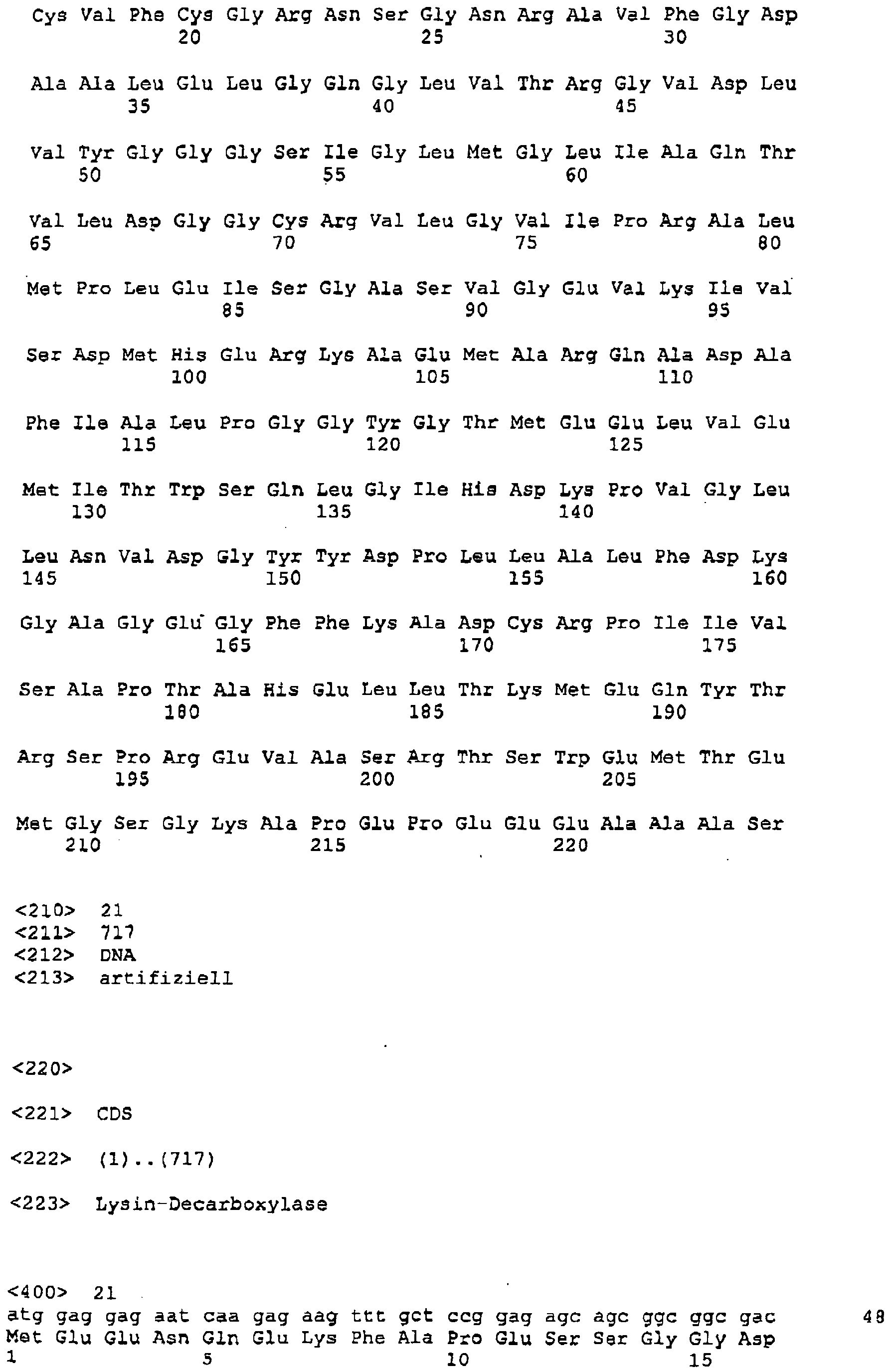


Claims (21)
- Verfahren zur Herstellung von L-Lysin, L-Threonin oder L-Methionin in transgenen Organismen dadurch gekennzeichnet, dass das Verfahren folgende Schritte umfasst:a) Einbringen einer Nukleinsäuresequenz, die für ein Lysin-abbauendes Protein codiert, oderb) Einbringen einer Nukleinsäuresequenz, die den Lysinabbau in den transgenen Organismen erhöht undc) Expression einer unter (a) oder (b) genannten Nukleinsäuresequenz im transgenen Organismus.
- Verfahren zur Herstellung von L-Lysin, L-Threonin oder L-Methioninin transgenen Organismen nach Anspruch 1, dadurch gekennzeichnet, dass das Verfahren folgende Schritte umfasst gelöst:a) Einbringen einer Nukleinsäuresequenz, die für ein Lysin-abbauendes Protein codiert, das folgende Consensus-Sequenz enthält
G[X]4GIM[X]48M[X]2RK[X]2M[X]11GGXG[X]3[X]2E[X]3W, oder
LG[X]9
LVYGG[X]3GIMGXVA[X]9G[X]3GXIP[X]24MHXRK[X]2M[X]6F[X]3PGGXGTXEE[ X]2 E[X]2TW[X]2IG[X]3KP[X]4N[X]3FY[X]14F, oderb) Einbringen einer Nukleinsäuresequenz, die den Lysinabbau in den transgenen Organismen erhöht undc) Expression einer unter (a) oder (b) genannten Nukleinsäuresequenz im transgenen Organismus. - Verfahren zur Herstellung von L-Lysin, L-Threonin oder L-Methionin in transgenen Organismen nach Anspruch 1 dadurch gekennzeichnet, dass im Verfahrensschritt (a) gemäß den Ansprüchen 1 bis 2 eine Nukleinsäuresequenz eingebracht wird, die ausgewählt ist aus der Gruppe der Nukleinsäuresequenzen:i) einer Nukleinsäuresequenz mit der in, SEQ ID NO: 11, SEQ ID NO: 17, SEQ ID NO: 19, SEQ ID NO: 21, SEQ ID NO: 23 oder SEQ ID NO: 25 dargestellten Sequenz;ii) einer Nukleinsäuresequenz, die aufgrund des degenerierten genetischen Codes durch Rückübersetzung der in SEQ ID NO: 12, SEQ ID NO: 18, SEQ ID NO: 20, SEQ ID NO: 22, SEQ ID NO: 24 oder SEQ ID NO: 26 dargestellten Aminosäuresequenz erhalten wird undiii) eines Derivats der in SEQ ID NO: 11, SEQ ID NO: 17, SEQ ID NO: 19, SEQ ID NO: 21, SEQ ID NO: 23 oder SEQ ID NO: 25 dargestellten Nukleinsäuresequenz, die für Polypeptide mit der in, SEQ ID NO: 12, SEQ ID NO: 18, SEQ ID NO: 20, SEQ ID NO: 22, SEQ ID NO: 24 oder SEQ ID NO: 26 dargestellten Aminosäuresequenz codiert und mindestens 50 % Homologie auf - Aminosäureebene aufweisen, ohne dass die biologische Aktivität der Polypeptide wesentlich reduziert ist.
- Verfahren zur Herstellung von L-Lysin, L-Threonin oder L-Methionin in transgenen Organismen nach den Ansprüchen 1 bis 3, dadurch gekennzeichnet, dass der transgene Organismus nach Einbringen und Expression der Nukleinsäure kultiviert und geerntet wird.
- Verfahren zur Herstellung von L-Lysin, L-Threonin oder L-Methionin in transgenen Organismen nach den Ansprüchen 1 bis 4, dadurch gekennzeichnet, dass die Aminosäure aus dem Organismus oder dem Kulturmedium oder dem Organismus und dem Kulturmedium isoliert wird.
- Verfahren zur Herstellung von L-Lysin, L-Threonin oder L-Methionin in transgenen Organismen nach den Ansprüchen 1 bis 5, dadurch gekennzeichnet, dass die Aminosäure L-Methionin ist.
- Verfahren zur Herstellung von L-Lysin, L-Threonin oder L-Methionin in transgenen Organismen nach den Ansprüchen 1 bis 6, dadurch gekennzeichnet, dass es sich bei dem transgenen Organismus um einen Mikroorganismus oder um eine Pflanze handelt.
- Verfahren zur Herstellung von L-Lysin, L-Threonin oder L-Methionin in transgenen Organismen nach den Ansprüchen 1 bis 7, dadurch gekennzeichnet, dass es sich bei dem transgenen Organismus um einen Mikroorganismus ausgewählt aus der Gruppe der Gattungen Corynebacterium, Brevibacterium, Escherichia, Bacillus, Rhodotorula, Hansenula, Schizosaccharomyces, Saccharomyces, Candida, Claviceps oder Flavobacterium handelt.
- Verfahren zur Herstellung von L-Lysin, L-Threonin oder L-Methionin in transgenen Organismen nach den Ansprüchen 1 bis 7, dadurch gekennzeichnet, dass es sich bei dem transgenen Organismus um eine Pflanze ausgewählt aus der Gruppe der Nutzpflanzen handelt.
- Verfahren zur Herstellung von L-Lysin, L-Threonin oder L-Methionin in transgenen Organismen nach Anspruch 9, dadurch gekennzeichnet, dass es sich bei dem transgenen Organismus um eine Pflanze ausgewählt aus der Gruppe der Erdnuss, Raps, Canola, Sonnenblume, Safflor (Färberdistel), Olive, Sesam, Haselnuss, Mandel, Avocado, Lorbeer, Kürbis, Salat, Lein, Soja, Pistazien, Borretsch, Mais, Weizen, Roggen, Hafer, Hirse, Triticale, Reis, Gerste, Maniok, Kartoffel, Zuckerrübe, Futterrübe, Aubergine, Tomate, Erbse, Alfaalfa sowie ausdauernde Gräser und Futterfeldfrüchte handelt.
- Verfahren zur Herstellung von L-Lysin, L-Threonin oder L-Methionin in transgenen Organismen nach den Ansprüchen 1 bis 10, dadurch gekennzeichnet, dass die Nukleinsäuresequenz aus einem Eukaryont stammt.
- Verfahren zur Herstellung von L-Lysin, L-Threonin oder L-Methionin in transgenen Organismen nach den Ansprüchen 1 bis 11, dadurch gekennzeichnet, dass die Nukleinsäuresequenz aus der Gattung Saccharomyces stammt.
- Verfahren zur Herstellung von L-Lysin, L-Threonin oder L-Methionin in transgenen Organismen nach den Ansprüchen 1 bis 12, dadurch gekennzeichnet, dass die Nukleinsäuresequenz zum Einbringen und zur Expression in ein Nukleinsäurekonstrukt oder einen Vektor eingebaut wird.
- Verfahren zur Herstellung von L-Lysin, L-Threonin oder L-Methionin in transgenen Organismen nach den Ansprüchen 1 bis 13, dadurch gekennzeichnet, dass zusätzlich Biosynthesegene der im Verfahren hergestellten Aminosäure in den Organismus eingebracht werden.
- Nukleinsäurekonstrukt enthaltend eine Nukleinsäuresequenz gemäß den Ansprüchen 2 bis 3, die funktionell mit einem oder mehreren Regulationssignalen verknüpft ist.
- Vektor enthaltend eine Nukleinsäuresequenz gemäß den Ansprüchen 2 bis 3 oder ein Nukleinsäurekonstrukt gemäß Anspruch 15.
- Transgener prokaryontischer oder eukaryontischer Organismus enthaltend mindestens eine Nukleinsäuresequenz gemäß den Ansprüchen 2 bis 3 oder mindestens ein Nukleinsäurekonstrukt gemäß Anspruch 15 oder mindestens einen Vektor gemäß Anspruch 16.
- Transgener prokaryontischer oder eukaryontischer Organismus nach Anspruch 17, wobei es sich um einen Mikroorganismus oder um eine Pflanze handelt.
- Transgener prokaryontischer oder eukaryontischer Organismus nach Anspruch 18, wobei es sich um einen Mikroorganismus der Gattung Corynebacterium oder Brevibacterium handelt.
- Transgener prokaryontischer oder eukaryontischer Organismus nach Anspruch 18, wobei es sich um eine Pflanze ausgewählt aus der Gruppe der Gattung der Erdnuss, Raps, Canola, Sonnenblume, Safflor (Färberdistel), Olive, Sesam, Haselnuss, Mandel, Avocado, Lorbeer, Kürbis, Salat, Lein, Soja, Pistazien, Borretsch, Mais, Weizen, Roggen, Hafer, Hirse, Triticale, Reis, Gerste, Maniok, Kartoffel, Zuckerrübe, Futterrübe, Aubergine, Tomate, Erbse, Alfalfa sowie ausdauernde Gräser und Futterfeldfrüchte handelt.
- Verwendung der transgenen Organismen gemäß den Ansprüchen 17 bis 20 oder von L-Lysin, L-Threonin oder L-Methionin hergestellt nach einem Verfahren gemäß den Ansprüchen 1 bis 14 zur Herstellung eines Futtermittel- oder Nahrungsmittel, zur Herstellung von Kosmetika oder Pharmazeutika.
Applications Claiming Priority (2)
| Application Number | Priority Date | Filing Date | Title |
|---|---|---|---|
| DE10261188 | 2002-12-20 | ||
| EP03785902A EP1578975A2 (de) | 2002-12-20 | 2003-12-19 | Verfahren zur herstellung von aminosäuren |
Related Parent Applications (2)
| Application Number | Title | Priority Date | Filing Date |
|---|---|---|---|
| EP03785902 Previously-Filed-Application | 2003-12-19 | ||
| EP03785902.2 Division | 2003-12-19 |
Publications (1)
| Publication Number | Publication Date |
|---|---|
| EP2471930A1 true EP2471930A1 (de) | 2012-07-04 |
Family
ID=32667551
Family Applications (2)
| Application Number | Title | Priority Date | Filing Date |
|---|---|---|---|
| EP03785902A Withdrawn EP1578975A2 (de) | 2002-12-20 | 2003-12-19 | Verfahren zur herstellung von aminosäuren |
| EP11194084A Withdrawn EP2471930A1 (de) | 2002-12-20 | 2003-12-19 | Verfahren zur Herstellung von Aminosäuren |
Family Applications Before (1)
| Application Number | Title | Priority Date | Filing Date |
|---|---|---|---|
| EP03785902A Withdrawn EP1578975A2 (de) | 2002-12-20 | 2003-12-19 | Verfahren zur herstellung von aminosäuren |
Country Status (9)
| Country | Link |
|---|---|
| US (1) | US20060117401A1 (de) |
| EP (2) | EP1578975A2 (de) |
| KR (1) | KR20050084390A (de) |
| CN (2) | CN100552030C (de) |
| AU (1) | AU2003294924A1 (de) |
| BR (1) | BR0317537A (de) |
| CA (1) | CA2510475A1 (de) |
| NO (1) | NO20052807L (de) |
| WO (1) | WO2004057003A2 (de) |
Families Citing this family (13)
| Publication number | Priority date | Publication date | Assignee | Title |
|---|---|---|---|---|
| US20070082031A1 (en) | 2005-10-08 | 2007-04-12 | Hermann Lotter | L-lysine-containing feed additives |
| PL1969130T3 (pl) * | 2006-01-04 | 2014-08-29 | Evonik Degussa Gmbh | Sposób wytwarzania metioniny i jej prekursorów lub sukcynylo homoseryny przy zastosowaniu mikroorganizmów |
| US20110312095A1 (en) * | 2008-01-09 | 2011-12-22 | Her Majesty The Queen In Right Of Canada As Represented By The Minister Of Agriculture | Method and constructs for increasing recombinant protein production in plants dehydration stress |
| US20090238920A1 (en) * | 2008-03-21 | 2009-09-24 | Lewis Ted C | Process for making high grade protein product |
| CN102317437B (zh) * | 2008-12-12 | 2013-08-21 | 麦特波力克斯公司 | 用于制备聚(5-羟基戊酸)和5碳化合物的绿色工艺和组合物 |
| DE102009013914B4 (de) * | 2009-03-19 | 2011-05-05 | Bruker Daltonik Gmbh | Kalibriersubstanzen für Atmosphärendruck-Ionenquellen |
| CN101914584B (zh) * | 2010-09-03 | 2013-07-10 | 王东阳 | 一种l-色氨酸的生产方法 |
| EP2479279A1 (de) | 2011-01-20 | 2012-07-25 | Evonik Degussa GmbH | Verfahren zur fermentativen Herstellung schwefelhaltiger Aminosäuren |
| US20140045235A1 (en) * | 2012-08-12 | 2014-02-13 | Wisconsin Alumi Research Foundation | Construction of a lactobacillus casei ethanologen |
| EP2921981A3 (de) * | 2014-01-20 | 2016-06-15 | Horst Hoelken | Verfahren zur Synthese hochspezieller Aminosäuresequenzen |
| CN109402098B (zh) * | 2018-11-06 | 2021-09-17 | 王喆明 | 苏氨酸醛缩酶、突变体及其在制备取代苯丝氨酸衍生物中的应用 |
| KR102233376B1 (ko) * | 2019-09-26 | 2021-03-30 | 씨제이제일제당 주식회사 | 메조 디아미노피멜레이트 디하이드로게네이즈 변이형 폴리펩타이드 및 이를 이용한 l-쓰레오닌 생산방법 |
| WO2023168402A2 (en) * | 2022-03-03 | 2023-09-07 | Nutech Ventures | Rice sequences involved in grain weight under high temperature conditions and methods of making and using |
Citations (50)
| Publication number | Priority date | Publication date | Assignee | Title |
|---|---|---|---|---|
| EP0066129A2 (de) | 1981-05-11 | 1982-12-08 | Ajinomoto Co., Inc. | Verfahren zur Herstellung von L-Threonin durch Gärung |
| WO1984002913A1 (en) | 1983-01-17 | 1984-08-02 | Monsanto Co | Chimeric genes suitable for expression in plant cells |
| US4489160A (en) | 1981-08-26 | 1984-12-18 | Kyowa Hakko Kogyo Co., Ltd. | Plasmid pCG2 |
| EP0249676A2 (de) | 1986-01-28 | 1987-12-23 | Sandoz Ltd. | Verfahren zur Genexpression in Pflanzen |
| EP0335528A2 (de) | 1988-03-29 | 1989-11-15 | E.I. Du Pont De Nemours And Company | DNS-Promotorfragmente aus Weizen |
| EP0375091A1 (de) | 1988-12-21 | 1990-06-27 | Institut Für Genbiologische Forschung Berlin Gmbh | Wundinduzierbare und kartoffelknollenspezifische transkriptionale Regulation |
| EP0388186A1 (de) | 1989-03-17 | 1990-09-19 | E.I. Du Pont De Nemours And Company | Externe Regulierung der Genexpression |
| US4962028A (en) | 1986-07-09 | 1990-10-09 | Dna Plant Technology Corporation | Plant promotors |
| WO1991013980A1 (en) | 1990-03-16 | 1991-09-19 | Calgene, Inc. | Novel sequences preferentially expressed in early seed development and methods related thereto |
| US5158891A (en) | 1984-08-21 | 1992-10-27 | Asahi Kasei Kogyo Kabushiki Kaisha | Plasmid containing a gene for tetracycline resistance and DNA fragments derived therefrom |
| WO1992018634A1 (en) | 1991-04-09 | 1992-10-29 | Unilever Plc | Plant promoter involved in controlling lipid biosynthesis in seeds |
| US5167267A (en) | 1992-01-08 | 1992-12-01 | Mcquaid Everett P | Automobile cover |
| DE4120867A1 (de) | 1991-06-25 | 1993-01-07 | Agfa Gevaert Ag | Fotografisches verarbeitungsverfahren und vorrichtung dafuer |
| WO1993020216A1 (en) | 1991-02-22 | 1993-10-14 | University Technologies International, Inc. | Oil-body protein cis-elements as regulatory signals |
| WO1993021334A1 (en) | 1992-04-13 | 1993-10-28 | Zeneca Limited | Dna constructs and plants incorporating them |
| EP0571741A2 (de) | 1992-03-27 | 1993-12-01 | Sumitomo Chemical Company, Limited | Samen-Expressionsplasmid |
| JPH0662870A (ja) | 1992-08-18 | 1994-03-08 | Mitsui Giyousai Shokubutsu Bio Kenkyusho:Kk | 大豆ホスホエノールピルビン酸カルボキシラーゼ遺伝子のプロモーター領域及び5’非翻訳領域 |
| US5315001A (en) | 1986-07-31 | 1994-05-24 | Calgene Inc. | Acyl carrier protein - DNA sequence and synthesis |
| WO1994012015A1 (en) | 1992-11-30 | 1994-06-09 | Chua Nam Hai | Expression motifs that confer tissue- and developmental-specific expression in plants |
| EP0615693A2 (de) | 1993-03-17 | 1994-09-21 | Degussa Aktiengesellschaft | Tierfuttermittel-Additiv auf Fermentationsbrühe-Basis, Verfahren zu dessen Herstellung und dessen Verwendung |
| US5352605A (en) | 1983-01-17 | 1994-10-04 | Monsanto Company | Chimeric genes for transforming plant cells using viral promoters |
| WO1994025606A2 (de) | 1993-04-23 | 1994-11-10 | Sandoz Ltd. | Rekombinante alanin racemase und gapdh aus tolypocladium niveum |
| WO1995014098A1 (en) | 1993-11-19 | 1995-05-26 | Biotechnology Research And Development Corporation | Chimeric regulatory regions and gene cassettes for expression of genes in plants |
| WO1995015389A2 (en) | 1993-12-02 | 1995-06-08 | Olsen Odd Arne | Promoter |
| WO1995016783A1 (en) | 1993-12-14 | 1995-06-22 | Calgene Inc. | Controlled expression of transgenic constructs in plant plastids |
| WO1995019443A2 (en) | 1994-01-13 | 1995-07-20 | Ciba-Geigy Ag | Chemically regulatable and anti-pathogenic dna sequences and uses thereof |
| EP0533039B1 (de) | 1991-09-17 | 1995-08-30 | Degussa Aktiengesellschaft | Tierfuttermittelsupplement auf Fermentationsbrühe-Aminosäurebasis, Verfahren zu dessen Herstellung und dessen Verwendung |
| WO1995023230A1 (en) | 1994-02-24 | 1995-08-31 | Olsen Odd Arne | Promoter from a lipid transfer protein gene |
| US5487993A (en) | 1990-09-27 | 1996-01-30 | Invitrogen Corporation | Direct cloning of PCR amplified nucleic acids |
| US5504200A (en) | 1983-04-15 | 1996-04-02 | Mycogen Plant Science, Inc. | Plant gene expression |
| US5510474A (en) | 1988-05-17 | 1996-04-23 | Mycogen Plant Science, Inc. | Plant ubiquitin promoter system |
| WO1996012814A1 (en) | 1994-10-21 | 1996-05-02 | Danisco A/S | Promoter sequence from potato |
| US5530149A (en) | 1992-03-13 | 1996-06-25 | Bayer Aktiengesellschaft | Azolylmethyl-fluorocyclopropyl derivatives |
| WO1997006268A2 (en) | 1995-08-08 | 1997-02-20 | Zeneca Limited | Dna constructs |
| WO1997006250A1 (en) | 1995-08-10 | 1997-02-20 | Rutgers University | Nuclear-encoded transcription system in plastids of higher plants |
| US5608152A (en) | 1986-07-31 | 1997-03-04 | Calgene, Inc. | Seed-specific transcriptional regulation |
| EP0781849A1 (de) | 1995-07-05 | 1997-07-02 | Sapporo Breweries Ltd. | Gewebsspezifischer promotor |
| EP0796912A1 (de) * | 1994-12-09 | 1997-09-24 | Ajinomoto Co., Inc. | Neues lysin decarboxylase gen und verfahren zur herstellung von l-lysin |
| US5677474A (en) | 1988-07-29 | 1997-10-14 | Washington University | Producing commercially valuable polypeptides with genetically transformed endosperm tissue |
| US5689040A (en) | 1995-02-23 | 1997-11-18 | The Regents Of The University Of California | Plant promoter sequences useful for gene expression in seeds and seedlings |
| WO1998001572A1 (de) | 1996-07-03 | 1998-01-15 | Hoechst Research & Technology Deutschland Gmbh & Co. Kg | Genetische transformation von ciliatenzellen durch microcarrier- bombardement mit dna-beladenen goldpartikeln |
| WO1998008962A1 (en) | 1996-08-30 | 1998-03-05 | Monsanto Company | Early seed 5' regulatory sequence |
| DE19644478A1 (de) | 1996-10-25 | 1998-04-30 | Basf Ag | Blattspezifische Expression von Genen in transgenen Pflanzen |
| WO1998045461A1 (en) | 1997-04-09 | 1998-10-15 | Rhone-Poulenc Agro | An oleosin 5' regulatory region for the modification of plant seed lipid composition |
| WO1999016890A2 (en) | 1997-09-30 | 1999-04-08 | The Regents Of The University Of California | Production of proteins in plant seeds |
| WO1999046394A1 (en) | 1998-03-11 | 1999-09-16 | Novartis Ag | Novel plant plastid promoter sequence |
| WO2000026388A2 (de) | 1998-11-04 | 2000-05-11 | Institut Für Pflanzengenetik Und Kulturpflanzenfor- Schung | Neue expressionskassette zur expression von beliebigen genen in pflanzensamen |
| WO2001014572A2 (de) | 1999-08-26 | 2001-03-01 | Basf Plant Science Gmbh | Pflanzliche genexpression unter der kontrolle von konstitutiven pflanzlichen v-atpase promotoren |
| WO2001020009A1 (de) | 1999-09-15 | 2001-03-22 | Basf Plant Science Gmbh | Pflanzen mit verändertem aminosäuregehalt und verfahren zu deren herstellung |
| US20020123118A1 (en) | 1998-07-31 | 2002-09-05 | Allen Stephen M. | Glycine metabolism enzymes |
Family Cites Families (3)
| Publication number | Priority date | Publication date | Assignee | Title |
|---|---|---|---|---|
| HUP9900864A3 (en) * | 1995-05-31 | 2001-11-28 | Pioneer Hi Bred Int | Methods of increasing accumulation of essential amino acids in seeds |
| CA2255284A1 (en) * | 1997-12-22 | 1999-06-22 | Forschungszentrum Julich Gmbh | Unicellular or multicellular organisms for preparing riboflavin |
| WO2004101741A2 (en) * | 2003-05-05 | 2004-11-25 | Monsanto Technology, Llc | Transgenic plants with increased glycine-betaine |
-
2003
- 2003-12-19 AU AU2003294924A patent/AU2003294924A1/en not_active Abandoned
- 2003-12-19 CA CA002510475A patent/CA2510475A1/en not_active Abandoned
- 2003-12-19 EP EP03785902A patent/EP1578975A2/de not_active Withdrawn
- 2003-12-19 KR KR1020057011222A patent/KR20050084390A/ko not_active Withdrawn
- 2003-12-19 EP EP11194084A patent/EP2471930A1/de not_active Withdrawn
- 2003-12-19 BR BR0317537-5A patent/BR0317537A/pt not_active Application Discontinuation
- 2003-12-19 US US10/539,954 patent/US20060117401A1/en not_active Abandoned
- 2003-12-19 CN CNB2003801067901A patent/CN100552030C/zh not_active Expired - Fee Related
- 2003-12-19 CN CN200910170715A patent/CN101691577A/zh active Pending
- 2003-12-19 WO PCT/EP2003/014649 patent/WO2004057003A2/de not_active Ceased
-
2005
- 2005-06-10 NO NO20052807A patent/NO20052807L/no not_active Application Discontinuation
Patent Citations (52)
| Publication number | Priority date | Publication date | Assignee | Title |
|---|---|---|---|---|
| EP0066129A2 (de) | 1981-05-11 | 1982-12-08 | Ajinomoto Co., Inc. | Verfahren zur Herstellung von L-Threonin durch Gärung |
| US4489160A (en) | 1981-08-26 | 1984-12-18 | Kyowa Hakko Kogyo Co., Ltd. | Plasmid pCG2 |
| WO1984002913A1 (en) | 1983-01-17 | 1984-08-02 | Monsanto Co | Chimeric genes suitable for expression in plant cells |
| US5352605A (en) | 1983-01-17 | 1994-10-04 | Monsanto Company | Chimeric genes for transforming plant cells using viral promoters |
| US5504200A (en) | 1983-04-15 | 1996-04-02 | Mycogen Plant Science, Inc. | Plant gene expression |
| US5158891A (en) | 1984-08-21 | 1992-10-27 | Asahi Kasei Kogyo Kabushiki Kaisha | Plasmid containing a gene for tetracycline resistance and DNA fragments derived therefrom |
| EP0249676A2 (de) | 1986-01-28 | 1987-12-23 | Sandoz Ltd. | Verfahren zur Genexpression in Pflanzen |
| US4962028A (en) | 1986-07-09 | 1990-10-09 | Dna Plant Technology Corporation | Plant promotors |
| US5608152A (en) | 1986-07-31 | 1997-03-04 | Calgene, Inc. | Seed-specific transcriptional regulation |
| US5315001A (en) | 1986-07-31 | 1994-05-24 | Calgene Inc. | Acyl carrier protein - DNA sequence and synthesis |
| EP0335528A2 (de) | 1988-03-29 | 1989-11-15 | E.I. Du Pont De Nemours And Company | DNS-Promotorfragmente aus Weizen |
| US5510474A (en) | 1988-05-17 | 1996-04-23 | Mycogen Plant Science, Inc. | Plant ubiquitin promoter system |
| US6020190A (en) | 1988-05-17 | 2000-02-01 | Mycogen Plant Science, Inc. | Plant ubiquitin promoter system |
| US6054574A (en) | 1988-05-17 | 2000-04-25 | Mycogen Plant Science, Inc. | Plant ubiquitin promoter system |
| US5677474A (en) | 1988-07-29 | 1997-10-14 | Washington University | Producing commercially valuable polypeptides with genetically transformed endosperm tissue |
| EP0375091A1 (de) | 1988-12-21 | 1990-06-27 | Institut Für Genbiologische Forschung Berlin Gmbh | Wundinduzierbare und kartoffelknollenspezifische transkriptionale Regulation |
| EP0388186A1 (de) | 1989-03-17 | 1990-09-19 | E.I. Du Pont De Nemours And Company | Externe Regulierung der Genexpression |
| WO1991013980A1 (en) | 1990-03-16 | 1991-09-19 | Calgene, Inc. | Novel sequences preferentially expressed in early seed development and methods related thereto |
| US5487993A (en) | 1990-09-27 | 1996-01-30 | Invitrogen Corporation | Direct cloning of PCR amplified nucleic acids |
| WO1993020216A1 (en) | 1991-02-22 | 1993-10-14 | University Technologies International, Inc. | Oil-body protein cis-elements as regulatory signals |
| WO1992018634A1 (en) | 1991-04-09 | 1992-10-29 | Unilever Plc | Plant promoter involved in controlling lipid biosynthesis in seeds |
| DE4120867A1 (de) | 1991-06-25 | 1993-01-07 | Agfa Gevaert Ag | Fotografisches verarbeitungsverfahren und vorrichtung dafuer |
| EP0533039B1 (de) | 1991-09-17 | 1995-08-30 | Degussa Aktiengesellschaft | Tierfuttermittelsupplement auf Fermentationsbrühe-Aminosäurebasis, Verfahren zu dessen Herstellung und dessen Verwendung |
| US5167267A (en) | 1992-01-08 | 1992-12-01 | Mcquaid Everett P | Automobile cover |
| US5530149A (en) | 1992-03-13 | 1996-06-25 | Bayer Aktiengesellschaft | Azolylmethyl-fluorocyclopropyl derivatives |
| EP0571741A2 (de) | 1992-03-27 | 1993-12-01 | Sumitomo Chemical Company, Limited | Samen-Expressionsplasmid |
| WO1993021334A1 (en) | 1992-04-13 | 1993-10-28 | Zeneca Limited | Dna constructs and plants incorporating them |
| JPH0662870A (ja) | 1992-08-18 | 1994-03-08 | Mitsui Giyousai Shokubutsu Bio Kenkyusho:Kk | 大豆ホスホエノールピルビン酸カルボキシラーゼ遺伝子のプロモーター領域及び5’非翻訳領域 |
| WO1994012015A1 (en) | 1992-11-30 | 1994-06-09 | Chua Nam Hai | Expression motifs that confer tissue- and developmental-specific expression in plants |
| EP0615693A2 (de) | 1993-03-17 | 1994-09-21 | Degussa Aktiengesellschaft | Tierfuttermittel-Additiv auf Fermentationsbrühe-Basis, Verfahren zu dessen Herstellung und dessen Verwendung |
| WO1994025606A2 (de) | 1993-04-23 | 1994-11-10 | Sandoz Ltd. | Rekombinante alanin racemase und gapdh aus tolypocladium niveum |
| WO1995014098A1 (en) | 1993-11-19 | 1995-05-26 | Biotechnology Research And Development Corporation | Chimeric regulatory regions and gene cassettes for expression of genes in plants |
| WO1995015389A2 (en) | 1993-12-02 | 1995-06-08 | Olsen Odd Arne | Promoter |
| WO1995016783A1 (en) | 1993-12-14 | 1995-06-22 | Calgene Inc. | Controlled expression of transgenic constructs in plant plastids |
| WO1995019443A2 (en) | 1994-01-13 | 1995-07-20 | Ciba-Geigy Ag | Chemically regulatable and anti-pathogenic dna sequences and uses thereof |
| WO1995023230A1 (en) | 1994-02-24 | 1995-08-31 | Olsen Odd Arne | Promoter from a lipid transfer protein gene |
| WO1996012814A1 (en) | 1994-10-21 | 1996-05-02 | Danisco A/S | Promoter sequence from potato |
| EP0796912A1 (de) * | 1994-12-09 | 1997-09-24 | Ajinomoto Co., Inc. | Neues lysin decarboxylase gen und verfahren zur herstellung von l-lysin |
| US5689040A (en) | 1995-02-23 | 1997-11-18 | The Regents Of The University Of California | Plant promoter sequences useful for gene expression in seeds and seedlings |
| EP0781849A1 (de) | 1995-07-05 | 1997-07-02 | Sapporo Breweries Ltd. | Gewebsspezifischer promotor |
| WO1997006268A2 (en) | 1995-08-08 | 1997-02-20 | Zeneca Limited | Dna constructs |
| WO1997006250A1 (en) | 1995-08-10 | 1997-02-20 | Rutgers University | Nuclear-encoded transcription system in plastids of higher plants |
| WO1998001572A1 (de) | 1996-07-03 | 1998-01-15 | Hoechst Research & Technology Deutschland Gmbh & Co. Kg | Genetische transformation von ciliatenzellen durch microcarrier- bombardement mit dna-beladenen goldpartikeln |
| WO1998008962A1 (en) | 1996-08-30 | 1998-03-05 | Monsanto Company | Early seed 5' regulatory sequence |
| DE19644478A1 (de) | 1996-10-25 | 1998-04-30 | Basf Ag | Blattspezifische Expression von Genen in transgenen Pflanzen |
| WO1998045461A1 (en) | 1997-04-09 | 1998-10-15 | Rhone-Poulenc Agro | An oleosin 5' regulatory region for the modification of plant seed lipid composition |
| WO1999016890A2 (en) | 1997-09-30 | 1999-04-08 | The Regents Of The University Of California | Production of proteins in plant seeds |
| WO1999046394A1 (en) | 1998-03-11 | 1999-09-16 | Novartis Ag | Novel plant plastid promoter sequence |
| US20020123118A1 (en) | 1998-07-31 | 2002-09-05 | Allen Stephen M. | Glycine metabolism enzymes |
| WO2000026388A2 (de) | 1998-11-04 | 2000-05-11 | Institut Für Pflanzengenetik Und Kulturpflanzenfor- Schung | Neue expressionskassette zur expression von beliebigen genen in pflanzensamen |
| WO2001014572A2 (de) | 1999-08-26 | 2001-03-01 | Basf Plant Science Gmbh | Pflanzliche genexpression unter der kontrolle von konstitutiven pflanzlichen v-atpase promotoren |
| WO2001020009A1 (de) | 1999-09-15 | 2001-03-22 | Basf Plant Science Gmbh | Pflanzen mit verändertem aminosäuregehalt und verfahren zu deren herstellung |
Non-Patent Citations (160)
| Title |
|---|
| "Biochemical Engineering Fundamentals", 1986, MCGRAW-HIII |
| "Cloning Vectors", 1985, ELSEVIER |
| "Current Protocols in Molecular Biology", 1989, JOHN WILEY & SONS |
| "Enzymatic Reaction Mechanisms", FREEMAN |
| "Essential Molecular Biology: A Practical Approach", IRL PRESS AT OXFORD UNIVERSITY PRESS |
| "Manual of Methods für General Bacteriology", 1981, AMERICAN SOCIETY FÜR BACTERIOLOGY |
| "More Gene Manipulations in Fungi", ACADEMIC PRESS, pages: 396 - 428 |
| "Nucleic Acids Hybridization: A Practical Approach", 1991, IRL PRESS AT OXFORD UNIVERSITY PRESS |
| "Plant Molecular Biology and Blotechnology", 1993, C PRESS, pages: 71 - 119 |
| "Transgenic Plants, Bd. 1, Engineering and Utilization", vol. 1, 1993, article "Vectors for Gene Transfer in Higher Plants", pages: 15 - 38 |
| "Ullmann's Encyclopedia of Industrial Chemistry", vol. A2, 1985, VCH, pages: 1 |
| "Ullmann's Encyclopedia of Industrial Chemistry", vol. A2, 1985, VCH, pages: 57 - 97 |
| "Ullmann's Encyclopedia of Industrial Chemistry", vol. A9, 1987, VCH, pages: 352 - 363 |
| "Ulmann's Encyclopedia of Industrial Chemistry", vol. A27, 1996, VCH, pages: 540-547 - 559-566 |
| "Ulmann's Encyclopedia of Industrial Chemistry", vol. A27, 1996, VCH, pages: 89-90 - 521-540 |
| AMANN ET AL., GENE, vol. 69, 1988, pages 301 - 315 |
| AUSUBEL ET AL.: "Current Protocols in Molecular Biology", 1988, WILEY |
| AUSUBEL, F.M. ET AL.: "Current Protocols in Molecular Biology", 1994, JOHN WILEY & SONS |
| B. JENES ET AL.: "Transgenic Plants, Vol. 1, Engineering and Utilization", vol. 1, 1993, ACADEMIC PRESS, article "Techniques for Gene Transfer", pages: 128 - 143 |
| BAEUMLEIN ET AL., MOL GEN GENET, vol. 225, no. 3, 1981, pages 459 - 67 |
| BAEUMLEIN ET AL., PLANT JOURNAL, vol. 2, no. 2, 1992, pages 233 - 9 |
| BALDARI ET AL., EMBO J., vol. 6, 1987, pages 229 - 234 |
| BALOWS, A., ET AL.,: "The Procaryotes", vol. II, 1992, SPRINGER-VERLAG, article ; LIEBL: "The Genus Corynebacterium" |
| BARKER W. C. ET AL., NUCLEIC ACIDS RES., vol. 27, 1999, pages 39 - 43 |
| BAUMLEIN ET AL., MOL. GEN GENET., vol. 225, no. 3, 1991 |
| BÄUMLEIN ET AL., PLANT J., vol. 2, 1992, pages 2 |
| BECHTHOLD, N.; ELLIS, J; PELLETIER, G: "In planta Agrobacterium-mediated gene transfer by infiltration of adult Arabidopsis thalina plants", C R ACAD SEI PARIS LIFE SCI, vol. 316, 1993, pages 1194 - 1199 |
| BECKER, D.; KEMPER, E.; SCHELL. J.; MASTERSON, R.: "New plant binary vectors with selectable markers located proximal to the left border", PLANT MOL. BLOL., vol. 20, 1992, pages 1195 - 1197 |
| BEITER. P.A. ET AL.: "Bioseparations: downstream processing for Biotechnology", 1988, JOHN WILEY AND SONS |
| BENFEY ET AL., EMBO J., vol. 8, 1989, pages 2195 - 2202 |
| BENSON D.A. ET AL., NUCLEIC ACIDS RES, vol. 28, 2000, pages 15 - 18 |
| BERGMEYER, H.U., BERGMEYER, J., GRASSL, M.: "Methods of Enzymatic Analysis, 3. Aufl.", vol. I-XII, 1983, VERLAG CHEMIE |
| BERLIN J ET AL: "Lysine decarboxylase transgenic tobacco root cultures biosynthesize novel hydroxycinnamoylcadaverines", PHYTOCHEMISTRY, PERGAMON PRESS, GB, vol. 48, no. 1, 1 May 1998 (1998-05-01), pages 79 - 84, XP004294017, ISSN: 0031-9422, DOI: 10.1016/S0031-9422(97)01098-4 * |
| BEVAN ET AL., NUCL. ACIDS RES., vol. 12, 1984, pages 8711 |
| BEVAN, M.W.: "Binary Agrobacterium vectors for plant transformation", NUCL. ACIDS RES., vol. 12, 1984, pages 8711 - 8721 |
| BISSWANGER, H.: "Enzymkinetik, 2. Aufl.", 1994, VCH |
| BORMANN, E.R. ET AL., MOL. MICROBIOL., vol. 6, 1992, pages 317 - 326 |
| BOYER, P.D:: "The Enzymes, 3. Aufl.", 1983, ACADEMIC PRESS |
| CALLIS ET AL., J. BIOL. CHEM., vol. 265, 1990, pages 12486 - 12493 |
| CARRIZO C N ET AL: "Occurrence of cadaverine in hairy roots of Brugmansia candida", PHYTOCHEMISTRY, PERGAMON PRESS, GB, vol. 57, no. 5, 1 July 2001 (2001-07-01), pages 759 - 763, XP004241573, ISSN: 0031-9422, DOI: 10.1016/S0031-9422(01)00127-3 * |
| CHANG, SS; PARK SK; KIM, BC; KANG, BJ; KIMDU; NAM, HG: "Stable genetic transformation of Arabidopsis thaliana by Agrobacterium inoculation in planta", PLANT J., vol. 5, 1994, pages 551 - 558, XP002085792 |
| CHANGE; COHEN, J. BACTERIOL., vol. 134, 1978, pages 1141 - 1156 |
| CHERRY J. M. ET AL., NUCLEIC ACIDS RES., vol. 26, 1998, pages 73 - 80 |
| CHIRGWIN ET AL., BIOCHEMISTRY, vol. 18, 1979, pages 5294 - 5299 |
| CHMIEL: "Bloprozeßtechnik 1. Einführung in die Bioverfahrenstechnik", 1991, GUSTAV FISCHER VERLAG |
| CLOUGH, JC; BENT, AF.: "Floral dip: a simplifled method for Agrobacterium-mediated transformation of Arabidopsis thaliana", PLANT J.., vol. 16, 1998, pages 735 - 743 |
| CLOUGH, SJ; BENT, AF: "Floral dip: a simple method for Agrobacterium-mediated transformation of Arabidopsis thaliana", THE PLANT J., vol. 16, 1998, pages 735 - 743 |
| CLOUGH; BENT, PLANT J, vol. 16, 1998, pages 735 - 743 |
| COMAI ET AL., PLANT MOL BIOL, vol. 15, no. 3, 1990, pages 373 - 381 |
| DECHOW, F.J.: "Separation and purification techniques in biotechnology", 1989, NOYES PUBLICATIONS |
| DIXON, M.; WEBB, E.C: "Enzymes", 1979, LONGMANS |
| EIKMANNS ET AL., GENE, vol. 102, 1991, pages 93 - 98 |
| EIKMANNS, B.J. ET AL., GENE, vol. 102, 1992, pages 93 - 98 |
| F.F. WHITE: "Transgenic Plants, Bd. 1, Engineering and Utilization", vol. 1, 1993, ACADEMIC PRESS, article "Vectors for Gene Transfer in Higher Plants", pages: 15 - 38 |
| F.F. WHITE: "Transgenic Plants, Vol. 1, Engineering and Utilization", vol. 1, 1993, ACADEMIC PRESS, article "Vectors for Gene Transfer in Higher Plants", pages: 15 - 38 |
| FALCIATORE ET AL., MARINE BIOTECHNOLOGY, vol. 1, 1999 |
| FALCIATORE ET AL., MARINE BLOTECHNOLOGY, vol. 1, no. 3, 1999, pages 239 - 251 |
| FALION, A. ET AL.: "Applications of HPLC in Biochemistry", LABORATORY TECHNIQUES IN BIOCHEMISTRY AND MOLECULAR BIOLOGY, vol. 17, 1987 |
| FALLON, A ET AL.: "Applications of HPLC in Blochemistry", LABORATORY TECHNIQUES IN BIOCHEMISTRY AND MOLECULAR BIOLOGY, vol. 17, 1987 |
| FALLON, A. ET AL.: "Applications of HPLC in Biochemistry", LABORATORY TECHNIQUES IN BIOCHEMISTRY AND MOLECULAR BIOLOGY, vol. 17, 1987 |
| FELDMAN, KA; MARKS MD: "Agrobacterium-mediated transformation of germinating seeds of Arabidopsis thaliana: a non tissue culture approach", MOL GEN GENET, vol. 208, 1987, pages 274 - 289 |
| FELDMANN K: "Methods in Arabidopsis Research", 1992, WORD SCIENTIFIC, article "T-DNA insertion mutagenesis in Arabidopsis: seed infection transformation", pages: 274 - 289 |
| FERSHT: "Enzyme Structure and Mechanism", 1979, FREEMAN |
| FLEISCHMAN, R.D. ET AL.: "Wholegenome Random Sequencing and Assembly of Haemophilus Influenzae Rd.", SCIENCE, vol. 269, 1995, pages 496 - 512 |
| FRANCK ET AL., CELL, vol. 21, 1980, pages 285 - 294 |
| GALLIE ET AL., NUCL. ACIDS RESEARCH, vol. 15, 1987, pages 8693 - 8711 |
| GARTLAND UND DAVEY,: "Methods in Molecular Biology", vol. 44, 1995, HUMANA PRESS |
| GATZ ET AL., PLANT J., vol. 2, 1992, pages 397 - 404 |
| GATZ, ANNU. REV. PLANT PHYSIOL. PLANT MOL. BIOI., vol. 48, 1997, pages 89 - 108 |
| GATZ, ANNU. REV. PLANT PHYSIOL. PLANT MOL. BIOL., vol. 48, 1997, pages 89 - 108 |
| GEIGENBERGER ET AL., PLANT CELL & ENVIRON, vol. 19, 1996, pages 43 - 55 |
| GIBSON, T.J.; ROSENTHAL, A.; WATERSON, R.H., GENE, vol. 53, 1987, pages 283 - 286 |
| GIEIEN ET AL., EMBO J., vol. 3, 1984 |
| GOEDDEL: "Gene Expression Technology: Methods in Enzymology", vol. 185, 1990, ACADEMLC PRESS |
| GREENER, A; CALLAHAN, M., STRATEGIES, vol. 7, 1994, pages 32 - 34 |
| GRUBER; CROSBY: "Methods in Plant Molecular Biology and Biotechnolgy", vol. 7, CRC PRESS, pages: 89 - 108 |
| HELLENS ET AL., TRENDS IN PLANT SCIENCE, vol. 5, 2000, pages 446 - 451 |
| HELLENS, R.; MULLINEAUX, P.; KLEE H.: "A guide to Agrobacterium binary vectors", TRENDS IN PLANT SCIENCE, vol. 5, no. 10, 2000, pages 446 - 451, XP002909175, DOI: doi:10.1016/S1360-1385(00)01740-4 |
| HELLENS, R.; MULLINEAUX, P.; KLEE H.: "Trends in Plant Science", vol. 5, 2000, article "A guide to Agrobacterium binary vectors", pages: 446 - 451 |
| HELLENS, R; MULLINEAUX, P.; KLEE H.: "Trends in Plant Science", vol. 5, 2000, article "A guide to Agrobacterium binary vectors", pages: 446 - 451 |
| HERMINGHAUS S ET AL: "EXPRESSION OF A BACTERIAL LYSINE DECARBOXYLASE GENE AND TRANSPORT OF THE PROTEIN INTO CHLOROPLASTS OF TRANSGENIC TOBACCO", PLANT MOLECULAR BIOLOGY, SPRINGER, DORDRECHT, NL, vol. 17, no. 3, 1 January 1991 (1991-01-01), pages 475 - 486, XP009058911, ISSN: 0167-4412, DOI: 10.1007/BF00040641 * |
| HOFGEN; WILLMLTZER: "Nucl. Acid Res.", vol. 16, 1988, pages: 9877 |
| HOLTORF S ET AL., PLANT. MOL. BIOL., vol. 29, 1995, pages 637 - 747 |
| HUALA, E. ET AL., NUCLEIC ACIDS RES., vol. 29, no. 1, 2001, pages 102 - 5 |
| J.F. PEBERDY ET AL.: "Applied Molecular Genetics of fungi", 1991, CAMBRIDGE UNIVERSITY PRESS, article HONDEL, C.A.M.J.J.; PUNT, P.J. ET AL.: "Gene transfer systems and vector development for filamentous fungi", pages: 1 - 28 |
| JAIN ET AL., CROP SCIENCE, vol. 39, no. 6, 1999, pages 1696 - 1701 |
| KASTSUMATA, R. ET AL., J. BACTERIOL., vol. 159, 1984, pages 306 - 311 |
| KATAVIC, V; HAUGHN, GW; REED, D; MARFIN, M; KUNST, L: "In planta transformation of Arabidopsis thaliana", MOL GEN GENET, vol. 245, 1994, pages 363 - 370, XP002085791 |
| KAWALLECK ET AL., PLANT MOLECULAR BIOLOGY, vol. 21, 1993, pages 673 - 684 |
| KENNEDY, J.F.; CABRAL, J.M.S.: "Recovery processes for biological Materials", 1992, JOHN WILEY AND SONS |
| KONCZ; SCHELL, MOL. GEN. GENT, vol. 204, 1986, pages 383 - 396 |
| KUNG ET AL.: "Transgenic Plants,", vol. 1, 1993, article B. JENES ET AL.: "Techniques for Gene Transfer", pages: 128 - 143 |
| KURJAN; HERSKOWITZ, CELL, vol. 30, 1982, pages 933 - 943 |
| LEHRBUCH: "Applied Microbiol. Physiology, A Practical Approach", 1997, IRL PRESS, pages: 53 - 73 |
| LEISNER; GELVIN, PROC NATL ACAD SCI USA, vol. 85, no. 5, 1988, pages 2553 - 2557 |
| LEUCHTENBERGER, W. ET AL.: "Biotechnology", vol. 6, 1996, VCH, article "Amino acids - technical production and use", pages: 466 - 502 |
| LIEB ET AL., APPL. MICROBIOL. BIOTECHNOL., vol. 32, 1989, pages 205 - 210 |
| LIEBL, E. ET AL., FEMS MICROBIOL. LETTERS, vol. 53, 1989, pages 399 - 303 |
| LUCKLOW; SUMMERS, VIROLOGY, vol. 170, 1989, pages 31 - 39 |
| MALAKHOVA ET AL., BIOTEKHNOLOGIYA, vol. 11, 1996, pages 27 - 32 |
| MARTIN, J.F. ET AL., BIOTECHNOLOGY, vol. 5, 1987, pages 137 - 146 |
| MENKEI ET AL., APPL. ENVIRON. MICROBIOL., vol. 84, 1989, pages 549 - 554 |
| MEWES H.W. ET AL., NUCLEIC ACIDS RES., vol. 27, 1999, pages 44 - 48 |
| MICHAL, G: "Biochemical Path- ways: An Atlas of Biochemistry and Molecular Blology", 1999, JOHN WILEY AND SONS |
| MICHAL, G: "Biochemical Pathways: An Atlas of Biochemistry and Molecular Biology", 1999, JOHN WILEY AND SONS |
| OBERSICHT IN KERMODE, CRIT REV. PLANT SCI., vol. 15, no. 4, 1996, pages 285 - 423 |
| OSTEN ET AL., BIOTECHNOLOGY LETTERS, vol. 11, 1998, pages 11 - 16 |
| P.M. RHODES UND P.F. STANBURY,: "Applled Microbial Physiology; A Practical Approach", IRL PRESS, pages: 103-129 - 131-163 |
| P.M. RHODES, P.F. STANBURY: "Appfied Microbiol. Physiology, A Practlcal Approach", 1997, IRL PRESS, pages: 53 - 73 |
| PATEK ET AL., APPL. ENVIRON. MICROBIOL., vol. 60, 1994, pages 133 - 140 |
| PATEK ET AL.: "Diese Analyseverfahren sind zusammengefasst", APPL. ENVIRON. MICROBIOL., vol. 60, 1994, pages 133 - 140 |
| POTRYKUS ANNU. REV. PLANT PHYSIOL. PLANT MOLEC. BLOL., vol. 42, 1991, pages 205 - 225 |
| POTRYKUS, ANNU. REV. PLANT PHYSIOL. PLANT MOLEC. BIOL., vol. 42, 1991, pages 205 - 225 |
| PRICE, N.C.; STEVENS, L.: "Fundamentals of Enzymology", 1982, OXFORD UNIV. PRESS |
| REHM ET AL.: "Biotechnology", vol. 3, 1993, VCH, article "Product recovery and purification", pages: 469 - 714 |
| ROMANOS, M.A. ET AL.: "Foreign gene expression In yeast: a review", YEAST, vol. 8, 1992, pages 423 - 488, XP002939357, DOI: doi:10.1002/yea.320080602 |
| RUPP, W.D.: "DNA repair mechanisms in Escherichia coli and Salmonella", 1996, ASM |
| SAMBROOK ET AL.: "Molecular Cloning", 1985, COLD SPRING HARBOR LABORATORY |
| SAMBROOK ET AL.: "Molecular Cloning: A laboratory manual", 1989, COLD SPRING HARBOR LABORATORY PRESS |
| SAMBROOK ET AL.: "Molecular Cloning: A Laboratory Manual. 2. Auft.,", 1989, COLD SPRING HARBOR LABORATORY PRESS |
| SAMBROOK ET AL.: "Molecular Cloning: A Laboratory Manual., 2. Aufl.,", 1989, COLD SPRING HARBOR LABORATORY PRESS |
| SAMBROOK, J. ET AL.: "Molecular Cloning: A Laboratory Manual", 1989, COLD SPRING HARBOR LABORATORY PRESS |
| SAMBROOK, J.; FRITSCH, E.F.; MANIATIS, T.: "Molecular Cloning: A Laboratory Manual, 2. Auflage,", 1989, COLD SPRING HARBOR LABORATORY PRESS |
| SANGER ET AL., PLANT MOL. BIOL., vol. 14, 1990, pages 433 - 443 |
| SCHÄFER ET AL., GENE, vol. 145, 1994, pages 69 - 73 |
| SCHÄFER, A., J. BACTERIOI., vol. 172, 1990, pages 1663 - 1666 |
| SCHENK ET AL., PLANT MOL BIOL, vol. 39, no. 6, 1999, pages 1221 - 1230 |
| SCHMIDT ET AL., BIOPROCESS ENGINEER, vol. 19, 1998, pages 67 - 70 |
| SCHMIDT ET AL., BIOPROCESS ENGINEER., vol. 19, 1998, pages 67 - 70 |
| SCHMIDT, R.; WILLMITZER, L.: "High efficiency Agrobacterium tumefaciens-mediated transformation of Arabidopsis thaliana leaf and cotyledon explants", PLANT CELL REP., 1988, pages 583 - 586 |
| SCHRUMPF ET AL., J. BACTERIOL., vol. 17.3, 1991, pages 4510 - 4516 |
| SCHULTZ ET AL., GENE, vol. 54, 1987, pages 113 - 123 |
| SCHUMAN, J. BIOL. CHEM., vol. 269, 1994, pages 32678 - 32684 |
| SERWOLD-DAVIS ET AL., FEMS MICROBIOL. LETT., vol. 66, 1990, pages 119 - 124 |
| SHAEIWITZ, J.A.; HENRY, J.D.: "Ullmann's Encyclopedia of industrial Chemistry", vol. 83, 1988, VCH, article "Bio chemical Separations", pages: 1 - 27 |
| SHAW ET AL., NUCLEIC ACIDS RES., vol. 12, no. 20, 1984, pages 7831 - 7846 |
| SIMON ET AL., BIOLTECHNOLOGY, vol. 1, 1983, pages 784 - 791 |
| SMITH, D.B.; JOHNSON, K.S., GENE, vol. 67, 1988, pages 31 - 40 |
| SMLTH ET AL., MOL. CELL BIOL., vol. 3, 1983, pages 2156 - 2165 |
| SONNEN ET AL., GENE, vol. 107, 1991, pages 69 - 74 |
| STOCKHAUS, EMBO J., vol. 8, 1989, pages 2445 |
| STOESSER G. ET AL., NUCLEIC ACIDS RES, vol. 29, 2001, pages 17 - 21 |
| STORHAS: "Bioreaktoren und periphere Einrichtungen", 1994, VIEWEG VERLAG |
| STRYER, L.: "Biochemistry, 3. Aufl.", 1988, article "Amino Acid Degradation and the Urea Cycle", pages: 495 - 516 |
| STRYER, L.: "Biochemistry, 3. Aufl.,", 1988, article "Biosynthesis of Amino Acids and Heme", pages: 575 - 600 |
| STRYER, L.: "Biochemistry, 3. Auflage,", 1988, pages: 578 - 590 |
| STUDIER ET AL.: "Gene Expression Technoiogy: Methods in Enzymology", vol. 185, 1990, ACADEMIC PRESS, pages: 60 - 89 |
| SUTCLIFFE, J.G., PROC. NATL ACAD. SEI. USA, vol. 75, 1979, pages 3737 - 3741 |
| TRIBBLE ET AL., J.BIOL. CHEM., vol. 275, 2000, pages 22255 - 22267 |
| ULLMAN: "Encyclopedia of Industrial Chemistry", vol. A2, 1985, VCH, pages: 89-90 - 443-613 |
| UMBARGER, H.E.: "für einen Überblick der bakteriellen Aminosäure-Biosynthese und ihrer Regulation", ANN. REV. BIOCHEM., vol. 47, 1978, pages 533 - 606 |
| VAN DEN HONDEL, C.A.M.J.J. ET AL.: "More Gene Manipulations In Fungl", 1991, ACADEMIC PRESS, article "Heterologous gene expression in fiiamentous fungi", pages: 396 - 428 |
| VAN DEN HONDEL, C.A.M.J.J.; PUNT, P.J. ET AL.: "Applied Molecular Genetics of Fungi", 1991, CAMBRIDGE UNIVERSITY PRESS, article "Gene transfer systems and vector development for filamentous fungi" |
| VELMURUGAN ET AL., J. CELL BIOL., vol. 149, 2000, pages 553 - 566 |
| VON BAEUMLEIN ET AL., PLANT J., vol. 2, no. 2, 1992, pages 233 - 239 |
| VON ZEH ET AL., PLANT PHYSIOL., vol. 127, 2001, pages 792 - 802 |
| WARD ET AL., PLANT MOL. BIOL., vol. 22, 1993, pages 361 - 366 |
| WARD ET AL., PLANT. MOL. BIOL., vol. 22, 1993 |
| WINNACKER, E.L.: "From Genes to Clones - Introduction to Gene Technology", 1987, VCH |
| YOSHIHAMA, M. ET AL., J. BACTERIOL., vol. 162, 1985, pages 591 - 597 |
Also Published As
| Publication number | Publication date |
|---|---|
| CN1729294A (zh) | 2006-02-01 |
| US20060117401A1 (en) | 2006-06-01 |
| WO2004057003A3 (de) | 2004-10-14 |
| NO20052807L (no) | 2005-09-13 |
| BR0317537A (pt) | 2005-11-22 |
| WO2004057003A2 (de) | 2004-07-08 |
| NO20052807D0 (no) | 2005-06-10 |
| CN101691577A (zh) | 2010-04-07 |
| KR20050084390A (ko) | 2005-08-26 |
| CN100552030C (zh) | 2009-10-21 |
| AU2003294924A1 (en) | 2004-07-14 |
| EP1578975A2 (de) | 2005-09-28 |
| CA2510475A1 (en) | 2004-07-08 |
Similar Documents
| Publication | Publication Date | Title |
|---|---|---|
| US8541208B1 (en) | Process for the production of fine chemicals | |
| CA2598792A1 (en) | Process for the production of fine chemicals | |
| US20140259212A1 (en) | Process for the Production of Fine Chemicals | |
| WO2008034648A1 (en) | Process for the production of a fine chemical | |
| CA2585798A1 (en) | Process for the control of production of fine chemicals | |
| EP1578975A2 (de) | Verfahren zur herstellung von aminosäuren | |
| EP2573188A2 (de) | Verfahren zur Herstellung von Feinchemikalien | |
| EP1735452A2 (de) | Verfahren zur produktion von feinchemikalien | |
| EP1953235A2 (de) | Neue Gene im Zusammenhang mit einem Produktionsverfahren für Feinchemikalien | |
| EP1654368A2 (de) | Verfahren zur herstellung von feinchemikalien in pflanzen | |
| AU2009801A (en) | Moss genes from physcomitrella patens encoding proteins involved in the synthesis of tocopherols carotenoids and aromatic amino acids | |
| US20060137042A1 (en) | Process for the production of fine chemicals | |
| EP1326994A2 (de) | Verbesserte verfahren zur vitamin e biosynthese | |
| WO2003040181A2 (de) | Gene aus corynebacterium glutamicum die für regulatorische proteine codieren | |
| AU2010201673B2 (en) | Preparation of organisms with faster growth and/or higher yield | |
| EP1774004B1 (de) | Herstellung von organismen mit schnellerem wachstum und/oder höherem ertrag | |
| US20110117614A1 (en) | Production Process for Methionine Using Microorganisms with Reduced Isocitrate Dehydrogenase Activity | |
| EP1991689A1 (de) | Verfahren zur herstellung einer feinen chemikalie | |
| AU2011244938A1 (en) | Process for the production of fine chemicals |
Legal Events
| Date | Code | Title | Description |
|---|---|---|---|
| AC | Divisional application: reference to earlier application |
Ref document number: 1578975 Country of ref document: EP Kind code of ref document: P |
|
| AK | Designated contracting states |
Kind code of ref document: A1 Designated state(s): AT BE BG CH CY CZ DE DK EE ES FI FR GB GR HU IE IT LI LU MC NL PT RO SE SI SK TR |
|
| PUAI | Public reference made under article 153(3) epc to a published international application that has entered the european phase |
Free format text: ORIGINAL CODE: 0009012 |
|
| 17P | Request for examination filed |
Effective date: 20130104 |
|
| 17Q | First examination report despatched |
Effective date: 20130227 |
|
| STAA | Information on the status of an ep patent application or granted ep patent |
Free format text: STATUS: THE APPLICATION IS DEEMED TO BE WITHDRAWN |
|
| 18D | Application deemed to be withdrawn |
Effective date: 20140701 |