EP2469265A1 - Corrosion evaluation test method for ballast tank on ship - Google Patents
Corrosion evaluation test method for ballast tank on ship Download PDFInfo
- Publication number
- EP2469265A1 EP2469265A1 EP10810052A EP10810052A EP2469265A1 EP 2469265 A1 EP2469265 A1 EP 2469265A1 EP 10810052 A EP10810052 A EP 10810052A EP 10810052 A EP10810052 A EP 10810052A EP 2469265 A1 EP2469265 A1 EP 2469265A1
- Authority
- EP
- European Patent Office
- Prior art keywords
- specimen
- solution
- time
- wet process
- corrosion
- Prior art date
- Legal status (The legal status is an assumption and is not a legal conclusion. Google has not performed a legal analysis and makes no representation as to the accuracy of the status listed.)
- Withdrawn
Links
- 238000005260 corrosion Methods 0.000 title claims abstract description 78
- 230000007797 corrosion Effects 0.000 title claims abstract description 78
- 238000011156 evaluation Methods 0.000 title claims abstract description 31
- 238000010998 test method Methods 0.000 title claims abstract description 21
- 238000000034 method Methods 0.000 claims abstract description 87
- 230000008569 process Effects 0.000 claims abstract description 83
- 238000001035 drying Methods 0.000 claims abstract description 60
- 239000000243 solution Substances 0.000 claims abstract description 49
- FAPWRFPIFSIZLT-UHFFFAOYSA-M Sodium chloride Chemical compound [Na+].[Cl-] FAPWRFPIFSIZLT-UHFFFAOYSA-M 0.000 claims abstract description 31
- 238000012360 testing method Methods 0.000 claims abstract description 31
- 239000013535 sea water Substances 0.000 claims abstract description 28
- 238000009736 wetting Methods 0.000 claims abstract description 17
- 239000011780 sodium chloride Substances 0.000 claims abstract description 16
- 150000003839 salts Chemical class 0.000 claims abstract description 15
- XLYOFNOQVPJJNP-UHFFFAOYSA-N water Substances O XLYOFNOQVPJJNP-UHFFFAOYSA-N 0.000 claims abstract description 8
- 238000005507 spraying Methods 0.000 claims abstract description 7
- 239000007864 aqueous solution Substances 0.000 claims abstract description 6
- 230000008859 change Effects 0.000 claims description 9
- 229910000831 Steel Inorganic materials 0.000 description 66
- 239000010959 steel Substances 0.000 description 66
- 239000003973 paint Substances 0.000 description 28
- 230000008961 swelling Effects 0.000 description 23
- 239000011248 coating agent Substances 0.000 description 5
- 238000000576 coating method Methods 0.000 description 5
- 238000005259 measurement Methods 0.000 description 5
- 239000007921 spray Substances 0.000 description 5
- 239000000463 material Substances 0.000 description 4
- 230000007246 mechanism Effects 0.000 description 4
- 238000007654 immersion Methods 0.000 description 3
- XEEYBQQBJWHFJM-UHFFFAOYSA-N Iron Chemical compound [Fe] XEEYBQQBJWHFJM-UHFFFAOYSA-N 0.000 description 2
- TWRXJAOTZQYOKJ-UHFFFAOYSA-L Magnesium chloride Chemical compound [Mg+2].[Cl-].[Cl-] TWRXJAOTZQYOKJ-UHFFFAOYSA-L 0.000 description 2
- WCUXLLCKKVVCTQ-UHFFFAOYSA-M Potassium chloride Chemical compound [Cl-].[K+] WCUXLLCKKVVCTQ-UHFFFAOYSA-M 0.000 description 2
- 239000000460 chlorine Substances 0.000 description 2
- 239000003245 coal Substances 0.000 description 2
- 238000000151 deposition Methods 0.000 description 2
- 238000011161 development Methods 0.000 description 2
- 239000003822 epoxy resin Substances 0.000 description 2
- 239000000203 mixture Substances 0.000 description 2
- 229920000647 polyepoxide Polymers 0.000 description 2
- 230000007704 transition Effects 0.000 description 2
- ZAMOUSCENKQFHK-UHFFFAOYSA-N Chlorine atom Chemical compound [Cl] ZAMOUSCENKQFHK-UHFFFAOYSA-N 0.000 description 1
- 235000019738 Limestone Nutrition 0.000 description 1
- 230000008901 benefit Effects 0.000 description 1
- 230000015572 biosynthetic process Effects 0.000 description 1
- 239000004568 cement Substances 0.000 description 1
- 229910052801 chlorine Inorganic materials 0.000 description 1
- 239000010779 crude oil Substances 0.000 description 1
- 238000001514 detection method Methods 0.000 description 1
- 238000010438 heat treatment Methods 0.000 description 1
- 238000005098 hot rolling Methods 0.000 description 1
- 229910052742 iron Inorganic materials 0.000 description 1
- JEIPFZHSYJVQDO-UHFFFAOYSA-N iron(III) oxide Inorganic materials O=[Fe]O[Fe]=O JEIPFZHSYJVQDO-UHFFFAOYSA-N 0.000 description 1
- 239000010410 layer Substances 0.000 description 1
- 239000006028 limestone Substances 0.000 description 1
- 239000006193 liquid solution Substances 0.000 description 1
- 229910001629 magnesium chloride Inorganic materials 0.000 description 1
- 238000002844 melting Methods 0.000 description 1
- 230000008018 melting Effects 0.000 description 1
- 239000001103 potassium chloride Substances 0.000 description 1
- 235000011164 potassium chloride Nutrition 0.000 description 1
- 230000002265 prevention Effects 0.000 description 1
- 230000001737 promoting effect Effects 0.000 description 1
- 239000002356 single layer Substances 0.000 description 1
- 239000000126 substance Substances 0.000 description 1
Images

Classifications
-
- G—PHYSICS
- G01—MEASURING; TESTING
- G01N—INVESTIGATING OR ANALYSING MATERIALS BY DETERMINING THEIR CHEMICAL OR PHYSICAL PROPERTIES
- G01N17/00—Investigating resistance of materials to the weather, to corrosion, or to light
- G01N17/006—Investigating resistance of materials to the weather, to corrosion, or to light of metals
-
- G—PHYSICS
- G01—MEASURING; TESTING
- G01N—INVESTIGATING OR ANALYSING MATERIALS BY DETERMINING THEIR CHEMICAL OR PHYSICAL PROPERTIES
- G01N17/00—Investigating resistance of materials to the weather, to corrosion, or to light
Definitions
- the present invention relates to a corrosion evaluation test method of a back side of an upper deck of a ballast tank which is mounted on a ship such as a coal ship, an ore carrier, an ore coal carrier, a crude oil tanker, a LPG ship, a LNG ship, a chemical tanker, a containership, a bulk carrier ship, a timber carrier, a chip carrier, a refrigerated cargo carrier, an automobile carrier, a heavy cargo ship, a roll-on/roll-off ship, a limestone carrier or a cement carrier.
- a ship such as a coal ship, an ore carrier, an ore coal carrier, a crude oil tanker, a LPG ship, a LNG ship, a chemical tanker, a containership, a bulk carrier ship, a timber carrier, a chip carrier, a refrigerated cargo carrier, an automobile carrier, a heavy cargo ship, a roll-on/roll-off ship, a limestone carrier or a cement carrier.
- Ballast tanks of a ship play a role of securing safety marine navigation of a ship with seawater filled therein when there is no cargo so that the ballast tanks are subjected to an extremely strict corrosive environment. Accordingly, the prevention of corrosion of a steel material used for ballast tanks is usually acquired by the combination of the formation of an anticorrosion coating film made of an epoxy resin paint and electrolytic protection.
- a lifetime of the anticorrosion coating film of the ballast tank under such a severe corrosive environment is approximately 10 to 15 years in general so that the lifetime of the anticorrosion coating film is approximately half of a lifetime of a ship (20 to 25 years) . Accordingly, the actual situation is that the anticorrosion coating film maintains the corrosion resistance by performing refinish paint for remaining approximately 10 years from a point of time that a lifetime of the first anticorrosion coating film ends to a point of time that a lifetime of the ship ends. Accordingly, the development of a steel material having excellent corrosion resistance which can extend a period before the refinish paint is started as long as possible and can reduce a refinish paint operation as much as possible has been expected.
- patent document 1 discloses, as a corrosion test method which simulates a ballast tank, a test method where 1 cycle is constituted of the immersion in artificial seawater for one week and the exposure in the atmosphere having relative humidity of 100% for one week.
- this test method is reasonable as a corrosion test method of a ship bottom portion of a ballast tank, a test corresponding to a dry process of the present invention is not performed and hence, this test method has a drawback that the corrosion of a back side of an upper deck cannot be simulated.
- the present invention is made to effectively overcome the above-mentioned drawback, and it is an object of the present invention to provide a corrosion evaluation test method which can evaluate the corrosion of a back side of an upper deck of a ballast tank of a ship.
- Inventors of the present invention have, to provide a corrosion evaluation test method which can evaluate corrosion of a back side of an upper deck of a ballast tank of a ship, studied in detail the corrosive environment of a back side of an upper deck of a ballast tank of the actual ship which has not been carried out up to now.
- the gist of the present invention is as follows.
- a corrosion evaluation test method for evaluating corrosion of a back side of an upper deck of a ballast tank of a ship where, in a corrosion evaluation test cycle where a specimen is subjected to a wet process A of relative humidity of 75% or more and a dry process B of relative humidity of less than 75% and the wet process and the dry process are repeated alternately, the relationship between a time (At) where the specimen is subjected to the wet process A and a time (Bt) where the specimen is subjected to the dry process B is set to 0.05 ⁇ Bt/At ⁇ 10, the relationship between a wetting rate (Av) and a drying rate (Bv) is set to 0.1 ⁇ Bv/Av ⁇ 3.8, and in the wet process, salt is applied to the specimen by spraying any one solution out of sodium chloride aqueous solution, artificial seawater solution or natural ocean water solution to the specimen, by immersing the specimen in the solution or by applying the solution to the specimen.
- the wetting rate Av is a value obtained by dividing a relative humidity change amount when a process is shifted from the dry process to the wet process by time
- the drying rate Bv is a value obtained by dividing a relative humidity change amount when the process is shifted from the wet process to the dry process by time.
- the drying rate is obtained by dividing the humidity difference when the relative humidity of 85% is changed to the lowest humidity by time.
- the wetting rate is obtained by dividing the humidity difference when the lowest humidity is changed to the relative humidity of 85% by time.
- humidity means relative humidity and is also referred to as RH hereinafter.
- a corrosive environment measurement is performed such that a temperature sensor and a humidity sensor are mounted on a back side of an upper deck of a ballast tank of a ship which goes and comes between Japan and Australia, and data are obtained from these sensors with time.
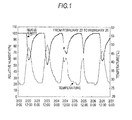
- Fig. 1 shows one example of the result. It is understood from Fig. 1 that the temperature becomes the maximum temperature around 12 o'clock at noon, the temperature is lowered toward night, and the humidity is elevated along with the lowering of the temperature. It is also understood that the humidity is lowered along with the elevation of temperature from night to noon. The maximum humidity during this measuring period is measured at night and is 100%. The minimum humidity is measured around 12 o'clock at noon and is approximately 50%. From these results, it is understood that a back side of an upper deck of a ballast tank of the actual ship is subjected to an environment where drying and wetting are repeated.
- ACM Admospheric Corrosion Monitor
- Cl chlorine
- a transition rate (drying rate; Bv) from a wet state to a dry state is RH5.4 to 18.8%/h from the actual ship result
- a transition rate (wetting rate; Av) from a dry state to a wet state is RH5.0 to 50.0%/h from the actual ship result.
- the drying rate is obtained by dividing the humidity difference when the humidity becomes the minimum humidity from RH85% by time.
- the wetting rate is obtained by dividing the humidity difference when the humidity becomes RH85% from the minimum humidity by time.
- Fig. 2 shows one example of a change with time of relative humidity.
- symbol At indicates a time for a wet process and symbol Bt indicates a time for dry process.
- symbol Av indicates a wetting rate and symbol Bv indicates a drying rate.
- Natural ocean water solution is solution whose concentration of salt (sodium chloride and magnesium chloride, potassium chloride and other components other than sodium chloride) falls within a range of 3.0 to 4.0mass%. A method of applying these solutions is performed by depositing salt on a specimen.
- the formula 0.1 ⁇ Bv/Av ⁇ 3.8 was obtained by measuring an environment of the actual ship. When Bv/Av falls within this range, the corrosion mechanism substantially equal to the corrosion mechanism of the actual ship is acquired. That is, when Bv/Av is 0.1 or more, ranking of corrosion resistance agrees with the ranking of corrosion resistance of the actual ship, while when Bv/Av exceeds 3.8, the ranking of corrosion resistance differs from the ranking of corrosion resistance of the actual ship.
- Molten steel having the composition shown in Table 1 was produced by a 50kg vacuum melting furnace and, thereafter, steel ingot was produced. Then, the steel ingot was loaded into a heating furnace and was heated at a temperature of 1150°C and, thereafter, was formed into steel plates having a thickness of 30mm by hot rolling. specimens each having a size of 3mmt x 50mmw x 150mmL were taken such that a portion of the steel plate at a position 2mm away from a surface of the steel plate in the depth direction forms a surface of the specimen, and surfaces of the specimens were subjected to shotblasting.
- specimens each of which has a surface thereof coated with a single layer film (paint film thickness: approximately 100 ⁇ m) formed of tar epoxy resin paints were prepared.
- the corrosion resistance evaluation was performed such that a scratch which reaches a surface of base iron was formed from above the paint film in a straight line using a utility knife, and after a predetermined corrosion evaluation test was performed, the corrosion resistance was evaluated based on an area of swelling of paint film which was formed around the scratch.
- a specimen was placed on a back side of an upper deck of a ballast tank of the actual ship by using a rack such that a surface of the specimen on which the scratch was formed was directed downwardly.
- a testing period was 2 years. Further, the corrosion evaluation test was carried out under testing conditions for a testing period both shown in Table 2.
- Table 3 shows the result of measurement of the area of swelling of paint film which was formed around the scratch after the predetermined corrosion evaluation test was performed.
- ranking of area of swelling of paint film was steel plate C > steel plate B > steel plate A > steel plate D > steel plate E.
- examples 1 to 5 in the corrosion evaluation test ranking of area of swelling of paint film was steel plate C > steel plate B > steel plate A > steel plate D > steel plate E so that the ranking of area of swelling of paint film was equal to the ranking of area of swelling of paint film in the exposure test of the actual ship.
- the ratio of area of swelling of the steel plates B, C, D, E with reference to the area of swelling of the steel plate A were also substantially equal between the actual ship and the present invention examples 1 to 5 of the corrosion evaluation test. From the above, it is understood that the corrosion evaluation test condition of the present invention example is reasonable as a corrosion evaluation test method of a back side of an upper deck of a ballast tank of an actual ship.
- ranking of area of swelling of paint film was steel plate A > steel plate B > steel plate D > steel plate E > steel plate C.
- ranking of area of swelling of paint film was steel plate A > steel plate E > steel plate B > steel plate D > steel plate C.
- ranking of area of swelling of paint film was steel plate A > steel plate B > steel plate E > steel plate D > steel plate C.
- ranking of area of swelling of paint film was steel plate B > steel plate A > steel plate C > steel plate D > steel plate E.
- ranking of area of swelling of paint film was steel plate C > steel plate A > steel plate B > steel plate E > steel plate D.
- ranking of area of swelling of paint film was steel plate B > steel plate A > steel plate C > steel plate D > steel plate E.
- the corrosion environment was always in an immersed state in the comparison example 1 and the corrosion environment was always in a wet state in the comparison example 2 and hence, the corrosion environment did not include the dry process whereby the corrosion environment of the actual ship was not simulated. Accordingly, the ranking of corrosion resistance (swelling of paint film) of comparison examples differed from the ranking of corrosion resistance (swelling of paint film) of actual ship.
- the corrosion environment included the dry process in the comparison example 3 and the comparison example 4
- the ratio between the dry process B and the wet process A was excessively small in the comparison example 3 and was excessively large in the comparison example 4 so that the ranking of corrosion resistance (swelling of paint film) of comparison examples differed from the ranking of corrosion resistance (swelling of paint film) of actual ship.
- the ratio between the drying rate and the wetting rate was excessively small in the comparison example 5 and the ratio between the drying rate and the wetting rate was excessively large in the comparison example 6 and hence, the ranking of corrosion resistance (swelling of paint film) of comparison examples differed from the result of the actual ship. Accordingly, the comparison examples 1 to 6. cannot be adopted as the evaluation test.
Landscapes
- Life Sciences & Earth Sciences (AREA)
- Biodiversity & Conservation Biology (AREA)
- Ecology (AREA)
- Environmental & Geological Engineering (AREA)
- Environmental Sciences (AREA)
- Physics & Mathematics (AREA)
- Health & Medical Sciences (AREA)
- Chemical & Material Sciences (AREA)
- Analytical Chemistry (AREA)
- Biochemistry (AREA)
- General Health & Medical Sciences (AREA)
- General Physics & Mathematics (AREA)
- Immunology (AREA)
- Pathology (AREA)
- Testing Resistance To Weather, Investigating Materials By Mechanical Methods (AREA)
Abstract
Provided is a corrosion evaluation test method for evaluating corrosion of a back side of an upper deck of a ballast tank of a ship. To be more specific, provided is a corrosion evaluation test method for evaluating corrosion of an upper deck of a ballast tank of a ship where, in a corrosion evaluation test cycle where a specimen is subjected to a wet process A of relative humidity of 75% or more and a dry process B of relative humidity of less than 75% and the wet process and the dry process are repeated alternately, the relationship between a time (At) where the specimen is subjected to the wet process A and a time (Bt) where the specimen is subjected to the dry process B is set to 0.05 ≤ Bt/At ≤ 10, the relationship between a wetting rate (Av) and a drying rate (Bv) is set to 0. 1 ≤ Bv/Av ≤ 3.8, and in the wet process, salt is applied to the specimen by spraying any one solution out of sodium chloride aqueous solution, artificial seawater solution or natural ocean water solution to the specimen, by immersing the specimen in the solution or applying the solution to the specimen.
Description
- The present invention relates to a corrosion evaluation test method of a back side of an upper deck of a ballast tank which is mounted on a ship such as a coal ship, an ore carrier, an ore coal carrier, a crude oil tanker, a LPG ship, a LNG ship, a chemical tanker, a containership, a bulk carrier ship, a timber carrier, a chip carrier, a refrigerated cargo carrier, an automobile carrier, a heavy cargo ship, a roll-on/roll-off ship, a limestone carrier or a cement carrier.
- Ballast tanks of a ship play a role of securing safety marine navigation of a ship with seawater filled therein when there is no cargo so that the ballast tanks are subjected to an extremely strict corrosive environment. Accordingly, the prevention of corrosion of a steel material used for ballast tanks is usually acquired by the combination of the formation of an anticorrosion coating film made of an epoxy resin paint and electrolytic protection.
- However, even when such anticorrosion measures are taken, because of splash of seawater and the elevation of a temperature of a steel plate due to sunlight, an area around an uppermost part of the ballast tank, particularly a back side of an upper deck is subjected to a stricter corrosive environment and receives severe corrosion.
- It is said that a lifetime of the anticorrosion coating film of the ballast tank under such a severe corrosive environment is approximately 10 to 15 years in general so that the lifetime of the anticorrosion coating film is approximately half of a lifetime of a ship (20 to 25 years) . Accordingly, the actual situation is that the anticorrosion coating film maintains the corrosion resistance by performing refinish paint for remaining approximately 10 years from a point of time that a lifetime of the first anticorrosion coating film ends to a point of time that a lifetime of the ship ends. Accordingly, the development of a steel material having excellent corrosion resistance which can extend a period before the refinish paint is started as long as possible and can reduce a refinish paint operation as much as possible has been expected.
- However, to develop a steel material having excellent corrosion resistance, it is necessary to establish a corrosion evaluation test method where the corrosion of a ballast tank can be simulated. However, there exists no established test method which satisfies the request up to now.
- For example,
patent document 1 discloses, as a corrosion test method which simulates a ballast tank, a test method where 1 cycle is constituted of the immersion in artificial seawater for one week and the exposure in the atmosphere having relative humidity of 100% for one week. Although this test method is reasonable as a corrosion test method of a ship bottom portion of a ballast tank, a test corresponding to a dry process of the present invention is not performed and hence, this test method has a drawback that the corrosion of a back side of an upper deck cannot be simulated. -
- patent document 1]
JP-A-7-310141 - The present invention is made to effectively overcome the above-mentioned drawback, and it is an object of the present invention to provide a corrosion evaluation test method which can evaluate the corrosion of a back side of an upper deck of a ballast tank of a ship.
- Inventors of the present invention have, to provide a corrosion evaluation test method which can evaluate corrosion of a back side of an upper deck of a ballast tank of a ship, studied in detail the corrosive environment of a back side of an upper deck of a ballast tank of the actual ship which has not been carried out up to now. The gist of the present invention is as follows.
- (1) A corrosion evaluation test method for evaluating corrosion of a back side of an upper deck of a ballast tank of a ship where, in a corrosion evaluation test cycle where a specimen is subjected to a wet process A of relative humidity of 75% or more and a dry process B of relative humidity of less than 75% and the wet process and the dry process are repeated alternately, the relationship between a time (At) where the specimen is subjected to the wet process A and a time (Bt) where the specimen is subjected to the dry process B is set to 0.05 ≤ Bt/At ≤ 10, the relationship between a wetting rate (Av) and a drying rate (Bv) is set to 0.1 ≤ Bv/Av ≤ 3.8, and in the wet process, salt is applied to the specimen by spraying any one solution out of sodium chloride aqueous solution, artificial seawater solution or natural ocean water solution to the specimen, by immersing the specimen in the solution or by applying the solution to the specimen.
Here, the wetting rate Av is a value obtained by dividing a relative humidity change amount when a process is shifted from the dry process to the wet process by time, and the drying rate Bv is a value obtained by dividing a relative humidity change amount when the process is shifted from the wet process to the dry process by time. To be more specific, the drying rate is obtained by dividing the humidity difference when the relative humidity of 85% is changed to the lowest humidity by time. The wetting rate is obtained by dividing the humidity difference when the lowest humidity is changed to the relative humidity of 85% by time. (2) The corrosion evaluation test method for evaluating corrosion of a back side of an upper deck of a ballast tank of a ship, wherein in the above-mentioned constitution (1), the repeating number of times of the wet process A and the dry process B is 30 times or more, and in the wet process, the salt is applied to the specimen by spraying any one solution out of sodium chloride aqueous solution, artificial seawater solution or natural ocean water solution to the specimen, by immersing the specimen in the solution or by applying the solution to the specimen at a rate of one time or more in 30 times. - According to the present invention, it is possible to perform a corrosion evaluation test by which corrosion of a back side of an upper deck of a ballast tank of a ship can be evaluated and hence, the development of a steel material for a ship can be efficiently realized.
-
-
Fig. 1 is a view showing a result of measurement with time of temperature and relative humidity at a back side of an upper deck of a ballast tank of an actual ship in a certain year. -
Fig. 2 is a view showing one example of a change with time in relative humidity in a corrosion evaluation test according to the present invention. - Hereinafter, the present invention is explained specifically. In the present invention, humidity means relative humidity and is also referred to as RH hereinafter.
- A corrosive environment measurement is performed such that a temperature sensor and a humidity sensor are mounted on a back side of an upper deck of a ballast tank of a ship which goes and comes between Japan and Australia, and data are obtained from these sensors with time.
-
Fig. 1 shows one example of the result. It is understood fromFig. 1 that the temperature becomes the maximum temperature around 12 o'clock at noon, the temperature is lowered toward night, and the humidity is elevated along with the lowering of the temperature. It is also understood that the humidity is lowered along with the elevation of temperature from night to noon. The maximum humidity during this measuring period is measured at night and is 100%. The minimum humidity is measured around 12 o'clock at noon and is approximately 50%. From these results, it is understood that a back side of an upper deck of a ballast tank of the actual ship is subjected to an environment where drying and wetting are repeated. Based on a result of a change with time of a wet state of a steel plate measured by an ACM (Atmospheric Corrosion Monitor) sensor simultaneously with the measurement of humidity and a detection result of Cl (chlorine) in a rust layer which is formed on a specimen placed on a back side of an upper deck of a ballast tank simultaneously, it is confirmed that seawater is deposited to the steel plate. A transition rate (drying rate; Bv) from a wet state to a dry state is RH5.4 to 18.8%/h from the actual ship result, and a transition rate (wetting rate; Av) from a dry state to a wet state is RH5.0 to 50.0%/h from the actual ship result. The drying rate is obtained by dividing the humidity difference when the humidity becomes the minimum humidity from RH85% by time. The wetting rate is obtained by dividing the humidity difference when the humidity becomes RH85% from the minimum humidity by time. Along with the above-mentioned test, steel plates shown in Table 1 are subjected to an exposure test on a back side of an upper deck of a ballast tank of the actual ship. - From the above-mentioned result of the corrosive environment measurement of a ballast tank of the actual ship, as a corrosion evaluation test method, it is found that the targeted result can be acquired by alternately repeating a wet process and a dry process on a condition where seawater is applied to a specimen and by setting a drying rate/wetting rate to a value which falls within a proper range.
Hereinafter, a corrosion evaluation test method according to the present invention is explained in detail.
Fig. 2 shows one example of a change with time of relative humidity. InFig. 2 , symbol At indicates a time for a wet process and symbol Bt indicates a time for dry process. Symbol Av indicates a wetting rate and symbol Bv indicates a drying rate. - (1) Repeating number of times of wet process A and dry process B:
- The repeating number of times of the wet process A and the dry process B corresponds to the repeating number of times of wetting and drying on the actual ship. It implies that the larger the repeating number of times, the more the corrosion progresses. Although the repeating number of times may be selected in conformity with the corrosion resistance level of a steel kind to be evaluated, to generate the difference in ranking of corrosion resistance with respect to each steel kind, it is necessary to set the repeating number of times to 30 times or more. On the other hand, even when the repeating number of times exceeds 730 times, no difference is generated in ranking of corrosion resistance with respect to each steel kind and hence, it is desirable to set the repeating number of times to 730 times or less.
- (2) Applying salt in wet process with the repeating number of times of wet process A and dry process B set at a rate of one time or more in 30 times:
- The reason that salt is applied to a specimen in wet process with the repeating number of times of wet process A and dry process B set at a rate of one time in 30 times is as follows. When the repeating number of times is less than one time, salt is not applied to the specimen, and this condition differs from a corrosive environment of the actual ship and hence, the repeating number of times is set to one time or more. Even when salt is applied to the specimen twice or more or continuously in the same wet process, this applying of salt is regarded as applying of salt one time. It is reasonable to differentiate the wet process and the dry process based on relative humidity, and a threshold value is set to relative humidity of 75% where NaCl exhibits deliquescent and is brought into a wet state.
-
- (3) range of ratio between time (At) for wet process and time (Bt) for dry process (0.05 ≤ Bt/At ≤ 10):
- With respect to the range of ratio between the time (At) for the wet process and the time (Bt) for the dry process (0.05 ≤ Bt/At ≤ 10), tests were repeatedly carried out mainly aiming at making ranking of corrosion resistance with respect to a steel kind equal between an actual ship exposure test and a corrosion evaluation test explained later, and a lower limit of 0.05 and an upper limit of 10 were found.
- Next, the reason that the range of ratio between the time (At) for the wet process and the time (Bt) for the dry process is limited to 0.05 ≤ Bt/At ≤ 10 is explained.
- When the value of Bt/At is smaller than 0.05, the ratio of the wetting time becomes large so that there arises a situation where the ranking of corrosion resistance differs from the ranking of corrosion resistance of the actual ship (that is, the corrosion mechanism differs from the corrosion mechanism of the actual ship). Accordingly, a lower limit value is set to 0.05. Further, when the value of Bt/At is larger than 10, the ratio of the drying time becomes excessively large so that a corrosion time becomes short whereby a corrosion promoting element becomes small. Accordingly, an upper limit value is set to 10.
-
- (4) seawater for test
- As seawater for test, any one of NaCl solution, artificial seawater solution and natural ocean water may be used. As a method of applying seawater for test, spraying of seawater to a specimen, immersion of a specimen in seawater or depositing of seawater on a specimen using a pipet and so on or any other method may be used. Here, the concentration of NaCl solution is 2 to 6 mass%. Artificial seawater solution is saline liquid solution which is prepared such that artificial seawater solution has the substantially same composition as seawater and ratios and the concentration of respective components of artificial seawater solution are also similar to ratios and the concentration of respective components of seawater.
- Natural ocean water solution is solution whose concentration of salt (sodium chloride and magnesium chloride, potassium chloride and other components other than sodium chloride) falls within a range of 3.0 to 4.0mass%. A method of applying these solutions is performed by depositing salt on a specimen.
-
- (5) 0.1 ≤ Bv/Av ≤ 3.8
- Based on a result of the actual ship, as a relational formula between the wetting rate (Av) and the drying rate (Bv), a formula 0.1 ≤ Bv/Av ≤ 3.8 was established,
- The formula 0.1 ≤ Bv/Av ≤ 3.8 was obtained by measuring an environment of the actual ship. When Bv/Av falls within this range, the corrosion mechanism substantially equal to the corrosion mechanism of the actual ship is acquired. That is, when Bv/Av is 0.1 or more, ranking of corrosion resistance agrees with the ranking of corrosion resistance of the actual ship, while when Bv/Av exceeds 3.8, the ranking of corrosion resistance differs from the ranking of corrosion resistance of the actual ship.
- Molten steel having the composition shown in Table 1 was produced by a 50kg vacuum melting furnace and, thereafter, steel ingot was produced. Then, the steel ingot was loaded into a heating furnace and was heated at a temperature of 1150°C and, thereafter, was formed into steel plates having a thickness of 30mm by hot rolling. specimens each having a size of 3mmt x 50mmw x 150mmL were taken such that a portion of the steel plate at a position 2mm away from a surface of the steel plate in the depth direction forms a surface of the specimen, and surfaces of the specimens were subjected to shotblasting. Thereafter, specimens each of which has a surface thereof coated with a single layer film (paint film thickness: approximately 100µm) formed of tar epoxy resin paints were prepared. The corrosion resistance evaluation was performed such that a scratch which reaches a surface of base iron was formed from above the paint film in a straight line using a utility knife, and after a predetermined corrosion evaluation test was performed, the corrosion resistance was evaluated based on an area of swelling of paint film which was formed around the scratch. In an exposure test of the actual ship, a specimen was placed on a back side of an upper deck of a ballast tank of the actual ship by using a rack such that a surface of the specimen on which the scratch was formed was directed downwardly. A testing period was 2 years. Further, the corrosion evaluation test was carried out under testing conditions for a testing period both shown in Table 2.
- Table 3 shows the result of measurement of the area of swelling of paint film which was formed around the scratch after the predetermined corrosion evaluation test was performed. In the exposure test of the actual ship, ranking of area of swelling of paint film was steel plate C > steel plate B > steel plate A > steel plate D > steel plate E. In the present invention examples 1 to 5 in the corrosion evaluation test, ranking of area of swelling of paint film was steel plate C > steel plate B > steel plate A > steel plate D > steel plate E so that the ranking of area of swelling of paint film was equal to the ranking of area of swelling of paint film in the exposure test of the actual ship. The ratio of area of swelling of the steel plates B, C, D, E with reference to the area of swelling of the steel plate A were also substantially equal between the actual ship and the present invention examples 1 to 5 of the corrosion evaluation test. From the above, it is understood that the corrosion evaluation test condition of the present invention example is reasonable as a corrosion evaluation test method of a back side of an upper deck of a ballast tank of an actual ship.
- On the other hand, in the comparison example 1 in the corrosion evaluation test, ranking of area of swelling of paint film was steel plate A > steel plate B > steel plate D > steel plate E > steel plate C. In the comparison example 2, ranking of area of swelling of paint film was steel plate A > steel plate E > steel plate B > steel plate D > steel plate C. In the comparison example 3, ranking of area of swelling of paint film was steel plate A > steel plate B > steel plate E > steel plate D > steel plate C. In the comparison example 4, ranking of area of swelling of paint film was steel plate B > steel plate A > steel plate C > steel plate D > steel plate E. In the comparison example 5, ranking of area of swelling of paint film was steel plate C > steel plate A > steel plate B > steel plate E > steel plate D. In the comparison example 6, ranking of area of swelling of paint film was steel plate B > steel plate A > steel plate C > steel plate D > steel plate E. As a result, the ranking of area of swelling of paint film of comparison examples differed from the ranking of area of swelling of paint film of actual ship. The corrosion environment was always in an immersed state in the comparison example 1 and the corrosion environment was always in a wet state in the comparison example 2 and hence, the corrosion environment did not include the dry process whereby the corrosion environment of the actual ship was not simulated. Accordingly, the ranking of corrosion resistance (swelling of paint film) of comparison examples differed from the ranking of corrosion resistance (swelling of paint film) of actual ship. Although the corrosion environment included the dry process in the comparison example 3 and the comparison example 4, the ratio between the dry process B and the wet process A was excessively small in the comparison example 3 and was excessively large in the comparison example 4 so that the ranking of corrosion resistance (swelling of paint film) of comparison examples differed from the ranking of corrosion resistance (swelling of paint film) of actual ship. The ratio between the drying rate and the wetting rate was excessively small in the comparison example 5 and the ratio between the drying rate and the wetting rate was excessively large in the comparison example 6 and hence, the ranking of corrosion resistance (swelling of paint film) of comparison examples differed from the result of the actual ship. Accordingly, the comparison examples 1 to 6. cannot be adopted as the evaluation test.
-
[Table 1] (mass%) C Si Mn P S Al Cr Sn W Steel plate A 0.15 0.28 1.15 0.015 0.002 0.028 - - - Steel plate B 0.15 0.29 1.18 0.014 0.002 0.031 0.48 - - Steel plate C 0.14 0.30 1.14 0.015 0.003 0.028 1.50 - - Steel plate D 0.14 0.28 1.17 0.016 0.002 0.027 - 0.05 - Steel plate E 0.14 0.27 1.15 0.015 0.002 0.027 - - 0.35 -
[Table 2] Kind of test A (relative humidity≥75%) B (relative humidity<75%) Av (RH%/h) Bv (RH%/h) Salt applying method Bt/At Bv/Av Test period (day) Minimum temperature (°C) Maximum relative humidity (%) Time (h) at relative humidity≥75% (At) Maximum temperature (°C) Minimum relative humidity (%) Time (h) at relative humidity<75% (Bt) Invention example 1 Repetition of dry process and wet process 50 100 4 60 25 4 300 150 Spray 5% NaCl solution to specimen for 2h in process A one time in repeating process A and process B one time 1.0 0.5 60 Invention example 2 Repetition of dry process and wet process 30 90 12 40 60 12 30 30 Deposit artificial seawater solution on specimen by pipet in process A one time in repeating process A and process B 7 times 1.0 1.0 180 Invention example 3 Repetition of dry process and wet process 25 100 8.75 50 40 15.25 8.6 30 immerse specimen in artificial seawater solution for 0.25h in process A one time in repeating process A and process B 14 times 1.7 3.5 180 Invention example 4 Repetition of dry process and wet process 50 100 6 60 25 2 150 75 Spray 5% NaCl solution to specimen for 2h in process A one time in repeating process A and process B one time 0.33 0.5 60 invention example 5 Repetition of dry process and wet process 25 100 4.5 50 40 19.5 15 30 immerse specimen in natural seawater solution for 0.25h in process A one time in repeating process A and process B 14 times 4.3 2.0 180 Comparison example 1 immersion 40 Always wet Always - - - - - Always immerse specimen in artificial seawater 0.0 - 360 Comparison example 2 Wetting 35 Always wet Always - - - - - Always spray 5% NaCl solution to specimen 0.0 - 360 Comparison example 3 Repetition of dry process and wet process 25 100 23 50 40 1 240 240 immerse specimen in natural seawater solution for 0.25h in process A one time in repeating process A and process B 14 times 0.04 1.0 180 Comparison example 4 Repetition of dry process and wet process 25 100 1.8 50 40 22.2 60 60 immerse specimen in 3% NaCI solution for 0.25h in process A one time in repeating process A and process B 7 times 12.3 1.0 180 Comparison example 5 Repetition of dry process and wet process 50 100 5 60 25 3 300 21 Spray 5% NaCI solution to specimen for 2h in process A one time in repeating process A and process B one time 0.6 0.07 60 Comparison example 6 Repetition of dry process and wet process 50 100 2.8 60 25 5.2 37.5 300 Spray 5% NaCl solution to specimen for 2h in process A one time in repeating process A and process B one time 1.9 8.0 60 -
[Table 3] Area of swelling of paint film (per scratch length 10mm) (mm2) Ratio of area of swelling of paint film (with respect to steel plate A) (%) Steel plate A Steel plate B Steel plate C Steel plate D Steel plate E Steel plate A Steel plate B Steel plate C Steel plate D Steel plate E Exposure in actual ship 302 352 428 189 89 100 117 142 63 29 Invention example 1 210 269 334 137 84 100 128 159 65 40 Invention example 2 224 252 308 145 62 100 113 138 65 28 Invention example 3 215 255 310 125 78 100 119 144 58 36 Invention example 4 195 218 257 131 77 100 112 132 67 39 Invention example 5 185 232 283 107 44 100 125 153 58 24 Comparison example 1 220 176 88 170 161 100 80 40 77 73 Comparison example 2 145 115 65 113 135 100 79 45 78 93 Comparison example 3 180 162 108 144 156 100 90 60 80 87 Comparison example 4 98 111 70 69 58 100 113 71 70 59 Comparison example 5 240 232 271 167 189 100 97 113 70 79 Comparison example 6 140 156 99 95 80 100 111 71 68 57
Claims (3)
- A corrosion evaluation test method for evaluating corrosion of a back side of an upper deck of a ballast tank of a ship where, in a corrosion evaluation test cycle where a specimen is subjected to a wet process A of relative humidity of 75% or more and a dry process B of relative humidity of less than 75% and the wet process and the dry process are repeated alternately, the relationship between a time (At) where the specimen is subjected to the wet process A and a time (Bt) where the specimen is subjected to the dry process B is set to 0.05 ≤ Bt/At ≤ 10, the relationship between a wetting rate (Av) and a drying rate (Bv) is set to 0.1 ≤ Bv/Av ≤ 3.8, and in the wet process, salt is applied to the specimen by spraying any one solution out of sodium chloride aqueous solution, artificial seawater solution or natural ocean water solution to the specimen, by immersing the specimen in the solution or applying the solution to the specimen, wherein
Av is a value obtained by dividing a relative humidity change amount when a process is shifted from the dry process to the wet process by time, and Bv is a value obtained by dividing a relative humidity change amount when the process is shifted from the wet process to the dry process by time. - A corrosion evaluation test method for evaluating corrosion of a back side of an upper deck of a ballast tank of a ship according to claim 1, wherein the repeating number of times of the wet process A and the dry process B is 30 times or more and, at a rate of one time or more in 30 times, in the wet process, the salt is applied to the specimen by spraying any one solution out of sodium chloride aqueous solution, artificial seawater solution or natural ocean water solution to the specimen, by immersing the specimen in the solution or applying the solution to the specimen.
- A corrosion evaluation test method for evaluating corrosion of a back side of an upper deck of a ballast tank of a ship where, in a corrosion evaluation test cycle where a specimen is subjected to a wet process A of relative humidity of 75% or more and a dry process B of relative humidity of less than 75% and the wet process and the dry process are repeated alternately at least 30 times or more, the relationship between a time (At) where the specimen is subjected to the wet process A and a time (Bt) where the specimen is subjected to the dry process B is set to 0.05 ≤ Bt/At ≤ 10, the relationship between a wetting rate (Av) and a drying rate (Bv) is set to 0. 1 ≤ Bv/Av ≤ 3.8, and, at a rate of one time or more in 30 times of the repeating number of times of the wet process A and the dry process B, in the wet process, the salt is applied to the specimen by spraying any one solution out of sodium chloride aqueous solution, artificial seawater solution or natural ocean water solution to the specimen, by immersing the specimen in the solution or applying the solution to the specimen, wherein
Av is a value obtained by dividing a relative humidity change amount when a process is shifted from the dry process to the wet process by time, and Bv is a value obtained by dividing a relative humidity change amount when the process is shifted from the wet process to the dry process by time.
Applications Claiming Priority (3)
| Application Number | Priority Date | Filing Date | Title |
|---|---|---|---|
| JP2009189612 | 2009-08-19 | ||
| JP2010182673A JP2011064678A (en) | 2009-08-19 | 2010-08-18 | Vessel ballast tank corrosion testing method |
| PCT/JP2010/064318 WO2011021714A1 (en) | 2009-08-19 | 2010-08-18 | Corrosion evaluation test method for ballast tank on ship |
Publications (2)
| Publication Number | Publication Date |
|---|---|
| EP2469265A1 true EP2469265A1 (en) | 2012-06-27 |
| EP2469265A4 EP2469265A4 (en) | 2015-07-01 |
Family
ID=43607159
Family Applications (1)
| Application Number | Title | Priority Date | Filing Date |
|---|---|---|---|
| EP10810052.0A Withdrawn EP2469265A4 (en) | 2009-08-19 | 2010-08-18 | Corrosion evaluation test method for ballast tank on ship |
Country Status (5)
| Country | Link |
|---|---|
| EP (1) | EP2469265A4 (en) |
| JP (1) | JP2011064678A (en) |
| KR (1) | KR101312557B1 (en) |
| CN (1) | CN102483373A (en) |
| WO (1) | WO2011021714A1 (en) |
Cited By (3)
| Publication number | Priority date | Publication date | Assignee | Title |
|---|---|---|---|---|
| CN103383340A (en) * | 2013-06-26 | 2013-11-06 | 中国船舶重工集团公司第七二五研究所 | Immersion test apparatus for coating of cargo oil tank of crude oil tanker |
| CN103383339A (en) * | 2013-06-26 | 2013-11-06 | 中国船舶重工集团公司第七二五研究所 | Air-tight test apparatus for coating of cargo oil tank of crude oil tanker |
| CN113390777A (en) * | 2021-05-17 | 2021-09-14 | 中国科学院金属研究所 | Indoor dry-wet alternative acceleration test method for simulating coastal atmospheric corrosion process |
Families Citing this family (1)
| Publication number | Priority date | Publication date | Assignee | Title |
|---|---|---|---|---|
| JP7043823B2 (en) * | 2017-12-15 | 2022-03-30 | 日本製鉄株式会社 | Corrosion test method |
Family Cites Families (13)
| Publication number | Priority date | Publication date | Assignee | Title |
|---|---|---|---|---|
| JPS6051657B2 (en) * | 1979-11-30 | 1985-11-15 | 三菱電機株式会社 | Corrosion resistance test method |
| JPH07310141A (en) | 1993-07-09 | 1995-11-28 | Kawasaki Steel Corp | Seawater resistant steel for high temperature and high humidity environment and method for producing the same |
| KR970048276A (en) * | 1995-12-29 | 1997-07-29 | 김태구 | Durability Tester of Washer Fluid Tank |
| KR19980040516U (en) * | 1996-12-23 | 1998-09-15 | 김종진 | Corrosion test equipment in steam in multi-stage condenser |
| KR100462727B1 (en) | 2002-06-20 | 2004-12-20 | 현대자동차주식회사 | Composite for testing corrosion of fuel tank, and test method and apparatus thereof |
| JP3557530B1 (en) * | 2003-07-14 | 2004-08-25 | スガ試験機株式会社 | Combined cycle test apparatus and combined cycle test method |
| JP4148132B2 (en) * | 2003-12-19 | 2008-09-10 | Jfeスチール株式会社 | Method for evaluating corrosion resistance of steel |
| JP2005241400A (en) * | 2004-02-26 | 2005-09-08 | Jfe Steel Kk | Corrosion resistance evaluation method for indoor use steel sheet |
| JP4393291B2 (en) * | 2004-06-29 | 2010-01-06 | 株式会社神戸製鋼所 | Marine steel with excellent corrosion resistance |
| JP4867303B2 (en) * | 2005-11-16 | 2012-02-01 | Jfeスチール株式会社 | Method for evaluating corrosion resistance of metal material, metal material, and corrosion acceleration test apparatus for metal material |
| JP2008070298A (en) * | 2006-09-15 | 2008-03-27 | Tokyo Electric Power Co Inc:The | Steel corrosion resistance test method and evaluation method |
| JP4767887B2 (en) * | 2007-03-22 | 2011-09-07 | 新日本製鐵株式会社 | Corrosion test method for metallic materials for ship ballast tanks |
| KR20080103124A (en) * | 2007-05-23 | 2008-11-27 | 현대자동차주식회사 | Test apparatus for evaluating corrosion fatigue of automobile chassis parts |
-
2010
- 2010-08-18 JP JP2010182673A patent/JP2011064678A/en active Pending
- 2010-08-18 WO PCT/JP2010/064318 patent/WO2011021714A1/en not_active Ceased
- 2010-08-18 CN CN2010800367580A patent/CN102483373A/en active Pending
- 2010-08-18 KR KR1020127003721A patent/KR101312557B1/en not_active Expired - Fee Related
- 2010-08-18 EP EP10810052.0A patent/EP2469265A4/en not_active Withdrawn
Non-Patent Citations (1)
| Title |
|---|
| See references of WO2011021714A1 * |
Cited By (5)
| Publication number | Priority date | Publication date | Assignee | Title |
|---|---|---|---|---|
| CN103383340A (en) * | 2013-06-26 | 2013-11-06 | 中国船舶重工集团公司第七二五研究所 | Immersion test apparatus for coating of cargo oil tank of crude oil tanker |
| CN103383339A (en) * | 2013-06-26 | 2013-11-06 | 中国船舶重工集团公司第七二五研究所 | Air-tight test apparatus for coating of cargo oil tank of crude oil tanker |
| CN103383340B (en) * | 2013-06-26 | 2015-08-12 | 中国船舶重工集团公司第七二五研究所 | A kind of crude oil tanker oil cargo tank coating immersion test device |
| CN103383339B (en) * | 2013-06-26 | 2015-10-21 | 中国船舶重工集团公司第七二五研究所 | A kind of crude oil tanker oil cargo tank coating air tightness tester |
| CN113390777A (en) * | 2021-05-17 | 2021-09-14 | 中国科学院金属研究所 | Indoor dry-wet alternative acceleration test method for simulating coastal atmospheric corrosion process |
Also Published As
| Publication number | Publication date |
|---|---|
| EP2469265A4 (en) | 2015-07-01 |
| CN102483373A (en) | 2012-05-30 |
| KR101312557B1 (en) | 2013-09-30 |
| JP2011064678A (en) | 2011-03-31 |
| WO2011021714A1 (en) | 2011-02-24 |
| KR20120033351A (en) | 2012-04-06 |
Similar Documents
| Publication | Publication Date | Title |
|---|---|---|
| JP4393291B2 (en) | Marine steel with excellent corrosion resistance | |
| Sun et al. | Effect of defect on corrosion behavior of electroless Ni-P coating in CO2-saturated NaCl solution | |
| KR20080097933A (en) | Steel plate excellent in fit resistance and manufacturing method thereof | |
| CN101715393A (en) | Methods of preparing thin polymetal diffusion coatings | |
| Pyc | Field performance of epoxy-coated reinforcing steel in Virginia bridge decks | |
| Etteyeb et al. | Protection of reinforcement steel corrosion by phenyl phosphonic acid pre-treatment PART I: Tests in solutions simulating the electrolyte in the pores of fresh concrete | |
| Rossi et al. | Influence of soil chemical characteristics on corrosion behaviour of galvanized steel | |
| Cui et al. | Atmospheric corrosion behavior of 2A12 aluminum alloy in a tropical marine environment | |
| CN104846280A (en) | Coating steel excellent in corrosion resistance | |
| CN107617547A (en) | Coated steel and its manufacture method | |
| KR101786409B1 (en) | Steel for crude oil tank and crude oil tank | |
| Kainuma et al. | Long-term deterioration mechanism of hot-dip aluminum coating exposed to a coastal-atmospheric environment | |
| TWI427160B (en) | Corrosion resistance of the ship with excellent steel | |
| Li et al. | Corrosion behavior of Ni-W coatings with and without macroscopic defects under different corrosion conditions | |
| Beom et al. | Comparison of influences of NaCl and CaCl2 on the corrosion of 11% and 17% Cr ferritic stainless steels during cyclic corrosion test | |
| KR101312557B1 (en) | Corrosion evaluation test method for ballast tank on ship | |
| JP4668141B2 (en) | Steel material for ballast tank with excellent corrosion resistance and ballast tank with excellent durability | |
| JP3923962B2 (en) | Marine steel with excellent corrosion resistance | |
| JP2008007860A (en) | Steel member for vessel having excellent crevice corrosion resistance in humid air atmosphere | |
| JP2008133536A (en) | Steel having excellent corrosion resistance for ship use | |
| FI87581B (en) | CORROSION COMBINATION COMPOSITION, PRODUCT SOM INNEHAOLLER SMAO MAONGDER AV DESSA COMPOSITION FOR FAR FARING DERAS ANVAENDNING | |
| TWI282372B (en) | Corrosion resistance excellent steel for ship | |
| JP4476927B2 (en) | High tensile steel for marine vessels with excellent corrosion resistance and base metal toughness | |
| Hammonds | An introduction to corrosion and its prevention | |
| Huang et al. | Prediction of uniform CO2 corrosion of mild steel under inert solid deposits |
Legal Events
| Date | Code | Title | Description |
|---|---|---|---|
| PUAI | Public reference made under article 153(3) epc to a published international application that has entered the european phase |
Free format text: ORIGINAL CODE: 0009012 |
|
| 17P | Request for examination filed |
Effective date: 20120319 |
|
| AK | Designated contracting states |
Kind code of ref document: A1 Designated state(s): AL AT BE BG CH CY CZ DE DK EE ES FI FR GB GR HR HU IE IS IT LI LT LU LV MC MK MT NL NO PL PT RO SE SI SK SM TR |
|
| DAX | Request for extension of the european patent (deleted) | ||
| RA4 | Supplementary search report drawn up and despatched (corrected) |
Effective date: 20150601 |
|
| RIC1 | Information provided on ipc code assigned before grant |
Ipc: G01N 17/00 20060101AFI20150526BHEP |
|
| STAA | Information on the status of an ep patent application or granted ep patent |
Free format text: STATUS: THE APPLICATION IS DEEMED TO BE WITHDRAWN |
|
| 18D | Application deemed to be withdrawn |
Effective date: 20160105 |