EP2460155B1 - Verfahren für erhöhte spracherkennungspräzision anhand von geografischen informationen - Google Patents
Verfahren für erhöhte spracherkennungspräzision anhand von geografischen informationen Download PDFInfo
- Publication number
- EP2460155B1 EP2460155B1 EP10738130.3A EP10738130A EP2460155B1 EP 2460155 B1 EP2460155 B1 EP 2460155B1 EP 10738130 A EP10738130 A EP 10738130A EP 2460155 B1 EP2460155 B1 EP 2460155B1
- Authority
- EP
- European Patent Office
- Prior art keywords
- geographical information
- user
- vehicle
- geographical
- names
- Prior art date
- Legal status (The legal status is an assumption and is not a legal conclusion. Google has not performed a legal analysis and makes no representation as to the accuracy of the status listed.)
- Active
Links
Images

Classifications
-
- G—PHYSICS
- G10—MUSICAL INSTRUMENTS; ACOUSTICS
- G10L—SPEECH ANALYSIS TECHNIQUES OR SPEECH SYNTHESIS; SPEECH RECOGNITION; SPEECH OR VOICE PROCESSING TECHNIQUES; SPEECH OR AUDIO CODING OR DECODING
- G10L15/00—Speech recognition
- G10L15/08—Speech classification or search
- G10L15/18—Speech classification or search using natural language modelling
- G10L15/1815—Semantic context, e.g. disambiguation of the recognition hypotheses based on word meaning
-
- G—PHYSICS
- G10—MUSICAL INSTRUMENTS; ACOUSTICS
- G10L—SPEECH ANALYSIS TECHNIQUES OR SPEECH SYNTHESIS; SPEECH RECOGNITION; SPEECH OR VOICE PROCESSING TECHNIQUES; SPEECH OR AUDIO CODING OR DECODING
- G10L15/00—Speech recognition
- G10L15/22—Procedures used during a speech recognition process, e.g. man-machine dialogue
- G10L2015/226—Procedures used during a speech recognition process, e.g. man-machine dialogue using non-speech characteristics
- G10L2015/228—Procedures used during a speech recognition process, e.g. man-machine dialogue using non-speech characteristics of application context
Definitions
- the present invention relates to speech recognition systems, and, more particularly, to speech recognition systems that are used within a vehicle.
- proper names such as street names, point of interest (POI) names, and city names
- POI point of interest
- city names are widely used. It is often the case that the proper names used in these applications are very numerous and/or involve many foreign names, such as street names in a navigation domain or restaurant names in a restaurant selection domain. As may be readily appreciated, foreign names in particular are subject to being mispronounced or pronounced in a variety of ways.
- the problems with the recognition of proper names in conventional spoken language interface applications with large name lists include inadequate speech recognition accuracy of these names in the speech recognizer component, and inadequate recognition accuracy of these names with regard to the presence of these names in the system database.
- Dialog systems are systems in which a person speaks to a computer or machine, in order to accomplish a result. They are becoming increasingly used to facilitate the man-machine interface in many applications such as computers and automobiles.
- proper names such as street names, city names, point of interest (POI) names, company names, and so on.
- POI point of interest
- POI point of interest
- Accessing the data with spoken language offers people convenience and efficiency if the spoken interface is reliable.
- the number of proper names used in these applications is very large, and can include many foreign or hard-to-recognize names, such as street names in a navigation domain, or restaurant names in a restaurant selection domain.
- present recognition methods on large name lists focus strictly on the static aspect of the names. This is a very challenging problem especially for speech recognition because of the confusability in the large name lists.
- the present invention may provide a name model generation and name recognition process for spoken interface applications that improves the speech recognition accuracy of names and partial names.
- the present invention may utilize the geographic information provided by a global positioning system (GPS) receiver or by the user to improve the recognition of proper names spoken by the user.
- GPS global positioning system
- the present invention may utilize geographic information from such other modalities to significantly aid in the recognition process for proper names.
- the invention may improve the speech recognition accuracy for proper names by using geographic information presented by the user during the interaction with the system through other modalities.
- the geographic information provided by the GPS and/or the user may be used to construct a weighting hierarchy for proper names in the database so that prioritized name categories at different levels may be used to assist speech recognition.
- An index for geographic entities such as streets and POIs may be provided to speed up the process of generating the name categories.
- the invention comprises, in one form thereof, a method for speech recognition including providing a source of geographical information within a vehicle.
- the geographical information pertains to a system database which contains information related to geographical entities, a current location of the vehicle, a planned travel route of the vehicle, and/or a map displayed within the vehicle. Words spoken within the vehicle are recognized by use of a speech recognition module. The recognizing is dependent upon the geographical information.
- the invention comprises, in another form thereof, a method for speech recognition, including automatically providing a first category of geographical information by the system or a GPS device.
- a second category of geographical information is derived from inputs provided by the user orally and/or manually via a user interface.
- a plurality of candidate words are extracted from the geographical information.
- First ones of the candidate words are extracted from the first category of geographical information.
- Second ones of the candidate words are extracted from the second category of geographical information.
- Words spoken within the vehicle are recognized by use of a speech recognition module.
- the recognizing includes selecting at least one word from the candidate words.
- the second candidate words are given more weight in the selecting than are the first candidate words.
- the system may not be limited to two categories of geographical information. Inputs from the user may form several categories of geographical information to help speech recognition.
- the invention comprises, in yet another form thereof, a method for speech recognition, including displaying within a vehicle a map of a first geographical area.
- the first geographical area may be changed by the user by moving or zooming the map.
- Geographical information is derived from a second geographical area manually defined by a user on a touch screen on which the map is displayed.
- the second geographical area is a subset of the first geographical area. Words spoken within the vehicle are recognized by use of a speech recognition module. The recognizing is dependent upon the geographical information derived from the first and second geographical area.
- An advantage of the present invention is that geographical location data that is available within a vehicle may be used to improve the performance of a speech recognition system within the vehicle.
- An advantage of the present invention is that the geographical information together with system database information and active information of the system may form a set of hierarchical name categories with different weights to improve the performance of a speech recognition system.
- the geographical location data may be provided by an automatic system, such as a GPS receiver, or by the human user of the speech recognition system.
- Yet another advantage is that the focus of the speech recognition unit may be narrowed down to selected relatively short lists, thereby greatly reducing the misrecognition of names that results from large lists.
- the present invention may provide a system that, for applications with multimodal interfaces besides natural language, may enable information from another multimodality to be leveraged to assist the recognition process. More specifically, in a navigation system with touch screen, geographic information can be utilized to generate hierarchical prioritized name categories to narrow down the search space of proper name recognition. In other words, proper names in different categories may be assigned, or attached with, different weighting values. Names in a category that have a higher weighting value than other names may receive more attention in speech recognition, or may otherwise be more likely to be selected as a candidate interpretation of the name as spoken.
- the geographic information can be received or derived from, among other sources, the current system display (e.g., the segment of the map currently displayed); a predetermined or variable area surrounding the vehicle's current location, as determined by a GPS receiver; and/or user gestures (e.g., a circle drawn by touch by the user on the touch screen).
- the current system display e.g., the segment of the map currently displayed
- a predetermined or variable area surrounding the vehicle's current location as determined by a GPS receiver
- user gestures e.g., a circle drawn by touch by the user on the touch screen.
- the geographic information can be received or derived from a predetermined area of fixed size.
- the size of the area surrounding the vehicle's current location, from which geographic information may be received or derived may vary, for example, with the density of POIs and/or nearby streets in the area (i.e., with the number of POIs and/or nearby streets per unit area).
- a predetermined number of POIs, streets, or other proper names surrounding, and closest to, the vehicle may be provided with relatively high weightings on the list.
- the predetermined number of POIs, streets, or other proper names may be provided with the relatively high weightings regardless of the distances from the POIs, streets, or other proper names to the vehicle.
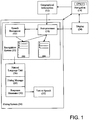
- the dialog system 34 may include a speech recognizer (SR) unit 16, a speech Post-processor unit 18, a natural language understanding (NLU) unit 26, and a dialog manager (DM) unit 28 including a Response Generator (RG) unit 30.
- the speech recognizer 16 may receive speech input in the form of acoustic signals at one or more inputs, which can come from one or more users (human speakers) in the form of user utterances.
- the speech recognizer 16 and the post-processor 18 may comprise the recognition system 10.
- the natural language understanding unit 26 may be coupled to the recognition system 10 and may receive a sequence or lattice of words with attached labels, such as confidence scores.
- the NLU unit 26 may output a structured meaning representation, which may use class-based grammars and/or class-based statistical models trained on in-domain and/or domain-independent linguistic data and one or more available knowledge bases. Optimized output may be provided from the natural language unit 26 to the dialog manager unit 28.
- the DM unit 28 may maintain a list of names mentioned in conversation from both the user and the system, interpret the input representations in context, and issue appropriate instructions to other modules of the dialog system or the navigation application 14 based on the context.
- Navigation system 14 may provide geographic information 12 in the form of a list of POIs, streets, or other proper names that are currently closest to system 34.
- System 34 may be installed in a vehicle, and thus geographic information may change as the vehicle travels.
- the list of POIs, streets, or other proper names in geographic information 12 may be provided in order of closeness or proximity to system 34. It is also possible for information 12 to include numerical distances between each item on the list and system 34.
- Display 24 may include a touch screen (e.g., a screen that is sensitive to the heat, pressure, and/or optical light-blocking qualities of touch) and may also provide geographic information which is related to gestures marked by a user on a map on Display 24. Possible gestures may include a circle, a line, or a point.
- the geographic information 12 may be in the form of a list of POIs, streets or other proper names which are enclosed by the gestures or close to the gestures marked by a user.
- the geographic information 12 may be updated when user gestures on Display 24 are changed.
- POIs, streets, or other proper names that are enclosed by, and/or close to the gestures may be provided with relatively high weightings as compared to other POIs, streets, or other proper names in the database.
- a speech recognition module 16 may receive audible spoken inputs from a human user. Module 16 may convert the spoken inputs into strings of alphanumeric characters. The alphanumeric characters may be provided in binary form or any other form that is suitable for processing. The alphanumeric characters may be indicative of the pronunciation of the spoken inputs as provided by the user. The strings of characters may be used by Module 16 to create a list 20 of preliminary candidate interpretations. The preliminary candidate interpretations on list 20 may be provided in an order based on decreasing similarity of pronunciation with the character string.
- the preliminary candidate interpretations on list 20 may match, or be similar to, POIs, streets, or other proper names provided in geographic information 12.
- List 20 may be reordered by Post-processor 18 to give greater weighting to those preliminary candidate interpretations that match, or are similar to, POIs, streets, or other proper names provided in geographic information 12.
- the weightings given to preliminary candidate interpretations based on matching or similarity to geographic information 12 versus the weightings given to preliminary candidate interpretations based on similarity in pronunciation to the character strings provided by module 16 may vary. Based on these weightings, candidate list 20 may be reordered and/or shortened to produce a list 22 of final candidate interpretations that may be presented to the user on display 24.
- List 22 may provide the final candidate interpretations in order of decreasing likelihood of matching the user's intended interpretation of his spoken input. This likelihood of matching the user's intended interpretation may be based upon the above-described weightings.
- Display 24 may be touch-sensitive and may be used by navigation system 14 to display maps and other navigation information to the user. The user may then indicate orally or via the touch screen which of the final candidate interpretations on list 22 matches the user's intended interpretation of his spoken input.
- system 10 may take the top N number of candidate words with respect to weighting or confidence on list 22 and forward the N candidate words to NLU unit 26 for further processing.
- post-processor 18 does not reorder every list 20 from Module 16 by using geographical information 12. Rather, it is possible that only lists for concrete proper names such as POIs or streets may be reordered by post-processor 18. It is possible that lists for generic names are not reordered by post-processor 18. For example, if the user asks "Is there a Chinese restaurant in this area?" and marks a circle on the map, the geographical information extracted from the circle gesture may not be used to reorder the list 20 for the generic proper name "Chinese restaurant". Another example is the user asking "Is Taco Bell in this area?" and a circle is marked on the map by the user.
- the geographical information extracted from the circle gesture may not be used to reorder the list 20 for the restaurant name "Taco Bell”.
- the user says "Plan a route to Miranda Ave near here", and marks a point on the map, the street names extracted from the surrounding area of the point may be used to reorder the list 20 for the street name "Miranda Ave”.
- Navigation system 14 may include a GPS receiver 27 that ascertains and updates the current global geographical coordinates of system 34. However, it is within the scope of the invention for system to use other techniques to determine its global location, such as via triangulation with cellular telephone towers.
- any weighting scheme that may be used to produce list 22 may be within the scope of the present invention.
- the present invention may not be limited specifically to the use of weightings. Rather, the invention may encompass any algorithm or method that provides at least one interpretation of spoken input, wherein the interpretation is dependent upon, or based upon, geographical information provided by any available source of such information.
- the fourth category may be highest priority; the third category may be second highest priority; the second category may be third highest priority; and the first category may be lowest priority.
- the first category may include a static background database that contains all possible proper names such as street names and POI names.
- the second category may include proper names related to geographic entities (e.g., street, POI) contained in the map area that is displayed. For example, if the current map displayed on the screen is of a certain part of a city, then street names and POI names in this area of the city which is visible to the user are put in the second category. These street names and POI names which are in the displayed area of the city may be provided with a higher weighting than are the street names and POI names that are not in this displayed area. A reason that such increased weighting of displayed areas may be advantageous may be that the user is more likely to speak names that are in the current focus, and thus the higher weighting may result in more accurate final candidate interpretations.
- geographic entities e.g., street, POI
- the third category may include proper names related to geographic entities contained in areas of a map that are indicated by user gestures. For example, the user may "draw" a circle or a point on the map by touching the touch screen. The user may draw such a circle or a point because he wants the navigation system to calculate a route to a POI within the circle or near the point. In order to facilitate the recognition of the name of the POI by the processor, all names of POIs in this circle or near the point may be put in the third category and have a higher priority than POIs not in this circle or far from the point. This category may include only a limited number of POIs that are associated with the user gesture.
- the fourth and last category may include proper names in an active list which could be a list of POIs which have been recently retrieved from the database and are being displayed, have been recently displayed, and/or have been audibly spoken by the system to the user.
- the user may want to find restaurants in a certain geographic area, and may orally request a list of such restaurants.
- a list of ten restaurants in the area may be shown to the user in the form of text characters on a monitor or display screen. These ten restaurants, by virtue of being displayed to the user, may be included in the active list.
- These restaurant names which may be provided in response to user input, may thus be included in the fourth category that has the highest priority.
- the four categories may make up a weighting hierarchy for the proper names in the database.
- these POIs, street names or other proper names that have had their properties queried or otherwise mentioned by the user may be placed in a fifth category of the highest priority, and thus may be assigned increased weightings. It is possible for these weightings of proper names of the fifth category to decrease with the length of time that has passed since the user orally referred to the particular proper name. As already mentioned with regard to other embodiments, a higher weighting may improve the ranking of a proper name in the list of final candidate interpretations.
- the first name category as described above with the lowest priority may be a static list containing all proper names in the database, while the other categories may be generated dynamically at run time based on the current system context.
- the system may re-determine the proper names (e.g., street names, POI names) that are contained in the modified map and update the second name category.
- proper names e.g., street names, POI names
- the user uses a finger to draw a demarcation or other marking on the touch screen which may include, but is not limited to, a circle, a point or a line
- proper names related to these markings may be given a higher priority and stored in the third name category.
- proper names of entities enclosed in the circle may be given a higher weight. If the drawing is a point, proper names of entities near this point (e.g., within a certain radius) may be given a higher weight. Further, proper names of entities that are closer to the point than other points within the circle may be given higher weights than the proper names of the other farther points. If the drawing is a line, proper names of entities within the bounding box of this line may have a higher weight. Active proper names, which are names recently mentioned or related to a current search/query result that has been returned back to the user, may have the highest priority. With this priority hierarchy, the present invention may provide increased accuracy for large name lists in speech recognition, language understanding, and other components in dialog systems, due to the weightings that give higher rankings to the names that are more likely to be currently or recently spoken by the user.
- the second and third categories may be generated based on geographic information provided within the system (e.g., a map that is displayed) and information provided by the user (e.g., hand gestures that create drawings on a touch screen on which a map is displayed). Proper names related to this geographic information and user-provided information may be identified so that proper weights can be assigned to them.
- geographical information in the form of an index may be constructed for the geographic entities (e.g., street, POI) whose names may need to be recognized. For example, given a geographical area, the index can return the proper names of the geographic entities within this area. As one example, if the user draws a circle on the map, the geographical area is identified by the circle and the index may be consulted to get the names of streets and POIs within this circle.
- the index may have a tree structure.
- Each leaf node may correspond to a relatively small geographic region and may have references to all the geographic entities (e.g., streets, POIs) within this region. Geographic regions in leaf nodes may not overlap with each other, but it is possible for such overlap to exist within the scope of the invention.
- an internal node may be a bounding box for the regions of this node's child nodes. In other words, an internal node may be the smallest region that covers all the regions of its child nodes.
- Each of the regions that are at least partially overlapped by a pattern manually created by the user on the touch screen may be included in a geographical area on the map considered to be marked or indicated by the user as being of interest.
- the index may be a full quadtree.
- a quadtree is a tree data structure in which each internal node has up to four children.
- the index may be built up as follows. The root of tree is the whole region. For each node at a certain level, the region may be evenly divided into four regions which are the four children of that node. The granularity of the leaf nodes may depend on the depth of the tree.
- Given a query of a geographic region e.g., a circle drawn by the user), in order to find all the geographic entities in this region, the index may be searched to find all the leaf nodes that overlap with the query region. Proper names in the leaf nodes may be merged to construct the prioritized name category.
- the present invention as described above includes several advantages over the prior art.
- Previous speech recognition methods on large name lists strictly focus on the static aspect of the names.
- the present invention may use geographic information from other modalities to construct a weighted name hierarchy that increases the recognition accuracy.
- a search index may be used to speed up the generation of prioritized name categories.
- Spoken language is the most natural and convenient communication tool for human beings. With data storage capacity increasing rapidly, people tend to put more and more names into their storage in the form of database. Accessing the data with spoken language offers people convenience and efficiency if the spoken interface is reliable.
- the method of the invention may provide a highly reliable technique that may be especially applicable for use in the automotive industry, wherein drivers' are in an eye-busy and hand-busy situation.
- the present invention may leverage geographic information to increase the recognition accuracy with large name lists.
- the geographic information may come from GPS devices, modalities other than speech recognition, and may be derived from user gestures and the current geographical area displayed by a navigation system.
- the geographic information, the static database, and the dynamic active list may be used to establish a set of hierarchical name categories with different priorities in order to facilitate speech recognition.
- a search index may be used to speed up the generation of prioritized name categories.
- the present invention may include several novel features, including: the use of geographic information from other modalities to increase the accuracy of name recognition; a set of hierarchical name categories with different weight values for use in speech recognition; geographic information derived from a visible display map and from user gestures; and a search index to speed up the generation of prioritized name categories.
- a source of geographical information is provided within a vehicle.
- the geographical information pertains to a current location of the vehicle, a planned travel route of the vehicle, and/or a map displayed within the vehicle.
- navigation system 14 may provide geographical information 12 which may include a current geographical location of a vehicle in which system 34 is installed; a map displayed on display 24; and/or a planned route of the vehicle that a user has programmed into navigation system 14.
- a speech recognition module In a next step 204, words spoken within the vehicle are recognized by use of a speech recognition module.
- the recognizing is dependent upon the geographical information.
- words spoken within a vehicle in which system 34 is installed are recognized by use of speech recognition module 16.
- the speech recognition process may also involve processor 18 using the output of module 16 to produce a preliminary list 20 of candidate interpretations, and modifying list 20 based on geographical information 12 to thereby produce list 22 of final candidate interpretations.
- processor 18 may decide that a lower ranked candidate interpretation on list 20 is more likely to be correct than is a higher ranked candidate interpretation based the lower ranked candidate interpretation being present in geographical information 12 and the higher ranked candidate interpretation not being present in geographical information 12.
- processor 18 may flip flop the rankings of the two candidate interpretations such that the one that is lower ranked on list 20 is the higher ranked of the two on list 22.
- geographical information provided by the user may be afforded more weight in the recognizing algorithm than is geographical information automatically produced by the system.
- geographical information pertaining to a planned travel route of the vehicle which may be based on user inputs, may be afforded more weight in the recognizing algorithm than are a current location of the vehicle or a map displayed within the vehicle.
- the recognizing process may be biased to a greater degree toward interpreting the spoken words as a selected candidate interpretation that is extracted from geographical information pertaining to the planned travel route of the vehicle than toward interpreting the spoken words as a selected candidate interpretation that is extracted from geographical information pertaining to the current location of the vehicle or to a map displayed within the vehicle.
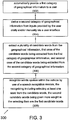
- FIG. 3 Another embodiment of a method 300 of the present invention for speech recognition is illustrated in FIG. 3 .
- a first category of geographical information is automatically provided by the system to a user.
- navigation system 14 may provide geographical information in the form of a map automatically displayed and updated on display 24 and showing the geographical area or neighborhood surrounding system 34.
- a second category of geographical information is derived from inputs provided by the user orally and/or manually via a user interface.
- a user may speak a phrase including a command (e.g., "plot a route to") followed by the name of a POI or street to which he would like to plot a route.
- the user may use his finger to draw a circle on a touch screen map display, wherein the entity that he wants to go to is inside the circle.
- the user will not likely be able to draw a perfect circle on the map, and the "drawing" may not even be a closed loop (i.e., may be C-shaped).
- processor 18 may model the drawing as a circle, or may use the actual drawing and modify it by closing the loop. Geographic entities contained in the user's drawing (or modeled/modified drawing) may be placed in the second category of geographical information to facilitate the recognition of the words spoken by the user.
- a plurality of candidate words are extracted from the geographical information.
- First ones of the candidate words are extracted from the first category of geographical information
- second ones of the candidate words are extracted from the second category of geographical information.
- the first candidate words may be in the form of proper names of POIs and streets that are extracted from and that are within the map that is automatically displayed on display 24.
- the second candidate words may be in the form of the names of entities extracted from the names of POIs and streets that are within the drawn circle on the map.
- a speech recognition module In a final step 308, words spoken within the vehicle are recognized by use of a speech recognition module.
- the recognizing includes selecting at least one word from the candidate words.
- the second candidate words are given more weight in the selecting than are the first candidate words.
- speech recognition module 16 may be used in recognizing speech within the vehicle in which system 34 is installed.
- the speech recognition may also involve processor 18 creating a preliminary list 20 of candidate words that sound like the phonetic output of module 16.
- the preliminary candidate words on list 20 may be listed in order of phonetic similarity to the output of module 16.
- Processor 18 may then modify and/or re-rank list 20 based on the first and second candidate words to thereby arrive at the final list 22 of candidate words.
- the candidate word on list 20 may be moved up in the rankings on final list 22 as compared to preliminary list 20. If the word is in the second candidate words, then it may move farther up the rankings on final list 22 than if it were in the first candidate words. Moreover, being in both the first and second candidate words may cause a word on list 20 to be higher ranked on list 22 than if it were only in the second candidate words. A word may move farther still up the rankings on list 22 base on being included multiple times in the geographical information. Some limited number (perhaps only one) of top-ranked final candidate words on list 22 may be presented to the user on display 24 for the user to verify or select which word he intended to convey. It is also possible that system 10 may simply go ahead with further processing of navigation system 14 based on automatic selection of the top ranked final candidate word on list 22.
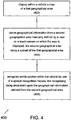
- FIG. 4 Yet another embodiment of a method 400 of the present invention for speech recognition is illustrated in FIG. 4 .
- a map of a first geographical area is displayed within a vehicle.
- a map of a city for instance, may be displayed on a screen of display 24 inside a vehicle.
- a next step 404 geographical information is derived from a second geographical area manually defined by a user on a touch screen on which the map is displayed.
- the second geographical area is a subset of the first geographical area.
- a user may finger-draw a line, point or at least semi-closed loop that delineates or otherwise indicates a geographical area or point that is within the map displayed on the touch screen of display 24.
- a speech recognition module In a final step 406, words spoken within the vehicle are recognized by use of a speech recognition module.
- the recognizing is dependent upon the geographical information derived from the second geographical area. For example, the user may speak the name of a geographical entity that he would like displayed on the map.
- Speech recognition module 16 may convert the audible inputs into alphanumeric characters indicative of the sounds uttered by the user.
- Processor 18 or navigation system 14 may extract from display 24 all of the entity names that are within the section of the map that the user manually marked.
- a search index having a tree structure may be used to facilitate the identification of the entity names that are within the marked section of the map.
- the recognizing process may be biased toward interpreting the words spoken as being one of the candidate interpretations extracted from the geographical information.
- the recognizing process may include providing several top-ranked candidate names to the user so that he can pick one that matches the entity that he earlier spoke.
- the recognizing process may include assuming that the single top-ranked candidate name is the one that the user earlier spoke.
- the number of final candidate names presented to the user may depend on a degree of confidence that processor 18 has in the top-ranked final candidate names. For example, processor 18 may display to the user only the top-ranked final candidate name(s) whose sum total probability of matching the user's intended interpretation exceeds some threshold probability, such as 95 percent, for example. For instance, if processor 18 believes that there is a 60 percent chance that the highest ranked final candidate name matches what the user said, and there is a 37 percent chance that the second-highest ranked final candidate name matches what the user said, then only those two final candidate names are present to the user for him to indicate which of the two actually does match what he said.
- some threshold probability such as 95 percent
Landscapes
- Engineering & Computer Science (AREA)
- Artificial Intelligence (AREA)
- Computational Linguistics (AREA)
- Health & Medical Sciences (AREA)
- Audiology, Speech & Language Pathology (AREA)
- Human Computer Interaction (AREA)
- Physics & Mathematics (AREA)
- Acoustics & Sound (AREA)
- Multimedia (AREA)
- Navigation (AREA)
Claims (15)
- Verfahren zur Spracherkennung, wobei das Verfahren folgende Schritte umfasst:Bereitstellen einer Quelle geografischer Informationen innerhalb eines Fahrzeugs, wobei sich die geografischen Informationen auf mindestens eines von Folgendem beziehen:eine momentane Position des Fahrzeugs;eine geplante Reiseroute des Fahrzeugs; undeine Karte, die innerhalb des Fahrzeugs angezeigt wird; Erkennen von Wörtern, die innerhalb des Fahrzeugs gesprochen werden, mit Hilfe eines Spracherkennungsmoduls, wobei das Erkennen von den geografischen Informationen abhängig ist; undExtrahieren mehrerer in Frage kommender Interpretationen aus den geografischen Informationen, wobei das Erkennen bevorzugt stärker in Richtung des Interpretierens eines der gesprochenen Wörter erfolgt, die eine ausgewählte in Frage kommende Interpretation sind, die aus geografischen Informationen extrahiert wurden, die sich auf die geplante Reiseroute des Fahrzeugs beziehen, als in Richtung des Interpretierens eines der gesprochenen Wörter, die eine ausgewählte in Frage kommende Interpretation sind, die aus geografischen Informationen extrahiert wurden, die sich auf die momentane Position des Fahrzeugs oder eine Karte, die innerhalb des Fahrzeugs angezeigt wird, beziehen.
- Verfahren nach Anspruch 1, wobei die Quelle geografischer Informationen ein Navigationssystem umfasst.
- Verfahren nach Anspruch 1, wobei die in Frage kommende Interpretation ein Name einer Entität ist, die mit dem mindestens einem von Folgendem verknüpft ist:eine momentane Position des Fahrzeugs;eine geplante Reiseroute des Fahrzeugs; undeine Karte, die innerhalb des Fahrzeugs angezeigt wird.
- Verfahren nach Anspruch 1, wobei sich die geografischen Informationen auf eine Teilmenge der angezeigten Karte beziehen, wobei die Teilmenge manuell durch einen Nutzer markiert wird und wobei die Teilmenge einen Bereich umfasst, der durch den Nutzer auf einer Berührungsbildschirmanzeige markiert wird, wobei eine Grenze des Bereichs als eine geschlossene Schleife, ein Punkt oder eine Linie modelliert ist.
- Verfahren nach Anspruch 1, wobei die geografischen Informationen eine erste Kategorie geografischer Informationen umfassen, die dem Nutzer automatisch übermittelt werden, wobei das Verfahren diese weiteren Schritte umfasst:Ableiten einer zweiten Kategorie geografischer Informationen aus Eingaben, die durch den Nutzer mündlich und/oder von Hand über eine Benutzerschnittstelle getätigt wurden;Extrahieren mehrerer in Frage kommender Wörter aus den geografischen Informationen, wobei erste der in Frage kommenden Wörter aus der ersten Kategorie geografischer Informationen extrahiert werden und zweite der in Frage kommender Wörter aus der zweiten Kategorie geografischer Informationen extrahiert werden; undErkennen von Wörtern, die innerhalb des Fahrzeugs gesprochen werden, mit Hilfe eines Spracherkennungsmoduls, wobei das Erkennen das Auswählen mindestens eines Wortes aus den in Frage kommenden Wörtern umfasst, wobei den zweiten in Frage kommenden Wörtern größeres Gewicht bei der Auswahl eingeräumt wird als den ersten in Frage kommenden Wörtern.
- Verfahren nach Anspruch 5, wobei der erste Kategorie geografischer Informationen automatisch durch ein Navigationssystem übermittelt werden und die zweite Kategorie geografischer Informationen aus mindestens einem Navigationsbefehl abgeleitet werden, der mündlich durch den Nutzer gegeben wurde.
- Verfahren nach Anspruch 5, wobei die zweite Kategorie geografischer Informationen aus einem Bereich einer Karte abgeleitet sind, die in dem Fahrzeug angezeigt wird, wobei der Kartenbereich manuell durch den Nutzer markiert wird, wobei das Verfahren diese weiteren Schritte umfasst:Teilen der Karte in mehrere Sektionen; undErzeugen eines Index, der jede der Sektionen mit Namen von Entitäten mit der Sektion verknüpft, wobei das Extrahieren der zweiten in Frage kommenden Wörter umfasst, den Index dafür zu verwenden, alle Entitätennamen zu identifizieren, die mit jeder der Sektionen verknüpft sind, die mindestens teilweise durch den manuell markierten Bereich der Karte überlappt werden.
- Verfahren nach Anspruch 5, wobei die in Frage kommenden Wörter im Wesentlichen aus in Frage kommenden Entitätennamen bestehen.
- Verfahren nach Anspruch 5, das den weiteren Schritt des Verwendens eines Spracherkennungsmoduls zum Erstellen einer Liste vorläufiger in Frage kommender Wörter umfasst, wobei die Liste vorläufiger in Frage kommender Wörter unabhängig von den geografischen Informationen erstellt wird, wobei den ersten in Frage kommenden Wörtern ein größeres Gewicht bei der Auswahl eingeräumt wird als den vorläufigen in Frage kommenden Wörtern, die unabhängig von den geografischen Informationen identifiziert werden.
- Verfahren nach Anspruch 1, das diese weiteren Schritte umfasst:Anzeigen, innerhalb des Fahrzeugs, einer Karte eines ersten geografischen Bereichs; undAbleiten geografischer Informationen aus einem zweiten geografischen Bereich, der manuell durch einen Nutzer auf einem Berührungsbildschirm definiert wurde, auf dem die Karte angezeigt wird, wobei der zweite geografische Bereich eine Teilmenge des ersten geografischen Bereichs ist, wobei das Erkennen von den geografischen Informationen abhängig ist, die aus dem zweiten geografischen Bereich abgeleitet wurden.
- Verfahren nach Anspruch 10, wobei mindestens ein Teil der ersten geografischen Informationen aus den zweiten geografischen Informationen weggelassen wird, wobei den zweiten geografischen Informationen eine größere Gewichtung beim Erkennen eingeräumt wird als den ersten geografischen Informationen, wobei den ersten geografischen Informationen eine Gewichtung von ungleich null eingeräumt wird.
- Verfahren nach Anspruch 10, wobei der zweite geografische Bereich durch einen Nutzer definiert wird, der einen Abschnitt des Berührungsbildschirms berührt, der die Karte überlappt, wobei der Nutzer den Bildschirm in einem Muster berührt, das durch einen Prozessor als Definierung des zweiten geografischen Bereichs modelliert wurde, und wobei die Karte in mehrere rechteckige Sektionen unterteilt wird, wobei der zweite geografische Bereich jede der Sektionen umfasst, die mindestens teilweise durch das Muster überlappt wird.
- Verfahren nach Anspruch 10, das diese weiteren Schritte umfasst:Extrahieren von Namen von Entitäten innerhalb des zweiten geografischen Bereichs, undPräsentieren der extrahierten Namen an den Nutzer als in Frage kommende Interpretationen der gesprochenen Wörter.
- Verfahren nach Anspruch 13, wobei das Erkennen bevorzugt in Richtung des Interpretierens der gesprochen Wörter als mindestens einer der extrahierten Namen erfolgt.
- Verfahren nach Anspruch 1, wobei die geplante Reiseroute durch ein Fahrzeugnavigationssystem geplant wird.
Applications Claiming Priority (2)
| Application Number | Priority Date | Filing Date | Title |
|---|---|---|---|
| US12/509,662 US8239129B2 (en) | 2009-07-27 | 2009-07-27 | Method and system for improving speech recognition accuracy by use of geographic information |
| PCT/US2010/043370 WO2011014500A1 (en) | 2009-07-27 | 2010-07-27 | Method and system for improving speech recognition accuracy by use of geographic information |
Publications (2)
| Publication Number | Publication Date |
|---|---|
| EP2460155A1 EP2460155A1 (de) | 2012-06-06 |
| EP2460155B1 true EP2460155B1 (de) | 2017-09-06 |
Family
ID=42575725
Family Applications (1)
| Application Number | Title | Priority Date | Filing Date |
|---|---|---|---|
| EP10738130.3A Active EP2460155B1 (de) | 2009-07-27 | 2010-07-27 | Verfahren für erhöhte spracherkennungspräzision anhand von geografischen informationen |
Country Status (3)
| Country | Link |
|---|---|
| US (2) | US8239129B2 (de) |
| EP (1) | EP2460155B1 (de) |
| WO (1) | WO2011014500A1 (de) |
Families Citing this family (226)
| Publication number | Priority date | Publication date | Assignee | Title |
|---|---|---|---|---|
| US8645137B2 (en) | 2000-03-16 | 2014-02-04 | Apple Inc. | Fast, language-independent method for user authentication by voice |
| US8677377B2 (en) | 2005-09-08 | 2014-03-18 | Apple Inc. | Method and apparatus for building an intelligent automated assistant |
| US9318108B2 (en) | 2010-01-18 | 2016-04-19 | Apple Inc. | Intelligent automated assistant |
| EP1933302A1 (de) * | 2006-12-12 | 2008-06-18 | Harman Becker Automotive Systems GmbH | Spracherkennungsverfahren |
| US8977255B2 (en) | 2007-04-03 | 2015-03-10 | Apple Inc. | Method and system for operating a multi-function portable electronic device using voice-activation |
| JPWO2008152765A1 (ja) * | 2007-06-11 | 2010-08-26 | 三菱電機株式会社 | ナビゲーション装置 |
| US10002189B2 (en) | 2007-12-20 | 2018-06-19 | Apple Inc. | Method and apparatus for searching using an active ontology |
| US9330720B2 (en) | 2008-01-03 | 2016-05-03 | Apple Inc. | Methods and apparatus for altering audio output signals |
| US8996376B2 (en) | 2008-04-05 | 2015-03-31 | Apple Inc. | Intelligent text-to-speech conversion |
| US10496753B2 (en) | 2010-01-18 | 2019-12-03 | Apple Inc. | Automatically adapting user interfaces for hands-free interaction |
| US20100030549A1 (en) | 2008-07-31 | 2010-02-04 | Lee Michael M | Mobile device having human language translation capability with positional feedback |
| US8676904B2 (en) | 2008-10-02 | 2014-03-18 | Apple Inc. | Electronic devices with voice command and contextual data processing capabilities |
| WO2010067118A1 (en) | 2008-12-11 | 2010-06-17 | Novauris Technologies Limited | Speech recognition involving a mobile device |
| US10706373B2 (en) | 2011-06-03 | 2020-07-07 | Apple Inc. | Performing actions associated with task items that represent tasks to perform |
| US10241752B2 (en) | 2011-09-30 | 2019-03-26 | Apple Inc. | Interface for a virtual digital assistant |
| US10241644B2 (en) | 2011-06-03 | 2019-03-26 | Apple Inc. | Actionable reminder entries |
| US9858925B2 (en) | 2009-06-05 | 2018-01-02 | Apple Inc. | Using context information to facilitate processing of commands in a virtual assistant |
| US9431006B2 (en) | 2009-07-02 | 2016-08-30 | Apple Inc. | Methods and apparatuses for automatic speech recognition |
| US8239129B2 (en) * | 2009-07-27 | 2012-08-07 | Robert Bosch Gmbh | Method and system for improving speech recognition accuracy by use of geographic information |
| KR101622196B1 (ko) * | 2009-09-07 | 2016-05-18 | 삼성전자주식회사 | 휴대용 단말기에서 피오아이 정보 제공 방법 및 장치 |
| US8255217B2 (en) * | 2009-10-16 | 2012-08-28 | At&T Intellectual Property I, Lp | Systems and methods for creating and using geo-centric language models |
| US10679605B2 (en) | 2010-01-18 | 2020-06-09 | Apple Inc. | Hands-free list-reading by intelligent automated assistant |
| US10705794B2 (en) | 2010-01-18 | 2020-07-07 | Apple Inc. | Automatically adapting user interfaces for hands-free interaction |
| US10553209B2 (en) | 2010-01-18 | 2020-02-04 | Apple Inc. | Systems and methods for hands-free notification summaries |
| US10276170B2 (en) | 2010-01-18 | 2019-04-30 | Apple Inc. | Intelligent automated assistant |
| US8682667B2 (en) | 2010-02-25 | 2014-03-25 | Apple Inc. | User profiling for selecting user specific voice input processing information |
| TWI442353B (zh) * | 2010-12-06 | 2014-06-21 | Mitac Int Corp | 根據導航路徑上的興趣點提供導航路徑之方法及相關裝置 |
| US10762293B2 (en) | 2010-12-22 | 2020-09-01 | Apple Inc. | Using parts-of-speech tagging and named entity recognition for spelling correction |
| US8990689B2 (en) | 2011-02-03 | 2015-03-24 | Sony Corporation | Training for substituting touch gestures for GUI or hardware keys to control audio video play |
| US9047005B2 (en) * | 2011-02-03 | 2015-06-02 | Sony Corporation | Substituting touch gestures for GUI or hardware keys to control audio video play |
| US9262612B2 (en) | 2011-03-21 | 2016-02-16 | Apple Inc. | Device access using voice authentication |
| US8972267B2 (en) | 2011-04-07 | 2015-03-03 | Sony Corporation | Controlling audio video display device (AVDD) tuning using channel name |
| US10057736B2 (en) | 2011-06-03 | 2018-08-21 | Apple Inc. | Active transport based notifications |
| US8688366B2 (en) * | 2011-07-19 | 2014-04-01 | Navteq B.V. | Method of operating a navigation system to provide geographic location information |
| US8994660B2 (en) | 2011-08-29 | 2015-03-31 | Apple Inc. | Text correction processing |
| JP2013068532A (ja) * | 2011-09-22 | 2013-04-18 | Clarion Co Ltd | 情報端末、サーバー装置、検索システムおよびその検索方法 |
| US8890827B1 (en) | 2011-10-05 | 2014-11-18 | Google Inc. | Selected content refinement mechanisms |
| US8930393B1 (en) | 2011-10-05 | 2015-01-06 | Google Inc. | Referent based search suggestions |
| WO2013052866A2 (en) | 2011-10-05 | 2013-04-11 | Google Inc. | Semantic selection and purpose facilitation |
| US8825671B1 (en) * | 2011-10-05 | 2014-09-02 | Google Inc. | Referent determination from selected content |
| US10013152B2 (en) | 2011-10-05 | 2018-07-03 | Google Llc | Content selection disambiguation |
| US8878785B1 (en) | 2011-10-05 | 2014-11-04 | Google Inc. | Intent determination using geometric shape input |
| US9032316B1 (en) | 2011-10-05 | 2015-05-12 | Google Inc. | Value-based presentation of user-selectable computing actions |
| US10134385B2 (en) | 2012-03-02 | 2018-11-20 | Apple Inc. | Systems and methods for name pronunciation |
| US9483461B2 (en) | 2012-03-06 | 2016-11-01 | Apple Inc. | Handling speech synthesis of content for multiple languages |
| US20130238332A1 (en) * | 2012-03-06 | 2013-09-12 | Apple Inc. | Automatic input signal recognition using location based language modeling |
| US8521539B1 (en) * | 2012-03-26 | 2013-08-27 | Nuance Communications, Inc. | Method for chinese point-of-interest search |
| US9431012B2 (en) * | 2012-04-30 | 2016-08-30 | 2236008 Ontario Inc. | Post processing of natural language automatic speech recognition |
| US9093076B2 (en) | 2012-04-30 | 2015-07-28 | 2236008 Ontario Inc. | Multipass ASR controlling multiple applications |
| US9280610B2 (en) | 2012-05-14 | 2016-03-08 | Apple Inc. | Crowd sourcing information to fulfill user requests |
| US10417037B2 (en) | 2012-05-15 | 2019-09-17 | Apple Inc. | Systems and methods for integrating third party services with a digital assistant |
| US9182233B2 (en) * | 2012-05-17 | 2015-11-10 | Robert Bosch Gmbh | System and method for autocompletion and alignment of user gestures |
| US9721563B2 (en) | 2012-06-08 | 2017-08-01 | Apple Inc. | Name recognition system |
| US9495129B2 (en) | 2012-06-29 | 2016-11-15 | Apple Inc. | Device, method, and user interface for voice-activated navigation and browsing of a document |
| US9093072B2 (en) * | 2012-07-20 | 2015-07-28 | Microsoft Technology Licensing, Llc | Speech and gesture recognition enhancement |
| US9576574B2 (en) | 2012-09-10 | 2017-02-21 | Apple Inc. | Context-sensitive handling of interruptions by intelligent digital assistant |
| US9547647B2 (en) | 2012-09-19 | 2017-01-17 | Apple Inc. | Voice-based media searching |
| US9070366B1 (en) * | 2012-12-19 | 2015-06-30 | Amazon Technologies, Inc. | Architecture for multi-domain utterance processing |
| US9097548B2 (en) | 2013-01-07 | 2015-08-04 | Televav, Inc. | Content delivery system with natural language mechanism and method of operation thereof |
| KR102579086B1 (ko) | 2013-02-07 | 2023-09-15 | 애플 인크. | 디지털 어시스턴트를 위한 음성 트리거 |
| US9368114B2 (en) | 2013-03-14 | 2016-06-14 | Apple Inc. | Context-sensitive handling of interruptions |
| US10652394B2 (en) | 2013-03-14 | 2020-05-12 | Apple Inc. | System and method for processing voicemail |
| WO2014144579A1 (en) | 2013-03-15 | 2014-09-18 | Apple Inc. | System and method for updating an adaptive speech recognition model |
| US10748529B1 (en) | 2013-03-15 | 2020-08-18 | Apple Inc. | Voice activated device for use with a voice-based digital assistant |
| KR101759009B1 (ko) | 2013-03-15 | 2017-07-17 | 애플 인크. | 적어도 부분적인 보이스 커맨드 시스템을 트레이닝시키는 것 |
| US9208781B2 (en) * | 2013-04-05 | 2015-12-08 | International Business Machines Corporation | Adapting speech recognition acoustic models with environmental and social cues |
| WO2014197334A2 (en) | 2013-06-07 | 2014-12-11 | Apple Inc. | System and method for user-specified pronunciation of words for speech synthesis and recognition |
| WO2014197336A1 (en) | 2013-06-07 | 2014-12-11 | Apple Inc. | System and method for detecting errors in interactions with a voice-based digital assistant |
| US9582608B2 (en) | 2013-06-07 | 2017-02-28 | Apple Inc. | Unified ranking with entropy-weighted information for phrase-based semantic auto-completion |
| WO2014197335A1 (en) | 2013-06-08 | 2014-12-11 | Apple Inc. | Interpreting and acting upon commands that involve sharing information with remote devices |
| US10176167B2 (en) | 2013-06-09 | 2019-01-08 | Apple Inc. | System and method for inferring user intent from speech inputs |
| JP6259911B2 (ja) | 2013-06-09 | 2018-01-10 | アップル インコーポレイテッド | デジタルアシスタントの2つ以上のインスタンスにわたる会話持続を可能にするための機器、方法、及びグラフィカルユーザインタフェース |
| HK1220313A1 (zh) | 2013-06-13 | 2017-04-28 | 苹果公司 | 用於由语音命令发起的紧急呼叫的系统和方法 |
| CN105453026A (zh) | 2013-08-06 | 2016-03-30 | 苹果公司 | 基于来自远程设备的活动自动激活智能响应 |
| US9495359B1 (en) * | 2013-08-21 | 2016-11-15 | Athena Ann Smyros | Textual geographical location processing |
| US10296160B2 (en) | 2013-12-06 | 2019-05-21 | Apple Inc. | Method for extracting salient dialog usage from live data |
| US9466310B2 (en) * | 2013-12-20 | 2016-10-11 | Lenovo Enterprise Solutions (Singapore) Pte. Ltd. | Compensating for identifiable background content in a speech recognition device |
| TWI506458B (zh) | 2013-12-24 | 2015-11-01 | Ind Tech Res Inst | 辨識網路產生裝置及其方法 |
| DE102014208390A1 (de) * | 2014-05-06 | 2015-11-12 | Bayerische Motoren Werke Aktiengesellschaft | Ein- und Ausblenden von Kartenelementen bei der Routenführung durch Gesten |
| US9620105B2 (en) | 2014-05-15 | 2017-04-11 | Apple Inc. | Analyzing audio input for efficient speech and music recognition |
| US10592095B2 (en) | 2014-05-23 | 2020-03-17 | Apple Inc. | Instantaneous speaking of content on touch devices |
| US9502031B2 (en) | 2014-05-27 | 2016-11-22 | Apple Inc. | Method for supporting dynamic grammars in WFST-based ASR |
| US10289433B2 (en) | 2014-05-30 | 2019-05-14 | Apple Inc. | Domain specific language for encoding assistant dialog |
| US10170123B2 (en) | 2014-05-30 | 2019-01-01 | Apple Inc. | Intelligent assistant for home automation |
| US9760559B2 (en) | 2014-05-30 | 2017-09-12 | Apple Inc. | Predictive text input |
| US9633004B2 (en) | 2014-05-30 | 2017-04-25 | Apple Inc. | Better resolution when referencing to concepts |
| US9715875B2 (en) | 2014-05-30 | 2017-07-25 | Apple Inc. | Reducing the need for manual start/end-pointing and trigger phrases |
| US9842101B2 (en) | 2014-05-30 | 2017-12-12 | Apple Inc. | Predictive conversion of language input |
| US9430463B2 (en) | 2014-05-30 | 2016-08-30 | Apple Inc. | Exemplar-based natural language processing |
| US9785630B2 (en) | 2014-05-30 | 2017-10-10 | Apple Inc. | Text prediction using combined word N-gram and unigram language models |
| EP3480811A1 (de) | 2014-05-30 | 2019-05-08 | Apple Inc. | Verfahren zur eingabe von mehreren befehlen mit einer einzigen äusserung |
| US10078631B2 (en) | 2014-05-30 | 2018-09-18 | Apple Inc. | Entropy-guided text prediction using combined word and character n-gram language models |
| US9734193B2 (en) | 2014-05-30 | 2017-08-15 | Apple Inc. | Determining domain salience ranking from ambiguous words in natural speech |
| US9773499B2 (en) * | 2014-06-18 | 2017-09-26 | Google Inc. | Entity name recognition based on entity type |
| US9338493B2 (en) | 2014-06-30 | 2016-05-10 | Apple Inc. | Intelligent automated assistant for TV user interactions |
| US10659851B2 (en) | 2014-06-30 | 2020-05-19 | Apple Inc. | Real-time digital assistant knowledge updates |
| US9293132B2 (en) | 2014-08-06 | 2016-03-22 | Honda Motor Co., Ltd. | Dynamic geo-fencing for voice recognition dictionary |
| US10446141B2 (en) | 2014-08-28 | 2019-10-15 | Apple Inc. | Automatic speech recognition based on user feedback |
| US9551588B2 (en) | 2014-08-29 | 2017-01-24 | The Nielsen Company, LLC | Methods and systems to determine consumer locations based on navigational voice cues |
| US9818400B2 (en) | 2014-09-11 | 2017-11-14 | Apple Inc. | Method and apparatus for discovering trending terms in speech requests |
| US10789041B2 (en) | 2014-09-12 | 2020-09-29 | Apple Inc. | Dynamic thresholds for always listening speech trigger |
| US9606986B2 (en) | 2014-09-29 | 2017-03-28 | Apple Inc. | Integrated word N-gram and class M-gram language models |
| US10074360B2 (en) | 2014-09-30 | 2018-09-11 | Apple Inc. | Providing an indication of the suitability of speech recognition |
| US10127911B2 (en) | 2014-09-30 | 2018-11-13 | Apple Inc. | Speaker identification and unsupervised speaker adaptation techniques |
| US9668121B2 (en) | 2014-09-30 | 2017-05-30 | Apple Inc. | Social reminders |
| US9886432B2 (en) | 2014-09-30 | 2018-02-06 | Apple Inc. | Parsimonious handling of word inflection via categorical stem + suffix N-gram language models |
| US9646609B2 (en) | 2014-09-30 | 2017-05-09 | Apple Inc. | Caching apparatus for serving phonetic pronunciations |
| US10552013B2 (en) | 2014-12-02 | 2020-02-04 | Apple Inc. | Data detection |
| US9711141B2 (en) | 2014-12-09 | 2017-07-18 | Apple Inc. | Disambiguating heteronyms in speech synthesis |
| US10152299B2 (en) | 2015-03-06 | 2018-12-11 | Apple Inc. | Reducing response latency of intelligent automated assistants |
| US9865280B2 (en) | 2015-03-06 | 2018-01-09 | Apple Inc. | Structured dictation using intelligent automated assistants |
| US9886953B2 (en) | 2015-03-08 | 2018-02-06 | Apple Inc. | Virtual assistant activation |
| US10567477B2 (en) | 2015-03-08 | 2020-02-18 | Apple Inc. | Virtual assistant continuity |
| US9721566B2 (en) | 2015-03-08 | 2017-08-01 | Apple Inc. | Competing devices responding to voice triggers |
| US9899019B2 (en) | 2015-03-18 | 2018-02-20 | Apple Inc. | Systems and methods for structured stem and suffix language models |
| US9842105B2 (en) | 2015-04-16 | 2017-12-12 | Apple Inc. | Parsimonious continuous-space phrase representations for natural language processing |
| US10176262B2 (en) | 2015-05-13 | 2019-01-08 | Telenav, Inc. | Navigation system with synthesized search mechanism and method of operation thereof |
| US10460227B2 (en) | 2015-05-15 | 2019-10-29 | Apple Inc. | Virtual assistant in a communication session |
| US10200824B2 (en) | 2015-05-27 | 2019-02-05 | Apple Inc. | Systems and methods for proactively identifying and surfacing relevant content on a touch-sensitive device |
| US10083688B2 (en) | 2015-05-27 | 2018-09-25 | Apple Inc. | Device voice control for selecting a displayed affordance |
| US10127220B2 (en) | 2015-06-04 | 2018-11-13 | Apple Inc. | Language identification from short strings |
| US10101822B2 (en) | 2015-06-05 | 2018-10-16 | Apple Inc. | Language input correction |
| US9578173B2 (en) | 2015-06-05 | 2017-02-21 | Apple Inc. | Virtual assistant aided communication with 3rd party service in a communication session |
| US10255907B2 (en) | 2015-06-07 | 2019-04-09 | Apple Inc. | Automatic accent detection using acoustic models |
| US10186254B2 (en) | 2015-06-07 | 2019-01-22 | Apple Inc. | Context-based endpoint detection |
| US11025565B2 (en) | 2015-06-07 | 2021-06-01 | Apple Inc. | Personalized prediction of responses for instant messaging |
| US20160378747A1 (en) | 2015-06-29 | 2016-12-29 | Apple Inc. | Virtual assistant for media playback |
| US9576578B1 (en) * | 2015-08-12 | 2017-02-21 | Google Inc. | Contextual improvement of voice query recognition |
| US10747498B2 (en) | 2015-09-08 | 2020-08-18 | Apple Inc. | Zero latency digital assistant |
| US10331312B2 (en) | 2015-09-08 | 2019-06-25 | Apple Inc. | Intelligent automated assistant in a media environment |
| US10740384B2 (en) | 2015-09-08 | 2020-08-11 | Apple Inc. | Intelligent automated assistant for media search and playback |
| US10671428B2 (en) | 2015-09-08 | 2020-06-02 | Apple Inc. | Distributed personal assistant |
| US9697820B2 (en) | 2015-09-24 | 2017-07-04 | Apple Inc. | Unit-selection text-to-speech synthesis using concatenation-sensitive neural networks |
| US11010550B2 (en) | 2015-09-29 | 2021-05-18 | Apple Inc. | Unified language modeling framework for word prediction, auto-completion and auto-correction |
| US10366158B2 (en) | 2015-09-29 | 2019-07-30 | Apple Inc. | Efficient word encoding for recurrent neural network language models |
| US11587559B2 (en) | 2015-09-30 | 2023-02-21 | Apple Inc. | Intelligent device identification |
| US10691473B2 (en) | 2015-11-06 | 2020-06-23 | Apple Inc. | Intelligent automated assistant in a messaging environment |
| US10956666B2 (en) | 2015-11-09 | 2021-03-23 | Apple Inc. | Unconventional virtual assistant interactions |
| US20170133015A1 (en) * | 2015-11-11 | 2017-05-11 | Bernard P. TOMSA | Method and apparatus for context-augmented speech recognition |
| US10088327B2 (en) | 2015-11-30 | 2018-10-02 | Telenav, Inc. | Navigation system with communication mechanism and method of operation thereof |
| US10049668B2 (en) | 2015-12-02 | 2018-08-14 | Apple Inc. | Applying neural network language models to weighted finite state transducers for automatic speech recognition |
| US10223066B2 (en) * | 2015-12-23 | 2019-03-05 | Apple Inc. | Proactive assistance based on dialog communication between devices |
| KR101820291B1 (ko) * | 2016-01-15 | 2018-01-19 | 현대자동차주식회사 | 차량용 음성 인식 제어 장치 및 그 방법 |
| US10446143B2 (en) | 2016-03-14 | 2019-10-15 | Apple Inc. | Identification of voice inputs providing credentials |
| US9934775B2 (en) | 2016-05-26 | 2018-04-03 | Apple Inc. | Unit-selection text-to-speech synthesis based on predicted concatenation parameters |
| US9972304B2 (en) | 2016-06-03 | 2018-05-15 | Apple Inc. | Privacy preserving distributed evaluation framework for embedded personalized systems |
| US11227589B2 (en) | 2016-06-06 | 2022-01-18 | Apple Inc. | Intelligent list reading |
| US10249300B2 (en) | 2016-06-06 | 2019-04-02 | Apple Inc. | Intelligent list reading |
| US10049663B2 (en) | 2016-06-08 | 2018-08-14 | Apple, Inc. | Intelligent automated assistant for media exploration |
| DK179309B1 (en) | 2016-06-09 | 2018-04-23 | Apple Inc | Intelligent automated assistant in a home environment |
| US12223282B2 (en) | 2016-06-09 | 2025-02-11 | Apple Inc. | Intelligent automated assistant in a home environment |
| US10067938B2 (en) | 2016-06-10 | 2018-09-04 | Apple Inc. | Multilingual word prediction |
| US10192552B2 (en) | 2016-06-10 | 2019-01-29 | Apple Inc. | Digital assistant providing whispered speech |
| US10586535B2 (en) | 2016-06-10 | 2020-03-10 | Apple Inc. | Intelligent digital assistant in a multi-tasking environment |
| US10490187B2 (en) | 2016-06-10 | 2019-11-26 | Apple Inc. | Digital assistant providing automated status report |
| US10509862B2 (en) | 2016-06-10 | 2019-12-17 | Apple Inc. | Dynamic phrase expansion of language input |
| DK179049B1 (en) | 2016-06-11 | 2017-09-18 | Apple Inc | Data driven natural language event detection and classification |
| DK201670540A1 (en) | 2016-06-11 | 2018-01-08 | Apple Inc | Application integration with a digital assistant |
| DK179343B1 (en) | 2016-06-11 | 2018-05-14 | Apple Inc | Intelligent task discovery |
| DK179415B1 (en) | 2016-06-11 | 2018-06-14 | Apple Inc | Intelligent device arbitration and control |
| US10474753B2 (en) | 2016-09-07 | 2019-11-12 | Apple Inc. | Language identification using recurrent neural networks |
| US10043516B2 (en) | 2016-09-23 | 2018-08-07 | Apple Inc. | Intelligent automated assistant |
| US9959864B1 (en) | 2016-10-27 | 2018-05-01 | Google Llc | Location-based voice query recognition |
| US11281993B2 (en) | 2016-12-05 | 2022-03-22 | Apple Inc. | Model and ensemble compression for metric learning |
| US11003417B2 (en) * | 2016-12-15 | 2021-05-11 | Samsung Electronics Co., Ltd. | Speech recognition method and apparatus with activation word based on operating environment of the apparatus |
| US10593346B2 (en) | 2016-12-22 | 2020-03-17 | Apple Inc. | Rank-reduced token representation for automatic speech recognition |
| US11204787B2 (en) | 2017-01-09 | 2021-12-21 | Apple Inc. | Application integration with a digital assistant |
| US10417266B2 (en) | 2017-05-09 | 2019-09-17 | Apple Inc. | Context-aware ranking of intelligent response suggestions |
| DK201770383A1 (en) | 2017-05-09 | 2018-12-14 | Apple Inc. | USER INTERFACE FOR CORRECTING RECOGNITION ERRORS |
| US10726832B2 (en) | 2017-05-11 | 2020-07-28 | Apple Inc. | Maintaining privacy of personal information |
| DK201770439A1 (en) | 2017-05-11 | 2018-12-13 | Apple Inc. | Offline personal assistant |
| US10395654B2 (en) | 2017-05-11 | 2019-08-27 | Apple Inc. | Text normalization based on a data-driven learning network |
| DK179496B1 (en) | 2017-05-12 | 2019-01-15 | Apple Inc. | USER-SPECIFIC Acoustic Models |
| US11301477B2 (en) | 2017-05-12 | 2022-04-12 | Apple Inc. | Feedback analysis of a digital assistant |
| DK179745B1 (en) | 2017-05-12 | 2019-05-01 | Apple Inc. | SYNCHRONIZATION AND TASK DELEGATION OF A DIGITAL ASSISTANT |
| DK201770427A1 (en) | 2017-05-12 | 2018-12-20 | Apple Inc. | LOW-LATENCY INTELLIGENT AUTOMATED ASSISTANT |
| DK201770432A1 (en) | 2017-05-15 | 2018-12-21 | Apple Inc. | Hierarchical belief states for digital assistants |
| DK201770431A1 (en) | 2017-05-15 | 2018-12-20 | Apple Inc. | Optimizing dialogue policy decisions for digital assistants using implicit feedback |
| US10311144B2 (en) | 2017-05-16 | 2019-06-04 | Apple Inc. | Emoji word sense disambiguation |
| US20180336892A1 (en) | 2017-05-16 | 2018-11-22 | Apple Inc. | Detecting a trigger of a digital assistant |
| US10403278B2 (en) | 2017-05-16 | 2019-09-03 | Apple Inc. | Methods and systems for phonetic matching in digital assistant services |
| DK179549B1 (en) | 2017-05-16 | 2019-02-12 | Apple Inc. | FAR-FIELD EXTENSION FOR DIGITAL ASSISTANT SERVICES |
| US10303715B2 (en) | 2017-05-16 | 2019-05-28 | Apple Inc. | Intelligent automated assistant for media exploration |
| US10657328B2 (en) | 2017-06-02 | 2020-05-19 | Apple Inc. | Multi-task recurrent neural network architecture for efficient morphology handling in neural language modeling |
| DE102017216513A1 (de) * | 2017-09-19 | 2018-09-27 | Audi Ag | Verfahren zum Verarbeiten einer Spracheingabe, über welche ein Benutzer eine Ortsangabe an einem Bedienterminal vorgibt, sowie Bedienvorrichtung und Kraftfahrzeug |
| US10445429B2 (en) | 2017-09-21 | 2019-10-15 | Apple Inc. | Natural language understanding using vocabularies with compressed serialized tries |
| US10755051B2 (en) | 2017-09-29 | 2020-08-25 | Apple Inc. | Rule-based natural language processing |
| US10636424B2 (en) | 2017-11-30 | 2020-04-28 | Apple Inc. | Multi-turn canned dialog |
| US10733982B2 (en) | 2018-01-08 | 2020-08-04 | Apple Inc. | Multi-directional dialog |
| US10733375B2 (en) | 2018-01-31 | 2020-08-04 | Apple Inc. | Knowledge-based framework for improving natural language understanding |
| US10789959B2 (en) | 2018-03-02 | 2020-09-29 | Apple Inc. | Training speaker recognition models for digital assistants |
| US10592604B2 (en) | 2018-03-12 | 2020-03-17 | Apple Inc. | Inverse text normalization for automatic speech recognition |
| US10818288B2 (en) | 2018-03-26 | 2020-10-27 | Apple Inc. | Natural assistant interaction |
| US10909331B2 (en) | 2018-03-30 | 2021-02-02 | Apple Inc. | Implicit identification of translation payload with neural machine translation |
| US11145294B2 (en) | 2018-05-07 | 2021-10-12 | Apple Inc. | Intelligent automated assistant for delivering content from user experiences |
| US10928918B2 (en) | 2018-05-07 | 2021-02-23 | Apple Inc. | Raise to speak |
| US10984780B2 (en) | 2018-05-21 | 2021-04-20 | Apple Inc. | Global semantic word embeddings using bi-directional recurrent neural networks |
| US10892996B2 (en) | 2018-06-01 | 2021-01-12 | Apple Inc. | Variable latency device coordination |
| DK201870355A1 (en) | 2018-06-01 | 2019-12-16 | Apple Inc. | VIRTUAL ASSISTANT OPERATION IN MULTI-DEVICE ENVIRONMENTS |
| US11386266B2 (en) | 2018-06-01 | 2022-07-12 | Apple Inc. | Text correction |
| DK180639B1 (en) | 2018-06-01 | 2021-11-04 | Apple Inc | DISABILITY OF ATTENTION-ATTENTIVE VIRTUAL ASSISTANT |
| DK179822B1 (da) | 2018-06-01 | 2019-07-12 | Apple Inc. | Voice interaction at a primary device to access call functionality of a companion device |
| US11076039B2 (en) | 2018-06-03 | 2021-07-27 | Apple Inc. | Accelerated task performance |
| US11010561B2 (en) | 2018-09-27 | 2021-05-18 | Apple Inc. | Sentiment prediction from textual data |
| US11170166B2 (en) | 2018-09-28 | 2021-11-09 | Apple Inc. | Neural typographical error modeling via generative adversarial networks |
| US10839159B2 (en) | 2018-09-28 | 2020-11-17 | Apple Inc. | Named entity normalization in a spoken dialog system |
| US11462215B2 (en) | 2018-09-28 | 2022-10-04 | Apple Inc. | Multi-modal inputs for voice commands |
| US11475898B2 (en) | 2018-10-26 | 2022-10-18 | Apple Inc. | Low-latency multi-speaker speech recognition |
| US11638059B2 (en) | 2019-01-04 | 2023-04-25 | Apple Inc. | Content playback on multiple devices |
| US11348573B2 (en) | 2019-03-18 | 2022-05-31 | Apple Inc. | Multimodality in digital assistant systems |
| US11307752B2 (en) | 2019-05-06 | 2022-04-19 | Apple Inc. | User configurable task triggers |
| DK201970509A1 (en) | 2019-05-06 | 2021-01-15 | Apple Inc | Spoken notifications |
| US11475884B2 (en) | 2019-05-06 | 2022-10-18 | Apple Inc. | Reducing digital assistant latency when a language is incorrectly determined |
| US11423908B2 (en) | 2019-05-06 | 2022-08-23 | Apple Inc. | Interpreting spoken requests |
| US11140099B2 (en) | 2019-05-21 | 2021-10-05 | Apple Inc. | Providing message response suggestions |
| DK180129B1 (en) | 2019-05-31 | 2020-06-02 | Apple Inc. | User activity shortcut suggestions |
| US11289073B2 (en) | 2019-05-31 | 2022-03-29 | Apple Inc. | Device text to speech |
| US11496600B2 (en) | 2019-05-31 | 2022-11-08 | Apple Inc. | Remote execution of machine-learned models |
| DK201970510A1 (en) | 2019-05-31 | 2021-02-11 | Apple Inc | Voice identification in digital assistant systems |
| CN118379989A (zh) | 2019-05-31 | 2024-07-23 | 华为技术有限公司 | 语音识别的方法、装置、设备及计算机可读存储介质 |
| US11360641B2 (en) | 2019-06-01 | 2022-06-14 | Apple Inc. | Increasing the relevance of new available information |
| US11488406B2 (en) | 2019-09-25 | 2022-11-01 | Apple Inc. | Text detection using global geometry estimators |
| JP7447458B2 (ja) * | 2019-12-13 | 2024-03-12 | コニカミノルタ株式会社 | 制御装置、制御システム及び制御プログラム |
| CN113569565B (zh) * | 2020-04-29 | 2023-04-11 | 抖音视界有限公司 | 一种语义理解方法、装置、设备和存储介质 |
| US11038934B1 (en) | 2020-05-11 | 2021-06-15 | Apple Inc. | Digital assistant hardware abstraction |
| JP2024084393A (ja) * | 2022-12-13 | 2024-06-25 | キヤノン株式会社 | 情報処理装置、情報処理装置の制御方法、及びプログラム |
Family Cites Families (6)
| Publication number | Priority date | Publication date | Assignee | Title |
|---|---|---|---|---|
| JP3990075B2 (ja) * | 1999-06-30 | 2007-10-10 | 株式会社東芝 | 音声認識支援方法及び音声認識システム |
| US20030112277A1 (en) * | 2001-12-14 | 2003-06-19 | Koninklijke Philips Electronics N.V. | Input of data using a combination of data input systems |
| US7328155B2 (en) * | 2002-09-25 | 2008-02-05 | Toyota Infotechnology Center Co., Ltd. | Method and system for speech recognition using grammar weighted based upon location information |
| US8751145B2 (en) * | 2005-11-30 | 2014-06-10 | Volkswagen Of America, Inc. | Method for voice recognition |
| KR100983027B1 (ko) * | 2008-12-16 | 2010-09-17 | 엘지전자 주식회사 | 이동 단말기 및 이를 이용한 데이터 송수신 방법 |
| US8239129B2 (en) * | 2009-07-27 | 2012-08-07 | Robert Bosch Gmbh | Method and system for improving speech recognition accuracy by use of geographic information |
-
2009
- 2009-07-27 US US12/509,662 patent/US8239129B2/en active Active
-
2010
- 2010-07-27 WO PCT/US2010/043370 patent/WO2011014500A1/en not_active Ceased
- 2010-07-27 EP EP10738130.3A patent/EP2460155B1/de active Active
-
2012
- 2012-08-06 US US13/567,242 patent/US8510032B2/en active Active
Non-Patent Citations (1)
| Title |
|---|
| None * |
Also Published As
| Publication number | Publication date |
|---|---|
| EP2460155A1 (de) | 2012-06-06 |
| US8239129B2 (en) | 2012-08-07 |
| US8510032B2 (en) | 2013-08-13 |
| US20110022292A1 (en) | 2011-01-27 |
| WO2011014500A1 (en) | 2011-02-03 |
| US20120303267A1 (en) | 2012-11-29 |
Similar Documents
| Publication | Publication Date | Title |
|---|---|---|
| EP2460155B1 (de) | Verfahren für erhöhte spracherkennungspräzision anhand von geografischen informationen | |
| EP2058800B1 (de) | Verfahren und System zur Spracherkennung zum Durchsuchen einer Datenbank | |
| US20230122941A1 (en) | Language models using domain-specific model components | |
| US11016968B1 (en) | Mutation architecture for contextual data aggregator | |
| EP3032532B1 (de) | Vereindeutigung von heteronymen in der sprachsynthese | |
| US7949524B2 (en) | Speech recognition correction with standby-word dictionary | |
| CN109923608B (zh) | 利用神经网络对混合语音识别结果进行评级的系统和方法 | |
| EP2259252B1 (de) | Spracherkennungsverfahren zum Auswählen einer Kombination von Listenelementen über eine Spracheingabe | |
| US9842592B2 (en) | Language models using non-linguistic context | |
| US10037758B2 (en) | Device and method for understanding user intent | |
| JP6017678B2 (ja) | 音声制御ナビゲーション・システム用のランドマークに基づく場所思考追跡 | |
| US11568863B1 (en) | Skill shortlister for natural language processing | |
| US20200184967A1 (en) | Speech processing system | |
| HK1225504A1 (en) | Disambiguating heteronyms in speech synthesis | |
| US11289075B1 (en) | Routing of natural language inputs to speech processing applications | |
| JP2008097082A (ja) | 音声対話装置 | |
| JP2002123290A (ja) | 音声認識装置ならびに音声認識方法 | |
| US11380308B1 (en) | Natural language processing | |
| US12327562B1 (en) | Speech processing using user satisfaction data | |
| US20250140249A1 (en) | Voice input disambiguation | |
| US20200372110A1 (en) | Method of creating a demographic based personalized pronunciation dictionary | |
| KR20230103166A (ko) | 음성인식 간편 민원서식 도우미 서비스 시스템 | |
| Tashev et al. | Commute UX: Telephone Dialog System for Location-based Services |
Legal Events
| Date | Code | Title | Description |
|---|---|---|---|
| PUAI | Public reference made under article 153(3) epc to a published international application that has entered the european phase |
Free format text: ORIGINAL CODE: 0009012 |
|
| 17P | Request for examination filed |
Effective date: 20120227 |
|
| AK | Designated contracting states |
Kind code of ref document: A1 Designated state(s): AL AT BE BG CH CY CZ DE DK EE ES FI FR GB GR HR HU IE IS IT LI LT LU LV MC MK MT NL NO PL PT RO SE SI SK SM TR |
|
| DAX | Request for extension of the european patent (deleted) | ||
| REG | Reference to a national code |
Ref country code: DE Ref legal event code: R079 Ref document number: 602010045015 Country of ref document: DE Free format text: PREVIOUS MAIN CLASS: G10L0015260000 Ipc: G10L0015180000 |
|
| RIC1 | Information provided on ipc code assigned before grant |
Ipc: G10L 15/18 20130101AFI20170228BHEP |
|
| GRAP | Despatch of communication of intention to grant a patent |
Free format text: ORIGINAL CODE: EPIDOSNIGR1 |
|
| STAA | Information on the status of an ep patent application or granted ep patent |
Free format text: STATUS: GRANT OF PATENT IS INTENDED |
|
| INTG | Intention to grant announced |
Effective date: 20170412 |
|
| RIN1 | Information on inventor provided before grant (corrected) |
Inventor name: SHEN, ZHONGNAN Inventor name: FENG, ZHE Inventor name: WENG, FULIANG |
|
| GRAS | Grant fee paid |
Free format text: ORIGINAL CODE: EPIDOSNIGR3 |
|
| GRAA | (expected) grant |
Free format text: ORIGINAL CODE: 0009210 |
|
| STAA | Information on the status of an ep patent application or granted ep patent |
Free format text: STATUS: THE PATENT HAS BEEN GRANTED |
|
| AK | Designated contracting states |
Kind code of ref document: B1 Designated state(s): AL AT BE BG CH CY CZ DE DK EE ES FI FR GB GR HR HU IE IS IT LI LT LU LV MC MK MT NL NO PL PT RO SE SI SK SM TR |
|
| REG | Reference to a national code |
Ref country code: GB Ref legal event code: FG4D |
|
| REG | Reference to a national code |
Ref country code: CH Ref legal event code: EP Ref country code: AT Ref legal event code: REF Ref document number: 926654 Country of ref document: AT Kind code of ref document: T Effective date: 20170915 |
|
| REG | Reference to a national code |
Ref country code: IE Ref legal event code: FG4D |
|
| REG | Reference to a national code |
Ref country code: DE Ref legal event code: R096 Ref document number: 602010045015 Country of ref document: DE |
|
| REG | Reference to a national code |
Ref country code: NL Ref legal event code: MP Effective date: 20170906 |
|
| REG | Reference to a national code |
Ref country code: LT Ref legal event code: MG4D |
|
| PG25 | Lapsed in a contracting state [announced via postgrant information from national office to epo] |
Ref country code: FI Free format text: LAPSE BECAUSE OF FAILURE TO SUBMIT A TRANSLATION OF THE DESCRIPTION OR TO PAY THE FEE WITHIN THE PRESCRIBED TIME-LIMIT Effective date: 20170906 Ref country code: HR Free format text: LAPSE BECAUSE OF FAILURE TO SUBMIT A TRANSLATION OF THE DESCRIPTION OR TO PAY THE FEE WITHIN THE PRESCRIBED TIME-LIMIT Effective date: 20170906 Ref country code: NO Free format text: LAPSE BECAUSE OF FAILURE TO SUBMIT A TRANSLATION OF THE DESCRIPTION OR TO PAY THE FEE WITHIN THE PRESCRIBED TIME-LIMIT Effective date: 20171206 Ref country code: SE Free format text: LAPSE BECAUSE OF FAILURE TO SUBMIT A TRANSLATION OF THE DESCRIPTION OR TO PAY THE FEE WITHIN THE PRESCRIBED TIME-LIMIT Effective date: 20170906 Ref country code: LT Free format text: LAPSE BECAUSE OF FAILURE TO SUBMIT A TRANSLATION OF THE DESCRIPTION OR TO PAY THE FEE WITHIN THE PRESCRIBED TIME-LIMIT Effective date: 20170906 |
|
| REG | Reference to a national code |
Ref country code: AT Ref legal event code: MK05 Ref document number: 926654 Country of ref document: AT Kind code of ref document: T Effective date: 20170906 |
|
| PG25 | Lapsed in a contracting state [announced via postgrant information from national office to epo] |
Ref country code: ES Free format text: LAPSE BECAUSE OF FAILURE TO SUBMIT A TRANSLATION OF THE DESCRIPTION OR TO PAY THE FEE WITHIN THE PRESCRIBED TIME-LIMIT Effective date: 20170906 Ref country code: LV Free format text: LAPSE BECAUSE OF FAILURE TO SUBMIT A TRANSLATION OF THE DESCRIPTION OR TO PAY THE FEE WITHIN THE PRESCRIBED TIME-LIMIT Effective date: 20170906 Ref country code: BG Free format text: LAPSE BECAUSE OF FAILURE TO SUBMIT A TRANSLATION OF THE DESCRIPTION OR TO PAY THE FEE WITHIN THE PRESCRIBED TIME-LIMIT Effective date: 20171206 Ref country code: GR Free format text: LAPSE BECAUSE OF FAILURE TO SUBMIT A TRANSLATION OF THE DESCRIPTION OR TO PAY THE FEE WITHIN THE PRESCRIBED TIME-LIMIT Effective date: 20171207 |
|
| PG25 | Lapsed in a contracting state [announced via postgrant information from national office to epo] |
Ref country code: NL Free format text: LAPSE BECAUSE OF FAILURE TO SUBMIT A TRANSLATION OF THE DESCRIPTION OR TO PAY THE FEE WITHIN THE PRESCRIBED TIME-LIMIT Effective date: 20170906 |
|
| PG25 | Lapsed in a contracting state [announced via postgrant information from national office to epo] |
Ref country code: CZ Free format text: LAPSE BECAUSE OF FAILURE TO SUBMIT A TRANSLATION OF THE DESCRIPTION OR TO PAY THE FEE WITHIN THE PRESCRIBED TIME-LIMIT Effective date: 20170906 Ref country code: PL Free format text: LAPSE BECAUSE OF FAILURE TO SUBMIT A TRANSLATION OF THE DESCRIPTION OR TO PAY THE FEE WITHIN THE PRESCRIBED TIME-LIMIT Effective date: 20170906 Ref country code: RO Free format text: LAPSE BECAUSE OF FAILURE TO SUBMIT A TRANSLATION OF THE DESCRIPTION OR TO PAY THE FEE WITHIN THE PRESCRIBED TIME-LIMIT Effective date: 20170906 |
|
| PG25 | Lapsed in a contracting state [announced via postgrant information from national office to epo] |
Ref country code: IS Free format text: LAPSE BECAUSE OF FAILURE TO SUBMIT A TRANSLATION OF THE DESCRIPTION OR TO PAY THE FEE WITHIN THE PRESCRIBED TIME-LIMIT Effective date: 20180106 Ref country code: EE Free format text: LAPSE BECAUSE OF FAILURE TO SUBMIT A TRANSLATION OF THE DESCRIPTION OR TO PAY THE FEE WITHIN THE PRESCRIBED TIME-LIMIT Effective date: 20170906 Ref country code: AT Free format text: LAPSE BECAUSE OF FAILURE TO SUBMIT A TRANSLATION OF THE DESCRIPTION OR TO PAY THE FEE WITHIN THE PRESCRIBED TIME-LIMIT Effective date: 20170906 Ref country code: SM Free format text: LAPSE BECAUSE OF FAILURE TO SUBMIT A TRANSLATION OF THE DESCRIPTION OR TO PAY THE FEE WITHIN THE PRESCRIBED TIME-LIMIT Effective date: 20170906 Ref country code: SK Free format text: LAPSE BECAUSE OF FAILURE TO SUBMIT A TRANSLATION OF THE DESCRIPTION OR TO PAY THE FEE WITHIN THE PRESCRIBED TIME-LIMIT Effective date: 20170906 |
|
| REG | Reference to a national code |
Ref country code: DE Ref legal event code: R097 Ref document number: 602010045015 Country of ref document: DE |
|
| PLBE | No opposition filed within time limit |
Free format text: ORIGINAL CODE: 0009261 |
|
| STAA | Information on the status of an ep patent application or granted ep patent |
Free format text: STATUS: NO OPPOSITION FILED WITHIN TIME LIMIT |
|
| PG25 | Lapsed in a contracting state [announced via postgrant information from national office to epo] |
Ref country code: DK Free format text: LAPSE BECAUSE OF FAILURE TO SUBMIT A TRANSLATION OF THE DESCRIPTION OR TO PAY THE FEE WITHIN THE PRESCRIBED TIME-LIMIT Effective date: 20170906 |
|
| 26N | No opposition filed |
Effective date: 20180607 |
|
| PG25 | Lapsed in a contracting state [announced via postgrant information from national office to epo] |
Ref country code: SI Free format text: LAPSE BECAUSE OF FAILURE TO SUBMIT A TRANSLATION OF THE DESCRIPTION OR TO PAY THE FEE WITHIN THE PRESCRIBED TIME-LIMIT Effective date: 20170906 |
|
| REG | Reference to a national code |
Ref country code: CH Ref legal event code: PL |
|
| PG25 | Lapsed in a contracting state [announced via postgrant information from national office to epo] |
Ref country code: LU Free format text: LAPSE BECAUSE OF NON-PAYMENT OF DUE FEES Effective date: 20180727 Ref country code: MC Free format text: LAPSE BECAUSE OF FAILURE TO SUBMIT A TRANSLATION OF THE DESCRIPTION OR TO PAY THE FEE WITHIN THE PRESCRIBED TIME-LIMIT Effective date: 20170906 |
|
| REG | Reference to a national code |
Ref country code: BE Ref legal event code: MM Effective date: 20180731 |
|
| PG25 | Lapsed in a contracting state [announced via postgrant information from national office to epo] |
Ref country code: FR Free format text: LAPSE BECAUSE OF NON-PAYMENT OF DUE FEES Effective date: 20180731 Ref country code: LI Free format text: LAPSE BECAUSE OF NON-PAYMENT OF DUE FEES Effective date: 20180731 Ref country code: CH Free format text: LAPSE BECAUSE OF NON-PAYMENT OF DUE FEES Effective date: 20180731 |
|
| REG | Reference to a national code |
Ref country code: IE Ref legal event code: MM4A |
|
| PG25 | Lapsed in a contracting state [announced via postgrant information from national office to epo] |
Ref country code: BE Free format text: LAPSE BECAUSE OF NON-PAYMENT OF DUE FEES Effective date: 20180731 |
|
| PG25 | Lapsed in a contracting state [announced via postgrant information from national office to epo] |
Ref country code: IE Free format text: LAPSE BECAUSE OF NON-PAYMENT OF DUE FEES Effective date: 20180727 |
|
| PG25 | Lapsed in a contracting state [announced via postgrant information from national office to epo] |
Ref country code: MT Free format text: LAPSE BECAUSE OF NON-PAYMENT OF DUE FEES Effective date: 20180727 |
|
| PG25 | Lapsed in a contracting state [announced via postgrant information from national office to epo] |
Ref country code: TR Free format text: LAPSE BECAUSE OF FAILURE TO SUBMIT A TRANSLATION OF THE DESCRIPTION OR TO PAY THE FEE WITHIN THE PRESCRIBED TIME-LIMIT Effective date: 20170906 |
|
| PG25 | Lapsed in a contracting state [announced via postgrant information from national office to epo] |
Ref country code: PT Free format text: LAPSE BECAUSE OF FAILURE TO SUBMIT A TRANSLATION OF THE DESCRIPTION OR TO PAY THE FEE WITHIN THE PRESCRIBED TIME-LIMIT Effective date: 20170906 Ref country code: HU Free format text: LAPSE BECAUSE OF FAILURE TO SUBMIT A TRANSLATION OF THE DESCRIPTION OR TO PAY THE FEE WITHIN THE PRESCRIBED TIME-LIMIT; INVALID AB INITIO Effective date: 20100727 |
|
| PG25 | Lapsed in a contracting state [announced via postgrant information from national office to epo] |
Ref country code: MK Free format text: LAPSE BECAUSE OF NON-PAYMENT OF DUE FEES Effective date: 20170906 Ref country code: CY Free format text: LAPSE BECAUSE OF FAILURE TO SUBMIT A TRANSLATION OF THE DESCRIPTION OR TO PAY THE FEE WITHIN THE PRESCRIBED TIME-LIMIT Effective date: 20170906 |
|
| PG25 | Lapsed in a contracting state [announced via postgrant information from national office to epo] |
Ref country code: AL Free format text: LAPSE BECAUSE OF FAILURE TO SUBMIT A TRANSLATION OF THE DESCRIPTION OR TO PAY THE FEE WITHIN THE PRESCRIBED TIME-LIMIT Effective date: 20170906 |
|
| PGFP | Annual fee paid to national office [announced via postgrant information from national office to epo] |
Ref country code: DE Payment date: 20250924 Year of fee payment: 16 |
|
| PGFP | Annual fee paid to national office [announced via postgrant information from national office to epo] |
Ref country code: IT Payment date: 20250731 Year of fee payment: 16 |
|
| PGFP | Annual fee paid to national office [announced via postgrant information from national office to epo] |
Ref country code: GB Payment date: 20250724 Year of fee payment: 16 |