EP2459575B2 - Hydrolysestabile phosphitzusammensetzungen - Google Patents
Hydrolysestabile phosphitzusammensetzungen Download PDFInfo
- Publication number
- EP2459575B2 EP2459575B2 EP10742936.7A EP10742936A EP2459575B2 EP 2459575 B2 EP2459575 B2 EP 2459575B2 EP 10742936 A EP10742936 A EP 10742936A EP 2459575 B2 EP2459575 B2 EP 2459575B2
- Authority
- EP
- European Patent Office
- Prior art keywords
- bis
- amine
- phosphite
- tert
- tris
- Prior art date
- Legal status (The legal status is an assumption and is not a legal conclusion. Google has not performed a legal analysis and makes no representation as to the accuracy of the status listed.)
- Active
Links
Classifications
-
- C—CHEMISTRY; METALLURGY
- C08—ORGANIC MACROMOLECULAR COMPOUNDS; THEIR PREPARATION OR CHEMICAL WORKING-UP; COMPOSITIONS BASED THEREON
- C08K—Use of inorganic or non-macromolecular organic substances as compounding ingredients
- C08K5/00—Use of organic ingredients
- C08K5/49—Phosphorus-containing compounds
- C08K5/51—Phosphorus bound to oxygen
- C08K5/52—Phosphorus bound to oxygen only
- C08K5/524—Esters of phosphorous acids, e.g. of H3PO3
-
- C—CHEMISTRY; METALLURGY
- C07—ORGANIC CHEMISTRY
- C07C—ACYCLIC OR CARBOCYCLIC COMPOUNDS
- C07C215/00—Compounds containing amino and hydroxy groups bound to the same carbon skeleton
- C07C215/02—Compounds containing amino and hydroxy groups bound to the same carbon skeleton having hydroxy groups and amino groups bound to acyclic carbon atoms of the same carbon skeleton
- C07C215/04—Compounds containing amino and hydroxy groups bound to the same carbon skeleton having hydroxy groups and amino groups bound to acyclic carbon atoms of the same carbon skeleton the carbon skeleton being saturated
- C07C215/06—Compounds containing amino and hydroxy groups bound to the same carbon skeleton having hydroxy groups and amino groups bound to acyclic carbon atoms of the same carbon skeleton the carbon skeleton being saturated and acyclic
- C07C215/12—Compounds containing amino and hydroxy groups bound to the same carbon skeleton having hydroxy groups and amino groups bound to acyclic carbon atoms of the same carbon skeleton the carbon skeleton being saturated and acyclic the nitrogen atom of the amino group being further bound to hydrocarbon groups substituted by hydroxy groups
-
- C—CHEMISTRY; METALLURGY
- C07—ORGANIC CHEMISTRY
- C07F—ACYCLIC, CARBOCYCLIC OR HETEROCYCLIC COMPOUNDS CONTAINING ELEMENTS OTHER THAN CARBON, HYDROGEN, HALOGEN, OXYGEN, NITROGEN, SULFUR, SELENIUM OR TELLURIUM
- C07F9/00—Compounds containing elements of Groups 5 or 15 of the Periodic Table
- C07F9/02—Phosphorus compounds
- C07F9/06—Phosphorus compounds without P—C bonds
- C07F9/08—Esters of oxyacids of phosphorus
- C07F9/141—Esters of phosphorous acids
- C07F9/1411—Esters of phosphorous acids with hydroxyalkyl compounds with further substituents on alkyl
-
- C—CHEMISTRY; METALLURGY
- C07—ORGANIC CHEMISTRY
- C07F—ACYCLIC, CARBOCYCLIC OR HETEROCYCLIC COMPOUNDS CONTAINING ELEMENTS OTHER THAN CARBON, HYDROGEN, HALOGEN, OXYGEN, NITROGEN, SULFUR, SELENIUM OR TELLURIUM
- C07F9/00—Compounds containing elements of Groups 5 or 15 of the Periodic Table
- C07F9/02—Phosphorus compounds
- C07F9/06—Phosphorus compounds without P—C bonds
- C07F9/08—Esters of oxyacids of phosphorus
- C07F9/141—Esters of phosphorous acids
- C07F9/145—Esters of phosphorous acids with hydroxyaryl compounds
-
- C—CHEMISTRY; METALLURGY
- C08—ORGANIC MACROMOLECULAR COMPOUNDS; THEIR PREPARATION OR CHEMICAL WORKING-UP; COMPOSITIONS BASED THEREON
- C08K—Use of inorganic or non-macromolecular organic substances as compounding ingredients
- C08K5/00—Use of organic ingredients
- C08K5/16—Nitrogen-containing compounds
- C08K5/17—Amines; Quaternary ammonium compounds
-
- C—CHEMISTRY; METALLURGY
- C08—ORGANIC MACROMOLECULAR COMPOUNDS; THEIR PREPARATION OR CHEMICAL WORKING-UP; COMPOSITIONS BASED THEREON
- C08K—Use of inorganic or non-macromolecular organic substances as compounding ingredients
- C08K5/00—Use of organic ingredients
- C08K5/16—Nitrogen-containing compounds
- C08K5/17—Amines; Quaternary ammonium compounds
- C08K5/175—Amines; Quaternary ammonium compounds containing COOH-groups; Esters or salts thereof
Definitions
- the present invention relates to a novel composition of phosphite antioxidants that are hydrolytically stabilized with an amine. It also relates to stabilized polymers and stabilizer concentrates comprising the novel hydrolytically stable liquid composition of phosphite antioxidants.
- Organic phosphites are known in the art as secondary antioxidants for polymeric resins such as polyolefins and elastomers. As an antioxidant, these phosphites are oxidized to phosphates to prevent oxidation of the polymer. Examples of such phosphites are disclosed in H. Zweifel (Ed) Plastics Additives Handbook, 5th edition, Hanser Publishers, Kunststoff 2000 .
- Trialkylaryl phosphite stabilizers having hindered alkyl groups at the ortho and para positions are resistant to hydrolysis due to steric hindrance.
- One of the most widely used phosphites is tris(2,4-di-t-butylphenyl) phosphite, which is commercially sold under the trade name AlkanoxTM240, IrgafosTM 168 or DoverphosTM S-480. This phosphite is a solid and is commercially available without a hydrolysis stabilizer.
- TNPP tris(p-nonylphenyl) phosphite
- Other trialkylaryl phosphite stabilizers such as the widely used tris(p-nonylphenyl) phosphite (TNPP) are susceptible to hydrolysis.
- TNPP is a liquid at room temperature.
- Commercial grades of TNPP, such as WestonTM 399 (Chemtura Corporation) usually contain up to 1 wt% of triethanolamine or triisopropanolamine, which acts as an hydrolysis stabilizer.
- US Patent No. 5,561,181 discloses a highly ortho-substituted TNPP that is more hydrolytically stable than para-substituted TNPP.
- EP0167969 discloses a phosphite that is hydrolytically stabilized with a long-chain aliphatic amine, such as coconut-alkyl diethanolamine.
- EP0143464 discloses a pentaerythritol diphosphite that is hydrolytically stabilized with a long-chain aliphatic amine, such as octyldecyl diethanolamine.
- the invention is directed to a composition according to Claim 1.
- the liquid phosphite composition comprises at least two different phosphites of the following: (i) a tris(dialkylaryl)phosphite, (ii) a tris(monoalkylaryl)phosphite, (iii) a bis(dialkylaryl)monoalkylaryl phosphite, and (iv) a bis(monoalkylaryl)dialkylaryl phosphite; wherein and is a liquid at ambient conditions (25C, 1.01325 bar).
- the present invention is directed to composition
- composition comprising: (a) a liquid phosphite composition and (b) a bis(2-alkanol)mono-C 8 -C 20 -alkyl amine.
- the liquid phosphite composition comprises at least two different phosphites of the following: (i) a tris(dialkylaryl)phosphite, (ii) a tris(monoalkylaryl)phosphite, (iii) a bis(dialkylaryl)monoalkylaryl phosphite, and (iv) a bis(monoalkylaryl)dialkylaryl phosphite; and is a liquid at ambient conditions.
- the present invention is directed to a process for hydrolytically stabilizing a secondary antioxidant comprising adding to the secondary antioxidant an amine in the amount of from 0.01 to 3 wt%.
- the amine has the structure Wherein x is 1, 2 or 3; R 1 is selected from the group consisting of hydrogen, and straight or branched C 1 -C 6 - alkyl, and R 2 is selected from the group consisting of straight or branched C 1 -C 30 alkyl.
- x is 1 or 2.
- the liquid phosphite composition comprises at least two different phosphites of the following: (i) a tris(dialkylaryl)phosphite, (ii) a tris(monoalkylaryl)phosphite, (iii) a bis(dialkylaryl)monoalkylaryl phosphite, and (iv) a bis(monoalkylaryl)dialkylaryl phosphite; and is a liquid at ambient conditions.
- the present invention relates to stabilized phosphite compositions comprising one or more phosphite compounds and on more amine compounds that are capable of hydrolytically stabilizing the phosphite compound.
- the phosphite compounds according to the present invention are stabilized with one or more amines, eg, one or more alkanolamines, preferably one or more alkan-2-olamines, ie, wherein the hydroxyl group or groups are on a beta carbon.
- the amine compound may have a primary, secondary, or tertiary nitrogen.
- the nitrogen atom is substituted with at least one alkanol group and optionally one or more alkyl groups, which preferably facilitate dispersing or solubilizing the amine compound into the phosphite compound or mixture of phosphite compounds.
- Phosphites and phosphonites are well known and include, for example, triphenyl phosphites, diphenylalkyl phosphites, phenyldialkyl phosphites, tris(nonyl-phenyl)phosphites, trilauryl phosphites, trioctadecyl phosphites, distearyl pentaerythritol diphosphites, tris(2,4-di-tert-butylphenyl)phosphites, diisodecyl pentaerythritol diphosphites, bis(2,4-di-tert-butylphenyl)pentaerythritol diphosphites tristearyl sorbitol triphosphites, bis(2,4-dicumylphenyl) pentaerythritol diphosphites, and tetrakis(2,4-di-tert-butylphenyl)4,
- the phosphite is a liquid tris(mono-alkyl)phenyl phosphite ester or a liquid mixture of liquid tris(mono-alkyl)phenyl phosphite esters, as described in US Patent No. 7,468,410 , the entire contents and disclosures of which are hereby incorporated by reference.
- the phosphite is a tris(monoalkylphenyl)phosphite or a liquid mixture of two or more tris(monoalkylphenyl)phosphites, for example, tris(monoalkylphenyl)phosphites wherein the alkyl substituent is a straight or branched chain alkyl of 4 or 5 carbon atoms.
- the phosphite contains one or more of tris(3-t-butylphenyl)phosphite, tris(2-sec-butylphenyl)phosphite, or tris(4-sec-butylphenyl)phosphite.
- the liquid mixture comprises different phosphites, one of which is tris(3-t-butylphenyl)phosphite, tris(2-sec-butylphenyl)phosphite, or tris(4-sec-butylphenyl)phosphite and the other of which is tris(3-t-butylphenyl)phosphite, tris(2-sec-butylphenyl)phosphite, tris(4-sec-butylphenyl)phosphite, tris(2-t-butylphenyl)phosphite, tris(4-t-butylphenyl)phosphite, or tris(2,4-di-t-butylphenyl)phosphite.
- phosphites one of which is tris(3-t-butylphenyl)phosphite, tris(2-sec-butylphenyl)phosphite, or
- the amine stabilizer has the structure of formula I: wherein x is 1, 2 or 3, preferably, x is 1 or 2; R 1 is selected from the group consisting of hydrogen, and straight or branched C 1 -C 6 alkyl, and R 2 is selected from the group consisting of straight or branched C 1 -C 30 alkyl.
- R 1 is selected from the group consisting of straight or branched C 1 -C 4 alkyl, e.g., methyl or ethyl.
- R 2 is selected from the group consisting of straight or branched C 5 -C 20 alkyl, e.g., straight or branched C 10 -C 20 alkyl or straight or branched C 12 -C 18 alkyl.
- x is 1 and R 2 is straight or branched C 5 -C 20 alkyl, e.g., C 12 -C 18 alkyl.
- x is 2 and R 2 is straight or branched C 10 -C 20 alkyl, e.g., C 12 -C 18 alkyl
- the amine has the structure of formula (II): wherein R 1 is independently selected from the group consisting of hydrogen and straight or branched C 1 -C 6 alkyl, preferably methyl, and R 2 comprises a straight or branched C 8 -C 20 alkyl group, e.g., a straight or branched C 10 -C 18 alkyl group or a straight or branched C 12 -C 18 alkyl group.
- the amine comprises a bis(2-alkanol) mono-C 8 -C 20 -alkyl amine.
- the bis(2-alkanol) mono-C 8 -C 20 -alkyl amine for example, is selected from the group consisting of octyl-bis(2-ethanol)amine, nonyl-bis(2-ethanol)amine, decyl-bis(2-ethanol)amine, undecyl-bis(2-ethanol)amine, dodecyl-bis(2-ethanol)amine, tridecyl-bis(2-ethanol)amine, tetradecyl-bis(2-ethanol)amine, pentadecyl-bis(2-ethanol)amine, hexadecyl-bis(2-ethanol)amine, heptadecyl-bis(2-ethanol)amine, octadecyl-bis(2-ethanol)amine, octyl-bis(2-propanol)amine, nonyl-bis(2-propanol)amine,
- the amine has the structure of formula (III): wherein each R 1 is independently selected from the group consisting of hydrogen, straight or branched C 1 -C 6 alkyl.
- R 1 is a straight or branched C 1 -C 3 alkyl group, preferably methyl.
- Exemplary amine compounds of formula (III) include compounds selected from the group consisting of triethanolamine, triisopropanolamine (TIPA), tributanolamine, and tripentanolamine.
- exemplary amines suitable for stabilizing phosphite composition include diethanolamine, diisopropanolamine, and tetraisopropanolethylenediamine.
- the amount of stabilizer needed to effectively stabilize the phosphite composition may vary widely depending on the number of hydroxyl groups on each amine molecule, the compatibility, eg, miscibility, of the amine with the phosphite composition, and the specific phosphite compounds included in the phosphite composition to be stabilized.
- the stabilized phosphite composition comprises the one or more amines in an amount ranging from 0.01 to 3 wt%, eg, from 0.1 to 1.5 wt%, or from 0.2 to 0.8 wt%, based on the total weight of the stabilized phosphite composition.
- the stabilized phosphite composition comprises 0.7 wt% of the one or more amines.
- the liquid phosphite composition which is stabilized by the amine, comprises at least two different phosphites. Suitable liquid phosphite compositions are described, for example, in US App. No. 11/787,531 , entitled LIQUID PHOSPHITE BLENDS AS STABILIZERS.
- the phosphite composition comprises at least two different phosphites having the structure of formula V. wherein R 3 , R 4 and R 5 are independently selected alkylated aryl groups and wherein the liquid phosphite composition is a liquid at ambient conditions.
- ambient conditions it is meant room temperature, eg, 25°C, and 1 atmosphere pressure.
- the aryl moiety of R 3 , R 4 and R 5 is an aromatic moiety of from 6 to 18 carbon atoms, eg, phenyl, naphthyl, phenanthryl, anthracyl, biphenyl, terphenyl, o-cresyl, m-cresyl, p-cresyl, and the like, preferably phenyl.
- Each aromatic moiety is substituted with at least one C 4 -C 5 alkyl group.
- no aromatic moieties are substituted with any C 9 alkyl groups.
- aromatic moieties may be mono-, di-, or tri- substituted in the ortho and/or para positions, but in many of these mixtures the phosphites themselves are not exclusively mono-substituted, are not exclusively di-substituted, and are not exclusively tri-substituted.
- the invention is to a stabilized liquid phosphite composition
- a stabilized liquid phosphite composition comprising a liquid phosphite composition and an amine compound, wherein the liquid phosphite composition comprises at least two of a tris(dialkylaryl)monophosphate, a tris(monoalkylaryl) phosphite, a bis(dialkylaryl)monoalkylaryl phosphite, and a bis(monoalkylaryl)dialkylaryl phosphite, wherein the phosphite composition is a liquid at ambient conditions.
- the liquid phosphite composition comprises at least one phosphite that has at least one aromatic moiety that is multiply substituted, such as a bis(dialkylaryl)monoalkylaryl phosphite, a bis(monoalkylaryl)dialkylaryl phosphite, or a tris(dialkylaryl) phosphite.
- the liquid phosphite composition also preferably includes at least one phosphite compound in which each aryl moiety is entirely monosubstituted, eg, a tris(monoalkylaryl) phosphite.
- the alkyl group in the alkylaryl phosphite compounds preferably comprises a C 4 -C 5 alkyl group, most preferably t-butyl and/or t-amyl, and the aryl group preferably comprises phenyl or cresyl, eg, o-, m-, and/or p-cresyl.
- the alkyl substituent(s) on the aryl moieties of formula (V) are selected from straight-chain or branched C 1 -C 18 alkyl, eg, C 1 -C 8 alkyl, C 4 -C 6 akyl, or C 4 -C 5 alkyl, preferably C 4 alkyl or C 5 alkyl.
- the alkyl substituent(s) is not C 8 -C 10 alkyl, eg, not C 9 alkyl.
- the alkyl substituent may include, for example, methyl, ethyl, propyl, butyl, amyl, hexyl, heptyl, octyl, nonyl (although less preferred), decyl, undecyl, dodecyl, tridecyl, tetradecyl, pentadecyl, hexadecyl, heptadecyl, octadecyl, and isomers thereof.
- the alkyl group(s) are selected from butyl (especially sec-butyl and/or tert-butyl), and amyl groups (especially sec-amyl, tert-amyl, and/or iso-amyl).
- the alkyl moieties do not include nonyl, meaning the phosphite composition preferably comprises less than 50 wppm, eg, less than 10 wppm, or less than 5 wppm, nonyl substituted aryl phosphite compounds, and most preferably no detectable nonyl substituted aryl phosphite compounds.
- the phosphite composition preferably comprises less than 50 wppm, eg, less than 10 wppm, or less than 5 wppm, nonylphenol. Most preferably, the phosphite composition comprises no detectable nonylphenol.
- R 3 , R 4 and R 5 are independently selected alkylated aryl groups of the structure of formula (VI): wherein R 6 , R 7 , and R 8 are independently selected from the group consisting of hydrogen and straight or branched C 1 -C 8 alkyl, eg, methyl, ethyl, propyl, butyl, amyl, hexyl, heptyl, octyl, and isomers thereof, eg, isopropyl, sec-butyl, tert-butyl, tert-amyl, sec-amyl etc, provided that at least one of R 6 , R 7 , and R 8 is C 4 -C 5 alkyl.
- R 6 and R 7 are independently selected from the group consisting of methyl, ethyl, propyl, butyl, amyl, hexyl, and isomers thereof, and R 8 is hydrogen.
- R 6 and R 8 are hydrogen and R 7 is independently selected from the group consisting of butyl, amyl, and isomers thereof.
- at least one of R 6 , R 7 , and R 8 are C 4 or C 5 alkyl, often tert-butyl or tert-amyl.
- R 3 , R 4 , and R 5 are independently selected alkylated aryl groups of the structure of formula (VII): wherein R 6 , R 7 , and R 8 are defined above and R 9 is hydrogen or methyl, provided that one of R 6 , R 7 , R 8 , and R 9 is methyl and that at least two of R 6 , R 7 , R 8 , and R 9 are not hydrogen.
- Such phosphites may be formed, for example, by the reaction of one or more alkylated cresol compounds, eg, one or more of alkylated ortho-, meta-, and/or para-cresol, with PCl 3 .
- the liquid phosphite composition comprises at least two phosphites selected from the group consisting of tris(4-t-butylphenyl)phosphite, tris(2-t-butylphenyl)phosphite, tris(2,4-di-t-butylphenyl)phosphite, bis(4-t-butylphenyl)-2,4-di-t-butylphenyl phosphite, bis(2,4-di-t-butylphenyl)-4-t-butylphenyl phosphite, bis(2-t-butylphenyl)-2,4-di-t-butylphenyl phosphite, bis(2,4-di-t-butylphenyl)-2-t-butylphenyl phosphite, tris(4-t-amylphenyl)phosphite, tris(2-
- the phosphite composition does not comprise only phosphites that, when combined in a composition, would result in a solid composition.
- An example of a phosphite that would result in a solid composition is one produced from the reaction of 2,4-di-t-butylphenyl and 2,4-di-t-amylphenyl with phosphorus trichloride as described in US Patent No. 5,254,709 .
- the phosphite composition has an overall phosphorus content that is equal to or greater than that of TNPP, eg, at least 4.5 mole % eg, at least 4.8 mole %, or at least 5.1 mole %.
- the overall phosphorus content of the phosphite composition may range, from 4.5 to 10.0 mole %, eg, from 4.8 to 8.0 mole %, or 5.1 to 6.0 mole %, based on the total moles of all phosphorous-containing compounds in the phosphite composition.
- the phosphite composition often comprises at least two of the following: a tris(dialkylaryl)monophosphate, a tris(monoalkylaryl)phosphite, a bis(dialkylaryl) monoalkylaryl phosphite, and a bis(monoalkylaryl)dialkylaryl phosphite, wherein the phosphite composition is a liquid at ambient conditions.
- the relative amounts of the respective phosphite components contained in the phosphite composition may vary somewhat so long as the phosphite composition itself is a liquid at ambient conditions.
- the phosphite composition comprises at least two of these compounds, at least three of these compounds, or all four of these compounds, in an amount greater than 80 wt.%, 90 wt.%, or 95 wt.%, based on the total weight of all phosphite compounds in the phosphite composition.
- compositions e.g., one or more of tris(2-tert-amylphenyl)phosphite, bis(2-tert-amylphenyl)-2,4-di-tert-amylphenyl phosphite, bis(2,4-di-tert-amylphenyl)-2-tert-amylphenyl phosphite, and the like.
- one particular phosphite composition comprises a tris(monoalkylaryl)phosphite, e.g., tris(4-t-amyl-phenyl)phosphite, in an amount from 20 to 70 wt. %, e.g., from 15 to 55 wt. %, or from 37 to 54 wt.
- a tris(monoalkylaryl)phosphite e.g., tris(4-t-amyl-phenyl)phosphite
- the phosphite composition further comprises a tris(dialkylaryl)phosphite, and/or bis(dialkylaryl)monoaryl phosphite.
- the tris(dialkylaryl)phosphite e.g., tris(2,4-di-tert-amyl-phenyl)phosphite
- the bis(dialkylaryl)monoaryl phosphite e.g., bis(2,4-di-tert-amyl-phenyl)-4-t-amyl-phenyl phosphite
- weight percent (wt. %) is based on the total weight of the phosphite composition.
- the phosphite composition often has a weight ratio of tris(monoalkylaryl)phosphites to the combination of bis(monoalkylaryl)dialkylaryl phosphites, bis(dialkylaryl)monoalkylaryl phosphites and tris(dialkylaryl)phosphites of from 1:4 to 7:3, e.g., from 2:5 to 3:2, or from 3:5 to 6:5.
- the phosphite composition optionally has a weight ratio of bis(monoalkylaryl)dialkylaryl phosphites to the combination of tris(monoalkylaryl)phosphites, bis(dialkylaryl)monoalkylaryl phosphites and tris(dialkylaryl)phosphites of from 1:6 to 3:2 e.g., from 1:3 to 1:1, or from 1:2 to 2:3.
- the phosphite composition optionally has a weight ratio of bis(dialkylaryl)monoalkylaryl phosphites to the combination of tris(monoalkylaryl)phosphites, bis(monoalkylaryl)dialkylaryl phosphites, and tris(dialkylaryl)phosphites of from 1:50 to 2:5, e.g., from 1:30 to 1:5, or from 1:20 to 1:9, or optionally less than 0.2:1, less than 0.1:1, less than 0.05:1, or less than 0.02:1.
- the liquid phosphite composition comprises at least two of a tris(di-C 3 -C 5 alkylaryl) phosphite, a tris(C 3 -C 5 alkylaryl) phosphite, a bis(di-C 3 -C 5 alkylaryl) C 3 -C 5 alkylaryl phosphite, and a bis(C 3 -C 5 alkylaryl) di-C 3 -C 5 alkylaryl phosphite.
- the composition comprises each of the these phosphites in the following amounts: 1-5 wt% of the tris(di-C 3 -C 5 alkylaryl) phosphite, 10-70 wt% of the tris(C 3 -C 5 alkylaryl) phosphite, 1-35 wt% of the bis(di-C 3 -C 5 alkylaryl) C 3 -C 5 alkylaryl phosphite, and 5-70 wt% of the bis(C 3 -C 5 alkylaryl) di-C 3 -C 5 alkylaryl phosphite.
- Liquid phosphite mixtures may be characterized based on how the aryl moieties, e.g., phenyl moieties, are substituted, e.g., alkyl (e.g., t-butyl or t-amyl) substituted, as a whole.
- aryl moieties e.g., phenyl moieties
- alkyl e.g., t-butyl or t-amyl
- a majority of the aryl moieties are mono substituted in the para-position, e.g., at least 50%, at least 70%, or at least 90% mono substituted in the para-position, optionally from 50 to 95%, e.g., from 55 to 90, or from 60 to 85% mono substituted in the para-position, based on the number of aryl moieties in the phosphite composition.
- some of the aryl moieties are disubstituted, e.g., ortho- and para- disubstituted, at least in part, for example, least 10% of the aryl moieties are ortho- and para- disubstituted, e.g., at least 20% ortho- and para- disubstituted, or at least 50% ortho- and para- disubstituted, optionally from 5 to 50% ortho- and para- disubstituted, e.g., from 10 to 45% ortho- and para-disubstituted, or from 15 to 40% ortho- and para- disubstituted, based on the total number of aryl moieties in the phosphite composition.
- the ratio of monoalkylaryl groups to dialkylaryl groups ranges from 5:1 to 1:1, e.g., from 4:1 to 1:1, or from 3.5:1 to 2:1.
- liquid phosphite compositions include phosphite compounds having aryl moieties that are monoalkylated and dialkylated, few if any of the aryl moieties are trisubstituted. For example, fewer than 3 wt. % of the aryl moieties are trisubstituted, e.g., fewer than 2 wt. %, or fewer than 1 wt. %. Similarly, in these mixtures, few if any of the aryl moieties are monosubstituted in the ortho position. Preferably, the aryl moieties are monosubstituted in the ortho position, if at all, in an amount less than 3 wt. %, e.g., less than 2 wt. %, or less than 1 wt. %.
- a stabilizing amount or effective amount of the hydrolytically stabilized phosphite composition of the invention may be used as a secondary antioxidant for various types of polymers.
- stabilizing amount and an “effective amount” it is meant when the polymer composition containing the hydrolytically stabilized phosphite compositions of the invention shows improved stability in any of its physical or color properties in comparison to an analogous polymer composition which does not include a hydrolytically stabilized phosphite composition.
- improved stability include improved stabilization against, for example, molecular weight degradation, color degradation, and the like from, for example, melt processing, weathering, and/or long term field exposure to air heat, light, and/or other elements.
- improved stability is obtained in the form of one or both of lower initial color as measured by yellowing index and melt flow rate of the molten polymer or additional resistance to weathering, as measured, for example, by initial yellowness index (YI), or by resistance to yellowing and change in color, when compared to a composition without the stabilizer additive.
- YI initial yellowness index
- the additives and stabilizers described herein are preferably present in an amount effective to improve composition stability.
- the composition is generally present in an amount from about 0.001 to about 5 wt.%, e.g., from about 0.0025 to about 2 wt.%, or from about 0.005 to about 1 wt.%, based on the total weight of the polymer including the weight of the phosphite composition, amines, and any other stabilizers or additives.
- the hydrolytically stabilized phosphite compositions of this invention stabilize resins especially during high temperature processing with relatively little change in melt index and/or color, even after multiple extrusions.
- the invention further relates to a stabilized thermoplastics, comprising a base polymer (e.g., polymer resin) and any of the aforementioned hydrolytically stabilized phosphite compositions of the invention.
- the polymer may be a polyolefin
- phosphite may be a liquid phosphite composition in combination with a co-stabilizer, for example, hindered phenolics, aromatic amines, hydroxylamines, lactones, and thioethers.
- thermoplastic that is stabilized by the hydrolytically stabilized phosphites of the present invention may optionally contain one or more additional stabilizers or mixtures of stabilizers selected from the group consisting of the phenolic antioxidants, hindered amine light stabilizers (HALS), the ultraviolet light absorbers, phosphites, phosphonites, alkaline metal salts of fatty acids, hydrotalcites, metal oxides, epoxydized soybean oils, the hydroxylamines, the tertiary amine oxides, lactones, thermal reaction products of tertiary amine oxides, and the thiosynergists.
- HALS hindered amine light stabilizers
- the amount of each component in the stabilizing mixture is shown in Table 3.
- Table 3 Component Range Preferred Range Liquid phosphite compositions 0.001-5.0 wt% 0.005-1.0 wt%
- Primary antioxidant 0-5.0 wt% 0.005-2.0 wt% UV or light stabilizers 0-3.0 wt% 0.001-2.0 wt%
- Metal deactivators 0-3.0 wt% 0.001-2.0 wt%
- Other secondary antioxidants 0-3.0 wt% 0.001-2.0 wt%
- Peroxide scavengers 0-3.0 wt% 0.001-2.0 wt%
- Polyamide stabilizers 0-3.0 wt% 0.001-2.0 wt%
- Basic co-stabilizers 0-3.0 wt% 0.001-2.0 wt% Nucleating or clarifying agents 0-3.0 wt% 0.001-2.0 wt% Aminoxy prop
- Primary antioxidants include the following:
- hydrolytically stabilized phosphites and/or the resulting stabilized polymeric resin compositions optionally also comprise one or more UV absorbers and/or light stabilizers, such as the following:
- the polymer resins and phosphite compositions of the invention may also include one or more additional additives, including, for example, one or more of the following:
- the polymer or polymeric resins may include from 5-50 wt%, e.g., 10-40 wt% or 15-30 wt% fillers and reinforcing agents, for example, calcium carbonate, silicates, glass fibers, asbestos, talc, kaolin, mica, barium sulfate, metal oxides and hydroxides, carbon black and graphite.
- fillers and reinforcing agents for example, calcium carbonate, silicates, glass fibers, asbestos, talc, kaolin, mica, barium sulfate, metal oxides and hydroxides, carbon black and graphite.
- the invention further pertains to a stabilized polymer, wherein one component comprises a liquid phosphite composition, as described herein, and the other a polymer, such as a polyolefin, polyvinyl chloride, etc., or polymeric resins.
- the polymer stabilized by such liquid phosphite compositions may be any polymer known in the art, such as polyolefin homopolymers and copolymers, thermoplastics, rubbers, polyesters, polyurethanes, polyalkylene terephthalates, polysulfones, polyimides, polyphenylene ethers, styrenic polymers and copolymers, polycarbonates, acrylic polymers, polyamides, polyacetals, halide-containing polymers, and biodegradable polymers.
- polyolefin homopolymers and copolymers such as polyolefin homopolymers and copolymers, thermoplastics, rubbers, polyesters, polyurethanes, polyalkylene terephthalates, polysulfones, polyimides, polyphenylene ethers, styrenic polymers and copolymers, polycarbonates, acrylic polymers, polyamides, polyacetals, halide-containing polymers, and bio
- polymers such as polyphenylene ether/styrenic resin blends, polyvinyl chloride/ABS or other impact modified polymers, such as methacrylonitrile and ⁇ -methylstyrene containing ABS, and polyester/ABS or polycarbonate/ABS and polyester plus some other impact modifier may also be used.
- Such polymers are available commercially or may be made by means well known in the art.
- the stabilizer compositions of the invention are particularly useful in thermoplastic polymers, such as polyolefins, polycarbonates, polyesters, polyphenylene ethers and styrenic polymers, due to the extreme temperatures at which thermoplastic polymers are often processed and/or used.
- the polymers used in combination with liquid phosphite compositions, as described herein, are produced using a variety of polymerization processes including solution, highpressure, slurry and gas phase using various catalysts including Ziegler-Natta, single-site, metallocene or Phillips-type catalysts.
- Non-limiting polymers useful with the liquid phosphite compositions include ethylene based polymers such as linear low density polyethylene, elastomers, plastomers, high density polyethylene, substantially linear long chain branched polymers, and low density polyethylene; and propylene based polymers such as polypropylene polymers including atactic, isotactic, and syndiotactic polypropylene polymers, and propylene copolymers such as propylene random, block or impact copolymers.
- ethylene based polymers such as linear low density polyethylene, elastomers, plastomers, high density polyethylene, substantially linear long chain branched polymers, and low density polyethylene
- propylene based polymers such as polypropylene polymers including atactic, isotactic, and syndiotactic polypropylene polymers, and propylene copolymers such as propylene random, block or impact copolymers.
- the polymers typically ethylene based polymers, have a density in the range of from 0.86 g/cc to 0.97 g/cc, preferably in the range of from 0.88 g/cc to 0.965 g/cc, more preferably in the range of from 0.900 g/cc to 0.96 g/cc, even more preferably in the range of from 0.905 g/cc to 0.95 g/cc, yet even more preferably in the range from 0.910 g/cc to 0.940 g/cc, and most preferably greater than 0.915 g/cc, preferably greater than 0.920 g/cc, and most preferably greater than 0.925 g/cc.
- the polymers produced by the process of the invention typically have a molecular weight distribution, a weight average molecular weight to number average molecular weight (Mw/Mn) of greater than 1.5 to about 15, particularly greater than 2 to about 10, more preferably greater than about 2.2 to less than about 8, even more preferably from about 2.2 to less than 5, and most preferably from 2.5 to 4.
- Mw/Mn weight average molecular weight to number average molecular weight
- the ratio of Mw/Mn can be measured by gel permeation chromatography techniques well known in the art.
- the polymers of the present invention in one embodiment have a melt index (MI) or (I2) as measured by ASTM-D-1238-E in the range from 0.01 dg/min to 1000 dg/min, more preferably from about 0.01 dg/min to about 100 dg/min, even more preferably from about 0.1 dg/min to about 50 dg/min, and most preferably from about 0.1 dg/min to about 10 dg/min.
- the polymers of the invention in one embodiment have a melt index ratio (I21/I2) (I21 is measured by ASTM-D-1238-F) of from 10 to less than 25, more preferably from about 15 to less than 25.
- the polymers of the invention in a preferred embodiment have a melt index ratio (I21/I2) (I21 is measured by ASTM-D-1238-F) of from preferably greater than 25, more preferably greater than 30, even more preferably greater that 40, still even more preferably greater than 50 and most preferably greater than 65.
- I21/I2 melt index ratio
- Polymers used with liquid phosphites compositions of the invention are useful in such forming operations as film, sheet, and fiber extrusion and co-extrusion as well as blow molding, injection molding and rotary molding.
- Films include blown or cast films formed by coextrusion or by lamination useful as shrink film, cling film, stretch film, sealing films, oriented films, snack packaging, heavy duty bags, grocery sacks, baked and frozen food packaging, medical packaging, industrial liners, membranes, etc. in food-contact and non-food contact applications.
- Fibers include melt spinning, solution spinning and melt blown fiber operations for use in woven or non-woven form to make filters, diaper fabrics, medical garments, geotextiles, etc.
- Extruded articles include medical tubing, wire and cable coatings, geomembranes, and pond liners. Molded articles include single and multi-layered constructions in the form of bottles, tanks, large hollow articles, rigid food containers and toys, etc. In addition to the above, the liquid phosphite compositions are used in various rubber based products such as tires, barriers and the like.
- liquid phosphite compositions are suitable and/or approved for use in polymers, preferably polyolefins, that are used in contact with beverages, foods and other human consumables.
- Polymers of monoolefins and diolefins for example polypropylene, polyisobutylene, polybutene-1, polymethylpentene-1, polyisoprene, or polybutadiene, as well as polymers of cycloolefins, for instance of cyclopentene or norbornene, polyethylene (which optionally can be crosslinked), for example high density polyethylene (HDPE), low density polyethylene (LDPE) and linear low density polyethylene (LLDPE) may be used.
- HDPE high density polyethylene
- LDPE low density polyethylene
- LLDPE linear low density polyethylene
- Mixtures of these polymers for example, mixtures of polypropylene with polyisobutylene, polypropylene with polyethylene (for example PP/HDPE, PP/LDPE) and mixtures of different types of polyethylene (for example LDPE/HDPE), may also be used.
- copolymers of monoolefins and diolefins with each other or with other vinyl monomers such as, for example, ethylene/propylene, LLDPE and its mixtures with LDPE, propylene/butene-1, ethylene/hexene, ethylene/ethylpentene, ethylene/heptene, ethylene/octene, propylene/isobutylene, ethylene/butane-1, propylene/butadiene, isobutylene, isoprene, ethylene/alkyl acrylates, ethylene/alkyl methacrylates, ethylene/vinyl acetate (EVA) or ethylene/acrylic acid copolymers (EAA) and their salts (ionomers) and terpolymers of ethylene with propylene and a diene, such as hexadiene, dicyclopentadiene or ethylidene-norbomene; as well as mixtures
- the olefin polymers may be produced by, for example, polymerization of olefins in the presence of Ziegler-Natta catalysts optionally on supports such as, for example, MgCl2, chromium 20 salts and complexes thereof, silica, silica-alumina and the like.
- the olefin polymers may also be produced utilizing chromium catalysts or single site catalysts, e.g., metallocene catalysts such as, for example, cyclopentadiene complexes of metals such as Ti and Zr.
- polyethylene polymers used herein can contain various comonomers such as, for example, 1-butene, 1-hexene and 1-octene comonomers.
- the polymer may also include styrenic polymers, such as polystyrene, poly-(p-methylstyrene), 5 poly-( ⁇ -methylystyrene), copolymers of styrene or ⁇ -methylstyrene with dienes or acrylic derivatives, such as, for example, styrene/butadiene (SBR), styrene/acrylonitrile, styrene/alkyl methacrylate, styrene/maleic anhydride, styrene/maleimide, styrene/butadiene/ethyl acrylate, styrene/acrylonitrile/methylacrylate, mixtures of high impact strength from styrene copolymers and another polymer, such as, for example, from a polyacrylate, a diene polymer or an ethylene/propylene/diene terpolymer; and block copolymers of
- Styrenic polymers may additionally or alternatively include graft copolymers of styrene or ⁇ -methylstyrene such as, for example, styrene on polybutadiene, styrene on polybutadiene-styrene or polybutadiene-acrylonitrile; styrene and acrylonitrile (or methacrylonitrile) on polybutadiene and copolymers thereof; styrene and maleic anhydride or maleimide on polybutadiene; styrene, acrylonitrile and maleic anhydride or maleimide on polybutadiene; styrene, acrylonitrile and methyl methacrylate on polybutadiene, styrene and alkyl acrylates or methacrylates on polybutadiene, styrene and acrylonitrile on ethylenepropylene-diene terpolymers, styren
- Suitable rubbers include both natural rubber and synthetic rubbers, and combinations thereof.
- Synthetic rubbers include, but are not limited to, for example, thermoplastic rubbers, ethylene/alpha-olefin/non-conjugated polyene (EPDM) rubbers, ethylene/alpha-olefin (EPR) rubbers, styrene/butadiene rubbers, acrylic rubbers, nitrile rubbers, polyisoprene, polybutadiene, polychloroprene, acrylonitrile/butadiene (NBR) rubbers, polychloroprene rubbers, polybutadiene rubbers, isobutylene-isoprene copolymers, etc.
- Thermoplastic rubbers include SIS, solution and emulsion SBS, etc.
- Nitrile polymers are also useful in the polymer composition of the invention. These include homopolymers and copolymers of acrylonitrile and its analogs, such as polymethacrylonitrile, polyacrylonitrile, acrylonitrile/butadiene polymers, acrylonitrile/alkyl acrylate polymers, acrylonitrile/alkyl methacrylate/butadiene polymers, and various ABS compositions as referred to above in regard to styrenics.
- acrylonitrile and its analogs such as polymethacrylonitrile, polyacrylonitrile, acrylonitrile/butadiene polymers, acrylonitrile/alkyl acrylate polymers, acrylonitrile/alkyl methacrylate/butadiene polymers, and various ABS compositions as referred to above in regard to styrenics.
- Acrylic acids such as acrylic acid, methacrylic acid, methyl methacrylic acid and ethacrylic acid and esters thereof may also be used.
- Such polymers include polymethylmethacrylate, and ABS-type graft copolymers wherein all or part of the acrylonitrile-type monomer has been replaced by an acrylic acid ester or an acrylic acid amide.
- Polymers including other acrylic-type monomers, such as acrolein, methacrolein, acrylamide and methacrylamide may also be used.
- Halogen-containing polymers may also be stabilized with the hydrolytically stabilized phosphites. These include polymers such as polychloroprene, epichlorohydrin homo-and copolymers, polyvinyl chloride, polyvinyl bromide, polyvinyl fluoride, polyvinylidene chloride, chlorinated polyethylene, chlorinated polypropylene, fluorinated polyvinylidene, brominated polyethylene, chlorinated rubber, vinyl chloride-vinyl acetate copolymers, vinyl chloride-ethylene copolymer, vinyl chloride-propylene copolymer, vinyl chloridestyrene copolymer, vinyl chloride-isobutylene copolymer, vinyl chloride-vinylidene chloride copolymer, vinyl chloride-styrene-maleic anhydride terpolymer, vinyl chloride-styrene-acrylonitrile copolymer, vinyl chloride-butadiene copolymer, vinyl chlor
- polystyrene resin examples include homopolymers and copolymers of cyclic ethers, such as polyalkylene glycols, polyethylene oxide, polypropylene oxide or copolymers thereof with bisglycidyl ethers; polyacetals, such as polyoxymethylene and those polyoxymethylene which contain ethylene oxide as a comonomer; polyacetals modified with thermoplastic polyurethanes, acrylates or methacrylonitrile containing ABS; polyphenylene oxides and sulfides, and mixtures of polyphenylene oxides with polystyrene or polyamides; polycarbonates and polyester-carbonates; polysulfones, polyethersulfones and polyetherketones; and polyesters which are derived from dicarboxylic acids and diols and/or from hydroxycarboxylic acids or the corresponding lactones, such as polyethylene terephthalate, polybutylene terephthalate, poly-1,4-dimethylol
- Polyamides and copolyamides which are derived from bisamines and dicarboxylic acids and/or from aminocarboxylic acids or the corresponding lactams, such as polyamide 4, polyamide 6, polyamide 6/6, 6/10, 6/9, 6/12 and 4/6, polyamide 11, polyamide 12, aromatic polyamides obtained by condensation of m-xylene bisamine and adipic acid; polyamides prepared from hexamethylene bisamine and isophthalic or/and terephthalic acid and optionally an elastomer as modifier, for example poly-2,4,4 trimethylhexamethylene terephthalamide or poly-m-phenylene isophthalamide may be useful.
- copolymers of the aforementioned polyamides with polyolefins, olefin copolymers, ionomers or chemically bonded or grafted elastomers; or with polyethers, such as for instance, with polyethylene glycol, polypropylene glycol or polytetramethylene glycols and polyamides or copolyamides modified with EPDM or ABS may be used.
- the polymer comprises a biodegradable polymer or compostable polymer.
- Biodegradable polymers are those in which the degradation results from the action of naturally occurring microorganisms, such as bacteria, fungi and algae. Compostable polymers undergoes degradation by biological processes during composting to yield CO2, water, inorganic compounds and a biomass at a rate consistent with other compostable materials.
- the biodegradable or compostable polymers are derived from plant sources and are synthetically produced. Examples of biodegradable or compostable polymers include poly(glycolic acid) (PGA), poly(lactic acid) (PLA), and co-polymers thereof.
- Biodegradable or compostable polymers may also be derived from a blend of starch of a plant and a conventional petroleum-based polymer. For example, the biodegradable polymer may be blended with a polyolefin.
- Polyolefin, polyalkylene terephthalate, polyphenylene ether and styrenic polymers, and mixtures thereof are more preferred, with polyethylene, polypropylene, polyethylene terephthalate, polyphenylene ether homopolymers and copolymers, polystyrene, high impact polystyrene, polycarbonates and ABS-type graft copolymers and mixtures thereof being particularly preferred.
- the liquid phosphite compositions are added to stabilize natural and synthetic waxes, such as n-paraffin waxes, chloroparaffins, ⁇ -olefin waxes, microcrystalline waxes, polyethylene waxes, amide waxes, and Fisher-Tropsch waxes. These waxes may be suitable for making candles.
- natural and synthetic waxes such as n-paraffin waxes, chloroparaffins, ⁇ -olefin waxes, microcrystalline waxes, polyethylene waxes, amide waxes, and Fisher-Tropsch waxes. These waxes may be suitable for making candles.
- the instant stabilizers may readily be incorporated into the polymer by conventional techniques at any convenient stage prior to the manufacture of shaped articles therefrom.
- the stabilizer may be mixed with the polymer in dry powder form, or a suspension or emulsion of the stabilizer may be mixed with a solution, suspension, or emulsion of the polymer.
- the stabilized compositions of the invention may optionally also contain from about 0.001 to about 5 wt. %, e.g., from about 0.0025 to about 2 wt. % or from about 0.05 to about 0.25 wt. %, of various conventional additives, such as those described previously, or mixtures thereof.
- the stabilizers of this invention advantageously assist with the stabilization of polymer compositions especially in high temperature processing against changes in melt index and/or color, even though the polymer may undergo a number of extrusions.
- the stabilizers of the present invention may readily be incorporated into the polymer compositions by conventional techniques, at any convenient stage prior to the manufacture of shaped articles therefrom.
- the stabilizer may be mixed with the polymer in dry powder form, or a suspension or emulsion of the stabilizer may be mixed with a solution, suspension, or emulsion of the polymer.
- compositions of the present invention can be prepared by a variety of methods, such as those involving intimate admixing of the ingredients with any additional materials desired in the formulation. Suitable procedures include solution blending and melt blending. Because of the availability of melt blending equipment in commercial polymer processing facilities, melt processing procedures are generally preferred. Examples of equipment used in such melt compounding methods include: co-rotating and counter-rotating extruders, single screw extruders, disc-pack processors and various other types of extrusion equipment. In some instances, the compounded material exits the extruder through small exit holes in a die and the resulting strands of molten resin are cooled by passing the strands through a water bath. The cooled strands can be chopped into small pellets for packaging and further handling.
- All of the ingredients may be added initially to the processing system, or else certain additives may be pre-compounded with each other or with a portion of the polymer or polymeric resin to make a stabilizer concentrate. Moreover, it is also sometimes advantageous to employ at least one vent port to allow venting (either atmospheric or vacuum) of the melt.
- venting either atmospheric or vacuum
- the stabilizers of this invention may be conveniently incorporated by conventional techniques into polymers before the fabrication thereof into shaped articles, it is also possible to apply the instant stabilizers by a topical application to the finished articles.
- Articles may comprise the instant stabilizer compounds and polymers and may be made into, for example, head lamp covers, roofing sheets, telephone covers, aircraft interiors, building interiors, computer and business machine housings, automotive parts, and home appliances.
- the articles may be made by extrusion, injection molding, roto-molding, compaction, and other methods. This may be particularly useful with fiber applications where the instant stabilizers are applied topically to the fibers, for example, by way of a spin finish during the melt spinning process.
- the liquid phosphite compositions should be approved for use in polymeric resins, preferably polyolefins, that are used in contact with beverages, foods and other human consumables.
- the hydrolytically stabilized phosphite composition of the invention may have uses in addition to polymer stabilization. For example, it may be desirable to react the phosphite composition to form a new derivative product, that may have additional uses.
- Transesterification processes for example, such as those disclosed in Hechenbleikner et al., U.S. Patent No. 3,056,823 may also be employed. Specifically, the process described by Hechenbleikner et al. involves transesterifying a triaryl phosphite with a monohydroxy hydrocarbon in the presence of a small but catalytically effective amount of a metal alcoholate or metal phenolate. To avoid contamination, the alcoholate of the particular alcohol to be transesterified is employed.
- the alcoholate can be formed in situ by adding the metal, e.g., sodium, potassium or lithium to the alcohol prior to adding the triaryl phosphite.
- the mono alcohol and triaryl phosphite are reacted in the mol ratio of three mols of the alcohol to one mol of the triaryl phosphite.
- Table 4 demonstrates the improved hydrostability of phosphites and liquid phosphite compositions when utilized together with various hydrolysis stabilizers.
- the liquid phosphite composition analyzed included trinonylphenyl phosphite (TNPP) and a Mono/Di t-amylphenyl phosphite composition (designated Liquid X), which comprised the following phosphites: 30-50 wt% tri(4-t-amylphenyl)phosphite; 30-50 wt% bis(4-t-amylphenyl)(2,4-di-t-amylphenyl)phosphite; 5-15 wt% (4-t-amylphenyl)bis(2,4-di-t-amylphenyl)phosphite; and less than 4 wt% of tri(2,4-di-t-amylphenyl)phosphite.
- TNPP trinonylphenyl phosphite
- Liquid X Mono/Di t-amylphenyl phosphi
- the amine stabilizers of the present invention yielded significant improvements to the hydrostability of the liquid phosphite compositions.
- ethoxylated tallowalkylamine and octadecylbis(2-hydroxyethyl)amine demonstrated an increased hydrostability of the liquid phosphite composition (Runs 9 and 10) over that of TNPP (Runs 4 and 5).
- Armostat 1800 provides similar hydrolytic stability to TIPA, however, the Armostat 1800 does so without the generation of turbidity.
Landscapes
- Chemical & Material Sciences (AREA)
- Organic Chemistry (AREA)
- Health & Medical Sciences (AREA)
- Biochemistry (AREA)
- General Health & Medical Sciences (AREA)
- Molecular Biology (AREA)
- Life Sciences & Earth Sciences (AREA)
- Chemical Kinetics & Catalysis (AREA)
- Medicinal Chemistry (AREA)
- Polymers & Plastics (AREA)
- Compositions Of Macromolecular Compounds (AREA)
- Lubricants (AREA)
- Anti-Oxidant Or Stabilizer Compositions (AREA)
- Organic Low-Molecular-Weight Compounds And Preparation Thereof (AREA)
- Low-Molecular Organic Synthesis Reactions Using Catalysts (AREA)
Claims (15)
- Zusammensetzung, umfassend:(a) eine flüssige Phosphitzusammensetzung und(b) ein Amin mit der Struktur:


wobei es sich bei der Aryleinheit von R3, R4 und R5 um eine aromatische Einheit mit 6 bis 18 Kohlenstoffatomen handelt und jede aromatische Einheit mit mindestens einer C4-C5-Alkylgruppe substituiert ist. - Zusammensetzung nach Anspruch 1, wobei die flüssige Phosphitzusammensetzung eine Mischung aus zwei oder mehr Tris(monoalkylphenyl)phosphiten oder eine Mischung aus mindestens zwei verschiedenen Phosphiten aus den Folgenden umfasst:(i) einem Tris(dialkylaryl)phosphit,(ii) einem Tris(monoalkylaryl)phosphit,(iii) einem Bis(dialkylaryl)monoalkylarylphosphit und(iv) einem Bis(monoalkylaryl)dialkylarylphosphit.
- Zusammensetzung nach Anspruch 1 oder 2, wobei x 1 oder 2 ist.
- Zusammensetzung nach Anspruch 3, wobei das Amin die folgende Struktur aufweist:

- Zusammensetzung nach Anspruch 3, wobei das Amin ausgewählt ist aus der Gruppe bestehend aus Octyl-bis(2-ethanol)amin, Nonyl-bis(2-ethanol)amin, Decyl-bis(2-ethanol)amin, Undecyl-bis(2-ethanol)amin, Dodecyl-bis(2-ethanol)amin, Tridecyl-bis(2-ethanol)amin, Tetradecyl-bis(2-ethanol)amin, Pentadecyl-bis(2-ethanol)amin, Hexadecyl-bis(2-ethanol)amin, Heptadecyl-bis(2-ethanol)amin, Octadecyl-bis(2-ethanol)amin, Octyl-bis(2-propanol)amin, Nonyl-bis(2-propanol)amin, Decyl-bis(2-propanol)amin, Undecyl-bis(2-propanol)amin, Dodecyl-bis(2-propanol)amin, Tridecyl-bis(2-propanol)amin, Tetradecyl-bis(2-propanol)amin, Pentadecyl-bis(2-propanol)amin, Hexadecyl-bis(2-propanol)amin, Heptadecyl-bis(2-propanol)amin, Octadecyl-bis(2-propanol)amin und Isomeren davon.
- Zusammensetzung nach Anspruch 1 oder 2, wobei das Amin die folgende Struktur aufweist:
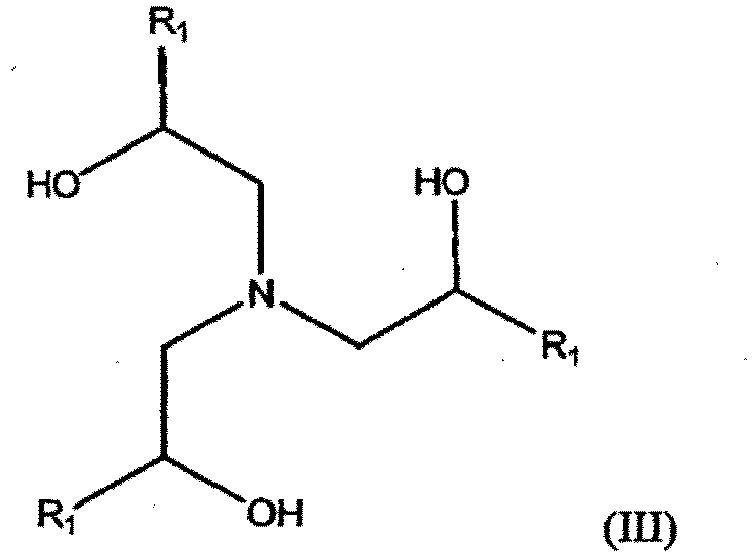
- Zusammensetzung nach Anspruch 1 oder 2, wobei das Amin in einer Menge von 0,01 bis 3 Gew.-%, bezogen auf das Gesamtgewicht der Zusammensetzung, vorliegt.
- Zusammensetzung nach Anspruch 2, wobei es sich bei R3, R4 und R5 der mindestens zwei verschiedenen Phosphite um unabhängig ausgewählte alkylierte Arylgruppen der folgenden Struktur handelt:

- Zusammensetzung nach Anspruch 2, wobei die mindestens zwei verschiedenen Phosphite die Folgenden umfassen:Tris(monoalkylaryl)phosphit in einer Menge von 20 bis 70 Gew.-% ;Bis(monoalkylaryl)dialkylarylphosphit in einer Menge von 15 bis 60 Gew.-%;Tris(dialkylaryl)phosphit in einer Menge von 0,1 bis 20 Gew.-%; undBis(dialkylaryl)monoarylphosphit in einer Menge von 2 bis 20 Gew.-%.
- Zusammensetzung nach Anspruch 3, wobei die mindestens zwei verschiedenen Phosphite aus der Gruppe bestehend aus Tris(4-tert-butylphenyl)phosphit, Tris(2-tert-butylphenyl)phosphit, Tris(2,4-di-tert-butylphenyl)phosphit, Bis(4-tert-butylphenyl)-2,4-di-tert-butylphenylphosphit, Bis(2,4-di-tert-butylphenyl)-4-tert-butylphenylphosphit, Bis(2-tert-butylphenyl)-2,4-di-tert-butylphenylphosphit, Bis(2,4-di-tert-butylphenyl)-2-tert-butylphenylphosphit, Tris(4-tert-amylphenyl)phosphit, Tris(2-tert-amylphenyl)phosphit, Tris(2,4-di-tert-amylphenyl)phosphit, Bis(4-tert-amylphenyl)-2,4-di-tert-amylphenylphosphit, Bis(2,4-di-tert-amylphenyl)-4-tert-amylphenylphosphit, Bis(2-tert-amylphenyl)-2,4-di-tert-amylphenylphosphit und Bis(2,4-di-tert-amylphenyl)-2-tert-amylphenylphosphit ausgewählt sind.
- Stabilisierte Polymerzusammensetzung, umfassend ein Polymer und die Zusammensetzung nach den Ansprüchen 1 bis 10.
- Verfahren zum hydrolytischen Stabilisieren eines sekundären Antioxidationsmittels, umfassend die Zugabe eines Amins in einer Menge von 0,01 bis 3 Gew.-% zu dem sekundären Antioxidationsmittel, wobei das Amin die folgende Struktur aufweist:

- Verfahren nach Anspruch 12, wobei das Amin die folgende Struktur aufweist:

- Verfahren nach Anspruch 13, wobei das Amin aus der Gruppe bestehend aus Octyl-bis(2-ethanol)amin, Nonyl-bis(2-ethanol)amin, Decyl-bis(2-ethanol)amin, Undecyl-bis(2-ethanol)amin, Dodecyl-bis(2-ethanol)amin, Tridecyl-bis(2-ethanol)amin, Tetradecyl-bis(2-ethanol)amin, Pentadecyl-bis(2-ethanol)amin, Hexadecyl-bis(2-ethanol)amin, Heptadecyl-bis(2-ethanol)amin, Octadecyl-bis(2-ethanol)amin, Octyl-bis(2-propanol)amin, Nonyl-bis(2-propanol)amin, Decyl-bis(2-propanol)amin, Undecyl-bis(2-propanol)amin, Dodecyl-bis(2-propanol)amin, Tridecyl-bis(2-propanol)amin, Tetradecyl-bis(2-propanol)amin, Pentadecyl-bis(2-propanol)amin, Hexadecyl-bis(2-propanol)amin, Heptadecyl-bis(2-propanol)amin, Octadecyl-bis(2-propanol)amin und Isomeren davon ausgewählt ist.
- Verfahren nach Anspruch 12, 13 oder 14, wobei die Phosphitzusammensetzung ein flüssiges Tris(monoalkylphenyl)phosphit, eine Mischung aus zwei oder mehr Tris(monoalkylphenyl)phosphiten oder mindestens zwei verschiedene Phosphite aus den Folgenden umfasst:(i) einem Tris(dialkylaryl)phosphit,(ii) einem Tris(monoalkylaryl)phosphit,(iii) einem Bis(dialkylaryl)monoalkylarylphosphit und(iv) einem Bis(monoalkylaryl)dialkylarylphosphit.
Priority Applications (1)
| Application Number | Priority Date | Filing Date | Title |
|---|---|---|---|
| PL10742936T PL2459575T5 (pl) | 2009-07-31 | 2010-07-28 | Hydrolitycznie stabilne kompozycje fosforynowe |
Applications Claiming Priority (3)
| Application Number | Priority Date | Filing Date | Title |
|---|---|---|---|
| US23065409P | 2009-07-31 | 2009-07-31 | |
| US12/804,793 US8048946B2 (en) | 2009-07-31 | 2010-07-28 | Hydrolytically stable phosphite compositions |
| PCT/US2010/043469 WO2011014529A2 (en) | 2009-07-31 | 2010-07-28 | Hydrolytically stable phosphite compositions |
Publications (3)
| Publication Number | Publication Date |
|---|---|
| EP2459575A2 EP2459575A2 (de) | 2012-06-06 |
| EP2459575B1 EP2459575B1 (de) | 2014-12-17 |
| EP2459575B2 true EP2459575B2 (de) | 2018-07-25 |
Family
ID=43527625
Family Applications (1)
| Application Number | Title | Priority Date | Filing Date |
|---|---|---|---|
| EP10742936.7A Active EP2459575B2 (de) | 2009-07-31 | 2010-07-28 | Hydrolysestabile phosphitzusammensetzungen |
Country Status (12)
| Country | Link |
|---|---|
| US (1) | US8048946B2 (de) |
| EP (1) | EP2459575B2 (de) |
| JP (1) | JP5756101B2 (de) |
| KR (1) | KR101752660B1 (de) |
| AR (1) | AR080273A1 (de) |
| BR (1) | BR112012000885B1 (de) |
| CA (1) | CA2760874C (de) |
| ES (1) | ES2533096T5 (de) |
| PL (1) | PL2459575T5 (de) |
| RU (1) | RU2563457C2 (de) |
| TW (1) | TW201109342A (de) |
| WO (1) | WO2011014529A2 (de) |
Families Citing this family (22)
| Publication number | Priority date | Publication date | Assignee | Title |
|---|---|---|---|---|
| US8557946B1 (en) * | 2011-02-28 | 2013-10-15 | Wm. T. Burnett Ip, Llc | Oxidation discoloration resistant polyurethane foam |
| US9127144B2 (en) * | 2012-01-20 | 2015-09-08 | Addivant Usa Llc | Polyolefin compositions for film, fiber and molded articles |
| CN104508031B (zh) | 2012-08-02 | 2020-10-16 | 瑞士新集团有限公司 | 亚磷酸酯组合物 |
| WO2014028943A1 (en) | 2012-08-17 | 2014-02-20 | Metabolix, Inc. | Biobased rubber modifiers for polymer blends |
| EP3004225A1 (de) | 2013-05-30 | 2016-04-13 | Metabolix, Inc. | Rezyklatmischungen |
| DE102014224119A1 (de) * | 2014-11-26 | 2016-06-02 | Leoni Kabel Holding Gmbh | Ladekabel für ein Elektro- oder Hybridfahrzeug sowie Ladesystem mit einem solchen Ladekabel |
| CN107848905B (zh) | 2015-07-28 | 2021-05-28 | 陶氏技术投资有限责任公司 | 用于制备稳定的有机磷化合物溶液的方法 |
| WO2017184234A1 (en) | 2016-04-22 | 2017-10-26 | Exxonmobil Chemical Patents Inc. | Polyethylene sheets |
| WO2018017180A1 (en) | 2016-07-21 | 2018-01-25 | Exxonmobil Chemical Patents Inc. | Rotomolded compositions, articles, and processes for making the same |
| WO2018102091A1 (en) | 2016-12-02 | 2018-06-07 | Exxonmobil Chemical Patents Inc. | Polyethylene films |
| US20200108539A1 (en) | 2017-04-06 | 2020-04-09 | ExxonMobil Chemica Patents Inc. | Cast Films and Processes for Making the Same |
| KR102389451B1 (ko) | 2017-05-25 | 2022-04-22 | 셰브론 필립스 케미컬 컴퍼니 엘피 | 폴리에틸렌 수지에서 색 안정성을 개선하는 방법 |
| WO2018226311A1 (en) | 2017-06-08 | 2018-12-13 | Exxonmobil Chemical Patents Inc. | Polyethylene blends and extrudates and methods of making the same |
| WO2019022801A1 (en) | 2017-07-24 | 2019-01-31 | Exxonmobil Chemical Patents Inc. | POLYETHYLENE FILMS AND METHODS OF PRODUCING THE SAME |
| WO2019209334A1 (en) | 2018-04-27 | 2019-10-31 | Exxonmobil Chemical Patents Inc. | Polyethylene films and methods of making the same |
| US11629245B2 (en) | 2018-06-28 | 2023-04-18 | Exxonmobil Chemical Patents Inc. | Polyethylene compositions, wire and cables, and methods for making the same |
| GB201812145D0 (en) | 2018-07-25 | 2018-09-05 | Addivant Switzerland Gmbh | Composition |
| GB2591482A (en) | 2020-01-29 | 2021-08-04 | Si Group Switzerland Chaa Gmbh | Non-dust blend |
| GB2592952B (en) * | 2020-03-11 | 2023-12-13 | Si Group Switzerland Gmbh | Composition |
| KR20230048030A (ko) * | 2020-08-07 | 2023-04-10 | 주식회사 쿠라레 | 조성물, 수지 조성물 및 그것들을 포함하는 성형체 |
| WO2023196800A2 (en) * | 2022-04-05 | 2023-10-12 | Global Thermostat Operations, Llc. | Epoxide-modified-sorbents, systems including epoxide-modified-sorbents, and methods using the epoxide-modified-sorbents |
| EP4532081A4 (de) | 2022-05-27 | 2025-09-17 | Zero Carbon Systems Inc | Direktlufterfassungssystem mit hohem durchsatz für bewegliche platten |
Family Cites Families (31)
| Publication number | Priority date | Publication date | Assignee | Title |
|---|---|---|---|---|
| US3056823A (en) | 1956-05-31 | 1962-10-02 | Hooker Chemical Corp | Transesterification process for making trialiphatic phosphite esters |
| US3553298A (en) * | 1967-10-20 | 1971-01-05 | Hooker Chemical Corp | Hydrolytic stabilized phosphite esters |
| FR2101275A5 (de) * | 1970-07-17 | 1972-03-31 | Ugine Kuhlmann | |
| JPS5930173B2 (ja) * | 1979-05-01 | 1984-07-25 | ボルグ−ワ−ナ−・ケミカルス・インコ−ポレ−テッド | 重合体のための安定剤 |
| ATE28208T1 (de) | 1983-11-28 | 1987-07-15 | Argus Chem | Pentaerythrit-spiro-bis-phosphitzusammensetzungen mit hydrolysebestaendigkeit. |
| US4650894A (en) | 1984-07-05 | 1987-03-17 | Argus Chemical Corporation | Tris-organophosphite compositions having improved hydrolytic stability |
| EP0372321A1 (de) * | 1988-12-02 | 1990-06-13 | General Electric Company | Mischungen aus Polyphenylenether und hochschlagfestem Polystyrol |
| EP0416321B1 (de) * | 1989-08-28 | 1994-11-09 | Chisso Corporation | Kristalline Polyolefinmischung |
| US5254709A (en) | 1989-12-08 | 1993-10-19 | Uniroyal Chemical Company, Inc. | Method for preparing stearically hindered aryl phosphites |
| JP2834241B2 (ja) * | 1989-12-20 | 1998-12-09 | 城北化学工業株式会社 | 粉体ホスファイト組成物 |
| US5308648A (en) * | 1992-09-30 | 1994-05-03 | Union Carbide Chemicals & Plastics Technology Corporation | Spray application of plastics additives to polymers |
| ZA937339B (en) * | 1992-10-05 | 1994-03-29 | Ciba Geigy | Process for stabilizing trivalent phosphorus compounds with amines |
| TW251307B (de) * | 1992-10-05 | 1995-07-11 | Ciba Geigy | |
| JP3568981B2 (ja) * | 1994-03-28 | 2004-09-22 | 旭電化工業株式会社 | 有機ホスファイト組成物 |
| US5561181A (en) | 1994-11-16 | 1996-10-01 | General Electric Company | Ultra high ortho nonyl phenyl phosphite and resin compositions stabilized therewith |
| JPH09176415A (ja) * | 1995-12-25 | 1997-07-08 | Toray Ind Inc | 熱安定性熱可塑性樹脂組成物 |
| WO2000077085A1 (en) * | 1999-06-11 | 2000-12-21 | Sydney Hyman | Image making medium |
| WO2004024810A2 (en) * | 2002-09-11 | 2004-03-25 | Ciba, Specialty Chemicals Holding Inc. | Stabillization of organic materials |
| CA2615555C (en) | 2005-07-21 | 2014-01-07 | Ciba Specialty Chemicals Holding Inc. | Stabilization of polyolefins with liquid tris-(mono-alkyl)phenyl phosphites |
| US8188170B2 (en) * | 2006-06-20 | 2012-05-29 | Chemtura Corporation | Polymers with low gel content and enhanced gas-fading |
| US8178005B2 (en) * | 2006-06-20 | 2012-05-15 | Chemtura Corporation | Liquid phosphite compositions having different alkyl groups |
| US20100076131A1 (en) * | 2006-06-20 | 2010-03-25 | Chemtura Corporation | Liquid butylaryl phosphite compositions and alkylate compositions for manufacturing same |
| US8008383B2 (en) * | 2006-06-20 | 2011-08-30 | Chemtura Corporation | Liquid amylaryl phosphite compositions |
| US7888414B2 (en) * | 2006-06-20 | 2011-02-15 | Chemtura Corporation | Liquid phosphite blends as stabilizers |
| US8183311B2 (en) * | 2006-06-20 | 2012-05-22 | Chemtura Corporation | Liquid phosphite composition derived from cresols |
| US8008384B2 (en) * | 2006-06-20 | 2011-08-30 | Chemtura Corporation | Liquid butylaryl phosphite compositions |
| US7947769B2 (en) * | 2006-06-20 | 2011-05-24 | Chemtura Corporation | Liquid amylaryl phosphite compositions and alkylate compositions for manufacturing same |
| CN102471357A (zh) * | 2009-07-31 | 2012-05-23 | 科聚亚公司 | 固体烷基芳基亚磷酸酯组合物和制备其方法 |
| US8309635B2 (en) * | 2009-07-31 | 2012-11-13 | Chemtura Corporation | Solid alkylaryl phosphite compositions and methods for manufacturing same |
| US8735628B2 (en) * | 2009-07-31 | 2014-05-27 | Addivant Usa Llc | Processes for forming alkylated aryl phosphite compositions from complex hydrocarbon streams |
| WO2011014405A1 (en) * | 2009-07-31 | 2011-02-03 | Chemtura Corporation | Liquid alkylated trisaryl phosphite compositions having two alkyl groups with different carbon number |
-
2010
- 2010-07-27 AR ARP100102713A patent/AR080273A1/es not_active Application Discontinuation
- 2010-07-27 TW TW099124769A patent/TW201109342A/zh unknown
- 2010-07-28 KR KR1020127002004A patent/KR101752660B1/ko not_active Expired - Fee Related
- 2010-07-28 CA CA2760874A patent/CA2760874C/en active Active
- 2010-07-28 PL PL10742936T patent/PL2459575T5/pl unknown
- 2010-07-28 JP JP2012516392A patent/JP5756101B2/ja not_active Expired - Fee Related
- 2010-07-28 EP EP10742936.7A patent/EP2459575B2/de active Active
- 2010-07-28 BR BR112012000885-4A patent/BR112012000885B1/pt active IP Right Grant
- 2010-07-28 WO PCT/US2010/043469 patent/WO2011014529A2/en not_active Ceased
- 2010-07-28 ES ES10742936.7T patent/ES2533096T5/es active Active
- 2010-07-28 RU RU2012107446/04A patent/RU2563457C2/ru active
- 2010-07-28 US US12/804,793 patent/US8048946B2/en active Active
Also Published As
| Publication number | Publication date |
|---|---|
| RU2563457C2 (ru) | 2015-09-20 |
| PL2459575T3 (pl) | 2015-06-30 |
| TW201109342A (en) | 2011-03-16 |
| EP2459575A2 (de) | 2012-06-06 |
| BR112012000885B1 (pt) | 2019-02-26 |
| RU2012107446A (ru) | 2013-09-10 |
| EP2459575B1 (de) | 2014-12-17 |
| CA2760874A1 (en) | 2011-02-03 |
| KR101752660B1 (ko) | 2017-06-30 |
| JP5756101B2 (ja) | 2015-07-29 |
| BR112012000885A2 (pt) | 2018-03-13 |
| US20110028619A1 (en) | 2011-02-03 |
| CA2760874C (en) | 2017-06-27 |
| ES2533096T3 (es) | 2015-04-07 |
| WO2011014529A3 (en) | 2011-04-07 |
| JP2012530813A (ja) | 2012-12-06 |
| US8048946B2 (en) | 2011-11-01 |
| AR080273A1 (es) | 2012-03-28 |
| KR20120050979A (ko) | 2012-05-21 |
| PL2459575T5 (pl) | 2018-12-31 |
| WO2011014529A2 (en) | 2011-02-03 |
| ES2533096T5 (es) | 2018-11-21 |
Similar Documents
| Publication | Publication Date | Title |
|---|---|---|
| EP2459575B2 (de) | Hydrolysestabile phosphitzusammensetzungen | |
| EP2491078B1 (de) | Polymere mit geringem gelgehalt und verbesserter gasverblassung | |
| US8178005B2 (en) | Liquid phosphite compositions having different alkyl groups | |
| EP2459578B1 (de) | Feste alkylaryl-phosphit-zusammensetzungen und verfahren zu ihrer herstellung | |
| US20100190900A1 (en) | Liquid butylaryl phosphite compositions | |
| EP2459574B1 (de) | Feste alkylarylphosphitzusammensetzungen und verfahren zu deren herstellung | |
| EP2459576B1 (de) | Flüssige alkylierte trisarylphosphitzusammensetzungen mit zwei alkylgruppen, die sich in ihrer kohlenstoffanzahl unterscheiden | |
| US8183311B2 (en) | Liquid phosphite composition derived from cresols | |
| CN102482302A (zh) | 水解稳定的亚磷酸酯组合物 | |
| WO2011014210A2 (en) | Liquid phosphite compositions having different alkyl groups |
Legal Events
| Date | Code | Title | Description |
|---|---|---|---|
| PUAI | Public reference made under article 153(3) epc to a published international application that has entered the european phase |
Free format text: ORIGINAL CODE: 0009012 |
|
| 17P | Request for examination filed |
Effective date: 20111129 |
|
| AK | Designated contracting states |
Kind code of ref document: A2 Designated state(s): AL AT BE BG CH CY CZ DE DK EE ES FI FR GB GR HR HU IE IS IT LI LT LU LV MC MK MT NL NO PL PT RO SE SI SK SM TR |
|
| DAX | Request for extension of the european patent (deleted) | ||
| 17Q | First examination report despatched |
Effective date: 20121112 |
|
| RAP1 | Party data changed (applicant data changed or rights of an application transferred) |
Owner name: ADDIVANT SWITZERLAND GMBH |
|
| GRAP | Despatch of communication of intention to grant a patent |
Free format text: ORIGINAL CODE: EPIDOSNIGR1 |
|
| INTG | Intention to grant announced |
Effective date: 20140704 |
|
| GRAS | Grant fee paid |
Free format text: ORIGINAL CODE: EPIDOSNIGR3 |
|
| GRAA | (expected) grant |
Free format text: ORIGINAL CODE: 0009210 |
|
| AK | Designated contracting states |
Kind code of ref document: B1 Designated state(s): AL AT BE BG CH CY CZ DE DK EE ES FI FR GB GR HR HU IE IS IT LI LT LU LV MC MK MT NL NO PL PT RO SE SI SK SM TR |
|
| REG | Reference to a national code |
Ref country code: GB Ref legal event code: FG4D |
|
| REG | Reference to a national code |
Ref country code: CH Ref legal event code: EP |
|
| REG | Reference to a national code |
Ref country code: IE Ref legal event code: FG4D |
|
| REG | Reference to a national code |
Ref country code: AT Ref legal event code: REF Ref document number: 701821 Country of ref document: AT Kind code of ref document: T Effective date: 20150115 Ref country code: CH Ref legal event code: NV Representative=s name: ISLER AND PEDRAZZINI AG, CH |
|
| REG | Reference to a national code |
Ref country code: DE Ref legal event code: R096 Ref document number: 602010021081 Country of ref document: DE Effective date: 20150129 |
|
| REG | Reference to a national code |
Ref country code: NL Ref legal event code: T3 |
|
| REG | Reference to a national code |
Ref country code: SE Ref legal event code: TRGR |
|
| REG | Reference to a national code |
Ref country code: ES Ref legal event code: FG2A Ref document number: 2533096 Country of ref document: ES Kind code of ref document: T3 Effective date: 20150407 |
|
| PG25 | Lapsed in a contracting state [announced via postgrant information from national office to epo] |
Ref country code: FI Free format text: LAPSE BECAUSE OF FAILURE TO SUBMIT A TRANSLATION OF THE DESCRIPTION OR TO PAY THE FEE WITHIN THE PRESCRIBED TIME-LIMIT Effective date: 20141217 Ref country code: LT Free format text: LAPSE BECAUSE OF FAILURE TO SUBMIT A TRANSLATION OF THE DESCRIPTION OR TO PAY THE FEE WITHIN THE PRESCRIBED TIME-LIMIT Effective date: 20141217 |
|
| REG | Reference to a national code |
Ref country code: NO Ref legal event code: T2 Effective date: 20141217 |
|
| REG | Reference to a national code |
Ref country code: LT Ref legal event code: MG4D |
|
| PG25 | Lapsed in a contracting state [announced via postgrant information from national office to epo] |
Ref country code: GR Free format text: LAPSE BECAUSE OF FAILURE TO SUBMIT A TRANSLATION OF THE DESCRIPTION OR TO PAY THE FEE WITHIN THE PRESCRIBED TIME-LIMIT Effective date: 20150318 Ref country code: LV Free format text: LAPSE BECAUSE OF FAILURE TO SUBMIT A TRANSLATION OF THE DESCRIPTION OR TO PAY THE FEE WITHIN THE PRESCRIBED TIME-LIMIT Effective date: 20141217 Ref country code: HR Free format text: LAPSE BECAUSE OF FAILURE TO SUBMIT A TRANSLATION OF THE DESCRIPTION OR TO PAY THE FEE WITHIN THE PRESCRIBED TIME-LIMIT Effective date: 20141217 |
|
| REG | Reference to a national code |
Ref country code: AT Ref legal event code: MK05 Ref document number: 701821 Country of ref document: AT Kind code of ref document: T Effective date: 20141217 |
|
| REG | Reference to a national code |
Ref country code: PL Ref legal event code: T3 |
|
| PG25 | Lapsed in a contracting state [announced via postgrant information from national office to epo] |
Ref country code: RO Free format text: LAPSE BECAUSE OF FAILURE TO SUBMIT A TRANSLATION OF THE DESCRIPTION OR TO PAY THE FEE WITHIN THE PRESCRIBED TIME-LIMIT Effective date: 20141217 Ref country code: SK Free format text: LAPSE BECAUSE OF FAILURE TO SUBMIT A TRANSLATION OF THE DESCRIPTION OR TO PAY THE FEE WITHIN THE PRESCRIBED TIME-LIMIT Effective date: 20141217 Ref country code: CZ Free format text: LAPSE BECAUSE OF FAILURE TO SUBMIT A TRANSLATION OF THE DESCRIPTION OR TO PAY THE FEE WITHIN THE PRESCRIBED TIME-LIMIT Effective date: 20141217 Ref country code: EE Free format text: LAPSE BECAUSE OF FAILURE TO SUBMIT A TRANSLATION OF THE DESCRIPTION OR TO PAY THE FEE WITHIN THE PRESCRIBED TIME-LIMIT Effective date: 20141217 |
|
| PG25 | Lapsed in a contracting state [announced via postgrant information from national office to epo] |
Ref country code: AT Free format text: LAPSE BECAUSE OF FAILURE TO SUBMIT A TRANSLATION OF THE DESCRIPTION OR TO PAY THE FEE WITHIN THE PRESCRIBED TIME-LIMIT Effective date: 20141217 Ref country code: IS Free format text: LAPSE BECAUSE OF FAILURE TO SUBMIT A TRANSLATION OF THE DESCRIPTION OR TO PAY THE FEE WITHIN THE PRESCRIBED TIME-LIMIT Effective date: 20150417 |
|
| REG | Reference to a national code |
Ref country code: DE Ref legal event code: R026 Ref document number: 602010021081 Country of ref document: DE |
|
| PLBI | Opposition filed |
Free format text: ORIGINAL CODE: 0009260 |
|
| PLAX | Notice of opposition and request to file observation + time limit sent |
Free format text: ORIGINAL CODE: EPIDOSNOBS2 |
|
| 26 | Opposition filed |
Opponent name: BASF SE Effective date: 20150916 |
|
| PG25 | Lapsed in a contracting state [announced via postgrant information from national office to epo] |
Ref country code: DK Free format text: LAPSE BECAUSE OF FAILURE TO SUBMIT A TRANSLATION OF THE DESCRIPTION OR TO PAY THE FEE WITHIN THE PRESCRIBED TIME-LIMIT Effective date: 20141217 |
|
| PLAF | Information modified related to communication of a notice of opposition and request to file observations + time limit |
Free format text: ORIGINAL CODE: EPIDOSCOBS2 |
|
| PG25 | Lapsed in a contracting state [announced via postgrant information from national office to epo] |
Ref country code: SI Free format text: LAPSE BECAUSE OF FAILURE TO SUBMIT A TRANSLATION OF THE DESCRIPTION OR TO PAY THE FEE WITHIN THE PRESCRIBED TIME-LIMIT Effective date: 20141217 Ref country code: MC Free format text: LAPSE BECAUSE OF FAILURE TO SUBMIT A TRANSLATION OF THE DESCRIPTION OR TO PAY THE FEE WITHIN THE PRESCRIBED TIME-LIMIT Effective date: 20141217 |
|
| PG25 | Lapsed in a contracting state [announced via postgrant information from national office to epo] |
Ref country code: LU Free format text: LAPSE BECAUSE OF FAILURE TO SUBMIT A TRANSLATION OF THE DESCRIPTION OR TO PAY THE FEE WITHIN THE PRESCRIBED TIME-LIMIT Effective date: 20150728 |
|
| REG | Reference to a national code |
Ref country code: IE Ref legal event code: MM4A |
|
| PLBB | Reply of patent proprietor to notice(s) of opposition received |
Free format text: ORIGINAL CODE: EPIDOSNOBS3 |
|
| REG | Reference to a national code |
Ref country code: FR Ref legal event code: PLFP Year of fee payment: 7 |
|
| PG25 | Lapsed in a contracting state [announced via postgrant information from national office to epo] |
Ref country code: IE Free format text: LAPSE BECAUSE OF NON-PAYMENT OF DUE FEES Effective date: 20150728 |
|
| PG25 | Lapsed in a contracting state [announced via postgrant information from national office to epo] |
Ref country code: MT Free format text: LAPSE BECAUSE OF FAILURE TO SUBMIT A TRANSLATION OF THE DESCRIPTION OR TO PAY THE FEE WITHIN THE PRESCRIBED TIME-LIMIT Effective date: 20141217 |
|
| PG25 | Lapsed in a contracting state [announced via postgrant information from national office to epo] |
Ref country code: HU Free format text: LAPSE BECAUSE OF FAILURE TO SUBMIT A TRANSLATION OF THE DESCRIPTION OR TO PAY THE FEE WITHIN THE PRESCRIBED TIME-LIMIT; INVALID AB INITIO Effective date: 20100728 Ref country code: SM Free format text: LAPSE BECAUSE OF FAILURE TO SUBMIT A TRANSLATION OF THE DESCRIPTION OR TO PAY THE FEE WITHIN THE PRESCRIBED TIME-LIMIT Effective date: 20141217 Ref country code: BG Free format text: LAPSE BECAUSE OF FAILURE TO SUBMIT A TRANSLATION OF THE DESCRIPTION OR TO PAY THE FEE WITHIN THE PRESCRIBED TIME-LIMIT Effective date: 20141217 |
|
| REG | Reference to a national code |
Ref country code: FR Ref legal event code: PLFP Year of fee payment: 8 |
|
| PG25 | Lapsed in a contracting state [announced via postgrant information from national office to epo] |
Ref country code: CY Free format text: LAPSE BECAUSE OF FAILURE TO SUBMIT A TRANSLATION OF THE DESCRIPTION OR TO PAY THE FEE WITHIN THE PRESCRIBED TIME-LIMIT Effective date: 20141217 |
|
| PG25 | Lapsed in a contracting state [announced via postgrant information from national office to epo] |
Ref country code: TR Free format text: LAPSE BECAUSE OF FAILURE TO SUBMIT A TRANSLATION OF THE DESCRIPTION OR TO PAY THE FEE WITHIN THE PRESCRIBED TIME-LIMIT Effective date: 20141217 |
|
| REG | Reference to a national code |
Ref country code: BE Ref legal event code: FP Effective date: 20150312 Ref country code: BE Ref legal event code: RC Free format text: DETAILS PLEDGE: RIGHT OF PLEDGE, ETABLI Name of requester: WELLS FARGO BANK, NATIONAL ASSOCIATION Effective date: 20171025 |
|
| REG | Reference to a national code |
Ref country code: FR Ref legal event code: PLFP Year of fee payment: 9 |
|
| PUAH | Patent maintained in amended form |
Free format text: ORIGINAL CODE: 0009272 |
|
| STAA | Information on the status of an ep patent application or granted ep patent |
Free format text: STATUS: PATENT MAINTAINED AS AMENDED |
|
| PG25 | Lapsed in a contracting state [announced via postgrant information from national office to epo] |
Ref country code: MK Free format text: LAPSE BECAUSE OF FAILURE TO SUBMIT A TRANSLATION OF THE DESCRIPTION OR TO PAY THE FEE WITHIN THE PRESCRIBED TIME-LIMIT Effective date: 20141217 |
|
| 27A | Patent maintained in amended form |
Effective date: 20180725 |
|
| AK | Designated contracting states |
Kind code of ref document: B2 Designated state(s): AL AT BE BG CH CY CZ DE DK EE ES FI FR GB GR HR HU IE IS IT LI LT LU LV MC MK MT NL NO PL PT RO SE SI SK SM TR |
|
| REG | Reference to a national code |
Ref country code: DE Ref legal event code: R102 Ref document number: 602010021081 Country of ref document: DE |
|
| PG25 | Lapsed in a contracting state [announced via postgrant information from national office to epo] |
Ref country code: PT Free format text: LAPSE BECAUSE OF FAILURE TO SUBMIT A TRANSLATION OF THE DESCRIPTION OR TO PAY THE FEE WITHIN THE PRESCRIBED TIME-LIMIT Effective date: 20141217 |
|
| REG | Reference to a national code |
Ref country code: CH Ref legal event code: AELC |
|
| PG25 | Lapsed in a contracting state [announced via postgrant information from national office to epo] |
Ref country code: AL Free format text: LAPSE BECAUSE OF FAILURE TO SUBMIT A TRANSLATION OF THE DESCRIPTION OR TO PAY THE FEE WITHIN THE PRESCRIBED TIME-LIMIT Effective date: 20141217 |
|
| REG | Reference to a national code |
Ref country code: NL Ref legal event code: MP Effective date: 20141217 |
|
| REG | Reference to a national code |
Ref country code: ES Ref legal event code: DC2A Ref document number: 2533096 Country of ref document: ES Kind code of ref document: T5 Effective date: 20181121 |
|
| REG | Reference to a national code |
Ref country code: NO Ref legal event code: TB2 |
|
| REG | Reference to a national code |
Ref country code: BE Ref legal event code: RF Free format text: DETAILS PLEDGE: RIGHT OF PLEDGE, SUPPRIME Name of requester: WELLS FARGO BANK, NATIONAL ASSOCIATION Effective date: 20181025 |
|
| PG25 | Lapsed in a contracting state [announced via postgrant information from national office to epo] |
Ref country code: NL Free format text: LAPSE BECAUSE OF FAILURE TO SUBMIT A TRANSLATION OF THE DESCRIPTION OR TO PAY THE FEE WITHIN THE PRESCRIBED TIME-LIMIT Effective date: 20141217 |
|
| REG | Reference to a national code |
Ref country code: SE Ref legal event code: NAV |
|
| REG | Reference to a national code |
Ref country code: NL Ref legal event code: NE Effective date: 20190508 |
|
| PG25 | Lapsed in a contracting state [announced via postgrant information from national office to epo] |
Ref country code: NL Free format text: THE PATENT HAS BEEN ANNULLED BY A DECISION OF A NATIONAL AUTHORITY Effective date: 20141217 |
|
| REG | Reference to a national code |
Ref country code: CH Ref legal event code: PFA Owner name: SI GROUP SWITZERLAND (CHAA) GMBH, CH Free format text: FORMER OWNER: ADDIVANT SWITZERLAND GMBH, CH |
|
| REG | Reference to a national code |
Ref country code: NO Ref legal event code: CHAD Owner name: SI GROUP SWITZERLAND (CHAA) GMBH, CH |
|
| REG | Reference to a national code |
Ref country code: BE Ref legal event code: HC Owner name: SI GROUP SWITZERLAND (CHAA) GMBH; CH Free format text: DETAILS ASSIGNMENT: CHANGE OF OWNER(S), CHANGEMENT DE NOM DU PROPRIETAIRE; FORMER OWNER NAME: ADDIVANT SWITZERLAND GMBH Effective date: 20191025 |
|
| REG | Reference to a national code |
Ref country code: DE Ref legal event code: R081 Ref document number: 602010021081 Country of ref document: DE Owner name: SI GROUP-SWITZERLAND GMBH, CH Free format text: FORMER OWNER: ADDIVANT SWITZERLAND GMBH, REINACH, CH Ref country code: DE Ref legal event code: R082 Ref document number: 602010021081 Country of ref document: DE Representative=s name: DF-MP DOERRIES FRANK-MOLNIA & POHLMAN PATENTAN, DE Ref country code: DE Ref legal event code: R081 Ref document number: 602010021081 Country of ref document: DE Owner name: SI GROUP SWITZERLAND (CHAA) GMBH, CH Free format text: FORMER OWNER: ADDIVANT SWITZERLAND GMBH, REINACH, CH |
|
| REG | Reference to a national code |
Ref country code: SE Ref legal event code: RINS Effective date: 20191209 |
|
| REG | Reference to a national code |
Ref country code: SE Ref legal event code: RPEO |
|
| REG | Reference to a national code |
Ref country code: ES Ref legal event code: PC2A Owner name: SI GROUP SWITZERLAND (CHAA) GMBH Effective date: 20200206 |
|
| REG | Reference to a national code |
Ref country code: NL Ref legal event code: FP Ref country code: NL Ref legal event code: NG |
|
| REG | Reference to a national code |
Ref country code: NL Ref legal event code: HC Owner name: SI GROUP SWITZERLAND (CHAA) GMBH; CH Free format text: DETAILS ASSIGNMENT: CHANGE OF OWNER(S), CHANGE OF OWNER(S) NAME; FORMER OWNER NAME: ADDIVANT SWITZERLAND GMBH Effective date: 20200320 |
|
| PG25 | Lapsed in a contracting state [announced via postgrant information from national office to epo] |
Ref country code: NL Free format text: THE PATENT HAS BEEN ANNULLED BY A DECISION OF A NATIONAL AUTHORITY Effective date: 20141217 |
|
| PGRI | Patent reinstated in contracting state [announced from national office to epo] |
Ref country code: NL Effective date: 20200206 |
|
| PGFP | Annual fee paid to national office [announced via postgrant information from national office to epo] |
Ref country code: NO Payment date: 20200713 Year of fee payment: 11 Ref country code: ES Payment date: 20200803 Year of fee payment: 11 |
|
| PGFP | Annual fee paid to national office [announced via postgrant information from national office to epo] |
Ref country code: IT Payment date: 20200720 Year of fee payment: 11 Ref country code: BE Payment date: 20200717 Year of fee payment: 11 |
|
| PGFP | Annual fee paid to national office [announced via postgrant information from national office to epo] |
Ref country code: SE Payment date: 20210715 Year of fee payment: 12 |
|
| REG | Reference to a national code |
Ref country code: NO Ref legal event code: MMEP |
|
| REG | Reference to a national code |
Ref country code: BE Ref legal event code: MM Effective date: 20210731 |
|
| PG25 | Lapsed in a contracting state [announced via postgrant information from national office to epo] |
Ref country code: NO Free format text: LAPSE BECAUSE OF NON-PAYMENT OF DUE FEES Effective date: 20210731 |
|
| PG25 | Lapsed in a contracting state [announced via postgrant information from national office to epo] |
Ref country code: IT Free format text: LAPSE BECAUSE OF NON-PAYMENT OF DUE FEES Effective date: 20210728 Ref country code: BE Free format text: LAPSE BECAUSE OF NON-PAYMENT OF DUE FEES Effective date: 20210731 |
|
| REG | Reference to a national code |
Ref country code: ES Ref legal event code: FD2A Effective date: 20220930 |
|
| PG25 | Lapsed in a contracting state [announced via postgrant information from national office to epo] |
Ref country code: ES Free format text: LAPSE BECAUSE OF NON-PAYMENT OF DUE FEES Effective date: 20210729 |
|
| PGFP | Annual fee paid to national office [announced via postgrant information from national office to epo] |
Ref country code: GB Payment date: 20220727 Year of fee payment: 13 |
|
| PGFP | Annual fee paid to national office [announced via postgrant information from national office to epo] |
Ref country code: PL Payment date: 20220704 Year of fee payment: 13 |
|
| REG | Reference to a national code |
Ref country code: NL Ref legal event code: PD Owner name: SI GROUP-SWITZERLAND GMBH; CH Free format text: DETAILS ASSIGNMENT: CHANGE OF OWNER(S), MERGE; FORMER OWNER NAME: SI GROUP SWITZERLAND (CHAA) GMBH Effective date: 20221130 |
|
| PGFP | Annual fee paid to national office [announced via postgrant information from national office to epo] |
Ref country code: CH Payment date: 20220808 Year of fee payment: 13 |
|
| REG | Reference to a national code |
Ref country code: DE Ref legal event code: R081 Ref document number: 602010021081 Country of ref document: DE Owner name: SI GROUP-SWITZERLAND GMBH, CH Free format text: FORMER OWNER: SI GROUP SWITZERLAND (CHAA) GMBH, PRATTELN, CH |
|
| REG | Reference to a national code |
Ref country code: GB Ref legal event code: 732E Free format text: REGISTERED BETWEEN 20230112 AND 20230118 |
|
| REG | Reference to a national code |
Ref country code: SE Ref legal event code: EUG |
|
| PG25 | Lapsed in a contracting state [announced via postgrant information from national office to epo] |
Ref country code: SE Free format text: LAPSE BECAUSE OF NON-PAYMENT OF DUE FEES Effective date: 20220729 |
|
| P01 | Opt-out of the competence of the unified patent court (upc) registered |
Effective date: 20230511 |
|
| REG | Reference to a national code |
Ref country code: CH Ref legal event code: PL |
|
| GBPC | Gb: european patent ceased through non-payment of renewal fee |
Effective date: 20230728 |
|
| PG25 | Lapsed in a contracting state [announced via postgrant information from national office to epo] |
Ref country code: CH Free format text: LAPSE BECAUSE OF NON-PAYMENT OF DUE FEES Effective date: 20230731 Ref country code: GB Free format text: LAPSE BECAUSE OF NON-PAYMENT OF DUE FEES Effective date: 20230728 |
|
| PG25 | Lapsed in a contracting state [announced via postgrant information from national office to epo] |
Ref country code: PL Free format text: LAPSE BECAUSE OF NON-PAYMENT OF DUE FEES Effective date: 20230728 |
|
| PG25 | Lapsed in a contracting state [announced via postgrant information from national office to epo] |
Ref country code: PL Free format text: LAPSE BECAUSE OF NON-PAYMENT OF DUE FEES Effective date: 20230728 |
|
| PGFP | Annual fee paid to national office [announced via postgrant information from national office to epo] |
Ref country code: NL Payment date: 20250726 Year of fee payment: 16 |
|
| PGFP | Annual fee paid to national office [announced via postgrant information from national office to epo] |
Ref country code: DE Payment date: 20250729 Year of fee payment: 16 |
|
| PGFP | Annual fee paid to national office [announced via postgrant information from national office to epo] |
Ref country code: FR Payment date: 20250728 Year of fee payment: 16 |