EP2457553B1 - Composite powder for simultaneously blocking infrared and ultraviolet rays, and cosmetic composition using same - Google Patents
Composite powder for simultaneously blocking infrared and ultraviolet rays, and cosmetic composition using same Download PDFInfo
- Publication number
- EP2457553B1 EP2457553B1 EP10802391.2A EP10802391A EP2457553B1 EP 2457553 B1 EP2457553 B1 EP 2457553B1 EP 10802391 A EP10802391 A EP 10802391A EP 2457553 B1 EP2457553 B1 EP 2457553B1
- Authority
- EP
- European Patent Office
- Prior art keywords
- ray blocking
- infrared
- ultraviolet
- powder
- composite powder
- Prior art date
- Legal status (The legal status is an assumption and is not a legal conclusion. Google has not performed a legal analysis and makes no representation as to the accuracy of the status listed.)
- Active
Links
Images




Classifications
-
- A—HUMAN NECESSITIES
- A61—MEDICAL OR VETERINARY SCIENCE; HYGIENE
- A61K—PREPARATIONS FOR MEDICAL, DENTAL OR TOILETRY PURPOSES
- A61K8/00—Cosmetics or similar toiletry preparations
- A61K8/02—Cosmetics or similar toiletry preparations characterised by special physical form
- A61K8/0241—Containing particulates characterized by their shape and/or structure
- A61K8/0275—Containing agglomerated particulates
-
- A—HUMAN NECESSITIES
- A61—MEDICAL OR VETERINARY SCIENCE; HYGIENE
- A61K—PREPARATIONS FOR MEDICAL, DENTAL OR TOILETRY PURPOSES
- A61K8/00—Cosmetics or similar toiletry preparations
- A61K8/18—Cosmetics or similar toiletry preparations characterised by the composition
- A61K8/19—Cosmetics or similar toiletry preparations characterised by the composition containing inorganic ingredients
- A61K8/27—Zinc; Compounds thereof
-
- A—HUMAN NECESSITIES
- A61—MEDICAL OR VETERINARY SCIENCE; HYGIENE
- A61K—PREPARATIONS FOR MEDICAL, DENTAL OR TOILETRY PURPOSES
- A61K8/00—Cosmetics or similar toiletry preparations
- A61K8/18—Cosmetics or similar toiletry preparations characterised by the composition
- A61K8/19—Cosmetics or similar toiletry preparations characterised by the composition containing inorganic ingredients
- A61K8/29—Titanium; Compounds thereof
-
- A—HUMAN NECESSITIES
- A61—MEDICAL OR VETERINARY SCIENCE; HYGIENE
- A61Q—SPECIFIC USE OF COSMETICS OR SIMILAR TOILETRY PREPARATIONS
- A61Q17/00—Barrier preparations; Preparations brought into direct contact with the skin for affording protection against external influences, e.g. sunlight, X-rays or other harmful rays, corrosive materials, bacteria or insect stings
- A61Q17/04—Topical preparations for affording protection against sunlight or other radiation; Topical sun tanning preparations
-
- A—HUMAN NECESSITIES
- A61—MEDICAL OR VETERINARY SCIENCE; HYGIENE
- A61K—PREPARATIONS FOR MEDICAL, DENTAL OR TOILETRY PURPOSES
- A61K2800/00—Properties of cosmetic compositions or active ingredients thereof or formulation aids used therein and process related aspects
- A61K2800/40—Chemical, physico-chemical or functional or structural properties of particular ingredients
- A61K2800/41—Particular ingredients further characterized by their size
- A61K2800/412—Microsized, i.e. having sizes between 0.1 and 100 microns
-
- A—HUMAN NECESSITIES
- A61—MEDICAL OR VETERINARY SCIENCE; HYGIENE
- A61K—PREPARATIONS FOR MEDICAL, DENTAL OR TOILETRY PURPOSES
- A61K2800/00—Properties of cosmetic compositions or active ingredients thereof or formulation aids used therein and process related aspects
- A61K2800/40—Chemical, physico-chemical or functional or structural properties of particular ingredients
- A61K2800/60—Particulates further characterized by their structure or composition
- A61K2800/61—Surface treated
- A61K2800/62—Coated
- A61K2800/621—Coated by inorganic compounds
Definitions
- the present invention relates to functional powder for simultaneously blocking infrared and ultraviolet rays, and more particularly, to powder for preventing skin from aging and being damaged by solar rays.
- Skin aging may be largely classified into two types: the first type is chronologic aging of the skin which is unavoidable with the lapse of time; and the second type is photoaging of the skin.
- the photoaging is observed when the skin on the face, the back of the hand, and the posterior neck are exposed to the solar rays for a long time.
- the photoaging is caused by the chronologic aging and ultraviolet rays.
- the photoaging relates with rough wrinkles, irregular pigmentary deposits, loss of skin elasticity, disturbance of skin barrier function, and cancer of the skin.
- the photoagaing can be prevented by avoiding the exposure to the ultraviolet rays.
- Recently, it is disclosed that the infrared rays which occupy 54% of solar energy are among the environmental factors for accelerating the skin aging by a thermal effect.
- the skin may be easily aging and damaged due to the increased exposure to the ultraviolet rays.
- cosmetics with sunscreen added therein have been developed.
- the sunscreen may be largely classified into organic-based sunscreen and inorganic-based sunscreen.
- the organic-based sunscreen comprises ingredients with conjugated bond capable of absorbing the ultraviolet rays in a molecular structure. This organic-based sunscreen might cause problems of skin toxicity, allergy to the skin, and discoloration.
- the inorganic-based sunscreen comprises powder for scattering the ultraviolet rays, for example, metal oxide with a high refractive index.
- the inorganic-based sunscreen the above problems caused by the organic-based sunscreen would not occur.
- the inorganic-based sunscreen is widely used in view of safety.
- the powder such as the metal oxide constituting the inorganic-based sunscreen has strong aggregation so that a lump of powder is increased in size due to the powder aggregation. In this case, the lump of powder with the increased size may deteriorate the feeling to the skin and the adhesion to the skin, and may lower the efficiency of sunscreen.
- the present invention is directed to composite powder and cosmetics composition using the same that substantially obviates one or more of the problems due to limitations and disadvantages of the related art.
- An aspect of the present invention is to provide composite powder which facilitates to prevent particles for preventing skin damaging from being aggregated, and to minimize rough wrinkles, irregular pigmentary deposits, loss of skin elasticity, disturbance of skin barrier function, skin damages such as cancer of the skin, and skin aging by simultaneously blocking infrared and ultraviolet rays, and cosmetics composition using the above composite powder.
- a composite powder comprising: infrared-ray blocking particles; and ultraviolet-ray blocking particles coated onto one surface of each of the infrared-ray blocking particles.
- the ultraviolet-ray blocking particles are coated onto the entire surface of the infrared-ray blocking particle.
- the ultraviolet-ray blocking particles are coated onto the surface of the infrared-ray blocking particle while penetrating into the inside of the infrared-ray blocking particle.
- At least one of the infrared-ray blocking particle and ultraviolet-ray blocking particle is surface-treated with an organic or inorganic surface treating agent containing a hydroxyl group (-OH) or hydrogen group (-H).
- a weight ratio of the ultraviolet-ray blocking particle to the infrared-ray blocking particle is 1:99 ⁇ 99:1.
- a diameter of the infrared-ray blocking particle is within the range of 0.38 ⁇ 1.5 ⁇ m; and a diameter of the ultraviolet-ray blocking particle is within the range of 8 ⁇ 150nm.
- the infrared-ray blocking particle is formed of titanium dioxide (TiO 2 ) or zinc oxide (ZnO), and the ultraviolet-ray blocking particle is formed of a material or a mixture of two materials selected from a group including titanium dioxide (TiO 2 ), zinc oxide (ZnO), cerium dioxide (CeO 2 ), and zirconium dioxide (ZrO 2 ).
- the infrared-ray blocking particle blocks infrared rays having the wavelength range of 760nm ⁇ 3000nm; and the ultraviolet-ray blocking particle blocks ultraviolet rays having the wavelength range of 290nm ⁇ 400nm.
- a cosmetics composition comprising the composite powder of the above structure as an effective component.
- the infrared-ray blocking particle of the composite powder is about 1% ⁇ 25% by weight of the cosmetics composition.
- the cosmetics composition is prepared in type of a solution of water-in-oil emulsion or oil-in-water emulsion, suspension, emulsion, paste, gel, cream, lotion, powder, soap, surfactant-containing cleaning oil, powder-type foundation, emulsion-type foundation, wax-type foundation, or spray type.
- the composite powder using both the infrared-ray blocking particle and the ultraviolet-ray blocking particle enables to simultaneously block the infrared and ultraviolet rays.
- the composite powder of the present invention is applied to the cosmetics, it is possible to minimize the rough wrinkles, irregular pigmentary deposits, loss of skin elasticity, disturbance of skin barrier function, skin damages such as cancer of the skin, and skin aging, and also to boost SPF (Sun Protection Factor) and PA (Protection Factor of UVA) of the related art sunscreen.
- the present invention uses the composite powder prepared by coating one surface of the infrared-ray blocking particle with the ultraviolet-ray blocking particles, instead of mixing powder prepared by simply mixing the infrared-ray blocking particle and the ultraviolet-ray blocking particle. That is, since the small-sized ultraviolet-ray blocking particles are coated onto and stably fixed into the surface of the infrared-ray blocking particle, it is possible to prevent aggregation of the ultraviolet-ray blocking particles, thereby preventing deterioration in uniformity of adhesion to the skin, and deterioration of the ultraviolet-ray blocking efficiency.
- the solar rays reaching the ground has the wavelength range of 290 ⁇ 4,000nm, which may be divided into three ranges. That is, ultraviolet rays have the wavelength range of 290 ⁇ 400nm, which occupy about 7% of the solar rays reaching the ground. Also, visible rays have the wavelength range of 400 ⁇ 760nm, which occupy about 39% of the solar rays reaching the ground. Also, infrared rays have the wavelength of 760nm ⁇ 1,000 ⁇ m, which occupy about 54% of the solar rays reaching the ground.
- the ultraviolet rays of the solar rays correspond to electromagnetic wave having the short wavelength range of 200 ⁇ 400nm.
- the virtual wavelength range of ultraviolet rays which causes the skin damage is about 290 ⁇ 400nm.
- the ultraviolet rays within the wavelength range of 290 ⁇ 320nm penetrates into the outermost layer of the skin, which might cause erythema, freckle, and edema.
- the ultraviolet rays within the wavelength range of 320 ⁇ 400nm penetrate into the dermis, which induces melanin formation, and causes the skin cancer and wrinkles, thereby causing the skin aging and skin irritation.
- the infrared rays are in the wavelength range with small photon energy. Thus, if the infrared rays are absorbed in the human body, it raises the temperature of the human body, but the infrared rays have been regarded as the rays having no adverse effects on the human body. However, the infrared rays of the relatively-short wavelength range, and more particularly, the infrared rays having the wavelength range of 760nm ⁇ 3,000nm may induce the skin cancer, in the same manner as the ultraviolet rays.
- the present invention is proposed based on a powder design which facilitates to efficiently block the ultraviolet rays having the wavelength range of 290nm ⁇ 400nm, and the infrared rays having the wavelength range of 760nm ⁇ 3,000nm. That is, the composite powder of the present invention is prepared by the use of particles for blocking the ultraviolet rays, and particles for blocking the infrared rays. In more detail, the composite powder of the present invention is prepared by not only mixing the particles for blocking the ultraviolet rays with the particles for blocking the infrared rays, but also coating the particles for the infrared rays with the particles for the ultraviolet rays, to thereby maximize the efficiency in blocking the ultraviolet rays and infrared rays.
- FIG. 1 is a cross section view illustrating composite powder according to one embodiment of the present invention.
- the composite powder 10 is prepared by infrared-ray blocking particle 12, and a plurality of ultraviolet-ray blocking particles 14, wherein the surface of infrared-ray blocking particle 12 is coated with the plurality of ultraviolet-ray blocking particles 14.
- the infrared-ray blocking particle 12 is to efficiently block the infrared rays within the wavelength range of 760nm ⁇ 3,000nm, and more preferably, the infrared rays within the wavelength range of 760nm ⁇ 2,000nm, and most preferably, the infrared rays within the wavelength range of 760nm ⁇ 1,800nm.
- the infrared-ray blocking particle 12 according to the present invention does not block only the infrared rays within the above wavelength range.
- a diameter of the infrared-ray blocking particle 12 is within the range of 0.38 ⁇ 1.5 ⁇ m. If the diameter of the infrared-ray blocking particle 12 is less than 0.38 ⁇ m, or more than 1.5 ⁇ m, it might deteriorate the efficiency in blocking the infrared rays within the wavelength range of 760nm ⁇ 3,000nm.
- the infrared-ray blocking particle 12 may be formed of an inorganic-based material such as titanium dioxide(TiO 2 ) or zinc oxide (ZnO), but not necessary.
- the ultraviolet-ray blocking particles 14 are provided to efficiently block the ultraviolet rays within the wavelength range of 290nm ⁇ 400nm, but it is not limited to the above wavelength range.
- a diameter of the ultraviolet-ray blocking particles 14 is within the range of 8 ⁇ 150nm. If the diameter of the ultraviolet-ray blocking particles 14 is less than 8nm, a coating process might be difficult due to strong aggregation. Meanwhile, if the diameter of the ultraviolet-ray blocking particles 14 is more than 150nm, it might deteriorate the efficiency in blocking the ultraviolet rays within the above wavelength range.
- the ultraviolet-ray blocking particles 14 may be formed of an inorganic-based material such as titanium dioxide (TiO 2 ), zinc oxide (ZnO), cerium dioxide (CeO 2 ), zirconium dioxide (ZrO 2 ), and etc., but it is not limited to these materials.
- TiO 2 titanium dioxide
- ZnO zinc oxide
- CeO 2 cerium dioxide
- ZrO 2 zirconium dioxide
- the entire surface of the infrared-ray blocking particle 12 may be coated with the ultraviolet-ray blocking particles 14, but not necessarily. Instead, the surface of the infrared-ray blocking particle 12 may be partially coated with the ultraviolet-ray blocking particles 14.
- the ultraviolet-ray blocking particles 14 may be coated only onto the upper surface or lower surface of the infrared-ray blocking particle 12, instead of being coated onto the entire surfaces including the upper surface, lower surface, and lateral surfaces of the infrared-ray blocking particle 12.
- the ultraviolet-ray blocking efficiency can be realized even though the ultraviolet-ray blocking particles 14 are coated only onto the upper surface or lower surface of the infrared-ray blocking particle 12.
- the ultraviolet-ray blocking efficiency can be realized even though the ultraviolet-ray blocking particles 14 are coated only onto predetermined portions of the upper surface of the infrared-ray blocking particle 12.
- the ultraviolet-ray blocking particles 14 may be coated onto the surface of the infrared-ray blocking particle 12 while penetrating into the inside of the infrared-ray blocking particle 12.
- the shape of the ultraviolet-ray blocking particles 14 coated may be determined by a coating process. If applying a mechanical coating process which uses collision among the particles, the ultraviolet-ray blocking particles 14 may be coated while penetrating into the inside of the infrared-ray blocking particle 12 from the surface of the infrared-ray blocking particle 12.
- the coating process for preparing the composite powder according to the present invention may use various coating methods which are generally known to those in the art, for example, mechanical coating method and method using the difference of isoelectric point.
- various coating methods which are generally known to those in the art, for example, mechanical coating method and method using the difference of isoelectric point.
- the isoelectric point of silica is about pH3, and the isoelectric point of TiO 2 is about pH6; silica is negative-charged, and TiO 2 is positive-charged, whereby silica-coated TiO 2 positively charged is formed by an electrostatic attraction between silica and TiO 2 when the pH difference is within the range of 3 ⁇ 6.
- the present invention uses the mechanical coating method to easily coat the nano-sized titanium dioxide onto the surface of the micro-sized titanium dioxide, especially, to improve the yield in coating without regard to the kind of the inorganic-based particle used.
- the composite powder of the present invention may be prepared by a mechanical coating system of compression-shearing dry powder compounding method, that is, Mechanofusion system shown in FIG. 10 .
- Mechanofusion system is provided with a rotating container being rotated at a high speed, and an arm head. As the powder compound passes through a small gap between the rotating container and the arm head, the compounding process is carried out by the particle collision.
- the process for preparing the composite powder of the present invention is not limited to the case using the mechanical coating system. That is, the process for preparing the composite powder of the present invention may be performed by a wet compounding method using the isoelectric point, a high-speed impulsive method, or a dry compounding method using a mixing mode (compression, shearing).
- the ultraviolet-ray blocking particle and/or infrared-ray blocking particle constituting the composite powder of the present invention may be surface-treated with a surface treating agent.
- the surface treating agent may be formed of any material including one or more hydroxyl group (-OH) or hydrogen group (-H), for example, dimethiconol, triethoxycaprylylsilane, methicone/dimethicone copolymer, and methicone.
- the surface treating agent may be formed of any inorganic material or organic material enabling to improve the surface quality of the powder, for example, alumina, silica, aluminum hydroxide, and etc., but it is not limited to these mentioned materials. If the composite powder is prepared after applying the surface treating agent to the surface of the ultraviolet-ray blocking particle and/or infrared-ray blocking particle, the ultraviolet-ray blocking particle is more uniformly coated onto the surface of the infrared-ray blocking particle.
- the infrared-ray blocking particles 12 be included to be not less than 1 weight%, and the ultraviolet-ray blocking particle 14 be included to be not less than 1 weight%, to thereby realize the good efficiency of blocking the ultraviolet rays and infrared rays at the same time. That is, a weight ratio of the infrared-ray blocking particle 12 to the ultraviolet-ray blocking particle 14 may be 1 : 99 ⁇ 99 : 1. Preferably, a weight ratio of the infrared-ray blocking particle 12 to the ultraviolet-ray blocking particle 14 may be 90 : 10 ⁇ 10 : 90, and more preferably, 80 : 20 ⁇ 20 : 80, and most preferably, 70 : 30.
- the present invention may provide the cosmetics composition containing the above composite powder as an effective component.
- the infrared-ray blocking particle of the composite powder may be 1 ⁇ 25% by weight of the cosmetics composition, and more preferably 5 ⁇ 15% by weight of the cosmetics composition. If the infrared-ray blocking particle of the composite powder may be less than 1% by weight of the total weight of the cosmetics composition, it might be difficult to obtain the desired efficiency of blocking the ultraviolet rand infrared rays.
- the infrared-ray blocking particle of the composite powder may be more than 25% by weight of the total weight of the cosmetics composition, it might be restricted by a limited ingredient of cosmetics, and quality of prepared cosmetics, such as shapability, may be deteriorated due to the decrease in ratio of basic components for the cosmetics.
- the cosmetic compound of the present invention may be prepared in any shape generally known to those in the art, for example, solution of water-in-oil emulsion or oil-in-water emulsion, suspension, emulsion, paste, gel, cream, lotion, powder, soap, surfactant-containing cleaning oil, powder-type foundation, emulsion-type foundation, wax-type foundation, or spray type.
- the cosmetic compound of the present invention may be prepared in various shapes.
- the cosmetic compound of the present invention may contain auxiliary agent such as anti-oxidizing agent, stabilizing agent, dissolving agent, vitamin, pigment, and perfume; and/or carrier.
- auxiliary agent such as anti-oxidizing agent, stabilizing agent, dissolving agent, vitamin, pigment, and perfume
- carrier to be used in accordance with the each type will be described as follows.
- the carrier may be made of lactose, talc, silica, aluminum hydroxide, calcium silicate, or polyamide powder.
- gas propellant such as chlorofluorohydrocarbon, propane/butane or dimethylether.
- the carrier may be made of solvent, dissolving agent, or emulsion agent, for example, water, ethanol, isopropanol, ethylcarbonate, ethylacetate, benzyl alcohol, benzyl benzoate, propyleneglycol, 1,3-butylglycol oil, glycerol aliphatic ester, polyethylene glycol, or sorbitan aliphatic ester.
- solvent dissolving agent
- emulsion agent for example, water, ethanol, isopropanol, ethylcarbonate, ethylacetate, benzyl alcohol, benzyl benzoate, propyleneglycol, 1,3-butylglycol oil, glycerol aliphatic ester, polyethylene glycol, or sorbitan aliphatic ester.
- the carrier may be made of diluents such as water, ethanol or propyleneglycol; suspending agent such as ethoxylated isostearyl alcohol, polyoxyethylene sorbitol ester, or polyoxyethylene sorbitan ester; microcrystalline cellulose; aluminum metahydroxide; bentonite; aga; or tracanth.
- diluents such as water, ethanol or propyleneglycol
- suspending agent such as ethoxylated isostearyl alcohol, polyoxyethylene sorbitol ester, or polyoxyethylene sorbitan ester
- microcrystalline cellulose aluminum metahydroxide
- bentonite aga
- tracanth tracanth.
- the carrier may be made of animal oil, vegetable oil, wax, paraffin, tracanth, cellulose derivative, polyethyleneglycol, silicon, bentonite, silica, talc, or zinc oxide.
- the carrier may be made of aliphatic alcohol sulfate, aliphatic alcohol ether sulfate, sulfosuccinic acid monoester, isethionate, imidazolinium derivative, methyl taurate, sarcosinate, aliphatic amide ether sulfate, alkyl amidobetains, aliphatic alcohol, aliphatic glyceride, aliphatic diethanolamide, vegetable oil, lanolin derivative, or ethoxyl glycerol aliphatic ester.
- the composite powder of the present invention is prepared by using both the ultraviolet-ray blocking particle and the ultraviolet-ray blocking particle, thereby blocking both the ultraviolet rays and the infrared rays at the same time.
- the composite powder of the present invention is applied to the cosmetics, it is possible to prevent the rough wrinkles, irregular pigmentary deposits, loss of skin elasticity, disturbance of skin barrier function, skin damages such as cancer of the skin, and skin aging, and also to boost SPF (Sun Protection Factor) and PA (Protection Factor of UVA) of the related art sunscreen by composition.
- the present invention uses the composite powder prepared by coating one surface of the infrared-ray blocking particle with the ultraviolet-ray blocking particles, instead of mixing powder prepared by simply mixing the infrared-ray blocking particle and the ultraviolet-ray blocking particle. That is, since the small-sized ultraviolet-ray blocking particles are coated onto and stably fixed into the surface of the infrared-ray blocking particle, it is possible to prevent aggregation of the ultraviolet-ray blocking particles, thereby preventing deterioration in uniformity of adhesion to the skin, and deterioration of the ultraviolet-ray blocking efficiency.
- Examples 1 ⁇ 5 preparing the composite powder by coating the surface of the infrared-ray blocking particle with the ultraviolet-ray blocking particles
- a composite powder is prepared by using infrared-ray blocking powder MP-100 (produced by TAYCA Co.) having a particle size of 1 ⁇ m, and ultraviolet-ray blocking powder MPT-136 (produced by ISHIHARA SANGYO Co.) having a width of 8 ⁇ 20nm and a length of 30 ⁇ 100nm, wherein a weight ratio of infrared-ray blocking powder to ultraviolet-ray blocking powder may be changed as the following Table 1.
- the composite powder is prepared by the mechanical coating system of compression-shearing dry powder compounding method, that is, Mechanofusion system shown in FIG. 10 .
- the aggregated ultraviolet-ray blocking powder MPT-136 is desorbed and crushed by the use of pin mill.
- MP100 is used intactly, that is, MP-100 is coated with MPT-136.
- MP-100 whose surface is respectively treated with dimethiconol and dimethicone/methicone copolymer is coated with MPT-136.
- the mechanical coating system is performed at a rotation speed 8000rpm by a coating process for 15 minutes.
- the comparative examples 1 and 2 of the composite powder are prepared by using the infrared-ray blocking powder MP-100 (produced by TAYCA Co.) and the ultraviolet-ray blocking powder MPT-136 (produced by ISHIHARA SANGYO Co.), wherein the comparative examples 1 and 2 are prepared under the conditions of simple compounding method using Hensel mixer at 800rpm for 5 minutes, and wherein the weight ratio of infrared-ray blocking powder to ultraviolet-ray blocking powder in the comparative example 1 is 70 : 30, and the weight ratio of infrared-ray blocking powder to ultraviolet-ray blocking powder in the comparative example 2 is 50 : 50.
- Example 6 preparing powder cosmetics composition using composite powder
- powder foundation cosmetics composition (comparative example 3) is prepared by the use of composite powder of the comparative example 1 under the same method of the example 6.
- powder foundation cosmetics composition (comparative example 4) is prepared by the use of only ultraviolet-ray blocking powder MPT-136 under the same method of the example 6.
- powder foundation cosmetics composition (comparative example 5) is prepared by the use of only infrared-ray blocking powder MP-100 under the same method of the example 6.
- Example 2 Ingredients of material Example 6 (content%) Comparative example 3 (content%) Comparative example 4 (content%) Comparative example 5 (content%) Talc/cellulose/ raffinose/ PCA/dimethicone 18.000 18.000 18.000 18.000 Composite powder (example 1) 20.000 - - - Mixing powder (comparative example 1) - 20.000 - - Ultraviolet-ray blocking powder (MPT-136) - - 20.000 - Infrared-ray blocking powder (MP-100) - - - 20.000 Mica/hydrogenated lacithin 15.000 15.000 15.000 15.000 15.000 Mica/ triethoxycaprylylsilane 27.000 27.000 27.000 27.000 27.000 Silica 3.000 3.000 3.000 Nylon-12 5.000 5.000 5.000 5.000 Red iron oxide 0.300 0.300 0.300 0.300 Yellow iron oxide 1.700 1.700 1.700 Black iron
- Example 7 preparing water-in-oil emulsion sunscreen cosmetics composition using composite powder
- Example 7 Comparative example 8 Cyclomethicone 6.60 6.60 Neopenthylene 7.50 7.50 Polyglyceryl-6Polyricinoleate 0.90 0.90 Composite powder (example 1) 15.00 - Ultraviolet-ray blocking powder (MPT-136) - 15.00 Dicaprylyl Carbonate 5.00 5.00 Dimethicone(6CS) 3.00 3.00 Cetyl PEG/PPG-10/1 Dimethicone 2.00 2.00 Quaternium-18 Hectorite 0.80 0.80 Refined water 48.0 48.0 Butylene glycol 7.00 7.00 Glycerin 3.00 3.00 Methylparaben 0.20 0.20 Sodium chloride 1.00 1.00 1.00
- Example 8 preparing dispersion using composite powder
- the composite powder of the example 1 is dispersed at weight% shown in Table 4 for 20 minutes by the use of AGI MIXER of 300RPM, thereby obtaining dispersion of the example 8.
- dispersion of the comparative example 7 is obtained by the use of pigmentary titanium dioxide C47-056 (produced by SUN chemical Co.);
- dispersion of the comparative example 8 is obtained by the use of MPT-136;
- dispersion of the comparative example 9 is obtained by the use of MP-100;
- dispersion of the comparative example 10 is obtained by the use of composite powder of the comparative example 1.
- FIG. 2 is SEM photograph of infrared-ray blocking powder MP-100; and FIG. 3 is SEM photograph of ultraviolet-ray blocking powder MPT-136.
- FIG. 4 is SEM photograph of the composite powder prepared by the example 1; and FIGs. 5 and 6 are SEM photographs of the composite powder prepared by the examples 4 and 5.
- the surface of the surface-treated infrared-ray blocking particle is coated well with the ultraviolet-ray blocking particles.
- the surface of the surface-untreated infrared-ray blocking particle is also coated well with the ultraviolet-ray blocking particles.
- the composite powder prepared by coating the surface of the infrared-ray blocking particle with the ultraviolet-ray blocking particles may be made without regard to the surface treatment of the infrared-ray blocking particle.
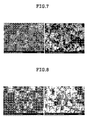
- FIG. 7 is SEM photograph which compares the SEM photograph (left photograph) of MP-100 with the SEM photograph (right photograph) of the composite powder of the example 1 prepared by coating the surface of MP-100 with MPT-136 at the same magnification. As known from FIG. 7 , the composite powder of the present invention is made definitely.
- the composite powder is crushed for 30 seconds (two times, 15 seconds each) by the use of IKA Mixer (Model name : IKA-WERKE M20), and then the surface state thereof is observed by SEM.
- the result is shown in FIG. 8 .
- the surface after the crushing process (right photograph) is hardly changed from the surface before the crushing process (left photograph).
- the coating state of the ultraviolet-ray blocking powder before the crushing process is maintained intactly even after the crushing process.
- ultraviolet-ray blocking efficiency of the composite powder after the crushing process is compared with ultraviolet-ray blocking efficiency of the composite powder before the crushing process by the use of SPF 290 analyzer (Optometrics USA, Inc) of In-vitro test method.
- SPF 290 analyzer Optometrics USA, Inc
- butylenes glycol and the composite powder before the crushing process or after the crushing process are mixed at a ratio of 1: 1, and are then dispersed uniformly; and appropriate amount (2mg/cm 2 ) of the dispersed mixture is uniformly pasted on a surgical tape (Transpore tape produced by 3M Co.), and is dried for 15 ⁇ 20 minutes.
- Ultraviolet-ray blocking efficiencies in the powder of infrared-ray blocking powder MP-100, the powder of ultraviolet-ray blocking powder MPT-136, the composite powder of the example 1, the composite powder of the example 3, the mixing powder of the comparative example 1, and the mixing powder of the comparative example 2 are compared by the use of SPF 290 analyzer (Optometrics USA, Inc) of In-vitro test method.
- SPF 290 analyzer Optometrics USA, Inc
- butylenes glycol is mixed with each of the powder MP-100, the powder MPT-136, the composite powder, and the mixing powder, wherein a mixing ratio of butylenes glycol to each powder is 1:1; and is then dispersed uniformly.
- the appropriate amount (2mg/cm 2 ) of the dispersed mixture is uniformly pasted on a surgical tape (Transpore tape produced by 3M Co.), and is dried for 15 ⁇ 20 minutes. Then, the ultraviolet-ray blocking efficiency of SPF (sun protection factor) and PA (protection factor of UVA) is measured. In each sample, the above SPF and PA are measured five times, and the mean value is used to obtain SPF value and PA value which are shown below in Table 6.
- the SPF value and PA value in the comparative example 1, comparative example 2, example 1, and example 3 are higher than the SPF value and PA value in MP-100 powder and MPT-136 powder.
- the simple mixing of the ultraviolet-ray blocking powder and the infrared-ray blocking powder enhances the ultraviolet-ray blocking efficiency.
- the SPF value in the composite powder of the example 1 is raised by about 18%, and the PA value in the composite powder of the example 1 is raised by about 20%.
- the SPF value in the composite powder of the example 3 is raised by about 20%, and the PA value in the composite powder of the example 3 is raised by about 32%.
- the ultraviolet-ray blocking efficiency of the composite powder is relatively higher than the ultraviolet-ray blocking efficiency of the mixing powder prepared by the simple mixing.
- the SPF value and PA value in the mixing powder of the comparative example 1 are higher than the SP value and PA value in the mixing powder of the comparative example 2; and the SPF value and PA value in the composite powder of the example 1 are higher than the SP value and PA value in the composite powder of the example 3.
- the SPF value and PA value are enhanced when a weight ratio of the infrared-ray blocking powder to the ultraviolet-ray blocking powder is 70 : 30.
- the ultraviolet-ray blocking efficiency in the powder foundation cosmetics composition prepared by the example 6, and the cosmetics composition prepared by the comparative example 3 is measured in the same method as that of the experimental example 3, whereby the results are shown below in Table 7.
- the SPF value of the example 6 is raised by about 32%
- the PA value of the example 6 is raised by about 36%.
- enhancement of the ultraviolet-ray blocking efficiency of the SPF value and PA value in the composite powder affects enhancement of the ultraviolet-ray blocking efficiency of the SPF value and PA value in the cosmetics composition.
- the functional evaluation is performed by applying the foundation powder, which is prepared by the example 6 and comparative examples 3 ⁇ 5, onto the skin of 20 women.
- This functional evaluation is to check whether or not the powder foundation satisfies following matters: even cosmetic film, cosmetic film being blended into skin, moderate glossy feeling, satisfactory spreadability, good adhesion, difference between apparent color and tine of cosmetic film, and soft focus effect.
- the results are shown below in Table 8.
- the powder foundation (example 6) prepared by compounding the composite powder of the present invention has the great properties such as the even cosmetic film, satisfactory spreadability, good adhesion, and soft focus effect. Also, the composite powder of the present invention is superior in all evaluation items to the mixing powder of the comparative example 3.
- the composite powder including the ultraviolet-ray blocking particle and infrared-ray blocking particle according to the present invention can obtain the even cosmetic film, satisfactory spreadability, good adhesion, and soft focus effect, which are not obtainable in the mixing powder. It is known that the above properties of the even cosmetic film, satisfactory spreadability, good adhesion, and soft focus effect are derived from the uniform dispersion effect of the ultraviolet-ray blocking particle MPT-136, that is, even cosmetic film.
- the temperature rise in the skin to which the cosmetics composition (comparative example 5) prepared by the infrared-ray blocking powder, and the skin to which the cosmetics composition (example 6) prepared by the composite powder of the present invention is relatively smaller than the temperature rise in the untreated skin, and the skin to which the cosmetics composition (comparative example 4) prepared by the ultraviolet-ray blocking powder.
- the cosmetics composition prepared by the example 6 and the comparative example 5 has the infrared-ray blocking efficiency.
- the infrared-ray blocking efficiency in the cosmetics composition (comparative example 5) prepared by the infrared-ray blocking powder is very similar to the infrared-ray blocking efficiency in the cosmetics composition (example 6) prepared by the composite powder of the present invention.
- the composite powder of the present invention has the infrared-ray blocking efficiency.
- the example 7 prepared by the composite powder shows that there are a small-sized red portion and a large-sized blue portion on the cheek. If it is calculated in terms of temperature, it shows that the average temperature is lowered by about 0.5°C. That is, it is known that the infrared rays which cause the temperature rise are blocked effectively.
- the following test is carried out.
- the dispersions prepared by the example 8 and the comparative examples 7 ⁇ 10 are used to measure a degree of white cloud.
- 'L' value is measured by the use of colorimeter(Minolta CR-200).
- correctly-weighted 0.1g of each of samples prepared by the example 8 and the comparative examples 7 ⁇ 10 is applied to the bare skin, and is rubbed with finger thirty times, and then 'L' value is measured by the use of colorimeter, after 5 minutes.
- the difference between the 'L' value measured on the bare skin and the 'L' value measured after applying each sample is evaluated. As the difference of 'L' value becomes larger, the degree of white cloud becomes larger. Meanwhile, as the difference of 'L' value becomes smaller, the degree of white cloud becomes smaller.
- the difference of 'L' value in the example 8 is 4.5; the difference of 'L' value in the comparative example 7 is 9.85; the difference of 'L' value in the comparative example 8 is 1.63; the difference of 'L' value in the comparative example 9 is 7.41; and the difference of 'L' value in the comparative example 10 is 6.30.
- the degree of white cloud in the composite powder of the example 8 is higher than the degree of white cloud in the ultraviolet-ray blocking powder of the comparative example 8, wherein it is known that the ultraviolet-ray blocking powder is transparent while being applied to the skin.
- the degree of white cloud in the composite powder of the example 8 is lower than the degree of white cloud in the pigmentary titanium dioxide of the comparative example 7 and the mixing powder of the comparative example 10. Accordingly, the composite powder may be used for various products, for example, powder type, sunscreen type, whitening emulsion type, and etc.
- a skin patch test is carried out by uniformly dispersing each sample of the composite powder of the examples 1 ⁇ 3, the mixing powder of the comparative examples 1 ⁇ 2, the cosmetics of the example 6, and the cosmetics of the comparative example 3 in a solvent of squalene without causing skin irritation, to thereby test skin irritation.
- Table 10 In general, as shown in Table 10, there are no skin troubles. In case of the examples 2 and 6 and the comparative example 3, there is one person having slight skin troubles. However, one person among the test applicants shows the allergic skin reaction by a skin analyzing test. Thus, it is safe to apply the composite powder of the present invention to the skin.
- Example 1 Composite powder Example 2
- Composite powder Example 3 Composite powder Example 6
- Cosmetics composition Comparative example 1 Mixing powder Comparative example 2 mixing powder Comparative example 3 cosmetics +++ 0 0 0 0 0 0 0 0 0 ++ 0 0 0 0 0 0 + 0 1 0 1 0 0 1 ⁇ 15 12 16 14 17 18 15 - 5 7 4 5 3 2 4
- Evaluation standard +++ (strong trouble), ++(weak trouble), +(very weak trouble) ⁇ (normal), -(negative)
Landscapes
- Health & Medical Sciences (AREA)
- Life Sciences & Earth Sciences (AREA)
- Animal Behavior & Ethology (AREA)
- General Health & Medical Sciences (AREA)
- Public Health (AREA)
- Veterinary Medicine (AREA)
- Birds (AREA)
- Epidemiology (AREA)
- Chemical & Material Sciences (AREA)
- Inorganic Chemistry (AREA)
- Dermatology (AREA)
- Cosmetics (AREA)
Description
- The present invention relates to functional powder for simultaneously blocking infrared and ultraviolet rays, and more particularly, to powder for preventing skin from aging and being damaged by solar rays.
- Skin aging may be largely classified into two types: the first type is chronologic aging of the skin which is unavoidable with the lapse of time; and the second type is photoaging of the skin. The photoaging is observed when the skin on the face, the back of the hand, and the posterior neck are exposed to the solar rays for a long time. The photoaging is caused by the chronologic aging and ultraviolet rays.
- The photoaging relates with rough wrinkles, irregular pigmentary deposits, loss of skin elasticity, disturbance of skin barrier function, and cancer of the skin. The photoagaing can be prevented by avoiding the exposure to the ultraviolet rays. Recently, it is disclosed that the infrared rays which occupy 54% of solar energy are among the environmental factors for accelerating the skin aging by a thermal effect.
- As the environmental contamination results in the depletion of ozone layer, the skin may be easily aging and damaged due to the increased exposure to the ultraviolet rays. In order to prevent the skin from being damaged by the ultraviolet rays, cosmetics with sunscreen added therein have been developed.
- The sunscreen may be largely classified into organic-based sunscreen and inorganic-based sunscreen.
- The organic-based sunscreen comprises ingredients with conjugated bond capable of absorbing the ultraviolet rays in a molecular structure. This organic-based sunscreen might cause problems of skin toxicity, allergy to the skin, and discoloration.
- The inorganic-based sunscreen comprises powder for scattering the ultraviolet rays, for example, metal oxide with a high refractive index. In case of the inorganic-based sunscreen, the above problems caused by the organic-based sunscreen would not occur. Recently, the inorganic-based sunscreen is widely used in view of safety. However, the powder such as the metal oxide constituting the inorganic-based sunscreen has strong aggregation so that a lump of powder is increased in size due to the powder aggregation. In this case, the lump of powder with the increased size may deteriorate the feeling to the skin and the adhesion to the skin, and may lower the efficiency of sunscreen.
- Accordingly, if using the inorganic-based sunscreen, it is necessary to overcome the above problems caused by the powder aggregation. However, a method for preventing the above problem of the powder aggregation has not been proposed yet.
- There are many reports informing that the ultraviolet rays of the solar rays especially have adverse effects on the human body. Thus, blocking the ultraviolet rays was a matter of primary concern in the cosmetics. However, the newest reports disclose that the infrared rays also have adverse effects on the human skin. Thus, it needs to provide a method for preventing the skin from being damaged by the infrared rays, but there is no proposed method.
- Therefore, the present invention is directed to composite powder and cosmetics composition using the same that substantially obviates one or more of the problems due to limitations and disadvantages of the related art.
- An aspect of the present invention is to provide composite powder which facilitates to prevent particles for preventing skin damaging from being aggregated, and to minimize rough wrinkles, irregular pigmentary deposits, loss of skin elasticity, disturbance of skin barrier function, skin damages such as cancer of the skin, and skin aging by simultaneously blocking infrared and ultraviolet rays, and cosmetics composition using the above composite powder.
- To achieve these objects and other advantages and in accordance with the purpose of the invention, as embodied and broadly described herein, there is provided a composite powder comprising: infrared-ray blocking particles; and ultraviolet-ray blocking particles coated onto one surface of each of the infrared-ray blocking particles.
- At this time, the ultraviolet-ray blocking particles are coated onto the entire surface of the infrared-ray blocking particle.
- Also, the ultraviolet-ray blocking particles are coated onto the surface of the infrared-ray blocking particle while penetrating into the inside of the infrared-ray blocking particle.
- At least one of the infrared-ray blocking particle and ultraviolet-ray blocking particle is surface-treated with an organic or inorganic surface treating agent containing a hydroxyl group (-OH) or hydrogen group (-H).
- Furthermore, a weight ratio of the ultraviolet-ray blocking particle to the infrared-ray blocking particle is 1:99 ∼ 99:1.
- Also, a diameter of the infrared-ray blocking particle is within the range of 0.38 ~ 1.5µm; and a diameter of the ultraviolet-ray blocking particle is within the range of 8 ∼ 150nm.
- The infrared-ray blocking particle is formed of titanium dioxide (TiO2) or zinc oxide (ZnO), and the ultraviolet-ray blocking particle is formed of a material or a mixture of two materials selected from a group including titanium dioxide (TiO2), zinc oxide (ZnO), cerium dioxide (CeO2), and zirconium dioxide (ZrO2).
- The infrared-ray blocking particle blocks infrared rays having the wavelength range of 760nm ~ 3000nm; and the ultraviolet-ray blocking particle blocks ultraviolet rays having the wavelength range of 290nm ~ 400nm.
- In another aspect of the present invention, there is a cosmetics composition comprising the composite powder of the above structure as an effective component.
- The infrared-ray blocking particle of the composite powder is about 1% ~ 25% by weight of the cosmetics composition.
- The cosmetics composition is prepared in type of a solution of water-in-oil emulsion or oil-in-water emulsion, suspension, emulsion, paste, gel, cream, lotion, powder, soap, surfactant-containing cleaning oil, powder-type foundation, emulsion-type foundation, wax-type foundation, or spray type.
- According to the present invention, the composite powder using both the infrared-ray blocking particle and the ultraviolet-ray blocking particle enables to simultaneously block the infrared and ultraviolet rays. Thus, if the composite powder of the present invention is applied to the cosmetics, it is possible to minimize the rough wrinkles, irregular pigmentary deposits, loss of skin elasticity, disturbance of skin barrier function, skin damages such as cancer of the skin, and skin aging, and also to boost SPF (Sun Protection Factor) and PA (Protection Factor of UVA) of the related art sunscreen.
- Especially, the present invention uses the composite powder prepared by coating one surface of the infrared-ray blocking particle with the ultraviolet-ray blocking particles, instead of mixing powder prepared by simply mixing the infrared-ray blocking particle and the ultraviolet-ray blocking particle. That is, since the small-sized ultraviolet-ray blocking particles are coated onto and stably fixed into the surface of the infrared-ray blocking particle, it is possible to prevent aggregation of the ultraviolet-ray blocking particles, thereby preventing deterioration in uniformity of adhesion to the skin, and deterioration of the ultraviolet-ray blocking efficiency.
-
-
FIG. 1 is a cross section view illustrating composite powder according to one embodiment of the present invention. -
FIG. 2 is an SEM photograph of MP-100 showing infrared-ray blocking particle. -
FIG. 3 is an SEM photograph of MPT-136 showing ultraviolet-ray blocking particle. -
FIG. 4 is an SEM photograph showing composite powder according to the example 1 of the present invention. -
FIG. 5 is an SEM photograph showing composite powder according to the example 4 of the present invention. -
FIG. 6 is an SEM photograph showing composite powder according to the example 5 of the present invention. -
FIG. 7 shows SEM photographs of composite powder at the same scale before and after preparing processes to check whether or not the composite powder according to the example 1 is prepared properly; wherein the left photograph is an SEM photograph of MP-100 showing infrared-ray blocking particle, and the right photograph is an SEM photograph showing the composite powder of the example 1 prepared by coating the infrared-ray blocking particle MP-100 with the ultraviolet-ray blocking particle MPT-136. -
FIG. 8 shows SEM photographs of composite powder before and after crushing process to check a coating strength of the composite powder of the example 1by applying a physical force to the composite powder, wherein the left photograph is an SEM photograph before the crushing process, and the right photograph is an SEM photograph after the crushing process. -
FIG. 9 shows a photograph taken by a thermal imaging camera, which shows that sunscreen cosmetic (example 7) containing the composite powder of the present invention is effective in blocking rays, wherein the left photograph shows cosmetics of the comparative example 7 (containing MPT-136), and the right photograph shows cosmetics of the example 7 (composite powder of the example 1). -
FIG. 10 shows an operational principle of Mechanofusion system of a mechanical method for preparing the composite powder of the present invention. -
FIG. 11 is a 'L' value comparison graph to check a degree of white cloud in a dispersion liquid prepared by the composite powder of the present invention, wherein '1' is the example 8, '2' is the comparative example 7, '3' is the comparative example 8, '4' is the comparative example 9, and '5' is the comparative example 10. - If the human skin is exposed to solar rays, some of the solar rays is reflected or scattered on the stratum corneum, and the rest of the solar rays penetrates into the skin, whereby the skin damage may occur. Thus, in order to prepare powder for preventing the skin damage, it is first necessary to check what range of wavelength of the solar rays deeply penetrates into the inside of the skin. Thereafter, it needs to research and study a method for preparing the powder which enables to efficiently block the solar rays of the wavelength range which causes the skin damage.
- The solar rays reaching the ground has the wavelength range of 290 ~ 4,000nm, which may be divided into three ranges. That is, ultraviolet rays have the wavelength range of 290 ~ 400nm, which occupy about 7% of the solar rays reaching the ground. Also, visible rays have the wavelength range of 400 ~ 760nm, which occupy about 39% of the solar rays reaching the ground. Also, infrared rays have the wavelength of 760nm ~ 1,000µm, which occupy about 54% of the solar rays reaching the ground. The ultraviolet rays of the solar rays correspond to electromagnetic wave having the short wavelength range of 200 ~ 400nm. In this case, since the ultraviolet rays having the wavelength range less than 290nm are mostly lost while passing through the atmosphere, the virtual wavelength range of ultraviolet rays which causes the skin damage is about 290 ~ 400nm. Especially, the ultraviolet rays within the wavelength range of 290 ~ 320nm penetrates into the outermost layer of the skin, which might cause erythema, freckle, and edema. The ultraviolet rays within the wavelength range of 320 ~ 400nm penetrate into the dermis, which induces melanin formation, and causes the skin cancer and wrinkles, thereby causing the skin aging and skin irritation.
- The infrared rays of the solar rays correspond to non-ionising electromagnetic wave having the long wavelength range of 760nm ~ 1,000µm, which may be generally divided into IRA(near IR, λ =760~1, 440nm), IRB (mid IR, λ =1,440∼3,000nm), and IRC (far IR, λ =3,000nm~1,000µm).
- The infrared rays are in the wavelength range with small photon energy. Thus, if the infrared rays are absorbed in the human body, it raises the temperature of the human body, but the infrared rays have been regarded as the rays having no adverse effects on the human body. However, the infrared rays of the relatively-short wavelength range, and more particularly, the infrared rays having the wavelength range of 760nm~3,000nm may induce the skin cancer, in the same manner as the ultraviolet rays.
- Accordingly, the present invention is proposed based on a powder design which facilitates to efficiently block the ultraviolet rays having the wavelength range of 290nm ~ 400nm, and the infrared rays having the wavelength range of 760nm ~ 3,000nm. That is, the composite powder of the present invention is prepared by the use of particles for blocking the ultraviolet rays, and particles for blocking the infrared rays. In more detail, the composite powder of the present invention is prepared by not only mixing the particles for blocking the ultraviolet rays with the particles for blocking the infrared rays, but also coating the particles for the infrared rays with the particles for the ultraviolet rays, to thereby maximize the efficiency in blocking the ultraviolet rays and infrared rays.
- Reference will now be made in detail to the preferred embodiments of the present invention, examples of which are illustrated in the accompanying drawings.
-
FIG. 1 is a cross section view illustrating composite powder according to one embodiment of the present invention. - As shown in
FIG. 1 , thecomposite powder 10 according to one embodiment of the present invention is prepared by infrared-ray blocking particle 12, and a plurality of ultraviolet-ray blocking particles 14, wherein the surface of infrared-ray blocking particle 12 is coated with the plurality of ultraviolet-ray blocking particles 14. - As mentioned above, the infrared-
ray blocking particle 12 is to efficiently block the infrared rays within the wavelength range of 760nm ~ 3,000nm, and more preferably, the infrared rays within the wavelength range of 760nm ~ 2,000nm, and most preferably, the infrared rays within the wavelength range of 760nm ~ 1,800nm. However, the infrared-ray blocking particle 12 according to the present invention does not block only the infrared rays within the above wavelength range. - Preferably, a diameter of the infrared-
ray blocking particle 12 is within the range of 0.38 ~ 1.5µm. If the diameter of the infrared-ray blocking particle 12 is less than 0.38µm, or more than 1.5µm, it might deteriorate the efficiency in blocking the infrared rays within the wavelength range of 760nm ~ 3,000nm. - The infrared-
ray blocking particle 12 may be formed of an inorganic-based material such as titanium dioxide(TiO2) or zinc oxide (ZnO), but not necessary. - As mentioned above, the ultraviolet-
ray blocking particles 14 are provided to efficiently block the ultraviolet rays within the wavelength range of 290nm ~ 400nm, but it is not limited to the above wavelength range. - Preferably, a diameter of the ultraviolet-
ray blocking particles 14 is within the range of 8 ∼ 150nm. If the diameter of the ultraviolet-ray blocking particles 14 is less than 8nm, a coating process might be difficult due to strong aggregation. Meanwhile, if the diameter of the ultraviolet-ray blocking particles 14 is more than 150nm, it might deteriorate the efficiency in blocking the ultraviolet rays within the above wavelength range. - The ultraviolet-
ray blocking particles 14 may be formed of an inorganic-based material such as titanium dioxide (TiO2), zinc oxide (ZnO), cerium dioxide (CeO2), zirconium dioxide (ZrO2), and etc., but it is not limited to these materials. - The entire surface of the infrared-
ray blocking particle 12 may be coated with the ultraviolet-ray blocking particles 14, but not necessarily. Instead, the surface of the infrared-ray blocking particle 12 may be partially coated with the ultraviolet-ray blocking particles 14. For example, the ultraviolet-ray blocking particles 14 may be coated only onto the upper surface or lower surface of the infrared-ray blocking particle 12, instead of being coated onto the entire surfaces including the upper surface, lower surface, and lateral surfaces of the infrared-ray blocking particle 12. The ultraviolet-ray blocking efficiency can be realized even though the ultraviolet-ray blocking particles 14 are coated only onto the upper surface or lower surface of the infrared-ray blocking particle 12. Also, the ultraviolet-ray blocking efficiency can be realized even though the ultraviolet-ray blocking particles 14 are coated only onto predetermined portions of the upper surface of the infrared-ray blocking particle 12. - The ultraviolet-
ray blocking particles 14 may be coated onto the surface of the infrared-ray blocking particle 12 while penetrating into the inside of the infrared-ray blocking particle 12. Herein, the shape of the ultraviolet-ray blocking particles 14 coated may be determined by a coating process. If applying a mechanical coating process which uses collision among the particles, the ultraviolet-ray blocking particles 14 may be coated while penetrating into the inside of the infrared-ray blocking particle 12 from the surface of the infrared-ray blocking particle 12. - The coating process for preparing the composite powder according to the present invention may use various coating methods which are generally known to those in the art, for example, mechanical coating method and method using the difference of isoelectric point. For example, on assumption that the method using the difference of isoelectric point is applied, since the isoelectric point of silica is about pH3, and the isoelectric point of TiO2 is about pH6; silica is negative-charged, and TiO2 is positive-charged, whereby silica-coated TiO2 positively charged is formed by an electrostatic attraction between silica and TiO2 when the pH difference is within the range of 3 ~ 6.
- However, since the micro-sized titanium dioxide and the nano-sized titanium dioxide have the same isoelectric point, it is difficult to coat the nano-sized titanium dioxide onto the surface of the micro-sized titanium dioxide. Even though the nano-sized titanium dioxide is coated onto the surface of the micro-sized titanium dioxide, the nano-sized titanium dioxide is coated only small portions on the surface of the micro-sized titanium dioxide, whereby it is difficult to obtain the desired efficiency for blocking the ultraviolet rays. In order to solve these problems, the present invention uses the mechanical coating method to easily coat the nano-sized titanium dioxide onto the surface of the micro-sized titanium dioxide, especially, to improve the yield in coating without regard to the kind of the inorganic-based particle used.
- Especially, the composite powder of the present invention may be prepared by a mechanical coating system of compression-shearing dry powder compounding method, that is, Mechanofusion system shown in
FIG. 10 . Mechanofusion system is provided with a rotating container being rotated at a high speed, and an arm head. As the powder compound passes through a small gap between the rotating container and the arm head, the compounding process is carried out by the particle collision. - However, the process for preparing the composite powder of the present invention is not limited to the case using the mechanical coating system. That is, the process for preparing the composite powder of the present invention may be performed by a wet compounding method using the isoelectric point, a high-speed impulsive method, or a dry compounding method using a mixing mode (compression, shearing).
- Preferably, the ultraviolet-ray blocking particle and/or infrared-ray blocking particle constituting the composite powder of the present invention may be surface-treated with a surface treating agent. The surface treating agent may be formed of any material including one or more hydroxyl group (-OH) or hydrogen group (-H), for example, dimethiconol, triethoxycaprylylsilane, methicone/dimethicone copolymer, and methicone. Also, the surface treating agent may be formed of any inorganic material or organic material enabling to improve the surface quality of the powder, for example, alumina, silica, aluminum hydroxide, and etc., but it is not limited to these mentioned materials. If the composite powder is prepared after applying the surface treating agent to the surface of the ultraviolet-ray blocking particle and/or infrared-ray blocking particle, the ultraviolet-ray blocking particle is more uniformly coated onto the surface of the infrared-ray blocking particle.
- In the
composite powder 10 of the present invention, it is preferable that the infrared-ray blocking particles 12 be included to be not less than 1 weight%, and the ultraviolet-ray blocking particle 14 be included to be not less than 1 weight%, to thereby realize the good efficiency of blocking the ultraviolet rays and infrared rays at the same time. That is, a weight ratio of the infrared-ray blocking particle 12 to the ultraviolet-ray blocking particle 14 may be 1 : 99 ~ 99 : 1. Preferably, a weight ratio of the infrared-ray blocking particle 12 to the ultraviolet-ray blocking particle 14 may be 90 : 10 ~ 10 : 90, and more preferably, 80 : 20 ~ 20 : 80, and most preferably, 70 : 30. - The present invention may provide the cosmetics composition containing the above composite powder as an effective component. The infrared-ray blocking particle of the composite powder may be 1 ∼ 25% by weight of the cosmetics composition, and more preferably 5 ~ 15% by weight of the cosmetics composition. If the infrared-ray blocking particle of the composite powder may be less than 1% by weight of the total weight of the cosmetics composition, it might be difficult to obtain the desired efficiency of blocking the ultraviolet rand infrared rays. Meanwhile, if the infrared-ray blocking particle of the composite powder may be more than 25% by weight of the total weight of the cosmetics composition, it might be restricted by a limited ingredient of cosmetics, and quality of prepared cosmetics, such as shapability, may be deteriorated due to the decrease in ratio of basic components for the cosmetics.
- The cosmetic compound of the present invention may be prepared in any shape generally known to those in the art, for example, solution of water-in-oil emulsion or oil-in-water emulsion, suspension, emulsion, paste, gel, cream, lotion, powder, soap, surfactant-containing cleaning oil, powder-type foundation, emulsion-type foundation, wax-type foundation, or spray type.
- The cosmetic compound of the present invention may be prepared in various shapes. In this case, the cosmetic compound of the present invention may contain auxiliary agent such as anti-oxidizing agent, stabilizing agent, dissolving agent, vitamin, pigment, and perfume; and/or carrier. The carrier to be used in accordance with the each type will be described as follows.
- If the type corresponds to the powder or spray, the carrier may be made of lactose, talc, silica, aluminum hydroxide, calcium silicate, or polyamide powder. Especially, in case of the spray type, there may be used gas propellant such as chlorofluorohydrocarbon, propane/butane or dimethylether.
- If the type corresponds to the solution or emulsion, the carrier may be made of solvent, dissolving agent, or emulsion agent, for example, water, ethanol, isopropanol, ethylcarbonate, ethylacetate, benzyl alcohol, benzyl benzoate, propyleneglycol, 1,3-butylglycol oil, glycerol aliphatic ester, polyethylene glycol, or sorbitan aliphatic ester.
- If the type corresponds to the suspension, the carrier may be made of diluents such as water, ethanol or propyleneglycol; suspending agent such as ethoxylated isostearyl alcohol, polyoxyethylene sorbitol ester, or polyoxyethylene sorbitan ester; microcrystalline cellulose; aluminum metahydroxide; bentonite; aga; or tracanth.
- If the type corresponds to the paste, cream or gel, the carrier may be made of animal oil, vegetable oil, wax, paraffin, tracanth, cellulose derivative, polyethyleneglycol, silicon, bentonite, silica, talc, or zinc oxide.
- If the type corresponds to surfactant-containing cleaning, the carrier may be made of aliphatic alcohol sulfate, aliphatic alcohol ether sulfate, sulfosuccinic acid monoester, isethionate, imidazolinium derivative, methyl taurate, sarcosinate, aliphatic amide ether sulfate, alkyl amidobetains, aliphatic alcohol, aliphatic glyceride, aliphatic diethanolamide, vegetable oil, lanolin derivative, or ethoxyl glycerol aliphatic ester.
- The composite powder of the present invention is prepared by using both the ultraviolet-ray blocking particle and the ultraviolet-ray blocking particle, thereby blocking both the ultraviolet rays and the infrared rays at the same time. Thus, if the composite powder of the present invention is applied to the cosmetics, it is possible to prevent the rough wrinkles, irregular pigmentary deposits, loss of skin elasticity, disturbance of skin barrier function, skin damages such as cancer of the skin, and skin aging, and also to boost SPF (Sun Protection Factor) and PA (Protection Factor of UVA) of the related art sunscreen by composition.
- Especially, the present invention uses the composite powder prepared by coating one surface of the infrared-ray blocking particle with the ultraviolet-ray blocking particles, instead of mixing powder prepared by simply mixing the infrared-ray blocking particle and the ultraviolet-ray blocking particle. That is, since the small-sized ultraviolet-ray blocking particles are coated onto and stably fixed into the surface of the infrared-ray blocking particle, it is possible to prevent aggregation of the ultraviolet-ray blocking particles, thereby preventing deterioration in uniformity of adhesion to the skin, and deterioration of the ultraviolet-ray blocking efficiency.
- Hereinafter, the detailed examples and experimental examples of the composite powder of the present invention will be described as follows.
- A composite powder is prepared by using infrared-ray blocking powder MP-100 (produced by TAYCA Co.) having a particle size of 1µm, and ultraviolet-ray blocking powder MPT-136 (produced by ISHIHARA SANGYO Co.) having a width of 8 ~ 20nm and a length of 30 ~ 100nm, wherein a weight ratio of infrared-ray blocking powder to ultraviolet-ray blocking powder may be changed as the following Table 1. The composite powder is prepared by the mechanical coating system of compression-shearing dry powder compounding method, that is, Mechanofusion system shown in
FIG. 10 . - Before preparing the composite powder, the aggregated ultraviolet-ray blocking powder MPT-136 is desorbed and crushed by the use of pin mill. In case of the examples 1 ~ 3, MP100 is used intactly, that is, MP-100 is coated with MPT-136. Meanwhile, in case of the examples 4 and 5, MP-100 whose surface is respectively treated with dimethiconol and dimethicone/methicone copolymer is coated with MPT-136. The mechanical coating system is performed at a rotation speed 8000rpm by a coating process for 15 minutes. Also, in order to check enhancement of infrared-ray blocking efficiency and ultraviolet-ray blocking efficiency, the comparative examples 1 and 2 of the composite powder are prepared by using the infrared-ray blocking powder MP-100 (produced by TAYCA Co.) and the ultraviolet-ray blocking powder MPT-136 (produced by ISHIHARA SANGYO Co.), wherein the comparative examples 1 and 2 are prepared under the conditions of simple compounding method using Hensel mixer at 800rpm for 5 minutes, and wherein the weight ratio of infrared-ray blocking powder to ultraviolet-ray blocking powder in the comparative example 1 is 70 : 30, and the weight ratio of infrared-ray blocking powder to ultraviolet-ray blocking powder in the comparative example 2 is 50 : 50.
- The composite powder prepared by the above examples 1 to 5 and comparative examples 1 and 2 are summarized below in Table 1.
[Table 1] Kind of Infrared-ray blocking powder/ Ultraviolet-ray blocking powder Infrared-ray blocking powder weight% vs Ultraviolet-ray blocking powder weight% Powder preparing method Example 1 MP-100/MPT-136 70 : 30 Composite powder (coating) Example 2 MP-100/MPT-136 60 : 40 Composite powder (coating) Example 3 MP-100/MPT-136 50 : 50 Composite powder (coating) Example 4 MP-100 surface-treated with dimethiconol/ MPT-136 70 : 30 Composite powder (coating after surface treatment) Example 5 MP-100 surface-treated with dimethicone and methicone copolymer/ MPT-136 70 : 30 Composite powder (coating after surface treatment) Comparative example 1 MP-100/MPT-136 70 : 30 Mixing powder (simple compounding) Comparative example 2 MP-100/MPT-136 50 : 50 Mixing powder (simple compounding) - After the composite powder prepared by the example 1 is uniformly stirred by the use of Hensel mixer, liquid binder is uniformly sprayed by the use of micro-spray, and is then crushed by an atomizer, thereby preparing the powder foundation cosmetics composition (example 6). Also, powder foundation cosmetics composition (comparative example 3) is prepared by the use of composite powder of the comparative example 1 under the same method of the example 6. Also, powder foundation cosmetics composition (comparative example 4) is prepared by the use of only ultraviolet-ray blocking powder MPT-136 under the same method of the example 6. Also, powder foundation cosmetics composition (comparative example 5) is prepared by the use of only infrared-ray blocking powder MP-100 under the same method of the example 6.
- The ingredients and weight% of the powder foundation cosmetics composition of the examples 6 and the comparative examples 3 ~ 5 are shown below in Table 2.
[Table 2] Ingredients of material Example 6 (content%) Comparative example 3 (content%) Comparative example 4 (content%) Comparative example 5 (content%) Talc/cellulose/ raffinose/ PCA/dimethicone 18.000 18.000 18.000 18.000 Composite powder (example 1) 20.000 - - - Mixing powder (comparative example 1) - 20.000 - - Ultraviolet-ray blocking powder (MPT-136) - - 20.000 - Infrared-ray blocking powder (MP-100) - - - 20.000 Mica/hydrogenated lacithin 15.000 15.000 15.000 15.000 Mica/ triethoxycaprylylsilane 27.000 27.000 27.000 27.000 Silica 3.000 3.000 3.000 3.000 Nylon-12 5.000 5.000 5.000 5.000 Red iron oxide 0.300 0.300 0.300 0.300 Yellow iron oxide 1.700 1.700 1.700 1.700 Black iron oxide 0.050 0.050 0.050 0.050 Dimethicone 1.950 1.950 1.950 1.950 Phenyl trimethicone 1.000 1.000 1.000 1.000 Tricaprylin 2.000 2.000 2.000 2.000 Squalene0 5.000 5.000 5.000 5.000 Total 100.000 100.000 100.000 100.000 - 15 weight% of the composite powder prepared by the example 1 is added into oil, and is then dispersed for 20 minutes by the use of homogenizer of 5,000rpm, wherein the composition rate is shown below in Table 3. Thereafter, aqueous phase is slowly supplied to oily phase at 5,000rpm of homogenizer, and is emulsified for 10 minutes, thereby preparing uniform sunscreen cosmetics of the example 7. Also, uniform sunscreen cosmetics (comparative example 6) which includes 15 weight% of the ultraviolet-ray blocking powder MPT-136 is obtained by the same method as that of the example 7.
- Ingredients and contents of the water-in-oil emulsion sunscreen cosmetics composition according to the example 7 and the comparative example 6 are shown below in Table 3.
[Table 3] Ingredients of material Example 7 Comparative example 8 Cyclomethicone 6.60 6.60 Neopenthylene 7.50 7.50 Polyglyceryl-6Polyricinoleate 0.90 0.90 Composite powder (example 1) 15.00 - Ultraviolet-ray blocking powder (MPT-136) - 15.00 Dicaprylyl Carbonate 5.00 5.00 Dimethicone(6CS) 3.00 3.00 Cetyl PEG/PPG-10/1 Dimethicone 2.00 2.00 Quaternium-18 Hectorite 0.80 0.80 Refined water 48.0 48.0 Butylene glycol 7.00 7.00 Glycerin 3.00 3.00 Methylparaben 0.20 0.20 Sodium chloride 1.00 1.00 - The composite powder of the example 1 is dispersed at weight% shown in Table 4 for 20 minutes by the use of AGI MIXER of 300RPM, thereby obtaining dispersion of the example 8. Under the same method as that of the example 8, dispersion of the comparative example 7 is obtained by the use of pigmentary titanium dioxide C47-056 (produced by SUN chemical Co.); dispersion of the comparative example 8 is obtained by the use of MPT-136; dispersion of the comparative example 9 is obtained by the use of MP-100; and dispersion of the comparative example 10 is obtained by the use of composite powder of the comparative example 1.
- Ingredients and weight% of the dispersions of the example 8 and the comparative examples 7 ~ 10 are shown below in Table 4.
[Table 4] Ingredients of material Example 8 Comparative example 7 Comparative example 8 Comparative example 9 Comparative example 10 C12-15 Alkylbenzoate 57.00 57.00 57.00 57.00 57.00 Polyglyceryl-6Polyricinoleate 3.00 3.00 3.00 3.00 3.00 Composite powder (example 1) 40.00 - - - - pigmentary titanium dioxide C47-056 (produced by SUN chemical Co.) - 40.00 - - Ultraviolet-ray blocking powder (MPT-136) - - 40.00 - - Infrared-ray blocking powder (MP-100) - - - 40.00 - Mixing powder (comparative example 1) - - - - 40.00 - SEM photograph is taken to check whether or not the composite powder of the present invention obtained by coating the surface of the infrared-ray blocking particle with the ultraviolet-ray blocking particles is well made as desired.
FIG. 2 is SEM photograph of infrared-ray blocking powder MP-100; andFIG. 3 is SEM photograph of ultraviolet-ray blocking powder MPT-136. -
FIG. 4 is SEM photograph of the composite powder prepared by the example 1; andFIGs. 5 and 6 are SEM photographs of the composite powder prepared by the examples 4 and 5. - As known from
FIGs. 5 and 6 , the surface of the surface-treated infrared-ray blocking particle is coated well with the ultraviolet-ray blocking particles. As known fromFIG. 4 , the surface of the surface-untreated infrared-ray blocking particle is also coated well with the ultraviolet-ray blocking particles. As a result, the composite powder prepared by coating the surface of the infrared-ray blocking particle with the ultraviolet-ray blocking particles may be made without regard to the surface treatment of the infrared-ray blocking particle. -
FIG. 7 is SEM photograph which compares the SEM photograph (left photograph) of MP-100 with the SEM photograph (right photograph) of the composite powder of the example 1 prepared by coating the surface of MP-100 with MPT-136 at the same magnification. As known fromFIG. 7 , the composite powder of the present invention is made definitely. - In order to check a coating strength of the composite powder prepared by the example 1, the composite powder is crushed for 30 seconds (two times, 15 seconds each) by the use of IKA Mixer (Model name : IKA-WERKE M20), and then the surface state thereof is observed by SEM. The result is shown in
FIG. 8 . As shown inFIG. 8 , the surface after the crushing process (right photograph) is hardly changed from the surface before the crushing process (left photograph). Thus, the coating state of the ultraviolet-ray blocking powder before the crushing process is maintained intactly even after the crushing process. In order to check the coating state of the composite powder prepared by the example 1, ultraviolet-ray blocking efficiency of the composite powder after the crushing process is compared with ultraviolet-ray blocking efficiency of the composite powder before the crushing process by the use of SPF 290 analyzer (Optometrics USA, Inc) of In-vitro test method. In more detail, butylenes glycol and the composite powder before the crushing process or after the crushing process are mixed at a ratio of 1: 1, and are then dispersed uniformly; and appropriate amount (2mg/cm2) of the dispersed mixture is uniformly pasted on a surgical tape (Transpore tape produced by 3M Co.), and is dried for 15 ~ 20 minutes. Then, the ultraviolet-ray blocking efficiency of SPF (sun protection factor) and PA (protection factor of UVA) is measured. In each sample, the above SPF and PA are measured five times, and the mean value is shown as SPF value and PA value, which is shown below in Table 5. As known from below Table 5, the SPF value and PA value after the crushing process are very similar to those before the crushing process. As a result, it is known that the coating state of the composite powder after the crushing process is very similar to that of the composite powder before the crushing process.[Table 5] Example 1 SPF value PA value Before crushing 19.23 22.34 After crushing 18.58 20.77 - Ultraviolet-ray blocking efficiencies in the powder of infrared-ray blocking powder MP-100, the powder of ultraviolet-ray blocking powder MPT-136, the composite powder of the example 1, the composite powder of the example 3, the mixing powder of the comparative example 1, and the mixing powder of the comparative example 2 are compared by the use of SPF 290 analyzer (Optometrics USA, Inc) of In-vitro test method. In more detail, butylenes glycol is mixed with each of the powder MP-100, the powder MPT-136, the composite powder, and the mixing powder, wherein a mixing ratio of butylenes glycol to each powder is 1:1; and is then dispersed uniformly. Thereafter, the appropriate amount (2mg/cm2) of the dispersed mixture is uniformly pasted on a surgical tape (Transpore tape produced by 3M Co.), and is dried for 15 ~ 20 minutes. Then, the ultraviolet-ray blocking efficiency of SPF (sun protection factor) and PA (protection factor of UVA) is measured. In each sample, the above SPF and PA are measured five times, and the mean value is used to obtain SPF value and PA value which are shown below in Table 6.
- As known from below Table 6, the SPF value and PA value in the comparative example 1, comparative example 2, example 1, and example 3 are higher than the SPF value and PA value in MP-100 powder and MPT-136 powder. Thus, it is known that the simple mixing of the ultraviolet-ray blocking powder and the infrared-ray blocking powder enhances the ultraviolet-ray blocking efficiency.
- In comparison to the SP value and PA value in the mixing powder of the comparative example 1, the SPF value in the composite powder of the example 1 is raised by about 18%, and the PA value in the composite powder of the example 1 is raised by about 20%. In comparison to the SP value and PA value in the mixing powder of the comparative example 2, the SPF value in the composite powder of the example 3 is raised by about 20%, and the PA value in the composite powder of the example 3 is raised by about 32%. Thus, it is known that the ultraviolet-ray blocking efficiency of the composite powder is relatively higher than the ultraviolet-ray blocking efficiency of the mixing powder prepared by the simple mixing.
- Also, the SPF value and PA value in the mixing powder of the comparative example 1 are higher than the SP value and PA value in the mixing powder of the comparative example 2; and the SPF value and PA value in the composite powder of the example 1 are higher than the SP value and PA value in the composite powder of the example 3. Thus, it is known that the SPF value and PA value are enhanced when a weight ratio of the infrared-ray blocking powder to the ultraviolet-ray blocking powder is 70 : 30.
[Table 6] SPF value PA value MP-100 7.47 7.92 MPT-136 11.15 9.7 Comparative example 1 (mixing powder) 17.74 20.90 Example 1 (composite powder) 20.87 25.10 Comparative example 2 (mixing powder) 15.75 15.82 Example 3 (composite powder) 18.97 20.91 - The ultraviolet-ray blocking efficiency in the powder foundation cosmetics composition prepared by the example 6, and the cosmetics composition prepared by the comparative example 3 is measured in the same method as that of the experimental example 3, whereby the results are shown below in Table 7. As known from below Table 7, in comparison to the comparative example 3, the SPF value of the example 6 is raised by about 32%, and the PA value of the example 6 is raised by about 36%. Thus, it is known that enhancement of the ultraviolet-ray blocking efficiency of the SPF value and PA value in the composite powder affects enhancement of the ultraviolet-ray blocking efficiency of the SPF value and PA value in the cosmetics composition.
[Table 7] SPF value PA value Comparative example 3 (cosmetics using mixing powder) 13.10 13.41 Example 8 (cosmetics using composite powder) 17.23 18.21 - The functional evaluation is performed by applying the foundation powder, which is prepared by the example 6 and comparative examples 3 ~ 5, onto the skin of 20 women. This functional evaluation is to check whether or not the powder foundation satisfies following matters: even cosmetic film, cosmetic film being blended into skin, moderate glossy feeling, satisfactory spreadability, good adhesion, difference between apparent color and tine of cosmetic film, and soft focus effect. The results are shown below in Table 8.
[Table 8] Test samples Test results of functional evaluation Number of example Number of comparative example Even cosmetic film Cosmetic film being blended into skin Moderate glossy feeling satisfactory spreadability Good adhesion Difference between apparent color and tone of cosmetic film Soft focus effect 6 ⊙ ○ ○ ⊙ ⊙ ○ ⊙ 3 Δ ○ ○ ○ Δ ○ ○ 4 Δ ⊙ Δ X Δ ⊙ Δ 5 ○ Δ ○ ○ ○ Δ Δ ⊙: optimal use feeling or touch feeling
○: moderate use feeling or touch feeling
Δ: somewhat unsatisfactory
X: obvious unsatisfactory - As known from above Table 8, the powder foundation (example 6) prepared by compounding the composite powder of the present invention has the great properties such as the even cosmetic film, satisfactory spreadability, good adhesion, and soft focus effect. Also, the composite powder of the present invention is superior in all evaluation items to the mixing powder of the comparative example 3.
- In addition, the composite powder including the ultraviolet-ray blocking particle and infrared-ray blocking particle according to the present invention can obtain the even cosmetic film, satisfactory spreadability, good adhesion, and soft focus effect, which are not obtainable in the mixing powder. It is known that the above properties of the even cosmetic film, satisfactory spreadability, good adhesion, and soft focus effect are derived from the uniform dispersion effect of the ultraviolet-ray blocking particle MPT-136, that is, even cosmetic film.
- In order to measure the infrared-ray blocking efficiency of the cosmetics composition containing the composite powder of the present invention, the following tests are carried out.
- After applying the appropriate amount (2mg/cm2) of the respective cosmetics compositions prepared by the example 6, and comparative examples 4 ~ 5 to the skin of the humeral region of the arm, it is irradiated at a distance of 60cm for 10 minutes by the use of infrared lamp (125W), and then a temperature of the skin is measured in a non-contact method by the use of Laser Radiation Gun Thermometer. The results are shown below in Table 9.
- As known from Table 9, when the infrared ray is applied to the skin, the temperature rise in the skin to which the cosmetics composition (comparative example 5) prepared by the infrared-ray blocking powder, and the skin to which the cosmetics composition (example 6) prepared by the composite powder of the present invention is relatively smaller than the temperature rise in the untreated skin, and the skin to which the cosmetics composition (comparative example 4) prepared by the ultraviolet-ray blocking powder. Thus, it is known that the cosmetics composition prepared by the example 6 and the comparative example 5 has the infrared-ray blocking efficiency.
- Also, the infrared-ray blocking efficiency in the cosmetics composition (comparative example 5) prepared by the infrared-ray blocking powder is very similar to the infrared-ray blocking efficiency in the cosmetics composition (example 6) prepared by the composite powder of the present invention. This means that the infrared-ray blocking efficiency is maintained even though the infrared-ray blocking powder is coated with the ultraviolet-ray blocking powder. Thus, it shows that the composite powder of the present invention has the infrared-ray blocking efficiency.
[Table 9] Before applying (°C) 10 minutes later, after applying (°C) Untreated skin 30.1 36.1 Comparative example 4 29.9 35.35 Comparative example 5 30.3 34.68 Example 6 30.3 34.37 - After uniformly applying the appropriate amount (2mg/cm2) of the respective cosmetics compositions prepared by the example 7, and comparative example 6 to a half of the face, it is irradiated at a distance of 60cm for 10 minutes by the use of infrared lamp (125W), and then a temperature of the skin on the cheek is measured by the use of Thermography(IRIS-5000) corresponding to a skin-temperature tester using infrared thermography. The measured results are shown above in Table 9.
- As known from Table 9, on comparison of the composition (comparative example 6) prepared by the ultraviolet-ray blocking powder to the cosmetics composition (example 7) prepared by the composite powder of the present invention, the example 7 prepared by the composite powder shows that there are a small-sized red portion and a large-sized blue portion on the cheek. If it is calculated in terms of temperature, it shows that the average temperature is lowered by about 0.5°C. That is, it is known that the infrared rays which cause the temperature rise are blocked effectively.
- In order to measure whiteness of the dispersion containing the composite powder of the present invention, the following test is carried out. The dispersions prepared by the example 8 and the comparative examples 7 ~ 10 are used to measure a degree of white cloud. In each square-shaped portion (2 X 2cm2) of 6 squares on the bare skin of the upper arm, 'L' value is measured by the use of colorimeter(Minolta CR-200). Also, correctly-weighted 0.1g of each of samples prepared by the example 8 and the comparative examples 7 ~ 10 is applied to the bare skin, and is rubbed with finger thirty times, and then 'L' value is measured by the use of colorimeter, after 5 minutes. The difference between the 'L' value measured on the bare skin and the 'L' value measured after applying each sample is evaluated. As the difference of 'L' value becomes larger, the degree of white cloud becomes larger. Meanwhile, as the difference of 'L' value becomes smaller, the degree of white cloud becomes smaller.
- As a result, the difference of 'L' value in the example 8 is 4.5; the difference of 'L' value in the comparative example 7 is 9.85; the difference of 'L' value in the comparative example 8 is 1.63; the difference of 'L' value in the comparative example 9 is 7.41; and the difference of 'L' value in the comparative example 10 is 6.30.
- Thus, the degree of white cloud in the composite powder of the example 8 is higher than the degree of white cloud in the ultraviolet-ray blocking powder of the comparative example 8, wherein it is known that the ultraviolet-ray blocking powder is transparent while being applied to the skin. However, the degree of white cloud in the composite powder of the example 8 is lower than the degree of white cloud in the pigmentary titanium dioxide of the comparative example 7 and the mixing powder of the comparative example 10. Accordingly, the composite powder may be used for various products, for example, powder type, sunscreen type, whitening emulsion type, and etc.
- For 20 test applicants, a skin patch test is carried out by uniformly dispersing each sample of the composite powder of the examples 1 ~ 3, the mixing powder of the comparative examples 1 ~ 2, the cosmetics of the example 6, and the cosmetics of the comparative example 3 in a solvent of squalene without causing skin irritation, to thereby test skin irritation. The results are shown below in Table 10. In general, as shown in Table 10, there are no skin troubles. In case of the examples 2 and 6 and the comparative example 3, there is one person having slight skin troubles. However, one person among the test applicants shows the allergic skin reaction by a skin analyzing test. Thus, it is safe to apply the composite powder of the present invention to the skin.
[Table 10] Example 1 Composite powder Example 2 Composite powder Example 3 Composite powder Example 6 Cosmetics composition Comparative example 1 Mixing powder Comparative example 2 mixing powder Comparative example 3 cosmetics +++ 0 0 0 0 0 0 0 ++ 0 0 0 0 0 0 0 + 0 1 0 1 0 0 1 ± 15 12 16 14 17 18 15 - 5 7 4 5 3 2 4 Evaluation standard : +++ (strong trouble), ++(weak trouble), +(very weak trouble) ± (normal), -(negative)
Claims (9)
- A composite powder comprising:infrared-ray blocking particles; andultraviolet-ray blocking particles coated onto one surface of each of the infrared-ray blocking particles by a mechanical coating method, wherein a weight ratio of the ultraviolet-ray blocking particle to the infrared-ray blocking particle is 1:99 ∼ 99:1, wherein a diameter of the infrared-ray blocking particle is within the range of 0.38 ~ 1.5µm; a diameter of the ultraviolet-ray blocking particle is within the range of 8 ~ 150nm,wherein the ultraviolet-ray blocking particles are coated onto the entire surface of the infrared-ray blocking particle,
wherein the ultraviolet-ray blocking particles are coated onto the surface of the infrared-ray blocking particle by compression-sharing dry powder compounding method while penetrating into the inside of the infrared-ray blocking particle. - The composite powder of claim 1, wherein at least one of the infrared-ray blocking particle and ultraviolet-ray blocking particle is surface-treated with an organic or inorganic surface treating agent containing a hydroxyl group (-OH) or hydrogen group (-H).
- The composite powder of claim 1, wherein a weight ratio of the infrared-ray blocking particle to the ultraviolet-ray blocking particle is 90:10 ~ 10:90.
- The composite powder of claim 1, wherein a weight ratio of the ultraviolet-ray blocking particle to the infrared-ray blocking particle is 70:30.
- The composite powder of claim 1, wherein the infrared-ray blocking particle is formed of titanium dioxide(TiO2) or zinc oxide(ZnO), and the ultraviolet-ray blocking particle is formed of a material or a mixture of materials selected from a group including titanium dioxide(TiO2), zinc oxide(ZnO), cerium dioxide(CeO2), and zirconium dioxide(ZrO2).
- The composite powder of claim 1, wherein the infrared-ray blocking particle blocks infrared rays having the wavelength range of 760nm ~ 3000nm; and the ultraviolet-ray blocking particle blocks ultraviolet rays having the wavelength range of 290nm ~ 400nm.
- A cosmetics composition comprising the composite powder of any one of the claims 1 to 6 as an effective component, wherein the infrared-ray blocking particle of the composite powder is about 1% ~ 25% by weight of the cosmetics composition.
- The cosmetics composition of claim 7, wherein the infrared-ray blocking particle of the composite powder is about 5% ~ 15% by weight of the cosmetics composition.
- The cosmetics composition of claim 7, wherein the cosmetics composition is prepared in type of a solution of water-in-oil emulsion or oil-in-water emulsion, suspension, emulsion, paste, gel, cream, lotion, powder, soap, surfactant-containing cleaning oil, powder-type foundation, emulsion-type foundation, wax-type foundation, or spray type.
Applications Claiming Priority (2)
| Application Number | Priority Date | Filing Date | Title |
|---|---|---|---|
| KR20090067886 | 2009-07-24 | ||
| PCT/KR2010/003813 WO2011010798A2 (en) | 2009-07-24 | 2010-06-14 | Composite powder for simultaneously blocking infrared and ultraviolet rays, and cosmetic composition using same |
Publications (3)
| Publication Number | Publication Date |
|---|---|
| EP2457553A2 EP2457553A2 (en) | 2012-05-30 |
| EP2457553A4 EP2457553A4 (en) | 2013-01-16 |
| EP2457553B1 true EP2457553B1 (en) | 2015-10-14 |
Family
ID=43499500
Family Applications (1)
| Application Number | Title | Priority Date | Filing Date |
|---|---|---|---|
| EP10802391.2A Active EP2457553B1 (en) | 2009-07-24 | 2010-06-14 | Composite powder for simultaneously blocking infrared and ultraviolet rays, and cosmetic composition using same |
Country Status (7)
| Country | Link |
|---|---|
| US (1) | US8647609B2 (en) |
| EP (1) | EP2457553B1 (en) |
| JP (1) | JP5973169B2 (en) |
| KR (1) | KR101148427B1 (en) |
| CN (1) | CN102365073B (en) |
| ES (1) | ES2559236T3 (en) |
| WO (1) | WO2011010798A2 (en) |
Families Citing this family (35)
| Publication number | Priority date | Publication date | Assignee | Title |
|---|---|---|---|---|
| KR101716325B1 (en) * | 2011-02-28 | 2017-03-15 | (주)아모레퍼시픽 | Method for generating thermal protection index |
| JP6109486B2 (en) * | 2012-03-22 | 2017-04-05 | 株式会社セプテム総研 | Thermal barrier cosmetic |
| JP5973205B2 (en) * | 2012-03-30 | 2016-08-23 | 株式会社コーセー | Processed powder for cosmetics and cosmetics containing the same |
| US9173570B2 (en) | 2012-04-12 | 2015-11-03 | Thomas Nathan Millikan | Viewing and processing multispectral images |
| JP6003287B2 (en) * | 2012-06-26 | 2016-10-05 | 日油株式会社 | O / W type UV cosmetic skin protection |
| KR101455379B1 (en) * | 2012-08-22 | 2014-10-27 | (주)탑나노시스 | Carbon nanotube functional product having improved light transmittance, method thereof, clothes manufactured of the Carbon nanotube functional product, and bed clothes manufactured of the Carbon nanotube functional product |
| JP6532646B2 (en) * | 2013-12-06 | 2019-06-19 | ロレアル | Powdery cosmetic composition |
| CN103983561B (en) * | 2014-04-30 | 2016-09-28 | 上海理工大学 | A kind of method of external test powder body SPF (sun protection factor) |
| KR101662407B1 (en) | 2014-12-23 | 2016-10-05 | 포항공과대학교 산학협력단 | Method for vignetting correction of image and apparatus therefor |
| KR101727527B1 (en) * | 2015-06-09 | 2017-04-17 | 주식회사 초이스엔텍 | Manufacturing method of aqueous dispersions containing titanium dioxide and zinc oxide and cosmetic composition for protecting containing thereof |
| KR101700940B1 (en) | 2015-11-03 | 2017-02-02 | 주식회사 마크로케어 | Preparation Method of powder for reflecting near infrared rays |
| WO2017083117A1 (en) | 2015-11-10 | 2017-05-18 | Elc Management Llc | Indium tin oxide coated particles and compositions |
| JP6619262B2 (en) * | 2016-03-02 | 2019-12-18 | 株式会社コスモビューティー | COMPOSITE PARTICLE, COSMETIC COMPOSITION, AND METHOD FOR PRODUCING COMPOSITE PARTICLE |
| US10695278B2 (en) | 2016-03-31 | 2020-06-30 | L'oreal | Photo-stabilized compositions and methods of use |
| US10137072B2 (en) | 2016-03-31 | 2018-11-27 | L'oreal | Methods and compositions for providing broad spectrum photo protection using antioxidants |
| US10149808B2 (en) | 2016-03-31 | 2018-12-11 | L'oreal | Cosmetic compositions and methods for providing full spectrum photo protection |
| KR102672901B1 (en) * | 2017-02-27 | 2024-06-10 | (주)아모레퍼시픽 | Cosmetics Composition for Harmful Rays blocking |
| TWI615446B (en) * | 2017-04-21 | 2018-02-21 | 國立清華大學 | Infrared-blocking material and coating using the material |
| KR102194600B1 (en) * | 2017-08-23 | 2020-12-23 | 한양대학교 산학협력단 | Size-selective Polymer-inorganic Composite Particles for Blocking Near-infrared Light, and Method for Preparing the Same |
| KR101990008B1 (en) | 2017-10-30 | 2019-06-17 | 주식회사 솔레온 | Composite pigments, manufacturing method of Composite pigments and cosmetic composition of the sun screen using thereof |
| KR102012278B1 (en) | 2017-12-28 | 2019-08-22 | 주식회사 마크로케어 | Preparation Method of powder for reflecting near infrared rays |
| EP3542782A1 (en) | 2018-03-21 | 2019-09-25 | Venator Germany GmbH | Titanium dioxide |
| US12605314B2 (en) | 2018-03-23 | 2026-04-21 | LCS Advanced Solutions, LLC | Broad-spectrum, mineral, photoprotective compositions |
| KR102168166B1 (en) * | 2018-11-08 | 2020-10-21 | 주식회사 코리아나화장품 | Cosmetic composition for blue light blocking |
| KR102131773B1 (en) * | 2018-12-04 | 2020-07-10 | 주식회사 코리아나화장품 | Cosmetic composition for preventing damage of skin by heat |
| KR102151740B1 (en) | 2019-03-08 | 2020-09-03 | 금오공과대학교 산학협력단 | Cosmetics composition comprising gold nano rod and titanium dioxide for preventing near infrared ray and heat |
| KR102190530B1 (en) | 2019-05-29 | 2020-12-14 | 코스맥스 주식회사 | Cosmetic composition for blocking ultraviolet and infrared ray |
| KR102053646B1 (en) * | 2019-08-08 | 2019-12-09 | 주식회사 한국화장품제조 | Powder composite for protecting Blue-light and IR ray and cosmetics composition using the same |
| US12083199B2 (en) | 2019-09-10 | 2024-09-10 | LCS Advanced Solutions, LLC | Mineral, anhydrous, broad-spectrum sunscreen |
| KR102133953B1 (en) * | 2019-11-15 | 2020-07-15 | 주식회사 코리아나화장품 | Cosmetic composition for blocking infrared ray and uv ray |
| CN113116736A (en) * | 2019-12-31 | 2021-07-16 | 新生活化妆品科技(上海)有限公司 | Inorganic composite powder, preparation method, application and cosmetic material composition |
| KR102320538B1 (en) * | 2020-04-08 | 2021-11-03 | 씨큐브 주식회사 | Antipollution composite powder with protection effect for ultraviolet light and fine dust and cosmetic composition containing the same |
| KR102362336B1 (en) * | 2020-06-01 | 2022-02-14 | 주식회사 초이스엔텍 | Emulsion containing zinc oxide for protecting ultraviolet ray, near infrared ray and blue light, and cosmetics composition containing the same |
| JP7645654B2 (en) * | 2021-02-10 | 2025-03-14 | 株式会社 資生堂 | Oil-in-water emulsion cosmetics |
| CA3216682A1 (en) | 2022-10-15 | 2024-04-15 | LCS Advanced Solutions, LLC | Structurally diverse, stable, and radiation-protective particle matrix sunscreen and cosmetic compositions and related methods |
Family Cites Families (24)
| Publication number | Priority date | Publication date | Assignee | Title |
|---|---|---|---|---|
| JPS61293906A (en) * | 1985-06-11 | 1986-12-24 | Sumitomo Chem Co Ltd | Finishing cosmetic |
| JPH0735325B2 (en) * | 1985-12-24 | 1995-04-19 | マックス・ファクター株式会社 | Cosmetics containing infrared ray blocking substances |
| JPH072615B2 (en) * | 1986-02-25 | 1995-01-18 | 住友セメント株式会社 | Cosmetics |
| JP3073836B2 (en) * | 1992-07-02 | 2000-08-07 | メルク・ジヤパン株式会社 | Pearlescent pigment having discoloration resistance and method for producing the same |
| FR2719502B1 (en) * | 1994-05-09 | 1996-06-07 | Rhone Poulenc Chimie | Colloidal dispersion based on cerium oxide and titanium oxide, its preparation process, its application to the coating of substrates and substrates thus coated. |
| JP3606400B2 (en) * | 1995-10-05 | 2005-01-05 | テイカ株式会社 | Method for producing powder composition |
| JPH09132514A (en) | 1995-11-10 | 1997-05-20 | Catalysts & Chem Ind Co Ltd | Flake powder and cosmetics |
| JPH09143030A (en) * | 1995-11-21 | 1997-06-03 | Sumitomo Chem Co Ltd | Method for producing composite powder and cosmetics using the same |
| JPH11180829A (en) * | 1997-12-19 | 1999-07-06 | Kao Corp | Titanium oxide-cerium oxide composite powder and cosmetic containing the same |
| JP2000072622A (en) * | 1998-08-28 | 2000-03-07 | Daito Kasei Kogyo Kk | Composite pigments for cosmetics and cosmetics |
| KR100339778B1 (en) * | 2000-02-14 | 2002-06-05 | 강현섭 | Uv protection composition containing zno-coated tio2 composite particles |
| EP1317245B8 (en) | 2000-09-11 | 2008-09-03 | Showa Denko K.K. | Sunscreen cosmetic composition |
| JP2002234827A (en) | 2001-02-13 | 2002-08-23 | Pola Chem Ind Inc | Composite powder and cosmetic containing the same |
| JP3745688B2 (en) * | 2002-01-22 | 2006-02-15 | メルク株式会社 | Cosmetic extender pigment and method for producing the same |
| FR2842417B1 (en) | 2002-07-19 | 2005-01-21 | Oreal | COSMETIC COMPOSITION |
| JP2005162695A (en) * | 2003-12-04 | 2005-06-23 | Lion Corp | Infrared shielding substance-containing cosmetics |
| JP2005171145A (en) * | 2003-12-12 | 2005-06-30 | Miyoshi Kasei Inc | Dispersion composition and cosmetic containing the same |
| EP1731134B1 (en) * | 2004-03-17 | 2015-10-07 | Hayashibara Co., Ltd. | Functional powders |
| KR101224339B1 (en) * | 2004-12-13 | 2013-01-18 | 가부시키가이샤 시세이도 | Modified powder and cosmetic composition using same |
| KR100744945B1 (en) * | 2005-06-30 | 2007-08-02 | 주식회사 코리아나화장품 | A sunscreen composition containing titanium dioxide and silica sol encapsulated in a multilayer as an active ingredient, and a method of manufacturing the same |
| EP1959914B1 (en) | 2005-12-09 | 2014-05-21 | DSM IP Assets B.V. | Cosmetic or dermatological compositions comprising modified titanium dioxide particles |
| JP2007308395A (en) * | 2006-05-16 | 2007-11-29 | Ishihara Sangyo Kaisha Ltd | Cosmetic |
| WO2008044385A1 (en) | 2006-10-12 | 2008-04-17 | Catalysts & Chemicals Industries Co., Ltd. | Cosmetic preparation containing polyfunctional composite powder |
| KR20100055433A (en) * | 2007-07-30 | 2010-05-26 | 요헤이 타나카 | Protective agent against damage of biological tissue caused by near-infrared ray, and product comprising the same |
-
2010
- 2010-06-14 ES ES10802391.2T patent/ES2559236T3/en active Active
- 2010-06-14 KR KR1020100056064A patent/KR101148427B1/en active Active
- 2010-06-14 CN CN201080014861.5A patent/CN102365073B/en active Active
- 2010-06-14 EP EP10802391.2A patent/EP2457553B1/en active Active
- 2010-06-14 US US13/257,873 patent/US8647609B2/en active Active
- 2010-06-14 WO PCT/KR2010/003813 patent/WO2011010798A2/en not_active Ceased
- 2010-06-14 JP JP2011551996A patent/JP5973169B2/en active Active
Also Published As
| Publication number | Publication date |
|---|---|
| CN102365073B (en) | 2014-02-19 |
| EP2457553A2 (en) | 2012-05-30 |
| KR101148427B1 (en) | 2012-05-21 |
| JP2012519166A (en) | 2012-08-23 |
| KR20110010553A (en) | 2011-02-01 |
| US20120015015A1 (en) | 2012-01-19 |
| EP2457553A4 (en) | 2013-01-16 |
| ES2559236T3 (en) | 2016-02-11 |
| WO2011010798A3 (en) | 2011-04-21 |
| WO2011010798A2 (en) | 2011-01-27 |
| JP5973169B2 (en) | 2016-08-23 |
| US8647609B2 (en) | 2014-02-11 |
| CN102365073A (en) | 2012-02-29 |
Similar Documents
| Publication | Publication Date | Title |
|---|---|---|
| EP2457553A2 (en) | Composite powder for simultaneously blocking infrared and ultraviolet rays, and cosmetic composition using same | |
| EP3798191B1 (en) | Novel titanium oxide powder and cosmetic formulated therewith | |
| JP3332386B2 (en) | Ultraviolet ray shielding composite fine particles and method for producing the same | |
| CN102695493B (en) | Oil-in-water-type emulsion cosmetic | |
| JP6438409B2 (en) | Cosmetic photoprotective composition | |
| EP3081206B1 (en) | Sunscreen composition | |
| CN101730518A (en) | highly charged microcapsules | |
| EP1930297A1 (en) | Process for producing fine particle of rutile-form titanium oxide | |
| PL215110B1 (en) | A sprayable composition | |
| JPH03183620A (en) | Zinc oxide and cosmetic material | |
| US9226881B2 (en) | Multi-functional composite powder | |
| KR102062543B1 (en) | Manufacturing method of emulsion containing titanium dioxide for blue light interception and cosmetic composition for protecting containing thereof | |
| KR20120050951A (en) | Pulverulent composite for protecting uv and ir ray and cosmetic composition using the same | |
| JP4100898B2 (en) | Method for producing titanium dioxide cerium oxide composite | |
| JP4516729B2 (en) | Iron phosphate-containing composite and cosmetic containing the same | |
| Chunnawong et al. | Effects of the Combination of Organic Filter and Inorganic Metal Oxides and the Matrix Formulations on UV and Blue Light Protection Efficiencies | |
| AU2018264055B2 (en) | Uv protective compositions and their use | |
| JP5966507B2 (en) | Cosmetics | |
| JP2004269482A (en) | Powder coated with fine titanium dioxide particle and cosmetic containing the same | |
| WO2025146351A1 (en) | Cosmetic composition comprising bis-ethylhexyloxyphenol methoxyphenyl triazine | |
| CN113056256A (en) | Ultraviolet screening agent composition for absorbing light in UVA wave band and preparation method thereof | |
| AU2018247256A1 (en) | Uv-protective compositions and their use |
Legal Events
| Date | Code | Title | Description |
|---|---|---|---|
| PUAI | Public reference made under article 153(3) epc to a published international application that has entered the european phase |
Free format text: ORIGINAL CODE: 0009012 |
|
| 17P | Request for examination filed |
Effective date: 20110819 |
|
| AK | Designated contracting states |
Kind code of ref document: A2 Designated state(s): AL AT BE BG CH CY CZ DE DK EE ES FI FR GB GR HR HU IE IS IT LI LT LU LV MC MK MT NL NO PL PT RO SE SI SK SM TR |
|
| DAX | Request for extension of the european patent (deleted) | ||
| A4 | Supplementary search report drawn up and despatched |
Effective date: 20121219 |
|
| RIC1 | Information provided on ipc code assigned before grant |
Ipc: A61K 8/27 20060101ALI20121211BHEP Ipc: A61K 8/29 20060101ALI20121211BHEP Ipc: A61K 8/02 20060101AFI20121211BHEP Ipc: A61Q 17/04 20060101ALI20121211BHEP |
|
| 17Q | First examination report despatched |
Effective date: 20130909 |
|
| GRAP | Despatch of communication of intention to grant a patent |
Free format text: ORIGINAL CODE: EPIDOSNIGR1 |
|
| INTG | Intention to grant announced |
Effective date: 20150505 |
|
| GRAS | Grant fee paid |
Free format text: ORIGINAL CODE: EPIDOSNIGR3 |
|
| GRAA | (expected) grant |
Free format text: ORIGINAL CODE: 0009210 |
|
| AK | Designated contracting states |
Kind code of ref document: B1 Designated state(s): AL AT BE BG CH CY CZ DE DK EE ES FI FR GB GR HR HU IE IS IT LI LT LU LV MC MK MT NL NO PL PT RO SE SI SK SM TR |
|
| REG | Reference to a national code |
Ref country code: GB Ref legal event code: FG4D |
|
| REG | Reference to a national code |
Ref country code: AT Ref legal event code: REF Ref document number: 754580 Country of ref document: AT Kind code of ref document: T Effective date: 20151015 Ref country code: CH Ref legal event code: EP |
|
| REG | Reference to a national code |
Ref country code: IE Ref legal event code: FG4D |
|
| REG | Reference to a national code |
Ref country code: DE Ref legal event code: R096 Ref document number: 602010028290 Country of ref document: DE |
|
| REG | Reference to a national code |
Ref country code: ES Ref legal event code: FG2A Ref document number: 2559236 Country of ref document: ES Kind code of ref document: T3 Effective date: 20160211 |
|
| REG | Reference to a national code |
Ref country code: NL Ref legal event code: MP Effective date: 20151014 |
|
| REG | Reference to a national code |
Ref country code: LT Ref legal event code: MG4D |
|
| REG | Reference to a national code |
Ref country code: AT Ref legal event code: MK05 Ref document number: 754580 Country of ref document: AT Kind code of ref document: T Effective date: 20151014 |
|
| REG | Reference to a national code |
Ref country code: FR Ref legal event code: PLFP Year of fee payment: 7 |
|
| PG25 | Lapsed in a contracting state [announced via postgrant information from national office to epo] |
Ref country code: IS Free format text: LAPSE BECAUSE OF FAILURE TO SUBMIT A TRANSLATION OF THE DESCRIPTION OR TO PAY THE FEE WITHIN THE PRESCRIBED TIME-LIMIT Effective date: 20160214 Ref country code: LT Free format text: LAPSE BECAUSE OF FAILURE TO SUBMIT A TRANSLATION OF THE DESCRIPTION OR TO PAY THE FEE WITHIN THE PRESCRIBED TIME-LIMIT Effective date: 20151014 Ref country code: NO Free format text: LAPSE BECAUSE OF FAILURE TO SUBMIT A TRANSLATION OF THE DESCRIPTION OR TO PAY THE FEE WITHIN THE PRESCRIBED TIME-LIMIT Effective date: 20160114 Ref country code: NL Free format text: LAPSE BECAUSE OF FAILURE TO SUBMIT A TRANSLATION OF THE DESCRIPTION OR TO PAY THE FEE WITHIN THE PRESCRIBED TIME-LIMIT Effective date: 20151014 Ref country code: HR Free format text: LAPSE BECAUSE OF FAILURE TO SUBMIT A TRANSLATION OF THE DESCRIPTION OR TO PAY THE FEE WITHIN THE PRESCRIBED TIME-LIMIT Effective date: 20151014 |
|
| PG25 | Lapsed in a contracting state [announced via postgrant information from national office to epo] |
Ref country code: PL Free format text: LAPSE BECAUSE OF FAILURE TO SUBMIT A TRANSLATION OF THE DESCRIPTION OR TO PAY THE FEE WITHIN THE PRESCRIBED TIME-LIMIT Effective date: 20151014 Ref country code: AT Free format text: LAPSE BECAUSE OF FAILURE TO SUBMIT A TRANSLATION OF THE DESCRIPTION OR TO PAY THE FEE WITHIN THE PRESCRIBED TIME-LIMIT Effective date: 20151014 Ref country code: SE Free format text: LAPSE BECAUSE OF FAILURE TO SUBMIT A TRANSLATION OF THE DESCRIPTION OR TO PAY THE FEE WITHIN THE PRESCRIBED TIME-LIMIT Effective date: 20151014 Ref country code: FI Free format text: LAPSE BECAUSE OF FAILURE TO SUBMIT A TRANSLATION OF THE DESCRIPTION OR TO PAY THE FEE WITHIN THE PRESCRIBED TIME-LIMIT Effective date: 20151014 Ref country code: GR Free format text: LAPSE BECAUSE OF FAILURE TO SUBMIT A TRANSLATION OF THE DESCRIPTION OR TO PAY THE FEE WITHIN THE PRESCRIBED TIME-LIMIT Effective date: 20160115 Ref country code: PT Free format text: LAPSE BECAUSE OF FAILURE TO SUBMIT A TRANSLATION OF THE DESCRIPTION OR TO PAY THE FEE WITHIN THE PRESCRIBED TIME-LIMIT Effective date: 20160215 Ref country code: LV Free format text: LAPSE BECAUSE OF FAILURE TO SUBMIT A TRANSLATION OF THE DESCRIPTION OR TO PAY THE FEE WITHIN THE PRESCRIBED TIME-LIMIT Effective date: 20151014 |
|
| REG | Reference to a national code |
Ref country code: DE Ref legal event code: R097 Ref document number: 602010028290 Country of ref document: DE |
|
| PG25 | Lapsed in a contracting state [announced via postgrant information from national office to epo] |
Ref country code: CZ Free format text: LAPSE BECAUSE OF FAILURE TO SUBMIT A TRANSLATION OF THE DESCRIPTION OR TO PAY THE FEE WITHIN THE PRESCRIBED TIME-LIMIT Effective date: 20151014 |
|
| PLBE | No opposition filed within time limit |
Free format text: ORIGINAL CODE: 0009261 |
|
| STAA | Information on the status of an ep patent application or granted ep patent |
Free format text: STATUS: NO OPPOSITION FILED WITHIN TIME LIMIT |
|
| PG25 | Lapsed in a contracting state [announced via postgrant information from national office to epo] |
Ref country code: EE Free format text: LAPSE BECAUSE OF FAILURE TO SUBMIT A TRANSLATION OF THE DESCRIPTION OR TO PAY THE FEE WITHIN THE PRESCRIBED TIME-LIMIT Effective date: 20151014 Ref country code: RO Free format text: LAPSE BECAUSE OF FAILURE TO SUBMIT A TRANSLATION OF THE DESCRIPTION OR TO PAY THE FEE WITHIN THE PRESCRIBED TIME-LIMIT Effective date: 20151014 Ref country code: DK Free format text: LAPSE BECAUSE OF FAILURE TO SUBMIT A TRANSLATION OF THE DESCRIPTION OR TO PAY THE FEE WITHIN THE PRESCRIBED TIME-LIMIT Effective date: 20151014 Ref country code: SK Free format text: LAPSE BECAUSE OF FAILURE TO SUBMIT A TRANSLATION OF THE DESCRIPTION OR TO PAY THE FEE WITHIN THE PRESCRIBED TIME-LIMIT Effective date: 20151014 Ref country code: SM Free format text: LAPSE BECAUSE OF FAILURE TO SUBMIT A TRANSLATION OF THE DESCRIPTION OR TO PAY THE FEE WITHIN THE PRESCRIBED TIME-LIMIT Effective date: 20151014 |
|
| 26N | No opposition filed |
Effective date: 20160715 |
|
| PG25 | Lapsed in a contracting state [announced via postgrant information from national office to epo] |
Ref country code: SI Free format text: LAPSE BECAUSE OF FAILURE TO SUBMIT A TRANSLATION OF THE DESCRIPTION OR TO PAY THE FEE WITHIN THE PRESCRIBED TIME-LIMIT Effective date: 20151014 |
|
| PG25 | Lapsed in a contracting state [announced via postgrant information from national office to epo] |
Ref country code: BE Free format text: LAPSE BECAUSE OF FAILURE TO SUBMIT A TRANSLATION OF THE DESCRIPTION OR TO PAY THE FEE WITHIN THE PRESCRIBED TIME-LIMIT Effective date: 20151014 |
|
| PG25 | Lapsed in a contracting state [announced via postgrant information from national office to epo] |
Ref country code: MC Free format text: LAPSE BECAUSE OF FAILURE TO SUBMIT A TRANSLATION OF THE DESCRIPTION OR TO PAY THE FEE WITHIN THE PRESCRIBED TIME-LIMIT Effective date: 20151014 |
|
| REG | Reference to a national code |
Ref country code: CH Ref legal event code: PL |
|
| REG | Reference to a national code |
Ref country code: IE Ref legal event code: MM4A |
|
| REG | Reference to a national code |
Ref country code: FR Ref legal event code: PLFP Year of fee payment: 8 |
|
| PG25 | Lapsed in a contracting state [announced via postgrant information from national office to epo] |
Ref country code: CH Free format text: LAPSE BECAUSE OF NON-PAYMENT OF DUE FEES Effective date: 20160630 Ref country code: LI Free format text: LAPSE BECAUSE OF NON-PAYMENT OF DUE FEES Effective date: 20160630 |
|
| PG25 | Lapsed in a contracting state [announced via postgrant information from national office to epo] |
Ref country code: IE Free format text: LAPSE BECAUSE OF NON-PAYMENT OF DUE FEES Effective date: 20160614 |
|
| REG | Reference to a national code |
Ref country code: FR Ref legal event code: PLFP Year of fee payment: 9 |
|
| PG25 | Lapsed in a contracting state [announced via postgrant information from national office to epo] |
Ref country code: HU Free format text: LAPSE BECAUSE OF FAILURE TO SUBMIT A TRANSLATION OF THE DESCRIPTION OR TO PAY THE FEE WITHIN THE PRESCRIBED TIME-LIMIT; INVALID AB INITIO Effective date: 20100614 Ref country code: CY Free format text: LAPSE BECAUSE OF FAILURE TO SUBMIT A TRANSLATION OF THE DESCRIPTION OR TO PAY THE FEE WITHIN THE PRESCRIBED TIME-LIMIT Effective date: 20151014 |
|
| PG25 | Lapsed in a contracting state [announced via postgrant information from national office to epo] |
Ref country code: TR Free format text: LAPSE BECAUSE OF FAILURE TO SUBMIT A TRANSLATION OF THE DESCRIPTION OR TO PAY THE FEE WITHIN THE PRESCRIBED TIME-LIMIT Effective date: 20151014 Ref country code: MK Free format text: LAPSE BECAUSE OF FAILURE TO SUBMIT A TRANSLATION OF THE DESCRIPTION OR TO PAY THE FEE WITHIN THE PRESCRIBED TIME-LIMIT Effective date: 20151014 Ref country code: MT Free format text: LAPSE BECAUSE OF NON-PAYMENT OF DUE FEES Effective date: 20160630 Ref country code: LU Free format text: LAPSE BECAUSE OF NON-PAYMENT OF DUE FEES Effective date: 20160614 |
|
| PG25 | Lapsed in a contracting state [announced via postgrant information from national office to epo] |
Ref country code: BG Free format text: LAPSE BECAUSE OF FAILURE TO SUBMIT A TRANSLATION OF THE DESCRIPTION OR TO PAY THE FEE WITHIN THE PRESCRIBED TIME-LIMIT Effective date: 20151014 |
|
| PG25 | Lapsed in a contracting state [announced via postgrant information from national office to epo] |
Ref country code: AL Free format text: LAPSE BECAUSE OF FAILURE TO SUBMIT A TRANSLATION OF THE DESCRIPTION OR TO PAY THE FEE WITHIN THE PRESCRIBED TIME-LIMIT Effective date: 20151014 |
|
| PGFP | Annual fee paid to national office [announced via postgrant information from national office to epo] |
Ref country code: ES Payment date: 20250714 Year of fee payment: 16 |
|
| PGFP | Annual fee paid to national office [announced via postgrant information from national office to epo] |
Ref country code: FR Payment date: 20260323 Year of fee payment: 17 |
|
| PGFP | Annual fee paid to national office [announced via postgrant information from national office to epo] |
Ref country code: GB Payment date: 20260409 Year of fee payment: 17 |
|
| PGFP | Annual fee paid to national office [announced via postgrant information from national office to epo] |
Ref country code: IT Payment date: 20260326 Year of fee payment: 17 |
|
| PGFP | Annual fee paid to national office [announced via postgrant information from national office to epo] |
Ref country code: DE Payment date: 20260323 Year of fee payment: 17 |