EP2454300B1 - Herstellung und verwendung von hydroxygruppen und acrylatgruppen aufweisenden polymeren - Google Patents
Herstellung und verwendung von hydroxygruppen und acrylatgruppen aufweisenden polymeren Download PDFInfo
- Publication number
- EP2454300B1 EP2454300B1 EP10730805.8A EP10730805A EP2454300B1 EP 2454300 B1 EP2454300 B1 EP 2454300B1 EP 10730805 A EP10730805 A EP 10730805A EP 2454300 B1 EP2454300 B1 EP 2454300B1
- Authority
- EP
- European Patent Office
- Prior art keywords
- groups
- compound
- diacrylate
- polymers according
- polymers
- Prior art date
- Legal status (The legal status is an assumption and is not a legal conclusion. Google has not performed a legal analysis and makes no representation as to the accuracy of the status listed.)
- Active
Links
Images
Classifications
-
- C—CHEMISTRY; METALLURGY
- C08—ORGANIC MACROMOLECULAR COMPOUNDS; THEIR PREPARATION OR CHEMICAL WORKING-UP; COMPOSITIONS BASED THEREON
- C08G—MACROMOLECULAR COMPOUNDS OBTAINED OTHERWISE THAN BY REACTIONS ONLY INVOLVING UNSATURATED CARBON-TO-CARBON BONDS
- C08G61/00—Macromolecular compounds obtained by reactions forming a carbon-to-carbon link in the main chain of the macromolecule
- C08G61/12—Macromolecular compounds containing atoms other than carbon in the main chain of the macromolecule
-
- C—CHEMISTRY; METALLURGY
- C08—ORGANIC MACROMOLECULAR COMPOUNDS; THEIR PREPARATION OR CHEMICAL WORKING-UP; COMPOSITIONS BASED THEREON
- C08G—MACROMOLECULAR COMPOUNDS OBTAINED OTHERWISE THAN BY REACTIONS ONLY INVOLVING UNSATURATED CARBON-TO-CARBON BONDS
- C08G2/00—Addition polymers of aldehydes or cyclic oligomers thereof or of ketones; Addition copolymers thereof with less than 50 molar percent of other substances
-
- C—CHEMISTRY; METALLURGY
- C08—ORGANIC MACROMOLECULAR COMPOUNDS; THEIR PREPARATION OR CHEMICAL WORKING-UP; COMPOSITIONS BASED THEREON
- C08F—MACROMOLECULAR COMPOUNDS OBTAINED BY REACTIONS ONLY INVOLVING CARBON-TO-CARBON UNSATURATED BONDS
- C08F22/00—Homopolymers and copolymers of compounds having one or more unsaturated aliphatic radicals each having only one carbon-to-carbon double bond, and at least one being terminated by a carboxyl radical and containing at least one other carboxyl radical in the molecule; Salts, anhydrides, esters, amides, imides or nitriles thereof
- C08F22/10—Esters
- C08F22/1006—Esters of polyhydric alcohols or polyhydric phenols, e.g. ethylene glycol dimethacrylate
-
- C—CHEMISTRY; METALLURGY
- C08—ORGANIC MACROMOLECULAR COMPOUNDS; THEIR PREPARATION OR CHEMICAL WORKING-UP; COMPOSITIONS BASED THEREON
- C08F—MACROMOLECULAR COMPOUNDS OBTAINED BY REACTIONS ONLY INVOLVING CARBON-TO-CARBON UNSATURATED BONDS
- C08F222/00—Copolymers of compounds having one or more unsaturated aliphatic radicals, each having only one carbon-to-carbon double bond, and at least one being terminated by a carboxyl radical and containing at least one other carboxyl radical in the molecule; Salts, anhydrides, esters, amides, imides, or nitriles thereof
- C08F222/10—Esters
- C08F222/1006—Esters of polyhydric alcohols or polyhydric phenols
-
- C—CHEMISTRY; METALLURGY
- C08—ORGANIC MACROMOLECULAR COMPOUNDS; THEIR PREPARATION OR CHEMICAL WORKING-UP; COMPOSITIONS BASED THEREON
- C08F—MACROMOLECULAR COMPOUNDS OBTAINED BY REACTIONS ONLY INVOLVING CARBON-TO-CARBON UNSATURATED BONDS
- C08F222/00—Copolymers of compounds having one or more unsaturated aliphatic radicals, each having only one carbon-to-carbon double bond, and at least one being terminated by a carboxyl radical and containing at least one other carboxyl radical in the molecule; Salts, anhydrides, esters, amides, imides, or nitriles thereof
- C08F222/10—Esters
- C08F222/1006—Esters of polyhydric alcohols or polyhydric phenols
- C08F222/102—Esters of polyhydric alcohols or polyhydric phenols of dialcohols, e.g. ethylene glycol di(meth)acrylate or 1,4-butanediol dimethacrylate
-
- C—CHEMISTRY; METALLURGY
- C08—ORGANIC MACROMOLECULAR COMPOUNDS; THEIR PREPARATION OR CHEMICAL WORKING-UP; COMPOSITIONS BASED THEREON
- C08G—MACROMOLECULAR COMPOUNDS OBTAINED OTHERWISE THAN BY REACTIONS ONLY INVOLVING UNSATURATED CARBON-TO-CARBON BONDS
- C08G2/00—Addition polymers of aldehydes or cyclic oligomers thereof or of ketones; Addition copolymers thereof with less than 50 molar percent of other substances
- C08G2/18—Copolymerisation of aldehydes or ketones
- C08G2/26—Copolymerisation of aldehydes or ketones with compounds containing carbon-to-carbon unsaturation
-
- C—CHEMISTRY; METALLURGY
- C08—ORGANIC MACROMOLECULAR COMPOUNDS; THEIR PREPARATION OR CHEMICAL WORKING-UP; COMPOSITIONS BASED THEREON
- C08G—MACROMOLECULAR COMPOUNDS OBTAINED OTHERWISE THAN BY REACTIONS ONLY INVOLVING UNSATURATED CARBON-TO-CARBON BONDS
- C08G2261/00—Macromolecular compounds obtained by reactions forming a carbon-to-carbon link in the main chain of the macromolecule
- C08G2261/30—Monomer units or repeat units incorporating structural elements in the main chain
- C08G2261/34—Monomer units or repeat units incorporating structural elements in the main chain incorporating partially-aromatic structural elements in the main chain
- C08G2261/344—Monomer units or repeat units incorporating structural elements in the main chain incorporating partially-aromatic structural elements in the main chain containing heteroatoms
Definitions
- the present invention relates to polymers containing hydroxyl groups and acrylate groups, to processes for their preparation and to their use.
- the polymers containing hydroxyl groups and acrylate groups according to the invention can preferably be prepared via the so-called Baylis-Hillman reaction in which acrylates and carbonyl compounds, preferably aldehydes, are reacted with one another (see also below).
- the WO 2005/57286 (equivalent to US 2007/135556 ) describes the reaction of acrylates with formaldehyde for the additional introduction of methylol groups into an existing molecule.
- the reaction of monofunctional acrylates with monofunctional carbonyl compounds, polyfunctional acrylates with monofunctional carbonyl compounds and monofunctional acrylates with polyfunctional carbonyl compounds is described in detail.
- the aldehydes used as polyfunctional carbonyl compounds may contain, inter alia, heteroatoms in the connecting alkylene chain.
- US 2009/0018300 discloses in the merely "prophetic examples" 19 to 23 the hypothetical production of linear polymer by a Baylis-Hillman reaction on the basis of diformylfuran and a furan or isosorbitol-based diacrylate. Since these hypothetical examples are produced on the basis of renewable biological materials, biodegradability, ie reduced stability, can also be expected for the hypothetical products. In addition, the monomers of the "prophetic examples" are technically not available and their preparation consuming.
- the object of the present invention was therefore to develop new, technically attractive methods for the preparation of polymers containing hydroxyl groups and acrylate groups, either as such or as components for radiation-curable systems, for systems curable via polyaddition or polycondensation or for radiation-curable and over polyaddition or polycondensation hardenable systems, so-called dual-cure systems, can be used.
- the polymers should be expected to have improved stability than the polymers suggested by the prior art which can be prepared hypothetically by a Baylis-Hillman.
- the Baylis-Hillman reaction involves the condensation of an electron-deficient alkene and an aldehyde catalyzed by a tertiary amine or phosphine.
- the Baylis-Hillman adduct an ⁇ -methylene- ⁇ -hydroxy carbonyl derivative, is an interesting and important substructure commonly found in natural and synthetic products of biological and medicinal interest.
- the typical Baylis-Hillman reaction uses nucleophilic and non-hindered tertiary amines as catalysts, such as 1,4-diazabicyclo [2.2.2] octane (DABCO) or 2- or 4-dimethylaminopyridine.
- Free-radically curable systems are polymerizable compositions that can be cured by free-radical polymerization. Such initiation can be carried out, for example, via peroxides, azo compounds or oxygen.
- thermally activatable initiators are, for example, potassium peroxodisulfate, dibenzoyl peroxide, cyclohexanone peroxide, di-tert-butyl peroxide, cyclohexylsulfonylacetyl peroxide, di-isopropyl percarbonate, tert-butyl peroctoate or benzpinacol, di-t-butyl peroxide, cumene hydroperoxide, dicumyl peroxide, t-butyl perbenzoate, azobis -iso-butyronitrile, silylated pinacols, the z. B.
- ADDID 600 commercially available under the trade name ADDID 600 from Wacker or hydroxyl-containing amine-N-oxides, such as 2,2,6,6-tetramethylpiperidine-N-oxyl, 4-hydroxy-2,2,6,6- Tetramethylpiperidine-N-oxyl etc.
- the term “dual cure” or “multi-cure” refers to a hardening process which takes place via two or more than two mechanisms, for example selected from radiation, moisture, chemical, oxidative and / or thermal curing, preferably selected from radiation, moisture, chemical and / or thermal curing, particularly preferably selected from radiation, chemical and / or thermal curing and very particularly preferably radiation and chemical curing.
- Polyaddition in the sense of this document is defined as the polymerization of polymerizable compounds without cleavage of smaller molecules as a result of a reaction of, for example, hydroxy groups (-OH), mercapto groups (-SH) or amino groups (-NRH) with groups which are reactive toward hydroxyl, mercapto or amino groups
- isocyanates, capped isocyanates, epoxides, cyclic carbonates or aminoplasts preferably isocyanates, epoxides or aminoplasts, more preferably isocyanates or epoxides, and most preferably isocyanates.
- this also includes the reaction of double bonds with compounds containing groups which can be added to the double bonds, namely the Michael addition. Particular mention should be made here of primary or secondary amino groups.
- Polycondensation for the purposes of this document is defined as the polymerization of polymerizable compounds with elimination of smaller molecules as a result of a reaction of, for example, hydroxy groups (-OH), mercapto groups (-SH) or amino groups (-NRH) with hydroxyl, mercapto or amino groups, for example, carboxylic acids or their derivatives, sulfonic acids or derivatives thereof, carbonates, preferably carboxylic acids and derivatives thereof or carbonates, particularly preferably carboxylic acids, carboxylic acid halides and carboxylic anhydrides.
- starting materials for the reaction according to the invention are at least one, for example one to four, preferably one to three, more preferably one to two and most preferably exactly one difunctional carbonyl compound (a1) and at least one, for example one to four, preferably one to three, more preferably one to two and most preferably exactly one difunctional acrylate (a2) used.
- the compound (a1) is a dialdehyde.
- the two carbonyl groups are linked together by an aliphatic, cycloaliphatic or aromatic hydrocarbon radical.
- R 1 is preferably unsubstituted or halogen, C 1 -C 8 alkyl, C 2 -C 8 alkenyl, carboxy, carboxy-C 1 -C 8 alkyl, C 1 -C 20 acyl, C 1 -C 8 Alkoxy, C 6 -C 12 aryl substituted C 6 -C 12 arylene, C 3 -C 12 cycloalkylene, C 1 -C 20 alkylene or a single bond.
- Particular preference is given to unsubstituted C 6 -C 12 -arylene, C 3 -C 12 -cycloalkylene, C 1 -C 20 -alkylene or a single bond.
- Very particular preference is given to unsubstituted C 6 -C 12 -arylene, C 2 -C 20 -alkylene or a single bond.
- C 1 -C 20 -alkylene is linear or branched alkylene, for example methylene, 1,2-ethylene, 1,2- or 1,3-propylene, 1,2-, 1,3- or 1,4-butylene, 1,1-dimethyl-1,2-ethylene, 1,2-dimethyl-1,2-ethylene, 1,5-pentylene, 1,6-hexylene, 1,8-octylene, 1,10-decylene or 1, 20-eicosylene.
- C 3 - C 12 cycloalkylene for example cyclopropylene, cyclopentylene, cyclohexylene, cyclooctylene or cyclododecylene.
- C 6 -C 12 arylene is, for example, phenylene, naphthylene or biphenylene.
- Preferred radicals R 1 are a single bond, methylene, 1,2-ethylene, 1,3-propylene, 1,2-propylene, 1,4-butylene, 1,5-pentylene, 1,6-hexylene, 1,2- Phenylene, 1,3-phenylene, 1,4-phenylene, 2,3-toluene, 2,4-toluylene, 2,6-toluene, 1,2-cyclohexylene, 1,3-cyclohexylene and 1,4-cyclohexylene.
- radicals R 1 are a single bond, 1,2-ethylene, 1,3-propylene, 1,4-butylene, 1,3-phenylene and 1,4-phenylene.
- Preferred compounds (a1) are glyoxal, succinaldehyde, glutaraldehyde, capronaldehyde, phthalaldehyde, isophthalaldehyde and terephthalaldehyde, particularly preferred are glyoxal, succinaldehyde, glutaraldehyde, isophthalaldehyde and terephthalaldehyde.
- the diacrylate compound (a2) is any difunctional acrylates, preferably diacrylates of alkanediols or cycloalkanediols and lower polyalkylene glycols, preferably polyethylene glycols or polypropylene glycols, or even less preferably difunctional acrylamides of diamines, preferably of linear or branched aliphatic or cycloaliphatic diamines.
- the compounds (a2) are those having a molecular weight below 400 g / mol, more preferably structurally uniform compounds, i. those which have no molecular weight distribution.
- the alkanediols may preferably be ethylene glycol, 2,2-dimethyl-1,2-ethanediol, 1,3-propanediol, 1,2-propanediol, 1,2-butanediol, 1,3-butanediol, 1,4 Butanediol, 3-methylpentane-1,5-diol, 2-ethylhexane-1,3-diol, 2,4-diethyloctane-1,3-diol, 1,6-hexanediol, neopentyl glycol, 2-ethyl-1,3 Propanediol or 2-methyl-1,3-propanediol.
- the cycloalkanediols may preferably be 2,2-bis (4-hydroxycyclohexyl) propane, 1,1-, 1,2-, 1,3- and 1,4-cyclohexanedimethanol, 1,2-, 1,3 - or 1,4-cyclohexanediol.
- the polyalkylene glycols may preferably be polyethylene glycols, polypropylene glycols, polyTHF or poly-1,3-propanediol. Particularly preferred are polyethylene glycols or polypropylene glycols as a mixture of isomers. Among the polyalkylene glycols, di- to pentamers are preferred.
- the diamines are preferably linear or branched aliphatic or cycloaliphatic primary and / or secondary diamines, such as, for example, 1,2-diaminoethane, 1,2- or 1,3-diaminopropane, 1,4-diaminobutane, 1.5 -Diaminopentan, 1,6-diaminohexane, 1,7-diaminoheptane, 1,8-diaminooctane, 1,9-diaminononane, 1,10-diaminodecane, 1,12-diaminododecane or piperazine.
- 1,2-diaminoethane 1,2- or 1,3-diaminopropane
- 1,4-diaminobutane 1.5 -Diaminopentan
- 1,6-diaminohexane 1,7-diaminoheptane
- diacrylates (a2) are ethylene glycol diacrylate, 1,2-propanediol diacrylate, 1,3-propanediol diacrylate, 1,3-butanediol diacrylate, 1,4-butanediol diacrylate, 1,6-hexanediol diacrylate, diethylene glycol diarylate, dipropylene glycol diacrylate, tripropylene glycol diacrylate, N, N'- Bisacryloyl-1,2-diaminoethane, N, N'-bisacryloyl-1,6-diaminohexane or N, N'-bisacryloyl-piperazine.
- Very particularly preferred compounds are 1,6-hexanediol diacrylate and dipropylene glycol diacrylate.
- the reaction can be carried out at a temperature between 0 ° C and 100 ° C, preferably 20 to 80 ° C and particularly preferably 25 ° C to 60 ° C.
- the catalyst used for the reaction is usually a tertiary amine or phosphine, for example trimethylamine, triethylamine, tri-n-butylamine, ethyl-di-iso-propylamine, methyl-di-iso-propylamine, N-methylmorpholine, N-methylpiperidine, triethanolamine , N, N-dimethylethanolamine, 2-dimethylaminopyridine, 4-dimethylaminopyridine, diazabicyclooctane, 1,5-diazabicyclo [4.3.0] -non-5-ene (DBN), 1,8-diazabicyclo [5.4.0] -undec- 7-ene (DBU), pyrolloline, quinuclidine, quinidine, trimethylphosphine, triethylphosphine, tri-n-butylphosphine, dimethylphenylphosphine, and preferably 1,4-di
- the stoichiometry between acrylate groups and carbonyl groups is generally 1: 0.05-1.5, preferably 1: 0.1-1.3, more preferably 1: 0.2-1.0 and most preferably 1: 0, 4 -1.0.
- the solvents used for the Baylis-Hillman reaction are preferably water, petroleum ether, ligroin, toluene, benzene, xylene, tetrahydrofuran (THF), diethyl ether, dioxane, a methacrylate or else the acrylate used for the reaction.
- the reaction can also be carried out in the absence of a solvent.
- the resulting reaction mixture which contains both the (meth) acrylate used and the polymer according to the invention, purified or used without separation of the (meth) acrylate as such, the (meth) acrylate then acting as reactive diluent or multifunctional (meth) acrylate (see below).
- the mixture can also be purified by distillation, stripping, acidic, alkaline or neutral washing, filtration, by treatment with ion exchangers or the like.
- the polymers according to the invention generally have a number-average molecular weight Mn of from 398 to 20,000, preferably from 398 to 10,000 and more preferably from 398 to 5,000 g / mol and a weight-average molecular weight Mw of from 398 to 50,000, preferably from 398 to 30,000 and more preferably from From 398 to 20,000.
- the molecular weights can be determined for oligomers by determination of the degree of polymerization and subsequent molecular weight calculation from the individual weights of the monomers or in the case of polymers by gel permeation chromatography with a suitable polymer standard, for example polymethyl methacrylate as standard and tetrahydrofuran or dimethylformamide as eluent).
- the polymers according to the invention are generally colorless to at most pale yellowish and dissolve readily in polar solvents, such as methanol, ethanol, dimethylformamide, dimethylacetamide, ethyl acetate, butyl acetate, tetrahydrofuran, acetone, 2-butanone or toluene.
- polar solvents such as methanol, ethanol, dimethylformamide, dimethylacetamide, ethyl acetate, butyl acetate, tetrahydrofuran, acetone, 2-butanone or toluene.
- the polymers (A) according to the invention are more stable than the polymers based on diformylfuran and a furan-based or isosorbitol-based diacrylate based polymers.
- a significant advantage of the invention is also the possibility of using a wide variety of monomers (a1) and (a2).
- monomers (a1) and (a2) are technically available and the polymers (A) can be easily prepared.
- the polymers (A) obtainable according to the invention are strictly linear, i. they have no or only a negligible degree of branching. With the latter, a degree of branching of less than 5%, preferably less than 4%, more preferably less than 3%, very particularly preferably less than 2% and in particular less than 1%.
- the carbonyl compound is substoichiometrically used relative to the acrylate group-containing compound to give reaction mixtures containing the Baylis-Hillman product in admixture with the acrylate used.
- Such mixtures can be used with advantage in coating compositions for free-radical or radiation curing and / or dual-cure curing.
- the polymers (A) according to the invention can be mixed with at least one photoinitiator (P). In most cases, amounts of from 0.1 to 10% by weight of photoinitiator are sufficient, preferably from 0.2 to 5% by weight.
- Photoinitiators (P) which may be used are photoinitiators known to the person skilled in the art. Suitable photoinitiators which can be activated with UV light are those described in US Pat WO 2006/005491 A1 , Page 21, line 18 to page 22, line 2 (corresponds US 2006/0009589 A1 , Paragraph [0150]), which is hereby incorporated by reference into the present disclosure. It is of course also possible to use with IR radiation activatable photoinitiators.
- At least one sensitizing dye in particular cyanine, xanthylium or thiazine dyes
- at least one co-initiator for example boranate salts, sulfonium salts, iodonium salts, sulfones, peroxides, pyridine-N-oxides or halomethyltriazines.
- the polymers according to the invention can furthermore, in a preferred embodiment, be mixed with at least one reactive diluent and / or at least one multifunctional, polymerizable compound and / or further typical lacquer additives in order to obtain radiation-curable coating compositions.
- Reactive diluents are, for example, esters of (meth) acrylic acid with alcohols having 1 to 20 C atoms, for example (meth) acrylic acid methyl ester, (meth) acrylic acid ethyl ester, (meth) acrylic acid butyl ester, (meth) acrylic acid 2-ethylhexyl ester, 2-hydroxyethyl acrylate, 4-hydroxybutyl acrylate, dihydrodicyclopentadienyl acrylate, vinylaromatic compounds, eg styrene, divinylbenzene, ⁇ , ⁇ -unsaturated nitriles, eg acrylonitrile, methacrylonitrile, ⁇ , ⁇ -unsaturated aldehydes, eg acrolein, methacrolein, vinyl esters, for example, vinyl acetate, vinyl propionate, halogenated ethylenically unsaturated compounds, for example vinyl chloride, vinyl
- N-vinylacetamide, N-vinyl-N-methylformamide and N-vinyl-N-methylacetamide or vinyl ethers for example methyl vinyl ether, ethyl vinyl ether, n-propyl vinyl ether, iso-propyl vinyl ether, n-butyl vinyl ether, sec-butyl vinyl ether, iso-butyl vinyl ether, tert Butyl vinyl ether, 4-hydroxybutyl vinyl ether, as well as mixtures thereof.
- (meth) acrylic is in this document as a collective term for "methacrylic” and "acrylic".
- Multifunctional, polymerizable compounds are preferably multifunctional (meth) acrylates which carry at least 2, preferably 3-10, more preferably 3-6, very preferably 3-4, and in particular 3 (meth) acrylate groups, preferably acrylate groups.
- esters of (meth) acrylic acid with correspondingly at least dihydric polyhydric alcohols may be, for example, esters of (meth) acrylic acid with correspondingly at least dihydric polyhydric alcohols.
- Such polyalcohols are, for example, at least divalent polyols, polyether or polyesterols or polyacrylate polyols having an average OH functionality of at least 2, preferably 3 to 10, suitable.
- These are preferably acrylates of one to twenty times and more preferably three to ten times ethoxylated, propoxylated or mixed ethoxylated and propoxylated and in particular exclusively ethoxylated neopentyl glycol, glycerol, trimethylolpropane, trimethylolethane or pentaerythritol.
- Preferred compounds (IV) are ethylene glycol diacrylate, 1,2-propanediol diacrylate, 1,3-propanediol diacrylate, 1,3-butanediol diacrylate, 1,4-butanediol diacrylate, 1,6-hexanediol diacrylate, trimethylolpropane triacrylate, pentaerythritol tetraacrylate, polyester polyol acrylates, polyetherol acrylates and triacrylate of one or more to twenty times ethoxylated trimethylolpropane.
- Particularly preferred compounds are 1,4-butanediol diacrylate, 1,6-hexanediol diacrylate, trimethylolpropane triacrylate, pentaerythritol tetraacrylate and triacrylate of one to twenty times ethoxylated trimethylolpropane.
- Suitable alkylene oxides are, for example, ethylene oxide, propylene oxide, isobutylene oxide, vinyl oxirane and / or styrene oxide.
- the alkylene oxide chain may preferably be composed of ethylene oxide, propylene oxide and / or butylene oxide units. Such a chain can be of a species of an alkylene oxide or of a mixture of alkylene oxides. When a mixture is used, the different alkylene oxide units may be random or block or blocks of individual species.
- the alkylene oxide is ethylene oxide, propylene oxide or a mixture thereof, more preferably it is ethylene oxide or propylene oxide and most preferably ethylene oxide.
- the number of alkylene oxide units in the chain is, for example, 1 to 20, preferably 1 to 10, particularly preferably 1 to 5 and in particular 1 to 3 and exceptionally preferably 1, based on the respective hydroxy groups of the polyhydric alcohol.
- polyesterols are e.g. such as those already listed above.
- the molecular weights M n of the polyesterols or polyetherols are preferably between 100 and 4000 g / mol (M n determined by gel permeation chromatography with polymethyl methacrylate as standard and tetrahydrofuran as eluent).
- Other multifunctional (meth) acrylates may be polyester (meth) acrylates, epoxy (meth) acrylates, urethane (meth) acrylates or (meth) acrylated polyacrylates, as described above as acrylates of (IVa), (IVb) or (IVc) are listed.
- the (meth) acrylate groups it is also possible to use other free-radically or cationically polymerizable groups.
- Urethane (meth) acrylates are e.g. obtainable by reacting polyisocyanates with hydroxyalkyl (meth) acrylates or vinyl ethers and optionally chain extenders such as diols, polyols, diamines, polyamines or dithiols or polythiols.
- Preferred multifunctional (meth) acrylates are trimethylolpropane tri (meth) acrylate, (meth) acrylates of ethoxylated and / or propoxylated trimethylolpropane, pentaerythritol, glycerol or di-trimethylolpropane. Particularly preferred are acrylates of ethoxylated and / or propoxylated trimethylolpropane or pentaerythritol.
- antioxidants for example, antioxidants, stabilizers, activators (accelerators), fillers, pigments, dyes, antistatic agents, flame retardants, thickeners, thixotropic agents, surface-active agents, viscosity modifiers, plasticizers or chelating agents can be used.
- a post-curing accelerator e.g. Tin octoate, zinc octoate, dibutyltin dilaurate or diaza [2.2.2] bicyclooctane.
- one or more photochemically and / or thermally activatable initiators may be added, for example potassium peroxodisulfate, dibenzoyl peroxide, cyclohexanone peroxide, Di-tert-butyl peroxide, azobisisobutyronitrile, cyclohexylsulfonyl acetyl peroxide, diisopropyl percarbonate, tert-butyl peroctoate or benzpinacol, and for example those thermally activatable initiators which have a half-life of more than 100 hours at 80 ° C., such as di t-butyl peroxide, cumene hydroperoxide, dicumyl peroxide, t-butyl perbenzoate, silylated pinacols, e.g.
- AD-DID 600 commercially available under the trade name AD-DID 600 from Wacker or hydroxyl-containing amine-N-oxides, such as 2,2,6,6-tetramethylpiperidine-N-oxyl, 4-hydroxy-2,2,6, 6-tetramethylpiperidine-N-oxyl etc.
- chelating agents e.g. Ethylenediamine tetraacetic acid and its salts and ⁇ -diketones can be used.
- Suitable fillers include silicates, e.g. Example by hydrolysis of silicon tetrachloride available silicates such as Aerosil® the Fa. Degussa, silica, talc, aluminum silicates, magnesium silicates, calcium carbonate, etc.
- silicates e.g. Example by hydrolysis of silicon tetrachloride available silicates such as Aerosil® the Fa. Degussa, silica, talc, aluminum silicates, magnesium silicates, calcium carbonate, etc.
- Suitable stabilizers include typical UV absorbers such as oxanilides, triazines and benzotriazole (the latter available as Tinuvin® grades from Ciba Specialty Chemicals) and benzophenones. These may be used alone or together with suitable radical scavengers, for example sterically hindered amines such as 2,2,6,6-tetramethylpiperidine, 2,6-di-tert-butylpiperidine or derivatives thereof, eg. B. bis (2,2,6,6-tetra-methyl-4-piperidyl) sebacinate used. Stabilizers are usually used in amounts of 0.1 to 5.0 wt .-%, based on the solid components contained in the preparation.
- suitable radical scavengers for example sterically hindered amines such as 2,2,6,6-tetramethylpiperidine, 2,6-di-tert-butylpiperidine or derivatives thereof, eg. B. bis (2,2,6,6-te
- the polymers (A) according to the invention are advantageously usable for dual or multi-cure applications if they additionally contain at least one compound (B) having at least one hydroxy (-OH) reactive group.
- Compounds (B) having at least one group which is reactive toward hydroxyl (-OH) may be, for example, isocyanates, capped isocyanates, epoxides, carboxylic acids or derivatives thereof, carbonates or aminoplasts; preferably isocyanates, blocked isocyanates and melamine-formaldehyde resins are particularly preferred isocyanates.
- Isocyanates are, for example, aliphatic, aromatic and cycloaliphatic di- and polyisocyanates having an NCO functionality of at least 1.8, preferably from 1.8 to 5 and more preferably 2 to 4 in question, as well as their isocyanurates, biurets, urethanes, allophanates and uretdiones.
- the diisocyanates are preferably isocyanates having 4 to 20 C atoms.
- Examples of customary diisocyanates are aliphatic diisocyanates such as tetramethylene diisocyanate, hexamethylene diisocyanate (1,6-diisocyanatohexane), octamethylene diisocyanate, decamethylene diisocyanate, dodecamethylene diisocyanate, tetradecamethylene diisocyanate, derivatives of lysine diisocyanate, trimethylhexane diisocyanate or tetramethylhexane diisocyanate, cycloaliphatic diisocyanates such as 1,4-, 1,3- or 1, 2-diisocyanatocyclohexane, 4,4'- or 2,4'-di (isocyanatocyclohexyl) methane, 1-isocyanato-3,3,5-trimethyl-5- (isocyanatomethyl)
- Suitable polyisocyanates are polyisocyanates containing isocyanurate groups, uretdione diisocyanates, polyisocyanates containing biuret groups, polyisocyanates containing urethane or allophanate groups, polyisocyanates containing oxadiazinetrione groups or iminooxadiazinedione groups, uretonimine-modified polyisocyanates of straight-chain or branched C 4 -C 20 -alkylene diisocyanates, cycloaliphatic diisocyanates having a total of from 6 to 20 ° C. -Atomen or aromatic diisocyanates having a total of 8 to 20 carbon atoms or mixtures thereof.
- aliphatic or cycloaliphatic di- and polyisocyanates for example the abovementioned aliphatic or cycloaliphatic diisocyanates, or mixtures thereof.
- hexamethylene diisocyanate 1,3-bis (isocyanatomethyl) cyclohexane, isophorone diisocyanate and di (isocyanatocyclohexyl) methane or their polyisocyanates, very particularly preferably isophorone diisocyanate and hexamethylene diisocyanate or their polyisocyanates, particularly preferably hexamethylene diisocyanate or its polyisocyanates.
- the polyisocyanates 1) to 7) can be used in a mixture, if appropriate also in a mixture with diisocyanates.
- the isocyanate groups may also be present in capped form.
- Suitable capping agents for NCO groups are, for example, oximes, phenols, imidazoles, pyrazoles, pyrazolinones, diketopiperazines, caprolactam, malonic acid esters or compounds as mentioned in the publications of ZW Wicks, Prog. Org. Coat. 3 (1975) 73-99 and Prog. Org. Coat 9 (1981), 3-28 as in Houben-Weyl, Methods of Organic Chemistry, Vol. XIV / 2, 61 ff. Georg Thieme Verlag, Stuttgart 1963 ,
- blocking or blocking agents compounds which convert isocyanate groups into blocked (capped or protected) isocyanate groups, which then do not exhibit the usual reactions of a free isocyanate group below the so-called deblocking temperature.
- Such compounds having blocked isocyanate groups are commonly used in dual-cure coating compositions which are finally cured via isocyanate group cure.
- Epoxy compounds are those having at least one, preferably having at least two, preferably two or three epoxide groups in the molecule.
- epoxidized olefins glycidyl esters (e.g., glycidyl (meth) acrylate) of saturated or unsaturated carboxylic acids or glycidyl ethers of aliphatic or aromatic polyols.
- glycidyl esters e.g., glycidyl (meth) acrylate
- Such products are commercially available in large numbers.
- bisphenol A, F or B type polyglycidyl compounds and glycidyl ethers of polyfunctional alcohols e.g. Butanediol, 1,6-hexanediol, glycerol and pentaerythritol.
- polyepoxide compounds examples include Epikote® 812 (epoxy value: about 0.67 mol / 100g) and Epikote® 828 (epoxy value: about 0.53 mol / 100g), Epikote® 1001, Epikote® 1007 and Epikote® 162 (epoxy value 0.61 mol / 100g) from Resolution Performance Products, Studtapox® 0162 (epoxy value: about 0.58 mol / 100g), Araldit® DY 0397 (epoxy value: about 0.83 mol / 100g) from the company Vantico AG.
- Suitable components (B) are compounds containing active methylol or alkylalkoxy groups, in particular methylalkoxy groups, on aminoplast crosslinkers, for example etherified reaction products of formaldehyde with amines, such as melamine, urea, etc., phenol / formaldehyde adducts, siloxane or silane groups and anhydrides, such as eg in US 5,770,650 are described.
- preferred aminoplasts are particularly preferably urea resins and melamine resins, such as urea-formaldehyde resins, melamine-formaldehyde resins, melamine-phenol-formaldehyde resins or melamine-urea-formaldehyde resins, usable.
- urea resins and melamine resins such as urea-formaldehyde resins, melamine-formaldehyde resins, melamine-phenol-formaldehyde resins or melamine-urea-formaldehyde resins, usable.
- Suitable urea resins are those which are obtainable by reacting ureas with aldehydes and can be modified if appropriate.
- urea, N-substituted or N, N'-disubstituted ureas are suitable, e.g. N-methylurea, N-phenylurea, N, N'-dimethylurea, hexamethylenediurea, N, N'-diphenylurea, 1,2-ethylenediurea, 1,3-propylenediurea, diethylenetriurea, dipropylenetriurea, 2-hydroxypropylenediurea, 2-imidazolidinone (ethyleneurea) , 2-oxohexahydropyrimidine (propyleneurea) or 2-oxo-5-hydroxyhexahydropyrimidine (5-hydroxypropyleneurea).
- Urea resins may optionally be partially or fully modified, e.g. by reaction with mono- od.
- Polyfunctional alcohols, ammonia or amines (cationically modified urea resins) or with (hydrogen) sulfites (anionic modified urea resins), particularly suitable are the alcohol-modified urea resins.
- Suitable alcohols for the modification C 1 -C 6 -alcohols, preferably C 1 -C 4 -alcohol and in particular methanol, ethanol, isopropanol, n-propanol, n-butanol, isobutanol and sec-butanol.
- Suitable melamine resins are those which are obtainable by reacting melamine with aldehydes and which may optionally be partially or completely modified.
- aldehydes are formaldehyde, acetaldehyde, isobutyraldehyde and glyoxal.
- Melamine-formaldehyde resins are reaction products of the reaction of melamine with aldehydes, e.g. the o.g. Aldehydes, especially formaldehyde.
- aldehydes e.g. the o.g. Aldehydes, especially formaldehyde.
- the resulting methylol groups are modified by etherification with the above-mentioned monohydric or polyhydric alcohols.
- the melamine-formaldehyde resins can also be modified as described above by reaction with amines, aminocarboxylic acids or sulfites.
- aminoplasts The production of said aminoplasts is carried out according to known methods.
- melamine-formaldehyde resins including monomeric or polymeric melamine resins, and partially or fully alkylated melamine resins, urea resins, e.g. Methylol ureas such as formaldehyde-urea resins, alkoxy ureas such as butylated formaldehyde-urea resins, but also N-methylolacrylamide emulsions, isobutoxy methyl acrylamide emulsions, polyanhydrides, such. Polysuccinic anhydride, and siloxanes or silanes, e.g. Dimethyldimethoxysilanes.
- urea resins e.g. Methylol ureas such as formaldehyde-urea resins, alkoxy ureas such as butylated formaldehyde-urea resins, but also N-methylolacrylamide emulsions, isobutoxy methyl acrylamide emul
- aminoplast resins such as melamine-formaldehyde resins or formaldehyde-urea resins.
- the substrates are coated by customary methods known to the person skilled in the art, at least one coating composition or lacquer formulation according to the invention being applied to the substrate to be coated in the desired thickness and the volatile constituents of the coating composition removed, if appropriate with heating. If desired, this process can be repeated one or more times.
- the application to the substrate can in a known manner, for. B. by spraying, filling, doctoring, brushing, rolling, rolling or pouring done.
- the coating thickness is generally in a range of about 3 to 1000 g / m 2 and preferably 10 to 200 g / m 2 .
- a process for coating substrates in which the coating compositions of the invention or coating formulations containing them, optionally mixed with further typical coatings additives and thermally curable resins, applied to the substrate and optionally dried, with electron beams or UV exposure under an oxygen-containing atmosphere or preferred cured under inert gas, optionally at temperatures up to the height of the drying temperature and then at temperatures up to 160 ° C, preferably between 60 and 160 ° C, thermally treated.
- the process for coating substrates can also be carried out so that after application of the coating composition of the invention or paint formulations initially at temperatures up to 160 ° C, preferably between 60 and 160 ° C, thermally treated and then with electron beams or UV exposure under oxygen or is preferably cured under inert gas.
- the curing of the films formed on the substrate can be effected exclusively thermally. Generally and preferably, however, the coatings are cured by both high energy irradiation and thermal.
- thermal and / or radiation curing can take place after each coating operation.
- Suitable radiation sources for radiation curing are, for example, low-pressure mercury lamps, medium-pressure lamps with high-pressure lamps and fluorescent tubes, pulse emitters, metal halide lamps, electronic flash devices, whereby a radiation curing without photoinitiator is possible, or Excimerstrahler.
- the radiation sources used are, for example, high-pressure mercury vapor lamps, lasers, pulsed lamps (flash light), halogen lamps or excimer radiators.
- the radiation dose for UV curing which is usually sufficient for crosslinking, is in the range from 80 to 3000 mJ / cm 2 .
- radiation sources can be used for the curing, e.g. two to four.
- the curing can also be carried out in addition to or instead of the thermal curing by NIR radiation, wherein NIR radiation here electromagnetic radiation in the wavelength range of 760 nm to 2.5 microns, preferably from 900 to 1500 nm is designated. Curing by radiation usually requires a suitable photoinitiator with absorption in the range of the irradiated wavelength.
- the irradiation may optionally also in the absence of oxygen, for. B. under inert gas atmosphere, are performed. Suitable inert gases are preferably nitrogen, noble gases, carbon dioxide or combustion gases. Furthermore, the irradiation can be carried out by covering the coating composition with transparent media. Transparent media are z. As plastic films, glass or liquids, eg. B. water. Particular preference is given to irradiation in the manner as described in US Pat DE-A1 199 57 900 is described.
- the steps iv) and iii) can also be performed in reverse order, d. H.
- the film can first be cured thermally and then with high energy radiation.
- the coating compositions and coating formulations according to the invention are particularly suitable for coating substrates such as wood, paper, textile, leather, fleece, plastic surfaces, glass, ceramics, mineral building materials, such as cement blocks and fiber cement boards, or metals or coated metals, preferably of plastics or metals , which may be present as films, for example.
- the coating compositions according to the invention are particularly preferably suitable as or in exterior coatings, ie those applications that are exposed to daylight, preferably of buildings or building parts, interior coatings, road markings, coatings on vehicles and aircraft.
- the coating compositions of the invention are used as or in automotive clearcoat and topcoat (s).
- Another object of the invention is the use of the polymers (A) according to the invention in coating compositions for dual-cure applications.
- Another object of the invention is the use of the polymers (A) according to the invention in radiation curing.
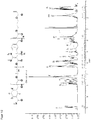
- Example 1 Polymer of 1,3-butanediol diacrylate and isophthalaldehyde
- the structure of the polymer produced was confirmed by 1 H-NMR spectroscopy as in FIG. 1 shown.
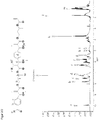
- Example 2 Polymer of 1,3-butanediol diacrylate and terephthalaldehyde
- the structure of the polymer produced was confirmed by 1 H-NMR spectroscopy as in FIG. 2 shown.
- Example 3 Polymer of 1,3-butanediol diacrylate and terephthalaldehyde
- the cured film swelled upon contact with acetone and partially detached from the substrate, indicating incomplete crosslinking.
- a formulation was prepared from 90 parts by weight of polymer from Example 3, 10 parts by weight of hexanediol diacrylate and 4 parts by weight of Lucirin® TPO, diluted with 69 parts by weight of butyl acetate and with the aid of a box doctor blade with a 100 ⁇ m gap width a glass substrate applied. After venting the solvent (15 minutes 23 ° C, 20 minutes 80 ° C), the film was exposed at 80 ° C in a nitrogen atmosphere with 2800 mJ / cm 2 (Hg high-pressure lamp).
- the cured film was crosslinked and showed no swelling and no contact on contact with acetone.
Landscapes
- Chemical & Material Sciences (AREA)
- Health & Medical Sciences (AREA)
- Chemical Kinetics & Catalysis (AREA)
- Medicinal Chemistry (AREA)
- Polymers & Plastics (AREA)
- Organic Chemistry (AREA)
- Paints Or Removers (AREA)
- Polyurethanes Or Polyureas (AREA)
Description
- Die vorliegende Erfindung betrifft Hydroxygruppen und Acrylatgruppen aufweisende Polymere, Verfahren zu deren Herstellung und deren Verwendung.
- Die erfindungsgemäßen, Hydroxygruppen und Acrylatgruppen aufweisenden Polymere können bevorzugt hergestellt werden über die sogenannte Baylis-Hillman-Reaktion, in der Acrylate und Carbonylverbindungen, bevorzugt Aldehyde miteinander umgesetzt werden (siehe auch unten).
-
US 5,380,901 beschreibt die Reaktion von Acrylaten mit para-Formaldehyd unter Bildung von etherverbrückten Diacrylaten sowie die Umsetzung von Diacrylaten mit Formaldehyd zu Di-(α-(1'-Hydroxyalkyl))acrylaten sowie die potentielle Verwendung solcher Monomere in beispielsweise Beschichtungen. Als Härtung wird Massepolymerisation beschrieben. - Die
WO 2005/57286 US 2007/135556 ) beschreibt die Umsetzung von Acrylaten mit Formaldehyd zur zusätzlichen Einbringung von Methylolgruppen in ein bestehendes Molekül. Im einzelnen beschrieben wird die Umsetzung von monofunktionellen Acrylaten mit monofunktionellen Carbonylverbindungen, mehrfunktionellen Acrylaten mit monofunktionellen Carbonylverbindungen und monofunktionellen Acrylaten mit mehrfunktionellen Carbonylverbindungen. Die als mehrfunktionelle Carbonylverbindungen eingesetzten Aldehyde können unter anderem Heteroatome in der verbindenden Alkylenkette enthalten. - P. Venkitasubramanian, E. C. Hagberg und P. D. Bloom, Polymer Preprints 2008, 49 (1), 914 bis 915 und
US 2009/0018300 beschreiben die Herstellung von biobasierten Polymeren auf Basis eines Monomeren, das eine Aldehyd- und eine Acrylatgruppe aufweist, aus der Reaktion von 5-Hydroxymethylfurfural und Acryloylchlorid oder Acrylsäuremethylester. Dieses Monomer wird mittels der Baylis-Hillman-Reaktion polymerisiert. -
US 2009/0018300 offenbart in den lediglich "prophetischen Beispielen" 19 bis 23 die hypothetische Herstellung linearer Polymer durch eine Baylis-Hillman Reaktion auf der Basis von Diformylfuran und einem auf Furan bzw. Isosorbit basierenden Diacrylat. Da diese hypothetischen Beispiele basierend auf nachwachsenden biologischen Materialien hergestellt werden, ist auch für die hypothetischen Produkte mit einer Bioabbaubarkeit, also verminderter Stabilität zu rechnen. Zudem sind die Monomere der "prophetischen Beispiele" technisch nicht verfügbar und deren Herstellung aufwendig. - Aufgabe der vorliegenden Erfindung war es daher, neue, technisch attraktive Wege zur Herstellung von Hydroxygruppen und Acrylatgruppen aufweisende Polymeren zu entwickeln, die entweder als solche oder als Komponenten für strahlungshärtbare Systeme, für über Polyaddition oder Polykondensation härtbare Systeme oder für strahlungshärtbare und über Polyaddition oder Polykondensation härtbare Systeme, sogenannte Dual Cure Systeme, verwendet werden können. Die Polymere sollen eine verbessert Stabilität erwarten lassen als die im Stand der Technik angeregten, durch eine Baylis-Hillman hypothetisch herstellbaren Polymere.
- Die Aufgabe wird gelöst durch Hydroxygruppen und Acrylatgruppen aufweisende Polymere (A), erhältlich durch Reaktion
- mindestens einer Dicarbonylverbindung (a1) mit genau zwei Carbonylgruppen, ausgewählt aus der Gruppe bestehend aus
- -- Aldehydgruppen (a1 a) und
- -- Ketogruppen (a1b)
- mindestens einer Diacrylatverbindung (a2),
- Die Baylis-Hillman Reaktion beinhaltet die Kondensation eines elektronenarmen Alkens und eines Aldehyds, katalysiert durch ein tertiäres Amin oder Phosphin. Das Baylis-Hillman Addukt, ein α-Methylen-β-hydroxy Carbonylderivat, ist eine interessante und wichtige Substruktur, die häufig in natürlichen und synthetischen Produkten von biologischem und medizinischem Interesse auftritt. Der typische Baylis-Hillman Reaktion verwendet nukleophile und nicht-gehinderte tertiäre Amine als Katalysatoren, wie beispielsweise 1,4-Diazabicyclo[2.2.2]octan (DABCO) oder 2- oder 4-Dimethylaminopyridin.
- Radikalisch härtbare Systeme sind polymerisierbare Zusammensetzungen, die sich über radikalisch initiierte Polymerisation härten lassen. Eine solche Initiierung kann beispielsweise über Peroxide, Azoverbindungen oder Sauerstoff erfolgen.
- Beispiele für thermisch aktivierbare Initiatoren sind, z.B. Kaliumperoxodisulfat, Dibenzoylperoxid, Cyclohexanonperoxid, Di-tert.-Butylperoxid, Cyclohexylsulfonylacetylperoxid, Di-iso-propylpercarbonat, tert-Butylperoktoat oder Benzpinakol, Di-t-Butylperoxid, Cumolhydroperoxid, Dicumylperoxid, t-Butylperbenzoat, Azobis-iso-butyronitril, silylierte Pinakole, die z. B. unter dem Handelsnamen ADDID 600 der Firma Wacker kommerziell erhältlich sind oder Hydroxylgruppen-haltige Amin-N-Oxide, wie 2,2,6,6-Tetramethylpiperidin-N-oxyl, 4-Hydroxy-2,2,6,6-Tetramethylpiperidin-N-oxyl etc.
- Weitere Beispiele geeigneter Initiatoren sind in "Polymer Handbook", 2. Aufl., Wiley & Sons, New York beschrieben.
- Strahlungshärtung im Sinne dieser Schrift ist definiert als die Polymerisation von polymerisierbaren Verbindungen infolge einer elektromagnetischen und/oder korpuskularen Strahlung, bevorzugt UV-Licht im Wellenlängenbereich von λ=200 bis 700 nm, aber auch IR oder NIR-Strahlung, und/oder Elektronenstrahlung im Bereich von 150 bis 300 keV und besonders bevorzugt mit einer Strahlungsdosis von mindestens 80, bevorzugt 80 bis 3000 mJ/cm2.
- Mit dem Begriff "Dual Cure" beziehungsweise "Multi Cure" ist im Rahmen dieser Schrift ein Härtungsprozeß bezeichnet, der über zwei beziehungsweise mehr als zwei Mechanismen erfolgt und zwar beispielsweise ausgewählt aus strahlungs-, feuchtigkeits-, chemisch, oxidativ und/oder thermisch härtend, bevorzugt ausgewählt aus strahlungs-, feuchtigkeits-, chemisch und/oder thermisch härtend, besonders bevorzugt ausgewählt aus strahlungs-, chemisch und/oder thermisch härtend und ganz besonders bevorzugt strahlungs- und chemisch härtend.
- Polyaddition im Sinne dieser Schrift ist definiert als die Polymerisation von polymerisierbaren Verbindungen ohne Abspaltung kleinerer Moleküle infolge einer Reaktion von beispielsweise Hydroxygruppen (-OH), Mercaptogruppen (-SH) oder Aminogruppen (-NRH) mit gegenüber Hydroxy- , Mercapto- oder Aminogruppen reaktiven Gruppen, beispielsweise Isocyanaten, verkappten Isocyanaten, Epoxiden, cyclischen Carbonaten oder Aminoplasten, bevorzugt Isocyanaten, Epoxiden oder Aminoplasten, besonders bevorzugt Isocyanaten oder Epoxiden und ganz besonders bevorzugt Isocyanaten.
- Weiterhin sei damit auch die Reaktion an Doppelbindungen mit Verbindungen, die an die Doppelbindungen addierbare Gruppen enthalten, umfaßt, namentlich genannt sei die Michael-Addition. Zu nennen sind hier besonders primäre oder sekundäre Aminogruppen.
- Polykondensation im Sinne dieser Schrift ist definiert als die Polymerisation von polymerisierbaren Verbindungen unter Abspaltung kleinerer Moleküle infolge einer Reaktion von beispielsweise Hydroxygruppen (-OH), Mercaptogruppen (-SH) oder Aminogruppen (-NRH) mit gegenüber Hydroxy- , Mercapto- oder Aminogruppenreaktiven Gruppen, beispielsweise Carbonsäuren oder deren Derivaten, Sulfonsäuren oder deren Derivaten, Carbonaten, bevorzugt Carbonsäuren und deren Derivaten oder Carbonaten, besonders bevorzugt Carbonsäuren, Carbonsäurehalogenide und Carbonsäureanhydride.
- Als Einsatzstoffe für die erfindungsgemäße Reaktion werden mindestens eine, beispielsweise ein bis vier, bevorzugt ein bis drei, besonders bevorzugt ein bis zwei und ganz besonders bevorzugt genau eine difunktionelle Carbonylverbindung (a1) und mindestens ein, beispielsweise ein bis vier, bevorzugt ein bis drei, besonders bevorzugt ein bis zwei und ganz besonders bevorzugt genau ein difunktionelles Acrylat (a2) eingesetzt.
- Die Dicarbonylverbindung (a1) mit genau zwei Carbonylgruppen ist erfindungsgemäß ausgewählt aus der Gruppe bestehend aus
- -- Aldehydgruppen (a1 a) und
- -- Ketogruppen (a1b).
- Unter den Verbindungen (a1) sind Diketone und Dialdehyde bevorzugt, besonders bevorzugt handelt es sich bei der Verbindung (a1) um einen Dialdehyd.
- Erfindungsgemäß sind in der Verbindung (a1) die zwei Carbonylgruppen durch einen aliphatischen, cycloaliphatischen oder aromatischen Kohlenwasserstoffrest miteinander verbunden.
- Bevorzugt handelt es sich bei den Dialdehyden als Verbindungen (a1) um Verbindungen der Formel
OHC-R1-CHO,
worin - R1 einen aliphatischen, cycloaliphatischen oder aromatischen Kohlenwasserstoffrest oder eine Einfachbindung bedeutet.
- R1 bedeutet bevorzugt unsubstituiertes oder mit Halogen, C1-C8-Alkyl, C2-C8-Alkenyl, Carboxy, Carboxy-C1-C8-Alkyl, C1-C20-Acyl, C1-C8-Alkoxy, C6-C12-Aryl substituiertes C6-C12-Arylen, C3-C12-Cycloalkylen, C1-C20-Alkylen oder eine Einfachbindung. Besonders bevorzugt handelt es sich um unsubstituiertes C6-C12-Arylen, C3-C12-Cycloalkylen, C1-C20-Alkylen oder eine Einfachbindung. Ganz besonders bevorzugt handelt es sich um unsubstituiertes C6-C12-Arylen, C2-C20-Alkylen oder eine Einfachbindung.
- Darin bedeuten C1 - C20-Alkylen lineares oder verzweigtes Alkylen, z.B. Methylen, 1,2-Ethylen, 1,2- oder 1,3-Propylen, 1,2-, 1,3- oder 1,4-Butylen, 1,1-Dimethyl-1,2-ethylen, 1,2-Dimethyl-1,2-ethylen, 1,5-Pentylen, 1,6-Hexylen, 1,8-Octylen, 1,10-Decylen oder 1,20-Eicosylen.
- C3 - C12-Cycloalkylen beispielsweise Cyclopropylen, Cyclopentylen, Cyclohexylen, Cyclooctylen oder Cyclododecylen.
- C6-C12-Arylen bedeutet beispielsweise Phenylen, Naphthylen oder Biphenylen.
- Bevorzugte Reste R1 sind eine Einfachbindung, Methylen, 1,2-Ethylen, 1,3-Propylen, 1,2-Propylen, 1,4-Butylen, 1,5-Pentylen, 1,6-Hexylen, 1,2-Phenylen, 1,3-Phenylen, 1,4-Phenylen, 2,3-Toluylen, 2,4-Toluylen, 2,6-Toluylen, 1,2-Cyclohexylen, 1,3-Cyclohexylen und 1,4-Cyclohexylen.
- Besonders bevorzugte Reste R1 sind eine Einfachbindung, 1,2-Ethylen, 1,3-Propylen, 1,4-Butylen, 1,3-Phenylen und 1,4-Phenylen.
- Bevorzugte Verbindungen (a1) sind Glyoxal, Succinaldehyd, Glutaraldehyd, Capronaldehyd, Phthalaldehyd, Isophthalaldehyd und Terephthalaldehyd, besonders bevorzugt sind Glyoxal, Succinaldehyd, Glutaraldehyd, Isophthalaldehyd und Terephthalaldehyd.
- Bei der Diacrylatverbindung (a2) handelt es sich um beliebige difunktionelle Acrylate, bevorzugt um Diacrylate von Alkandiolen oder Cycloalkandiolen sowie niederen Polyalkylenglykolen, bevorzugt Polyethylenglykolen oder Polypropylenglykolen, oderwenn auch weniger bevorzugt - difunktionelle Acrylamide von Diaminen, vorzugsweise von linearen oder verzweigten aliphatischen oder cycloaliphatischen Diaminen.
- Bevorzugt handelt es sich bei den Verbindungen (a2) um solche mit einem Molekulargewicht unter 400 g/mol, besonders bevorzugt um strukturell einheitliche Verbindungen, d.h. solche, die keine Molekulargewichtsverteilung aufweisen.
- Bei den Alkandiolen kann es sich bevorzugt handeln um Ethylenglykol, 2,2-Dimethyl-1,2-Ethandiol, 1,3-Propandiol, 1,2-Propandiol, 1,2-Butandiol, 1,3-Butandiol, 1,4-Butandiol, 3-Methylpentan-1,5-diol, 2-Ethylhexan-1,3-diol, 2,4-Diethyloctan-1,3-diol, 1,6-Hexandiol, Neopentylglykol, 2-Ethyl-1,3-Propandiol oder 2-Methyl-1,3-Propandiol.
- Bei den Cycloalkandiolen kann es sich bevorzugt handeln um 2,2-Bis(4-hydroxycyclohexyl)propan, 1,1-, 1,2-, 1,3- und 1,4-Cyclohexandimethanol, 1,2-, 1,3- oder 1,4-Cyclohexandiol.
- Bei den Polyalkylenglykolen kann es sich bevorzugt handeln um Polyethylenglykole, Polypropylenglykole, Poly-THF oder Poly-1,3-propandiol. Besonders bevorzugt sind Polyethylenglykole oder Polypropylenglykole als Gemisch der Isomere. Unter den Polyalkylenglykolen sind Di- bis Pentamere bevorzugt.
- Bei den Diaminen handelt es sich bevorzugt um lineare oder verzweigte aliphatische oder cycloaliphatische primäre und/oder sekundäre Diamine, wie zum Beispiel 1,2-Diaminoethan, 1,2- oder 1,3-Diaminopropan, 1,4-Diaminobutan, 1,5-Diaminopentan, 1,6-Diaminohexan, 1,7-Diaminoheptan, 1,8-Diaminooktan, 1,9-Diaminononan, 1,10-Diaminodekan, 1,12-Diaminododecan oder Piperazin.
- Besonders bevorzugte Diacrylate (a2) sind Ethylenglykoldiacrylat, 1,2-Propandioldiacrylat, 1,3-Propandioldiacrylat, 1,3-Butandioldiacrylat, 1,4-Butandioldiacrylat, 1,6-Hexandioldiacrylat, Diethylenglykoldiarylat, Dipropylenglykoldiacrylat, Tripropylenglykoldiacrylat, N,N'-Bisacryloyl-1,2-diaminoethan, N,N'-Bisacryloyl-1,6-diaminohexan oder N,N'-Bisacryloyl-piperazin.
- Ganz besonders bevorzugte Verbindungen sind 1,6-Hexandioldiacrylat und Dipropylenglykoldiacrylat.
- Die Durchführung der Baylis-Hillman-Reaktion ist dem Fachmann an sich bekannt und Gegenstand mehrerer Literaturüberblicke.
- Die Reaktion kann bei einer Temperatur zwischen 0 °C und 100 °C, bevorzugt 20 bis 80 °C und besonders bevorzugt 25 °C bis 60 °C durchgeführt werden.
- Um Ketone zur Reaktion zu bringen kann es erforderlich sein, hohen Druck anzulegen.
- Als Katalysator für die Reaktion wird zumeist ein tertiäres Amin oder Phosphin verwendet, beispielsweise Trimethylamin, Triethylamin, Tri-n-butylamin, Ethyl-di-iso-Propylamin, Methyl-di-iso-Propylamin, N-Methylmorpholin, N-Methylpiperidin, Triethanolamin, N,N-Dimethylethanolamin, 2-Dimethylaminopyridin, 4-Dimethylaminopyridin, Diazabicyclooctan, 1,5-Diazabicyclo[4.3.0]-non-5-en (DBN), 1,8-Diazabicyclo[5.4.0]-undec-7-en (DBU), Pyrrocolin, Chinuclidin, Chinidin, Trimethylphosphin, Triethylphosphin, Tri-n-Butylphosphin, Dimethylphenylphosphin und bevorzugt 1,4-Diaza-bicyclo[2,2,2]octan (DABCO). Der Katalysator wird in der Regel in Mengen von 1 bis 100 mol% bzgl. Acrylgruppen eingesetzt, bevorzugt 5 - 50, besonders bevorzugt 10 - 40 und ganz besonders bevorzugt 15 - 30 mol%.
- Die Stöchiometrie zwischen Acrylatgruppen und Carbonylgruppen beträgt in der Regel 1 : 0,05 - 1,5, bevorzugt 1 : 0,1 - 1,3, besonders bevorzugt 1 : 0,2 - 1,0 und ganz besonders bevorzugt 1 : 0,4 -1,0.
- Als Lösungsmittel für die Baylis-Hillman Reaktion können bevorzugt Wasser, Petrolether, Ligroin, Toluol, Benzol, Xylol, Tetrahydrofuran (THF), Diethylether, Dioxan, ein Methacrylat oder aber auch das zur Reaktion verwendete Acrylat eingesetzt werden. Die Reaktion kann auch in Abwesenheit eines Lösungsmittels durchgeführt werden.
- Wird ein Methacrylat oder das an der Reaktion beteiligte Acrylat (im folgenden als (Meth)acrylat bezeichnet) als Lösungsmittel verwendet, so kann das entstehende Reaktionsgemisch, das sowohl das verwendete (Meth)acrylat als auch erfindungsgemäßes Polymer enthält, aufgereinigt oder ohne Abtrennung des (Meth)acrylats als solches eingesetzt werden, wobei das (Meth)acrylat dann als Reaktivverdünner oder multifunktionelles (Meth)acrylat (siehe unten) fungiert.
- Auf eine Aufreinigung des Reaktionsgemisches kann verzichtet werden, selbstverständlich kann das Gemisch natürlich auch durch Destillation, Strippen, saure, alkalische oder neutrale Wäsche, Filtration, durch Behandlung mit lonentauschern oder dergleichen gereinigt werden.
- Die erfindungsgemäßen Polymere weisen in der Regel ein zahlenmittleres Molekulargewicht Mn von 398 bis 20000, bevorzugt von 398 bis 10000 und besonders bevorzugt von 398 bis 5000 g/mol und ein gewichtsmittleres Molekulargewicht Mw von 398 bis 50000, bevorzugt von 398 bis 30000 und besonders bevorzugt von 398 bis 20000 auf. Die Molekulargewichte können bestimmt werden bei Oligomeren durch Ermittlung des Polymerisationsgrades und anschließender Molekulargewichtsberechnung aus den Einzelgewichten der Monomere oder bei Polymeren durch Gelpermeationschromatographie mit einem geeigneten Polymerstandard, beispielsweise Polymethylmethacrylat als Standard und Tetrahydrofuran oder Dimethylformamid als Elutionsmittel).
- Die erfindungsgemäßen Polymere sind in der Regel farblos bis höchstens schwach gelblich gefärbt und lösen sich gut in polaren Lösemitteln, wie Methanol, Ethanol, Dimethylformamid, Dimethylacetamid, Essigester, Butylacetat, Tetrahydrofuran, Aceton, 2-Butanon oder Toluol.
- Es stellt einen Vorteil der erfindungsgemäßen Polymere (A) dar, daß sie stabiler sind als die im Stand der Technik angeregten Polymere auf Basis von Diformylfuran und einem auf Furan bzw. Isosorbit basierenden Diacrylat. Dadurch, daß die erfindungsgemäßen Polymere einen Kohlenwasserstoffrest aufweisen, sind sie im Gegensatz zu diesen Polymeren weniger anfällig gegen Bioabbau und mithin stabiler, weiterhin dadurch auch wasserbeständiger. Weiterhin zeigen sie gegenüber dem elektronenreichen Furansystem eine verbesserte Lichtechtheit, da sie im Falle der aromatischen Monomere einen weniger elektronenreichen bzw. im Fall der aliphatischen und cycloaliphatischen Monomere (a1) einen gegenüber Einstrahlung von Licht stabilen Aufbau besitzen.
- Ein wesentlicher Vorteil der Erfindung ist weiterhin die Möglichkeit des Einsatzes verschiedenster Monomere (a1) und (a2). Durch diese variable Synthese können Molekulargewicht, Polarität, Reaktivität und Kompatibilität der Polymere im Hinblick auf die gewünschten Systemeigenschaften des Endproduktes sehr genau eingestellt werden. Darüberhinaus sind die Monomere (a1) und (a2) technisch verfügbar und die Polymere (A) mithin leicht herstellbar.
- Durch den Einsatz difunktioneller Verbindungen (a1) mit difunktionellen Verbindungen (a2) sind die erfindungsgemäß erhältlichen Polymere (A) streng linear, d.h. sie weisen keinen oder lediglich einen vernachlässigbaren Verzweigungsgrad auf. Mit letzterem ist ein Verzweigungsgrad von unter 5%, bevorzugt unter 4%, besonders bevorzugt unter 3%, ganz besonders bevorzugt unter 2% und insbesondere unter 1 % bezeichnet.
- In einer bevorzugten Ausführungsform wird die Carbonylverbindung im Verhältnis zu der Acrylatgruppen aufweisenden Verbindung unterstöchiometrisch eingesetzt, so daß Reaktionsgemische erhalten werden, die das Baylis-Hillman-Produkt im Gemisch mit dem eingesetzten Acrylat enthalten. Derartige Gemische können mit Vorteil in Beschichtungsmassen für die radikalische oder Strahlungshärtung und/oder Dual-Cure-Härtung eingesetzt werden.
- Für den Einsatz in der Strahlungshärtung können die erfindungsgemäßen Polymere (A) mit mindestens einem Photoinitiator (P) vermischt werden. Zumeist sind Mengen von 0,1 bis 10 Gew% Photoinitiator ausreichend, bevorzugt 0,2 bis 5 Gew%.
- Als Photoinitiatoren (P) können dem Fachmann bekannte Photoinitiatoren verwendet werden, In Betracht kommen solche mit UV-Licht aktivierbaren Photoinitiatoren, wie sie beschrieben sind in
WO 2006/005491 A1 , Seite 21, Zeile 18 bis Seite 22, Zeile 2 (entsprichtUS 2006/0009589 A1 , Absatz [0150]), was hiermit durch Bezugnahme Bestandteil der vorliegenden Offenbarung sei. Es ist selbstverständlich auch möglich mit IR-Strahlung aktivierbare Photoinitiatoren einzusetzen. Bei diesen handelt es sich häufig um eine Kombination aus mindestens einem Sensibilisatorfarbstoff, insbesondere Cyanin-, Xanthylium- oder Thiazinfarbstoffen, mit mindestens einem Co-Initiator, beispielsweise Boranatsalze, Sulfoniumsalze, Iodoniumsalze, Sulfone, Peroxide, Pyridin-N-oxide oder Halogenmethyltriazine. - Die erfindungsgemäßen Polymere können weiterhin in einer bevorzugten Ausführungsform mit mindestens einem Reaktivverdünner und/oder mindestens einer multifunktionellen, polymerisationsfähigen Verbindung und/oder weiteren lacktypischen Additiven vermischt werden, um strahlungshärtbare Beschichtungsmassen zu erhalten.
- Reaktivverdünner sind beispielsweise Ester der (Meth)acrylsäure mit Alkoholen, die 1 bis 20 C-Atome aufweisen, z.B. (Meth)acrylsäuremethylester, (Meth)acrylsäureethylester, (Meth)acrylsäurebutylester, (Meth)acrylsäure-2-ethylhexylester, 2-Hydroxyethylacrylat, 4-Hydroxybutylacrylat , Dihydrodicyclopentadienylacrylat, Vinylaromatische Verbindungen, z.B. Styrol, Divinylbenzol, α,β-ungesättigte Nitrile, z.B. Acrylnitril, Methacrylnitril, α,β-ungesättigte Aldehyde, z.B. Acrolein, Methacrolein, Vinylester, z.B. Vinylacetat, Vinylpropionat, halogenierte ethylenisch ungesättigte Verbindungen, z.B. Vinylchlorid, Vinylidenchlorid, konjugierte ungesättigte Verbindungen, z.B. Butadien, Isopren, Chloropren, einfach ungesättigte Verbindungen, z.B. Ethylen, Propylen, 1-Buten, 2-Buten, iso-Buten, cyclische einfach ungesättigte Verbindungen, z.B. Cyclopenten, Cyclohexen, Cyclododecen, N-Vinylformamid, Allylessigsäure, Vinylessigsäure, monoethylenisch ungesättigten Carbonsäuren mit 3 bis 8 C-Atomen sowie deren wasserlöslichen Alkalimetall-, Erdalkalimetall- oder Ammoniumsalze wie beispielsweise: Acrylsäure, Methacrylsäure, Dimethylacrylsäure, Ethacrylsäure, Maleinsäure, Citraconsäure, Methylenmalonsäure, Crotonsäure, Fumarsäure, Mesaconsäure und Itaconsäure, Maleinsäure, N-Vinylpyrrolidon, N-Vinyllactame, wie z.B. N-Vinylcaprolactam, N-Vinyl-N-Alkyl-carbonsäureamide oder N-Vinyl-carbonsäureamide, wie z. B. N-Vinylacetamid, N-Vinyl-N-methylformamid und N-Vinyl-N-methylacetamid oder Vinylether, z.B. Methylvinylether, Ethylvinylether, n-Propylvinylether, iso-Propylvinylether, n-Butylvinylether, sek-Butylvinylether, iso-Butylvinylether, tert-Butylvinylether, 4-Hydroxybutylvinylether, sowie Gemische davon.
- Der Begriff "(Meth)Acryl-" steht in dieser Schrift als Sammelbegriff für "Methacryl-" und "Acryl-".
- Multifunktionelle, polymerisationsfähige Verbindungen sind bevorzugt multifunktionelle (Meth)acrylate, die mindestens 2, bevorzugt 3 - 10, besonders bevorzugt 3 - 6, ganz besonders bevorzugt 3 - 4 und insbesondere 3 (Meth)acrylatgruppen, bevorzugt Acrylatgruppen tragen.
- Dies können beispielsweise Ester der (Meth)acrylsäure mit entsprechend mindestens zweiwertigen Polyalkoholen sein.
- Derartige Polyalkohole sind beispielsweise mindestens zweiwertige Polyole, Polyether- oder Polyesterole oder Polyacrylatpolyole mit einer mittleren OH-Funktionalität von mindestens 2, bevorzugt 3 bis 10, geeignet.
- Mindestens zweiwertige Polyalkohole sind beispielsweise alkoxylierte mindestens zweiwertige Polyalkohole der Formeln (IVa) bis (IVd),


- R9 und R10 unabhängig voneinander Wasserstoff oder C1 - C18-Alkyl,
- k, l, m, q unabhängig voneinander je für eine ganze Zahl von 1 bis 10, bevorzugt 1 bis 5 und besonders bevorzugt 1 bis 3 steht und
- jedes Xi für i = 1 bis k, 1 bis I, 1 bis m und 1 bis q unabhängig voneinander ausgewählt sein kann aus der Gruppe -CH2-CH2-O-, -CH2-CH(CH3)-O-, -CH(CH3)-CH2-O-, -CH2-C(CH3)2-O-, -C(CH3)2-CH2-O-, -CH2-CHVin-O-, -CHVin-CH2-O-, -CH2-CHPh-O- und -CHPh-CH2-O-, bevorzugt aus der Gruppe -CH2-CH2-O-, -CH2-CH(CH3)-O- und -CH(CH3)-CH2-O-, und besonders bevorzugt -CH2-CH2-O-,
- Bevorzugt handelt es sich dabei um Acrylate von ein- bis zwanzigfach und besonders bevorzugt drei- bis zehnfach ethoxyliertem, propoxyliertem oder gemischt ethoxyliertem und propoxyliertem und insbesondere ausschließlich ethoxyliertem Neopentylglykol, Glycerin, Trimethylolpropan, Trimethylolethan oder Pentaerythrit.
- Bevorzugte Verbindungen (IV) sind Ethylenglykoldiacrylat, 1,2-Propandioldiacrylat, 1,3-Propandioldiacrylat, 1,3-Butandioldiacrylat,1,4-Butandioldiacrylat, 1,6-Hexandioldiacrylat, Trimethylolpropantriacrylat, Pentaerythrittetraacrylat, Polyestepolyolacrylate, Polyetherolacrylate und Triacrylat von ein- bis zwanzigfach ethoxyliertem Trimethylolpropan.
- Besonders bevorzugte Verbindungen sind 1,4-Butandioldiacrylat, 1,6-Hexandioldiacrylat, Trimethylolpropantriacrylat, Pentaerythrittetraacrylat und Triacrylat von ein- bis zwanzigfach ethoxyliertem Trimethylolpropan.
- Geeignete Alkylenoxide sind beispielsweise Ethylenoxid, Propylenoxid, isoButylenoxid, Vinyloxiran und/oder Styroloxid.
- Die Alkylenoxidkette kann bevorzugt aus Ethylenoxid-, Propylenoxid- und/oder Butylenoxideinheiten zusammengesetzt sein. Eine solche Kette kann sich aus einer Spezies eines Alkylenoxides oder aus einem Gemisch von Alkylenoxiden zusammensetzen. Wird ein Gemisch verwendet, können die unterschiedlichen Alkylenoxideinheiten statistisch oder als Block oder Blöcke einzelner Spezies vorliegen. Bevorzugt ist als Alkylenoxid Ethylenoxid, Propylenoxid oder ein Gemisch daraus, besonders bevorzugt ist es Ethylenoxid oder Propylenoxid und ganz besonders bevorzugt Ethylenoxid.
- Die Anzahl der Alkylenoxideinheiten in der Kette beträgt beispielsweise 1 bis 20, bevorzugt 1 bis 10, besonders bevorzugt 1 - 5 und insbesondere 1 - 3 und außergewöhnlich bevorzugt 1, bezogen auf die jeweiligen Hydroxygruppen des Polyalkohols.
- Als Polyesterole kommen z.B. solche in Betracht, wie sie oben bereits aufgeführt sind.
- Die Molekulargewichte Mn der Polyesterole bzw. Polyetherole liegen bevorzugt zwischen 100 und 4000 g/mol (Mn bestimmt durch Gelpermeationschromatographie mit Polymethylmethacrylat als Standard und Tetrahydrofuran als Elutionsmittel).
- Weitere multifunktionelle (Meth)acrylate können Polyester(meth)acrylate, Epoxy(meth)-acrylate, Urethan(meth)acrylate oder (meth)acrylierte Polyacrylate sein, wie sie oben als Acrylate von (IVa), (IVb) oder (IVc) aufgeführt sind. Anstelle der (Meth)acrylatgruppen können auch andere radikalisch oder kationisch polymerisierbare Gruppen eingesetzt werden.
- Urethan(meth)acrylate sind z.B. erhältlich durch Umsetzung von Polyisocyanaten mit Hydroxyalkyl(meth)acrylaten oder -vinylethern und gegebenenfalls Kettenverlängerungsmitteln wie Diolen, Polyolen, Diaminen, Polyaminen oder Dithiolen oder Polythiolen.
- Bevorzugte multifunktionelle (Meth)acrylate sind Trimethylolpropantri(meth)acrylat, (Meth)Acrylate von ethoxyliertem und/oder propoxyliertem Trimethylolpropan, Pentaerythrit, Glycerin oder Di-Trimethylolpropan. Besonders bevorzugt sind Acrylate von ethoxyliertem und/oder propoxyliertem Trimethylolpropan oder Pentaerythrit.
- Als weitere lacktypische Additive können beispielsweise Antioxidantien, Stabilisatoren, Aktivatoren (Beschleuniger), Füllmittel, Pigmente, Farbstoffe, antistatische Agentien, Flammschutzmittel, Verdicker, thixotrope Agentien, oberflächenaktive Agentien, Viskositätsmodifikatoren, Plastifizierer oder Chelatbildner verwendet werden.
- Als Beschleuniger für die thermische Nachhärtung kann z.B. Zinnoctoat, Zinkoctoat, Dibutylzinn-dilaurat oder Diaza[2.2.2]bicyclooctan verwendet werden.
- Weiterhin können ein oder mehrere photochemisch und/oder thermisch aktivierbare Initiatoren zugesetzt werden, z.B. Kaliumperoxodisulfat, Dibenzoylperoxid, Cyclohexanonperoxid, Di-tert.-Butylperoxid, Azobis-iso-butyronitril, Cyclohexylsulfonylacetylperoxid, Di-iso-propylpercarbonat, tert-Butylperoctoat oder Benzpinakol, sowie beispielsweise solche thermisch aktivierbare Initiatoren, die eine Halbwertszeit bei 80°C von mehr als 100 Stunden aufweisen, wie Di-t-Butylperoxid, Cumolhydroperoxid, Dicumylperoxid, t-Butylperbenzoat, silylierte Pinakole, die z. B. unter dem Handelsnamen AD-DID 600 der Firma Wacker kommerziell erhältlich sind oder Hydroxygruppen-haltige Amin-N-Oxide, wie 2,2,6,6-Tetramethylpiperidin-N-oxyl, 4-Hydroxy-2,2,6,6-Tetramethylpiperidin-N-oxyl etc.
- Weitere Beispiele geeigneter Initiatoren sind in "Polymer Handbook", 2. Aufl., Wiley & Sons, New York beschrieben.
- Als Verdicker kommen neben radikalisch (co)polymerisierten (Co)Polymerisaten, übliche organische und anorganische Verdicker wie Hydroxymethylcellulose oder Bentonit in Betracht.
- Als Chelatbildner können z.B. Ethylendiamin-tetraessigsäure und deren Salze sowie β-Diketone verwendet werden.
- Geeignete Füllstoffe umfassen Silikate, z. B. durch Hydrolyse von Siliciumtetrachlorid erhältliche Silikate wie Aerosil® der Fa. Degussa, Kieselerde, Talkum, Aluminiumsilikate, Magnesiumsilikate, Calciumcarbonate etc.
- Geeignete Stabilisatoren umfassen typische UV-Absorber wie Oxanilide, Triazine und Benzotriazol (letztere erhältlich als Tinuvin® -Marken der Ciba-Spezialitätenchemie) und Benzophenone. Diese können allein oder zusammen mit geeigneten Radikalfängern, beispielsweise sterisch gehinderten Aminen wie 2,2,6,6-Tetramethylpiperidin, 2,6-Di-tert.-butylpiperidin oder deren Derivaten, z. B. Bis-(2,2,6,6-tetra-methyl-4-piperidyl)sebacinat, eingesetzt werden. Stabilisatoren werden üblicherweise in Mengen von 0,1 bis 5,0 Gew.-%, bezogen auf die in der Zubereitung enthaltenen festen Komponenten, eingesetzt.
- Die erfindungsgemäßen Polymere (A) sind mit Vorteil für Dual- oder Multi-Cure Anwendungen verwendbar, wenn sie zusätzlich mindestens eine Verbindung (B) mit mindestens einer gegenüber Hydroxy (-OH) reaktiven Gruppe enthalten.
- Verbindungen (B) mit mindestens einer gegenüber Hydroxy (-OH) reaktiven Gruppe können beispielsweise Isocyanate, verkappte Isocyanate, Epoxide, Carbonsäuren oder deren Derivate, Carbonate oder Aminoplaste sein, bevorzugt sind Isocyanate, blockierte Isocyanate und Melamin-Formaldehyd-Harze, besonders bevorzugt sind Isocyanate.
- Isocyanate sind beispielsweise aliphatische, aromatische und cycloaliphatische Di- und Polyisocyanate mit einer NCO-Funktionalität von mindestens 1,8, bevorzugt 1,8 bis 5 und besonders bevorzugt 2 bis 4 in Frage, sowie deren Isocyanurate, Biurete, Urethane, Allophanate und Uretdione.
- Bei den Diisocyanaten handelt es sich bevorzugt um Isocyanate mit 4 bis 20 C-Atomen. Beispiele für übliche Diisocyanate sind aliphatische Diisocyanate wie Tetramethylendiisocyanat, Hexamethylendiisocyanat (1,6-Diisocyanatohexan), Octamethylendiisocyanat, Decamethylendiisocyanat, Dodecamethylendüsocyanat, Tetradecamethylendiisocyanat, Derivate des Lysindiisocyanates, Trimethylhexandiisocyanat oder Tetramethylhexandüsocyanat, cycloaliphatische Diisocyanate wie 1,4-, 1,3- oder 1,2-Diisocyanatocyclohexan, 4,4'- oder 2,4'-Di(isocyanatocyclohexyl)methan, 1-Isocyanato-3,3,5- trimethyl-5-(isocyanatomethyl)cyclohexan (Isophorondiisocyanat), 1,3- oder 1,4-Bis(isocyanatomethyl)cyclohexan oder 2,4-, oder 2,6-Diisocyanato-1-methylcyclohexan sowie 3 (bzw. 4), 8 (bzw. 9)-Bis(isocyanatomethyl)-tricyclo[5.2.1.02.6]decan-Isomerengemische sowie aromatische Diisocyanate wie 2,4-oder 2,6-Toluylendiisocyanat und deren Isomerengemische, m- oder p-Xylylendiisocyanat, 2,4'- oder 4,4'-Diisocyanatodiphenylmethan (MDI) und deren Isomerengemische, Mischungen aus 2,4'-, 4,4'- und oligomeren Diisocyanatodiphenylmethanen (Polymer-MDI), 1,3- oder 1,4-Phenylendiisocyanat, 1-Chlor-2,4-phenylendiisocyanat, 1,5-Naphthylendiisocyanat, Diphenylen-4,4'-diisocyanat, 4,4'-Diisocyanato-3,3'-dimethyldiphenyl, 3-Methyldiphenylmethan-4,4'-diisocyanat, Tetramethylxylylendiisocyanat, 1,4-Diisocyanatobenzol oder Diphenylether-4,4'-diisocyanat.
- Es können auch Gemische der genannten Diisocyanate vorliegen.
- Als Polyisocyanate kommen Isocyanuratgruppen aufweisende Polyisocyanate, Uretdiondiisocyanate, Biuretgruppen aufweisende Polyisocyanate, Urethan- oder Allophanatgruppen aufweisende Polyisocyanate, Oxadiazintriongruppen oder Iminooxadiazindiongruppen enthaltende Polyisocyanate, Uretonimin-modifizierte Polyisocyanate von geradlinigen oder verzweigten C4-C20-Alkylendiisocyanaten, cycloaliphatischen Diisocyanaten mit insgesamt 6 bis 20 C-Atomen oder aromatischen Diisocyanaten mit insgesamt 8 bis 20 C-Atomen oder deren Gemische in Betracht.
- Die einsetzbaren Di- und Polyisocyanate haben bevorzugt einen Gehalt an Isocyanatgruppen (berechnet als NCO, Molekulargewicht = 42 g/mol) von 10 bis 60 Gew% bezogen auf das Di- und Polyisocyanat(gemisch), bevorzugt 12 bis 50 Gew% und besonders bevorzugt 12 bis 40 Gew%.
- Bevorzugt sind aliphatische bzw. cycloaliphatische Di- und Polyisocyanate, z.B. die vorstehend genannten aliphatischen bzw. cycloaliphatischen Diisocyanate, oder deren Mischungen.
- Besonders bevorzugt sind Hexamethylendiisocyanat, 1,3-Bis(isocyanatomethyl)-cyclohexan, Isophorondiisocyanat und Di(isocyanatocyclohexyl)methan oder deren Polyisocyanate, ganz besonders bevorzugt sind Isophorondiisocyanat und Hexamethylendiisocyanat oder deren Polyisocyanate, insbesondere bevorzugt ist Hexamethylendiisocyanat oder dessen Polyisocyanate.
- Weiterhin bevorzugt sind
- 1) Isocyanuratgruppen aufweisende Polyisocyanate von aromatischen, aliphatischen und/oder cycloaliphatischen Diisocyanaten. Besonders bevorzugt sind hierbei die entsprechenden aliphatischen und/oder cycloaliphatischen Isocyanato-Isocyanurate und insbesondere die auf Basis von Hexamethylendiisocyanat und Isophorondiisocyanat. Bei den dabei vorliegenden Isocyanuraten handelt es sich insbesondere um Tris-isocyanatoalkyl- bzw. Tris-isocyanatocycloalkyl-Isocyanurate, welche cyclische Trimere der Diisocyanate darstellen, oder um Gemische mit ihren höheren, mehr als einen Isocyanuratring aufweisenden Homologen. Die Isocyanato-Isocyanurate haben im allgemeinen einen NCO-Gehalt von 10 bis 30 Gew.-%, insbesondere 15 bis 25 Gew.-% und eine mittlere NCO-Funktionalität von 2,6 bis 4,5.
- 2) Uretdiondiisocyanate mit aromatisch, aliphatisch und/oder cycloaliphatisch gebundenen Isocyanatgruppen, vorzugsweise aliphatisch und/oder cycloaliphatisch gebundenen und insbesondere die von Hexamethylendiisocyanat oder Isophorondiisocyanat abgeleiteten. Bei Uretdiondiisocyanaten handelt es sich um cyclische Dimerisierungsprodukte von Diisocyanaten.
Die Uretdiondiisocyanate können in den erfindungsgemäßen Zubereitungen als alleinige Komponente oder im Gemisch mit anderen Polyisocyanaten, insbesondere den unter 1) genannten, eingesetzt werden. - 3) Biuretgruppen aufweisende Polyisocyanate mit aromatisch, cycloaliphatisch oder aliphatisch gebundenen, bevorzugt cycloaliphatisch oder aliphatisch gebundenen Isocyanatgruppen, insbesondere Tris(6-isocyanatohexyl)biuret oder dessen Gemische mit seinen höheren Homologen. Diese Biuretgruppen aufweisenden Polyisocyanate weisen im allgemeinen einen NCO-Gehalt von 18 bis 22 Gew.-% und eine mittlere NCO-Funktionalität von 2,8 bis 4,5 auf.
- 4) Urethan- und/oder Allophanatgruppen aufweisende Polyisocyanate mit aromatisch, aliphatisch oder cycloaliphatisch gebundenen, bevorzugt aliphatisch oder cycloaliphatisch gebundenen Isocyanatgruppen, wie sie beispielsweise durch Umsetzung von überschüssigen Mengen an Hexamethylendiisocyanat oder an Isophorondiisocyanat mit ein- oder mehrwertigen Alkoholen wie z.B. Methanol, Ethanol, iso-Propanol, n-Propanol, n-Butanol, iso-Butanol, sek-Butanol, tert-Butanol, n-Hexanol, n-Heptanol, n-Octanol, n-Decanol, n-Dodecanol (Laurylalkohol), 2-Ethylhexanol, n-Pentanol, Stearylalkohol, Cetylalkohol, Laurylalkohol, Ethylenglykolmonomethylether, Ethylenglykolmonoethylether, 1,3-Propandiolmonomethylether, Cyclopentanol, Cyclohexanol, Cyclooctanol, Cyclododecanol oder mehrwertige Alkohole, wie sie oben bei den Polyesterolen aufgeführt sind, oder deren Gemischen erhalten werden können. Diese Urethan- und/oder Allophanatgruppen aufweisenden Polyisocyanate haben im allgemeinen einen NCO-Gehalt von 12 bis 20 Gew.-% und eine mittlere NCO-Funktionalität von 2,5 bis 4,5.
- 5) Oxadiazintriongruppen enthaltende Polyisocyanate, vorzugsweise von Hexamethylendiisocyanat oder Isophorondiisocyanat abgeleitet. Solche Oxadiazintriongruppen enthaltenden Polyisocyanate sind aus Diisocyanat und Kohlendioxid herstellbar.
- 6) Iminooxadiazindiongruppen enthaltende Polyisocyanate, vorzugsweise von Hexamethylendiisocyanat oder Isophorondiisocyanat abgeleitet. Solche Iminooxadiazindiongruppen enthaltenden Polyisocyanate sind aus Diisocyanaten mittels spezieller Katalysatoren herstellbar.
- 7) Uretonimin-modifizierte Polyisocyanate.
- Die Polyisocyanate 1) bis 7) können im Gemisch, gegebenenfalls auch im Gemisch mit Diisocyanaten, eingesetzt werden.
- Die Isocyanatgruppen können auch in verkappter Form vorliegen. Als Verkappungsmittel für NCO-Gruppen eignen sich z.B. Oxime, Phenole, Imidazole, Pyrazole, Pyrazolinone, Diketopiperazine, Caprolactam, Malonsäureester oder Verbindungen, wie sie genannt sind in den Veröffentlichungen von Z.W. Wicks, Prog. Org. Coat. 3 (1975) 73 - 99 und Prog. Org. Coat 9 (1981), 3 - 28 sowie in Houben-Weyl, Methoden der Organischen Chemie, Bd. XIV/2, 61 ff. Georg Thieme Verlag, Stuttgart 1963.
- Unter Verkappungs- bzw. Blockierungsmitteln werden dabei Verbindungen verstanden, die Isocyanatgruppen in blockierte (verkappte bzw. geschützte) Isocyanatgruppen umwandeln, die dann unterhalb der sogenannten Deblockierungstemperatur nicht die üblichen Reaktionen einer freien Isocyanatgruppe zeigen. Solche Verbindungen mit blockierten Isocyanatgruppen kommen üblicherweise in Dual-Cure-Beschichtungsmitteln zur Anwendung, die über Isocyanatgruppenhärtung endgehärtet werden.
- Epoxidverbindungen sind solche mit mindestens einer, bevorzugt mit mindestens zwei, vorzugsweise zwei oder drei Epoxidgruppen im Molekül.
- In Betracht kommen z.B. epoxidierte Olefine, Glycidylester (z.B. Glycidyl(meth)acrylat) von gesättigten oder ungesättigten Carbonsäuren oder Glycidylether aliphatischer oder aromatische Polyole. Derartige Produkte werden im Handel in großer Zahl angeboten. Besonders bevorzugt sind Polyglycidylverbindungen vom Bisphenol A-, -F- oder -B-Typ und Glycidylether mehrfunktioneller Alkohole, z.B. des Butandiol, des 1,6-Hexandiol, des Glycerin und des Pentaerythrit. Beispiele für derartige Polyepoxidverbindungen sind Epikote® 812 (Epoxidwert: ca. 0,67 mol/100g) und Epikote® 828 (Epoxidwert: ca. 0,53 mol/100g), Epikote® 1001, Epikote® 1007 und Epikote® 162 (Epoxidwert: ca. 0,61 mol/100g) der Firma Resolution Performance Products, Rütapox® 0162 (Epoxidwert: ca. 0,58 mol/100g), Araldit® DY 0397 (Epoxidwert: ca. 0,83 mol/100g) der Firma Vantico AG.
- Als Komponenten (B) kommen weiterhin Verbindungen in Frage, mit aktiven Methyloloder Alkylalkoxygruppen, insbesondere Methylalkoxygruppen, an Aminoplastvernetzern, wie z.B veretherte Umsetzungsprodukte von Formaldehyd mit Aminen, wie Melamin, Harnstoff etc., Phenol/Formaldehydaddukte, Siloxan oder Silangruppen und Anhydride ein, wie sie z.B. in
US 5,770,650 beschrieben sind, ein. - Unter den technisch weit verbreiteten und bekannten, bevorzugten Aminoplasten sind besonders bevorzugt Harnstoffharze und Melaminharze, wie z.B. Harnstoff-Formaldehyd-Harze, Melamin-Formaldehyd-Harze, Melamin-Phenol-Formaldehyd-Harze oder Melamin-Harnstoff-Formaldehyd-Harze, verwendbar.
- Als Harnstoffharze sind solche geeignet, die durch Umsetzung von Harnstoffen mit Aldehyden erhältlich sind und gegebenenfalls modifiziert werden können.
- Als Harnstoffe sind Harnstoff, N-substituierte oder N,N'-disubstituierte Harnstoffe geeignet, wie z.B. N-Methylharnstoff, N-Phenylharnstoff, N,N'-Dimethylharnstoff, Hexamethylendiharnstoff, N,N'-Diphenylharnstoff, 1,2-Ethylendiharnstoff, 1,3-Propylendiharnstoff, Diethylentriharnstoff, Dipropylentriharnstoff, 2-Hydroxypropylendiharnstoff, 2-Imidazolidinon (Ethylenharnstoff), 2-Oxohexahydropyrimidin (Propylenharnstoff) oder 2-Oxo-5-Hydroxyhexahydropyrimidin (5-Hydroxypropylenharnstoff).
- Harnstoffharze können gegebenenfalls teilweise oder vollständig modifiziert werden, z.B. durch Umsetzung mit mono- od. polyfunktionellen Alkoholen, Ammoniak bzw. Aminen (kationisch modifizierte Harnstoffharze) oder mit (Hydrogen)sulfiten (anionisch modifizierte Harnstoffharze), insbesondere geeignet sind die alkoholmodifizierten Harnstoffharze.
- Als Alkohole kommen für die Modifizierung C1 - C6-Alkohole in Frage, bevorzugt C1 - C4-Alkohol und insbesondere Methanol, Ethanol, iso-Propanol, n-Propanol, n-Butanol, iso-Butanol und sek-Butanol.
- Als Melaminharze sind solche geeignet, die durch Umsetzung von Melamin mit Aldehyden erhältlich sind und gegebenenfalls teilweise oder vollständig modifiziert werden können.
- Als Aldehyde sind insbesondere Formaldehyd, Acetaldehyd, Iso-Butyraldehyd und Glyoxal geeignet.
- Melamin-Formaldehyd-Harze sind Reaktionsprodukte der Umsetzung von Melamin mit Aldehyden, z.B. den o.g. Aldehyden, insbesondere Formaldehyd. Gegebenenfalls werden die erhaltenen Methylol-Gruppen durch Veretherung mit den oben genannten ein- oder mehrwertigen Alkoholen modifiziert. Weiterhin können die Melamin-Formaldehyd-Harze auch wie oben beschrieben durch Reaktion mit Aminen, Aminocarbonsäuren oder Sulfiten modifiziert werden.
- Durch Einwirkung von Formaldehyd auf Mischungen von Melamin und Harnstoff beziehungsweise auf Mischungen aus Melamin und Phenol entstehen erfindungsgemäß ebenfalls verwendbare Melamin-Harnstoff-Formaldehyd-Harze beziehungsweise Melamin-Phenol-Formaldehyd-Harze.
- Die Herstellung der genannten Aminoplaste erfolgt nach an sich bekannten Verfahren.
- Besonders genannte Beispiele sind Melamin-Formaldehyd-Harze, einschließlich monomerer oder polymerer Melaminharze und teilweise oder vollständig alkylierte Melaminharze, Harnstoff-Harze, z.B. Methylolharnstoffe wie Formaldehyd-Harnstoff-Harze, Alkoxyharnstoffe wie butylierte Formaldehyd-Harnstoff-Harze, aber auch N-Methylolacrylamid-emulsionen, iso-Butoxy methyl acrylamid-emulsionen, Polyanhydride, wie z.B. Polybernsteinsäureanhydrid, und Siloxane oder Silane, z.B. Dimethyldimethoxysilane.
- Besonders bevorzugt sind Aminoplastharze wie Melamin-Formaldehyd-Harze oder Formaldehyd-Harnstoff-Harze.
- Ebenfalls offenbart wird ein Verfahren zur Beschichtung von Substraten, in dem man eine erfindungsgemäße Beschichtungsmasse einsetzt.
- Die Beschichtung der Substrate erfolgt nach üblichen, dem Fachmann bekannten Verfahren, wobei man wenigstens eine erfindungsgemäße Beschichtungsmasse oder diese enthaltende Lackformulierung auf das zu beschichtende Substrat in der gewünschten Stärke aufbringt und die flüchtigen Bestandteile der Beschichtungsmasse, gegebenenfalls unter Erhitzen, entfernt. Dieser Vorgang kann gewünschtenfalls ein- oder mehrfach wiederholt werden. Das Aufbringen auf das Substrat kann in bekannter Weise, z. B. durch Spritzen, Spachteln, Rakeln, Bürsten, Rollen, Walzen oder Gießen erfolgen. Die Beschichtungsstärke liegt in der Regel in einem Bereich von etwa 3 bis 1000 g/m2 und vorzugsweise 10 bis 200 g/m2.
- Weiterhin wird ein Verfahren zum Beschichten von Substraten offenbart, bei dem man die erfindungsgemäßen Beschichtungsmassen oder diese enthaltende Lackformulierungen, gegebenenfalls mit weiteren lacktypischen Additiven und thermisch härtbaren Harzen versetzt, auf das Substrat aufbringt und gegebenenfalls trocknet, mit Elektronenstrahlen oder UV Belichtung unter sauerstoffhaltiger Atmosphäre oder bevorzugt unter Inertgas härtet, gegebenenfalls bei Temperaturen bis zur Höhe der Trocknungstemperatur und anschließend bei Temperaturen bis zu 160°C, bevorzugt zwischen 60 und 160 °C, thermisch behandelt.
- Das Verfahren zum Beschichten von Substraten kann auch so durchgeführt werden, daß nach dem Aufbringen der erfindungsgemäßen Beschichtungsmasse oder Lackformulierungen zunächst bei Temperaturen bis zu 160°C, bevorzugt zwischen 60 und 160°C, thermisch behandelt und anschließend mit Elektronenstrahlen oder UV Belichtung unter Sauerstoff oder bevorzugt unter Inertgas gehärtet wird.
- Die Härtung der auf dem Substrat gebildeten Filme kann gewünschtenfalls ausschließlich thermisch erfolgen. Im allgemeinen und bevorzugt härtet man die Beschichtungen jedoch sowohl durch Bestrahlung mit energiereicher Strahlung als auch thermisch.
- Gegebenenfalls kann, wenn mehrere Schichten des Beschichtungsmittels übereinander aufgetragen werden, nach jedem Beschichtungsvorgang eine thermische und/oder Strahlungshärtung erfolgen.
- Als Strahlungsquellen für die Strahlungshärtung geeignet sind z.B. Quecksilber-Niederdruckstrahler, -Mitteldruckstrahler mit Hochdruckstrahler sowie Leuchtstoffröhren, Impulsstrahler, Metallhalogenidstrahler, Elektronenblitzeinrichtungen, wodurch eine Strahlungshärtung ohne Photoinitiator möglich ist, oder Excimerstrahler. Die Strahlungshärtung erfolgt durch Einwirkung energiereicher Strahlung, also UV-Strahlung oder Tageslicht, vorzugsweise Licht im Wellenlängenbereich von λ=200 bis 700 nm strahlt, besonders bevorzugt von λ=200 bis 500 nm und ganz besonders bevorzugt λ =250 bis 400 nm, oder durch Bestrahlung mit energiereichen Elektronen (E-lektronenstrahlung; 150 bis 300 keV). Als Strahlungsquellen dienen beispielsweise Hochdruckquecksilberdampflampen, Laser, gepulste Lampen (Blitzlicht), Halogenlampen oder Excimerstrahler. Die üblicherweise zur Vernetzung ausreichende Strahlungsdosis bei UV-Härtung liegt im Bereich von 80 bis 3000 mJ/cm2.
- Selbstverständlich sind auch mehrere Strahlungsquellen für die Härtung einsetzbar, z.B. zwei bis vier.
- Diese können auch in jeweils unterschiedlichen Wellenlängebereichen strahlen.
- Die Härtung kann auch zusätzlich zur oder anstelle der thermischen Härtung durch NIR-Strahlung erfolgen, wobei als NIR-Strahlung hier elektromagnetische Strahlung im Wellenlängenbereich von 760 nm bis 2,5 μm, bevorzugt von 900 bis 1500 nm bezeichnet ist. Eine Härtung per Strahlung erfordert zumeist einen geeigneten Photoinitiator mit einer Absorption im Bereich der eingestrahlten Wellenlänge.
- Die Bestrahlung kann gegebenenfalls auch unter Ausschluß von Sauerstoff, z. B. unter Inertgas-Atmosphäre, durchgeführt werden. Als Inertgase eignen sich vorzugsweise Stickstoff, Edelgase, Kohlendioxid oder Verbrennungsgase. Desweiteren kann die Bestrahlung erfolgen, indem die Beschichtungsmasse mit transparenten Medien abgedeckt wird. Transparente Medien sind z. B. Kunststofffolien, Glas oder Flüssigkeiten, z. B. Wasser. Besonders bevorzugt ist eine Bestrahlung in der Weise, wie sie in der
DE-A1 199 57 900 beschrieben ist. - Ein weiterer Gegenstand der Erfindung ist ein Verfahren zur Beschichtung von Substraten, wobei man
- i) ein Substrat mit einer Beschichtungsmasse, wie zuvor beschrieben, beschichtet,
- ii) flüchtige Bestandteile der Beschichtungsmasse zur Filmbildung unter Bedingungen entfernt, bei denen der Initiator (P) im wesentlichen noch keine freien Radikale ausbildet,
- iii) gegebenenfalls den in Schritt ii) gebildeten Film mit energiereicher Strahlung bestrahlt, wobei der Film vorgehärtet wird, und anschließend gegebenenfalls den mit dem vorgehärteten Film beschichteten Gegenstand mechanisch bearbeitet oder die Oberfläche des vorgehärteten Films mit einem anderen Substrat in Kontakt bringt,
- iv) dem Film thermisch endhärtet.
- Dabei können die Schritte iv) und iii) auch in umgekehrter Reihenfolge durchgeführt, d. h. der Film kann zuerst thermisch und dann mit energiereicher Strahlung gehärtet werden.
- Die erfindungsgemäßen Beschichtungsmassen und Lackformulierungen eignen sich besonders zum Beschichten von Substraten wie Holz, Papier, Textil, Leder, Vlies, Kunststoffoberflächen, Glas, Keramik, mineralischen Baustoffen, wie Zement-Formsteine und Faserzementplatten, oder Metallen oder beschichteten Metallen, bevorzugt von Kunststoffen oder Metallen, die beispielsweise auch als Folien vorliegen können.
- Besonders bevorzugt eignen sich die erfindungsgemäßen Beschichtungsmassen als oder in Außenbeschichtungen, also solche Anwendungen, die dem Tageslicht ausgesetzt sind, bevorzugt von Gebäuden oder Gebäudeteilen, Innenbeschichtungen, Straßenmarkierungen, Beschichtungen auf Fahrzeugen und Flugzeugen. Insbesondere werden die erfindungsgemäßen Beschichtungsmassen als oder in Automobilklar- und -decklacke(n) eingesetzt.
- Ein weiterer erfindungsgemäßer Gegenstand ist die Verwendung der erfindungsgemäßen Polymere (A) in Beschichtungsmassen für Dual-Cure Anwendungen.
- Ein weiterer erfindungsgemäßer Gegenstand ist die Verwendung der erfindungsgemäßen Polymere (A) in der Strahlungshärtung.
- Die folgenden Beispiele sollen die Eigenschaften der Erfindung erläutern, ohne sie aber einzuschränken.
- Alle Einsatzstoffe und Lösungsmittel wurden in den kommerzielle erhältlichen Reinheitsgraden wie erhalten eingesetzt. Einsatzstoffe wurden von Sigma Aldrich (Buchs, Switzerland) eingesetzt. Deuterierte Lösungsmittel für NMR wurden bezogen von Armar Chemicals (Döttigen, Schweiz).
- Gelpermeationschromatographie (GPC) wurde durchgeführt mit einem Waters Alliance GPCV 2000 System mit Refraktivindex, Differentialviscometer und Lichtstreuungsdetektor. Trennung wurde bei 60°C auf TSK-Gel Alpha 2500 + 3000 + 4000 Säulen mit vakuumdestillierten Dimethylformamid (HPLC Reinheit) mit 0.5 g/L LiCl als Eluent oder mit wasserfreiem THF, bei einer Strömungsrate von 0.6 mL/min durchgeführt. Molekulargewichte wurden bestimmt unter Benutzung einer universellen Kalibrierungskurve, die mit Poly(methyl methacrylat) PMMA-Standard einer geringen Polydispersität aufgenommen war. Die Ergebnisse wurden berechnet mit der Empower Pro multidetection GPC software (Version 5.00). Das Volumen innerhalb des Detektors wurde eingestellt anhand der Position der Signale von einheitlichen PEG Oligomeren. Das Volumen der Injektorschleife betrug 0.214 mL, und die Polymerkonzentration wurde so berechnet, daß das viscometrische Signal weniger als 0.5% der Grundlinie betrug.
- NMR Spektren: Bruker ARX-400 Spektrometer mit 400 MHz. CDCl3 wurde als Lösungsmittel eingesetzt. Für 1H-NMR Spektren: Die chemische Verschiebung wurde relativ zum Rückstandssignal des Lösungsmittels als interner Standard angegeben. (CDCl3: 7.25 ppm). 1H Zuordnungen wurden bestätigt durch 2D-COSY-45 Spektren. Kopplungskonstanten J in Hz.
- Glasübergangstemperaturen wurden bestimmt mit einem Setaram DSC 131 differential scanning calorimeter an 3-5 mg Probenmenge, die Aufheizrate betrug 5 °C pro min, gemessen wurde unter N2.
- Zu einer gerührten Mischung aus Isophthalaldehyd (134 mg, 1.0 mmol) und 1,3-Butandioldiacrylat (177 µL, 1.0 mmol) wurde Chinuclidin (111 mg, 1.0 mmol) und Methanol (60 μL, 1.5 mmol) hinzugegeben. 0.2 mL THF wurden hinzugefügt um die Reaktanden zu lösen. Die homogene Reaktionsmischung wurde bei Umgebungstemperatur gerührt und der Reaktionsfortschritt per 1H-NMR und GPC verfolgt. Nach einer Rührzeit von 24 h wurde das Reaktionsgemisch mit Chloroform verdünnt und mit gesättigter Kochsalzlösung extrahiert. Nach Trocknen der Chloroformphase über Na2SO4 wurde das Lösungsmittel unter vermindertem Druck entfernt. Das erfindungsgemäße Produkt wies folgende Kennzahlen auf:
- 1H-NMR (400 MHz, CDCl3): 9.97 (CHO), 7.83 (CH Phenyl), 7.75 (CH Phenyl), 7.63(CH Phenyl), 7.49(CH Phenyl), 7.21 (CH Phenyl), 6.29 (=CH2), 5.85 (=CH2), 5.43 (-CH-OH), 5.01 (-CH-CH3), 4.75 (-OH), 3.7 (-O-CH 2-CH2-), 1.82 (-O-CH2-CH 2-), 1.16 (-CH-CH 3)
- Die Struktur des hergestellten Polymers wurde bestätigt durch 1H-NMR Spektroskopie, wie in
Figur 1 dargestellt. - Zu einer gerührten Mischung aus Terephthalaldehyd (134 mg, 1.0 mmol) und 1,3-Butandioldiacrylat (177 μL, 1.0 mmol) wurde Chinuclidin hinzugefügt (111 mg, 1.0 mmol) und Methanol (60 μL, 1.5 mmol). 0.2 mL THF wurden zugegeben um die Reaktanden zu lösen. Die homogene Reaktionsmischung wurde bei Umgebungstemperatur gerührt und der Reaktionsverlauf per 1H-NMR and GPC verfolgt. Nach 24 h Rührzeit wurde die Reaktionsmischung mit Chloroform verdünnt und extrahiert mit gesättigter Kochsalzlösung. Nach Trocknen der Chloroformphase über Na2SO4 wurde das Lösungsmittel unter verringertem Druck entfernt. Das erfindungsgemäße Produkt wies folgende Kennzahlen auf:
- 1H-NMR (400 MHz, CDCl3): 9.96 (CHO), 7.82 (CH Phenyl), 7.52 (CH Phenyl), 7.24 (CH Phenyl), 6.28 (=CH2), 5.82 (=CH2), 5.42 (-CH-OH), 4.97 (-CH-CH3), 4.77 (-OH), 3.69 (-O-CH 2-CH2-), 1.81 (-O-CH2-CH 2-), 1.19 (-CH-CH 3)
- Die Struktur des hergestellten Polymers wurde bestätigt durch 1H-NMR Spektroskopie, wie in
Figur 2 dargestellt. - Zu einer gerührten Mischung aus Terephthalaldehyd (6.1784 g, 45.6 mmol) und 1,3-Butandioldiacrylat (8.95 mL, 45.6 mmol) wurden DABCO (5 g, 45 mmol) und Methanol (2.5 mL) hinzugefügt. 7 mL THF wurden zugegeben um die Reaktanden zu lösen. Die homogene Reaktionsmischung wurde bei Umgebungstemperatur gerührt und der Fortschritt der Reaktion per 1H-NMR und GPC verfolgt. Nach 24h wurde das Reaktionsgemisch mit Chloroform verdünnt und mit gesättigter Kochsalzlösung extrahiert. Nach Trocknen über Na2SO4 wurde das Lösungsmittel unter vermindertem Druck entfernt und das gewünschte Produkt erhalten. Das erfindungsgemäße Produkt wies folgende Kennzahlen auf:
- Molekulargewichte, bestimmt per GPC in THF: Mn: 1228, Mw: 2233, Tg: +1 °C.
- Es wurde eine Formulierung aus 50 Gew.-Teilen Polymer aus Beispiel 3, 50 Gew.-Teilen n-Butylacetat und 4 Gew.-Teilen Diphenyl (2,4,6-trimethylbenzoyl) phosphinoxid (Lucirin® TPO, Firma BASF SE, Ludwigshafen, Deutschland, CAS-Nr. 75980-60-8) hergestellt und mit Hilfe eines Kastenrakels mit 100 μm Spaltbreite auf ein Glassubstrat aufgetragen. Nach Ablüften des Lösungsmittels (15 Minuten bei 23°C, 20 Minuten 80°C) wurde der Film bei 80°C in einer Stickstoffatmosphäre mit 2800 mJ/cm2 (Hg-Hochdrucklampe) belichtet.
- Der gehärtete Film quoll bei Kontakt mit Aceton an und löste sich teilweise vom Substrat, was auf eine unvollständige Vernetzung schließen ließ.
- Es wurde eine Formulierung aus 90 Gew.-Teilen Polymer aus Beispiel 3, 10 Gew.-Teilen Hexandioldiacrylat und 4 Gew.-Teilen Lucirin® TPO hergestellt, mit 69 Gew.-Teilen Butylacetat verdünnt und mit Hilfe eines Kastenrakels mit 100 μm Spaltbreite auf ein Glassubstrat aufgetragen. Nach Ablüften des Lösungsmittels (15 Minuten 23°C, 20 Minuten 80°C) wurde der Film bei 80 °C in einer Stickstoffatmosphäre mit 2800 mJ/cm2 (Hg-Hochdrucklampe) belichtet.
- Der gehärtete Film war vernetzt und zeigte keine Quellung und kein Anlösen bei Kontakt mit Aceton.
-
-
Figur 1: 1 H-NMR Spektrum des Polymeren aus Beispiel 1 -
Figur 2 :1 H-NMR Spektrum des Polymeren aus Beispiel 2
Claims (11)
- Hydroxygruppen und Acrylatgruppen aufweisende Polymere (A), erhältlich durch Reaktion- mindestens einer Dicarbonylverbindung (a1) mit genau zwei Carbonylgruppen, ausgewählt aus der Gruppe bestehend aus-- Aldehydgruppen (a1a) und-- Ketogruppen (a1b)und- mindestens einer Diacrylatverbindung (a2),wobei in der Verbindung (a1) die zwei Carbonylgruppen durch einen aliphatischen, cycloaliphatischen oder aromatischen Kohlenwasserstoffrest oder lediglich durch eine Einfachbindung miteinander verbunden sind.
- Polymere gemäß Anspruch 1, dadurch gekennzeichnet, daß in der Verbindung (a1) die zwei Carbonylgruppen durch einen aliphatischen, cycloaliphatischen oder aromatischen Kohlenwasserstoffrest miteinander verbunden sind.
- Polymere gemäß Anspruch 1 oder 2, dadurch gekennzeichnet, daß es sich bei der Verbindung (a1) um einen Dialdehyd handelt.
- Polymere gemäß Anspruch 2, dadurch gekennzeichnet, daß der Dialdehyd als Verbindung (a1) die Formel
OHC-R1-CHO,
erfüllt,
worin
R1 einen aliphatischen, cycloaliphatischen oder aromatischen Kohlenwasserstoffrest oder eine Einfachbindung bedeutet. - Polymere gemäß einem der vorstehenden Ansprüche, dadurch gekennzeichnet, daß Verbindung (a1) ausgewählt ist aus der Gruppe bestehend aus Glyoxal, Succinaldehyd, Glutaraldehyd, Capronaldehyd, Phthalaldehyd, Isophtha-Ialdehyd und Terephthalaldehyd.
- Polymere gemäß einem der vorstehenden Ansprüche, dadurch gekennzeichnet, daß es sich bei der Verbindung (a2) um difunktionelle Acrylate von Alkandiolen, Cycloalkandiolen, niederen Polyalkylenglykolen oder Diaminen handelt.
- Polymere gemäß einem der vorstehenden Ansprüche, dadurch gekennzeichnet, daß Verbindung (a2) ausgewählt ist aus der Gruppe bestehend aus Ethylenglykoldiacrylat, 1,2-Propandioldiacrylat, 1,3-Propandioldiacrylat, 1,3-Butandioldiacrylat, 1,4-Butandioldiacrylat, 1,6-Hexandioldiacrylat, Diethylenglykoldiarylat, Dipropylenglykoldiacrylat, Tripropylenglykoldiacrylat, N,N'-Bisacryloyl-2,2-diaminoethan, N,N'-Bisacryloyl-1,6-diaminohexan oder N,N'-Bisacryloyl-piperazin.
- Verfahren zur Herstellung von Polymeren gemäß einem der vorstehenden Ansprüche, dadurch gekennzeichnet, daß man mindestens eine Dicarbonylverbindung (a1) mit genau zwei Carbonylgruppen mindestens eine Diacrylatverbindung (a2) bei einer Temperatur zwischen 0 °C und 100 °C in Gegenwart eines tertiären Amins oder Phosphins in einer Stöchiometrie zwischen Acrylatgruppen und Carbonylverbindungen von 1 : 0,05 - 1,5 miteinander umsetzt, optional in Gegenwart mindestens eines Lösungsmittels.
- Verwendung der Polymere gemäß einem der vorstehenden Ansprüche in der Strahlungshärtung.
- Verwendung der Polymere gemäß einem der vorstehenden Ansprüche in Beschichtungsmassen für Dual-Cure Anwendungen.
- Beschichtungsmassen für die radikalische oder Strahlungshärtung und/oder Dual-Cure-Härtung, enthaltend mindestens ein Polymer gemäß einem der Ansprüche 1 bis 7.
Priority Applications (1)
| Application Number | Priority Date | Filing Date | Title |
|---|---|---|---|
| EP10730805.8A EP2454300B1 (de) | 2009-07-17 | 2010-07-15 | Herstellung und verwendung von hydroxygruppen und acrylatgruppen aufweisenden polymeren |
Applications Claiming Priority (4)
| Application Number | Priority Date | Filing Date | Title |
|---|---|---|---|
| EP09165743 | 2009-07-17 | ||
| EP10162436 | 2010-05-10 | ||
| PCT/EP2010/060177 WO2011006947A1 (de) | 2009-07-17 | 2010-07-15 | Herstellung und verwendung von hydroxygruppen und acrylatgruppen aufweisenden polymeren |
| EP10730805.8A EP2454300B1 (de) | 2009-07-17 | 2010-07-15 | Herstellung und verwendung von hydroxygruppen und acrylatgruppen aufweisenden polymeren |
Publications (2)
| Publication Number | Publication Date |
|---|---|
| EP2454300A1 EP2454300A1 (de) | 2012-05-23 |
| EP2454300B1 true EP2454300B1 (de) | 2016-12-21 |
Family
ID=42736073
Family Applications (1)
| Application Number | Title | Priority Date | Filing Date |
|---|---|---|---|
| EP10730805.8A Active EP2454300B1 (de) | 2009-07-17 | 2010-07-15 | Herstellung und verwendung von hydroxygruppen und acrylatgruppen aufweisenden polymeren |
Country Status (5)
| Country | Link |
|---|---|
| US (1) | US9290611B2 (de) |
| EP (1) | EP2454300B1 (de) |
| KR (1) | KR101764447B1 (de) |
| CN (1) | CN102471430B (de) |
| WO (1) | WO2011006947A1 (de) |
Families Citing this family (13)
| Publication number | Priority date | Publication date | Assignee | Title |
|---|---|---|---|---|
| EP2569344B1 (de) | 2010-05-10 | 2014-07-23 | Basf Se | Herstellung und verwendung von hydroxygruppen und acrylatgruppen aufweisenden verzweigten polymeren |
| US9267053B2 (en) | 2010-05-10 | 2016-02-23 | Basf Se | Preparation and use of branched polymers containing hydroxyl and acrylate groups |
| AU2014345787B2 (en) * | 2013-11-05 | 2017-10-26 | Sika Technology Ag | Novel binding agent systems |
| US9186852B2 (en) | 2013-11-22 | 2015-11-17 | Johns Manville | Fiber-containing prepregs and methods and systems of making |
| US11548245B2 (en) | 2013-11-22 | 2023-01-10 | Johns Manville | Fiber-containing prepregs and methods and systems of making |
| DK3201261T3 (en) * | 2014-10-01 | 2019-04-08 | Basf Se | PROCEDURE FOR Curing HARDWARE COMPOSITIONS |
| US20210163731A1 (en) * | 2018-03-26 | 2021-06-03 | Georgia Tech Research Corporation | Transient polymer formulations, articles thereof, and methods of making and using same |
| US10717245B2 (en) | 2018-04-03 | 2020-07-21 | Johns Manville | System for producing a fully impregnated thermoplastic prepreg |
| US10857744B2 (en) | 2018-04-03 | 2020-12-08 | Johns Manville | System for producing a fully impregnated thermoplastic prepreg |
| EP3762459B1 (de) | 2018-09-10 | 2022-05-04 | Sun Chemical Corporation | Energiehärtbare zusammensetzungen mit teilweise acrylierten polyolen |
| CN109851772B (zh) * | 2018-12-26 | 2021-07-30 | 温州大学 | 一种含羟基和活泼双键的多嵌段聚乙二醇及其制备方法 |
| US12220879B2 (en) | 2021-02-11 | 2025-02-11 | Johns Manville | Lightweight thermoplastic composite products and methods of making same |
| CN117106424B (zh) * | 2023-10-25 | 2024-01-12 | 大庆永铸石油技术开发有限公司 | 一种用于页岩油防塌减阻水基钻井液及其制备方法 |
Family Cites Families (11)
| Publication number | Priority date | Publication date | Assignee | Title |
|---|---|---|---|---|
| US5380901A (en) | 1992-01-30 | 1995-01-10 | The United States Of America As Represented By The Secretary Of Commerce | Multifunctional acrylates and the synthesis thereof |
| US5770650A (en) | 1995-10-06 | 1998-06-23 | Basf Corporation | Curable compositions for coatings |
| AU5489999A (en) | 1998-08-19 | 2000-03-14 | Hercules Incorporated | Dialdehyde-modified anionic and amphoteric polyacrylamides for improving strength of paper |
| DE19957900A1 (de) | 1999-12-01 | 2001-06-07 | Basf Ag | Lichthärtung von strahlungshärtbaren Massen unter Schutzgas |
| DE60302817T2 (de) * | 2002-03-15 | 2006-08-03 | Agfa-Gevaert | Neue Tintenzusammensetzungen für den Tintenstrahldruck |
| CN1200053C (zh) * | 2002-07-25 | 2005-05-04 | 上海飞凯光电材料有限公司 | 一种辐射固化涂料 |
| DE10358081A1 (de) | 2003-12-10 | 2005-07-21 | Basf Ag | α-(1'-Hydroxyalkyl)acrylate enthaltende Beschichtungsmassen |
| DE102004033555A1 (de) | 2004-07-09 | 2006-02-16 | Basf Ag | Enzymatische Herstellung von (Meth)acrylsäureestern |
| US20090018300A1 (en) * | 2007-07-11 | 2009-01-15 | Archer-Daniels-Midland Company | Monomers and polymers from bioderived carbon |
| CN100540613C (zh) * | 2008-12-10 | 2009-09-16 | 深圳市嘉卓成科技发展有限公司 | 真空电镀uv辐射固化涂料及生产方法、施工方法 |
| US9267053B2 (en) | 2010-05-10 | 2016-02-23 | Basf Se | Preparation and use of branched polymers containing hydroxyl and acrylate groups |
-
2010
- 2010-07-15 WO PCT/EP2010/060177 patent/WO2011006947A1/de not_active Ceased
- 2010-07-15 US US13/382,197 patent/US9290611B2/en active Active
- 2010-07-15 KR KR1020127004053A patent/KR101764447B1/ko not_active Expired - Fee Related
- 2010-07-15 EP EP10730805.8A patent/EP2454300B1/de active Active
- 2010-07-15 CN CN201080032252.2A patent/CN102471430B/zh active Active
Non-Patent Citations (1)
| Title |
|---|
| None * |
Also Published As
| Publication number | Publication date |
|---|---|
| WO2011006947A1 (de) | 2011-01-20 |
| US20120129971A1 (en) | 2012-05-24 |
| US9290611B2 (en) | 2016-03-22 |
| EP2454300A1 (de) | 2012-05-23 |
| KR20120089241A (ko) | 2012-08-09 |
| KR101764447B1 (ko) | 2017-08-02 |
| CN102471430A (zh) | 2012-05-23 |
| CN102471430B (zh) | 2014-03-19 |
Similar Documents
| Publication | Publication Date | Title |
|---|---|---|
| WO2011006947A1 (de) | Herstellung und verwendung von hydroxygruppen und acrylatgruppen aufweisenden polymeren | |
| DE60111865T2 (de) | Carbamatfunktionelle harze und deren verwendung in beschichtungszusammensetzung mit hohem feststoffgehalt | |
| EP0272664B1 (de) | Härtbare Mischungen und deren Vewendung | |
| DE69814302T2 (de) | Zweifach wärmehärtbare Zusammensetzungen mit hohem Feststoffgehalt | |
| EP1118627B1 (de) | Witterungsstabile, strahlungshärtbare Polyurethane | |
| EP1508581B1 (de) | Strahlenhärtbare Harze auf Basis von Keton- und/oder Harnstoff-Aldehydharzen und ein Verfahren zu ihrer Herstellung | |
| EP2160429B1 (de) | Flexible strahlungshärtbare beschichtungsmassen | |
| WO2016035887A1 (ja) | ポリイソシアネート組成物、塗料組成物、塗膜及びその製造方法、並びに湿気安定化方法 | |
| EP3347393B1 (de) | Kratzfeste 2k-pur-beschichtungen | |
| WO2006042769A1 (de) | Wässrige, strahlenhärtbare harze, ein verfahren zu ihrer herstellung und ihre verwendung | |
| EP2569344B1 (de) | Herstellung und verwendung von hydroxygruppen und acrylatgruppen aufweisenden verzweigten polymeren | |
| EP3655456A1 (de) | Farbstabile härterzusammensetzungen enthaltend polyisocyanate (cyclo)aliphatischer diisocyanate | |
| DE102004049544A1 (de) | Strahlungshärtbar modifizierte, ungesättigte, amorphe Polyester | |
| EP0868463B1 (de) | Verbindungen mit isocyanatgruppen und verkappten gegenüber isocyanaten reaktiven gruppen | |
| EP1910485A1 (de) | Durch energieeintrag reparable beschichtungen | |
| EP1695146B1 (de) | alpha-(1' -HYDROXYALKYL)ACRYLATE ENTHALTENDE BESCHICHTUNGSMASSEN | |
| WO2009053307A1 (de) | Urethangruppenhaltige polyisocyanate | |
| US9267053B2 (en) | Preparation and use of branched polymers containing hydroxyl and acrylate groups | |
| WO1996028478A1 (de) | Modifiziertes acrylcopolymerisat | |
| DE102008054981A1 (de) | Strahlungshärtbare Polyurethanbeschichtungsmassen | |
| WO2005090494A1 (de) | Cer-verbindungen als initiatoren für die thermische härtung | |
| WO2005087873A2 (de) | Cer-verbindungen als initiatoren für die strahlungshärtung |
Legal Events
| Date | Code | Title | Description |
|---|---|---|---|
| PUAI | Public reference made under article 153(3) epc to a published international application that has entered the european phase |
Free format text: ORIGINAL CODE: 0009012 |
|
| 17P | Request for examination filed |
Effective date: 20120217 |
|
| AK | Designated contracting states |
Kind code of ref document: A1 Designated state(s): AL AT BE BG CH CY CZ DE DK EE ES FI FR GB GR HR HU IE IS IT LI LT LU LV MC MK MT NL NO PL PT RO SE SI SK SM TR |
|
| RIN1 | Information on inventor provided before grant (corrected) |
Inventor name: KLOK, HARM-ANTON Inventor name: BRUCHMANN, BERND Inventor name: ROESCH, CHRISTINE Inventor name: JI, SANHAO |
|
| DAX | Request for extension of the european patent (deleted) | ||
| GRAP | Despatch of communication of intention to grant a patent |
Free format text: ORIGINAL CODE: EPIDOSNIGR1 |
|
| INTG | Intention to grant announced |
Effective date: 20160916 |
|
| GRAS | Grant fee paid |
Free format text: ORIGINAL CODE: EPIDOSNIGR3 |
|
| GRAA | (expected) grant |
Free format text: ORIGINAL CODE: 0009210 |
|
| AK | Designated contracting states |
Kind code of ref document: B1 Designated state(s): AL AT BE BG CH CY CZ DE DK EE ES FI FR GB GR HR HU IE IS IT LI LT LU LV MC MK MT NL NO PL PT RO SE SI SK SM TR |
|
| REG | Reference to a national code |
Ref country code: GB Ref legal event code: FG4D Free format text: NOT ENGLISH |
|
| REG | Reference to a national code |
Ref country code: CH Ref legal event code: EP |
|
| REG | Reference to a national code |
Ref country code: IE Ref legal event code: FG4D Free format text: LANGUAGE OF EP DOCUMENT: GERMAN |
|
| REG | Reference to a national code |
Ref country code: AT Ref legal event code: REF Ref document number: 855431 Country of ref document: AT Kind code of ref document: T Effective date: 20170115 |
|
| REG | Reference to a national code |
Ref country code: DE Ref legal event code: R096 Ref document number: 502010012923 Country of ref document: DE |
|
| PG25 | Lapsed in a contracting state [announced via postgrant information from national office to epo] |
Ref country code: LV Free format text: LAPSE BECAUSE OF FAILURE TO SUBMIT A TRANSLATION OF THE DESCRIPTION OR TO PAY THE FEE WITHIN THE PRESCRIBED TIME-LIMIT Effective date: 20161221 |
|
| REG | Reference to a national code |
Ref country code: SE Ref legal event code: TRGR |
|
| REG | Reference to a national code |
Ref country code: LT Ref legal event code: MG4D |
|
| REG | Reference to a national code |
Ref country code: NL Ref legal event code: MP Effective date: 20161221 |
|
| PG25 | Lapsed in a contracting state [announced via postgrant information from national office to epo] |
Ref country code: LT Free format text: LAPSE BECAUSE OF FAILURE TO SUBMIT A TRANSLATION OF THE DESCRIPTION OR TO PAY THE FEE WITHIN THE PRESCRIBED TIME-LIMIT Effective date: 20161221 Ref country code: GR Free format text: LAPSE BECAUSE OF FAILURE TO SUBMIT A TRANSLATION OF THE DESCRIPTION OR TO PAY THE FEE WITHIN THE PRESCRIBED TIME-LIMIT Effective date: 20170322 Ref country code: NO Free format text: LAPSE BECAUSE OF FAILURE TO SUBMIT A TRANSLATION OF THE DESCRIPTION OR TO PAY THE FEE WITHIN THE PRESCRIBED TIME-LIMIT Effective date: 20170321 |
|
| PG25 | Lapsed in a contracting state [announced via postgrant information from national office to epo] |
Ref country code: HR Free format text: LAPSE BECAUSE OF FAILURE TO SUBMIT A TRANSLATION OF THE DESCRIPTION OR TO PAY THE FEE WITHIN THE PRESCRIBED TIME-LIMIT Effective date: 20161221 Ref country code: FI Free format text: LAPSE BECAUSE OF FAILURE TO SUBMIT A TRANSLATION OF THE DESCRIPTION OR TO PAY THE FEE WITHIN THE PRESCRIBED TIME-LIMIT Effective date: 20161221 |
|
| PG25 | Lapsed in a contracting state [announced via postgrant information from national office to epo] |
Ref country code: NL Free format text: LAPSE BECAUSE OF FAILURE TO SUBMIT A TRANSLATION OF THE DESCRIPTION OR TO PAY THE FEE WITHIN THE PRESCRIBED TIME-LIMIT Effective date: 20161221 |
|
| REG | Reference to a national code |
Ref country code: FR Ref legal event code: PLFP Year of fee payment: 8 |
|
| PG25 | Lapsed in a contracting state [announced via postgrant information from national office to epo] |
Ref country code: RO Free format text: LAPSE BECAUSE OF FAILURE TO SUBMIT A TRANSLATION OF THE DESCRIPTION OR TO PAY THE FEE WITHIN THE PRESCRIBED TIME-LIMIT Effective date: 20161221 Ref country code: IS Free format text: LAPSE BECAUSE OF FAILURE TO SUBMIT A TRANSLATION OF THE DESCRIPTION OR TO PAY THE FEE WITHIN THE PRESCRIBED TIME-LIMIT Effective date: 20170421 Ref country code: SK Free format text: LAPSE BECAUSE OF FAILURE TO SUBMIT A TRANSLATION OF THE DESCRIPTION OR TO PAY THE FEE WITHIN THE PRESCRIBED TIME-LIMIT Effective date: 20161221 Ref country code: EE Free format text: LAPSE BECAUSE OF FAILURE TO SUBMIT A TRANSLATION OF THE DESCRIPTION OR TO PAY THE FEE WITHIN THE PRESCRIBED TIME-LIMIT Effective date: 20161221 Ref country code: CZ Free format text: LAPSE BECAUSE OF FAILURE TO SUBMIT A TRANSLATION OF THE DESCRIPTION OR TO PAY THE FEE WITHIN THE PRESCRIBED TIME-LIMIT Effective date: 20161221 |
|
| PG25 | Lapsed in a contracting state [announced via postgrant information from national office to epo] |
Ref country code: ES Free format text: LAPSE BECAUSE OF FAILURE TO SUBMIT A TRANSLATION OF THE DESCRIPTION OR TO PAY THE FEE WITHIN THE PRESCRIBED TIME-LIMIT Effective date: 20161221 Ref country code: PT Free format text: LAPSE BECAUSE OF FAILURE TO SUBMIT A TRANSLATION OF THE DESCRIPTION OR TO PAY THE FEE WITHIN THE PRESCRIBED TIME-LIMIT Effective date: 20170421 Ref country code: BG Free format text: LAPSE BECAUSE OF FAILURE TO SUBMIT A TRANSLATION OF THE DESCRIPTION OR TO PAY THE FEE WITHIN THE PRESCRIBED TIME-LIMIT Effective date: 20170321 Ref country code: SM Free format text: LAPSE BECAUSE OF FAILURE TO SUBMIT A TRANSLATION OF THE DESCRIPTION OR TO PAY THE FEE WITHIN THE PRESCRIBED TIME-LIMIT Effective date: 20161221 Ref country code: PL Free format text: LAPSE BECAUSE OF FAILURE TO SUBMIT A TRANSLATION OF THE DESCRIPTION OR TO PAY THE FEE WITHIN THE PRESCRIBED TIME-LIMIT Effective date: 20161221 |
|
| REG | Reference to a national code |
Ref country code: DE Ref legal event code: R097 Ref document number: 502010012923 Country of ref document: DE |
|
| PLBE | No opposition filed within time limit |
Free format text: ORIGINAL CODE: 0009261 |
|
| STAA | Information on the status of an ep patent application or granted ep patent |
Free format text: STATUS: NO OPPOSITION FILED WITHIN TIME LIMIT |
|
| 26N | No opposition filed |
Effective date: 20170922 |
|
| PG25 | Lapsed in a contracting state [announced via postgrant information from national office to epo] |
Ref country code: DK Free format text: LAPSE BECAUSE OF FAILURE TO SUBMIT A TRANSLATION OF THE DESCRIPTION OR TO PAY THE FEE WITHIN THE PRESCRIBED TIME-LIMIT Effective date: 20161221 |
|
| PG25 | Lapsed in a contracting state [announced via postgrant information from national office to epo] |
Ref country code: SI Free format text: LAPSE BECAUSE OF FAILURE TO SUBMIT A TRANSLATION OF THE DESCRIPTION OR TO PAY THE FEE WITHIN THE PRESCRIBED TIME-LIMIT Effective date: 20161221 |
|
| REG | Reference to a national code |
Ref country code: IE Ref legal event code: MM4A |
|
| PG25 | Lapsed in a contracting state [announced via postgrant information from national office to epo] |
Ref country code: IE Free format text: LAPSE BECAUSE OF NON-PAYMENT OF DUE FEES Effective date: 20170715 |
|
| REG | Reference to a national code |
Ref country code: BE Ref legal event code: MM Effective date: 20170731 |
|
| PG25 | Lapsed in a contracting state [announced via postgrant information from national office to epo] |
Ref country code: LU Free format text: LAPSE BECAUSE OF NON-PAYMENT OF DUE FEES Effective date: 20170715 |
|
| REG | Reference to a national code |
Ref country code: FR Ref legal event code: PLFP Year of fee payment: 9 |
|
| PG25 | Lapsed in a contracting state [announced via postgrant information from national office to epo] |
Ref country code: BE Free format text: LAPSE BECAUSE OF NON-PAYMENT OF DUE FEES Effective date: 20170731 |
|
| PG25 | Lapsed in a contracting state [announced via postgrant information from national office to epo] |
Ref country code: MT Free format text: LAPSE BECAUSE OF FAILURE TO SUBMIT A TRANSLATION OF THE DESCRIPTION OR TO PAY THE FEE WITHIN THE PRESCRIBED TIME-LIMIT Effective date: 20161221 |
|
| PG25 | Lapsed in a contracting state [announced via postgrant information from national office to epo] |
Ref country code: MC Free format text: LAPSE BECAUSE OF FAILURE TO SUBMIT A TRANSLATION OF THE DESCRIPTION OR TO PAY THE FEE WITHIN THE PRESCRIBED TIME-LIMIT Effective date: 20161221 Ref country code: HU Free format text: LAPSE BECAUSE OF FAILURE TO SUBMIT A TRANSLATION OF THE DESCRIPTION OR TO PAY THE FEE WITHIN THE PRESCRIBED TIME-LIMIT; INVALID AB INITIO Effective date: 20100715 |
|
| PG25 | Lapsed in a contracting state [announced via postgrant information from national office to epo] |
Ref country code: CY Free format text: LAPSE BECAUSE OF NON-PAYMENT OF DUE FEES Effective date: 20161221 |
|
| PG25 | Lapsed in a contracting state [announced via postgrant information from national office to epo] |
Ref country code: MK Free format text: LAPSE BECAUSE OF FAILURE TO SUBMIT A TRANSLATION OF THE DESCRIPTION OR TO PAY THE FEE WITHIN THE PRESCRIBED TIME-LIMIT Effective date: 20161221 |
|
| PG25 | Lapsed in a contracting state [announced via postgrant information from national office to epo] |
Ref country code: TR Free format text: LAPSE BECAUSE OF FAILURE TO SUBMIT A TRANSLATION OF THE DESCRIPTION OR TO PAY THE FEE WITHIN THE PRESCRIBED TIME-LIMIT Effective date: 20161221 |
|
| PG25 | Lapsed in a contracting state [announced via postgrant information from national office to epo] |
Ref country code: AL Free format text: LAPSE BECAUSE OF FAILURE TO SUBMIT A TRANSLATION OF THE DESCRIPTION OR TO PAY THE FEE WITHIN THE PRESCRIBED TIME-LIMIT Effective date: 20161221 |
|
| REG | Reference to a national code |
Ref country code: DE Ref legal event code: R081 Ref document number: 502010012923 Country of ref document: DE Owner name: SIKA TECHNOLOGY AG, CH Free format text: FORMER OWNER: BASF SE, 67063 LUDWIGSHAFEN, DE |
|
| REG | Reference to a national code |
Ref country code: AT Ref legal event code: PC Ref document number: 855431 Country of ref document: AT Kind code of ref document: T Owner name: SIKA TECHNOLOGY AG, CH Effective date: 20240412 |
|
| PGFP | Annual fee paid to national office [announced via postgrant information from national office to epo] |
Ref country code: GB Payment date: 20240620 Year of fee payment: 15 |
|
| PGFP | Annual fee paid to national office [announced via postgrant information from national office to epo] |
Ref country code: FR Payment date: 20240619 Year of fee payment: 15 |
|
| PGFP | Annual fee paid to national office [announced via postgrant information from national office to epo] |
Ref country code: SE Payment date: 20240619 Year of fee payment: 15 |
|
| PGFP | Annual fee paid to national office [announced via postgrant information from national office to epo] |
Ref country code: IT Payment date: 20240619 Year of fee payment: 15 |
|
| PGFP | Annual fee paid to national office [announced via postgrant information from national office to epo] |
Ref country code: DE Payment date: 20240619 Year of fee payment: 15 |
|
| PGFP | Annual fee paid to national office [announced via postgrant information from national office to epo] |
Ref country code: CH Payment date: 20240802 Year of fee payment: 15 |
|
| PGFP | Annual fee paid to national office [announced via postgrant information from national office to epo] |
Ref country code: AT Payment date: 20240620 Year of fee payment: 15 |
|
| REG | Reference to a national code |
Ref country code: DE Ref legal event code: R119 Ref document number: 502010012923 Country of ref document: DE |
|
| REG | Reference to a national code |
Ref country code: CH Ref legal event code: H13 Free format text: ST27 STATUS EVENT CODE: U-0-0-H10-H13 (AS PROVIDED BY THE NATIONAL OFFICE) Effective date: 20260224 |
|
| REG | Reference to a national code |
Ref country code: AT Ref legal event code: MM01 Ref document number: 855431 Country of ref document: AT Kind code of ref document: T Effective date: 20250715 |
|
| GBPC | Gb: european patent ceased through non-payment of renewal fee |
Effective date: 20250715 |
|
| PG25 | Lapsed in a contracting state [announced via postgrant information from national office to epo] |
Ref country code: GB Free format text: LAPSE BECAUSE OF NON-PAYMENT OF DUE FEES Effective date: 20250715 |
|
| PG25 | Lapsed in a contracting state [announced via postgrant information from national office to epo] |
Ref country code: DE Free format text: LAPSE BECAUSE OF NON-PAYMENT OF DUE FEES Effective date: 20260203 |
|
| PG25 | Lapsed in a contracting state [announced via postgrant information from national office to epo] |
Ref country code: AT Free format text: LAPSE BECAUSE OF NON-PAYMENT OF DUE FEES Effective date: 20250715 |
|
| PG25 | Lapsed in a contracting state [announced via postgrant information from national office to epo] |
Ref country code: FR Free format text: LAPSE BECAUSE OF NON-PAYMENT OF DUE FEES Effective date: 20250731 |
|
| PG25 | Lapsed in a contracting state [announced via postgrant information from national office to epo] |
Ref country code: CH Free format text: LAPSE BECAUSE OF NON-PAYMENT OF DUE FEES Effective date: 20250731 |