EP2452668B1 - Emulsified composition - Google Patents
Emulsified composition Download PDFInfo
- Publication number
- EP2452668B1 EP2452668B1 EP10796902.4A EP10796902A EP2452668B1 EP 2452668 B1 EP2452668 B1 EP 2452668B1 EP 10796902 A EP10796902 A EP 10796902A EP 2452668 B1 EP2452668 B1 EP 2452668B1
- Authority
- EP
- European Patent Office
- Prior art keywords
- group
- ingredient
- ingredients
- type
- bal
- Prior art date
- Legal status (The legal status is an assumption and is not a legal conclusion. Google has not performed a legal analysis and makes no representation as to the accuracy of the status listed.)
- Not-in-force
Links
- 0 CCCCCCCCCCCCCCC[C@]([C@](COCC)*NCCCCCCCCCCC=CC=CCCCCCC)O Chemical compound CCCCCCCCCCCCCCC[C@]([C@](COCC)*NCCCCCCCCCCC=CC=CCCCCCC)O 0.000 description 2
- DNLRJWGHGZRUON-UHFFFAOYSA-N CCCC(C(CO)N)O Chemical compound CCCC(C(CO)N)O DNLRJWGHGZRUON-UHFFFAOYSA-N 0.000 description 1
Images

Classifications
-
- A—HUMAN NECESSITIES
- A61—MEDICAL OR VETERINARY SCIENCE; HYGIENE
- A61K—PREPARATIONS FOR MEDICAL, DENTAL OR TOILETRY PURPOSES
- A61K8/00—Cosmetics or similar toiletry preparations
- A61K8/02—Cosmetics or similar toiletry preparations characterised by special physical form
- A61K8/04—Dispersions; Emulsions
- A61K8/06—Emulsions
-
- A—HUMAN NECESSITIES
- A61—MEDICAL OR VETERINARY SCIENCE; HYGIENE
- A61K—PREPARATIONS FOR MEDICAL, DENTAL OR TOILETRY PURPOSES
- A61K8/00—Cosmetics or similar toiletry preparations
- A61K8/18—Cosmetics or similar toiletry preparations characterised by the composition
- A61K8/30—Cosmetics or similar toiletry preparations characterised by the composition containing organic compounds
- A61K8/68—Sphingolipids, e.g. ceramides, cerebrosides, gangliosides
-
- A—HUMAN NECESSITIES
- A61—MEDICAL OR VETERINARY SCIENCE; HYGIENE
- A61K—PREPARATIONS FOR MEDICAL, DENTAL OR TOILETRY PURPOSES
- A61K8/00—Cosmetics or similar toiletry preparations
- A61K8/18—Cosmetics or similar toiletry preparations characterised by the composition
- A61K8/30—Cosmetics or similar toiletry preparations characterised by the composition containing organic compounds
- A61K8/33—Cosmetics or similar toiletry preparations characterised by the composition containing organic compounds containing oxygen
- A61K8/34—Alcohols
- A61K8/342—Alcohols having more than seven atoms in an unbroken chain
-
- A—HUMAN NECESSITIES
- A61—MEDICAL OR VETERINARY SCIENCE; HYGIENE
- A61K—PREPARATIONS FOR MEDICAL, DENTAL OR TOILETRY PURPOSES
- A61K8/00—Cosmetics or similar toiletry preparations
- A61K8/18—Cosmetics or similar toiletry preparations characterised by the composition
- A61K8/30—Cosmetics or similar toiletry preparations characterised by the composition containing organic compounds
- A61K8/33—Cosmetics or similar toiletry preparations characterised by the composition containing organic compounds containing oxygen
- A61K8/34—Alcohols
- A61K8/345—Alcohols containing more than one hydroxy group
-
- A—HUMAN NECESSITIES
- A61—MEDICAL OR VETERINARY SCIENCE; HYGIENE
- A61K—PREPARATIONS FOR MEDICAL, DENTAL OR TOILETRY PURPOSES
- A61K8/00—Cosmetics or similar toiletry preparations
- A61K8/18—Cosmetics or similar toiletry preparations characterised by the composition
- A61K8/30—Cosmetics or similar toiletry preparations characterised by the composition containing organic compounds
- A61K8/33—Cosmetics or similar toiletry preparations characterised by the composition containing organic compounds containing oxygen
- A61K8/37—Esters of carboxylic acids
-
- A—HUMAN NECESSITIES
- A61—MEDICAL OR VETERINARY SCIENCE; HYGIENE
- A61K—PREPARATIONS FOR MEDICAL, DENTAL OR TOILETRY PURPOSES
- A61K8/00—Cosmetics or similar toiletry preparations
- A61K8/18—Cosmetics or similar toiletry preparations characterised by the composition
- A61K8/30—Cosmetics or similar toiletry preparations characterised by the composition containing organic compounds
- A61K8/33—Cosmetics or similar toiletry preparations characterised by the composition containing organic compounds containing oxygen
- A61K8/37—Esters of carboxylic acids
- A61K8/375—Esters of carboxylic acids the alcohol moiety containing more than one hydroxy group
-
- A—HUMAN NECESSITIES
- A61—MEDICAL OR VETERINARY SCIENCE; HYGIENE
- A61K—PREPARATIONS FOR MEDICAL, DENTAL OR TOILETRY PURPOSES
- A61K8/00—Cosmetics or similar toiletry preparations
- A61K8/18—Cosmetics or similar toiletry preparations characterised by the composition
- A61K8/30—Cosmetics or similar toiletry preparations characterised by the composition containing organic compounds
- A61K8/40—Cosmetics or similar toiletry preparations characterised by the composition containing organic compounds containing nitrogen
- A61K8/41—Amines
-
- A—HUMAN NECESSITIES
- A61—MEDICAL OR VETERINARY SCIENCE; HYGIENE
- A61K—PREPARATIONS FOR MEDICAL, DENTAL OR TOILETRY PURPOSES
- A61K8/00—Cosmetics or similar toiletry preparations
- A61K8/18—Cosmetics or similar toiletry preparations characterised by the composition
- A61K8/30—Cosmetics or similar toiletry preparations characterised by the composition containing organic compounds
- A61K8/60—Sugars; Derivatives thereof
-
- A—HUMAN NECESSITIES
- A61—MEDICAL OR VETERINARY SCIENCE; HYGIENE
- A61K—PREPARATIONS FOR MEDICAL, DENTAL OR TOILETRY PURPOSES
- A61K8/00—Cosmetics or similar toiletry preparations
- A61K8/18—Cosmetics or similar toiletry preparations characterised by the composition
- A61K8/72—Cosmetics or similar toiletry preparations characterised by the composition containing organic macromolecular compounds
- A61K8/84—Cosmetics or similar toiletry preparations characterised by the composition containing organic macromolecular compounds obtained by reactions otherwise than those involving only carbon-carbon unsaturated bonds
- A61K8/86—Polyethers
-
- A—HUMAN NECESSITIES
- A61—MEDICAL OR VETERINARY SCIENCE; HYGIENE
- A61Q—SPECIFIC USE OF COSMETICS OR SIMILAR TOILETRY PREPARATIONS
- A61Q19/00—Preparations for care of the skin
Definitions
- the present invention relates to an emulsion composition which allows water to remain in the skin for a long period of time.
- ⁇ -Gel has a hydrate-type crystal structure, which is a lamellar structure.
- the intercellular lipid present in the horny layer i.e., the outermost skin layer
- the intercellular lipid itself retains water, whereby the softness and smooth appearance of the skin can be maintained.
- the horny layer retains water as bound water in an amount of about 33%.
- Patent Document 1 discloses that an emulsion composition containing a ceramide and other ingredients forms an ⁇ -gel structure, to thereby enhance a moisturizing effect.
- the skin surface is covered with such an ⁇ -gel, as covered with the intercellular lipid, the skin is expected to retain a sufficient amount of water under dry conditions, to thereby attain long-lasting moistness.
- low-molecular-weight compounds such as glycerin and amino acid as well as high-molecular-weight compounds such as hyaluronic acid are thought to have a high moisture retention property.
- a preparation containing such an ingredient attains unsatisfactory water retention.
- solid fat that constitutes ⁇ -gel provides users a heavy feeling upon use.
- a good feeling upon use is impaired (e.g., sticky feeling upon use).
- Patent Document 2 describes in Example 24 a milky lotion comprising (a) 1.4 wt.% sorbitan stearate, (b) 0.5 wt.% cetearyl alcohol, (c) 0.1 wt.% of a ceramide, (d) 0.5 wt.% stearic acid, (e) 0.03 wt.% trehalose and (f) water.
- the weight ratio [(a)+(b)]/[(a)+(b)+(c)] is 0.95.
- Patent Document 3 describes in Example 2 a cream comprising (a) 0.75 wt.% glyceryl stearate, (b) 0.0025 wt.% behenyl alcohol, (c) 0.0025 wt.% of a ceramide compound, (d) 0.0025 wt.% of sodium stearoyl lactylate, (e) 0.05 wt.% xylitol, and (f) water.
- the weight ratio [(a)+(b)]/[(a)+(b)+(c)] is 0.99.
- Patent Document 4 describes in Example 75 an anti-agin cream comprising (a) 1 wt.% glyceryl stearate, (b) 3.5 wt.% stearyl alcohol and 1.0 wt.% cetanol, (c) 0.1 wt.% of a ceramide compound, (d) steareth-6, (e) 0.5 wt.% trehalose, and (f) water.
- the weight ratio [(a)+(b)]/[(a)+(b)+(c)] is 0.98.
- Patent Document 5 describes an emulsion of a ceramide reportedly having excellent storage stability without using a surfactant.
- the method for producing the emulsion comprises adding a sphingosine and an acidic compound having a molecular weight of 200 or less to form a salt with the sphingosine to the ceramide when the ceramide is emulsified.
- Non-Patent Document 1 Genji IMOKAWA, Oil Chemistry, 44, 10, p. 51-66(1995 )
- the present invention is directed to an emulsion composition which can retain bound water and free water (i.e., water retained in the interlamellar layers but not restrained by a lamellar structure ingredient) in the interlamellar layers of an ⁇ -gel lamellar structure, allowing water to be retained in the skin for a long period of time, to thereby improve skin conditions.
- bound water and free water i.e., water retained in the interlamellar layers but not restrained by a lamellar structure ingredient
- the present inventors have found that, through a combination of an ⁇ -gel designed to have enhanced water retention with a specific sugar alcohol, disaccharide, or trisaccharide, there can be produced an emulsion composition which can enhance water retention of ⁇ -gel, allowing water to be retained in the skin for a long period of time, to thereby improve skin conditions.
- the present invention provides an emulsion composition containing the following ingredients (A), (B), (C), (D), (E), and (F):
- the emulsion composition of the present invention contains, as active ingredients, ingredients (A), (B), and (C) and forms a uniform ⁇ structure having high steric regularity.
- the emulsion composition has enhanced water retention and allows water to remain in the skin for a long period of time, whereby the skin conditions can be improved.
- excellent skin permeability and long-lasting moistness can be obtained.
- the composition enables formation on the skin surface of a soft coating layer having a lamellarlike structure, whereby water can be retained in the interlayer space, to thereby enhance a skin protection effect.
- FIG. 1 A graph employed for measuring remaining water content in the Examples and Comparative Examples.
- Ingredient (A) employed in the present invention is an organic compound having two or more hydroxyl groups, an inorganic value of 220 to 450, and an organic value of 300 to 1,000.
- Preferable examples of ingredient (A) include an organic compound having an inorganic value of 220 to 340 and an organic value of 380 to 840, more preferably an organic compound having an inorganic value of 250 to 340 and organic value of 380 to 700, from the viewpoint of formability of a lamellar structure with the below-mentioned other ingredients.
- inorganic value and “organic value” refer to those obtained from an organic conceptual diagram (see “ Prediction of Organic Compounds by a Conceptual Diagram” described by Atsushi FUJITA, Kagaku-no-Ryouiki, Vol. 11, No. 10 (1957) 719-725 ).
- ingredient (A) is a compound represented by formula (1): Z 1 ( ⁇ Y 1 -R) n (1) (wherein Z 1 represents a structure which is a glycerin residue, a sorbitan residue, a sorbitol residue, or a sucrose residue having two or more hydroxyl groups; Y 1 represents an ester bond or an ether bond; R represents a C14 to C22 hydrocarbon group; and n is a number of 1 or 2).
- the C14 to C22 hydrocarbon group R is preferably a linear hydrocarbon group, such as a linear alkyl group (e.g., myristyl, palmityl, stearyl, or behenyl), a palmitoyl group, or an oleyl group.
- a linear alkyl group e.g., myristyl, palmityl, stearyl, or behenyl
- palmitoyl group e.g., a palmitoyl group
- an oleyl group e.g., myristyl, palmityl, stearyl, or behenyl
- Examples of the compound represented by formula (1) include glycerin monofatty acid ester, sorbitan monofatty acid ester, sorbtian difatty acid ester, sorbitol monofatty acid ester, sorbitol difatty acid ester, sucrose monofatty acid ester, and glycerin monoalkyl ether.
- Ingredient (A) is preferably glycerin monofatty acid ester, glycerin monoalkyl ether, sorbitan monofatty acid ester, or sorbtian difatty acid ester.
- glyceryl monopalmitate inorganic value 260, organic value 380
- glyceryl monostearate inorganic value 260, organic value 420
- glyceryl monobehenate inorganic value 260, organic value 500
- monocetyl glyceryl ether inorganic value 220, organic value 380
- monostearyl glyceryl ether inorganic value 220, organic value 420
- sorbitan monostearate inorganic value 445, organic value 480
- sorbitan distearate inorganic value 340, organic value 840
- glyceryl monobehenate and monocetyl glyceryl ether are more preferred, for enhancing lamellar film formability and water retention
- Ingredient (A) employed in the present invention may be one or more species.
- the composition of the invention has an ingredient (A) content of 0.001 to 10 wt.%, preferably 0.05 to 7 wt.%, more preferably 0.1 to 3 wt.%, in the total composition, since water retention is enhanced.
- Ingredient (B) employed in the present invention is an organic compound having one hydroxyl group, an inorganic value of 100 to 200, and an organic value of 280 to 700.
- ingredient (B) more preferred is an organic compound having an inorganic value of 100 to 182 and an organic value of 300 to 520, from the viewpoint of formability of a lamellar structure with ingredient (A) and the below-mentioned ingredients.
- ingredient (B) is one or more compounds selected from the group consisting of a C14 to C22 higher alcohol and a sterol.
- the higher alcohol is a C14 to C22 alcohol, preferably C16 to C18 alcohol.
- Examples of the higher alcohol include myristyl alcohol (inorganic value 100, organic value 280), cetanol (inorganic value 100, organic value 320), stearyl alcohol (inorganic value 100, organic value 360), behenyl alcohol (inorganic value 100, organic value 440), and oleyl alcohol (inorganic value 102, organic value 360).
- an alcohol having a linear alkyl group is preferred, with cetanol and stearyl alcohol being more preferred.
- sterol examples include cholesterol (inorganic value 182, organic value 520) and phytosterol.
- phytosterol collectively refers to plant-derived sterols such as ⁇ -sitosterol, campesterol, stigmasterol, and brassicasterol, and no particular limitation is imposed on the ingredient composition thereof.
- Ingredient (B) employed in the composition may include one or more species.
- the composition contains ingredient (B) in an amount of 0.001 to 10 wt.% with respect to the total composition, preferably 0.05 to 7 wt.%, more preferably 0.1 to 3 wt.%, for attaining high water-occluding property.
- Ingredient (C) employed in the present invention is a compound represented by formula (2).
- R 1 represents a hydrogen atom or a C4 to C30 linear, branched, or cyclic, saturated or unsaturated hydrocarbon group which may be substituted by a hydroxyl group, a carbonyl group, or an amino group
- R 1 represents preferably a C7 to C22 linear, branched, or cyclic, saturated or unsaturated hydrocarbon group which may be substituted by a hydroxyl group.
- Z represents a methylene group, a methine group, or an oxygen atom.
- Each of X 1 , X 2 , and X 3 represents a hydrogen atom, a hydroxyl group, or an acetoxy group. In a preferred embodiment, all of X 1 , X 2 , and X 3 are not a hydroxyl group or one of X 1 , X 2 , and X 3 is a hydroxyl group, and each of the remaining groups is a hydrogen atom.
- Z is a methine group
- one of X 1 and X 2 is a hydrogen atom, and the other is absent.
- X 4 is preferably a hydrogen atom or a glyceryl group.
- R 2 and R 3 represents a hydrogen atom, a hydroxyl group, a hydroxymethyl group, or an acetoxymethyl group.
- R 2 is preferably a hydrogen atom or a hydroxymethyl group, and R 3 is preferably a hydrogen atom.
- R 4 represents a C5 to C60 linear, branched, or cyclic, saturated or unsaturated hydrocarbon group which may be substituted by a hydroxyl group, a carboxyl group, or an amino group and which may have an ether bond, an ester bond, or an amide bond in a backbone thereof.
- R 4 is preferably, for example, a C5 to C35 linear, branched, or cyclic, saturated or unsaturated hydrocarbon group optionally substituted by a hydroxyl group or an amino group, or a group formed by bonding a C8 to C22 linear, branched, or cyclic, saturated or unsaturated fatty acid optionally having a hydroxyl group to the ⁇ -position of the above hydrocarbon group via an ester bond or an amide bond.
- the fatty acid bonded to the hydrocarbon group is preferably isostearic acid, 12-hydroxystearic acid, or linoleic acid.
- R 5 represents a hydrogen atom, or a linear or branched, saturated or unsaturated hydrocarbon group optionally having a substituent selected from the group consisting of a hydroxyl group, a hydroxyalkoxy group, an alkoxy group, and an acetoxy group and containing 1 to 30 carbon atoms in total.
- R 1 is a hydrogen atom and Z is an oxygen atom
- R 5 is a hydrocarbon group containing 10 to 30 carbon atoms in total.
- R 5 is a hydrocarbon group containing 1 to 8 carbon atoms in total.
- a hydrogen atom and a hydrocarbon group containing 1 to 8 carbon atoms in total which group may be substituted by 1 to 3 substituents selected from the group consisting of a hydroxyl group, a hydroxyalkoxy group, and an alkoxy group.
- the hydroxyalkoxy group and the alkoxy group preferably have 1 to 7 carbon atoms.
- the compound represented by formula (2) is preferably a ceramide represented by the following formula (3) or (4).
- R 16 is preferably nonyl, tridecyl, pentadecyl, undecyl to which linoleic acid is bonded at the ⁇ -position thereof via ester bonding, pentadecyl to which linoleic acid is bonded at the ⁇ -position thereof via ester bonding, pentadecyl to which 12-hydroxystearic acid is bonded at the ⁇ -position thereof via ester bonding, or undecyl to which methyl-branched isostearic acid is bonded at the ⁇ -position thereof via amide bonding.
- R 17 is an alkyl group optionally substituted by a hydroxyl group, a hydroxyalkoxy group, an alkoxy group, or an acetoxy group and containing 10 to 30 (preferably 12 to 20) carbon atoms in total.
- R 15 is a C10 to C22 linear, branched, or cyclic, saturated or unsaturated hydrocarbon group which may be substituted by a hydroxyl group
- R 17 is preferably a hydrogen atom or an alkyl group optionally substituted by a hydroxyl group, a hydroxyalkoxy group, an alkoxy group, or an acetoxy group and containing 1 to 8 carbon atoms in total.
- the hydroxyalkoxy or alkoxy group in R 17 preferably contains 1 to 7 carbon atoms.
- Preferred pseudo-ceramides represented by formula (4) are the case where R 15 is hexadecyl, X 9 is a hydrogen atom, R 16 is pentadecyl, and R 17 is hydroxyethyl; the case where R 15 is hexadecyl, X 9 is a hydrogen atom, R 16 is nonyl, and R 17 is hydroxyethyl; and the case where R 15 is hexadecyl, X 9 is glyceryl, R 16 is tridecyl, and R 17 is 3-methoxypropyl.
- More preferred pseudo-ceramide represented by formula (4) is the case where R 15 is hexadecyl, X 9 is a hydrogen atom, R 16 is pentadecyl, and R 17 is hydroxyethyl (i.e., N-(hexadecyloxyhydroxypropyl)-N-hydroxyethylhexadecanamide).
- One or more compounds serving as ingredient (C) may be used.
- the total content of ingredient (C) is 0.001 to 10 wt.%, preferably 0.05 to 7 wt.%, more preferably 0.1 to 5 wt.%, in the total composition, for attaining sufficient skin permeation of ingredient (C).
- the weight ratio of ingredients (A), (B), and (C) has the following relationship: ((A)+(B))/((A)+(B)+(C)) (by weight) of 0.15 to 0.8, more preferably 0.35 to 0.8, from the viewpoint of enhancing storage stability of ⁇ -gel.
- the weight ratio of ingredients (A) and (B) preferably have the following relationship: (A)/((A)+(B)) (by weight) of 0.1 or more, more preferably 0.25 to 0.75, since stable ⁇ -gel structure is formed, to thereby enhance water retention.
- the ingredient (D) employed in the present invention is at least one compound selected from the group consisting of a nonionic surfactant having a polyoxyethylene group and an HLB of 10 or more, an ionic surfactant, and a sphingosine salt.
- the nonionic surfactant is a hydrophilic compound having a polyoxyethylene group and an HLB of 10 or more, preferably an HLB of 12.5 to 15.5.
- the non-ionic compound include polyoxyethylene hydrogenated castor oil, polyoxyethylene sorbitan fatty acid ester, alkylpolyoxyethylene glyceryl, and polyoxyethylene alkyl ether.
- polyoxyethylene hydrogenated castor oil and polyoxyethylene sorbitan monostearate are preferred.
- the ionic surfactant is an anionic surfactant, a cationic surfactant, or an ampholytic surfactant.
- anionic surfactant examples include C12 to C24 fatty acid salts such as sodium laurate, potassium palmitate, and arginine stearate; alkyl sulfate ester salts such as sodium lauryl sulfate and potassium lauryl sulfate; alkyl ether sulfate ester salts such as polyoxyethylene lauryl sulfate triethanolamine salt; N-acylsarcosine salts such as lauroyl sarcosine sodium salt; fatty acid amide sulfonate salts such as sodium methyl stearoyl taurate(N-stearoyl-N-methyltaurine sodium salt) and sodium methyl myristoyl taurate(N-myristoyl-N-methyltaurine sodium salt); alkyl phosphate salts such as sodium monostearyl phosphate; polyoxyethylene alkyl ether phosphate salts such as sodium polyoxyethylene oleyl ether phosphate and sodium polyoxyethylene stea
- C12 to C24 fatty acid salts, fatty acid amidesulfonate salts, polyoxyethylene alkyl ether phosphate salts, and long-chain N-acylglutamate salts are preferred, with sodium methyl stearoyl taurate(N-stearoyl-N-methyltaurine sodium salt), arginine N-stearoyl-L-glutamate, and sodium polyoxyethylene stearyl ether phosphate being more preferred.
- the cationic surfactant is preferably a quaternary ammonium salt.
- alkyltrimethylammonium salts such as stearyl trimethylammonium chloride and lauryl trimethylammonium chloride; dialkyldimethylammonium salts; trialkylmethylammonium salts; and alkylamine salts.
- ampholytic surfactant examples include alkyldimethylamine oxide, alkylcarboxybetaine, alkylsulfobetaine, amideamino acid salts, and alkylamidepropylbetaine. Of these, alkylamidepropylbetaine is preferred.
- the sphingosine salt is formed of a sphingosine and an acidic substance.
- the sphingosine include those represented by formula (5): (wherein R 21 represents a C4 to C30 linear, branched, or cyclic, saturated or unsaturated hydrocarbon group which may be substituted by a hydroxyl group, a carbonyl group, or an amino group; Y represents a methylene group, a methine group, or an oxygen atom; each of X 11 , X 12 , and X 13 represents a hydrogen atom, a hydroxyl group, or an acetoxy group; X 14 represents a hydrogen atom, an acetyl group, or a glyceryl group, or forms an oxo group together with the adjacent oxygen atom (wherein when Y is a methine group, one of X 11 and X 12 is a hydrogen atom, and the other is absent,
- R 21 is C4 to C30 linear, branched, or cyclic, saturated or unsaturated hydrocarbon group which may be substituted by a hydroxyl group, a carbonyl group, or an amino group, and R 21 represents preferably a C7 to C22 linear, branched, or cyclic, saturated or unsaturated hydrocarbon group which may be substituted by a hydroxyl group.
- preferred alkyl groups include tridecyl, tetradecyl, pentadecyl, hexadecyl, 1-hydroxytridecyl, 1-hydroxypentadecyl, isohexadecyl, and isostearyl.
- Y represents a methylene group (CH 2 ), a methine group (CH), or an oxygen atom.
- Each of X 11 , X 12 , and X 13 is a hydrogen atom, a hydroxyl group, or an acetoxy group.
- X 14 is a hydrogen atom, an acetyl group, or a glyceryl group, or a substituent which forms an oxo group together with the adjacent oxygen atom.
- all of X 11 , X 12 , and X 13 are not a hydroxyl group, or one of X 11 , X 12 , and X 13 is a hydroxyl group, and the remaining groups are a hydrogen atom, and X 14 is a hydrogen atom.
- Y is a methine group
- one of X 11 and X 12 is a hydrogen atom, and the other is absent.
- X 14 forms an oxo group
- X 13 is absent.
- R 22 and R 23 are a hydrogen atom, a hydroxyl group, a hydroxymethyl group, or an acetoxymethyl group.
- R 23 is preferably a hydrogen atom.
- the symbol "a" is a number of 2 or 3. When a is 2, R 1 correspond to R 24 and R 25 , and when a is 3, R 1 correspond to R 24 , R 25 , and R 26 .
- Each of R 24 , R 25 , and R 26 represents a hydrogen atom, an amidino group, or a linear or branched, saturated or unsaturated hydrocarbon group optionally having a substituent selected from the group consisting of a hydroxyl group, a hydroxyalkoxy group, an alkoxy group, and an acetoxy group and containing 1 to 8 carbon atoms in total.
- the hydroxyalkoxy group which can serve as a substituent of the hydrocarbon group is preferably a C1 to C7 linear or branched hydroxyalkoxy group.
- the alkoxy group is preferably a C1 to C7 linear or branched alkoxy group.
- R 24 , R 25 , and R 26 include hydrocarbon groups each having 1 to 8 carbon atoms in total and being substituted by 1 to 6 substituents.
- substituents include a hydrogen atom; linear or branched alkyl groups such as methyl, ethyl, propyl, 2-ethylhexyl, and isopropyl; alkenyl groups such as vinyl and allyl; an amidino group; hydroxyl groups such as hydroxymethyl, 2-hydroxyethyl, 1,1-dimethyl-2-hydroxyethyl, 2-hydroxypropyl, 2,3-dihydroxypropyl, 2-hydroxy-3-methoxypropyl, 2,3,4,5,6-pentahydroxyhexyl, 1,1-bis(hydroxymethyl)ethyl, 2-(2-hydroxyethoxy)ethyl, 2-methoxyethyl, 1-methyl-2-hydroxyethyl, 3-hydroxypropyl, 3-methoxypropyl, and 1,1-bis(hydroxymethyl)-2
- a hydrogen atom and alkyl groups each being substituted by 1 to 3 groups selected from the group consisting of methyl, hydroxyl groups such as 2-hydroxyethyl, 1,1-dimethyl-2-hydroxyethyl, 1,1-bis(hydroxymethyl)ethyl, and 2-(2-hydroxyethoxy)ethyl, and hydroxyalkoxy groups.
- the sphingosine represented by formula (5) is preferably a naturally occurring sphingosine represented by formula (6), a synthetic product having the same structure, or a derivative of any of these (hereinafter referred to as natural-type sphingosine); or a pseudo-sphingosine represented by formula (7) having a sphingosine structure (hereinafter referred to as pseudo-sphingosine).
- R 29 is preferably a C14 to C20 iso-type branched alkyl group, more preferably an isostearyl group.
- the isostearyl group is preferably an isostearyl group derived from a raw material oil; i.e., isostearyl alcohol which is a by-product obtained in production of dimeric acid from a fatty acid originating from animal or vegetable oil.
- R 3 represents R 30 and R 31
- R 3 represents R 30 , R 31 , and R 32 .
- Examples of the groups R 30 , R 31 , and R 32 include a hydrogen atom; linear or branched alkyl groups such as methyl, ethyl, propyl, 2-ethylhexyl, and isopropyl; alkenyl groups such as vinyl and allyl; an amidino group; and alkyl groups having 1 to 8 carbon atoms in total and a substituent selected from the group consisting of hydroxyl groups such as hydroxymethyl, 2-hydroxyethyl, 1,1-dimethyl-2-hydroxyethyl, 2-hydroxypropyl, 2,3-dihydroxypropyl, 2-hydroxy-3-methoxypropyl, 2,3,4,5,6-pentahydroxyhexyl, 1,1-bis(hydroxymethyl)ethyl, 2-(2-hydroxyethoxy)ethyl, 2-methoxyethyl, 1-methyl-2-hydroxyethyl, 3-hydroxypropyl, 3-methoxypropyl, and 1,1-bis(hydroxymethyl)-2-hydroxye
- R 30 and R 31 are a hydrogen atom, and the other is 2-hydroxyethyl, 1,1-dimethyl-2-hydroxyethyl, 1,1-bis(hydroxymethyl)ethyl, or 2-(2-hydroxyethoxy)ethyl.
- the pseudo-sphingosine is preferably one in which R 29 is an isostearyl group, X 19 is a hydrogen atom, R 30 is a hydrogen atom, and R 31 is an alkyl group which is substituted by 1 to 3 substituents selected from the group consisting of hydroxyl groups such as 2-hydroxyethyl, 1,1-bis(hydroxymethyl)ethyl, 1,1-dimethyl-2-hydroxyethyl, and 2-(2-hydroxyethoxy)ethyl and hydroxyalkoxy groups.
- pseudo-sphingosine examples include the following pseudo-sphingosines (i) to (iv).
- the sphingosine is preferably sphingosine, phytosphingosine, or pseudo-sphingosine, more preferably pseud-sphingosine (ii) or 1-(2-hydroxyethylamino)-3-isostearyloxy-2-propanol.
- Examples of the acidic substance which forms salts with the aforementioned sphingosines, phytosphingosines, and pseudo-sphingosines include acidic amino acids such as glutamic acid and aspartic acid; inorganic acids such as phosphoric acid and hydrochloric acid; monocarboxylic acids such as acetic acid; dicarboxylic acids such as succinic acid; and hydroxycarboxylic acids such as citric acid, lactic acid, and malic acid.
- salts of sphingosines, phytosphingosines, and pseudo-sphingosines (pseudo-sphingosine (ii), 1-(2-hydroxyethylamino)-3-isostearyloxy-2-propanol) with succinic acid, lactic acid, and glutamic acid are preferred, with glutamic acid salts of sphingosines, phytosphingosines, and pseudo-sphingosines being more preferred.
- an anionic surfactant or a sphingosine salt is preferably used, since repulsion between electric charges results in retention of a large amount of water in interlayer spaces of the lamellar structure, leading to high water retention.
- anionic surfactant and the sphingosine salt preferred are sodium methyl stearoyl taurate (N-stearoyl-N-methyltaurine sodium salt), sodium polyoxyethylene stearyl ether phosphate, arginine N-stearoyl-L-glutamate, phytosphingosine glutamic acid salt, and pseudo-sphingosine glutamic acid salt, since these compounds form a stable emulsion in a small amount of addition thereof.
- One or more species of ingredient (D) may be used.
- the content of ingredient (D) is 0.00012 to 10 wt.%.
- the content of ingredient (D) is 0.01 to 7 wt.%, more preferably 0.2 to 3 wt.%, in the total composition, since the interlayer spacing of the lamellar structure formed from ingredients (A), (B), and (C) can be increased, to thereby form such a structure that a large amount of water can be retained in interlayer spaces.
- the sugar alcohol serving as ingredient (E) of the present invention is selected from the group consisting of erythritol, threitol, xylitol, and mannitol. Of these, xylitol is preferred.
- disaccharide and trisaccharide examples include trehalose, galactosylfructose, sucralose, melibiose, raffinose, and lactose. Of these, trehalose and raffinose are preferred, with trehalose being more preferred.
- One or more species of ingredient (E) may be used. That is, sugar alcohol, disaccharide, and/or trisaccharide may be used in combination.
- the content of ingredient (E) is 0.003 to 15 wt.%, in the total composition, from the viewpoint of attaining satisfactorily high water retention.
- the content of sugar alcohol is preferably 0.003 to 10 wt.%, more preferably 0.01 to 5 wt.%, even more preferably 0.1 to 3 wt.%, in the total composition.
- the content of disaccharide or trisaccharide is preferably 0.018 to 15 wt.%, more preferably 0.1 to 10 wt.%, even more preferably 0.5 to 7 wt.%, in the total composition.
- a preferable relationship of the weight ratio of ingredients (A), (B), (C) and (E) is (E)/((A)+(B)+(C)) (by weight) being preferably 0.01 to 5, since water (bound water and free water) can be firmly retained in interlayer spaces of the structure formed from ingredients (A), (B), (C), and (D), thereby remarkably enhancing water retention.
- (E)/((A)+(B)+(C)) is preferably 0.01 to 3, more preferably 0.125 to 2.5.
- (E)/((A)+(B)+(C)) is preferably 0.2 or more, more preferably 0.6 to 5.
- ingredient (E) into the composition of the invention is preferred, since the lamellar structure formed from ingredients (A), (B), and (C) is stabilized, and the composition forms, on the dried skin, a soft coating layer having the same lamellar structure as the intercellular lamellar structure, whereby the skin water retention can be enhanced, to thereby provide users with long-lasting moistness.
- (D)/((A)+(B)+(C)) is preferably 0.04 to 1, more preferably 0.04 to 0.5, since ingredient (C) permeability can be enhanced, whereby a moisturizing effect can be attained at the skin surface and the inside of the skin.
- the composition preferably has an ingredient (F) (i.e., water) content of 20 to 99.9 wt.%, more preferably 40 to 95 wt.%, even more preferably 50 to 90 wt.%.
- ingredient (F) i.e., water
- composition of the present invention may further contain other aqueous base materials, for example, a C1 to C4 lower alcohol such as ethanol or propanol.
- a C1 to C4 lower alcohol such as ethanol or propanol.
- the aforementioned preferred ingredients are employed in combination in the aforementioned preferred amounts.
- the composition contains glyceryl monobehenate or monocetyl glyceryl ether as ingredient (A), cetanol as ingredient (B), a compound represented by formula (2) as ingredient (C), stearoylglutamic acid salt or sphingosine salt as ingredient (D), xylitol as ingredient (E), and water as ingredient (F).
- the emulsion composition of the present invention may further contain an oily ingredient.
- oily ingredient include hydrocarbon oils such as liquid paraffin, squalane, and petrolatum; ether oils such as cetyl dimethylbutyl ether, ethylene glycol dioctyl ether, and glycerol monooleyl ether; ester oils such as octyl dodeyl myristate, isopropyl palmitate, butyl stearate, di-2-ethylhexyl adipate, neopentyl glycol dicaprate, and trioctanoin; higher fatty acids such as stearic acid, behenic acid, and isomyristic acid; vegetable oil such as olive oil; silicone oils such as dimethylpolysiloxane, cyclic dimethylpolysiloxane, methylphenylpolysiloxane, amino-modified silicone, carboxy-modified silicone, alcohol-modified silicone, alkyl-mod
- the emulsion composition of the present invention may further contain active ingredients or additives which are employed in typical cosmetics.
- active ingredients and additives include water-soluble vitamins such as ascorbic acid, nicotinamide, and nicotinic acid; animal and vegetable extracts such as Phellodendoron Amurense extract, licorice extract, aloe extract, horsetail extract, tea extract, cucumber extract, clove extract, ginseng extract, witch hazel extract, placenta extract, seaweed extract, horse chestnut extract, Japanese citron ( Yuzu ) extract, thujopsis dolabrata extract, royal jelly extract, eucalyptus extract, and thujopsis dolabrata extract solution; bases such as potassium hydroxide, sodium hydroxide, triethanolamine, and sodium carbonate; acids such as citric acid, tartaric acid, lactic acid, phosphoric acid, succinic acid, and adipic acid; and thickening agents such as carboxyvinyl polymer, sodium arginate, carrageen
- the emulsion composition of the present invention may be produced through any of production methods (1) to (3):
- Production method (2) is more preferred as compared with production method (1), since the emulsion composition produced through production method (2) has higher water retention.
- ⁇ -gel a-type crystal
- ⁇ -Gel can be identified through X-ray structure analysis.
- ⁇ -Type structure is a hexagonal crystal structure type, in which a lipophilic group is arranged normal to the hydrophilic group layer, with one characteristic diffraction peak at a Bragg angle of 21 to 23°.
- the emulsion composition of the present invention is an O/W-type emulsion composition and is suited for producing, for example, cosmetics such as skin lotion, milky lotion, cream, and gel, or an agent for skin external use.
- cosmetics such as skin lotion, milky lotion, cream, and gel, or an agent for skin external use.
- O/W emulsion compositions having formulations shown in Tables 1 and 2 were produced.
- the thus-produced compositions were subjected to X-ray structural analysis and remaining water content measurement. Also, the film formability of each composition was assessed. The results are also shown in Tables 1 and 2.
- the coating films produced in the Examples were found to have a lamellar structure.
- Phase I ingredients (mixture containing ingredients (A) to (D)) were heated and mixed at 80 to 95°C. Under propeller-stirring (300 rpm), phase II ingredients (mixture containing ingredients (E) and (F)), which had been heated to 80 to 95°C, were added to the phase I ingredients, to thereby form an emulsion. The emulsion was gradually cooled to 25°C, to thereby yield an O/W emulsion composition.
- Example 11 exhibited an increase in small angle X-ray scattering intensity, indicating that the lamellar structure has high order.
- O/W emulsion compositions having formulations shown in Table 4 were produced.
- the thus-produced compositions were subjected to X-ray structural analysis and evaluated in terms of remaining water content and film formability.
- the skin permeability of each composition and lasting of moist skin attained by the composition were assessed. The results are also shown in Table 4.
- each emulsion composition was applied to the face of each panelist.
- the "skin permeation sensation" immediately after application of the composition and "lasting of moist skin” 10 hours after application thereof were sensorily evaluated by the panelists.
- the evaluation was scores represented by the number of panelists who gave a rating of "satisfactory.” [Table 4](1/2) Ingredients (wt.%) Ex.
- Tables 5 to 9 were produced. The thus-produced compositions were subjected to X-ray structural analysis and evaluated in terms of remaining water content. The skin permeability and lasting of moist skin attained by each composition were assessed. The results are also shown in Tables 5 to 9. Examples 29 and 38 are Reference Examples that are not covered by the appended claims. [Table 5](1/2) Ingredients (wt.%) Ex.
- O/W emulsion compositions having formulations shown in Table 10 were produced through production method (2).
- the thus-produced emulsion compositions were subjected to X-ray structural analysis and evaluated in terms of remaining water content and film formability.
- the skin permeability of each composition and lasting of moist skin attained by each composition were assessed. The results are also shown in Table 10.
- Emulsion compositions having the same formulations as those of Examples 54 to 56 were also produced through production method (1) (Examples 30, 3, and 5). The evaluation results thereof are also shown in Table 10.
- Phase I ingredients (mixture containing ingredients (A) to (E)) were heated and mixed at 80 to 95°C. Under propeller-stirring (300 rpm), phase II ingredient (aqueous phase containing ingredient (F)), which had been heated to 80 to 95°C, was added to the phase I ingredients, to thereby form an emulsion. The emulsion was gradually cooled to 25°C, to thereby yield an O/W emulsion composition.
- Ingredients (wt.%) Ex.
- an O/W emulsion composition (skin lotion) having a formulation shown in Table 11 was produced.
- X-ray structural analysis of the composition was performed. Film formability, and skin permeability of the composition, and lasting of moist skin attained by the composition were assessed. The results are also shown in Table 11.
- Example 58 milky lotion
- an O/W emulsion composition (milky lotion) having a formulation shown in Table 12 was produced. X-ray structural analysis of the composition was performed. The film formability and skin permeability of the composition, and lasting of moist skin attained by the composition were assessed. The results are also shown in Table 12.
- Phase I ingredients were heated and mixed at 80 to 95°C. Under propeller-stirring (300 rpm), phase II ingredients, which had been heated to 80 to 95°C, were added to the phase I ingredients, to thereby form an emulsion. The emulsion was gradually cooled to 25°C, and phase III ingredients (25°C) were added to the cooled emulsion, to thereby yield an O/W emulsion composition (skin lotion) having a formulation of Table 15. X-ray structural analysis of the composition was performed. The film formability and skin permeability of the composition, and lasting of moist skin attained by the composition were assessed. The results are also shown in Table 15.
- Phase I ingredients were heated and mixed at 80 to 95°C. Under propeller-stirring (300 rpm), phase II ingredients, which had been heated to 80 to 95°C, were added to the phase I ingredients, to thereby form an emulsion. The emulsion was gradually cooled to 25°C, and phase III ingredients (25°C) were added to the cooled emulsion, to thereby yield an O/W emulsion composition (essence lotion) having a formulation of Table 16. X-ray structural analysis of the composition was performed. The film formability and skin permeability of the composition, and lasting of moist skin attained by the composition were assessed. The results are also shown in Table 16.
- an O/W emulsion composition (milky lotion) having a formulation shown in Table 17 was produced. X-ray structural analysis of the composition was performed. The film formability and skin permeability of the composition, and lasting of moist skin attained by the composition were assessed. The results are also shown in Table 17.
Landscapes
- Health & Medical Sciences (AREA)
- Life Sciences & Earth Sciences (AREA)
- Veterinary Medicine (AREA)
- Animal Behavior & Ethology (AREA)
- General Health & Medical Sciences (AREA)
- Public Health (AREA)
- Epidemiology (AREA)
- Birds (AREA)
- Emergency Medicine (AREA)
- Dermatology (AREA)
- Chemical & Material Sciences (AREA)
- Dispersion Chemistry (AREA)
- Biophysics (AREA)
- Molecular Biology (AREA)
- Cosmetics (AREA)
- Medicinal Preparation (AREA)
Description
- The present invention relates to an emulsion composition which allows water to remain in the skin for a long period of time.
- α-Gel has a hydrate-type crystal structure, which is a lamellar structure. The intercellular lipid present in the horny layer (i.e., the outermost skin layer) generally has the α-gel structure, and prevents entry of outside substances into the skin as well as transepidermal water loss. Also, the intercellular lipid itself retains water, whereby the softness and smooth appearance of the skin can be maintained. In the skin, the horny layer retains water as bound water in an amount of about 33%. Studies have revealed that the intercellular lipid retains about 13% of the bound water (here, bound water is defined as water restrained by molecules forming the horny layer) (Non-Patent Document 1).
- For example,
Patent Document 1 discloses that an emulsion composition containing a ceramide and other ingredients forms an α-gel structure, to thereby enhance a moisturizing effect. When the skin surface is covered with such an α-gel, as covered with the intercellular lipid, the skin is expected to retain a sufficient amount of water under dry conditions, to thereby attain long-lasting moistness. - Meanwhile, low-molecular-weight compounds such as glycerin and amino acid as well as high-molecular-weight compounds such as hyaluronic acid are thought to have a high moisture retention property. However, since the water content of an aqueous solution of a single ingredient is generally limited to the bound water level, a preparation containing such an ingredient attains unsatisfactory water retention. In addition, although the aforementioned α-gel is expected to exhibit satisfactory water retention, solid fat that constitutes α-gel provides users a heavy feeling upon use. Thus, when the amount of α-gel is simply increased to enhance water retention, a good feeling upon use is impaired (e.g., sticky feeling upon use).
-
Patent Document 2 describes in Example 24 a milky lotion comprising (a) 1.4 wt.% sorbitan stearate, (b) 0.5 wt.% cetearyl alcohol, (c) 0.1 wt.% of a ceramide, (d) 0.5 wt.% stearic acid, (e) 0.03 wt.% trehalose and (f) water. The weight ratio [(a)+(b)]/[(a)+(b)+(c)] is 0.95. - Patent Document 3 describes in Example 2 a cream comprising (a) 0.75 wt.% glyceryl stearate, (b) 0.0025 wt.% behenyl alcohol, (c) 0.0025 wt.% of a ceramide compound, (d) 0.0025 wt.% of sodium stearoyl lactylate, (e) 0.05 wt.% xylitol, and (f) water. The weight ratio [(a)+(b)]/[(a)+(b)+(c)] is 0.99.
- Patent Document 4 describes in Example 75 an anti-agin cream comprising (a) 1 wt.% glyceryl stearate, (b) 3.5 wt.% stearyl alcohol and 1.0 wt.% cetanol, (c) 0.1 wt.% of a ceramide compound, (d) steareth-6, (e) 0.5 wt.% trehalose, and (f) water. The weight ratio [(a)+(b)]/[(a)+(b)+(c)] is 0.98.
- Patent Document 5 describes an emulsion of a ceramide reportedly having excellent storage stability without using a surfactant. The method for producing the emulsion comprises adding a sphingosine and an acidic compound having a molecular weight of 200 or less to form a salt with the sphingosine to the ceramide when the ceramide is emulsified.
- Non-Patent Document 1: Genji IMOKAWA, Oil Chemistry, 44, 10, p. 51-66(1995)
-
- Patent Document 1:
JP-A-2007-22997 - Patent Document 2:
WO 2008/133267 A - Patent Document 3:
US 2008/0241084 A - Patent Document 4:
JP 2008/127341 A - Patent Document 5:
JP 2003/171229 A - The present invention is directed to an emulsion composition which can retain bound water and free water (i.e., water retained in the interlamellar layers but not restrained by a lamellar structure ingredient) in the interlamellar layers of an α-gel lamellar structure, allowing water to be retained in the skin for a long period of time, to thereby improve skin conditions.
- The present inventors have found that, through a combination of an α-gel designed to have enhanced water retention with a specific sugar alcohol, disaccharide, or trisaccharide, there can be produced an emulsion composition which can enhance water retention of α-gel, allowing water to be retained in the skin for a long period of time, to thereby improve skin conditions.
- The present invention provides an emulsion composition containing the following ingredients (A), (B), (C), (D), (E), and (F):
- (A) 0.001 to 10 wt.% of an organic compound having two or more hydroxyl groups, an inorganic value of 220 to 450, and an organic value of 300 to 1,000, wherein ingredient (A) is a compound represented by the following formula (1):
Z1(̵Y1-R)n (1)
wherein Z1 represents a structure which is a glycerin residue, a sorbitan residue, a sorbitol residue, or a sucrose residue having two or more hydroxyl groups; Y1 represents an ester bond or an ether bond; R represents a C14 to C22 hydrocarbon group; and n is a number of 1 to 4; - (B) 0.001 to 10 wt.% of an organic compound having one hydroxyl group, an inorganic value of 100 to 200, and an organic value of 280 to 700, wherein ingredient (B) is one or more compounds selected from the group consisting of a C14 to C22 higher alcohol and a sterol;
- (C) 0.001 to 10 wt.% of a compound represented by formula (2):

- (D) 0.00012 to 10 wt.% of at least one compound selected from the group consisting of a nonionic surfactant having a polyoxyethylene group and an HLB of 10 or higher, an ionic surfactant, and a sphingosine salt;
- (E) 0.003 to 15 wt.% of at least one compound selected from the group consisting of a sugar alcohol selected from the group consisting of erythritol, threitol, xylitol, and mannitol, a disaccharide, and a trisaccharide; and
- (F) water,
characterized in that the weight ratio of the ingredients (A), (B) and (C) is such that the following condition is met: [(A)+(B)]/[(A)+(B)+(C)] is 0.15 to 0.8. - The emulsion composition of the present invention contains, as active ingredients, ingredients (A), (B), and (C) and forms a uniform α structure having high steric regularity. Thus, the emulsion composition has enhanced water retention and allows water to remain in the skin for a long period of time, whereby the skin conditions can be improved. When the composition is applied to the skin, excellent skin permeability and long-lasting moistness can be obtained. In addition, the composition enables formation on the skin surface of a soft coating layer having a lamellarlike structure, whereby water can be retained in the interlayer space, to thereby enhance a skin protection effect.
- [
Fig. 1 ] A graph employed for measuring remaining water content in the Examples and Comparative Examples. - Ingredient (A) employed in the present invention is an organic compound having two or more hydroxyl groups, an inorganic value of 220 to 450, and an organic value of 300 to 1,000. Preferable examples of ingredient (A) include an organic compound having an inorganic value of 220 to 340 and an organic value of 380 to 840, more preferably an organic compound having an inorganic value of 250 to 340 and organic value of 380 to 700, from the viewpoint of formability of a lamellar structure with the below-mentioned other ingredients.
- In the present invention, the terms "inorganic value" and "organic value" refer to those obtained from an organic conceptual diagram (see "Prediction of Organic Compounds by a Conceptual Diagram" described by Atsushi FUJITA, Kagaku-no-Ryouiki, Vol. 11, No. 10 (1957) 719-725).
- In the present invention, ingredient (A) is a compound represented by formula (1):
Z1(̵Y1-R)n (1)
(wherein Z1 represents a structure which is a glycerin residue, a sorbitan residue, a sorbitol residue, or a sucrose residue having two or more hydroxyl groups; Y1 represents an ester bond or an ether bond; R represents a C14 to C22 hydrocarbon group; and n is a number of 1 or 2). - In formula (1), the C14 to C22 hydrocarbon group R is preferably a linear hydrocarbon group, such as a linear alkyl group (e.g., myristyl, palmityl, stearyl, or behenyl), a palmitoyl group, or an oleyl group.
- Examples of the compound represented by formula (1) include glycerin monofatty acid ester, sorbitan monofatty acid ester, sorbtian difatty acid ester, sorbitol monofatty acid ester, sorbitol difatty acid ester, sucrose monofatty acid ester, and glycerin monoalkyl ether.
- Ingredient (A) is preferably glycerin monofatty acid ester, glycerin monoalkyl ether, sorbitan monofatty acid ester, or sorbtian difatty acid ester. Among them, glyceryl monopalmitate (inorganic value 260, organic value 380), glyceryl monostearate (inorganic value 260, organic value 420), glyceryl monobehenate (inorganic value 260, organic value 500), monocetyl glyceryl ether (inorganic value 220, organic value 380), monostearyl glyceryl ether (inorganic value 220, organic value 420), sorbitan monostearate (inorganic value 445, organic value 480), and sorbitan distearate (inorganic value 340, organic value 840) are preferred. Of these, glyceryl monobehenate and monocetyl glyceryl ether are more preferred, for enhancing lamellar film formability and water retention, as mentioned hereinbelow.
- Ingredient (A) employed in the present invention may be one or more species. The composition of the invention has an ingredient (A) content of 0.001 to 10 wt.%, preferably 0.05 to 7 wt.%, more preferably 0.1 to 3 wt.%, in the total composition, since water retention is enhanced.
- Ingredient (B) employed in the present invention is an organic compound having one hydroxyl group, an inorganic value of 100 to 200, and an organic value of 280 to 700. For ingredient (B), more preferred is an organic compound having an inorganic value of 100 to 182 and an organic value of 300 to 520, from the viewpoint of formability of a lamellar structure with ingredient (A) and the below-mentioned ingredients.
- In the present invention, ingredient (B) is one or more compounds selected from the group consisting of a C14 to C22 higher alcohol and a sterol.
- The higher alcohol is a C14 to C22 alcohol, preferably C16 to C18 alcohol. Examples of the higher alcohol include myristyl alcohol (
inorganic value 100, organic value 280), cetanol (inorganic value 100, organic value 320), stearyl alcohol (inorganic value 100, organic value 360), behenyl alcohol (inorganic value 100, organic value 440), and oleyl alcohol (inorganic value 102, organic value 360). - Among them, an alcohol having a linear alkyl group is preferred, with cetanol and stearyl alcohol being more preferred.
- Examples of the sterol include cholesterol (inorganic value 182, organic value 520) and phytosterol. The term "phytosterol" collectively refers to plant-derived sterols such as β-sitosterol, campesterol, stigmasterol, and brassicasterol, and no particular limitation is imposed on the ingredient composition thereof.
- Ingredient (B) employed in the composition may include one or more species. The composition contains ingredient (B) in an amount of 0.001 to 10 wt.% with respect to the total composition, preferably 0.05 to 7 wt.%, more preferably 0.1 to 3 wt.%, for attaining high water-occluding property.
- Ingredient (C) employed in the present invention is a compound represented by formula (2).
- In formula (2), R1 represents a hydrogen atom or a C4 to C30 linear, branched, or cyclic, saturated or unsaturated hydrocarbon group which may be substituted by a hydroxyl group, a carbonyl group, or an amino group, and R1 represents preferably a C7 to C22 linear, branched, or cyclic, saturated or unsaturated hydrocarbon group which may be substituted by a hydroxyl group.
- Z represents a methylene group, a methine group, or an oxygen atom.
- Each of X1, X2, and X3 represents a hydrogen atom, a hydroxyl group, or an acetoxy group. In a preferred embodiment, all of X1, X2, and X3 are not a hydroxyl group or one of X1, X2, and X3 is a hydroxyl group, and each of the remaining groups is a hydrogen atom. When Z is a methine group, one of X1 and X2 is a hydrogen atom, and the other is absent. X4 is preferably a hydrogen atom or a glyceryl group.
- Each of R2 and R3 represents a hydrogen atom, a hydroxyl group, a hydroxymethyl group, or an acetoxymethyl group. R2 is preferably a hydrogen atom or a hydroxymethyl group, and R3 is preferably a hydrogen atom.
- R4 represents a C5 to C60 linear, branched, or cyclic, saturated or unsaturated hydrocarbon group which may be substituted by a hydroxyl group, a carboxyl group, or an amino group and which may have an ether bond, an ester bond, or an amide bond in a backbone thereof. R4 is preferably, for example, a C5 to C35 linear, branched, or cyclic, saturated or unsaturated hydrocarbon group optionally substituted by a hydroxyl group or an amino group, or a group formed by bonding a C8 to C22 linear, branched, or cyclic, saturated or unsaturated fatty acid optionally having a hydroxyl group to the ω-position of the above hydrocarbon group via an ester bond or an amide bond. The fatty acid bonded to the hydrocarbon group is preferably isostearic acid, 12-hydroxystearic acid, or linoleic acid.
- R5 represents a hydrogen atom, or a linear or branched, saturated or unsaturated hydrocarbon group optionally having a substituent selected from the group consisting of a hydroxyl group, a hydroxyalkoxy group, an alkoxy group, and an acetoxy group and containing 1 to 30 carbon atoms in total. When R1 is a hydrogen atom and Z is an oxygen atom, R5 is a hydrocarbon group containing 10 to 30 carbon atoms in total. When R1 is a hydrocarbon group, R5 is a hydrocarbon group containing 1 to 8 carbon atoms in total. Among them, preferred are a hydrogen atom and a hydrocarbon group containing 1 to 8 carbon atoms in total which group may be substituted by 1 to 3 substituents selected from the group consisting of a hydroxyl group, a hydroxyalkoxy group, and an alkoxy group. The hydroxyalkoxy group and the alkoxy group preferably have 1 to 7 carbon atoms.
- The compound represented by formula (2) is preferably a ceramide represented by the following formula (3) or (4).
- (I) The compound represented by formula (3) may be a naturally occurring ceramide or a synthetic product having the same structure.

In a preferred compound, R11 is a C7 to C19 (more preferably C13 to C15) linear alkyl group; R14 is a C9 to C27 linear alkyl group which may be substituted by a hydroxyl group, or a C9 to C27 linear alkyl group to which linoleic acid is bonded via ester bonding. Preferably, X8 is a hydrogen atom or forms an oxo group together with an oxygen atom. R14 is preferably tricosyl, 1-hydroxypentadecyl, 1-hydroxytricosyl, heptadecyl, 1-hydroxyundecyl, or nonacosyl to which linoleic acid is bonded at the ω-position via ester bonding.
Specific examples of the natural-type ceramide include sphingosine, dihydrosphingosine, phytosphingosine, and amidated sphingadienine (Ceramide Types 1 to 7) (see, for example, pig-origin and human-origin ceramides shown in Fig. 2 in J. Lipid Res., 24: 759 (1983) and Fig. 4 in J. Lipid. Res., 35: 2069 (1994)).
N-alkyl forms of these ceramides are also included (e.g., N-methyl form).
Regarding these ceramides, either a natural-type optically active form (D(-) form) or a non-natural-type optically active form (L(+) form) may be used. Furthermore, a mixture of a natural-type form and a non-natural-type form may also be used. The relative configuration of the aforementioned compound may be ones of natural-type, of non-natural-type, or of mixed type. Further, preferred are compounds:CERAMIDE 1,CERAMIDE 2, CERAMIDE 3, CERAMIDE 5, CERAMIDE 611, (INCI, 8th Edition), and those represented by the following formulas.



These ceramides may be either compounds extracted from natural ceramides or synthesized ones thereof. Commercially available ones can also be used.
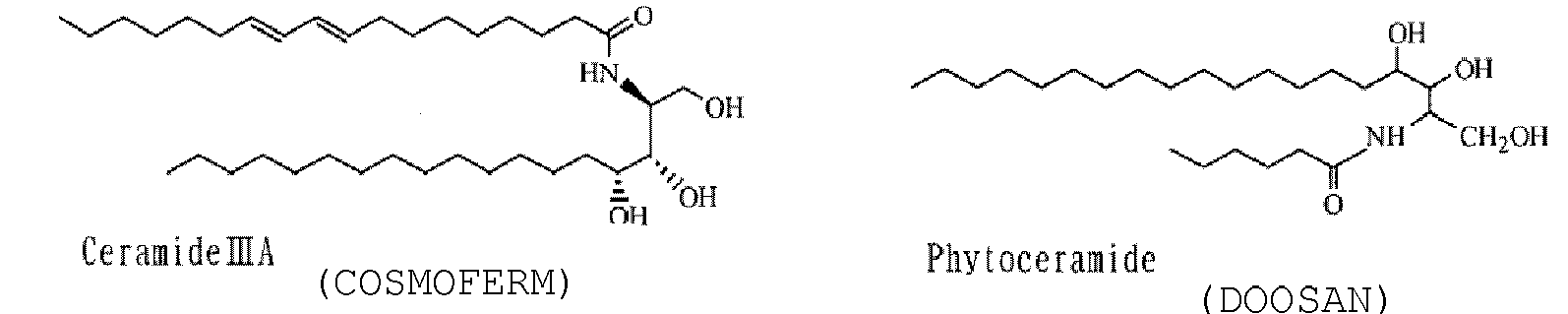
Examples of such the commercially available natural type ceramides include Ceramide I, Ceramide III, Ceramide IIIA, Ceramide IIIB, Ceramide IIIC, and Ceramide VI (COSMOFERM); Ceramide TIC-001 (Takasago International Corporation); CERAMIDE II (Quest International); DS-Ceramide VI, DS-CLA-Phytoceramide, C6-Phytoceramide, and DS-ceramide Y3S (DOOSAN); and CERAMIDE 2 (Sederma).


- (II): Pseudo-ceramide represented by formula (4):

- R16 is preferably nonyl, tridecyl, pentadecyl, undecyl to which linoleic acid is bonded at the ω-position thereof via ester bonding, pentadecyl to which linoleic acid is bonded at the ω-position thereof via ester bonding, pentadecyl to which 12-hydroxystearic acid is bonded at the ω-position thereof via ester bonding, or undecyl to which methyl-branched isostearic acid is bonded at the ω-position thereof via amide bonding.
- When R15 is a hydrogen atom, R17 is an alkyl group optionally substituted by a hydroxyl group, a hydroxyalkoxy group, an alkoxy group, or an acetoxy group and containing 10 to 30 (preferably 12 to 20) carbon atoms in total. When R15 is a C10 to C22 linear, branched, or cyclic, saturated or unsaturated hydrocarbon group which may be substituted by a hydroxyl group, R17 is preferably a hydrogen atom or an alkyl group optionally substituted by a hydroxyl group, a hydroxyalkoxy group, an alkoxy group, or an acetoxy group and containing 1 to 8 carbon atoms in total. The hydroxyalkoxy or alkoxy group in R17 preferably contains 1 to 7 carbon atoms.


- Preferred pseudo-ceramides represented by formula (4) are the case where R15 is hexadecyl, X9 is a hydrogen atom, R16 is pentadecyl, and R17 is hydroxyethyl; the case where R15 is hexadecyl, X9 is a hydrogen atom, R16 is nonyl, and R17 is hydroxyethyl; and the case where R15 is hexadecyl, X9 is glyceryl, R16 is tridecyl, and R17 is 3-methoxypropyl. More preferred pseudo-ceramide represented by formula (4) is the case where R15 is hexadecyl, X9 is a hydrogen atom, R16 is pentadecyl, and R17 is hydroxyethyl (i.e., N-(hexadecyloxyhydroxypropyl)-N-hydroxyethylhexadecanamide).


- One or more compounds serving as ingredient (C) may be used. The total content of ingredient (C) is 0.001 to 10 wt.%, preferably 0.05 to 7 wt.%, more preferably 0.1 to 5 wt.%, in the total composition, for attaining sufficient skin permeation of ingredient (C).
- In the present invention, the weight ratio of ingredients (A), (B), and (C) has the following relationship: ((A)+(B))/((A)+(B)+(C)) (by weight) of 0.15 to 0.8, more preferably 0.35 to 0.8, from the viewpoint of enhancing storage stability of α-gel.
- The weight ratio of ingredients (A) and (B) preferably have the following relationship: (A)/((A)+(B)) (by weight) of 0.1 or more, more preferably 0.25 to 0.75, since stable α-gel structure is formed, to thereby enhance water retention.
- The ingredient (D) employed in the present invention is at least one compound selected from the group consisting of a nonionic surfactant having a polyoxyethylene group and an HLB of 10 or more, an ionic surfactant, and a sphingosine salt.
- Among the compounds serving as ingredient (D), the nonionic surfactant is a hydrophilic compound having a polyoxyethylene group and an HLB of 10 or more, preferably an HLB of 12.5 to 15.5. Examples of the non-ionic compound include polyoxyethylene hydrogenated castor oil, polyoxyethylene sorbitan fatty acid ester, alkylpolyoxyethylene glyceryl, and polyoxyethylene alkyl ether.
- Of these, polyoxyethylene hydrogenated castor oil and polyoxyethylene sorbitan monostearate are preferred.
- Among the compounds serving as ingredient (D), the ionic surfactant is an anionic surfactant, a cationic surfactant, or an ampholytic surfactant.
- Examples of the anionic surfactant include C12 to C24 fatty acid salts such as sodium laurate, potassium palmitate, and arginine stearate; alkyl sulfate ester salts such as sodium lauryl sulfate and potassium lauryl sulfate; alkyl ether sulfate ester salts such as polyoxyethylene lauryl sulfate triethanolamine salt; N-acylsarcosine salts such as lauroyl sarcosine sodium salt; fatty acid amide sulfonate salts such as sodium methyl stearoyl taurate(N-stearoyl-N-methyltaurine sodium salt) and sodium methyl myristoyl taurate(N-myristoyl-N-methyltaurine sodium salt); alkyl phosphate salts such as sodium monostearyl phosphate; polyoxyethylene alkyl ether phosphate salts such as sodium polyoxyethylene oleyl ether phosphate and sodium polyoxyethylene stearyl ether phosphate; long-chain sulfosuccinate salts such as sodium di-2-ethylhexylsulfosuccinate; and long-chain N-acylglutamate salts such as monosodium N-lauroylglutamate, sodium N-stearoyl-L-glutamate, arginine N-stearoyl-L-glutamate, sodium N-stearoylglutamate, and sodium N-myristoyl-L-glutamate.
- Among them, C12 to C24 fatty acid salts, fatty acid amidesulfonate salts, polyoxyethylene alkyl ether phosphate salts, and long-chain N-acylglutamate salts are preferred, with sodium methyl stearoyl taurate(N-stearoyl-N-methyltaurine sodium salt), arginine N-stearoyl-L-glutamate, and sodium polyoxyethylene stearyl ether phosphate being more preferred.
- The cationic surfactant is preferably a quaternary ammonium salt. Examples include alkyltrimethylammonium salts such as stearyl trimethylammonium chloride and lauryl trimethylammonium chloride; dialkyldimethylammonium salts; trialkylmethylammonium salts; and alkylamine salts.
- Examples of the ampholytic surfactant include alkyldimethylamine oxide, alkylcarboxybetaine, alkylsulfobetaine, amideamino acid salts, and alkylamidepropylbetaine. Of these, alkylamidepropylbetaine is preferred.
- Among the compounds serving as ingredient (D) employed in the present invention, the sphingosine salt is formed of a sphingosine and an acidic substance. Examples of the sphingosine include those represented by formula (5):

- In formula (5), R21 is C4 to C30 linear, branched, or cyclic, saturated or unsaturated hydrocarbon group which may be substituted by a hydroxyl group, a carbonyl group, or an amino group, and R21 represents preferably a C7 to C22 linear, branched, or cyclic, saturated or unsaturated hydrocarbon group which may be substituted by a hydroxyl group. Also preferred are a C10 to C20 linear or branched alkyl group and a C10 to C20 linear or branched alkyl group having a hydroxyl group on the carbon atom bonding to Y in formula (5), wherein when the alkyl is of a branched type, the branched alkyl is preferably, for example, a methyl branching fashion alkyl. Specific examples of preferred alkyl groups include tridecyl, tetradecyl, pentadecyl, hexadecyl, 1-hydroxytridecyl, 1-hydroxypentadecyl, isohexadecyl, and isostearyl.
- Y represents a methylene group (CH2), a methine group (CH), or an oxygen atom.
- Each of X11, X12, and X13 is a hydrogen atom, a hydroxyl group, or an acetoxy group. X14 is a hydrogen atom, an acetyl group, or a glyceryl group, or a substituent which forms an oxo group together with the adjacent oxygen atom. In a preferred embodiment, all of X11, X12, and X13 are not a hydroxyl group, or one of X11, X12, and X13 is a hydroxyl group, and the remaining groups are a hydrogen atom, and X14 is a hydrogen atom. When Y is a methine group, one of X11 and X12 is a hydrogen atom, and the other is absent. When X14 forms an oxo group, X13 is absent.
- Each of R22 and R23 is a hydrogen atom, a hydroxyl group, a hydroxymethyl group, or an acetoxymethyl group. R23 is preferably a hydrogen atom.
- The symbol "a" is a number of 2 or 3. When a is 2, R1 correspond to R24 and R25, and when a is 3, R1 correspond to R24, R25, and R26.
- Each of R24, R25, and R26 represents a hydrogen atom, an amidino group, or a linear or branched, saturated or unsaturated hydrocarbon group optionally having a substituent selected from the group consisting of a hydroxyl group, a hydroxyalkoxy group, an alkoxy group, and an acetoxy group and containing 1 to 8 carbon atoms in total. The hydroxyalkoxy group which can serve as a substituent of the hydrocarbon group is preferably a C1 to C7 linear or branched hydroxyalkoxy group. The alkoxy group is preferably a C1 to C7 linear or branched alkoxy group. Examples of R24, R25, and R26 include hydrocarbon groups each having 1 to 8 carbon atoms in total and being substituted by 1 to 6 substituents. Examples of the substituents include a hydrogen atom; linear or branched alkyl groups such as methyl, ethyl, propyl, 2-ethylhexyl, and isopropyl; alkenyl groups such as vinyl and allyl; an amidino group; hydroxyl groups such as hydroxymethyl, 2-hydroxyethyl, 1,1-dimethyl-2-hydroxyethyl, 2-hydroxypropyl, 2,3-dihydroxypropyl, 2-hydroxy-3-methoxypropyl, 2,3,4,5,6-pentahydroxyhexyl, 1,1-bis(hydroxymethyl)ethyl, 2-(2-hydroxyethoxy)ethyl, 2-methoxyethyl, 1-methyl-2-hydroxyethyl, 3-hydroxypropyl, 3-methoxypropyl, and 1,1-bis(hydroxymethyl)-2-hydroxyethyl; hydroxyalkoxy groups, and alkoxy groups.
- Among them, more preferred are a hydrogen atom and alkyl groups each being substituted by 1 to 3 groups selected from the group consisting of methyl, hydroxyl groups such as 2-hydroxyethyl, 1,1-dimethyl-2-hydroxyethyl, 1,1-bis(hydroxymethyl)ethyl, and 2-(2-hydroxyethoxy)ethyl, and hydroxyalkoxy groups.
- The sphingosine represented by formula (5) is preferably a naturally occurring sphingosine represented by formula (6), a synthetic product having the same structure, or a derivative of any of these (hereinafter referred to as natural-type sphingosine); or a pseudo-sphingosine represented by formula (7) having a sphingosine structure (hereinafter referred to as pseudo-sphingosine).
- (I) Natural-type sphingosine represented by formula (6) :

R27 is preferably a C7 to C19 linear, branched, or cyclic, saturated or unsaturated hydrocarbon group, more preferably a C13 to C15 linear, saturated or unsaturated hydrocarbon group. The number "a" is preferably 2. Each of R2s is preferably a hydrogen atom or a C1 to C4 linear or branched alkyl group.
Specific examples of the natural-type sphingosine represented by formula (6) include sphingosine, dihydrosphingosine, phytosphingosine, sphingadienine, dehydrosphingosine, and dehydrophytosphingosine, and N-alkyl derivatives thereof (e.g., N-methyl derivatives).
Regarding these sphingosines, either a natural-type optically active form (D(+) form) or a non-natural-type optically active form (L(-) form) may be used. Furthermore, a mixture of a natural-type form and a non-natural-type form may also be used. The relative configuration of the aforementioned compound may be ones of natural-type, of non-natural-type, or of mixed type.
Examples of preferred sphingosines further include phytosphingosine (INCI name; 8th Edition) and the compounds represented by the following formulas.





These compounds may be a natural extract or a synthetic compound, and a commercial product thereof may be used.
Examples of the commercial product of natural-type sphingosine include D-sphingosine (4-sphingenine) (product of SIGMA-ALDRICH), DS-phytosphingosine (product of DOOSAN), and phytosphingosine (product of COSMOFERM). - (II) Pseudo-sphingosine represented by formula (7)

- In formula (7), R29 is preferably a C14 to C20 iso-type branched alkyl group, more preferably an isostearyl group. The isostearyl group is preferably an isostearyl group derived from a raw material oil; i.e., isostearyl alcohol which is a by-product obtained in production of dimeric acid from a fatty acid originating from animal or vegetable oil.
- When a is 2, R3 represents R30 and R31, whereas when a is 3, R3 represents R30, R31, and R32.
- Examples of the groups R30, R31, and R32 include a hydrogen atom; linear or branched alkyl groups such as methyl, ethyl, propyl, 2-ethylhexyl, and isopropyl; alkenyl groups such as vinyl and allyl; an amidino group; and alkyl groups having 1 to 8 carbon atoms in total and a substituent selected from the group consisting of hydroxyl groups such as hydroxymethyl, 2-hydroxyethyl, 1,1-dimethyl-2-hydroxyethyl, 2-hydroxypropyl, 2,3-dihydroxypropyl, 2-hydroxy-3-methoxypropyl, 2,3,4,5,6-pentahydroxyhexyl, 1,1-bis(hydroxymethyl)ethyl, 2-(2-hydroxyethoxy)ethyl, 2-methoxyethyl, 1-methyl-2-hydroxyethyl, 3-hydroxypropyl, 3-methoxypropyl, and 1,1-bis(hydroxymethyl)-2-hydroxyethyl, hydroxyalkoxy groups, and alkoxy groups.
- Among them, preferred is a secondary amine in which one of R30 and R31 is a hydrogen atom, and the other is 2-hydroxyethyl, 1,1-dimethyl-2-hydroxyethyl, 1,1-bis(hydroxymethyl)ethyl, or 2-(2-hydroxyethoxy)ethyl.
- The pseudo-sphingosine is preferably one in which R29 is an isostearyl group, X19 is a hydrogen atom, R30 is a hydrogen atom, and R31 is an alkyl group which is substituted by 1 to 3 substituents selected from the group consisting of hydroxyl groups such as 2-hydroxyethyl, 1,1-bis(hydroxymethyl)ethyl, 1,1-dimethyl-2-hydroxyethyl, and 2-(2-hydroxyethoxy)ethyl and hydroxyalkoxy groups.
- Specific examples of the pseudo-sphingosine include the following pseudo-sphingosines (i) to (iv).


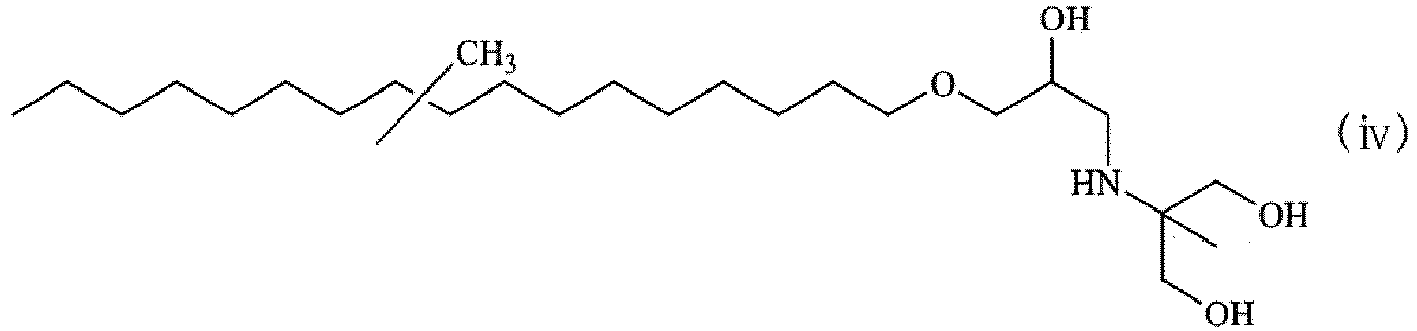
- The sphingosine is preferably sphingosine, phytosphingosine, or pseudo-sphingosine, more preferably pseud-sphingosine (ii) or 1-(2-hydroxyethylamino)-3-isostearyloxy-2-propanol.
- Examples of the acidic substance which forms salts with the aforementioned sphingosines, phytosphingosines, and pseudo-sphingosines include acidic amino acids such as glutamic acid and aspartic acid; inorganic acids such as phosphoric acid and hydrochloric acid; monocarboxylic acids such as acetic acid; dicarboxylic acids such as succinic acid; and hydroxycarboxylic acids such as citric acid, lactic acid, and malic acid. Among the aforementioned salts, salts of sphingosines, phytosphingosines, and pseudo-sphingosines (pseudo-sphingosine (ii), 1-(2-hydroxyethylamino)-3-isostearyloxy-2-propanol) with succinic acid, lactic acid, and glutamic acid are preferred, with glutamic acid salts of sphingosines, phytosphingosines, and pseudo-sphingosines being more preferred.
- As ingredient (D), an anionic surfactant or a sphingosine salt is preferably used, since repulsion between electric charges results in retention of a large amount of water in interlayer spaces of the lamellar structure, leading to high water retention. Among the anionic surfactant and the sphingosine salt, preferred are sodium methyl stearoyl taurate (N-stearoyl-N-methyltaurine sodium salt), sodium polyoxyethylene stearyl ether phosphate, arginine N-stearoyl-L-glutamate, phytosphingosine glutamic acid salt, and pseudo-sphingosine glutamic acid salt, since these compounds form a stable emulsion in a small amount of addition thereof.
- One or more species of ingredient (D) may be used. The content of ingredient (D) is 0.00012 to 10 wt.%. Preferably, the content of ingredient (D) is 0.01 to 7 wt.%, more preferably 0.2 to 3 wt.%, in the total composition, since the interlayer spacing of the lamellar structure formed from ingredients (A), (B), and (C) can be increased, to thereby form such a structure that a large amount of water can be retained in interlayer spaces.
- The sugar alcohol serving as ingredient (E) of the present invention is selected from the group consisting of erythritol, threitol, xylitol, and mannitol. Of these, xylitol is preferred.
- Examples of disaccharide and trisaccharide include trehalose, galactosylfructose, sucralose, melibiose, raffinose, and lactose. Of these, trehalose and raffinose are preferred, with trehalose being more preferred.
- One or more species of ingredient (E) may be used. That is, sugar alcohol, disaccharide, and/or trisaccharide may be used in combination.
- The content of ingredient (E) is 0.003 to 15 wt.%, in the total composition, from the viewpoint of attaining satisfactorily high water retention.
- In the case of sugar alcohol, the content of sugar alcohol is preferably 0.003 to 10 wt.%, more preferably 0.01 to 5 wt.%, even more preferably 0.1 to 3 wt.%, in the total composition.
- In the case of disaccharide or trisaccharide, the content of disaccharide or trisaccharide is preferably 0.018 to 15 wt.%, more preferably 0.1 to 10 wt.%, even more preferably 0.5 to 7 wt.%, in the total composition.
- In the present invention, a preferable relationship of the weight ratio of ingredients (A), (B), (C) and (E) is (E)/((A)+(B)+(C)) (by weight) being preferably 0.01 to 5, since water (bound water and free water) can be firmly retained in interlayer spaces of the structure formed from ingredients (A), (B), (C), and (D), thereby remarkably enhancing water retention.
- In the case where ingredient (E) is sugar alcohol, (E)/((A)+(B)+(C)) is preferably 0.01 to 3, more preferably 0.125 to 2.5. In the case of disaccharide or trisaccharide, (E)/((A)+(B)+(C)) is preferably 0.2 or more, more preferably 0.6 to 5.
- Incorporation of ingredient (E) into the composition of the invention is preferred, since the lamellar structure formed from ingredients (A), (B), and (C) is stabilized, and the composition forms, on the dried skin, a soft coating layer having the same lamellar structure as the intercellular lamellar structure, whereby the skin water retention can be enhanced, to thereby provide users with long-lasting moistness.
- (D)/((A)+(B)+(C)) is preferably 0.04 to 1, more preferably 0.04 to 0.5, since ingredient (C) permeability can be enhanced, whereby a moisturizing effect can be attained at the skin surface and the inside of the skin.
- In the present invention, the composition preferably has an ingredient (F) (i.e., water) content of 20 to 99.9 wt.%, more preferably 40 to 95 wt.%, even more preferably 50 to 90 wt.%.
- The composition of the present invention may further contain other aqueous base materials, for example, a C1 to C4 lower alcohol such as ethanol or propanol.
- In the present invention, more preferably, the aforementioned preferred ingredients are employed in combination in the aforementioned preferred amounts. In more preferred embodiment, the composition contains glyceryl monobehenate or monocetyl glyceryl ether as ingredient (A), cetanol as ingredient (B), a compound represented by formula (2) as ingredient (C), stearoylglutamic acid salt or sphingosine salt as ingredient (D), xylitol as ingredient (E), and water as ingredient (F).
- The emulsion composition of the present invention may further contain an oily ingredient. Examples of the oily ingredient include hydrocarbon oils such as liquid paraffin, squalane, and petrolatum; ether oils such as cetyl dimethylbutyl ether, ethylene glycol dioctyl ether, and glycerol monooleyl ether; ester oils such as octyl dodeyl myristate, isopropyl palmitate, butyl stearate, di-2-ethylhexyl adipate, neopentyl glycol dicaprate, and trioctanoin; higher fatty acids such as stearic acid, behenic acid, and isomyristic acid; vegetable oil such as olive oil; silicone oils such as dimethylpolysiloxane, cyclic dimethylpolysiloxane, methylphenylpolysiloxane, amino-modified silicone, carboxy-modified silicone, alcohol-modified silicone, alkyl-modified silicone, polyether-modified silicone, and fluorine-modified silicone; and fluorine-containing oils such as perfluoroalkylethylphosphoric acid, perfluoroalkylpolyoxyethylenephosphoric acid, perfluoropolyether, and polytetrafluoroethylene. The composition of the invention preferably has an oily ingredient content of 0 to 20 wt.% in the total composition.
- The emulsion composition of the present invention may further contain active ingredients or additives which are employed in typical cosmetics. Examples of such ingredients and additives include water-soluble vitamins such as ascorbic acid, nicotinamide, and nicotinic acid; animal and vegetable extracts such as Phellodendoron Amurense extract, licorice extract, aloe extract, horsetail extract, tea extract, cucumber extract, clove extract, ginseng extract, witch hazel extract, placenta extract, seaweed extract, horse chestnut extract, Japanese citron (Yuzu) extract, thujopsis dolabrata extract, royal jelly extract, eucalyptus extract, and thujopsis dolabrata extract solution; bases such as potassium hydroxide, sodium hydroxide, triethanolamine, and sodium carbonate; acids such as citric acid, tartaric acid, lactic acid, phosphoric acid, succinic acid, and adipic acid; and thickening agents such as carboxyvinyl polymer, sodium arginate, carrageenan, carboxymethylcellulose, hydroxyethylcellulose, guar gum, xanthan gum, carboxymethylchitosan, sodium hyaluronate, oxazoline-modified silicone, N,N-dimethylaminoethyl methacrylate diethylsulfate salt-N,N-dimethylacrylamide-polyethylene glycol dimethacrylate copolymer.
- The emulsion composition of the present invention may be produced through any of production methods (1) to (3):
- Production method (1): emulsification through mixing ingredients (A) to (D) (in the case of the composition containing an oily ingredient, a mixture of ingredients (A) to (D) and the oily ingredient) with an aqueous phase including ingredients (E) and (F);
- Production method (2): emulsification through mixing ingredients (A) to (E) (in the case of the composition containing an oily ingredient, a mixture of ingredients (A) to (E) and the oily ingredient) with an aqueous phase including ingredient (F); and
- Production method (3): emulsification through mixing a mixture of ingredients (A) to (D) (in the case of the composition containing an oily ingredient, a mixture of ingredients (A) to (D) and the oily ingredient) and a portion of ingredient (E) with an aqueous phase including the remaining ingredient (E) and ingredient (F).
- Production method (2) is more preferred as compared with production method (1), since the emulsion composition produced through production method (2) has higher water retention.
- The thus-produced emulsion composition assumes α-gel (a-type crystal), with deposition of γ-type crystals being prevented. α-Gel can be identified through X-ray structure analysis. α-Type structure is a hexagonal crystal structure type, in which a lipophilic group is arranged normal to the hydrophilic group layer, with one characteristic diffraction peak at a Bragg angle of 21 to 23°.
- Also, the emulsion composition of the present invention is an O/W-type emulsion composition and is suited for producing, for example, cosmetics such as skin lotion, milky lotion, cream, and gel, or an agent for skin external use. Examples
- O/W emulsion compositions having formulations shown in Tables 1 and 2 were produced. The thus-produced compositions were subjected to X-ray structural analysis and remaining water content measurement. Also, the film formability of each composition was assessed. The results are also shown in Tables 1 and 2.
- Through observation under a transmission electron microscope, the coating films produced in the Examples were found to have a lamellar structure.
- Phase I ingredients (mixture containing ingredients (A) to (D)) were heated and mixed at 80 to 95°C. Under propeller-stirring (300 rpm), phase II ingredients (mixture containing ingredients (E) and (F)), which had been heated to 80 to 95°C, were added to the phase I ingredients, to thereby form an emulsion. The emulsion was gradually cooled to 25°C, to thereby yield an O/W emulsion composition.
-
- (1) X-ray structure analysis
The crystal structure of each of the thus-prepared O/W emulsion compositions was determined from wide angle X-ray diffraction peaks (2θ = 10 to 30°) according to Wilson's & Ott's method (Wilson, D. A. and Ott, E., J. Chem. Phys., 2, 231-238 (1934)). - (2) Remaining water content measurement:
Each O/W emulsion composition (2 g) was spread on a metal tray (6 × 6 cm), to thereby form a layer having a uniform thickness. Under constant temperature and humidity conditions (25°C, 40%), the weight of the layer was monitored. The measurements were plotted to time. As shown inFig. 1 , the drawn curve was bent at two points. When a lamellar film is formed, the subsequent change in weight will be minimized. The weight value at the crossing betweenlines Fig. 1 was employed as the remaining water content. The water content of the solid of each composition (preparation) was calculated by the following equation (the solid containing ingredients (A) to (E)):

- (3) Film formability:
Each agent (5 g) was placed in a Petri dish (diameter: 5 cm) made of Teflon (registered trademark), and uniformly spread. The agent was dried for two days, and the state of the film was observed. - A: Formation of soft coating film
- B: Formation of hard and fragile coating film
- C: Formation of coating film failed
- In a manner similar to that employed in Examples 1 to 10, O/W emulsion compositions having formulations shown in Table 3 were produced. The small angle X-ray scattering intensity of each composition was monitored. The intensity was compared with that of the composition of Comparative Example 9. Table 3 shows the results.
[Table 3] Ingredients (wt.%) Ex. Comp. Ex. 11 9 10 11 Phase I D 1-(2-Hydroxyethylamino)-3-isostearyloxy-2-propanol 0.4 0.4 0.4 0.4 C Pseudo-ceramide* 6 6 6 6 B Cetanol 2 2 2 2 A Monocetyl glyceryl ether 2 2 2 2 Phae II F Water bal. bal. bal. bal. L-Glutamic acid 0.24 0.24 0.24 0.24 E Xylitol 3 Trimethylglycine 3 Glycerin 3 Total 100 100 100 100 ((A)+(B))/((A)+(B)+(C)) 0.4 0.4 0.4 0.4 (A)/((A)+(B)) 0.5 0.5 0.5 0.5 (E)/((A)+(B)+(C)) 0.3 - - - Small angle X-ray scattering intensity increase no change no change *: N-(Hexadecyloxyhydroxypropyl)-N-hydroxyethylhexadecanamide - As is clear from Table 3, the composition of Example 11 exhibited an increase in small angle X-ray scattering intensity, indicating that the lamellar structure has high order.
- In a manner similar to that employed in Examples 1 to 10, O/W emulsion compositions having formulations shown in Table 4 were produced. The thus-produced compositions were subjected to X-ray structural analysis and evaluated in terms of remaining water content and film formability. The skin permeability of each composition and lasting of moist skin attained by the composition were assessed. The results are also shown in Table 4.
- The emulsion compositions were tested by 10 expert panelists. Specifically, each emulsion composition (0.5 to 0.6 g) was applied to the face of each panelist. The "skin permeation sensation" immediately after application of the composition and "lasting of moist skin" 10 hours after application thereof were sensorily evaluated by the panelists. The evaluation was scores represented by the number of panelists who gave a rating of "satisfactory."
[Table 4](1/2) Ingredients (wt.%) Ex. 12 13 14 15 16 17 Phase I D 1-(2-Hydroxyethylamino)-3-isostearyloxy-2-propanol 0.2 0.2 D Stearoylglutamic acid 0.5 0.5 D Sodium methyl stearoyl taurate 0.5 D Polyoxyethylene(20) sorbitan monostearate (HLB 14.9) 2 Hydrogenated lecithin 1 C Pseudo-ceramide* 2 2.5 3 1 1 1 Stearic acid B Cetanol 1 1 1 1.5 1 3 B Cholesterol A Glyceryl monostearate A Glyceryl monobehenate 1.5 1 A Monostearyl glyceryl ether 2.5 3 A Monocetyl glyceryl ether 2 A Sorbitan monostearate 1 A Sorbitan distearate 0.5 Phase II F Water bal. bal. bal. bal. bal. bal. L-Arginine 0.35 L-Glutamic acid 0.12 0.12 E Xylitol 1 1 1 1 1 1 Total 100 100 100 100 100 100 ((A)+(B))/((A)+(B)+(C)) 0.6 0.5 0.4 0.8 0.8 0.8 (A)/((A)+(B)) 0.67 0.6 0.5 0.63 0.75 0.3 (E)/((A)+(B)+(C)) 0.2 0.2 0.2 0.2 0.2 0.2 X-ray structure analysis α-type α-type α-type α-type α-type α-type Remaining water content (%) 64.6 63.3 61.5 59.9 57.7 60.2 Film formability A A A A A A Permeation sensation 10 10 9 9 8 8 Lasting of moist skin 10 9 9 8 7 8 *: N-(Hexadecyloxyhydroxypropyl)-N-hydroxyethylhexadecanamide [Table 4](2/2) Ingredients (wt.%) Comp. Ex. 12 13 14 15 16 17 18 19 20 21 Phase I D 1-(2-Hydroxyethylamino)-3-isostearyloxy-2-propanol 0.2 0.2 0.2 0.2 D Stearoylglutamic acid 0.5 D Sodium methyl stearoyl taurate 0.5 0.3 D Polyoxyethylene(20) sorbitan monostearate (HLB 14.9) 2 2.3 Hydrogenated lecithin 1 1.5 C Pseudo-ceramide* 2 2.5 3 1 1 3 Stearic acid 3 B Cetanol 1 1 1 1.5 1 2.5 2 1.8 2 B Cholesterol 2.5 1 A Glyceryl monostearate 3.2 A Glyceryl monobehenate 1.5 A Monostearyl glyceryl ether 2.5 3 4 A Monocetyl glyceryl ether 2 A Sorbitan monostearate 1 A Sorbitan distearate Phase II F Water bal. bal. bal. bal. bal. bal. bal. bal. bal. bal. L-Arginine 0.35 L-Glutamic acid 0.12 0.12 0.12 0.12 E Xylitol 1 1 1 1 1 Total 100 100 100 100 100 100 100 100 100 100 ((A)+(B))/((A)+(B)+(C)) 0.6 0.5 0.4 0.8 0.8 1 0.4 1 0.4 1 (A)/((A)+(B)) 0.67 0.6 0.5 0.63 0.75 - - 0.64 - 0.8 (E)/((A)+(B)+(C)) - - - - - 0.2 0.2 0.2 0.2 0.2 X-ray structure analysis α-type α-type α-type α-type α-type γ-type α-type α-type α-type α-type Remaining water content (%) 59.1 58.7 57.1 57 55.1 10.8 32.6 52.6 20.8 16.3 Film formability B B B B B C B B B C Permeation sensation 7 6 8 7 7 3 6 7 5 1 Lasting of moist skin 6 4 5 4 4 3 5 4 3 2 *: N-(Hexadecyloxyhydroxypropyl)-N-hydroxyethylhexadecanamide - In a manner similar to that employed in Examples 1 to 10, O/W emulsion compositions having formulations shown in
- Tables 5 to 9 were produced. The thus-produced compositions were subjected to X-ray structural analysis and evaluated in terms of remaining water content. The skin permeability and lasting of moist skin attained by each composition were assessed. The results are also shown in Tables 5 to 9. Examples 29 and 38 are Reference Examples that are not covered by the appended claims.
[Table 5](1/2) Ingredients (wt.%) Ex. 18 19 20 21 22 Phase I D 1-(2-Hydroxyethylamino)-3-isostearyloxy-2-propanol 0.2 0.2 D Stearoylglutamic acid 0.5 D Sorium methyl stearoyl taurate 0.5 D Polyoxyethylene(20) sorbitan monostearate (HLB 14.9) 2 Hydrogenated lecithin 1 C Pseudo-ceramide* 2 2.5 3 1 1 Stearic acid B Cetanol 1 1 1 1.5 1 B Cholesterol A Glyceryl monostearate A Glyceryl monobehenate 1.5 A Monostearyl glyceryl ether 2.5 3 A Monocetyl glyceryl ether 2 A Sorbitan monostearate 1 Phase II F Water bal. bal. bal. bal. bal. L-Arginine 0.35 L-Glutamic acid 0.12 0.12 E Trehalose 5 5 5 5 5 Total 100 100 100 100 100 ((A)+(B))/((A)+(B)+(C)) 0.6 0.5 0.4 0.8 0.8 (A)/((A)+(B)) 0.7 0.6 0.5 0.6 0.8 (E)/((A)+(B)+(C)) 1.0 1.0 1.0 1.0 1.0 X-ray structure analysis α-type α-type α-type α-type α-type Remaining water content (%) 67.53 67.58 66.25 62.97 60.50 Permeation sensation 9 9 9 8 8 Lasting of moist skin 10 9 9 8 6 *: N-(Hexadecyloxyhydroxypropyl)-N-hydroxyethylhexadecanamide [Table 5](2/2) Ingredients (wt.%) Comp. Ex. 22 23 24 25 26 27 28 29 30 31 Phase I D 1-(2-Hydroxyethylamino)-3-isostearyloxy-2-propanol 0.2 0.2 0.2 0.2 D Stearoylglutamic acid 0.5 D Sorium methyl stearoyl taurate 0.5 0.3 D Polyoxyethylene(20) sorbitan monostearate (HLB 14.9) 2 2.3 Hydrogenated lecithin 1 1.5 C Pseudo-ceramide* 2 2.5 3 1 1 3 Stearic acid 3 B Cetanol 1 1 1 1.5 1 2.5 2 1.8 2 B Cholesterol 2.5 1 A Glyceryl monostearate 3.2 A Glyceryl monobehenate 1.5 A Monostearyl glyceryl ether 2.5 3 4 A Monocetyl glyceryl ether 2 A Sorbitan monostearate 1 Phase II F Water bal. bal. bal. bal. bal. bal. bal. bal. bal. bal. L-Arginine 0.35 L-Glutamic acid 0.12 0.12 0.12 0.12 E Trehalose 5 5 5 5 5 Total 100 100 100 100 100 100 100 100 100 100 ((A)+(B))/((A)+(B)+(C)) 0.6 0.5 0.4 0.8 0.8 - 0.7 1.0 - 1.0 (A)/((A)+(B)) 0.7 0.6 0.5 0.6 0.8 - - 0.6 - 0.8 (E)/((A)+(B)+(C)) - - - - - 1.0 1.7 1.0 2.5 1.0 X-ray structure analysis α-type α-type α-type α-type α-type γ-type α-type α-type α-type α-type Remaining water content (%) 59.13 58.65 57.13 56.99 55.10 24.32 41.35 56.04 28.50 23.04 Permeation sensation 7 6 8 7 7 3 6 2 4 7 Lasting of moist skin 5 5 4 4 4 8 4 1 4 1 *: N-(Hexadecyloxyhydroxypropyl)-N-hydroxyethylhexadecanamide [Table 6] Ingredients (wt.%) Ex. Comp. Ex. 23 24 25 26 27 28 29‡ 30 31 32 Phase I D 1-(2-Hydroxyethylamino)- 3-isostearyloxy-2-propanol 0.13 0.25 0.1 0.2 2 0.25 0.2 0.4 1.2 0.2 C Pseudo-ceramide* 2.8 4 1 3 0.5 0.1 0.1 0.2 0.2 11 B Cetanol 0.45 1.6 0.5 1 1 0.1 1 0.4 0.4 0.5 A Glyceryl monobehenate 0.05 0.55 0.5 1 0.5 0.3 1 0.4 0.4 0.05 Phase II F Water bal. bal. bal. bal. bal. bal. bal. bal. bal. bal. L-Glutamic acid 0.078 0.15 0.06 0.12 1.2 0.15 0.12 0.24 0.72 0.12 E Xylitol 0.04 0.8 1 1 3 1.25 1 3 3 0.04 Total 100 100 100 100 100 100 100 100 100 100 ((A) + (B)) / ((A) + (B) + (C)) 0.15 0.35 0.5 0.4 0.8 0.8 0.95 0.8 0.8 0.05 (A) / ((A) + (B)) 0.1 0.26 0.5 0.5 0.33 0.75 0.5 0.5 0.5 0.09 (E) / ((A) + (B) + (C)) 0.01 0.13 0.5 0.2 1.5 2.5 0.48 3.0 3.0 0.003 X-ray structure analysis α-type α-type α-type α-type α-type α-type α-type α-type α-type γ-type Remaining water content (%) 58.1 59.5 62.9 61.5 65.3 60.6 55.0 57.1 58.2 13.4 Film formability A A A A A A A A A C Permeation sensation 7 8 9 10 8 9 8 7 7 4 Lasting of moist skin 7 9 10 10 10 8 7 7 8 1 ‡: Reference example; *: N-(Hexadecyloxyhydroxypropyl)-N-hydroxyethylhexadecanamide [Table 7] Ingredients (wt.%) Ex. Comp. Ex. 32 33 34 35 36 37 38‡ 39 40 33 Phase I D 1-(2-Hydroxyethylamino)-3-isostearyloxy-2-propanol 0.13 0.25 0.1 0.5 2 0.25 0.2 0.2 1.2 0.2 C Pseudo-ceramide* 2.8 4 1 3 0.5 0.1 0.1 0.2 0.2 11 B Cetanol 0.45 1.6 0.5 1 1 0.1 1 0.4 0.4 0.5 A Glyceryl monobehenate 0.05 0.55 0.5 1 0.5 0.3 1 0.4 0.4 0.05 Phase II F Water bal. bal. bal. bal. bal. bal. bal. bal. bal. bal. L-Glutamic acid 0.078 0.15 0.06 0.12 1.2 0.15 0.12 0.12 0.72 0.12 E Trehalose 0.7 3.7 2 4 3 2.5 2 4 3 0.04 Total 100 100 100 100 100 100 100 100 100 100 ((A) + (B)) / ((A) + (B) + (C)) 0.15 0.35 0.5 0.4 0.8 0.8 0.95 0.8 0.8 0.07 (A) / ((A) + (B)) 0.1 0.26 0.5 0.5 0.33 0.75 0.5 0.5 0.5 0.09 (E) / ((A) + (B) + (C)) 0.21 0.60 1.0 0.8 1.5 5.0 0.95 4.0 3.0 0.003 X-ray structure analysis α-type α-type α-type α-type α-type α-type α-type α-type α-type γ-type Remaining water content (%) 57.4 60.2 63.3 67.2 66.9 61.7 55.5 62.5 61.1 14.8 Film formability A A A A A A A A A C Permeation sensation 7 8 10 10 8 9 7 7 7 5 Lasting of moist skin 7 9 10 10 9 8 7 8 8 3 ‡: Reference example; *: N-(Hexadecyloxyhydroxypropyl)-N-hydroxyethylhexadecanamide [Table 8] Ingredients (wt.%) Ex. 41 42 43 44 45 Phase I D 1-(2-Hydroxyethylamino)-3-isostearyloxy-2-propanol 0.01 0.2 3 7 10 C Pseudo-ceramide* 0.05 0.1 5 7 10 B Cetanol 0.05 0.1 3 7 10 A Glyceryl monobehenate 0.05 0.3 3 7 10 Phase II F Water bal. bal. bal. bal. bal. L-Glutamic acid 0.006 0.12 1.8 4.2 6 E Xylitol 0.01 0.1 3 5 10 Total 100 100 100 100 100 ((A) + (B)) / ((A) + (B) + (C)) 0.67 0.8 0.55 0.67 0.67 (A) / ((A) + (B)) 0.5 0.75 0.5 0.5 0.5 (E) / ((A) + (B) + (C)) 0.07 0.2 0.27 0.24 0.33 X-ray structure analysis α-type α-type α-type α-type α-type Remaining water content (%) 60.3 65.1 67.8 60.5 54.3 Film formability A A A A B Permeation sensation 7 9 9 9 7 Lasting of moist skin 9 9 10 8 6 *: N-(Hexadecyloxyhydroxypropyl)-N-hydroxyethylhexadecanamide [Table 9] Ingredients (wt.%) Ex. 46 47 48 49 50 51 52 53 Phase I D 1-(2-Hydroxyethylamino)-3-isostearyloxy-2-propanol 0.01 0.2 1 3 3 7 3 7 C Pseudo-ceramide* 0.05 0.1 1 5 5 7 5 10 B Cetanol 0.05 0.1 1 3 3 7 3 10 A Glyceryl monobehenate 0.05 0.3 1 3 5 7 3 10 Phase II F Water bal. bal. bal. bal. bal. bal. bal. bal. L-Glutamic acid 0.006 0.12 0.6 1.8 1.8 4.2 1.8 4.2 E Trehalose 0.1 0.5 3 7 10 10 15 6 Total 100 100 100 100 100 100 100 100 ((A) + (B)) / ((A) + (B) + (C)) 0.67 0.8 0.67 0.55 0.62 0.67 0.55 0.67 (A) / ((A) + (B)) 0.5 0.75 0.5 0.5 0.63 0.5 0.5 0.5 (E) / ((A) + (B) + (C)) 0.67 1.0 1.0 0.64 0.77 0.48 1.36 0.2 X-ray structure analysis α-type α-type α-type α-type α-type α-type α-type α-type Remaining water content (%) 65.8 67.7 69.3 68.0 67.5 61.2 57.3 55.4 Film formability A A A A A A A B Permeation sensation 7 10 10 10 8 7 6 7 Lasting of moist skin 7 9 10 9 9 8 7 5 *: N-(Hexadecyloxyhydroxypropyl)-N-hydroxyethylhexadecanamide - O/W emulsion compositions having formulations shown in Table 10 were produced through production method (2). The thus-produced emulsion compositions were subjected to X-ray structural analysis and evaluated in terms of remaining water content and film formability. The skin permeability of each composition and lasting of moist skin attained by each composition were assessed. The results are also shown in Table 10.
- Emulsion compositions having the same formulations as those of Examples 54 to 56 were also produced through production method (1) (Examples 30, 3, and 5). The evaluation results thereof are also shown in Table 10.
- Phase I ingredients (mixture containing ingredients (A) to (E)) were heated and mixed at 80 to 95°C. Under propeller-stirring (300 rpm), phase II ingredient (aqueous phase containing ingredient (F)), which had been heated to 80 to 95°C, was added to the phase I ingredients, to thereby form an emulsion. The emulsion was gradually cooled to 25°C, to thereby yield an O/W emulsion composition.
[Table 10] Ingredients (wt.%) Ex. 54 30 55 3 56 5 Phase I D 1-(2-Hydroxyethylamino)- 3-isostearyloxy-2-propanol 0.4 0.4 0.2 0.2 0.2 0.2 C Pseudo-ceramide* 0.2 0.2 3 3 3 3 B Cetanol 0.4 0.4 1 1 1 1 A Glyceryl monobehenate 0.4 0.4 A Monocetyl glyceryl ether 1 1 1 1 E Xylitol 3 1 E Trehalose 5 Phase II F Water bal. bal. bal. bal. bal. bal. L-Glutamic acid 0.24 0.24 0.12 0.12 0.12 0.12 E Xylitol 3 1 E Trehalose 5 Total 100 100 100 100 100 100 ((A) + (B)) / ((A) + (B) + (C) ) 0.8 0.8 0.4 0.4 0.4 0.4 (A) / ((A) + (B)) 0.5 0.5 0.5 0.5 0.5 0.5 (E) / ((A) + (B) + (C)) 3.0 3.0 0.2 0.2 0.2 1.0 X-ray structure analysis α-type α-type α-type α-type α-type α-type Remaining water content (%) 59.6 57.1 71.0 70.0 74.6 72.15 Film formability A A A A A A Permeation sensation 8 7 10 8 10 7 Lasting of moist skin 9 7 10 9 10 9 *: N-(hexadecyloxyhydroxypropyl)-N-hydroxyethylhexadecanamide - In a manner similar to that employed in Examples 1 to 10, an O/W emulsion composition (skin lotion) having a formulation shown in Table 11 was produced. X-ray structural analysis of the composition was performed. Film formability, and skin permeability of the composition, and lasting of moist skin attained by the composition were assessed. The results are also shown in Table 11.
[Table 11] (Ingredients) (wt.%) Phase I D 1-(2-Hydroxyethylamino)-3-isostearyloxy-2-propanol 0.2 D Phytosphingosine 0.01 C Pseudo-ceramide* 0.5 C CERAMIDE 2 0.1 B Cetanol 0.2 A Monostrearyl glyceryl ether 0.2 Glycerin 5.0 Phase II F Water bal. Methylparaben q.s. E Xylitol 1.0 E Erythritol 1.0 Hydroxyethylcellulose 0.01 Eucalyptus extract 0.1 Thujopsis dolabrata extract 0.1 Altheae extract 0.1 Seaweed extract 0.1 L-Glutamic acid 0.1 Total 100 ((A) + (B)) / ((A) + (B) + (C)) 0.40 (A) / ((A) + (B)) 0.50 (E) / ((A) + (B) + (C)) 1.98 X-ray structure analysis α-type Film formability A Permeation sensation 8 Lasting of moist skin 8 *: N-(Hexadecyloxyhydroxypropyl)-N-hydroxyethylhexadecanamide - In a manner similar to that employed in Examples 1 to 10, an O/W emulsion composition (milky lotion) having a formulation shown in Table 12 was produced. X-ray structural analysis of the composition was performed. The film formability and skin permeability of the composition, and lasting of moist skin attained by the composition were assessed. The results are also shown in Table 12.
[Table 12] (Ingredients) (wt.%) Phase I D Sodium polyoxyethylene(4) lauryl ether phosphate 0.2 D Polyoxyethylene(20) sorbitan monostearate (HLB 14.9) 0.3 C Pseudo-ceramide* 1.0 C CERAMIDE 2 0.1 B Cetanol 1.0 A Sorbitan monostearate 0.2 Squalane 4.0 Dimethylpolysiloxane 5.0 Glycerin 10.0 Phase II F Water bal. D Sodium methyl stearoyl taurate 0.3 Methylparaben q.s. Phenoxyetha nol q.s. Sodium hydroxide q.s. Carboxyvinyl polymer 0.2 Xanthan gum 0.1 E Erythritol 1.0 E Mannitol 0.5 1,3-Butanediol 2.0 Ginger extract 0.1 Yuzu extract 0.1 Total 100 ((A) + (B)) / ((A) + (B) + (C)) 0.52 (A) / ((A) + (B)) 0.17 (E) / ((A) + (B) + (C)) 0.65 X-ray structure analysis α-type Film formability A Permeation sensation 8 Lasting of moist skin 9 *: N-(Hexadecyloxyhydroxypropyl)-N-hydroxyethylhexadecanamide - In a manner similar to that employed in Examples 1 to 10, an O/W emulsion composition (semi-transparent gel) having a formulation shown in Table 13 was produced. X-ray structural analysis of the composition was performed. The film formability and skin permeability of the composition, and lasting of moist skin attained by the composition were assessed. The results are also shown in Table 13.
[Table 13] (Ingredients) (wt.%) Phase I D Stearoylglutamic acid 0.5 C Pseudo-ceramide* 2.0 C CERAMIDE 2 0.1 B Cetanol 1.0 B Stearyl alcohol 0.5 A Monostrearyl glyceryl ether 0.5 A Glyceryl monobehenate 2.0 Glycerin 5.0 Phase II F Water bal. Methylparaben q.s. E Xylitol 0.7 E Threitol 0.3 Carboxyvinyl polymer 0.3 Eucalyptus extract 0.1 Thujopsis dolabrata extract 0.1 Altheae extract 0.1 Seaweed extract 0.1 L-Arginine q.s. Total 100 ((A) + (B)) / ((A) + (B) + (C)) 0.66 (A) / ((A) + (B)) 0.63 (E) / ((A) + (B) + (C)) 0.16 X-ray structure analysis α-type Film formability A Permeation sensation 9 Lasting of moist skin 9 *: N-(Hexadecyloxyhydroxypropyl)-N-hydroxyethylhexadecanamide - In a manner similar to that employed in Examples 1 to 10, an O/W emulsion composition (cream) having a formulation shown in Table 14 was produced. X-ray structural analysis of the composition was performed. The film formability and skin permeability of the composition, and lasting of moist skin attained by the composition were assessed. The results are also shown in Table 14.
[Table 14] (Ingredients) (wt.%) Phase I D Sodium stearoylglutamate 0.5 C Pseudo-ceramide* 3.5 C CERAMIDE 3 0.5 B Cetanol 1.0 B Cholesterol 0.1 A Glyceryl monobehenate 1.5 A Monostearoyl glyceryl ether 0.5 Stearic acid 0.1 Dimethylpolysiloxane 5.0 Olive oil 5.0 Squalane 5.0 Dicapryl carbonate 0.5 Petrolatum 1.0 Cholesteryl isostearate 1.0 Sorbitol 2.0 Glycerin 15.0 Phase II F Water bal. D Sodium methyl stearoyl taurate 0.3 Methylparaben 0.3 Phenoxyethanol 0.2 Xanthan gum 0.2 1% Tuberosa polysaccharide 2.0 E Xylitol 1.0 Total 100 ((A) + (B)) / ((A) + (B) + (C)) 0.44 (A) / ((A) + (B)) 0.65 (E) / ((A) + (B) + (C)) 0.14 X-ray structure analysis α-type Film formability A Permeation sensation 9 Lasting of moist skin 10 *: N-(Hexadecyloxyhydroxypropyl)-N-hydroxyethylhexadecanamide - Phase I ingredients were heated and mixed at 80 to 95°C. Under propeller-stirring (300 rpm), phase II ingredients, which had been heated to 80 to 95°C, were added to the phase I ingredients, to thereby form an emulsion. The emulsion was gradually cooled to 25°C, and phase III ingredients (25°C) were added to the cooled emulsion, to thereby yield an O/W emulsion composition (skin lotion) having a formulation of Table 15. X-ray structural analysis of the composition was performed. The film formability and skin permeability of the composition, and lasting of moist skin attained by the composition were assessed. The results are also shown in Table 15.
[Table 15] (Ingredients) (wt.%) Phase I A Monostrearyl glyceryl ether 0.25 B Cetanol 0.15 C Pseudo-ceramide* 0.6 D 1-(2-Hydroxyethylamino)-3-isostearyloxy-2-propanol 0.2 Glycerin 5.0 Phase II F Water bal. L-Glutamic acid 0.07 Methylparaben 0.2 Phase III Water 5.0 Ethanol 3.0 1,3-Butylene glycol 3.0 E Trehalose 3.0 E Raffinose 2.0 Thujopsis dolabrata extract 0.5 Eucalyptus extract 0.5 Amidinoproline 0.2 Total 100 ((A) + (B)) / ((A) + (B) + (C)) 0.4 (A) / ((A) + (B) ) 0.63 (E) / ((A) + (B) + (C)) 5.0 X-ray structure analysis α-type Film formability A Permeation sensation 8 Lasting of moist skin 9 *: N-(Hexadecyloxyhydroxypropyl)-N-hydroxyethylhexadecanamide - Phase I ingredients were heated and mixed at 80 to 95°C. Under propeller-stirring (300 rpm), phase II ingredients, which had been heated to 80 to 95°C, were added to the phase I ingredients, to thereby form an emulsion. The emulsion was gradually cooled to 25°C, and phase III ingredients (25°C) were added to the cooled emulsion, to thereby yield an O/W emulsion composition (essence lotion) having a formulation of Table 16. X-ray structural analysis of the composition was performed. The film formability and skin permeability of the composition, and lasting of moist skin attained by the composition were assessed. The results are also shown in Table 16.
[Table 16] (Ingredients) (wt.%) Phase I A Monocetyl glyceryl ether 0.7 B Cetanol 0.6 C Pseudo-ceramide* 2.0 D Stearoylglutamic acid 0.2 E Lactose 2.0 E Sucralose 2.0 Phase II F Water bal. L-Arginine 0.14 Methylparaben 0.2 Phase III Dimethylpolysiloxane 3.0 Carboxyvinyl polymer 0.1 F Water 15.0 Tuberosa polysaccharide liq. 5.0 Dipropylene glycol 5.0 Horse chestnut extract 0.2 Chamomile extract 0.2 Yuzu extract 0.2 Clove extract 0.2 Altheae extract 0.2 Tea extract 0.2 Lemon extract 0.2 Seaweed extract 0.1 Total 100 ((A) + (B)) / ((A) + (B) + (C)) 0.39 (A) / ((A) + (B)) 0.54 (E) / ((A) + (B) + (C)) 1.21 X-ray structure analysis α-type Film formability A Permeation sensation 9 Lasting of moist skin 9 *: N-(Hexadecyloxyhydroxypropyl)-N-hydroxyethylhexadecanamide - In a manner similar to that employed in Examples 1 to 10, an O/W emulsion composition (milky lotion) having a formulation shown in Table 17 was produced. X-ray structural analysis of the composition was performed. The film formability and skin permeability of the composition, and lasting of moist skin attained by the composition were assessed. The results are also shown in Table 17.
[Table 17] (Ingredients) (wt.%) Phase I A Sorbitan monostearate 0.6 B Cetanol 0.6 B Stearyl alcohol 0.4 C Pseudo-ceramide* 2.0 D Polyoxyethylene(40) hydrogenated castor oil 1.0 D Sodium methyl stearoyl taurate 0.3 D Polyoxyethylene(20) sorbitan monostearate (HLB 14.9) 1.4 Squalane 3.0 Pentaerythritol tetraoctanoate 3.0 Glyceryl tri(2-ethylhexanoate) 3.0 Cetyl octanoate 1.0 Glycerin 3.0 E Galactosylfructose 2.5 E Melibiose 2.5 Phase II Dimethylpolysiloxane 3.0 Carboxyvinyl polymer 0.2 F Water bal. Phenoxyethanol 0.3 Methylparaben 0.1 Potassium hydroxide q.s. Total 100 ((A) + (B)) / ((A) + (B) + (C)) 0.44 (A) / ((A) + (B)) 0.38 (E) / ((A) + (B) + (C)) 1.39 X-ray structure analysis α-type Film formability A Permeation sensation 9 Lasting of moist skin 9 *: N-(Hexadecyloxyhydroxypropyl)-N-hydroxyethylhexadecanamide - In a manner similar to that employed in Examples 1 to 10, an O/W emulsion composition (cream) having a formulation shown in Table 18 was produced. X-ray structural analysis of the composition was performed. The film formability and skin permeability of the composition, and lasting of moist skin attained by the composition were assessed. The results are also shown in Table 18.
[Table 18] (Ingredients) (wt.%) Phase I A Glyceryl monobehenate 1.25 B Cetanol 0.8 B Stearyl alcohol 1.2 C Pseudo-ceramide*1 4.0 D 1-(2-Hydroxyethylamino)-3-isostearyloxy-2-propanol 0.2 Hydrogenated lecithin 0.05 B Cholesterol 0.75 Petrolatum 1.75 Dimethylpolysiloxane 3.0 BRS661-C*2 0.5 Glycerin 15.0 Phase II F Water bal. L-Glutamic acid 0.18 Methylparaben 0.2 Polyethylene glycol 2.0 E Trehalose 5.0 Total 100 ((A) + (B)) / ((A) + (B) + (C)) 0.49 (A) / ((A) + (B)) 0.38 (E) / ((A) + (B) + (C)) 0.69 X-ray structure analysis α-type Film formability A Permeation sensation 9 Lasting of moist skin 10 *1: N-(hexadecyloxyhydroxypropyl)-N-hydroxyethylhexadecanamide
*2: Bismethoxypropylamideisodocosane
| Ingredients (wt.%) | Ex. | Comp. Ex. | ||||||||
| 1 | 2 | 3 | 4 | 1 | 2 | 3 | 4 | |||
| Phase I | D | 1-(2-Hydroxyethylamino)-3-isostearyloxy-2-propanol | 0.2 | 0.2 | 0.2 | 0.2 | 0.2 | 0.2 | 0.2 | 0.2 |
| C | Pseudo-ceramide* | 3 | 3 | 3 | 3 | 3 | 3 | 3 | 3 | |
| | Cetanol | 1 | 1 | 1 | 1 | 1 | 1 | 1 | 1 | |
| A | |
1 | 1 | 1 | 1 | 1 | 1 | 1 | 1 | |
| Phase II | F | Water | bal. | bal. | bal. | bal. | bal. | bal. | bal. | bal. |
| L-Glutamic acid | 0.12 | 0.12 | 0.12 | 0.12 | 0.12 | 0.12 | 0.12 | 0.12 | ||
| | Erythritol | 1 | ||||||||
| |
1 | |||||||||
| |
1 | |||||||||
| |
1 | |||||||||
| |
1 | |||||||||
| |
1 | |||||||||
| |
1 | |||||||||
| |
100 | 100 | 100 | 100 | 100 | 100 | 100 | 100 | ||
| ((A)+(B))/((A)+(B)+(C)) | 0.4 | 0.4 | 0.4 | 0.4 | 0.4 | 0.4 | 0.4 | 0.4 | ||
| (A)/((A)+(B)) | 0.5 | 0.5 | 0.5 | 0.5 | 0.5 | 0.5 | 0.5 | 0.5 | ||
| (E)/((A)+(B)+(C)) | 0.2 | 0.2 | 0.2 | 0.2 | - | - | - | - | ||
| X-ray structure analysis | α-type | α-type | α-type | α-type | α-type | α-type | α-type | α-type | ||
| Remaining water content (%) | 67.0 | 66.8 | 70.0 | 66.0 | 65.2 | 61.9 | 59.5 | 62.3 | ||
| Film formability | A | A | A | A | B | B | B | B | ||
| *: N-(Hexadecyloxyhydroxypropyl)-N-hydroxyethylhexadecanamide |
| Ingredients (wt.%) | Ex. | Comp. Ex. | ||||||||||
| 5 | 6 | 7 | 8 | 9 | 10 | 5 | 6 | 7 | 8 | |||
| Phase I | D | 1-(2-Hydroxyethylamino)-3-isostearyloxy-2-propanol | 0.2 | 0.2 | 0.2 | 0.2 | 0.2 | 0.2 | 0.2 | 0.2 | 0.2 | 0.2 |
| C | Pseudo-ceramide* | 3 | 3 | 3 | 3 | 3 | 3 | 3 | 3 | 3 | 3 | |
| | Cetanol | 1 | 1 | 1 | 1 | 1 | 1 | 1 | 1 | 1 | 1 | |
| A | |
1 | 1 | 1 | 1 | 1 | 1 | 1 | 1 | 1 | 1 | |
| Phase II | F | Water | bal. | bal. | bal. | bal. | bal. | bal. | bal. | bal. | bal. | bal. |
| L-Glutamic acid | 0.12 | 0.12 | 0.12 | 0.12 | 0.12 | 0.12 | 0.12 | 0.12 | 0.12 | 0.12 | ||
| E | Trehalose | 5 | ||||||||||
| Raffinose | 5 | |||||||||||
| Lactose | 5 | |||||||||||
| Galactosylfructose | 5 | |||||||||||
| Sucralose | 5 | |||||||||||
| Melibiose | 5 | |||||||||||
| Glycerin | 5 | |||||||||||
| Glucose | 5 | |||||||||||
| Trimethylglycine | 5 | |||||||||||
| |
100 | 100 | 100 | 100 | 100 | 100 | 100 | 100 | 100 | 100 | ||
| ((A)+(B))/((A)+(B)+(C)) | 0.4 | 0.4 | 0.4 | 0.4 | 0.4 | 0.4 | 0.4 | 0.4 | 0.4 | 0.4 | ||
| (A)/((A)+(B)) | 0.5 | 0.5 | 0.5 | 0.5 | 0.5 | 0.5 | 0.5 | 0.5 | 0.5 | 0.5 | ||
| (E)/((A)+(B)+(C)) | 1.0 | 1.0 | 1.0 | 1.0 | 1.0 | 1.0 | - | - | - | - | ||
| X-ray structure analysis | α-type | α-type | α-type | α-type | α-type | α-type | α-type | α-type | α-type | α-type | ||
| Remaining water content (%) | 72.15 | 71.21 | 71.21 | 70.72 | 70.28 | 71.44 | 65.20 | 53.18 | 61.50 | 59.41 | ||
| Film formability | A | A | A | A | A | A | B | B | B | C | ||
| *: N-(Hexadecyloxyhydroxypropyl)-N-hydroxyethylhexadecanamide |
Claims (12)
- An emulsion composition comprising the following ingredients (A), (B), (C), (D), (E), and (F):(A) 0.001 to 10 wt.% of an organic compound having two or more hydroxyl groups, an inorganic value of 220 to 450, and an organic value of 300 to 1,000, wherein ingredient (A) is a compound represented by the following formula (1):
Z1(̵Y1-R)n (1)
wherein Z1 represents a structure which is a glycerin residue, a sorbitan residue, a sorbitol residue, or a sucrose residue having two or more hydroxyl groups; Y1 represents an ester bond or an ether bond; R represents a C14 to C22 hydrocarbon group; and n is a number of 1 to 4;(B) 0.001 to 10 wt.% of an organic compound having one hydroxyl group, an inorganic value of 100 to 200, and an organic value of 280 to 700, wherein ingredient (B) is one or more compounds selected from the group consisting of a C14 to C22 higher alcohol and a sterol;(C) 0.001 to 10 wt.% of a compound represented by formula (2): (D) 0.00012 to 10 wt.% of at least one compound selected from the group consisting of a nonionic surfactant having a polyoxyethylene group and an HLB of 10 or higher, an ionic surfactant, and a sphingosine salt;(E) 0.003 to 15 wt.% of at least one compound selected from the group consisting of a sugar alcohol selected from the group consisting of erythritol, threitol, xylitol, and mannitol, a disaccharide, and a trisaccharide; and(F) water,wherein the "inorganic value" and the "organic value" for ingredients (A) and (B) is calculated from the organic conceptual diagram in Kagaku-no-Ryouiki, 1957, Vol. 11, No. 10, pp. 719-725, and
characterized in that the weight ratio of the ingredients (A), (B) and (C) is such that the following condition is met: [(A)+(B)]/[(A)+(B)+(C)] is 0.15 to 0.8. - The emulsion composition according to claim 1, wherein, in ingredient (A), R in formula (1) is a linear hydrocarbon group, and, in ingredient (B), the hydrocarbon group of the higher alcohol is a linear hydrocarbon group.
- The emulsion composition according to any one of claims 1 or 2, wherein ingredient (D) is an anionic surfactant or a sphingosine salt.
- The emulsion composition according to any one of claims 1 to 3, which forms an α-gel structure.
- The emulsion composition according to any one of claims 1 to 4, wherein the weight ratio of the ingredients (A) and (B) is such that the following condition is met: (A)/((A)+(B)) is 0.1 or more, preferably 0.25 to 0.75.
- The emulsion composition according to any one of claims 1 to 5, wherein the weight ratio of the ingredients (A), (B), (C) and (E) is such that the following condition is met: (E)/((A)+(B)+(C)) is 0.01 to 5.
- The emulsion composition according to any one of claims 1 to 6, wherein:ingredient (E) is a sugar alcohol and the weight ratio of the ingredients (A), (B), (C) and (E) is such that the following condition is met: (E)/((A)+(B)+(C)) is 0.125 to 2.5; oringredient (E) is a disaccharide or trisaccharide and the weight ratio of the ingredients (A), (B), (C) and (E) is such that the following condition is met: (E)/((A)+(B)+(C)) is 0.2 to 5.
- The emulsion composition according to any one of claims 1 to 7, wherein the content of ingredient (B) is 0.1 to 3 wt.%.
- The emulsion composition according to any one of claims 1 to 8, wherein ingredient (E) is a disaccharide or trisaccharide selected from trehalose, galactosylfructose, sucralose, melibiose, raffinose, and lactose, preferably trehalose.
- The emulsion composition according to any one of claims 1 to 9, wherein n in formula (1) is 1 or 2.
- The emulsion composition according to any one of claims 1 to 10, wherein
ingredient (A) is glyceryl monobehenate or monocetyl glyceryl ether;
ingredient (B) is cetanol;
ingredient (C) is a compound represented by formula (2) ;
ingredient (D) is a stearoylglutamate salt or a sphingosine salt;
ingredient (E) is xylitol; and
ingredient (F) is water. - A method for producing an emulsion composition as recited in any one of claims 1 to 11, the method comprising:(i) mixing a mixture containing ingredients (A) to (E) with an aqueous phase containing ingredient (F), to thereby form an emulsion; or(ii) mixing a mixture containing ingredients (A) to (D) with an aqueous phase containing ingredients (E) and (F), to thereby form an emulsion.
Applications Claiming Priority (3)
| Application Number | Priority Date | Filing Date | Title |
|---|---|---|---|
| JP2009159738 | 2009-07-06 | ||
| JP2009159737 | 2009-07-06 | ||
| PCT/JP2010/004414 WO2011004589A1 (en) | 2009-07-06 | 2010-07-06 | Emulsified composition |
Publications (3)
| Publication Number | Publication Date |
|---|---|
| EP2452668A1 EP2452668A1 (en) | 2012-05-16 |
| EP2452668A4 EP2452668A4 (en) | 2016-06-15 |
| EP2452668B1 true EP2452668B1 (en) | 2018-10-03 |
Family
ID=43429020
Family Applications (1)
| Application Number | Title | Priority Date | Filing Date |
|---|---|---|---|
| EP10796902.4A Not-in-force EP2452668B1 (en) | 2009-07-06 | 2010-07-06 | Emulsified composition |
Country Status (5)
| Country | Link |
|---|---|
| US (2) | US8647649B2 (en) |
| EP (1) | EP2452668B1 (en) |
| CN (1) | CN102724953A (en) |
| RU (1) | RU2551853C2 (en) |
| WO (1) | WO2011004589A1 (en) |
Families Citing this family (22)
| Publication number | Priority date | Publication date | Assignee | Title |
|---|---|---|---|---|
| CN102727392A (en) * | 2011-03-31 | 2012-10-17 | 花王株式会社 | Emulsified composition |
| SG193416A1 (en) | 2011-03-31 | 2013-10-30 | Kao Corp | Vesicle composition |
| JP5326028B2 (en) | 2011-08-09 | 2013-10-30 | 花王株式会社 | Emulsified composition |
| JP5961071B2 (en) * | 2011-08-09 | 2016-08-02 | 花王株式会社 | Emulsified composition |
| KR101917201B1 (en) * | 2011-10-07 | 2018-11-09 | (주)아모레퍼시픽 | Cleanser composition having high moisturizing effect |
| CN103445975B (en) * | 2012-05-30 | 2017-08-22 | 花王株式会社 | Emulsification cosmetic composition |
| JP2014108953A (en) * | 2012-12-03 | 2014-06-12 | Kao Corp | Emulsified cosmetic |
| JP6016728B2 (en) * | 2013-08-02 | 2016-10-26 | 富士フイルム株式会社 | Ceramide dispersion composition |
| FR3011741B1 (en) * | 2013-10-11 | 2015-10-23 | Oreal | COSMETIC COMPOSITION FOR COATING KERATINIC FIBERS |
| US9433567B2 (en) * | 2013-10-17 | 2016-09-06 | Kao Corporation | Skin cosmetic composition |
| CN107404892A (en) | 2015-03-12 | 2017-11-28 | 奇华顿股份有限公司 | Emulsion |
| JP6552280B2 (en) * | 2015-05-29 | 2019-07-31 | 花王株式会社 | Scalp cosmetic |
| KR20200034816A (en) * | 2015-10-29 | 2020-03-31 | 글락소스미스클라인 컨슈머 헬스케어 홀딩스 (유에스) 엘엘씨 | Novel method of use and compositions |
| KR102241914B1 (en) | 2015-10-29 | 2021-04-19 | 주식회사 엘지생활건강 | Novel barrier formulation |
| US10821057B2 (en) | 2015-10-29 | 2020-11-03 | Lg Household & Health Care Ltd. | Occlusive compositions |
| JP6639919B2 (en) * | 2016-01-15 | 2020-02-05 | 株式会社ファンケル | Gel composition |
| FR3060327B1 (en) | 2016-12-16 | 2020-02-21 | L'oreal | O / W EMULSION COMPRISING A C16-C30 FATTY ALCOHOL, ANIONIC SURFACTANT, OIL, WAX AND HYDROPHILIC SOLVENT |
| CN110099659B (en) | 2016-12-23 | 2022-04-26 | 莱雅公司 | Composition having alpha-crystalline phase |
| JP7840683B2 (en) * | 2020-12-28 | 2026-04-06 | 花王株式会社 | emulsifying composition |
| EP4376803A4 (en) | 2021-07-29 | 2025-04-30 | L'oreal | COMPOSITION FOR SKIN CARE |
| JP2024533367A (en) * | 2021-09-09 | 2024-09-12 | ザ・トラスティーズ・オブ・インディアナ・ユニバーシティー | Compositions and methods for treating skin disorders |
| CN120344237A (en) * | 2022-12-14 | 2025-07-18 | 花王株式会社 | Oil-in-water emulsion composition |
Citations (15)
| Publication number | Priority date | Publication date | Assignee | Title |
|---|---|---|---|---|
| US5641495A (en) | 1994-10-19 | 1997-06-24 | Kao Corporation | Skin cosmetic containing ceramides of pseudoceramides and dicarboxylic acids and dicarboxylic acid salts |
| JP2000119178A (en) | 1998-10-13 | 2000-04-25 | Shionogi & Co Ltd | Ceramide-containing composition |
| JP2001097816A (en) | 1999-07-27 | 2001-04-10 | Shiseido Co Ltd | Oil-in-water type emulsion composition |
| EP1153595A2 (en) | 2000-05-11 | 2001-11-14 | Takasago International Corporation | Clear aqueous ceramide composition |
| US6348200B1 (en) | 1995-10-16 | 2002-02-19 | Kao Corporation | Cosmetic composition |
| JP3400666B2 (en) | 1996-12-20 | 2003-04-28 | 高砂香料工業株式会社 | Skin protective agent |
| US6908625B2 (en) | 2001-09-07 | 2005-06-21 | Coreana Cosmetics Co., Ltd. | Cosmetic material containing triple- encapsulated retinol |
| JP2006056851A (en) | 2004-08-23 | 2006-03-02 | Shu Uemura:Kk | Cosmetic |
| JP2007022997A (en) | 2005-07-21 | 2007-02-01 | Kao Corp | Emulsified composition |
| JP2007063145A (en) | 2005-08-29 | 2007-03-15 | Kao Corp | Oil-in-water emulsified cosmetic |
| WO2007089100A1 (en) | 2006-01-31 | 2007-08-09 | Amorepacific Corporation | Emulsified composition for promoting the effect of skin-lifting |
| JP2008044866A (en) | 2006-08-11 | 2008-02-28 | Shiseido Co Ltd | Cream composition |
| JP4152301B2 (en) | 2003-10-31 | 2008-09-17 | 株式会社資生堂 | Oil-in-water emulsion composition |
| EP2149361A1 (en) | 2007-04-26 | 2010-02-03 | Shiseido Company, Ltd. | Oil-in-water emulsion composition and method for producing the same |
| US7854922B2 (en) | 2003-02-13 | 2010-12-21 | Kabushiki Kaisha Hayashibara Seibutsu Kagaku Kenkyujo | Skin preparation for external use characterized by containing sugar derivative of α, α-trehalose |
Family Cites Families (14)
| Publication number | Priority date | Publication date | Assignee | Title |
|---|---|---|---|---|
| FR2712188B1 (en) * | 1993-11-08 | 1996-01-26 | Oreal | Cosmetic composition intended for making up the skin, its preparation process and make-up product obtained from said composition. |
| WO2003041667A2 (en) * | 2001-11-13 | 2003-05-22 | The Procter & Gamble Company | Compositions containing enzymes stabilized with certain osmo-protectants and methods for using such compositions in personal care |
| TWI230073B (en) * | 2001-12-10 | 2005-04-01 | Kao Corp | Ceramide emulsifier |
| JP4220698B2 (en) | 2001-12-10 | 2009-02-04 | 花王株式会社 | Topical skin preparation |
| JP4119646B2 (en) | 2001-12-10 | 2008-07-16 | 花王株式会社 | Method for producing ceramide emulsion |
| US7169382B2 (en) | 2003-01-30 | 2007-01-30 | L'oreal | Reconstructed epidermis/skin equivalent comprising a ceramide 7 and /or 5.5 and lipid lamellar vesicular compositions comprising ceramide 7 and/or 5.5 compounds |
| EP1443108A3 (en) | 2003-01-30 | 2005-10-12 | L'oreal | Processes for preparing reconstructed skin supplemented in ceramid 7 and/or 5.5, composition based on lamellar lipid vesicles comprising a derivative of ceramid 7 and/or 5.5 and use thereof |
| KR101355343B1 (en) | 2006-10-13 | 2014-02-07 | 에보니크 골트슈미트 게엠베하 | Skin treatment composition |
| JP5214872B2 (en) | 2006-11-13 | 2013-06-19 | 株式会社コーセー | Vesicle composition and external preparation for skin containing the same |
| JP5113371B2 (en) * | 2006-11-22 | 2013-01-09 | 日本精化株式会社 | Hydrolyzate of water-soluble polysaccharide derived from white jellyfish, antioxidant containing the same, cosmetic or skin external preparation, food |
| TW200904482A (en) * | 2007-03-29 | 2009-02-01 | Shaklee Corp | Compositions and methods for inhibiting melanogenesis |
| CN101715457B (en) * | 2007-04-24 | 2013-01-02 | 丘比株式会社 | Cationic hyaluronic acid and/or salt thereof, method for producing same, hair improving agent, cuticle repairing agent, skin improving agent and cosmetics using same |
| JP5432470B2 (en) * | 2007-05-01 | 2014-03-05 | 株式会社ファンケル | Ceramide solution and external preparation for skin |
| JP5455292B2 (en) | 2007-06-15 | 2014-03-26 | 小林製薬株式会社 | Skin external composition |
-
2010
- 2010-07-06 RU RU2012103897/04A patent/RU2551853C2/en not_active IP Right Cessation
- 2010-07-06 CN CN2010800305122A patent/CN102724953A/en active Pending
- 2010-07-06 EP EP10796902.4A patent/EP2452668B1/en not_active Not-in-force
- 2010-07-06 WO PCT/JP2010/004414 patent/WO2011004589A1/en not_active Ceased
- 2010-07-06 US US13/382,298 patent/US8647649B2/en not_active Expired - Fee Related
-
2013
- 2013-12-04 US US14/096,397 patent/US20140100276A1/en not_active Abandoned
Patent Citations (15)
| Publication number | Priority date | Publication date | Assignee | Title |
|---|---|---|---|---|
| US5641495A (en) | 1994-10-19 | 1997-06-24 | Kao Corporation | Skin cosmetic containing ceramides of pseudoceramides and dicarboxylic acids and dicarboxylic acid salts |
| US6348200B1 (en) | 1995-10-16 | 2002-02-19 | Kao Corporation | Cosmetic composition |
| JP3400666B2 (en) | 1996-12-20 | 2003-04-28 | 高砂香料工業株式会社 | Skin protective agent |
| JP2000119178A (en) | 1998-10-13 | 2000-04-25 | Shionogi & Co Ltd | Ceramide-containing composition |
| JP2001097816A (en) | 1999-07-27 | 2001-04-10 | Shiseido Co Ltd | Oil-in-water type emulsion composition |
| EP1153595A2 (en) | 2000-05-11 | 2001-11-14 | Takasago International Corporation | Clear aqueous ceramide composition |
| US6908625B2 (en) | 2001-09-07 | 2005-06-21 | Coreana Cosmetics Co., Ltd. | Cosmetic material containing triple- encapsulated retinol |
| US7854922B2 (en) | 2003-02-13 | 2010-12-21 | Kabushiki Kaisha Hayashibara Seibutsu Kagaku Kenkyujo | Skin preparation for external use characterized by containing sugar derivative of α, α-trehalose |
| JP4152301B2 (en) | 2003-10-31 | 2008-09-17 | 株式会社資生堂 | Oil-in-water emulsion composition |
| JP2006056851A (en) | 2004-08-23 | 2006-03-02 | Shu Uemura:Kk | Cosmetic |
| JP2007022997A (en) | 2005-07-21 | 2007-02-01 | Kao Corp | Emulsified composition |
| JP2007063145A (en) | 2005-08-29 | 2007-03-15 | Kao Corp | Oil-in-water emulsified cosmetic |
| WO2007089100A1 (en) | 2006-01-31 | 2007-08-09 | Amorepacific Corporation | Emulsified composition for promoting the effect of skin-lifting |
| JP2008044866A (en) | 2006-08-11 | 2008-02-28 | Shiseido Co Ltd | Cream composition |
| EP2149361A1 (en) | 2007-04-26 | 2010-02-03 | Shiseido Company, Ltd. | Oil-in-water emulsion composition and method for producing the same |
Non-Patent Citations (1)
| Title |
|---|
| FUJITA,: "Voreinschätzung von organischen verbindungen und schematische darstellung der Organik", KAGAKU-NO-RYOUIKI, vol. 11, no. 10, 1957, pages 719 - 725, XP055626236 |
Also Published As
| Publication number | Publication date |
|---|---|
| EP2452668A4 (en) | 2016-06-15 |
| RU2012103897A (en) | 2013-08-20 |
| CN102724953A (en) | 2012-10-10 |
| US8647649B2 (en) | 2014-02-11 |
| EP2452668A1 (en) | 2012-05-16 |
| RU2551853C2 (en) | 2015-05-27 |
| US20140100276A1 (en) | 2014-04-10 |
| US20120108661A1 (en) | 2012-05-03 |
| WO2011004589A1 (en) | 2011-01-13 |
Similar Documents
| Publication | Publication Date | Title |
|---|---|---|
| EP2452668B1 (en) | Emulsified composition | |
| CN103732206B (en) | emulsified composition | |
| EP2857000B1 (en) | Emulsion cosmetic composition | |
| JP5690516B2 (en) | Emulsified composition | |
| TWI618546B (en) | Emulsified composition | |
| JP4926420B2 (en) | Emulsified composition | |
| JP7324278B2 (en) | Composition containing ceramides and isobutyl oleate | |
| EP2417961A1 (en) | Hair cosmetic | |
| CN100372527C (en) | Composition for external use | |
| US11896703B2 (en) | Liquid lipid composite composition for improving hair condition | |
| JP6423701B2 (en) | Cosmetics | |
| JP5690517B2 (en) | Emulsified composition | |
| JP2006312622A (en) | Oil-in-water emulsion and method for producing the same | |
| JP4778256B2 (en) | Oil-in-water emulsion and method for producing the same | |
| JP2016222600A (en) | Emulsified composition | |
| JP3712676B2 (en) | External preparation composition | |
| JP2006273807A (en) | Cosmetic | |
| JP4150738B2 (en) | External preparation composition |
Legal Events
| Date | Code | Title | Description |
|---|---|---|---|
| PUAI | Public reference made under article 153(3) epc to a published international application that has entered the european phase |
Free format text: ORIGINAL CODE: 0009012 |
|
| 17P | Request for examination filed |
Effective date: 20120102 |
|
| AK | Designated contracting states |
Kind code of ref document: A1 Designated state(s): AL AT BE BG CH CY CZ DE DK EE ES FI FR GB GR HR HU IE IS IT LI LT LU LV MC MK MT NL NO PL PT RO SE SI SK SM TR |
|
| DAX | Request for extension of the european patent (deleted) | ||
| RA4 | Supplementary search report drawn up and despatched (corrected) |
Effective date: 20160517 |
|
| RIC1 | Information provided on ipc code assigned before grant |
Ipc: A61K 8/37 20060101ALI20160510BHEP Ipc: A61K 8/41 20060101ALI20160510BHEP Ipc: A61K 8/42 20060101AFI20160510BHEP Ipc: A61K 8/06 20060101ALI20160510BHEP Ipc: A61K 8/34 20060101ALI20160510BHEP Ipc: A61K 8/86 20060101ALI20160510BHEP Ipc: B01J 13/00 20060101ALI20160510BHEP Ipc: A61Q 19/00 20060101ALI20160510BHEP Ipc: A61K 8/68 20060101ALI20160510BHEP Ipc: A61K 8/60 20060101ALI20160510BHEP |
|
| STAA | Information on the status of an ep patent application or granted ep patent |
Free format text: STATUS: EXAMINATION IS IN PROGRESS |
|
| 17Q | First examination report despatched |
Effective date: 20170412 |
|
| GRAP | Despatch of communication of intention to grant a patent |
Free format text: ORIGINAL CODE: EPIDOSNIGR1 |
|
| STAA | Information on the status of an ep patent application or granted ep patent |
Free format text: STATUS: GRANT OF PATENT IS INTENDED |
|
| INTG | Intention to grant announced |
Effective date: 20180418 |
|
| GRAJ | Information related to disapproval of communication of intention to grant by the applicant or resumption of examination proceedings by the epo deleted |
Free format text: ORIGINAL CODE: EPIDOSDIGR1 |
|
| STAA | Information on the status of an ep patent application or granted ep patent |
Free format text: STATUS: EXAMINATION IS IN PROGRESS |
|
| TPAC | Observations filed by third parties |
Free format text: ORIGINAL CODE: EPIDOSNTIPA |
|
| GRAS | Grant fee paid |
Free format text: ORIGINAL CODE: EPIDOSNIGR3 |
|
| STAA | Information on the status of an ep patent application or granted ep patent |
Free format text: STATUS: GRANT OF PATENT IS INTENDED |
|
| GRAJ | Information related to disapproval of communication of intention to grant by the applicant or resumption of examination proceedings by the epo deleted |
Free format text: ORIGINAL CODE: EPIDOSDIGR1 |
|
| GRAL | Information related to payment of fee for publishing/printing deleted |
Free format text: ORIGINAL CODE: EPIDOSDIGR3 |
|
| INTC | Intention to grant announced (deleted) | ||
| STAA | Information on the status of an ep patent application or granted ep patent |
Free format text: STATUS: EXAMINATION IS IN PROGRESS |
|
| GRAR | Information related to intention to grant a patent recorded |
Free format text: ORIGINAL CODE: EPIDOSNIGR71 |
|
| STAA | Information on the status of an ep patent application or granted ep patent |
Free format text: STATUS: GRANT OF PATENT IS INTENDED |
|
| INTC | Intention to grant announced (deleted) | ||
| RAP1 | Party data changed (applicant data changed or rights of an application transferred) |
Owner name: KAO CORPORATION |
|
| GRAA | (expected) grant |
Free format text: ORIGINAL CODE: 0009210 |
|
| STAA | Information on the status of an ep patent application or granted ep patent |
Free format text: STATUS: THE PATENT HAS BEEN GRANTED |
|
| AK | Designated contracting states |
Kind code of ref document: B1 Designated state(s): AL AT BE BG CH CY CZ DE DK EE ES FI FR GB GR HR HU IE IS IT LI LT LU LV MC MK MT NL NO PL PT RO SE SI SK SM TR |
|
| INTG | Intention to grant announced |
Effective date: 20180828 |
|
| REG | Reference to a national code |
Ref country code: GB Ref legal event code: FG4D |
|
| REG | Reference to a national code |
Ref country code: DE Ref legal event code: R026 Ref document number: 602010054081 Country of ref document: DE |
|
| PLBI | Opposition filed |
Free format text: ORIGINAL CODE: 0009260 |
|
| REG | Reference to a national code |
Ref country code: CH Ref legal event code: EP Ref country code: AT Ref legal event code: REF Ref document number: 1047865 Country of ref document: AT Kind code of ref document: T Effective date: 20181015 |
|
| REG | Reference to a national code |
Ref country code: DE Ref legal event code: R096 Ref document number: 602010054081 Country of ref document: DE Ref country code: IE Ref legal event code: FG4D |
|
| 26 | Opposition filed |
Opponent name: SEUSS, THOMAS Effective date: 20181004 |
|
| REG | Reference to a national code |
Ref country code: NL Ref legal event code: MP Effective date: 20181003 |
|
| REG | Reference to a national code |
Ref country code: LT Ref legal event code: MG4D |
|
| REG | Reference to a national code |
Ref country code: AT Ref legal event code: MK05 Ref document number: 1047865 Country of ref document: AT Kind code of ref document: T Effective date: 20181003 |
|
| PG25 | Lapsed in a contracting state [announced via postgrant information from national office to epo] |
Ref country code: NL Free format text: LAPSE BECAUSE OF FAILURE TO SUBMIT A TRANSLATION OF THE DESCRIPTION OR TO PAY THE FEE WITHIN THE PRESCRIBED TIME-LIMIT Effective date: 20181003 |
|
| PG25 | Lapsed in a contracting state [announced via postgrant information from national office to epo] |
Ref country code: CZ Free format text: LAPSE BECAUSE OF FAILURE TO SUBMIT A TRANSLATION OF THE DESCRIPTION OR TO PAY THE FEE WITHIN THE PRESCRIBED TIME-LIMIT Effective date: 20181003 Ref country code: FI Free format text: LAPSE BECAUSE OF FAILURE TO SUBMIT A TRANSLATION OF THE DESCRIPTION OR TO PAY THE FEE WITHIN THE PRESCRIBED TIME-LIMIT Effective date: 20181003 Ref country code: HR Free format text: LAPSE BECAUSE OF FAILURE TO SUBMIT A TRANSLATION OF THE DESCRIPTION OR TO PAY THE FEE WITHIN THE PRESCRIBED TIME-LIMIT Effective date: 20181003 Ref country code: AT Free format text: LAPSE BECAUSE OF FAILURE TO SUBMIT A TRANSLATION OF THE DESCRIPTION OR TO PAY THE FEE WITHIN THE PRESCRIBED TIME-LIMIT Effective date: 20181003 Ref country code: PL Free format text: LAPSE BECAUSE OF FAILURE TO SUBMIT A TRANSLATION OF THE DESCRIPTION OR TO PAY THE FEE WITHIN THE PRESCRIBED TIME-LIMIT Effective date: 20181003 Ref country code: LV Free format text: LAPSE BECAUSE OF FAILURE TO SUBMIT A TRANSLATION OF THE DESCRIPTION OR TO PAY THE FEE WITHIN THE PRESCRIBED TIME-LIMIT Effective date: 20181003 Ref country code: NO Free format text: LAPSE BECAUSE OF FAILURE TO SUBMIT A TRANSLATION OF THE DESCRIPTION OR TO PAY THE FEE WITHIN THE PRESCRIBED TIME-LIMIT Effective date: 20190103 Ref country code: IS Free format text: LAPSE BECAUSE OF FAILURE TO SUBMIT A TRANSLATION OF THE DESCRIPTION OR TO PAY THE FEE WITHIN THE PRESCRIBED TIME-LIMIT Effective date: 20190203 Ref country code: ES Free format text: LAPSE BECAUSE OF FAILURE TO SUBMIT A TRANSLATION OF THE DESCRIPTION OR TO PAY THE FEE WITHIN THE PRESCRIBED TIME-LIMIT Effective date: 20181003 Ref country code: BG Free format text: LAPSE BECAUSE OF FAILURE TO SUBMIT A TRANSLATION OF THE DESCRIPTION OR TO PAY THE FEE WITHIN THE PRESCRIBED TIME-LIMIT Effective date: 20190103 Ref country code: LT Free format text: LAPSE BECAUSE OF FAILURE TO SUBMIT A TRANSLATION OF THE DESCRIPTION OR TO PAY THE FEE WITHIN THE PRESCRIBED TIME-LIMIT Effective date: 20181003 |
|
| PG25 | Lapsed in a contracting state [announced via postgrant information from national office to epo] |
Ref country code: AL Free format text: LAPSE BECAUSE OF FAILURE TO SUBMIT A TRANSLATION OF THE DESCRIPTION OR TO PAY THE FEE WITHIN THE PRESCRIBED TIME-LIMIT Effective date: 20181003 Ref country code: SE Free format text: LAPSE BECAUSE OF FAILURE TO SUBMIT A TRANSLATION OF THE DESCRIPTION OR TO PAY THE FEE WITHIN THE PRESCRIBED TIME-LIMIT Effective date: 20181003 Ref country code: PT Free format text: LAPSE BECAUSE OF FAILURE TO SUBMIT A TRANSLATION OF THE DESCRIPTION OR TO PAY THE FEE WITHIN THE PRESCRIBED TIME-LIMIT Effective date: 20190203 Ref country code: GR Free format text: LAPSE BECAUSE OF FAILURE TO SUBMIT A TRANSLATION OF THE DESCRIPTION OR TO PAY THE FEE WITHIN THE PRESCRIBED TIME-LIMIT Effective date: 20190104 |
|
| PLAX | Notice of opposition and request to file observation + time limit sent |
Free format text: ORIGINAL CODE: EPIDOSNOBS2 |
|
| PG25 | Lapsed in a contracting state [announced via postgrant information from national office to epo] |
Ref country code: IT Free format text: LAPSE BECAUSE OF FAILURE TO SUBMIT A TRANSLATION OF THE DESCRIPTION OR TO PAY THE FEE WITHIN THE PRESCRIBED TIME-LIMIT Effective date: 20181003 Ref country code: DK Free format text: LAPSE BECAUSE OF FAILURE TO SUBMIT A TRANSLATION OF THE DESCRIPTION OR TO PAY THE FEE WITHIN THE PRESCRIBED TIME-LIMIT Effective date: 20181003 |
|
| PG25 | Lapsed in a contracting state [announced via postgrant information from national office to epo] |
Ref country code: SM Free format text: LAPSE BECAUSE OF FAILURE TO SUBMIT A TRANSLATION OF THE DESCRIPTION OR TO PAY THE FEE WITHIN THE PRESCRIBED TIME-LIMIT Effective date: 20181003 Ref country code: EE Free format text: LAPSE BECAUSE OF FAILURE TO SUBMIT A TRANSLATION OF THE DESCRIPTION OR TO PAY THE FEE WITHIN THE PRESCRIBED TIME-LIMIT Effective date: 20181003 Ref country code: SK Free format text: LAPSE BECAUSE OF FAILURE TO SUBMIT A TRANSLATION OF THE DESCRIPTION OR TO PAY THE FEE WITHIN THE PRESCRIBED TIME-LIMIT Effective date: 20181003 Ref country code: RO Free format text: LAPSE BECAUSE OF FAILURE TO SUBMIT A TRANSLATION OF THE DESCRIPTION OR TO PAY THE FEE WITHIN THE PRESCRIBED TIME-LIMIT Effective date: 20181003 |
|
| PG25 | Lapsed in a contracting state [announced via postgrant information from national office to epo] |
Ref country code: SI Free format text: LAPSE BECAUSE OF FAILURE TO SUBMIT A TRANSLATION OF THE DESCRIPTION OR TO PAY THE FEE WITHIN THE PRESCRIBED TIME-LIMIT Effective date: 20181003 |
|
| PLBB | Reply of patent proprietor to notice(s) of opposition received |
Free format text: ORIGINAL CODE: EPIDOSNOBS3 |
|
| PG25 | Lapsed in a contracting state [announced via postgrant information from national office to epo] |
Ref country code: MC Free format text: LAPSE BECAUSE OF FAILURE TO SUBMIT A TRANSLATION OF THE DESCRIPTION OR TO PAY THE FEE WITHIN THE PRESCRIBED TIME-LIMIT Effective date: 20181003 |
|
| REG | Reference to a national code |
Ref country code: CH Ref legal event code: PL |
|
| PG25 | Lapsed in a contracting state [announced via postgrant information from national office to epo] |
Ref country code: TR Free format text: LAPSE BECAUSE OF FAILURE TO SUBMIT A TRANSLATION OF THE DESCRIPTION OR TO PAY THE FEE WITHIN THE PRESCRIBED TIME-LIMIT Effective date: 20181003 |
|
| REG | Reference to a national code |
Ref country code: BE Ref legal event code: MM Effective date: 20190731 |
|
| PG25 | Lapsed in a contracting state [announced via postgrant information from national office to epo] |
Ref country code: LI Free format text: LAPSE BECAUSE OF NON-PAYMENT OF DUE FEES Effective date: 20190731 Ref country code: CH Free format text: LAPSE BECAUSE OF NON-PAYMENT OF DUE FEES Effective date: 20190731 Ref country code: LU Free format text: LAPSE BECAUSE OF NON-PAYMENT OF DUE FEES Effective date: 20190706 Ref country code: BE Free format text: LAPSE BECAUSE OF NON-PAYMENT OF DUE FEES Effective date: 20190731 |
|
| PG25 | Lapsed in a contracting state [announced via postgrant information from national office to epo] |
Ref country code: IE Free format text: LAPSE BECAUSE OF NON-PAYMENT OF DUE FEES Effective date: 20190706 |
|
| PG25 | Lapsed in a contracting state [announced via postgrant information from national office to epo] |
Ref country code: CY Free format text: LAPSE BECAUSE OF FAILURE TO SUBMIT A TRANSLATION OF THE DESCRIPTION OR TO PAY THE FEE WITHIN THE PRESCRIBED TIME-LIMIT Effective date: 20181003 |
|
| REG | Reference to a national code |
Ref country code: DE Ref legal event code: R100 Ref document number: 602010054081 Country of ref document: DE |
|
| PLCK | Communication despatched that opposition was rejected |
Free format text: ORIGINAL CODE: EPIDOSNREJ1 |
|
| PG25 | Lapsed in a contracting state [announced via postgrant information from national office to epo] |
Ref country code: MT Free format text: LAPSE BECAUSE OF FAILURE TO SUBMIT A TRANSLATION OF THE DESCRIPTION OR TO PAY THE FEE WITHIN THE PRESCRIBED TIME-LIMIT Effective date: 20181003 Ref country code: HU Free format text: LAPSE BECAUSE OF FAILURE TO SUBMIT A TRANSLATION OF THE DESCRIPTION OR TO PAY THE FEE WITHIN THE PRESCRIBED TIME-LIMIT; INVALID AB INITIO Effective date: 20100706 |
|
| PLBN | Opposition rejected |
Free format text: ORIGINAL CODE: 0009273 |
|
| STAA | Information on the status of an ep patent application or granted ep patent |
Free format text: STATUS: OPPOSITION REJECTED |
|
| 27O | Opposition rejected |
Effective date: 20210625 |
|
| PG25 | Lapsed in a contracting state [announced via postgrant information from national office to epo] |
Ref country code: MK Free format text: LAPSE BECAUSE OF FAILURE TO SUBMIT A TRANSLATION OF THE DESCRIPTION OR TO PAY THE FEE WITHIN THE PRESCRIBED TIME-LIMIT Effective date: 20181003 |
|
| PGFP | Annual fee paid to national office [announced via postgrant information from national office to epo] |
Ref country code: GB Payment date: 20220606 Year of fee payment: 13 |
|
| PGFP | Annual fee paid to national office [announced via postgrant information from national office to epo] |
Ref country code: FR Payment date: 20220609 Year of fee payment: 13 |
|
| PGFP | Annual fee paid to national office [announced via postgrant information from national office to epo] |
Ref country code: DE Payment date: 20220531 Year of fee payment: 13 |
|
| REG | Reference to a national code |
Ref country code: DE Ref legal event code: R119 Ref document number: 602010054081 Country of ref document: DE |
|
| GBPC | Gb: european patent ceased through non-payment of renewal fee |
Effective date: 20230706 |
|
| PG25 | Lapsed in a contracting state [announced via postgrant information from national office to epo] |
Ref country code: DE Free format text: LAPSE BECAUSE OF NON-PAYMENT OF DUE FEES Effective date: 20240201 Ref country code: GB Free format text: LAPSE BECAUSE OF NON-PAYMENT OF DUE FEES Effective date: 20230706 |
|
| PG25 | Lapsed in a contracting state [announced via postgrant information from national office to epo] |
Ref country code: FR Free format text: LAPSE BECAUSE OF NON-PAYMENT OF DUE FEES Effective date: 20230731 |