EP2442279B1 - Designoptimierung von physikalischen Körpern - Google Patents
Designoptimierung von physikalischen Körpern Download PDFInfo
- Publication number
- EP2442279B1 EP2442279B1 EP10187387.5A EP10187387A EP2442279B1 EP 2442279 B1 EP2442279 B1 EP 2442279B1 EP 10187387 A EP10187387 A EP 10187387A EP 2442279 B1 EP2442279 B1 EP 2442279B1
- Authority
- EP
- European Patent Office
- Prior art keywords
- control point
- data representation
- grid
- shape
- physical object
- Prior art date
- Legal status (The legal status is an assumption and is not a legal conclusion. Google has not performed a legal analysis and makes no representation as to the accuracy of the status listed.)
- Not-in-force
Links
Images

Classifications
-
- G—PHYSICS
- G06—COMPUTING OR CALCULATING; COUNTING
- G06T—IMAGE DATA PROCESSING OR GENERATION, IN GENERAL
- G06T17/00—Three-dimensional [3D] modelling for computer graphics
- G06T17/30—Polynomial surface description
-
- G—PHYSICS
- G06—COMPUTING OR CALCULATING; COUNTING
- G06F—ELECTRIC DIGITAL DATA PROCESSING
- G06F30/00—Computer-aided design [CAD]
Definitions
- This invention is in the field of shape/design optimization of physical objects.
- Design optimization of physical bodies or objects is a wide application area of high importance in various industrial fields.
- the invention can be applied for all forms of problems involving the search for optimum design solutions using shape morphing techniques which rely on control point grids, e.g. design optimization of physical bodies for aerodynamic efficiency, design optimization of physical bodies for structure stability in a car crash scenario. Areas are automotive, aircraft, turbines, engines, outboard engines.
- NURBS as a prominent example for a shape representation
- the representation of complex shapes with many edges requires a NURBS surface with a very large number of control points.
- the number of control points defines the dimension of the search space, i.e. the size of the domain of the function to be optimized. If the dimension of the search space is much larger than 200 and no subspaces can be easily identified to allow a sequential search, the shape design optimization process is prohibitively time consuming and the convergence may not be achieved [Menzel et al., 2008].
- Free form deformation (FFD) techniques which will be introduced in the following, are fundamentally different from other representations in that they do not represent the actual shape but changes to a baseline shape. Because of their ability to handle shapes of arbitrary complexity, they are becoming more widely used as an efficient object representation for a fully automated design optimization recently. Of course the changes that can be represented might be limited by the complexity of the representation [Menzel et al., 2008]. Additionally, FFD is especially attractive for the optimization of designs which provide structural inconsistencies like e.g. holes or sharp edges, and provides several advantages as the number of optimization parameters is, generally spoken, arbitrary, i.e. user dependent, and unfolds in combination with numerical methods which are required for the quantification of the design performance to a very powerful representation.
- FFD Free form deformation
- FFD has been introduced in the late 1980's in the field of computer graphics [Sederberg et al., 1986; Coquillart, 1990].
- the object is embedded within a lattice of control points, which defines the degrees of freedom for the deformation.
- the parameter set and consequently the difficulty of the optimization problem can be tuned by the number and choice of control points or control point groups.
- FFD computational fluid dynamics
- the mesh is deformed just like the design is deformed. Therefore, the mathematical deformation procedure is applied to the design and to the mesh simultaneously. This has the great advantage that mesh generation just has to be done once at the beginning of the optimization for the baseline design. During optimization the mesh is always adapted to the changing design. Of course, the quality of the deformed mesh has to be controlled during the search process. However, for complex shape design, the whole optimization process takes days and weeks and the sporadic analysis of the current mesh quality in parallel to the search process is feasible [Menzel et al., 2008].
- the basic idea behind FFD is depicted in Fig. 1 .
- the sphere represents the object which is the target of the optimization. It is embedded in a lattice of control points (CP). Firstly, the coordinates of the object have to be mapped to the coordinates in the spline parameter space. If the object is a surface point cloud of the design or a mesh which originates from an aerodynamic computer simulation, each grid point has to be converted into spline parameter space to allow the deformations. After this process of 'freezing', the object can be modified by moving a control point to a new position. The new control point positions are the inputs for the spline equations and the updated geometry is calculated.
- FFD is based on splines and relies on a grid of control points in which an initial base design is embedded.
- a physical object is digitized using sensors, e.g. visual sensors.
- sensors e.g. visual sensors.
- its spatial shape or design is detected to obtain a data representation of the object, e.g. in 3D coordinates.
- a grid is applied to the objects data representation and control points are defined through which the grid, and thereby the data representation of the object can be deformed or reshaped.
- single ones or groups of control points are modified to generate shape variations.
- the initial set-up of the control points influences strongly the performance of the optimization.
- the invention solves the problems posed with a method, program and system according to the independent claims. Further aspects of the invention are addressed by the dependent claims.
- the invention provides a method for optimizing a shape of a physical object using a free-form deformation technique (FD), the method comprising steps of:
- the updated data representation can be compared to the reference data representation, e.g. by calculating the Euclidean distance.
- Updated data representation variants may be generated by modifying control points and/or knot vector(s) of a control point configuration.
- the generation/computation may be carried out by an optimization algorithm configured to generate an optimal control grid layout by maximizing the measure for structure robustness.
- Additional constraints can be added for the generation/computation of the initially optimal control point configuration, wherein the additional constraints may be a predefined distance between control points.
- the shape optimization of geometries can target at least one of an increase of aerodynamic/fluid dynamic efficiency of physical bodies, an increase of structure stability of physical bodies and a minimization of noise generated during the operation of physical bodies.
- a computer software product implementing a method as describe above when run on a computing device is provided.
- the present invention tackles the problem of efficiently and automatically setting up the FFD control volume.
- a quantification of the FFD control point grid quality which is realized in the present invention by measuring the structure robustness of design variants.
- an evolvability measure E covol is defined.
- the evolvability measure E covol is utilized to calculate efficient FFD control volumes, e.g. by a sampling method or an optimization algorithm.
- the optimal control point grid set-up is characterized based on the evolvability measure for calculating structure robustness and called "Evolvable Control Volume Layout" (EcoVoL), which allows a quantification of the quality of control point grids.
- EcoVoL Evolvable Control Volume Layout
- This measure favors control point grids which allow an initially higher variability, prevent systems to get stuck in local optima especially for changing environments, and allow an efficient optimization by promoting neutral shape modifications.
- an application of evolvable control point grids increases strongly the efficiency of various real-world product optimizations.
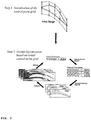
- the first step is the initial set-up of the representation and the second step comprises the optimization loop based on the initial representation.
- Fig. 2 depicts both steps of this workflow for the exemplary design optimization of a turbine blade utilizing Free-Form Deformation (FFD), an evolutionary optimization algorithm and Computational Fluid Dynamics (CFD) for the aerodynamic simulation of design proposals.
- FFD Free-Form Deformation
- CFD Computational Fluid Dynamics
- the present invention focuses on step 1.
- the initialization of an adequate FFD control point grid is very important for a successful optimization.
- the set-up is carried out by a human based on his/her expertise in the application field and spline mathematics. Nevertheless, since the control point grid is basically arbitrary the perfect choice of the number and distribution of control points and choice of knot vectors is very difficult.
- the computation of an initially optimal control point grid layout for a design representation, which is the target of the invention, is optimal in the sense of providing an optimal starting point for the optimization and promoting the optimization process by increasing flexibility.
- the core of the invention is the formulation of a measure for structure robustness, which can also be called evolvability measure E covol . Based on structure robustness, this measure quantifies the quality of a control point grid.
- an optimization algorithm is applicable which adjusts the position and distribution of control points to maximize the structure robustness of the control point grid and, thus, allows an efficient optimization by promoting neutral shape modifications to overcome local optima.
- a biological system is defined on two levels, a genotype level which comprises the encoding, and a phenotype level which comprises the structure.
- a genotype level which comprises the encoding
- a phenotype level which comprises the structure.
- this characteristic is combined with control point grids of Free-Form Deformation (FFD) systems promoting highly efficient system set-ups.
- FFD Free-Form Deformation
- E covol allows a quantification of the evolvability of a designed FFD control volume and, as a consequence, an application of a computational optimization based on E covol in a fully automated process to search for an initially optimal control point grid layout.
- a major advantage of the inventive method is that it is possible to compute the control grid layout based on the current state of the design representation, i.e. without any need to modify the design representation and to estimate possible effects on the design performance.
- step 2 strongly profits from control point grid layouts based on a high E covol because the small distance between the control point settings which generate the neutral design modifications, and thus structure robustness, allow a stepwise movement between these control point settings.
- stepwise neutral movements imply that it is possible to evade local optima during the optimization process.
- a generalization of the concept of structure robustness to splines seems also possible.
- the impact of this invention is strongly connected to the quantification of the quality of a control point grid layout as a pre-processing step to a subsequent adaptation of the control points and/or knot vector(s).
- the quantification is required for the application of a sampling or an optimization algorithm which solves the task of generating an optimal control point grid layout.
- a reference design D R is represented using a base design consisting of points P i and a base control volume
- an evolvable system with respect to this invention is characterized by a high number of control point variations which in turn produce designs similar to the reference design, i.e. points P i * which are in a close neighborhood to P i .
- a base control point grid is generated, e.g. manually or by an optimization algorithm. This grid consists of a distribution of control points.
- a base geometry D R is embedded within the control point grid and representative points P i on the design are chosen, e.g. manually or based on prior data analysis of the design.
- These points P i are transferred to a spline parameter space of the FFD control grid, e.g. by the FFD freezing algorithm.
- the control grid is modified in such a way that the control points are moved to all possible control point positions, usually carried out by using a discretization value.
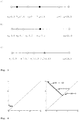
- An example system as shown in Fig. 3a is one-dimensional and consists of a control point grid with 4 control points.
- the underlying spline is a state-of-the-art NURBS of order 4, i.e. degree 3, and the knot vector is chosen to [0,0,0,0,1,1,1,1] for a clamped spline.
- As reference geometry exactly one point P 1 is chosen.
- the FFD grid is defined by 4 points.
- the point P 1a is chosen to 7.5 and in case b) the point P 1b is chosen to 1.0.
- the task is to find the optimal positions of x 2 and x 3 which provide the highest system evolvability.
- x 2 and x 3 are chosen from possible positions in the interval [0,15].
- x 2 is exemplary set to 1.1 and x 3 to 2.2.
- P 1a is frozen.
- x 2 and x 3 are stepwise moved in x-direction to all possible positions in the interval [0,15] and P 1a is updated to P 1a * .
- the Euclidean distance is calculated between the updated positions P 1a * and initial positions P 1a . If the distance is small enough, the evolvability measure E covol is increased by one. Pseudocode is given in the algorithm for case a).
- step iii) c) is exemplary depicted in Fig. 4 .
- a black dot marks a control point setting where the Euclidean distance between P 1a * and P 1a is smaller than ⁇ (here: ⁇ chosen to 0.1) and which, thus, increases the structure robustness.
- the x-axis reflects the position of x 2 and the y-axis reflects the position of x 3 .
- the discretization for the scatter plot has been chosen to 0.5.
- the algorithm outlined above calculates for one chosen control grid set-up the measure for structure robustness E covol which defines the degree of evolvability. Based on this measure it is possible to find the optimal control point grid set-up, i.e. the control point grid which provides the highest degree of evolvability. This can be e.g. done by testing all possible control point grid set-ups or, for larger control grids, by utilizing an optimization algorithm.
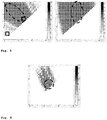
- the plots depicted in Fig. 5 present an overview on the evolvability measure E covol for case a) and case b) for all possible control point grids.
- the color mark the E covol a darker color indicates a higher robustness and, thus, a higher evolvability.
- the regions which provide the highest evolvability are marked.
- Fig. 6 shows that there exists a region with different control point positions which provide a highly evolvable control point grid.
- the present invention therefore provides two important parts. First, it is possible to calculate the structure robustness to quantify the quality of a control point grid. Second, it is possible to carry out an optimization of the control point grid layout using the structure robustness as performance indicator.
- Structure robustness A measure that specifies the quantity and relation between control point configurations that represent identical shapes in the context of shape morphing algorithms.
Landscapes
- Physics & Mathematics (AREA)
- Engineering & Computer Science (AREA)
- General Physics & Mathematics (AREA)
- Pure & Applied Mathematics (AREA)
- Mathematical Optimization (AREA)
- Mathematical Physics (AREA)
- Mathematical Analysis (AREA)
- Algebra (AREA)
- Computer Graphics (AREA)
- Geometry (AREA)
- Software Systems (AREA)
- Theoretical Computer Science (AREA)
- Management, Administration, Business Operations System, And Electronic Commerce (AREA)
- Image Generation (AREA)
Claims (8)
- Verfahren zur Optimierung einer Form eines physikalischen Objekts unter Verwendung einer Freiformverformungstechnik (FFD), wobei das Verfahren die folgenden Schritte aufweist:- Gewinnen einer anfänglichen Datendarstellung der Form des physikalischen Objekts, wobei die anfängliche Datendarstellung Punktkoordinaten, die von einer Oberflächenpunktwolke des digitalisierten physikalischen Objekts gewonnen werden, oder ein Netz, das aus einer aerodynamischen Computersimulation stammt, aufweist,- Gewinnen einer Referenzdatendarstellung der Form des physikalischen Objekts, wobei die Referenzdatendarstellung darstellende Punktkoordinaten (Pi) der anfänglichen Datendarstellung aufweist,- Erzeugen eines Gitters aus Steuerpunkten für die anfängliche Datendarstellung durch Zurückgeben einer Steuerpunktkonfiguration mit dem höchsten Maß für die Strukturrobustheit (ECOVOL) in einem Satz von Steuerpunktkonfigurationen,- Optimieren der Form des physikalischen Objekts durch einen Formgestaltungsalgorithmus unter Verwendung der Freiformverformungstechnik basierend auf dem zurückgegebenen Steuerpunktgitter,- Zurückgeben einer Datendarstellung der optimierten Form für das physikalische Objekt und wobei das Maß für die Strukturrobustheit (ECOVOL) für eine Steuerpunktkonfiguration (x1, x2, x3, x4) durch Bestimmen jeweiliger Steuerpunkte (x2, x3) des anfänglichen Steuerpunktgitters berechnet wird,- Einbetten der Referenzdatendarstellung in das Steuerpunktgitter durch Abbilden jeder Punktkoordinate (P1) der Referenzdatendarstellung auf einen Spline-Parameterraum des Steuerpunktgitters,- Modifizieren von Positionen der darstellenden Steuerpunkte (x2, x3), um eine Vielzahl modifizierter Steuerpunktkonfigurationen zu gewinnen,- für jede berechnete Steuerpunktkonfiguration Berechnen einer Formvariante der Referenzdatendarstellung (P1a) durch Freiformverformung unter Verwendung der modifizierten Steuerpunkkonfiguration, um eine aktualisierte Datendarstellung (P1a*) zu gewinnen, und Bestimmen einer Ähnlichkeit zwischen der aktualisierten Datendarstellung (P1a*) und der Referenzdatendarstellung (P1a) durch Berechnen eines Abstands von Punktkoordinaten der aktualisierten und der anfänglichen Datendarstellung und Zurückgeben der Anzahl modifizierter Steuerpunktkonfigurationen, für die der Abstand kleiner als der Schwellwert (ε) ist, als den Wert für das Maß der Strukturrobustheit (ECOVOL).
- Verfahren nach Anspruch 1,
wobei die aktualisierte Datendarstellung (P1a*) mit der Referenzdatendarstellung (P1a) verglichen wird, indem der euklidische Abstand berechnet wird. - Verfahren nach einem der vorhergehenden Ansprüche,
wobei die aktualisierten Datendarstellungsvarianten (P1a*) durch Modifizieren von Steuerpunkten und/oder Knotenvektor(en) einer Steuerpunktkonfiguration erzeugt werden. - Verfahren nach einem der vorhergehenden Ansprüche,
wobei die Erzeugung durch ein Abtasten einer Teilmenge aller möglichen Steuerpunktpositionen (x1, x2, x3, x4) innerhalb des Steuerpunktgitters ausgeführt wird. - Verfahren nach einem der vorhergehenden Ansprüche,
wobei für die Erzeugung des Steuerpunktgitters zusätzliche Nebenbedingungen für Steuerpunkte (x1, x2, x3, x4) hinzugefügt werden,
wobei die zusätzlichen Nebenbedingungen ein vordefinierter Abstand zwischen Steuerpunkten (x1, x2, x3, x4) sind. - Verfahren nach einem der vorhergehenden Ansprüche,
wobei die Formoptimierung des physikalischen Objekts auf wenigstens eines der Folgenden abzielt: eine Erhöhung der aerodynamischen/fluiddynamischen Effizienz des physikalischen Objekts, eine Erhöhung der Strukturstabilität des physikalischen Objekts und eine Minimierung von Geräuschen, die während des Betriebs des physikalischen Objekts erzeugt werden. - Computersoftwareprodukt, das einen der vorhergehenden Ansprüche 1 bis 9 implementiert, wenn es auf einer Computervorrichtung läuft.
- Computersystem, das geeignet ist, ein Verfahren nach einem der Ansprüche 1 bis 6 durchzuführen.
Priority Applications (1)
| Application Number | Priority Date | Filing Date | Title |
|---|---|---|---|
| EP10187387.5A EP2442279B1 (de) | 2010-10-13 | 2010-10-13 | Designoptimierung von physikalischen Körpern |
Applications Claiming Priority (1)
| Application Number | Priority Date | Filing Date | Title |
|---|---|---|---|
| EP10187387.5A EP2442279B1 (de) | 2010-10-13 | 2010-10-13 | Designoptimierung von physikalischen Körpern |
Publications (2)
| Publication Number | Publication Date |
|---|---|
| EP2442279A1 EP2442279A1 (de) | 2012-04-18 |
| EP2442279B1 true EP2442279B1 (de) | 2019-01-09 |
Family
ID=43608387
Family Applications (1)
| Application Number | Title | Priority Date | Filing Date |
|---|---|---|---|
| EP10187387.5A Not-in-force EP2442279B1 (de) | 2010-10-13 | 2010-10-13 | Designoptimierung von physikalischen Körpern |
Country Status (1)
| Country | Link |
|---|---|
| EP (1) | EP2442279B1 (de) |
Families Citing this family (4)
| Publication number | Priority date | Publication date | Assignee | Title |
|---|---|---|---|---|
| FR3023942A1 (fr) * | 2014-07-15 | 2016-01-22 | Inst Rech Technologique Systemx | Procede et systeme de conception de forme optimale d'un objet |
| CN106651900B (zh) * | 2016-12-27 | 2019-07-23 | 中国农业大学 | 一种基于轮廓分割的高架原位草莓三维建模方法 |
| US11288414B2 (en) * | 2018-11-20 | 2022-03-29 | The Boeing Company | Artificial intelligence-based manufacturing part design |
| JP7446579B2 (ja) * | 2019-09-02 | 2024-03-11 | マツダ株式会社 | 曲面のフィッティング処理方法、フィッティング処理装置およびフィッティング処理プログラム、並びに、該フィッティング処理プログラムを記憶したコンピュータ読取可能な記憶媒体 |
Family Cites Families (1)
| Publication number | Priority date | Publication date | Assignee | Title |
|---|---|---|---|---|
| EP1840842A1 (de) * | 2006-03-27 | 2007-10-03 | Honda Research Institute Europe GmbH | Evolutionäre Designoptimierung mittels erweiterter direkter Manipulation von Freiformdeformationen |
-
2010
- 2010-10-13 EP EP10187387.5A patent/EP2442279B1/de not_active Not-in-force
Non-Patent Citations (1)
| Title |
|---|
| None * |
Also Published As
| Publication number | Publication date |
|---|---|
| EP2442279A1 (de) | 2012-04-18 |
Similar Documents
| Publication | Publication Date | Title |
|---|---|---|
| US8600534B2 (en) | Method of designing a structure | |
| Praveen et al. | Low cost PSO using metamodels and inexact pre-evaluation: Application to aerodynamic shape design | |
| US8098244B2 (en) | Evolutionary direct manipulation of free form deformation representations for design optimization | |
| CN106384384B (zh) | 一种三维产品模型的形状优化方法 | |
| CN115358009B (zh) | 交通工具外壳造型中nurbs曲线曲面光顺生成方法 | |
| JP2025511421A (ja) | モデリング-解析-最適化の一体化向けの組み合わせ薄壁素子構造の自己適応幾何学的モデリング方法 | |
| EP2442279B1 (de) | Designoptimierung von physikalischen Körpern | |
| Wan et al. | Interval optimization design of a submersible surface ship form considering the uncertainty of surrogate model | |
| Li et al. | Free-form surface parts quality inspection optimization with a novel sampling method | |
| CN116595827B (zh) | 无限维度条带喷丸成形工艺规划方法和系统 | |
| JP7437747B2 (ja) | 構造物-流場推定方法、構造物-流場推定プログラム、及び構造物-流場推定システム | |
| CN115310332B (zh) | 一种基于Voronoi划分的多孔模型紧致拓扑优化方法 | |
| CN120276371B (zh) | 折弯机数控系统的加工件图样实时绘制验证方法 | |
| CN121147396A (zh) | 基于bim与激光扫描的构件定位方法 | |
| Lam | Multidiscilinary design optimization for aircraft wing using response surface method, genetic algorithm, and simulated annealing | |
| JPH1196400A (ja) | 形状変換方法 | |
| EP1840842A1 (de) | Evolutionäre Designoptimierung mittels erweiterter direkter Manipulation von Freiformdeformationen | |
| Viúdez-Moreiras et al. | Performance comparison of Kriging and SVR surrogate models applied to the objective function prediction within aerodynamic shape optimization | |
| Koratikere et al. | Multi-Point Airfoil Shape Optimization Using Neural Network-Based Sequential Sampling | |
| EP1901235B1 (de) | Freistildeformation (FSD) | |
| Amrit et al. | Efficient multi-objective aerodynamic optimization by design space dimension reduction and co-kriging | |
| Zimmert et al. | Parametric modelling of free-form structural concrete beams and derivation of structural analysis models | |
| CN119720855B (zh) | 一种用于飞行器代理优化设计的梯度增强采样方法 | |
| Sun et al. | Physics-informed deep learning for flow modelling and aerodynamic optimization | |
| CN119918215B (zh) | 面向边界表示的三维机械部件直接静力学仿真方法及系统 |
Legal Events
| Date | Code | Title | Description |
|---|---|---|---|
| PUAI | Public reference made under article 153(3) epc to a published international application that has entered the european phase |
Free format text: ORIGINAL CODE: 0009012 |
|
| 17P | Request for examination filed |
Effective date: 20110909 |
|
| AK | Designated contracting states |
Kind code of ref document: A1 Designated state(s): AL AT BE BG CH CY CZ DE DK EE ES FI FR GB GR HR HU IE IS IT LI LT LU LV MC MK MT NL NO PL PT RO RS SE SI SK SM TR |
|
| AX | Request for extension of the european patent |
Extension state: BA ME |
|
| STAA | Information on the status of an ep patent application or granted ep patent |
Free format text: STATUS: EXAMINATION IS IN PROGRESS |
|
| 17Q | First examination report despatched |
Effective date: 20170512 |
|
| GRAP | Despatch of communication of intention to grant a patent |
Free format text: ORIGINAL CODE: EPIDOSNIGR1 |
|
| STAA | Information on the status of an ep patent application or granted ep patent |
Free format text: STATUS: GRANT OF PATENT IS INTENDED |
|
| INTG | Intention to grant announced |
Effective date: 20180801 |
|
| RIN1 | Information on inventor provided before grant (corrected) |
Inventor name: MENZEL, STEFAN, DR. |
|
| GRAS | Grant fee paid |
Free format text: ORIGINAL CODE: EPIDOSNIGR3 |
|
| GRAA | (expected) grant |
Free format text: ORIGINAL CODE: 0009210 |
|
| STAA | Information on the status of an ep patent application or granted ep patent |
Free format text: STATUS: THE PATENT HAS BEEN GRANTED |
|
| AK | Designated contracting states |
Kind code of ref document: B1 Designated state(s): AL AT BE BG CH CY CZ DE DK EE ES FI FR GB GR HR HU IE IS IT LI LT LU LV MC MK MT NL NO PL PT RO RS SE SI SK SM TR |
|
| REG | Reference to a national code |
Ref country code: GB Ref legal event code: FG4D |
|
| REG | Reference to a national code |
Ref country code: CH Ref legal event code: EP Ref country code: AT Ref legal event code: REF Ref document number: 1088249 Country of ref document: AT Kind code of ref document: T Effective date: 20190115 |
|
| REG | Reference to a national code |
Ref country code: IE Ref legal event code: FG4D |
|
| REG | Reference to a national code |
Ref country code: DE Ref legal event code: R096 Ref document number: 602010056381 Country of ref document: DE |
|
| REG | Reference to a national code |
Ref country code: NL Ref legal event code: MP Effective date: 20190109 |
|
| REG | Reference to a national code |
Ref country code: LT Ref legal event code: MG4D |
|
| PG25 | Lapsed in a contracting state [announced via postgrant information from national office to epo] |
Ref country code: NL Free format text: LAPSE BECAUSE OF FAILURE TO SUBMIT A TRANSLATION OF THE DESCRIPTION OR TO PAY THE FEE WITHIN THE PRESCRIBED TIME-LIMIT Effective date: 20190109 |
|
| REG | Reference to a national code |
Ref country code: AT Ref legal event code: MK05 Ref document number: 1088249 Country of ref document: AT Kind code of ref document: T Effective date: 20190109 |
|
| PG25 | Lapsed in a contracting state [announced via postgrant information from national office to epo] |
Ref country code: LT Free format text: LAPSE BECAUSE OF FAILURE TO SUBMIT A TRANSLATION OF THE DESCRIPTION OR TO PAY THE FEE WITHIN THE PRESCRIBED TIME-LIMIT Effective date: 20190109 Ref country code: PL Free format text: LAPSE BECAUSE OF FAILURE TO SUBMIT A TRANSLATION OF THE DESCRIPTION OR TO PAY THE FEE WITHIN THE PRESCRIBED TIME-LIMIT Effective date: 20190109 Ref country code: FI Free format text: LAPSE BECAUSE OF FAILURE TO SUBMIT A TRANSLATION OF THE DESCRIPTION OR TO PAY THE FEE WITHIN THE PRESCRIBED TIME-LIMIT Effective date: 20190109 Ref country code: ES Free format text: LAPSE BECAUSE OF FAILURE TO SUBMIT A TRANSLATION OF THE DESCRIPTION OR TO PAY THE FEE WITHIN THE PRESCRIBED TIME-LIMIT Effective date: 20190109 Ref country code: NO Free format text: LAPSE BECAUSE OF FAILURE TO SUBMIT A TRANSLATION OF THE DESCRIPTION OR TO PAY THE FEE WITHIN THE PRESCRIBED TIME-LIMIT Effective date: 20190409 Ref country code: PT Free format text: LAPSE BECAUSE OF FAILURE TO SUBMIT A TRANSLATION OF THE DESCRIPTION OR TO PAY THE FEE WITHIN THE PRESCRIBED TIME-LIMIT Effective date: 20190509 Ref country code: SE Free format text: LAPSE BECAUSE OF FAILURE TO SUBMIT A TRANSLATION OF THE DESCRIPTION OR TO PAY THE FEE WITHIN THE PRESCRIBED TIME-LIMIT Effective date: 20190109 |
|
| PG25 | Lapsed in a contracting state [announced via postgrant information from national office to epo] |
Ref country code: GR Free format text: LAPSE BECAUSE OF FAILURE TO SUBMIT A TRANSLATION OF THE DESCRIPTION OR TO PAY THE FEE WITHIN THE PRESCRIBED TIME-LIMIT Effective date: 20190410 Ref country code: IS Free format text: LAPSE BECAUSE OF FAILURE TO SUBMIT A TRANSLATION OF THE DESCRIPTION OR TO PAY THE FEE WITHIN THE PRESCRIBED TIME-LIMIT Effective date: 20190509 Ref country code: LV Free format text: LAPSE BECAUSE OF FAILURE TO SUBMIT A TRANSLATION OF THE DESCRIPTION OR TO PAY THE FEE WITHIN THE PRESCRIBED TIME-LIMIT Effective date: 20190109 Ref country code: HR Free format text: LAPSE BECAUSE OF FAILURE TO SUBMIT A TRANSLATION OF THE DESCRIPTION OR TO PAY THE FEE WITHIN THE PRESCRIBED TIME-LIMIT Effective date: 20190109 Ref country code: RS Free format text: LAPSE BECAUSE OF FAILURE TO SUBMIT A TRANSLATION OF THE DESCRIPTION OR TO PAY THE FEE WITHIN THE PRESCRIBED TIME-LIMIT Effective date: 20190109 Ref country code: BG Free format text: LAPSE BECAUSE OF FAILURE TO SUBMIT A TRANSLATION OF THE DESCRIPTION OR TO PAY THE FEE WITHIN THE PRESCRIBED TIME-LIMIT Effective date: 20190409 |
|
| REG | Reference to a national code |
Ref country code: DE Ref legal event code: R097 Ref document number: 602010056381 Country of ref document: DE |
|
| PG25 | Lapsed in a contracting state [announced via postgrant information from national office to epo] |
Ref country code: AL Free format text: LAPSE BECAUSE OF FAILURE TO SUBMIT A TRANSLATION OF THE DESCRIPTION OR TO PAY THE FEE WITHIN THE PRESCRIBED TIME-LIMIT Effective date: 20190109 Ref country code: AT Free format text: LAPSE BECAUSE OF FAILURE TO SUBMIT A TRANSLATION OF THE DESCRIPTION OR TO PAY THE FEE WITHIN THE PRESCRIBED TIME-LIMIT Effective date: 20190109 Ref country code: CZ Free format text: LAPSE BECAUSE OF FAILURE TO SUBMIT A TRANSLATION OF THE DESCRIPTION OR TO PAY THE FEE WITHIN THE PRESCRIBED TIME-LIMIT Effective date: 20190109 Ref country code: RO Free format text: LAPSE BECAUSE OF FAILURE TO SUBMIT A TRANSLATION OF THE DESCRIPTION OR TO PAY THE FEE WITHIN THE PRESCRIBED TIME-LIMIT Effective date: 20190109 Ref country code: SK Free format text: LAPSE BECAUSE OF FAILURE TO SUBMIT A TRANSLATION OF THE DESCRIPTION OR TO PAY THE FEE WITHIN THE PRESCRIBED TIME-LIMIT Effective date: 20190109 Ref country code: IT Free format text: LAPSE BECAUSE OF FAILURE TO SUBMIT A TRANSLATION OF THE DESCRIPTION OR TO PAY THE FEE WITHIN THE PRESCRIBED TIME-LIMIT Effective date: 20190109 Ref country code: EE Free format text: LAPSE BECAUSE OF FAILURE TO SUBMIT A TRANSLATION OF THE DESCRIPTION OR TO PAY THE FEE WITHIN THE PRESCRIBED TIME-LIMIT Effective date: 20190109 Ref country code: DK Free format text: LAPSE BECAUSE OF FAILURE TO SUBMIT A TRANSLATION OF THE DESCRIPTION OR TO PAY THE FEE WITHIN THE PRESCRIBED TIME-LIMIT Effective date: 20190109 |
|
| PLBE | No opposition filed within time limit |
Free format text: ORIGINAL CODE: 0009261 |
|
| STAA | Information on the status of an ep patent application or granted ep patent |
Free format text: STATUS: NO OPPOSITION FILED WITHIN TIME LIMIT |
|
| PG25 | Lapsed in a contracting state [announced via postgrant information from national office to epo] |
Ref country code: SM Free format text: LAPSE BECAUSE OF FAILURE TO SUBMIT A TRANSLATION OF THE DESCRIPTION OR TO PAY THE FEE WITHIN THE PRESCRIBED TIME-LIMIT Effective date: 20190109 |
|
| 26N | No opposition filed |
Effective date: 20191010 |
|
| PGFP | Annual fee paid to national office [announced via postgrant information from national office to epo] |
Ref country code: DE Payment date: 20191025 Year of fee payment: 10 |
|
| PG25 | Lapsed in a contracting state [announced via postgrant information from national office to epo] |
Ref country code: SI Free format text: LAPSE BECAUSE OF FAILURE TO SUBMIT A TRANSLATION OF THE DESCRIPTION OR TO PAY THE FEE WITHIN THE PRESCRIBED TIME-LIMIT Effective date: 20190109 |
|
| PGFP | Annual fee paid to national office [announced via postgrant information from national office to epo] |
Ref country code: FR Payment date: 20191022 Year of fee payment: 10 |
|
| PG25 | Lapsed in a contracting state [announced via postgrant information from national office to epo] |
Ref country code: TR Free format text: LAPSE BECAUSE OF FAILURE TO SUBMIT A TRANSLATION OF THE DESCRIPTION OR TO PAY THE FEE WITHIN THE PRESCRIBED TIME-LIMIT Effective date: 20190109 |
|
| PGFP | Annual fee paid to national office [announced via postgrant information from national office to epo] |
Ref country code: GB Payment date: 20191023 Year of fee payment: 10 |
|
| PG25 | Lapsed in a contracting state [announced via postgrant information from national office to epo] |
Ref country code: MC Free format text: LAPSE BECAUSE OF FAILURE TO SUBMIT A TRANSLATION OF THE DESCRIPTION OR TO PAY THE FEE WITHIN THE PRESCRIBED TIME-LIMIT Effective date: 20190109 |
|
| REG | Reference to a national code |
Ref country code: CH Ref legal event code: PL |
|
| PG25 | Lapsed in a contracting state [announced via postgrant information from national office to epo] |
Ref country code: LU Free format text: LAPSE BECAUSE OF NON-PAYMENT OF DUE FEES Effective date: 20191013 Ref country code: LI Free format text: LAPSE BECAUSE OF NON-PAYMENT OF DUE FEES Effective date: 20191031 Ref country code: CH Free format text: LAPSE BECAUSE OF NON-PAYMENT OF DUE FEES Effective date: 20191031 |
|
| REG | Reference to a national code |
Ref country code: BE Ref legal event code: MM Effective date: 20191031 |
|
| PG25 | Lapsed in a contracting state [announced via postgrant information from national office to epo] |
Ref country code: BE Free format text: LAPSE BECAUSE OF NON-PAYMENT OF DUE FEES Effective date: 20191031 |
|
| PG25 | Lapsed in a contracting state [announced via postgrant information from national office to epo] |
Ref country code: IE Free format text: LAPSE BECAUSE OF NON-PAYMENT OF DUE FEES Effective date: 20191013 |
|
| REG | Reference to a national code |
Ref country code: DE Ref legal event code: R119 Ref document number: 602010056381 Country of ref document: DE |
|
| PG25 | Lapsed in a contracting state [announced via postgrant information from national office to epo] |
Ref country code: CY Free format text: LAPSE BECAUSE OF FAILURE TO SUBMIT A TRANSLATION OF THE DESCRIPTION OR TO PAY THE FEE WITHIN THE PRESCRIBED TIME-LIMIT Effective date: 20190109 |
|
| GBPC | Gb: european patent ceased through non-payment of renewal fee |
Effective date: 20201013 |
|
| PG25 | Lapsed in a contracting state [announced via postgrant information from national office to epo] |
Ref country code: MT Free format text: LAPSE BECAUSE OF FAILURE TO SUBMIT A TRANSLATION OF THE DESCRIPTION OR TO PAY THE FEE WITHIN THE PRESCRIBED TIME-LIMIT Effective date: 20190109 Ref country code: HU Free format text: LAPSE BECAUSE OF FAILURE TO SUBMIT A TRANSLATION OF THE DESCRIPTION OR TO PAY THE FEE WITHIN THE PRESCRIBED TIME-LIMIT; INVALID AB INITIO Effective date: 20101013 Ref country code: DE Free format text: LAPSE BECAUSE OF NON-PAYMENT OF DUE FEES Effective date: 20210501 Ref country code: FR Free format text: LAPSE BECAUSE OF NON-PAYMENT OF DUE FEES Effective date: 20201031 |
|
| PG25 | Lapsed in a contracting state [announced via postgrant information from national office to epo] |
Ref country code: GB Free format text: LAPSE BECAUSE OF NON-PAYMENT OF DUE FEES Effective date: 20201013 |
|
| PG25 | Lapsed in a contracting state [announced via postgrant information from national office to epo] |
Ref country code: MK Free format text: LAPSE BECAUSE OF FAILURE TO SUBMIT A TRANSLATION OF THE DESCRIPTION OR TO PAY THE FEE WITHIN THE PRESCRIBED TIME-LIMIT Effective date: 20190109 |