EP2439986A1 - Verfahren zur Bestimmung, unter welcher Bedingung eine erste Basisstation, die sich in einem Energiesparmodus befindet, in einen anderen Betriebsmodus umschalten muss - Google Patents
Verfahren zur Bestimmung, unter welcher Bedingung eine erste Basisstation, die sich in einem Energiesparmodus befindet, in einen anderen Betriebsmodus umschalten muss Download PDFInfo
- Publication number
- EP2439986A1 EP2439986A1 EP10186655A EP10186655A EP2439986A1 EP 2439986 A1 EP2439986 A1 EP 2439986A1 EP 10186655 A EP10186655 A EP 10186655A EP 10186655 A EP10186655 A EP 10186655A EP 2439986 A1 EP2439986 A1 EP 2439986A1
- Authority
- EP
- European Patent Office
- Prior art keywords
- base station
- mobile terminal
- power
- signal
- handled
- Prior art date
- Legal status (The legal status is an assumption and is not a legal conclusion. Google has not performed a legal analysis and makes no representation as to the accuracy of the status listed.)
- Granted
Links
Images


Classifications
-
- H—ELECTRICITY
- H04—ELECTRIC COMMUNICATION TECHNIQUE
- H04W—WIRELESS COMMUNICATION NETWORKS
- H04W52/00—Power management, e.g. Transmission Power Control [TPC] or power classes
- H04W52/02—Power saving arrangements
- H04W52/0203—Power saving arrangements in the radio access network or backbone network of wireless communication networks
- H04W52/0206—Power saving arrangements in the radio access network or backbone network of wireless communication networks in access points, e.g. base stations
-
- H—ELECTRICITY
- H04—ELECTRIC COMMUNICATION TECHNIQUE
- H04W—WIRELESS COMMUNICATION NETWORKS
- H04W36/00—Hand-off or reselection arrangements
- H04W36/08—Reselecting an access point
-
- Y—GENERAL TAGGING OF NEW TECHNOLOGICAL DEVELOPMENTS; GENERAL TAGGING OF CROSS-SECTIONAL TECHNOLOGIES SPANNING OVER SEVERAL SECTIONS OF THE IPC; TECHNICAL SUBJECTS COVERED BY FORMER USPC CROSS-REFERENCE ART COLLECTIONS [XRACs] AND DIGESTS
- Y02—TECHNOLOGIES OR APPLICATIONS FOR MITIGATION OR ADAPTATION AGAINST CLIMATE CHANGE
- Y02D—CLIMATE CHANGE MITIGATION TECHNOLOGIES IN INFORMATION AND COMMUNICATION TECHNOLOGIES [ICT], I.E. INFORMATION AND COMMUNICATION TECHNOLOGIES AIMING AT THE REDUCTION OF THEIR OWN ENERGY USE
- Y02D30/00—Reducing energy consumption in communication networks
- Y02D30/70—Reducing energy consumption in communication networks in wireless communication networks
Definitions
- the present invention relates generally to a method and a device for determining, in a wireless cellular telecommunication network, in which condition a first base station which is in an energy saving mode has to switch in an operation mode which enables a mobile terminal to be handled by the first base station.
- the present invention is in the field of the management of the activity of base stations of a wireless cellular telecommunication network.
- the management of the activity of base stations enables to reduce the electric power consumed by the wireless cellular telecommunication network.
- the management of the activity of a base station consists in switching or not the base station in an energy saving mode.
- the switching is executed according to at least one criterion, which is for example the load of the base station and/or the load of surrounding base stations.
- the base station when a base station does not handle any mobile terminal, the base station can be set in an energy saving mode wherein the base station transfers radio signals at a low power level or at most sixty percent of the nominal radio signal transmission power or interrupts the transmission of radio signals.
- Few or no mobile terminals may be located in some areas covered by the wireless cellular telecommunication network, for example during night.
- energy is saved without degrading the quality of service provided by the wireless cellular telecommunication network.
- the base station which is in an energy saving mode should be switched in a normal operation mode which enables the mobile terminal or other mobile terminals handled by surrounding base stations to be handled by the base station which is in an energy saving mode.
- Figs. 1a and 1b represent an example of such classical switching of a base station from an energy saving mode to a normal operation mode.
- Figs. 1 Three base stations BS1 to BS3 are shown in Figs. 1 for the sake of clarity but the wireless cellular telecommunication network may comprise a more important number of base stations BS.
- the base station BS2 is in the energy saving mode and the base stations BS1 and BS3 are in the normal operation mode.
- the base station BS 1 transfers and receives signals in the cell CE1a.
- a cell CE of a base station BS is an area in which mobile terminals located in the cell of the base station can be handled by the base station BS, i.e. can establish a communication with a remote telecommunication device through the base station BS.
- the mobile terminals MT1, MT2, MT3 and MT4 are located in the cell CE1a of the base station BS1.
- the base station BS3 transfers and receives signals in the cell CE3a.
- the mobile terminal MT5 is located in the cell CE3a of the base station BS3.
- the mobile terminal MT2 is located at the edge of the cell CE1a and is moving out from the cell CE1a as shown by the arrow noted AR and enters in an area that could have been covered by the base station BS2 if the base station was in normal operation mode.
- the base station BS2 is switched to the normal operation mode and starts to transfer radio signals at a nominal transmission power defined for example according to radio planning techniques or stored in the non volatile memory of the base station BS2.
- the base stations BS1, BS2 and BS3 are in the normal operation mode.
- the transmission of radio signals by the base station BS2 at normal operation mode transmission power reduces the areas covered by the cells CE1b and CE3b of the base stations BS1 and BS3.
- the signals transferred by the base station BS2 interfere with the signals transferred by the base stations BS1 and BS3.
- the mobile terminals MT1, MT2 and MT4 are no more covered by the cell CE1b of the base station BS1 once the base station BS2 is switched in the normal operation mode.
- Such sudden modification of signal reception conditions may cause, if one of the mobile terminal MT1, MT2 or MT4 was involved in a communication with a remote telecommunication device through the base station BS1, a sudden interruption of the communication.
- the sudden modification of signal reception conditions causes the mobile terminal MT1 to be no more included in any cell.
- the switching to the normal operation mode of the base station BS2 degrades the quality of service of the wireless cellular telecommunication network.
- the present invention aims at providing a wireless cellular telecommunication network wherein the quality of service of the wireless cellular telecommunication network is kept when a base station which is in an energy saving mode has to switch in an operation mode which enables a mobile terminal to be handled by the base station while reducing the electric energy power consumption.
- the present invention concerns a method for determining, in a wireless cellular telecommunication network, in which condition a first base station which is in an energy saving mode has to switch in an operation mode which enables a mobile terminal to be handled by the first base station, the mobile terminal being currently handled by a second base station, characterised in that the method comprises the steps of:
- the present invention concerns also a device for determining, in a wireless cellular telecommunication network, in which condition a first base station which is in an energy saving mode has to switch in an operation mode which enables a mobile terminal to be handled by the first base station, the mobile terminal being currently handled by a second base station, characterised in that the device for determining in which condition the first base station which is in the energy saving mode has to switch comprises:
- the quality of service of the wireless cellular telecommunication network is kept when the first base station which is in an energy saving mode switches in an operation mode which enables the mobile terminal to be handled by the first base station.
- the step of obtaining information representative of a path gain between the first base station and the mobile terminal and the determining step are executed according to the value of the information representative of the path gain between the second base station and the mobile terminal.
- the base station in energy saving mode stays in energy saving mode as long as the mobile terminal can be handled by the second base station. Energy savings are maximised.
- the second base station transfers a message requesting the first base station to monitor the power of the signal transferred by the mobile terminal and received by the first base station, the message further comprising the transmit power of signals transferred by the mobile terminal and the information representative of the path gain between the first base station and the mobile terminal is determined, by the first base station.
- the second base station doesn't need to be aware of the nominal transmit power the first base station uses to transmit its signals when the first base station is in normal operation mode.
- the second base station transfers a message requesting the first base station to transfer in response the power of the signal transferred by the mobile terminal and received by the first base station the power of transmission of signal transferred by the first base station which enables the mobile terminal to be handled by the first base station and by the second base station is determined by the second base station.
- the number of parameters provided by the second base station to the first base station is minimized.
- the second base station transfers a message requesting the first base station to monitor the power of the signal transferred by the mobile terminal and received by the first base station, and the power of transmission of signal transferred by the first base station is determined by the first base station.
- the number of parameters provided by the first base station to the second base station is minimized.
- a message is transferred to the mobile terminal, the message requesting the mobile terminal to transfer information representative of the power of signal received by the mobile terminal and transferred by the first base station and the power of transmission of signal transferred by the first base station when the first base station transfers signal which enables the mobile terminal to be handled by the first base station and by the second base station is determined, by the second base station, from the power of the signal transferred by the first base station and received by the mobile terminal and the power of signal transferred by the second base station and received by the mobile terminal.
- the first base station doesn't have to monitor signals from the mobile terminal.
- the second base station transfers a message requesting the first base station to transfer signal at a transmission power which does not enable a mobile terminal to be handled by the first base station.
- the first base station remains longer in an energy saving state where it transmits no signals.
- the power of transmission is computed as an increase or decrease factor of the power of transmission of the first base station.
- the threshold is determined from a signal interference plus noise ratio value determined for the mobile terminal.
- the threshold can be adapted to each mobile terminal.
- the signal interference plus noise ratio value is determined according to a quality of service to be provided to the mobile terminal.
- the quality of service to be provided to the mobile terminal is increased when the power of signal received by the mobile terminal from the second base station is lower than or equal to the threshold and/or a more robust modulation and coding scheme is allocated to the mobile terminal when the power of signal received by the mobile terminal from the second base station is lower than or equal to the threshold and/or a more robust modulation and coding scheme is allocated to the mobile terminal.
- the mobile terminal can be served longer by the second base station.
- plural base stations neighbouring the second base station are in the energy saving mode, a message is transferred to each base station neighbouring the second base station, the message requesting to monitor the power of the signal transferred by the mobile terminal and received by the first base station, and the method further comprises the step of selecting among the base stations neighbouring the second base station, the first base station as the one receiving the signal transferred by the mobile terminal at the highest power.
- the second base station transfers information identifying the mobile terminal to the first base station, information identifying the mobile terminal being a cell radio network temporary identifier allocated by the second base station to the mobile terminal or dedicated pilot sequence and time/frequency pattern allocated by the second base station to the mobile terminal or a contention-based channel for initial transmission from mobile terminal to the second base station.
- the first base station does not have to decode data from signals transmitted by the second base station.
- the present invention concerns computer program which can be directly loadable into a programmable device, comprising instructions or portions of code for implementing the steps of the method according to the invention, when said computer program is executed on a programmable device.
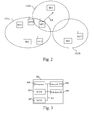
- Fig. 2 represents an example of a switching of a base station from an energy saving mode to an operation mode which enables at least one mobile terminal currently handled by another base station to be handled by the base station according to the present invention.
- each base station has one cell.
- the present invention is also applicable when one or plural base stations handle respectively plural cells.
- the base station BS1 handles the mobile terminals Met1, MT2, MT3 and MT4.
- the mobile terminal MT2 is moving to the direction of the base station BS2 which is in the energy saving mode.
- the base station BS1 receives from the mobile terminals MT1 to MT4, measurement reports on signal transferred by the base station BS 1.
- the base station BS1 checks if the power of signal received by the mobile terminals MT1 to MT4 from the base station BS1 is lower than or equal to a threshold Th.
- the power of signal received by the mobile terminal MT2 from the base station BS1 is lower than or equal to the threshold Th .
- the threshold Th will be disclosed with more details hereinafter.
- the base station BS1 obtains information representative of a path gain between the base station BS1 and the mobile terminal MT2.
- the base station BS1 obtains information representative of a path gain between the base station BS2 and the mobile terminal MT2.
- the base station BS 1 determines, from information representative of the path gain between the base station BS2 and the mobile terminal MT2 and from information representative of a path gain between the base station BS1 and the mobile terminal MT2., a power of transmission of signal transferred by the base station BS2 when the base station BS2 transfers signal which enables the mobile terminal MT2 to be handled by the base station BS2 and by the base station BS 1.
- information representative of a path gain between the second base station and the mobile terminal are obtained according to the value of the power of signal received by the mobile terminal MT2 from the base station BS1 and the determining step is executed if the power of signal received by the mobile terminal from the second base station is lower than or equal to the threshold.
- the power of transmission of signal transferred by the base station BS2 when the base station BS2 is in the operation mode is a transmission power which enables the mobile terminal MT2 to be handled with a given quality of service by the base station BS2 and by the base station BS1.
- the transmission power of the base station BS2 is set in order to be received, at mobile terminal MT2 side, at a level equal to the level of the signal received from base station BS1,at mobile terminal MT2 side.
- the mobile terminal MT2 is located at the cell edge of CE1c of base station BS1 thanks to the choice of threshold Th , interferences from base station BS2 are reduced and the area covered by the cell CE1c of base station BS1 is less reduced compared to the example of Fig. 1b .
- the mobile terminals MT1, MT2 and MT4 are still comprised in the cell CE1c of the base station BS1 once the base station BS2 is switched in the normal operation mode.
- a handover of the mobile terminal MT2 can be performed between the base stations BS1 and BS2.
- the base station BS1 to BS3 may be named nodes or access points or home base stations or pico base stations.
- the mobile terminals MT1 to MT5 may be a personal computer, a peripheral device like a set top box, or a phone.
- Fig. 3 is a diagram representing the architecture of a base station in which the present invention is implemented.
- the base station BS has, for example, an architecture based on components connected together by a bus 301 and a processor 300 controlled by the programs as disclosed in Figs. 4 to 9 .
- the base station BS may have an architecture based on dedicated integrated circuits.
- the bus 301 links the processor 300 to a read only memory ROM 302, a random access memory RAM 303, a wireless interface 305 and a network interface 306.
- the memory 303 contains registers intended to receive variables and the instructions of the programs related to the algorithms as disclosed in Figs. 4 to 9 .
- the processor 300 controls the operation of the network interface 306 and of the wireless interface 305.
- the read only memory 302 contains instructions of the programs related to the algorithms as disclosed in Figs. 4 to 9 , which are transferred, when the base station BS is powered on, to the random access memory 303.
- the base station BS may be connected to a telecommunication network through the network interface 306.
- the network interface 306 is a DSL (Digital Subscriber Line) modem, or an ISDN (Integrated Services Digital Network) interface, etc.
- the wireless interface 305 may be switched in the energy saving mode.
- the energy saving mode is a mode wherein the base station transfers radio signals at a low power level or at most sixty percent of the nominal radio signal transmission power or interrupts the transmission of radio signals.
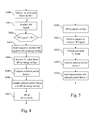
- Fig. 4 discloses an example of an algorithm executed by a base station which handles at least one mobile terminal according to a first mode of realization of the present invention when the base station is surrounded by a base station which is in energy saving mode.
- the present algorithm is executed by each base station of the wireless cellular telecommunication network when it is in an operation mode which enables a mobile terminal to be handled by the base station.
- the present algorithm is executed by the processor 300 of the base station BS1 in parallel for each mobile terminal handled by the base station BS 1.
- the processor 300 obtains a minimum signal interference plus noise ratio p that should be provided, for example, to the mobile terminal MT2 the base station BS1 handles.
- the minimum signal interference plus noise ratio p is for example obtained according to a quality of service provided to the mobile terminal MT2 by the base station BS1.
- the processor 300 monitors the power of signal received by the mobile terminal MT2 from the base station BS1 using, for example, measurement report transferred periodically by the mobile terminal MT2.
- the processor 300 checks if the power of signal received by the mobile terminal MT2, from the base station BS1, is equal to or lower than the threshold Th determined for the mobile terminal MT2.
- the base station BS2 when signal power P 1 received from the base station BS1 by the mobile terminal MT2 is below the given threshold Th, the base station BS2 starts transmitting with a reduced power ⁇ P 2n (0 ⁇ 1), which is received by the UE at power ⁇ P 2 , such as: ⁇ P 1 ⁇ P 2 + N 0 ⁇ ⁇ P 1 ⁇ ⁇ P 2
- P 1 is the power of signal transferred by the base station BS 1 and received by the mobile terminal MT2
- P 2n is the nominal transmission power of signal transferred by the base station BS2 without any power reduction
- N 0 is the noise component received by the mobile terminal MT2
- P 2 is the power of signal transferred by the base station BS2 and received by the mobile terminal MT2.
- the first equation expresses that mobile terminal MT2 is still handled by the base station BS1 with a SINR above minimum SINR p, although second equation means that the mobile terminal MT2 can be handed over to the base station BS2 when the base station BS2 transfers signal, where the mobile terminal MT2 would be handled with an equivalent minimum SINR p .
- P 1 verifies P 1 ⁇ pN 0 .
- the threshold Th exists.
- Th ⁇ ⁇ N 0 1 - ⁇
- the minimum SINR p is determined in order to provide a robust communication between the base stations BS1 and BS2 and the mobile terminal MT2.
- a robust communication depends on the quality of service to be provided to the mobile terminal MT2 and/or depends on the amount of resources the base station BS1 may allocate to the mobile terminal MT2.
- step S403 If the power of signal received by the mobile terminal MT2 from the base station BS1 is equal to or lower than the threshold Th determined for the mobile terminal MT2, the processor 300 moves to step S403. Otherwise, the processor 300 returns to step S401.
- the processor 300 sends a message to the base station BS2 requesting the base station BS2, which is in energy saving mode, to monitor the power of signal transferred by the mobile terminal MT2 and received by the base station BS2.
- the message comprises information identifying the mobile terminal MT2.
- Information identifying the mobile terminal MT2 may be the local MAC (Media Access Control) identifier named also cell radio network temporary identifier (C-RNTI) allocated by the base station BS1 to the mobile terminal MT2.
- C-RNTI cell radio network temporary identifier
- the base station BS2 listens to signals transmitted by the base station BS1 in order to find the resources allocated by the base station BS1 to the mobile terminal MT2, and then measures the radio signal power transmitted by the mobile terminal MT2.
- Parameters characteristics of the cell of the base station BS1 are for example the frequency bands used by the base station BS1 for uplink transmission. They can be known by the base station BS2 from configuration, or the base station BS1 can provide them to the base station BS2, or the base station BS2 can learn parameters characteristic of the cell of the base station BS1 from data broadcasted by the base station BS1.
- the base station BS1 may provide to the base station BS2 in addition to the information identifying the mobile terminal MT2, the number of the time slot containing resources allocated by the base station BS1 to the mobile terminal MT2.
- Information identifying the mobile terminal MT2 may be the dedicated pilot sequence and time/frequency pattern allocated by the base station BS1 to the mobile terminal MT2. In that case, the base station BS2 monitors pilot sequence signal power transferred by the mobile terminal MT2.
- the pilot sequence may be a configuration of reference signals like Sounding Reference Signal (SRS) that the base station BS1 provides to the base station BS2 and to the mobile terminal MT2.
- SRS Sounding Reference Signal
- RACH Random Access Channel
- the base station BS1 reserves some RACH time/frequency/code resources without contention for the mobile terminal MT2, provides information representative of the reserved resources to the base station BS2 and requests the mobile terminal MT2 to transmit RACH in the reserved resources.
- the message may further comprise the power P UE of signals transferred by the mobile terminal MT2.
- the processor 300 receives the value of the power signal P 2 the mobile terminal MT2 would receive from the base station BS2 if the base station BS2 was transmitting at its nominal transmission power P 2n .
- the value P 2 comprises information representative of a measurement of the path gain between the mobile terminal MT2 and the base station BS2.
- the nominal transmit power P 2n is determined for example according to radio planning techniques or from a value stored in the non volatile memory of the base station BS2.
- the processor 300 commands the transfer, to the base station BS2, of the power reduction factor ⁇ .
- the processor 300 marks the base station BS2 as being in the operation mode which enables a mobile terminal to be handled by the base station BS2.
- Fig. 5 discloses an example of an algorithm executed by a base station which is in energy saving mode according to the first mode of realization of the present invention.
- the present algorithm is executed by each base station of the wireless cellular telecommunication network when it is in the energy saving mode.
- the base station BS2 is in the energy saving mode, i.e. does not transfer radio signals or transfers radio signal at a power level which does not enable at least the mobile terminal MT2 to be handled by the base station BS2.
- the processor 300 detects the reception of a message requesting the base station BS2 to monitor the power of signal transferred by the mobile terminal MT2 and received by the base station BS2.
- the message comprises information identifying the mobile terminal MT2 like the one disclosed at step S403 of the algorithm of Fig. 4 .
- the message may further comprise the signal transmission power P UE of signals transferred by the mobile terminal MT2.
- the processor 300 obtains the value of the power signal P 2 the mobile terminal MT2 would receive from the base station BS2 if the base station BS2 was transmitting at its nominal power P 2n .
- the processor 300 commands the determination of the path gain G 2 between the mobile terminal MT2 and the base station BS2 from the signal transmission power P UE used by the mobile terminal MT2 and the power of signal transferred by the mobile terminal MT2 and received by the base station BS2.
- the processor 300 detects the reception of the power reduction factor ⁇ .
- the processor commands the wireless interface 305 in order to switch in an operation mode which enables at least the mobile terminal MT2 to be handled by the base station BS2 by transferring signal at power ⁇ .P 2n .
- the message transferred at step S403 and received at step S501 does not comprise the signal transmission power P UE of signal transferred by the mobile terminal MT2.
- the base station BS2 transfers the power of signal P 2UE transferred by the mobile terminal MT2 and received by the base station BS2 and the nominal transmission power P 2n of signal transferred by the base station BS2 without any power reduction.
- the base station BS1 determines the path gain G 2 between the mobile terminal MT2 and the base station BS2 from the signal transmission power P UE used by the mobile terminal MT2 and the power of signal P 2UE transferred by the mobile terminal MT2 and received by the base station BS2.
- the base station BS1 determines also P 2 and ⁇ .
- the base station BS1 does not know the power P UE of signals transferred by the mobile terminal MT2. In that case, the message transferred by the base station BS1 does not comprise the power P UE of signals transferred by the mobile terminal MT2.
- the base station BS1 can use the path gain ratio G 2 / G 1 instead of computing G 2 .
- ⁇ P 2 ⁇ UE G 2 .
- P tUE P 1 ⁇ UE G 1 .
- P tUE ⁇ G 2 G 1 P 2 ⁇ UE P 1 ⁇ UE
- P 1UE is the power of signals transferred by the mobile terminal MT2 and received by the base station BS1
- P 2UE is the power of signals transferred by the mobile terminal MT2 and received by the base station BS2.
- the message transferred at step S403 and received at step S501 further comprises the signal power P 1 at the mobile terminal MT2 of signal transferred by the base station BS1.
- the base station BS2 determines the path gain G 2 between the mobile terminal MT2 and the base station BS2 from the signal transmission power P UE used by the mobile terminal MT2 and the power of signal transferred by the mobile terminal MT2 and received by the base station BS2, determines P 2 and ⁇ .
- the base station BS2 does not send at step S502 the value P 2 to the base station BS1, and steps S503, S405 and S406 are skipped.
- the base station BS1 does not know the power P UE of signals transferred by the mobile terminal MT2. In that case, the message transferred by the base station BS1 does not comprise the power P UE of signals transferred by the mobile terminal MT2.
- the base station BS1 transfers to the base station BS2 its transmit power P 1n and the signal power P 1UE it receives from the UE.
- the base station BS2 measures the power P 2UE of signals transferred by the mobile terminal MT2 and received by the base station BS2.
- the base station BS2 computes parameter ⁇ as in the second variant of the first mode of realization.
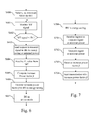
- Fig. 6 discloses an example of an algorithm executed by a base station which handles at least one mobile terminal according to a second mode of realization of the present invention when the base station is surrounded by a base station which is in energy saving mode.
- the present algorithm is executed by each base station of the wireless cellular telecommunication network when it is in an operation mode which enables at least one mobile terminal to be handled by the base station.
- the present algorithm is executed by the processor 300 of the base station BS1 in parallel for each mobile terminal handled by the base station BS1.
- the processor 300 obtains a minimum signal interference plus noise ratio p that should be provided, for example, to the mobile terminal MT2 the base station BS1 handles.
- the minimum signal interference plus noise ratio p is obtained as disclosed at step S400 of Fig. 4 .
- the processor 300 monitors the power of signal received by the mobile terminal MT2 from the base station BS1 using, for example, measurement report transferred periodically by the mobile terminal MT2.
- the processor 300 checks if the power of signal received by the mobile terminal MT2 from the base station BS1 is equal to or lower than the threshold Th determined for the mobile terminal MT2.
- the threshold Th is determined as disclosed at step S402 of Fig. 4 .
- the processor 300 moves to step S603 or to S604 according to a variant of the second mode of realization of the present invention. Otherwise, the processor 300 returns to step S601.
- the base station BS2 transfers when it is in energy saving mode, signal at a transmission power P 2mln which does not enable at least the mobile terminal MT2 to be handled by the base station BS2.
- This transmission power depends on network topology and is determined for example by network planning and provided for example to the base station BS2 with configuration data.
- the processor 300 sends a message to the base station BS2 requesting the base station BS2 which is in energy saving mode and not transferring any radio signal, to transfer signal at a transmission power P 2mln which does not enable the mobile terminal MT2 to be handled by the base station BS2.
- the processor 300 monitors the power of signal P 2 received by the mobile terminal MT2 from the base station BS2 using, for example, measurement reports transferred periodically by the mobile terminal MT2.
- the processor 300 commands the transfer, to the base station BS2, of the increase power factor ⁇ .
- the processor 300 marks the base station BS2 as being in the operation mode which enables a mobile terminal to be handled by the base station BS2.
- Fig. 7 discloses an example of an algorithm executed by a base station which is in energy saving mode according to the second mode of realization of the present invention.
- the present algorithm is executed by each base station of the wireless cellular telecommunication network when it is in the energy saving mode.
- the base station BS2 is in the energy saving mode, i.e. the base station BS2 does not transfer any radio signals.
- the processor 300 detects the reception of a message requesting the base station BS2, which is in energy saving mode and not transferring any radio signal, to transfer signal at a transmission power P 2mln which does not enable the mobile terminal MT2 to be handled by the base station BS2.
- the base station BS2 transfers, when it is in energy saving mode, signal at a transmission power P 2min which does not enable at least the mobile terminal MT2 to be handled by the base station BS2. According to that variant, steps S701 and S702 don't need to be executed and the processor 300 moves from step S700 to S703.
- the processor 300 commands the wireless interface 305 to transfer a signal at a transmission power P 2min which does not enable at the mobile terminal MT2 to be handled by the base station BS2.
- the processor 300 detects the reception of the increase power factor ⁇ .
- the processor commands the wireless interface 305 in order to switch in an operation mode which enables the mobile terminal MT2 to be handled by the base station BS2 by transferring signal at power ⁇ .P 2mln .
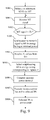
- Fig. 8 discloses an example of an algorithm executed by a base station which handles at least one mobile terminal according to the first mode of realization of the present invention when the base station is surrounded by plural base stations which are in energy saving mode.
- the present algorithm is executed by each base station of the wireless cellular telecommunication network when it is in an operation mode which enables a mobile terminal to be handled by the base station.
- the present algorithm is executed by the processor 300 of the base station BS1 in parallel for each mobile terminal handled by the base station BS1.
- the processor 300 obtains a minimum signal interference plus noise ratio p that should be provided, for example, to the mobile terminal MT2 the base station BS1 handles.
- the minimum signal interference plus noise ratio p is obtained as disclosed at step S400 of Fig. 4 .
- the processor 300 monitors the power of signal received by the mobile terminal MT2 from the base station BS1 using, for example, measurement report transferred periodically by the mobile terminal MT2.
- the processor 300 checks if the power of signal received by the mobile terminal MT2 from the base station BS1 is equal to or lower than a threshold Th determined for the mobile terminal MT2 as disclosed at step S402 of Fig. 4 .
- step S803 If the power of signal received by the mobile terminal MT2 from the base station BS1 is equal to or lower than the threshold Th determined for the mobile terminal MT2, the processor 300 moves to step S803. Otherwise, the processor 300 returns to step S801.
- the processor 300 sends a message to each neighbouring base station which is in energy saving mode requesting the neighbouring base station which is in energy saving mode to monitor the power of signal transferred by the mobile terminal MT2 and received by each neighbouring base station which is in energy saving mode.
- the message comprises information identifying the mobile terminal MT2 as disclosed at step S403 of the algorithm of Fig. 4 .
- the message further comprises the power P UE of signals transferred by the mobile terminal.
- the processor 300 receives from each neighbouring base station which is in energy saving mode, the value of the power signal P 2 the mobile terminal MT2 would receive from the base station which is energy saving mode if the base station which is energy saving mode was transmitting at its nominal power P 2n .
- the processor 300 selects, among the neighbouring base stations which are in energy saving mode, the one which provides the highest received power P 2 .
- the processor 300 commands the transfer, to the selected base station, of the power reduction factor ⁇ .
- the processor 300 marks the selected base station as being in the operation mode which enables a mobile terminal to be handled by the selected base station.
- Fig. 9 discloses an example of an algorithm executed by a base station which handles at least one mobile terminal according to the second mode of realization of the present invention when the base station is surrounded by plural base stations which are in energy saving mode.
- the present algorithm is executed by each base station of the wireless cellular telecommunication network when it is in an operation mode which enables a mobile terminal to be handled by the base station.
- the present algorithm is executed by the processor 300 of the base station BS1 in parallel for each mobile terminal MT handled by the base station BS1.
- the processor 300 obtains a minimum signal interference plus noise ratio p that should be provided, for example, to the mobile terminal MT2 the base station BS1 handles.
- the minimum signal interference plus noise ratio p is obtained as disclosed at step S400 of Fig. 4 .
- the processor 300 monitors the power of signal received by the mobile terminal MT2 from the base station BS1 using, for example, measurement report transferred periodically by the mobile terminal MT2.
- the processor 300 checks if the power of signal received by the mobile terminal MT2 from the base station BS1 is equal to or lower than a threshold Th determined for the mobile terminal MT2.
- the threshold Th is determined as disclosed at step S402 of Fig. 4 .
- step S903 If the power of signal received by the mobile terminal MT2 from the base station BS1 is equal to or lower than the threshold Th determined for the mobile terminal MT2, the processor 300 moves to step S903 or to step S904 according to a variant of the second mode of realization of the present invention. Otherwise, the processor 300 returns to step S901.
- the base stations BS transfer when they are in energy saving mode, signal at a transmission power P 2min which does not enable at least the mobile terminal MT2 to be handled by the base stations.
- the processor 300 sends to each neighbouring base station which is in energy saving mode and not transferring any radio signal a message requesting the base station to transfer signal at a transmission power P 2min which does not enable at the mobile terminal MT2 to be handled by the base station.
- the processor 300 monitors the powers P 2 of signals received by the mobile terminal MT2 from each neighbouring base station which is in energy saving mode using, for example, measurement report transferred periodically by the mobile terminal MT2.
- the processor 300 selects among the neighbouring base stations which are in energy saving mode, the one which provides the highest received power P 2 at the mobile terminal MT2.
- the processor 300 commands the transfer to the selected base station, of the increase power factor ⁇ .
- the processor 300 marks the selected base station as being in the operation mode which enables a mobile terminal to be handled by the base station BS2.
- the quality of service to be provided to the mobile terminal is increased and/or a more robust modulation and coding scheme is allocated to the mobile terminal when the power of signal received by the mobile terminal from the base station BS1 is lower than or equal to the threshold Th.
- Such increase of the quality of service and/or of the modulation and coding scheme robustness is taken into account when computing the minimum SINR p determined at steps S400, S600, S800 and S900.
- the threshold Th is increased accordingly, allowing to delay the time when a neighbouring base station in energy saving mode has to be switched into the operation mode which enables the mobile terminal MT2 to be handled by the base station BS2.
- This increase of quality of service and/or of the modulation and coding scheme robustness has impacts on base station load only the time for the mobile terminal to be handed over to the base station which leaves the energy saving mode.
- the processor 300 may command an increase of the robustness of the modulation and coding scheme and/or an increase of the amount of resources allocated to the mobile terminal MT2 in order to guaranty a communication link between the mobile terminal MT2 and the base station BS1 when the base station BS2 has to be switched into the operation mode which enables the mobile terminal MT2 to be handled by the base station BS2.
Landscapes
- Engineering & Computer Science (AREA)
- Computer Networks & Wireless Communication (AREA)
- Signal Processing (AREA)
- Mobile Radio Communication Systems (AREA)
Priority Applications (5)
| Application Number | Priority Date | Filing Date | Title |
|---|---|---|---|
| EP10186655.6A EP2439986B1 (de) | 2010-10-06 | 2010-10-06 | Verfahren zur bestimmung, unter welcher bedingung eine erste basisstation, die sich in einem energiesparmodus befindet, in einen anderen betriebsmodus umschalten muss |
| US13/242,868 US8868125B2 (en) | 2010-10-06 | 2011-09-23 | Method for determining in which condition a first base station which is in an energy saving mode has to switch in another operation mode |
| CN201110292528.7A CN102448153B (zh) | 2010-10-06 | 2011-09-30 | 确定基站在哪种条件下必须接入另一模式的方法和设备 |
| JP2011221986A JP2012085288A (ja) | 2010-10-06 | 2011-10-06 | 省エネルギーモードにある第1の基地局を別の動作モードに切り替えるのに必要な条件を確定する方法 |
| JP2016095879A JP6386493B2 (ja) | 2010-10-06 | 2016-05-12 | 無線セルラ通信ネットワークにおいて送信電力を確定する方法 |
Applications Claiming Priority (1)
| Application Number | Priority Date | Filing Date | Title |
|---|---|---|---|
| EP10186655.6A EP2439986B1 (de) | 2010-10-06 | 2010-10-06 | Verfahren zur bestimmung, unter welcher bedingung eine erste basisstation, die sich in einem energiesparmodus befindet, in einen anderen betriebsmodus umschalten muss |
Publications (2)
| Publication Number | Publication Date |
|---|---|
| EP2439986A1 true EP2439986A1 (de) | 2012-04-11 |
| EP2439986B1 EP2439986B1 (de) | 2018-08-15 |
Family
ID=43602917
Family Applications (1)
| Application Number | Title | Priority Date | Filing Date |
|---|---|---|---|
| EP10186655.6A Not-in-force EP2439986B1 (de) | 2010-10-06 | 2010-10-06 | Verfahren zur bestimmung, unter welcher bedingung eine erste basisstation, die sich in einem energiesparmodus befindet, in einen anderen betriebsmodus umschalten muss |
Country Status (4)
| Country | Link |
|---|---|
| US (1) | US8868125B2 (de) |
| EP (1) | EP2439986B1 (de) |
| JP (2) | JP2012085288A (de) |
| CN (1) | CN102448153B (de) |
Cited By (1)
| Publication number | Priority date | Publication date | Assignee | Title |
|---|---|---|---|---|
| WO2023163630A1 (en) * | 2022-02-22 | 2023-08-31 | Telefonaktiebolaget Lm Ericsson (Publ) | Energy-efficient network transmit power adaptation |
Families Citing this family (8)
| Publication number | Priority date | Publication date | Assignee | Title |
|---|---|---|---|---|
| GB2497918A (en) * | 2011-12-06 | 2013-07-03 | Nec Corp | HNB and HeNB of a dual mode base station having an internalinterface coupling over which they inform each other of whether they are in a power saving mode |
| US8805384B2 (en) * | 2012-04-27 | 2014-08-12 | Intel Corporation | Inter-rat coverage determination for energy saving management |
| CN103052134B (zh) * | 2012-12-26 | 2015-02-04 | 北京邮电大学 | 一种可再生能源供能基站接入选择方法和系统 |
| US10028302B2 (en) | 2013-03-08 | 2018-07-17 | Huawei Technologies Co., Ltd. | System and method for uplink grant-free transmission scheme |
| US10135562B2 (en) * | 2015-05-28 | 2018-11-20 | Huawei Technologies Co., Ltd. | Apparatus and method for link adaptation in uplink grant-less random access |
| US10270481B1 (en) * | 2015-12-22 | 2019-04-23 | Amazon Technologies, Inc. | Wireless communication receiver gain management system |
| CN115396960B (zh) * | 2021-05-24 | 2025-03-18 | 南宁富联富桂精密工业有限公司 | 无线通信系统中管理换手的方法及装置 |
| US12185249B2 (en) * | 2022-04-28 | 2024-12-31 | Qualcomm Incorporated | Mode management for network entity energy savings |
Citations (3)
| Publication number | Priority date | Publication date | Assignee | Title |
|---|---|---|---|---|
| US20050208946A1 (en) * | 2004-03-17 | 2005-09-22 | Motorola, Inc. | Power balancing for downlink fast power control using central processing |
| EP2056628A1 (de) * | 2007-10-30 | 2009-05-06 | Nokia Siemens Networks Oy | Kommunikationsnetzwerkelemente und Verfahren zum Schalten von Aktivitätszuständen |
| WO2010093298A1 (en) * | 2009-02-16 | 2010-08-19 | Telefonaktiebolaget Lm Ericsson (Publ) | Controllling cell activation in a radio communication network |
Family Cites Families (14)
| Publication number | Priority date | Publication date | Assignee | Title |
|---|---|---|---|---|
| JP3852724B2 (ja) * | 1997-12-18 | 2006-12-06 | ソニー株式会社 | 送信電力制御方法及び基地局 |
| JP4272675B2 (ja) * | 2003-08-19 | 2009-06-03 | エルジー エレクトロニクス インコーポレイティド | 移動通信システムにおけるNodeBスケジューリング方法 |
| US7620004B2 (en) * | 2004-04-30 | 2009-11-17 | Alcatel-Lucent Usa Inc. | Methods of power overload control in communication systems |
| US7577456B2 (en) * | 2005-02-28 | 2009-08-18 | Telefonaktiebolaget Lm Ericsson (Publ) | Using uplink relative path gain related measurements to support uplink resource management |
| US7668530B2 (en) * | 2005-04-01 | 2010-02-23 | Adaptix, Inc. | Systems and methods for coordinating the coverage and capacity of a wireless base station |
| US8514771B2 (en) * | 2005-12-22 | 2013-08-20 | Qualcomm Incorporated | Methods and apparatus for communicating and/or using transmission power information |
| JP4595912B2 (ja) * | 2006-08-28 | 2010-12-08 | 日本電気株式会社 | 送信電力制御システム、制御方法及び基地局並びに移動局 |
| US8712461B2 (en) * | 2007-08-10 | 2014-04-29 | Qualcomm Incorporated | Autonomous adaptation of transmit power |
| JP5051241B2 (ja) * | 2007-12-20 | 2012-10-17 | 富士通株式会社 | 無線通信システムにおけるアップリンク電力制御方法および同システムにおける上位装置 |
| EP2282573A4 (de) * | 2008-05-27 | 2014-05-14 | Ntt Docomo Inc | Verfahren zur überwachung einer funkbasisstation und netzwerkgerät |
| EP2343933B1 (de) * | 2008-10-27 | 2016-06-15 | NEC Corporation | Basisstation, funkkommunikationssystem, basisstationssteuerverfahren, funkkommunikationsverfahren und steuerprogramm |
| KR101428638B1 (ko) * | 2010-02-25 | 2014-08-08 | 브로드콤 코포레이션 | 다수의 무선 기술 통신 디바이스에서 전력 및 핸드오버 관리를 위한 방법 및 장치 |
| WO2012050506A1 (en) * | 2010-10-12 | 2012-04-19 | Telefonaktiebolaget L M Ericsson (Publ) | Uplink power control |
| WO2012052066A1 (en) * | 2010-10-22 | 2012-04-26 | Telefonaktiebolaget L M Ericsson (Publ) | Methods for cell selection balancing, computer programs and computer program products |
-
2010
- 2010-10-06 EP EP10186655.6A patent/EP2439986B1/de not_active Not-in-force
-
2011
- 2011-09-23 US US13/242,868 patent/US8868125B2/en not_active Expired - Fee Related
- 2011-09-30 CN CN201110292528.7A patent/CN102448153B/zh not_active Expired - Fee Related
- 2011-10-06 JP JP2011221986A patent/JP2012085288A/ja active Pending
-
2016
- 2016-05-12 JP JP2016095879A patent/JP6386493B2/ja not_active Expired - Fee Related
Patent Citations (3)
| Publication number | Priority date | Publication date | Assignee | Title |
|---|---|---|---|---|
| US20050208946A1 (en) * | 2004-03-17 | 2005-09-22 | Motorola, Inc. | Power balancing for downlink fast power control using central processing |
| EP2056628A1 (de) * | 2007-10-30 | 2009-05-06 | Nokia Siemens Networks Oy | Kommunikationsnetzwerkelemente und Verfahren zum Schalten von Aktivitätszuständen |
| WO2010093298A1 (en) * | 2009-02-16 | 2010-08-19 | Telefonaktiebolaget Lm Ericsson (Publ) | Controllling cell activation in a radio communication network |
Non-Patent Citations (1)
| Title |
|---|
| SHENZHEN C: "Dynamic Setup of HNBs for Energy Savings and Interference Reduction", 3RD GENERATION PARTNERSHIP PROJECT (3GPP); TECHNICALSPECIFICATION GROUP (TSG) RADIO ACCESS NETWORK (RAN); WORKINGGROUP 3 (WG3), XX, XX, vol. R3-080658, 31 March 2008 (2008-03-31), pages 1 - 6, XP003023429 * |
Cited By (1)
| Publication number | Priority date | Publication date | Assignee | Title |
|---|---|---|---|---|
| WO2023163630A1 (en) * | 2022-02-22 | 2023-08-31 | Telefonaktiebolaget Lm Ericsson (Publ) | Energy-efficient network transmit power adaptation |
Also Published As
| Publication number | Publication date |
|---|---|
| US20120088531A1 (en) | 2012-04-12 |
| EP2439986B1 (de) | 2018-08-15 |
| US8868125B2 (en) | 2014-10-21 |
| CN102448153A (zh) | 2012-05-09 |
| JP2016178672A (ja) | 2016-10-06 |
| JP2012085288A (ja) | 2012-04-26 |
| JP6386493B2 (ja) | 2018-09-05 |
| CN102448153B (zh) | 2016-08-03 |
Similar Documents
| Publication | Publication Date | Title |
|---|---|---|
| EP2439986B1 (de) | Verfahren zur bestimmung, unter welcher bedingung eine erste basisstation, die sich in einem energiesparmodus befindet, in einen anderen betriebsmodus umschalten muss | |
| US9277496B2 (en) | Cell selection | |
| EP2217028B1 (de) | Verfahren und Vorrichtung zur Anpassung der Übertragungsleistung von Signalen | |
| JP4907700B2 (ja) | 無線局、送信局及び周波数帯共用方法 | |
| CN102625388B (zh) | 切换方法、基站和系统 | |
| JP5647453B2 (ja) | 無線通信システム、無線中継局、無線端末、及び通信制御方法 | |
| EP2136478A1 (de) | Verfahren zur Picozellen-Leistungsregelung und entsprechende Basisstation | |
| KR20120091261A (ko) | 무선 통신 시스템, 기지국 장치, 기지국 제어 장치, 기지국의 송신 전력 제어 방법, 및 컴퓨터 판독 가능 매체 | |
| JP2004048528A (ja) | セルラシステムの異周波数切替え方法及びセルラシステム並びにその基地局制御装置及び移動局 | |
| WO2012053240A1 (ja) | 無線通信システム、低電力基地局及び通信制御方法 | |
| EP2485543A1 (de) | Drahtloses kommunikationssystem, grosszellige basisstation und kommunikationssteuerverfahren | |
| CN101790858B (zh) | 时分双工系统中改进的信号质量测量 | |
| EP2582180A1 (de) | Funkkommunikationssystem, funkbasisstation, funkendgeräte und kommunikationssteuerverfahren | |
| JP2007221276A (ja) | 移動局および無線アクセスネットワーク装置並びにモビリティ制御方法 | |
| JPH09322222A (ja) | 移動通信システムにおけるハンドオーバ開始判定方法および移動局装置と基地局装置 | |
| CN102598750A (zh) | 无线基站和通信控制方法 | |
| EP2731378B1 (de) | Erzeugung einer Nachbarzellenliste in einem heterogenen Netzwerk | |
| JP3056473B1 (ja) | 移動体通信システム、基地局装置、移動局装置および送信制御方法 | |
| EP2487966B1 (de) | Verfahren und Vorrichtung zum Einstellen eines maximalen Wertes einer Übertragungsleistung von Signalen, die von einer Heimbasisstation übertragen werden | |
| US9615324B2 (en) | Method for setting, in a wireless cellular telecommunication network, the power of the radio signals transferred in cells | |
| KR19990031209A (ko) | 이동통신에서 역방향 링크제어 채널의 전력 제어방법 | |
| CN114339820A (zh) | 卫星通信网络中的通信方法、装置、设备及可读存储介质 | |
| WO2012137928A1 (ja) | 無線通信システム、低電力基地局及び通信制御方法 | |
| KR20020039859A (ko) | 이동 통신 시스템의 에스에스디티(ssdt)를 이용한핸드 오프 방법 |
Legal Events
| Date | Code | Title | Description |
|---|---|---|---|
| AK | Designated contracting states |
Kind code of ref document: A1 Designated state(s): AL AT BE BG CH CY CZ DE DK EE ES FI FR GB GR HR HU IE IS IT LI LT LU LV MC MK MT NL NO PL PT RO RS SE SI SK SM TR |
|
| AX | Request for extension of the european patent |
Extension state: BA ME |
|
| PUAI | Public reference made under article 153(3) epc to a published international application that has entered the european phase |
Free format text: ORIGINAL CODE: 0009012 |
|
| 17P | Request for examination filed |
Effective date: 20121008 |
|
| 17Q | First examination report despatched |
Effective date: 20161108 |
|
| GRAP | Despatch of communication of intention to grant a patent |
Free format text: ORIGINAL CODE: EPIDOSNIGR1 |
|
| INTG | Intention to grant announced |
Effective date: 20180315 |
|
| RIN1 | Information on inventor provided before grant (corrected) |
Inventor name: KHANFOUCI, MOURAD Inventor name: BONNEVILLE, HERVE Inventor name: GRESSET, NICOLAS |
|
| GRAS | Grant fee paid |
Free format text: ORIGINAL CODE: EPIDOSNIGR3 |
|
| GRAA | (expected) grant |
Free format text: ORIGINAL CODE: 0009210 |
|
| AK | Designated contracting states |
Kind code of ref document: B1 Designated state(s): AL AT BE BG CH CY CZ DE DK EE ES FI FR GB GR HR HU IE IS IT LI LT LU LV MC MK MT NL NO PL PT RO RS SE SI SK SM TR |
|
| REG | Reference to a national code |
Ref country code: CH Ref legal event code: EP Ref country code: GB Ref legal event code: FG4D Ref country code: AT Ref legal event code: REF Ref document number: 1031255 Country of ref document: AT Kind code of ref document: T Effective date: 20180815 |
|
| REG | Reference to a national code |
Ref country code: IE Ref legal event code: FG4D |
|
| REG | Reference to a national code |
Ref country code: DE Ref legal event code: R096 Ref document number: 602010052699 Country of ref document: DE |
|
| REG | Reference to a national code |
Ref country code: FR Ref legal event code: PLFP Year of fee payment: 9 |
|
| REG | Reference to a national code |
Ref country code: NL Ref legal event code: MP Effective date: 20180815 |
|
| REG | Reference to a national code |
Ref country code: LT Ref legal event code: MG4D |
|
| REG | Reference to a national code |
Ref country code: AT Ref legal event code: MK05 Ref document number: 1031255 Country of ref document: AT Kind code of ref document: T Effective date: 20180815 |
|
| PG25 | Lapsed in a contracting state [announced via postgrant information from national office to epo] |
Ref country code: NO Free format text: LAPSE BECAUSE OF FAILURE TO SUBMIT A TRANSLATION OF THE DESCRIPTION OR TO PAY THE FEE WITHIN THE PRESCRIBED TIME-LIMIT Effective date: 20181115 Ref country code: BG Free format text: LAPSE BECAUSE OF FAILURE TO SUBMIT A TRANSLATION OF THE DESCRIPTION OR TO PAY THE FEE WITHIN THE PRESCRIBED TIME-LIMIT Effective date: 20181115 Ref country code: SE Free format text: LAPSE BECAUSE OF FAILURE TO SUBMIT A TRANSLATION OF THE DESCRIPTION OR TO PAY THE FEE WITHIN THE PRESCRIBED TIME-LIMIT Effective date: 20180815 Ref country code: NL Free format text: LAPSE BECAUSE OF FAILURE TO SUBMIT A TRANSLATION OF THE DESCRIPTION OR TO PAY THE FEE WITHIN THE PRESCRIBED TIME-LIMIT Effective date: 20180815 Ref country code: LT Free format text: LAPSE BECAUSE OF FAILURE TO SUBMIT A TRANSLATION OF THE DESCRIPTION OR TO PAY THE FEE WITHIN THE PRESCRIBED TIME-LIMIT Effective date: 20180815 Ref country code: FI Free format text: LAPSE BECAUSE OF FAILURE TO SUBMIT A TRANSLATION OF THE DESCRIPTION OR TO PAY THE FEE WITHIN THE PRESCRIBED TIME-LIMIT Effective date: 20180815 Ref country code: AT Free format text: LAPSE BECAUSE OF FAILURE TO SUBMIT A TRANSLATION OF THE DESCRIPTION OR TO PAY THE FEE WITHIN THE PRESCRIBED TIME-LIMIT Effective date: 20180815 Ref country code: IS Free format text: LAPSE BECAUSE OF FAILURE TO SUBMIT A TRANSLATION OF THE DESCRIPTION OR TO PAY THE FEE WITHIN THE PRESCRIBED TIME-LIMIT Effective date: 20181215 Ref country code: GR Free format text: LAPSE BECAUSE OF FAILURE TO SUBMIT A TRANSLATION OF THE DESCRIPTION OR TO PAY THE FEE WITHIN THE PRESCRIBED TIME-LIMIT Effective date: 20181116 Ref country code: RS Free format text: LAPSE BECAUSE OF FAILURE TO SUBMIT A TRANSLATION OF THE DESCRIPTION OR TO PAY THE FEE WITHIN THE PRESCRIBED TIME-LIMIT Effective date: 20180815 |
|
| PG25 | Lapsed in a contracting state [announced via postgrant information from national office to epo] |
Ref country code: AL Free format text: LAPSE BECAUSE OF FAILURE TO SUBMIT A TRANSLATION OF THE DESCRIPTION OR TO PAY THE FEE WITHIN THE PRESCRIBED TIME-LIMIT Effective date: 20180815 Ref country code: ES Free format text: LAPSE BECAUSE OF FAILURE TO SUBMIT A TRANSLATION OF THE DESCRIPTION OR TO PAY THE FEE WITHIN THE PRESCRIBED TIME-LIMIT Effective date: 20180815 Ref country code: HR Free format text: LAPSE BECAUSE OF FAILURE TO SUBMIT A TRANSLATION OF THE DESCRIPTION OR TO PAY THE FEE WITHIN THE PRESCRIBED TIME-LIMIT Effective date: 20180815 Ref country code: LV Free format text: LAPSE BECAUSE OF FAILURE TO SUBMIT A TRANSLATION OF THE DESCRIPTION OR TO PAY THE FEE WITHIN THE PRESCRIBED TIME-LIMIT Effective date: 20180815 |
|
| PG25 | Lapsed in a contracting state [announced via postgrant information from national office to epo] |
Ref country code: EE Free format text: LAPSE BECAUSE OF FAILURE TO SUBMIT A TRANSLATION OF THE DESCRIPTION OR TO PAY THE FEE WITHIN THE PRESCRIBED TIME-LIMIT Effective date: 20180815 Ref country code: IT Free format text: LAPSE BECAUSE OF FAILURE TO SUBMIT A TRANSLATION OF THE DESCRIPTION OR TO PAY THE FEE WITHIN THE PRESCRIBED TIME-LIMIT Effective date: 20180815 Ref country code: CZ Free format text: LAPSE BECAUSE OF FAILURE TO SUBMIT A TRANSLATION OF THE DESCRIPTION OR TO PAY THE FEE WITHIN THE PRESCRIBED TIME-LIMIT Effective date: 20180815 Ref country code: RO Free format text: LAPSE BECAUSE OF FAILURE TO SUBMIT A TRANSLATION OF THE DESCRIPTION OR TO PAY THE FEE WITHIN THE PRESCRIBED TIME-LIMIT Effective date: 20180815 Ref country code: PL Free format text: LAPSE BECAUSE OF FAILURE TO SUBMIT A TRANSLATION OF THE DESCRIPTION OR TO PAY THE FEE WITHIN THE PRESCRIBED TIME-LIMIT Effective date: 20180815 |
|
| REG | Reference to a national code |
Ref country code: DE Ref legal event code: R097 Ref document number: 602010052699 Country of ref document: DE |
|
| PG25 | Lapsed in a contracting state [announced via postgrant information from national office to epo] |
Ref country code: SK Free format text: LAPSE BECAUSE OF FAILURE TO SUBMIT A TRANSLATION OF THE DESCRIPTION OR TO PAY THE FEE WITHIN THE PRESCRIBED TIME-LIMIT Effective date: 20180815 Ref country code: SM Free format text: LAPSE BECAUSE OF FAILURE TO SUBMIT A TRANSLATION OF THE DESCRIPTION OR TO PAY THE FEE WITHIN THE PRESCRIBED TIME-LIMIT Effective date: 20180815 Ref country code: DK Free format text: LAPSE BECAUSE OF FAILURE TO SUBMIT A TRANSLATION OF THE DESCRIPTION OR TO PAY THE FEE WITHIN THE PRESCRIBED TIME-LIMIT Effective date: 20180815 |
|
| REG | Reference to a national code |
Ref country code: CH Ref legal event code: PL |
|
| PLBE | No opposition filed within time limit |
Free format text: ORIGINAL CODE: 0009261 |
|
| STAA | Information on the status of an ep patent application or granted ep patent |
Free format text: STATUS: NO OPPOSITION FILED WITHIN TIME LIMIT |
|
| REG | Reference to a national code |
Ref country code: BE Ref legal event code: MM Effective date: 20181031 |
|
| PG25 | Lapsed in a contracting state [announced via postgrant information from national office to epo] |
Ref country code: MC Free format text: LAPSE BECAUSE OF FAILURE TO SUBMIT A TRANSLATION OF THE DESCRIPTION OR TO PAY THE FEE WITHIN THE PRESCRIBED TIME-LIMIT Effective date: 20180815 Ref country code: LU Free format text: LAPSE BECAUSE OF NON-PAYMENT OF DUE FEES Effective date: 20181006 |
|
| 26N | No opposition filed |
Effective date: 20190516 |
|
| REG | Reference to a national code |
Ref country code: IE Ref legal event code: MM4A |
|
| PG25 | Lapsed in a contracting state [announced via postgrant information from national office to epo] |
Ref country code: LI Free format text: LAPSE BECAUSE OF NON-PAYMENT OF DUE FEES Effective date: 20181031 Ref country code: CH Free format text: LAPSE BECAUSE OF NON-PAYMENT OF DUE FEES Effective date: 20181031 Ref country code: BE Free format text: LAPSE BECAUSE OF NON-PAYMENT OF DUE FEES Effective date: 20181031 Ref country code: SI Free format text: LAPSE BECAUSE OF FAILURE TO SUBMIT A TRANSLATION OF THE DESCRIPTION OR TO PAY THE FEE WITHIN THE PRESCRIBED TIME-LIMIT Effective date: 20180815 |
|
| PG25 | Lapsed in a contracting state [announced via postgrant information from national office to epo] |
Ref country code: IE Free format text: LAPSE BECAUSE OF NON-PAYMENT OF DUE FEES Effective date: 20181006 |
|
| PG25 | Lapsed in a contracting state [announced via postgrant information from national office to epo] |
Ref country code: MT Free format text: LAPSE BECAUSE OF NON-PAYMENT OF DUE FEES Effective date: 20181006 |
|
| PG25 | Lapsed in a contracting state [announced via postgrant information from national office to epo] |
Ref country code: TR Free format text: LAPSE BECAUSE OF FAILURE TO SUBMIT A TRANSLATION OF THE DESCRIPTION OR TO PAY THE FEE WITHIN THE PRESCRIBED TIME-LIMIT Effective date: 20180815 |
|
| PG25 | Lapsed in a contracting state [announced via postgrant information from national office to epo] |
Ref country code: PT Free format text: LAPSE BECAUSE OF FAILURE TO SUBMIT A TRANSLATION OF THE DESCRIPTION OR TO PAY THE FEE WITHIN THE PRESCRIBED TIME-LIMIT Effective date: 20180815 |
|
| PG25 | Lapsed in a contracting state [announced via postgrant information from national office to epo] |
Ref country code: CY Free format text: LAPSE BECAUSE OF FAILURE TO SUBMIT A TRANSLATION OF THE DESCRIPTION OR TO PAY THE FEE WITHIN THE PRESCRIBED TIME-LIMIT Effective date: 20180815 Ref country code: MK Free format text: LAPSE BECAUSE OF NON-PAYMENT OF DUE FEES Effective date: 20180815 Ref country code: HU Free format text: LAPSE BECAUSE OF FAILURE TO SUBMIT A TRANSLATION OF THE DESCRIPTION OR TO PAY THE FEE WITHIN THE PRESCRIBED TIME-LIMIT; INVALID AB INITIO Effective date: 20101006 |
|
| PGFP | Annual fee paid to national office [announced via postgrant information from national office to epo] |
Ref country code: FR Payment date: 20210913 Year of fee payment: 12 |
|
| PGFP | Annual fee paid to national office [announced via postgrant information from national office to epo] |
Ref country code: GB Payment date: 20210901 Year of fee payment: 12 |
|
| PGFP | Annual fee paid to national office [announced via postgrant information from national office to epo] |
Ref country code: DE Payment date: 20210831 Year of fee payment: 12 |
|
| REG | Reference to a national code |
Ref country code: DE Ref legal event code: R084 Ref document number: 602010052699 Country of ref document: DE |
|
| REG | Reference to a national code |
Ref country code: GB Ref legal event code: 746 Effective date: 20220509 |
|
| REG | Reference to a national code |
Ref country code: DE Ref legal event code: R119 Ref document number: 602010052699 Country of ref document: DE |
|
| GBPC | Gb: european patent ceased through non-payment of renewal fee |
Effective date: 20221006 |
|
| PG25 | Lapsed in a contracting state [announced via postgrant information from national office to epo] |
Ref country code: FR Free format text: LAPSE BECAUSE OF NON-PAYMENT OF DUE FEES Effective date: 20221031 Ref country code: DE Free format text: LAPSE BECAUSE OF NON-PAYMENT OF DUE FEES Effective date: 20230503 |
|
| PG25 | Lapsed in a contracting state [announced via postgrant information from national office to epo] |
Ref country code: GB Free format text: LAPSE BECAUSE OF NON-PAYMENT OF DUE FEES Effective date: 20221006 |