EP2438929B1 - Solution anti-infectieuse comprenant un composé pyrido(3,2,1-ij)-benzoxadiazine - Google Patents
Solution anti-infectieuse comprenant un composé pyrido(3,2,1-ij)-benzoxadiazine Download PDFInfo
- Publication number
- EP2438929B1 EP2438929B1 EP11177669.6A EP11177669A EP2438929B1 EP 2438929 B1 EP2438929 B1 EP 2438929B1 EP 11177669 A EP11177669 A EP 11177669A EP 2438929 B1 EP2438929 B1 EP 2438929B1
- Authority
- EP
- European Patent Office
- Prior art keywords
- solution
- solution according
- compound
- substituted
- radical
- Prior art date
- Legal status (The legal status is an assumption and is not a legal conclusion. Google has not performed a legal analysis and makes no representation as to the accuracy of the status listed.)
- Active
Links
Classifications
-
- A—HUMAN NECESSITIES
- A61—MEDICAL OR VETERINARY SCIENCE; HYGIENE
- A61K—PREPARATIONS FOR MEDICAL, DENTAL OR TOILETRY PURPOSES
- A61K9/00—Medicinal preparations characterised by special physical form
- A61K9/0012—Galenical forms characterised by the site of application
- A61K9/0019—Injectable compositions; Intramuscular, intravenous, arterial, subcutaneous administration; Compositions to be administered through the skin in an invasive manner
-
- A—HUMAN NECESSITIES
- A61—MEDICAL OR VETERINARY SCIENCE; HYGIENE
- A61K—PREPARATIONS FOR MEDICAL, DENTAL OR TOILETRY PURPOSES
- A61K31/00—Medicinal preparations containing organic active ingredients
- A61K31/33—Heterocyclic compounds
- A61K31/395—Heterocyclic compounds having nitrogen as a ring hetero atom, e.g. guanethidine or rifamycins
- A61K31/535—Heterocyclic compounds having nitrogen as a ring hetero atom, e.g. guanethidine or rifamycins having six-membered rings with at least one nitrogen and one oxygen as the ring hetero atoms, e.g. 1,2-oxazines
- A61K31/5395—Heterocyclic compounds having nitrogen as a ring hetero atom, e.g. guanethidine or rifamycins having six-membered rings with at least one nitrogen and one oxygen as the ring hetero atoms, e.g. 1,2-oxazines having two or more nitrogen atoms in the same ring, e.g. oxadiazines
-
- A—HUMAN NECESSITIES
- A61—MEDICAL OR VETERINARY SCIENCE; HYGIENE
- A61P—SPECIFIC THERAPEUTIC ACTIVITY OF CHEMICAL COMPOUNDS OR MEDICINAL PREPARATIONS
- A61P31/00—Antiinfectives, i.e. antibiotics, antiseptics, chemotherapeutics
Definitions
- the technical field of the present invention relates to anti-infectious solutions intended for treating animals.
- the present invention relates more specifically to an injectable anti-infectious aqueous solution comprising at least one pyrido (3,2,1-ij) -benzoxadiazine compound, and in particular a concentrated solution.
- the volume of product administered parenterally as well as the number of injection sites are important criteria in choosing a formulation.
- One objective of producing a concentrated formula is to reduce the volume and / or the number of administrations, in particular with a view to reducing, for production animals, the muscular areas not valued at the slaughterhouse.
- Another important criterion, which can also be taken into account in the production of concentrated formulas, is local tolerance, at the injection site, in particular to reduce losses at the slaughterhouse.
- some of the anti-infective products for example Marbofloxacin, have a low solubility in water.
- This can lead to the use of technologies making it possible to increase their solubility, such as salification, the use of complexes more soluble than the molecule itself, for example in combination with a cyclodextrin, pH modifiers, dispersed systems (emulsions , liposomes, vector systems), or adding adjuvants such as organic solvents, co-solvents, or surfactants.
- solutions sold mention may be made of stable solutions containing up to 10% of Marbofloxacin.
- the therapeutic dose is high.
- the use of solutions currently marketed requires the administration of large injection volumes, in particular greater than or equal to 40 ml, distributed over several injection sites. These conditions can lead to tolerance issues.
- the subject of the invention is an aqueous anti-infective solution for injection comprising (i) from 15 to 20% by weight relative to the total volume of the solution of at least one compound of the pyrido type (3, 2,1-ij) -benzoxadiazine, or at least one of its pharmaceutically acceptable salts, (ii) a stabilizing agent chosen from the group comprising alcohols, propylenes glycol, polyethylene glycol and glycerin, and (iii) at least a solubilizing agent or solubilizing agent chosen from the group comprising mineral acids, organic acids and their esters, and their mixtures, in a pharmaceutically acceptable carrier.
- a stabilizing agent chosen from the group comprising alcohols, propylenes glycol, polyethylene glycol and glycerin
- a solubilizing agent or solubilizing agent chosen from the group comprising mineral acids, organic acids and their esters, and their mixtures, in a pharmaceutically acceptable carrier.
- the pyrido (3,2,1-ij) -benzoxadiazine type compound may very particularly correspond to formula (I) in which R1 represents a 1-piperazinyl radical substituted in position 4 by a methyl group, R2 represents a methyl group and X represents a fluorine atom.
- This compound can in particular be obtained by the methods described in the document EP 0 259 804 .
- This compound corresponds in particular to the International Common Denomination of Marbofloxacin.
- the solution includes at least one solubilizing agent.
- This solubilizing agent can form a complex with the pyrido (3,2,1-ij) -benzoxadiazine compound.
- this solubilizing agent is an acid, it can form a salt with the compound of the pyrido (3,2,1-ij) -benzoxadiazine type.
- solubilizing agents of the pyrido (3,2,1-ij) -benzoxadiazine type compounds and in particular Marbofloxacin, mention may particularly be made of lactic acid, gluconic acid and gluconolactone.
- the solution can comprise a solubilizing agent content ranging from 4 to 58% by weight, in particular from 5 to 35% by weight, in particular ranging from 6 to 25% by weight, or even ranging from 7 to 20% by weight relative to to the total volume of the solution.
- the solution according to the invention comprises a molar ratio of solubilizing agent / pyrido (3,2,1-ij) -benzoxadiazine type compound ranging from 0.9 to 4, in particular from 1 to 3, and in particular from 1.1 to 2.4.
- the solution can comprise a solubilizing agent content such that the pH of the solution ranges from 2 to 7, in particular from 2.8 to 5.
- solutions described above may exhibit limited stability, in particular when they comprise a high concentration of compound of the pyrido (3,2,1-ij) -benzoxadiazine type and a low concentration of solubilizing agent.
- the inventors have discovered that it is possible to improve the feasibility of certain concentrated solutions and / or their stability by the addition of at least one solubilizing agent and / or at least one stabilizing agent.
- the stabilizing agent can be chosen from the group comprising alcohols, propylenes glycol, polyethylene glycol, glycerin. More particularly, the stabilizing agent is an alcohol, in particular aromatic, alkyl, arylalkyl or alkylaryl, in particular comprising from 5 to 15 carbon atoms, and very especially benzyl alcohol and its derivatives.
- benzyl alcohol derivative means compounds corresponding to formula (II): in which R 3 , R 4 , R 5 , R 6 , R 7 , R 8 and R 9 independently represent a hydrogen or halogen atom, an alcohol, ether, amine, optionally substituted function, thioether, ester, amide , optionally substituted, an alkyl, aryl, aralkyl, alkaryl radical.
- the solution comprises a content of stabilizing agent ranging from 0.2 to 20% by weight, in particular from 0.3 to 10% by weight, in particular from 0.4 to 5% by weight, and very particularly from 0.5 to 3% by weight relative to the total volume of the solution.
- the solution may comprise a stabilizing agent / pyrido (3,2,1-ij) -benzoxadiazine type molar ratio ranging from 0.02 to 7, in particular from 0.05 to 5, in particular from 0 , 1 to 1.5, or even 0.2 to 1.
- the solutions can comprise a molar ratio of solubilizing agent / stabilizing agent ranging from 1 to 15, in particular from 1.5 to 10, in particular from 2 to 8, or even from 2.5 to 7.
- the pH of the solution can range from 2 to 7, in particular from 2.8 to 5.
- the solution according to the invention is in the form of an injectable solution, in particular by intramuscular, subcutaneous, intraperitoneal and / or intravenous route.
- Said solution can also be an infusion or an infusion.
- This solution can be intended for so-called production animals, such as sheep, cattle, pigs, goats, horses and / or poultry, and / or for pets, such as dogs and cats.
- the solution has a viscosity ranging from 10 -4 to 10 -2 , in particular from 10 -3 to 5.10 -3 Pa.s at 20 ° C.
- the solution may be clear, in particular not including suspended particles.
- the use of at least one compound of the pyrido (3,2,1-ij) -benzoxadiazine type as described above is described in the preparation of a solution intended to treat or prevent infections, in particular in animals, said pyrido (3,2,1-ij) -benzoxadiazine compound being present in a content ranging from 10 to 30% by weight, in particular 11 to 28% by weight, or even 12 to 27% by weight, in particular from 13 to 25% by weight, very particularly from 14 to 23% by weight, or even from 15 to 20% by weight relative to the total volume of the solution.
- a solution according to the invention is described for the preparation of a medicament intended to treat or prevent infections, in particular in animals.
- infections capable of being treated there may be mentioned infections of the respiratory system, the reproductive system, the urinary system, the digestive system, the musculoskeletal system, the cardiovascular system, of the skin type, otitis, ophthalmic, in particular in animals.
- Said treatment method can comprise the injection of 0.01 to 0.5 ml of concentrated solution per kg, in particular from 0.01 to 0.1 ml / kg of animal to be treated.
- the treatment may include a single injection at a single point.
- the treatment of a respiratory infection can be carried out with "MARBOCYL S" with a volume of 24 ml, administered at 2 injection points, and with the concentrated solution, with a volume of 15 ml, injected at 1 point.
- treatment is meant the treatment itself, but also prophylaxis and metaphylaxis.
- the stabilizing agent is an alcohol, in particular aromatic, alkyl, arylalkyl or alkylaryl, in particular comprising from 5 to 15 carbon atoms, and very especially benzyl alcohol and its derivatives, as stabilizing agent for a solution comprising at least one compound of formula (I), in particular at a high concentration, in particular greater than 10% by weight relative to the total volume of the solution, and optionally a solubilizing agent.
- a stabilizing agent and in particular of benzyl alcohol, can also allow the solutions concentrated in compound of formula (I), in particular in Marbofloxacin, and comprising at least one solubilizing agent, in particular gluconolactone, to have a lower pH and / or osmolarity compared to the solutions comprising an equivalent concentration of compound of formula ( I) and optionally as a solubilizing agent.
- This can in particular allow concentrated solutions comprising at least one compound of formula (I), a solubilizing agent and a stabilizing agent to have a pH and / or an osmolarity close to the less concentrated compositions, in particular of compound of formula (I) and / or as a solubilizing agent. This is linked to the presence of a stabilizing agent which can allow the use of less solubilizing agent.
- stabilizing agent also makes it possible to manufacture certain very concentrated solutions of compound of formula (I) suitable for injection, which would not be, or would be difficult, without the added this agent. Indeed, the stabilizing effect can increase with the content of stabilizing agent.
- benzyl alcohol and, on the other hand, lactic acid, gluconic acid and / or gluconolactone as a solubilizing agent is described.
- stabilizer of a solution of compound of formula (I) in particular at a concentration greater than 10%, in particular greater than 11%, in particular greater than 12% by weight, very particularly greater than 13% by weight, or even greater than 14% by weight relative to the volume of the solution.
- Local tolerance post-mortem lesions was examined 1 week after administration.
- the injection with lot 1 has a lesion volume of approximately 9 cm 3 while the injection with the control shows a lesion volume of 32 cm 3 .
- melt stability is meant the time for a precipitate to form when the batches are left stationary between +4 and + 8 ° C.
Landscapes
- Health & Medical Sciences (AREA)
- Pharmacology & Pharmacy (AREA)
- Veterinary Medicine (AREA)
- Chemical & Material Sciences (AREA)
- Public Health (AREA)
- General Health & Medical Sciences (AREA)
- Medicinal Chemistry (AREA)
- Animal Behavior & Ethology (AREA)
- Life Sciences & Earth Sciences (AREA)
- Epidemiology (AREA)
- Dermatology (AREA)
- Organic Chemistry (AREA)
- Nuclear Medicine, Radiotherapy & Molecular Imaging (AREA)
- General Chemical & Material Sciences (AREA)
- Chemical Kinetics & Catalysis (AREA)
- Oncology (AREA)
- Communicable Diseases (AREA)
- Pharmaceuticals Containing Other Organic And Inorganic Compounds (AREA)
- Nitrogen And Oxygen Or Sulfur-Condensed Heterocyclic Ring Systems (AREA)
- Medicinal Preparation (AREA)
Description
- Le domaine technique de la présente invention concerne les solutions anti-infectieuses destinées à traiter les animaux.
- La présente invention concerne plus précisément une solution aqueuse anti-infectieuse injectable comprenant au moins un composé pyrido(3,2,1-ij)-benzoxadiazine, et en particulier une solution concentrée.
- Chez les animaux de rente, comme les bovins, porcins, caprins, ovins, volailles et/ou cheval, ainsi que chez les animaux de compagnie, l'administration, notamment par injection, de produits à visés thérapeutiques, prophylactiques ou métaphylactiques à visées anti-infectieuse est fréquente.
- Le volume de produit administré par voie parentérale ainsi que le nombre de sites d'injection sont des critères importants dans le choix d'une formulation. Un objectif de la réalisation d'une formule concentrée est de diminuer le volume et/ou le nombre d'administrations, notamment en vue de réduire, pour les animaux de rente, les zones musculaires non valorisées à l'abattoir. Un autre critère important, qui peut également être pris en compte dans la réalisation de formules concentrées, est la tolérance locale, au site d'injection, notamment pour réduire les pertes à l'abattoir.
- Cependant certains des produits anti-infectieux, par exemple la Marbofloxacine, présentent une faible solubilité dans l'eau. Ceci peut conduire à utiliser des technologies permettant d'augmenter leur solubilité, comme la salification, l'utilisation de complexes plus solubles que la molécule elle-même, par exemple en combinaison avec une cyclodextrine, de modificateurs de pH, de systèmes dispersés (émulsions, liposomes, systèmes vectoriels), ou l'ajout d'adjuvants tels les solvants organiques, les co-solvants, ou les tensioactifs.
- Cependant, les techniques évoquées ci-dessus peuvent présenter une efficacité très relative par rapport à certains composés spécifiques.
- Parmi les solutions commercialisées, on peut citer des solutions stables contenant jusqu'à 10 % de Marbofloxacine. Cependant, pour certaines indications thérapeutiques, prophylactiques ou métaphylactiques, notamment chez les animaux de rente, la dose thérapeutique est élevée. Ainsi l'emploi des solutions actuellement commercialisées nécessite l'administration de grands volumes d'injection, notamment supérieurs ou égaux à 40 ml, répartis en plusieurs sites d'injection. Ces conditions peuvent conduire à des problèmes de tolérance.
- Le document
EP 0 868 183 décrit des solutions aqueuses pharmaceutiques concentrées de danofloxacine comprenant des sels métalliques, dont la tolérance, au site d'injection, serait améliorée. - Cependant ce type de formulation, précédemment décrit pour les tétracyclines peut se révéler ne pas être applicable ou en tout cas ne pas être suffisamment efficace par rapport à tout type de molécule, en particulier en ce qui concerne certaines quinolones.
- Or, pour différentes raisons, dont l'amélioration du bien être animal, un gain de temps, et/ou l'amélioration du rendement en viande, il peut être souhaitable de diminuer le volume de produit administré par voie parentérale, le nombre de sites d'injection et/ou d'améliorer la tolérance.
- Il existe donc toujours un besoin pour des formules concentrées de composés anti-infectieux, en particulier de type quinolone, permettant de diminuer le volume, le nombre d'administrations et/ou présentant une tolérance améliorée, pouvant ainsi, pour les animaux de rente, diminuer les zones musculaires non valorisables.
- Selon un de ses aspects, l'invention a pour objet une solution aqueuse anti-infectieuse injectable comprenant (i) de 15 à 20% en poids par rapport au volume total de la solution d'au moins un composé de type pyrido(3,2,1-ij)-benzoxadiazine, ou au moins un de ses sels pharmaceutiquement acceptables, (ii) un agent stabilisant choisi dans le groupe comprenant les alcools, les propylènes glycol, le polyéthylène glycol et la glycérine, et (iii) au moins un agent de solubilisation ou agent solubilisant choisi dans le groupe comprenant les acides minéraux, les acides organiques et leurs esters, et leurs mélanges, dans un support pharmaceutiquement acceptable.
- Par « composé de type pyrido(3,2,1-ij)-benzoxadiazine », on entend un composé répondant à la formule (I) suivante :
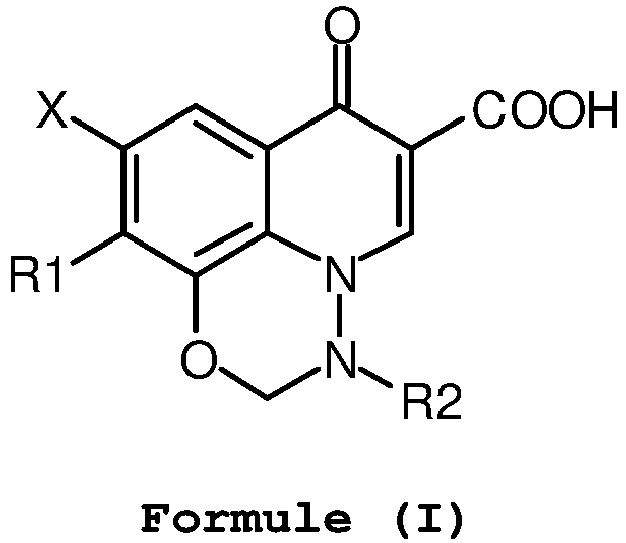
- X représente un atome d'hydrogène, d'halogène ou une fonction hydroxy, et en particulier un atome de fluor,
- R1 représente :
- un radical 1-pipérazinyle, qui peut être substitué en position 4 par un groupe méthyle, acétyle ou 4-aminobenzyle ;
- un radical morpholino ;
- un radical 1-pyrrolidinyle substitué en position 3 par un atome de chlore ou par un groupe amino, aminométhyle, (méthylamino) méthyle, (éthylamino) méthyle ou méthoxy ;
- un radical 1-imidazolyle qui peut être substitué en position 4 par le groupe méthyle ou
- un radical 1-pipéridyle substitué en position 4 par un groupe hydroxy ou méthoxy, et
- R2 représente un radical alkyle, linéaire, ramifié ou cyclique, comprenant de 1 à 10 atomes de carbone, notamment un groupe méthyle, et
- Le composé de type pyrido(3,2,1-ij)-benzoxadiazine peut tout particulièrement répondre à la formule (I) dans laquelle R1 représente un radical 1-pipérazinyle substitué en position 4 par un groupe méthyle, R2 représente un groupement méthyle et X représente un atome de fluor. Ce composé peut notamment être obtenu par les procédés décrits dans le document
EP 0 259 804 . Ce composé répond notamment à la Dénomination Commune Internationale de Marbofloxacine. - La solution comprend au moins un agent de solubilisation. Cet agent de solubilisation peut former un complexe avec le composé de type pyrido(3,2,1-ij)-benzoxadiazine. En particulier lorsque cet agent de solubilisation est un acide, il peut former un sel avec le composé de type pyrido(3,2,1-ij)-benzoxadiazine.
- La formation de tels complexes peut permettre d'améliorer la solubilisation du composé de type pyrido(3,2,1-ij)-benzoxadiazine en solution, et en particulier en solution aqueuse.
- Parmi les agents de solubilisation, on peut citer :
- les acides minéraux, notamment l'acide chlorhydrique, bromhydrique, sulfurique, phosphorique et nitrique, et
- les acides organiques, comme les acides carboxyliques les acides sulfoniques et les acides phosphoniques ; notamment l'acide formique, acétique, propionique, succinique, glycolique, lactique ou polylactique, malique, tartrique, citrique, ascorbique, maléique, hydroxymaléique, phénylacétique, benzoïque, 4-aminobenzoïque, anthranilique, 4-hydroxybenzoïque, salicylique, aminosalicylique, nicotinique, méthane sulfonique, éthane sulfonique, hydroxyéthane sulfonique, benzène sulfonique, p-toluènesulfonique ; les acides polycarboxyliques, comme l'acide gluconique, l'acide glucuronique, l'acide galacturonique, l'acide isophtalique et l'acide lactobionique ; les acides aminés, comme l'acide aspartique et glutamique, la méthionine, le tryptophane, la lysine, l'arginine ; leurs esters, parmi lesquels on peut citer la gluconolactone ; et leurs sels, et
- leurs mélanges.
- Parmi les agents de solubilisation des composés de type pyrido(3,2,1-ij)-benzoxadiazine, et en particulier la Marbofloxacine, on peut tout particulièrement citer l'acide lactique, l'acide gluconique et la gluconolactone.
- La solution peut comprendre une teneur en agent de solubilisation allant de 4 à 58 % en poids, notamment de 5 à 35 % en poids, en particulier allant de 6 à 25 % en poids, voire allant de 7 à 20 % en poids par rapport au volume total de la solution.
- Tout particulièrement, la solution selon l'invention comprend un rapport molaire agent de solubilisation/composé de type pyrido(3,2,1-ij)-benzoxadiazine allant de 0,9 à 4, notamment de 1 à 3, et en particulier de 1,1 à 2,4.
- La solution peut comprendre une teneur en agent de solubilisation telle que le pH de la solution va de 2 à 7, notamment de 2,8 à 5.
- Les solutions décrites ci-dessus peuvent présenter une stabilité limitée, notamment lorsqu'elles comprennent une forte concentration en composé de type pyrido(3,2,1-ij)-benzoxadiazine et une faible concentration en agent de solubilisation.
- Les inventeurs ont découvert qu'il était possible d'améliorer la faisabilité de certaines solutions concentrées et/ou leur stabilité par l'addition d'au moins un agent solubilisant et/ou d'au moins un agent stabilisant.
- L'agent stabilisant peut être choisi dans le groupe comprenant les alcools, les propylènes glycol, le polyéthylène glycol, la glycérine. Plus particulièrement, l'agent stabilisant est un alcool, notamment aromatique, alkyle, arylalkyle ou alkylaryle, en particulier comprenant de 5 à 15 atomes de carbone, et tout spécialement l'alcool benzylique et ses dérivés.
- On entend par « dérivé d'alcool benzylique » au sens de la présente invention des composés répondant à la formule (II) :

- En particulier, la solution comprend une teneur en agent stabilisant allant de 0,2 à 20 % en poids, notamment de 0,3 à 10 % en poids, en particulier de 0,4 à 5 % en poids, et tout particulièrement de 0,5 à 3 % en poids par rapport au volume total de la solution.
- D'autre part, la solution peut comprendre un rapport molaire agent stabilisant/composé de type pyrido(3,2,1-ij)-benzoxadiazine allant de 0,02 à 7, notamment de 0,05 à 5, en particulier de 0,1 à 1,5, voire de 0,2 à 1.
- En particulier, les solutions peuvent comprendre un rapport molaire agent solubilisant/agent stabilisant allant de 1 à 15, notamment de 1,5 à 10, en particulier de 2 à 8, voire de 2,5 à 7.
- Les solutions selon l'invention peuvent en outre comprendre au moins un additif, notamment choisi dans le groupe comprenant :
- un solvant, par exemple choisi parmi les solvants non aqueux utilisables par voie parentérale i.e. les solvants non miscibles à l'eau, par exemple les huiles végétales, l'oléate d'éthyle, ou les solvants miscibles à l'eau, notamment les alcools, comme l'éthanol ; les amides, comme le N,N diméthylacétamide ; les esters de polyol, comme le glycéride polyglucosé ; les éthers, comme le diméthyl-1,3-dioxolane-4-méthanol, l'éther monoéthylique du diéthylène glycol, le glycérol formal, le polyéthylène glycol, notamment PEG 300 et PEG 400 ; les polyols, comme le glycérol, le propylène glycol ; le diméthylsulfoxyde ; le 2-pyrrolidone ; ou un mélange de ceux-ci,
- un tensioactif, par exemple non ionique, anionique, cationique, ou un mélange de tensioactif, et tout particulièrement un tensioactif non ionique,
- un agent chélatant, par exemple l'EDTA
- un conservateur, notamment un antioxydant, ou un antimicrobien, et
- un mélange de ceux-ci.
- Le pH de la solution peut aller de 2 à 7, notamment de 2,8 à 5.
- Tout particulièrement, la solution selon l'invention est sous forme d'une solution injectable, en particulier par voie intramusculaire, sous-cutanée, intrapéritonéale et/ou intraveineuse. Ladite solution peut encore être une infusion ou une perfusion. Cette solution peut être destinée aux animaux dits de rente, comme les ovins, bovins, porcins, caprins, chevaux et/ou volailles, et/ou aux animaux de compagnie, comme les chiens et les chats.
- Tout particulièrement, la solution présente une viscosité allant de 10-4 à 10-2, en particulier de 10-3 à 5.10-3 Pa.s à 20°C.
- La solution peut être limpide, en particulier ne pas comprendre de particules en suspension.
- Selon un autre aspect, il est décrit l'utilisation d'au moins un composé de type pyrido(3,2,1-ij)-benzoxadiazine tel que décrit ci-dessus dans la préparation d'une solution destinée à traiter ou à prévenir des infections, en particulier chez l'animal, ledit composé de type pyrido(3,2,1-ij)-benzoxadiazine étant présent en une teneur allant de 10 à 30 % en poids, notamment 11 à 28 % en poids, voire de 12 à 27 % en poids, en particulier de 13 à 25 % en poids, tout particulièrement de 14 à 23 % en poids, voire de 15 à 20 % en poids par rapport au volume total de la solution.
- Selon un autre aspect, il est décrit l'utilisation d'une solution selon l'invention pour la préparation d'un médicament destiné à traiter ou à prévenir des infections, en particulier chez l'animal.
- Parmi les infections susceptibles d'être traitées, on peut citer les infections du système respiratoire, du système de reproduction, du système urinaire, du système digestif, du système locomoteur, cardiovasculaire, du type cutanée, otite, ophtalmique, notamment chez les animaux.
- Selon un autre aspect, il est décrit une méthode de traitement, de prévention et de métaphylaxie des infections chez des animaux. Ladite méthode de traitement peut comprendre l'injection de 0,01 à 0,5 ml de solution concentrée par kg, notamment de 0,01 à 0,1 ml/kg d'animal à traiter. En particulier le traitement peut comprendre une seule injection en un seul point.
- Par exemple pour un animal de 300 kg, le traitement d'une infection respiratoire peut être réalisé avec « MARBOCYL S » avec un volume de 24 ml, administré en 2 points d'injection, et avec la solution concentrée, avec un volume de 15 ml, injecté en 1 seul point.
- Par « traitement » on entend le traitement en lui-même, mais aussi la prophylaxie et la métaphylaxie.
- Selon un autre aspect, il est décrit l'utilisation d'au moins un composé choisi parmi les alcools, les propylènes glycol, le polyéthylène glycol, la glycérine, en tant qu'agent stabilisant une solution d'un composé de Formule (I). Plus particulièrement, l'agent stabilisant est un alcool, notamment aromatique, alkyle, arylalkyle ou alkylaryle, en particulier comprenant de 5 à 15 atomes de carbone, et tout spécialement l'alcool benzylique et ses dérivés, en tant qu'agent stabilisant d'une solution comprenant au moins un composé de formule (I), en particulier à une forte concentration, notamment supérieure à 10 % en poids par rapport au volume total de la solution, et éventuellement un agent de solubilisation.
- Selon un autre aspect, il est décrit l'utilisation d'au moins un composé choisi parmi :
- les acides minéraux, notamment l'acide chlorhydrique, bromhydrique, sulfurique, phosphorique et nitrique, et
- les acides organiques, comme les acides carboxyliques, les acides sulfoniques et les acides phosphoniques ; notamment l'acide formique, acétique, propionique, succinique, glycolique, lactique ou polylactique, malique, tartrique, citrique, ascorbique, maléique, hydroxymaléique, phénylacétique, benzoïque, 4-aminobenzoïque, anthranilique, 4-hydroxybenzoïque, salicylique, aminosalicylique, nicotinique, méthane sulfonique, éthane sulfonique, hydroxyéthane sulfonique, benzène sulfonique, p-toluènesulfonique ; les acides polycarboxyliques, comme l'acide gluconique, l'acide glucuronique, l'acide galacturonique, l'acide isophtalique et l'acide lactobionique ; les acides aminés, comme l'acide aspartique et glutamique, la méthionine, le tryptophane, la lysine, l'arginine ; leurs esters, parmi lesquels on peut citer la gluconolactone ; et leurs sels, et
- leurs mélanges,
- L'utilisation d'un agent stabilisant, et en particulier d'alcool benzylique, peut permettre en outre aux solutions concentrées en composé de formule (I), notamment en Marbofloxacine, et comprenant au moins un agent de solubilisation, notamment de la gluconolactone, de présenter un pH et/ou une osmolarité moindre par rapport aux solutions comprenant une concentration équivalente en composé de formule (I) et éventuellement en agent de solubilisation. Ceci peut en particulier permettre aux solutions concentrées comprenant au moins un composé de formule (I), un agent de solubilisation et un agent stabilisant de présenter un pH et/ou une osmolarité proche des compositions moins concentrées, notamment en composé de formule (I) et/ou en agent de solubilisation. Ceci est lié à la présence d'un agent stabilisant qui peut permettre d'utiliser moins d'agent de solubilisation.
- En d'autres termes, l'addition d'agent stabilisant rend également possible la fabrication de certaines solutions très concentrées en composé de formule (I) adaptées à l'injection, qui ne le seraient pas, ou qui le seraient difficilement, sans l'ajout de cet agent. Effectivement, l'effet stabilisant peut augmenter avec la teneur en agent stabilisant.
- Selon un autre aspect, il est décrit l'utilisation de l'association d'une part d'alcool benzylique et d'autre part de l'acide lactique, l'acide gluconique et/ou la gluconolactone en tant qu'agent solubilisant et stabilisant d'une solution de composé de formule (I), en particulier à une concentration supérieure à 10 %, notamment supérieure à 11 %, en particulier supérieure à 12 % en poids, tout particulièrement supérieure à 13 % en poids, voire supérieure à 14 % en poids par rapport au volume de la solution.
- Dans des exemples de modes de réalisation, il est décrit :
- A. une solution anti-infectieuse comprenant de 10 à 30 % en poids par rapport au volume total de la solution d'au moins un composé de type pyrido(3,2,1-ij)-benzoxadiazine répondant à la formule (I) suivante :

- X représente un atome d'hydrogène, d'halogène ou une fonction hydroxy, et en particulier un atome de fluor,
- R1 représente :
- un radical 1-pipérazinyle, qui peut être substitué en position 4 par un groupe méthyle, acétyle ou 4-aminobenzyle ;
- un radical morpholino ;
- un radical 1-pyrrolidinyle substitué en position 3 par un atome de chlore ou par un groupe amino, aminométhyle, (méthylamino) méthyle, (éthylamino) méthyle ou méthoxy ;
- un radical 1-imidazolyle qui peut être substitué en position 4 par le groupe méthyle ou
- un radical 1-pipéridyle substitué en position 4 par un groupe hydroxy ou méthoxy, et
- R2 représente un radical alkyle, linéaire, ramifié ou cyclique, comprenant de 1 à 10 atomes de carbone, notamment un groupe méthyle, ou
- B. une solution selon le mode de réalisation A ci-dessus caractérisée en ce que le composé répond à la formule (I) dans laquelle R1 représente un radical 1-pipérazinyle substitué en position 4 par un groupe méthyle, R2 représente un groupement méthyle et X représente un atome de fluor.
- C. une solution selon le mode de réalisation A ou B, caractérisée en ce qu'elle comprend une teneur en composé de formule (I) allant de 11 à 28 % en poids, en particulier allant de 12 à 27 % en poids, tout particulièrement allant de 13 à 25 % en poids, encore plus particulièrement allant de 14 à 23 % en poids, voire allant de 15 à 20 % en poids par rapport au volume total de la solution.
- D. une solution selon l'un quelconque des modes de réalisation A à C, caractérisée en ce que l'agent de solubilisation est choisi dans le groupe comprenant les acides minéraux, les acides organiques, leurs esters et leurs sels.
- E. une solution selon l'un quelconque des modes de réalisation A à D, caractérisée en ce que l'agent de solubilisation est choisi dans le groupe comprenant l'acide lactique, l'acide gluconique et la gluconolactone.
- F. une solution selon l'une quelconque des modes de réalisation A à E, caractérisée en ce qu'elle comprend une teneur en agent de solubilisation allant de 4 à 58 % en poids, notamment de 5 à 35 % en poids, en particulier allant de 6 à 25 % en poids, voire allant de 7 à 20 % en poids par rapport au volume total de la solution.
- G. une solution selon l'un quelconque des modes de réalisation A à F, caractérisée en ce que le rapport molaire agent de solubilisation/composé de type pyrido(3,2,1-ij)-benzoxadiazine va de 0,9 à 4, notamment de 1 à 3, et en particulier de 1,1 à 2,4.
- H. une solution selon l'un quelconque des modes de réalisation A à G, caractérisée en ce que l'agent de solubilisation est présent en une teneur telle que le pH de la solution va de 2 à 7, notamment de 2,8 à 5.
- I. une solution selon l'un quelconque des modes de réalisation A à H, caractérisée en ce qu'elle comprend en outre un agent stabilisant, notamment choisi dans le groupe comprenant les alcools, les propylènes glycol, le polyéthylène glycol, la glycérine, en particulier un alcool, et tout particulièrement l'alcool benzylique et ses dérivés.
- J. une solution selon l'un quelconque des modes de réalisation A à I, caractérisée en ce qu'elle comprend une teneur en agent stabilisant allant de 0,2 à 20 % en poids, notamment de 0,3 à 10 % en poids, en particulier de 0,4 à 5 % en poids, et tout particulièrement de 0,5% à 3 % en poids par rapport au volume total de la solution.
- K. une solution selon l'un quelconque des modes de réalisation A à J, caractérisée en ce qu'elle comprend un rapport molaire agent stabilisant/composé de type pyrido(3,2,1-ij)-benzoxadiazine allant de 0,02 à 7, notamment de 0,05 à 5, en particulier de 0,1 à 1,5, voire de 0,2 à 1.
- L. une solution selon l'un quelconque des modes de réalisation A à K, caractérisée en ce qu'elle présente un pH allant de 2 à 7 et notamment de 2,8 à 5.
- M. une solution selon l'un quelconque des modes de réalisation A à L, destinée à être injectée, notamment chez des animaux, notamment des animaux de rente et/ou des animaux de compagnie.
- N. l'utilisation d'au moins un composé de type pyrido(3,2,1-ij)-benzoxadiazine tel que décrit dans le mode de réalisation A ou B dans la préparation d'une solution destinée à traiter ou à prévenir des infections, en particulier chez l'animal, ledit composé de type pyrido(3,2,1-ij)-benzoxadiazine étant présent en une teneur allant de 10 à 30 % en poids, notamment de 11 à 28 % en poids, voire de 12 à 27 % en poids, en particulier de 13 à 25 % en poids, tout particulièrement de 14 à 23 % en poids, voire de 15 à 20 % en poids par rapport au volume total de la solution.
- O. l'utilisation d'au moins un composé choisi parmi les alcools, les propylènes glycol, le polyéthylène glycol, la glycérine, et plus particulièrement un alcool, notamment aromatique, alkyle, arylalkyle ou alkylaryle, en particulier comprenant de 5 à 15 atomes de carbone, et tout spécialement l'alcool benzylique, en tant qu'agent stabilisant d'une solution comprenant au moins un composé de formule (I) et éventuellement un agent de solubilisation.
- P. l'utilisation d'au moins un composé choisi parmi :
- les acides minéraux, notamment l'acide chlorhydrique, bromhydrique, sulfurique, phosphorique et nitrique, et
- les acides organiques, comme les acides carboxyliques, les acides sulfoniques et les acides phosphoniques ; notamment l'acide formique, acétique, propionique, succinique, glycolique, lactique ou polylactique, malique, tartrique, citrique, ascorbique, maléique, hydroxymaléique, phénylacétique, benzoïque, 4-aminobenzoïque, anthranilique, 4-hydroxybenzoïque, salicylique, aminosalicylique, nicotinique, méthane sulfonique, éthane sulfonique, hydroxyéthane sulfonique, benzène sulfonique, p-toluènesulfonique ; les acides polycarboxyliques, comme l'acide gluconique, l'acide glucuronique, l'acide galacturonique, l'acide isophtalique et l'acide lactobionique ; les acides aminés, comme l'acide aspartique et glutamique, la méthionine, le tryptophane, la lysine, l'arginine ; leurs esters, parmi lesquels on peut citer la gluconolactone ; et leurs sels, et
- leurs mélanges,
- Les exemples suivants sont donnés à titre illustratif et ne peuvent en aucun cas servir à limiter la portée de l'invention.
- Les solutions décrites dans le tableau 1 suivant ont été préparées.
Lot 1 Témoin Marbofloxacine (en gramme) 15, 00 10,00 Gluconolactone (en gramme) 8,11 8,00 Eau déminéralisée qsp 100 ml 100 ml - Des porcs de 70-80 Kg ont reçu une injection unique de solution témoin dans l'encolure droite et d'une solution du lot 1 dans l'encolure gauche, par voie intramusculaire, à la dose de 8 mg/Kg. La tolérance locale (lésions post-mortem) a été examinée 1 semaine après administration.
- L'injection avec le lot 1 présente un volume de lésion d'environ 9 cm3 alors que l'injection avec le témoin montre un volume de lésion de 32 cm3.
- Ceci démontre une meilleure tolérance locale de la solution concentrée en Marbofloxacine, par rapport à la solution témoin.
- Les lots suivants ont été préparés :
Lot 1 Lot 2 Lot 3 Lot 4 Marbofloxacine 20,00 g 20,00 g 20,00 g 20,00 g Gluconolactone 19,00 g 19,00 g 17,00 g 17,00 g Alcool benzylique - 2,00 g - 2,00 g Eau déminéralisée qsp 100 ml qsp 100 ml qsp 100 ml qsp 100 ml Stabilité à froid 24 heures > 7 jours* 24 heures > 7 jours* * Apres 7 jours, aucun précipité n'a été observé - Par « stabilité à froid », on entend le temps pour qu'il se forme un précipité lorsque les lots sont laissés immobiles entre +4 et +8°C.
- Ceci démontre bien une amélioration de la stabilité des solutions selon l'invention.
Claims (10)
- Solution aqueuse anti-infectieuse injectable comprenant :(i) de 15 à 20 % en poids par rapport au volume total de la solution d'au moins un composé répondant à la formule (I) suivante :
 - X représente un atome d'hydrogène, d'halogène ou une fonction hydroxy,- R1 représente :- un radical 1-pipérazinyle, qui peut être substitué en position 4 par un groupe méthyle, acétyle ou 4-aminobenzyle ;- un radical morpholino ;- un radical 1-pyrrolidinyle substitué en position 3 par un atome de chlore ou par un groupe amino, aminométhyle, (méthylamino) méthyle, (éthylamino) méthyle ou méthoxy ;- un radical 1-imidazolyle qui peut être substitué en position 4 par le groupe méthyle ou- un radical 1-pipéridyle substitué en position 4 par un groupe hydroxy ou méthoxy, et- R2 représente un radical alkyle, linéaire, ramifié ou cyclique, comprenant de 1 à 10 atomes de carbone, ou au moins un de ses sels pharmaceutiquement acceptables,(ii) un agent stabilisant choisi dans le groupe comprenant les alcools, les propylènes glycol, le polyéthylène glycol et la glycérine, et(iii) au moins un agent de solubilisation choisi dans le groupe comprenant les acides minéraux, les acides organiques et leurs esters, et leurs mélanges,dans un support pharmaceutiquement acceptable.
 - Solution selon la revendication 1 dans laquelle le composé répond à la formule (I) dans laquelle R1 représente un radical 1-pipérazinyle substitué en position 4 par un groupe méthyle, R2 représente un groupement méthyle et X représente un atome de fluor.
- Solution selon la revendication 1 ou 2, dans laquelle l'agent de solubilisation est choisi dans le groupe comprenant l'acide lactique, l'acide gluconique et la gluconolactone.
- Solution selon l'une quelconque des revendications 1 à 3, laquelle comprend une teneur en agent de solubilisation allant de 4 à 58 % en poids, par rapport au volume total de la solution.
- Solution selon l'une quelconque des revendications 1 à 4, dans laquelle le rapport molaire agent de solubilisation/composé de formule (I) va de 0,9 à 4.
- Solution selon l'une quelconque des revendications 1 à 5, dans laquelle l'agent de solubilisation est présent en une teneur telle que le pH de la solution va de 2 à 7.
- Solution selon l'une quelconque des revendications 1 à 6, laquelle comprend une teneur en agent stabilisant allant de 0,2 à 20 % en poids par rapport au volume total de la solution.
- Solution selon l'une quelconque des revendications 1 à 7, laquelle comprend un rapport molaire agent stabilisant/composé de formule (I) allant de 0,02 à 7.
- Solution selon l'une quelconque des revendications 1 à 8, laquelle présente un pH allant de 2 à 7.
- Solution selon l'une quelconque des revendications 1 à 9 pour son utilisation dans le traitement ou la prévention des infections chez l'animal.
Priority Applications (2)
| Application Number | Priority Date | Filing Date | Title |
|---|---|---|---|
| PL11177669T PL2438929T3 (pl) | 2006-01-24 | 2007-01-24 | Roztwór przeciwzakaźny zawierający związek pirydo (3,2,1-ij) -benzoksadiazyny |
| SI200732159T SI2438929T1 (sl) | 2006-01-24 | 2007-01-24 | Protiinfekcijska raztopina, ki obsega spojino pirido(3,2,1-ij)- benzoksadiazin |
Applications Claiming Priority (3)
| Application Number | Priority Date | Filing Date | Title |
|---|---|---|---|
| FR0650246A FR2896416B1 (fr) | 2006-01-24 | 2006-01-24 | Composition anti-infectieuse comprenant un compose de type pyrido (3,2,1-ij)-benzoxadiazine |
| PCT/FR2007/050682 WO2007085760A2 (fr) | 2006-01-24 | 2007-01-24 | Solution anti-infectieuse comprenant un compose de type pyrido(3,2,1-ij)-benzoxadiazine |
| EP07731510A EP1976561B1 (fr) | 2006-01-24 | 2007-01-24 | Solution anti-infectieuse comprenant un compose de type pyrido(3,2,1-ij)-benzoxadiazine |
Related Parent Applications (2)
| Application Number | Title | Priority Date | Filing Date |
|---|---|---|---|
| EP07731510.9 Division | 2007-01-24 | ||
| EP07731510A Division EP1976561B1 (fr) | 2006-01-24 | 2007-01-24 | Solution anti-infectieuse comprenant un compose de type pyrido(3,2,1-ij)-benzoxadiazine |
Publications (3)
| Publication Number | Publication Date |
|---|---|
| EP2438929A2 EP2438929A2 (fr) | 2012-04-11 |
| EP2438929A3 EP2438929A3 (fr) | 2012-07-18 |
| EP2438929B1 true EP2438929B1 (fr) | 2020-06-10 |
Family
ID=36748355
Family Applications (2)
| Application Number | Title | Priority Date | Filing Date |
|---|---|---|---|
| EP11177669.6A Active EP2438929B1 (fr) | 2006-01-24 | 2007-01-24 | Solution anti-infectieuse comprenant un composé pyrido(3,2,1-ij)-benzoxadiazine |
| EP07731510A Not-in-force EP1976561B1 (fr) | 2006-01-24 | 2007-01-24 | Solution anti-infectieuse comprenant un compose de type pyrido(3,2,1-ij)-benzoxadiazine |
Family Applications After (1)
| Application Number | Title | Priority Date | Filing Date |
|---|---|---|---|
| EP07731510A Not-in-force EP1976561B1 (fr) | 2006-01-24 | 2007-01-24 | Solution anti-infectieuse comprenant un compose de type pyrido(3,2,1-ij)-benzoxadiazine |
Country Status (24)
| Country | Link |
|---|---|
| US (1) | US8796265B2 (fr) |
| EP (2) | EP2438929B1 (fr) |
| JP (1) | JP5221383B2 (fr) |
| CN (1) | CN101405032B (fr) |
| AT (1) | ATE520418T1 (fr) |
| AU (1) | AU2007209245B2 (fr) |
| BR (1) | BRPI0706956B1 (fr) |
| CA (1) | CA2637941C (fr) |
| CY (1) | CY1112481T1 (fr) |
| DK (1) | DK1976561T3 (fr) |
| EA (1) | EA016154B1 (fr) |
| ES (2) | ES2371941T3 (fr) |
| FR (1) | FR2896416B1 (fr) |
| HU (1) | HUE050643T2 (fr) |
| IL (1) | IL192935A (fr) |
| MX (1) | MX2008009470A (fr) |
| NO (1) | NO20083422L (fr) |
| NZ (1) | NZ570332A (fr) |
| PL (2) | PL2438929T3 (fr) |
| PT (2) | PT2438929T (fr) |
| SI (2) | SI2438929T1 (fr) |
| UA (1) | UA94086C2 (fr) |
| WO (1) | WO2007085760A2 (fr) |
| ZA (1) | ZA200806369B (fr) |
Families Citing this family (8)
| Publication number | Priority date | Publication date | Assignee | Title |
|---|---|---|---|---|
| FR2928150A1 (fr) | 2008-02-29 | 2009-09-04 | Vetoquinol Sa Sa | Nouveaux derives 7-substitues de 3-carboxy-oxadiazino-quinolones, leur preparation et leur application comme anti-bacteriens |
| EP2145891A1 (fr) * | 2008-07-09 | 2010-01-20 | Vetoquinol S.A. | Dérivés de 9-substitués-5-carboxy-oxadiazino-quinolone, leur préparation et leur application en tant qu'antibactériens |
| EP2332916A3 (fr) | 2009-11-19 | 2011-08-03 | Krka Tovarna Zdravil, D.D., Novo Mesto | Procede de la preparation du marbofloxacin et produits intermediares |
| CN103271875A (zh) * | 2013-07-01 | 2013-09-04 | 浙江华尔成生物药业股份有限公司 | 一种注射用麻保沙星冻干粉及其制备方法与应用 |
| CN107107001B (zh) * | 2014-12-31 | 2020-11-03 | 通用电气医疗集团生物科学公司 | 用于一次性生物反应器的轴安装式流体传递组件 |
| US10440147B2 (en) | 2015-11-24 | 2019-10-08 | William Edward Woodcock, IV | Quality-of-service management for domain name service |
| US20170239250A1 (en) | 2016-02-19 | 2017-08-24 | Eagle Pharmaceuticals, Inc. | Pemetrexed formulations |
| CN107445977B (zh) * | 2017-07-13 | 2019-08-09 | 江西傲新生物科技有限公司 | 一种水溶性马波沙星及其制备方法与应用 |
Citations (2)
| Publication number | Priority date | Publication date | Assignee | Title |
|---|---|---|---|---|
| EP0219784A2 (fr) * | 1985-10-24 | 1987-04-29 | Bayer Ag | Solutions d'infusion de l'acide 1-cyclopropyl-6-fluoro-1,4-dihydro-4-oxo-7-(1-pipérazinyl)-chinolone-3-carboxylique |
| DE19500784A1 (de) * | 1995-01-13 | 1996-07-18 | Bayer Ag | Enrofloxacin-Injektions- oder Infusionslösungen |
Family Cites Families (9)
| Publication number | Priority date | Publication date | Assignee | Title |
|---|---|---|---|---|
| DE3788177D1 (de) | 1986-09-12 | 1993-12-23 | Hoffmann La Roche | Pyrido [3,2,1-ij]-1,3,4-benzoxadiazinderivate, Verfahren zu deren Herstellung, entsprechende pharmazeutische Präparate und im Verfahren verwendbare Zwischenprodukte. |
| DE19519822A1 (de) * | 1995-05-31 | 1996-12-05 | Bayer Ag | Neue antibakterielle Mittel |
| CZ293747B6 (cs) | 1995-12-21 | 2004-07-14 | Pfizer Inc. | Vodný farmaceutický roztok vhodný pro injekční podávání hostiteli a jeho použití |
| GB9600886D0 (en) * | 1996-01-17 | 1996-03-20 | Pfizer | Novel compound |
| GB9600894D0 (en) * | 1996-01-17 | 1996-03-20 | Pfizer | Novel compound |
| GB9601356D0 (en) * | 1996-01-24 | 1996-03-27 | Pfizer | Novel compound |
| DE19633480A1 (de) * | 1996-08-20 | 1998-02-26 | Bayer Ag | Oral applizierbare Formulierungen von Chinolon- und Naphthyridoncarbonsäuren |
| DE10337191A1 (de) * | 2003-08-13 | 2005-03-17 | Bayer Healthcare Ag | Neue Verwendung von Chinolon-Antibiotika |
| BRPI0416205A (pt) * | 2003-11-21 | 2006-12-26 | Pfizer Prod Inc | uso de antibióticos como adjuvantes de vacina |
-
2006
- 2006-01-24 FR FR0650246A patent/FR2896416B1/fr not_active Expired - Lifetime
-
2007
- 2007-01-24 AT AT07731510T patent/ATE520418T1/de active
- 2007-01-24 JP JP2008551835A patent/JP5221383B2/ja active Active
- 2007-01-24 PT PT111776696T patent/PT2438929T/pt unknown
- 2007-01-24 PT PT07731510T patent/PT1976561E/pt unknown
- 2007-01-24 PL PL11177669T patent/PL2438929T3/pl unknown
- 2007-01-24 MX MX2008009470A patent/MX2008009470A/es active IP Right Grant
- 2007-01-24 SI SI200732159T patent/SI2438929T1/sl unknown
- 2007-01-24 EP EP11177669.6A patent/EP2438929B1/fr active Active
- 2007-01-24 BR BRPI0706956A patent/BRPI0706956B1/pt active IP Right Grant
- 2007-01-24 AU AU2007209245A patent/AU2007209245B2/en not_active Ceased
- 2007-01-24 HU HUE11177669A patent/HUE050643T2/hu unknown
- 2007-01-24 US US12/161,827 patent/US8796265B2/en active Active
- 2007-01-24 CN CN2007800033484A patent/CN101405032B/zh not_active Expired - Fee Related
- 2007-01-24 UA UAA200810611A patent/UA94086C2/ru unknown
- 2007-01-24 DK DK07731510.9T patent/DK1976561T3/da active
- 2007-01-24 EA EA200801733A patent/EA016154B1/ru not_active IP Right Cessation
- 2007-01-24 EP EP07731510A patent/EP1976561B1/fr not_active Not-in-force
- 2007-01-24 PL PL07731510T patent/PL1976561T3/pl unknown
- 2007-01-24 WO PCT/FR2007/050682 patent/WO2007085760A2/fr not_active Ceased
- 2007-01-24 CA CA2637941A patent/CA2637941C/fr active Active
- 2007-01-24 ES ES07731510T patent/ES2371941T3/es active Active
- 2007-01-24 SI SI200730767T patent/SI1976561T1/sl unknown
- 2007-01-24 NZ NZ570332A patent/NZ570332A/en not_active IP Right Cessation
- 2007-01-24 ES ES11177669T patent/ES2813856T3/es active Active
-
2008
- 2008-07-21 IL IL192935A patent/IL192935A/en active IP Right Grant
- 2008-07-22 ZA ZA200806369A patent/ZA200806369B/xx unknown
- 2008-08-05 NO NO20083422A patent/NO20083422L/no not_active Application Discontinuation
-
2011
- 2011-11-16 CY CY20111101104T patent/CY1112481T1/el unknown
Patent Citations (2)
| Publication number | Priority date | Publication date | Assignee | Title |
|---|---|---|---|---|
| EP0219784A2 (fr) * | 1985-10-24 | 1987-04-29 | Bayer Ag | Solutions d'infusion de l'acide 1-cyclopropyl-6-fluoro-1,4-dihydro-4-oxo-7-(1-pipérazinyl)-chinolone-3-carboxylique |
| DE19500784A1 (de) * | 1995-01-13 | 1996-07-18 | Bayer Ag | Enrofloxacin-Injektions- oder Infusionslösungen |
Non-Patent Citations (1)
| Title |
|---|
| PFIZER INC: "Zeniquin (marbofloxacin) Tablets", 1 August 2001 (2001-08-01), US, pages 1 - 28, XP055364999, Retrieved from the Internet <URL:https://www.fda.gov/ohrms/dockets/98fr/141151fi.pdf> [retrieved on 20170418] * |
Also Published As
Similar Documents
| Publication | Publication Date | Title |
|---|---|---|
| EP1976561B1 (fr) | Solution anti-infectieuse comprenant un compose de type pyrido(3,2,1-ij)-benzoxadiazine | |
| CH630260A5 (fr) | Compositions antibiotiques a base d'une tetracycline. | |
| JP2008542260A (ja) | 新規の注射可能組成物及びその調製方法 | |
| CN112843042A (zh) | 长效酮洛芬组合物 | |
| WO2015007759A1 (fr) | Composition pharmaceutique aqueuse liquide contenant des dérivés de cyclodextrine éthérifiée | |
| JP2002532437A (ja) | トリフェニルエチレン型抗エストロゲンの水溶性組成物 | |
| PT2125782E (pt) | Derivados ciclo-hexilamida de ácidos arilcarboxílicos | |
| CN110248643B (zh) | 含普拉沙星的液体组合物 | |
| WO2006054315B1 (fr) | Formulation parenterale d'aceclofenac liquide non aqueux | |
| HK1167093B (en) | Anti-infective solution comprising a pyrido(3,2,1-ij)-benzoxadiazine compound | |
| HK1167093A (en) | Anti-infective solution comprising a pyrido(3,2,1-ij)-benzoxadiazine compound | |
| EP0859609A1 (fr) | Composition liquide a usage topique, son procede de preparation et ses applications | |
| EP0271374A2 (fr) | Composition antibiotique aqueuse à usage vétérinaire | |
| HK1128883B (en) | Anti-infective solution comprising a compound of pyrido(3,2,1-ij)-benzoxadiazine type | |
| HK40014202A (en) | Liquid composition containing pradofloxacin | |
| BR112019016543B1 (pt) | Composição líquida que contém pradofloxacina e seu uso | |
| HK1130682A (en) | Medicament formulations comprising fluoroquinolones | |
| LU87274A1 (fr) | Procede en vue de provoquer la regression de la leucemie et l'inhibition de la croissance des tumeurs chez les mammiferes |
Legal Events
| Date | Code | Title | Description |
|---|---|---|---|
| AC | Divisional application: reference to earlier application |
Ref document number: 1976561 Country of ref document: EP Kind code of ref document: P |
|
| AK | Designated contracting states |
Kind code of ref document: A2 Designated state(s): AT BE BG CH CY CZ DE DK EE ES FI FR GB GR HU IE IS IT LI LT LU LV MC NL PL PT RO SE SI SK TR |
|
| PUAI | Public reference made under article 153(3) epc to a published international application that has entered the european phase |
Free format text: ORIGINAL CODE: 0009012 |
|
| PUAL | Search report despatched |
Free format text: ORIGINAL CODE: 0009013 |
|
| AK | Designated contracting states |
Kind code of ref document: A3 Designated state(s): AT BE BG CH CY CZ DE DK EE ES FI FR GB GR HU IE IS IT LI LT LU LV MC NL PL PT RO SE SI SK TR |
|
| RIC1 | Information provided on ipc code assigned before grant |
Ipc: A61K 47/12 20060101ALI20120613BHEP Ipc: A61K 47/26 20060101AFI20120613BHEP Ipc: A61P 31/00 20060101ALI20120613BHEP Ipc: A61K 47/02 20060101ALI20120613BHEP |
|
| 17P | Request for examination filed |
Effective date: 20121016 |
|
| REG | Reference to a national code |
Ref country code: HK Ref legal event code: DE Ref document number: 1167093 Country of ref document: HK |
|
| 17Q | First examination report despatched |
Effective date: 20140606 |
|
| STAA | Information on the status of an ep patent application or granted ep patent |
Free format text: STATUS: EXAMINATION IS IN PROGRESS |
|
| REG | Reference to a national code |
Ref country code: DE Ref legal event code: R079 Ref document number: 602007060345 Country of ref document: DE Free format text: PREVIOUS MAIN CLASS: A61K0047260000 Ipc: A61K0031539500 |
|
| RIC1 | Information provided on ipc code assigned before grant |
Ipc: A61K 9/00 20060101ALI20191220BHEP Ipc: A61K 31/5395 20060101AFI20191220BHEP |
|
| GRAP | Despatch of communication of intention to grant a patent |
Free format text: ORIGINAL CODE: EPIDOSNIGR1 |
|
| STAA | Information on the status of an ep patent application or granted ep patent |
Free format text: STATUS: GRANT OF PATENT IS INTENDED |
|
| INTG | Intention to grant announced |
Effective date: 20200204 |
|
| GRAS | Grant fee paid |
Free format text: ORIGINAL CODE: EPIDOSNIGR3 |
|
| GRAA | (expected) grant |
Free format text: ORIGINAL CODE: 0009210 |
|
| STAA | Information on the status of an ep patent application or granted ep patent |
Free format text: STATUS: THE PATENT HAS BEEN GRANTED |
|
| AC | Divisional application: reference to earlier application |
Ref document number: 1976561 Country of ref document: EP Kind code of ref document: P |
|
| AK | Designated contracting states |
Kind code of ref document: B1 Designated state(s): AT BE BG CH CY CZ DE DK EE ES FI FR GB GR HU IE IS IT LI LT LU LV MC NL PL PT RO SE SI SK TR |
|
| REG | Reference to a national code |
Ref country code: GB Ref legal event code: FG4D Free format text: NOT ENGLISH |
|
| REG | Reference to a national code |
Ref country code: AT Ref legal event code: REF Ref document number: 1278660 Country of ref document: AT Kind code of ref document: T Effective date: 20200615 Ref country code: CH Ref legal event code: EP |
|
| REG | Reference to a national code |
Ref country code: DE Ref legal event code: R096 Ref document number: 602007060345 Country of ref document: DE |
|
| REG | Reference to a national code |
Ref country code: IE Ref legal event code: FG4D Free format text: LANGUAGE OF EP DOCUMENT: FRENCH |
|
| REG | Reference to a national code |
Ref country code: CH Ref legal event code: NV Representative=s name: NOVAGRAAF INTERNATIONAL SA, CH |
|
| REG | Reference to a national code |
Ref country code: PT Ref legal event code: SC4A Ref document number: 2438929 Country of ref document: PT Date of ref document: 20200901 Kind code of ref document: T Free format text: AVAILABILITY OF NATIONAL TRANSLATION Effective date: 20200825 |
|
| REG | Reference to a national code |
Ref country code: EE Ref legal event code: FG4A Ref document number: E019529 Country of ref document: EE Effective date: 20200831 |
|
| REG | Reference to a national code |
Ref country code: GR Ref legal event code: EP Ref document number: 20200402456 Country of ref document: GR Effective date: 20201014 |
|
| REG | Reference to a national code |
Ref country code: LT Ref legal event code: MG4D |
|
| PG25 | Lapsed in a contracting state [announced via postgrant information from national office to epo] |
Ref country code: SE Free format text: LAPSE BECAUSE OF FAILURE TO SUBMIT A TRANSLATION OF THE DESCRIPTION OR TO PAY THE FEE WITHIN THE PRESCRIBED TIME-LIMIT Effective date: 20200610 Ref country code: LT Free format text: LAPSE BECAUSE OF FAILURE TO SUBMIT A TRANSLATION OF THE DESCRIPTION OR TO PAY THE FEE WITHIN THE PRESCRIBED TIME-LIMIT Effective date: 20200610 Ref country code: FI Free format text: LAPSE BECAUSE OF FAILURE TO SUBMIT A TRANSLATION OF THE DESCRIPTION OR TO PAY THE FEE WITHIN THE PRESCRIBED TIME-LIMIT Effective date: 20200610 |
|
| REG | Reference to a national code |
Ref country code: NL Ref legal event code: MP Effective date: 20200610 |
|
| PG25 | Lapsed in a contracting state [announced via postgrant information from national office to epo] |
Ref country code: LV Free format text: LAPSE BECAUSE OF FAILURE TO SUBMIT A TRANSLATION OF THE DESCRIPTION OR TO PAY THE FEE WITHIN THE PRESCRIBED TIME-LIMIT Effective date: 20200610 Ref country code: BG Free format text: LAPSE BECAUSE OF FAILURE TO SUBMIT A TRANSLATION OF THE DESCRIPTION OR TO PAY THE FEE WITHIN THE PRESCRIBED TIME-LIMIT Effective date: 20200910 |
|
| REG | Reference to a national code |
Ref country code: SK Ref legal event code: T3 Ref document number: E 35350 Country of ref document: SK |
|
| REG | Reference to a national code |
Ref country code: HU Ref legal event code: AG4A Ref document number: E050643 Country of ref document: HU |
|
| PG25 | Lapsed in a contracting state [announced via postgrant information from national office to epo] |
Ref country code: NL Free format text: LAPSE BECAUSE OF FAILURE TO SUBMIT A TRANSLATION OF THE DESCRIPTION OR TO PAY THE FEE WITHIN THE PRESCRIBED TIME-LIMIT Effective date: 20200610 |
|
| PG25 | Lapsed in a contracting state [announced via postgrant information from national office to epo] |
Ref country code: IS Free format text: LAPSE BECAUSE OF FAILURE TO SUBMIT A TRANSLATION OF THE DESCRIPTION OR TO PAY THE FEE WITHIN THE PRESCRIBED TIME-LIMIT Effective date: 20201010 |
|
| REG | Reference to a national code |
Ref country code: DE Ref legal event code: R097 Ref document number: 602007060345 Country of ref document: DE |
|
| REG | Reference to a national code |
Ref country code: ES Ref legal event code: FG2A Ref document number: 2813856 Country of ref document: ES Kind code of ref document: T3 Effective date: 20210325 |
|
| PLBE | No opposition filed within time limit |
Free format text: ORIGINAL CODE: 0009261 |
|
| STAA | Information on the status of an ep patent application or granted ep patent |
Free format text: STATUS: NO OPPOSITION FILED WITHIN TIME LIMIT |
|
| PG25 | Lapsed in a contracting state [announced via postgrant information from national office to epo] |
Ref country code: DK Free format text: LAPSE BECAUSE OF FAILURE TO SUBMIT A TRANSLATION OF THE DESCRIPTION OR TO PAY THE FEE WITHIN THE PRESCRIBED TIME-LIMIT Effective date: 20200610 |
|
| 26N | No opposition filed |
Effective date: 20210311 |
|
| PG25 | Lapsed in a contracting state [announced via postgrant information from national office to epo] |
Ref country code: MC Free format text: LAPSE BECAUSE OF FAILURE TO SUBMIT A TRANSLATION OF THE DESCRIPTION OR TO PAY THE FEE WITHIN THE PRESCRIBED TIME-LIMIT Effective date: 20200610 |
|
| PG25 | Lapsed in a contracting state [announced via postgrant information from national office to epo] |
Ref country code: LU Free format text: LAPSE BECAUSE OF NON-PAYMENT OF DUE FEES Effective date: 20210124 |
|
| PGFP | Annual fee paid to national office [announced via postgrant information from national office to epo] |
Ref country code: HU Payment date: 20220122 Year of fee payment: 16 Ref country code: AT Payment date: 20220119 Year of fee payment: 16 |
|
| PGFP | Annual fee paid to national office [announced via postgrant information from national office to epo] |
Ref country code: TR Payment date: 20220104 Year of fee payment: 16 Ref country code: SK Payment date: 20220111 Year of fee payment: 16 Ref country code: GR Payment date: 20220120 Year of fee payment: 16 Ref country code: EE Payment date: 20220119 Year of fee payment: 16 |
|
| REG | Reference to a national code |
Ref country code: AT Ref legal event code: UEP Ref document number: 1278660 Country of ref document: AT Kind code of ref document: T Effective date: 20200610 |
|
| PG25 | Lapsed in a contracting state [announced via postgrant information from national office to epo] |
Ref country code: CY Free format text: LAPSE BECAUSE OF FAILURE TO SUBMIT A TRANSLATION OF THE DESCRIPTION OR TO PAY THE FEE WITHIN THE PRESCRIBED TIME-LIMIT Effective date: 20200610 |
|
| P01 | Opt-out of the competence of the unified patent court (upc) registered |
Effective date: 20230524 |
|
| REG | Reference to a national code |
Ref country code: EE Ref legal event code: MM4A Ref document number: E019529 Country of ref document: EE Effective date: 20230131 |
|
| REG | Reference to a national code |
Ref country code: SK Ref legal event code: MM4A Ref document number: E 35350 Country of ref document: SK Effective date: 20230124 |
|
| REG | Reference to a national code |
Ref country code: AT Ref legal event code: MM01 Ref document number: 1278660 Country of ref document: AT Kind code of ref document: T Effective date: 20230124 |
|
| PG25 | Lapsed in a contracting state [announced via postgrant information from national office to epo] |
Ref country code: EE Free format text: LAPSE BECAUSE OF NON-PAYMENT OF DUE FEES Effective date: 20230131 Ref country code: AT Free format text: LAPSE BECAUSE OF NON-PAYMENT OF DUE FEES Effective date: 20230124 |
|
| PG25 | Lapsed in a contracting state [announced via postgrant information from national office to epo] |
Ref country code: SK Free format text: LAPSE BECAUSE OF NON-PAYMENT OF DUE FEES Effective date: 20230124 Ref country code: HU Free format text: LAPSE BECAUSE OF NON-PAYMENT OF DUE FEES Effective date: 20230125 Ref country code: GR Free format text: LAPSE BECAUSE OF NON-PAYMENT OF DUE FEES Effective date: 20230804 |
|
| REG | Reference to a national code |
Ref country code: CH Ref legal event code: U11 Free format text: ST27 STATUS EVENT CODE: U-0-0-U10-U11 (AS PROVIDED BY THE NATIONAL OFFICE) Effective date: 20260201 |
|
| PGFP | Annual fee paid to national office [announced via postgrant information from national office to epo] |
Ref country code: GB Payment date: 20260121 Year of fee payment: 20 |
|
| PGFP | Annual fee paid to national office [announced via postgrant information from national office to epo] |
Ref country code: ES Payment date: 20260217 Year of fee payment: 20 |
|
| PGFP | Annual fee paid to national office [announced via postgrant information from national office to epo] |
Ref country code: DE Payment date: 20260120 Year of fee payment: 20 Ref country code: IE Payment date: 20260121 Year of fee payment: 20 |
|
| PGFP | Annual fee paid to national office [announced via postgrant information from national office to epo] |
Ref country code: RO Payment date: 20260120 Year of fee payment: 20 Ref country code: BE Payment date: 20260121 Year of fee payment: 20 Ref country code: IT Payment date: 20260130 Year of fee payment: 20 |
|
| PGFP | Annual fee paid to national office [announced via postgrant information from national office to epo] |
Ref country code: FR Payment date: 20260121 Year of fee payment: 20 |
|
| PGFP | Annual fee paid to national office [announced via postgrant information from national office to epo] |
Ref country code: PT Payment date: 20260120 Year of fee payment: 20 Ref country code: CH Payment date: 20260201 Year of fee payment: 20 Ref country code: CZ Payment date: 20260113 Year of fee payment: 20 |
|
| PGFP | Annual fee paid to national office [announced via postgrant information from national office to epo] |
Ref country code: PL Payment date: 20260112 Year of fee payment: 20 |
|
| PGFP | Annual fee paid to national office [announced via postgrant information from national office to epo] |
Ref country code: SI Payment date: 20260115 Year of fee payment: 20 |
|
| PG25 | Lapsed in a contracting state [announced via postgrant information from national office to epo] |
Ref country code: TR Free format text: LAPSE BECAUSE OF NON-PAYMENT OF DUE FEES Effective date: 20230124 |