EP2428598A1 - Superhydrophobic fibers and methods of preparation - Google Patents
Superhydrophobic fibers and methods of preparation Download PDFInfo
- Publication number
- EP2428598A1 EP2428598A1 EP20110191430 EP11191430A EP2428598A1 EP 2428598 A1 EP2428598 A1 EP 2428598A1 EP 20110191430 EP20110191430 EP 20110191430 EP 11191430 A EP11191430 A EP 11191430A EP 2428598 A1 EP2428598 A1 EP 2428598A1
- Authority
- EP
- European Patent Office
- Prior art keywords
- fiber
- another embodiment
- contact angle
- pdms
- mat
- Prior art date
- Legal status (The legal status is an assumption and is not a legal conclusion. Google has not performed a legal analysis and makes no representation as to the accuracy of the status listed.)
- Withdrawn
Links
Images




Classifications
-
- D—TEXTILES; PAPER
- D01—NATURAL OR MAN-MADE THREADS OR FIBRES; SPINNING
- D01F—CHEMICAL FEATURES IN THE MANUFACTURE OF ARTIFICIAL FILAMENTS, THREADS, FIBRES, BRISTLES OR RIBBONS; APPARATUS SPECIALLY ADAPTED FOR THE MANUFACTURE OF CARBON FILAMENTS
- D01F8/00—Conjugated, i.e. bi- or multicomponent, artificial filaments or the like; Manufacture thereof
-
- D—TEXTILES; PAPER
- D01—NATURAL OR MAN-MADE THREADS OR FIBRES; SPINNING
- D01D—MECHANICAL METHODS OR APPARATUS IN THE MANUFACTURE OF ARTIFICIAL FILAMENTS, THREADS, FIBRES, BRISTLES OR RIBBONS
- D01D5/00—Formation of filaments, threads, or the like
- D01D5/0007—Electro-spinning
- D01D5/0015—Electro-spinning characterised by the initial state of the material
- D01D5/003—Electro-spinning characterised by the initial state of the material the material being a polymer solution or dispersion
- D01D5/0038—Electro-spinning characterised by the initial state of the material the material being a polymer solution or dispersion the fibre formed by solvent evaporation, i.e. dry electro-spinning
-
- D—TEXTILES; PAPER
- D01—NATURAL OR MAN-MADE THREADS OR FIBRES; SPINNING
- D01F—CHEMICAL FEATURES IN THE MANUFACTURE OF ARTIFICIAL FILAMENTS, THREADS, FIBRES, BRISTLES OR RIBBONS; APPARATUS SPECIALLY ADAPTED FOR THE MANUFACTURE OF CARBON FILAMENTS
- D01F6/00—Monocomponent artificial filaments or the like of synthetic polymers; Manufacture thereof
- D01F6/28—Monocomponent artificial filaments or the like of synthetic polymers; Manufacture thereof from copolymers obtained by reactions only involving carbon-to-carbon unsaturated bonds
- D01F6/42—Monocomponent artificial filaments or the like of synthetic polymers; Manufacture thereof from copolymers obtained by reactions only involving carbon-to-carbon unsaturated bonds comprising cyclic compounds containing one carbon-to-carbon double bond in the side chain as major constituent
-
- D—TEXTILES; PAPER
- D01—NATURAL OR MAN-MADE THREADS OR FIBRES; SPINNING
- D01F—CHEMICAL FEATURES IN THE MANUFACTURE OF ARTIFICIAL FILAMENTS, THREADS, FIBRES, BRISTLES OR RIBBONS; APPARATUS SPECIALLY ADAPTED FOR THE MANUFACTURE OF CARBON FILAMENTS
- D01F6/00—Monocomponent artificial filaments or the like of synthetic polymers; Manufacture thereof
- D01F6/88—Monocomponent artificial filaments or the like of synthetic polymers; Manufacture thereof from mixtures of polycondensation products as major constituent with other polymers or low-molecular-weight compounds
- D01F6/92—Monocomponent artificial filaments or the like of synthetic polymers; Manufacture thereof from mixtures of polycondensation products as major constituent with other polymers or low-molecular-weight compounds of polyesters
-
- D—TEXTILES; PAPER
- D01—NATURAL OR MAN-MADE THREADS OR FIBRES; SPINNING
- D01F—CHEMICAL FEATURES IN THE MANUFACTURE OF ARTIFICIAL FILAMENTS, THREADS, FIBRES, BRISTLES OR RIBBONS; APPARATUS SPECIALLY ADAPTED FOR THE MANUFACTURE OF CARBON FILAMENTS
- D01F6/00—Monocomponent artificial filaments or the like of synthetic polymers; Manufacture thereof
- D01F6/96—Monocomponent artificial filaments or the like of synthetic polymers; Manufacture thereof from other synthetic polymers
-
- Y—GENERAL TAGGING OF NEW TECHNOLOGICAL DEVELOPMENTS; GENERAL TAGGING OF CROSS-SECTIONAL TECHNOLOGIES SPANNING OVER SEVERAL SECTIONS OF THE IPC; TECHNICAL SUBJECTS COVERED BY FORMER USPC CROSS-REFERENCE ART COLLECTIONS [XRACs] AND DIGESTS
- Y10—TECHNICAL SUBJECTS COVERED BY FORMER USPC
- Y10T—TECHNICAL SUBJECTS COVERED BY FORMER US CLASSIFICATION
- Y10T428/00—Stock material or miscellaneous articles
- Y10T428/249921—Web or sheet containing structurally defined element or component
- Y10T428/249924—Noninterengaged fiber-containing paper-free web or sheet which is not of specified porosity
-
- Y—GENERAL TAGGING OF NEW TECHNOLOGICAL DEVELOPMENTS; GENERAL TAGGING OF CROSS-SECTIONAL TECHNOLOGIES SPANNING OVER SEVERAL SECTIONS OF THE IPC; TECHNICAL SUBJECTS COVERED BY FORMER USPC CROSS-REFERENCE ART COLLECTIONS [XRACs] AND DIGESTS
- Y10—TECHNICAL SUBJECTS COVERED BY FORMER USPC
- Y10T—TECHNICAL SUBJECTS COVERED BY FORMER US CLASSIFICATION
- Y10T428/00—Stock material or miscellaneous articles
- Y10T428/25—Web or sheet containing structurally defined element or component and including a second component containing structurally defined particles
-
- Y—GENERAL TAGGING OF NEW TECHNOLOGICAL DEVELOPMENTS; GENERAL TAGGING OF CROSS-SECTIONAL TECHNOLOGIES SPANNING OVER SEVERAL SECTIONS OF THE IPC; TECHNICAL SUBJECTS COVERED BY FORMER USPC CROSS-REFERENCE ART COLLECTIONS [XRACs] AND DIGESTS
- Y10—TECHNICAL SUBJECTS COVERED BY FORMER USPC
- Y10T—TECHNICAL SUBJECTS COVERED BY FORMER US CLASSIFICATION
- Y10T428/00—Stock material or miscellaneous articles
- Y10T428/29—Coated or structually defined flake, particle, cell, strand, strand portion, rod, filament, macroscopic fiber or mass thereof
-
- Y—GENERAL TAGGING OF NEW TECHNOLOGICAL DEVELOPMENTS; GENERAL TAGGING OF CROSS-SECTIONAL TECHNOLOGIES SPANNING OVER SEVERAL SECTIONS OF THE IPC; TECHNICAL SUBJECTS COVERED BY FORMER USPC CROSS-REFERENCE ART COLLECTIONS [XRACs] AND DIGESTS
- Y10—TECHNICAL SUBJECTS COVERED BY FORMER USPC
- Y10T—TECHNICAL SUBJECTS COVERED BY FORMER US CLASSIFICATION
- Y10T428/00—Stock material or miscellaneous articles
- Y10T428/29—Coated or structually defined flake, particle, cell, strand, strand portion, rod, filament, macroscopic fiber or mass thereof
- Y10T428/2913—Rod, strand, filament or fiber
-
- Y—GENERAL TAGGING OF NEW TECHNOLOGICAL DEVELOPMENTS; GENERAL TAGGING OF CROSS-SECTIONAL TECHNOLOGIES SPANNING OVER SEVERAL SECTIONS OF THE IPC; TECHNICAL SUBJECTS COVERED BY FORMER USPC CROSS-REFERENCE ART COLLECTIONS [XRACs] AND DIGESTS
- Y10—TECHNICAL SUBJECTS COVERED BY FORMER USPC
- Y10T—TECHNICAL SUBJECTS COVERED BY FORMER US CLASSIFICATION
- Y10T428/00—Stock material or miscellaneous articles
- Y10T428/29—Coated or structually defined flake, particle, cell, strand, strand portion, rod, filament, macroscopic fiber or mass thereof
- Y10T428/2913—Rod, strand, filament or fiber
- Y10T428/2933—Coated or with bond, impregnation or core
-
- Y—GENERAL TAGGING OF NEW TECHNOLOGICAL DEVELOPMENTS; GENERAL TAGGING OF CROSS-SECTIONAL TECHNOLOGIES SPANNING OVER SEVERAL SECTIONS OF THE IPC; TECHNICAL SUBJECTS COVERED BY FORMER USPC CROSS-REFERENCE ART COLLECTIONS [XRACs] AND DIGESTS
- Y10—TECHNICAL SUBJECTS COVERED BY FORMER USPC
- Y10T—TECHNICAL SUBJECTS COVERED BY FORMER US CLASSIFICATION
- Y10T428/00—Stock material or miscellaneous articles
- Y10T428/29—Coated or structually defined flake, particle, cell, strand, strand portion, rod, filament, macroscopic fiber or mass thereof
- Y10T428/2913—Rod, strand, filament or fiber
- Y10T428/2933—Coated or with bond, impregnation or core
- Y10T428/2964—Artificial fiber or filament
- Y10T428/2967—Synthetic resin or polymer
-
- Y—GENERAL TAGGING OF NEW TECHNOLOGICAL DEVELOPMENTS; GENERAL TAGGING OF CROSS-SECTIONAL TECHNOLOGIES SPANNING OVER SEVERAL SECTIONS OF THE IPC; TECHNICAL SUBJECTS COVERED BY FORMER USPC CROSS-REFERENCE ART COLLECTIONS [XRACs] AND DIGESTS
- Y10—TECHNICAL SUBJECTS COVERED BY FORMER USPC
- Y10T—TECHNICAL SUBJECTS COVERED BY FORMER US CLASSIFICATION
- Y10T442/00—Fabric [woven, knitted, or nonwoven textile or cloth, etc.]
- Y10T442/20—Coated or impregnated woven, knit, or nonwoven fabric which is not [a] associated with another preformed layer or fiber layer or, [b] with respect to woven and knit, characterized, respectively, by a particular or differential weave or knit, wherein the coating or impregnation is neither a foamed material nor a free metal or alloy layer
- Y10T442/2164—Coating or impregnation specified as water repellent
-
- Y—GENERAL TAGGING OF NEW TECHNOLOGICAL DEVELOPMENTS; GENERAL TAGGING OF CROSS-SECTIONAL TECHNOLOGIES SPANNING OVER SEVERAL SECTIONS OF THE IPC; TECHNICAL SUBJECTS COVERED BY FORMER USPC CROSS-REFERENCE ART COLLECTIONS [XRACs] AND DIGESTS
- Y10—TECHNICAL SUBJECTS COVERED BY FORMER USPC
- Y10T—TECHNICAL SUBJECTS COVERED BY FORMER US CLASSIFICATION
- Y10T442/00—Fabric [woven, knitted, or nonwoven textile or cloth, etc.]
- Y10T442/20—Coated or impregnated woven, knit, or nonwoven fabric which is not [a] associated with another preformed layer or fiber layer or, [b] with respect to woven and knit, characterized, respectively, by a particular or differential weave or knit, wherein the coating or impregnation is neither a foamed material nor a free metal or alloy layer
- Y10T442/2164—Coating or impregnation specified as water repellent
- Y10T442/2172—Also specified as oil repellent
-
- Y—GENERAL TAGGING OF NEW TECHNOLOGICAL DEVELOPMENTS; GENERAL TAGGING OF CROSS-SECTIONAL TECHNOLOGIES SPANNING OVER SEVERAL SECTIONS OF THE IPC; TECHNICAL SUBJECTS COVERED BY FORMER USPC CROSS-REFERENCE ART COLLECTIONS [XRACs] AND DIGESTS
- Y10—TECHNICAL SUBJECTS COVERED BY FORMER USPC
- Y10T—TECHNICAL SUBJECTS COVERED BY FORMER US CLASSIFICATION
- Y10T442/00—Fabric [woven, knitted, or nonwoven textile or cloth, etc.]
- Y10T442/20—Coated or impregnated woven, knit, or nonwoven fabric which is not [a] associated with another preformed layer or fiber layer or, [b] with respect to woven and knit, characterized, respectively, by a particular or differential weave or knit, wherein the coating or impregnation is neither a foamed material nor a free metal or alloy layer
- Y10T442/2221—Coating or impregnation is specified as water proof
-
- Y—GENERAL TAGGING OF NEW TECHNOLOGICAL DEVELOPMENTS; GENERAL TAGGING OF CROSS-SECTIONAL TECHNOLOGIES SPANNING OVER SEVERAL SECTIONS OF THE IPC; TECHNICAL SUBJECTS COVERED BY FORMER USPC CROSS-REFERENCE ART COLLECTIONS [XRACs] AND DIGESTS
- Y10—TECHNICAL SUBJECTS COVERED BY FORMER USPC
- Y10T—TECHNICAL SUBJECTS COVERED BY FORMER US CLASSIFICATION
- Y10T442/00—Fabric [woven, knitted, or nonwoven textile or cloth, etc.]
- Y10T442/20—Coated or impregnated woven, knit, or nonwoven fabric which is not [a] associated with another preformed layer or fiber layer or, [b] with respect to woven and knit, characterized, respectively, by a particular or differential weave or knit, wherein the coating or impregnation is neither a foamed material nor a free metal or alloy layer
- Y10T442/2221—Coating or impregnation is specified as water proof
- Y10T442/2238—Fluorocarbon containing
Definitions
- the present invention relates to fibers exhibiting a water contact angle of above 150° and water contact angle hysteresis of below 15°, methods of producing the same, and applications thereof.
- the present invention further relates to superhydrophobic fiber mats, methods of producing the same, and applications thereof.
- Electrospinning is a versatile method to produce polymer fibers with diameters in the micron, sub-micron and nano ( ⁇ 100 nm) range. Numerous polymeric materials have been electrospun into continuous, uniform fibers, and various applications of the fibers have been widely recognized.
- the method employs electrostatic forces to stretch a polymer jet and make superfine fibers. Electrohydrodynamic instabilities that occur in electrospinning, charge density of the electrified jet (and indirectly, solution conductivity), surface tension, and viscoelasticity of the solution have been shown to play important roles both in making the production of fibers possible and in controlling the size and uniformity of the fibers.
- Block copolymers offer an alternative method by which internal structure can be induced in electrospun fibers via microphase separation.
- block copolymers are known to form microphase separated structures such as spheres, cylinders, gyroids and lamellae, depending on molecular weight, volume fractions of components and the degree of immiscibility of the different polymer blocks.
- microphase separated structures such as spheres, cylinders, gyroids and lamellae, depending on molecular weight, volume fractions of components and the degree of immiscibility of the different polymer blocks.
- surface forces and confinement effects are strong enough to alter the phase separation behavior.
- no such information is currently available on microphase separation in a confined cylindrical, sub-micrometer sized and fiber-like geometry. Electrospinning of block copolymers is therefore not only promising for applications involving surface chemistry, drug delivery and multi-functional textiles, but is also of intrinsic scientific interest.
- this invention provides a fiber comprising a copolymer wherein said fiber exhibits a water contact angle of above 150° and water contact angle hysteresis of below 15°.
- this invention provides a superhydrophobic fiber mat, wherein said mat comprises fibers comprising a copolymer and wherein said mat exhibits a water contact angle of above 150° and water contact angle hysteresis of below 15°.
- the method further comprises the step of producing a superhydrophobic mat comprising said fibers.
- this invention provides a composition comprising a fiber of this invention.
- the invention provides an article of manufacture comprising a fiber or mat of this invention.
- this invention provides a fiber comprising a copolymer wherein said fiber exhibits a water contact angle of above 150° and water contact angle hysteresis of below 15°.
- this invention provides a superhydrophobic fiber mat, wherein said fiber comprises a copolymer and wherein said mat exhibits a water contact angle of above 150° and water contact angle hysteresis of below 15°.
- the water contact angle may be above 160°. In another embodiment, the water contact angle may be about 163°. In another embodiment, the water contact angle may be between 160°-165°. In another embodiment, the water contact angle may be between 150°-160°, In another embodiment, the water contact angle may be between 160°-165°. In another embodiment, the water contact angle may be between 160°-170°. In another embodiment, the water contact angle may be between 160°-175°.
- the water contact angle hysteresis may be between 10°-15°. In another embodiment, the water contact angle hysteresis may be between 10°-14°. In another embodiment, the water contact angle hysteresis may be between 8°-13°. In another embodiment, the water contact angle hysteresis may be between 6°-12°. In another embodiment, the water contact angle hysteresis may be between 5°-10°. In another embodiment, the water contact angle hysteresis may be between 0°-5°.
- the fiber may exhibit surface roughness properties.
- the mat may be electrospun. In another embodiment, the mat may exhibit wettability properties. In another embodiment, the mat may be composed solely of fibers. In another embodiment, the fibers within the mat are uniform. In another embodiment, the mat may be composed solely of fibers randomly oriented within a plane. In one embodiment of this invention, the mat may exhibit a water contact angle of above 160°. In another embodiment, the mat may exhibit a water contact angle of about 163°. In another embodiment, the mat may exhibit a water contact angle of between 160°-165°. In another embodiment, the mat may exhibit a water contact angle of between 150°-160°. In another embodiment, the mat may exhibit a water contact angle of between 160°-165°, In another embodiment, the mat may exhibit a water contact angle of between 160°-170°. In another embodiment, the mat may exhibit a water contact angle of between 160°-175°,
- the mat may exhibit a water contact angle hysteresis of between 10°-15°. In another embodiment the mat may exhibit a water contact angle hysteresis of between 10°-14°. In another embodiment, the mat may exhibit a water contact angle hysteresis of between 8°-13°. In another embodiment, the mat may exhibit a water contact angle hysteresis of between 6°-12°. In another embodiment, the mat may exhibit a water contact angle hysteresis of between 5°-10°. In another embodiment, the mat may exhibit a water contact angle hysteresis of between 0°-5°.
- the mat may exhibit an isotropic nature of the contact angle, contact angle hysteresis or a combination thereof.
- the mat may exhibit a non-isotropic nature of the contact angle, contact angle hysteresis or a combination thereof.
- the mat may include:
- the mat may exhibit surface roughness properties.
- the mat may exhibit pore sizes of between 0.01-100 micron. In another embodiment, the mat may exhibit pore sizes of between 0.1-100 micron. In another embodiment, the mat may exhibit pore sizes of between 0.1-50 micron. In another embodiment, the mat may exhibit pore sizes of between 0.1-10 micron. In another embodiment, the mat may exhibit pore sizes of between 0.1-5 micron. In another embodiment, the mat may exhibit pore sizes of between 0.1-2 micron. In another embodiment, the mat may exhibit pore sizes of between 0.2-1.5 micron. In another embodiment, the pore size may be non-uniform. In another embodiment, the pore size may be uniform.
- the diameter of the fiber, or, in another embodiment, fibers in the mat, which in some comprise only some fibers, or in other embodiments comprises fibers mostly having a diameter of between 1nm-5 micron, or in another embodiment, the diameter is between 1nm-500nm, or in another embodiment, the diameter is between 1nm-100nm, or in another embodiment, the diameter is between 100nm-300nm, or in another embodiment, the diameter is between 100nm-500nm, or in another embodiment, the diameter is between 50nm-400nm, or in another embodiment, the diameter is between 200nm-500nm, or in another embodiment, the diameter is between 300nm-600nm, or in another embodiment, the diameter is between 400nm-700nm, or in another embodiment, the diameter is between 500nm-800nm, or in another embodiment, the diameter is between 500nm-1000nm, or in another embodiment, the diameter is between 1000nm-1500nm, or in another embodiment, the diameter is between 1500nmm-5 micron, or
- the fiber may be an electrospun fiber.
- the fiber may exhibit a microphase-separation.
- the fiber may include, inter alia , a component, wherein the surface energy of the component is below 5 mJ/m 2 . In one embodiment of this invention, the fiber may include, inter alia , a component, wherein the surface energy of the component is below 1 mJ/m 2 . In another embodiment, the surface energy of the component is between 0.1-1 mJ/m 2 . In another embodiment, the surface energy of the component is between 0.1-0.5 mJ/m 2 . In another embodiment, the surface energy of the component is between 0.5-0.9 mJ/m 2 .
- the component may segregate to the surface of the fiber.
- the component may be a part of the copolymer.
- the component may include, inter alia , a silicon structure.
- the silicon structure may be, inter alia , a resin, linear, branched, cross-linked, cross-linkable silicone structure or any combination thereof.
- the silicon structure may include, inter alia , poly-dimethylsiloxane (PDMS).
- PDMS poly-dimethylsiloxane
- the silicon structure may include, inter alia , fluorine.
- the copolymer may include, inter alia , polyisobutylene, polyolefin, polystyrene, polyacrylate, polyurethane, polyester, polyamide, polyetherimide, any derivative thereof or any combination thereof.
- the copolymers according to the invention may be substituted or unsubstituted.
- the copolymers according to the invention may be saturated or unsaturated.
- the copolymers according to the invention may be linear or branched.
- the copolymers according to the invention may be alkylated.
- alkylated may be methylated.
- the copolymers according to the invention may be halogenated.
- the copolymers according to the invention may be chlorinated.
- the polyolefin may include, inter alia , polyisobutylene, polyethylene, polypropylene or any combination thereof.
- the copolymers according to the invention may be fluorinated.
- the copolymer may include, inter alia , poly(alphamethyl)styrene.
- the copolymer may include, inter alia , a block, graft, star or random copolymer.
- the block copolymer may include, inter alia , poly(styrene-co-dimethylsiloxane) (PS-PDMS), or in another embodiment, poly(dimethylsiloxane-co-etherimide).
- the molecular weight of the PS-PDMS may be higher than about 100K. In another embodiment, the molecular weight of the PS-PDMS may range between about 100K-5000K. In another embodiment, the molecular weight of the PS-PDMS may range between about 100K-1000K. In another embodiment, the molecular weight of the PS-PDMS may range between about 100K-500K. In another embodiment, the molecular weight of the PS-PDMS may range between about 200K-300K. In another embodiment, the molecular weight of the PS-PDMS may be higher than about 250K. In another embodiment the molecular weight of the PS-PDMS may be 150K, or about 150K.
- the term "about” refers to a deviance from the stated value or range of values by +/- 1 %, or in another embodiment, by +/- 2 %, or in another embodiment, by +/- 5 %, or in another embodiment, by +/- 7 %, or in another embodiment, by +/- 10 % , or in another embodiment, by +/- 13 %, or in another embodiment, by +/- 15 %, or in another embodiment, by +/- 18 % , or in another embodiment, by +/- 20 %.
- the fiber may include, inter alia , poly-dimethylsiloxane (PDMS) blocks non-uniformly dispersed within a polystyrene (PS) matrix.
- the fiber may include, inter alia , polystyrene-polydimethylsiloxane copolymer blocks non-uniformly dispersed within a siloxane matrix.
- the copolymer may include, inter alia , polystyrene (PS).
- PS polystyrene
- the volume fraction of PS in the copolymer may be between 0.05-0.9.
- the volume fraction of PS in the copolymer may be between 0.1-0.6.
- the volume fraction of PS in the copolymer may be between 0.3-0.5.
- the volume fraction of PS in the copolymer may be between 0.4-0.9.
- the volume fraction of PS in the copolymer may be 0.45.
- the volume fraction of PS in the mixture may be between 0.1-0.9.
- the volume fraction of PS in the mixture may be between 0.3-0.6.
- the volume fraction of PS in the mixture may be 0.57. In another embodiment, the volume fraction of PS in the mixture may be 0.813. In another embodiment, the volume fraction of PS in the mixture may be 0.05-0.9, and exhibit may exhibit a cylindrical morphology upon microphase separation in the bulk.
- the poly-dimethylsiloxane (PDMS) blocks may segregate to the surface of the fiber.
- the poly-dimethylsiloxane (PDMS) blocks may be aligned along the fibers axis.
- this invention provides a superhydrophobic nonwoven mat including submicron diameter fibers of poly(styrene-co-dimethylsiloxane) (PS-PDMS) block copolymers blended with homopolymer polystyrene (PS).
- PS-PDMS poly(styrene-co-dimethylsiloxane)
- PS/PDMS system of this invention has a larger Flory interaction parameter compared to the conventional styrene-diene block copolymers.
- the PS/PDMS system of this invention exhibits a pronounced surface activity of the PDMS block.
- the Flory interaction of the PS/PDMS system and the pronounced surface activity of the PDMS block facilitate the microphase separation in the electrospun fibers even without any post treatment.
- the superhydrophobicity of the electrospun mats according to the invention may be determined by static and dynamic contact angle attributed to both the surface roughness and surface excess of the PDMS blocks. In one embodiment, the superhydrophobicity of the electrospun mats according to the invention may be obtained without the presence of microspheres within the mat. In one embodiment, the superhydrophobicity of the electrospun mats according to the invention may exhibit an isotropic nature of the contact angle hysteresis. In another embodiment, the isotropic nature of the contact angle hysteresis may be attributed to the random in-plane arrangement of fibers, which may mitigate pinning effects on the liquid drop.
- the high surface tension at the air/polymer interface and/or the confinement of the microphase separated structures to the fiber geometry and/or the aligning effect of the elongational flow according to the invention may have some effects on the morphologies of the block copolymers.
- this invention provides a method for preparing a fiber, wherein the fiber includes a copolymer and wherein the fiber exhibits a water contact angle of above 150° and water contact angle hysteresis of below 15°, the method may include, inter alia , the step of electrospinning a solution including, inter alia , the copolymer.
- this invention provides a method for preparing a superhydrophobic fiber mat, wherein the fiber includes a copolymer and wherein the mat exhibits a water contact angle of above 150° and water contact angle hysteresis of below 15°, the method may include, inter alia , the step of electrospinning a solution including, inter alia , the copolymer.
- the concentration of the poly(styrene-co-dimethylsiloxane) (PS-PDMS) in the solution is 21%. In another embodiment, the concentration of the poly(styrene-co-dimethylsiloxane) (PS-PDMS) in the solution is about" 21%. In another embodiment, the concentration of the poly(styrene-co-dimethylsiloxane) (PS-PDMS) in the solution is between 5-10%. In another embodiment, the concentration of the poly(styrene-co-dimethylsiloxane) (PS-PDMS) in the solution is between 10-20%.
- the concentration of the poly(styrene-co-dimethylsiloxane) (PS-PDMS) in the solution is between 20-25%. In another embodiment, the concentration of the poly(styrene-co-dimethylsiloxane) (PS-PDMS) in the solution is between 15-25%. In another embodiment, the concentration of the poly(styrene-co-dimethylsiloxane) (PS-PDMS) in the solution is between 20-30%. In another embodiment, the concentration of the poly(styrene-co-dimethylsiloxane) (PS-PDMS) in the solution is between 20-40%.
- the polystyrene-polydimethylsiloxane copolymer is mixed with a siloxane resin such as MQ siloxane resin (Dow Corning 407), at various ratios, for example,18:5,15:10,12:12 copolymer to resin, or in another embodiment, about 10 - 25 : 5-15 copolymer to resin ratio.
- the total solids level is 25%, or in another embodiment, 23%, or in another embodiment, 24%, or in another embodiment, about 18% - 30 %.
- the mixture is dissolved in 3:1 THF-DMF solvent.
- the solution includes a solvent.
- the solvent is an organic solvent.
- the solvent may include, inter alia , tetrahydrofuran, diethylformamide or a combination thereof.
- the solvent may include, inter alia , tetrahydrofuran and diethylformamide in a ratio of 3:1.
- the solvent may include, inter alia , chloroform, toluene or a combination thereof.
- the solvent comprises chloroform: diethylformamide in a ratio of 4:1.
- the solution may include additives.
- the additives may include, inter alia , inorganic salts, organic salts, surfactants or any combination thereof.
- the additives may include, inter alia , any material that increases the conductivity of the solution.
- the additives may include, inter alia , any material that decreases the surface tension of the solution.
- the additives may include, inter alia , a dye.
- the additives may include, inter alia , a colorant.
- the additives may include, inter alia , a labeling agent.
- the solution exhibits conductivity, surface tension and viscoelasticity fluidic properties.
- the zero shear rate viscosity of the solution may be between 0.1-10 PaS. In another embodiment, the zero shear rate viscosity of the solution may be between 0.5-10 PaS. In another embodiment, the zero shear rate viscosity of the solution may be between 1-10 PaS. In another embodiment, the zero shear rate viscosity of the solution may be between 5-8 PaS. In another embodiment, the zero shear rate viscosity of the solution may be about 6 PaS.
- the extensional viscosity of the solution may be between 0.1- 100,000 PaS. In another embodiment, the extensional viscosity of the solution may be between 100- 1000 PaS. In another embodiment, the extensional viscosity of the solution may be between 1- 100 PaS. In another embodiment, the extensional viscosity of the solution may be between 5- 50 PaS. In another embodiment, the extensional viscosity of the solution may be about 10 PaS.
- the solution conductivity may be between 0.01-25 mS/m. In another embodiment, the solution conductivity may be between 0.1-10 mS/m. In another embodiment, the solution conductivity may be between 0.1-5 mS/m. In another embodiment, the solution conductivity may be between 0.1-1 mS/m. In another embodiment, the solution conductivity may be between 0.1-0.5 mS/m. In another embodiment, the solution conductivity may be about 0.3 mS/m.
- the surface tension of the solution may be between 10-100 mN/m. In another embodiment, the surface tension of the solution may be between 20-80 mN/m. surface tension of the solution may be between 20-50 mN/m. In another embodiment, the surface tension of the solution may be about 30 mN/m.
- the dielectric constant of the solution may be between 1-100. In another embodiment, the dielectric constant of the solution may be between 5-50. In another embodiment, the dielectric constant of the solution may be between 10-70. In another embodiment, the dielectric constant of the solution may be between 1-20. In another embodiment, the dielectric constant of the solution may be about 10.
- the zero shear rate viscosity of the solution may be 6 Pa S
- the extensional viscosity of the solution may be 10 Pa S
- the solution conductivity may be 0.3 mS/m
- the surface tension of the solution may be 30 mN/m.
- the molecular weight of the PS-PDMS may be about 240K
- the concentration of the PS-PDMS in the solution may be about 21%
- the solution includes THF and DMF in a ratio of 3:1.
- percent or “%” may refer to weight percent
- the voltage applied in the electro spinning may range between 5-50 KV. In another embodiment, the voltage applied in the electrospinning may range between 10-40 KV. In another embodiment, the voltage applied in the electrospinning may range between 15-35 KV. In another embodiment, the voltage applied in the electrospinning may range between 20-30 KV. In another embodiment, the voltage applied in the electrospinning may be about 30 KV.
- the flow rate in the electrospinning may range between 0.005-0.5 ml/min. In another embodiment, the flow rate in the electrospinning may range between 0.005-0.1 ml/min. the flow rate in the electrospinning may range between 0.01-0.1 ml/min. the flow rate in the electrospinning may range between 0.02-0.1 ml/min. the flow rate in the electrospinning may be about 0.05 ml/min.
- the electric current in the electrospinning may range between 10-10,000 nA. In another embodiment, the electric current in the electrospinning may range between 10-1000 nA. In another embodiment, the electric current in the electrospinning may range between 50-500 nA. In another embodiment, the electric current in the electrospinning may range between 75-100 nA. In another embodiment, the electric current in the electrospinning may be around 85 nA.
- the voltage applied in the electrospinning may be about 30 KV
- the flow rate may be the electrospinning is about 0.05 ml/min
- the electric current in the electrospinning may be about 85 nA.
- a parallel plate setup may be used in the electrospinning.
- electrospinning may be conducted with the aid of any suitable apparatus as will be known to one skilled in the art.
- the methods of this invention may further include post treatment of the fibers. In one embodiment, the methods of this invention may further include annealing of the fibers. In another embodiment, the annealing of the fibers may enhance the hydrophobicity for these fibers. In another embodiment, the annealing of the fibers may enhance the regularity of the microphases for these fibers.
- this invention provides a composition including any fiber according to the invention.
- this invention provides an article of manufacture including any fiber according to this invention. Tn another embodiment, this invention provides an article of manufacture including any mat according to this invention.
- the article of manufacture may be, inter alia , a waterproof substance.
- the article of manufacture may be, inter alia , a water resistant substance.
- the article of manufacture may be, inter alia , a self-cleaning substance.
- the article of manufacture may be, inter alia , a water draining substance.
- the article of manufacture may be, inter alia , a coating substance.
- the coating substance reduces drag.
- the coating substance reduces drag in a gas, in a liquid or in both.
- the gas may be air.
- the liquid may be water.
- the article of manufacture may be a membrane.
- the article of manufacture may be, inter alia , manufacture is a fabric.
- the fabric may be, inter alia , a breathable fabric.
- the fabric may have, inter alia, a filtration functionality.
- the fabric may have, inter alia , an absorptive functionality.
- the fabric may be, inter alia , a non-woven fabric.
- the fabric may be, inter alia , a waterproof fabric.
- the fabric may be, inter alia , a water resistant fabric.
- the fabric may be a superhydrophobic fabric. In another embodiment, the fabric may be an electrospun fibrous fabric. In one embodiment of this invention, the fabric may exhibit a water contact angle of above 160°, In another embodiment, the fabric may exhibit a water contact angle of about 163°. In another embodiment, the fabric may exhibit a water contact angle of between 160°-165°. In another embodiment, the fabric may exhibit a water contact angle of between 150°-160°. In another embodiment, the fabric may exhibit a water contact angle of between 160°-165° . In another embodiment, the fabric may exhibit a water contact angle of between 160°-170°. In another embodiment, the fabric may exhibit a water contact angle of between 160°-175°.
- the fabric may exhibit a water contact angle hysteresis of between 10°-15°. In another embodiment the fabric may exhibit a water contact angle hysteresis of between 10°-14°. In another embodiment, the fabric may exhibit a water contact angle hysteresis of between 8°-13°. In another embodiment, the fabric may exhibit a water contact angle hysteresis of between 6°-12°. In another embodiment, the fabric may exhibit a water contact angle hysteresis of between 5°-1.0°. In another embodiment, the fabric may exhibit a water contact angle hysteresis of between 0°-5°.
- the article of manufacture may be, inter alia , a drug delivery system.
- the article of manufacture may be, inter alia , a bandage or patch.
- the bandage or patch may include, inter alia , a drug.
- the term "contact angle" may refer to the angle on the liquid side tangential line draw through the three phase boundary where a liquid, gas and solid intersect.
- the term "static contact angle” may refer to the contact angle measured of a Sessile drop on a solid substance when the three phase line is not moving.
- dynamic contact angle may be divided into “advancing contact angle” and “receding contact angle” which may refer to, according to embodiments of the invention, to the contact angles measured when the three phase line is in controlled movement by wetting the solid by a liquid or by withdrawing the liquid over a prewetted solid, respectively.
- the liquid is water.
- contact angle hysteresis may refer to the difference between the measured advancing and receding contact angles.
- the term "wettability" may refer to the process when a liquid spreads on (wets) a solid substrate. In another embodiment wettability may be estimated by determining the contact angle.
- the term “surface tension” may refer to the measurement of the cohesive (excess) energy present at a gas/liquid interface.
- viscoelasticity may refer to a combination of viscous and elastic properties in a material with the relative contribution of each being dependent on time, temperature, stress and strain rate.
- viscosity or “viscous” may refer to the resistance of a material to flow under stress.
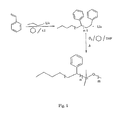
- a Poly(styrene-co-dimethylsiloxane) diblock copolymer was synthesized at Dow Corning Corp. laboratories by sequential controlled anionic polymerization of styrene and then hexamethylcyclotrisiloxane (D 3 ) as shown in Figure 1 [ Rosati, D.; Perrin, M.; Navard, P.; Harabagiu, V.; Pinteala, M.; Simionescu, B. C. Macromolecules, 1998, 31, 4301 ; Pantazis, D.; Chalari, I.; Hadjichristidis, N. Macromolecules, 2003, 36, 3783 ]. All operations were carried out in a Schlenk line operating under a vacuum pump and dry nitrogen or argon.
- the size exclusion chromatography (SEC) chromatogram of PS-PDMS is shown in Figure 2 .
- the volume fraction of PS in the mixture is 0.57 which exhibits a cylindrical morphology upon microphase separation in the bulk, as confirmed by the TEAM image of the solution-cast film in Figure 3 [ Hasegawa, H.; Hashimoto, T. (1996). Self-assembly and morphology of block copolymer system. In Comprehensive polymer science. Suppl. 2, (ed. S.L. Aggarwal and S. Russo), p. 497. Pergamon, Lond on]. Addition of a homopolymer to a near symmetric block copolymer causes swelling of the corresponding block chain, resulting in a curved interface instead of a flat interface to attain a favorable conformational entropy and a uniform packing density).
- a 21wt% solution of the above material was prepared by dissolution in a 3:1 mixture by weight of tetrahydrofuran (THF): dimethylformamide (DMF) (Aldrich). It formed a milky gel-like solution that was stable (no further solidification or precipitation takes place during storage) at room temperature.
- This solution was electrospun using a parallel plate setup as described previously [ Shin, Y. M.; Hohman, M. M.; Brenner, M. P.; Rutledge, G. C. Polymer 2001, 42, 9955 ].
- a JEOL-6060SEM (JEOL Ltd, Japan) scanning electron microscope (SEM) was used to observe the general features of the fibers.
- the fibers were sputter-coated with a 2-3 nm layer of gold for imaging using a Desk II cold sputter/etch unit (Denton Vacuum LLC, NJ).
- the fiber diameters were determined using AnalySIS image processing software (Soft Imaging System Corp., Lakewood, USA).
- JEOL JEM200 CX (JEOL Ltd, Japan) transmission electron microscope (TEM) was used to observe internal features of the fibers.
- TEM transmission electron microscope
- the fibers were deposited directly onto a copper TEM grid.
- the fibers were fixed in a glycol methacrylate based embedding system. (JB-4 Plus Embedding Kit, TED PELLA. INC.), and then sectioned into 100 nm slices using an ultramicrotome (RMC Scientific Corp. Arlington, AZ) with a diamond knife. No staining was necessary, as the intrinsic difference in electron density of PS block and PDMS block provided adequate contrast.
- DSC Differential scanning calorimeter
- the thermal transitions in the as-electrospun fibers of the block copolymer were characterized using a Q1000 modulated differential scanning calorimeter (DSC) (TA Instrument Inc., DE). The measurements were carried out under a nitrogen atmosphere and the sample was scanned for two cycles from -100 to 200 °C with a rate of 10°C per minute.
- DSC differential scanning calorimeter
- XPS X-ray photoelectron spectrometer
- the contact angle of water on the electrospun mat was measured using a Contact Angle Meter G10 (Kruss, Germany). The final result was obtained by averaging at least 4 separate runs.
- Contact angle hysteresis was obtained by the sessile drop method [ Lau, K. K. S.; Bico, J.; Teo, K. B. K.; Chhowalla, M.; Amaratunga, G. A. J.; Milne, W. I.; McKinley, G. H.; Gleason, K. K. Nano Lett., 2003, 3, 1701 ].
- To study the sliding behavior water droplets were dripped on a fiber mat tilted at 17° and the motion of the droplets was observed using a video recorder.
- Figure 4 shows typical SEM pictures of the fibers produced according to embodiments of the invention.
- the fiber diameter ranges from 150 to 400 nm.
- "beading" on the fibers was also observed, but was generally minor, as demonstrated in Figure 4 . According to embodiments of the invention this "beading" might be due to the insufficiently fast stretching during the whipping and the heterogeneity of the microphase-separated solution.
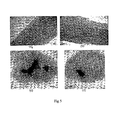
- Figure 5 shows TEM images of the as-electrospun PS-PDMS fibers.
- the dark regions are associated with the higher electron density of the PDMS blocks.
- the fibers appear to be comprised of PDMS cylinders with a diameter of about 20 nm dispersed in the PS matrix, consistent with the overall composition and the TEM images of the solution-cast film.
- these cylinders due to the strong elongational flow in the electrospinning process, these cylinders appear to be well-aligned along the fiber axis.
- the PS/PDMS diblocks are expected to be very strongly segregated due to the nonpolar nature of the PDMS block.
- the average atomic ratio of carbon to silicon is about 8.8.
- the material layer within several nanometers of the fiber surface exhibits a carbon:silicon ratio of only 5.5, indicative of surface enrichment in the PDMS component.
- the surface tensions of PDMS and PS are 19.9 mN/m and 40.7 mN/m, respectively [ Chan, C.-M. 'Polymer surface Modification and Characterization', 1st ed., (1994) Hanser Publishers, Kunststoff ]. Since the PDMS block has lower surface tension, it is more likely to segregate to the fiber surface.
- the reason that the fiber surface contained not just pure PDMS but also PS may be, in accordance with embodiments of this invention, the fact that solidification during the electrospinning takes place so fast (usually on the order of milliseconds) that PDMS blocks do not have enough time to segregate completely to the surface.
- the reason that the surface enrichment of PDMS is not apparent in the TEM axial images may be, in accordance with embodiments of this invention, that TEM only yields pictures of individual cross sections, while XPS averages results over the surfaces of all the fibers.
- the confinement and diameter of the fiber also has an effect on the microphase separation. For example, large fibers tend to contain more PDMS cylinders inside than the small ones. If the diameter is not an integer multiple of the preferred domain spacing, the domains must reorganize to accommodate the incommensuration.
- the advancing and receding contact angles measured by the sessile drop method were 164° and 149°, respectively, giving a hysteresis of 15°.
- Table 2 presents the composition and conditions for the preparation of additional electrospun superhydrophobic fibers.
- a number of additional fibers and mats comprising the same were produced using various copolymers, which yielded a water contact angle of above 150°.
- Some embodiments of mats were prepared, as described hereinabove, via electrospinning of a polystyrene-polydimethylsiloxane copolymer solution at a concentration of 12.95% in Chloroform, yielding a fibrous mat with a contact angle of 170.5 degrees.
- mats of this invention were prepared via electrospinning of the polystyrene-polydimethylsiloxane copolymer described herein, mixed in various ratios of copolymer to MQ siloxane resin (Dow Corning 407), dissolved in 3:1 THF-DMF solvent, electrospun to form a fibrous mat
- Some embodiments of mats of this invention were prepared via electrospinning of a poly(dimethylsiloxane)etherimide copolymer with 35-40% polydimethylsiloxane electrospun from a 15 weight percent solution in chloroform to form a fibrous mat, which had a water contact angle of 157.8°.
Landscapes
- Engineering & Computer Science (AREA)
- Chemical & Material Sciences (AREA)
- Textile Engineering (AREA)
- Chemical Kinetics & Catalysis (AREA)
- General Chemical & Material Sciences (AREA)
- Dispersion Chemistry (AREA)
- Mechanical Engineering (AREA)
- Nonwoven Fabrics (AREA)
- Spinning Methods And Devices For Manufacturing Artificial Fibers (AREA)
- Artificial Filaments (AREA)
Abstract
Description
- The present invention relates to fibers exhibiting a water contact angle of above 150° and water contact angle hysteresis of below 15°, methods of producing the same, and applications thereof. The present invention further relates to superhydrophobic fiber mats, methods of producing the same, and applications thereof.
- Electrospinning is a versatile method to produce polymer fibers with diameters in the micron, sub-micron and nano (<100 nm) range. Numerous polymeric materials have been electrospun into continuous, uniform fibers, and various applications of the fibers have been widely recognized. The method employs electrostatic forces to stretch a polymer jet and make superfine fibers. Electrohydrodynamic instabilities that occur in electrospinning, charge density of the electrified jet (and indirectly, solution conductivity), surface tension, and viscoelasticity of the solution have been shown to play important roles both in making the production of fibers possible and in controlling the size and uniformity of the fibers. The development of internal structure in such fibers has generally been limited to crystallization of homopolymer or macrophase separation of a polymer blend during the drying and solidification of the fiber, inclusion of immiscible additives such as clays, nanotubes and metallic or oxide particles. Surface structures attributed to "breath figures" have also been shown.
- Block copolymers offer an alternative method by which internal structure can be induced in electrospun fibers via microphase separation. In bulk, block copolymers are known to form microphase separated structures such as spheres, cylinders, gyroids and lamellae, depending on molecular weight, volume fractions of components and the degree of immiscibility of the different polymer blocks. In thin films, it has been shown that surface forces and confinement effects are strong enough to alter the phase separation behavior. However, no such information is currently available on microphase separation in a confined cylindrical, sub-micrometer sized and fiber-like geometry. Electrospinning of block copolymers is therefore not only promising for applications involving surface chemistry, drug delivery and multi-functional textiles, but is also of intrinsic scientific interest.
- The wetting behavior of a solid surface is important for various commercial applications and depends strongly on both the surface energy or chemistry and the surface roughness. Currently, surfaces with a water contact angle above 150° are considered to be "superhydrophobic" and are the subject of great interest for their water proof and self-cleaning usages. There is a need to develope fiber-forming processes and products that would demonstrate the desired surface characteristics, such as superhydrophobicity, as well as other properties, such as mechanical strength and integrity.
- In one embodiment, this invention provides a fiber comprising a copolymer wherein said fiber exhibits a water contact angle of above 150° and water contact angle hysteresis of below 15°.
- In one embodiment, this invention provides a superhydrophobic fiber mat, wherein said mat comprises fibers comprising a copolymer and wherein said mat exhibits a water contact angle of above 150° and water contact angle hysteresis of below 15°.
- In one embodiment, this invention provides a method for preparing a superhydrophobic fiber or fibers, the method comprising the step of electrospinning a solution comprising a copolymer, wherein said copolymer comprises a component, comprising a silicon structure and having a surface energy of less than 1 mJ/m2, said solution exhibits conductivity, surface tension and viscoelasticity fluidic properties, and whereby said electrospinning produces a superhydrophobic fiber or fibers exhibiting a water contact angle of above 150° and water contact angle hysteresis of below 15°.
- In one embodiment, the method further comprises the step of producing a superhydrophobic mat comprising said fibers.
- In one embodiment, this invention provides a composition comprising a fiber of this invention.
- In one embodiment, the invention provides an article of manufacture comprising a fiber or mat of this invention.
-
-
Figure 1 demonstrates a reaction scheme for synthesis of PS-PDMS, according to embodiments of the invention. -
Figure 2 demonstrates a SEC chromatogram of the PS-PDMS (solvent=THF, run against PS standards), according to embodiments of the invention. -
Figure 3 demonstrates a TEM image of the PS-PDMS solution-cast film (the scale bar is 200 nm, the dark regions are PDMS blocks and the light regions are PS), according to embodiments of the invention. -
Figure 4 demonstrates SEM images of electrospun PS-PDMS block copolymer fibers. (a) 6000x magnification (scale bar=2 microns); (b)15,000x magnification (scale bar=1micron), according to embodiments of the invention. -
Figure 5 demonstrates TEM images of single PS-PDMS fibers (a), (b) lateral views, (c), (d) axial views (all scale bars are 20 nm; the dark regions are PDMS blocks and the light regions are PS), according to embodiments of the invention. -
Figure 6 demonstrates DSC curves for the phase separated PS-PDMS fibers (the top curves are the cooling runs in the first and second cycles and the bottom curves are the heating runs), according to embodiments of the invention. -
Figure 7 demonstrates XPS data of the phase separated PS-PDMS fibers, according to embodiments of the invention. -
Figure 8 demonstrates (a) A, C a water droplet on the horizontal surface of PS-PDMS fiber and pure PS fiber mat respectively; B, D the droplets were sliding on a 17°-tilted surface of PS-PDMS and pure PS fiber mat respectively, as recorded by a video at 25 frames per second; (b) a photograph showing super hydrophobicity of PS-PDMS fiber mat, according to embodiments of the invention. - In one embodiment, this invention provides a fiber comprising a copolymer wherein said fiber exhibits a water contact angle of above 150° and water contact angle hysteresis of below 15°.
- In one embodiment, this invention provides a superhydrophobic fiber mat, wherein said fiber comprises a copolymer and wherein said mat exhibits a water contact angle of above 150° and water contact angle hysteresis of below 15°.
- In one embodiment of this invention, the water contact angle may be above 160°. In another embodiment, the water contact angle may be about 163°. In another embodiment, the water contact angle may be between 160°-165°. In another embodiment, the water contact angle may be between 150°-160°, In another embodiment, the water contact angle may be between 160°-165°. In another embodiment, the water contact angle may be between 160°-170°. In another embodiment, the water contact angle may be between 160°-175°.
- In one embodiment of this invention, the water contact angle hysteresis may be between 10°-15°. In another embodiment, the water contact angle hysteresis may be between 10°-14°. In another embodiment, the water contact angle hysteresis may be between 8°-13°. In another embodiment, the water contact angle hysteresis may be between 6°-12°. In another embodiment, the water contact angle hysteresis may be between 5°-10°. In another embodiment, the water contact angle hysteresis may be between 0°-5°.
- In one embodiment of this invention, the fiber may exhibit surface roughness properties.
- In one embodiment of this invention, the mat may be electrospun. In another embodiment, the mat may exhibit wettability properties. In another embodiment, the mat may be composed solely of fibers. In another embodiment, the fibers within the mat are uniform. In another embodiment, the mat may be composed solely of fibers randomly oriented within a plane. In one embodiment of this invention, the mat may exhibit a water contact angle of above 160°. In another embodiment, the mat may exhibit a water contact angle of about 163°. In another embodiment, the mat may exhibit a water contact angle of between 160°-165°. In another embodiment, the mat may exhibit a water contact angle of between 150°-160°. In another embodiment, the mat may exhibit a water contact angle of between 160°-165°, In another embodiment, the mat may exhibit a water contact angle of between 160°-170°. In another embodiment, the mat may exhibit a water contact angle of between 160°-175°,
- In one embodiment of this invention, the mat may exhibit a water contact angle hysteresis of between 10°-15°. In another embodiment the mat may exhibit a water contact angle hysteresis of between 10°-14°. In another embodiment, the mat may exhibit a water contact angle hysteresis of between 8°-13°. In another embodiment, the mat may exhibit a water contact angle hysteresis of between 6°-12°. In another embodiment, the mat may exhibit a water contact angle hysteresis of between 5°-10°. In another embodiment, the mat may exhibit a water contact angle hysteresis of between 0°-5°.
- In one embodiment of this invention, the mat may exhibit an isotropic nature of the contact angle, contact angle hysteresis or a combination thereof.
- In one embodiment of this invention, the mat may exhibit a non-isotropic nature of the contact angle, contact angle hysteresis or a combination thereof.
- In one embodiment of this invention, the mat may include:
- domains exhibiting an isotropic nature of the contact angle, contact angle hysteresis or a combination thereof,
- domains exhibiting a non-isotropic nature of the contact angle, contact angle hysteresis or a combination thereof,
- or a combination thereof.
- In one embodiment of this invention, the mat may exhibit surface roughness properties.
- In one embodiment of this invention, the mat may exhibit pore sizes of between 0.01-100 micron. In another embodiment, the mat may exhibit pore sizes of between 0.1-100 micron. In another embodiment, the mat may exhibit pore sizes of between 0.1-50 micron. In another embodiment, the mat may exhibit pore sizes of between 0.1-10 micron. In another embodiment, the mat may exhibit pore sizes of between 0.1-5 micron. In another embodiment, the mat may exhibit pore sizes of between 0.1-2 micron. In another embodiment, the mat may exhibit pore sizes of between 0.2-1.5 micron. In another embodiment, the pore size may be non-uniform. In another embodiment, the pore size may be uniform.
- In one embodiment of this invention, the diameter of the fiber, or, in another embodiment, fibers in the mat, which in some comprise only some fibers, or in other embodiments comprises fibers mostly having a diameter of between 1nm-5 micron, or in another embodiment, the diameter is between 1nm-500nm, or in another embodiment, the diameter is between 1nm-100nm, or in another embodiment, the diameter is between 100nm-300nm, or in another embodiment, the diameter is between 100nm-500nm, or in another embodiment, the diameter is between 50nm-400nm, or in another embodiment, the diameter is between 200nm-500nm, or in another embodiment, the diameter is between 300nm-600nm, or in another embodiment, the diameter is between 400nm-700nm, or in another embodiment, the diameter is between 500nm-800nm, or in another embodiment, the diameter is between 500nm-1000nm, or in another embodiment, the diameter is between 1000nm-1500nm, or in another embodiment, the diameter is between 1500nm-3000nm, or in another embodiment, the diameter is between 2000nm-5000nm, or in another embodiment, the diameter is between 3000nm-4000nm.
- In one embodiment of this invention, the fiber may be an electrospun fiber.
- In one embodiment of this invention, the fiber may exhibit a microphase-separation.
- In one embodiment of this invention, the fiber may include, inter alia, a component, wherein the surface energy of the component is below 5 mJ/m2. In one embodiment of this invention, the fiber may include, inter alia, a component, wherein the surface energy of the component is below 1 mJ/m2. In another embodiment, the surface energy of the component is between 0.1-1 mJ/m2. In another embodiment, the surface energy of the component is between 0.1-0.5 mJ/m2. In another embodiment, the surface energy of the component is between 0.5-0.9 mJ/m2.
- In one embodiment of this invention, the component may segregate to the surface of the fiber. In another embodiment, the component may be a part of the copolymer. In another embodiment, the component may include, inter alia, a silicon structure. In another embodiment, the silicon structure may be, inter alia, a resin, linear, branched, cross-linked, cross-linkable silicone structure or any combination thereof. In another embodiment, the silicon structure may include, inter alia, poly-dimethylsiloxane (PDMS). In another embodiment, the silicon structure may include, inter alia, fluorine.
- In one embodiment of this invention, the copolymer may include, inter alia, polyisobutylene, polyolefin, polystyrene, polyacrylate, polyurethane, polyester, polyamide, polyetherimide, any derivative thereof or any combination thereof. In another embodiment, the copolymers according to the invention may be substituted or unsubstituted. In another embodiment, the copolymers according to the invention may be saturated or unsaturated. In another embodiment, the copolymers according to the invention may be linear or branched. In another embodiment, the copolymers according to the invention may be alkylated. In another embodiment, alkylated may be methylated. In another embodiment, the copolymers according to the invention may be halogenated. In another embodiment, the copolymers according to the invention may be chlorinated. In another embodiment, the polyolefin may include, inter alia, polyisobutylene, polyethylene, polypropylene or any combination thereof. In another embodiment, the copolymers according to the invention may be fluorinated. In another embodiment, the copolymer may include, inter alia, poly(alphamethyl)styrene.
- In another embodiment, the copolymer may include, inter alia, a block, graft, star or random copolymer. In another embodiment, the block copolymer may include, inter alia, poly(styrene-co-dimethylsiloxane) (PS-PDMS), or in another embodiment, poly(dimethylsiloxane-co-etherimide).
- In one embodiment of this invention, the molecular weight of the PS-PDMS may be higher than about 100K. In another embodiment, the molecular weight of the PS-PDMS may range between about 100K-5000K. In another embodiment, the molecular weight of the PS-PDMS may range between about 100K-1000K. In another embodiment, the molecular weight of the PS-PDMS may range between about 100K-500K. In another embodiment, the molecular weight of the PS-PDMS may range between about 200K-300K. In another embodiment, the molecular weight of the PS-PDMS may be higher than about 250K. In another embodiment the molecular weight of the PS-PDMS may be 150K, or about 150K. In one embodiment, the term "about" refers to a deviance from the stated value or range of values by +/- 1 %, or in another embodiment, by +/- 2 %, or in another embodiment, by +/- 5 %, or in another embodiment, by +/- 7 %, or in another embodiment, by +/- 10 % , or in another embodiment, by +/- 13 %, or in another embodiment, by +/- 15 %, or in another embodiment, by +/- 18 % , or in another embodiment, by +/- 20 %.
- In one embodiment of this invention, the fiber may include, inter alia, poly-dimethylsiloxane (PDMS) blocks non-uniformly dispersed within a polystyrene (PS) matrix. In one embodiment of this invention, the fiber may include, inter alia, polystyrene-polydimethylsiloxane copolymer blocks non-uniformly dispersed within a siloxane matrix.
- In one embodiment of this invention, the copolymer may include, inter alia, polystyrene (PS). In another embodiment, the volume fraction of PS in the copolymer may be between 0.05-0.9. In another embodiment, the volume fraction of PS in the copolymer may be between 0.1-0.6. In another embodiment, the volume fraction of PS in the copolymer may be between 0.3-0.5. In another embodiment, the volume fraction of PS in the copolymer may be between 0.4-0.9. In another embodiment, the volume fraction of PS in the copolymer may be 0.45. In another embodiment, the volume fraction of PS in the mixture may be between 0.1-0.9. In another embodiment, the volume fraction of PS in the mixture may be between 0.3-0.6. In another embodiment, the volume fraction of PS in the mixture may be 0.57. In another embodiment, the volume fraction of PS in the mixture may be 0.813. In another embodiment, the volume fraction of PS in the mixture may be 0.05-0.9, and exhibit may exhibit a cylindrical morphology upon microphase separation in the bulk.
- In one embodiment of this invention, the poly-dimethylsiloxane (PDMS) blocks may segregate to the surface of the fiber.
- In one embodiment of this invention, the poly-dimethylsiloxane (PDMS) blocks may be aligned along the fibers axis.
- In one embodiment, this invention provides a superhydrophobic nonwoven mat including submicron diameter fibers of poly(styrene-co-dimethylsiloxane) (PS-PDMS) block copolymers blended with homopolymer polystyrene (PS). In one embodiment, the PS/PDMS system of this invention, has a larger Flory interaction parameter compared to the conventional styrene-diene block copolymers. In one embodiment, the PS/PDMS system of this invention, exhibits a pronounced surface activity of the PDMS block. In one embodiment of this invention, the Flory interaction of the PS/PDMS system and the pronounced surface activity of the PDMS block facilitate the microphase separation in the electrospun fibers even without any post treatment. In one embodiment, the superhydrophobicity of the electrospun mats according to the invention may be determined by static and dynamic contact angle attributed to both the surface roughness and surface excess of the PDMS blocks. In one embodiment, the superhydrophobicity of the electrospun mats according to the invention may be obtained without the presence of microspheres within the mat. In one embodiment, the superhydrophobicity of the electrospun mats according to the invention may exhibit an isotropic nature of the contact angle hysteresis. In another embodiment, the isotropic nature of the contact angle hysteresis may be attributed to the random in-plane arrangement of fibers, which may mitigate pinning effects on the liquid drop. In one embodiment, the high surface tension at the air/polymer interface and/or the confinement of the microphase separated structures to the fiber geometry and/or the aligning effect of the elongational flow according to the invention may have some effects on the morphologies of the block copolymers.
- In one embodiment, this invention provides a method for preparing a fiber, wherein the fiber includes a copolymer and wherein the fiber exhibits a water contact angle of above 150° and water contact angle hysteresis of below 15°, the method may include, inter alia, the step of electrospinning a solution including, inter alia, the copolymer.
- In one embodiment, this invention provides a method for preparing a superhydrophobic fiber mat, wherein the fiber includes a copolymer and wherein the mat exhibits a water contact angle of above 150° and water contact angle hysteresis of below 15°, the method may include, inter alia, the step of electrospinning a solution including, inter alia, the copolymer.
- In one embodiment of this invention, the concentration of the poly(styrene-co-dimethylsiloxane) (PS-PDMS) in the solution is 21%. In another embodiment, the concentration of the poly(styrene-co-dimethylsiloxane) (PS-PDMS) in the solution is about" 21%. In another embodiment, the concentration of the poly(styrene-co-dimethylsiloxane) (PS-PDMS) in the solution is between 5-10%. In another embodiment, the concentration of the poly(styrene-co-dimethylsiloxane) (PS-PDMS) in the solution is between 10-20%. In another embodiment, the concentration of the poly(styrene-co-dimethylsiloxane) (PS-PDMS) in the solution is between 20-25%. In another embodiment, the concentration of the poly(styrene-co-dimethylsiloxane) (PS-PDMS) in the solution is between 15-25%. In another embodiment, the concentration of the poly(styrene-co-dimethylsiloxane) (PS-PDMS) in the solution is between 20-30%. In another embodiment, the concentration of the poly(styrene-co-dimethylsiloxane) (PS-PDMS) in the solution is between 20-40%.
- In some embodiments, the polystyrene-polydimethylsiloxane copolymer is mixed with a siloxane resin such as MQ siloxane resin (Dow Corning 407), at various ratios, for example,18:5,15:10,12:12 copolymer to resin, or in another embodiment, about 10 - 25 : 5-15 copolymer to resin ratio. In some embodiments, the total solids level is 25%, or in another embodiment, 23%, or in another embodiment, 24%, or in another embodiment, about 18% - 30 %. In one embodiment, the mixture is dissolved in 3:1 THF-DMF solvent.
- In one embodiment of this invention, the solution includes a solvent. In another embodiment, the solvent is an organic solvent. In another embodiment, the solvent may include, inter alia, tetrahydrofuran, diethylformamide or a combination thereof. In another embodiment, the solvent may include, inter alia, tetrahydrofuran and diethylformamide in a ratio of 3:1. In another embodiment, the solvent may include, inter alia, chloroform, toluene or a combination thereof. In one embodiment, the solvent comprises chloroform: diethylformamide in a ratio of 4:1.
- In one embodiment of this invention, the solution may include additives. In another embodiment, the additives may include, inter alia, inorganic salts, organic salts, surfactants or any combination thereof. In another embodiment, the additives may include, inter alia, any material that increases the conductivity of the solution. In another embodiment, the additives may include, inter alia, any material that decreases the surface tension of the solution. In another embodiment, the additives may include, inter alia, a dye. In another embodiment, the additives may include, inter alia, a colorant. In another embodiment, the additives may include, inter alia, a labeling agent.
- In one embodiment of this invention, the solution exhibits conductivity, surface tension and viscoelasticity fluidic properties. In one embodiment of this invention, the zero shear rate viscosity of the solution may be between 0.1-10 PaS. In another embodiment, the zero shear rate viscosity of the solution may be between 0.5-10 PaS. In another embodiment, the zero shear rate viscosity of the solution may be between 1-10 PaS. In another embodiment, the zero shear rate viscosity of the solution may be between 5-8 PaS. In another embodiment, the zero shear rate viscosity of the solution may be about 6 PaS.
- In one embodiment of this invention, the extensional viscosity of the solution may be between 0.1- 100,000 PaS. In another embodiment, the extensional viscosity of the solution may be between 100- 1000 PaS. In another embodiment, the extensional viscosity of the solution may be between 1- 100 PaS. In another embodiment, the extensional viscosity of the solution may be between 5- 50 PaS. In another embodiment, the extensional viscosity of the solution may be about 10 PaS.
- In one embodiment of this invention, the solution conductivity may be between 0.01-25 mS/m. In another embodiment, the solution conductivity may be between 0.1-10 mS/m. In another embodiment, the solution conductivity may be between 0.1-5 mS/m. In another embodiment, the solution conductivity may be between 0.1-1 mS/m. In another embodiment, the solution conductivity may be between 0.1-0.5 mS/m. In another embodiment, the solution conductivity may be about 0.3 mS/m.
- In one embodiment of this invention, the surface tension of the solution may be between 10-100 mN/m. In another embodiment, the surface tension of the solution may be between 20-80 mN/m. surface tension of the solution may be between 20-50 mN/m. In another embodiment, the surface tension of the solution may be about 30 mN/m.
- In one embodiment of this invention, the dielectric constant of the solution may be between 1-100. In another embodiment, the dielectric constant of the solution may be between 5-50. In another embodiment, the dielectric constant of the solution may be between 10-70. In another embodiment, the dielectric constant of the solution may be between 1-20. In another embodiment, the dielectric constant of the solution may be about 10.
- In one embodiment of this invention, the zero shear rate viscosity of the solution may be 6 Pa S, the extensional viscosity of the solution may be 10 Pa S, the solution conductivity may be 0.3 mS/m and the surface tension of the solution may be 30 mN/m.
- In one embodiment of this invention, the molecular weight of the PS-PDMS may be about 240K, the concentration of the PS-PDMS in the solution may be about 21%, and the solution includes THF and DMF in a ratio of 3:1.
- In one embodiment of this invention, the term "percent" or "%" may refer to weight percent
- In one embodiment of this invention, the voltage applied in the electro spinning may range between 5-50 KV. In another embodiment, the voltage applied in the electrospinning may range between 10-40 KV. In another embodiment, the voltage applied in the electrospinning may range between 15-35 KV. In another embodiment, the voltage applied in the electrospinning may range between 20-30 KV. In another embodiment, the voltage applied in the electrospinning may be about 30 KV.
- In one embodiment of this invention, the distance between electrodes in the electrospinning may range between 10-100 cm. In another embodiment, the distance between electrodes in the electro spinning may range between 20-75 cm. In another embodiment, the distance between electrodes in the electrospinning may range between 30-60 cm. In another embodiment, the distance between electrodes in the electrospinning may range between 40-50 cm. In another embodiment, the distance between electrodes in the electrospinning may be about 50 cm
- In one embodiment of this invention, the flow rate in the electrospinning may range between 0.005-0.5 ml/min. In another embodiment, the flow rate in the electrospinning may range between 0.005-0.1 ml/min. the flow rate in the electrospinning may range between 0.01-0.1 ml/min. the flow rate in the electrospinning may range between 0.02-0.1 ml/min. the flow rate in the electrospinning may be about 0.05 ml/min.
- In one embodiment of this invention, the electric current in the electrospinning may range between 10-10,000 nA. In another embodiment, the electric current in the electrospinning may range between 10-1000 nA. In another embodiment, the electric current in the electrospinning may range between 50-500 nA. In another embodiment, the electric current in the electrospinning may range between 75-100 nA. In another embodiment, the electric current in the electrospinning may be around 85 nA.
- In one embodiment of this invention, the voltage applied in the electrospinning may be about 30 KV, the flow rate may be the electrospinning is about 0.05 ml/min and the electric current in the electrospinning may be about 85 nA.
- In one embodiment of this invention, a parallel plate setup may be used in the electrospinning.
- In one embodiment, electrospinning may be conducted with the aid of any suitable apparatus as will be known to one skilled in the art.
- In one embodiment, the methods of this invention, may further include post treatment of the fibers. In one embodiment, the methods of this invention may further include annealing of the fibers. In another embodiment, the annealing of the fibers may enhance the hydrophobicity for these fibers. In another embodiment, the annealing of the fibers may enhance the regularity of the microphases for these fibers.
- In one embodiment, this invention provides a composition including any fiber according to the invention.
- In one embodiment, this invention provides an article of manufacture including any fiber according to this invention. Tn another embodiment, this invention provides an article of manufacture including any mat according to this invention. In another embodiment, the article of manufacture may be, inter alia, a waterproof substance. In another embodiment, the article of manufacture may be, inter alia, a water resistant substance. In another embodiment, the article of manufacture may be, inter alia, a self-cleaning substance. In another embodiment, the article of manufacture may be, inter alia, a water draining substance. In another embodiment, the article of manufacture may be, inter alia, a coating substance. In another embodiment, the coating substance reduces drag. In another embodiment, the coating substance reduces drag in a gas, in a liquid or in both. In another embodiment, the gas may be air. In another embodiment, the liquid may be water.
- In another embodiment of this invention, the article of manufacture may be a membrane.
- In another embodiment of this invention, the article of manufacture may be, inter alia, manufacture is a fabric. In another embodiment, the fabric may be, inter alia, a breathable fabric. In another embodiment, the fabric may have, inter alia, a filtration functionality. In another embodiment, the fabric may have, inter alia, an absorptive functionality. In another embodiment, the fabric may be, inter alia, a non-woven fabric. In another embodiment, the fabric may be, inter alia, a waterproof fabric. In another embodiment, the fabric may be, inter alia, a water resistant fabric.
- In one embodiment of this invention, the fabric may be a superhydrophobic fabric. In another embodiment, the fabric may be an electrospun fibrous fabric. In one embodiment of this invention, the fabric may exhibit a water contact angle of above 160°, In another embodiment, the fabric may exhibit a water contact angle of about 163°. In another embodiment, the fabric may exhibit a water contact angle of between 160°-165°. In another embodiment, the fabric may exhibit a water contact angle of between 150°-160°. In another embodiment, the fabric may exhibit a water contact angle of between 160°-165°. In another embodiment, the fabric may exhibit a water contact angle of between 160°-170°. In another embodiment, the fabric may exhibit a water contact angle of between 160°-175°.
- In one embodiment of this invention, the fabric may exhibit a water contact angle hysteresis of between 10°-15°. In another embodiment the fabric may exhibit a water contact angle hysteresis of between 10°-14°. In another embodiment, the fabric may exhibit a water contact angle hysteresis of between 8°-13°. In another embodiment, the fabric may exhibit a water contact angle hysteresis of between 6°-12°. In another embodiment, the fabric may exhibit a water contact angle hysteresis of between 5°-1.0°. In another embodiment, the fabric may exhibit a water contact angle hysteresis of between 0°-5°.
- In another embodiment of this invention, the article of manufacture may be, inter alia, a drug delivery system. In another embodiment, the article of manufacture may be, inter alia, a bandage or patch. In another embodiment, the bandage or patch may include, inter alia, a drug.
- In one embodiment of the invention, the term "contact angle" may refer to the angle on the liquid side tangential line draw through the three phase boundary where a liquid, gas and solid intersect.
- In one embodiment of the invention, the term "static contact angle" may refer to the contact angle measured of a Sessile drop on a solid substance when the three phase line is not moving.
- In one embodiment of the invention, the term "dynamic contact angle" may be divided into "advancing contact angle" and "receding contact angle" which may refer to, according to embodiments of the invention, to the contact angles measured when the three phase line is in controlled movement by wetting the solid by a liquid or by withdrawing the liquid over a prewetted solid, respectively. In another embodiment, the liquid is water.
- In one embodiment of the invention, the term "contact angle hysteresis" may refer to the difference between the measured advancing and receding contact angles.
- In one embodiment of the invention, the term "wettability" may refer to the process when a liquid spreads on (wets) a solid substrate. In another embodiment wettability may be estimated by determining the contact angle.
- In one embodiment of the invention, the term "surface tension" may refer to the measurement of the cohesive (excess) energy present at a gas/liquid interface.
- In one embodiment of the invention, the term "viscoelasticity" may refer to a combination of viscous and elastic properties in a material with the relative contribution of each being dependent on time, temperature, stress and strain rate.
- In one embodiment of the invention, the terms "viscosity" or "viscous" may refer to the resistance of a material to flow under stress.
- The following examples are presented in order to more fully illustrate some embodiments of the invention. They should, in no way be construed, however, as limiting the scope of the invention.
- A Poly(styrene-co-dimethylsiloxane) diblock copolymer was synthesized at Dow Corning Corp. laboratories by sequential controlled anionic polymerization of styrene and then hexamethylcyclotrisiloxane (D3) as shown in
Figure 1 [Rosati, D.; Perrin, M.; Navard, P.; Harabagiu, V.; Pinteala, M.; Simionescu, B. C. Macromolecules, 1998, 31, 4301; Pantazis, D.; Chalari, I.; Hadjichristidis, N. Macromolecules, 2003, 36, 3783]. All operations were carried out in a Schlenk line operating under a vacuum pump and dry nitrogen or argon. - The size exclusion chromatography (SEC) chromatogram of PS-PDMS is shown in
Figure 2 . Peak 1 was identified as the copolymer with Mn=238000, polydispersity (pdi) =1.16, and accounts for 76.6% of the sample. Peak 2 was identified as residual PS homopolymer, Mn=114000, and accounts for the remaining 23.4%. Assuming that the Mn of the PS block in the copolymer is also 114k, the composition of the copolymer is 114k/124k. The volume fraction of PS in the copolymer is 0.45. The volume fraction of PS in the mixture is 0.57 which exhibits a cylindrical morphology upon microphase separation in the bulk, as confirmed by the TEAM image of the solution-cast film inFigure 3 [Hasegawa, H.; Hashimoto, T. (1996). Self-assembly and morphology of block copolymer system. In Comprehensive polymer science. Suppl. 2, (ed. S.L. Aggarwal and S. Russo), p. 497. Pergamon, London]. Addition of a homopolymer to a near symmetric block copolymer causes swelling of the corresponding block chain, resulting in a curved interface instead of a flat interface to attain a favorable conformational entropy and a uniform packing density). - A 21wt% solution of the above material was prepared by dissolution in a 3:1 mixture by weight of tetrahydrofuran (THF): dimethylformamide (DMF) (Aldrich). It formed a milky gel-like solution that was stable (no further solidification or precipitation takes place during storage) at room temperature. This solution was electrospun using a parallel plate setup as described previously [Shin, Y. M.; Hohman, M. M.; Brenner, M. P.; Rutledge, G. C. Polymer 2001, 42, 9955].
- The electrical potential, solution flow rate, the protrusion of the spinnerette from the upper plate and the distance between the capillary tip and the collector were adjusted so that spinning was stable and dry nanofibers were obtained (Table 1).
Table 1: Operating parameters for the electrospinning process, according to embodiments of this invention. Flow rate Spinnerette protrusion Tip-to-collector distance Voltage 0.05 ml/ min 2cm 50 cm 30 KV - A JEOL-6060SEM (JEOL Ltd, Japan) scanning electron microscope (SEM) was used to observe the general features of the fibers. The fibers were sputter-coated with a 2-3 nm layer of gold for imaging using a Desk II cold sputter/etch unit (Denton Vacuum LLC, NJ). The fiber diameters were determined using AnalySIS image processing software (Soft Imaging System Corp., Lakewood, USA).
- A JEOL JEM200 CX (JEOL Ltd, Japan) transmission electron microscope (TEM) was used to observe internal features of the fibers. For lateral viewing the fibers were deposited directly onto a copper TEM grid. For axial viewing, the fibers were fixed in a glycol methacrylate based embedding system. (JB-4 Plus Embedding Kit, TED PELLA. INC.), and then sectioned into 100 nm slices using an ultramicrotome (RMC Scientific Corp. Tucson, AZ) with a diamond knife. No staining was necessary, as the intrinsic difference in electron density of PS block and PDMS block provided adequate contrast.
- The thermal transitions in the as-electrospun fibers of the block copolymer were characterized using a Q1000 modulated differential scanning calorimeter (DSC) (TA Instrument Inc., DE). The measurements were carried out under a nitrogen atmosphere and the sample was scanned for two cycles from -100 to 200 °C with a rate of 10°C per minute.
- Surface chemistry of the fibers was characterized using a Kratos Axis Ultra X-ray photoelectron spectrometer (XPS) (Kratos Analytical, Manchester) with a monochromatized Al Kα X-ray source. The XPS signals from the silicon and oxygen of the PDMS block were used to distinguish the two polymer blocks and to obtain the composition of the fiber surface.
- The contact angle of water on the electrospun mat was measured using a Contact Angle Meter G10 (Kruss, Germany). The final result was obtained by averaging at least 4 separate runs. Contact angle hysteresis was obtained by the sessile drop method [Lau, K. K. S.; Bico, J.; Teo, K. B. K.; Chhowalla, M.; Amaratunga, G. A. J.; Milne, W. I.; McKinley, G. H.; Gleason, K. K. Nano Lett., 2003, 3, 1701]. To study the sliding behavior, water droplets were dripped on a fiber mat tilted at 17° and the motion of the droplets was observed using a video recorder.
-
Figure 4 shows typical SEM pictures of the fibers produced according to embodiments of the invention. The fiber diameter ranges from 150 to 400 nm. Besides the broad distribution of fiber diameter, "beading" on the fibers was also observed, but was generally minor, as demonstrated inFigure 4 . According to embodiments of the invention this "beading" might be due to the insufficiently fast stretching during the whipping and the heterogeneity of the microphase-separated solution. -
Figure 5 shows TEM images of the as-electrospun PS-PDMS fibers. The dark regions are associated with the higher electron density of the PDMS blocks. According to embodiments of the invention, judging from the longitudinal striations inFigure 5 (a) and (b) and the dark circular objects observed on the cross-section images inFigure 5 (c) and (d) , the fibers appear to be comprised of PDMS cylinders with a diameter of about 20 nm dispersed in the PS matrix, consistent with the overall composition and the TEM images of the solution-cast film. According to further embodiments of the invention, due to the strong elongational flow in the electrospinning process, these cylinders appear to be well-aligned along the fiber axis. - The PS/PDMS diblocks are expected to be very strongly segregated due to the nonpolar nature of the PDMS block. A rough estimate for the Flory interaction parameter χ is obtained by group contribution methods, χ =(100 cm3/mol) /RT)(δPS-δPDMS)2, [Bristow, G. M.; Watson, W. F. Trans. Faraday Soc., 1958, 54, 1731] where δPS=18.6 (J/cm3)1/2 and δPDMS=15.4 (J/cm3)1/2 are the Hildebrandt solubility parameters for PS and PDMS, respectively ['Polymer Handbook' (Eds J. Brandrup and E. H. Immergut). 3rd Edn, Wiley, New York, 1989, P. VII/557]. For a degree of polymerization N=2771, χN=1130, well in excess of χN=10.5 required for microphase separation in a symmetric diblock copolymer according to mean field theory [Leibler, L. Macromolecules, 1980, 13, 1602].
- Strong segregation of the PS and PDMS blocks is further evidenced by the glass transition temperature Tg of 105°C exhibited in the DSC curve of
Figure 6 . This transition temperature is characteristic of unblended PS. The glass transition of PDMS is -125°C. The rule of mixtures [Gordon, M.; Taylor, J. S. J. Appl Chem. 1952, 2, 493] would predict a glass transition of about -5°C if the PS and PDMS were well mixed; no such peak is observed inFigure 6 . The endotherm around -40°C during heating is attributed to the crystal melting point of PDMS, while the exotherm around -75°C during cooling could be due to crystallization [Chu, J. H.; Rangarajan, P.; LaMonte Adams, J.; Register, R. A. Polymer, 1995, 36, 1569]. - From the material composition, the average atomic ratio of carbon to silicon is about 8.8. According to the XPS data shown in
Figure 7 , the material layer within several nanometers of the fiber surface exhibits a carbon:silicon ratio of only 5.5, indicative of surface enrichment in the PDMS component. The surface tensions of PDMS and PS are 19.9 mN/m and 40.7 mN/m, respectively [Chan, C.-M. 'Polymer surface Modification and Characterization', 1st ed., (1994) Hanser Publishers, Munich]. Since the PDMS block has lower surface tension, it is more likely to segregate to the fiber surface. A similar enrichment of PDMS was reported for the films of PS/PS-b-PDMS blends [Lee, H.; Archer, L. A. Macromolecules 2001, 34, 4572]. Such a surface segregation of fluorine in electrospun fibers of poly(methyl methacylate-co-tetrahydroperfluorooctyl acrylate) was also observed [Deitzel, J. M.; Kosik, W.; McKnight, S. H.; Beck Tan, N. C.; Desimone, J. M.; Crette, S. Polymer, 2002, 43, 1025]. The reason that the fiber surface contained not just pure PDMS but also PS may be, in accordance with embodiments of this invention, the fact that solidification during the electrospinning takes place so fast (usually on the order of milliseconds) that PDMS blocks do not have enough time to segregate completely to the surface. The reason that the surface enrichment of PDMS is not apparent in the TEM axial images may be, in accordance with embodiments of this invention, that TEM only yields pictures of individual cross sections, while XPS averages results over the surfaces of all the fibers. The confinement and diameter of the fiber also has an effect on the microphase separation. For example, large fibers tend to contain more PDMS cylinders inside than the small ones. If the diameter is not an integer multiple of the preferred domain spacing, the domains must reorganize to accommodate the incommensuration. - The contact angle measurement and the sliding behavior of the water on the PS-PDMS electrospun mat are shown
Figure 8 (a) A and B. The contact angle was as high as 163° which is much larger than the contact angle of 112° for pure PDMS films [Gillmor S. D. et al., 2th Annual International IEEE-EMBS Special Topic Conference on Microtechnologies in medicine&Biology, 2002, Poster 225, 51]. - The advancing and receding contact angles measured by the sessile drop method were 164° and 149°, respectively, giving a hysteresis of 15°. The wetting behavior of the PS-PDMS fiber mat were compared with that of a pure PS fiber mat with comparable fiber sizes (average diameter = 300nm) and pore size distribution (pore sizes ranging from 0.200 to 1.5 mm, as determined by Hg porosimetry, Quantachrome Instruments Poremaster 33). It was found that the PS fiber mat not only had a smaller contact angle (138°) but also showed a sliding behavior characterized by a much bigger contact area between the mat and the droplet than in the case of PS-PDMS block copolymer fiber, as shown on
Figure 8 (a) C and D. From these comparisons it can be concluded, in accordance with embodiments of this invention, that the superhydrophobicity observed for the PS-PDMS fiber mat is the combined result of both the roughness of the surface and the excess concentration of PDMS on the surface. - Table 2 presents the composition and conditions for the preparation of additional electrospun superhydrophobic fibers. A number of additional fibers and mats comprising the same were produced using various copolymers, which yielded a water contact angle of above 150°.
Sample No. Copolymer #Parts Copol Resin #Parts resin % ttl solids Solvent Contact angle of mat 1 PS-DMS of Ex. # 118 MQ siloxane resin (Dow Corning 407) 5 23 3:1 THF-DMF 167.9 2 PS-DMS of Ex. # 115 MQ siloxane resin (Dow Corning 407) 10 25 3:1 THF-DMF 168.9 3 PS-DMS of Ex. # 112 MQ siloxane resin (Dow Corning 407) 12 24 3:1 THF-DMF 168.5 4 PS-DMS of Ex. #1 - - - 12.95%weight solution Chloroform 170.5 5 PS-PDMS MW: 153,000, PS Volume ratio of 0.813 - - - 9% weight solution 4:1 chloroform -DMF mixture 168 6 Poly(dimethyl siloxane) Etherimide: 35-40% polydimethylsilox ane - - - 15 % weight solution Chloroform 157.8 - Some embodiments of mats were prepared, as described hereinabove, via electrospinning of a polystyrene-polydimethylsiloxane copolymer solution at a concentration of 12.95% in Chloroform, yielding a fibrous mat with a contact angle of 170.5 degrees.
- Some embodiments of mats of this invention were prepared via electrospinning of the polystyrene-polydimethylsiloxane copolymer described herein, mixed in various ratios of copolymer to MQ siloxane resin (Dow Corning 407), dissolved in 3:1 THF-DMF solvent, electrospun to form a fibrous mat
- Some embodiments of mats of this invention were prepared via electrospinning of a polystyrene-polydimethylsiloxane copolymer having a total molecular weight of 153000 and a volume ratio of polystyrene = 0.813, dissolved in a 4:1 chloroform-DMF solvent mixture. Fibrous mat with a water contact angle of 168° were obtained. Based on this example, copolymers with a volume percent of as little as 19 of silicone produce superhydrophobic fibrous mats.
- Some embodiments of mats of this invention were prepared via electrospinning of a poly(dimethylsiloxane)etherimide copolymer with 35-40% polydimethylsiloxane electrospun from a 15 weight percent solution in chloroform to form a fibrous mat, which had a water contact angle of 157.8°.
- These results indicate that a number of superhydrophobic fibers and mats can be prepared according to the methods of this invention.
- The invention will now be described by a series of numbered clauses:
- 1. A fiber comprising a copolymer wherein said fiber exhibits a water contact angle of above 150° and water contact angle hysteresis of below 15°.
- 2. The fiber of
clause 1, wherein the diameter of said fiber is between 1nm-5 micron. - 3. The fiber of clause 2, wherein said diameter is between 1nm-500nm.
- 4. The fiber of
clause 1, wherein said water contact angle is above 160°. - 5. The fiber of
clause 1, wherein said fiber is an electrospun fiber. - 6. The fiber of
clause 1, wherein said fiber exhibits a microphase-separation. - 7. The fiber of
clause 1, wherein said fiber comprises a component, wherein the surface energy of said component is below 1 mJ/m. - 8. The fiber of clause 7, wherein said component segregates to the surface of said fiber.
- 9. The fiber of clause 7, wherein said component is a part of said copolymer.
- 10. The fiber of clause 7, wherein said component comprises a silicone structure.
- 11. The fiber of
clause 10, wherein said silicone structure is a resin, linear, branched, cross- linked, cross-linkable silicone structure or any combination thereof. - 12. The fiber of
clause 10, wherein said silicone structure is poly-dimethylsiloxane (PDMS). - 13. The fiber of clause 7, wherein said component comprises fluorine.
- 14. The fiber of
clause 1, wherein said copolymer comprises a polyisobutylene, polyolefin, polystyrene, polyacrylate, polyurethane, polyester, polyamide, polyetherimide, any derivative thereof or any combination thereof. - 15. The fiber of
clause 1, wherein said copolymer comprises a block, graft, star or random copolymer. - 16. The fiber of
clause 15, wherein said block copolymer comprises poly(styrene-co- dimethylsiloxane) (PS-PDMS). - 17. The fiber of
clause 15, wherein said fiber comprises poly-dimethylsiloxane (PDMS) blocks non-uniformly dispersed within a polystyrene (PS) matrix. - 18. The fiber of clause 17, wherein said poly-dimethylsiloxane (PDMS) blocks segregate to the surface of said fibers.
- 19. The fiber of
clause 15, wherein said block copolymer comprises poly(dimethylsiloxane- co-etherimide). - 20. The fiber of
clause 1, wherein said fiber exhibits surface roughness properties. - 21. A composition or an article of manufacture comprising the fiber of
clause 1. - 22. A superhydrophobic mat of fibers comprising a copolymer wherein said mat exhibits a water contact angle of above 150° and water contact angle hysteresis of below 15°.
- 23. The mat of clause 22, wherein said mat exhibits a water contact angle of above 160°.
- 24. The mat of clause 22, wherein said mat exhibits an isotropic nature of said contact angle, contact angle hysteresis or a combination thereof.
- 25. The mat of clause 22, wherein said mat exhibits a non-isotropic nature of said contact angle, contact angle hysteresis or a combination thereof.
- 26. The mat of clause 22, wherein the diameter of said fiber is between 1nm-5 micron.
- 27. The mat of clause 26, wherein said diameter is between 1nm-500nm.
- 28. The mat of clause 22, wherein said fiber is an electrospun fiber.
- 29. The mat of clause 22, wherein said fiber exhibits a microphase-separation.
- 30. The mat of clause 22, wherein said fiber comprises a component, wherein the surface energy of said component is below 1 mJ/m2.
- 31. The mat of clause 30, wherein said component segregates to the surface of said fiber.
- 32. The mat of clause 30, wherein said component is a part of said copolymer.
- 33. The mat of clause 30, wherein said component comprises a silicone structure.
- 34. The mat of clause 33, wherein said silicone structure is a resin, linear, branched, cross- linked, cross-linkable silicone structure or any combination thereof.
- 35. The mat of clause 33, wherein said silicone structure is poly-dimethylsiloxane (PDMS).
- 36. The mat of clause 30, wherein said component comprises fluorine.
- 37. The mat of clause 22, wherein said copolymer comprises a polyisobutylene, polyolefin, polystyrene, polyacrylate, polyurethane, polyester, polyamide, polyetherimide, any derivative thereof or any combination thereof.
- 38. The mat of clause 22, wherein said copolymer comprises a block, graft, star or random copolymer.
- 39. The mat of clause 38, wherein said block copolymer comprises poly(styrene-co- dimethylsiloxane) (PS-PDMS).
- 40. The mat of clause 38, wherein said fiber comprises poly-dimethylsiloxane (PDMS) blocks non-uniformly dispersed within a polystyrene (PS) matrix.
- 41. The mat of
clause 40, wherein said poly-dimethylsiloxane (PDMS) blocks segregate to the surface of said fibers. - 42. The mat of clause 38, wherein said block copolymer comprises poly(dimethylsiloxane- co-etherimide).
- 43. The mat of clause 22, wherein said mat exhibits surface roughness properties.
- 44. The mat of clause 22, wherein said mat exhibits pore size of between 0.1-100 micron.
- 45. An article of manufacture comprising the mat of clause 22.
- 46. The article of manufacture of clause 45, wherein said article of manufacture is a waterproof, water resistant or water draining substance.
- 47. The article of manufacture of clause 45, wherein said article of manufacture is a self- cleaning substance.
- 48. The article of manufacture of clause 45, wherein said article of manufacture of is a coating substance.
- 49. The article of manufacture of clause 48, wherein said coating reduces drag.
- 50. The article of manufacture of any one of clauses 45, wherein said article of manufacture is a fabric.
- 51. The article of manufacture of
clause 50, wherein said fabric is a breathable fabric. - 52. The article of manufacture of
clause 50, wherein said fabric has a filtration functionality. - 53. The article of manufacture of
clause 50, wherein said fabric has an absorptive functionality. - 54. The article of manufacture of
clause 50, wherein said fabric is a non-woven fabric. - 55. The article of manufacture of
clause 50, wherein said fabric is a waterproof or water resistant fabric. - 56. The article of manufacture of any one of clause 45, wherein said article of manufacture is a drug delivery system.
- 57. The article of manufacture of any one of clause 45, wherein said article of manufacture is a bandage or patch.
- 58. The article of manufacture of clause 57, wherein said bandage or patch comprise a drug.
- 59. A method for preparing a superhydrophobic fiber or fibers, the method comprising the step of electrospinning a solution comprising a copolymer, wherein said copolymer comprises a component, comprising a silicone structure and having a surface energy of less than 1 mJ/m2, said solution exhibits conductivity, surface tension and viscoelasticity fluidic properties, and whereby said electrospinning produces a superhydrophobic fiber or fibers exhibiting a water contact angle of above 150° and water contact angle hysteresis of below 15°.
- 60. The method of clause 59, wherein the diameter of said fiber is between 1 nm-5 micron.
- 61. The method of clause 59, wherein said diameter is between 1nm-500nm.
- 62. The method of clause 59, wherein said water contact angle is above 160°.
- 63. The method of clause 59, wherein said fiber exhibits a microphase-separation.
- 64. The method of clause 59, wherein said component segregates to the surface of said fibers.
- 65. The method of clause 59, wherein said silicone structure is a resin, linear, branched, cross- linked, cross-linkable silicone structure or any combination thereof.
- 66. The method of clause 59, wherein said silicone structure is poly-dimethylsiloxane (PDMS).
- 67. The method of clause 59, wherein said component comprises fluorine.
- 68. The method of clause 59, wherein said copolymer comprises a polyisobutylene, polyolefin, polystyrene, polyacrylate, polyurethane, polyester, polyamide any derivative thereof or any combination thereof.
- 69. The method of clause 59, wherein said copolymer comprises a block, graft, star or random copolymer.
- 70. The method of clause 69, wherein said block copolymer comprises poly(styrene-co- dimethylsiloxane) (PS-PDMS).
- 71. The method of clause 70, wherein the concentration of said poly(styrene-co-dimethylsiloxane) (PS-PDMS) in said solution is 21%.
- 72. The method of clause 59, wherein said fiber comprises poly-dimethylsiloxane (PDMS) blocks non-uniformly dispersed within a polystyrene (PS) matrix.
- 73. The method of clause 72, wherein said poly-dimethylsiloxane (PDMS) blocks segregate to the surface of said fibers.
- 74. The method of clause 59, wherein said fiber exhibits surface roughness properties.
- 75. The method of clause 59, wherein said solution further comprises tetrahydrofuran, diethylformamide, chloroform or a combination thereof.
- 76. The method of clause 59, wherein said solution further comprises tetrahydrofuran and diethylformamide in a ratio of 3:1.
- 77. The method of clause 59, wherein said solution further comprises chloroform and diethylformamide in a ratio of 4: 1.
- 78. The method of clause 59, further comprising the step of producing a superhydrophobic mat comprising said fibers.
- 79. The method of clause 78, wherein said mat exhibits surface roughness properties.
- 80. The mat of clause 78, wherein said mat exhibits pore sizes of between 0.1-100 micron.
- 81. The method of clause 78, wherein said mat exhibits a non-isotropic nature of said contact angle, contact angle hysteresis or a combination thereof.
Claims (24)
- A fiber comprising a copolymer wherein said fiber exhibits a water contact angle of above 150° and water contact angle hysteresis of below 15°.
- The fiber of claim 1, wherein the diameter of said fiber is between 1 nm-5 micron, preferably between 1nm-500nm.
- The fiber of claim 1, wherein said water contact angle is above 160°.
- The fiber of claim 1, wherein said fiber is an electrospun fiber.
- The fiber of claim 1, wherein said fiber exhibits a microphase-separation.
- The fiber of claim 1, wherein said fiber comprises a component, wherein the surface energy of said component is below 1 mJ/m, and preferably said component segregates to the surface of said fiber.
- The fiber of claim 6, wherein said component is a part of said copolymer.
- The fiber of claim 6, wherein said component comprises a silicone structure or fluorine.
- The fiber of claim 8, wherein said silicone structure is a resin, linear, branched, cross- linked, cross-linkable silicone structure or any combination thereof, or said silicone structure is poly-dimethylsiloxane (PDMS).
- The fiber of claim 1, wherein said copolymer comprises a polyisobutylene, polyolefin, polystyrene, polyacrylate, polyurethane, polyester, polyamide, polyetherimide, any derivative thereof or any combination thereof, or a block, graft, star or random copolymer.
- The fiber of claim 10, wherein said block copolymer comprises poly(styrene-co- dimethylsiloxane) (PS-PDMS) or poly(dimethylsiloxane- co-etherimide).
- The fiber of claim 10, wherein said fiber comprises poly-dimethylsiloxane (PDMS) blocks non-uniformly dispersed within a polystyrene (PS) matrix, preferably said poly-dimethylsiloxane (PDMS) blocks segregate to the surface of said fibers.
- The fiber of claim 1, wherein said fiber exhibits surface roughness properties.
- A composition or an article of manufacture comprising the fiber of claim 1.
- The article of manufacture of claim 14, wherein said article of manufacture is a waterproof, water resistant or water draining substance, a self- cleaning substance, a coating substance which preferably reduces drag, a fabric, a drug delivery system, or a bandage or patch.
- The article of manufacture of claim 15, wherein said fabric is a breathable fabric, a non-woven fabric, or a waterproof or water resistant fabric, or said fabric has a filtration functionality or an absorptive functionality.
- The article of manufacture of claim 15, wherein said bandage or patch comprise a drug.
- A method for preparing a superhydrophobic fiber or fibers, the method comprising the step of electrospinning a solution comprising a copolymer, wherein said copolymer comprises a component, comprising a silicone structure and having a surface energy of less than 1 mJ/m2, said solution exhibits conductivity, surface tension and viscoelasticity fluidic properties, and whereby said electrospinning produces a superhydrophobic fiber or fibers exhibiting a water contact angle of above 150° and water contact angle hysteresis of below 15°.
- The method of claim 18, wherein the superhydrophobic fiber or fibers are as defined in any one of claims 1 to 13.
- The method of claim 18, wherein the concentration of said poly(styrene-co-dimethylsiloxane) (PS-PDMS) in said solution is 21%.
- The method of claim 18, wherein said solution further comprises tetrahydrofuran, diethylformamide, chloroform or a combination thereof.
- The method of claim 18, wherein said solution further comprises tetrahydrofuran and diethylformamide in a ratio of 3:1, or said solution further comprises chloroform and diethylformamide in a ratio of 4:1.
- The method of claim 18, further comprising the step of producing a superhydrophobic mat comprising said fibers.
- The method of claim 18, wherein said mat exhibits surface roughness properties, pore sizes of between 0.1-100 micron, or a non-isotropic nature of said contact angle, contact angle hysteresis or a combination thereof.
Applications Claiming Priority (2)
| Application Number | Priority Date | Filing Date | Title |
|---|---|---|---|
| US65990705P | 2005-03-10 | 2005-03-10 | |
| EP20060737690 EP1856314B1 (en) | 2005-03-10 | 2006-03-09 | Superhydrophobic fiber mats |
Related Parent Applications (1)
| Application Number | Title | Priority Date | Filing Date |
|---|---|---|---|
| EP06737690.5 Division | 2006-03-09 |
Publications (1)
| Publication Number | Publication Date |
|---|---|
| EP2428598A1 true EP2428598A1 (en) | 2012-03-14 |
Family
ID=36992253
Family Applications (2)
| Application Number | Title | Priority Date | Filing Date |
|---|---|---|---|
| EP20060737690 Expired - Lifetime EP1856314B1 (en) | 2005-03-10 | 2006-03-09 | Superhydrophobic fiber mats |
| EP20110191430 Withdrawn EP2428598A1 (en) | 2005-03-10 | 2006-03-09 | Superhydrophobic fibers and methods of preparation |
Family Applications Before (1)
| Application Number | Title | Priority Date | Filing Date |
|---|---|---|---|
| EP20060737690 Expired - Lifetime EP1856314B1 (en) | 2005-03-10 | 2006-03-09 | Superhydrophobic fiber mats |
Country Status (7)
| Country | Link |
|---|---|
| US (1) | US8574713B2 (en) |
| EP (2) | EP1856314B1 (en) |
| JP (1) | JP5096308B2 (en) |
| KR (1) | KR20070110024A (en) |
| CN (1) | CN101137779B (en) |
| CA (1) | CA2601992C (en) |
| WO (1) | WO2006099107A2 (en) |
Families Citing this family (39)
| Publication number | Priority date | Publication date | Assignee | Title |
|---|---|---|---|---|
| US7651760B2 (en) * | 2005-09-16 | 2010-01-26 | Massachusetts Institute Of Technology | Superhydrophobic fibers produced by electrospinning and chemical vapor deposition |
| DE102006009004A1 (en) * | 2006-02-23 | 2007-09-06 | Sustech Gmbh & Co. Kg | Multifunctional star-shaped prepolymers, their preparation and use |
| US20100317249A1 (en) * | 2007-11-20 | 2010-12-16 | Aneta Clark | Article Comprising Fibers And A Method Of Forming The Same |
| WO2009069759A1 (en) * | 2007-11-30 | 2009-06-04 | Daiwabo Co., Ltd. | Ultrafine composite fiber, ultrafine fiber, method for manufacturing same, and fiber structure |
| JP5004774B2 (en) * | 2007-11-30 | 2012-08-22 | ダイワボウホールディングス株式会社 | Extra fine composite fiber, method for producing the same, and fiber structure |
| JP4558826B2 (en) * | 2007-11-30 | 2010-10-06 | ダイワボウホールディングス株式会社 | Extra fine composite fiber, extra fine fiber, method for producing the same, and fiber structure |
| US8906814B2 (en) * | 2008-08-18 | 2014-12-09 | Massachusetts Institute Of Technology | Highly reactive multilayer assembled coating of metal oxides on organic and inorganic substrates |
| TW201016909A (en) * | 2008-08-29 | 2010-05-01 | Dow Corning | Article formed from electrospinning a dispersion |
| CN102144058B (en) | 2008-09-04 | 2012-07-11 | 大和纺控股株式会社 | Fibrous mass, composite of conductive substrate with fibrous mass, and processes for producing same |
| US9234300B2 (en) * | 2008-12-16 | 2016-01-12 | Xerox Corporation | Fabrication of large area, textured oil-less fusing/fixing surfaces by electrospinning technique |
| US20100178505A1 (en) * | 2008-12-17 | 2010-07-15 | Rutledge Gregory C | Fibers and fiber-based superstructures, their preparation and uses thereof |
| US8518320B2 (en) * | 2009-05-21 | 2013-08-27 | University Of Cincinnati | Methods for electrospinning hydrophobic coaxial fibers into superhydrophobic and oleophobic coaxial fiber mats |
| US8384748B2 (en) | 2009-07-29 | 2013-02-26 | Xerox Corporation | Fabrication of improved aluminum rollers with low adhesion and ultra/super hydrophobicity and/or oleophobicity by electrospinning technique in solid ink-jet marking |
| JP5749246B6 (en) * | 2010-02-16 | 2018-06-27 | 国立大学法人福井大学 | Surface-modified fine fiber |
| US8304493B2 (en) | 2010-08-20 | 2012-11-06 | Micron Technology, Inc. | Methods of forming block copolymers |
| US9118272B2 (en) | 2010-09-08 | 2015-08-25 | Momentive Performance Materials Inc. | Light trapping photovoltaic cells |
| US8889572B2 (en) * | 2010-09-29 | 2014-11-18 | Milliken & Company | Gradient nanofiber non-woven |
| US20120076972A1 (en) * | 2010-09-29 | 2012-03-29 | Hao Zhou | Nanofiber Non-Woven Composite |
| US20120077406A1 (en) * | 2010-09-29 | 2012-03-29 | Scrivens Walter A | Nanofiber Non-Wovens Containing Particles |
| US20120077405A1 (en) * | 2010-09-29 | 2012-03-29 | Hao Zhou | Core/Shell Nanofiber Non-Woven |
| JP2014505119A (en) | 2010-11-24 | 2014-02-27 | ダウ コーニング コーポレーション | Control of block copolymer morphology |
| US8781383B2 (en) | 2011-03-04 | 2014-07-15 | Xerox Corporation | Fuser topcoat comprising electrospun non-woven polymer nanofabrics |
| US9237973B2 (en) | 2012-01-31 | 2016-01-19 | Kimberly-Clark Worldwide, Inc. | Treated apertures |
| JP5530023B1 (en) * | 2012-12-19 | 2014-06-25 | 花王株式会社 | Non-woven |
| DE102013201124A1 (en) | 2013-01-24 | 2014-07-24 | Wacker Chemie Ag | Nonwovens made of thermoplastic silicone elastomers, producible by electrospinning |
| JP6198548B2 (en) * | 2013-09-27 | 2017-09-20 | キヤノン株式会社 | Electrophotographic conductive member, process cartridge, and electrophotographic apparatus |
| JP6192466B2 (en) * | 2013-09-27 | 2017-09-06 | キヤノン株式会社 | Electrophotographic conductive member, process cartridge, and electrophotographic apparatus |
| EP3051358B1 (en) * | 2013-09-27 | 2020-07-22 | Canon Kabushiki Kaisha | Electrophotographic conductive member, process cartridge, and electrophotographic device |
| CN103952786B (en) * | 2014-04-25 | 2016-05-11 | 中国科学院化学研究所 | A kind of Long Carbon Chain Polyamide fiber with controlled hydrophobic, super-hydrophobicity and its production and use |
| US10508182B2 (en) | 2014-07-25 | 2019-12-17 | University Of Florida Research Foundation, Inc. | Durable superhydrophobic surfaces |
| CN107879677A (en) * | 2017-11-16 | 2018-04-06 | 山西亮龙涂料有限公司 | A kind of true mineral varnish of self demixing anti-soil and preparation method thereof |
| CN109281063B (en) * | 2018-11-12 | 2020-06-26 | 江苏师范大学 | Preparation method and application of organic silicon fiber membrane containing secondary amino group |
| CN109913975A (en) * | 2019-01-28 | 2019-06-21 | 圣华盾防护科技股份有限公司 | A kind of preparation method of antistatic fiber, fabric and antistatic fiber |
| CN110981297B (en) * | 2019-11-28 | 2021-02-19 | 浙江大学 | Hydrophobic antibacterial geopolymer material for marine concrete structure and preparation method thereof |
| CN112195552A (en) * | 2020-09-28 | 2021-01-08 | 宁波大千纺织品有限公司 | Antibacterial knitted fabric with super-hydrophobicity and preparation method thereof |
| KR102517012B1 (en) * | 2021-11-01 | 2023-04-03 | 한국세라믹기술원 | Electronic device waterproofing method and waterproof electronic device |
| JP2023157251A (en) * | 2022-04-14 | 2023-10-26 | シンワ株式会社 | Method for producing synthetic fibers, surface modification method for synthetic fibers, nonwoven fabrics, and synthetic resins |
| CN118065048B (en) * | 2024-02-06 | 2026-02-17 | 常州大学 | Preparation method of high-toughness hydrophobic fiber membrane under action of no electric field force |
| CN118996858B (en) * | 2024-08-01 | 2026-04-10 | 苏州大学 | A method and product for constructing a water-repellent and durable coating on a fabric surface. |
Citations (2)
| Publication number | Priority date | Publication date | Assignee | Title |
|---|---|---|---|---|
| US6127507A (en) * | 1995-08-03 | 2000-10-03 | Santerre; Paul J. | Fluoroligomer surface modifiers for polymers and articles made therefrom |
| EP1449642A1 (en) * | 2001-11-08 | 2004-08-25 | Nippon Sheet Glass Company, Limited | Ultra-water-repellent substrate |
Family Cites Families (25)
| Publication number | Priority date | Publication date | Assignee | Title |
|---|---|---|---|---|
| US3354022A (en) * | 1964-03-31 | 1967-11-21 | Du Pont | Water-repellant surface |
| US3686355A (en) * | 1970-05-08 | 1972-08-22 | Gen Electric | Shaped composition of polymer and surface modifying block copolymer additive and method |
| US4861830A (en) * | 1980-02-29 | 1989-08-29 | Th. Goldschmidt Ag | Polymer systems suitable for blood-contacting surfaces of a biomedical device, and methods for forming |
| SE8501111L (en) * | 1985-03-07 | 1986-03-03 | Gambro Dialysatoren | SET TO MAKE A SEMIPERMEABLE HALFIBER |
| US5856245A (en) * | 1988-03-14 | 1999-01-05 | Nextec Applications, Inc. | Articles of barrier webs |
| US4920168A (en) * | 1988-04-14 | 1990-04-24 | Kimberly-Clark Corporation | Stabilized siloxane-containing melt-extrudable thermoplastic compositions |
| US6743878B2 (en) * | 1991-07-05 | 2004-06-01 | Biocompatibles Uk Limited | Polymeric surface coatings |
| US5589563A (en) * | 1992-04-24 | 1996-12-31 | The Polymer Technology Group | Surface-modifying endgroups for biomedical polymers |
| US5476901A (en) * | 1993-06-24 | 1995-12-19 | The Procter & Gamble Company | Siloxane modified polyolefin copolymers |
| TW307775B (en) * | 1994-02-15 | 1997-06-11 | Novartis Erfind Verwalt Gmbh | Unsaturated carbohydrate derivatives, polymers thereof and their use |
| US5733657A (en) * | 1994-10-11 | 1998-03-31 | Praxair Technology, Inc. | Method of preparing membranes from blends of polymers |
| US5954966A (en) * | 1997-01-31 | 1999-09-21 | University Of Ottawa | Membrane composition and method of preparation |
| JPH10273543A (en) * | 1997-03-28 | 1998-10-13 | Hoya Corp | Article having water-repellant surface and preparation of the same and method for improving water repellamcy of surface of fluororesin |
| US6448301B1 (en) * | 2000-09-08 | 2002-09-10 | 3M Innovative Properties Company | Crosslinkable polymeric compositions and use thereof |
| US20020084178A1 (en) * | 2000-12-19 | 2002-07-04 | Nicast Corporation Ltd. | Method and apparatus for manufacturing polymer fiber shells via electrospinning |
| AU2002253882A1 (en) * | 2001-01-30 | 2002-08-28 | The Procter And Gamble Company | Coating compositions for modifying surfaces |
| DE10106494B4 (en) * | 2001-02-13 | 2005-05-12 | Papierfabrik Schoeller & Hoesch Gmbh & Co. Kg | Self-cleaning and anti-adhesive papers and paper-like materials, process for their preparation and their use |
| CN1156617C (en) * | 2001-07-18 | 2004-07-07 | 中国科学院化学研究所 | Nano polymer fibre two with super-hydrophobic surface and its preparing process |
| KR100447931B1 (en) * | 2001-10-24 | 2004-09-08 | 한국화학연구원 | The super water-repellent organic/inorganic composite membrane |
| DE60329922D1 (en) * | 2002-09-17 | 2009-12-17 | Du Pont | EXTREMELY LIQUID, UNIQUE FABRIC |
| US20040138083A1 (en) * | 2003-01-10 | 2004-07-15 | Kimbrell Wiliam C. | Substrates having reversibly adaptable surface energy properties and method for making the same |
| US20040266302A1 (en) * | 2003-06-30 | 2004-12-30 | Disalvo Anthony L. | Absorbent article having odor control properties |
| EP1660704B1 (en) * | 2003-09-02 | 2009-07-15 | Sabanci Universitesi | Process for preparing superhydrophobic surface compositions, surfaces obtained by said process and use of them |
| US20050053782A1 (en) * | 2003-09-04 | 2005-03-10 | Ayusman Sen | Process for forming polymeric micro and nanofibers |
| US20050148264A1 (en) * | 2003-12-30 | 2005-07-07 | Varona Eugenio G. | Bimodal pore size nonwoven web and wiper |
-
2006
- 2006-03-09 JP JP2008500952A patent/JP5096308B2/en not_active Expired - Fee Related
- 2006-03-09 US US11/371,223 patent/US8574713B2/en not_active Expired - Fee Related
- 2006-03-09 KR KR1020077018246A patent/KR20070110024A/en not_active Ceased
- 2006-03-09 WO PCT/US2006/008534 patent/WO2006099107A2/en not_active Ceased
- 2006-03-09 EP EP20060737690 patent/EP1856314B1/en not_active Expired - Lifetime
- 2006-03-09 CA CA 2601992 patent/CA2601992C/en not_active Expired - Fee Related
- 2006-03-09 CN CN2006800077420A patent/CN101137779B/en not_active Expired - Fee Related
- 2006-03-09 EP EP20110191430 patent/EP2428598A1/en not_active Withdrawn
Patent Citations (2)
| Publication number | Priority date | Publication date | Assignee | Title |
|---|---|---|---|---|
| US6127507A (en) * | 1995-08-03 | 2000-10-03 | Santerre; Paul J. | Fluoroligomer surface modifiers for polymers and articles made therefrom |
| EP1449642A1 (en) * | 2001-11-08 | 2004-08-25 | Nippon Sheet Glass Company, Limited | Ultra-water-repellent substrate |
Non-Patent Citations (14)
| Title |
|---|
| BRISTOW, G. M.; WATSON, W. F., TRANS. FARADAY SOC., vol. 54, 1958, pages 1731 |
| CHAN, C.-M.: "Polymer surface Modification and Characterization", 1994, HANSER PUBLISHERS |
| CHU, J. H.; RANGARAJAN, P.; LAMONTE ADAMS, J.; REGISTER, R. A., POLYMER, vol. 36, 1995, pages 1569 |
| DEITZEL, J. M.; KOSIK, W.; MCKNIGHT, S. H.; BECK TAN, N. C.; DESIMONE, J. M.; CRETTE, S., POLYMER, vol. 43, 2002, pages 1025 |
| GILLMOR S. D. ET AL., 2TH ANNUAL INTERNATIONAL IEEE-EMBS SPECIAL TOPIC CONFERENCE ON MICROTECHNOLOGIES IN MEDICINE&BIOLOGY, 2002 |
| GORDON, M.; TAYLOR, J. S., J. APPL CHEM., vol. 2, 1952, pages 493 |
| HASEGAWA, H.; HASHIMOTO, T.: "Comprehensive polymer science", 1996, PERGAMON, article "Self-assembly and morphology of block copolymer system", pages: 497 |
| J. BRANDRUP AND E. H. IMMERGUT: "Polymer Handbook). 3rd Edn,", 1989, WILEY, pages: VII/557 |
| LAU, K. K. S.; BICO, J.; TEO, K. B. K.; CHHOWALLA, M.; AMARATUNGA, G. A. J.; MILNE, W. 1.; MCKINLEY, G. H.; GLEASON, K. K., NANO LETT., vol. 3, 2003, pages 1701 |
| LEE, H.; ARCHER, L. A., MACROMOLECULES, vol. 34, 2001, pages 4572 |
| LEIBLER, L. MACROMOLECULES, vol. 13, 1980, pages 1602 |
| PANTAZIS, D.; CHALARI, I.; HADJICHRISTIDIS, N., MACROMOLECULES, vol. 36, 2003, pages 3783 |
| ROSATI, D.; PERRIN, M.; NAVARD, P.; HARABAGIU, V.; PINTEALA, M.; SIMIONESCU, B. C., MACROMOLECULES, vol. 31, 1998, pages 4301 |
| SHIN, Y. M.; HOHMAN, M. M.; BRENNER, M. P.; RUFLEDGE, G. C., POLYMER, vol. 42, 2001, pages 9955 |
Also Published As
| Publication number | Publication date |
|---|---|
| WO2006099107A3 (en) | 2007-09-07 |
| US8574713B2 (en) | 2013-11-05 |
| CA2601992C (en) | 2013-10-01 |
| EP1856314B1 (en) | 2012-05-16 |
| JP2008533317A (en) | 2008-08-21 |
| EP1856314A2 (en) | 2007-11-21 |
| CA2601992A1 (en) | 2006-09-21 |
| WO2006099107A2 (en) | 2006-09-21 |
| EP1856314A4 (en) | 2009-09-16 |
| JP5096308B2 (en) | 2012-12-12 |
| CN101137779B (en) | 2013-07-03 |
| KR20070110024A (en) | 2007-11-15 |
| CN101137779A (en) | 2008-03-05 |
| US20060292369A1 (en) | 2006-12-28 |
Similar Documents
| Publication | Publication Date | Title |
|---|---|---|
| EP1856314B1 (en) | Superhydrophobic fiber mats | |
| Ma et al. | Electrospun poly (styrene-block-dimethylsiloxane) block copolymer fibers exhibiting superhydrophobicity | |
| Shawon et al. | Electrospinning of polycarbonate nanofibers with solvent mixtures THF and DMF | |
| Deng et al. | One-step melt-blowing of multi-scale micro/nano fabric membrane for advanced air-filtration | |
| CN1093893C (en) | Process for producing fine fibers and fabrics thereof | |
| Bognitzki et al. | Preparation of fibers with nanoscaled morphologies: Electrospinning of polymer blends | |
| EP2212384B1 (en) | Article comprising fibers and a method of forming the same | |
| Veleirinho et al. | Solvent and concentration effects on the properties of electrospun poly (ethylene terephthalate) nanofiber mats | |
| Kalra et al. | Self-assembled structures in electrospun poly (styrene-b lock-isoprene) fibers | |
| Lee et al. | Preparation of atactic poly (vinyl alcohol)/sodium alginate blend nanowebs by electrospinning | |
| Kalra et al. | Confined assembly in coaxially electrospun block copolymer fibers | |
| Zou et al. | Dynamic hydrophobicity of superhydrophobic PTFE-SiO2 electrospun fibrous membranes | |
| Yoon et al. | Multi-jet electrospinning of polystyrene/polyamide 6 blend: thermal and mechanical properties | |
| Kim et al. | Effect of collector temperature on the porous structure of electrospun fibers | |
| Bandegi et al. | Effect of solvent quality and humidity on the porous formation and oil absorbency of SAN electrospun nanofibers | |
| Lee et al. | Electrostatic polymer processing of isotactic poly (4-methyl-1-pentene) fibrous membrane | |
| Chanunpanich et al. | A study of electrospun PVDF on PET sheet | |
| Han et al. | Coaxial electrospinning of PC (shell)/PU (core) composite nanofibers for textile application | |
| Ribeiro et al. | Fabrication of poly (lactic acid)-poly (ethylene oxide) electrospun membranes with controlled micro to nanofiber sizes | |
| Kántor et al. | Poly (Styrene-b-Isobutylene-b-Styrene) Triblock Copolymer Fiber Generation with Centrifugal Spinning, and Its Potential Application in Oil Collection | |
| JP4316783B2 (en) | Manufacturing method of long fiber nonwoven fabric | |
| Iregui et al. | Biodegradable Copolyester Fibers by Solution Electrospinning | |
| Sowmya et al. | Indian Journal of Advances in Chemical Science | |
| Ghaffar et al. | Polyester‐Polyether Block Copolymers III. Supramolecular Texture in Poly (hexamethylene terephthalate)/Poly (oxytetramethylene) Block Copolymers and Related Homopolymers and Blends | |
| Göktaş | Electrospinning of Polystyrene/Butly Rubber Blends: A Parametric Study |
Legal Events
| Date | Code | Title | Description |
|---|---|---|---|
| AC | Divisional application: reference to earlier application |
Ref document number: 1856314 Country of ref document: EP Kind code of ref document: P |
|
| AK | Designated contracting states |
Kind code of ref document: A1 Designated state(s): DE FR GB IT |
|
| PUAI | Public reference made under article 153(3) epc to a published international application that has entered the european phase |
Free format text: ORIGINAL CODE: 0009012 |
|
| RIN1 | Information on inventor provided before grant (corrected) |
Inventor name: LOWERY, JOSEPH L Inventor name: RUTLEDGE, GREGORY C. Inventor name: MA, MINGLIN Inventor name: FRIDRIKH, SERGEY Inventor name: HILL, RANDAL M. |
|
| 17P | Request for examination filed |
Effective date: 20120913 |
|
| 17Q | First examination report despatched |
Effective date: 20121018 |
|
| STAA | Information on the status of an ep patent application or granted ep patent |
Free format text: STATUS: THE APPLICATION IS DEEMED TO BE WITHDRAWN |
|
| 18D | Application deemed to be withdrawn |
Effective date: 20140819 |