EP2428502B1 - Synthese von tripodalen Catecholderivaten mit einem Adamantylgrundgerüst zur Funktionalisierung von Oberflächen - Google Patents
Synthese von tripodalen Catecholderivaten mit einem Adamantylgrundgerüst zur Funktionalisierung von Oberflächen Download PDFInfo
- Publication number
- EP2428502B1 EP2428502B1 EP10176286.2A EP10176286A EP2428502B1 EP 2428502 B1 EP2428502 B1 EP 2428502B1 EP 10176286 A EP10176286 A EP 10176286A EP 2428502 B1 EP2428502 B1 EP 2428502B1
- Authority
- EP
- European Patent Office
- Prior art keywords
- group
- alkenyl
- atoms
- integer
- compound
- Prior art date
- Legal status (The legal status is an assumption and is not a legal conclusion. Google has not performed a legal analysis and makes no representation as to the accuracy of the status listed.)
- Not-in-force
Links
- 125000005073 adamantyl group Chemical group C12(CC3CC(CC(C1)C3)C2)* 0.000 title claims description 4
- 230000015572 biosynthetic process Effects 0.000 title description 13
- 238000003786 synthesis reaction Methods 0.000 title description 12
- 150000005206 1,2-dihydroxybenzenes Chemical class 0.000 title description 5
- 150000001875 compounds Chemical class 0.000 claims description 53
- -1 -NC=O Chemical group 0.000 claims description 38
- 125000004432 carbon atom Chemical group C* 0.000 claims description 28
- 125000003342 alkenyl group Chemical group 0.000 claims description 24
- 238000000034 method Methods 0.000 claims description 23
- 125000000217 alkyl group Chemical group 0.000 claims description 19
- 238000006243 chemical reaction Methods 0.000 claims description 15
- 125000006239 protecting group Chemical group 0.000 claims description 14
- 125000000304 alkynyl group Chemical group 0.000 claims description 13
- 239000003153 chemical reaction reagent Substances 0.000 claims description 13
- 125000006165 cyclic alkyl group Chemical group 0.000 claims description 13
- 125000003178 carboxy group Chemical group [H]OC(*)=O 0.000 claims description 11
- 239000012636 effector Substances 0.000 claims description 11
- 125000004429 atom Chemical group 0.000 claims description 8
- 125000003118 aryl group Chemical group 0.000 claims description 7
- 125000001072 heteroaryl group Chemical group 0.000 claims description 7
- 125000000524 functional group Chemical group 0.000 claims description 6
- 239000002243 precursor Substances 0.000 claims description 6
- 239000007795 chemical reaction product Substances 0.000 claims description 4
- 125000000391 vinyl group Chemical group [H]C([*])=C([H])[H] 0.000 claims description 3
- 125000004435 hydrogen atom Chemical group [H]* 0.000 claims description 2
- OKKJLVBELUTLKV-UHFFFAOYSA-N Methanol Chemical compound OC OKKJLVBELUTLKV-UHFFFAOYSA-N 0.000 description 27
- 239000002904 solvent Substances 0.000 description 25
- XEKOWRVHYACXOJ-UHFFFAOYSA-N Ethyl acetate Chemical compound CCOC(C)=O XEKOWRVHYACXOJ-UHFFFAOYSA-N 0.000 description 24
- ORILYTVJVMAKLC-UHFFFAOYSA-N adamantane Chemical group C1C(C2)CC3CC1CC2C3 ORILYTVJVMAKLC-UHFFFAOYSA-N 0.000 description 24
- RTZKZFJDLAIYFH-UHFFFAOYSA-N Diethyl ether Chemical compound CCOCC RTZKZFJDLAIYFH-UHFFFAOYSA-N 0.000 description 16
- 238000007306 functionalization reaction Methods 0.000 description 15
- UCTWMZQNUQWSLP-UHFFFAOYSA-N adrenaline Chemical compound CNCC(O)C1=CC=C(O)C(O)=C1 UCTWMZQNUQWSLP-UHFFFAOYSA-N 0.000 description 14
- 238000002360 preparation method Methods 0.000 description 14
- 230000008569 process Effects 0.000 description 14
- 239000000243 solution Substances 0.000 description 14
- XLYOFNOQVPJJNP-UHFFFAOYSA-N water Chemical compound O XLYOFNOQVPJJNP-UHFFFAOYSA-N 0.000 description 13
- YQUVCSBJEUQKSH-UHFFFAOYSA-N 3,4-dihydroxybenzoic acid Chemical compound OC(=O)C1=CC=C(O)C(O)=C1 YQUVCSBJEUQKSH-UHFFFAOYSA-N 0.000 description 12
- VYFYYTLLBUKUHU-UHFFFAOYSA-N dopamine Chemical compound NCCC1=CC=C(O)C(O)=C1 VYFYYTLLBUKUHU-UHFFFAOYSA-N 0.000 description 12
- 150000003943 catecholamines Chemical class 0.000 description 11
- 230000008878 coupling Effects 0.000 description 11
- 238000010168 coupling process Methods 0.000 description 11
- 238000005859 coupling reaction Methods 0.000 description 11
- 229910010413 TiO 2 Inorganic materials 0.000 description 10
- IAZDPXIOMUYVGZ-UHFFFAOYSA-N Dimethylsulphoxide Chemical compound CS(C)=O IAZDPXIOMUYVGZ-UHFFFAOYSA-N 0.000 description 9
- XEEYBQQBJWHFJM-UHFFFAOYSA-N Iron Chemical compound [Fe] XEEYBQQBJWHFJM-UHFFFAOYSA-N 0.000 description 8
- LNTHITQWFMADLM-UHFFFAOYSA-N gallic acid Chemical compound OC(=O)C1=CC(O)=C(O)C(O)=C1 LNTHITQWFMADLM-UHFFFAOYSA-N 0.000 description 8
- SFLSHLFXELFNJZ-QMMMGPOBSA-N (-)-norepinephrine Chemical compound NC[C@H](O)C1=CC=C(O)C(O)=C1 SFLSHLFXELFNJZ-QMMMGPOBSA-N 0.000 description 7
- VEXZGXHMUGYJMC-UHFFFAOYSA-N Hydrochloric acid Chemical compound Cl VEXZGXHMUGYJMC-UHFFFAOYSA-N 0.000 description 7
- WTDRDQBEARUVNC-LURJTMIESA-N L-DOPA Chemical compound OC(=O)[C@@H](N)CC1=CC=C(O)C(O)=C1 WTDRDQBEARUVNC-LURJTMIESA-N 0.000 description 7
- 239000000654 additive Substances 0.000 description 7
- 239000000872 buffer Substances 0.000 description 7
- 238000012650 click reaction Methods 0.000 description 7
- 229960004502 levodopa Drugs 0.000 description 7
- 239000000463 material Substances 0.000 description 7
- 229960002748 norepinephrine Drugs 0.000 description 7
- SFLSHLFXELFNJZ-UHFFFAOYSA-N norepinephrine Natural products NCC(O)C1=CC=C(O)C(O)=C1 SFLSHLFXELFNJZ-UHFFFAOYSA-N 0.000 description 7
- 238000003756 stirring Methods 0.000 description 7
- 239000000126 substance Substances 0.000 description 7
- SDTORDSXCYSNTD-UHFFFAOYSA-N 1-methoxy-4-[(4-methoxyphenyl)methoxymethyl]benzene Chemical compound C1=CC(OC)=CC=C1COCC1=CC=C(OC)C=C1 SDTORDSXCYSNTD-UHFFFAOYSA-N 0.000 description 6
- JMTMSDXUXJISAY-UHFFFAOYSA-N 2H-benzotriazol-4-ol Chemical compound OC1=CC=CC2=C1N=NN2 JMTMSDXUXJISAY-UHFFFAOYSA-N 0.000 description 6
- FAPWRFPIFSIZLT-UHFFFAOYSA-M Sodium chloride Chemical compound [Na+].[Cl-] FAPWRFPIFSIZLT-UHFFFAOYSA-M 0.000 description 6
- 125000002777 acetyl group Chemical group [H]C([H])([H])C(*)=O 0.000 description 6
- 230000003213 activating effect Effects 0.000 description 6
- 229910052586 apatite Inorganic materials 0.000 description 6
- 229960003638 dopamine Drugs 0.000 description 6
- NPZTUJOABDZTLV-UHFFFAOYSA-N hydroxybenzotriazole Substances O=C1C=CC=C2NNN=C12 NPZTUJOABDZTLV-UHFFFAOYSA-N 0.000 description 6
- 238000011068 loading method Methods 0.000 description 6
- 238000005259 measurement Methods 0.000 description 6
- VSIIXMUUUJUKCM-UHFFFAOYSA-D pentacalcium;fluoride;triphosphate Chemical compound [F-].[Ca+2].[Ca+2].[Ca+2].[Ca+2].[Ca+2].[O-]P([O-])([O-])=O.[O-]P([O-])([O-])=O.[O-]P([O-])([O-])=O VSIIXMUUUJUKCM-UHFFFAOYSA-D 0.000 description 6
- XMDNBCYGXBBWCV-UHFFFAOYSA-N 4-[2-(dihydroxyamino)ethyl]benzene-1,2-diol Chemical compound ON(O)CCC1=CC=C(O)C(O)=C1 XMDNBCYGXBBWCV-UHFFFAOYSA-N 0.000 description 5
- XSQUKJJJFZCRTK-UHFFFAOYSA-N Urea Chemical compound NC(N)=O XSQUKJJJFZCRTK-UHFFFAOYSA-N 0.000 description 5
- 125000001797 benzyl group Chemical group [H]C1=C([H])C([H])=C(C([H])=C1[H])C([H])([H])* 0.000 description 5
- YCIMNLLNPGFGHC-UHFFFAOYSA-N catechol Chemical group OC1=CC=CC=C1O YCIMNLLNPGFGHC-UHFFFAOYSA-N 0.000 description 5
- 239000003638 chemical reducing agent Substances 0.000 description 5
- 229910052751 metal Inorganic materials 0.000 description 5
- 239000002184 metal Substances 0.000 description 5
- ABXZOXDTHTTZJW-UHFFFAOYSA-N norlaudanosoline Chemical compound C1=C(O)C(O)=CC=C1CC1C2=CC(O)=C(O)C=C2CCN1 ABXZOXDTHTTZJW-UHFFFAOYSA-N 0.000 description 5
- 229920001223 polyethylene glycol Polymers 0.000 description 5
- 229920006395 saturated elastomer Polymers 0.000 description 5
- 238000001644 13C nuclear magnetic resonance spectroscopy Methods 0.000 description 4
- 238000005160 1H NMR spectroscopy Methods 0.000 description 4
- MCGBIXXDQFWVDW-UHFFFAOYSA-N 4,5-dihydro-1h-pyrazole Chemical compound C1CC=NN1 MCGBIXXDQFWVDW-UHFFFAOYSA-N 0.000 description 4
- LFQSCWFLJHTTHZ-UHFFFAOYSA-N Ethanol Chemical compound CCO LFQSCWFLJHTTHZ-UHFFFAOYSA-N 0.000 description 4
- JGFZNNIVVJXRND-UHFFFAOYSA-N N,N-Diisopropylethylamine (DIPEA) Chemical compound CCN(C(C)C)C(C)C JGFZNNIVVJXRND-UHFFFAOYSA-N 0.000 description 4
- RTAQQCXQSZGOHL-UHFFFAOYSA-N Titanium Chemical compound [Ti] RTAQQCXQSZGOHL-UHFFFAOYSA-N 0.000 description 4
- 239000002585 base Substances 0.000 description 4
- 125000003236 benzoyl group Chemical group [H]C1=C([H])C([H])=C(C([H])=C1[H])C(*)=O 0.000 description 4
- 125000001584 benzyloxycarbonyl group Chemical group C(=O)(OCC1=CC=CC=C1)* 0.000 description 4
- 230000003592 biomimetic effect Effects 0.000 description 4
- QAIPRVGONGVQAS-UHFFFAOYSA-N cis-caffeic acid Natural products OC(=O)C=CC1=CC=C(O)C(O)=C1 QAIPRVGONGVQAS-UHFFFAOYSA-N 0.000 description 4
- 239000012043 crude product Substances 0.000 description 4
- 125000004122 cyclic group Chemical group 0.000 description 4
- 229940052761 dopaminergic adamantane derivative Drugs 0.000 description 4
- 229940074391 gallic acid Drugs 0.000 description 4
- 235000004515 gallic acid Nutrition 0.000 description 4
- 229910052742 iron Inorganic materials 0.000 description 4
- NSPJNIDYTSSIIY-UHFFFAOYSA-N methoxy(methoxymethoxy)methane Chemical compound COCOCOC NSPJNIDYTSSIIY-UHFFFAOYSA-N 0.000 description 4
- 239000000047 product Substances 0.000 description 4
- 102000004169 proteins and genes Human genes 0.000 description 4
- 108090000623 proteins and genes Proteins 0.000 description 4
- 238000000746 purification Methods 0.000 description 4
- 150000003839 salts Chemical class 0.000 description 4
- 239000007787 solid Substances 0.000 description 4
- 238000006557 surface reaction Methods 0.000 description 4
- 239000010936 titanium Substances 0.000 description 4
- 229910052719 titanium Inorganic materials 0.000 description 4
- LYCAIKOWRPUZTN-UHFFFAOYSA-N Ethylene glycol Chemical compound OCCO LYCAIKOWRPUZTN-UHFFFAOYSA-N 0.000 description 3
- 238000006736 Huisgen cycloaddition reaction Methods 0.000 description 3
- 239000002202 Polyethylene glycol Substances 0.000 description 3
- HEMHJVSKTPXQMS-UHFFFAOYSA-M Sodium hydroxide Chemical compound [OH-].[Na+] HEMHJVSKTPXQMS-UHFFFAOYSA-M 0.000 description 3
- 230000010933 acylation Effects 0.000 description 3
- 238000005917 acylation reaction Methods 0.000 description 3
- 150000001412 amines Chemical group 0.000 description 3
- 239000011248 coating agent Substances 0.000 description 3
- 238000000576 coating method Methods 0.000 description 3
- 229940125773 compound 10 Drugs 0.000 description 3
- 238000013461 design Methods 0.000 description 3
- 239000000975 dye Substances 0.000 description 3
- 239000007943 implant Substances 0.000 description 3
- ZLVXBBHTMQJRSX-VMGNSXQWSA-N jdtic Chemical compound C1([C@]2(C)CCN(C[C@@H]2C)C[C@H](C(C)C)NC(=O)[C@@H]2NCC3=CC(O)=CC=C3C2)=CC=CC(O)=C1 ZLVXBBHTMQJRSX-VMGNSXQWSA-N 0.000 description 3
- 239000003446 ligand Substances 0.000 description 3
- 239000000203 mixture Substances 0.000 description 3
- 229920000642 polymer Polymers 0.000 description 3
- 239000011780 sodium chloride Substances 0.000 description 3
- 125000000999 tert-butyl group Chemical group [H]C([H])([H])C(*)(C([H])([H])[H])C([H])([H])[H] 0.000 description 3
- UMGDCJDMYOKAJW-UHFFFAOYSA-N thiourea Chemical compound NC(N)=S UMGDCJDMYOKAJW-UHFFFAOYSA-N 0.000 description 3
- 235000012431 wafers Nutrition 0.000 description 3
- 125000003088 (fluoren-9-ylmethoxy)carbonyl group Chemical group 0.000 description 2
- RRQYJINTUHWNHW-UHFFFAOYSA-N 1-ethoxy-2-(2-ethoxyethoxy)ethane Chemical compound CCOCCOCCOCC RRQYJINTUHWNHW-UHFFFAOYSA-N 0.000 description 2
- FPIRBHDGWMWJEP-UHFFFAOYSA-N 1-hydroxy-7-azabenzotriazole Chemical compound C1=CN=C2N(O)N=NC2=C1 FPIRBHDGWMWJEP-UHFFFAOYSA-N 0.000 description 2
- GPAAEZIXSQCCES-UHFFFAOYSA-N 1-methoxy-2-(2-methoxyethoxymethoxymethoxy)ethane Chemical compound COCCOCOCOCCOC GPAAEZIXSQCCES-UHFFFAOYSA-N 0.000 description 2
- YQTCQNIPQMJNTI-UHFFFAOYSA-N 2,2-dimethylpropan-1-one Chemical group CC(C)(C)[C]=O YQTCQNIPQMJNTI-UHFFFAOYSA-N 0.000 description 2
- PAQZWJGSJMLPMG-UHFFFAOYSA-N 2,4,6-tripropyl-1,3,5,2$l^{5},4$l^{5},6$l^{5}-trioxatriphosphinane 2,4,6-trioxide Chemical compound CCCP1(=O)OP(=O)(CCC)OP(=O)(CCC)O1 PAQZWJGSJMLPMG-UHFFFAOYSA-N 0.000 description 2
- IBGBGRVKPALMCQ-UHFFFAOYSA-N 3,4-dihydroxybenzaldehyde Chemical compound OC1=CC=C(C=O)C=C1O IBGBGRVKPALMCQ-UHFFFAOYSA-N 0.000 description 2
- 125000002774 3,4-dimethoxybenzyl group Chemical group [H]C1=C([H])C(=C([H])C(OC([H])([H])[H])=C1OC([H])([H])[H])C([H])([H])* 0.000 description 2
- DVLFYONBTKHTER-UHFFFAOYSA-N 3-(N-morpholino)propanesulfonic acid Chemical compound OS(=O)(=O)CCCN1CCOCC1 DVLFYONBTKHTER-UHFFFAOYSA-N 0.000 description 2
- ZZQAEXISWYSDHS-UHFFFAOYSA-N 3-chloropyridin-1-ium iodide Chemical compound [I-].ClC1=CC=C[NH+]=C1 ZZQAEXISWYSDHS-UHFFFAOYSA-N 0.000 description 2
- HSJKGGMUJITCBW-UHFFFAOYSA-N 3-hydroxybutanal Chemical compound CC(O)CC=O HSJKGGMUJITCBW-UHFFFAOYSA-N 0.000 description 2
- 125000004172 4-methoxyphenyl group Chemical group [H]C1=C([H])C(OC([H])([H])[H])=C([H])C([H])=C1* 0.000 description 2
- OKKJLVBELUTLKV-MZCSYVLQSA-N Deuterated methanol Chemical compound [2H]OC([2H])([2H])[2H] OKKJLVBELUTLKV-MZCSYVLQSA-N 0.000 description 2
- LCGLNKUTAGEVQW-UHFFFAOYSA-N Dimethyl ether Chemical compound COC LCGLNKUTAGEVQW-UHFFFAOYSA-N 0.000 description 2
- 239000007821 HATU Substances 0.000 description 2
- NQTADLQHYWFPDB-UHFFFAOYSA-N N-Hydroxysuccinimide Chemical compound ON1C(=O)CCC1=O NQTADLQHYWFPDB-UHFFFAOYSA-N 0.000 description 2
- 239000012317 TBTU Substances 0.000 description 2
- XAKBSHICSHRJCL-UHFFFAOYSA-N [CH2]C(=O)C1=CC=CC=C1 Chemical group [CH2]C(=O)C1=CC=CC=C1 XAKBSHICSHRJCL-UHFFFAOYSA-N 0.000 description 2
- CLZISMQKJZCZDN-UHFFFAOYSA-N [benzotriazol-1-yloxy(dimethylamino)methylidene]-dimethylazanium Chemical compound C1=CC=C2N(OC(N(C)C)=[N+](C)C)N=NC2=C1 CLZISMQKJZCZDN-UHFFFAOYSA-N 0.000 description 2
- 239000002253 acid Substances 0.000 description 2
- 239000013543 active substance Substances 0.000 description 2
- 238000007792 addition Methods 0.000 description 2
- 238000007259 addition reaction Methods 0.000 description 2
- 230000000996 additive effect Effects 0.000 description 2
- 150000001299 aldehydes Chemical class 0.000 description 2
- 125000002947 alkylene group Chemical group 0.000 description 2
- 150000001413 amino acids Chemical class 0.000 description 2
- 239000003242 anti bacterial agent Substances 0.000 description 2
- 229940088710 antibiotic agent Drugs 0.000 description 2
- 125000004369 butenyl group Chemical class C(=CCC)* 0.000 description 2
- 235000013877 carbamide Nutrition 0.000 description 2
- 125000002915 carbonyl group Chemical group [*:2]C([*:1])=O 0.000 description 2
- 230000003197 catalytic effect Effects 0.000 description 2
- 125000003493 decenyl group Chemical class [H]C([*])=C([H])C([H])([H])C([H])([H])C([H])([H])C([H])([H])C([H])([H])C([H])([H])C([H])([H])C([H])([H])[H] 0.000 description 2
- 125000002704 decyl group Chemical class [H]C([H])([H])C([H])([H])C([H])([H])C([H])([H])C([H])([H])C([H])([H])C([H])([H])C([H])([H])C([H])([H])C([H])([H])* 0.000 description 2
- 239000004053 dental implant Substances 0.000 description 2
- 238000003618 dip coating Methods 0.000 description 2
- KPUWHANPEXNPJT-UHFFFAOYSA-N disiloxane Chemical compound [SiH3]O[SiH3] KPUWHANPEXNPJT-UHFFFAOYSA-N 0.000 description 2
- 238000001035 drying Methods 0.000 description 2
- 125000002534 ethynyl group Chemical group [H]C#C* 0.000 description 2
- 238000001914 filtration Methods 0.000 description 2
- 125000003187 heptyl group Chemical class [H]C([*])([H])C([H])([H])C([H])([H])C([H])([H])C([H])([H])C([H])([H])C([H])([H])[H] 0.000 description 2
- 125000006038 hexenyl group Chemical class 0.000 description 2
- 125000004051 hexyl group Chemical class [H]C([H])([H])C([H])([H])C([H])([H])C([H])([H])C([H])([H])C([H])([H])* 0.000 description 2
- 238000004128 high performance liquid chromatography Methods 0.000 description 2
- 125000002887 hydroxy group Chemical group [H]O* 0.000 description 2
- 229910052500 inorganic mineral Inorganic materials 0.000 description 2
- 150000002540 isothiocyanates Chemical class 0.000 description 2
- 239000010410 layer Substances 0.000 description 2
- 150000002739 metals Chemical class 0.000 description 2
- GPKUICFDWYEPTK-UHFFFAOYSA-N methoxycyclohexatriene Chemical compound COC1=CC=C=C[CH]1 GPKUICFDWYEPTK-UHFFFAOYSA-N 0.000 description 2
- 150000004702 methyl esters Chemical class 0.000 description 2
- CPZBTYRIGVOOMI-UHFFFAOYSA-N methylsulfanyl(methylsulfanylmethoxy)methane Chemical compound CSCOCSC CPZBTYRIGVOOMI-UHFFFAOYSA-N 0.000 description 2
- 239000011707 mineral Substances 0.000 description 2
- 230000004048 modification Effects 0.000 description 2
- 238000012986 modification Methods 0.000 description 2
- 125000005187 nonenyl group Chemical class C(=CCCCCCCC)* 0.000 description 2
- 125000001400 nonyl group Chemical class [H]C([*])([H])C([H])([H])C([H])([H])C([H])([H])C([H])([H])C([H])([H])C([H])([H])C([H])([H])C([H])([H])[H] 0.000 description 2
- 239000012038 nucleophile Substances 0.000 description 2
- 125000004365 octenyl group Chemical class C(=CCCCCCC)* 0.000 description 2
- 125000002347 octyl group Chemical class [H]C([*])([H])C([H])([H])C([H])([H])C([H])([H])C([H])([H])C([H])([H])C([H])([H])C([H])([H])[H] 0.000 description 2
- 150000002905 orthoesters Chemical class 0.000 description 2
- 239000001301 oxygen Substances 0.000 description 2
- 229910052760 oxygen Inorganic materials 0.000 description 2
- 125000002255 pentenyl group Chemical class C(=CCCC)* 0.000 description 2
- UYWQUFXKFGHYNT-UHFFFAOYSA-N phenylmethyl ester of formic acid Natural products O=COCC1=CC=CC=C1 UYWQUFXKFGHYNT-UHFFFAOYSA-N 0.000 description 2
- 229920000768 polyamine Polymers 0.000 description 2
- 102000004196 processed proteins & peptides Human genes 0.000 description 2
- 108090000765 processed proteins & peptides Proteins 0.000 description 2
- 125000004368 propenyl group Chemical class C(=CC)* 0.000 description 2
- 239000002356 single layer Substances 0.000 description 2
- 239000011550 stock solution Substances 0.000 description 2
- 125000001424 substituent group Chemical group 0.000 description 2
- 229940124530 sulfonamide Drugs 0.000 description 2
- 150000003456 sulfonamides Chemical class 0.000 description 2
- JOXIMZWYDAKGHI-UHFFFAOYSA-N toluene-4-sulfonic acid Chemical compound CC1=CC=C(S(O)(=O)=O)C=C1 JOXIMZWYDAKGHI-UHFFFAOYSA-N 0.000 description 2
- 125000002088 tosyl group Chemical group [H]C1=C([H])C(=C([H])C([H])=C1C([H])([H])[H])S(*)(=O)=O 0.000 description 2
- 150000003628 tricarboxylic acids Chemical class 0.000 description 2
- GHYOCDFICYLMRF-UTIIJYGPSA-N (2S,3R)-N-[(2S)-3-(cyclopenten-1-yl)-1-[(2R)-2-methyloxiran-2-yl]-1-oxopropan-2-yl]-3-hydroxy-3-(4-methoxyphenyl)-2-[[(2S)-2-[(2-morpholin-4-ylacetyl)amino]propanoyl]amino]propanamide Chemical compound C1(=CCCC1)C[C@@H](C(=O)[C@@]1(OC1)C)NC([C@H]([C@@H](C1=CC=C(C=C1)OC)O)NC([C@H](C)NC(CN1CCOCC1)=O)=O)=O GHYOCDFICYLMRF-UTIIJYGPSA-N 0.000 description 1
- 108091032973 (ribonucleotides)n+m Proteins 0.000 description 1
- RYHBNJHYFVUHQT-UHFFFAOYSA-N 1,4-Dioxane Chemical compound C1COCCO1 RYHBNJHYFVUHQT-UHFFFAOYSA-N 0.000 description 1
- UNILWMWFPHPYOR-KXEYIPSPSA-M 1-[6-[2-[3-[3-[3-[2-[2-[3-[[2-[2-[[(2r)-1-[[2-[[(2r)-1-[3-[2-[2-[3-[[2-(2-amino-2-oxoethoxy)acetyl]amino]propoxy]ethoxy]ethoxy]propylamino]-3-hydroxy-1-oxopropan-2-yl]amino]-2-oxoethyl]amino]-3-[(2r)-2,3-di(hexadecanoyloxy)propyl]sulfanyl-1-oxopropan-2-yl Chemical compound O=C1C(SCCC(=O)NCCCOCCOCCOCCCNC(=O)COCC(=O)N[C@@H](CSC[C@@H](COC(=O)CCCCCCCCCCCCCCC)OC(=O)CCCCCCCCCCCCCCC)C(=O)NCC(=O)N[C@H](CO)C(=O)NCCCOCCOCCOCCCNC(=O)COCC(N)=O)CC(=O)N1CCNC(=O)CCCCCN\1C2=CC=C(S([O-])(=O)=O)C=C2CC/1=C/C=C/C=C/C1=[N+](CC)C2=CC=C(S([O-])(=O)=O)C=C2C1 UNILWMWFPHPYOR-KXEYIPSPSA-M 0.000 description 1
- IMSODMZESSGVBE-UHFFFAOYSA-N 2-Oxazoline Chemical compound C1CN=CO1 IMSODMZESSGVBE-UHFFFAOYSA-N 0.000 description 1
- PCYGLFXKCBFGPC-UHFFFAOYSA-N 3,4-Dihydroxy hydroxymethyl benzene Natural products OCC1=CC=C(O)C(O)=C1 PCYGLFXKCBFGPC-UHFFFAOYSA-N 0.000 description 1
- MQLZRIWOJRILDI-UHFFFAOYSA-N 3-(1-adamantyl)propanoic acid Chemical compound C1C(C2)CC3CC2CC1(CCC(=O)O)C3 MQLZRIWOJRILDI-UHFFFAOYSA-N 0.000 description 1
- FPQQSJJWHUJYPU-UHFFFAOYSA-N 3-(dimethylamino)propyliminomethylidene-ethylazanium;chloride Chemical compound Cl.CCN=C=NCCCN(C)C FPQQSJJWHUJYPU-UHFFFAOYSA-N 0.000 description 1
- 229940122361 Bisphosphonate Drugs 0.000 description 1
- HFLGBNBLMBSXEM-UHFFFAOYSA-N CCc(cc1)cc(O)c1O Chemical compound CCc(cc1)cc(O)c1O HFLGBNBLMBSXEM-UHFFFAOYSA-N 0.000 description 1
- VEXZGXHMUGYJMC-UHFFFAOYSA-M Chloride anion Chemical compound [Cl-] VEXZGXHMUGYJMC-UHFFFAOYSA-M 0.000 description 1
- 108020004414 DNA Proteins 0.000 description 1
- 238000005698 Diels-Alder reaction Methods 0.000 description 1
- MYMOFIZGZYHOMD-UHFFFAOYSA-N Dioxygen Chemical compound O=O MYMOFIZGZYHOMD-UHFFFAOYSA-N 0.000 description 1
- CTENFNNZBMHDDG-UHFFFAOYSA-N Dopamine hydrochloride Chemical compound Cl.NCCC1=CC=C(O)C(O)=C1 CTENFNNZBMHDDG-UHFFFAOYSA-N 0.000 description 1
- KRHYYFGTRYWZRS-UHFFFAOYSA-M Fluoride anion Chemical compound [F-] KRHYYFGTRYWZRS-UHFFFAOYSA-M 0.000 description 1
- 241001295925 Gegenes Species 0.000 description 1
- CPELXLSAUQHCOX-UHFFFAOYSA-N Hydrogen bromide Chemical compound Br CPELXLSAUQHCOX-UHFFFAOYSA-N 0.000 description 1
- 206010061218 Inflammation Diseases 0.000 description 1
- 239000007993 MOPS buffer Substances 0.000 description 1
- 238000006845 Michael addition reaction Methods 0.000 description 1
- 241000237536 Mytilus edulis Species 0.000 description 1
- 239000004952 Polyamide Substances 0.000 description 1
- 239000000589 Siderophore Substances 0.000 description 1
- 239000007983 Tris buffer Substances 0.000 description 1
- 241000251539 Vertebrata <Metazoa> Species 0.000 description 1
- 150000001241 acetals Chemical class 0.000 description 1
- 125000000641 acridinyl group Chemical group C1(=CC=CC2=NC3=CC=CC=C3C=C12)* 0.000 description 1
- 230000009471 action Effects 0.000 description 1
- 239000004480 active ingredient Substances 0.000 description 1
- IGSDAEDEJRBTEJ-UHFFFAOYSA-N adamantane-1,3,5-tricarboxylic acid Chemical compound C1C(C2)CC3(C(O)=O)CC1(C(=O)O)CC2(C(O)=O)C3 IGSDAEDEJRBTEJ-UHFFFAOYSA-N 0.000 description 1
- JIMXXGFJRDUSRO-UHFFFAOYSA-N adamantane-1-carboxylic acid Chemical compound C1C(C2)CC3CC2CC1(C(=O)O)C3 JIMXXGFJRDUSRO-UHFFFAOYSA-N 0.000 description 1
- 239000000853 adhesive Substances 0.000 description 1
- 230000001070 adhesive effect Effects 0.000 description 1
- 125000003158 alcohol group Chemical group 0.000 description 1
- 125000001931 aliphatic group Chemical group 0.000 description 1
- HSFWRNGVRCDJHI-UHFFFAOYSA-N alpha-acetylene Chemical class C#C HSFWRNGVRCDJHI-UHFFFAOYSA-N 0.000 description 1
- 238000010640 amide synthesis reaction Methods 0.000 description 1
- 150000001408 amides Chemical class 0.000 description 1
- 125000002178 anthracenyl group Chemical group C1(=CC=CC2=CC3=CC=CC=C3C=C12)* 0.000 description 1
- 238000013459 approach Methods 0.000 description 1
- 239000012062 aqueous buffer Substances 0.000 description 1
- 239000012736 aqueous medium Substances 0.000 description 1
- 239000012298 atmosphere Substances 0.000 description 1
- QVGXLLKOCUKJST-UHFFFAOYSA-N atomic oxygen Chemical compound [O] QVGXLLKOCUKJST-UHFFFAOYSA-N 0.000 description 1
- 125000002785 azepinyl group Chemical group 0.000 description 1
- 150000001541 aziridines Chemical class 0.000 description 1
- 125000003785 benzimidazolyl group Chemical group N1=C(NC2=C1C=CC=C2)* 0.000 description 1
- 125000004603 benzisoxazolyl group Chemical group O1N=C(C2=C1C=CC=C2)* 0.000 description 1
- 125000000499 benzofuranyl group Chemical group O1C(=CC2=C1C=CC=C2)* 0.000 description 1
- 125000001164 benzothiazolyl group Chemical group S1C(=NC2=C1C=CC=C2)* 0.000 description 1
- 125000004196 benzothienyl group Chemical group S1C(=CC2=C1C=CC=C2)* 0.000 description 1
- 125000004541 benzoxazolyl group Chemical group O1C(=NC2=C1C=CC=C2)* 0.000 description 1
- HSDAJNMJOMSNEV-UHFFFAOYSA-N benzyl chloroformate Chemical compound ClC(=O)OCC1=CC=CC=C1 HSDAJNMJOMSNEV-UHFFFAOYSA-N 0.000 description 1
- 239000011230 binding agent Substances 0.000 description 1
- 230000003851 biochemical process Effects 0.000 description 1
- 230000031018 biological processes and functions Effects 0.000 description 1
- 150000004663 bisphosphonates Chemical class 0.000 description 1
- 238000006664 bond formation reaction Methods 0.000 description 1
- 210000000988 bone and bone Anatomy 0.000 description 1
- 125000000484 butyl group Chemical group [H]C([*])([H])C([H])([H])C([H])([H])C([H])([H])[H] 0.000 description 1
- 125000000480 butynyl group Chemical class [*]C#CC([H])([H])C([H])([H])[H] 0.000 description 1
- 239000004202 carbamide Substances 0.000 description 1
- 125000002837 carbocyclic group Chemical group 0.000 description 1
- 150000001720 carbohydrates Chemical class 0.000 description 1
- 235000014633 carbohydrates Nutrition 0.000 description 1
- 229910052799 carbon Inorganic materials 0.000 description 1
- 150000001732 carboxylic acid derivatives Chemical class 0.000 description 1
- 239000003054 catalyst Substances 0.000 description 1
- 230000008859 change Effects 0.000 description 1
- 125000000259 cinnolinyl group Chemical group N1=NC(=CC2=CC=CC=C12)* 0.000 description 1
- 229940125797 compound 12 Drugs 0.000 description 1
- 238000004590 computer program Methods 0.000 description 1
- 238000002425 crystallisation Methods 0.000 description 1
- 230000008025 crystallization Effects 0.000 description 1
- 238000006352 cycloaddition reaction Methods 0.000 description 1
- 125000005070 decynyl group Chemical class [H]C([H])([H])C([H])([H])C([H])([H])C([H])([H])C([H])([H])C([H])([H])C([H])([H])C([H])([H])C#C* 0.000 description 1
- 210000003298 dental enamel Anatomy 0.000 description 1
- 210000004268 dentin Anatomy 0.000 description 1
- 125000002576 diazepinyl group Chemical group N1N=C(C=CC=C1)* 0.000 description 1
- 238000005906 dihydroxylation reaction Methods 0.000 description 1
- 150000002009 diols Chemical class 0.000 description 1
- 238000004821 distillation Methods 0.000 description 1
- 229960001149 dopamine hydrochloride Drugs 0.000 description 1
- 239000003814 drug Substances 0.000 description 1
- 238000007876 drug discovery Methods 0.000 description 1
- 239000000428 dust Substances 0.000 description 1
- 230000000694 effects Effects 0.000 description 1
- 238000005516 engineering process Methods 0.000 description 1
- 238000006735 epoxidation reaction Methods 0.000 description 1
- 150000002118 epoxides Chemical class 0.000 description 1
- 230000032050 esterification Effects 0.000 description 1
- 238000005886 esterification reaction Methods 0.000 description 1
- 150000002148 esters Chemical class 0.000 description 1
- 125000001033 ether group Chemical class 0.000 description 1
- 238000006266 etherification reaction Methods 0.000 description 1
- 125000001495 ethyl group Chemical group [H]C([H])([H])C([H])([H])* 0.000 description 1
- 238000000605 extraction Methods 0.000 description 1
- 229910052587 fluorapatite Inorganic materials 0.000 description 1
- 238000004108 freeze drying Methods 0.000 description 1
- 125000002541 furyl group Chemical group 0.000 description 1
- 239000011521 glass Substances 0.000 description 1
- 150000004820 halides Chemical class 0.000 description 1
- 238000010438 heat treatment Methods 0.000 description 1
- 150000002390 heteroarenes Chemical class 0.000 description 1
- 125000000623 heterocyclic group Chemical group 0.000 description 1
- 125000005980 hexynyl group Chemical class 0.000 description 1
- 210000004394 hip joint Anatomy 0.000 description 1
- 150000007857 hydrazones Chemical class 0.000 description 1
- 230000007062 hydrolysis Effects 0.000 description 1
- 238000006460 hydrolysis reaction Methods 0.000 description 1
- 125000004356 hydroxy functional group Chemical group O* 0.000 description 1
- 229910052588 hydroxylapatite Inorganic materials 0.000 description 1
- 125000002883 imidazolyl group Chemical group 0.000 description 1
- 150000002466 imines Chemical class 0.000 description 1
- 125000003453 indazolyl group Chemical group N1N=C(C2=C1C=CC=C2)* 0.000 description 1
- 125000001041 indolyl group Chemical group 0.000 description 1
- 230000004054 inflammatory process Effects 0.000 description 1
- 125000001977 isobenzofuranyl group Chemical group C=1(OC=C2C=CC=CC12)* 0.000 description 1
- 239000012948 isocyanate Substances 0.000 description 1
- 150000002513 isocyanates Chemical class 0.000 description 1
- 125000000904 isoindolyl group Chemical group C=1(NC=C2C=CC=CC12)* 0.000 description 1
- 125000001972 isopentyl group Chemical group [H]C([H])([H])C([H])(C([H])([H])[H])C([H])([H])C([H])([H])* 0.000 description 1
- 125000001449 isopropyl group Chemical group [H]C([H])([H])C([H])(*)C([H])([H])[H] 0.000 description 1
- 125000002183 isoquinolinyl group Chemical group C1(=NC=CC2=CC=CC=C12)* 0.000 description 1
- 150000002576 ketones Chemical class 0.000 description 1
- 210000000629 knee joint Anatomy 0.000 description 1
- 229910044991 metal oxide Inorganic materials 0.000 description 1
- 150000004706 metal oxides Chemical class 0.000 description 1
- 125000002496 methyl group Chemical group [H]C([H])([H])* 0.000 description 1
- 244000000010 microbial pathogen Species 0.000 description 1
- 230000003278 mimic effect Effects 0.000 description 1
- 125000000896 monocarboxylic acid group Chemical group 0.000 description 1
- 235000020638 mussel Nutrition 0.000 description 1
- 125000004108 n-butyl group Chemical group [H]C([H])([H])C([H])([H])C([H])([H])C([H])([H])* 0.000 description 1
- ZUSSTQCWRDLYJA-UHFFFAOYSA-N n-hydroxy-5-norbornene-2,3-dicarboximide Chemical compound C1=CC2CC1C1C2C(=O)N(O)C1=O ZUSSTQCWRDLYJA-UHFFFAOYSA-N 0.000 description 1
- 125000000740 n-pentyl group Chemical group [H]C([H])([H])C([H])([H])C([H])([H])C([H])([H])C([H])([H])* 0.000 description 1
- 125000004123 n-propyl group Chemical group [H]C([H])([H])C([H])([H])C([H])([H])* 0.000 description 1
- 125000001624 naphthyl group Chemical group 0.000 description 1
- 125000001971 neopentyl group Chemical group [H]C([*])([H])C(C([H])([H])[H])(C([H])([H])[H])C([H])([H])[H] 0.000 description 1
- FEMOMIGRRWSMCU-UHFFFAOYSA-N ninhydrin Chemical compound C1=CC=C2C(=O)C(O)(O)C(=O)C2=C1 FEMOMIGRRWSMCU-UHFFFAOYSA-N 0.000 description 1
- 239000012299 nitrogen atmosphere Substances 0.000 description 1
- 125000005071 nonynyl group Chemical class C(#CCCCCCCC)* 0.000 description 1
- MBFUSGLXKQWVDW-UHFFFAOYSA-N norsalsolinol Chemical compound C1CNCC2=C1C=C(O)C(O)=C2 MBFUSGLXKQWVDW-UHFFFAOYSA-N 0.000 description 1
- 238000010534 nucleophilic substitution reaction Methods 0.000 description 1
- 125000005069 octynyl group Chemical class [H]C([H])([H])C([H])([H])C([H])([H])C([H])([H])C([H])([H])C([H])([H])C#C* 0.000 description 1
- 125000001181 organosilyl group Chemical group [SiH3]* 0.000 description 1
- 230000000399 orthopedic effect Effects 0.000 description 1
- 125000001715 oxadiazolyl group Chemical group 0.000 description 1
- 150000002918 oxazolines Chemical class 0.000 description 1
- 125000002971 oxazolyl group Chemical group 0.000 description 1
- 230000001590 oxidative effect Effects 0.000 description 1
- 150000002923 oximes Chemical class 0.000 description 1
- XYJRXVWERLGGKC-UHFFFAOYSA-D pentacalcium;hydroxide;triphosphate Chemical compound [OH-].[Ca+2].[Ca+2].[Ca+2].[Ca+2].[Ca+2].[O-]P([O-])([O-])=O.[O-]P([O-])([O-])=O.[O-]P([O-])([O-])=O XYJRXVWERLGGKC-UHFFFAOYSA-D 0.000 description 1
- 125000003538 pentan-3-yl group Chemical group [H]C([H])([H])C([H])([H])C([H])(*)C([H])([H])C([H])([H])[H] 0.000 description 1
- 125000001147 pentyl group Chemical group C(CCCC)* 0.000 description 1
- 125000005981 pentynyl group Chemical class 0.000 description 1
- 239000008194 pharmaceutical composition Substances 0.000 description 1
- 238000005191 phase separation Methods 0.000 description 1
- 125000001997 phenyl group Chemical group [H]C1=C([H])C([H])=C(*)C([H])=C1[H] 0.000 description 1
- 239000003880 polar aprotic solvent Substances 0.000 description 1
- 229920002647 polyamide Polymers 0.000 description 1
- 125000001436 propyl group Chemical group [H]C([*])([H])C([H])([H])C([H])([H])[H] 0.000 description 1
- 125000002568 propynyl group Chemical class [*]C#CC([H])([H])[H] 0.000 description 1
- 125000000561 purinyl group Chemical group N1=C(N=C2N=CNC2=C1)* 0.000 description 1
- 125000003373 pyrazinyl group Chemical group 0.000 description 1
- 125000003226 pyrazolyl group Chemical group 0.000 description 1
- 125000002098 pyridazinyl group Chemical group 0.000 description 1
- 125000004076 pyridyl group Chemical group 0.000 description 1
- 125000000714 pyrimidinyl group Chemical group 0.000 description 1
- 125000000168 pyrrolyl group Chemical group 0.000 description 1
- 125000002294 quinazolinyl group Chemical group N1=C(N=CC2=CC=CC=C12)* 0.000 description 1
- 125000002943 quinolinyl group Chemical group N1=C(C=CC2=CC=CC=C12)* 0.000 description 1
- 125000001567 quinoxalinyl group Chemical group N1=C(C=NC2=CC=CC=C12)* 0.000 description 1
- 230000002285 radioactive effect Effects 0.000 description 1
- 230000035484 reaction time Effects 0.000 description 1
- 238000012552 review Methods 0.000 description 1
- 238000007363 ring formation reaction Methods 0.000 description 1
- 238000007142 ring opening reaction Methods 0.000 description 1
- 125000002914 sec-butyl group Chemical group [H]C([H])([H])C([H])([H])C([H])(*)C([H])([H])[H] 0.000 description 1
- 238000006467 substitution reaction Methods 0.000 description 1
- 235000000346 sugar Nutrition 0.000 description 1
- 150000008163 sugars Chemical class 0.000 description 1
- 125000000446 sulfanediyl group Chemical group *S* 0.000 description 1
- 239000000725 suspension Substances 0.000 description 1
- 150000003505 terpenes Chemical class 0.000 description 1
- 235000007586 terpenes Nutrition 0.000 description 1
- 125000005931 tert-butyloxycarbonyl group Chemical group [H]C([H])([H])C(OC(*)=O)(C([H])([H])[H])C([H])([H])[H] 0.000 description 1
- 238000012360 testing method Methods 0.000 description 1
- 125000005247 tetrazinyl group Chemical group N1=NN=NC(=C1)* 0.000 description 1
- 125000004305 thiazinyl group Chemical group S1NC(=CC=C1)* 0.000 description 1
- 125000000335 thiazolyl group Chemical group 0.000 description 1
- 125000001544 thienyl group Chemical group 0.000 description 1
- 150000003573 thiols Chemical class 0.000 description 1
- 125000004306 triazinyl group Chemical group 0.000 description 1
- 125000001425 triazolyl group Chemical group 0.000 description 1
- 150000003672 ureas Chemical class 0.000 description 1
- 238000005406 washing Methods 0.000 description 1
Classifications
-
- C—CHEMISTRY; METALLURGY
- C07—ORGANIC CHEMISTRY
- C07D—HETEROCYCLIC COMPOUNDS
- C07D217/00—Heterocyclic compounds containing isoquinoline or hydrogenated isoquinoline ring systems
- C07D217/02—Heterocyclic compounds containing isoquinoline or hydrogenated isoquinoline ring systems with only hydrogen atoms or radicals containing only carbon and hydrogen atoms, directly attached to carbon atoms of the nitrogen-containing ring; Alkylene-bis-isoquinolines
- C07D217/06—Heterocyclic compounds containing isoquinoline or hydrogenated isoquinoline ring systems with only hydrogen atoms or radicals containing only carbon and hydrogen atoms, directly attached to carbon atoms of the nitrogen-containing ring; Alkylene-bis-isoquinolines with the ring nitrogen atom acylated by carboxylic or carbonic acids, or with sulfur or nitrogen analogues thereof, e.g. carbamates
-
- C—CHEMISTRY; METALLURGY
- C07—ORGANIC CHEMISTRY
- C07C—ACYCLIC OR CARBOCYCLIC COMPOUNDS
- C07C231/00—Preparation of carboxylic acid amides
- C07C231/02—Preparation of carboxylic acid amides from carboxylic acids or from esters, anhydrides, or halides thereof by reaction with ammonia or amines
-
- C—CHEMISTRY; METALLURGY
- C07—ORGANIC CHEMISTRY
- C07C—ACYCLIC OR CARBOCYCLIC COMPOUNDS
- C07C233/00—Carboxylic acid amides
- C07C233/01—Carboxylic acid amides having carbon atoms of carboxamide groups bound to hydrogen atoms or to acyclic carbon atoms
- C07C233/16—Carboxylic acid amides having carbon atoms of carboxamide groups bound to hydrogen atoms or to acyclic carbon atoms having the nitrogen atom of at least one of the carboxamide groups bound to a carbon atom of a hydrocarbon radical substituted by singly-bound oxygen atoms
- C07C233/17—Carboxylic acid amides having carbon atoms of carboxamide groups bound to hydrogen atoms or to acyclic carbon atoms having the nitrogen atom of at least one of the carboxamide groups bound to a carbon atom of a hydrocarbon radical substituted by singly-bound oxygen atoms with the substituted hydrocarbon radical bound to the nitrogen atom of the carboxamide group by an acyclic carbon atom
- C07C233/19—Carboxylic acid amides having carbon atoms of carboxamide groups bound to hydrogen atoms or to acyclic carbon atoms having the nitrogen atom of at least one of the carboxamide groups bound to a carbon atom of a hydrocarbon radical substituted by singly-bound oxygen atoms with the substituted hydrocarbon radical bound to the nitrogen atom of the carboxamide group by an acyclic carbon atom having the carbon atom of the carboxamide group bound to an acyclic carbon atom of a saturated carbon skeleton containing rings
-
- C—CHEMISTRY; METALLURGY
- C07—ORGANIC CHEMISTRY
- C07C—ACYCLIC OR CARBOCYCLIC COMPOUNDS
- C07C233/00—Carboxylic acid amides
- C07C233/01—Carboxylic acid amides having carbon atoms of carboxamide groups bound to hydrogen atoms or to acyclic carbon atoms
- C07C233/16—Carboxylic acid amides having carbon atoms of carboxamide groups bound to hydrogen atoms or to acyclic carbon atoms having the nitrogen atom of at least one of the carboxamide groups bound to a carbon atom of a hydrocarbon radical substituted by singly-bound oxygen atoms
- C07C233/17—Carboxylic acid amides having carbon atoms of carboxamide groups bound to hydrogen atoms or to acyclic carbon atoms having the nitrogen atom of at least one of the carboxamide groups bound to a carbon atom of a hydrocarbon radical substituted by singly-bound oxygen atoms with the substituted hydrocarbon radical bound to the nitrogen atom of the carboxamide group by an acyclic carbon atom
- C07C233/22—Carboxylic acid amides having carbon atoms of carboxamide groups bound to hydrogen atoms or to acyclic carbon atoms having the nitrogen atom of at least one of the carboxamide groups bound to a carbon atom of a hydrocarbon radical substituted by singly-bound oxygen atoms with the substituted hydrocarbon radical bound to the nitrogen atom of the carboxamide group by an acyclic carbon atom having the carbon atom of the carboxamide group bound to an acyclic carbon atom of a carbon skeleton containing six-membered aromatic rings
-
- C—CHEMISTRY; METALLURGY
- C07—ORGANIC CHEMISTRY
- C07C—ACYCLIC OR CARBOCYCLIC COMPOUNDS
- C07C237/00—Carboxylic acid amides, the carbon skeleton of the acid part being further substituted by amino groups
- C07C237/02—Carboxylic acid amides, the carbon skeleton of the acid part being further substituted by amino groups having the carbon atoms of the carboxamide groups bound to acyclic carbon atoms of the carbon skeleton
- C07C237/14—Carboxylic acid amides, the carbon skeleton of the acid part being further substituted by amino groups having the carbon atoms of the carboxamide groups bound to acyclic carbon atoms of the carbon skeleton the carbon skeleton being saturated and containing rings
-
- C—CHEMISTRY; METALLURGY
- C07—ORGANIC CHEMISTRY
- C07C—ACYCLIC OR CARBOCYCLIC COMPOUNDS
- C07C271/00—Derivatives of carbamic acids, i.e. compounds containing any of the groups, the nitrogen atom not being part of nitro or nitroso groups
- C07C271/06—Esters of carbamic acids
- C07C271/08—Esters of carbamic acids having oxygen atoms of carbamate groups bound to acyclic carbon atoms
- C07C271/24—Esters of carbamic acids having oxygen atoms of carbamate groups bound to acyclic carbon atoms with the nitrogen atom of at least one of the carbamate groups bound to a carbon atom of a ring other than a six-membered aromatic ring
-
- C—CHEMISTRY; METALLURGY
- C07—ORGANIC CHEMISTRY
- C07D—HETEROCYCLIC COMPOUNDS
- C07D217/00—Heterocyclic compounds containing isoquinoline or hydrogenated isoquinoline ring systems
- C07D217/12—Heterocyclic compounds containing isoquinoline or hydrogenated isoquinoline ring systems with radicals, substituted by hetero atoms, attached to carbon atoms of the nitrogen-containing ring
- C07D217/18—Aralkyl radicals
- C07D217/20—Aralkyl radicals with oxygen atoms directly attached to the aromatic ring of said aralkyl radical, e.g. papaverine
-
- C—CHEMISTRY; METALLURGY
- C07—ORGANIC CHEMISTRY
- C07D—HETEROCYCLIC COMPOUNDS
- C07D493/00—Heterocyclic compounds containing oxygen atoms as the only ring hetero atoms in the condensed system
- C07D493/02—Heterocyclic compounds containing oxygen atoms as the only ring hetero atoms in the condensed system in which the condensed system contains two hetero rings
- C07D493/10—Spiro-condensed systems
-
- C—CHEMISTRY; METALLURGY
- C07—ORGANIC CHEMISTRY
- C07C—ACYCLIC OR CARBOCYCLIC COMPOUNDS
- C07C2603/00—Systems containing at least three condensed rings
- C07C2603/56—Ring systems containing bridged rings
- C07C2603/58—Ring systems containing bridged rings containing three rings
- C07C2603/70—Ring systems containing bridged rings containing three rings containing only six-membered rings
- C07C2603/74—Adamantanes
-
- Y—GENERAL TAGGING OF NEW TECHNOLOGICAL DEVELOPMENTS; GENERAL TAGGING OF CROSS-SECTIONAL TECHNOLOGIES SPANNING OVER SEVERAL SECTIONS OF THE IPC; TECHNICAL SUBJECTS COVERED BY FORMER USPC CROSS-REFERENCE ART COLLECTIONS [XRACs] AND DIGESTS
- Y02—TECHNOLOGIES OR APPLICATIONS FOR MITIGATION OR ADAPTATION AGAINST CLIMATE CHANGE
- Y02P—CLIMATE CHANGE MITIGATION TECHNOLOGIES IN THE PRODUCTION OR PROCESSING OF GOODS
- Y02P20/00—Technologies relating to chemical industry
- Y02P20/50—Improvements relating to the production of bulk chemicals
- Y02P20/55—Design of synthesis routes, e.g. reducing the use of auxiliary or protecting groups
Definitions
- the present invention describes tripodal catechol derivatives having an adamantyl backbone for functionalizing surfaces, processes for their preparation and their use.
- the design of the compounds is biomimetic and is based on mussel adhesion proteins, which naturally cause high-affinity binding to surfaces.
- a fourth remaining position of the adamantane skeleton can optionally be functionalized via so-called click reactions, for example with biomolecules, polyethylene glycol or active compounds.
- the present invention relates to the fields of organic chemistry and materials science.
- implants for example in the field of dentistry and orthopedics (joint replacement) should be as biocompatible as possible, ie among other things are not prone to biofouling, do not cause inflammatory reactions and are not colonized by pathogenic microorganisms. Furthermore, they must withstand strong mechanical stress permanently.
- Medical implants often contain the metals iron and / or titanium, and dental implants also include apatite.
- monomeric derivatives of catecholamine have been used as surface binders, to which various functional molecules, e.g. Antibiotics or PEG were bound. With such conjugates, increased resistance of the surfaces to biofouling could be detected.
- An alternative to monomeric catechol derivatives are polymeric structures that mimic clade adhesion proteins. These are used as biomimetic adhesives.
- metal surfaces can be functional very easily, but unfortunately also little permanently. This is especially at heavy material stress such. in the dental field of disadvantage.
- polymeric structures allow a very strong bond, they do not allow for a targeted and defined functionalization of the surface, as e.g. is desirable for implants.
- Adamantane is a rigid molecule consisting of three condensed, six-membered carbocyclic rings.
- the carbon atoms 1, 3, 5 and 7 of the adamantane are bridgehead atoms.
- Adamantane derivatives are known and used in medicine and materials science. When these adamantane derivatives carry identical substituents at three bridgehead positions, they have a tripodal arrangement.
- the present invention overcomes the disadvantages of the prior art by providing trivalent adamantane skeletons with ligands comprising catechol units.
- the design of these compounds is biomimetic and is based on clade adhesion proteins and siderophores, which naturally cause high-affinity binding to surfaces.
- the compounds according to the invention consist of tripodal skeletons based on the adamantane to which three catechol units are bound in bridgehead positions. The remaining fourth bridgehead position can easily be further functionalized by so-called click reactions, for example with biomolecules, dyes, radiolabels, polyethylene glycol or active substances.
- the object of the invention is to provide compounds which permit a stable functionalization and a high defined loading of surfaces, as well as processes for the preparation of these compounds.
- the compounds of the formula (I) according to the invention allow a stable functionalization and a high defined loading of surfaces.
- Surfaces that can be functionalized and loaded include metals, metal oxides, apatite, glass, and mixtures thereof.
- apatite encompasses both compounds of the general formula Ca 5 (PO 4 ) 3 (F, Cl, OH), in which the concentration of fluoride, chloride and hydroxyl ions is freely exchangeable, as well as the single minerals fluoroapatite, chloroapatite and hydroxyapatite.
- high defined loading is meant that the loading of the surface allows a complete coating of the material in the form of a monolayer.
- a layer is meant a layer of molecules according to the invention on the surface in which the layer height is only one molecule.
- a “functionalization” is the addition of functional groups to the surface of a material by chemical synthesis methods. A coating of surfaces with the compounds according to the invention therefore represents a functionalization of these surfaces.
- an effector molecule can be bound to the group X, which represents a further functionalization.
- An effector is a molecule or molecular component that initiates a physical, chemical, biochemical or biological process or such effect is controlled, activated or inactivated.
- effectors are dyes, radioactive molecules, biomolecules such as amino acids, sugars, peptides, proteins, DNA, RNA, polymers such as ethylene glycol and derivatives thereof as well as active ingredients.
- Active substances are substances which produce a specific action, a reaction, in a small dose in an organism. Due to the multivalent binding of the compounds according to formula (I), this functionalization is resistant to molecular exchange processes on the surface (such as the hydrolysis of the linkage in aqueous media) and also to mechanical stress.
- alkyl groups having 1 to 10 carbon atoms are selected from methyl, ethyl, n-propyl, isopropyl, 1-butyl, 2-butyl, tert-butyl, 1-pentyl, 2-pentyl, 3-pentyl, 3 Methylbutyl, 2,2-dimethylpropyl and all isomers of hexyl, heptyl, octyl, nonyl and decyl.
- Alkenyl and alkynyl groups comprise at least two carbon atoms.
- Branched alkyl, alkenyl and alkynyl groups contain at least three carbon atoms and are selected according to the invention from the above-mentioned homologues having this minimum number of carbon atoms.
- cyclic alkyl and alkenyl groups must contain at least three carbon atoms.
- “annular” groups are understood to mean those groups in which all carbon atoms are involved in ring formation.
- cyclic groups may contain acyclic carbon atoms.
- Ring-shaped alkyl and alkenyl groups in the context of the present invention are propyl, butyl, pentyl, hexyl, heptyl, octyl, nonyl, decyl, propenyl, butenyl, pentenyl, hexenyl, heptenyl, Octenyl, nonenyl and decenyl rings.
- groups X, R 6 and / or R 7 are cyclic alkyl or alkenyl groups, these are selected from the ring-shaped alkyl and alkenyl groups which carry no further substituents, and from the abovementioned cyclic alkyl and alkenyl groups Alkenyl groups, which in turn are bonded to one or more acyclic alkyl, alkenyl or alkynyl groups.
- aryl groups are phenyl, naphthyl and anthracenyl groups.
- Heteroaryl groups are selected from furanyl, pyrrolyl, thiophenyl, imidazolyl, pyrazolyl, triazolyl, thiazolyl, oxazolyl, isooxazolyl, an oxadiazolyl, pyridinyl, pyrazinyl, pyrimidinyl, pyridazinyl, a triazinyl, a tetrazinyl, 1,4-dioxinyl, a thiazinyl, an oxazinyl , an azepinyl, a diazepinyl, benzofuranyl, isobenzofuranyl, indolyl, isoindolyl, benzothiophenyl, benzo [c] thiophenyl, benzimidazolyl, purinyl,
- Y is "-aryl” or “heteroaryl”
- n is an integer between 0 and 3.
- m is an integer between 0 and 3.
- n and m stand independently for integers between 0 and 3.
- Z is a group wherein m, A and R 4 are as defined above.
- m is an integer between 0 and 3.
- the grouping YZ is selected from
- the compounds dopamine, norepinephrine, adrenaline, dihydroxydopamine, dihydroxyphenylalanine, 1- (3,4-dihydroxybenzyl) -1,2,3,4-tetrahydroisoquinoline-6,7-diol and dihydroxytetraisoquinoline and 3,4- Dihydroxybenzoic acid referred to as "catechol derivatives”.
- X represents a group (-CH 2 ) p -R 5 , where p represents an integer between 0 and 3 and R 5 is as defined in claim 1.
- the compounds according to formula (I) according to the invention are prepared by reacting a compound X-Ad [(CH 2 ) n -Y '] 3 with a reagent Y "Z to give the corresponding compound X-Ad [(CH 2 ) n -YZ] 3 and the reaction product is subsequently purified, wherein Ad stands for the adamantyl skeleton and Y 'stands for a precursor of the group Y according to formula (I) and wherein X, Z and n are as defined in formula (I).
- Precursor is understood here to mean a functional group which is converted into a functional group of the formula (I) by reaction with a further functional group acting as a precursor or another reagent which functions as a precursor.
- X is a hydrogen atom
- R 6 and R 7 are as defined in formula (I).
- These groups may optionally be protected by a protecting group (Pg), as stated earlier.
- the purification of the reaction product is carried out, for example, by removing the solvent, taking up the residue in a mixture of a polar aprotic solvent such as ethyl acetate and a dilute mineral acid, for example dilute hydrochloric acid, washing with a saturated KHSO 4 solution and drying.
- a polar aprotic solvent such as ethyl acetate and a dilute mineral acid, for example dilute hydrochloric acid
- Y "Z is a catecholamine selected from dopamine, noradrenaline, adrenaline, dihydroxydopamine, dihydroxyphenylalanine, 1- (3,4-dihydroxybenzyl) -1,2,3,4-tetrahydroisoquinoline-6,7-diol and dihydroxytetraisoquinoline
- X-Ad [(CH 2 ) n -Y '] 3 or Pg-X-Ad [(CH 2 ) n -YZ] 3 is reacted with the catecholamine in the presence of an activating reagent and a coupling additive
- Suitable activating reagents are, for example, EDC, DCC, DCI, PyClop, HBTU, HATU, HOSu, TBTU, T3P, BopCl and 3-Cl-1-pyridinium iodide as coupling additives, for example the substances HOBT known to the person skilled in the art, It will be appreciated by those skilled
- catecholamine Y "Z is adrenaline or norepinephrine
- its aliphatic hydroxy group is optionally protected with a protecting group prior to coupling, as well as the carboxyl group of the dihydroxyphenylalanine may be protected from coupling if it is Y" Z.
- Y "Z is 3,4-dihydroxybenzoic acid or a similar derivative such as, for example, 3,4-dihydroxycinnamic acid or gallic acid.
- X-Ad [(CH 2 ) n -Y '] 3 or Pg-X-Ad [( CH 2 ) n -Y '] 3 are reacted with 3,4-dihydroxybenzoic acid, 3,4-dihydroxycinnamic acid or gallic acid in the presence of an activating reagent and a coupling additive, Y' being advantageously an alcohol or amine function.
- Suitable coupling additives are the substances HOBT, HOAt and HONB known to the person skilled in the art It will be appreciated by those skilled in the art that various solvents for use in said processes may be used make additives, bases and solvents with his usual knowledge and standard literature himself.
- Y "Z is a catecholamine selected from dopamine, norepinephrine, adrenaline, dihydroxydopamine, dihydroxyphenylalanine, 1- (3,4-dihydroxybenzyl) -1,2,3,4-tetrahydroisoquinoline-6,7-diol and Dihydroxytetraisoquinoline, X-Ad [(CH 2 ) n -Y '] 3 or Pg-X-Ad [(CH 2 ) n -Y'] 3 are reacted with the catecholamine in the presence of a reducing agent, Y 'being an aldehyde or Suitable reducing agents include, for example, NaBH 4 , NaBH 3 CN, NaBH (OAC) 3 and H 2 and metal catalysts Various solvents for use in said processes are known to those skilled in the art and may include these combinations of reducing agents and solvents with his usual knowledge and the standard literature itself.
- Y "Z is a catecholamine selected from dopamine, norepinephrine, adrenaline, dihydroxydopamine, dihydroxyphenylalanine, 1- (3,4-dihydroxybenzyl) -1,2,3,4-tetrahydroisoquinoline-6,7-diol and Dihydroxytetraisochinolin.
- X-Ad [(CH 2 ) n -Y '] 3 or Pg-X-Ad [(CH 2 ) n -Y'] 3 with a suitable leaving group Y ' are reacted with the catecholamine.
- Suitable leaving groups are for example -OTs, OMs, -OTf and halides.
- the skilled person is aware of various solvents for use in said processes. He can make these combinations of leaving groups and solvents with his usual knowledge and the standard literature himself.
- Y "Z is a catecholamine selected from dopamine, norepinephrine, adrenaline, dihydroxydopamine, dihydroxyphenylalanine, 1- (3,4-dihydroxybenzyl) -1,2,3,4-tetrahydroisoquinoline-6,7-diol and Dihydroxytetraisoquinoline, X-Ad [(CH 2 ) n -Y '] 3 or Pg-X ad [(CH 2 ) n -Y'] 3 are reacted with the catecholamine, Y 'being an isothiocyanate or an isocyanate
- Y ' being an isothiocyanate or an isocyanate
- Y "Z is 3,4-dihydroxybenzaldehyde
- X-Ad [(CH 2 ) n -Y '] 3 or Pg-X-Ad [(CH 2 ) n -Y'] 3 are represented by 3
- Y ' is an O-alkylhydroxylamine or the corresponding hydrohalide
- Y "Z is 3,4-dihydroxybenzoic acid or a similar derivative such as, for example, 3,4-dihydroxycinnamic acid or gallic acid.
- X-Ad [(CH 2 ) n -Y '] 3 or Pg-X-Ad [( CH 2 ) n -Y '] 3 are reacted with 3,4-dihydroxybenzoic acid or a similar derivative such as 3,4-dihydroxycinnamic acid or gallic acid in the presence of an activating reagent such as DCC or EDC or with catalytic amounts of an acid such as HCl, H 2 SO 4 or p-toluenesulfonic acid is reacted, Y 'being advantageous an alcohol function.
- an activating reagent such as DCC or EDC
- catalytic amounts of an acid such as HCl, H 2 SO 4 or p-toluenesulfonic acid
- the compounds of formula (I) according to the invention can be used in a process for the functionalization of surfaces.
- the functionalization is done by means of dip and rinse by the surfaces to be functionalized are immersed in a solution of the compounds of the invention.
- the compounds of the invention are dissolved in an aqueous buffer solution having a salt concentration which is significantly higher than physiological salt concentration (0.9 wt% NaCl).
- a suitable buffer is, for example, MOPS (3 (N-morpholine) -propanesulfonic acid), suitable salts are, for example, NaCl and K 2 SO 4 and mixtures thereof.
- the salt concentration is advantageously between 10 and 20 wt .-% and the buffer concentration 0.05 to 0.2 mmol.
- the group X of the compounds of the invention may be coupled to an effector.
- the coupling of X to the effector can take place both in solution, ie before the surface functionalization, as well as on the surface, ie after the surface functionalization.
- Effectors include, for example, ether moieties, ester moieties, heteroaromatics, dyes, metal complexes, polymers (eg, polyethylene glycols), pharmaceutically active compounds (eg, antibiotics, bisphosphonates), biomolecules (eg, an amino acid), peptides, carbohydrates, and terpenes.
- the effector is a polymer and is a polyethylene glycol, it is advantageously a grouping - (O-CH 2 -CH 2 ) q -R 5 or - (CH 2 -CH 2 -O) q -R 5 , wherein q is a number between 1 and 10 and R 5 is defined as described under formula 1.
- the coupling of X takes place by means of click chemistry.
- click reactions the expert understands energetically favored Reactions that are specific and result in a single product. These are very simple and efficient reactions. Click reactions are used in molecular biology, drug discovery, biotechnology, macromolecular chemistry, and materials science.
- the coupling of the effector to the group X takes place via conventional substitution or addition reactions which do not belong to the abovementioned conditions of a click reaction.
- These conventional reactions include, for example, etherification, esterification of a carboxylic acid, or amide formation.
- the surfaces which are to be functionalized are particularly advantageously metallic surfaces comprising iron and / or titanium or surfaces comprising apatite. It is known to those skilled in the art that bones of vertebrates consist of about 50% apatite, dentin about 70%, and enamel more than 95%. Modern dentures, such as fillings and dental implants, often include apatite and / or devices that include iron and / or titanium. It is also known that the surfaces of endoprostheses, eg for hip and knee joints, include iron and / or titanium.
- the compounds according to the invention of the formula (I) and the compounds obtainable therefrom and coupled to an effector are therefore suitable for surface functionalization of dentures and joint endoprostheses.
- the aqueous, basic phase was washed 3 times with CH 2 Cl 2 and 3 times with ethyl acetate, then acidified to pH 1 with 2 M HCl, extracted again by shaking 6 times with ethyl acetate and the organic ethyl acetate phase was concentrated on a rotary evaporator. It was possible to obtain 0.524 g (1.05 mmol) of a colorless solid 2, which corresponds to a yield of 84%.
- TiO 2 surfaces are used on Si wafers.
- a solution of TiCl 4 , water and ethanol is prepared and immersed in the Si wafers and pulled out at a speed of 1 mm / sec. In the oven, the surfaces are "fired" to their final shape.
- the Si wafers are heated for 6 h at 80 ° C, then for 6 h at 300 ° C and then at a heating rate of 10 ° C / min to 550 ° C ..
- the compounds according to the invention (5 mg each) are dissolved in 5 ml of MeOH and 15 ml of pure water HPLC.
- the TiO 2 surfaces to be measured were determined by means of dest. MeOH and compressed air cleaned of dust and water droplets.
- a contact angle measuring device Krüss Dropshape Analyzer, DAS 10-MK 2
- DAS 10-MK 2 A contact angle measuring device
- a needle which produced a water droplet (HPLC grade water) of 4 ⁇ l, was slowly driven to the surface to settle the droplet on the surface.
- Each TiO 2 surface was measured 3-4 times and the average was determined from the results.
Landscapes
- Chemical & Material Sciences (AREA)
- Organic Chemistry (AREA)
- Chemical Kinetics & Catalysis (AREA)
- Organic Low-Molecular-Weight Compounds And Preparation Thereof (AREA)
- Materials For Medical Uses (AREA)
- Other In-Based Heterocyclic Compounds (AREA)
- Heterocyclic Carbon Compounds Containing A Hetero Ring Having Oxygen Or Sulfur (AREA)
Description
- Die vorliegende Erfindung beschreibt tripodale Catecholderivate mit einem Adamantylgrundgerüst zur Funktionalisierung von Oberflächen, Verfahren zu ihrer Herstellung sowie ihre Verwendung. Das Design der Verbindungen erfolgt dabei biomimetisch und orientiert sich an Muscheladhäsionsproteinen, die natürlicherweise hochaffine Bindungen an Oberflächen bewirken. Eine vierte verbliebene Position des Adamantangerüstes kann optional über sog. Click-Reaktionen beispielsweise mit Biomolekülen, Polyethylenglykol oder Wirkstoffen funktionalisiert werden.
- Die vorliegende Erfindung betrifft die Gebiete organische Chemie und Materialwissenschaften.
- Der Stand der Technik (
US 2008/0169059 ) kennt zahlreiche Methoden zur Funktionalisierung von Oberflächen. Solche Funktionalisierungen werden verwendet, um die Materialeigenschaften der Oberflächen gezielt zu verändern. Derartige Funktionalisierungen sollten möglichst beständig sein und eine hohe definierte Beladung der Oberfläche erlauben. - Im Bereich der Medizintechnik kommt funktionalisierten Oberflächen eine besondere Bedeutung zu. So sollten Implantate ― beispielsweise im Dentalbereich und der Orthopädie (Gelenkersatz) möglichst biokompatibel sein, d.h. unter Anderem nicht zum Biofouling neigen, keine Entzündungsreaktionen hervorrufen und nicht von pathogenen Mikroorganismen besiedelt werden. Des Weiteren müssen sie starker mechanischer Beanspruchung dauerhaft standhalten.
- Medizinische Implantate enthalten häufig die Metalle Eisen und/oder Titan, Zahnimplantate zudem Apatit. Bislang wurden monomere Derivate des Catecholamins als Oberflächenbinder eingesetzt, an die dann verschiedene funktionelle Moleküle wie z.B. Antibiotika oder PEG gebunden wurden. Mit solchen Konjugaten konnte eine erhöhte Resistenz der Oberflächen gegen Biofouling nachgewiesen werden. Eine Alternative zu monomeren Catecholderivaten sind polymere Strukturen, die Muscheladhäsionsproteine imitieren. Diese kommen als biomimetische Klebstoffe zum Einsatz.
- Mit Hilfe monomerer Catecholderivate lassen sich Metalloberflächen sehr einfach, aber leider auch nur wenig dauerhaft funktionalisieren. Dies ist insbesondere bei starker Materialbeanspruchung wie z.B. im Dentalbereich von Nachteil. Polymere Strukturen ermöglichen zwar eine sehr feste Verbindung, erlauben aber keine zielgerichtete und definierte Funktionalisierung der Oberfläche, wie sie z.B. für Implantate wünschenswert ist.
- Adamantan ist ein starres Molekül, das aus drei kondensierten, sechsgliedrigen carbocyclischen Ringen besteht. Die Kohlenstoffatome 1, 3, 5 und 7 des Adamantans sind Brückenkopfatome. Adamantanderivate sind bekannt und werden in Medizin und Materialwissenschaften verwendet. Wenn diese Adamantanderivate an drei Brückenkopfpositionen identische Substituenten tragen, weisen sie eine tripodale Anordnung auf.
- Die
US 2006/0063834 A1 beschreibt verschiedene Adamantanderivate mit tripodaler Anordnung, Verfahren zu ihrer Herstellung und ihre Verwendung für pharmazeutische Zusammensetzungen. Es werden jedoch keine Adamantanderivate offenbart, die zur Funktionalisierung von Oberflächen geeignet sind. - In A Oganesyan, IA Cruz, RB Amador, NA Sorto, J Lozano, CE Godinez, J Anguiano, H Pace, G Sabih, CG Gutierrez: "High Yield Selective Acylation of Polyamines: Proton as Protecting Group", Org Lett 2007, 9, 4967-4970 wird die selektive Acylierung von Polyaminen beschrieben, die mehrere identische oder ähnliche Aminfunktionen aufweisen. Die Autoren des Aufsatzes weisen darauf hin, dass die Allgegenwart von Polyamidbindungen in biologischen Molekülen die selektive Acylierung zu einem interessanten Ansatz für die Herstellung biomimetischer Moleküle macht. Allerdings werden keine Verbindungen offenbart, die substituierte 3,4-Dihydroxybenzylgruppen als Liganden des Adamantans aufweisen, welche zur Funktionalisierung von Oberflächen dienen.
- Verfahren zur Herstellung starrer tripodaler Verbindungen auf Basis von Adamantan sind in W Maison, JV Frangioni, N Pannier: "Synthesis of Rigid Multivalent Scaffolds Based on Adamantane", Org Lett 2004, 6, 4567-4569 und in N Pannier, W Maison: "Rigid C3-Symmetric Scaffolds Based on Adamantane", Eur J Org Chem 2008, 1278-1284 sowie in K Nasr, N Pannier, JV Frangioni, W Maison: "Rigid Multivalent Scaffolds Based on Adamantane", J Org Chem 2008, 73, 1058-1060 beschrieben. Die Herstellung trivalenter Adamantangerüste mit Liganden umfassend Catecholeinheiten ist dort nicht offenbart.
- Funktionalisierungen von Oberflächen mit den bislang bekannten monomeren Derivaten des Catecholamins weisen den Nachteil auf, dass diese Funktionalisierung nicht hinreichend dauerhaft sind.
- Die vorliegende Erfindung überwindet die Nachteile des Standes der Technik, indem sie trivalente Adamantangerüste mit Liganden umfassend Catecholeinheiten bereitstellt. Das Design dieser Verbindungen erfolgt hierbei biomimetisch und orientiert sich an Muscheladhäsionsproteinen und Siderophoren, die natürlicherweise hochaffine Bindungen an Oberflächen bewirken. Die erfindungsgemäßen Verbindungen bestehen aus tripodalen Grundgerüsten auf Basis des Adamantans, an die drei Catecholeinheiten in Brückenkopfpositionen gebunden sind. Die verbleibende vierte Brückenkopfposition kann leicht über sog. Click-Reaktionen weiter funktionalisiert werden, beispielsweise mit Biomolekülen, Farbstoffen, Radiomarkern, Polyethylenglykol oder Wirkstoffen.
- Aufgabe der Erfindung ist es, Verbindungen bereitzustellen, die eine beständige Funktionalisierung und eine hohe definierte Beladung von Oberflächen erlauben, sowie Verfahren zur Herstellung dieser Verbindungen.
- Die Aufgabe der Bereitstellung von Verbindungen, die eine beständige Funktionalisierung und eine hohe definierte Beladung von Oberflächen erlauben, wird erfindungsgemäß gelöst durch Verbindungen gemäß Formel (I):

- n für eine ganze Zahl zwischen 0 und 10 steht,
- Y ausgewählt ist aus ―CH2-, -CH=CH-, -C=C-, -O-, -S-, -S-S-, -NH-, -O-NH-, -NH-O-, -HC=N-O-, -O-N=CH-, -NR1- -Aryl-, -Heteroaryl-, -(C=O)-, -O-(C=O)-, -(C=O)-O-, -NH-(C=O)-, -(C=O)-NH-, -NR1-(C=O)-, -(C=O)-NR1-, -NH-(C=O)-NH-, -NH-(C=S)-NH-, wobei R1 für eine lineare Alkylgruppe mit 1 bis 10 C-Atomen oder eine verzweigte oder cyclische Alkylgruppe mit 3 bis 10 C-Atomen steht,
- Z ausgewählt ist aus

- m = eine ganze Zahl zwischen 0 und 10,
- R2 = -H, -OH oder -COOH,
- R3 = -H, -OH
- A = kein Atom oder ―(C=O)-
- R4 = -H oder
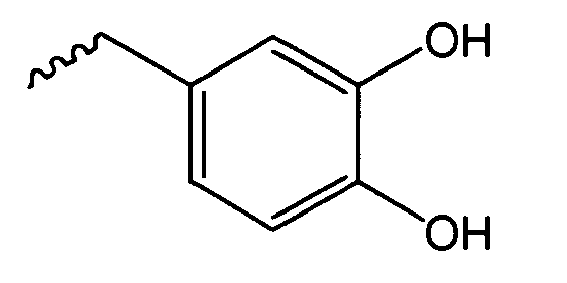
- X für eine Gruppe ―(CH2)p-R5 steht, worin p = 0-10 ist und R5 ausgewählt ist aus ―H, -NH2, -NO2, -OH, -SH, -O-NH2, -NH-NH2, -N=C=S-, -N=C=O-, -CH=CH2, -C≡CH, -COOH, -(C=O)H, -(C=O)R6, wobei die Hydroxy-, Thio-, Amino- oder C=O-Gruppen optional durch eine Schutzgruppe geschützt sein können, -N3, -OR6 , -COOR6, -NHR6, - NR6R7, -CO-NHR6, -CONR6R7, -NH-CO-R6, 4-(2,5-Dioxopyrrol-1-yl), wobei R6 und R7 unabhängig voneinander für eine lineare Alkylgruppe mit 1 bis 10 C-Atomen, eine lineare Alkenyl- oder Alkinylgruppe mit 2 bis 10 C-Atomen, eine verzweigte Alkyl-, Alkenyl- oder Alkinylgruppe mit 3 bis 10 C-Atomen oder eine cyclische Alkyl- oder Alkenylgruppe mit 3 bis 10 C-Atomen stehen, oder
X für eine verzweigte Alkyl-, Alkenyl- oder Alkinylgruppe mit 3 bis 10 C-Atomen oder eine cyclische Alkyl-, Alkenyl- oder Alkinylgruppe mit 3 bis 10 C-Atomen oder für eine Aryl- oder Heteroarylgruppe steht,
wobei für den Fall, dass X eine verzweigte Alkyl-, Alkenyl- und Alkinylgruppe, eine cyclische Alkyl- oder Alkenylgruppe, eine Aryl- oder Heteroarylgruppe ist, optional ein C-Atom dieser Gruppe X eine Gruppe R5 gemäß obiger Definition tragen kann. - Die erfindungsgemäßen Verbindungen, das Verfahren zu ihrer Herstellung sowie die Verwendung dieser Verbindungen sind nachfolgend erläutert.
- Die Erfindung ist nicht auf eine der nachfolgend beschriebenen Ausführungsformen beschränkt, sondern in vielfältiger Weise abwandelbar.
- Sämtliche aus den Ansprüchen, der Beschreibung und den Zeichnungen hervorgehenden Merkmale und Vorteile, einschließlich konstruktiver Einzelheiten, räumlicher Anordnungen und Verfahrensschritten, können sowohl für sich als auch in den verschiedensten Kombinationen erfindungswesentlich sein.
- Die erfindungsgemäßen Verbindungen gemäß Formel (I) erlauben eine beständige Funktionalisierung und eine hohe definierte Beladung von Oberflächen. Oberflächen, die funktionalisiert und beladen werden können, umfassen Metalle, Metalloxide, Apatit, Glas und Gemische davon. Der Begriff "Apatit" umfasst dabei sowohl Verbindungen der allgemeinen Formel Ca5(PO4)3(F,Cl,OH), bei denen die Konzentration von Fluorid-, Chlorid- und Hydroxylionen frei austauschbar ist, als auch die Einzelminerale Fluorapatit, Chlorapatit und Hydroxylapatit.
Unter "hoher definierter Beladung" wird verstanden, dass die Beladung der Oberfläche eine lückenlose Beschichtung des Materials in Form einer Monolage ermöglicht. Unter "Monolage" wird dabei eine Schicht von erfindungsgemäßen Molekülen auf der Oberfläche verstanden, bei der die Schichthöhe nur ein Molekül beträgt. Eine "Funktionalisierung" ist die Hinzufügung funktioneller Gruppen auf die Oberfläche eines Materials durch chemische Synthesemethoden. Eine Beschichtung von Oberflächen mit den erfindungsgemäßen Verbindungen stellt daher eine Funktionalisierung dieser Oberflächen dar. An die Gruppe X kann optional ein Effektormolekül gebunden werden, was eine weitere Funktionalisierung darstellt. Ein Effektor ist ein Molekül oder ein Molekülbestandteil, welcher einen physikalischen, chemischen, biochemischen oder biologischen Prozess auslöst oder eine solche Wirkung kontrolliert, aktiviert oder inaktiviert. Beispielse für Effektoren sind Farbstoffe, radioaktive Moleküle, Biomoleküle wie Aminosäuren, Zucker, Peptide, Proteine, DNA, RNA, Polymere wie Ethylenglycol und Derivate davon sowie Wirkstoffe. Als Wirkstoffe werden Substanzen bezeichnet, die in geringer Dosis in einem Organismus eine spezifische Wirkung, eine Reaktion, hervorrufen.
Aufgrund der multivalenten Bindung der Verbindungen gemäß Formel (I) ist diese Funktionalisierung beständig gegenüber molekularen Austauschprozessen auf der Oberfläche (wie z.B. der Hydrolyse der Verknüpfung in wässrigen Medien) und auch gegenüber mechanischer Beanspruchung. - Im Rahmen der vorliegenden Erfindung werden Alkylgruppen mit 1 bis 10 Kohlenstoffatomen ausgewählt aus Methyl, Ethyl, n-Propyl, Isopropyl, 1-Butyl, 2-Butyl, tert.-Butyl, 1-Pentyl, 2-Pentyl, 3-Pentyl, 3-Methylbutyl, 2,2-Dimethylpropyl sowie allen Isomeren von Hexyl, Heptyl, Octyl, Nonyl und Decyl. Alkenyl- und Alkinyl-gruppen umfassen mindestens zwei Kohlenstoffatome. Sie werden ausgewählt aus Ethenyl- und Ethinylgruppen sowie allen Isomeren von Propenyl-, Butenyl-, Pentenyl-, Hexenyl-, Heptenyl-, Octenyl-, Nonenyl-, Decenyl-, Ethinyl-, Propinyl-, Butinyl-, Pentinyl-, Hexinyl-, Heptinyl-, Octinyl-, Noninyl- und Decinylgruppen. Verzweigte Alkyl-, Alkenyl- und Alkinylgruppen enthalten mindestens drei Kohlenstoffatome und werden erfindungsgemäß aus den oben genannten Homologen mit dieser Mindestanzahl an Kohlenstoffatomen ausgewählt.
- Dem Fachmann ist bekannt, dass cyclische Alkyl- und Alkenylgruppen mindestens drei Kohlenstoffatome enthalten müssen. Im Rahmen der vorliegenden Erfindung werden unter "ringförmigen" Gruppen solche Gruppen verstanden, bei denen alle Kohlenstoffatome an der Ringbildung beteiligt sind. "Cyciische" Gruppen können darüber hinaus noch acyclische Kohlenstoffatome enthalten. Ringförmige Alkyl-und Alkenylgruppen im Rahmen der vorliegenden Erfindung sind Propyl-, Butyl-, Pentyl-, Hexyl-, Heptyl-, Octyl-, Nonyl-, Decyl-, Propenyl-, Butenyl-, Pentenyl-, Hexenyl-, Heptenyl-, Octenyl-, Nonenyl- und Decenyl-Ringe. Handelt es sich bei den Gruppen X, R6 und/oder R7 um cyclische Alkyl- oder Alkenylgruppen, so werden diese ausgewählt aus den genannten ringförmigen Alkyl- und Alkenylgruppen, die keine weiteren Substituenten tragen, und aus den genannten ringförmigen Alkyl-und Alkenylgruppen, welche ihrerseits an eine oder mehrere acyclische Alkyl-, Alkenyl- oder Alkinylgruppen gebunden sind. Im letztgenannten Fall kann die Bindung der cyclischen Alkyl- oder Alkenylgruppe an das C1-Atom des Adamantangerüstes (falls die cyclische Gruppe X darstellt) bzw. an das entsprechende Atom der Gruppe R5 (falls die cyclische Gruppe R6 oder R7 darstellt) über ein cyclisches oder ein acyclisches Kohlenstoffatom der cyclischen Alkyl- oder Alkylengruppe erfolgen. Cyclische Alkylgruppen enthalten gemäß obiger Definition des Begriffes "Alkylgruppe" ebenfalls insgesamt maximal 10 Kohlenstoffatome.
- Die Gruppe X ist erfindungsgemäß eine Gruppe -(CH2)p-R5. Handelt es sich bei R5 um -NH2, -OH, -SH, -O-NH2, -NH-NH-COOH, -(C=O)H, -(C=O)R6, so können diese Gruppen optional durch eine Schutzgruppe geschützt sein. Schutzgruppen für Hydroxy-, Thiol-, Amino-, Carbonyl- und Carboxylgruppen sind dem Fachmann bekannt. Er kann diese Schutzgruppen verwenden, d.h. sie einführen und bei Bedarf wieder abspalten, ohne den Schutzbereich der Patentansprüche zu verlassen.
Beispielsweise, aber nicht erschöpfend, seien folgende Schutzgruppen genannt: - für die OH-Gruppe: Methoxymethylether (MOM), β -Methoxyethoxymethylether (MEM), Silylether, 2-Tetrahydropyranyl (THP), Acetyl (Ac), Benzoyl (Bz), Benzyl (Bn, Bnl), Dimethoxytrityl (DMT), Methoxytrityl (MMT), p-Methoxybenzylether (PMB), Methylthiomethylether, Pivaloyl (Piv), Methylether, Ethoxyethylether (EE)
- für die SH-Gruppe: tert.-Butyl, 2-Tetrahydropyranyl, Acetyl, 2-Nitropyranyl, Phenacyl, (Cumarin-4-yl)methyl
- für die NH2-Gruppe: 1-(1-Adamantyl)-1-methoxycarbonyl (ADPOC), Allyl-oxycarbonyl (ALLOC), Benzyloxycarbonyl (Z oder Cbz abgekürzt), 9-Fluorenylmethoxycarbonyl (FMOC), p-Methoxybenzylcarbonyl (Moz, MeOZ), tert.-Butyloxycarbonyl (BOC), Acetyl (Ac), Benzoyl (Bz), Benzyl (Bn, Bnl), p-Methoxybenzyl (PMB), 3,4-Dimethoxybenzyl (DMPM), p-Methoxyphenyl (PMP), Tosyl (Ts), Sulfonamide
- für die Carbonylgruppe (in Aldehyden und Ketonen): die Umsetzung mit Diolen zu Acetalen bzw. Ketalen
- für die COOH-Gruppe: Methylester, Benzylester, tert.-Butylester, Silylester, Orthoester, Oxazoline
- Unter Arylgruppen werden erfindungsgemäß Phenyl-, Naphthyl- und Anthracenylgruppen verstanden.
Heteroarylgruppe werden ausgewählt aus Furanyl, Pyrrolyl, Thiophenyl, Imidazolyl, Pyrazolyl, Triazolyl, Thiazolyl, Oxazolyl, Isooxazolyl, einem Oxadiazolyl, Pyridinyl, Pyrazinyl, Pyrimidinyl, Pyridazinyl, einem Triazinyl, einem Tetrazinyl, 1,4-Dioxinyl, einem Thiazinyl, einem Oxazinyl, einem Azepinyl, einem Diazepinyl, Benzofuranyl, Isobenzofuranyl, Indolyl, Isoindolyl, Benzothiophenyl, Benzo[c]thiophenyl, Benzimidazolyl, Purinyl, Indazolyl, Benzoxazolyl, Benzisoxazolyl, Benzothiazolyl, Chinolinyl, Isochinolinyl, Chinoxalinyl, Acridinyl, Chinazolinyl und Cinnolinyl.
Steht Y für "-Aryl-" oder "-Heteroaryl-", so sind zwei Kohlenstoffatome dieser Aryl- bzw. Heteroarylgruppe mit den Alkylengruppen ―(CH2)n bzw. ―(CH2)m gemäß Formel (I) und Definition von Z verbunden. - In einer vorteilhaften Ausführungsform ist Y ausgewählt aus keinem Atom, -CH2-, -NH-(C=O)-, -(C=O)-NH-, -NR1-, wobei R1 wie oben definiert ist.
- In einer weiteren vorteilhaften Ausführungsform ist n eine ganze Zahl zwischen 0 und 3.
In einer weiteren vorteilhaften Ausführungsform ist m eine ganze Zahl zwischen 0 und 3.
Besonders vorteilhaft stehen n und m unabhängig voneinander für ganze Zahlen zwischen 0 und 3. - In einer weiteren vorteilhaften Ausführungsform ist Z eine Gruppe

- In einer besonders vorteilhaften Ausführungsform ist die Gruppierung YZ ausgewählt aus

- Diese besonders vorteilhaften Gruppierungen YZ leiten sich von folgenden Catecholderivaten ab:

- Im Rahmen der vorliegenden Erfindung werden die Verbindungen Dopamin, Noradrenalin, Adrenalin, Dihydroxydopamin, Dihydroxyphenylalanin, 1-(3,4-Dihydroxybenzyl)-1,2,3,4-tetrahydroisochinolin-6,7-diol und Dihydroxytetraisochinolin und 3,4-Dihydroxybenzoesäure als "Catecholderivate" bezeichnet.
- In einer weiteren vorteilhaften Ausführungsform stellt X eine Gruppe (-CH2)p-R5 dar, wobei p eine ganze Zahl zwischen 0 und 3 darstellt und R5 wie in Anspruch 1 definiert ist.
- In einer weiteren vorteilhaften Ausführungsform steht X für -(CH2)p-R5, worin R5 ausgewählt ist aus ―H, -OH, -NH2, -NO2, -NH-NH2, -NHR6, -NR6R7, -O-NH2, -NH-(C=O)-C≡CH, -C≡CH, -N=C=S, -N=C=O, -COOH, -(C=O)H, -(C=O)R6 und wobei p eine ganze Zahl zwischen 0 und 3 darstellt und R6 und R7 wie oben definiert sind.
- Die erfindungsgemäßen Verbindungen gemäß Formel (I) werden hergestellt, indem eine Verbindung X-Ad[(CH2)n-Y']3 mit einem Reagenz Y"Z zur korrespondierenden Verbindung X-Ad[(CH2)n-YZ]3 umgesetzt und das Reaktionsprodukt anschließend gereinigt wird, worin Ad für das Adamantylgerüst und Y' für einen Precursor (Vorläufer) der Gruppe Y gemäß Formel (I) stehen und wobei X, Z und n wie in Formel (I) definiert sind.
- Unter Precursor (Vorläufer) wird hierbei eine funktionelle Gruppe verstanden, die durch Reaktion mit einer weiteren als Precursor fungierenden funktionellen Gruppe oder einem weiteren als Precursor funktionierenden Reagenz in eine funktionelle Gruppe gemäß Formel (I) umgewandelt wird.
- Verbindungen der Formel X-Ad[(CH2)n-Y']3 sind bekannt. Der Fachmann kann sie entweder kommerziell erwerben oder mit Hilfe seines Fachwissen nach bekannten Synthesevorschriften selbst herstellen.
- In einer vorteilhaften Ausführungsform ist X ein Wasserstoffatom.
- In einer weiteren vorteilhaften Ausführungsform ist X eine Gruppe ― (CH2)p-R5, worin p eine ganze Zahl zwischen 0 und 3 darstellt und R5 ausgewählt ist aus -OH, -NH2, -NO2, -NH-NH2, -NHR6, -NR6R7 -O-NH2, -NH-(C=O)-C≡CH, -C≡CH, - N=C=S, -N=C=O, -COOH, -(C=O)H, -(C=O)R6, wobei R6 und R7 wie in Formel (I) definiert sind. Diese Gruppen können, wie bereits ausgeführt, optional durch eine Schutzgruppe (Pg) geschützt sein. Werden diese Gruppen geschützt, so geschieht dies vor der Umsetzung mit dem Reagenz Y"Z, so dass in diesem Fall Pg-X-Ad[(CH2)n-Y']3 mit einem Reagenz Y"Z zur korrespondierenden Verbindung Pg-X-Ad[(CH2)n-YZ]3 umgesetzt wird.
- Geeignete Schutzgruppen sind oben beschrieben. Dem Fachmann ist bekannt, wie man diese Schutzgruppen einführt und auch wieder entfernt. Er kann dieses Wissen anwenden, ohne den Schutzbereich der Patentansprüche zu verlassen.
- Die Reinigung des Reaktionsproduktes erfolgt beispielsweise durch Entfernen des Lösungsmittels, Aufnehmen des Rückstandes in einer Mischung aus einem polar aprotischen Lösungsmittel wie Ethylacetat und einer verdünnten Mineralsäure, z.B. verdünnter Salzsäure, Waschen mit einer gesättigten KHSO4-Lösung und Trockung.
- In einer vorteilhaften Ausführungsform ist Y"Z ein Catecholamin, ausgewählt aus Dopamin, Noradrenalin, Adrenalin, Dihydroxydopamin, Dihydroxyphenylalanin, 1-(3,4-Dihydroxybenzyl)-1,2,3,4-tetrahydroisochinolin-6,7-diol und Dihydroxytetraisochinolin. In diesem Fall wird X-Ad[(CH2)n-Y']3 oder Pg-X-Ad[(CH2)n-YZ]3 mit dem Catecholamin in Gegenwart eines Aktivierungsreagenzes und eines Kupplungsadditivs umgesetzt. Dabei ist Y' ein Carbonsäurerest oder ein Derivat derselben. Geeignete Aktivierungsreagenzien sind beispielsweise EDC, DCC, DCI, PyClop, HBTU, HATU, HOSu, TBTU, T3P, BopCl und 3-Cl-1-Pyridiniumiodid. Als Kupplungsadditive beispielsweise die dem Fachmann bekannten Substanzen HOBT, HOAt, HONB und NHS verwendbar. Dem Fachmann ist bekannt, dass diese Reaktionen zweckmäßig unter Zugabe einer Base wie beispielsweise DIPEA durchgeführt werden. Dem Fachmann sind weiterhin verschiedene Lösungsmittel zur Verwendung in den genannten Verfahren bekannt. Er kann diese Kombinationen von Aktivierungsreagenzien, Kupplungsadditiven, Basen und Lösungsmitteln mit seinem üblichen Wissen und der Standardliteratur selbst herstellen.
- Handelt es sich bei dem Catecholamin Y"Z um Adrenalin oder Noradrenalin, so wird deren aliphatische Hydroxygruppe optional vor der Kupplung mit einer Schutzgruppe geschützt. Ebenso kann die Carboxylgruppe des Dihydroxyphenylalanins vor der Kupplung geschützt werden, falls es Y"Z darstellt.
- Wurde eine Schutzgruppe Pg eingeführt und/oder geschütztes Adrenalin, Noradrenalin oder Dihydroxyphenylalanin verwendet, so werden diese Schutzgruppen zuletzt entfernt und das entschützte Produkt anschließend gereinigt.
- In einer weiteren vorteilhaften Ausführungsform ist Y"Z 3,4-Dihydroxybenzoesäure oder ein ähnliches Derivat wie beispielsweise 3,4-Dihydroxyzimtsäure oder Gallussäure. X-Ad[(CH2)n-Y']3 oder Pg-X-Ad[(CH2)n-Y']3 werden mit 3,4-Dihydroxybenzoesäure, 3,4-Dihydroxyzimtsäure oder Gallussäure in Gegenwart eines Aktivierungsreagenzes und eines Kupplungsadditivs umgesetzt. Y' ist hierbei vorteilhaft eine Alkohol- oder Aminfunktion. Geeignete Aktivierungsreagenzien sind beispielsweise EDC, DCC, DCI, PyClop, HBTU, HATU, HOSu, TBTU, T3P, BopCl und 3-Cl-1-Pyridiniumiodid. Als Kupplungsadditive sind beispielsweise die dem Fachmann bekannten Substanzen HOBT, HOAt und HONB verwendbar. Dem Fachmann ist bekannt, dass diese Reaktionen zweckmäßig unter Zugabe einer Base wie beispielsweise DIPEA durchgeführt werden. Dem Fachmann sind weiterhin verschiedene Lösungsmittel zur Verwendung in den genannten Verfahren bekannt. Er kann diese Kombinationen von Aktivierungsreagenzien, Kupplungsadditiven, Basen und Lösungsmitteln mit seinem üblichen Wissen und der Standardliteratur selbst herstellen.
- In einer weiteren vorteilhaften Ausführungsform ist Y"Z ein Catecholamin, ausgewählt aus Dopamin, Noradrenalin, Adrenalin, Dihydroxydopamin, Dihydroxyphenylalanin, 1-(3,4-Dihydroxybenzyl)-1,2,3,4-tetrahydroisochinolin-6,7-diol und Dihydroxytetraisochinolin. X-Ad[(CH2)n-Y']3 oder Pg-X-Ad[(CH2)n-Y']3 werden mit dem Catecholamin in Gegenwart eines Reduktionsmittels umgesetzt. Y' ist dabei ein Aldehyd oder ein Keton. Geeignete Reduktionsmittel sind beispielsweise NaBH4, NaBH3CN, NaBH(OAC)3 sowie H2 und Metallkatalysatoren. Dem Fachmann sind verschiedene Lösungsmittel zur Verwendung in den genannten Verfahren bekannt. Er kann diese Kombinationen von Reduktionsmitteln und Lösungsmitteln mit seinem üblichen Wissen und der Standardliteratur selbst herstellen.
- In einer weiteren vorteilhaften Ausführungsform ist Y"Z ein Catecholamin, ausgewählt aus Dopamin, Noradrenalin, Adrenalin, Dihydroxydopamin, Dihydroxyphenylalanin, 1-(3,4-Dihydroxybenzyl)-1,2,3,4-tetrahydroisochinolin-6,7-diol und Dihydroxytetraisochinolin. X-Ad[(CH2)n-Y']3 oder Pg-X-Ad[(CH2)n-Y']3 mit einer geeigneten Austrittsgruppe Y' werden mit dem Catecholamin umgesetzt. Geeignete Austrittsgruppen sind beispielsweise -OTs, OMs, -OTf sowie Halogenide. Dem Fachmann sind verschiedene Lösungsmittel zur Verwendung in den genannten Verfahren bekannt. Er kann diese Kombinationen von Austrittsgruppen und Lösungsmitteln mit seinem üblichen Wissen und der Standardliteratur selbst herstellen.
- In einer weiteren vorteilhaften Ausführungsform ist Y"Z ein Catecholamin, ausgewählt aus Dopamin, Noradrenalin, Adrenalin, Dihydroxydopamin, Dihydroxyphenylalanin, 1-(3,4-Dihydroxybenzyl)-1,2,3,4-tetrahydroisochinolin-6,7-diol und Dihydroxytetraisochinolin. X-Ad[(CH2)n-Y']3 oder Pg-X-Ad[(CH2)n-Y']3 werden mit dem Catecholamin umgesetzt. Y' ist dabei ein Isothiocyanat oder ein Isocyanat. Dem Fachmann sind verschiedene Lösungsmittel zur Verwendung in den genannten Verfahren bekannt. Er kann diese Kombinationen von Reduktionsmitteln und Lösungsmitteln mit seinem üblichen Wissen und der Standardliteratur selbst herstellen.
- In einer weiteren vorteilhaften Ausführungsform ist Y"Z 3,4-Dihydroxybenzaldehyd. X-Ad[(CH2)n-Y']3 oder Pg-X-Ad[(CH2)n-Y']3 werden mit 3,4-Dihydroxybenzaldehyd umgesetzt. Y' ist dabei ein O-Alkylhydroxylamin oder das korrespondierende Hydrohalogenid. Dem Fachmann sind verschiedene Lösungsmittel zur Verwendung in den genannten Verfahren bekannt. Er kann diese Kombinationen von Reduktionsmitteln und Lösungsmitteln mit seinem üblichen Wissen und der Standardliteratur selbst herstellen.
- In einer weiteren vorteilhaften Ausführungsform ist Y"Z 3,4-Dihydroxybenzoesäure oder ein ähnliches Derivat wie beispielsweise 3,4-Dihydroxyzimtsäure oder Gallussäure. X-Ad[(CH2)n-Y']3 oder Pg-X-Ad[(CH2)n-Y']3 werden mit 3,4-Dihydroxybenzoesäure oder einem ähnlichen Derivat wie beispielsweise 3,4-Dihydroxyzimtsäure oder Gallussäure in Gegenwart eines Aktivierungsreagenzes wie beispielsweise DCC oder EDC oder mit katalytischen Mengen einer Säure wie beispielsweise HCl, H2SO4 oder p-Toluolsulfonsäure umgesetzt. Y' ist hierbei vorteilhaft eine Alkoholfunktion. Dem Fachmann sind verschiedene Lösungsmittel zur Verwendung in den genannten Verfahren bekannt. Er kann diese Kombinationen von Aktivierungsreagenzien, Kupplungsadditiven, Basen und Lösungsmitteln mit seinem üblichen Wissen und der Standardliteratur selbst herstellen.
- Die erfindungsgemäßen Verbindungen gemäß Formel (I) können in einem Verfahren zur Funktionalisierung von Oberflächen verwendet werden. Die Funktionalisierung geschieht dabei mittels dip and rinse, indem die zu funktionalisierenden Oberflächen in eine Lösung der erfindungsgemäßen Verbindungen getaucht werden.
- Vorteilhaft werden die erfindungsgemäßen Verbindungen in einer wässrigen Pufferlösung gelöst, die eine Salzkonzentration aufweist, welche signifikant höher als physiologische Salzkonzentration (0,9 Gew.-% NaCl) ist. Ein geeigneter Puffer ist beispielsweise MOPS (3(N―Morpholin)-propansulfonsäure), geeignete Salze sind beispielsweise NaCl und K2SO4 und Gemische davon. Die Salzkonzentration beträgt vorteilhaft zwischen 10 und 20 Gew.-% und die Pufferkonzentration 0,05 bis 0,2 mmol.
- Optional kann die Gruppe X der erfindungsgemäßen Verbindungen an einen Effektor gekuppelt sein. Die Kupplung von X an den Effektor kann dabei sowohl in Lösung, d.h. vor der Oberflächenfunktionalisierung, als auch auf der Oberfläche, d.h. nach der Oberflächenfunktionalisierung, erfolgen. Effektoren sind beispielsweise Ethergruppierungen, Estergruppierungen, Heteroaromaten, Farbstoffe, Metallkomplexe, Polymere (beispielsweise Polyethylenglykole), pharmazeutische Wirkstoffe (beispielsweise Antibiotika, Bisphosphonate), Biomoleküle (z.B. eine Aminosäure), Peptide, Kohlenhydrate und Terpene. Ist der Effektor ein Polymer und handelt es sich dabei um ein Polyethylenglykol, so handelt es sich vorteilhaft um eine Gruppierung -(O-CH2-CH2)q-R5 oder -(CH2-CH2-O)q-R5, worin q eine Zahl zwischen 1 und 10 und R5 wie unter Formel 1 beschrieben definiert ist.
- In einer vorteilhaften Ausführungsform erfolgt die Kupplung von X dabei mittels Click-Chemie. Unter "Click-Reaktionen" versteht der Fachmann energetisch begünstigte Reaktionen, die spezifisch verlaufen und ein einziges Produkt ergeben. Es handelt sich damit um sehr einfach durchzuführende und effiziente Reaktionen. Click-Reaktionen finden Anwendung in Molekularbiologie, Wirkstoffentwicklung, Biotechnologie, makromolekularer Chemie und Materialwissenschaften.
- Das Konzept der Click-Reaktion wurde von K. Barry Sharpless begründet und beschreibt Reaktionen, die
- modular aufgebaut sind,
- ein breites Anwendungsspektrum aufweisen,
- mit hohen Ausbeuten durchführbar sind,
- stereospezifisch ablaufen,
- einfache Reaktionsbedingungen erlauben (möglichst unempfindlich gegen Wasser und Sauerstoff),
- in umweltfreundlichen und/oder leicht entfernbaren Lösungsmitteln wie Wasser oder lösungsmittelfrei ablaufen,
- eine einfache Aufreinigung (Extraktion, Phasentrennung, Destillation oder Kristallisation) oder gar keine Aufreinigung benötigen.
- "Click-Reaktionen sind in der Regel stark thermodynamisch begünstigt, häufig mehr als 84 kJ/mol, was in einem schnellen Umsatz mit hoher Selektivität für ein einzelnes Produkt resultiert. Dabei handelt es sich meist um Kohlenstoff-Heteroatom-Bindungsbildungen.
- Chemische Reaktionen, die diese Kriterien erfüllen, sind:
- die Carbonylchemie des "Non-Aldol-Typs" wie z.B. die Bildung von Harnstoff, Thioharnstoff, Oximen, Iminen, aromatischen Heterocyclen und Hydrazonen sowie die Bildung von Carbamiden und Amiden,
- Cycloadditionen an ungesättigten C-C-Bindungen, besonders 1,3-dipolare Cycloadditionen wie die Huisgen-Cycloaddition, außerdem Diels-Alder-Reaktionen,
- nucleophile Substitutionen, besonders die Ringöffnung von gespannten, elektrophilen Heterozyklen wie Aziridinen und Epoxiden,
- Additionsreaktionen an C-C-Mehrfachbindungen, meist oxidativ wie z.B. Epoxidierung, Aziridierung oder Dihydroxylierung, aber auch Michaeladditionen von Nu-H, wobei Nu ein Nucleophil ist.
- In einer weiteren vorteilhaften Ausführungsform erfolgt die Kupplung des Effektors an die Gruppe X über konventionelle Substitutions- oder Additionsreaktionen, die nicht die oben genannten Bedingungen einer Click-Reaktion gehören. Zu diesen konventionellen Reaktionen zählen beispielsweise die Etherbildung, die Veresterung einer Carbonsäure oder die Amidbildung.
- Besonders vorteilhaft handelt es sich bei den Oberflächen, die funktionalisiert werden sollen, um metallische Oberflächen umfassend Eisen und/oder Titan oder um Oberflächen umfassend Apatit. Dem Fachmann ist bekannt, dass Knochen von Wirbeltieren zu etwa 50 % aus Apatit bestehen, Dentin zu etwa 70 % und Zahnschmelz zu mehr als 95 %. Moderner Zahnersatz, beispielsweise Füllungen und Zahnimplantate, umfasst häufig Apatit und/oder Vorrichtungen, die Eisen und/oder Titan umfassen. Es ist ferner bekannt, dass die Oberflächen von Endoprothesen, z.B. für Hüft- und Kniegelenke, Eisen und/oder Titan umfassen. Die erfindungsgemäßen Verbindungen gemäß Formel (I) sowie die daraus erhältlichen, an einen Effektor gekuppelten Verbindungen eignen sich daher zur Oberflächenfunktionalisierung von Zahnersatz und Gelenksendoprothesen.
- Syntheseplan für die Ausführungsbeispiele 1 bis 3

- Syntheseplan 2 für die Ausführungsbeispiele 4 bis 7

-

- 0.3g (4.09 mmol) NaHCO3 wurden in 30 mL dest. Wasser gelöst und zu einer Lösung aus 0.5 g (1.2 mmol) 1,3,5-Adamantantricarbonsäure in 30 mL Dioxan gegeben. Um einen pH-Wert von etwa 9 zu erhalten, wurde gegebenenfalls 2M NaOH dazugegeben. 0.24 mL (1.74 mmol) CBZ-Cl wurde zu der Reaktionslösung bei 0°C langsam zugetropft und für 12 bis 16 h gerührt (Ninhydrintest). Die wässrige, basische Phase wurde 3 mal mit CH2Cl2 und 3 mal mit Ethylacetat gewaschen, danach mit 2 M HCl auf pH-Wert 1 angesäuert, erneut 6 mal mit Ethylacetat ausgeschüttelt und die organische Ethylacetat-Phase am Rotationsverdampfer eingeengt. Es konnten 0.524 g (1.05 mmol) eines farblosen Feststoffs 2 erhalten werden, was einer Ausbeute von 84 % entspricht.
- Smp.: 221 °C; 1H-NMR (400 MHz, DMSO): δ [ppm] = 12.0 (br s, 3H, 7-H), 7.28-7.38 (m, 5H, aryl.-H), 7.0 (s, 1 H, 8-H), 4.95 (s, 2H, 10-H), 2.13 (t, 6H, 3J = 7.9 Hz, 6-H), 1.46 (s, 6H, 2-H), 1.37 (t, 6H, 3J = 8.2 Hz, 5-H), 1.04 (d, 3H, 2J = 13.2 Hz, 4a-H), 1.00 (d, 3H, 2J = 13.2 Hz, 4b-H); 13 C-NMR (400 MHz, DMSO): δ [ppm] = 175.0 (C7), 154.2 (C9), 137.3 (C11), 128.4 (C13), 127.7 (C14), 127.7 (C12), 64.6 (C10), 52.0 (C1), 44.5 (C4), 44.5 (C2), 37.5 (C5), 34.3 (C3), 27.9 (C6)
-

- 50 mg (0.099 mmol) der geschützten Adamantancarbonsäure 6 wurden in 30 ml abs. DMF gelöst und anschließend bei 0 °C 0.22 mL (01.277 mmol) DIPEA zugegeben und für 10 Minuten gerührt. Danach wurden nacheinander 63 mg (0.327 mmol) EDC*HCl (-Ethyl-3-(3-dimethylaminopropyl)-Carbodiimid-Hydrochlorid) und 44 mg (0.327 mmol) HOBT (Hydroxybenzotriazol) zugegeben und zur Voraktivierung 20 min gerührt. Nach dieser Zeit wurden 62 mg (0.327 mmol) des Amins (Dopaminhydrochlorid) hinzugegeben und bei RT 3 Tage gerührt.
- Anschließend wurde das Lösungsmittel im Vakuum abgezogen, in 30 mL Ethylacetat und 5 mL 1 M HCl aufgenommen und mit derselben Menge einer wässrigen gesättigten KHSO4-Lösung 3 mal gewaschen. Nach Trocknen über Na2SO4 wurde das Lösungsmittel abdestilliert. Mittels Gefriertrocknung konnte ein beigefarbener Feststoff erhalten werden, der in je 100 mL Diethylether 6 mal bei 30 °C im Wasserbad gerührt und abpipettiert wurde. Dadurch konnte ein beigefarbener Feststoff von 43 mg (0.047 mmol) erhalten werden, was einer Ausbeute von 48 % entspricht.
- 1H-NMR (400 MHz, MeOH): ö [ppm] = 7.17 (m, 5H, 12-14-H), 6.54 (d, 3H, 2 J= 8 Hz, 20-H), 6.5 (m, 3H, 23-H), 6.38 (d, 3H, 2 J = 8.0 Hz, 19-H), 4.84 (s, 2H, 10-H), 3.18 (m, 6H, 17-H), 2.49 (t, 3 J = 7.2 Hz 6H, 16-H), 1.97 (t, 3 J = 7.6 Hz 6H, 6-H), 1.39 (s, 6H, 2-H), 1.28 (t, 3 J = 7.6 Hz 6H, 5-H), 0.97 (d, 2 J = 12.0 Hz, 3H, 4a-H), 0.88 (d, 2 J= 12.0 Hz, 3H, 4b-H);
- 13C-NMR (100 MHz, MeOH-d4): δ [ppm] = 176.8 (C7), 156.7 (C9), 146.2 (C21), 144.7 (C22), 138.4 (C11), 131.9 (C18), 128.7, 128.8, 129.4 (C12-C14), 121.0 (C19), 116.9 (C23), 116.3 (C20), 66.8 (C10), 53.7 (C1), 46.3 (C4), 45.8 (C2), 42.2 (C16), 40.0 (C5), 36.0 (C3), 35.8 (C17), 31.1 (C6); MS-ESI m/z (%): (MNa+) = 929.6, (MH+) 907.5.
-

- 43 mg (0.047 mmol) des zu entschützenden bzw. zu hydrierenden Reaktionsproduktes aus Beispiel 2 wurden unter N2-Atmosphäre in destilliertem Methanol gelöst und mit einer katalytischen Menge Pd/C (Spatelspitze) versetzt. Die Suspension wurde entgast und bis zur vollständigen Reaktion unter H2-Atmosphäre bei für 3 Tage bei Raumtemperatur gerührt. Anschließend wurde die Reaktionslösung über einen Faltenfilter filtriert, mehrmals mit destilliertem Methanol gespült und das Lösungsmittel im Vakuum entfernt. Es konnten 30 mg (0.039 mmol) eines hellgelben Öls erhalten werden, was einer Ausbeute von 82 % entspricht.
- 1H-NMR (400 MHz, MeOH): ö [ppm] = 6.64 (d, 3H, 2 J = 8.0 Hz, 15-H), 6.60 (m, 3H, 18-H), 6.48 (d, 3H, 2 J = 8.0 Hz, 14-H), 2.59 (t, 3 J = 7.0 Hz 6H, 12-H), 2.08 (t, 3 J = 7.8 Hz, 6H, 11-H), 1.97 (t, 3 J = 7.6 Hz 6H, 6-H), 1.42 (m, 12H, 2-H und 5-H), 1.08 (m, 6H, 4-H);
- 13C-NMR (100 MHz, MeOH-d4): δ [ppm] = 176.42 (C7), 146.21 (C16), 144.79 (C17), 138.48 (C11), 132.02 (C13), 121.12 (C14), 117.05 (C18), 116.42 (C15), 54.88 (C1), 45.33 (C4), 44.95 (C2), 42.24 (C11), 49.57 (C5), 36.39 (C3), 35.80 (C12), 31.05 (C6);
- MS-ESI m/z (%): (M+) = 772.4, (M-H+) = 771.5, (2*M+) = 1545.3.
-

- 500 mg (1.42 mmol) der Tricarbonsäure 4 wurden in 60 mL dest. DMF gelöst und mit 2.54 mL dest. Et3N versetzt. Nach 5 min wurden bei 0°C 900 mg (4.69 mmol) EDC*HCL und 9.38 mL (4.69 mmol) HOAT dazugeben und 30 min voraktivieren lassen. Danach wurden 890 mg (4.69 mmol) Dopamin*HCL dazugegeben und 3 Tage bei Raumtemperatur rühren lassen. Das Lösungsmittel wurde bis zur Trockenheit abgezogen, das Rohprodukt in Ethylacetat aufgenommen, 3-mal mit gesättigter KHSO4 Lösung gewaschen, erneut eingeengt und in Diethylether rühren lassen.
- Es konnten 687 mg Produkt (0.906 mmol) als leicht beiger Feststoff erhalten werden, was einer Ausbeute von 64% entspricht.
- 1H-NMR (400 MHz, MeOH): δ [ppm] = 6.65 (d, 3H, 2 J = 8.0 Hz, 13-H), 6.51 (m, 3H, 16-H), 6.28 (d, 3H, 2 J = 8.0 Hz, 12-H), 3.30 (m, 6 H, 10-H), 2.55 (t, 6 H, 3 J = 8.0, 9-H), 2.10 (t, 6H, 3 J = 8.0 Hz, 6-H), 1.88 (s, 1 H, 1-H), 1.35 (m, 12H, 2,5-H), 1.10 (m 6 H, 4-H), 13C-NMR (100 MHz, MeOH): δ [ppm] = 177.1 (C7), 146.2 (C14), 144.7 (C15), 131.9 (C9), 129.5 (C11), 121.0 (C16), 116.9 (C16), 116.3 (C13), 54.88 (C1), 47.3 (C4), 42.2 (C2), 41.9 (C19), 38.00 (C5), 35.8 (C3), 34.5 (C12), 31.1 (C6);
- MS-ESI m/z (%) = 757.3 [M]+(38), 758.3 [MH]+(45), 780.3 [MNa]+(32)
-

- 100 mg (0.28 mmol) der Tricarbonsäure 4 wurden in 30 mL dest. DMF gelöst und mit 0.51 mL dest. Et3N versetzt. Nach 5 min wurden bei 0°C 180 mg (0.93 mmol) EDC*HCL und 126 mg (0.93 mmol) HOBT dazugeben und 5 min voraktivieren lassen. Danach wurden 231 mg (937 mmol) 1,2,3,4-Tetrahydro-6,7-isochinolindiol*Hydrobromid dazugegeben und 5 Tage bei Raumtemperatur rühren lassen. Das Lösungsmittel wurde bis zur Trockenheit abgezogen, das Rohprodukt in Ethylacetat aufgenommen, 3-mal mit gesättigter KHSO4 Lösung gewaschen, über Na2SO4 getrocknet, erneut eingeengt und in Diethylether rühren lassen. Nach Filtrieren und Abziehen des Lösungsmittels verbleiben 133 mg der Zielverbindung 10 (60%).
- MS-ESI m/z (%) = 794.4 [MH+] (75%)
-

- 200 mg (0.48 mmol) des Triamins 11 wurde in 30 mL dest. DMF gelöst und mit 0.85 mL dest. Et3N versetzt. Nach 5 min wurden bei 0°C 303 mg (1.58 mmol) EDC*HCL und 214 mg (1.58 mmol) HOBT dazugeben und 15 min voraktivieren lassen. Danach wurden 251 mg (1.58 mmol) 3,4-Dihydroxybenzoesäure dazugegeben und 5 Tage bei Raumtemperatur rühren lassen. Das Lösungsmittel wurde bis zur Trockenheit abgezogen, das Rohprodukt in Ethylacetat aufgenommen, 3-mal mit gesättigter KHSO4 Lösung gewaschen, über Na2SO4 getrocknet, erneut eingeengt und in Diethylether rühren lassen. Nach Filtrieren und Abziehen des Lösungsmittels verbleiben 237 mg der Zielverbindung 10 (69%).
- MS-ESI m/z (%) = 716.4 [MH+](100%)
-

- 21 mg (0.03 mmol) der Verbindung 8 wurden in 15 mL dest. DMSO gelöst und mit 0.15 mL dest. Et3N und 10 mg (0.03 mmol) des Fluorosceinisothiocyanat versetzt und bei Raumtemperatur 3.5 Stunden rühren lassen. Das Lösungsmittel wurde bis zur Trockenheit abgezogen und das Rohprodukt ohne weitere Reinigung zur Oberflächenfunktionalisierung eingesetzt.
- Für die Oberflächenmodifizierung werden TiO2-Oberflächen auf Si-Wafern verwendet. Dazu wird eine Lösung aus TiCl4, Wasser und Ethanol hergestellt und die Si-Wafer hineingetaucht und mit einer Geschwindigkeit von 1 mm/sec herausgezogen. Im Ofen werden die Oberflächen zu Ihrer endgültigen Form "gebrannt". Hierzu werden die Si-Wafer 6 h auf 80 °C erhitzt, anschließend für 6 h auf 300 °C und dann mit einer Heizrate von 10 °C/min auf 550 °C..
- Die erfindungsgemäßen Verbindungen (je 5mg) werden in 5 mL MeOH und 15 mL HPLC reinen Wassers gelöst.
- Für die Dipcoating-Methode wird eine 100 mL Puffer-Stammlösung (0,1 mol/l Mops) aus 3.5 g NaCl, 10.45 g K2SO4 und 2.31 g Mops (= 3-Morpholinopropan-1-sulfonsäure) hergestellt. Hierbei wird ebenfalls HPLC-reines Wasser verwendet.
- 5 mL der Lösung jeder erfindungsgemäßen Verbindung und 10 mL Puffer-Stammlösung werden gemischt und die TiO2 Oberflächen darin für 13 h mittels Dip-Coating beschichtet.
- Nach dieser Reaktionszeit werden die Oberflächen mit dest. MeOH und dest. Wasser gereinigt, mittels Druckluft getrocknet und mittels Kontaktwinkelmessung und SIMS-Tof vermessen.
- Vermessen wurden folgende Substanzen:


- Vor jeder Messung wurden die zu vermessenden TiO2-Oberflächen mittels dest. MeOH und Druckluft von Staub und Wassertropfen gereinigt.
Zur Messung wurde ein Kontaktwinkelmessgerät (Krüss Dropshape Analyser, DAS 10-MK 2) verwendet, wobei in der Messkammer eine konstante Temperatur von 23 ° herrschte. Eine Nadel, welche einen Wassertropfen (HPLC grade water) von 4µl herstellte, wurde langsam auf die Oberfläche gefahren um den Tropfen auf der Oberfläche absetzten zu lassen.
Ab diesem Zeitpunkt nahm eine Kamera eine 1000 Bildersequenz auf, die am Ende manuell mit Hilfe eines speziellen Computerprogrammes (Krüss, DSA = Drop Shape Analyze), welches die Young-Laplace Methode (Sessel Drop Fitting) verwendet, ausgewertet.
Jede TiO2 Oberfläche wurde 3-4-mal vermessen und aus den Ergebnissen der Mittelwert bestimmt. - Als Kontrollen wurde jeweils das ein reines, gereinigtes TiO2-Blech ohne Beschichtung (zweite Spalte in Tabelle 1) sowie mit Mops-Puffer beschichtetes TiO2-Blech (Spalte 3 in Tabelle 1) vermessen. In Spalte 4 sind die Ergebnisse der Kontaktwinkelmessungen von TiO2-Blechen gezeigt, die zuvor mit in Mops-Puffer gelösten Substanzen 3 bis 7 ("Moleküle") beschichtet worden waren.
Tab. 1: Ergebnisse der Kontaktwinkelmessung TiO2 TiO2 + Mops TiO2 + Mops + Moleküle Substanz Nr. Kontaktwinkel (°) Kontaktwinkel (°) Kontaktwinkel (°) 3 28,0 5,0 38,5 4 29,1 5,0 11,7 5 24,7 8,2 22,9 7 30,9 7,6 10,7
Claims (15)
- Verbindungen gemäß Formel (I):
 - n für eine ganze Zahl zwischen 0 und 10 steht,- Y ausgewählt ist aus -CH2-, -CH=CH-, -C≡C-, -O-, -S-, -S-S-, -NH-, -O-NH-, -NH-O-, -HC=N-O-, -O-N=CH-, -NR1-, -Aryl-, -Heteroaryl-, -(C=O)-, -O-(C=O)-, -(C=O)-O-, -NH-(C=O)-, -(C=O)-NH-, -NR1-(C=O)-, -(C=O)-NR1-, -NH-(C=O)-NH-, -NH-(C=S)-NH-, wobei R1 für eine lineare Alkylgruppe mit 1 bis 10 C-Atomen oder eine verzweigte oder cyclische Alkylgruppe mit 3 bis 10 C-Atomen steht,- Z ausgewählt ist aus
m = eine ganze Zahl zwischen 0 und 10,
R2 = -H, -OH oder -COOH,
R3 = -H, -OH
A = kein Atom oder -(C=O)-
R4 = -H oder - X für eine Gruppe -(CH2)p-R5 steht, worin p = 0-10 ist und R5 ausgewählt ist aus -H, -NH2, -NO2, -OH, -SH, -O-NH2, -NH-NH2, -N=C=S, -NC=O, -CH=CH2, -C≡CH, -COOH, -(C=O)H, -(C=O)R6, wobei die Hydroxy-, Thio-, Amino- oder C=O-Gruppen optional durch eine Schutzgruppe geschützt sein können, -N3, -OR6, -COOR6, -NHR6, - NR6R7, -CO-NHR6, -CONR6R7, -NH-CO-R6, 4-(2,5-Dioxopyrrol-1-yl), wobei R6 und R7 unabhängig voneinander für eine lineare Alkylgruppe mit 1 bis 10 C-Atomen, eine lineare Alkenyl- oder Alkinylgruppe mit 2 bis 10 C-Atomen, eine verzweigte Alkyl-, Alkenyl- oder Alkinylgruppe mit 3 bis 10 C-Atomen oder eine cyclische Alkyl- oder Alkenylgruppe mit 3 bis 10 C-Atomen stehen, oder
X für eine verzweigte Alkyl-, Alkenyl- oder Alkinylgruppe mit 3 bis 10 C-Atomen oder eine cyclische Alkyl-, Alkenyl- oder Alkinylgruppe mit 3 bis 10 C-Atomen oder für eine Aryl- oder Heteroarylgruppe steht, wobei für den Fall, dass X ein verzweigte Alkyl-, Alkenyl- und Alkinylgruppe, eine cyclische Alkyl- oder Alkenylgruppe, eine Aryl- oder Heteroarylgruppe ist, optional ein C-Atom dieser Gruppe X eine Gruppe R5 gemäß obiger Definition tragen kann. - Verbindung gemäß Anspruch 1, dadurch gekennzeichnet, dass Y ausgewählt ist aus keinem Atom, -CH2-,-NH-(C=O)-, -(C=O)-NH-, -NR1-, wobei R1 wie in Anspruch 1 definiert ist.
- Verbindung gemäß einem der Ansprüche 1 und 2, dadurch gekennzeichnet, dass n eine ganze Zahl zwischen 0 und 3 ist.
- Verbindung gemäß einem der Ansprüche 1 bis 3, dadurch gekennzeichnet, dass m eine ganze Zahl zwischen 0 und 3 ist.
- Verbindung gemäß einem der Ansprüche 1 bis 4, dadurch gekennzeichnet, dass Z eine Gruppe

- Verbindung gemäß einem der Ansprüche 1 bis 3, dadurch gekennzeichnet, dass dieGruppierung YZ ausgewählt ist aus

- Verbindung gemäß einem der Ansprüche 1 bis 6, dadurch gekennzeichnet, dass X eine Gruppe (-CH2)p-R5 darstellt, wobei p eine ganze Zahl zwischen 0 und 3 darstellt und R5 wie in Anspruch 1 definiert ist.
- Verbindung gemäß einem der Ansprüche 1 bis 7, dadurch gekennzeichnet, dass X eine Gruppe -(CH2)p-R5 darstellt, worin R5 ausgewählt ist aus -H, -OH, -NH2, -NO2, -NH-NH2, -NHR6, -NR6R7, -O-NH2, -NH-(C=O)-C≡CH, -C≡CH, -N=C=S, -N=C=O, -COOH, -(C=O)H, -(C=O)R6 und wobei p eine ganze Zahl zwischen 0 und 3 darstellt und R6 und R7 wie in Anspruch 1 definiert sind.
- Verfahren zur Herstellung von Verbindungen gemäß einem der Ansprüche 1 bis 8, dadurch gekennzeichnet, dass eine Verbindung X-Ad[(CH2)n-Y']3 mit einem Reagenz Y"Z zur korrespondierenden Verbindung X-Ad[(CH2)n-YZ]3 umgesetzt und das Reaktionsprodukt anschließend gereinigt wird, wobei Ad für das Adamantylgerüst und Y' für einen Precursor (Vorläufer) der Gruppe Y gemäß Formel (I) stehen und worin X, Z und n wie in Anspruch 1 definiert sind.
- Verfahren gemäß Anspruch 9, dadurch gekennzeichnet, dass X ein Wasserstoffatom ist.
- Verfahren gemäß Anspruch 9, dadurch gekennzeichnet, dass X eine Gruppe -(CH2)p-R5 ist, worin p eine ganze Zahl zwischen 0 und 3 darstellt und R5 ausgewählt ist aus -OH, -NH2, -NO2, -NH-NH2, -NHR6, -NR6R7, -O-NH2, -NH-(C=O)-C≡CH, -C≡CH, -N=C=S, -N=C=O, -COOH, -(C=O)H, -(C=O)R6, wobei R6 und R7 wie in Formel (I) definiert sind.
- Verfahren gemäß Anspruch 11, dadurch gekennzeichnet, dass die Gruppe R5 vor der Umsetzung mit dem Reagenz Y"Z durch eine Schutzgruppe Pg geschützt wird, so dass die Verbindung Pg-X-Ad[(CH2)n-Y']3 mit einem Reagenz Y"Z zur korrespondierenden Verbindung Pg-X-Ad[(CH2)n-YZ]3 umgesetzt wird.
- Verwendung von Verbindungen gemäß einem der Ansprüche 1 bis 8 in einem Verfahren zur Funktionalisierung von Oberflächen, wobei die Funktionalisierung mittels dip and rinse erfolgt.
- Verwendung von Verbindungen gemäß Anspruch 13, dadurch gekennzeichnet, dass die funktionelle Gruppe X der Verbindungen gemäß Formel (I) zuerst mit einem Effektor gekoppelt wird und danach die Funktionalisierung der Oberfläche mittels dip and rinse erfolgt.
- Verwendung von Verbindungen gemäß Anspruch 13, dadurch gekennzeichnet, dass zuerst die Funktionalisierung der Oberflächen mittels dip and rinse erfolgt und danach die funktionelle Gruppe X der Verbindungen gemäß Formel (I) mit einem Effektor gekoppelt wird.
Priority Applications (4)
| Application Number | Priority Date | Filing Date | Title |
|---|---|---|---|
| EP10176286.2A EP2428502B1 (de) | 2010-09-10 | 2010-09-10 | Synthese von tripodalen Catecholderivaten mit einem Adamantylgrundgerüst zur Funktionalisierung von Oberflächen |
| US13/821,319 US8785641B2 (en) | 2010-09-10 | 2011-09-07 | Synthesis of tripodal catechol derivatives having an adamantyl basic framework for functionalizing surfaces |
| PCT/EP2011/065480 WO2012032084A1 (de) | 2010-09-10 | 2011-09-07 | Synthese von tripodalen catecholderivaten mit einem adamantylgrundgerüst zur funktionalisierung von oberflächen |
| JP2013527587A JP2013540728A (ja) | 2010-09-10 | 2011-09-07 | 表面機能化のためのアダマンチル基本構造を有する三脚型カテコール誘導体の合成 |
Applications Claiming Priority (1)
| Application Number | Priority Date | Filing Date | Title |
|---|---|---|---|
| EP10176286.2A EP2428502B1 (de) | 2010-09-10 | 2010-09-10 | Synthese von tripodalen Catecholderivaten mit einem Adamantylgrundgerüst zur Funktionalisierung von Oberflächen |
Publications (2)
| Publication Number | Publication Date |
|---|---|
| EP2428502A1 EP2428502A1 (de) | 2012-03-14 |
| EP2428502B1 true EP2428502B1 (de) | 2014-12-10 |
Family
ID=43535878
Family Applications (1)
| Application Number | Title | Priority Date | Filing Date |
|---|---|---|---|
| EP10176286.2A Not-in-force EP2428502B1 (de) | 2010-09-10 | 2010-09-10 | Synthese von tripodalen Catecholderivaten mit einem Adamantylgrundgerüst zur Funktionalisierung von Oberflächen |
Country Status (4)
| Country | Link |
|---|---|
| US (1) | US8785641B2 (de) |
| EP (1) | EP2428502B1 (de) |
| JP (1) | JP2013540728A (de) |
| WO (1) | WO2012032084A1 (de) |
Family Cites Families (6)
| Publication number | Priority date | Publication date | Assignee | Title |
|---|---|---|---|---|
| US20060063834A1 (en) | 2004-09-09 | 2006-03-23 | Frangioni John V | Substituted adamantanes, and methods of making the same |
| JP4878486B2 (ja) * | 2005-06-17 | 2012-02-15 | 本州化学工業株式会社 | 1,3−ビス(3−ホルミル−4−ヒドロキシフェニル)アダマンタン類及びそれから誘導される多核体ポリフェノール類 |
| WO2008091386A2 (en) * | 2006-08-04 | 2008-07-31 | Northwestern University | Biomimetic modular adhesive complex: material, methods and applications therefore |
| WO2009021948A1 (en) * | 2007-08-13 | 2009-02-19 | Ge Healthcare As | Chelators, paramagnetic chelates thereof and their use as contrast agents in magnetic resonance imaging (mri) |
| WO2009111611A2 (en) * | 2008-03-05 | 2009-09-11 | Proteotech Inc. | Compounds, compositions and methods for the treatment of islet amyloid polypeptide (iapp) accumulation in diabetes |
| EP2428517B1 (de) * | 2010-09-10 | 2013-11-06 | Justus-Liebig-Universität Gießen | Synthese von tripodalen Bisphosphonatderivaten mit einem Adamantylgrundgerüst zur Funktionalisierung von Oberflächen |
-
2010
- 2010-09-10 EP EP10176286.2A patent/EP2428502B1/de not_active Not-in-force
-
2011
- 2011-09-07 US US13/821,319 patent/US8785641B2/en not_active Expired - Fee Related
- 2011-09-07 JP JP2013527587A patent/JP2013540728A/ja active Pending
- 2011-09-07 WO PCT/EP2011/065480 patent/WO2012032084A1/de not_active Ceased
Also Published As
| Publication number | Publication date |
|---|---|
| US20130245269A1 (en) | 2013-09-19 |
| EP2428502A1 (de) | 2012-03-14 |
| WO2012032084A1 (de) | 2012-03-15 |
| JP2013540728A (ja) | 2013-11-07 |
| US8785641B2 (en) | 2014-07-22 |
Similar Documents
| Publication | Publication Date | Title |
|---|---|---|
| DE69905181T2 (de) | Antivirale purin-derivate | |
| DE69620882T2 (de) | Verfahren zur herstellung eines hiv-protease inhibitor | |
| DE69914921T2 (de) | Phenyl-xanthinderivate | |
| DE69717974T2 (de) | Verfahren zur herstellung von ganciclovirderivaten | |
| DE69737636T2 (de) | Verfahren zur herstellung von purinderivaten | |
| WO2005058863A1 (de) | Reaktive cyclische carbonate und harnstoffe zur modifizierung von biomolekülen, polymeren und oberflächen | |
| DE2759033C2 (de) | Verfahren zur Herstellung von 4-Hydroxypyrrolidin-2-on-1-ylalkylcarbonsäureamiden | |
| EP0885204A1 (de) | Neue arylglycinamidderivate, verfahren zu ihrer herstellung und diese verbindungen enthaltende pharmazeutische zusammensetzungen | |
| DE69818516T2 (de) | Phenylaminoalkylcarbonsäure-derivate und medizinische zusammensetzungen, die diese enthalten | |
| EP2428503B1 (de) | Synthese von tripodalen Catecholderivaten mit einem flexiblen Grundgerüst zur Funktionalisierung von Oberflächen | |
| DE69706828T2 (de) | Verfahren zur herstellung von purinderivaten | |
| DE69102762T2 (de) | Beta-phenylisoserinderivate, ihre herstellung und ihre anwendung. | |
| EP2428517B1 (de) | Synthese von tripodalen Bisphosphonatderivaten mit einem Adamantylgrundgerüst zur Funktionalisierung von Oberflächen | |
| EP2428502A1 (de) | Synthese von tripodalen Catecholderivaten mit einem Adamantylgrundgerüst zur Funktionalisierung von Oberflächen | |
| DE19847149A1 (de) | Pseudo-Ceramide | |
| EP2428518B1 (de) | Synthese von tripodalen Bisphosphonatderivaten mit einem flexiblen Grundgerüst zur Funktionalisierung von Oberflächen | |
| CH696542A5 (de) | Verfahren zur Herstellung von substituierten 2,6-Dioxopiperidin-3-yl-Verbindungen. | |
| DE69829654T2 (de) | Verfahren zur herstellung von rhizoferrin | |
| EP0271443B1 (de) | N,N'-Disubstituierte Harnstoffe und Verfahren zu ihrer Herstellung | |
| DE60127848T2 (de) | T-Butoxycarbonylaminoethylamin für die Synthese von PNA-Monomereinheiten, Aminosäurederivaten, Zwischenprodukten davon und Verfahren für deren Herstellung | |
| EP0391850B1 (de) | Ungesättigte Aminodicarbonsäurederivate | |
| EP0087656B1 (de) | Verfahren zur Herstellung von 1-(4-Chlorbenzoyl)-5-methoxy-2-methyl-3-indolacetoxyessigsäure | |
| DE102011088854B4 (de) | Verfahren zur Herstellung von Sphingosin-1-phosphat | |
| EP2563847B1 (de) | Mcr-dendrimere | |
| JPH02250899A (ja) | ムラミルトリペプチド誘導体の製造法 |
Legal Events
| Date | Code | Title | Description |
|---|---|---|---|
| AK | Designated contracting states |
Kind code of ref document: A1 Designated state(s): AL AT BE BG CH CY CZ DE DK EE ES FI FR GB GR HR HU IE IS IT LI LT LU LV MC MK MT NL NO PL PT RO SE SI SK SM TR |
|
| AX | Request for extension of the european patent |
Extension state: BA ME RS |
|
| PUAI | Public reference made under article 153(3) epc to a published international application that has entered the european phase |
Free format text: ORIGINAL CODE: 0009012 |
|
| 17P | Request for examination filed |
Effective date: 20120914 |
|
| REG | Reference to a national code |
Ref country code: DE Ref legal event code: R079 Ref document number: 502010008439 Country of ref document: DE Free format text: PREVIOUS MAIN CLASS: C07C0231020000 Ipc: C07C0271240000 |
|
| GRAP | Despatch of communication of intention to grant a patent |
Free format text: ORIGINAL CODE: EPIDOSNIGR1 |
|
| RIC1 | Information provided on ipc code assigned before grant |
Ipc: C07C 271/24 20060101AFI20140623BHEP Ipc: C07C 237/14 20060101ALI20140623BHEP Ipc: C07D 217/06 20060101ALI20140623BHEP Ipc: C07C 231/02 20060101ALI20140623BHEP Ipc: C07D 217/20 20060101ALI20140623BHEP Ipc: C07C 233/22 20060101ALI20140623BHEP Ipc: C07C 233/19 20060101ALI20140623BHEP Ipc: C07D 493/10 20060101ALI20140623BHEP |
|
| INTG | Intention to grant announced |
Effective date: 20140708 |
|
| GRAS | Grant fee paid |
Free format text: ORIGINAL CODE: EPIDOSNIGR3 |
|
| GRAA | (expected) grant |
Free format text: ORIGINAL CODE: 0009210 |
|
| AK | Designated contracting states |
Kind code of ref document: B1 Designated state(s): AL AT BE BG CH CY CZ DE DK EE ES FI FR GB GR HR HU IE IS IT LI LT LU LV MC MK MT NL NO PL PT RO SE SI SK SM TR |
|
| REG | Reference to a national code |
Ref country code: GB Ref legal event code: FG4D Free format text: NOT ENGLISH |
|
| REG | Reference to a national code |
Ref country code: CH Ref legal event code: EP |
|
| REG | Reference to a national code |
Ref country code: IE Ref legal event code: FG4D Free format text: LANGUAGE OF EP DOCUMENT: GERMAN |
|
| REG | Reference to a national code |
Ref country code: AT Ref legal event code: REF Ref document number: 700572 Country of ref document: AT Kind code of ref document: T Effective date: 20150115 |
|
| REG | Reference to a national code |
Ref country code: DE Ref legal event code: R096 Ref document number: 502010008439 Country of ref document: DE Effective date: 20150122 |
|
| REG | Reference to a national code |
Ref country code: NL Ref legal event code: VDEP Effective date: 20141210 |
|
| REG | Reference to a national code |
Ref country code: NL Ref legal event code: VDEP Effective date: 20141210 |
|
| PG25 | Lapsed in a contracting state [announced via postgrant information from national office to epo] |
Ref country code: LT Free format text: LAPSE BECAUSE OF FAILURE TO SUBMIT A TRANSLATION OF THE DESCRIPTION OR TO PAY THE FEE WITHIN THE PRESCRIBED TIME-LIMIT Effective date: 20141210 Ref country code: FI Free format text: LAPSE BECAUSE OF FAILURE TO SUBMIT A TRANSLATION OF THE DESCRIPTION OR TO PAY THE FEE WITHIN THE PRESCRIBED TIME-LIMIT Effective date: 20141210 Ref country code: ES Free format text: LAPSE BECAUSE OF FAILURE TO SUBMIT A TRANSLATION OF THE DESCRIPTION OR TO PAY THE FEE WITHIN THE PRESCRIBED TIME-LIMIT Effective date: 20141210 Ref country code: NO Free format text: LAPSE BECAUSE OF FAILURE TO SUBMIT A TRANSLATION OF THE DESCRIPTION OR TO PAY THE FEE WITHIN THE PRESCRIBED TIME-LIMIT Effective date: 20150310 |
|
| REG | Reference to a national code |
Ref country code: LT Ref legal event code: MG4D |
|
| PG25 | Lapsed in a contracting state [announced via postgrant information from national office to epo] |
Ref country code: HR Free format text: LAPSE BECAUSE OF FAILURE TO SUBMIT A TRANSLATION OF THE DESCRIPTION OR TO PAY THE FEE WITHIN THE PRESCRIBED TIME-LIMIT Effective date: 20141210 Ref country code: GR Free format text: LAPSE BECAUSE OF FAILURE TO SUBMIT A TRANSLATION OF THE DESCRIPTION OR TO PAY THE FEE WITHIN THE PRESCRIBED TIME-LIMIT Effective date: 20150311 Ref country code: LV Free format text: LAPSE BECAUSE OF FAILURE TO SUBMIT A TRANSLATION OF THE DESCRIPTION OR TO PAY THE FEE WITHIN THE PRESCRIBED TIME-LIMIT Effective date: 20141210 Ref country code: SE Free format text: LAPSE BECAUSE OF FAILURE TO SUBMIT A TRANSLATION OF THE DESCRIPTION OR TO PAY THE FEE WITHIN THE PRESCRIBED TIME-LIMIT Effective date: 20141210 |
|
| PG25 | Lapsed in a contracting state [announced via postgrant information from national office to epo] |
Ref country code: NL Free format text: LAPSE BECAUSE OF FAILURE TO SUBMIT A TRANSLATION OF THE DESCRIPTION OR TO PAY THE FEE WITHIN THE PRESCRIBED TIME-LIMIT Effective date: 20141210 |
|
| PG25 | Lapsed in a contracting state [announced via postgrant information from national office to epo] |
Ref country code: CZ Free format text: LAPSE BECAUSE OF FAILURE TO SUBMIT A TRANSLATION OF THE DESCRIPTION OR TO PAY THE FEE WITHIN THE PRESCRIBED TIME-LIMIT Effective date: 20141210 Ref country code: RO Free format text: LAPSE BECAUSE OF FAILURE TO SUBMIT A TRANSLATION OF THE DESCRIPTION OR TO PAY THE FEE WITHIN THE PRESCRIBED TIME-LIMIT Effective date: 20141210 Ref country code: SK Free format text: LAPSE BECAUSE OF FAILURE TO SUBMIT A TRANSLATION OF THE DESCRIPTION OR TO PAY THE FEE WITHIN THE PRESCRIBED TIME-LIMIT Effective date: 20141210 Ref country code: EE Free format text: LAPSE BECAUSE OF FAILURE TO SUBMIT A TRANSLATION OF THE DESCRIPTION OR TO PAY THE FEE WITHIN THE PRESCRIBED TIME-LIMIT Effective date: 20141210 Ref country code: PT Free format text: LAPSE BECAUSE OF FAILURE TO SUBMIT A TRANSLATION OF THE DESCRIPTION OR TO PAY THE FEE WITHIN THE PRESCRIBED TIME-LIMIT Effective date: 20150410 |
|
| PG25 | Lapsed in a contracting state [announced via postgrant information from national office to epo] |
Ref country code: IS Free format text: LAPSE BECAUSE OF FAILURE TO SUBMIT A TRANSLATION OF THE DESCRIPTION OR TO PAY THE FEE WITHIN THE PRESCRIBED TIME-LIMIT Effective date: 20150410 Ref country code: PL Free format text: LAPSE BECAUSE OF FAILURE TO SUBMIT A TRANSLATION OF THE DESCRIPTION OR TO PAY THE FEE WITHIN THE PRESCRIBED TIME-LIMIT Effective date: 20141210 |
|
| REG | Reference to a national code |
Ref country code: DE Ref legal event code: R097 Ref document number: 502010008439 Country of ref document: DE |
|
| PLBE | No opposition filed within time limit |
Free format text: ORIGINAL CODE: 0009261 |
|
| PG25 | Lapsed in a contracting state [announced via postgrant information from national office to epo] |
Ref country code: DK Free format text: LAPSE BECAUSE OF FAILURE TO SUBMIT A TRANSLATION OF THE DESCRIPTION OR TO PAY THE FEE WITHIN THE PRESCRIBED TIME-LIMIT Effective date: 20141210 |
|
| 26N | No opposition filed |
Effective date: 20150911 |
|
| PLAA | Information modified related to event that no opposition was filed |
Free format text: ORIGINAL CODE: 0009299DELT |
|
| PLBE | No opposition filed within time limit |
Free format text: ORIGINAL CODE: 0009261 |
|
| STAA | Information on the status of an ep patent application or granted ep patent |
Free format text: STATUS: NO OPPOSITION FILED WITHIN TIME LIMIT |
|
| PG25 | Lapsed in a contracting state [announced via postgrant information from national office to epo] |
Ref country code: IT Free format text: LAPSE BECAUSE OF FAILURE TO SUBMIT A TRANSLATION OF THE DESCRIPTION OR TO PAY THE FEE WITHIN THE PRESCRIBED TIME-LIMIT Effective date: 20141210 |
|
| R26N | No opposition filed (corrected) |
Effective date: 20150911 |
|
| PG25 | Lapsed in a contracting state [announced via postgrant information from national office to epo] |
Ref country code: SI Free format text: LAPSE BECAUSE OF FAILURE TO SUBMIT A TRANSLATION OF THE DESCRIPTION OR TO PAY THE FEE WITHIN THE PRESCRIBED TIME-LIMIT Effective date: 20141210 |
|
| PG25 | Lapsed in a contracting state [announced via postgrant information from national office to epo] |
Ref country code: MC Free format text: LAPSE BECAUSE OF FAILURE TO SUBMIT A TRANSLATION OF THE DESCRIPTION OR TO PAY THE FEE WITHIN THE PRESCRIBED TIME-LIMIT Effective date: 20141210 Ref country code: LU Free format text: LAPSE BECAUSE OF FAILURE TO SUBMIT A TRANSLATION OF THE DESCRIPTION OR TO PAY THE FEE WITHIN THE PRESCRIBED TIME-LIMIT Effective date: 20150910 |
|
| REG | Reference to a national code |
Ref country code: CH Ref legal event code: PL |
|
| REG | Reference to a national code |
Ref country code: IE Ref legal event code: MM4A |
|
| PG25 | Lapsed in a contracting state [announced via postgrant information from national office to epo] |
Ref country code: CH Free format text: LAPSE BECAUSE OF NON-PAYMENT OF DUE FEES Effective date: 20150930 Ref country code: IE Free format text: LAPSE BECAUSE OF NON-PAYMENT OF DUE FEES Effective date: 20150910 Ref country code: LI Free format text: LAPSE BECAUSE OF NON-PAYMENT OF DUE FEES Effective date: 20150930 |
|
| REG | Reference to a national code |
Ref country code: FR Ref legal event code: PLFP Year of fee payment: 7 |
|
| REG | Reference to a national code |
Ref country code: AT Ref legal event code: MM01 Ref document number: 700572 Country of ref document: AT Kind code of ref document: T Effective date: 20150910 |
|
| PG25 | Lapsed in a contracting state [announced via postgrant information from national office to epo] |
Ref country code: AT Free format text: LAPSE BECAUSE OF NON-PAYMENT OF DUE FEES Effective date: 20150910 |
|
| PG25 | Lapsed in a contracting state [announced via postgrant information from national office to epo] |
Ref country code: MT Free format text: LAPSE BECAUSE OF FAILURE TO SUBMIT A TRANSLATION OF THE DESCRIPTION OR TO PAY THE FEE WITHIN THE PRESCRIBED TIME-LIMIT Effective date: 20141210 |
|
| PG25 | Lapsed in a contracting state [announced via postgrant information from national office to epo] |
Ref country code: BG Free format text: LAPSE BECAUSE OF FAILURE TO SUBMIT A TRANSLATION OF THE DESCRIPTION OR TO PAY THE FEE WITHIN THE PRESCRIBED TIME-LIMIT Effective date: 20141210 Ref country code: SM Free format text: LAPSE BECAUSE OF FAILURE TO SUBMIT A TRANSLATION OF THE DESCRIPTION OR TO PAY THE FEE WITHIN THE PRESCRIBED TIME-LIMIT Effective date: 20141210 Ref country code: HU Free format text: LAPSE BECAUSE OF FAILURE TO SUBMIT A TRANSLATION OF THE DESCRIPTION OR TO PAY THE FEE WITHIN THE PRESCRIBED TIME-LIMIT; INVALID AB INITIO Effective date: 20100910 |
|
| PG25 | Lapsed in a contracting state [announced via postgrant information from national office to epo] |
Ref country code: CY Free format text: LAPSE BECAUSE OF FAILURE TO SUBMIT A TRANSLATION OF THE DESCRIPTION OR TO PAY THE FEE WITHIN THE PRESCRIBED TIME-LIMIT Effective date: 20141210 |
|
| PG25 | Lapsed in a contracting state [announced via postgrant information from national office to epo] |
Ref country code: BE Free format text: LAPSE BECAUSE OF NON-PAYMENT OF DUE FEES Effective date: 20150930 |
|
| PG25 | Lapsed in a contracting state [announced via postgrant information from national office to epo] |
Ref country code: TR Free format text: LAPSE BECAUSE OF FAILURE TO SUBMIT A TRANSLATION OF THE DESCRIPTION OR TO PAY THE FEE WITHIN THE PRESCRIBED TIME-LIMIT Effective date: 20141210 |
|
| REG | Reference to a national code |
Ref country code: FR Ref legal event code: PLFP Year of fee payment: 8 |
|
| PG25 | Lapsed in a contracting state [announced via postgrant information from national office to epo] |
Ref country code: MK Free format text: LAPSE BECAUSE OF FAILURE TO SUBMIT A TRANSLATION OF THE DESCRIPTION OR TO PAY THE FEE WITHIN THE PRESCRIBED TIME-LIMIT Effective date: 20141210 |
|
| REG | Reference to a national code |
Ref country code: FR Ref legal event code: PLFP Year of fee payment: 9 |
|
| PG25 | Lapsed in a contracting state [announced via postgrant information from national office to epo] |
Ref country code: AL Free format text: LAPSE BECAUSE OF FAILURE TO SUBMIT A TRANSLATION OF THE DESCRIPTION OR TO PAY THE FEE WITHIN THE PRESCRIBED TIME-LIMIT Effective date: 20141210 |
|
| PGFP | Annual fee paid to national office [announced via postgrant information from national office to epo] |
Ref country code: FR Payment date: 20190927 Year of fee payment: 10 |
|
| PGFP | Annual fee paid to national office [announced via postgrant information from national office to epo] |
Ref country code: GB Payment date: 20190920 Year of fee payment: 10 |
|
| PGFP | Annual fee paid to national office [announced via postgrant information from national office to epo] |
Ref country code: DE Payment date: 20190930 Year of fee payment: 10 |
|
| REG | Reference to a national code |
Ref country code: DE Ref legal event code: R119 Ref document number: 502010008439 Country of ref document: DE |
|
| GBPC | Gb: european patent ceased through non-payment of renewal fee |
Effective date: 20200910 |
|
| PG25 | Lapsed in a contracting state [announced via postgrant information from national office to epo] |
Ref country code: DE Free format text: LAPSE BECAUSE OF NON-PAYMENT OF DUE FEES Effective date: 20210401 Ref country code: FR Free format text: LAPSE BECAUSE OF NON-PAYMENT OF DUE FEES Effective date: 20200930 |
|
| PG25 | Lapsed in a contracting state [announced via postgrant information from national office to epo] |
Ref country code: GB Free format text: LAPSE BECAUSE OF NON-PAYMENT OF DUE FEES Effective date: 20200910 |