EP2428036B1 - Systeme und verfahren für die autonome videoproduktion aus multi-sensorischen daten - Google Patents
Systeme und verfahren für die autonome videoproduktion aus multi-sensorischen daten Download PDFInfo
- Publication number
- EP2428036B1 EP2428036B1 EP10737234.4A EP10737234A EP2428036B1 EP 2428036 B1 EP2428036 B1 EP 2428036B1 EP 10737234 A EP10737234 A EP 10737234A EP 2428036 B1 EP2428036 B1 EP 2428036B1
- Authority
- EP
- European Patent Office
- Prior art keywords
- camera
- view
- viewpoint
- objects
- interest
- Prior art date
- Legal status (The legal status is an assumption and is not a legal conclusion. Google has not performed a legal analysis and makes no representation as to the accuracy of the status listed.)
- Active
Links
Images






Classifications
-
- H—ELECTRICITY
- H04—ELECTRIC COMMUNICATION TECHNIQUE
- H04N—PICTORIAL COMMUNICATION, e.g. TELEVISION
- H04N5/00—Details of television systems
- H04N5/222—Studio circuitry; Studio devices; Studio equipment
- H04N5/262—Studio circuits, e.g. for mixing, switching-over, change of character of image, other special effects ; Cameras specially adapted for the electronic generation of special effects
-
- G—PHYSICS
- G11—INFORMATION STORAGE
- G11B—INFORMATION STORAGE BASED ON RELATIVE MOVEMENT BETWEEN RECORD CARRIER AND TRANSDUCER
- G11B27/00—Editing; Indexing; Addressing; Timing or synchronising; Monitoring; Measuring tape travel
- G11B27/02—Editing, e.g. varying the order of information signals recorded on, or reproduced from, record carriers
- G11B27/031—Electronic editing of digitised analogue information signals, e.g. audio or video signals
- G11B27/034—Electronic editing of digitised analogue information signals, e.g. audio or video signals on discs
-
- G—PHYSICS
- G11—INFORMATION STORAGE
- G11B—INFORMATION STORAGE BASED ON RELATIVE MOVEMENT BETWEEN RECORD CARRIER AND TRANSDUCER
- G11B27/00—Editing; Indexing; Addressing; Timing or synchronising; Monitoring; Measuring tape travel
- G11B27/10—Indexing; Addressing; Timing or synchronising; Measuring tape travel
- G11B27/102—Programmed access in sequence to addressed parts of tracks of operating record carriers
- G11B27/105—Programmed access in sequence to addressed parts of tracks of operating record carriers of operating discs
-
- H—ELECTRICITY
- H04—ELECTRIC COMMUNICATION TECHNIQUE
- H04N—PICTORIAL COMMUNICATION, e.g. TELEVISION
- H04N5/00—Details of television systems
- H04N5/222—Studio circuitry; Studio devices; Studio equipment
- H04N5/262—Studio circuits, e.g. for mixing, switching-over, change of character of image, other special effects ; Cameras specially adapted for the electronic generation of special effects
- H04N5/268—Signal distribution or switching
Definitions
- the first category selects one view (i.e. one video) among the ones covered by a pre-defined set of cameras, based on some activity detection mechanism.
- each camera is activated based on some external device, which triggers the video acquisition each time a particular event is detected (e.g. an object entering the field of view).
- audio sensors are used to identify the direction in which the video should be captures.
- the second category captures a rich visual signal, either based on omnidirectional cameras or on wide-angle multi-camera setting, so as to offer some flexibility in the way the scene is rendered at the receiver-end.
- the systems in [17] and [18] respectively consider multi-camera and omnidirectional viewing systems to capture and broadcast wide-angle video streams.
- an interface allows the viewer to monitor the wide-angle video stream(s) to select which portion of the video to unwrap in real time. Further, the operator can stop the playback and control pan-tilt-zoom effects in a particular frame.
- the interface is improved based on the automatic detection of the video areas in which an event participant is present. Hence, the viewer gets the opportunity to choose interactively which event participant (s)he would like to look at.
- [19-21] detect people of interest in a scene (typically a lecturer or a videoconference participant).
- a scene typically a lecturer or a videoconference participant.
- the improvement over [18] is twofold.
- methods are proposed to define automatically a set of candidate shots based on automatic analysis of the scene.
- mechanisms are defined to select automatically a shot among the candidate shots.
- the shot definition relies on detection and tracking of the lecturer, and probabilistic rules are used to pseudo-randomly switch from the audience to the lecturer camera during a lecture.
- a list of candidate shots is also defined based on the detection of some particular object of interest (typically a face), but more sophisticated editing effects are considered to create a dynamic (videoconference) rendering.
- one shot can pan from one person to another, or several faces can be pasted next to each other in a single shot.
- the edited output video is then constructed by selecting a best shot among the candidate shots for each scene (in [20] and [21], a scene corresponds to a particular period of time).
- the best shot is selected based on a pre-defined set of cinematic rules, e.g. to avoid too many of the same shot in a row.
- the third and last category of semi-automatic video production systems differentiates the cameras that are dedicated to scene analysis from the ones that are used to capture the video sequences.
- a grid of cameras is used for sport scene analysis purposes.
- the outputs of the analysis module are then exploited to compute statistics about the game, but also to control pan-tilt-zoom (PTZ) cameras that collect videos of players of interest (typically the one that holds the puck or the ball).
- PTZ pan-tilt-zoom
- [22] selects the PTZ parameters to capture a specific detected object and not to offer appropriate rendering of a team action, potentially composed of multiple objects-of-interest. In this it is similar to [19-21]. Also, when multiple videos are collected, [22] does not provide any solution to select one of them. It just forwards all the videos to an interface that presents them in an integrated manner to a human operator. This is the source of a bottleneck when many source cameras are considered.
- US2004/0105004A1 relates rendering talks or meetings. Tracking cameras are exploited to render the presenter or a member of the audience who asks a question. The presenter and the audience members are tracked based on sound source localization, using an array of microphones. Given the position of the tracking camera target, the PTZ parameters of the motorized camera are controlled so as to provide a smooth edited video of the target. The described method and system is only suited to follow a single individual person. With respect to the selection of the camera, switching is disclosed between a set of very distinct views (one overview of the room, one view of the slides, one close view on the presenter, and one close view a speaking audience member). The camera selection process is controlled based on event detection (e.g. a new slide appearing, or a member of the audience speaking) and videography rules defined by professionals, to emulate a human video production team.
- event detection e.g. a new slide appearing, or a member of the audience speaking
- videography rules defined by professionals
- US 5 745 126 discloses automated dynamic selection of one video camera/image from multiple real (or virtual) video cameras/images in accordance with a particular perspective, an object in the scene or an event in the video scene.
- the present invention provides an autonomous computer based method and system for personalized production of videos such as team sport videos such as basketball videos from multi-sensored data under limited display resolution.
- videos such as team sport videos such as basketball videos from multi-sensored data under limited display resolution.
- Embodiments of the present invention relate to the selection of a view to display from among the multiple video streams captured by the camera network.
- Technical solutions are provided to provide perceptual comfort as well as an efficient integration of contextual information, which is implemented, for example, by smoothing generated viewpoint/camera sequences to alleviate flickering visual artefacts and discontinuous story-telling artefacts.
- a design and implementation of the viewpoint selection process is disclosed that has been verified by experiments, which shows that the method and system of the present invention efficiently distribute the processing load across cameras, and effectively selects viewpoints that cover the team action at hand while avoiding major perceptual artefacts.
- the present invention provides a computer based method comprising the steps of claim 1.
- the selecting of rendering parameters can be for all objects or objects-of-interest simultaneously.
- the knowledge about the position of the objects in the images can be exploited to decide how to render the captured action.
- the method can include selecting field of view parameters for the camera that renders action as a function of time based on an optimal balance between closeness and completeness metrics.
- the field of view parameters refer to the crop in camera view of static cameras and/or to the pan-tilt-zoom or displacement parameters for dynamic and potentially moving cameras.
- the closeness and completeness metrics can be adapted according to user preferences and/or resources.
- a user resource can be encoding resolution.
- a user preference can be at least one of preferred object, or preferred camera.
- Images from all views of all cameras can be mapped to the same absolute temporal coordinates based a common unique temporal reference for all camera views.
- field of view parameters are selected that optimize the trade-off between completeness and closeness.
- the viewpoint selected in each camera view can be rated according to the quality of its completeness/closeness trade-off, and to its degree of occlusions.
- the parameters of an optimal virtual camera that pans, zooms and switches across views can be computed to preserve high ratings of selected viewpoints while minimizing the amount of virtual camera movements.
- the method can include selecting the optimal field of view in each camera, at a given time instant.
- ⁇ (.%) decreases with Sk and the function ⁇ (.%) is equal to one when S k ⁇ u res , and decrease afterwards.
- the method includes rating the viewpoint associated to each camera according to the quality of its completeness/closeness trade-off, and to its degree of occlusions.
- the highest rate should correspond to a view that (1) makes most object of interest visible, and (2) is close to the action, meaning that it presents important objects with lots of details, i.e. a high resolution.
- the capturing of the mulitiple video streams may be by static or dynamic cameras.
- the present invention also includes a computer based system comprising the features of claim 11.
- the computer based system can have
- the present invention also provides a computer program product that comprises code segments which when executed on a processing engine execute any of the methods of the invention or implement any system according to the invention.
- the present invention also includes a non-transitory machine readable signal storage medium storing the computer program product.
- the present invention can deal with scenes involving several interacting moving persons/objects of interest.
- those scenes are denoted as team actions, and typically correspond to the scenes encountered in team sports context.
- An aim of the present invention is to target the production of semantically meaningful, i.e. showing the action of interest, and perceptually comfortable contents from raw multi-sensored data.
- the system according to the present invention is computer based including memory and a processing engine and is a computationally efficient production system, e.g. based on a divide-and-conquer paradigm (see Fig. 15 ).
- the best field of view is first computed for each individual camera, and then the best camera to render the scene is selected. Together the camera index and its field of view define the viewpoint to render the action.
- field of view definition is limited to a crop of the image captured by the camera.
- the field of view directly results from the pan-tilt-zoom parameters of the camera, and can thus capture an arbitrary rectangular portion of the light field reaching the centre of the camera.
- Completeness stands for the integrity of action rendering.
- closeness defines the fineness of detail description (typically the average amount of pixels that are available to render the persons/objects of interest), and smoothness is a term referring to the continuity of viewpoint selection.
- the present invention is completely autonomous and self-governing, in the sense that it can select the pixels to display without any human intervention, based on a default set of production parameters and on the outcomes of people detection systems. But the invention can also deal with user-preferences, such as user's narrative profile, and device capabilities. Narrative preferences can be summarized into four descriptors, i.e., user preferred group of objects or "team”, user preferred object or “player”, user preferred 'view type' (e.g. close zoom-in or far zoom-out views), and user preferred "camera”. All device constraints, such as display resolution, network speed, decoder's performance, are abstracted as the output resolution parameter, which denotes the resolution at which the output video is encoded to be conveyed and displayed at the end-host.
- a set of cameras that (partly) cover the same area are considered, which are likely to be activated simultaneously based on any activity detection mechanism which is another important advantage of the present invention over the prior art.
- the purpose of the invention is thus not to select a camera view based on the fact that some activity was detected in the view. Rather, the objective is to select along the time the camera view and its corresponding variations in parameters such as cropping or PTZ parameters, to best render the action occurring in the covered area.
- quality of rendering refers to the optimization of a trade-off between measures of closeness, completeness, and smoothness.
- the present invention has an advantage of dynamically adapting and smoothing out viewpoint parameters with time, which is an improvement over prior art systems in which the shot parameters (e.g. the cropping parameters in the view at hand) stay fixed until the camera is switched.
- the shot parameters e.g. the cropping parameters in the view at hand
- a choice between one object or another is not made, but rather a selection is made of the viewpoint based on the joint processing of the positions of the multiple objects that have been detected.
- a selection is made of the viewpoints sequence that is optimal in the way it maximizes and smoothes out closeness and completeness metrics e.g. for all objects simultaneously.
- the methods and systems of the present invention capture and produce content automatically, without the need for costly handmade processes (no technical team or cameraman is needed).
- the present invention aims at keeping the production of content profitable even for small- or medium-size targeted audiences. Thereby, it promotes the emergence of novel markets, offering a large choice of contents that are of interest for a relatively small number of users (e.g. the summary of a regional sport event, a university lecture, or a day at the nursery).
- An aim of the present invention is to produce a video report of an event based on the concatenation of video (and optionally corresponding audio) segments captured by a set of cameras.
- both static and dynamic cameras can be manipulated by the present invention:
- the main assumption underlying the networked acquisition setting is the existence of a common unique temporal reference for all camera views, so that the images from all cameras can be mapped to the same absolute temporal co-ordinates of the scene at hand.
- the cameras are thus assumed to be loosely, but not necessarily tightly, synchronized.
- the loose synchronization refers to a set of cameras that capture images independently, and that relies on timestamps to associate the images that have been captured at similar, but not necessarily identical, time instants.
- a tight synchronization would refer to synchronized capture of the images by the cameras, as done when acquisition is controlled by a common trigger signal.
- the invention has to know the position of objects-of interest in the scene.
- This knowledge might be an (error-prone) estimate, and can refer either to the position of objects in the 3D scene, or to the position of objects in each one of the camera views.
- This information can be provided based on transmitters that are carried by the objects to be tracked in the scene of interest.
- This knowledge can also be provided by a non-intrusive alternative, e.g. by exploitation of a set of video signals captured by a network of static cameras, e.g. the ones used for video report production, to detect and track the objects-of-interest.
- the method is described in " Detection and Recognition of Sports(wo)men from Multiple Views, D. Delannay, N. Danhier, and C. De Vleeschouwer, Third ACM/IEEE International Conference on Distributed Smart Cameras, Como, Italy, September 2009 " which is incorporated herein by reference in its entirety. It builds on a background reference model to identify the pixels that change in each view.
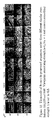
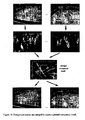
- the change detection masks that are collected in each view can be merged, e.g. in a ground occupancy mask, to identify the position of objects-of-interest in the 3D space (see for example the approach depicted in Figure 16 ).
- Particle filters or graph-based techniques can then be used to link occurrences of the same object along the time line. Note that such detection and tracking techniques are well known to those skilled in the art, and will not be described in detail herein.
- the embodiment of these algorithms that has been implemented is described in the reference above, and offers the advantage of handling occlusions in a computationally efficient way.
- the approach is generic in the sense that it can integrate a large range of user preferences including transmission or display resources, semantic interest (like preferred player), or narrative preferences (dealing with the preferred way to visualize the story, e.g. preferred camera or zoom-in factor).
- the present invention aims at selecting the sequence of viewpoints that optimizes scene rendering along the time, with respect to the detected persons/objects-of-interest.
- a viewpoint refers to a camera index and to the window that is cropped in that particular camera view, for actual display.
- smoothness of transitions between the rendering parameters of consecutive frames of the edited video has also to be taken into account when considering the production of a temporal segment.
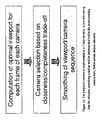
- the first step consists in selecting the optimal field of view for each camera, at a given time instant. To simplify notations, in the following, we omit the time index t .
- a field of view v k in the k th static camera is defined by the size S k and the center c k of the window that is cropped in the k th view for actual display.
- the second step rates the viewpoint associated to each camera according to the quality of its completeness/closeness trade-off, and to its degree of occlusions.
- the highest rate should correspond to a view that (1) makes most object of interest visible, and (2) is close to the action, meaning that it presents important objects with lots of details, i.e. a high resolution.
- the embodiment of the invention that is described in the appendix 1 defines the function to maximize based on the product of a closeness factor with a completeness factor, each factor measuring a weighted sum of individual object display resolution and visibility. Hence, it replaces the sum of product by a product of sums, but still follows the same basic idea of taking user preferences into account while trading off two antagonist terms, reflecting the concept of closeness and completeness, respectively.
- the virtual director module also rates the viewpoint selected in each camera view according to the quality (in terms of user preferences) of its completeness/closeness trade-off, and to its degree of occlusions. Finally the virtual director module computes the parameters of an optimal virtual camera that pans, zooms and switches across views for the temporal segment at hand, to preserve high ratings of selected viewpoints while minimizing the amount of virtual camera movements.
- the viewpoints selected by the virtual director match end-user expectations. Even more, subjective tests reveal that viewers generally prefer the viewpoints selected based on the automatic system than the ones selected by a human producer. This is partly explained by the severe load imposed to the human operator when the number of camera increases. Hence, the present invention also alleviates the bottleneck experienced by a human operator, when jointly and simultaneously processing a large number of source cameras.
- the present invention provides computer based methods and systems for cost-effective and autonomous generation of video contents from multi-sensored data including automatic extraction of intelligent contents from a network of sensors distributed around the scene at hand.
- intelligent contents refers to the identification of salient segments within the audiovisual content, using distributed scene analysis algorithms. This knowledge can be exploited to automate the production and personalize the summarization of video contents.
- One input is the positions of objects of interest.
- multi-camera analysis is considered, whereby relevant object detection such as people detection methods relying on the fusion of the foreground likelihood information computed in each view can be used.
- Multi-view analysis can overcome traditional hurdles such as occlusions, shadows and changing illumination. This is in contrast with single sensor signal analysis, which is often subject to interpretation ambiguities, due to the lack of accurate model of the scene, and to coincidental adverse scene configurations.
- the positions of the objects of interest are assumed to be (at least partially) known as a function of the time.
- embodiments of the present invention infer this knowledge from the analysis of the light fields captured by a distributed set of static cameras.
- a ground occupancy mask can be computed by merging the foreground likelihood measured in each view. Actual player positions can then be derived through an iterative and occlusion-aware greedy process.
- Multi view analysis can be used to provide the required inputs to the autonomous team sport production method and system of the present invention and is described in the article " Detection and Recognition of Sports(wo)men from Multiple Views", D. Delannay, N. Danhier, and C. De Vleeschouwer, Third ACM/IEEE International Conference on Distributed Smart Cameras, Como, Italy, September 2009 is incorporated herein by reference in its entirety as appendix 2.
- Embodiments of the present invention then proceed in two stages.
- the invention selects a set of so-called relevant parameters to render the scene of interest as a function of time, using a camera located at a point which can be any arbitrary 3D point around the action.
- the rendering parameters define a field of view for the camera, and depend on the camera infrastructure that has been deployed to capture the images of the scene. For example, embodiments of the present invention make use of a fixed camera, and the rendering parameters define how to crop sub-images within the camera view. In other embodiments an articulated and motorized camera can be used, and the rendering parameters may then refer to the pan, tilt, and zoom parameters of the camera.
- the notion of relevant parameters has to do with the definition of informative, i.e. displaying the persons and objects of interest, and perceptually pleasant images.
- embodiments of the present invention assume that multiple (PTZ) cameras are distributed around the scene, and how to select the right camera to render the action at a given time is then determined. This is done by selecting or promoting informative cameras, and avoiding perceptually inopportune switching between cameras.
- the present invention introduces three fundamental concepts, i.e. "completeness”, “smoothness” and closeness (or “fineness”), to abstract the semantic and narrative requirement of video contents. Based on those concepts, the selection of camera viewpoints and that of temporal segments in the summary can be determined, these two being independent optimization problems.
- these three concepts are optimised, e.g. maximized to produce a meaningful and visually pleasant content.
- maximization of the three concepts can resuls in conflicting decisions, under some limited resource constraints, typically expressed in terms of the spatial resolution and temporal duration of the produced content. For example, at fixed output video resolution, increasing completeness generally induces larger viewpoints, which in turns decreases fineness of salient objects. Similarly, increased smoothness of viewpoint movement prevents accurate pursuit of actions of interest along the time. The same observations hold regarding the selection of segments and the organization of stories along the time, under some global duration constraints.
- embodiments of the present invention relating to computer based methods and systems provide a good balance between the three major factors. For example, quantitative metrics are defined to reflect completeness, fineness/closeness. Constrained optimization can then be used to balance those concepts.
- an event timeframe can be first cut into semantically meaningful temporal segments, such as an offense/defense round of team sports, or an entry in news.
- semantically meaningful temporal segments such as an offense/defense round of team sports, or an entry in news.
- several narrative options are considered.
- Each option defines a local story, which consists of multiple shots with different camera coverage.
- a local story not only includes shots to render the global action at hand, but also shots for explanative and decorative purposes, e.g., replays and close-up views in sports or graph data in news.
- the camerawork associated to each shot is planned automatically, taking into account the knowledge inferred about the scene by video analysis modules.
- Camerawork Planning will be described with reference to an example, e.g. Team Sport Videos basketball video production. Whilst extendable to other contexts (e.g. PTZ camera control), the process has been designed to select which fraction of which camera view should be cropped in a distributed set of still cameras to render the scene at hand in a semantically meaningful and visually pleasant way by assuming the knowledge of players' positions.
- PTZ camera control e.g. PTZ camera control
- Step 2 Frame-wise Camera Selection
- the viewpoint selected in each view is rated according to the quality of its completeness/closeness trade-off, and to its degree of occlusions.
- the highest rate should correspond to a view that (1) makes most object of interest visible, and (2) is close to the action, meaning that it presents important objects with lots of details, i.e. a high resolution.
- Step 3 Smoothing of Camera/Viewpoint Sequences.
- Multi-view Player Detection and Recognition are obtained in an autonomous production of visual content by relying on the detection (and recognition) of object-of-interest in the scene.
- the foreground likelihood is computed independently on each view, using standard background modelling techniques. These likelihoods are then fused by projecting them on the ground plane, thereby defining a set of so-called ground occupancy masks. The computation of the ground occupancy mask associated to each view is efficient, and these masks are combined and processed to infer the actual position of players.
- the computation of the ground occupancy mask G k associated to the k th view is described as follows.
- the k th view is the source of a foreground likelihood image F k ⁇ [0,1] Mk , where M k is the number of pixels of camera k , 0 ⁇ k ⁇ C.
- M k is the number of pixels of camera k , 0 ⁇ k ⁇ C.
- the value of G k in x is defined to be the integration of the (forward-)projection of F k on a vertical segment anchored in x .
- this integration can equivalently be computed in F k , along the back-projection of the vertical segment anchored in x.
- these two properties can be achieved by virtually moving (through homography transforms) the camera viewing direction (principal axis) so as to bring the vertical vanishing point at infinity and ensure horizon line is horizontal.
- the principal axis is set perpendicular to the ground and a polar mapping is performed to achieve the same properties. Note that in some geometrical configurations, these transformations can induce severe skewing of the views.
- each iteration is then run in two steps.
- the first step searches for the most likely position of the n th player, knowing the position of the ( n-1 ) players located in previous iterations.
- the second step updates the ground occupancy masks of all views to remove the contribution of the newly located player.
- the first trade-off arises from the personalization of the production. Specifically, it originates from the conflict between preserving general production rules of sports videos and maximizing satisfaction of user preferences. Some basic rules of video production for basketball games could not be sacrificed for better satisfaction of user preferences, e.g., the scene must always include the ball, and well balanced weighting should be taken between the dominant player and the user-preferred player when rendering an event.
- the second trade-off is the balance between completeness and closeness of the rendered scene.
- the intrinsic interest of basketball games partially comes from the complexity of team working, whose clear description requires spatial completeness in camera coverage.
- many highlighted activities usually happen in a specific and bounded playing area.
- a close view emphasizing those areas increases the emotional involvement of the audience with the play, by moving the audience closer to the scene. Closeness is also required to generate a view of the game with sufficient spatial resolution under a situation with limited resources, such as small display size or limited bandwidth resources of handheld devices.
- Intrinsic hierarchical structure of basketball games provides reasonable grounds for the above vision, and also gives clues on segment separation.
- a game is divided by rules into a sequence of noun-overlapped ball-possession periods.
- a ball-possession period is the period of game when the same team holds the ball and makes several trials of scoring.
- several events might occur during the offence/defence process.
- events in a basketball game could be classified as clock-events and non-clock-events. Clock-events will not overlap with each other, while non-clock-events might overlap with both clock-/non-clock- events.
- one ball possession period is a rather fluent period and requires the period-level continuity of viewpoint movement.
- Input data fed into our system include video data, associated meta-data, and user preferences.
- video data associated meta-data
- user preferences user preferences.
- N frames the number of frames, i.e., N frames, for each camera.
- M i different salient objects denoted by ⁇ o im
- m 1, ⁇ , M i ⁇ , are detected in total from all camera views.
- the first class includes regions for players, referees, and the ball, which are used for scene understanding.
- the second class includes the basket, coach bench, and some landmarks of the court, which are used in both scene understanding and camera calibration. Objects of the first class are automatically extracted from the scene typically based on background subtraction algorithm, while those from the second class are manually labeled because their positions are constant on fixed cameras.
- o im [ o kim
- k 1 ⁇ K ]
- o kim is the m -th salient object in the k -th camera.
- a region r is a set of pixel coordinates that are belonging to this region. If o im does not appear in the k -th camera view, we set o kim to the empty set ⁇ .
- a parameter set u which includes both narrative and restrictive preferences, such as favorites and device capabilities.
- a video sequence with individually optimized viewpoints will have obvious fluctuations, which leads to uncomfortable visual artifacts.
- We solve this problem by generating a smooth moving sequence of both cameras and viewpoints based on their individual optima.
- v ⁇ ki we take as observed data and assume that they are noise-distorted outputs of some underlying smooth results v ki .
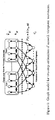
- We use statistical inference to recover one smooth viewpoint sequence for each camera. Taking camera-gains of those derived viewpoints into consideration, we then generate a smooth camera sequence.
- a smooth camera sequence will be generated from determined viewpoints.
- ⁇ ki ⁇ log P c i k
- v ki * , u to shorten the formulation, which is computed by using Eq.11.
- ⁇ is a hyper-parameter for controlling the smoothing strength.
- a short video clip with about 1200 frames is used to demonstrate behavioral characteristics of our system, especially its adaptivity under limited Table 1: Weighting of Different Salient Objects Object type Ball Player Judge Basket Coach-bench Others I ( o kim )
- This clip covers three ball-possession periods and includes five events in total.
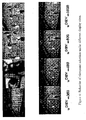
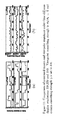
- Fig.8 we show time spans of all events, whose most highlighted moments are also marked out by red solid lines.
- meta-data should be generated by automatic understanding of the scene.
- the 3-rd camera i.e., the top-view with wide-angle lens
- its corresponding viewpoints are much smaller in width. This camera is selected because it provides a side view of the right court with salient object gathered closer than other camera views due to projective geometry.
- camera-7 is similar to camera-1 with linear zooming in, their optimal viewpoints might have different emphases on completeness and closeness. This consistency also exists in separated selection of cameras and viewpoints.
- viewpoint selection focuses more on closeness and camera selection focuses more on completeness
- Subjective test will help us to tune the relative weighting of completeness and closeness. It is more important to implement simultaneous selection of viewpoints and cameras, which requires both inclusion of positional information of cameras such as using homography, and an analytically solvable criterion for viewpoint selection.
- the methods presented in this paper aim at detecting and recognizing players on a sport-field, based on a distributed set of loosely synchronized cameras. Detection assumes player verticality, and sums the cumulative projection of the multiple views' foreground activity masks on a set of planes that are parallel to the ground plane. After summation, large projection values indicate the position of the player on the ground plane. This position is used as an anchor for the player bounding box projected in each one of the views. Within this bounding box, the regions provided by mean-shift segmentation are sorted out based on contextual features, e.g. relative size and position, to select the ones that are likely to correspond to a digit. Normalization and classification of the selected regions then provides the number and identity of the player. Since the player number can only be read when it faces towards the camera, graph-based tracking is considered to propagate the identity of a player along its trajectory.
- contextual features e.g. relative size and position
- the position of the players provides the required input to drive the autonomous selection of viewpoint parameters[5], whilst identification and tracking of the detected players supports personalization of the summary, e.g. through highlight and/or replay of preferred player's actions[4].
- Part of this work has been funded by the FP7 European project APIDIS. and by the Belgian NSF.
- the European FP7 APIDIS research project (www.apidis.org) has deployed a multi-camera acquisition system around a basket-ball court.
- the acquisition setting consists in a set of 7 calibrated IP cameras, each one collecting 2 Mpixels frames at a rate higher than 20 frames/sec.
- this paper investigates how to augment the video dataset based on the detection, tracking, and recognition of players.
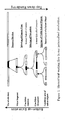
- Figure 1 surveys our proposed approach to compute and label players tracks. After joint multiview detection of people standing on the ground field at each time instant, a graph-based tracking algorithm matches positions that are sufficiently close -in position and appearance- between successive frames, thereby defining a set of potentially interrupted disjoint tracks, also named partial tracks.
- image analysis and classification is considered for each frame of each view, to recognize the digits that potentially appear on the shirts of detected objects. This information is then aggregated over time to label the partial tracks.
- the works in [2], [7], [1] adopt a top-down approach. They consider a grid of points on the ground plane, and estimate the probabilities of occupancy of each point in the grid based on the back-projection of some kind of generative model in each one of the calibrated multiple views. Hence, they all start from the ground plane, and validate occupancy hypothesis based on associated appearance model in each one of the views.
- the approaches proposed in this second category mainly differ based on the kind of generative model they consider (rectangle or learned dictionary), and on the way they decide about occupancy in each point of the grid (combination of multiple view-based classifiers in [2], probabilistic occupancy grid inferred from background subtraction masks in [7], and sparsity constrained binary occupancy map for [1]).
- Section III-B proposes a simple greedy heuristic to resolve the interference occurring between the silhouettes projected from distinct views by distinct objects.
- This interference was the source of many false detections while inferring the actual objects positions from the ground occupancy mask.
- this phenomenon had only been taken into account by the top-down approach described in [7], through a complex iterative approximation of the joint posterior probabilities of occupancy.
- our approach appears to be both efficient and effective.
- the computation of the ground occupancy mask G i associated to the i th view is described as follows.
- the i th view is the source of a binary background subtracted silhouette image B i ⁇ ⁇ 0,1 ⁇ Mi , where M i is the number of pixels of camera i , 1 ⁇ i ⁇ C.
- B i is projected on a set of L reference planes that are defined to be parallel to the ground plane, at regular height intervals, and up to the typical height of a player.
- G i j we define to be the projection of the i th binary mask on the j th plane.
- G i j is computed by applying the homography warping each pixel from camera i to its corresponding position on the j th reference plane, with 0 ⁇ j ⁇ L.
- points from B i that are labeled to 1 because of the presence of a player in the j th reference plane project to corresponding top view position in G i j .
- the summation G i of the projections obtained at different heights and from different views is expected to highlight top view positions of vertically standing players.
- these two properties can be achieved by virtually moving -through homography transforms- the camera viewing direction (principal axis) so as to bring the vertical vanishing point at infinity and ensure horizon line is horizontal.
- the principal axis is set perpendicular to the ground and a polar mapping is performed to achieve the same properties. Note that in some geometrical configurations, these transformations can induces severe skewing of the views.
- G i 0 x to be the ground occupancy mask G i associated to the i th view (see Section III-B), and set w i 0 x to 1 when x is covered by the i th view, and to 0 otherwise.
- Each iteration is then run in two steps.
- the first step searches for the most likely position of the n th player, knowing the position of the ( n - 1) players located in previous iterations.
- the second step updates the ground occupancy masks of all views to remove the contribution of the newly located player.
- the first step of iteration n aggregates the ground occupancy mask from all views, and then searches for the denser cluster in this mask.
- x n argmax y ⁇ G n x , k y >
- k (y) denotes a Gaussian kernel centered in y and whose spatial support corresponds to the typical width of a player.
- the ground occupancy mask of each view is updated to account for the presence of the n th player.
- typical support of a player silhouette in view i is a rectangular box of width W and height H, and observe that the part of the silhouette that occludes or is occluded by the newly detected player does not bring any information about the potential presence of a player in position x.
- ⁇ i ( x , x n ) denote the fraction of the silhouette in ground position x that becomes non-informative in view i as a consequence of the presence of a player in x n . To estimate this ratio, we consider the geometry of the problem.
- Figure 4 depicts a plane P i that is orthogonal to the ground, while passing through the i th camera and the player position x n .
- P i we consider two points of interest, namely b i and f i , which correspond to the points at which the rays, originated in the i th camera and passing through the head and feet of the player, intersect the ground plane and the plane parallel to ground at height H, respectively.
- f i ( b i ) to be the distance between f i (b i ) and the vertical line supporting player n in P i .
- the first and second factors reflect the misalignment of x and x n in P i and orthogonally to P i , respectively.
Landscapes
- Engineering & Computer Science (AREA)
- Multimedia (AREA)
- Signal Processing (AREA)
- Studio Devices (AREA)
- Two-Way Televisions, Distribution Of Moving Picture Or The Like (AREA)
- Closed-Circuit Television Systems (AREA)
Claims (24)
- Rechnergestütztes Verfahren für eine autonome Produktion eines bearbeiteten Videos aus mehreren Video-Streams, die von mehreren Kameras aufgenommen werden, die um eine Szene von Interesse verteilt sind, um zeitabhängig optimale Blickwinkel für die Anzeigeauflösung und andere Benutzerpräferenzen zu wählen und diese Sequenzen für eine kontinuierliche und elegante Handlungsstruktur zu glätten, wobei das Verfahren umfasst:• Erfassen interessanter Objekte in den Bildern der Video-Streams,• Auswählen für jede in Betracht gezogene Kamerastelle/-position eines Blickfeldes, das erhalten wird:- entweder durch Ausschneiden des Bildes, das von einer feststehenden Kamera aufgenommen wird, wodurch Ausschnittparameter definiert werden,- oder durch Wählen der Schwenk/Neige/Zoom-Parameter einer motorisierten Kamera oder einer virtuellen Kamera, wobei die virtuelle Kamera ein Bild in einer willkürlichen Position mit einem beliebigen Blickfeld durch Nutzung eines verteilten Netzes der Kameras angleicht,wobei das Blickfeld auf Basis einer gemeinsamen Verarbeitung der Positionen mehrerer interessanter Objekte, die erfasst wurden, gewählt wird, wobei die Auswahl in einer Weise erfolgt, die eine Ausgewogenheit von Vollständigkeits- und Genauigkeitsmetriken abhängig von individuellen Benutzerpräferenzen vorsieht, wobei Vollständigkeit die Anzahl von interessanten Objekten zählt, die in dem angezeigten Blickwinkel enthalten und sichtbar sind, und Genauigkeit die Anzahl von Pixeln misst, die zur Beschreibung des interessanten Objekts verfügbar sind,• Erstellen des bearbeiteten Videos durch Auswählen und Verknüpfen von Videosegmenten, die von einer oder mehreren individuellen Kamera(s) bereitgestellt werden, wobei die Erstellung in einer Weise erfolgt, die eine Ausgewogenheit von Vollständigkeits- und Genauigkeitsmetriken im Laufe der Zeit vorsieht, während die Sequenz der Ausschnitts- und/oder Schwenk/Neige/Zoom-Parameter geglättet wird, die mit den verknüpften Segmenten verbunden sind, wobei der Glättungsprozess auf der Basis eines linearen oder nicht linearen Tiefpass-Zeitfiltermechanismus implementiert wird.
- Rechnergestütztes Verfahren nach Anspruch 1, wobei die Auswahl in einer Weise erfolgt, die Vollständigkeits- und Genauigkeitsmetriken maximiert.
- Rechnergestütztes Verfahren nach Anspruch 1 oder 2, wobei die Vollständigkeitsmetrik als der Prozentsatz enthaltener Objekte definiert ist, während die Genauigkeitsmetrik als durchschnittliche Pixelfläche definiert ist, die zur Wiedergabe verwendet wird.
- Verfahren nach Anspruch 1, 2 oder 3, des Weiteren umfassend eine Bewertung jeder Kameraansicht entsprechend der Qualität ihres Vollständigkeits- und Genauigkeitskompromisses und ihres Verdeckungsgrades.
- Verfahren nach Anspruch 1, 2 oder 3, des Weiteren umfassend eine Auswahl des optimalen Blickfeldes in jeder Kamera zu einem bestimmten Zeitpunkt, wobei ein Blickfeld Vk in der k. Kameraansicht durch die Größe Sk und den Mittelpunkt ck des Fensters definiert ist, das in der k. Ansicht für eine tatsächliche Anzeige ausgeschnitten wird und so gewählt ist, dass es die interessanten Objekte enthält und eine hohe Auflösungsbeschreibung der Objekte bereitstellt, und ein optimales Blickfeld vk* zur Maximierung einer gewichteten Summe von interessanten Objekten wie folgt gewählt ist

wobei in der obenstehenden Gleichung• In den Wert an Interesse angibt, der dem n. Objekt zugeordnet ist, das in der Szene erfasst wird,• xn,k die Position des n. Objekts in der Kameraansicht k bezeichnet,• die Funktion m(...) die Wichtungen des n. Objekts gemäß seines Abstandes zum Mittelpunkt des Blickwinkelfensters, verglichen mit der Größe dieses Fensters moduliert,• der Vektor α die Benutzerpräferenzen reflektiert, wobei insbesondere seine Komponente ures die Auflösung des Ausgang-Streams definiert, die im Allgemeinen durch die Übertragungsbandbreite oder Benutzerendgerätauflösung begrenzt ist,• die Funktion α(.) den Zuschlag (Penality) reflektiert, der durch die Tatsache eingeführt wird, dass das von der k. Kamera aufgenommene native Signal sub-abgetastet werden muss, sobald die Größe des Blickwinkels größer als die maximale Auflösung rres wird, die der Benutzer zulässt. - Verfahren nach Anspruch 5, wobei α(...) mit Sk abnimmt und die Funktion von α(...) gleich eins ist, wenn Sk < ures ist, und danach abnimmt und
wobei α(...) optional definiert ist durch:
wobei der Exponent uclose größer als 1 ist und zunimmt, wenn der Benutzer eine Wiedergabe voller Auflösung einer Heranzoomfläche wünscht, verglichen mit großen, aber sub-abgetasteten Blickwinkeln. - Verfahren nach einem der Ansprüche 4 bis 6, wobei die höchste Rate einer Ansicht entspricht, die die meisten interessanten Objekte sichtbar macht und der Handlung nahe ist.
- Verfahren nach einem der Ansprüche 4 bis 7, wobei, angesichts des Interesses In jedes Spielers, die Rate Ik (vk,u), die mit der k. Kameraansicht verbunden ist, wie folgt definiert ist:

wobei in der obenstehenden Gleichung:• In den Wert an Interesse angibt, der dem n. Objekt zugeordnet ist, das in der Szene erfasst wird,• xn die Position des n. Objekts im 3D-Raum bezeichnet,• ok(xn|x) das Verdeckungsverhältnis des n. Objekts in der Kameraansicht k misst, wobei die Position aller anderen Objekte bekannt ist, wobei das Verdeckungsverhältnis eines Objekts als der Bruchteil von Pixeln des Objekts definiert ist, der von anderen Objekten verdeckt ist, wenn diese auf den Kamerasensor projiziert werden;• die Höhe hk(xn) als die Höhe in Pixeln der Projektion in Ansicht k einer Referenzhöhe eines Referenzobjekts definiert ist, das sich in xn befindet. Der Wert hk(xn) wird direkt auf der Basis einer Kamerakalibrierung berechnet oder kann, wenn keine Kalibrierung verfügbar ist, auf der Basis der Höhe des in Ansicht k erfassten Objekts geschätzt werden,• die Funktion βk(.) die Auswirkung der Benutzerpräferenzen hinsichtlich Kameraansicht und Anzeigeauflösung reflektiert. - Verfahren nach Anspruch 8, wobei βk(.) definiert ist als

wobei uk die Wichtung bezeichnet, die der k. Kamera zugeordnet ist und α(S,u) wie in Anspruch 6 definiert ist. - Verfahren nach einem der Ansprüche 1 bis 9, des Weiteren umfassend ein Glätten der Sequenz von Kameraindizes und entsprechender Blickwinkelparameter, wobei der Glättungsprozess zum Beispiel auf der Basis von zwei Markov Random Fields, linearen oder nicht linearen Tiefpass-Filtermechanismen oder durch einen Grafikmodellformalismus, gelöst auf der Basis eines herkömmlichen Viterbi-Algorithmus, implementiert wird.
- Rechnergestütztes System zum zeitabhängigen Auswählen optimaler Blickwinkel für die Anzeigeauflösung und andere Benutzerpräferenzen und zum Glätten dieser Sequenzen für eine kontinuierliche und elegante Handlungsstruktur, umfassend eine Verarbeitungsmaschine und einen Speicher für eine autonome Produktion eines bearbeiteten Videos aus mehreren Video-Streams, die von mehreren Kameras aufgenommen werden, die um eine Szene von Interesse verteilt sind, wobei das System umfasst:einen Detektor zum Erfassen interessanter Objekte in den Bildern der Video-Streams,erste Mittel zum Auswählen eines oder mehrere Kamerablickwinkel(s), die entweder durch Ausschneiden des Bildes, das von einer feststehenden Kamera aufgenommen wird, wodurch Ausschnittparameter definiert werden, oder durch Wählen der Schwenk/Neige/Zoom-Parameter einer motorisierten Kamera oder einer virtuellen Kamera, wobei die virtuelle Kamera ein Bild in einer willkürlichen Position mit einem beliebigen Blickfeld durch Nutzung eines verteilten Netzes der Kameras angleicht, erhalten werden, wobei der Blickwinkel der Kamera so gewählt wird, dass er die interessanten Objekte enthält, sowie auf Basis einer gemeinsamen Verarbeitung der Positionen mehrerer interessanter Objekte, die erfasst wurden, wobei die Auswahl in einer Weise erfolgt, die eine Ausgewogenheit von Vollständigkeits- und Genauigkeitsmetriken abhängig von individuellen Benutzerpräferenzen vorsieht, wobei Vollständigkeit die Anzahl von interessanten Objekten zählt, die in dem angezeigten Blickwinkel enthalten und sichtbar sind, und Genauigkeit die Anzahl von Pixeln misst, die zur Beschreibung des interessanten Objekts verfügbar sind;zweite Mittel zum Auswählen von Wiedergabeparametern, die die Vollständigkeits- und Genauigkeitsmetriken maximieren und glätten, indem Segmente in den Video-Streams verknüpft werden, die von einer oder mehreren individuellen Kamera(s) bereitgestellt werden, wobei die Erstellung in einer Weise erfolgt, die eine Ausgewogenheit von Vollständigkeits- und Genauigkeitsmetriken im Laufe der Zeit vorsieht, während die Sequenz der Ausschnitts- und/oder Schwenk/Neige/Zoom-Parameter geglättet wird, die mit den verknüpften Segmenten verbunden sind, wobei der Glättungsprozess auf der Basis eines linearen oder nicht linearen Tiefpass-Zeitfiltermechanismus implementiert wird.
- Rechnergestütztes System nach Anspruch 11, wobei die Auswahl in einer Weise erfolgt, die Vollständigkeits- und Genauigkeitsmetriken maximiert.
- Rechnergestütztes System nach Anspruch 11 oder 12, wobei die Vollständigkeitsmetrik als der Prozentsatz enthaltener Objekte definiert ist, während die Genauigkeitsmetrik als durchschnittliche Pixelfläche definiert ist, die zur Wiedergabe verwendet wird.
- System nach Anspruch 11, 12 oder 13, des Weiteren umfassend dritte Mittel zum Auswählen von Kamera- und Bildparametervariationen für die Kameraansicht, die eine Handlung zeitabhängig für einen Satz gemeinsamer Vollständigkeits- und Genauigkeitsmetriken wiedergeben,
wobei die dritten Mittel zum Auswählen von Kamera- und Bildparametervariationen optional dazu ausgebildet sind, die Kameraansicht einer statischen Kamera auszuschneiden oder die Steuerparameter einer dynamischen Kamera zu steuern. - System nach Anspruch 11 oder 14, des Weiteren umfassend Mittel zum Eintragen von Bildern von allen Ansichten aller Kameras mit denselben absoluten zeitlichen Koordinaten auf Basis einer gemeinsamen einzigartigen Zeitreferenz für alle Kameraansichten.
- System nach einem der Ansprüche 11 bis 15, des Weiteren umfassend vierte Mittel zum Auswählen der Parametervariationen, die den Kompromiss zwischen Vollständigkeit und Genauigkeit zu jedem Zeitpunkt und für jede Kameraansicht optimieren,
wobei der Kompromiss Vollständigkeit/Genauigkeit optional abhängig von Benutzerpräferenzen gemessen wird. - System nach einem der Ansprüche 11 bis 16, des Weiteren umfassend Mittel zum Bewerten des Blickwinkels, der in jeder Kameraansicht gewählt ist, entsprechend der Qualität ihres Vollständigkeits- und Genauigkeitskompromisses und ihres Verdeckungsgrades.
- System nach Anspruch 17, des Weiteren umfassend Mittel zum Berechnen der Parameter einer optimalen virtuellen Kamera, die Ansichten schwenkt, zoomt und wechselt, um hochwertige ausgewählte Blickwinkel zu bewahren, während die Menge an Bewegungen der virtuellen Kamera für das vorliegende Zeitsegment minimiert wird.
- System nach Anspruch 17 oder 18, des Weiteren umfassend fünfte Mittel zum Auswählen des optimalen Blickwinkels in jeder Kameraansicht zu einem bestimmten Zeitpunkt.
wobei die fünften Mittel zum Auswählen des optimalen Blickwinkels für einen Blickwinkel vk in der k. Kameraansicht, der durch die Größe Sk und den Mittelpunkt ck des Fensters definiert ist, das in der k. Ansicht für eine tatsächliche Anzeige ausgeschnitten wird und so gewählt ist, dass es die interessanten Objekte enthält und eine hohe Auflösungsbeschreibung der Objekte bereitstellt, dazu ausgebildet ist, eine Beschreibung der Objekte und einen optimalen Blickwinkel vk* zur Maximierung einer gewichteten Summe von interessanten Objekten wie folgt zu wählen
wobei in der obenstehenden Gleichung• In den Wert an Interesse angibt, der dem n. Objekt zugeordnet ist, das in der Szene erfasst wird,• In,k die Position des n. Objekts in der Kameraansicht k bezeichnet,• die Funktion m(...) die Wichtungen des n. Objekts gemäß seines Abstandes zum Mittelpunkt des Blickwinkelfensters, verglichen mit der Größe dieses Fensters moduliert,• der Vektor α die Benutzerpräferenzen reflektiert, wobei insbesondere seine Komponente ures die Auflösung des Ausgang-Streams definiert, die im Allgemeinen durch die Übertragungsbandbreite oder Benutzerendgerätauflösung begrenzt ist,• die Funktion α(.) den Zuschlag (Penality) reflektiert, der durch die Tatsache eingeführt wird, dass das von der k. Kamera aufgenommene native Signal sub-abgetastet werden muss, sobald die Größe des Blickwinkels größer als die maximale Auflösung rres wird, die der Benutzer zulässt. - System nach Anspruch 19, wobei α(...) mit Sk abnimmt und die Funktion von α(...) gleich eins ist, wenn Sk < ures ist, und danach abnimmt und
wobei α(...) optional definiert ist durch:
wobei der Exponent uclose größer als 1 ist und zunimmt, wenn der Benutzer eine Wiedergabe voller Auflösung einer Heranzoomfläche wünscht, verglichen mit großen, aber sub-abgetasteten Blickwinkeln. - System nach einem der Ansprüche 18 bis 20, des Weiteren umfassend sechste Mittel zum Auswählen der Kamera zu einem bestimmten Zeitpunkt die die meisten interessanten Objekte sichtbar macht und der Handlung nahe ist, wobei ein optimaler Kameraindex k* gemäß einer Gleichung gewählt wird, die gleich oder äquivalent

ist, wobei in der oben stehenden Gleichung:• In den Wert an Interesse angibt, der dem n. Objekt zugeordnet ist, das in der Szene erfasst wird,• xn die Position des n. Objekts im 3D-Raum bezeichnet,• ok(xn|x) das Verdeckungsverhältnis des n. Objekts in der Kameraansicht k misst, wobei die Position aller anderen Objekte bekannt ist, wobei das Verdeckungsverhältnis eines Objekts als der Bruchteil von Pixeln des Objekts definiert ist, der von anderen Objekten verdeckt ist, wenn diese auf den Kamerasensor projiziert werden;• die Höhe hk(xn) als die Höhe in Pixeln der Projektion in Ansicht k einer Referenzhöhe eines Referenzobjekts definiert ist, das sich in xn befindet. Der Wert hk(xn) wird direkt auf der Basis einer Kamerakalibrierung berechnet oder kann, wenn keine Kalibrierung verfügbar ist, auf der Basis der Höhe des in Ansicht k erfassten Objekts geschätzt werden,• die Funktion βk(.) die Auswirkung der Benutzerpräferenzen hinsichtlich Kameraansicht und Anzeigeauflösung reflektiert. - System nach Anspruch 21, wobei βk(.) definiert ist als

wobei uk die Wichtung bezeichnet, die der k. Kamera zugeordnet ist und α(S,u) wie in Anspruch 20 definiert ist. - System nach einem der Ansprüche 20 bis 22, des Weiteren umfassend Mittel zum Glätten der Sequenz von Kameraindizes und entsprechender Blickwinkelparameter, wobei die Mittel zum Glätten zum Glätten auf der Basis von zwei Markov Random Fields, durch einen linearen oder nicht linearen Tiefpass-Filtermechanismus, durch einen Grafikmodellformalismus, gelöst auf der Basis eines herkömmlichen Viterbi-Algorithmus, ausgebildet sind.
- Nicht flüchtiges, maschinenlesbares Signalspeichermedium, das ein Computerprogrammprodukt speichert, das Codesegmente umfasst, die, wenn sie auf einer Verarbeitungsmaschine ausgeführt werden, das Verfahren nach einem der Ansprüche 1 bis 10 ausführen oder das System nach einem der Ansprüche 11 bis 23 implementieren.
Priority Applications (1)
| Application Number | Priority Date | Filing Date | Title |
|---|---|---|---|
| PL10737234T PL2428036T3 (pl) | 2009-05-07 | 2010-05-07 | Systemy i sposoby autonomicznej produkcji przekazu wizyjnego z danych z wielu czujników |
Applications Claiming Priority (2)
| Application Number | Priority Date | Filing Date | Title |
|---|---|---|---|
| GBGB0907870.0A GB0907870D0 (en) | 2009-05-07 | 2009-05-07 | Systems and methods for the autonomous production of videos from multi-sensored data |
| PCT/BE2010/000039 WO2010127418A1 (en) | 2009-05-07 | 2010-05-07 | Systems and methods for the autonomous production of videos from multi-sensored data |
Publications (2)
| Publication Number | Publication Date |
|---|---|
| EP2428036A1 EP2428036A1 (de) | 2012-03-14 |
| EP2428036B1 true EP2428036B1 (de) | 2015-09-16 |
Family
ID=40833634
Family Applications (1)
| Application Number | Title | Priority Date | Filing Date |
|---|---|---|---|
| EP10737234.4A Active EP2428036B1 (de) | 2009-05-07 | 2010-05-07 | Systeme und verfahren für die autonome videoproduktion aus multi-sensorischen daten |
Country Status (9)
| Country | Link |
|---|---|
| US (1) | US8854457B2 (de) |
| EP (1) | EP2428036B1 (de) |
| BR (1) | BRPI1011189B1 (de) |
| CA (1) | CA2761187C (de) |
| ES (1) | ES2556601T3 (de) |
| GB (1) | GB0907870D0 (de) |
| MX (1) | MX2011011799A (de) |
| PL (1) | PL2428036T3 (de) |
| WO (1) | WO2010127418A1 (de) |
Cited By (5)
| Publication number | Priority date | Publication date | Assignee | Title |
|---|---|---|---|---|
| US11025888B2 (en) | 2018-02-17 | 2021-06-01 | Dreamvu, Inc. | System and method for capturing omni-stereo videos using multi-sensors |
| USD931355S1 (en) | 2018-02-27 | 2021-09-21 | Dreamvu, Inc. | 360 degree stereo single sensor camera |
| USD943017S1 (en) | 2018-02-27 | 2022-02-08 | Dreamvu, Inc. | 360 degree stereo optics mount for a camera |
| US11482004B2 (en) | 2020-07-29 | 2022-10-25 | Disney Enterprises, Inc. | Fast video content matching |
| EP4485952A4 (de) * | 2022-02-21 | 2025-05-14 | Sony Group Corporation | Informationsverarbeitungsvorrichtung, informationsverarbeitungsverfahren und programm |
Families Citing this family (156)
| Publication number | Priority date | Publication date | Assignee | Title |
|---|---|---|---|---|
| JP5627498B2 (ja) * | 2010-07-08 | 2014-11-19 | 株式会社東芝 | 立体画像生成装置及び方法 |
| CN102075696B (zh) | 2011-01-07 | 2013-03-27 | 卢泳 | 信号采集、传输、编辑整合、播发及收视的方法和系统 |
| CA2772206C (en) | 2011-03-24 | 2016-06-21 | Kabushiki Kaisha Topcon | Omnidirectional camera |
| US9557885B2 (en) | 2011-08-09 | 2017-01-31 | Gopro, Inc. | Digital media editing |
| US9838687B1 (en) | 2011-12-02 | 2017-12-05 | Amazon Technologies, Inc. | Apparatus and method for panoramic video hosting with reduced bandwidth streaming |
| US9723223B1 (en) | 2011-12-02 | 2017-08-01 | Amazon Technologies, Inc. | Apparatus and method for panoramic video hosting with directional audio |
| US9516225B2 (en) | 2011-12-02 | 2016-12-06 | Amazon Technologies, Inc. | Apparatus and method for panoramic video hosting |
| US20130300832A1 (en) * | 2012-05-14 | 2013-11-14 | Sstatzz Oy | System and method for automatic video filming and broadcasting of sports events |
| US9202526B2 (en) | 2012-05-14 | 2015-12-01 | Sstatzz Oy | System and method for viewing videos and statistics of sports events |
| US20140125806A1 (en) * | 2012-05-14 | 2014-05-08 | Sstatzz Oy | Sports Apparatus and Method |
| BR112014018522A8 (pt) | 2012-06-28 | 2017-07-11 | Nec Corp | Dispositivo de avaliação de posição/postura de câmera, método de avaliação de posição/postura de câmera e programa de avaliação de posição/postura de câmera |
| US20140071349A1 (en) * | 2012-09-12 | 2014-03-13 | Nokia Corporation | Method, apparatus, and computer program product for changing a viewing angle of a video image |
| US9265991B2 (en) | 2012-10-25 | 2016-02-23 | Sstatzz Oy | Method and system for monitoring movement of a sport projectile |
| US8874139B2 (en) | 2012-10-25 | 2014-10-28 | Sstatzz Oy | Position location system and method |
| US8968100B2 (en) | 2013-02-14 | 2015-03-03 | Sstatzz Oy | Sports training apparatus and method |
| US9462301B2 (en) * | 2013-03-15 | 2016-10-04 | Google Inc. | Generating videos with multiple viewpoints |
| US9881206B2 (en) | 2013-04-09 | 2018-01-30 | Sstatzz Oy | Sports monitoring system and method |
| US9843623B2 (en) | 2013-05-28 | 2017-12-12 | Qualcomm Incorporated | Systems and methods for selecting media items |
| KR101560274B1 (ko) * | 2013-05-31 | 2015-10-14 | 삼성에스디에스 주식회사 | 데이터 분석 장치 및 방법 |
| GB2517730A (en) * | 2013-08-29 | 2015-03-04 | Mediaproduccion S L | A method and system for producing a video production |
| EP2851900B1 (de) * | 2013-09-18 | 2017-08-23 | Nxp B.V. | Echtzeit Medieninhalts-Analyse und semi-automatische Zusammenfassung um ein flüchtiges Ereignis zu erfassen. |
| US20150139601A1 (en) * | 2013-11-15 | 2015-05-21 | Nokia Corporation | Method, apparatus, and computer program product for automatic remix and summary creation using crowd-sourced intelligence |
| US10878770B2 (en) * | 2013-12-02 | 2020-12-29 | Nvidia Corporation | Method and system for customizing optimal settings using end-user preferences |
| US11250886B2 (en) | 2013-12-13 | 2022-02-15 | FieldCast, LLC | Point of view video processing and curation platform |
| US9918110B2 (en) | 2013-12-13 | 2018-03-13 | Fieldcast Llc | Point of view multimedia platform |
| US10622020B2 (en) | 2014-10-03 | 2020-04-14 | FieldCast, LLC | Point of view video processing and curation platform |
| US10015527B1 (en) | 2013-12-16 | 2018-07-03 | Amazon Technologies, Inc. | Panoramic video distribution and viewing |
| US9912743B2 (en) | 2014-02-28 | 2018-03-06 | Skycapital Investors, Llc | Real-time collection and distribution of information for an event organized according to sub-events |
| WO2015134537A1 (en) | 2014-03-04 | 2015-09-11 | Gopro, Inc. | Generation of video based on spherical content |
| US9870621B1 (en) | 2014-03-10 | 2018-01-16 | Google Llc | Motion-based feature correspondence |
| NL2012399B1 (en) * | 2014-03-11 | 2015-11-26 | De Vroome Poort B V | Autonomous camera system for capturing sporting events. |
| US10108254B1 (en) | 2014-03-21 | 2018-10-23 | Google Llc | Apparatus and method for temporal synchronization of multiple signals |
| ES2845933T3 (es) | 2014-04-03 | 2021-07-28 | Pixellot Ltd | Método y sistema de producción automática de televisión |
| US9600723B1 (en) | 2014-07-03 | 2017-03-21 | Google Inc. | Systems and methods for attention localization using a first-person point-of-view device |
| US9082018B1 (en) | 2014-09-30 | 2015-07-14 | Google Inc. | Method and system for retroactively changing a display characteristic of event indicators on an event timeline |
| US10127783B2 (en) | 2014-07-07 | 2018-11-13 | Google Llc | Method and device for processing motion events |
| US10140827B2 (en) | 2014-07-07 | 2018-11-27 | Google Llc | Method and system for processing motion event notifications |
| US9449229B1 (en) | 2014-07-07 | 2016-09-20 | Google Inc. | Systems and methods for categorizing motion event candidates |
| US9501915B1 (en) | 2014-07-07 | 2016-11-22 | Google Inc. | Systems and methods for analyzing a video stream |
| US9213903B1 (en) | 2014-07-07 | 2015-12-15 | Google Inc. | Method and system for cluster-based video monitoring and event categorization |
| WO2016014724A1 (en) * | 2014-07-23 | 2016-01-28 | Gopro, Inc. | Scene and activity identification in video summary generation |
| US9984293B2 (en) | 2014-07-23 | 2018-05-29 | Gopro, Inc. | Video scene classification by activity |
| US9685194B2 (en) | 2014-07-23 | 2017-06-20 | Gopro, Inc. | Voice-based video tagging |
| USD782495S1 (en) | 2014-10-07 | 2017-03-28 | Google Inc. | Display screen or portion thereof with graphical user interface |
| US9734870B2 (en) | 2015-01-05 | 2017-08-15 | Gopro, Inc. | Media identifier generation for camera-captured media |
| JP6529267B2 (ja) * | 2015-01-23 | 2019-06-12 | キヤノン株式会社 | 情報処理装置及びその制御方法、プログラム、並びに記憶媒体 |
| US9679605B2 (en) | 2015-01-29 | 2017-06-13 | Gopro, Inc. | Variable playback speed template for video editing application |
| EP3262643A4 (de) | 2015-02-24 | 2019-02-20 | Plaay, LLC | System und verfahren zur erzeugung eines sportvideos |
| WO2016187235A1 (en) | 2015-05-20 | 2016-11-24 | Gopro, Inc. | Virtual lens simulation for video and photo cropping |
| US9361011B1 (en) | 2015-06-14 | 2016-06-07 | Google Inc. | Methods and systems for presenting multiple live video feeds in a user interface |
| US10291845B2 (en) | 2015-08-17 | 2019-05-14 | Nokia Technologies Oy | Method, apparatus, and computer program product for personalized depth of field omnidirectional video |
| US10104286B1 (en) | 2015-08-27 | 2018-10-16 | Amazon Technologies, Inc. | Motion de-blurring for panoramic frames |
| US9894393B2 (en) | 2015-08-31 | 2018-02-13 | Gopro, Inc. | Video encoding for reduced streaming latency |
| US10609379B1 (en) | 2015-09-01 | 2020-03-31 | Amazon Technologies, Inc. | Video compression across continuous frame edges |
| JP6566799B2 (ja) * | 2015-09-07 | 2019-08-28 | キヤノン株式会社 | 提供装置、提供方法、及びプログラム |
| EP3142116A1 (de) * | 2015-09-14 | 2017-03-15 | Thomson Licensing | Verfahren und vorrichtung zur erfassung eines videos in einer kommunalen erfassung |
| US9843724B1 (en) | 2015-09-21 | 2017-12-12 | Amazon Technologies, Inc. | Stabilization of panoramic video |
| US9721611B2 (en) | 2015-10-20 | 2017-08-01 | Gopro, Inc. | System and method of generating video from video clips based on moments of interest within the video clips |
| US10204273B2 (en) | 2015-10-20 | 2019-02-12 | Gopro, Inc. | System and method of providing recommendations of moments of interest within video clips post capture |
| RU2665045C2 (ru) * | 2015-10-29 | 2018-08-27 | Акционерное общество "Российская корпорация ракетно-космического приборостроения и информационных систем" (АО "Российские космические системы") | Система моделирования ситуаций, относящихся к конфликтам и/или конкуренции |
| US10356456B2 (en) * | 2015-11-05 | 2019-07-16 | Adobe Inc. | Generating customized video previews |
| US10095696B1 (en) | 2016-01-04 | 2018-10-09 | Gopro, Inc. | Systems and methods for generating recommendations of post-capture users to edit digital media content field |
| US10109319B2 (en) | 2016-01-08 | 2018-10-23 | Gopro, Inc. | Digital media editing |
| US9812175B2 (en) | 2016-02-04 | 2017-11-07 | Gopro, Inc. | Systems and methods for annotating a video |
| US9972066B1 (en) | 2016-03-16 | 2018-05-15 | Gopro, Inc. | Systems and methods for providing variable image projection for spherical visual content |
| US10402938B1 (en) | 2016-03-31 | 2019-09-03 | Gopro, Inc. | Systems and methods for modifying image distortion (curvature) for viewing distance in post capture |
| US9838730B1 (en) | 2016-04-07 | 2017-12-05 | Gopro, Inc. | Systems and methods for audio track selection in video editing |
| US9794632B1 (en) | 2016-04-07 | 2017-10-17 | Gopro, Inc. | Systems and methods for synchronization based on audio track changes in video editing |
| US9838731B1 (en) | 2016-04-07 | 2017-12-05 | Gopro, Inc. | Systems and methods for audio track selection in video editing with audio mixing option |
| EP3249651B1 (de) * | 2016-05-23 | 2018-08-29 | Axis AB | Erzeugung einer zusammenfassenden videosequenz von einer quellenvideosequenz |
| US10027954B2 (en) | 2016-05-23 | 2018-07-17 | Microsoft Technology Licensing, Llc | Registering cameras in a multi-camera imager |
| US10339662B2 (en) | 2016-05-23 | 2019-07-02 | Microsoft Technology Licensing, Llc | Registering cameras with virtual fiducials |
| US10326979B2 (en) | 2016-05-23 | 2019-06-18 | Microsoft Technology Licensing, Llc | Imaging system comprising real-time image registration |
| JP6808357B2 (ja) * | 2016-05-25 | 2021-01-06 | キヤノン株式会社 | 情報処理装置、制御方法、及び、プログラム |
| US10506237B1 (en) | 2016-05-27 | 2019-12-10 | Google Llc | Methods and devices for dynamic adaptation of encoding bitrate for video streaming |
| US9922682B1 (en) | 2016-06-15 | 2018-03-20 | Gopro, Inc. | Systems and methods for organizing video files |
| US9998769B1 (en) | 2016-06-15 | 2018-06-12 | Gopro, Inc. | Systems and methods for transcoding media files |
| US10250894B1 (en) | 2016-06-15 | 2019-04-02 | Gopro, Inc. | Systems and methods for providing transcoded portions of a video |
| FR3052949B1 (fr) * | 2016-06-17 | 2019-11-08 | Alexandre Courtes | Procede et systeme de prise de vues a l'aide d'un capteur virtuel |
| US10045120B2 (en) | 2016-06-20 | 2018-08-07 | Gopro, Inc. | Associating audio with three-dimensional objects in videos |
| US10185891B1 (en) | 2016-07-08 | 2019-01-22 | Gopro, Inc. | Systems and methods for compact convolutional neural networks |
| US10192415B2 (en) | 2016-07-11 | 2019-01-29 | Google Llc | Methods and systems for providing intelligent alerts for events |
| US10957171B2 (en) | 2016-07-11 | 2021-03-23 | Google Llc | Methods and systems for providing event alerts |
| US10380429B2 (en) | 2016-07-11 | 2019-08-13 | Google Llc | Methods and systems for person detection in a video feed |
| US10469909B1 (en) | 2016-07-14 | 2019-11-05 | Gopro, Inc. | Systems and methods for providing access to still images derived from a video |
| US10395119B1 (en) | 2016-08-10 | 2019-08-27 | Gopro, Inc. | Systems and methods for determining activities performed during video capture |
| JP6918455B2 (ja) * | 2016-09-01 | 2021-08-11 | キヤノン株式会社 | 画像処理装置、画像処理方法及びプログラム |
| US9836853B1 (en) | 2016-09-06 | 2017-12-05 | Gopro, Inc. | Three-dimensional convolutional neural networks for video highlight detection |
| US10282632B1 (en) | 2016-09-21 | 2019-05-07 | Gopro, Inc. | Systems and methods for determining a sample frame order for analyzing a video |
| US10268898B1 (en) | 2016-09-21 | 2019-04-23 | Gopro, Inc. | Systems and methods for determining a sample frame order for analyzing a video via segments |
| JP6812181B2 (ja) * | 2016-09-27 | 2021-01-13 | キヤノン株式会社 | 画像処理装置、画像処理方法、及び、プログラム |
| US10002641B1 (en) | 2016-10-17 | 2018-06-19 | Gopro, Inc. | Systems and methods for determining highlight segment sets |
| US10284809B1 (en) | 2016-11-07 | 2019-05-07 | Gopro, Inc. | Systems and methods for intelligently synchronizing events in visual content with musical features in audio content |
| US10262639B1 (en) | 2016-11-08 | 2019-04-16 | Gopro, Inc. | Systems and methods for detecting musical features in audio content |
| JP6539253B2 (ja) * | 2016-12-06 | 2019-07-03 | キヤノン株式会社 | 情報処理装置、その制御方法、およびプログラム |
| US10534966B1 (en) | 2017-02-02 | 2020-01-14 | Gopro, Inc. | Systems and methods for identifying activities and/or events represented in a video |
| KR102745729B1 (ko) * | 2017-02-08 | 2024-12-24 | 삼성전자주식회사 | 비디오 재생을 위한 전자 장치 및 서버 |
| US10339443B1 (en) | 2017-02-24 | 2019-07-02 | Gopro, Inc. | Systems and methods for processing convolutional neural network operations using textures |
| US10127943B1 (en) | 2017-03-02 | 2018-11-13 | Gopro, Inc. | Systems and methods for modifying videos based on music |
| US10185895B1 (en) | 2017-03-23 | 2019-01-22 | Gopro, Inc. | Systems and methods for classifying activities captured within images |
| US10083718B1 (en) | 2017-03-24 | 2018-09-25 | Gopro, Inc. | Systems and methods for editing videos based on motion |
| JP6922369B2 (ja) * | 2017-04-14 | 2021-08-18 | 富士通株式会社 | 視点選択支援プログラム、視点選択支援方法及び視点選択支援装置 |
| US10187690B1 (en) | 2017-04-24 | 2019-01-22 | Gopro, Inc. | Systems and methods to detect and correlate user responses to media content |
| US10395122B1 (en) | 2017-05-12 | 2019-08-27 | Gopro, Inc. | Systems and methods for identifying moments in videos |
| US11783010B2 (en) | 2017-05-30 | 2023-10-10 | Google Llc | Systems and methods of person recognition in video streams |
| US10410086B2 (en) | 2017-05-30 | 2019-09-10 | Google Llc | Systems and methods of person recognition in video streams |
| US11981352B2 (en) | 2017-07-05 | 2024-05-14 | Perceptive Automata, Inc. | System and method of predicting human interaction with vehicles |
| US11987272B2 (en) | 2017-07-05 | 2024-05-21 | Perceptive Automata, Inc. | System and method of predicting human interaction with vehicles |
| US10402687B2 (en) | 2017-07-05 | 2019-09-03 | Perceptive Automata, Inc. | System and method of predicting human interaction with vehicles |
| US10614114B1 (en) | 2017-07-10 | 2020-04-07 | Gopro, Inc. | Systems and methods for creating compilations based on hierarchical clustering |
| US10402698B1 (en) | 2017-07-10 | 2019-09-03 | Gopro, Inc. | Systems and methods for identifying interesting moments within videos |
| US10402656B1 (en) | 2017-07-13 | 2019-09-03 | Gopro, Inc. | Systems and methods for accelerating video analysis |
| KR102535031B1 (ko) * | 2017-07-19 | 2023-05-22 | 삼성전자주식회사 | 디스플레이장치, 그 제어방법 및 그 컴퓨터프로그램제품 |
| US10432987B2 (en) * | 2017-09-15 | 2019-10-01 | Cisco Technology, Inc. | Virtualized and automated real time video production system |
| US10664688B2 (en) | 2017-09-20 | 2020-05-26 | Google Llc | Systems and methods of detecting and responding to a visitor to a smart home environment |
| US11134227B2 (en) | 2017-09-20 | 2021-09-28 | Google Llc | Systems and methods of presenting appropriate actions for responding to a visitor to a smart home environment |
| JP7132730B2 (ja) * | 2018-03-14 | 2022-09-07 | キヤノン株式会社 | 情報処理装置および情報処理方法 |
| US10574975B1 (en) | 2018-08-08 | 2020-02-25 | At&T Intellectual Property I, L.P. | Method and apparatus for navigating through panoramic content |
| US11138694B2 (en) | 2018-12-05 | 2021-10-05 | Tencent America LLC | Method and apparatus for geometric smoothing |
| US10818077B2 (en) * | 2018-12-14 | 2020-10-27 | Canon Kabushiki Kaisha | Method, system and apparatus for controlling a virtual camera |
| JP2020134973A (ja) * | 2019-02-12 | 2020-08-31 | キヤノン株式会社 | 素材生成装置、画像生成装置および画像処理装置 |
| CN113508419B (zh) | 2019-02-28 | 2024-09-13 | 斯塔特斯公司 | 从广播视频生成运动员跟踪数据的系统及方法 |
| US10728443B1 (en) | 2019-03-27 | 2020-07-28 | On Time Staffing Inc. | Automatic camera angle switching to create combined audiovisual file |
| US10963841B2 (en) | 2019-03-27 | 2021-03-30 | On Time Staffing Inc. | Employment candidate empathy scoring system |
| JP7310252B2 (ja) * | 2019-04-19 | 2023-07-19 | 株式会社リコー | 動画生成装置、動画生成方法、プログラム、記憶媒体 |
| US12172064B2 (en) | 2019-06-07 | 2024-12-24 | Shoot-A-Way, Inc. | Basketball system for tracking and presenting off the dribble shooting statistics |
| US12134009B1 (en) | 2019-06-07 | 2024-11-05 | Shoot-A-Way, Inc. | Basketball launching device using machine vision |
| US11400355B1 (en) | 2019-06-07 | 2022-08-02 | Shoot-A-Way, Inc. | Basketball launching device with a camera for detecting made shots |
| US11577146B1 (en) | 2019-06-07 | 2023-02-14 | Shoot-A-Way, Inc. | Basketball launching device with off of the dribble statistic tracking |
| US11572083B2 (en) | 2019-07-22 | 2023-02-07 | Perceptive Automata, Inc. | Neural network based prediction of hidden context of traffic entities for autonomous vehicles |
| US11993291B2 (en) | 2019-10-17 | 2024-05-28 | Perceptive Automata, Inc. | Neural networks for navigation of autonomous vehicles based upon predicted human intents |
| US12012118B2 (en) | 2019-11-02 | 2024-06-18 | Perceptive Automata, Inc. | Generating training datasets for training machine learning based models for predicting behavior of traffic entities for navigating autonomous vehicles |
| US11615266B2 (en) | 2019-11-02 | 2023-03-28 | Perceptive Automata, Inc. | Adaptive sampling of stimuli for training of machine learning based models for predicting hidden context of traffic entities for navigating autonomous vehicles |
| US11127232B2 (en) | 2019-11-26 | 2021-09-21 | On Time Staffing Inc. | Multi-camera, multi-sensor panel data extraction system and method |
| US11893795B2 (en) | 2019-12-09 | 2024-02-06 | Google Llc | Interacting with visitors of a connected home environment |
| US12390713B1 (en) | 2019-12-20 | 2025-08-19 | Shoot-A-Way, Inc. | Basketball passing machine with multi-user features |
| US12029960B1 (en) | 2019-12-20 | 2024-07-09 | Shoot-A-Way, Inc. | Basketball passing machine with virtual coaching capabilities |
| WO2021178379A1 (en) * | 2020-03-02 | 2021-09-10 | Visual Supply Company | Systems and methods for automating video editing |
| US11023735B1 (en) | 2020-04-02 | 2021-06-01 | On Time Staffing, Inc. | Automatic versioning of video presentations |
| US11861806B2 (en) | 2020-04-10 | 2024-01-02 | Stats Llc | End-to-end camera calibration for broadcast video |
| US12076632B1 (en) | 2020-04-24 | 2024-09-03 | Shoot-A-Way, Inc. | Basketball launching device |
| CN114007059B (zh) * | 2020-07-28 | 2025-01-17 | 阿里巴巴集团控股有限公司 | 视频压缩方法、解压方法、装置、电子设备及存储介质 |
| US11144882B1 (en) | 2020-09-18 | 2021-10-12 | On Time Staffing Inc. | Systems and methods for evaluating actions over a computer network and establishing live network connections |
| US11516517B2 (en) | 2021-03-19 | 2022-11-29 | Sm Tamjid | Localized dynamic video streaming system |
| US12425697B2 (en) | 2021-03-19 | 2025-09-23 | Sm Tamjid | Localized dynamic video streaming system |
| EP4099704A1 (de) * | 2021-06-04 | 2022-12-07 | Spiideo AB | System und verfahren zur bereitstellung einer empfohlenen videoproduktion |
| US11430486B1 (en) * | 2021-06-11 | 2022-08-30 | Gopro, Inc. | Provision of supplemental content for use in a video edit |
| US11727040B2 (en) | 2021-08-06 | 2023-08-15 | On Time Staffing, Inc. | Monitoring third-party forum contributions to improve searching through time-to-live data assignments |
| US11423071B1 (en) | 2021-08-31 | 2022-08-23 | On Time Staffing, Inc. | Candidate data ranking method using previously selected candidate data |
| US12262115B2 (en) | 2022-01-28 | 2025-03-25 | Gopro, Inc. | Methods and apparatus for electronic image stabilization based on a lens polynomial |
| ES2957182A1 (es) * | 2022-05-31 | 2024-01-12 | Pronoide S L | Sistema y metodo para la creacion de videos instructivos mediante el empleo de secuencias de comandos |
| US11907652B2 (en) | 2022-06-02 | 2024-02-20 | On Time Staffing, Inc. | User interface and systems for document creation |
| US12287826B1 (en) | 2022-06-29 | 2025-04-29 | Gopro, Inc. | Systems and methods for sharing media items capturing subjects |
| CN115119050B (zh) * | 2022-06-30 | 2023-12-15 | 北京奇艺世纪科技有限公司 | 一种视频剪辑方法和装置、电子设备和存储介质 |
| US11712610B1 (en) | 2023-01-11 | 2023-08-01 | Shoot-A-Way, Inc. | Ultrasonic shots-made detector for basketball launching device |
| US12392548B2 (en) * | 2023-09-29 | 2025-08-19 | Springhouse Technologies Inc. | System and method for tracking refrigerator inventory |
Family Cites Families (19)
| Publication number | Priority date | Publication date | Assignee | Title |
|---|---|---|---|---|
| US5850352A (en) * | 1995-03-31 | 1998-12-15 | The Regents Of The University Of California | Immersive video, including video hypermosaicing to generate from multiple video views of a scene a three-dimensional video mosaic from which diverse virtual video scene images are synthesized, including panoramic, scene interactive and stereoscopic images |
| US5729471A (en) * | 1995-03-31 | 1998-03-17 | The Regents Of The University Of California | Machine dynamic selection of one video camera/image of a scene from multiple video cameras/images of the scene in accordance with a particular perspective on the scene, an object in the scene, or an event in the scene |
| US5969755A (en) * | 1996-02-05 | 1999-10-19 | Texas Instruments Incorporated | Motion based event detection system and method |
| US6711278B1 (en) * | 1998-09-10 | 2004-03-23 | Microsoft Corporation | Tracking semantic objects in vector image sequences |
| EP1206129B1 (de) * | 2000-11-13 | 2012-05-02 | Wells & Verne Investments Ltd | Computerunterstützes Bilderzeugungssystem |
| US6577333B2 (en) | 2000-12-12 | 2003-06-10 | Intel Corporation | Automatic multi-camera video composition |
| US6741250B1 (en) | 2001-02-09 | 2004-05-25 | Be Here Corporation | Method and system for generation of multiple viewpoints into a scene viewed by motionless cameras and for presentation of a view path |
| US6937266B2 (en) | 2001-06-14 | 2005-08-30 | Microsoft Corporation | Automated online broadcasting system and method using an omni-directional camera system for viewing meetings over a computer network |
| US7349005B2 (en) | 2001-06-14 | 2008-03-25 | Microsoft Corporation | Automated video production system and method using expert video production rules for online publishing of lectures |
| DE60123786T2 (de) | 2001-08-29 | 2007-03-15 | Dartfish Sa | Verfahren und System zur automatischen Produktion von Videosequenzen |
| US20050128291A1 (en) * | 2002-04-17 | 2005-06-16 | Yoshishige Murakami | Video surveillance system |
| US7505604B2 (en) * | 2002-05-20 | 2009-03-17 | Simmonds Precision Prodcuts, Inc. | Method for detection and recognition of fog presence within an aircraft compartment using video images |
| US7349008B2 (en) | 2002-11-30 | 2008-03-25 | Microsoft Corporation | Automated camera management system and method for capturing presentations using videography rules |
| GB2413720B (en) * | 2003-03-14 | 2006-08-02 | British Broadcasting Corp | Video processing |
| GB2402011B (en) | 2003-05-20 | 2006-11-29 | British Broadcasting Corp | Automated video production |
| EP2408193A3 (de) | 2004-04-16 | 2014-01-15 | James A. Aman | Kamera für sichtbares und unsichtbares Licht für Videoaufnahmen und Objektnachführung |
| US20060251382A1 (en) | 2005-05-09 | 2006-11-09 | Microsoft Corporation | System and method for automatic video editing using object recognition |
| EP2479992B1 (de) | 2006-12-04 | 2020-07-15 | Isolynx, LLC | Autonome Systeme und Verfahren zur Erzeugung von Stand- und Bewegtbildern |
| US9766089B2 (en) * | 2009-12-14 | 2017-09-19 | Nokia Technologies Oy | Method and apparatus for correlating and navigating between a live image and a prerecorded panoramic image |
-
2009
- 2009-05-07 GB GBGB0907870.0A patent/GB0907870D0/en not_active Ceased
-
2010
- 2010-05-07 WO PCT/BE2010/000039 patent/WO2010127418A1/en not_active Ceased
- 2010-05-07 BR BRPI1011189-1A patent/BRPI1011189B1/pt active IP Right Grant
- 2010-05-07 PL PL10737234T patent/PL2428036T3/pl unknown
- 2010-05-07 MX MX2011011799A patent/MX2011011799A/es active IP Right Grant
- 2010-05-07 US US13/319,202 patent/US8854457B2/en active Active
- 2010-05-07 EP EP10737234.4A patent/EP2428036B1/de active Active
- 2010-05-07 CA CA2761187A patent/CA2761187C/en active Active
- 2010-05-07 ES ES10737234.4T patent/ES2556601T3/es active Active
Cited By (6)
| Publication number | Priority date | Publication date | Assignee | Title |
|---|---|---|---|---|
| US11025888B2 (en) | 2018-02-17 | 2021-06-01 | Dreamvu, Inc. | System and method for capturing omni-stereo videos using multi-sensors |
| US11523101B2 (en) | 2018-02-17 | 2022-12-06 | Dreamvu, Inc. | System and method for capturing omni-stereo videos using multi-sensors |
| USD931355S1 (en) | 2018-02-27 | 2021-09-21 | Dreamvu, Inc. | 360 degree stereo single sensor camera |
| USD943017S1 (en) | 2018-02-27 | 2022-02-08 | Dreamvu, Inc. | 360 degree stereo optics mount for a camera |
| US11482004B2 (en) | 2020-07-29 | 2022-10-25 | Disney Enterprises, Inc. | Fast video content matching |
| EP4485952A4 (de) * | 2022-02-21 | 2025-05-14 | Sony Group Corporation | Informationsverarbeitungsvorrichtung, informationsverarbeitungsverfahren und programm |
Also Published As
| Publication number | Publication date |
|---|---|
| PL2428036T3 (pl) | 2016-04-29 |
| GB0907870D0 (en) | 2009-06-24 |
| CA2761187C (en) | 2023-01-17 |
| EP2428036A1 (de) | 2012-03-14 |
| ES2556601T3 (es) | 2016-01-19 |
| BRPI1011189A2 (pt) | 2018-07-10 |
| WO2010127418A1 (en) | 2010-11-11 |
| CA2761187A1 (en) | 2010-11-11 |
| BRPI1011189B1 (pt) | 2021-08-24 |
| MX2011011799A (es) | 2012-07-23 |
| US20120057852A1 (en) | 2012-03-08 |
| US8854457B2 (en) | 2014-10-07 |
Similar Documents
| Publication | Publication Date | Title |
|---|---|---|
| EP2428036B1 (de) | Systeme und verfahren für die autonome videoproduktion aus multi-sensorischen daten | |
| US12026947B2 (en) | Methods and apparatus to measure brand exposure in media streams | |
| EP1955205B1 (de) | Verfahren und system zum produzieren einer videosynopse | |
| US10147163B2 (en) | Systems and methods for automated image cropping | |
| US10861159B2 (en) | Method, system and computer program product for automatically altering a video stream | |
| Chen et al. | An autonomous framework to produce and distribute personalized team-sport video summaries: A basketball case study | |
| Chen et al. | Personalized production of basketball videos from multi-sensored data under limited display resolution | |
| WO1999005865A1 (en) | Content-based video access | |
| Nieto et al. | An automatic system for sports analytics in multi-camera tennis videos | |
| CN119172634A (zh) | 一种以用户主观偏好为驱动的全景视频导航方法 | |
| Wang et al. | Personal multi-view viewpoint recommendation based on trajectory distribution of the viewing target | |
| Mei et al. | Structure and event mining in sports video with efficient mosaic | |
| Grundmann | Computational video: post-processing methods for stabilization, retargeting and segmentation | |
| Parisot et al. | Consensus-based trajectory estimation for ball detection in a calibrated cameras system | |
| Chen et al. | Multi-sensored vision for autonomous production of personalized video summaries | |
| US12211275B1 (en) | Low-latency spotlighting | |
| DATA | De Vleeschouwer et al. | |
| Wang | Viewing support system for multi-view videos | |
| Guntur et al. | Automated virtual camera during mobile video playback | |
| Cai | Video anatomy: spatial-temporal video profile |
Legal Events
| Date | Code | Title | Description |
|---|---|---|---|
| PUAI | Public reference made under article 153(3) epc to a published international application that has entered the european phase |
Free format text: ORIGINAL CODE: 0009012 |
|
| 17P | Request for examination filed |
Effective date: 20111207 |
|
| AK | Designated contracting states |
Kind code of ref document: A1 Designated state(s): AL AT BE BG CH CY CZ DE DK EE ES FI FR GB GR HR HU IE IS IT LI LT LU LV MC MK MT NL NO PL PT RO SE SI SK SM TR |
|
| DAX | Request for extension of the european patent (deleted) | ||
| 17Q | First examination report despatched |
Effective date: 20120914 |
|
| GRAP | Despatch of communication of intention to grant a patent |
Free format text: ORIGINAL CODE: EPIDOSNIGR1 |
|
| INTG | Intention to grant announced |
Effective date: 20150410 |
|
| RAP1 | Party data changed (applicant data changed or rights of an application transferred) |
Owner name: KEEMOTION S.A. |
|
| GRAS | Grant fee paid |
Free format text: ORIGINAL CODE: EPIDOSNIGR3 |
|
| GRAA | (expected) grant |
Free format text: ORIGINAL CODE: 0009210 |
|
| AK | Designated contracting states |
Kind code of ref document: B1 Designated state(s): AL AT BE BG CH CY CZ DE DK EE ES FI FR GB GR HR HU IE IS IT LI LT LU LV MC MK MT NL NO PL PT RO SE SI SK SM TR |
|
| REG | Reference to a national code |
Ref country code: GB Ref legal event code: FG4D |
|
| REG | Reference to a national code |
Ref country code: CH Ref legal event code: EP |
|
| REG | Reference to a national code |
Ref country code: IE Ref legal event code: FG4D |
|
| REG | Reference to a national code |
Ref country code: AT Ref legal event code: REF Ref document number: 750592 Country of ref document: AT Kind code of ref document: T Effective date: 20151015 |
|
| REG | Reference to a national code |
Ref country code: DE Ref legal event code: R096 Ref document number: 602010027578 Country of ref document: DE |
|
| REG | Reference to a national code |
Ref country code: SE Ref legal event code: TRGR |
|
| REG | Reference to a national code |
Ref country code: ES Ref legal event code: FG2A Ref document number: 2556601 Country of ref document: ES Kind code of ref document: T3 Effective date: 20160119 |
|
| PG25 | Lapsed in a contracting state [announced via postgrant information from national office to epo] |
Ref country code: NO Free format text: LAPSE BECAUSE OF FAILURE TO SUBMIT A TRANSLATION OF THE DESCRIPTION OR TO PAY THE FEE WITHIN THE PRESCRIBED TIME-LIMIT Effective date: 20151216 Ref country code: LV Free format text: LAPSE BECAUSE OF FAILURE TO SUBMIT A TRANSLATION OF THE DESCRIPTION OR TO PAY THE FEE WITHIN THE PRESCRIBED TIME-LIMIT Effective date: 20150916 |
|
| REG | Reference to a national code |
Ref country code: AT Ref legal event code: MK05 Ref document number: 750592 Country of ref document: AT Kind code of ref document: T Effective date: 20150916 |
|
| REG | Reference to a national code |
Ref country code: NL Ref legal event code: FP |
|
| PG25 | Lapsed in a contracting state [announced via postgrant information from national office to epo] |
Ref country code: HR Free format text: LAPSE BECAUSE OF FAILURE TO SUBMIT A TRANSLATION OF THE DESCRIPTION OR TO PAY THE FEE WITHIN THE PRESCRIBED TIME-LIMIT Effective date: 20150916 |
|
| PG25 | Lapsed in a contracting state [announced via postgrant information from national office to epo] |
Ref country code: SK Free format text: LAPSE BECAUSE OF FAILURE TO SUBMIT A TRANSLATION OF THE DESCRIPTION OR TO PAY THE FEE WITHIN THE PRESCRIBED TIME-LIMIT Effective date: 20150916 Ref country code: IS Free format text: LAPSE BECAUSE OF FAILURE TO SUBMIT A TRANSLATION OF THE DESCRIPTION OR TO PAY THE FEE WITHIN THE PRESCRIBED TIME-LIMIT Effective date: 20160116 Ref country code: CZ Free format text: LAPSE BECAUSE OF FAILURE TO SUBMIT A TRANSLATION OF THE DESCRIPTION OR TO PAY THE FEE WITHIN THE PRESCRIBED TIME-LIMIT Effective date: 20150916 Ref country code: EE Free format text: LAPSE BECAUSE OF FAILURE TO SUBMIT A TRANSLATION OF THE DESCRIPTION OR TO PAY THE FEE WITHIN THE PRESCRIBED TIME-LIMIT Effective date: 20150916 |
|
| REG | Reference to a national code |
Ref country code: FR Ref legal event code: PLFP Year of fee payment: 7 |
|
| PG25 | Lapsed in a contracting state [announced via postgrant information from national office to epo] |
Ref country code: RO Free format text: LAPSE BECAUSE OF FAILURE TO SUBMIT A TRANSLATION OF THE DESCRIPTION OR TO PAY THE FEE WITHIN THE PRESCRIBED TIME-LIMIT Effective date: 20150916 Ref country code: AT Free format text: LAPSE BECAUSE OF FAILURE TO SUBMIT A TRANSLATION OF THE DESCRIPTION OR TO PAY THE FEE WITHIN THE PRESCRIBED TIME-LIMIT Effective date: 20150916 |
|
| REG | Reference to a national code |
Ref country code: GR Ref legal event code: EP Ref document number: 20150402690 Country of ref document: GR Effective date: 20160414 Ref country code: DE Ref legal event code: R097 Ref document number: 602010027578 Country of ref document: DE |
|
| PLBE | No opposition filed within time limit |
Free format text: ORIGINAL CODE: 0009261 |
|
| STAA | Information on the status of an ep patent application or granted ep patent |
Free format text: STATUS: NO OPPOSITION FILED WITHIN TIME LIMIT |
|
| 26N | No opposition filed |
Effective date: 20160617 |
|
| PG25 | Lapsed in a contracting state [announced via postgrant information from national office to epo] |
Ref country code: DK Free format text: LAPSE BECAUSE OF FAILURE TO SUBMIT A TRANSLATION OF THE DESCRIPTION OR TO PAY THE FEE WITHIN THE PRESCRIBED TIME-LIMIT Effective date: 20150916 |
|
| REG | Reference to a national code |
Ref country code: AT Ref legal event code: EK Ref document number: 750592 Country of ref document: AT Kind code of ref document: T Effective date: 20160726 |
|
| PG25 | Lapsed in a contracting state [announced via postgrant information from national office to epo] |
Ref country code: SI Free format text: LAPSE BECAUSE OF FAILURE TO SUBMIT A TRANSLATION OF THE DESCRIPTION OR TO PAY THE FEE WITHIN THE PRESCRIBED TIME-LIMIT Effective date: 20150916 |
|
| PG25 | Lapsed in a contracting state [announced via postgrant information from national office to epo] |
Ref country code: LU Free format text: LAPSE BECAUSE OF FAILURE TO SUBMIT A TRANSLATION OF THE DESCRIPTION OR TO PAY THE FEE WITHIN THE PRESCRIBED TIME-LIMIT Effective date: 20160507 |
|
| REG | Reference to a national code |
Ref country code: IE Ref legal event code: MM4A |
|
| REG | Reference to a national code |
Ref country code: FR Ref legal event code: PLFP Year of fee payment: 8 |
|
| PG25 | Lapsed in a contracting state [announced via postgrant information from national office to epo] |
Ref country code: IE Free format text: LAPSE BECAUSE OF NON-PAYMENT OF DUE FEES Effective date: 20160507 |
|
| PGFP | Annual fee paid to national office [announced via postgrant information from national office to epo] |
Ref country code: PT Payment date: 20170417 Year of fee payment: 8 |
|
| REG | Reference to a national code |
Ref country code: AT Ref legal event code: UEP Ref document number: 750592 Country of ref document: AT Kind code of ref document: T Effective date: 20150916 |
|
| REG | Reference to a national code |
Ref country code: FR Ref legal event code: PLFP Year of fee payment: 9 |
|
| PG25 | Lapsed in a contracting state [announced via postgrant information from national office to epo] |
Ref country code: HU Free format text: LAPSE BECAUSE OF FAILURE TO SUBMIT A TRANSLATION OF THE DESCRIPTION OR TO PAY THE FEE WITHIN THE PRESCRIBED TIME-LIMIT; INVALID AB INITIO Effective date: 20100507 Ref country code: CY Free format text: LAPSE BECAUSE OF FAILURE TO SUBMIT A TRANSLATION OF THE DESCRIPTION OR TO PAY THE FEE WITHIN THE PRESCRIBED TIME-LIMIT Effective date: 20150916 Ref country code: SM Free format text: LAPSE BECAUSE OF FAILURE TO SUBMIT A TRANSLATION OF THE DESCRIPTION OR TO PAY THE FEE WITHIN THE PRESCRIBED TIME-LIMIT Effective date: 20150916 |
|
| PG25 | Lapsed in a contracting state [announced via postgrant information from national office to epo] |
Ref country code: MK Free format text: LAPSE BECAUSE OF FAILURE TO SUBMIT A TRANSLATION OF THE DESCRIPTION OR TO PAY THE FEE WITHIN THE PRESCRIBED TIME-LIMIT Effective date: 20150916 Ref country code: MC Free format text: LAPSE BECAUSE OF FAILURE TO SUBMIT A TRANSLATION OF THE DESCRIPTION OR TO PAY THE FEE WITHIN THE PRESCRIBED TIME-LIMIT Effective date: 20150916 Ref country code: MT Free format text: LAPSE BECAUSE OF NON-PAYMENT OF DUE FEES Effective date: 20160531 Ref country code: PT Free format text: LAPSE BECAUSE OF FAILURE TO SUBMIT A TRANSLATION OF THE DESCRIPTION OR TO PAY THE FEE WITHIN THE PRESCRIBED TIME-LIMIT Effective date: 20150916 |
|
| PG25 | Lapsed in a contracting state [announced via postgrant information from national office to epo] |
Ref country code: BG Free format text: LAPSE BECAUSE OF FAILURE TO SUBMIT A TRANSLATION OF THE DESCRIPTION OR TO PAY THE FEE WITHIN THE PRESCRIBED TIME-LIMIT Effective date: 20150916 |
|
| PG25 | Lapsed in a contracting state [announced via postgrant information from national office to epo] |
Ref country code: AL Free format text: LAPSE BECAUSE OF FAILURE TO SUBMIT A TRANSLATION OF THE DESCRIPTION OR TO PAY THE FEE WITHIN THE PRESCRIBED TIME-LIMIT Effective date: 20150916 |
|
| REG | Reference to a national code |
Ref country code: LT Ref legal event code: MM4D Effective date: 20180507 |
|
| PG25 | Lapsed in a contracting state [announced via postgrant information from national office to epo] |
Ref country code: LT Free format text: LAPSE BECAUSE OF NON-PAYMENT OF DUE FEES Effective date: 20180507 |
|
| PG25 | Lapsed in a contracting state [announced via postgrant information from national office to epo] |
Ref country code: PL Free format text: LAPSE BECAUSE OF NON-PAYMENT OF DUE FEES Effective date: 20180507 |
|
| P01 | Opt-out of the competence of the unified patent court (upc) registered |
Effective date: 20230515 |
|
| PGFP | Annual fee paid to national office [announced via postgrant information from national office to epo] |
Ref country code: NL Payment date: 20250526 Year of fee payment: 16 |
|
| PGFP | Annual fee paid to national office [announced via postgrant information from national office to epo] |
Ref country code: FI Payment date: 20250526 Year of fee payment: 16 |
|
| PGFP | Annual fee paid to national office [announced via postgrant information from national office to epo] |
Ref country code: DE Payment date: 20250528 Year of fee payment: 16 |
|
| PGFP | Annual fee paid to national office [announced via postgrant information from national office to epo] |
Ref country code: GB Payment date: 20250520 Year of fee payment: 16 Ref country code: ES Payment date: 20250606 Year of fee payment: 16 |
|
| PGFP | Annual fee paid to national office [announced via postgrant information from national office to epo] |
Ref country code: BE Payment date: 20250526 Year of fee payment: 16 Ref country code: IT Payment date: 20250522 Year of fee payment: 16 |
|
| PGFP | Annual fee paid to national office [announced via postgrant information from national office to epo] |
Ref country code: FR Payment date: 20250526 Year of fee payment: 16 |
|
| PGFP | Annual fee paid to national office [announced via postgrant information from national office to epo] |
Ref country code: GR Payment date: 20250523 Year of fee payment: 16 |
|
| PGFP | Annual fee paid to national office [announced via postgrant information from national office to epo] |
Ref country code: CH Payment date: 20250601 Year of fee payment: 16 |
|
| PGFP | Annual fee paid to national office [announced via postgrant information from national office to epo] |
Ref country code: AT Payment date: 20250521 Year of fee payment: 16 |
|
| PGFP | Annual fee paid to national office [announced via postgrant information from national office to epo] |
Ref country code: TR Payment date: 20250424 Year of fee payment: 16 |
|
| PGFP | Annual fee paid to national office [announced via postgrant information from national office to epo] |
Ref country code: SE Payment date: 20250526 Year of fee payment: 16 |