EP2851900B1 - Echtzeit Medieninhalts-Analyse und semi-automatische Zusammenfassung um ein flüchtiges Ereignis zu erfassen. - Google Patents
Echtzeit Medieninhalts-Analyse und semi-automatische Zusammenfassung um ein flüchtiges Ereignis zu erfassen. Download PDFInfo
- Publication number
- EP2851900B1 EP2851900B1 EP13290223.0A EP13290223A EP2851900B1 EP 2851900 B1 EP2851900 B1 EP 2851900B1 EP 13290223 A EP13290223 A EP 13290223A EP 2851900 B1 EP2851900 B1 EP 2851900B1
- Authority
- EP
- European Patent Office
- Prior art keywords
- video
- media content
- content
- detecting
- user
- Prior art date
- Legal status (The legal status is an assumption and is not a legal conclusion. Google has not performed a legal analysis and makes no representation as to the accuracy of the status listed.)
- Active
Links
Images

Classifications
-
- G—PHYSICS
- G06—COMPUTING OR CALCULATING; COUNTING
- G06F—ELECTRIC DIGITAL DATA PROCESSING
- G06F3/00—Input arrangements for transferring data to be processed into a form capable of being handled by the computer; Output arrangements for transferring data from processing unit to output unit, e.g. interface arrangements
- G06F3/01—Input arrangements or combined input and output arrangements for interaction between user and computer
- G06F3/048—Interaction techniques based on graphical user interfaces [GUI]
- G06F3/0484—Interaction techniques based on graphical user interfaces [GUI] for the control of specific functions or operations, e.g. selecting or manipulating an object, an image or a displayed text element, setting a parameter value or selecting a range
- G06F3/04842—Selection of displayed objects or displayed text elements
-
- G—PHYSICS
- G06—COMPUTING OR CALCULATING; COUNTING
- G06F—ELECTRIC DIGITAL DATA PROCESSING
- G06F16/00—Information retrieval; Database structures therefor; File system structures therefor
- G06F16/70—Information retrieval; Database structures therefor; File system structures therefor of video data
- G06F16/74—Browsing; Visualisation therefor
- G06F16/745—Browsing; Visualisation therefor the internal structure of a single video sequence
-
- G—PHYSICS
- G06—COMPUTING OR CALCULATING; COUNTING
- G06F—ELECTRIC DIGITAL DATA PROCESSING
- G06F3/00—Input arrangements for transferring data to be processed into a form capable of being handled by the computer; Output arrangements for transferring data from processing unit to output unit, e.g. interface arrangements
- G06F3/01—Input arrangements or combined input and output arrangements for interaction between user and computer
- G06F3/048—Interaction techniques based on graphical user interfaces [GUI]
- G06F3/0484—Interaction techniques based on graphical user interfaces [GUI] for the control of specific functions or operations, e.g. selecting or manipulating an object, an image or a displayed text element, setting a parameter value or selecting a range
-
- G—PHYSICS
- G06—COMPUTING OR CALCULATING; COUNTING
- G06V—IMAGE OR VIDEO RECOGNITION OR UNDERSTANDING
- G06V20/00—Scenes; Scene-specific elements
- G06V20/40—Scenes; Scene-specific elements in video content
- G06V20/46—Extracting features or characteristics from the video content, e.g. video fingerprints, representative shots or key frames
- G06V20/47—Detecting features for summarising video content
-
- G—PHYSICS
- G11—INFORMATION STORAGE
- G11B—INFORMATION STORAGE BASED ON RELATIVE MOVEMENT BETWEEN RECORD CARRIER AND TRANSDUCER
- G11B27/00—Editing; Indexing; Addressing; Timing or synchronising; Monitoring; Measuring tape travel
- G11B27/02—Editing, e.g. varying the order of information signals recorded on, or reproduced from, record carriers
- G11B27/031—Electronic editing of digitised analogue information signals, e.g. audio or video signals
- G11B27/034—Electronic editing of digitised analogue information signals, e.g. audio or video signals on discs
-
- G—PHYSICS
- G11—INFORMATION STORAGE
- G11B—INFORMATION STORAGE BASED ON RELATIVE MOVEMENT BETWEEN RECORD CARRIER AND TRANSDUCER
- G11B27/00—Editing; Indexing; Addressing; Timing or synchronising; Monitoring; Measuring tape travel
- G11B27/10—Indexing; Addressing; Timing or synchronising; Measuring tape travel
-
- G—PHYSICS
- G11—INFORMATION STORAGE
- G11B—INFORMATION STORAGE BASED ON RELATIVE MOVEMENT BETWEEN RECORD CARRIER AND TRANSDUCER
- G11B27/00—Editing; Indexing; Addressing; Timing or synchronising; Monitoring; Measuring tape travel
- G11B27/10—Indexing; Addressing; Timing or synchronising; Measuring tape travel
- G11B27/19—Indexing; Addressing; Timing or synchronising; Measuring tape travel by using information detectable on the record carrier
- G11B27/28—Indexing; Addressing; Timing or synchronising; Measuring tape travel by using information detectable on the record carrier by using information signals recorded by the same method as the main recording
-
- G—PHYSICS
- G11—INFORMATION STORAGE
- G11B—INFORMATION STORAGE BASED ON RELATIVE MOVEMENT BETWEEN RECORD CARRIER AND TRANSDUCER
- G11B27/00—Editing; Indexing; Addressing; Timing or synchronising; Monitoring; Measuring tape travel
- G11B27/10—Indexing; Addressing; Timing or synchronising; Measuring tape travel
- G11B27/34—Indicating arrangements
-
- H—ELECTRICITY
- H04—ELECTRIC COMMUNICATION TECHNIQUE
- H04N—PICTORIAL COMMUNICATION, e.g. TELEVISION
- H04N21/00—Selective content distribution, e.g. interactive television or video on demand [VOD]
- H04N21/20—Servers specifically adapted for the distribution of content, e.g. VOD servers; Operations thereof
- H04N21/21—Server components or server architectures
- H04N21/218—Source of audio or video content, e.g. local disk arrays
- H04N21/2187—Live feed
-
- H—ELECTRICITY
- H04—ELECTRIC COMMUNICATION TECHNIQUE
- H04N—PICTORIAL COMMUNICATION, e.g. TELEVISION
- H04N21/00—Selective content distribution, e.g. interactive television or video on demand [VOD]
- H04N21/20—Servers specifically adapted for the distribution of content, e.g. VOD servers; Operations thereof
- H04N21/23—Processing of content or additional data; Elementary server operations; Server middleware
- H04N21/234—Processing of video elementary streams, e.g. splicing of video streams or manipulating encoded video stream scene graphs
- H04N21/23418—Processing of video elementary streams, e.g. splicing of video streams or manipulating encoded video stream scene graphs involving operations for analysing video streams, e.g. detecting features or characteristics
-
- H—ELECTRICITY
- H04—ELECTRIC COMMUNICATION TECHNIQUE
- H04N—PICTORIAL COMMUNICATION, e.g. TELEVISION
- H04N21/00—Selective content distribution, e.g. interactive television or video on demand [VOD]
- H04N21/80—Generation or processing of content or additional data by content creator independently of the distribution process; Content per se
- H04N21/83—Generation or processing of protective or descriptive data associated with content; Content structuring
- H04N21/84—Generation or processing of descriptive data, e.g. content descriptors
- H04N21/8405—Generation or processing of descriptive data, e.g. content descriptors represented by keywords
-
- H—ELECTRICITY
- H04—ELECTRIC COMMUNICATION TECHNIQUE
- H04N—PICTORIAL COMMUNICATION, e.g. TELEVISION
- H04N23/00—Cameras or camera modules comprising electronic image sensors; Control thereof
- H04N23/60—Control of cameras or camera modules
- H04N23/667—Camera operation mode switching, e.g. between still and video, sport and normal or high- and low-resolution modes
-
- H—ELECTRICITY
- H04—ELECTRIC COMMUNICATION TECHNIQUE
- H04N—PICTORIAL COMMUNICATION, e.g. TELEVISION
- H04N23/00—Cameras or camera modules comprising electronic image sensors; Control thereof
- H04N23/60—Control of cameras or camera modules
- H04N23/68—Control of cameras or camera modules for stable pick-up of the scene, e.g. compensating for camera body vibrations
- H04N23/681—Motion detection
- H04N23/6811—Motion detection based on the image signal
-
- H—ELECTRICITY
- H04—ELECTRIC COMMUNICATION TECHNIQUE
- H04N—PICTORIAL COMMUNICATION, e.g. TELEVISION
- H04N23/00—Cameras or camera modules comprising electronic image sensors; Control thereof
- H04N23/60—Control of cameras or camera modules
- H04N23/68—Control of cameras or camera modules for stable pick-up of the scene, e.g. compensating for camera body vibrations
- H04N23/682—Vibration or motion blur correction
- H04N23/684—Vibration or motion blur correction performed by controlling the image sensor readout, e.g. by controlling the integration time
-
- G—PHYSICS
- G06—COMPUTING OR CALCULATING; COUNTING
- G06F—ELECTRIC DIGITAL DATA PROCESSING
- G06F16/00—Information retrieval; Database structures therefor; File system structures therefor
- G06F16/70—Information retrieval; Database structures therefor; File system structures therefor of video data
- G06F16/78—Retrieval characterised by using metadata, e.g. metadata not derived from the content or metadata generated manually
- G06F16/783—Retrieval characterised by using metadata, e.g. metadata not derived from the content or metadata generated manually using metadata automatically derived from the content
-
- H—ELECTRICITY
- H04—ELECTRIC COMMUNICATION TECHNIQUE
- H04N—PICTORIAL COMMUNICATION, e.g. TELEVISION
- H04N2101/00—Still video cameras
-
- H—ELECTRICITY
- H04—ELECTRIC COMMUNICATION TECHNIQUE
- H04N—PICTORIAL COMMUNICATION, e.g. TELEVISION
- H04N2201/00—Indexing scheme relating to scanning, transmission or reproduction of documents or the like, and to details thereof
- H04N2201/0077—Types of the still picture apparatus
- H04N2201/0084—Digital still camera
Definitions
- This invention relates to a method and apparatus for creating media content, such as an image, a video, or an audio clip. It may be particularly relevant to the creation of content using a personal electronic device, such as a smart-phone or digital camera, which incorporates a touch screen for user control/input.
- a personal electronic device such as a smart-phone or digital camera, which incorporates a touch screen for user control/input.
- Camera functions are commonly provided on mobile phones. Obviously, they are also provided in digital cameras (which are designed exclusively or mainly for this purpose). In both cases, it is known to provide a camera function that can be launched in one of two modes: a "Picture” mode and a “Video” mode.
- Picture mode an on-screen preview is displayed to the user on a display screen, showing the scene currently being viewed through the camera lens.
- the user can press/touch a soft or hard button to capture the scene, resulting in the creation of a picture.
- the quality of the captured picture typically depends on camera application parameters that may be preset for the Picture mode, such as image-resolution, flash-mode and panorama.
- Video mode a preview is again displayed to the user, who can press/touch a soft or hard button to start, pause, and/or stop recording a video. While the video is being recorded, the screen shows the user the scene that is actually being recorded. The quality of the recorded video depends on certain preset parameters associated with the Video mode, such as resolution or white balance.
- the user must select the mode (that is, Picture or Video) before creating the media content, and the type of content that is created depends on the mode that has been selected by the user. Also, there may be multiple kinds of pictures like Panorama or Duplicated-object-in-a-move. These parameters shall be set before creating the Picture content.
- EBRAHIMI T ET AL "MPEG-7 camera”, PROCEEDINGS 2001 INTERNATIONAL CONFERENCE ON IMAGE PROCESSING. ICIP 2001-THESSALONIKI, GREECE, OCT. 7 - 10, 2001; [INTERNATIONAL CONFERENCE ON IMAGE PROCESSING], INSTITUTE OF ELECTRICAL AND ELECTRONICS ENGINEERS, NEW YORK, NY, vol. 3, 7 October 2001 (2001-10-07), pages 600-603, XP010563421, DOI: 10.1109/ICIP.2001.958190, ISBN: 978-0-7803-6725-8 discloses an MPEG-7 that extends the capabilities of conventional cameras.
- US6549643 defines a system to create content from a video database or from a video stream: While the stream is being input, automatically analysing the content; creating media content in response to the results of the content-analysis by automatically extracting key-frames from the video, based on camera and/or object motion.
- US2003/0202777 provides a continuous video recording with real time still pictures extraction at regular intervals. It defines a semi automatic content creation of a slide show based on a user selection of still picture groups. According to an aspect of the present invention, there is provided the method of claim 1.
- a user may not need to select in advance (that is, before the video is recorded) the type or format of media content to be created.
- the present inventor has recognised that it is not always obvious which mode to choose, between conventional Picture and Video modes, or how to operate the user-interface of the camera to select the mode, once the choice has been made.
- the time taken to choose and to input the selection via the user-interface may result in missing the event that the user wished to capture.
- the user can also select the mode incorrectly and be unaware of his/her mistake - this will result in a picture being captured when the user really intended to capture a video, or vice versa.
- the user does not need to decide in advance which mode to choose (that is, what type of content to create).
- the user does not need to know how to operate the user-interface of the device before capturing the media content. This means that the user can start capturing the content more quickly, helping to ensure that fleeting events can be captured and not missed. In other words, latency can be reduced, between the user deciding to capture a picture or video and the start of capture.
- the user may press/touch the capture button too early or too late, resulting in missing the "best" moment. For example, a subject may smile just before or just after the user actually presses the capture button.
- the present approach can also help to avoid this because it always captures a video. If the user wishes to create picture-content from the video, he/she can select a frame of the video in which the subject is smiling. This may help the user to capture smiles more successfully (or to capture more natural smiles, because the subject will not have to smile artificially for a long period, while waiting for the user to capture a picture).
- the user can start the capture quickly, and can later decide the most appropriate format (picture or video) in which to permanently record the scene.
- the user can extract the "best" content (for example, the most relevant or most attractive scene, or the part of the video captured with the best quality).
- Automatic content-analysis is performed while the video is being captured, to assist in the selection of the content to be extracted from the video.
- Performing content-analysis while the video is being captured (rather than afterwards) helps to further reduce delay, because the results of the analysis will be ready as soon as possible and therefore the media content can be created sooner.
- the method may comprise: receiving from a user an instruction to capture media content; in response to the instruction, starting to record the video; stopping recording the video; and in response to stopping recording, creating the media content.
- the device begins recording video in response to a specific user-action, such as pressing/touching a button. Recording may stop after a predetermined time or in response to a further user-action. Upon stopping recording, the device launches an editing mode to extract the media content from the video, assisted by the results of the content-analysis.
- a specific user-action such as pressing/touching a button. Recording may stop after a predetermined time or in response to a further user-action.
- the device launches an editing mode to extract the media content from the video, assisted by the results of the content-analysis.
- the method comprises: continuously recording the video; and in response to the results of the content-analysis, creating the media content, while the video continues to be recorded.
- the recording function is running permanently.
- the video may be recorded to a circular buffer memory.
- the buffer memory stores enough video to allow the content analysis to be completed and to allow media content to be extracted from the video before the corresponding part of the video is overwritten in the buffer.
- the media content is created automatically from the video, without the need for user-input (see below).
- the device may automatically extract media content such as one or more pictures, video segments or audio clips and suggest these to the user. The user can later decide whether or not to permanently save or share these suggested media content items.
- a possible difference with this implementation is that the whole video might not be retained for manual or semi-automatic editing by the user. Therefore, if the user does not like the automatically extracted media content, there is no opportunity to select different content.
- the media content can be created with minimal user input.
- the step of creating the media content preferably comprises extracting from the video one or more of: a video segment; a still image; and an audio clip.
- the still image that is extracted may be a frame of the video (optionally with some image-processing function applied), or it may be a panorama image, generated by stitching together multiple frames.
- the step of creating the media content may be semi-automatic, comprising: suggesting to a user the media content to create, based on the results of the content-analysis; receiving from the user a response to the suggestion; and creating the media content based on the user's response.
- the step of creating the media content may alternatively be fully automatic, comprising: automatically creating the media content, based on the results of the content-analysis, without receiving further input from a user.
- the media content may be extracted from the video solely on the basis of the results of the automatic content-analysis.
- the content analysis preferably comprises at least one of: detecting a segment of the video that is blurred; detecting a segment of the video that contains more motion than other segments; detecting a segment of the video containing substantially no motion; detecting a predetermined shape in one or more frames of the video; determining a focal distance of a scene in the video; determining an audio noise level in a segment of the video; detecting a smiling face in one or more frames of the video; detecting an object occluding a scene in the video (for example, detecting a segment of the video in which a finger is put on the lens); detecting a segment of the video exhibiting a predetermined camera motion (for example, panning, tilting or rotation; or, in particular, detecting a downward tilting of the camera, typically at the end of the recording); and detecting a change in lighting between at least two frames of the video (for example, detecting a video segment with a suddenly higher or lower level of lights).
- a segment of the video can comprise one or more consecutive frames. Blurred segments can be detected so that they are not included in the created media content. Segments with lots of motion may be more interesting and may therefore be included in the media content. Segments with little or no motion may be uninteresting and may therefore be excluded. Alternatively, segments with little or no motion may be selected for creating picture content, so that motion blur is avoided as much as possible. Segments containing loud noise may be interesting and may therefore be included. Smiles may be considered attractive and interesting and may therefore be included.
- a moving shape with a certain long distance may result in an automatic zooming to this shape, and automatic zoomed tracking of this moving shape.
- a sudden different level of lights can be fixed automatically using a High Dynamic Range (HDR) algorithm. Panning movement could result in creating automatically a panorama picture.
- a rotated video segment could be suppressed or rotated in the opposite direction to correct it, when the orientation reaches a certain angle.
- the method may further comprise saving the created media content in a storage medium and/or sharing the media content, for example by uploading it to an internet server.
- the resolution and compression quality used for video capture are sufficient that frames of the video are acceptable for use as pictures.
- the video recording resolution is preferably at least 4000 lines (corresponding to an 8 megapixel picture) and the compressed bit-rate is preferably 20 Mbps or higher.
- Fig. 1 shows a personal electronic device 5 according to an embodiment of the invention.
- the device 5 is a smart-phone with a touch-screen.
- the device 5 has a camera 10 for recording video.
- a content analysis processor 20 is coupled to the camera. It is operable to receive the video recorded by the camera and to automatically analyse the content of the video, in order to assist in media content creation.
- a media content creation unit 30 is also coupled to the camera and operable to receive the video recorded by the camera.
- the unit 30 is also coupled to the content-analysis processor 20, for receiving the results of the content-analysis.
- the media content creation unit 30 is adapted create media content by editing the video recorded by the camera 10, using the results of the content-analysis from the content-analysis processor 20.
- An output of the media content creation unit 30 is coupled to a non-volatile storage 40.
- the media content created by the media content creation unit 30 is transferred to the storage 40 to be stored.
- a user interface 50 is also provided, for controlling the video recording and content creation process.
- the user interface 50 is presented to the user and obtains user-input via the touch-sensitive screen of the smart phone 5.
- the functions of the media content creation unit 30 and the content analysis processor 20 may be fulfilled by a single microprocessor in some embodiments.
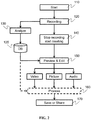
- Fig. 2 illustrates a method performed by the device 5 according to an embodiment of the invention.
- the device receives an instruction from the user (via the user interface 50) to begin recording video.
- the user touches a soft button on the screen of the smart phone.
- the camera 10 starts recording video (step 120).
- the content-analysis processor 20 processes it (step 130) to analyse its visual and/or auditory content.
- the result of the analysis is metadata about the video content, which is stored in a database 135.
- step 140 when the event that the user wished to capture has finished, the user inputs a "stop" instruction, via the user interface 50.
- the camera 50 stops recording the video and the device 5 automatically enters a media content creation mode.
- the media content creation unit 30 presents to the user a preview of the content to be created and/or allows the user to edit the video to create the content (step 150).
- the media content creation unit 30 retrieves the metadata produced by the content analysis processor 20 from the database 135. This metadata is used to select one or more items of media content, which are suggested to the user to be created.
- the media content to be created may include one or more videos, pictures, and/or audio clips.
- the user can adjust (edit) the selections suggested by the media content creation unit 30, until he/she is satisfied with the media content. Once the user is satisfied, the items of media content are created and either saved in the non-volatile storage 40 or shared (for example, by uploading to the internet).
- the content extracted from the video can also be processed by the media content creation unit 30, based on the metadata containing the results of the content-analysis. For example, if the content-analysis suggests that a segment of video was blurred, the media content creation unit 30 can process the segment to sharpen it.
- the user interface 50 may be designed in various ways.
- the button which starts recording (step 110) using the method of the invention may be presented to the user as a third option, next to buttons for selecting conventional Picture and Video modes.
- the approach used in the present invention completely supersedes these conventional capture-modes. Therefore, it is also possible that the "mode" used in the present invention is the default mode or the only mode for creating media content.
- the recording may start (step 110) as soon as the user selects a camera-application on their smartphone. Alternatively, when the user launches the camera-application, they may be presented with a single "Record" button, without any mode selection options.
- some additional desirable features of the user interface 50 may be as follows:
- a hard or soft user interface control is provided for stopping the Video recording. This preferably stops the recording and moves automatically to the media content creation phase.
- the content-analysis processor 20 determines and stores some video properties that will help later on to suggest to the user possible media content to create; to assist the user in editing the video; and/or to fix the content (for example, enhance the image quality).
- the content analysis may result in logged metrics comprising metadata. Examples of this metadata include:
- the results of the content-analysis are used to assist the user in creating the media content from the video.
- the media content creation unit 30 can make suggestions to the user by displaying the following exemplary items on the screen:
- the media content created from the video can be saved in the non-volatile storage 40 or shared with another device (step 170).
- some operations such as extracting a video segment from the video can be performed in compressed domain.
- the "save" function can be performed quickly, without the need to decode and re-encode the video.
- operations that can be performed in the compressed domain include cut or trim functionalities, and picture extraction.
- the video can be decoded, edited as desired, and then re-encoded.
- An example is zooming.
- Each frame of the content (or a sub-segment of the content) is decoded, zoomed, and then re-encoded.
- the decoding and re-encoding can be done using a hardware codec - potentially with multiple instances of the hardware codec, if capabilities allow it.
- the video can be decoded and re-encoded using a software codec on multiple CPUs of the electronic device 5.
- the camera is adapted to continuously record video and the content-analysis processor is adapted to continuously analyse the video being recorded. Therefore, there is no need for the user to start and stop the recording.
- the media content creation unit determines media content to create, in real-time, using the metadata generated by the content analysis. In this way, the need for user input is reduced or eliminated.
- Media content is created from the video whenever the media content creation unit decides that there is interesting content to extract from the video stream.
- the media content (for example, pictures, video segments, or audio clips) can be saved or shared automatically.
- Embodiments of the present invention are applicable to a wide range of electronic devices. Embodiments can be implemented with any device capable of video capture with suitable quality.
- the device should also have suitable Central Processing Unit (CPU) processing and Random Access Memory (RAM) capabilities.
- CPU Central Processing Unit
- RAM Random Access Memory
- suitable devices include but are not limited to: mobile phones; tablet computing devices; digital still cameras; and portable devices with webcams.
- portable means devices of a size and weight suitable for being carried by a human for significant periods of time.
- a computer program may be stored/distributed on a suitable medium, such as an optical storage medium or a solid-state medium supplied together with or as part of other hardware, but may also be distributed in other forms, such as via the Internet or other wired or wireless telecommunication systems. Any reference signs in the claims should not be construed as limiting the scope.
Landscapes
- Engineering & Computer Science (AREA)
- Multimedia (AREA)
- Theoretical Computer Science (AREA)
- Signal Processing (AREA)
- General Engineering & Computer Science (AREA)
- Physics & Mathematics (AREA)
- General Physics & Mathematics (AREA)
- Human Computer Interaction (AREA)
- Databases & Information Systems (AREA)
- Data Mining & Analysis (AREA)
- Television Signal Processing For Recording (AREA)
Claims (8)
- Ein Verfahren zum Erzeugen eines Medieninhaltes mittels einer persönlichen elektronischen Vorrichtung (5), so dass flüchtige Ereignisse erfasst werden können, aufweisend:kontinuierliches Aufnehmen (120) eines Videos mittels einer Kamera (10) von der persönlichen elektronischen Vorrichtung (5);während das Video aufgenommen wird, kontinuierliches Analysieren (130) des Inhaltes von dem Video mittels eines Inhalt-Analyse Prozessors (20) von der persönlichen elektronischen Vorrichtung (5), resultierend in Metadaten über dem Inhalt von dem Video; undErzeugen von Medieninhalten mittels Vorschlagens einer Auswahl von Items von dem Video, welches auf den Metadaten basiert, als Antwort auf die Ergebnisse von der Inhalt-Analyse mittels einer Medieninhalt Erzeugung (30) Einheit von der persönlichen elektronischen Vorrichtung (5);wobei der Schritt des Erzeugens des Medieninhaltes aufweist Extrahieren eines oder mehrerer Standbilder von dem Video,und wobei der Schritt des Erzeugens des Medieninhaltes semi-automatisch ist, aufweisend:Vorschlagen, zu einem Benutzer, den Medieninhalt, um darauf basierend Metadaten zu erzeugen;Empfangen von dem Benutzer eine Antwort auf den Vorschlag durch Bedienelemente in einem Benutzerinterface (50) von der persönlichen elektronischen Vorrichtung (5); undErzeugen des Medieninhaltes basierend auf der Benutzer Antwort.
- Das Verfahren gemäß Anspruch 1, wobei der Schritt des Erzeugens von dem Medieninhalt Extrahieren eines Videosegmentes von dem Video aufweist.
- Das Verfahren gemäß einem vorhergehenden Anspruch, wobei der Schritt des Erzeugens des Medieninhaltes Extrahierens eines Audioclips von dem Video aufweist.
- Das Verfahren gemäß einem vorhergehenden Anspruch, wobei die Inhalt-Analyse zumindest eines aufweist von:Detektieren eines Segmentes von dem Video, welches unscharf ist;Detektieren eines Segmentes von dem Video, welches mehr Bewegung als andere Segmente enthält;Detektieren eines Segmentes von dem Video, welches im Wesentlichen keine Bewegung enthält;Detektieren einer vordefinierten Form in einem oder mehreren Frames von dem Video;Detektieren einer fokalen Distanz von einer Szene in dem Video,Detektieren eines Audio Rauschlevels in einem Segment von dem Video;Detektieren eines lächelnden Gesichtes in einem oder mehreren Frames von dem Video;Detektieren eines Objektes, welches eine Szene in dem Video verdeckt;Detektieren eines Videosegmentes, welches vordefinierte Kamerabewegung zeigt; undDetektieren einer Veränderung in Beleuchtung zwischen zumindest zwei Frames von dem Video.
- Ein Computerprogramm, welches Computerprogramm Codemittel aufweist, welche eingerichtet sind, um all die Schritte gemäß einem vorhergehenden Anspruch auszuführen, wenn das Programm auf einem Computer ausgeführt wird.
- Eine persönliche elektronische Vorrichtung (5) betreibbar zum Erzeugen von Medieninhalt, sodass flüchtige Ereignisse erfasst werden können, wobei die Vorrichtung aufweist:eine Kamera (10) zum Aufnehmen (120) eines Videos;einen Inhalt-Analyse Prozessor (20), welcher eingerichtet ist zum kontinuierlichen Analysieren (130) des Inhaltes von dem Video, resultierend in Metadaten über dem Inhalt von dem Video, während das Video kontinuierlich aufgenommen wird; undeine Medieninhalt Erzeugungseinheit (30), welche eingerichtet ist, um Medieninhalt zu erzeugen mittels Vorschlagens einer Auswahl von Items von Videoinhalt, basierend auf den Metadaten als Antwort auf die Ergebnisse von der Inhalt-Analyse, wobei die Medieninhalt Erzeugungseinheit (30) konfiguriert ist, um eines oder mehrere Standbilder von dem Video zu extrahieren und um zu erzeugen den Medieninhalt semi-automatisch mittels Vorschlagens, zu einem Benutzer, den Medieninhalt, um darauf basierend Metadaten zu erzeugen,
Empfangen von dem Benutzer eine Antwort auf den Vorschlag durch Bedienelemente in einem Benutzerinterface (50) von der persönlichen elektronischen Vorrichtung (5) und Erzeugen des Medieninhaltes basierend auf der Benutzer Antwort. - Die Vorrichtung (5) gemäß Anspruch 6, wobei die Medieninhalt Erzeugungseinheit eingerichtet ist, um den Medieninhalt zu erzeugen mittels Extrahierens eines Audioclips von dem Video.
- Die Vorrichtung gemäß Anspruch 6 oder 7, wobei der Inhalt-Analyse Prozessor (20) eingerichtet ist, um den Inhalt von dem Video zu analysieren in zumindest einer der folgenden Art und Weise:Detektieren eines Segmentes von dem Video, welches unscharf ist;Detektieren eines Segmentes von dem Video, welches mehr Bewegung als andere Segmente enthält;Detektieren eines Segmentes von dem Video, welches im Wesentlichen keine Bewegung enthält;Detektieren einer vordefinierten Form in einem oder mehreren Frames von dem Video;Detektieren einer fokalen Distanz von einer Szene in dem Video,Detektieren eines Audio Rauschlevels in einem Segment von dem Video;Detektieren eines lächelnden Gesichtes in einem oder mehreren Frames von dem Video;Detektieren eines Objektes, welches eine Szene in dem Video verdeckt;Detektieren eines Videosegmentes, welches vordefinierte Kamerabewegung zeigt; undDetektieren einer Veränderung in Beleuchtung zwischen zumindest zwei Frames von dem Video.
Priority Applications (2)
| Application Number | Priority Date | Filing Date | Title |
|---|---|---|---|
| EP13290223.0A EP2851900B1 (de) | 2013-09-18 | 2013-09-18 | Echtzeit Medieninhalts-Analyse und semi-automatische Zusammenfassung um ein flüchtiges Ereignis zu erfassen. |
| US14/460,152 US9703461B2 (en) | 2013-09-18 | 2014-08-14 | Media content creation |
Applications Claiming Priority (1)
| Application Number | Priority Date | Filing Date | Title |
|---|---|---|---|
| EP13290223.0A EP2851900B1 (de) | 2013-09-18 | 2013-09-18 | Echtzeit Medieninhalts-Analyse und semi-automatische Zusammenfassung um ein flüchtiges Ereignis zu erfassen. |
Publications (2)
| Publication Number | Publication Date |
|---|---|
| EP2851900A1 EP2851900A1 (de) | 2015-03-25 |
| EP2851900B1 true EP2851900B1 (de) | 2017-08-23 |
Family
ID=49378196
Family Applications (1)
| Application Number | Title | Priority Date | Filing Date |
|---|---|---|---|
| EP13290223.0A Active EP2851900B1 (de) | 2013-09-18 | 2013-09-18 | Echtzeit Medieninhalts-Analyse und semi-automatische Zusammenfassung um ein flüchtiges Ereignis zu erfassen. |
Country Status (2)
| Country | Link |
|---|---|
| US (1) | US9703461B2 (de) |
| EP (1) | EP2851900B1 (de) |
Families Citing this family (9)
| Publication number | Priority date | Publication date | Assignee | Title |
|---|---|---|---|---|
| US10516893B2 (en) | 2015-02-14 | 2019-12-24 | Remote Geosystems, Inc. | Geospatial media referencing system |
| US9936214B2 (en) * | 2015-02-14 | 2018-04-03 | Remote Geosystems, Inc. | Geospatial media recording system |
| EP3094082A1 (de) * | 2015-05-13 | 2016-11-16 | AIM Sport Vision AG | Digitale überlagerung eines bildes mit einem anderen bild |
| KR20170013083A (ko) * | 2015-07-27 | 2017-02-06 | 엘지전자 주식회사 | 이동단말기 및 그 제어방법 |
| KR101832966B1 (ko) | 2015-11-10 | 2018-02-28 | 엘지전자 주식회사 | 이동 단말기 및 이의 제어방법 |
| US10262208B2 (en) * | 2016-09-23 | 2019-04-16 | Microsoft Technology Licensing, Llc | Automatic selection of cinemagraphs |
| WO2018071562A1 (en) * | 2016-10-12 | 2018-04-19 | Viar Inc | Virtual/augmented reality content management system |
| EP3622513B1 (de) * | 2017-10-03 | 2025-09-03 | Google LLC | Mikrovideosystem, format, und erzeugungsmethode |
| CN115525188A (zh) * | 2022-02-28 | 2022-12-27 | 荣耀终端有限公司 | 拍摄方法和电子设备 |
Citations (2)
| Publication number | Priority date | Publication date | Assignee | Title |
|---|---|---|---|---|
| US6424795B1 (en) * | 1999-07-05 | 2002-07-23 | Hitachi, Ltd. | Method and apparatus for recording and reproducing video data, and recording medium |
| US20030202777A1 (en) * | 2002-04-26 | 2003-10-30 | Canon Kabushiki Kaisha | Recording apparatus capable of recording moving image and still image |
Family Cites Families (19)
| Publication number | Priority date | Publication date | Assignee | Title |
|---|---|---|---|---|
| US6665342B1 (en) * | 1999-07-02 | 2003-12-16 | International Business Machines Corporation | System and method for producing a still image representation of a motion video |
| US6549643B1 (en) * | 1999-11-30 | 2003-04-15 | Siemens Corporate Research, Inc. | System and method for selecting key-frames of video data |
| US20050259958A1 (en) * | 2001-06-22 | 2005-11-24 | Ivan Johansson | Automatic indexing of digital video recordings |
| JP2003061038A (ja) * | 2001-08-20 | 2003-02-28 | Univ Waseda | 映像コンテンツ編集支援装置および映像コンテンツ編集支援方法 |
| US8238718B2 (en) * | 2002-06-19 | 2012-08-07 | Microsoft Corporaton | System and method for automatically generating video cliplets from digital video |
| AU2003278558A1 (en) * | 2002-11-08 | 2004-06-07 | Aliope Limited | Multimedia management |
| US7675550B1 (en) | 2006-04-28 | 2010-03-09 | Ambarella, Inc. | Camera with high-quality still capture during continuous video capture |
| GB0907870D0 (en) * | 2009-05-07 | 2009-06-24 | Univ Catholique Louvain | Systems and methods for the autonomous production of videos from multi-sensored data |
| US8692913B2 (en) * | 2010-03-16 | 2014-04-08 | Fujifilm Corporation | Solid-state electronic image sensing apparatus and method of controlling operation of same |
| JP5389724B2 (ja) | 2010-03-31 | 2014-01-15 | 富士フイルム株式会社 | 画像処理装置、画像処理方法およびプログラム |
| JP2012015830A (ja) | 2010-07-01 | 2012-01-19 | Nikon Corp | カメラ |
| US20120148216A1 (en) * | 2010-12-14 | 2012-06-14 | Qualcomm Incorporated | Self-editing video recording |
| KR101721226B1 (ko) | 2010-12-23 | 2017-04-10 | 삼성전자주식회사 | 사용자가 원하는 시점의 정지 영상을 획득할 수 있는 디지털 영상 신호 처리 장치 및 이의 제어 방법 |
| US8611601B2 (en) | 2011-03-08 | 2013-12-17 | Bank Of America Corporation | Dynamically indentifying individuals from a captured image |
| US9117483B2 (en) * | 2011-06-03 | 2015-08-25 | Michael Edward Zaletel | Method and apparatus for dynamically recording, editing and combining multiple live video clips and still photographs into a finished composition |
| US9286641B2 (en) * | 2011-10-19 | 2016-03-15 | Facebook, Inc. | Automatic photo capture based on social components and identity recognition |
| WO2013133905A1 (en) | 2012-03-06 | 2013-09-12 | Apple Inc. | Color adjustors for color segments |
| US8428453B1 (en) | 2012-08-08 | 2013-04-23 | Snapchat, Inc. | Single mode visual media capture |
| US10154177B2 (en) * | 2012-10-04 | 2018-12-11 | Cognex Corporation | Symbology reader with multi-core processor |
-
2013
- 2013-09-18 EP EP13290223.0A patent/EP2851900B1/de active Active
-
2014
- 2014-08-14 US US14/460,152 patent/US9703461B2/en active Active
Patent Citations (2)
| Publication number | Priority date | Publication date | Assignee | Title |
|---|---|---|---|---|
| US6424795B1 (en) * | 1999-07-05 | 2002-07-23 | Hitachi, Ltd. | Method and apparatus for recording and reproducing video data, and recording medium |
| US20030202777A1 (en) * | 2002-04-26 | 2003-10-30 | Canon Kabushiki Kaisha | Recording apparatus capable of recording moving image and still image |
Non-Patent Citations (1)
| Title |
|---|
| EBRAHIMI T ET AL: "MPEG-7 camera", PROCEEDINGS 2001 INTERNATIONAL CONFERENCE ON IMAGE PROCESSING. ICIP 2001 - THESSALONIKI, GREECE, OCT. 7 - 10, 2001; [INTERNATIONAL CONFERENCE ON IMAGE PROCESSING], INSTITUTE OF ELECTRICAL AND ELECTRONICS ENGINEERS, NEW YORK, NY, vol. 3, 7 October 2001 (2001-10-07), pages 600 - 603, XP010563421, ISBN: 978-0-7803-6725-8, DOI: 10.1109/ICIP.2001.958190 * |
Also Published As
| Publication number | Publication date |
|---|---|
| EP2851900A1 (de) | 2015-03-25 |
| US9703461B2 (en) | 2017-07-11 |
| US20150082168A1 (en) | 2015-03-19 |
Similar Documents
| Publication | Publication Date | Title |
|---|---|---|
| US9703461B2 (en) | Media content creation | |
| EP2710594B1 (de) | Videozusammenfassung mit einer bestimmten eigenschaft | |
| JP5877895B2 (ja) | 所定の人間を含むビデオサマリー | |
| US20200351466A1 (en) | Low Power Framework for Controlling Image Sensor Mode in a Mobile Image Capture Device | |
| JP5568178B2 (ja) | ビデオの要約方法 | |
| US20070081796A1 (en) | Image capture method and device | |
| JP6175518B2 (ja) | 自動ビデオセグメント化のための方法および装置 | |
| CN112136309B (zh) | 用移动图像捕获设备执行倒回操作的系统和方法 | |
| WO2015038342A1 (en) | Interactive ordered list of dynamic video abstracts as thumbnails with associated hypermedia links | |
| JP5837922B2 (ja) | カメラ位置に基づくキービデオフレームのランク付け | |
| JP2016517195A (ja) | リスト駆動選択プロセスを利用してビデオ及びメディアの時系列的編集を改善する方法及び装置 | |
| US20110292245A1 (en) | Video capture system producing a video summary | |
| US20160227134A1 (en) | Method and apparatus for color detection to generate text color | |
| JP2002176613A (ja) | 動画像編集装置、動画像編集方法および記録媒体 | |
| KR20150083491A (ko) | 단말과 서버간의 정보 동기화 방법 및 시스템 | |
| US9407825B2 (en) | Imaging apparatus, image processing apparatus, image processing method, and storage medium | |
| US20120219264A1 (en) | Image processing device | |
| CN107483838A (zh) | 基于前后摄像头的拍摄方法、装置、设备及介质 | |
| CN109474782B (zh) | 用于数据编辑的接口装置、数据编辑方法、记录介质 | |
| CN119182976A (zh) | 多媒体文件处理方法、装置 | |
| JP5304833B2 (ja) | 撮像装置、撮像制御方法及びプログラム | |
| HK1190545A (en) | Video summary including a particular person |
Legal Events
| Date | Code | Title | Description |
|---|---|---|---|
| PUAI | Public reference made under article 153(3) epc to a published international application that has entered the european phase |
Free format text: ORIGINAL CODE: 0009012 |
|
| 17P | Request for examination filed |
Effective date: 20140326 |
|
| AK | Designated contracting states |
Kind code of ref document: A1 Designated state(s): AL AT BE BG CH CY CZ DE DK EE ES FI FR GB GR HR HU IE IS IT LI LT LU LV MC MK MT NL NO PL PT RO RS SE SI SK SM TR |
|
| AX | Request for extension of the european patent |
Extension state: BA ME |
|
| RBV | Designated contracting states (corrected) |
Designated state(s): AL AT BE BG CH CY CZ DE DK EE ES FI FR GB GR HR HU IE IS IT LI LT LU LV MC MK MT NL NO PL PT RO RS SE SI SK SM TR |
|
| 17Q | First examination report despatched |
Effective date: 20151109 |
|
| RIC1 | Information provided on ipc code assigned before grant |
Ipc: H04N 21/83 20110101ALN20160811BHEP Ipc: G06K 9/00 20060101ALI20160811BHEP Ipc: G11B 27/034 20060101AFI20160811BHEP |
|
| RIC1 | Information provided on ipc code assigned before grant |
Ipc: H04N 21/83 20110101ALN20160818BHEP Ipc: G11B 27/034 20060101AFI20160818BHEP Ipc: G06K 9/00 20060101ALI20160818BHEP |
|
| STAA | Information on the status of an ep patent application or granted ep patent |
Free format text: STATUS: EXAMINATION IS IN PROGRESS |
|
| RIC1 | Information provided on ipc code assigned before grant |
Ipc: H04N 21/21 20110101ALN20170403BHEP Ipc: H04N 5/222 20060101ALN20170403BHEP Ipc: H04N 21/83 20110101ALN20170403BHEP Ipc: H04N 21/234 20110101ALI20170403BHEP Ipc: G06K 9/00 20060101ALI20170403BHEP Ipc: G11B 27/34 20060101ALN20170403BHEP Ipc: G11B 27/034 20060101AFI20170403BHEP Ipc: G06F 17/30 20060101ALN20170403BHEP Ipc: G11B 27/10 20060101ALN20170403BHEP Ipc: G06F 3/048 20130101ALN20170403BHEP |
|
| GRAP | Despatch of communication of intention to grant a patent |
Free format text: ORIGINAL CODE: EPIDOSNIGR1 |
|
| STAA | Information on the status of an ep patent application or granted ep patent |
Free format text: STATUS: GRANT OF PATENT IS INTENDED |
|
| INTG | Intention to grant announced |
Effective date: 20170515 |
|
| GRAS | Grant fee paid |
Free format text: ORIGINAL CODE: EPIDOSNIGR3 |
|
| GRAA | (expected) grant |
Free format text: ORIGINAL CODE: 0009210 |
|
| STAA | Information on the status of an ep patent application or granted ep patent |
Free format text: STATUS: THE PATENT HAS BEEN GRANTED |
|
| AK | Designated contracting states |
Kind code of ref document: B1 Designated state(s): AL AT BE BG CH CY CZ DE DK EE ES FI FR GB GR HR HU IE IS IT LI LT LU LV MC MK MT NL NO PL PT RO RS SE SI SK SM TR |
|
| REG | Reference to a national code |
Ref country code: GB Ref legal event code: FG4D |
|
| REG | Reference to a national code |
Ref country code: CH Ref legal event code: EP |
|
| REG | Reference to a national code |
Ref country code: AT Ref legal event code: REF Ref document number: 922143 Country of ref document: AT Kind code of ref document: T Effective date: 20170915 |
|
| REG | Reference to a national code |
Ref country code: IE Ref legal event code: FG4D |
|
| REG | Reference to a national code |
Ref country code: DE Ref legal event code: R096 Ref document number: 602013025388 Country of ref document: DE |
|
| REG | Reference to a national code |
Ref country code: NL Ref legal event code: MP Effective date: 20170823 |
|
| REG | Reference to a national code |
Ref country code: LT Ref legal event code: MG4D |
|
| REG | Reference to a national code |
Ref country code: AT Ref legal event code: MK05 Ref document number: 922143 Country of ref document: AT Kind code of ref document: T Effective date: 20170823 |
|
| PG25 | Lapsed in a contracting state [announced via postgrant information from national office to epo] |
Ref country code: FI Free format text: LAPSE BECAUSE OF FAILURE TO SUBMIT A TRANSLATION OF THE DESCRIPTION OR TO PAY THE FEE WITHIN THE PRESCRIBED TIME-LIMIT Effective date: 20170823 Ref country code: NO Free format text: LAPSE BECAUSE OF FAILURE TO SUBMIT A TRANSLATION OF THE DESCRIPTION OR TO PAY THE FEE WITHIN THE PRESCRIBED TIME-LIMIT Effective date: 20171123 Ref country code: HR Free format text: LAPSE BECAUSE OF FAILURE TO SUBMIT A TRANSLATION OF THE DESCRIPTION OR TO PAY THE FEE WITHIN THE PRESCRIBED TIME-LIMIT Effective date: 20170823 Ref country code: NL Free format text: LAPSE BECAUSE OF FAILURE TO SUBMIT A TRANSLATION OF THE DESCRIPTION OR TO PAY THE FEE WITHIN THE PRESCRIBED TIME-LIMIT Effective date: 20170823 Ref country code: SE Free format text: LAPSE BECAUSE OF FAILURE TO SUBMIT A TRANSLATION OF THE DESCRIPTION OR TO PAY THE FEE WITHIN THE PRESCRIBED TIME-LIMIT Effective date: 20170823 Ref country code: LT Free format text: LAPSE BECAUSE OF FAILURE TO SUBMIT A TRANSLATION OF THE DESCRIPTION OR TO PAY THE FEE WITHIN THE PRESCRIBED TIME-LIMIT Effective date: 20170823 Ref country code: AT Free format text: LAPSE BECAUSE OF FAILURE TO SUBMIT A TRANSLATION OF THE DESCRIPTION OR TO PAY THE FEE WITHIN THE PRESCRIBED TIME-LIMIT Effective date: 20170823 |
|
| PG25 | Lapsed in a contracting state [announced via postgrant information from national office to epo] |
Ref country code: RS Free format text: LAPSE BECAUSE OF FAILURE TO SUBMIT A TRANSLATION OF THE DESCRIPTION OR TO PAY THE FEE WITHIN THE PRESCRIBED TIME-LIMIT Effective date: 20170823 Ref country code: BG Free format text: LAPSE BECAUSE OF FAILURE TO SUBMIT A TRANSLATION OF THE DESCRIPTION OR TO PAY THE FEE WITHIN THE PRESCRIBED TIME-LIMIT Effective date: 20171123 Ref country code: GR Free format text: LAPSE BECAUSE OF FAILURE TO SUBMIT A TRANSLATION OF THE DESCRIPTION OR TO PAY THE FEE WITHIN THE PRESCRIBED TIME-LIMIT Effective date: 20171124 Ref country code: PL Free format text: LAPSE BECAUSE OF FAILURE TO SUBMIT A TRANSLATION OF THE DESCRIPTION OR TO PAY THE FEE WITHIN THE PRESCRIBED TIME-LIMIT Effective date: 20170823 Ref country code: LV Free format text: LAPSE BECAUSE OF FAILURE TO SUBMIT A TRANSLATION OF THE DESCRIPTION OR TO PAY THE FEE WITHIN THE PRESCRIBED TIME-LIMIT Effective date: 20170823 Ref country code: ES Free format text: LAPSE BECAUSE OF FAILURE TO SUBMIT A TRANSLATION OF THE DESCRIPTION OR TO PAY THE FEE WITHIN THE PRESCRIBED TIME-LIMIT Effective date: 20170823 Ref country code: IS Free format text: LAPSE BECAUSE OF FAILURE TO SUBMIT A TRANSLATION OF THE DESCRIPTION OR TO PAY THE FEE WITHIN THE PRESCRIBED TIME-LIMIT Effective date: 20171223 |
|
| PG25 | Lapsed in a contracting state [announced via postgrant information from national office to epo] |
Ref country code: DK Free format text: LAPSE BECAUSE OF FAILURE TO SUBMIT A TRANSLATION OF THE DESCRIPTION OR TO PAY THE FEE WITHIN THE PRESCRIBED TIME-LIMIT Effective date: 20170823 Ref country code: CZ Free format text: LAPSE BECAUSE OF FAILURE TO SUBMIT A TRANSLATION OF THE DESCRIPTION OR TO PAY THE FEE WITHIN THE PRESCRIBED TIME-LIMIT Effective date: 20170823 Ref country code: RO Free format text: LAPSE BECAUSE OF FAILURE TO SUBMIT A TRANSLATION OF THE DESCRIPTION OR TO PAY THE FEE WITHIN THE PRESCRIBED TIME-LIMIT Effective date: 20170823 |
|
| REG | Reference to a national code |
Ref country code: CH Ref legal event code: PL |
|
| REG | Reference to a national code |
Ref country code: DE Ref legal event code: R097 Ref document number: 602013025388 Country of ref document: DE |
|
| PG25 | Lapsed in a contracting state [announced via postgrant information from national office to epo] |
Ref country code: SK Free format text: LAPSE BECAUSE OF FAILURE TO SUBMIT A TRANSLATION OF THE DESCRIPTION OR TO PAY THE FEE WITHIN THE PRESCRIBED TIME-LIMIT Effective date: 20170823 Ref country code: SM Free format text: LAPSE BECAUSE OF FAILURE TO SUBMIT A TRANSLATION OF THE DESCRIPTION OR TO PAY THE FEE WITHIN THE PRESCRIBED TIME-LIMIT Effective date: 20170823 Ref country code: MC Free format text: LAPSE BECAUSE OF FAILURE TO SUBMIT A TRANSLATION OF THE DESCRIPTION OR TO PAY THE FEE WITHIN THE PRESCRIBED TIME-LIMIT Effective date: 20170823 Ref country code: EE Free format text: LAPSE BECAUSE OF FAILURE TO SUBMIT A TRANSLATION OF THE DESCRIPTION OR TO PAY THE FEE WITHIN THE PRESCRIBED TIME-LIMIT Effective date: 20170823 Ref country code: IT Free format text: LAPSE BECAUSE OF FAILURE TO SUBMIT A TRANSLATION OF THE DESCRIPTION OR TO PAY THE FEE WITHIN THE PRESCRIBED TIME-LIMIT Effective date: 20170823 |
|
| REG | Reference to a national code |
Ref country code: IE Ref legal event code: MM4A |
|
| REG | Reference to a national code |
Ref country code: BE Ref legal event code: MM Effective date: 20170930 |
|
| PG25 | Lapsed in a contracting state [announced via postgrant information from national office to epo] |
Ref country code: LU Free format text: LAPSE BECAUSE OF NON-PAYMENT OF DUE FEES Effective date: 20170918 |
|
| PLBE | No opposition filed within time limit |
Free format text: ORIGINAL CODE: 0009261 |
|
| REG | Reference to a national code |
Ref country code: FR Ref legal event code: ST Effective date: 20180531 |
|
| STAA | Information on the status of an ep patent application or granted ep patent |
Free format text: STATUS: NO OPPOSITION FILED WITHIN TIME LIMIT |
|
| GBPC | Gb: european patent ceased through non-payment of renewal fee |
Effective date: 20171123 |
|
| PG25 | Lapsed in a contracting state [announced via postgrant information from national office to epo] |
Ref country code: LI Free format text: LAPSE BECAUSE OF NON-PAYMENT OF DUE FEES Effective date: 20170930 Ref country code: IE Free format text: LAPSE BECAUSE OF NON-PAYMENT OF DUE FEES Effective date: 20170918 Ref country code: CH Free format text: LAPSE BECAUSE OF NON-PAYMENT OF DUE FEES Effective date: 20170930 |
|
| 26N | No opposition filed |
Effective date: 20180524 |
|
| PG25 | Lapsed in a contracting state [announced via postgrant information from national office to epo] |
Ref country code: FR Free format text: LAPSE BECAUSE OF NON-PAYMENT OF DUE FEES Effective date: 20171023 Ref country code: SI Free format text: LAPSE BECAUSE OF FAILURE TO SUBMIT A TRANSLATION OF THE DESCRIPTION OR TO PAY THE FEE WITHIN THE PRESCRIBED TIME-LIMIT Effective date: 20170823 Ref country code: BE Free format text: LAPSE BECAUSE OF NON-PAYMENT OF DUE FEES Effective date: 20170930 |
|
| PG25 | Lapsed in a contracting state [announced via postgrant information from national office to epo] |
Ref country code: MT Free format text: LAPSE BECAUSE OF NON-PAYMENT OF DUE FEES Effective date: 20170918 |
|
| PG25 | Lapsed in a contracting state [announced via postgrant information from national office to epo] |
Ref country code: GB Free format text: LAPSE BECAUSE OF NON-PAYMENT OF DUE FEES Effective date: 20171123 |
|
| PG25 | Lapsed in a contracting state [announced via postgrant information from national office to epo] |
Ref country code: HU Free format text: LAPSE BECAUSE OF FAILURE TO SUBMIT A TRANSLATION OF THE DESCRIPTION OR TO PAY THE FEE WITHIN THE PRESCRIBED TIME-LIMIT; INVALID AB INITIO Effective date: 20130918 |
|
| PG25 | Lapsed in a contracting state [announced via postgrant information from national office to epo] |
Ref country code: CY Free format text: LAPSE BECAUSE OF FAILURE TO SUBMIT A TRANSLATION OF THE DESCRIPTION OR TO PAY THE FEE WITHIN THE PRESCRIBED TIME-LIMIT Effective date: 20170823 |
|
| PG25 | Lapsed in a contracting state [announced via postgrant information from national office to epo] |
Ref country code: MK Free format text: LAPSE BECAUSE OF FAILURE TO SUBMIT A TRANSLATION OF THE DESCRIPTION OR TO PAY THE FEE WITHIN THE PRESCRIBED TIME-LIMIT Effective date: 20170823 |
|
| PG25 | Lapsed in a contracting state [announced via postgrant information from national office to epo] |
Ref country code: TR Free format text: LAPSE BECAUSE OF FAILURE TO SUBMIT A TRANSLATION OF THE DESCRIPTION OR TO PAY THE FEE WITHIN THE PRESCRIBED TIME-LIMIT Effective date: 20170823 |
|
| PG25 | Lapsed in a contracting state [announced via postgrant information from national office to epo] |
Ref country code: PT Free format text: LAPSE BECAUSE OF FAILURE TO SUBMIT A TRANSLATION OF THE DESCRIPTION OR TO PAY THE FEE WITHIN THE PRESCRIBED TIME-LIMIT Effective date: 20170823 |
|
| PG25 | Lapsed in a contracting state [announced via postgrant information from national office to epo] |
Ref country code: AL Free format text: LAPSE BECAUSE OF FAILURE TO SUBMIT A TRANSLATION OF THE DESCRIPTION OR TO PAY THE FEE WITHIN THE PRESCRIBED TIME-LIMIT Effective date: 20170823 |
|
| REG | Reference to a national code |
Ref country code: DE Ref legal event code: R081 Ref document number: 602013025388 Country of ref document: DE Owner name: GOODIX TECHNOLOGY (HK) COMPANY LIMITED, CN Free format text: FORMER OWNER: NXP B.V., EINDHOVEN, NL |
|
| PGFP | Annual fee paid to national office [announced via postgrant information from national office to epo] |
Ref country code: DE Payment date: 20250902 Year of fee payment: 13 |