EP2421960B1 - Zellen und verfahren zur herstellung von aceton - Google Patents
Zellen und verfahren zur herstellung von aceton Download PDFInfo
- Publication number
- EP2421960B1 EP2421960B1 EP10704577.5A EP10704577A EP2421960B1 EP 2421960 B1 EP2421960 B1 EP 2421960B1 EP 10704577 A EP10704577 A EP 10704577A EP 2421960 B1 EP2421960 B1 EP 2421960B1
- Authority
- EP
- European Patent Office
- Prior art keywords
- acetone
- cell
- enzyme
- adc
- thla
- Prior art date
- Legal status (The legal status is an assumption and is not a legal conclusion. Google has not performed a legal analysis and makes no representation as to the accuracy of the status listed.)
- Active
Links
Images
Classifications
-
- C—CHEMISTRY; METALLURGY
- C12—BIOCHEMISTRY; BEER; SPIRITS; WINE; VINEGAR; MICROBIOLOGY; ENZYMOLOGY; MUTATION OR GENETIC ENGINEERING
- C12N—MICROORGANISMS OR ENZYMES; COMPOSITIONS THEREOF; PROPAGATING, PRESERVING, OR MAINTAINING MICROORGANISMS; MUTATION OR GENETIC ENGINEERING; CULTURE MEDIA
- C12N9/00—Enzymes; Proenzymes; Compositions thereof; Processes for preparing, activating, inhibiting, separating or purifying enzymes
- C12N9/10—Transferases (2.)
- C12N9/13—Transferases (2.) transferring sulfur containing groups (2.8)
-
- C—CHEMISTRY; METALLURGY
- C12—BIOCHEMISTRY; BEER; SPIRITS; WINE; VINEGAR; MICROBIOLOGY; ENZYMOLOGY; MUTATION OR GENETIC ENGINEERING
- C12N—MICROORGANISMS OR ENZYMES; COMPOSITIONS THEREOF; PROPAGATING, PRESERVING, OR MAINTAINING MICROORGANISMS; MUTATION OR GENETIC ENGINEERING; CULTURE MEDIA
- C12N9/00—Enzymes; Proenzymes; Compositions thereof; Processes for preparing, activating, inhibiting, separating or purifying enzymes
- C12N9/10—Transferases (2.)
- C12N9/1025—Acyltransferases (2.3)
- C12N9/1029—Acyltransferases (2.3) transferring groups other than amino-acyl groups (2.3.1)
-
- C—CHEMISTRY; METALLURGY
- C12—BIOCHEMISTRY; BEER; SPIRITS; WINE; VINEGAR; MICROBIOLOGY; ENZYMOLOGY; MUTATION OR GENETIC ENGINEERING
- C12N—MICROORGANISMS OR ENZYMES; COMPOSITIONS THEREOF; PROPAGATING, PRESERVING, OR MAINTAINING MICROORGANISMS; MUTATION OR GENETIC ENGINEERING; CULTURE MEDIA
- C12N9/00—Enzymes; Proenzymes; Compositions thereof; Processes for preparing, activating, inhibiting, separating or purifying enzymes
- C12N9/14—Hydrolases (3)
- C12N9/16—Hydrolases (3) acting on ester bonds (3.1)
-
- C—CHEMISTRY; METALLURGY
- C12—BIOCHEMISTRY; BEER; SPIRITS; WINE; VINEGAR; MICROBIOLOGY; ENZYMOLOGY; MUTATION OR GENETIC ENGINEERING
- C12N—MICROORGANISMS OR ENZYMES; COMPOSITIONS THEREOF; PROPAGATING, PRESERVING, OR MAINTAINING MICROORGANISMS; MUTATION OR GENETIC ENGINEERING; CULTURE MEDIA
- C12N9/00—Enzymes; Proenzymes; Compositions thereof; Processes for preparing, activating, inhibiting, separating or purifying enzymes
- C12N9/88—Lyases (4.)
-
- C—CHEMISTRY; METALLURGY
- C12—BIOCHEMISTRY; BEER; SPIRITS; WINE; VINEGAR; MICROBIOLOGY; ENZYMOLOGY; MUTATION OR GENETIC ENGINEERING
- C12P—FERMENTATION OR ENZYME-USING PROCESSES TO SYNTHESISE A DESIRED CHEMICAL COMPOUND OR COMPOSITION OR TO SEPARATE OPTICAL ISOMERS FROM A RACEMIC MIXTURE
- C12P7/00—Preparation of oxygen-containing organic compounds
- C12P7/24—Preparation of oxygen-containing organic compounds containing a carbonyl group
- C12P7/26—Ketones
- C12P7/28—Acetone-containing products
- C12P7/30—Acetone-containing products produced from substrate containing inorganic compounds other than water
-
- C—CHEMISTRY; METALLURGY
- C12—BIOCHEMISTRY; BEER; SPIRITS; WINE; VINEGAR; MICROBIOLOGY; ENZYMOLOGY; MUTATION OR GENETIC ENGINEERING
- C12Y—ENZYMES
- C12Y203/00—Acyltransferases (2.3)
- C12Y203/01—Acyltransferases (2.3) transferring groups other than amino-acyl groups (2.3.1)
- C12Y203/01009—Acetyl-CoA C-acetyltransferase (2.3.1.9)
-
- Y—GENERAL TAGGING OF NEW TECHNOLOGICAL DEVELOPMENTS; GENERAL TAGGING OF CROSS-SECTIONAL TECHNOLOGIES SPANNING OVER SEVERAL SECTIONS OF THE IPC; TECHNICAL SUBJECTS COVERED BY FORMER USPC CROSS-REFERENCE ART COLLECTIONS [XRACs] AND DIGESTS
- Y02—TECHNOLOGIES OR APPLICATIONS FOR MITIGATION OR ADAPTATION AGAINST CLIMATE CHANGE
- Y02P—CLIMATE CHANGE MITIGATION TECHNOLOGIES IN THE PRODUCTION OR PROCESSING OF GOODS
- Y02P20/00—Technologies relating to chemical industry
- Y02P20/50—Improvements relating to the production of bulk chemicals
- Y02P20/52—Improvements relating to the production of bulk chemicals using catalysts, e.g. selective catalysts
Definitions
- the invention relates to a process for acetone production.
- Clostridium acetobutylicum and Clostridium beijerinckii Both are Gram-positive and multiply under strictly anaerobic conditions. These organisms can convert mono-, di- and polysaccharides, the substrates used mainly in the fermentation being molasses and starch.
- the fermentation process with C. acetobutylicum is divided into two phases.
- biomass formation is associated with the formation of acetate, butyrate and traces of ethanol (acidogenic phase).
- Solventogenic Phase the acids are then used to form the fermentation products acetone, butanol and ethanol (ABE).
- the products acetone, butanol and ethanol are formed in the wild type C. acetobutylicum in a ratio of approximately 3: 6: 1. This product ratio can vary widely depending on the chosen culture conditions (eg pH or nutrient delivery) or substrates used.
- acetobutylicum is also available ( Noelling, J., Breton, G., Omelchenko, MV & 16 other authors (2001). Genome sequence and comparative analysis of the solvent-producing bacterium Clostridium acetobutylicum. J Bacteriol 183, 4823-4838 .).
- Clostridium acetobutylicum strains have already been generated in which the acetone production is decoupled from butanol and ethanol production, so that these strains produce only acetone ( Mermelstein et al. (1993). Metabolic engineering of Clostridium acetobutylicum ATCC824 for enhanced production of acetone by enzymes. Biotech. Bioeng. 42: 1053-1060 . Nair, RV, and Papoutsakis, ET 1994). The measured titers for acetone were generally below the concentrations of those in the wild type.
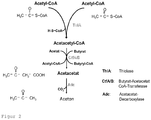
- FIG. 2 is the classic Clostridium- characterized metabolic pathway for acetone synthesis. This pathway starts from acetyl-CoA, a central metabolite that is formed in all microorganisms, regardless of which C source is metabolized or which metabolic pathways are established. Enzymes that are needed are: the ⁇ -ketothiolase, the two subunits of acetyl-CoA / butyryl-CoA transferase, and the acetoacetate decarboxylase.
- Acetogenic cells therefore cells that are capable of forming acetate by anaerobic respiration, are known.
- the acetogenic bacteria include, for example, species of the genus Acetobacterium such as A. woodii and Clostridium aceticum.
- the WO0068407 describes the use of acetogenic bacteria for the production of ethanol.
- C. aceticum and C. carboxidivorans have not yet published a genome sequence.
- C. aceticum additionally carries a plasmid (5.6 kbp, Lee et al., 1987).
- plasmid 5.6 kbp, Lee et al., 1987.
- the group of acetogenic bacteria belongs to the anaerobic prokaryotes, which can use CO2 as a terminal electron acceptor and thereby form acetate.
- 21 different genera are counted among the acetogens (Drake et al ., 2006), including some clostridia (Drake & kusel, 2005).
- You are able to use carbon dioxide plus hydrogen or also to use carbon monoxide as a carbon and energy source (Wood, 1991).
- alcohols, aldehydes, carboxylic acids and numerous hexoses can be used as a carbon source (Drake et al., 2004).
- the reductive pathway that leads to the formation of acetate is referred to as the acetyl-CoA or Wood-Ljungdahl pathway.
- the object of the invention was to provide a process with which acetone can be prepared from ubiquitously available carbon sources.
- the present invention is a process for the preparation of acetone as described in claim 1.
- An advantage of the invention is that the cells can be cultivated anaerobically and thus energetically particularly favorably.
- Another advantage of the invention is that the cells according to the invention contribute to a reduction of climate-damaging carbon dioxide.
- Another advantage of cells according to the invention is an increase in yield due to acetone production from carbon dioxide and hydrogen.
- the present invention is an acetogenic cell capable of forming acetone.
- acetogenic cell in the context of the present invention is meant cells which are capable of forming acetate by anaerobic respiration.
- the acetogenic cell is preferably an isolated cell, in particular a genetically modified cell. According to the invention, preference is given to a cell which is able to form acetone from at least one carbon source selected from the group comprising carbon dioxide and carbon monoxide. Particularly preferably, the acetogenic cell according to the invention is capable of forming acetone from carbon monoxide and carbon dioxide as sole carbon source.
- the acetogenic cell has been genetically engineered with respect to its wild type such that it is capable of producing more acetone compared to its wild-type.
- phrase "that it is capable of producing more acetone compared to its wild type” also refers to the case that the wild-type of the genetically engineered cell is unable to form acetone, or at least no detectable amounts of this compound, and detectable only after the genetic modification Quantities of this component can be formed.
- acetogenic cell in the context of the present invention is meant cells which are capable of forming acetate by anaerobic respiration. All percentages are by weight unless otherwise specified.
- the acetogenic cell is preferably an isolated cell, in particular a genetically modified cell.
- the cell is one which is capable of forming acetone from at least one carbon source selected from the group comprising carbon dioxide and carbon monoxide.
- the acetogenic cell according to the invention is capable of forming acetone from carbon monoxide and carbon dioxide as sole carbon source.
- acetogenic cell has been genetically engineered compared to its wild type in such a way that it is able to form more acetone compared to its wild type.
- phrase "that it is capable of producing more acetone compared to its wild type” also refers to the case that the wild-type of the genetically engineered cell is unable to form acetone, or at least no detectable amounts of this compound, and detectable only after the genetic modification Quantities of this component can be formed.
- a wild type of a cell is preferably referred to as a cell whose genome is in a state such as naturally originated by evolution. The term is used for both the entire cell and for individual genes. The term “wild-type” therefore does not include, in particular, those cells or genes whose gene sequences have been altered at least in part by humans by means of recombinant methods.
- These cells are genetically engineered to produce more acetone from a carbon source compared to their wild-type.
- the acetogenic cell is genetically engineered such that it is at least 2 times, more preferably at least 2 times, more preferably within 8 hours and most preferably within 24 hours within a defined time interval More preferably at least 100 times, more preferably at least 1,000 times, and most preferably at least 10,000 times more acetone than the wild type of the cell.
- the increase in product formation can be determined, for example, by culturing the cell according to the invention and the wild-type cell separately under the same conditions (same cell density, same nutrient medium, same culture conditions) for a specific time interval in a suitable nutrient medium and then the amount Target product (acetone) is determined in the nutrient medium.
- an increased activity of an enzyme E x which is increased in comparison with its wild type, is preferably always a factor greater than or equal to at least 2, particularly preferably at least 10, more preferably at least 100, moreover even more preferably at least 1,000 and most preferably at least 10,000 increased activity of the respective enzyme E x .
- the cell according to the invention which "has an increased compared to their wild type activity of an enzyme E x ", in particular a cell whose wild type has no or at least no detectable activity of this enzyme E x and which only after increasing the enzyme activity, for example by overexpression, a detectable activity of this enzyme E x shows.
- the term "overexpression” or the expression “increase in expression” used in the following also encompasses the case that a starting cell, for example a wild-type cell, has no or at least no detectable expression and only by recombinant methods a detectable Expression of the enzyme E x is induced.
- particularly preferred cells are those in which the activity of the following enzyme or of the following enzymes is increased: E 1 , E 2 , E 3 , E 1 + E 2 , E 1 + E 3 , E 2 + E 3 , E 1 + E 2 + E 3 , wherein E 1 + E 2 + E 3 is particularly preferred.
- the enzyme E 1 is an acetyl-CoA-C-acetyltransferase (EC 2.3.1.9); the enzyme E 2 is a butyrate-acetoacetate-CoA transferase (EC 2.8.3.9) or an acyl-CoA hydrolase (EC 3.1.2.20); the enzyme E 3 is an acetoacetate decarboxylase (EC 4.1.1.4); Particularly preferred enzyme used as enzyme E 1 is thlA from Clostridium acetobutylicum.
- Butyrate-acetoacetate-CoA transferase used particularly preferably as enzyme E 2 are ctfA and ctfB from Clostridium acetobutylicum and atoD and atoA from Escherichia coli.
- Particularly preferably used as the enzyme E 2 acyl-CoA hydrolase are TEII from B. subtilis or ybgC from Heamophilus influenzae.
- Particularly preferred enzyme used as enzyme E 3 is adc from Clostridium acetobutylicum.
- the acetogenic cell according to the invention is preferably a microorganism, preferably a bacterium and particularly preferably an anaerobic bacterium, in particular a rod-shaped, gram-positive bacterium.
- acetogenic cells selected from the group comprising Thermoanaerobacter kivui, Acetobacterium woodii, Acetoanaerobium notera, Clostridium aceticum, Butyribacterium methylotrophicum, Moorella thermoacetica , Eubacterium limosum, Peptostreptococcus productus, Clostridium ljungdahlii and Clostridium carboxivivorans.
- a particularly suitable bacterium is Clostridium carboxidivorans, in particular such strains as "P7" and "P11". Such cells are for example in US 2007/0275447 and US 2008/0057554 described.
- Clostridium ljungdahlii is Clostridium ljungdahlii, especially strains selected from the group comprising Clostridium ljungdahlii PETC, Clostridium ljungdahlii ERI2, Clostridium ljungdahlii C01 and Clostridium ljungdahlii O-52 and are used in the WO 98/00558 and WO 00/68407 described.
- the acetogenic cell according to the invention can, preferably under anaerobic conditions, form acetone from at least one carbon source selected from the group consisting of carbon dioxide and carbon monoxide.
- the carbon source be provided by exhaust gases such as synthesis gas, flue gas, petroleum refinery emissions, gases resulting from yeast fermentation or clostridial fermentation, Exhaust gas from gasification cellulosic materials or coal gasification.
- exhaust gases such as synthesis gas, flue gas, petroleum refinery emissions, gases resulting from yeast fermentation or clostridial fermentation, Exhaust gas from gasification cellulosic materials or coal gasification.
- any exhaust gas capable of supplying the acetogenic cell with enough carbon to enable it to perform its anaerobic respiration can be used.
- the carbon source is synthesis gas.
- Synthesis gas can e.g. be provided from the by-product of coal gasification.
- the acetogenic cell thus converts a substance that is a waste product into a valuable raw material.
- synthesis gas may be provided by the gasification of widely available, inexpensive agricultural raw materials for the process of the present invention.
- raw materials that can be converted into synthesis gas, since almost all forms of vegetation can be used for this purpose.
- Preferred raw materials are selected from the group comprising perennial grasses such as miscanthus, cereal residues, processing waste such as sawdust.
- synthesis gas is recovered in a gasification apparatus from dried biomass, mainly by pyrolysis, partial oxidation and steam reforming, the primary products being CO, H 2 and CO 2 .
- the nutrient media used in the method according to the invention must suitably satisfy the requirements of the respective strains. Descriptions of nutrient media of various microorganisms are in the handbook " Manual of Methods for General Bacteriology of the American Society for Bacteriology (Washington DC, USA, 1981 ) contain.
- the nutrient medium contains in particular nitrogen and phosphorus sources, salts and pH control agents.
- organic nitrogen-containing compounds such as peptones, yeast extract, meat extract, malt extract, corn steep liquor, soybean meal and urea or inorganic compounds such as ammonium sulfate, ammonium chloride, ammonium phosphate, ammonium carbonate and ammonium nitrate may be used.
- the nitrogen sources can be used singly or as a mixture.
- Phosphoric acid, potassium dihydrogen phosphate or dipotassium hydrogen phosphate or the corresponding sodium-containing salts may be present in the nutrient medium as the phosphorus source.
- the culture medium must continue to contain salts of metals such. As magnesium sulfate or iron sulfate, which are necessary for growth.
- essential growth factors such as amino acids and vitamins can be used in addition to the above-mentioned substances.
- the said feedstocks may be added to the culture in the form of a one-time batch or fed in a suitable manner during the cultivation.
- basic compounds such as sodium hydroxide, potassium hydroxide, ammonia or ammonia water or acidic compounds such as phosphoric acid or sulfuric acid are suitably used.
- acidic compounds such as phosphoric acid or sulfuric acid are suitably used.
- B. fatty acid polyglycol esters are used.
- the medium suitable selective substances such as B. antibiotics are added.
- the acetogenic cells are cultured under conditions which allow the cell to form acetone.
- this cultivation takes place under anaerobic conditions.
- the genetically modified cells according to the invention can be used continuously or discontinuously in the batch process ( batch culturing) or in the fed-batch process (feed process) or repeated-fed-batch process (repetitive feed process) for the purpose of producing acetone with the nutrient medium in Contact and thus be cultivated.
- step C) of the process according to the invention the acetone formed by the cells can optionally be isolated from the cells and / or the nutrient medium, all methods known to those skilled in the art for isolating low molecular weight substances from complex compositions being suitable for isolation.
- the precipitation by means of suitable solvents the extraction by means of suitable solvents, the complexation, for example by means of cyclodextrins or cyclodextrin derivatives, crystallization, purification or isolation by means of chromatographic methods or the conversion of the acetone into readily separable derivatives may be mentioned at this point.
- distillative separation processes are suitable for use in process step C).
- the cloning was carried out in E. coli XL2 blue.
- the genes were ctfA and ctfB from Clostridium acetobutylicum, or atoA and atoD from E. coli, or teII from B. subtilis, as well as ybgC from Heamophilus influenzae together with the genes thlA and adc from C. acetobutylicum on the plasmid pIMP1 (Mermelstein et al., 1992).
- Table 1 Plasmids plasmid CoA transferase / thioesterase Seq ID No pIMP_adc_ctfAB_thlA C. acetobutylicum 13 pIMP_adc_atoDA_thlA E. coli 14 pIMP_adc_teII_thlA B. subtilis 15 pIMP_adc_ybgC_thlA H. influenzae 16
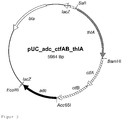
- FIG. 3 shows the resulting pUC plasmid.
- coli produced up to 80 mM acetone.
- purely clostridial genes thlA, ctfAB, adc
- 5 mM acetone were produced and with the combinations clostridial genes ( thlA and adc ) with B.II. subtilis or ybgC from H. influenzae 1 mM acetone.
- the pH was adjusted to 5.6 before boiling and anaerobicizing, and after autoclaving, 10 ml of reducing agent 1 (see below) was added, whereafter the pH should be 6.0.
- the nitrilotriacetic acid was completely dissolved in water, the pH was adjusted to 6.0 with potassium hydroxide, and then the other components were dissolved.
- the plasmids constructed in E. coli X12-blue were then introduced into acetogenic clostridia by conjugation (Purdy et al., 2002) or transformation (Zhu et al. , 2004), thereby giving the recombinant strain the ability to produce acetone.
- the cells were again centrifuged and taken up in 200 ⁇ l of a Clostridia culture grown overnight in appropriate medium.
- this mixture was distributed on well-dried agar plates in 10 ⁇ l drops and incubated at 37 ° C for 6 h anaerobically. Subsequently, the cells were washed 2 to 3 times with 0.5 ml of sterile, anaerobic PBS buffer from the agar plate. The conjugation mixture was plated on selective agar plates (clarithromycin) and incubated anaerobically at 37 ° C.
- the clostridial cells were grown in 50 ml C. aceticum medium with 40 mM DL-threonine at 30 ° C. to an optical density of 0.3-0.4. The following steps took place in the anaerobic chamber. Here, the cells were harvested (6000 rpm, 10 min, RT), washed twice with SMP buffer (270 mM sucrose, 1 mM MgCl 2 , 7 mM NaH 2 PO 4 ) and finally taken up in 500 to 700 ⁇ l SMP buffer and these used in the transformation. For this, the cells were transferred into electroporation cuvettes (4 mm) and mixed with 0.5 to 1.5 ⁇ g of plasmid DNA.
- SMP buffer 270 mM sucrose, 1 mM MgCl 2 , 7 mM NaH 2 PO 4
- Plasmid isolation means "peqGOLD ® Plasmid Miniprep Kit II” (Peqlab, Er Weg, Germany). The preparation was carried out according to the manufacturer's instructions, with all optional steps being carried out. This was followed by a "Plasmidrecovery", the E. coli strain XL2-blue was used and then a restriction digestion.
Landscapes
- Chemical & Material Sciences (AREA)
- Life Sciences & Earth Sciences (AREA)
- Health & Medical Sciences (AREA)
- Organic Chemistry (AREA)
- Engineering & Computer Science (AREA)
- Zoology (AREA)
- Wood Science & Technology (AREA)
- Bioinformatics & Cheminformatics (AREA)
- Genetics & Genomics (AREA)
- General Health & Medical Sciences (AREA)
- General Engineering & Computer Science (AREA)
- Biochemistry (AREA)
- Microbiology (AREA)
- Biotechnology (AREA)
- Medicinal Chemistry (AREA)
- Molecular Biology (AREA)
- Biomedical Technology (AREA)
- General Chemical & Material Sciences (AREA)
- Chemical Kinetics & Catalysis (AREA)
- Inorganic Chemistry (AREA)
- Micro-Organisms Or Cultivation Processes Thereof (AREA)
- Preparation Of Compounds By Using Micro-Organisms (AREA)
- Organic Low-Molecular-Weight Compounds And Preparation Thereof (AREA)
Description
- Gegenstand der Erfindung ist ein Verfahren zur Aceton-Produktion.
- Der klassische ABE-Fermentationsprozess, also die mikrobielle Produktion von Aceton, Butanol und Ethanol, war für lange Zeit der weltweit zweitgrößte biotechnologische Prozess direkt nach der Ethanol-Fermentation mit Hefen. Die kommerzielle ABE-Fermentation startete 1916 in England, wo unter anderen Chaim Weizmann die Fähigkeit von Clostridium acetobutylicum zur Bildung der Lösungsmittel Aceton, Butanol und Ethanol entdeckte. Der Prozess wurde bis in die späten 50iger Jahre in der westlichen Welt angewendet, in Südafrika sogar noch bis 1981.
- Zwei Hauptgründe sind dafür verantwortlich, dass dieser Prozess eingestellt wurde: Zum einen wurde die chemische Synthese von Aceton und Butanol immer günstiger, und zum anderen stieg der Preis für die Substrate der Fermentation stark an. Besonders der Preis für Melasse zog durch deren Verwendung als Futtermittelzusatz für Rinder stark an.
- Die steigenden Kosten für petrochemische Vorprodukte, als auch neue technologische Möglichkeiten auf dem Gebiet des Pathway-Engineerings von Mikroorganismen eröffnen nun neue Optionen zur Entwicklung von Hochleistungsstämmen und kommerziellen Fermentationsprozessen zur Produktion von Lösungsmitteln wie Aceton.
- Die klassische ABE-Fermentation basiert auf den Organismen Clostridium acetobutylicum und Clostridium beijerinckii. Beide sind Gram-positiv und vermehren sich unter strikt anaeroben Bedingungen. Diese Organismen können Mono-, Di- und Polysaccharide umsetzen, wobei die hauptsächlich in der Fermentation verwendeten Substrate Melasse und Stärke sind.
- Der Fermentationsprozess mit C. acetobutylicum unterteilt sich in zwei Phasen. In der ersten Phase geht die Biomassebildung einher mit der Bildung von Acetat, Butyrat und Spuren von Ethanol ("Acidogene Phase"). In der zweiten Phase, der sogenannten "Solventogenen Phase", werden die Säuren dann genutzt, um die Fermentationsprodukte Aceton, Butanol und Ethanol zu bilden (ABE). Die Produkte Aceton, Butanol und Ethanol werden im Wildtyp C. acetobutylicum im Verhältnis von ungefähr 3 : 6 : 1 gebildet. Dieses Produktverhältnis kann je nach gewählten Kulturbedingungen (z.B. pH oder Nährstoffzufuhr)oder eingesetzten Substraten stark variieren.
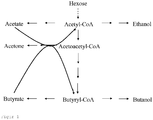
- Die Enzyme der Lösungsmittel-Biosynthese von Aceton, Butanol und Ethanol sind weitgehend aufgereinigt und biochemisch charakterisiert (vgl.
Figur 1 ; Duerre, P., und Bahl, H. 1996. Microbial production of acetone/butanol/isopropanol. In: Biotechnology, vol. 6, 2nd ed. M. Roehr, (ed.),VCH Verlagsgesellschaft mbH, Weinheim, Germany. p. 229-268.Duerre, P. 1998. New insights and novel developments in clostridial acetone/butanol/isopropanol fermentation. Appl. Microbiol. Biotechnol.49: 639-648.). Auch die Genomsequenz von C. acetobutylicum liegt vor (Noelling, J., Breton, G., Omelchenko, M. V. & 16 other authors(2001). Genome sequence and comparative analysis of the solvent-producing bacterium Clostridium acetobutylicum. J Bacteriol 183,4823-4838.). - Es wurden bereits Clostridium acetobutylicum-Stämme generiert, bei denen die Aceton-Produktion von Butanol- und Ethanolproduktion entkoppelt ist, so dass diese Stämme nur Aceton produzieren (Mermelstein et al. (1993). Metabolic engineering of Clostridium acetobutylicum ATCC824 for increased solvent production by enhancement of acetone formation enzyme activities using a synthetic operon. Biotech. Bioeng. 42:1053-1060.; Nair, R.V., and Papoutsakis, E.T. 1994). Die gemessenen Titer für Aceton lagen grundsätzlich unter den Konzentrationen derer im Wildtyp.
- In
Figur 2 ist der klassische, in Clostridium charakterisierte Stoffwechselweg für die Acetonsynthese dargestellt. Dieser Weg geht aus von Acetyl-CoA, einem zentralen Metaboliten, der in allen Mikroorganismen gebildet wird, unabhängig davon, welche C-Quelle verstoffwechselt wird oder welche Stoffwechselwege etabliert sind. Enzyme, die benötigt werden, sind: die β-Ketothiolase, die zwei Untereinheiten der Acetyl-CoA/Butyryl-CoA-Transferase, und die Acetacetat-Decarboxylase. - Es konnte gezeigt werden, dass die heterologe Expression dieser Enzyme aus C. acetobutylicum in Escherichia coli, die die Acetonbildung ausgehend von Acetyl-CoA katalysieren (Acetacetat-Decarboxylase, Acetyl-CoA/Butyryl-CoA-Transferase und Thiolase) zu einer Acetonbildung in diesem Organismus von ca. 150 mM führen, wobei aber auch nachteilhafter Weise hohe Mengen an Acetat (50 mM) anfielen (Bermejo L. L., N. E. Welker, E. T. Papoutsakis. 1998. Expression of Clostridium acetobutylicum ATCC 824 Genes in Escherichia coli for Acetone Production and Acetate Detoxification. Appl. Env. Microbiol. 64:1079-1085).
- Ein weiterer Nachteil ist hier, dass Aceton nur unter aeroben Bedingungen produziert wurde, da die Redoxequivalente, die während der Metabolisierung von Glukose zu Acetyl-CoA entstehen, unter anaeroben Bedingungen von E. coli nicht reoxidiert werden können.
- Allen beschriebenen Verfahren ist gemein, dass sie nachteilig komplexe Kohlenstoffquellen wie beispielsweise Zucker benötigen.
- Acetogene Zellen, daher Zellen, die in der Lage sind, mittels anaerober Atmung Acetat zu bilden, sind bekannt.
- Zu den acetogenen Bakterien gehören z.B. Arten der Gattung Acetobacterium wie A. woodii und Clostridium aceticum.
- Die
WO0068407 - Seit kurzem liegt auch die Genomsequenz von C. ljungdahlii vor. Von C. aceticum und C. carboxidivorans ist noch keine Genomsequenz veröffentlicht. Es ist allerdings bekannt, dass C. aceticum zusätzlich ein Plasmid trägt (5,6 kBp, Lee et al., 1987). Derzeit sind keine Techniken publiziert, um diese Organismen genetisch zu verändern.
- Die Gruppe der acetogenen Bakterien gehört zu den anaerobe Prokaryoten, die CO2 als terminalen Elektronenakzeptor nutzen können und dabei Acetat bilden. Gegenwärtig werden 21 verschiedenen Gattungen zu den Acetogenen gezählt (Drake et al., 2006), wozu auch einige Clostridien zählen (Drake & Küsel, 2005). Sie sind in der Lage, Kohlendioxid plus Wasserstoff oder auch Kohlenmonoxid als Kohlenstoff- und Energiequelle zu nutzen (Wood, 1991). Daneben können auch Alkohole, Aldehyde, Carbonsäuren sowie zahlreiche Hexosen als Kohlenstoff-Quelle genutzt werden (Drake et al., 2004). Der reduktive Stoffwechselweg, der zur Bildung von Acetat führt wird als Acetyl-CoA-oder Wood-Ljungdahl-Weg bezeichnet.
- Aufgabe der Erfindung war es, ein Verfahren bereitzustellen, mit welchem Aceton aus ubiquitär verfügbaren Kohlenstoffquellen hergestellt werden kann.
- Überraschenderweise wurde gefunden, dass das im Folgenden beschriebenen Verfahren die Aufgabe der Erfindung löst.
- Gegenstand der vorliegenden Erfindung ist ein Verfahren zur Herstellung von Aceton wie in Anspruch 1 beschrieben.
- Ein Vorteil der Erfindung ist, dass die Zellen anaerob und somit energetisch besonders günstig kultiviert werden können.
- Ein weiterer Vorteil der Erfindung ist, dass die erfindungsgemäßen Zellen zu einer Verminderung des klimaschädlichen Kohlendioxids beitragen.
- Noch ein Vorteil erfindungsgemäßer Zellen ist eine Ausbeutesteigerung durch Acetonproduktion aus Kohlendioxid und Wasserstoff.
- Gegenstand der vorliegenden Erfindung ist eine acetogene Zelle, welche Aceton zu bilden vermag.
- Unter dem Begriff "acetogene Zelle" im Zusammenhang mit der vorliegenden Erfindung werden Zellen verstanden, die in der Lage sind, mittels anaerober Atmung Acetat zu bilden.
- Alle angegebenen Prozent sind, wenn nicht anders angegeben Gewichtsprozent.
- Bevorzugt handelt es sich bei der acetogenen Zelle um eine isolierte, insbesondere um eine gentechnisch veränderte Zelle. Erfindungsgemäß bevorzugt ist eine Zelle, die aus mindestens einer Kohlenstoffquelle ausgewählt aus der Gruppe umfassend Kohlendioxid und Kohlenmonoxid Aceton zu bilden vermag. Besonders bevorzugt vermag die erfindungsgemäße acetogene Zelle Aceton aus Kohlenmonoxid und Kohlendioxid als einzige Kohlenstoffquelle zu bilden.
- Es ist dem Fachmann hinlänglich bekannt, dass mit Hilfe rekombinanter Gentechnik Produktausbeuten in biologischen Systemen verbessert werden können. Daher ist es erfindungsgemäß weiterhin bevorzugt, dass die acetogene Zelle gegenüber ihrem Wildtyp derart gentechnisch verändert wurde, dass sie im Vergleich zu ihrem Wildtyp mehr Aceton zu bilden vermag.
- Die Formulierung "dass sie im Vergleich zu ihrem Wildtyp mehr Aceton zu bilden vermag" betrifft auch den Fall, dass der Wildtyp der gentechnisch veränderten Zelle überhaupt kein Aceton, zumindest aber keine nachweisbaren Mengen dieser Verbindung, zu bilden vermag und erst nach der gentechnischen Veränderung nachweisbare Mengen dieser Komponente gebildet werden können.
- Unter einem "Wildtyp" einer Zelle wird vorzugsweise eine Zelle bezeichnet, deren Genom in einem Zustand vorliegt, wie er Gegenstand der vorliegenden Erfindung ist ein Verfahren zur Herstellung von Aceton, umfassend die Verfahrensschritte:
- A) in Kontakt Bringen einer acetogenen Zelle, welche Aceton zu bilden vermag, mit einem Nährmedium beinhaltend mindestens eine Kohlenstoffquelle ausgewählt aus der Gruppe umfassend Kohlendioxid und Kohlenmonoxid;
- B) Kultivieren der Zelle unter Bedingungen, die es der Zelle ermöglichen, Aceton zu bilden;
- C) gegebenenfalls Isolierung des gebildeten Acetons,
- eines Enzyms E1, welches die Umsetzung von Acetyl-Coenzym A zu Acetacetyl-Coenzym A katalysiert;
- eines Enzyms E2, welches die Umsetzung von Acetacetyl-Coenzym A zu Acetacetat katalysiert;
- eines Enzyms E3, welches die Umsetzung von Acetacetat zu Aceton katalysiert,
- dass die Zelle aus mindestens einer Kohlenstoffquelle ausgewählt aus der Gruppe enthaltend Kohlendioxid und Kohlenmonoxid Aceton zu bilden vermag, und
- dass die Zelle gegenüber ihrem Wildtyp derart gentechnisch verändert wurde, dass sie im Vergleich zu ihrem Wildtyp mehr Aceton zu bilden vermag.
- Unter dem Begriff "acetogene Zelle" im Zusammenhang mit der vorliegenden Erfindung werden Zellen verstanden, die in der Lage sind, mittels anaerober Atmung Acetat zu bilden. Alle angegebenen Prozent sind, wenn nicht anders angegeben Gewichtsprozent.
- Bevorzugt handelt es sich bei der acetogenen Zelle um eine isolierte, insbesondere um eine gentechnisch veränderte Zelle. Erfindungsgemäß ist die Zelle eine, die aus mindestens einer Kohlenstoffquelle ausgewählt aus der Gruppe umfassend Kohlendioxid und Kohlenmonoxid Aceton zu bilden vermag. Besonders bevorzugt vermag die erfindungsgemäße acetogene Zelle Aceton aus Kohlenmonoxid und Kohlendioxid als einzige Kohlenstoffquelle zu bilden.
- Es ist dem Fachmann hinlänglich bekannt, dass mit Hilfe rekombinanter Gentechnik Produktausbeuten in biologischen Systemen verbessert werden können die acetogene Zelle wurde gegenüber ihrem Wildtyp derart gentechnisch verändert, dass sie im Vergleich zu ihrem Wildtyp mehr Aceton zu bilden vermag.
- Die Formulierung "dass sie im Vergleich zu ihrem Wildtyp mehr Aceton zu bilden vermag" betrifft auch den Fall, dass der Wildtyp der gentechnisch veränderten Zelle überhaupt kein Aceton, zumindest aber keine nachweisbaren Mengen dieser Verbindung, zu bilden vermag und erst nach der gentechnischen Veränderung nachweisbare Mengen dieser Komponente gebildet werden können.
- Unter einem "Wildtyp" einer Zelle wird vorzugsweise eine Zelle bezeichnet, deren Genom in einem Zustand vorliegt, wie er natürlicherweise durch die Evolution entstanden ist. Der Begriff wird sowohl für die gesamte Zelle als auch für einzelne Gene verwendet. Unter den Begriff "Wildtyp" fallen daher insbesondere nicht solche Zellen bzw. solche Gene, deren Gensequenzen zumindest teilweise durch den Menschen mittels rekombinanter Verfahren verändert worden sind.
- Diese Zellen sind gentechnisch derart verändert, dass sie im Vergleich zu ihrem Wildtyp mehr Aceton aus einer Kohlenstoffquelle bilden können.
- Dabei ist es erfindungsgemäß bevorzugt, dass die acetogene Zelle derart gentechnisch verändert ist, dass sie in einem definierten Zeitintervall, vorzugsweise innerhalb von 2 Stunden, noch mehr bevorzugt innerhalb von 8 Stunden und am meisten bevorzugt innerhalb von 24 Stunden, mindestens 2mal, besonders bevorzugt mindestens 10mal, darüber hinaus bevorzugt mindestens 100mal, darüber hinaus noch mehr bevorzugt mindestens 1.000mal und am meisten bevorzugt mindestens 10.000mal mehr Aceton bildet als der Wildtyp der Zelle. Die Zunahme der Produktbildung kann dabei beispielsweise dadurch bestimmt werden, dass die erfindungsgemäße Zelle und die Wildtyp-Zelle jeweils getrennt unter gleichen Bedingungen (gleiche Zelldichte, gleiches Nährmedium, gleiche Kulturbedingungen) für ein bestimmtes Zeitintervall in einem geeigneten Nährmedium kultiviert werden und anschließend die Menge an Zielprodukt (Aceton) im Nährmedium bestimmt wird.
- Die Zelle weist eine im Vergleich zu ihrem Wildtyp gesteigerte Aktivität mindestens eines der folgenden Enzyme auf:
- eines Enzyms E1, welches die Umsetzung von Acetyl-Coenzym A zu Acetacetyl-Coenzym A katalysiert.
- eines Enzyms E2, welches die Umsetzung von Acetacetyl-Coenzym A zu Acetacetat katalysiert;
- eines Enzyms E3, welches die Umsetzung von Acetacetat zu Aceton katalysiert.
- Unter der vorstehend und in den nachfolgenden Ausführungen verwendeten Formulierung "eine im Vergleich zu ihrem Wildtyp gesteigerte Aktivität eines Enzyms Ex" ist vorzugsweise stets eine um einen Faktor von mindestens 2, besonders bevorzugt von mindestens 10, darüber hinaus bevorzugt von mindestens 100, darüber hinaus noch mehr bevorzugt von mindestens 1.000 und am meisten bevorzugt von mindestens 10.000 gesteigerte Aktivität des jeweiligen Enzyms Ex zu verstehen. Weiterhin umfasst die erfindungsgemäße Zelle, welche "eine im Vergleich zu ihrem Wildtyp gesteigerte Aktivität eines Enzyms Ex" aufweist, insbesondere auch eine Zelle, deren Wildtyp keine oder zumindest keine nachweisbare Aktivität dieses Enzyms Ex aufweist und die erst nach Erhöhung der Enzymaktivität, beispielsweise durch Überexpression, eine nachweisbare Aktivität dieses Enzyms Ex zeigt. In diesem Zusammenhang umfasst der Begriff "Überexpression" oder die in den nachfolgenden Ausführungen verwendete Formulierung "Erhöhung der Expression" auch den Fall, dass eine Ausgangszelle, beispielsweise eine Wildtyp-Zelle, keine oder zumindest keine nachweisbare Expression aufweist und erst durch rekombinante Verfahren eine nachweisbare Expression des Enzyms Ex induziert wird.
- In diesem Zusammenhang besonders bevorzugte Zellen sind dabei diejenigen, in denen die Aktivität des folgenden Enzyms bzw. der folgenden Enzyme erhöht ist: E1, E2, E3, E1 + E2 , E1 + E3, E2 + E3, E1 + E2 + E3, wobei E1 + E2 + E3 besonders bevorzugt ist.
- Weiterhin ist es erfindungsgemäß bevorzugt, dass es sich bei dem Enzym E1 um eine Acetyl-CoA-C-Acetyltransferase (EC 2.3.1.9) handelt;
bei dem Enzym E2 um eine Butyrat-Acetacetat-CoA-Transferase (EC 2.8.3.9) oder um eine Acyl-CoA-Hydrolase (EC 3.1.2.20) handelt; bei dem Enzym E3 um eine Acetacetat-Decarboxylase (EC 4.1.1.4) handelt;
Besonders bevorzugt als Enzym E1 eingesetztes Enzym ist thlA aus Clostridium acetobutylicum. - Besonders bevorzugt als Enzym E2 eingesetzte Butyrat-Acetacetat-CoA-Transferase sind ctfA und ctfB aus Clostridium acetobutylicum und atoD und atoA aus Escherichia coli. Besonders bevorzugt als Enzym E2 eingesetzte Acyl-CoA Hydrolase sind teII aus B. subtilis bzw. ybgC aus Heamophilus influenzae. Besonders bevorzugt als Enzym E3 eingesetztes Enzym ist adc aus Clostridium acetobutylicum.
- Erfindungsgemäße acetogene Zelle ist bevorzugt ein Mikroorganismus, bevorzugt ein Bakterium und besonders bevorzugt ein anaerobes Bakterium, insbesondere ein stabförmiges, grampositives Bakterium.
- Ganz besonders bevorzugt werden acetogene Zellen eingesetzt ausgewählt aus der Gruppe umfassend Thermoanaerobacter kivui, Acetobacterium woodii, Acetoanaerobium notera, Clostridium aceticum, Butyribacterium methylotrophicum, Moorella thermoacetica, Eubacterium limosum, Peptostreptococcus productus, Clostridium ljungdahlii und Clostridium carboxidivorans. Ein besonders geeignetes Bakterium ist Clostridium carboxidivorans, insbesondere solche Stämme wie "P7" und "P11". Solche Zellen sind beispielsweise in
US 2007/0275447 undUS 2008/0057554 beschrieben. - Ein weiteres, besonders geeignetes Bakterium ist Clostridium ljungdahlii, insbesondere Stämme ausgewählt aus der Gruppe umfassend Clostridium ljungdahlii PETC, Clostridium ljungdahlii ERI2, Clostridium ljungdahlii C01 und Clostridium ljungdahlii O-52 und werden in der
WO 98/00558 WO 00/68407 - Die erfindungsgemäße acetogene Zelle vermag, bevorzugt unter anaeroben Bedingungen, Aceton aus mindestens einer Kohlenstoffquelle ausgewählt aus der Gruppe enthaltend Kohlendioxid und Kohlenmonoxid zu bilden.
- In Bezug auf die Quelle dieser Substrate ist offenbar, dass viele mögliche Quellen zur Bereitstellung von CO bzw. CO2 als Kohlenstoffquelle existieren. Es ist ersichtlich, dass in der Praxis als Kohlenstoffquelle der vorliegenden Erfindung jedes Gas bzw. jede Gasmischung eingesetzt werden kann, welche in der Lage ist, die acetogene Zelle mit genügenden Mengen an Kohlenstoff zu versorgen, damit diese ihre anaerobe Amtung durchführen und Aceton zu bilden vermag.
- In dem erfindungsgemäßen Verfahren ist es bevorzugt, dass die Kohlestoffquelle bereitgestellt wird durch Abgase wie beispielsweise Synthesegas, Rauchgas, Erdölraffinerieabgase, durch Hefegärung oder clostridielle Gärung entstandene Gase, Abgase aus der Vergasung zellulosehaltige Materialien oder der Kohlevergasung.
- Diese Abgase müssen nicht notwendigerweise als Nebenerscheinungen anderer Prozesse entstanden sein, sondern können extra für den Einsatz in dem erfindungsgemäßen Verfahren produziert werden.
- Es ist ersichtlich, dass in der Praxis als Kohlenstoffquelle der vorliegenden Erfindung jedes Abgas eingesetzt werden kann, welches in der Lage ist, die acetogene Zelle mit genügenden Mengen an Kohlenstoff zu versorgen, damit diese ihre anaerobe Atmung durchführen kann.
- In einer bevorzugten Ausgestaltung des erfindungsgemäßen Verfahrens ist die Kohlenstoffquelle Synthesegas.
- Synthesegas kann z.B. aus dem Nebenprodukt der Kohlevergasung bereitgestellt werden. Die acetogene Zelle wandelt folglich eine Substanz, die ein Abfallprodukt ist, in einen wertvollen Rohstoff um.
- Alternativ kann Synthesegas durch die Vergasung von weit verfügbaren, preiswerten landwirtschaftlichen Rohstoffen für das erfindungsgemäße Verfahren bereitgestellt werden.
- Es gibt zahlreiche Beispiele an Rohstoffen, die in Synthesegas umgewandelt werden können, da fast alle Vegetationsformen zu diesem Zwecke genutzt werden können. Bevorzugte Rohstoffe sind ausgewählt aus der Gruppe umfassend perennierende Gräser wie Chinaschilf, Getreiderückstände, Verarbeitungsabfälle wie Sägemehl.
- Im Allgemeinen wird Synthesegas in einer Vergasungsapparatur aus getrockneter Biomasse gewonnen, hauptsächlich durch Pyrolyse, partielle Oxidation und Dampfreformierung, wobei die Primärprodukte CO, H2 und CO2 sind.
- Normalerweise wird ein Teil des Produktgases aufbereitet, um Produkterträge zu optimieren und Teerbildung zu vermeiden. Das Cracken des unerwünschten Teers in Synthesegas und CO kann unter Einsatz von Kalk und/oder Dolomit durchgeführt werden. Diese Prozesse werden im Detail in z.B. Reed, 1981 beschrieben (Reed, T.B.,1981, Biomass gasification: principles and technology, Noves Data Corporation, Park Ridge, NJ.)
- Es können auch Mischungen verschiedener Quellen als Kohlenstoffquelle eingesetzt werden.
- Die im erfindungsgemäßen Verfahren eingesetzten Nährmedien müssen in geeigneter Weise den Ansprüchen der jeweiligen Stämme genügen. Beschreibungen von Nährmedien verschiedener Mikroorganismen sind im Handbuch "Manual of Methods for General Bacteriology" der American Society for Bacteriology (Washington D. C., USA, 1981) enthalten.
- Neben den Kohlenstoffquellen enthält das Nährmedium insbesondere Stickstoff und Phosphorquellen, Salze sowie Mittel zur pH-Kontrolle.
- Als Stickstoffquelle können organische Stickstoff-haltige Verbindungen wie Peptone, Hefeextrakt, Fleischextrakt, Malzextrakt, Maisquellwasser, Sojabohnenmehl und Harnstoff oder anorganische Verbindungen wie Ammoniumsulfat, Ammoniumchlorid, Ammoniumphosphat, Ammoniumcarbonat und Ammoniumnitrat verwendet werden. Die Stickstoffquellen können einzeln oder als Mischung verwendet werden.
- Als Phosphorquelle können Phosphorsäure, Kaliumdihydrogenphosphat oder Dikaliumhydrogenphosphat oder die entsprechenden Natrium-haltigen Salze im Nährmedium enthalten sein. Das Kulturmedium muss weiterhin Salze von Metallen enthalten wie z. B. Magnesiumsulfat oder Eisensulfat, die für das Wachstum notwendig sind. Schließlich können essentielle Wuchsstoffe wie Aminosäuren und Vitamine zusätzlich zu den oben genannten Stoffen eingesetzt werden.
- Die genannten Einsatzstoffe können zur Kultur in Form eines einmaligen Ansatzes hinzugegeben oder in geeigneter Weise während der Kultivierung zugefüttert werden.
- Zur pH-Kontrolle der Kultur werden basische Verbindungen wie Natriumhydroxid, Kaliumhydroxid, Ammoniak bzw. Ammoniakwasser oder saure Verbindungen wie Phosphorsäure oder Schwefelsäure in geeigneter Weise eingesetzt. Zur Kontrolle der Schaumentwicklung können Antischaummittel wie z. B. Fettsäurepolyglykolester eingesetzt werden. Zur Aufrechterhaltung der Stabilität von Plasmiden können dem Medium geeignete selektiv wirkende Stoffe wie z. B. Antibiotika hinzugefügt werden.
- Im Verfahrensschritt B) des erfindungsgemäßen Verfahrens werden die acetogenen Zellen unter Bedingungen, die es der Zelle ermöglichen, Aceton zu bilden, kultiviert. Bevorzugt findet diese Kultivierung unter anaeroben Bedingungen statt.
- Die erfindungsgemäßen, gentechnisch veränderten Zellen können dabei kontinuierlich oder diskontinuierlich im batch-Verfahren (Satzkultivierung) oder im fed-batch-Verfahren (Zulaufverfahren) oder repeated-fed-batch-Verfahren (repetitives Zulaufverfahren) zum Zwecke der Produktion von Aceton mit dem Nährmedium in Kontakt und somit kultiviert werden.
- Denkbar ist auch ein semi-kontinuierliches Verfahren, wie es in der
GB-A-1009370 - Weitere gut geeignete Verfahren zu Kultivierung der acetogenen Zelle in Verfahrensschritt b) sind z.B. in dem DOE report "Bench-scale Demonstration of Biological Production of Ethanol from Coal Synthesis Gas", Topical Report 5, November 1995 (DOE Contract Number DE-AC22-92PC92118) und in den Schriften
WO 98/00558 WO 00/68407 WO 02/08438 - Im Schritt C) des erfindungsgemäßen Verfahrens kann das durch die Zellen gebildete Aceton gegebenenfalls aus den Zellen und/oder dem Nährmedium isoliert werden, wobei zur Isolierung alle dem Fachmann bekannten Methoden zur Isolierung von niedermolekularen Substanzen aus komplexen Zusammensetzungen in Betracht kommen.
- Beispielhaft seien an dieser Stelle die Fällung mittels geeigneter Lösungsmittel, die Extraktion mittels geeigneter Lösungsmittel, die Komplexierung, beispielsweise mittels Cyclodextrinen oder Cyclodextrin-Derivaten, die Kristallisation, die Aufreinigung bzw. Isolierung mittels chromatographischer Methoden oder die Überführung des Acetons in leicht abtrennbare Derivate genannt.
- Insbesondere destillative Trennverfahren sind für den Einsatz in Verfahrensschritt C) geeignet.
- In den nachfolgend aufgeführten Beispielen wird die vorliegende Erfindung beispielhaft beschrieben, ohne dass die Erfindung, deren Anwendungsbreite sich aus der gesamten Beschreibung und den Ansprüchen ergibt, auf die in den Beispielen genannten Ausführungsformen beschränkt sein soll.
- Folgende Figuren sind Bestandteil der Offenbarung:
-
Figur 1 : Biosyntheseweg des klassischen, clostridiellen ABE-Prozesses -
Figur 2 : Biosyntheseweg von Aceton in C. acetobutylicum -
Figur 3 : Plasmidkarte pUC_adc_ctfAB_thlA: -
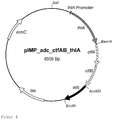
Figur 4 : Plasmidkarte pIMP_adc_ctfAB_thlA: - Für die Acetonproduktion in acetogenen Zellen wurden die Klonierungen in E. coli XL2 blue durchgeführt. Hierfür wurden die Gene
ctfA und ctfB aus Clostridium acetobutylicum,
bzw. atoA und atoD aus E. coli,
bzw. teII aus B. subtilis,
so wie bzw. ybgC aus Heamophilus influenzae
zusammen mit den Genen thlA und adc aus C. acetobutylicum auf dem Plasmid pIMP1 (Mermelstein et al., 1992) arrangiert. - Eine Übersicht über die korrespondierenden Expressionsplasmide ist in Tabelle 1 zusammengestellt.
Tabelle 1: Plasmide Plasmid CoA-Transferase/ Thioesterase aus Seq ID No pIMP_adc_ctfAB_thlA C. acetobutylicum 13 pIMP_adc_atoDA_thlA E. coli 14 pIMP_adc_teII_thlA B. subtilis 15 pIMP_adc_ybgC_thlA H. influenzae 16 - Die Klonierung der Gene erfolgte sequentiell. Hierzu wurden zunächst Oligonukleotide (Tabelle 2) für die Amplifikation der Gene unter Einführung entsprechender Schnittstellen entworfen und anschließend alle Fragmente amplifiziert.
Tabelle 1: Oligonukleotide Name Sequenz (5' → 3')*) Schnittstelle Seq ID No adc fw GGAAGGTACCTTTTATG Acc65I 1 adc rev GTAACTCTGAATTCTATTACTTAAG EcoRI 2 atoDA fw CACAACGGTGGATCCAAGAG BamHI 3 atoDA rev CGCGATATGGTACCAATCAT Acc65I 4 ctfAB fw GAATTTAAAAGGAGGGATCCAAATGAAC BamHI 5 ctfAB rev GTTTCATAGTATTGGTACCTAAACAGC Acc65I 6 thl fw CTCAGGTCGACTTCAAGAAG SalI 7 thl rev CAGAGTTATTTTTAAGGATCCTTTCTAGC BamHI 8 telI fw CAATTGGGATCCGATAACAATTTCACACAG BamHI 9 telI rev GAGATCTGGTACCCGGTTAAATGATCGGA Acc65I 10 ybgc fw CTCTAGAAGGATCCTGTTTAACTTTAAG BamHI 11 ybgc rev ATTGGGTACCTCATTGCATACTCCG Acc65I 12 - Korrespondierende Fragmente wurden von genomischer DNA mittels herkömmlicher PCR-Methoden amplifiziert, elektrophoretisch getrennt und aufgereinigt.
- Generierung pUC_adc_ctfAB_thlA:
- Im ersten Schritt wurde adc über die Schnittstellen Acc65I und EcoRI in den Vektor pUC18 kloniert und anschließend thlA über SalI und BamHI zugefügt. Im letzten Schritt wurden ctfA und ctfB in einem Schritt, da es als Operon in C. acetobutylicum organisiert ist, über die Schnittstellen BamHI und Acc65I kloniert. Im daraus resultierten Vektor pUC_adc_ctfAB_thlA liegen nun die für die Acetonproduktion nötigen Gene in einem Operon organisiert vor.
-
Figur 3 zeigt das resultierende pUC-Plasmid. - Generierung pIMP_adc_ctfAB_thlA:
- Anschließend erfolgte die Umklonierung der Genkassette in den Vektor pIMP1 über die Restriktionsendonukleasen SalI und EcoRI, woraus das Expressionsplasmid pIMP_adc_ctfAB_thlA resultierte, vgl
Figur 4 . - Generierung pIMP_adc_atoDA_thlA, pIMP_adc_teII_thlA und pIMP_adc_ybgC_thlA:
- Zur Generierung der Vektoren pIMP_adc_atoDA_thlA, pIMP_adc_teII_thlA und pIMP_adc_ybgC_thlA wurden die Gene ctfA und ctfB aus dem Vektor pIMP_adc_ctfAB_thlA über die Schnittstellen BamHI und Acc65I ausgeschnitten. atoD und atoA, welche in E. coli in einem Operon organisiert sind, wurden amplifiziert, und ebenso die Gene teII aus B. subtilis und ybgC aus H. infuenzae, wobei die Schnittstellen BamHI und Acc65I generiert wurden.
- Diese Fragmente wurden zuerst über diese in den Vektor pDrive (atoDA) bzw. pUC19 (teII und ybgC) kloniert. Anschließend erfolgte die Umklonierung dieser Gene aus dem pDrive- bzw. pUC-Vektoren, wofür die Genkassetten über die Schnittstellen BamHI und Acc65I geschnitten, aufgereinigt und in das wie oben beschrieben restringierte (Acc65I und BamHI) und aufgereinigte Vektorrückgrat des pIMP_adc_ctfAB_thlA ligiert wurden.
- Alle erhaltenen Plasmid-Varianten (siehe Tabelle 1) wurden zur Kontrolle auf Funktionalität im E. coli-Klonierstamm XL2-blue auf Acetonbildung hin untersucht. Die Analysen erfolgten im 100-ml-Maßstab in TY-Medium mit Ampicillin (100 µg/ml). Nach Inokulation aus entsprechenden Vorkulturen auf eine optische Dichte (600 nm) von 0,1 erfolgte eine Inkubation bei 37 °C und 150 Upm. Die optische Dichte wurde photometrisch verfolgt und zu bestimmten Zeitpunkten wurden über einen Zeitraum von ca. 50 h Proben entnommen und gaschromatographisch die Konzentration von Aceton und Acetat im zellfreien Medienüberstand bestimmt. Hierbei zeigte sich, dass mit der Kombination clostridieller Gene (thlA und adc) mit atoDA aus E. coli bis zu 80 mM Aceton produziert wurden. Mit rein clostridiellen Genen (thlA, ctfAB, adc) wurden 5 mM Aceton produziert und mit den Kombinationen clostridielle Gene (thlA und adc) mit teII aus B. subtilis bzw. ybgC aus H. influenzae 1 mM Aceton.
- Je nach eingesetztem Clostridienstamm wurden verschiedene Medien eingesetzt:
- Zur Herstellung der Medien für C. carboxidivorans bzw. C. ljungdhalii wurden die Chemikalien eingewogen, in Wasser gelöst und anschließend der pH-Wert eingestellt. Zusätzlich wurde der Redox-Indikator Reszurin (1 mg/l) zugesetzt, um das Redoxpotential und somit den Sauerstoffgehalt später prüfen zu können. Anschliessend wurden die Medien in einem Heizpilz aufgekocht und im Eisbad abgekühlt. Während dessen erfolgte die Begasung mit Stickstoff, um den gelösten Sauerstoff zu entfernen. Anschliessend wurden die Medien in die Anaerobenkammer eingeschleust, das Endvolumen mit anaerobem Wasser eingestellt, abgefüllt und luftdicht verschlossen. Wenn eine andere Gasphase als Stickstoff verwendet werden sollte, erfolgte im Anschluss ein Gasaustausch, wobei das Medium mit dem entsprechenden Gas mittels einer langen Kanüle begast wurde und letztendlich ein leichter Überdruck von rund 0,8 bar angelegt wurde.
- Für das Medium für C. aceticum wurden alle Komponenten eingewogen, gelöst und abgefüllt. Zusätzlich wurde der Redox-Indikator Reszurin (1 mg/l) zugesetzt, um das Redoxpotential und somit den Sauerstoffgehalt später prüfen zu können. Anschliessend erfolgte die Begasung über Kanülen mit einer Mischung aus 80 % N2 und 20 % CO2, bis ein pH von 7,4 erreicht wurde. Auch hier wurde ein leichter Überdruck angelegt. Nach dem Autoklavieren wurde steril Na2CO3 in Form einer anaeroben 5 %igen Na2CO3-Lösung zugegeben, um einen pH von 8,2 zu erreichen. Zusätzlich wurde Fructose steril zu einer Endkonzentration von 1 % zugegeben. Für autotrophes Wachstum wurde eine Gasatmosphäre von 80 % H2 und 20 % CO2 erzeugt.
- Alle Medien wurden bei 121 °C und 1,2 bar für 15 min autoklaviert. Einige Medienbestandteile wurden separat autoklaviert, um chemische Reaktionen der Komponenten untereinander zu verhindern. Hitzelabile Komponenten wurden gelöst, sterilfiltriert und dem abgekühlten, autoklavierten Medium vor Benutzung zugesetzt.
- Für die Herstellung von festen Medien wurden 1,5 % (w/v) Agar vor dem Autoklavieren zugegeben und direkt danach wurden in der Anaerobenkammer diese in Petrischalen gegossen. Nach dem Gießen wurden die Platten einige Tage lang getrocknet und bis zur Verwendung bei 4 °C gelagert.
- Medium für C. aceticum
NH4Cl 1,00 g 18,7 mM KH2PO4 0,33 g 2,4 mM K2HPO4 0,45 g 2,6 mM MgSO4 x 7 H2O 0,10 g 0,4 mM Spurenelementelösung (s.u.) 20, 00 ml 2 % (v/v) Wolfe's Vitaminlösung (s.u.) 20, 00 ml 2 % (v/v) Hefeextract 2,00 g 0,2 % (w/v) NaHCO3 10,00 g 0,1 M Cystein-HCl x H2O 0,50 g 2,8 mM Na2S x 9 H2O 0,50 g 2,1 mM Wasser ad 1000 ml - Nach dem Autoklavieren wurde steril 25 ml 1-1 einer 5 Gew.-%igen Na2CO3-Lösung zugegeben, um einen pH von 8,2 zu erreichen. Zusätzlich wurde Fructose steril zu einer Endkonzentration von 1 Gew.-% bezogen auf das gesamte Medium zugegeben. Für autotrophes Wachstum wurde vor dem autoklavieren eine Gasatmosphäre von 80 Vol.-% H2 und 20 Vol.-% CO2 erzeugt.
- Medium für C. carboxidivorans - Wilkins-Chalgren Medium
Wilkins-Chalgren Anaerobe Broth (OXOID CM0643) 33 g 3,3 % NaHCO3 1 g 12 mM Wasser ad 1000 ml - Der pH wurde vor dem Aufkochen und Anaerobisieren auf 5,6 einstellt und nach dem Autoklavieren wurden 10 ml Reduktionsmittel 1 (siehe unten) zugeben, wonach der pH bei 6,0 liegen sollte.
- Medium für C. ljungdahlii - ATCC Medium 1754 (PETC Medium)
NH4Cl 1,0 g 19 mM KCl 0,1 g 1,35 mM MgSO4 * 7 H2O 0,2 g 0,8 mM NaCl 0,8 g 14 mM KH2PO4 0,1 g 0,7 mM CaCl2 * 2 H2O 20,0 mg 0,15 mM Hefeextrakt 1,0 g 0,1 % (w/v) Spurenelementlösung 10,0 ml 1 % (v/v) Wolfe's Vitaminlösung 10,0 ml 1 % (v/v) NaHCO3 2,0 g 24 mM Wasser ad 1000 ml pH 5,5 - Vor dem Aufkochen und Anaerobisieren wurde der pH auf 5,5 einstellt. Nach dem Autoklavieren wurden 20 ml einer sterilen Fructoselösung (250 g/l) und je 5 ml Reduktionsmittel 1 und 2 (siehe unten) zugeben, der pH sollte danach bei 5,9 liegen.
- Es werden 1,8 g NaOH in 200 ml Wasser gelöst, aufgekocht und unter Stickstoffbegasung abgekühlt. In der Anaerobenkammer werden in 100 ml anaerobem NaOH zuerst 4 g L-Cystein-HCl und anschließend 4 g Na2S * 9 H2O gelöst und anschließend autoklaviert.
- Es werden 1,8 g NaOH in 200 ml Wasser gelöst, aufgekocht und unter Stickstoffbegasung abgekühlt. In der Anaerobenkammer werden in 100 ml anaerobem NaOH 4 g L-Cystein-HCl gelöst und anschließend autoklaviert.
-
Nitrilotriessigsäure 2 g 10,5 mM MnSO4 * H2O 1 g 6 mM Fe (SO4)2(NH4 )2 * 6 H2O 0,8 g 2 mM CoCl2 * 6 H2O 0,2 g 0, 86 mM ZnSO4 * 7 H2O 0,2 mg 0,7 µm CuCl2 * 2 H2O 20 mg 0,12 mM NiCl2 * 6 H2O 20 mg 80 µM Na2MoO4 * 2 H2O 20 mg 80 µM Na2SeO4 20 mg 80 µM Na2WO4 20 mg 60 µM Wasser ad 1000 ml - Zuerst wurde die Nitrilotriessigsäure vollständig in Wasser gelöst, der pH-Wert mit Kaliumhydroxid auf 6,0 eingestellt und danach die anderen Komponenten gelöst.
- Wolfe's Vitaminlösung für das ATCC Medium 1754 und für das C. aceticum-Medium
Biotin (Vitamin H) 2,0 mg 8 µM Folsäure (Vitamin B9) 2,0 mg 4,5 µM Pyridoxin-HCl (Vitamin B6) 10,0 mg 49 µM Thiamin-HCl (Vitamin B1) 5,0 mg 15 µM Riboflavin (Vitamin B2) 5,0 mg 13 µM Nicotinsäureamid (Vitamin PP) 5,0 mg 41 µM Calcium D-(+)-Pantothenat 5,0 mg 10,5 µM Cyanocobalmin (Vitamin B12) 0,1 mg 74 µM p-Aminobenzoesäure 5,0 mg 36 µM Liponsäure 5,0 mg 24 µM Wasser ad 1000 ml pH 4,3 - Die in E. coli X12-blue konstruierten Plasmide wurden anschließend in acetogene Clostridien mittels Konjugation (Purdy et al., 2002) bzw. Transformation (Zhu et al., 2004) eingebracht, wodurch der rekombinante Stamm die Fähigkeit erhält, Aceton zu produzieren.
- Für die Konjugationsexperimente wurde der E. coli-Donorstamm CA434 mit dem zu übertragenden Plasmid in LB-Medium aerob über Nacht angezogen. Ein 1-ml-Aliquot wurde 1 min bei 10000 × g zentrifugiert und das Zellsediment in der Anaerobenkammer in 1 ml sterilem, anaeroben PBS-Puffer (1,5 mM KH2PO4, 4,2 mM Na2HPO4, 137 mM NaCl, 2,7 mM KCl) vorsichtig suspendiert, um ein Abscheren der konjugativen Pili zu verhindern. Die Zellen wurden erneut zentrifugiert und in 200 µl einer über Nacht in entsprechendem Medium gewachsenen Clostridienkultur aufgenommen. In der Anaerobenkammer wurde dieses Gemisch auf gut getrocknete Agarplatten in 10-µl-Tropfen verteilt und bei 37 °C für 6 h anaerob inkubiert. Anschließend wurden die Zellen 2- bis 3mal mit jeweils 0,5 ml sterilem, anaerobem PBS-Puffer von der Agarplatte abgewaschen. Das Konjugationsgemisch wurde auf Selektiv-Agarplatten (Clarithromycin) ausplattiert und anaerob bei 37 °C inkubiert.
- Für die Transformation wurden die clostridiellen Zellen in 50 ml C. aceticum-Medium mit 40 mM DL-Threonin bei 30 °C bis zu einer optische Dichte von 0,3 - 0,4 angezogen. Die folgenden Schritte erfolgten in der Anaerobenkammer. Hier wurden die Zellen geerntet (6000 Upm, 10 min, RT), zweimal mit SMP-Puffer (270 mM Saccharose, 1 mM MgCl2, 7 mM NaH2PO4) gewaschen und letztendlich in 500 bis 700 µl SMP-Puffer aufgenommen und diese in die Tranformation eingesetzt. Hierfür wurden die Zellen in Elektroporationsküvetten (4 mm) transferiert und mit 0,5 bis 1,5 µg Plasmid-DNA versetzt. Nach 5-minütiger Inkubation erfolgte die Elektroporation bei 25 µF, 600 Ω und 2,5 kV in einem Gene-Pulser (Bio-Rad Laboratories GmbH; München) mit 4 mM Küvetten (Biozym Scientific GmbH). Anschließend wurden die Zellen sofort in 5 ml vorgewärmtes Medium gegeben. Es folgte eine Inkubation zur Resistenzausprägung bei 37 °C über Nacht bis hin zu vier Tagen, woraufhin 5 ml Medium mit Clarithromycin (5 µg ml-1) inokuliert und für 3 bis 5 Tagen bei 37 °C inkubiert wurden.
- Um die Transformation zu überprüfen, folgte eine Plasmidisolierung mittels "peqGOLD® Plasmid Miniprep Kit II" (Peqlab, Erlangen). Die Präparation erfolgte nach den Angaben des Herstellers, wobei alle optionalen Schritte durchgeführt wurden. Anschließend erfolgte eine "Plasmidrecovery", wobei der E. coli-Stamm XL2-blue verwendet wurde und darauf folgend ein Restriktionsverdau.
- Alle erhaltenen Plasmid-Varianten (siehe Tabelle 1) wurden in den autotrophen Clostridien auf Acetonbildung hin untersucht. Die Analysen erfolgten im 50-ml-Maßstab im entsprechenden Medium mit Clarithromycin (5 µg/ml). Nach Inokulation aus entsprechenden Vorkulturen erfolgte eine Inkubation bei 37 °C. Die notwendige Begasung des Mediums erfolgte bei der Medienherstellung. Zum Einsatz kamen hier entweder Synthesegas oder ein CO2-/H2-Gemisch im Verhältnis 1:2. Die optische Dichte wurde photometrisch verfolgt und zu bestimmten Zeitpunkten wurden über einen Zeitraum von ca. 100 bis 200 h Proben entnommen und gaschromatographisch die Konzentration von Aceton und Acetat im zellfreien Medienüberstand bestimmt. Hierbei zeigt sich, dass mit der Kombination clostridielle Gene (thlA und adc) mit atoDA aus E. coli und mit den Kombinationen clostridielle Gene (thlA und adc) mit teII aus B. subtilis bzw. ybgC aus H. influenzae bis zu 1 mM Aceton produziert wird. Mit rein clostridiellen Genen (thlA, ctfAB, adc) wurde bis zu 0,24 mM Aceton produziert.
-
- <110> Evonik Degussa
- <120> Zellen und Verfahren zur Herstellung von Aceton
- <130> 200900033
- <160> 16
- <170> PatentIn version 3.4
- <210> 1
<211> 17
<212> DNA
<213> Artificial - <220>
<223> Primer - <400> 1
ggaaggtacc ttttatg 17 - <210> 2
<211> 25
<212> DNA
<213> Artificial - <220>
<223> Primer - <400> 2
gtaactctga attctattac ttaag 25 - <210> 3
<211> 20
<212> DNA
<213> Artificial - <220>
<223> Primer - <400> 3
cacaacggtg gatccaagag 20 - <210> 4
<211> 20
<212> DNA
<213> Artificial - <220>
<223> Primer - <400> 4
cgcgatatgg taccaatcat 20 - <210> 5
<211> 28
<212> DNA
<213> Artificial - <220>
<223> Primer - <400> 5
gaatttaaaa ggagggatcc aaatgaac 28 - <210> 6
<211> 27
<212> DNA
<213> Artificial - <220>
<223> Primer - <400> 6
gtttcatagt attggtacct aaacagc 27 - <210> 7
<211> 20
<212> DNA
<213> Artificial - <220>
<223> Primer - <400> 7
ctcaggtcga cttcaagaag 20 - <210> 8
<211> 29
<212> DNA
<213> Artificial - <220>
<223> Primer - <400> 8
cagagttatt tttaaggatc ctttctagc 29 - <210> 9
<211> 30
<212> DNA
<213> Artificial - <220>
<223> Primer - <400> 9
caattgggat ccgataacaa tttcacacag 30 - <210> 10
<211> 29
<212> DNA
<213> Artificial - <220>
<223> Primer - <400> 10
gagatctggt acccggttaa atgatcgga 29 - <210> 11
<211> 28
<212> DNA
<213> Artificial - <220>
<223> Primer - <400> 11
ctctagaagg atcctgttta actttaag 28 - <210> 12
<211> 25
<212> DNA
<213> Artificial - <220>
<223> Primer - <400> 12
attgggtacc tcattgcata ctccg 25 - <210> 13
<211> 8559
<212> DNA
<213> Artificial - <220>
<223> Plasmid - <400> 13


- <210> 14
<211> 8563
<212> DNA
<213> Artificial - <220>
<223> Plasmid - <400> 14


- <210> 15
<211> 8004
<212> DNA
<213> Artificial - <220>
<223> Plasmid - <400> 15


- <210> 16
<211> 7693
<212> DNA
<213> Artificial - <220>
<223> Plasmid - <400> 16


-
- <110> Evonik Degussa
- <120> Zellen und Verfahren zur Herstellung von Aceton
- <130> 200900033
- <160> 16
- <170> PatentIn version 3.4
- <210> 1
<211> 17
<212> DNA
<213> Artificial - <220>
<223> Primer - <400> 1
ggaaggtacc ttttatg 17 - <210> 2
<211> 25
<212> DNA
<213> Artificial - <220>
<223> Primer - <400> 2
gtaactctga attctattac ttaag 25 - <210> 3
<211> 20
<212> DNA
<213> Artificial - <220>
<223> Primer - <400> 3
cacaacggtg gatccaagag 20 - <210> 4
<211> 20
<212> DNA
<213> Artificial - <220>
<223> Primer - <400> 4
cgcgatatgg taccaatcat 20 - <210> 5
<211> 28
<212> DNA
<213> Artificial - <220>
<223> Primer - <400> 5
gaatttaaaa ggagggatcc aaatgaac 28 - <210> 6
<211> 27
<212> DNA
<213> Artificial - <220>
<223> Primer - <400> 6
gtttcatagt attggtacct aaacagc 27 - <210> 7
<211> 20
<212> DNA
<213> Artificial - <220>
<223> Primer - <400> 7
ctcaggtcga cttcaagaag 20 - <210> 8
<211> 29
<212> DNA
<213> Artificial - <220>
<223> Primer - <400> 8
cagagttatt tttaaggatc ctttctagc 29 - <210> 9
<211> 30
<212> DNA
<213> Artificial - <220>
<223> Primer - <400> 9
caattgggat ccgataacaa tttcacacag 30 - <210> 10
<211> 29
<212> DNA
<213> Artificial - <220>
<223> Primer - <400> 10
gagatctggt acccggttaa atgatcgga 29 - <210> 11
<211> 28
<212> DNA
<213> Artificial - <220>
<223> Primer - <400> 11
ctctagaagg atcctgttta actttaag 28 - <210> 12
<211> 25
<212> DNA
<213> Artificial - <220>
<223> Primer - <400> 12
attgggtacc tcattgcata ctccg 25 - <210> 13
<211> 8559
<212> DNA
<213> Artificial - <220>
<223> Plasmid - <400> 13


- <210> 14
<211> 8563
<212> DNA
<213> Artificial - <220>
<223> Plasmid - <400> 14


- <210> 15
<211> 8004
<212> DNA
<213> Artificial - <220>
<223> Plasmid - <400> 15


- <210> 16
<211> 7693
<212> DNA
<213> Artificial - <220>
<223> Plasmid - <400> 16




dass die Zelle eine im Vergleich zu ihrem Wildtyp gesteigerte Aktivität mindestens eines der folgenden Enzyme aufweist:
Claims (3)
- Ein Verfahren zur Herstellung von Aceton, umfassend die Verfahrensschritte:A) in Kontakt Bringen einer acetogenen Zelle, welche Aceton zu bilden vermag, mit einem Nährmedium beinhaltend mindestens eine Kohlenstoffquelle ausgewählt aus der Gruppe umfassend Kohlendioxid und Kohlenmonoxid;B) Kultivieren der Zelle unter Bedingungen, die es der Zelle ermöglichen, Aceton zu bilden;C) gegebenenfalls Isolierung des gebildeten Acetons,dadurch gekennzeichnet,
dass die Zelle eine im Vergleich zu ihrem Wildtyp gesteigerte Aktivität mindestens eines der folgenden Enzyme durch Überexpression aufweist:eines Enzyms E1, welches die Umsetzung von Acetyl-Coenzym A zu Acetacetyl-Coenzym A katalysiert;eines Enzyms E2, welches die Umsetzung von Acetacetyl-Coenzym A zu Acetacetat katalysiert;eines Enzyms E3, welches die Umsetzung von Acetacetat zu Aceton katalysiert, und dass die Zelle aus mindestens einer Kohlenstoffquelle ausgewählt aus der Gruppe enthaltend Kohlendioxid und Kohlenmonoxid Aceton zu bilden vermag. - Verfahren gemäß Anspruch 1, dadurch gekennzeichnet, dass es sich
bei dem Enzym E1 um eine Acetyl-CoA-C-Acetyltransferase (EC 2.3.1.9) handelt;
bei dem Enzym E2 um eine Butyrat-Acetacetat-CoA-Transferase (EC 2.8.3.9) oder um eine Acyl-CoA-Hydrolase (EC 3.1.2.20) handelt;
bei dem Enzym E3 um eine Acetacetat-Decarboxylase (EC 4.1.1.4) handelt. - Verfahren gemäß mindestens einem der Ansprüche 1 oder 2, dadurch gekennzeichnet, dass die Zelle ein Mikroorganismus ist, ausgewählt aus der Gruppe umfassend Thermoanaerobacter kivui, Acetobacterium woodii, Acetoanaerobium notera, Clostridium aceticum, Butyribacterium methylotrophicum, Moorella thermoacetica, Eubacterium limosum, Peptostreptococcus productus, Clostridium ljungdahlii und Clostridium carboxidivorans.
Applications Claiming Priority (2)
| Application Number | Priority Date | Filing Date | Title |
|---|---|---|---|
| DE102009002583A DE102009002583A1 (de) | 2009-04-23 | 2009-04-23 | Zellen und Verfahren zur Herstellung von Aceton |
| PCT/EP2010/052244 WO2010121849A1 (de) | 2009-04-23 | 2010-02-23 | Zellen und verfahren zur herstellung von aceton |
Publications (2)
| Publication Number | Publication Date |
|---|---|
| EP2421960A1 EP2421960A1 (de) | 2012-02-29 |
| EP2421960B1 true EP2421960B1 (de) | 2017-07-19 |
Family
ID=42103849
Family Applications (1)
| Application Number | Title | Priority Date | Filing Date |
|---|---|---|---|
| EP10704577.5A Active EP2421960B1 (de) | 2009-04-23 | 2010-02-23 | Zellen und verfahren zur herstellung von aceton |
Country Status (9)
| Country | Link |
|---|---|
| US (1) | US9453210B2 (de) |
| EP (1) | EP2421960B1 (de) |
| JP (1) | JP5805073B2 (de) |
| CN (1) | CN102414314A (de) |
| AU (1) | AU2010241185B2 (de) |
| BR (1) | BRPI1013430A2 (de) |
| DE (1) | DE102009002583A1 (de) |
| ES (1) | ES2639224T3 (de) |
| WO (1) | WO2010121849A1 (de) |
Cited By (1)
| Publication number | Priority date | Publication date | Assignee | Title |
|---|---|---|---|---|
| WO2024231219A1 (en) | 2023-05-11 | 2024-11-14 | Evonik Operations Gmbh | Biotechnological production of acetone |
Families Citing this family (16)
| Publication number | Priority date | Publication date | Assignee | Title |
|---|---|---|---|---|
| JP5397136B2 (ja) * | 2009-09-30 | 2014-01-22 | 住友電気工業株式会社 | Iii族窒化物半導体レーザ素子、及びiii族窒化物半導体レーザ素子を作製する方法 |
| DE102010062587A1 (de) | 2010-12-08 | 2012-06-14 | Evonik Degussa Gmbh | Verfahren zur Herstellung von Isophoron |
| US9365868B2 (en) | 2011-02-25 | 2016-06-14 | Lanzatech New Zealand Limited | Fermentation process for producing isopropanol using a recombinant microorganism |
| US9410130B2 (en) | 2011-02-25 | 2016-08-09 | Lanzatech New Zealand Limited | Recombinant microorganisms and uses therefor |
| TWI541348B (zh) * | 2011-02-25 | 2016-07-11 | 藍瑟科技紐西蘭有限公司 | 重組一氧化碳營養性產乙酸微生物及其用途 |
| DE102011075777A1 (de) | 2011-05-13 | 2012-11-15 | Evonik Degussa Gmbh | Verfahren zur Herstellung von Isophoron in Gegenwart mindestens eines Entschäumers in der Abwasserkolonne im Aufarbeitungsteil |
| DE102011077705A1 (de) | 2011-06-17 | 2012-12-20 | Evonik Degussa Gmbh | Mikrobielles Verfahren zur Herstellung niedermolekularer, organischer Verbindungen umfassend die Produktabsorption durch Isophoron |
| CA2862790C (en) * | 2012-01-31 | 2016-09-27 | Lanzatech New Zealand Limited | A recombinant carboxydotrophic acetogenic microorganism and uses thereof in microbial fermentation |
| WO2013181647A2 (en) | 2012-06-01 | 2013-12-05 | Danisco Us Inc. | Compositions and methods of producing isoprene and/or industrrial bio-products using anaerobic microorganisms |
| CN105051178B (zh) * | 2013-03-15 | 2018-08-03 | 朗泽科技新西兰有限公司 | 用于在微生物发酵中控制代谢物产生的系统和方法 |
| EP3050966A1 (de) * | 2015-01-28 | 2016-08-03 | Evonik Degussa GmbH | Aerobes Verfahren zur Herstellung von Alkoholen |
| CN107404882A (zh) * | 2015-02-27 | 2017-11-28 | 白狗实验室有限公司 | 用于生产丙酮、异丙醇、丁酸、其他生物产品及其混合物的混合营养发酵方法 |
| KR101750293B1 (ko) * | 2015-03-04 | 2017-06-26 | 한국과학기술연구원 | 이산화탄소로부터의 아세톤 생성능을 갖는 형질전환된 시네코코커스 일롱게투스 균주 |
| EP3348646A1 (de) | 2017-01-17 | 2018-07-18 | Evonik Degussa GmbH | Mikrobielles verfahren zur herstellung von aceton, isopropanol, butanol und/oder ethanol umfassend die produktabsorption durch wasser |
| WO2021154826A1 (en) * | 2020-01-29 | 2021-08-05 | Jupeng Bio (Hk) Limited | Process for controlling organic acid ratios in a carbon dioxide bioconversion process |
| CN112608935A (zh) * | 2020-12-18 | 2021-04-06 | 北京化工大学 | 一种改造乙酸梭菌代谢途径产丙酮的方法 |
Family Cites Families (10)
| Publication number | Priority date | Publication date | Assignee | Title |
|---|---|---|---|---|
| NL301993A (de) | 1962-12-18 | |||
| US5807722A (en) | 1992-10-30 | 1998-09-15 | Bioengineering Resources, Inc. | Biological production of acetic acid from waste gases with Clostridium ljungdahlii |
| EP1177309B1 (de) | 1999-05-07 | 2004-02-18 | Emmaus Foundation, Inc. | Aus substrathaltigen gasgemischen aethanol erzeugende clostridium stamme |
| ATE332390T1 (de) | 2000-07-25 | 2006-07-15 | Emmaus Foundation Inc | Verfahren zur produktionssteigerung von die fermentativen erzeugnung von ethanol |
| US20070275447A1 (en) | 2006-05-25 | 2007-11-29 | Lewis Randy S | Indirect or direct fermentation of biomass to fuel alcohol |
| US7704723B2 (en) | 2006-08-31 | 2010-04-27 | The Board Of Regents For Oklahoma State University | Isolation and characterization of novel clostridial species |
| EP2182051A4 (de) * | 2007-08-29 | 2010-12-29 | Res Inst Innovative Tech Earth | Zur herstellung von isopropanol geeignete transformanten |
| CN101903530A (zh) * | 2007-10-12 | 2010-12-01 | 加利福尼亚大学董事会 | 被改造以产生异丙醇的微生物 |
| DE102007052463A1 (de) * | 2007-11-02 | 2009-05-07 | Evonik Degussa Gmbh | Fermentative Gewinnung von Aceton aus erneuerbaren Rohstoffen mittels neuen Stoffwechselweges |
| DE102010062587A1 (de) | 2010-12-08 | 2012-06-14 | Evonik Degussa Gmbh | Verfahren zur Herstellung von Isophoron |
-
2009
- 2009-04-23 DE DE102009002583A patent/DE102009002583A1/de not_active Withdrawn
-
2010
- 2010-02-23 CN CN2010800177745A patent/CN102414314A/zh active Pending
- 2010-02-23 EP EP10704577.5A patent/EP2421960B1/de active Active
- 2010-02-23 AU AU2010241185A patent/AU2010241185B2/en not_active Ceased
- 2010-02-23 US US13/260,012 patent/US9453210B2/en active Active
- 2010-02-23 BR BRPI1013430-1A patent/BRPI1013430A2/pt not_active Application Discontinuation
- 2010-02-23 WO PCT/EP2010/052244 patent/WO2010121849A1/de not_active Ceased
- 2010-02-23 ES ES10704577.5T patent/ES2639224T3/es active Active
- 2010-02-23 JP JP2012506411A patent/JP5805073B2/ja active Active
Non-Patent Citations (3)
| Title |
|---|
| BERMEJO L L ET AL: "Expression of Clostridium acetobutylicum ATCC 824 genes in Escherichia coli for acetone production and acetate detoxification", APPLIED AND ENVIRONMENTAL MICROBIOLOGY, AMERICAN SOCIETY FOR MICROBIOLOGY, US, vol. 64, no. 3, 1 March 1998 (1998-03-01), pages 1079 - 1085, XP002334443, ISSN: 0099-2240 * |
| HENSTRA ET AL: "Microbiology of synthesis gas fermentation for biofuel production", CURRENT OPINION IN BIOTECHNOLOGY, LONDON, GB, vol. 18, no. 3, 8 June 2007 (2007-06-08), pages 200 - 206, XP022110181, ISSN: 0958-1669, DOI: 10.1016/J.COPBIO.2007.03.008 * |
| HIROKI MATSUI ET AL: "Diversity of the Formyltetrahydrofolate Synthetase Gene ( fhs ), a Key Enzyme for Reductive Acetogenesis, in the Bovine Rumen", BIOSCIENCE, BIOTECHNOLOGY, AND BIOCHEMISTRY, vol. 72, no. 12, 23 December 2008 (2008-12-23), pages 3273 - 3276, XP055158612, ISSN: 0916-8451, DOI: 10.1271/bbb.70375 * |
Cited By (1)
| Publication number | Priority date | Publication date | Assignee | Title |
|---|---|---|---|---|
| WO2024231219A1 (en) | 2023-05-11 | 2024-11-14 | Evonik Operations Gmbh | Biotechnological production of acetone |
Also Published As
| Publication number | Publication date |
|---|---|
| DE102009002583A1 (de) | 2010-10-28 |
| WO2010121849A1 (de) | 2010-10-28 |
| CN102414314A (zh) | 2012-04-11 |
| US9453210B2 (en) | 2016-09-27 |
| ES2639224T3 (es) | 2017-10-25 |
| AU2010241185A1 (en) | 2011-10-27 |
| AU2010241185B2 (en) | 2016-03-10 |
| JP2012524529A (ja) | 2012-10-18 |
| JP5805073B2 (ja) | 2015-11-04 |
| US20120101304A1 (en) | 2012-04-26 |
| BRPI1013430A2 (pt) | 2015-09-01 |
| EP2421960A1 (de) | 2012-02-29 |
Similar Documents
| Publication | Publication Date | Title |
|---|---|---|
| DE102009002583A1 (de) | Zellen und Verfahren zur Herstellung von Aceton | |
| US9359611B2 (en) | Recombinant microorganism and methods of production thereof | |
| AU2007316189B2 (en) | Process for the biological production of n-Butanol with high yield | |
| EP2181195B1 (de) | Fermentative Gewinnung von Aceton aus erneuerbaren Rohstoffen mittels neuen Stoffwechselweges | |
| EP1999264B1 (de) | Verfahren zur enzymatischen herstellung von 2-hydroxy-2-methylcarbonsäuren | |
| EP2813575A1 (de) | Verfahren zur Herstellung von organischen Verbindungen aus Knallgas und CO2 über Acetoacetyl-CoA als Zwischenprodukt | |
| EP3273782B1 (de) | Mixotrophe fermentation zur herstellung von aceton, isopropanol, und anderen bioprodukten sowie mischungen davon | |
| US20090286294A1 (en) | Methods and Compositions for Improving the Production of Fuels in Microorganisms | |
| DE69934366T2 (de) | Transformierte mikroorganismen mit verbesserten eigenschaften | |
| KR102011540B1 (ko) | 발효 방법 | |
| WO2012104244A1 (de) | Verfahren zur fermentativen herstellung von 2,3-butandiol | |
| TW201610165A (zh) | 微生物共培養系統及其應用 | |
| US20180125092A1 (en) | Method for preparing feedstuffs comprising butyric acid and/or butyrate | |
| DE102012201360A1 (de) | Zellen und Verfahren zur Herstellung von Rhamnolipiden | |
| KR101144235B1 (ko) | 바이오에탄올 폐발효액을 이용한 부탄올의 제조방법 | |
| DE69131015T2 (de) | Rekombinante zellen, die stark chromosomal-integrierte heterologe gene exprimieren | |
| WO2015110518A1 (de) | Fermentatives verfahren umfassend eine kultivierung von zellen unter niedriger gelöstsauerstoffkonzentration | |
| DE102016007810B4 (de) | Verfahren zur Herstellung von D-Xylonat | |
| WO2014146881A1 (de) | Mikroorganismenstamm und verfahren zur fermentativen herstellung von c4-verbindungen aus c5-zuckern | |
| US20230050887A1 (en) | Recombinant microorganisms as a versatile and stable platform for production of antigen-binding molecules | |
| EP4448780A2 (de) | Mischungen von glucose und xylose zur fermentativen herstellung von ortho-aminobenzoesäure | |
| DE102021101004B3 (de) | Verfahren zur Herstellung von 2,4-Dihydroxybutyrat oder L-Threonin unter Nutzung eines mikrobiellen Stoffwechselweges | |
| CA3133087C (en) | Gas fermentation for the production of protein-based bioplastics | |
| DE102013216658A1 (de) | Verfahren zur fermentativen Herstellung von C4-Produkten und dafür geeignete Mikroorganismenstämme | |
| Hanif et al. | FERMENTATIVE PRODUCTS OF GENUS CLOSTRIDIUM FOR VARIOUS INDUSTRIAL APPLICATIONS |
Legal Events
| Date | Code | Title | Description |
|---|---|---|---|
| PUAI | Public reference made under article 153(3) epc to a published international application that has entered the european phase |
Free format text: ORIGINAL CODE: 0009012 |
|
| 17P | Request for examination filed |
Effective date: 20111004 |
|
| AK | Designated contracting states |
Kind code of ref document: A1 Designated state(s): AT BE BG CH CY CZ DE DK EE ES FI FR GB GR HR HU IE IS IT LI LT LU LV MC MK MT NL NO PL PT RO SE SI SK SM TR |
|
| DAX | Request for extension of the european patent (deleted) | ||
| 17Q | First examination report despatched |
Effective date: 20150105 |
|
| GRAP | Despatch of communication of intention to grant a patent |
Free format text: ORIGINAL CODE: EPIDOSNIGR1 |
|
| INTG | Intention to grant announced |
Effective date: 20170307 |
|
| GRAS | Grant fee paid |
Free format text: ORIGINAL CODE: EPIDOSNIGR3 |
|
| GRAA | (expected) grant |
Free format text: ORIGINAL CODE: 0009210 |
|
| AK | Designated contracting states |
Kind code of ref document: B1 Designated state(s): AT BE BG CH CY CZ DE DK EE ES FI FR GB GR HR HU IE IS IT LI LT LU LV MC MK MT NL NO PL PT RO SE SI SK SM TR |
|
| REG | Reference to a national code |
Ref country code: GB Ref legal event code: FG4D Free format text: NOT ENGLISH |
|
| REG | Reference to a national code |
Ref country code: CH Ref legal event code: EP |
|
| REG | Reference to a national code |
Ref country code: IE Ref legal event code: FG4D Free format text: LANGUAGE OF EP DOCUMENT: GERMAN |
|
| REG | Reference to a national code |
Ref country code: AT Ref legal event code: REF Ref document number: 910421 Country of ref document: AT Kind code of ref document: T Effective date: 20170815 |
|
| REG | Reference to a national code |
Ref country code: DE Ref legal event code: R096 Ref document number: 502010013876 Country of ref document: DE |
|
| REG | Reference to a national code |
Ref country code: ES Ref legal event code: FG2A Ref document number: 2639224 Country of ref document: ES Kind code of ref document: T3 Effective date: 20171025 Ref country code: NL Ref legal event code: FP |
|
| REG | Reference to a national code |
Ref country code: LT Ref legal event code: MG4D |
|
| PG25 | Lapsed in a contracting state [announced via postgrant information from national office to epo] |
Ref country code: FI Free format text: LAPSE BECAUSE OF FAILURE TO SUBMIT A TRANSLATION OF THE DESCRIPTION OR TO PAY THE FEE WITHIN THE PRESCRIBED TIME-LIMIT Effective date: 20170719 Ref country code: LT Free format text: LAPSE BECAUSE OF FAILURE TO SUBMIT A TRANSLATION OF THE DESCRIPTION OR TO PAY THE FEE WITHIN THE PRESCRIBED TIME-LIMIT Effective date: 20170719 Ref country code: SE Free format text: LAPSE BECAUSE OF FAILURE TO SUBMIT A TRANSLATION OF THE DESCRIPTION OR TO PAY THE FEE WITHIN THE PRESCRIBED TIME-LIMIT Effective date: 20170719 Ref country code: NO Free format text: LAPSE BECAUSE OF FAILURE TO SUBMIT A TRANSLATION OF THE DESCRIPTION OR TO PAY THE FEE WITHIN THE PRESCRIBED TIME-LIMIT Effective date: 20171019 Ref country code: HR Free format text: LAPSE BECAUSE OF FAILURE TO SUBMIT A TRANSLATION OF THE DESCRIPTION OR TO PAY THE FEE WITHIN THE PRESCRIBED TIME-LIMIT Effective date: 20170719 |
|
| REG | Reference to a national code |
Ref country code: FR Ref legal event code: PLFP Year of fee payment: 9 |
|
| PG25 | Lapsed in a contracting state [announced via postgrant information from national office to epo] |
Ref country code: GR Free format text: LAPSE BECAUSE OF FAILURE TO SUBMIT A TRANSLATION OF THE DESCRIPTION OR TO PAY THE FEE WITHIN THE PRESCRIBED TIME-LIMIT Effective date: 20171020 Ref country code: IS Free format text: LAPSE BECAUSE OF FAILURE TO SUBMIT A TRANSLATION OF THE DESCRIPTION OR TO PAY THE FEE WITHIN THE PRESCRIBED TIME-LIMIT Effective date: 20171119 Ref country code: PL Free format text: LAPSE BECAUSE OF FAILURE TO SUBMIT A TRANSLATION OF THE DESCRIPTION OR TO PAY THE FEE WITHIN THE PRESCRIBED TIME-LIMIT Effective date: 20170719 Ref country code: BG Free format text: LAPSE BECAUSE OF FAILURE TO SUBMIT A TRANSLATION OF THE DESCRIPTION OR TO PAY THE FEE WITHIN THE PRESCRIBED TIME-LIMIT Effective date: 20171019 Ref country code: LV Free format text: LAPSE BECAUSE OF FAILURE TO SUBMIT A TRANSLATION OF THE DESCRIPTION OR TO PAY THE FEE WITHIN THE PRESCRIBED TIME-LIMIT Effective date: 20170719 |
|
| REG | Reference to a national code |
Ref country code: DE Ref legal event code: R097 Ref document number: 502010013876 Country of ref document: DE |
|
| PG25 | Lapsed in a contracting state [announced via postgrant information from national office to epo] |
Ref country code: DK Free format text: LAPSE BECAUSE OF FAILURE TO SUBMIT A TRANSLATION OF THE DESCRIPTION OR TO PAY THE FEE WITHIN THE PRESCRIBED TIME-LIMIT Effective date: 20170719 Ref country code: CZ Free format text: LAPSE BECAUSE OF FAILURE TO SUBMIT A TRANSLATION OF THE DESCRIPTION OR TO PAY THE FEE WITHIN THE PRESCRIBED TIME-LIMIT Effective date: 20170719 Ref country code: RO Free format text: LAPSE BECAUSE OF FAILURE TO SUBMIT A TRANSLATION OF THE DESCRIPTION OR TO PAY THE FEE WITHIN THE PRESCRIBED TIME-LIMIT Effective date: 20170719 |
|
| PLBE | No opposition filed within time limit |
Free format text: ORIGINAL CODE: 0009261 |
|
| STAA | Information on the status of an ep patent application or granted ep patent |
Free format text: STATUS: NO OPPOSITION FILED WITHIN TIME LIMIT |
|
| PG25 | Lapsed in a contracting state [announced via postgrant information from national office to epo] |
Ref country code: EE Free format text: LAPSE BECAUSE OF FAILURE TO SUBMIT A TRANSLATION OF THE DESCRIPTION OR TO PAY THE FEE WITHIN THE PRESCRIBED TIME-LIMIT Effective date: 20170719 Ref country code: SK Free format text: LAPSE BECAUSE OF FAILURE TO SUBMIT A TRANSLATION OF THE DESCRIPTION OR TO PAY THE FEE WITHIN THE PRESCRIBED TIME-LIMIT Effective date: 20170719 Ref country code: SM Free format text: LAPSE BECAUSE OF FAILURE TO SUBMIT A TRANSLATION OF THE DESCRIPTION OR TO PAY THE FEE WITHIN THE PRESCRIBED TIME-LIMIT Effective date: 20170719 |
|
| 26N | No opposition filed |
Effective date: 20180420 |
|
| PG25 | Lapsed in a contracting state [announced via postgrant information from national office to epo] |
Ref country code: SI Free format text: LAPSE BECAUSE OF FAILURE TO SUBMIT A TRANSLATION OF THE DESCRIPTION OR TO PAY THE FEE WITHIN THE PRESCRIBED TIME-LIMIT Effective date: 20170719 |
|
| REG | Reference to a national code |
Ref country code: CH Ref legal event code: PL |
|
| PG25 | Lapsed in a contracting state [announced via postgrant information from national office to epo] |
Ref country code: MT Free format text: LAPSE BECAUSE OF FAILURE TO SUBMIT A TRANSLATION OF THE DESCRIPTION OR TO PAY THE FEE WITHIN THE PRESCRIBED TIME-LIMIT Effective date: 20170719 Ref country code: MC Free format text: LAPSE BECAUSE OF FAILURE TO SUBMIT A TRANSLATION OF THE DESCRIPTION OR TO PAY THE FEE WITHIN THE PRESCRIBED TIME-LIMIT Effective date: 20170719 |
|
| PG25 | Lapsed in a contracting state [announced via postgrant information from national office to epo] |
Ref country code: LU Free format text: LAPSE BECAUSE OF NON-PAYMENT OF DUE FEES Effective date: 20180223 Ref country code: CH Free format text: LAPSE BECAUSE OF NON-PAYMENT OF DUE FEES Effective date: 20180228 Ref country code: LI Free format text: LAPSE BECAUSE OF NON-PAYMENT OF DUE FEES Effective date: 20180228 |
|
| REG | Reference to a national code |
Ref country code: IE Ref legal event code: MM4A |
|
| PG25 | Lapsed in a contracting state [announced via postgrant information from national office to epo] |
Ref country code: IE Free format text: LAPSE BECAUSE OF NON-PAYMENT OF DUE FEES Effective date: 20180223 |
|
| REG | Reference to a national code |
Ref country code: AT Ref legal event code: MM01 Ref document number: 910421 Country of ref document: AT Kind code of ref document: T Effective date: 20180223 |
|
| PG25 | Lapsed in a contracting state [announced via postgrant information from national office to epo] |
Ref country code: AT Free format text: LAPSE BECAUSE OF NON-PAYMENT OF DUE FEES Effective date: 20180223 |
|
| REG | Reference to a national code |
Ref country code: DE Ref legal event code: R081 Ref document number: 502010013876 Country of ref document: DE Owner name: EVONIK OPERATIONS GMBH, DE Free format text: FORMER OWNER: EVONIK DEGUSSA GMBH, 45128 ESSEN, DE |
|
| PG25 | Lapsed in a contracting state [announced via postgrant information from national office to epo] |
Ref country code: TR Free format text: LAPSE BECAUSE OF FAILURE TO SUBMIT A TRANSLATION OF THE DESCRIPTION OR TO PAY THE FEE WITHIN THE PRESCRIBED TIME-LIMIT Effective date: 20170719 |
|
| PGFP | Annual fee paid to national office [announced via postgrant information from national office to epo] |
Ref country code: IT Payment date: 20200225 Year of fee payment: 11 Ref country code: ES Payment date: 20200322 Year of fee payment: 11 |
|
| PG25 | Lapsed in a contracting state [announced via postgrant information from national office to epo] |
Ref country code: HU Free format text: LAPSE BECAUSE OF FAILURE TO SUBMIT A TRANSLATION OF THE DESCRIPTION OR TO PAY THE FEE WITHIN THE PRESCRIBED TIME-LIMIT; INVALID AB INITIO Effective date: 20100223 Ref country code: PT Free format text: LAPSE BECAUSE OF FAILURE TO SUBMIT A TRANSLATION OF THE DESCRIPTION OR TO PAY THE FEE WITHIN THE PRESCRIBED TIME-LIMIT Effective date: 20170719 |
|
| REG | Reference to a national code |
Ref country code: ES Ref legal event code: PC2A Owner name: EVONIK OPERATIONS GMBH Effective date: 20200623 |
|
| PG25 | Lapsed in a contracting state [announced via postgrant information from national office to epo] |
Ref country code: MK Free format text: LAPSE BECAUSE OF NON-PAYMENT OF DUE FEES Effective date: 20170719 Ref country code: CY Free format text: LAPSE BECAUSE OF FAILURE TO SUBMIT A TRANSLATION OF THE DESCRIPTION OR TO PAY THE FEE WITHIN THE PRESCRIBED TIME-LIMIT Effective date: 20170719 |
|
| REG | Reference to a national code |
Ref country code: BE Ref legal event code: HC Owner name: EVONIK OPERATIONS GMBH; DE Free format text: DETAILS ASSIGNMENT: CHANGE OF OWNER(S), CHANGEMENT DE NOM DU PROPRIETAIRE; FORMER OWNER NAME: EVONIK DEGUSSA GMBH Effective date: 20200403 |
|
| REG | Reference to a national code |
Ref country code: NL Ref legal event code: HC Owner name: EVONIK OPERATIONS GMBH; DE Free format text: DETAILS ASSIGNMENT: CHANGE OF OWNER(S), CHANGE OF OWNER(S) NAME Effective date: 20200928 |
|
| PG25 | Lapsed in a contracting state [announced via postgrant information from national office to epo] |
Ref country code: IT Free format text: LAPSE BECAUSE OF NON-PAYMENT OF DUE FEES Effective date: 20210223 |
|
| REG | Reference to a national code |
Ref country code: ES Ref legal event code: FD2A Effective date: 20220513 |
|
| PG25 | Lapsed in a contracting state [announced via postgrant information from national office to epo] |
Ref country code: ES Free format text: LAPSE BECAUSE OF NON-PAYMENT OF DUE FEES Effective date: 20210224 |
|
| P01 | Opt-out of the competence of the unified patent court (upc) registered |
Effective date: 20230526 |
|
| PGFP | Annual fee paid to national office [announced via postgrant information from national office to epo] |
Ref country code: NL Payment date: 20260218 Year of fee payment: 17 |
|
| PGFP | Annual fee paid to national office [announced via postgrant information from national office to epo] |
Ref country code: GB Payment date: 20260219 Year of fee payment: 17 |
|
| PGFP | Annual fee paid to national office [announced via postgrant information from national office to epo] |
Ref country code: DE Payment date: 20260218 Year of fee payment: 17 |
|
| PGFP | Annual fee paid to national office [announced via postgrant information from national office to epo] |
Ref country code: BE Payment date: 20260218 Year of fee payment: 17 |
|
| PGFP | Annual fee paid to national office [announced via postgrant information from national office to epo] |
Ref country code: FR Payment date: 20260218 Year of fee payment: 17 |