EP2412503B1 - Vorrichtung und Verfahren zur Kompaktierung einer granulären Masse wie z. B. Betonzement - Google Patents
Vorrichtung und Verfahren zur Kompaktierung einer granulären Masse wie z. B. Betonzement Download PDFInfo
- Publication number
- EP2412503B1 EP2412503B1 EP11175816.5A EP11175816A EP2412503B1 EP 2412503 B1 EP2412503 B1 EP 2412503B1 EP 11175816 A EP11175816 A EP 11175816A EP 2412503 B1 EP2412503 B1 EP 2412503B1
- Authority
- EP
- European Patent Office
- Prior art keywords
- hydraulic
- exciters
- exciter
- excitation
- frequency
- Prior art date
- Legal status (The legal status is an assumption and is not a legal conclusion. Google has not performed a legal analysis and makes no representation as to the accuracy of the status listed.)
- Not-in-force
Links
- 238000000034 method Methods 0.000 title claims description 13
- 239000004568 cement Substances 0.000 title claims description 6
- 230000005284 excitation Effects 0.000 claims description 51
- 238000006073 displacement reaction Methods 0.000 claims description 29
- 239000012530 fluid Substances 0.000 claims description 15
- 230000001105 regulatory effect Effects 0.000 claims description 7
- 238000003825 pressing Methods 0.000 claims description 6
- 230000001427 coherent effect Effects 0.000 claims description 4
- 239000007795 chemical reaction product Substances 0.000 claims description 3
- 239000004570 mortar (masonry) Substances 0.000 description 14
- 239000000047 product Substances 0.000 description 12
- 230000001133 acceleration Effects 0.000 description 7
- 239000008187 granular material Substances 0.000 description 6
- 230000007246 mechanism Effects 0.000 description 5
- 230000008719 thickening Effects 0.000 description 4
- 238000005056 compaction Methods 0.000 description 3
- 230000002706 hydrostatic effect Effects 0.000 description 3
- 230000001276 controlling effect Effects 0.000 description 2
- 230000001419 dependent effect Effects 0.000 description 2
- 238000010586 diagram Methods 0.000 description 2
- 230000006872 improvement Effects 0.000 description 2
- 239000000463 material Substances 0.000 description 2
- 230000007935 neutral effect Effects 0.000 description 2
- 230000010355 oscillation Effects 0.000 description 2
- 230000008901 benefit Effects 0.000 description 1
- 238000001035 drying Methods 0.000 description 1
- 238000009499 grossing Methods 0.000 description 1
- 239000002184 metal Substances 0.000 description 1
- 229920000642 polymer Polymers 0.000 description 1
- 230000008569 process Effects 0.000 description 1
- 230000002787 reinforcement Effects 0.000 description 1
- 238000005303 weighing Methods 0.000 description 1
Images



Classifications
-
- B—PERFORMING OPERATIONS; TRANSPORTING
- B29—WORKING OF PLASTICS; WORKING OF SUBSTANCES IN A PLASTIC STATE IN GENERAL
- B29C—SHAPING OR JOINING OF PLASTICS; SHAPING OF MATERIAL IN A PLASTIC STATE, NOT OTHERWISE PROVIDED FOR; AFTER-TREATMENT OF THE SHAPED PRODUCTS, e.g. REPAIRING
- B29C43/00—Compression moulding, i.e. applying external pressure to flow the moulding material; Apparatus therefor
- B29C43/32—Component parts, details or accessories; Auxiliary operations
- B29C43/58—Measuring, controlling or regulating
-
- B—PERFORMING OPERATIONS; TRANSPORTING
- B06—GENERATING OR TRANSMITTING MECHANICAL VIBRATIONS IN GENERAL
- B06B—METHODS OR APPARATUS FOR GENERATING OR TRANSMITTING MECHANICAL VIBRATIONS OF INFRASONIC, SONIC, OR ULTRASONIC FREQUENCY, e.g. FOR PERFORMING MECHANICAL WORK IN GENERAL
- B06B1/00—Methods or apparatus for generating mechanical vibrations of infrasonic, sonic, or ultrasonic frequency
- B06B1/18—Methods or apparatus for generating mechanical vibrations of infrasonic, sonic, or ultrasonic frequency wherein the vibrator is actuated by pressure fluid
-
- B—PERFORMING OPERATIONS; TRANSPORTING
- B28—WORKING CEMENT, CLAY, OR STONE
- B28B—SHAPING CLAY OR OTHER CERAMIC COMPOSITIONS; SHAPING SLAG; SHAPING MIXTURES CONTAINING CEMENTITIOUS MATERIAL, e.g. PLASTER
- B28B1/00—Producing shaped prefabricated articles from the material
- B28B1/08—Producing shaped prefabricated articles from the material by vibrating or jolting
- B28B1/087—Producing shaped prefabricated articles from the material by vibrating or jolting by means acting on the mould ; Fixation thereof to the mould
- B28B1/0873—Producing shaped prefabricated articles from the material by vibrating or jolting by means acting on the mould ; Fixation thereof to the mould the mould being placed on vibrating or jolting supports, e.g. moulding tables
-
- B—PERFORMING OPERATIONS; TRANSPORTING
- B28—WORKING CEMENT, CLAY, OR STONE
- B28B—SHAPING CLAY OR OTHER CERAMIC COMPOSITIONS; SHAPING SLAG; SHAPING MIXTURES CONTAINING CEMENTITIOUS MATERIAL, e.g. PLASTER
- B28B3/00—Producing shaped articles from the material by using presses; Presses specially adapted therefor
- B28B3/02—Producing shaped articles from the material by using presses; Presses specially adapted therefor wherein a ram exerts pressure on the material in a moulding space; Ram heads of special form
- B28B3/022—Producing shaped articles from the material by using presses; Presses specially adapted therefor wherein a ram exerts pressure on the material in a moulding space; Ram heads of special form combined with vibrating or jolting
-
- B—PERFORMING OPERATIONS; TRANSPORTING
- B30—PRESSES
- B30B—PRESSES IN GENERAL
- B30B11/00—Presses specially adapted for forming shaped articles from material in particulate or plastic state, e.g. briquetting presses, tabletting presses
- B30B11/02—Presses specially adapted for forming shaped articles from material in particulate or plastic state, e.g. briquetting presses, tabletting presses using a ram exerting pressure on the material in a moulding space
- B30B11/022—Presses specially adapted for forming shaped articles from material in particulate or plastic state, e.g. briquetting presses, tabletting presses using a ram exerting pressure on the material in a moulding space whereby the material is subjected to vibrations
-
- F—MECHANICAL ENGINEERING; LIGHTING; HEATING; WEAPONS; BLASTING
- F04—POSITIVE - DISPLACEMENT MACHINES FOR LIQUIDS; PUMPS FOR LIQUIDS OR ELASTIC FLUIDS
- F04B—POSITIVE-DISPLACEMENT MACHINES FOR LIQUIDS; PUMPS
- F04B23/00—Pumping installations or systems
-
- F—MECHANICAL ENGINEERING; LIGHTING; HEATING; WEAPONS; BLASTING
- F15—FLUID-PRESSURE ACTUATORS; HYDRAULICS OR PNEUMATICS IN GENERAL
- F15B—SYSTEMS ACTING BY MEANS OF FLUIDS IN GENERAL; FLUID-PRESSURE ACTUATORS, e.g. SERVOMOTORS; DETAILS OF FLUID-PRESSURE SYSTEMS, NOT OTHERWISE PROVIDED FOR
- F15B15/00—Fluid-actuated devices for displacing a member from one position to another; Gearing associated therewith
- F15B15/08—Characterised by the construction of the motor unit
- F15B15/14—Characterised by the construction of the motor unit of the straight-cylinder type
- F15B15/1423—Component parts; Constructional details
- F15B15/1447—Pistons; Piston to piston rod assemblies
- F15B15/1452—Piston sealings
-
- F—MECHANICAL ENGINEERING; LIGHTING; HEATING; WEAPONS; BLASTING
- F15—FLUID-PRESSURE ACTUATORS; HYDRAULICS OR PNEUMATICS IN GENERAL
- F15B—SYSTEMS ACTING BY MEANS OF FLUIDS IN GENERAL; FLUID-PRESSURE ACTUATORS, e.g. SERVOMOTORS; DETAILS OF FLUID-PRESSURE SYSTEMS, NOT OTHERWISE PROVIDED FOR
- F15B21/00—Common features of fluid actuator systems; Fluid-pressure actuator systems or details thereof, not covered by any other group of this subclass
- F15B21/12—Fluid oscillators or pulse generators
Definitions
- the invention relates to the field of compacting a granular, loosely coherent mass, such as soil-moist concrete cement. By compacting the mass, the air content thereof is reduced, and a strong coherent product is obtained.
- the products in question may be tiles, kerbstones and various other products made of concrete and the like.
- the invention relates to a compacting device with a hydraulic exciter device, and a method for operating such a compacting device.
- NL-1005862 and EP 0 870 585 B1 disclose a device for compacting a granular, loosely coherent mass, such as soil-moist cement, for producing end products, such as tiles, kerbstones and the like.
- the known device comprises a vibrating table and a mould for the mass to be compacted, a stamp for pressing onto the mass in the mould, a hydraulic exciter and a hydraulic pressure element connected to the vibrating table or stamp, respectively, drive means and control means for controlling the exciter and the pressure element.
- the known device is configured so as to carry out a method which comprises the following steps:
- the hydraulic exciter of the known device comprises a piston/cylinder device in which the movable part comprises a piston which is moved to and fro in an excitation cylinder by means of the respective drive means and control means.
- the piston is connected to a piston rod which is connected to the vibrating table at an excitation position on the vibrating table, which makes it possible to produce an excitation displacement at the excitation position.
- the excitation displacement is the sum of a working position and an excitation oscillation with the excitation frequency and an excitation amplitude around this working position.
- the vibrating table has to have a high degree of stiffness in order to achieve a substantially uniform vibration across the entire surface of the vibrating table when this is driven in the centre by the exciter.
- the dimensions of the vibrating table have to be increased. If the dimensions of the vibrating table are increased, the resulting table will be very heavy due to the stiffness requirements. This entire heavy table will have to be driven and pass through the frequency range which is associated with the great forces which are required therefor. It is therefore desired to provide a device which can be operated in a more efficient manner, for example due to the fact that it may comprise a relatively light table.
- the excitation cylinder is, for example, a piston/cylinder device fitted with hydrostatic bearings.
- a known piston/cylinder device is associated with, for example, an energy loss of approximately 20% due to leakage flow across the hydrostatic bearings. It is therefore desired to provide a more efficient excitation cylinder.
- the more efficient excitation cylinder can in addition be used in the more efficient device, so that an optimum efficient device is obtained.
- SU-A-856796 discloses a compacting device, comprising:
- DE-A1-10 2006 018810 discloses a compaction device in accordance with the preamble of claim 1.
- a drive means is provided which is configured so as to evenly distribute a hydraulic volumetric flow of a compressible hydraulic fluid between all the hydraulic exciters, in that the drive means comprises an electro-hydraulic servo valve, a manifold and a plurality of distribution pipes, wherein the servo valve is configured to provide a hydraulic volumetric flow to the manifold and wherein the manifold is configured to evenly distribute the hydraulic volumetric flow from the servo valve between the distribution pipes, which distribution pipes are connected to respective hydraulic exciters, and in that the hydraulic pipe paths, measured from the electro-hydraulic servo valve to each of the respective hydraulic exciters, are identical in length and volume.
- the invention provides a compacting device in accordance with claim 1, wherein a drive means is provided which is configured so as to evenly distribute a hydraulic volumetric flow of a compressible hydraulic medium between all the hydraulic exciters.
- a drive means is provided which is configured so as to evenly distribute a hydraulic volumetric flow of a compressible hydraulic medium between all the hydraulic exciters.
- the hydraulic exciters can be driven synchronously by means of a hydraulic volumetric flow, with only a single hydraulic volumetric flow having to be provided and regulated. This avoids the complexity which would result from providing several individual hydraulic volume flows, one for each exciter, and which each have to be provided separately and in such a manner that all exciters are operated at the same excitation displacements.
- the drive means comprises an electro-hydraulic servo valve, a manifold and a plurality of distribution pipes, wherein the servo valve is configured to provide a hydraulic volumetric flow to the manifold and wherein the manifold is configured to evenly distribute the hydraulic volumetric flow from the servo valve between the distribution pipes, which distribution pipes are connected to respective hydraulic exciters.
- the hydraulic exciters can be driven synchronously by a single valve, thus avoiding the additional costs of several valves.
- the hydraulic pipe paths, measured from the servo valve to each of the respective hydraulic exciters, are identical in length and in volume. As a result thereof, the hydraulic exciters can be driven in a relatively simple manner at the same frequency, amplitude and in phase with one another.
- the vibrating table is thus driven by several hydraulic exciters in several locations, with the same excitation displacement at each of the several locations.
- This makes it possible to achieve a substantially uniform vibration across the entire surface of the vibrating table, requiring a less high degree of stiffness of the vibrating table than when the compacting device only has a single exciter which excites the vibrating table in its centre as is the case with the known device.
- a lighter vibrating table can be used than with a single exciter. This is particularly advantageous if the dimensions of the vibrating table are relatively large, thus making it possible to compact relatively large products or more products per run.
- a lighter vibrating table can result in a lower installed power.
- the hydraulic exciter device can be configured to drive the exciters with excitation displacements with mutually substantially the same amplitude and frequency and in phase with one another by means of a drive means together with a control means.
- excitation displacement is used in order to denote the sum of a working position of the hydraulic exciter and an excitation oscillation at a frequency and an amplitude around this working position. This frequency can also be denoted as the excitation frequency and this amplitude as the excitation amplitude.
- a control means is provided wherein the control means is configured to control the drive of each of the hydraulic exciters of the plurality of hydraulic exciters on the basis of a determination of the excitation displacement of one and only one single hydraulic exciter of the plurality of hydraulic exciters.
- the excitation displacement, and therefore the working position and the amplitude, of only this one hydraulic exciter is actively controlled.
- the excitation displacement of the other hydraulic exciters is not actively controlled: the other hydraulic exciters are driven on the basis of the excitation displacement of only the one hydraulic exciter.
- any possible complexity of a control means can be avoided which would be required if each hydraulic exciter were to be actuated separately and controlled separately on the basis of respective determinations of the respective excitation displacements, in which case the control means would have to be provided with a complex control arrangement in order to achieve a substantially mutual synchronicity in amplitude and frequency and without phase difference between all hydraulic exciters.
- the single hydraulic exciter is, according to a further embodiment, provided with a sensor, such as a displacement sensor, which is configured to determine the excitation displacement of the one and only one single hydraulic exciter and to pass on the determined excitation displacement to the control means.
- a sensor such as a displacement sensor
- control means are configured to actuate the drive means, and in particular the single electro-hydraulic servo valve, on the basis of the determination of the excitation displacement of a single hydraulic exciter. This makes it possible to save costs which would otherwise have been necessary if several electro-hydraulic servo valves and/or several sensors had been required.
- the hydraulic exciter device is configured to carry out a method which comprises the following steps:
- the invention provides a method in accordance with claim 8 for operating a compacting device according to the invention, comprising driving all hydraulic exciters of the plurality of hydraulic exciters with excitation displacements of the same amplitude and the same frequency and in phase with one another.
- a uniform excitation vibration is obtained across the entire table surface with, for example, a relatively light table and/or relatively low energy losses.
- the method furthermore comprises the following steps:
- the device illustrated in Fig. 1 comprises a vibrating table 1 which is connected to the piston rod 2 of the hydraulic exciter 3. Furthermore, the device comprises a stamp 4 which is connected to the piston rod 5 of the hydraulic pressing piston/cylinder device 5, 6. Both the hydraulic exciter 3 and the hydraulic pressing piston/cylinder device 5, 6 can be operated by respective servo mechanisms 7, 8 which are connected to an electronic control device 11 via electrical control lines 9, 10. The hydraulic exciter 3 can generate a vibration in the vibrating table, as is described below.
- the hydraulic pressing piston/cylinder device 5, 6 can exert a pressure on a granular material 17, such as for example mortar, in use, as is described below.
- Servo mechanisms 7, 8 may also be referred to by the term drive means.
- the electronic control device 11 can also be referred to by the term control means.
- a transport plate 12 is arranged on the vibrating table 1 on which the mould which is denoted overall by reference numeral 13 is placed.
- This mould is open at the top and bottom and essentially consists of a continuous wall 14 having the desired cross-sectional shape of the compacted product to be obtained or the desired cross-sectional shapes of several compacted products to be obtained simultaneously, as well as a flange 15.
- the clamping jaws 16 of a clamping mechanism can be clamped with an adjustable, if desired programmable clamping force.
- the number of clamping jaws 16 which is fitted along the circumference of the flange 15 is such that the mould 13, plate 12 and vibrating table 1 operate as a single entity from a mechanical point of view, even with the vibrations generated in the vibrating device.
- the material to be treated such as concrete cement (mortar) or another granular material 17, is placed in the mould which is subsequently made to vibrate by the hydraulic exciter 3, vibrating table 1, plate 12 and mould 13.
- the shape of the stamp 4 is adapted to the internal shape of the mould 13 and exerts a specific pressure on the mortar 17 when vibrating.
- the control unit 11 can set the magnitude of the pressure to a value which is optimal for compacting a specific type of granular material, for example a specific type of mortar, and/or for the properties of the compacted product to be obtained.
- Said pressure may be varied continuously during compacting as a function of time in order for the compacting process to proceed in an optimum manner.
- the pressure/time function of the hydraulic pressing piston/cylinder device 5, 6 can be coupled to the frequency/time function by means of which the exciter 3 is operated.
- the resulting compaction of the granular material depends on the magnitude of the acceleration to which it has been subjected. It is best to generate a sufficiently high frequency within the frequency range at adequate amplitude, as the resulting acceleration is substantially linearly proportional to the amplitude, but quadratic to the frequency.
- the hydraulic exciter 3 is connected to the vibrating table 1.
- the vibrating table 1 has dimensions which are such that it can support a relatively large mould 13.
- the vibrating table 1 has a size, for example, of 2.15 metres x 2.15 metres in order to support a mould 13 of approximately 2.00 metres x 2.00 metres.
- Using a mould 13 of that size it is possible, for example, to obtain a single concrete slab of approx. 2.00 metres x 2.00 metres by compacting the mortar 17 in a mould with an internal shape which provides a single square space of such dimensions.
- the compacting device 1 As such a size requires a relatively large mass of mortar 17, mould 13, plate 12 and vibrating table 1, it is desirable to use a hydraulic exciter with relatively low loss of energy.
- the compacting device 1 according to the embodiment shown in Fig. 1 is to this end provided with a hydraulic exciter with reduced loss of energy, for example as illustrated in Fig. 2a .
- Fig. 2 diagrammatically shows a view of a compacting device comprising a hydraulic exciter device with a plurality of hydraulic exciters according to an embodiment of the invention.
- the compacting device of Fig. 2 differs from that of Fig. 1 by the fact that the single hydraulic exciter 3 with piston rod 2 has been replaced by a hydraulic exciter device 63.
- the hydraulic exciter device 63 has a plurality of hydraulic exciters 3, each connected to the vibrating table 1 by a respective piston rod 2.
- the hydraulic exciters 3 are mutually parallel, which means that the piston rods 2 of the hydraulic exciters 3 are parallel with respect to one another.
- all piston rods 2 are at right angles to the top surface of the vibrating table 1, on which the mould 13 with the mortar 17 is situated during use.
- the hydraulic exciter device 63 can be controlled by servo mechanisms 7 which are connected to an electronic control device 11 via electrical control lines 9.
- the electronic control device 11 can also be designated as control means 11.
- the servo mechanism 7 can also be referred to as drive means 7.
- the hydraulic exciter device 63 is configured to drive the hydraulic exciters 3 at mutually substantially the same amplitude, frequency and phase by means of the drive means 7 in cooperation with the control means 11.
- the hydraulic exciters 3 are rigidly connected to one another via the vibrating table 1.
- the piston rods 2 of the hydraulic exciters 3 are mutually connected in a flexurally stiff manner in a plane which is defined by the axes of in each case two piston rods.
- Each hydraulic exciter 3 has, in general terms, a piston/cylinder device 28, 30 with two piston rods 2a, 2b (referred to collectively as the piston rod 2), a housing 30 and two bearings 40 for guiding the two piston rods 2a, 2b in the housing 30, wherein the bearings 40 are provided with a metal/polymer layer 44, in particular of DP31TM.
- An example of such a hydraulic exciter device comprising four hydraulic exciters with DP31TM bearings is suitable for use with a vibrating table with transport plate and mould weighing a total of 5000 kg, on which 1500 kg of granular material can be compacted in the mould, across a frequency range of, for example, 40 to 80 Hz, at a resonance in the excitation amplitude around 70 Hz with an amplitude of approximately 1.5 mm and an associated acceleration of approximately 290 m/s 2 .
- Each hydraulic exciter 3 can alternatively comprise a hydrostatic piston/cylinder device of a known type.
- Fig. 3 shows a diagrammatic side view of the hydraulic exciter device from Fig. 2 .
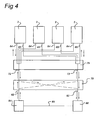
- Fig. 4 shows a hydraulic diagram (not to scale) of the same exciter device.
- Fig. 5 shows a diagrammatic top view of the same hydraulic exciter device.
- Fig. 3 shows two of the four hydraulic exciters 3, all of which are shown in Fig. 4 and Fig. 5 .
- the hydraulic exciters 3 are all connected to a foundation plate 90 by means of bolts, the former being connected to a concrete foundation 91 by means of further bolts.
- the hydraulic exciters 3 are all connected to a single electro-hydraulic servo valve, diagrammatically represented by 70.
- Fig. 3 and Fig. 4 furthermore show a first, second and third pump line 82, 83, 85, a pump 84 and a tank 86 which form a hydraulic pump circuit in which the pump 84, via the first pump line 82, pumps a hydraulic fluid to the electro-hydraulic servo valve 70 with a first volumetric flow.
- the hydraulic fluid subsequently returns to the tank 86 from the electro-hydraulic servo valve 70 via the second pump line 83.
- the tank 86 is connected to the third pump line 85 on the pump 84.
- the electro-hydraulic servo valve 70 ensures the fluid flow from the first pump line 82 to a hydraulic main supply pipe 72 and from a hydraulic main discharge pipe 73 to the second pump line 82, and thus regulates the volumetric flow in the hydraulic main supply pipe 72 and the hydraulic main discharge pipe 73. To this end, the electro-hydraulic servo valve 70 is actuated via electrical control lines 9 from the electronic control device 11.
- the electro-hydraulic servo valve 70 connects the hydraulic main supply pipe 72 to the first pump line 82 with the pump 85 and at the same time connects the hydraulic main discharge pipe 73, via the second pump line 83, to the tank 86, by means of which the volumetric flow supplied by the pump 85 is passed to the hydraulic main supply pipe 72.
- the flow of the hydraulic fluid through the respective pipes in the first state is illustrated in Fig. 5 by means of full arrows.
- the electro-hydraulic servo valve 70 connects the hydraulic main discharge pipe 73 to the first pump line 82 with the pump 85 and at the same time connects the hydraulic main supply pipe 72, via the second pump line 83, to the tank 86 by means of which the volumetric flow supplied by the pump 85 is passed to the hydraulic main discharge pipe 73.
- the flow of the hydraulic fluid through the respective pipes in the second state is illustrated in Fig. 5 by means of dashed arrows.
- the hydraulic main supply pipe 72 and the hydraulic main discharge pipe 73 are coupled to respective and substantially identical distribution supply pipes 64 and distribution discharge pipes 65 via a manifold 75.
- the hydraulic main supply pipe 72 thus branches in the manifold 75 into in this example four distribution supply pipes 64.
- the hydraulic main discharge pipe 73 thus branches in the manifold 75 into in this example four distribution discharge pipes 5.
- Substantially identical is understood to mean that the distribution supply pipes and the distribution discharge pipes, respectively, behave in substantially the same manner when a hydraulic fluid which is present therein is offered the same hydraulic volumetric flow.
- each of the distribution supply pipes 63 and the distribution discharge pipes 64, respectively are made of substantially the same material and have substantially the same diameter, substantially the same rigidity in the longitudinal direction and substantially the same stiffness in the circumferential direction.
- the total volumetric flow is thus evenly distributed between the distribution supply pipes 63 and the distribution discharge pipes 64, respectively.
- a hydraulic volumetric flow to/from the upper space 29a of each of the hydraulic exciters 3 is regulated via the hydraulic main supply pipe 72, the manifold 75 and the respective distribution supply pipe 64, and the hydraulic volumetric flow from/to the lower space 29b of each of the hydraulic exciters 3 is regulated via the hydraulic main discharge pipe 73, the manifold 75 and the respective distribution discharge pipe 65.
- the hydraulic exciters are driven synchronously by means of the single valve 70.
- the use of a single valve 70 offers the advantage, for example, that the exciters 3 operate synchronously without requiring additional measures. Moreover, this makes it possible to avoid the extra costs of additional electro-hydraulic servo valves 70 which would be required if each exciter had its own servo valve.
- the drive means 7 illustrated diagrammatically in Fig. 3 thus comprises the electro-hydraulic servo valve 70, the pump circuit, the manifold 75 and the supply pipes 64 and main discharge pipes 75.
- the hydraulic exciters 3 are driven at mutually substantially the same amplitude and frequency and in phase with one another by means of the drive means 7 in cooperation with the control means 11.
- a plurality of hydraulic supply pipe paths between the servo valve 70 and the respective hydraulic exciters 3 are formed by the common hydraulic main supply pipe 72, an internal path in the manifold 75 and the respective distribution supply pipes 64. These hydraulic supply pipe paths are identical in length and volume.
- a plurality of hydraulic discharge pipe paths are formed between the servo valve 70 and the respective hydraulic exciters 3 by the common hydraulic main discharge pipe 73, a further internal path in the manifold 75 and the respective distribution discharge pipes 65.
- These hydraulic discharge pipe paths are likewise identical in length and volume.
- the hydraulic pipe paths thus behave the same for each hydraulic exciter 3. As a result thereof, the exciters are not only operated at the same frequency, but also in phase with one another. All exciters will thus move at the same frequency, without phase differences between the various exciters.
- a first hydraulic exciter 3 is provided with a position sensor for emitting a position signal representative of the position of the first hydraulic exciter 3, that is to say of the piston rod 2 with respect to the housing 30.
- Said sensor is in communication with the control means 11 for regulating a working position and/or an amplitude of the first hydraulic exciter 3 by means of the control means 11 and drive means 7.
- the device is configured in such a manner that the rigid connection between the exciters, in use, normally results in a smoothing out of any small differences between the internal friction in the various exciters 3, and so that the hydraulic exciters 3 with the same working position, amplitude, frequency and phase make the vibrating table 1 vibrate.
- each of the hydraulic exciters 3 is provided with its own position sensor and each of the hydraulic exciters 3 is driven by its own servo valve, with the control means 11 actuating the servo valves of the various exciters in phase and amplitude in such a manner that the hydraulic exciters 3 are operated at the same amplitude, frequency and phase.
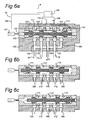
- Fig. 6a, Fig. 6b and Fig. 6c show an example of the electro-hydraulic valve 70 according to an embodiment of the compacting device with a hydraulic exciter device.
- the electro-hydraulic servo valve 70 has a 3-step structure and comprises a valve body 104, which can be moved to and fro hydraulically in a cylindrical cavity 103 in a valve housing 102 by means of a hydraulic intermediate valve 108, which is operated in turn by an electro-hydraulic pilot valve 106 which is actuated via electrical control line 9 and an electrical feedback line 109 from a measuring device 107 which is configured to emit a feedback signal, indicative of the position of the valve body 104 in the cylindrical cavity 104.
- a known type of such an electro-hydraulic servo valve 70 is, for example, the Type 4 WSE 3 EE 32 servo valve by Bosch Rexroth.
- the valve body 104 is a rod-shaped element with thickenings 121, 122, 123 and 124, the outer diameter of which corresponds to the inner diameter of the cylindrical cavity. Between the thickenings 121, 122, 123 and 124, there are annular recesses 111, 112, 113.
- the electro-hydraulic servo valve 70 can be brought into three states: a first (operating) state, a second (operating) state and a neutral state.
- Fig. 6a shows the electro-hydraulic valve 70 in the neutral state, in which thickening 122 closes off duct 173 (and thus the hydraulic main discharge pipe 73) and thickening 123 closes off duct 172 (and thus the hydraulic supply pipe 72).
- the valve body In the first state, illustrated in Fig. 6c , the valve body is moved slightly to the right, so that recess 111 creates a connection between ducts 183 and 173, and recess 112 creates a connection between ducts 182 and 172.
- the electro-hydraulic servo valve 70 thus connects the hydraulic main supply pipe 72 to the pump via the first pump line 82 and at the same time connects the hydraulic main discharge pipe 73 to the tank 85 via the second pump line 83.
- the valve body In the second state, illustrated in Fig. 6b , the valve body is moved slightly to the left, so that recess 112 creates a connection between ducts 182 and 173, and recess 113 creates a connection between ducts 184 and 172.
- the electro-hydraulic servo valve 70 thus connects the hydraulic main discharge pipe 73 to the pump 85 via the first pump line 82 and at the same time connects the hydraulic main supply pipe 72 to the tank 85 via the second pump line 83.
- the vibrating table 1 is rectangular or square.
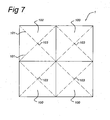
- Fig. 7 shows an example of a square vibrating table 1.
- the rectangular or square vibrating table 1 may be composed of a plurality of adjoining, identical rectangular or square parts 100 whose number is equal to the number of exciters 3.
- each exciter 3 is connected to the vibrating table 1 at the intersection 102 of the diagonals 101 of the respective rectangular or square part. This may be advantageous when producing a uniform excitation across the entire vibrating table 1, without nodes and antinodes, so that a uniform compaction can be achieved and/or fatigue stresses are reduced as far as possible.
- each exciter 3 is connected to the vibrating table 1 between the intersection 102 of the diagonals 101 of the respective rectangular or square part and the outer circumference of the vibrating table, at at most 25% of the distance between the intersection 102 of the diagonals 101 and a corner of the respective rectangular or square part. This may be advantageous for a uniform excitation and/or lower fatigue stress.
Landscapes
- Engineering & Computer Science (AREA)
- Mechanical Engineering (AREA)
- General Engineering & Computer Science (AREA)
- Chemical & Material Sciences (AREA)
- Manufacturing & Machinery (AREA)
- Ceramic Engineering (AREA)
- Physics & Mathematics (AREA)
- Fluid Mechanics (AREA)
- Analytical Chemistry (AREA)
- Apparatuses For Generation Of Mechanical Vibrations (AREA)
- Reciprocating Pumps (AREA)
Claims (10)
- Kompaktiervorrichtung zur Kompaktierung einer granulären, lose zusammenhängenden Masse, wie z. B. erdfeuchten Zement, zur Erzeugung von Endprodukten, wie z. B. Fliesen, Randsteine und dergleichen, umfassend einen Rütteltisch(1), eine Form (14), die für die zu kompaktierende Masse (17) vorgesehen und an dem Rütteltisch, zumindest während der Verwendung der Kompaktiervorrichtung, angebracht ist, eine mit dem Rütteltisch (1) verbundene hydraulische Anregungseinrichtung (63), wobei die hydraulische Anregungseinrichtung eine Vielzahl von hydraulischen Anregern (3) umfasst, wobei jeder hydraulische Anreger mit dem Rütteltisch verbunden ist, die hydraulischen Anreger zueinander parallel sind und die hydraulische Anregungseinrichtung konfiguriert ist, um die hydraulischen Anreger mit Anregungswegen mit wechselseitig im Wesentlichen derselben Amplitude und derselben Frequenz und in Phase zu einander anzutreiben, dadurch gekennzeichnet, dass ein Antriebsmittel (7) vorgesehen ist, das so konfiguriert ist, dass es einen hydraulischen Volumenfluss eines kompressiblen hydraulischen Fluids auf all die hydraulischen Anreger (3) gleichmäßig verteilt, dass das Antriebsmittel (7) ein elektrohydraulisches Servoventil (70), einen Verteiler (75) und eine Vielzahl von Verteilerrohren (64; 65) aufweist, wobei das Servoventil (70) konfiguriert ist, um einen hydraulischen Volumenfluss zum Verteiler (75) zu liefern, und wobei der Verteiler (75) konfiguriert ist, um den hydraulischen Volumenfluss vom Servoventil (70) auf die Verteilerrohre (64; 65) gleichmäßig zu verteilen, wobei die Verteilerrohre (64; 65) mit jeweiligen hydraulischen Anregern (3) verbunden sind, und dass die hydraulischen Rohrstrecken, gemessen von dem elektrohydraulischen Servoventil (70) zu jedem der jeweiligen hydraulischen Anreger (3) hinsichtlich Länge und Volumen identisch sind.
- Kompaktiervorrichtung nach einem der vorrangehenden Ansprüche, wobei ein Steuermittel (11) vorgesehen ist, das konfiguriert ist, um den Antrieb von jedem der hydraulischen Anreger der Vielzahl von hydraulischen Anregern auf der Grundlage einer Bestimmung des Anregungswegs von einem und nur einem einzigen hydraulischen Anreger der Vielzahl von hydraulischen Anregern zu steuern.
- Kompaktiervorrichtung nach Anspruch 2, wobei die Steuermittel (11) konfiguriert sind, um das elektrohydraulische Servoventil (3) auf der Grundlage der Bestimmung des Anregungswegs zu betätigen.
- Kompaktiervorrichtung nach Anspruch 2 oder 3, wobei der einzige hydraulische Anreger mit einem Sensor (80), wie z. B. einem Wegsensor, versehen ist, der konfiguriert ist, um den Anregungsweg von dem einem und nur einem einzigen hydraulischen Anreger zu bestimmen und den bestimmten Anregungsweg zum Steuermittel zu leiten.
- Kompaktiervorrichtung nach einem der vorrangehenden Ansprüche, wobei die hydraulische Anregungsvorrichtung konfiguriert ist, um die hydraulischen Anreger (3) gemäß einer kontinuierlich variablen Steuerfunktion anzutreiben.
- Kompaktiervorrichtung nach Anspruch 5, wobei die hydraulische Anregungsvorrichtung konfiguriert ist, um ein Verfahren durchzuführen, das die folgenden Schritte umfasst:- Auswählen eines Frequenzbereiches mit einem niedrigsten Wert und einem höchsten Wert für eine Anregungsfrequenz,- Regulieren der Anregungsfrequenz derart, dass der Frequenzbereich zumindest teilweise durchgelassen wird und dass eine Eigenfrequenz des hydraulischmechanischen Masse- Feder- Systems erreicht und passiert wird, wobei das hydraulisch-mechanische Masse- Feder- System von dem beweglichen Teil des Anregers, dem Rütteltisch, der Form und der zu kompaktierenden Masse sowie dem kompressiblen hydraulischen Fluid, das sich zwischen den hydraulischen Anregern und dem Antriebsmittel befindet, gebildet wird.
- Kompaktiervorrichtung nach einem der vorrangehenden Ansprüchen, umfassend einen Stempel (4) zum Pressen der Masse (17) in der Form (14) während des Gebrauchs.
- Verfahren zum Betreiben einer Kompaktiervorrichtung nach einem der vorangehenden Ansprüche, umfassend:- Antreiben aller hydraulischen Anreger (3) der Vielzahl von hydraulischen Anregern mit Anregungswegen mit derselben Amplitude und derselben Frequenz und in Phase miteinander,- Bereitstellen einer Quelle mit kompressiblem hydraulischen Fluid,- Bereitstellen eines hydraulischen Volumenflusses mit einer bestimmten Amplitude und Frequenz für das kompressible hydraulische Fluid,- gleichmäßiges Verteilen eines hydraulischen Volumenflusses, von einem Verteilpunkt, auf eine Vielzahl von hydraulischen Wegen mit identischer Länge und identischem Volumen, gemessen vom Verteilpunkt bis zu den jeweiligen hydraulischen Anregern.
- Verfahren nach Anspruch 8, umfassend die folgenden Schritte:- bestimmen des Anregungsweges eines einzigen hydraulischen Anregers der Vielzahl von hydraulischen Anregern, und- Antreiben von jedem der hydraulischen Anreger der Vielzahl von hydraulischen Anregern auf der Grundlage des Anregungsweges von nur dem einen hydraulischen Anreger.
- Verfahren nach einem der Ansprüche 7-9, umfassend- Auswählen eines Frequenzbereiches mit einem niedrigsten und einem höchsten Wert für eine Anregungsfrequenz,- Regeln der Anregungsfrequenz in der Weise, dass der Frequenzbereich zumindest teilweise durchgelassen wird und dass die Eigenfrequenz des hydraulischmechanischen Masse-Feder-Systems erreicht und überschritten wird, wobei das hydraulisch-mechanische Masse-Feder-System von dem beweglichen Teil des Anregers, dem Rütteltisch, der Form und der zu kompaktierenden Masse sowie dem kompressiblen hydraulischen Fluid, das sich zwischen den hydraulischen Anregern und dem Antriebsmittel befindet, gebildet wird.
Applications Claiming Priority (1)
| Application Number | Priority Date | Filing Date | Title |
|---|---|---|---|
| NL2005171A NL2005171C2 (nl) | 2010-07-29 | 2010-07-29 | Inrichting voor het verdichten van korrelvormige massa zoals betonspecie. |
Publications (3)
| Publication Number | Publication Date |
|---|---|
| EP2412503A2 EP2412503A2 (de) | 2012-02-01 |
| EP2412503A3 EP2412503A3 (de) | 2012-03-28 |
| EP2412503B1 true EP2412503B1 (de) | 2015-09-02 |
Family
ID=43708765
Family Applications (1)
| Application Number | Title | Priority Date | Filing Date |
|---|---|---|---|
| EP11175816.5A Not-in-force EP2412503B1 (de) | 2010-07-29 | 2011-07-28 | Vorrichtung und Verfahren zur Kompaktierung einer granulären Masse wie z. B. Betonzement |
Country Status (5)
| Country | Link |
|---|---|
| US (1) | US9211663B2 (de) |
| EP (1) | EP2412503B1 (de) |
| CA (1) | CA2813391C (de) |
| NL (1) | NL2005171C2 (de) |
| WO (1) | WO2012015305A1 (de) |
Families Citing this family (5)
| Publication number | Priority date | Publication date | Assignee | Title |
|---|---|---|---|---|
| CN103433998B (zh) * | 2013-07-18 | 2016-09-28 | 浙江中隧桥波形钢腹板有限公司 | 一种混凝土频幅共变振动方法 |
| NL2013003B1 (nl) * | 2014-06-16 | 2016-07-04 | Bouman Ind Supplier Group B V | Compactor, werkwijze voor het compacteren van een mengsel en toepassing van een compactor. |
| CN105908973A (zh) * | 2016-04-27 | 2016-08-31 | 天津送变电工程公司 | 一种改善基础施工工艺的微振捣技术 |
| CN106763007B (zh) * | 2017-02-17 | 2018-01-26 | 北京航空航天大学 | 一体化电静液伺服机构 |
| CN110227753B (zh) * | 2019-05-30 | 2020-06-26 | 江苏大学 | 一种径向高频振动式空化微塑性成形装置 |
Family Cites Families (11)
| Publication number | Priority date | Publication date | Assignee | Title |
|---|---|---|---|---|
| SU856796A1 (ru) * | 1979-11-16 | 1981-08-23 | Рижский Ордена Трудового Красного Знамени Политехнический Институт | Устройство дл уплотнени бетонных смесей в форме |
| SU1038234A1 (ru) * | 1982-01-21 | 1983-08-30 | Производственное объединение "Строймаш" | Гидропривод виброплощадки |
| NL1005862C1 (nl) * | 1997-04-09 | 1998-10-12 | Boer Staal Bv Den | Werkwijze alsmede inrichting voor het verdichten van korrelvormige massa zoals betonspecie. |
| JPH11300714A (ja) * | 1998-04-23 | 1999-11-02 | Kayaba Ind Co Ltd | テーブル式打設装置 |
| DE19921145B4 (de) * | 1999-05-07 | 2008-01-10 | Kobra Formen Gmbh | Rüttelantrieb für eine Form |
| DE10039028A1 (de) * | 2000-08-10 | 2002-02-21 | Gedib Ingbuero Innovation | Verfahren und Vorrichtung für ein Verdichtungssystem |
| DE10129468B4 (de) * | 2000-11-11 | 2006-01-26 | GEDIB Ingenieurbüro und Innovationsberatung GmbH | Verdichtungseinrichtung zur Verdichtung von Formkörpern aus kornförmigen Stoffen und Verfahren zur Anwendung der Verdichtungseinrichtung |
| DE102004005922A1 (de) * | 2004-02-06 | 2005-09-15 | Wacker Construction Equipment Ag | Vorrichtung zum Verdichten von Beton bei der Fertigung von Betonteilen |
| US7269949B1 (en) * | 2004-09-24 | 2007-09-18 | Davor Petricio Yaksic | Synchronizing hydraulic cylinders |
| DE102006018810A1 (de) | 2006-04-22 | 2007-10-25 | Kobra Formen Gmbh | Vorrichtung zur Herstellung von Betonformsteinen mit einer Rütteleinrichtung und Aktuator |
| DE112006003929A5 (de) * | 2006-06-21 | 2009-04-30 | Harald Winkler | Anlage und Verfahren zum Herstellen von Betonwaren |
-
2010
- 2010-07-29 NL NL2005171A patent/NL2005171C2/nl not_active IP Right Cessation
-
2011
- 2011-07-28 US US13/812,903 patent/US9211663B2/en not_active Expired - Fee Related
- 2011-07-28 CA CA2813391A patent/CA2813391C/en not_active Expired - Fee Related
- 2011-07-28 EP EP11175816.5A patent/EP2412503B1/de not_active Not-in-force
- 2011-07-28 WO PCT/NL2011/050545 patent/WO2012015305A1/en not_active Ceased
Also Published As
| Publication number | Publication date |
|---|---|
| WO2012015305A1 (en) | 2012-02-02 |
| US9211663B2 (en) | 2015-12-15 |
| CA2813391A1 (en) | 2012-02-02 |
| NL2005171C2 (nl) | 2012-01-31 |
| EP2412503A3 (de) | 2012-03-28 |
| EP2412503A2 (de) | 2012-02-01 |
| US20130145755A1 (en) | 2013-06-13 |
| CA2813391C (en) | 2019-04-30 |
Similar Documents
| Publication | Publication Date | Title |
|---|---|---|
| EP2412503B1 (de) | Vorrichtung und Verfahren zur Kompaktierung einer granulären Masse wie z. B. Betonzement | |
| US20130058717A1 (en) | Arrangement for providing a pulsing compressive force | |
| US5332372A (en) | Modular double-diaphragm pump | |
| KR101305982B1 (ko) | 유압 액추에이터 및 유압 진동 시험 장치 | |
| JP2012514150A (ja) | 2つのポンプユニットを伴っているポンプ装置,システム,使用及び方法 | |
| KR102607528B1 (ko) | 진동 댐퍼를 가진 대형 매니풀레이터 | |
| CN104185704A (zh) | 磁性振动压实机 | |
| CN1129916A (zh) | 连铸用结晶器 | |
| CN115194912A (zh) | 一种生产t梁用振捣器 | |
| CN102027168B (zh) | 振动装置 | |
| CN205474735U (zh) | 一种振动压路机液控无级调幅装置 | |
| CN108684234B (zh) | 一种气压自激式振动深松机 | |
| KR20210063755A (ko) | 보강토교대의 장기침하예측을 위한 장기침하측정방법 및 그 장치 | |
| CN121324140A (zh) | 三维地应力场中应力主轴可旋转的围岩变形破坏试验系统 | |
| CN104475199B (zh) | 薄膜式双向液压激振近共振型双筒振动磨 | |
| JPS5828017Y2 (ja) | 油圧振動締固め機 | |
| Niu et al. | A novel multifunctional energy-saving electro-hydraulic servo system | |
| CN104475198B (zh) | 薄膜式液压激振单筒振动磨 | |
| Popescu et al. | Increasing energy efficiency and flow rate regularity in facilities, machinery and equipment provided with high operating pressure and low flow rate hydraulic systems | |
| CN204448222U (zh) | 薄膜式双向液压激振双筒振动磨 | |
| Paladiychuk et al. | Increasing the efficiency of choosing a hydraulic impulse drive with programmable control | |
| CN204485958U (zh) | 薄膜式双向液压激振近共振型双筒振动磨 | |
| US7682143B2 (en) | Modular mounting device for concrete casting machines | |
| RU2184811C1 (ru) | Молот сваебойный гидравлический | |
| CN111674074B (zh) | 一种电液伺服低频振动设备及其加工工艺 |
Legal Events
| Date | Code | Title | Description |
|---|---|---|---|
| AK | Designated contracting states |
Kind code of ref document: A2 Designated state(s): AL AT BE BG CH CY CZ DE DK EE ES FI FR GB GR HR HU IE IS IT LI LT LU LV MC MK MT NL NO PL PT RO RS SE SI SK SM TR |
|
| AX | Request for extension of the european patent |
Extension state: BA ME |
|
| PUAI | Public reference made under article 153(3) epc to a published international application that has entered the european phase |
Free format text: ORIGINAL CODE: 0009012 |
|
| PUAL | Search report despatched |
Free format text: ORIGINAL CODE: 0009013 |
|
| AK | Designated contracting states |
Kind code of ref document: A3 Designated state(s): AL AT BE BG CH CY CZ DE DK EE ES FI FR GB GR HR HU IE IS IT LI LT LU LV MC MK MT NL NO PL PT RO RS SE SI SK SM TR |
|
| AX | Request for extension of the european patent |
Extension state: BA ME |
|
| RIC1 | Information provided on ipc code assigned before grant |
Ipc: F15B 21/12 20060101ALI20120223BHEP Ipc: B06B 1/18 20060101ALI20120223BHEP Ipc: B28B 1/087 20060101AFI20120223BHEP Ipc: B28B 3/02 20060101ALI20120223BHEP |
|
| 17P | Request for examination filed |
Effective date: 20120730 |
|
| 17Q | First examination report despatched |
Effective date: 20141006 |
|
| REG | Reference to a national code |
Ref country code: DE Ref legal event code: R079 Ref document number: 602011019320 Country of ref document: DE Free format text: PREVIOUS MAIN CLASS: B28B0001087000 Ipc: B06B0001180000 |
|
| RIC1 | Information provided on ipc code assigned before grant |
Ipc: B30B 11/02 20060101ALI20150211BHEP Ipc: F15B 21/12 20060101ALI20150211BHEP Ipc: B28B 1/087 20060101ALI20150211BHEP Ipc: B06B 1/18 20060101AFI20150211BHEP Ipc: B28B 3/02 20060101ALI20150211BHEP Ipc: F04B 23/00 20060101ALI20150211BHEP Ipc: F15B 15/14 20060101ALI20150211BHEP Ipc: B29C 43/58 20060101ALI20150211BHEP |
|
| GRAP | Despatch of communication of intention to grant a patent |
Free format text: ORIGINAL CODE: EPIDOSNIGR1 |
|
| INTG | Intention to grant announced |
Effective date: 20150325 |
|
| GRAS | Grant fee paid |
Free format text: ORIGINAL CODE: EPIDOSNIGR3 |
|
| GRAA | (expected) grant |
Free format text: ORIGINAL CODE: 0009210 |
|
| AK | Designated contracting states |
Kind code of ref document: B1 Designated state(s): AL AT BE BG CH CY CZ DE DK EE ES FI FR GB GR HR HU IE IS IT LI LT LU LV MC MK MT NL NO PL PT RO RS SE SI SK SM TR |
|
| REG | Reference to a national code |
Ref country code: GB Ref legal event code: FG4D |
|
| REG | Reference to a national code |
Ref country code: AT Ref legal event code: REF Ref document number: 746224 Country of ref document: AT Kind code of ref document: T Effective date: 20150915 Ref country code: CH Ref legal event code: EP |
|
| REG | Reference to a national code |
Ref country code: IE Ref legal event code: FG4D |
|
| REG | Reference to a national code |
Ref country code: DE Ref legal event code: R096 Ref document number: 602011019320 Country of ref document: DE |
|
| REG | Reference to a national code |
Ref country code: AT Ref legal event code: MK05 Ref document number: 746224 Country of ref document: AT Kind code of ref document: T Effective date: 20150902 |
|
| REG | Reference to a national code |
Ref country code: NL Ref legal event code: FP |
|
| PG25 | Lapsed in a contracting state [announced via postgrant information from national office to epo] |
Ref country code: LV Free format text: LAPSE BECAUSE OF FAILURE TO SUBMIT A TRANSLATION OF THE DESCRIPTION OR TO PAY THE FEE WITHIN THE PRESCRIBED TIME-LIMIT Effective date: 20150902 Ref country code: NO Free format text: LAPSE BECAUSE OF FAILURE TO SUBMIT A TRANSLATION OF THE DESCRIPTION OR TO PAY THE FEE WITHIN THE PRESCRIBED TIME-LIMIT Effective date: 20151202 Ref country code: GR Free format text: LAPSE BECAUSE OF FAILURE TO SUBMIT A TRANSLATION OF THE DESCRIPTION OR TO PAY THE FEE WITHIN THE PRESCRIBED TIME-LIMIT Effective date: 20151203 Ref country code: FI Free format text: LAPSE BECAUSE OF FAILURE TO SUBMIT A TRANSLATION OF THE DESCRIPTION OR TO PAY THE FEE WITHIN THE PRESCRIBED TIME-LIMIT Effective date: 20150902 Ref country code: LT Free format text: LAPSE BECAUSE OF FAILURE TO SUBMIT A TRANSLATION OF THE DESCRIPTION OR TO PAY THE FEE WITHIN THE PRESCRIBED TIME-LIMIT Effective date: 20150902 |
|
| REG | Reference to a national code |
Ref country code: LT Ref legal event code: MG4D |
|
| PG25 | Lapsed in a contracting state [announced via postgrant information from national office to epo] |
Ref country code: AT Free format text: LAPSE BECAUSE OF FAILURE TO SUBMIT A TRANSLATION OF THE DESCRIPTION OR TO PAY THE FEE WITHIN THE PRESCRIBED TIME-LIMIT Effective date: 20150902 Ref country code: ES Free format text: LAPSE BECAUSE OF FAILURE TO SUBMIT A TRANSLATION OF THE DESCRIPTION OR TO PAY THE FEE WITHIN THE PRESCRIBED TIME-LIMIT Effective date: 20150902 Ref country code: PL Free format text: LAPSE BECAUSE OF FAILURE TO SUBMIT A TRANSLATION OF THE DESCRIPTION OR TO PAY THE FEE WITHIN THE PRESCRIBED TIME-LIMIT Effective date: 20150902 Ref country code: RS Free format text: LAPSE BECAUSE OF FAILURE TO SUBMIT A TRANSLATION OF THE DESCRIPTION OR TO PAY THE FEE WITHIN THE PRESCRIBED TIME-LIMIT Effective date: 20150902 Ref country code: SE Free format text: LAPSE BECAUSE OF FAILURE TO SUBMIT A TRANSLATION OF THE DESCRIPTION OR TO PAY THE FEE WITHIN THE PRESCRIBED TIME-LIMIT Effective date: 20150902 |
|
| PG25 | Lapsed in a contracting state [announced via postgrant information from national office to epo] |
Ref country code: IT Free format text: LAPSE BECAUSE OF FAILURE TO SUBMIT A TRANSLATION OF THE DESCRIPTION OR TO PAY THE FEE WITHIN THE PRESCRIBED TIME-LIMIT Effective date: 20150902 Ref country code: SK Free format text: LAPSE BECAUSE OF FAILURE TO SUBMIT A TRANSLATION OF THE DESCRIPTION OR TO PAY THE FEE WITHIN THE PRESCRIBED TIME-LIMIT Effective date: 20150902 Ref country code: EE Free format text: LAPSE BECAUSE OF FAILURE TO SUBMIT A TRANSLATION OF THE DESCRIPTION OR TO PAY THE FEE WITHIN THE PRESCRIBED TIME-LIMIT Effective date: 20150902 Ref country code: IS Free format text: LAPSE BECAUSE OF FAILURE TO SUBMIT A TRANSLATION OF THE DESCRIPTION OR TO PAY THE FEE WITHIN THE PRESCRIBED TIME-LIMIT Effective date: 20160102 Ref country code: CZ Free format text: LAPSE BECAUSE OF FAILURE TO SUBMIT A TRANSLATION OF THE DESCRIPTION OR TO PAY THE FEE WITHIN THE PRESCRIBED TIME-LIMIT Effective date: 20150902 |
|
| PG25 | Lapsed in a contracting state [announced via postgrant information from national office to epo] |
Ref country code: RO Free format text: LAPSE BECAUSE OF FAILURE TO SUBMIT A TRANSLATION OF THE DESCRIPTION OR TO PAY THE FEE WITHIN THE PRESCRIBED TIME-LIMIT Effective date: 20150902 Ref country code: PT Free format text: LAPSE BECAUSE OF FAILURE TO SUBMIT A TRANSLATION OF THE DESCRIPTION OR TO PAY THE FEE WITHIN THE PRESCRIBED TIME-LIMIT Effective date: 20160104 |
|
| REG | Reference to a national code |
Ref country code: DE Ref legal event code: R097 Ref document number: 602011019320 Country of ref document: DE |
|
| PLBE | No opposition filed within time limit |
Free format text: ORIGINAL CODE: 0009261 |
|
| STAA | Information on the status of an ep patent application or granted ep patent |
Free format text: STATUS: NO OPPOSITION FILED WITHIN TIME LIMIT |
|
| REG | Reference to a national code |
Ref country code: FR Ref legal event code: PLFP Year of fee payment: 6 |
|
| 26N | No opposition filed |
Effective date: 20160603 |
|
| PG25 | Lapsed in a contracting state [announced via postgrant information from national office to epo] |
Ref country code: SI Free format text: LAPSE BECAUSE OF FAILURE TO SUBMIT A TRANSLATION OF THE DESCRIPTION OR TO PAY THE FEE WITHIN THE PRESCRIBED TIME-LIMIT Effective date: 20150902 Ref country code: DK Free format text: LAPSE BECAUSE OF FAILURE TO SUBMIT A TRANSLATION OF THE DESCRIPTION OR TO PAY THE FEE WITHIN THE PRESCRIBED TIME-LIMIT Effective date: 20150902 |
|
| PGFP | Annual fee paid to national office [announced via postgrant information from national office to epo] |
Ref country code: NL Payment date: 20160720 Year of fee payment: 6 |
|
| PGFP | Annual fee paid to national office [announced via postgrant information from national office to epo] |
Ref country code: DE Payment date: 20160722 Year of fee payment: 6 Ref country code: GB Payment date: 20160721 Year of fee payment: 6 |
|
| PGFP | Annual fee paid to national office [announced via postgrant information from national office to epo] |
Ref country code: FR Payment date: 20160721 Year of fee payment: 6 |
|
| PG25 | Lapsed in a contracting state [announced via postgrant information from national office to epo] |
Ref country code: BE Free format text: LAPSE BECAUSE OF FAILURE TO SUBMIT A TRANSLATION OF THE DESCRIPTION OR TO PAY THE FEE WITHIN THE PRESCRIBED TIME-LIMIT Effective date: 20150902 |
|
| REG | Reference to a national code |
Ref country code: CH Ref legal event code: PL |
|
| PG25 | Lapsed in a contracting state [announced via postgrant information from national office to epo] |
Ref country code: MC Free format text: LAPSE BECAUSE OF FAILURE TO SUBMIT A TRANSLATION OF THE DESCRIPTION OR TO PAY THE FEE WITHIN THE PRESCRIBED TIME-LIMIT Effective date: 20150902 |
|
| PG25 | Lapsed in a contracting state [announced via postgrant information from national office to epo] |
Ref country code: LI Free format text: LAPSE BECAUSE OF NON-PAYMENT OF DUE FEES Effective date: 20160731 Ref country code: CH Free format text: LAPSE BECAUSE OF NON-PAYMENT OF DUE FEES Effective date: 20160731 |
|
| REG | Reference to a national code |
Ref country code: IE Ref legal event code: MM4A |
|
| PG25 | Lapsed in a contracting state [announced via postgrant information from national office to epo] |
Ref country code: IE Free format text: LAPSE BECAUSE OF NON-PAYMENT OF DUE FEES Effective date: 20160728 |
|
| PG25 | Lapsed in a contracting state [announced via postgrant information from national office to epo] |
Ref country code: LU Free format text: LAPSE BECAUSE OF NON-PAYMENT OF DUE FEES Effective date: 20160728 |
|
| REG | Reference to a national code |
Ref country code: DE Ref legal event code: R119 Ref document number: 602011019320 Country of ref document: DE |
|
| REG | Reference to a national code |
Ref country code: NL Ref legal event code: MM Effective date: 20170801 |
|
| GBPC | Gb: european patent ceased through non-payment of renewal fee |
Effective date: 20170728 |
|
| REG | Reference to a national code |
Ref country code: FR Ref legal event code: ST Effective date: 20180330 |
|
| PG25 | Lapsed in a contracting state [announced via postgrant information from national office to epo] |
Ref country code: NL Free format text: LAPSE BECAUSE OF NON-PAYMENT OF DUE FEES Effective date: 20170801 Ref country code: DE Free format text: LAPSE BECAUSE OF NON-PAYMENT OF DUE FEES Effective date: 20180201 Ref country code: GB Free format text: LAPSE BECAUSE OF NON-PAYMENT OF DUE FEES Effective date: 20170728 |
|
| PG25 | Lapsed in a contracting state [announced via postgrant information from national office to epo] |
Ref country code: SM Free format text: LAPSE BECAUSE OF FAILURE TO SUBMIT A TRANSLATION OF THE DESCRIPTION OR TO PAY THE FEE WITHIN THE PRESCRIBED TIME-LIMIT Effective date: 20150902 Ref country code: FR Free format text: LAPSE BECAUSE OF NON-PAYMENT OF DUE FEES Effective date: 20170731 Ref country code: CY Free format text: LAPSE BECAUSE OF FAILURE TO SUBMIT A TRANSLATION OF THE DESCRIPTION OR TO PAY THE FEE WITHIN THE PRESCRIBED TIME-LIMIT Effective date: 20150902 Ref country code: HU Free format text: LAPSE BECAUSE OF FAILURE TO SUBMIT A TRANSLATION OF THE DESCRIPTION OR TO PAY THE FEE WITHIN THE PRESCRIBED TIME-LIMIT; INVALID AB INITIO Effective date: 20110728 |
|
| PG25 | Lapsed in a contracting state [announced via postgrant information from national office to epo] |
Ref country code: MK Free format text: LAPSE BECAUSE OF FAILURE TO SUBMIT A TRANSLATION OF THE DESCRIPTION OR TO PAY THE FEE WITHIN THE PRESCRIBED TIME-LIMIT Effective date: 20150902 Ref country code: TR Free format text: LAPSE BECAUSE OF FAILURE TO SUBMIT A TRANSLATION OF THE DESCRIPTION OR TO PAY THE FEE WITHIN THE PRESCRIBED TIME-LIMIT Effective date: 20150902 Ref country code: MT Free format text: LAPSE BECAUSE OF NON-PAYMENT OF DUE FEES Effective date: 20160731 Ref country code: HR Free format text: LAPSE BECAUSE OF FAILURE TO SUBMIT A TRANSLATION OF THE DESCRIPTION OR TO PAY THE FEE WITHIN THE PRESCRIBED TIME-LIMIT Effective date: 20150902 |
|
| PG25 | Lapsed in a contracting state [announced via postgrant information from national office to epo] |
Ref country code: BG Free format text: LAPSE BECAUSE OF FAILURE TO SUBMIT A TRANSLATION OF THE DESCRIPTION OR TO PAY THE FEE WITHIN THE PRESCRIBED TIME-LIMIT Effective date: 20150902 |
|
| PG25 | Lapsed in a contracting state [announced via postgrant information from national office to epo] |
Ref country code: AL Free format text: LAPSE BECAUSE OF FAILURE TO SUBMIT A TRANSLATION OF THE DESCRIPTION OR TO PAY THE FEE WITHIN THE PRESCRIBED TIME-LIMIT Effective date: 20150902 |