EP2408786B1 - Neue silanverbindungen mit cyclischer kohlenstoffkette einschliesslich einer alkinfunktion zur funktionalisierung fester substrate und immobilisierung biologischer moleküle auf diesen substraten - Google Patents
Neue silanverbindungen mit cyclischer kohlenstoffkette einschliesslich einer alkinfunktion zur funktionalisierung fester substrate und immobilisierung biologischer moleküle auf diesen substraten Download PDFInfo
- Publication number
- EP2408786B1 EP2408786B1 EP10712457.0A EP10712457A EP2408786B1 EP 2408786 B1 EP2408786 B1 EP 2408786B1 EP 10712457 A EP10712457 A EP 10712457A EP 2408786 B1 EP2408786 B1 EP 2408786B1
- Authority
- EP
- European Patent Office
- Prior art keywords
- group
- substrate
- support
- solid
- substrates
- Prior art date
- Legal status (The legal status is an assumption and is not a legal conclusion. Google has not performed a legal analysis and makes no representation as to the accuracy of the status listed.)
- Not-in-force
Links
- 239000007787 solid Substances 0.000 title claims description 57
- 239000000758 substrate Substances 0.000 title claims description 27
- 150000004756 silanes Chemical class 0.000 title description 21
- 150000001345 alkine derivatives Chemical group 0.000 title description 4
- 238000000034 method Methods 0.000 claims description 46
- 150000001875 compounds Chemical class 0.000 claims description 45
- 125000002887 hydroxy group Chemical group [H]O* 0.000 claims description 37
- 238000006243 chemical reaction Methods 0.000 claims description 22
- 125000004432 carbon atom Chemical group C* 0.000 claims description 18
- 229910000077 silane Inorganic materials 0.000 claims description 13
- -1 Silane compound Chemical class 0.000 claims description 12
- 125000000217 alkyl group Chemical group 0.000 claims description 12
- 125000003118 aryl group Chemical group 0.000 claims description 11
- IVRMZWNICZWHMI-UHFFFAOYSA-N azide group Chemical group [N-]=[N+]=[N-] IVRMZWNICZWHMI-UHFFFAOYSA-N 0.000 claims description 11
- 125000005842 heteroatom Chemical group 0.000 claims description 11
- 229910052751 metal Inorganic materials 0.000 claims description 10
- 239000002184 metal Substances 0.000 claims description 10
- 229910052710 silicon Inorganic materials 0.000 claims description 10
- 239000010703 silicon Substances 0.000 claims description 10
- VYPSYNLAJGMNEJ-UHFFFAOYSA-N Silicium dioxide Chemical compound O=[Si]=O VYPSYNLAJGMNEJ-UHFFFAOYSA-N 0.000 claims description 9
- 229910052760 oxygen Inorganic materials 0.000 claims description 9
- 229910052717 sulfur Inorganic materials 0.000 claims description 9
- 125000002947 alkylene group Chemical group 0.000 claims description 8
- 125000006850 spacer group Chemical group 0.000 claims description 8
- 239000011521 glass Substances 0.000 claims description 7
- 229910052801 chlorine Inorganic materials 0.000 claims description 6
- 229910052731 fluorine Inorganic materials 0.000 claims description 6
- 125000004435 hydrogen atom Chemical group [H]* 0.000 claims description 6
- 229910044991 metal oxide Inorganic materials 0.000 claims description 6
- 150000004706 metal oxides Chemical class 0.000 claims description 6
- 125000001997 phenyl group Chemical group [H]C1=C([H])C([H])=C(*)C([H])=C1[H] 0.000 claims description 6
- 239000004033 plastic Substances 0.000 claims description 6
- 229920003023 plastic Polymers 0.000 claims description 6
- 229910052814 silicon oxide Inorganic materials 0.000 claims description 6
- 241000894006 Bacteria Species 0.000 claims description 5
- 229920000089 Cyclic olefin copolymer Polymers 0.000 claims description 5
- 229910052794 bromium Inorganic materials 0.000 claims description 5
- 229910052740 iodine Inorganic materials 0.000 claims description 5
- 150000002632 lipids Chemical class 0.000 claims description 5
- 108020004707 nucleic acids Proteins 0.000 claims description 5
- 102000039446 nucleic acids Human genes 0.000 claims description 5
- 150000007523 nucleic acids Chemical class 0.000 claims description 5
- 108090000623 proteins and genes Proteins 0.000 claims description 5
- 102000004169 proteins and genes Human genes 0.000 claims description 5
- 235000000346 sugar Nutrition 0.000 claims description 5
- 150000008163 sugars Chemical class 0.000 claims description 5
- 239000004642 Polyimide Substances 0.000 claims description 4
- 239000004417 polycarbonate Substances 0.000 claims description 4
- 229920000515 polycarbonate Polymers 0.000 claims description 4
- 229920001721 polyimide Polymers 0.000 claims description 4
- QQQSFSZALRVCSZ-UHFFFAOYSA-N triethoxysilane Chemical group CCO[SiH](OCC)OCC QQQSFSZALRVCSZ-UHFFFAOYSA-N 0.000 claims description 4
- 239000000463 material Substances 0.000 claims description 3
- JCXJVPUVTGWSNB-UHFFFAOYSA-N nitrogen dioxide Inorganic materials O=[N]=O JCXJVPUVTGWSNB-UHFFFAOYSA-N 0.000 claims description 3
- 125000002524 organometallic group Chemical group 0.000 claims description 3
- ZPWOOKQUDFIEIX-UHFFFAOYSA-N cyclooctyne Chemical compound C1CCCC#CCC1 ZPWOOKQUDFIEIX-UHFFFAOYSA-N 0.000 claims description 2
- 238000007306 functionalization reaction Methods 0.000 description 12
- XLYOFNOQVPJJNP-UHFFFAOYSA-N water Chemical compound O XLYOFNOQVPJJNP-UHFFFAOYSA-N 0.000 description 10
- HEMHJVSKTPXQMS-UHFFFAOYSA-M Sodium hydroxide Chemical compound [OH-].[Na+] HEMHJVSKTPXQMS-UHFFFAOYSA-M 0.000 description 9
- LFQSCWFLJHTTHZ-UHFFFAOYSA-N Ethanol Chemical compound CCO LFQSCWFLJHTTHZ-UHFFFAOYSA-N 0.000 description 8
- XUIMIQQOPSSXEZ-UHFFFAOYSA-N Silicon Chemical compound [Si] XUIMIQQOPSSXEZ-UHFFFAOYSA-N 0.000 description 7
- 150000002430 hydrocarbons Chemical group 0.000 description 7
- 230000003993 interaction Effects 0.000 description 7
- 238000007789 sealing Methods 0.000 description 7
- XEKOWRVHYACXOJ-UHFFFAOYSA-N Ethyl acetate Chemical compound CCOC(C)=O XEKOWRVHYACXOJ-UHFFFAOYSA-N 0.000 description 6
- 239000007822 coupling agent Substances 0.000 description 6
- IAZDPXIOMUYVGZ-UHFFFAOYSA-N Dimethylsulphoxide Chemical compound CS(C)=O IAZDPXIOMUYVGZ-UHFFFAOYSA-N 0.000 description 5
- BLRPTPMANUNPDV-UHFFFAOYSA-N Silane Chemical group [SiH4] BLRPTPMANUNPDV-UHFFFAOYSA-N 0.000 description 5
- 230000015572 biosynthetic process Effects 0.000 description 5
- 238000006352 cycloaddition reaction Methods 0.000 description 5
- 230000003100 immobilizing effect Effects 0.000 description 5
- 239000012074 organic phase Substances 0.000 description 5
- XKRFYHLGVUSROY-UHFFFAOYSA-N Argon Chemical compound [Ar] XKRFYHLGVUSROY-UHFFFAOYSA-N 0.000 description 4
- XDTMQSROBMDMFD-UHFFFAOYSA-N Cyclohexane Chemical compound C1CCCCC1 XDTMQSROBMDMFD-UHFFFAOYSA-N 0.000 description 4
- 210000004027 cell Anatomy 0.000 description 4
- 239000003795 chemical substances by application Substances 0.000 description 4
- 239000000460 chlorine Substances 0.000 description 4
- 238000005859 coupling reaction Methods 0.000 description 4
- 125000000753 cycloalkyl group Chemical group 0.000 description 4
- 238000003818 flash chromatography Methods 0.000 description 4
- 125000003808 silyl group Chemical group [H][Si]([H])([H])[*] 0.000 description 4
- OKTJSMMVPCPJKN-UHFFFAOYSA-N Carbon Chemical compound [C] OKTJSMMVPCPJKN-UHFFFAOYSA-N 0.000 description 3
- HEDRZPFGACZZDS-UHFFFAOYSA-N Chloroform Chemical compound ClC(Cl)Cl HEDRZPFGACZZDS-UHFFFAOYSA-N 0.000 description 3
- WQZGKKKJIJFFOK-QTVWNMPRSA-N D-mannopyranose Chemical compound OC[C@H]1OC(O)[C@@H](O)[C@@H](O)[C@@H]1O WQZGKKKJIJFFOK-QTVWNMPRSA-N 0.000 description 3
- 229910004013 NO 2 Inorganic materials 0.000 description 3
- YXFVVABEGXRONW-UHFFFAOYSA-N Toluene Chemical compound CC1=CC=CC=C1 YXFVVABEGXRONW-UHFFFAOYSA-N 0.000 description 3
- 229910052799 carbon Inorganic materials 0.000 description 3
- 125000006297 carbonyl amino group Chemical group [H]N([*:2])C([*:1])=O 0.000 description 3
- 239000003054 catalyst Substances 0.000 description 3
- 230000008878 coupling Effects 0.000 description 3
- 238000010168 coupling process Methods 0.000 description 3
- 150000004678 hydrides Chemical group 0.000 description 3
- 238000006459 hydrosilylation reaction Methods 0.000 description 3
- 239000000203 mixture Substances 0.000 description 3
- 238000002444 silanisation Methods 0.000 description 3
- 238000003756 stirring Methods 0.000 description 3
- ZSPTYLOMNJNZNG-UHFFFAOYSA-N 3-Buten-1-ol Chemical compound OCCC=C ZSPTYLOMNJNZNG-UHFFFAOYSA-N 0.000 description 2
- OFBQJSOFQDEBGM-UHFFFAOYSA-N Pentane Chemical compound CCCCC OFBQJSOFQDEBGM-UHFFFAOYSA-N 0.000 description 2
- KAESVJOAVNADME-UHFFFAOYSA-N Pyrrole Chemical compound C=1C=CNC=1 KAESVJOAVNADME-UHFFFAOYSA-N 0.000 description 2
- RTAQQCXQSZGOHL-UHFFFAOYSA-N Titanium Chemical compound [Ti] RTAQQCXQSZGOHL-UHFFFAOYSA-N 0.000 description 2
- XSTXAVWGXDQKEL-UHFFFAOYSA-N Trichloroethylene Chemical group ClC=C(Cl)Cl XSTXAVWGXDQKEL-UHFFFAOYSA-N 0.000 description 2
- 239000000654 additive Substances 0.000 description 2
- 230000000996 additive effect Effects 0.000 description 2
- 150000001336 alkenes Chemical class 0.000 description 2
- 239000012736 aqueous medium Substances 0.000 description 2
- 239000008346 aqueous phase Substances 0.000 description 2
- 229910052786 argon Inorganic materials 0.000 description 2
- 239000002585 base Substances 0.000 description 2
- 230000008901 benefit Effects 0.000 description 2
- DIKBFYAXUHHXCS-UHFFFAOYSA-N bromoform Chemical compound BrC(Br)Br DIKBFYAXUHHXCS-UHFFFAOYSA-N 0.000 description 2
- 238000004177 carbon cycle Methods 0.000 description 2
- 239000003153 chemical reaction reagent Substances 0.000 description 2
- 229940125904 compound 1 Drugs 0.000 description 2
- 229940126214 compound 3 Drugs 0.000 description 2
- 150000001925 cycloalkenes Chemical class 0.000 description 2
- 239000008367 deionised water Substances 0.000 description 2
- 229910021641 deionized water Inorganic materials 0.000 description 2
- 125000000524 functional group Chemical group 0.000 description 2
- 229910052739 hydrogen Inorganic materials 0.000 description 2
- 239000003446 ligand Substances 0.000 description 2
- 239000007788 liquid Substances 0.000 description 2
- 239000002609 medium Substances 0.000 description 2
- 230000003647 oxidation Effects 0.000 description 2
- 238000007254 oxidation reaction Methods 0.000 description 2
- 229920000642 polymer Polymers 0.000 description 2
- 150000003839 salts Chemical class 0.000 description 2
- 239000000126 substance Substances 0.000 description 2
- 125000001424 substituent group Chemical group 0.000 description 2
- 239000004094 surface-active agent Substances 0.000 description 2
- 238000003786 synthesis reaction Methods 0.000 description 2
- 239000010936 titanium Substances 0.000 description 2
- 229910052719 titanium Inorganic materials 0.000 description 2
- 231100000331 toxic Toxicity 0.000 description 2
- 230000002588 toxic effect Effects 0.000 description 2
- LUSSPXRPJHSSSS-DHZHZOJOSA-N (1e)-1-bromo-8-but-3-enoxycyclooctene Chemical compound Br\C1=C\CCCCCC1OCCC=C LUSSPXRPJHSSSS-DHZHZOJOSA-N 0.000 description 1
- PUAQLLVFLMYYJJ-UHFFFAOYSA-N 2-aminopropiophenone Chemical compound CC(N)C(=O)C1=CC=CC=C1 PUAQLLVFLMYYJJ-UHFFFAOYSA-N 0.000 description 1
- KIVYKGIZETTWDW-UHFFFAOYSA-N 3-but-3-enoxycyclooctyne Chemical compound C=CCCOC1CCCCCC#C1 KIVYKGIZETTWDW-UHFFFAOYSA-N 0.000 description 1
- QTTYZFVFHNOGNM-UHFFFAOYSA-N 4-cyclooct-2-yn-1-yloxybutyl(triethoxy)silane Chemical compound CCO[Si](OCC)(OCC)CCCCOC1CCCCCC#C1 QTTYZFVFHNOGNM-UHFFFAOYSA-N 0.000 description 1
- YZHSFGUZOQHWKJ-UHFFFAOYSA-N 6,7-dibromobicyclo[5.1.0]octane Chemical compound BrC1CCCCC2CC12Br YZHSFGUZOQHWKJ-UHFFFAOYSA-N 0.000 description 1
- MILKPYBKTSZFBT-UHFFFAOYSA-N 8,8-dibromobicyclo[5.1.0]octane Chemical compound C1CCCCC2C(Br)(Br)C21 MILKPYBKTSZFBT-UHFFFAOYSA-N 0.000 description 1
- WKBOTKDWSSQWDR-UHFFFAOYSA-N Bromine atom Chemical group [Br] WKBOTKDWSSQWDR-UHFFFAOYSA-N 0.000 description 1
- 241000206602 Eukaryota Species 0.000 description 1
- 229910004298 SiO 2 Inorganic materials 0.000 description 1
- 241001080024 Telles Species 0.000 description 1
- YTPLMLYBLZKORZ-UHFFFAOYSA-N Thiophene Chemical group C=1C=CSC=1 YTPLMLYBLZKORZ-UHFFFAOYSA-N 0.000 description 1
- 240000008042 Zea mays Species 0.000 description 1
- 238000013019 agitation Methods 0.000 description 1
- 125000002355 alkine group Chemical group 0.000 description 1
- 229910052782 aluminium Inorganic materials 0.000 description 1
- XAGFODPZIPBFFR-UHFFFAOYSA-N aluminium Chemical compound [Al] XAGFODPZIPBFFR-UHFFFAOYSA-N 0.000 description 1
- 238000004458 analytical method Methods 0.000 description 1
- 150000001540 azides Chemical class 0.000 description 1
- 229950005228 bromoform Drugs 0.000 description 1
- 239000000969 carrier Substances 0.000 description 1
- 230000003197 catalytic effect Effects 0.000 description 1
- 210000002421 cell wall Anatomy 0.000 description 1
- 238000007385 chemical modification Methods 0.000 description 1
- 125000001309 chloro group Chemical group Cl* 0.000 description 1
- 238000004587 chromatography analysis Methods 0.000 description 1
- 239000012230 colorless oil Substances 0.000 description 1
- 229940125782 compound 2 Drugs 0.000 description 1
- 238000004132 cross linking Methods 0.000 description 1
- ZXIJMRYMVAMXQP-UHFFFAOYSA-N cycloheptene Chemical compound C1CCC=CCC1 ZXIJMRYMVAMXQP-UHFFFAOYSA-N 0.000 description 1
- 238000007256 debromination reaction Methods 0.000 description 1
- 230000001419 dependent effect Effects 0.000 description 1
- 238000001514 detection method Methods 0.000 description 1
- 238000003745 diagnosis Methods 0.000 description 1
- 125000000664 diazo group Chemical group [N-]=[N+]=[*] 0.000 description 1
- 201000010099 disease Diseases 0.000 description 1
- 208000037265 diseases, disorders, signs and symptoms Diseases 0.000 description 1
- 238000005401 electroluminescence Methods 0.000 description 1
- 238000001962 electrophoresis Methods 0.000 description 1
- 125000005677 ethinylene group Chemical group [*:2]C#C[*:1] 0.000 description 1
- 238000000605 extraction Methods 0.000 description 1
- 238000001914 filtration Methods 0.000 description 1
- 125000001153 fluoro group Chemical group F* 0.000 description 1
- 238000010438 heat treatment Methods 0.000 description 1
- 230000013632 homeostatic process Effects 0.000 description 1
- 230000002209 hydrophobic effect Effects 0.000 description 1
- APFVFJFRJDLVQX-UHFFFAOYSA-N indium atom Chemical compound [In] APFVFJFRJDLVQX-UHFFFAOYSA-N 0.000 description 1
- 229910003437 indium oxide Inorganic materials 0.000 description 1
- AMGQUBHHOARCQH-UHFFFAOYSA-N indium;oxotin Chemical compound [In].[Sn]=O AMGQUBHHOARCQH-UHFFFAOYSA-N 0.000 description 1
- PNDPGZBMCMUPRI-UHFFFAOYSA-N iodine Chemical compound II PNDPGZBMCMUPRI-UHFFFAOYSA-N 0.000 description 1
- 150000002703 mannose derivatives Chemical class 0.000 description 1
- 150000002739 metals Chemical class 0.000 description 1
- 230000004048 modification Effects 0.000 description 1
- 238000012986 modification Methods 0.000 description 1
- 238000010534 nucleophilic substitution reaction Methods 0.000 description 1
- 239000003921 oil Substances 0.000 description 1
- 230000003287 optical effect Effects 0.000 description 1
- 230000008520 organization Effects 0.000 description 1
- 125000001979 organolithium group Chemical group 0.000 description 1
- 125000002734 organomagnesium group Chemical group 0.000 description 1
- 238000005897 peptide coupling reaction Methods 0.000 description 1
- 239000012071 phase Substances 0.000 description 1
- 238000005424 photoluminescence Methods 0.000 description 1
- LPNYRYFBWFDTMA-UHFFFAOYSA-N potassium tert-butoxide Chemical compound [K+].CC(C)(C)[O-] LPNYRYFBWFDTMA-UHFFFAOYSA-N 0.000 description 1
- 238000002360 preparation method Methods 0.000 description 1
- 230000008569 process Effects 0.000 description 1
- 238000000746 purification Methods 0.000 description 1
- 239000010453 quartz Substances 0.000 description 1
- 125000004151 quinonyl group Chemical group 0.000 description 1
- 230000035945 sensitivity Effects 0.000 description 1
- 238000000926 separation method Methods 0.000 description 1
- 125000005372 silanol group Chemical group 0.000 description 1
- 239000000377 silicon dioxide Substances 0.000 description 1
- 241000894007 species Species 0.000 description 1
- 238000001228 spectrum Methods 0.000 description 1
- 239000000725 suspension Substances 0.000 description 1
- XOLBLPGZBRYERU-UHFFFAOYSA-N tin dioxide Chemical compound O=[Sn]=O XOLBLPGZBRYERU-UHFFFAOYSA-N 0.000 description 1
- 229910001887 tin oxide Inorganic materials 0.000 description 1
- ZDHXKXAHOVTTAH-UHFFFAOYSA-N trichlorosilane Chemical group Cl[SiH](Cl)Cl ZDHXKXAHOVTTAH-UHFFFAOYSA-N 0.000 description 1
- WPPVEXTUHHUEIV-UHFFFAOYSA-N trifluorosilane Chemical group F[SiH](F)F WPPVEXTUHHUEIV-UHFFFAOYSA-N 0.000 description 1
- YUYCVXFAYWRXLS-UHFFFAOYSA-N trimethoxysilane Chemical group CO[SiH](OC)OC YUYCVXFAYWRXLS-UHFFFAOYSA-N 0.000 description 1
- 238000002604 ultrasonography Methods 0.000 description 1
- 125000000391 vinyl group Chemical group [H]C([*])=C([H])[H] 0.000 description 1
Classifications
-
- C—CHEMISTRY; METALLURGY
- C07—ORGANIC CHEMISTRY
- C07F—ACYCLIC, CARBOCYCLIC OR HETEROCYCLIC COMPOUNDS CONTAINING ELEMENTS OTHER THAN CARBON, HYDROGEN, HALOGEN, OXYGEN, NITROGEN, SULFUR, SELENIUM OR TELLURIUM
- C07F7/00—Compounds containing elements of Groups 4 or 14 of the Periodic Table
- C07F7/02—Silicon compounds
- C07F7/08—Compounds having one or more C—Si linkages
- C07F7/18—Compounds having one or more C—Si linkages as well as one or more C—O—Si linkages
- C07F7/1804—Compounds having Si-O-C linkages
Definitions
- the invention relates to a silane compound comprising a cycloalkyne functionality.
- It also relates to a method of functionalizing a solid support, and the solid support thus obtained.
- It also relates to a method of immobilizing a biological molecule, a method of sealing two solid supports and the structure consisting of two sealed solid supports.
- Supports carrying immobilized biological molecules such as nucleic acids, proteins, sugars, lipids are advantageously used for the detection and recognition of biological species, as well as the study of their functioning and their role in the natural environment.
- the coupling agents are grafted onto the surface of the supports by reaction with hydroxyl functions of the support and the reactive functions of the agent, to form covalent bonds between the coupling agent and the support.
- Metals are usually toxic, can interact with many biological molecules and alter the function of metallo-enzymes, or disrupt homeostasis.
- the patent application EP 0 664 452 A2 discloses silane compounds for functionalizing a substrate. However, in particular, no cycloalkyl group is present in these silane compounds.
- surfactants are commonly used to destroy cell walls.
- the inventors have set themselves the goal of providing novel silane compounds capable of being grafted onto the surface of a solid support and comprising groups allowing a cycloaddition reaction to immobilize biological entities of interest such as cells.
- living organisms eukaryotes or prokaryotes
- biological molecules nucleic acids, proteins, sugars, lipids
- any other sensitive molecule e.g., any other sensitive molecule.
- This cycloaddition reaction is carried out under conditions of the living medium, namely in water, at physiological temperature, and in the absence of any other additive.
- the preferred compounds of the invention are those in which the formula I, X is selected from a trihalosilane group, a trihydrogenosilane group, a trialkoxysilane group -Si (OR 3 ) 3 with R 3 representing an alkyl group of 1 to 6 carbon atoms. carbon, linear or branched, or a phenyl group; a triaminoalkylsilane group -Si (NR 4 R 5 ) 3 , with R 4 and R 5 independently representing a saturated alkyl group of 1 to 6 carbon atoms, linear or branched, or a phenyl group, or an organometallic group.
- E represents a hydrocarbon group, optionally comprising one or more unsaturations and / or one or more aromatic groups and / or one or more heteroatoms.
- the hydrocarbon group comprises from 2 to 24 carbon atoms.
- the hydrocarbon group is an alkylene group having 2 to 24 carbon atoms.
- X is a triethoxysilane group
- E is a carbon chain containing 3 carbon atoms
- Z is a cyclooctin or a heterocyclooctin whose alkyne triple bond is in the alpha position, the heterocyclic heteroatom being preferably O or S
- R 1 and R 2 are hydrogen atoms, the compound having the following formula III:
- the invention also proposes a method for functionalizing a solid support having on the surface hydroxyl functions, characterized in that it comprises a step of placing a solution in contact with said support. comprising at least one silane compound according to the invention and as defined in the foregoing.
- the functionalization method of the invention comprises, before the contacting step, a step of treating the surface of the support in order to create on said surface the hydroxyl functions necessary for the grafting.
- the solid support is an organic support or an inorganic support.
- the inorganic support is a metal oxide, silicon oxide, glass, metal or silicon.
- the organic support is plastic, polyimide, polycarbonate, cycloolefin polymer (COP).
- the invention also proposes a solid support capable of being obtained by the method of functionalization of the invention, characterized in that a compound according to the invention is bound to the surface of the support via the group X of said compound. .
- the biological molecule to be immobilized is chosen from nucleic acids, proteins, lipids, sugars, cells and bacteria.
- Said solid supports may be supports made of a material chosen from a metal oxide, silicon oxide, glass, a metal or silicon.
- the solid supports are made of silicon.
- the structure obtained by the sealing method of the invention is also an object of the invention.
- the cycloalkene of formula IV may comprise a heteroatom, preferably selected from O and S, when the compound used for sealing the two supports is a heterocycloalkyne.
- silane compounds of the invention are capable of being grafted onto the surface of a solid support, this surface comprising hydroxyl functional groups.
- the term "surface comprising hydroxyl functional groups” is intended to mean a surface predominantly comprising hydroxyl functions or a surface mainly comprising hydride functions but partially oxidized, this oxidation leading to the formation of hydroxyl functions from the hydride functions.
- the compounds of the invention have a first functionality which is a silyl group capable of creating a covalent bond after reaction with the hydroxyl functions of the support.
- This silylated group allows the covalent attachment of the silane compound of the invention to the hydroxyl functions of a support.
- the support may be, for example, a solid support made of silicon, indium tin oxide (ITO) made of titanium or plastic.
- ITO indium tin oxide
- It can also be silicon oxide, glass or other metal.
- the support may also be an organic support of plastic, polyimide, polycarbonate or cycloolefinic polymer (COP).
- COP cycloolefinic polymer
- silane compounds of the invention are also capable of being engaged in a cycloaddition reaction for immobilizing biological entities of interest.
- silane compounds of the invention have a second functionality which is a cycloalkyl or a heterocycloalkyne of the following formula Z:
- cycloalkyne or, where appropriate the heterocycloalkyne has at least 8 members. This is why in formula Z above, n is greater than or equal to 1.
- the heteroatom is preferably O or S.
- It also comprises at least one three-link unsaturation, i.e., an alkyne function, at any of the positions within the ring.
- R 1 and R 2 in formula Z above represent, independently of one another, a hydrogen atom, a chlorine atom, a bromine atom, a fluorine atom, a hydrogen atom or a hydrogen atom.
- iodine a group NO 2 or a group OR, or SR, or NR 2 , or R, or NHCOR, or CONHR, or COOR with R representing an alkyl or aryl group.
- R 1 and R 2 represent H.
- the two functionalities that is to say the silylated group and the functionality of formula Z are preferably separated from each other by a spacer group and / or a group selected from -CONH-, - NHCO-, -OCH 2 CONH-, -NHCOCH 2 O -, - O-, -S-.
- X represents the silylated group capable of creating a covalent bond after reaction with the hydroxyl functions of a support.
- the hydroxyl functions can also be obtained by the combination of hydride functions predominantly present on the surface of the support and a slight oxidation of this support.
- This group X can be, for example, a trihalosilane group, such as a trifluorosilane group, or a trichlorosilane group, a trihydrogensilane group, a trialkoxysilane group (Si (OR 4 ) 3 with R 4 representing a saturated alkyl group of 1 to 6 linear or branched carbon atoms, a phenyl group, such as a trimethoxysilane group, a triethoxysilane group, a triisopropoxysilane group, a triaminoalkylsilane group -Si (NR 5 R 6 ) 3 , with R 5 and R 6 independently representing a group saturated alkyl of 1 to 6 carbon atoms, linear or branched, a phenyl group, or an organometallic group, such as an organomagnesium or organolithium group, or a hydrolyzable group.
- a trihalosilane group such as a triflu
- group E is an organic spacer group.
- This group E is generally a hydrocarbon group preferably comprising from 2 to 24 carbon atoms, and optionally comprising one or several unsaturations and / or one or more aromatic groups and / or one or more heteroatoms.
- the group E may be an alkylene group, that is to say a sequence of the -CH 2 - type, comprising, for example, from 8 to 24 carbon atoms.
- This type of groups gives the silane compounds, once grafted onto a support, an ability to interact with each other, by creating inter-chain interactions and thus contributes to obtaining monolayers organized on the surface of the support.
- the group E can also be a fluoroalkylene group comprising from 3 to 24 carbon atoms.
- the group E may be a hydrocarbon group comprising one or more unsaturations such as an alkenic type group.
- An example of such a group is an alkylene group as defined above interrupted by one or more alkenic unsaturations.
- the group E comprises at least two unsaturations, it gives the silane compounds, once grafted onto a support, an ability to crosslink.
- the group E can also be a hydrocarbon group comprising one or more aromatic groups.
- a group comprising aromatic groups conjugated with unsaturated linear groups such as a group resulting from the linking of a phenylene-vinylene unit.
- Group E may also be a group comprising pyrrole or thiophene units.
- a preferred group is a group comprising one or more aromatic rings substituted with one or more aromatic groups, such as a group comprising a chain of quinone units or disazo units.
- a first family of silane compounds according to the invention is a family in which A is a group of formula -NHCOCH 2 O-.
- the compounds of this first preferred family of compounds of the invention have the following Formula II: wherein X, E, R 1 , R 2 and Z are as previously defined.
- the more particularly preferred compounds of the invention are those in which A is a group of formula -NHCOCH 2 O- and E is an alkylene group comprising from 3 to 24 carbon atoms.
- A is -NHCOCH 2 O-
- E is a 3-carbon alkylene group
- X is -Si (OCH 2 CH 3 ) 3
- Z is a carbon-based ring
- 8-membered rings, R 1 , R 2 are hydrogen atoms and the group A is linked at a to the triple bond.
- the invention therefore proposes a method for functionalizing a solid support having on the surface hydroxyl functions which comprises a step of contacting a solution comprising at least one silane compound according to the invention with said support.
- This method may comprise a prior step of treating the surface of the support in order to create on this surface hydroxyl functional groups necessary for grafting.
- the invention also provides a solid support that can be obtained by the functionalization method of the invention.
- This solid support is characterized in that a compound according to the invention is bonded to the surface of the support via the silyl group of the compound of the invention.
- Functionalization of a solid support with the compound according to the invention allows the immobilization of biological molecules on a solid support.
- the invention thus proposes a method for immobilizing biological molecules on a solid support.
- This immobilization method comprises a step of implementing the method of functionalization of a solid support according to the invention and a step of bringing the support thus obtained into contact with a solution comprising the biological molecule (s) (s) ) to immobilize.
- the biological molecule to be immobilized is preferably chosen from nucleic acids, proteins, lipids, sugars, cells and bacteria.
- the method for sealing two solid supports comprises a step of implementing the method of functionalizing a solid support according to the invention with a compound according to the invention and a step of bringing the support thus obtained into contact with a second solid support which binds at least one surface comprising azide functions.
- the azide functions will then react with the Z-group triple bond of the compounds of the invention.
- the method of sealing two solid surfaces according to the invention may also comprise bringing a compound according to the invention into contact with a solid support and having at least one surface having azide functions and then only, the step of contacting the solid support comprising the compounds of the invention related to the azide functions of the first support with a second support comprising at least one surface comprising hydroxyl functions that is to say the functionalization method according to the invention.
- the solid supports may be organic or inorganic supports.
- they may be selected from a metal oxide, silicon oxide, glass, a metal or silicon or plastic, a polyimide, polycarbonate, a cycloolefinic polymer.
- the structure obtained by carrying out the method of sealing two solid supports of the invention is also an object of the invention.
- This structure consists of two solid supports sealed together by a compound of formula IV below: in which E and A are as defined for the compounds of the invention, n is greater than or equal to 1, and X 1 is a silyl group as defined for X for compounds of the invention but having reacted with a hydroxyl function, Y is a covalent bond or an organic spacer as defined for E, and the cycloalkene ring may comprise a heteroatom, preferably O or S.
- the first support is linked to X 1 and the second support is linked to Y.
- silane compounds of the invention can be carried out by methods known to those skilled in the art.
- the silane compounds of the invention are capable of grafting onto the surface of a support, because of the presence of the group X capable of reacting with hydroxyl functions present on the surface of the support to form covalent bonds .
- the invention also relates to a method for functionalizing a solid support having on the surface hydroxyl functions, comprising a step of contacting a solution comprising at least one silane compound as defined above with said support.
- This method may comprise a prior step of treating the surface of the support in order to create on said surface the hydroxyl functions necessary for grafting.
- a silicon support 1, 0, 0 for example, of the wafer type
- the supports that can be functionalized according to the method of the invention can be organic supports (for example in plastic materials), inorganic supports, for example supports made of metal oxide (for example, silica and its derivatives such as glass, quartz indium and tin oxide), metal supports (such as titanium supports) or silicon supports, the essential point being that these supports are susceptible (possibly with the prior treatment step mentioned above ) to present hydroxyl functions on the surface for grafting the silane compounds of the invention.
- organic supports for example in plastic materials
- inorganic supports for example supports made of metal oxide (for example, silica and its derivatives such as glass, quartz indium and tin oxide), metal supports (such as titanium supports) or silicon supports, the essential point being that these supports are susceptible (possibly with the prior treatment step mentioned above ) to present hydroxyl functions on the surface for grafting the silane compounds of the invention.
- the invention also relates to the functionalized solid support that can be obtained by the method of the invention.
- the vinyl function is incorporated by a nucleophilic substitution reaction between 8.8 dibromobicyclo [5.1.0] octane and 3-buten-1-ol.
- the acetylene group is obtained by a debromination step in dimethylsulfoxide while hot. Termination by the silane group is by hydrosilylation.
- the obtained product 2 (1.45 g, 5.59 mmol, 55%) is in the form of a yellow oil.
- 13 C NMR (CDCl 3 , 200 MHz): ⁇ (ppm) 26.66; 28.56; 33.66; 34.46; 36.91 (C 1-5 ); 39.99 (C 10 ); 68.56 (C 9 ); 85.41 (C 8 ); 116.35 (C 12 ); 131.57 (C 7 ) 133.85 (C 6 ); 135.64 (C 11 ).
Landscapes
- Chemical & Material Sciences (AREA)
- Organic Chemistry (AREA)
Claims (19)
- Silanverbindung, dadurch gekennzeichnet, dass sie die folgende Formel I hat:
X-E-A-Z Formel 1
in der:- X eine Silylgruppe ist, die in der Lage ist, nach Reaktion mit Hydroxylfunktionen eines Trägers eine kovalente Bindung zu erzeugen,- E eine organische Spacergruppe darstellt,- A eine Einfachbindung oder eine Gruppe, ausgewählt aus- CONH-, -NHCO-, -OCH2CONH-, -NHCOCH2O-, -O-, -S-, darstellt und- Z ein Cycloalkin oder ein Heterocycloalkin mit wenigstens 8 Kettengliedern der folgenden Formel Z darstellt: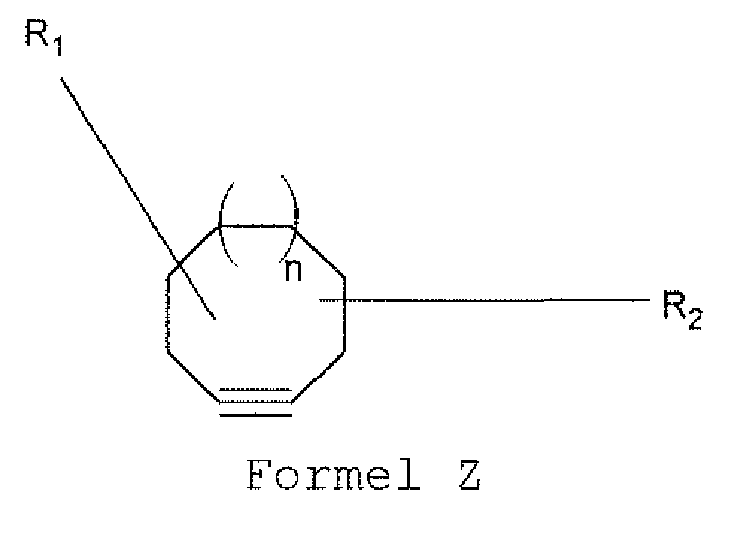
- Verbindung gemäß Anspruch 1, dadurch gekennzeichnet, dass in der Formel I X ausgewählt ist aus einer Trihalogensilan-Gruppe, einer Trihydrogensilan-Gruppe, einer Trialkoxysilan-Gruppe -Si(OR3)3, wobei R3 eine lineare oder verzweigte Alkylgruppe mit 1 bis 6 Kohlenstoffatomen oder eine Phenylgruppe darstellt, eine Triaminoalkylsilan-Gruppe -Si(NR4R5)3, wobei R4 und R5 unabhängig voneinander eine lineare oder verzweigte gesättigte Alkylgruppe mit 1 bis 6 Kohlenstoffatomen oder eine Phenylgruppe darstellen, oder einer metallorganischen Gruppe.
- Verbindung gemäß Anspruch 1 oder 2, dadurch gekennzeichnet, dass in Formel I E eine Kohlenwasserstoffgruppe darstellt, die gegebenenfalls eine oder mehrere Ungesättigtheiten und/oder eine oder mehrere aromatische Gruppen und/oder ein oder mehrere Heteroatome umfasst.
- Verbindung gemäß Anspruch 3, dadurch gekennzeichnet, dass die Kohlenwasserstoffgruppe 2 bis 24 Kohlenstoffatome umfasst.
- Verbindung gemäß Anspruch 4, dadurch gekennzeichnet, dass die Kohlenwasserstoffgruppe eine Alkylengruppe ist, die 2 bis 24 Kohlenstoffatome umfasst.
- Verbindungen gemäß einem der vorangehenden Ansprüche, dadurch gekennzeichnet, dass sie die folgende Formel II haben:

- Silanverbindung gemäß einem der vorangehenden Ansprüche, dadurch gekennzeichnet, dass in der Formel I X eine Triethoxysilangruppe ist, E eine Kohlenstoffkette mit 3 Kohlenstoffatomen ist, Z ein Cyclooctin oder ein Heterocyclooctin ist, bei dem die Alkin-Dreifachbindung in alpha-Position ist, wobei das Heteroatom des Heterocyclooctins vorzugsweise O oder S ist und R1 und R2 Wasserstoffatome sind, wobei die Verbindung die folgende Formel III hat:

- Verfahren zur Funktionalisierung eines festen Trägers, der an der Oberfläche Hydroxylfunktionen trägt, dadurch gekennzeichnet, dass es eine Stufe umfasst, in welcher der genannte Träger mit einer Lösung in Kontakt gebracht wird, die wenigstens eine Silanverbindung gemäß einem der Ansprüche 1 bis 7 umfasst.
- Verfahren gemäß Anspruch 8, dadurch gekennzeichnet, dass es vor der Stufe des Inkontaktbringens eine Stufe der Behandlung der Oberfläche des Trägers umfasst, um auf der Oberfläche die für die Pfropfung erforderlichen Hydroxylfunktionen zu schaffen.
- Verfahren gemäß Anspruch 8 oder 9, dadurch gekennzeichnet, dass der feste Träger ein organischer Träger oder ein anorganischer Träger ist.
- Verfahren gemäß Anspruch 10, dadurch gekennzeichnet, dass der anorganische Träger aus Metalloxid, Siliciumoxid, Glas, Metall oder Silicium besteht.
- Verfahren gemäß Anspruch 10, dadurch gekennzeichnet, dass der organische Träger aus Kunststoff, Polyimid, Polycarbonat, Cycloolefinpolymer (COP) besteht.
- Fester Träger, der durch das Verfahren gemäß einem der Ansprüche 8 bis 12 erhalten werden kann, dadurch gekennzeichnet, dass eine Verbindung gemäß einem der Ansprüche 1 bis 7 mittels der Gruppierung X der Verbindung an die Oberfläche des Trägers gebunden ist.
- Verfahren zur Immobilisierung biologischer Moleküle auf einem festen Träger, dadurch gekennzeichnet, dass es umfasst:a) eine Stufe der Durchführung des Verfahrens gemäß einem der Ansprüche 8 bis 12 undb) eine Stufe des Inkontaktbringens des in Stufe a) erhaltenen Trägers mit einer Lösung, die das zu immobilisierende biologische Molekül (die zu immobilisierenden biologischen Moleküle) umfasst.
- Verfahren zur Immobilisierung gemäß Anspruch 14, in dem das zu immobilisierende biologische Molekül aus Nucleinsäuren, Proteinen, Lipiden, Zuckern, Zellen, Bakterien ausgewählt wird.
- Verfahren zum Versiegeln von zwei festen Trägern, dadurch gekennzeichnet, dass es umfasst:a) eine Stufe des Inkontaktbringens eines festen Trägers, der an der Oberfläche Nitridfunktionen trägt, mit einer Verbindung gemäß einem der Ansprüche 1 bis 7 undb) eine Stufe des Inkontaktbringens des in Stufe a) erhaltenen Trägers mit einem festen Träger, der an der Oberfläche Nitridfunktionen trägt, wenn der in Stufe a) erhaltene Träger Hydroxylfunktionen trägt, oder mit einem festen Träger, der Hydroxylfunktionen trägt, wenn der in Stufe a) verwendete Träger an der Oberfläche Nitridfunktionen trägt.
- Verfahren gemäß Anspruch 16, dadurch gekennzeichnet, dass die festen Träger Träger aus einem Material sind, das aus Metalloxid, Siliciumoxid, Glas, einem Metall und Silicium ausgewählt ist.
- Verfahren gemäß Anspruch 16 oder 17, dadurch gekennzeichnet, dass die festen Träger aus Silicium sind.
- Struktur, die durch das Verfahren gemäß einem der Ansprüche 16 bis 18 erhalten werden kann, dadurch gekennzeichnet, dass sie aus zwei festen Trägern besteht, die untereinander durch eine Verbindung mit der folgenden Formel IV verbunden sind:
 in der E, A und n wie in einem der Ansprüche 1 bis 7 definiert sind,X1 eine Silylgruppe ist, wie sie für X in einem der Ansprüche 1 bis 7 definiert ist, aber mit einer Hydroxylfunktion reagiert hat,Y eine kovalente Bindung oder ein organischer Spacer ist und - das Cycloalken ein Heteroatom, vorzugsweise 0 oder S, umfassen kann.
Applications Claiming Priority (2)
| Application Number | Priority Date | Filing Date | Title |
|---|---|---|---|
| FR0901254A FR2943344B1 (fr) | 2009-03-18 | 2009-03-18 | Nouveaux composes silanes porteurs d'une chaine carbonee cyclique comprenant une fonction alcyne pour fonctionnaliser des supports solides et immobiliser sur ces supports des molecules biologiques |
| PCT/FR2010/000218 WO2010106243A1 (fr) | 2009-03-18 | 2010-03-16 | Nouveaux composes silanes porteurs d'une chaine carbonee cyclique comprenant une fonction alcyne pour fonctionnaliser des supports solides et immobiliser sur ces supports des molecules biologiques |
Publications (2)
| Publication Number | Publication Date |
|---|---|
| EP2408786A1 EP2408786A1 (de) | 2012-01-25 |
| EP2408786B1 true EP2408786B1 (de) | 2014-07-23 |
Family
ID=40940487
Family Applications (1)
| Application Number | Title | Priority Date | Filing Date |
|---|---|---|---|
| EP10712457.0A Not-in-force EP2408786B1 (de) | 2009-03-18 | 2010-03-16 | Neue silanverbindungen mit cyclischer kohlenstoffkette einschliesslich einer alkinfunktion zur funktionalisierung fester substrate und immobilisierung biologischer moleküle auf diesen substraten |
Country Status (4)
| Country | Link |
|---|---|
| US (1) | US8546598B2 (de) |
| EP (1) | EP2408786B1 (de) |
| FR (1) | FR2943344B1 (de) |
| WO (1) | WO2010106243A1 (de) |
Families Citing this family (7)
| Publication number | Priority date | Publication date | Assignee | Title |
|---|---|---|---|---|
| CN102179266B (zh) * | 2011-03-18 | 2012-11-28 | 杭州师范大学 | 一种硅氢加成反应用负载型催化剂及其制备方法 |
| MX363806B (es) * | 2013-07-01 | 2019-04-03 | Illumina Inc | Funcionalización de superficies sin catalizador e injerto de polímeros.. |
| FR3008324B1 (fr) * | 2013-07-12 | 2019-10-04 | Centre National De La Recherche Scientifique - Cnrs | Nouveaux catalyseurs a ligand silylene |
| WO2015095291A1 (en) | 2013-12-19 | 2015-06-25 | Illumina, Inc. | Substrates comprising nano-patterning surfaces and methods of preparing thereof |
| CN114805710B (zh) | 2014-10-31 | 2023-11-17 | 伊鲁米纳剑桥有限公司 | 聚合物以及dna共聚物涂层 |
| CA3103227A1 (en) * | 2018-06-14 | 2019-12-19 | Mochida Pharmaceutical Co., Ltd. | Novel crosslinked alginic acid |
| WO2022250981A1 (en) | 2021-05-28 | 2022-12-01 | Illumina, Inc. | Fluidic devices including fluidic channels, and methods of making the same |
Family Cites Families (2)
| Publication number | Priority date | Publication date | Assignee | Title |
|---|---|---|---|---|
| ES2179853T3 (es) * | 1994-01-19 | 2003-02-01 | Roche Diagnostics Gmbh | Compuestos de biotina-silanos y matriz de fijacion que contiene estos compuestos. |
| EP1812031B1 (de) | 2004-11-01 | 2015-06-24 | The Regents of the University of California | Zusammensetzungen und verfahren zur modifizierung von biomolekülen |
-
2009
- 2009-03-18 FR FR0901254A patent/FR2943344B1/fr not_active Expired - Fee Related
-
2010
- 2010-03-16 EP EP10712457.0A patent/EP2408786B1/de not_active Not-in-force
- 2010-03-16 WO PCT/FR2010/000218 patent/WO2010106243A1/fr not_active Ceased
- 2010-03-16 US US13/257,326 patent/US8546598B2/en not_active Expired - Fee Related
Also Published As
| Publication number | Publication date |
|---|---|
| US20120095203A1 (en) | 2012-04-19 |
| US8546598B2 (en) | 2013-10-01 |
| FR2943344A1 (fr) | 2010-09-24 |
| FR2943344B1 (fr) | 2011-04-15 |
| EP2408786A1 (de) | 2012-01-25 |
| WO2010106243A1 (fr) | 2010-09-23 |
Similar Documents
| Publication | Publication Date | Title |
|---|---|---|
| EP2408786A1 (de) | Neue silanverbindungen mit cyclischer kohlenstoffkette einschliesslich einer alkinfunktion zur funktionalisierung fester substrate und immobilisierung biologischer moleküle auf diesen substraten | |
| EP1979362B1 (de) | Neue silanverbindungen und deren verwendung zur funktionalisierung fester medien und zur immobilisierung biologischer moleküle auf diesen medien | |
| EP4396266B1 (de) | Kobaltverbindungkatalysierte hydrosilylierungsverfahren | |
| FR2892859A1 (fr) | Procede de greffage de molecules d'interet sur des surfaces inorganiques, surfaces obtenues et applications | |
| CA2453303C (fr) | Procede de fonctionnalisation de supports solides | |
| EP1979363B1 (de) | Neue silanverbindungen und deren verwendung zur funktionalisierung fester medien und zur immobilisierung biologischer moleküle auf diesen medien | |
| EP1248789B1 (de) | Organosilicium-verbindungen, ihre herstellung und ihre verwendung | |
| EP1248859B1 (de) | Verfahren zur herstellung und immobilisierung von nukleinsäure auf einem silan-modifizierten festträger | |
| FR2738011A1 (fr) | Support hydroxyle d'oxyde inorganique, fonctionnalise, et procede pour sa preparation | |
| CA2473789C (fr) | Derives ureido ou carbamates d'ethers-couronnes et de silicium, utilisables pour preparer des supports destines a la separation par chromatographie de cations metalliques et de molecules organiques comportant des fonctions amines | |
| EP2027133B1 (de) | Neue silanverbindungen mit hydrazon- oder diazofunktion zur funktionalisierung fester träger und zur immobilisierung biologischer moleküle darauf | |
| CA2609310C (fr) | Procede de preparation de composes organosiliciques | |
| EP2097425A2 (de) | Verfahren zur herstellung funktionalisierter organomonoalkoxy- (oder monohydroxy-)silane, insbesondere alkenylen | |
| FR2886296A1 (fr) | Procede de preparation de composes organosiliciques en milieu biphasique | |
| FR2669033A1 (fr) | Polyarylsilsesquioxanes comportant au moins un groupe sulfonique, greffes sur un support inorganique, leurs preparations et leurs applications. | |
| FR2878518A1 (fr) | Oxyde poreux mesostructure multifonctionnalise. | |
| WO2010106246A1 (fr) | Procede de fonctionnalisation de surface par des alcynes disubstitues | |
| JPH09157273A (ja) | フラーレン誘導体 |
Legal Events
| Date | Code | Title | Description |
|---|---|---|---|
| PUAI | Public reference made under article 153(3) epc to a published international application that has entered the european phase |
Free format text: ORIGINAL CODE: 0009012 |
|
| 17P | Request for examination filed |
Effective date: 20111014 |
|
| AK | Designated contracting states |
Kind code of ref document: A1 Designated state(s): AT BE BG CH CY CZ DE DK EE ES FI FR GB GR HR HU IE IS IT LI LT LU LV MC MK MT NL NO PL PT RO SE SI SK SM TR |
|
| DAX | Request for extension of the european patent (deleted) | ||
| GRAP | Despatch of communication of intention to grant a patent |
Free format text: ORIGINAL CODE: EPIDOSNIGR1 |
|
| INTG | Intention to grant announced |
Effective date: 20140220 |
|
| GRAS | Grant fee paid |
Free format text: ORIGINAL CODE: EPIDOSNIGR3 |
|
| GRAA | (expected) grant |
Free format text: ORIGINAL CODE: 0009210 |
|
| AK | Designated contracting states |
Kind code of ref document: B1 Designated state(s): AT BE BG CH CY CZ DE DK EE ES FI FR GB GR HR HU IE IS IT LI LT LU LV MC MK MT NL NO PL PT RO SE SI SK SM TR |
|
| REG | Reference to a national code |
Ref country code: GB Ref legal event code: FG4D Free format text: NOT ENGLISH |
|
| REG | Reference to a national code |
Ref country code: CH Ref legal event code: EP |
|
| REG | Reference to a national code |
Ref country code: IE Ref legal event code: FG4D Free format text: LANGUAGE OF EP DOCUMENT: FRENCH |
|
| REG | Reference to a national code |
Ref country code: AT Ref legal event code: REF Ref document number: 678823 Country of ref document: AT Kind code of ref document: T Effective date: 20140815 |
|
| REG | Reference to a national code |
Ref country code: DE Ref legal event code: R096 Ref document number: 602010017698 Country of ref document: DE Effective date: 20140904 |
|
| REG | Reference to a national code |
Ref country code: CH Ref legal event code: NV Representative=s name: ISLER AND PEDRAZZINI AG, CH |
|
| REG | Reference to a national code |
Ref country code: NL Ref legal event code: T3 |
|
| REG | Reference to a national code |
Ref country code: AT Ref legal event code: MK05 Ref document number: 678823 Country of ref document: AT Kind code of ref document: T Effective date: 20140723 |
|
| REG | Reference to a national code |
Ref country code: LT Ref legal event code: MG4D |
|
| PG25 | Lapsed in a contracting state [announced via postgrant information from national office to epo] |
Ref country code: NO Free format text: LAPSE BECAUSE OF FAILURE TO SUBMIT A TRANSLATION OF THE DESCRIPTION OR TO PAY THE FEE WITHIN THE PRESCRIBED TIME-LIMIT Effective date: 20141023 Ref country code: GR Free format text: LAPSE BECAUSE OF FAILURE TO SUBMIT A TRANSLATION OF THE DESCRIPTION OR TO PAY THE FEE WITHIN THE PRESCRIBED TIME-LIMIT Effective date: 20141024 Ref country code: PT Free format text: LAPSE BECAUSE OF FAILURE TO SUBMIT A TRANSLATION OF THE DESCRIPTION OR TO PAY THE FEE WITHIN THE PRESCRIBED TIME-LIMIT Effective date: 20141124 Ref country code: ES Free format text: LAPSE BECAUSE OF FAILURE TO SUBMIT A TRANSLATION OF THE DESCRIPTION OR TO PAY THE FEE WITHIN THE PRESCRIBED TIME-LIMIT Effective date: 20140723 Ref country code: FI Free format text: LAPSE BECAUSE OF FAILURE TO SUBMIT A TRANSLATION OF THE DESCRIPTION OR TO PAY THE FEE WITHIN THE PRESCRIBED TIME-LIMIT Effective date: 20140723 Ref country code: SE Free format text: LAPSE BECAUSE OF FAILURE TO SUBMIT A TRANSLATION OF THE DESCRIPTION OR TO PAY THE FEE WITHIN THE PRESCRIBED TIME-LIMIT Effective date: 20140723 Ref country code: LT Free format text: LAPSE BECAUSE OF FAILURE TO SUBMIT A TRANSLATION OF THE DESCRIPTION OR TO PAY THE FEE WITHIN THE PRESCRIBED TIME-LIMIT Effective date: 20140723 Ref country code: BG Free format text: LAPSE BECAUSE OF FAILURE TO SUBMIT A TRANSLATION OF THE DESCRIPTION OR TO PAY THE FEE WITHIN THE PRESCRIBED TIME-LIMIT Effective date: 20141023 |
|
| PG25 | Lapsed in a contracting state [announced via postgrant information from national office to epo] |
Ref country code: IS Free format text: LAPSE BECAUSE OF FAILURE TO SUBMIT A TRANSLATION OF THE DESCRIPTION OR TO PAY THE FEE WITHIN THE PRESCRIBED TIME-LIMIT Effective date: 20141123 Ref country code: PL Free format text: LAPSE BECAUSE OF FAILURE TO SUBMIT A TRANSLATION OF THE DESCRIPTION OR TO PAY THE FEE WITHIN THE PRESCRIBED TIME-LIMIT Effective date: 20140723 Ref country code: AT Free format text: LAPSE BECAUSE OF FAILURE TO SUBMIT A TRANSLATION OF THE DESCRIPTION OR TO PAY THE FEE WITHIN THE PRESCRIBED TIME-LIMIT Effective date: 20140723 Ref country code: HR Free format text: LAPSE BECAUSE OF FAILURE TO SUBMIT A TRANSLATION OF THE DESCRIPTION OR TO PAY THE FEE WITHIN THE PRESCRIBED TIME-LIMIT Effective date: 20140723 Ref country code: LV Free format text: LAPSE BECAUSE OF FAILURE TO SUBMIT A TRANSLATION OF THE DESCRIPTION OR TO PAY THE FEE WITHIN THE PRESCRIBED TIME-LIMIT Effective date: 20140723 Ref country code: CY Free format text: LAPSE BECAUSE OF FAILURE TO SUBMIT A TRANSLATION OF THE DESCRIPTION OR TO PAY THE FEE WITHIN THE PRESCRIBED TIME-LIMIT Effective date: 20140723 |
|
| REG | Reference to a national code |
Ref country code: DE Ref legal event code: R097 Ref document number: 602010017698 Country of ref document: DE |
|
| PG25 | Lapsed in a contracting state [announced via postgrant information from national office to epo] |
Ref country code: CZ Free format text: LAPSE BECAUSE OF FAILURE TO SUBMIT A TRANSLATION OF THE DESCRIPTION OR TO PAY THE FEE WITHIN THE PRESCRIBED TIME-LIMIT Effective date: 20140723 Ref country code: RO Free format text: LAPSE BECAUSE OF FAILURE TO SUBMIT A TRANSLATION OF THE DESCRIPTION OR TO PAY THE FEE WITHIN THE PRESCRIBED TIME-LIMIT Effective date: 20140723 Ref country code: DK Free format text: LAPSE BECAUSE OF FAILURE TO SUBMIT A TRANSLATION OF THE DESCRIPTION OR TO PAY THE FEE WITHIN THE PRESCRIBED TIME-LIMIT Effective date: 20140723 Ref country code: SK Free format text: LAPSE BECAUSE OF FAILURE TO SUBMIT A TRANSLATION OF THE DESCRIPTION OR TO PAY THE FEE WITHIN THE PRESCRIBED TIME-LIMIT Effective date: 20140723 Ref country code: EE Free format text: LAPSE BECAUSE OF FAILURE TO SUBMIT A TRANSLATION OF THE DESCRIPTION OR TO PAY THE FEE WITHIN THE PRESCRIBED TIME-LIMIT Effective date: 20140723 |
|
| PLBE | No opposition filed within time limit |
Free format text: ORIGINAL CODE: 0009261 |
|
| STAA | Information on the status of an ep patent application or granted ep patent |
Free format text: STATUS: NO OPPOSITION FILED WITHIN TIME LIMIT |
|
| 26N | No opposition filed |
Effective date: 20150424 |
|
| REG | Reference to a national code |
Ref country code: DE Ref legal event code: R119 Ref document number: 602010017698 Country of ref document: DE |
|
| PG25 | Lapsed in a contracting state [announced via postgrant information from national office to epo] |
Ref country code: LU Free format text: LAPSE BECAUSE OF FAILURE TO SUBMIT A TRANSLATION OF THE DESCRIPTION OR TO PAY THE FEE WITHIN THE PRESCRIBED TIME-LIMIT Effective date: 20150316 Ref country code: MC Free format text: LAPSE BECAUSE OF FAILURE TO SUBMIT A TRANSLATION OF THE DESCRIPTION OR TO PAY THE FEE WITHIN THE PRESCRIBED TIME-LIMIT Effective date: 20140723 |
|
| REG | Reference to a national code |
Ref country code: CH Ref legal event code: PL |
|
| GBPC | Gb: european patent ceased through non-payment of renewal fee |
Effective date: 20150316 |
|
| PG25 | Lapsed in a contracting state [announced via postgrant information from national office to epo] |
Ref country code: SI Free format text: LAPSE BECAUSE OF FAILURE TO SUBMIT A TRANSLATION OF THE DESCRIPTION OR TO PAY THE FEE WITHIN THE PRESCRIBED TIME-LIMIT Effective date: 20140723 |
|
| REG | Reference to a national code |
Ref country code: NL Ref legal event code: MM Effective date: 20150401 |
|
| PG25 | Lapsed in a contracting state [announced via postgrant information from national office to epo] |
Ref country code: IT Free format text: LAPSE BECAUSE OF NON-PAYMENT OF DUE FEES Effective date: 20150316 |
|
| REG | Reference to a national code |
Ref country code: FR Ref legal event code: ST Effective date: 20151130 |
|
| REG | Reference to a national code |
Ref country code: IE Ref legal event code: MM4A |
|
| PG25 | Lapsed in a contracting state [announced via postgrant information from national office to epo] |
Ref country code: LI Free format text: LAPSE BECAUSE OF NON-PAYMENT OF DUE FEES Effective date: 20150331 Ref country code: DE Free format text: LAPSE BECAUSE OF NON-PAYMENT OF DUE FEES Effective date: 20151001 Ref country code: IE Free format text: LAPSE BECAUSE OF NON-PAYMENT OF DUE FEES Effective date: 20150316 Ref country code: GB Free format text: LAPSE BECAUSE OF NON-PAYMENT OF DUE FEES Effective date: 20150316 Ref country code: CH Free format text: LAPSE BECAUSE OF NON-PAYMENT OF DUE FEES Effective date: 20150331 |
|
| PG25 | Lapsed in a contracting state [announced via postgrant information from national office to epo] |
Ref country code: FR Free format text: LAPSE BECAUSE OF NON-PAYMENT OF DUE FEES Effective date: 20150331 |
|
| PG25 | Lapsed in a contracting state [announced via postgrant information from national office to epo] |
Ref country code: MT Free format text: LAPSE BECAUSE OF FAILURE TO SUBMIT A TRANSLATION OF THE DESCRIPTION OR TO PAY THE FEE WITHIN THE PRESCRIBED TIME-LIMIT Effective date: 20140723 |
|
| PG25 | Lapsed in a contracting state [announced via postgrant information from national office to epo] |
Ref country code: HU Free format text: LAPSE BECAUSE OF FAILURE TO SUBMIT A TRANSLATION OF THE DESCRIPTION OR TO PAY THE FEE WITHIN THE PRESCRIBED TIME-LIMIT; INVALID AB INITIO Effective date: 20100316 Ref country code: SM Free format text: LAPSE BECAUSE OF FAILURE TO SUBMIT A TRANSLATION OF THE DESCRIPTION OR TO PAY THE FEE WITHIN THE PRESCRIBED TIME-LIMIT Effective date: 20140723 |
|
| PG25 | Lapsed in a contracting state [announced via postgrant information from national office to epo] |
Ref country code: NL Free format text: LAPSE BECAUSE OF NON-PAYMENT OF DUE FEES Effective date: 20150401 |
|
| PG25 | Lapsed in a contracting state [announced via postgrant information from national office to epo] |
Ref country code: BE Free format text: LAPSE BECAUSE OF NON-PAYMENT OF DUE FEES Effective date: 20150331 |
|
| PG25 | Lapsed in a contracting state [announced via postgrant information from national office to epo] |
Ref country code: TR Free format text: LAPSE BECAUSE OF FAILURE TO SUBMIT A TRANSLATION OF THE DESCRIPTION OR TO PAY THE FEE WITHIN THE PRESCRIBED TIME-LIMIT Effective date: 20140723 |
|
| PG25 | Lapsed in a contracting state [announced via postgrant information from national office to epo] |
Ref country code: MK Free format text: LAPSE BECAUSE OF FAILURE TO SUBMIT A TRANSLATION OF THE DESCRIPTION OR TO PAY THE FEE WITHIN THE PRESCRIBED TIME-LIMIT Effective date: 20140723 |