EP2407659A2 - Gasturbinenabgaskonus - Google Patents
Gasturbinenabgaskonus Download PDFInfo
- Publication number
- EP2407659A2 EP2407659A2 EP11005553A EP11005553A EP2407659A2 EP 2407659 A2 EP2407659 A2 EP 2407659A2 EP 11005553 A EP11005553 A EP 11005553A EP 11005553 A EP11005553 A EP 11005553A EP 2407659 A2 EP2407659 A2 EP 2407659A2
- Authority
- EP
- European Patent Office
- Prior art keywords
- cone
- gas turbine
- turbine exhaust
- exhaust cone
- mantle
- Prior art date
- Legal status (The legal status is an assumption and is not a legal conclusion. Google has not performed a legal analysis and makes no representation as to the accuracy of the status listed.)
- Withdrawn
Links
Images

Classifications
-
- F—MECHANICAL ENGINEERING; LIGHTING; HEATING; WEAPONS; BLASTING
- F02—COMBUSTION ENGINES; HOT-GAS OR COMBUSTION-PRODUCT ENGINE PLANTS
- F02K—JET-PROPULSION PLANTS
- F02K1/00—Plants characterised by the form or arrangement of the jet pipe or nozzle; Jet pipes or nozzles peculiar thereto
- F02K1/28—Plants characterised by the form or arrangement of the jet pipe or nozzle; Jet pipes or nozzles peculiar thereto using fluid jets to influence the jet flow
- F02K1/34—Plants characterised by the form or arrangement of the jet pipe or nozzle; Jet pipes or nozzles peculiar thereto using fluid jets to influence the jet flow for attenuating noise
-
- F—MECHANICAL ENGINEERING; LIGHTING; HEATING; WEAPONS; BLASTING
- F02—COMBUSTION ENGINES; HOT-GAS OR COMBUSTION-PRODUCT ENGINE PLANTS
- F02K—JET-PROPULSION PLANTS
- F02K1/00—Plants characterised by the form or arrangement of the jet pipe or nozzle; Jet pipes or nozzles peculiar thereto
- F02K1/44—Nozzles having means, e.g. a shield, reducing sound radiation in a specified direction
-
- F—MECHANICAL ENGINEERING; LIGHTING; HEATING; WEAPONS; BLASTING
- F02—COMBUSTION ENGINES; HOT-GAS OR COMBUSTION-PRODUCT ENGINE PLANTS
- F02K—JET-PROPULSION PLANTS
- F02K1/00—Plants characterised by the form or arrangement of the jet pipe or nozzle; Jet pipes or nozzles peculiar thereto
- F02K1/78—Other construction of jet pipes
- F02K1/82—Jet pipe walls, e.g. liners
- F02K1/827—Sound absorbing structures or liners
-
- F—MECHANICAL ENGINEERING; LIGHTING; HEATING; WEAPONS; BLASTING
- F05—INDEXING SCHEMES RELATING TO ENGINES OR PUMPS IN VARIOUS SUBCLASSES OF CLASSES F01-F04
- F05D—INDEXING SCHEME FOR ASPECTS RELATING TO NON-POSITIVE-DISPLACEMENT MACHINES OR ENGINES, GAS-TURBINES OR JET-PROPULSION PLANTS
- F05D2250/00—Geometry
- F05D2250/20—Three-dimensional
- F05D2250/23—Three-dimensional prismatic
- F05D2250/232—Three-dimensional prismatic conical
-
- F—MECHANICAL ENGINEERING; LIGHTING; HEATING; WEAPONS; BLASTING
- F05—INDEXING SCHEMES RELATING TO ENGINES OR PUMPS IN VARIOUS SUBCLASSES OF CLASSES F01-F04
- F05D—INDEXING SCHEME FOR ASPECTS RELATING TO NON-POSITIVE-DISPLACEMENT MACHINES OR ENGINES, GAS-TURBINES OR JET-PROPULSION PLANTS
- F05D2250/00—Geometry
- F05D2250/20—Three-dimensional
- F05D2250/25—Three-dimensional helical
-
- Y—GENERAL TAGGING OF NEW TECHNOLOGICAL DEVELOPMENTS; GENERAL TAGGING OF CROSS-SECTIONAL TECHNOLOGIES SPANNING OVER SEVERAL SECTIONS OF THE IPC; TECHNICAL SUBJECTS COVERED BY FORMER USPC CROSS-REFERENCE ART COLLECTIONS [XRACs] AND DIGESTS
- Y02—TECHNOLOGIES OR APPLICATIONS FOR MITIGATION OR ADAPTATION AGAINST CLIMATE CHANGE
- Y02T—CLIMATE CHANGE MITIGATION TECHNOLOGIES RELATED TO TRANSPORTATION
- Y02T50/00—Aeronautics or air transport
- Y02T50/60—Efficient propulsion technologies, e.g. for aircraft
Definitions
- the invention relates to a gas turbine exhaust cone, which is arranged at the outflow region of a gas turbine.
- Helmholtz resonator From the prior art it is known to dampen low frequencies that result particularly in lean-burn engines. A noise attenuation takes place via a Helmholtz resonator. It is known to form such a Helmholtz resonator in the inflow region of the exhaust gas cone, while the downstream end region of the exhaust gas cone is formed only as a geometric body. Known Helmholtz resonators are designed as a system of radial walls and inner cylindrical guides and dimensioned as a function of the frequencies.
- the invention has for its object to provide a gas turbine exhaust cone of the type described above, which is inexpensive to produce with a simple structure and high damping effect and has a low weight.
- the exhaust gas cone according to the invention initially has an outer jacket cone, which is essentially closed in the flow direction. According to the invention, it is provided that at least over a part of the length of the exhaust cone an inner cone extends within the jacket cone, which is connected to the jacket cone via at least one coiled partition wall. This results in a double-cone construction with an inner space between the jacket cone and the inner cone. In this intermediate space, the at least one coiled partition wall extends. The interior is connected at an inflow side with inlet openings through which sound waves can enter. These spread out in the gap. The coiled partition results in a very considerable run length. The axial dimension of the exhaust cone according to the invention can thus be made very small, since the required length of the sound waves for the Helmholtz resonator principle is provided by the coiled partition.
- the intermediate space opens to an interior of the jacket cone, wherein adjacent to the outlet side, through which the sound waves reach the interior of the jacket cone, a damping element is arranged in the jacket cone.
- a Helmholtz resonator can be formed, which is particularly suitable for reducing low noise frequencies resulting from a lean burn.
- the sound waves thus pass through the inlet openings in the spirally formed Helmholtz resonator. Due to the spiral, coiled partitions (preferably, several such partitions are provided), the required length of the Helmholtz resonator results without the length of the exhaust cone must be increased.
- the coiled or spiral partitions are arranged at an angle to the local radial direction of the mandrel cone.
- the partitions are preferably welded to the jacket cone, while they can be connected to the inner cone via blind rivets.
- the coiled separating wall is therefore ideally suited, since thermal expansion primarily results in a displacement in the axial direction, but not in the radial direction. As a result, the loads of the jacket cone can be significantly reduced.
- the coiled partitions thus rotate together with the inner cone relative to the outer cone.
- the inventively provided damping element which is preferably plate-shaped, preferably in a honeycomb structure is preferably connected via a bellows with the mantle cone, so that there is also an avoidance of thermal stress.
- a second damping element is arranged in the interior of the inner cone in the inflow region of the exhaust cone. This is also preferably mounted on a bellows to compensate for the thermal expansion or contraction.
- the exhaust gas cone according to the invention comprises a jacket cone 1, which is tapered in the flow direction, as is known from the prior art.
- the flow according to Fig. 2 is thus from the left, the gas jet emerging from a turbine of an aircraft gas turbine is not shown.
- the jacket cone 5 is provided with inlet openings 5 (perforation), through which the sound waves 12 generated by the exhaust gas flow can enter the jacket cone 1.
- an inner cone 2 is provided, which extends over part of the axial length of the jacket cone 1.
- the inner cone 2 is connected by means of helical or spiral partitions 3 with the jacket cone 1. It is preferably provided that the connection between the partitions 3 and the jacket cone 1 is carried out by welding, while a connection of the partitions 3 with the inner cone 2 can be made via rivets or the like.
- the Fig. 2 shows an intermediate space 4 formed between the jacket cone 1 and the inner cone 2. Due to the helical construction of the partitions, an effective length 15 of the spiral chamber formed between the partitions 3 in the intermediate space 4 results. This effective length 15 allows the formation of an effective acting Helmholtz resonator, in particular together with the ⁇ / 4 effect of the damping element 8 described below.
- a flat damping element 8 which may be provided with a honeycomb structure and may be formed in the form of a ⁇ / 4 resonator.
- the Fig. 2 shows reflected sound waves 16, which may still be delivered by the damping element 8. These reflected sound waves 16 pass into an interior 9 of the inner cone 2 and hit a plate-shaped damping element 10, which is also formed as a ⁇ / 4 damper.
- the damping element 10 is connected via a bellows 14 with the inner cone 2 and stored on this.
- the damping element 8 is mounted on the jacket cone 1 via a bellows 13.
- This is preferably fixedly connected to the jacket cone 1, while at the transition to the inner cone 2, an expansion gap may be located to compensate for thermal stress by contraction or expansion.
- the Fig. 2 shows by the reference numeral 17 an angle reference line, from which it follows that the partition at an angle of 5 ° to 15 °, preferably 10 °, to the reference line, which is aligned perpendicular to the lateral surface of the jacket cone 1 and parallel to this inner cone 2 is, is arranged.
- the two damping elements 8, 10 are each formed as a flat high-frequency damper.
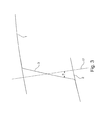
- FIG. 3 shows a sectional view showing the inclination of the partition at an angle ⁇ to the radial direction 17th
Landscapes
- Engineering & Computer Science (AREA)
- Chemical & Material Sciences (AREA)
- Combustion & Propulsion (AREA)
- Mechanical Engineering (AREA)
- General Engineering & Computer Science (AREA)
- Exhaust Silencers (AREA)
Abstract
Die Erfindung bezieht sich auf einen Gasturbinenabgaskonus mit einem konusförmigen, in Strömungsrichtung geschlossenen Mantelkonus 1, wobei in dem Mantelkonus 1 über zumindest einen Teil der Länge des Abgaskonus ein Innenkonus 2 angeordnet ist, welcher mit dem Mantelkonus 1 über zumindest eine gewendelte Trennwand 3 verbunden ist, wobei ein zwischen dem Mantelkonus 1 und dem Innenkonus 2 gebildeter Zwischenraum 4 an einer Einströmseite mit Eintrittsöffnungen 5 verbunden ist und sich an einer Austrittsseite 6 zum Innenraum 7 des Mantelkonus 1 öffnet, wobei benachbart zu der Austrittsseite 6 des Zwischenraums 4 in dem Mantelkonus 1 ein Dämpfungselement 8 angeordnet ist.
Description
- Die Erfindung bezieht sich auf einen Gasturbinenabgaskonus, welcher am Ausströmbereich einer Gasturbine angeordnet ist.
- Bei Gasturbinen für Flugzeugtriebwerke ist es erforderlich, das Geräuschniveau zu senken. Zu diesem Zweck sind auch unterschiedliche Maßnahmen bekannt, um das aus einer Abströmdüse stromab der Turbine austretende Gasstrahlgeräusch zu minimieren.
- Aus dem Stand der Technik ist es bekannt, niedrige Frequenzen, die sich insbesondere bei Triebwerken mit Magerverbrennung ergeben, zu dämpfen. Eine Geräuschdämpfung erfolgt dabei über einen Helmholtz-Resonator. Es ist bekannt, in dem Anströmbereich des Abgaskonus einen derartigen Helmholtz-Resonator auszubilden, während der stromab liegende Endbereich des Abgaskonus lediglich als geometrischer Körper ausgebildet ist. Bekannte Helmholtz-Resonatoren werden dabei als System von radialen Wänden und inneren zylindrischen Führungen ausgestaltet und in Abhängigkeit von den Frequenzen dimensioniert.
- Bei den bekannten Konstruktionen erweist es sich als nachteilig, dass diese im Hinblick auf die auftretenden Gastemperaturen mechanisch stark belastet sind und deshalb Verstärkungselemente erfordern. Dies führt zu einer ein relativ hohes Gewicht aufweisenden Konstruktion, auch bedingt durch unterschiedliche Wandungen und Versteifungselemente. Zusätzlich ergibt sich eine sehr aufwendige Fertigung. Die Herstellungskosten werden auch noch durch interne Akustik-Maßnahmen (Perforationen oder Ähnliches) erhöht. Auch die axiale Länge eines derartigen Resonators erfordert einen erheblichen Bauraum und bringt zusätzliches Gewicht.
- Der Erfindung liegt die Aufgabe zugrunde, einen Gasturbinenabgaskonus der eingangs beschriebenen Art zu schaffen, welcher bei einfachem Aufbau und hoher Dämpfungswirkung kostengünstig herstellbar ist und ein geringes Gewicht aufweist.
- Erfindungsgemäß wird die Aufgabe durch die Merkmalskombination des Anspruchs 1 gelöst, die Unteransprüche zeigen weitere vorteilhafte Ausgestaltungen der Erfindung. Der erfindungsgemäße Abgaskonus weist zunächst einen äußeren Mantelkonus auf, welcher in Strömungsrichtung im Wesentlichen geschlossen ist. Erfindungsgemäß ist vorgesehen, dass zumindest über einen Teil der Länge des Abgaskonus sich innerhalb des Mantelkonus ein Innenkonus erstreckt, welcher mit dem Mantelkonus über zumindest eine gewendelte Trennwand verbunden ist. Es ergibt sich somit eine DoppelKonus-Konstruktion mit einem Innenraum zwischen dem Mantelkonus und dem Innenkonus. In diesem Zwischenraum erstreckt sich die zumindest eine gewendelte Trennwand. Der Innenraum ist an einer Einströmseite mit Eintrittsöffnungen verbunden, durch welche Schallwellen eintreten können. Diese breiten sich in dem Zwischenraum aus. Durch die gewendelte Trennwand ergibt sich eine sehr erhebliche Lauflänge. Die axiale Abmessung des erfindungsgemäßen Abgaskonus kann somit sehr gering ausgebildet werden, da die für das Helmholtz-Resonator-Prinzip erforderliche Lauflänge für die Schallwellen durch die gewendelte Trennwand bereitgestellt wird.
- An der Austrittsseite öffnet sich der Zwischenraum zu einem Innenraum des Mantelkonus, wobei benachbart zu der Austrittsseite, durch welche die Schallwellen in den Innenraum des Mantelkonus gelangen, in dem Mantelkonus ein Dämpfungselement angeordnet ist.
- In besonders günstiger Ausgestaltung der Erfindung ist vorgesehen, dass mehrere spiralförmig ausgebildete Trennwände vorgesehen sind.
- Durch die erfindungsgemäße Ausgestaltung des Abgaskonus kann ein Helmholtz-Resonator gebildet werden, der insbesondere zur Reduzierung niedriger Geräuschfrequenzen, die sich durch eine Magerverbrennung ergeben, geeignet ist.
- Die Schallwellen gelangen somit durch die Eintrittsöffnungen in den spiralförmig ausgebildet Helmholtz-Resonator. Durch die spiralförmigen, gewendelten Trennwände (bevorzugt sind mehrere derartige Trennwände vorgesehen), ergibt sich die geforderte Länge des Helmholtz-Resonators, ohne dass die Baulänge des Abgaskonus erhöht werden muss.
- Die gewendelten oder spiralförmigen Trennwände sind in einem Winkel zu der lokalen Radialrichtung der Mantelkonus angeordnet. Die Trennwände sind bevorzugt mit dem Mantelkonus verschweißt, während sie mit dem Innenkonus über Blindnieten verbunden werden können.
- Um thermische Ausdehnungen zu kompensieren, ist somit die gewendelte Trennwand bestens geeignet, da sich bei thermischer Ausdehnung hauptsächlich eine Verschiebung in Axialrichtung, nicht jedoch in Radialrichtung ergibt. Hierdurch können die Belastungen des Mantelkonus erheblich reduziert werden. Die gewendelten Trennwände verdrehen sich somit zusammen mit dem Innenkonus relativ zu dem Außenkonus.
- Erfindungsgemäß ergibt sich somit eine stabile, feste Konstruktion, deren Anfälligkeit für thermische Belastungen gering ist. Hierdurch ist es möglich, den Mantelkonus dünner und somit leichter auszubilden.
- Das erfindungsgemäß vorgesehene Dämpfungselement, welches bevorzugterweise plattenförmig ausgebildet ist, bevorzugterweise in einer Wabenstruktur, ist bevorzugt über einen Faltenbalg mit dem Mantelkonus verbunden, so dass auch hier eine Vermeidung von thermischen Belastungen erfolgt.
- Es ergibt sich somit eine erhebliche Erhöhung der mechanischen Festigkeit, verbunden mit einer reduzierten Baugröße und einer verbesserten Dämpfungswirkung.
- In günstiger Ausgestaltung der Erfindung ist vorgesehen, dass im Anströmbereich des Abgaskonus ein zweites Dämpfungselement im Innenraum des Innenkonus angeordnet ist. Dieses ist bevorzugterweise ebenfalls über einen Faltenbalg gelagert, um die thermische Ausdehnung oder Kontraktion zu kompensieren.
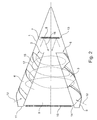
- Im Folgenden wird die Erfindung anhand von Ausführungsbeispielen in Verbindung mit der Zeichnung beschrieben. Dabei zeigt:
- Fig.1
- eine perspektivische Teil-Schnittansicht eines erfindungsgemäßen Abgaskonus,
- Fig. 2
- eine Axial-Schnittansicht durch das Ausführungsbeispiel der
Fig. 1 , und - Fig. 3
- eine Schnittansicht gemäß A-A von
Fig. 1 . - Der erfindungsgemäße Abgaskonus umfasst einen Mantelkonus 1, der in Strömungsrichtung verjüngt ausgebildet ist, so wie dies aus dem Stand der Technik bekannt ist. Die Anströmung gemäß
Fig. 2 erfolgt somit von links, der aus einer Turbine einer Fluggasturbine austretende Gasstrahl ist dabei nicht dargestellt. - An seinem Anströmbereich ist der Mantelkonus 5 mit Eintrittsöffnungen 5 (Perforation) versehen, durch welche die durch die Abgasströmung erzeugten Schallwellen 12 in den Mantelkonus 1 eintreten können. Parallel zu dem Mantelkonus 1 ist ein Innenkonus 2 vorgesehen, der sich über einen Teil der axialen Länge des Mantelkonus 1 erstreckt. Der Innenkonus 2 ist mittels gewendelter oder spiralförmiger Trennwände 3 mit dem Mantelkonus 1 verbunden. Dabei ist bevorzugt vorgesehen, dass die Verbindung zwischen den Trennwänden 3 und dem Mantelkonus 1 durch Verschweißen erfolgt, während eine Verbindung der Trennwände 3 mit dem Innenkonus 2 über Nieten oder Ähnliches erfolgen kann.
- Die
Fig. 2 zeigt einen zwischen dem Mantelkonus 1 und dem Innenkonus 2 ausgebildeten Zwischenraum 4. Bedingt durch die wendelartige Konstruktion der Trennwände ergibt sich eine effektive Länge 15 der zwischen den Trennwänden 3 in dem Zwischenraum 4 gebildeten Spiralkammer. Diese effektive Länge 15 ermöglicht die Ausbildung eines effektiv wirkenden Helmholtz-Resonators, insbesondere zusammen mit dem λ/4-Effekt des nachfolgend beschriebenen Dämpfungselements 8. - An einer Austrittsseite 6 des Zwischenraums 4 treten die in
Fig. 2 gewendelt dargestellten Schallwellen aus und gelangen in einen Innenraum 7 des Mantelkonus 1. Die Schallwellen treffen dabei auf ein flaches Dämpfungselement 8, welches mit einer Wabenstruktur versehen sein kann und in Form eines λ/4-Resonators ausgebildet sein kann. - Die
Fig. 2 zeigt reflektierte Schallwellen 16, die von dem Dämpfungselement 8 gegebenenfalls noch abgegeben werden. Diese reflektierten Schallwellen 16 gelangen in einen Innenraum 9 des Innenkonus 2 und treffen auf ein plattenförmiges Dämpfungselement 10, welches ebenfalls als λ/4-Dämpfer ausgebildet ist. - Das Dämpfungselement 10 ist über einen Faltenbalg 14 mit dem Innenkonus 2 verbunden und an diesem gelagert. Analog hierzu ist das Dämpfungselement 8 über einen Faltenbalg 13 an dem Mantelkonus 1 gelagert.
- Eine Lagerung und Befestigung des gesamten Abgaskonus erfolgt über einen ringförmigen Befestigungsflansch 11. Dieser ist bevorzugterweise fest mit dem Mantelkonus 1 verbunden, während sich am Übergang zu dem Innenkonus 2 ein Ausdehnungsspalt befinden kann, um thermische Belastungen durch Kontraktion oder Expansion zu kompensieren.
- Die
Fig. 2 zeigt mit dem Bezugszeichen 17 eine Winkelbezugslinie, aus welcher sich ergibt, dass die Trennwand mit einem Winkel von 5° bis 15°, bevorzugt 10°, zu der Bezugslinie, welche senkrecht auf die Mantelfläche des Mantelkonus 1 und des zu diesem parallelen Innenkonus 2 ausgerichtet ist, angeordnet ist. - Die beiden Dämpfungselemente 8, 10 sind jeweils als flache Hochfrequenzdämpfer ausgebildet.
- Die
Figur 3 zeigt eine Schnittansicht mit Darstellung der Neigung der Trennwand im Winkel α zur Radialrichtung 17. -
- 1
- Mantelkonus
- 2
- Innenkonus
- 3
- Trennwand
- 4
- Zwischenraum
- 5
- Eintrittsöffnung
- 6
- Austrittsseite
- 7
- Innenraum des Mantelkonus 1
- 8
- Dämpfungselement
- 9
- Innenraum des Innenkonus 2
- 10
- Dämpfungselement
- 11
- Befestigungsflansch
- 12
- Schallwelle
- 13, 14
- Faltenbalg
- 15
- effektive Länge
- 16
- reflektierte Schallwelle
- 17
- Radialrichtung
Claims (10)
- Gasturbinenabgaskonus mit einem konusförmigen, in Strömungsrichtung geschlossenen Mantelkonus (1), wobei in dem Mantelkonus (1) über zumindest einen Teil der Länge des Abgaskonus ein Innenkonus (2) angeordnet ist, welcher mit dem Mantelkonus (1) über zumindest eine gewendelte Trennwand (3) verbunden ist, wobei ein zwischen dem Mantelkonus (1) und dem Innenkonus (2) gebildeter Zwischenraum (4) an einer Einströmseite mit Eintrittsöffnungen (5) verbunden ist und sich an einer Austrittsseite (6) zum Innenraum (7) des Mantelkonus (1) öffnet, wobei benachbart zu der Austrittsseite (6) des Zwischenraums (4) in dem Mantelkonus (1) ein Dämpfungselement (8) angeordnet ist.
- Gasturbinenabgaskonus nach Anspruch 1, dadurch gekennzeichnet, dass in dem Zwischenraum (4) mehrere spiralförmig ausgebildete Trennwände (3) angeordnet sind.
- Gasturbinenabgaskonus nach Anspruch 1 oder 2, dadurch gekennzeichnet, dass im Anströmbereich des Mantelkonus (1) Eintrittsöffnungen (5) in Form einer Perforierung ausgebildet sind.
- Gasturbinenabgaskonus nach einem der Ansprüche 1 bis 3, dadurch gekennzeichnet, dass in dem Innenraum (9) des Innenkonus (2) an der Anströmseite ein zweites Dämpfungselement (10) angeordnet ist.
- Gasturbinenabgaskonus nach einem der Ansprüche 1 bis 4, dadurch gekennzeichnet, dass das Dämpfungselement (8, 10) plattenförmig, bevorzugt mit einer Wabenstruktur, bevorzugt als λ/4-Dämpfer, ausgebildet ist.
- Gasturbinenabgaskonus nach einem der Ansprüche 1 bis 5, dadurch gekennzeichnet, dass die wendelförmige Trennwand (3) mit einem Winkel von 5° bis 15° zu einer Senkrechten auf der Mantelfläche angeordnet ist.
- Gasturbinenabgaskonus nach einem der Ansprüche 1 bis 6, dadurch gekennzeichnet, dass das Dämpfungselement (8, 10) als Hochfrequenzdämpfer ausgebildet ist.
- Gasturbinenabgaskonus nach einem der Ansprüche 1 bis 7, dadurch gekennzeichnet, dass der Innenkonus (2) über die zumindest eine Trennwand (3) an dem Mantelkonus (1) gelagert ist.
- Gasturbinenabgaskonus nach einem der Ansprüche 1 bis 8, dadurch gekennzeichnet, dass am anströmseitigen Endbereich ein ringförmiger, mit dem Mantelkonus (1) verbundener Befestigungsflansch (11) ausgebildet ist.
- Gasturbinenabgaskonus nach einem der Ansprüche 1 bis 9, dadurch gekennzeichnet, dass der Innenbereich des Abgaskonus nur über die Eintrittsöffnungen (5) zur Umgebung geöffnet ist.
Applications Claiming Priority (1)
| Application Number | Priority Date | Filing Date | Title |
|---|---|---|---|
| DE102010026834A DE102010026834A1 (de) | 2010-07-12 | 2010-07-12 | Gasturbinenabgaskonus |
Publications (1)
| Publication Number | Publication Date |
|---|---|
| EP2407659A2 true EP2407659A2 (de) | 2012-01-18 |
Family
ID=44352314
Family Applications (1)
| Application Number | Title | Priority Date | Filing Date |
|---|---|---|---|
| EP11005553A Withdrawn EP2407659A2 (de) | 2010-07-12 | 2011-07-06 | Gasturbinenabgaskonus |
Country Status (3)
| Country | Link |
|---|---|
| US (1) | US8307945B2 (de) |
| EP (1) | EP2407659A2 (de) |
| DE (1) | DE102010026834A1 (de) |
Cited By (2)
| Publication number | Priority date | Publication date | Assignee | Title |
|---|---|---|---|---|
| CN104204490A (zh) * | 2012-03-20 | 2014-12-10 | 埃尔塞乐公司 | 用于飞行器涡轮喷气发动机的气体喷射锥体 |
| EP3839238A1 (de) * | 2019-12-20 | 2021-06-23 | Airbus Operations (S.A.S.) | Ausgangskonus einer antriebseinheit eines luftfahrzeugs, der ein akustisches verarbeitungssystem mit mindestens zwei freiheitsgraden bildet |
Families Citing this family (14)
| Publication number | Priority date | Publication date | Assignee | Title |
|---|---|---|---|---|
| FR2946090B1 (fr) * | 2009-05-27 | 2016-01-22 | Turbomeca | Turbomoteur comportant un cone de guidage des gaz d'echappement avec un attenuateur sonore. |
| EP2302302A1 (de) * | 2009-09-23 | 2011-03-30 | Siemens Aktiengesellschaft | Helmholtz-Resonator für Gasturbinenbrennkammern |
| DE102011008921A1 (de) * | 2011-01-19 | 2012-07-19 | Rolls-Royce Deutschland Ltd & Co Kg | Gasturbinenabgaskonus |
| US9200537B2 (en) | 2011-11-09 | 2015-12-01 | Pratt & Whitney Canada Corp. | Gas turbine exhaust case with acoustic panels |
| FR2994460B1 (fr) * | 2012-08-09 | 2018-04-27 | Safran Aircraft Engines | Cone d'ejection pour turbomachine comportant des moyens d'aspiration de couche limite d'un flux d'air |
| GB201301702D0 (en) * | 2013-01-31 | 2013-03-20 | Rolls Royce Plc | Exhaust cone |
| WO2014149604A1 (en) * | 2013-03-15 | 2014-09-25 | United Technologies Corporation | Apu exhaust system |
| US10808399B2 (en) * | 2017-10-12 | 2020-10-20 | Honeywell International Inc. | Enhanced acoustic cell and enhanced acoustic panel, and methods of producing the same |
| US11434778B2 (en) * | 2019-03-11 | 2022-09-06 | Hamilton Sundstrand Corporation | Integrated tail cone and mounted generator acoustic suppression |
| US11319895B2 (en) * | 2019-03-15 | 2022-05-03 | Hamilton Sundstrand Corporation | Integrated tail cone and mounted generator |
| US11428191B1 (en) * | 2021-04-30 | 2022-08-30 | Rhor, Inc. | Acoustic zoned system for turbofan engine exhaust application |
| US11976597B2 (en) * | 2021-09-13 | 2024-05-07 | Rohr, Inc. | Low-frequency acoustic center body |
| CN114215656A (zh) * | 2021-12-01 | 2022-03-22 | 中国航发沈阳发动机研究所 | 一种强化气冷中心锥 |
| FR3153109A1 (fr) * | 2023-09-18 | 2025-03-21 | Safran Helicopter Engines | Sous-ensemble de turbomachine d’hélicoptère et turbomachine d’hélicoptère comprenant un tel sous-ensemble |
Family Cites Families (33)
| Publication number | Priority date | Publication date | Assignee | Title |
|---|---|---|---|---|
| US938101A (en) * | 1909-02-05 | 1909-10-26 | Harry B Winters | Muffler. |
| US2853148A (en) * | 1953-06-05 | 1958-09-23 | Donaldson Co Inc | Exhaust silencer and rain trap |
| US2934891A (en) * | 1956-08-31 | 1960-05-03 | United Aircraft Corp | Anti-screech inner body |
| US4044555A (en) * | 1958-09-30 | 1977-08-30 | Hayes International Corporation | Rear section of jet power plant installations |
| US3286787A (en) * | 1963-08-26 | 1966-11-22 | Garrett Corp | Turbine exhaust silencer |
| US3286786A (en) * | 1964-12-23 | 1966-11-22 | Garrett Corp | Gas turbine exhaust silencer and acoustical material therefor |
| US4004416A (en) * | 1970-03-16 | 1977-01-25 | United Technologies Corporation | Infra-red suppressor for use with turbo-shaft engine |
| US4105090A (en) * | 1975-08-09 | 1978-08-08 | Kawasaki Jukogyo Kabushiki Kaisha | Muffler for exhaust gases |
| JPS5236219A (en) * | 1975-09-13 | 1977-03-19 | Teruo Kashiwara | Exhaust equipment for internal combustion engine |
| US4199936A (en) * | 1975-12-24 | 1980-04-29 | The Boeing Company | Gas turbine engine combustion noise suppressor |
| US4064961A (en) * | 1976-04-05 | 1977-12-27 | Rohr Industries, Incorporated | Slanted cavity resonator |
| US4137992A (en) * | 1976-12-30 | 1979-02-06 | The Boeing Company | Turbojet engine nozzle for attenuating core and turbine noise |
| US4226297A (en) * | 1979-01-12 | 1980-10-07 | United Technologies Corporation | Acoustic treated exhaust plug for turbine engine |
| US4240519A (en) * | 1979-07-02 | 1980-12-23 | United Technologies Corporation | Acoustical turbine engine tail pipe plug |
| US4244441A (en) * | 1979-07-31 | 1981-01-13 | The Garrett Corporation | Broad band acoustic attenuator |
| US4947958A (en) * | 1987-10-06 | 1990-08-14 | Uas Support, Inc. | Sound attenuating laminate installation for jet aircraft engines |
| US5491310A (en) * | 1990-08-16 | 1996-02-13 | Jen; Wang H. | Acoustic board |
| US5210383A (en) * | 1991-07-22 | 1993-05-11 | Noxon Arthur M | Sound absorbent device for a room |
| CH691465A5 (de) * | 1995-04-20 | 2001-07-31 | Dornier Gmbh | Schallschutz für Nutzlastverkleidungen bei Trägerraketen und Verfahren zum Herstellen eines Schallschutzes. |
| US6062339A (en) * | 1995-11-27 | 2000-05-16 | Hathaway; Dana B. | Compact spiral cavity loudspeaker enclosure |
| US5912442A (en) * | 1997-07-02 | 1999-06-15 | Trw Inc. | Structure having low acoustically-induced vibration response |
| EP0892217B1 (de) * | 1997-07-15 | 2003-01-15 | ALSTOM (Switzerland) Ltd | Vorrichtung zur Dämpfung von Brennkammerschwingungen |
| KR100390492B1 (ko) * | 2000-07-13 | 2003-07-04 | 엘지전자 주식회사 | 압축기용 흡입소음기의 소음 저감장치 |
| US6615576B2 (en) * | 2001-03-29 | 2003-09-09 | Honeywell International Inc. | Tortuous path quiet exhaust eductor system |
| EP1470327A4 (de) * | 2002-01-09 | 2010-07-21 | Nordam Group Inc | Düsenstopfen mit variablem querschnitt |
| ES2224807B1 (es) * | 2002-08-14 | 2007-05-01 | Sener, Ingenieria Y Sistemas, S.A. | Conducto de reduccion de ruido para componentes estaticos de motores aeronauticos. |
| US6799657B2 (en) * | 2002-10-02 | 2004-10-05 | Carrier Corporation | Absorptive/reactive muffler for variable speed compressors |
| FR2898940B1 (fr) * | 2006-03-24 | 2008-05-30 | Snecma Sa | Corps central de tuyere de turboreacteur |
| US7784283B2 (en) * | 2006-05-03 | 2010-08-31 | Rohr, Inc. | Sound-absorbing exhaust nozzle center plug |
| US7451855B2 (en) * | 2007-01-09 | 2008-11-18 | Samw Hong Jen Wang | Acoustic absorbing device |
| FR2912186B1 (fr) * | 2007-02-01 | 2013-07-05 | Airbus France | Dispositif de traitement acoustique des bruits de turbine et de combustion |
| US9291104B2 (en) * | 2007-11-21 | 2016-03-22 | Mitsubishi Hitachi Power Systems, Ltd. | Damping device and gas turbine combustor |
| US8025122B2 (en) * | 2008-11-06 | 2011-09-27 | The Boeing Company | Acoustically treated exhaust centerbody for jet engines and associated methods |
-
2010
- 2010-07-12 DE DE102010026834A patent/DE102010026834A1/de not_active Withdrawn
-
2011
- 2011-07-06 EP EP11005553A patent/EP2407659A2/de not_active Withdrawn
- 2011-07-11 US US13/180,073 patent/US8307945B2/en not_active Expired - Fee Related
Non-Patent Citations (1)
| Title |
|---|
| None |
Cited By (4)
| Publication number | Priority date | Publication date | Assignee | Title |
|---|---|---|---|---|
| CN104204490A (zh) * | 2012-03-20 | 2014-12-10 | 埃尔塞乐公司 | 用于飞行器涡轮喷气发动机的气体喷射锥体 |
| EP3839238A1 (de) * | 2019-12-20 | 2021-06-23 | Airbus Operations (S.A.S.) | Ausgangskonus einer antriebseinheit eines luftfahrzeugs, der ein akustisches verarbeitungssystem mit mindestens zwei freiheitsgraden bildet |
| FR3105551A1 (fr) * | 2019-12-20 | 2021-06-25 | Airbus Operations | Cône de sortie d’un ensemble propulsif d’aéronef formant un système de traitement acoustique à au moins deux degrés de liberté |
| US12104557B2 (en) | 2019-12-20 | 2024-10-01 | Airbus Operations (S.A.S.) | Output cone of an aircraft propulsive assembly forming an acoustic treatment system with at least two degrees of freedom |
Also Published As
| Publication number | Publication date |
|---|---|
| US20120006614A1 (en) | 2012-01-12 |
| US8307945B2 (en) | 2012-11-13 |
| DE102010026834A1 (de) | 2012-01-12 |
Similar Documents
| Publication | Publication Date | Title |
|---|---|---|
| DE102010026834A1 (de) | Gasturbinenabgaskonus | |
| EP2334558B1 (de) | Schalldämpfer für ein hilfstriebwerk eines flugzeugs | |
| DE69017042T2 (de) | Doppeltströmungsschalldämpfer für ein turbinentriebwerk. | |
| EP2381154B1 (de) | Rohrschalldämpfer für eine Strömungsmaschine | |
| EP2551507B1 (de) | Abgasturbinenkonus mit dreidimensional profilierter Trennwand sowie plattenartiges Wandelement | |
| DE60122779T2 (de) | Fluiddruckbeaufschlagungsvorrichtung | |
| WO2012097997A2 (de) | Gasturbinenabgaskonus | |
| EP2394033B1 (de) | Schalldämpfer mit helikalen einbauten | |
| EP2191105A1 (de) | Mehrschichtiger abschirmungsring für einen flugantrieb | |
| EP3004577B1 (de) | Abgasanlage für eine brennkraftmaschine und verfahren zum betreiben der abgasanlage | |
| EP0683851B1 (de) | In einem inneren und einem äusseren mantelrohr gehalterter metallischer wabenkörper, insbesondere katalysator-trägerkörper | |
| EP2273196A2 (de) | Brennkammerkopf einer Gasturbine | |
| EP2500648B1 (de) | Gasturbinenbrennkammer | |
| EP3117148B1 (de) | Brenneranordnung mit resonator | |
| EP2775131A1 (de) | Schalldämpfer eines Abgasturboladers | |
| EP2287451B1 (de) | Abgasanlage und zugehörige Verbindungsanordnung für einen Aktuator | |
| EP0990851B1 (de) | Brennkammer für eine Gasturbine | |
| EP3388678B1 (de) | Pulsations-schalldämpfer für kompressoren | |
| EP2620628B1 (de) | Triebwerksgehäuse einer Fluggasturbine mit Schalldämpfungselementen im Fan-Einströmbereich | |
| DE102012005590B4 (de) | Flexibles Leitungselement | |
| EP3591183B1 (de) | Flexibles leitungselement für die abgasanlage eines verbrennungsmotors | |
| DE102021123653A1 (de) | Abgasschalldämpfer | |
| DE19706883C2 (de) | Abgas-Schalldämpfer für Kraftfahrzeuge mit Verbrennungsmotoren | |
| DE102019106968A1 (de) | Fluidrohr für gasförmige Fluide mit einem runden Querschnitt und mindestens einem Kammerresonator sowie Brennkraftmaschine mit einem solchen Fluidrohr | |
| WO1998019054A1 (de) | Schalldämpfer |
Legal Events
| Date | Code | Title | Description |
|---|---|---|---|
| AK | Designated contracting states |
Kind code of ref document: A2 Designated state(s): AL AT BE BG CH CY CZ DE DK EE ES FI FR GB GR HR HU IE IS IT LI LT LU LV MC MK MT NL NO PL PT RO RS SE SI SK SM TR |
|
| AX | Request for extension of the european patent |
Extension state: BA ME |
|
| PUAI | Public reference made under article 153(3) epc to a published international application that has entered the european phase |
Free format text: ORIGINAL CODE: 0009012 |
|
| STAA | Information on the status of an ep patent application or granted ep patent |
Free format text: STATUS: THE APPLICATION IS DEEMED TO BE WITHDRAWN |
|
| 18D | Application deemed to be withdrawn |
Effective date: 20180201 |