EP2404970A1 - Infrared absorbing material, method for synthesizing same, coloring composition, ink, toner, printed material, image recording method and image information detecting method - Google Patents
Infrared absorbing material, method for synthesizing same, coloring composition, ink, toner, printed material, image recording method and image information detecting method Download PDFInfo
- Publication number
- EP2404970A1 EP2404970A1 EP10748562A EP10748562A EP2404970A1 EP 2404970 A1 EP2404970 A1 EP 2404970A1 EP 10748562 A EP10748562 A EP 10748562A EP 10748562 A EP10748562 A EP 10748562A EP 2404970 A1 EP2404970 A1 EP 2404970A1
- Authority
- EP
- European Patent Office
- Prior art keywords
- ink
- infrared absorbing
- group
- absorbing material
- mass
- Prior art date
- Legal status (The legal status is an assumption and is not a legal conclusion. Google has not performed a legal analysis and makes no representation as to the accuracy of the status listed.)
- Withdrawn
Links
- 239000011358 absorbing material Substances 0.000 title claims abstract description 78
- 238000000034 method Methods 0.000 title claims abstract description 76
- 239000000203 mixture Substances 0.000 title claims description 153
- 230000002194 synthesizing effect Effects 0.000 title claims description 18
- 238000004040 coloring Methods 0.000 title description 54
- 239000000463 material Substances 0.000 title description 45
- 125000003118 aryl group Chemical group 0.000 claims abstract description 25
- 229910052751 metal Inorganic materials 0.000 claims abstract description 24
- 239000002184 metal Substances 0.000 claims abstract description 24
- 230000002378 acidificating effect Effects 0.000 claims abstract description 16
- -1 lithium halide Chemical class 0.000 claims description 147
- 150000001875 compounds Chemical class 0.000 claims description 56
- 239000003086 colorant Substances 0.000 claims description 34
- 239000011230 binding agent Substances 0.000 claims description 23
- 239000003960 organic solvent Substances 0.000 claims description 15
- QIGBRXMKCJKVMJ-UHFFFAOYSA-N Hydroquinone Chemical compound OC1=CC=C(O)C=C1 QIGBRXMKCJKVMJ-UHFFFAOYSA-N 0.000 claims description 14
- 238000006243 chemical reaction Methods 0.000 claims description 13
- 239000002994 raw material Substances 0.000 claims description 10
- 229910052744 lithium Inorganic materials 0.000 claims description 8
- RYGMFSIKBFXOCR-UHFFFAOYSA-N Copper Chemical group [Cu] RYGMFSIKBFXOCR-UHFFFAOYSA-N 0.000 claims description 4
- 229910052783 alkali metal Inorganic materials 0.000 claims description 2
- 150000001340 alkali metals Chemical class 0.000 claims description 2
- 239000000976 ink Substances 0.000 description 167
- 125000004432 carbon atom Chemical group C* 0.000 description 66
- 239000002904 solvent Substances 0.000 description 44
- 238000007639 printing Methods 0.000 description 43
- 230000000052 comparative effect Effects 0.000 description 33
- 229920005989 resin Polymers 0.000 description 32
- 239000011347 resin Substances 0.000 description 32
- 239000000975 dye Substances 0.000 description 29
- 239000000049 pigment Substances 0.000 description 28
- 239000002250 absorbent Substances 0.000 description 24
- 230000002745 absorbent Effects 0.000 description 24
- 239000003963 antioxidant agent Substances 0.000 description 21
- 238000011156 evaluation Methods 0.000 description 21
- 239000000758 substrate Substances 0.000 description 21
- 230000003078 antioxidant effect Effects 0.000 description 20
- 239000001993 wax Substances 0.000 description 18
- RSWGJHLUYNHPMX-UHFFFAOYSA-N Abietic-Saeure Natural products C12CCC(C(C)C)=CC2=CCC2C1(C)CCCC2(C)C(O)=O RSWGJHLUYNHPMX-UHFFFAOYSA-N 0.000 description 17
- KHPCPRHQVVSZAH-HUOMCSJISA-N Rosin Natural products O(C/C=C/c1ccccc1)[C@H]1[C@H](O)[C@@H](O)[C@@H](O)[C@@H](CO)O1 KHPCPRHQVVSZAH-HUOMCSJISA-N 0.000 description 17
- KHPCPRHQVVSZAH-UHFFFAOYSA-N trans-cinnamyl beta-D-glucopyranoside Natural products OC1C(O)C(O)C(CO)OC1OCC=CC1=CC=CC=C1 KHPCPRHQVVSZAH-UHFFFAOYSA-N 0.000 description 17
- YXFVVABEGXRONW-UHFFFAOYSA-N Toluene Chemical compound CC1=CC=CC=C1 YXFVVABEGXRONW-UHFFFAOYSA-N 0.000 description 16
- 230000000740 bleeding effect Effects 0.000 description 16
- 238000010521 absorption reaction Methods 0.000 description 14
- 150000001450 anions Chemical class 0.000 description 14
- LFQSCWFLJHTTHZ-UHFFFAOYSA-N Ethanol Chemical compound CCO LFQSCWFLJHTTHZ-UHFFFAOYSA-N 0.000 description 13
- 230000015572 biosynthetic process Effects 0.000 description 13
- 238000003786 synthesis reaction Methods 0.000 description 13
- UQSXHKLRYXJYBZ-UHFFFAOYSA-N Iron oxide Chemical compound [Fe]=O UQSXHKLRYXJYBZ-UHFFFAOYSA-N 0.000 description 12
- OKKJLVBELUTLKV-UHFFFAOYSA-N Methanol Chemical compound OC OKKJLVBELUTLKV-UHFFFAOYSA-N 0.000 description 12
- 239000010949 copper Substances 0.000 description 12
- XCJYREBRNVKWGJ-UHFFFAOYSA-N copper(II) phthalocyanine Chemical compound [Cu+2].C12=CC=CC=C2C(N=C2[N-]C(C3=CC=CC=C32)=N2)=NC1=NC([C]1C=CC=CC1=1)=NC=1N=C1[C]3C=CC=CC3=C2[N-]1 XCJYREBRNVKWGJ-UHFFFAOYSA-N 0.000 description 11
- 239000003921 oil Substances 0.000 description 11
- 239000002245 particle Substances 0.000 description 11
- 239000004094 surface-active agent Substances 0.000 description 11
- XLYOFNOQVPJJNP-UHFFFAOYSA-N water Substances O XLYOFNOQVPJJNP-UHFFFAOYSA-N 0.000 description 11
- NIXOWILDQLNWCW-UHFFFAOYSA-M Acrylate Chemical compound [O-]C(=O)C=C NIXOWILDQLNWCW-UHFFFAOYSA-M 0.000 description 10
- 125000000623 heterocyclic group Chemical group 0.000 description 10
- CSCPPACGZOOCGX-UHFFFAOYSA-N Acetone Chemical compound CC(C)=O CSCPPACGZOOCGX-UHFFFAOYSA-N 0.000 description 9
- 229930195733 hydrocarbon Natural products 0.000 description 9
- 238000007641 inkjet printing Methods 0.000 description 9
- 239000000178 monomer Substances 0.000 description 9
- 239000000843 powder Substances 0.000 description 9
- 239000004215 Carbon black (E152) Substances 0.000 description 8
- LRHPLDYGYMQRHN-UHFFFAOYSA-N N-Butanol Chemical compound CCCCO LRHPLDYGYMQRHN-UHFFFAOYSA-N 0.000 description 8
- 125000000217 alkyl group Chemical group 0.000 description 8
- IISBACLAFKSPIT-UHFFFAOYSA-N bisphenol A Chemical compound C=1C=C(O)C=CC=1C(C)(C)C1=CC=C(O)C=C1 IISBACLAFKSPIT-UHFFFAOYSA-N 0.000 description 8
- 229910017052 cobalt Inorganic materials 0.000 description 8
- 239000010941 cobalt Substances 0.000 description 8
- GUTLYIVDDKVIGB-UHFFFAOYSA-N cobalt atom Chemical compound [Co] GUTLYIVDDKVIGB-UHFFFAOYSA-N 0.000 description 8
- 229920001577 copolymer Polymers 0.000 description 8
- 150000002148 esters Chemical class 0.000 description 8
- 150000002430 hydrocarbons Chemical class 0.000 description 8
- ISWSIDIOOBJBQZ-UHFFFAOYSA-N phenol group Chemical group C1(=CC=CC=C1)O ISWSIDIOOBJBQZ-UHFFFAOYSA-N 0.000 description 8
- 229920000647 polyepoxide Polymers 0.000 description 8
- 238000002360 preparation method Methods 0.000 description 8
- GWEVSGVZZGPLCZ-UHFFFAOYSA-N Titan oxide Chemical compound O=[Ti]=O GWEVSGVZZGPLCZ-UHFFFAOYSA-N 0.000 description 7
- 125000004429 atom Chemical group 0.000 description 7
- 238000009835 boiling Methods 0.000 description 7
- 239000003795 chemical substances by application Substances 0.000 description 7
- 125000004435 hydrogen atom Chemical group [H]* 0.000 description 7
- 230000002265 prevention Effects 0.000 description 7
- 239000000047 product Substances 0.000 description 7
- 239000011701 zinc Substances 0.000 description 7
- VEXZGXHMUGYJMC-UHFFFAOYSA-M Chloride anion Chemical compound [Cl-] VEXZGXHMUGYJMC-UHFFFAOYSA-M 0.000 description 6
- PEDCQBHIVMGVHV-UHFFFAOYSA-N Glycerine Chemical compound OCC(O)CO PEDCQBHIVMGVHV-UHFFFAOYSA-N 0.000 description 6
- JUJWROOIHBZHMG-UHFFFAOYSA-N Pyridine Chemical compound C1=CC=NC=C1 JUJWROOIHBZHMG-UHFFFAOYSA-N 0.000 description 6
- VYPSYNLAJGMNEJ-UHFFFAOYSA-N Silicium dioxide Chemical compound O=[Si]=O VYPSYNLAJGMNEJ-UHFFFAOYSA-N 0.000 description 6
- 239000002253 acid Substances 0.000 description 6
- 150000001412 amines Chemical class 0.000 description 6
- 238000001035 drying Methods 0.000 description 6
- 239000011256 inorganic filler Substances 0.000 description 6
- 229920000642 polymer Polymers 0.000 description 6
- 239000000126 substance Substances 0.000 description 6
- 229940124530 sulfonamide Drugs 0.000 description 6
- CTQNGGLPUBDAKN-UHFFFAOYSA-N O-Xylene Chemical compound CC1=CC=CC=C1C CTQNGGLPUBDAKN-UHFFFAOYSA-N 0.000 description 5
- 239000000654 additive Substances 0.000 description 5
- 150000008064 anhydrides Chemical class 0.000 description 5
- 239000000460 chlorine Substances 0.000 description 5
- 229940125904 compound 1 Drugs 0.000 description 5
- DMBHHRLKUKUOEG-UHFFFAOYSA-N diphenylamine Chemical compound C=1C=CC=CC=1NC1=CC=CC=C1 DMBHHRLKUKUOEG-UHFFFAOYSA-N 0.000 description 5
- 239000006185 dispersion Substances 0.000 description 5
- 229910052736 halogen Inorganic materials 0.000 description 5
- 229910003475 inorganic filler Inorganic materials 0.000 description 5
- 239000003208 petroleum Substances 0.000 description 5
- 125000001997 phenyl group Chemical group [H]C1=C([H])C([H])=C(*)C([H])=C1[H] 0.000 description 5
- IEQIEDJGQAUEQZ-UHFFFAOYSA-N phthalocyanine Chemical compound N1C(N=C2C3=CC=CC=C3C(N=C3C4=CC=CC=C4C(=N4)N3)=N2)=C(C=CC=C2)C2=C1N=C1C2=CC=CC=C2C4=N1 IEQIEDJGQAUEQZ-UHFFFAOYSA-N 0.000 description 5
- 239000002798 polar solvent Substances 0.000 description 5
- 230000005855 radiation Effects 0.000 description 5
- 238000003860 storage Methods 0.000 description 5
- 125000001424 substituent group Chemical group 0.000 description 5
- 238000001308 synthesis method Methods 0.000 description 5
- 235000010215 titanium dioxide Nutrition 0.000 description 5
- 238000012546 transfer Methods 0.000 description 5
- 239000003981 vehicle Substances 0.000 description 5
- 239000008096 xylene Substances 0.000 description 5
- 229910052725 zinc Inorganic materials 0.000 description 5
- PPBRXRYQALVLMV-UHFFFAOYSA-N Styrene Chemical compound C=CC1=CC=CC=C1 PPBRXRYQALVLMV-UHFFFAOYSA-N 0.000 description 4
- DKGAVHZHDRPRBM-UHFFFAOYSA-N Tert-Butanol Chemical compound CC(C)(C)O DKGAVHZHDRPRBM-UHFFFAOYSA-N 0.000 description 4
- 150000007933 aliphatic carboxylic acids Chemical class 0.000 description 4
- 125000001931 aliphatic group Chemical group 0.000 description 4
- 125000005907 alkyl ester group Chemical group 0.000 description 4
- 150000001408 amides Chemical class 0.000 description 4
- 239000011324 bead Substances 0.000 description 4
- 229910052801 chlorine Inorganic materials 0.000 description 4
- MVPPADPHJFYWMZ-UHFFFAOYSA-N chlorobenzene Chemical compound ClC1=CC=CC=C1 MVPPADPHJFYWMZ-UHFFFAOYSA-N 0.000 description 4
- JHIVVAPYMSGYDF-UHFFFAOYSA-N cyclohexanone Chemical compound O=C1CCCCC1 JHIVVAPYMSGYDF-UHFFFAOYSA-N 0.000 description 4
- QDOXWKRWXJOMAK-UHFFFAOYSA-N dichromium trioxide Chemical compound O=[Cr]O[Cr]=O QDOXWKRWXJOMAK-UHFFFAOYSA-N 0.000 description 4
- MTHSVFCYNBDYFN-UHFFFAOYSA-N diethylene glycol Chemical compound OCCOCCO MTHSVFCYNBDYFN-UHFFFAOYSA-N 0.000 description 4
- 239000003822 epoxy resin Substances 0.000 description 4
- 239000010419 fine particle Substances 0.000 description 4
- LNEPOXFFQSENCJ-UHFFFAOYSA-N haloperidol Chemical compound C1CC(O)(C=2C=CC(Cl)=CC=2)CCN1CCCC(=O)C1=CC=C(F)C=C1 LNEPOXFFQSENCJ-UHFFFAOYSA-N 0.000 description 4
- UHOKSCJSTAHBSO-UHFFFAOYSA-N indanthrone blue Chemical compound C1=CC=C2C(=O)C3=CC=C4NC5=C6C(=O)C7=CC=CC=C7C(=O)C6=CC=C5NC4=C3C(=O)C2=C1 UHOKSCJSTAHBSO-UHFFFAOYSA-N 0.000 description 4
- 239000003999 initiator Substances 0.000 description 4
- JEIPFZHSYJVQDO-UHFFFAOYSA-N iron(III) oxide Inorganic materials O=[Fe]O[Fe]=O JEIPFZHSYJVQDO-UHFFFAOYSA-N 0.000 description 4
- 239000007788 liquid Substances 0.000 description 4
- 238000004519 manufacturing process Methods 0.000 description 4
- 239000003094 microcapsule Substances 0.000 description 4
- 125000001624 naphthyl group Chemical group 0.000 description 4
- NBIIXXVUZAFLBC-UHFFFAOYSA-K phosphate Chemical compound [O-]P([O-])([O-])=O NBIIXXVUZAFLBC-UHFFFAOYSA-K 0.000 description 4
- 229940085991 phosphate ion Drugs 0.000 description 4
- 229920000728 polyester Polymers 0.000 description 4
- BWHMMNNQKKPAPP-UHFFFAOYSA-L potassium carbonate Chemical compound [K+].[K+].[O-]C([O-])=O BWHMMNNQKKPAPP-UHFFFAOYSA-L 0.000 description 4
- 239000002002 slurry Substances 0.000 description 4
- JOUDBUYBGJYFFP-FOCLMDBBSA-N thioindigo Chemical compound S\1C2=CC=CC=C2C(=O)C/1=C1/C(=O)C2=CC=CC=C2S1 JOUDBUYBGJYFFP-FOCLMDBBSA-N 0.000 description 4
- DNIAPMSPPWPWGF-GSVOUGTGSA-N (R)-(-)-Propylene glycol Chemical compound C[C@@H](O)CO DNIAPMSPPWPWGF-GSVOUGTGSA-N 0.000 description 3
- RYHBNJHYFVUHQT-UHFFFAOYSA-N 1,4-Dioxane Chemical compound C1COCCO1 RYHBNJHYFVUHQT-UHFFFAOYSA-N 0.000 description 3
- OSNILPMOSNGHLC-UHFFFAOYSA-N 1-[4-methoxy-3-(piperidin-1-ylmethyl)phenyl]ethanone Chemical compound COC1=CC=C(C(C)=O)C=C1CN1CCCCC1 OSNILPMOSNGHLC-UHFFFAOYSA-N 0.000 description 3
- OISVCGZHLKNMSJ-UHFFFAOYSA-N 2,6-dimethylpyridine Chemical compound CC1=CC=CC(C)=N1 OISVCGZHLKNMSJ-UHFFFAOYSA-N 0.000 description 3
- QTBSBXVTEAMEQO-UHFFFAOYSA-N Acetic acid Chemical compound CC(O)=O QTBSBXVTEAMEQO-UHFFFAOYSA-N 0.000 description 3
- UHOVQNZJYSORNB-UHFFFAOYSA-N Benzene Chemical compound C1=CC=CC=C1 UHOVQNZJYSORNB-UHFFFAOYSA-N 0.000 description 3
- ZAMOUSCENKQFHK-UHFFFAOYSA-N Chlorine atom Chemical compound [Cl] ZAMOUSCENKQFHK-UHFFFAOYSA-N 0.000 description 3
- 239000013032 Hydrocarbon resin Substances 0.000 description 3
- XEEYBQQBJWHFJM-UHFFFAOYSA-N Iron Chemical compound [Fe] XEEYBQQBJWHFJM-UHFFFAOYSA-N 0.000 description 3
- KFZMGEQAYNKOFK-UHFFFAOYSA-N Isopropanol Chemical compound CC(C)O KFZMGEQAYNKOFK-UHFFFAOYSA-N 0.000 description 3
- ZMXDDKWLCZADIW-UHFFFAOYSA-N N,N-Dimethylformamide Chemical compound CN(C)C=O ZMXDDKWLCZADIW-UHFFFAOYSA-N 0.000 description 3
- 239000004698 Polyethylene Substances 0.000 description 3
- 239000004793 Polystyrene Substances 0.000 description 3
- HCHKCACWOHOZIP-UHFFFAOYSA-N Zinc Chemical compound [Zn] HCHKCACWOHOZIP-UHFFFAOYSA-N 0.000 description 3
- AUNAPVYQLLNFOI-UHFFFAOYSA-L [Pb++].[Pb++].[Pb++].[O-]S([O-])(=O)=O.[O-][Cr]([O-])(=O)=O.[O-][Mo]([O-])(=O)=O Chemical compound [Pb++].[Pb++].[Pb++].[O-]S([O-])(=O)=O.[O-][Cr]([O-])(=O)=O.[O-][Mo]([O-])(=O)=O AUNAPVYQLLNFOI-UHFFFAOYSA-L 0.000 description 3
- NIXOWILDQLNWCW-UHFFFAOYSA-N acrylic acid group Chemical group C(C=C)(=O)O NIXOWILDQLNWCW-UHFFFAOYSA-N 0.000 description 3
- 125000003342 alkenyl group Chemical group 0.000 description 3
- 125000004414 alkyl thio group Chemical group 0.000 description 3
- 125000000304 alkynyl group Chemical group 0.000 description 3
- 229910052782 aluminium Inorganic materials 0.000 description 3
- BTANRVKWQNVYAZ-UHFFFAOYSA-N butan-2-ol Chemical compound CCC(C)O BTANRVKWQNVYAZ-UHFFFAOYSA-N 0.000 description 3
- 125000003917 carbamoyl group Chemical group [H]N([H])C(*)=O 0.000 description 3
- 125000001309 chloro group Chemical group Cl* 0.000 description 3
- 229910052802 copper Inorganic materials 0.000 description 3
- 230000000694 effects Effects 0.000 description 3
- 125000001495 ethyl group Chemical group [H]C([H])([H])C([H])([H])* 0.000 description 3
- 238000001914 filtration Methods 0.000 description 3
- 150000002334 glycols Chemical class 0.000 description 3
- 229920006270 hydrocarbon resin Polymers 0.000 description 3
- 230000002209 hydrophobic effect Effects 0.000 description 3
- RAXXELZNTBOGNW-UHFFFAOYSA-N imidazole Natural products C1=CNC=N1 RAXXELZNTBOGNW-UHFFFAOYSA-N 0.000 description 3
- COHYTHOBJLSHDF-UHFFFAOYSA-N indigo powder Natural products N1C2=CC=CC=C2C(=O)C1=C1C(=O)C2=CC=CC=C2N1 COHYTHOBJLSHDF-UHFFFAOYSA-N 0.000 description 3
- 238000005259 measurement Methods 0.000 description 3
- VLKZOEOYAKHREP-UHFFFAOYSA-N n-Hexane Chemical compound CCCCCC VLKZOEOYAKHREP-UHFFFAOYSA-N 0.000 description 3
- 239000002530 phenolic antioxidant Substances 0.000 description 3
- 239000005011 phenolic resin Substances 0.000 description 3
- 125000005328 phosphinyl group Chemical group [PH2](=O)* 0.000 description 3
- 229920006391 phthalonitrile polymer Polymers 0.000 description 3
- 239000004014 plasticizer Substances 0.000 description 3
- 229920000573 polyethylene Polymers 0.000 description 3
- 229920005862 polyol Polymers 0.000 description 3
- 150000003077 polyols Chemical class 0.000 description 3
- 229920002223 polystyrene Polymers 0.000 description 3
- BDERNNFJNOPAEC-UHFFFAOYSA-N propan-1-ol Chemical compound CCCO BDERNNFJNOPAEC-UHFFFAOYSA-N 0.000 description 3
- UMJSCPRVCHMLSP-UHFFFAOYSA-N pyridine Natural products COC1=CC=CN=C1 UMJSCPRVCHMLSP-UHFFFAOYSA-N 0.000 description 3
- 239000003381 stabilizer Substances 0.000 description 3
- 238000012360 testing method Methods 0.000 description 3
- VZCYOOQTPOCHFL-UHFFFAOYSA-N trans-butenedioic acid Natural products OC(=O)C=CC(O)=O VZCYOOQTPOCHFL-UHFFFAOYSA-N 0.000 description 3
- 239000002966 varnish Substances 0.000 description 3
- PSGCQDPCAWOCSH-UHFFFAOYSA-N (4,7,7-trimethyl-3-bicyclo[2.2.1]heptanyl) prop-2-enoate Chemical compound C1CC2(C)C(OC(=O)C=C)CC1C2(C)C PSGCQDPCAWOCSH-UHFFFAOYSA-N 0.000 description 2
- QPFMBZIOSGYJDE-UHFFFAOYSA-N 1,1,2,2-tetrachloroethane Chemical compound ClC(Cl)C(Cl)Cl QPFMBZIOSGYJDE-UHFFFAOYSA-N 0.000 description 2
- KBPLFHHGFOOTCA-UHFFFAOYSA-N 1-Octanol Chemical compound CCCCCCCCO KBPLFHHGFOOTCA-UHFFFAOYSA-N 0.000 description 2
- ZNRLMGFXSPUZNR-UHFFFAOYSA-N 2,2,4-trimethyl-1h-quinoline Chemical compound C1=CC=C2C(C)=CC(C)(C)NC2=C1 ZNRLMGFXSPUZNR-UHFFFAOYSA-N 0.000 description 2
- FFRBMBIXVSCUFS-UHFFFAOYSA-N 2,4-dinitro-1-naphthol Chemical compound C1=CC=C2C(O)=C([N+]([O-])=O)C=C([N+]([O-])=O)C2=C1 FFRBMBIXVSCUFS-UHFFFAOYSA-N 0.000 description 2
- HCLJOFJIQIJXHS-UHFFFAOYSA-N 2-[2-[2-(2-prop-2-enoyloxyethoxy)ethoxy]ethoxy]ethyl prop-2-enoate Chemical compound C=CC(=O)OCCOCCOCCOCCOC(=O)C=C HCLJOFJIQIJXHS-UHFFFAOYSA-N 0.000 description 2
- 125000001340 2-chloroethyl group Chemical group [H]C([H])(Cl)C([H])([H])* 0.000 description 2
- 125000001731 2-cyanoethyl group Chemical group [H]C([H])(*)C([H])([H])C#N 0.000 description 2
- DWDURZSYQTXVIN-UHFFFAOYSA-N 4-[(4-aminophenyl)-(4-methyliminocyclohexa-2,5-dien-1-ylidene)methyl]aniline Chemical compound C1=CC(=NC)C=CC1=C(C=1C=CC(N)=CC=1)C1=CC=C(N)C=C1 DWDURZSYQTXVIN-UHFFFAOYSA-N 0.000 description 2
- LVOJOIBIVGEQBP-UHFFFAOYSA-N 4-[[2-chloro-4-[3-chloro-4-[(5-hydroxy-3-methyl-1-phenylpyrazol-4-yl)diazenyl]phenyl]phenyl]diazenyl]-5-methyl-2-phenylpyrazol-3-ol Chemical compound CC1=NN(C(O)=C1N=NC1=CC=C(C=C1Cl)C1=CC(Cl)=C(C=C1)N=NC1=C(O)N(N=C1C)C1=CC=CC=C1)C1=CC=CC=C1 LVOJOIBIVGEQBP-UHFFFAOYSA-N 0.000 description 2
- WLHCBQAPPJAULW-UHFFFAOYSA-N 4-methylbenzenethiol Chemical compound CC1=CC=C(S)C=C1 WLHCBQAPPJAULW-UHFFFAOYSA-N 0.000 description 2
- FKNQCJSGGFJEIZ-UHFFFAOYSA-N 4-methylpyridine Chemical compound CC1=CC=NC=C1 FKNQCJSGGFJEIZ-UHFFFAOYSA-N 0.000 description 2
- JHWGFJBTMHEZME-UHFFFAOYSA-N 4-prop-2-enoyloxybutyl prop-2-enoate Chemical compound C=CC(=O)OCCCCOC(=O)C=C JHWGFJBTMHEZME-UHFFFAOYSA-N 0.000 description 2
- YYROPELSRYBVMQ-UHFFFAOYSA-N 4-toluenesulfonyl chloride Chemical compound CC1=CC=C(S(Cl)(=O)=O)C=C1 YYROPELSRYBVMQ-UHFFFAOYSA-N 0.000 description 2
- AQSOTOUQTVJNMY-UHFFFAOYSA-N 7-(dimethylamino)-4-hydroxy-3-oxophenoxazin-10-ium-1-carboxylic acid;chloride Chemical compound [Cl-].OC(=O)C1=CC(=O)C(O)=C2OC3=CC(N(C)C)=CC=C3[NH+]=C21 AQSOTOUQTVJNMY-UHFFFAOYSA-N 0.000 description 2
- NLHHRLWOUZZQLW-UHFFFAOYSA-N Acrylonitrile Chemical compound C=CC#N NLHHRLWOUZZQLW-UHFFFAOYSA-N 0.000 description 2
- LSNNMFCWUKXFEE-UHFFFAOYSA-M Bisulfite Chemical compound OS([O-])=O LSNNMFCWUKXFEE-UHFFFAOYSA-M 0.000 description 2
- NLZUEZXRPGMBCV-UHFFFAOYSA-N Butylhydroxytoluene Chemical compound CC1=CC(C(C)(C)C)=C(O)C(C(C)(C)C)=C1 NLZUEZXRPGMBCV-UHFFFAOYSA-N 0.000 description 2
- 108091005944 Cerulean Proteins 0.000 description 2
- RTZKZFJDLAIYFH-UHFFFAOYSA-N Diethyl ether Chemical compound CCOCC RTZKZFJDLAIYFH-UHFFFAOYSA-N 0.000 description 2
- IAZDPXIOMUYVGZ-UHFFFAOYSA-N Dimethylsulphoxide Chemical compound CS(C)=O IAZDPXIOMUYVGZ-UHFFFAOYSA-N 0.000 description 2
- BRLQWZUYTZBJKN-UHFFFAOYSA-N Epichlorohydrin Chemical compound ClCC1CO1 BRLQWZUYTZBJKN-UHFFFAOYSA-N 0.000 description 2
- IAYPIBMASNFSPL-UHFFFAOYSA-N Ethylene oxide Chemical group C1CO1 IAYPIBMASNFSPL-UHFFFAOYSA-N 0.000 description 2
- VZCYOOQTPOCHFL-OWOJBTEDSA-N Fumaric acid Chemical compound OC(=O)\C=C\C(O)=O VZCYOOQTPOCHFL-OWOJBTEDSA-N 0.000 description 2
- YLQBMQCUIZJEEH-UHFFFAOYSA-N Furan Chemical compound C=1C=COC=1 YLQBMQCUIZJEEH-UHFFFAOYSA-N 0.000 description 2
- WOBHKFSMXKNTIM-UHFFFAOYSA-N Hydroxyethyl methacrylate Chemical compound CC(=C)C(=O)OCCO WOBHKFSMXKNTIM-UHFFFAOYSA-N 0.000 description 2
- 235000000177 Indigofera tinctoria Nutrition 0.000 description 2
- CERQOIWHTDAKMF-UHFFFAOYSA-N Methacrylic acid Chemical compound CC(=C)C(O)=O CERQOIWHTDAKMF-UHFFFAOYSA-N 0.000 description 2
- FXHOOIRPVKKKFG-UHFFFAOYSA-N N,N-Dimethylacetamide Chemical compound CN(C)C(C)=O FXHOOIRPVKKKFG-UHFFFAOYSA-N 0.000 description 2
- KWORKYDIARWARF-UHFFFAOYSA-N N-(4-chloro-2-methylphenyl)-4-[(4-chloro-2-methylphenyl)diazenyl]-3-hydroxynaphthalene-2-carboxamide Chemical compound Cc1cc(Cl)ccc1NC(=O)c1cc2ccccc2c(N=Nc2ccc(Cl)cc2C)c1O KWORKYDIARWARF-UHFFFAOYSA-N 0.000 description 2
- IMNFDUFMRHMDMM-UHFFFAOYSA-N N-Heptane Chemical compound CCCCCCC IMNFDUFMRHMDMM-UHFFFAOYSA-N 0.000 description 2
- AMQJEAYHLZJPGS-UHFFFAOYSA-N N-Pentanol Chemical compound CCCCCO AMQJEAYHLZJPGS-UHFFFAOYSA-N 0.000 description 2
- PXHVJJICTQNCMI-UHFFFAOYSA-N Nickel Chemical compound [Ni] PXHVJJICTQNCMI-UHFFFAOYSA-N 0.000 description 2
- KDLHZDBZIXYQEI-UHFFFAOYSA-N Palladium Chemical compound [Pd] KDLHZDBZIXYQEI-UHFFFAOYSA-N 0.000 description 2
- 239000004952 Polyamide Substances 0.000 description 2
- 239000004743 Polypropylene Substances 0.000 description 2
- KYQCOXFCLRTKLS-UHFFFAOYSA-N Pyrazine Chemical compound C1=CN=CC=N1 KYQCOXFCLRTKLS-UHFFFAOYSA-N 0.000 description 2
- KAESVJOAVNADME-UHFFFAOYSA-N Pyrrole Chemical compound C=1C=CNC=1 KAESVJOAVNADME-UHFFFAOYSA-N 0.000 description 2
- SMWDFEZZVXVKRB-UHFFFAOYSA-N Quinoline Chemical compound N1=CC=CC2=CC=CC=C21 SMWDFEZZVXVKRB-UHFFFAOYSA-N 0.000 description 2
- 241000220317 Rosa Species 0.000 description 2
- MRQIXHXHHPWVIL-ISLYRVAYSA-N Sudan I Chemical compound OC1=CC=C2C=CC=CC2=C1\N=N\C1=CC=CC=C1 MRQIXHXHHPWVIL-ISLYRVAYSA-N 0.000 description 2
- QAOWNCQODCNURD-UHFFFAOYSA-L Sulfate Chemical compound [O-]S([O-])(=O)=O QAOWNCQODCNURD-UHFFFAOYSA-L 0.000 description 2
- YTPLMLYBLZKORZ-UHFFFAOYSA-N Thiophene Chemical compound C=1C=CSC=1 YTPLMLYBLZKORZ-UHFFFAOYSA-N 0.000 description 2
- RTAQQCXQSZGOHL-UHFFFAOYSA-N Titanium Chemical compound [Ti] RTAQQCXQSZGOHL-UHFFFAOYSA-N 0.000 description 2
- MCMNRKCIXSYSNV-UHFFFAOYSA-N Zirconium dioxide Chemical compound O=[Zr]=O MCMNRKCIXSYSNV-UHFFFAOYSA-N 0.000 description 2
- 125000003545 alkoxy group Chemical group 0.000 description 2
- 125000004453 alkoxycarbonyl group Chemical group 0.000 description 2
- 125000004466 alkoxycarbonylamino group Chemical group 0.000 description 2
- 125000005194 alkoxycarbonyloxy group Chemical group 0.000 description 2
- 125000004644 alkyl sulfinyl group Chemical group 0.000 description 2
- 125000004390 alkyl sulfonyl group Chemical group 0.000 description 2
- 125000004656 alkyl sulfonylamino group Chemical group 0.000 description 2
- XAGFODPZIPBFFR-UHFFFAOYSA-N aluminium Chemical compound [Al] XAGFODPZIPBFFR-UHFFFAOYSA-N 0.000 description 2
- WLDHEUZGFKACJH-UHFFFAOYSA-K amaranth Chemical compound [Na+].[Na+].[Na+].C12=CC=C(S([O-])(=O)=O)C=C2C=C(S([O-])(=O)=O)C(O)=C1N=NC1=CC=C(S([O-])(=O)=O)C2=CC=CC=C12 WLDHEUZGFKACJH-UHFFFAOYSA-K 0.000 description 2
- 125000003277 amino group Chemical group 0.000 description 2
- 125000006598 aminocarbonylamino group Chemical group 0.000 description 2
- 125000004397 aminosulfonyl group Chemical group NS(=O)(=O)* 0.000 description 2
- 229910052787 antimony Inorganic materials 0.000 description 2
- WATWJIUSRGPENY-UHFFFAOYSA-N antimony atom Chemical compound [Sb] WATWJIUSRGPENY-UHFFFAOYSA-N 0.000 description 2
- 125000001204 arachidyl group Chemical group [H]C([*])([H])C([H])([H])C([H])([H])C([H])([H])C([H])([H])C([H])([H])C([H])([H])C([H])([H])C([H])([H])C([H])([H])C([H])([H])C([H])([H])C([H])([H])C([H])([H])C([H])([H])C([H])([H])C([H])([H])C([H])([H])C([H])([H])C([H])([H])[H] 0.000 description 2
- 125000006615 aromatic heterocyclic group Chemical group 0.000 description 2
- 150000004945 aromatic hydrocarbons Chemical class 0.000 description 2
- 125000005162 aryl oxy carbonyl amino group Chemical group 0.000 description 2
- 125000005161 aryl oxy carbonyl group Chemical group 0.000 description 2
- 125000005135 aryl sulfinyl group Chemical group 0.000 description 2
- 125000004657 aryl sulfonyl amino group Chemical group 0.000 description 2
- 125000004391 aryl sulfonyl group Chemical group 0.000 description 2
- 125000005110 aryl thio group Chemical group 0.000 description 2
- 125000005200 aryloxy carbonyloxy group Chemical group 0.000 description 2
- 125000004104 aryloxy group Chemical group 0.000 description 2
- 125000000751 azo group Chemical group [*]N=N[*] 0.000 description 2
- IRERQBUNZFJFGC-UHFFFAOYSA-L azure blue Chemical compound [Na+].[Na+].[Na+].[Na+].[Na+].[Na+].[Na+].[Na+].[Al+3].[Al+3].[Al+3].[Al+3].[Al+3].[Al+3].[S-]S[S-].[O-][Si]([O-])([O-])[O-].[O-][Si]([O-])([O-])[O-].[O-][Si]([O-])([O-])[O-].[O-][Si]([O-])([O-])[O-].[O-][Si]([O-])([O-])[O-].[O-][Si]([O-])([O-])[O-] IRERQBUNZFJFGC-UHFFFAOYSA-L 0.000 description 2
- QFFVPLLCYGOFPU-UHFFFAOYSA-N barium chromate Chemical compound [Ba+2].[O-][Cr]([O-])(=O)=O QFFVPLLCYGOFPU-UHFFFAOYSA-N 0.000 description 2
- 239000012965 benzophenone Substances 0.000 description 2
- 150000001602 bicycloalkyls Chemical group 0.000 description 2
- 235000010354 butylated hydroxytoluene Nutrition 0.000 description 2
- CJOBVZJTOIVNNF-UHFFFAOYSA-N cadmium sulfide Chemical compound [Cd]=S CJOBVZJTOIVNNF-UHFFFAOYSA-N 0.000 description 2
- 229910052799 carbon Inorganic materials 0.000 description 2
- 125000002915 carbonyl group Chemical group [*:2]C([*:1])=O 0.000 description 2
- 125000003178 carboxy group Chemical group [H]OC(*)=O 0.000 description 2
- 150000001732 carboxylic acid derivatives Chemical class 0.000 description 2
- 235000012730 carminic acid Nutrition 0.000 description 2
- 239000004203 carnauba wax Substances 0.000 description 2
- 235000013869 carnauba wax Nutrition 0.000 description 2
- HBHZKFOUIUMKHV-UHFFFAOYSA-N chembl1982121 Chemical compound OC1=CC=C2C=CC=CC2=C1N=NC1=CC=C([N+]([O-])=O)C=C1[N+]([O-])=O HBHZKFOUIUMKHV-UHFFFAOYSA-N 0.000 description 2
- YOCIQNIEQYCORH-UHFFFAOYSA-M chembl2028361 Chemical compound [Na+].OC1=CC=C2C=C(S([O-])(=O)=O)C=CC2=C1N=NC1=CC=CC=C1 YOCIQNIEQYCORH-UHFFFAOYSA-M 0.000 description 2
- 238000000576 coating method Methods 0.000 description 2
- ZPUCINDJVBIVPJ-LJISPDSOSA-N cocaine Chemical compound O([C@H]1C[C@@H]2CC[C@@H](N2C)[C@H]1C(=O)OC)C(=O)C1=CC=CC=C1 ZPUCINDJVBIVPJ-LJISPDSOSA-N 0.000 description 2
- 238000002485 combustion reaction Methods 0.000 description 2
- 238000007796 conventional method Methods 0.000 description 2
- 238000001816 cooling Methods 0.000 description 2
- OPQARKPSCNTWTJ-UHFFFAOYSA-L copper(ii) acetate Chemical compound [Cu+2].CC([O-])=O.CC([O-])=O OPQARKPSCNTWTJ-UHFFFAOYSA-L 0.000 description 2
- 230000007797 corrosion Effects 0.000 description 2
- 238000005260 corrosion Methods 0.000 description 2
- 125000004122 cyclic group Chemical group 0.000 description 2
- 125000000392 cycloalkenyl group Chemical group 0.000 description 2
- 125000000753 cycloalkyl group Chemical group 0.000 description 2
- ZSWFCLXCOIISFI-UHFFFAOYSA-N cyclopentadiene Chemical compound C1C=CC=C1 ZSWFCLXCOIISFI-UHFFFAOYSA-N 0.000 description 2
- 235000014113 dietary fatty acids Nutrition 0.000 description 2
- 239000002270 dispersing agent Substances 0.000 description 2
- POULHZVOKOAJMA-UHFFFAOYSA-N dodecanoic acid Chemical compound CCCCCCCCCCCC(O)=O POULHZVOKOAJMA-UHFFFAOYSA-N 0.000 description 2
- 229910001254 electrum Inorganic materials 0.000 description 2
- 239000003623 enhancer Substances 0.000 description 2
- PLYDMIIYRWUYBP-UHFFFAOYSA-N ethyl 4-[[2-chloro-4-[3-chloro-4-[(3-ethoxycarbonyl-5-oxo-1-phenyl-4h-pyrazol-4-yl)diazenyl]phenyl]phenyl]diazenyl]-5-oxo-1-phenyl-4h-pyrazole-3-carboxylate Chemical compound CCOC(=O)C1=NN(C=2C=CC=CC=2)C(=O)C1N=NC(C(=C1)Cl)=CC=C1C(C=C1Cl)=CC=C1N=NC(C(=N1)C(=O)OCC)C(=O)N1C1=CC=CC=C1 PLYDMIIYRWUYBP-UHFFFAOYSA-N 0.000 description 2
- 238000001704 evaporation Methods 0.000 description 2
- 230000008020 evaporation Effects 0.000 description 2
- 238000005562 fading Methods 0.000 description 2
- 239000000194 fatty acid Substances 0.000 description 2
- 229930195729 fatty acid Natural products 0.000 description 2
- 150000004665 fatty acids Chemical class 0.000 description 2
- 125000000524 functional group Chemical group 0.000 description 2
- 239000011521 glass Substances 0.000 description 2
- 238000007646 gravure printing Methods 0.000 description 2
- 239000010940 green gold Substances 0.000 description 2
- 150000002367 halogens Chemical class 0.000 description 2
- 125000005842 heteroatom Chemical group 0.000 description 2
- IPCSVZSSVZVIGE-UHFFFAOYSA-N hexadecanoic acid Chemical compound CCCCCCCCCCCCCCCC(O)=O IPCSVZSSVZVIGE-UHFFFAOYSA-N 0.000 description 2
- 235000019239 indanthrene blue RS Nutrition 0.000 description 2
- 229940097275 indigo Drugs 0.000 description 2
- 238000004255 ion exchange chromatography Methods 0.000 description 2
- 150000002500 ions Chemical class 0.000 description 2
- 229910052742 iron Inorganic materials 0.000 description 2
- 230000001678 irradiating effect Effects 0.000 description 2
- QQVIHTHCMHWDBS-UHFFFAOYSA-N isophthalic acid Chemical compound OC(=O)C1=CC=CC(C(O)=O)=C1 QQVIHTHCMHWDBS-UHFFFAOYSA-N 0.000 description 2
- 125000001449 isopropyl group Chemical group [H]C([H])([H])C([H])(*)C([H])([H])[H] 0.000 description 2
- MOUPNEIJQCETIW-UHFFFAOYSA-N lead chromate Chemical compound [Pb+2].[O-][Cr]([O-])(=O)=O MOUPNEIJQCETIW-UHFFFAOYSA-N 0.000 description 2
- 238000007644 letterpress printing Methods 0.000 description 2
- KWGKDLIKAYFUFQ-UHFFFAOYSA-M lithium chloride Chemical compound [Li+].[Cl-] KWGKDLIKAYFUFQ-UHFFFAOYSA-M 0.000 description 2
- 235000010187 litholrubine BK Nutrition 0.000 description 2
- 229940002712 malachite green oxalate Drugs 0.000 description 2
- VZCYOOQTPOCHFL-UPHRSURJSA-N maleic acid Chemical compound OC(=O)\C=C/C(O)=O VZCYOOQTPOCHFL-UPHRSURJSA-N 0.000 description 2
- 238000001819 mass spectrum Methods 0.000 description 2
- 239000011159 matrix material Substances 0.000 description 2
- YDKNBNOOCSNPNS-UHFFFAOYSA-N methyl 1,3-benzoxazole-2-carboxylate Chemical compound C1=CC=C2OC(C(=O)OC)=NC2=C1 YDKNBNOOCSNPNS-UHFFFAOYSA-N 0.000 description 2
- 125000002496 methyl group Chemical group [H]C([H])([H])* 0.000 description 2
- CXKWCBBOMKCUKX-UHFFFAOYSA-M methylene blue Chemical compound [Cl-].C1=CC(N(C)C)=CC2=[S+]C3=CC(N(C)C)=CC=C3N=C21 CXKWCBBOMKCUKX-UHFFFAOYSA-M 0.000 description 2
- 229960000907 methylthioninium chloride Drugs 0.000 description 2
- 238000002156 mixing Methods 0.000 description 2
- 239000003607 modifier Substances 0.000 description 2
- RQUXYBHREKXNKT-UHFFFAOYSA-N n-butyl-4-methylbenzenesulfonamide Chemical compound CCCCNS(=O)(=O)C1=CC=C(C)C=C1 RQUXYBHREKXNKT-UHFFFAOYSA-N 0.000 description 2
- 125000004123 n-propyl group Chemical group [H]C([H])([H])C([H])([H])C([H])([H])* 0.000 description 2
- OBJNZHVOCNPSCS-UHFFFAOYSA-N naphtho[2,3-f]quinazoline Chemical compound C1=NC=C2C3=CC4=CC=CC=C4C=C3C=CC2=N1 OBJNZHVOCNPSCS-UHFFFAOYSA-N 0.000 description 2
- 229910052755 nonmetal Inorganic materials 0.000 description 2
- SJWFXCIHNDVPSH-UHFFFAOYSA-N octan-2-ol Chemical compound CCCCCCC(C)O SJWFXCIHNDVPSH-UHFFFAOYSA-N 0.000 description 2
- 238000007645 offset printing Methods 0.000 description 2
- 230000003287 optical effect Effects 0.000 description 2
- 125000001820 oxy group Chemical group [*:1]O[*:2] 0.000 description 2
- 239000012188 paraffin wax Substances 0.000 description 2
- JYVLIDXNZAXMDK-UHFFFAOYSA-N pentan-2-ol Chemical compound CCCC(C)O JYVLIDXNZAXMDK-UHFFFAOYSA-N 0.000 description 2
- 229920003023 plastic Polymers 0.000 description 2
- 239000004033 plastic Substances 0.000 description 2
- 229920000058 polyacrylate Polymers 0.000 description 2
- 229920002647 polyamide Polymers 0.000 description 2
- 239000004645 polyester resin Substances 0.000 description 2
- 229920001225 polyester resin Polymers 0.000 description 2
- 229920001223 polyethylene glycol Polymers 0.000 description 2
- 229920001155 polypropylene Polymers 0.000 description 2
- 229920001451 polypropylene glycol Polymers 0.000 description 2
- 229910052700 potassium Inorganic materials 0.000 description 2
- 229910000027 potassium carbonate Inorganic materials 0.000 description 2
- IZMJMCDDWKSTTK-UHFFFAOYSA-N quinoline yellow Chemical compound C1=CC=CC2=NC(C3C(C4=CC=CC=C4C3=O)=O)=CC=C21 IZMJMCDDWKSTTK-UHFFFAOYSA-N 0.000 description 2
- 235000012752 quinoline yellow Nutrition 0.000 description 2
- 229940051201 quinoline yellow Drugs 0.000 description 2
- 239000004172 quinoline yellow Substances 0.000 description 2
- YGSDEFSMJLZEOE-UHFFFAOYSA-N salicylic acid Chemical compound OC(=O)C1=CC=CC=C1O YGSDEFSMJLZEOE-UHFFFAOYSA-N 0.000 description 2
- 239000004065 semiconductor Substances 0.000 description 2
- 239000000377 silicon dioxide Substances 0.000 description 2
- 125000004469 siloxy group Chemical group [SiH3]O* 0.000 description 2
- 125000003808 silyl group Chemical group [H][Si]([H])([H])[*] 0.000 description 2
- 229910052708 sodium Inorganic materials 0.000 description 2
- 239000011734 sodium Substances 0.000 description 2
- IDVNZMQMDGSYNQ-UHFFFAOYSA-M sodium 2-(naphthalen-1-yldiazenyl)-5-sulfonaphthalen-1-olate Chemical compound [Na+].Oc1c(ccc2c(cccc12)S([O-])(=O)=O)N=Nc1cccc2ccccc12 IDVNZMQMDGSYNQ-UHFFFAOYSA-M 0.000 description 2
- 230000003595 spectral effect Effects 0.000 description 2
- 235000015096 spirit Nutrition 0.000 description 2
- 229910052712 strontium Inorganic materials 0.000 description 2
- CIOAGBVUUVVLOB-UHFFFAOYSA-N strontium atom Chemical compound [Sr] CIOAGBVUUVVLOB-UHFFFAOYSA-N 0.000 description 2
- 238000000859 sublimation Methods 0.000 description 2
- 230000008022 sublimation Effects 0.000 description 2
- 125000003107 substituted aryl group Chemical group 0.000 description 2
- 229920003002 synthetic resin Polymers 0.000 description 2
- 239000000057 synthetic resin Substances 0.000 description 2
- 239000003784 tall oil Substances 0.000 description 2
- 125000000999 tert-butyl group Chemical group [H]C([H])([H])C(*)(C([H])([H])[H])C([H])([H])[H] 0.000 description 2
- 125000004149 thio group Chemical group *S* 0.000 description 2
- 239000010936 titanium Substances 0.000 description 2
- 229910052719 titanium Inorganic materials 0.000 description 2
- 235000013799 ultramarine blue Nutrition 0.000 description 2
- 125000005287 vanadyl group Chemical group 0.000 description 2
- 125000000391 vinyl group Chemical group [H]C([*])=C([H])[H] 0.000 description 2
- XOSXWYQMOYSSKB-LDKJGXKFSA-L water blue Chemical compound CC1=CC(/C(\C(C=C2)=CC=C2NC(C=C2)=CC=C2S([O-])(=O)=O)=C(\C=C2)/C=C/C\2=N\C(C=C2)=CC=C2S([O-])(=O)=O)=CC(S(O)(=O)=O)=C1N.[Na+].[Na+] XOSXWYQMOYSSKB-LDKJGXKFSA-L 0.000 description 2
- 239000000080 wetting agent Substances 0.000 description 2
- 239000002023 wood Substances 0.000 description 2
- JNELGWHKGNBSMD-UHFFFAOYSA-N xanthone Chemical compound C1=CC=C2C(=O)C3=CC=CC=C3OC2=C1 JNELGWHKGNBSMD-UHFFFAOYSA-N 0.000 description 2
- PJAKWOZHTFWTNF-UHFFFAOYSA-N (2-nonylphenyl) prop-2-enoate Chemical compound CCCCCCCCCC1=CC=CC=C1OC(=O)C=C PJAKWOZHTFWTNF-UHFFFAOYSA-N 0.000 description 1
- KMOUUZVZFBCRAM-OLQVQODUSA-N (3as,7ar)-3a,4,7,7a-tetrahydro-2-benzofuran-1,3-dione Chemical compound C1C=CC[C@@H]2C(=O)OC(=O)[C@@H]21 KMOUUZVZFBCRAM-OLQVQODUSA-N 0.000 description 1
- QGKMIGUHVLGJBR-UHFFFAOYSA-M (4z)-1-(3-methylbutyl)-4-[[1-(3-methylbutyl)quinolin-1-ium-4-yl]methylidene]quinoline;iodide Chemical compound [I-].C12=CC=CC=C2N(CCC(C)C)C=CC1=CC1=CC=[N+](CCC(C)C)C2=CC=CC=C12 QGKMIGUHVLGJBR-UHFFFAOYSA-M 0.000 description 1
- YYGNTYWPHWGJRM-UHFFFAOYSA-N (6E,10E,14E,18E)-2,6,10,15,19,23-hexamethyltetracosa-2,6,10,14,18,22-hexaene Chemical compound CC(C)=CCCC(C)=CCCC(C)=CCCC=C(C)CCC=C(C)CCC=C(C)C YYGNTYWPHWGJRM-UHFFFAOYSA-N 0.000 description 1
- WRIDQFICGBMAFQ-UHFFFAOYSA-N (E)-8-Octadecenoic acid Natural products CCCCCCCCCC=CCCCCCCC(O)=O WRIDQFICGBMAFQ-UHFFFAOYSA-N 0.000 description 1
- JYEUMXHLPRZUAT-UHFFFAOYSA-N 1,2,3-triazine Chemical compound C1=CN=NN=C1 JYEUMXHLPRZUAT-UHFFFAOYSA-N 0.000 description 1
- AZQWKYJCGOJGHM-UHFFFAOYSA-N 1,4-benzoquinone Chemical compound O=C1C=CC(=O)C=C1 AZQWKYJCGOJGHM-UHFFFAOYSA-N 0.000 description 1
- PEXREEDJORUHET-UHFFFAOYSA-N 1-(2-phenylethyl)-4-propan-2-ylbenzene Chemical compound C1=CC(C(C)C)=CC=C1CCC1=CC=CC=C1 PEXREEDJORUHET-UHFFFAOYSA-N 0.000 description 1
- RAVIQFQJZMTUBX-AWEZNQCLSA-N 1-[(3S)-3-[4-(aminomethyl)-6-(trifluoromethyl)pyridin-2-yl]oxypiperidin-1-yl]-2-(3,4-dichlorophenyl)ethanone Chemical compound NCC1=CC(=NC(=C1)C(F)(F)F)O[C@@H]1CN(CCC1)C(CC1=CC(=C(C=C1)Cl)Cl)=O RAVIQFQJZMTUBX-AWEZNQCLSA-N 0.000 description 1
- XAOMFUPJQYNDEG-LBPRGKRZSA-N 1-[(3S)-3-[4-(aminomethyl)-6-(trifluoromethyl)pyridin-2-yl]oxypiperidin-1-yl]-2-methylpropan-1-one Chemical compound NCC1=CC(=NC(=C1)C(F)(F)F)O[C@@H]1CN(CCC1)C(C(C)C)=O XAOMFUPJQYNDEG-LBPRGKRZSA-N 0.000 description 1
- ZDQNWDNMNKSMHI-UHFFFAOYSA-N 1-[2-(2-prop-2-enoyloxypropoxy)propoxy]propan-2-yl prop-2-enoate Chemical compound C=CC(=O)OC(C)COC(C)COCC(C)OC(=O)C=C ZDQNWDNMNKSMHI-UHFFFAOYSA-N 0.000 description 1
- APTGHASZJUAUCP-UHFFFAOYSA-N 1-n,4-n-di(octan-2-yl)benzene-1,4-diamine Chemical compound CCCCCCC(C)NC1=CC=C(NC(C)CCCCCC)C=C1 APTGHASZJUAUCP-UHFFFAOYSA-N 0.000 description 1
- LNETULKMXZVUST-UHFFFAOYSA-N 1-naphthoic acid Chemical compound C1=CC=C2C(C(=O)O)=CC=CC2=C1 LNETULKMXZVUST-UHFFFAOYSA-N 0.000 description 1
- KJCVRFUGPWSIIH-UHFFFAOYSA-N 1-naphthol Chemical compound C1=CC=C2C(O)=CC=CC2=C1 KJCVRFUGPWSIIH-UHFFFAOYSA-N 0.000 description 1
- KGRVJHAUYBGFFP-UHFFFAOYSA-N 2,2'-Methylenebis(4-methyl-6-tert-butylphenol) Chemical compound CC(C)(C)C1=CC(C)=CC(CC=2C(=C(C=C(C)C=2)C(C)(C)C)O)=C1O KGRVJHAUYBGFFP-UHFFFAOYSA-N 0.000 description 1
- OYKPJMYWPYIXGG-UHFFFAOYSA-N 2,2-dimethylbutane;prop-2-enoic acid Chemical compound OC(=O)C=C.OC(=O)C=C.OC(=O)C=C.CCC(C)(C)C OYKPJMYWPYIXGG-UHFFFAOYSA-N 0.000 description 1
- YQTCQNIPQMJNTI-UHFFFAOYSA-N 2,2-dimethylpropan-1-one Chemical group CC(C)(C)[C]=O YQTCQNIPQMJNTI-UHFFFAOYSA-N 0.000 description 1
- PUGOMSLRUSTQGV-UHFFFAOYSA-N 2,3-di(prop-2-enoyloxy)propyl prop-2-enoate Chemical compound C=CC(=O)OCC(OC(=O)C=C)COC(=O)C=C PUGOMSLRUSTQGV-UHFFFAOYSA-N 0.000 description 1
- SPSPIUSUWPLVKD-UHFFFAOYSA-N 2,3-dibutyl-6-methylphenol Chemical compound CCCCC1=CC=C(C)C(O)=C1CCCC SPSPIUSUWPLVKD-UHFFFAOYSA-N 0.000 description 1
- BYLSIPUARIZAHZ-UHFFFAOYSA-N 2,4,6-tris(1-phenylethyl)phenol Chemical compound C=1C(C(C)C=2C=CC=CC=2)=C(O)C(C(C)C=2C=CC=CC=2)=CC=1C(C)C1=CC=CC=C1 BYLSIPUARIZAHZ-UHFFFAOYSA-N 0.000 description 1
- DRRDTKUTHYHEKE-UHFFFAOYSA-N 2,4-dimethyl-6-octylphenol Chemical compound CCCCCCCCC1=CC(C)=CC(C)=C1O DRRDTKUTHYHEKE-UHFFFAOYSA-N 0.000 description 1
- OPLCSTZDXXUYDU-UHFFFAOYSA-N 2,4-dimethyl-6-tert-butylphenol Chemical compound CC1=CC(C)=C(O)C(C(C)(C)C)=C1 OPLCSTZDXXUYDU-UHFFFAOYSA-N 0.000 description 1
- HNURKXXMYARGAY-UHFFFAOYSA-N 2,6-Di-tert-butyl-4-hydroxymethylphenol Chemical compound CC(C)(C)C1=CC(CO)=CC(C(C)(C)C)=C1O HNURKXXMYARGAY-UHFFFAOYSA-N 0.000 description 1
- BVUXDWXKPROUDO-UHFFFAOYSA-N 2,6-di-tert-butyl-4-ethylphenol Chemical compound CCC1=CC(C(C)(C)C)=C(O)C(C(C)(C)C)=C1 BVUXDWXKPROUDO-UHFFFAOYSA-N 0.000 description 1
- GZMAAYIALGURDQ-UHFFFAOYSA-N 2-(2-hexoxyethoxy)ethanol Chemical compound CCCCCCOCCOCCO GZMAAYIALGURDQ-UHFFFAOYSA-N 0.000 description 1
- GOXQRTZXKQZDDN-UHFFFAOYSA-N 2-Ethylhexyl acrylate Chemical compound CCCCC(CC)COC(=O)C=C GOXQRTZXKQZDDN-UHFFFAOYSA-N 0.000 description 1
- VTIMKVIDORQQFA-UHFFFAOYSA-N 2-Ethylhexyl-4-hydroxybenzoate Chemical compound CCCCC(CC)COC(=O)C1=CC=C(O)C=C1 VTIMKVIDORQQFA-UHFFFAOYSA-N 0.000 description 1
- HWSSEYVMGDIFMH-UHFFFAOYSA-N 2-[2-[2-(2-methylprop-2-enoyloxy)ethoxy]ethoxy]ethyl 2-methylprop-2-enoate Chemical compound CC(=C)C(=O)OCCOCCOCCOC(=O)C(C)=C HWSSEYVMGDIFMH-UHFFFAOYSA-N 0.000 description 1
- SXAMGRAIZSSWIH-UHFFFAOYSA-N 2-[3-[2-(2,3-dihydro-1H-inden-2-ylamino)pyrimidin-5-yl]-1,2,4-oxadiazol-5-yl]-1-(2,4,6,7-tetrahydrotriazolo[4,5-c]pyridin-5-yl)ethanone Chemical compound C1C(CC2=CC=CC=C12)NC1=NC=C(C=N1)C1=NOC(=N1)CC(=O)N1CC2=C(CC1)NN=N2 SXAMGRAIZSSWIH-UHFFFAOYSA-N 0.000 description 1
- YJLUBHOZZTYQIP-UHFFFAOYSA-N 2-[5-[2-(2,3-dihydro-1H-inden-2-ylamino)pyrimidin-5-yl]-1,3,4-oxadiazol-2-yl]-1-(2,4,6,7-tetrahydrotriazolo[4,5-c]pyridin-5-yl)ethanone Chemical compound C1C(CC2=CC=CC=C12)NC1=NC=C(C=N1)C1=NN=C(O1)CC(=O)N1CC2=C(CC1)NN=N2 YJLUBHOZZTYQIP-UHFFFAOYSA-N 0.000 description 1
- GTELLNMUWNJXMQ-UHFFFAOYSA-N 2-ethyl-2-(hydroxymethyl)propane-1,3-diol;prop-2-enoic acid Chemical class OC(=O)C=C.OC(=O)C=C.OC(=O)C=C.CCC(CO)(CO)CO GTELLNMUWNJXMQ-UHFFFAOYSA-N 0.000 description 1
- SJEBAWHUJDUKQK-UHFFFAOYSA-N 2-ethylanthraquinone Chemical compound C1=CC=C2C(=O)C3=CC(CC)=CC=C3C(=O)C2=C1 SJEBAWHUJDUKQK-UHFFFAOYSA-N 0.000 description 1
- 125000002941 2-furyl group Chemical group O1C([*])=C([H])C([H])=C1[H] 0.000 description 1
- XWKFPIODWVPXLX-UHFFFAOYSA-N 2-methyl-5-methylpyridine Natural products CC1=CC=C(C)N=C1 XWKFPIODWVPXLX-UHFFFAOYSA-N 0.000 description 1
- YCMLQMDWSXFTIF-UHFFFAOYSA-N 2-methylbenzenesulfonimidic acid Chemical compound CC1=CC=CC=C1S(N)(=O)=O YCMLQMDWSXFTIF-UHFFFAOYSA-N 0.000 description 1
- MSXVEPNJUHWQHW-UHFFFAOYSA-N 2-methylbutan-2-ol Chemical compound CCC(C)(C)O MSXVEPNJUHWQHW-UHFFFAOYSA-N 0.000 description 1
- CFVWNXQPGQOHRJ-UHFFFAOYSA-N 2-methylpropyl prop-2-enoate Chemical compound CC(C)COC(=O)C=C CFVWNXQPGQOHRJ-UHFFFAOYSA-N 0.000 description 1
- 125000003903 2-propenyl group Chemical group [H]C([*])([H])C([H])=C([H])[H] 0.000 description 1
- 125000001494 2-propynyl group Chemical group [H]C#CC([H])([H])* 0.000 description 1
- YFHKLSPMRRWLKI-UHFFFAOYSA-N 2-tert-butyl-4-(3-tert-butyl-4-hydroxy-5-methylphenyl)sulfanyl-6-methylphenol Chemical compound CC(C)(C)C1=C(O)C(C)=CC(SC=2C=C(C(O)=C(C)C=2)C(C)(C)C)=C1 YFHKLSPMRRWLKI-UHFFFAOYSA-N 0.000 description 1
- GPNYZBKIGXGYNU-UHFFFAOYSA-N 2-tert-butyl-6-[(3-tert-butyl-5-ethyl-2-hydroxyphenyl)methyl]-4-ethylphenol Chemical compound CC(C)(C)C1=CC(CC)=CC(CC=2C(=C(C=C(CC)C=2)C(C)(C)C)O)=C1O GPNYZBKIGXGYNU-UHFFFAOYSA-N 0.000 description 1
- 125000000175 2-thienyl group Chemical group S1C([*])=C([H])C([H])=C1[H] 0.000 description 1
- LQJBNNIYVWPHFW-UHFFFAOYSA-N 20:1omega9c fatty acid Natural products CCCCCCCCCCC=CCCCCCCCC(O)=O LQJBNNIYVWPHFW-UHFFFAOYSA-N 0.000 description 1
- MPAIWVOBMLSHQA-UHFFFAOYSA-N 3,6-dihydroxybenzene-1,2-dicarbonitrile Chemical compound OC1=CC=C(O)C(C#N)=C1C#N MPAIWVOBMLSHQA-UHFFFAOYSA-N 0.000 description 1
- 125000004179 3-chlorophenyl group Chemical group [H]C1=C([H])C(*)=C([H])C(Cl)=C1[H] 0.000 description 1
- CYUZOYPRAQASLN-UHFFFAOYSA-N 3-prop-2-enoyloxypropanoic acid Chemical compound OC(=O)CCOC(=O)C=C CYUZOYPRAQASLN-UHFFFAOYSA-N 0.000 description 1
- KLSLBUSXWBJMEC-UHFFFAOYSA-N 4-Propylphenol Chemical compound CCCC1=CC=C(O)C=C1 KLSLBUSXWBJMEC-UHFFFAOYSA-N 0.000 description 1
- HOWFLZVASJDZRZ-UHFFFAOYSA-N 4-[[4-(aminomethyl)-6-(trifluoromethyl)pyridin-2-yl]oxymethyl]-N-phenylpiperidine-1-carboxamide Chemical compound NCC1=CC(=NC(=C1)C(F)(F)F)OCC1CCN(CC1)C(=O)NC1=CC=CC=C1 HOWFLZVASJDZRZ-UHFFFAOYSA-N 0.000 description 1
- ALYNCZNDIQEVRV-UHFFFAOYSA-N 4-aminobenzoic acid Chemical compound NC1=CC=C(C(O)=O)C=C1 ALYNCZNDIQEVRV-UHFFFAOYSA-N 0.000 description 1
- WTWGHNZAQVTLSQ-UHFFFAOYSA-N 4-butyl-2,6-ditert-butylphenol Chemical compound CCCCC1=CC(C(C)(C)C)=C(O)C(C(C)(C)C)=C1 WTWGHNZAQVTLSQ-UHFFFAOYSA-N 0.000 description 1
- XGIPGWJHNHEEAL-UHFFFAOYSA-N 4-hexadecoxy-4-oxobutanoic acid Chemical compound CCCCCCCCCCCCCCCCOC(=O)CCC(O)=O XGIPGWJHNHEEAL-UHFFFAOYSA-N 0.000 description 1
- NDWUBGAGUCISDV-UHFFFAOYSA-N 4-hydroxybutyl prop-2-enoate Chemical compound OCCCCOC(=O)C=C NDWUBGAGUCISDV-UHFFFAOYSA-N 0.000 description 1
- CYYZDBDROVLTJU-UHFFFAOYSA-N 4-n-Butylphenol Chemical compound CCCCC1=CC=C(O)C=C1 CYYZDBDROVLTJU-UHFFFAOYSA-N 0.000 description 1
- GNXBFFHXJDZGEK-UHFFFAOYSA-N 4-tert-butylbenzenethiol Chemical compound CC(C)(C)C1=CC=C(S)C=C1 GNXBFFHXJDZGEK-UHFFFAOYSA-N 0.000 description 1
- CONKBQPVFMXDOV-QHCPKHFHSA-N 6-[(5S)-5-[[4-[2-(2,3-dihydro-1H-inden-2-ylamino)pyrimidin-5-yl]piperazin-1-yl]methyl]-2-oxo-1,3-oxazolidin-3-yl]-3H-1,3-benzoxazol-2-one Chemical compound C1C(CC2=CC=CC=C12)NC1=NC=C(C=N1)N1CCN(CC1)C[C@H]1CN(C(O1)=O)C1=CC2=C(NC(O2)=O)C=C1 CONKBQPVFMXDOV-QHCPKHFHSA-N 0.000 description 1
- ZCYVEMRRCGMTRW-UHFFFAOYSA-N 7553-56-2 Chemical group [I] ZCYVEMRRCGMTRW-UHFFFAOYSA-N 0.000 description 1
- QSBYPNXLFMSGKH-UHFFFAOYSA-N 9-Heptadecensaeure Natural products CCCCCCCC=CCCCCCCCC(O)=O QSBYPNXLFMSGKH-UHFFFAOYSA-N 0.000 description 1
- RZVAJINKPMORJF-UHFFFAOYSA-N Acetaminophen Chemical compound CC(=O)NC1=CC=C(O)C=C1 RZVAJINKPMORJF-UHFFFAOYSA-N 0.000 description 1
- CPELXLSAUQHCOX-UHFFFAOYSA-M Bromide Chemical compound [Br-] CPELXLSAUQHCOX-UHFFFAOYSA-M 0.000 description 1
- WKBOTKDWSSQWDR-UHFFFAOYSA-N Bromine atom Chemical group [Br] WKBOTKDWSSQWDR-UHFFFAOYSA-N 0.000 description 1
- OYPRJOBELJOOCE-UHFFFAOYSA-N Calcium Chemical compound [Ca] OYPRJOBELJOOCE-UHFFFAOYSA-N 0.000 description 1
- OKTJSMMVPCPJKN-UHFFFAOYSA-N Carbon Chemical compound [C] OKTJSMMVPCPJKN-UHFFFAOYSA-N 0.000 description 1
- UGFAIRIUMAVXCW-UHFFFAOYSA-N Carbon monoxide Chemical compound [O+]#[C-] UGFAIRIUMAVXCW-UHFFFAOYSA-N 0.000 description 1
- 229920000298 Cellophane Polymers 0.000 description 1
- XDTMQSROBMDMFD-UHFFFAOYSA-N Cyclohexane Chemical compound C1CCCCC1 XDTMQSROBMDMFD-UHFFFAOYSA-N 0.000 description 1
- ZZSNKZQZMQGXPY-UHFFFAOYSA-N Ethyl cellulose Chemical compound CCOCC1OC(OC)C(OCC)C(OCC)C1OC1C(O)C(O)C(OC)C(CO)O1 ZZSNKZQZMQGXPY-UHFFFAOYSA-N 0.000 description 1
- 239000001856 Ethyl cellulose Substances 0.000 description 1
- 238000005727 Friedel-Crafts reaction Methods 0.000 description 1
- GYHNNYVSQQEPJS-UHFFFAOYSA-N Gallium Chemical compound [Ga] GYHNNYVSQQEPJS-UHFFFAOYSA-N 0.000 description 1
- DGAQECJNVWCQMB-PUAWFVPOSA-M Ilexoside XXIX Chemical compound C[C@@H]1CC[C@@]2(CC[C@@]3(C(=CC[C@H]4[C@]3(CC[C@@H]5[C@@]4(CC[C@@H](C5(C)C)OS(=O)(=O)[O-])C)C)[C@@H]2[C@]1(C)O)C)C(=O)O[C@H]6[C@@H]([C@H]([C@@H]([C@H](O6)CO)O)O)O.[Na+] DGAQECJNVWCQMB-PUAWFVPOSA-M 0.000 description 1
- 239000005639 Lauric acid Substances 0.000 description 1
- FYYHWMGAXLPEAU-UHFFFAOYSA-N Magnesium Chemical compound [Mg] FYYHWMGAXLPEAU-UHFFFAOYSA-N 0.000 description 1
- UTGQNNCQYDRXCH-UHFFFAOYSA-N N,N'-diphenyl-1,4-phenylenediamine Chemical compound C=1C=C(NC=2C=CC=CC=2)C=CC=1NC1=CC=CC=C1 UTGQNNCQYDRXCH-UHFFFAOYSA-N 0.000 description 1
- SECXISVLQFMRJM-UHFFFAOYSA-N N-Methylpyrrolidone Chemical compound CN1CCCC1=O SECXISVLQFMRJM-UHFFFAOYSA-N 0.000 description 1
- KEQFTVQCIQJIQW-UHFFFAOYSA-N N-Phenyl-2-naphthylamine Chemical compound C=1C=C2C=CC=CC2=CC=1NC1=CC=CC=C1 KEQFTVQCIQJIQW-UHFFFAOYSA-N 0.000 description 1
- WHNWPMSKXPGLAX-UHFFFAOYSA-N N-Vinyl-2-pyrrolidone Chemical compound C=CN1CCCC1=O WHNWPMSKXPGLAX-UHFFFAOYSA-N 0.000 description 1
- 229930192627 Naphthoquinone Natural products 0.000 description 1
- 239000005642 Oleic acid Substances 0.000 description 1
- ZQPPMHVWECSIRJ-UHFFFAOYSA-N Oleic acid Natural products CCCCCCCCC=CCCCCCCCC(O)=O ZQPPMHVWECSIRJ-UHFFFAOYSA-N 0.000 description 1
- ZCQWOFVYLHDMMC-UHFFFAOYSA-N Oxazole Chemical compound C1=COC=N1 ZCQWOFVYLHDMMC-UHFFFAOYSA-N 0.000 description 1
- 235000021314 Palmitic acid Nutrition 0.000 description 1
- PCNDJXKNXGMECE-UHFFFAOYSA-N Phenazine Natural products C1=CC=CC2=NC3=CC=CC=C3N=C21 PCNDJXKNXGMECE-UHFFFAOYSA-N 0.000 description 1
- LGRFSURHDFAFJT-UHFFFAOYSA-N Phthalic anhydride Natural products C1=CC=C2C(=O)OC(=O)C2=C1 LGRFSURHDFAFJT-UHFFFAOYSA-N 0.000 description 1
- 239000002202 Polyethylene glycol Substances 0.000 description 1
- ZLMJMSJWJFRBEC-UHFFFAOYSA-N Potassium Chemical compound [K] ZLMJMSJWJFRBEC-UHFFFAOYSA-N 0.000 description 1
- XBDQKXXYIPTUBI-UHFFFAOYSA-M Propionate Chemical compound CCC([O-])=O XBDQKXXYIPTUBI-UHFFFAOYSA-M 0.000 description 1
- XUIMIQQOPSSXEZ-UHFFFAOYSA-N Silicon Chemical compound [Si] XUIMIQQOPSSXEZ-UHFFFAOYSA-N 0.000 description 1
- 229920002125 Sokalan® Polymers 0.000 description 1
- 235000021355 Stearic acid Nutrition 0.000 description 1
- 239000004809 Teflon Substances 0.000 description 1
- 229920006362 Teflon® Polymers 0.000 description 1
- BHEOSNUKNHRBNM-UHFFFAOYSA-N Tetramethylsqualene Natural products CC(=C)C(C)CCC(=C)C(C)CCC(C)=CCCC=C(C)CCC(C)C(=C)CCC(C)C(C)=C BHEOSNUKNHRBNM-UHFFFAOYSA-N 0.000 description 1
- FZWLAAWBMGSTSO-UHFFFAOYSA-N Thiazole Chemical compound C1=CSC=N1 FZWLAAWBMGSTSO-UHFFFAOYSA-N 0.000 description 1
- ZJCCRDAZUWHFQH-UHFFFAOYSA-N Trimethylolpropane Chemical compound CCC(CO)(CO)CO ZJCCRDAZUWHFQH-UHFFFAOYSA-N 0.000 description 1
- 150000001242 acetic acid derivatives Chemical class 0.000 description 1
- ZOIORXHNWRGPMV-UHFFFAOYSA-N acetic acid;zinc Chemical compound [Zn].CC(O)=O.CC(O)=O ZOIORXHNWRGPMV-UHFFFAOYSA-N 0.000 description 1
- 125000002777 acetyl group Chemical group [H]C([H])([H])C(*)=O 0.000 description 1
- 150000001252 acrylic acid derivatives Chemical class 0.000 description 1
- 125000002252 acyl group Chemical group 0.000 description 1
- 125000004442 acylamino group Chemical group 0.000 description 1
- 125000004423 acyloxy group Chemical group 0.000 description 1
- 230000006978 adaptation Effects 0.000 description 1
- 230000000996 additive effect Effects 0.000 description 1
- 239000003570 air Substances 0.000 description 1
- 125000002723 alicyclic group Chemical group 0.000 description 1
- 150000001338 aliphatic hydrocarbons Chemical class 0.000 description 1
- 150000001336 alkenes Chemical class 0.000 description 1
- 125000005250 alkyl acrylate group Chemical group 0.000 description 1
- 125000003282 alkyl amino group Chemical group 0.000 description 1
- 125000003806 alkyl carbonyl amino group Chemical group 0.000 description 1
- 125000004448 alkyl carbonyl group Chemical group 0.000 description 1
- 125000005196 alkyl carbonyloxy group Chemical group 0.000 description 1
- 125000005529 alkyleneoxy group Chemical group 0.000 description 1
- HSFWRNGVRCDJHI-UHFFFAOYSA-N alpha-acetylene Natural products C#C HSFWRNGVRCDJHI-UHFFFAOYSA-N 0.000 description 1
- PNEYBMLMFCGWSK-UHFFFAOYSA-N aluminium oxide Inorganic materials [O-2].[O-2].[O-2].[Al+3].[Al+3] PNEYBMLMFCGWSK-UHFFFAOYSA-N 0.000 description 1
- 229940064734 aminobenzoate Drugs 0.000 description 1
- 238000004458 analytical method Methods 0.000 description 1
- 125000002490 anilino group Chemical group [H]N(*)C1=C([H])C([H])=C([H])C([H])=C1[H] 0.000 description 1
- RWZYAGGXGHYGMB-UHFFFAOYSA-N anthranilic acid Chemical class NC1=CC=CC=C1C(O)=O RWZYAGGXGHYGMB-UHFFFAOYSA-N 0.000 description 1
- 239000001000 anthraquinone dye Substances 0.000 description 1
- 150000004982 aromatic amines Chemical class 0.000 description 1
- 125000004658 aryl carbonyl amino group Chemical group 0.000 description 1
- 125000005129 aryl carbonyl group Chemical group 0.000 description 1
- 125000005199 aryl carbonyloxy group Chemical group 0.000 description 1
- 239000000987 azo dye Substances 0.000 description 1
- 239000002585 base Substances 0.000 description 1
- HFACYLZERDEVSX-UHFFFAOYSA-N benzidine Chemical class C1=CC(N)=CC=C1C1=CC=C(N)C=C1 HFACYLZERDEVSX-UHFFFAOYSA-N 0.000 description 1
- XJHABGPPCLHLLV-UHFFFAOYSA-N benzo[de]isoquinoline-1,3-dione Chemical compound C1=CC(C(=O)NC2=O)=C3C2=CC=CC3=C1 XJHABGPPCLHLLV-UHFFFAOYSA-N 0.000 description 1
- WPYMKLBDIGXBTP-UHFFFAOYSA-N benzoic acid Chemical compound OC(=O)C1=CC=CC=C1 WPYMKLBDIGXBTP-UHFFFAOYSA-N 0.000 description 1
- RWCCWEUUXYIKHB-UHFFFAOYSA-N benzophenone Chemical compound C=1C=CC=CC=1C(=O)C1=CC=CC=C1 RWCCWEUUXYIKHB-UHFFFAOYSA-N 0.000 description 1
- 150000008366 benzophenones Chemical class 0.000 description 1
- 125000003236 benzoyl group Chemical group [H]C1=C([H])C([H])=C(C([H])=C1[H])C(*)=O 0.000 description 1
- 235000010290 biphenyl Nutrition 0.000 description 1
- 150000004074 biphenyls Chemical class 0.000 description 1
- 229920001400 block copolymer Polymers 0.000 description 1
- JHIWVOJDXOSYLW-UHFFFAOYSA-N butyl 2,2-difluorocyclopropane-1-carboxylate Chemical compound CCCCOC(=O)C1CC1(F)F JHIWVOJDXOSYLW-UHFFFAOYSA-N 0.000 description 1
- 239000011575 calcium Substances 0.000 description 1
- 229910052791 calcium Inorganic materials 0.000 description 1
- 150000001721 carbon Chemical group 0.000 description 1
- 239000006229 carbon black Substances 0.000 description 1
- 229910002091 carbon monoxide Inorganic materials 0.000 description 1
- 125000005626 carbonium group Chemical group 0.000 description 1
- 125000002843 carboxylic acid group Chemical group 0.000 description 1
- 239000003054 catalyst Substances 0.000 description 1
- 239000001913 cellulose Substances 0.000 description 1
- 229920002678 cellulose Polymers 0.000 description 1
- 239000006231 channel black Substances 0.000 description 1
- 239000012295 chemical reaction liquid Substances 0.000 description 1
- 239000007795 chemical reaction product Substances 0.000 description 1
- 239000011651 chromium Substances 0.000 description 1
- 239000011362 coarse particle Substances 0.000 description 1
- 239000011248 coating agent Substances 0.000 description 1
- 239000008119 colloidal silica Substances 0.000 description 1
- 239000012141 concentrate Substances 0.000 description 1
- 239000007859 condensation product Substances 0.000 description 1
- 239000007822 coupling agent Substances 0.000 description 1
- 238000005336 cracking Methods 0.000 description 1
- 238000002425 crystallisation Methods 0.000 description 1
- 230000008025 crystallization Effects 0.000 description 1
- 125000004093 cyano group Chemical group *C#N 0.000 description 1
- 125000006165 cyclic alkyl group Chemical group 0.000 description 1
- 150000001925 cycloalkenes Chemical class 0.000 description 1
- 125000000113 cyclohexyl group Chemical group [H]C1([H])C([H])([H])C([H])([H])C([H])(*)C([H])([H])C1([H])[H] 0.000 description 1
- KBLWLMPSVYBVDK-UHFFFAOYSA-N cyclohexyl prop-2-enoate Chemical compound C=CC(=O)OC1CCCCC1 KBLWLMPSVYBVDK-UHFFFAOYSA-N 0.000 description 1
- 125000001511 cyclopentyl group Chemical group [H]C1([H])C([H])([H])C([H])([H])C([H])(*)C1([H])[H] 0.000 description 1
- FWLDHHJLVGRRHD-UHFFFAOYSA-N decyl prop-2-enoate Chemical compound CCCCCCCCCCOC(=O)C=C FWLDHHJLVGRRHD-UHFFFAOYSA-N 0.000 description 1
- 239000002274 desiccant Substances 0.000 description 1
- 238000003795 desorption Methods 0.000 description 1
- 238000001514 detection method Methods 0.000 description 1
- 238000011161 development Methods 0.000 description 1
- 125000004386 diacrylate group Chemical group 0.000 description 1
- 238000009826 distribution Methods 0.000 description 1
- PRAKJMSDJKAYCZ-UHFFFAOYSA-N dodecahydrosqualene Natural products CC(C)CCCC(C)CCCC(C)CCCCC(C)CCCC(C)CCCC(C)C PRAKJMSDJKAYCZ-UHFFFAOYSA-N 0.000 description 1
- 230000005611 electricity Effects 0.000 description 1
- 230000003028 elevating effect Effects 0.000 description 1
- 238000004049 embossing Methods 0.000 description 1
- 125000003754 ethoxycarbonyl group Chemical group C(=O)(OCC)* 0.000 description 1
- 229920001249 ethyl cellulose Polymers 0.000 description 1
- 235000019325 ethyl cellulose Nutrition 0.000 description 1
- LYCAIKOWRPUZTN-UHFFFAOYSA-N ethylene glycol Natural products OCCO LYCAIKOWRPUZTN-UHFFFAOYSA-N 0.000 description 1
- 125000006125 ethylsulfonyl group Chemical group 0.000 description 1
- 125000002534 ethynyl group Chemical group [H]C#C* 0.000 description 1
- NBVXSUQYWXRMNV-UHFFFAOYSA-N fluoromethane Chemical compound FC NBVXSUQYWXRMNV-UHFFFAOYSA-N 0.000 description 1
- 235000013305 food Nutrition 0.000 description 1
- 125000002485 formyl group Chemical group [H]C(*)=O 0.000 description 1
- 239000001530 fumaric acid Substances 0.000 description 1
- 230000004927 fusion Effects 0.000 description 1
- 229910052733 gallium Inorganic materials 0.000 description 1
- 239000008187 granular material Substances 0.000 description 1
- 238000000227 grinding Methods 0.000 description 1
- 125000005843 halogen group Chemical group 0.000 description 1
- RBTKNAXYKSUFRK-UHFFFAOYSA-N heliogen blue Chemical compound [Cu].[N-]1C2=C(C=CC=C3)C3=C1N=C([N-]1)C3=CC=CC=C3C1=NC([N-]1)=C(C=CC=C3)C3=C1N=C([N-]1)C3=CC=CC=C3C1=N2 RBTKNAXYKSUFRK-UHFFFAOYSA-N 0.000 description 1
- TZMQHOJDDMFGQX-UHFFFAOYSA-N hexane-1,1,1-triol Chemical compound CCCCCC(O)(O)O TZMQHOJDDMFGQX-UHFFFAOYSA-N 0.000 description 1
- ACCCMOQWYVYDOT-UHFFFAOYSA-N hexane-1,1-diol Chemical compound CCCCCC(O)O ACCCMOQWYVYDOT-UHFFFAOYSA-N 0.000 description 1
- 229910052739 hydrogen Inorganic materials 0.000 description 1
- 239000001257 hydrogen Substances 0.000 description 1
- 125000002887 hydroxy group Chemical group [H]O* 0.000 description 1
- WGCNASOHLSPBMP-UHFFFAOYSA-N hydroxyacetaldehyde Natural products OCC=O WGCNASOHLSPBMP-UHFFFAOYSA-N 0.000 description 1
- 150000005165 hydroxybenzoic acids Chemical class 0.000 description 1
- 238000005286 illumination Methods 0.000 description 1
- COHYTHOBJLSHDF-BUHFOSPRSA-N indigo dye Chemical compound N\1C2=CC=CC=C2C(=O)C/1=C1/C(=O)C2=CC=CC=C2N1 COHYTHOBJLSHDF-BUHFOSPRSA-N 0.000 description 1
- 230000001939 inductive effect Effects 0.000 description 1
- 230000000977 initiatory effect Effects 0.000 description 1
- 239000001023 inorganic pigment Substances 0.000 description 1
- XMBWDFGMSWQBCA-UHFFFAOYSA-M iodide Chemical compound [I-] XMBWDFGMSWQBCA-UHFFFAOYSA-M 0.000 description 1
- 229910052740 iodine Inorganic materials 0.000 description 1
- QXJSBBXBKPUZAA-UHFFFAOYSA-N isooleic acid Natural products CCCCCCCC=CCCCCCCCCC(O)=O QXJSBBXBKPUZAA-UHFFFAOYSA-N 0.000 description 1
- 150000002576 ketones Chemical class 0.000 description 1
- PBOSTUDLECTMNL-UHFFFAOYSA-N lauryl acrylate Chemical compound CCCCCCCCCCCCOC(=O)C=C PBOSTUDLECTMNL-UHFFFAOYSA-N 0.000 description 1
- 230000007774 longterm Effects 0.000 description 1
- 229910052749 magnesium Inorganic materials 0.000 description 1
- 239000011777 magnesium Substances 0.000 description 1
- FPYJFEHAWHCUMM-UHFFFAOYSA-N maleic anhydride Chemical compound O=C1OC(=O)C=C1 FPYJFEHAWHCUMM-UHFFFAOYSA-N 0.000 description 1
- 239000000155 melt Substances 0.000 description 1
- 239000012528 membrane Substances 0.000 description 1
- 229910001507 metal halide Inorganic materials 0.000 description 1
- 150000005309 metal halides Chemical class 0.000 description 1
- 229910044991 metal oxide Inorganic materials 0.000 description 1
- 150000004706 metal oxides Chemical class 0.000 description 1
- 150000002739 metals Chemical class 0.000 description 1
- NYGZLYXAPMMJTE-UHFFFAOYSA-M metanil yellow Chemical group [Na+].[O-]S(=O)(=O)C1=CC=CC(N=NC=2C=CC(NC=3C=CC=CC=3)=CC=2)=C1 NYGZLYXAPMMJTE-UHFFFAOYSA-M 0.000 description 1
- 125000001160 methoxycarbonyl group Chemical group [H]C([H])([H])OC(*)=O 0.000 description 1
- SKTCDJAMAYNROS-UHFFFAOYSA-N methoxycyclopentane Chemical compound COC1CCCC1 SKTCDJAMAYNROS-UHFFFAOYSA-N 0.000 description 1
- 125000006216 methylsulfinyl group Chemical group [H]C([H])([H])S(*)=O 0.000 description 1
- 125000004170 methylsulfonyl group Chemical group [H]C([H])([H])S(*)(=O)=O 0.000 description 1
- 239000012170 montan wax Substances 0.000 description 1
- GEMHFKXPOCTAIP-UHFFFAOYSA-N n,n-dimethyl-n'-phenylcarbamimidoyl chloride Chemical compound CN(C)C(Cl)=NC1=CC=CC=C1 GEMHFKXPOCTAIP-UHFFFAOYSA-N 0.000 description 1
- WQEPLUUGTLDZJY-UHFFFAOYSA-N n-Pentadecanoic acid Natural products CCCCCCCCCCCCCCC(O)=O WQEPLUUGTLDZJY-UHFFFAOYSA-N 0.000 description 1
- DKYVVNLWACXMDW-UHFFFAOYSA-N n-cyclohexyl-4-methylbenzenesulfonamide Chemical compound C1=CC(C)=CC=C1S(=O)(=O)NC1CCCCC1 DKYVVNLWACXMDW-UHFFFAOYSA-N 0.000 description 1
- OHPZPBNDOVQJMH-UHFFFAOYSA-N n-ethyl-4-methylbenzenesulfonamide Chemical compound CCNS(=O)(=O)C1=CC=C(C)C=C1 OHPZPBNDOVQJMH-UHFFFAOYSA-N 0.000 description 1
- XQPCBFAEXQDCDF-UHFFFAOYSA-N n-phenyl-n-propan-2-yloxyaniline Chemical compound C=1C=CC=CC=1N(OC(C)C)C1=CC=CC=C1 XQPCBFAEXQDCDF-UHFFFAOYSA-N 0.000 description 1
- 150000002791 naphthoquinones Chemical class 0.000 description 1
- 229930014626 natural product Natural products 0.000 description 1
- 229910052759 nickel Inorganic materials 0.000 description 1
- 239000001005 nitro dye Substances 0.000 description 1
- 125000000449 nitro group Chemical group [O-][N+](*)=O 0.000 description 1
- QJGQUHMNIGDVPM-UHFFFAOYSA-N nitrogen group Chemical group [N] QJGQUHMNIGDVPM-UHFFFAOYSA-N 0.000 description 1
- 239000001006 nitroso dye Substances 0.000 description 1
- 239000002736 nonionic surfactant Substances 0.000 description 1
- 231100000252 nontoxic Toxicity 0.000 description 1
- 230000003000 nontoxic effect Effects 0.000 description 1
- MBNSKHJDYXPONL-UHFFFAOYSA-N nonyl 4-hydroxybenzoate Chemical compound CCCCCCCCCOC(=O)C1=CC=C(O)C=C1 MBNSKHJDYXPONL-UHFFFAOYSA-N 0.000 description 1
- QIQXTHQIDYTFRH-UHFFFAOYSA-N octadecanoic acid Chemical compound CCCCCCCCCCCCCCCCCC(O)=O QIQXTHQIDYTFRH-UHFFFAOYSA-N 0.000 description 1
- OQCDKBAXFALNLD-UHFFFAOYSA-N octadecanoic acid Natural products CCCCCCCC(C)CCCCCCCCC(O)=O OQCDKBAXFALNLD-UHFFFAOYSA-N 0.000 description 1
- NOPZJEGEHWRZSE-UHFFFAOYSA-N octadecyl formate Chemical group CCCCCCCCCCCCCCCCCCOC=O NOPZJEGEHWRZSE-UHFFFAOYSA-N 0.000 description 1
- 229940065472 octyl acrylate Drugs 0.000 description 1
- ANISOHQJBAQUQP-UHFFFAOYSA-N octyl prop-2-enoate Chemical compound CCCCCCCCOC(=O)C=C ANISOHQJBAQUQP-UHFFFAOYSA-N 0.000 description 1
- ZQPPMHVWECSIRJ-KTKRTIGZSA-N oleic acid Chemical compound CCCCCCCC\C=C/CCCCCCCC(O)=O ZQPPMHVWECSIRJ-KTKRTIGZSA-N 0.000 description 1
- 125000001117 oleyl group Chemical group [H]C([*])([H])C([H])([H])C([H])([H])C([H])([H])C([H])([H])C([H])([H])C([H])([H])C([H])([H])/C([H])=C([H])\C([H])([H])C([H])([H])C([H])([H])C([H])([H])C([H])([H])C([H])([H])C([H])([H])C([H])([H])[H] 0.000 description 1
- 239000012766 organic filler Substances 0.000 description 1
- 239000012860 organic pigment Substances 0.000 description 1
- MPQXHAGKBWFSNV-UHFFFAOYSA-N oxidophosphanium Chemical class [PH3]=O MPQXHAGKBWFSNV-UHFFFAOYSA-N 0.000 description 1
- 125000001037 p-tolyl group Chemical group [H]C1=C([H])C(=C([H])C([H])=C1*)C([H])([H])[H] 0.000 description 1
- 229910052763 palladium Inorganic materials 0.000 description 1
- FJKROLUGYXJWQN-UHFFFAOYSA-N papa-hydroxy-benzoic acid Natural products OC(=O)C1=CC=C(O)C=C1 FJKROLUGYXJWQN-UHFFFAOYSA-N 0.000 description 1
- DGBWPZSGHAXYGK-UHFFFAOYSA-N perinone Chemical compound C12=NC3=CC=CC=C3N2C(=O)C2=CC=C3C4=C2C1=CC=C4C(=O)N1C2=CC=CC=C2N=C13 DGBWPZSGHAXYGK-UHFFFAOYSA-N 0.000 description 1
- 239000003209 petroleum derivative Substances 0.000 description 1
- 239000012169 petroleum derived wax Substances 0.000 description 1
- 235000019381 petroleum wax Nutrition 0.000 description 1
- 150000002989 phenols Chemical class 0.000 description 1
- 125000006678 phenoxycarbonyl group Chemical group 0.000 description 1
- 125000003170 phenylsulfonyl group Chemical group C1(=CC=CC=C1)S(=O)(=O)* 0.000 description 1
- DOIRQSBPFJWKBE-UHFFFAOYSA-N phthalic acid di-n-butyl ester Natural products CCCCOC(=O)C1=CC=CC=C1C(=O)OCCCC DOIRQSBPFJWKBE-UHFFFAOYSA-N 0.000 description 1
- 239000001007 phthalocyanine dye Substances 0.000 description 1
- 229940099800 pigment red 48 Drugs 0.000 description 1
- 239000004584 polyacrylic acid Substances 0.000 description 1
- 229920001748 polybutylene Polymers 0.000 description 1
- 239000002861 polymer material Substances 0.000 description 1
- 230000000379 polymerizing effect Effects 0.000 description 1
- 229920000098 polyolefin Polymers 0.000 description 1
- 239000004814 polyurethane Substances 0.000 description 1
- 229920002635 polyurethane Polymers 0.000 description 1
- 239000011591 potassium Substances 0.000 description 1
- LPNYRYFBWFDTMA-UHFFFAOYSA-N potassium tert-butoxide Chemical compound [K+].CC(C)(C)[O-] LPNYRYFBWFDTMA-UHFFFAOYSA-N 0.000 description 1
- 239000002244 precipitate Substances 0.000 description 1
- 125000001844 prenyl group Chemical group [H]C([*])([H])C([H])=C(C([H])([H])[H])C([H])([H])[H] 0.000 description 1
- 238000000746 purification Methods 0.000 description 1
- 125000000246 pyrimidin-2-yl group Chemical group [H]C1=NC(*)=NC([H])=C1[H] 0.000 description 1
- 150000004040 pyrrolidinones Chemical class 0.000 description 1
- 150000004053 quinones Chemical class 0.000 description 1
- 230000035484 reaction time Effects 0.000 description 1
- 238000010992 reflux Methods 0.000 description 1
- 238000000518 rheometry Methods 0.000 description 1
- 229960004889 salicylic acid Drugs 0.000 description 1
- 239000004576 sand Substances 0.000 description 1
- 229910052710 silicon Inorganic materials 0.000 description 1
- 239000010703 silicon Substances 0.000 description 1
- 239000007787 solid Substances 0.000 description 1
- 238000001179 sorption measurement Methods 0.000 description 1
- 229940031439 squalene Drugs 0.000 description 1
- TUHBEKDERLKLEC-UHFFFAOYSA-N squalene Natural products CC(=CCCC(=CCCC(=CCCC=C(/C)CCC=C(/C)CC=C(C)C)C)C)C TUHBEKDERLKLEC-UHFFFAOYSA-N 0.000 description 1
- 229910001220 stainless steel Inorganic materials 0.000 description 1
- 230000003068 static effect Effects 0.000 description 1
- 239000008117 stearic acid Substances 0.000 description 1
- 125000003696 stearoyl group Chemical group O=C([*])C([H])([H])C([H])([H])C([H])([H])C([H])([H])C([H])([H])C([H])([H])C([H])([H])C([H])([H])C([H])([H])C([H])([H])C([H])([H])C([H])([H])C([H])([H])C([H])([H])C([H])([H])C([H])([H])C([H])([H])[H] 0.000 description 1
- 229920003048 styrene butadiene rubber Polymers 0.000 description 1
- 229960002317 succinimide Drugs 0.000 description 1
- 125000000020 sulfo group Chemical group O=S(=O)([*])O[H] 0.000 description 1
- HXJUTPCZVOIRIF-UHFFFAOYSA-N sulfolane Chemical compound O=S1(=O)CCCC1 HXJUTPCZVOIRIF-UHFFFAOYSA-N 0.000 description 1
- 150000003457 sulfones Chemical class 0.000 description 1
- 150000003462 sulfoxides Chemical class 0.000 description 1
- MUTNCGKQJGXKEM-UHFFFAOYSA-N tamibarotene Chemical compound C=1C=C2C(C)(C)CCC(C)(C)C2=CC=1NC(=O)C1=CC=C(C(O)=O)C=C1 MUTNCGKQJGXKEM-UHFFFAOYSA-N 0.000 description 1
- ILMRJRBKQSSXGY-UHFFFAOYSA-N tert-butyl(dimethyl)silicon Chemical group C[Si](C)C(C)(C)C ILMRJRBKQSSXGY-UHFFFAOYSA-N 0.000 description 1
- 238000004227 thermal cracking Methods 0.000 description 1
- 125000003396 thiol group Chemical group [H]S* 0.000 description 1
- 150000003573 thiols Chemical class 0.000 description 1
- 229930192474 thiophene Natural products 0.000 description 1
- YRHRIQCWCFGUEQ-UHFFFAOYSA-N thioxanthen-9-one Chemical compound C1=CC=C2C(=O)C3=CC=CC=C3SC2=C1 YRHRIQCWCFGUEQ-UHFFFAOYSA-N 0.000 description 1
- LMYRWZFENFIFIT-UHFFFAOYSA-N toluene-4-sulfonamide Chemical compound CC1=CC=C(S(N)(=O)=O)C=C1 LMYRWZFENFIFIT-UHFFFAOYSA-N 0.000 description 1
- 150000003918 triazines Chemical class 0.000 description 1
- SRPWOOOHEPICQU-UHFFFAOYSA-N trimellitic anhydride Chemical compound OC(=O)C1=CC=C2C(=O)OC(=O)C2=C1 SRPWOOOHEPICQU-UHFFFAOYSA-N 0.000 description 1
- QXJQHYBHAIHNGG-UHFFFAOYSA-N trimethylolethane Chemical compound OCC(C)(CO)CO QXJQHYBHAIHNGG-UHFFFAOYSA-N 0.000 description 1
- 125000000026 trimethylsilyl group Chemical group [H]C([H])([H])[Si]([*])(C([H])([H])[H])C([H])([H])[H] 0.000 description 1
- 239000002383 tung oil Substances 0.000 description 1
- 229910052720 vanadium Inorganic materials 0.000 description 1
- GPPXJZIENCGNKB-UHFFFAOYSA-N vanadium Chemical compound [V]#[V] GPPXJZIENCGNKB-UHFFFAOYSA-N 0.000 description 1
- 229920001567 vinyl ester resin Polymers 0.000 description 1
- 229920002554 vinyl polymer Polymers 0.000 description 1
- 238000009736 wetting Methods 0.000 description 1
- 150000007964 xanthones Chemical class 0.000 description 1
- 229910052724 xenon Inorganic materials 0.000 description 1
- FHNFHKCVQCLJFQ-UHFFFAOYSA-N xenon atom Chemical compound [Xe] FHNFHKCVQCLJFQ-UHFFFAOYSA-N 0.000 description 1
- 239000004246 zinc acetate Substances 0.000 description 1
Classifications
-
- C—CHEMISTRY; METALLURGY
- C09—DYES; PAINTS; POLISHES; NATURAL RESINS; ADHESIVES; COMPOSITIONS NOT OTHERWISE PROVIDED FOR; APPLICATIONS OF MATERIALS NOT OTHERWISE PROVIDED FOR
- C09B—ORGANIC DYES OR CLOSELY-RELATED COMPOUNDS FOR PRODUCING DYES, e.g. PIGMENTS; MORDANTS; LAKES
- C09B47/00—Porphines; Azaporphines
- C09B47/04—Phthalocyanines abbreviation: Pc
- C09B47/06—Preparation from carboxylic acids or derivatives thereof, e.g. anhydrides, amides, mononitriles, phthalimide, o-cyanobenzamide
- C09B47/067—Preparation from carboxylic acids or derivatives thereof, e.g. anhydrides, amides, mononitriles, phthalimide, o-cyanobenzamide from phthalodinitriles naphthalenedinitriles, aromatic dinitriles prepared in situ, hydrogenated phthalodinitrile
- C09B47/0675—Preparation from carboxylic acids or derivatives thereof, e.g. anhydrides, amides, mononitriles, phthalimide, o-cyanobenzamide from phthalodinitriles naphthalenedinitriles, aromatic dinitriles prepared in situ, hydrogenated phthalodinitrile having oxygen or sulfur linked directly to the skeleton
-
- C—CHEMISTRY; METALLURGY
- C09—DYES; PAINTS; POLISHES; NATURAL RESINS; ADHESIVES; COMPOSITIONS NOT OTHERWISE PROVIDED FOR; APPLICATIONS OF MATERIALS NOT OTHERWISE PROVIDED FOR
- C09B—ORGANIC DYES OR CLOSELY-RELATED COMPOUNDS FOR PRODUCING DYES, e.g. PIGMENTS; MORDANTS; LAKES
- C09B47/00—Porphines; Azaporphines
- C09B47/04—Phthalocyanines abbreviation: Pc
- C09B47/30—Metal-free phthalocyanines
-
- C—CHEMISTRY; METALLURGY
- C09—DYES; PAINTS; POLISHES; NATURAL RESINS; ADHESIVES; COMPOSITIONS NOT OTHERWISE PROVIDED FOR; APPLICATIONS OF MATERIALS NOT OTHERWISE PROVIDED FOR
- C09B—ORGANIC DYES OR CLOSELY-RELATED COMPOUNDS FOR PRODUCING DYES, e.g. PIGMENTS; MORDANTS; LAKES
- C09B47/00—Porphines; Azaporphines
- C09B47/04—Phthalocyanines abbreviation: Pc
- C09B47/30—Metal-free phthalocyanines
- C09B47/305—Metal-free phthalocyanines prepared by demetallizing metal Pc compounds
-
- C—CHEMISTRY; METALLURGY
- C09—DYES; PAINTS; POLISHES; NATURAL RESINS; ADHESIVES; COMPOSITIONS NOT OTHERWISE PROVIDED FOR; APPLICATIONS OF MATERIALS NOT OTHERWISE PROVIDED FOR
- C09B—ORGANIC DYES OR CLOSELY-RELATED COMPOUNDS FOR PRODUCING DYES, e.g. PIGMENTS; MORDANTS; LAKES
- C09B67/00—Influencing the physical, e.g. the dyeing or printing properties of dyestuffs without chemical reactions, e.g. by treating with solvents grinding or grinding assistants, coating of pigments or dyes; Process features in the making of dyestuff preparations; Dyestuff preparations of a special physical nature, e.g. tablets, films
- C09B67/0033—Blends of pigments; Mixtured crystals; Solid solutions
- C09B67/0034—Mixtures of two or more pigments or dyes of the same type
-
- C—CHEMISTRY; METALLURGY
- C09—DYES; PAINTS; POLISHES; NATURAL RESINS; ADHESIVES; COMPOSITIONS NOT OTHERWISE PROVIDED FOR; APPLICATIONS OF MATERIALS NOT OTHERWISE PROVIDED FOR
- C09B—ORGANIC DYES OR CLOSELY-RELATED COMPOUNDS FOR PRODUCING DYES, e.g. PIGMENTS; MORDANTS; LAKES
- C09B67/00—Influencing the physical, e.g. the dyeing or printing properties of dyestuffs without chemical reactions, e.g. by treating with solvents grinding or grinding assistants, coating of pigments or dyes; Process features in the making of dyestuff preparations; Dyestuff preparations of a special physical nature, e.g. tablets, films
- C09B67/0033—Blends of pigments; Mixtured crystals; Solid solutions
- C09B67/0034—Mixtures of two or more pigments or dyes of the same type
- C09B67/0035—Mixtures of phthalocyanines
-
- C—CHEMISTRY; METALLURGY
- C09—DYES; PAINTS; POLISHES; NATURAL RESINS; ADHESIVES; COMPOSITIONS NOT OTHERWISE PROVIDED FOR; APPLICATIONS OF MATERIALS NOT OTHERWISE PROVIDED FOR
- C09D—COATING COMPOSITIONS, e.g. PAINTS, VARNISHES OR LACQUERS; FILLING PASTES; CHEMICAL PAINT OR INK REMOVERS; INKS; CORRECTING FLUIDS; WOODSTAINS; PASTES OR SOLIDS FOR COLOURING OR PRINTING; USE OF MATERIALS THEREFOR
- C09D11/00—Inks
- C09D11/02—Printing inks
- C09D11/03—Printing inks characterised by features other than the chemical nature of the binder
- C09D11/037—Printing inks characterised by features other than the chemical nature of the binder characterised by the pigment
-
- C—CHEMISTRY; METALLURGY
- C09—DYES; PAINTS; POLISHES; NATURAL RESINS; ADHESIVES; COMPOSITIONS NOT OTHERWISE PROVIDED FOR; APPLICATIONS OF MATERIALS NOT OTHERWISE PROVIDED FOR
- C09D—COATING COMPOSITIONS, e.g. PAINTS, VARNISHES OR LACQUERS; FILLING PASTES; CHEMICAL PAINT OR INK REMOVERS; INKS; CORRECTING FLUIDS; WOODSTAINS; PASTES OR SOLIDS FOR COLOURING OR PRINTING; USE OF MATERIALS THEREFOR
- C09D11/00—Inks
- C09D11/02—Printing inks
- C09D11/10—Printing inks based on artificial resins
- C09D11/101—Inks specially adapted for printing processes involving curing by wave energy or particle radiation, e.g. with UV-curing following the printing
-
- C—CHEMISTRY; METALLURGY
- C09—DYES; PAINTS; POLISHES; NATURAL RESINS; ADHESIVES; COMPOSITIONS NOT OTHERWISE PROVIDED FOR; APPLICATIONS OF MATERIALS NOT OTHERWISE PROVIDED FOR
- C09D—COATING COMPOSITIONS, e.g. PAINTS, VARNISHES OR LACQUERS; FILLING PASTES; CHEMICAL PAINT OR INK REMOVERS; INKS; CORRECTING FLUIDS; WOODSTAINS; PASTES OR SOLIDS FOR COLOURING OR PRINTING; USE OF MATERIALS THEREFOR
- C09D11/00—Inks
- C09D11/30—Inkjet printing inks
- C09D11/32—Inkjet printing inks characterised by colouring agents
- C09D11/322—Pigment inks
Definitions
- the present invention relates to an infrared absorbing material, a method for synthesizing the same, a coloring composition including the infrared absorbing material, an ink, a toner, a printed material, an image recording method using the composition, and an image information detecting method.
- JP-A Japanese Patent Application Laid-Open
- JP-A Japanese Patent Application Laid-Open
- 2005-537319 Japanese National Phase Publication No. 2005-537319 .
- a method including adding an infrared absorbing material to a printing ink in an inkjet system, a method including adding an infrared absorbing material to an ink; in a dye sublimation thermal transfer system, a method including adding an infrared absorbing material into an ink sheet; in an electrographic system, a method including adding an infrared absorbing material to a toner particle itself or to a toner fixing material; and, in a heat sensitive or pressure sensitive recording system, a method including adding an infrared absorbing material into a microcapsule.
- infrared absorbing materials are required to have high solubility or dispersibility in a solvent depending on the use application; to be capable of high density recording; to have good hue and be invisible to the naked eye in the intended use application; to have excellent resistance to light, heat, air, water, or chemicals; when used together with an image receiving material, to have good fixing ability to the image receiving material and to be less likely to desorption or bleeding; when included in a coloring composition of, for example, an ink, a toner, a microcapsule, or the like, to have excellent storage stability over time, to be non-toxic, to have high purity, and to be available at low cost.
- infrared absorbing material and a coloring composition including the same that satisfy all the requirements have not been obtained yet.
- infrared absorbing materials are slightly colored whether they are dyes or pigments, and therefore, it is not easy to make them invisible.
- infrared absorbing materials are problematic in terms of heat ray absorption due to their narrow absorption band gap, many infrared absorbing materials have significant stability problems, and therefore, it is also a significant challenge to provide the infrared absorbing materials with stability.
- coloring compositions including an infrared absorbing material may damage equipment.
- Conventional coloring compositions including an infrared absorbing material generally contain an acidic anion as a result of the method of synthesizing the infrared absorbing material or the method of preparing the coloring composition.
- acidic anions a halogen ion, a sulfate ion, a sulfite ion, an organic sulfonate ion, an organic sulfinate ion, a phosphate ion, an organic phosphate ion, or the like
- acidic anions cause various problems such as generation of rust, corrosion, or rot due to water absorption.
- fine marking systems fine printing, inkjet printing, toner printing, and the like, this problem is significant.
- the technical problem of the invention is to provide an infrared absorbing material which has detectable absorption in the infrared region but high invisibility and has excellent durability as a marking system, a coloring composition including the same, a method for synthesizing an infrared absorbing material which has detectable absorption in the infrared region but high invisibility, an ink, a toner, a printed material, an image recording method using the composition, and an image information detecting method.
- M represents a metal atom or a substituted metal atom and, in Formulae (1a) and (1b), each of Ar 1 , Ar 2 , Ar 3 , Ar 4 , Ar 5 , Ar 6 , Ar 7 and Ar 8 independently represents a substituted or unsubstituted aryl group.
- each of Ar 9 and Ar 10 independently represents a substituted or un substituted aryl group.
- M represents a metal atom or a substituted metal atom and, in Formulae (1a) and (1b), each of Ar 1 , Ar 2 , Ar 3 , Ar 4 , Ar 5 , Ar 6 , Ar 7 and Ar 8 independently represents a substituted or unsubstituted aryl group.
- a coloring composition which has detectable absorption in the infrared region but high invisibility and has excellent durability as a marking system may be provided. Further, according to the present invention, a method for synthesizing an infrared absorbing material which has detectable absorption in the infrared region but high invisibility, an ink, a toner, a printed material, an image recording method using the composition, and an image information detecting method may be provided.
- the coloring composition of the present invention Since the coloring composition of the present invention has high transparency, does not have sub-absorption in the visible region, and has near infrared absorption, an image or information including the coloring composition of the present invention has excellent invisibility and can be detected only when an infrared ray detector is used, and therefore has high security properties. Accordingly, the image or information including the coloring composition of the present invention can be particularly preferably utilized for the use of checking means such as prevention of falsification, prevention of reconstruction, or discrimination of documents, cards, or the like.
- the coloring composition of the present invention when a mark is applied to a general product or the like by using the coloring composition of the present invention, the mark can not be recognized visually and can be detected only by using infrared rays, the coloring composition can be utilized for the authenticity determination and proof whether the product is original or not. Moreover, since the coloring composition of the present invention has excellent light fastness, as well as excellent heat resistance and wet heat resistance, the printed materials or marks to be prepared can be utilized stably under various usage environments or storage environments.
- infrared absorbing material represented by Formula (1a) or (1b) of the present invention is described.
- M represents a metal atom or a substituted metal
- Ar 1 , Ar 2 , Ar 3 , Ar 4 , Ar 5 , Ar 6 , Ar 7 , and Ar 8 each independently represent a substituted or unsubstituted aryl group.
- the metal atom or the metal of the substituted metal represented by M include copper, zinc, nickel, iron, cobalt, silicon, palladium, aluminum, magnesium, vanadium, and gallium.
- the metal atom represented by M is preferably copper.
- the infrared absorbing material represented by Formula (1a) or (1b) of the present invention may have tautomers according to the structure and the environment where the material is placed. In this specification, one of the representative forms is described, but the tautomers that are different from the compound described in this specification are also included in the compound which may be used in the present invention.
- the aryl group in this specification encompasses an aromatic group formed from carbon atoms only and a heterocyclic group containing a heteroatom. Further, the aromatic group may be condensed with an aliphatic ring, another aromatic ring, or a hetero ring.
- the aromatic group preferably has from 6 to 40 carbon atoms, more preferably from 6 to 30 carbon atoms, and even more preferably from 6 to 20 carbon atoms.
- Preferable examples of the heterocyclic group include pyridine, pyrazine, triazine, pyrrole, furan, thiophene, imidazole, thiazole, and oxazole.
- the aryl group is preferably phenyl or naphthyl, and particularly preferably phenyl.
- the aryl groups represented by Ar 1 to Ar 8 in this specification are each independently, preferably, an aryl group having from 6 to 20 carbon atoms, and more preferably an aryl group having from 6 to 12 carbon atoms (for example, a phenyl group or a naphthyl group). These aryl groups may be substituted by the substituent described below.
- substituents for the substituted aryl group in the present invention include substituents described below.
- alkynyl group which may be a substituted or unsubstituted, and linear, branched, or cyclic alkenyl group; an alkenyl group (preferably, a substituted or unsubstituted alkenyl group having 2 to 30 carbon atoms; for example, vinyl, allyl, prenyl, gelanyl, and oleyl), a cycloalkenyl group (preferably, a substituted or unsubstituted cycloalkenyl group having 3 to 30 carbon atoms, namely, a monovalent group obtained by removing one hydrogen atom from cycloalkene having 3 to 30 carbon atoms; for example, 2-cyclopenten-1-yl and 2-cyclohexen-1-yl), a bicycloalkenyl group (a substituted or unsubstituted bicycloalkenyl group, and preferably, a substituted or unsubstituted bicycloalkenyl group having 5 to 30 carbon atoms
- an alkynyl group preferably, a substituted or unsubstituted alkynyl group having 2 to 30 carbon atoms; for example, ethynyl, propargyl, and a trimethylsilylethynyl group
- an aryl group preferably, a substituted or unsubstituted aryl group having 6 to 30 carbon atoms; for example, phenyl, p-tolyl, naphthyl, m-chlorophenyl, and o-hexadecanoytaminophcnyl
- ⁇ a heterocyclic group preferably, a monovalent group obtained by removing one hydrogen atom from 5- or 6-membered, substituted or unsubstituted, aromatic or non-aromatic heterocyclic compound, and more preferably a 5- or 6-membered aromatic heterocyclic group having 3 to 30 carbon atoms; for example, 2-furyl, 2-thienyl, 2-pyrimidinyl, and
- an acyloxy group (preferably, a formyloxy group, a substituted or unsubstituted alkylcarbonyloxy group having 2 to 30 carbon atoms, or a substituted or unsubstituted arylcarbonyloxy group having 6 to 30 carbon atoms; for examples, formyloxy, acetyloxy, pivaloyloxy, stearoyloxy, benzoyloxy, and p-methoxyphenylcarbonyloxy); ⁇ a carbamoyloxy group (preferably, a substituted or unsubstituted carbamoyloxy group having 1 to 30 carbon atoms; for example, N,N-dimethylcarbamoyloxy, N,N-diethylcarbamoyloxy, morpholinocarbonyloxy, N,N-di-n-octylaminocarbonyloxy, and N-n-octylcarbamoyloxy);
- an alkoxycarbonyloxy group (preferably, a substituted or unsubstituted alkoxycarbonyloxy group having 2 to 30 carbon atoms; for example, methoxycarbonyloxy, ethoxycarbonyloxy, t-butoxycarbonyloxy, and n-octylcarbonyloxy);
- an acylamino group (preferably, a formylamino group, a substituted or unsubstituted alkylcarbonylamino group having 1 to 30 carbon atoms, or a substituted or unsubstituted arylcarbonylamino group having 6 to 30 carbon atoms; for example, formylamino, acetylamino, pivaloylamino, lauroylamino, benzoylamino, and 3,4,5-tri-n-octyloxyphenylcarbonylamino);
- a sulfamoylamino group (preferably, a substituted or unsubstituted sulfamoylamino group having 0 to 30 carbon atoms; for example, sulfamoylamino, N,N-dimethylaminosulfonylamino, and N-n-octylaminosulfonylamino);
- heterocyclic thio group preferably, a substituted or unsubstituted heterocyclic thio group having 2 to 30 carbon atoms; for example, 2-benzothiazolylthio and 1-phenyltetrazol-5-ylthio;
- an alkylsulfinyl group and an arylsulfinyl group preferably, a substituted or unsubstituted alkylsulfinyl group having 1 to 30 carbon atoms and a substituted or unsubstituted arylsulfinyl group having 6 to 30 carbon atoms; for example, methylsulfinyl, ethylsulfinyl, phenylsulfinyl, and p-methylphenylsulfinyl);
- an alkoxycarbonyl group (preferably, a substituted or unsubstituted alkoxycarbonyl group having 2 to 30 carbon atoms; for example, methoxycarbonyl, ethoxycarbonyl, t-butoxycarbonyl, and n-octadecyloxycarbonyl);
- a phosphinyl group (preferably, a substituted or unsubstituted phosphinyl group having 2 to 30 carbon atoms; for example, phosphinyl, dioctyloxyphosphinyl, and diethoxyphosphinyl);
- the group which has a hydrogen atom may be further substituted by the above group after removing the hydrogen atom.
- Examples of such functional group include an alkylcarbonylaminosulfonyl group, an arylcarbonylaminosulfonyl group, an alkylsulfonylaminocarbonyl group, and an arylsulfonylaminocarbonyl group. Specific examples thereof include methylsulfonylaminocarbonyl, p-methylphenylsulfonylaminocarbonyl, acetylaminosulfonyl, and a benzoylaminosulfonyl group.
- the aryl group represented by Ar1 to Ar8 in the present invention is preferably a substituted or unsubstituted phenyl group or naphthyl group.
- a preferable substituent for the aryl group is an alkyl group having 1 to 30 carbon atoms such as methyl, ethyl, n-propyl, isopropyl, t-butyl, n-octyl, eicosyl, 2-chloroethyl, 2-cyanoethyl, 2-ethylhexyl, or the like.
- the infrared absorbing material represented by Formula (1a) or (1b) in the present invention is synthesized by using a compound represented by the following Formula (2) as the raw material.
- the method includes a process of synthesizing the infrared absorbing material in which the compound represented by the following Formula (2) is allowed to react in an organic solvent in the presence of lithium halide.
- Ar 9 and Ar 10 each independently represent a substituted or unsubstituted aryl group.
- the synthesis method using the compound represented by Formula (2) above as a raw material is represented by the formula described below. Since the synthesis route is not a route via halogen-containing phthalocyanine, a chlorine ion does not contaminate essentially. On the other hand, in a conventional synthesis method through the reaction of multi-halogen containing phthalocyanine with an arylthio compound, which is disclosed, for example, in JP-A No. 60-209583 , the eliminated chlorine atoms may be contaminated, and thus the concentration of acidic anions may increase extremely. The contaminated chlorine atoms may be removed in some extent in the succeeding purification, however, to remove them thoroughly is not realistic also from the viewpoints of production costs and the like.
- Ar 9 , Ar 10 , and M each independently have the same definition as Ar 1 to Ar 6 described above.
- the synthesis process of synthesizing the compound of Formula (3b) from the compound of Formula (2) can be conducted in high yield by allowing to react, preferably, in an organic solvent in the presence of lithium halide. More preferably, the synthesis process is conducted in the presence of alcoholate (for example, sodium alcoholate, potassium alcoholate, or the like) and hydroquinone.
- alcoholate for example, sodium alcoholate, potassium alcoholate, or the like
- hydroquinone for example, sodium alcoholate, potassium alcoholate, or the like
- the amount of t-BuOM 3 is preferably from 0.1 times molar amount to 20 times molar amount, more preferably from 1 time molar amount to 8 times molar amount, and even more preferably from 2 times molar amount to 4 times molar amount, with respect to the compound of Formula (2), which is the raw material.
- the amount of lithium halide is preferably from 0.1 times molar amount to 50 times molar amount, more preferably from 1 time molar amount to 15 times molar amount, and even more preferably from 3 times molar amount to 10 times molar amount, with respect to the compound of Formula (2), which is the raw material.
- an alcohol having from 1 to 20 carbon atoms it is more preferable to use an alcohol having from 1 to 10 carbon atoms, it is even more preferable to use methanol, ethanol, 1-propanol, 2-propanol, 1-butanol, 2-butanol, t-butanol, 1-pentanol, 2-pentanol, i-pentanol, t-pentanol, 1-octanol, or 2-octanol, and it is particularly preferable to use 1-butanol.
- the amount of the alcohol to be used as the solvent is preferably from 0.1 times to 50 times the amount of the phthalonitrile compound represented by Formula (2), which is the raw material, more preferably from 1 time to 15 times the amount of the phthalonitrile compound, and even more preferably from 2 times to 6 times the amount of the phthalonitrile compound.
- an amide solvent for example, N,N-dimethylformamide, N,N-dimethylacetamide, or 1 -methyl-2-pyrrolidone
- a sulfone solvent for example, sulfolane
- a sulfoxide solvent for example, dimethylsulfoxide
- an ether solvent for example, dioxane or cyclopentyl methyl ether
- a ketone solvent for example, acetone or cyclohexanone
- a hydrocarbon solvent for example, toluene or xylene
- a halogen solvent for example, tetrachloroethane or chlorobenzene
- a pyridine solvent for example, pyridine, ⁇ -picoline, or 2,6-lutidine
- the amount of hydroquinone is preferably from 0.05 times molar amount to 5 times molar amount, more preferably from 0.1 times molar amount to 3 times molar amount, and even more preferably from 0.2 times molar amount to 2 times molar amount, with respect to the compound of Formula (2), which is the raw material.
- the addition of hydroquinone is conducted at the time of the addition of the compound represented by Formula (2), which is the raw material, lithium halide, or t-BuOM 3 , it is also preferable that the addition is conducted after the completion of elevating the temperature, and it is also preferable that the addition is conducted at any time between the initiation of the reaction and immediately before the completion of the reaction.
- the reaction temperature is from -30°C to 250°C, preferably from 0°C to 200°C, more preferably from 20°C to 150°C, and even more preferably from 50°C to 120°C; and the reaction time is preferably in a range of from 5 minutes to 30 hours.
- the synthesis process of synthesizing the compound of Formula (3a) from the compound of Formula (3b) can be conducted through a conventionally known reaction of introducing a metal or a substituted metal into a phthalocyanine nucleus.
- the synthesis process can be conducted under the conditions disclosed in JP-A No. 60-209583 .
- the infrared absorbing material represented by Formula (1a) or (1b) in the present invention is characterized in that the acidic anion content is as low as 0.1 % by mass or less.
- the acidic anion content is 0.08% by mass or less, and more preferably 0.07% by mass or less.
- the types of acidic anion to be incorporated may be different depending on the synthesis method, specifically, depending on the material to be used as the raw material, the solvent, the reaction vessel, or the like, but the acidic anion is a halogen ion (a chlorine ion, a bromine ion, an iodine ion, or the like), a sulfate ion, a sulfite ion, an organic sulfonate ion, an organic sulfinate ion, a phosphate ion, an organic phosphate ion, or the like.
- halogen ion a chlorine ion, a bromine ion, an iodine ion, or the like
- a sulfate ion a sulfite ion
- an organic sulfonate ion an organic sulfinate ion
- phosphate ion an organic phosphate ion
- acetic anions have high corrosiveness with respect to metals, and by a chemical attack upon the equipments, the acidic anions cause problems such as generation of rust, corrosion, or the like. Further, other problems such as progress of rot due to increase in hygroscopic property may also occur.
- the acidic anion content is 0.1% by mass or less, these problems may be settled, which is preferable in the case of using a coloring composition, especially in connection with equipments for semiconductors.
- a coloring composition including the infrared absorbing material of the present invention, which has a low acidic anion content is used, storage stability of the ink may be improved, and also light fastness or wet heat resistance of the printed material may be improved.
- the coloring composition including the infrared absorbing material of the present invention, which has a low acidic anion content is used in an inkjet ink, image bleeding may be suppressed and image quality may be enhanced.
- the coloring composition of the present invention contains at least one infrared absorbing material represented by Formula (1a) or (1b) as a colorant.
- the coloring composition of the present invention may further contain, other than the infrared absorbing material, a colorant having absorption in the visible region (which may be referred to as a "colored colorant" in some cases in the following description, in order to distinguish the colorant from an infrared absorbing material), a binder, or a volatile solvent. More preferably, the coloring composition of the present invention may contain an antioxidant, a surfactant, an inorganic filler, or the like.
- the infrared absorbing material represented by Formula (1a) or (1b) may be incorporated in the coloring composition in the form of a solid such as powder or a granule, or in the form of a fine particle dispersion, or may be incorporated in the coloring composition by being dissolved in water or in an organic solvent. Further, depending on the use of the coloring composition, the coloring composition may be used in the form of a microcapsule.
- the coloring composition of the present invention can be used for various applications including an inkjet ink, an ink for general printing (offset printing, gravure printing, or the like), a toner, and an industrial UV curable ink (for use in semiconductors or the like).
- the kind and the content of the colored colorant, binder, volatile solvent, antioxidant, surfactant, inorganic filler, and the like are preferably selected as appropriate, depending on the use of the coloring composition.
- the printing ink and toner containing the coloring composition of the present invention are described.
- the printing inks containing the coloring composition of the present invention can be applied for printing and for printers.
- printing inks such as gravure inks, flexo inks, offset inks, screen inks, or inks for letterpress printing, and inks for various printers and the like such as printers for heat sensitive transfer, inkjet printers, impact printers, or laser printers are included.
- the inks include printing inks such as gravure inks, gravure inks, flexo inks, offset inks, screen inks, inks for letterpress printing or the like, and inkjet printer, impact printer, and laser printer offset inks.
- printing inks such as gravure inks, gravure inks, flexo inks, offset inks, screen inks, inks for letterpress printing or the like, and inkjet printer, impact printer, and laser printer offset inks.
- the content of the infrared absorbing material in the ink is preferably from 0.01% by mass to 5.0% by mass, and more preferably from 0.1% by mass to 3.0% by mass, based on the total mass of the ink.
- the content of the infrared absorbing material in the toner is preferably from 0.01% by mass to 5.0% by mass, and more preferably from 0.1% by mass to 3.0% by mass, based on the total mass of the toner.
- the toners containing the coloring composition of the present invention can be applied to any toners.
- a toner is used in a laser printer or copying machine and includes micro-sized particles formed through adhering dye or pigment particles to plastic particles having charging property.
- a printed material is formed by transferring a toner to paper utilizing the static electricity that the toner has, and by fixing the toner using heat.
- the toner containing the coloring composition of the present invention includes particles in which at least one infrared absorbent represented by Formula (1a) or (1b) is fused or adhered to the above plastic particles.
- the ink or toner containing the coloring composition of the present invention may contain a pigment or dye (colored colorant) having absorption in the visible region, together with the infrared absorbing material represented by Formula (1a) or (1b).
- the pigment include chrome yellow, cadmium yellow, yellow iron oxide, titanium yellow, naphthol yellow, Hanza yellow, pigment yellow, benzidine yellow, permanent yellow, quinoline yellow, anthrapyrimidine yellow, permanent orange, molybdenum orange, vulcan fast orange, benzidine orange, indanthrene brilliant orange, iron oxide, amber, permanent brown, rose iron oxide red, antimony powder, permanent red, fire red, brilliant carmine, light fast red toner, permanent carmine, pyrazolone red, Bordeaux, helio-Bordeaux, rohdamine lake, DuPont oil red, thioindigo red, thioindigo marron, watching red strontium, cobalt purple, fast violet, dioxane violet, methyl violet lake, methylene
- the ink or toner containing the coloring composition of the present invention contains a binder.
- the binder include polystyrenes; copolymers formed of styrene with (meth)acrylate, acrylonitrile, or maleate; poly(meth)acrylic esters: polyesters; polyamides; epoxy resins; phenol resins; hydrocarbon resins; and petroleum resins, and these binders can be used alone or in a combination with other binder or additives.
- Preferable binders are polyester resins and epoxy resins obtained by using bisphenol A and epichlorohydrin.
- the image recording method using the coloring composition of the present invention can be used in, for example, an image recording method of recording images (including information such as character data) by printing (gravure printing, intaglio printing, offset printing, or the like) using an printing ink containing an infrared absorbing material; an image recording method of recording images by an inkjet system using an inkjet ink containing an infrared absorbing material; an image recording method of recording images by a sublimation thermal transfer system using an ink sheet containing an infrared absorbing material; an image recording method of recording images by an electrographic system using a toner particle or toner fixing material containing an infrared absorbing material; an image recording method of recording images by a heat sensitive or pressure sensitive recording system using a microcapsule containing an infrared absorbing material; and the like.
- the obtained image has excellent invisibility and can be detected only when an infrared ray detector is used, and therefore has high security properties. Accordingly, the image recording method can be particularly preferably utilized for the use of checking means such as prevention of falsification, prevention of reconstruction, and discrimination of documents, cards, or the like.
- the image information recorded by means of the above image recording method can be detected by using an infrared ray detector.
- a light source for the image information detecting method of the present invention any light source may be used as far as the light source has radiation energy in the infrared region of from 650 nm to 1500 nm, however, a laser, a light emitting diode, or the like can be suitably used.
- a band path filter or the like noise generated at the light source or at the detector can be reduced.
- Image information detection can be carried out through irradiating or scanning a printed material with infrared rays and detecting the reflected or transmitted infrared rays by using a detector.
- a system which can be used for the method of proofing originality of a product or substrate in the present invention can include irradiating a printed material containing the infrared absorbing material represented by Formula (1a) or (1b) with infrared rays by using the above light source, detecting the reflected infrared rays or measuring the reflection factor of the infrared light, and reading higher information by pattern analysis thereof.
- the image information detecting method of the present invention can be used in combination with other method to heighten the accuracy of judgment of originality. Examples of the other method which may be used in combination include an optical variable device, such as more or hologram, and embossing.
- a suitable gravure ink for intaglio pattern printing contains an infrared absorbing material represented by Formula (1a) or (1b), a binder, and a volatile solvent.
- the ink further contains a colorant. More preferably, the ink may contain an antioxidant, a surfactant, an inorganic filler, or the like.
- resins for rotogravure inks depends on the solvent, the substrate to be printed, and the end use of the printed material.
- resin suitable for the production of inks including a gravure type ink, are described in " Synthetic Resins", written by Werner Husen, The American Ink Maker, June 1952, page 63 and " Synthetic Resins for Inks", written by John P. Petrone, The American Ink Maker, vol. 49, March to October 1971 .
- Useful resins include rosin and modified rosins, for example, calcium and zinc resinates, and variants of these.
- suitable resins include:
- the volatile solvent component may be an aliphatic or alicyclic hydrocarbon, for example, hexane, heptane, or cyclohexane, or may be an aromatic hydrocarbon, for example, xylene, toluene (for example, tolusol 25), high flash naphtha, benzene, or chlorobenzene.
- Other examples of the solvent include C 1-4 -alkanols, acetates of C 1-5 -alkanols, glycol ethers having a BP of from 115°C to 180°C, C 1-5 -aliphatic ketones, and cyclohexanone.
- the resin should be soluble in the solvent, and readily separated therefrom. Since the drying of gravure inks results from evaporation of the solvent, the ink vehicle is essentially a resin and a solvent. Various types of vehicles can be used according to the particular combination of resin and solvent.
- Preferable antioxidant is a phenolic or amine antioxidant
- preferable antioxidant composition is a mixture of a phenoli antioxidant and an amine antioxidant.
- a preferable antioxidant composition includes from about 10% by mass to about 90% by mass, more preferably from about 25% by mass to about 75% by mass, of a phenolic antioxidant, and includes from about 90% by mass to about 10% by mass, and more preferably from about 75% by mass to about 25% by mass, of an amine antioxidant.
- Suitable amine antioxidants include octylated diphenylamine, isopropoxy diphenylamine, an aldol- ⁇ -naphthylamine condensation product of diphenylamine and acetone, N,N'-diphenyl-p-phenylenediamine, phenyl- ⁇ -naphthylamine, polymerized 1,2-dihydro-2,2,4-trimethylquinoline, N,N'-di(2-octyl)-p-phenylenediamine, other aromatic amines, diphenylamines, and mixtures thereof.
- Suitable phenolic antioxidants include 4,4'-isopropylidene-diphenol, styrenated phenol, hindered phenol, 4,4'-thiobis(6-t-butyl-o-cresol), p-butylphenol, p-(i-propyl)phenol, 2,4-dimethyl-6-octylphenol, 2,6-di-t-butyl-4-methylphenol, 2,6-di-t-butyl-4-ethylphenol, 2,6-di-t-butyl-4-n-butylphenol, 2,2'-methylenebis(4-methyl-6-t-butylphenol), 2,2'-methylenebis(4-ethyl-6-t-butylphenol), 2,4-dimethyl-6-t-butylphenol, 4-hydroxymethyl-2,6-di-t-butylphenol, n-octadecyl- ⁇ -(3,5-di-t-butyl-4-hydroxy
- the inks for intaglio pattern printing containing an antioxidant or an antioxidant composition can be produced by a conventional method.
- the ink vehicle can be produced by dissolving 100 parts by mass of a resin and 1 part by mass of an antioxidant or antioxidant composition in 200 parts by mass or less of a petroleum solvent having a high boiling point.
- a preferable solvent for example, a mixture including 70% by mass of toluene, 4% by mass of xylene, and 26% by mass of lactol spirits, has a Kauri-butanol value of about 105 (in contrast to aliphatic solvents having a Kauri-butanol value of from 35 to 45).
- the infrared absorbent that is preferably included in the ink composition in an amount of from 0.01% by mass to 5.0% by mass, more preferably in an amount of from 0.1 % by mass to 3.0% by mass, based on the total mass of the ink, provides a detectable transparent infrared ray absorbing ink which can be seen, after application to a substrate, in the substrate only when the substrate is viewed by an infrared ray sensitive detector under appropriate irradiation.
- the ink further contains a colored colorant
- the printed substrate material to be printed
- the printed substrate is distinguishable from a substrate printed with an ink that does not contain an infrared absorbent, in a similar manner.
- An infrared absorbent or a colored colorant for example, phthalocyanine blue, benzidine yellow, channel black, Carmine 6B, or titanium white
- an ink vehicle preferably in the form of a dispersion liquid
- the resulting mixture is placed in a ball mill and ground until a uniform dispersion liquid of the pigment is obtained in the ink vehicle.
- the obtained ink concentrate can be subsequently diluted with additional solvent to have an appropriate concentration for use in printing operation.
- a typical gravure ink composition for intaglio pattern printing contains from about 0.005% by mass to about 0.5% by mass of an antioxidant composition, from about 10% by mass to about 50% by mass of a resin, and from about 0.01% by mass to about 5.0% by mass, preferably from 0.1 % by mass to 3.0% by mass, of an infrared absorbent, based on the total mass of the ink, and/or from about 50 parts to about 100 parts of a dye colorant per 100 parts of the resin; and the residue essentially consists of a mixture of hydrocarbon solvents such as toluene, xylene, and lactol spirits.
- the viscosity of ink at the time of use is preferably 5 poises or less, and more preferably from 0.5 poises to 1.0 poises.
- the amount of the antioxidant composition to be used is preferably from 0.005% by mass to 0.5% by mass, and more preferably in a range of from 0.025% by mass to 0.5% by mass, based on the total mass of the ink.
- additives can also be added in an amount of from 1% by mass to 15% by mass (more preferably from 1 % by mass to 10% by mass) with respect to the resin.
- Wax for example, an ester wax, an amide wax, or a hydrocarbon wax, can be added in an amount of from 0.1 % by mass to 5% by mass.
- Other additives capable of adaptation for example, ethyl cellulose or ethyl hydroxy cellulose may be used to improve ink film adhesion, scuff resistance, gloss, or the like.
- Printing inks are preferably used without using a plasticizer, however a plasticizer can be added for the purpose of achieving special effects.
- Suitable substrates are those conventionally used in intaglio pattern printing, for example, paper, cellophane, or a metal film such as an aluminum film.
- the toner containing the coloring composition of the present invention contains an infrared absorbent represented by Formula (1a) or (1b) and a binder.
- the toner according to the present invention further contains a colored colorant.
- the toner according to the present invention may contain an antioxidant, a surfactant, an inorganic filler, or the like.
- the toner may be a conventional toner in which an infrared absorbent represented by Formula (1a) or (1b) is fused or dispersed in the binder that forms a matrix of the toner particles, or may be a toner in which an infrared absorbent represented by Formula (1a) or (1b) is included in a chemically produced toner.
- the flash fixing toner contains a binder, a colored colorant, and an infrared absorbent represented by Formula (1a) or (1b).
- the infrared absorbent represented by Formula (1a) or (1b) is preferably present in an amount of from 0.01% by mass to 5.0% by mass (more preferably from 0.1% by mass to 3.0% by mass) based on the total mass of the toner.
- the infrared absorbent represented by Formula (1a) or (1b) is preferably contained by being fused or dispersed in the binder that forms the matrix of the toner particles.
- binder which may be used in the flash fixing toner include polystyrenes; copolymers formed of styrene with (meth)acrylate, acrylonitrile, or maleate; poly(meth)acrylic esters: polyesters; polyamides; epoxy resins; phenol resins; hydrocarbon resins; and petroleum resins, and these binders may be used alone or in a combination with other binder or additives.
- Preferable binders are polyester resins and epoxy resins obtained by using bisphenol A and epichlorohydrin.
- the flash fixing toner can contain further components, for example, a wax, a charge control agent, and/or a flow-enhancer.
- a wax for example, a wax, a charge control agent, and/or a flow-enhancer.
- Preferable waxes are polyolefin type waxes and natural waxes, for example, carnauba wax, montan wax, a natural paraffin, polyethylene, polypropylene, polybutylene, an ethylene-propylene copolymer, an ethylene-butene copolymer, an ethylene-pentene copolymer, or an ethylene-3-methyl-1-butene copolymer, and copolymers of olefins with other monomers, for example, vinyl esters, haloolefins, (meth)acrylic esters, (meth)acrylic acid, or derivatives thereof.
- the mass average molecular weight of the waxy component is preferably from 1,000 daltons to 45,000 daltons
- the charge control agent include nigrosine, monoazo dyes, zinc, hexadecyl succinate, alkyl esters or alkyl amides of naphthoic acid, nitrohumic acid, N,N-tetramethyl diamine benzophenone, N,N-tetramcthyl benzidine, triazines, and metal complexes of salicylic acid.
- the charge control agent is substantially colorless.
- Preferable examples of the flow-enhancer include fine particles of an inorganic substance, for example, colloidal silica, hydrophobic silica, hydrophobic titania, hydrophobic zirconia, or talk, and fine particles of an organic substance, for example, polystyrene beads or (meth)acrylic acid beads.
- an inorganic substance for example, colloidal silica, hydrophobic silica, hydrophobic titania, hydrophobic zirconia, or talk
- fine particles of an organic substance for example, polystyrene beads or (meth)acrylic acid beads.
- an infrared absorbent is fused or dispersed in the binder
- a coupling agent and the infrared absorbent are compounded and kneaded together.
- the resulting mixture is cooled and pulverized, and thereafter, the particles are classified.
- the coloring composition of the present invention may be incorporated in a chemically produced toner.
- a chemically produced toner By mixing one or more types of polymers having different molecular weight, the molecular weight distribution and the melt rheology properties of the toner can be controlled.
- suitable polymers include styrene-acrylate copolymers, styrene-butadiene copolymers, polyesters, and hydrocarbon resins.
- a charge control agent or a wax may be added to aid release from the fusion roller.
- Suitable colored colorants include pigments (including magnet pigments, provided that these pigments do not interfere with the absorption of infrared radiation by the infrared absorbent) and dyes.
- Preferable charge control agents include metal complexes, for example, complexes of Zn, Al, Fe, or Cr, and polymer materials, for example, complexes of a phenolic polymer, and the like.
- Preferable waxes include hydrocarbon waxes, for example, paraffins, polyethylene or polypropylene waxes, waxes derived from carbon monoxide and hydrogen, for example, Fischer-Tropsch wax, natural product waxes, for example, carnauba wax, and synthetic waxes, for example, ester or amide waxes.
- hydrocarbon waxes for example, paraffins, polyethylene or polypropylene waxes, waxes derived from carbon monoxide and hydrogen, for example, Fischer-Tropsch wax, natural product waxes, for example, carnauba wax, and synthetic waxes, for example, ester or amide waxes.
- the toner may also include a surfactant, and an inorganic or organic filler, for example, silica, titania, alumina, or polymer particles, to control the fluidity, charging performance, or transfer properties.
- a surfactant for example, silica, titania, alumina, or polymer particles, to control the fluidity, charging performance, or transfer properties.
- an inorganic or organic filler for example, silica, titania, alumina, or polymer particles, to control the fluidity, charging performance, or transfer properties.
- the UV curable ink containing the coloring composition of the present invention can be used for the purpose of applying marks including the infrared absorbing material (infrared absorbent) represented by Formula (1a) or (1b) to products or substrates.
- infrared absorbent infrared absorbent
- Preferable UV curable ink compositions contain an alkoxylated or polyalkoxylated acrylate monomer, a photoinitiator, an infrared absorbent, and a colored colorant, as described in U.S. Patent No.6,114,406 .
- Preferable UV curable ink compositions contain a polyfunctional alkoxylated and/or polyalkoxylated acrylate monomer in an amount of from 80% by mass to 95% by mass with respect to the total composition, an infrared absorbent, and, as necessary, a colored colorant.
- the amounts of the acrylate monomer, photoinitiator, infrared absorbent, and colored colorant may vary depending on the particular equipment and the intended use. However, the amount of the photoinitiator is preferably from 1% by mass to 15% by mass of the total composition.
- the polyfunctional alkoxylated or polyalkoxylated acrylate monomer material can contain one or more di- or triacrylates; or alkoxylated or polyalkoxylated arylate monomers having higher functionality may be used alone or may be used together with one or more di-and/or trifunctional materials.
- the number of alkyleneoxy groups is preferably from 1 to 20 per one molecule of the monomer, and such groups are each preferably C 2-4 -alkyleneoxy, and particularly preferably ethyleneoxy (EO) or propyleneoxy (PO).
- Suitable polyfunctional alkoxylated or polyalkoxylated acrylates include alkoxylated, preferably ethoxylated or propoxylated, adducts of neopentyl glycol diacrylate, butanediol diacrylate, trimethylpropane triacrylate, or glyceryl triacrylate.
- the ink may contain a monofunctional alkoxylated or polyalkoxylated acrylate monomer, for example, an alkoxylated, specifically ethoxylated or propoxylated, adduct of one or more of tetrahydrofurfuryl acrylate, cyclohexyl acrylate, alkyl acrylate, nonyl-phenol acrylate, or polyethylene- or polypropylene-glycol acrylate, in an amount of 10% by mass or less.
- a monofunctional alkoxylated or polyalkoxylated acrylate monomer for example, an alkoxylated, specifically ethoxylated or propoxylated, adduct of one or more of tetrahydrofurfuryl acrylate, cyclohexyl acrylate, alkyl acrylate, nonyl-phenol acrylate, or polyethylene- or polypropylene-glycol acrylate, in an amount of 10% by mass or less.
- the ink may also contain a non-alkoxylated monofunctional or polyfunctional radiation curable monomer, for example, octyl acrylate, decyl acrylate, N-vinylpyrrolidone, ethyl diglycol acrylate, isobornyl acrylate, ethyl-hexyl acrylate, lauryl acrylate, butanediol monoacrylate, ⁇ -carboxyethyl acrylate, i-butyl acrylate, polypropylene glycol monomethacrylate, 2-hydroxyethyl methacrylate, hexanediol di(meth)acrylate, tetraethylene glycol diacrylate, tripropylene glycol diacrylate, butanediol diacrylate, polyethylene glycol diacrylate, or triethylene glycol dimethacrylate, in an amount of 5% by mass or less.
- the photoinitiator which is commercially available and can be utilized, include xanthones, thioxanthones, benzophenones, quinones, and phosphine oxides.
- the aminobenzoate and acrylated amine co-initiators are preferably used together with the xanthone and/or thioxanthone primary photoinitiators.
- the term "radiation curable” means that the composition is curable by the application of UV radiation.
- the composition may be an ink.
- the ink contains the colorant in an amount of from 1% by mass to 10% by mass with respect to the ink.
- Preferable colored colorants can be classified into two types, namely, (a) dyes which are substantially soluble in the ink composition and (b) pigments which are dispersed in the ink composition in the form of fine particles by using an appropriate dispersant.
- a typical pigment include Pigment Red 57 : 1, Pigment Red 52 : 2, Pigment Red 48 : 2, Pigment Blue 15 : 3, Pigment Green 7, Pigment Yellow 83, Pigment Yellow 13, and Pigment White 6.
- the ink may contain other minor components, for example a surfactant, a leveling additive, a photoinitiator, a stabilizer, a wetting agent, or a pigment stabilizer.
- the latter may be especially in the form of a high molecular weight block copolymer of, for example, a polyester, polyurethane, or polyacrylate type, and is generally incorporated at a level of from 2.5% by mass to 100% by mass of the pigment.
- Specific examples include DISPERBYK 16] or 162 (all trade names, manufactured by BYK Chemie) and SOLSPERSE HYPERDISPERSANT (trade name, manufactured by Avecia).
- Preferable examples of the photoinitiator and stabilizer include those disclosed in EP 0465039A .
- Preferable surfactants include non-ionic surfactants, for example, FLUORAD FC430 (trade name, manufactured by 3M Corp.).
- FLUORAD FC430 trade name, manufactured by 3M Corp.
- the surfactant is preferably included in an amount of from 0.1% by mass to 10% by mass of the total composition.
- inks or varnishes do not substantially contain an organic solvent, or are totally free of organic solvent.
- the amount of the organic solvent is preferably less than 10%, more preferably less than 5%, even more preferably less than 1%, and most preferably less than 0.1%, of the mass of the total composition.
- the application of the coloring composition of the present invention is not limited to the use in the above UV curable ink, and can also be used in any other soluble or dispersible UV curable inks.
- the ink composition of the present invention for lithographic printing contains the coloring composition of the present invention, a binder, and a volatile solvent.
- the ink composition further contains a colored colorant.
- the ink composition may contain an antioxidant, a surfactant, an inorganic filler, or the like.
- the binder is preferably derived from a crosslinked resin produced by grafting polyepoxide onto usable carboxyl groups on, for example, a phenolic or maleic acid-modified rosin ester resin, and subsequently the binder is solubilized with an aliphatic alcohol having at least 12 carbon atoms.
- the phenolic or maleic acid-modified rosin ester resin preferably has a number average molecular weight of from about 1,500 to about 3,000.
- the polyepoxide is preferably a diepoxide, more preferably an aromatic or alicyclic diepoxide, and particularly preferably bisphenol A diepoxide.
- the molecular weight of the polyepoxide is preferably 560 daltons or less, more preferably from 100 daltons to 500 daltones, and particularly preferably from 300 daltons to 500 daltons.
- the phenolic or maleic acid- modified rosin ester resin is preferably a reaction product of four components, namely, (a) a polyol, (b) a monobasic aliphatic carboxylic acid, (c) a rosin or a modified rosin, and (d) a polycarboxylic acid and/or an anhydride thereof.
- the polyol is preferably a thiol, and examples thereof include trimethylolethane, trimethylolpropane, glycerol, and hexanetriol.
- the monobasic aliphatic carboxylic acid has preferably from about 8 to about 20 carbon atoms, and examples thereof include stearic acid, lauric acid, palmitic acid, oleic acid, and refined tall oil fatty acid.
- the rosin and modified rosin are preferably selected from the group consisting of tall oil rosin, wood rosin, hydrogenated rosin, and dehydrogenated rosin.
- the polycarboxylic acid or anhydride thereof may be aliphatic or aromatic, and examples thereof include phthalic anhydride, trimellitic anhydride, tetrahydrophthalic anhydride, maleic anhydride, isophthalic acid, fumaric acid, and a mixture thereof.
- the phenolic or maleic acid-modified rosin ester resin can be produced through a two-step process, and in the first step, the polyol, the monobasic aliphatic carboxylic acid, and the rosin or modified rosin are preferably reacted at a temperature of from about 250°C to about 290°C, and more preferably from about 260°C to about 280°C, to give an acid number of from about I to about 10.
- the polycarboxylic acid or anhydride thereof is added, and the reaction is preferably continued at a temperature of from about 150°C to about 220°C, and more preferably from about 170°C to about 200°C, to give an acid number of, preferably, from about 20 to about 90, and more preferably from about 20 to about 50.
- the reaction is preferably continued at a temperature of from about 150°C to about 220°C, and more preferably from about 170°C to about 200°C, to give an acid number of, preferably, from about 20 to about 90, and more preferably from about 20 to about 50.
- the polymer obtained by grafting the polyepoxide on the ink resin becomes oil insoluble, which enhances squalene (skin oil) resistance, facilitates solvent release for improved heatset drying. Since the crosslinked resin has little solubility, the resin is maintained in the solution by adding an aliphatic alcohol having at least 12 carbon atoms, more preferably from 12 to 24 carbon atoms, and even more preferably 12 or 13 carbon atoms, for example, NEODOL 23 (trade name, manufactured by Shell Oil Co.).
- a high boiling point petroleum distillate varnish solvent such as MAGIE 470 or MAGIE 500 (all trade names, manufactured by Magie Brothers Oil Company, 9101 Fullerton Ave., Franklin Park I11; hydrocarbon solvent).
- This aliphatic alcohol is used for dissolving the resin in the solvent.
- the alcohol is evaporated off during adsorption to paper or during the heat drying process, the balance of solubility is affected, the resin precipitates out of the solution, and ink film is in a state of being dry even touched. The more the amount of alcohol evaporates off, the faster the ink dries.
- the appropriate amount of alcohol is such an amount that enables the ink to transfer through the printing roller of the press and to print the paper without drying during the printing process.
- the infrared absorbent represented by Formula (1a) or (1b) is preferably incorporated in an amount of from about 0.01 % by mass to about 5.0% by mass, and more preferably from about 0.1% by mass to about 3.0% by mass, based on the total mass of the ink composition.
- the infrared absorbent included in this amount may be detected, after printing to a substrate, only when the substrate is viewed under proper illumination by an infrared ray detector.
- the ink further contains a colored colorant
- a colored colorant may be any of various conventionally known organic or inorganic pigments, and examples thereof include molybdate orange, titanium white, phthalocyanine blue, and carbon black.
- the content of the colored colorant is preferably from about 5% by mass to about 30% by mass, based on the total mass of the ink.
- a modifier for example, a plasticizer; a wetting agent for the colorant; a leveling agent, for example, lanoline, a paraffin wax, or a natural wax; or a slipping agent, for example, a low molecular weight polyethylene or a microcrystalline petroleum wax, can also be incorporated in the ink.
- a modifier is preferably used in an amount of about 3% by mass or less, and more preferably about 1% by mass, based on the total mass of the ink.
- the other components can be also used conventionally in inks or coatings to modify adhesion or toughness, and other basic properties can also be used.
- the lithographic printing ink can be produced by any method such as a mixing and filtration process, for example, using a three-roll mill, in accordance with a known dispersion method.
- the ink can be applied to a substrate, preferably paper, by any known and conventional method.
- the ink composition for inkjet printing including the coloring composition of the present invention preferably contains at least one of an aromatic sulfonamide or hydroxybenzoic acid ester dissolved in an organic solvent.
- the aromatic sulfonamide is preferably a toluene sulfonamide which is substituted as desired, for example, p-toluenesulfonamide, N-ethyl-p-toluenesulfonamide, N-butyl-p-toluenesulfonamide, or N-cyclohexyl-p-toluenesulfonamide.
- the aromatic sulfonamide is preferably incorporated in the organic solvent-based IJP ink in an amount of from 0.1 % by mass to 40% by mass.
- the hydroxybenzoic acid ester is preferably an alkyl ester, particularly preferably an alkylester having from 6 to 12 carbon atoms, for example, 2-ethylhexyl p-hydroxybenzoate or n-nonyl p-hydroxybenzoate.
- the hydroxybenzoic acid ester is preferably incorporated in the organic solvent-based IJP ink in an amount of from 0.1% by mass to 40% by mass.
- the infrared absorbent represented by Formula (1a) or (1b) of the present invention is preferably incorporated in the ink in an amount of from about 0.01 % by mass to about 5.0% by mass, and more preferably from about 0.1% by mass to 3.0% by mass, based on the total mass of the ink, and when the ink is applied to the substrate, the ink is detected only by using an infrared ray detector, and thus, an invisible infrared absorbing ink may be provided.
- the ink further contains a colored colorant
- a colored colorant may be any dye which is soluble in the organic solvent that is incorporated in the ink composition, or is soluble in the above aromatic sulfonamide or hydroxybenzoic acid ester.
- useful dyes include an azo dye, a metal complex salt dye, a naphthol dye, an anthraquinone dye, an indigo dye, a carbonium dye, a quinoimine dye, a cyanine dye, a quinoline dye, a nitro dye, a nitroso dye, a benzoquinone dye, a naphthoquinone dye, a naphthalimide dye, a perinone dye, and a phthalocyanine dye.
- These dyes can be used alone, or may be used in combination.
- the dye is preferably incorporated in the ink composition in an amount of from 0.1% by mass to 10% by mass, and more preferably from 0.5% by mass to 5% by mass, based on the total mass of the ink.
- the organic solvent to be used in the IJP ink according to the present invention although it depends on the dye or the mixture of dyes, since most dyes have polarity, a highly polar solvent functions as a good solvent, and a less polar solvent functions as a poor solvent. Therefore, a highly polar solvent that has a high ability to dissolve dyes is preferably used in the production of the IJK ink. However, a less polar solvent can also be used, when the solvent is mixed with the aromatic sulfonamide or hydroxybenzoic acid ester, or when the solvent is used in combination with a higher polar solvent.
- organic solvent which can be used in the IJP inks include aliphatic hydrocarbons; naphthenic hydrocarbons; aromatic hydrocarbons, for example, mono- or di-substituted alkylnaphthalenes, biphenyls, and alkyl derivatives of xylylethane or phenetylcumene; glycols; mono- or di-alkyl ethers of glycols and esters of glycols; fatty acids and esters thereof; and nitrogen-containing compounds, for example, amide or pyrrolidone compounds.
- the organic solvent which can be used in the production of the IJP inks is not limited to these specific examples.
- solvents having a higher boiling point have a tendency of producing viscous inks which are difficult to be ejected smoothly.
- inks obtained by using a solvent having a lower boiling point may dry so quickly that it may dry at the nozzle orifice. Accordingly, a suitable solvent having a desired viscosity and boiling point is selected in consideration of the means of prevention of ink drying, adopted by the print head.
- Z1-B is a compound that corresponds to Formula (2)
- Z1-A is an infrared absorbing material that corresponds to Formula (1b)
- the exemplary compound (1) is an infrared absorbing material that corresponds to Formula (1a).
- the obtained compound was measured by MS (mass spectrum), and a peak that agreed with the molecular weight was obtained.
- 15 g of the exemplary compound (Z1-A) were dissolved in 1 L of THF, then 3.65 g (2.0 equivalents) of copper acetate were added thereto, and the mixture was stirred at 30°C for 4 hours. After cooling the reaction liquid, water was added thereto, and the resulting slurry was filtrated, washed with 100 mL of methanol, and dried, to obtain 14.7 g of exemplary compound (1) (yield 94%).
- the powder of the compound (1) obtained as described above was let be Sample 1. Further, powder of the compound (1), which was obtained by the same method except for changing the scale in the process of synthesizing the exemplary compound (1) from the compound (Z1-B), was let be Sample 2 to 5. Powder of the compound (1) synthesized in accordance with the method described in JP-A No. 60-209583 , which was used for comparison, was let be Comparative Sample A. With regard to Samples 1 to 5, and Comparative Sample A, the content of chlorine was measured by combustion ion chromatography, and the results are shown in the following Table 1. Samples 1 to 5, which were synthesized by the synthesis method of the present invention, showed a low chlorine ion content of 0.01 % by mass or lower, whereas Comparative Sample A showed an extremely high chlorine content as high as 0.578% by mass.
- the powder of the exemplary compound (2) obtained as described above was let be Sample 6. Further, the powder of the exemplary compound (11) was let be Sample 7. With regard to Sample 6, Sample 7, and Comparative Sample A in Example 1, the content of chlorine was measured by combustion ion chromatography, and the results are shown in the following Table 2. Samples 6 and 7, which were synthesized by the synthesis method of the present invention, showed a lower chlorine ion content of 0.01% by mass or lower, as compared with Comparative Sample A.
- a pigment dispersed aqueous inkjet ink composition was prepared by using the powder of the infrared absorbing material synthesized in Example 1.
- the mixture with the composition ratios shown below was dispersed using a sand mill (manufactured by Yasukawa Seisakusho Co., Ltd.) with glass beads (diameter 1.7 mm) in a total weight of 1.5 times the amount of this mixture. Fine grinding was carried out for 2 hours.
- the glass beads were removed by filtration using a rough stainless steal mesh, and non-dispersed coarse particles were removed by filtration using a 3 ⁇ m membrane filter, to obtain an inkjet ink.
- the ink composition thus obtained was charged in a light magenta cartridge of INKJET PRINTER PM-950C (trade name), manufactured by EPSON, and a monochromatic image of magenta was printed.
- the image was printed on an image receiving sheet, INKJET PAPER PHOTO GLOSS PAPER "KASSAI” (trade name), manufactured by Fujifilm Co., Ltd., and evaluation of image fastness under a high humidity condition was performed.
- This test was conducted by lengthening the time for storage to conduct a one week humidity resistance test, and it was found that, in the printed sample including the comparative ink composition, image bleeding was clearly recognized visually, and the level of image bleeding was inferior as compared with the printed sample formed from the ink composition of the present invention.
- Solvent-based inkjet ink compositions with the following composition ratios were prepared.
- printed materials were prepared by printing on plain paper as a substrate.
- Samples were prepared by coating each of the obtained ink compositions on paper, and the following evaluation was performer.
- the sample was irradiated with a xenon lamp at an illuminance of 95,000 lux for a period described in the table, and the densities of the sample before and after the irradiation in each spectral absorption maximum wavelength were measured, and the rate of residual density was determined, whereby the light fastness of each sample was evaluated.
- the sample was placed under the condition of 80°C for the evaluation of heat resistance, or under the conditions of 60°C-90% relative humidity (RH) for the evaluation of wet heat resistance, for a period described in the table, and the densities of the sample before and after the placement in each spectral absorption maximum wavelength were measured, and the rate of residual density was determined, whereby the heat resistance and wet heat resistance of each sample were evaluated.
- RH relative humidity
- Example 3 evaluation was performed in a manner similar to that in Example 3. However, image bleeding was evaluated by the measurement of the increase in cyan density of the background.
- the printed materials formed from the ink compositions of the present invention exhibited extremely excellent performance in terms of image bleeding, as compared with the printed materials formed from the comparative ink composition. Further, it was revealed that the ink compositions including the coloring compositions of the present invention had unexpectedly high light fastness, heat resistance, and wet heat resistance.
- Lithographic printing ink compositions having a composition described in the following table were prepared.
- the printed materials formed from the ink compositions including the coloring compositions of the present invention exhibited reduced image bleeding and excellent performance, as compared with the printed materials formed from the comparative ink composition. Further, it was revealed that the ink compositions including the coloring compositions of the present invention had unexpectedly high light fastness, heat resistance, and wet heat resistance.
- the ink composition including the coloring composition of the present invention may exhibit excellent durability under various storage environments, and its functions may be maintained and utilized stably for a long-term.
- Intaglio printing ink compositions having a composition described in the following table were prepared.
- printed materials were prepared by printing on plain paper as a substrate.
- Example 10 Evaluation was performed in a manner similar to that in Example 4. The obtained results are shown in Table 10. As a result, the printed materials formed from the ink compositions including the coloring compositions of the present invention exhibited unexpectedly high light fastness, heat resistance, and wet heat resistance, as compared with the printed materials formed from the comparative ink composition.
- UV curable ink compositions with the composition ratios shown in the following table were prepared.
- Example 12 Evaluation was performed in a manner similar to that in Example 4. The obtained results are shown in Table 12. As a result, the printed materials formed from the UV curable ink compositions according to the present invention exhibited unexpectedly high light fastness, heat resistance, and wet heat resistance, as compared with the printed materials formed from the comparative UV curable ink composition.
- the infrared absorbing material and the coloring composition including the same may be used in images having security properties or in information recording, and the information detecting method using these can be utilized for the use of checking means such as prevention of falsification, or reconstruction, or discrimination of, for example, cards such as prepaid cards, credit cards, bank cards, identification cards, licenses, tickets, entrance tickets, membership cards, or securities, marketable securities, paper moneys, tickets, documents, or the like.
Landscapes
- Chemical & Material Sciences (AREA)
- Organic Chemistry (AREA)
- Life Sciences & Earth Sciences (AREA)
- Engineering & Computer Science (AREA)
- Materials Engineering (AREA)
- Wood Science & Technology (AREA)
- Chemical Kinetics & Catalysis (AREA)
- General Chemical & Material Sciences (AREA)
- Inks, Pencil-Leads, Or Crayons (AREA)
- Ink Jet (AREA)
- Ink Jet Recording Methods And Recording Media Thereof (AREA)
Abstract

Description
- The present invention relates to an infrared absorbing material, a method for synthesizing the same, a coloring composition including the infrared absorbing material, an ink, a toner, a printed material, an image recording method using the composition, and an image information detecting method.
- In recent years, as evidenced by the enactment of the Personal Information Protection Law, measures aimed at information security have been widely carried out by society as a whole.
Further, "product liability" in the form, for example, of food forgery or product recall has also come under close scrutiny, and the development of means for the prevention of forgery is a challenge that urgently needs to be addressed for the sake of society as a whole.
In view of such circumstances, various security techniques have been designed, and among these, since infrared absorbing materials are extremely effective for invisible information recording, coloring compositions including an infrared absorbing material are widely used in order to secure authentic information against counterfeiters, and it is thought that demand therefore will continue to increase hereafter (see, for example, Japanese Patent Application Publication (JP-B) No.46-25288 58-45999 2005-537319
In the utilization of such an infrared absorbing material for the use application of marking for security, various methods are now under consideration as information or image recording methods.
For example, the following methods have been proposed: a method including adding an infrared absorbing material to a printing ink; in an inkjet system, a method including adding an infrared absorbing material to an ink; in a dye sublimation thermal transfer system, a method including adding an infrared absorbing material into an ink sheet; in an electrographic system, a method including adding an infrared absorbing material to a toner particle itself or to a toner fixing material; and, in a heat sensitive or pressure sensitive recording system, a method including adding an infrared absorbing material into a microcapsule. - These infrared absorbing materials are required to have high solubility or dispersibility in a solvent depending on the use application; to be capable of high density recording; to have good hue and be invisible to the naked eye in the intended use application; to have excellent resistance to light, heat, air, water, or chemicals; when used together with an image receiving material, to have good fixing ability to the image receiving material and to be less likely to desorption or bleeding; when included in a coloring composition of, for example, an ink, a toner, a microcapsule, or the like, to have excellent storage stability over time, to be non-toxic, to have high purity, and to be available at low cost.
- However, it is not easy to find an infrared absorbing material which satisfies these requirements at a high level. Various dyes or pigments have already been proposed (see, for example,
JP-A Nos. 3-79683 2000-309736 - However, an infrared absorbing material and a coloring composition including the same that satisfy all the requirements have not been obtained yet.
In general, infrared absorbing materials are slightly colored whether they are dyes or pigments, and therefore, it is not easy to make them invisible. Further, since infrared absorbing materials are problematic in terms of heat ray absorption due to their narrow absorption band gap, many infrared absorbing materials have significant stability problems, and therefore, it is also a significant challenge to provide the infrared absorbing materials with stability. - In addition to the above problems, it is clearly understood that there is a problem in that coloring compositions including an infrared absorbing material may damage equipment.
Conventional coloring compositions including an infrared absorbing material generally contain an acidic anion as a result of the method of synthesizing the infrared absorbing material or the method of preparing the coloring composition.
However, when contacting equipment, acidic anions (a halogen ion, a sulfate ion, a sulfite ion, an organic sulfonate ion, an organic sulfinate ion, a phosphate ion, an organic phosphate ion, or the like) have high corrosiveness, and by a chemical attack on the equipment, acidic anions cause various problems such as generation of rust, corrosion, or rot due to water absorption. Especially in fine marking systems, fine printing, inkjet printing, toner printing, and the like, this problem is significant. - Accordingly, the technical problem of the invention is to provide an infrared absorbing material which has detectable absorption in the infrared region but high invisibility and has excellent durability as a marking system, a coloring composition including the same, a method for synthesizing an infrared absorbing material which has detectable absorption in the infrared region but high invisibility, an ink, a toner, a printed material, an image recording method using the composition, and an image information detecting method.
- The inventors have found that the objects of the invention can be achieved by the following means.
- <1> An infrared absorbing material, that is represented by the following Formulae (1a) or (1b) and includes an acidic ion in a content of 0.1% by mass or less with respect to a total mass of the infrared absorbing material.
-

- In Formulae (1a), M represents a metal atom or a substituted metal atom and, in Formulae (1a) and (1b), each of Ar1, Ar2, Ar3, Ar4, Ar5, Ar6, Ar7 and Ar8 independently represents a substituted or unsubstituted aryl group.
- <2> A colored composition including at least one of the infrared absorbing material according to the item <1>.
- <3>. A method of synthesizing an infrared absorbing material represented by the following Formulae (1a) or (1b), wherein a compound represented by the following Formula (2) is used as a raw material.
-


- In Formula (2), each of Ar9 and Ar10 independently represents a substituted or un substituted aryl group.
-

- In Formulae (1a), M represents a metal atom or a substituted metal atom and, in Formulae (1a) and (1b), each of Ar1, Ar2, Ar3, Ar4, Ar5, Ar6, Ar7 and Ar8 independently represents a substituted or unsubstituted aryl group.
- <4> The method of synthesizing an infrared absorbing material according to the item <3>, the method including a reaction process including t-BuOM3 and a lithium halide in organic solvent, wherein M3 represents an alkali metal.
- <5> The method of synthesizing an infrared absorbing material according to item <4>, wherein the reaction process including t-BuOM3 and a lithium halide further includes a hydroquinone.
- <6> An infrared absorbing material synthesized by the method of synthesizing an infrared absorbing material according to any one of the items <3> to <5>.
- <7> A colored composition including at least one of the infrared absorbing material according to the item <6>.
- <8> The colored composition according to the item <2> or the item <7>, wherein M in Formula (1a) is a copper atom.
- <9> The colored composition according to the item <2> or the item <7>, further including a colorant and a binder.
- <10> An ink comprising the colored composition according to any one of the items <2> and <7> to <9>.
- <11> A toner including the colored composition according to any one of the items <2> and <7> to <9>.
- <12> A printed matter that is printed using the colored composition according to any one of the items <2> and <7> to <9>.
- <13> An image recording method including using the colored composition according to any one of the items <2> and <7> to <9>.
- <14> An image detecting method for detecting image information of an image which is recorded by the image recording method according to the item <13>, the image detecting method including using an infrared detector.
- According to the present invention, a coloring composition which has detectable absorption in the infrared region but high invisibility and has excellent durability as a marking system may be provided. Further, according to the present invention, a method for synthesizing an infrared absorbing material which has detectable absorption in the infrared region but high invisibility, an ink, a toner, a printed material, an image recording method using the composition, and an image information detecting method may be provided.
- Since the coloring composition of the present invention has high transparency, does not have sub-absorption in the visible region, and has near infrared absorption, an image or information including the coloring composition of the present invention has excellent invisibility and can be detected only when an infrared ray detector is used, and therefore has high security properties. Accordingly, the image or information including the coloring composition of the present invention can be particularly preferably utilized for the use of checking means such as prevention of falsification, prevention of reconstruction, or discrimination of documents, cards, or the like.
Further, when a mark is applied to a general product or the like by using the coloring composition of the present invention, the mark can not be recognized visually and can be detected only by using infrared rays, the coloring composition can be utilized for the authenticity determination and proof whether the product is original or not.
Moreover, since the coloring composition of the present invention has excellent light fastness, as well as excellent heat resistance and wet heat resistance, the printed materials or marks to be prepared can be utilized stably under various usage environments or storage environments. - Hereinafter, the present invention will be described in more detail. Note that, in the present specification, the expression "from A to B" which shows a numeric value range is used to indicate that the lower limit value represented by A and the upper limit value represented by B are both included in the range.
- The infrared absorbing material (infrared absorbent) represented by Formula (1a) or (1b) of the present invention is described.
-

- (In the formulae, M represents a metal atom or a substituted metal; and Ar1, Ar2, Ar3, Ar4, Ar5, Ar6, Ar7, and Ar8 each independently represent a substituted or unsubstituted aryl group.)
- Preferable examples of the metal atom or the metal of the substituted metal represented by M include copper, zinc, nickel, iron, cobalt, silicon, palladium, aluminum, magnesium, vanadium, and gallium.
The metal atom represented by M is preferably copper.
The substituted metal represented by M is preferably a metal oxide or a metal halide, and preferable examples thereof include a vanadyl group (V=O). - The infrared absorbing material represented by Formula (1a) or (1b) in the present invention is preferably a compound represented by Formula (1a), more preferably a compound of Formula (1a) in which M represents Cu, Zn, or a vanadyl group (V=O), and even more preferably a compound of Formula (1a) in which M represents Cu.
- The infrared absorbing material represented by Formula (1a) or (1b) of the present invention may have tautomers according to the structure and the environment where the material is placed. In this specification, one of the representative forms is described, but the tautomers that are different from the compound described in this specification are also included in the compound which may be used in the present invention.
- The aryl group in this specification encompasses an aromatic group formed from carbon atoms only and a heterocyclic group containing a heteroatom. Further, the aromatic group may be condensed with an aliphatic ring, another aromatic ring, or a hetero ring. The aromatic group preferably has from 6 to 40 carbon atoms, more preferably from 6 to 30 carbon atoms, and even more preferably from 6 to 20 carbon atoms. Preferable examples of the heterocyclic group include pyridine, pyrazine, triazine, pyrrole, furan, thiophene, imidazole, thiazole, and oxazole. Above all, the aryl group is preferably phenyl or naphthyl, and particularly preferably phenyl.
- The aryl groups represented by Ar1 to Ar8 in this specification are each independently, preferably, an aryl group having from 6 to 20 carbon atoms, and more preferably an aryl group having from 6 to 12 carbon atoms (for example, a phenyl group or a naphthyl group). These aryl groups may be substituted by the substituent described below.
- Examples of the substituents for the substituted aryl group in the present invention include substituents described below.
- · a halogen atom (for example, a chlorine atom, a bromine atom, or an iodine atom);
- · an alkyl group [which may be a substituted or unsubstituted, and linear, branched, or cyclic alkyl group; an alkyl group (preferably, an alkyl group having 1 to 30 carbon atoms; for example, methyl, ethyl, n-propyl, isopropyl, t-butyl, n-octyl, eicosyl, 2-chloroethyl, 2-cyanoethyl, and 2-ethylhexyl), a cycloalkyl group (preferably, a substituted or unsubstituted cycloalkyl group having 3 to 30 carbon atoms; for example, cyclohexyl, cyclopentyl, and 4-n-dodecylcyclohexyl), a bicycloalkyl group (preferably, a substituted or unsubstituted bicycloalkyl group having 5 to 30 carbon atoms, namely, a monovalent group obtained by removing one hydrogen atom from bicycloalkane having 5 to 30 carbon atoms; for example, bicyclo[1,2,2]heptan-2-yl and bicyclo[2,2,2]octan-3-yl), and further a tricyclo structure having many cyclic structures, and the like. An alkyl group included in a substituent described below (for example, an alkyl group in an alkylthio group) also represents the alkyl group of this concept];
- an alkynyl group [which may be a substituted or unsubstituted, and linear, branched, or cyclic alkenyl group; an alkenyl group (preferably, a substituted or unsubstituted alkenyl group having 2 to 30 carbon atoms; for example, vinyl, allyl, prenyl, gelanyl, and oleyl), a cycloalkenyl group (preferably, a substituted or unsubstituted cycloalkenyl group having 3 to 30 carbon atoms, namely, a monovalent group obtained by removing one hydrogen atom from cycloalkene having 3 to 30 carbon atoms; for example, 2-cyclopenten-1-yl and 2-cyclohexen-1-yl), a bicycloalkenyl group (a substituted or unsubstituted bicycloalkenyl group, and preferably, a substituted or unsubstituted bicycloalkenyl group having 5 to 30 carbon atoms, namely, a monovalent group obtained by removing one hydrogen atom from bicycloalkene having one double bond; for example, bicyclo[2,2,1]hepto-2-en-1-yl and bicyclo[2,2,2]octo-2-en-4-yl) are described];
- an alkynyl group (preferably, a substituted or unsubstituted alkynyl group having 2 to 30 carbon atoms; for example, ethynyl, propargyl, and a trimethylsilylethynyl group), an aryl group (preferably, a substituted or unsubstituted aryl group having 6 to 30 carbon atoms; for example, phenyl, p-tolyl, naphthyl, m-chlorophenyl, and o-hexadecanoytaminophcnyl);
· a heterocyclic group (preferably, a monovalent group obtained by removing one hydrogen atom from 5- or 6-membered, substituted or unsubstituted, aromatic or non-aromatic heterocyclic compound, and more preferably a 5- or 6-membered aromatic heterocyclic group having 3 to 30 carbon atoms; for example, 2-furyl, 2-thienyl, 2-pyrimidinyl, and 2-benzothiazolyl); -
- · an cyano group;
- · a hydroxyl group;
- · a nitro group;
- · a carboxyl group;
- · an alkoxy group (preferably, a substituted or unsubstituted alkoxy group having 1 to 30 carbon atoms; for example, methoxy, ethoxy, isopropoxy, t-butoxy, n-octyloxy, and 2-methoxyethoxy);
- · an aryloxy group (preferably, a substituted or unsubstituted aryloxy group having 6 to 30 carbon atoms; for example, phenoxy, 2-methylphenoxy, 4-t-butylphenoxy, 3-nitrophenoxy, and 2-tetradecanoylaminophenoxy);
- · a silyloxy group (preferably, a silyloxy group having 3 to 20 carbon atoms; for example, trimethylsilyloxy and t-butyldimethytsilyloxy);
- · a heterocyclic oxy group (preferably, a substituted or unsubstituted heterocyclic oxy group having 2 to 30 carbon atoms; for example, 1-phenyltetrazole-5-oxy and 2-tetrahydropyranyloxy);
- · an acyloxy group (preferably, a formyloxy group, a substituted or unsubstituted alkylcarbonyloxy group having 2 to 30 carbon atoms, or a substituted or unsubstituted arylcarbonyloxy group having 6 to 30 carbon atoms; for examples, formyloxy, acetyloxy, pivaloyloxy, stearoyloxy, benzoyloxy, and p-methoxyphenylcarbonyloxy);
· a carbamoyloxy group (preferably, a substituted or unsubstituted carbamoyloxy group having 1 to 30 carbon atoms; for example, N,N-dimethylcarbamoyloxy, N,N-diethylcarbamoyloxy, morpholinocarbonyloxy, N,N-di-n-octylaminocarbonyloxy, and N-n-octylcarbamoyloxy); - · an alkoxycarbonyloxy group (preferably, a substituted or unsubstituted alkoxycarbonyloxy group having 2 to 30 carbon atoms; for example, methoxycarbonyloxy, ethoxycarbonyloxy, t-butoxycarbonyloxy, and n-octylcarbonyloxy);
- · an aryloxycarbonyloxy group (preferably, a substituted or unsubstituted aryloxycarbonyloxy group having 7 to 30 carbon atoms; for example, phenoxycarbonyloxy, p-methoxyphenoxycarbonyloxy, and p-n-hexadecyloxyphenoxycarbonyloxy);
- · an amino group (preferably, an amino group, a substituted or unsubstituted alkylamino group having 1 to 30 carbon atoms, or a substituted or unsubstituted anilino group having 6 to 30 carbon atoms; for example, amino, methylamino, dimethylamino, anilino, N-methyl-anilino, and diphenylamino),
- · an acylamino group (preferably, a formylamino group, a substituted or unsubstituted alkylcarbonylamino group having 1 to 30 carbon atoms, or a substituted or unsubstituted arylcarbonylamino group having 6 to 30 carbon atoms; for example, formylamino, acetylamino, pivaloylamino, lauroylamino, benzoylamino, and 3,4,5-tri-n-octyloxyphenylcarbonylamino);
- · an aminocarbonylamino group (preferably, a substituted or unsubstituted aminocarbonylamino group having 1 to 30 carbon atoms; for example, carbamoylamino, N,N-dimethylaminocarbonylamino, N,N-diethylaminocarbonylamino, and morpholinocarbonylamino);
- · an alkoxycarbonylamino group (preferably, a substituted or unsubstituted alkoxycarbonylamino group having 2 to 30 carbon atoms; for example, methoxycarbonylamino, ethoxycarbonylamino, t-butoxycarbonylamino, n-octadecyloxycarbonylamino, and N-methyl-methoxycarbonylamino);
- · an aryloxycarbonylamino group (preferably, a substituted or unsubstituted aryloxycarbonylamino group having 7 to 30 carbon atoms; for example, phenoxycarbonylamino, p-chlorophenoxycarbonylamino, and m-n-octyloxyphenoxycarbonylamino);
- · a sulfamoylamino group (preferably, a substituted or unsubstituted sulfamoylamino group having 0 to 30 carbon atoms; for example, sulfamoylamino, N,N-dimethylaminosulfonylamino, and N-n-octylaminosulfonylamino);
- · an alkylsulfonylamino group and an arylsulfonylamino group (preferably, a substituted or unsubstituted alkylsulfonylamino group having 1 to 30 carbon atoms and a substituted or unsubstituted arylsulfonylamino group having 6 to 30 carbon atoms; for example, methylsulfonylamino, butylsulfonylamino, phenylsulfonylamino, 2,3,5-trichlorophenylsulfonylamino, and p-methylphenylsulfonylamino);
- · a mercapto group;
- · an alkylthio group (preferably, a substituted or unsubstituted alkylthio group having 1 to 30 carbon atoms; for example, methylthio, ethylthio, and n-hexadecylthio);
- · an arylthio group (preferably, a substituted or unsubstituted arylthio group having 6 to 30 carbon atoms; for example, phenylthio, p-chlorophenylthio, and m-methoxyphenylthio);
- · a heterocyclic thio group (preferably, a substituted or unsubstituted heterocyclic thio group having 2 to 30 carbon atoms; for example, 2-benzothiazolylthio and 1-phenyltetrazol-5-ylthio);
- · a sulfamoyl group (preferably, a substituted or unsubstituted sulfamoyl group having 0 to 30 carbon atoms; for example, N-ethylsulfamoyl, N-(3-dodecyloxypropyl)sulfamoyl, N,N-dimethylsulfamoyl, N-acetylsulfamoyl, N-benzoylsulfamoyl, and N-(N'-phenylcarbamoyl)sulfamoyl);
- · a sulfo group;
- · an alkylsulfinyl group and an arylsulfinyl group (preferably, a substituted or unsubstituted alkylsulfinyl group having 1 to 30 carbon atoms and a substituted or unsubstituted arylsulfinyl group having 6 to 30 carbon atoms; for example, methylsulfinyl, ethylsulfinyl, phenylsulfinyl, and p-methylphenylsulfinyl);
- · an alkylsulfonyl group and an arylsulfonyl group (preferably, a substituted or unsubstituted alkylsulfonyl group having 1 to 30 carbon atoms and a substituted or unsubstituted arylsulfonyl group having 6 to 30 carbon atoms; for example, methylsulfonyl, ethylsulfonyl, phenylsulfonyl, and p-methylphenylsulfonyl);
- · an acyl group (preferably, a formyl group, a substituted or unsubstituted alkylcarbonyl group having 2 to 30 carbon atoms, a substituted or unsubstituted arylcarbonyl group having 7 to 30 carbon atoms, or a substituted or unsubstituted heterocyclic carbonyl group having 4 to 30 carbon atoms in which the heterocycle bonds to the carbonyl group through a carbon atom; for example, acetyl, pivaloyl, 2-chloroacetyl, stearoyl, benzoyl, p-n-octyloxyphenylcarbonyl, 2-pyridylcarbonyl, and 2-furylcarbonyl);
- · an aryloxycarbonyl group (preferably, a substituted or unsubstituted aryloxycarbonyl group having 7 to 30 carbon atoms; for example, phenoxycarbonyl, o-chlorophenoxycarbonyl, m-nitrophenoxycarbonyl, and p-t-butylphenoxycarbonyl);
- · an alkoxycarbonyl group (preferably, a substituted or unsubstituted alkoxycarbonyl group having 2 to 30 carbon atoms; for example, methoxycarbonyl, ethoxycarbonyl, t-butoxycarbonyl, and n-octadecyloxycarbonyl);
- · a carbamoyl group (preferably, a substituted or unsubstituted carbamoyl group having 1 to 30 carbon atoms; for example, carbamoyl, N-methylcarbamoyl, N,N-dimethylcarbamoyl, N,N-di-n-octylcarbamoyl, and N-(methylsulfonyl)carbamoyl);
- · an arylazo group and a heterocyclic azo group (preferably, a substituted or unsubstituted arylazo group having 6 to 30 carbon atoms and a substituted or unsubstituted heterocyclic azo group having 3 to 30 carbon atoms; for example, phenylazo, p-chlorophenylazo, and 5-ethylthio-1,3,4-thiadiazol-2-ylazo);
- · an imido group (for example, N-succinimide and N-phthalimide);
- · a phosphino group (preferably, a substituted or unsubstituted phosphino group having 2 to 30 carbon atoms; for example, dimethylphosphino, diphenylphosphino, and methylphenoxyphosphino);
- · a phosphinyl group (preferably, a substituted or unsubstituted phosphinyl group having 2 to 30 carbon atoms; for example, phosphinyl, dioctyloxyphosphinyl, and diethoxyphosphinyl);
- · a phosphinyloxy group (preferably, a substituted or unsubstituted phosphinyloxy group having 2 to 30 carbon atoms; for example, diphenoxyphosphinyloxy and dioctyloxyphosphinyloxy);
- · a phosphinylamino group (preferably, a substituted or unsubstituted phosphinylamino group having 2 to 30 carbon atoms; for example, dimethoxyphosphinylamino and dimethylaminophosphinylamino);
- · a silyl group (preferably, a substituted or unsubstituted silyl group having 3 to 30 carbon atoms; for example, trimethylsilyl, t-butyldimethylsilyl, and phenyldimethylsilyl).
- Among the functional groups described above, the group which has a hydrogen atom may be further substituted by the above group after removing the hydrogen atom. Examples of such functional group include an alkylcarbonylaminosulfonyl group, an arylcarbonylaminosulfonyl group, an alkylsulfonylaminocarbonyl group, and an arylsulfonylaminocarbonyl group. Specific examples thereof include methylsulfonylaminocarbonyl, p-methylphenylsulfonylaminocarbonyl, acetylaminosulfonyl, and a benzoylaminosulfonyl group.
- The aryl group represented by Ar1 to Ar8 in the present invention is preferably a substituted or unsubstituted phenyl group or naphthyl group. A preferable substituent for the aryl group is an alkyl group having 1 to 30 carbon atoms such as methyl, ethyl, n-propyl, isopropyl, t-butyl, n-octyl, eicosyl, 2-chloroethyl, 2-cyanoethyl, 2-ethylhexyl, or the like.
- Specific examples of the infrared absorbing material represented by Formula (1a) or (1b) of the present invention are shown below, however it should be construed that the present invention is not limited to these specific examples.
-
Compound No. M Ar1 to Ar8 Note 1 Cu 
Compound of the present invention 2 Cu 
Compound of the present invention 3 Cu 
Compound of the present invention 4 Cu 
Compound of the present invention 5 Cu 
Compound of the present invention 6 Cu 
Compound of the present invention 7 Cu 
Compound of the present invention 8 Cu 
Compound of the present invention 9 V=O 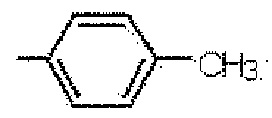
Compound of the present invention 10 V=O 
Compound of the present invention 11 Zn 
Compound of the present invention 12 Zn 
Compound of the present invention - The infrared absorbing material represented by Formula (1a) or (1b) in the present invention is synthesized by using a compound represented by the following Formula (2) as the raw material. Preferably, the method includes a process of synthesizing the infrared absorbing material in which the compound represented by the following Formula (2) is allowed to react in an organic solvent in the presence of lithium halide.
-

- (In the formula, Ar9 and Ar10 each independently represent a substituted or unsubstituted aryl group.)
- The synthesis method using the compound represented by Formula (2) above as a raw material is represented by the formula described below.
Since the synthesis route is not a route via halogen-containing phthalocyanine, a chlorine ion does not contaminate essentially. On the other hand, in a conventional synthesis method through the reaction of multi-halogen containing phthalocyanine with an arylthio compound, which is disclosed, for example, inJP-A No. 60-209583 -

- In the formulae, Ar9, Ar10, and M each independently have the same definition as Ar1 to Ar6 described above.
- The synthesis process of synthesizing the compound of Formula (3b) from the compound of Formula (2) can be conducted in high yield by allowing to react, preferably, in an organic solvent in the presence of lithium halide. More preferably, the synthesis process is conducted in the presence of alcoholate (for example, sodium alcoholate, potassium alcoholate, or the like) and hydroquinone.
For example, in a case in which t-butanol alcoholate (t-BuOM3, M3: an alkaline metal (for example, Na, K, or the like)) is used as alcoholate, the amount of t-BuOM3 is preferably from 0.1 times molar amount to 20 times molar amount, more preferably from 1 time molar amount to 8 times molar amount, and even more preferably from 2 times molar amount to 4 times molar amount, with respect to the compound of Formula (2), which is the raw material. Further, the amount of lithium halide is preferably from 0.1 times molar amount to 50 times molar amount, more preferably from 1 time molar amount to 15 times molar amount, and even more preferably from 3 times molar amount to 10 times molar amount, with respect to the compound of Formula (2), which is the raw material. - It is preferable to use an alcohol having from 1 to 20 carbon atoms as a solvent used for the reaction, it is more preferable to use an alcohol having from 1 to 10 carbon atoms, it is even more preferable to use methanol, ethanol, 1-propanol, 2-propanol, 1-butanol, 2-butanol, t-butanol, 1-pentanol, 2-pentanol, i-pentanol, t-pentanol, 1-octanol, or 2-octanol, and it is particularly preferable to use 1-butanol. The amount of the alcohol to be used as the solvent is preferably from 0.1 times to 50 times the amount of the phthalonitrile compound represented by Formula (2), which is the raw material, more preferably from 1 time to 15 times the amount of the phthalonitrile compound, and even more preferably from 2 times to 6 times the amount of the phthalonitrile compound. Further, it is also preferable to further mix an amide solvent (for example, N,N-dimethylformamide, N,N-dimethylacetamide, or 1 -methyl-2-pyrrolidone), a sulfone solvent (for example, sulfolane), a sulfoxide solvent (for example, dimethylsulfoxide), an ether solvent (for example, dioxane or cyclopentyl methyl ether), a ketone solvent (for example, acetone or cyclohexanone), a hydrocarbon solvent (for example, toluene or xylene), a halogen solvent (for example, tetrachloroethane or chlorobenzene), or a pyridine solvent (for example, pyridine, γ-picoline, or 2,6-lutidine) with these solvents.
- Further, it is preferable to undergo reaction in the presence of hydroquinone. The amount of hydroquinone is preferably from 0.05 times molar amount to 5 times molar amount, more preferably from 0.1 times molar amount to 3 times molar amount, and even more preferably from 0.2 times molar amount to 2 times molar amount, with respect to the compound of Formula (2), which is the raw material. It is preferable that the addition of hydroquinone is conducted at the time of the addition of the compound represented by Formula (2), which is the raw material, lithium halide, or t-BuOM3, it is also preferable that the addition is conducted after the completion of elevating the temperature, and it is also preferable that the addition is conducted at any time between the initiation of the reaction and immediately before the completion of the reaction.
- The reaction temperature is from -30°C to 250°C, preferably from 0°C to 200°C, more preferably from 20°C to 150°C, and even more preferably from 50°C to 120°C; and the reaction time is preferably in a range of from 5 minutes to 30 hours.
- The synthesis process of synthesizing the compound of Formula (3a) from the compound of Formula (3b) can be conducted through a conventionally known reaction of introducing a metal or a substituted metal into a phthalocyanine nucleus. For example, the synthesis process can be conducted under the conditions disclosed in
JP-A No. 60-209583 - The infrared absorbing material represented by Formula (1a) or (1b) in the present invention is characterized in that the acidic anion content is as low as 0.1 % by mass or less. Preferably, the acidic anion content is 0.08% by mass or less, and more preferably 0.07% by mass or less.
- The types of acidic anion to be incorporated may be different depending on the synthesis method, specifically, depending on the material to be used as the raw material, the solvent, the reaction vessel, or the like, but the acidic anion is a halogen ion (a chlorine ion, a bromine ion, an iodine ion, or the like), a sulfate ion, a sulfite ion, an organic sulfonate ion, an organic sulfinate ion, a phosphate ion, an organic phosphate ion, or the like.
These acetic anions have high corrosiveness with respect to metals, and by a chemical attack upon the equipments, the acidic anions cause problems such as generation of rust, corrosion, or the like. Further, other problems such as progress of rot due to increase in hygroscopic property may also occur. When the acidic anion content is 0.1% by mass or less, these problems may be settled, which is preferable in the case of using a coloring composition, especially in connection with equipments for semiconductors.
Further, when a coloring composition including the infrared absorbing material of the present invention, which has a low acidic anion content, is used, storage stability of the ink may be improved, and also light fastness or wet heat resistance of the printed material may be improved. Moreover, when the coloring composition including the infrared absorbing material of the present invention, which has a low acidic anion content, is used in an inkjet ink, image bleeding may be suppressed and image quality may be enhanced. - The coloring composition of the present invention contains at least one infrared absorbing material represented by Formula (1a) or (1b) as a colorant.
The coloring composition of the present invention may further contain, other than the infrared absorbing material, a colorant having absorption in the visible region (which may be referred to as a "colored colorant" in some cases in the following description, in order to distinguish the colorant from an infrared absorbing material), a binder, or a volatile solvent. More preferably, the coloring composition of the present invention may contain an antioxidant, a surfactant, an inorganic filler, or the like. - The infrared absorbing material represented by Formula (1a) or (1b) may be incorporated in the coloring composition in the form of a solid such as powder or a granule, or in the form of a fine particle dispersion, or may be incorporated in the coloring composition by being dissolved in water or in an organic solvent. Further, depending on the use of the coloring composition, the coloring composition may be used in the form of a microcapsule.
The coloring composition of the present invention can be used for various applications including an inkjet ink, an ink for general printing (offset printing, gravure printing, or the like), a toner, and an industrial UV curable ink (for use in semiconductors or the like).
The kind and the content of the colored colorant, binder, volatile solvent, antioxidant, surfactant, inorganic filler, and the like are preferably selected as appropriate, depending on the use of the coloring composition. - The printing ink and toner containing the coloring composition of the present invention are described.
The printing inks containing the coloring composition of the present invention can be applied for printing and for printers. For example, printing inks such as gravure inks, flexo inks, offset inks, screen inks, or inks for letterpress printing, and inks for various printers and the like such as printers for heat sensitive transfer, inkjet printers, impact printers, or laser printers are included. Preferable examples of the inks include printing inks such as gravure inks, gravure inks, flexo inks, offset inks, screen inks, inks for letterpress printing or the like, and inkjet printer, impact printer, and laser printer offset inks. - The content of the infrared absorbing material in the ink is preferably from 0.01% by mass to 5.0% by mass, and more preferably from 0.1% by mass to 3.0% by mass, based on the total mass of the ink.
The content of the infrared absorbing material in the toner is preferably from 0.01% by mass to 5.0% by mass, and more preferably from 0.1% by mass to 3.0% by mass, based on the total mass of the toner. - The toners containing the coloring composition of the present invention can be applied to any toners. A toner is used in a laser printer or copying machine and includes micro-sized particles formed through adhering dye or pigment particles to plastic particles having charging property. A printed material is formed by transferring a toner to paper utilizing the static electricity that the toner has, and by fixing the toner using heat. The toner containing the coloring composition of the present invention includes particles in which at least one infrared absorbent represented by Formula (1a) or (1b) is fused or adhered to the above plastic particles.
- The ink or toner containing the coloring composition of the present invention may contain a pigment or dye (colored colorant) having absorption in the visible region, together with the infrared absorbing material represented by Formula (1a) or (1b). Examples of the pigment include chrome yellow, cadmium yellow, yellow iron oxide, titanium yellow, naphthol yellow, Hanza yellow, pigment yellow, benzidine yellow, permanent yellow, quinoline yellow, anthrapyrimidine yellow, permanent orange, molybdenum orange, vulcan fast orange, benzidine orange, indanthrene brilliant orange, iron oxide, amber, permanent brown, rose iron oxide red, antimony powder, permanent red, fire red, brilliant carmine, light fast red toner, permanent carmine, pyrazolone red, Bordeaux, helio-Bordeaux, rohdamine lake, DuPont oil red, thioindigo red, thioindigo marron, watching red strontium, cobalt purple, fast violet, dioxane violet, methyl violet lake, methylene blue, aniline blue, cobalt blue, cerulean blue, chalco oil blue, nonmetal phthalocyanine blue, phthalocyanine blue, ultramarine blue, indanthrene blue, indigo, chrome green, cobalt green, pigment green B, green gold, phthalocyanine green, malachite green oxalate, and polychloro-bromo copper phthalocyanine.
- It is preferable that the ink or toner containing the coloring composition of the present invention contains a binder. Examples of the binder include polystyrenes; copolymers formed of styrene with (meth)acrylate, acrylonitrile, or maleate; poly(meth)acrylic esters: polyesters; polyamides; epoxy resins; phenol resins; hydrocarbon resins; and petroleum resins, and these binders can be used alone or in a combination with other binder or additives.
Preferable binders are polyester resins and epoxy resins obtained by using bisphenol A and epichlorohydrin. - The image recording method using the coloring composition of the present invention can be used in, for example, an image recording method of recording images (including information such as character data) by printing (gravure printing, intaglio printing, offset printing, or the like) using an printing ink containing an infrared absorbing material; an image recording method of recording images by an inkjet system using an inkjet ink containing an infrared absorbing material; an image recording method of recording images by a sublimation thermal transfer system using an ink sheet containing an infrared absorbing material; an image recording method of recording images by an electrographic system using a toner particle or toner fixing material containing an infrared absorbing material; an image recording method of recording images by a heat sensitive or pressure sensitive recording system using a microcapsule containing an infrared absorbing material; and the like.
- Particularly, in the utilization of the image recording method using a printing ink or a toner for the use of marking for security, the obtained image has excellent invisibility and can be detected only when an infrared ray detector is used, and therefore has high security properties. Accordingly, the image recording method can be particularly preferably utilized for the use of checking means such as prevention of falsification, prevention of reconstruction, and discrimination of documents, cards, or the like.
- The image information recorded by means of the above image recording method can be detected by using an infrared ray detector.
As a light source for the image information detecting method of the present invention, any light source may be used as far as the light source has radiation energy in the infrared region of from 650 nm to 1500 nm, however, a laser, a light emitting diode, or the like can be suitably used. By using a band path filter or the like, noise generated at the light source or at the detector can be reduced.
Image information detection can be carried out through irradiating or scanning a printed material with infrared rays and detecting the reflected or transmitted infrared rays by using a detector. - A system which can be used for the method of proofing originality of a product or substrate in the present invention can include irradiating a printed material containing the infrared absorbing material represented by Formula (1a) or (1b) with infrared rays by using the above light source, detecting the reflected infrared rays or measuring the reflection factor of the infrared light, and reading higher information by pattern analysis thereof. Further, in order to make it more difficult to forge, the image information detecting method of the present invention can be used in combination with other method to heighten the accuracy of judgment of originality. Examples of the other method which may be used in combination include an optical variable device, such as more or hologram, and embossing.
- Hereinafter, the present invention will be described in more detail.
- A suitable gravure ink for intaglio pattern printing contains an infrared absorbing material represented by Formula (1a) or (1b), a binder, and a volatile solvent. Preferably, the ink further contains a colorant. More preferably, the ink may contain an antioxidant, a surfactant, an inorganic filler, or the like.
- The selection of resins for rotogravure inks depends on the solvent, the substrate to be printed, and the end use of the printed material. Detailed examples of the resin suitable for the production of inks, including a gravure type ink, are described in "Synthetic Resins", written by Werner Husen, The American Ink Maker, June 1952, page 63 and "Synthetic Resins for Inks", written by John P. Petrone, The American Ink Maker, vol. 49, March to October 1971. Useful resins include rosin and modified rosins, for example, calcium and zinc resinates, and variants of these. Other examples of suitable resins include:
- (a) petroleum resins or various modified products of cyclopentadiene resins, examples of which are found in this specification, and in
U.S. Patent No. 3,084,147 and British Patent No.1,369,370 - (b) a modified resin, which has an ability for inducing a stable viscosity and excellent printing property, and has a softening point of 145°C, as described in Japanese Patent No.
47994/72 - The volatile solvent component may be an aliphatic or alicyclic hydrocarbon, for example, hexane, heptane, or cyclohexane, or may be an aromatic hydrocarbon, for example, xylene, toluene (for example, tolusol 25), high flash naphtha, benzene, or chlorobenzene. Other examples of the solvent include C1-4-alkanols, acetates of C1-5-alkanols, glycol ethers having a BP of from 115°C to 180°C, C1-5-aliphatic ketones, and cyclohexanone. The resin should be soluble in the solvent, and readily separated therefrom. Since the drying of gravure inks results from evaporation of the solvent, the ink vehicle is essentially a resin and a solvent. Various types of vehicles can be used according to the particular combination of resin and solvent.
- Preferable antioxidant is a phenolic or amine antioxidant, and preferable antioxidant composition is a mixture of a phenoli antioxidant and an amine antioxidant. A preferable antioxidant composition includes from about 10% by mass to about 90% by mass, more preferably from about 25% by mass to about 75% by mass, of a phenolic antioxidant, and includes from about 90% by mass to about 10% by mass, and more preferably from about 75% by mass to about 25% by mass, of an amine antioxidant.
- Examples of suitable amine antioxidants include octylated diphenylamine, isopropoxy diphenylamine, an aldol-α-naphthylamine condensation product of diphenylamine and acetone, N,N'-diphenyl-p-phenylenediamine, phenyl-β-naphthylamine, polymerized 1,2-dihydro-2,2,4-trimethylquinoline, N,N'-di(2-octyl)-p-phenylenediamine, other aromatic amines, diphenylamines, and mixtures thereof. Examples of suitable phenolic antioxidants include 4,4'-isopropylidene-diphenol, styrenated phenol, hindered phenol, 4,4'-thiobis(6-t-butyl-o-cresol), p-butylphenol, p-(i-propyl)phenol, 2,4-dimethyl-6-octylphenol, 2,6-di-t-butyl-4-methylphenol, 2,6-di-t-butyl-4-ethylphenol, 2,6-di-t-butyl-4-n-butylphenol, 2,2'-methylenebis(4-methyl-6-t-butylphenol), 2,2'-methylenebis(4-ethyl-6-t-butylphenol), 2,4-dimethyl-6-t-butylphenol, 4-hydroxymethyl-2,6-di-t-butylphenol, n-octadecyl-β-(3,5-di-t-butyl-4-hydroxyphenyl) propionate, and mixtures thereof. Preferable phenolic antioxidants are phenols having sterically complicated structure.
- The inks for intaglio pattern printing containing an antioxidant or an antioxidant composition can be produced by a conventional method. For example, the ink vehicle can be produced by dissolving 100 parts by mass of a resin and 1 part by mass of an antioxidant or antioxidant composition in 200 parts by mass or less of a petroleum solvent having a high boiling point. A preferable solvent, for example, a mixture including 70% by mass of toluene, 4% by mass of xylene, and 26% by mass of lactol spirits, has a Kauri-butanol value of about 105 (in contrast to aliphatic solvents having a Kauri-butanol value of from 35 to 45).
- The infrared absorbent that is preferably included in the ink composition in an amount of from 0.01% by mass to 5.0% by mass, more preferably in an amount of from 0.1 % by mass to 3.0% by mass, based on the total mass of the ink, provides a detectable transparent infrared ray absorbing ink which can be seen, after application to a substrate, in the substrate only when the substrate is viewed by an infrared ray sensitive detector under appropriate irradiation.
- In a case in which the ink further contains a colored colorant, it is possible to visually detect the printed pattern, however the printed substrate (material to be printed) is distinguishable from a substrate printed with an ink that does not contain an infrared absorbent, in a similar manner.
- An infrared absorbent or a colored colorant (for example, phthalocyanine blue, benzidine yellow, channel black, Carmine 6B, or titanium white) is added to an ink vehicle, preferably in the form of a dispersion liquid, and then the resulting mixture is placed in a ball mill and ground until a uniform dispersion liquid of the pigment is obtained in the ink vehicle. The obtained ink concentrate can be subsequently diluted with additional solvent to have an appropriate concentration for use in printing operation.
- A typical gravure ink composition for intaglio pattern printing contains from about 0.005% by mass to about 0.5% by mass of an antioxidant composition, from about 10% by mass to about 50% by mass of a resin, and from about 0.01% by mass to about 5.0% by mass, preferably from 0.1 % by mass to 3.0% by mass, of an infrared absorbent, based on the total mass of the ink, and/or from about 50 parts to about 100 parts of a dye colorant per 100 parts of the resin; and the residue essentially consists of a mixture of hydrocarbon solvents such as toluene, xylene, and lactol spirits. The viscosity of ink at the time of use is preferably 5 poises or less, and more preferably from 0.5 poises to 1.0 poises. The amount of the antioxidant composition to be used is preferably from 0.005% by mass to 0.5% by mass, and more preferably in a range of from 0.025% by mass to 0.5% by mass, based on the total mass of the ink.
- In order to improve printing suitability, flow behavior, and pigment wetting, other additives can also be added in an amount of from 1% by mass to 15% by mass (more preferably from 1 % by mass to 10% by mass) with respect to the resin. Wax, for example, an ester wax, an amide wax, or a hydrocarbon wax, can be added in an amount of from 0.1 % by mass to 5% by mass. Other additives capable of adaptation, for example, ethyl cellulose or ethyl hydroxy cellulose may be used to improve ink film adhesion, scuff resistance, gloss, or the like. Printing inks are preferably used without using a plasticizer, however a plasticizer can be added for the purpose of achieving special effects.
- Suitable substrates are those conventionally used in intaglio pattern printing, for example, paper, cellophane, or a metal film such as an aluminum film.
- The toner containing the coloring composition of the present invention contains an infrared absorbent represented by Formula (1a) or (1b) and a binder. Preferably, the toner according to the present invention further contains a colored colorant. Further, the toner according to the present invention may contain an antioxidant, a surfactant, an inorganic filler, or the like.
The toner may be a conventional toner in which an infrared absorbent represented by Formula (1a) or (1b) is fused or dispersed in the binder that forms a matrix of the toner particles, or may be a toner in which an infrared absorbent represented by Formula (1a) or (1b) is included in a chemically produced toner. - The flash fixing toner contains a binder, a colored colorant, and an infrared absorbent represented by Formula (1a) or (1b). The infrared absorbent represented by Formula (1a) or (1b) is preferably present in an amount of from 0.01% by mass to 5.0% by mass (more preferably from 0.1% by mass to 3.0% by mass) based on the total mass of the toner. The infrared absorbent represented by Formula (1a) or (1b) is preferably contained by being fused or dispersed in the binder that forms the matrix of the toner particles.
- Preferable examples of the binder which may be used in the flash fixing toner include polystyrenes; copolymers formed of styrene with (meth)acrylate, acrylonitrile, or maleate; poly(meth)acrylic esters: polyesters; polyamides; epoxy resins; phenol resins; hydrocarbon resins; and petroleum resins, and these binders may be used alone or in a combination with other binder or additives.
Preferable binders are polyester resins and epoxy resins obtained by using bisphenol A and epichlorohydrin. - Preferable examples of the colored colorant which may be used in the flash fixing toner include one or more types of pigments or colorants, for example, chrome yellow, cadmium yellow, yellow iron oxide, titanium yellow, naphthol yellow, Hanza yellow, pigment yellow, benzidine yellow, permanent yellow, quinoline yellow, anthrapyrimidine yellow, permanent orange, molybdenum orange, vulcan fast orange, benzidine orange, indanthrene brilliant orange, iron oxide, amber, permanent brown, rose iron oxide red, antimony powder, permanent red, fire red, brilliant carmine, light fast red toner, permanent carmine, pyrazolone red, Bordeaux, helio-Bordeaux, rohdamine lake, DuPont oil red, thioindigo red, thioindigo marron, watching red strontium, cobalt purple, fast violet, dioxane violet, methyl violet lake, methylene blue, aniline blue, cobalt blue, cerulean blue, chalco oil blue, nonmetal phthalocyanine blue, phthalocyanine blue, ultramarine blue, indanthrene blue, indigo, chrome green, cobalt green, pigment green B, green gold, phthalocyanine green, malachite green oxalate, and polychloro-bromo copper phthalocyanine. The amount of the colored colorant may be varied widely, but it is preferable that the colored colorant is included in an amount of from 3 parts by mass to 5 parts by mass based on 100 parts by mass of the above binder.
- The flash fixing toner can contain further components, for example, a wax, a charge control agent, and/or a flow-enhancer.
Preferable waxes are polyolefin type waxes and natural waxes, for example, carnauba wax, montan wax, a natural paraffin, polyethylene, polypropylene, polybutylene, an ethylene-propylene copolymer, an ethylene-butene copolymer, an ethylene-pentene copolymer, or an ethylene-3-methyl-1-butene copolymer, and copolymers of olefins with other monomers, for example, vinyl esters, haloolefins, (meth)acrylic esters, (meth)acrylic acid, or derivatives thereof. The mass average molecular weight of the waxy component is preferably from 1,000 daltons to 45,000 daltons. - Preferable examples of the charge control agent include nigrosine, monoazo dyes, zinc, hexadecyl succinate, alkyl esters or alkyl amides of naphthoic acid, nitrohumic acid, N,N-tetramethyl diamine benzophenone, N,N-tetramcthyl benzidine, triazines, and metal complexes of salicylic acid. In the case of a colorant other than black, it is preferable that the charge control agent is substantially colorless.
- Preferable examples of the flow-enhancer include fine particles of an inorganic substance, for example, colloidal silica, hydrophobic silica, hydrophobic titania, hydrophobic zirconia, or talk, and fine particles of an organic substance, for example, polystyrene beads or (meth)acrylic acid beads.
- In a case in which an infrared absorbent is fused or dispersed in the binder, it is preferable that a coupling agent and the infrared absorbent (and any other components described above) are compounded and kneaded together. The resulting mixture is cooled and pulverized, and thereafter, the particles are classified.
- The coloring composition of the present invention may be incorporated in a chemically produced toner. By mixing one or more types of polymers having different molecular weight, the molecular weight distribution and the melt rheology properties of the toner can be controlled. Examples of suitable polymers include styrene-acrylate copolymers, styrene-butadiene copolymers, polyesters, and hydrocarbon resins.
- In a case in which a coloring composition is incorporated in the toner to form a colored image on the printed substrate, a charge control agent or a wax may be added to aid release from the fusion roller. Suitable colored colorants include pigments (including magnet pigments, provided that these pigments do not interfere with the absorption of infrared radiation by the infrared absorbent) and dyes. Preferable charge control agents include metal complexes, for example, complexes of Zn, Al, Fe, or Cr, and polymer materials, for example, complexes of a phenolic polymer, and the like. Preferable waxes include hydrocarbon waxes, for example, paraffins, polyethylene or polypropylene waxes, waxes derived from carbon monoxide and hydrogen, for example, Fischer-Tropsch wax, natural product waxes, for example, carnauba wax, and synthetic waxes, for example, ester or amide waxes.
- The toner may also include a surfactant, and an inorganic or organic filler, for example, silica, titania, alumina, or polymer particles, to control the fluidity, charging performance, or transfer properties.
- The UV curable ink containing the coloring composition of the present invention can be used for the purpose of applying marks including the infrared absorbing material (infrared absorbent) represented by Formula (1a) or (1b) to products or substrates.
- Preferable UV curable ink compositions contain an alkoxylated or polyalkoxylated acrylate monomer, a photoinitiator, an infrared absorbent, and a colored colorant, as described in
U.S. Patent No.6,114,406 .
Preferable UV curable ink compositions contain a polyfunctional alkoxylated and/or polyalkoxylated acrylate monomer in an amount of from 80% by mass to 95% by mass with respect to the total composition, an infrared absorbent, and, as necessary, a colored colorant. - The amounts of the acrylate monomer, photoinitiator, infrared absorbent, and colored colorant may vary depending on the particular equipment and the intended use. However, the amount of the photoinitiator is preferably from 1% by mass to 15% by mass of the total composition.
- The polyfunctional alkoxylated or polyalkoxylated acrylate monomer material can contain one or more di- or triacrylates; or alkoxylated or polyalkoxylated arylate monomers having higher functionality may be used alone or may be used together with one or more di-and/or trifunctional materials. The number of alkyleneoxy groups is preferably from 1 to 20 per one molecule of the monomer, and such groups are each preferably C2-4-alkyleneoxy, and particularly preferably ethyleneoxy (EO) or propyleneoxy (PO).
- Suitable polyfunctional alkoxylated or polyalkoxylated acrylates include alkoxylated, preferably ethoxylated or propoxylated, adducts of neopentyl glycol diacrylate, butanediol diacrylate, trimethylpropane triacrylate, or glyceryl triacrylate.
- The ink may contain a monofunctional alkoxylated or polyalkoxylated acrylate monomer, for example, an alkoxylated, specifically ethoxylated or propoxylated, adduct of one or more of tetrahydrofurfuryl acrylate, cyclohexyl acrylate, alkyl acrylate, nonyl-phenol acrylate, or polyethylene- or polypropylene-glycol acrylate, in an amount of 10% by mass or less.
- The ink may also contain a non-alkoxylated monofunctional or polyfunctional radiation curable monomer, for example, octyl acrylate, decyl acrylate, N-vinylpyrrolidone, ethyl diglycol acrylate, isobornyl acrylate, ethyl-hexyl acrylate, lauryl acrylate, butanediol monoacrylate, β-carboxyethyl acrylate, i-butyl acrylate, polypropylene glycol monomethacrylate, 2-hydroxyethyl methacrylate, hexanediol di(meth)acrylate, tetraethylene glycol diacrylate, tripropylene glycol diacrylate, butanediol diacrylate, polyethylene glycol diacrylate, or triethylene glycol dimethacrylate, in an amount of 5% by mass or less.
- Preferable examples of the photoinitiator, which is commercially available and can be utilized, include xanthones, thioxanthones, benzophenones, quinones, and phosphine oxides. Examples of a co-initiator, which can be incorporated together with a primary photoinitiator, include amines and aminobenzoates. In a case in which the ink contains a primary photoinitiator and a co-initiator, the total amount is preferably within the preferable range described above. The aminobenzoate and acrylated amine co-initiators are preferably used together with the xanthone and/or thioxanthone primary photoinitiators.
- The term "radiation curable" means that the composition is curable by the application of UV radiation. In a case in which such a composition is a substantially colorless curable varnish or base, or the coloring composition further contains a colored colorant (namely, a material which is visible or provides a related optical property such as fluorescence), the composition may be an ink. In a case in which a colored colorant is incorporated, it is preferable that the ink contains the colorant in an amount of from 1% by mass to 10% by mass with respect to the ink.
- Preferable colored colorants can be classified into two types, namely, (a) dyes which are substantially soluble in the ink composition and (b) pigments which are dispersed in the ink composition in the form of fine particles by using an appropriate dispersant. Examples of a typical pigment include Pigment Red 57 : 1, Pigment Red 52 : 2, Pigment Red 48 : 2, Pigment Blue 15 : 3, Pigment Green 7, Pigment Yellow 83, Pigment Yellow 13, and Pigment White 6.
- The ink may contain other minor components, for example a surfactant, a leveling additive, a photoinitiator, a stabilizer, a wetting agent, or a pigment stabilizer. The latter may be especially in the form of a high molecular weight block copolymer of, for example, a polyester, polyurethane, or polyacrylate type, and is generally incorporated at a level of from 2.5% by mass to 100% by mass of the pigment. Specific examples include DISPERBYK 16] or 162 (all trade names, manufactured by BYK Chemie) and SOLSPERSE HYPERDISPERSANT (trade name, manufactured by Avecia). Preferable examples of the photoinitiator and stabilizer include those disclosed in
EP 0465039A . Preferable surfactants include non-ionic surfactants, for example, FLUORAD FC430 (trade name, manufactured by 3M Corp.). In a case in which such a surfactant is incorporated, the surfactant is preferably included in an amount of from 0.1% by mass to 10% by mass of the total composition. - Preferably, inks or varnishes do not substantially contain an organic solvent, or are totally free of organic solvent. The amount of the organic solvent is preferably less than 10%, more preferably less than 5%, even more preferably less than 1%, and most preferably less than 0.1%, of the mass of the total composition.
- The application of the coloring composition of the present invention is not limited to the use in the above UV curable ink, and can also be used in any other soluble or dispersible UV curable inks.
- The ink composition of the present invention for lithographic printing contains the coloring composition of the present invention, a binder, and a volatile solvent. Preferably, the ink composition further contains a colored colorant. More preferably, the ink composition may contain an antioxidant, a surfactant, an inorganic filler, or the like.
- The binder is preferably derived from a crosslinked resin produced by grafting polyepoxide onto usable carboxyl groups on, for example, a phenolic or maleic acid-modified rosin ester resin, and subsequently the binder is solubilized with an aliphatic alcohol having at least 12 carbon atoms.
- The phenolic or maleic acid-modified rosin ester resin preferably has a number average molecular weight of from about 1,500 to about 3,000. The polyepoxide is preferably a diepoxide, more preferably an aromatic or alicyclic diepoxide, and particularly preferably bisphenol A diepoxide. The molecular weight of the polyepoxide is preferably 560 daltons or less, more preferably from 100 daltons to 500 daltones, and particularly preferably from 300 daltons to 500 daltons.
- The phenolic or maleic acid- modified rosin ester resin is preferably a reaction product of four components, namely, (a) a polyol, (b) a monobasic aliphatic carboxylic acid, (c) a rosin or a modified rosin, and (d) a polycarboxylic acid and/or an anhydride thereof. The polyol is preferably a thiol, and examples thereof include trimethylolethane, trimethylolpropane, glycerol, and hexanetriol. The monobasic aliphatic carboxylic acid has preferably from about 8 to about 20 carbon atoms, and examples thereof include stearic acid, lauric acid, palmitic acid, oleic acid, and refined tall oil fatty acid. The rosin and modified rosin are preferably selected from the group consisting of tall oil rosin, wood rosin, hydrogenated rosin, and dehydrogenated rosin. The polycarboxylic acid or anhydride thereof may be aliphatic or aromatic, and examples thereof include phthalic anhydride, trimellitic anhydride, tetrahydrophthalic anhydride, maleic anhydride, isophthalic acid, fumaric acid, and a mixture thereof.
- The phenolic or maleic acid-modified rosin ester resin can be produced through a two-step process, and in the first step, the polyol, the monobasic aliphatic carboxylic acid, and the rosin or modified rosin are preferably reacted at a temperature of from about 250°C to about 290°C, and more preferably from about 260°C to about 280°C, to give an acid number of from about I to about 10. In the second step, the polycarboxylic acid or anhydride thereof is added, and the reaction is preferably continued at a temperature of from about 150°C to about 220°C, and more preferably from about 170°C to about 200°C, to give an acid number of, preferably, from about 20 to about 90, and more preferably from about 20 to about 50.
As a result, all of the monobasic aliphatic carboxylic acid groups and most of the rosin carboxylic acid groups are reacted at about 250°C to about 290°C, and the aromatic carboxylic acid, as pendant groups, is added at about 150°C to about 220°C. - The polymer obtained by grafting the polyepoxide on the ink resin becomes oil insoluble, which enhances squalene (skin oil) resistance, facilitates solvent release for improved heatset drying. Since the crosslinked resin has little solubility, the resin is maintained in the solution by adding an aliphatic alcohol having at least 12 carbon atoms, more preferably from 12 to 24 carbon atoms, and even more preferably 12 or 13 carbon atoms, for example, NEODOL 23 (trade name, manufactured by Shell Oil Co.).
- In order to achieve ink roller stability necessary for high speed lithographic web printing, it is preferable to include a high boiling point petroleum distillate varnish solvent such as MAGIE 470 or MAGIE 500 (all trade names, manufactured by Magie Brothers Oil Company, 9101 Fullerton Ave., Franklin Park I11; hydrocarbon solvent). This aliphatic alcohol is used for dissolving the resin in the solvent. When some of the alcohol is evaporated off during adsorption to paper or during the heat drying process, the balance of solubility is affected, the resin precipitates out of the solution, and ink film is in a state of being dry even touched. The more the amount of alcohol evaporates off, the faster the ink dries. The appropriate amount of alcohol is such an amount that enables the ink to transfer through the printing roller of the press and to print the paper without drying during the printing process.
- The infrared absorbent represented by Formula (1a) or (1b) is preferably incorporated in an amount of from about 0.01 % by mass to about 5.0% by mass, and more preferably from about 0.1% by mass to about 3.0% by mass, based on the total mass of the ink composition. The infrared absorbent included in this amount may be detected, after printing to a substrate, only when the substrate is viewed under proper illumination by an infrared ray detector.
- In a case in which the ink further contains a colored colorant, it is possible to visually detect the printed pattern, however the printed substrate is distinguishable from a substrate printed with an ink that does not contain an infrared absorbent, in a similar manner. This colored colorant may be any of various conventionally known organic or inorganic pigments, and examples thereof include molybdate orange, titanium white, phthalocyanine blue, and carbon black. The content of the colored colorant is preferably from about 5% by mass to about 30% by mass, based on the total mass of the ink.
- A modifier, for example, a plasticizer; a wetting agent for the colorant; a leveling agent, for example, lanoline, a paraffin wax, or a natural wax; or a slipping agent, for example, a low molecular weight polyethylene or a microcrystalline petroleum wax, can also be incorporated in the ink. Such a modifier is preferably used in an amount of about 3% by mass or less, and more preferably about 1% by mass, based on the total mass of the ink. The other components can be also used conventionally in inks or coatings to modify adhesion or toughness, and other basic properties can also be used.
- The lithographic printing ink can be produced by any method such as a mixing and filtration process, for example, using a three-roll mill, in accordance with a known dispersion method. The ink can be applied to a substrate, preferably paper, by any known and conventional method.
- The ink composition for inkjet printing including the coloring composition of the present invention preferably contains at least one of an aromatic sulfonamide or hydroxybenzoic acid ester dissolved in an organic solvent.
- The aromatic sulfonamide is preferably a toluene sulfonamide which is substituted as desired, for example, p-toluenesulfonamide, N-ethyl-p-toluenesulfonamide, N-butyl-p-toluenesulfonamide, or N-cyclohexyl-p-toluenesulfonamide. The aromatic sulfonamide is preferably incorporated in the organic solvent-based IJP ink in an amount of from 0.1 % by mass to 40% by mass.
- The hydroxybenzoic acid ester is preferably an alkyl ester, particularly preferably an alkylester having from 6 to 12 carbon atoms, for example, 2-ethylhexyl p-hydroxybenzoate or n-nonyl p-hydroxybenzoate. The hydroxybenzoic acid ester is preferably incorporated in the organic solvent-based IJP ink in an amount of from 0.1% by mass to 40% by mass.
- Since the aromatic sulfonamides and hydroxybenzoic acid esters have high polarity, they effectively prevent crystallization of dyes.
The infrared absorbent represented by Formula (1a) or (1b) of the present invention is preferably incorporated in the ink in an amount of from about 0.01 % by mass to about 5.0% by mass, and more preferably from about 0.1% by mass to 3.0% by mass, based on the total mass of the ink, and when the ink is applied to the substrate, the ink is detected only by using an infrared ray detector, and thus, an invisible infrared absorbing ink may be provided. - In a case in which the ink further contains a colored colorant, it is possible to visually detect the printed pattern, however the printed substrate is distinguishable from a substrate printed with an ink that does not contain an infrared absorbent, in a similar manner. The colored colorant may be any dye which is soluble in the organic solvent that is incorporated in the ink composition, or is soluble in the above aromatic sulfonamide or hydroxybenzoic acid ester. Generally, useful dyes include an azo dye, a metal complex salt dye, a naphthol dye, an anthraquinone dye, an indigo dye, a carbonium dye, a quinoimine dye, a cyanine dye, a quinoline dye, a nitro dye, a nitroso dye, a benzoquinone dye, a naphthoquinone dye, a naphthalimide dye, a perinone dye, and a phthalocyanine dye. These dyes can be used alone, or may be used in combination. The dye is preferably incorporated in the ink composition in an amount of from 0.1% by mass to 10% by mass, and more preferably from 0.5% by mass to 5% by mass, based on the total mass of the ink.
- With regard to the organic solvent to be used in the IJP ink according to the present invention, although it depends on the dye or the mixture of dyes, since most dyes have polarity, a highly polar solvent functions as a good solvent, and a less polar solvent functions as a poor solvent. Therefore, a highly polar solvent that has a high ability to dissolve dyes is preferably used in the production of the IJK ink. However, a less polar solvent can also be used, when the solvent is mixed with the aromatic sulfonamide or hydroxybenzoic acid ester, or when the solvent is used in combination with a higher polar solvent. Specific examples of the organic solvent which can be used in the IJP inks include aliphatic hydrocarbons; naphthenic hydrocarbons; aromatic hydrocarbons, for example, mono- or di-substituted alkylnaphthalenes, biphenyls, and alkyl derivatives of xylylethane or phenetylcumene; glycols; mono- or di-alkyl ethers of glycols and esters of glycols; fatty acids and esters thereof; and nitrogen-containing compounds, for example, amide or pyrrolidone compounds. However, the organic solvent which can be used in the production of the IJP inks is not limited to these specific examples.
- The higher the boiling point is, the more advantageous the solvent is in view of reduced amount of evaporation and low drying speed. However, solvents having a higher boiling point have a tendency of producing viscous inks which are difficult to be ejected smoothly. On the other hand, inks obtained by using a solvent having a lower boiling point may dry so quickly that it may dry at the nozzle orifice. Accordingly, a suitable solvent having a desired viscosity and boiling point is selected in consideration of the means of prevention of ink drying, adopted by the print head.
- The present invention will be specifically illustrated by the following Examples, but it should be construed that the present invention is not limited to these Examples.
In the description of the Examples, all the parts and proportions are based on "mass", unless stated otherwise. - First, a synthesis example of the infrared absorbing material represented by Formula (1a) or (1b) is described.
The synthesis route is represented by the following formula. Z1-B is a compound that corresponds to Formula (2), Z1-A is an infrared absorbing material that corresponds to Formula (1b), and the exemplary compound (1) is an infrared absorbing material that corresponds to Formula (1a). -

- 100 g of 2,3-dicyano-1,4-dihydroquinone (Z1-D), 259 g of potassium carbonate, and 900 mL of acetone were placed in a 3L three-necked flask, and 262 g of p-toluenesulfonyl chloride were dividingly added thereto at an inner temperature of 20°C or lower, and then the resulting mixture was stirred for 2 hours under reflux. Then, after cooling the inner temperature to 50°C, 1000 mL of water were added thereto dropwise, and the resulting liquid was cooled to 10°C over 2 hours. The obtained slurry was filtrated and washed with 300 mL of methanol and 300 mL of water, to obtain 214 g of compound (Z1-C) (yield 73%). Subsequently, 50 g of 4-methylthiophenol, 55.8 g of potassium carbonate, and 590 mL of DMAc were placed in a 2L three-necked flask, and 90 g of the exemplary compound (Z1-C) were dividingly added thereto at an inner temperature of 30°C or lower, and then the resulting mixture was stirred for 2 hours. Then, 1200 mL of water were added thereto dropwise over 10 minutes, the resulting liquid was stirred under room temperature for one hour, and then the obtained slurry was filtrated and washed with 4 L of water, to obtain 46.6 g of compound (Z1-B) (yield 65%).
- 30 g of the compound (Z1-B), 16.4 g of lithium chloride, 21.7 g of t-butoxypotassium, and 300 mL of butanol were placed in a 1.00 mL three-necked flask, and heated at 100°C for 6 hours. Then, 1.3 g of hydroquinone were added thereto, and the mixture was stirred for one hour and then cooled to 50°C, and then, 210 mL of water and 105 mL of acetic acid were added thereto. The obtained slurry was filtrated and washed with 200 mL of water and 300 mL of methanol, to obtain 30 g of compound (Z1 -A) (yield 64.6%). The obtained compound was measured by MS (mass spectrum), and a peak that agreed with the molecular weight was obtained.
15 g of the exemplary compound (Z1-A) were dissolved in 1 L of THF, then 3.65 g (2.0 equivalents) of copper acetate were added thereto, and the mixture was stirred at 30°C for 4 hours. After cooling the reaction liquid, water was added thereto, and the resulting slurry was filtrated, washed with 100 mL of methanol, and dried, to obtain 14.7 g of exemplary compound (1) (yield 94%). - The powder of the compound (1) obtained as described above was let be Sample 1. Further, powder of the compound (1), which was obtained by the same method except for changing the scale in the process of synthesizing the exemplary compound (1) from the compound (Z1-B), was let be Sample 2 to 5.
Powder of the compound (1) synthesized in accordance with the method described inJP-A No. 60-209583 -
Table 1 Sample No. Scale of final process (Amount of obtained compound (1)) Cl content (% by mass) Note 1 14.7g 0.024 Present invention 2 19.0g 0.021 Present invention 3 194g 0.066 Present invention 4 296g 0.053 Present invention 5 5.4kg 0.059 Present invention Comparative Sample A 15.1g 0.578 Comparative - Synthesis of exemplary compound (2) was conducted in a manner similar to that in Example 1, except that 4-(t-butyl)thiophenol was used instead of using 4-methylthiophenol.
- Synthesis of exemplary compound (11) was conducted in a manner similar to that in Example 1, except that zinc acetate was used instead of using copper acetate.
- The powder of the exemplary compound (2) obtained as described above was let be Sample 6. Further, the powder of the exemplary compound (11) was let be Sample 7. With regard to Sample 6, Sample 7, and Comparative Sample A in Example 1, the content of chlorine was measured by combustion ion chromatography, and the results are shown in the following Table 2. Samples 6 and 7, which were synthesized by the synthesis method of the present invention, showed a lower chlorine ion content of 0.01% by mass or lower, as compared with Comparative Sample A.
-
Table 2 Sample No. Scale of final process (Amount of obtained specific compound) Cl content (% by mass) Note 6 13.1g 0.028 Present invention 7 15.0g 0.025 Present invention Comparative Sample A 15.1g 0.578 Comparative - Examples of a pigment dispersed aqueous inkjet ink including the coloring composition of the present invention are described.
- As the coloring composition, a pigment dispersed aqueous inkjet ink composition was prepared by using the powder of the infrared absorbing material synthesized in Example 1.
- The mixture with the composition ratios shown below was dispersed using a sand mill (manufactured by Yasukawa Seisakusho Co., Ltd.) with glass beads (diameter 1.7 mm) in a total weight of 1.5 times the amount of this mixture. Fine grinding was carried out for 2 hours.
-
Table 3 Material Added amount (% by mass) Symuler Brilliant Carmine (trade name, manufactured by DIC Co.; C. I. Pigment Red 57:1) 2.0 Sample 1 to 7 or Samples A 2.0 N-polyaspartyl -poly(2-vinylpyridine)-ω-carboxamide 6.0 Glycerol 13.0 Diethylene glycol 9.0 Ethanol 3.0 Ion exchanged water 63.0 - After the completion of the dispersion, the glass beads were removed by filtration using a rough stainless steal mesh, and non-dispersed coarse particles were removed by filtration using a 3 µm membrane filter, to obtain an inkjet ink.
- The ink composition thus obtained was charged in a light magenta cartridge of INKJET PRINTER PM-950C (trade name), manufactured by EPSON, and a monochromatic image of magenta was printed. The image was printed on an image receiving sheet, INKJET PAPER PHOTO GLOSS PAPER "KASSAI" (trade name), manufactured by Fujifilm Co., Ltd., and evaluation of image fastness under a high humidity condition was performed.
- Image bleeding under a high humidity condition was evaluated. Four magenta square patterns each having a size of 3 cm × 3 cm were placed so that each formed a background space having a width of I mm, and a print pattern including the four square patterns, in which the background spaces looked as to form a cross with each of the four arms the same length, was prepared; then, this image sample was stored for 72 hours under the conditions of 25°C and 90% RH; thereafter, bleeding of the magenta dye in the background spaces was observed; and the increase in the magenta density at the background spaces with respect to the magenta density just after printing was evaluated according to the following criteria: Rank A: in the magenta filter of status A, the increase in magenta density is less than 0.01; Rank B: the increase in magenta density is from 0.01 to 0.05; Rank C: the increase in magenta density is more than 0.05; and Rank D: the bleeding state is terrible, and magenta is bleeding to the whole image.
The obtained results are shown in the following table. -
Table 4 Ink No. Sample No. of Compound(1) Image bleeding Note 21 1 A Present invention 22 2 A present invention 23 3 A Present invention 24 4 A present invention 25 5 A Present invention 26 6 A Present invention 27 7 A Present invention 28 A C Comparative - From the results shown in Table 4, it was revealed that the systems using the ink composition of the present invention exhibited extremely small degree of image bleeding and showed excellent performance, but the comparative ink composition exhibited image bleeding of Rank C.
- This test was conducted by lengthening the time for storage to conduct a one week humidity resistance test, and it was found that, in the printed sample including the comparative ink composition, image bleeding was clearly recognized visually, and the level of image bleeding was inferior as compared with the printed sample formed from the ink composition of the present invention.
- Under the same printing conditions as in the above performance evaluation, for 3 months, from Monday to Friday, printing was conducted on 20 sheets per one day, thus performing a test of durability of the ink composition with respect to the inkjet printer.
As a result, all the ink compositions of the present invention could print with no problem even after 3 months had past.
On the other hand, with regard to the ink composition of the comparative example, fading of printing or printing gap had occurred. The cause of this was investigated, and it was found that rust was generated at several parts of the printer and, as a result, it was cleared up that the cause of the fading of printing or the printing gap was the rust. - When the pigment dispersed aqueous inkjet ink composition including the coloring composition of the present invention was used in a thermal inkjet printer, the same effects were obtained.
- Examples of a solvent-based inkjet ink including the coloring composition of the present invention are described.
- Solvent-based inkjet ink compositions with the following composition ratios were prepared.
-
Table 5 Material Added amount (% by mass) Copper phthalocyanine: C.I. Pigment Blue 15:3 3.4 Phenethylcumene 80.0 Sample 1 to 7, or Sample A, or Comparative compound-1 0.6 Diethylene glycol hexyl ether 14.0 N-butyl-p-toluene sulfonamide 1.0 -

- Using each of the obtained inkjet ink compositions, printed materials were prepared by printing on plain paper as a substrate.
- Samples were prepared by coating each of the obtained ink compositions on paper, and the following evaluation was performer.
- The sample was irradiated with a xenon lamp at an illuminance of 95,000 lux for a period described in the table, and the densities of the sample before and after the irradiation in each spectral absorption maximum wavelength were measured, and the rate of residual density was determined, whereby the light fastness of each sample was evaluated.
- The sample was placed under the condition of 80°C for the evaluation of heat resistance, or under the conditions of 60°C-90% relative humidity (RH) for the evaluation of wet heat resistance, for a period described in the table, and the densities of the sample before and after the placement in each spectral absorption maximum wavelength were measured, and the rate of residual density was determined, whereby the heat resistance and wet heat resistance of each sample were evaluated.
- Further, regarding the obtained printed materials, evaluation was performed in a manner similar to that in Example 3. However, image bleeding was evaluated by the measurement of the increase in cyan density of the background.
- The obtained results are shown in the following table.
-
Table 6 Ink No. Sample No. Light resistance Heat resistance Wet heat resistance Image bleeding Note (1 hour) (50 hours) (50 hours) 31 1 93 82 80 A Present invention 32 2 95 83 81 A Present invention 33 3 92 84 80 A Present invention 34 4 91 81 79 A Present invention 35 5 90 79 78 A Present invention 36 6 73 65 61 A Present invention 37 7 79 68 65 A Present invention 38 A 82 71 69 B Comparative 39 Comparative 1 compound-1 52 62 44 C Comparative - It was understood that, like the results in Example 3, the printed materials formed from the ink compositions of the present invention exhibited extremely excellent performance in terms of image bleeding, as compared with the printed materials formed from the comparative ink composition. Further, it was revealed that the ink compositions including the coloring compositions of the present invention had unexpectedly high light fastness, heat resistance, and wet heat resistance.
- Lithographic printing ink compositions having a composition described in the following table were prepared.
-
Table 7 Material Added amount (% by mass) Bisphenol A epoxide modified phenol resin 46.0 C.I. Pigment Blue 15:3 30.1 Teflon (trade name, manufactured by E. I. Du Pont de Nemours & Co., Inc.) 7.0 Bodied Tung Oil (commercially available oil as wood oil) 10.0 Co/Mn drying agent: NAPHTHEX COBALT (Cobalt Naphthenate) (trade name, manufactured by NIHON KAGAKU SANGYO CO., LTD) 2.0 Sample 1 to 5 or Sample A, or Comparative compound-1 0.6 BHT: (antioxidant, dibutyl hydroxytoluene, trade name, manufactured by Tokyo Chemical Industry Co., Ltd.) 2.0 Hydrocarbon solvent: Magie 470 (trade name, manufactured by Magie Brothers Oil Co.) 2.3 - With regard to the obtained printed materials, evaluation was performed in a manner similar to that in Example 4. The obtained results are shown in Table 8.
- As a result, it was understood that the printed materials formed from the ink compositions including the coloring compositions of the present invention exhibited reduced image bleeding and excellent performance, as compared with the printed materials formed from the comparative ink composition. Further, it was revealed that the ink compositions including the coloring compositions of the present invention had unexpectedly high light fastness, heat resistance, and wet heat resistance.
- Accordingly, in a case in which the ink composition including the coloring composition of the present invention is used as a security printing ink, the ink may exhibit excellent durability under various storage environments, and its functions may be maintained and utilized stably for a long-term.
-
Table 8 Ink No. Sample No. Light resistance Heat resistance Wet heat resistance Image blur Note (1 hour) (50 hours) (50 hours) 41 1 93 89 79 A Present invention 42 2 90 90 78 A Present invention 43 3 90 89 80 A Present invention 44 4 88 88 77 A Present invention 45 5 89 87 76 A Present invention 46 A 75 66 64 B Comparative 47 Comparative compound-1 47 59 42 C Comparative - Intaglio printing ink compositions having a composition described in the following table were prepared.
-
Table 9 Material Added amount (% by mass) Resin: Hardened rosin oil 50.0 HALS: (antioxidant, trade name, manufactured by Ciba specialty Chemical Co.) 0.4 Toluene/Xylene/Lactol 25.0 C.I. Pigment Blue 15:3 24.0 Sample 1to 5 or Sample A, or Comparative compound-1 0.6 - Using each of the obtained inkjet ink compositions, printed materials were prepared by printing on plain paper as a substrate.
- With regard to the obtained printed materials, evaluation was performed in a manner similar to that in Example 4. The obtained results are shown in Table 10.
As a result, the printed materials formed from the ink compositions including the coloring compositions of the present invention exhibited unexpectedly high light fastness, heat resistance, and wet heat resistance, as compared with the printed materials formed from the comparative ink composition. -
Table 10 Ink No. Sample No. Light resistance Heat resistance Wet heat resistance Note (1 hour) (50 hours) (50 hours) 51 1 90 83 77 Present invention 52 2 90 81 78 Present invention 53 3 91 81 74 Present invention 54 4 87 79 71 Present invention 55 5 84 75 71 Present invention 56 A 71 69 59 Comparative 57 Comparative compound-1 42 46 39 Comparative - UV curable ink compositions with the composition ratios shown in the following table were prepared.
-
Table 11 Material Added amount (% by mass) Isobornyl acrylate 50.0 Ethoxylated trimethylolpropane triacrylate 27.0 Propoxylated neopentyl glycol diacrylate 16.0 C. I. Pigment Blue 15:3 2.0 Samples 1 to 5 or Sample A, or Comparative compound-1 0.5 Polymer dispersant: partial alkyl ester of poly acrylic acid 0.5 2-Ethylanthraquinone (photo initiator) 3.7 Fluorocarbon surfactant: EFTOP EF-351 (trade name, Hydrocarbon acrylate-perfluorocarbon acrylate polymer) 0.3 - Using each of the obtained UV curable ink compositions, a mark was applied to plain paper as a substrate.
- With regard to the obtained printed materials, evaluation was performed in a manner similar to that in Example 4. The obtained results are shown in Table 12.
As a result, the printed materials formed from the UV curable ink compositions according to the present invention exhibited unexpectedly high light fastness, heat resistance, and wet heat resistance, as compared with the printed materials formed from the comparative UV curable ink composition. -
Table 12 Ink No. Sample No. Light resistance Heat resistance Wet heat resistance Note (1 hour) (50 hours) (50 hours) 61 1 94 88 79 Present invention 62 2 96 89 78 Present invention 63 3 95 90 78 Present invention 64 4 94 87 75 Present invention 65 5 93 85 72 Present invention 66 A 79 77 68 Comparative 67 Comparative compound-1 70 67 61 Comparative - The infrared absorbing material and the coloring composition including the same, which are provided by the present invention, may be used in images having security properties or in information recording, and the information detecting method using these can be utilized for the use of checking means such as prevention of falsification, or reconstruction, or discrimination of, for example, cards such as prepaid cards, credit cards, bank cards, identification cards, licenses, tickets, entrance tickets, membership cards, or securities, marketable securities, paper moneys, tickets, documents, or the like.
Claims (14)
- An infrared absorbing material, that is represented by the following Formulae (1a) or (1b) and comprises an acidic ion in a content of 0.1% by mass or less with respect to a total mass of the infrared absorbing material:
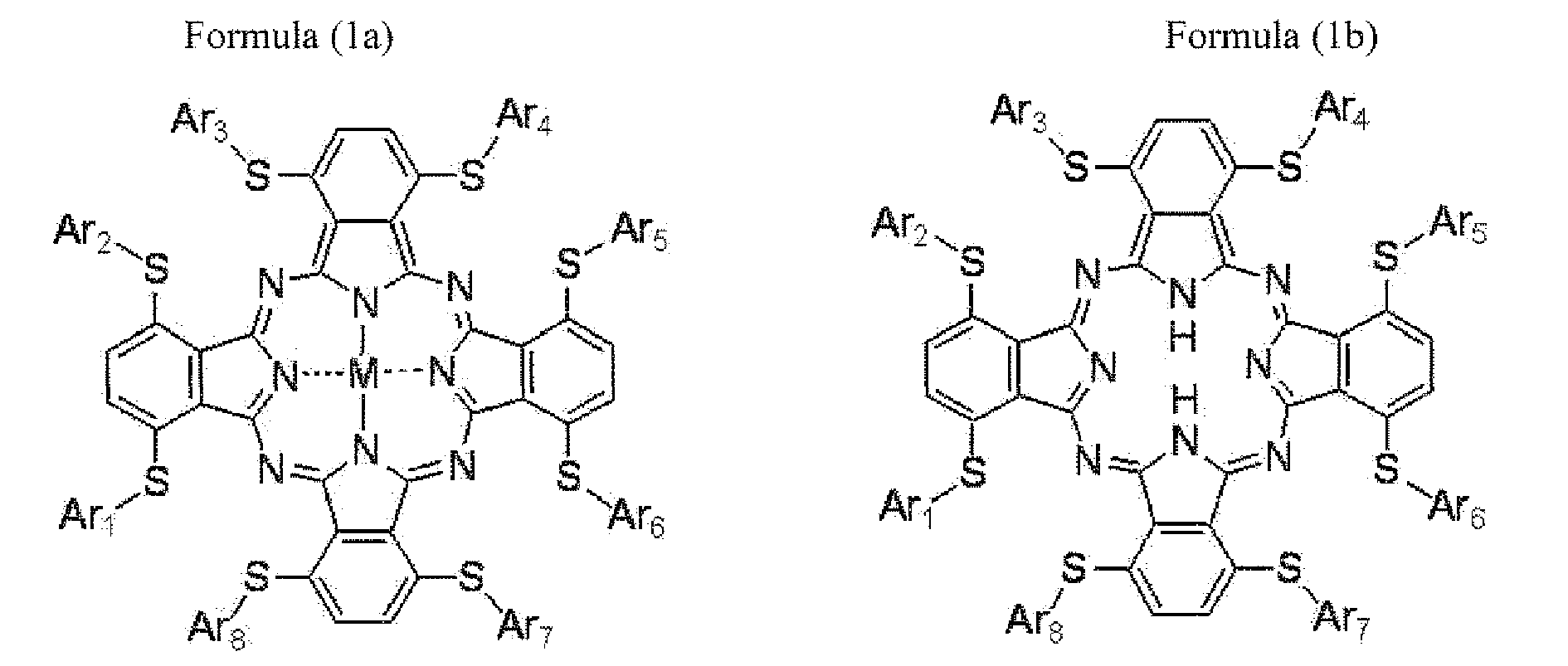
- A colored composition comprising at least one of the infrared absorbing material according to claim 1.
- A method of synthesizing an infrared absorbing material represented by the following Formulae (1a) or (1b), wherein a compound represented by the following Formula (2) is used as a raw material:
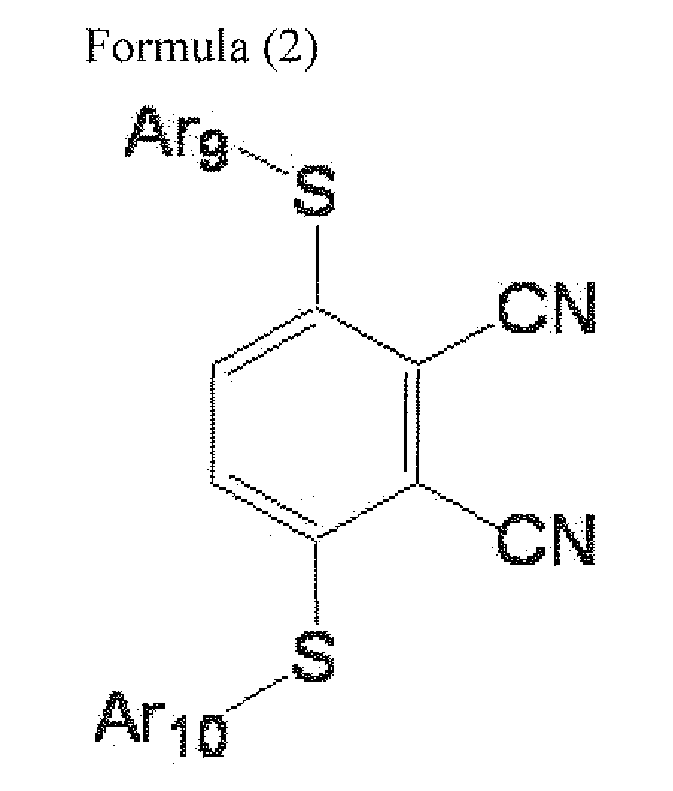

- The method of synthesizing an infrared absorbing material according to claim 3, the method comprising a reaction process including t-BuOM3 and a lithium halide in organic solvent, wherein M3 represents an alkali metal.
- The method of synthesizing an infrared absorbing material according to claim 4, wherein the reaction process including t-BuOM3 and a lithium halide further includes a hydroquinone.
- An infrared absorbing material synthesized by the method of synthesizing an infrared absorbing material according to any one of claims 3 to 5.
- A colored composition comprising at least one of the infrared absorbing material according to claim 6.
- The colored composition according to claim 2 or claim 7, wherein M in Formula (1a) is a copper atom.
- The colored composition according to claim 2 or claim 7, further comprising a colorant and a binder.
- An ink comprising the colored composition according to any one of claims 2 and 7 to 9.
- A toner comprising the colored composition according to any one of claims 2 and 7 to 9.
- A printed matter that is printed using the colored composition according to any one of claims 2 and 7 to 9.
- An image recording method comprising using the colored composition according to any one of claims 2 and 7 to 9.
- An image detecting method for detecting image information of an image which is recorded by the image recording method according to claim 13, the image detecting method comprising using an infrared detector.
Applications Claiming Priority (3)
| Application Number | Priority Date | Filing Date | Title |
|---|---|---|---|
| JP2009051673 | 2009-03-05 | ||
| JP2009270827A JP2010229389A (en) | 2009-03-05 | 2009-11-27 | Infrared absorbing material and method for synthesizing the same, coloring composition, ink, toner, printed matter, image recording method, and image information detecting method |
| PCT/JP2010/050543 WO2010100964A1 (en) | 2009-03-05 | 2010-01-19 | Infrared absorbing material, method for synthesizing same, coloring composition, ink, toner, printed material, image recording method and image information detecting method |
Publications (2)
| Publication Number | Publication Date |
|---|---|
| EP2404970A1 true EP2404970A1 (en) | 2012-01-11 |
| EP2404970A4 EP2404970A4 (en) | 2015-03-11 |
Family
ID=42709528
Family Applications (1)
| Application Number | Title | Priority Date | Filing Date |
|---|---|---|---|
| EP10748562.5A Withdrawn EP2404970A4 (en) | 2009-03-05 | 2010-01-19 | Infrared absorbing material, method for synthesizing same, coloring composition, ink, toner, printed material, image recording method and image information detecting method |
Country Status (4)
| Country | Link |
|---|---|
| EP (1) | EP2404970A4 (en) |
| JP (1) | JP2010229389A (en) |
| CN (1) | CN102341461A (en) |
| WO (1) | WO2010100964A1 (en) |
Cited By (1)
| Publication number | Priority date | Publication date | Assignee | Title |
|---|---|---|---|---|
| US12097714B2 (en) | 2018-09-28 | 2024-09-24 | Fujifilm Corporation | Ink jet recording method |
Families Citing this family (8)
| Publication number | Priority date | Publication date | Assignee | Title |
|---|---|---|---|---|
| JP2011241274A (en) * | 2010-05-17 | 2011-12-01 | Fujifilm Corp | Infrared absorption nature composition, infrared absorption nature ink, recorded matter, image recording method, and image detecting method |
| JP5697894B2 (en) * | 2010-05-17 | 2015-04-08 | 富士フイルム株式会社 | Infrared absorbing composition, infrared absorbing ink, recorded matter, image recording method, and image detection method |
| JP5575539B2 (en) * | 2010-05-19 | 2014-08-20 | 富士フイルム株式会社 | Infrared absorbing composition, infrared absorbing ink, recorded matter, image recording method, and image detection method |
| JP2011241335A (en) * | 2010-05-20 | 2011-12-01 | Fujifilm Corp | Infrared absorptive composition, infrared absorptive ink, recorded matter, method for recording image, and method for detecting image |
| JP2013103911A (en) * | 2011-11-14 | 2013-05-30 | Kaneka Corp | Infrared absorption phthalocyanine |
| TW201435830A (en) | 2012-12-11 | 2014-09-16 | 3M Innovative Properties Co | Inconspicuous optical tags and methods therefor |
| WO2018061746A1 (en) * | 2016-09-30 | 2018-04-05 | セーレン株式会社 | Inkjet recording device |
| JP6525074B2 (en) * | 2017-07-31 | 2019-06-05 | 大日本印刷株式会社 | Thermal transfer sheet, combination of printing sheet and thermal transfer sheet, and thermal transfer printing apparatus |
Family Cites Families (20)
| Publication number | Priority date | Publication date | Assignee | Title |
|---|---|---|---|---|
| US3084147A (en) | 1958-06-27 | 1963-04-02 | Velsicol Chemical Corp | Thermal polymerization of dicyclopentadiene |
| JPS4625288B1 (en) | 1966-08-03 | 1971-07-21 | ||
| BE789164A (en) | 1971-09-24 | 1973-03-22 | Synres Internationaal Nv | PREPARATION OF MODIFIED PETROLEUM RESINS |
| JPS5845999A (en) | 1981-09-16 | 1983-03-17 | 株式会社ト−タ−テクノロジ− | Voting card with bar code |
| EP0155780B1 (en) * | 1984-03-21 | 1990-03-28 | Imperial Chemical Industries Plc | Infra-red absorber |
| JP2561961B2 (en) | 1989-08-22 | 1996-12-11 | 東洋インキ製造株式会社 | Thermal transfer material and detection method |
| GB8923921D0 (en) * | 1989-10-24 | 1989-12-13 | Minnesota Mining & Mfg | Optical recording elements |
| GB9014299D0 (en) | 1990-06-27 | 1990-08-15 | Domino Printing Sciences Plc | Ink composition |
| GB9603667D0 (en) | 1996-02-21 | 1996-04-17 | Coates Brothers Plc | Ink composition |
| JP2000309736A (en) | 1999-04-26 | 2000-11-07 | Toppan Printing Co Ltd | Infrared absorbing ink composition and printed matter using the same |
| TWI302552B (en) * | 2002-06-12 | 2008-11-01 | Nippon Catalytic Chem Ind | Phthalocyanine compund, method for prodution thereof, and near infrared absorbing dye and near infrared absorbing filter using same |
| GB0219938D0 (en) | 2002-08-28 | 2002-10-02 | Avecia Ltd | Compound |
| CN1690135A (en) * | 2004-04-20 | 2005-11-02 | 上海印钞厂 | Anti-false printing ink of light-coloured infrared absorption powder with high absorptivity |
| US20070010645A1 (en) * | 2005-07-05 | 2007-01-11 | Silverbrook Research Pty Ltd | Red-shifted water dispersible IR dyes |
| JP2007262164A (en) * | 2006-03-27 | 2007-10-11 | Fujifilm Corp | Near-infrared absorbing material |
| JP2007262263A (en) * | 2006-03-29 | 2007-10-11 | Fujifilm Corp | Phthalocyanine compounds |
| JP2009051774A (en) * | 2007-08-28 | 2009-03-12 | Univ Nihon | Phthalocyanine compounds |
| JP5402635B2 (en) * | 2007-08-28 | 2014-01-29 | 日産化学工業株式会社 | Phthalocyanine compounds |
| JP5575539B2 (en) * | 2010-05-19 | 2014-08-20 | 富士フイルム株式会社 | Infrared absorbing composition, infrared absorbing ink, recorded matter, image recording method, and image detection method |
| JP2011241335A (en) * | 2010-05-20 | 2011-12-01 | Fujifilm Corp | Infrared absorptive composition, infrared absorptive ink, recorded matter, method for recording image, and method for detecting image |
-
2009
- 2009-11-27 JP JP2009270827A patent/JP2010229389A/en not_active Abandoned
-
2010
- 2010-01-19 CN CN201080010096XA patent/CN102341461A/en active Pending
- 2010-01-19 EP EP10748562.5A patent/EP2404970A4/en not_active Withdrawn
- 2010-01-19 WO PCT/JP2010/050543 patent/WO2010100964A1/en not_active Ceased
Non-Patent Citations (1)
| Title |
|---|
| See references of WO2010100964A1 * |
Cited By (1)
| Publication number | Priority date | Publication date | Assignee | Title |
|---|---|---|---|---|
| US12097714B2 (en) | 2018-09-28 | 2024-09-24 | Fujifilm Corporation | Ink jet recording method |
Also Published As
| Publication number | Publication date |
|---|---|
| EP2404970A4 (en) | 2015-03-11 |
| CN102341461A (en) | 2012-02-01 |
| WO2010100964A1 (en) | 2010-09-10 |
| JP2010229389A (en) | 2010-10-14 |
Similar Documents
| Publication | Publication Date | Title |
|---|---|---|
| EP2404970A1 (en) | Infrared absorbing material, method for synthesizing same, coloring composition, ink, toner, printed material, image recording method and image information detecting method | |
| WO2010089943A1 (en) | Printing ink or toner containing dihydroperimidine squarylium compound, printed matter, method for detection of information, and method for ascertaining the genuineness of articles or substrates | |
| JP5616044B2 (en) | Radiation curable ink composition and method for forming an image | |
| US8603370B2 (en) | Near-infrared absorptive composition, near-infrared absorptive coated material, near-infrared absorptive liquid dispersion, near-infrared absorptive ink, printed material, and near-infrared absorptive image-forming composition | |
| US20110311911A1 (en) | Method of proving authenticity, signal conversion method, polymer welding method, method of producing lithographic printing plate, ink for printing, toner, and heat ray-shielding material, each using naphthalocyanine compound, and method of producing naphthalocyanine compound | |
| US8845760B2 (en) | Compound having multimer structure of xanthene derivative, coloring composition, ink for inkjet recording, method of inkjet recording, color filter, and color toner | |
| EP2752465B1 (en) | Compounds having triazine side chain, colored composition, inkjet ink, inkjet recording method, color filter, and color toner | |
| JP6255482B2 (en) | Compound, coloring composition, ink for ink jet recording, ink jet recording method, ink jet printer cartridge, ink jet recorded material, color filter, color toner, and transfer ink | |
| JP2016069656A (en) | Compound having xanthene skeleton, colored composition, ink for inkjet recording, inkjet recording method, inkjet printer cartridge, inkjet recorded matter, color filter, color toner, transfer ink, and colored composition for textile printing | |
| JP5461654B2 (en) | Color filter pixel forming coating solution and color filter | |
| JP5478691B2 (en) | Color filter pixel forming coating solution and color filter | |
| JP4787510B2 (en) | Fluorescent coloring composition, coloring method and colored article | |
| JP3798038B2 (en) | Infrared absorbing material | |
| JP2008261809A (en) | Image detection method, signal conversion method, ink, product or substrate authenticity verification method, mineral oil, heat ray blocking material, polymer welding method, lithographic printing plate manufacturing method | |
| JP2007224141A (en) | Fluorescent pigment composition and use thereof | |
| JP2007224143A (en) | Fluorescent colorants and uses thereof | |
| WO2016043232A1 (en) | Compound, dye composition, inkjet recording-use ink, inkjet recording method, inkjet printer cartridge, inkjet recorded article, color filter, color toner, and transfer ink | |
| EP2257600B1 (en) | Coloring composition, thermal transfer recording ink sheet, thermal transfer recording method, color toner, inkjet ink, color filter, and arylidene-pyrazolone dye | |
| JP2007224236A (en) | Fluorescent colorants and uses thereof | |
| JP2015189770A (en) | xanthene compound | |
| JP2009209344A (en) | Coloring composition and inkjet recording ink | |
| JP2003073575A (en) | Methine dye compound, oil-based ink, water-based ink, method for recording image, methine dye compound dispersion and colored photosensitive composition |
Legal Events
| Date | Code | Title | Description |
|---|---|---|---|
| PUAI | Public reference made under article 153(3) epc to a published international application that has entered the european phase |
Free format text: ORIGINAL CODE: 0009012 |
|
| 17P | Request for examination filed |
Effective date: 20110902 |
|
| AK | Designated contracting states |
Kind code of ref document: A1 Designated state(s): AT BE BG CH CY CZ DE DK EE ES FI FR GB GR HR HU IE IS IT LI LT LU LV MC MK MT NL NO PL PT RO SE SI SK SM TR |
|
| DAX | Request for extension of the european patent (deleted) | ||
| A4 | Supplementary search report drawn up and despatched |
Effective date: 20150209 |
|
| RIC1 | Information provided on ipc code assigned before grant |
Ipc: C09D 11/02 20140101ALI20150203BHEP Ipc: B41M 5/00 20060101ALI20150203BHEP Ipc: C09B 47/20 20060101AFI20150203BHEP Ipc: C09B 47/30 20060101ALI20150203BHEP Ipc: B41J 2/01 20060101ALI20150203BHEP Ipc: C09B 67/22 20060101ALI20150203BHEP Ipc: C09D 11/00 20140101ALI20150203BHEP |
|
| STAA | Information on the status of an ep patent application or granted ep patent |
Free format text: STATUS: THE APPLICATION IS DEEMED TO BE WITHDRAWN |
|
| 18D | Application deemed to be withdrawn |
Effective date: 20150909 |