EP2403701B1 - Stärkefolien bzw -filme sowie verfahren und vorrichtung zur herstellung derselben - Google Patents
Stärkefolien bzw -filme sowie verfahren und vorrichtung zur herstellung derselben Download PDFInfo
- Publication number
- EP2403701B1 EP2403701B1 EP10709710.7A EP10709710A EP2403701B1 EP 2403701 B1 EP2403701 B1 EP 2403701B1 EP 10709710 A EP10709710 A EP 10709710A EP 2403701 B1 EP2403701 B1 EP 2403701B1
- Authority
- EP
- European Patent Office
- Prior art keywords
- starch
- film
- mixture
- particles
- films
- Prior art date
- Legal status (The legal status is an assumption and is not a legal conclusion. Google has not performed a legal analysis and makes no representation as to the accuracy of the status listed.)
- Active
Links
Images


Classifications
-
- A—HUMAN NECESSITIES
- A61—MEDICAL OR VETERINARY SCIENCE; HYGIENE
- A61K—PREPARATIONS FOR MEDICAL, DENTAL OR TOILETRY PURPOSES
- A61K9/00—Medicinal preparations characterised by special physical form
- A61K9/48—Preparations in capsules, e.g. of gelatin, of chocolate
- A61K9/4816—Wall or shell material
-
- A—HUMAN NECESSITIES
- A61—MEDICAL OR VETERINARY SCIENCE; HYGIENE
- A61J—CONTAINERS SPECIALLY ADAPTED FOR MEDICAL OR PHARMACEUTICAL PURPOSES; DEVICES OR METHODS SPECIALLY ADAPTED FOR BRINGING PHARMACEUTICAL PRODUCTS INTO PARTICULAR PHYSICAL OR ADMINISTERING FORMS; DEVICES FOR ADMINISTERING FOOD OR MEDICINES ORALLY; BABY COMFORTERS; DEVICES FOR RECEIVING SPITTLE
- A61J3/00—Devices or methods specially adapted for bringing pharmaceutical products into particular physical or administering forms
- A61J3/07—Devices or methods specially adapted for bringing pharmaceutical products into particular physical or administering forms into the form of capsules or similar small containers for oral use
- A61J3/071—Devices or methods specially adapted for bringing pharmaceutical products into particular physical or administering forms into the form of capsules or similar small containers for oral use into the form of telescopically engaged two-piece capsules
- A61J3/077—Manufacturing capsule shells
-
- A—HUMAN NECESSITIES
- A61—MEDICAL OR VETERINARY SCIENCE; HYGIENE
- A61K—PREPARATIONS FOR MEDICAL, DENTAL OR TOILETRY PURPOSES
- A61K9/00—Medicinal preparations characterised by special physical form
- A61K9/48—Preparations in capsules, e.g. of gelatin, of chocolate
- A61K9/4833—Encapsulating processes; Filling of capsules
-
- A—HUMAN NECESSITIES
- A61—MEDICAL OR VETERINARY SCIENCE; HYGIENE
- A61K—PREPARATIONS FOR MEDICAL, DENTAL OR TOILETRY PURPOSES
- A61K9/00—Medicinal preparations characterised by special physical form
- A61K9/48—Preparations in capsules, e.g. of gelatin, of chocolate
- A61K9/4841—Filling excipients; Inactive ingredients
- A61K9/4866—Organic macromolecular compounds
-
- B—PERFORMING OPERATIONS; TRANSPORTING
- B29—WORKING OF PLASTICS; WORKING OF SUBSTANCES IN A PLASTIC STATE IN GENERAL
- B29C—SHAPING OR JOINING OF PLASTICS; SHAPING OF MATERIAL IN A PLASTIC STATE, NOT OTHERWISE PROVIDED FOR; AFTER-TREATMENT OF THE SHAPED PRODUCTS, e.g. REPAIRING
- B29C43/00—Compression moulding, i.e. applying external pressure to flow the moulding material; Apparatus therefor
- B29C43/003—Compression moulding, i.e. applying external pressure to flow the moulding material; Apparatus therefor characterised by the choice of material
-
- B—PERFORMING OPERATIONS; TRANSPORTING
- B29—WORKING OF PLASTICS; WORKING OF SUBSTANCES IN A PLASTIC STATE IN GENERAL
- B29C—SHAPING OR JOINING OF PLASTICS; SHAPING OF MATERIAL IN A PLASTIC STATE, NOT OTHERWISE PROVIDED FOR; AFTER-TREATMENT OF THE SHAPED PRODUCTS, e.g. REPAIRING
- B29C43/00—Compression moulding, i.e. applying external pressure to flow the moulding material; Apparatus therefor
- B29C43/32—Component parts, details or accessories; Auxiliary operations
- B29C43/44—Compression means for making articles of indefinite length
-
- B—PERFORMING OPERATIONS; TRANSPORTING
- B29—WORKING OF PLASTICS; WORKING OF SUBSTANCES IN A PLASTIC STATE IN GENERAL
- B29C—SHAPING OR JOINING OF PLASTICS; SHAPING OF MATERIAL IN A PLASTIC STATE, NOT OTHERWISE PROVIDED FOR; AFTER-TREATMENT OF THE SHAPED PRODUCTS, e.g. REPAIRING
- B29C43/00—Compression moulding, i.e. applying external pressure to flow the moulding material; Apparatus therefor
- B29C43/32—Component parts, details or accessories; Auxiliary operations
- B29C43/44—Compression means for making articles of indefinite length
- B29C43/48—Endless belts
-
- C—CHEMISTRY; METALLURGY
- C08—ORGANIC MACROMOLECULAR COMPOUNDS; THEIR PREPARATION OR CHEMICAL WORKING-UP; COMPOSITIONS BASED THEREON
- C08L—COMPOSITIONS OF MACROMOLECULAR COMPOUNDS
- C08L3/00—Compositions of starch, amylose or amylopectin or of their derivatives or degradation products
-
- A—HUMAN NECESSITIES
- A61—MEDICAL OR VETERINARY SCIENCE; HYGIENE
- A61J—CONTAINERS SPECIALLY ADAPTED FOR MEDICAL OR PHARMACEUTICAL PURPOSES; DEVICES OR METHODS SPECIALLY ADAPTED FOR BRINGING PHARMACEUTICAL PRODUCTS INTO PARTICULAR PHYSICAL OR ADMINISTERING FORMS; DEVICES FOR ADMINISTERING FOOD OR MEDICINES ORALLY; BABY COMFORTERS; DEVICES FOR RECEIVING SPITTLE
- A61J3/00—Devices or methods specially adapted for bringing pharmaceutical products into particular physical or administering forms
- A61J3/07—Devices or methods specially adapted for bringing pharmaceutical products into particular physical or administering forms into the form of capsules or similar small containers for oral use
- A61J3/071—Devices or methods specially adapted for bringing pharmaceutical products into particular physical or administering forms into the form of capsules or similar small containers for oral use into the form of telescopically engaged two-piece capsules
- A61J3/072—Sealing capsules, e.g. rendering them tamper-proof
-
- A—HUMAN NECESSITIES
- A61—MEDICAL OR VETERINARY SCIENCE; HYGIENE
- A61J—CONTAINERS SPECIALLY ADAPTED FOR MEDICAL OR PHARMACEUTICAL PURPOSES; DEVICES OR METHODS SPECIALLY ADAPTED FOR BRINGING PHARMACEUTICAL PRODUCTS INTO PARTICULAR PHYSICAL OR ADMINISTERING FORMS; DEVICES FOR ADMINISTERING FOOD OR MEDICINES ORALLY; BABY COMFORTERS; DEVICES FOR RECEIVING SPITTLE
- A61J3/00—Devices or methods specially adapted for bringing pharmaceutical products into particular physical or administering forms
- A61J3/07—Devices or methods specially adapted for bringing pharmaceutical products into particular physical or administering forms into the form of capsules or similar small containers for oral use
- A61J3/071—Devices or methods specially adapted for bringing pharmaceutical products into particular physical or administering forms into the form of capsules or similar small containers for oral use into the form of telescopically engaged two-piece capsules
- A61J3/074—Filling capsules; Related operations
-
- B—PERFORMING OPERATIONS; TRANSPORTING
- B29—WORKING OF PLASTICS; WORKING OF SUBSTANCES IN A PLASTIC STATE IN GENERAL
- B29C—SHAPING OR JOINING OF PLASTICS; SHAPING OF MATERIAL IN A PLASTIC STATE, NOT OTHERWISE PROVIDED FOR; AFTER-TREATMENT OF THE SHAPED PRODUCTS, e.g. REPAIRING
- B29C43/00—Compression moulding, i.e. applying external pressure to flow the moulding material; Apparatus therefor
- B29C43/32—Component parts, details or accessories; Auxiliary operations
- B29C43/44—Compression means for making articles of indefinite length
- B29C43/48—Endless belts
- B29C2043/486—Endless belts cooperating with rollers or drums
-
- B—PERFORMING OPERATIONS; TRANSPORTING
- B29—WORKING OF PLASTICS; WORKING OF SUBSTANCES IN A PLASTIC STATE IN GENERAL
- B29K—INDEXING SCHEME ASSOCIATED WITH SUBCLASSES B29B, B29C OR B29D, RELATING TO MOULDING MATERIALS OR TO MATERIALS FOR MOULDS, REINFORCEMENTS, FILLERS OR PREFORMED PARTS, e.g. INSERTS
- B29K2003/00—Use of starch or derivatives as moulding material
-
- C—CHEMISTRY; METALLURGY
- C08—ORGANIC MACROMOLECULAR COMPOUNDS; THEIR PREPARATION OR CHEMICAL WORKING-UP; COMPOSITIONS BASED THEREON
- C08L—COMPOSITIONS OF MACROMOLECULAR COMPOUNDS
- C08L3/00—Compositions of starch, amylose or amylopectin or of their derivatives or degradation products
- C08L3/02—Starch; Degradation products thereof, e.g. dextrin
-
- C—CHEMISTRY; METALLURGY
- C08—ORGANIC MACROMOLECULAR COMPOUNDS; THEIR PREPARATION OR CHEMICAL WORKING-UP; COMPOSITIONS BASED THEREON
- C08L—COMPOSITIONS OF MACROMOLECULAR COMPOUNDS
- C08L3/00—Compositions of starch, amylose or amylopectin or of their derivatives or degradation products
- C08L3/04—Starch derivatives, e.g. crosslinked derivatives
-
- C—CHEMISTRY; METALLURGY
- C08—ORGANIC MACROMOLECULAR COMPOUNDS; THEIR PREPARATION OR CHEMICAL WORKING-UP; COMPOSITIONS BASED THEREON
- C08L—COMPOSITIONS OF MACROMOLECULAR COMPOUNDS
- C08L3/00—Compositions of starch, amylose or amylopectin or of their derivatives or degradation products
- C08L3/04—Starch derivatives, e.g. crosslinked derivatives
- C08L3/08—Ethers
Definitions
- the present invention relates to a method, in particular a casting method, for the production of starch foils or films, to the films or webs or films obtained therefrom, and to the use of a device for producing films or films according to the invention Lanes or films.
- Sheets or films and other starch-based moldings have been of particular interest for some time because of their biodegradability.
- casting processes for the production of starch moldings from aqueous starch solutions are limited by the low starch and high water content of such solutions. Solutions of starch are already so viscous at typically 5% strength that at least simple casting methods are no longer possible. The cause is the very high molecular weight of starch, which can amount to 100,000,000 g / mol.
- starch films are obtained by means of extrusion, which requires expensive extruders.
- a homogeneous starch melt of high viscosity is prepared from the typically granular starch present at temperatures of more than 100 ° C under the action of mechanical energy in the form of shear, which is pressed at high pressures, for example by a slot-shaped nozzle to a To produce starch film. Due to the high mechanical energy input, the molecular weight of the starch is significantly reduced, which is detrimental to the mechanical properties of the film and also the macromolecules are oriented in the longitudinal direction of the film in the flow processes at the nozzle, so that the film is anisotropic, which is disadvantageous for further processing is.
- the temperature in the film decreases, increasing the strength of the film.
- destructured starch is not used consistently in the art. As destructured starch is here termed a starch which has been destructured at most up to stage 4.1, i. the starch is at least partially still in the form of particles.
- the object of the present invention is to provide films and webs or films which are simple and inexpensive to produce based on harmless and inexpensive vegetable raw materials with good mechanical properties.
- This object is achieved according to the invention by a process for producing a film or a film based on starch, in particular by a casting process, wherein a mixture containing starch, wherein more than 50 wt .-% of the starch in the liquid phase are present as particles of granular starch, is formed into a film and during and / or after this transformation, the mixture by a temperature increase, in particular of more than 5 ° C, solidified.
- the molecular weight of the starch is not significantly impaired.
- particularly good mechanical properties of the fresh and the dry film are possible.
- the heterogeneous structure of the material contributes substantially to this, since the destructured particles of granular starch produced at the solidification temperature already have a certain strength and elasticity per se, which has an advantageous effect on the handling of the fresh film during further processing.
- the molecular weight of the starch and its content in the starting mixture should be high enough.
- the initially contradictory combination of pourability, ie of low viscosity and high molecular weight of the starch is inventively achieved in that the starch occurs in the casting mixture in the form of particles.
- the viscosity of the mixture is determined primarily by the viscosity of water and plasticizer and is correspondingly deep.
- a starch mixture with about 35 wt .-% water in total and 35 wt .-% glycerol, based on the starch content still good, even pourable without pressure.
- To convert such a mixture into a film would require high pressures, such as those that can be generated by extruders.
- the water content of such a mixture would have to be increased to about 95%, so that the mixture is pourable without pressure.
- the solidification of the previously low viscous, pourable mixture to a viscous-elastic, solid material which can be characterized by a typical solid state property such as the modulus of elasticity, occurs almost simultaneously with the increase in temperature and arises in that the liquid phase of water and plasticizer disappears, ie diffused into the starch particles, within the starch particles by entanglements of macromolecules a network, ie a gel structure is formed and the particles are glued together.
- the adhesion of the particles can optionally be modified by the addition of a thickener.
- solidification of the mixture is meant the primary solidification, wherein a destructuring of granular starch, ie a phase transformation of the starch takes place and the properties of the mixture change orders of magnitude. This phase transformation manifests itself as gelation of the casting material to a solid film. For this purpose, no further gelling agents are needed except starch.
- sundew solidification occurs, accompanied by a gradual change in material properties as the primary solidified film temperature and / or water content is reduced and / or by slow network formation caused by retrogradation, i , H. Crystallization of the starch macromolecules is caused.
- mixtures of starch with high amounts of starch can be processed into films by simple casting methods.
- orders of magnitude lower viscosities of the mixture are obtained.
- the solidification of the mixture to an isotropic film material of high elasticity and high elasticity is achieved by an increase in temperature. It is advantageous that the molecular weight of the starch is not significantly impaired in the process according to the invention.
- M w 1 is the weight average molecular weight distribution of the starch used
- M w 2 is the weight average molecular weight distribution of the starch in the film produced.
- the molecular weight of starch is very sensitive to mechanical stress. For example, the molecular weight of dissolved starch is already measurably reduced by merely shaking the solution.
- the starch mixtures used according to the invention can be processed into films in almost the same way as is the case with gelatine casting processes. This is a particularly favorable condition to replace gelatin films, since the same equipment can be used.
- the procedural difference to gelatin films is essentially that gelatin melts on cooling, while gels according to the invention gel as a result of an increase in temperature.
- the film has an upper limit on the thickness in mm of 10, preferably 5, more preferably 3, even more preferably 2, even more preferably 1.5, even more preferably 1.0, most preferably 0.9.
- the thickness decreases, the temperature increase for solidification is facilitated, especially when the temperature increase is substantially achieved by heat conduction, and the reduction of the water content in the film after solidification is facilitated.
- the film has a lower limit on the thickness in mm of 0.001, preferably 0.01, more preferably 0.05, even more preferably 0.1, even more preferably 0.2, most preferably 0.3. With increasing thickness of the film whose handling is facilitated.
- any starches or mixtures thereof can be used in terms of origin and preparation. They can be used, for example, in the native state, as well as in the physically and / or chemically / enzymatically modified state.
- root starches such as, for example, potato starches or tapioca starches are preferred, since these have low gelatinization temperatures in comparison to starches of other origin and the solidification or gelation of the casting material into films is therefore possible even at low temperatures.
- tapioca starch is colorless, tasteless, has a very good transparency and there are no known genetically modified variants of tapioca starch.
- the strength is native, i. unmodified state used. This good properties can be obtained at low cost.
- substituted starches such as starch esters and starch ethers are used, for example hydroxypropylated or acetylated starches.
- oxidized starches are used.
- crosslinked starches are used, in particular crosslinked starch esters or crosslinked starch ethers, for example starch phosphates and starch adipates.
- crosslinked starch esters or crosslinked starch ethers for example starch phosphates and starch adipates.
- substituted tapioca starch is used, in particular crosslinked substituted tapioca starch, for example hydroxypropylated starch phosphate.
- the preferred weight average molecular weight distribution M w 1 of the starch used is at least 500,000 g / mol, more preferably at least 1,000,000 g / mol, even more preferably at least 2,500,000 g / mol, even more preferably at least 3,000,000 g / mol more preferably at least 4,000,000 g / mol, more preferably at least 5,000,000 g / mol, even more preferably at least 7,000,000 g / mol, most preferably at least 10,000,000 g / mol.
- the amylose content of the starches in% by weight is preferably ⁇ 50, more preferably ⁇ 40, more preferably ⁇ 35, even more preferably ⁇ 30, even more preferably ⁇ 27, even more preferably ⁇ 25, most preferably ⁇ 20.
- High amylose contents lead to reduced elasticity of the film and the film is of lesser quality in terms of gloss and transparency. In addition, their disintegration properties in aqueous medium worsen.
- Waxy starches are preferred, in particular crosslinked and / or substituted Waxy starches. Waxy strengths are beneficial in terms of transparency.
- the starch is not of the C-structure type (i.e., for example, legume starch), since corresponding starches result in poor stretch properties of the film, but of the A and / or B structure type.
- the starch source is selected from native or modified A- and / or B-structure-type starches, in particular from the group consisting of tapioca starch, potato starch and mixtures thereof, and Waxy starches, more preferably modified tapioca starch, especially substituted ones Tapioca starch and most preferably substituted and crosslinked tapioca starch or modified potato starch or substituted potato starch or substituted and crosslinked potato starch is used.
- starches having a gelatinization temperature ⁇ 90 ° C, more preferably ⁇ 80 ° C, even more preferably ⁇ 75 ° C, even more preferably ⁇ 70 ° C, even more preferably ⁇ 67 ° C, most preferably ⁇ 65 ° C.
- the gelatinization temperature is determined by differential thermal calorimetry (DSC) as the peak temperature on heating at 10 ° C./min.
- DSC differential thermal calorimetry
- starches having a dextrose equivalent (DE) of ⁇ 10, more preferably ⁇ 1, most preferably ⁇ 0.7, even more preferably ⁇ 0.5, even more preferably ⁇ 0.2, even more preferably ⁇ 0.1, very particularly preferably ⁇ 0.05.
- DE dextrose equivalent
- the DE value is a measure of how far the polymer degradation has taken place, therefore low DE products have a high polysaccharide content and low low molecular weight sugars (oligosaccharides), while high DE products are mainly only out consist of low molecular weight sugars.
- the dextrose equivalent is determined according to ISO standard 5377. With decreasing DE value, the strength of the film increases after solidification.
- the starch content of the dry blend, after removal of the plasticizer (ie after mathematical subtraction of the plasticizer from the dry blend consisting of starch, plasticizer and all optional ingredients), in weight percent at> 40 is particularly preferred > 50, more preferably 60, even more preferably> 70, even more preferably> 80, even more preferably> 90, particularly preferably> 95.
- the granular starch is destructurized to 2.2., Preferably to 2.1, more preferably to 1.5, more preferably to 1.4, more preferably to 1.3, even more preferably to 1.2, more preferably to used for stage 1.1, most preferably in the native, non-destructured state. As the destructuring decreases, the viscosity of the mixture decreases, thereby facilitating casting.
- the granular starch is used according to the invention in the form of particles, these particles correspond in shape to the original starch granules or agglomerates thereof.
- Typical sizes of the starch granules in the non-swollen state are: 5-100 ⁇ m for potato starch, 5-30 ⁇ m for corn starch, 1-45 ⁇ m for wheat starch, 4-35 ⁇ m for tapioca starch, 1-30 ⁇ m for rice starch.
- the original starch granules may have been altered in geometry and size, in particular the size of the destructuring increases significantly.
- As granular starch it is also possible to use mixtures of different granular starches.
- Water is important for adjusting the viscosity of the casting compound and for solidifying the film after the casting material has been converted into a film.
- a high water content reduces the strength of the film and longer drying times are required as more water must then be removed from the film.
- the upper limit for the water content of the casting composition in wt .-% is preferably 90, more preferably 80, more preferably 70, more preferably 60, more preferably 50, even more preferably 45, most preferably 40, while the lower limit of the water content of the casting % by weight is preferably 15, more preferably 20, even more preferably 25, even more preferably 30, most preferably 33.
- the water content increases, solidification is facilitated, e.g. at lower temperatures and / or accelerated, but the strength of the solidified film is thereby reduced and the amount of water that must be removed after solidification must be increased.
- plasticizers listed in the state of the art for starch are suitable as plasticizers.
- a low plasticizer content leads to embrittlement of the film at low humidities, while a high plasticizer content leads to poor properties at high humidity.
- Plasticizers can be used singly or in mixtures of different plasticizers.
- polyols are used such as glycerol, sorbitol, maltitol, erythritol, xylitol, mannitol, galactitol, tagatose, lactitol, maltulose, isomalt, maltol, etc., but also various sugars such as sucrose, maltose, trehalose, lactose, lactulose, galactose, fructose etc. as well as mono- and oligosaccharides.
- Glycerol is particularly preferred as a plasticizer.
- sucrose has the further advantage of increasing the oxygen barrier properties of the film improve.
- Water is also a plasticizer for starch, but is not included in the plasticizers and taken into account separately.
- the upper limit of the plasticizer content in% by weight of the dry mixture is preferably 70, more preferably 60, even more preferably 55, even more preferably 50, even more preferably 46, most preferably 42, while the lower limit in% by weight is preferably 0 , more preferably 5, even more preferably 10, even more preferably 15, even more preferably 20, even more preferably 25, even more preferably 28, even more preferably 31 even more preferably 32.5, most preferably 33.5.
- plasticizers having a maximum melting temperature of the anhydrous plasticizer of 150 ° C, preferably 125 ° C, more preferably 110 ° C, even more preferably 95 ° C, most preferably 70 ° C are used.
- the proportion of plasticizers in the total plasticizer content which fulfills this condition is in% by weight> 50, preferably> 70, particularly preferably> 80, with very particular preference> 90.
- the starch mixture may have a proportion of short-chain amylose.
- this short-chain amylose can be obtained by the action of enzymes on the granular starch in the granular starch or applied to the granular starch by spraying the granular starch with dissolved short-chain amylose.
- This short-chain amylose may be supplied together with at least one of the starches used to make the film, or it may be separately fed to the mixture, for example in the form of a short-chain starch or spray-dried short-chain starch solution the spray-dried short-chain starch may have other spray-dried starches than mixture.
- the short chain amylose is present in and / or on the granular starch in non-crystalline form.
- Short-chain amylose (short chain amylose) consists of substantially unbranched amyloses and is used in a preferred embodiment.
- the branching degree (Number of branches per monomer unit) of the short-chain amyloses is ⁇ 0.01, preferably ⁇ 0.005, more preferably ⁇ 0.003, more preferably ⁇ 0.001, even more preferably ⁇ 0.0007, even more preferably ⁇ 0.0004, even more preferably ⁇ 0.0001 ,
- the short-chain amylose has a degree of branching of 0 or near zero, for example when obtained by complete debranching (for example by pullulanase).
- the crystallizability of the short-chain amylose increases and thus also the network formation (under heterocrystallization with longer starch macromolecules), which causes the short-chain amylose.
- improved properties of the film of the invention are obtained, in particular higher moduli of elasticity at high humidities, whereby the film can be used in a wide range of climates with different humidities.
- Short-chain amylose has a mean degree of polymerization (DPn: number average) of> 8 and ⁇ 500. According to the invention, it is preferably ⁇ 300, more preferably ⁇ 100, even more preferably ⁇ 70, even more preferably ⁇ 50, most preferably ⁇ 30. Furthermore, it is preferred according to the invention that the average degree of polymerization is> 10, particularly preferably> 12, more preferably> 14, very particularly preferably> 15. With decreasing DPn, the transparency of the film is improved since the heterocrystallites consisting of short-chain amylose and longer starch macromolecules As the DPn of the short-chain amylose decreases, the light scattering is reduced. If DPn is too low, crystallization is no longer possible.
- DPn number average
- Short-chain amylose can be obtained, for example, by polymerization of glucose synthetically or by the action of enzymes (for example ⁇ -amylase, ⁇ -amylase, isoamylase, pullulanase) from starch.
- enzymes for example ⁇ -amylase, ⁇ -amylase, isoamylase, pullulanase
- a thickening agent may be added to the starch-containing mixture to adjust the viscosity of the mixture to a desired value, thus allowing optimization of the viscosity of the mixture during casting.
- thickeners are advantageously used to weaken the bonds between the destructured starch particles in the solidified film for accelerated decomposition behavior in an aqueous medium.
- the thickening agent may be in the form of particles, in swollen form or in dissolved form at the time of shaping the mixture.
- Suitable thickeners are in principle all hydrophilic substances and mixtures thereof which increase the viscosity, in particular hydrophilic polymers and preferably those from vegetable sources.
- hydrocolloids and gums such as galactomannans such as guar gum or locust bean gum; Cellulose derivatives, in particular cellulose ethers; Pectins, especially rhamnogalacturonans and protopectins; dextrans; xanthan; zymosan; Seaweed hydrocolloids such as alginates, agar-agar, agarose, carrageenan and carrageenans; furcellaran; Lycopene hydrocolloids such as Lichenine and Isolichenine or hydrocolloids as exudates of wood such as tragacanth (Astragalus gum), karaya gum, gum arabic, kutira gum; inulin; Latex; chitin; chitosan; gellan; collagen; Gelatin; Casein. Dissolve
- thickeners such as gelatin, carrageenan, gellan and pectin
- gelling agents are also known as gelling agents, but they gel on cooling rather than on heating. They do not contribute to the gelation during the solidification of the casting mixture according to the invention during the temperature increase and are also not used for this purpose.
- the maximum amount of thickener in weight percent, based on the dry formulation, after exfoliation of the plasticizer is 50, more preferably 40, even more preferably 30, even more preferably 20, even more preferably 10, even more preferably 5, even more preferably 2.5, most preferably 1.
- the maximum proportion of carrageenans and carrageenans in% by weight, based on the dry formulation, after the removal of the plasticizer is 10, preferably 7.5, more preferably 5, even more preferably 3, even more preferably 2, even more preferably 1, even more preferably 0 , 5, very particularly preferably 0. Owing to the high raw material costs and the suspected carcinogenicity, the proportion of carrageenan and carrageenans is kept as low as possible.
- the maximum proportion of gelatin in% by weight, based on the dry formulation, after removal of the plasticizer 10 is more preferably 7.5, more preferably 5, even more preferably 3, even more preferably 2, even more preferably 1 , more preferably 0.5, most preferably 0. Because of the general gelatin problem, the proportion of gelatin is kept as low as possible.
- the maximum content of gellan in% by weight, based on the dry formulation, after the removal of the plasticizer is 5, more preferably 2.5, even more preferably 2, even more preferably 1.5, even more preferably 1, still more preferably 0.5, more preferably 0.2, most preferably 0. Owing to the high raw material costs, the proportion of gellan is kept as low as possible.
- Dissolved starch can be used as well as the aforementioned thickening agents to increase the viscosity of the mixture and to modify the bond between the starch particles.
- Their use is optional because the desired increase in viscosity to the viscosity suitable for casting can also be obtained by suitably increasing the temperature of the casting mixture, the granular starch increasing the viscosity due to swelling.
- the temperature of the casting mixture must be accurately adjusted and controlled, the procedure of using dissolved starch (or a thickening agent) is simpler and therefore preferred.
- the dissolved starch may also have a lower molecular weight than is generally preferred for the starch.
- starvation-stabilized starches are preferably used for the dissolved starch, bsw. highly substituted starches or highly branched dextrins, which can accelerate the disintegration of the film in an aqueous medium.
- the dissolved starch differs from the granular starch in its state in the casting mixture, where it is in dissolved form or in predominantly destructured form, while the granular starch is still predominantly undecorrected at this time.
- Dissolved starch can be obtained, for example, by dissolving from amorphous, extruded starch, or it can be obtained from pregelatinized starch.
- the term "dissolved starch” also means pregelatinized starch (such as, for example, roller-dried pregelatinized starch), even if it is present in an undissolved form or only partially dissolved.
- Pregelatinized starch is preferably destructured at least to stage 2.3, more preferably at least to stage 2.4, even more preferably at least to stage 3.1, even more preferably at least to stage 3.3.
- dissolved starch is destructured at least until the time the mixture is formed into a film, at least until stage 2.3 more preferably at least up to level 2.4, even more preferably at least until level 3.1, even more preferably at least until level 3.3, even more preferably at least until level 3.5, even more preferably at least until level 3.6, even more preferably at least until level 4.1, most preferably up to level 4.2.
- constituents of the starch mixture may be dyes and pigments and fillers, mineral fillers such as talc, or modifying substances such Polyethlyenglycole or disintegrating agents such as carbonates or bicarbonates or additives such as preservatives, antioxidants or emulsifiers such as lecithins, mono-, di- and triglycerides of fatty acids, polyglycerol derivatives, polyethylene esters or sugar esters.
- additives which are used in extruded starch films can likewise be used according to the invention.
- the starch in the form of particles of granular starch is destructured during and / or after forming the mixture into a film by a temperature increase, whereby a rapid solidification of the casting mixture into a solid film is obtained.
- the temperature increase preferably takes place after the mixture has been converted into a film, in particular immediately after the mixture has been converted into a film.
- the temperature increase during forming is at most 50%, preferably at most 40%, more preferably at most 30%, even more preferably at most 20%, most preferably at most 10% of the total temperature increase of the casting composition to the solidification temperature.
- the mixture containing starch may be under a pressure of less than 5 bar (0.5 MPa), more preferably less than 4 bar (0.4 MPa), even more preferably less than 3 bar (0.3 MPa ), more preferably less than 2 bar (0.2 MPa), most preferably less than 1 bar (0.1 MPa). At such pressures, pressure build-up is easy and the equipment needed is simple and inexpensive.
- the mixture containing starch may be under a pressure of less than 0.7 bar (0.07 MPa), more preferably less than 0.6 (0.06 MPa) bar, even more preferably less than 0.5 bar (0.05 MPa), more preferably less than 0.4 bar (0.04 MPa), even more preferably less than 0.3 bar (0.03 MPa), most preferably less than 0.2 bar (0, 02 MPa) are transformed.
- the mixture is reformed virtually without pressure, i. due to its own weight, the mixture flows through the shaping unit, which is, for example, a spreader box, which is already used by default when pouring gelatine.
- the viscosity of the casting mixture for example with thickening agents, can also be set so high that pressures of well above 5 bar (0.5 MPa) are required for the transformation of the casting mixture into film.
- the upper limit for the dynamic viscosity of the mixture before or during the forming (ie the viscosity at the corresponding temperature) in Pas is 3000, more preferably 1000, even more preferably 500, even more preferably 300, even more preferably 200, even more preferably 150, even more preferably 120, more preferably 100, even more preferably 70, most preferably 50. It is further preferred that the lower limit for the dynamic viscosity of the mixture before or during the transformation in Pas at 0.01, particularly preferably 0.05, still more preferably 0.1, more preferably 0.5, most preferably 1.
- the viscosities refer to a shear rate of 1.1 / s.
- the upper limit for the temperature in ° C at which the mixture containing starch is converted to 90, more preferably 80, more preferably 70, even more preferably 65, even more preferably 60, even more preferably 55, most preferably 50.
- the lower limit for the temperature in ° C at which the mixture containing starch is converted is -20, more preferably -10, even more preferably 0, even more preferably 10, even more preferably 20, even more preferably 30 or more more preferably 35, more preferably 40, most preferably 45.
- the temperature of the starch mixture is increased to solidify it.
- the lower limit for the temperature increase of the starch mixture in ° C to initiate the solidification at 10, more preferably 15, more preferably 20, more preferably 25, even more preferably 30, more preferably 35, most preferably 40.
- the upper limit is given by the increasing or increasing bubble formation with increasing temperature.
- the water content after forming the casting compound is kept approximately constant during solidification of the product, especially until the film (at room temperature) has an modulus in MPa of at least 0.001, preferably 0.003, more preferably 0.005, even more preferably 0.007, more preferably 0.009, most preferably 0.01 has reached.
- the water content is preferably at most about 25% by weight, more preferably at most 20% by weight, even more preferably at most 15% by weight, even more preferably at most 10% by weight, more preferably at most 7 Wt .-%, more preferably by at most 5 wt .-%, most preferably by at most 3 wt .-% reduced (to illustrate: the water content after the Forming the casting material into a film at 40%, this is 37% after a reduction of 3%).
- the constancy of the water content during the solidification of the film facilitates the solidification, an excessive reduction of the water content in this phase leads to incomplete solidification of the film and thus to insufficient mechanical properties, in particular the film then tends to crack during further processing.
- the film of the invention is 1-ply during solidification, i. no additional layers are present at this stage of the process that are associated with the film and remain connected.
- starch particles in the films are destructured starch particles which have formed from the granular starch in the gelation of the casting mixture to the film, optionally still destructured starch particles present before the gelling of the casting mixture in this state and derived from the dissolved starch their degree of destructuring preferably equals at least that of granular starch).
- the starch particles of the granular starch preferably still exist as individual starch particles, preferably with an average diameter of at least 2 ⁇ m, more preferably of at least 4 ⁇ m, even more preferably of at least 6 ⁇ m.
- the starch particles formed from granular starch are preferably destructured at least up to stage 2.1, particularly preferably up to stage 2.2, more preferably up to stage 2.3, even more preferably up to stage 2.4, very particularly preferably up to stage 3.1. As the destructuring increases, the handling of the virgin film and the mechanical and optical properties of the dry film are improved.
- the starch particles are preferably destructured at most up to stage 4.1, more preferably up to stage 3.6, even more preferred up to stage 3.5, even more preferred up to stage 3.4, even more preferred up to stage 3.3, most especially preferred up to stage 3.2.
- very high temperatures during solidification are necessary, which is technically complex to control, in particular the control of the water content and the formation of undesirable air bubbles.
- very high destructuring as the starch granules increasingly disintegrate, the positive contribution of starch particles to the mechanical properties of the fresh film and dry film decreases.
- the granular starch is present at the time of forming the mixture into a film as solid, at most partially swollen particles.
- this starch is present in the form of highly swollen, destructured starch particles which are bonded together, either directly by coupling surfaces of such particles or indirectly via an intermediate layer, this intermediate layer optionally having a binder and / or starch, in particular dissolved starch can.
- the ratio of the average thickness of the intermediate layer divided by the mean diameter of the swollen particles is preferably ⁇ 0.4, more preferably ⁇ 0.2, even more preferably 0.15, even more preferably ⁇ 0.1, even more preferably ⁇ 0.05. That Preferably, the particles are densely packed, most preferably the particles are in contact with each other in a dense, in particular a densest, package (i.e., a packing without spaces).
- connection between the starch particles may optionally be improved by the dissolved starch between the particles or by another binder, but even without this measure a sufficient compound is obtained.
- the composition of the starch film as a dense agglomerate of particles is clearly expressed when the film is placed in water and agitated with a magnetic stirrer, eg at room temperature or at 70 ° C.
- the film decomposes, optionally (at room temperature) under the action of slight trituration, first in a fine uniform paste. If this mass is further diluted with water, it can be used to recover individual starch particles which, under the light microscope, can be identified as swollen particles of destructured starch due to their shape.
- starch granules which can be recovered from the film, even the origin or type of starch used can be determined, since different strengths have different grain shapes and grain size distributions.
- they are advantageously stained with an iodine solution (Lugol's solution).
- Another way to make the original starch particles visible again is to place a drop of the water-diluted mass on a slide instead of staining. After the water has evaporated, the starch particles can be identified by light microscopy. Due to the shrinkage of the swollen starch particles during drying, these particles have characteristic deformations and possibly cracks.
- the preferred weight average molecular weight distribution M w 2 of the starch contained, as well as the preferred weight average molecular weight distribution M w 1 of the starch in the starch casting mixture is at least 500,000 g / mol, more preferably at least 1,000,000 g / mol, even more preferably at least 2,500 .000 g / mol, more preferably at least 3,000,000 g / mol, even more preferably at least 4,000,000 g / mol, even more preferably at least 5,000,000 g / mol, even more preferably at least 7,000,000 g / mol, most preferably at least 10,000,000 g / mol.
- the upper limit for the water content of the film of the invention in% by weight is preferably 40, more preferably 30, more preferably 25, even more preferably 20, most preferably 17, while the lower limit of the water content of the film is preferably in% by weight 1, more preferably 3, more preferably 5, most preferably 7.
- the films produced consist of particles of starch which, in a preferred embodiment, are densely packed, resulting in advantageous properties for the processing of the film and for the properties of the finished film.
- particles of starch may e.g. by dissolving the film at 70 ° C for 30 minutes of the soluble components (these are especially plasticizer, soluble starch, optionally thickener) are separated and their quantitative proportion in the film can thus be measured.
- the minimum amount in weight percent of the starch in the film that can be recovered after dissolution of the film at 70 ° C for 30 minutes is 30, preferably 40, more preferably 50, even more preferably 55, more preferably 60, more preferably 65, most preferably 70%.
- the proportion of the mass which can be recovered after dissolving the film at 70 ° C for 30 minutes and based on the weight of the dry film is determined.
- the determination according to this definition is simpler than that according to recovery method No. 1, because it can be applied even if the composition of the film is not exactly known.
- the minimum weight percent of the mass that can be recovered is 25, preferably 35, more preferably 40, even more preferably 45, most preferably 50.
- Films made by the process of this invention are used as a replacement for gelatin films.
- the films are particularly suitable in the field of packaging materials, which decompose into water, for example, packaging materials that break down into water, especially sachets, for perfumes and Cleaning agent, in particular for laundry detergents.
- Another use is in the field of biodegradable packaging. Another use is in the area of films applied to the skin. In this application form, ingredients could also be included in the film accordingly.
- Another use is the use as a face mask.
- cosmetic ingredients may be included in the film.
- the dried film which in particular contains little or no plasticizer, is comminuted to form particles.
- these particles have an average particle size in the range of 0.01 to 0.2 mm.
- These particles can then be used advantageously in the confectionery sector as gelling agents, in particular for gumdrops and jellies.
- the particles are preferably in the so-called low-temperature mogul process after WO 2007/128150 A1 used. In this area, improvements can be achieved with the particles obtained from the film according to the invention in terms of texture, processability and the range of products which can be prepared.
- Cast mixtures according to the invention are easy to produce. No extruders are needed, but a simple casting process can be used; in particular, pressureless casting under its own weight is also possible. Fast solidification (gelation) after casting results in high and competitive production rates.
- the film In contrast to extruded films, the film is also isotropic, ie its properties are not directional. Extruded films must be heat treated to reduce anisotropy, but hardly become fully isotropic even then.
- the essential feature of the starch mixture used in the process according to the invention is that this mixture has starch in the form of particles, i. the mixture is a dispersion of the particles in an aqueous medium. This mixture is stable for a long time.
- the fresh film after solidification may have an E-modulus of at least 0.009 MPa and an elongation at break of at least 100%. Young's modulus and elongation at break are measured at room temperature immediately after solidification, i. no more than several minutes after the mixture has been converted into a film, the water content corresponding to the water content after solidification of the film. If solidification is achieved, for example, on a rotating drum, modulus of elasticity and elongation at break of the film are measured after the film has reached the Drum has left and the water content in the measurement corresponds to the water content of the film at this time.
- Films of the invention also have good mechanical properties, in particular high elasticity and high elasticity.
- the films are composed of interconnected, tightly packed, individual starch particles. These starch particles are in a swollen state and preferably in a dense packing. The films are also compact and free of air bubbles.
- the starch has to be plasticized in the extruder, whereby the individuality of the starch particles used, typically granular starch, is completely lost.
- the film according to the invention even has better mechanical properties, for example a higher modulus of elasticity, than a film of the same composition, which Plasticization of the starch has been produced in the extruder.
- the reason for this lies at least in part in the fact that in the plasticization of starch due to the high temperature and / or the high shear, the molecular weight of the starch is reduced macromolecules and the mechanical properties with the Increase in molecular weight.
- the molecular weight of the starch in the film corresponds approximately (molecular weight determinations usually have a considerable error, since the measurements are difficult) the molecular weight of the starch before processing.
- films of plasticized starch soften when stored in water, but remain more or less dimensionally stable and disintegrate under mechanical stress into fragments. There is no dissolution into original starch particles since their identity has been destroyed by extrusion plasticization.
- films of the invention disintegrate in water into the starch particles of which they are composed and thus exhibit an advantageous decomposition behavior which is required in the case of soluble packaging.
- the particles of the film Since the particles of the film are tightly packed, it has a high density. It is preferably in the range 1.07 to 1.3 g / cm 3 .
- the casting compound which has starch particles and therefore is virtually completely non-transparent, becomes increasingly transparent in the mass as the solidification progresses. After completion of the solidification, the film is then almost completely transparent. This means that a font that can be read by a person at a distance can still be read by that person at the same distance when covered with a transparent film (about 0.5 mm thick), and the font size has been increased by a maximum of 50%.
- Films of the invention are stable to a wide range of humidities and temperatures.
- the good mechanical properties of the film according to the invention are a consequence of the structure of the film as an agglomerate of densely packed, destructured starch granules, as well as a consequence of the high molecular weight of the starch made possible by the process according to the invention.
- the destructured starch granules have a certain strength and therefore contribute to the good mechanical properties of the film in a wide range of humidities.
- an apparatus for producing starch-based films comprises the following apparatuses: a shaping device for allowing a molding material to be formed into a film, at least one heating device for forming at and / or after molding
- the device according to the invention for producing films still has a device to regulate the water content of the film at and / or after the shaping, in particular during the solidification of the starch in the Area of the heater.
- the temperature increase of the casting compound takes place there, in particular by heat conduction.
- any other type of heating wherein in particular heating methods by means of radiation are suitable, for example infrared radiation or microwave radiation.
- Other heating methods use steam.
- the rotating process part is a drum.
- Another realization is e.g. in a circulating band
- the film remains preferred until substantially complete solidification (primary solidification) of the film in contact with the rotating process part.
- the film remains at least 30% of the circumference of the rotating process part, more preferably at least 40%, more preferably at least 50%, even more preferably at least 60%, most preferably at least 70% in contact with the rotating part part of the process.
- the water content control device of the film controls the water content such that the water content of the film during contact with the rotating process part is at most 25% by weight, more preferably at most 20% by weight, more preferably around at most 15% by weight, more preferably at most 10% by weight, even more preferably at most 7% by weight, even more preferably at most 5% by weight, most preferably at most 3% by weight (cf. Clarification: is the Water content after forming the casting material to a film at 40%, which is after a reduction of 3% at 37%).
- the rotating process part is heatable to a temperature of at least 25 ° C, more preferably of at least 50 ° C, more preferably of at least 80 ° C, even more preferably of at least 90 ° C, even more preferably of at least 100 ° C, most preferably at least 105 ° C.
- the rotating process part preferably has thermal insulation on at least one side.
- the apparatus for controlling the water content of the film after molding comprises means covering the film on the rotating process part to at least 30% of the circumference, more preferably at least 40%, more preferably at least 50% more preferably at least 60%, most preferably at least 70%.
- the water content in the film is controlled during solidification, in particular kept substantially constant.
- this cover is achieved by a circulating belt which rests on the film and in particular has the same speed or angular velocity as the rotating process part.
- This band may have its own drive, preferably it is driven directly with the rotating part of the process, wherein the power transmission between the rotating process part or the film and the tape takes place by means of adhesion.
- the tape can be heated before it comes to rest on the rotating process part or the film, for example by radiation such as infrared radiation.
- a further or more heating devices can be used, for example infrared radiators.
- the apparatus for controlling the water content of the film after molding comprises means for restricting the space above the film along at least a portion of the rotating part of the process so that the volume at which water evaporates from the film is limited.
- This restriction preferably concerns at least 30% of the circumference of the rotating part of the process, more preferably at least 40%, more preferably at least 50%, even more preferably at least 60%, most preferably at least 70%.
- the restricted volume is at most 10 times the volume of the film within the limitation, more preferably at most 5 times, more preferably at most 2 times.
- the restricted volume is conditioned, ie air humidity and optionally temperature are regulated.
- the device for controlling the water content of the film after shaping has a means for supplying water to the film, preferably hot water, more preferably water vapor.
- the apparatus for controlling the water content of the film after molding comprises means for covering the surface of the film with a liquid.
- the agent produces a film of the liquid on the starch film, or the agent has a bath of the liquid, thereby passing the starch film.
- the liquid is an oil.
- the starch films were composed of densely packed, destructured starch granules ( ⁇ 5% birefringent starch granules) and the films could be redissolved in water in these components, i. After disintegration of the films, the destructured starch grains could be detected again in the water and their weight determined (recovery method no. 1).
- the decomposition of the films in water was determined in a shaking bath at 25 ° C. on films which, after production, had been dried to about 10% water content and then stored for 20 days at 33% atmospheric humidity. In all the examples, the films were dissolved after less than 20 minutes.
- the water and the plasticizer were first added to a heatable and evacuated vessel with stirrer at room temperature and these two components were mixed at 100 rpm. Then the starch S1E, which was extruded very gently at a water content of 35%, was dissolved in the mixture of water and plasticizer at 100 rpm for 5 minutes.
- the extruded starch SIE was made by means of a hammer mill of dried extrudate (based on the starch S1) and had a particle size distribution in the range of 30-150 ⁇ m, as well as a proportion of 10% short-chain amylose (this short-chain amylose was prepared by complete debranching using Obtained from Tapioca starch pullulanase and had a number average degree of DPn of 25).
- the granular starch S1 which w is a weight average molecular weight M of 30.100.000g / mol
- This mixture was then having supplied and during 5min dispersed at 100rpm therein, and this mixture heated to 45 ° C and 5 minutes at 100rpm by applying a vacuum was degassed (removing air bubbles).
- the dynamic viscosity of this mixture at this temperature was 5.7 Pas at a shear rate of 1.1 / s.
- the pan mixture was then made into a film by means of a casting apparatus according to the invention.
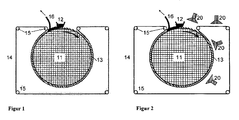
- the device is in FIG. 1 shown. It comprises a rotating, heated drum (11), a spreader box (12), a revolving Teflon belt (14), and deflection rollers (15).
- the casting compound (13) is solidified into a film (16).
- the drum (11) consists of a metal cylinder of 50 cm diameter, which was heated by means of a heating fluid to the temperature TZ of 105 ° C.
- the speed n of the drum was 0.6 revolutions per minute.
- the pouring temperature TG of the mixture was 45 ° C.
- the mixture was poured by means of the spreader box (12) onto the rotating metal cylinder to form a film (16) 25 cm wide and 0.7 mm thick.
- the cast film (16) was covered with the co-rotating teflon tape (14) to keep the water content in the film constant. After a 3 ⁇ 4 turn, the film was peeled off the metal cylinder and fed to a dryer. The resulting films were completely transparent. No birefringent starch granules were observed in the films.
- the bulk temperature of the film on the drum was 91% at% rotation.
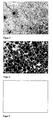
- FIG. 3 A light micrograph of a starch film stored for 7 months over sodium bromide (relative humidity of 58%) is in FIG. 3 shown. It is good to see that the film consists of interconnected starch grains.
- FIG. 4 shows a light micrograph of a starch film, which was stored for 7 months on magnesium chloride (relative humidity of 33%).
- FIG. 5 an extruded starch film according to the patent EP 1 103 254 B1 shown. By extrusion, all starch particles were destroyed, so that they are no longer detectable by light microscopy.
- the moduli of elasticity of films of Example 1 stored for 2 weeks at relative humidities of 33%, 43%, 57% and 75% were 23MPa, 3.4MPa, 3.7MPa and 3.3MPa, while the E -Moduli of films of the same composition, but which have been prepared by extrusion, (longitudinally) at the same humidities at 4.5 MPa, 0.7 MPa, 0.9 MPa and 0.4 MPa were.
- Example 1 was repeated.
- the extruded starch SIE and the granular starch were blended together to form a mixture of water and plasticizer. It has been found that the order of preparation of the casting mixture has no effect on further processing and product properties.
- Example 1 was repeated. The finished casting mix was stored at room temperature for two hours prior to further processing without any effect on further processing or product performance.
- Example 1 was repeated.
- the finished casting mixture was stored at 45 ° C for two hours before further processing without any effect on further processing or product performance.
- the casting material had a water content of 35%.
- the temperature of the drum was set at 108 ° C.
- the bulk temperature of the film on the drum was 93 ° C after 3 ⁇ 4 turn.
- the casting material had a water content of 41.1%.
- the temperature of the drum was set at 103 ° C.
- the bulk temperature of the film on the drum was 3 ⁇ 4 turn at 89 ° C.
- the extruded starch SH in the casting mass was increased from 2.28% to 4.49%, whereby the dynamic viscosity at 45 ° C at a shear rate of 1.1 / s increased from 5.7 Pas to 21 Pas ,
- the temperature of the drum was set at 105 ° C.
- the bulk temperature of the film on the drum was around 90 ° C at 3 ⁇ 4 turn.
- Example 2 Analogously to Example 1, the hydroxypropylated, crosslinked tapioca starch S1 was replaced by the native tapioca starch S2 and the starch SIE by the pregelatinized starch S2P.
- the temperature of the drum was set at 111 ° C.
- the bulk temperature of the film on the drum was around 96 ° C after 3 ⁇ 4 turn.
- Starches S2 and S2P before processing had a weight average molecular weight M w of 22,690,000 g / mol, and the starch extracted from the film made therefrom had a molecular weight M w of 21,340,000, ie, the molecular weight only became minimally reduced (cf. FIG. 12 ).
- Example 2 Analogously to Example 1, the glycerol content was increased.
- the temperature of the drum was set at 102 ° C.
- the temperature of the film after 3 ⁇ 4 turns was 88 ° C.
- Example 2 Analogously to Example 1, the hydroxypropylated, crosslinked tapioca starch S1 was replaced by the native Waxy potato starch S4.
- the temperature of the casting mixture was 40 ° C.
- the temperature of the drum was set at 102 ° C.
- the temperature of the film after 3 ⁇ 4 turns was 87 ° C.
- Example 2 Analogously to Example 1, the hydroxypropylated, crosslinked tapioca starch S1 was replaced by the hydroxypropylated potato starch S5 and the starch SIE by the pregelatinized hydroxypropylated potato starch S5P.
- the temperature of the casting mixture was 40 ° C.
- the temperature of the drum was set at 101 ° C.
- the temperature of the film after 3 ⁇ 4 turns was 86 ° C.
- Starches S5 and S5P before processing had a weight average molecular weight M w of 13,530,000 g / mol, and the starch extracted from the film made therefrom had a molecular weight M w of 13,490,000 in a first measurement, in a second measurement of 15,460,000, ie the molecular weight was virtually unchanged during the production of the film.
- the apparent increase in molecular weight in the second measurement is believed to be due to the limited accuracy of molecular weight measurements at the high molecular weights.
- the starches S1 and S1P have a weight average molecular weight M w of 30,100,000 g / mol.
- the molecular weight analysis for the starch in the respective films showed in a first measurement a molecular weight M w of 21,340,000 g / mol, and in a second measurement a molecular weight M w of 20,220,000 g / mol, ie Molecular weight was only slightly reduced by the method. In particular, in comparison to the extrusion process, where the thickness S1, although extruded under the gentlest possible conditions, ie at high water content and low shear rates, only had a molecular weight M w of 920,000 g / mol.
- Example 9 was repeated.
- the extruded starch SIE was replaced by the starch S1 (as dissolved starch) and after adding this starch S1 to the mixture of water and plasticizer, this starch S1 was destructured into this mixture by heating to 90 ° C. After subsequent cooling to a temperature below 45 ° C then the granular starch S1 (as granular starch) was added. This had no effect on the subsequent process and product properties.
- Example 9a was repeated. To avoid cooling, the process was simplified by destroying the starch S1 (as dissolved starch) in only part of the water-plasticizer mixture and then adding the remainder of water and plasticizer at room temperature to keep the temperature below 45 ° C to lower.
- Example 9 Analogously to Example 9. The pregelatinized starch S1P was replaced by the pregelatinized starch S6P. Again, the same procedures as described in Examples 9a and 9b are applicable to destruct the starch S6 (as dissolved starch).
- Example 9 Analogously to Example 1.
- the dissolved starch SIE was replaced by thickeners V1, V2 and V3, whereby the decomposition behavior of the films in an aqueous medium could be accelerated.
- V2 xanthan gum
- V3 Locust bean gum, locust bean flour
- the mixture of water, plasticizer and polysaccharide was heated to 90 ° C, as in Example 9a, and then cooled to a temperature below about 45 ° C, before the granular starch was mixed.
- Example 9b the same variant as in Example 9b is applicable to avoid active cooling of the mixture of water, plasticizer and dissolved polysaccharide.
- Example 9 Analogously to Example 1.
- the dissolved starch S1E was replaced by various tapioca dextrins S7, S8 and S9, which accelerated the decomposition behavior of the starch films in an aqueous medium.
- the mixture of water, plasticizer and polysaccharide was heated to 90 ° C and then cooled to a temperature below about 45 ° C as in Example 9a, before the granular starch ( Starch 1 according to Table 1) was added.
- the same variant as in Example 9b is applicable to avoid active cooling of the mixture of water, plasticizer and starch.
- a light micrograph of the unprocessed, granular tapioca starch S1 from Example 1 can be found in FIG. 6 .
- FIG. 7 shows the change of this strength under the influence of temperature.
- the sample was prepared by suspending 20% by weight of starch in water in a test tube and heating to 70 ° C. for 5 minutes in a water bath. After cooling to room temperature, the starch was stained with iodine and microscanned FIG. 6 shows small birefringent starch particles, one recognizes that the particles in FIG. 7 are swollen and no longer show birefringence.
- FIG. 8 shows starch particles recovered from starch films.
- a starch films from Example 1 was first stored for 7 months over magnesium chloride (relative humidity: 33%).
- a sample was prepared by holding about 100 mg of the film in 7 g of water with stirring with a magnetic stirrer at 70 ° C for 30 minutes, the material disintegrating into particles. After cooling, it was stained with iodine.
- These starch particles from the film are more stained and more thinned, but do not differ significantly from those in FIG. 7 which could be obtained by heating the suspended starch. This shows that the film consists of destructured starch grains.
- Example 17 was repeated with the potato starch S5 and the films according to Example 8.
- a light micrograph under crossed polarizers of the unprocessed starch S5 from Example 8 can be found in FIG. 5 , In the larger grains well known Maltese crosses are recognizable, which are typical of native starch.
- FIG. 10 shows the change of this starch after heating to 70 ° C.
- FIG. 11 shows starch particles recovered from films according to Example 8, which were stored for 7 months over sodium bromide (relative humidity: 58%).
- FIG. 3 shows a light micrograph of a starch film according to the invention according to Example 1. From the starch film with the razor blade a very thin layer was separated and placed on it a drop of iodine solution (the dark spots were more strongly colored). This preparation was then hand pressed between slides to further reduce the thickness of the film. The resulting film thickness was about the thickness of two Starch grains so that the grains are partially over each other. Nevertheless, it can be clearly seen that the film consists of a thick pack of destructured starch granules (no birefringence was recognized).
- FIG. 4 shows a light micrograph of a starch film according to the invention according to Example 1.
- the starch film obtained with the razor blade was briefly swollen at 70 ° C, the starch granules stained with iodine and the film pressed by hand between two slides, so that the film thickness was about the thickness of the grains.
- the swelling at 70 ° C the grains are swollen and therefore slightly larger than at FIG. 3 ,
- FIG. 5 shows a photomicrograph of a non-inventive extruded starch film with the magnification factor of 150 (a film cutout with a width of 0.57 mm is shown). Since the starch has been completely dissolved, no particles of starch are left. The recovery process 2 still resulted in a mass fraction of about 1.5% of the dry film, which could be sedimented from the solution and can be attributed to non-soluble additives.
- the molar mass distributions of the unprocessed starch S2 and the thickness S2 processed according to the invention in accordance with Example 5 were compared with one another.
- the dissolution of the starch film was carried out by pressure boiling under defined conditions in a mini-autoclave and the investigation of the molecular weight distribution of the molecularly disperse dissolved starch by means of GPC-MALLS.
- starch samples were suspended in water at a concentration of 3% by weight of dry matter. This suspension was heated in a mini-autoclave with stirring. After reaching 150 ° C, the temperature was held for 20 minutes. The solution was then cooled to 60 ° C., diluted to 0.3% by weight, filtered with a 5 ⁇ m membrane filter and measured on the GPC-MALLS.
- the molecular weight distributions obtained are in FIG. 12 wherein A denotes the sample of the starting thickness S2 and B denotes the thickness of the film sample according to Example 5.
- Starting starch and processed starch are in a comparable molar mass range.
- Dynamic viscosities were determined using a Brookfield LVDV-I + viscometer at a shear rate of 1.1 / s (5 rpm, Spindle 25) and the indicated temperatures.
- the mechanical properties were measured on an Instron 5542 test system according to ISO 527.
- the determination of the insoluble component in the film is carried out as follows: Previously, the dried film was stored at 57% humidity for 2 months. A sample amount of 100-150 mg (dry matter M0) in the form of a film piece of 0.5 mm thickness is swollen and / or dissolved at 70 ° C. together with 7 g demineralized water in a test tube for 30 minutes with slow stirring with a magnetic stirrer. Thereafter, the test tube is centrifuged until the undissolved constituents have sedimented and the supernatant has become clear. The supernatant is then decanted. Then 7 g of demineralized water are added and stirred with the sediment, centrifuged again and then decanted.
- This process is repeated again to ensure that there are no more soluble constituents in the sediment.
- This sediment consists of a film consisting of starch and plasticizer, of undissolved starch.
- the sediment is dried for 48 h at 80 ° C over phosphorus pentoxide and determined by the dry mass (M1). The proportion of the mass that can be recovered after the dissolution process thus results in wt .-% to 100 ⁇ M1 / M0.
- the amount of starch that can be recovered after the dissolution process results in a starch film consisting of starch and plasticizer, in% by weight to 100 ⁇ M1 / (M0 ⁇ (1- (WM / 100)), where WM
- the starch film has, in addition to the starch particles, at most only minimal amounts of insoluble constituents, for example pigments (typically ⁇ 0.5%) or fillers such as titanium dioxide (typically ⁇ 1) , 5%).
- pigments typically ⁇ 0.5%) or fillers such as titanium dioxide (typically ⁇ 1) , 5%.
- Such components are optionally subtracted at dry matter M0 and mass M1.
- Table 1 ⁇ / b> Formulation of the casting mixture Fresh movie example granular starch dissolved starch Dil. medium granular starch dissolved starch SCA Dil.
Landscapes
- Health & Medical Sciences (AREA)
- Chemical & Material Sciences (AREA)
- Medicinal Chemistry (AREA)
- Engineering & Computer Science (AREA)
- Life Sciences & Earth Sciences (AREA)
- Animal Behavior & Ethology (AREA)
- General Health & Medical Sciences (AREA)
- Public Health (AREA)
- Veterinary Medicine (AREA)
- Pharmacology & Pharmacy (AREA)
- Mechanical Engineering (AREA)
- Epidemiology (AREA)
- Polymers & Plastics (AREA)
- Chemical Kinetics & Catalysis (AREA)
- Organic Chemistry (AREA)
- Manufacturing & Machinery (AREA)
- Medicinal Preparation (AREA)
- Compositions Of Macromolecular Compounds (AREA)
- Processes Of Treating Macromolecular Substances (AREA)
- Manufacture Of Macromolecular Shaped Articles (AREA)
- Polysaccharides And Polysaccharide Derivatives (AREA)
- Medical Preparation Storing Or Oral Administration Devices (AREA)
- Inorganic Chemistry (AREA)
Description
- Die vorliegende Erfindung bezieht sich auf ein Verfahren, insbesondere ein Giessverfahren, zur Herstellung von Stärkefolien bzw. -bahnen bzw. -filmen, auf die daraus erhaltenen Folien bzw. Bahnen bzw. Filme, sowie auf die Verwendung einer Vorrichtung zur Herstellung von erfindungsgemäßen Folien bzw. Bahnen bzw. Filmen.
- Folien bzw. Filme und sonstige Formteile auf Stärkebasis sind wegen der biologischen Abbaubarkeit schon seit längerem von besonderem Interesse. Giessverfahren zur Herstellung von Stärkeformteilen aus wässerigen Stärkelösungen werden allerdings durch den tiefen Stärke- und hohen Wasseranteil solcher Lösungen limitiert. Lösungen von Stärke werden bei typischerweise 5% Stärke bereits so viskos, dass zumindest einfache Giessverfahren nicht mehr möglich sind. Ursache ist das sehr hohe Molekulargewicht von Stärke, das bis 100.000.000 g/mol betragen kann.
- Indem die Stärke durch Kochen degradiert, und so das Molekulargewicht reduziert wird, können auch Lösungen mit Stärke von höheren Konzentrationen gegossen werden, allerdings werden dann auch schlechtere mechanische Eigenschaften der Filme und sonstigen Formteile erhalten, da die langen Stärke Makromoleküle die mechanischen Eigenschaften positiv beeinflussen. Beispielsweise werden in der
WO 01/92400 A2 - Üblicherweise werden Stärkefilme allerdings mittels Extrusion erhalten, wozu teure Extruder benötigt werden. Dabei wird aus der typischerweise granulär vorliegend Stärke bei Temperaturen von meist mehr als 100°C unter der Einwirkung von mechanischer Energie in Form von Scherung eine homogene Stärkeschmelze von hoher Viskosität hergestellt, welche unter hohen Drücken beispielsweise durch eine schlitzförmige Düse gepresst wird, um einen Stärkefilm zu erzeugen. Infolge des hohen mechanischen Energieeintrags wird das Molekulargewicht der Stärke deutlich reduziert, was für die mechanischen Eigenschaften des Films nachteilig ist und ausserdem werden die Makromoleküle bei den Fliessvorgängen an der Düse in Längsrichtung des Films orientiert, sodass der Film anisotrop ist, was für die Weiterverarbeitung nachteilig ist. Bei der Extrusion von Stärke Filmen sinkt nach der Formgebung die Temperatur im Film, wodurch die Festigkeit des Films zunimmt.
- Filme, die aus homogenen Stärkemassen hergestellt werden, die mittels Extrusion erhalten werden, sind beispielsweise aus der
EP 0 735 080 A2 und derUS 4,454,268 undEP 1,103,254 B1 bekannt. - Eine Destrukturierung von Stärke wird durch Erhitzen von Stärke in einem wässrigen Medium erhalten, wobei mit zunehmender Temperatur die Destrukturierung zunimmt. Werden die Stärkekörner gleichzeitig durch Scherkräfte mechanisch beansprucht, so wird bei gleicher Temperatur eine höhere Destrukturierung erhalten. Ist die Kristallinität der Stärkekörner substanziell zerstört, so reichen schon geringe Scherkräfte, wie sie z. B. bei einfachen Misch- und Fliessvorgängen von Stärkemischungen auftreten, um den Destrukturierungsgrad zu erhöhen und die gequollenen Stärkekörner substanziell zu zerstören, wobei ausserdem auch das Molekulargewicht der Stärke Makromoleküle deutlich reduziert werden kann. Der Grad der Destrukturierung lässt sich in folgende Stufen unterteilen:
- Stufe 1: die Kristallinität der Stärke ist teilweise zerstört, im Polarisationsmikroskop sind
- Stufe 1.1: höchstens 5% der Körner nicht mehr doppelbrechend
- Stufe 1.2: 5 - 10% der Körner nicht mehr doppelbrechend
- Stufe 1.3: 10 - 20% der Körner nicht mehr doppelbrechend
- Stufe 1.4: 20 - 30% der Körner nicht mehr doppelbrechend
- Stufe 1.5: 30 - 40% der Körner nicht mehr doppelbrechend
- Stufe 2: die Kristallinität der Stärke ist substantiell zerstört, im Polarisationsmikroskop sind
- Stufe 2.1: 40 - 50% der Körner nicht mehr doppelbrechend
- Stufe 2.2: 50 - 60 % der Körner nicht mehr doppelbrechend
- Stufe 2.3: 60 - 80% der Körner nicht mehr doppelbrechend
- Stufe 2.4: 80 - 100% der Körner sind nicht mehr doppelbrechend
- Stufe 3: es sind höchstens 5% der Körner doppelbrechend
- Stufe 3.1: und 1 - 10% der Körner sind aufgeplatzt
- Stufe 3.2: und 10 - 20% der Körner sind aufgeplatzt
- Stufe 3.3: und 20 -- 30% der Körner sind aufgeplatzt
- Stufe 3.4: und 30 -- 50% der Körner sind aufgeplatzt
- Stufe 3.5: und 50 -- 70% der Körner sind aufgeplatzt
- Stufe 3.6: und 70 -- 100% der Körner sind aufgeplatzt
- Aufgeplatzte Stärkekörner sind dadurch charakterisiert, dass die Stärkekörner an der Oberfläche Risse aufweisen und/oder die zuvor relativ glatte Oberfläche deutlich deformiert worden ist (z.B. schrumpelige Oberfläche). Neben noch als ganze Körner vorliegenden Stärkepartikeln können auch in Bruchstücke zerfallene Stärkepartikel vorliegen. Die Stärkekörner wie auch die Bruchstücke sind jedoch noch als Entitäten erkennbar.
- Stufe 4: Es wird keinerlei Doppelbrechung beobachtet, die Stärkekörner sind substanziell zerstört
- Stufe 4.1: es liegen noch Fragmente von Stärkekörnern vor, die Stärke liegt grossteils gelöst vor
- Stufe 4.2: die Stärke liegt vollständig gelöst vor
- Der Begriff "destrukturierte Stärke" wird in der Fachwelt nicht einheitlich verwendet. Als destrukturierte Stärke wird hier eine Stärke bezeichnet, welche höchstens bis zur Stufe 4.1 destrukturiert worden ist, d.h. die Stärke liegt mindestens teilweise noch in Form von Partikeln vor.
- Allen Stärkefilmen, die aus Lösungen degradierter Stärke oder extrudierten Stärkemassen hergestellt wurden, ist gemein, dass das Molekulargewicht der Stärke deutlich gesenkt und die Stärkepartikel im wesentlichen vollständig zerstört wurden. Filme gemäß den erwähnten Veröffentlichungen
EP 0 735 080 A2 ,US 4,454,268 undEP 1,103,254 B1 enthalten folglich im wesentlichen nur Stärke der Destrukturierungsstufe 4.2. - Aufgabe der vorliegenden Erfindung ist, einfach und kostengünstig herzustellende Folien bzw. Bahnen bzw. Filme auf Basis von unbedenklichen und günstigen pflanzlichen Rohstoffen mit guten mechanischen Eigenschaften bereitzustellen.
- Diese Aufgabe wird erfindungsgemäß durch ein Verfahren zur Herstellung einer Folie bzw. eines Films auf Stärkebasis, insbesondere durch ein Gießverfahren gelöst, wobei eine Mischung enthaltend Stärke, wobei mehr als 50 Gew.-% der Stärke in der flüssigen Phase als Partikeln granulärer Stärke vorliegen, zu einem Film umgeformt wird und während und/oder nach dieser Umformung die Mischung durch eine Temperaturerhöhung, insbesondere von mehr als 5°C, verfestigt wird.
- Bevorzugt wird diese Aufgabe durch ein Verfahren zur Herstellung eines Films auf Stärkebasis, insbesondere ein Gießverfahren, gelöst, umfassend die folgenden Schritte:
- Herstellen einer Mischung, umfassend:
- a) > 40 Gew.-% der trockenen Mischung, nach Abzug des Weichmachers, Stärke, wobei mehr als 50 Gew.-% der Stärke in der flüssigen Phase als Partikeln granulärer Stärke vorliegen,
- b) 0 - 70 Gew.-% der trockenen Mischung Weichmacher,
- c) 15 - 90 Gew.-% der gesamten Mischung Wasser,
- d) gegebenenfalls maximal 50 Gew.-% der trockenen Mischung, nach Abzug des Weichmachers, ein Verdickungsmittel, und
- e) gegebenenfalls übliche Zusatz- und Hilfsstoffe,
- Umformen der Mischung zu einem Film in einem Formgebungsprozess,
- Verfestigen der Mischung durch Erhöhen der Temperatur der Mischung während und/oder nach dem Formgebungsprozess um mehr als 5°C, zu einem kompakten Film, der Partikeln von destrukturierter Stärke aufweist
- Gegebenenfalls Trocknung des Films.
- Erfindungsgemäß wird dabei das Molekulargewicht der Stärke nicht wesentlich beeinträchtigt. Dadurch sind besonders gute mechanische Eigenschaften des frischen und des trockenen Films möglich. Weiter aber trägt auch die heterogene Struktur des Materials wesentlich hierzu bei, indem die bei der Verfestigungstemperatur entstandenen, destrukturierten Partikel der granulären Stärke bereits eine gewisse Festigkeit und Elastizität per se aufweisen, was sich vorteilhaft auf die Handhabung des frischen Films bei der Weiterverarbeitung auswirkt.
- Für gute mechanische Eigenschaften des Stärkefilms sollten das Molekulargewicht der Stärke und ihr Anteil in der Ausgangsmischung gross genug sein. Die zunächst widersprüchliche Kombination von Gießfähigkeit, also von tiefer Viskosität und hohem Molekulargewicht der Stärke wird erfindungsgemäß dadurch erreicht, dass die Stärke in der Gießmischung in Form von Partikeln auftritt. Dann wird die Viskosität der Mischung primär von der Viskosität von Wasser und Weichmacher bestimmt und ist entsprechend tief. So ist beispielsweise eine Stärkemischung mit rund 35 Gew.-% Wasser insgesamt und 35 Gew.-% Glycerin, bezogen auf den Stärkeanteil noch gut, sogar drucklos gießbar. Eine Mischung gleicher Zusammensetzung, wobei jedoch die Stärke vor der Formgebung in destrukturierter, gelöster oder plastifizierter Form vorliegt, würde eine um mindestens 1000mal höhere Viskosität von mehr als 10.000 Pas aufweisen. Um eine solche Mischung zu einem Film umzuformen, würden hohe Drücke benötigt, wie sie beispielsweise von Extrudern erzeugt werden können. Alternativ müsste der Wassergehalt einer solchen Mischung auf rund 95% erhöht werden, damit die Mischung drucklos gießbar wird. Allerdings läge dann nach dem Gießen auch bei einer nachfolgenden Temperaturerhöhung immer noch eine Flüssigkeit vor und kein Film mit brauchbaren mechanischen Eigenschaften.
- Wird die Stärkemischung erhitzt, so findet eine zunehmende Quellung und Destrukturierung der Stärkepartikel statt, wobei die Partikel Wasser und Weichmacher aufnehmen, anquellen und miteinander verkleben. Es wird ein Agglomerat oder Konglomerat von Partikeln erhalten, also eine heterogene Struktur bestehend aus einem Gemenge von Stärkepartikeln.
- Die Verfestigung der zuvor tiefviskosen, gießfähigen Mischung zu einem viskoselastischen, festen Material, das durch eine typische Festkörpereigenschaft wie den E-Modul charakterisiert werden kann, erfolgt nahezu simultan mit der Temperaturerhöhung und entsteht dadurch, dass die flüssige Phase von Wasser und Weichmacher verschwindet, d. h. in die Stärkepartikel eindiffundiert, innerhalb der Stärkepartikel durch Verschlaufungen von Makromolekülen eine Netzwerk-, d.h. eine Gelstruktur entsteht und die Partikel miteinander verklebt werden. Die Verklebung der Partikel kann durch die Zugabe eines Verdickungsmittels gegebenenfalls noch modifiziert werden.
- Unter Verfestigung der Mischung ist die primäre Verfestigung zu verstehen, wobei eine Destrukturierung von granulärer Stärke, also eine Phasenumwandlung der Stärke stattfindet und sich die Eigenschaften der Mischung um Grössenordnungen ändern. Diese Phasenumwandlung zeigt sich als Gelierung der Gießmasse zu einem festen Film. Hierzu werden ausser Stärke keine weiteren Gelierungsmittel benötigt. Nach der primären Verfestigung der Mischung findet eine sckundäre Verfestigung statt, begleitet von einer graduellen Änderung der Stoffeigenschaften, wenn die Temperatur der primär verfestigten Films und/oder deren Wassergehalt reduziert wird und/oder indem eine langsame Netzwerkbildung der Stärke einsetzt, die durch Retrogradation, d. h. Kristallisation der Stärkemakromoleküle hervorgerufen wird.
- Erfindungsgemäß können Mischungen von Stärke mit hohen Stärkeanteilen mit einfachen Gießverfahren zu Filmen verarbeitet werden. Im Vergleich zu einer Mischung, in welcher dieselbe Menge Stärke in gelöster Form vorliegt, werden um Grössenordnungen tiefere Viskositäten der Mischung erhalten. Die Verfestigung der Mischung zu einem isotropen Filmmaterial von hoher Elastizität und hohem Dehnvermögen wird durch eine Temperaturerhöhung erreicht. Vorteilhaft ist, dass das Molekulargewicht der Stärke im erfindungsgemäßen Verfahren nicht wesentlich beeinträchtigt wird. Bevorzugt ist der Quotient Mw2/Mw1 > 0,3, noch bevorzugter > 0,4, noch bevorzugter > 0,5, noch bevorzugter > 0,6, noch bevorzugter > 0,7, noch bevorzugter > 0,8, wobei Mw1 das Gewichtsmittel der Molekulargewichtsverteilung der eingesetzten Stärke und Mw2 das Gewichtsmittel der Molekulargewichtsverteilung der Stärke im hergestellten Film ist. Hier ist anzumerken, dass das Molekulargewicht von Stärke sehr empfindlich auf mechanische Beanspruchung reagiert. So wird beispielsweise das Molekulargewicht von gelöster Stärke durch blosses Schütteln der Lösung bereits messbar reduziert.
- Die erfindungsgemäß eingesetzten Stärkemischungen können in nahezu gleicher Art und Weise zu Filmen verarbeitet werden, wie dies bei Gelatinegießverfahren der Fall ist. Dies ist eine besonders günstige Voraussetzung, um Gelatinefilme zu ersetzten, da dieselben Anlagen genutzt werden können. Der verfahrenstechnische Unterschied zu Gelatinefilmen besteht im Wesentlichen darin, dass Gelatineschmelzen bei Abkühlung gelieren, während erfindungsgemäße Stärkemischungen infolge einer Temperaturerhöhung gelieren.
- In einer bevorzugten Ausführung hat der Film eine obere Grenze betreffend die Dicke in mm von 10, vorzugsweise 5, noch bevorzugter 3, noch bevorzugter 2, noch bevorzugter 1,5, noch bevorzugter 1,0, am bevorzugtesten 0,9. Mit abnehmender Dicke wird die Temperaturerhöhung zur Verfestigung erleichtert, insbesondere wenn die Temperaturerhöhung substanziell durch Wärmeleitung erreicht wird, ausserdem wird die Reduktion des Wassergehalts im Film nach der Verfestigung erleichtert.
- In einer bevorzugten Ausführung hat der Film eine untere Grenze betreffend die Dicke in mm von 0,001, vorzugsweise 0,01, noch bevorzugter 0,05, noch bevorzugter 0,1, noch bevorzugter 0,2, am bevorzugtesten 0,3. Mit zunehmender Dicke des Films wird dessen Handhabbarkeit erleichtert.
- Grundsätzlich können hinsichtlich des Ursprungs und Aufbereitung beliebige Stärken oder Mischungen davon eingesetzt werden. Sie können zum Beispiel im nativen Zustand, wie auch im physikalisch und/oder chemisch/enzymatisch modifizierten Zustand eingesetzt werden.
- Hinsichtlich des Ursprungs sind Wurzelstärken wie beispielweise Kartoffelstärken oder Tapiocastärken bevorzugt, da diese im Vergleich zu Stärken anderer Herkunft niedrige Gelantinisierungstemperaturen aufweisen und die Verfestigung bzw. Gelierung der Gießmasse zu Filmen daher bereits bei niedrigen Temperaturen möglich ist. Besonders bevorzugt ist Tapiocastärke. Tapiocastärke ist farblos, geschmacklos, weist eine sehr gute Transparenz auf und es sind von Tapiocastärken noch keine genetisch modifizierten Varianten bekannt.
- In einer bevorzugten Ausführung wird die Stärke im nativen, d.h. nicht modifizierten Zustand eingesetzt. Hiermit können gute Eigenschaften bei tiefen Kosten erhalten werden.
- In einer weiteren bevorzugten Ausführungsform werden substituierte Stärken wie Stärkeester und Stärkeether eingesetzt wie beispielsweise hydroxypropylierte oder acetylierte Stärken. Diese Modifikationen führen zu besonders hoher Transparenz und hohem Dehnvermögen des Films.
- Alternativ werden oxidierte Stärken eingesetzt.
- In einer weiteren bevorzugten Ausführungsform werden vernetzte Stärken eingesetzt, insbesondere vernetzte Stärkeester bzw. vernetzte Stärkeether, beispielsweise Stärkephosphate und Stärkeadipate. Durch die Erhöhung des Molekulargewichtes, welche mit der Vernetzung einhergeht, werden verbesserte mechanische Eigenschaften erhalten und werden die Stärkekörner als Einheiten auch mechanisch stabilisiert, was für das Verfahren besonders vorteilhaft ist, da damit der Beitrag der Stärkepartikel zu den mechanischen Eigenschaften des frischen Films und des trockenen Films gesteigert werden kann. Bei hochvernetzten Stärken bildet das destrukturierte Stärkekorn praktisch ein Molekül von gigantischem Molekulargewicht und weist eine besonders hohe Stabilität auf.
- In einer weiteren bevorzugten Ausführungsform wird substituierte Tapiocastärke eingesetzt, insbesondere vernetzte substituierte Tapiocastärke wie beispielsweise hydroxypropyliertes Stärkephosphat.
- Das bevorzugte Gewichtsmittel der Molekulargewichtsverteilung Mw1 der verwendeten Stärke liegt mindestens bei 500.000 g/mol, besonders bevorzugt mindestens 1.000.000 g/mol, noch bevorzugter mindestens 2.500.000 g/mol, noch bevorzugter mindestens 3.000.000 g/mol, noch bevorzugter mindestens 4.000.000 g/mol, noch bevorzugter mindestens 5.000.000 g/mol, noch bevorzugter mindestens 7.000.000 g/mol, ganz besonders bevorzugt mindestens 10.000.000 g/mol.
- Der Amylosegehalt der Stärken in Gew.-% ist bevorzugt < 50, noch bevorzugter < 40 noch bevorzugter < 35, noch bevorzugter < 30, noch bevorzugter < 27, noch bevorzugter < 25, ganz besonders bevorzugt < 20. Hohe Amylosegehalte führen zu reduziertem Dehnvermögen des Films und der Film ist bezüglich Glanz und Transparenz von minderer Qualität. Zudem verschlechtern sich ihre Zerfallseigenschaften in wässerigem Medium.
- Weiterhin sind Waxy-Stärken bevorzugt, insbesondere vernetzte und/oder substituierte Waxy-Stärken. Waxy-Stärken sind betreffend die Transparenz vorteilhaft.
- Bevorzugt ist erfindungsgemäß die Stärke nicht vom C-Strukturtyp (d. h. zum Beispiel Leguminosenstärke), da entsprechende Stärken zu schlechten Dehneigenschaften des Films führen, sondern vom A- und/oder B-Strukturtyp.
- In einer Ausführungsform der Erfindung ist die Stärkequelle ausgewählt aus nativen oder modifizierten Stärken vom A- und/oder B-Strukturtyp, insbesondere aus der Gruppe, bestehend aus Tapiocastärke, Kartoffelstärke und Gemischen daraus und Waxy-Stärken, wobei besonders bevorzugt modifizierte Tapiocastärke, insbesondere substituierte Tapiocastärke und ganz besonders bevorzugt substituierte und vernetzte Tapiocastärke oder modifizierte Kartoffelstärke oder substituierte Kartoffelstärke oder substituierte und vernetzte Kartoffelstärke eingesetzt wird.
- Der Amylosegehalt der Stärken in Gew.-% ist bevorzugt >= 0, noch bevorzugter > 0,3, noch bevorzugter > 0,5, noch bevorzugter > 0,7, noch bevorzugter > 1, noch bevorzugter > 2, ganz besonders bevorzugt > 3. Zu tiefe Amylosegehalte können zu reduziertem Dehnvermögen des Films führen.
- Weiterhin bevorzugt sind Stärken mit einer Gelatinisierungstemperatur < 90°C, besonders bevorzugt < 80°C, noch bevorzugter < 75°C, noch bevorzugter < 70°C, noch bevorzugter < 67°C, ganz besonders bevorzugt < 65°C. Die Gelatinisierungstemperatur wird mittels DSC (Differential Thermal Calorimetry) als Peak-Temperatur beim Aufheizen mit 10°C/min von einer Stärke/Wasser-Mischung enthaltend 65 Gew.-% Wasser bestimmt. Mit abnehmender Gelatinisierungstemperatur wird die Verfestigung des gegossenen Films bei tieferen Temperaturen möglich und somit sowohl einfacher als auch schneller.
- Weiter bevorzugt sind Stärken mit einem Dextrose-Äquivalent (DE) von < 10, besonders bevorzugt < 1, am bevorzugtesten < 0,7, noch bevorzugter < 0,5, noch bevorzugter < 0,2, noch bevorzugter < 0,1, ganz besonders bevorzugt < 0,05. Das Dextrose-Äquivalent eines Polysaccharid-Gemischs bezeichnet den prozentualen Anteil reduzierender Zucker an der Trockensubstanz. Es entspricht der Menge Glucose (= Dextrose), die je 100 g Trockensubstanz das gleiche Reduktionsvermögen hätte. Der DE-Wert ist ein Maß dafür, wie weit der Polymerabbau erfolgt ist, daher erhalten Produkte mit niedrigem DE-Wert einen hohen Anteil an Polysacchariden und einen niedrigen Gehalt an niedermolekularen Zuckern (Oligosaccharide), während Erzeugnisse mit hohem DE-Wert hauptsächlich nur noch aus niedermolekularen Zuckern bestehen. Das Dextrose-Äquivalent wird nach der ISO Norm 5377 bestimmt. Mit tiefer werdendem DE Wert nimmt die Festigkeit des Films nach Verfestigung zu.
- In einer bevorzugten Ausführungsform der Erfindung liegt der Stärkeanteil der trockenen Mischung, nach Abzug des Weichmachers (d. h. nach mathematischer Subtraktion des Weichmachers von der Trockenmischung, bestehend aus Stärke, Weichmacher und allen optionalen Bestandteilen), in Gew.-% bei > 40, besonders bevorzugt > 50, noch bevorzugter 60, noch bevorzugter > 70, noch bevorzugter > 80, noch bevorzugter > 90, besonders bevorzugt > 95.
- Die granuläre Stärke wird mit einer Destrukturierung bis zur Stufe 2.2., bevorzugt bis zur Stufe 2.1, noch bevorzugter bis zur Stufe 1.5, noch bevorzugter bis zur Stufe 1.4, noch bevorzugter bis zur Stufe 1.3, noch bevorzugter bis zur Stufe 1.2, noch bevorzugter bis zur Stufe 1.1, ganz besonders bevorzugt im nativen, nicht destrukturierten Zustand eingesetzt. Mit abnehmender Destrukturierung nimmt die Viskosität der Mischung ab, wodurch das Gießen vereinfacht wird.
- Die granuläre Stärke wird erfindungsgemäß in Form von Partikeln eingesetzt, wobei diese Partikel in ihrer Form den ursprünglichen Stärkekörnern entsprechen oder Agglomerate davon sind. Typische Grössen der Stärkekörner im nicht gequollenen Zustand sind: 5 - 100 µm bei Kartoffelstärke, 5 - 30 µm bei Maisstärke, 1 - 45 µm bei Weizensstärke, 4 - 35 µm bei Tapiocastärke, 1 - 30µm bei Reisstärke. Bei einer teilweisen Destrukturierung können die ursprünglichen Stärkekörner bezüglich Geometrie und Grösse verändert worden sein, insbesondere nimmt die Grösse bei der Destrukturierung deutlich zu. Als granuläre Stärke können auch Mischungen von verschiedenen granulären Stärken eingesetzt werden.
- Bevorzugt ist der Anteil der granulären Stärke am gesamten Stärkeanteil der Mischung in Gew.-% > 60, besonders bevorzugt > 70, noch bevorzugter > 75, noch bevorzugter > 80, noch bevorzugter > 85, ganz besonders bevorzugt > 90.
- Wasser ist für die Einstellung der Viskosität der Gießmasse und für die Verfestigung des Films nach der Umformung der Gießmasse zu einem Film von Bedeutung. Je höher der Wassergehalt ist, umso einfacher ist das Gießen, umso schneller erfolgt die Verfestigung und umso geringer ist die dafür notwendige Temperaturerhöhung. Andererseits reduziert ein hoher Wassergehalt die Festigkeit des Films und es werden längere Trocknungszeiten benötigt, da dann mehr Wasser aus dem Film entfernt werden muss.
- Die obere Grenze für den Wassergehalt der Gießmasse in Gew.-% beträgt bevorzugt 90, besonders bevorzugt 80, noch bevorzugter 70, noch bevorzugter 60, noch bevorzugter 50, noch bevorzugter 45, ganz besonders bevorzugt 40, während die untere Grenze des Wassergehalts der Gießmasse in Gew.-% vorzugsweise 15, besonders bevorzugt 20, noch bevorzugter 25, noch bevorzugter 30, ganz besonders bevorzugt 33 beträgt. Mit zunehmendem Wassergehalt wird die Verfestigung erleichtert, z.B. bei tieferen Temperaturen ermöglicht und/oder beschleunigt, jedoch wird die Festigkeit des verfestigten Films dabei reduziert und die Wassermenge, die nach der Verfestigung wieder entfernt werden muss vergrössert.
- Als Weichmacher kommen grundsätzlich alle im Stand der Technik aufgeführten Weichmacher für Stärke in Frage. Ein tiefer Weichmachergehalt führt zu Versprödung des Films bei tiefen Luftfeuchtigkeiten, während ein hoher Weichmachergehalt zu schlechten Eigenschaften bei hoher Luftfeuchtigkeit führt.
- Weichmacher können einzeln oder in Mischungen von verschiedenen Weichmachern eingesetzt werden. Vorzugsweise werden Polyole eingesetzt wie beispielsweise Glycerin, Sorbitol, Maltitol, Erythritol, Xylitol, Mannitol, Galactitol, Tagatose, Lactitol, Maltulose, Isomalt, Maltol usw., aber auch verschiedene Zucker wie Sucrose, Maltose, Trehalose, Lactose, Lactulose, Galactose, Fructose usw. sowie Mono- und Oligosaccharide. Glycerin ist als Weichmacher besonders bevorzugt. Sucrose hat neben seiner Eigenschaft als Weichmacher weiterhin den Vorteil, die Sauerstoffbarriereeigenschaften des Films zu verbessern. Wasser ist ebenfalls ein Weichmacher für Stärke, wird hier jedoch nicht zu den Weichmachern gerechnet und separat berücksichtigt.
- Die obere Grenze für den Weichmachergehalt in Gew.-% der trockenen Mischung beträgt vorzugsweise 70, besonders bevorzugt 60, noch bevorzugter 55, noch bevorzugter 50, noch bevorzugter 46, ganz besonders bevorzugt 42, während die untere Grenze in Gew.-% vorzugsweise 0, besonders bevorzugt 5, noch bevorzugter 10, noch bevorzugter 15, noch bevorzugter 20, noch bevorzugter 25, noch bevorzugter 28, noch bevorzugter 31 noch bevorzugter 32,5, ganz besonders bevorzugt 33,5 beträgt.
- In einer bevorzugten Ausführung werden Weichmacher mit einer maximalen Schmelztemperatur des wasserfreien Weichmachers von 150°C, vorzugsweise 125°C, besonders bevorzugt 110°C, noch bevorzugter 95°C, ganz besonders bevorzugt 70°C eingesetzt. Der Anteil der Weichmacher am Gesamtweichmachergehalt, welcher diese Bedingung erfüllt, beträgt in Gew.-% > 50, vorzugsweise > 70, besonders bevorzugt > 80, ganz besonders bevorzugt > 90.
- Die Stärkemischung kann einen Anteil an kurzkettiger Amylose aufweisen. Diese kurzkettige Amylose kann beispielsweise durch Einwirkung von Enzymen auf die granuläre Stärke in der granulären Stärke erhalten werden oder durch Besprühen der granulären Stärke mit gelöster kurzkettiger Amylose auf die granuläre Stärke aufgebracht werden. Diese kurzkettige Amylose kann zusammen mit mindestens einer der Stärken, die für die Herstellung des Films eingesetzt werden, zugeführt werden, oder sie kann der Mischung auch separat zugeführt werden, beispielsweise in Form einer Lösung von kurzkettiger Stärke oder in Form von sprühgetrockneter kurzkettiger Stärke, wobei die sprühgetrocknete kurzkettige Stärke noch andere sprühgetrocknete Stärken als Mischung aufweisen kann. Bevorzugt liegt die kurzkettige Amylose in und/oder auf der granulären Stärke in nicht-kristalliner Form vor.
- Kurzkettige Amylose (Short Chain Amylose) besteht aus substanziell unverzweigten Amylosen und wird in einer bevorzugten Ausführung eingesetzt. Der Verzweigunsgrad (Anzahl Verzweigungen pro Monomereinheit) der kurzkettigen Amylosen ist < 0,01, vorzugsweise < 0,005, besonders bevorzugt < 0,003, noch bevorzugter < 0,001, noch bevorzugter < 0,0007, noch bevorzugter < 0,0004, ganz besonders bevorzugt < 0,0001. Idealerweise hat die kurzkettige Amylose einen Verzweigungsgrad von 0 oder nahe null, beispielsweise wenn sie durch vollständige Entzweigung (beispielsweise mittels Pullulanase) erhalten wird. Mit abnehmendem Verzweigungsgrad nimmt die Kristallisierbarkeit der kurzkettigen Amylose zu und damit auch die Netzwerkbildung (unter Heterokristallisation mit längeren Stärke Makromolekülen), welche die kurzkettige Amylose bewirkt. Mit zunehmender Netzwerkbildung werden verbesserte Eigenschaften des erfindungsgemäßen Films erhalten, insbesondere höhere E-Moduli bei hohen Luftfeuchtigkeiten, wodurch der Film in einem breiten Bereich von Klimazonen mit unterschiedlichen Luftfeuchtigkeiten einsetzbar sind.
- Kurzkettige Amylose weist einen mittleren Polymerisationsgrad (DPn: Zahlenmittel) von > 8 und < 500 auf. Erfindungsgemäß beträgt er vorzugsweise < 300, besonders bevorzugt < 100, noch bevorzugter < 70, noch bevorzugter < 50, ganz besonders bevorzugt < 30 auf. Weiterhin ist erfindungsgemäß bevorzugt, dass der mittlere Polymerisationsgrad > 10 beträgt, besonders bevorzugt > 12, noch bevorzugter > 14, ganz besonders bevorzugt > 15. Mit abnehmendem DPn wird die Transparenz des Films verbessert, da die Heterokristallite bestehend aus kurzkettiger Amylose und längeren Stärke Makromolekülen mit abnehmendem DPn der kurzkettigen Amylose kleiner werden, wodurch die Lichtstreuung reduziert wird. Bei zu tiefem DPn ist Kristallisation nicht mehr möglich.
- Kurzkettige Amylose kann beispielsweise durch Polymerisation von Glucose synthetisch oder durch die Wirkung von Enzymen (beispielsweise α-Amylase, β-amylase, Isoamylase, Pullulanase) aus Stärke erhalten werden.
- Bevorzugt ist der Anteil der kurzkettigen Amylose am gesamten Stärkeanteil der Mischung in Gew.-% < 15, besonders bevorzugt < 10, noch bevorzugter < 7.5, noch bevorzugter < 5, noch bevorzugter < 3, ganz besonders bevorzugt = 0.
- Der Stärke enthaltenden Mischung kann ein Verdickungsmittel zugesetzt werden, um die Viskosität der Mischung auf einen gewünschten Wert einzustellen, es ermöglicht also eine Optimierung der Viskosität der Mischung beim Gießen. Ausserdem werden Verdickungsmittel vorteilhaft eingesetzt, um die Verbindungen zwischen den destrukturierten Stärkepartikeln in dem verfestigten Film hinsichtlich eines beschleunigten Zerfallsverhaltens in wässrigem Medium zu schwächen. Das Verdickungsmittel kann zum Zeitpunkt der Umformung der Mischung in Form von Partikeln, in gequollener Form oder in gelöster Form vorliegen.
- Als Verdickungsmittel kommen grundsätzlich alle hydrophilen Substanzen und Mischungen davon in Frage, welche die Viskosität erhöhen, insbesondere hydrophile Polymere und davon vorzugsweise solche aus pflanzlichen Quellen. Beispiele sind Hydrokolliode und Gummis wie Galactomannane, wie Guar-Gummi oder Johannisbrotkernmehl; Cellulosederivate, insbesondere Celluloseether; Pectine, insbesondere Rhamnogalakturonane und Protopektine; Dextrane; Xanthan; Zymosan; Hydrokolloide aus Meeresalgen, wie Alginate, Agar-Agar, Agarose, Carrageen und Carrageenane; Furcellaran; Hydrokolloide aus Flechten, wie Lichenine und Isolichenine, oder Hydrokolloide als Exsudate aus Hölzern, wie Tragant (Astragalus Gummi), Karaya-Gummi, Gummi arabicum, Kutira-Gummi; Inulin; Latex; Chitin; Chitosan; Gellan; Kollagen; Gelatine; Casein. Gelöste Stärke kann für dieselbe Funktionalität wie die Verdickungsmittel eingesetzt werden, wird aber nicht zu den Verdickungsmitteln gerechnet und separat behandelt.
- Einige dieser Verdickungsmittel wie beispielsweise Gelatine, Carrageenan, Gellan und Pectin sind auch als Geliermittel bekannt, wobei sie allerdings beim Abkühlen gelieren und nicht beim Erhitzen. Sie leisten bei der Verfestigung der erfindungsgemäßen Gießmischung bei der Temperaturerhöhung keinen Beitrag zur Gelierung und werden auch nicht hierfür eingesetzt.
- In einer bevorzugten Ausführungsform beträgt der maximale Anteil an Verdickungsmittel in Gew.-%, bezogen auf die trockene Rezeptur, nach Abzug des Weichmachers 50, noch bevorzugter 40, noch bevorzugter 30, noch bevorzugter 20, noch bevorzugter 10, noch bevorzugter 5, noch bevorzugter 2,5, ganz besonders bevorzugt 1.
- Der maximale Anteil an Carrageen und Carrageenanen in Gew.-%, bezogen auf die trockene Rezeptur, beträgt nach Abzug des Weichmachers 10, bevorzugt 7,5, noch bevorzugter 5, noch bevorzugter 3, noch bevorzugter 2, noch bevorzugter 1, noch bevorzugter 0,5, ganz besonders bevorzugt 0. Aufgrund der hohen Rohstoffkosten und des Verdachts auf Kanzerogenität wird der Anteil an Carrageen und Carrageenanen möglichst tief gehalten.
- In einer weiteren bevorzugten Ausführungsform beträgt der maximale Anteil an Gelatine in Gew.-%, bezogen auf die trockene Rezeptur, nach Abzug des Weichmachers 10, noch bevorzugter 7,5, noch bevorzugter 5, noch bevorzugter 3, noch bevorzugter 2, noch bevorzugter 1, noch bevorzugter 0,5, ganz besonders bevorzugt 0. Aufgrund der generellen Gelatine-Problematik wird der Anteil an Gelatine möglichst tief gehalten.
- In einer weiteren bevorzugten Ausführungsform beträgt der maximale Anteil an Gellan in Gew.-%, bezogen auf die trockene Rezeptur, nach Abzug des Weichmachers 5, noch bevorzugter 2,5, noch bevorzugter 2, noch bevorzugter 1,5, noch bevorzugter 1, noch bevorzugter 0,5, noch bevorzugter 0,2, ganz besonders bevorzugt 0. Aufgrund der hohen Rohstoffkosten wird der Anteil an Gellan möglichst tief gehalten.
- In einer weiteren bevorzugten Ausführungsform beträgt der maximale Anteil an Pektin in Gew.-%, bezogen auf die trockene Rezeptur, nach Abzug des Weichmachers 5, noch bevorzugter 2,5, noch bevorzugter 2, noch bevorzugter 1,5, noch bevorzugter 1, noch bevorzugter 0,5, noch bevorzugter 0,2, ganz besonders bevorzugt 0. Aufgrund der hohen Rohstoffkosten und der problematischen Verarbeitbarkeit wird der Anteil an Pektin möglichst tief gehalten.
- In einer weiteren bevorzugten Ausführungsform beträgt der maximale Anteil an Cellulosederivaten in Gew.-%, bezogen auf die trockene Rezeptur, nach Abzug des Weichmachers 15, noch bevorzugter 10, noch bevorzugter 5, noch bevorzugter 2,5, noch bevorzugter 1, noch bevorzugter 0,5, ganz besonders bevorzugt 0. Aufgrund der hohen Rohstoffkosten und der Entmischung bzw. dem Ausfallen von Cellulosederivaten aus der Stärkemischung bei erhöhten Temperaturen wird der Anteil an Cellulosederivaten möglichst tief gehalten.
- Gelöste Stärke kann ebenso wie die zuvor erwähnten Verdickungsmittel eingesetzt werden, um die Viskosität der Mischung zu erhöhen und um die Verbindung zwischen den Stärke Partikeln zu modifizieren. Ihr Einsatz ist optional, da die gewünschte Erhöhung der Viskosität auf die für das Gießen geeignete Viskosität auch durch eine geeignete Erhöhung der Temperatur der Gießmischung erhalten werden kann, wobei die granuläre Stärke infolge Quellung die Viskosität erhöht. Da dann jedoch die Temperatur der Gießmischung genau eingestellt und kontrolliert werden muss, ist die Verfahrensweise mit Einsatz von gelöster Stärke (oder einem Verdickungsmittel) einfacher und daher bevorzugt.
- Betreffend die gelöste Stärke gelten dieselben Aussagen zu geeigneten Stärken und bevorzugten Typen wie betreffend die Stärke allgemein. Jedoch kann die gelöste Stärke auch ein tieferes Molekulargewicht aufweisen als für die Stärke allgemein bevorzugt ist. Ausserdem werden für die gelöste Stärke noch bevorzugt stark retrogradationsstabilisierte Stärken eingesetzt, bsw. hochsubstituierte Stärken oder hochverzweigte Dextrine, wodurch der Zerfall des Films in wässrigem Medium beschleunigt werden kann.
- Die gelöste Stärke unterscheidet sich von der granulären Stärke in ihrem Zustand in der Gießmischung, wo sie in gelöster Form oder in vorwiegend destrukturierter Form vorliegt, während die granuläre Stärke zu diesem Zeitpunkt noch vorwiegend nicht destrukturiert vorliegt.
- Gelöste Stärke kann beispielsweise durch Lösen aus amorpher, extrudierter Stärke erhalten werden oder sie kann aus pregelatinisierter Stärke erhalten werden. Erfindungsgemäß wird unter dem Begriff "gelöste Stärke" auch pregelatinisierte Stärke verstanden (wie beispielsweise walzengetrocknete pregelatinisierte Stärke), selbst wenn diese in ungelöster Form oder nur teilweise gelöst vorliegt. Pregelatinisierte Stärke ist bevorzugt mindestens bis zur Stufe 2.3 destrukturiert, noch bevorzugter mindestens bis zur Stufe 2.4, noch bevorzugter mindestens bis zur Stufe 3.1, noch bevorzugter mindestens bis zur Stufe 3.3.
- In einer bevorzugten Ausführung ist gelöste Stärke spätestens zum Zeitpunkt zu dem die Mischung zu einem Film umgeformt wird, mindestens bis zur Stufe 2.3 destrukturiert, noch bevorzugter mindestens bis zur Stufe 2.4, noch bevorzugter mindestens bis zur Stufe 3.1, noch bevorzugter mindestens bis zur Stufe 3.3, noch bevorzugter mindestens bis zur Stufe 3.5, noch bevorzugter mindestens bis zur Stufe 3.6, besonders bevorzugt mindestens bis zur Stufe 4.1, ganz besonders bevorzugt bis zur Stufe 4.2.
- Weiterhin ist erfindungsgemäß bevorzugt, dass die obere Grenze für den Anteil der gelösten Stärke bezogen auf die wasserfreie Mischung in Gew.-% 30 beträgt, besonders bevorzugt 25, noch bevorzugter 20, noch bevorzugter 15, noch bevorzugter 10, ganz besonders bevorzugt 5.
- Weitere Bestandteile der Stärkemischung können Farbstoffe und Pigmente sein sowie Füllstoffe, mineralische Füllstoffe wie beispielsweise Talk, oder modifizierende Stoffe wie Polyethlyenglycole oder Zerfallshilfen wie beispielsweise Carbonate oder Hydrogencarbonate oder Additive wie beispielsweise Konservierungsmittel, Antioxidantien oder Emulgatoren wie beispielsweise Lecithine, Mono-, Di- und Triglyceride von Fettsäuren, Polyglycerinexter, Polyethylenester oder Zuckerester. Grundsätzlich können alle Zusatzstoffe, welche bei extrudierten Stärkefilmen eingesetzt werden, erfindungsgemäß ebenfalls eingesetzt werden. Werden Fasern eingesetzt (anorganische oder organische Fasern), so beträgt deren maximaler Anteil in Gew.%, bezogen auf die trockene Rezeptur nach Abzug des Weichmachers, bevorzugt < 15, besonders bevorzugt < 10, noch bevorzugter < 5, noch bevorzugter < 2,5, noch bevorzugter = 0. Fasern beeinträchtigen die sehr guten Dehnungseigenschaften des Films.
- Die Stärke in Form von Partikeln von granulärer Stärke wird während und/oder nach der Umformung der Mischung zu einem Film durch eine Temperaturerhöhung destrukturiert, wodurch eine rasche Verfestigung der Gießmischung zu einem festen Film erhalten wird.
- Bevorzugt findet die Temperaturerhöhung nach der Umformung der Mischung zu einem Film statt, insbesondere unmittelbar nach der Umformung der Mischung zu einem Film. Gegebenenfalls beträgt die Temperaturerhöhung während der Umformung höchstens 50%, vorzugsweise höchstens 40%, noch bevorzugter höchstens 30%, noch bevorzugter höchstens 20%, am bevorzugtesten höchstens 10% der gesamten Temperaturerhöhung der Gießmasse auf die Verfestigungstemperatur.
- In einer bevorzugten Ausführungsform kann die Mischung, enthaltend Stärke, unter einem Druck von weniger als 5 bar (0,5 MPa), besonders bevorzugt weniger als 4 bar (0,4 MPa), noch bevorzugter weniger als 3 bar (0,3 MPa), noch bevorzugter weniger als 2 bar (0,2 MPa), ganz besonders bevorzugt weniger als 1 bar (0,1 MPa) umgeformt werden. Bei solchen Drücken ist der Druckaufbau einfach und die benötigten Geräte sind einfach und günstig. In noch einer weiteren bevorzugten Ausführungsform kann die Mischung enthaltend Stärke unter einem Druck von weniger als 0,7 bar (0,07 MPa), besonders bevorzugt weniger als 0,6 (0,06 MPa) bar, noch bevorzugter weniger als 0,5 bar (0,05 MPa), noch bevorzugter weniger als 0,4 bar (0,04 MPa), noch bevorzugter weniger als 0,3 bar (0,03 MPa), ganz besonders bevorzugt weniger als 0,2 bar (0,02 MPa) umgeformt werden. In der bevorzugtesten Ausführung wird die Mischung praktisch drucklos umgeformt, d.h. die Mischung fliesst infolge ihres Eigengewichts durch die Formgebungseinheit, welche beispielsweise eine Spreader Box ist, welche bereits beim Gießen von Gelatine standardmässig eingesetzt wird.
- Grundsätzlich kann die Viskosität der Gießmischung beispielsweise mit Verdickungsmitteln auch so hoch eingestellt werden, dass Drücke von weit oberhalb 5 bar (0,5MPa) für die Umformung der Gießmischung zum Film benötigt werden.
- Bevorzugt liegt die obere Grenze für die dynamische Viskosität der Mischung vor oder bei der Umformung (d.h. die Viskosität bei der entsprechenden Temperatur) in Pas bei 3000, besonders bevorzugt 1000, noch bevorzugter 500, noch bevorzugter 300, noch bevorzugter 200, noch bevorzugter 150, noch bevorzugter 120, noch bevorzugter 100, noch bevorzugter 70, ganz besonders bevorzugt 50. Weiterhin ist bevorzugt, dass die untere Grenze für die dynamische Viskosität der Mischung vor oder bei der Umformung in Pas bei 0,01, besonders bevorzugt 0,05, noch bevorzugter 0,1, noch bevorzugter 0,5, ganz besonders bevorzugt 1 liegt. Die Viskositäten beziehen sich auf eine Schergeschwindigkeit von 1,1/s. Hohe Viskositäten korrelieren mit hohen notwendigen Drücken, sodass die Vorteile der tieferen Viskositäten den Vorteilen der tieferen Drücken entsprechen. Da eine Vielzahl von Möglichkeiten bestehen, Mischungen mit einem weiten Bereich von Viskositäten umzuformen, decken die in Frage kommenden Viskositäten einen entsprechend weiten Bereich ab. Bei einer Viskosität unterhalb von etwa 300 Pas sind drucklose Gießverfahren (unter Eigengewicht der Mischung) mittels der für das Gelatine-Gießverfahren typischen Spreader Box möglich. Die unteren Grenzen sind dadurch gegeben, dass bei sehr tiefen Viskositäten die Formgebung und insbesondere die Einstellung der Dicke eines gegossenen Films zunehmend schwierig wird (Wegfliessen der Mischung).
- Bevorzugt liegt die obere Grenze für die Temperatur in °C mit der die Mischung, enthaltend Stärke, umgeformt wird bei 90, besonders bevorzugt bei 80, noch bevorzugter 70, noch bevorzugter 65, noch bevorzugter 60, noch bevorzugter 55, ganz besonders bevorzugt 50. Weiterhin liegt in einer bevorzugten Ausführungsform die untere Grenze für die Temperatur in °C mit der die Mischung enthaltend Stärke umgeformt wird bei -20, besonders bevorzugt bei -10, noch bevorzugter 0, noch bevorzugter 10, noch bevorzugter 20, noch bevorzugter 30, noch bevorzugter 35, noch bevorzugter 40, ganz besonders bevorzugt 45.
- Ausgehend von der Temperatur der Giessmaße vor der Umformung, d.h. von der Temperatur der Gießmasse in der Spreader Box, wird die Temperatur der Stärkemischung erhöht, um diese zu verfestigen. Bevorzugt liegt die untere Grenze für die Temperaturerhöhung der Stärkemischung in °C zur Auslösung der Verfestigung bei 10, besonders bevorzugt 15, noch bevorzugter 20, noch bevorzugter 25, noch bevorzugter 30, noch bevorzugter 35, ganz besonders bevorzugt 40. Weiterhin liegt in einer bevorzugten Ausführungsform die obere Grenze der Temperaturerhöhung in °C bei 130, noch bevorzugter 110, noch bevorzugter 90, ganz besonders bevorzugt 70. Mit zunehmender Temperaturerhöhung wird die Verfestigung beschleunigt und werden bessere mechanische Eigenschaften erhalten, da die Stärkepartikel besser aneinander gebunden werden. Die obere Grenze ist durch die mit zunehmender Temperatur auftretende bzw. zunehmende Blasenbildung gegeben.
- Bevorzugt wird der Wassergehalt nach der Umformung der Gießmasse während der Verfestigung des Produktes in etwa konstant gehalten, insbesondere bis der Film (bei Raumtemperatur) einen E-Modul in MPa von mindestens 0,001, vorzugsweise 0,003, besonders bevorzugt 0,005, noch bevorzugter 0,007, noch bevorzugter 0,009, ganz besonders bevorzugt 0,01 erreicht hat. Während der Verfestigung wird der Wassergehalt bevorzugt höchstens um 25 Gew.-%, besonders bevorzugt um höchstens 20 Gew.-%, noch bevorzugter um höchstens 15 Gew.-%, noch bevorzugter um höchstens 10 Gew.-%, noch bevorzugter um höchstens 7 Gew.-%, noch bevorzugter um höchstens 5 Gew.-%, ganz besonders bevorzugt um höchstens 3 Gew.-% reduziert (zur Verdeutlichung: liegt der Wassergehalt nach der Umformung der Gießmasse zu einem Film bei 40%, so liegt der nach einer Reduktion von 3% bei 37%). Die Konstanz des Wassergehaltes während der Verfestigung des Films erleichtert die Verfestigung, eine zu starke Reduktion des Wassergehalts in dieser Phase führt zu unvollständiger Verfestigung des Films und somit zu ungenügenden mechanischen Eigenschaften, insbesondere neigt der Film bei der weiteren Verarbeitung dann zu Rissbildung.
- Erfindungsgemäße Filme auf Stärkebasis umfassen bevorzugt:
- a) > 40 Gew.-% des trockenen Films nach Abzug des Weichmachers, Stärke,
- b) 0 - 70 Gew.-% des trockenen Films Weichmacher, und
- c) 0,1 - 50 Gew.-% des gesamten Films Wasser,
- d) gegebenenfalls maximal 50 Gew.-% des trockenen Films, nach Abzug des Weichmachers, eines Verdickungsmittels, und
- e) gegebenenfalls übliche Zusatz- und Hilfsstoffe,
- In einer bevorzugten Ausführung ist der erfindungsgemäße Film während der Verfestigung 1-lagig, d.h. es sind in dieser Phase des Verfahrens keine zusätzlichen Schichten anwesend, die mit dem Film verbunden sind und verbunden bleiben.
- Diese Stärkepartikel in den Filmen sind destrukturierte Stärkepartikel, die aus der granulären Stärke bei der Gelierung der Gießmischung zum Film entstanden sind, wobei gegebenenfalls noch destrukturierte Stärkepartikel vorliegen, die bereits vor der Gelierung der Gießmischung in diesem Zustand vorlagen und von der gelösten Stärke stammen (wobei ihr Destrukturierungsgrad bevorzugt mindestens demjenigen der granulären Stärke entspricht).
- Bevorzugt existieren die Stärkepartikel der granulären Stärke noch als individuelle Stärkepartikel, bevorzugt mit einem mittleren Durchmesser von mindestens 2 µm, noch bevorzugter von mindestens 4µm, noch bevorzugter von mindestens 6µm. Die aus granulärer Stärke entstandenen Stärkepartikel sind bevorzugt mindestens bis zur Stufe 2.1 destrukturiert, besonders bevorzugt bis zur Stufe 2.2, noch bevorzugter bis zur Stufe 2.3, noch bevorzugter bis zur Stufe 2.4 ganz besonders bevorzugt bis zur Stufe 3.1. Mit zunehmender Destrukturierung werden die Handhabung des frischen Films und die mechanischen und optischen Eigenschaften des trockenen Films verbessert. Andererseits sind die Stärkepartikel bevorzugt höchstens bis zur Stufe 4.1 destrukturiert, besonders bevorzugt bis zur Stufe 3.6, noch bevorzugter bis zur Stufe 3.5, noch bevorzugter bis zur Stufe 3.4, noch bevorzugter bis zur Stufe 3.3, ganz besonders bevorzugt bis zur Stufe 3.2. Um eine sehr hohe Destrukturierung zu erreichen, sind sehr hohe Temperaturen bei der Verfestigung notwendig, was verfahrenstechnisch aufwändig zu kontrollieren ist, insbesondere die Kontrolle des Wassergehalts sowie die Entstehung von unerwünschten Luftblasen. Ausserdem nimmt bei sehr hoher Destrukturierung, wenn die Stärke Körner zunehmend zerfallen, der positive Beitrag der Stärke Partikel zu den mechanischen Eigenschaften des frischen Films und des trockenen Films ab.
- Die granuläre Stärke liegt zum Zeitpunkt der Umformung der Mischung zu einem Film als fester, höchstens teilweise gequollener Partikel vor. Im verfestigten Film liegt diese Stärke in Form von stark gequollenen, destrukturierten Stärkepartikeln vor, die miteinander verbunden sind, entweder direkt durch Kopplung von Oberflächen solcher Partikel oder indirekt über eine Zwischenschicht, wobei diese Zwischenschicht gegebenenfalls ein Bindemittel und/oder Stärke, insbesondere gelöste Stärke aufweisen kann. Das Verhältnis der mittleren Dicke der Zwischenschicht dividiert durch den mittleren Durchmesser der gequollenen Partikel beträgt bevorzugt < 0,4, besonders bevorzugt < 0,2, noch bevorzugter 0,15, noch bevorzugter < 0,1, noch bevorzugter < 0,05. D.h. bevorzugt sind die Partikel dicht gepackt, am bevorzugtesten berühren die Partikel einander in einer dichten, insbesondere einer dichtesten Packung (d.h. eine Packung ohne Zwischenräume).
- Die Verbindung zwischen den Stärkepartikeln kann gegebenenfalls durch die gelöste Stärke zwischen den Partikeln oder durch ein anderes Bindemittel verbessert werden, aber auch ohne diese Massnahme wird eine ausreichende Verbindung erhalten. Der Aufbau des Stärkefilms als ein dichtes Agglomerat von Partikeln kommt deutlich zum Ausdruck, wenn der Film in Wasser gelegt und mit einem Magnetrührer bewegt wird, z.B. bei Raumtemperatur oder bei 70°C. Der Film zerfällt, gegebenenfalls (bei Raumtemperatur) unter Einwirkung von geringfügigem Zerreiben, zunächst in eine feine gleichmässige Paste. Wird diese Masse weiter mit Wasser verdünnt, können daraus wieder individuelle Stärkepartikel gewonnen werden, die unter dem Lichtmikroskop aufgrund ihrer Form als gequollene Partikel der destrukturierten Stärke identifiziert werden können. Aus destrukturierten Stärkekörnern, die aus dem Film zurück gewonnen werden können, lässt sich sogar der Ursprung bzw. Typ der eingesetzten Stärke ermitteln, da unterschiedliche Stärken unterschiedliche Kornformen und Korngrössenverteilungen aufweisen. Um die Partikel im Mikroskop deutlich zu machen, werden sie vorteilhaft mit einer Iod-Lösung (Lugolsche Lösung) angefärbt. Eine andere Möglichkeit die ursprünglichen Stärkepartikel wieder sichtbar zu machen, besteht darin, dass statt der Anfärbung ein Tropfen der mit Wasser verdünnten Masse auf einen Objektträger gegeben wird. Nachdem das Wasser verdunstet ist, können die Stärkepartikel im Lichtmikroskop identifiziert werden. Aufgrund der Schrumpfung der gequollenen Stärkepartikel beim Trocknen weisen diese Partikel charakteristische Deformationen und gegebenenfalls Risse auf.
- Das bevorzugte Gewichtsmittel der Molekulargewichtsverteilung Mw2 der enthaltenen Stärke liegt, ebenso wie das bevorzugte Gewichtsmittel der Molekulargewichtsverteilung Mw1 der Stärke in der Stärkegießmischung, mindestens bei 500.000 g/mol, besonders bevorzugt mindestens 1.000.000 g/mol, noch bevorzugter mindestens 2.500.000 g/mol, noch bevorzugter mindestens 3.000.000 g/mol, noch bevorzugter mindestens 4.000.000 g/mol, noch bevorzugter mindestens 5.000.000 g/mol, noch bevorzugter mindestens 7.000.000 g/mol, ganz besonders bevorzugt mindestens 10.000.000 g/mol.
- Hinsichtlich der Bestandteile des Films gelten bis auf den Wassergehalt die Aussagen zur im Verfahren verwendeten Gießmischung. Die obere Grenze für den Wassergehalt des erfindungsgemäßen Films in Gew.-% liegt vorzugsweise bei 40, besonders bevorzugt 30, noch bevorzugter 25, noch bevorzugter 20, ganz besonders bevorzugt 17, während die untere Grenze des Wassergehalts des Films in Gew.-% vorzugsweise 1 beträgt, besonders bevorzugt 3, noch bevorzugter 5, ganz besonders bevorzugt 7. Mit höher werdendem Wassergehalt verliert der Film seine mechanischen Eigenschaften, und wird insbesondere zu weich. Mit tiefer werdendem Wassergehalt wird der Film zu hart.
- Die hergestellten Filme bestehen aus Partikeln von Stärke, die in einer bevorzugten Ausführung dicht gepackt sind, woraus sich vorteilhafte Eigenschaften für die Verarbeitung des Films und für die Eigenschaften des fertigen Films ergeben. Diese Partikeln von Stärke können z.B. durch Auflösen des Films bei 70°C während 30 min von den löslichen Bestandteilen (diese sind insbesondere Weichmacher, lösliche Stärke, gegebenenfalls Verdickungsmittel) separiert werden und ihr quantitativer Anteil im Film kann somit gemessen werden.
- In einer bevorzugten Ausführung beträgt der minimale Anteil in Gew.-% der Stärke im Film, der nach Auflösen des Films bei 70°C während 30 min zurück gewonnen werden kann, 30, vorzugsweise 40, noch bevorzugter 50, noch bevorzugter 55, noch bevorzugter 60, noch bevorzugter 65, ganz besonders bevorzugt 70%.
- In einer weiteren bevorzugten Ausführung wird der Anteil der Masse bestimmt, die nach Auflösen des Films bei 70°C während 30 min zurück gewonnen werden kann, und auf die Masse des trockenen Films bezogen. Die Bestimmung nach dieser Definition ist einfacher als jene gemäß Wiedergewinnungsverfahren Nr. 1, weil sie auch dann angewendet werden kann, wenn die Zusammensetzung des Films nicht genau bekannt ist. Der minimale Anteil in Gew.-% der Masse, die zurück gewonnen werden kann, liegt bei 25, vorzugsweise 35, noch bevorzugter 40, noch bevorzugter 45, ganz besonders bevorzugt 50.
- Mit dem erfindungsgemäßen Verfahren hergestellte Filme werden als Ersatz für Gelatine Filme verwendet.
- Eine weitere Verwendung besteht in der Verwendung im Bereich Verpackungsmaterialien, insbesondere als Sachets, Kapseln, Beuteln, Taschen und Tüten, besonderes geeignet sind die Filme im Bereich von Verpackungsmaterialien, die in Wasser zerfallen, beispielsweise in Wasser zerfallende Verpackungsmaterialien, insbesondere Portionenbeutel, für Parfüms und Reinigungsmittel, insbesondere für Waschmittel.
- Eine weitere Verwendung besteht im Bereich biologisch abbaubarer Verpackungen.
Eine weitere Verwendung ist die Verwendung im Bereich von Filmen, die auf die Haut appliziert werden. In dieser Anwendungsform könnten auch entsprechend Inhaltsstoffe im Film enthalten sein. - Eine weitere Verwendung ist die Verwendung als Gesichtsmaske. In dieser Anwendungsform können z.B. auch kosmetische Inhaltsstoffe im Film enthalten sein.
- Eine andere erfindungsgemäße Verwendung des Films besteht darin, dass der getrocknete Film, der insbesondere wenig oder keinen Weichmacher enthält, zu Partikeln zerkleinert wird. Insbesondere haben diese Partikel eine mittlere Partikelgrösse im Bereich von 0,01 bis 0,2mm. Diese Partikel können dann vorteilhaft im Bereich Süsswarenherstellung als Geliermittel eingesetzt werden, insbesondere bei Gummibonbons und Jellies. Hier werden die Partikel vorzugsweise im sogenannten Tieftemperatur Mogul Verfahren nach
WO 2007/128150 A1 eingesetzt. In diesem Bereich können mit den aus dem erfindungsgemäßen Film erhaltenen Partikeln hinsichtlich Textur, Verarbeitbarkeit und dem Spektrum der herstellbaren Produkte Verbesserungen erreicht werden. - Vorteile des erfindungsgemäßen Verfahrens und des erfindungsgemäßen Films
- Erfindungsgemäße Gießmischungen sind einfach herzustellen Es werden keine Extruder benötigt, sondern es kann ein einfacher Gießprozess eingesetzt werden, insbesondere ist auch druckloses Gießen unter Eigengewicht ist möglich. Durch die schnelle Verfestigung (Gelierung) nach dem Gießen, werden hohe und kompetitive Produktionsraten erhalten. Der Film ist ausserdem im Unterschied zu extrudierten Filmen isotrop d.h. seine Eigenschaften sind nicht richtungsabhängig. Extrudierte Filme müssen wärmebehandelt werden, um die Anisotropie zu reduzieren, werden aber auch dann kaum vollständig isotrop.
- Das wesentliche Merkmal der Stärkemischung, welche im erfindungsgemäßen Verfahren verwendet wird, besteht darin, dass diese Mischung Stärke in Form von Partikeln aufweist, d.h. die Mischung ist eine Dispersion der Partikeln in wässrigem Medium. Diese Mischung ist über längere Zeit stabil.
- Der frische Film kann nach der Verfestigung einen E-Modul mindestens 0,009 MPa und eine Bruchdehnung von mindestens 100 % aufweisen. E-Modul und Bruchdehnung werden bei Raumtemperatur gemessen, unmittelbar nach der Verfestigung, d.h. höchstens einige Minuten nach der Umformung der Mischung zu einem Film, wobei der Wassergehalt dem Wassergehalt nach der Verfestigung des Films entspricht.. Wird die Verfestigung beispielsweise auf einer rotierenden Trommel erreicht, dann werden E-Modul und Bruchdehnung des Films gemessen, nachdem der Film die Trommel verlassen hat und der Wassergehalt bei der Messung entspricht dem Wassergehalt des Films zu diesem Zeitpunkt. Erst mit genügend grossem E-Modul und ausreichender Bruchdehnung nach der Verfestigung wird die Handhabbarkeit des Films möglich, da für die Weiterverarbeitbarkeit der verfestigte Film mechanisch beansprucht wird. Die Eigenschaften des frischen Films sind hierzu mehr als ausreichend, sodass auch hohe Produktionsraten gefahren werden können.
- Erfindungsgemäße Filme haben ebenfalls gute mechanische Eigenschaften, insbesondere hohe Elastizität und hohes Dehnvermögen. Die Filme sind aus miteinander verbundenen, dicht gepackten, individuellen Stärkepartikeln aufgebaut. Diese Stärkepartikel liegen in einem gequollenen Zustand und bevorzugt in einer dichten Packung vor. Die Filme sind ausserdem kompakt und frei von Luftblasen. Bisher wurde von der Fachwelt vorausgesetzt, dass für brauchbare Filme die Stärke im Extruder plastifiziert werden muss, wobei die Individualität der eingesetzten Stärkepartikel, typischerweise granuläre Stärke, vollständig verloren geht.
- Noch überraschender ist in Anbetracht der partikulären Struktur, wobei man zunächst erwarten müsste, dass die Verbindungen zwischen den Stärkepartikeln Schwachstellen sind, dass der erfindungsgemäße Film sogar bessere mechanische Eigenschaften aufweist, beispielsweise einen höheren E-Modul, als ein Film der gleichen Zusammensetzung, welcher durch Plastifizierung der Stärke im Extruder hergestellt worden ist. Der Grund hierfür liegt zumindest teilweise darin, dass bei der Plastifizierung von Stärke infolge der hohen Temperatur und/oder der hohen Scherungen, das Molekulargewicht der Stärke Makromoleküle reduziert sind und die mechanischen Eigenschaften mit dem Molekulargewicht zunehmen. Da für die Herstellung des erfindungsgemäßen Films keine Scherung benötigt wird und deutlich tiefere Temperaturen als bei der Plastifizierung notwendig sind, entspricht das Molekulargewicht der Stärke im Film in etwa (Molekulargewichtsbestimmungen weisen meist einen beachtlichen Fehler auf, da die Messungen schwierig sind) dem Molekulargewicht der Stärke vor der Verarbeitung.
- Bekannte Filme aus plastifizierter Stärke werden beim Lagern in Wasser weich, bleiben aber mehr oder weniger formstabil und zerfallen bei mechanischer Beanspruchung in Bruchstücke. Es findet keine Auflösung in ursprüngliche Stärkepartikel statt, da deren Identität bei der Plastifizierung mittels Extrusion zerstört worden ist. Erfindungsgemäße Filme zerfallen in Wasser jedoch in die Stärkepartikel, aus denen sie aufgebaut sind und zeigen so ein vorteilhaftes Zerfallsverhalten, das bei löslichen Verpackungen gefordert ist.
- Da die Partikel des Films dicht gepackt sind, weist dieser eine hohe Dichte auf. Sie liegt vorzugsweise im Bereich 1,07 - 1,3 g/cm3.
- Bei Verwendung von Gießmassen, welche keine die Transparenz vermindernde Zusatzstoffe wie beispielsweise Pigmente aufweisen, wird die Gießmasse, welche Stärkepartikeln aufweist und darum praktisch vollständig intransparent ist, in dem Masse, wie die Verfestigung fortschreitet, zunehmend transparent. Nach Abschluss der Verfestigung ist der Film dann praktisch vollständig transparent. Dies bedeutet, dass eine Schrift, welche von einer Person in einem Abstand gerade noch gelesen werden kann, von dieser Person in demselben Abstand immer noch gelesen werden kann, wenn sie mit einem transparenten Film (ca. 0,5 mm Dicke) abgedeckt wird, und die Schriftgrösse höchstens um 50% vergrössert wurde.
- Erfindungsgemäße Filme sind ein einem breiten Bereich von Luftfeuchtigkeiten und Temperaturen stabil. Die guten mechanischen Eigenschaften der erfindungsgemäßen Films sind eine Folge der Struktur des Films als Agglomerat von dicht gepackten, destrukturierten Stärkekörnern, sowie eine Folge des hohen Molekulargewichts der Stärke, das durch das erfindungsgemäße Verfahren ermöglicht wird. Die destrukturierten Stärkekörner weisen eine gewisse Festigkeit auf und leisten daher einen Beitrag zu den guten mechanischen Eigenschaften des Films in einem breiten Bereich von Luftfeuchtigkeiten.
- Zur Durchführung des erfindungsgemäßen Verfahrens kann eine Vorrichtung zur Herstellung von Filmen auf Stärkebasis verwendet werden, welche die folgenden Vorrichtungen aufweist: eine Formgebungsvorrichtung, um eine Formgebung einer Stärkemasse zu einem Film zu ermöglichen, mindestens eine Heizvorrichtung, um bei und/oder nach der Formgebung eine Wärmebehandlung zur Gelierung der Stärke durchzuführen, sowie nach der Heizvorrichtung gegebenenfalls eine Trocknungsvorrichtung Gegebenenfalls weist die erfindungsgemäße Vorrichtung zur Herstellung von Filmen noch eine Vorrichtung auf, um den Wassergehalt des Films bei und/oder nach der Formgebung zu regeln, insbesondere während der Verfestigung der Stärke im Bereich der Heizvorrichtung.
- Vorzugsweise wird beim erfindungsgemäßen Verfahren auf ein rotierendes Verfahrensteil, gegossen, wobei dort die Temperaturerhöhung der Gießmasse erfolgt, insbesondere durch Wärmeleitung. Grundsätzlich kann jedoch alternativ oder zusätzlich jede andere Art von Heizen eingesetzt werden, wobei insbesondere Heizmethoden mittels Strahlung geeignet sind, beispielsweise Infrarotstrahlung oder Mikrowellenstrahlung. Weitere Heizmethoden verwenden Wasserdampf. Bevorzugt ist das rotierende Verfahrensteil eine Trommel. Eine andere Realisierung besteht z.B. in einem umlaufenden Band
- Der Film bleibt bevorzugt bis zur im wesentlichen vollständigen Verfestigung (primäre Verfestigung) des Films in Kontakt mit dem rotierenden Verfahrensteil.
- In einer bevorzugten Ausführung bleibt der Film auf mindestens 30% des Umfangs des rotierenden Verfahrensteils, besonders bevorzugt auf mindestens 40%, noch bevorzugter auf mindestens 50%, noch bevorzugter auf mindestens 60% ganz besonders bevorzugt auf mindestens 70%, in Kontakt mit dem rotierenden Verfahrensteil.
- In einer bevorzugten Ausführung regelt die Vorrichtung zur Regelung des Wassergehalts des Films den Wassergehalt so, dass der Wassergehalt des Films während dem Kontakt mit dem rotierenden Verfahrensteil höchstens um 25 Gew.-%, besonders bevorzugt um höchstens 20 Gew.-%, noch bevorzugter um höchstens 15 Gew.-%, noch bevorzugter um höchstens 10 Gew.-%, noch bevorzugter um höchstens 7 Gew.-%, noch bevorzugter um höchstens 5 Gew.-%, ganz besonders bevorzugt um höchstens 3 Gew.-% reduziert (zur Verdeutlichung: liegt der Wassergehalt nach der Umformung der Gießmasse zu einem Film bei 40%, so liegt der nach einer Reduktion von 3% bei 37%).
- In einer bevorzugten Ausführung ist das rotierende Verfahrensteil auf eine Temperatur von mindestens 25°C heizbar, besonders bevorzugt von mindestens 50°C, noch bevorzugter von mindestens 80°C, noch bevorzugter von mindestens 90°C, noch bevorzugter von mindestens 100°C, am bevorzugtesten von mindestens 105°C.
- Bevorzugt weist das rotierende Verfahrensteil mindestens auf einer Seite eine Wärmeisolation auf.
- Die Vorrichtung zur Regelung des Wassergehalts des Films nach der Formgebung weist in einer bevorzugten Ausführungsform ein Mittel auf, das den Film auf dem rotierenden Verfahrensteil auf mindestens 30% des Umfangs abgedeckt, besonders bevorzugt auf mindestens 40%, noch bevorzugter auf mindestens 50%, noch bevorzugter auf mindestens 60%, ganz besonders bevorzugt auf mindestens 70%. Damit wird der Wassergehalt im Film während der Verfestigung geregelt, insbesondere im wesentlichen konstant gehalten.
- Bevorzugt wird diese Abdeckung durch ein mit-umlaufendes Band erreicht, das auf dem Film aufliegt und insbesondere dieselbe Geschwindigkeit oder Winkelgeschwindigkeit wie das rotierende Verfahrensteil aufweist. Dieses Band kann einen eigenen Antrieb aufweisen, bevorzugt wird es direkt mit dem rotierenden Verfahrensteil angetrieben, wobei die Kraftübertragung zwischen dem rotierenden Verfahrensteil bzw. dem Film und dem Band mittels Haftung erfolgt. Das Band kann, bevor es auf das rotierende Verfahrensteil bzw. den Film zu liegen kommt, beheizt werden, beispielsweise durch Strahlung wie Infrarotstrahlung. Entlang dem Umfang des Bandes um das rotierende Verfahrensteil, in dem Bereich wo das Band aufliegt, können eine weitere oder mehrere Heizeinrichtungen zum Einsatz kommen, beispielsweise Infrarotstrahler.
- Die Vorrichtung zur Regelung des Wassergehalts des Films nach der Formgebung weist in einer weiteren bevorzugten Ausführungsform ein Mittel auf, um den Raum über dem Film entlang mindestens eines Teils des rotierenden Verfahrensteils einzuschränken, sodass das Volumen, wohinein Wasser aus dem Film abdampft, beschränkt ist. Diese Einschränkung betrifft vorzugsweise mindestens 30% des Umfangs des rotierenden Verfahrensteils, besonders bevorzugt mindestens 40%, noch bevorzugter mindestens 50%, noch bevorzugter mindestens 60%, ganz besonders bevorzugt mindestens 70%. Vorzugsweise beträgt das eingeschränkte Volumen höchstens das 10-fache des Volumens des Films innerhalb der Einschränkung, besonders bevorzugt höchstens das 5-fache, noch bevorzugter höchstens das 2-fache. In einer bevorzugten Ausführungsform wird das eingeschränkte Volumen klimatisiert, d.h. Luftfeuchtigkeit und gegebenenfalls Temperatur werden geregelt.
- Die Vorrichtung zur Regelung des Wassergehalts des Films nach der Formgebung weist in einer weiteren bevorzugten Ausführungsform ein Mittel auf, um dem Film Wasser zuzuführen, bevorzugt heisses Wasser, besonders bevorzugt Wasserdampf.
- Die Vorrichtung zur Regelung des Wassergehalts des Films nach der Formgebung weist in einer weiteren bevorzugten Ausführungsform ein Mittel auf, um die Oberfläche des Films mit einer Flüssigkeit abzudecken. Insbesondere erzeugt das Mittel einen Film der Flüssigkeit auf dem Stärke Film oder das Mittel weist ein Bad der Flüssigkeit auf, wohindurch der Stärke Film geführt wird. Bevorzugt ist die Flüssigkeit ein Öl.
-
-
Figur 1 zeigt einen Ausschnitt einer ersten Ausfuhrungsform der erfindungsgemäßen Vorrichtung zur Herstellung von Filmen. -
Figur 2 zeigt einen Ausschnitt einer zweiten Ausführungsform der erfindungsgemäßen Vorrichtung zur Herstellung von Filmen. -
Figur 3 zeigt eine lichtmikroskopische Aufnahme eines erfindungsgemäßen Stärkefilms gemäß Beispiel 1, welcher bei einer relativen Luftfeuchtigkeit von 58 % gelagert wurde in der Vergrößerung 1:150 (es wir ein Filmausschnitt mit einer Breite von 0,57 mm gezeigt). -
Figur 4 zeigt eine lichtmikroskopische Aufnahme eines erfindungsgemäßen Stärkefilms gemäß Beispiel 1 mit dem Vergrößerungsfaktor 150 (es wird ein Filmausschnitt mit einer Breite von 0,57 mm gezeigt), welcher bei einer relativen Luftfeuchtigkeit von 58 % gelagert wurde. -
Figur 5 zeigt eine lichtmikroskopische Aufnahme eines nicht erfindungsgemäßen extrudierten Stärkefilms mit dem Vergrößerungsfaktor 150 (es wird ein Filmausschnitt mit einer Breite von 0,57 mm gezeigt). -
Figur 6 zeigt eine lichtmikroskopische Aufnahme einer wässerigen Suspension von unverarbeiteter, doppelbrechender, hydroxypropylierter Tapiocastärke mit dem Vergrößerungsfaktor 150 (es wird ein Ausschnitt mit einer Breite von 0,57 mm gezeigt). -
Figur 7 zeigt eine lichtmikroskopische Aufnahme einer wässerigen Suspension von hydroxypropylierter Tapiocastärke, welche auf 70°C erhitzt wurde, mit dem Vergrößerungsfaktor 150 (es wird ein Ausschnitt mit einer Breite von 0,57 mm gezeigt). -
Figur 8 zeigt eine lichtmikroskopische Aufnahme einer wässerigen Suspension von hydroxypropylierter Tapiocastärke, welche erhalten wurde, indem ein erfindungsgemäßer Film gemäß Beispiel 1 in Wasser auf 70°C erhitzt wurde, mit dem Vergrößerungsfaktor 150 (es wird ein Ausschnitt mit einer Breite von 0,57 mm gezeigt). -
Figur 9 zeigt eine lichtmikroskopische Aufnahme einer wässerigen Suspension von nichtverarbeiteter hydroxypropylierter Kartoffelstärke unter gekreuzten Polarisatoren, mit dem Vergrößerungsfaktor 150 (es wird ein Ausschnitt mit einer Breite von 0,57 mm gezeigt). -
Figur 10 zeigt eine lichtmikroskopische Aufnahme einer wässerigen Suspension von hydroxypropylierter Kartoffelstärke, welche auf 70°C erhitzt wurde, mit dem Vergrößerungsfaktor 150 (es wird ein Ausschnitt mit einer Breite von 0,57 mm gezeigt). -
Figur 11 zeigt eine lichtmikroskopische Aufnahme einer wässerigen Suspension von hydroxypropylierter Kartoffelstärke, welche erhalten wurde, indem eine Probe eines erfindungsgemäßen Films gemäß Beispiel 5 in Wasser auf 70°C erhitzt wurde, mit dem Vergrößerungsfaktor 150 (es wird ein Ausschnitt mit einer Breite von 0,57 mm gezeigt). -
Figur 12 zeigt die Molmassenverteilungen einer Ausgangsstärke und einer Stärke, welche durch Auflösen eines erfindungsgemäßen Films gemäß Beispiel 5 zurück gewonnen wurde, welche aus dieser Ausgangsstärke hergestellt wurde. - Die Rezepturen zu den Beispielen sind in der Tabelle 1 aufgeführt. Es wurden jeweils Gießmischungen von 10 kg hergestellt. Die Viskosität der Gießmischung, die mechanischen Eigenschaften und die Wiedergewinnung der Stärke sind ebenfalls in der Tabelle 1 aufgeführt.
- Bei allen Versuchen zur Herstellung von Stärkefilmen wurden vollständig transparente Filme von guter Qualität erhalten.
- Bei allen erfindungsgemäßen Beispielen zeigte die mikroskopische Analyse, dass die Stärkefilme aus dicht gepackten, destrukturierten Stärkekörnern (< 5% doppelbrechende Stärkekörner) aufgebaut waren und die Filme konnten in Wasser wieder in diese Bestandteile aufgelöst werden, d.h. nach Zerfall der Filme konnten im Wasser die destrukturierten Stärkekörner wieder nachgewiesen und deren Gewicht bestimmt werden (Wiedergewinnungsverfahren Nr. 1).
- Der Zerfall der Filme in Wasser wurde im Schüttelbad bei 25°C an Filmen bestimmt, welche nach der Herstellung auf rund 10% Wassergehalt getrocknet worden sind und anschliessend 20 Tage bei 33% Luftfeuchtigkeit gelagert wurden. Bei allen Beispielen erfolgte eine Auflösung der Filme nach weniger als 20 min.
- Gemäß der Rezeptur 1 wurde zunächst in einen heizbaren und evakuierbaren Kessel mit Rührwerk bei Raumtemperatur das Wasser und der Weichmacher zugegeben und diese beiden Komponenten bei 100rpm gemischt. Dann wurde die bei einem Wassergehalt von 35% sehr schonend extrudierte Stärke S1E zugeführt und während 5min bei 100rpm in der Mischung von Wasser und Weichmacher gelöst. Die extrudierte Stärke SIE wurde mittels einer Schlagmühle aus getrocknetem Extrudat (basierend auf der Stärke S1) hergestellt und wies eine Partikelgrössenverteilung im Bereich von 30 - 150 µmm, sowie einen Anteil von 10% an kurzkettiger Amylose auf (diese kurzkettige Amylose wurde durch vollständige Entzweigung mittels Pullulanase von Tapiocastärke erhalten und wies ein Zahlenmittel des Polymerisationsgrades DPn von 25 auf).
- Zu dieser Mischung wurde dann die granuläre Stärke S1, welche ein Gewichtsmittel des Molekulargewichts Mw von 30.100.000g/mol aufwies, zugeführt und während 5min bei 100rpm darin dispergiert, wonach diese Mischung auf 45°C erwärmt und 5min bei 100rpm durch Anlegen von Vakuum entgast wurde (Entfernen von Luftblasen). Die dynamische Viskosität dieser Mischung lag bei dieser Temperatur bei 5,7 Pas bei einer Scherrate von 1,1/s.
- Die wanne Mischung wurde dann mittels einer erfindungsgemäßen Gießvorrichtung zu einem Film verarbeitet. Die Vorrichtung ist in
Figur 1 dargestellt. Sie umfasst einer rotierende, beheizte Trommel (11), eine Spreader Box (12), ein umlaufendes Teflonband (14), und Umlenkrollen (15). Die Gießmasse (13) wird zu einem Film (16) verfestigt. - Die Trommel (11) besteht aus einem Metallzylinder von 50 cm Durchmesser, der mittels einer Heizflüssigkeit auf die Temperatur TZ von 105°C geheizt wurde. Die Drehzahl n der Trommel lag bei 0,6 Umdrehungen pro Minute. Die Gießtemperatur TG der Mischung lag bei 45°C. Die Mischung wurde mittels der Spreader Box (12) auf den rotierenden Metallzylinder zu einem Film (16) mit 25 cm Breite und 0,7 mm Dicke gegossen. Entlang ¾ des Umfangs wurde der gegossene Film (16) mit dem mitrotierenden Teflonband (14) abgedeckt, damit der Wassergehalt im Film konstant blieb. Nach einer ¾ Umdrehung wurde der Film vom Metallzylinder abgelöst, und einer Trocknungseinrichtung zugeführt. Die erhaltenen Filme waren vollständig transparent, Es wurden keine doppelbrechenden Stärkekörner in den Filmen beobachtet. Die Massentemperatur des Films auf der Trommel lag nach % Umdrehung bei 91 °C.
- Eine lichtmikroskopische Aufnahme eines Stärkefilms, welcher 7 Monate über Natriumbromid (relative Luftfeuchtigkeit von 58 %) gelagert wurde ist in
Figur 3 gezeigt. Es ist gut zu erkennen, dass der Film aus miteinander verbundenen Stärkekörnern besteht.Figur 4 zeigt eine lichtmikroskopische Aufnahme eines Stärkefilms, welcher 7 Monate über Magnesiumchlorid (relative Luftfeuchtigkeit von 33 %) gelagert wurde. Zum Vergleich wird inFigur 5 ein extrudierter Stärkefilm gemäß dem PatentEP 1 103 254 B1 gezeigt. Durch die Extrusion wurden alle Stärkepartikel zerstört, so dass sie lichtmikroskopisch nicht mehr nachweisbar sind. - Die E-Moduli von Filmen aus Beispiel 1, welche 2 Wochen bei relativen Luftfeuchtigkeiten von 33%, 43%, 57% und 75% gelagert worden sind, lagen bei 23MPa, 3,4MPa, 3.7MPa und 3,3MPa, während die E-Moduli von Filmen derselben Zusammensetzung, welche jedoch mittels Extrusion hergestellt worden sind, (in Längsrichtung) bei denselben Luftfeuchtigkeiten bei 4.5 MPa, 0,7 MPa, 0,9 MPa und 0.4MPa lagen.
- Beispiel 1 wurde wiederholt. Die extrudierte Stärke SIE und die granuläre Stärke wurden zusammen zur Mischung von Wasser und Weichmacher zugemischt. Es zeigte sich, dass die Reihenfolge bei der Herstellung der Gießmischung ohne Effekt auf die weitere Verarbeitung und die Produkteigenschaften bleibt.
- Beispiel 1 wurde wiederholt. Die fertige Gießmischung wurde bei Raumtemperatur zwei Stunden vor der Weiterverabeitung gelagert, ohne dass dies einen Effekt auf die weitere Verarbeitung oder die Produkteigenschaft hatte.
- Beispiel 1 wurde wiederholt. Die fertige Gießmischung wurde bei 45°C zwei Stunden vor der Weiterverabeitung gelagert, ohne dass dies einen Effekt auf die weitere Verarbeitung oder die Produkteigenschaft hatte.
- Analog Beispiel 1, statt 38% Wasser wies die Gießmasse einen Wassergehalt von 35% auf. Die Temperatur der Trommel wurde auf 108°C eingestellt. Die Massentemperatur des Films auf der Trommel lag nach ¾ Umdrehung bei 93°C.
- Analog Beispiel 1, statt 38% Wasser wies die Gießmasse einen Wassergehalt von 41,1% auf. Die Temperatur der Trommel wurde auf 103°C eingestellt. Die Massentemperatur des Films auf der Trommel lag bei ¾ Umdrehung bei 89°C.
- Analog Beispiel 1, der Anteil der extrudierten Stärke SIE in der Gießmasse wurde von 2,28% auf 4,49% erhöht, wodurch die dynamische Viskosität bei 45°C bei einer Scherrate von 1,1/s von 5,7Pas auf 21Pas anstieg. Die Temperatur der Trommel wurde auf 105°C eingestellt. Die Massentemperatur des Films auf der Trommel lag bei ¾ Umdrehung bei rund 90°C.
- Analog Beispiel 1, die hydroxypropylierte, vernetzte Tapiocastärke S1 wurde durch die native Tapiocastärke S2 und die Stärke SIE durch die pregelatinisierte Stärke S2P ersetzt. Die Temperatur der Trommel wurde auf 111°C eingestellt. Die Massentemperatur des Films auf der Trommel lag nach ¾ Umdrehung bei rund 96°C.
- Die Stärken S2 und S2P wiesen vor der Verarbeitung ein Gewichtsmittel des Molekulargewichts Mw von 22.690.000g/mol auf und die aus dem damit hergestellten Film extrahierte Stärke wies ein Molekulargewicht Mw von 21.340.000 auf, d.h. das Molekulargewicht wurde bei der Herstellung nur minimal reduziert (vergl.
Figur 12 ). - Analog Beispiel 1, der Glyceringehalt wurde erhöht. Die Temperatur der Trommel wurde auf 102°C eingestellt. Die Temperatur des Films nach ¾ Umdrehungen lag bei 88°C.
- Analog Beispiel 1, die hydroxypropylierte, vernetzte Tapiocastärke S1 wurde durch die native Waxy Kartoffelstärke S4 ersetzt. Die Temperatur der Gießmischung lag bei 40°C. Die Temperatur der Trommel wurde auf 102°C eingestellt. Die Temperatur des Films nach ¾ Umdrehungen lag bei 87°C.
- Analog Beispiel 1, die hydroxypropylierte, vernetzte Tapiocastärke S1 wurde durch die hydroxypropylierte Kartoffelstärke S5 und die Stärke SIE durch die pregelatinisierte hydroxypropylierte Kartoffelstärke S5P ersetzt. Die Temperatur der Gießmischung lag bei 40°C. Die Temperatur der Trommel wurde auf 101 °C eingestellt. Die Temperatur des Films nach ¾ Umdrehungen lag bei 86°C.
- Die Stärken S5 und S5P wiesen vor der Verarbeitung ein Gewichtsmittel des Molekulargewichts Mw von 13.530.000g/mol auf und die aus dem damit hergestellten Film extrahierte Stärke wies bei einer ersten Messung ein Molekulargewicht Mw von 13.490.000, bei einer zweiten Messung von 15.460.000 auf, d.h. das Molekulargewicht wurde bei der Herstellung des Films praktisch nicht verändert. Die anscheinende Erhöhung des Molekulargewichts bei der zweiten Messung dürfte darauf zurückzuführen sein, dass die Genauigkeit von Molekulargewichtsmessungen bei den hohen Molekulargewichten begrenzt ist.
- Analog Beispiel 1, die extrudierte Stärke SIE wurde durch die pregelatinisierte Stärke S1P ersetzt.
- Die Stärken S1 und S1P weisen ein Gewichtsmittel des Molekulargewichts Mw von 30.100.000g/mol auf. Die Molekulargewichtsanalyse für die Stärke in den entsprechenden Filmen ergab in einer ersten Messung ein Molekulargewicht Mw von 21.340.000g/mol, und in einer zweiten Messung ein Molekulargewicht Mw von 20.220.000g/mol, d.h. das Molekulargewicht wurde durch das Verfahren nur geringfügig reduziert. Insbesondere im Vergleich zum Extrusionsverfahren, wo die Stärke S1, obwohl unter möglichst schonenden Bedingungen extrudiert, d.h. bei hohem Wassergehalt und tiefen Schergeschwindigkeiten, nur noch ein Molekulargewicht Mw von 920.000g/mol aufwies.
- Beispiel 9 wurde wiederholt. Die extrudierte Stärke SIE wurde durch die Stärke S1 (als gelöste Stärke) ersetzt und nach Zugabe dieser Stärke S1 zum Gemisch aus Wasser und Weichmacher wurde diese Stärke S1 in diese Mischung durch Erhitzen auf 90°C destrukturiert. Nach anschliessendem Abkühlen auf eine Temperatur unterhalb 45°C wurde dann die granuläre Stärke S1 (als granuläre Stärke) zugemischt. Dies hatte keinen Effekt auf das nachfolgende Verfahren und die Produkteigenschaften.
- Beispiel 9a wurde wiederholt. Um das Abkühlen zu vermeiden, wurde das Verfahren vereinfacht, indem die Stärke S1 (als gelöste Stärke) nur in einem Teil des Wasser-Weichmacher Gemisches destrukturiert wurde und nachfolgend der Rest von Wasser und Weichmacher bei Raumtemperatur zugeführt wurde, um die Temperatur auf unterhalb 45°C zu senken.
- Analog Beispiel 9. Die pregelatinisierte Stärke S1P wurde durch die pregelatinisierte Stärke S6P ersetzt. Auch hier sind dieselben Verfahrensweisen wie in den Beispielen 9a und 9b beschrieben anwendbar, um die Stärke S6 (als gelöste Stärke) zu destrukturieren.
- Analog Beispiel 1. Bei diesen Beispielen wurde die gelöste Stärke SIE durch Verdickungsmittel V1, V2 und V3 ersetzt, wodurch das Zerfallsverhalten der Filme im wässrigen Milieu beschleunigt werden konnte. Um die Verdickungsmittel V2 (Xanthan) und V3 (Locust Bean Gum, Johannisbrotkern Mehl) in der Mischung von Wasser und Weichmacher zu lösen, wurde analog Beispiel 9a die Mischung von Wasser, Weichmacher und Polysaccharid auf 90°C, erhitzt und dann auf eine Temperatur unterhalb rund 45°C abgekühlt, bevor die granuläre Stärke zugemischt wurde. Auch hier ist dieselbe Variante wie in Beispiel 9b anwendbar, um ein aktives Kühlen der Mischung aus Wasser, Weichmacher und gelöstem Polysaccharid zu vermeiden.
- Analog Beispiel 1. Bei diesen Beispielen wurde die gelöste Stärke S1E durch verschiedene Tapiocadextrine S7, S8 und S9 ersetzt, wodurch das Zerfallsverhalten der Stärkefilme im wässrigen Milieu beschleunigt werden konnte. Um die Dextrine S7 und S8 in der Mischung von Wasser und Weichmacher zu lösen, wurde analog Beispiel 9a die Mischung von Wasser, Weichmacher und Polysaccharid auf 90°C erhitzt und dann auf eine Temperatur unterhalb rund 45°C abgekühlt, bevor die granuläre Stärke (Stärke 1 gemäß Tabelle 1) zugemischt wurde. Auch hier ist dieselbe Variante wie in Beispiel 9b anwendbar, um ein aktives Kühlen der Mischung aus Wasser, Weichmacher und Stärke zu vermeiden.
- Bei allen aus den Beispielen 1 bis 17 erhaltenen Stärkefilme, liessen sich die ursprünglichen Stärkepartikel durch Einlegen in Wasser zurück gewinnen und durch Anfärben mit Lugolscher Lösung unter dem Mikroskop sichtbar machen.
- Eine lichtmikroskopische Aufnahme der unverarbeiteten, granulären Tapiocastärke S1 aus Beispiel 1 findet sich in
Figur 6 . -
Figur 7 zeigt die Veränderung dieser Stärke unter Temperatureinfluss. Die Probe wurde hergestellt, indem 20 Gew.-% Stärke in Wasser in einem Reagenzglas suspendiert und 5 min im Wasserbad auf 70°C aufgeheizt wurden. Nach dem Abkühlen auf Raumtemperatur wurde die Stärke mit Jod angefärbt und mikroskopiert.. WährendFigur 6 kleine doppelbrechende Stärkepartikel zeigt, erkennt man, dass die Partikel inFigur 7 gequollen sind und keine Doppelbrechung mehr zeigen. -
Figur 8 zeigt Stärkepartikel, welche aus Stärkefilmen zurück gewonnen wurden. Hierzu wurde ein Stärkefilme aus Beispiel 1 zunächst 7 Monate über Magnesiumchlorid (relative Luftfeuchtigkeit: 33 %) gelagert. Eine Probe wurde hergestellt, indem rund 100mg des Films in 7g Wasser unter Rühren mit einem Magnetrührer 30 min bei 70°C gehalten wurde, wobei das Material in Partikel zerfiel. Nach Abkühlung wurde mit Iod gefärbt wurde. Diese Stärkepartikel aus dem Film sind stärker gefärbt und stärker verdünnt, unterscheiden sich aber nicht wesentlich von jenen inFigur 7 , welche durch Erhitzen der suspendierten Stärke erhalten werden konnten. Damit wird gezeigt, dass der Film aus destrukturierten Stärkekörnern besteht. - Beispiel 17 wurde mit der Kartoffelstärke S5 und den Filmen gemäß Beispiel 8 wiederholt.
- Eine lichtmikroskopische Aufnahme unter gekreuzten Polarisatoren der unverarbeiteten Stärke S5 aus Beispiel 8 findet sich in
Figur 5 . Bei den grösseren Körnern sind gut die bekannten Malteserkreuze zu erkennen, welche typisch sind für native Stärke. -
Figur 10 zeigt die Veränderung dieser Stärke nach Erhitzen auf 70°C.Figur 11 zeigt Stärkepartikel, welche aus Filmen gemäß Beispiel 8 zurück gewonnen wurden, welche 7 Monate über Natriumbromid (relative Luftfeuchtigkeit: 58 %) gelagert wurden. - Sie sind analog den Stärkekörnern von
Figur 10 , jedoch stärker gefärbt und stärker verdünnt. Hiermit wird gezeigt, dass der Film aus destrukturierten Stärkekörnern besteht, die in eine Suspension überführt werden können und durch Sedimentation zurück gewonnen werden können. -
Figur 3 zeigt eine lichtmikroskopische Aufnahme eines erfindungsgemäßen Stärkefilms gemäß Beispiel 1. Vom Stärkefilm wurde mit der Rasierklinge eine sehr dünne Schicht abgetrennt und darauf ein Tropfen von Iod Lösung gegeben (die dunklen Stellen wurden stärker gefärbt). Dieses Präparat wurde dann zwischen zwei Objektträgern von Hand gepresst, um die Dicke des Films noch etwas zu reduzieren. Die resultierende Filmdicke wies etwa die Dicke von zwei Stärkekörnern auf, sodass die Körner teilweise übereinander liegen. Dennoch wird gut erkennbar, dass der Film aus einer dickten Packung von destrukturierten Stärkekörnern besteht (es war keine Doppelbrechung mehr erkennbar) -
Figur 4 zeigt eine lichtmikroskopische Aufnahme eines erfindungsgemäßen Stärkefilms gemäß Beispiel 1. Um die individuellen Stärkekörner gegenüberFigur 3 deutlicher zu machen, wurde der mit der Rasierklinge erhaltene Stärkefilm bei 70°C kurz gequollen, die Stärkekörner mit Iod angefärbt und der Film zwischen zwei Objektträgern von Hand gepresst, sodass die Filmdicke etwa der Dicke der Körner entsprach. Infolge der Quellung bei 70°C sind die Körner angequollen und daher etwas grösser als beiFigur 3 . -
Figur 5 zeigt eine lichtmikroskopische Aufnahme eines nicht erfindungsgemäßen, extrudierten, Stärkefilms mit dem Vergrößerungsfaktor 150 (es wird ein Filmausschnitt mit einer Breite von 0,57 mm gezeigt). Da die Stärke vollständig gelöst worden ist, sind keine Partikel von Stärke mehr vorhanden. Mit dem Wiedergewinnungsverfahren 2 ergab sich noch ein Masseanteil von rund 1.5% des trockenen Films, der aus der Lösung sedimentiert werden konnte und auf nicht-lösliche Additive zurückgeführt werden kann. - Die Molmassenverteilungen der unverarbeiteten Stärke S2 und der zu einem erfindungsgemäßen Film verarbeiteten Stärke S2 gemäß Beispiel 5, wurden miteinander verglichen. Hierzu wurde die Auflösung des Stärkefilms durch Druckkochung unter definierten Bedingungen in einem Miniautoklav und die Untersuchung der Molmassenverteilung der molekular dispers gelösten Stärke mittels GPC-MALLS durchgeführt.
- Dazu wurden die Stärkeproben mit einer Konzentration von 3 Gew.-% Trockensubstanz in Wasser suspendiert. Diese Suspension wurde in einem Miniautoklav unter Rühren aufgeheizt. Nach Erreichen von 150°C wurde die Temperatur für 20 Minuten gehalten. Anschließend wurden die Lösung auf 60°C abgekühlt, auf 0,3 Gew.-% verdünnt, mit einem 5 µm Membranfilter filtriert und auf der GPC-MALLS gemessen.
- Die erhaltenen Molmassenverteilungen sind in
Figur 12 dargestellt, wobei A die Probe der Ausgangsstärke S2 und B die Stärke der Filmprobe gemäß Beispiel 5 bezeichnet. Als mittlere Molmasse der Ausgangsstärke ergibt sich Mw = 22,69 × 10⁶ g/mol und als Molmasse der Stärke, welche aus dem Film zurück gewonnen wurde, ergibt sich Mw = 21,84 × 10⁶ g/mol. Es kann festgestellt werden, dass die relativ hohe Molmasse der Ausgangsprobe durch die Verarbeitung zu einem Film nicht signifikant abgebaut wurde. Ausgangsstärke und verarbeitete Stärke liegen in einem vergleichbaren Molmassenbereich. - Dynamische Viskositäten wurden mit Hilfe eines Brookfield Viskosimeters des Typs LVDV-I+ bei einer Scherrate von 1.1/s (5 rpm, Spindle 25) und den angegebenen Temperaturen bestimmt.
- Die mechanischen Eigenschaften (Bruchdehnung, E-Modul) wurden auf einem Instron 5542 Prüfsystem gemäß ISO 527 gemessen.
- Wassergehalte wurden durch Trocknung über Phosphorpentoxid bei 80°C während 48 h gemessen.
- Die GPC-MALLS wurde mittels eines Alliance 2695 Separationsmoduls der Firma Waters, DRIDetektor. 2414 der Firma Waters und MALLS-Detektor Dawn-HELEOS von Wyatt Technologie Inc., Santa Barbara, USA, mit einer Wellenlänge 1 = 658 nm und einer K5 Durchflusszelle durchgeführt. Säulen: SUPREMA-Gel Säulensatz, Exclusionsgrenzen S30000 mit 108-106, S1000 mit 2×10⁶-5×10⁴, S100 mit 105- 103. Eluent: DMSO mit 0,09 m NaNO3, Temperatur: 70°C, Auswertung: Astra Software 5.3.0.18. Für alle Proben wurde ein Brechungsindexinkrement dn/dc von 0.068 angenommen.
- Die Bestimmung des unlöslichen Bestandteils im Film wird wie folgt durchgeführt: Vorgängig wurde der getrocknete Film bei 57% Luftfeuchtigkeit 2 Monate gelagert. Eine Probemenge von 100 - 150mg (Trockenmasse M0) in Form eines Filmstücks von 0,5mm Dicke wird bei 70°C zusammen mit 7 g demineralisiertem Wasser in einem Reagenzglas während 30 min unter langsamem Rühren mit einem Magnetrührer gequollen und/oder gelöst. Danach wird das Reagenzglas zentrifugiert, bis die ungelösten Bestandteile sedimentiert haben und der Überstand klar geworden ist. Der Überstand wird dann dekantiert. Dann werden 7 g demineralisiertes Wasser zugegeben und mit dem Sediment verrührt, sowie erneut zentrifugiert und dann dekantiert. Dieser Vorgang wird nochmals wiederholt, um sicherzustellen, dass sich keine löslichen Bestandteile mehr im Sediment befinden. Dieses Sediment besteht bei einem Film bestehend aus Stärke und Weichmacher, aus nicht-gelöster Stärke. Schliesslich wird das Sediment während 48h bei 80°C über Phosphorpentoxid getrocknet und davon die trockene Masse (M1) bestimmt. Der Anteil der Masse, die nach dem Lösevorgang zurück gewonnen werden kann ergibt sich somit in Gew.-% zu 100 × M1/M0. Der Anteil der Stärke, die nach dem Lösevorgang zurück gewonnen werden kann ergibt sich bei einem Stärke Film bestehend aus Stärke und Weichmacher, in Gew.-% zu 100 × M1/(M0 × (1-(WM/100)), wobei WM der Anteil in Gew.-% des Weichmachers der trockenen Mischung ist. In der Regel weist der Stärkefilm neben den Stärkepartikeln höchstens noch minimale Anteile an unlöslichen Bestandteilen auf wie z.B. Pigmente (typischerweise < 0,5%) oder Füllstoffe wie Titandioxid (typischerweise < 1,5%). Solche Bestandteile werden bei der Trockenmasse M0 und der Masse M1 Gegebenenfalls subtrahiert.
Tabelle 1 Rezeptur der Gießmischung Frischer Film Beispiel granuläre Stärke gelöste Stärke Verd. Mittel granuläre Stärke gelöste Stärke SCA Verd. Mittel H2O WM Viskosität der Gießmischung E-Modul Dehnung H2O Wg. [%] [%] [%] [%] [%] [%] [°C] [Pas] [MPa] [%] [%] [%] 1 S1 SIE - 38,97 2,28 0,25 - 38,0 20,5 45 5,7 0,03 386 36,5 86,3 2 S1 SIE - 40,85 2,39 0,27 - 35,0 21,5 45 14 0,04 430 34,2 87,2 3 S1 SIE - 37,06 2,17 0,24 - 41,1 19,5 45 2 0,02 531 40.0 86,7 4 S1 S1E - 36,54 4,49 0,50 - 38,0 20,5 45 21 0,03 420 37.0 82,3 5 S2 S2P - 38,97 2,28 0,25 - 38,0 20,5 45 2,8 0,03 452 36,8 92,1 6 S1 S1E - 39,08 2,29 0,25 - 33.5 24.9 45 21 0,02 510 33,1 91,5 7 S4 SIE - 38,98 2,28 0,25 - 38,0 20,4 40 8 0,14 148 35,8 73,4 8 S5 S5P - 39,42 1,88 0,21 - 38,0 20,5 40 4,3 0,03 430 36.5 64,2 9 S1 S1P - 39,43 2,09 - - 38,0 20,5 45 11 0,04 421 36.7 88,4 10 S1 S6P - 39,45 2,09 - - 38,0 20,5 45 4 0,02 523 34,3 79,5 11 S1 - V1 41,11 - - 0,41 38,0 20,5 45 35 0,05 440 37,9 89,2 12 S1 - V2 41,32 - - 0,21 38,0 20,5 45 17 0,04 508 37,7 91,2 13 S1 - V3 41,11 - - 0,41 38,0 20,5 45 20 0,04 467 37,8 92,5 14 S1 S7 - 33,24 8,30 - - 38,0 20,5 45 13 0,03 507 37,2 88,4 15 S1 S8 - 33,23 8,30 - - 38,0 20,5 45 10 0,02 563 37,4 86,2 16 S1 S9 - 36,56 5,02 - - 38,0 20,5 45 22 0,02 499 35 84,7 -
- S1
- hydroxypropylierte, vernetzte Tapiocastärke (Creamtex 75725 von Cerestar)
- S2
- Native Tapiocastärke (von Cerestar)
- S4
- Waxy Kartoffel Stärke (Eliane 100 von AVEBE)
- S5
- hydroxypropylierte Kartoffelstärke (Emden KH 15 von Emsland)
-
- S1E
- Stärke S1, extrudiert, enthaltend 10% kurzkettige Amylose
- S1P
- Stärke S1, pregelatinisiert
- S2P
- Stärke S2, pregelatinisiert
- S5P
- Stärke S5, pregelatinisiert
- S6P
- hydroxypropylierte Stärke (Emcol H7 von Emsland), pregelatinisiert
- S7
- Tapioca Dextrin (Cleargum TA 90 von Roquette)
- S8
- Tapioca Dextrin (Tapioca Dextrin 11 von Tate&Lyle)
- S9
- Mischung aus 50% Stärke S1P und 50% Tapioca Dextrin (Dextrin D-400 von Cerestar)
-
- V1
- Guar-Gummi (Meypro Guar CSAA M-200 von Meyhall/Rhodia)
- V2
- Xanthan-Gummi (Keltrol HP E415 von Kelko)
- V3
- Johannisbrotkernmehl (Meypro LBG Fleur M-175 von Meyhall/Rhodia)
- WM:
- Glycerin als Weichmacher
- Die mechanischen Eigenschaften (E-Modul und Dehnung) des frischen Films wurden bei einer Temperatur von 25°C, 10 min nach der Herstellung des Films gemessen.
Wg.: Wiedergewinnung gemäß Wiedergewinnungsverfahren Nr. 1
Claims (16)
- Verfahren zur Herstellung einer Folie bzw. eines Films auf Stärkebasis, insbesondere ein Gießverfahren, dadurch gekennzeichnet, dass eine Mischung enthaltend Stärke, wobei mehr als 50 Gew.-% der Stärke in der flüssigen Phase als Partikeln granulärer Stärke vorliegen, die maximal bis zur Stufe 2.2 destrukturiert ist, zu einem Film umgeformt wird und während und/oder nach dieser Umformung die Mischung durch eine Temperaturerhöhung, insbesondere von mehr als 5°C, unter Destrukturierung der granulären Stärke verfestigt wird, wobei Stärke mit einer Destrukturierung der Stufe 2.2 dadurch charakterisiert ist, dass 50 - 60 % der Stärkekörner im Polarisationsmikroskop nicht mehr doppelbrechend sind.
- Verfahren zur Herstellung einer Folie bzw. eines Films auf Stärkebasis, insbesondere ein Gießverfahren gemäß Anspruch 1, umfassend die folgenden Schritte:- Herstellen einer Mischung, umfassend:a) > 40 Gew.-% der trockenen Mischung, nach Abzug des Weichmachers, Stärke, wobei mehr als 50 Gew.-% der Stärke in der flüssigen Phase als Partikeln granulärer Stärke vorliegen,b) 0 - 70 Gew.-%, vorzugsweise 5 - 70 Gew.-% der trockenen Mischung Weichmacher,c) 15 - 90 Gew.-% der gesamten Mischung Wasser,d) gegebenenfalls maximal 50 Gew.-% der trockenen Mischung, nach Abzug des Weichmachers, ein Verdickungsmittel,e) gegebenenfalls übliche Zusatz- und Hilfsstoffe, undf) maximal 10 Gew.-% der trockenen Mischung, nach Abzug des Weichmachers, Carrageen und Carrageenane,- Umformen der Mischung zu einem Film in einem Formgebungsprozess,- Verfestigen der Mischung durch Erhöhen der Temperatur der Mischung während und/oder nach dem Formgebungsprozess um mehr als 5°C, und- gegebenenfalls Trocknen des Films.
- Verfahren nach Anspruch 1 oder 2, dadurch gekennzeichnet, dass die Mischung enthaltend Stärke bei der Umformung zu einem Film eine dynamische Viskosität von < 3000 Pas, bestimmt bei der Umformungstemperatur, aufweist.
- Verfahren nach einem der Ansprüche 1 bis 3, dadurch gekennzeichnet, dass der Wassergehalt der Mischung während der Verfestigung um höchstens 25 Gew.-% verringert wird.
- Verfahren nach einem der Ansprüche 1 bis 4, dadurch gekennzeichnet, dass das Molekulargewicht der Stärke nicht wesentlich beeinträchtigt wird und der Quotient Mw2/Mw1 > 0,3 beträgt, wobei Mw1 das Gewichtsmittel der Molekulargewichtsverteilung der eingesetzten Stärke und Mw2 das Gewichtsmittel der Molekulargewichtsverteilung der Stärke im hergestellten Film ist.
- Folie bzw. Film auf Stärkebasis, umfassenda) > 40 Gew.-% des trockenen Films, nach Abzug des Weichmachers, Stärke,b) 0 - 70 Gew.-%, vorzugsweise 5 - 70 Gew.-%, des trockenen Films Weichmacher,c) 0,1 - 50 Gew.-% des gesamten Films Wasser,d) gegebenenfalls maximal 50 Gew.-% des trockenen Films, nach Abzug des Weichmachers, ein Verdickungsmittel,e) gegebenenfalls übliche Zusatz- und Hilfsstoffe, undf) maximal 10 Gew.-% des trockenen Films, nach Abzug des Weichmachers, Carrageen und Carrageenane,wobei der Film miteinander verbundene Partikel destrukturierter Stärke aufweist.
- Folie bzw. Film auf Stärkebasis nach Anspruch 6, dadurch gekennzeichnet, dass der Film eine Matrix aus miteinander verbundenen Partikeln destrukturierter Stärke aufweist.
- Folie bzw. Film auf Stärkebasis nach Anspruch 6 oder 7, dadurch gekennzeichnet, dass die Stärke im Film einen Anteil von mindestens 30% aufweist, der nach Lösen des Films bei 70°C während 30 min in Form von Partikeln vorliegt und durch Sedimentation zurück gewonnen werden kann.
- Folie bzw. Film auf Stärkebasis nach einem der Ansprüche 6 bis 8, dadurch gekennzeichnet, dass das Gewichtsmittel der Molekulargewichtsverteilung der Stärke im hergestellten Film mindestens 500.000 g/mol beträgt.
- Folie bzw. Film auf Stärkebasis nach einem der Ansprüche 6 bis 9, erhältlich nach dem Verfahren nach einem der Ansprüche 1 bis 5.
- Verwendung einer Folie bzw. eines Films auf Stärkebasis nach einem der Ansprüche 6 bis 10 in den Bereichen Gelatine-Ersatz, Verpackungsmaterialien, insbesondere in Wasser zerfallenden Verpackungsmaterialien, Portionenverpackungen, insbesondere von Reinigungsmitteln und Parfüms, Gesichtsmasken, Gummibonbons.
- Verwendung einer Vorrichtung zur Herstellung von Folien bzw. Filmen auf Stärkebasis mittels eines Verfahrens gemäß einem der Ansprüche 1 bis 5, dadurch gekennzeichnet, dass die Vorrichtung- eine Formgebungsvorrichtung (12) aufweist, um eine Formgebung einer Stärkemasse (13) zu einem Film (16) zu ermöglichen, und- eine Heizvorrichtung (11, 20) aufweist, um während und/oder nach der Formgebung eine Wärmebehandlung zur Destrukturierung der Stärke durchzuführen.
- Verwendung nach Anspruch 12, dadurch gekennzeichnet, dass die Heizvorrichtung (11) ein rotierendes Verfahrensteil aufweist, insbesondere eine heizbare, rotierende Trommel aufweist, wobei insbesondere die heizbare, rotierende Trommel auf eine Minimaltemperatur von mindestens 25°C, bevorzugt von mindestens 50°C heizbar ist.
- Verwendung nach einem der Ansprüche 12 oder 13, dadurch gekennzeichnet, dass die Vorrichtung ein Mittel aufweist, um den Wassergehalt des Films bei und/oder nach der Formgebung zu regeln.
- Verwendung nach einem der Ansprüche 12 bis 14, dadurch gekennzeichnet, dass die Vorrichtung ein Mittel umfasst, um die Stärkemasse (13) auf mindestens 30% des Umfangs des rotierenden Verfahrensteils abzudecken, insbesondere ein zusammen mit dem rotierenden Verfahrensteil umlaufendes Band (14), welches mit derselben Winkelgeschwindigkeit umläuft, wie das rotierende Verfahrensteil.
- Verwendung nach einem der Ansprüche 12 bis 15, dadurch gekennzeichnet, dass es sich bei der Formgebungsvorrichtung (12) um eine Spreader Box handelt.
Applications Claiming Priority (2)
| Application Number | Priority Date | Filing Date | Title |
|---|---|---|---|
| CH00324/09A CH700543A2 (de) | 2009-03-03 | 2009-03-03 | Film auf Basis von Stärke. |
| PCT/EP2010/052717 WO2010100206A1 (de) | 2009-03-03 | 2010-03-03 | Stärkefolien bzw. -filme sowie verfahren und vorrichtung zur herstellung derselben |
Publications (2)
| Publication Number | Publication Date |
|---|---|
| EP2403701A1 EP2403701A1 (de) | 2012-01-11 |
| EP2403701B1 true EP2403701B1 (de) | 2014-08-27 |
Family
ID=42288522
Family Applications (3)
| Application Number | Title | Priority Date | Filing Date |
|---|---|---|---|
| EP10709710.7A Active EP2403701B1 (de) | 2009-03-03 | 2010-03-03 | Stärkefolien bzw -filme sowie verfahren und vorrichtung zur herstellung derselben |
| EP20100707269 Active EP2403700B1 (de) | 2009-03-03 | 2010-03-03 | Weichkapsel auf stärkebasis sowie verfahren und vorrichtung zur herstellung derselben |
| EP15166337.4A Active EP2921276B1 (de) | 2009-03-03 | 2010-03-03 | Weichkapsel auf stärkebasis sowie verfahren und vorrichtung zur herstellung derselben |
Family Applications After (2)
| Application Number | Title | Priority Date | Filing Date |
|---|---|---|---|
| EP20100707269 Active EP2403700B1 (de) | 2009-03-03 | 2010-03-03 | Weichkapsel auf stärkebasis sowie verfahren und vorrichtung zur herstellung derselben |
| EP15166337.4A Active EP2921276B1 (de) | 2009-03-03 | 2010-03-03 | Weichkapsel auf stärkebasis sowie verfahren und vorrichtung zur herstellung derselben |
Country Status (10)
| Country | Link |
|---|---|
| US (3) | US9486415B2 (de) |
| EP (3) | EP2403701B1 (de) |
| JP (1) | JP5555264B2 (de) |
| CN (2) | CN102365159B (de) |
| CA (1) | CA2754382C (de) |
| CH (1) | CH700543A2 (de) |
| ES (2) | ES2791073T3 (de) |
| MX (1) | MX336619B (de) |
| PL (2) | PL2403700T3 (de) |
| WO (2) | WO2010100196A1 (de) |
Families Citing this family (32)
| Publication number | Priority date | Publication date | Assignee | Title |
|---|---|---|---|---|
| CA2882048C (en) | 2006-02-03 | 2020-03-24 | Opko Renal, Llc | Treating vitamin d insufficiency and deficiency with 25-hydroxyvitamin d2 and 25-hydroxyvitamin d3 |
| HUE037309T2 (hu) | 2006-06-21 | 2018-08-28 | Opko Ireland Global Holdings Ltd | Terápia D-vitamin telítési szer alkalmazásával és D-vitamin hormon helyettesítõ szer |
| ES2401205T3 (es) | 2007-04-25 | 2013-04-17 | Cytochroma Inc. | Composiciones de orales de liberación controlada que comprende un compuesto de vitamina D y un soporte céreo |
| WO2009047644A2 (en) | 2007-04-25 | 2009-04-16 | Cytochroma Inc. | Method of treating vitamin d insufficiency and deficiency |
| KR101685031B1 (ko) | 2008-04-02 | 2016-12-09 | 사이토크로마 인코포레이티드 | 비타민 d 결핍 및 관련 장애에 유용한 방법, 조성물, 용도 및 키트 |
| CH700543A2 (de) | 2009-03-03 | 2010-09-15 | Innogel Ag | Film auf Basis von Stärke. |
| CN103037902A (zh) | 2010-03-29 | 2013-04-10 | 赛特克罗公司 | 用于降低甲状旁腺水平的方法和组合物 |
| WO2012028702A1 (de) * | 2010-09-02 | 2012-03-08 | Innogel Ag | Hartkapsel auf stärkebasis sowie tauchbeschichtungszusammensetzung, tauchbad und verfahren zur herstellung derselben |
| GB201209597D0 (en) * | 2012-05-30 | 2012-07-11 | Givaudan Sa | Composition |
| KR101847947B1 (ko) | 2013-03-15 | 2018-05-28 | 옵코 아이피 홀딩스 Ⅱ 인코포레이티드 | 안정화되고 변형된 비타민 d 방출 제형 |
| JP6133168B2 (ja) * | 2013-08-21 | 2017-05-24 | アピ株式会社 | カプセル皮膜組成物 |
| CN103520133B (zh) * | 2013-10-26 | 2015-02-04 | 中山市凯博思淀粉材料科技有限公司 | 一种淀粉基软胶囊的制备方法 |
| CN103550065B (zh) * | 2013-10-26 | 2015-01-28 | 中山市凯博思淀粉材料科技有限公司 | 一种复合挤出法生产淀粉基软胶囊的方法 |
| CN103495176B (zh) * | 2013-10-26 | 2015-01-28 | 中山市凯博思淀粉材料科技有限公司 | 一种共混挤出法制备淀粉基软胶囊的方法 |
| CN103893772B (zh) | 2014-04-21 | 2015-08-26 | 湖南尔康制药股份有限公司 | 一种羟丙基淀粉空心胶囊及其制备工艺 |
| US10220047B2 (en) | 2014-08-07 | 2019-03-05 | Opko Ireland Global Holdings, Ltd. | Adjunctive therapy with 25-hydroxyvitamin D and articles therefor |
| CN104354254B (zh) * | 2014-10-15 | 2017-02-22 | 潍坊澳力克制药机械有限公司 | 彩蛋专用定型干燥机 |
| WO2016111731A1 (en) * | 2015-01-09 | 2016-07-14 | Banner Life Sciences Llc | Abuse-deterrent opioids |
| US9828486B2 (en) * | 2015-03-25 | 2017-11-28 | Mannington Mills, Inc. | Halogenated polysaccharides |
| CN104804224B (zh) * | 2015-05-13 | 2017-04-26 | 湖南尔康制药股份有限公司 | 一种淀粉成膜组合物 |
| US10400105B2 (en) | 2015-06-19 | 2019-09-03 | The Research Foundation For The State University Of New York | Extruded starch-lignin foams |
| ITUB20160381A1 (it) * | 2016-01-19 | 2017-07-19 | Novamont Spa | Uso di amido destrutturato come addensante e composizioni che lo contengono. |
| EP4596045A3 (de) | 2016-03-28 | 2025-10-15 | EirGen Pharma Ltd. | Verfahren zur behandlung von vitamin d |
| CN108606959A (zh) * | 2016-12-10 | 2018-10-02 | 湖南尔康制药股份有限公司 | 一种保健新型淀粉基软胶囊 |
| WO2019167934A1 (ja) * | 2018-02-28 | 2019-09-06 | 三生医薬株式会社 | 皮膜組成物及び該皮膜組成物を用いたカプセル剤 |
| JP7368388B2 (ja) * | 2018-03-02 | 2023-10-24 | キャプテック ソフトジェル インターナショナル、インコーポレイテッド | ソフトゲル組成物及びそれから製造されたカプセル |
| JP2023522451A (ja) * | 2020-04-24 | 2023-05-30 | プランティック・テクノロジーズ・リミテッド | デンプン組成物 |
| CN113332257B (zh) * | 2021-06-28 | 2023-05-05 | 仙乐健康科技股份有限公司 | 软胶囊囊壳和软胶囊 |
| EP4190292A1 (de) * | 2021-12-03 | 2023-06-07 | Billerud Aktiebolag (publ) | Heisssiegelbares papier |
| EP4470521B1 (de) * | 2023-06-02 | 2026-01-28 | Harro Höfliger Verpackungsmaschinen GmbH | Kapselfüllmaschine und verfahren zum betrieb einer kapselfüllmaschine |
| CH721185A1 (de) | 2023-10-06 | 2025-04-15 | Innogel Ag | Robustes Verfahren zur Herstellung von Weichkapseln |
| CN118416011A (zh) * | 2024-04-30 | 2024-08-02 | 广州东智盟化妆品有限公司 | 抗寒抗高温植物软胶囊囊皮及其制备方法和应用 |
Family Cites Families (34)
| Publication number | Priority date | Publication date | Assignee | Title |
|---|---|---|---|---|
| US3098492A (en) * | 1960-11-25 | 1963-07-23 | Nat Starch Chem Corp | Method of making tobacco product |
| US3661154A (en) * | 1969-05-26 | 1972-05-09 | David Torr | Water-absorbing material |
| BG46154A3 (bg) | 1983-02-18 | 1989-10-16 | Warner-Lambert Company Llc | Метод за получаване на капсули |
| US4454268A (en) * | 1983-06-23 | 1984-06-12 | The United States Of America As Represented By The Secretary Of Agriculture | Starch-based semipermeable films |
| US5409973A (en) | 1989-08-07 | 1995-04-25 | Butterfly S.R.L. | Polymer composition including destructured starch and an ethylene copolymer |
| DE4026992A1 (de) | 1990-08-25 | 1992-02-27 | Roehm Gmbh | Verfahren zur herstellung von traegersystemen fuer biologisch aktive materialien |
| DE4038732A1 (de) | 1990-12-05 | 1992-06-11 | Henkel Kgaa | Mit synthetischen polymerverbindungen modifizierte werkstoffe und/oder formteile auf staerkebasis und verfahren zu ihrer herstellung |
| DE4141170A1 (de) * | 1991-12-13 | 1993-06-17 | Inventa Ag | Klarsichtteil sowie verwendung desselben |
| DE4141171A1 (de) * | 1991-12-13 | 1993-06-17 | Inventa Ag | Verpackungskoerper sowie seine verwendung |
| US5342626A (en) | 1993-04-27 | 1994-08-30 | Merck & Co., Inc. | Composition and process for gelatin-free soft capsules |
| DE19512252C2 (de) | 1995-03-31 | 2000-05-31 | Fraunhofer Ges Forschung | Verfahren zur Herstellung von Folien aus Stärke und mit diesem Verfahren hergestellte Folien |
| US20030104048A1 (en) * | 1999-02-26 | 2003-06-05 | Lipocine, Inc. | Pharmaceutical dosage forms for highly hydrophilic materials |
| US6340473B1 (en) * | 1999-07-07 | 2002-01-22 | R.P. Scherer Technologies, Inc. | Film forming compositions comprising modified starches and iota-carrageenan and methods for manufacturing soft capsules using same |
| US6489386B1 (en) * | 1999-08-12 | 2002-12-03 | E. I. Du Pont De Nemours And Company | Method and composition for improving gas barrier properties of polymeric containers and films |
| DE19943604C2 (de) * | 1999-09-11 | 2002-06-27 | Schroeder Heinrich Friedrich | Verfahren zur kontinuierlichen Herstellung von endlosen, optisch abbildungsfähigen Folien, Bahnen und Platten aus Kunststoffen und Einrichtung zur Ausübung des Verfahrens |
| EP1103254B1 (de) | 1999-11-19 | 2005-03-23 | Swiss Caps Rechte und Lizenzen AG | Verfahren zum Herstellen eines Stärke enthaltenden Formkörpers, homogenisierte Stärke enthaltende Masse und Vorrichtung zum Herstellen einer Weichkapsel |
| DE10012063A1 (de) | 2000-03-14 | 2001-09-20 | Basf Ag | Weichkapseln enthaltend Polymerisate von Vinylestern und Polyethern, deren Verwendung und Herstellung |
| DE10022095B4 (de) * | 2000-05-08 | 2005-07-14 | Südzucker AG Mannheim/Ochsenfurt | Gel aus einem Poly-α-1,4-Glucan und Stärke |
| CN1324620A (zh) * | 2000-05-19 | 2001-12-05 | 华泽庆 | 一种生物活性蛤士蟆软胶囊的生产工艺 |
| US6528088B1 (en) * | 2000-06-01 | 2003-03-04 | A. E. Staley Manufacturing Co. | Highly flexible starch-based films |
| US6375981B1 (en) | 2000-06-01 | 2002-04-23 | A. E. Staley Manufacturing Co. | Modified starch as a replacement for gelatin in soft gel films and capsules |
| JP2004513144A (ja) | 2000-11-09 | 2004-04-30 | セラニーズ ベンチャーズ ゲー・エム・ベー・ハー | 低減された分岐度を有するデンプン混合物を含む軟カプセル |
| JP2003055198A (ja) * | 2001-08-17 | 2003-02-26 | Toyo Capsule Kk | 軟カプセルシェル |
| CN1432356A (zh) * | 2002-01-18 | 2003-07-30 | 朱芳海 | 生物调节释放软胶囊的制备 |
| US6949256B2 (en) | 2002-01-18 | 2005-09-27 | Banner Pharmacaps, Inc. | Non-gelatin capsule shell formulation |
| US7169450B2 (en) * | 2002-05-15 | 2007-01-30 | Mcneil-Ppc, Inc. | Enrobed core |
| EP1608686A1 (de) * | 2003-03-28 | 2005-12-28 | InnoGEL AG | Zaehelastischer werkstoff |
| JP4393957B2 (ja) | 2003-09-16 | 2010-01-06 | 富士カプセル株式会社 | 軟カプセル製造方法 |
| JP2005170929A (ja) * | 2003-11-18 | 2005-06-30 | Showa Sangyo Co Ltd | ソフトカプセル基剤 |
| GB0329825D0 (en) * | 2003-12-23 | 2004-01-28 | Celltech R&D Ltd | Biological products |
| GB0412201D0 (en) | 2004-06-01 | 2004-07-07 | Plant Bioscience Ltd | Starch films and uses thereof |
| DE102006021280A1 (de) * | 2006-05-05 | 2007-11-08 | Innogel Ag | Modifiziertes Mogul Verfahren |
| EP2115008B1 (de) * | 2007-03-01 | 2019-09-18 | De Staat der Nederlanden, vert. door de Minister van Volksgezondheid, Welzijn en Sport, namens de Minister, Projectdirectie ALT, het INTRAVACC | Auf offener stärke basierendes, biologisch abbaubares material |
| CH700543A2 (de) | 2009-03-03 | 2010-09-15 | Innogel Ag | Film auf Basis von Stärke. |
-
2009
- 2009-03-03 CH CH00324/09A patent/CH700543A2/de not_active Application Discontinuation
-
2010
- 2010-03-03 EP EP10709710.7A patent/EP2403701B1/de active Active
- 2010-03-03 WO PCT/EP2010/052702 patent/WO2010100196A1/de not_active Ceased
- 2010-03-03 ES ES15166337T patent/ES2791073T3/es active Active
- 2010-03-03 EP EP20100707269 patent/EP2403700B1/de active Active
- 2010-03-03 CN CN201080015848.1A patent/CN102365159B/zh active Active
- 2010-03-03 PL PL10707269T patent/PL2403700T3/pl unknown
- 2010-03-03 MX MX2011009182A patent/MX336619B/es unknown
- 2010-03-03 US US13/255,045 patent/US9486415B2/en active Active
- 2010-03-03 PL PL15166337T patent/PL2921276T3/pl unknown
- 2010-03-03 EP EP15166337.4A patent/EP2921276B1/de active Active
- 2010-03-03 US US13/255,072 patent/US9339474B2/en active Active
- 2010-03-03 WO PCT/EP2010/052717 patent/WO2010100206A1/de not_active Ceased
- 2010-03-03 JP JP2011552435A patent/JP5555264B2/ja active Active
- 2010-03-03 CN CN201510276567.6A patent/CN104997751B/zh active Active
- 2010-03-03 CA CA2754382A patent/CA2754382C/en active Active
- 2010-03-03 ES ES10707269.6T patent/ES2544263T3/es active Active
-
2013
- 2013-03-15 US US13/839,426 patent/US11160760B2/en active Active
Also Published As
| Publication number | Publication date |
|---|---|
| JP2012519663A (ja) | 2012-08-30 |
| EP2403700A1 (de) | 2012-01-11 |
| US20110319503A1 (en) | 2011-12-29 |
| CH700543A2 (de) | 2010-09-15 |
| PL2403700T3 (pl) | 2015-10-30 |
| CN104997751B (zh) | 2018-10-30 |
| ES2791073T3 (es) | 2020-10-30 |
| ES2544263T3 (es) | 2015-08-28 |
| EP2403700B1 (de) | 2015-05-06 |
| US9486415B2 (en) | 2016-11-08 |
| US9339474B2 (en) | 2016-05-17 |
| CA2754382A1 (en) | 2010-09-10 |
| EP2921276B1 (de) | 2020-02-19 |
| CN104997751A (zh) | 2015-10-28 |
| US20130216618A1 (en) | 2013-08-22 |
| WO2010100206A1 (de) | 2010-09-10 |
| US11160760B2 (en) | 2021-11-02 |
| EP2403701A1 (de) | 2012-01-11 |
| WO2010100196A1 (de) | 2010-09-10 |
| CA2754382C (en) | 2014-01-21 |
| JP5555264B2 (ja) | 2014-07-23 |
| EP2921276A1 (de) | 2015-09-23 |
| CN102365159A (zh) | 2012-02-29 |
| MX336619B (es) | 2016-01-25 |
| MX2011009182A (es) | 2011-12-16 |
| CN102365159B (zh) | 2015-07-01 |
| PL2921276T3 (pl) | 2020-10-19 |
| US20120006226A1 (en) | 2012-01-12 |
Similar Documents
| Publication | Publication Date | Title |
|---|---|---|
| EP2403700B1 (de) | Weichkapsel auf stärkebasis sowie verfahren und vorrichtung zur herstellung derselben | |
| DE60005932T2 (de) | Nanopartikel auf der basis von biopolymer | |
| DE19729273C2 (de) | Thermoplastische Mischung auf 1,4-alpha-D-Polyglucanbasis, Verfahren zu deren Herstellung und Verwendung | |
| DE60031825T2 (de) | Filmbildende zusammensetzungen mit modifizierten stärken und iota-carrageenan sowie verfahren zur herstellung von weichkapseln unter deren verwendung | |
| EP1335710B8 (de) | Weichkapseln umfassend ein stärkegemisch verringerten verzweigungsgrades | |
| EP1438032B1 (de) | Herstellung von formkörpern auf basis von stärke-gel | |
| DE19839214C1 (de) | Verfahren zur Herstellung von sphärischen Mikropartikeln mit glatter Oberfläche, die ganz oder teilweise aus mindestens einem wasserunlöslichen linearen Polysaccharid bestehen, sowie mit diesem Verfahren erhältliche Mikropartikel und deren Verwendung | |
| EP3047068B1 (de) | Verpackungsmaterial mit einer auf stärke basierenden barrierebeschichtung sowie beschichtungsmasse und verfahren zum herstellen desselben | |
| DE10221127A1 (de) | Herstellung von Formkörpern auf Basis von Stärke Gel | |
| JP2012519663A5 (de) | ||
| EP1608686A1 (de) | Zaehelastischer werkstoff | |
| EP1282663A1 (de) | GEL AUS EINEM POLY-$g(a)-1,4-GLUCAN UND STÄRKE | |
| WO2013006876A1 (de) | Cellulose ii suspension, deren herstellung und daraus gebildete strukturen | |
| DE3123453A1 (de) | Veredelte staerke, verfahren zu ihrer herstellung und ihre verwendung in arzneimitteln | |
| WO2003035026A2 (de) | Netzwerk auf polysaccharidbasis und verfahren zu dessen herstellung | |
| EP1437129B2 (de) | Formkörper bestehend aus gelatinfreiem Material und gefüllt mit einer flüssigen Füllmasse | |
| WO2012028702A1 (de) | Hartkapsel auf stärkebasis sowie tauchbeschichtungszusammensetzung, tauchbad und verfahren zur herstellung derselben | |
| EP1258242A1 (de) | Verfahren zum Herstellen von Formkörpern, insbesondere von Weichkapseln | |
| DE19839212A1 (de) | Verfahren zur Herstellung von kleinen sphärischen Partikeln, die mindestens ein wasserunlösliches lineares Polysaccharid enthalten | |
| CH702771B1 (de) | Mikrokapseln auf Stärkebasis sowie Vertropfungsverfahren zur Herstellung derselben. | |
| EP1438033B1 (de) | Hartkapseln auf basis von stärke-gel und verfahren zu deren herstellung |
Legal Events
| Date | Code | Title | Description |
|---|---|---|---|
| PUAI | Public reference made under article 153(3) epc to a published international application that has entered the european phase |
Free format text: ORIGINAL CODE: 0009012 |
|
| 17P | Request for examination filed |
Effective date: 20110928 |
|
| AK | Designated contracting states |
Kind code of ref document: A1 Designated state(s): AT BE BG CH CY CZ DE DK EE ES FI FR GB GR HR HU IE IS IT LI LT LU LV MC MK MT NL NO PL PT RO SE SI SK SM TR |
|
| DAX | Request for extension of the european patent (deleted) | ||
| RIC1 | Information provided on ipc code assigned before grant |
Ipc: A61K 9/48 20060101ALI20140203BHEP Ipc: C08L 3/08 20060101ALN20140203BHEP Ipc: C08L 3/00 20060101ALI20140203BHEP Ipc: C08L 3/04 20060101ALN20140203BHEP Ipc: B29C 43/48 20060101AFI20140203BHEP Ipc: C08J 5/18 20060101ALI20140203BHEP Ipc: B29C 43/00 20060101ALI20140203BHEP Ipc: B29C 43/44 20060101ALI20140203BHEP Ipc: C08L 3/02 20060101ALN20140203BHEP Ipc: A61J 3/07 20060101ALI20140203BHEP |
|
| GRAP | Despatch of communication of intention to grant a patent |
Free format text: ORIGINAL CODE: EPIDOSNIGR1 |
|
| RIC1 | Information provided on ipc code assigned before grant |
Ipc: C08L 3/02 20060101ALN20140224BHEP Ipc: B29C 43/44 20060101ALI20140224BHEP Ipc: C08L 3/08 20060101ALN20140224BHEP Ipc: C08J 5/18 20060101ALI20140224BHEP Ipc: C08L 3/00 20060101ALI20140224BHEP Ipc: B29C 43/00 20060101ALI20140224BHEP Ipc: B29C 43/48 20060101AFI20140224BHEP Ipc: C08L 3/04 20060101ALN20140224BHEP Ipc: A61K 9/48 20060101ALI20140224BHEP Ipc: A61J 3/07 20060101ALI20140224BHEP |
|
| RIC1 | Information provided on ipc code assigned before grant |
Ipc: A61K 9/48 20060101ALI20140306BHEP Ipc: B29C 43/44 20060101ALI20140306BHEP Ipc: C08L 3/02 20060101ALN20140306BHEP Ipc: C08L 3/00 20060101ALI20140306BHEP Ipc: C08L 3/08 20060101ALN20140306BHEP Ipc: B29C 43/48 20060101AFI20140306BHEP Ipc: C08J 5/18 20060101ALI20140306BHEP Ipc: A61J 3/07 20060101ALI20140306BHEP Ipc: B29C 43/00 20060101ALI20140306BHEP Ipc: C08L 3/04 20060101ALN20140306BHEP |
|
| INTG | Intention to grant announced |
Effective date: 20140321 |
|
| GRAS | Grant fee paid |
Free format text: ORIGINAL CODE: EPIDOSNIGR3 |
|
| GRAA | (expected) grant |
Free format text: ORIGINAL CODE: 0009210 |
|
| AK | Designated contracting states |
Kind code of ref document: B1 Designated state(s): AT BE BG CH CY CZ DE DK EE ES FI FR GB GR HR HU IE IS IT LI LT LU LV MC MK MT NL NO PL PT RO SE SI SK SM TR |
|
| REG | Reference to a national code |
Ref country code: GB Ref legal event code: FG4D Free format text: NOT ENGLISH |
|
| REG | Reference to a national code |
Ref country code: CH Ref legal event code: EP |
|
| REG | Reference to a national code |
Ref country code: AT Ref legal event code: REF Ref document number: 684279 Country of ref document: AT Kind code of ref document: T Effective date: 20140915 |
|
| REG | Reference to a national code |
Ref country code: IE Ref legal event code: FG4D Free format text: LANGUAGE OF EP DOCUMENT: GERMAN |
|
| REG | Reference to a national code |
Ref country code: DE Ref legal event code: R096 Ref document number: 502010007758 Country of ref document: DE Effective date: 20141009 |
|
| REG | Reference to a national code |
Ref country code: LT Ref legal event code: MG4D |
|
| REG | Reference to a national code |
Ref country code: NL Ref legal event code: VDEP Effective date: 20140827 |
|
| PG25 | Lapsed in a contracting state [announced via postgrant information from national office to epo] |
Ref country code: NO Free format text: LAPSE BECAUSE OF FAILURE TO SUBMIT A TRANSLATION OF THE DESCRIPTION OR TO PAY THE FEE WITHIN THE PRESCRIBED TIME-LIMIT Effective date: 20141127 Ref country code: BG Free format text: LAPSE BECAUSE OF FAILURE TO SUBMIT A TRANSLATION OF THE DESCRIPTION OR TO PAY THE FEE WITHIN THE PRESCRIBED TIME-LIMIT Effective date: 20141127 Ref country code: PT Free format text: LAPSE BECAUSE OF FAILURE TO SUBMIT A TRANSLATION OF THE DESCRIPTION OR TO PAY THE FEE WITHIN THE PRESCRIBED TIME-LIMIT Effective date: 20141229 Ref country code: LT Free format text: LAPSE BECAUSE OF FAILURE TO SUBMIT A TRANSLATION OF THE DESCRIPTION OR TO PAY THE FEE WITHIN THE PRESCRIBED TIME-LIMIT Effective date: 20140827 Ref country code: ES Free format text: LAPSE BECAUSE OF FAILURE TO SUBMIT A TRANSLATION OF THE DESCRIPTION OR TO PAY THE FEE WITHIN THE PRESCRIBED TIME-LIMIT Effective date: 20140827 Ref country code: SE Free format text: LAPSE BECAUSE OF FAILURE TO SUBMIT A TRANSLATION OF THE DESCRIPTION OR TO PAY THE FEE WITHIN THE PRESCRIBED TIME-LIMIT Effective date: 20140827 Ref country code: FI Free format text: LAPSE BECAUSE OF FAILURE TO SUBMIT A TRANSLATION OF THE DESCRIPTION OR TO PAY THE FEE WITHIN THE PRESCRIBED TIME-LIMIT Effective date: 20140827 Ref country code: GR Free format text: LAPSE BECAUSE OF FAILURE TO SUBMIT A TRANSLATION OF THE DESCRIPTION OR TO PAY THE FEE WITHIN THE PRESCRIBED TIME-LIMIT Effective date: 20141128 |
|
| PG25 | Lapsed in a contracting state [announced via postgrant information from national office to epo] |
Ref country code: IS Free format text: LAPSE BECAUSE OF FAILURE TO SUBMIT A TRANSLATION OF THE DESCRIPTION OR TO PAY THE FEE WITHIN THE PRESCRIBED TIME-LIMIT Effective date: 20141227 Ref country code: CY Free format text: LAPSE BECAUSE OF FAILURE TO SUBMIT A TRANSLATION OF THE DESCRIPTION OR TO PAY THE FEE WITHIN THE PRESCRIBED TIME-LIMIT Effective date: 20140827 Ref country code: LV Free format text: LAPSE BECAUSE OF FAILURE TO SUBMIT A TRANSLATION OF THE DESCRIPTION OR TO PAY THE FEE WITHIN THE PRESCRIBED TIME-LIMIT Effective date: 20140827 Ref country code: HR Free format text: LAPSE BECAUSE OF FAILURE TO SUBMIT A TRANSLATION OF THE DESCRIPTION OR TO PAY THE FEE WITHIN THE PRESCRIBED TIME-LIMIT Effective date: 20140827 |
|
| PG25 | Lapsed in a contracting state [announced via postgrant information from national office to epo] |
Ref country code: NL Free format text: LAPSE BECAUSE OF FAILURE TO SUBMIT A TRANSLATION OF THE DESCRIPTION OR TO PAY THE FEE WITHIN THE PRESCRIBED TIME-LIMIT Effective date: 20140827 |
|
| PG25 | Lapsed in a contracting state [announced via postgrant information from national office to epo] |
Ref country code: DK Free format text: LAPSE BECAUSE OF FAILURE TO SUBMIT A TRANSLATION OF THE DESCRIPTION OR TO PAY THE FEE WITHIN THE PRESCRIBED TIME-LIMIT Effective date: 20140827 Ref country code: SK Free format text: LAPSE BECAUSE OF FAILURE TO SUBMIT A TRANSLATION OF THE DESCRIPTION OR TO PAY THE FEE WITHIN THE PRESCRIBED TIME-LIMIT Effective date: 20140827 Ref country code: CZ Free format text: LAPSE BECAUSE OF FAILURE TO SUBMIT A TRANSLATION OF THE DESCRIPTION OR TO PAY THE FEE WITHIN THE PRESCRIBED TIME-LIMIT Effective date: 20140827 Ref country code: IT Free format text: LAPSE BECAUSE OF FAILURE TO SUBMIT A TRANSLATION OF THE DESCRIPTION OR TO PAY THE FEE WITHIN THE PRESCRIBED TIME-LIMIT Effective date: 20140827 Ref country code: RO Free format text: LAPSE BECAUSE OF FAILURE TO SUBMIT A TRANSLATION OF THE DESCRIPTION OR TO PAY THE FEE WITHIN THE PRESCRIBED TIME-LIMIT Effective date: 20140827 Ref country code: EE Free format text: LAPSE BECAUSE OF FAILURE TO SUBMIT A TRANSLATION OF THE DESCRIPTION OR TO PAY THE FEE WITHIN THE PRESCRIBED TIME-LIMIT Effective date: 20140827 |
|
| REG | Reference to a national code |
Ref country code: DE Ref legal event code: R097 Ref document number: 502010007758 Country of ref document: DE |
|
| PG25 | Lapsed in a contracting state [announced via postgrant information from national office to epo] |
Ref country code: PL Free format text: LAPSE BECAUSE OF FAILURE TO SUBMIT A TRANSLATION OF THE DESCRIPTION OR TO PAY THE FEE WITHIN THE PRESCRIBED TIME-LIMIT Effective date: 20140827 |
|
| PLBE | No opposition filed within time limit |
Free format text: ORIGINAL CODE: 0009261 |
|
| STAA | Information on the status of an ep patent application or granted ep patent |
Free format text: STATUS: NO OPPOSITION FILED WITHIN TIME LIMIT |
|
| 26N | No opposition filed |
Effective date: 20150528 |
|
| PG25 | Lapsed in a contracting state [announced via postgrant information from national office to epo] |
Ref country code: MC Free format text: LAPSE BECAUSE OF FAILURE TO SUBMIT A TRANSLATION OF THE DESCRIPTION OR TO PAY THE FEE WITHIN THE PRESCRIBED TIME-LIMIT Effective date: 20140827 Ref country code: LU Free format text: LAPSE BECAUSE OF FAILURE TO SUBMIT A TRANSLATION OF THE DESCRIPTION OR TO PAY THE FEE WITHIN THE PRESCRIBED TIME-LIMIT Effective date: 20150303 |
|
| PG25 | Lapsed in a contracting state [announced via postgrant information from national office to epo] |
Ref country code: SI Free format text: LAPSE BECAUSE OF FAILURE TO SUBMIT A TRANSLATION OF THE DESCRIPTION OR TO PAY THE FEE WITHIN THE PRESCRIBED TIME-LIMIT Effective date: 20140827 |
|
| REG | Reference to a national code |
Ref country code: IE Ref legal event code: MM4A |
|
| PG25 | Lapsed in a contracting state [announced via postgrant information from national office to epo] |
Ref country code: IE Free format text: LAPSE BECAUSE OF NON-PAYMENT OF DUE FEES Effective date: 20150303 |
|
| REG | Reference to a national code |
Ref country code: FR Ref legal event code: PLFP Year of fee payment: 7 |
|
| PG25 | Lapsed in a contracting state [announced via postgrant information from national office to epo] |
Ref country code: MT Free format text: LAPSE BECAUSE OF FAILURE TO SUBMIT A TRANSLATION OF THE DESCRIPTION OR TO PAY THE FEE WITHIN THE PRESCRIBED TIME-LIMIT Effective date: 20140827 |
|
| REG | Reference to a national code |
Ref country code: FR Ref legal event code: PLFP Year of fee payment: 8 |
|
| PG25 | Lapsed in a contracting state [announced via postgrant information from national office to epo] |
Ref country code: HU Free format text: LAPSE BECAUSE OF FAILURE TO SUBMIT A TRANSLATION OF THE DESCRIPTION OR TO PAY THE FEE WITHIN THE PRESCRIBED TIME-LIMIT; INVALID AB INITIO Effective date: 20100303 Ref country code: SM Free format text: LAPSE BECAUSE OF FAILURE TO SUBMIT A TRANSLATION OF THE DESCRIPTION OR TO PAY THE FEE WITHIN THE PRESCRIBED TIME-LIMIT Effective date: 20140827 |
|
| PG25 | Lapsed in a contracting state [announced via postgrant information from national office to epo] |
Ref country code: BE Free format text: LAPSE BECAUSE OF NON-PAYMENT OF DUE FEES Effective date: 20150331 |
|
| PG25 | Lapsed in a contracting state [announced via postgrant information from national office to epo] |
Ref country code: TR Free format text: LAPSE BECAUSE OF FAILURE TO SUBMIT A TRANSLATION OF THE DESCRIPTION OR TO PAY THE FEE WITHIN THE PRESCRIBED TIME-LIMIT Effective date: 20140827 |
|
| REG | Reference to a national code |
Ref country code: FR Ref legal event code: PLFP Year of fee payment: 9 |
|
| PG25 | Lapsed in a contracting state [announced via postgrant information from national office to epo] |
Ref country code: MK Free format text: LAPSE BECAUSE OF FAILURE TO SUBMIT A TRANSLATION OF THE DESCRIPTION OR TO PAY THE FEE WITHIN THE PRESCRIBED TIME-LIMIT Effective date: 20140827 |
|
| REG | Reference to a national code |
Ref country code: FR Ref legal event code: PLFP Year of fee payment: 14 |
|
| PGFP | Annual fee paid to national office [announced via postgrant information from national office to epo] |
Ref country code: CH Payment date: 20250401 Year of fee payment: 16 |
|
| REG | Reference to a national code |
Ref country code: CH Ref legal event code: U11 Free format text: ST27 STATUS EVENT CODE: U-0-0-U10-U11 (AS PROVIDED BY THE NATIONAL OFFICE) Effective date: 20260401 |
|
| PGFP | Annual fee paid to national office [announced via postgrant information from national office to epo] |
Ref country code: GB Payment date: 20260324 Year of fee payment: 17 |
|
| PGFP | Annual fee paid to national office [announced via postgrant information from national office to epo] |
Ref country code: DE Payment date: 20260319 Year of fee payment: 17 |
|
| PGFP | Annual fee paid to national office [announced via postgrant information from national office to epo] |
Ref country code: AT Payment date: 20260320 Year of fee payment: 17 |
|
| PGFP | Annual fee paid to national office [announced via postgrant information from national office to epo] |
Ref country code: FR Payment date: 20260320 Year of fee payment: 17 |