EP2386589A1 - Novel antimicrobial composition, use and preparation thereof - Google Patents
Novel antimicrobial composition, use and preparation thereof Download PDFInfo
- Publication number
- EP2386589A1 EP2386589A1 EP10305435A EP10305435A EP2386589A1 EP 2386589 A1 EP2386589 A1 EP 2386589A1 EP 10305435 A EP10305435 A EP 10305435A EP 10305435 A EP10305435 A EP 10305435A EP 2386589 A1 EP2386589 A1 EP 2386589A1
- Authority
- EP
- European Patent Office
- Prior art keywords
- group
- alkyl group
- polymer
- composition according
- comprised
- Prior art date
- Legal status (The legal status is an assumption and is not a legal conclusion. Google has not performed a legal analysis and makes no representation as to the accuracy of the status listed.)
- Withdrawn
Links
- 239000000203 mixture Substances 0.000 title claims abstract description 67
- 238000002360 preparation method Methods 0.000 title claims description 8
- 230000000845 anti-microbial effect Effects 0.000 title description 20
- 150000003839 salts Chemical class 0.000 claims abstract description 44
- 229920000642 polymer Polymers 0.000 claims abstract description 40
- -1 poly(polymethylene) Polymers 0.000 claims abstract description 20
- ZRALSGWEFCBTJO-UHFFFAOYSA-N Guanidine Chemical compound NC(N)=N ZRALSGWEFCBTJO-UHFFFAOYSA-N 0.000 claims abstract description 12
- CHJJGSNFBQVOTG-UHFFFAOYSA-N N-methyl-guanidine Natural products CNC(N)=N CHJJGSNFBQVOTG-UHFFFAOYSA-N 0.000 claims abstract description 6
- SWSQBOPZIKWTGO-UHFFFAOYSA-N dimethylaminoamidine Natural products CN(C)C(N)=N SWSQBOPZIKWTGO-UHFFFAOYSA-N 0.000 claims abstract description 6
- LSNNMFCWUKXFEE-UHFFFAOYSA-M Bisulfite Chemical compound OS([O-])=O LSNNMFCWUKXFEE-UHFFFAOYSA-M 0.000 claims abstract description 4
- 125000000217 alkyl group Chemical group 0.000 claims description 49
- 239000000843 powder Substances 0.000 claims description 25
- 239000004952 Polyamide Substances 0.000 claims description 20
- 229920002647 polyamide Polymers 0.000 claims description 20
- 239000004014 plasticizer Substances 0.000 claims description 18
- 238000000034 method Methods 0.000 claims description 17
- 229920002981 polyvinylidene fluoride Polymers 0.000 claims description 17
- 229920000299 Nylon 12 Polymers 0.000 claims description 16
- 238000002156 mixing Methods 0.000 claims description 15
- 125000001997 phenyl group Chemical group [H]C1=C([H])C([H])=C(*)C([H])=C1[H] 0.000 claims description 15
- 150000003460 sulfonic acids Chemical class 0.000 claims description 13
- 229910006069 SO3H Inorganic materials 0.000 claims description 11
- 239000000155 melt Substances 0.000 claims description 11
- KVBGVZZKJNLNJU-UHFFFAOYSA-N naphthalene-2-sulfonic acid Chemical compound C1=CC=CC2=CC(S(=O)(=O)O)=CC=C21 KVBGVZZKJNLNJU-UHFFFAOYSA-N 0.000 claims description 10
- 125000000020 sulfo group Chemical group O=S(=O)([*])O[H] 0.000 claims description 10
- JOXIMZWYDAKGHI-UHFFFAOYSA-N toluene-4-sulfonic acid Chemical compound CC1=CC=C(S(O)(=O)=O)C=C1 JOXIMZWYDAKGHI-UHFFFAOYSA-N 0.000 claims description 9
- 238000000576 coating method Methods 0.000 claims description 8
- 229910052736 halogen Inorganic materials 0.000 claims description 8
- 150000002367 halogens Chemical class 0.000 claims description 8
- 239000002033 PVDF binder Substances 0.000 claims description 7
- WBIQQQGBSDOWNP-UHFFFAOYSA-N 2-dodecylbenzenesulfonic acid Chemical compound CCCCCCCCCCCCC1=CC=CC=C1S(O)(=O)=O WBIQQQGBSDOWNP-UHFFFAOYSA-N 0.000 claims description 6
- 239000011248 coating agent Substances 0.000 claims description 6
- 229940060296 dodecylbenzenesulfonic acid Drugs 0.000 claims description 6
- 125000003545 alkoxy group Chemical group 0.000 claims description 4
- 238000010438 heat treatment Methods 0.000 claims description 3
- 125000002887 hydroxy group Chemical group [H]O* 0.000 claims description 3
- 229910006074 SO2NH2 Inorganic materials 0.000 claims description 2
- 238000007598 dipping method Methods 0.000 claims description 2
- 125000000538 pentafluorophenyl group Chemical group FC1=C(F)C(F)=C(*)C(F)=C1F 0.000 claims description 2
- 125000005010 perfluoroalkyl group Chemical group 0.000 claims description 2
- XLYOFNOQVPJJNP-UHFFFAOYSA-N water Substances O XLYOFNOQVPJJNP-UHFFFAOYSA-N 0.000 description 19
- 125000004432 carbon atom Chemical group C* 0.000 description 18
- NAQMVNRVTILPCV-UHFFFAOYSA-N hexane-1,6-diamine Chemical compound NCCCCCCN NAQMVNRVTILPCV-UHFFFAOYSA-N 0.000 description 18
- 239000003139 biocide Substances 0.000 description 9
- PJJJBBJSCAKJQF-UHFFFAOYSA-N guanidinium chloride Chemical compound [Cl-].NC(N)=[NH2+] PJJJBBJSCAKJQF-UHFFFAOYSA-N 0.000 description 8
- VEXZGXHMUGYJMC-UHFFFAOYSA-N Hydrochloric acid Chemical compound Cl VEXZGXHMUGYJMC-UHFFFAOYSA-N 0.000 description 7
- 239000000460 chlorine Substances 0.000 description 7
- 239000000047 product Substances 0.000 description 7
- QGZKDVFQNNGYKY-UHFFFAOYSA-N Ammonia Chemical compound N QGZKDVFQNNGYKY-UHFFFAOYSA-N 0.000 description 6
- 241000894006 Bacteria Species 0.000 description 6
- FAPWRFPIFSIZLT-UHFFFAOYSA-M Sodium chloride Chemical compound [Na+].[Cl-] FAPWRFPIFSIZLT-UHFFFAOYSA-M 0.000 description 6
- 238000009833 condensation Methods 0.000 description 6
- 230000005494 condensation Effects 0.000 description 6
- 238000000921 elemental analysis Methods 0.000 description 6
- 230000002538 fungal effect Effects 0.000 description 6
- 238000002844 melting Methods 0.000 description 6
- 230000008018 melting Effects 0.000 description 6
- 239000007787 solid Substances 0.000 description 6
- 241000588724 Escherichia coli Species 0.000 description 5
- 230000001580 bacterial effect Effects 0.000 description 5
- 230000015572 biosynthetic process Effects 0.000 description 5
- GVGUFUZHNYFZLC-UHFFFAOYSA-N dodecyl benzenesulfonate;sodium Chemical compound [Na].CCCCCCCCCCCCOS(=O)(=O)C1=CC=CC=C1 GVGUFUZHNYFZLC-UHFFFAOYSA-N 0.000 description 5
- 229960000789 guanidine hydrochloride Drugs 0.000 description 5
- 239000004953 Aliphatic polyamide Substances 0.000 description 4
- LFQSCWFLJHTTHZ-UHFFFAOYSA-N Ethanol Chemical compound CCO LFQSCWFLJHTTHZ-UHFFFAOYSA-N 0.000 description 4
- IPRJXAGUEGOFGG-UHFFFAOYSA-N N-butylbenzenesulfonamide Chemical compound CCCCNS(=O)(=O)C1=CC=CC=C1 IPRJXAGUEGOFGG-UHFFFAOYSA-N 0.000 description 4
- 241001045770 Trichophyton mentagrophytes Species 0.000 description 4
- 239000000654 additive Substances 0.000 description 4
- 229920003231 aliphatic polyamide Polymers 0.000 description 4
- 239000004599 antimicrobial Substances 0.000 description 4
- BZAMVQLCVWFCNZ-UHFFFAOYSA-N carbamimidoylazanium;phenylmethanesulfonate Chemical compound NC([NH3+])=N.[O-]S(=O)(=O)CC1=CC=CC=C1 BZAMVQLCVWFCNZ-UHFFFAOYSA-N 0.000 description 4
- 238000010908 decantation Methods 0.000 description 4
- JBKVHLHDHHXQEQ-UHFFFAOYSA-N epsilon-caprolactam Chemical compound O=C1CCCCCN1 JBKVHLHDHHXQEQ-UHFFFAOYSA-N 0.000 description 4
- 229960004198 guanidine Drugs 0.000 description 4
- 150000002357 guanidines Chemical class 0.000 description 4
- 239000000178 monomer Substances 0.000 description 4
- 239000011253 protective coating Substances 0.000 description 4
- CXMXRPHRNRROMY-UHFFFAOYSA-N sebacic acid Chemical compound OC(=O)CCCCCCCCC(O)=O CXMXRPHRNRROMY-UHFFFAOYSA-N 0.000 description 4
- 238000003786 synthesis reaction Methods 0.000 description 4
- 238000005979 thermal decomposition reaction Methods 0.000 description 4
- 238000002411 thermogravimetry Methods 0.000 description 4
- 229920001817 Agar Polymers 0.000 description 3
- 241000222122 Candida albicans Species 0.000 description 3
- 239000004215 Carbon black (E152) Substances 0.000 description 3
- 241000233866 Fungi Species 0.000 description 3
- ZMXDDKWLCZADIW-UHFFFAOYSA-N N,N-Dimethylformamide Chemical compound CN(C)C=O ZMXDDKWLCZADIW-UHFFFAOYSA-N 0.000 description 3
- 241000191967 Staphylococcus aureus Species 0.000 description 3
- 239000008272 agar Substances 0.000 description 3
- 125000001931 aliphatic group Chemical group 0.000 description 3
- BJQHLKABXJIVAM-UHFFFAOYSA-N bis(2-ethylhexyl) phthalate Chemical compound CCCCC(CC)COC(=O)C1=CC=CC=C1C(=O)OCC(CC)CCCC BJQHLKABXJIVAM-UHFFFAOYSA-N 0.000 description 3
- 229940095731 candida albicans Drugs 0.000 description 3
- 238000000748 compression moulding Methods 0.000 description 3
- 239000000470 constituent Substances 0.000 description 3
- 238000001816 cooling Methods 0.000 description 3
- 229920001577 copolymer Polymers 0.000 description 3
- 229930195733 hydrocarbon Natural products 0.000 description 3
- 150000002430 hydrocarbons Chemical class 0.000 description 3
- 125000002496 methyl group Chemical group [H]C([H])([H])* 0.000 description 3
- 239000003921 oil Substances 0.000 description 3
- 239000003960 organic solvent Substances 0.000 description 3
- 239000002244 precipitate Substances 0.000 description 3
- 239000011780 sodium chloride Substances 0.000 description 3
- 229940080264 sodium dodecylbenzenesulfonate Drugs 0.000 description 3
- BQCIDUSAKPWEOX-UHFFFAOYSA-N 1,1-Difluoroethene Chemical compound FC(F)=C BQCIDUSAKPWEOX-UHFFFAOYSA-N 0.000 description 2
- VTIMKVIDORQQFA-UHFFFAOYSA-N 2-Ethylhexyl-4-hydroxybenzoate Chemical compound CCCCC(CC)COC(=O)C1=CC=C(O)C=C1 VTIMKVIDORQQFA-UHFFFAOYSA-N 0.000 description 2
- 229920006370 Kynar Polymers 0.000 description 2
- 238000001069 Raman spectroscopy Methods 0.000 description 2
- 239000004959 Rilsan Substances 0.000 description 2
- 240000004808 Saccharomyces cerevisiae Species 0.000 description 2
- 230000000996 additive effect Effects 0.000 description 2
- WNLRTRBMVRJNCN-UHFFFAOYSA-N adipic acid Chemical compound OC(=O)CCCCC(O)=O WNLRTRBMVRJNCN-UHFFFAOYSA-N 0.000 description 2
- 150000001298 alcohols Chemical class 0.000 description 2
- 229910021529 ammonia Inorganic materials 0.000 description 2
- GDTBXPJZTBHREO-UHFFFAOYSA-N bromine Chemical compound BrBr GDTBXPJZTBHREO-UHFFFAOYSA-N 0.000 description 2
- 229910052799 carbon Inorganic materials 0.000 description 2
- 239000008199 coating composition Substances 0.000 description 2
- 150000004985 diamines Chemical class 0.000 description 2
- DOIRQSBPFJWKBE-UHFFFAOYSA-N dibutyl phthalate Chemical compound CCCCOC(=O)C1=CC=CC=C1C(=O)OCCCC DOIRQSBPFJWKBE-UHFFFAOYSA-N 0.000 description 2
- VJHINFRRDQUWOJ-UHFFFAOYSA-N dioctyl sebacate Chemical compound CCCCC(CC)COC(=O)CCCCCCCCC(=O)OCC(CC)CCCC VJHINFRRDQUWOJ-UHFFFAOYSA-N 0.000 description 2
- 239000000706 filtrate Substances 0.000 description 2
- 239000012467 final product Substances 0.000 description 2
- 229920002313 fluoropolymer Polymers 0.000 description 2
- 239000004811 fluoropolymer Substances 0.000 description 2
- 239000000499 gel Substances 0.000 description 2
- 238000011835 investigation Methods 0.000 description 2
- 229910052740 iodine Inorganic materials 0.000 description 2
- 230000007774 longterm Effects 0.000 description 2
- 230000002906 microbiologic effect Effects 0.000 description 2
- 244000005700 microbiome Species 0.000 description 2
- 238000013508 migration Methods 0.000 description 2
- 230000005012 migration Effects 0.000 description 2
- QHUJTQAJBPYVQF-UHFFFAOYSA-N n-(2-hydroxyethyl)benzenesulfonamide Chemical compound OCCNS(=O)(=O)C1=CC=CC=C1 QHUJTQAJBPYVQF-UHFFFAOYSA-N 0.000 description 2
- DHRXPBUFQGUINE-UHFFFAOYSA-N n-(2-hydroxypropyl)benzenesulfonamide Chemical compound CC(O)CNS(=O)(=O)C1=CC=CC=C1 DHRXPBUFQGUINE-UHFFFAOYSA-N 0.000 description 2
- QIQXTHQIDYTFRH-UHFFFAOYSA-N octadecanoic acid Chemical compound CCCCCCCCCCCCCCCCCC(O)=O QIQXTHQIDYTFRH-UHFFFAOYSA-N 0.000 description 2
- RIKCMEDSBFQFAL-UHFFFAOYSA-N octyl 4-hydroxybenzoate Chemical compound CCCCCCCCOC(=O)C1=CC=C(O)C=C1 RIKCMEDSBFQFAL-UHFFFAOYSA-N 0.000 description 2
- 238000012545 processing Methods 0.000 description 2
- KVCGISUBCHHTDD-UHFFFAOYSA-M sodium;4-methylbenzenesulfonate Chemical compound [Na+].CC1=CC=C(S([O-])(=O)=O)C=C1 KVCGISUBCHHTDD-UHFFFAOYSA-M 0.000 description 2
- 239000002904 solvent Substances 0.000 description 2
- 239000000126 substance Substances 0.000 description 2
- BDHFUVZGWQCTTF-UHFFFAOYSA-M sulfonate Chemical compound [O-]S(=O)=O BDHFUVZGWQCTTF-UHFFFAOYSA-M 0.000 description 2
- 239000000725 suspension Substances 0.000 description 2
- PBLZLIFKVPJDCO-UHFFFAOYSA-N 12-aminododecanoic acid Chemical class NCCCCCCCCCCCC(O)=O PBLZLIFKVPJDCO-UHFFFAOYSA-N 0.000 description 1
- LBLYYCQCTBFVLH-UHFFFAOYSA-M 2-methylbenzenesulfonate Chemical compound CC1=CC=CC=C1S([O-])(=O)=O LBLYYCQCTBFVLH-UHFFFAOYSA-M 0.000 description 1
- ZMPRRFPMMJQXPP-UHFFFAOYSA-N 2-sulfobenzoic acid Chemical compound OC(=O)C1=CC=CC=C1S(O)(=O)=O ZMPRRFPMMJQXPP-UHFFFAOYSA-N 0.000 description 1
- WMRCTEPOPAZMMN-UHFFFAOYSA-N 2-undecylpropanedioic acid Chemical class CCCCCCCCCCCC(C(O)=O)C(O)=O WMRCTEPOPAZMMN-UHFFFAOYSA-N 0.000 description 1
- WTKWFNIIIXNTDO-UHFFFAOYSA-N 3-isocyanato-5-methyl-2-(trifluoromethyl)furan Chemical compound CC1=CC(N=C=O)=C(C(F)(F)F)O1 WTKWFNIIIXNTDO-UHFFFAOYSA-N 0.000 description 1
- DZIHTWJGPDVSGE-UHFFFAOYSA-N 4-[(4-aminocyclohexyl)methyl]cyclohexan-1-amine Chemical compound C1CC(N)CCC1CC1CCC(N)CC1 DZIHTWJGPDVSGE-UHFFFAOYSA-N 0.000 description 1
- HVBSAKJJOYLTQU-UHFFFAOYSA-N 4-aminobenzenesulfonic acid Chemical compound NC1=CC=C(S(O)(=O)=O)C=C1 HVBSAKJJOYLTQU-UHFFFAOYSA-N 0.000 description 1
- ORPXKVFCUSJGIS-UHFFFAOYSA-N 4-dodecylbenzenesulfonamide Chemical compound CCCCCCCCCCCCC1=CC=C(S(N)(=O)=O)C=C1 ORPXKVFCUSJGIS-UHFFFAOYSA-N 0.000 description 1
- SLXKOJJOQWFEFD-UHFFFAOYSA-N 6-aminohexanoic acid Chemical compound NCCCCCC(O)=O SLXKOJJOQWFEFD-UHFFFAOYSA-N 0.000 description 1
- ZCYVEMRRCGMTRW-UHFFFAOYSA-N 7553-56-2 Chemical group [I] ZCYVEMRRCGMTRW-UHFFFAOYSA-N 0.000 description 1
- 241000228245 Aspergillus niger Species 0.000 description 1
- XNCOSPRUTUOJCJ-UHFFFAOYSA-N Biguanide Chemical compound NC(N)=NC(N)=N XNCOSPRUTUOJCJ-UHFFFAOYSA-N 0.000 description 1
- 229940123208 Biguanide Drugs 0.000 description 1
- KZBUYRJDOAKODT-UHFFFAOYSA-N Chlorine Chemical compound ClCl KZBUYRJDOAKODT-UHFFFAOYSA-N 0.000 description 1
- 206010011409 Cross infection Diseases 0.000 description 1
- MQIUGAXCHLFZKX-UHFFFAOYSA-N Di-n-octyl phthalate Natural products CCCCCCCCOC(=O)C1=CC=CC=C1C(=O)OCCCCCCCC MQIUGAXCHLFZKX-UHFFFAOYSA-N 0.000 description 1
- XTJFFFGAUHQWII-UHFFFAOYSA-N Dibutyl adipate Chemical compound CCCCOC(=O)CCCCC(=O)OCCCC XTJFFFGAUHQWII-UHFFFAOYSA-N 0.000 description 1
- PYGXAGIECVVIOZ-UHFFFAOYSA-N Dibutyl decanedioate Chemical compound CCCCOC(=O)CCCCCCCCC(=O)OCCCC PYGXAGIECVVIOZ-UHFFFAOYSA-N 0.000 description 1
- ZVFDTKUVRCTHQE-UHFFFAOYSA-N Diisodecyl phthalate Chemical compound CC(C)CCCCCCCOC(=O)C1=CC=CC=C1C(=O)OCCCCCCCC(C)C ZVFDTKUVRCTHQE-UHFFFAOYSA-N 0.000 description 1
- PXGOKWXKJXAPGV-UHFFFAOYSA-N Fluorine Chemical compound FF PXGOKWXKJXAPGV-UHFFFAOYSA-N 0.000 description 1
- 241000250507 Gigaspora candida Species 0.000 description 1
- JHWNWJKBPDFINM-UHFFFAOYSA-N Laurolactam Chemical compound O=C1CCCCCCCCCCCN1 JHWNWJKBPDFINM-UHFFFAOYSA-N 0.000 description 1
- 241000589268 Legionella sp. Species 0.000 description 1
- RJQXTJLFIWVMTO-TYNCELHUSA-N Methicillin Chemical compound COC1=CC=CC(OC)=C1C(=O)N[C@@H]1C(=O)N2[C@@H](C(O)=O)C(C)(C)S[C@@H]21 RJQXTJLFIWVMTO-TYNCELHUSA-N 0.000 description 1
- 241000589517 Pseudomonas aeruginosa Species 0.000 description 1
- 206010041925 Staphylococcal infections Diseases 0.000 description 1
- GTVWRXDRKAHEAD-UHFFFAOYSA-N Tris(2-ethylhexyl) phosphate Chemical compound CCCCC(CC)COP(=O)(OCC(CC)CCCC)OCC(CC)CCCC GTVWRXDRKAHEAD-UHFFFAOYSA-N 0.000 description 1
- 229920003774 UBESTA® P3014 U Polymers 0.000 description 1
- FDLQZKYLHJJBHD-UHFFFAOYSA-N [3-(aminomethyl)phenyl]methanamine Chemical compound NCC1=CC=CC(CN)=C1 FDLQZKYLHJJBHD-UHFFFAOYSA-N 0.000 description 1
- 238000005299 abrasion Methods 0.000 description 1
- 230000032683 aging Effects 0.000 description 1
- 150000001413 amino acids Chemical class 0.000 description 1
- 238000004458 analytical method Methods 0.000 description 1
- 230000000844 anti-bacterial effect Effects 0.000 description 1
- 239000007900 aqueous suspension Substances 0.000 description 1
- 125000003118 aryl group Chemical group 0.000 description 1
- 125000004429 atom Chemical group 0.000 description 1
- CJYXCQLOZNIMFP-UHFFFAOYSA-N azocan-2-one Chemical compound O=C1CCCCCCN1 CJYXCQLOZNIMFP-UHFFFAOYSA-N 0.000 description 1
- 238000005452 bending Methods 0.000 description 1
- WPYMKLBDIGXBTP-UHFFFAOYSA-N benzoic acid Chemical compound OC(=O)C1=CC=CC=C1 WPYMKLBDIGXBTP-UHFFFAOYSA-N 0.000 description 1
- SAOKZLXYCUGLFA-UHFFFAOYSA-N bis(2-ethylhexyl) adipate Chemical compound CCCCC(CC)COC(=O)CCCCC(=O)OCC(CC)CCCC SAOKZLXYCUGLFA-UHFFFAOYSA-N 0.000 description 1
- ZFMQKOWCDKKBIF-UHFFFAOYSA-N bis(3,5-difluorophenyl)phosphane Chemical compound FC1=CC(F)=CC(PC=2C=C(F)C=C(F)C=2)=C1 ZFMQKOWCDKKBIF-UHFFFAOYSA-N 0.000 description 1
- 229910052794 bromium Inorganic materials 0.000 description 1
- 229910052801 chlorine Inorganic materials 0.000 description 1
- 239000002131 composite material Substances 0.000 description 1
- 150000001875 compounds Chemical class 0.000 description 1
- 239000000645 desinfectant Substances 0.000 description 1
- 230000006866 deterioration Effects 0.000 description 1
- 229940100539 dibutyl adipate Drugs 0.000 description 1
- 229960002380 dibutyl phthalate Drugs 0.000 description 1
- 229940031954 dibutyl sebacate Drugs 0.000 description 1
- USIUVYZYUHIAEV-UHFFFAOYSA-N diphenyl ether Chemical class C=1C=CC=CC=1OC1=CC=CC=C1 USIUVYZYUHIAEV-UHFFFAOYSA-N 0.000 description 1
- 239000002270 dispersing agent Substances 0.000 description 1
- 238000004090 dissolution Methods 0.000 description 1
- QFTYSVGGYOXFRQ-UHFFFAOYSA-N dodecane-1,12-diamine Chemical compound NCCCCCCCCCCCCN QFTYSVGGYOXFRQ-UHFFFAOYSA-N 0.000 description 1
- YRIUSKIDOIARQF-UHFFFAOYSA-N dodecyl benzenesulfonate Chemical compound CCCCCCCCCCCCOS(=O)(=O)C1=CC=CC=C1 YRIUSKIDOIARQF-UHFFFAOYSA-N 0.000 description 1
- 229940071161 dodecylbenzenesulfonate Drugs 0.000 description 1
- 238000001035 drying Methods 0.000 description 1
- 230000000694 effects Effects 0.000 description 1
- 125000001495 ethyl group Chemical group [H]C([H])([H])C([H])([H])* 0.000 description 1
- 238000000605 extraction Methods 0.000 description 1
- 238000001125 extrusion Methods 0.000 description 1
- 239000004744 fabric Substances 0.000 description 1
- 239000000835 fiber Substances 0.000 description 1
- 229910052731 fluorine Inorganic materials 0.000 description 1
- 239000011737 fluorine Substances 0.000 description 1
- 239000000446 fuel Substances 0.000 description 1
- 239000011521 glass Substances 0.000 description 1
- 229940083094 guanine derivative acting on arteriolar smooth muscle Drugs 0.000 description 1
- 229920001519 homopolymer Polymers 0.000 description 1
- 239000012943 hotmelt Substances 0.000 description 1
- 238000010348 incorporation Methods 0.000 description 1
- 150000003951 lactams Chemical class 0.000 description 1
- 238000002386 leaching Methods 0.000 description 1
- 239000007788 liquid Substances 0.000 description 1
- 230000005923 long-lasting effect Effects 0.000 description 1
- 238000004519 manufacturing process Methods 0.000 description 1
- 239000000463 material Substances 0.000 description 1
- 238000010128 melt processing Methods 0.000 description 1
- 239000012528 membrane Substances 0.000 description 1
- 229960003085 meticillin Drugs 0.000 description 1
- 230000003641 microbiacidal effect Effects 0.000 description 1
- 230000003158 microbiostatic effect Effects 0.000 description 1
- 125000000896 monocarboxylic acid group Chemical group 0.000 description 1
- 239000004570 mortar (masonry) Substances 0.000 description 1
- ZETYUTMSJWMKNQ-UHFFFAOYSA-N n,n',n'-trimethylhexane-1,6-diamine Chemical compound CNCCCCCCN(C)C ZETYUTMSJWMKNQ-UHFFFAOYSA-N 0.000 description 1
- OFSROJXNRXUEDU-UHFFFAOYSA-N n-(3-hydroxypropyl)benzenesulfonamide Chemical compound OCCCNS(=O)(=O)C1=CC=CC=C1 OFSROJXNRXUEDU-UHFFFAOYSA-N 0.000 description 1
- TVIDDXQYHWJXFK-UHFFFAOYSA-N n-Dodecanedioic acid Natural products OC(=O)CCCCCCCCCCC(O)=O TVIDDXQYHWJXFK-UHFFFAOYSA-N 0.000 description 1
- RQUXYBHREKXNKT-UHFFFAOYSA-N n-butyl-4-methylbenzenesulfonamide Chemical compound CCCCNS(=O)(=O)C1=CC=C(C)C=C1 RQUXYBHREKXNKT-UHFFFAOYSA-N 0.000 description 1
- NATWUQFQFMZVMT-UHFFFAOYSA-N n-ethyl-2-methylbenzenesulfonamide Chemical compound CCNS(=O)(=O)C1=CC=CC=C1C NATWUQFQFMZVMT-UHFFFAOYSA-N 0.000 description 1
- OHPZPBNDOVQJMH-UHFFFAOYSA-N n-ethyl-4-methylbenzenesulfonamide Chemical compound CCNS(=O)(=O)C1=CC=C(C)C=C1 OHPZPBNDOVQJMH-UHFFFAOYSA-N 0.000 description 1
- WNSXUAGCWVZDQC-UHFFFAOYSA-N n-ethylbenzenesulfonamide Chemical compound CCNS(=O)(=O)C1=CC=CC=C1 WNSXUAGCWVZDQC-UHFFFAOYSA-N 0.000 description 1
- OKPTYPHVKNNPSG-UHFFFAOYSA-N n-propylbenzenesulfonamide Chemical compound CCCNS(=O)(=O)C1=CC=CC=C1 OKPTYPHVKNNPSG-UHFFFAOYSA-N 0.000 description 1
- PSZYNBSKGUBXEH-UHFFFAOYSA-N naphthalene-1-sulfonic acid Chemical compound C1=CC=C2C(S(=O)(=O)O)=CC=CC2=C1 PSZYNBSKGUBXEH-UHFFFAOYSA-N 0.000 description 1
- 229910000069 nitrogen hydride Inorganic materials 0.000 description 1
- BDJRBEYXGGNYIS-UHFFFAOYSA-N nonanedioic acid Chemical compound OC(=O)CCCCCCCC(O)=O BDJRBEYXGGNYIS-UHFFFAOYSA-N 0.000 description 1
- 235000019645 odor Nutrition 0.000 description 1
- 229940049964 oleate Drugs 0.000 description 1
- ZQPPMHVWECSIRJ-KTKRTIGZSA-N oleic acid Chemical compound CCCCCCCC\C=C/CCCCCCCC(O)=O ZQPPMHVWECSIRJ-KTKRTIGZSA-N 0.000 description 1
- 150000007524 organic acids Chemical group 0.000 description 1
- 235000005985 organic acids Nutrition 0.000 description 1
- 230000003204 osmotic effect Effects 0.000 description 1
- 239000002245 particle Substances 0.000 description 1
- 230000001717 pathogenic effect Effects 0.000 description 1
- 230000000737 periodic effect Effects 0.000 description 1
- 239000002952 polymeric resin Substances 0.000 description 1
- 229910052573 porcelain Inorganic materials 0.000 description 1
- 125000001436 propyl group Chemical group [H]C([*])([H])C([H])([H])C([H])([H])[H] 0.000 description 1
- 230000001681 protective effect Effects 0.000 description 1
- 150000003242 quaternary ammonium salts Chemical class 0.000 description 1
- 150000003254 radicals Chemical class 0.000 description 1
- 239000011541 reaction mixture Substances 0.000 description 1
- 239000011347 resin Substances 0.000 description 1
- 229920005989 resin Polymers 0.000 description 1
- 230000002441 reversible effect Effects 0.000 description 1
- 238000007151 ring opening polymerisation reaction Methods 0.000 description 1
- 229920006395 saturated elastomer Polymers 0.000 description 1
- 159000000000 sodium salts Chemical class 0.000 description 1
- 241000894007 species Species 0.000 description 1
- 238000005507 spraying Methods 0.000 description 1
- 238000003756 stirring Methods 0.000 description 1
- 229950000244 sulfanilic acid Drugs 0.000 description 1
- 229920003002 synthetic resin Polymers 0.000 description 1
- 238000012360 testing method Methods 0.000 description 1
- HQHCYKULIHKCEB-UHFFFAOYSA-N tetradecanedioic acid Natural products OC(=O)CCCCCCCCCCCCC(O)=O HQHCYKULIHKCEB-UHFFFAOYSA-N 0.000 description 1
- 239000004753 textile Substances 0.000 description 1
- 238000002076 thermal analysis method Methods 0.000 description 1
- 229920001169 thermoplastic Polymers 0.000 description 1
- 239000004416 thermosoftening plastic Substances 0.000 description 1
- 238000005292 vacuum distillation Methods 0.000 description 1
- 239000002966 varnish Substances 0.000 description 1
Classifications
-
- C—CHEMISTRY; METALLURGY
- C08—ORGANIC MACROMOLECULAR COMPOUNDS; THEIR PREPARATION OR CHEMICAL WORKING-UP; COMPOSITIONS BASED THEREON
- C08G—MACROMOLECULAR COMPOUNDS OBTAINED OTHERWISE THAN BY REACTIONS ONLY INVOLVING UNSATURATED CARBON-TO-CARBON BONDS
- C08G73/00—Macromolecular compounds obtained by reactions forming a linkage containing nitrogen with or without oxygen or carbon in the main chain of the macromolecule, not provided for in groups C08G12/00 - C08G71/00
-
- A—HUMAN NECESSITIES
- A01—AGRICULTURE; FORESTRY; ANIMAL HUSBANDRY; HUNTING; TRAPPING; FISHING
- A01N—PRESERVATION OF BODIES OF HUMANS OR ANIMALS OR PLANTS OR PARTS THEREOF; BIOCIDES, e.g. AS DISINFECTANTS, AS PESTICIDES OR AS HERBICIDES; PEST REPELLANTS OR ATTRACTANTS; PLANT GROWTH REGULATORS
- A01N47/00—Biocides, pest repellants or attractants, or plant growth regulators containing organic compounds containing a carbon atom not being member of a ring and having no bond to a carbon or hydrogen atom, e.g. derivatives of carbonic acid
- A01N47/40—Biocides, pest repellants or attractants, or plant growth regulators containing organic compounds containing a carbon atom not being member of a ring and having no bond to a carbon or hydrogen atom, e.g. derivatives of carbonic acid the carbon atom having a double or triple bond to nitrogen, e.g. cyanates, cyanamides
- A01N47/42—Biocides, pest repellants or attractants, or plant growth regulators containing organic compounds containing a carbon atom not being member of a ring and having no bond to a carbon or hydrogen atom, e.g. derivatives of carbonic acid the carbon atom having a double or triple bond to nitrogen, e.g. cyanates, cyanamides containing —N=CX2 groups, e.g. isothiourea
- A01N47/44—Guanidine; Derivatives thereof
-
- C—CHEMISTRY; METALLURGY
- C08—ORGANIC MACROMOLECULAR COMPOUNDS; THEIR PREPARATION OR CHEMICAL WORKING-UP; COMPOSITIONS BASED THEREON
- C08L—COMPOSITIONS OF MACROMOLECULAR COMPOUNDS
- C08L79/00—Compositions of macromolecular compounds obtained by reactions forming in the main chain of the macromolecule a linkage containing nitrogen with or without oxygen or carbon only, not provided for in groups C08L61/00 - C08L77/00
-
- C—CHEMISTRY; METALLURGY
- C09—DYES; PAINTS; POLISHES; NATURAL RESINS; ADHESIVES; COMPOSITIONS NOT OTHERWISE PROVIDED FOR; APPLICATIONS OF MATERIALS NOT OTHERWISE PROVIDED FOR
- C09D—COATING COMPOSITIONS, e.g. PAINTS, VARNISHES OR LACQUERS; FILLING PASTES; CHEMICAL PAINT OR INK REMOVERS; INKS; CORRECTING FLUIDS; WOODSTAINS; PASTES OR SOLIDS FOR COLOURING OR PRINTING; USE OF MATERIALS THEREFOR
- C09D5/00—Coating compositions, e.g. paints, varnishes or lacquers, characterised by their physical nature or the effects produced; Filling pastes
- C09D5/03—Powdery paints
- C09D5/032—Powdery paints characterised by a special effect of the produced film, e.g. wrinkle, pearlescence, matt finish
-
- C—CHEMISTRY; METALLURGY
- C09—DYES; PAINTS; POLISHES; NATURAL RESINS; ADHESIVES; COMPOSITIONS NOT OTHERWISE PROVIDED FOR; APPLICATIONS OF MATERIALS NOT OTHERWISE PROVIDED FOR
- C09D—COATING COMPOSITIONS, e.g. PAINTS, VARNISHES OR LACQUERS; FILLING PASTES; CHEMICAL PAINT OR INK REMOVERS; INKS; CORRECTING FLUIDS; WOODSTAINS; PASTES OR SOLIDS FOR COLOURING OR PRINTING; USE OF MATERIALS THEREFOR
- C09D5/00—Coating compositions, e.g. paints, varnishes or lacquers, characterised by their physical nature or the effects produced; Filling pastes
- C09D5/14—Paints containing biocides, e.g. fungicides, insecticides or pesticides
Definitions
- the present invention relates to a polymer composition having antimicrobial activity.
- the present invention also concerns methods of preparation thereof as well as uses thereof as antimicrobial compositions.
- polymers in technique is constantly growing due to their unique properties like chemical and hydrocarbon resistance, impact strength, burst strength, abrasion and scratch resistance, flexibility, high service temperature, and long-term ageing. It allows the use of polymers for the production of fuel lines, oil and gas flexible pipes, tubing, hose fittings, protective powder coatings, reverse osmotic membranes, electrical cables, textiles and garments, institutional and home furnishings etc.
- antimicrobial agents is thus required to prevent the growth of microorganisms on polymeric surfaces.
- Poly(polymethylene)guanidine salts (PpMG), and particularly poly(hexamethylene)guanidine (PHMG) salts are known as biocides possessing a wide range of activity ( M. K. Oulé et al. Poly(hexamethylene)guanidine hydrochloride-based disinfectant: a novel tool to fight meticillin-resistant Staphylococcus aureus and nosocomial infections, Journal of Medical Microbiology, vol. 57, 1523-1528 (2006 )).
- PHMG salts are claimed as imparting excellent antibacterial properties to various resins ( EP1110948 ), fibers ( JP2002235282 ), protective coatings and varnishes ( RU2181737C2 , RU 2190648 , RU2236428C1 ).
- PHMG benzoate, p-toluenesulfonate ( JP2002235282 ), stearate, isophtalate, oleate ( RU2181737C2 ) have been described as highly effective water resistant antimicrobial agents.
- the potential problem of the use of said PHMG salts in polymeric articles and protective coatings is the stability of such additives to high temperature conditions associated with the processing of polymers, particularly polyamides.
- the aim of the present invention is to provide antimicrobial resistance to polymeric articles by the means of polymer composition stable to high temperature conditions.
- the present invention relates to a composition
- a composition comprising a polymer and a poly(polymethylene)guanidine (PpMG) salt of general formula (I): wherein:
- PpMG salts are homopolymers, formed of n (polymethylene)guanidine sulfonate monomers.
- PpMG salts are statistic copolymers, formed of a statistic arrangement of n (polymethylene)guanidine sulfonate monomers and m (polymethylene)guanidine hydrochloride monomers.
- copolymer (I) should be understood as of statistic type.
- the dot notation e.g. NH 3 ⁇ HCl
- NH 4 + Cl the salt "NH 4 + Cl”.
- NH ⁇ HA should be understood as “NH 2 + A - ".
- sulfonic acid refers to a class of organic acids bearing at least one radical, preferably bound to a carbon atom.
- the polymer is selected from polyamide (PA) and polyvinylidene fluoride (PVDF).
- Polyvinylidene fluoride is a highly non-reactive and pure thermoplastic fluoropolymer which melting point is relatively low compared to other fluoropolymers (between 170°C and 180°C).
- composition of the invention has following advantages over known antimicrobial compositions.
- PpMG salts are thermally stable at the conditions of polyamide and polyvinylidene fluoride melt processing (230-290°C, corresponding to the range of temperature for melt extrusion of both polyamides and polyvinylidene fluoride), and also have good compatibility with these two polymers. Therefore, antimicrobial PA or PVDF compositions, including articles or protective coatings, can be obtained by common melt blending of the mixtures of commercial grade PA or PVDF and water resistant PpMG salts.
- PpMG salts are water and oil resistant, so that they can provide long-term antimicrobial protection of polymeric articles due to their high resistance to the migration or extraction from polymeric articles.
- PpMG poly(p-methylene)guanidines
- PHMG poly(hexamethylene)guanidines
- HA is selected from the sulfonic acids consisting of:
- alkyl refers to a saturated or unsaturated aliphatic hydrocarbon group, which may be straight or branched, comprising from 1 to 20 carbon atoms.
- Branched refers to an alkyl group having at least one lower alkyl group such as methyl, ethyl or propyl attached to a linear alkyl chain.
- Lower alkyl refers to an alkyl group comprising from 1 to 4 carbon atoms which may be straight or branched.
- alkoxy refers to an -O-alkyl radical.
- halogen refers to the atoms of the group 17 of the periodic table and includes in particular fluorine, chlorine, bromine, and iodine atom.
- phenyl refers to a benzenic ring, optionally substituted by at least one group, in particular selected from halogen, hydroxyl, alkyl and alkoxy group.
- HA is selected from the sulfonic acids consisting of:
- HA is selected from the sulfonic acids consisting of:
- HA is selected from dodecylbenzenesulfonic acid, naphthalene-2-sulfonic acid, naphthalene-1-sulfonic acid, p-toluenesulfonic acid, 2-carboxybenzenesulfonic acid and 4-aminobenzenesulfonic acid, preferably from dodecylbenzenesulfonic acid, naphthalene-2-sulfonic acid and p-toluenesulfonic acid.
- HA is selected from dodecylbenzenesulfonic acid and naphthalene-2-sulfonic acid
- the polymer comprises at least one polyamide, selected from PA-4,6, PA-6, PA-6,I,PA-6,T, PA-6/6,T, PA-6,6, PA-6,T/6,6, PA-6,T/6,I, PA-6,10, PA-6,12, PA-10,10, PA-12,10, PA-12,12, PA-10,T, PA-12,T, PA-11 and PA-12, preferably selected from PA-11 and PA-12.
- HA is selected from dodecylbenzenesulfonic acid and naphthalene-2-sulfonic acid
- the polymer comprises at least one polyamide, selected from PA-6, PA-6,6, PA-6,10, PA-6,12, PA-10,10, PA-11 and PA-12, preferably selected from PA-11 and PA-12.
- polyamide refers to products resulting from the condensation:
- the aliphatic polyamides may be chosen from PA-6, resulting from the ring-opening polymerization of caprolactam, PA-11 (also called Rilsan ) and PA-12.
- the aliphatic polyamides may also be chosen from aliphatic polyamides resulting from the condensation of an aliphatic diamine having from 6 to 12 carbon atoms and of an aliphatic diacid having from 6 to 12 carbon atoms:
- PA-11 and PA-12 are used.
- the composition of the present invention comprises a polymer comprising at least one polyamide, selected from PA-6, PA-6,6, PA-6,10, PA-6,12, PA-10,10, PA-11 and PA-12, preferably selected from PA-11 and PA-12, and a salt of formula (I) wherein p is 6 and HA is selected from dodecylbenzenesulfonic acid and naphthalene-2-sulfonic acid.
- the polymer of the composition of the invention is polyvinylidene fluoride (PVDF) and, in formula (I), HA is p-toluenesulfonic acid and p is 6.
- the composition comprises from 75% to 99% by weight of polymer and from 1% to 5% by weight of PpMG salts, preferably from 1% to 2%.
- Antimicrobial properties of the polymer composition are provided by addition of 1% to 5% by weight of PpMG salts, preferably of 1% to 2% by weight of PpMG salts.
- the composition of the invention also comprises a plasticizer, in particular selected from N-butylbenzenesulfonamide, N-ethylbenzenesulfonamide, N-propylbenzenesulfonamide, N-butyl-p-toluenesulfonamide, N-ethyl-o-toluenesulfonamide, N-ethyl-p-toluenesulfonamide, 4-dodecylbenzenesulfonamide, N-(2-hydroxyethyl) benzenesulfonamide, N-(3-hydroxypropyl)benzenesulfonamide, N-(2-hydroxypropyl) benzenesulfonamide, 2-ethylhexyl-4-hydroxybenzoate, octyl-4-hydroxybenzoate, dibutylphthalate, dioctylphthalate, di(2-ethylhexyl)phthalate
- plasticizer also called dispersants
- plasticizer refers to an additive that increases the plasticity or fluidity of the material to which it is added, it usually softens the final product thus increasing its flexibility, transparency, durability, and longevity.
- the composition comprises less than 20% by weight of the plasticizer.
- a composition without plasticizer, i.e. only comprising a polymer and PpMG salts, is in the form of a powder.
- Such powder composition is the result of the dry blending of a polymer powder (in particular PA or PVDF) and a powder of PpMG salts.
- the present invention also relates to a method of preparation of a powder composition comprising from 75% to 99% by weight of polymer and from 1% to 5% by weight of PpMG salts, preferably from 1% to 2%, said method comprising the mechanical blending of the polymer and PpMG salts at room temperature.
- mechanical blending refers to a simple dry blending of the constituents.
- the blending is carried out at standard temperature and pressure.
- the blending time must be long enough for the blend to be homogeneous.
- the final powder has a particle size that may vary from 10 ⁇ m to 1000 ⁇ m.
- the present invention also relates to a method of coating an article with a film of the above-mentioned powder composition, comprising the following steps:
- the powder composition is placed in a fluidized bed in a glass vessel with the help of air compressor.
- step (b) the article is heated in an oven until the surface of the article reaches the appropriate temperature.
- the temperature of heating in step (b) is high enough so that the powder composition melts when on contact with the previously heated article. Consequently, the powder composition melts and forms a film onto the surface of the article.
- PpMG salts comprised in the composition are stable at the above defined temperature.
- the present invention relates to a method of coating an article with a film formed of a thin layer of a powder composition comprising from 75% to 99% by weight of polymer and from 1% to 5% by weight of PpMG salts, preferably from 1% to 2%, said method comprising a step of spraying the powder composition onto the previously heated article so that the powder melts when on contact with it.
- a composition comprising a polymer, PpMG salts and a plasticizer is in the form of a plasticized polymeric composition.
- plasticized polymeric composition is the result of the melt blending of a melt polymer (PA or PVDF) and PpMG salts.
- PA or PVDF melt polymer
- plasticized polymeric composition refers to a polymeric composition whose plasticity and flexibility have been increased by the addition of a plasticizer, which turns it into a gel composition.
- plasticizers are used for the obtaining of plasticized polymeric articles. It may also be designated as a "gel composition".
- the present invention also relates to a method of preparation of a plasticized polymeric composition, comprising from 75% to 99% by weight of polymer, from 1% to 5% by weight of PpMG salts, preferably from 1% to 2%, and less than 20% by weight of the above-defined plasticizer, said method comprising the melt blending of the polymer, the plasticizer and the PpMG salts at a temperature comprised from 220°C to 280°C, preferably from 240 °C to 260 °C.
- melt blending refers to the blending of the constituents in the melt state.
- the melt blending is carried out at a temperature high enough to melt the different constituents of the composition, but at which PpMG salts are still stable and do not degrade.
- the present invention also relates to a method of preparation of the above-mentioned plasticized polymeric composition, comprising the previous dissolution of the PpMG salts into a plasticizer (to obtain a 10-30% wt. mixture of salts in the plasticizer) at a temperature comprised from 50°C to 60°C, followed by the melt blending of the polymer and the mixture of the dissolved PpMG salts in the plasticizer at a temperature comprised from 220 °C to 280 °C, preferably from 240 °C to 260 °C.
- the present invention also relates to a method of coating an article with a film formed of a plasticized polymeric composition, comprising from 75% to 99% by weight of polymer, from 1% to 5% by weight of PpMG salts, preferably from 1% to 2%, and less than 20% by weight of the above-defined plasticizer, said method comprising the following steps :
- PpMG salts comprised in the composition are stable at the above-defined temperature.
- the present invention also relates to an antimicrobial composition comprising the polymer composition as defined above.
- the present invention also relates to an antimicrobial coating comprising the polymer composition as defined above.
- antimicrobial refers to a substance that kills or inhibits the growth of microorganisms such as bacteria, fungi, yeasts, mold, mildew or protozoans.
- Antimicrobial compounds also called “biocides” either kill microbes (microbiocidal) or prevent the growth of microbes (microbiostatic).
- Gram+ bacteria such as Staphylococcus aureus
- Gram- bacteria such as Escherichia coli, Pseudomonas aeruginosa and Legionella sp.
- the present invention also relates to a coated article, obtainable by the coating method as defined above.
- PHMG-DBS (5) was prepared according to the following schemes:
- Guanidine hydrochloride, hexamethylenediamine, sodium dodecylbenzenesulfonate were supplied from Aldrich.
- Intrinsic viscosity value of 0.07 dl/g was obtained for PHMG hydrochloride solution in 0.1 M NaCl at 25°C.
- PHMG hydrochloride (3) (15.0 g, 0.084 mol) was dissolved into 120 ml of ethanol.
- Sodium dodecylbenzenesulfonate (4) (29.6 g, 0.085 mol) was added to the solution and it was stirred for 4 hours at 50-60°C.
- the precipitate of sodium chloride was filtered off and the filtrate was poured into water.
- the obtained PHMG-DBS polymer (5) has a melting temperature region of 115-120°C. It is soluble in low alcohols but insoluble in hydrocarbon solvents and most common organic solvents.
- thermogravimetric analysis data PHMG-DBS is thermally stable to at least 350°C.
- PHMG-DBS-Cl (6) was prepared according to the following scheme:
- PHMG hydrochloride (3) (15.0 g, 0.084 mol) was dissolved into 70 ml of water.
- a solution of sodium dodecylbenzenesulfonate (4) (30.0 g, 0.086 mol) in 200 ml of water was added while stirring.
- the obtained PHMG-DBS-Cl polymer (6) has a melting temperature region of 125-130°C. Elemental analysis: (C 26.75 H 49 N 3.75 O 3 SCI 0.25 ) x (476.5) x : Found: C 67.3; H 10.3; N 11.0; S 6.7; Cl 1.8.
- thermogravimetric analysis data the thermal decomposition point of PHMG-DBS-Cl is 290°C.
- PHMG-NS (8) was prepared according to the following scheme:
- PHMG hydrochloride (3) (25.0 g, 0.14 mol) and sodium salt of naphthalene-2-sulfonic acid (7) (32.5 g, 0.14 mol) were dissolved into 150 ml of N,N-dimethylformamide.
- the precipitate of sodium chloride (7.8 g, 0.134 mol) was filtered off.
- the filtrate was poured into 400 ml of water and a solid precipitated.
- the product was filtered, washed with water and dried in vacuum at 90°C. The salt can be easily pounded to obtain a fine white powder.
- the obtained PHMG-NS polymer (8) has a melting temperature region of 120-134°C. Elemental analysis: (C 17 H 23 N 3 O 3 S) x (349) x : Calculated: C 58.4; H 6.6; N 12.0; S 9.2; Found: C 58.1, 58.3; H 6.5, 6.8; N 11.7, 12.2; S 9.1, 9.5.
- thermogravimetric analysis data the thermal decomposition point of PHMG-NS is 340 °C.
- PHMG-TS (11) was prepared according to the following schemes:
- Guanidine hydrochloride (2) (20.0 g, 0.21 mol) and p-toluenesulfonic acid sodium salt (9) (40.7 g, 0.21 mol) were dissolved into water (200 ml) and the solution was cooled to 0-5°C. The white precipitate of guanidine toluenesulfonate (10) was filtered off and dried at 120°C.
- the obtained PHMG-TS polymer (11) has a melting temperature region of 112-115°C.
- the product is soluble in low alcohols but insoluble in hydrocarbon solvents and most common organic solvents.
- thermogravimetric analysis data the thermal decomposition point of PHMG-TS is 310°C.
- Three different transparent films of polyamide PA-11-PHMG-DBS-Cl (45x45 mm, thickness 5 ⁇ m) were obtained by compression molding at 240°C of the mixture comprising 99% (98.5% and 98% respectively) by weight of Rilsan 11 powder (Arkema) and 1% (1.5% and 2% respectively) by weight of PHMG-DBS-Cl powder.
- Three different films of polyamide PA-12-PHMG-DBS were obtained by compression molding at 240°C of the mixture comprising 99% (98.5% and 98% respectively) by weight of polyamide PA-12 powder UBESTA P3014U (UBE Industries) and 1% (1.5% and 2% respectively) by weight of PHMG-DBS powder.
- Thermal analysis data indicate that when PHMG-DBS is introduced (2% by weight) the thermal stability of PA-12 is improved by at least 20°C. Thus, virgin PA-12 begins to decompose at 380°C, while the thermal decomposition point of PA-12-PHMG-DBS was detected at 400 °C.
- Fungal strains Trichophyton mentagrophytes and Candida albicans were cultivated for antimicrobial testing of composite films.
- Water suspensions of bacterial cultures were prepared in a concentration of 2.10 9 CFU/ml.
- Liquid Saburo's agar was prepared in Petri dishes.
- Polyamide films containing antimicrobial PHMG salts were placed into the medium inoculated with fungal spore suspension when agar hardened.
- PHMG salts used can be characterized as biocides of contact action. Similar results were obtained on E. Coli bacteria. There was no bacterial growth on the surfaces of PA-12-PHMG-DBS films containing 1.5% by weight of PHMG-DBS.
- PVDF poly(vinylidene)fluoride
Landscapes
- Chemical & Material Sciences (AREA)
- Life Sciences & Earth Sciences (AREA)
- Organic Chemistry (AREA)
- Health & Medical Sciences (AREA)
- Engineering & Computer Science (AREA)
- Wood Science & Technology (AREA)
- Chemical Kinetics & Catalysis (AREA)
- Plant Pathology (AREA)
- Materials Engineering (AREA)
- Medicinal Chemistry (AREA)
- Polymers & Plastics (AREA)
- Agronomy & Crop Science (AREA)
- Pest Control & Pesticides (AREA)
- Dentistry (AREA)
- General Health & Medical Sciences (AREA)
- Zoology (AREA)
- Environmental Sciences (AREA)
- Compositions Of Macromolecular Compounds (AREA)
Abstract
The present invention relates to a composition comprising a polymer and a poly(polymethylene)guanidine (PpMG) salt of general formula (I):

wherein:
- n is comprised from 10 to 140;
- m is comprised from 0 to 35;
- p is comprised from 2 to 12; and
- HA is a sulfonic acid.
- n is comprised from 10 to 140;
- m is comprised from 0 to 35;
- p is comprised from 2 to 12; and
- HA is a sulfonic acid.
Description
- The present invention relates to a polymer composition having antimicrobial activity. The present invention also concerns methods of preparation thereof as well as uses thereof as antimicrobial compositions.
- The use of polymers in technique is constantly growing due to their unique properties like chemical and hydrocarbon resistance, impact strength, burst strength, abrasion and scratch resistance, flexibility, high service temperature, and long-term ageing. It allows the use of polymers for the production of fuel lines, oil and gas flexible pipes, tubing, hose fittings, protective powder coatings, reverse osmotic membranes, electrical cables, textiles and garments, institutional and home furnishings etc.
- In most of such cases, polymeric surfaces exposed to humid and aqueous environments are readily colonized by harmful bacteria, mold, mildew and fungi which can cause odors, stains and lead to product deterioration.
- The use of antimicrobial agents is thus required to prevent the growth of microorganisms on polymeric surfaces.
- Following organic type biocides are most widely used to impart antimicrobial resistance to various polymeric fabrics or coating formulations: quaternary ammonium salts (
US4282366 ,US5416210 ), diphenyl ether derivatives (WO/1999/031036 ,WO/2004/071537 ), guanidine derivatives (US4816163 ,US4906385 ,US20020177627 ,JP 04225945 US 6465412 ,EP0987946 ). - Meanwhile, the use of most organic biocides in polymer articles or protective coatings is limited by their migration and their increased solubility in water or in common organic solvents, as that may cause leaching of such additives at operational conditions, especially when coating is used in continuous contact with flowing water or oils. Therefore antimicrobial properties are commonly not so long-lasting. Another problem is insufficient thermal stability of many organic biocides, especially at processing temperature of polyamide (
US 20050170001 ). - Poly(polymethylene)guanidine salts (PpMG), and particularly poly(hexamethylene)guanidine (PHMG) salts are known as biocides possessing a wide range of activity (M. K. Oulé et al. Poly(hexamethylene)guanidine hydrochloride-based disinfectant: a novel tool to fight meticillin-resistant Staphylococcus aureus and nosocomial infections, Journal of Medical Microbiology, vol. 57, 1523-1528 (2006)).
- A series of both water soluble and water resistant PHMG salts have been obtained by simple, low-wasted methods (
RU2039735C1 RU2052453C1 EP1110948 ), fibers (JP2002235282 RU2181737C2 RU 2190648 RU2236428C1 JP2002235282 RU2181737C2 - The potential problem of the use of said PHMG salts in polymeric articles and protective coatings is the stability of such additives to high temperature conditions associated with the processing of polymers, particularly polyamides.
- Thus, the aim of the present invention is to provide antimicrobial resistance to polymeric articles by the means of polymer composition stable to high temperature conditions.
- To this end, the present invention relates to a composition comprising a polymer and a poly(polymethylene)guanidine (PpMG) salt of general formula (I):

- n is comprised from 10 to 140;
- m is comprised from 0 to 35;
- p is comprised from 2 to 12; and
- HA is a sulfonic acid.
- If m = 0, PpMG salts are homopolymers, formed of n (polymethylene)guanidine sulfonate monomers.
- Else, if m > 0, PpMG salts are statistic copolymers, formed of a statistic arrangement of n (polymethylene)guanidine sulfonate monomers and m (polymethylene)guanidine hydrochloride monomers.
- In order to avoid confusion between block and statistic copolymer, specific notation

- The dot notation (e.g. NH3·HCl), often used for denoting salts, means the salt "NH4 + Cl". As a result, "NH·HA" should be understood as "NH2 + A-".
- The term "sulfonic acid" refers to a class of organic acids bearing at least one

- In a particular embodiment, the polymer is selected from polyamide (PA) and polyvinylidene fluoride (PVDF).
- Polyvinylidene fluoride is a highly non-reactive and pure thermoplastic fluoropolymer which melting point is relatively low compared to other fluoropolymers (between 170°C and 180°C).
- The composition of the invention has following advantages over known antimicrobial compositions.
- PpMG salts are thermally stable at the conditions of polyamide and polyvinylidene fluoride melt processing (230-290°C, corresponding to the range of temperature for melt extrusion of both polyamides and polyvinylidene fluoride), and also have good compatibility with these two polymers. Therefore, antimicrobial PA or PVDF compositions, including articles or protective coatings, can be obtained by common melt blending of the mixtures of commercial grade PA or PVDF and water resistant PpMG salts.
- PpMG salts are water and oil resistant, so that they can provide long-term antimicrobial protection of polymeric articles due to their high resistance to the migration or extraction from polymeric articles.
- In a particular embodiment, in above formula (I) p is 6.
- Then, poly(p-methylene)guanidines (PpMG) are poly(hexamethylene)guanidines (PHMG).
- In a particular embodiment, HA is selected from the sulfonic acids consisting of:
- sulfonic acids of formula RSO3H, where
- R is selected from the group consisting of an alkyl group, a CH(COOR3)CH2COOR3 group, a perchloroalkyl group, a perfluoroalkyl group, a pentachlorophenyl group or a pentafluorophenyl group; or
- R represents (CH2)qR1, where
- q is comprised from 1 to 4, and
- R1 is selected from the group consisting of a phenyl group, a NHR2 group and a COOR3 group where
- R2 is selected from the group consisting of C6H4(COOR4), C6H3(OH)(COOR4), C6H4(OR4), C6H4(R4), SO2C6H5, SO2C6H4R4, SO2C6H4OR4, C6H4SO2NH2, C6H4SO2NHR4 and COR5, where
- R3 and R4 represent independently an alkyl group,
- R5 represents an alkyl group or a phenyl group;
- R2 is selected from the group consisting of C6H4(COOR4), C6H3(OH)(COOR4), C6H4(OR4), C6H4(R4), SO2C6H5, SO2C6H4R4, SO2C6H4OR4, C6H4SO2NH2, C6H4SO2NHR4 and COR5, where
- sulfonic acids of formula (II), where

- R6 is selected from the group consisting of H, halogen, alkyl group, N(R7)2 and NR7R8, where
- R7 represents H or an alkyl group,
- R8 represents a phenyl group or a COR9 group, where
- R9 is selected from the group consisting of an alkyl group, a phenyl group, a SO2C6H4R10 group and a SO2C6H4OR10 group, where
- R10 represents H or an alkyl group,
- R9 is selected from the group consisting of an alkyl group, a phenyl group, a SO2C6H4R10 group and a SO2C6H4OR10 group, where
- R11 is selected from the group consisting of H, an halogen, an alkyl group, a OR12 group, a NHR12 group and a COOR12 group, where
- R12 represents H or an alkyl group,
- R13 is selected from the group consisting of H, an halogen, alkyl, hydroxyl, alkoxy and phenyloxy group;
- R6 is selected from the group consisting of H, halogen, alkyl group, N(R7)2 and NR7R8, where
- sulfonic acids of formula (III) where

- R14 represents H or SO3H,
- R15 represents a N(R16)2 group or a NR16R17 group, where
- R16 represents H or an alkyl group,
- R17 represents a COR18 group, where
- R18 is selected from the group consisting of an alkyl group, a phenyl group, a SO2C6H4R19 group and a SO2C6H4OR19 group where
- R19 represents H or an alkyl group,
- R18 is selected from the group consisting of an alkyl group, a phenyl group, a SO2C6H4R19 group and a SO2C6H4OR19 group where
- R20 represents H or a SO3H,
- provided that at least one of R14 and R20 represents SO3H.
- The term "alkyl" refers to a saturated or unsaturated aliphatic hydrocarbon group, which may be straight or branched, comprising from 1 to 20 carbon atoms. "Branched" refers to an alkyl group having at least one lower alkyl group such as methyl, ethyl or propyl attached to a linear alkyl chain. "Lower alkyl" refers to an alkyl group comprising from 1 to 4 carbon atoms which may be straight or branched.
- The term "alkoxy" refers to an -O-alkyl radical.
- The term "halogen" refers to the atoms of the group 17 of the periodic table and includes in particular fluorine, chlorine, bromine, and iodine atom.
- The term "phenyl" refers to a benzenic ring, optionally substituted by at least one group, in particular selected from halogen, hydroxyl, alkyl and alkoxy group.
- In a particular embodiment, HA is selected from the sulfonic acids consisting of:
- sulfonic acids of formula RSO3H, where
- R represents an alkyl group comprising from 12 to 20 carbon atoms;
- or R represents CH2R1, where
- R1 represents a phenyl group or a NHR2 group, where
- R2 is selected from the group consisting of COR3, C6H4(COOR4), C6H3(OH)(COOR4), SOP2C6H4R4 and C6H4SO2NHR4, where
- R3 represents an alkyl group comprising from 12 to 17 carbon atoms, and
- R4 represents an alkyl group comprising from 1 to 16 carbon atoms;
- R2 is selected from the group consisting of COR3, C6H4(COOR4), C6H3(OH)(COOR4), SOP2C6H4R4 and C6H4SO2NHR4, where
- q is an integer comprised from 1 to 4, and
- R5 represents an alkyl group comprising from 4 to 16 carbon atoms;
- R1 represents a phenyl group or a NHR2 group, where
- sulfonic acids of formula (II'), where

- R'6 is selected from the group consisting of H, an alkyl group comprising from 1 to 16 carbon atoms, N(R'7)2 and NR'7R'8, where
- R'7 represents H or an alkyl group comprising from 1 to 16 carbon atoms,
- R'8 represents a phenyl or a COR'9 group, where
- R'9 is selected from the group consisting of an alkyl group comprising from 1 to 17 carbon atoms, a phenyl group and a SO2C6H4R'10 group, where
- R'10 represents H or an alkyl group comprising from 1 to 16 carbon atoms,
- R'9 is selected from the group consisting of an alkyl group comprising from 1 to 17 carbon atoms, a phenyl group and a SO2C6H4R'10 group, where
- R'11 is selected from the group consisting of H, an alkyl group comprising from 1 to 16 carbon atoms, a OR12 group, a NHR'12 group and a COOR'12 group, where
- R'12 represents H or an alkyl group comprising from 1 to 16 carbon atoms,
- R'13 is selected from the group consisting of H, methyl group and phenyloxy group;
- R'6 is selected from the group consisting of H, an alkyl group comprising from 1 to 16 carbon atoms, N(R'7)2 and NR'7R'8, where
- sulfonic acids of formula (III') where

- R'14 represents H or SO3H,
- R'15 represents a N(R'16)2 group or a NR'16R'17 group, where R'16 represents H or an alkyl group comprising from 1 to 16 carbon atoms,
- R'17 represents a COR'18 group, where
- R'18 is selected from the group consisting of an alkyl group comprising from 1 to 17 carbon atoms, a phenyl group and a SO2C6H4R'19 group, where
- R'19 represents H or an alkyl group comprising from 1 to 16 carbon atoms,
- R'18 is selected from the group consisting of an alkyl group comprising from 1 to 17 carbon atoms, a phenyl group and a SO2C6H4R'19 group, where
- R'17 represents a COR'18 group, where
- R'20 represents H or a SO3H,
- provided that at least one of R'14 and R'20 represents SO3H.
- Preferably, HA is selected from the sulfonic acids consisting of:
- sulfonic acids of formula R21SO3H, where R21 represents an alkyl group;
- sulfonic acids of formula (IV), where

- sulfonic acids of formula (V), where

- In a particularly preferred embodiment, HA is selected from dodecylbenzenesulfonic acid, naphthalene-2-sulfonic acid, naphthalene-1-sulfonic acid, p-toluenesulfonic acid, 2-carboxybenzenesulfonic acid and 4-aminobenzenesulfonic acid, preferably from dodecylbenzenesulfonic acid, naphthalene-2-sulfonic acid and p-toluenesulfonic acid.
- In an advantageous embodiment, HA is selected from dodecylbenzenesulfonic acid and naphthalene-2-sulfonic acid, and the polymer comprises at least one polyamide, selected from PA-4,6, PA-6, PA-6,I,PA-6,T, PA-6/6,T, PA-6,6, PA-6,T/6,6, PA-6,T/6,I, PA-6,10, PA-6,12, PA-10,10, PA-12,10, PA-12,12, PA-10,T, PA-12,T, PA-11 and PA-12, preferably selected from PA-11 and PA-12.
- In another advantageous embodiment, HA is selected from dodecylbenzenesulfonic acid and naphthalene-2-sulfonic acid, and the polymer comprises at least one polyamide, selected from PA-6, PA-6,6, PA-6,10, PA-6,12, PA-10,10, PA-11 and PA-12, preferably selected from PA-11 and PA-12.
- The term "polyamide" refers to products resulting from the condensation:
- of one or more amino acids, such as aminocaproic, 7-aminoheptanoic, 11-amino undecanoic and 12-aminododecanoic acids, or of one or more lactams, such as caprolactam, oenantholactam and lauryllactam;
- of one or more salts or mixtures of diamines, such as hexamethylenediamine, dodecamethylenediamine, metaxylylenediamine, bis(p-aminocyclohexyl)methane and trimethylhexamethylenediamine with diacids such as isophthalic, terephthalic, adipic, azelaic, suberic, sebacic and dodecanedicarboxylic acids; or mixtures of several of these monomers, resulting on copolyamides. Advantageously, aliphatic polyamides are used.
- The aliphatic polyamides may be chosen from PA-6, resulting from the ring-opening polymerization of caprolactam, PA-11 (also called Rilsan) and PA-12.
- The aliphatic polyamides may also be chosen from aliphatic polyamides resulting from the condensation of an aliphatic diamine having from 6 to 12 carbon atoms and of an aliphatic diacid having from 6 to 12 carbon atoms:
- PA-6,6 resulting from the condensation of hexamethylenediamine and 1,6-hexanedioic acid;
- PA-6,10 resulting from the condensation of hexamethylenediamine and 1,10-decanedioic acid;
- PA-6,12 resulting from the condensation of hexamethylenediamine and 1,12-dodecanedioic acid;
- PA-10,10 resulting from the condensation of the C10 diamine and 1,10-decanedioic acid.
- Advantageously, PA-11 and PA-12 are used.
- According to a preferred embodiment, the composition of the present invention comprises a polymer comprising at least one polyamide, selected from PA-6, PA-6,6, PA-6,10, PA-6,12, PA-10,10, PA-11 and PA-12, preferably selected from PA-11 and PA-12, and a salt of formula (I) wherein p is 6 and HA is selected from dodecylbenzenesulfonic acid and naphthalene-2-sulfonic acid.
- In another advantageous embodiment, the polymer of the composition of the invention is polyvinylidene fluoride (PVDF) and, in formula (I), HA is p-toluenesulfonic acid and p is 6.
- According to a preferential aspect of the invention, the composition comprises from 75% to 99% by weight of polymer and from 1% to 5% by weight of PpMG salts, preferably from 1% to 2%.
- Antimicrobial properties of the polymer composition are provided by addition of 1% to 5% by weight of PpMG salts, preferably of 1% to 2% by weight of PpMG salts.
- Preferably, the composition of the invention also comprises a plasticizer, in particular selected from N-butylbenzenesulfonamide, N-ethylbenzenesulfonamide, N-propylbenzenesulfonamide, N-butyl-p-toluenesulfonamide, N-ethyl-o-toluenesulfonamide, N-ethyl-p-toluenesulfonamide, 4-dodecylbenzenesulfonamide, N-(2-hydroxyethyl) benzenesulfonamide, N-(3-hydroxypropyl)benzenesulfonamide, N-(2-hydroxypropyl) benzenesulfonamide, 2-ethylhexyl-4-hydroxybenzoate, octyl-4-hydroxybenzoate, dibutylphthalate, dioctylphthalate, di(2-ethylhexyl)phthalate, diisodecylphthalate, dibutyladipate, dioctyladipate, di(2-ethylhexyl)adipate, dibutylsebacate, dioctylsebacate, di(2-ethylhexyl)sebacate, tri(2-ethylhexyl)phosphate, and more preferably from N-butylbenzenesulfonamide, N-(2-hydroxyethyl)benzenesulfonamide, 2-ethylhexyl-4-hydroxybenzoate and N-(2-hydroxypropyl)benzenesulfonamide.
- The term "plasticizer" (also called dispersants) refers to an additive that increases the plasticity or fluidity of the material to which it is added, it usually softens the final product thus increasing its flexibility, transparency, durability, and longevity.
- Preferably, the composition comprises less than 20% by weight of the plasticizer.
- A composition without plasticizer, i.e. only comprising a polymer and PpMG salts, is in the form of a powder.
Such powder composition is the result of the dry blending of a polymer powder (in particular PA or PVDF) and a powder of PpMG salts. - The present invention also relates to a method of preparation of a powder composition comprising from 75% to 99% by weight of polymer and from 1% to 5% by weight of PpMG salts, preferably from 1% to 2%, said method comprising the mechanical blending of the polymer and PpMG salts at room temperature.
- In the context of the invention, the term "mechanical blending", as used herein, refers to a simple dry blending of the constituents. The blending is carried out at standard temperature and pressure. The blending time must be long enough for the blend to be homogeneous. The final powder has a particle size that may vary from 10 µm to 1000 µm.
- The present invention also relates to a method of coating an article with a film of the above-mentioned powder composition, comprising the following steps:
- (a) placing the powder composition in a fluidized bed;
- (b) heating the article to be coated to a temperature of the surface of said article comprised from 260°C to 300°C; and
- (c) dipping the heated article into the fluidized bed to form a film onto said article.
- Preferably, during step (a), the powder composition is placed in a fluidized bed in a glass vessel with the help of air compressor.
- Preferably, during step (b), the article is heated in an oven until the surface of the article reaches the appropriate temperature.
- Preferably, the temperature of heating in step (b) is high enough so that the powder composition melts when on contact with the previously heated article. Consequently, the powder composition melts and forms a film onto the surface of the article. Preferably, PpMG salts comprised in the composition are stable at the above defined temperature.
- Alternatively, the present invention relates to a method of coating an article with a film formed of a thin layer of a powder composition comprising from 75% to 99% by weight of polymer and from 1% to 5% by weight of PpMG salts, preferably from 1% to 2%, said method comprising a step of spraying the powder composition onto the previously heated article so that the powder melts when on contact with it.
- A composition comprising a polymer, PpMG salts and a plasticizer is in the form of a plasticized polymeric composition.
Such plasticized polymeric composition is the result of the melt blending of a melt polymer (PA or PVDF) and PpMG salts.
In the context of the invention, the term "plasticized polymeric composition", as used herein, refers to a polymeric composition whose plasticity and flexibility have been increased by the addition of a plasticizer, which turns it into a gel composition. Such plasticizers are used for the obtaining of plasticized polymeric articles. It may also be designated as a "gel composition". - The present invention also relates to a method of preparation of a plasticized polymeric composition, comprising from 75% to 99% by weight of polymer, from 1% to 5% by weight of PpMG salts, preferably from 1% to 2%, and less than 20% by weight of the above-defined plasticizer, said method comprising the melt blending of the polymer, the plasticizer and the PpMG salts at a temperature comprised from 220°C to 280°C, preferably from 240 °C to 260 °C.
- The term "melt blending", as used herein, refers to the blending of the constituents in the melt state. The melt blending is carried out at a temperature high enough to melt the different constituents of the composition, but at which PpMG salts are still stable and do not degrade.
- The present invention also relates to a method of preparation of the above-mentioned plasticized polymeric composition, comprising the previous dissolution of the PpMG salts into a plasticizer (to obtain a 10-30% wt. mixture of salts in the plasticizer) at a temperature comprised from 50°C to 60°C, followed by the melt blending of the polymer and the mixture of the dissolved PpMG salts in the plasticizer at a temperature comprised from 220 °C to 280 °C, preferably from 240 °C to 260 °C.
- It has been found that most of the PpMG salts are highly soluble in plasticizers and, therefore, the total amount of salts can be previously dissolved in the plasticizers followed by addition to polymers such as polymer resins.
- The present invention also relates to a method of coating an article with a film formed of a plasticized polymeric composition, comprising from 75% to 99% by weight of polymer, from 1% to 5% by weight of PpMG salts, preferably from 1% to 2%, and less than 20% by weight of the above-defined plasticizer, said method comprising the following steps :
- (a) application of the plasticized polymeric composition at a temperature comprised from 240°C to 280°C, preferably from 260°C to 280°C, onto said article in order to form a film ; and
- (b) drying said film.
- Preferably, PpMG salts comprised in the composition are stable at the above-defined temperature.
- The present invention also relates to an antimicrobial composition comprising the polymer composition as defined above.
- The present invention also relates to an antimicrobial coating comprising the polymer composition as defined above.
- The term "antimicrobial" refers to a substance that kills or inhibits the growth of microorganisms such as bacteria, fungi, yeasts, mold, mildew or protozoans. Antimicrobial compounds (also called "biocides") either kill microbes (microbiocidal) or prevent the growth of microbes (microbiostatic).
- There are thousands of species of bacteria, approximately 200 of which are pathogenic for humans. A distinction is made between Gram+ bacteria such as Staphylococcus aureus and Gram- bacteria such as Escherichia coli, Pseudomonas aeruginosa and Legionella sp.
- The incorporation of organic biocides into coating compositions makes it possible to obtain surfaces that are effective against Gram+ and Gram- type bacteria, mold, mildew, yeasts and fungi (e.g. Candida albicans, T. Mentagrophytes, Escherichia coli, Bacillus coli, Aspergillus niger, Staphylococcus aureus).
- The present invention also relates to a coated article, obtainable by the coating method as defined above.
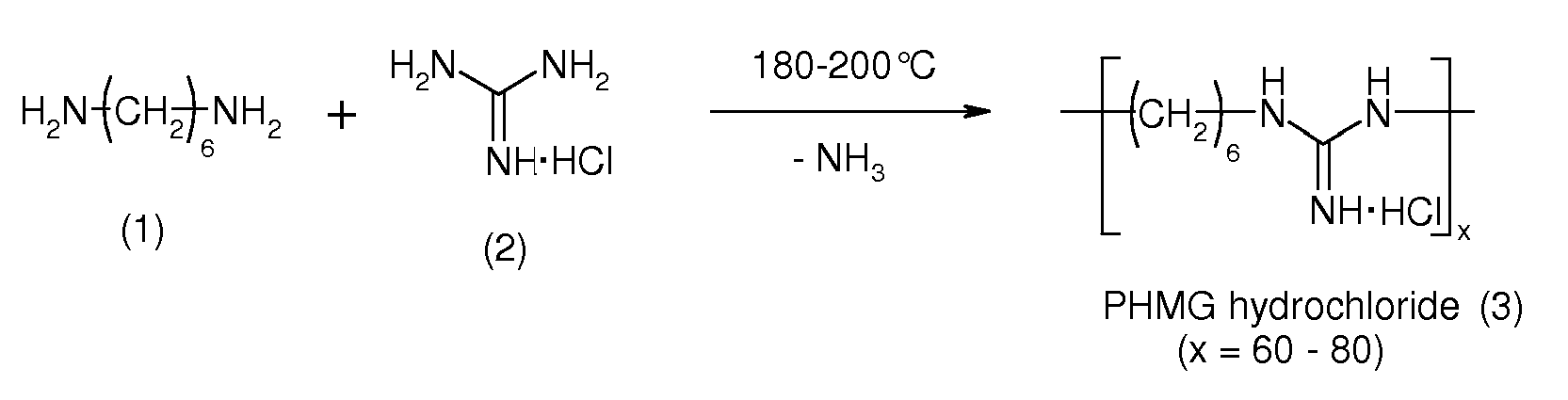
- PHMG-DBS (5) was prepared according to the following schemes:
- Guanidine hydrochloride, hexamethylenediamine, sodium dodecylbenzenesulfonate were supplied from Aldrich.
- 40.0 g (0.41 mol) of guanidine hydrochloride (2) and 45.8 g (0.39 mol) of hexamethylenediamine (1) were placed into a round-bottomed flask equipped with inside thermometer and arm stirrer. The reaction mixture was stirred and heated for 4 hours at 140°C, followed by 10 hours at 180°C, as long as ammonia formation took place. Residual ammonia was removed from the final product by vacuum distillation at 180°C. Hot melt of PHMG hydrochloride (3) was placed in a porcelain mortar and formed a vitreous solid when cooled.
- Intrinsic viscosity value of 0.07 dl/g was obtained for PHMG hydrochloride solution in 0.1 M NaCl at 25°C.
- Elemental analysis: (C7H16N3Cl)x (177.5)x: Calculated: C 47.4, H 9.1, N 23.8, Cl 19.8; Found: C 47.3; H 9.0; N 23.6; Cl 20.0.
- IR cm-1 (KBr): 3240 (-C=N-H, v), 2920, 2860 (-CH2, v), 1650 (-C=N, v), 1470 (-CH2, d).

- PHMG hydrochloride (3) (15.0 g, 0.084 mol) was dissolved into 120 ml of ethanol. Sodium dodecylbenzenesulfonate (4) (29.6 g, 0.085 mol) was added to the solution and it was stirred for 4 hours at 50-60°C. The precipitate of sodium chloride was filtered off and the filtrate was poured into water. White dough formed, which was separated by decantation and washed with water. This product was dried at 120°C. After cooling, the resulting fragile solid was finally pounded.
- The obtained PHMG-DBS polymer (5) has a melting temperature region of 115-120°C. It is soluble in low alcohols but insoluble in hydrocarbon solvents and most common organic solvents.
- Elemental analysis: (C25H45N3O3S)x (467)x: Calculated: C 64.2; H 9.6; N 9.0; S 6.8; Found: C 64.7, 64.4; H 9.5, 9.8; N 9.4, 9.2; S 6.9, 6.6.
- Raman analysis: broad bands between 3130-3500 cm-1 attributed to OH and NH2 stretch vibrations. The aromatic C-H stretching Raman band appears clearly at 3069 cm-1; whereas, the C-H symmetric stretches of aliphatic appear at 2864, 2911 and 2930 cm-1, respectively. Broad bands between 1530 and 1650 cm-1 corresponding mainly to CC in plane stretching mode of the aromatic moieties and to NH scissoring vibrations. Bands between 1350 and 1480 cm-1 are assigned to bending vibrations of CH2 and CH3 groups of the alkyl chains. The bands observed between 800 and 1200 cm-1 are related to ring vibration and indicative of CNC stretching modes.
- According to thermogravimetric analysis data, PHMG-DBS is thermally stable to at least 350°C.
- PHMG-DBS-Cl (6) was prepared according to the following scheme:

- PHMG hydrochloride (3) (15.0 g, 0.084 mol) was dissolved into 70 ml of water. A solution of sodium dodecylbenzenesulfonate (4) (30.0 g, 0.086 mol) in 200 ml of water was added while stirring. White dough formed, which was separated by decantation, washed with water and separated again by decantation. This product was dried at 110°C. After cooling, the resulting fragile solid was finally pounded.
- The obtained PHMG-DBS-Cl polymer (6) has a melting temperature region of 125-130°C. Elemental analysis: (C26.75H49N3.75O3SCI0.25)x (476.5)x: Found: C 67.3; H 10.3; N 11.0; S 6.7; Cl 1.8.
- Thus, on the basis of elemental analysis, the ratio (S:Cl) is around (4:1), and prepared PHMG-DBS-Cl salt can be described by following formula:

- According to thermogravimetric analysis data, the thermal decomposition point of PHMG-DBS-Cl is 290°C.
- PHMG-NS (8) was prepared according to the following scheme:

- PHMG hydrochloride (3) (25.0 g, 0.14 mol) and sodium salt of naphthalene-2-sulfonic acid (7) (32.5 g, 0.14 mol) were dissolved into 150 ml of N,N-dimethylformamide. The precipitate of sodium chloride (7.8 g, 0.134 mol) was filtered off. The filtrate was poured into 400 ml of water and a solid precipitated. The product was filtered, washed with water and dried in vacuum at 90°C. The salt can be easily pounded to obtain a fine white powder.
- The obtained PHMG-NS polymer (8) has a melting temperature region of 120-134°C. Elemental analysis: (C17H23N3O3S)x (349)x: Calculated: C 58.4; H 6.6; N 12.0; S 9.2; Found: C 58.1, 58.3; H 6.5, 6.8; N 11.7, 12.2; S 9.1, 9.5.
- According to thermogravimetric analysis data, the thermal decomposition point of PHMG-NS is 340 °C.
- PHMG-TS (11) was prepared according to the following schemes:

- Guanidine hydrochloride (2) (20.0 g, 0.21 mol) and p-toluenesulfonic acid sodium salt (9) (40.7 g, 0.21 mol) were dissolved into water (200 ml) and the solution was cooled to 0-5°C. The white precipitate of guanidine toluenesulfonate (10) was filtered off and dried at 120°C.
- Yield: 44 g (91%). Melting point: 120°C.
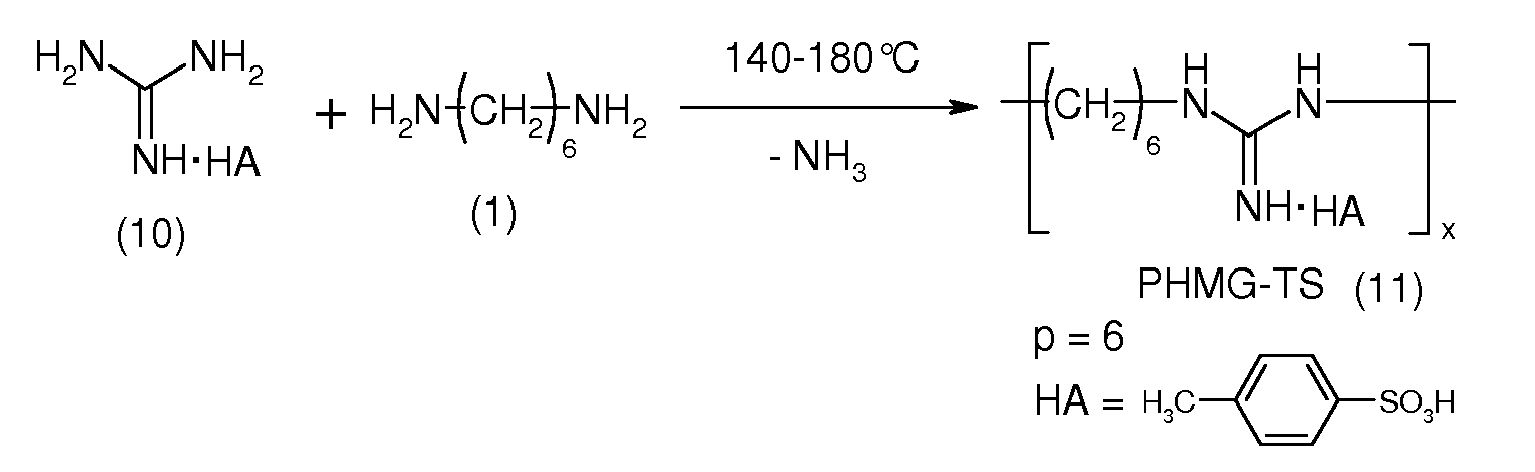
- A mixture of guanidine toluenesulfonate (10) (30.0 g, 0.13 mol) and hexamethylenediamine (1) (14.3 g, 0.12 mol) was stirred and heated for 4 hours at 130-140°C, followed by 8 hours at 170-180°C under atmospheric pressure and 2 hours at reduced pressure (10 mm Hg). A vitreous transparent solid was obtained when reactionary melt cooled. The mixture was dissolved in ethanol (200 ml) at 50-60°C and then poured into water (300 ml). White dough formed, which was separated by decantation and washed few times with water. This product was dried at 120°C. After cooling, the resulting fragile solid was finally pounded.
- The obtained PHMG-TS polymer (11) has a melting temperature region of 112-115°C. The melt viscosity determined with the help of Brookfield DV-III Ultra Rheometer (200°C, shear rate 1 s-1) was found to be 15 000 cP.
- The product is soluble in low alcohols but insoluble in hydrocarbon solvents and most common organic solvents.
- Elemental analysis: (C14H23N3O3S)x (313)x: Calculated: C 53.6; H 7.3; N 13.4; S 10.2; Found: C 53.2, 53.5; H 7.5, 7.2; N 13.7, 13.5; S 10.4, 10.2.
- According to thermogravimetric analysis data, the thermal decomposition point of PHMG-TS is 310°C.
- Three different transparent films of polyamide PA-11-PHMG-DBS-Cl (45x45 mm, thickness 5 µm) were obtained by compression molding at 240°C of the mixture comprising 99% (98.5% and 98% respectively) by weight of Rilsan 11 powder (Arkema) and 1% (1.5% and 2% respectively) by weight of PHMG-DBS-Cl powder.
- Three different films of polyamide PA-12-PHMG-DBS were obtained by compression molding at 240°C of the mixture comprising 99% (98.5% and 98% respectively) by weight of polyamide PA-12 powder UBESTA P3014U (UBE Industries) and 1% (1.5% and 2% respectively) by weight of PHMG-DBS powder.
- Thermal analysis data indicate that when PHMG-DBS is introduced (2% by weight) the thermal stability of PA-12 is improved by at least 20°C. Thus, virgin PA-12 begins to decompose at 380°C, while the thermal decomposition point of PA-12-PHMG-DBS was detected at 400 °C.
- Fungal strains Trichophyton mentagrophytes and Candida albicans were cultivated for antimicrobial testing of composite films. Water suspensions of bacterial cultures were prepared in a concentration of 2.109 CFU/ml. Liquid Saburo's agar was prepared in Petri dishes. Polyamide films containing antimicrobial PHMG salts were placed into the medium inoculated with fungal spore suspension when agar hardened.
- Polymeric films surfaces were covered by equal volumes of microbe suspensions (0.3 ml) followed by placement into thermostatically controlled (30°C) chamber during 72 hours. Then the samples were taken out from the chamber and kept in dark box at room temperature. Results control was carried out for 30 days.
Table 1 - Microbiological investigations of PA-PHMG-DBS films microbe Film composition %PHMG salts (wt.) C. albicans T. mentagrophytes PA-11 / + + PA-12 / + + 1% + + PA-11-PHMG-DBS-Cl 1.5% + + 2% - - 1% + + PA-12-PHMG-DBS 1.5% + + 2% - - + (continuous fungal growth)
- (no fungal growth) - On one hand, continuous fungal growth was observed on PA-11 and PA-12 control films and on films containing 1% or 1.5% by weight of both PHMG-DBS and PHMG-DBS-Cl. On the other hand, there was no bacterial growth on the surfaces of PA films containing 2% by weight of the said biocides.
- In all cases intensive growth of bacterial colonies was observed in agar medium outside films surfaces. Thus, PHMG salts used can be characterized as biocides of contact action. Similar results were obtained on E. Coli bacteria. There was no bacterial growth on the surfaces of PA-12-PHMG-DBS films containing 1.5% by weight of PHMG-DBS.
- Three transparent films of poly(vinylidene)fluoride (PVDF) Kynar 1000 (Arkema, France), comprising PHMG-TS as antimicrobial additive were obtained by compression molding at 220°C of the mixture comprising 99% (98.5% and 98% respectively) by weight of Kynar 1000 powder and 1% (1.5% and 2% respectively) by weight of PHMG-TS powder. Microbiological investigations were performed using the method described in Example 6 (Trichophyton mentagrophytes, Candida albicans and E. Coli).
- Continuous fungal growth was observed on the PVDF control films, while there was no bacterial growth on the surfaces of PVDF films containing 1% by weight of PHMG-TS.
Claims (10)
- A composition comprising a polymer and a poly(polymethylene)guanidine (PpMG) salt of general formula (I):
 - n is comprised from 10 to 140;- m is comprised from 0 to 35;- p is comprised from 2 to 12; and- HA is a sulfonic acid.
 - The composition according to claim 1, wherein HA is selected from the sulfonic acids consisting of:- sulfonic acids of formula RSO3H, whereR is selected from the group consisting of an alkyl group, a CH(COOR3)CH2COOR3 group, a perchloroalkyl group, a perfluoroalkyl group, a pentachlorophenyl group or a pentafluorophenyl group; orR represents (CH2)qR1, whereq is comprised from 1 to 4, andR1 is selected from the group consisting of a phenyl group, a NHR2 group and a COOR3 group whereR2 is selected from the group consisting of C6H4(COOR4), C6H3(OH)(COOR4), C6H4(OR4), C6H4(R4), SO2C6H5, SO2C6H4R4, SO2C6H4OR4, C6H4SO2NH2, C6H4SO2NHR4 and COR5, whereR3 and R4 represent independently an alkyl group;R5 represents an alkyl group or a phenyl group;- sulfonic acids of formula (II), where
 R6 is selected from the group consisting of H, an halogen, an alkyl group, N(R7)2 and NR7R8, whereR7 represents H or an alkyl group,R8 represents a phenyl group or a COR9 group, whereR9 is selected from the group consisting of an alkyl group, a phenyl group, a SO2C6H4R10 group and a SO2C6H4OR10 group, whereR10 represents H or an alkyl group,R11 is selected from the group consisting of H, an halogen, an alkyl group, a OR12 group, a NHR12 group and a COOR12 group, whereR12 represents H or an alkyl group,R13 is selected from the group consisting of H, an halogen, alkyl, hydroxyl, alkoxy and phenyloxy group; and- sulfonic acids of formula (III) where
 R14 represents H or SO3H,R15 represents a N(R16)2 group or a NR16R17 group, whereR16 represents H or an alkyl group,R17 represents a COR18 group, whereR18 is selected from the group consisting of an alkyl group, a phenyl group, a SO2C6H4R19 group and a SO2C6H4OR19 group whereR19 represents H or an alkyl group,R20 represents H or a SO3H,provided that at least one of R14 and R20 represents SO3H.
 - The composition according to any one of claims 1 or 2, wherein p is 6, HA is selected from dodecylbenzenesulfonic acid and naphthalene-2-sulfonic acid, and the polymer comprises at least one polyamide, selected from PA-6, PA-6,6, PA-6,10, PA-6,12, PA-10,10, PA-11 and PA-12, preferably selected from PA-11 and PA-12.
- The composition according to any one of claims 1 or 2, wherein p is 6, HA is p-toluenesulfonic acid and the polymer is polyvinylidene fluoride (PVDF).
- The composition according to any one of claims 1 to 4, comprising from 75% to 99% by weight of polymer and from 1% to 5% by weight of PpMG salts, preferably from 1% to 2%.
- The composition according to claim 5, which also comprises a plasticizer.
- The composition according to claim 6, which comprises less than 20% by weight of the plasticizer.
- A method of preparation of a composition according to any one of claims 1 to 5, as a powder, comprising the mechanical blending of the polymer and PpMG salts at room temperature.
- A method of preparation of the composition according to claim 6 or 7, as a plasticized polymeric composition, comprising the melt blending of the polymer, the plasticizer and PpMG salts at a temperature comprised from 220°C to 280°C, preferably from 240°C to 260°C.
- A method of coating an article with a film of a composition according to any one of claims 1 to 5, as a powder, comprising the following steps :(a) placing the powder composition in a fluidized bed;(b) heating the article to be coated to a temperature of the surface of said article comprised from 260°C to 300°C; and(c) dipping the heated article into the fluidized bed to form a film onto said article.
Priority Applications (2)
| Application Number | Priority Date | Filing Date | Title |
|---|---|---|---|
| EP10305435A EP2386589A1 (en) | 2010-04-23 | 2010-04-23 | Novel antimicrobial composition, use and preparation thereof |
| PCT/EP2011/056470 WO2011131773A1 (en) | 2010-04-23 | 2011-04-21 | Novel antimicrobial composition, use and preparation thereof |
Applications Claiming Priority (1)
| Application Number | Priority Date | Filing Date | Title |
|---|---|---|---|
| EP10305435A EP2386589A1 (en) | 2010-04-23 | 2010-04-23 | Novel antimicrobial composition, use and preparation thereof |
Publications (1)
| Publication Number | Publication Date |
|---|---|
| EP2386589A1 true EP2386589A1 (en) | 2011-11-16 |
Family
ID=42237228
Family Applications (1)
| Application Number | Title | Priority Date | Filing Date |
|---|---|---|---|
| EP10305435A Withdrawn EP2386589A1 (en) | 2010-04-23 | 2010-04-23 | Novel antimicrobial composition, use and preparation thereof |
Country Status (2)
| Country | Link |
|---|---|
| EP (1) | EP2386589A1 (en) |
| WO (1) | WO2011131773A1 (en) |
Cited By (1)
| Publication number | Priority date | Publication date | Assignee | Title |
|---|---|---|---|---|
| RU2489452C1 (en) * | 2012-04-26 | 2013-08-10 | Общество с ограниченной ответственностью "Компания Вереск" | Method of producing polyhexamethylene guanidine hydrochloride |
Families Citing this family (4)
| Publication number | Priority date | Publication date | Assignee | Title |
|---|---|---|---|---|
| FR3006149B1 (en) | 2013-05-28 | 2016-05-27 | Univ Maine | ANTIMICROBIAL COMPOSITION BASED ON SILICONE |
| WO2017182536A1 (en) * | 2016-04-20 | 2017-10-26 | Ineos Styrolution Group Gmbh | Antimicrobially active, non-leaching thermoplastic molding compounds |
| EP3381967A1 (en) | 2017-03-28 | 2018-10-03 | Thomas Flechsig | Homogeneous poly(alkylene) guanidines and method for their preparation |
| CN113817162A (en) * | 2021-09-17 | 2021-12-21 | 河北亮能生物科技有限公司 | Antibacterial hydrophobic polymer and preparation method and application thereof |
Citations (20)
| Publication number | Priority date | Publication date | Assignee | Title |
|---|---|---|---|---|
| US4282366A (en) | 1979-11-06 | 1981-08-04 | International Paper Company | Organosilicon quaternary ammonium antimicrobial compounds |
| US4816163A (en) | 1986-07-23 | 1989-03-28 | Betz Laboratories, Inc. | Method for controlling macroinvertebrates |
| US4906385A (en) | 1986-07-23 | 1990-03-06 | Betz Laboratories, Inc. | Method for controlling macroinvertebrates |
| JPH04225945A (en) | 1990-05-15 | 1992-08-14 | Yoshitomi Pharmaceut Ind Ltd | Poorly water-soluble salt of dodecylguanidine and its use |
| US5416210A (en) | 1991-01-03 | 1995-05-16 | Rohm And Haas Company | Antimicrobial polymeric quaternary ammonium salts |
| RU2039735C1 (en) | 1993-04-29 | 1995-07-20 | Петр Александрович Гембицкий | Method of preparing disinfecting agent |
| RU2052453C1 (en) | 1993-08-24 | 1996-01-20 | Петр Александрович Гембицкий | Method for production of disinfectant |
| WO1999031036A2 (en) | 1997-12-12 | 1999-06-24 | Ciba Specialty Chemicals Holding Inc. | O-derivatives of halogenated diphenyl ether compounds |
| EP0987946A1 (en) | 1997-06-13 | 2000-03-29 | Avecia Limited | Biocidal organic acid salts of a polymeric biguanide |
| EP1110948A2 (en) | 1999-12-20 | 2001-06-27 | SK Corporation | Polyhexamethyleneguanidine phosphate powder, method of making the same and antimicrobial resin containing the same |
| RU2181737C2 (en) | 1998-03-31 | 2002-04-27 | ТОО "Экотех" (ЛТД.) | Bactericidal composition for covers |
| JP2002235282A (en) | 2001-02-09 | 2002-08-23 | Daiwa Kagaku Kogyo Kk | Antibacterial fiber |
| RU2190648C1 (en) | 2001-10-15 | 2002-10-10 | Ооо "Эвима-М" | Epoxide composition for biocidal covering |
| US6465412B1 (en) | 2002-03-21 | 2002-10-15 | Colgate-Palmolive Co. | Antimicrobial scale cleaning composition comprising polyhexamethylene biquanide hydrochloride |
| US20020177627A1 (en) | 2000-04-13 | 2002-11-28 | Rhocraft Research Development, Ltd. | Microbiocidal properties of poly-substituted guanidinium salts |
| WO2004071537A2 (en) | 2003-02-15 | 2004-08-26 | Eradibac Limited | Additive for imparting bactericidal and antimicrobial properties to a material |
| RU2236428C1 (en) | 2002-12-10 | 2004-09-20 | Левичев Александр Николаевич | Composition for coating disinfecting indoor air |
| US20050170001A1 (en) | 2003-12-05 | 2005-08-04 | Adrien Lapeyre | Polyamide-based powder and its use for obtaining an antibacterial coating |
| US20060137566A1 (en) * | 2002-10-24 | 2006-06-29 | Kyung-Wook Yang | Antifouling paint composition |
| US20080003434A1 (en) * | 2006-02-17 | 2008-01-03 | Kaneka Corporation : | Artificial hair fiber, artificial hair fiber bundle, hair decorative product, and a process for a preparation of an artificial hair fiber |
Family Cites Families (1)
| Publication number | Priority date | Publication date | Assignee | Title |
|---|---|---|---|---|
| JP4225945B2 (en) | 2004-05-17 | 2009-02-18 | 富士高分子工業株式会社 | Thermally conductive sheet |
-
2010
- 2010-04-23 EP EP10305435A patent/EP2386589A1/en not_active Withdrawn
-
2011
- 2011-04-21 WO PCT/EP2011/056470 patent/WO2011131773A1/en not_active Ceased
Patent Citations (21)
| Publication number | Priority date | Publication date | Assignee | Title |
|---|---|---|---|---|
| US4282366A (en) | 1979-11-06 | 1981-08-04 | International Paper Company | Organosilicon quaternary ammonium antimicrobial compounds |
| US4816163A (en) | 1986-07-23 | 1989-03-28 | Betz Laboratories, Inc. | Method for controlling macroinvertebrates |
| US4906385A (en) | 1986-07-23 | 1990-03-06 | Betz Laboratories, Inc. | Method for controlling macroinvertebrates |
| JPH04225945A (en) | 1990-05-15 | 1992-08-14 | Yoshitomi Pharmaceut Ind Ltd | Poorly water-soluble salt of dodecylguanidine and its use |
| US5416210A (en) | 1991-01-03 | 1995-05-16 | Rohm And Haas Company | Antimicrobial polymeric quaternary ammonium salts |
| RU2039735C1 (en) | 1993-04-29 | 1995-07-20 | Петр Александрович Гембицкий | Method of preparing disinfecting agent |
| RU2052453C1 (en) | 1993-08-24 | 1996-01-20 | Петр Александрович Гембицкий | Method for production of disinfectant |
| EP0987946A1 (en) | 1997-06-13 | 2000-03-29 | Avecia Limited | Biocidal organic acid salts of a polymeric biguanide |
| US20020142020A1 (en) * | 1997-06-13 | 2002-10-03 | Peter Woollven | Biocidal organic acid salts of a polymeric biguanide |
| WO1999031036A2 (en) | 1997-12-12 | 1999-06-24 | Ciba Specialty Chemicals Holding Inc. | O-derivatives of halogenated diphenyl ether compounds |
| RU2181737C2 (en) | 1998-03-31 | 2002-04-27 | ТОО "Экотех" (ЛТД.) | Bactericidal composition for covers |
| EP1110948A2 (en) | 1999-12-20 | 2001-06-27 | SK Corporation | Polyhexamethyleneguanidine phosphate powder, method of making the same and antimicrobial resin containing the same |
| US20020177627A1 (en) | 2000-04-13 | 2002-11-28 | Rhocraft Research Development, Ltd. | Microbiocidal properties of poly-substituted guanidinium salts |
| JP2002235282A (en) | 2001-02-09 | 2002-08-23 | Daiwa Kagaku Kogyo Kk | Antibacterial fiber |
| RU2190648C1 (en) | 2001-10-15 | 2002-10-10 | Ооо "Эвима-М" | Epoxide composition for biocidal covering |
| US6465412B1 (en) | 2002-03-21 | 2002-10-15 | Colgate-Palmolive Co. | Antimicrobial scale cleaning composition comprising polyhexamethylene biquanide hydrochloride |
| US20060137566A1 (en) * | 2002-10-24 | 2006-06-29 | Kyung-Wook Yang | Antifouling paint composition |
| RU2236428C1 (en) | 2002-12-10 | 2004-09-20 | Левичев Александр Николаевич | Composition for coating disinfecting indoor air |
| WO2004071537A2 (en) | 2003-02-15 | 2004-08-26 | Eradibac Limited | Additive for imparting bactericidal and antimicrobial properties to a material |
| US20050170001A1 (en) | 2003-12-05 | 2005-08-04 | Adrien Lapeyre | Polyamide-based powder and its use for obtaining an antibacterial coating |
| US20080003434A1 (en) * | 2006-02-17 | 2008-01-03 | Kaneka Corporation : | Artificial hair fiber, artificial hair fiber bundle, hair decorative product, and a process for a preparation of an artificial hair fiber |
Non-Patent Citations (1)
| Title |
|---|
| M. K. OUL6 ET AL.: "Poly(hexamethylene)guanidine hydrochloride-based disinfectant: a novel tool to fight meticillin-resistant Staphylococcus aureus and nosocomial infections", JOURNAL OF MEDICAL MICROBIOLOGY, vol. 57, 2006, pages 1523 - 1528 |
Cited By (1)
| Publication number | Priority date | Publication date | Assignee | Title |
|---|---|---|---|---|
| RU2489452C1 (en) * | 2012-04-26 | 2013-08-10 | Общество с ограниченной ответственностью "Компания Вереск" | Method of producing polyhexamethylene guanidine hydrochloride |
Also Published As
| Publication number | Publication date |
|---|---|
| WO2011131773A1 (en) | 2011-10-27 |
Similar Documents
| Publication | Publication Date | Title |
|---|---|---|
| US9992996B2 (en) | Bioactive aniline copolymers | |
| US6440405B1 (en) | Quaternary ammonium functionalized dendrimers and methods of use therefor | |
| JP6445430B2 (en) | Curable antibacterial composition | |
| EP2386589A1 (en) | Novel antimicrobial composition, use and preparation thereof | |
| US20120259064A1 (en) | Polymeric or Oligomeric Active Ingredients Having a Biocidal Effect, Method for the Production Thereof, and Composition Comprising a Polymeric or Oligomeric Active Ingredient | |
| JPH10512273A (en) | Composition and use | |
| US10709130B2 (en) | Clickable antimicrobial molecules and polymers | |
| CN115175968B (en) | Antimicrobial polymer composition | |
| Rogalsky et al. | Antimicrobial properties and thermal stability of polycarbonate modified with 1‐alkyl‐3‐methylimidazolium tetrafluoroborate ionic liquids | |
| Cao et al. | Synthesis of non-water soluble polymeric guanidine derivatives and application in preparation of antimicrobial regenerated cellulose | |
| CN101123953B (en) | Conversion of conventional, commercially important polymers into durable, refillable antimicrobial polymeric materials | |
| CN113929892B (en) | A kind of metal-containing high-efficiency cationic antibacterial polymer and its preparation method and application | |
| CN112080011B (en) | Dendritic macromolecule quaternary ammonium salt compound and preparation method and application thereof | |
| US20160106104A1 (en) | Silicone-based antimicrobial composition | |
| CN116284758B (en) | Intrinsic antibacterial nylon and preparation method and application thereof | |
| US20030032768A1 (en) | Double end-capped polymeric biguanides | |
| JPH04264003A (en) | Poly-p-hydroxystyrene derivative-based antimicrobial and mildewproofing agent containing nitrogen-containing substituent group | |
| US20240367115A1 (en) | Reverse osmosis composite membrane | |
| CN120383820A (en) | An antibacterial nylon 6 material and its preparation method and application | |
| KR102948047B1 (en) | Graft Modified Polymer and method of preparing thereof | |
| JP2010195949A5 (en) | ||
| JP3178557B2 (en) | Homopolymer and method for producing the same | |
| CN119735925A (en) | A PET antibacterial material and its preparation method and application | |
| JP2000344611A (en) | Antimicrobial / antifungal / antistatic composition and antimicrobial / antifungal / antistatic resin composition | |
| JPH04312503A (en) | Poly-p-hydroxystyrene derivative antibacterial/antifungal agent having dialkylaminomethyl group |
Legal Events
| Date | Code | Title | Description |
|---|---|---|---|
| AK | Designated contracting states |
Kind code of ref document: A1 Designated state(s): AT BE BG CH CY CZ DE DK EE ES FI FR GB GR HR HU IE IS IT LI LT LU LV MC MK MT NL NO PL PT RO SE SI SK SM TR |
|
| AX | Request for extension of the european patent |
Extension state: AL BA ME RS |
|
| PUAI | Public reference made under article 153(3) epc to a published international application that has entered the european phase |
Free format text: ORIGINAL CODE: 0009012 |
|
| 17P | Request for examination filed |
Effective date: 20120418 |
|
| STAA | Information on the status of an ep patent application or granted ep patent |
Free format text: STATUS: THE APPLICATION IS DEEMED TO BE WITHDRAWN |
|
| 18D | Application deemed to be withdrawn |
Effective date: 20120517 |