EP2380936A2 - Neues TIO2-Material und damit durchgeführte Beschichtungsverfahren - Google Patents
Neues TIO2-Material und damit durchgeführte Beschichtungsverfahren Download PDFInfo
- Publication number
- EP2380936A2 EP2380936A2 EP11173887A EP11173887A EP2380936A2 EP 2380936 A2 EP2380936 A2 EP 2380936A2 EP 11173887 A EP11173887 A EP 11173887A EP 11173887 A EP11173887 A EP 11173887A EP 2380936 A2 EP2380936 A2 EP 2380936A2
- Authority
- EP
- European Patent Office
- Prior art keywords
- titanium dioxide
- coating
- oxidation material
- crystals
- photocatalytic oxidation
- Prior art date
- Legal status (The legal status is an assumption and is not a legal conclusion. Google has not performed a legal analysis and makes no representation as to the accuracy of the status listed.)
- Withdrawn
Links
- 239000000463 material Substances 0.000 title claims abstract description 42
- 238000000576 coating method Methods 0.000 title claims description 91
- GWEVSGVZZGPLCZ-UHFFFAOYSA-N Titan oxide Chemical compound O=[Ti]=O GWEVSGVZZGPLCZ-UHFFFAOYSA-N 0.000 claims abstract description 528
- 239000004408 titanium dioxide Substances 0.000 claims abstract description 259
- 239000013078 crystal Substances 0.000 claims abstract description 80
- XLYOFNOQVPJJNP-UHFFFAOYSA-N water Substances O XLYOFNOQVPJJNP-UHFFFAOYSA-N 0.000 claims abstract description 39
- 125000002887 hydroxy group Chemical group [H]O* 0.000 claims abstract description 38
- 239000002202 Polyethylene glycol Substances 0.000 claims abstract description 34
- 239000002270 dispersing agent Substances 0.000 claims abstract description 34
- 229920001223 polyethylene glycol Polymers 0.000 claims abstract description 34
- 230000001699 photocatalysis Effects 0.000 claims abstract description 22
- 238000007254 oxidation reaction Methods 0.000 claims abstract description 19
- 238000002329 infrared spectrum Methods 0.000 claims abstract description 18
- 238000010521 absorption reaction Methods 0.000 claims abstract description 17
- 230000003647 oxidation Effects 0.000 claims abstract description 15
- 239000011248 coating agent Substances 0.000 claims description 74
- 238000000034 method Methods 0.000 claims description 43
- 239000000758 substrate Substances 0.000 claims description 29
- 230000008569 process Effects 0.000 claims description 26
- 239000000203 mixture Substances 0.000 claims description 18
- 238000011282 treatment Methods 0.000 claims description 18
- LFQSCWFLJHTTHZ-UHFFFAOYSA-N Ethanol Chemical compound CCO LFQSCWFLJHTTHZ-UHFFFAOYSA-N 0.000 claims description 14
- GRYLNZFGIOXLOG-UHFFFAOYSA-N Nitric acid Chemical compound O[N+]([O-])=O GRYLNZFGIOXLOG-UHFFFAOYSA-N 0.000 claims description 9
- 229910017604 nitric acid Inorganic materials 0.000 claims description 9
- 239000002243 precursor Substances 0.000 claims description 9
- 238000001354 calcination Methods 0.000 claims description 5
- 239000010931 gold Substances 0.000 claims description 5
- 229910052737 gold Inorganic materials 0.000 claims description 5
- 230000003301 hydrolyzing effect Effects 0.000 claims description 4
- PCHJSUWPFVWCPO-UHFFFAOYSA-N gold Chemical compound [Au] PCHJSUWPFVWCPO-UHFFFAOYSA-N 0.000 claims description 2
- 230000007480 spreading Effects 0.000 claims description 2
- 238000003892 spreading Methods 0.000 claims description 2
- 239000000523 sample Substances 0.000 description 53
- 229920000642 polymer Polymers 0.000 description 29
- 239000000725 suspension Substances 0.000 description 26
- 239000012855 volatile organic compound Substances 0.000 description 25
- 239000000843 powder Substances 0.000 description 20
- 229910052782 aluminium Inorganic materials 0.000 description 18
- XAGFODPZIPBFFR-UHFFFAOYSA-N aluminium Chemical compound [Al] XAGFODPZIPBFFR-UHFFFAOYSA-N 0.000 description 18
- 238000002441 X-ray diffraction Methods 0.000 description 17
- CSCPPACGZOOCGX-UHFFFAOYSA-N Acetone Chemical compound CC(C)=O CSCPPACGZOOCGX-UHFFFAOYSA-N 0.000 description 16
- KFZMGEQAYNKOFK-UHFFFAOYSA-N Isopropanol Chemical compound CC(C)O KFZMGEQAYNKOFK-UHFFFAOYSA-N 0.000 description 16
- 230000009102 absorption Effects 0.000 description 13
- 238000012360 testing method Methods 0.000 description 13
- 238000003618 dip coating Methods 0.000 description 11
- 239000007789 gas Substances 0.000 description 11
- 239000003054 catalyst Substances 0.000 description 10
- 239000007788 liquid Substances 0.000 description 10
- 238000004626 scanning electron microscopy Methods 0.000 description 10
- CURLTUGMZLYLDI-UHFFFAOYSA-N Carbon dioxide Chemical compound O=C=O CURLTUGMZLYLDI-UHFFFAOYSA-N 0.000 description 9
- 238000012512 characterization method Methods 0.000 description 9
- 238000006243 chemical reaction Methods 0.000 description 9
- 230000006870 function Effects 0.000 description 9
- 230000002070 germicidal effect Effects 0.000 description 9
- IJGRMHOSHXDMSA-UHFFFAOYSA-N Atomic nitrogen Chemical compound N#N IJGRMHOSHXDMSA-UHFFFAOYSA-N 0.000 description 8
- 238000001237 Raman spectrum Methods 0.000 description 8
- 230000002776 aggregation Effects 0.000 description 8
- 238000004220 aggregation Methods 0.000 description 8
- 229910001220 stainless steel Inorganic materials 0.000 description 8
- 239000010935 stainless steel Substances 0.000 description 8
- 241000233866 Fungi Species 0.000 description 7
- 238000001069 Raman spectroscopy Methods 0.000 description 7
- 239000008367 deionised water Substances 0.000 description 7
- 229910021641 deionized water Inorganic materials 0.000 description 7
- 238000007669 thermal treatment Methods 0.000 description 7
- 241000894006 Bacteria Species 0.000 description 6
- OKTJSMMVPCPJKN-UHFFFAOYSA-N Carbon Chemical compound [C] OKTJSMMVPCPJKN-UHFFFAOYSA-N 0.000 description 6
- 238000005033 Fourier transform infrared spectroscopy Methods 0.000 description 6
- 238000004833 X-ray photoelectron spectroscopy Methods 0.000 description 6
- 230000002378 acidificating effect Effects 0.000 description 6
- 229910002092 carbon dioxide Inorganic materials 0.000 description 6
- 125000003178 carboxy group Chemical group [H]OC(*)=O 0.000 description 6
- PBAYDYUZOSNJGU-UHFFFAOYSA-N chelidonic acid Natural products OC(=O)C1=CC(=O)C=C(C(O)=O)O1 PBAYDYUZOSNJGU-UHFFFAOYSA-N 0.000 description 6
- 239000011538 cleaning material Substances 0.000 description 6
- 238000005286 illumination Methods 0.000 description 6
- 150000002576 ketones Chemical class 0.000 description 6
- 239000010410 layer Substances 0.000 description 6
- 238000004519 manufacturing process Methods 0.000 description 6
- 239000002245 particle Substances 0.000 description 6
- VXUYXOFXAQZZMF-UHFFFAOYSA-N titanium(IV) isopropoxide Chemical compound CC(C)O[Ti](OC(C)C)(OC(C)C)OC(C)C VXUYXOFXAQZZMF-UHFFFAOYSA-N 0.000 description 6
- 238000002425 crystallisation Methods 0.000 description 5
- 230000008025 crystallization Effects 0.000 description 5
- 238000010586 diagram Methods 0.000 description 5
- 238000001035 drying Methods 0.000 description 5
- 239000011521 glass Substances 0.000 description 5
- 238000004375 physisorption Methods 0.000 description 5
- 238000005070 sampling Methods 0.000 description 5
- 238000000527 sonication Methods 0.000 description 5
- 239000010936 titanium Substances 0.000 description 5
- XKRFYHLGVUSROY-UHFFFAOYSA-N Argon Chemical compound [Ar] XKRFYHLGVUSROY-UHFFFAOYSA-N 0.000 description 4
- 238000001157 Fourier transform infrared spectrum Methods 0.000 description 4
- RTAQQCXQSZGOHL-UHFFFAOYSA-N Titanium Chemical compound [Ti] RTAQQCXQSZGOHL-UHFFFAOYSA-N 0.000 description 4
- 230000003197 catalytic effect Effects 0.000 description 4
- 229910052757 nitrogen Inorganic materials 0.000 description 4
- 238000011056 performance test Methods 0.000 description 4
- 229910052719 titanium Inorganic materials 0.000 description 4
- 244000063299 Bacillus subtilis Species 0.000 description 3
- 235000014469 Bacillus subtilis Nutrition 0.000 description 3
- 229920002565 Polyethylene Glycol 400 Polymers 0.000 description 3
- 241000589517 Pseudomonas aeruginosa Species 0.000 description 3
- 238000001530 Raman microscopy Methods 0.000 description 3
- 241000191963 Staphylococcus epidermidis Species 0.000 description 3
- 238000004458 analytical method Methods 0.000 description 3
- 239000001569 carbon dioxide Substances 0.000 description 3
- 230000015556 catabolic process Effects 0.000 description 3
- 238000002447 crystallographic data Methods 0.000 description 3
- 238000006731 degradation reaction Methods 0.000 description 3
- 238000002474 experimental method Methods 0.000 description 3
- 239000000499 gel Substances 0.000 description 3
- 230000007062 hydrolysis Effects 0.000 description 3
- 238000006460 hydrolysis reaction Methods 0.000 description 3
- 150000002484 inorganic compounds Chemical class 0.000 description 3
- 229910010272 inorganic material Inorganic materials 0.000 description 3
- 239000010445 mica Substances 0.000 description 3
- 229910052618 mica group Inorganic materials 0.000 description 3
- 230000009467 reduction Effects 0.000 description 3
- 150000003839 salts Chemical class 0.000 description 3
- 238000001878 scanning electron micrograph Methods 0.000 description 3
- 239000002356 single layer Substances 0.000 description 3
- 238000001228 spectrum Methods 0.000 description 3
- 239000006150 trypticase soy agar Substances 0.000 description 3
- 238000005406 washing Methods 0.000 description 3
- RZVAJINKPMORJF-UHFFFAOYSA-N Acetaminophen Chemical compound CC(=O)NC1=CC=C(O)C=C1 RZVAJINKPMORJF-UHFFFAOYSA-N 0.000 description 2
- 241000258240 Mantis religiosa Species 0.000 description 2
- 239000004809 Teflon Substances 0.000 description 2
- 229920006362 Teflon® Polymers 0.000 description 2
- 229910003087 TiOx Inorganic materials 0.000 description 2
- 229910052786 argon Inorganic materials 0.000 description 2
- 238000000089 atomic force micrograph Methods 0.000 description 2
- 230000001580 bacterial effect Effects 0.000 description 2
- 239000007844 bleaching agent Substances 0.000 description 2
- 229910052799 carbon Inorganic materials 0.000 description 2
- 239000000919 ceramic Substances 0.000 description 2
- 230000032798 delamination Effects 0.000 description 2
- 230000029087 digestion Effects 0.000 description 2
- 239000012153 distilled water Substances 0.000 description 2
- 238000009826 distribution Methods 0.000 description 2
- 238000001473 dynamic force microscopy Methods 0.000 description 2
- 230000005284 excitation Effects 0.000 description 2
- -1 gold modified TiO2 Chemical class 0.000 description 2
- 238000010438 heat treatment Methods 0.000 description 2
- 238000011068 loading method Methods 0.000 description 2
- 238000005259 measurement Methods 0.000 description 2
- 229910052751 metal Inorganic materials 0.000 description 2
- 239000002184 metal Substances 0.000 description 2
- 239000013642 negative control Substances 0.000 description 2
- 238000010943 off-gassing Methods 0.000 description 2
- 239000011148 porous material Substances 0.000 description 2
- 239000013641 positive control Substances 0.000 description 2
- IOLCXVTUBQKXJR-UHFFFAOYSA-M potassium bromide Chemical compound [K+].[Br-] IOLCXVTUBQKXJR-UHFFFAOYSA-M 0.000 description 2
- 238000002360 preparation method Methods 0.000 description 2
- 239000005297 pyrex Substances 0.000 description 2
- 230000005855 radiation Effects 0.000 description 2
- 229920006395 saturated elastomer Polymers 0.000 description 2
- 238000003980 solgel method Methods 0.000 description 2
- 239000007787 solid Substances 0.000 description 2
- 230000003595 spectral effect Effects 0.000 description 2
- HLLICFJUWSZHRJ-UHFFFAOYSA-N tioxidazole Chemical compound CCCOC1=CC=C2N=C(NC(=O)OC)SC2=C1 HLLICFJUWSZHRJ-UHFFFAOYSA-N 0.000 description 2
- 230000001052 transient effect Effects 0.000 description 2
- ZAMOUSCENKQFHK-UHFFFAOYSA-N Chlorine atom Chemical compound [Cl] ZAMOUSCENKQFHK-UHFFFAOYSA-N 0.000 description 1
- 241000222290 Cladosporium Species 0.000 description 1
- 241000005398 Figaro Species 0.000 description 1
- 229910004042 HAuCl4 Inorganic materials 0.000 description 1
- 101001008953 Homo sapiens Kinesin-like protein KIF11 Proteins 0.000 description 1
- 102100027629 Kinesin-like protein KIF11 Human genes 0.000 description 1
- 241000192041 Micrococcus Species 0.000 description 1
- 241000228143 Penicillium Species 0.000 description 1
- 241000191940 Staphylococcus Species 0.000 description 1
- 239000002253 acid Substances 0.000 description 1
- 239000000853 adhesive Substances 0.000 description 1
- 230000001070 adhesive effect Effects 0.000 description 1
- 238000000137 annealing Methods 0.000 description 1
- 238000013459 approach Methods 0.000 description 1
- 125000003118 aryl group Chemical group 0.000 description 1
- 238000006555 catalytic reaction Methods 0.000 description 1
- 239000003795 chemical substances by application Substances 0.000 description 1
- 239000000460 chlorine Substances 0.000 description 1
- 229910052801 chlorine Inorganic materials 0.000 description 1
- 239000011247 coating layer Substances 0.000 description 1
- 230000001332 colony forming effect Effects 0.000 description 1
- 239000000356 contaminant Substances 0.000 description 1
- 230000009849 deactivation Effects 0.000 description 1
- 210000002615 epidermis Anatomy 0.000 description 1
- 239000011888 foil Substances 0.000 description 1
- 230000036541 health Effects 0.000 description 1
- 239000001307 helium Substances 0.000 description 1
- 229910052734 helium Inorganic materials 0.000 description 1
- SWQJXJOGLNCZEY-UHFFFAOYSA-N helium atom Chemical compound [He] SWQJXJOGLNCZEY-UHFFFAOYSA-N 0.000 description 1
- 230000036571 hydration Effects 0.000 description 1
- 238000006703 hydration reaction Methods 0.000 description 1
- 239000001257 hydrogen Substances 0.000 description 1
- 229910052739 hydrogen Inorganic materials 0.000 description 1
- 125000004435 hydrogen atom Chemical class [H]* 0.000 description 1
- APFVFJFRJDLVQX-UHFFFAOYSA-N indium atom Chemical compound [In] APFVFJFRJDLVQX-UHFFFAOYSA-N 0.000 description 1
- 230000002045 lasting effect Effects 0.000 description 1
- 229910044991 metal oxide Inorganic materials 0.000 description 1
- 150000004706 metal oxides Chemical class 0.000 description 1
- 238000002156 mixing Methods 0.000 description 1
- 238000012986 modification Methods 0.000 description 1
- 230000004048 modification Effects 0.000 description 1
- 150000002894 organic compounds Chemical class 0.000 description 1
- SOQBVABWOPYFQZ-UHFFFAOYSA-N oxygen(2-);titanium(4+) Chemical compound [O-2].[O-2].[Ti+4] SOQBVABWOPYFQZ-UHFFFAOYSA-N 0.000 description 1
- 238000001935 peptisation Methods 0.000 description 1
- 230000008092 positive effect Effects 0.000 description 1
- 239000010453 quartz Substances 0.000 description 1
- 238000010791 quenching Methods 0.000 description 1
- 230000000171 quenching effect Effects 0.000 description 1
- 230000009257 reactivity Effects 0.000 description 1
- 230000006798 recombination Effects 0.000 description 1
- 238000005215 recombination Methods 0.000 description 1
- 239000013074 reference sample Substances 0.000 description 1
- 230000003014 reinforcing effect Effects 0.000 description 1
- 238000005067 remediation Methods 0.000 description 1
- 239000004065 semiconductor Substances 0.000 description 1
- VYPSYNLAJGMNEJ-UHFFFAOYSA-N silicon dioxide Inorganic materials O=[Si]=O VYPSYNLAJGMNEJ-UHFFFAOYSA-N 0.000 description 1
- 239000008279 sol Substances 0.000 description 1
- 238000004611 spectroscopical analysis Methods 0.000 description 1
- 238000003756 stirring Methods 0.000 description 1
- 239000000126 substance Substances 0.000 description 1
- 238000009281 ultraviolet germicidal irradiation Methods 0.000 description 1
- 238000001291 vacuum drying Methods 0.000 description 1
- 238000009423 ventilation Methods 0.000 description 1
Images







Classifications
-
- C—CHEMISTRY; METALLURGY
- C09—DYES; PAINTS; POLISHES; NATURAL RESINS; ADHESIVES; COMPOSITIONS NOT OTHERWISE PROVIDED FOR; APPLICATIONS OF MATERIALS NOT OTHERWISE PROVIDED FOR
- C09C—TREATMENT OF INORGANIC MATERIALS, OTHER THAN FIBROUS FILLERS, TO ENHANCE THEIR PIGMENTING OR FILLING PROPERTIES ; PREPARATION OF CARBON BLACK ; PREPARATION OF INORGANIC MATERIALS WHICH ARE NO SINGLE CHEMICAL COMPOUNDS AND WHICH ARE MAINLY USED AS PIGMENTS OR FILLERS
- C09C1/00—Treatment of specific inorganic materials other than fibrous fillers; Preparation of carbon black
- C09C1/36—Compounds of titanium
- C09C1/3607—Titanium dioxide
- C09C1/3676—Treatment with macro-molecular organic compounds
-
- B—PERFORMING OPERATIONS; TRANSPORTING
- B82—NANOTECHNOLOGY
- B82Y—SPECIFIC USES OR APPLICATIONS OF NANOSTRUCTURES; MEASUREMENT OR ANALYSIS OF NANOSTRUCTURES; MANUFACTURE OR TREATMENT OF NANOSTRUCTURES
- B82Y30/00—Nanotechnology for materials or surface science, e.g. nanocomposites
-
- C—CHEMISTRY; METALLURGY
- C01—INORGANIC CHEMISTRY
- C01G—COMPOUNDS CONTAINING METALS NOT COVERED BY SUBCLASSES C01D OR C01F
- C01G23/00—Compounds of titanium
- C01G23/04—Oxides; Hydroxides
- C01G23/047—Titanium dioxide
- C01G23/053—Producing by wet processes, e.g. hydrolysing titanium salts
-
- C—CHEMISTRY; METALLURGY
- C09—DYES; PAINTS; POLISHES; NATURAL RESINS; ADHESIVES; COMPOSITIONS NOT OTHERWISE PROVIDED FOR; APPLICATIONS OF MATERIALS NOT OTHERWISE PROVIDED FOR
- C09C—TREATMENT OF INORGANIC MATERIALS, OTHER THAN FIBROUS FILLERS, TO ENHANCE THEIR PIGMENTING OR FILLING PROPERTIES ; PREPARATION OF CARBON BLACK ; PREPARATION OF INORGANIC MATERIALS WHICH ARE NO SINGLE CHEMICAL COMPOUNDS AND WHICH ARE MAINLY USED AS PIGMENTS OR FILLERS
- C09C1/00—Treatment of specific inorganic materials other than fibrous fillers; Preparation of carbon black
- C09C1/36—Compounds of titanium
- C09C1/3692—Combinations of treatments provided for in groups C09C1/3615 - C09C1/3684
-
- C—CHEMISTRY; METALLURGY
- C23—COATING METALLIC MATERIAL; COATING MATERIAL WITH METALLIC MATERIAL; CHEMICAL SURFACE TREATMENT; DIFFUSION TREATMENT OF METALLIC MATERIAL; COATING BY VACUUM EVAPORATION, BY SPUTTERING, BY ION IMPLANTATION OR BY CHEMICAL VAPOUR DEPOSITION, IN GENERAL; INHIBITING CORROSION OF METALLIC MATERIAL OR INCRUSTATION IN GENERAL
- C23C—COATING METALLIC MATERIAL; COATING MATERIAL WITH METALLIC MATERIAL; SURFACE TREATMENT OF METALLIC MATERIAL BY DIFFUSION INTO THE SURFACE, BY CHEMICAL CONVERSION OR SUBSTITUTION; COATING BY VACUUM EVAPORATION, BY SPUTTERING, BY ION IMPLANTATION OR BY CHEMICAL VAPOUR DEPOSITION, IN GENERAL
- C23C24/00—Coating starting from inorganic powder
- C23C24/08—Coating starting from inorganic powder by application of heat or pressure and heat
-
- C—CHEMISTRY; METALLURGY
- C23—COATING METALLIC MATERIAL; COATING MATERIAL WITH METALLIC MATERIAL; CHEMICAL SURFACE TREATMENT; DIFFUSION TREATMENT OF METALLIC MATERIAL; COATING BY VACUUM EVAPORATION, BY SPUTTERING, BY ION IMPLANTATION OR BY CHEMICAL VAPOUR DEPOSITION, IN GENERAL; INHIBITING CORROSION OF METALLIC MATERIAL OR INCRUSTATION IN GENERAL
- C23C—COATING METALLIC MATERIAL; COATING MATERIAL WITH METALLIC MATERIAL; SURFACE TREATMENT OF METALLIC MATERIAL BY DIFFUSION INTO THE SURFACE, BY CHEMICAL CONVERSION OR SUBSTITUTION; COATING BY VACUUM EVAPORATION, BY SPUTTERING, BY ION IMPLANTATION OR BY CHEMICAL VAPOUR DEPOSITION, IN GENERAL
- C23C26/00—Coating not provided for in groups C23C2/00 - C23C24/00
-
- C—CHEMISTRY; METALLURGY
- C01—INORGANIC CHEMISTRY
- C01P—INDEXING SCHEME RELATING TO STRUCTURAL AND PHYSICAL ASPECTS OF SOLID INORGANIC COMPOUNDS
- C01P2002/00—Crystal-structural characteristics
- C01P2002/04—Compounds with a limited amount of crystallinty, e.g. as indicated by a crystallinity index
-
- C—CHEMISTRY; METALLURGY
- C01—INORGANIC CHEMISTRY
- C01P—INDEXING SCHEME RELATING TO STRUCTURAL AND PHYSICAL ASPECTS OF SOLID INORGANIC COMPOUNDS
- C01P2002/00—Crystal-structural characteristics
- C01P2002/70—Crystal-structural characteristics defined by measured X-ray, neutron or electron diffraction data
- C01P2002/72—Crystal-structural characteristics defined by measured X-ray, neutron or electron diffraction data by d-values or two theta-values, e.g. as X-ray diagram
-
- C—CHEMISTRY; METALLURGY
- C01—INORGANIC CHEMISTRY
- C01P—INDEXING SCHEME RELATING TO STRUCTURAL AND PHYSICAL ASPECTS OF SOLID INORGANIC COMPOUNDS
- C01P2002/00—Crystal-structural characteristics
- C01P2002/80—Crystal-structural characteristics defined by measured data other than those specified in group C01P2002/70
- C01P2002/82—Crystal-structural characteristics defined by measured data other than those specified in group C01P2002/70 by IR- or Raman-data
-
- C—CHEMISTRY; METALLURGY
- C01—INORGANIC CHEMISTRY
- C01P—INDEXING SCHEME RELATING TO STRUCTURAL AND PHYSICAL ASPECTS OF SOLID INORGANIC COMPOUNDS
- C01P2004/00—Particle morphology
- C01P2004/01—Particle morphology depicted by an image
- C01P2004/03—Particle morphology depicted by an image obtained by SEM
-
- C—CHEMISTRY; METALLURGY
- C01—INORGANIC CHEMISTRY
- C01P—INDEXING SCHEME RELATING TO STRUCTURAL AND PHYSICAL ASPECTS OF SOLID INORGANIC COMPOUNDS
- C01P2004/00—Particle morphology
- C01P2004/01—Particle morphology depicted by an image
- C01P2004/04—Particle morphology depicted by an image obtained by TEM, STEM, STM or AFM
-
- C—CHEMISTRY; METALLURGY
- C01—INORGANIC CHEMISTRY
- C01P—INDEXING SCHEME RELATING TO STRUCTURAL AND PHYSICAL ASPECTS OF SOLID INORGANIC COMPOUNDS
- C01P2004/00—Particle morphology
- C01P2004/60—Particles characterised by their size
- C01P2004/64—Nanometer sized, i.e. from 1-100 nanometer
-
- C—CHEMISTRY; METALLURGY
- C01—INORGANIC CHEMISTRY
- C01P—INDEXING SCHEME RELATING TO STRUCTURAL AND PHYSICAL ASPECTS OF SOLID INORGANIC COMPOUNDS
- C01P2006/00—Physical properties of inorganic compounds
- C01P2006/12—Surface area
Definitions
- the present invention is related to titanium dioxide crystals, the process of producing it, the use of the titanium dioxide crystals as a photocatalytic coating material, and the method of coating it.
- VOCs Volatile organic compounds
- Titanium dioxide has been known as an effective photocatalytic material to facilitate photocatalytic oxidization (PCO) of VOCs in air.
- titanium dioxide is coated onto a substrate for immobilization to prevent lost and enhance the area exposed to air.
- the present invention provides a titanium dioxide material comprising
- the crystal size of the titanium dioxide crystals ranges between 6-10 nm, and the same size is maintained during the manufacturing process by adding the dispersant.
- the titanium dioxide material comprises 1-5% w/w of water.
- the material further comprises surface hydroxyl groups on the titanium dioxide.
- About 90-100% of the surface hydroxyl groups are characterized by at least one absorption peak between 3000-3680 cm -1 in an infrared spectrum when recorded at 150 °C.
- 90-100% of the surface hydroxyl groups are characterized by one absorption peak at about 3660 ⁇ 20 cm -1 and another absorption peak at about 3630 ⁇ 20 cm -1 in an infrared spectrum when recorded at 150°C.
- the surface area of the titanium dioxide is larger than 50 m 2 /g. In still another preferred embodiment, at least 70% of the titanium dioxide is anatase.
- the dispersant is a polymer containing OH group or oxygenated function group including hydroxyl, carboxyl and ketone.
- the dispersant is selected from a group consisting of polyoxygenated and polyhydroxylated polymer.
- the dispersant is polyethylene glycol.
- the dispersant is polyethylene glycol having a molecular weight at 200-1000 g/mole.
- the present invention provides a process of producing the titanium dioxide material.
- the process comprises the following steps:
- the titanium dioxide sol is prepared by hydrolyzing the titanium dioxide precursor preferably in the presence of alcohol and water, and peptizing using nitric acid.
- peptizing is to form a stable sol.
- the ratio of titanium dioxide: dispersant is 3:5.
- the water content of the mixture is reduced to less than 5%w/w.
- the dispersant is added to the titanium dioxide sol for the following functions: (a) controlling the crystal size of the titanium dioxide; (b) preventing the aggregation of titanium dioxide crystals; (c) manipulating the property of surface hydroxyl groups of titanium dioxide; (d) improving the coating performance of the titanium dioxide material.
- the dispersant is a polymer containing OH group or oxygenated function group including hydroxyl, carboxyl and ketone.
- the dispersant is selected from a group consisting of polyoxygenated and polyhydroxylated polymer.
- the dispersant is polyethylene glycol. As the desired polymer used at present invention will tend to attach to one another if it is too large, the polyethylene glycol is preferably at a molecular weight at 240-1000 g/mole.
- the process of making the titanium dioxide material further comprises microwave treatment after step b) and before step c).
- the microwave treatment lasts about 20 minutes at a power ranging from 30W to 200W.
- Microwave treatment enables rapid crystallization and quenching and facilitates the production of anatase-titanium dioxide with a good crystal size distribution.
- the present invention provides a coating process.
- the coating process comprises:
- the coating is highly adhesive to the texture of the substrate and is scratch proof, and does not delaminate over time.
- the substrate has a texture surface, including, but not limited to grooved surface, metal, metal oxide, ceramic, glass or polymer.
- the present invention provides a self-cleaning material.
- the self-cleaning material comprises a solid surface coated with one to ten monolayers of titanium dioxide.
- the titanium dioxide coating comprises titanium dioxide crystals having crystal size of about 3-25nm and crystallinity of 70-100%.
- the crystal size of the titanium dioxide crystals remains within the 3-25nm range for at least one year.
- the crystal size ranges between 6-10nm and remain within the same range for at least one year.
- the titanium dioxide coating comprises surface hydroxyl groups.
- About 90-100% of the surface hydroxyl groups are characterized by at least one absorption peak between 3000-3680 cm -1 in an infrared spectrum when recorded at 150°C.
- 90-100% of the surface hydroxyl groups are characterized by one absorption peak at about 3660 ⁇ 20 cm -1 and another absorption peak at about 3630 ⁇ 20 cm -1 in an infrared spectrum when recorded at 150°C.
- the OH absorptions under 3680 cm -1 in the infrared spectrum when recorded at 150 °C indicates that the hydroxyl groups on the surface of the present titanium dioxide are acidic in nature.
- the acidic surface hydroxyl groups could facilitate the opening of the ring structures of organic compounds and removal of chlorine, resulting in an enhanced overall catalytic activity for photocatalytic oxidation of aromatic and chlorinated volatile organic compounds.
- the crystals size of the titanium dioxide crystals remain within the 3-25nm range for at least one year.
- the sizes can be controlled at the range of 6 to 10 nm. Because of the high crystallinity of the produced titanium dioxide of the present invention, it can prevent electron-hole recombination in the bulk, also decrease deactivation. Because of the small size of the titanium dioxide, the catalyst has high surface area, thus providing more active sites for reaction.
- the size of the titanium dioxide crystals of the present invention is preferably not smaller than 3 nm, thus there is no significant blue shift in the band gap energy, so there won't be a need for higher energy UV light to activate the PCO reaction.
- the titanium dioxide sol used herein is an amorphous titanium dioxide suspension prepared by hydrolyzing a titanium dioxide precursor in the presence of water and alcohol followed by peptizing it with acid.
- Monolayer coating refers to a coating with one layer of particles.
- Dispersant refers to an agent that interacts with the titanium dioxide crystals to prevent aggregation of the crystals such that the crystal size is maintained at about 3-25 nm during the manufacturing process.
- the dispersant is a polymer containing OH group or oxygenated function group including hydroxyl, carboxyl and ketone.
- the dispersant is selected from a group consisting of polyoxygenated and polyhydroxylated polymer.
- the titanium dioxide samples may be prepared by a PEG assisted microwave sol-gel method followed by an ultrathin coating process to achieve a coating of 1 to10 monolayers of titanium dioxide. Using this method and material, a single monolayer coating is achievable. Such coating demonstrates superior performance for photocatalytic oxidation of VOCs.
- Section (I) describes how titanium dioxide samples were prepared by sol-gel and crystallized according to the following methods, namely, low temperature crystallization, microwave-assisted crystallization and PEG-moderated, microwave-assisted crystallization.
- section (II) a scratch proof coating method based on brush-coating of polymer-titanium dioxide paste is presented.
- Other coating methods including drain-coating, dip-coating using titanium dioxide, polymer-titanium dioxide and commercial P25 powder of different liquid concentrations are also illustrated. (details are given in the examples)
- section (III) the properties of titanium dioxide and coated titanium dioxide prepared by the present invention were characterized by seven methods.
- X-ray diffraction (XRD) was used to characterize the crystal size and phase structure of titanium dioxide; nitrogen physisorption was used to determine the BET surface area of the titanium dioxide; atomic force microscope (AFM) was used to determine the morphology of the titanium dioxide; FTIR was used to determine the chemical nature of the surface hydroxyl groups on the titanium dioxide.
- Micro-Raman analysis was used to determine the crystal structure (anatase or rutile, etc.) and the existence of PEG residue of the coated titanium dioxide; scanning electron microscopy (SEM) was used to measure quality of the titanium dioxide coating; X-ray photoelectron spectroscopy (XPS) was used to measure the surface atomic composition of the titanium dioxide coating.
- SEM scanning electron microscopy
- XPS X-ray photoelectron spectroscopy
- section (IV) the characterization results were discussed and catalytic activities of the coated titanium dioxide samples were tested by the following two methods: gas-phase photo-catalytic oxidation of isopropanol in a flow reactor was used to test the catalytic reactivity of the titanium dioxide-coated stainless steel plate; a test prototype incorporating the titanium dioxide coated stainless steel was set up to test the performance of the titanium dioxide for germicide and VOC degradation.
- Example 2 Peptization of hydrolyzed titanium precursor (Step 2 )
- Example 3 Addition of polyethylene glycol (PEG) into the titanium dioxide sol (Step 3 )
- Example 4 Microwave treatment, drying, and calcination of polymer-titanium dioxide sol (Steps 4 and 5 )
- Example 5 microwave treatment, drying, and calcination of polymer-free titanium dioxide sol (Step 4' and 5' )
- Example 6 Drain-coating of commercial P25 titanium dioxide (the thickness is controlled by the amount and concentration of the titanium dioxide suspension or sol and coating times)
- Example 10 Dip-coating of commercial P25 titanium dioxide (the thickness is control by the amount and concentration of the titanium dioxide suspension or sol and contact time)
- both surfaces of the plate is coated during dip-coating process, unless one of the surfaces is covered.
- both surface of the plate is coated during dip-coating process, unless one of the surface is covered.
- both surfaces of the plate is coated during dip-coating process, unless one of the surfaces is covered.
- both surface of the plate is coated during dip-coating process, unless one of the surfaces is covered.
- the above process could also be used to prepare other metal supported titanium dioxide scratch-proof coating, i.e. Ag/titanium dioxide, Cu/titanium dioxide, Pt/titanium dioxide, Pd/titanium dioxide.
- Example 2 the concentration of titanium dioxide sol can be adjusted to between 0.2-1.0 M; in Examples 4 and 5, the power of the microwave treatment can be set at 0-200W; in Examples 6, 7, 10,11,14 the quantity of the sieved P25 titanium dioxide suspended in deionized water can be 0.05-0.3g; the nitric acid used in Examples 6 and 10 can be 0.4-2.4 ml; in Examples 8 and 12, the titanium dioxide sol (A) can be adjusted to 0.05-0.8M; in Examples 9 and 13, the polymer-titanium dioxide sol (B) can be adjusted to 0.05-0.8 M.
- the substrate can be immersed in the sol or suspension for any preset length of time.
- the quantity of paste used to form 1-10 monolayers coating on a surface can be 4g-10g per square meter of surface.
- the substrate used can be a stainless steel or any other substrate that has a surface.
- Table 1 lists the X-ray diffraction data of titanium dioxide crystals that has pure anatase structure (Cu K ⁇ radiation source, wavelength: 1.54056 ⁇ , cited from 1998 JCPDS-International Centre for Diffraction Data).
- Table 2 lists the X-ray diffraction data of titanium dioxide crystals that has pure Rutile structure. (Cu K ⁇ radiation source, wavelength: 1.54056 ⁇ , cited from 1998 Joint Committee on Powder Diffraction Standards-International Centre for Diffraction Data) Table 1.
- the BET surface area of the catalyst is measured by nitrogen physisorption.
- High resolution image of the titanium dioxide was imaged using AFM to determine the size, morphology and aggregation.
- the surface composition and chemistry of the catalyst was determined by X-ray photoelectron spectroscopy (XPS).
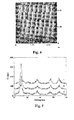
- Figure 2 displays the atomic force microscope image of titanium dioxide sol (A) prepared by Example 2.
- the sols are spherical in shape and have a narrow size distribution around 20 nm.
- the width of the particles includes the hydration layer.
- the X-ray diffraction of the dried titanium dioxide sol (A) is shown in Figure 3 . It displays characteristic anatase diffraction peaks at 2 ⁇ values around 25°, 38°, 47° and 54°. A small peak signal at 2 ⁇ around 31 ° is ascribed to titanium dioxide brookite traces (Reference: 1998 JCPDS-International Centre for Diffraction Data). Measuring the full width at half maximum (FWHM) of the peak at 2 ⁇ equal to 25°, the size of titanium dioxide sol (A) was calculated to be 3.3 nm using Scherrer equation.
- Figure 4 displays the atomic force microscope image of polymer-titanium dioxide sol (B) prepared by Example 3.
- the polymer-titanium dioxide sol (B) was slight blue in color.
- the size and shape of polymer-titanium dioxide sol (B) are similar to the titanium dioxide sol (A) shown in Figure 2 .
- Table 3 lists twelve titanium dioxide samples used for characterization (No.1 to No.12). Samples No.1-3 were prepared from (F)-0W with subsequent thermal treatment at room temperature, 200°C, and 400°C, respectively. Samples No. 4-6 were prepared from (F)-90W with subsequent thermal treatment at room temperature, 200°C, and 400°C, respectively. Samples No. 7-9 were prepared from (F)-120W with subsequent thermal treatment at room temperature, 200°C, and 400°C, respectively. Samples No. 10-12 refer to titanium dioxide crystals prepared by polymer-titanium dioxide with microwave treatment at 0, 90, and 120W followed by a thermal treatment at 450°C. Table 3 also summarizes the particle size, BET surface area and types of pore structure for the samples.
- Figure 5 shows the XRD patterns of titanium dioxide sample No.1, 2 and 3.
- the characteristic anatase diffraction peaks are present in all samples. Broader peaks for samples thermally treated at lower temperatures indicate smaller particle size (see Table 3). Trace amount of brookite is present in all samples.
- Samples No. 10-12 (D) in Table 3 show that these samples possessed higher surface area compared to similar titanium dioxide (F) crystallized from titanium dioxide-sol (A). This indicates that the addition of PEG polymer restricted the aggregation of titanium dioxide during crystallization and growth.
- Figure 6 displays the infrared spectra of crystallized titanium dioxide (sample No. 10) prepared from PEG-titanium dioxide with no microwave treatment followed by thermal treatment at 450°C. The samples were outgassed and analyzed at 100°C and 150°C, respectively. It is clear from Figure 6 that signals at around 3660 and 3630 cm -1 appear in the samples. These two bands are considered to possess acidic nature. The signal at lower frequency corresponds to more acidic bridged hydroxyls.
- Figure 7 displays the infrared spectra of crystallized titanium dioxide (Sample No. 11) prepared from PEG-titanium dioxide with 90W microwave treatment followed by thermal treatment at 450°C. The samples were outgassed and analyzed at 100°C and 150°C, respectively. It is clear from Figure 7 that signals at around 3660 and 3630 cm -1 appear in the samples.
- Figure 8 displays the infrared spectra of crystallized titanium dioxide (Sample No. 12) prepared from PEG-titanium dioxide with 120 W microwave treatment followed by thermal treatment at 450°C. The samples were outgassed and analyzed at 100°C and 150°C, respectively. It is clear from Figure 8 that signals at around 3660 and 3630 cm -1 appear in the samples.
- the present FTIR spectra results show that the polymer modified titanium dioxide samples possess surface acidic hydroxyl group while an additional microwave treatment step selectively increases the proportion of surface acidic hydroxyl groups of the resultant titanium dioxide sample.
- the enhanced acidity has a positive effect on the performance of photocatalytic oxidation reaction.
- acidity used herein is a relative property which highly depends on the environment in which a reaction is being considered.
- Figure 9 is SEM photo of a titanium dioxide-coated plate prepared by method illustrated in Example 6.
- the SEM picture shows a thick layer of commercial P25 titanium dioxide was coated on the plate surface.
- the XRD pattern of the titanium dioxide-coated plate is shown in Figure 10 .
- the figure shows that both characteristic XRD patterns belonging to anatase and rutile titanium dioxide are present in the coated sample.
- Micro-Raman spectroscopy confirmed the presence of a uniform coating of anatase-titanium dioxide ( Figure 11 ). However, the adhesion of the coating is poor and layer can easily delaminate upon touching.
- Figure 12 is SEM photo of a titanium dioxide-coated plate prepared by method illustrated in Example 9.
- the SEM picture shows a plate coated with a thin layer that is less than 10 monolayer of titanium dioxide.
- the nanosized titanium dioxide are preferentially deposited in the microscopic grooves and channels of the stainless steel plate.
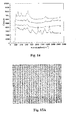
- Figures 13 & 14 are the corresponding XRD and micro-Raman analyses of sample heat treated at different temperatures.
- the XRD pattern in Figure 13 belongs only to the substrate confirming the SEM data that a ultrathin layer of titanium dioxide was coated.
- Micro-Raman is more sensitive the surface and Figure 14 displays characteristic peaks at 400cm -1 , 500cm -1 and 630cm -1 , attributed to titanium dioxide anatase phase (Reference: Handbook of Infrared and Raman Spectra of Inorganic Compounds and Organic Salts 4-Volume Set ⁇ Volume 2>).
- the broad peaks at 800 to1800 cm -1 regions belong to the polymer, which disappears with high temperature heat treatment of the coated samples.
- This method can provide titanium dioxide coating plate with good adhesion that can withstand washing and normal usage without delamination.
- P25 powder was tried to be coated by dip-coating process as listed as Examples 10 and 11. Using P25 powder is capable of yielding a uniform coating layer, however, the adhesion is poor and powder easily delaminate by gently touch.
- Figure 15 is a titanium dioxide-coated plate prepared by method illustrated in Example 15.
- the SEM pictures show the coating at increasing magnification. It is clear from Fig. 15a that a uniform coating was obtained.
- Figure 15b shows that most of the titanium dioxide are deposited along the texture of the substrate. The coating is less than ten monolayers of nanosized titanium dioxide.
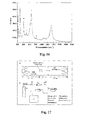
- Micro-Raman spectroscopy ( Figure 16 ) indicates anatase-titanium dioxide.
- the coating is scratch-proof using nails, and can tolerate washing with sponge and normal dishwasher operation without delamination of titanium dioxide.
- Fig.22 shows the conversion of isopropanol as function of illumination time. It is seen that the coated catalyst attains its maximum conversion around 12-14% when it exposed to UV light for more than 40 min, and it was tested twice to confirm that the maximum conversion is similar.
- Example 15 could be regenerated by water washing and followed calcined at 450°C.
- Table 4 shows the prototype VOC degradation performance data. It confirms that the incorporated titanium dioxide coated plate prepared by Example 15 has ability to degrade VOC under the real indoor operating condition. Table 4. VOC degradation performance data Performance test type With UV illumination Average removed 23.15 ethanol (mmol/h) Average increased 37.77 CO 2 (mmol/h)
- the Clinical tests results for Bacillus subtilis, Pseudomonas aeruginosa and Staphylococcus epidermidis are shown in Figure 23 .
- the circular filter papers (5 mm diameter) were saturated with (1) distilled water (positive control), (2) bleach solution (negative control), (3) 75 % alcohol and (4) different concentration of titanium dioxide.
- the titanium dioxide at coating concentration has similar germicidal effectiveness as 75 % alcohol even without UV-irradiation.
- the titanium dioxide coated plate prepared by Example 15 was incorporated in the prototype and its germicidal performance was examined in the public canteen, the results in Table 5 shows that it can reduce about 36% bacteria and 60% fungi, respectively.
- the coating sample is capable of destroying of bacteria and fungi in the absence of UV illumination, reinforcing the germicidal effectiveness of titanium dioxide material prepared by present invention under the non-UV condition as shown above. Table 5.
- Germicidal performance data Performance test type With UV illumination Without UV illumination Bacteria average 35.98 28.76 reduction (%) Fungi average 59.62 26.76 reduction (%)
Landscapes
- Chemical & Material Sciences (AREA)
- Organic Chemistry (AREA)
- Engineering & Computer Science (AREA)
- Materials Engineering (AREA)
- Chemical Kinetics & Catalysis (AREA)
- Mechanical Engineering (AREA)
- Metallurgy (AREA)
- Nanotechnology (AREA)
- Geology (AREA)
- General Physics & Mathematics (AREA)
- Environmental & Geological Engineering (AREA)
- Inorganic Chemistry (AREA)
- Physics & Mathematics (AREA)
- Composite Materials (AREA)
- Condensed Matter Physics & Semiconductors (AREA)
- General Life Sciences & Earth Sciences (AREA)
- Crystallography & Structural Chemistry (AREA)
- Life Sciences & Earth Sciences (AREA)
- Catalysts (AREA)
- Inorganic Compounds Of Heavy Metals (AREA)
- Paints Or Removers (AREA)
- Application Of Or Painting With Fluid Materials (AREA)
- Pigments, Carbon Blacks, Or Wood Stains (AREA)
Applications Claiming Priority (2)
| Application Number | Priority Date | Filing Date | Title |
|---|---|---|---|
| US10/898,118 US7144840B2 (en) | 2004-07-22 | 2004-07-22 | TiO2 material and the coating methods thereof |
| EP05752422.5A EP1769036B1 (de) | 2004-07-22 | 2005-06-13 | Selbstreinigendes Material |
Related Parent Applications (2)
| Application Number | Title | Priority Date | Filing Date |
|---|---|---|---|
| EP05752422.5 Division | 2005-06-13 | ||
| EP05752422.5A Division-Into EP1769036B1 (de) | 2004-07-22 | 2005-06-13 | Selbstreinigendes Material |
Publications (2)
| Publication Number | Publication Date |
|---|---|
| EP2380936A2 true EP2380936A2 (de) | 2011-10-26 |
| EP2380936A3 EP2380936A3 (de) | 2012-02-08 |
Family
ID=34970485
Family Applications (2)
| Application Number | Title | Priority Date | Filing Date |
|---|---|---|---|
| EP11173887A Withdrawn EP2380936A3 (de) | 2004-07-22 | 2005-06-13 | Neues TIO2-Material und damit durchgeführte Beschichtungsverfahren |
| EP05752422.5A Expired - Lifetime EP1769036B1 (de) | 2004-07-22 | 2005-06-13 | Selbstreinigendes Material |
Family Applications After (1)
| Application Number | Title | Priority Date | Filing Date |
|---|---|---|---|
| EP05752422.5A Expired - Lifetime EP1769036B1 (de) | 2004-07-22 | 2005-06-13 | Selbstreinigendes Material |
Country Status (4)
| Country | Link |
|---|---|
| US (1) | US7144840B2 (de) |
| EP (2) | EP2380936A3 (de) |
| JP (1) | JP4291391B2 (de) |
| WO (1) | WO2006008434A2 (de) |
Families Citing this family (61)
| Publication number | Priority date | Publication date | Assignee | Title |
|---|---|---|---|---|
| US7713297B2 (en) | 1998-04-11 | 2010-05-11 | Boston Scientific Scimed, Inc. | Drug-releasing stent with ceramic-containing layer |
| FR2838734B1 (fr) * | 2002-04-17 | 2005-04-15 | Saint Gobain | Substrat a revetement auto-nettoyant |
| DE102005040157A1 (de) * | 2005-08-25 | 2007-03-01 | Degussa Ag | Paste aus nanoskaligem Pulver und Dispergiermittel |
| KR100727579B1 (ko) * | 2005-12-20 | 2007-06-14 | 주식회사 엘지화학 | 이산화티탄 졸, 이의 제조방법 및 이를 포함하는 피복조성물 |
| US20070224235A1 (en) | 2006-03-24 | 2007-09-27 | Barron Tenney | Medical devices having nanoporous coatings for controlled therapeutic agent delivery |
| US8187620B2 (en) | 2006-03-27 | 2012-05-29 | Boston Scientific Scimed, Inc. | Medical devices comprising a porous metal oxide or metal material and a polymer coating for delivering therapeutic agents |
| US8815275B2 (en) | 2006-06-28 | 2014-08-26 | Boston Scientific Scimed, Inc. | Coatings for medical devices comprising a therapeutic agent and a metallic material |
| US8771343B2 (en) | 2006-06-29 | 2014-07-08 | Boston Scientific Scimed, Inc. | Medical devices with selective titanium oxide coatings |
| US7923075B2 (en) * | 2006-07-17 | 2011-04-12 | The Hong Kong University Of Science And Technology | Methods for preparing nanotextured surfaces and applications thereof |
| DE102006038593A1 (de) * | 2006-08-17 | 2008-02-21 | Siemens Ag | Selbstreinigende Oberflächenbeschichtung (Photokatalyse) |
| ATE508708T1 (de) | 2006-09-14 | 2011-05-15 | Boston Scient Ltd | Medizinprodukte mit wirkstofffreisetzender beschichtung |
| US7833935B2 (en) | 2006-11-08 | 2010-11-16 | Rockwood Italia S.P.A. | Iron oxide containing precipitated crystalline titanium dioxide and process for the manufacture thereof |
| US7981150B2 (en) | 2006-11-09 | 2011-07-19 | Boston Scientific Scimed, Inc. | Endoprosthesis with coatings |
| US7935753B2 (en) * | 2006-11-13 | 2011-05-03 | Tronox Llc | Surface treated pigment |
| JP5339682B2 (ja) * | 2007-03-01 | 2013-11-13 | キヤノン株式会社 | 金属酸化物微粒子の製造方法 |
| US8431149B2 (en) | 2007-03-01 | 2013-04-30 | Boston Scientific Scimed, Inc. | Coated medical devices for abluminal drug delivery |
| US8070797B2 (en) | 2007-03-01 | 2011-12-06 | Boston Scientific Scimed, Inc. | Medical device with a porous surface for delivery of a therapeutic agent |
| US8067054B2 (en) | 2007-04-05 | 2011-11-29 | Boston Scientific Scimed, Inc. | Stents with ceramic drug reservoir layer and methods of making and using the same |
| US7976915B2 (en) | 2007-05-23 | 2011-07-12 | Boston Scientific Scimed, Inc. | Endoprosthesis with select ceramic morphology |
| US7942926B2 (en) | 2007-07-11 | 2011-05-17 | Boston Scientific Scimed, Inc. | Endoprosthesis coating |
| US8002823B2 (en) | 2007-07-11 | 2011-08-23 | Boston Scientific Scimed, Inc. | Endoprosthesis coating |
| JP2010533563A (ja) | 2007-07-19 | 2010-10-28 | ボストン サイエンティフィック リミテッド | 吸着抑制表面を有する内部人工器官 |
| US20090157172A1 (en) * | 2007-07-24 | 2009-06-18 | Boston Scientific Scrimed, Inc. | Stents with polymer-free coatings for delivering a therapeutic agent |
| US8815273B2 (en) | 2007-07-27 | 2014-08-26 | Boston Scientific Scimed, Inc. | Drug eluting medical devices having porous layers |
| US7931683B2 (en) | 2007-07-27 | 2011-04-26 | Boston Scientific Scimed, Inc. | Articles having ceramic coated surfaces |
| US8221822B2 (en) | 2007-07-31 | 2012-07-17 | Boston Scientific Scimed, Inc. | Medical device coating by laser cladding |
| JP2010535541A (ja) | 2007-08-03 | 2010-11-25 | ボストン サイエンティフィック リミテッド | 広い表面積を有する医療器具用のコーティング |
| US20090041632A1 (en) * | 2007-08-08 | 2009-02-12 | Novapure Systems Inc. | Air Purifier System and Method |
| US8216632B2 (en) | 2007-11-02 | 2012-07-10 | Boston Scientific Scimed, Inc. | Endoprosthesis coating |
| US8029554B2 (en) | 2007-11-02 | 2011-10-04 | Boston Scientific Scimed, Inc. | Stent with embedded material |
| US7938855B2 (en) | 2007-11-02 | 2011-05-10 | Boston Scientific Scimed, Inc. | Deformable underlayer for stent |
| WO2009062248A1 (en) * | 2007-11-16 | 2009-05-22 | Aqua Diagnostic Pty Ltd | Photo electrodes |
| US7820724B2 (en) * | 2008-02-14 | 2010-10-26 | Millennium Inorganic Chemicals, Inc. | Colloidal titanium dioxide sols |
| JP5964585B2 (ja) | 2008-03-31 | 2016-08-03 | ハンツマン ピグメンツ エス.ピー.エー. | 光触媒活性を有する顆粒体およびその製造方法 |
| EP2271380B1 (de) | 2008-04-22 | 2013-03-20 | Boston Scientific Scimed, Inc. | Medizinprodukte mit einer beschichtung aus anorganischem material |
| TWI359698B (en) * | 2008-04-22 | 2012-03-11 | Iner Aec Executive Yuan | Method for producing catalyst for wastewater treat |
| WO2009132176A2 (en) | 2008-04-24 | 2009-10-29 | Boston Scientific Scimed, Inc. | Medical devices having inorganic particle layers |
| US8449603B2 (en) | 2008-06-18 | 2013-05-28 | Boston Scientific Scimed, Inc. | Endoprosthesis coating |
| US20100062075A1 (en) * | 2008-09-08 | 2010-03-11 | Vizio, Inc | Germicidal coating on hand held remote control devices for controlling electrical and electronic devices |
| US7846866B2 (en) * | 2008-09-09 | 2010-12-07 | Guardian Industries Corp. | Porous titanium dioxide coatings and methods of forming porous titanium dioxide coatings having improved photocatalytic activity |
| US20100062265A1 (en) * | 2008-09-09 | 2010-03-11 | Guardian Industries Corp. | Titanium Dioxide Coatings and Methods of Forming Titanium Dioxide Coatings Having Reduced Crystallite Size |
| US20100062032A1 (en) * | 2008-09-09 | 2010-03-11 | Guardian Industries Corp. | Doped Titanium Dioxide Coatings and Methods of Forming Doped Titanium Dioxide Coatings |
| US8647652B2 (en) * | 2008-09-09 | 2014-02-11 | Guardian Industries Corp. | Stable silver colloids and silica-coated silver colloids, and methods of preparing stable silver colloids and silica-coated silver colloids |
| US20100112359A1 (en) * | 2008-11-03 | 2010-05-06 | Sharma Pramod K | Titanium dioxide coatings having barrier layers and methods of forming titanium dioxide coatings having barrier layers |
| US8545899B2 (en) * | 2008-11-03 | 2013-10-01 | Guardian Industries Corp. | Titanium dioxide coatings having roughened surfaces and methods of forming titanium dioxide coatings having roughened surfaces |
| US8231980B2 (en) | 2008-12-03 | 2012-07-31 | Boston Scientific Scimed, Inc. | Medical implants including iridium oxide |
| US8071156B2 (en) * | 2009-03-04 | 2011-12-06 | Boston Scientific Scimed, Inc. | Endoprostheses |
| ES2706297T3 (es) | 2009-04-24 | 2019-03-28 | Fundacion Tecnalia Res & Innovation | Procedimiento para obtener revestimientos fotocatalíticos sobre sustratos metálicos |
| US8287937B2 (en) | 2009-04-24 | 2012-10-16 | Boston Scientific Scimed, Inc. | Endoprosthese |
| US20110076450A1 (en) * | 2009-09-29 | 2011-03-31 | Sharma Pramod K | Titanium dioxide coatings and methods of forming improved titanium dioxide coatings |
| TWI398469B (zh) * | 2009-10-19 | 2013-06-11 | Ind Tech Res Inst | 一階段固定TiO2奈米結晶粒於高分子基材的方法及其應用 |
| FR2960537A1 (fr) * | 2010-05-25 | 2011-12-02 | Francais Ciments | Superplastifiant a base de nanoparticules minerales a surface modifiee pour mortier et beton |
| FR2960538A1 (fr) * | 2010-05-25 | 2011-12-02 | Francais Ciments | Agent anti-retrait a base de nanoparticules minerales a surface modifiee pour mortier et beton |
| CN102086046A (zh) * | 2010-12-31 | 2011-06-08 | 东莞市明天纳米科技有限公司 | 纳米二氧化钛液溶胶的制备方法 |
| US8961682B2 (en) * | 2012-07-26 | 2015-02-24 | Empire Technology Development Llc | Hydrophilic paints using pigments coated with anti-oxidants |
| CN103816882B (zh) * | 2014-02-19 | 2016-01-27 | 福州大学 | 一种微米球状锐钛矿二氧化钛光催化剂及其制备方法 |
| GB201520463D0 (en) * | 2015-11-20 | 2016-01-06 | Huntsman P&A Uk Ltd | Coatings |
| ES2705088B2 (es) | 2017-09-20 | 2020-03-30 | Liderkit S L | Nuevo gel-coat aditivado con particulas de dioxido de titanio y alumina |
| EP3590600A1 (de) * | 2018-07-04 | 2020-01-08 | Université de Namur | Verfahren zur herstellung eines festen katalysators aus einem mit einer dünnen katalytischen schicht beschichteten träger und verfahren zur beseitigung von gasförmigen und/oder partikelförmigen schadstoffen in einem abgas |
| CN115957385B (zh) * | 2022-12-12 | 2024-09-17 | 西北工业大学 | 一种金属多酚网络偶联抗菌肽的多功能涂层的制备方法及其应用 |
| US20260022240A1 (en) | 2024-07-18 | 2026-01-22 | Illinois Tool Works Inc. | Anti-fog and substrate cleaning composition and process for the use thereof |
Family Cites Families (18)
| Publication number | Priority date | Publication date | Assignee | Title |
|---|---|---|---|---|
| WO1988008432A1 (fr) * | 1987-04-20 | 1988-11-03 | Mitsui Petrochemical Industries, Ltd. | Catalyseur et procede de polymerisation d'olefines |
| FR2633605B1 (fr) * | 1988-07-01 | 1991-07-12 | Rhone Poulenc Chimie | Procede de preparation d'oxyde de titane et d'articles a base d'oxyde de titane |
| US5034508A (en) * | 1988-08-31 | 1991-07-23 | Dai-Ichi Kogyo Seiyaku Co., Ltd. | Dispersant for nonaqueous systems |
| FR2738836B1 (fr) * | 1995-09-15 | 1998-07-17 | Rhone Poulenc Chimie | Substrat a proprietes photocatalytiques a base de dioxyde de titane et dispersions organiques a base de dioxyde de titane |
| EP0850203B2 (de) * | 1995-09-15 | 2012-01-04 | Rhodia Chimie | Substrat mit einer photokatalytischen beschichtung von titandioxyd und organische dispersionen mit titandioxyd |
| DE19635556C1 (de) | 1996-09-02 | 1997-11-20 | Forschungszentrum Juelich Gmbh | Verfahren zur Herstellung von hochporösen Schichten |
| DE19706899C1 (de) * | 1997-02-21 | 1998-11-05 | Bayer Ag | Anorganische, kompaktierte Pigmentgranulate, Verfahren zu ihrer Herstellung und ihre Verwendung |
| DE19749082A1 (de) * | 1997-11-06 | 1999-05-12 | Bayer Ag | Nanoskalige anorganische Pigmente enthaltende Ink-Jet-Tinten |
| US6287374B1 (en) * | 1998-09-11 | 2001-09-11 | Shozo Yanagida | Pigment and process for producing the same, water base ink and process for producing the same |
| US6262152B1 (en) * | 1998-10-06 | 2001-07-17 | E. I. Du Pont De Nemours And Company | Particles dispersed w/polymer dispersant having liquid soluble and cross-linkable insoluble segments |
| WO2000022050A1 (en) * | 1998-10-13 | 2000-04-20 | The Valspar Corporation | Universal paint tinting concentrates |
| WO2000046154A1 (en) * | 1999-02-04 | 2000-08-10 | Japan Science And Technology Corporation | Process for producing anatase titania or composite oxide containing anatase titania |
| US6770257B1 (en) * | 1999-02-04 | 2004-08-03 | Kawasaki Jukogyo Kabushiki Kaisha | Processes for producing anatase titanium oxide and titanium oxide coating material |
| US6306209B1 (en) * | 1999-12-16 | 2001-10-23 | Ppg Industries Ohio, Inc. | Pigment dispersions containing dispersants having pendent hydrophobic polymeric segments prepared by controlled radical polymerization |
| DE10043502B4 (de) | 2000-09-01 | 2004-06-24 | Sachtleben Chemie Gmbh | Verfahren zur Herstellung von Mattierungsadditiven |
| DE10158433B4 (de) * | 2001-11-29 | 2006-05-18 | Nano-X Gmbh | Beschichtung |
| US20030230335A1 (en) * | 2002-06-17 | 2003-12-18 | Fuji Photo Film Co., Ltd. | Methods for producing titanium oxide sol and fine titanium oxide particles, and photoelectric conversion device |
| KR100541750B1 (ko) * | 2003-04-03 | 2006-01-10 | (주)선한엠엔티 | 중성 이산화티탄 콜로이드 용액, 그것의 제조방법 및그것을 포함하는 코팅제 |
-
2004
- 2004-07-22 US US10/898,118 patent/US7144840B2/en not_active Expired - Lifetime
-
2005
- 2005-06-13 WO PCT/GB2005/002322 patent/WO2006008434A2/en not_active Ceased
- 2005-06-13 EP EP11173887A patent/EP2380936A3/de not_active Withdrawn
- 2005-06-13 JP JP2007522001A patent/JP4291391B2/ja not_active Expired - Fee Related
- 2005-06-13 EP EP05752422.5A patent/EP1769036B1/de not_active Expired - Lifetime
Non-Patent Citations (4)
| Title |
|---|
| R. A. VAN SANTEN, P. W. N. M. VAN, LEEUWEN, J .A. MOULIJN, B. A. AVERILL: "Studies in Surface Science and Catalysis", vol. 123, 1999, pages: 463 |
| R. NYQUIST, R. KAGEL, C. PUTZIG, M. LEUGERS: "Handbook of Infrared and Raman Spectra of Inorganic Compounds and Organic Salts", 1996, ACADEMIC PRESS |
| R. NYQUIST, R. KAGET, C. PUTZIG, M. LEUGERS: "Handbook of Infrared and Raman Spectra of Inorganic Compounds and Organic Salts", 1996, ACADEMIC PRESS |
| Y. IIDA., M. FURUKAWA, T. AOKI, T. SAKAI, APPL. SPECTROSC., vol. 52, 1998, pages 673 |
Also Published As
| Publication number | Publication date |
|---|---|
| US7144840B2 (en) | 2006-12-05 |
| HK1102049A1 (zh) | 2007-11-02 |
| JP2008506827A (ja) | 2008-03-06 |
| EP2380936A3 (de) | 2012-02-08 |
| EP1769036B1 (de) | 2015-08-12 |
| EP1769036A2 (de) | 2007-04-04 |
| WO2006008434A2 (en) | 2006-01-26 |
| JP4291391B2 (ja) | 2009-07-08 |
| US20060019028A1 (en) | 2006-01-26 |
| WO2006008434A3 (en) | 2006-04-27 |
Similar Documents
| Publication | Publication Date | Title |
|---|---|---|
| EP1769036B1 (de) | Selbstreinigendes Material | |
| Kontos et al. | Efficient photocatalysts by hydrothermal treatment of TiO2 | |
| Hung et al. | Study on photocatalytic degradation of gaseous dichloromethane using pure and iron ion-doped TiO2 prepared by the sol–gel method | |
| Rampaul et al. | Titania and tungsten doped titania thin films on glass; active photocatalysts | |
| Pelaez et al. | Synthesis, structural characterization and evaluation of sol–gel-based NF-TiO2 films with visible light-photoactivation for the removal of microcystin-LR | |
| Dundar et al. | TiO2 thin films by ultrasonic spray pyrolysis as photocatalytic material for air purification | |
| Pérez-González et al. | Enhanced photocatalytic activity of TiO2-ZnO thin films deposited by dc reactive magnetron sputtering | |
| Arconada et al. | Synthesis and photocatalytic properties of dense and porous TiO2-anatase thin films prepared by sol–gel | |
| Mills et al. | Preparation and characterisation of novel thick sol–gel titania film photocatalysts | |
| Djaoued et al. | Sol–gel nanocrystalline brookite-rich titania films | |
| Hamden et al. | In situ generation of TiO2 nanoparticles using chitosan as a template and their photocatalytic activity | |
| Hassan et al. | Synthesis and characterization of C-doped TiO2 thin films for visible-light-induced photocatalytic degradation of methyl orange | |
| Kenanakis et al. | Chemically grown TiO2 on glass with superior photocatalytic properties | |
| Chadwick et al. | Combinatorial aerosol assisted chemical vapour deposition of a photocatalytic mixed SnO 2/TiO 2 thin film | |
| US20010056037A1 (en) | Titanium hydroxide, photocatalyst produced from the same and photocatalytic coating agent | |
| Vodišek et al. | Transparent titania-zirconia-silica thin films for self-cleaning and photocatalytic applications | |
| Radić et al. | Effect of cerium oxide doping on the photocatalytic properties of rutile TiO2 films prepared by spray pyrolysis | |
| Szołdra et al. | Characterization and photocatalytic activity of TiO2 thin films prepared by sol-gel method for NOx degradation | |
| Smirnova et al. | Photodegradation of stearic acid adsorbed on superhydrophilic TiO2 surface: In situ FT-IR and LDI study | |
| Rahmani et al. | Enhancing the photocatalytic activity of TiO2 nanocrystalline thin film by doping with SiO2 | |
| Crişan et al. | Crystallization study of sol–gel un-doped and Pd-doped TiO2 materials | |
| Medina-Valtierra et al. | The influence of surfactants on the roughness of titania sol–gel films | |
| Aguiar et al. | Photocatalytic decomposition of acetone using LaTi (O, N) 3 nanoparticles under visible light irradiation | |
| Borowiec et al. | Surface morphology-driven stability of the hydrophobic Er2O3 films | |
| Azpiroz et al. | In-flow photocatalytic oxidation of NO on glasses coated with nanocolumnar porous TiO2 thin films prepared by reactive sputtering |
Legal Events
| Date | Code | Title | Description |
|---|---|---|---|
| AC | Divisional application: reference to earlier application |
Ref document number: 1769036 Country of ref document: EP Kind code of ref document: P |
|
| AK | Designated contracting states |
Kind code of ref document: A2 Designated state(s): AT BE BG CH CY CZ DE DK EE ES FI FR GB GR HU IE IS IT LI LT LU MC NL PL PT RO SE SI SK TR |
|
| AX | Request for extension of the european patent |
Extension state: AL BA HR LV MK YU |
|
| PUAI | Public reference made under article 153(3) epc to a published international application that has entered the european phase |
Free format text: ORIGINAL CODE: 0009012 |
|
| PUAL | Search report despatched |
Free format text: ORIGINAL CODE: 0009013 |
|
| AK | Designated contracting states |
Kind code of ref document: A3 Designated state(s): AT BE BG CH CY CZ DE DK EE ES FI FR GB GR HU IE IS IT LI LT LU MC NL PL PT RO SE SI SK TR |
|
| AX | Request for extension of the european patent |
Extension state: AL BA HR LV MK YU |
|
| RIC1 | Information provided on ipc code assigned before grant |
Ipc: C23C 26/00 20060101ALI20120102BHEP Ipc: C23C 24/08 20060101ALI20120102BHEP Ipc: C01G 23/053 20060101ALI20120102BHEP Ipc: C09C 3/04 20060101ALI20120102BHEP Ipc: C09C 3/00 20060101ALI20120102BHEP Ipc: C09C 1/36 20060101AFI20120102BHEP |
|
| STAA | Information on the status of an ep patent application or granted ep patent |
Free format text: STATUS: THE APPLICATION IS DEEMED TO BE WITHDRAWN |
|
| 18D | Application deemed to be withdrawn |
Effective date: 20120114 |