EP2377845A1 - Heterocyclic nitrogenous or oxygenous compounds with insecticidal activity formed from dialdehydes and their preparation and uses thereof - Google Patents
Heterocyclic nitrogenous or oxygenous compounds with insecticidal activity formed from dialdehydes and their preparation and uses thereof Download PDFInfo
- Publication number
- EP2377845A1 EP2377845A1 EP09832948A EP09832948A EP2377845A1 EP 2377845 A1 EP2377845 A1 EP 2377845A1 EP 09832948 A EP09832948 A EP 09832948A EP 09832948 A EP09832948 A EP 09832948A EP 2377845 A1 EP2377845 A1 EP 2377845A1
- Authority
- EP
- European Patent Office
- Prior art keywords
- alkyl
- compound
- carbonyl
- alkoxyl
- saturated
- Prior art date
- Legal status (The legal status is an assumption and is not a legal conclusion. Google has not performed a legal analysis and makes no representation as to the accuracy of the status listed.)
- Granted
Links
- VXLYOURCUVQYLN-UHFFFAOYSA-N Cc(cc1)cnc1Cl Chemical compound Cc(cc1)cnc1Cl VXLYOURCUVQYLN-UHFFFAOYSA-N 0.000 description 5
- CFRPSFYHXJZSBI-DHZHZOJOSA-N CCN(Cc(cn1)ccc1Cl)/C(/NC)=C/[N+]([O-])=O Chemical compound CCN(Cc(cn1)ccc1Cl)/C(/NC)=C/[N+]([O-])=O CFRPSFYHXJZSBI-DHZHZOJOSA-N 0.000 description 2
- RHXJMJVMGDLNHK-CUJWWBMDSA-N CCN(Cc(cn1)ccc1Cl)/C(/C(/[N+]([O-])=O)=C\C/C=C(\C(\N(CC)Cc(cc1)cnc1Cl)=N\C)/[N+]([O-])=O)=N\C Chemical compound CCN(Cc(cn1)ccc1Cl)/C(/C(/[N+]([O-])=O)=C\C/C=C(\C(\N(CC)Cc(cc1)cnc1Cl)=N\C)/[N+]([O-])=O)=N\C RHXJMJVMGDLNHK-CUJWWBMDSA-N 0.000 description 1
- WBWJDFFVJWYQPH-FLIBITNWSA-N CCN(Cc(cn1)ccc1Cl)/C(/SC)=C/[N+]([O-])=O Chemical compound CCN(Cc(cn1)ccc1Cl)/C(/SC)=C/[N+]([O-])=O WBWJDFFVJWYQPH-FLIBITNWSA-N 0.000 description 1
- ALNDHUQPXHHNON-JXMROGBWSA-N [O-][N+](/C=C1/N(Cc(cn2)ccc2Cl)CCN1)=O Chemical compound [O-][N+](/C=C1/N(Cc(cn2)ccc2Cl)CCN1)=O ALNDHUQPXHHNON-JXMROGBWSA-N 0.000 description 1
- NDHXMRFNYMNBKO-UHFFFAOYSA-N [O-][N+](C1=C(N(Cc(cc2)cnc2Cl)CC2)N2C2OC1CC2)=O Chemical compound [O-][N+](C1=C(N(Cc(cc2)cnc2Cl)CC2)N2C2OC1CC2)=O NDHXMRFNYMNBKO-UHFFFAOYSA-N 0.000 description 1
Classifications
-
- A—HUMAN NECESSITIES
- A01—AGRICULTURE; FORESTRY; ANIMAL HUSBANDRY; HUNTING; TRAPPING; FISHING
- A01N—PRESERVATION OF BODIES OF HUMANS OR ANIMALS OR PLANTS OR PARTS THEREOF; BIOCIDES, e.g. AS DISINFECTANTS, AS PESTICIDES OR AS HERBICIDES; PEST REPELLANTS OR ATTRACTANTS; PLANT GROWTH REGULATORS
- A01N43/00—Biocides, pest repellants or attractants, or plant growth regulators containing heterocyclic compounds
- A01N43/90—Biocides, pest repellants or attractants, or plant growth regulators containing heterocyclic compounds having two or more relevant hetero rings, condensed among themselves or with a common carbocyclic ring system
-
- A—HUMAN NECESSITIES
- A01—AGRICULTURE; FORESTRY; ANIMAL HUSBANDRY; HUNTING; TRAPPING; FISHING
- A01N—PRESERVATION OF BODIES OF HUMANS OR ANIMALS OR PLANTS OR PARTS THEREOF; BIOCIDES, e.g. AS DISINFECTANTS, AS PESTICIDES OR AS HERBICIDES; PEST REPELLANTS OR ATTRACTANTS; PLANT GROWTH REGULATORS
- A01N33/00—Biocides, pest repellants or attractants, or plant growth regulators containing organic nitrogen compounds
- A01N33/02—Amines; Quaternary ammonium compounds
-
- A—HUMAN NECESSITIES
- A01—AGRICULTURE; FORESTRY; ANIMAL HUSBANDRY; HUNTING; TRAPPING; FISHING
- A01N—PRESERVATION OF BODIES OF HUMANS OR ANIMALS OR PLANTS OR PARTS THEREOF; BIOCIDES, e.g. AS DISINFECTANTS, AS PESTICIDES OR AS HERBICIDES; PEST REPELLANTS OR ATTRACTANTS; PLANT GROWTH REGULATORS
- A01N43/00—Biocides, pest repellants or attractants, or plant growth regulators containing heterocyclic compounds
- A01N43/34—Biocides, pest repellants or attractants, or plant growth regulators containing heterocyclic compounds having rings with one nitrogen atom as the only ring hetero atom
- A01N43/40—Biocides, pest repellants or attractants, or plant growth regulators containing heterocyclic compounds having rings with one nitrogen atom as the only ring hetero atom six-membered rings
-
- A—HUMAN NECESSITIES
- A01—AGRICULTURE; FORESTRY; ANIMAL HUSBANDRY; HUNTING; TRAPPING; FISHING
- A01N—PRESERVATION OF BODIES OF HUMANS OR ANIMALS OR PLANTS OR PARTS THEREOF; BIOCIDES, e.g. AS DISINFECTANTS, AS PESTICIDES OR AS HERBICIDES; PEST REPELLANTS OR ATTRACTANTS; PLANT GROWTH REGULATORS
- A01N43/00—Biocides, pest repellants or attractants, or plant growth regulators containing heterocyclic compounds
- A01N43/48—Biocides, pest repellants or attractants, or plant growth regulators containing heterocyclic compounds having rings with two nitrogen atoms as the only ring hetero atoms
- A01N43/50—1,3-Diazoles; Hydrogenated 1,3-diazoles
-
- A—HUMAN NECESSITIES
- A01—AGRICULTURE; FORESTRY; ANIMAL HUSBANDRY; HUNTING; TRAPPING; FISHING
- A01N—PRESERVATION OF BODIES OF HUMANS OR ANIMALS OR PLANTS OR PARTS THEREOF; BIOCIDES, e.g. AS DISINFECTANTS, AS PESTICIDES OR AS HERBICIDES; PEST REPELLANTS OR ATTRACTANTS; PLANT GROWTH REGULATORS
- A01N43/00—Biocides, pest repellants or attractants, or plant growth regulators containing heterocyclic compounds
- A01N43/48—Biocides, pest repellants or attractants, or plant growth regulators containing heterocyclic compounds having rings with two nitrogen atoms as the only ring hetero atoms
- A01N43/54—1,3-Diazines; Hydrogenated 1,3-diazines
-
- A—HUMAN NECESSITIES
- A01—AGRICULTURE; FORESTRY; ANIMAL HUSBANDRY; HUNTING; TRAPPING; FISHING
- A01N—PRESERVATION OF BODIES OF HUMANS OR ANIMALS OR PLANTS OR PARTS THEREOF; BIOCIDES, e.g. AS DISINFECTANTS, AS PESTICIDES OR AS HERBICIDES; PEST REPELLANTS OR ATTRACTANTS; PLANT GROWTH REGULATORS
- A01N43/00—Biocides, pest repellants or attractants, or plant growth regulators containing heterocyclic compounds
- A01N43/48—Biocides, pest repellants or attractants, or plant growth regulators containing heterocyclic compounds having rings with two nitrogen atoms as the only ring hetero atoms
- A01N43/62—Biocides, pest repellants or attractants, or plant growth regulators containing heterocyclic compounds having rings with two nitrogen atoms as the only ring hetero atoms three- or four-membered rings or rings with more than six members
-
- A—HUMAN NECESSITIES
- A01—AGRICULTURE; FORESTRY; ANIMAL HUSBANDRY; HUNTING; TRAPPING; FISHING
- A01N—PRESERVATION OF BODIES OF HUMANS OR ANIMALS OR PLANTS OR PARTS THEREOF; BIOCIDES, e.g. AS DISINFECTANTS, AS PESTICIDES OR AS HERBICIDES; PEST REPELLANTS OR ATTRACTANTS; PLANT GROWTH REGULATORS
- A01N43/00—Biocides, pest repellants or attractants, or plant growth regulators containing heterocyclic compounds
- A01N43/72—Biocides, pest repellants or attractants, or plant growth regulators containing heterocyclic compounds having rings with nitrogen atoms and oxygen or sulfur atoms as ring hetero atoms
- A01N43/74—Biocides, pest repellants or attractants, or plant growth regulators containing heterocyclic compounds having rings with nitrogen atoms and oxygen or sulfur atoms as ring hetero atoms five-membered rings with one nitrogen atom and either one oxygen atom or one sulfur atom in positions 1,3
- A01N43/78—1,3-Thiazoles; Hydrogenated 1,3-thiazoles
-
- C—CHEMISTRY; METALLURGY
- C07—ORGANIC CHEMISTRY
- C07D—HETEROCYCLIC COMPOUNDS
- C07D213/00—Heterocyclic compounds containing six-membered rings, not condensed with other rings, with one nitrogen atom as the only ring hetero atom and three or more double bonds between ring members or between ring members and non-ring members
- C07D213/02—Heterocyclic compounds containing six-membered rings, not condensed with other rings, with one nitrogen atom as the only ring hetero atom and three or more double bonds between ring members or between ring members and non-ring members having three double bonds between ring members or between ring members and non-ring members
- C07D213/04—Heterocyclic compounds containing six-membered rings, not condensed with other rings, with one nitrogen atom as the only ring hetero atom and three or more double bonds between ring members or between ring members and non-ring members having three double bonds between ring members or between ring members and non-ring members having no bond between the ring nitrogen atom and a non-ring member or having only hydrogen or carbon atoms directly attached to the ring nitrogen atom
- C07D213/60—Heterocyclic compounds containing six-membered rings, not condensed with other rings, with one nitrogen atom as the only ring hetero atom and three or more double bonds between ring members or between ring members and non-ring members having three double bonds between ring members or between ring members and non-ring members having no bond between the ring nitrogen atom and a non-ring member or having only hydrogen or carbon atoms directly attached to the ring nitrogen atom with hetero atoms or with carbon atoms having three bonds to hetero atoms with at the most one bond to halogen, e.g. ester or nitrile radicals, directly attached to ring carbon atoms
- C07D213/61—Halogen atoms or nitro radicals
-
- C—CHEMISTRY; METALLURGY
- C07—ORGANIC CHEMISTRY
- C07D—HETEROCYCLIC COMPOUNDS
- C07D401/00—Heterocyclic compounds containing two or more hetero rings, having nitrogen atoms as the only ring hetero atoms, at least one ring being a six-membered ring with only one nitrogen atom
- C07D401/02—Heterocyclic compounds containing two or more hetero rings, having nitrogen atoms as the only ring hetero atoms, at least one ring being a six-membered ring with only one nitrogen atom containing two hetero rings
- C07D401/12—Heterocyclic compounds containing two or more hetero rings, having nitrogen atoms as the only ring hetero atoms, at least one ring being a six-membered ring with only one nitrogen atom containing two hetero rings linked by a chain containing hetero atoms as chain links
-
- C—CHEMISTRY; METALLURGY
- C07—ORGANIC CHEMISTRY
- C07D—HETEROCYCLIC COMPOUNDS
- C07D401/00—Heterocyclic compounds containing two or more hetero rings, having nitrogen atoms as the only ring hetero atoms, at least one ring being a six-membered ring with only one nitrogen atom
- C07D401/14—Heterocyclic compounds containing two or more hetero rings, having nitrogen atoms as the only ring hetero atoms, at least one ring being a six-membered ring with only one nitrogen atom containing three or more hetero rings
-
- C—CHEMISTRY; METALLURGY
- C07—ORGANIC CHEMISTRY
- C07D—HETEROCYCLIC COMPOUNDS
- C07D405/00—Heterocyclic compounds containing both one or more hetero rings having oxygen atoms as the only ring hetero atoms, and one or more rings having nitrogen as the only ring hetero atom
- C07D405/14—Heterocyclic compounds containing both one or more hetero rings having oxygen atoms as the only ring hetero atoms, and one or more rings having nitrogen as the only ring hetero atom containing three or more hetero rings
-
- C—CHEMISTRY; METALLURGY
- C07—ORGANIC CHEMISTRY
- C07D—HETEROCYCLIC COMPOUNDS
- C07D409/00—Heterocyclic compounds containing two or more hetero rings, at least one ring having sulfur atoms as the only ring hetero atoms
- C07D409/14—Heterocyclic compounds containing two or more hetero rings, at least one ring having sulfur atoms as the only ring hetero atoms containing three or more hetero rings
-
- C—CHEMISTRY; METALLURGY
- C07—ORGANIC CHEMISTRY
- C07D—HETEROCYCLIC COMPOUNDS
- C07D413/00—Heterocyclic compounds containing two or more hetero rings, at least one ring having nitrogen and oxygen atoms as the only ring hetero atoms
- C07D413/02—Heterocyclic compounds containing two or more hetero rings, at least one ring having nitrogen and oxygen atoms as the only ring hetero atoms containing two hetero rings
- C07D413/12—Heterocyclic compounds containing two or more hetero rings, at least one ring having nitrogen and oxygen atoms as the only ring hetero atoms containing two hetero rings linked by a chain containing hetero atoms as chain links
-
- C—CHEMISTRY; METALLURGY
- C07—ORGANIC CHEMISTRY
- C07D—HETEROCYCLIC COMPOUNDS
- C07D417/00—Heterocyclic compounds containing two or more hetero rings, at least one ring having nitrogen and sulfur atoms as the only ring hetero atoms, not provided for by group C07D415/00
- C07D417/14—Heterocyclic compounds containing two or more hetero rings, at least one ring having nitrogen and sulfur atoms as the only ring hetero atoms, not provided for by group C07D415/00 containing three or more hetero rings
-
- C—CHEMISTRY; METALLURGY
- C07—ORGANIC CHEMISTRY
- C07D—HETEROCYCLIC COMPOUNDS
- C07D471/00—Heterocyclic compounds containing nitrogen atoms as the only ring hetero atoms in the condensed system, at least one ring being a six-membered ring with one nitrogen atom, not provided for by groups C07D451/00 - C07D463/00
- C07D471/12—Heterocyclic compounds containing nitrogen atoms as the only ring hetero atoms in the condensed system, at least one ring being a six-membered ring with one nitrogen atom, not provided for by groups C07D451/00 - C07D463/00 in which the condensed system contains three hetero rings
- C07D471/14—Ortho-condensed systems
-
- C—CHEMISTRY; METALLURGY
- C07—ORGANIC CHEMISTRY
- C07D—HETEROCYCLIC COMPOUNDS
- C07D491/00—Heterocyclic compounds containing in the condensed ring system both one or more rings having oxygen atoms as the only ring hetero atoms and one or more rings having nitrogen atoms as the only ring hetero atoms, not provided for by groups C07D451/00 - C07D459/00, C07D463/00, C07D477/00 or C07D489/00
- C07D491/12—Heterocyclic compounds containing in the condensed ring system both one or more rings having oxygen atoms as the only ring hetero atoms and one or more rings having nitrogen atoms as the only ring hetero atoms, not provided for by groups C07D451/00 - C07D459/00, C07D463/00, C07D477/00 or C07D489/00 in which the condensed system contains three hetero rings
- C07D491/18—Bridged systems
-
- C—CHEMISTRY; METALLURGY
- C07—ORGANIC CHEMISTRY
- C07D—HETEROCYCLIC COMPOUNDS
- C07D498/00—Heterocyclic compounds containing in the condensed system at least one hetero ring having nitrogen and oxygen atoms as the only ring hetero atoms
- C07D498/02—Heterocyclic compounds containing in the condensed system at least one hetero ring having nitrogen and oxygen atoms as the only ring hetero atoms in which the condensed system contains two hetero rings
- C07D498/08—Bridged systems
-
- C—CHEMISTRY; METALLURGY
- C07—ORGANIC CHEMISTRY
- C07D—HETEROCYCLIC COMPOUNDS
- C07D498/00—Heterocyclic compounds containing in the condensed system at least one hetero ring having nitrogen and oxygen atoms as the only ring hetero atoms
- C07D498/12—Heterocyclic compounds containing in the condensed system at least one hetero ring having nitrogen and oxygen atoms as the only ring hetero atoms in which the condensed system contains three hetero rings
- C07D498/18—Bridged systems
Definitions
- This invention relates to novel neonicotinoid derivatives, the preparation method and the uses thereof.
- This invention provides novel effective insecticides, which resolve the resistance problem of neonicotinoid insecticides, enlarge the insecticidal spectrum and address the issues existed in the art.
- One object of the invention is to provide derivatives for effective pest control and the preparation thereof.
- Another object of the invention is to provide the protection for growing and harvested plants and prevent them from the invading of insect.
- R 1 is selected from pyridyl, thiazolyl, pyrimidinyl, tetrahydrofuryl, oxazolyl, or the halogenated groups thereof.
- the preferable R 1 represents halopyridyl, halothiazolyl, halopyrimidinyl, halotetrahydrofuryl, or halooxazolyl.
- the halogenated groups are chlorides.
- R 1 represents
- R 2 represents H, saturated or unsaturated C 1-4 alkyl, saturated or unsaturated C 1-4 halo-alkyl, C 1-4 alkyl-carbonyl, unsubstituted benzyl or benzyl substituted by one or more groups selected from the group consisting of halogen atom, C 1-4 halo-alkyl or C 1-4 chloro-alkoxyl.
- R 2 represents H or C 1-3 alkyl. More preferably, R 2 represents H or methyl.
- R 3 and R 4 are H, C 1-6 alkyl, or R 3 and R 4 together form -CH 2 -CH 2 - or -CH 2 -CH 2 -CH 2 -
- R 3 and R 4 are hydrogen atom or C 1-3 alkyl, and preferably H, methyl or ethyl. Alternatively, R 3 and R 4 together form -CH 2 -CH 2 - or -CH 2 -CH 2 -CH 2 -.
- R 5 , R 6 , R 7 , R 8 and R 9 are H, saturated or unsaturated -C 1-2 alkyl, halogen, saturated or unsaturated C 1-4 alkoxyl, saturated or unsaturated C 1-2 halo-alkoxyl, C 1-4 alkyl-ester group (RCOO-), C 1-2 alkyl-sulfonyl or trifluoromethanesulfonyl ester group.
- R 5 , R 6 , R 7 , R 8 and R 9 represent H, methyl, chloride atom, bromide atom, methoxyl or ethoxyl and preferably represent H, methyl and methoxyl.
- Y is nitro group or cyano group.
- Y represents nitro group
- an agrochemical composition comprising:
- the concentration of component (a) is 0.01-99.9wt%, and preferably 0.05-90wt%.
- the agrochemical composition is used to kill or control the insects selected from the group consisting of Coleoptera, Lepidoptera, Hemiptera, Orthoptera, Isoptera and dipteral insects.
- the pests have piercing-sucking type or scratching type mouthparts.
- the pests comprise aphid, planthopper, white fly, leaf hopper, thrips, cotton bollworm, Cabbage caterpillar, Diamondback prodenia litura or army worm.
- the agrochemical composition further comprises other active compounds which are selected from the group consisting of insecticide, cobait, bactericide, acaricide, nematicide, fungicide and growth control agents.
- the use of the agrochemical composition in killing or controlling agricultural pests, sanitary pests and animal health hazard pests; or the agrochemical composition is used as an insecticidal composition for killing or controlling agricultural pests, sanitary pests and animal health hazard pests.
- the method comprises applying the above agrochemical or insecticidal composition onto plants, their surrounding soil or environment that is attacked or will be attacked by insects.
- the compound, its optical isomer or cis-trans isomer, an agrochemically acceptable salts or their composition in preparation of insecticide composition is provided.
- the sixth aspect of the invention it is provided a method for preparation of the compound, its optical isomer or cis-trans isomer, or agrochemically acceptable salts, wherein the method comprises the following steps:
- the reaction temperature is 15-45 °C, and preferably 20-30 °C.
- the solvent is chosen from acetonitrile or ethanol, and preferably acetonitrile.
- the catalytic acid is chosen from concentrated hydrochloric acid, concentrated sulfuric acid or benzoic acid, and preferably concentrated hydrochloric acid.
- the method comprises:
- the inventors After long term and deep investigation, the inventors have synthesized a novel class of neonicotinoid derivatives, which are obtained by the reaction of nitromethylene compounds with dialdehyde based on the nitromethylene group of current nitromethylene neonicotinoid insecticides.
- the novel derivatives show significantly high activities and enlarged insecticidal spectrum.
- the inventors completed the present invention based on the above.
- C 1-6 alkyl refers to straight or branched alkyl with 1-6 carbon such as methyl, ethyl, propyl, iso -propyl, butyl, iso -butyl, sec -butyl, tert -butyl or some similar groups.
- C 1-6 alkoxyl refers to straight or branched alkoxyl with 1-6 carbon such as methoxyl, ethoxyl, propoxyl, iso -propoxyl, butoxyl, iso -butoxyl, sec -butoxyl, tert -butoxyl or some similar groups.
- halogen refers to fluorine, chlorine, bromine or iodine.
- halogenated refers to one or more substitution with same or different "halogen” as mentioned above, such as trifluoromethyl, pentafluoroethyl or similar groups.
- 5 or 6 membered heterocyclic alkyl refers to 5 or 6 membered ring cyclic alkyl containing one or more heteroatoms selected from nitrogen, oxygen or sulfur, such as pyridyl, thiazyl, pyrimidinyl, tetrahydrofuryl, oxazolyl etc.
- compound of formula (A) can be synthesized by the following procedure, wherein R 2 is H:
- compound of formula (B) can be synthesized by the following procedure:
- compound of formula (C) can be synthesized by the following procedure:
- compound of formula (D) can be synthesized by the following procedure:
- compound of formula (A) can be synthesized by the following procedure:
- compound of formula (B) can be synthesized by the following procedure:
- compound of formula (C) can be synthesized by the following procedure:
- compound of formula (D) can be synthesized by the following procedure:
- active ingredient of the invention or “active compound of the invention” represent the invented compound, its optical isomer or cis-trans isomer, or an agrochemically acceptable salts thereof.
- active compound of the invention shows significantly increased activities and broadened insecticidal spectrum.
- agrochemically acceptable salts means that the anion of the salt is known or acceptable when forming the insecticidally acceptable salt.
- the salt is water-soluble.
- the salts formed by the compounds of formula (A), (B), (C) and (D) include salts formed with inorganic acid (e.g., hydrochlorate, phosphate, sulfate, and nitrate) and salts formed with organic acid (e.g., acetate and benzoate).
- insects can be used to control and kill general agriculture and plant insects, storage cereal insects, public health insects and animal health hazard insects.
- insecticide represents any compound that prevents or controls any of the above mentioned insects.
- the exemplary insects include but are not limited to: Coleoptera: Sitophilus zeamai, Tribolium castaneum, Henosepilachna vigintioctomaculata, Henosepilachna spars, Agriotes fuscicollis, Anomala cupripes, Popillia quadriguttata, Monolepta hieroglyphica, Monochamus alternatus, Echinocnemus squameus, Basiprionota bisignata, Anoplophora chinensis, Apripona germari, Scolytus schevy, Agriotes fuscicollis.
- Lepidoptera Lymantria dispar, Malacosoma neustria testacea, Diaphania perspectalis, Clania variegate, Cnidocampa flauescens, Dendrolimus punctatus, Orgyia gonostigma, Paranthrene tabaniformis, Spodoptera litura, Chilo suppressalis, Ostrinia nubilalis, Ephestia cautella, Adoxophyes orana, Laspyresia splendana, Agrotis fucosa, Galleria mellonella, Plutella xylostella, Phyllocnistis citrella, or Mythimna separate.
- Homoptera Nephotettix cincticeps, Nilaparvata lugens, Pseudococcus comstocki, Unaspis yanonensis, Myzus persicae, Aphis gossydii, Lipaphis erysimi pseudobrassicae, Stephanitis nashi, or Bemisia tabaci.
- Orthoptera Blattella germanica, Periplaneta americana, Gryllotalpa africana, or Locusta migratoria.
- Isoptera Solenopsis invicta, Coptotermes formosanus.
- Diptera Musca domestica, Aedes aegypti, Delia platura, Culex sp., Anopheles sinensis.
- Animal Health hazard insects Boophilus microplus, Haemaphysalis longicornis, Hyalomma anatolicum, Hypoderma spp., Fasciola hepatica, Moniezia Blanchard Ostertagia spp., Trypanosoma enansi, Babesia bigemina, etc.
- the compounds of the invention have specific effects on agriculture and plant insects having a piercing-sucking or scratching monthparts, such as aphid, leafhopper, planthopper, thrips, white fly and so on.
- the invented active compounds can be generally prepared into insecticidal composition.
- the invented active compounds can be prepared into the conventional formulations, such as solutions, emulsions, suspensions, powders, foams, pastes, granules, aerosols, natural and synthetic materials impregnated with active compounds, and micro-capsules in polymers, the coating complex for seed, preparations used with a combustion device (such as smoking cylindrantherae, smoking can and smoking plate) and ULV cold mist and warm mist preparations.
- a combustion device such as smoking cylindrantherae, smoking can and smoking plate
- formulations may be produced in a known manner, for example, by mixing the active compounds with extenders, which are liquid or liquefied gaseous, solid diluents or carriers, optionally with the use of surface-active agents, which is emulsifying agents and/or dispersing agents, and/or foam-forming agents.
- extenders which are liquid or liquefied gaseous, solid diluents or carriers
- surface-active agents which is emulsifying agents and/or dispersing agents, and/or foam-forming agents.
- organic solvents can also be used as auxiliary solvents.
- liquid solvents as a diluent or carrier, for example, aromatic hydrocarbons, such as xylene, toluene and alkyl naphthalenes; chlorinated aromatic or chlorinated aliphatic hydrocarbons, such as chlorobenzenes, chloroethylenes and methylene chloride; aliphatic hydrocarbons, such as cyclohexane or paraffins, for example, mineral oil fractions; alcohols, such as ethanol or glycol as well as their ethers and esters; ketones, such as acetone, methyl ethyl ketone, methyl isobutyl ketone or cyclohexanone; or uncommon polar solvents, such as dimethylformamide and dimethylsulfoxide, as well as water.
- aromatic hydrocarbons such as xylene, toluene and alkyl naphthalenes
- chlorinated aromatic or chlorinated aliphatic hydrocarbons such as chlorobenzenes, chlor
- liquefied gaseous diluents or carriers liquids which are gaseous at normal temperature under normal pressure, for example, aerosol propellants, such as halogenated hydrocarbons as well as butane, propane, nitrogen and carbon dioxide.
- the solid carrier comprises ground natural minerals, such as kaolins, clays, talcs, quartzs, attapulgites, montmorillonites or kieselguhrs; ground synthetic minerals, such as high dispersed silicic acid, alumina and silicate.
- the solid carrier used for particles is crushed and fractionated natural rocks such as calcite, marble, pumice, sepiolite and dolomite, as well as synthetic granules of inorganic and organic coarse powder, and granules of organic material such as sawdust, coconut shells, maize cobs and tobacco stalks and the like.
- Nonionic and anionic emulsifiers may be used as emulsifying and/or foam-forming agents, such as polyoxyethylene-fatty acid esters, polyoxyethylene-fatty alcohol ethers, for example, alkylaryl polyglycol ethers, alkylsulfonates, alkylsulfates, arylsulfonates as well as albumin hydrolysis products.
- Dispersing agents include, for example, lignin sulfite waste liquors and methyl cellulose.
- Adhesives such as carboxymethyl cellulose and natural and synthetic polymers, (such as gum arabic, polyvinyl alcohol and polyvinyl acetate) in the form of powders, granules or emulsions can be used in the formulations.
- colorants such as inorganic dyestuffs, for example, iron oxide, cobalt oxide and Prussian Blue, and organic dyestuffs, such as diazo dyestuffs or metal phthalo-cyanine dyestuffs, and trace nutritional agent, such as the salts of iron, manganese, boron, copper, cobalt, aluminum and zinc.
- the active compound of the invention can be present as a mixture with other active compounds in a commercial formulation or a use form prepared from the commercial formulation.
- the other compounds can be insecticide, bactericide, acaricide, nematocide, fungicide, growth controller and the like.
- the insecticide includes, e.g., phosphates, carbamate, pyrethroids, chlorinated hydrocarbons, benzoylurea, nereistoxin and material produced by microbion such as avermectin.
- the active compound of the invention can be present as a mixture with a synergist in a commercial formulation or a use form prepared from the commercial formulation.
- Synergist is used to enhance the action of active compound, as the compound itself is active it is optional to use the synergist.
- the formulations contain 0.001-99.99wt%, preferably 0.01-99.9wt%, and more preferably 0.05-90wt% of the active compound of invention.
- concentration of the active compound in the use form prepared from the commercial formulation can vary within a wide range.
- the active compound concentration of the formulation for use is, for example, 0.0000001-100 % (g/v), and preferably 0.0001- 1%.
- N-((6-chloropyridin-3-yl)methyl)ethanamine (17.0 g, 0.1 mol), (2-nitroethene-1,1-diyl)bis(methylsulfane) (15.0 g, 0.09 mol), dry ethanol (50 mL).
- the mixture was refluxed.
- the reaction mixture was cooled to r.t. and concentrated under reduced pressure to obtain crude product as oil, which was purified by column chromatography to afford 5.3g N-((6-chloropyridin-3-yl)methyl)-N-ethyl-1- (methylthio)-2-nitroethenamine in 18.5% yield.
- N-((6-chloropyridin-3-yl)methyl)-N-ethyl-1-(methylthio)-2-nitroethenamine 5 g, 0.017 mol
- Methylamine alcohol solution 1.8g, 0.017 mol
- dry ethanol 30 mL
- Aphis which belongs to Homoptera and has a piercing-sucking mouthpart, is a common insect for agricultural plant. Aphis craccivoral was tested by the way of immersing.
- Planthopper which belongs to Homoptera and has a piercing-sucking mouthpart, is a common insect for agricultural plant. Nilaparvata lugens was tested by the way of spraying.
- Test method the test compound was exactly formulated into a solution of acetone to final concentration of 500, 250, 100, 50, 25, 12.5, 6.25, 3.13, 1.57 and 0.79 ppm.
- the acetone aqueous solution was used as control.
- Each process was repeated for 3 tumblers (3 times).
- 2mL of solution was sprayed uniformly to each cup by a mini manual sprayer.
- 10 Nilaparvata lugens were introduced to every sink 6 hours before spraying.
- Three series of experiments were conducted. The number of killed Nilaparvata lugens was counted after 24 hours to calculate the mortality using above mentioned formula. The results were shown in Tables 1-4 bellow.
- the test compound was exactly formulated into a solution of acetone to concentration 500, 250, 100, 50, 25, 12.5, 6.25, 3.13 and 1.57 ppm.
- the acetone aqueous solution was used as control.
- Fresh maize leaves were immersed in the solution for 3 seconds and dried at room temperature and used to feed the tested insects. Each process was repeated for 3 times while 10 Armyworms were tested in each experiment. The number of killed Armyworms was counted after 24 hours to calculate the mortality using above mentioned formula. The results were shown in Tables 1-4 bellow.
- Diamondback moth was tested by the way of feeding immersed leaves. Fresh cabbage leaves were immersed in above mentioned solution for 3 seconds and dried at room temperature and used to feed to the tested insects. Each process was repeated for 3 tumblers (3 times) while 10 Diamondback moths were tested in each experiment, while water was used as control. The number of killed Diamondback moth was counted after 24 hours to calculate the mortality using above mentioned formula. The results were shown in Tables 1-4 bellow. Table 1 Insecticidal Activities of Compound of formula (A) Compd. No .
- the following components were prepared: 25 wt% of any compound selected from compounds 1-73; 5 wt% polyoxyethylene sorbital hexaoleate and 70 wt% higher aliphatic hydrocarbon oil. All of the components were ground in a sand mill until the solid granules were reduced to less than about 5 micrometer. The resultant viscous suspension could be used directly or may be used after it was emulsified in water.
- the following components were prepared: 25 wt% of any compound selected from compounds 1-73; 3 wt% hydrate attapulagit; 10 wt% calcium lignosulphonate; 0.5 wt% sodium dihydrogen phosphate and 61.5 wt% water. All of the components were ground in a ball mill until the solid granules were reduced to less than about 10 micrometer. The aqueous suspension could be used directly.
- the following components were prepared: 0.1-10 wt% of any compound selected from compounds 1-73; 80 wt% wheat flour and 19.9-10 wt% molasses. All of the components were sufficiently mixed and shaped according to the need.
- the edible bait could be oral ingested or distributed to domestic or industrial places such as kitchen, hospital, store and outdoor area infected by public health insects.
Landscapes
- Chemical & Material Sciences (AREA)
- Organic Chemistry (AREA)
- Life Sciences & Earth Sciences (AREA)
- Dentistry (AREA)
- Wood Science & Technology (AREA)
- Plant Pathology (AREA)
- Health & Medical Sciences (AREA)
- Engineering & Computer Science (AREA)
- Agronomy & Crop Science (AREA)
- General Health & Medical Sciences (AREA)
- Pest Control & Pesticides (AREA)
- Zoology (AREA)
- Environmental Sciences (AREA)
- Agricultural Chemicals And Associated Chemicals (AREA)
- Plural Heterocyclic Compounds (AREA)
- Pyridine Compounds (AREA)
- Nitrogen And Oxygen Or Sulfur-Condensed Heterocyclic Ring Systems (AREA)
- Low-Molecular Organic Synthesis Reactions Using Catalysts (AREA)
Abstract
Description
- This invention relates to novel neonicotinoid derivatives, the preparation method and the uses thereof.
- Represented by Imidacloprid, neonicotinoid insecticide has been act as a hot area of pesticide discovery, with the character of high insecticidal activity, wide insecticidal spectrum, low toxic to mammals and aquatic animals, good systematic properties, appropriate field stability and environmental friendship. After Imidacloprid, a series of neonicotinoid insecticides such as Thiacloprid, Clothianidin, Thiamethoxam, Acetamiprid, Nitenpyram and Dinotefuran were developed (
EP 247477 296453 685477 235725 235725 315826 192060 244777 0386565 ,580553 1031566 ,JP 62292765 8259568 8291171 7242633 - However, the application and development of these compounds are limited due to the resistance caused by over frequent use of Imidacloprid and cross-resistance among neonicotinoid insecticides caused by structural similarity. Meanwhile, the neonicotinoid insecticides mainly show high activity to Homoptera and Coleoptera pests, and the narrow insecticidal spectrum limits their broad application in pest control.
- Therefore, it is urgent in the art to develop compounds with efficient activities from high active nitromethylene compounds so as to solve the problem of resistance, enlarge the insecticidal spectrum and apply them in insecticide compositions.
- This invention provides novel effective insecticides, which resolve the resistance problem of neonicotinoid insecticides, enlarge the insecticidal spectrum and address the issues existed in the art.
- One object of the invention is to provide derivatives for effective pest control and the preparation thereof.
- Another object of the invention is to provide the protection for growing and harvested plants and prevent them from the invading of insect.
- According to the first aspect of the invention, it is provided a compound of formula (A), (B), (C) or (D), its optical isomer, cis-trans isomer, or its agrochemically acceptable salts thereof


- wherein R1 is 5 or 6 membered heterocycle containing nitrogen, oxygen and/or sulfur atom, halo-substituted 5 or 6 membered heterocycle containing nitrogen, oxygen and/or sulfur atom, substituted or unsubstituted phenyl, wherein the substituents are one or more groups selected from the group consisting of halogen atoms, C1-4 halo-alkyl or C1-4 chloro-alkoxyl;
- R2 is H, C1-8 saturated or unsaturated alkyl, halo-substituted C1-8 saturated or unsaturated alkyl, -CH2CH2OCH2CH3, -CH2CH2OCH3, C2-8 saturated or unsaturated alkoxyl, phenyl, benzyl, C1-4 alkyl-carbonyl, or C1-4 alkyl-sulfonyl;
- R3 and R4 are independently selected from H, C1-6 alkyl, allyl, benzyl, C1-4 alkoxyl-C1-4 alkyl, C1-4 alkoxyl-carbonyl, phenoxycarbonyl, C2-6 alkynyl-carbonyl, C2-3 alkenyl-carbonyl, C3-6 cycloalkyl-carbonyl, unsubstitued benzoyl group or benzoyl group substituted by one or more groups selected from the group consisting of halogen atoms, C1-4 alkyl, C1-4 halo-alkyl, C1-4 alkoxyl or C1-4 alkyl-carbonyl, furan carbonyl or N, N-dimethyl carbonyl; or R3 and R4 together form -CH2-CH2-, -CH2-CH2-CH2- or -CH2-XR-CH2-, wherein X represents N, O, S or other heteroatom; R is substituent on X and selected from H, C1-6 alkyl, allyl, benzyl, phenyl, C1-4 akoxyl-C1-4 alkyl, C1-4 alkoxyl-carbonyl, phenoxycarbonyl, C2-6 alkynyl-carbonyl, C2-3 alkenyl-carbonyl, C3-6 cycloalkyl-carbonyl, unsubstitued benzoyl group or benzoyl group substituted by one or more groups selected from the group consisting of halogen atoms, C1-4 halo-alkyl, C1-8 saturated or unsaturated alkyl or alkoxyl, or C1-4 alkyl-carbonyl, furan carbonyl or N, N-dimethyl carbonyl.
- R5, R6, R7, R8 and R9 are H, saturated or unsaturated C1-4 alkyl, halogen, saturated or unsaturated C1-8 alkoxyl, saturated or unsaturated C1-4 halo-alkoxyl, C1-4 alkyl-carbonyl, C1-8 alkyl-ester, C1-4 alkyl-sulfonyl, phenyl or benzyl;
- Y is nitro, cyano, trifluoromethyl, trifluoroacetyl, or trifluoromethylsulfonyl.
- In one embodiment, R1 is selected from pyridyl, thiazolyl, pyrimidinyl, tetrahydrofuryl, oxazolyl, or the halogenated groups thereof.
- In one embodiment, the preferable R1 represents halopyridyl, halothiazolyl, halopyrimidinyl, halotetrahydrofuryl, or halooxazolyl. Preferably, the halogenated groups are chlorides.
- In another embodiment, R1 represents

- In another embodiment, R2 represents H, saturated or unsaturated C1-4 alkyl, saturated or unsaturated C1-4 halo-alkyl, C1-4 alkyl-carbonyl, unsubstituted benzyl or benzyl substituted by one or more groups selected from the group consisting of halogen atom, C1-4 halo-alkyl or C1-4 chloro-alkoxyl.
- In one embodiment, R2 represents H or C1-3 alkyl. More preferably, R2 represents H or methyl.
- In another embodiment, R3 and R4 are H, C1-6 alkyl, or R3 and R4 together form -CH2-CH2- or -CH2-CH2-CH2-
- In one embodiment, R3 and R4 are hydrogen atom or C1-3 alkyl, and preferably H, methyl or ethyl. Alternatively, R3 and R4 together form -CH2-CH2- or -CH2-CH2-CH2-.
- In another embodiment, R5, R6, R7, R8 and R9 are H, saturated or unsaturated -C1-2 alkyl, halogen, saturated or unsaturated C1-4 alkoxyl, saturated or unsaturated C1-2 halo-alkoxyl, C1-4 alkyl-ester group (RCOO-), C1-2 alkyl-sulfonyl or trifluoromethanesulfonyl ester group.
- In one embodiment, R5, R6, R7, R8 and R9 represent H, methyl, chloride atom, bromide atom, methoxyl or ethoxyl and preferably represent H, methyl and methoxyl.
- In another embodiment, Y is nitro group or cyano group.
- In one embodiment, Y represents nitro group.
- According to the second aspect of the invention, it is provided an agrochemical composition comprising:
- (a) 0.001-99.99wt% of the above-mentioned compound, its optical isomer, cis-trans isomer, agrochemically acceptable salts thereof or the combination thereof; and
- (b) an agrochemically acceptable carrier or excipient.
- In one embodiment, the concentration of component (a) is 0.01-99.9wt%, and preferably 0.05-90wt%.
- In one embodiment, the agrochemical composition is used to kill or control the insects selected from the group consisting of Coleoptera, Lepidoptera, Hemiptera, Orthoptera, Isoptera and dipteral insects.
- In one embodiment, the pests have piercing-sucking type or scratching type mouthparts.
- In another embodiment, the pests comprise aphid, planthopper, white fly, leaf hopper, thrips, cotton bollworm, Cabbage caterpillar, Diamondback prodenia litura or army worm.
- In another embodiment, the agrochemical composition further comprises other active compounds which are selected from the group consisting of insecticide, cobait, bactericide, acaricide, nematicide, fungicide and growth control agents.
- According to the third aspect of the invention, it is provided the use of the agrochemical composition in killing or controlling agricultural pests, sanitary pests and animal health hazard pests; or the agrochemical composition is used as an insecticidal composition for killing or controlling agricultural pests, sanitary pests and animal health hazard pests.
- According to the forth aspect of the invention, it is provided a method of for killing or controlling agricultural pests, sanitary pests and animal health hazard pests, wherein the method comprises applying the above agrochemical or insecticidal composition onto plants, their surrounding soil or environment that is attacked or will be attacked by insects.
- According to the fifth aspect of the invention, it is provided the use of the compound, its optical isomer or cis-trans isomer, an agrochemically acceptable salts or their composition in preparation of insecticide composition.
- According to the sixth aspect of the invention, it is provided a method for preparation of the compound, its optical isomer or cis-trans isomer, or agrochemically acceptable salts, wherein the method comprises the following steps:
- In the presence of catalytic acid and at 0-60 °C, reacting compound of formula (a) with compound (b), (c) or (d), thereby forming compound (A), (B), (C) or (D), wherein R2 represents H,

- In one embodiment, the reaction temperature is 15-45 °C, and preferably 20-30 °C.
- In another embodiment, the solvent is chosen from acetonitrile or ethanol, and preferably acetonitrile.
- In another embodiment, the catalytic acid is chosen from concentrated hydrochloric acid, concentrated sulfuric acid or benzoic acid, and preferably concentrated hydrochloric acid.
- In one embodiment, the method comprises:
- in the presence of catalytic acid, the following reaction is carried out at 20-30 °C in acetonitrile for 2-24 hours, thereby forming compound (A), wherein R2 is H:

- in the presence of catalytic acid, the following reaction is carried out at 20-30 °C in acetonitrile for 2-24 hours, thereby forming compound (B):

- in the presence of catalytic acid, the following reaction is carried out at 10-50 °C in acetonitrile for 2-24 hours, thereby forming compound (C):

- in the presence of catalytic acid, the following reaction is carried out at 10-50 °C in acetonitrile for 2-24 hours, thereby forming compound (D):

- After long term and deep investigation, the inventors have synthesized a novel class of neonicotinoid derivatives, which are obtained by the reaction of nitromethylene compounds with dialdehyde based on the nitromethylene group of current nitromethylene neonicotinoid insecticides. The novel derivatives show significantly high activities and enlarged insecticidal spectrum. The inventors completed the present invention based on the above.
- The term "C1-6 alkyl" refers to straight or branched alkyl with 1-6 carbon such as methyl, ethyl, propyl, iso-propyl, butyl, iso-butyl, sec-butyl, tert-butyl or some similar groups.
- The term "C1-6 alkoxyl" refers to straight or branched alkoxyl with 1-6 carbon such as methoxyl, ethoxyl, propoxyl, iso-propoxyl, butoxyl, iso-butoxyl, sec-butoxyl, tert-butoxyl or some similar groups.
- The term "halogen" refers to fluorine, chlorine, bromine or iodine. The term "halogenated" refers to one or more substitution with same or different "halogen" as mentioned above, such as trifluoromethyl, pentafluoroethyl or similar groups.
- The term "5 or 6 membered heterocyclic alkyl" refers to 5 or 6 membered ring cyclic alkyl containing one or more heteroatoms selected from nitrogen, oxygen or sulfur, such as pyridyl, thiazyl, pyrimidinyl, tetrahydrofuryl, oxazolyl etc.
- Compounds of the invention can be synthesized as described above. The compound (a) can be obtained according to the technical references in the art, such as
WO2006056108A1 ,WO2007101369A1 andPCT/CN2008/071115 - In one embodiment, compound of formula (A) can be synthesized by the following procedure, wherein R2 is H:

- In one embodiment, compound of formula (B) can be synthesized by the following procedure:

- In one embodiment, compound of formula (C) can be synthesized by the following procedure:

- In one embodiment, compound of formula (D) can be synthesized by the following procedure:

- In one embodiment, compound of formula (A) can be synthesized by the following procedure:
- (1) A solution of 2-chloro-5-(chloromethyl)pyridine in acetonitrile is added dropwise to 5-10 mole of diamine solution. The reaction is carried out at 0-50°C for 5-10 hours. After completion, the mixture is distillated under reduced pressure to remove diamine, dissolved in ethyl acetate and evaporated to obtain N-((6-chloropyridin-3-yl)methyl)diamine.
- (2) A mixture of N-((6-chloropyridin-3-yl)methyl)diamine and 1,1-dimethylthio-2-nitroethene is dissolved in ethanol and refluxed for 4-8 hours to obtain the nitromethylene compound.
- (3) In the presence of acidic catalyst such as hydrochloric acid, sulfuric acid, heteropolyacids etc., nitromethylene compound reacts with oxaldehyde (glyoxal) to obtain compound of formula (A).
- In another embodiment, compound of formula (B) can be synthesized by the following procedure:
- (1) To a solution of aqueous ethylamine, an appropriate amount of acetonitrile is added. Then 2-chloro-5-(chloromethyl)pyridine in acetonitrile is added dropwise in ice bath. The reaction is monitored by TLC. After completion, the mixture is added large amount of water, extracted by DCM, dried, filtered and evaporated to obtain N-((6-chloropyridin-3-yl)methyl)ethenamine as oil.
- (2) A mixture of N-((6-chloropyridin-3-yl)methyl)ethenamine and 1,1-dimethylthio-2-nitroethene is dissolved in ethanol and refluxed for 4-8 hours. After completion, the mixture is concentrated and purified by column chromatography to obtain N-((6-chloropyridin-3-yl)methyl)-N-ethyl-1-(methylthio)-2-nitroethenamine.
- (3) A mixture of methylamine alcohol solution and N-((6-chloropyridin-3-yl)methyl)-N-ethyl-1-(methylthio)-2-nitroethenamine is dissolved in ethanol and reacted for 4-8 hours in ice bath. After completion, the mixture is concentrated and purified by column chromatography to obtain N-((6-chloropyridin-3-yl)methyl)-N-ethyl-N'-methyl-2-nitroethene-1,1-diamine.
- (4) In the presence of acidic catalyst such as hydrochloric acid, sulfuric acid, heteropolyacids etc., N-((6-chloropyridin-3-yl)methyl)-N-ethyl-N'-methyl -2-nitroethene-1,1-diamine reacts with malonaldehyde to obtain compound of formula (B).
- In another embodiment, compound of formula (C) can be synthesized by the following procedure:
- (1) A solution of 2-chloro-5-(chloromethyl)pyridine in acetonitrile is added dropwise to 5-10 mole of diamine solution. The reaction is carried out at 0-50°C for 5-10 hours. After completion, the mixture is distillated under reduced pressure to remove diamine, dissolved in ethyl acetate and evaporated to obtain N-((6-chloropyridin-3-yl)methyl)diamine.
- (2) A mixture of N-((6-chloropyridin-3-yl)methyl)diamine and 1,1-dimethylthio-2-nitroethene is dissolved in ethanol and refluxed for 4-8 hours to obtain the nitromethylene compound.
- (3) In the presence of acidic catalyst such as hydrochloric acid, sulfuric acid, heteropolyacids etc., nitromethylene compound reacts with succinaldehyde to obtain compound of formula (C).
- In another embodiment, compound of formula (D) can be synthesized by the following procedure:
- (1) A solution of 2-chloro-5-(chloromethyl)pyridine in acetonitrile is added dropwise to 5-10 mole of diamine solution. The reaction is carried out at the temperature range of 0-50°C for 5-10 hours. After completion, the mixture is distillated under reduced pressure to remove diamine, dissolved in ethyl acetate and evaporated to obtain N-((6-chloropyridin-3-yl)methyl)diamine.
- (2) A mixture of N-((6-chloropyridin-3-yl)methyl)diamine and 1,1-dimethylthio-2-nitroethene is dissolved in ethanol and refluxed for 4-8 hours to obtain the nitromethylene compound.
- (3): In the presence of acidic catalyst such as hydrochloric acid, sulfuric acid, heteropolyacids etc., nitromethylene compound reacts with glutaraldehyde to obtain compound of formula (D).
- The terms "active ingredient of the invention" or "active compound of the invention" represent the invented compound, its optical isomer or cis-trans isomer, or an agrochemically acceptable salts thereof. The "active compound of the invention" shows significantly increased activities and broadened insecticidal spectrum.
- The term "agrochemically acceptable salts" means that the anion of the salt is known or acceptable when forming the insecticidally acceptable salt. Preferably, the salt is water-soluble. The salts formed by the compounds of formula (A), (B), (C) and (D) include salts formed with inorganic acid (e.g., hydrochlorate, phosphate, sulfate, and nitrate) and salts formed with organic acid (e.g., acetate and benzoate).
- The active compound of this invention can be used to control and kill general agriculture and plant insects, storage cereal insects, public health insects and animal health hazard insects. In this invention, term "insecticide" represents any compound that prevents or controls any of the above mentioned insects. The exemplary insects include but are not limited to: Coleoptera: Sitophilus zeamai, Tribolium castaneum, Henosepilachna vigintioctomaculata, Henosepilachna spars, Agriotes fuscicollis, Anomala cupripes, Popillia quadriguttata, Monolepta hieroglyphica, Monochamus alternatus, Echinocnemus squameus, Basiprionota bisignata, Anoplophora chinensis, Apripona germari, Scolytus schevy, Agriotes fuscicollis.
- Lepidoptera: Lymantria dispar, Malacosoma neustria testacea, Diaphania perspectalis, Clania variegate, Cnidocampa flauescens, Dendrolimus punctatus, Orgyia gonostigma, Paranthrene tabaniformis, Spodoptera litura, Chilo suppressalis, Ostrinia nubilalis, Ephestia cautella, Adoxophyes orana, Laspyresia splendana, Agrotis fucosa, Galleria mellonella, Plutella xylostella, Phyllocnistis citrella, or Mythimna separate.
- Homoptera: Nephotettix cincticeps, Nilaparvata lugens, Pseudococcus comstocki, Unaspis yanonensis, Myzus persicae, Aphis gossydii, Lipaphis erysimi pseudobrassicae, Stephanitis nashi, or Bemisia tabaci.
- Orthoptera: Blattella germanica, Periplaneta americana, Gryllotalpa africana, or Locusta migratoria.
- Isoptera: Solenopsis invicta, Coptotermes formosanus.
- Diptera: Musca domestica, Aedes aegypti, Delia platura, Culex sp., Anopheles sinensis.
- Animal Health hazard insects: Boophilus microplus, Haemaphysalis longicornis, Hyalomma anatolicum, Hypoderma spp., Fasciola hepatica, Moniezia Blanchard Ostertagia spp., Trypanosoma enansi, Babesia bigemina, etc.
- The compounds of the invention have specific effects on agriculture and plant insects having a piercing-sucking or scratching monthparts, such as aphid, leafhopper, planthopper, thrips, white fly and so on.
- The invented active compounds can be generally prepared into insecticidal composition. The invented active compounds can be prepared into the conventional formulations, such as solutions, emulsions, suspensions, powders, foams, pastes, granules, aerosols, natural and synthetic materials impregnated with active compounds, and micro-capsules in polymers, the coating complex for seed, preparations used with a combustion device (such as smoking cylindrantherae, smoking can and smoking plate) and ULV cold mist and warm mist preparations.
- These formulations may be produced in a known manner, for example, by mixing the active compounds with extenders, which are liquid or liquefied gaseous, solid diluents or carriers, optionally with the use of surface-active agents, which is emulsifying agents and/or dispersing agents, and/or foam-forming agents. In the case of using water as an extender, organic solvents can also be used as auxiliary solvents.
- It is generally proper to use liquid solvents as a diluent or carrier, for example, aromatic hydrocarbons, such as xylene, toluene and alkyl naphthalenes; chlorinated aromatic or chlorinated aliphatic hydrocarbons, such as chlorobenzenes, chloroethylenes and methylene chloride; aliphatic hydrocarbons, such as cyclohexane or paraffins, for example, mineral oil fractions; alcohols, such as ethanol or glycol as well as their ethers and esters; ketones, such as acetone, methyl ethyl ketone, methyl isobutyl ketone or cyclohexanone; or uncommon polar solvents, such as dimethylformamide and dimethylsulfoxide, as well as water. By liquefied gaseous diluents or carriers are meant liquids which are gaseous at normal temperature under normal pressure, for example, aerosol propellants, such as halogenated hydrocarbons as well as butane, propane, nitrogen and carbon dioxide.
- The solid carrier comprises ground natural minerals, such as kaolins, clays, talcs, quartzs, attapulgites, montmorillonites or kieselguhrs; ground synthetic minerals, such as high dispersed silicic acid, alumina and silicate. The solid carrier used for particles is crushed and fractionated natural rocks such as calcite, marble, pumice, sepiolite and dolomite, as well as synthetic granules of inorganic and organic coarse powder, and granules of organic material such as sawdust, coconut shells, maize cobs and tobacco stalks and the like.
- Nonionic and anionic emulsifiers may be used as emulsifying and/or foam-forming agents, such as polyoxyethylene-fatty acid esters, polyoxyethylene-fatty alcohol ethers, for example, alkylaryl polyglycol ethers, alkylsulfonates, alkylsulfates, arylsulfonates as well as albumin hydrolysis products. Dispersing agents include, for example, lignin sulfite waste liquors and methyl cellulose.
- Adhesives such as carboxymethyl cellulose and natural and synthetic polymers, (such as gum arabic, polyvinyl alcohol and polyvinyl acetate) in the form of powders, granules or emulsions can be used in the formulations. It is possible to use colorants such as inorganic dyestuffs, for example, iron oxide, cobalt oxide and Prussian Blue, and organic dyestuffs, such as diazo dyestuffs or metal phthalo-cyanine dyestuffs, and trace nutritional agent, such as the salts of iron, manganese, boron, copper, cobalt, aluminum and zinc.
- The active compound of the invention can be present as a mixture with other active compounds in a commercial formulation or a use form prepared from the commercial formulation. The other compounds can be insecticide, bactericide, acaricide, nematocide, fungicide, growth controller and the like. The insecticide includes, e.g., phosphates, carbamate, pyrethroids, chlorinated hydrocarbons, benzoylurea, nereistoxin and material produced by microbion such as avermectin.
- Furthermore, the active compound of the invention can be present as a mixture with a synergist in a commercial formulation or a use form prepared from the commercial formulation. Synergist is used to enhance the action of active compound, as the compound itself is active it is optional to use the synergist.
- Generally, the formulations contain 0.001-99.99wt%, preferably 0.01-99.9wt%, and more preferably 0.05-90wt% of the active compound of invention. The concentration of the active compound in the use form prepared from the commercial formulation can vary within a wide range. The active compound concentration of the formulation for use is, for example, 0.0000001-100 % (g/v), and preferably 0.0001- 1%.
- The invention is further illustrated by the following examples. It should be appreciated that these examples are only intended to illustrate the invention, but not to limit the scope of the invention. For the experimental methods in the following examples, they are performed under routine conditions, or as instructed by the manufacturers, unless otherwise specified. The percentage and parts are calculated by weight. Term "r.t." represents room temperature.
- According to the method described in
WO 2006056108A1 andWO2007101369A1 , 2-chloro-5-((2-(nitromethylene)imidazolidin-1-yl)methyl)pyridine was prepared from 2-chloro-5-(chloromethyl)pyridine (0.03mol) with 56% yield. Rf = 0.46 ( petroleum ether: EtOAc = 1:1); mp = 156.9°C-161.8°C; GC MS(m/s): 220 (25), 126(100), 90(9). -

- To a 50ml round bottom flask was added 1.27g (0.005mol) 2-chloro-5-((2-(nitromethylene)imidazolidin-1-yl)methyl)pyridine, 30ml acetonitrile and 3ml 30% oxaldehyde aqueous solution. After stirring for 0.5hour, catalytic concentrated HCl was added. The reaction was then stirred and monitored by TLC until completion. The mixture was filtered afterwards to afford white powder, which was crystallized to give 1.05g pure final product as white powder solid. Yield: about 76%.
mp = 164.6-165.3 °C; 1H NMR (400 Mz, DMSO-d6): δ 9.01 (s, 1H), 8.41 (d, J= 2.0 Hz, 1H), 8.38 (d, J = 2.0 Hz, 1H), 7.80-7.86 (m, 2H), 7.51-7.54 (m, 2H), 6.50 (d, J = 7.2 Hz, 1H), 5.34 (d, J = 15.2 Hz, 1H), 5.18 (d, J = 15.2 Hz, 1H), 4.84 (dd, J1 = 2.4 Hz, J2 = 7.2 Hz, 1 H), 4.77 (d, J = 16.8 Hz, 1H), 4.67 (d, J = 16.8 Hz, 1H), 3.98 (d, J = 2.4 Hz, 1H), 3.86-3.95 (m, 2H), 3.61-3.80 (m, 5H), 3.40-3.47 (m, 1H) ppm; 13C NMR (100 Mz, DMSO-d6): δ 162.7, 158.7, 148.3, 148.2, 148.0, 147.7, 138.1, 137.7, 130.9, 130.2, 123.1, 123.0, 102.5, 101.4, 81.4, 53.8, 52.6, 49.4, 48.8, 46.4, 41.2, 41.0 ppm; HRMS (ES+) calcd for C22H23N8O5 35Cl2 (M+H)+, 549.1168; found, 549.1178. calcd for C22H23N8O5 35Cl37Cl (M+H)+, 551.1139; found, 551.1152. calcd for C22H23N8O5 37Cl2 (M+H)+, 553.1109; found, 553.1108. -

- To a 50ml round bottom flask was added 0.549g (0.001mol) compound 13, 10ml methanol, 50ml dichloromethane and catalytic concentrated HCl. The reaction was refluxed and monitored by TLC. After completion, the mixture was evaporated to remove solvent and purified by column chromatography to afford final product as yellow powder (62% yield).
mp = 151.6-153.1 °C; 1H NMR (400 Mz, DMSO-d6): δ 9.03 (s, 1H), 8.38 (d, J= 2.0 Hz, 1H), 8.36 (d, J = 2.0 Hz, 1H), 7.81-7.85 (m, 2H), 7.49-7.51 (m, 2H), 6.50 (d, J = 7.2 Hz, 1H), 5.35 (d, J = 15.2 Hz, 1H), 5.19 (d, J = 15.2 Hz, 1H), 4.80 (d, J1 = 7.2 Hz, 1H), 4.77 (d, J = 16.8 Hz, 1H), 4.69 (d, J = 16.8 Hz, 1H), 3.68 (s, 3H), 3.88-3.95 (m, 2H), 3.61-3.85 (m, 5H), 3.38-3.41 (m, 1H) ppm; 13C NMR (100 Mz, DMSO-d6): δ 162.6, 158.7, 148.9, 148.3, 148.1, 147.6, 138.1, 137.8, 130.9, 129.9, 122.8, 123.1, 102.2, 101.6, 81.6, 58.7, 53.8, 52.6, 49.6, 48.9, 46.4, 41.3, 41.0 ppm; HRMS (ES+) calcd for C23H25N8O5 35Cl2 (M+H)+, 563.1325; found, 563.1311. calcd for C23H25N8O5 35Cl37Cl (M+H)+, 565.1295. -

- 65-70% ethylamine solution (70 g, 1 mol), acetonitrile 50 mL were added into a three necked round bottom flask mounted with pressure-equalizing dropping funnel and thermometer. The solution was stirred in ice bath for 15min to control the temperature near 0°C. Then, 2-chloro-5-(chloromethyl)pyridine (16.10 g, 0.10 mol) in 25ml acetonitrile was added by pressure-equalizing dropping funnel in 3.5hrs with a speed of 3 drop/min. After completion, water was added and the reaction mixture was extracted with DCM. The organic phase was collected, thereby obtaining 14g N-((6-chloropyridin-3-yl)methyl)ethanamine as oil with 70% yield. GC-MS: m/z (%) = 170 ([M]+, 20), 155 (80), 126 (100), 114 (10), 90 (12).
-

- To a 100ml three necked round bottom flask was added N-((6-chloropyridin-3-yl)methyl)ethanamine (17.0 g, 0.1 mol), (2-nitroethene-1,1-diyl)bis(methylsulfane) (15.0 g, 0.09 mol), dry ethanol (50 mL). The mixture was refluxed. After completion, the reaction mixture was cooled to r.t. and concentrated under reduced pressure to obtain crude product as oil, which was purified by column chromatography to afford 5.3g N-((6-chloropyridin-3-yl)methyl)-N-ethyl-1- (methylthio)-2-nitroethenamine in 18.5% yield.
GC-MS: m/z (%) = 242 ([M]+-46, 53), 227 (15), 213 (100), 169 (45), 155 (28), 141 (29), 126 (91),90 (12). -

- To a 100ml round bottom flask was added N-((6-chloropyridin-3-yl)methyl)-N-ethyl-1-(methylthio)-2-nitroethenamine (5 g, 0.017 mol), Methylamine alcohol solution (1.8g, 0.017 mol), dry ethanol (30 mL). The mixture was stirred in ice bath to lower the temperature to 0°C and continuously stirred until completion. The reaction mixture was evaporated under reduced pressure to remove solvent and concentrated to obtain the syrup which was solved in some DCM and purified by column chromatography using DCM/MeOH= 25:1 as eluent and silica as filler. 0.9g N-((6-chloropyridin-3-yl)methyl)-N-ethyl-N-methyl-2-nitroethene-1,1-diamine was obtained with 19.1% yield. Rf = 0.23 (DCM/Acetone = 5:1,); mp = 78-80 °C, (lit[67] 79-81 °C); GC-MS: m/z (%) =236 ([M]+-34, 32), 207 (49), 169 (52), 126 (49), 110 (20), 90 (16), 67 (100). 16.65.
-

- To a 50ml round bottom flask was added 1.35g (0.005mol) N-((6-chloropyridin-3-yl)methyl)-N-ethyl-N-methyl-2-nitroethene-1,1-diamine, 30ml dry acetonitrile, 0.72g (0.01mol) malonaldehyde and catalytic concentrated HCl. The reaction was stirred at r.t. and monitored by TLC. After completion, the mixture was evaporated to remove solvent and purified by column chromatography to afford final product as faint yellow powder with 56% yield.
mp = 117.3-118.7°C; 1H NMR (400 Mz, DMSO-d6): δ 8.36 (d, J= 2.4 Hz, 2H), 7.88 (dd, J1 = 2.4 Hz, J2 = 8.4 Hz, 2H), 7.51 (d, J = 8.4 Hz, 2H), 4.97 (t, J = 2.8 Hz, 2H), 4.86 (d, J = 15.2 Hz, 2H), 4.49 (d, J = 15.2 Hz, 2H), 3.95-3.99 (m, 4H), 3.66-3.78 (m, 6H), 3.12-3.21 (m, 2H), 1.91-1.93 (m, 6H) ppm; 13C NMR (100 Mz, DMSO-d6): δ 156.3, 148.5, 148.1, 137.3, 131.9, 122.5, 104.8, 49.2, 48.9, 48.0, 48.5, 28.1, 20.2 ppm; HRMS (EI+) calcd for C25H30N8O4 35Cl2 (M+), 576.1767; found, 576.1751. -

- To a 50ml round bottom flask was added 1.27g (0.005mol) 2-chloro-5-((2-(nitromethylene)imidazolidin-1-yl)methyl)pyridine, 30ml dry acetonitrile, 0.720g (0.01mol) malonaldehyde and catalytic concentrated HCl. The reaction was stirred at r.t. and monitored by TLC. After completion, the mixture was evaporated to remove solvent and purified by column chromatography to afford final product as faint yellow powder with 52% yield.
mp = 136.5-137.8 °C; 1H NMR (400 Mz, DMSO-d6): δ 8.34 (d, J= 2.4 Hz, 2H), 7.82 (dd, J1 = 2.4 Hz, J2 = 8.4 Hz, 2H), 7.47 (d, J = 8.4 Hz, 2H), 4.96 (t, J = 2.8 Hz, 2H), 4.81 (d, J = 15.8 Hz, 2H), 4.44 (d, J = 15.8 Hz, 2H), 3.92-3.97 (m, 4H), 3.65-3.72 (m, 2H), 3.49-3.56 (m, 2H), 1.92-1.93 (m, 2H) ppm; 13C NMR (100 Mz, DMSO-d6): δ 155.3, 147.9, 147.8, 138.0, 130.9, 122.7, 104.8, 50.2, 48.9, 48.5, 48.5, 28.1 ppm; HRMS (ES+) calcd for C23H23N8O4 35Cl2 (M+H)+, 545.1219; found, 545.1201. calcd for C23H23N8O4 35Cl37Cl (M+H)+, 547.1190; found, 547.1178. calcd for C23H23N8O4 37Cl2 (M+H)+, 549.1160; found, 549.1181. - Following the method described in Example 1, 0.03mol 2-chloro-5-(chloromethyl)thiazole instead of 2-chloro-5-(chloromethyl)pyridine was used as staring material and 1-((2-chlorothiazol-5-yl)methyl)-2-(nitromethylene)imidazolidine was obtained with 56% yield. GC MS(m/s) 226(24), 132(100), 77(9).
-

- To a 50ml round bottom flask was added 1.30g (0.005mol) 1-((2-chlorothiazol-5-yl)methyl)-2-(nitromethylene)imidazolidine, 30ml dry acetonitrile, 0.720g (0.01mol) malonaldehyde and catalytic concentrated HCl. The reaction was stirred at r.t. and monitored by TLC. After completion, the mixture was evaporated to remove solvent and purified by column chromatography to afford final product as faint yellow powder with 44% yield.
mp = 138.6-139.9 °C; 1H NMR (400 Mz, DMSO-d6): δ 7.63 (s, 1H), 4.98 (t, J= 2.8 Hz, 2H), 4.85 (d, J = 15.8 Hz, 2H), 4.43 (d, J = 15.8 Hz, 2H), 3.96-3.99 (m, 4H), 3.67-3.71 (m, 2H), 3.51-3.56 (m, 2H), 1.95-1.97 (m, 2H) ppm; 13C NMR (100 Mz, DMSO-d6): δ 157.6, 149.3, 138.3, 105.8, 50.6, 48.9, 48.4, 48.1, 29.1 ppm; HRMS (ES+) calcd for C19H19N8O4S2 35Cl2 (M+H)+, 557.0348; found, 557.0363. calcd for C19H19N8O4S2 35Cl37Cl (M+H)+, 559.0318; found, 559.0620. - According to the method described in
WO 2006056108A1 andWO2007101369A1 , 1-((6-chloropyridin-3-yl)methyl)-2-(nitromethylene)-hexahydropyrimidine was prepared from 2.42g (0.015 mmol) 2-chloro-5-(chloromethyl)pyridine with 56% yield; Rf= 0.19 (EtOH: DCM = 1:1); mp = 175.7°C-182.6°C; GC MS(m/s): 225(100), 196(9), 154(10), 139(11), 126(31), 113(10),90(31). -

- To a 50ml round bottom flask was added 1.34g (0.005mol) 1-((6-chloropyridin-3-yl)methyl)-2-(nitromethylene)-hexahydropyrimidine, 30ml dry acetonitrile and 0.720g (0.01mol) malonaldehyde and catalytic concentrated HCl. The reaction was stirred at r.t. and monitored by TLC. After completion, the mixture was evaporated to remove solvent and purified by column chromatography to afford final product as faint yellow powder with 55% yield.
mp = 133.7-134.9 °C; 1H NMR (400 Mz, DMSO-d6): δ 8.32 (d, J= 2.4 Hz, 2H), 7.81 (dd, J1 = 2.4 Hz, J2 = 8.4 Hz, 2H), 7.49 (d, J = 8.4 Hz, 2H), 4.93 (t, J= 2.8 Hz, 2H), 4.78 (d, J = 15.8 Hz, 2H), 4.40 (d, J = 15.8 Hz, 2H), 3.91-3.96 (m, 4H), 3.63-3.71 (m, 2H), 3.49-3.53 (m, 2H), 2.32-2.37 (m, 2H), 1.92-1.93 (m, 2H) ppm; 13C NMR (100 Mz, DMSO-d6): δ 155.6, 148.3, 147.9, 138.0, 130.7, 122.7, 105.1, 50.2, 48.8, 48.5, 48.1, 36.2, 28.0 ppm; HRMS (ES+) calcd for C25H27N8O4 35Cl2 (M+H)+, 572.1454; found, 572.1468. calcd for C25H27N8O4 35Cl37Cl (M+H)+, 574.1425; found, 574.1416. -

- To a 50ml round bottom flask was added 1.35g (0.005mol) N-((6-chloropyridin-3-yl)methyl)-N-ethyl-N'-methyl-2-nitroethene-1,1-diamine, 30ml dry acetonitrile, 0.860g (0.01mol) succinaldehyde and catalytic concentrated HCl. The reaction was stirred at r.t. and monitored by TLC. After completion, the mixture was evaporated to remove solvent and purified by column chromatography to afford final product as faint yellow powder with 40% yield.
mp = 125.3-125.7°C; 1H NMR (400 Mz, DMSO-d6): δ 8.72 (s, 1H), 8.27 (d, J= 2.4 Hz, 1H), 7.75 (dd, J1 = 2.4 Hz, J2 = 8.4 Hz, 1H), 7.58 (d, J = 8.4 Hz, 1H), 5.25-5.30 (s, 2H), 4.41-4.50 (m, 2H), 2.96-3.26 (m, 2H), 2.86 (s, 3H), 2.36-2.41 (m, 2H), 1.81-1.5 (m, 4H), 1.16-1.26 (m, 3H) ppm; 13C NMR (100 Mz, DMSO-d6): δ 158.5, 154.4, 151.6, 150.8, 148.1, 139.3, 137.1, 107.8, 89.5, 65.8, 49.8, 46.9, 40.6, 21.9, 20.3 ppm; HRMS (EI+) calcd for C15H21N4O3 35Cl (M+), 339.1224; found, 339.1257. calcd for C15H21N4O3 37Cl (M+), 341.1194; found, 341.1213. -
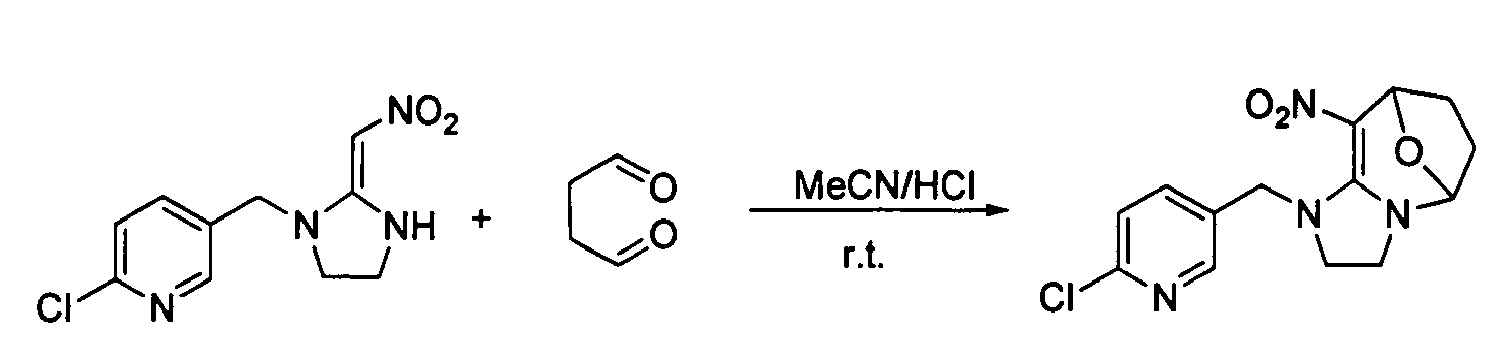
- To a 50ml round bottom flask was added 1.27g (0.005mol) 2-chloro-5-((2-(nitromethylene)imidazolidin-1-yl)methyl)pyridine, 30ml dry acetonitrile, 0.860g (0.01mol) succinaldehyde and catalytic concentrated HCl. The reaction was stirred at r.t. and monitored by TLC. After completion, the mixture was evaporated to remove solvent and purified by column chromatography to afford final product as faint yellow powder with 71% yield.
mp = 149.0-150.0 °C; 1H NMR (400 Mz, DMSO-d6): δ 8.35 (d, J= 2.4 Hz, 1H), 7.81 (dd, J1= 2.4 Hz, J2 = 8.4 Hz, 1H), 7.51 (d, J = 8.4 Hz, 1H), 5.36-5.39 (s, 2H), 5.00 (d, J = 15.6 Hz, 1H), 4.68 (d, J = 15.6 Hz, 1H), 3.57-3.73 (m, 4H), 1.94-2.04 (m, 4H) ppm; 13C NMR (100 Mz, DMSO-d6): δ 155.6, 149.7, 149.6, 139.7, 132.6, 124.5, 109.6, 87.0, 75.1, 51.2, 50.3, 46.6, 31.9, 31.7 ppm; HRMS (ES+) calcd for C14H16N4O3 35Cl (M+H)+, 323.0911; found, 323.0912. calcd for C14H16N4O3 37Cl (M+H)+, 325.0811; found, 325.0895. calcd for C14H15N4O3 35ClNa (M+Na)+, 345.0730; found, 345.0722. calcd for C14H15N4O3 37ClNa (M+Na)++, 347.0701; found, 347.0692. -

- To a 50ml round bottom flask was added 1.30g (0.005mol) 1-((2-chlorothiazol-5-yl)methyl)-2-(nitromethylene)imidazolidine, 30ml dry acetonitrile, 0.860g (0.01mol) succinaldehyde and catalytic concentrated HCl. The reaction was stirred at r.t. and monitored by TLC. After completion, the mixture was evaporated to remove solvent and purified by column chromatography to afford final product as faint yellow powder with 63% yield.
mp = 151.7-152.1 °C; 1H NMR (400 Mz, DMSO-d6): δ 7.65 (s, 1H), 5.33-5.37 (s, 2H), 5.01 (d, J = 15.6 Hz, 1H), 4.69 (d, J = 15.6 Hz, 1H), 3.52-3.70 (m, 4H), 1.90-2.01 (m, 4H) ppm; 13C NMR (100 Mz, DMSO-d6): δ 155.2, 149.6, 139.1, 124.5, 110.6, 87.1, 75.6, 51.3, 50.6, 46.9, 31.9, 31.2 ppm; HRMS (ES+) calcd for C12H15N4O3S35Cl (M+H)+, 329.0475; found, 329.0412. calcd for C12H15N4O3S37Cl (M+H)+, 331.0446; found, 331.0423. -

- To a 50ml round bottom flask was added 1.34g (0.005mol) (E)-1-((6-chloropyridin-3-yl)methyl)-2-(nitromethylene)-hexahydropyrimidine, 30ml dry acetonitrile and 0.860g (0.01mol) succinaldehyde and catalytic concentrated HCl. The reaction was stirred at r.t. and monitored by TLC. After completion, the mixture was evaporated to remove solvent and purified by column chromatography to afford final product as faint yellow powder with 38% yield.
mp = 143.2-144.9 °C; 1H NMR (400 Mz, DMSO-d6): δ 8.33 (d, J= 2.4 Hz, 1H), 7.80 (dd, J1= 2.4 Hz, J2 = 8.4 Hz, 1H), 7.49 (d, J = 8.4 Hz, 1H), 5.32-5.35 (s, 2H), 5.00 (d, J = 15.6 Hz, 1H), 4.66 (d, J = 15.6 Hz, 1H), 3.51-3.68 (m, 4H), 2.33-2.41 (m, 2H), 1.89-2.00 (m, 4H) ppm; 13C NMR (100 Mz, DMSO-d6): δ 155.5, 149.6, 149.3, 139.7, 132.6, 124.1, 109.3, 86.6, 75.1, 51.2, 50.7, 46.6, 32.1, 31.7, 26.9 ppm; HRMS (ES+) calcd for C15H19N4O3 35Cl (M+H)+, 337.1067; found, 337.1015. calcd for C15H19N4O3 37Cl (M+H)+, 339.1038; found, 339.0995. -

- To a 50ml round bottom flask was added 1.17g (0.005mol) 2-(1-((6-chloropyridin-3-yl)methyl)imidazolidin-2-ylidene)acetonitrile, 30ml dry acetonitrile and 0.860g (0.01ml) succinaldehyde and catalytic concentrated HCl. The reaction was stirred at r.t. and monitored by TLC. After completion, the mixture was evaporated to remove solvent and purified by column chromatography to afford final product as faint yellow powder with 66% yield.
mp = 125.1-126.8 °C; 1H NMR (400 Mz, DMSO-d6): δ 8.34 (d, J= 2.4 Hz, 1H), 7.82 (dd, J1 = 2.4 Hz, J2 = 8.4 Hz, 1H), 7.55 (d, J = 8.4 Hz, 1H), 5.33 (s, 1H), 5.25 (s, 1H), 5.00 (d, J = 15.6 Hz, 1H), 4.78 (d, J = 15.6 Hz, 1H), 3.56-3.78 (m, 4H), 1.91-2.00 (m, 4H) ppm; 13C NMR (100 Mz, DMSO-d6): δ 153.6, 149.0, 148.6, 139.7, 132.3, 121.5, 99.6, 87.3, 75.7, 51.3, 50.2, 46.6, 31.5, 29.7 ppm; HRMS (ES+) calcd for C15H16N4O35Cl (M+H)+, 303.1013; found, 303.0992. calcd for C15H16N4O37Cl (M+H)+, 305.0983; found, 305.0957. -

- To a 50ml round bottom flask was added 1.27g (0.005mol) 2-chloro-5-((2-(nitromethylene)imidazolidin-1-yl)methyl)pyridine, 30ml acetonitrile, 3ml 25% glutaraldehyde aqueous solution and catalytic concentrated HCl. The reaction was stirred at r.t. and monitored by TLC. After completion, the mixture was evaporated to remove solvent and purified by column chromatography to afford final product as faint yellow powder with 86% yield.
mp = 174.7-175.4 °C; 1H NMR (400 Mz, DMSO-d6): δ 8.38 (dd, J1 = 0.6 Hz, J2 = 2.4 Hz, 1H), 7.84 (dd, J1 = 2.4 Hz, J2 = 8.4 Hz, 1H), 7.52 (dd, J1 = 0.6 Hz, J2 = 8.4 Hz, 1H), 5.12 (s, 1H), 5.04-5.05 (m, 1H), 4.97 (d, J = 15.6 Hz, 1H), 4.71 (d, J = 15.6 Hz, 1H), 3.62-3.74 (m, 4H), 1.66-1.81 (m, 4H), 1.51-1.55 (m, 1H), 1.32-1.44 (m, 1H) ppm; 13C NMR (100 Mz, DMSO-d6): δ 156.6, 149.7, 149.6, 139.7, 132.9, 124.5, 105.8, 81.7, 68.9, 51.7, 50.0, 46.3, 28.8, 27.2, 14.8 ppm; HRMS (EI+) calcd for C15H17N4O3 35Cl (M+), 336.0989; found, 336.0988. calcd for C15H17N4O3 37Cl (M+), 338.0960; found, 338.0968. - Following the method described in Example 1, 0.2 mol 3-(chloromethyl)tetrahydrofuran instead of 2-chloro-5-(chloromethyl)pyridine was used as staring material. 2-(nitromethylene)-1-((tetrahydrofuran-3-yl)methyl)imidazolidine was obtained with 51% yield. GC MS(m/s) 177(29), 99(100), 56(9).
-

- To a 50ml round bottom flask was added 1.065g (0.005mol) 2-(nitromethylene)-1-((tetrahydrofuran-3-yl)methyl)imidazolidine, 30ml acetonitrile, 3ml 25% glutaraldehyde aqueous solution and catalytic concentrated HCl. The reaction was stirred at r.t. and monitored by TLC. After completion, the mixture was evaporated to remove solvent and purified by column chromatography to afford final product as yellow powder with 36% yield.
mp = 115.3-116.9°C; 1H NMR (400 Mz, DMSO-d6): δ 5.11 (s, 1H), 5.00-5.03 (m, 1H), 4.18 (d, J = 3.2 Hz, 2H), 4.05-4.25 (m, 2H), 3.85-3.96 (m, 4H), 2.25 (m, 1H), 1.66-1.81 (m, 4H), 1.63 -1.64 (m, 2H), 1.57-1.59 (m, 2H), 1.51-1.55 (m, 1H), 1.32-1.44 (m, 1H) ppm; 13C NMR (100 Mz, DMSO-d6): δ 81.7, 80.6, 78.5, 68.9, 50.0, 49.7, 46.9, 44.6, 36.8, 33.9, 28.8, 27.2, 17.8, 14.8ppm; HRMS (EI+) calcd for C14H21N3O4 (M+), 295.1532; found, 295.1598. - Aphis, which belongs to Homoptera and has a piercing-sucking mouthpart, is a common insect for agricultural plant. Aphis craccivoral was tested by the way of immersing.
- Test method: exactly weighed various samples were independently added to N,N-dimethylformamide to form a 10g/L stock solution. The mixture was diluted with 0.2mL/L aqueous Triton X-100 solution to a concentration of 500ppm After stably sucking on bean sprout, the adult aphis without wings together with bean sprout was dipped into 500ppm dilution, taken out after 5 seconds, and the excess dilution was sucked out with bibulous paper and the adult aphis without wings was incubated in clean vessel at a constant temperature of 23 °C. Each concentration was repeated for 3 times and the control group contained 0.2mL/L aqueous Triton X-100 solution. The number of killed aphis was counted after 24 hours to calculate the mortality by the following formula:

- The results were shown in Tables 1-4 bellow.
- Planthopper, which belongs to Homoptera and has a piercing-sucking mouthpart, is a common insect for agricultural plant. Nilaparvata lugens was tested by the way of spraying.
- Test method: the test compound was exactly formulated into a solution of acetone to final concentration of 500, 250, 100, 50, 25, 12.5, 6.25, 3.13, 1.57 and 0.79 ppm. The acetone aqueous solution was used as control. Each process was repeated for 3 tumblers (3 times). 2mL of solution was sprayed uniformly to each cup by a mini manual sprayer. 10 Nilaparvata lugens were introduced to every sink 6 hours before spraying. Three series of experiments were conducted. The number of killed Nilaparvata lugens was counted after 24 hours to calculate the mortality using above mentioned formula. The results were shown in Tables 1-4 bellow.
- Armyworm was tested by the way of feeding immersed leaves. The test compound was exactly formulated into a solution of acetone to concentration 500, 250, 100, 50, 25, 12.5, 6.25, 3.13 and 1.57 ppm. The acetone aqueous solution was used as control. Fresh maize leaves were immersed in the solution for 3 seconds and dried at room temperature and used to feed the tested insects. Each process was repeated for 3 times while 10 Armyworms were tested in each experiment. The number of killed Armyworms was counted after 24 hours to calculate the mortality using above mentioned formula. The results were shown in Tables 1-4 bellow.
- Diamondback moth was tested by the way of feeding immersed leaves. Fresh cabbage leaves were immersed in above mentioned solution for 3 seconds and dried at room temperature and used to feed to the tested insects. Each process was repeated for 3 tumblers (3 times) while 10 Diamondback moths were tested in each experiment, while water was used as control. The number of killed Diamondback moth was counted after 24 hours to calculate the mortality using above mentioned formula. The results were shown in Tables 1-4 bellow.
Table 1 Insecticidal Activities of Compound of formula (A) 
Compd. No. R1 R2 R3 R4 Y Insecticidal Activity Cowpea Aphids Planth-op per Army-wor m Diamo-nd back moth Mortality (100%) 500ppm Mortality (100%) 500ppm Mortality (100%) 500ppm Mortality (100%) 500ppm 1 
H C2H5 CH3 NO2 80 91 100 100 2 
CH3 C2H5 CH3 NO2 100 100 100 100 3 
C2H5 C2H5 CH3 NO2 100 100 100 100 4 
C3H7 C2H5 CH3 NO2 100 100 100 100 5 
i-C3H7 C2H5 CH3 NO2 100 100 100 100 6 
benzyl C2H5 CH3 NO2 100 100 100 100 7 
H H CH3 NO2 24 35 35 21 8 
CH3 H CH3 NO2 45 44 67 56 9 
C2H5 H CH3 NO2 89 87 100 100 10 
C3H7 H CH3 NO2 45 36 87 90 11 
i-C3H7 H CH3 NO2 76 90 95 100 12 
benzyl H CH3 NO2 67 92 97 100 13 
H R3 and R4 form together -CH2-CH2- NO2 78 85 100 100 14 
CH3 R3 and R4 together form -CH2-CH2- NO2 100 100 100 100 15 
C2H5 R3 and R4 together form -CH2-CH2- NO2 100 100 100 100 16 
C3H7 R3 and R4 together form -CH2-CH2- NO2 100 100 100 100 17 
i-C3H7 R3 and R4 together form -CH2-CH2- NO2 100 100 100 100 18 
benzyl R3 and R4 together form -CH2-CH2- NO2 100 100 100 100 19 
H R3 and R4 together form -CH2-CH2- CN 90 100 100 100 20 
H R3 and R4 together form -CH2-CH2- CN 98 100 100 100 21 
H R3 and R4 together form -CH2-CH2- CN 100 100 100 100 22 
H R3 and R4 together form -CH2-CH2- CN 73 100 92 100 23 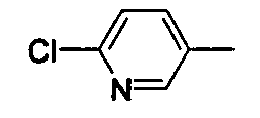
H R3 and R4 together form -CH2-CH2- CN 56 87 87 100 24 
H R3 and R4 together form -CH2-CH2- CN 65 83 90 100 25 
H R3 and R4 together form -CH2-CH2- NO2 89 87 100 100 26 
H R3 and R4 together form -CH2-CH2- NO2 100 100 100 100 27 
H R3 and R4 together form -CH2-CH2- NO2 100 100 100 100 28 
H R3 and R4 together form -CH2-CH2- NO2 100 100 100 100 29 
H R3 and R4 together form -CH2-CH2- NO2 100 100 100 100 30 
H R3 and R4 together form -CH2-CH2-CH2 NO2 100 100 100 100 31 
H R3 and R4 together form -CH2-CH2-CH2 NO2 46 77 77 83 32 
H R3 and R4 together form -CH2-CH2-CH2 NO2 65 61 87 92 33 
H R3 and R4 together form -CH2-CH2-CH2 NO2 32 50 58 52 34 
H R3 and R4 together form -CH2-CH2-CH2 NO2 76 88 90 86 35 
H R3 and R4 together form -CH2-CH2-CH2 NO2 76 90 68 77 36 
H R3 and R4 together form -CH2-CH2-CH2 NO2 87 97 100 100 Table 2 Insecticidal Activities of Compound of formula (B) 
Compd. No. R1 R3 R4 Y Insecticidal Activity Cowpea Aphids Planth-op per Army-wo rm Diamo-ndb ack moth Mortality (100%) 500ppm Mortality (100%) 500ppm Mortality (100%) 500ppm Mortality (100%) 500ppm 37 
C2H5 CH3 NO2 100 100 100 100 38 
H CH3 NO2 100 100 100 100 39 
R3 and R4 together form -CH2-CH2- NO2 100 100 100 100 40 
R3 and R4 together form CN 56 87 87 100 41 
R3 and R4 together form -CH2-CH2- NO2 100 100 100 100 42 
R3 and R4 together form -CH2-CH2- NO2 100 100 100 100 43 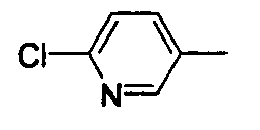
R3 and R4 together form -CH2-CH2-CH2- NO2 78 87 100 96 Table 3 Insecticidal Activities of Compound of formula (C) 
Comp d. No. R1 R3 R4 R5 R6 Y Insecticidal Activity Cowpea Aphids Planth-opper Army-wo rm Diamo-nd back moth Mortality (100%) 500ppm Mortality (100%) 500ppm Mortality (100%) 500ppm Mortality (100%) 500ppm 44 
H CH3 H H NO2 100 100 100 100 45 
CH3 CH3 H H NO2 100 100 100 100 46 
C2H5 CH3 H H NO2 100 100 100 100 47 
H H H H NO2 100 100 100 100 48 
CH3 H H H NO2 100 100 100 100 49 
C2H5 H H H NO2 100 100 100 100 50 
CH3 C2H5 H H NO2 100 100 100 100 51 
C2H5 C2H5 H H NO2 100 100 100 100 52 
R3 and R4 together form -CH2CH2- H H NO2 100 100 100 100 53 
R3 and R4 together form -CH2CH2- H H NO2 100 100 100 100 54 
R3 and R4 together form -CH2-CH2- H H NO2 100 100 100 100 55 
R3 and R4 together form -CH2-CH2- CH3 CH3 NO2 100 100 100 100 56 
R3 and R4 together form -CH2-CH2- CH3 CH3 NO2 100 100 100 100 57 
R3 and R4 together form -CH2-CH2- CH3 CH3 NO2 100 100 100 100 58 
R3 and R4 together form -CH2-CH2- F F NO2 100 100 100 100 59 
R3 and R4 together form -CH2-CH2- F F NO2 100 100 100 100 60 
R3 and R4 together form -CH2-CH2- F F NO2 100 100 100 100 61 
R3 and R4 together form -CH2-CH2-CH2- H H NO2 65 75 76 35 62 
R3 and R4 together form -CH2-CH2-CH2- H H NO2 75 50 89 33 63 
R3 and R4 together form -CH2-CH2-CH2- H H NO2 37 76 3 87 64 
R3 and R4 together form -CH2-CH2- H H CN 96 56 100 100 65 
R3 and R4 together orm -CH2-CH2- H H CN 80 86 98 00 66 
R3 and R4 together form -CH2-CH2- H H CN 37 44 50 41 67 
R3 and R4 together form -CH2-CH2- H CH3O NO2 NO2 100 100 100 100 68 
R3 and R4 together form -CH2-CH2- H C2H5O NO2 100 100 100 100 69 
R3 and R4 together form -CH2-CH2- CH3O H NO2 100 100 100 100 70 
R3 and R4 together form -CH2-CH2- C2H5O H NO2 100 100 100 100 71 
R3 and R4 together form -CH2-CH2- 
H NO2 100 100 100 100 72 
R3 and R4 together form -CH2-CH2- 
H NO2 100 100 100 100 73 
R3 and R4 together form -CH2-CH2- H 
NO2 100 100 100 100 74 
R3 and R4 together form -CH2-CH2- H 
NO2 100 100 100 100 Table 4 Insecticidal Activities of Compound of formula (D) 
Compd. No. R1 R3 R4 R7 , R 8 , R 9 Y Insecticidal Activity Cowpea Aphids Planth-op per Army-worm Diamo-nd back moth Mortality (100%) 500ppm Mortality (100%) 500ppm Mortality (100%) 500ppm Mortality (100%) 500ppm 75 
C2H5 CH3 H NO2 100 100 100 100 76 
H CH3 H NO2 100 100 100 100 77 
R3 and R4 together form -CH2-CH2- H NO2 100 100 100 100 78 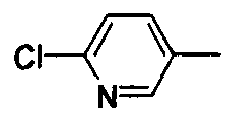
R3 and R4 together form -CH2-CH2- H CN 56 87 87 100 79 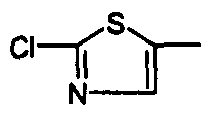
R3 and R4 together form -CH2-CH2- H NO2 100 100 100 100 80 
R3 and R4 together form -CH2-CH2- H NO2 100 100 100 100 81 
R3 and R4 together form -CH2-CH2-CH2 H NO2 78 87 100 96 - The following components were prepared: 25 wt% of any compound selected from compounds 1-73; 5 wt% polyoxyethylene sorbital hexaoleate and 70 wt% higher aliphatic hydrocarbon oil. All of the components were ground in a sand mill until the solid granules were reduced to less than about 5 micrometer. The resultant viscous suspension could be used directly or may be used after it was emulsified in water.
- The following components were prepared: 25 wt% of any compound selected from compounds 1-73; 3 wt% hydrate attapulagit; 10 wt% calcium lignosulphonate; 0.5 wt% sodium dihydrogen phosphate and 61.5 wt% water. All of the components were ground in a ball mill until the solid granules were reduced to less than about 10 micrometer. The aqueous suspension could be used directly.
- The following components were prepared: 0.1-10 wt% of any compound selected from compounds 1-73; 80 wt% wheat flour and 19.9-10 wt% molasses. All of the components were sufficiently mixed and shaped according to the need. The edible bait could be oral ingested or distributed to domestic or industrial places such as kitchen, hospital, store and outdoor area infected by public health insects.
- All the documents cited herein are incorporated into the invention as reference, as if each of them is individually incorporated. Further, it would be appreciated that, in light of the above described teaching of the invention, the skilled in the art could make various changes or modifications to the invention, and these equivalents would still be within the scope of the invention defined by the appended claims of the application.
Claims (10)
- A compound of formula (A), (B), (C) or (D), its optical isomer, cis-trans isomer, or its agrochemically acceptable salts thereof,

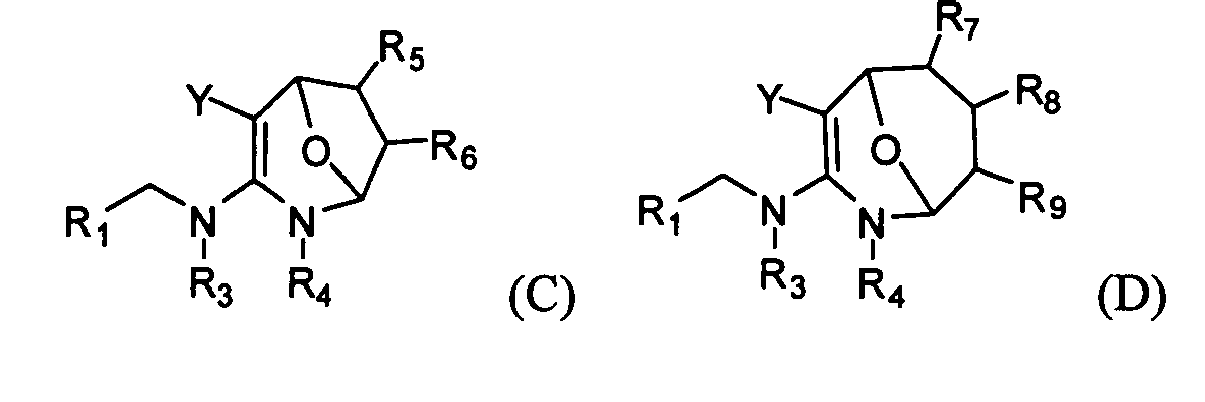 wherein R1 is 5 or 6 membered heterocycle containing nitrogen, oxygen and/or sulfur atom, halo-substituted 5 or 6 membered heterocycle containing nitrogen, oxygen and/or sulfur atom, substituted or unsubstituted phenyl, wherein the substituents are one or more groups selected from the group consisting of halogen atoms, C1-4 halo-alkyl or C1-4 chloro-alkoxyl;R2 is H, C1-8 saturated or unsaturated alkyl, halo-substituted C1-8 saturated or unsaturated alkyl, -CH2CH2OCH2CH3, -CH2CH2OCH3, C1-8 saturated or unsaturated alkoxyl, phenyl, benzyl, C1-4 alkyl-carbonyl, or C1-4 alkyl-sulfonyl;R3 and R4 are independently selected from H, C1-6 alkyl, allyl, benzyl, C1-4 alkoxyl-C1-4 alkyl, C1-4 alkoxyl-carbonyl, phenoxycarbonyl, C2-6 alkynyl-carbonyl, C2-3 alkenyl-carbonyl, C3-6 cycloalkyl-carbonyl, unsubstitued benzoyl group or benzoyl group substituted by one or more groups selected from the group consisting of halogen atoms, C1-4 alkyl, C1-4 halo-alkyl, C1-4 alkoxyl or C1-4 alkyl-carbonyl, furan carbonyl or N, N-dimethyl carbonyl; or R3 and R4 together form -CH2-CH2-, -CH2-CH2-CH2- or -CH2-XR-CH2-, wherein X represents heteroatom; R is substituent on X and selected from H, C1-6 alkyl, allyl, benzyl, phenyl, C1-4 alkoxyl-C1-4 alkyl, C1-4 alkoxyl-carbonyl, phenoxycarbonyl, C2-6 alkynyl-carbonyl, C2-3 alkenyl-carbonyl, C3-6 cycloalkyl-carbonyl, unsubstitued benzoyl group or benzoyl group substituted by one or more groups selected from the group consisting of halogen atoms, C1-4 halo-alkyl, C1-8 saturated or unsaturated alkyl or alkoxyl, or C1-4 alkyl-carbonyl, furan carbonyl or N, N-dimethyl carbonyl.R5, R6, R7, R8 and R9 are H, saturated or unsaturated C1-4 alkyl, halogen, saturated or unsaturated C1-8 alkoxyl, saturated or unsaturated C1-4 halo-alkoxyl, C1-4 alkyl-carbonyl, C1-8 alkyl-ester, C1-4 alkyl-sulfonyl, phenyl or benzyl;Y is nitro, cyano, trifluoromethyl, trifluoroacetyl, or trifluoromethylsulfonyl.
 - The compound, its optical isomer or cis-trans isomer, or its agrochemically acceptable salts of claim 1 wherein R1 is selected from pyridyl, thiazolyl, pyrimidinyl, tetrahydrofuryl, oxazolyl, or the halogenated groups thereof.
- The compound, its optical isomer or cis-trans isomer, or its agrochemically acceptable salts of claim 1 wherein R2 represents H, saturated or unsaturated C1-4 alkyl, saturated or unsaturated C1-4 halo-alkyl, C1-4 alkyl-carbonyl, unsubstituted benzyl or benzyl substituted by one or more groups selected from the group consisting of halogen atom, C1-4 halo-alkyl or C1-4 chloro-alkoxyl.
- The compound, its optical isomer or cis-trans isomer, or its agrochemically acceptable salts of claim 1 were featured with that R3 and R4 are H, C1-6 alkyl group, or R3 and R4 together form -CH2-CH2- or -CH2-CH2-CH2-.
- The compound, its optical isomer or cis-trans isomer, or its agrochemically acceptable salts of claim 1 wherein R5, R6, R7, R8 and R9 are H, saturated or unsaturated C1-2 alkyl, halogen, saturated or unsaturated C1-4 alkoxyl, saturated or unsaturated C1-2 halo-alkoxyl, C1-4 alkyl-ester group (RCOO-), C1-2 alkyl-sulfonyl or trifluoromethanesulfonyl ester group.
- The compound, its optical isomer or cis-trans isomer, or its agrochemically acceptable salts of claim 1 wherein Y is nitro group or cyano group.
- An agrochemical composition comprising:(a) 0.001-99.99wt% of the compound, its optical isomer, cis-trans isomer, agrochemically acceptable salts thereof according to any of claims 1-6 or the combination thereof; and(b) an agrochemically acceptable carrier or excipient.
- An use of the agrochemical composition of claim 7 in killing or controlling agricultural pests, sanitary pests and animal health hazard pests; or the use agrochemical composition of claim 7 as an insecticidal composition for killing or controlling agricultural pests, sanitary pests and animal health hazard pests.
- A method for preparation of the compound, its optical isomer or cis-trans isomer, or an agrochemically acceptable salts according to any of claims 1-6, wherein the method comprises the following steps:in the presence of catalytic acid and at 0-60 °C, reacting compound of formula (a) with compound (b), (c) or (d), thereby forming compound (A), (B), (C) or (D), wherein R2 represents H,
 wherein R1, R3, R4, R5, R6, R7, R8, R9 and Y are defined as in claim 1, and n is 0 or 1.
 - The method of claim 9 wherein the method comprises:in the presence of catalytic acid, the following reaction is carried out at 20-30 °C in acetonitrile for 2-24 hours, thereby forming compound (A), wherein R2 is H:
 in the presence of catalytic acid, the following reaction is carried out at 20-30 °C in acetonitrile for 2-24 hours, thereby forming compound (B):
 in the presence of catalytic acid, the following reaction is carried out at 10-50 °C in acetonitrile for 2-24 hours, thereby forming compound (C):
 in the presence of catalytic acid, the following reaction is carried out at 10-50 °C in acetonitrile for 2-24 hours, thereby forming compound (D):
Applications Claiming Priority (2)
| Application Number | Priority Date | Filing Date | Title |
|---|---|---|---|
| CN2008102073552A CN101747320B (en) | 2008-12-19 | 2008-12-19 | Dialdehyde-constructed nitrogen- or oxygen-containing heterocyclic compound with insecticidal activity and preparation method thereof |
| PCT/CN2009/075693 WO2010069266A1 (en) | 2008-12-19 | 2009-12-18 | Heterocyclic nitrogenous or oxygenous compounds with insecticidal activity formed from dialdehydes and their preparation and uses thereof |
Publications (3)
| Publication Number | Publication Date |
|---|---|
| EP2377845A1 true EP2377845A1 (en) | 2011-10-19 |
| EP2377845A4 EP2377845A4 (en) | 2012-12-26 |
| EP2377845B1 EP2377845B1 (en) | 2015-01-28 |
Family
ID=42268331
Family Applications (1)
| Application Number | Title | Priority Date | Filing Date |
|---|---|---|---|
| EP09832948.5A Active EP2377845B1 (en) | 2008-12-19 | 2009-12-18 | Heterocyclic nitrogenous or oxygenous compounds with insecticidal activity formed from dialdehydes and their preparation and uses thereof |
Country Status (10)
| Country | Link |
|---|---|
| US (1) | US8563546B2 (en) |
| EP (1) | EP2377845B1 (en) |
| JP (1) | JP5771150B2 (en) |
| KR (1) | KR101392296B1 (en) |
| CN (1) | CN101747320B (en) |
| AU (1) | AU2009328851C1 (en) |
| BR (1) | BRPI0918359B1 (en) |
| IL (1) | IL213656A (en) |
| RU (1) | RU2495023C2 (en) |
| WO (1) | WO2010069266A1 (en) |
Cited By (1)
| Publication number | Priority date | Publication date | Assignee | Title |
|---|---|---|---|---|
| EP2511279A4 (en) * | 2009-12-09 | 2013-05-01 | Univ East China Science & Tech | HETEROCOTINIC BIVALENT AND OXAPONTATED NEONICOTINIC COMPOUNDS AND PROCESSES FOR PREPARING THE SAME |
Families Citing this family (129)
| Publication number | Priority date | Publication date | Assignee | Title |
|---|---|---|---|---|
| CN102197807A (en) * | 2011-03-31 | 2011-09-28 | 上海生农生化制品有限公司 | Cycloxaprid wettable powder and preparation method thereof |
| CN102197808B (en) * | 2011-03-31 | 2013-10-30 | 上海生农生化制品有限公司 | Cyclopyrid water-dispersible granule and preparation method thereof |
| CN102197804A (en) * | 2011-03-31 | 2011-09-28 | 上海生农生化制品有限公司 | Cycloxaprid suspending agent and preparation method thereof |
| CN102326583B (en) * | 2011-07-19 | 2013-09-18 | 陕西上格之路生物科学有限公司 | Insecticidal composition containing epoxy insect pyridine and organic phosphorus insecticide |
| CN102293208B (en) * | 2011-08-29 | 2013-05-15 | 陕西上格之路生物科学有限公司 | A kind of insecticidal composition containing cyclopyrid and buprofezin |
| CN102396472A (en) * | 2011-11-26 | 2012-04-04 | 陕西美邦农药有限公司 | Insecticidal composition containing cycloxaprid and hormones |
| CN102487952B (en) * | 2011-12-04 | 2013-10-23 | 陕西上格之路生物科学有限公司 | A kind of insecticidal composition containing cyclopyrid and biological source insecticide |
| CN103125481A (en) * | 2011-12-05 | 2013-06-05 | 上海生农生化制品有限公司 | Cycloxaprid oil suspending agent and preparing method thereof |
| CN102428949A (en) * | 2011-12-21 | 2012-05-02 | 陕西美邦农药有限公司 | Insecticidal composition containing cycloxaprid and neonicotinoids |
| CN103242323B (en) * | 2012-02-06 | 2017-05-10 | 华东理工大学 | Nitrogen (sulfur) containing bridge ring compound with insecticidal activity, preparation method and application |
| CN103238609A (en) * | 2012-02-09 | 2013-08-14 | 陕西美邦农药有限公司 | Cycloxaprid-containing insecticidal composition |
| CN102440252B (en) * | 2012-02-13 | 2013-09-18 | 陕西上格之路生物科学有限公司 | Insecticidal composition containing cycloxaprid and pyrazole insecticide |
| WO2013156331A1 (en) | 2012-04-16 | 2013-10-24 | Basf Se | Synergistic compositions comprising pyraclostrobin and an insecticidal compound |
| CN102657189B (en) * | 2012-05-08 | 2014-04-30 | 陕西上格之路生物科学有限公司 | Pesticide composition containing cycloxaprid |
| WO2014005982A1 (en) | 2012-07-05 | 2014-01-09 | Bayer Cropscience Ag | Insecticide and fungicide active ingredient combinations |
| CN102771510B (en) * | 2012-07-31 | 2014-06-04 | 陕西上格之路生物科学有限公司 | Insecticidal composition containing fosthiazate |
| AR093828A1 (en) | 2012-10-01 | 2015-06-24 | Basf Se | ACTIVE MIXTURES AS PESTICIDES, WHICH INCLUDE ANTRANILAMIDE COMPOUNDS |
| WO2014053407A1 (en) | 2012-10-01 | 2014-04-10 | Basf Se | N-thio-anthranilamide compounds and their use as pesticides |
| AR093771A1 (en) | 2012-10-01 | 2015-06-24 | Basf Se | METHOD TO CONTROL INSECTICIDE RESISTANT INSECTS |
| WO2014053401A2 (en) | 2012-10-01 | 2014-04-10 | Basf Se | Method of improving plant health |
| KR20150067270A (en) | 2012-10-01 | 2015-06-17 | 바스프 에스이 | Pesticidally active mixtures comprising anthranilamide compounds |
| EP2903437A1 (en) | 2012-10-01 | 2015-08-12 | Basf Se | Use of n-thio-anthranilamide compounds on cultivated plants |
| AR093772A1 (en) | 2012-10-01 | 2015-06-24 | Basf Se | METHOD FOR CONTROLLING INSECTICIDES INSECTICIDES MODULADORES DE RIANODINA |
| WO2014079820A1 (en) | 2012-11-22 | 2014-05-30 | Basf Se | Use of anthranilamide compounds for reducing insect-vectored viral infections |
| EP2984074A1 (en) | 2012-12-14 | 2016-02-17 | Basf Se | Malononitrile compounds for controlling animal pests |
| CN105189489A (en) | 2012-12-27 | 2015-12-23 | 巴斯夫欧洲公司 | 2-(pyridin-3-yl)-5-hetaryl-thiazole compounds carrying an imine or imine-derived substituent for combating invertebrate pests |
| CN104054726B (en) * | 2013-03-20 | 2018-10-26 | 上海生农生化制品股份有限公司 | Fenoxycarb and cycloxaprid Pesticidal combination |
| WO2014170300A1 (en) | 2013-04-19 | 2014-10-23 | Basf Se | N-substituted acyl-imino-pyridine compounds and derivatives for combating animal pests |
| US20160145222A1 (en) | 2013-06-21 | 2016-05-26 | Basf Se | Methods for Controlling Pests in Soybean |
| AU2014292164C1 (en) | 2013-07-15 | 2018-09-27 | Basf Se | Pesticide compounds |
| CN103430952B (en) * | 2013-07-18 | 2015-03-04 | 张强 | Water-soluble thiophanate-methyl preparation and production process thereof |
| US10206397B2 (en) | 2013-09-19 | 2019-02-19 | Basf Se | N-acylimino heterocyclic compounds |
| UY35772A (en) | 2013-10-14 | 2015-05-29 | Bayer Cropscience Ag | NEW PESTICIDED COMPOUNDS |
| WO2015055554A1 (en) | 2013-10-14 | 2015-04-23 | Bayer Cropscience Ag | Active substance for treating seed and soil |
| WO2015055497A1 (en) | 2013-10-16 | 2015-04-23 | Basf Se | Substituted pesticidal pyrazole compounds |
| MX386864B (en) | 2013-10-18 | 2025-03-19 | Basf Agrochemical Products Bv | USE OF ACTIVE CARBOXAMIDE DERIVATIVE AS A PESTICIDE IN SOIL AND SEED APPLICATION AND TREATMENT METHODS. |
| WO2015059088A1 (en) | 2013-10-23 | 2015-04-30 | Bayer Cropscience Ag | Substituted quinoxaline derivatives as pest control agent |
| WO2015091649A1 (en) | 2013-12-18 | 2015-06-25 | Basf Se | N-substituted imino heterocyclic compounds |
| CN105829296A (en) | 2013-12-18 | 2016-08-03 | 巴斯夫欧洲公司 | Azole compounds with imine-derived substituents |
| CN103719115B (en) * | 2013-12-25 | 2015-08-05 | 江苏龙灯化学有限公司 | A kind of Pesticidal combination |
| CN104738052A (en) * | 2013-12-25 | 2015-07-01 | 南京华洲药业有限公司 | Composite insecticidal composition containing pyridalyl and cycloxaprid and application thereof |
| WO2015104422A1 (en) | 2014-01-13 | 2015-07-16 | Basf Se | Dihydrothiophene compounds for controlling invertebrate pests |
| TW201612161A (en) | 2014-01-20 | 2016-04-01 | Bayer Cropscience Ag | Quinoline derivatives as insecticides and acaricides |
| CN106661022B (en) | 2014-05-08 | 2018-05-04 | 拜耳作物科学股份公司 | Pyrazolopyridine sulfonamides as nematicides |
| BR112016028404A2 (en) | 2014-06-05 | 2018-07-03 | Bayer Cropscience Aktiengesellschaft | bicyclic compounds as pesticides |
| WO2016001119A1 (en) | 2014-07-01 | 2016-01-07 | Bayer Cropscience Aktiengesellschaft | Insecticide and fungicide active ingredient combinations |
| JP2017521441A (en) | 2014-07-15 | 2017-08-03 | バイエル・アニマル・ヘルス・ゲゼルシャフト・ミット・ベシュレンクテル・ハフツングBayer Animal Health Gmbh | Aryl-triazolylpyridines as pest control agents |
| BR112017005140A2 (en) | 2014-10-06 | 2018-01-23 | Basf Se | compounding, mixing, composition, crop protection methods and control or control of invertebrate pests, non-therapeutic method for the treatment of parasite and seed-infested animals |
| WO2016055096A1 (en) | 2014-10-07 | 2016-04-14 | Bayer Cropscience Ag | Method for treating rice seed |
| CN105557709B (en) * | 2014-10-11 | 2018-08-14 | 南京农业大学 | Purposes of eight yuan of oxygen bridge heterocyclic compounds as insecticidal synergist |
| BR112017009513A2 (en) | 2014-11-06 | 2018-02-06 | Basf Se | use of a heterobicyclic compound, use of compounds i, compounds, agricultural or veterinary composition, method for pest control or control, method for crop and seed protection |
| EP3081085A1 (en) | 2015-04-14 | 2016-10-19 | Bayer CropScience AG | Method for improving earliness in cotton |
| EP3253209A1 (en) | 2015-02-06 | 2017-12-13 | Basf Se | Pyrazole compounds as nitrification inhibitors |
| WO2016128261A2 (en) | 2015-02-11 | 2016-08-18 | Basf Se | Pesticidal mixture comprising a pyrazole compound, an insecticide and a fungicide |
| BR112017021450B1 (en) | 2015-04-07 | 2021-12-28 | Basf Agrochemical Products B.V. | PEST CONTROL METHODS, PLANT HEALTH IMPROVEMENT METHOD AND COATED SEED |
| EP2910126A1 (en) | 2015-05-05 | 2015-08-26 | Bayer CropScience AG | Active compound combinations having insecticidal properties |
| MX2017014459A (en) | 2015-05-12 | 2018-03-16 | Basf Se | THIOETER COMPOUNDS AS INHIBITORS OF NITRIFICATION. |
| WO2016198611A1 (en) | 2015-06-11 | 2016-12-15 | Basf Se | N-(thio)acylimino heterocyclic compounds |
| WO2016198613A1 (en) | 2015-06-11 | 2016-12-15 | Basf Se | N-(thio)acylimino compounds |
| WO2017016883A1 (en) | 2015-07-24 | 2017-02-02 | Basf Se | Process for preparation of cyclopentene compounds |
| WO2017055386A1 (en) | 2015-10-02 | 2017-04-06 | Basf Se | Imino compounds with a 2-chloropyrimidin-5-yl substituent as pest-control agents |
| CN105330593A (en) * | 2015-11-23 | 2016-02-17 | 上海晋景化学有限公司 | Improved preparation method of nitenpyram |
| PL3383183T3 (en) | 2015-11-30 | 2020-11-16 | Basf Se | Compositions containing cis-jasmone and bacillus amyloliquefaciens |
| US20190059381A1 (en) | 2016-02-19 | 2019-02-28 | Basf Se | Method for controlling pests of soybean, corn, and cotton plants |
| WO2017153217A1 (en) | 2016-03-09 | 2017-09-14 | Basf Se | Spirocyclic derivatives |
| BR112018068042A2 (en) | 2016-03-11 | 2019-01-08 | Basf Se | methods for controlling plant pests, plant propagating material and use of one or more compounds of formula i |
| CA3015934A1 (en) | 2016-04-01 | 2017-10-05 | Basf Se | Bicyclic compounds |
| AU2017267129A1 (en) | 2016-05-18 | 2018-11-22 | Basf Se | Capsules comprising benzylpropargylethers for use as nitrification inhibitors |
| US10750750B2 (en) | 2016-07-11 | 2020-08-25 | Covestro Llc | Aqueous compositions for treating seeds, seeds treated therewith, and methods for treating seeds |
| US10653136B2 (en) | 2016-07-11 | 2020-05-19 | Covestro Llc | Aqueous compositions for treating seeds, seeds treated therewith, and methods for treating seeds |
| US10653135B2 (en) | 2016-07-11 | 2020-05-19 | Covestro Llc | Methods for treating seeds with an aqueous composition and seeds treated therewith |
| CN106577694A (en) * | 2016-10-24 | 2017-04-26 | 东莞市联洲知识产权运营管理有限公司 | High efficiency broad-spectrum synergistic pesticide composition based on cycloxaprid and matrine |
| US20200077658A1 (en) | 2016-12-16 | 2020-03-12 | Basf Se | Pesticidal Compounds |
| WO2018162312A1 (en) | 2017-03-10 | 2018-09-13 | Basf Se | Spirocyclic derivatives |
| WO2018166855A1 (en) | 2017-03-16 | 2018-09-20 | Basf Se | Heterobicyclic substituted dihydroisoxazoles |
| BR112019020277B1 (en) | 2017-03-28 | 2023-02-14 | Basf Se | COMPOUNDS, COMPOSITION, METHOD FOR COMBATING OR CONTROLING INVERTEBRATE PESTS, METHOD FOR PROTECTING GROWING PLANTS, TREATED SEED, USES OF A COMPOUND OF FORMULA I |
| MX2019011785A (en) | 2017-03-31 | 2019-11-18 | Basf Se | Process for preparing chiral 2,3-dihydrothiazolo[3,2-a]pyrimidin- 4-ium compounds. |
| WO2018192793A1 (en) | 2017-04-20 | 2018-10-25 | Basf Se | Substituted rhodanine derivatives |
| MX2019012813A (en) | 2017-04-26 | 2020-01-14 | Basf Se | Substituted succinimide derivatives as pesticides. |
| ES2910854T3 (en) | 2017-05-10 | 2022-05-13 | Basf Se | Bicyclic Pesticide Compounds |
| WO2018224455A1 (en) | 2017-06-07 | 2018-12-13 | Basf Se | Substituted cyclopropyl derivatives |
| BR112019025331A2 (en) | 2017-06-16 | 2020-06-23 | Basf Se | COMPOUNDS OF FORMULA (I), COMPOSITION, METHODS OF PROTECTION OF CROPS AND COMBAT, NON-THERAPEUTIC METHOD OF TREATMENT, SEED, USE OF COMPOUNDS AND USE OF COMPOUND |
| BR112019025191B1 (en) | 2017-06-19 | 2023-11-28 | Basf Se | SUBSTITUTED PYRIMIDINIUM COMPOUNDS, COMPOSITION, METHOD FOR PROTECTING CROPS, COATED SEED, USE OF THE COMPOUNDS AND USE OF A COMPOUND |
| WO2018234488A1 (en) | 2017-06-23 | 2018-12-27 | Basf Se | SUBSTITUTED CYCLOPROPYL DERIVATIVES |
| WO2019007891A1 (en) | 2017-07-06 | 2019-01-10 | Bayer Aktiengesellschaft | INSECTICIDES ACTIVE COMPOUNDS |
| WO2019007888A1 (en) | 2017-07-06 | 2019-01-10 | Bayer Aktiengesellschaft | INSECTICIDES ACTIVE COMPOUNDS |
| WO2019042932A1 (en) | 2017-08-31 | 2019-03-07 | Basf Se | Method of controlling rice pests in rice |
| EP3453706A1 (en) | 2017-09-08 | 2019-03-13 | Basf Se | Pesticidal imidazole compounds |
| US11399543B2 (en) | 2017-10-13 | 2022-08-02 | Basf Se | Substituted 1,2,3,5-tetrahydroimidazo[1,2-a]pyrimidiniumolates for combating animal pests |
| EP3689877A4 (en) | 2017-11-03 | 2020-08-19 | South China Agricultural University | NITROGEN CONDENSED TRICYCLIC COMPOUND AND ITS USE AS AN INSECTICIDE FOR AGROFORESTYLE |
| WO2019121143A1 (en) | 2017-12-20 | 2019-06-27 | Basf Se | Substituted cyclopropyl derivatives |
| MX2020006566A (en) | 2017-12-21 | 2020-09-25 | Basf Se | Pesticidal compounds. |
| BR112020013292A2 (en) | 2018-01-05 | 2020-12-01 | Basf Se | methods to control pests of soybean plants, method to control pests of the families pentatomidae, agromyzidae, noctuidae, pyralidae, and / or thripidae and use of one or more compounds of formula i |
| IL275726B2 (en) | 2018-01-09 | 2024-06-01 | Basf Se | Hetaryl silylethynyl compounds as nitrification inhibitors |
| WO2019137995A1 (en) | 2018-01-11 | 2019-07-18 | Basf Se | Novel pyridazine compounds for controlling invertebrate pests |
| PE20211754A1 (en) | 2018-02-28 | 2021-09-06 | Basf Se | USE OF N-FUNCTIONALIZED ALCOXY PYRAZOLE COMPOUNDS AS NITRIFICATION INHIBITORS |
| WO2019166558A1 (en) | 2018-02-28 | 2019-09-06 | Basf Se | Use of pyrazole propargyl ethers as nitrification inhibitors |
| BR112020016425A2 (en) | 2018-02-28 | 2020-12-15 | Basf Se | USE OF ALCOXIPYRAZOL COMPOUND, COMPOSITION FOR USE IN REDUCING NITRIFICATION, AGRICULTURAL MIXTURE AND METHODS OF REDUCING NITRIFICATION AND TREATMENT OF FERTILIZER OR COMPOSITION |
| WO2019175712A1 (en) | 2018-03-14 | 2019-09-19 | Basf Corporation | New uses for catechol molecules as inhibitors to glutathione s-transferase metabolic pathways |
| WO2019175713A1 (en) | 2018-03-14 | 2019-09-19 | Basf Corporation | New catechol molecules and their use as inhibitors to p450 related metabolic pathways |
| WO2019185413A1 (en) | 2018-03-27 | 2019-10-03 | Basf Se | Pesticidal substituted cyclopropyl derivatives |
| WO2019211106A1 (en) | 2018-04-30 | 2019-11-07 | Basf Se | Control of pests of soybean plants with mesoionic compounds |
| CN112423590B (en) | 2018-05-15 | 2022-07-08 | 巴斯夫欧洲公司 | Mixtures and use comprising benzpyrimoxan and oxazosulfyl and methods for their application |
| WO2019224092A1 (en) | 2018-05-22 | 2019-11-28 | Basf Se | Pesticidally active c15-derivatives of ginkgolides |
| WO2020002472A1 (en) | 2018-06-28 | 2020-01-02 | Basf Se | Use of alkynylthiophenes as nitrification inhibitors |
| DK3826983T3 (en) | 2018-07-23 | 2024-08-05 | Basf Se | USE OF SUBSTITUTED 2-THIAZOLINES AS NITRIFICATION INHIBITORS |
| US12151991B2 (en) | 2018-07-23 | 2024-11-26 | Basf Se | Use of a substituted thiazolidine compound as nitrification inhibitor |
| EP3613736A1 (en) | 2018-08-22 | 2020-02-26 | Basf Se | Substituted glutarimide derivatives |
| US20220046925A1 (en) | 2018-09-28 | 2022-02-17 | Basf Se | Method of controlling pests by seed treatment application of a mesoionic compound or mixture thereof |
| EP3628156A1 (en) | 2018-09-28 | 2020-04-01 | Basf Se | Method for controlling pests of sugarcane, citrus, rapeseed, and potato plants |
| EP3628158A1 (en) | 2018-09-28 | 2020-04-01 | Basf Se | Pesticidal mixture comprising a mesoionic compound and a biopesticide |
| EP3628157A1 (en) | 2018-09-28 | 2020-04-01 | Basf Se | Method of controlling insecticide resistant insects and virus transmission to plants |
| EP3643705A1 (en) | 2018-10-24 | 2020-04-29 | Basf Se | Pesticidal compounds |
| WO2020109039A1 (en) | 2018-11-28 | 2020-06-04 | Basf Se | Pesticidal compounds |
| US20230031024A1 (en) | 2018-12-18 | 2023-02-02 | Basf Se | Substituted pyrimidinium compounds for combating animal pests |
| EP3696177A1 (en) | 2019-02-12 | 2020-08-19 | Basf Se | Heterocyclic compounds for the control of invertebrate pests |
| EP3769623A1 (en) | 2019-07-22 | 2021-01-27 | Basf Se | Mesoionic imidazolium compounds and derivatives for combating animal pests |
| EP3975718A1 (en) | 2019-05-29 | 2022-04-06 | Basf Se | Mesoionic imidazolium compounds and derivatives for combating animal pests |
| EP3766879A1 (en) | 2019-07-19 | 2021-01-20 | Basf Se | Pesticidal pyrazole derivatives |
| CN111165505A (en) * | 2020-02-24 | 2020-05-19 | 华东理工大学 | Use of Eight-membered Oxygen-Bridged Heterocyclic Compounds as Selective Insecticide Synergists for Honeybees |
| CN112010873A (en) * | 2020-08-20 | 2020-12-01 | 上海生农生化制品股份有限公司 | Synthetic method of cycloxaprid |
| JP7811947B2 (en) | 2021-01-28 | 2026-02-06 | スペシャルティ オペレーションズ フランス | Method for treating rice seeds with improved retention of pesticides, micronutrients and colorants - Patent Application 20070122999 |
| CN116829521A (en) | 2021-02-02 | 2023-09-29 | 巴斯夫欧洲公司 | Synergistic effects of DCD and alkoxypyrazoles as nitrification inhibitors |
| EP4341245A1 (en) | 2021-05-21 | 2024-03-27 | Basf Se | Use of ethynylpyridine compounds as nitrification inhibitors |
| EP4341248A1 (en) | 2021-05-21 | 2024-03-27 | Basf Se | Use of an n-functionalized alkoxy pyrazole compound as nitrification inhibitor |
| BR112023027004A2 (en) | 2021-06-21 | 2024-03-12 | Basf Se | METAL-ORGANIC STRUCTURE, USE OF METAL-ORGANIC STRUCTURE, COMPOSITION FOR USE IN NITRIFICATION REDUCTION, AGROCHEMICAL MIXTURE AND METHODS OF NITRIFICATION REDUCTION, OF FERTILIZER TREATMENT OR FERTILIZER COMPOSITION AND OF PREPARING A METAL-ORGANIC FRAMEWORK |
| WO2023203066A1 (en) | 2022-04-21 | 2023-10-26 | Basf Se | Synergistic action as nitrification inhibitors of dcd oligomers with alkoxypyrazole and its oligomers |
| CA3263381A1 (en) | 2022-08-02 | 2024-02-08 | Basf Se | Pyrazolo pesticidal compounds |
| WO2026078036A1 (en) | 2024-10-11 | 2026-04-16 | Covestro (Netherlands) B.V. | Polymer compositions resulting in reduced seed dust and excellent seed flowability |
Family Cites Families (21)
| Publication number | Priority date | Publication date | Assignee | Title |
|---|---|---|---|---|
| JPS4819934B1 (en) * | 1968-10-08 | 1973-06-18 | ||
| EP0192060B1 (en) | 1985-02-04 | 1991-09-18 | Nihon Bayer Agrochem K.K. | Heterocyclic compounds |
| JPH0717621B2 (en) | 1986-03-07 | 1995-03-01 | 日本バイエルアグロケム株式会社 | New heterocyclic compound |
| US4704563A (en) | 1986-05-09 | 1987-11-03 | General Electric Company | Fluorescent lamp operating circuit |
| DE3638121A1 (en) | 1986-05-30 | 1987-12-03 | Bayer Ag | 1,2,3,6-TETRAHYDRO-5-NITRO-PYRIMIDINE DERIVATIVES |
| JPH0710865B2 (en) | 1987-06-26 | 1995-02-08 | 日本バイエルアグロケム株式会社 | Nitro-substituted heterocyclic compounds and insecticides |
| JP2583429B2 (en) | 1987-11-06 | 1997-02-19 | 日本バイエルアグロケム株式会社 | Imidazolines and insecticides |
| JP2610988B2 (en) | 1989-03-09 | 1997-05-14 | 日本バイエルアグロケム 株式会社 | New heterocyclic compounds and insecticides |
| TW240163B (en) | 1992-07-22 | 1995-02-11 | Syngenta Participations Ag | Oxadiazine derivatives |
| JPH07242633A (en) | 1994-03-03 | 1995-09-19 | Ishihara Sangyo Kaisha Ltd | Production of 5-aminoethylaminomethyl-2-chloropyridine |
| JP4136000B2 (en) | 1994-06-03 | 2008-08-20 | 三井化学株式会社 | Insecticidal tetrahydrofuran compounds |
| JPH08259568A (en) | 1995-03-27 | 1996-10-08 | Mitsui Toatsu Chem Inc | Insecticidal tetrahydropyrimidine derivative |
| JP3722512B2 (en) | 1995-04-20 | 2005-11-30 | 三井化学株式会社 | Insecticidal 5-{(tetrahydro-3-furanyl) methyl} -4-nitroiminoperhydro-1,3,5-oxadiazine derivatives |
| DE19908447A1 (en) | 1999-02-26 | 2000-08-31 | Bayer Ag | Process for the preparation of 2-chloro-5-chloromethylthiazole |
| EP1572654A4 (en) * | 2002-12-19 | 2006-08-09 | Dow Agrosciences Llc | Compounds useful as pesticides |
| UA79571C2 (en) * | 2003-12-04 | 2007-06-25 | Basf Ag | Metod for the protection of seeds from soil pests comprising |
| CN1295228C (en) | 2004-11-23 | 2007-01-17 | 华东理工大学 | Nitryl methylene derivatives and uses thereof |
| EP1997820A4 (en) | 2006-03-09 | 2009-03-04 | Univ East China Science & Tech | METHOD OF PREPARATION AND USE OF COMPOUNDS HAVING BIOCIDAL ACTION |
| CN100503585C (en) * | 2007-02-12 | 2009-06-24 | 江苏天容集团股份有限公司 | The second generation neonicotinoid insecticide JT-L001 and its chemical synthesis method |
| CN101492444B (en) | 2008-01-23 | 2012-07-04 | 华东理工大学 | Nitrogenous heterocyclic compounds with insecticidal activity, preparation and uses thereof |
| CN102093389B (en) * | 2009-12-09 | 2014-11-19 | 华东理工大学 | Duplex and oxygen bridge heterlcyclic ring anabasine compound and preparation method thereof |
-
2008
- 2008-12-19 CN CN2008102073552A patent/CN101747320B/en active Active
-
2009
- 2009-12-18 AU AU2009328851A patent/AU2009328851C1/en active Active
- 2009-12-18 EP EP09832948.5A patent/EP2377845B1/en active Active
- 2009-12-18 RU RU2011129408/04A patent/RU2495023C2/en active
- 2009-12-18 US US13/140,968 patent/US8563546B2/en not_active Expired - Fee Related
- 2009-12-18 KR KR1020117016887A patent/KR101392296B1/en not_active Expired - Fee Related
- 2009-12-18 BR BRPI0918359A patent/BRPI0918359B1/en active IP Right Grant
- 2009-12-18 JP JP2011541073A patent/JP5771150B2/en not_active Expired - Fee Related
- 2009-12-18 WO PCT/CN2009/075693 patent/WO2010069266A1/en not_active Ceased
-
2011
- 2011-06-19 IL IL213656A patent/IL213656A/en active IP Right Grant
Cited By (1)
| Publication number | Priority date | Publication date | Assignee | Title |
|---|---|---|---|---|
| EP2511279A4 (en) * | 2009-12-09 | 2013-05-01 | Univ East China Science & Tech | HETEROCOTINIC BIVALENT AND OXAPONTATED NEONICOTINIC COMPOUNDS AND PROCESSES FOR PREPARING THE SAME |
Also Published As
| Publication number | Publication date |
|---|---|
| RU2011129408A (en) | 2013-01-27 |
| WO2010069266A1 (en) | 2010-06-24 |
| AU2009328851A1 (en) | 2011-08-04 |
| IL213656A0 (en) | 2011-07-31 |
| KR20110097970A (en) | 2011-08-31 |
| US8563546B2 (en) | 2013-10-22 |
| JP2012512191A (en) | 2012-05-31 |
| KR101392296B1 (en) | 2014-05-07 |
| CN101747320B (en) | 2013-10-16 |
| BRPI0918359A2 (en) | 2015-12-15 |
| AU2009328851B2 (en) | 2012-04-05 |
| JP5771150B2 (en) | 2015-08-26 |
| EP2377845B1 (en) | 2015-01-28 |
| RU2495023C2 (en) | 2013-10-10 |
| AU2009328851C1 (en) | 2012-12-06 |
| EP2377845A4 (en) | 2012-12-26 |
| US20110269751A1 (en) | 2011-11-03 |
| IL213656A (en) | 2015-11-30 |
| BRPI0918359B1 (en) | 2018-11-06 |
| CN101747320A (en) | 2010-06-23 |
Similar Documents
| Publication | Publication Date | Title |
|---|---|---|
| EP2377845B1 (en) | Heterocyclic nitrogenous or oxygenous compounds with insecticidal activity formed from dialdehydes and their preparation and uses thereof | |
| CN102093389B (en) | Duplex and oxygen bridge heterlcyclic ring anabasine compound and preparation method thereof | |
| US20090111847A1 (en) | Preparation method and use of compounds having high insecticidal activities | |
| EP2281812B1 (en) | Nitrogenous heterocyclic compound with insecticidal activity and its preparation and use | |
| EP1826209A1 (en) | Nitromethylene derivatives and their use | |
| CN102070607A (en) | Pyridine-n-oxide anabasine compound with insecticidal activity, and application thereof | |
| CN101875653B (en) | Preparation and application of 1,2,3-3H pyridine-heterocyclic compound | |
| CN102464653A (en) | Heterocyclic azo compound with insecticidal activity and preparation thereof as well as application thereof | |
| CN103242323B (en) | Nitrogen (sulfur) containing bridge ring compound with insecticidal activity, preparation method and application | |
| CN104557963B (en) | Dialdehyde-constructed nitrogenous or heterocyclic oxygen compound with insecticidal activity and preparation method thereof | |
| CN103570729B (en) | Bicyclic neonicotine compounds constructed by cycloalkenone, and preparation method and application thereof | |
| CN103518745B (en) | Dialdehyde-built nitrogen-containing or oxygen-containing heterocyclic compound with insecticidal activity and preparation method thereof |
Legal Events
| Date | Code | Title | Description |
|---|---|---|---|
| PUAI | Public reference made under article 153(3) epc to a published international application that has entered the european phase |
Free format text: ORIGINAL CODE: 0009012 |
|
| 17P | Request for examination filed |
Effective date: 20110715 |
|
| AK | Designated contracting states |
Kind code of ref document: A1 Designated state(s): AT BE BG CH CY CZ DE DK EE ES FI FR GB GR HR HU IE IS IT LI LT LU LV MC MK MT NL NO PL PT RO SE SI SK SM TR |
|
| RIN1 | Information on inventor provided before grant (corrected) |
Inventor name: LI, ZHONG Inventor name: SONG, GONGHUA Inventor name: TAO, LIMING Inventor name: XU, XIAOYONG Inventor name: SHAO, XUSHENG Inventor name: QIAN, XUHONG |
|
| DAX | Request for extension of the european patent (deleted) | ||
| REG | Reference to a national code |
Ref country code: DE Ref legal event code: R079 Ref document number: 602009029297 Country of ref document: DE Free format text: PREVIOUS MAIN CLASS: C07C0249020000 Ipc: C07D0401140000 |
|
| RIC1 | Information provided on ipc code assigned before grant |
Ipc: A01N 43/50 20060101ALI20121114BHEP Ipc: A01P 7/00 20060101ALI20121114BHEP Ipc: C07D 405/14 20060101ALI20121114BHEP Ipc: C07D 498/08 20060101ALI20121114BHEP Ipc: A01N 43/54 20060101ALI20121114BHEP Ipc: A01N 43/78 20060101ALI20121114BHEP Ipc: C07D 417/14 20060101ALI20121114BHEP Ipc: C07D 498/18 20060101ALI20121114BHEP Ipc: A01N 43/40 20060101ALI20121114BHEP Ipc: A01N 43/90 20060101ALI20121114BHEP Ipc: C07D 401/14 20060101AFI20121114BHEP Ipc: C07D 213/61 20060101ALI20121114BHEP |
|
| A4 | Supplementary search report drawn up and despatched |
Effective date: 20121123 |
|
| 17Q | First examination report despatched |
Effective date: 20130923 |
|
| GRAP | Despatch of communication of intention to grant a patent |
Free format text: ORIGINAL CODE: EPIDOSNIGR1 |
|
| INTG | Intention to grant announced |
Effective date: 20140324 |
|
| GRAP | Despatch of communication of intention to grant a patent |
Free format text: ORIGINAL CODE: EPIDOSNIGR1 |
|
| INTG | Intention to grant announced |
Effective date: 20140808 |
|
| GRAS | Grant fee paid |
Free format text: ORIGINAL CODE: EPIDOSNIGR3 |
|
| GRAA | (expected) grant |
Free format text: ORIGINAL CODE: 0009210 |
|
| AK | Designated contracting states |
Kind code of ref document: B1 Designated state(s): AT BE BG CH CY CZ DE DK EE ES FI FR GB GR HR HU IE IS IT LI LT LU LV MC MK MT NL NO PL PT RO SE SI SK SM TR |
|
| REG | Reference to a national code |
Ref country code: GB Ref legal event code: FG4D |
|
| REG | Reference to a national code |
Ref country code: CH Ref legal event code: EP |
|
| REG | Reference to a national code |
Ref country code: IE Ref legal event code: FG4D |
|
| REG | Reference to a national code |
Ref country code: DE Ref legal event code: R096 Ref document number: 602009029297 Country of ref document: DE Effective date: 20150312 |
|
| REG | Reference to a national code |
Ref country code: AT Ref legal event code: REF Ref document number: 708182 Country of ref document: AT Kind code of ref document: T Effective date: 20150315 |
|
| REG | Reference to a national code |
Ref country code: CH Ref legal event code: NV Representative=s name: BRAUNPAT BRAUN EDER AG, CH |
|
| REG | Reference to a national code |
Ref country code: AT Ref legal event code: MK05 Ref document number: 708182 Country of ref document: AT Kind code of ref document: T Effective date: 20150128 |
|
| REG | Reference to a national code |
Ref country code: NL Ref legal event code: VDEP Effective date: 20150128 |
|
| REG | Reference to a national code |
Ref country code: LT Ref legal event code: MG4D |
|
| PG25 | Lapsed in a contracting state [announced via postgrant information from national office to epo] |
Ref country code: NO Free format text: LAPSE BECAUSE OF FAILURE TO SUBMIT A TRANSLATION OF THE DESCRIPTION OR TO PAY THE FEE WITHIN THE PRESCRIBED TIME-LIMIT Effective date: 20150428 Ref country code: FI Free format text: LAPSE BECAUSE OF FAILURE TO SUBMIT A TRANSLATION OF THE DESCRIPTION OR TO PAY THE FEE WITHIN THE PRESCRIBED TIME-LIMIT Effective date: 20150128 Ref country code: SE Free format text: LAPSE BECAUSE OF FAILURE TO SUBMIT A TRANSLATION OF THE DESCRIPTION OR TO PAY THE FEE WITHIN THE PRESCRIBED TIME-LIMIT Effective date: 20150128 Ref country code: HR Free format text: LAPSE BECAUSE OF FAILURE TO SUBMIT A TRANSLATION OF THE DESCRIPTION OR TO PAY THE FEE WITHIN THE PRESCRIBED TIME-LIMIT Effective date: 20150128 Ref country code: LT Free format text: LAPSE BECAUSE OF FAILURE TO SUBMIT A TRANSLATION OF THE DESCRIPTION OR TO PAY THE FEE WITHIN THE PRESCRIBED TIME-LIMIT Effective date: 20150128 Ref country code: ES Free format text: LAPSE BECAUSE OF FAILURE TO SUBMIT A TRANSLATION OF THE DESCRIPTION OR TO PAY THE FEE WITHIN THE PRESCRIBED TIME-LIMIT Effective date: 20150128 Ref country code: BG Free format text: LAPSE BECAUSE OF FAILURE TO SUBMIT A TRANSLATION OF THE DESCRIPTION OR TO PAY THE FEE WITHIN THE PRESCRIBED TIME-LIMIT Effective date: 20150428 |
|
| REG | Reference to a national code |
Ref country code: DE Ref legal event code: R082 Ref document number: 602009029297 Country of ref document: DE Representative=s name: GRAMM, LINS & PARTNER PATENT- UND RECHTSANWAEL, DE |
|
| PG25 | Lapsed in a contracting state [announced via postgrant information from national office to epo] |
Ref country code: AT Free format text: LAPSE BECAUSE OF FAILURE TO SUBMIT A TRANSLATION OF THE DESCRIPTION OR TO PAY THE FEE WITHIN THE PRESCRIBED TIME-LIMIT Effective date: 20150128 Ref country code: IS Free format text: LAPSE BECAUSE OF FAILURE TO SUBMIT A TRANSLATION OF THE DESCRIPTION OR TO PAY THE FEE WITHIN THE PRESCRIBED TIME-LIMIT Effective date: 20150528 Ref country code: NL Free format text: LAPSE BECAUSE OF FAILURE TO SUBMIT A TRANSLATION OF THE DESCRIPTION OR TO PAY THE FEE WITHIN THE PRESCRIBED TIME-LIMIT Effective date: 20150128 Ref country code: GR Free format text: LAPSE BECAUSE OF FAILURE TO SUBMIT A TRANSLATION OF THE DESCRIPTION OR TO PAY THE FEE WITHIN THE PRESCRIBED TIME-LIMIT Effective date: 20150429 Ref country code: PL Free format text: LAPSE BECAUSE OF FAILURE TO SUBMIT A TRANSLATION OF THE DESCRIPTION OR TO PAY THE FEE WITHIN THE PRESCRIBED TIME-LIMIT Effective date: 20150128 Ref country code: LV Free format text: LAPSE BECAUSE OF FAILURE TO SUBMIT A TRANSLATION OF THE DESCRIPTION OR TO PAY THE FEE WITHIN THE PRESCRIBED TIME-LIMIT Effective date: 20150128 |
|
| REG | Reference to a national code |
Ref country code: DE Ref legal event code: R097 Ref document number: 602009029297 Country of ref document: DE |
|
| PG25 | Lapsed in a contracting state [announced via postgrant information from national office to epo] |
Ref country code: DK Free format text: LAPSE BECAUSE OF FAILURE TO SUBMIT A TRANSLATION OF THE DESCRIPTION OR TO PAY THE FEE WITHIN THE PRESCRIBED TIME-LIMIT Effective date: 20150128 Ref country code: SK Free format text: LAPSE BECAUSE OF FAILURE TO SUBMIT A TRANSLATION OF THE DESCRIPTION OR TO PAY THE FEE WITHIN THE PRESCRIBED TIME-LIMIT Effective date: 20150128 Ref country code: CZ Free format text: LAPSE BECAUSE OF FAILURE TO SUBMIT A TRANSLATION OF THE DESCRIPTION OR TO PAY THE FEE WITHIN THE PRESCRIBED TIME-LIMIT Effective date: 20150128 Ref country code: EE Free format text: LAPSE BECAUSE OF FAILURE TO SUBMIT A TRANSLATION OF THE DESCRIPTION OR TO PAY THE FEE WITHIN THE PRESCRIBED TIME-LIMIT Effective date: 20150128 Ref country code: RO Free format text: LAPSE BECAUSE OF FAILURE TO SUBMIT A TRANSLATION OF THE DESCRIPTION OR TO PAY THE FEE WITHIN THE PRESCRIBED TIME-LIMIT Effective date: 20150128 |
|
| PLBE | No opposition filed within time limit |
Free format text: ORIGINAL CODE: 0009261 |
|
| STAA | Information on the status of an ep patent application or granted ep patent |
Free format text: STATUS: NO OPPOSITION FILED WITHIN TIME LIMIT |
|
| REG | Reference to a national code |
Ref country code: FR Ref legal event code: PLFP Year of fee payment: 7 |
|
| PG25 | Lapsed in a contracting state [announced via postgrant information from national office to epo] |
Ref country code: IT Free format text: LAPSE BECAUSE OF FAILURE TO SUBMIT A TRANSLATION OF THE DESCRIPTION OR TO PAY THE FEE WITHIN THE PRESCRIBED TIME-LIMIT Effective date: 20150128 |
|
| 26N | No opposition filed |
Effective date: 20151029 |
|
| PG25 | Lapsed in a contracting state [announced via postgrant information from national office to epo] |
Ref country code: SI Free format text: LAPSE BECAUSE OF FAILURE TO SUBMIT A TRANSLATION OF THE DESCRIPTION OR TO PAY THE FEE WITHIN THE PRESCRIBED TIME-LIMIT Effective date: 20150128 |
|
| PG25 | Lapsed in a contracting state [announced via postgrant information from national office to epo] |
Ref country code: BE Free format text: LAPSE BECAUSE OF FAILURE TO SUBMIT A TRANSLATION OF THE DESCRIPTION OR TO PAY THE FEE WITHIN THE PRESCRIBED TIME-LIMIT Effective date: 20150128 |
|
| PG25 | Lapsed in a contracting state [announced via postgrant information from national office to epo] |
Ref country code: MC Free format text: LAPSE BECAUSE OF FAILURE TO SUBMIT A TRANSLATION OF THE DESCRIPTION OR TO PAY THE FEE WITHIN THE PRESCRIBED TIME-LIMIT Effective date: 20150128 Ref country code: LU Free format text: LAPSE BECAUSE OF FAILURE TO SUBMIT A TRANSLATION OF THE DESCRIPTION OR TO PAY THE FEE WITHIN THE PRESCRIBED TIME-LIMIT Effective date: 20151218 |
|
| REG | Reference to a national code |
Ref country code: IE Ref legal event code: MM4A |
|
| PG25 | Lapsed in a contracting state [announced via postgrant information from national office to epo] |
Ref country code: IE Free format text: LAPSE BECAUSE OF NON-PAYMENT OF DUE FEES Effective date: 20151218 |
|
| REG | Reference to a national code |
Ref country code: FR Ref legal event code: PLFP Year of fee payment: 8 |
|
| PG25 | Lapsed in a contracting state [announced via postgrant information from national office to epo] |
Ref country code: HU Free format text: LAPSE BECAUSE OF FAILURE TO SUBMIT A TRANSLATION OF THE DESCRIPTION OR TO PAY THE FEE WITHIN THE PRESCRIBED TIME-LIMIT; INVALID AB INITIO Effective date: 20091218 Ref country code: SM Free format text: LAPSE BECAUSE OF FAILURE TO SUBMIT A TRANSLATION OF THE DESCRIPTION OR TO PAY THE FEE WITHIN THE PRESCRIBED TIME-LIMIT Effective date: 20150128 |
|
| PG25 | Lapsed in a contracting state [announced via postgrant information from national office to epo] |
Ref country code: CY Free format text: LAPSE BECAUSE OF FAILURE TO SUBMIT A TRANSLATION OF THE DESCRIPTION OR TO PAY THE FEE WITHIN THE PRESCRIBED TIME-LIMIT Effective date: 20150128 |
|
| PG25 | Lapsed in a contracting state [announced via postgrant information from national office to epo] |
Ref country code: TR Free format text: LAPSE BECAUSE OF FAILURE TO SUBMIT A TRANSLATION OF THE DESCRIPTION OR TO PAY THE FEE WITHIN THE PRESCRIBED TIME-LIMIT Effective date: 20150128 Ref country code: MT Free format text: LAPSE BECAUSE OF FAILURE TO SUBMIT A TRANSLATION OF THE DESCRIPTION OR TO PAY THE FEE WITHIN THE PRESCRIBED TIME-LIMIT Effective date: 20150128 |
|
| REG | Reference to a national code |
Ref country code: FR Ref legal event code: PLFP Year of fee payment: 9 |
|
| REG | Reference to a national code |
Ref country code: CH Ref legal event code: PCAR Free format text: NEW ADDRESS: HOLEESTRASSE 87, 4054 BASEL (CH) |
|
| PG25 | Lapsed in a contracting state [announced via postgrant information from national office to epo] |
Ref country code: PT Free format text: LAPSE BECAUSE OF FAILURE TO SUBMIT A TRANSLATION OF THE DESCRIPTION OR TO PAY THE FEE WITHIN THE PRESCRIBED TIME-LIMIT Effective date: 20150128 Ref country code: MK Free format text: LAPSE BECAUSE OF FAILURE TO SUBMIT A TRANSLATION OF THE DESCRIPTION OR TO PAY THE FEE WITHIN THE PRESCRIBED TIME-LIMIT Effective date: 20150128 |
|
| P01 | Opt-out of the competence of the unified patent court (upc) registered |
Effective date: 20230517 |
|
| PGFP | Annual fee paid to national office [announced via postgrant information from national office to epo] |
Ref country code: DE Payment date: 20241210 Year of fee payment: 16 |
|
| PGFP | Annual fee paid to national office [announced via postgrant information from national office to epo] |
Ref country code: GB Payment date: 20241224 Year of fee payment: 16 |
|
| PGFP | Annual fee paid to national office [announced via postgrant information from national office to epo] |
Ref country code: FR Payment date: 20241223 Year of fee payment: 16 |
|
| PGFP | Annual fee paid to national office [announced via postgrant information from national office to epo] |
Ref country code: CH Payment date: 20250101 Year of fee payment: 16 |