EP2371639A2 - Bremssteuerungssystem einer mobilen Arbeitsmaschine, insbesondere Flurföderzeug - Google Patents
Bremssteuerungssystem einer mobilen Arbeitsmaschine, insbesondere Flurföderzeug Download PDFInfo
- Publication number
- EP2371639A2 EP2371639A2 EP11001727A EP11001727A EP2371639A2 EP 2371639 A2 EP2371639 A2 EP 2371639A2 EP 11001727 A EP11001727 A EP 11001727A EP 11001727 A EP11001727 A EP 11001727A EP 2371639 A2 EP2371639 A2 EP 2371639A2
- Authority
- EP
- European Patent Office
- Prior art keywords
- brake
- valve
- release pressure
- control valve
- brake release
- Prior art date
- Legal status (The legal status is an assumption and is not a legal conclusion. Google has not performed a legal analysis and makes no representation as to the accuracy of the status listed.)
- Granted
Links
- 230000000903 blocking effect Effects 0.000 claims description 23
- 238000011144 upstream manufacturing Methods 0.000 claims description 4
- 238000012423 maintenance Methods 0.000 abstract 1
- 238000010276 construction Methods 0.000 description 11
- 238000002485 combustion reaction Methods 0.000 description 2
- 230000003111 delayed effect Effects 0.000 description 2
- 230000004913 activation Effects 0.000 description 1
- 230000015556 catabolic process Effects 0.000 description 1
- 238000006731 degradation reaction Methods 0.000 description 1
- 230000009760 functional impairment Effects 0.000 description 1
- 230000003068 static effect Effects 0.000 description 1
- 230000001960 triggered effect Effects 0.000 description 1
Images

Classifications
-
- B—PERFORMING OPERATIONS; TRANSPORTING
- B60—VEHICLES IN GENERAL
- B60T—VEHICLE BRAKE CONTROL SYSTEMS OR PARTS THEREOF; BRAKE CONTROL SYSTEMS OR PARTS THEREOF, IN GENERAL; ARRANGEMENT OF BRAKING ELEMENTS ON VEHICLES IN GENERAL; PORTABLE DEVICES FOR PREVENTING UNWANTED MOVEMENT OF VEHICLES; VEHICLE MODIFICATIONS TO FACILITATE COOLING OF BRAKES
- B60T13/00—Transmitting braking action from initiating means to ultimate brake actuator with power assistance or drive; Brake systems incorporating such transmitting means, e.g. air-pressure brake systems
- B60T13/10—Transmitting braking action from initiating means to ultimate brake actuator with power assistance or drive; Brake systems incorporating such transmitting means, e.g. air-pressure brake systems with fluid assistance, drive, or release
- B60T13/12—Transmitting braking action from initiating means to ultimate brake actuator with power assistance or drive; Brake systems incorporating such transmitting means, e.g. air-pressure brake systems with fluid assistance, drive, or release the fluid being liquid
- B60T13/22—Brakes applied by springs or weights and released hydraulically
-
- B—PERFORMING OPERATIONS; TRANSPORTING
- B60—VEHICLES IN GENERAL
- B60T—VEHICLE BRAKE CONTROL SYSTEMS OR PARTS THEREOF; BRAKE CONTROL SYSTEMS OR PARTS THEREOF, IN GENERAL; ARRANGEMENT OF BRAKING ELEMENTS ON VEHICLES IN GENERAL; PORTABLE DEVICES FOR PREVENTING UNWANTED MOVEMENT OF VEHICLES; VEHICLE MODIFICATIONS TO FACILITATE COOLING OF BRAKES
- B60T13/00—Transmitting braking action from initiating means to ultimate brake actuator with power assistance or drive; Brake systems incorporating such transmitting means, e.g. air-pressure brake systems
- B60T13/10—Transmitting braking action from initiating means to ultimate brake actuator with power assistance or drive; Brake systems incorporating such transmitting means, e.g. air-pressure brake systems with fluid assistance, drive, or release
- B60T13/66—Electrical control in fluid-pressure brake systems
- B60T13/68—Electrical control in fluid-pressure brake systems by electrically-controlled valves
- B60T13/686—Electrical control in fluid-pressure brake systems by electrically-controlled valves in hydraulic systems or parts thereof
Definitions
- the invention relates to a brake control system of a mobile machine, in particular truck, designed as a spring brake device, in particular a braking device acting as a parking brake, which is hydraulically acted upon by means of a brake release pressure in a brake release pressure in the direction of a release position, wherein the brake release pressure chamber for controlling the brake device electrically actuated brake valve device is connected upstream and by means of the brake valve device, a manual and / or automatic parking brake function and a safety function can be achieved.
- Such trained as spring-loaded brakes braking devices which are acted upon by a brake release pressure against the spring force of a spring assembly in the release position, are also referred to as hydraulically acted negative spring brakes.
- the loading of the spring brake in the direction of the braking position is effected by a reduction of the brake release pressure, wherein the maximum braking force is determined by the spring force of the spring assembly.
- braking devices In mobile machines, such as electric-powered or internal combustion engine-powered forklifts trained trucks, designed as spring brakes braking devices are used as a parking brake and / or service brake.
- the operating elements to be operated by the operator are in this case usually formed by a pedal, for example a brake pedal or a double pedal arrangement, for the function of the service brake and an actuating means, for example a hand brake lever, for the function of the parking brake.
- Both actuators in this case act independently of each other mechanically on an actuator of the spring brake, such as a brake release pressure generating brake valve.
- Generic braking devices are used to achieve a parking brake function and a safety function.
- a parking brake function in the context of this invention, a static case is considered, in which the braking device is actuated when the machine is at a standstill in the braking position.
- the reduction of the brake release pressure should in this case be abruptly in order to achieve a rapid collapse of the spring brake in the braking position.
- the safety function is in case of failure, such as a power failure, a drop or demolition of the battery connector in an electrically powered machine, or when operating an emergency stop (dead vehicle), a reduction of the brake release pressure to a defined level or a time-delay of the brake release pressure in the brake release pressure chamber is achieved, so that the work machine is braked with a reduced braking torque and a defined delay.
- failure such as a power failure, a drop or demolition of the battery connector in an electrically powered machine, or when operating an emergency stop (dead vehicle)
- a reduction of the brake release pressure to a defined level or a time-delay of the brake release pressure in the brake release pressure chamber is achieved, so that the work machine is braked with a reduced braking torque and a defined delay.
- a generic brake control system for a truck is from the DE 10 2009 031 743 A1 , From the figure 4 of DE 10 2009 031 743 A1 an embodiment of a brake control system is known, wherein the electrically actuated brake valve means comprises an electric parking brake valve which connects in the de-energized state associated with the brake release pressure chamber brake release pressure line with an electrically operable proportional pressure relief valve, which is connected on the output side to a container.
- the parking brake valve is switched off and the proportional pressure relief valve is activated in an open position, so that the spring brake is acted upon in the braking position by an immediate pressure reduction of the brake release pressure.
- the parking brake valve is de-energized and the proportional pressure relief valve is not activated, so that by a delayed release of the brake release pressure the spring-loaded brake is subjected to a reduced braking torque in the braking position.
- the existing of the parking brake valve and the proportional pressure relief valve electrically actuated brake valve device has a high construction cost.
- functional impairments may occur if the parking brake valve should jam after an electrical control in a switching position in which the brake release pressure chamber communicates with the output of a brake valve. In a jamming of the parking brake valve in this switching position, the functionality of the automatic parking brake function is no longer present.
- the electrically operable brake valve means comprises three electrically actuable shift valves and a pressure relief valve to achieve an automatic parking brake function and a safety function. Due to the high number of switching valves and the additional pressure relief valve, this embodiment also has a high construction cost.
- the present invention has for its object to provide a brake control system of the type mentioned in which a parking brake function and a safety function can be achieved with low construction costs and high reliability.
- the electrically actuated brake valve device comprises a first, designed as a two-position valve, electrically actuated control valve which is arranged in a Bremslinatedruck the brake release pressure line and has an effective in the de-energized state locking position and an electrically actuated flow position, and a second , as a two-position valve formed, electrically operable control valve, which is arranged in a branched from the brake release pressure line between the first control valve and the brake release pressure chamber, led to a container container branch line and an active in the de-energized blocking position and an electrically actuated flow position, wherein the first control valve in the de-energized state, the brake release pressure chamber with a pressure reducing or pressure-holding device or connects to the container.
- Such a brake valve device which is formed by only two electrically operable two-position valves, has a low construction cost.
- the brake valve device since in addition to the second control valve also the first control valve in the de-energized state allows a connection of the brake release pressure chamber with the container or the pressure reduction or pressure holding device and thus allows a slowing down of the machine by the brake device designed as a spring brake device , As a result, in the event of failure of one of the two control valves, the working machine can be safely braked by the respective other control valve.
- the second control valve achieved by the second control valve in a failure or jamming of the first control valve in the flow position or by the first control valve in case of failure or jamming of the second control valve in the blocking position, a reduction of the brake release pressure and thus an application of the spring brake in the braking position and thus the parking brake function enabled and maintained.
- the brake valve device according to the invention which comprises only two simply constructed two-position valves, the parking brake function and the safety function can thus be achieved with a low construction cost and high reliability in a hydraulically releasable spring brake.
- the manual and / or automatic parking brake function can be achieved in a simple manner, when the first control valve is acted upon by a power-off circuit in the blocking position and the second control valve is acted upon by an electrical control in the flow position.
- the first control valve locks in the blocking position, the brake release pressure line from a pressure supply, so that by a control of the second control valve and an actuation of the second Control valve in the flow position of the pending in the brake release pressure chamber brake release pressure abruptly to the container is degraded to achieve a sudden and immediate collapse of the spring brake in the braking position.
- the safety function can be achieved according to an advantageous embodiment of the invention with low construction costs, when the first control valve in the de-energized state, the container branch line or the brake release pressure line between the first control valve and the brake release pressure chamber with the pressure reduction or pressure holding device or the container connects.
- the brake release pressure chamber with the pressure reduction or pressure holding device By connecting the container branch line or the brake release pressure line between the first control valve and the brake release pressure chamber with the pressure reduction or pressure holding device or the container can be achieved in the de-energized state of the first control valve with low construction costs, that the brake release pressure chamber with the pressure reduction or pressure holding device in combination so that a reduction of the brake release pressure to a defined level or a time-delayed reduction of the brake release pressure in the brake release pressure chamber is achieved in order to brake the work machine in the safety function with a reduced braking torque.
- the pressure reduction or pressure holding device is formed by a built-in the first control valve throttle device, in particular a diaphragm, wherein the first control valve in the de-energized state, the container branch line or the brake release pressure line between the first control valve and the brake release pressure chamber via the throttle device connects to the container.
- a throttle device which can be formed by a corresponding control edge of the control valve, a time-delayed reduction of the brake release pressure in the brake release pressure chamber can be achieved with low construction costs in the de-energized state of the first control valve to achieve the safety function braking the machine with a reduced braking torque to achieve.
- the first control valve in the flow position blocks the connection of the brake release pressure chamber to the container.
- the flow position of the first control valve forms a switching position for releasing the spring brake.
- the automatic parking brake function can be achieved in a simple manner depending on the signal of the sensor device by appropriate control of the two control valves.
- a driver assistance can be achieved in a simple manner, for example, when a stationary machine or leaving the driver's workplace, the spring brake is automatically applied to the braking position.
- this can be realized in the start-stop operation of the mobile machine, the function of an automatic parking brake to prevent unwanted movement of the stationary vehicle.
- an automatic parking brake can be achieved easily.
- the electronic control device is on the input side with a control element, in particular a button or switch, in operative connection, wherein the manual parking brake function can be achieved depending on the operation of the control element.
- a control element in particular a button or switch
- the function of a manual parking brake can also be achieved in a simple manner.
- the spring brake operates in addition as a service brake
- the brake release pressure chamber is associated with a brake valve.
- the first control valve is preferably arranged in the brake release pressure line guided from the brake valve to the brake release pressure chamber and thus downstream of the brake valve in the brake release pressure line.
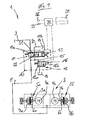
- a brake control system 1 a working machine, for example, a battery-electric or internal combustion engine operated, preferably designed as a forklift truck, described with a designed as a spring brake brake device 2, which forms a parking brake.
- a drive axle with two driven wheels which has two drive shafts 3a and 3b, which are each driven by a traction motor 4a and 4b.
- the drive shafts 3a, 3b can be braked and locked by a respective braking device, which is designed as a hydraulically releasable spring-loaded brake 5a or 5b.
- the spring-loaded brakes 5 a, 5 b are preferably designed as oil-cooled multi-disc brakes.
- the spring-loaded brakes 5a, 5b are each acted upon by a spring device 6a, 6b in a closed position forming the braking position, the force of the spring device defining a maximum braking force and thus a maximum deceleration.
- a brake release pressure chamber 7a or 7b is provided in each case, which counteracts when pressure is applied with a brake release pressure of the force of the spring means 6a, 6b to act on the spring brake 5a, 5b in a release position.
- the brake release pressure chambers 7a, 7b are connected to a common hydraulic brake release pressure line 8, which is connectable to a pressure supply line 9 of a pressure supply device not shown in detail.
- an electrically actuated brake valve device 10 is connected upstream.
- the brake valve device 10 comprises two electrically actuatable control valves 11, 12 which are each designed as a second-position valves.
- the first control valve 11 is arranged in the brake line 8 and is on the input side with the pressure supply line 9 and the output side with the brake release pressure line 8 in connection.
- the first control valve 11 has a blocking position 11a and a pressure build-up position for releasing the spring brake 5a, 5b formed flow position 11 b, shut off in the blocking position 11a, the connection of the pressure supply line 9 with the brake release pressure line 8 and in the flow position 11 b, the brake release pressure line 8 with the pressure supply line 9 is connected.
- the control valve 11 is acted upon by a spring in the blocking position 11a and acted upon by an electrical actuator 13, such as a solenoid, in the flow position 11 b.
- the control valve 11 is thus in the de-energized state in the blocking position 11a.
- the control valve 11 is actuated in the flow position 11 b, in which the brake release pressure chambers 7a, 7b are connected to the pressure supply line 9.
- the second control valve 12 has a blocking position 12a, in which the container branch line 15 is shut off, and designed as a pressure release position for the parking brake function flow position 12b, in which the container branch line 15 is opened and thus the Bremslprop Kunststoffschreib 7a, 7b are connected to the container 14.
- no further throttling valve devices are arranged in addition to the control valve 12.
- the control valve 12 is acted upon by a spring in the blocking position 12a and acted upon by an electrical actuator 16, such as a solenoid, in the flow position 12b.
- the control valve 12 is thus in the de-energized state in the blocking position 12a.
- the control valve 12 is actuated in the flow position 12b, in which the brake release pressure chambers 7a, 7b are connected via the container branch line 15 directly and without interposition of further valve means with the container 14.
- the first control valve 11 further controls in a redundant manner, the connection of the brake release pressure chambers 7a, 7b with the container 14.
- the control valve 11 has for this purpose a second control path which controls the connection of the brake release pressure chambers 7a, 7b with the container 14 and in the present embodiment of a control line 20 is formed.
- the control line 20 is in this case connected to the container branch line 15 and the brake release pressure line 8 between the first control valve 11 and the brake release pressure chamber 7a, 7b and guided to the container 14.
- a pressure reduction or pressure holding device 21 is arranged, which is preferably formed by a built-in the first control valve 11 throttle device 22, for example, a diaphragm in the second control path.
- the blocking position 11a of the first control valve 11 in this case forms via the second control path a pressure reduction position to achieve a safety function.
- the second control path and thus the control line 20 is shut off.
- the two control valves 11, 12 of the brake valve device 10 can be actuated by means of an electronic control device 30, which is the input side with an actuating means designed as a switch or pushbutton control element 31 in connection.
- an actuating means designed as a switch or pushbutton control element 31 in connection.
- a manual parking brake function can be achieved by the electronic control device 30 by corresponding activation of the two control valves 11, 12.
- At least one sensor device is connected to the input side of the control device 30, for example a seat occupancy switch 32 detecting the presence of the operator on a driver's workstation, for example a driver's seat, or a sensor 33 detecting the vehicle speed.
- a seat occupancy switch 32 detecting the presence of the operator on a driver's workstation, for example a driver's seat, or a sensor 33 detecting the vehicle speed.
- the second control valve 12 is de-energized and is in the blocking position 12a, in which the connection of the brake release pressure chambers 7a, 7b to the container 14 is interrupted and shut off.
- the first control valve 11 is acted upon in the flow position 11 b, in which the brake release pressure line 8 is connected to the pressure supply line 9.
- the flow position 11 b of the first control valve 11 thus forms a pressure build-up position for releasing the spring brake 5a, 5b, so that the brake release pressure chambers 7a, 7b acted upon hydraulically by a brake release pressure and thereby one of the spring force of the spring means 6a, 6b opposite force can be generated, whereby the Spring brakes 5a, 5b acted upon in the release position and thus be solved, which corresponds to an open parking brake.
- the second control path to the control line 20 is shut off, so that the container outlet of the first control valve 11 is closed.
- the brake release pressure required for releasing the spring-loaded brake 5a, 5b is thus made available via the pressure supply line 9.
- the spring brake 5a, 5b operating as a parking brake can, in the sense of an automatic parking brake, be provided with corresponding signals from the sensor devices 32 or 33 or applied in the sense of a manual parking brake upon actuation of the control element 31 in the braking position and thus closed when the first control valve 11 is no longer energized and thus de-energized and the second control valve 12 is energized.
- the first control valve 11 is thus acted upon in the blocking position 11a, in which the connection of the pressure supply line 9 with the brake release pressure line 8 and thus the pressure supply of the spring brake 5a, 5b is shut off and the second, formed by the control line 20 signal path is open.
- the second control valve 12 provides in the activated state in the formed as a pressure release flow position 12b for an immediate and sudden pressure reduction of the brake release pressure in the brake release pressure chambers 7a, 7b of the spring brakes 5a, 5b, so that the spring means 6a, 6b the spring brake 5a, 5b in the braking position applied and closes the parking brake.
- the working machine is thus braked with the maximum braking force, which are defined by the spring means 6a, 6b, and held at a standstill.
- both control valves 11, 12 are energized.
- the first control valve 11 and the second control valve 12 thus each switch into the blocking position 11a or 12a.
- the first control valve 11 1 here in the blocking position 11 a, the second signal path, which is formed by the control line 20, free and allows a pressure reduction position in which the Bremslstructure foundedatii 7 a, 7 b are connected via the pressure reduction or pressure holding device 21 to the container 14 ,
- a pressure reduction of the brake release pressure to a defined level or a time-delayed pressure reduction of the brake release pressure in the brake release pressure chamber 7a and 7b of the spring brakes 5a, 5b achieved so that they initially close with a reduced braking torque and the driving Working machine is decelerated according to a hydraulic ramp with a defined delay.
- the first control valve 11 blocks the connection of the brake release pressure line 8 to the pressure supply line 9. This ensures that no dynamic pressure between the brake release pressure chamber 7a, 7b and the pressure reduction or pressure-maintaining device 21 can build up, which would have a reduction in the braking force in the safety function result.
- an additional, redundant container connection of the brake-air pressure chambers 7a, 7b is achieved by the second signal path of the first control valve 11 in addition to the container connection of the brake-air pressure chambers 7a, 7b via the second control valve 12.
- the functional safety of the parking brake device 5a, 5b can be further increased.
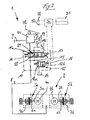
- FIG. 2 is a brake control system 1 described as a spring brake 2 brake device described which forms a service brake and a parking brake and thus in addition to the functions already described additionally has the function of a service brake for metered braking of the machine.
- the brake control system 1 corresponds in this case, in particular with respect to the structure and the function of the brake valve device 10, in the FIG. 1 shown construction.
- the spring brake 2 is here for example designed as a single-circuit brake system, in addition to the FIG. 1 a brake valve 40 is disposed upstream of the first control valve 11 in the brake pipe 8.
- the brake valve 40 may in this case be part of the brake valve device 10.
- the brake valve 40 is on the input side with the pressure supply line 9 and the output side with a guided to the container 14 tank line 41 and guided to the first control valve 11 brake release pressure line 8 in combination.
- the brake valve 40 is formed in the present embodiment, for example, as a controllable proportional pressure reducing valve with a falling characteristic.
- the brake valve 40 is mechanically actuated by an actuator 42, for example, a brake pedal or by the pedals of a so-called double pedal control, in each of which a drive / brake pedal the forward direction and a drive / brake pedal is assigned to the reverse direction.
- an actuator 42 for example, a brake pedal or by the pedals of a so-called double pedal control, in each of which a drive / brake pedal the forward direction and a drive / brake pedal is assigned to the reverse direction.
- the brake valve 40 is increasingly applied in a the brake release pressure line 8 with the guided to the container tank 14 41 position connecting, so that by a metered reduction in the pending in the brake line 8 brake release pressure spring brake 5a, 5b to achieve a service brake function dosed in the braking position can be acted upon.
- the second control valve 12 is designed as a two-position two-port valve and the first control valve 11 is designed as a two-position four-port valve, in which the second signal path branches off from the container branch line 15.
- first control valve 11 form as a two-position three-port valve, in which the second signal path branches off from the brake release pressure line 8 between the first control valve 11 and the brake release pressure chamber 7a, 7b and thus guided to the container 14 control line 20 in the blocking position 11a of the control valve 11 to the connection of the control valve 11th is connected, which is connected to the guided to the brake release pressure chambers 7a, 7b brake release pressure line 8.
- the two control valves 11, 12 of the brake valve device 10 according to the invention can in this case - as in the FIGS. 1 to 3 is shown - as in intermediate positions throttling proportional valves may be formed. Alternatively, it is also possible to design the two control valves 11, 12 as switching valves.
Landscapes
- Engineering & Computer Science (AREA)
- Transportation (AREA)
- Mechanical Engineering (AREA)
- Braking Systems And Boosters (AREA)
Abstract
Description
- Die Erfindung betrifft ein Bremssteuerungssystem einer mobilen Arbeitsmaschine, insbesondere Flurförderzeug, mit einer als Federspeicherbremse ausgebildeten Bremseinrichtung, insbesondere einer als Feststellbremse arbeitenden Bremseinrichtung, die hydraulisch mittels eines in einem Bremslösedruckraum anstehenden Bremslösedruckes in Richtung einer Lösestellung beaufschlagbar ist, wobei zur Steuerung der Bremseinrichtung dem Bremslösedruckraum eine elektrisch betätigbare Bremsventileinrichtung vorgeschaltet ist und mittels der Bremsventileinrichtung eine manuelle und/oder automatische Feststellbremsfunktion sowie eine Sicherheitsfunktion erzielbar ist.
- Derartige, als Federspeicherbremsen ausgebildete Bremseinrichtungen, die durch einen Bremslösedruck entgegen der Federkraft eines Federpaketes in die Lösestellung beaufschlagbar sind, werden auch als hydraulisch beaufschlagte negative Federspeicherbremsen bezeichnet. Die Beaufschlagung der Federspeicherbremse in Richtung der Bremsstellung erfolgt durch einen Abbau des Bremslösedruckes, wobei die maximale Bremskraft durch die Federkraft des Federpaketes vorgegeben wird.
- Bei mobilen Arbeitsmaschinen, beispielsweise als elektrisch-betriebene oder verbrennungsmotorisch-betriebene Gabelstapler ausgebildeten Flurförderzeugen, werden als Federspeicherbremsen ausgebildete Bremseinrichtungen als Feststellbremse und/oder Betriebsbremse verwendet. Die von der Bedienperson zu bedienenden Betätigungselemente sind hierbei in der Regel von einem Pedal, beispielsweise einem Bremspedal oder einer Doppelpedalanordnung, für die Funktion der Betriebsbremse und einem Betätigungsmittel, beispielsweise einem Handbremshebel, für die Funktion der Feststellbremse gebildet. Beide Betätigungselemente wirken hierbei unabhängig voneinander mechanisch auf einen Aktuator der Federspeicherbremse, beispielsweise einem den Bremslösedruck erzeugenden Bremsventil.
- Gattungsgemäße Bremseinrichtungen werden zur Erzielung einer Feststellbremsfunktion und einer Sicherheitsfunktion eingesetzt. Als Feststellbremsfunktion im Sinne dieser Erfindung wird hierbei ein statischer Fall angesehen, bei dem die Bremseinrichtung im Stillstand der Arbeitsmaschine in die Bremsstellung betätigt wird. Der Abbau des Bremslösedruckes soll hierbei schlagartig erfolgen, um ein schnelles Einfallen der Federspeicherbremse in die Bremsstellung zu erzielen. Mit der Sicherheitsfunktion soll bei einem Fehlerfall, beispielsweise einem Stromausfall, einem Abfall oder Abriss des Batteriesteckers bei einem elektrischbetriebenen Arbeitsmaschine, oder bei der Betätigung eines Notausschalters (stromloses Fahrzeug) ein Abbau des Bremslösedruckes auf ein definiertes Niveau oder ein zeitverzögerter Abbau des Bremslösedruckes in dem Bremslösedruckraum erzielt wird, so dass die Arbeitsmaschine mit einem reduzierten Bremsmoment und einer definierten Verzögerung abgebremst wird. Durch ein derartiges kontrolliertes Abbremsen kann bei einer als Flurförderzeug ausgebildeten Arbeitsmaschine ein Abwerfen einer transportierten Last vermieden werden.
- Um bei derartigen Federspeicherbremsen eine automatische Feststellbremsfunktion und eine derartige Sicherheitsfunktion zu erzielen, ist bereits bekannt, eine elektrisch betätigbare Bremsventileinrichtung vorzusehen, mittels der ein schlagartiger Abbau des Bremslösedruckes für die Feststellbremsfunktion bzw. ein verzögerter Abbau des Bremslösedruckes für die Sicherheitsfunktion erzielbar ist.
- Ein gattungsgemäßes Bremssteuerungssystem für ein Flurförderzeug ist aus der
DE 10 2009 031 743 A1 . Aus der Figur 4 derDE 10 2009 031 743 A1 ist eine Ausführungsform eines Bremssteuerungssystem bekannt, bei dem die elektrisch betätigbare Bremsventileinrichtung ein elektrisches Feststellbremsventil umfasst, das im stromlosen Zustand die mit dem Bremslösedruckraum in Verbindung stehende Bremslösedruckleitung mit einem elektrisch betätigbaren Proportional-Druckbegrenzungsventil verbindet, das ausgangsseitig an einen Behälter angeschlossen ist. Für die automatische Feststellbremsfunktion wird das Feststellbremsventil stromlos geschalten und das Proportional-Druckbegrenzungsventil in eine Öffnungsstellung angesteuert, so dass durch einen sofortigen Druckabbau des Bremslösedruckes die Federspeicherbremse in die Bremsstellung beaufschlagt wird. Für die Sicherheitsfunktion wird das Feststellbremsventil stromlos geschaltet und das Proportional-Druckbegrenzungsventil nicht angesteuert, so dass durch einen zeitverzögerten Abbau des Bremslösedruckes die Federspeicherbremse mit einem reduzierten Bremsmoment in die Bremsstellung beaufschlagt wird. - Die von dem Feststellbremsventil und dem Proportional-Druckbegrenzungsventil bestehende elektrisch betätigbare Bremsventileinrichtung weist jedoch einen hohen Bauaufwand auf. Zudem können Funktionsbeeinträchtigungen auftreten, falls das Feststellbremsventil nach einer elektrischen Ansteuerung in einer Schaltstellung verklemmen sollte, in der der Bremslösedruckraum mit dem Ausgang eines Bremsventils in Verbindung steht. Bei einem Verklemmen des Feststellbremsventils in dieser Schaltstellung ist die Funktionalität der automatischen Feststellbremsfunktion nicht mehr gegeben.
- Aus der Figur 5 der
DE 10 2009 031 743 A1 ist eine Ausführungsform eines Bremssteuerungssystem bekannt, bei dem die elektrisch betätigbare Bremsventileinrichtung drei elektrisch betätigbare Schaltventile und ein Druckbegrenzungsventil umfasst, um eine automatische Feststellbremsfunktion und eine Sicherheitsfunktion zu erzielen. Aufgrund der hohen Anzahl von Schaltventilen und dem zusätzlichen Druckbegrenzungsventil weist diese Ausführungsform ebenfalls einen hohen Bauaufwand auf. - Der vorliegenden Erfindung liegt die Aufgabe zugrunde, ein Bremssteuerungssystem der eingangs genannten Gattung zur Verfügung zu stellen, bei dem mit geringem Bauaufwand und einer hohen Funktionssicherheit eine Feststellbremsfunktion und eine Sicherheitsfunktion erzielt werden kann.
- Diese Aufgabe wird erfindungsgemäß dadurch gelöst, dass die elektrisch betätigbare Bremsventileinrichtung ein erstes, als Zweistellungsventil ausgebildetes, elektrisch betätigbares Steuerventil umfasst, das in einer den Bremslösedruck führenden Bremslösedruckleitung angeordnet ist und eine im stromlosen Zustand wirksame Sperrstellung sowie eine elektrisch betätigbare Durchflussstellung aufweist, und ein zweites, als Zweistellungsventil ausgebildetes, elektrisch betätigbares Steuerventil umfasst, das in einer von der Bremslösedruckleitung zwischen dem ersten Steuerventil und dem Bremslösedruckraum abzweigenden, zu einem Behälter geführten Behälterzweigleitung angeordnet ist und eine im stromlosen Zustand wirksame Sperrstellung sowie eine elektrisch betätigbare Durchflussstellung aufweist, wobei das erste Steuerventil im stromlosen Zustand den Bremslösedruckraum mit einer Druckabbau- oder Druckhalteeinrichtung oder mit dem Behälter verbindet. Eine derartige Bremsventileinrichtung, die von lediglich zwei elektrisch betätigbaren Zweistellungsventilen gebildet ist, weist einen geringen Bauaufwand auf. Durch die Anordnung des zweiten Steuerventils in einer Behälterzweigleitung, die von der Bremslösedruckleitung zwischen dem ersten Steuerventil und dem Bremslösedruckraum der Federspeicherbremse abzweigt, ergibt sich eine parallele Anordnung und Schaltung der beiden Steuerventile der Bremsventileinrichtung. Durch die Verbindung des Bremslösedruckraumes mit der Druckabbau- oder Druckhalteeinrichtung bzw. dem Behälter in der stromlosen Stellung des ersten Ventils wird die Sicherheitsfunktion mit geringem Bauaufwand und ohne zusätzliche weitere Ventile erzielt. Darüber hinaus ergibt sich eine hohe Funktionssicherheit der Bremsventileinrichtung, da neben dem zweiten Steuerventil ebenfalls das erste Steuerventil im stromlosen Zustand eine Verbindung des Bremslösedruckraumes mit dem Behälter bzw. der Druckabbau- oder Druckhalteeinrichtung ermöglicht und somit ein Abbremsen der Arbeitsmaschine durch die als Federspeicherbremse ausgebildete Bremseinrichtung ermöglicht. Hierdurch kann bei dem Ausfall eines der beiden Steuerventile die Arbeitsmaschine durch das jeweils andere Steuerventil sicher abgebremst werden. Beispielsweise kann durch das zweite Steuerventil auch bei einem Ausfall oder einem Verklemmen des ersten Steuerventils in der Durchflussstellung bzw. durch das erste Steuerventil bei einem Ausfall oder Verklemmen des zweiten Steuerventils in der Sperrstellung ein Abbau des Bremslösedruckes und somit eine Beaufschlagung der Federspeicherbremse in die Bremsstellung erzielt werden und somit die Feststellbremsfunktion ermöglicht und erhalten bleiben. Mit der erfindungsgemäßen Bremsventileinrichtung, die lediglich zwei einfach aufgebaute Zweistellungsventile umfasst, kann somit bei einer hydraulisch lösbaren Federspeicherbremse die Feststellbremsfunktion und die Sicherheitsfunktion mit einem geringen Bauaufwand und einer hohen Funktionssicherheit erzielt werden.
- Die manuelle und/oder automatische Feststellbremsfunktion kann hierbei auf einfache Weise erzielt werden, wenn das erste Steuerventil durch eine Stromlosschaltung in die Sperrstellung beaufschlagt und das zweite Steuerventil durch eine elektrische Ansteuerung in die Durchflussstellung beaufschlagt ist. Das erste Steuerventil sperrt in der Sperrstellung die Bremslösedruckleitung von einer Druckversorgung ab, so dass durch eine Ansteuerung des zweiten Steuerventils und einer Betätigung des zweiten Steuerventils in die Durchflussstellung der in dem Bremslösedruckraum anstehende Bremslösedruck schlagartig zum Behälter abbaubar ist, um ein schlagartiges und sofortiges Einfallen der Federspeicherbremse in die Bremsstellung zu erzielen.
- Die Sicherheitsfunktion kann gemäß einer vorteilhaften Ausführungsform der Erfindung mit geringem Bauaufwand erzielt werden, wenn das erste Steuerventil im stromlosen Zustand die Behälterzweigleitung oder die Bremslösedruckleitung zwischen dem ersten Steuerventil und dem Bremslösedruckraum mit der Druckabbau- oder Druckhalteeinrichtung bzw. dem Behälter verbindet. Durch die Verbindung der Behälterzweigleitung bzw. der Bremslösedruckleitung zwischen dem ersten Steuerventil und dem Bremslösedruckraum mit der Druckabbau- oder Druckhalteeinrichtung bzw. dem Behälter kann im stromlosen Zustand des ersten Steuerventils mit geringem Bauaufwand erzielt werden, dass der Bremslösedruckraum mit der Druckabbau- oder Druckhalteeinrichtung in Verbindung steht, so dass ein Abbau des Bremslösedruckes auf ein definiertes Niveau oder ein zeitverzögerter Abbau des Bremslösedruckes in dem Bremslösedruckraum erzielt wird, um die Arbeitsmaschine in der Sicherheitsfunktion mit einem reduzierten Bremsmoment abzubremsen.
- Gemäß einer vorteilhaften Ausgestaltungsform der Erfindung ist die Druckabbau- oder Druckhalteeinrichtung von einer in das erste Steuerventil integrierten Drosseleinrichtung, insbesondere einer Blende, gebildet, wobei das erste Steuerventil im stromlosen Zustand die Behälterzweigleitung oder die Bremslösedruckleitung zwischen dem ersten Steuerventil und dem Bremslösedruckraum über die Drosseleinrichtung mit dem Behälter verbindet. Mit einer derartigen Drosseleinrichtung, die von einer entsprechenden Steuerkante des Steuerventils gebildet werden kann, kann mit geringem Bauaufwand im stromlosen Zustand des ersten Steuerventils ein zeitverzögerter Abbau des Bremslösedruckes in dem Bremslösedruckraum erzielt werden, um zur Erzielung der Sicherheitsfunktion ein Abbremsen der Arbeitsmaschine mit einem reduzierten Bremsmoment zu erzielen.
- Zweckmäßigerweise sperrt das erste Steuerventil in der Durchflussstellung die Verbindung des Bremslösedruckraumes zum Behälter ab. Die Durchflussstellung des ersten Steuerventils bildet eine Schaltstellung zum Lösen der Federspeicherbremse. Durch die Absperrung der Verbindung des Bremslösedruckraumes zum Behälter in dieser Schaltstellung wird ein hydraulischer Kurzschluss auf einfache Weise vermieden, um eine sichere Beaufschlagung der Federspeicherbremse in die Lösestellung zu erzielen.
- Besondere Vorteile ergeben sich, wenn bei dem erfindungsgemäßen Bremssteuerungssystem gemäß einer bevorzugten Weiterbildung der Erfindung zur Betätigung der elektrisch betätigbaren Bremsventileinrichtung eine elektronische Steuereinrichtung vorgesehen ist.
- Sofern die elektronische Steuereinrichtung eingangsseitig mit einer Sensoreinrichtung, insbesondere einem Geschwindigkeitssensor oder einem das Vorhandensein einer Bedienperson erfassenden Sensoreinrichtung, beispielsweise einem Sitzbelegungsschalter, in Wirkverbindung steht, ist auf einfache Weise in Abhängigkeit des Signals der Sensoreinrichtung die automatische Feststellbremsfunktion durch entsprechende Ansteuerung der beiden Steuerventile erzielbar. Mit der Funktion einer automatischen Feststellbremse kann eine Fahrerunterstützung auf einfache Weise erzielt werden, indem beispielsweise bei einer stehenden Arbeitsmaschine oder einem Verlassen des Fahrerarbeitsplatzes die Federspeicherbremse automatisch in die Bremsstellung beaufschlagt wird. Zudem kann hierdurch im Start-Stopp-Betrieb der mobilen Arbeitsmaschine die Funktion einer automatischen Feststellbremse realisiert werden, um eine ungewollte Bewegung des stehenden Fahrzeugs zu vermeiden. Bei dem Bremssteuerungssystem mit den beiden elektrischen betätigten Steuerventilen kann eine automatische Feststellbremse auf einfache Weise erzielt werden.
- Zweckmäßigerweise steht die elektronische Steuereinrichtung eingangsseitig mit einem Bedienelement, insbesondere einem Taster oder Schalter, in Wirkverbindung, wobei in Abhängigkeit der Betätigung des Bedienelements die manuelle Feststellbremsfunktion erzielbar ist. Durch Betätigen des Bedienelements und entsprechende Ansteuerung der beiden Steuerventile durch die elektronische Steuereinrichtung kann ebenfalls die Funktion einer manuellen Feststellbremse auf einfache Weise erzielt werden.
- Gemäß einer zweckmäßigen Weiterbildung der Erfindung arbeitet die Federspeicherbremse zusätzlich als Betriebsbremse, wobei dem Bremslösedruckraum ein Bremsventil zugeordnet ist. Bei einer Betätigung des Bremsventils kann durch einen kontrollierten Abbau des in dem Bremslösedruckraum anstehenden Bremslösedruckes mit geringem zusätzlichen Bauaufwand die Federspeicherbremse um die Funktion einer Betriebsbremse erweitert werden. Das erste Steuerventil ist hierbei bevorzugt in der von dem Bremsventil zu dem Bremslösedruckraum geführten Bremslösedruckleitung und somit stromab des Bremsventils in der Bremslösedruckleitung angeordnet.
- Weitere Vorteile und Einzelheiten der Erfindung werden anhand der in den schematischen Figuren dargestellten Ausführungsbeispiele näher erläutert. Hierbei zeigt
- Figur 1
- eine erste Ausführungsform der Erfindung mit einer als Feststellbremse ausgebildeten Bremseinrichtung,
- Figur 2
- eine zweite Ausführungsform der Erfindung mit einer als Feststellbremse und Betriebsbremse ausgebildeten Bremseinrichtung und
- Figur 3
- eine Ausgestaltungsform der Erfindung.
- In der
Figur 1 ist ein Bremssteuerungssystem 1 einer Arbeitsmaschine, beispielsweise eines batterie-elektrisch oder verbrennungsmotorisch betriebenen, bevorzugt als Gabelstapler ausgebildeten Flurförderzeugs, mit einer als Federspeicherbremse ausgebildeten Bremseinrichtung 2 beschrieben, die eine Feststellbremse bildet. Gezeigt ist eine Antriebsachse mit zwei angetrieben Rädern, die über zwei Antriebswellen 3a und 3b verfügt, die jeweils von einem Fahrmotor 4a bzw. 4b antreibbar sind. Die Antriebswellen 3a, 3b sind durch jeweils eine Bremseinrichtung abbremsbar und arretierbar, die als hydraulisch lösbare Federspeicherbremse 5a bzw. 5b ausgebildet ist. Bevorzugt sind die Federspeicherbremsen 5a, 5b als ölgekühlte Lamellenbremsen ausgebildet. - Anstelle der dargestellten Antriebsachse mit zwei Fahrmotoren ist ebenfalls möglich, zum Antrieb der beiden Räder einen einzigen Fahrmotor vorzusehen, der über ein Differentialgetriebe mit den Antriebswellen 3a, 3b in trieblicher Verbindung steht.
- Die Federspeicherbremsen 5a, 5b sind jeweils von einer Federeinrichtung 6a, 6b in eine die Bremsstellung bildende Schließstellung beaufschlagt, wobei die Kraft der Federeinrichtung eine maximale Bremskraft und somit eine maximale Verzögerung definiert. Zum Lösen der Federspeicherbremsen 5a, 5b ist jeweils ein Bremslösedruckraum 7a bzw. 7b vorgesehen, der bei einer Druckbeaufschlagung mit einem Bremslösedruck der Kraft der Federeinrichtung 6a, 6b entgegenwirkt, um die Federspeicherbremse 5a, 5b in eine Lösestellung zu beaufschlagen. Die Bremslösedruckräume 7a, 7b sind mit einer gemeinsamen hydraulischen Bremslösedruckleitung 8 verbunden, die an eine Druckversorgungsleitung 9 einer nicht mehr näher dargestellten Druckversorgungseinrichtung anschließbar ist.
- Zur Steuerung der Federspeicherbremse 6a, 6b ist den Bremslösedruckräumen 7a, 7b eine elektrisch betätigbare Bremsventileinrichtung 10 vorgeschaltet.
- Die erfindungsgemäße Bremsventileinrichtung 10 umfasst zwei elektrisch betätigbare Steuerventile 11, 12, die jeweils als Zweitstellungsventile ausgebildet sind.
- Das erste Steuerventil 11 ist in der Bremsleitung 8 angeordnet und steht eingangsseitig mit der Druckversorgungsleitung 9 und ausgangsseitig mit der Bremslösedruckleitung 8 in Verbindung. Das erste Steuerventil 11 weist eine Sperrstellung 11a und eine als Druckaufbaustellung zum Lösen der Federspeicherbremse 5a, 5b ausgebildete Durchflussstellung 11 b auf, wobei in der Sperrstellung 11a die Verbindung der Druckversorgungsleitung 9 mit der Bremslösedruckleitung 8 abgesperrt und in der Durchflussstellung 11 b die Bremslösedruckleitung 8 mit der Druckversorgungsleitung 9 verbunden ist. Das Steuerventil 11 ist von einer Feder in die Sperrstellung 11a beaufschlagt und durch eine elektrische Betätigungseinrichtung 13, beispielsweise einen Schaltmagneten, in die Durchflussstellung 11 b beaufschlagbar. Das Steuerventil 11 befindet sich somit im stromlosen Zustand in der Sperrstellung 11a. Bei einer elektrischen Ansteuerung wird das Steuerventil 11 in die Durchflussstellung 11 b betätigt, in der die Bremslösedruckräume 7a, 7b mit der Druckversorgungsleitung 9 verbunden sind.
- Von der Bremslösedruckleitung 8 zweigt zwischen dem ersten Steuerventil 11 und den Bremslösedruckräumen 7a, 7b eine zu einem Behälter 14 geführte Behälterzweigleitung 15 ab, in der das zweite Steuerventil 12 angeordnet ist. Das zweite Steuerventil 12 weist eine Sperrstellung 12a, in der die Behälterzweigleitung 15 abgesperrt ist, und eine als Drucklosstellung für die Feststellbremsfunktion ausgebildeten Durchflussstellung 12b auf, in der die Behälterzweigleitung 15 geöffnet und somit die Bremslüftdruckräume 7a, 7b mit dem Behälter 14 verbunden sind. In der Behälterzweigleitung 15 und somit der Verbindung des Bremslösedruckraumes 7a, 7b mit dem Behälter 14 sind zusätzlich zu dem Steuerventil 12 keine weiteren drosselnden Ventileinrichtungen angeordnet. Das Steuerventil 12 ist von einer Feder in die Sperrstellung 12a beaufschlagt und durch eine elektrische Betätigungseinrichtung 16, beispielsweise einen Schaltmagneten, in die Durchflussstellung 12b beaufschlagbar. Das Steuerventil 12 befindet sich somit im stromlosen Zustand in der Sperrstellung 12a. Bei einer elektrischen Ansteuerung wird das Steuerventil 12 in die Durchflussstellung 12b betätigt, in der die Bremslösedruckräume 7a, 7b über die Behälterzweigleitung 15 direkt und ohne Zwischenschaltung weiterer Ventileinrichtungen mit dem Behälter 14 verbunden sind.
- Das erste Steuerventil 11 steuert weiterhin in einer redundanten Weise die Verbindung der Bremslösedruckräume 7a, 7b mit dem Behälter 14. Das Steuerventil 11 weist hierzu einen zweiten Steuerpfad auf, der die Verbindung der Bremslösedruckräume 7a, 7b mit dem Behälter 14 steuert und im vorliegenden Ausführungsbeispiel von einer Steuerleitung 20 gebildet ist. Die Steuerleitung 20 ist hierbei an die Behälterzweigleitung 15 bzw. die Bremslösedruckleitung 8 zwischen dem ersten Steuerventil 11 und dem Bremslösedruckraum 7a, 7b angeschlossen und zu dem Behälter 14 geführt. In der Steuerleitung 20 ist eine Druckabbau- bzw. Druckhalteeinrichtung 21 angeordnet, die bevorzugt von einer in das erste Steuerventil 11 integrierten Drosseleinrichtung 22, beispielsweise einer Blende im zweiten Steuerpfad, gebildet ist. In der Sperrstellung 11a des ersten Steuerventils 11 und somit im stromlosen Zustand des ersten Steuerventils 11, in der die Verbindung des Bremslösedruckleitung 8 mit der Druckversorgungsleitung 9 abgesperrt ist, ist hierbei der zweite Steuerpfad und somit die Steuerleitung 20 geöffnet, so dass die Bremslösedruckräume 7a, 7b über die Druckabbau- bzw. Druckhalteeinrichtung 21 mit dem Behälter 14 verbunden sind. Die Sperrstellung 11a des ersten Steuerventils 11 bildet hierbei über den zweiten Steuerpfad eine Druckabbaustellung zur Erzielung einer Sicherheitsfunktion. In der Durchflussstellung 11 b des ersten Steuerventils 11 ist der zweite Steuerpfad und somit die Steuerleitung 20 abgesperrt.
- Die beiden Steuerventile 11, 12 der Bremsventileinrichtung 10 sind mittels einer elektronischen Steuereinrichtung 30 betätigbar, die eingangsseitig mit einem als Schalter oder Taster ausgebildeten Betätigungsmittel als Bedienelement 31 in Verbindung steht. Durch Betätigen des Bedienelements 31 kann hierbei von der elektronischen Steuereinrichtung 30 durch entsprechende Ansteuerung der beiden Steuerventile 11, 12 eine manuelle Feststellbremsfunktion erzielt werden.
- Zudem steht eingangsseitig mit der Steuereinrichtung 30 mindestens eine Sensoreinrichtung in Verbindung, beispielsweise ein das Vorhandensein der Bedienperson auf einem Fahrerarbeitsplatz, beispielsweise einem Fahrersitz, erfassender Sitzbelegungsschalter 32 oder ein die Fahrzeuggeschwindigkeit erfassender Sensor 33. Bei stehender Arbeitsmaschine oder einer den Fahrersitz verlassenden Bedienperson kann in Abhängigkeit von den Signalen der Sensoreinrichtungen eine automatisierte Betätigung der Federspeicherbremse 5a, 5b im Sinne einer automatisch aktivierten Feststellbremse erzielt werden.
- Zum Lösen der Feststellbremse 5a, 5b ist das zweite Steuerventil 12 unbestromt und befindet sich in der Sperrstellung 12a, in der die Verbindung der Bremslösedruckräume 7a, 7b zum Behälter 14 unterbrochen und abgesperrt ist. Durch Bestromen des ersten Steuerventil 11 wird das erste Steuerventil 11 in die Durchflussstellung 11 b beaufschlagt, in der die Bremslösedruckleitung 8 mit der Druckversorgungsleitung 9 verbunden ist. Die Durchflussstellung 11 b des ersten Steuerventils 11 bildet somit eine Druckaufbaustellung zum Lösen der Federspeicherbremse 5a, 5b, so dass die Bremslösedruckräume 7a, 7b durch einen Bremslösedruck hydraulisch beaufschlagt und dadurch eine der Federkraft der Federeinrichtungen 6a, 6b entgegengesetzte Kraft erzeugt werden kann, wodurch die Federspeicherbremsen 5a, 5b in die Lösestellung beaufschlagt und somit gelöst werden, was einer geöffneten Feststellbremse entspricht. In der Durchflussstellung 11 b des ersten Steuerventils 11 ist der zweite Steuerpfad mit der Steuerleitung 20 abgesperrt, so dass der Behälterausgang des ersten Steuerventils 11 verschlossen ist. Der zum Lösen der Federspeicherbremse 5a, 5b erforderliche Bremslösedruck wird somit über die Druckversorgungsleitung 9 zur Verfügung gestellt.
- Die als Feststellbremse arbeitende Federspeicherbremse 5a, 5b kann im Sinne einer automatischen Feststellbremse bei entsprechenden Signalen der Sensoreinrichtungen 32 bzw. 33 oder im Sinne einer manuellen Feststellbremse bei einer Betätigung des Bedienelements 31 in die Bremsstellung beaufschlagt und somit geschlossen werden, wenn das erste Steuerventil 11 nicht mehr bestromt und somit stromlos geschaltet wird und das zweite Steuerventil 12 bestromt wird. Das erste Steuerventil 11 wird somit in die Sperrstellung 11a beaufschlagt, in der die Verbindung der Druckversorgungsleitung 9 mit der Bremslösedruckleitung 8 und somit die Druckversorgung der Federspeicherbremse 5a, 5b abgesperrt ist und der zweite, von der Steuerleitung 20 gebildete Signalpfad geöffnet ist. Das zweite Steuerventil 12 sorgt im angesteuerten Zustand in der als Drucklosstellung ausgebildeten Durchflussstellung 12b für einen sofortigen und schlagartigen Druckabbau des Bremslösedruckes in den Bremslösedruckräumen 7a, 7b der Federspeicherbremsen 5a, 5b, so dass die Federeinrichtung 6a, 6b die Federspeicherbremse 5a, 5b in die Bremsstellung beaufschlagt und die Feststellbremse schließt. Die Arbeitsmaschine wird somit mit der maximalen Bremskraft, die durch die Federeinrichtungen 6a, 6b definiert werden, abgebremst und im Stillstand gehalten.
- Kommt es bei fahrender Arbeitsmaschine zu einem Stromausfall, beispielsweise infolge eines sich lösenden Batteriesteckers oder einer leeren Traktionsbatterie bzw. durch Betätigen eines Notausschalters (stromloses Fahrzeug), so sind beide Steuerventile 11, 12 unbestromt. Das erste Steuerventil 11 und das zweite Steuerventil 12 schalten somit jeweils in die Sperrstellung 11a bzw. 12a. Das erste Steuerventil 11 1 gibt hierbei in der Sperrstellung 11a den zweiten Signalpfad, der von der Steuerleitung 20 gebildet wird, frei und ermöglicht eine Druckabbaustellung, in der die Bremslüftdruckräume 7a, 7b über die Druckabbau- bzw. Druckhalteeinrichtung 21 mit dem Behälter 14 verbunden sind. Durch die Druckabbau- bzw. Druckhalteeinrichtung 21 wird ein Druckabbau des Bremslösedruckes auf ein definiertes Niveau bzw. ein zeitverzögerter Druckabbau des Bremslösedruckes in dem Bremslösedruckraum 7a bzw. 7b der Federspeicherbremsen 5a, 5b erzielt, so dass diese zunächst mit einem reduzierten Bremsmoment schließen und die fahrende Arbeitsmaschine gemäß einer hydraulischen Rampe mit einer definierten Verzögerung abgebremst wird. Durch dieses reduzierte Bremsmoment bzw. Abbremsen gemäß einer hydraulischen Rampe kann in dieser Sicherheitsfunktion bei einer als Flurförderzeug ausgebildeten Arbeitsmaschine bei einer Abbremsung infolge eines stromlosen Fahrzeugs ein Lastabwurf der transportierten Last vermieden werden. Bei vollständig abgebautem Bremslösedruck wird die Arbeitsmaschine mit der von der Federeinrichtung 6a, 6b vorgegebenen maximalen Bremskraft abgebremst bzw. im Stillstand gehalten.
- In der Sperrstellung 11a sperrt das erste Steuerventil 11 die Verbindung der Bremslösedruckleitung 8 mit der Druckversorgungsleitung 9 ab. Hierdurch wird sichergestellt, dass sich kein Staudruck zwischen dem Bremslösedruckraum 7a, 7b und der Druckabbau- bzw. Druckhalteeinrichtung 21 aufbauen kann, der eine Verringerung der Bremskraft in der Sicherheitsfunktion zur Folge hätte.
- Bei der erfindungsgemäßen Bremsventileinrichtung 10 wird durch den zweiten Signalpfad des ersten Steuerventils 11 neben der Behälterverbindung der Bremslüftdruckräume 7a, 7b über das zweite Steuerventil 12 eine zusätzliche, redundante Behälterverbindung der Bremslüftdruckräume 7a, 7b erzielt. Mit dem zweiten Signalpfad und der zusätzlichen Behälterverbindung des ersten Steuerventils 11 kann neben der Erzielung der Sicherheitsfunktion weiterhin die Funktionssicherheit der Feststellbremseinrichtung 5a, 5b erhöht werden. Durch die beiden Behälterverbindungen der Steuerventile 11, 12 wird hierbei erzielt, dass die Arbeitsmaschine bei einem Ausfall des zweiten Steuerventils 12 über den zweiten Signalpfad des ersten Steuerventils 11 abgebremst werden kann bzw. die Arbeitsmaschine bei einem Ausfall des ersten Steuerventils 11 über das zweite Steuerventil 12 abgebremst werden kann. Sofern eines der beiden Steuerventile 11 bzw. 12 ausfallen sollte, kann somit aufgrund der jeweiligen Behälterverbindungen in dem entsprechenden Steuerventil 11, 12 die Federspeicherbremse 5a, 5b über das noch funktionsfähige Steuerventil 11 bzw. 12 ausgelöst und in die Bremsstellung beaufschlagt werden.
- In der
Figur 2 ist ein Bremssteuerungssystem 1 einer als Federspeicherbremse 2 ausgebildeten Bremseinrichtung beschrieben, die eine Betriebsbremse und eine Feststellbremse bildet und somit neben den bereits beschriebenen Funktionen zusätzlich die Funktion einer Betriebsbremse zum dosierten Abbremsen der Arbeitsmaschine aufweist. Das Bremssteuerungssystem 1 entspricht hierbei, insbesondere bezüglich des Aufbaus und der Funktion der Bremsventileinrichtung 10, dem in denFigur 1 dargestellten Aufbau. - Die Federspeicherbremse 2 ist hierbei beispielsweise als Ein-Kreis-Bremssystem ausgebildet, wobei zusätzlich zu der
Figur 1 ein Bremsventil 40 stromauf des ersten Steuerventils 11 in der Bremsleitung 8 angeordnet ist. Das Bremsventil 40 kann hierbei Bestandteil der Bremsventileinrichtung 10 sein. Das Bremsventil 40 steht eingangsseitig mit der Druckversorgungsleitung 9 und ausgangsseitig mit einer zu dem Behälter 14 geführten Behälterleitung 41 sowie der zu dem ersten Steuerventil 11 geführten Bremslösedruckleitung 8 in Verbindung. Das Bremsventil 40 ist im vorliegenden Ausführungsbeispiel beispielsweise als steuerbares Proportional-Druckminderventil mit einer fallenden Kennlinie ausgebildet. Das Bremsventil 40 ist durch ein Betätigungsorgan 42, beispielsweise ein Bremspedal oder durch die Pedale einer sogenannten Doppelpedalsteuerung, bei der jeweils ein Fahr-/Bremspedal der Vorwärtsfahrtrichtung und ein Fahr-/Bremspedal der Rückwärtsfahrtrichtung zugeordnet ist, mechanisch betätigbar. Bei einer Betätigung des Betätigungsorgans 42 wird hierbei das Bremsventil 40 zunehmend in eine die Bremslösedruckleitung 8 mit der zu dem Behälter 14 geführten Behälterleitung 41 verbindenden Stellung beaufschlagt, so dass durch einen dosierten Abbau des in der Bremsleitung 8 anstehenden Bremslösedruckes die Federspeicherbremse 5a, 5b zur Erzielung eines Betriebsbremsfunktion dosiert in die Bremsstellung beaufschlagt werden kann. - Gemäß den
Figuren 1 und2 ist das zweite Steuerventil 12 als Zweistellungs-Zweianschlussventil ausgebildet und das erste Steuerventil 11 als Zweistellungs-Vieranschlussventil ausgebildet, bei dem der zweite Signalpfad von der Behälterzweigleitung 15 abzweigt. - Es ist jedoch ebenfalls möglich, dass erste Steuerventil 11 gemäß der
Figur 3 als Zweistellungs-Dreianschlussventil auszubilden, bei dem der zweite Signalpfad von der Bremslösedruckleitung 8 zwischen dem ersten Steuerventil 11 und dem Bremslösedruckraum 7a, 7b abzweigt und somit die zu dem Behälter 14 geführte Steuerleitung 20 in der Sperrstellung 11a des Steuerventils 11 an den Anschluss des Steuerventils 11 angeschlossen ist, der mit der zu den Bremslösedruckräumen 7a, 7b geführten Bremslösedruckleitung 8 verbunden ist. - Die beiden Steuerventile 11, 12 der erfindungsgemäßen Bremsventileinrichtung 10 können hierbei - wie in den
Figuren 1 bis 3 dargestellt ist - als in Zwischenstellungen drosselnde Proportionalventile ausgebildet sein. Alternativ ist ebenfalls möglich, die beiden Steuerventile 11, 12 als Schaltventile auszugestalten.
Claims (10)
- Bremssteuerungssystem einer mobilen Arbeitsmaschine, insbesondere Flurförderzeug, mit einer als Federspeicherbremse ausgebildeten Bremseinrichtung, insbesondere einer als Feststellbremse arbeitenden Bremseinrichtung, die hydraulisch mittels eines in einem Bremslösedruckraum anstehenden Bremslösedruckes in Richtung einer Lösestellung beaufschlagbar ist, wobei zur Steuerung der Bremseinrichtung dem Bremslösedruckraum eine elektrisch betätigbare Bremsventileinrichtung vorgeschaltet ist und mittels der Bremsventileinrichtung eine manuelle und/oder automatische Feststellbremsfunktion sowie eine Sicherheitsfunktion erzielbar ist, dadurch gekennzeichnet, dass die elektrisch betätigbare Bremsventileinrichtung (10) ein erstes, als Zweistellungsventil ausgebildetes, elektrisch betätigbares Steuerventil (11), das in einer den Bremslösedruck führenden Bremslösedruckleitung (8) angeordnet ist und eine im stromlosen Zustand wirksame Sperrstellung (11a) sowie eine elektrisch betätigbare Durchflussstellung (11b) aufweist, und ein zweites, als Zweistellungsventil ausgebildetes, elektrisch betätigbares Steuerventil (12) umfasst, das in einer von der Bremslösedruckleitung (8) zwischen dem ersten Steuerventil (11) und dem Bremslösedruckraum (7a; 7b) abzweigenden, zu einem Behälter (14) geführten Behälterzweigleitung (15) angeordnet ist und eine im stromlosen Zustand wirksame Sperrstellung (12a) sowie eine elektrisch betätigbare Durchflussstellung (12b) aufweist, wobei das erste Steuerventil (11) im stromlosen Zustand den Bremslösedruckraum (7a; 7b) mit einer Druckabbau- oder Druckhalteeinrichtung (21) oder mit dem Behälter (14) verbindet.
- Bremssteuerungssystem nach Anspruch 1, dadurch gekennzeichnet, dass zur Erzielung der manuellen und/oder automatischen Feststellbremsfunktion das erste Steuerventil (11) durch eine Stromlosschaltung in die Sperrstellung (11a) beaufschlagt und das zweite Steuerventil (12) durch eine elektrische Ansteuerung in die Durchflussstellung (12b) beaufschlagt ist.
- Bremssteuerungssystem nach Anspruch 1 oder 2, dadurch gekennzeichnet, dass das erste Steuerventil (11) im stromlosen Zustand die Behälterzweigleitung (15) oder die Bremslösedruckleitung (8) zwischen dem ersten Steuerventil (11) und dem Bremslösedruckraum (7a; 7b) mit der Druckabbau- oder Druckhalteeinrichtung oder dem Behälter (14) verbindet.
- Bremssteuerungssystem nach einem der Ansprüche 1 bis 3, dadurch gekennzeichnet, dass die Druckabbau- oder Druckhalteeinrichtung (21) von einer in das erste Steuerventil (11) integrierten Drosseleinrichtung (22), insbesondere einer Blende, gebildet ist und das erste Steuerventil (11) im stromlosen Zustand die Behälterzweigleitung (15) oder die Bremslösedruckleitung (8) zwischen dem ersten Steuerventil (11) und dem Bremslösedruckraum (7a; 7b) über die Drosseleinrichtung (22) mit dem Behälter (14) verbindet.
- Bremssteuerungssystem nach einem der Ansprüche 1 bis 4, dadurch gekennzeichnet, dass das erste Steuerventil (11) in der Durchflussstellung (11b) die Verbindung des Bremslösedruckraumes (7a; 7b) mit dem Behälter (14) absperrt.
- Bremssteuerungssystem nach einem der Ansprüche 1 bis 5, dadurch gekennzeichnet, dass zur Betätigung der elektrisch betätigbare Bremsventileinrichtung (10) eine elektronische Steuereinrichtung (30) vorgesehen ist.
- Bremssteuerungssystem nach Anspruch 6, dadurch gekennzeichnet, dass die elektronische Steuereinrichtung (30) eingangsseitig mit einer Sensoreinrichtung (32; 32), insbesondere einem Geschwindigkeitssensor oder einem das Vorhandensein einer Bedienperson erfassenden Sensoreinrichtung, in Wirkverbindung steht, wobei in Abhängigkeit des Signals der Sensoreinrichtung (32; 33) die automatische Feststellbremsfunktion erzielbar ist.
- Bremssteuerungssystem nach Anspruch 6 oder 7, dadurch gekennzeichnet, dass die elektronische Steuereinrichtung (30) eingangsseitig mit einem Bedienelement (31), insbesondere einem Taster oder Schalter, in Wirkverbindung steht, wobei in Abhängigkeit der Betätigung des Bedienelements (31) die manuelle Feststellbremsfunktion erzielbar ist.
- Bremssteuerungssystem nach einem der Ansprüche 1 bis 8, dadurch gekennzeichnet, dass die Federspeicherbremse (5a; 5b) als Betriebsbremse arbeitet, wobei dem Bremslösedruckraum (7a; 7b) ein Bremsventil (40) zugeordnet ist.
- Bremssteuerungssystem nach Anspruch 9, dadurch gekennzeichnet, dass das erste Steuerventil (11) stromab des Bremsventils (40) in der Bremslösedruckleitung (8) angeordnet ist.
Applications Claiming Priority (1)
| Application Number | Priority Date | Filing Date | Title |
|---|---|---|---|
| DE201010012886 DE102010012886A1 (de) | 2010-03-26 | 2010-03-26 | Bremssteuerungssystem einer mobilen Arbeitsmaschine, insbesondere Flurförderzeug |
Publications (3)
| Publication Number | Publication Date |
|---|---|
| EP2371639A2 true EP2371639A2 (de) | 2011-10-05 |
| EP2371639A3 EP2371639A3 (de) | 2013-05-29 |
| EP2371639B1 EP2371639B1 (de) | 2015-12-16 |
Family
ID=43978003
Family Applications (1)
| Application Number | Title | Priority Date | Filing Date |
|---|---|---|---|
| EP11001727.4A Not-in-force EP2371639B1 (de) | 2010-03-26 | 2011-03-02 | Bremssteuerungssystem einer mobilen Arbeitsmaschine, insbesondere Flurföderzeug |
Country Status (2)
| Country | Link |
|---|---|
| EP (1) | EP2371639B1 (de) |
| DE (1) | DE102010012886A1 (de) |
Families Citing this family (2)
| Publication number | Priority date | Publication date | Assignee | Title |
|---|---|---|---|---|
| DE102011116902A1 (de) * | 2011-10-25 | 2013-04-25 | Wabco Gmbh | Bremsverfahren und Bremseinrichtung für ein Fahrzeug sowie hydraulische Bremsanlage und Fahrzeug damit |
| DE102011116906A1 (de) * | 2011-10-25 | 2013-04-25 | Wabco Gmbh | Bremsverfahren und Bremseinrichtung für ein Fahrzeug, hydraulische Bremsanlage und Fahrzeug damit |
Citations (1)
| Publication number | Priority date | Publication date | Assignee | Title |
|---|---|---|---|---|
| DE102009031743A1 (de) | 2008-07-29 | 2010-02-04 | Linde Material Handling Gmbh | Fahrbare Arbeitsmaschine mit einer Bremse mit zwei Druckräumen |
Family Cites Families (3)
| Publication number | Priority date | Publication date | Assignee | Title |
|---|---|---|---|---|
| JPS58126246A (ja) * | 1982-01-21 | 1983-07-27 | Nippon Air Brake Co Ltd | ブレ−キ装置 |
| US5611199A (en) * | 1995-12-13 | 1997-03-18 | Caterpillar Inc. | Two stage electrohydraulic pressure control valve |
| DE102009031742A1 (de) * | 2008-07-29 | 2010-02-04 | Linde Material Handling Gmbh | Fahrbare Arbeitsmaschine mit einer als Betriebsbremse und als automatische Feststellbremse betreibbaren Bremse |
-
2010
- 2010-03-26 DE DE201010012886 patent/DE102010012886A1/de not_active Withdrawn
-
2011
- 2011-03-02 EP EP11001727.4A patent/EP2371639B1/de not_active Not-in-force
Patent Citations (1)
| Publication number | Priority date | Publication date | Assignee | Title |
|---|---|---|---|---|
| DE102009031743A1 (de) | 2008-07-29 | 2010-02-04 | Linde Material Handling Gmbh | Fahrbare Arbeitsmaschine mit einer Bremse mit zwei Druckräumen |
Also Published As
| Publication number | Publication date |
|---|---|
| DE102010012886A1 (de) | 2011-09-29 |
| EP2371639A3 (de) | 2013-05-29 |
| EP2371639B1 (de) | 2015-12-16 |
Similar Documents
| Publication | Publication Date | Title |
|---|---|---|
| DE102017118529B4 (de) | Elektronisch gesteuerte Anhänger-Bremssteuereinheit und Anhänger-Bremsanlage | |
| DE102009031743B4 (de) | Fahrbare Arbeitsmaschine mit einer Bremse mit zwei Druckräumen | |
| EP3034369B1 (de) | Mobile arbeitsmaschine mit einer bremseinrichtung | |
| DE19530612C2 (de) | Steuerung einer automatischen Kupplung | |
| EP1199234B1 (de) | Notentriegelungseinrichtung für die Parksperre eines Kraftfahrzeugs | |
| EP2650183B1 (de) | Parkbremsventileinrichtung und pneumatische Anhänger-Druckluftbremsanlage | |
| DE10146770A1 (de) | Bremsanlage für ein Fahrzeug | |
| EP1199233B1 (de) | Steuereinrichtung für die Parksperre eines Kraftfahrzeugs | |
| EP2696111A1 (de) | Aktuatoranordnung für einen Antriebsstrang | |
| DE102004033362A1 (de) | Hydraulikkreis für ein Doppelkupplungsgetriebe | |
| EP2368778B1 (de) | Bremssteuerungssystem einer mobilen Arbeitsmaschine, insbesondere Flurförderzeug | |
| DE102009031741B4 (de) | Fahrbare Arbeitsmaschine mit Federspeicherbremse | |
| WO2021190703A1 (de) | Parksperre in einer normal-gesperrten konfiguration für einen antriebsstrang | |
| DE102009031742A1 (de) | Fahrbare Arbeitsmaschine mit einer als Betriebsbremse und als automatische Feststellbremse betreibbaren Bremse | |
| DE102012106213A1 (de) | Arbeitsmaschine mit einem elektrischen Antriebssystem | |
| EP1938004A1 (de) | Steuerungsventilanordnung zur steuerung einer anfahrkupplung eines automatgetriebes | |
| DE2723469A1 (de) | Luftdruckbremssystem | |
| EP2371639B1 (de) | Bremssteuerungssystem einer mobilen Arbeitsmaschine, insbesondere Flurföderzeug | |
| DE102011053568B4 (de) | Bremssteuerungssystem einer mobilen Arbeitsmaschine | |
| DE102011008707A1 (de) | Mobile Arbeitsmaschine, insbesondere Flurförderzeug | |
| WO2008086980A1 (de) | Fahrzeug mit pre-safe-sensorik | |
| DE102012106212A1 (de) | Bremssteuerungssystem einer mobilen Arbeitsmaschine | |
| DE102009005009A1 (de) | Fahrbare Arbeitsmaschine mit hydraulisch lösbarer Federspeicherbremse | |
| EP1938003A1 (de) | Steuerungsventilanordnung zur steuerung einer anfahrkupplung eines automatgetriebes | |
| DE102013107805B4 (de) | Bremssteuerungssystem einer mobilen Arbeitsmaschine, insbesondere Flurförderzeug |
Legal Events
| Date | Code | Title | Description |
|---|---|---|---|
| PUAI | Public reference made under article 153(3) epc to a published international application that has entered the european phase |
Free format text: ORIGINAL CODE: 0009012 |
|
| AK | Designated contracting states |
Kind code of ref document: A2 Designated state(s): AL AT BE BG CH CY CZ DE DK EE ES FI FR GB GR HR HU IE IS IT LI LT LU LV MC MK MT NL NO PL PT RO RS SE SI SK SM TR |
|
| AX | Request for extension of the european patent |
Extension state: BA ME |
|
| PUAL | Search report despatched |
Free format text: ORIGINAL CODE: 0009013 |
|
| AK | Designated contracting states |
Kind code of ref document: A3 Designated state(s): AL AT BE BG CH CY CZ DE DK EE ES FI FR GB GR HR HU IE IS IT LI LT LU LV MC MK MT NL NO PL PT RO RS SE SI SK SM TR |
|
| AX | Request for extension of the european patent |
Extension state: BA ME |
|
| RIC1 | Information provided on ipc code assigned before grant |
Ipc: B60T 13/22 20060101AFI20130425BHEP Ipc: B60T 13/68 20060101ALI20130425BHEP |
|
| 17P | Request for examination filed |
Effective date: 20130830 |
|
| RBV | Designated contracting states (corrected) |
Designated state(s): AL AT BE BG CH CY CZ DE DK EE ES FI FR GB GR HR HU IE IS IT LI LT LU LV MC MK MT NL NO PL PT RO RS SE SI SK SM TR |
|
| GRAP | Despatch of communication of intention to grant a patent |
Free format text: ORIGINAL CODE: EPIDOSNIGR1 |
|
| INTG | Intention to grant announced |
Effective date: 20150629 |
|
| GRAS | Grant fee paid |
Free format text: ORIGINAL CODE: EPIDOSNIGR3 |
|
| GRAA | (expected) grant |
Free format text: ORIGINAL CODE: 0009210 |
|
| AK | Designated contracting states |
Kind code of ref document: B1 Designated state(s): AL AT BE BG CH CY CZ DE DK EE ES FI FR GB GR HR HU IE IS IT LI LT LU LV MC MK MT NL NO PL PT RO RS SE SI SK SM TR |
|
| REG | Reference to a national code |
Ref country code: GB Ref legal event code: FG4D Free format text: NOT ENGLISH |
|
| REG | Reference to a national code |
Ref country code: CH Ref legal event code: EP |
|
| REG | Reference to a national code |
Ref country code: IE Ref legal event code: FG4D Free format text: LANGUAGE OF EP DOCUMENT: GERMAN |
|
| REG | Reference to a national code |
Ref country code: AT Ref legal event code: REF Ref document number: 765416 Country of ref document: AT Kind code of ref document: T Effective date: 20160115 |
|
| REG | Reference to a national code |
Ref country code: DE Ref legal event code: R096 Ref document number: 502011008491 Country of ref document: DE |
|
| REG | Reference to a national code |
Ref country code: NL Ref legal event code: MP Effective date: 20151216 |
|
| REG | Reference to a national code |
Ref country code: LT Ref legal event code: MG4D |
|
| PG25 | Lapsed in a contracting state [announced via postgrant information from national office to epo] |
Ref country code: NO Free format text: LAPSE BECAUSE OF FAILURE TO SUBMIT A TRANSLATION OF THE DESCRIPTION OR TO PAY THE FEE WITHIN THE PRESCRIBED TIME-LIMIT Effective date: 20160316 Ref country code: LT Free format text: LAPSE BECAUSE OF FAILURE TO SUBMIT A TRANSLATION OF THE DESCRIPTION OR TO PAY THE FEE WITHIN THE PRESCRIBED TIME-LIMIT Effective date: 20151216 Ref country code: HR Free format text: LAPSE BECAUSE OF FAILURE TO SUBMIT A TRANSLATION OF THE DESCRIPTION OR TO PAY THE FEE WITHIN THE PRESCRIBED TIME-LIMIT Effective date: 20151216 |
|
| PG25 | Lapsed in a contracting state [announced via postgrant information from national office to epo] |
Ref country code: LV Free format text: LAPSE BECAUSE OF FAILURE TO SUBMIT A TRANSLATION OF THE DESCRIPTION OR TO PAY THE FEE WITHIN THE PRESCRIBED TIME-LIMIT Effective date: 20151216 Ref country code: GR Free format text: LAPSE BECAUSE OF FAILURE TO SUBMIT A TRANSLATION OF THE DESCRIPTION OR TO PAY THE FEE WITHIN THE PRESCRIBED TIME-LIMIT Effective date: 20160317 Ref country code: SE Free format text: LAPSE BECAUSE OF FAILURE TO SUBMIT A TRANSLATION OF THE DESCRIPTION OR TO PAY THE FEE WITHIN THE PRESCRIBED TIME-LIMIT Effective date: 20151216 Ref country code: FI Free format text: LAPSE BECAUSE OF FAILURE TO SUBMIT A TRANSLATION OF THE DESCRIPTION OR TO PAY THE FEE WITHIN THE PRESCRIBED TIME-LIMIT Effective date: 20151216 Ref country code: RS Free format text: LAPSE BECAUSE OF FAILURE TO SUBMIT A TRANSLATION OF THE DESCRIPTION OR TO PAY THE FEE WITHIN THE PRESCRIBED TIME-LIMIT Effective date: 20151216 Ref country code: NL Free format text: LAPSE BECAUSE OF FAILURE TO SUBMIT A TRANSLATION OF THE DESCRIPTION OR TO PAY THE FEE WITHIN THE PRESCRIBED TIME-LIMIT Effective date: 20151216 |
|
| PG25 | Lapsed in a contracting state [announced via postgrant information from national office to epo] |
Ref country code: IT Free format text: LAPSE BECAUSE OF FAILURE TO SUBMIT A TRANSLATION OF THE DESCRIPTION OR TO PAY THE FEE WITHIN THE PRESCRIBED TIME-LIMIT Effective date: 20151216 Ref country code: CZ Free format text: LAPSE BECAUSE OF FAILURE TO SUBMIT A TRANSLATION OF THE DESCRIPTION OR TO PAY THE FEE WITHIN THE PRESCRIBED TIME-LIMIT Effective date: 20151216 Ref country code: ES Free format text: LAPSE BECAUSE OF FAILURE TO SUBMIT A TRANSLATION OF THE DESCRIPTION OR TO PAY THE FEE WITHIN THE PRESCRIBED TIME-LIMIT Effective date: 20151216 |
|
| PG25 | Lapsed in a contracting state [announced via postgrant information from national office to epo] |
Ref country code: BE Free format text: LAPSE BECAUSE OF NON-PAYMENT OF DUE FEES Effective date: 20160331 Ref country code: PT Free format text: LAPSE BECAUSE OF FAILURE TO SUBMIT A TRANSLATION OF THE DESCRIPTION OR TO PAY THE FEE WITHIN THE PRESCRIBED TIME-LIMIT Effective date: 20160418 Ref country code: EE Free format text: LAPSE BECAUSE OF FAILURE TO SUBMIT A TRANSLATION OF THE DESCRIPTION OR TO PAY THE FEE WITHIN THE PRESCRIBED TIME-LIMIT Effective date: 20151216 Ref country code: IS Free format text: LAPSE BECAUSE OF FAILURE TO SUBMIT A TRANSLATION OF THE DESCRIPTION OR TO PAY THE FEE WITHIN THE PRESCRIBED TIME-LIMIT Effective date: 20160416 Ref country code: RO Free format text: LAPSE BECAUSE OF FAILURE TO SUBMIT A TRANSLATION OF THE DESCRIPTION OR TO PAY THE FEE WITHIN THE PRESCRIBED TIME-LIMIT Effective date: 20151216 Ref country code: SK Free format text: LAPSE BECAUSE OF FAILURE TO SUBMIT A TRANSLATION OF THE DESCRIPTION OR TO PAY THE FEE WITHIN THE PRESCRIBED TIME-LIMIT Effective date: 20151216 Ref country code: SM Free format text: LAPSE BECAUSE OF FAILURE TO SUBMIT A TRANSLATION OF THE DESCRIPTION OR TO PAY THE FEE WITHIN THE PRESCRIBED TIME-LIMIT Effective date: 20151216 |
|
| REG | Reference to a national code |
Ref country code: DE Ref legal event code: R097 Ref document number: 502011008491 Country of ref document: DE |
|
| PLBE | No opposition filed within time limit |
Free format text: ORIGINAL CODE: 0009261 |
|
| STAA | Information on the status of an ep patent application or granted ep patent |
Free format text: STATUS: NO OPPOSITION FILED WITHIN TIME LIMIT |
|
| PG25 | Lapsed in a contracting state [announced via postgrant information from national office to epo] |
Ref country code: DK Free format text: LAPSE BECAUSE OF FAILURE TO SUBMIT A TRANSLATION OF THE DESCRIPTION OR TO PAY THE FEE WITHIN THE PRESCRIBED TIME-LIMIT Effective date: 20151216 Ref country code: PL Free format text: LAPSE BECAUSE OF FAILURE TO SUBMIT A TRANSLATION OF THE DESCRIPTION OR TO PAY THE FEE WITHIN THE PRESCRIBED TIME-LIMIT Effective date: 20151216 Ref country code: LU Free format text: LAPSE BECAUSE OF FAILURE TO SUBMIT A TRANSLATION OF THE DESCRIPTION OR TO PAY THE FEE WITHIN THE PRESCRIBED TIME-LIMIT Effective date: 20160302 Ref country code: MC Free format text: LAPSE BECAUSE OF FAILURE TO SUBMIT A TRANSLATION OF THE DESCRIPTION OR TO PAY THE FEE WITHIN THE PRESCRIBED TIME-LIMIT Effective date: 20151216 |
|
| REG | Reference to a national code |
Ref country code: CH Ref legal event code: PL |
|
| 26N | No opposition filed |
Effective date: 20160919 |
|
| GBPC | Gb: european patent ceased through non-payment of renewal fee |
Effective date: 20160316 |
|
| REG | Reference to a national code |
Ref country code: IE Ref legal event code: MM4A |
|
| REG | Reference to a national code |
Ref country code: FR Ref legal event code: ST Effective date: 20161130 |
|
| REG | Reference to a national code |
Ref country code: DE Ref legal event code: R082 Ref document number: 502011008491 Country of ref document: DE Representative=s name: PATENTSHIP PATENTANWALTSGESELLSCHAFT MBH, DE |
|
| PG25 | Lapsed in a contracting state [announced via postgrant information from national office to epo] |
Ref country code: CH Free format text: LAPSE BECAUSE OF NON-PAYMENT OF DUE FEES Effective date: 20160331 Ref country code: GB Free format text: LAPSE BECAUSE OF NON-PAYMENT OF DUE FEES Effective date: 20160316 Ref country code: IE Free format text: LAPSE BECAUSE OF NON-PAYMENT OF DUE FEES Effective date: 20160302 Ref country code: FR Free format text: LAPSE BECAUSE OF NON-PAYMENT OF DUE FEES Effective date: 20160331 Ref country code: LI Free format text: LAPSE BECAUSE OF NON-PAYMENT OF DUE FEES Effective date: 20160331 |
|
| REG | Reference to a national code |
Ref country code: DE Ref legal event code: R082 Ref document number: 502011008491 Country of ref document: DE Representative=s name: PATENTSHIP PATENTANWALTSGESELLSCHAFT MBH, DE |
|
| PG25 | Lapsed in a contracting state [announced via postgrant information from national office to epo] |
Ref country code: SI Free format text: LAPSE BECAUSE OF FAILURE TO SUBMIT A TRANSLATION OF THE DESCRIPTION OR TO PAY THE FEE WITHIN THE PRESCRIBED TIME-LIMIT Effective date: 20151216 |
|
| REG | Reference to a national code |
Ref country code: AT Ref legal event code: MM01 Ref document number: 765416 Country of ref document: AT Kind code of ref document: T Effective date: 20160302 |
|
| PG25 | Lapsed in a contracting state [announced via postgrant information from national office to epo] |
Ref country code: AT Free format text: LAPSE BECAUSE OF NON-PAYMENT OF DUE FEES Effective date: 20160302 Ref country code: MT Free format text: LAPSE BECAUSE OF FAILURE TO SUBMIT A TRANSLATION OF THE DESCRIPTION OR TO PAY THE FEE WITHIN THE PRESCRIBED TIME-LIMIT Effective date: 20151216 |
|
| PG25 | Lapsed in a contracting state [announced via postgrant information from national office to epo] |
Ref country code: HU Free format text: LAPSE BECAUSE OF FAILURE TO SUBMIT A TRANSLATION OF THE DESCRIPTION OR TO PAY THE FEE WITHIN THE PRESCRIBED TIME-LIMIT; INVALID AB INITIO Effective date: 20110302 Ref country code: CY Free format text: LAPSE BECAUSE OF FAILURE TO SUBMIT A TRANSLATION OF THE DESCRIPTION OR TO PAY THE FEE WITHIN THE PRESCRIBED TIME-LIMIT Effective date: 20151216 |
|
| PG25 | Lapsed in a contracting state [announced via postgrant information from national office to epo] |
Ref country code: TR Free format text: LAPSE BECAUSE OF FAILURE TO SUBMIT A TRANSLATION OF THE DESCRIPTION OR TO PAY THE FEE WITHIN THE PRESCRIBED TIME-LIMIT Effective date: 20151216 Ref country code: MK Free format text: LAPSE BECAUSE OF FAILURE TO SUBMIT A TRANSLATION OF THE DESCRIPTION OR TO PAY THE FEE WITHIN THE PRESCRIBED TIME-LIMIT Effective date: 20151216 |
|
| PG25 | Lapsed in a contracting state [announced via postgrant information from national office to epo] |
Ref country code: BG Free format text: LAPSE BECAUSE OF FAILURE TO SUBMIT A TRANSLATION OF THE DESCRIPTION OR TO PAY THE FEE WITHIN THE PRESCRIBED TIME-LIMIT Effective date: 20151216 |
|
| PG25 | Lapsed in a contracting state [announced via postgrant information from national office to epo] |
Ref country code: AL Free format text: LAPSE BECAUSE OF FAILURE TO SUBMIT A TRANSLATION OF THE DESCRIPTION OR TO PAY THE FEE WITHIN THE PRESCRIBED TIME-LIMIT Effective date: 20151216 |
|
| PGFP | Annual fee paid to national office [announced via postgrant information from national office to epo] |
Ref country code: DE Payment date: 20200324 Year of fee payment: 10 |
|
| REG | Reference to a national code |
Ref country code: DE Ref legal event code: R119 Ref document number: 502011008491 Country of ref document: DE |
|
| PG25 | Lapsed in a contracting state [announced via postgrant information from national office to epo] |
Ref country code: DE Free format text: LAPSE BECAUSE OF NON-PAYMENT OF DUE FEES Effective date: 20211001 |