EP2371601A2 - Individual-powered dual CVT differential system with stabilizing device - Google Patents
Individual-powered dual CVT differential system with stabilizing device Download PDFInfo
- Publication number
- EP2371601A2 EP2371601A2 EP11151897A EP11151897A EP2371601A2 EP 2371601 A2 EP2371601 A2 EP 2371601A2 EP 11151897 A EP11151897 A EP 11151897A EP 11151897 A EP11151897 A EP 11151897A EP 2371601 A2 EP2371601 A2 EP 2371601A2
- Authority
- EP
- European Patent Office
- Prior art keywords
- continuous variable
- load
- power source
- variable transmission
- stabilizing device
- Prior art date
- Legal status (The legal status is an assumption and is not a legal conclusion. Google has not performed a legal analysis and makes no representation as to the accuracy of the status listed.)
- Granted
Links
Images


Classifications
-
- B—PERFORMING OPERATIONS; TRANSPORTING
- B60—VEHICLES IN GENERAL
- B60K—ARRANGEMENT OR MOUNTING OF PROPULSION UNITS OR OF TRANSMISSIONS IN VEHICLES; ARRANGEMENT OR MOUNTING OF PLURAL DIVERSE PRIME-MOVERS IN VEHICLES; AUXILIARY DRIVES FOR VEHICLES; INSTRUMENTATION OR DASHBOARDS FOR VEHICLES; ARRANGEMENTS IN CONNECTION WITH COOLING, AIR INTAKE, GAS EXHAUST OR FUEL SUPPLY OF PROPULSION UNITS IN VEHICLES
- B60K6/00—Arrangement or mounting of plural diverse prime-movers for mutual or common propulsion, e.g. hybrid propulsion systems comprising electric motors and internal combustion engines
- B60K6/20—Arrangement or mounting of plural diverse prime-movers for mutual or common propulsion, e.g. hybrid propulsion systems comprising electric motors and internal combustion engines the prime-movers consisting of electric motors and internal combustion engines, e.g. HEVs
- B60K6/50—Architecture of the driveline characterised by arrangement or kind of transmission units
- B60K6/52—Driving a plurality of drive axles, e.g. four-wheel drive
-
- B—PERFORMING OPERATIONS; TRANSPORTING
- B60—VEHICLES IN GENERAL
- B60K—ARRANGEMENT OR MOUNTING OF PROPULSION UNITS OR OF TRANSMISSIONS IN VEHICLES; ARRANGEMENT OR MOUNTING OF PLURAL DIVERSE PRIME-MOVERS IN VEHICLES; AUXILIARY DRIVES FOR VEHICLES; INSTRUMENTATION OR DASHBOARDS FOR VEHICLES; ARRANGEMENTS IN CONNECTION WITH COOLING, AIR INTAKE, GAS EXHAUST OR FUEL SUPPLY OF PROPULSION UNITS IN VEHICLES
- B60K17/00—Arrangement or mounting of transmissions in vehicles
- B60K17/04—Arrangement or mounting of transmissions in vehicles characterised by arrangement, location or kind of gearing
- B60K17/043—Transmission unit disposed in on near the vehicle wheel, or between the differential gear unit and the wheel
-
- B—PERFORMING OPERATIONS; TRANSPORTING
- B60—VEHICLES IN GENERAL
- B60K—ARRANGEMENT OR MOUNTING OF PROPULSION UNITS OR OF TRANSMISSIONS IN VEHICLES; ARRANGEMENT OR MOUNTING OF PLURAL DIVERSE PRIME-MOVERS IN VEHICLES; AUXILIARY DRIVES FOR VEHICLES; INSTRUMENTATION OR DASHBOARDS FOR VEHICLES; ARRANGEMENTS IN CONNECTION WITH COOLING, AIR INTAKE, GAS EXHAUST OR FUEL SUPPLY OF PROPULSION UNITS IN VEHICLES
- B60K17/00—Arrangement or mounting of transmissions in vehicles
- B60K17/04—Arrangement or mounting of transmissions in vehicles characterised by arrangement, location or kind of gearing
- B60K17/16—Arrangement or mounting of transmissions in vehicles characterised by arrangement, location or kind of gearing of differential gearing
-
- B—PERFORMING OPERATIONS; TRANSPORTING
- B60—VEHICLES IN GENERAL
- B60K—ARRANGEMENT OR MOUNTING OF PROPULSION UNITS OR OF TRANSMISSIONS IN VEHICLES; ARRANGEMENT OR MOUNTING OF PLURAL DIVERSE PRIME-MOVERS IN VEHICLES; AUXILIARY DRIVES FOR VEHICLES; INSTRUMENTATION OR DASHBOARDS FOR VEHICLES; ARRANGEMENTS IN CONNECTION WITH COOLING, AIR INTAKE, GAS EXHAUST OR FUEL SUPPLY OF PROPULSION UNITS IN VEHICLES
- B60K17/00—Arrangement or mounting of transmissions in vehicles
- B60K17/02—Arrangement or mounting of transmissions in vehicles characterised by arrangement, location, or kind of clutch
-
- B—PERFORMING OPERATIONS; TRANSPORTING
- B60—VEHICLES IN GENERAL
- B60K—ARRANGEMENT OR MOUNTING OF PROPULSION UNITS OR OF TRANSMISSIONS IN VEHICLES; ARRANGEMENT OR MOUNTING OF PLURAL DIVERSE PRIME-MOVERS IN VEHICLES; AUXILIARY DRIVES FOR VEHICLES; INSTRUMENTATION OR DASHBOARDS FOR VEHICLES; ARRANGEMENTS IN CONNECTION WITH COOLING, AIR INTAKE, GAS EXHAUST OR FUEL SUPPLY OF PROPULSION UNITS IN VEHICLES
- B60K17/00—Arrangement or mounting of transmissions in vehicles
- B60K17/04—Arrangement or mounting of transmissions in vehicles characterised by arrangement, location or kind of gearing
- B60K17/06—Arrangement or mounting of transmissions in vehicles characterised by arrangement, location or kind of gearing of change-speed gearing
-
- B—PERFORMING OPERATIONS; TRANSPORTING
- B60—VEHICLES IN GENERAL
- B60K—ARRANGEMENT OR MOUNTING OF PROPULSION UNITS OR OF TRANSMISSIONS IN VEHICLES; ARRANGEMENT OR MOUNTING OF PLURAL DIVERSE PRIME-MOVERS IN VEHICLES; AUXILIARY DRIVES FOR VEHICLES; INSTRUMENTATION OR DASHBOARDS FOR VEHICLES; ARRANGEMENTS IN CONNECTION WITH COOLING, AIR INTAKE, GAS EXHAUST OR FUEL SUPPLY OF PROPULSION UNITS IN VEHICLES
- B60K6/00—Arrangement or mounting of plural diverse prime-movers for mutual or common propulsion, e.g. hybrid propulsion systems comprising electric motors and internal combustion engines
- B60K6/20—Arrangement or mounting of plural diverse prime-movers for mutual or common propulsion, e.g. hybrid propulsion systems comprising electric motors and internal combustion engines the prime-movers consisting of electric motors and internal combustion engines, e.g. HEVs
- B60K6/42—Arrangement or mounting of plural diverse prime-movers for mutual or common propulsion, e.g. hybrid propulsion systems comprising electric motors and internal combustion engines the prime-movers consisting of electric motors and internal combustion engines, e.g. HEVs characterised by the architecture of the hybrid electric vehicle
- B60K6/44—Series-parallel type
- B60K6/442—Series-parallel switching type
-
- B—PERFORMING OPERATIONS; TRANSPORTING
- B60—VEHICLES IN GENERAL
- B60K—ARRANGEMENT OR MOUNTING OF PROPULSION UNITS OR OF TRANSMISSIONS IN VEHICLES; ARRANGEMENT OR MOUNTING OF PLURAL DIVERSE PRIME-MOVERS IN VEHICLES; AUXILIARY DRIVES FOR VEHICLES; INSTRUMENTATION OR DASHBOARDS FOR VEHICLES; ARRANGEMENTS IN CONNECTION WITH COOLING, AIR INTAKE, GAS EXHAUST OR FUEL SUPPLY OF PROPULSION UNITS IN VEHICLES
- B60K6/00—Arrangement or mounting of plural diverse prime-movers for mutual or common propulsion, e.g. hybrid propulsion systems comprising electric motors and internal combustion engines
- B60K6/20—Arrangement or mounting of plural diverse prime-movers for mutual or common propulsion, e.g. hybrid propulsion systems comprising electric motors and internal combustion engines the prime-movers consisting of electric motors and internal combustion engines, e.g. HEVs
- B60K6/42—Arrangement or mounting of plural diverse prime-movers for mutual or common propulsion, e.g. hybrid propulsion systems comprising electric motors and internal combustion engines the prime-movers consisting of electric motors and internal combustion engines, e.g. HEVs characterised by the architecture of the hybrid electric vehicle
- B60K6/44—Series-parallel type
- B60K6/448—Electrical distribution type
-
- B—PERFORMING OPERATIONS; TRANSPORTING
- B60—VEHICLES IN GENERAL
- B60K—ARRANGEMENT OR MOUNTING OF PROPULSION UNITS OR OF TRANSMISSIONS IN VEHICLES; ARRANGEMENT OR MOUNTING OF PLURAL DIVERSE PRIME-MOVERS IN VEHICLES; AUXILIARY DRIVES FOR VEHICLES; INSTRUMENTATION OR DASHBOARDS FOR VEHICLES; ARRANGEMENTS IN CONNECTION WITH COOLING, AIR INTAKE, GAS EXHAUST OR FUEL SUPPLY OF PROPULSION UNITS IN VEHICLES
- B60K7/00—Disposition of motor in, or adjacent to, traction wheel
- B60K7/0007—Disposition of motor in, or adjacent to, traction wheel the motor being electric
-
- F—MECHANICAL ENGINEERING; LIGHTING; HEATING; WEAPONS; BLASTING
- F16—ENGINEERING ELEMENTS AND UNITS; GENERAL MEASURES FOR PRODUCING AND MAINTAINING EFFECTIVE FUNCTIONING OF MACHINES OR INSTALLATIONS; THERMAL INSULATION IN GENERAL
- F16H—GEARING
- F16H48/00—Differential gearings
-
- B—PERFORMING OPERATIONS; TRANSPORTING
- B60—VEHICLES IN GENERAL
- B60K—ARRANGEMENT OR MOUNTING OF PROPULSION UNITS OR OF TRANSMISSIONS IN VEHICLES; ARRANGEMENT OR MOUNTING OF PLURAL DIVERSE PRIME-MOVERS IN VEHICLES; AUXILIARY DRIVES FOR VEHICLES; INSTRUMENTATION OR DASHBOARDS FOR VEHICLES; ARRANGEMENTS IN CONNECTION WITH COOLING, AIR INTAKE, GAS EXHAUST OR FUEL SUPPLY OF PROPULSION UNITS IN VEHICLES
- B60K1/00—Arrangement or mounting of electrical propulsion units
- B60K2001/001—Arrangement or mounting of electrical propulsion units one motor mounted on a propulsion axle for rotating right and left wheels of this axle
-
- Y—GENERAL TAGGING OF NEW TECHNOLOGICAL DEVELOPMENTS; GENERAL TAGGING OF CROSS-SECTIONAL TECHNOLOGIES SPANNING OVER SEVERAL SECTIONS OF THE IPC; TECHNICAL SUBJECTS COVERED BY FORMER USPC CROSS-REFERENCE ART COLLECTIONS [XRACs] AND DIGESTS
- Y02—TECHNOLOGIES OR APPLICATIONS FOR MITIGATION OR ADAPTATION AGAINST CLIMATE CHANGE
- Y02T—CLIMATE CHANGE MITIGATION TECHNOLOGIES RELATED TO TRANSPORTATION
- Y02T10/00—Road transport of goods or passengers
- Y02T10/60—Other road transportation technologies with climate change mitigation effect
- Y02T10/62—Hybrid vehicles
Definitions
- the present invention relates to a single power source installed at the common load, which is driven by electric motor, or internal combustion engine, or external combustion engine, or spring force, or hydraulic power, or pneumatic power, or flywheel power, or human power, or animal power, or wind power, for individually installing CVT between the output shaft of the single power source, or further through two or more output shafts of the transmission, and the individually driven load, for randomly changing the speed ratio to match the differential speed operation between two loads driven by the single power source, in which the stabilizing device constituted by the torque limited coupling device with sliding damping during sliding is installed between the loads individually driven by the two CVTs, the stabilizing device synchronously operates when the torque transmitted between the two loads operates within the limited torque range, and the stabilizing device differentially operates to produce sliding damping to stabilize the operation of the drive system when the torque transmitted between the two loads exceeds the limited torque range.
- the present invention relates to a single power source installed at the common load, which is driven by electric motor, or internal combustion engine, or external combustion engine, or spring force, or hydraulic power, or pneumatic power, or flywheel power, or human power, or animal power, or wind power, for individually installing CVT between the output shaft of the single power source, or further through two or more output shafts of the transmission, and the individually driven load, for randomly changing the speed ratio to match the speed differential operation between two loads driven by the single power source, and the stabilizing device constituted by the torque limited coupling device with sliding damping during sliding is installed between two loads individually driven by the two CVTs, during driving operation, if the loads individually driven by the two CVTs vary, or if the response time of the clutch unit at the loads individually driven by the two CVTs is slower, or if the two clutch units operate unstably because of the synchronous response time difference thereof, the stabilizing device installed between the loads operates to stabilize the system.
- the present invention relates to a single power source installed at the common load, which is driven by electric motor, or internal combustion engine, or external combustion engine, or spring force, or hydraulic power, or pneumatic power, or flywheel power, or human power, or animal power, or wind power, for individually installing CVT between the output shaft of the single power source, or further through two or more output shafts of the transmission, and the individually driven load, for randomly changing the speed ratio to match the differential speed operation between two loads driven by the single power source, in which the stabilizing device constituted by the torque limited coupling device with sliding damping during sliding is installed between the loads individually driven by the two CVTs, the stabilizing device synchronously operates when the torque transmitted between the two loads operates within the limited torque range, and the stabilizing device differentially operates to produce sliding damping to stabilize the operation of the drive system when the torque transmitted between the two loads exceeds the limited torque range.
- the CVT in the present invention is a continuous variable transmission, which can automatically change the speed ratio with the load state, or change the speed ratio in receiving external manipulation, including a variety of types, such as rubber belt type, metal belt type, and chain type CVT, or the electronic continuous variable transmission (ECVT), or the friction disk type, or the conventional non-coaxial continuous variable transmission.
- types such as rubber belt type, metal belt type, and chain type CVT, or the electronic continuous variable transmission (ECVT), or the friction disk type, or the conventional non-coaxial continuous variable transmission.
- the common load in the present invention refers to a common load, which is further installed with the engine power system, related user interface unit, and the optional non-power wheel not driven by the single power source (P100), for commonly bearing the common load body (L100) with the power wheel.
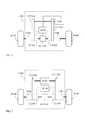
- Fig. 1 is a schematic view showing the first embodiment of the speed differential operation system of the present invention, in which between the rotary output side of the single power source (P100) and the wheel group (W100) and the wheel group (W200) respectively installed at two loads at two sides of the common load body (L100) is individually installed with a continuous variable transmission and installed with a stabilizing device (SDT100).
- P100 single power source
- W100 wheel group
- W200 wheel group
- SDT100 stabilizing device
- the single power source (P100) is through the continuous variable transmission (CVT100) and the transmission (T100) installed at the common load body (L100) to drive the wheel group (W100) installed at the load, and the same output side of the single power source (P100) is through the continuous variable transmission (CVT200) and the transmission (T200) to drive the wheel group (W200) installed at the load, whereas when the wheel group (W100) and the wheel group (W200) at the load are driven at differential speed, the continuous variable transmission (CVT100) and the continuous variable transmission (CVT200) automatically regulate the speed ratio with the load variation, and the stabilizing device (STD100) operates to match the speed differential operation drive between the wheel group (W100) and the wheel group (W200) at the load, in which:
- the continuous variable transmission (CVT100) and the continuous variable transmission (CVT200) individually regulate speed ratio according to the load variation of the wheel group (W100) and the wheel group (W200) installed at the load, so as to facilitate the speed differential operation drive between the wheel group (W100) and the wheel group (W200) at the load.
- a clutch unit is further installed at the output side of the continuous variable transmission individually arranged between the individual wheel group and the single power source (P100), including: the clutch unit (CL100) is additionally installed at the output side of the continuous variable transmission (CVT100), and/or the clutch unit (CL200) is additionally installed at the output side of the continuous variable transmission (CVT200), in which:
- Fig. 2 is a schematic view showing the second embodiment of the speed differential operation drive system of the present invention, in which between the rotary output sides at two sides of the single power source (P100) and the wheel group (W100) and the wheel group (W200) respectively installed at two loads at two sides of the common load body (L100) is individually installed with a continuous variable transmission and installed with a stabilizing device (SDT100) to constitute the speed differential operation drive system.
- P100 single power source
- W100 wheel group
- W200 wheel group respectively installed at two loads at two sides of the common load body
- SDT100 stabilizing device
- the speed differential operation drive system of the present invention is constituted by the continuous variable transmission individually installed between the rotary output sides at two sides of the single power source (P100) and the wheel group (W100) and the wheel group (W200) respectively installed at two loads at two sides of the common load body (L100), and through the operation of the stabilizing device (SDT100), in which:
- the continuous variable transmission (CVT100) and the continuous variable transmission (CVT200) individually regulate speed ratio according to the load variation of the wheel group (W100) and the wheel group (W200) installed at the load, so as to facilitate the speed differential operation drive between the wheel group (W100) and the wheel group (W200) at the load.
- a clutch unit is further installed at the output side of the continuous variable transmission individually arranged between the individual wheel group and the single power source (P100), including: the clutch unit (CL100) is additionally installed at the output side of the continuous variable transmission (CVT100), and/or the clutch unit (CL200) is additionally installed at the output side of the continuous variable transmission (CVT200), in which:
- Fig. 3 is a schematic view showing an embodiment of the system, in which the transmission with multi-shaft output (T101) is additionally installed between the rotary output side of the single power source (P100) and the individual CVT, as shown in Fig. 2 .
- the transmission with multi-shaft output (T101) is additionally installed between the rotary output side of the single power source (P100) and the individual CVT, as shown in Fig. 2 , for being driven by the single power source (P100), in which the multi-shaft output side respectively drives the input sides of the continuous variable transmissions (CVT100) and (CVT200).
- Fig. 4 is a schematic view showing the third embodiment of the speed differential operation drive system of the present invention, in which between the rotary output side of the single power source (P100) and the wheel group (W300) at the load installed at the intermediate portion of the front end (or the rear end) of the common load body (L100), and the wheel group (W100) and the wheel group (W200) respectively installed at the loads at two sides of the rear end (or the front end) of the common load body (L100) are individually installed with a continuous variable transmission and installed with a stabilizing device, and through the operation of the stabilizing device (SDT100) to constitute the speed differential operation drive system.
- P100 single power source
- W300 wheel group at the load installed at the intermediate portion of the front end (or the rear end) of the common load body (L100)
- the wheel group (W100) and the wheel group (W200) respectively installed at the loads at two sides of the rear end (or the front end) of the common load body (L100) are individually installed with a continuous variable transmission
- the speed differential operation drive system of the present invention is constituted by the continuous variable transmission individually installed between the rotary output side of the single power source (P100) and the wheel group (W300) installed at the load at the intermediate portion of the front end (or the rear end) of the common load body (L100), and the wheel group (W 100) and the wheel group (W200) respectively installed at the loads at two sides of the rear end (or the front end) of the common load body (L100), and through the operation of the stabilizing device (SDT100), in which:
- the continuous variable transmissions (CVT100), (CVT200), and (CVT300) individually regulate speed ratio according to the load variation of the wheel groups (W 100), (W200), and (W300) installed at the load, so as to facilitate the speed differential operation drive between the wheel groups (W100), (W200), and (W300) at the load.
- a clutch unit is further installed at the output side of the continuous variable transmission individually arranged between the individual wheel group and the single power source (P100), including: the clutch unit (CL100) is additionally installed at the output side of the continuous variable transmission (CYT100), and/or the clutch unit (CL200) is additionally installed at the output side of the continuous variable transmission (CVT200), and/or the clutch unit (CL300) is additionally installed at the output side of the continuous variable transmission (CVT300), in which:
- Fig. 5 is a schematic view showing the fourth embodiment of the speed differential operation drive system of the present invention, in which between the rotary output sides at two sides of the single power source (P100) and the wheel group (W300) at the load installed at the intermediate portion of the front end (or the rear end) of the common load body (L100), and the wheel group (W100) and the wheel group (W200) respectively installed at the loads at two sides of the rear end (or the frontend) of the common load body (L100) are individually installed with a continuous variable transmission and installed with a stabilizing device to constitute the speed differential operation drive system.
- the speed differential operation drive system of the present invention is constituted by the continuous variable transmission individually installed between the rotary output sides at two sides of the single power source (P100) and the wheel group (W300) installed at the load at the intermediate portion of the front end (or the rear end) of the common load body (L100), and the wheel group (W100) and the wheel group (W200) respectively installed at the loads at two sides of the rear end (or the front end) of the common load body (L100), and through the operation of the stabilizing device (SDT100), in which:
- the continuous variable transmissions (CVT100), (CVT200), and (CVT300) individually regulate speed ratio according to the load variation of the wheel groups (W100), (W200), and (W300) installed at the load, so as to facilitate the speed differential operation drive between the wheel groups (W100), (W200), and (W300) at the load.
- a clutch unit is further installed at the output side of the continuous variable transmission individually arranged between the individual wheel group and the single power source (P100), including: the clutch unit (CL100) is additionally installed at the output side of the continuous variable transmission (CVT100), and/or the clutch unit (CL200) is additionally installed at the output side of the continuous variable transmission (CVT200), and/or the clutch unit (CL300) is additionally installed at the output side of the continuous variable transmission (CVT300), in which:
- Fig. 6 is a schematic view showing an embodiment of the system, in which the transmission with multi-shaft output (T101) is additionally installed between the rotary output side of the single power source (P100) and the individual CVT, as shown in Fig. 5 .
- the transmission with multi-shaft output (T101) is additionally installed between the rotary output side at single side of the single power source (P100) and the individual CVT, as shown in Fig. 5 , for being driven by the single power source (P100), in which the multi-shaft output side respectively drives the input sides of the continuous variable transmissions (CVT100), (CVT200), and (CVT300).
- Fig. 7 is a schematic view showing the 5th embodiment of the speed differential operation drive system of the present invention, in which between the rotary output side of the single power source (P100) and the wheel group (W300) and the wheel group (W400) at the loads installed at two sides of the front end of the common load body (L 100), and the wheel group (W100) and the wheel group (W200) at the loads installed at two sides of the rear end of the common load body (L100) are individually installed with a continuous variable transmission and installed with the stabilizing devices (SDT100), (SDT200) to constitute the speed differential operation drive system.
- SDT100 stabilizing devices
- the speed differential operation drive system of the present invention is constituted by the continuous variable transmission individually installed between the rotary output side at single side of the single power source (P100) and the wheel group (W300) and the wheel group (W400) installed at the loads at two sides of the front end of the common load body (L100), and the wheel group (W100) and the wheel group (W200) installed at the loads at two sides of the rear end of the common load body (L100), and through the operation of the stabilizing devices (SDT100) and (SDT200), in which:
- the common load body (L100) is driven for operation by the single power source (P100), and wheel groups (W100), (W200), (W300), and (W400) installed at the load perform speed differential operation
- the continuous variable transmissions (CVT100), (CVT200), (CVT300), and (CVT400) individually regulate speed ratio according to the load variation of the wheel groups (W100), (W200), (W300), and (W400) installed at the load, so as to facilitate the speed differential operation drive between the wheel groups (W100), (W200), (W300), and (W400) at the load.
- a clutch unit is further installed at the output side of the continuous variable transmission individually arranged between the individual wheel group and the single power source (P100), including: the clutch unit (CL100) is additionally installed at the output side of the continuous variable transmission (CVT100), and/or the clutch unit (CL200) is additionally installed at the output side of the continuous variable transmission (CVT200), and/or the clutch unit (CL300) is additionally installed at the output side of the continuous variable transmission (CVT300), and/or the clutch unit (CL400) is additionally installed at the output side of the continuous variable transmission (CVT400), in which:
- Fig. 8 is a schematic view showing the 6th embodiment of the speed differential operation drive system of the present invention, in which between the rotary output sides at two sides of the single power source (P100) and the wheel group (W300) and the wheel group (W400) at the loads installed at two sides of the front end of the common load body (L100), and the wheel group (W100) and the wheel group (W200) at the loads installed at two sides of the rear end of the common load body (L100) are individually installed with a continuous variable transmission and installed with stabilizing devices (SDT100), (SDT200) to constitute the speed differential operation drive system.
- SDT100 stabilizing devices
- the speed differential operation drive system of the present invention is constituted by the continuous variable transmission individually installed between the rotary output sides at two sides of the single power source (P100) and the wheel group (W300) and the wheel group (W400) installed at the loads at two sides of the front end of the common load body (L100), and the wheel group (W100) and the wheel group (W200) installed at the loads at two sides of the rear end of the common load body (L100), and through the operation of the stabilizing devices (SDT100) and (SDT200), in which:
- the continuous variable transmissions (CVT100), (CVT200), (CVT300), and (CVT400) individually regulate speed ratio according to the load variation of the wheel groups (W100), (W200), (W300), and (W400) installed at the load, so as to facilitate the speed differential operation drive between the wheel groups (W100), (W200), (W300), and (W400) at the load.
- a clutch unit is further installed at the output side of the continuous variable transmission individually arranged between the individual wheel group and the single power source (P100), including: the clutch unit (CL100) is additionally installed at the output side of the continuous variable transmission (CVT100), and/or the clutch unit (CL200) is additionally installed at the output side of the continuous variable transmission (CVT200), and/or the clutch unit (CL300) is additionally installed at the output side of the continuous variable transmission (CVT300), and/or the clutch unit (CL400) is additionally installed at the output side of the continuous variable transmission (CVT400), in which:
- Fig. 9 is a schematic view showing an embodiment of the system, in which the transmission with multi-shaft output (T101) is additionally installed between the rotary output side of the single power source (P100) and the individual CVT, as shown in Fig. 8 .
- the transmission with multi-shaft output (T101) is additionally installed between the rotary output side at single side of the single power source (P100) and the individual CVT, as shown in Fig. 8 , for being driven by the single power source (P100), in which the multi-shaft output side drives the input sides of the continuous variable transmissions (CVT100), (CVT200), (CVT300), and (CVT400), respectively.
- Fig. 10 is a schematic view showing the 7th embodiment of the speed differential operation drive system of the present invention, in which between the rotary output side of the single power source (P100) and the wheel group (W300) at the load installed at the intermediate portion of the front end of the common load body (L100), the wheel group (W400) at the load installed at the intermediate portion of the rear end of the common load body (L100), and the wheel group (W100) and the wheel group (W200) respectively installed at the loads at two sides of the intermediate portion of the common load body (L100) are individually installed with a continuous variable transmission and installed with a stabilizing device (SDT100) to constitute the speed differential operation drive system.
- SDT100 stabilizing device
- the speed differential operation drive system of the present invention is constituted by the continuous variable transmission individually installed between the rotary output side at single side of the single power source (P100) and the wheel group (W300) installed at the load at the intermediate portion of the front end of the common load body (L100), the wheel group (W400) installed at the load at the intermediate portion of the rear end of the common load body (L100), and the wheel group (W100) and the wheel group (W200) respectively installed at the loads at two sides of the intermediate portion of the common load body (L100), and through the operation of the stabilizing device (SDT100), in which:
- the continuous variable transmissions (CVT100), (CVT200), (CVT300), and (CYT400) individually regulate speed ratio according to the load variation of the wheel groups (W100), (W200), (W300), and (W400) installed at the load, so as to facilitate the speed differential operation drive between the wheel groups (W100), (W200), (W300), and (W400) at the load.
- a clutch unit is further installed at the output side of the continuous variable transmission individually arranged between the individual wheel group and the single power source (P100), including: the clutch unit (CL100) is additionally installed at the output side of the continuous variable transmission (CVT100), and/or the clutch unit (CL200) is additionally installed at the output side of the continuous variable transmission (CVT200), and/or the clutch unit (CL300) is additionally installed at the output side of the continuous variable transmission (CVT300), and/or the clutch unit (CL400) is additionally installed at the output side of the continuous variable transmission (CVT400), in which:
- Fig. 11 is a schematic view showing the 8th embodiment of the speed differential operation drive system of the present invention, in which between the rotary output sides at two sides of the single power source (P100) and the wheel group (W300) at the load installed at the intermediate portion of the front end of the common load body (L 100), the wheel group (W400) at the load installed at the intermediate portion of the rear end of the common load body (L100), and the wheel group (W100) and the wheel group (W200) respectively installed at the loads at two sides of the intermediate portion of the common load body (L100) are individually installed with a continuous variable transmission and installed with a stabilizing device (SDT100) to constitute the speed differential operation drive system.
- SDT100 stabilizing device
- the speed differential operation drive system of the present invention is constituted by the continuous variable transmission individually installed between the rotary output sides at two sides of the single power source (P100) and the wheel group (W300) installed at the load at the intermediate portion of the front end of the common load body (L100), the wheel group (W400) installed at the load at the intermediate portion of the rear end of the common load body (L100), and the wheel group (W100) and the wheel group (W200) respectively installed at the loads at two sides of the intermediate portion of the common load body (L100), and through the operation of the stabilizing device (SDT100), in which:
- the continuous variable transmissions (CVT100), (CVT200), (CVT300), and (CVT400) individually regulate speed ratio according to the load variation of the wheel groups (W100), (W200), (W300), and (W400) installed at the load, so as to facilitate the speed differential operation drive between the wheel groups (W 100), (W200), (W300), and (W400) at the load.
- a clutch unit is further installed at the output side of the continuous variable transmission individually arranged between the individual wheel group and the single power source (P100), including: the clutch unit (CL100) is additionally installed at the output side of the continuous variable transmission (CVT100), and/or the clutch unit (CL200) is additionally installed at the output side of the continuous variable transmission (CVT200), and/or the clutch unit (CL300) is additionally installed at the output side of the continuous variable transmission (CVT300), and/or the clutch unit (CL400) is additionally installed at the output side of the continuous variable transmission (CVT400), in which:
- Fig. 12 is a schematic view showing an embodiment of the system, in which the transmission with multi-shaft output (T101) is additionally installed between the rotary output side of the single power source (P100) and the individual CVT, as shown in Fig. 11 .
- the transmission with multi-shaft output (T101) is additionally installed between the rotary output side at single side of the single power source (P100) and the individual CVT, as shown in Fig. 11 , for being driven by the single power source (P100), in which the multi-shaft output side drives the input sides of the continuous variable transmissions (CVT100), (CVT200), (CVT300), and (CVT400), respectively.
- Fig. 13 is a schematic view showing the 9th embodiment of the speed differential operation drive system of the present invention, in which between the rotary output side of the single power source (P100) and the wheel group (W500) and the wheel group (W600) at the loads installed at two sides of the front end of the common load body (L100), the wheel group (W300) and the wheel group (W400) at the loads installed at two sides of the intermediate portion of the common load body (L100), and the wheel group (W100) and the wheel group (W200) at the loads installed at two sides of the rear end of the common load body (L100) are individually installed with a continuous variable transmission and installed with stabilizing devices (SDT100), (SDT200), and (SDT300) to constitute the speed differential operation drive system.
- SDT100 stabilizing devices
- the speed differential operation drive system of the present invention is constituted by the continuous variable transmission individually installed between the rotary output side at single side of the single power source (P100) and the wheel group (W500) and the wheel group (W600) installed at the loads at two sides of the front end of the common load body (L100), the wheel group (W300) and the wheel group (W400) installed at the loads at two sides of the intermediate portion of the common load body (L100), and the wheel group (W100) and the wheel group (W200) installed at the loads at two sides of the rear end of the common load body (L100), and through the operation of the stabilizing devices (SDT100), (SDT200) and (SDT300), in which:
- the common load body (L100) is driven for operation by the single power source (P100), and the wheel groups (W100), (W200), (W300), (W400), (W500), and (W600) installed at the load perform speed differential operation
- the continuous variable transmissions (CVT100), (CVT200), (CVT300), (CVT400), (CVT500), and (CVT600) individually regulate speed ratio according to the load variation of the wheel groups (W100), (W200), (W300), (W400), (W500), and (W600) installed at the load, so as to facilitate the speed differential operation drive between the wheel groups (W100), (W200), (W300), (W400), (W500), and (W600) at the load.
- a clutch unit is further installed at the output side of the continuous variable transmission CVT individually arranged, between the individual wheel group and the single power source (P100), including: the clutch unit (CL100) is additionally installed at the output side of the continuous variable transmission (CVT100), and/or the clutch unit (CL200) is additionally installed at the output side of the continuous variable transmission (CVT200), and/or the clutch unit (CL300) is additionally installed at the output side of the continuous variable transmission (CVT300), and/or the clutch unit (CL400) is additionally installed at the output side of the continuous variable transmission (CVT400), and/or the clutch unit (CL500) is additionally installed at the output side of the continuous variable transmission (CVT500), and/or the clutch unit (CL600) is additionally installed at the output side of the continuous variable transmission (CVT600), in which:
- Fig. 14 is a schematic view showing the 10th embodiment of the speed differential operation drive system of the present invention, in which between the rotary output sides at two sides of the single power source (P100) and the wheel group (W500) and the wheel group (W600) at the loads installed at two sides of the front end of the common load body (L100), the wheel group (W300) and the wheel group (W400) at the loads installed at two sides of the intermediate portion of the common load body (L 100), and the wheel group (W100) and the wheel group (W200) at the loads installed at two sides of the reverse side of the common load body (L100) are individually installed with a continuous variable transmission and installed with the stabilizing devices (SDT100), (SDT200), and (SDT300) to constitute the speed differential operation drive system.
- SDT100 stabilizing devices
- the speed differential operation drive system of the present invention is constituted by the continuous variable transmission individually installed between the rotary output sides at two sides of the single power source (P100) and the wheel group (W500) and the wheel group (W600) installed at the loads at two sides of the front end of the common load body (L100), the wheel group (W300) and the wheel group (W400) installed at the loads at two sides of the intermediate portion of the common load body (L100), and the wheel group (W100) and the wheel group (W200) installed at the loads at two sides of the rear end of the common load body (L100), and through the operation of the stabilizing devices (SDT100), (SDT200) and (SDT300), in which:
- the common load body (L 100) is driven for operation by the single power source (P100), and the wheel groups (W100), (W200), (W300), (W400), (W500), and (W600) installed at the load perform speed differential operation
- the continuous variable transmissions (CVT100), (CVT200), (CVT300), (CVT400), (CVT500), and (CVT600) individually regulate speed ratio according to the load variation of the wheel groups (W100), (W200), (W300), (W400), (W500), and (W600) installed at the load, so as to facilitate the speed differential operation drive between the wheel groups (W100), (W200), (W300), (W400), (W500), and (W600) at the load.
- a clutch unit is further installed at the output side of the continuous variable transmission CVT individually arranged, between the individual wheel group and the single power source (P100), including: the clutch unit (CL100) is additionally installed at the output side of the continuous variable transmission (CVT100), and/or the clutch unit (CL200) is additionally installed at the output side of the continuous variable transmission (CVT200), and/or the clutch unit (CL300) is additionally installed at the output side of the continuous variable transmission (CVT300), and/or the clutch unit (CL400) is additionally installed at the output side of the continuous variable transmission (CVT400), and/or the clutch unit (CL500) is additionally installed at the output side of the continuous variable transmission (CVT500), and/or the clutch unit (CL600) is additionally installed at the output side of the continuous variable transmission (CVT600), in which:
- Fig. 15 is a schematic view showing an embodiment of the system, in which the transmission with multi-shaft output (T101) is additionally installed between the rotary output side of the single power source (P100) and the individual CVT, as shown in Fig. 14 .
- the transmission with multi-shaft output (T101) is additionally installed between the rotary output side at single side of the single power source (P100) and the individual CVT, as shown in Fig. 14 , for being driven by the single power source (P100), in which the multi-shaft output side drives the input sides of the continuous variable transmissions (CVT100), (CVT200), (CVT300), (CVT400), (CVT500), and (CVT600), respectively.
- the multi-shaft output side drives the input sides of the continuous variable transmissions (CVT100), (CVT200), (CVT300), (CVT400), (CVT500), and (CVT600), respectively.
- the single-powered multi-CVT differential system with stabilizing device is applied to the wheel-type vehicle, tracked vehicle, rail vehicle, or ship driven by at least two independent motors installed, or conveyor for stream of people or logistics, or industrial equipment driven by at least two motors.
- single powered multi-CVT differential system comprises:
Landscapes
- Engineering & Computer Science (AREA)
- Mechanical Engineering (AREA)
- Chemical & Material Sciences (AREA)
- Combustion & Propulsion (AREA)
- Transportation (AREA)
- General Engineering & Computer Science (AREA)
- Transmission Devices (AREA)
- Arrangement And Driving Of Transmission Devices (AREA)
- Hybrid Electric Vehicles (AREA)
- Retarders (AREA)
- Friction Gearing (AREA)
- Control Of Transmission Device (AREA)
Abstract
Description
- The present invention relates to a single power source installed at the common load, which is driven by electric motor, or internal combustion engine, or external combustion engine, or spring force, or hydraulic power, or pneumatic power, or flywheel power, or human power, or animal power, or wind power, for individually installing CVT between the output shaft of the single power source, or further through two or more output shafts of the transmission, and the individually driven load, for randomly changing the speed ratio to match the differential speed operation between two loads driven by the single power source, in which the stabilizing device constituted by the torque limited coupling device with sliding damping during sliding is installed between the loads individually driven by the two CVTs, the stabilizing device synchronously operates when the torque transmitted between the two loads operates within the limited torque range, and the stabilizing device differentially operates to produce sliding damping to stabilize the operation of the drive system when the torque transmitted between the two loads exceeds the limited torque range.
- Traditionally, when two or more loads installed at the common load are driven through speed differential drive by a single power, the speed differential function is often achieved by differential wheel group, which has shortcomings including transmission efficiency loss, space used, and the weight.
- The present invention relates to a single power source installed at the common load, which is driven by electric motor, or internal combustion engine, or external combustion engine, or spring force, or hydraulic power, or pneumatic power, or flywheel power, or human power, or animal power, or wind power, for individually installing CVT between the output shaft of the single power source, or further through two or more output shafts of the transmission, and the individually driven load, for randomly changing the speed ratio to match the speed differential operation between two loads driven by the single power source, and the stabilizing device constituted by the torque limited coupling device with sliding damping during sliding is installed between two loads individually driven by the two CVTs, during driving operation, if the loads individually driven by the two CVTs vary, or if the response time of the clutch unit at the loads individually driven by the two CVTs is slower, or if the two clutch units operate unstably because of the synchronous response time difference thereof, the stabilizing device installed between the loads operates to stabilize the system.
-
-
Fig. 1 is a schematic view showing the first embodiment of the speed differential operation system of the present invention, in which between the rotary output side of the single power source (P100) and the wheel group (W100) and the wheel group (W200) respectively installed at two loads at two sides of the common load body (L100) is individually installed with a continuous variable transmission and installed with a stabilizing device (SDT100) to constitute the speed differential operation drive system. -
Fig. 2 is a schematic view showing the second embodiment of the speed differential operation drive system of the present invention, in which between the rotary output sides at two sides of the single power source (P100) and the wheel group (W100) and the wheel group (W200) respectively installed at two loads at two sides of the common load body (L100) is individually installed with a continuous variable transmission and installed with a stabilizing device (SDT100) to constitute the speed differential operation drive system. -
Fig. 3 is a schematic view showing an embodiment of the system, in which the transmission with multi-shaft output (T101) is additionally installed between the rotary output side of the single power source (P100) and the individual CVT, as shown inFig. 2 . -
Fig. 4 is a schematic view showing the third embodiment of the speed differential operation drive system of the present invention, in which between the rotary output side of the single power source (P100) and the wheel group (W300) at the load installed at the intermediate portion of the front end (or the rear end) of the common load body (L100), and the wheel group (W100) and the wheel group (W200) respectively installed at the loads at two sides of the rear end (or the front end) of the common load body (L100) are individually installed with a continuous variable transmission and installed with a stabilizing device, and through the operation of the stabilizing device (SDT100) to constitute the speed differential operation drive system. -
Fig. 5 is a schematic view showing the fourth embodiment of the speed differential operation drive system of the present invention, in which between the rotary output sides at two sides of the single power source (P100) and the wheel group (W300) at the load installed at the intermediate portion of the front end (or the rear end) of the common load body (L100), and the wheel group (W100) and the wheel group (W200) respectively installed at the loads at two sides of the rear end (or the frontend) of the common load body (L100) are individually installed with a continuous variable transmission and installed with a stabilizing device to constitute the speed differential operation drive system. -
Fig. 6 is a schematic view showing an embodiment of the system, in which the transmission with multi-shaft output (T101) is additionally installed between the rotary output side of the single power source (P100) and the individual CVT, as shown inFig. 5 . -
Fig. 7 is a schematic view showing the 5th embodiment of the speed differential operation drive system of the present invention, in which between the rotary output side of the single power source (P100) and the wheel group (W300) and the wheel group (W400) at the loads installed at two sides of the front end of the common load body (L100), and the wheel group (W100) and the wheel group (W200) at the loads installed at two sides of the rear end of the common load body (L100) are individually installed with a continuous variable transmission and installed with the stabilizing devices (SDT100), (SDT200) to constitute the speed differential operation drive system. -
Fig. 8 is a schematic view showing the 6th embodiment of the speed differential operation drive system of the present invention, in which between the rotary output sides at two sides of the single power source (P100) and the wheel group (W300) and the wheel group (W400) at the loads installed at two sides of the front end of the common load body (L100), and the wheel group (W100) and the wheel group (W200) at the loads installed at two sides of the rear end of the common load body (L100) are individually installed with a continuous variable transmission and installed with stabilizing devices (SDT100), (SDT200) to constitute the speed differential operation drive system. -
Fig. 9 is a schematic view showing an embodiment of the system, in which the transmission with multi-shaft output (T101) is additionally installed between the rotary output side of the single power source (P100) and the individual CVT, as shown inFig. 8 . -
Fig. 10 is a schematic view showing the 7th embodiment of the speed differential operation drive system of the present invention, in which between the rotary output side of the single power source (P100) and the wheel group (W300) at the load installed at the intermediate portion of the front end of the common load body (L100), the wheel group (W400) at the load installed at the intermediate portion of the rear end of the common load body (L100), and the wheel group (W100) and the wheel group (W200) respectively installed at the loads at two sides of the intermediate portion of the common load body (L100) are individually installed with a continuous variable transmission and installed with a stabilizing device (SDT100) to constitute the speed differential operation drive system. -
Fig. 11 is a schematic view showing the 8th embodiment of the speed differential operation drive system of the present invention, in which between the rotary output sides at two sides of the single power source (P100) and the wheel group (W300) at the load installed at the intermediate portion of the front end of the common load body (L100), the wheel group (W4100) at the load installed at the intermediate portion of the rear end of the common load body (L100), and the wheel group (W100) and the wheel group (W200) respectively installed at the loads at two sides of the intermediate portion of the common load body (L100) are individually installed with a continuous variable transmission and installed with a stabilizing device (SDT100) to constitute the speed differential operation drive system. -
Fig. 12 is a schematic view showing an embodiment of the system, in which the transmission with multi-shaft output (T101) is additionally installed between the rotary output side of the single power source (P100) and the individual CVT, as shown inFig. 11 . -
Fig. 13 is a schematic view showing the 9th embodiment of the speed differential operation drive system of the present invention, in which between the rotary output side of the single power source (P100) and the wheel group (W500) and the wheel group (W600) at the loads installed at two sides of the front end of the common load body (L 100), the wheel group (W300) and the wheel group (W400) at the loads installed at two sides of the intermediate portion of the common load body (L100), and the wheel group (W100) and the wheel group (W200) at the loads installed at two sides of the rear end of the common load body (L100) are individually installed with a continuous variable transmission and installed with stabilizing devices (SDT100), (SDT200), and (SDT300) to constitute the speed differential operation drive system. -
Fig. 14 is a schematic view showing the 10th embodiment of the speed differential operation drive system of the present invention, in which between the rotary output sides at two sides of the single power source (P100) and the wheel group (W500) and the wheel group (W600) at the loads installed at two sides of the front end of the common load body (L100), the wheel group (W300) and the wheel group (W400) at the loads installed at two sides of the intermediate portion of the common load body (L100), and the wheel group (W100) and the wheel group (W200) at the loads installed at two sides of the reverse side of the common load body (L100) are individually installed with a continuous variable transmission and installed with the stabilizing devices (SDT100), (SDT200), and (SDT300) to constitute the speed differential operation drive system. -
Fig. 15 is a schematic view showing an embodiment of the system, in which the transmission with multi-shaft output (T101) is additionally installed between the rotary output side of the single power source (P100) and the individual CVT, as shown inFig. 14 . - CL100, CL200, CL300, CL400, CL500, CL600: Clutch unit
CVT100, CVT200, CVT300, CVT400, CVT500, CVT600: Continuous variable transmission
L100: Common load body
MI100: User interface
P100: Single power source
SDT100, SDT200, SDT300: Stabilizing device
T100, T101, T200, T300, T400, T500, T600: Transmission
W100, W200, W300, W400, W500, W600: Wheel group - Traditionally, when two or more loads installed at the common load are driven through speed differential drive by a single power, the speed differential function is often achieved by differential wheel group, which has shortcomings including transmission efficiency loss, space used, and the weight.
- The present invention relates to a single power source installed at the common load, which is driven by electric motor, or internal combustion engine, or external combustion engine, or spring force, or hydraulic power, or pneumatic power, or flywheel power, or human power, or animal power, or wind power, for individually installing CVT between the output shaft of the single power source, or further through two or more output shafts of the transmission, and the individually driven load, for randomly changing the speed ratio to match the differential speed operation between two loads driven by the single power source, in which the stabilizing device constituted by the torque limited coupling device with sliding damping during sliding is installed between the loads individually driven by the two CVTs, the stabilizing device synchronously operates when the torque transmitted between the two loads operates within the limited torque range, and the stabilizing device differentially operates to produce sliding damping to stabilize the operation of the drive system when the torque transmitted between the two loads exceeds the limited torque range.
- The CVT in the present invention is a continuous variable transmission, which can automatically change the speed ratio with the load state, or change the speed ratio in receiving external manipulation, including a variety of types, such as rubber belt type, metal belt type, and chain type CVT, or the electronic continuous variable transmission (ECVT), or the friction disk type, or the conventional non-coaxial continuous variable transmission.
- The common load in the present invention refers to a common load, which is further installed with the engine power system, related user interface unit, and the optional non-power wheel not driven by the single power source (P100), for commonly bearing the common load body (L100) with the power wheel.
- The various embodiments are described as following.
-
Fig. 1 is a schematic view showing the first embodiment of the speed differential operation system of the present invention, in which between the rotary output side of the single power source (P100) and the wheel group (W100) and the wheel group (W200) respectively installed at two loads at two sides of the common load body (L100) is individually installed with a continuous variable transmission and installed with a stabilizing device (SDT100). - As shown in
Fig. 1 , the single power source (P100) is through the continuous variable transmission (CVT100) and the transmission (T100) installed at the common load body (L100) to drive the wheel group (W100) installed at the load, and the same output side of the single power source (P100) is through the continuous variable transmission (CVT200) and the transmission (T200) to drive the wheel group (W200) installed at the load, whereas when the wheel group (W100) and the wheel group (W200) at the load are driven at differential speed, the continuous variable transmission (CVT100) and the continuous variable transmission (CVT200) automatically regulate the speed ratio with the load variation, and the stabilizing device (STD100) operates to match the speed differential operation drive between the wheel group (W100) and the wheel group (W200) at the load, in which: - - single power source (P100): constituted by the power source with rotary output kinetic energy, such as internal combustion engine, external combustion engine, spring force source, hydraulic power source, pneumatic power source, flywheel power source, or human power, or animal power, wind power source, and/or constituted by the electricity driven rotary motor, which are AC or DC, brushless or brush, synchronous or non-synchronous, internal or external rotation type; and equipped with the related control unit and the energy supply and/or storage unit;
- - continuous variable transmissions (CVT100), (CVT200): related to continuous variable transmissions, which can automatically change the speed ratio according to the load state, or change the speed ratio in receiving external manipulation, including a variety of types, such as rubber belt type, metal belt type, and chain type CVT, or the electronic continuous variable transmission (ECVT), or the friction disk type, or the conventional non-coaxial continuous variable transmission;
- - stabilizing device (SDT100): constituted by the dual-end shaft coupling device with the functions of setting coupling torque and sliding damping when exceeding the torque, including the stabilizing device with dual-end shaft structure formed by fluid viscosity effect, fluid damping effect, mechanical friction effect, or electromagnetic eddy current effect or power generation anti-torque effect, in which the two revolution ends individually link between the loads of the continuous variable transmissions (CVT100) and (CVT200), if unstable operation is caused by the varied load at individual load side during driving operation, the stabilizing device (SDT100) installed between the loads operates to stabilize the system;
- - transmissions (T100), (T200): related to fixed speed ratio, variable speed ratio, or stepless speed variable transmission, which is constituted by mechanical gear unit, sprocket unit, pulley unit, or linkage group; and the transmission is selectable as needed; and
- - user interface (MI100): related to linear analog or digital, or both mixed control device, constituted by the operating mechanism, and/or the electric machine, and/or the solid state circuit, for controlling the operation of the single power source (P100), and/or controlling the operations of the continuous variable transmission (CVT100) and/or the continuous variable transmission (CVT200).
- Through the operation of the above device, if the common load body (L100) is driven for operation, and the wheel group (W100) and the wheel group (W200) installed at the load perform speed differential operation, the continuous variable transmission (CVT100) and the continuous variable transmission (CVT200) individually regulate speed ratio according to the load variation of the wheel group (W100) and the wheel group (W200) installed at the load, so as to facilitate the speed differential operation drive between the wheel group (W100) and the wheel group (W200) at the load.
- In addition, for the embodiment shown in
Fig. 1 , except for directly driving the load through the continuous variable transmission, or through the continuous variable transmission and the transmission, a clutch unit is further installed at the output side of the continuous variable transmission individually arranged between the individual wheel group and the single power source (P100), including: the clutch unit (CL100) is additionally installed at the output side of the continuous variable transmission (CVT100), and/or the clutch unit (CL200) is additionally installed at the output side of the continuous variable transmission (CVT200), in which: - - clutch units (CL100), (CL200): related to the clutch device or structure, controlled by manpower or centrifugal force, or through the control of user interface (MI100), with the function of linking transmission or cutting separation, which is driven by electricity, and/or magnetic power, and/or machine power, and/or gas pressure, and/or liquid pressure, and which has the rotary input side and the rotary output side;
- - stabilizing device (SDT100): constituted by the dual-end shaft coupling device with the functions of setting coupling torque and sliding damping when exceeding the torque, including the stabilizing device with dual-end shaft structure formed by fluid viscosity effect, fluid damping effect, mechanical friction effect, or electromagnetic eddy current effect or power generation anti-torque effect, in which the two revolution ends individually link between two loads of the clutch units (CL100) and (CL200) individually driven by the continuous variable transmissions (CVT100) and (CVT200), during driving operation, if the load at individual load side varies, or if the response time of the clutch units (CL100) and (CL200) at the loads individually driven by the continuous variable transmissions (CVT100) and (CVT200) is slower, or if the clutch units (CL100) and (CL200) operate unstably because of the synchronous response time difference thereof, the stabilizing device (SDT100) installed between the loads of the clutch units (CL100) and (CL200) operates to stabilize the system.
-
Fig. 2 is a schematic view showing the second embodiment of the speed differential operation drive system of the present invention, in which between the rotary output sides at two sides of the single power source (P100) and the wheel group (W100) and the wheel group (W200) respectively installed at two loads at two sides of the common load body (L100) is individually installed with a continuous variable transmission and installed with a stabilizing device (SDT100) to constitute the speed differential operation drive system. - As shown in
Fig. 2 , the speed differential operation drive system of the present invention is constituted by the continuous variable transmission individually installed between the rotary output sides at two sides of the single power source (P100) and the wheel group (W100) and the wheel group (W200) respectively installed at two loads at two sides of the common load body (L100), and through the operation of the stabilizing device (SDT100), in which: - - single power source (P100): constituted by the power source with rotary output kinetic energy, such as internal combustion engine, external combustion engine, spring force source, hydraulic power source, pneumatic power source, flywheel power source, or human power, or animal power, wind power source, and/or constituted by the electricity driven rotary motor, which are AC or DC, brushless or brush, synchronous or non-synchronous, internal or external rotation type; and equipped with the related control unit and the energy supply and/or storage unit;
- - continuous variable transmissions (CVT100), (CVT200): related to continuous variable transmissions, which can automatically change the speed ratio according to the load state, or change the speed ratio in receiving external manipulation, including a variety of types, such as rubber belt type, metal belt type, and chain type CVT, or the electronic continuous variable transmission (ECVT), or the friction disk type, or the conventional non-coaxial continuous variable transmission;
- - stabilizing device (SDT100): constituted by the dual-end shaft coupling device with the functions of setting coupling torque and sliding damping when exceeding the torque, including the stabilizing device with dual-end shaft structure formed by fluid viscosity effect, fluid damping effect, mechanical friction effect, or electromagnetic eddy current effect or power generation anti-torque effect, in which the two revolution ends individually link between the loads of the continuous variable transmissions (CVT100) and (CVT200), if unstable operation is caused by the varied load at individual load side during driving operation, the stabilizing device (SDT100) installed between the loads operates to stabilize the system;
- - transmissions (T100), (T200): related to fixed speed ratio, variable speed ratio, or stepless speed variable transmission, which is constituted by mechanical gear unit, sprocket unit, pulley unit, or linkage group; and the transmission is selectable as needed; and
- - user interface (MI100): related to linear analog or digital, or both mixed control device, constituted by the operating mechanism, and/or the electric machine, and/or the solid state circuit, for controlling the operation of the single power source (P100), and/or controlling the operations of the continuous variable transmission (CVT100) and/or the continuous variable transmission (CVT200).
- Through the operation of the above device, if the common load body (L100) is driven for operation by the single power source (P100), and the wheel group (W100) and the wheel group (W200) installed at the load perform speed differential operation, the continuous variable transmission (CVT100) and the continuous variable transmission (CVT200) individually regulate speed ratio according to the load variation of the wheel group (W100) and the wheel group (W200) installed at the load, so as to facilitate the speed differential operation drive between the wheel group (W100) and the wheel group (W200) at the load.
- In addition, for the embodiment shown in
Fig. 2 , except for directly driving the load through the continuous variable transmission, or through the continuous variable transmission and the transmission, a clutch unit is further installed at the output side of the continuous variable transmission individually arranged between the individual wheel group and the single power source (P100), including: the clutch unit (CL100) is additionally installed at the output side of the continuous variable transmission (CVT100), and/or the clutch unit (CL200) is additionally installed at the output side of the continuous variable transmission (CVT200), in which: - - clutch units (CL100), (CL200): related to the clutch device or structure, controlled by manpower or centrifugal force, or through the control of user interface (MI100), with the function of linking transmission or cutting separation, which is driven by electricity, and/or magnetic power, and/or machine power, and/or gas pressure, and/or liquid pressure, and which has the rotary input side and the rotary output side;
- - stabilizing device (SDT100): constituted by the dual-end shaft coupling device with the functions of setting coupling torque and sliding damping when exceeding the torque, including the stabilizing device with dual-end shaft structure formed by fluid viscosity effect, fluid damping effect, mechanical friction effect, or electromagnetic eddy current effect or power generation anti-torque effect, in which the two revolution ends individually link between two loads of the clutch units (CL100) and (CL200) individually driven by the continuous variable transmissions (CVT100) and (CVT200), during driving operation, if the load at individual load side varies, or if the response time of the clutch units (CL100) and (CL200) at the loads individually driven by the continuous variable transmissions (CVT100) and (CVT200) is slower, or if the clutch units (CL100) and (CL200) operate unstably because of the synchronous response time difference thereof, the stabilizing device (SDT100) installed between the loads of the clutch units (CL100) and (CL200) operates to stabilize the system.
-
Fig. 3 is a schematic view showing an embodiment of the system, in which the transmission with multi-shaft output (T101) is additionally installed between the rotary output side of the single power source (P100) and the individual CVT, as shown inFig. 2 . - As shown in
Fig. 3 , the transmission with multi-shaft output (T101) is additionally installed between the rotary output side of the single power source (P100) and the individual CVT, as shown inFig. 2 , for being driven by the single power source (P100), in which the multi-shaft output side respectively drives the input sides of the continuous variable transmissions (CVT100) and (CVT200). -
Fig. 4 is a schematic view showing the third embodiment of the speed differential operation drive system of the present invention, in which between the rotary output side of the single power source (P100) and the wheel group (W300) at the load installed at the intermediate portion of the front end (or the rear end) of the common load body (L100), and the wheel group (W100) and the wheel group (W200) respectively installed at the loads at two sides of the rear end (or the front end) of the common load body (L100) are individually installed with a continuous variable transmission and installed with a stabilizing device, and through the operation of the stabilizing device (SDT100) to constitute the speed differential operation drive system. - As shown in
Fig. 4 , the speed differential operation drive system of the present invention is constituted by the continuous variable transmission individually installed between the rotary output side of the single power source (P100) and the wheel group (W300) installed at the load at the intermediate portion of the front end (or the rear end) of the common load body (L100), and the wheel group (W 100) and the wheel group (W200) respectively installed at the loads at two sides of the rear end (or the front end) of the common load body (L100), and through the operation of the stabilizing device (SDT100), in which: - - single power source (P100): constituted by the power source with rotary output kinetic energy, such as internal combustion engine, external combustion engine, spring force source, hydraulic power source, pneumatic power source, flywheel power source, or human power, or animal power, wind power source, and/or constituted by the electricity driven rotary motor, which are AC or DC, brushless or brush, synchronous or non-synchronous, internal or external rotation type; and equipped with the related control unit and the energy supply and/or storage unit;
- - continuous variable transmissions (CVT100), (CVT200), (CVT300): related to continuous variable transmissions, which can automatically change the speed ratio according to the load state, or change the speed ratio in receiving external manipulation, including a variety of types, such as rubber belt type, metal belt type, and chain type CVT, or the electronic continuous variable transmission (ECVT), or the friction disk type, or the conventional non-coaxial continuous variable transmission;
- - stabilizing device (SDT100): constituted by the dual-end shaft coupling device with the functions of setting coupling torque and sliding damping when exceeding the torque, including the stabilizing device with dual-end shaft structure formed by fluid viscosity effect, fluid damping effect, mechanical friction effect, or electromagnetic eddy current effect or power generation anti-torque effect, in which the two revolution ends individually link between the loads of the continuous variable transmissions (CVT100) and (CVT200), if unstable operation is caused by the varied load at individual load side during driving operation, the stabilizing device (SDT100) installed between the loads operates to stabilize the system;
- - transmissions (T100), (T200), (T300): related to fixed speed ratio, variable speed ratio, or stepless speed variable transmission, which is constituted by mechanical gear unit, sprocket unit, pulley unit, or linkage group; and the transmission is selectable as needed; and
- - user interface (MI100): related to linear analog or digital, or both mixed control device, constituted by the operating mechanism, and/or the electric machine, and/or the solid state circuit, for controlling the operation of the single power source (P100), and/or controlling the operations of the continuous variable transmission (CVT100) and/or the continuous variable transmission (CVT200), and the continuous variable transmission (CVT300).
- Through the operation of the above device, if the common load body (L 100) is driven for operation by the single power source (P100), and the wheel groups (W100), (W200), and (W300) installed at the load perform speed differential operation, the continuous variable transmissions (CVT100), (CVT200), and (CVT300) individually regulate speed ratio according to the load variation of the wheel groups (W 100), (W200), and (W300) installed at the load, so as to facilitate the speed differential operation drive between the wheel groups (W100), (W200), and (W300) at the load.
- In addition, for the embodiment shown in
Fig. 4 , except for directly driving the load through the continuous variable transmission, or through the continuous variable transmission and the transmission, a clutch unit is further installed at the output side of the continuous variable transmission individually arranged between the individual wheel group and the single power source (P100), including: the clutch unit (CL100) is additionally installed at the output side of the continuous variable transmission (CYT100), and/or the clutch unit (CL200) is additionally installed at the output side of the continuous variable transmission (CVT200), and/or the clutch unit (CL300) is additionally installed at the output side of the continuous variable transmission (CVT300), in which: - - clutch units (CL100), (CL200), (CL300): related to the clutch device or structure, controlled by manpower or centrifugal force, or through the control of user interface (MI100), with the function of linking transmission or cutting separation, which is driven by electricity, and/or magnetic power, and/or machine power, and/or gas pressure, and/or liquid pressure, and which has the rotary input side and the rotary output side;
- - stabilizing device (SDT100): constituted by the dual-end shaft coupling device with the functions of setting coupling torque and sliding damping when exceeding the torque, including the stabilizing device with dual-end shaft structure formed by fluid viscosity effect, fluid damping effect, mechanical friction effect, or electromagnetic eddy current effect or power generation anti-torque effect, in which the two revolution ends individually link between two loads of the clutch units (CL100) and (CL200) individually driven by the continuous variable transmissions (CVT100) and (CVT200), during driving operation, if the load at individual load side varies, or if the response time of the clutch units (CL100) and (CL200) at the loads individually driven by the continuous variable transmissions (CVT100) and (CVT200) is slower, or if the clutch units (CL100) and (CL200) operate unstably because of the synchronous response time difference thereof, the stabilizing device (SDT100) installed between the loads of the clutch units (CL100) and (CL200) operates to stabilize the system.
-
Fig. 5 is a schematic view showing the fourth embodiment of the speed differential operation drive system of the present invention, in which between the rotary output sides at two sides of the single power source (P100) and the wheel group (W300) at the load installed at the intermediate portion of the front end (or the rear end) of the common load body (L100), and the wheel group (W100) and the wheel group (W200) respectively installed at the loads at two sides of the rear end (or the frontend) of the common load body (L100) are individually installed with a continuous variable transmission and installed with a stabilizing device to constitute the speed differential operation drive system. - As shown in
Fig. 5 , the speed differential operation drive system of the present invention is constituted by the continuous variable transmission individually installed between the rotary output sides at two sides of the single power source (P100) and the wheel group (W300) installed at the load at the intermediate portion of the front end (or the rear end) of the common load body (L100), and the wheel group (W100) and the wheel group (W200) respectively installed at the loads at two sides of the rear end (or the front end) of the common load body (L100), and through the operation of the stabilizing device (SDT100), in which: - - single power source (P100): constituted by the power source with rotary output kinetic energy, such as internal combustion engine, external combustion engine, spring force source, hydraulic power source, pneumatic power source, flywheel power source, or human power, or animal power, wind power source, and/or constituted by the electricity driven rotary motor, which are AC or DC, brushless or brush, synchronous or non-synchronous, internal or external rotation type; and equipped with the related control unit and the energy supply and/or storage unit;
- - continuous variable transmissions (CVT100), (CVT200), (CVT300): related to continuous variable transmissions, which can automatically change the speed ratio according to the load state, or change the speed ratio in receiving external manipulation, including a variety of types, such as rubber belt type, metal belt type, and chain type CVT, or the electronic continuous variable transmission (ECVT), or the friction disk type, or the conventional non-coaxial continuous variable transmission;
- - stabilizing device (SDT100): constituted by the dual-end shaft coupling device with the functions of setting coupling torque and sliding damping when exceeding the torque, including the stabilizing device with dual-end shaft structure formed by fluid viscosity effect, fluid damping effect, mechanical friction effect, or electromagnetic eddy current effect or power generation anti-torque effect, in which the two revolution ends individually link between the loads of the continuous variable transmissions (CVT100) and (CVT200), if unstable operation is caused by the varied load at individual load side during driving operation, the stabilizing device (SDT100) installed between the loads operates to stabilize the system;
- - transmissions (T100), (T200), (T300): related to fixed speed ratio, variable speed ratio, or stepless speed variable transmission, which is constituted by mechanical gear unit, sprocket unit, pulley unit, or linkage group; and the transmission is selectable as needed; and
- - user interface (MI100): related to linear analog or digital, or both mixed control device, constituted by the operating mechanism, and/or the electric machine, and/or the solid state circuit, for controlling the operation of the single power source (P100), and/or controlling the operations of the continuous variable transmission (CVT100), (CVT200), and (CVT300).
- Through the operation of the above device, if the common load body (L100) is driven for operation by the single power source (P100), and the wheel groups (W100), (W200), and (W300) installed at the load perform speed differential operation, the continuous variable transmissions (CVT100), (CVT200), and (CVT300) individually regulate speed ratio according to the load variation of the wheel groups (W100), (W200), and (W300) installed at the load, so as to facilitate the speed differential operation drive between the wheel groups (W100), (W200), and (W300) at the load.
- In addition, for the embodiment shown in
Fig. 5 , except for directly driving the load through the continuous variable transmission, or through the continuous variable transmission and the transmission, a clutch unit is further installed at the output side of the continuous variable transmission individually arranged between the individual wheel group and the single power source (P100), including: the clutch unit (CL100) is additionally installed at the output side of the continuous variable transmission (CVT100), and/or the clutch unit (CL200) is additionally installed at the output side of the continuous variable transmission (CVT200), and/or the clutch unit (CL300) is additionally installed at the output side of the continuous variable transmission (CVT300), in which: - - clutch units (CL100), (CL200), (CL300): related to the clutch device or structure, controlled by manpower or centrifugal force, or through the control of user interface (MI100), with the function of linking transmission or cutting separation, which is driven by electricity, and/or magnetic power, and/or machine power, and/or gas pressure, and/or liquid pressure, and which has the rotary input side and the rotary output side;
- - stabilizing device (SDT100): constituted by the dual-end shaft coupling device with the functions of setting coupling torque and sliding damping when exceeding the torque, including the stabilizing device with dual-end shaft structure formed by fluid viscosity effect, fluid damping effect, mechanical friction effect, or electromagnetic eddy current effect or power generation anti-torque effect, in which the two revolution ends individually link between two loads of the clutch units (CL100) and (CL200) individually driven by the continuous variable transmissions (CVT100) and (CVT200), during driving operation, if the load at individual load side varies, or if the response time of the clutch units (CL100) and (CL200) at the loads individually driven by the continuous variable transmissions (CVT100) and (CVT200) is slower, or if the clutch units (CL100) and (CL200) operate unstably because of the synchronous response time difference thereof, the stabilizing device (SDT100) installed between the loads of the clutch units (CL100) and (CL200) operates to stabilize the system.
-
Fig. 6 is a schematic view showing an embodiment of the system, in which the transmission with multi-shaft output (T101) is additionally installed between the rotary output side of the single power source (P100) and the individual CVT, as shown inFig. 5 . - As shown in
Fig. 6 , the transmission with multi-shaft output (T101) is additionally installed between the rotary output side at single side of the single power source (P100) and the individual CVT, as shown inFig. 5 , for being driven by the single power source (P100), in which the multi-shaft output side respectively drives the input sides of the continuous variable transmissions (CVT100), (CVT200), and (CVT300). -
Fig. 7 is a schematic view showing the 5th embodiment of the speed differential operation drive system of the present invention, in which between the rotary output side of the single power source (P100) and the wheel group (W300) and the wheel group (W400) at the loads installed at two sides of the front end of the common load body (L 100), and the wheel group (W100) and the wheel group (W200) at the loads installed at two sides of the rear end of the common load body (L100) are individually installed with a continuous variable transmission and installed with the stabilizing devices (SDT100), (SDT200) to constitute the speed differential operation drive system. - As shown in
Fig. 7 , the speed differential operation drive system of the present invention is constituted by the continuous variable transmission individually installed between the rotary output side at single side of the single power source (P100) and the wheel group (W300) and the wheel group (W400) installed at the loads at two sides of the front end of the common load body (L100), and the wheel group (W100) and the wheel group (W200) installed at the loads at two sides of the rear end of the common load body (L100), and through the operation of the stabilizing devices (SDT100) and (SDT200), in which: - - single power source (P100): constituted by the power source with rotary output kinetic energy, such as internal combustion engine, external combustion engine, spring force source, hydraulic power source, pneumatic power source, flywheel power source, or human power, or animal power, wind power source, and/or constituted by the electricity driven rotary motor, which are AC or DC, brushless or brush, synchronous or non-synchronous, internal or external rotation type; and equipped with the related control unit and the energy supply and/or storage unit;
- - continuous variable transmissions (CVT100), (CVT200), (CVT300), (CVT400): related to continuous variable transmissions, which can automatically change the speed ratio according to the load state, or change the speed ratio in receiving external manipulation, including a variety of types, such as rubber belt type, metal belt type, and chain type CVT, or the electronic continuous variable transmission (ECVT), or the friction disk type, or the conventional non-coaxial continuous variable transmission;
- - stabilizing device (SDT100): constituted by the dual-end shaft coupling device with the functions of setting coupling torque and sliding damping when exceeding the torque, including the stabilizing device with dual-end shaft structure formed by fluid viscosity effect, fluid damping effect, mechanical friction effect, or electromagnetic eddy current effect or power generation anti-torque effect, in which the two revolution ends individually link between the loads of the continuous variable transmissions (CVT100) and (CVT200), if unstable operation is caused by the varied load at individual load side during driving operation, the stabilizing device (SDT100) installed between the loads operates to stabilize the system;
- - stabilizing device (SDT200): constituted by the dual-end shaft coupling device with the functions of setting coupling torque and sliding damping when exceeding the torque, including the stabilizing device with dual-end shaft structure formed by fluid viscosity effect, fluid damping effect, mechanical friction effect, or electromagnetic eddy current effect or power generation anti-torque effect, in which the two revolution ends individually link between the loads of the continuous variable transmissions (CVT300) and (CVT400), if unstable operation is caused by the varied load at individual load side during driving operation, the stabilizing device (SDT200) installed between the loads operates to stabilize the system;
- - transmissions (T100), (T200), (T300), (T400): related to fixed speed ratio, variable speed ratio, or stepless speed variable transmission, which is constituted by mechanical gear unit, sprocket unit, pulley unit, or linkage group; and the transmission is selectable as needed; and
- - user interface (MI100): related to linear analog or digital, or both mixed control device, constituted by the operating mechanism, and/or the electric machine, and/or the solid state circuit, for controlling the operation of the single power source (P100), and/or controlling the operations of the continuous variable transmission (CVT100), (CVT200), (CVT300), and (CVT400).
- Through the operation of the above device, if the common load body (L100) is driven for operation by the single power source (P100), and wheel groups (W100), (W200), (W300), and (W400) installed at the load perform speed differential operation, the continuous variable transmissions (CVT100), (CVT200), (CVT300), and (CVT400) individually regulate speed ratio according to the load variation of the wheel groups (W100), (W200), (W300), and (W400) installed at the load, so as to facilitate the speed differential operation drive between the wheel groups (W100), (W200), (W300), and (W400) at the load.
- In addition, for the embodiment shown in
Fig. 7 , except for directly driving the load through the continuous variable transmission, or through the continuous variable transmission and the transmission, a clutch unit is further installed at the output side of the continuous variable transmission individually arranged between the individual wheel group and the single power source (P100), including: the clutch unit (CL100) is additionally installed at the output side of the continuous variable transmission (CVT100), and/or the clutch unit (CL200) is additionally installed at the output side of the continuous variable transmission (CVT200), and/or the clutch unit (CL300) is additionally installed at the output side of the continuous variable transmission (CVT300), and/or the clutch unit (CL400) is additionally installed at the output side of the continuous variable transmission (CVT400), in which: - - clutch units (CL100), (CL200), (CL300), (CL400): related to the clutch device or structure, controlled by manpower or centrifugal force, or through the control of user interface (MI100), with the function of linking transmission or cutting separation, which is driven by electricity, and/or magnetic power, and/or machine power, and/or gas pressure, and/or liquid pressure, and which has the rotary input side and the rotary output side;
- - stabilizing device (SDT100): constituted by the dual-end shaft coupling device with the functions of setting coupling torque and sliding damping when exceeding the torque, including the stabilizing device with dual-end shaft structure formed by fluid viscosity effect, fluid damping effect, mechanical friction effect, or electromagnetic eddy current effect or power generation anti-torque effect, in which the two revolution ends individually link between two loads of the clutch units (CL100) and (CL200) individually driven by the continuous variable transmissions (CVT100) and (CVT200), during driving operation, if the load at individual load side varies, or if the response time of the clutch units (CL100) and (CL200) at the loads individually driven by the continuous variable transmissions (CVT100) and (CVT200) is slower, or if the clutch units (CL100) and (CL200) operate unstably because of the synchronous response time difference thereof, the stabilizing device (SDT100) installed between the loads of the clutch units (CL100) and (CL200) operates to stabilize the system;
- - stabilizing device (SDT200): constituted by the dual-end shaft coupling device with the functions of setting coupling torque and sliding damping when exceeding the torque, including the stabilizing device with dual-end shaft structure formed by fluid viscosity effect, fluid damping effect, mechanical friction effect, or electromagnetic eddy current effect or power generation anti-torque effect, in which the two revolution ends individually link between two loads of the clutch units (CL300) and (CL400) individually driven by the continuous variable transmissions (CVT300) and (CVT400), during driving operation, if the load at individual load side varies, or if the response time of the clutch units (CL300) and (CL400) at the loads individually driven by the continuous variable transmissions (CVT300) and (CVT400) is slower, or if the clutch units (CL300) and (CL400) operate unstably because of the synchronous response time difference thereof, the stabilizing device (SDT200) installed between the loads of the clutch units (CL300) and (CL400) operates to stabilize the system.
-
Fig. 8 is a schematic view showing the 6th embodiment of the speed differential operation drive system of the present invention, in which between the rotary output sides at two sides of the single power source (P100) and the wheel group (W300) and the wheel group (W400) at the loads installed at two sides of the front end of the common load body (L100), and the wheel group (W100) and the wheel group (W200) at the loads installed at two sides of the rear end of the common load body (L100) are individually installed with a continuous variable transmission and installed with stabilizing devices (SDT100), (SDT200) to constitute the speed differential operation drive system. - As shown in
Fig. 8 , the speed differential operation drive system of the present invention is constituted by the continuous variable transmission individually installed between the rotary output sides at two sides of the single power source (P100) and the wheel group (W300) and the wheel group (W400) installed at the loads at two sides of the front end of the common load body (L100), and the wheel group (W100) and the wheel group (W200) installed at the loads at two sides of the rear end of the common load body (L100), and through the operation of the stabilizing devices (SDT100) and (SDT200), in which: - - single power source (P100): constituted by the power source with rotary output kinetic energy, such as internal combustion engine, external combustion engine, spring force source, hydraulic power source, pneumatic power source, flywheel power source, or human power, or animal power, wind power source, and/or constituted by the electricity driven rotary motor, which are AC or DC, brushless or brush, synchronous or non-synchronous, internal or external rotation type; and equipped with the related control unit and the energy supply and/or storage unit;
- - continuous variable transmissions (CVT100), (CVT200), (CVT300), (CVT400): related to continuous variable transmissions, which can automatically change the speed ratio according to the load state, or change the speed ratio in receiving external manipulation, including a variety of types, such as rubber belt type, metal belt type, and chain type CVT, or the electronic continuous variable transmission (ECVT), or the friction disk type, or the conventional non-coaxial continuous variable transmission;
- - stabilizing device (SDT100): constituted by the dual-end shaft coupling device with the functions of setting coupling torque and sliding damping when exceeding the torque, including the stabilizing device with dual-end shaft structure formed by fluid viscosity effect, fluid damping effect, mechanical friction effect, or electromagnetic eddy current effect or power generation anti-torque effect, in which the two revolution ends individually link between the loads of the continuous variable transmissions (CVT100) and (CVT200), if unstable operation is caused by the varied load at individual load side during driving operation, the stabilizing device (SDT100) installed between the loads operates to stabilize the system;
- - stabilizing device (SDT200): constituted by the dual-end shaft coupling device with the functions of setting coupling torque and sliding damping when exceeding the torque, including the stabilizing device with dual-end shaft structure formed by fluid viscosity effect, fluid damping effect, mechanical friction effect, or electromagnetic eddy current effect or power generation anti-torque effect, in which the two revolution ends individually link between the loads of the continuous variable transmissions (CVT300) and (CVT400), if unstable operation is caused by the varied load at individual load side during driving operation, the stabilizing device (SDT200) installed between the loads operates to stabilize the system;
- - transmissions (T100), (T200), (T300), (T400): related to fixed speed ratio, variable speed ratio, or stepless speed variable transmission, which is constituted by mechanical gear unit, sprocket unit, pulley unit, or linkage group; and the transmission is selectable as needed; and
- - user interface (MI100): related to linear analog or digital, or both mixed control device, constituted by the operating mechanism, and/or the electric machine, and/or the solid state circuit, for controlling the operation of the single power source (P100), and/or controlling the operations of the continuous variable transmission (CVT100), (CVT200), (CVT300), and (CVT400).
- Through the operation of the above device, if the common load body (L 100) is driven for operation by the single power source (P100), and the wheel groups (W100), (W200), (W300), and (W400) installed at the load perform speed differential operation, the continuous variable transmissions (CVT100), (CVT200), (CVT300), and (CVT400) individually regulate speed ratio according to the load variation of the wheel groups (W100), (W200), (W300), and (W400) installed at the load, so as to facilitate the speed differential operation drive between the wheel groups (W100), (W200), (W300), and (W400) at the load.
- In addition, for the embodiment shown in
Fig. 8 , except for directly driving the load through the continuous variable transmission, or through the continuous variable transmission and the transmission, a clutch unit is further installed at the output side of the continuous variable transmission individually arranged between the individual wheel group and the single power source (P100), including: the clutch unit (CL100) is additionally installed at the output side of the continuous variable transmission (CVT100), and/or the clutch unit (CL200) is additionally installed at the output side of the continuous variable transmission (CVT200), and/or the clutch unit (CL300) is additionally installed at the output side of the continuous variable transmission (CVT300), and/or the clutch unit (CL400) is additionally installed at the output side of the continuous variable transmission (CVT400), in which: - - clutch units (CL100), (CL200), (CL300), (CL400): related to the clutch device or structure, controlled by manpower or centrifugal force, or through the control of user interface (MI100), with the function of linking transmission or cutting separation, which is driven by electricity, and/or magnetic power, and/or machine power, and/or gas pressure, and/or liquid pressure, and which has the rotary input side and the rotary output side;
- - stabilizing device (SDT100): constituted by the dual-end shaft coupling device with the functions of setting coupling torque and sliding damping when exceeding the torque, including the stabilizing device with dual-end shaft structure formed by fluid viscosity effect, fluid damping effect, mechanical friction effect, or electromagnetic eddy current effect or power generation anti-torque effect, in which the two revolution ends individually link between two loads of the clutch units (CL100) and (CL200) individually driven by the continuous variable transmissions (CVT100) and (CVT200), during driving operation, if the load at individual load side varies, or if the response time of the clutch units (CL100) and (CL200) at the loads individually driven by the continuous variable transmissions (CVT100) and (CVT200) is slower, or if the clutch units (CL100) and (CL200) operate unstably because of the synchronous response time difference thereof, the stabilizing device (SDT100) installed between the loads of the clutch units (CL100) and (CL200) operates to stabilize the system;
- - stabilizing device (SDT200): constituted by the dual-end shaft coupling device with the functions of setting coupling torque and sliding damping when exceeding the torque, including the stabilizing device with dual-end shaft structure formed by fluid viscosity effect, fluid damping effect, mechanical friction effect, or electromagnetic eddy current effect or power generation anti-torque effect, in which the two revolution ends individually link between two loads of the clutch units (CL300) and (CL400) individually driven by the continuous variable transmissions (CVT300) and (CVT400), during driving operation, if the load at individual load side varies, or if the response time of the clutch units (CL300) and (CL400) at the loads individually driven by the continuous variable transmissions (CVT300) and (CVT400) is slower, or if the clutch units (CL300) and (CL400) operate unstably because of the synchronous response time difference thereof, the stabilizing device (SDT200) installed between the loads of the clutch units (CL300) and (CL400) operates to stabilize the system.
-
Fig. 9 is a schematic view showing an embodiment of the system, in which the transmission with multi-shaft output (T101) is additionally installed between the rotary output side of the single power source (P100) and the individual CVT, as shown inFig. 8 . - As shown in
Fig. 9 , the transmission with multi-shaft output (T101) is additionally installed between the rotary output side at single side of the single power source (P100) and the individual CVT, as shown inFig. 8 , for being driven by the single power source (P100), in which the multi-shaft output side drives the input sides of the continuous variable transmissions (CVT100), (CVT200), (CVT300), and (CVT400), respectively. -
Fig. 10 is a schematic view showing the 7th embodiment of the speed differential operation drive system of the present invention, in which between the rotary output side of the single power source (P100) and the wheel group (W300) at the load installed at the intermediate portion of the front end of the common load body (L100), the wheel group (W400) at the load installed at the intermediate portion of the rear end of the common load body (L100), and the wheel group (W100) and the wheel group (W200) respectively installed at the loads at two sides of the intermediate portion of the common load body (L100) are individually installed with a continuous variable transmission and installed with a stabilizing device (SDT100) to constitute the speed differential operation drive system. - As shown in
Fig. 10 , the speed differential operation drive system of the present invention is constituted by the continuous variable transmission individually installed between the rotary output side at single side of the single power source (P100) and the wheel group (W300) installed at the load at the intermediate portion of the front end of the common load body (L100), the wheel group (W400) installed at the load at the intermediate portion of the rear end of the common load body (L100), and the wheel group (W100) and the wheel group (W200) respectively installed at the loads at two sides of the intermediate portion of the common load body (L100), and through the operation of the stabilizing device (SDT100), in which: - - single power source (P100): constituted by the power source with rotary output kinetic energy, such as internal combustion engine, external combustion engine, spring force source, hydraulic power source, pneumatic power source, flywheel power source, or human power, or animal power, wind power source, and/or constituted by the electricity driven rotary motor, which are AC or DC, brushless or brush, synchronous or non-synchronous, internal or external rotation type; and equipped with the related control unit and the energy supply and/or storage unit;
- - continuous variable transmissions (CVT100), (CVT200), (CVT300), (CVT400): related to continuous variable transmissions, which can automatically change the speed ratio according to the load state, or change the speed ratio in receiving external manipulation, including a variety of types, such as rubber belt type, metal belt type, and chain type CVT, or the electronic continuous variable transmission (ECVT), or the friction disk type, or the conventional non-coaxial continuous variable transmission;
- - stabilizing device (SDT100): constituted by the dual-end shaft coupling device with the functions of setting coupling torque and sliding damping when exceeding the torque, including the stabilizing device with dual-end shaft structure formed by fluid viscosity effect, fluid damping effect, mechanical friction effect, or electromagnetic eddy current effect or power generation anti-torque effect, in which the two revolution ends individually link between the loads of the continuous variable transmissions (CVT100) and (CVT200), if unstable operation is caused by the varied load at individual load side during driving operation, the stabilizing device (SDT100) installed between the loads operates to stabilize the system;
- - transmissions (T100), (T200), (T300), (T400): related to fixed speed ratio, variable speed ratio, or stepless speed variable transmission, which is constituted by mechanical gear unit, sprocket unit, pulley unit, or linkage group; and the transmission is selectable as needed; and
- - user interface (MI100): related to linear analog or digital, or both mixed control device, constituted by the operating mechanism, and/or the electric machine, and/or the solid state circuit, for controlling the operation of the single power source (P100), and/or controlling the operations of the continuous variable transmission (CVT100), (CVT200), (CVT300), and (CYT400).
- Through the operation of the above device, if the common load body (L100) is driven for operation by the single power source (P100), and the wheel groups (W100), (W200), (W300), and (W400) installed at the load perform speed differential operation, the continuous variable transmissions (CVT100), (CVT200), (CVT300), and (CYT400) individually regulate speed ratio according to the load variation of the wheel groups (W100), (W200), (W300), and (W400) installed at the load, so as to facilitate the speed differential operation drive between the wheel groups (W100), (W200), (W300), and (W400) at the load.
- In addition, for the embodiment shown in
Fig. 10 , except for directly driving the load through the continuous variable transmission, or through the continuous variable transmission and the transmission, a clutch unit is further installed at the output side of the continuous variable transmission individually arranged between the individual wheel group and the single power source (P100), including: the clutch unit (CL100) is additionally installed at the output side of the continuous variable transmission (CVT100), and/or the clutch unit (CL200) is additionally installed at the output side of the continuous variable transmission (CVT200), and/or the clutch unit (CL300) is additionally installed at the output side of the continuous variable transmission (CVT300), and/or the clutch unit (CL400) is additionally installed at the output side of the continuous variable transmission (CVT400), in which: - - clutch units (CL100), (CL200), (CL300), (CL400): related to the clutch device or structure, controlled by manpower or centrifugal force, or through the control of user interface (MI100), with the function of linking transmission or cutting separation, which is driven by electricity, and/or magnetic power, and/or machine power, and/or gas pressure, and/or liquid pressure, and which has the rotary input side and the rotary output side;
- - stabilizing device (SDT100): constituted by the dual-end shaft coupling device with the functions of setting coupling torque and sliding damping when exceeding the torque, including the stabilizing device with dual-end shaft structure formed by fluid viscosity effect, fluid damping effect, mechanical friction effect, or electromagnetic eddy current effect or power generation anti-torque effect, in which the two revolution ends individually link between two loads of the clutch units (CL100) and (CL200) individually driven by the continuous variable transmissions (CVT100) and (CVT200), during driving operation, if the load at individual load side varies, or if the response time of the clutch units (CL100) and (CL200) at the loads individually driven by the continuous variable transmissions (CVT100) and (CVT200) is slower, or if the clutch units (CL100) and (CL200) operate unstably because of the synchronous response time difference thereof, the stabilizing device (SDT100) installed between the loads of the clutch units (CL 100) and (CL200) operates to stabilize the system.
-
Fig. 11 is a schematic view showing the 8th embodiment of the speed differential operation drive system of the present invention, in which between the rotary output sides at two sides of the single power source (P100) and the wheel group (W300) at the load installed at the intermediate portion of the front end of the common load body (L 100), the wheel group (W400) at the load installed at the intermediate portion of the rear end of the common load body (L100), and the wheel group (W100) and the wheel group (W200) respectively installed at the loads at two sides of the intermediate portion of the common load body (L100) are individually installed with a continuous variable transmission and installed with a stabilizing device (SDT100) to constitute the speed differential operation drive system. - As shown in
Fig. 11 , the speed differential operation drive system of the present invention is constituted by the continuous variable transmission individually installed between the rotary output sides at two sides of the single power source (P100) and the wheel group (W300) installed at the load at the intermediate portion of the front end of the common load body (L100), the wheel group (W400) installed at the load at the intermediate portion of the rear end of the common load body (L100), and the wheel group (W100) and the wheel group (W200) respectively installed at the loads at two sides of the intermediate portion of the common load body (L100), and through the operation of the stabilizing device (SDT100), in which: - - single power source (P100): constituted by the power source with rotary output kinetic energy, such as internal combustion engine, external combustion engine, spring force source, hydraulic power source, pneumatic power source, flywheel power source, or human power, or animal power, wind power source, and/or constituted by the electricity driven rotary motor, which are AC or DC, brushless or brush, synchronous or non-synchronous, internal or external rotation type; and equipped with the related control unit and the energy supply and/or storage unit;
- - continuous variable transmissions (CVT100), (CVT200), (CVT300), (CVT400): related to continuous variable transmissions, which can automatically change the speed ratio according to the load state, or change the speed ratio in receiving external manipulation, including a variety of types, such as rubber belt type, metal belt type, and chain type CVT, or the electronic continuous variable transmission (ECVT), or the friction disk type, or the conventional non-coaxial continuous variable transmission;
- - stabilizing device (SDT100): constituted by the dual-end shaft coupling device with the functions of setting coupling torque and sliding damping when exceeding the torque, including the stabilizing device with dual-end shaft structure formed by fluid viscosity effect, fluid damping effect, mechanical friction effect, or electromagnetic eddy current effect or power generation anti-torque effect, in which the two revolution ends individually link between the loads of the continuous variable transmissions (CVT100) and (CVT200), if unstable operation is caused by the varied load at individual load side during driving operation, the stabilizing device (SDT100) installed between the loads operates to stabilize the system;
- - transmissions (T100), (T200), (T300), (T400): related to fixed speed ratio, variable speed ratio, or stepless speed variable transmission, which is constituted by mechanical gear unit, sprocket unit, pulley unit, or linkage group; and the transmission is selectable as needed; and
- - user interface (MI100): related to linear analog or digital, or both mixed control device, constituted by the operating mechanism, and/or the electric machine, and/or the solid state circuit, for controlling the operation of the single power source (P100), and/or controlling the operations of the continuous variable transmission (CVT100), (CVT200), (CVT300), and (CVT400).
- Through the operation of the above device, if the common load body (L 100) is driven for operation by the single power source (P100), and the wheel groups (W100), (W200), (W300), and (W400) installed at the load perform speed differential operation, the continuous variable transmissions (CVT100), (CVT200), (CVT300), and (CVT400) individually regulate speed ratio according to the load variation of the wheel groups (W100), (W200), (W300), and (W400) installed at the load, so as to facilitate the speed differential operation drive between the wheel groups (W 100), (W200), (W300), and (W400) at the load.
- In addition, for the embodiment shown in
Fig. 11 , except for directly driving the load through the continuous variable transmission, or through the continuous variable transmission and the transmission, a clutch unit is further installed at the output side of the continuous variable transmission individually arranged between the individual wheel group and the single power source (P100), including: the clutch unit (CL100) is additionally installed at the output side of the continuous variable transmission (CVT100), and/or the clutch unit (CL200) is additionally installed at the output side of the continuous variable transmission (CVT200), and/or the clutch unit (CL300) is additionally installed at the output side of the continuous variable transmission (CVT300), and/or the clutch unit (CL400) is additionally installed at the output side of the continuous variable transmission (CVT400), in which: - - clutch units (CL100), (CL200), (CL300), (CL400): related to the clutch device or structure, controlled by manpower or centrifugal force, or through the control of user interface (MI100), with the function of linking transmission or cutting separation, which is driven by electricity, and/or magnetic power, and/or machine power, and/or gas pressure, and/or liquid pressure, and which has the rotary input side and the rotary output side;
- - stabilizing device (SDT100): constituted by the dual-end shaft coupling device with the functions of setting coupling torque and sliding damping when exceeding the torque, including the stabilizing device with dual-end shaft structure formed by fluid viscosity effect, fluid damping effect, mechanical friction effect, or electromagnetic eddy current effect or power generation anti-torque effect, in which the two revolution ends individually link between two loads of the clutch units (CL100) and (CL200) individually driven by the continuous variable transmissions (CVT100) and (CVT200), during driving operation, if the load at individual load side varies, or if the response time of the clutch units (CL100) and (CL200) at the loads individually driven by the continuous variable transmissions (CVT100) and (CVT200) is slower, or if the clutch units (CL100) and (CL200) operate unstably because of the synchronous response time difference thereof, the stabilizing device (SDT100) installed between the loads of the clutch units (CL100) and (CL200) operates to stabilize the system.
-
Fig. 12 is a schematic view showing an embodiment of the system, in which the transmission with multi-shaft output (T101) is additionally installed between the rotary output side of the single power source (P100) and the individual CVT, as shown inFig. 11 . - As shown in
Fig. 12 , the transmission with multi-shaft output (T101) is additionally installed between the rotary output side at single side of the single power source (P100) and the individual CVT, as shown inFig. 11 , for being driven by the single power source (P100), in which the multi-shaft output side drives the input sides of the continuous variable transmissions (CVT100), (CVT200), (CVT300), and (CVT400), respectively. -
Fig. 13 is a schematic view showing the 9th embodiment of the speed differential operation drive system of the present invention, in which between the rotary output side of the single power source (P100) and the wheel group (W500) and the wheel group (W600) at the loads installed at two sides of the front end of the common load body (L100), the wheel group (W300) and the wheel group (W400) at the loads installed at two sides of the intermediate portion of the common load body (L100), and the wheel group (W100) and the wheel group (W200) at the loads installed at two sides of the rear end of the common load body (L100) are individually installed with a continuous variable transmission and installed with stabilizing devices (SDT100), (SDT200), and (SDT300) to constitute the speed differential operation drive system. - As shown in
Fig. 13 , the speed differential operation drive system of the present invention is constituted by the continuous variable transmission individually installed between the rotary output side at single side of the single power source (P100) and the wheel group (W500) and the wheel group (W600) installed at the loads at two sides of the front end of the common load body (L100), the wheel group (W300) and the wheel group (W400) installed at the loads at two sides of the intermediate portion of the common load body (L100), and the wheel group (W100) and the wheel group (W200) installed at the loads at two sides of the rear end of the common load body (L100), and through the operation of the stabilizing devices (SDT100), (SDT200) and (SDT300), in which: - - single power source (P100): constituted by the power source with rotary output kinetic energy, such as internal combustion engine, external combustion engine, spring force source, hydraulic power source, pneumatic power source, flywheel power source, or human power, or animal power, wind power source, and/or constituted by the electricity driven rotary motor, which are AC or DC, brushless or brush, synchronous or non-synchronous, internal or external rotation type; and equipped with the related control unit and the energy supply and/or storage unit;
- - continuous variable transmissions (CVT100), (CVT200), (CVT300), (CVT400), (CVT500), (CVT600): related to continuous variable transmissions, which can automatically change the speed ratio according to the load state, or change the speed ratio in receiving external manipulation, including a variety of types, such as rubber belt type, metal belt type, and chain type CVT, or the electronic continuous variable transmission (ECVT), or the friction disk type, or the conventional non-coaxial continuous variable transmission;
- - stabilizing device (SDT100): constituted by the dual-end shaft coupling device with the functions of setting coupling torque and sliding damping when exceeding the torque, including the stabilizing device with dual-end shaft structure formed by fluid viscosity effect, fluid damping effect, mechanical friction effect, or electromagnetic eddy current effect or power generation anti-torque effect, in which the two revolution ends individually link between the loads of the continuous variable transmissions (CVT100) and (CVT200), if unstable operation is caused by the varied load at individual load side during driving operation, the stabilizing device (SDT100) installed between the loads operates to stabilize the system;
- - stabilizing device (SDT200): constituted by the dual-end shaft coupling device with the functions of setting coupling torque and sliding damping when exceeding the torque, including the stabilizing device with dual-end shaft structure formed by fluid viscosity effect, fluid damping effect, mechanical friction effect, or electromagnetic eddy current effect or power generation anti-torque effect, in which the two revolution ends individually link between the loads of the continuous variable transmissions (CVT300) and (CVT400), if unstable operation is caused by the varied load at individual load side during driving operation, the stabilizing device (SDT200) installed between the loads operates to stabilize the system;
- - stabilizing device (SDT300): constituted by the dual-end shaft coupling device with the functions of setting coupling torque and sliding damping when exceeding the torque, including the stabilizing device with dual-end shaft structure formed by fluid viscosity effect, fluid damping effect, mechanical friction effect, or electromagnetic eddy current effect or power generation anti-torque effect, in which the two revolution ends individually link between the loads of the continuous variable transmissions (CVT500) and (CVT600), if unstable operation is caused by the varied load at individual load side during driving operation, the stabilizing device SD(T600) installed between the loads operates to stabilize the system;
- - transmissions (T100), (T200), (T300), (T400), (T500), (T600): related to fixed speed ratio, variable speed ratio, or stepless speed variable transmission, which is constituted by mechanical gear unit, sprocket unit, pulley unit, or linkage group; and the transmission is selectable as needed; and
- - user interface (MI100): related to linear analog or digital, or both mixed control device, constituted by the operating mechanism, and/or the electric machine, and/or the solid state circuit, for controlling the operation of the single power source (P100), and/or controlling the operations of the continuous variable transmission (CVT100), (CVT200), (CYT300), (CVT400), (CVT500), and (CVT600).
- Through the operation of the above device, if the common load body (L100) is driven for operation by the single power source (P100), and the wheel groups (W100), (W200), (W300), (W400), (W500), and (W600) installed at the load perform speed differential operation, the continuous variable transmissions (CVT100), (CVT200), (CVT300), (CVT400), (CVT500), and (CVT600) individually regulate speed ratio according to the load variation of the wheel groups (W100), (W200), (W300), (W400), (W500), and (W600) installed at the load, so as to facilitate the speed differential operation drive between the wheel groups (W100), (W200), (W300), (W400), (W500), and (W600) at the load.
- In addition, for the embodiment shown in
Fig. 13 , except for directly driving the load through the continuous variable transmission, or through the continuous variable transmission and the transmission, a clutch unit is further installed at the output side of the continuous variable transmission CVT individually arranged, between the individual wheel group and the single power source (P100), including: the clutch unit (CL100) is additionally installed at the output side of the continuous variable transmission (CVT100), and/or the clutch unit (CL200) is additionally installed at the output side of the continuous variable transmission (CVT200), and/or the clutch unit (CL300) is additionally installed at the output side of the continuous variable transmission (CVT300), and/or the clutch unit (CL400) is additionally installed at the output side of the continuous variable transmission (CVT400), and/or the clutch unit (CL500) is additionally installed at the output side of the continuous variable transmission (CVT500), and/or the clutch unit (CL600) is additionally installed at the output side of the continuous variable transmission (CVT600), in which: - - clutch units (CL100), (CL200), (CL300), (CL400), (CL500), (CL600): related to the clutch device or structure, controlled by manpower or centrifugal force, or through the control of user interface (MI 100), with the function of linking transmission or cutting separation, which is driven by electricity, and/or magnetic power, and/or machine power, and/or gas pressure, and/or liquid pressure, and which has the rotary input side and the rotary output side;
- - stabilizing device (SDT100): constituted by the dual-end shaft coupling device with the functions of setting coupling torque and sliding damping when exceeding the torque, including the stabilizing device with dual-end shaft structure formed by fluid viscosity effect, fluid damping effect, mechanical friction effect, or electromagnetic eddy current effect or power generation anti-torque effect, in which the two revolution ends individually link between two loads of the clutch units (CL100) and (CL200) individually driven by the continuous variable transmissions (CVT100) and (CVT200), during driving operation, if the load at individual load side varies, or if the response time of the clutch units (CL100) and (CL200) at the loads individually driven by the continuous variable transmissions (CVT100) and (CVT200) is slower, or if the clutch units (CL100) and (CL200) operate unstably because of the synchronous response time difference thereof, the stabilizing device (SDT100) installed between the loads of the clutch units (CL100) and (CL200) operates to stabilize the system;
- - stabilizing device (SDT200): constituted by the dual-end shaft coupling device with the functions of setting coupling torque and sliding damping when exceeding the torque, including the stabilizing device with dual-end shaft structure formed by fluid viscosity effect, fluid damping effect, mechanical friction effect, or electromagnetic eddy current effect or power generation anti-torque effect, in which the two revolution ends individually link between two loads of the clutch units (CL300) and (CL400) individually driven by the continuous variable transmissions (CVT300) and (CVT400), during driving operation, if the load at individual load side varies, or if the response time of the clutch units (CL300) and (CL400) at the loads individually driven by the continuous variable transmissions (CVT300) and (CVT400) is slower, or if the clutch units (CL300) and (CL400) operate unstably because of the synchronous response time difference thereof, the stabilizing device (SDT200) installed between the loads of the clutch units (CL300) and (CL400) operates to stabilize the system;
- - stabilizing device (SDT300): constituted by the dual-end shaft coupling device with the functions of setting coupling torque and sliding damping when exceeding the torque, including the stabilizing device with dual-end shaft structure formed by fluid viscosity effect, fluid damping effect, mechanical friction effect, or electromagnetic eddy current effect or power generation anti-torque effect, in which the two revolution ends individually link between two loads of the clutch units (CL500) and (CL600) individually driven by the continuous variable transmissions (CVT500) and (CVT600), during driving operation, if' the load at individual load side varies, or if the response time of the clutch units (CL500) and (CL600) at the loads individually driven by the continuous variable transmissions (CVT500) and (CVT600) is slower, or if the clutch units (CL500) and (CL600) operate unstably because of the synchronous response time difference thereof, the stabilizing device (SDT300) installed between the loads of the clutch units (CL500) and (CL600) operates to stabilize the system.
-
Fig. 14 is a schematic view showing the 10th embodiment of the speed differential operation drive system of the present invention, in which between the rotary output sides at two sides of the single power source (P100) and the wheel group (W500) and the wheel group (W600) at the loads installed at two sides of the front end of the common load body (L100), the wheel group (W300) and the wheel group (W400) at the loads installed at two sides of the intermediate portion of the common load body (L 100), and the wheel group (W100) and the wheel group (W200) at the loads installed at two sides of the reverse side of the common load body (L100) are individually installed with a continuous variable transmission and installed with the stabilizing devices (SDT100), (SDT200), and (SDT300) to constitute the speed differential operation drive system. - As shown in
Fig. 14 , the speed differential operation drive system of the present invention is constituted by the continuous variable transmission individually installed between the rotary output sides at two sides of the single power source (P100) and the wheel group (W500) and the wheel group (W600) installed at the loads at two sides of the front end of the common load body (L100), the wheel group (W300) and the wheel group (W400) installed at the loads at two sides of the intermediate portion of the common load body (L100), and the wheel group (W100) and the wheel group (W200) installed at the loads at two sides of the rear end of the common load body (L100), and through the operation of the stabilizing devices (SDT100), (SDT200) and (SDT300), in which: - - single power source (P100): constituted by the power source with rotary output kinetic energy, such as internal combustion engine, external combustion engine, spring force source, hydraulic power source, pneumatic power source, flywheel power source, or human power, or animal power, wind power source, and/or constituted by the electricity driven rotary motor, which are AC or DC, brushless or brush, synchronous or non-synchronous, internal or external rotation type; and equipped with the related control unit and the energy supply and/or storage unit;
- - continuous variable transmissions (CVT100), (CVT200), (CVT300), (CVT400), (CVT500), (CVT600): related to continuous variable transmissions, which can automatically change the speed ratio according to the load state, or change the speed ratio in receiving external manipulation, including a variety of types, such as rubber belt type, metal belt type, and chain type CVT, or the electronic continuous variable transmission (ECVT), or the friction disk type, or the conventional non-coaxial continuous variable transmission;
- - stabilizing device (SDT100): constituted by the dual-end shaft coupling device with the functions of setting coupling torque and sliding damping when exceeding the torque, including the stabilizing device with dual-end shaft structure formed by fluid viscosity effect, fluid damping effect, mechanical friction effect, or electromagnetic eddy current effect or power generation anti-torque effect, in which the two revolution ends individually link between the loads of the continuous variable transmissions (CVT100) and (CVT200), if unstable operation is caused by the varied load at individual load side during driving operation, the stabilizing device (SDT100) installed between the loads operates to stabilize the system;
- - stabilizing device (SDT200): constituted by the dual-end shaft coupling device with the functions of setting coupling torque and sliding damping when exceeding the torque, including the stabilizing device with dual-end shaft structure formed by fluid viscosity effect, fluid damping effect, mechanical friction effect, or electromagnetic eddy current effect or power generation anti-torque effect, in which the two revolution ends individually link between the loads of the continuous variable transmissions (CVT300) and (CVT400), if unstable operation is caused by the varied load at individual load side during driving operation, the stabilizing device (SDT200) installed between the loads operates to stabilize the system;
- - stabilizing device (SDT300): constituted by the dual-end shaft coupling device with the functions of setting coupling torque and sliding damping when exceeding the torque, including the stabilizing device with dual-end shaft structure formed by fluid viscosity effect, fluid damping effect, mechanical friction effect, or electromagnetic eddy current effect or power generation anti-torque effect, in which the two revolution ends individually link between the loads of the continuous variable transmissions (CVT500) and (CVT600), if unstable operation is caused by the varied load at individual load side during driving operation, the stabilizing device (SDT300) installed between the loads operates to stabilize the system;
- - transmissions (T100), (T200), (T300), (T400), (T500), (T600): related to fixed speed ratio, variable speed ratio, or stepless speed variable transmission, which is constituted by mechanical gear unit, sprocket unit, pulley unit, or linkage group; and the transmission is selectable as needed; and
- - user interface (MI100): related to linear analog or digital, or both mixed control device, constituted by the operating mechanism, and/or the electric machine, and/or the solid state circuit, for controlling the operation of the single power source (P100), and/or controlling the operations of the continuous variable transmission (CVT100), (CYT200), (CVT300), (CVT400), (CVT500), and (CVT600).
- Through the operation of the above device, if the common load body (L 100) is driven for operation by the single power source (P100), and the wheel groups (W100), (W200), (W300), (W400), (W500), and (W600) installed at the load perform speed differential operation, the continuous variable transmissions (CVT100), (CVT200), (CVT300), (CVT400), (CVT500), and (CVT600) individually regulate speed ratio according to the load variation of the wheel groups (W100), (W200), (W300), (W400), (W500), and (W600) installed at the load, so as to facilitate the speed differential operation drive between the wheel groups (W100), (W200), (W300), (W400), (W500), and (W600) at the load.
- In addition, for the embodiment shown in
Fig. 14 , except for directly driving the load through the continuous variable transmission, or through the continuous variable transmission and the transmission, a clutch unit is further installed at the output side of the continuous variable transmission CVT individually arranged, between the individual wheel group and the single power source (P100), including: the clutch unit (CL100) is additionally installed at the output side of the continuous variable transmission (CVT100), and/or the clutch unit (CL200) is additionally installed at the output side of the continuous variable transmission (CVT200), and/or the clutch unit (CL300) is additionally installed at the output side of the continuous variable transmission (CVT300), and/or the clutch unit (CL400) is additionally installed at the output side of the continuous variable transmission (CVT400), and/or the clutch unit (CL500) is additionally installed at the output side of the continuous variable transmission (CVT500), and/or the clutch unit (CL600) is additionally installed at the output side of the continuous variable transmission (CVT600), in which: - - clutch units (CL100), (CL200), (CL300), (CL400), (CL500), (CL600): related to the clutch device or structure, controlled by manpower or centrifugal force, or through the control of user interface (MI100), with the function of linking transmission or cutting separation, which is driven by electricity, and/or magnetic power, and/or machine power, and/or gas pressure, and/or liquid pressure, and which has the rotary input side and the rotary output side;
- - stabilizing device (SDT100): constituted by the dual-end shaft coupling device with the functions of setting coupling torque and sliding damping when exceeding the torque, including the stabilizing device with dual-end shaft structure formed by fluid viscosity effect, fluid damping effect, mechanical friction effect, or electromagnetic eddy current effect or power generation anti-torque effect, in which the two revolution ends individually link between two loads of the clutch units (CL100) and (CL200) individually driven by the continuous variable transmissions (CVT100) and (CVT200), during driving operation, if the load at individual load side varies, or if the response time of the clutch units (CL100) and (CL200) at the loads individually driven by the continuous variable transmissions (CV'T100) and (CVT200) is slower, or if the clutch units (CL100) and (CL200) operate unstably because of the synchronous response time difference thereof, the stabilizing device (SDT100) installed between the loads of the clutch units (CL100) and (CL200) operates to stabilize the system;
- - stabilizing device (SDT200): constituted by the dual-end shaft coupling device with the functions of setting coupling torque and sliding damping when exceeding the torque, including the stabilizing device with dual-end shaft structure formed by fluid viscosity effect, fluid damping effect, mechanical friction effect, or electromagnetic eddy current effect or power generation anti-torque effect, in which the two revolution ends individually link between two loads of the clutch units (CL300) and (CL400) individually driven by the continuous variable transmissions (CVT300) and (CVT400), during driving operation, if the load at individual load side varies, or if the response time of the clutch units (CL300) and (CL400) at the loads individually driven by the continuous variable transmissions (CVT300) and (CVT400) is slower, or if the clutch units (CL300) and (CL400) operate unstably because of the synchronous response time difference thereof, the stabilizing device (SDT200) installed between the loads of the clutch units (CL300) and (CL400) operates to stabilize the system;
- - stabilizing device (SDT300): constituted by the dual-end shaft coupling device with the functions of setting coupling torque and sliding damping when exceeding the torque, including the stabilizing device with dual-end shaft structure formed by fluid viscosity effect, fluid damping effect, mechanical friction effect, or electromagnetic eddy current effect or power generation anti-torque effect, in which the two revolution ends individually link between two loads of the clutch units (CL500) and (CL600) individually driven by the continuous variable transmissions (CVT500) and (CVT600), during driving operation, if the load at individual load side varies, or if the response time of the clutch units (CL500) and (CL600) at the loads individually driven by the continuous variable transmissions (CVT500) and (CVT600) is slower, or if the clutch units (CL500) and (CL600) operate unstably because of the synchronous response time difference thereof, the stabilizing device (SDT300) installed between the loads of the clutch units (CL500) and (CL600) operates to stabilize the system.
-
Fig. 15 is a schematic view showing an embodiment of the system, in which the transmission with multi-shaft output (T101) is additionally installed between the rotary output side of the single power source (P100) and the individual CVT, as shown inFig. 14 . - As shown in
Fig. 15 , the transmission with multi-shaft output (T101) is additionally installed between the rotary output side at single side of the single power source (P100) and the individual CVT, as shown inFig. 14 , for being driven by the single power source (P100), in which the multi-shaft output side drives the input sides of the continuous variable transmissions (CVT100), (CVT200), (CVT300), (CVT400), (CVT500), and (CVT600), respectively. - The single-powered multi-CVT differential system with stabilizing device is applied to the wheel-type vehicle, tracked vehicle, rail vehicle, or ship driven by at least two independent motors installed, or conveyor for stream of people or logistics, or industrial equipment driven by at least two motors.
- According to the present invention, single powered multi-CVT differential system comprises:
- a single power source (P100) with rotary output kinetic energy, such as internal combustion engine, or electricity driven rotary motor;
- a first continuous variable transmission (CVT100) driven by the single power source (P100);
- a first wheel driven by the continuous variable transmission (CYT100);
- a second continuous variable transmission (CVT200) driven by the single power source (P100);
- a second wheel (W200) driven by the second continuous variable transmission (CYT200); and
- a stabilizing device (STD100) disposed between the first and second wheels to carry out speed matching between the wheels, the stabilising device having a torque limited coupling device.
Claims (15)
- A single-powered multi-CVT differential system with stabilizing device, wherein the single power source (P100) is through the continuous variable transmission (CVT100) and the transmission (T100) installed at the common load body (L100) to drive the wheel group (W100) installed at the load, and the same output side or the rotary output side at both sides of the single power source (P100) is through the continuous variable transmission (CYT200) and the transmission (T200) to drive the wheel group (W200) installed at the load, whereas when the wheel group (W100) and the wheel group (W200) at the load are driven at differential speed, the continuous variable transmission (CVT100) and the continuous variable transmission (CVT200) automatically regulate the speed ratio with the load variation, and the stabilizing device (STD100) operates to match the speed differential operation drive between the wheel group (W100) and the wheel group (W200) at the load, in which:- - single power source (P100): constituted by the power source with rotary output kinetic energy, such as internal combustion engine, external combustion engine, spring force source, hydraulic power source, pneumatic power source, flywheel power source, or human power, or animal power, wind power source, and/or constituted by the electricity driven rotary motor, which are AC or DC, brushless or brush, synchronous or non-synchronous, internal or external rotation type; and equipped with the related control unit and the energy supply and/or storage unit;- - continuous variable transmissions (CVT100), (CVT200): related to continuous variable transmissions, which can automatically change the speed ratio according to the load state, or change the speed ratio in receiving external manipulation, including a variety of types, such as rubber belt type, metal belt type, and chain type CVT, or the electronic continuous variable transmission (ECVT), or the friction disk type, or the conventional non-coaxial continuous variable transmission;- - stabilizing device (SDT100): constituted by the dual-end shaft coupling device with the functions of setting coupling torque and sliding damping when exceeding the torque, including the stabilizing device with dual-end shaft structure formed by fluid viscosity effect, fluid damping effect, mechanical friction effect, or electromagnetic eddy current effect or power generation anti-torque effect, in which the two revolution ends individually link between the loads of the continuous variable transmissions (CVT100) and (CVT200), if unstable operation is caused by the varied load at individual load side during driving operation, the stabilizing device (SDT100) installed between the loads operates to stabilize the system;- - transmissions (T100), (T200): related to fixed speed ratio, variable speed ratio, or stepless speed variable transmission, which is constituted by mechanical gear unit, sprocket unit, pulley unit, or linkage group; and the transmission is selectable as needed; and- - user interface (MI100): related to linear analog or digital, or both mixed control device, constituted by the operating mechanism, and/or the electric machine, and/or the solid state circuit, for controlling the operation of the single power source (P100), and/or controlling the operations of the continuous variable transmission (CVT100) and/or the continuous variable transmission (CVT200);through the operation of the above device, if the common load body (L100) is driven for operation, and the wheel group (W100) and the wheel group (W200) installed at the load perform speed differential operation, the continuous variable transmission (CVT100) and the continuous variable transmission (CVT200) individually regulate speed ratio according to the load variation of the wheel group (W100) and the wheel group (W200) installed at the load, so as to facilitate the speed differential operation drive between the wheel group (W100) and the wheel group (W200) at the load.
- The single-powered multi-CVT differential system with stabilizing device as claimed in Claim 1, in which, except for directly driving the load through the continuous variable transmission, or through the continuous variable transmission and the transmission, a clutch unit is further installed at the output side of the continuous variable transmission individually arranged between the individual wheel group and the single power source (P100), including: the clutch unit (CL100) is additionally installed at the output side of the continuous variable transmission (CVT100), and/or the clutch unit (CL200) is additionally installed at the output side of the continuous variable transmission (CVT200), wherein:- - clutch units (CL100), (CL200): related to the clutch device or structure, controlled by manpower or centrifugal force, or through the control of user interface (MI100), with the function of linking transmission or cutting separation, which is driven by electricity, and/or magnetic power, and/or machine power, and/or gas pressure, and/or liquid pressure, and which has the rotary input side and the rotary output side;- - stabilizing device (SDT100): constituted by the dual-end shaft coupling device with the functions of setting coupling torque and sliding damping when exceeding the torque, including the stabilizing device with dual-end shaft structure formed by fluid viscosity effect, fluid damping effect, mechanical friction effect, or electromagnetic eddy current effect or power generation anti-torque effect, in which the two revolution ends individually link between two loads of the clutch units (CL100) and (CL200) individually driven by the continuous variable transmissions (CVT100) and (CVT200), during driving operation, if the load at individual load side varies, or if the response time of the clutch units (CL100) and (CL200) at the loads individually driven by the continuous variable transmissions (CVT100) and (CVT200) is slower, or if the clutch units (CL100) and (CL200) operate unstably because of the synchronous response time difference thereof, the stabilizing device (SDT100) installed between the loads of the clutch units (CL100) and (CL200) operates to stabilize the system.
- The single-powered multi-CVT differential system with stabilizing device as claimed in Claim 1, wherein the transmission with multi-shaft output (T101) is additionally installed between the rotary output side of the single power source (P100) and the individual CVT, for being driven by the single power source (P100), in which the multi-shaft output side respectively drives the input sides of the continuous variable transmissions (CVT100) and (CVT200).
- The single-powered multi-CVT differential system with stabilizing device as claimed in Claim 1, wherein between the rotary output side at single side or at both sides of the single power source (P100), the wheel group (W300) at the load installed at the intermediate portion of the front end (or the rear end) of the common load body (L100), and the wheel group (W100) and the wheel group (W200) respectively installed at the loads at two sides of the rear end (or the front end) of the common load body (L100) are individually installed with a continuous variable transmission and installed with a stabilizing device, and through the operation of the stabilizing device (SDT100) to constitute the speed differential operation drive system, in which:- - single power source (P100): constituted by the power source with rotary output kinetic energy, such as internal combustion engine, external combustion engine, spring force source, hydraulic power source, pneumatic power source, flywheel power source, or human power, or animal power, wind power source, and/or constituted by the electricity driven rotary motor, which are AC or DC, brushless or brush, synchronous or non-synchronous, internal or external rotation type; and equipped with the related control unit and the energy supply and/or storage unit;- - continuous variable transmissions (CVT100), (CVT200), (CVT300): related to continuous variable transmissions, which can automatically change the speed ratio according to the load state, or change the speed ratio in receiving external manipulation, including a variety of types, such as rubber belt type, metal belt type, and chain type CVT, or the electronic continuous variable transmission (ECVT), or the friction disk type, or the conventional non-coaxial continuous variable transmission;- - stabilizing device (SDT100): constituted by the dual-end shaft coupling device with the functions of setting coupling torque and sliding damping when exceeding the torque, including the stabilizing device with dual-end shaft structure formed by fluid viscosity effect, fluid damping effect, mechanical friction effect, or electromagnetic eddy current effect or power generation anti-torque effect, in which the two revolution ends individually link between the loads of the continuous variable transmissions (CVT100) and (CVT200), if unstable operation is caused by the varied load at individual load side during driving operation, the stabilizing device (SDT100) installed between the loads operates to stabilize the system;- - transmissions (T100), (T200), (T300): related to fixed speed ratio, variable speed ratio, or stepless speed variable transmission, which is constituted by mechanical gear unit, sprocket unit, pulley unit, or linkage group; and the transmission is selectable as needed; and- - user interface (MI100): related to linear analog or digital, or both mixed control device, constituted by the operating mechanism, and/or the electric machine, and/or the solid state circuit, for controlling the operation of the single power source (P100), and/or controlling the operations of the continuous variable transmission (CVT100) and/or the continuous variable transmission (CVT200), and the continuous variable transmission (CVT300);through the operation of the above device, if the common load body (L100) is driven for operation by the single power source (P100), and the wheel groups (W100), (W200), and (W300) installed at the load perform speed differential operation, the continuous variable transmissions (CVT100), (CVT200), and (CVT300) individually regulate speed ratio according to the load variation of the wheel groups (W100), (W200), and (W300) installed at the load, so as to facilitate the speed differential operation drive between the wheel groups (W100), (W200), and (W300) at the load.
- The single-powered multi-CVT differential system with stabilizing device as claimed in Claim 4, in which, except for directly driving the load through the continuous variable transmission, or through the continuous variable transmission and the transmission, a clutch unit is further installed at the output side of the continuous variable transmission individually arranged between the individual wheel group and the single power source (P100), including: the clutch unit (CL100) is additionally installed at the output side of the continuous variable transmission (CVT100), and/or the clutch unit (CL200) is additionally installed at the output side of the continuous variable transmission (CVT200), and/or the clutch unit (CL300) is additionally installed at the output side of the continuous variable transmission (CVT300), wherein:- - clutch units (CL100), (CL200), (CL300): related to the clutch device or structure, controlled by manpower or centrifugal force, or through the control of user interface (MI100), with the function of linking transmission or cutting separation, which is driven by electricity, and/or magnetic power, and/or machine power, and/or gas pressure, and/or liquid pressure, and which has the rotary input side and the rotary output side;- - stabilizing device (SDT100): constituted by the dual-end shaft coupling device with the functions of setting coupling torque and sliding damping when exceeding the torque, including the stabilizing device with dual-end shaft structure formed by fluid viscosity effect, fluid damping effect, mechanical friction effect, or electromagnetic eddy current effect or power generation anti-torque effect, in which the two revolution ends individually link between two loads of the clutch units (CL100) and (CL200) individually driven by the continuous variable transmissions (CVT00) and (CVT200), during driving operation, if the load at individual load side varies, or if the response time of the clutch units (CL100) and (CL200) at the loads individually driven by the continuous variable transmissions (CVT100) and (CVT200) is slower, or if the clutch units (CL100) and (CL200) operate unstably because of the synchronous response time difference thereof, the stabilizing device (SDT100) installed between the loads of the clutch units (CL100) and (CL200) operates to stabilize the system.
- The single-powered multi-CVT differential system with stabilizing device as claimed in Claim 4, wherein the transmission with multi-shaft output (T101) is additionally installed between the rotary output side at single side of the single power source (P100) and the individual CVT, for being driven by the single power source (P100), in which the multi-shaft output side respectively drives the input sides of the continuous variable transmissions (CVT100), (CVT200), and (CVT300).
- The single-powered multi-CVT differential system with stabilizing device as claimed in Claim 1, wherein between the rotary output side of the single power source (P100), the wheel group (W300) and the wheel group (W400) at the loads installed at two sides of the front end of the common load body (L100), and the wheel group (W100) and the wheel group (W200) at the loads installed at two sides of the rear end of the common load body (L100) are individually installed with a continuous variable transmission and installed with the stabilizing devices (SDT100), (SDT200) to constitute the speed differential operation drive system, in which:- - single power source (P100): constituted by the power source with rotary output kinetic energy, such as internal combustion engine, external combustion engine, spring force source, hydraulic power source, pneumatic power source, flywheel power source, or human power, or animal power, wind power source, and/or constituted by the electricity driven rotary motor, which are AC or DC, brushless or brush, synchronous or non-synchronous, internal or external rotation type; and equipped with the related control unit and the energy supply and/or storage unit;- - continuous variable transmissions (CVT100), (CVT200), (CVT300), (CVT400): related to continuous variable transmissions, which can automatically change the speed ratio according to the load state, or change the speed ratio in receiving external manipulation, including a variety of types, such as rubber belt type, metal belt type, and chain type CVT, or the electronic continuous variable transmission (ECVT), or the friction disk type, or the conventional non-coaxial continuous variable transmission;- - stabilizing device (SDT100): constituted by the dual-end shaft coupling device with the functions of setting coupling torque and sliding damping when exceeding the torque, including the stabilizing device with dual-end shaft structure formed by fluid viscosity effect, fluid damping effect, mechanical friction effect, or electromagnetic eddy current effect or power generation anti-torque effect, in which the two revolution ends individually link between the loads of the continuous variable transmissions (CVT100) and (CVT200), if unstable operation is caused by the varied load at individual load side during driving operation, the stabilizing device (SDT100) installed between the loads operates to stabilize the system;- - stabilizing device (SDT200): constituted by the dual-end shaft coupling device with the functions of setting coupling torque and sliding damping when exceeding the torque, including the stabilizing device with dual-end shaft structure formed by fluid viscosity effect, fluid damping effect, mechanical friction effect, or electromagnetic eddy current effect or power generation anti-torque effect, in which the two revolution ends individually link between the loads of the continuous variable transmissions (CVT300) and (CVT400), if unstable operation is caused by the varied load at individual load side during driving operation, the stabilizing device (SDT200) installed between the loads operates to stabilize the system;- - transmissions (T100), (T200), (T300), (T400): related to fixed speed ratio, variable speed ratio, or stepless speed variable transmission, which is constituted by mechanical gear unit, sprocket unit, pulley unit, or linkage group; and the transmission is selectable as needed; and- - user interface (MI100): related to linear analog or digital, or both mixed control device, constituted by the operating mechanism, and/or the electric machine, and/or the solid state circuit, for controlling the operation of the single power source (P100), and/or controlling the operations of the continuous variable transmission (CVT100), (CVT200), (CVT300), and (CVT400);through the operation of the above device, if the common load body (L100) is driven for operation by the single power source (P100), and wheel groups (W100), (W200), (W300), and (W400) installed at the load perform speed differential operation, the continuous variable transmissions (CVT100), (CVT200), (CVT300), and (CVT400) individually regulate speed ratio according to the load variation of the wheel groups (W100), (W200), (W300), and (W400) installed at the load, so as to facilitate the speed differential operation drive between the wheel groups (W100), (W200), (W300), and (W400) at the load.
- The single-powered multi-CVT differential system with stabilizing device as claimed in Claim 7, in which, except for directly driving the load through the continuous variable transmission, or through the continuous variable transmission and the transmission, a clutch unit is further installed at the output side of the continuous variable transmission individually arranged between the individual wheel group and the single power source (P100), including: the clutch unit (CL100) is additionally installed at the output side of the continuous variable transmission (CVT100), and/or the clutch unit (CL200) is additionally installed at the output side of the continuous variable transmission (CVT200), and/or the clutch unit (CL300) is additionally installed at the output side of the continuous variable transmission (CVT300), and/or the clutch unit (CL400) is additionally installed at the output side of the continuous variable transmission (CVT400), wherein:- - clutch units (CL100), (CL200), (CL300), (CL400): related to the clutch device or structure, controlled by manpower or centrifugal force, or through the control of user interface (MI100), with the function of linking transmission or cutting separation, which is driven by electricity, and/or magnetic power, and/or machine power, and/or gas pressure, and/or liquid pressure, and which has the rotary input side and the rotary output side;- - stabilizing device (SDT100): constituted by the dual-end shaft coupling device with the functions of setting coupling torque and sliding damping when exceeding the torque, including the stabilizing device with dual-end shaft structure formed by fluid viscosity effect, fluid damping effect, mechanical friction effect, or electromagnetic eddy current effect or power generation anti-torque effect, in which the two revolution ends individually link between two loads of the clutch units (CL100) and (CL200) individually driven by the continuous variable transmissions (CVT100) and (CVT200), during driving operation, if the load at individual load side varies, or if the response time of the clutch units (CL100) and (CL200) at the loads individually driven by the continuous variable transmissions (CVT100) and (CVT200) is slower, or if the clutch units (CL100) and (CL200) operate unstably because of the synchronous response time difference thereof, the stabilizing device (SDT100) installed between the loads of the clutch units (CL100) and (CL200) operates to stabilize the system;- - stabilizing device (SDT200): constituted by the dual-end shaft coupling device with the functions of setting coupling torque and sliding damping when exceeding the torque, including the stabilizing device with dual-end shaft structure formed by fluid viscosity effect, fluid damping effect, mechanical friction effect, or electromagnetic eddy current effect or power generation anti-torque effect, in which the two revolution ends individually link between two loads of the clutch units (CL300) and (CL400) individually driven by the continuous variable transmissions (CVT300) and (CVT400), during driving operation, if the load at individual load side varies, or if the response time of the clutch units (CL300) and (CL400) at the loads individually driven by the continuous variable transmissions (CVT300) and (CVT400) is slower, or if the clutch units (CL300) and (CL400) operate unstably because of the synchronous response time difference thereof, the stabilizing device (SDT200) installed between the loads of the clutch units (CL300) and (CL400) operates to stabilize the system.
- The single-powered multi-CVT differential system with stabilizing device as claimed in Claim 7, wherein the transmission with multi-shaft output (T101) is additionally installed between the rotary output side at single side of the single power source (P100) and the individual CVT, for being driven by the single power source (P100), in which the multi-shaft output side drives the input sides of the continuous variable transmissions (CVT100), (CVT200), (CVT300), and (CVT400), respectively.
- The single-powered multi-CVT differential system with stabilizing device as claimed in Claim 1, wherein between the rotary output side at single side or at both sides of the single power source (P100), the wheel group (W300) at the load installed at the intermediate portion of the front end of the common load body (L100), the wheel group (W400) at the load installed at the intermediate portion of the rear end of the common load body (L100), and the wheel group (W100) and the wheel group (W200) respectively installed at the loads at two sides of the intermediate portion of the common load body (L100) are individually installed with a continuous variable transmission and installed with a stabilizing device (SDT100) to constitute the speed differential operation drive system, in which:- - single power source (P100): constituted by the power source with rotary output kinetic energy, such as internal combustion engine, external combustion engine, spring force source, hydraulic power source, pneumatic power source, flywheel power source, or human power, or animal power, wind power source, and/or constituted by the electricity driven rotary motor, which are AC or DC, brushless or brush, synchronous or non-synchronous, internal or external rotation type; and equipped with the related control unit and the energy supply and/or storage unit;- - continuous variable transmissions (CVT100), (CVT200), (CVT300), (CVT400): related to continuous variable transmissions, which can automatically change the speed ratio according to the load state, or change the speed ratio in receiving external manipulation, including a variety of types, such as rubber belt type, metal belt type, and chain type CVT, or the electronic continuous variable transmission (ECVT), or the friction disk type, or the conventional non-coaxial continuous variable transmission;- - stabilizing device (SDT100): constituted by the dual-end shaft coupling device with the functions of setting coupling torque and sliding damping when exceeding the torque, including the stabilizing device with dual-end shaft structure formed by fluid viscosity effect, fluid damping effect, mechanical friction effect, or electromagnetic eddy current effect or power generation anti-torque effect, in which the two revolution ends individually link between the loads of the continuous variable transmissions (CVT100) and (CVT200), if unstable operation is caused by the varied load at individual load side during driving operation, the stabilizing device (SDT100) installed between the loads operates to stabilize the system;- - transmissions (T100), (T200), (T300), (T400): related to fixed speed ratio, variable speed ratio, or stepless speed variable transmission, which is constituted by mechanical gear unit, sprocket unit, pulley unit, or linkage group; and the transmission is selectable as needed; and- - user interface (MI100): related to linear analog or digital, or both mixed control device, constituted by the operating mechanism, and/or the electric machine, and/or the solid state circuit, for controlling the operation of the single power source (P100), and/or controlling the operations of the continuous variable transmission (CVT100), (CVT200), (CVT300), and (CVT400);through the operation of the above device, if the common load body (L100) is driven for operation by the single power source (P100), and the wheel groups (W100), (W200), (W300), and (W400) installed at the load perform speed differential operation, the continuous variable transmissions (CVT100), (CVT200), (CVT300), and (CVT400) individually regulate speed ratio according to the load variation of the wheel groups (W100), (W200), (W300), and (W400) installed at the load, so as to facilitate the speed differential operation drive between the wheel groups (W100), (W200), (W300), and (W400) at the load.
- The single-powered multi-CVT differential system with stabilizing device as claimed in Claim 10, in which, except for directly driving the load through the continuous variable transmission, or through the continuous variable transmission and the transmission, a clutch unit is further installed at the output side of the continuous variable transmission individually arranged between the individual wheel group and the single power source (P100), including: the clutch unit (CL100) is additionally installed at the output side of the continuous variable transmission (CVT100), and/or the clutch unit (CL200) is additionally installed at the output side of the continuous variable transmission (CVT200), and/or the clutch unit (CL300) is additionally installed at the output side of the continuous variable transmission (CVT300), and/or the clutch unit (CL400) is additionally installed at the output side of the continuous variable transmission (CVT400), wherein:- - clutch units (CL100), (CL200), (CL300), (CL400): related to the clutch device or structure, controlled by manpower or centrifugal force, or through the control of user interface (MI100), with the function of linking transmission or cutting separation, which is driven by electricity, and/or magnetic power, and/or machine power, and/or gas pressure, and/or liquid pressure, and which has the rotary input side and the rotary output side;- - stabilizing device (SDT100): constituted by the dual-end shaft coupling device with the functions of setting coupling torque and sliding damping when exceeding the torque, including the stabilizing device with dual-end shaft structure formed by fluid viscosity effect, fluid damping effect, mechanical friction effect, or electromagnetic eddy current effect or power generation anti-torque effect, in which the two revolution ends individually link between two loads of the clutch units (CL100) and (CL200) individually driven by the continuous variable transmissions (CVT100) and (CVT200), during driving operation, if the load at individual load side varies, or if the response time of the clutch units (CL100) and (CL200) at the loads individually driven by the continuous variable transmissions (CVT100) and (CVT200) is slower, or if the clutch units (CL100) and (CL200) operate unstably because of the synchronous response time difference thereof, the stabilizing device (SDT100) installed between the loads of the clutch units (CL100) and (CL200) operates to stabilize the system.
- The single-powered multi-CVT differential system with stabilizing device as claimed in Claim 10, wherein the transmission with multi-shaft output (T101) is additionally installed between the rotary output side at single side of the single power source (P100) and the individual CVT, for being driven by the single power source (P100), in which the multi-shaft output side drives the input sides of the continuous variable transmissions (CVT100), (CVT200), (CVT300), and (CVT400), respectively.
- The single-powered multi-CVT differential system with stabilizing device as claimed in Claim 1, wherein between the rotary output side at single side or at both sides of the single power source (P100), the wheel group (W500) and the wheel group (W600) at the loads installed at two sides of the front end of the common load body (L100), the wheel group (W300) and the wheel group (W400) at the loads installed at two sides of the intermediate portion of the common load body (L100), and the wheel group (W 100) and the wheel group (W200) at the loads installed at two sides of the rear end of the common load body (L100) are individually installed with a continuous variable transmission and installed with stabilizing devices (SDT100), (SDT200), and (SDT300) to constitute the speed differential operation drive system, in which:- - single power source (P100): constituted by the power source with rotary output kinetic energy, such as internal combustion engine, external combustion engine, spring force source, hydraulic power source, pneumatic power source, flywheel power source, or human power, or animal power, wind power source, and/or constituted by the electricity driven rotary motor, which are AC or DC, brushless or brush, synchronous or non-synchronous, internal or external rotation type; and equipped with the related control unit and the energy supply and/or storage unit;- - continuous variable transmissions (CVT100), (CVT200), (CVT300), (CVT400), (CVT500), (CVT600): related to continuous variable transmissions, which can automatically change the speed ratio according to the load state, or change the speed ratio in receiving external manipulation, including a variety of types, such as rubber belt type, metal belt type, and chain type CVT, or the electronic continuous variable transmission (ECVT), or the friction disk type, or the conventional non-coaxial continuous variable transmission;- - stabilizing device (SDT100): constituted by the dual-end shaft coupling device with the functions of setting coupling torque and sliding damping when exceeding the torque, including the stabilizing device with dual-end shaft structure formed by fluid viscosity effect, fluid damping effect, mechanical friction effect, or electromagnetic eddy current effect or power generation anti-torque effect, in which the two revolution ends individually link between the loads of the continuous variable transmissions (CVT100) and (CVT200), if unstable operation is caused by the varied load at individual load side during driving operation, the stabilizing device (SDTI00) installed between the loads operates to stabilize the system;- - stabilizing device (SDT200): constituted by the dual-end shaft coupling device with the functions of setting coupling torque and sliding damping when exceeding the torque, including the stabilizing device with dual-end shaft structure formed by fluid viscosity effect, fluid damping effect, mechanical friction effect, or electromagnetic eddy current effect or power generation anti-torque effect, in which the two revolution ends individually link between the loads of the continuous variable transmissions (CVT300) and (CVT400), if unstable operation is caused by the varied load at individual load side during driving operation, the stabilizing device (SDT200) installed between the loads operates to stabilize the system;- - stabilizing device (SDT300): constituted by the dual-end shaft coupling device with the functions of setting coupling torque and sliding damping when exceeding the torque, including the stabilizing device with dual-end shaft structure formed by fluid viscosity effect, fluid damping effect, mechanical friction effect, or electromagnetic eddy current effect or power generation anti-torque effect, in which the two revolution ends individually link between the loads of the continuous variable transmissions (CVT500) and (CVT600), if unstable operation is caused by the varied load at individual load side during driving operation, the stabilizing device SD(T600) installed between the loads operates to stabilize the system;- - transmissions (T100), (T200), (T300), (T400), (T500), (T600): related to fixed speed ratio, variable speed ratio, or stepless speed variable transmission, which is constituted by mechanical gear unit, sprocket unit, pulley unit, or linkage group; and the transmission is selectable as needed; and- - user interface (MI100): related to linear analog or digital, or both mixed control device, constituted by the operating mechanism, and/or the electric machine, and/or the solid state circuit, for controlling the operation of the single power source (P100), and/or controlling the operations of the continuous variable transmission (CVT100), (CVT200), (CVT300), (CVT400), (CVT500), and (CVT600).through the operation of the above device, if the common load body (L100) is driven for operation by the single power source (P100), and the wheel groups (W100), (W200), (W300), (W400), (W500), and (W600) installed at the load perform speed differential operation, the continuous variable transmissions (CVT100), (CVT200), (CVT300), (CVT400), (CVT500), and (CVT600) individually regulate speed ratio according to the load variation of the wheel groups (W100), (W200), (W300), (W400), (W500), and (W600) installed at the load, so as to facilitate the speed differential operation drive between the wheel groups (W100), (W200), (W300), (W400), (W500), and (W600) at the load.
- The single-powered multi-CVT differential system with stabilizing device as claimed in Claim 13, in which, except for directly driving the load through the continuous variable transmission, or through the continuous variable transmission and the transmission, a clutch unit is further installed at the output side of the continuous variable transmission CVT individually arranged, between the individual wheel group and the single power source (P100), including: the clutch unit (CL100) is additionally installed at the output side of the continuous variable transmission (CVT100), and/or the clutch unit (CL200) is additionally installed at the output side of the continuous variable transmission (CVT200), and/or the clutch unit (CL300) is additionally installed at the output side of the continuous variable transmission (CVT300), and/or the clutch unit (CL400) is additionally installed at the output side of the continuous variable transmission (CVT400), and/or the clutch unit (CL500) is additionally installed at the output side of the continuous variable transmission (CVT500), and/or the clutch unit (CL600) is additionally installed at the output side of the continuous variable transmission (CVT600), wherein:- - clutch units (CL100), (CL200), (CL300), (CL400), (CL500), (CL600): related to the clutch device or structure, controlled by manpower or centrifugal force, or through the control of user interface (MI100), with the function of linking transmission or cutting separation, which is driven by electricity, and/or magnetic power, and/or machine power, and/or gas pressure, and/or liquid pressure, and which has the rotary input side and the rotary output side;- - stabilizing device (SDT100): constituted by the dual-end shaft coupling device with the functions of setting coupling torque and sliding damping when exceeding the torque, including the stabilizing device with dual-end shaft structure formed by fluid viscosity effect, fluid damping effect, mechanical friction effect, or electromagnetic eddy current effect or power generation anti-torque effect, in which the two revolution ends individually link between two loads of the clutch units (CL100) and (CL200) individually driven by the continuous variable transmissions (CVT100) and (CVT200), during driving operation, if the load at individual load side varies, or if the response time of the clutch units (CL100) and (CL200) at the loads individually driven by the continuous variable transmissions (CVT100) and (CVT200) is slower, or if the clutch units (CL100) and (CL200) operate unstably because of the synchronous response time difference thereof, the stabilizing device (SDT100) installed between the loads of the clutch units (CL100) and (CL200) operates to stabilize the system;- - stabilizing device (SDT200): constituted by the dual-end shaft coupling device with the functions of setting coupling torque and sliding damping when exceeding the torque, including the stabilizing device with dual-end shaft structure formed by fluid viscosity effect, fluid damping effect, mechanical friction effect, or electromagnetic eddy current effect or power generation anti-torque effect, in which the two revolution ends individually link between two loads of the clutch units (CL300) and (CL400) individually driven by the continuous variable transmissions (CVT300) and (CVT400), during driving operation, if the load at individual load side varies, or if the response time of the clutch units (CL300) and (CL400) at the loads individually driven by the continuous variable transmissions (CVT300) and (CVT400) is slower, or if the clutch units (CL300) and (CL400) operate unstably because of the synchronous response time difference thereof, the stabilizing device (SDT200) installed between the loads of the clutch units (CL300) and (CL400) operates to stabilize the system;- - stabilizing device (SDT300): constituted by the dual-end shaft coupling device with the functions of setting coupling torque and sliding damping when exceeding the torque, including the stabilizing device with dual-end shaft structure formed by fluid viscosity effect, fluid damping effect, mechanical friction effect, or electromagnetic eddy current effect or power generation anti-torque effect, in which the two revolution ends individually link between two loads of the clutch units (CL500) and (CL600) individually driven by the continuous variable transmissions (CVT500) and (CVT600), during driving operation, if the load at individual load side varies, or if the response time of the clutch units (CL500) and (CL600) at the loads individually driven by the continuous variable transmissions (CVT500) and (CVT600) is slower, or if the clutch units (CL500) and (CL600) operate unstably because of the synchronous response time difference thereof, the stabilizing device (SDT300) installed between the loads of the clutch units (CL500) and (CL600) operates to stabilize the system.
- The single-powered multi-CVT differential system with stabilizing device as claimed in Claim 13, wherein the transmission with multi-shaft output (T101) is additionally installed between the rotary output side at single side of the single power source (P100) and the individual CVT, for being driven by the single power source (P100), in which the multi-shaft output side drives the input sides of the continuous variable transmissions (CVT100), (CVT200), (CVT300), (CVT400), (CVT500), and (CVT600), respectively.
Applications Claiming Priority (1)
| Application Number | Priority Date | Filing Date | Title |
|---|---|---|---|
| US12/659,916 US8406946B2 (en) | 2010-03-25 | 2010-03-25 | Single-powered multi-CVT differential system with stabilizing device |
Publications (3)
| Publication Number | Publication Date |
|---|---|
| EP2371601A2 true EP2371601A2 (en) | 2011-10-05 |
| EP2371601A3 EP2371601A3 (en) | 2014-11-26 |
| EP2371601B1 EP2371601B1 (en) | 2018-11-14 |
Family
ID=43629187
Family Applications (1)
| Application Number | Title | Priority Date | Filing Date |
|---|---|---|---|
| EP11151897.3A Not-in-force EP2371601B1 (en) | 2010-03-25 | 2011-01-24 | Individual-powered dual CVT differential system with stabilizing device |
Country Status (8)
| Country | Link |
|---|---|
| US (1) | US8406946B2 (en) |
| EP (1) | EP2371601B1 (en) |
| JP (1) | JP5802020B2 (en) |
| KR (1) | KR20110107730A (en) |
| CN (3) | CN102198796B (en) |
| BR (1) | BRPI1101030B1 (en) |
| CA (1) | CA2734314C (en) |
| TW (2) | TWI581988B (en) |
Cited By (1)
| Publication number | Priority date | Publication date | Assignee | Title |
|---|---|---|---|---|
| EP2634032A3 (en) * | 2012-03-02 | 2014-10-22 | Tai-Her Yang | Differential drive system having individual clutch control and mutual flexibility transmission |
Families Citing this family (10)
| Publication number | Priority date | Publication date | Assignee | Title |
|---|---|---|---|---|
| US8406946B2 (en) * | 2010-03-25 | 2013-03-26 | Tai-Her Yang | Single-powered multi-CVT differential system with stabilizing device |
| US8852043B2 (en) * | 2012-02-23 | 2014-10-07 | Tai-Her Yang | Multi-CVT drive system having differential epicycle gear set |
| US8649950B2 (en) * | 2012-04-11 | 2014-02-11 | Tai-Her Yang | Driving system having epicycle gear sets with dual output ends equipped with individually-controlled multiple speed-ratio device |
| US10011282B2 (en) * | 2013-12-20 | 2018-07-03 | Volvo Truck Corporation | Prime mover arrangement and method for controlling speed and torque output of a prime mover arrangement |
| CN104482142A (en) * | 2014-12-15 | 2015-04-01 | 广西科技大学 | Right-and-left double-drive racing car drive system |
| CN108099595A (en) * | 2017-12-15 | 2018-06-01 | 南京航空航天大学 | A kind of automobile four-wheel rotating speed independent control device and its control method |
| CN110001391B (en) * | 2019-04-26 | 2024-04-02 | 大连聪迅网络科技有限公司 | Multi-wheel differential system |
| CN111746268A (en) * | 2020-06-29 | 2020-10-09 | 奇瑞汽车股份有限公司 | Electric automobile driving system |
| CN115042574B (en) * | 2022-06-17 | 2023-09-08 | 淮海跨境电商股份有限公司 | Stabilizing device of suspension beam for small-sized vehicle |
| US20240017841A1 (en) * | 2022-07-15 | 2024-01-18 | Pratt & Whitney Canada Corp. | Aircraft propulsion system with intermittent combustion engine(s) |
Family Cites Families (25)
| Publication number | Priority date | Publication date | Assignee | Title |
|---|---|---|---|---|
| FR857359A (en) * | 1939-04-21 | 1940-09-11 | Steering mechanism for tracked vehicles | |
| JPS61257331A (en) * | 1985-05-10 | 1986-11-14 | Toyota Motor Corp | Double-row type stepless transmission for vehicles and controlling method thereof |
| JPH0649969Y2 (en) * | 1988-05-19 | 1994-12-14 | 株式会社神崎高級工機製作所 | HST type axle drive |
| JPH02112530U (en) * | 1989-02-27 | 1990-09-10 | ||
| JPH08282313A (en) * | 1995-04-17 | 1996-10-29 | Mitsubishi Heavy Ind Ltd | Steering control device for hydraulic drive type caterpillar vehicle |
| JPH10306874A (en) * | 1997-05-06 | 1998-11-17 | Mitsubishi Heavy Ind Ltd | Hydraulic type vehicle |
| JP3453132B2 (en) * | 2001-12-10 | 2003-10-06 | 本田技研工業株式会社 | Power transmission control device for vehicles |
| US6637283B2 (en) * | 2002-01-15 | 2003-10-28 | Gregorio M. Belloso | Control apparatus for a continuously variable transmission |
| DE10248173A1 (en) * | 2002-10-16 | 2004-05-13 | Zf Friedrichshafen Ag | Vehicle with electric independent wheel drives |
| JP3771213B2 (en) * | 2002-11-19 | 2006-04-26 | 本田技研工業株式会社 | Clutch control device for hybrid vehicle |
| US7004268B2 (en) * | 2003-06-06 | 2006-02-28 | Koji Irikura | Vehicle having twin transmissions for driving respective wheels |
| JP2005155686A (en) * | 2003-11-20 | 2005-06-16 | Kanzaki Kokyukoki Mfg Co Ltd | Axle driving device and four-wheel drive vehicle equipped with it |
| JP4306597B2 (en) * | 2004-02-25 | 2009-08-05 | トヨタ自動車株式会社 | Control device for vehicle drive device |
| JP4746279B2 (en) * | 2004-03-16 | 2011-08-10 | ヤンマー株式会社 | Work vehicle transmission |
| US7459816B2 (en) * | 2004-08-11 | 2008-12-02 | Tai-Her Yang | Bidirectional coupling device with variable transmission characteristics |
| CN100383433C (en) * | 2005-02-01 | 2008-04-23 | 程乃士 | Dual-belt or dual-chain drive synchronizing device |
| CN2771569Y (en) * | 2005-02-01 | 2006-04-12 | 程乃士 | Dual-belt or dual-chain drive synchronizing device |
| JP4457981B2 (en) * | 2005-05-26 | 2010-04-28 | トヨタ自動車株式会社 | Control device for vehicle drive device |
| US7722497B2 (en) * | 2006-06-13 | 2010-05-25 | Toyota Jidosha Kabushiki Kaisha | Control device for vehicle drive apparatus |
| US8480529B2 (en) * | 2006-06-26 | 2013-07-09 | Fallbrook Intellectual Property Company Llc | Continuously variable transmission |
| FR2907719B1 (en) * | 2006-10-26 | 2009-06-12 | Inst Francais Du Petrole | MOVING DRIVE SYSTEM FOR A HYBRID VEHICLE AND METHOD USING SUCH A SYSTEM. |
| JP4962000B2 (en) * | 2006-12-25 | 2012-06-27 | トヨタ自動車株式会社 | Control device for vehicle drive device |
| JP2008207690A (en) * | 2007-02-27 | 2008-09-11 | Toyota Motor Corp | Control device for vehicle drive device |
| CA2726205C (en) * | 2009-12-28 | 2017-05-30 | Tai-Her Yang | Individual-powered dual cvt differential system with stabilizing device |
| US8406946B2 (en) * | 2010-03-25 | 2013-03-26 | Tai-Her Yang | Single-powered multi-CVT differential system with stabilizing device |
-
2010
- 2010-03-25 US US12/659,916 patent/US8406946B2/en not_active Expired - Fee Related
-
2011
- 2011-01-24 EP EP11151897.3A patent/EP2371601B1/en not_active Not-in-force
- 2011-01-25 KR KR1020110007108A patent/KR20110107730A/en not_active Ceased
- 2011-02-15 JP JP2011029824A patent/JP5802020B2/en active Active
- 2011-03-17 CA CA2734314A patent/CA2734314C/en active Active
- 2011-03-21 CN CN201110067477.8A patent/CN102198796B/en not_active Expired - Fee Related
- 2011-03-21 CN CN2011200748688U patent/CN202038170U/en not_active Expired - Lifetime
- 2011-03-21 CN CN201710090064.9A patent/CN107054075A/en active Pending
- 2011-03-24 TW TW100110032A patent/TWI581988B/en not_active IP Right Cessation
- 2011-03-24 TW TW100205231U patent/TWM415225U/en unknown
- 2011-03-25 BR BRPI1101030-4A patent/BRPI1101030B1/en active IP Right Grant
Non-Patent Citations (1)
| Title |
|---|
| None |
Cited By (2)
| Publication number | Priority date | Publication date | Assignee | Title |
|---|---|---|---|---|
| EP2634032A3 (en) * | 2012-03-02 | 2014-10-22 | Tai-Her Yang | Differential drive system having individual clutch control and mutual flexibility transmission |
| AU2013201168B2 (en) * | 2012-03-02 | 2016-11-10 | Tai-Her Yang | Differential drive system having individual clutch control and mutual flexibility transmission |
Also Published As
| Publication number | Publication date |
|---|---|
| CN102198796A (en) | 2011-09-28 |
| US8406946B2 (en) | 2013-03-26 |
| JP5802020B2 (en) | 2015-10-28 |
| CA2734314C (en) | 2017-12-05 |
| JP2011202802A (en) | 2011-10-13 |
| TW201134691A (en) | 2011-10-16 |
| BRPI1101030A2 (en) | 2012-09-18 |
| EP2371601A3 (en) | 2014-11-26 |
| US20110238243A1 (en) | 2011-09-29 |
| KR20110107730A (en) | 2011-10-04 |
| CN202038170U (en) | 2011-11-16 |
| TWI581988B (en) | 2017-05-11 |
| CN102198796B (en) | 2017-04-12 |
| CN107054075A (en) | 2017-08-18 |
| AU2011201267A1 (en) | 2011-10-13 |
| CA2734314A1 (en) | 2011-09-25 |
| BRPI1101030B1 (en) | 2019-11-12 |
| EP2371601B1 (en) | 2018-11-14 |
| TWM415225U (en) | 2011-11-01 |
Similar Documents
| Publication | Publication Date | Title |
|---|---|---|
| EP2371601B1 (en) | Individual-powered dual CVT differential system with stabilizing device | |
| EP2340954B1 (en) | Individual-powered dual CVT differential system with stabilizing device | |
| US8403808B2 (en) | Individual-powered dual CVT differential system with stabilizing device | |
| KR102068944B1 (en) | Driving system having epicycle gear sets with dual output ends equipped with individually-controlled multiple speed-ratio device | |
| EP2374647B1 (en) | Dual gear train driving structure at input side of basin-type gear | |
| US20120178566A1 (en) | Dual power driving system with epicycle gear sets transmitted in series | |
| EP1502791A3 (en) | Hybrid transmission and mode-shift control for hybrid vehicle | |
| JP6228369B2 (en) | Differential system | |
| US8790205B2 (en) | Multi-CVT drive system having epicycle gear set | |
| CN111148646B (en) | Electric axle assembly | |
| US8414435B2 (en) | Dual power driving system with epicycle gear sets transmitted in series | |
| US8956255B2 (en) | Multi-CVT drive system having epicycle gear set | |
| JP3185618U (en) | Drive system | |
| US8894543B2 (en) | Differential drive system having individual clutch control and mutual flexibility transmission |
Legal Events
| Date | Code | Title | Description |
|---|---|---|---|
| PUAI | Public reference made under article 153(3) epc to a published international application that has entered the european phase |
Free format text: ORIGINAL CODE: 0009012 |
|
| AK | Designated contracting states |
Kind code of ref document: A2 Designated state(s): AL AT BE BG CH CY CZ DE DK EE ES FI FR GB GR HR HU IE IS IT LI LT LU LV MC MK MT NL NO PL PT RO RS SE SI SK SM TR |
|
| AX | Request for extension of the european patent |
Extension state: BA ME |
|
| PUAL | Search report despatched |
Free format text: ORIGINAL CODE: 0009013 |
|
| AK | Designated contracting states |
Kind code of ref document: A3 Designated state(s): AL AT BE BG CH CY CZ DE DK EE ES FI FR GB GR HR HU IE IS IT LI LT LU LV MC MK MT NL NO PL PT RO RS SE SI SK SM TR |
|
| AX | Request for extension of the european patent |
Extension state: BA ME |
|
| RIC1 | Information provided on ipc code assigned before grant |
Ipc: B60K 7/00 20060101ALI20141017BHEP Ipc: B60K 17/04 20060101ALI20141017BHEP Ipc: B60K 6/442 20071001ALI20141017BHEP Ipc: B60K 6/52 20071001AFI20141017BHEP Ipc: B60K 6/448 20071001ALI20141017BHEP |
|
| 17P | Request for examination filed |
Effective date: 20150327 |
|
| RBV | Designated contracting states (corrected) |
Designated state(s): AL AT BE BG CH CY CZ DE DK EE ES FI FR GB GR HR HU IE IS IT LI LT LU LV MC MK MT NL NO PL PT RO RS SE SI SK SM TR |
|
| STAA | Information on the status of an ep patent application or granted ep patent |
Free format text: STATUS: EXAMINATION IS IN PROGRESS |
|
| 17Q | First examination report despatched |
Effective date: 20170721 |
|
| GRAP | Despatch of communication of intention to grant a patent |
Free format text: ORIGINAL CODE: EPIDOSNIGR1 |
|
| STAA | Information on the status of an ep patent application or granted ep patent |
Free format text: STATUS: GRANT OF PATENT IS INTENDED |
|
| INTG | Intention to grant announced |
Effective date: 20180528 |
|
| GRAS | Grant fee paid |
Free format text: ORIGINAL CODE: EPIDOSNIGR3 |
|
| GRAA | (expected) grant |
Free format text: ORIGINAL CODE: 0009210 |
|
| STAA | Information on the status of an ep patent application or granted ep patent |
Free format text: STATUS: THE PATENT HAS BEEN GRANTED |
|
| AK | Designated contracting states |
Kind code of ref document: B1 Designated state(s): AL AT BE BG CH CY CZ DE DK EE ES FI FR GB GR HR HU IE IS IT LI LT LU LV MC MK MT NL NO PL PT RO RS SE SI SK SM TR |
|
| REG | Reference to a national code |
Ref country code: GB Ref legal event code: FG4D |
|
| REG | Reference to a national code |
Ref country code: CH Ref legal event code: EP Ref country code: AT Ref legal event code: REF Ref document number: 1064379 Country of ref document: AT Kind code of ref document: T Effective date: 20181115 |
|
| REG | Reference to a national code |
Ref country code: DE Ref legal event code: R096 Ref document number: 602011053793 Country of ref document: DE |
|
| REG | Reference to a national code |
Ref country code: IE Ref legal event code: FG4D |
|
| REG | Reference to a national code |
Ref country code: CH Ref legal event code: PK Free format text: BERICHTIGUNGEN |
|
| RIC2 | Information provided on ipc code assigned after grant |
Ipc: B60K 6/52 20071001AFI20141017BHEP Ipc: B60K 6/448 20071001ALI20141017BHEP Ipc: B60K 6/442 20071001ALI20141017BHEP Ipc: B60K 17/04 20060101ALI20141017BHEP Ipc: B60K 7/00 20060101ALI20141017BHEP |
|
| REG | Reference to a national code |
Ref country code: LT Ref legal event code: MG4D |
|
| REG | Reference to a national code |
Ref country code: NL Ref legal event code: FP |
|
| REG | Reference to a national code |
Ref country code: AT Ref legal event code: MK05 Ref document number: 1064379 Country of ref document: AT Kind code of ref document: T Effective date: 20181114 |
|
| PG25 | Lapsed in a contracting state [announced via postgrant information from national office to epo] |
Ref country code: LV Free format text: LAPSE BECAUSE OF FAILURE TO SUBMIT A TRANSLATION OF THE DESCRIPTION OR TO PAY THE FEE WITHIN THE PRESCRIBED TIME-LIMIT Effective date: 20181114 Ref country code: AT Free format text: LAPSE BECAUSE OF FAILURE TO SUBMIT A TRANSLATION OF THE DESCRIPTION OR TO PAY THE FEE WITHIN THE PRESCRIBED TIME-LIMIT Effective date: 20181114 Ref country code: FI Free format text: LAPSE BECAUSE OF FAILURE TO SUBMIT A TRANSLATION OF THE DESCRIPTION OR TO PAY THE FEE WITHIN THE PRESCRIBED TIME-LIMIT Effective date: 20181114 Ref country code: NO Free format text: LAPSE BECAUSE OF FAILURE TO SUBMIT A TRANSLATION OF THE DESCRIPTION OR TO PAY THE FEE WITHIN THE PRESCRIBED TIME-LIMIT Effective date: 20190214 Ref country code: BG Free format text: LAPSE BECAUSE OF FAILURE TO SUBMIT A TRANSLATION OF THE DESCRIPTION OR TO PAY THE FEE WITHIN THE PRESCRIBED TIME-LIMIT Effective date: 20190214 Ref country code: HR Free format text: LAPSE BECAUSE OF FAILURE TO SUBMIT A TRANSLATION OF THE DESCRIPTION OR TO PAY THE FEE WITHIN THE PRESCRIBED TIME-LIMIT Effective date: 20181114 Ref country code: IS Free format text: LAPSE BECAUSE OF FAILURE TO SUBMIT A TRANSLATION OF THE DESCRIPTION OR TO PAY THE FEE WITHIN THE PRESCRIBED TIME-LIMIT Effective date: 20190314 Ref country code: LT Free format text: LAPSE BECAUSE OF FAILURE TO SUBMIT A TRANSLATION OF THE DESCRIPTION OR TO PAY THE FEE WITHIN THE PRESCRIBED TIME-LIMIT Effective date: 20181114 Ref country code: ES Free format text: LAPSE BECAUSE OF FAILURE TO SUBMIT A TRANSLATION OF THE DESCRIPTION OR TO PAY THE FEE WITHIN THE PRESCRIBED TIME-LIMIT Effective date: 20181114 |
|
| PG25 | Lapsed in a contracting state [announced via postgrant information from national office to epo] |
Ref country code: SE Free format text: LAPSE BECAUSE OF FAILURE TO SUBMIT A TRANSLATION OF THE DESCRIPTION OR TO PAY THE FEE WITHIN THE PRESCRIBED TIME-LIMIT Effective date: 20181114 Ref country code: PT Free format text: LAPSE BECAUSE OF FAILURE TO SUBMIT A TRANSLATION OF THE DESCRIPTION OR TO PAY THE FEE WITHIN THE PRESCRIBED TIME-LIMIT Effective date: 20190314 Ref country code: GR Free format text: LAPSE BECAUSE OF FAILURE TO SUBMIT A TRANSLATION OF THE DESCRIPTION OR TO PAY THE FEE WITHIN THE PRESCRIBED TIME-LIMIT Effective date: 20190215 Ref country code: AL Free format text: LAPSE BECAUSE OF FAILURE TO SUBMIT A TRANSLATION OF THE DESCRIPTION OR TO PAY THE FEE WITHIN THE PRESCRIBED TIME-LIMIT Effective date: 20181114 Ref country code: RS Free format text: LAPSE BECAUSE OF FAILURE TO SUBMIT A TRANSLATION OF THE DESCRIPTION OR TO PAY THE FEE WITHIN THE PRESCRIBED TIME-LIMIT Effective date: 20181114 |
|
| PG25 | Lapsed in a contracting state [announced via postgrant information from national office to epo] |
Ref country code: CZ Free format text: LAPSE BECAUSE OF FAILURE TO SUBMIT A TRANSLATION OF THE DESCRIPTION OR TO PAY THE FEE WITHIN THE PRESCRIBED TIME-LIMIT Effective date: 20181114 Ref country code: PL Free format text: LAPSE BECAUSE OF FAILURE TO SUBMIT A TRANSLATION OF THE DESCRIPTION OR TO PAY THE FEE WITHIN THE PRESCRIBED TIME-LIMIT Effective date: 20181114 Ref country code: DK Free format text: LAPSE BECAUSE OF FAILURE TO SUBMIT A TRANSLATION OF THE DESCRIPTION OR TO PAY THE FEE WITHIN THE PRESCRIBED TIME-LIMIT Effective date: 20181114 |
|
| REG | Reference to a national code |
Ref country code: DE Ref legal event code: R097 Ref document number: 602011053793 Country of ref document: DE |
|
| PG25 | Lapsed in a contracting state [announced via postgrant information from national office to epo] |
Ref country code: SM Free format text: LAPSE BECAUSE OF FAILURE TO SUBMIT A TRANSLATION OF THE DESCRIPTION OR TO PAY THE FEE WITHIN THE PRESCRIBED TIME-LIMIT Effective date: 20181114 Ref country code: RO Free format text: LAPSE BECAUSE OF FAILURE TO SUBMIT A TRANSLATION OF THE DESCRIPTION OR TO PAY THE FEE WITHIN THE PRESCRIBED TIME-LIMIT Effective date: 20181114 Ref country code: SK Free format text: LAPSE BECAUSE OF FAILURE TO SUBMIT A TRANSLATION OF THE DESCRIPTION OR TO PAY THE FEE WITHIN THE PRESCRIBED TIME-LIMIT Effective date: 20181114 Ref country code: EE Free format text: LAPSE BECAUSE OF FAILURE TO SUBMIT A TRANSLATION OF THE DESCRIPTION OR TO PAY THE FEE WITHIN THE PRESCRIBED TIME-LIMIT Effective date: 20181114 Ref country code: MC Free format text: LAPSE BECAUSE OF FAILURE TO SUBMIT A TRANSLATION OF THE DESCRIPTION OR TO PAY THE FEE WITHIN THE PRESCRIBED TIME-LIMIT Effective date: 20181114 |
|
| REG | Reference to a national code |
Ref country code: CH Ref legal event code: PL |
|
| PLBE | No opposition filed within time limit |
Free format text: ORIGINAL CODE: 0009261 |
|
| STAA | Information on the status of an ep patent application or granted ep patent |
Free format text: STATUS: NO OPPOSITION FILED WITHIN TIME LIMIT |
|
| PG25 | Lapsed in a contracting state [announced via postgrant information from national office to epo] |
Ref country code: LU Free format text: LAPSE BECAUSE OF NON-PAYMENT OF DUE FEES Effective date: 20190124 |
|
| 26N | No opposition filed |
Effective date: 20190815 |
|
| REG | Reference to a national code |
Ref country code: IE Ref legal event code: MM4A |
|
| PG25 | Lapsed in a contracting state [announced via postgrant information from national office to epo] |
Ref country code: SI Free format text: LAPSE BECAUSE OF FAILURE TO SUBMIT A TRANSLATION OF THE DESCRIPTION OR TO PAY THE FEE WITHIN THE PRESCRIBED TIME-LIMIT Effective date: 20181114 |
|
| PG25 | Lapsed in a contracting state [announced via postgrant information from national office to epo] |
Ref country code: CH Free format text: LAPSE BECAUSE OF NON-PAYMENT OF DUE FEES Effective date: 20190131 Ref country code: LI Free format text: LAPSE BECAUSE OF NON-PAYMENT OF DUE FEES Effective date: 20190131 |
|
| PG25 | Lapsed in a contracting state [announced via postgrant information from national office to epo] |
Ref country code: IE Free format text: LAPSE BECAUSE OF NON-PAYMENT OF DUE FEES Effective date: 20190124 |
|
| PG25 | Lapsed in a contracting state [announced via postgrant information from national office to epo] |
Ref country code: TR Free format text: LAPSE BECAUSE OF FAILURE TO SUBMIT A TRANSLATION OF THE DESCRIPTION OR TO PAY THE FEE WITHIN THE PRESCRIBED TIME-LIMIT Effective date: 20181114 |
|
| PG25 | Lapsed in a contracting state [announced via postgrant information from national office to epo] |
Ref country code: MT Free format text: LAPSE BECAUSE OF NON-PAYMENT OF DUE FEES Effective date: 20190124 |
|
| PG25 | Lapsed in a contracting state [announced via postgrant information from national office to epo] |
Ref country code: CY Free format text: LAPSE BECAUSE OF FAILURE TO SUBMIT A TRANSLATION OF THE DESCRIPTION OR TO PAY THE FEE WITHIN THE PRESCRIBED TIME-LIMIT Effective date: 20181114 |
|
| PG25 | Lapsed in a contracting state [announced via postgrant information from national office to epo] |
Ref country code: HU Free format text: LAPSE BECAUSE OF FAILURE TO SUBMIT A TRANSLATION OF THE DESCRIPTION OR TO PAY THE FEE WITHIN THE PRESCRIBED TIME-LIMIT; INVALID AB INITIO Effective date: 20110124 |
|
| PG25 | Lapsed in a contracting state [announced via postgrant information from national office to epo] |
Ref country code: MK Free format text: LAPSE BECAUSE OF FAILURE TO SUBMIT A TRANSLATION OF THE DESCRIPTION OR TO PAY THE FEE WITHIN THE PRESCRIBED TIME-LIMIT Effective date: 20181114 |
|
| PGFP | Annual fee paid to national office [announced via postgrant information from national office to epo] |
Ref country code: NL Payment date: 20240131 Year of fee payment: 14 |
|
| PGFP | Annual fee paid to national office [announced via postgrant information from national office to epo] |
Ref country code: DE Payment date: 20240219 Year of fee payment: 14 Ref country code: GB Payment date: 20240131 Year of fee payment: 14 |
|
| PGFP | Annual fee paid to national office [announced via postgrant information from national office to epo] |
Ref country code: IT Payment date: 20240131 Year of fee payment: 14 Ref country code: FR Payment date: 20240131 Year of fee payment: 14 Ref country code: BE Payment date: 20240131 Year of fee payment: 14 |
|
| REG | Reference to a national code |
Ref country code: DE Ref legal event code: R119 Ref document number: 602011053793 Country of ref document: DE |
|
| REG | Reference to a national code |
Ref country code: NL Ref legal event code: MM Effective date: 20250201 |
|
| GBPC | Gb: european patent ceased through non-payment of renewal fee |
Effective date: 20250124 |
|
| PG25 | Lapsed in a contracting state [announced via postgrant information from national office to epo] |
Ref country code: DE Free format text: LAPSE BECAUSE OF NON-PAYMENT OF DUE FEES Effective date: 20250801 |
|
| PG25 | Lapsed in a contracting state [announced via postgrant information from national office to epo] |
Ref country code: NL Free format text: LAPSE BECAUSE OF NON-PAYMENT OF DUE FEES Effective date: 20250201 |
|
| PG25 | Lapsed in a contracting state [announced via postgrant information from national office to epo] |
Ref country code: GB Free format text: LAPSE BECAUSE OF NON-PAYMENT OF DUE FEES Effective date: 20250124 Ref country code: BE Free format text: LAPSE BECAUSE OF NON-PAYMENT OF DUE FEES Effective date: 20250131 |
|
| PG25 | Lapsed in a contracting state [announced via postgrant information from national office to epo] |
Ref country code: FR Free format text: LAPSE BECAUSE OF NON-PAYMENT OF DUE FEES Effective date: 20250131 |
|
| REG | Reference to a national code |
Ref country code: BE Ref legal event code: MM Effective date: 20250131 |
|
| PG25 | Lapsed in a contracting state [announced via postgrant information from national office to epo] |
Ref country code: IT Free format text: LAPSE BECAUSE OF NON-PAYMENT OF DUE FEES Effective date: 20250124 |