EP2371159B1 - Uplink channel quality feedback reduction in a mobile communication system - Google Patents
Uplink channel quality feedback reduction in a mobile communication system Download PDFInfo
- Publication number
- EP2371159B1 EP2371159B1 EP09803902.7A EP09803902A EP2371159B1 EP 2371159 B1 EP2371159 B1 EP 2371159B1 EP 09803902 A EP09803902 A EP 09803902A EP 2371159 B1 EP2371159 B1 EP 2371159B1
- Authority
- EP
- European Patent Office
- Prior art keywords
- reliability
- impairment
- measure
- channel estimate
- communication system
- Prior art date
- Legal status (The legal status is an assumption and is not a legal conclusion. Google has not performed a legal analysis and makes no representation as to the accuracy of the status listed.)
- Not-in-force
Links
- 238000010295 mobile communication Methods 0.000 title claims description 27
- 230000009467 reduction Effects 0.000 title description 2
- 230000006735 deficit Effects 0.000 claims description 62
- 230000005540 biological transmission Effects 0.000 claims description 42
- 238000000034 method Methods 0.000 claims description 27
- 239000011159 matrix material Substances 0.000 claims description 12
- 230000002401 inhibitory effect Effects 0.000 claims 4
- 238000005259 measurement Methods 0.000 claims 1
- 230000006870 function Effects 0.000 description 13
- 238000013459 approach Methods 0.000 description 11
- 238000001514 detection method Methods 0.000 description 11
- 238000010586 diagram Methods 0.000 description 8
- 230000006978 adaptation Effects 0.000 description 6
- 238000004891 communication Methods 0.000 description 6
- 230000008569 process Effects 0.000 description 5
- 238000012545 processing Methods 0.000 description 5
- 230000011664 signaling Effects 0.000 description 5
- 101000741965 Homo sapiens Inactive tyrosine-protein kinase PRAG1 Proteins 0.000 description 4
- 102100038659 Inactive tyrosine-protein kinase PRAG1 Human genes 0.000 description 4
- 230000009471 action Effects 0.000 description 4
- 230000003190 augmentative effect Effects 0.000 description 3
- 230000008901 benefit Effects 0.000 description 3
- 238000001914 filtration Methods 0.000 description 3
- 230000005764 inhibitory process Effects 0.000 description 3
- 230000007774 longterm Effects 0.000 description 3
- 238000013461 design Methods 0.000 description 2
- 230000000694 effects Effects 0.000 description 2
- 238000005562 fading Methods 0.000 description 2
- 230000009191 jumping Effects 0.000 description 2
- 230000002085 persistent effect Effects 0.000 description 2
- 230000004044 response Effects 0.000 description 2
- 108010003272 Hyaluronate lyase Proteins 0.000 description 1
- 230000003321 amplification Effects 0.000 description 1
- 230000001413 cellular effect Effects 0.000 description 1
- 230000008859 change Effects 0.000 description 1
- 238000006243 chemical reaction Methods 0.000 description 1
- 238000007796 conventional method Methods 0.000 description 1
- 230000001934 delay Effects 0.000 description 1
- 230000001419 dependent effect Effects 0.000 description 1
- 238000005315 distribution function Methods 0.000 description 1
- 238000005516 engineering process Methods 0.000 description 1
- 230000003116 impacting effect Effects 0.000 description 1
- 230000002045 lasting effect Effects 0.000 description 1
- 238000013507 mapping Methods 0.000 description 1
- 238000003199 nucleic acid amplification method Methods 0.000 description 1
- 230000003287 optical effect Effects 0.000 description 1
- 230000000737 periodic effect Effects 0.000 description 1
- 230000003595 spectral effect Effects 0.000 description 1
- 230000003068 static effect Effects 0.000 description 1
Images


Classifications
-
- H—ELECTRICITY
- H04—ELECTRIC COMMUNICATION TECHNIQUE
- H04W—WIRELESS COMMUNICATION NETWORKS
- H04W24/00—Supervisory, monitoring or testing arrangements
- H04W24/10—Scheduling measurement reports ; Arrangements for measurement reports
Definitions
- the present invention relates to methods and arrangements in a telecommunication system, and more particularly to methods and arrangements for efficiently utilizing radio resources to communicate channel quality information from a user equipment to a network node in the telecommunication system.
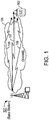
- a base station 101 communicates with a mobile device (which is often generically referred to in the art as a user equipment (UE)) 103, via a multipath channel 105.
- UE user equipment
- the signal transmitted (e.g., by radio waves) by the base station 101 spreads out into the environment and these spread signal components are often reflected off of any number of objects, the transmitted signal reaches the UE 103 via more than one path. Therefore, in addition to the direct path 107 from the base station 101 to the UE 103, there are a number of other indirect paths 109.
- the contributions from these indirect paths exhibit different signal attenuations and time delays relative to that from the direct path, and these contributions may interfere with the contribution from the direct path either constructively or destructively at the UE's receiver input.
- the signal components caused by the direct path 107 and the indirect paths 109 are denoted multipath components and can be modeled by a complex channel filter function either in the time domain as a channel impulse response or, correspondingly, as a channel frequency response in the frequency domain.
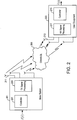
- FIG. 2 is a block diagram illustrating in greater detail a number of aspects of some mobile communication systems.
- MIMO multiple-input, multiple-output
- a base station 201 communicates with a UE 203 via a multipath channel 205.
- an information signal, I ( t ) (e.g., in the form of a binary data stream) is supplied to the base station 201.
- the base station 201 includes a controller 207 and a transmit signal processing circuit 209.
- the controller 207 controls operation of the base station 201 and schedules UEs 203 to receive data on a downlink channel.
- the transmit signal processing circuit 209 performs such functions as error coding, mapping the input bits to complex modulation symbols, and generating transmit signals for each of one or more transmit antennas 211, which may be independent, partially redundant, or fully redundant. After upward frequency conversion, filtering, and amplification, the base station 201 transmits the transmit signals from respective transmit antennas 211 through the channel 205 to the UE 203.
- Receiver equipment in the UE 203 demodulates and decodes the signal received at each of its antennas 213.
- the UE 203 includes a controller 215 to control operation of the UE 203 and a receive signal processing circuit 217.
- the receive signal processing circuit 217 demodulates and decodes the signal transmitted from the base station 201. In the absence of bit errors, the output signal from the UE 203, Î ( t ) , will be the same as the original information signal I ( t ) .
- FIGS. 1 and 2 generically illustrate components of a mobile communication system
- implementation details can vary from one system to another.
- a number of different standards that govern the design and operation of mobile telecommunication systems are known.
- High Speed Downlink Packet-data Access (HSDPA) is an evolution of Wideband Code Division Multiple Access (WCDMA) specified in the Release 5 version of the Third-generation Partnership Project (3GPP) WCDMA specification.
- WCDMA Wideband Code Division Multiple Access
- 3GPP Third-generation Partnership Project
- HSDPA introduces higher bit rates (up to over 10 Mbits/s) by using higher order modulation (16-QAM), multicodes (up to 15 with spreading factor 16), and downlink channel feedback information.
- Downlink channel feedback information is information, sent to the base station, regarding the downlink channel quality.
- the base station which in 3GPP terminology is called "node B"
- Hybrid ARQ is also introduced on the physical layer in order to reduce the round trip delay for erroneous received packets.
- HSDPA works according to the following.
- a User Equipment (UE) operating in connected mode, continuously transmits Channel Quality Index (CQI) reports to the HSDPA serving node B by means of the uplink (UL) High Speed Dedicated Physical Control Channel (HS-DPCCH).
- CQI informs the serving node B about the instantaneous downlink (DL) channel quality in order to enable the node B to optimize the downlink throughput.
- the CQI could, for example, be a function of Signal to Interference Ratio (SIR), where the particular function depends on higher layer parameters (e.g., available HS-power, and the like).
- SIR Signal to Interference Ratio
- the HS Shared Control Channel (HS-SCCH) is used to inform the UE about information that the UE will use in the upcoming communication, such as information about the data packets and transport format, retransmission number, and the like.
- HSDPA High-Speed Packet Access
- LTE Third Generation Long Term Evolution
- OFDMA multiple access technique
- bandwidths ranging from 1.4 MHz to 20 MHz.
- data rates up to and exceeding 100 Mb/s will be supported for the largest bandwidth.
- LTE will be used not only for high rate services, but also for low rate services like voice. Since LTE is designed for Transmission Control Protocol/Internet Protocol (TCP/IP), Voice over IP (VoIP) will likely be the service that carries speech.
- TCP/IP Transmission Control Protocol/Internet Protocol
- VoIP Voice over IP
- channel quality information is computed at the UE. This computation is based on reference pilot data transmissions, and is used for link adaptation (e.g., determining modulation and coding rates for the scheduled user).
- link adaptation e.g., determining modulation and coding rates for the scheduled user.
- the base station typically retains control for making decisions regarding user scheduling and link adaptation because the base station has the knowledge of the CQI reports from all users as well as specific data transmission requirements for each user.
- the inventors of the inventive subject matter described herein have noted that there is a delay between when the mobile computes the CQI information and when the base station makes a downlink transmission based on the corresponding CQI report. This delay results in a potential mismatch in the CQI at the time of transmission because the channel may have changed in the time between CQI reporting and the subsequent downlink transmission. This mismatch will be greater for higher fading rates, but there may still be some mismatch for lower rates.
- One method for compensating for this mismatch is to predict what the fading channel will be at a time when the downlink transmission will occur, and compute the CQI based on this predicted channel. Such an approach is described in PCT Pub. No.
- WO2007/032715 which also discloses techniques for a first network unit of a communication system estimating the reliability of the predicted channel estimate that is to be used for link adaptation, and communicating this reliability estimate to a second network unit.
- the second network unit can then take this information into account when deciding on, for example, selection of a transmission scheme for use when communicating with the first network unit.
- CQI reports are nonetheless an important factor in the quality of mobile telecommunications service. There are a number of issues with CQI reporting that are considered below:
- the increased load on the uplink feedback rate has the effect of increasing the so-called noise-rise, which is the apparent interference-plus-noise level observed by the base station.
- the CQI report contains a fixed number of bits that is transmitted from the mobile to the base station during every CQI reporting period. This occurs regardless of whether the CQI values have changed significantly (or not) from one CQI report to the next.
- any such form of embodiments may be referred to herein as "logic configured to” perform a described action, or alternatively as “logic that” performs a described action, or alternatively as “means for” performing a described function.
- the predictability of a channel quality measure (e.g., CQI) reported to the base station from a UE is used as a basis for controlling transmission of those reports. Determination of the channel quality measure predictability is based both on the reliability of a predicted future channel estimate as well as the stability of the interference environment observed at the UE.
- the base station when the channel quality can be predicted with sufficient reliably, it is not required for the UE to send a channel quality report. In this case, the base station must detect whether a channel quality report has been transmitted and make any adjustments based on the result of this detection. In some embodiments, the base station employs blind detection techniques to determine whether a channel quality report is present. In other embodiments, the base station receives a communication from the UE informing that one or more channel quality reports will be skipped.
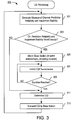
- FIG. 3 is, in one respect, a flow chart of steps/processes carried out by, for example, a controller 300 in a UE in accordance with aspects of the invention. In other respects, FIG. 3 can be considered to depict a block diagram of logic configured to perform the variously illustrated functions.
- the predicted channel estimate is a prediction of what a channel between the user equipment and a node of the mobile communications system (e.g., a base station) will be at a future point in time, for example a time when the base station will be transmitting information to the UE.
- a node of the mobile communications system e.g., a base station
- the measure of reliability of the predicted channel estimate and of impairment stability can be made in a number of alternative ways.
- a CQI value is inherently based on a signal to interference plus noise ratio (SINR) obtained at the receiver, so a measure of the SINR and its underlying quantities can be used to determine both predicted channel estimate reliability and impairment stability.
- SINR signal to interference plus noise ratio
- the UE ascertains a measure of how much the SINR of received signals varies over time, and uses this as a measure of both channel (and hence CQI) prediction reliability and of impairment stability. For example, this variability measure can be compared with one or more threshold values that define for the UE whether the channel and interference are stable (and hence predictable).
- a measure of channel reliability can be obtained by means of techniques described in the above-referenced PCT Pub. No. WO2007/032715 .
- a reliability measure can be a distribution function of the deviations of the prediction values.
- Channel prediction uncertainty can be described by the prediction error.
- ways to characterize this prediction error include the error variance, or the standard deviation of the error, for each measured channel tap; the sum of the error variance of the measured channel taps; or the maximum error variance of the measured channel taps. These can be based on all channel taps, or alternatively just the best M taps, where M is a design parameter.
- a measure of channel reliability can be derived by means of heuristic techniques. For example, the channel can be observed over a period of time, and its stability determined from these observations (e.g., by determining whether a plot of the channel coefficients is flat, and hence stable over time).
- impairment stability it can be ascertained from an impairment covariance matrix that is estimated at the receiver.
- the term "impairment” refers generically to interference alone or interference plus noise.
- the sum of the diagonal elements (i.e., the trace) of the matrix measures the total impairment power. Consequently, ascertaining how quickly the impairment power varies yields a good measure of the impairment stability.
- the impairment stability can, for example, be a measure of the instantaneous impairment covariance with respect to a smoothed impairment covariance. There may be different cases which indicate the presence of stable interference, and these are listed below.
- interference is stable is when there is an interferer (or interferers) that are persistent, so that the short-term and long-term covariance estimates are similar. This represents a slowly changing interference environment that favorably influences a decision to withhold channel quality reports for some period of time.
- Another case is when there is noise-only interference and the noise power is persistent. This can be established by determining the variability over time of the diagonal terms of the impairment covariance indicating a stable noise scenario, as well as determining that the off-diagonal terms are close to zero. This represents a stable noise environment.
- the use of the long-term covariance for CQI computation may itself be an indication of a stable interference environment due to its being computed based on a time-frame that is longer than the duration of a CQI report inhibition.
- This may result in a stable (and more predictable) interference scenario (so long as it adheres to the previous two cases described above).
- the short-term interference covariance can still be used for detection purposes as this may result in better detection performance.
- a data covariance matrix can be used instead of an impairment covariance matrix.
- the data covariance is the sum of the impairment covariance and the desired signal covariance. So, if the desired signal covariance is known, for example, from computing it based on reference pilot signals, then the impairment covariance can be estimated, or at least the influence due to the impairment can be determined. This, then, enables one to ascertain a measure of the impairment stability, as described above.
- transmission of the channel quality report to the base station is controlled as a function of the generated measure of reliability of the predicted channel estimate and of impairment stability. For example, in the exemplary embodiment this involves comparing the measure(s) of predicted channel estimate reliability and of impairment stability with a corresponding one or more threshold values to determine whether they are sufficiently reliable/stable (decision block 303). If they are ("YES" path out of decision block 303), then in some but not all embodiments, the base station is informed that an upcoming channel quality report transmission will be inhibited (step 305). In some but not necessarily all of these embodiments, the base station can be further informed of the expected duration of the period of time during which no channel quality report will be sent.
- the base station In embodiments that do not inform the base station in advance that one or more channel quality reports will not be transmitted, the base station relies on blind detection techniques to ascertain the presence or absence of any given channel quality report.
- the UE is presumed to have calculated a duration of expected channel estimate predictability and of impairment stability. If this duration is long enough, it is possible for the UE to skip the transmission of more than one channel quality report. Accordingly, the UE ascertains whether this duration has been reached (decision block 309). If not ("NO" path out of decision block 309), then transmission of the next channel quality report is also skipped by jumping back to step 307.
- step 303 if it was determined that channel prediction reliability and/or impairment stability are not good enough ("NO" path out of decision block 303), then no channel quality reports are skipped, and the UE simply proceeds by ascertaining a measure of channel quality (step 311) and transmitting this channel quality report to the base station (step 313).
- some embodiments do not include a step of informing the base station about a planned inhibition of a channel quality report transmission.
- the base station uses blind detection techniques to detect whether any given channel quality report is present or absent.
- uplink control signaling is required to support the operation of the hybrid-ARQ (HARQ) protocol and to provide the base station (called "NodeB" in an HSPA system) with knowledge about the instantaneous downlink channel conditions.
- This signaling is carried out on an uplink physical channel, called the High Speed Dedicated Physical Control Channel (HS-DPCCH), which has its own separate channelization code to separate it from other channels.
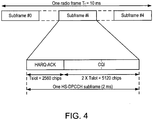
- FIG. 4 is a signal format diagram illustrating an HS-DPCCH.
- one radio frame lasting 10 ms is subdivided into five equal-length subframes.
- Each of these subframes is further subdivided into three slots, each slot being long enough to accommodate 2560 chips.
- the first of these slots carries the HARQ information ("HARQ-ACK"), that is, whether the UE is reporting an acknowledgement ("ACK”) or negative acknowledgement ("NAK").
- HARQ-ACK HARQ information
- the remaining two slots in each subframe are configured together to carry a channel quality report in the form of a CQI value.
- a UE decides to inhibit transmission of the CQI value, this can be accomplished by means of discontinuous transmission (DTX), whereby the UE turns off the transmission of the HS-DPCCH for the duration of the two slots that normally convey the CQI value.
- DTX discontinuous transmission
- the base station can advantageously use this fact in a blind detection technique in which the signal power at the output of its receiver HS-DPCCH despreader is tested.
- the level of the receiver power for the HS-DPCCH code will indicate whether a CQI signal from the UE is present (i.e., whether the CQI is present) or whether these two slots contained just noise.
- the discussion will now focus on embodiments in which the base station is informed by the UE that one or more channel quality reports will not be transmitted (e.g., step 305 illustrated in FIG. 3 ).
- One way of implementing this is for the UE to report an augmented channel quality report in which the augmented information specifies that an existing environment contains reliable channel predictability and stable interference. This predictability and stability can be presumed to last a predefined length (e.g., some number of subframes).
- the channel quality report can, in some embodiments, be further augmented with a field designating a computed duration for this environment (i.e., the "duration" discussed earlier with respect to the embodiments illustrated by FIG. 3 ).
- the duration value represents a range from a minimum duration to some maximum duration.
- this duration amount is referred to as a "scope indicator".
- a way of implementing this in existing systems is to reserve one possible codeword of the CQI field to indicate that the CQI field in the next HS-DPCCH subframe should be interpreted as a scope indicator.
- the scope indicator is then transmitted in the field normally reserved for the CQI in that next subframe.
- the CQI field is turned off (e.g., DTX'd) to reduce uplink feedback.
- FIG. 5 is a signal diagram indicating a sequence of HS-DPCCH subframes, with one including a reserved codeword that indicates the presence of a scope indicator in a next subframe.
- the scope indicator informs the base station of the duration of CQI transmission inhibition.
- the CQI field shown in FIG. 4 consists of 20 coded bits which are generated using a (20,5) block code.
- the five information bits are used to represent 31 possible values for the CQI indicator (values 0 - 30).
- the information bit sequence (0,0,0,0,0) is unused in the current standard. In accordance with an aspect of some embodiments consistent with the invention, this unused sequence is utilized to indicate that the next CQI report should not be interpreted as a CQI, but rather as a scope indicator as described above. Since five information bits are available, the scope could take on 32 possible values specifying a duration period for a stable and predictable CQI. After the scope indicator is communicated to the base station (Node B), subsequent CQI fields are DTX'd as described above until the duration specified by the scope expires.
- Type A reports include either 1 or 2 CQI values, depending on whether or not the UE prefers single or dual-stream transmission, plus an indication of the preferred precoding configuration (PCI).
- Type B reports indicate the channel quality exclusively for single-stream transmission, regardless of what number of streams the UE prefers. This gives extra information to the scheduler in Node B in case it needs to override a UE's preference for dual-stream transmission.
- the relative frequency of Type A and Type B reports is configured by the network. For example, the network could specify that one out of every eight CQI reports is Type B.
- Type B reports have the same unused bit sequence (0,0,0,0,0) as for UEs configured in non-MIMO mode.
- a similar scheme as described above could be used.
- the main difference is that the UE has to wait until the first available Type B reporting period occurs before it can utilize the (0,0,0,0,0) sequence to indicate that the next CQI report (likely a Type A report) should be interpreted as a scope indicator. This extra waiting time can easily be accounted for at the UE by reducing the scope by the waiting time.
- CQI0 CQI0
- Type A reports are encoded using a (20,10) code; hence, 10 information bits are available (1024 possible scope values).
- Type B reports are encoded using a (20,7) code; hence 7 information bits are available (128 possible scope values). If this is more than necessary, a modified coding format can be used. For example, the same (20,5) code as in MIMO mode can be used for the scope indicator, thus limiting the number of possible scope values to 32. The increased coding gain of such a code can be used to either reduce the amount of power necessary to transmit the CQI, or to improve the detection performance (or both).
- the UE additionally provides the base station with an indication of a starting and an ending modulation and coding scheme (e.g., the recommended rate that is normally part of a CQI report). This would provide the base station with better information for use in deciding the transport format to use for the period of time in which it will not be receiving any channel quality reports.
- a starting and an ending modulation and coding scheme e.g., the recommended rate that is normally part of a CQI report.
- Each of the above embodiments requires some reinterpretation of the CQI field in order to signal the scope indicator.
- the UE and Node B there must be some common understanding between the UE and Node B about what signaling format is used.
- One way to enable this is by means of higher layer signaling that places scope-reporting UEs in a special mode. This signaling could be done once at call setup time, meaning that this mode would be static for the duration of the call. Alternatively, the mode can be dynamically turned on and off under control of the network. To enable this, Node B could observe the reported CQIs over some time window and determine itself if the CQI is stable. If stability is detected, the Node B activates the new mode, thus requiring the UE to start reporting scope indicators.
- FIG. 6 is, in one respect, a flow chart of exemplary steps/processes carried out by, for example, a controller 600 in a base station in accordance with aspects of the invention.
- FIG. 6 can be considered to depict a block diagram of a controller 600 in a base station, comprising logic configured to perform the variously illustrated functions. It will be appreciated that base station operation encompasses a wide variety of functions. To simplify matters, only those functions that are pertinent to aspects of the invention are depicted in FIG. 6 and described herein.
- one of the base station's functions is to determine whether or not a channel quality report (e.g., a CQI value) has been received (decision block 601). In some embodiments, this involves determining whether this information has been expressly communicated by the UE. As described above, this can be done in any number of ways, such as by reserving one of the channel quality report codes as an indicator that one or more upcoming channel quality reports will not be sent.
- a channel quality report e.g., a CQI value
- the base station can determine this information by means of any of a number of possible blind detection techniques.
- the base station must detect whether the ACK/NACK alone or the ACK/NACK together with the CQI report was transmitted. In embodiments, this information is expressly signaled by the UE, as discussed earlier. However, in embodiments in which the UE does not perform this function, the base station generally does not know which it will receive, in which case it performs this detection blindly. Blind detection techniques were described above.
- Another base station consideration is that, when no CQI is reported from the UE ("NO" path out of decision block 601), the base station must determine from the previous channel quality reports the modulation and coding schemes to use for transmission. In the exemplary embodiment shown in FIG. 6 , this involves deriving a predicted channel quality report (called "Next CQI" in the figure) from one or more earlier channel quality reports (step 603) and then using the predicted channel quality report as a basis for determining modulation and coding schemes (step 605).
- a predicted channel quality report called "Next CQI" in the figure
- ⁇ m represent the CQI to be used to determine link adaptation at time m.
- a number of approaches can be used to determine ⁇ m based on the CQI reports corresponding to times ⁇ n (where n ⁇ m ) and on ⁇ p (where p ⁇ m ) . These approaches are:
- the next channel report to be used as a basis for modulation and coding scheme decisions is the report expressly received from the UE (step 607).
- the modulation and coding schemes are then determined as before (step 605).
- Various embodiments of the invention provide a number of advantages over conventional techniques. For example, by enabling the channel quality report to be selectively omitted from some transmissions, less feedback is required for this reporting. This is especially important for mobiles capable of higher data rates (especially in MIMO mode) because even more channel quality feedback is used and this puts a higher load on the amount uplink resources required. But by practicing embodiments of the invention, the required uplink resources can be reduced when channel quality reports are stable/predictable, thereby favorably impacting the noise-rise observed at the base station.
- accounting for the stability of the channel quality information can be used to assist in scheduling of mobiles with greater accuracy over longer time-frames.
Landscapes
- Engineering & Computer Science (AREA)
- Computer Networks & Wireless Communication (AREA)
- Signal Processing (AREA)
- Mobile Radio Communication Systems (AREA)
Priority Applications (1)
| Application Number | Priority Date | Filing Date | Title |
|---|---|---|---|
| EP17165940.2A EP3214868B1 (en) | 2008-12-30 | 2009-12-22 | Uplink channel quality feedback reduction in a mobile communication system |
Applications Claiming Priority (2)
| Application Number | Priority Date | Filing Date | Title |
|---|---|---|---|
| US12/346,313 US8185057B2 (en) | 2008-12-30 | 2008-12-30 | Uplink channel quality feedback reduction in a mobile communication system |
| PCT/IB2009/007863 WO2010076630A1 (en) | 2008-12-30 | 2009-12-22 | Uplink channel quality feedback reduction in a mobile communication system |
Related Child Applications (2)
| Application Number | Title | Priority Date | Filing Date |
|---|---|---|---|
| EP17165940.2A Division-Into EP3214868B1 (en) | 2008-12-30 | 2009-12-22 | Uplink channel quality feedback reduction in a mobile communication system |
| EP17165940.2A Division EP3214868B1 (en) | 2008-12-30 | 2009-12-22 | Uplink channel quality feedback reduction in a mobile communication system |
Publications (2)
| Publication Number | Publication Date |
|---|---|
| EP2371159A1 EP2371159A1 (en) | 2011-10-05 |
| EP2371159B1 true EP2371159B1 (en) | 2018-02-14 |
Family
ID=42060739
Family Applications (2)
| Application Number | Title | Priority Date | Filing Date |
|---|---|---|---|
| EP09803902.7A Not-in-force EP2371159B1 (en) | 2008-12-30 | 2009-12-22 | Uplink channel quality feedback reduction in a mobile communication system |
| EP17165940.2A Not-in-force EP3214868B1 (en) | 2008-12-30 | 2009-12-22 | Uplink channel quality feedback reduction in a mobile communication system |
Family Applications After (1)
| Application Number | Title | Priority Date | Filing Date |
|---|---|---|---|
| EP17165940.2A Not-in-force EP3214868B1 (en) | 2008-12-30 | 2009-12-22 | Uplink channel quality feedback reduction in a mobile communication system |
Country Status (5)
| Country | Link |
|---|---|
| US (1) | US8185057B2 (enExample) |
| EP (2) | EP2371159B1 (enExample) |
| JP (1) | JP5432289B2 (enExample) |
| CN (1) | CN102273253B (enExample) |
| WO (1) | WO2010076630A1 (enExample) |
Families Citing this family (23)
| Publication number | Priority date | Publication date | Assignee | Title |
|---|---|---|---|---|
| JP4898755B2 (ja) * | 2008-09-29 | 2012-03-21 | 京セラ株式会社 | 伝搬路予測システム、無線通信装置および伝搬路予測方法 |
| CN101599788B (zh) * | 2009-05-15 | 2013-02-13 | 华为技术有限公司 | Lte系统中确定信道反馈信息的方法及装置 |
| US8369793B2 (en) * | 2009-10-02 | 2013-02-05 | Telefonaktiebolaget L M Ericsson (Publ) | Channel-dependent scheduling and link adaptation |
| JP2012105185A (ja) * | 2010-11-12 | 2012-05-31 | Sharp Corp | 無線制御装置、無線端末装置、無線通信システム、無線制御装置および無線端末装置の制御プログラムおよび集積回路 |
| KR101653858B1 (ko) * | 2010-12-02 | 2016-09-02 | 인터디지탈 패튼 홀딩스, 인크 | 간섭 예측을 사용하여 무선 통신에서 채널 품질 표시 피드백 정확도를 향상시키는 시스템 및 방법 |
| EP2665201A4 (en) * | 2011-01-14 | 2017-05-17 | LG Electronics Inc. | Method and device for setting channel status information measuring resource in a wireless communication system |
| CN103369582B (zh) * | 2012-04-06 | 2016-08-03 | 中兴通讯股份有限公司 | 长期演进系统的物理下行控制信道质量预测方法及装置 |
| US9713165B2 (en) * | 2012-05-11 | 2017-07-18 | Telefonaktiebolaget Lm Ericsson (Publ) | Scheduling a user equipment in a communication system |
| US8879475B2 (en) | 2012-05-15 | 2014-11-04 | Apple Inc. | Adaptive channel state feedback in discontinuous reception scenarios based on connection characteristics |
| US9414365B2 (en) * | 2012-08-03 | 2016-08-09 | Telefonaktiebolaget Lm Ericsson (Publ) | Channel quality reporting in a wireless communication system |
| EP2883321A1 (en) * | 2012-08-09 | 2015-06-17 | Telefonaktiebolaget L M Ericsson (Publ) | Microwave link control |
| WO2014148964A1 (en) * | 2013-03-19 | 2014-09-25 | Telefonaktiebolaget L M Ericsson (Publ) | User equipment, network node and methods therein for reducing transmission of channel state information |
| US9661441B2 (en) * | 2013-04-17 | 2017-05-23 | Telefonaktiebolaget Lm Ericsson (Publ) | System and method to reduce radio resource management (RRM) related signaling in machine-to-machine (M2M) communications |
| US9474000B2 (en) | 2013-07-31 | 2016-10-18 | Qualcomm Incorporated | Handover and reselection searching using predictive mobility |
| US20150038140A1 (en) | 2013-07-31 | 2015-02-05 | Qualcomm Incorporated | Predictive mobility in cellular networks |
| US9722758B2 (en) * | 2015-05-20 | 2017-08-01 | Hong Kong Applied Science and Technology Research Institute Company Limited | Channel-quality estimation for a wireless channel |
| JP6607101B2 (ja) * | 2016-03-15 | 2019-11-20 | 富士通株式会社 | 無線装置用干渉抑制パラメータ演算装置、無線通信システム、無線通信システムの干渉抑制方法、基地局装置および無線端末装置 |
| ES2746947T3 (es) * | 2016-05-13 | 2020-03-09 | Ericsson Telefon Ab L M | Sistemas y métodos para recomendar una velocidad de datos en un sistema de comunicaciones inalámbrico |
| US10416747B2 (en) * | 2016-05-23 | 2019-09-17 | Apple Inc. | Dynamic transmission power adjustment |
| CN110650001A (zh) * | 2019-10-15 | 2020-01-03 | 中兴通讯股份有限公司 | 传输方法、装置、第一通信节点、第二通信节点及介质 |
| US11581959B2 (en) | 2020-03-04 | 2023-02-14 | Samsung Electronics Co., Ltd. | Channel estimation and prediction with measurement impairment |
| WO2023043578A1 (en) * | 2021-09-15 | 2023-03-23 | Qualcomm Incorporated | Techniques for control signal configuration for reference signal precoding |
| CN118249935A (zh) * | 2022-12-23 | 2024-06-25 | 华为技术有限公司 | 一种通信的方法和通信装置 |
Family Cites Families (9)
| Publication number | Priority date | Publication date | Assignee | Title |
|---|---|---|---|---|
| KR100493079B1 (ko) * | 2001-11-02 | 2005-06-02 | 삼성전자주식회사 | 고속 순방향 패킷 접속 방식을 사용하는 광대역 부호 분할다중 접속 통신 시스템에서 순방향 채널 품질을 보고하는장치 및 방법 |
| US7242724B2 (en) | 2003-07-16 | 2007-07-10 | Lucent Technologies Inc. | Method and apparatus for transmitting signals in a multi-antenna mobile communications system that compensates for channel variations |
| US7599698B2 (en) | 2003-12-29 | 2009-10-06 | Telefonaktiebolaget Lm Ericsson (Publ) | Network controlled channel information reporting |
| KR100606062B1 (ko) * | 2004-02-26 | 2006-07-26 | 삼성전자주식회사 | 이동통신 시스템에서 시변채널의 특성에 따라 채널품질정보의 전송을 제어하는 방법 |
| WO2007032715A1 (en) | 2005-09-15 | 2007-03-22 | Telefonaktiebolaget Lm Ericsson (Publ) | Method using reliability measures corresponding to channel parameters in adaptive scheduling |
| JP4812504B2 (ja) * | 2006-04-19 | 2011-11-09 | 株式会社エヌ・ティ・ティ・ドコモ | 無線基地局および送信制御方法 |
| EP2058957A4 (en) * | 2006-08-29 | 2012-07-18 | Fujitsu Ltd | COMMUNICATION DEVICE, TERMINAL AND RADIO CHANNEL QUALITY CONTROL METHOD |
| US8121552B2 (en) * | 2006-09-05 | 2012-02-21 | Motorola Mobility, Inc. | Method and apparatus for providing channel quality feedback in a wireless communication system |
| US7986919B2 (en) * | 2008-03-19 | 2011-07-26 | Telefonaktiebolaget Lm Ericsson (Publ) | Simplified impairments matrix calculation for SINR estimation |
-
2008
- 2008-12-30 US US12/346,313 patent/US8185057B2/en active Active
-
2009
- 2009-12-22 JP JP2011544089A patent/JP5432289B2/ja not_active Expired - Fee Related
- 2009-12-22 WO PCT/IB2009/007863 patent/WO2010076630A1/en not_active Ceased
- 2009-12-22 EP EP09803902.7A patent/EP2371159B1/en not_active Not-in-force
- 2009-12-22 CN CN200980153808.0A patent/CN102273253B/zh not_active Expired - Fee Related
- 2009-12-22 EP EP17165940.2A patent/EP3214868B1/en not_active Not-in-force
Also Published As
| Publication number | Publication date |
|---|---|
| US8185057B2 (en) | 2012-05-22 |
| JP2012514410A (ja) | 2012-06-21 |
| JP5432289B2 (ja) | 2014-03-05 |
| EP2371159A1 (en) | 2011-10-05 |
| CN102273253B (zh) | 2015-06-24 |
| US20100167657A1 (en) | 2010-07-01 |
| WO2010076630A1 (en) | 2010-07-08 |
| CN102273253A (zh) | 2011-12-07 |
| EP3214868B1 (en) | 2018-11-14 |
| EP3214868A1 (en) | 2017-09-06 |
Similar Documents
| Publication | Publication Date | Title |
|---|---|---|
| EP3214868B1 (en) | Uplink channel quality feedback reduction in a mobile communication system | |
| US7953049B2 (en) | Method and apparatus for allocating receiver resources based on delay | |
| TWI538433B (zh) | 用於無線通訊之可調適性鏈路調適 | |
| US8837337B2 (en) | Signaling of power information for MIMO transmission in a wireless communication system | |
| EP2484036B1 (en) | Link adaptation based on the statistical distribution of interfence and noise in a wireless communication system | |
| EP2984766B1 (en) | Method and mobile device for use in a mobile communication network | |
| US20130044593A1 (en) | Management of arq detection threshold in communication networks | |
| EP2870814B1 (en) | Methods and nodes for multiple user mimo scheduling | |
| CA2451965A1 (en) | Method and apparatus for controlling gain level of a supplemental channel in a cdma communication system | |
| JP2010521827A (ja) | 通信システムにチャネル品質を報告する方法及び装置 | |
| AU2007313629A1 (en) | Reliable uplink resource request | |
| WO2009132699A1 (en) | Distribution of downlink e-dch power usage | |
| EP1891764B1 (en) | Shared control channel detection strategies | |
| EP2553969B1 (en) | Apparatus and method for sending and receiving channel state information in communication system | |
| KR20120025060A (ko) | 광대역 무선 접속 시스템에서 전력 제어 장치 및 방법 | |
| CN102340369B (zh) | 一种调度控制方法和基站 | |
| JP5330406B2 (ja) | 無線資源の割当を容易にする方法および構成 | |
| HK1181598A (en) | Signaling of power information for mimo transmission in a wireless communication system | |
| HK1173604B (en) | Signaling of power information for mimo transmission in a wireless communication system |
Legal Events
| Date | Code | Title | Description |
|---|---|---|---|
| PUAI | Public reference made under article 153(3) epc to a published international application that has entered the european phase |
Free format text: ORIGINAL CODE: 0009012 |
|
| 17P | Request for examination filed |
Effective date: 20110608 |
|
| AK | Designated contracting states |
Kind code of ref document: A1 Designated state(s): AT BE BG CH CY CZ DE DK EE ES FI FR GB GR HR HU IE IS IT LI LT LU LV MC MK MT NL NO PL PT RO SE SI SK SM TR |
|
| DAX | Request for extension of the european patent (deleted) | ||
| 17Q | First examination report despatched |
Effective date: 20130207 |
|
| GRAP | Despatch of communication of intention to grant a patent |
Free format text: ORIGINAL CODE: EPIDOSNIGR1 |
|
| INTG | Intention to grant announced |
Effective date: 20170724 |
|
| GRAJ | Information related to disapproval of communication of intention to grant by the applicant or resumption of examination proceedings by the epo deleted |
Free format text: ORIGINAL CODE: EPIDOSDIGR1 |
|
| GRAR | Information related to intention to grant a patent recorded |
Free format text: ORIGINAL CODE: EPIDOSNIGR71 |
|
| GRAS | Grant fee paid |
Free format text: ORIGINAL CODE: EPIDOSNIGR3 |
|
| INTC | Intention to grant announced (deleted) | ||
| INTG | Intention to grant announced |
Effective date: 20171114 |
|
| GRAA | (expected) grant |
Free format text: ORIGINAL CODE: 0009210 |
|
| AK | Designated contracting states |
Kind code of ref document: B1 Designated state(s): AT BE BG CH CY CZ DE DK EE ES FI FR GB GR HR HU IE IS IT LI LT LU LV MC MK MT NL NO PL PT RO SE SI SK SM TR |
|
| REG | Reference to a national code |
Ref country code: GB Ref legal event code: FG4D |
|
| REG | Reference to a national code |
Ref country code: CH Ref legal event code: EP |
|
| REG | Reference to a national code |
Ref country code: IE Ref legal event code: FG4D |
|
| REG | Reference to a national code |
Ref country code: DE Ref legal event code: R096 Ref document number: 602009050768 Country of ref document: DE Ref country code: AT Ref legal event code: REF Ref document number: 970625 Country of ref document: AT Kind code of ref document: T Effective date: 20180315 |
|
| REG | Reference to a national code |
Ref country code: NL Ref legal event code: FP |
|
| REG | Reference to a national code |
Ref country code: AT Ref legal event code: MK05 Ref document number: 970625 Country of ref document: AT Kind code of ref document: T Effective date: 20180214 |
|
| PG25 | Lapsed in a contracting state [announced via postgrant information from national office to epo] |
Ref country code: ES Free format text: LAPSE BECAUSE OF FAILURE TO SUBMIT A TRANSLATION OF THE DESCRIPTION OR TO PAY THE FEE WITHIN THE PRESCRIBED TIME-LIMIT Effective date: 20180214 Ref country code: CY Free format text: LAPSE BECAUSE OF FAILURE TO SUBMIT A TRANSLATION OF THE DESCRIPTION OR TO PAY THE FEE WITHIN THE PRESCRIBED TIME-LIMIT Effective date: 20180214 Ref country code: FI Free format text: LAPSE BECAUSE OF FAILURE TO SUBMIT A TRANSLATION OF THE DESCRIPTION OR TO PAY THE FEE WITHIN THE PRESCRIBED TIME-LIMIT Effective date: 20180214 Ref country code: LT Free format text: LAPSE BECAUSE OF FAILURE TO SUBMIT A TRANSLATION OF THE DESCRIPTION OR TO PAY THE FEE WITHIN THE PRESCRIBED TIME-LIMIT Effective date: 20180214 Ref country code: HR Free format text: LAPSE BECAUSE OF FAILURE TO SUBMIT A TRANSLATION OF THE DESCRIPTION OR TO PAY THE FEE WITHIN THE PRESCRIBED TIME-LIMIT Effective date: 20180214 Ref country code: NO Free format text: LAPSE BECAUSE OF FAILURE TO SUBMIT A TRANSLATION OF THE DESCRIPTION OR TO PAY THE FEE WITHIN THE PRESCRIBED TIME-LIMIT Effective date: 20180514 |
|
| PG25 | Lapsed in a contracting state [announced via postgrant information from national office to epo] |
Ref country code: AT Free format text: LAPSE BECAUSE OF FAILURE TO SUBMIT A TRANSLATION OF THE DESCRIPTION OR TO PAY THE FEE WITHIN THE PRESCRIBED TIME-LIMIT Effective date: 20180214 Ref country code: BG Free format text: LAPSE BECAUSE OF FAILURE TO SUBMIT A TRANSLATION OF THE DESCRIPTION OR TO PAY THE FEE WITHIN THE PRESCRIBED TIME-LIMIT Effective date: 20180514 Ref country code: GR Free format text: LAPSE BECAUSE OF FAILURE TO SUBMIT A TRANSLATION OF THE DESCRIPTION OR TO PAY THE FEE WITHIN THE PRESCRIBED TIME-LIMIT Effective date: 20180515 Ref country code: SE Free format text: LAPSE BECAUSE OF FAILURE TO SUBMIT A TRANSLATION OF THE DESCRIPTION OR TO PAY THE FEE WITHIN THE PRESCRIBED TIME-LIMIT Effective date: 20180214 Ref country code: LV Free format text: LAPSE BECAUSE OF FAILURE TO SUBMIT A TRANSLATION OF THE DESCRIPTION OR TO PAY THE FEE WITHIN THE PRESCRIBED TIME-LIMIT Effective date: 20180214 |
|
| PG25 | Lapsed in a contracting state [announced via postgrant information from national office to epo] |
Ref country code: RO Free format text: LAPSE BECAUSE OF FAILURE TO SUBMIT A TRANSLATION OF THE DESCRIPTION OR TO PAY THE FEE WITHIN THE PRESCRIBED TIME-LIMIT Effective date: 20180214 Ref country code: IT Free format text: LAPSE BECAUSE OF FAILURE TO SUBMIT A TRANSLATION OF THE DESCRIPTION OR TO PAY THE FEE WITHIN THE PRESCRIBED TIME-LIMIT Effective date: 20180214 Ref country code: PL Free format text: LAPSE BECAUSE OF FAILURE TO SUBMIT A TRANSLATION OF THE DESCRIPTION OR TO PAY THE FEE WITHIN THE PRESCRIBED TIME-LIMIT Effective date: 20180214 Ref country code: EE Free format text: LAPSE BECAUSE OF FAILURE TO SUBMIT A TRANSLATION OF THE DESCRIPTION OR TO PAY THE FEE WITHIN THE PRESCRIBED TIME-LIMIT Effective date: 20180214 |
|
| REG | Reference to a national code |
Ref country code: DE Ref legal event code: R097 Ref document number: 602009050768 Country of ref document: DE |
|
| PG25 | Lapsed in a contracting state [announced via postgrant information from national office to epo] |
Ref country code: SM Free format text: LAPSE BECAUSE OF FAILURE TO SUBMIT A TRANSLATION OF THE DESCRIPTION OR TO PAY THE FEE WITHIN THE PRESCRIBED TIME-LIMIT Effective date: 20180214 Ref country code: DK Free format text: LAPSE BECAUSE OF FAILURE TO SUBMIT A TRANSLATION OF THE DESCRIPTION OR TO PAY THE FEE WITHIN THE PRESCRIBED TIME-LIMIT Effective date: 20180214 Ref country code: CZ Free format text: LAPSE BECAUSE OF FAILURE TO SUBMIT A TRANSLATION OF THE DESCRIPTION OR TO PAY THE FEE WITHIN THE PRESCRIBED TIME-LIMIT Effective date: 20180214 Ref country code: SK Free format text: LAPSE BECAUSE OF FAILURE TO SUBMIT A TRANSLATION OF THE DESCRIPTION OR TO PAY THE FEE WITHIN THE PRESCRIBED TIME-LIMIT Effective date: 20180214 |
|
| PLBE | No opposition filed within time limit |
Free format text: ORIGINAL CODE: 0009261 |
|
| STAA | Information on the status of an ep patent application or granted ep patent |
Free format text: STATUS: NO OPPOSITION FILED WITHIN TIME LIMIT |
|
| 26N | No opposition filed |
Effective date: 20181115 |
|
| PG25 | Lapsed in a contracting state [announced via postgrant information from national office to epo] |
Ref country code: SI Free format text: LAPSE BECAUSE OF FAILURE TO SUBMIT A TRANSLATION OF THE DESCRIPTION OR TO PAY THE FEE WITHIN THE PRESCRIBED TIME-LIMIT Effective date: 20180214 |
|
| PGFP | Annual fee paid to national office [announced via postgrant information from national office to epo] |
Ref country code: NL Payment date: 20181226 Year of fee payment: 10 |
|
| REG | Reference to a national code |
Ref country code: CH Ref legal event code: PL |
|
| PG25 | Lapsed in a contracting state [announced via postgrant information from national office to epo] |
Ref country code: MC Free format text: LAPSE BECAUSE OF FAILURE TO SUBMIT A TRANSLATION OF THE DESCRIPTION OR TO PAY THE FEE WITHIN THE PRESCRIBED TIME-LIMIT Effective date: 20180214 Ref country code: LU Free format text: LAPSE BECAUSE OF NON-PAYMENT OF DUE FEES Effective date: 20181222 |
|
| REG | Reference to a national code |
Ref country code: IE Ref legal event code: MM4A |
|
| REG | Reference to a national code |
Ref country code: BE Ref legal event code: MM Effective date: 20181231 |
|
| PG25 | Lapsed in a contracting state [announced via postgrant information from national office to epo] |
Ref country code: FR Free format text: LAPSE BECAUSE OF NON-PAYMENT OF DUE FEES Effective date: 20181231 Ref country code: IE Free format text: LAPSE BECAUSE OF NON-PAYMENT OF DUE FEES Effective date: 20181222 |
|
| PG25 | Lapsed in a contracting state [announced via postgrant information from national office to epo] |
Ref country code: BE Free format text: LAPSE BECAUSE OF NON-PAYMENT OF DUE FEES Effective date: 20181231 |
|
| PG25 | Lapsed in a contracting state [announced via postgrant information from national office to epo] |
Ref country code: CH Free format text: LAPSE BECAUSE OF NON-PAYMENT OF DUE FEES Effective date: 20181231 Ref country code: LI Free format text: LAPSE BECAUSE OF NON-PAYMENT OF DUE FEES Effective date: 20181231 |
|
| PG25 | Lapsed in a contracting state [announced via postgrant information from national office to epo] |
Ref country code: MT Free format text: LAPSE BECAUSE OF NON-PAYMENT OF DUE FEES Effective date: 20181222 |
|
| PG25 | Lapsed in a contracting state [announced via postgrant information from national office to epo] |
Ref country code: TR Free format text: LAPSE BECAUSE OF FAILURE TO SUBMIT A TRANSLATION OF THE DESCRIPTION OR TO PAY THE FEE WITHIN THE PRESCRIBED TIME-LIMIT Effective date: 20180214 |
|
| PG25 | Lapsed in a contracting state [announced via postgrant information from national office to epo] |
Ref country code: PT Free format text: LAPSE BECAUSE OF FAILURE TO SUBMIT A TRANSLATION OF THE DESCRIPTION OR TO PAY THE FEE WITHIN THE PRESCRIBED TIME-LIMIT Effective date: 20180214 |
|
| PG25 | Lapsed in a contracting state [announced via postgrant information from national office to epo] |
Ref country code: HU Free format text: LAPSE BECAUSE OF FAILURE TO SUBMIT A TRANSLATION OF THE DESCRIPTION OR TO PAY THE FEE WITHIN THE PRESCRIBED TIME-LIMIT; INVALID AB INITIO Effective date: 20091222 Ref country code: MK Free format text: LAPSE BECAUSE OF NON-PAYMENT OF DUE FEES Effective date: 20180214 |
|
| PG25 | Lapsed in a contracting state [announced via postgrant information from national office to epo] |
Ref country code: IS Free format text: LAPSE BECAUSE OF FAILURE TO SUBMIT A TRANSLATION OF THE DESCRIPTION OR TO PAY THE FEE WITHIN THE PRESCRIBED TIME-LIMIT Effective date: 20180614 |
|
| REG | Reference to a national code |
Ref country code: NL Ref legal event code: MM Effective date: 20200101 |
|
| PG25 | Lapsed in a contracting state [announced via postgrant information from national office to epo] |
Ref country code: NL Free format text: LAPSE BECAUSE OF NON-PAYMENT OF DUE FEES Effective date: 20200101 |
|
| PGFP | Annual fee paid to national office [announced via postgrant information from national office to epo] |
Ref country code: DE Payment date: 20211227 Year of fee payment: 13 Ref country code: GB Payment date: 20211227 Year of fee payment: 13 |
|
| REG | Reference to a national code |
Ref country code: DE Ref legal event code: R119 Ref document number: 602009050768 Country of ref document: DE |
|
| GBPC | Gb: european patent ceased through non-payment of renewal fee |
Effective date: 20221222 |
|
| PG25 | Lapsed in a contracting state [announced via postgrant information from national office to epo] |
Ref country code: GB Free format text: LAPSE BECAUSE OF NON-PAYMENT OF DUE FEES Effective date: 20221222 Ref country code: DE Free format text: LAPSE BECAUSE OF NON-PAYMENT OF DUE FEES Effective date: 20230701 |