EP2339907A2 - Lüftungssystem und Gestellvorrichtung - Google Patents
Lüftungssystem und Gestellvorrichtung Download PDFInfo
- Publication number
- EP2339907A2 EP2339907A2 EP10195992A EP10195992A EP2339907A2 EP 2339907 A2 EP2339907 A2 EP 2339907A2 EP 10195992 A EP10195992 A EP 10195992A EP 10195992 A EP10195992 A EP 10195992A EP 2339907 A2 EP2339907 A2 EP 2339907A2
- Authority
- EP
- European Patent Office
- Prior art keywords
- fan
- duct
- air
- noise
- square
- Prior art date
- Legal status (The legal status is an assumption and is not a legal conclusion. Google has not performed a legal analysis and makes no representation as to the accuracy of the status listed.)
- Withdrawn
Links
Images
Classifications
-
- H—ELECTRICITY
- H05—ELECTRIC TECHNIQUES NOT OTHERWISE PROVIDED FOR
- H05K—PRINTED CIRCUITS; CASINGS OR CONSTRUCTIONAL DETAILS OF ELECTRIC APPARATUS; MANUFACTURE OF ASSEMBLAGES OF ELECTRICAL COMPONENTS
- H05K7/00—Constructional details common to different types of electric apparatus
- H05K7/20—Modifications to facilitate cooling, ventilating, or heating
- H05K7/20709—Modifications to facilitate cooling, ventilating, or heating for server racks or cabinets; for data centers, e.g. 19-inch computer racks
- H05K7/20718—Forced ventilation of a gaseous coolant
- H05K7/20736—Forced ventilation of a gaseous coolant within cabinets for removing heat from server blades
Definitions
- the present invention relates to a fan-based a ventilation system and a rack apparatus which has the ventilation system for cooling equipment mounted thereon.
- Electronic equipment such as a server device, often has a cooling fan inside to disperse heat generated during operation of the equipment.
- the fan takes ambient air into the equipment for a cooling purpose (for example, see Japanese Laid-open Utility Model Publication No. 6-87695 , Japanese Laid-open Patent Publication No. 2007-218150 and Japanese Laid-open Patent Publication No. 3-168399 ).
- the electronic equipment is often provided with a plurality of fans disposed side by side and a rotational speed of vanes of each of the fans is set to be relatively high to provide a sufficient amount of air.
- the electronic equipment such as a server device, is used in a state in which multiple pieces of them (multiple units) are mounted in an equipment mounting rack.
- Such an equipment mounting rack is often annoyingly noisy because each of the multiple pieces of electronic equipment mounted thereon produces noise during operation.
- recent equipment mounting racks include walls of noise absorbing material disposed to surround an electronic equipment mounting space as a noise control measure.
- such equipment mounting rack with a noise control measure, however, the walls of noise absorbing material surrounding the equipment mounting space increase resistance against inflow air in a path of the inflow air to equipment mounting space. Thus, a volume of intake air may often be insufficient for the purpose of cooling the electronic equipment.
- such equipment mounting rack is often provided with a fan which takes ambient air into the electronic equipment mounting space.
- such equipment mounting racks are often provided with a plurality of fans disposed side by side and a rotational speed of vanes of each of the fans is set to be relatively high to provide a sufficient amount of air into the electronic equipment mounting space.
- a ventilation system includes a plurality of fan units.
- Each of the fan units includes a fan to generate an air stream, and a duct disposed upstream of the air stream with respect to the fan and defining a flow channel having a square-shaped section to guide air into the fan, the flow channel being coaxial with a rotating shaft of the fan.
- the fan units are arranged in a direction crossing the shaft so that the rotating shafts are disposed in parallel to each other.
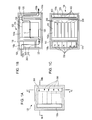
- FIG. 1A to FIG. 1C illustrate an equipment mounting rack according to a first embodiment.
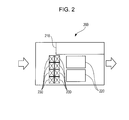
- FIG. 2 schematically illustrates an internal structure of a server device according to the first embodiment.
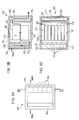
- FIG. 3A to FIG. 3C illustrate an equipment mounting rack according to a comparative example.
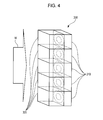
- FIG. 4 is a perspective view of a ventilation system according to the first embodiment.
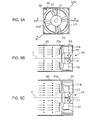
- FIG. 5A to FIG. 5C illustrate details of a set of a fan and a duct in a ventilation system according to the first embodiment.
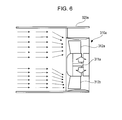
- FIG. 6 illustrates loss of rotational balance of vanes when a duct constituted by a plurality of walls which are not equally distant from a shaft is attached to a fan.
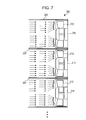
- FIG. 7 illustrates noise reduction in a ventilation system by a structure in which each of the fans is provided with a duct according to the first embodiment.
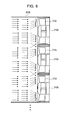
- FIG. 8 illustrates loss of rotational balance of vanes of each fan when a plurality of fans share a single duct.
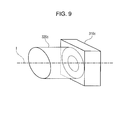
- FIG. 9 illustrates a state in which a round-section duct is attached to a fan.
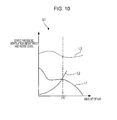
- FIG. 10 is a graph representing a P-Q characteristic, an impedance characteristic and a noise characteristic, in which the P-Q characteristic is a change in static pressure (P) with respect to an amount of air (Q) in a square-section duct fan, the impedance characteristic is a change in ventilation resistance with respect to the amount of air, and the noise characteristic is a change in a noise level with respect to the amount of air.
- P static pressure
- Q amount of air
- the noise characteristic is a change in a noise level with respect to the amount of air.
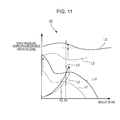
- FIG. 11 is a graph representing the P-Q characteristic, the impedance characteristic and the noise characteristic when a necessary amount of air illustrated in FIG. 10 is supplied by a round-section duct fan.
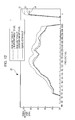
- FIG. 12 is a graph representing relationships between noises produced by a square-section duct fan or a round-section duct fan and a rotational frequency of vanes of the fans.
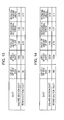
- FIG. 13 is a table of calculation results of an increase in noise when a round-section duct is attached as compared with a case when a square-section duct is attached.
- FIG. 14 is a table of calculation results of an increase in noise when a round-section duct is attached as compared with a case when a square-section duct is attached.
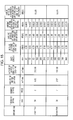
- FIG. 15 is a table of an amount of noise attenuation depending on a duct length.
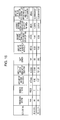
- FIG. 16 is a table of an amount of noise attenuation available in a duct of a length in a preferred range.
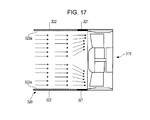
- FIG. 17 is a sectional view illustrating a structure in which a duct is attached to each fan according to a second embodiment.
- FIG. 1A to FIG. 1C illustrate an equipment mounting rack according to a first embodiment.
- FIG. 1A illustrates a side surface of an equipment mounting rack 100.
- FIG. 1B is a sectional view taken along line IB-IB in FIG. 1A.
- FIG. 1C is a sectional view taken along line IC-IC in FIG. 1A .
- the equipment mounting rack 100 illustrated in FIG. 1A to FIG. 1C is provided with a rack housing 110.
- the rack housing 110 includes an equipment mounting space 110a, a first air guide duct 110b and a second air guide duct 110c which will be described below.
- the first air guide duct 110b is a passage through which ambient air is taken into the equipment mounting space 110a for the purpose of cooling the server devices 200.
- the second air guide duct 110c is a passage through which air is guided to be exhausted out of the equipment mounting rack 100 from the equipment mounting space 110a after cooling the server devices 200.
- Each of the server devices 200 mounted in the equipment mounting space 110a has a function to cool electronic components or other devices inside by taking in ambient air.
- FIG. 2 schematically illustrates an internal structure of a server device according to the first embodiment.
- each of the server devices 200 has a plurality of electronic components 220 inside.
- the electronic components 220 operate with electric power supplied from a power supply unit 210 and generate heat during operation.
- Each of the server devices 200 is provided with fans 230 for taking ambient air for the purpose of cooling the electronic components 220.
- each of the server devices 200 has a plurality of device fans 230 disposed side by side to take in as much air as possible.
- a rotational speed of vanes of each of the device fans 230 is set to be relatively high to increase the amount of ambient air taken in.
- the device fans 230 with vanes of which rotational speed is set relatively high produce loud noise. Since each of the server devices 200 of the present embodiment are provided with a plurality of device fans 230, the entire equipment produces even louder noise.
- the following noise control measure is taken to prevent a leakage of noise produced by the server devices 200 mounted on the rack 100.
- the equipment mounting space 110a in which the server devices 200 are mounted is disposed between the first guide duct 110b, upstream of the airflow and the second air guide duct 110c, and downstream of the airflow along a direction of arrow C in FIG. 1B .
- an air inlet 100a for taking ambient air into the equipment mounting rack 100 for the purpose of cooling the server devices 200 is provided on a side wall of the equipment mounting rack 100, which side wall constitutes the first air guide duct 110b.
- An air outlet 100b through which air is exhausted after cooling is provided on a side wall which constitutes the second air guide duct 110c.
- the equipment mounting space 110a, the first air guide duct 110b and the second air guide duct 110c each have a plate-shaped noise-absorbing member 120 on their inner wall surfaces.
- the noise-absorbing member 120 is formed of noise-absorbing rubber or other material having noise absorbing properties greater than that of walls of the rack housing 110. In this manner, the equipment mounting space 110a of the first embodiment is surrounded by the noise-absorbing members 120. Noise produced by the server devices 200 is absorbed by the noise-absorbing members 120.
- the noise-absorbing members 120 attached to the first and second air guide ducts 110b and 110c also function to absorb noise produced by a later-described plurality of fans provided in the equipment mounting rack 100.
- the air taken into the equipment mounting rack 100 through the air inlet 100a for the cooling purpose flows toward the equipment mounting space 110a via the first air guide duct 110b.
- the air drawn into the equipment mounting space 110a tends to flow less smoothly as compared with a case in which, for example, the air inlet is provided directly in a wall that surrounds the equipment mounting space 110a.
- the equipment mounting rack 100 is provided with a ventilation system 300.
- the ventilation system 300 is disposed in the middle of the first air guide duct 110b to actively supply air flowing in the first air guide duct 110b into the equipment mounting space 110a.
- the ventilation system 300 includes five fans 310 arranged in a direction perpendicular to the flow of air, and five ducts 320 each of which is connected to an air inlet of each of the fans 310.
- the ventilation system 300 has five fans 310 to promote the flow of air which tends to be less smooth as described above and to provide a sufficient amount of air flowing into the equipment mounting space 110a.
- a rotational speed of vanes of each of the fans 310 is set to be relatively high to increase ventilation capacity.
- the equipment mounting rack 100 also has five fans 400 at an outlet of the equipment mounting space 110a.
- the fans 400 guide air exhausted out of (expelled from) the server devices 200 after cooling toward the second air guide duct 110c from the equipment mounting space 110a. It is not necessary that the fans 400 at the second air guide duct 110c side have ventilation capacity as high as that of the fans 310 at the first air guide duct 110b side. It suffices that the fans 400 can send air toward the second air guide duct 110c. For this reason, noise reduction is considered more important than ventilation capacity for the fans 400 at the second air guide duct 110c side and thus the rotational speed of vanes of the fans 400 is set to be relatively low.
- FIG. 3A to FIG. 3C illustrate the equipment mounting rack according to the comparative example.
- FIG. 3A illustrates a side surface of the equipment mounting rack 500 according to the comparative example.
- FIG. 3B is a sectional view taken along line IIIB-IIIB in FIG. 3A.
- FIG. 3C is a sectional view taken along line IIIC-IIIC in FIG. 3A .
- FIG. 3A to FIG. 3C components equivalent to those of the equipment mounting rack 100 of the first embodiment illustrated in FIG. 1A to FIG. 1C are denoted by the same reference numerals as FIG. 1A to FIG. 1C and description thereof will be omitted.
- five fans 510 for supplying sufficient air into an equipment mounting space 110a are provided at an inlet of the equipment mounting space 110a.
- vanes of the five fans 510 have relatively high rotational speed for increased ventilation capacity.
- the noise produced by the fan during operation becomes significantly louder in proportion to the fifth or sixth power of an increase in the rotational speed.
- the fans with vanes of which rotational speed is set relatively high as described above produce loud noise.
- the total amount of noise produced by the five fans 510 is controlled only by walls of a first air guide duct 110b and a noise-absorbing member 120.
- noise produced by the fans 510 as described above is often too loud to be controlled only by the walls of the first air guide duct 110b and the noise-absorbing member 120.
- such equipment mounting racks are often installed in offices. If, for example, the comparative equipment mounting rack 500 illustrated in FIG. 3A to FIG. 3C is installed in an office, people may often complain about the loud noise produced by the comparative equipment mounting rack 500.
- noise produced by the fans 310 of the ventilation system 300 with vanes of which rotational speed is set to be relatively high is controlled by the ducts 320 connected to the fans 310 in the equipment mounting rack 100 of the first embodiment illustrated in FIG. 1A to FIG. 1C .
- FIG. 4 is a perspective view of the ventilation system 300.
- the ventilation system 300 has five fans 310 arranged in a direction perpendicular to the flow of air W.
- Each of the ducts 320 connected to the air inlet each of the fans 310 has a square section.
- FIG. 5A to FIG. 5C illustrate details of a set of a fan and a duct of the ventilation system.
- FIG. 5A is a plan view of a set of a fan 310 and a duct 320 seen from a side in which air flows in.
- FIG. 5B is a sectional view of the set of the fan 310 and the duct 320 taken along line VB-VB in FIG. 5A.
- FIG. 5C is a sectional view of the set of the fan 310 and the duct 320 taken along line VC-VC in FIG. 5A .
- the fan 310 includes a shaft 311, vanes 312 and a cylindrical-shaped housing 313.
- the vanes 312 are attached to the shaft 311.
- the housing 313 extends along the shaft 311.
- the housing 313 of the fan 310 is formed as a square seen from a side in which air is caused to flow in.
- An internal cylinder of the fan 310 is a cylindrical-shaped pipe surrounding the vanes 312.
- the vanes 312 As the shaft 311 of the fan 310 is rotated, the vanes 312 generate a flow of air from an air inflow end 313a toward an air outflow end 313b. As illustrated in FIG. 4 , in the ventilation system 300 of the first embodiment, five fans 310 are arranged in a direction perpendicular to the flow of air.
- the duct 320 is a square-section duct which is larger than the air inflow end 313a in cross section.
- the duct 320 is connected to the air inflow end 313a and guides air flowing into the fan 310 toward the air inflow end 313a.
- An extension line H of a central axis of the square-section duct 320 is coincident with the shaft 311.
- An outside dimension of the duct 320 is coincident with an outside dimension of the square-shaped housing 313 of the fan 310.
- the duct 320 which guides the air to the air inflow end 313a of the fan 310 has a square section and the extension line H of the central axis of the square-section duct 320 is coincident with the shaft 311.
- four walls which constitute the duct 320 are substantially equally distanced from the shaft 311.
- VB-VB which is parallel to walls of the duct 320
- air is guided to the fan 310 so as to hit each of the vanes 312 uniformly in the section parallel to the walls.
- four corners of the duct 320 are also substantially equally distanced from the shaft 311.
- FIG. 5C taken along line VC-VC which is a diagonal line of the square section of the duct 320, air is guided to the fan 310 so as to hit each of the vanes 312 uniformly also in the section along the diagonal line of the square.
- the duct 320 has a square section, air is guided to the fan 310 so as to hit the vanes 312 uniformly in every section that includes the central axis H of the duct 320.
- the rotational balance of the vanes 312 is kept during operation of the fan 310.
- FIG. 6 illustrates loss of rotational balance of vanes when a duct constituted by a plurality of walls which are not equally distant from a shaft is attached to a fan.
- FIG. 6 illustrates a sectional view of a state in which, unlike the first embodiment, a duct 320a constituted by a plurality of walls which are not equally distant from a shaft 311a is attached to a fan 310a at an inflow side of air.
- the fan 310a is equivalent to the fan 310 of the present embodiment.
- an upper wall of the duct 320a in the drawing is more distant from the shaft 311a than a lower wall.
- a vane 312a near the upper wall in the drawing receives a larger amount of air passing through the duct 320a than a vane 312b near the lower wall in the drawing. Since greater force is exerted on the vane 312a than on the vane 312b, the rotational balance of vanes is lost.
- the rotational balance of the vanes 312 is kept during operation of the fan 310. In this manner, noise produced by the fan 310 is reduced.
- the five fans 310 are arranged in the direction perpendicular to the flow of air as described above. As illustrated in FIG. 4 , a duct 320 is attached to each of the five fans 310. As described above, noise can be reduced in the ventilation system 300 of the first embodiment also by a structure in which each of the fans 310 is provided with a duct 320.
- FIG. 7 illustrates noise reduction in a ventilation system by a structure in which each of the fans is provided with a duct.
- FIG. 7 is a longitudinal sectional view of the ducts 320 in the ventilation system 300 in which the fans 310 and the ducts 320 are arranged in a manner as illustrated in FIG. 4 .
- each of the fans 310 is provided with a square-section duct 320.
- the square-section duct 320 makes the air uniformly hit the vanes 312 of each of the fans 310.
- the rotational balance of the vanes 312 of each of the fans 310 is kept as described above.
- FIG. 8 illustrates loss of rotational balance of vanes of each fan when a plurality of fans share a single duct.
- FIG. 8 is a sectional view of a structure in which a single elongated rectangular-section duct 320b is attached to three fans 310b which are equivalent to the fans 310 of the first embodiment.
- flows of air supplied to each of the fans 310b cross each other between adjacent fans 310b and thereby are disturbed.
- the force is non-uniformly exerted on the vanes 312c of each of the fans 310b and the rotational balance of the vanes 312c of each of the fans 310b is lost.
- the duct 320 attached to each of the fans 310 guides air separately to each of the fans 310 so that air hits the vanes 312 uniformly.
- a disturbance of the flow of air as described above can be avoided.
- the rotational balance of the operating vanes 312 is kept for all the fans 310.
- noise produced by the entire ventilation system 300 is reduced.
- noise produced by the fans 310 is reduced by a structure in which the square-section duct 320 attached to each of the fans 310 guides the air to the corresponding fan 310 so that the air uniformly hits the vanes 312.
- a round-section duct is more preferable than the square-section duct 320 of the present invention for the purpose of guiding air to the fan 310.
- the square-section duct 320 is adopted in the present embodiment by the following reason.
- FIG. 9 illustrates a state in which a round-section duct is attached to a fan.
- FIG. 9 is a perspective view of a state in which a round-section duct 320c is attached to a fan 310c at an inflow side of air unlike the first embodiment.
- the fan 310c is equivalent to the fan 310 of the first embodiment.
- An extension line I of a central axis of the round-section duct 320c is coincident with a shaft of the fan 310c.
- inner wall surfaces of the duct 320c are equally distant from the shaft 311 as compared with those of the square-section duct 320 of the first embodiment in a strict sense.
- air is guided to hit the vanes of the fan 310c in a more uniform manner.
- a round cross section of the round-section duct 320c perpendicular to the flow of air along the longitudinal direction is smaller than a square cross section of the square-section duct 320 of the first embodiment perpendicular to the flow of air along the longitudinal direction.
- ventilation resistance of the flow of air in the round-section duct 320c is larger than that in the square-section duct 320.
- the ventilation resistance becomes high, the amount of air will be reduced.
- the fan may produce louder noise.
- FIG. 10 is a graph representing a P-Q characteristic, an impedance characteristic and a noise characteristic, in which the P-Q characteristic is a change in static pressure (P) with respect to an amount of air (Q) in a square-section duct fan, the impedance characteristic is a change in ventilation resistance with respect to the amount of air, and the noise characteristic is a change in a noise level with respect to the amount of air.
- P static pressure
- Q amount of air
- the noise characteristic is a change in a noise level with respect to the amount of air.
- the amount of air is plotted in the horizontal axis while the static pressure, the ventilation resistance and the noise level are plotted in the vertical axis.
- the graph G1 illustrates a first P-Q characteristic curve L1 representing the P-Q characteristic in the square-section duct fan, a first impedance characteristic curve L2 representing the impedance characteristic, and the first noise characteristic curve L3 representing the noise characteristic.
- an amount of air at the level illustrated by a dashed dotted line in the graph G1 of FIG. 10 is considered to be an amount of air P1 necessary for the cooling purpose.
- FIG. 11 is a graph representing the P-Q characteristic, the impedance characteristic and the noise characteristic when a necessary amount of air illustrated in FIG. 10 is supplied by a round-section duct fan.
- the amount of air is plotted in the horizontal axis while the static pressure, the ventilation resistance and the noise level are plotted in the vertical axis.
- the first P-Q characteristic curve L1, the first impedance characteristic curve L2 and the first noise characteristic curve L3 on the graph G1 of FIG. 10 are represented by dotted lines.
- ventilation capacity of a round-section duct fan is equivalent to that of a square-section duct fan, i.e., the P-Q characteristic of a round-section duct fan is equivalent to that represented by the first P-Q characteristic curve L1 above.
- an amount of air which can be supplied by the round-section duct fan is an amount of air P2 that corresponds to an intersection of the second impedance characteristic curve L2', which represents a high impedance characteristic as described above, and the first P-Q characteristic curve L1. As FIG. 11 illustrates, the amount of air P2 is smaller than the necessary amount of air P1.
- Such an increase in the P-Q characteristic is achieved by increasing the rotational speed of the round-section duct fan.
- an increase of the P-Q characteristic to that represented by the second P-Q characteristic curve L1' requires an increase in the rotational speed by n times of the rotational speed corresponding to the P-Q characteristic represented by the first P-Q characteristic curve L1.
- the noise produced by the fan becomes louder in proportion to the fifth or sixth power of an increase in the rotational speed. That is, the noise characteristic of the fan is increased in proportion to the fifth or sixth power of an increase in the rotational speed.
- a shape of the curve representing the noise characteristic of the fan also changes.
- the graph G2 of FIG. 11 illustrates the noise characteristic increased in proportion to the fifth or sixth power of the n times increase in the rotational speed of the round-section duct fan, as well as a second noise characteristic curve L3' of which shape is changed depending on the change in the rotational speed.
- noise is increased by an amount corresponding to a difference between the first noise characteristic curve L3 and the second noise characteristic curve L3' on the graph G2 as the rotational speed of the fan increases.
- FIG. 13 and FIG. 14 illustrate calculation results of an increase in noise when a round-section duct is attached to a fan as compared with a case when a square-section duct is attached to a fan.
- a table of FIG. 13 illustrates calculation results when a square-section duct and a round-section duct as described below are attached respectively to a fan which has a housing formed as a 40-mm square seen from a side in which air flows in which is illustrated in FIG. 5A .
- the square-section duct is 40 mm in each side and the form thereof is coincident with that of the housing of the fan.
- the round-section duct is 40 mm in diameter.
- a table of FIG. 14 illustrates calculation results when a square-section duct and a round-section duct as described below are attached respectively to a fan which has a housing formed as a 140-mm square seen from a side in which air flows in.
- the square-section duct is 140 mm in each side.
- the round-section duct is 140 mm in diameter.
- the calculation results in the tables in FIG. 13 and 14 demonstrate that the noise level increased by 5.77 dB(A) in the round-section duct fan as compared with the square-section duct fan.
- the increase in the noise level is due to an increased rotational speed by 1.27 times in order to increase the amount of air which decreases by 0.79 times with a round-section duct fan as compared with a square-section duct fan.
- FIG. 12 is a graph representing relationships between noises produced by a square-section duct fan or a round-section duct fan and a rotational frequency of vanes of the fans.
- a graph G3 of FIG. 12 illustrates a relationship between noise and a rotational frequency of a fan with a 40 mm-square housing.
- a rotational frequency of vanes of the fan is plotted in the horizontal axis while a noise level (sound pressure level) is plotted in the vertical axis.
- the graph G3 includes a first curve L4 which represents, by a solid line, a relationship between the noise and the rotational frequency when a square-section duct is attached to the fan.
- the graph G3 also includes a second curve L5 which represents, by a dashed dotted line, a relationship between the noise and the rotational frequency when a round-section duct is attached to the fan without changing the ventilation capacity of the fan.
- the graph G3 also includes a third curve L6 which represents, by a dotted line, a relationship between the noise and the rotational frequency when a round-section duct is attached to the fan with the ventilation capacity of the fan increased until a necessary amount of air is obtained.
- the graph G3 of FIG. 12 indicates that the noise produced by the fan with the round-section duct is smaller than that produced by the fan with the square-section duct at the rotational frequency of about 5 kHz when both the fans have the same ventilation capacity. This is because, as described above, the round-section duct has an advantage over the square-section duct in the uniformly of air hitting the vanes. However, when the round-section duct is attached to the fan without changing the ventilation capacity of the fan as described above, ventilation resistance is increased and thus the amount of air which can be supplied is reduced below the necessary amount of air. When the ventilation capacity of the fan is increased until the necessary amount of air is obtained, as indicated by the third curve L6 on the graph G3, the noise level is increased significantly over a wide frequency range.
- the round-section duct has an advantage over the square-section duct in the uniformly of air hitting the vanes but, at the same time, has a defect of higher noise level due to increased ventilation resistance. Therefore, the square-section duct 320 is adopted in the ventilation system 300 of the first embodiment described with reference to FIG. 4 to FIG. 7 . Noise produced by the fans 310 is reduced by the square-section duct 320 which guides air so that the air uniformly hits the vanes 312.
- the duct 320 attached to the air inflow end 313a of the housing 313 of the fan 310 functions also as a finger guard during, for example, maintenance of the equipment mounting rack 100 of FIG. 1 .
- a duct length of the square-section duct 320 is preferably about 1.5 to 4 times the length of each side of a square cross section which corresponds to the dimension of the housing 313 of the fan 310.
- the duct length will be described below.
- the lower limit of the preferred range of the duct length is equivalent to a length with which an amount of noise attenuation by 0.5 dB(A) is obtained.
- the amount of noise attenuation of 0.5 dB(A) is the minimum amount that can be measured without being considered as a measurement error in an ordinary noise measurement.
- the upper limit of the preferred range of the duct length is equivalent to a length with which an amount of noise attenuation of 2.0 dB(A) is obtained.
- the amount of noise attenuation of 2.0 dB(A) is the maximum amount that a human being can perceive noise attenuation.
- the duct length within these limits can be obtained by calculating the amount of noise attenuation while varying the duct length.
- the calculation results are illustrated in tables of FIG. 15 and FIG. 16 .
- the table of FIG. 15 illustrates the amounts of noise attenuation with various duct length for each of the fan having a 40 mm-square housing and the fan having 140 mm-square housing.
- the calculation result of the table in FIG. 15 demonstrates that the length with which the amount of noise attenuation of 0.5 dB(A) is obtained is about 1.5 times the length of each side of the square cross section which corresponds to the dimension of the housing of the fan.
- the calculation result of the table in FIG. 15 also demonstrates that the length with which the amount of noise attenuation of 2.0 dB(A) is obtained is about 4 times the length of each side of the square cross section.
- the table of FIG. 16 illustrates the amounts of noise attenuation obtained by the ducts having the length within the above-described preferred range for each of the 40 mm-square duct and the 140 mm-square duct.
- the table of FIG. 16 indicates that an amount of attenuation of 0.50 dB(A) is obtained with a duct which is 40 mm in each side and 60 mm in length.
- the table of FIG. 16 indicates that an amount of attenuation of 1.50 dB(A) is obtained with a duct which is 140 mm in each side and 350 mm in length.
- the length within the preferred range described above is adopted as the length of the square-section duct 320 in the ventilation system 300 of the first embodiment described with reference to FIG. 4 to FIG. 7 .
- the housing 313 surrounding the vanes 312 slightly vibrate during the rotation of the vanes 312 of each of the fans 310 although the vibration is suppressed by the duct 320 making the air uniformly hit the vanes 312.
- the vibration is transmitted to the duct 320 attached to the housing 313.
- the vibration transmitted from the fans 310 to the ducts 320 affect one another.
- the five ducts 320 each have different characteristic frequencies. Thus, a production of loud noise due to resonance between the ducts 320 can be avoided.
- the different characteristic frequencies may be imparted to the ducts 320 by, for example, constituting the ducts 320 by different materials or varying the wall thickness of the ducts 320.
- the method is not particularly limited herein.
- the five fans 310 have mutually different rotational speed.
- the frequencies of vibration produced in the fans 310 are different from each other among the fans 310.
- the vibration of the ducts 320 produced by and transmitted from each of the fans 310 as described above is also different from each other among the ducts 320.
- a production of loud noise due to resonance between the ducts 320 can be avoided.
- the five fans 310 of the present embodiment are an example of the plurality of fans in this application.
- the duct 320 is attached to each of the fans 310 with a following structure.
- FIG. 17 is a sectional view illustrating a structure in which a duct is attached to each fan according to the second embodiment.
- the duct 320 includes a joint section 321 and an extended portion 322.
- the joint section 321 is connected to the air inflow end 313a of the housing 313 of the fan 310.
- the extended portion 322 is connected to and extends from the joint section 321.
- vibration transmissibility in the joint section 321 is lower than that in the extended portion 322. Thus, transmission of vibration produced in each of the fans 310 to the duct 320 as described above is prevented.
- joint section 321 formed of rubber and the extended portion 322 formed of metal are illustrated in the second embodiment, the joint section and the extended portion in this application are not limited to these.
- the joint section and the extended portion in this application may be formed using materials other than those described above as long as the conditions regarding the vibration transmissibility are satisfied.
- the above-described extended portion 322 of the duct 320 is formed as a structure in which a noise-absorbing member 322a formed of rubber is attached to an inner surface of a metal wall.
- the noise-absorbing member 322a has noise absorbability greater than that of the housing 313 of the fan 310.
- slight noise remaining after being reduced as described above with the thus-structured duct 320 is absorbed by the duct 320.
- the number of fans and ducts is five as the embodiments of the ventilation system.
- the ventilation system is not limited to the same: any plural number, other than five, of the fans and ducts may be employed.
- the server devices are mounted in equipment mounting rack.
- the equipment mounting rack is not limited to the same: any rack in which electronic equipment other than the server devices which requires to be cooled may be employed.
- the numbers of pieces of the mounted electronic equipment is not limited to six as in the embodiment described above.
- the ventilation system mentioned above is not limited to the same: the ventilation system may be mounted on electronic equipment, such as a server device for the purpose of cooling inside thereof.
Landscapes
- Engineering & Computer Science (AREA)
- Computer Hardware Design (AREA)
- General Engineering & Computer Science (AREA)
- Physics & Mathematics (AREA)
- Thermal Sciences (AREA)
- Microelectronics & Electronic Packaging (AREA)
- Cooling Or The Like Of Electrical Apparatus (AREA)
- Structures Of Non-Positive Displacement Pumps (AREA)
- Ventilation (AREA)
Applications Claiming Priority (1)
| Application Number | Priority Date | Filing Date | Title |
|---|---|---|---|
| JP2009296980A JP2011137397A (ja) | 2009-12-28 | 2009-12-28 | 送風システムおよび機器収納ラック |
Publications (2)
| Publication Number | Publication Date |
|---|---|
| EP2339907A2 true EP2339907A2 (de) | 2011-06-29 |
| EP2339907A3 EP2339907A3 (de) | 2011-10-05 |
Family
ID=43757104
Family Applications (1)
| Application Number | Title | Priority Date | Filing Date |
|---|---|---|---|
| EP10195992A Withdrawn EP2339907A3 (de) | 2009-12-28 | 2010-12-20 | Lüftungssystem und Gestellvorrichtung |
Country Status (4)
| Country | Link |
|---|---|
| US (1) | US20110155675A1 (de) |
| EP (1) | EP2339907A3 (de) |
| JP (1) | JP2011137397A (de) |
| CN (1) | CN102108975A (de) |
Families Citing this family (1)
| Publication number | Priority date | Publication date | Assignee | Title |
|---|---|---|---|---|
| US9863403B2 (en) * | 2015-09-23 | 2018-01-09 | Toyota Motor Engineering & Manufacturing North America, Inc. | Wind turbine systems and air channels in vehicles for enhancing energy generation, cooling, and aerodynamics |
Citations (3)
| Publication number | Priority date | Publication date | Assignee | Title |
|---|---|---|---|---|
| JPH03168399A (ja) | 1989-11-28 | 1991-07-22 | Pfu Ltd | 冷却ファン装置 |
| JPH0687695U (ja) | 1993-05-28 | 1994-12-22 | 西芝電機株式会社 | 軸流送風機 |
| JP2007218150A (ja) | 2006-02-15 | 2007-08-30 | Sumitomo Heavy Ind Ltd | ファンモータおよび電機装置 |
Family Cites Families (5)
| Publication number | Priority date | Publication date | Assignee | Title |
|---|---|---|---|---|
| CN2507049Y (zh) * | 2001-08-31 | 2002-08-21 | 瑞传科技股份有限公司 | 用于计算机主机板的形成散热通道的支撑辅助板 |
| US20050240316A1 (en) * | 2004-04-26 | 2005-10-27 | Mayer David W | Method and apparatus for minimizing acoustic noise from a set of cooling fans |
| US7891464B2 (en) * | 2006-06-15 | 2011-02-22 | Hewlett-Packard Development, L.P. | System and method for noise suppression |
| US7779960B2 (en) * | 2006-08-18 | 2010-08-24 | Hewlett-Packard Development Company, L.P. | System and method for noise suppression |
| CN101193523A (zh) * | 2006-11-28 | 2008-06-04 | 佛山市顺德区顺达电脑厂有限公司 | 具有风扇的散热模块 |
-
2009
- 2009-12-28 JP JP2009296980A patent/JP2011137397A/ja active Pending
-
2010
- 2010-12-14 US US12/967,255 patent/US20110155675A1/en not_active Abandoned
- 2010-12-20 EP EP10195992A patent/EP2339907A3/de not_active Withdrawn
- 2010-12-27 CN CN2010106230935A patent/CN102108975A/zh active Pending
Patent Citations (3)
| Publication number | Priority date | Publication date | Assignee | Title |
|---|---|---|---|---|
| JPH03168399A (ja) | 1989-11-28 | 1991-07-22 | Pfu Ltd | 冷却ファン装置 |
| JPH0687695U (ja) | 1993-05-28 | 1994-12-22 | 西芝電機株式会社 | 軸流送風機 |
| JP2007218150A (ja) | 2006-02-15 | 2007-08-30 | Sumitomo Heavy Ind Ltd | ファンモータおよび電機装置 |
Also Published As
| Publication number | Publication date |
|---|---|
| CN102108975A (zh) | 2011-06-29 |
| EP2339907A3 (de) | 2011-10-05 |
| US20110155675A1 (en) | 2011-06-30 |
| JP2011137397A (ja) | 2011-07-14 |
Similar Documents
| Publication | Publication Date | Title |
|---|---|---|
| US7779960B2 (en) | System and method for noise suppression | |
| US8074765B2 (en) | Sound absorbing structure of electronic equipment | |
| KR101347987B1 (ko) | 관류 팬, 성형용 금형 및 유체 이송 장치 | |
| US20110155504A1 (en) | Silencing equipment for electric devices | |
| JP2008255969A (ja) | ファン装置の騒音低減構造 | |
| CN114840063B (zh) | 服务器机箱及其导流装置 | |
| CN113847735B (zh) | 一种风道降噪装置及具有其的空调 | |
| CN202187960U (zh) | 阻抗声流型风机消声器 | |
| EP2339907A2 (de) | Lüftungssystem und Gestellvorrichtung | |
| JP2024157555A (ja) | 人工呼吸器 | |
| JP2575902B2 (ja) | 筐体の冷却構造 | |
| EP2198205B1 (de) | Schalldämpfer für einen ventilatorkonvektor | |
| JP5521648B2 (ja) | 消音ボックス付送風機 | |
| CN220505434U (zh) | 一种降噪装置及服务器 | |
| CN110939818A (zh) | 一种消声降噪装置及风机 | |
| CN113936630A (zh) | 消声单元和蜂窝式消声器 | |
| CN114704480B (zh) | 一种基于多重降噪的多翼离心风机及其降噪方法 | |
| JP7092635B2 (ja) | 音源収容体 | |
| CN105019982A (zh) | 消除由至少一个风轮机构件的空气冷却生成的噪声的设备 | |
| JPH11173644A (ja) | 空調設備 | |
| CN207246128U (zh) | 一种扇叶、风机及空调 | |
| CN113056615A (zh) | 通风单元 | |
| CN220655481U (zh) | 一种降噪装置及吸尘器 | |
| JP2016164468A (ja) | 空気調和機用室外機 | |
| CN221881658U (zh) | 降噪式调温装置 |
Legal Events
| Date | Code | Title | Description |
|---|---|---|---|
| PUAI | Public reference made under article 153(3) epc to a published international application that has entered the european phase |
Free format text: ORIGINAL CODE: 0009012 |
|
| AK | Designated contracting states |
Kind code of ref document: A2 Designated state(s): AL AT BE BG CH CY CZ DE DK EE ES FI FR GB GR HR HU IE IS IT LI LT LU LV MC MK MT NL NO PL PT RO RS SE SI SK SM TR |
|
| AX | Request for extension of the european patent |
Extension state: BA ME |
|
| PUAL | Search report despatched |
Free format text: ORIGINAL CODE: 0009013 |
|
| AK | Designated contracting states |
Kind code of ref document: A3 Designated state(s): AL AT BE BG CH CY CZ DE DK EE ES FI FR GB GR HR HU IE IS IT LI LT LU LV MC MK MT NL NO PL PT RO RS SE SI SK SM TR |
|
| AX | Request for extension of the european patent |
Extension state: BA ME |
|
| RIC1 | Information provided on ipc code assigned before grant |
Ipc: H05K 7/20 20060101AFI20110831BHEP |
|
| 17P | Request for examination filed |
Effective date: 20120328 |
|
| STAA | Information on the status of an ep patent application or granted ep patent |
Free format text: STATUS: THE APPLICATION HAS BEEN WITHDRAWN |
|
| 18W | Application withdrawn |
Effective date: 20130904 |