EP2332018B1 - Automatische adressenauswahl für steuerbare einrichtungen - Google Patents
Automatische adressenauswahl für steuerbare einrichtungen Download PDFInfo
- Publication number
- EP2332018B1 EP2332018B1 EP09787270.9A EP09787270A EP2332018B1 EP 2332018 B1 EP2332018 B1 EP 2332018B1 EP 09787270 A EP09787270 A EP 09787270A EP 2332018 B1 EP2332018 B1 EP 2332018B1
- Authority
- EP
- European Patent Office
- Prior art keywords
- control interface
- tag
- interface units
- controllable device
- information
- Prior art date
- Legal status (The legal status is an assumption and is not a legal conclusion. Google has not performed a legal analysis and makes no representation as to the accuracy of the status listed.)
- Revoked
Links
Images


Classifications
-
- G—PHYSICS
- G05—CONTROLLING; REGULATING
- G05B—CONTROL OR REGULATING SYSTEMS IN GENERAL; FUNCTIONAL ELEMENTS OF SUCH SYSTEMS; MONITORING OR TESTING ARRANGEMENTS FOR SUCH SYSTEMS OR ELEMENTS
- G05B15/00—Systems controlled by a computer
- G05B15/02—Systems controlled by a computer electric
-
- G—PHYSICS
- G05—CONTROLLING; REGULATING
- G05B—CONTROL OR REGULATING SYSTEMS IN GENERAL; FUNCTIONAL ELEMENTS OF SUCH SYSTEMS; MONITORING OR TESTING ARRANGEMENTS FOR SUCH SYSTEMS OR ELEMENTS
- G05B19/00—Program-control systems
- G05B19/02—Program-control systems electric
- G05B19/04—Program control other than numerical control, i.e. in sequence controllers or logic controllers
- G05B19/042—Program control other than numerical control, i.e. in sequence controllers or logic controllers using digital processors
-
- H—ELECTRICITY
- H05—ELECTRIC TECHNIQUES NOT OTHERWISE PROVIDED FOR
- H05B—ELECTRIC HEATING; ELECTRIC LIGHT SOURCES NOT OTHERWISE PROVIDED FOR; CIRCUIT ARRANGEMENTS FOR ELECTRIC LIGHT SOURCES, IN GENERAL
- H05B47/00—Circuit arrangements for operating light sources in general, i.e. where the type of light source is not relevant
- H05B47/10—Controlling the light source
- H05B47/175—Controlling the light source by remote control
- H05B47/196—Controlling the light source by remote control characterised by user interface arrangements
-
- H—ELECTRICITY
- H05—ELECTRIC TECHNIQUES NOT OTHERWISE PROVIDED FOR
- H05B—ELECTRIC HEATING; ELECTRIC LIGHT SOURCES NOT OTHERWISE PROVIDED FOR; CIRCUIT ARRANGEMENTS FOR ELECTRIC LIGHT SOURCES, IN GENERAL
- H05B47/00—Circuit arrangements for operating light sources in general, i.e. where the type of light source is not relevant
- H05B47/10—Controlling the light source
- H05B47/175—Controlling the light source by remote control
- H05B47/198—Grouping of control procedures or address assignation to light sources
-
- G—PHYSICS
- G05—CONTROLLING; REGULATING
- G05B—CONTROL OR REGULATING SYSTEMS IN GENERAL; FUNCTIONAL ELEMENTS OF SUCH SYSTEMS; MONITORING OR TESTING ARRANGEMENTS FOR SUCH SYSTEMS OR ELEMENTS
- G05B2219/00—Program-control systems
- G05B2219/20—Pc systems
- G05B2219/21—Pc I-O input output
- G05B2219/21028—Address of module determined by position
-
- G—PHYSICS
- G05—CONTROLLING; REGULATING
- G05B—CONTROL OR REGULATING SYSTEMS IN GENERAL; FUNCTIONAL ELEMENTS OF SUCH SYSTEMS; MONITORING OR TESTING ARRANGEMENTS FOR SUCH SYSTEMS OR ELEMENTS
- G05B2219/00—Program-control systems
- G05B2219/20—Pc systems
- G05B2219/21—Pc I-O input output
- G05B2219/21053—Each unit, module has unique identification code, set during manufacturing, fMAC address
-
- G—PHYSICS
- G05—CONTROLLING; REGULATING
- G05B—CONTROL OR REGULATING SYSTEMS IN GENERAL; FUNCTIONAL ELEMENTS OF SUCH SYSTEMS; MONITORING OR TESTING ARRANGEMENTS FOR SUCH SYSTEMS OR ELEMENTS
- G05B2219/00—Program-control systems
- G05B2219/20—Pc systems
- G05B2219/25—Pc structure of the system
- G05B2219/25196—Radio link, transponder
-
- G—PHYSICS
- G05—CONTROLLING; REGULATING
- G05B—CONTROL OR REGULATING SYSTEMS IN GENERAL; FUNCTIONAL ELEMENTS OF SUCH SYSTEMS; MONITORING OR TESTING ARRANGEMENTS FOR SUCH SYSTEMS OR ELEMENTS
- G05B2219/00—Program-control systems
- G05B2219/20—Pc systems
- G05B2219/26—Pc applications
- G05B2219/2642—Domotique, domestic, home control, automation, smart house
-
- H—ELECTRICITY
- H05—ELECTRIC TECHNIQUES NOT OTHERWISE PROVIDED FOR
- H05B—ELECTRIC HEATING; ELECTRIC LIGHT SOURCES NOT OTHERWISE PROVIDED FOR; CIRCUIT ARRANGEMENTS FOR ELECTRIC LIGHT SOURCES, IN GENERAL
- H05B47/00—Circuit arrangements for operating light sources in general, i.e. where the type of light source is not relevant
- H05B47/10—Controlling the light source
- H05B47/175—Controlling the light source by remote control
- H05B47/19—Controlling the light source by remote control via wireless transmission
Definitions
- the invention relates to a system of devices in a building, such as a lighting system with lighting devices.
- US patent No. 5,565,855 describes a building management system with lamps that are controlled via a digital communication network.
- each installed lamp has its own network address.
- a control unit uses the addresses to target commands to specific lamps, for example to switch them on or off.
- the installation of such a system involves programming of addresses. If the control unit has predetermined addresses for different locations this involves programming the addresses into lamp mountings (or into the lamps themselves). If the lamps (mountings) have predetermined addresses, this involves programming their addresses into the control unit. In either case it is difficult for a layman to install the system.
- US patent No 6,667,690 discloses a heating, ventilation and air conditioning (HVAC) system with a digital communication network.
- the networked HVAC devices each have an RFID tag (Radio Frequency Identification).
- RFID tag Radio Frequency Identification
- a technician uses a handheld RFID tag reader to read an identification of a networked HVAC device and to transmit it to the control unit.
- the technician accesses a floor plan to identify the location where the networked HVAC device is installed.
- the location is used to identify the network address that has to be assigned to the identified device.
- the control unit broadcasts the network address together with the identification from the RFID tag to enable the device to download the network address.
- This solution is still difficult for a layman, because it requires the use of a floor plan to identify the location of the device.
- WO 2006/016845 A1 discloses a system for facility management, comprising a plurality of system devices each provided with an identity tag uniquely identifying the system device; a system layout database comprising facility layout data including intentional positions of the system devices; a system device database comprising data and identity for each system device; and an operator tool enabled to communicate with the system layout database and system device database, the operator tool being provided with a tag reader enabled to read an identity from the tags of the system devices when being in the vicinity of the system devices, wherein the operator tool is arranged to access data from the system device database about the system device and include said identity in an item of the system layout database.
- This solution is still relatively complex.
- a method is provided.
- a controllable device such as a lamp for example, is provided with a tag.
- Control interface units such as wall units each with a button to switch on a lamp, for example, are provided with tag reader.
- a control interface unit is made a control source for a controllable device by bringing it into reading range of the tag reader of the control interface unit before installation outside the reading range.
- a selection is made from the available control interface units by selectively bringing the controllable device (e.g. a lamp) into proximity of a control interface unit (e.g. a light switch) that the user intends to control the controllable device.
- Messages will be sent to control the controllable device when the user actuates the control interface unit.
- the system in the building is configured to use information from the tag to ensure that subsequently the messages will be addressed to the controllable device that from which the tag was read at the selected control interface unit.
- the "addressing information" may be a destination address for the messages, or any other information that can be used in the messages to allow the controllable device to respond selectively. Establishing such information may involve direct reading of the address information from the tag, or some form of message exchange with the controllable device to generate or obtain the address information using information derived from the tag. Bringing the controllable device into reading range may be done by moving the controllable device into the proximity of the control interface unit or, if the control interface unit is movable, by moving it, or both the control interface unit and the controllable device so that the controllable device is in the proximity of the control interface unit.
- De-establishment may be used to end use of a control interface unit to control a controllable device, that is, to ensure that a controllable device will no longer receive messages when the control interface unit is actuated.
- de-establishment is performed by again bringing the controllable device (e.g. a lamp) within reading range of the control interface unit (e.g. a wall-switch) that controls it.
- the controllable device e.g. a lamp
- the control interface unit e.g. a wall-switch
- de-establishment can be performed of any other units.
- de-establishment is performed by bringing the controllable device (e.g. a lamp) within reading range of another control interface unit (e.g.
- a wall-switch to make this other control interface unit control it and at the same time signal that the original controlling control interface should be de- established.
- This may be made dependent on whether the control interface units belong to a same group, e.g. of control interface units in a same room of a building. It may also be made dependent on a user indication whether or not combined establishment and de-establishment is required.
- a tag echoing tool may be used to present an echo of the tag to a control interface unit. In this way the controllable device need not be uninstalled to change its control.
- a control interface unit may control a plurality of controllable devices simultaneously. For this purpose a list of address information for each of these controllable devices may be formed by successively bringing different controllable devices within tag reading range.
- a control interface unit may provide for a plurality of options, for example because it comprises a corresponding plurality of user actuatable buttons, or a multi-position switch to select between the options.
- different controllable devices may be assigned to different options, by selecting an option at a control interface unit before or while the controllable device that has to be controlled by that option is brought within reading range of the control interface unit.
- the controllable device may be configured to perform successive steps through a cycle of states, each step in response to a message that is addressed to it, no matter from which control interface unit the messages are sent.
- a "hotel switch" functionality may be realized when the cycle contains two states (on/off).
- the same controllable device may be established at a plurality of control interface units that are intended to cooperate to control such cycle stepping, by successively bringing the same controllable device in reading range of different control interface units in the plurality. In this case no de-establishment is performed when the controllable device is installed in more than one control interface unit.
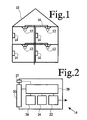
- each control interface unit 14 is associated with one specific controllable device 12, or group of controllable devices 12.
- the control interface unit 14 transmits a message addressed selectively to its associated controllable device 12, or group of controllable devices 12 responsive to the actuation.
- the term "address" covers a network address and/or any other information that can be used to determine a target of the message.
- An addressed message is a message that contains such an address.
- controller 28 detects whether control button 20 has been pushed, controller 28 retrieves the address of its associated controllable device 12, or group of controllable devices 12 from memory circuit 24 and it controls network transmitter 22 to transmit a message containing the retrieved address in response to the detection.
- controllable devices 12 receive messages and test whether the messages are destined to them. When a controllable device 12 detects a message that is destined to it, it performs an operation commanded by the message. In the embodiment wherein the controllable device is a lamp unit, control circuit 38 may receive the message from network receiver 36, compare its destination address with a pre-programmed address of the control circuit and cut or establish connections between mains connector 32 and lighting devices 30 dependent on the message if the destination address matches the pre-programmed address, or perform another control action for controllable device 12.
- Mains connector 32 may be screw-in foot, as is usual for light bulbs, a bayonet lock-type foot, a plug-in type connector for a wall socket, or any other structure to tap in to the mains power supply.
- control interface units 14 Prior to normal operation control interface units 14 need to establish the address in their memory circuit 24. The user controls this by bringing a particular controllable device 12 that has to be controlled by a particular control interface unit 14 within reading range of the tag reader 26 in the proximity of the particular control interface unit 14.
- control interface unit 14 The proximity of the control interface unit 14 is limited, so that the controllable device 12 will be outside the proximity when at the installation point of the controllable device 12 (the mains power supply outlet where the lamp unit is screwed in). Thus, unintentional establishment of addresses is prevented.
- a tag reader with a short range is used, that requires touching the particular control interface unit 14 with the particular controllable device 12, or a distance that the user will not casually distinguish from a distance corresponding to touching. Thus, it can be ensured that the user does not unintentionally establish an address.
- control interface unit 14 may have a user accessible control switch (not shown) coupled to its controller to enable establishment.
- Fig. 4 illustrates an embodiment of establishment of the address.
- tag reader 26 reads the tag 34 of the particular controllable device 12 and signals this to controller 28 in a first step 41.
- controller 28 writes information derived from the tag into memory circuit 24 in a second step 42, for use to create addresses in messages that will be transmitted in a fourth step 44, when it is detected in a third step 43 that button 20 is pushed.
- second step 42 includes activating signalling device 27 to provide a feedback signal to the user.
- the manufacturer of the controllable device 12, for example the controllable lamp unit ensures during manufacture that the pre-programmed address in control circuit 38 corresponds to the information in electronic tag 34, so that the addresses that are created from the information will match the programmed address.
- the pre-programmed address may be copied to the electronic tag 34, or vice versa tag content may be copied from tag 34 to control circuit, or both may be programmed in correspondence. Instead of including the address directly, other information may be used, from which an address can be derived.
- control button 20 of control interface unit 14 is replaced by a more complex actuator structure that allows entering a plurality of distinct user choices.
- a plurality of buttons may be provided for example, each for a different choice, or a combination of a multiple choice selector and a confirmation button may be used, controller 28 being configured to transmit a message corresponding to the last selected choice of the multiple choice selector before detection of actuation of the confirmation button.
- controller 28 is configured to store a plurality of addresses at respective locations in memory circuit 24, each for creating an address in messages for a respective one of the choices.
- Fig. 5 illustrates establishment of the addresses in this embodiment.
- a first further step 51 has been added behind first step 41, wherein controller 28 determines the last selected user choice (e.g. by reading out the multiple choice selector or from information identifying the last actuated button, which controller may provide by recording the identity of each actuated button at least until a next button is pressed).
- controller 28 determines the last selected user choice (e.g. by reading out the multiple choice selector or from information identifying the last actuated button, which controller may provide by recording the identity of each actuated button at least until a next button is pressed).
- controller 28 writes the information derived from the tag into memory circuit 24 at a location that it selects based on the last selected user choice that has been determined in first further step 51.
- the message is sent with the address from a location determined from the last selected user choice before the transmission.
- a control interface unit provides for de-establishment of addresses. This may be used for example when a user wants to change the location of a lamp, from a first room of the building to a second room for example. To avoid that the control interface unit in the old room continues to send message addressed to the lamp unit, the address can be de-established.
- Fig. 6 illustrates an embodiment wherein de-establishment of addresses is used.
- reader 26 reads the tag 34 of the particular controllable device 12 in a first step 61 when the particular controllable device 12 is within reading range and signals this to controller 28.
- controller 28 performs a second step 62 to test whether the information from the tag indicates matches information that is already stored in memory circuit 24. If so, controller 28 executes a third step 63, invalidating the information.
- third step 63 includes activating signalling device 27 to provide a feedback signal to the user.
- fourth step 64 includes activating signalling device 27 to provide a feedback signal to the user.
- Mutually different feedback signal may be used for feedback in third step 63 and fourth step 64.
- controller 28 uses the information, if valid, to create the address in messages generated in response to detection of actuation.
- controller may activate a disable time interval of one to ten seconds for example after establishment or de-establishment. In this case controller 28 disables establishment and de-establishment based on tags detected in the disable time interval. This prevents double actions.
- controller 28 may be configured to transmit messages to a plurality of controllable devices 12 in response to a single actuation.
- a list with information to create addresses for the plurality of controllable devices 12 is stored in memory circuit 24.
- controller 28 is configured to add information to the list, each time when a tag of a new controllable device 12 is stored. This may be combined with the embodiment that provides for de-establishment. In this case, a controllable device is removed from the list when its tag is read and it is already on the list.
- control interface units 14 are configured to communicate with each other to control de-establishment.
- at least one control interface unit 14 additionally comprises a network receiver coupled to its controller 28.
- a controller 28 sets the information for creating addresses that will be used for a controllable device in response to future actuation, it broadcasts a de-establishment message with information derived from the tag to at least one other control interface unit 14 in the system.
- the at least one other control interface unit 14 receives this de-establishment message and its controller tests its memory circuit 24 to determine whether it has stored information that matches the tag based information in the de-establishment message.
- Control interface unit 14 may have a control switch (not shown) coupled to its controller to select between combined establishment and de-establishment elsewhere when a controllable device is brought in to the proximity of a control interface unit 14, or mere establishment.
- a control interface unit 14 may store an identification of control interface units 14 in a group of related control interface units, for example of units in the same room of the building, or a group of units on a same panel.
- a professional technician may define the groups at installation in the building, so as to facilitate subsequent use by a lay user.
- establishment of a lamp unit for a control interface unit 14 may be used to de-establish the lamp unit for control interface units outside the group (outside the same room) but not for control interface units in the same room.
- establishment may be performed collectively for all control interface units 14 in the same group, when the controllable device is shown to one control interface unit 14 in the group. This may involve messages being broadcast to other members in the group, using a transmitter and receivers in the interface control units of the group.
- controllable device 12 toggles back or forth between two states each time when it receives a message that is addressed to it.
- the states may be a state with the lamp on and off respectively.
- toggling any other form of stepping through states in response to the messages may be used, such as successive round robin steps through a cycle of any number of states.
- This embodiment with establishment to a plurality of control interface units 14 may be combined with de-establishment by bringing the controllable device that has to be de-established within reading range of a control interface unit 14 that has previously stored information from the de-established controllable device.
- Direct transmission of messages from control interface units 14 to corresponding controllable devices 12 may be used.
- Wireless transmission may be used using RF electromagnetic signals for example. Wired transmission may also be used, via the AC power lines or via a separate control network.
- control interface units 14 transmit the messages to an intermediate station, which in turn forwards the messages directly or indirectly to controllable devices 12.
- Different transmission media may be used along the way, for example partly using wireless transmission and partly using wired transmission.
- Intermediate stations may be configured to forward messages from a control interface unit 14 to selected locations based on a source address of the message.
- an intermediate station is provided with a stored table that associates sources to destination addresses.
- the intermediate station Upon reception of a message from a source, the intermediate station uses the identity of the source (derived for example from a source address in the message, or from detection of a communication wire that was used to send the message, or from detection of a location where a wireless message was received) to look up the destination address in the table. The intermediate station can then send the message addressed to the looked-up destination address.
- identity of the source derived for example from a source address in the message, or from detection of a communication wire that was used to send the message, or from detection of a location where a wireless message was received
- the identity of the source may be used to select a group of multicast addresses.
- the messages from a control interface unit may be forwarded selectively to locations in a single room associated with that control interface unit, in which case installed devices in the room can match their address with the destination address.
- the information from the tag may be used to perform additional steps to establish an address or a message routing path for a controllable device 12, which may be used to control the destination of messages instead of information derived from the tag.
- controller 28 is configured to cause the network transmitter to broadcast information derived from the tag.
- the broadcast may include a proposed address, in which case a controllable device 12 is configured to set this address as its future destination address when it detects that the broadcast message comprises information derived from its tag. If desired a more complex protocol with multiple messages may be used to establish the address.
- a controllable device 12 is configured to respond to the broadcast by transmitting an acknowledgement when it detects that the broadcast message comprises information derived from its tag.
- the acknowledgement may be used to establish a network route to the controllable device 12, for use to route future messages from the user control interface unit 14 to the controllable device.
- a receiver in the control interface unit 14 may receive the acknowledgement for this purpose.
- inventions may also be implemented using an intermediate device, to distribute the broadcast, and/or propose the address and/or to assign a network route between the control interface unit 14 and the controlled device 12.
- the broadcast message to supply a proposed address may be transmitted while the controllable device 12 is still within reading range of the tag reader of the control interface unit 14, but this requires a source of power in the controllable device or transfer of power in the controllable device 12. It is preferred to receive the broadcast after the controllable device 12 has been connected to the mains power supply. For this purpose the broadcast may be delayed for a time period after reading of the tag that is considered sufficient to allow for installation of the controllable device 12 attached to the mains power supply.
- the broadcast may be repeated over a range of time, sufficiently often to make the user experience establishment of the address or route as completed once the physical installation of the controllable device 12 is complete (e.g. with a frequency of between once per tenth of a second and once per minute).
- An acknowledgement protocol may be used between the control interface unit 14 and the controllable device 12 for this purpose.
- controllable device 12 is configured to broadcast a message comprising its identifier (as stored in the tag) and its network address, upon detecting that it has been installed (i.e. connected to the mains).
- control interface unit 14 has a receiver and its controller 28 is configured to compare received identifiers to the information stored in its memory (as read form the tag). In case of a match the controller 28 is configured to replace (or associate) the information of the tag by (or with) the network address.
- receiving the broadcast message will provide for establishment of the address.
- control interface units 14 store information derived from the tags in a local memory circuit 24, it should be appreciated that instead the information could be stored elsewhere, for example at a central location or in an intermediate network device. In this case, control interface units 14 may retrieve the information from the location elsewhere, each time when a message must be sent. A memory at such a central location and a collection of local memory circuits will both be referred to as "memory".
- the intermediate device may transform messages from control interface units 14 to address the messages to the controllable device 12 or devices that is, or are, associated with the control interface unit 14 that originated the message. Thus, the control interface units 14 need not store or retrieve the information.
- control circuitry will be used to cover a controller of a control interface unit, a collection of different control interface units, and/or a central controller with as much circuits in the control interface units as needed for control purposes.
- a portable tag echoing device that can mimic tags.
- a tag echoing device comprises a tag reader, a transponder enabling it to respond as a tag and a control circuit.
- the control circuit is configured to store information read by the tag reader and to use the stored information to set the content of the response when the transponder is interrogated.
- a user may use such a tag echoing device first by bringing it in reading range of an installed controllable device 12, for example a lamp unit connected to the mains power supply lines at some place in building 10, to read its tag.
- the user may bringing the tag echoing device in reading range of a control interface unit 14 to supply a copy of the information from the tag of the controllable device 12 to the control interface unit 14.
- presentation of the controllable device 12 to the control interface unit 14 is simulated, without a need to detach the controllable device 12 from the mains power supply.
- the tags 34 may also be used for logistic purposes, such as keeping track of specific controllable devices 12 during manufacturing and/or shipping.
- a type of tag is used that stores both information in a format that can be used to address messages and to track the device for logistic reasons.
- a computer program may be stored/distributed on a suitable medium, such as an optical storage medium or a solid-state medium supplied together with or as part of other hardware, but may also be distributed in other forms, such as via the Internet or other wired or wireless telecommunication systems. Any reference signs in the claims should not be construed as limiting the scope.
Landscapes
- Engineering & Computer Science (AREA)
- Physics & Mathematics (AREA)
- General Physics & Mathematics (AREA)
- Automation & Control Theory (AREA)
- General Engineering & Computer Science (AREA)
- Selective Calling Equipment (AREA)
Claims (13)
- Ein Verfahren zur Steuerung von steuerbaren Vorrichtungen (12), die in einem Gebäude (10) mit einer Mehrzahl von Steuerungsschnittstelleneinheiten (14) installiert sind, welche Steuerungsschnittstelleneinheiten jeweils einen Empfänger (20) für Benutzerbetätigungen aufweisen, wobei das Verfahren, als Reaktion auf eine Erkennung des Betätigens der Empfänger (20) durch Benutzer, Mitteilungen von den Steuerungsschnittstelleneinheiten (14) an die steuerbaren Vorrichtungen (12) verwendet, das Verfahren aufweisend:- Ausstatten einer steuerbaren Vorrichtung (12) mit einem Tag (34) und Ausstatten jeder der Steuerungsschnittstelleneinheiten (14) mit einem Tag-Lesegerät (26), das zum Lesen des Tags (34) fähig ist, wenn das Tag (34) in einer Nähe der Steuerungsschnittstelleneinheit (14) ist,- Bringen der steuerbaren Vorrichtung (12) in die Nähe einer ausgewählten Steuerungsschnittstelleneinheit der Steuerungsschnittstelleneinheiten (14) vor der Installation der steuerbaren Vorrichtung (12), um zu zeigen, dass die steuerbare Vorrichtung (12) durch Betätigung eines Empfängers (20) der ausgewählten Steuerungsschnittstelleneinheit unter der Steuerungsschnittstelleneinheiten (14) gesteuert werden muss,- Auslesen des Tags (34) der steuerbaren Vorrichtung (12) von der ausgewählten Steuerungsschnittstelleneinheit der Steuerungsschnittstelleneinheiten (14),- automatisches Verwenden von Informationen von dem Tag (34), um Destinationen zu etablieren, die für Nachrichten von der ausgewählten Steuerungsschnittstelleneinheit der Steuerungsschnittstelleneinheiten (14) als Antwort auf ein zukünftiges Detektieren von Benutzer-Betätigung des Empfängers (20) der ausgewählten Steuerungsschnittstelleneinheit der Steuerungsschnittstelleneinheiten (14) zu verwenden sind,- Installieren der steuerbaren Vorrichtung (12) an einem Ort in dem Gebäude (10), der außerhalb besagter Nähe ist.
- Ein Verfahren gemäß Anspruch 1, wobei die steuerbare Vorrichtung (12) eine lösbare Lampeneinheit ist mit dem Tag (34) in oder an der Lampeneinheit, einem Netzanschluss (32) und einer Lichtversorgungsvorrichtung (30), die von dem Netzanschluss (32) gespeist wird, wobei der Schritt des Installierens ein Verbinden des Netzanschlusses (32) mit einer Hauptenergieversorgung des Gebäudes (10) aufweist.
- Ein Verfahren gemäß Anspruch 1, wobei die ausgewählte Steuerungsschnittstelleneinheit der Steuerungsschnittstelleneinheiten ein Auswählen aus einer Mehrzahl von Optionen durch einen Benutzer ermöglicht, wobei das Verfahren folgende Schritte aufweist:- Auswählen einer gewählten Option in der ausgewählten Steuerungsschnittstelleneinheit der Steuerungsschnittstelleneinheiten (14) bevor oder indem die Steuerbare Vorrichtung (12) in die Nähe einer ausgewählten Steuerungsschnittstelleneinheit der Steuerungsschnittstelleneinheiten (14) gebracht wird,automatisches Verwenden der Informationen von dem Tag (34), um Destinationen zu etablieren, die für die zukünftige Nachrichten zu verwenden sind, die transmittiert werden, wenn die gewählte Option der Optionen zuletzt zuvor ausgewählt wurde.
- Ein Verfahren gemäß Anspruch 1, das ein de-Etablieren einer zu verwendenden Destination aufweist, die für die Nachrichten von der ausgewählten Steuerungsschnittstelleneinheit der Steuerungsschnittstelleneinheiten (14) zu verwenden ist, wenn es detektiert wird, dass die steuerbare Vorrichtung (12) in die Nähe der ausgewählten Steuerungsschnittstelleneinheit der Steuerungsschnittstelleneinheiten (14) gebracht worden ist, und wenn die Destination früher unter Verwendung von Informationen, die von dem Tag (34) erlangt wurden, etabliert worden ist.
- Ein Verfahren gemäß Anspruch 1, aufweisend- Verwenden eines Tag-Wiedergabetools zum Lesen des Tags (34) der steuerbaren Vorrichtung (12) nach der Installation,- Bewegen des Tag-Wiedergabetools in die Nähe von einer der Steuerungsschnittstelleneinheiten (14) hinein, und- Etablieren und/oder de-Etablieren von Adressierung in Antwort auf ein Lesen von wiedergegebenen Taginformationen von der steuerbaren Vorrichtung (12) von dem Tag-Wiedergabetool.
- Ein Gebäudemanagementsystem zum Steuern einer adressierbaren steuerbaren Vorrichtung (12), die mit einem Tag (34) ausgestattet ist, das System aufweisend- eine Mehrzahl von Steuerungsschnittstelleneinheiten (14), jede Steuerungsschnittstelleneinheit (14) aufweisend ein Tag-Lesegerät (26) zum Auslesen von Taginformationen aus dem Tag (34) der steuerbaren Vorrichtung (12), wenn die steuerbare Vorrichtung in einer Nähe der Steuerungsschnittstelleneinheit (14) gebracht wird, und einen Benutzerbetätigungsempfänger (20) zum Detektieren von Benutzerbetätigungen der Steuerungsschnittstelleneinheit (14),- einen Speicher (24) zum Speichern von Adressierungsinformationen, welcher Speicher (24) in der Steuerungsschnittstelleneinheit (14) enthalten ist, und- zumindest einen Nachrichtentransmitter (22), und- einen Steuerschaltkreis (28), der konfiguriert ist zum Empfangen der Taginformationen, die von den Tag-Lesegeräten (26) der Mehrzahl von Steuerungsschnittstelleneinheiten (14) ausgelesen wurden, zum Etablieren von Adressierungsinformationen für jeweilige Steuerungsschnittstelleneinheiten (14) von der Mehrzahl von Steuerungsschnittstelleneinheiten (14) in dem Speicher (24), die jeweils auf den Taginformationen basieren, die von dem Tag-Lesegerät (26) der jeweilige Steuerungsschnittstelleneinheit der Steuerungsschnittstelleneinheiten (14) empfangen wurden, und zum Bewirken, dass der Nachrichtentransmitter (22) Nachrichten als Antwort darauf transmittiert, dass die Benutzerbetätigungen der Steuerungsschnittstelleneinheit (14) detektiert werden, wobei jede Nachricht mit der Adressierungsinformationen für diejenige Steuerungsschnittstelleeinheit (14) adresseiert ist, von der die Benutzerbetätigung detektiert wurde.
- Ein Gebäudemanagementsystem gemäß Anspruch 6, wobei der Speicher (24) und der Steuerschaltkreis (28) Kombination aus einem Speicherschaltkreis (24) und einer Steuerung aufweisen, wobei jede Kombination in einer jeweiligen Steuerungsschnittstelleneinheit (14) der Steuerungsschnittstelleneinheiten (14) lokalisiert ist, und wobei jede der Steuerungen (28) jeweils konfiguriert ist zum Etablieren von Adressierungsinformationen für ihre Steuerungsschnittstelleneinheit (14) in dem Speicherschaltkreis (24) von dieser Steuerungsschnittstelleneinheit (14).
- Ein Gebäudemanagementsystem gemäß Anspruch 6, wobei der Steuerschaltkreis (28) konfiguriert ist zum Detektieren, ob Taginformationen, die von dem Tag-Lesegerät (26) von zumindest einer bestimmten Steuerungsschnittstelleeinheit (14) der Steuerungsschnittstelleeinheiten (14) empfangen wurden, Adressierungsinformationen entsprechen, die früher für die bestimmte Steuerungsschnittstelleeinheit (14) der Steuerungsschnittstelleeinheiten (14) gespeichert wurden, und, wenn dies der Fall ist, de-Etablieren der Adressierungsinformationen für die bestimmte Steuerungsschnittstelleeinheit (14) der Steuerungsschnittstelleeinheiten (14).
- Ein Gebäudemanagementsystem gemäß Anspruch 6, wobei der Steuerschaltkreis (28) konfiguriert ist zum Detektieren, ob Taginformationen, die von dem Tag-Lesegerät (26) von zumindest einer bestimmten Steuerungsschnittstelleeinheit (14) der Steuerungsschnittstelleeinheiten (14) empfangen wurden, Adressierungsinformationen entsprechen, die früher für eine andere Steuerungsschnittstelleeinheit (14) der Steuerungsschnittstelleeinheiten (14) gespeichert wurden, und, wenn dies der Fall ist, de-Etablieren der Adressierungsinformationen für die andere Steuerungsschnittstelleeinheit (14) der Steuerungsschnittstelleeinheiten (14).
- Ein Gebäudemanagementsystem gemäß Anspruch 9, wobei der Steuerschaltkreis (28) konfiguriert ist zum Darstellen einer Gruppe von Steuerungsschnittstelleeinheiten (14) und zum Ermöglichen der de-Etablierung für die andere Steuerungsschnittstelleeinheit (14) der Steuerungsschnittstelleeinheiten (14) in Abhängigkeit davon, ob die bestimmte eine Steuerungsschnittstelleeinheit der Steuerungsschnittstelleeinheiten (14) und die andere Steuerungsschnittstelleeinheit (14) der Steuerungsschnittstelleeinheiten (14) beide zu der Gruppe gehören.
- Ein Gebäudemanagementsystem gemäß Anspruch 6, wobei zumindest eine der Steuerungsschnittstelleeinheiten (14) dafür sorgt, dass ein Benutzer aus einer Mehrzahl von Optionen auswählen kann, und wobei der Steuerschaltkreis (28) konfiguriert ist zum Bewirken, dass der Nachrichtentransmitter (22) als Reaktion auf ein Detektieren der Benutzerbetätigungen Nachrichten transmittiert, die in Abhängigkeit von einer letzten früher ausgewählten Option der Optionen adressiert ist, wobei der Steuerschaltkreis (28) konfiguriert ist zum- Bestimmen einer bestimmten Option der Optionen, die gleichzeitig oder zuletzt bevor das Tag (34) der steuerbaren Vorrichtungen (12) von dem Tag-Lesegerät (26) der zumindest eine Steuerungsschnittstelleeinheit der Steuerungsschnittstelleeinheiten (14) ausgelesen wurde, und zum- Etablieren von Adressierungsinformationen für die bestimmte Option der Optionen basierend auf Informationen, die von dem Tag (34) abgeleitet sind.
- Ein Gebäudemanagementsystem gemäß Anspruch 6, wobei der Steuerschaltkreis (28) konfiguriert ist zum Etablieren von Adressierungsinformationen für eine Liste von steuerbaren Vorrichtungen (12) für die jeweilige Steuerungsschnittstelleeinheit der Steuerungsschnittstelleeinheiten (14), wobei die Liste basierend auf der Taginformationen, die von dem Tag-Lesegerät (26) der jeweilige Steuerungsschnittstelleeinheit der Steuerungsschnittstelleeinheiten (14) nachfolgend empfangen wurden, erweitert worden ist, und zum Bewirken, dass der Nachrichtentransmitter (22) Nachrichten an alle steuerbaren Vorrichtungen (12) transmittiert, die auf der Liste sind, als Reaktion auf jede Erkennung einer Benutzerbetätigung bei der jeweiligen Steuerungsschnittstelleeinheit der Steuerungsschnittstelleeinheiten (14).
- Ein Gebäudemanagementsystem gemäß Anspruch 6, wobei zumindest eine der Steuerungsschnittstelleeinheiten (14) mit einer Benutzerfeedback-Signalisierungseinheit (27) ausgestattet ist, und wobei der Steuerungsschaltkreis (28) konfiguriert ist zum Bewirken, dass die Benutzerfeedback-Signalisierungseinheit (27) ein Feedbacksignal ausgibt in Zusammenhang mit der Etablierung und/oder de-Etablierung von den Adressierungsinformationen.
Priority Applications (1)
| Application Number | Priority Date | Filing Date | Title |
|---|---|---|---|
| EP09787270.9A EP2332018B1 (de) | 2008-09-22 | 2009-09-22 | Automatische adressenauswahl für steuerbare einrichtungen |
Applications Claiming Priority (3)
| Application Number | Priority Date | Filing Date | Title |
|---|---|---|---|
| EP08164827 | 2008-09-22 | ||
| PCT/IB2009/054153 WO2010032227A1 (en) | 2008-09-22 | 2009-09-22 | Automatic address selection for controllable devices |
| EP09787270.9A EP2332018B1 (de) | 2008-09-22 | 2009-09-22 | Automatische adressenauswahl für steuerbare einrichtungen |
Publications (2)
| Publication Number | Publication Date |
|---|---|
| EP2332018A1 EP2332018A1 (de) | 2011-06-15 |
| EP2332018B1 true EP2332018B1 (de) | 2013-06-12 |
Family
ID=41479030
Family Applications (1)
| Application Number | Title | Priority Date | Filing Date |
|---|---|---|---|
| EP09787270.9A Revoked EP2332018B1 (de) | 2008-09-22 | 2009-09-22 | Automatische adressenauswahl für steuerbare einrichtungen |
Country Status (4)
| Country | Link |
|---|---|
| US (1) | US20110169606A1 (de) |
| EP (1) | EP2332018B1 (de) |
| CN (1) | CN102160004B (de) |
| WO (1) | WO2010032227A1 (de) |
Families Citing this family (17)
| Publication number | Priority date | Publication date | Assignee | Title |
|---|---|---|---|---|
| EP2240000A1 (de) | 2009-04-08 | 2010-10-13 | Nxp B.V. | Meldungssteuerbare Lampe |
| EP2573948B1 (de) | 2011-09-23 | 2017-03-15 | Nxp B.V. | System und Verfahren zur Inbetriebnahme von Geräten |
| EP2602677B1 (de) | 2011-12-05 | 2018-02-21 | Nxp B.V. | Lokalisierungsverfahren, Computerprogrammprodukt und Lokalisierungsvorrichtung |
| EP2624081B1 (de) | 2012-01-31 | 2018-01-10 | Nxp B.V. | Konfigurationsverfahren, Konfigurationsvorrichtung, Computerprogrammprodukt und Steuerungssystem |
| EP2626755B1 (de) | 2012-02-10 | 2019-04-10 | Nxp B.V. | Kalibrierungsverfahren, Kalibrierungsvorrichtung und Messvorrichtung |
| EP2650820B1 (de) | 2012-04-12 | 2014-10-08 | Nxp B.V. | Steuerverfahren und Computerprogrammprodukt |
| EP2704365B1 (de) * | 2012-08-31 | 2016-02-03 | Nxp B.V. | Verfahren zur Herstellung von Steuerbeziehungen, Konfigurationsvorrichtung, vernetzte Vorrichtung und Computerprogramm |
| US10027127B2 (en) * | 2013-03-14 | 2018-07-17 | Lutron Electronics Co., Inc. | Commissioning load control systems |
| US10339795B2 (en) | 2013-12-24 | 2019-07-02 | Lutron Technology Company Llc | Wireless communication diagnostics |
| KR102325404B1 (ko) * | 2014-03-28 | 2021-11-12 | 엘지이노텍 주식회사 | 조명 제어 장치, 무선조명 시스템 및 이의 제어 방법 |
| KR102202943B1 (ko) * | 2014-03-28 | 2021-01-14 | 엘지이노텍 주식회사 | 조명 제어 장치, 무선조명 시스템 및 이의 제어 방법 |
| US9866990B2 (en) * | 2014-05-28 | 2018-01-09 | Technical Consumer Products, Inc. | System and method for simultaneous wireless control of multiple peripheral devices |
| PT3018977T (pt) * | 2014-11-10 | 2019-06-12 | Schreder | Rede de luzes |
| CN106054825B (zh) * | 2016-04-27 | 2024-08-20 | 杭州鸿雁电器有限公司 | 便携式控制装置 |
| US9932112B1 (en) * | 2017-03-22 | 2018-04-03 | Goodrich Corporation | Cargo handling system and control method |
| WO2019097392A1 (en) * | 2017-11-15 | 2019-05-23 | Sdataway Sa | Method of attributing data, such as an id, to an object |
| US20240346268A1 (en) | 2023-04-13 | 2024-10-17 | Bruce Walter Wilkinson | Session Control Broadcaster for RFID Systems |
Family Cites Families (11)
| Publication number | Priority date | Publication date | Assignee | Title |
|---|---|---|---|---|
| EP0513443B1 (de) * | 1991-05-06 | 1999-11-17 | Koninklijke Philips Electronics N.V. | Gebäudeleitsystem |
| GB2308910A (en) * | 1996-01-02 | 1997-07-09 | Bernard John Regan | Lighting control |
| US6894601B1 (en) * | 1998-10-16 | 2005-05-17 | Cummins Inc. | System for conducting wireless communications between a vehicle computer and a remote system |
| US6229433B1 (en) * | 1999-07-30 | 2001-05-08 | X-10 Ltd. | Appliance control |
| DE19940651A1 (de) * | 1999-08-26 | 2001-03-08 | Deutsch Zentr Luft & Raumfahrt | Einrichtung zum Empfangen und/oder Senden von Kommunikations- und/oder Navigationssignalen |
| US6667690B2 (en) * | 2002-01-22 | 2003-12-23 | Carrier Corporation | System and method for configuration of HVAC network |
| WO2004057927A1 (en) * | 2002-12-19 | 2004-07-08 | Koninklijke Philips Electronics N.V. | Method of configuration a wireless-controlled lighting system |
| EP1782140B1 (de) * | 2004-08-10 | 2017-10-25 | Tac AB | Verwaltung von feldgeräten |
| JP2008546148A (ja) * | 2005-06-02 | 2008-12-18 | コーニンクレッカ フィリップス エレクトロニクス エヌ ヴィ | 照明システム及び照明システムを制御する方法 |
| DE102006012471B4 (de) * | 2006-03-18 | 2010-08-26 | Demag Cranes & Components Gmbh | Verfahren und System zur drahtlosen Übertragung von Steuerungsbefehlen für eine Steuerung eines Hebezeugs |
| US8149108B2 (en) * | 2007-11-14 | 2012-04-03 | Stryker Corporation | System and method for automatically powering on and synchronizing a wireless remote console to a central control unit so as to allow remote control of a medical device |
-
2009
- 2009-09-22 EP EP09787270.9A patent/EP2332018B1/de not_active Revoked
- 2009-09-22 WO PCT/IB2009/054153 patent/WO2010032227A1/en not_active Ceased
- 2009-09-22 US US13/120,230 patent/US20110169606A1/en not_active Abandoned
- 2009-09-22 CN CN200980137108.2A patent/CN102160004B/zh active Active
Also Published As
| Publication number | Publication date |
|---|---|
| US20110169606A1 (en) | 2011-07-14 |
| EP2332018A1 (de) | 2011-06-15 |
| CN102160004B (zh) | 2014-11-05 |
| CN102160004A (zh) | 2011-08-17 |
| WO2010032227A1 (en) | 2010-03-25 |
Similar Documents
| Publication | Publication Date | Title |
|---|---|---|
| EP2332018B1 (de) | Automatische adressenauswahl für steuerbare einrichtungen | |
| US11160154B2 (en) | Commissioning load control systems | |
| CN101785367B (zh) | 启动照明系统的方法 | |
| US6856236B2 (en) | RF home automation system comprising nodes with dual functionality | |
| CN103676821B (zh) | 建立控制关系的方法,配置设备和联网设备 | |
| US6667690B2 (en) | System and method for configuration of HVAC network | |
| US10924296B2 (en) | Terminal apparatus, control apparatus, installation-location-ascertainment support system, installation-location-setting support system, installation-location-ascertainment support method, installation-location-setting support method, and program | |
| KR100912039B1 (ko) | 조명장치 제어시스템 및 방법 | |
| US20120306621A1 (en) | Lighting control network configuration with rfid devices | |
| US20050102040A1 (en) | Radio frequency lighting control system programming device and method | |
| CN102124416B (zh) | 用于改变联网的控制系统的行为特性的方法和装置 | |
| JP2003009261A (ja) | オートメーションシステムにおけるルーティングテーブル構築および信号ルーティングのためのシステムおよび方法 | |
| EP1540997A2 (de) | Allgemeines betriebssystem | |
| EP3363257B1 (de) | Inbetriebnahme einer drahtloskommunikationsfähigen vorrichtung | |
| CN102017806A (zh) | 包括局部光源控制的基于区域的照明控制系统 | |
| EP2132961B1 (de) | Steuerschaltung, system zum betreiben einer vorrichtung und vorrichtung zur programmierung einer solchen steuerschaltung | |
| EP2278570B1 (de) | Schaltmodul und Beleuchtungssteuerungssystem, das das Schaltmodul umfasst | |
| JP4613749B2 (ja) | 制御システム | |
| JP2002075663A (ja) | 照明装置 | |
| WO2008084356A1 (en) | Network communication system | |
| JP5505017B2 (ja) | 照明制御システム | |
| JP3643629B2 (ja) | 空気調和システムにおける自動運転設定方法及び空気調和システム | |
| US20060079972A1 (en) | Method and system for automatic addressing of a plurality of elements which communicate by means of a single bus | |
| EP3726939B1 (de) | Inbetriebnahme von elektrischen geräten in einer automatisierten hausumgebung | |
| HK40006380B (en) | Commissioning load control systems |
Legal Events
| Date | Code | Title | Description |
|---|---|---|---|
| PUAI | Public reference made under article 153(3) epc to a published international application that has entered the european phase |
Free format text: ORIGINAL CODE: 0009012 |
|
| 17P | Request for examination filed |
Effective date: 20110426 |
|
| AK | Designated contracting states |
Kind code of ref document: A1 Designated state(s): AT BE BG CH CY CZ DE DK EE ES FI FR GB GR HR HU IE IS IT LI LT LU LV MC MK MT NL NO PL PT RO SE SI SK SM TR |
|
| AX | Request for extension of the european patent |
Extension state: AL BA RS |
|
| DAX | Request for extension of the european patent (deleted) | ||
| GRAP | Despatch of communication of intention to grant a patent |
Free format text: ORIGINAL CODE: EPIDOSNIGR1 |
|
| RIN1 | Information on inventor provided before grant (corrected) |
Inventor name: BRANDSMA, EWOUT |
|
| GRAS | Grant fee paid |
Free format text: ORIGINAL CODE: EPIDOSNIGR3 |
|
| GRAA | (expected) grant |
Free format text: ORIGINAL CODE: 0009210 |
|
| AK | Designated contracting states |
Kind code of ref document: B1 Designated state(s): AT BE BG CH CY CZ DE DK EE ES FI FR GB GR HR HU IE IS IT LI LT LU LV MC MK MT NL NO PL PT RO SE SI SK SM TR |
|
| REG | Reference to a national code |
Ref country code: GB Ref legal event code: FG4D |
|
| REG | Reference to a national code |
Ref country code: CH Ref legal event code: EP |
|
| REG | Reference to a national code |
Ref country code: AT Ref legal event code: REF Ref document number: 616904 Country of ref document: AT Kind code of ref document: T Effective date: 20130615 |
|
| REG | Reference to a national code |
Ref country code: IE Ref legal event code: FG4D |
|
| REG | Reference to a national code |
Ref country code: DE Ref legal event code: R096 Ref document number: 602009016416 Country of ref document: DE Effective date: 20130808 |
|
| PG25 | Lapsed in a contracting state [announced via postgrant information from national office to epo] |
Ref country code: SE Free format text: LAPSE BECAUSE OF FAILURE TO SUBMIT A TRANSLATION OF THE DESCRIPTION OR TO PAY THE FEE WITHIN THE PRESCRIBED TIME-LIMIT Effective date: 20130612 Ref country code: LT Free format text: LAPSE BECAUSE OF FAILURE TO SUBMIT A TRANSLATION OF THE DESCRIPTION OR TO PAY THE FEE WITHIN THE PRESCRIBED TIME-LIMIT Effective date: 20130612 Ref country code: SI Free format text: LAPSE BECAUSE OF FAILURE TO SUBMIT A TRANSLATION OF THE DESCRIPTION OR TO PAY THE FEE WITHIN THE PRESCRIBED TIME-LIMIT Effective date: 20130612 Ref country code: ES Free format text: LAPSE BECAUSE OF FAILURE TO SUBMIT A TRANSLATION OF THE DESCRIPTION OR TO PAY THE FEE WITHIN THE PRESCRIBED TIME-LIMIT Effective date: 20130923 Ref country code: NO Free format text: LAPSE BECAUSE OF FAILURE TO SUBMIT A TRANSLATION OF THE DESCRIPTION OR TO PAY THE FEE WITHIN THE PRESCRIBED TIME-LIMIT Effective date: 20130912 Ref country code: FI Free format text: LAPSE BECAUSE OF FAILURE TO SUBMIT A TRANSLATION OF THE DESCRIPTION OR TO PAY THE FEE WITHIN THE PRESCRIBED TIME-LIMIT Effective date: 20130612 Ref country code: GR Free format text: LAPSE BECAUSE OF FAILURE TO SUBMIT A TRANSLATION OF THE DESCRIPTION OR TO PAY THE FEE WITHIN THE PRESCRIBED TIME-LIMIT Effective date: 20130913 |
|
| REG | Reference to a national code |
Ref country code: AT Ref legal event code: MK05 Ref document number: 616904 Country of ref document: AT Kind code of ref document: T Effective date: 20130612 |
|
| REG | Reference to a national code |
Ref country code: NL Ref legal event code: VDEP Effective date: 20130612 |
|
| REG | Reference to a national code |
Ref country code: LT Ref legal event code: MG4D |
|
| PG25 | Lapsed in a contracting state [announced via postgrant information from national office to epo] |
Ref country code: BG Free format text: LAPSE BECAUSE OF FAILURE TO SUBMIT A TRANSLATION OF THE DESCRIPTION OR TO PAY THE FEE WITHIN THE PRESCRIBED TIME-LIMIT Effective date: 20130912 Ref country code: HR Free format text: LAPSE BECAUSE OF FAILURE TO SUBMIT A TRANSLATION OF THE DESCRIPTION OR TO PAY THE FEE WITHIN THE PRESCRIBED TIME-LIMIT Effective date: 20130612 |
|
| PG25 | Lapsed in a contracting state [announced via postgrant information from national office to epo] |
Ref country code: LV Free format text: LAPSE BECAUSE OF FAILURE TO SUBMIT A TRANSLATION OF THE DESCRIPTION OR TO PAY THE FEE WITHIN THE PRESCRIBED TIME-LIMIT Effective date: 20130612 |
|
| PG25 | Lapsed in a contracting state [announced via postgrant information from national office to epo] |
Ref country code: PT Free format text: LAPSE BECAUSE OF FAILURE TO SUBMIT A TRANSLATION OF THE DESCRIPTION OR TO PAY THE FEE WITHIN THE PRESCRIBED TIME-LIMIT Effective date: 20131014 Ref country code: SK Free format text: LAPSE BECAUSE OF FAILURE TO SUBMIT A TRANSLATION OF THE DESCRIPTION OR TO PAY THE FEE WITHIN THE PRESCRIBED TIME-LIMIT Effective date: 20130612 Ref country code: IS Free format text: LAPSE BECAUSE OF FAILURE TO SUBMIT A TRANSLATION OF THE DESCRIPTION OR TO PAY THE FEE WITHIN THE PRESCRIBED TIME-LIMIT Effective date: 20131012 Ref country code: CZ Free format text: LAPSE BECAUSE OF FAILURE TO SUBMIT A TRANSLATION OF THE DESCRIPTION OR TO PAY THE FEE WITHIN THE PRESCRIBED TIME-LIMIT Effective date: 20130612 Ref country code: EE Free format text: LAPSE BECAUSE OF FAILURE TO SUBMIT A TRANSLATION OF THE DESCRIPTION OR TO PAY THE FEE WITHIN THE PRESCRIBED TIME-LIMIT Effective date: 20130612 Ref country code: AT Free format text: LAPSE BECAUSE OF FAILURE TO SUBMIT A TRANSLATION OF THE DESCRIPTION OR TO PAY THE FEE WITHIN THE PRESCRIBED TIME-LIMIT Effective date: 20130612 Ref country code: BE Free format text: LAPSE BECAUSE OF FAILURE TO SUBMIT A TRANSLATION OF THE DESCRIPTION OR TO PAY THE FEE WITHIN THE PRESCRIBED TIME-LIMIT Effective date: 20130612 |
|
| PG25 | Lapsed in a contracting state [announced via postgrant information from national office to epo] |
Ref country code: PL Free format text: LAPSE BECAUSE OF FAILURE TO SUBMIT A TRANSLATION OF THE DESCRIPTION OR TO PAY THE FEE WITHIN THE PRESCRIBED TIME-LIMIT Effective date: 20130612 Ref country code: RO Free format text: LAPSE BECAUSE OF FAILURE TO SUBMIT A TRANSLATION OF THE DESCRIPTION OR TO PAY THE FEE WITHIN THE PRESCRIBED TIME-LIMIT Effective date: 20130612 Ref country code: NL Free format text: LAPSE BECAUSE OF FAILURE TO SUBMIT A TRANSLATION OF THE DESCRIPTION OR TO PAY THE FEE WITHIN THE PRESCRIBED TIME-LIMIT Effective date: 20130612 |
|
| PLAZ | Examination of admissibility of opposition: despatch of communication + time limit |
Free format text: ORIGINAL CODE: EPIDOSNOPE2 |
|
| PLBI | Opposition filed |
Free format text: ORIGINAL CODE: 0009260 |
|
| 26 | Opposition filed |
Opponent name: LEGRAND FRANCE/LEGRAND SNC Effective date: 20140307 |
|
| PG25 | Lapsed in a contracting state [announced via postgrant information from national office to epo] |
Ref country code: MC Free format text: LAPSE BECAUSE OF FAILURE TO SUBMIT A TRANSLATION OF THE DESCRIPTION OR TO PAY THE FEE WITHIN THE PRESCRIBED TIME-LIMIT Effective date: 20130612 Ref country code: DK Free format text: LAPSE BECAUSE OF FAILURE TO SUBMIT A TRANSLATION OF THE DESCRIPTION OR TO PAY THE FEE WITHIN THE PRESCRIBED TIME-LIMIT Effective date: 20130612 |
|
| REG | Reference to a national code |
Ref country code: CH Ref legal event code: PL |
|
| PLBA | Examination of admissibility of opposition: reply received |
Free format text: ORIGINAL CODE: EPIDOSNOPE4 |
|
| PLAX | Notice of opposition and request to file observation + time limit sent |
Free format text: ORIGINAL CODE: EPIDOSNOBS2 |
|
| REG | Reference to a national code |
Ref country code: DE Ref legal event code: R026 Ref document number: 602009016416 Country of ref document: DE Effective date: 20140307 |
|
| PG25 | Lapsed in a contracting state [announced via postgrant information from national office to epo] |
Ref country code: IT Free format text: LAPSE BECAUSE OF FAILURE TO SUBMIT A TRANSLATION OF THE DESCRIPTION OR TO PAY THE FEE WITHIN THE PRESCRIBED TIME-LIMIT Effective date: 20130612 |
|
| REG | Reference to a national code |
Ref country code: IE Ref legal event code: MM4A |
|
| PLAF | Information modified related to communication of a notice of opposition and request to file observations + time limit |
Free format text: ORIGINAL CODE: EPIDOSCOBS2 |
|
| PG25 | Lapsed in a contracting state [announced via postgrant information from national office to epo] |
Ref country code: CH Free format text: LAPSE BECAUSE OF NON-PAYMENT OF DUE FEES Effective date: 20130930 Ref country code: IE Free format text: LAPSE BECAUSE OF NON-PAYMENT OF DUE FEES Effective date: 20130922 Ref country code: LI Free format text: LAPSE BECAUSE OF NON-PAYMENT OF DUE FEES Effective date: 20130930 |
|
| PLBB | Reply of patent proprietor to notice(s) of opposition received |
Free format text: ORIGINAL CODE: EPIDOSNOBS3 |
|
| PG25 | Lapsed in a contracting state [announced via postgrant information from national office to epo] |
Ref country code: SM Free format text: LAPSE BECAUSE OF FAILURE TO SUBMIT A TRANSLATION OF THE DESCRIPTION OR TO PAY THE FEE WITHIN THE PRESCRIBED TIME-LIMIT Effective date: 20130612 |
|
| PG25 | Lapsed in a contracting state [announced via postgrant information from national office to epo] |
Ref country code: CY Free format text: LAPSE BECAUSE OF FAILURE TO SUBMIT A TRANSLATION OF THE DESCRIPTION OR TO PAY THE FEE WITHIN THE PRESCRIBED TIME-LIMIT Effective date: 20130612 Ref country code: TR Free format text: LAPSE BECAUSE OF FAILURE TO SUBMIT A TRANSLATION OF THE DESCRIPTION OR TO PAY THE FEE WITHIN THE PRESCRIBED TIME-LIMIT Effective date: 20130612 Ref country code: MT Free format text: LAPSE BECAUSE OF FAILURE TO SUBMIT A TRANSLATION OF THE DESCRIPTION OR TO PAY THE FEE WITHIN THE PRESCRIBED TIME-LIMIT Effective date: 20130612 |
|
| PG25 | Lapsed in a contracting state [announced via postgrant information from national office to epo] |
Ref country code: LU Free format text: LAPSE BECAUSE OF NON-PAYMENT OF DUE FEES Effective date: 20130922 Ref country code: HU Free format text: LAPSE BECAUSE OF FAILURE TO SUBMIT A TRANSLATION OF THE DESCRIPTION OR TO PAY THE FEE WITHIN THE PRESCRIBED TIME-LIMIT; INVALID AB INITIO Effective date: 20090922 Ref country code: MK Free format text: LAPSE BECAUSE OF FAILURE TO SUBMIT A TRANSLATION OF THE DESCRIPTION OR TO PAY THE FEE WITHIN THE PRESCRIBED TIME-LIMIT Effective date: 20130612 |
|
| REG | Reference to a national code |
Ref country code: FR Ref legal event code: PLFP Year of fee payment: 7 |
|
| PGFP | Annual fee paid to national office [announced via postgrant information from national office to epo] |
Ref country code: GB Payment date: 20150825 Year of fee payment: 7 Ref country code: DE Payment date: 20150820 Year of fee payment: 7 |
|
| PGFP | Annual fee paid to national office [announced via postgrant information from national office to epo] |
Ref country code: FR Payment date: 20150824 Year of fee payment: 7 |
|
| RDAF | Communication despatched that patent is revoked |
Free format text: ORIGINAL CODE: EPIDOSNREV1 |
|
| REG | Reference to a national code |
Ref country code: DE Ref legal event code: R103 Ref document number: 602009016416 Country of ref document: DE Ref country code: DE Ref legal event code: R064 Ref document number: 602009016416 Country of ref document: DE |
|
| RDAG | Patent revoked |
Free format text: ORIGINAL CODE: 0009271 |
|
| STAA | Information on the status of an ep patent application or granted ep patent |
Free format text: STATUS: PATENT REVOKED |
|
| 27W | Patent revoked |
Effective date: 20160317 |
|
| GBPR | Gb: patent revoked under art. 102 of the ep convention designating the uk as contracting state |
Effective date: 20160317 |