EP2324810A1 - Gefüllter Dentalwerkstoff auf der Basis von polymerisationsfähigen Dihydroxyphenylalanin-Derivaten - Google Patents
Gefüllter Dentalwerkstoff auf der Basis von polymerisationsfähigen Dihydroxyphenylalanin-Derivaten Download PDFInfo
- Publication number
- EP2324810A1 EP2324810A1 EP09014467A EP09014467A EP2324810A1 EP 2324810 A1 EP2324810 A1 EP 2324810A1 EP 09014467 A EP09014467 A EP 09014467A EP 09014467 A EP09014467 A EP 09014467A EP 2324810 A1 EP2324810 A1 EP 2324810A1
- Authority
- EP
- European Patent Office
- Prior art keywords
- dental material
- alkyl radical
- radical
- material according
- independently
- Prior art date
- Legal status (The legal status is an assumption and is not a legal conclusion. Google has not performed a legal analysis and makes no representation as to the accuracy of the status listed.)
- Granted
Links
- 239000005548 dental material Substances 0.000 title claims abstract description 29
- IDBRDXGJPFCEFF-QMMMGPOBSA-N N,N-dihydroxy-L-phenylalanine Chemical class ON(O)[C@H](C(O)=O)CC1=CC=CC=C1 IDBRDXGJPFCEFF-QMMMGPOBSA-N 0.000 title 1
- 239000000945 filler Substances 0.000 claims abstract description 29
- 150000001875 compounds Chemical class 0.000 claims abstract description 16
- 239000003999 initiator Substances 0.000 claims abstract description 12
- 125000004432 carbon atom Chemical group C* 0.000 claims abstract description 7
- 125000004430 oxygen atom Chemical group O* 0.000 claims abstract description 6
- 238000010526 radical polymerization reaction Methods 0.000 claims abstract description 6
- 125000003903 2-propenyl group Chemical group [H]C([*])([H])C([H])=C([H])[H] 0.000 claims abstract description 4
- 125000004434 sulfur atom Chemical group 0.000 claims abstract description 3
- 125000000391 vinyl group Chemical group [H]C([*])=C([H])[H] 0.000 claims abstract description 3
- 229920002554 vinyl polymer Polymers 0.000 claims abstract description 3
- 239000000178 monomer Substances 0.000 claims description 41
- 239000000463 material Substances 0.000 claims description 28
- 239000002131 composite material Substances 0.000 claims description 18
- 239000004568 cement Substances 0.000 claims description 17
- 239000000203 mixture Substances 0.000 claims description 16
- 239000002245 particle Substances 0.000 claims description 13
- NIXOWILDQLNWCW-UHFFFAOYSA-M Acrylate Chemical compound [O-]C(=O)C=C NIXOWILDQLNWCW-UHFFFAOYSA-M 0.000 claims description 12
- XLYOFNOQVPJJNP-UHFFFAOYSA-N water Substances O XLYOFNOQVPJJNP-UHFFFAOYSA-N 0.000 claims description 8
- 239000000853 adhesive Substances 0.000 claims description 7
- 230000001070 adhesive effect Effects 0.000 claims description 7
- 229910052799 carbon Inorganic materials 0.000 claims description 7
- 238000000576 coating method Methods 0.000 claims description 7
- 239000002904 solvent Substances 0.000 claims description 6
- UEKHZPDUBLCUHN-UHFFFAOYSA-N 2-[[3,5,5-trimethyl-6-[2-(2-methylprop-2-enoyloxy)ethoxycarbonylamino]hexyl]carbamoyloxy]ethyl 2-methylprop-2-enoate Chemical compound CC(=C)C(=O)OCCOC(=O)NCCC(C)CC(C)(C)CNC(=O)OCCOC(=O)C(C)=C UEKHZPDUBLCUHN-UHFFFAOYSA-N 0.000 claims description 5
- NIXOWILDQLNWCW-UHFFFAOYSA-N acrylic acid group Chemical group C(C=C)(=O)O NIXOWILDQLNWCW-UHFFFAOYSA-N 0.000 claims description 5
- KGBXLFKZBHKPEV-UHFFFAOYSA-N boric acid Chemical compound OB(O)O KGBXLFKZBHKPEV-UHFFFAOYSA-N 0.000 claims description 5
- 239000004327 boric acid Substances 0.000 claims description 5
- 239000011248 coating agent Substances 0.000 claims description 5
- 125000002496 methyl group Chemical group [H]C([H])([H])* 0.000 claims description 4
- AMFGWXWBFGVCKG-UHFFFAOYSA-N Panavia opaque Chemical compound C1=CC(OCC(O)COC(=O)C(=C)C)=CC=C1C(C)(C)C1=CC=C(OCC(O)COC(=O)C(C)=C)C=C1 AMFGWXWBFGVCKG-UHFFFAOYSA-N 0.000 claims description 3
- 229910052739 hydrogen Inorganic materials 0.000 claims description 3
- 238000004519 manufacturing process Methods 0.000 claims description 3
- NCOOVOHQKQGDSY-UHFFFAOYSA-N n-ethyl-n-[3-[ethyl(prop-2-enoyl)amino]propyl]prop-2-enamide Chemical compound C=CC(=O)N(CC)CCCN(CC)C(=O)C=C NCOOVOHQKQGDSY-UHFFFAOYSA-N 0.000 claims description 3
- LRZPQLZONWIQOJ-UHFFFAOYSA-N 10-(2-methylprop-2-enoyloxy)decyl 2-methylprop-2-enoate Chemical compound CC(=C)C(=O)OCCCCCCCCCCOC(=O)C(C)=C LRZPQLZONWIQOJ-UHFFFAOYSA-N 0.000 claims description 2
- OKKRPWIIYQTPQF-UHFFFAOYSA-N Trimethylolpropane trimethacrylate Chemical compound CC(=C)C(=O)OCC(CC)(COC(=O)C(C)=C)COC(=O)C(C)=C OKKRPWIIYQTPQF-UHFFFAOYSA-N 0.000 claims description 2
- UKMBKKFLJMFCSA-UHFFFAOYSA-N [3-hydroxy-2-(2-methylprop-2-enoyloxy)propyl] 2-methylprop-2-enoate Chemical compound CC(=C)C(=O)OCC(CO)OC(=O)C(C)=C UKMBKKFLJMFCSA-UHFFFAOYSA-N 0.000 claims description 2
- 238000011049 filling Methods 0.000 claims description 2
- 125000000217 alkyl group Chemical group 0.000 abstract description 2
- 229910052760 oxygen Inorganic materials 0.000 abstract description 2
- 125000002947 alkylene group Chemical group 0.000 abstract 1
- WTDRDQBEARUVNC-LURJTMIESA-N L-DOPA Chemical class OC(=O)[C@@H](N)CC1=CC=C(O)C(O)=C1 WTDRDQBEARUVNC-LURJTMIESA-N 0.000 description 21
- -1 Vinyl- Chemical group 0.000 description 19
- 229920000642 polymer Polymers 0.000 description 11
- WTDRDQBEARUVNC-UHFFFAOYSA-N L-Dopa Natural products OC(=O)C(N)CC1=CC=C(O)C(O)=C1 WTDRDQBEARUVNC-UHFFFAOYSA-N 0.000 description 10
- XEKOWRVHYACXOJ-UHFFFAOYSA-N Ethyl acetate Chemical compound CCOC(C)=O XEKOWRVHYACXOJ-UHFFFAOYSA-N 0.000 description 9
- 150000003254 radicals Chemical class 0.000 description 8
- VYPSYNLAJGMNEJ-UHFFFAOYSA-N Silicium dioxide Chemical compound O=[Si]=O VYPSYNLAJGMNEJ-UHFFFAOYSA-N 0.000 description 7
- 239000002253 acid Substances 0.000 description 7
- 238000003786 synthesis reaction Methods 0.000 description 7
- OZAIFHULBGXAKX-UHFFFAOYSA-N 2-(2-cyanopropan-2-yldiazenyl)-2-methylpropanenitrile Chemical compound N#CC(C)(C)N=NC(C)(C)C#N OZAIFHULBGXAKX-UHFFFAOYSA-N 0.000 description 6
- CSCPPACGZOOCGX-UHFFFAOYSA-N Acetone Chemical compound CC(C)=O CSCPPACGZOOCGX-UHFFFAOYSA-N 0.000 description 6
- YMWUJEATGCHHMB-UHFFFAOYSA-N Dichloromethane Chemical compound ClCCl YMWUJEATGCHHMB-UHFFFAOYSA-N 0.000 description 6
- 239000000047 product Substances 0.000 description 6
- 238000005160 1H NMR spectroscopy Methods 0.000 description 5
- 230000029936 alkylation Effects 0.000 description 5
- 238000005804 alkylation reaction Methods 0.000 description 5
- 230000015572 biosynthetic process Effects 0.000 description 5
- 229960004502 levodopa Drugs 0.000 description 5
- 238000000034 method Methods 0.000 description 5
- ATOUXIOKEJWULN-UHFFFAOYSA-N 1,6-diisocyanato-2,2,4-trimethylhexane Chemical compound O=C=NCCC(C)CC(C)(C)CN=C=O ATOUXIOKEJWULN-UHFFFAOYSA-N 0.000 description 4
- CERQOIWHTDAKMF-UHFFFAOYSA-N Methacrylic acid Chemical compound CC(=C)C(O)=O CERQOIWHTDAKMF-UHFFFAOYSA-N 0.000 description 4
- KIMKGBGMXUPKJT-UHFFFAOYSA-N [diethyl-(4-methoxybenzoyl)germyl]-(4-methoxyphenyl)methanone Chemical compound C=1C=C(OC)C=CC=1C(=O)[Ge](CC)(CC)C(=O)C1=CC=C(OC)C=C1 KIMKGBGMXUPKJT-UHFFFAOYSA-N 0.000 description 4
- IISBACLAFKSPIT-UHFFFAOYSA-N bisphenol A Chemical compound C=1C=C(O)C=CC=1C(C)(C)C1=CC=C(O)C=C1 IISBACLAFKSPIT-UHFFFAOYSA-N 0.000 description 4
- 238000001723 curing Methods 0.000 description 4
- VYFYYTLLBUKUHU-UHFFFAOYSA-N dopamine Chemical compound NCCC1=CC=C(O)C(O)=C1 VYFYYTLLBUKUHU-UHFFFAOYSA-N 0.000 description 4
- 125000000896 monocarboxylic acid group Chemical group 0.000 description 4
- 238000006116 polymerization reaction Methods 0.000 description 4
- VNQXSTWCDUXYEZ-UHFFFAOYSA-N 1,7,7-trimethylbicyclo[2.2.1]heptane-2,3-dione Chemical compound C1CC2(C)C(=O)C(=O)C1C2(C)C VNQXSTWCDUXYEZ-UHFFFAOYSA-N 0.000 description 3
- 238000001644 13C nuclear magnetic resonance spectroscopy Methods 0.000 description 3
- WEVYAHXRMPXWCK-UHFFFAOYSA-N Acetonitrile Chemical compound CC#N WEVYAHXRMPXWCK-UHFFFAOYSA-N 0.000 description 3
- OKTJSMMVPCPJKN-UHFFFAOYSA-N Carbon Chemical group [C] OKTJSMMVPCPJKN-UHFFFAOYSA-N 0.000 description 3
- 239000004971 Cross linker Substances 0.000 description 3
- RTZKZFJDLAIYFH-UHFFFAOYSA-N Diethyl ether Chemical compound CCOCC RTZKZFJDLAIYFH-UHFFFAOYSA-N 0.000 description 3
- LYCAIKOWRPUZTN-UHFFFAOYSA-N Ethylene glycol Chemical compound OCCO LYCAIKOWRPUZTN-UHFFFAOYSA-N 0.000 description 3
- PEDCQBHIVMGVHV-UHFFFAOYSA-N Glycerine Chemical compound OCC(O)CO PEDCQBHIVMGVHV-UHFFFAOYSA-N 0.000 description 3
- WOBHKFSMXKNTIM-UHFFFAOYSA-N Hydroxyethyl methacrylate Chemical compound CC(=C)C(=O)OCCO WOBHKFSMXKNTIM-UHFFFAOYSA-N 0.000 description 3
- OKKJLVBELUTLKV-UHFFFAOYSA-N Methanol Chemical compound OC OKKJLVBELUTLKV-UHFFFAOYSA-N 0.000 description 3
- 150000001252 acrylic acid derivatives Chemical class 0.000 description 3
- 229930006711 bornane-2,3-dione Natural products 0.000 description 3
- 239000003795 chemical substances by application Substances 0.000 description 3
- 229940114166 dl dopa Drugs 0.000 description 3
- 150000002148 esters Chemical class 0.000 description 3
- 125000005842 heteroatom Chemical group 0.000 description 3
- 230000002401 inhibitory effect Effects 0.000 description 3
- 229910052757 nitrogen Inorganic materials 0.000 description 3
- 229920001223 polyethylene glycol Polymers 0.000 description 3
- 125000006239 protecting group Chemical group 0.000 description 3
- 102000004169 proteins and genes Human genes 0.000 description 3
- 108090000623 proteins and genes Proteins 0.000 description 3
- 238000003860 storage Methods 0.000 description 3
- ZIBGPFATKBEMQZ-UHFFFAOYSA-N triethylene glycol Chemical compound OCCOCCOCCO ZIBGPFATKBEMQZ-UHFFFAOYSA-N 0.000 description 3
- XASAPYQVQBKMIN-UHFFFAOYSA-K ytterbium(iii) fluoride Chemical compound F[Yb](F)F XASAPYQVQBKMIN-UHFFFAOYSA-K 0.000 description 3
- 0 *C(*)(C(C(O)=O)N)c(cc1)cc(O*)c1O* Chemical compound *C(*)(C(C(O)=O)N)c(cc1)cc(O*)c1O* 0.000 description 2
- BVQVLAIMHVDZEL-UHFFFAOYSA-N 1-phenyl-1,2-propanedione Chemical compound CC(=O)C(=O)C1=CC=CC=C1 BVQVLAIMHVDZEL-UHFFFAOYSA-N 0.000 description 2
- XXEYEDZRUQKMLI-UHFFFAOYSA-N 2-(2-phosphonoethoxymethyl)prop-2-enoic acid Chemical compound OC(=O)C(=C)COCCP(O)(O)=O XXEYEDZRUQKMLI-UHFFFAOYSA-N 0.000 description 2
- AAMTXHVZOHPPQR-UHFFFAOYSA-N 2-(hydroxymethyl)prop-2-enoic acid Chemical compound OCC(=C)C(O)=O AAMTXHVZOHPPQR-UHFFFAOYSA-N 0.000 description 2
- XWKAVQKJQBISOL-UHFFFAOYSA-N 2-(phenylazaniumyl)propanoate Chemical class OC(=O)C(C)NC1=CC=CC=C1 XWKAVQKJQBISOL-UHFFFAOYSA-N 0.000 description 2
- BQZIAHAVFPDTAT-UHFFFAOYSA-N 3-(3,4-dihydroxyphenyl)-2-(2-methylprop-2-enoylamino)propanoic acid Chemical compound CC(=C)C(=O)NC(C(O)=O)CC1=CC=C(O)C(O)=C1 BQZIAHAVFPDTAT-UHFFFAOYSA-N 0.000 description 2
- OZAIFHULBGXAKX-VAWYXSNFSA-N AIBN Substances N#CC(C)(C)\N=N\C(C)(C)C#N OZAIFHULBGXAKX-VAWYXSNFSA-N 0.000 description 2
- 229910002020 Aerosil® OX 50 Inorganic materials 0.000 description 2
- CIWBSHSKHKDKBQ-JLAZNSOCSA-N Ascorbic acid Chemical compound OC[C@H](O)[C@H]1OC(=O)C(O)=C1O CIWBSHSKHKDKBQ-JLAZNSOCSA-N 0.000 description 2
- 229910014033 C-OH Inorganic materials 0.000 description 2
- 229910014570 C—OH Inorganic materials 0.000 description 2
- VVQNEPGJFQJSBK-UHFFFAOYSA-N Methyl methacrylate Chemical compound COC(=O)C(C)=C VVQNEPGJFQJSBK-UHFFFAOYSA-N 0.000 description 2
- 241000237536 Mytilus edulis Species 0.000 description 2
- 229910004298 SiO 2 Inorganic materials 0.000 description 2
- DKGAVHZHDRPRBM-UHFFFAOYSA-N Tert-Butanol Chemical compound CC(C)(C)O DKGAVHZHDRPRBM-UHFFFAOYSA-N 0.000 description 2
- 229910010413 TiO 2 Inorganic materials 0.000 description 2
- ZJCCRDAZUWHFQH-UHFFFAOYSA-N Trimethylolpropane Chemical compound CCC(CO)(CO)CO ZJCCRDAZUWHFQH-UHFFFAOYSA-N 0.000 description 2
- CRFFPGKGPOBBHV-UHFFFAOYSA-N [benzoyl(diethyl)germyl]-phenylmethanone Chemical compound C=1C=CC=CC=1C(=O)[Ge](CC)(CC)C(=O)C1=CC=CC=C1 CRFFPGKGPOBBHV-UHFFFAOYSA-N 0.000 description 2
- 150000003926 acrylamides Chemical class 0.000 description 2
- HFBMWMNUJJDEQZ-UHFFFAOYSA-N acryloyl chloride Chemical compound ClC(=O)C=C HFBMWMNUJJDEQZ-UHFFFAOYSA-N 0.000 description 2
- 239000000654 additive Substances 0.000 description 2
- 239000002318 adhesion promoter Substances 0.000 description 2
- 150000001408 amides Chemical class 0.000 description 2
- 150000001412 amines Chemical class 0.000 description 2
- 125000003118 aryl group Chemical group 0.000 description 2
- TZCXTZWJZNENPQ-UHFFFAOYSA-L barium sulfate Chemical compound [Ba+2].[O-]S([O-])(=O)=O TZCXTZWJZNENPQ-UHFFFAOYSA-L 0.000 description 2
- 238000005452 bending Methods 0.000 description 2
- ISAOCJYIOMOJEB-UHFFFAOYSA-N benzoin Chemical compound C=1C=CC=CC=1C(O)C(=O)C1=CC=CC=C1 ISAOCJYIOMOJEB-UHFFFAOYSA-N 0.000 description 2
- 239000012965 benzophenone Substances 0.000 description 2
- WERYXYBDKMZEQL-UHFFFAOYSA-N butane-1,4-diol Chemical compound OCCCCO WERYXYBDKMZEQL-UHFFFAOYSA-N 0.000 description 2
- 125000006297 carbonyl amino group Chemical group [H]N([*:2])C([*:1])=O 0.000 description 2
- 238000006243 chemical reaction Methods 0.000 description 2
- 239000003638 chemical reducing agent Substances 0.000 description 2
- IJOOHPMOJXWVHK-UHFFFAOYSA-N chlorotrimethylsilane Chemical compound C[Si](C)(C)Cl IJOOHPMOJXWVHK-UHFFFAOYSA-N 0.000 description 2
- 229920001577 copolymer Polymers 0.000 description 2
- 238000007334 copolymerization reaction Methods 0.000 description 2
- 238000004132 cross linking Methods 0.000 description 2
- 210000003298 dental enamel Anatomy 0.000 description 2
- 210000004268 dentin Anatomy 0.000 description 2
- 229910003460 diamond Inorganic materials 0.000 description 2
- 239000010432 diamond Substances 0.000 description 2
- NBIIXXVUZAFLBC-UHFFFAOYSA-M dihydrogenphosphate Chemical compound OP(O)([O-])=O NBIIXXVUZAFLBC-UHFFFAOYSA-M 0.000 description 2
- 239000003085 diluting agent Substances 0.000 description 2
- GHLKSLMMWAKNBM-UHFFFAOYSA-N dodecane-1,12-diol Chemical compound OCCCCCCCCCCCCO GHLKSLMMWAKNBM-UHFFFAOYSA-N 0.000 description 2
- YIWFBNMYFYINAD-UHFFFAOYSA-N ethenylcyclopropane Chemical class C=CC1CC1 YIWFBNMYFYINAD-UHFFFAOYSA-N 0.000 description 2
- 229910021485 fumed silica Inorganic materials 0.000 description 2
- 239000011521 glass Substances 0.000 description 2
- FFUAGWLWBBFQJT-UHFFFAOYSA-N hexamethyldisilazane Chemical compound C[Si](C)(C)N[Si](C)(C)C FFUAGWLWBBFQJT-UHFFFAOYSA-N 0.000 description 2
- 238000004128 high performance liquid chromatography Methods 0.000 description 2
- 239000000017 hydrogel Substances 0.000 description 2
- 230000007062 hydrolysis Effects 0.000 description 2
- 238000006460 hydrolysis reaction Methods 0.000 description 2
- 125000002887 hydroxy group Chemical group [H]O* 0.000 description 2
- OKKJLVBELUTLKV-VMNATFBRSA-N methanol-d1 Chemical compound [2H]OC OKKJLVBELUTLKV-VMNATFBRSA-N 0.000 description 2
- ISWSIDIOOBJBQZ-UHFFFAOYSA-N phenol group Chemical group C1(=CC=CC=C1)O ISWSIDIOOBJBQZ-UHFFFAOYSA-N 0.000 description 2
- 229920001296 polysiloxane Polymers 0.000 description 2
- GHMLBKRAJCXXBS-UHFFFAOYSA-N resorcinol Chemical compound OC1=CC=CC(O)=C1 GHMLBKRAJCXXBS-UHFFFAOYSA-N 0.000 description 2
- 238000007142 ring opening reaction Methods 0.000 description 2
- 239000007787 solid Substances 0.000 description 2
- DTGKSKDOIYIVQL-WEDXCCLWSA-N (+)-borneol Chemical group C1C[C@@]2(C)[C@@H](O)C[C@@H]1C2(C)C DTGKSKDOIYIVQL-WEDXCCLWSA-N 0.000 description 1
- ZZCNGCMJBJERQI-UHFFFAOYSA-N (1-prop-2-enoylpiperidin-4-yl) dihydrogen phosphate Chemical compound OP(O)(=O)OC1CCN(C(=O)C=C)CC1 ZZCNGCMJBJERQI-UHFFFAOYSA-N 0.000 description 1
- JZNDTNIMGJMICF-UHFFFAOYSA-N (2,4,6-trimethylphenyl) 2-methylprop-2-enoate Chemical compound CC(=C)C(=O)OC1=C(C)C=C(C)C=C1C JZNDTNIMGJMICF-UHFFFAOYSA-N 0.000 description 1
- RQPKNXVVIBYOBX-KDBLBPRBSA-N (2s)-2-amino-3-(3,4-dihydroxyphenyl)propanoic acid;(2s)-2-(dihydroxyamino)-3-phenylpropanoic acid Chemical compound OC(=O)[C@@H](N)CC1=CC=C(O)C(O)=C1.ON(O)[C@H](C(O)=O)CC1=CC=CC=C1 RQPKNXVVIBYOBX-KDBLBPRBSA-N 0.000 description 1
- IJAOUFAMBRPHSJ-UHFFFAOYSA-N (4-ethenylphenyl)methylphosphonic acid Chemical compound OP(O)(=O)CC1=CC=C(C=C)C=C1 IJAOUFAMBRPHSJ-UHFFFAOYSA-N 0.000 description 1
- CJBYXOUKKQTXPF-UHFFFAOYSA-N (4-ethenylphenyl)phosphonic acid Chemical compound OP(O)(=O)C1=CC=C(C=C)C=C1 CJBYXOUKKQTXPF-UHFFFAOYSA-N 0.000 description 1
- DMBWRLHJJGEZPX-UHFFFAOYSA-N (6-methylidene-1,4-dithiepan-2-yl)methanol Chemical compound OCC1CSCC(=C)CS1 DMBWRLHJJGEZPX-UHFFFAOYSA-N 0.000 description 1
- MFEWNFVBWPABCX-UHFFFAOYSA-N 1,1,2,2-tetraphenylethane-1,2-diol Chemical compound C=1C=CC=CC=1C(C(O)(C=1C=CC=CC=1)C=1C=CC=CC=1)(O)C1=CC=CC=C1 MFEWNFVBWPABCX-UHFFFAOYSA-N 0.000 description 1
- XMAWUPHYEABFDR-UHFFFAOYSA-N 1,2-bis(4-chlorophenyl)ethane-1,2-dione Chemical compound C1=CC(Cl)=CC=C1C(=O)C(=O)C1=CC=C(Cl)C=C1 XMAWUPHYEABFDR-UHFFFAOYSA-N 0.000 description 1
- HGFPNCCIFWOGHW-UHFFFAOYSA-N 1,3-bis[prop-2-enoyl(propyl)amino]propan-2-yl dihydrogen phosphate Chemical compound CCCN(C(=O)C=C)CC(OP(O)(O)=O)CN(CCC)C(=O)C=C HGFPNCCIFWOGHW-UHFFFAOYSA-N 0.000 description 1
- YERHJBPPDGHCRJ-UHFFFAOYSA-N 1-[4-(1-oxoprop-2-enyl)-1-piperazinyl]-2-propen-1-one Chemical compound C=CC(=O)N1CCN(C(=O)C=C)CC1 YERHJBPPDGHCRJ-UHFFFAOYSA-N 0.000 description 1
- QQUZUWSSLUHHBP-UHFFFAOYSA-N 1-ethoxycarbonylcyclopropane-1-carboxylic acid Chemical group CCOC(=O)C1(C(O)=O)CC1 QQUZUWSSLUHHBP-UHFFFAOYSA-N 0.000 description 1
- CFKBCVIYTWDYRP-UHFFFAOYSA-N 10-phosphonooxydecyl 2-methylprop-2-enoate Chemical compound CC(=C)C(=O)OCCCCCCCCCCOP(O)(O)=O CFKBCVIYTWDYRP-UHFFFAOYSA-N 0.000 description 1
- KWVGIHKZDCUPEU-UHFFFAOYSA-N 2,2-dimethoxy-2-phenylacetophenone Chemical compound C=1C=CC=CC=1C(OC)(OC)C(=O)C1=CC=CC=C1 KWVGIHKZDCUPEU-UHFFFAOYSA-N 0.000 description 1
- SMZOUWXMTYCWNB-UHFFFAOYSA-N 2-(2-methoxy-5-methylphenyl)ethanamine Chemical compound COC1=CC=C(C)C=C1CCN SMZOUWXMTYCWNB-UHFFFAOYSA-N 0.000 description 1
- UHWLJHBFRWUMNP-UHFFFAOYSA-N 2-(2-methylprop-2-enoylamino)ethylphosphonic acid Chemical compound CC(=C)C(=O)NCCP(O)(O)=O UHWLJHBFRWUMNP-UHFFFAOYSA-N 0.000 description 1
- OKKJMXCNNZVCPO-UHFFFAOYSA-N 2-(2-methylprop-2-enoyloxy)ethylphosphonic acid Chemical compound CC(=C)C(=O)OCCP(O)(O)=O OKKJMXCNNZVCPO-UHFFFAOYSA-N 0.000 description 1
- CHLIEYMSXLYEBR-UHFFFAOYSA-N 2-(2-phosphonooxyphenyl)ethyl 2-methylprop-2-enoate Chemical compound CC(=C)C(=O)OCCC1=CC=CC=C1OP(O)(O)=O CHLIEYMSXLYEBR-UHFFFAOYSA-N 0.000 description 1
- JKNCOURZONDCGV-UHFFFAOYSA-N 2-(dimethylamino)ethyl 2-methylprop-2-enoate Chemical compound CN(C)CCOC(=O)C(C)=C JKNCOURZONDCGV-UHFFFAOYSA-N 0.000 description 1
- IZNVNFGCUTXHEH-UHFFFAOYSA-N 2-(ethoxymethyl)prop-2-enoic acid Chemical compound CCOCC(=C)C(O)=O IZNVNFGCUTXHEH-UHFFFAOYSA-N 0.000 description 1
- GPLACOONWGSIIP-UHFFFAOYSA-N 2-(n-[2-hydroxy-3-(2-methylprop-2-enoyloxy)propyl]anilino)acetic acid Chemical compound CC(=C)C(=O)OCC(O)CN(CC(O)=O)C1=CC=CC=C1 GPLACOONWGSIIP-UHFFFAOYSA-N 0.000 description 1
- JDKSTARXLKKYPS-UHFFFAOYSA-N 2-[10-(2-methylprop-2-enoyloxy)decyl]propanedioic acid Chemical compound CC(=C)C(=O)OCCCCCCCCCCC(C(O)=O)C(O)=O JDKSTARXLKKYPS-UHFFFAOYSA-N 0.000 description 1
- NGNBDVOYPDDBFK-UHFFFAOYSA-N 2-[2,4-di(pentan-2-yl)phenoxy]acetyl chloride Chemical compound CCCC(C)C1=CC=C(OCC(Cl)=O)C(C(C)CCC)=C1 NGNBDVOYPDDBFK-UHFFFAOYSA-N 0.000 description 1
- ORCCUTWCTCNHAF-UHFFFAOYSA-N 2-[3,3-bis(ethoxycarbonyl)-1-bicyclo[3.1.0]hexanyl]prop-2-enoic acid Chemical compound C1C(C(=O)OCC)(C(=O)OCC)CC2CC21C(=C)C(O)=O ORCCUTWCTCNHAF-UHFFFAOYSA-N 0.000 description 1
- APPHGUPLONDBFA-UHFFFAOYSA-N 2-ethenyl-1-methoxycarbonylcyclopropane-1-carboxylic acid Chemical compound COC(=O)C1(C(O)=O)CC1C=C APPHGUPLONDBFA-UHFFFAOYSA-N 0.000 description 1
- HOZMLTCHTRHKRK-UHFFFAOYSA-N 2-methyl-1-silylprop-2-en-1-one Chemical class CC(=C)C([SiH3])=O HOZMLTCHTRHKRK-UHFFFAOYSA-N 0.000 description 1
- CDIYIEKBGHJSDO-UHFFFAOYSA-N 2-methyl-n-[3-(2-methylprop-2-enoylamino)propyl]prop-2-enamide Chemical compound CC(=C)C(=O)NCCCNC(=O)C(C)=C CDIYIEKBGHJSDO-UHFFFAOYSA-N 0.000 description 1
- CAAMSDWKXXPUJR-UHFFFAOYSA-N 3,5-dihydro-4H-imidazol-4-one Chemical class O=C1CNC=N1 CAAMSDWKXXPUJR-UHFFFAOYSA-N 0.000 description 1
- LRQCBMGUUWENBW-UHFFFAOYSA-N 3-(2-methylprop-2-enoylamino)propane-1-sulfonic acid Chemical compound CC(=C)C(=O)NCCCS(O)(=O)=O LRQCBMGUUWENBW-UHFFFAOYSA-N 0.000 description 1
- CEKWUGOTLCGXCH-UHFFFAOYSA-N 3-(3,4-dihydroxyphenyl)-2-(prop-2-enoylamino)propanoic acid Chemical compound C=CC(=O)NC(C(=O)O)CC1=CC=C(O)C(O)=C1 CEKWUGOTLCGXCH-UHFFFAOYSA-N 0.000 description 1
- DSWAQZBIVDRGLP-UHFFFAOYSA-N 3-ethenyl-1-[6-(3-ethenyl-2-oxopyrrolidin-1-yl)hexyl]pyrrolidin-2-one Chemical compound O=C1C(C=C)CCN1CCCCCCN1C(=O)C(C=C)CC1 DSWAQZBIVDRGLP-UHFFFAOYSA-N 0.000 description 1
- ATVJXMYDOSMEPO-UHFFFAOYSA-N 3-prop-2-enoxyprop-1-ene Chemical compound C=CCOCC=C ATVJXMYDOSMEPO-UHFFFAOYSA-N 0.000 description 1
- XDLMVUHYZWKMMD-UHFFFAOYSA-N 3-trimethoxysilylpropyl 2-methylprop-2-enoate Chemical compound CO[Si](OC)(OC)CCCOC(=O)C(C)=C XDLMVUHYZWKMMD-UHFFFAOYSA-N 0.000 description 1
- MAGFQRLKWCCTQJ-UHFFFAOYSA-N 4-ethenylbenzenesulfonic acid Chemical compound OS(=O)(=O)C1=CC=C(C=C)C=C1 MAGFQRLKWCCTQJ-UHFFFAOYSA-N 0.000 description 1
- YYVYAPXYZVYDHN-UHFFFAOYSA-N 9,10-phenanthroquinone Chemical compound C1=CC=C2C(=O)C(=O)C3=CC=CC=C3C2=C1 YYVYAPXYZVYDHN-UHFFFAOYSA-N 0.000 description 1
- 239000004342 Benzoyl peroxide Substances 0.000 description 1
- OMPJBNCRMGITSC-UHFFFAOYSA-N Benzoylperoxide Chemical compound C=1C=CC=CC=1C(=O)OOC(=O)C1=CC=CC=C1 OMPJBNCRMGITSC-UHFFFAOYSA-N 0.000 description 1
- LELINDGVRIZXIQ-UHFFFAOYSA-N C=CC(NC(Cc(cc1)cc(O)c1O)C(NCCCCOC(C=C)=O)=O)=O Chemical compound C=CC(NC(Cc(cc1)cc(O)c1O)C(NCCCCOC(C=C)=O)=O)=O LELINDGVRIZXIQ-UHFFFAOYSA-N 0.000 description 1
- SRLUTATZIGSJSP-UHFFFAOYSA-N CC(C(C(O)=O)N/C(/C(C)=C)=[O]/OC(C(C(C)c(cc1O)ccc1O)NC(C=C)=O)=O)c(cc1O)ccc1O Chemical compound CC(C(C(O)=O)N/C(/C(C)=C)=[O]/OC(C(C(C)c(cc1O)ccc1O)NC(C=C)=O)=O)c(cc1O)ccc1O SRLUTATZIGSJSP-UHFFFAOYSA-N 0.000 description 1
- INRMERSXFBLMJW-UHFFFAOYSA-N CC(C)(C(C(O)=O)N/C(/C(C)=C)=[O]/OC(C(C(C)(C)c(cc1O)ccc1O)NC(C=C)=O)=O)c(cc1O)ccc1O Chemical compound CC(C)(C(C(O)=O)N/C(/C(C)=C)=[O]/OC(C(C(C)(C)c(cc1O)ccc1O)NC(C=C)=O)=O)c(cc1O)ccc1O INRMERSXFBLMJW-UHFFFAOYSA-N 0.000 description 1
- NFSKCIKKADIUKZ-UHFFFAOYSA-N CCC(C(C(OC)=O)N(CC)C(C=C)=O)c(cc1O)ccc1O Chemical compound CCC(C(C(OC)=O)N(CC)C(C=C)=O)c(cc1O)ccc1O NFSKCIKKADIUKZ-UHFFFAOYSA-N 0.000 description 1
- NCRJJWYURQBRMD-UHFFFAOYSA-N CCC(CC)(C(C(OCC)=O)N(C)C(C=C)=O)c(cc1O)ccc1O Chemical compound CCC(CC)(C(C(OCC)=O)N(C)C(C=C)=O)c(cc1O)ccc1O NCRJJWYURQBRMD-UHFFFAOYSA-N 0.000 description 1
- GAWIXWVDTYZWAW-UHFFFAOYSA-N C[CH]O Chemical group C[CH]O GAWIXWVDTYZWAW-UHFFFAOYSA-N 0.000 description 1
- 102000008186 Collagen Human genes 0.000 description 1
- 108010035532 Collagen Proteins 0.000 description 1
- QSJXEFYPDANLFS-UHFFFAOYSA-N Diacetyl Chemical group CC(=O)C(C)=O QSJXEFYPDANLFS-UHFFFAOYSA-N 0.000 description 1
- JIGUQPWFLRLWPJ-UHFFFAOYSA-N Ethyl acrylate Chemical compound CCOC(=O)C=C JIGUQPWFLRLWPJ-UHFFFAOYSA-N 0.000 description 1
- KRHYYFGTRYWZRS-UHFFFAOYSA-M Fluoride anion Chemical compound [F-] KRHYYFGTRYWZRS-UHFFFAOYSA-M 0.000 description 1
- 239000005057 Hexamethylene diisocyanate Substances 0.000 description 1
- 239000005058 Isophorone diisocyanate Substances 0.000 description 1
- WHNWPMSKXPGLAX-UHFFFAOYSA-N N-Vinyl-2-pyrrolidone Chemical compound C=CN1CCCC1=O WHNWPMSKXPGLAX-UHFFFAOYSA-N 0.000 description 1
- 230000006181 N-acylation Effects 0.000 description 1
- 238000005481 NMR spectroscopy Methods 0.000 description 1
- 238000010546 Norrish type I reaction Methods 0.000 description 1
- CTQNGGLPUBDAKN-UHFFFAOYSA-N O-Xylene Chemical compound CC1=CC=CC=C1C CTQNGGLPUBDAKN-UHFFFAOYSA-N 0.000 description 1
- 229910019142 PO4 Inorganic materials 0.000 description 1
- 208000018737 Parkinson disease Diseases 0.000 description 1
- ABLZXFCXXLZCGV-UHFFFAOYSA-N Phosphorous acid Chemical compound OP(O)=O ABLZXFCXXLZCGV-UHFFFAOYSA-N 0.000 description 1
- OFOBLEOULBTSOW-UHFFFAOYSA-N Propanedioic acid Natural products OC(=O)CC(O)=O OFOBLEOULBTSOW-UHFFFAOYSA-N 0.000 description 1
- 239000002262 Schiff base Substances 0.000 description 1
- CDBYLPFSWZWCQE-UHFFFAOYSA-L Sodium Carbonate Chemical compound [Na+].[Na+].[O-]C([O-])=O CDBYLPFSWZWCQE-UHFFFAOYSA-L 0.000 description 1
- PMZURENOXWZQFD-UHFFFAOYSA-L Sodium Sulfate Chemical compound [Na+].[Na+].[O-]S([O-])(=O)=O PMZURENOXWZQFD-UHFFFAOYSA-L 0.000 description 1
- 244000028419 Styrax benzoin Species 0.000 description 1
- 235000000126 Styrax benzoin Nutrition 0.000 description 1
- 235000008411 Sumatra benzointree Nutrition 0.000 description 1
- 240000007591 Tilia tomentosa Species 0.000 description 1
- GSEJCLTVZPLZKY-UHFFFAOYSA-N Triethanolamine Chemical compound OCCN(CCO)CCO GSEJCLTVZPLZKY-UHFFFAOYSA-N 0.000 description 1
- KJBLLFKNQIHZFC-UHFFFAOYSA-N [4-methyl-4-(2-methylprop-2-enoylamino)pentyl]phosphonic acid Chemical compound CC(=C)C(=O)NC(C)(C)CCCP(O)(O)=O KJBLLFKNQIHZFC-UHFFFAOYSA-N 0.000 description 1
- 239000006096 absorbing agent Substances 0.000 description 1
- 238000010521 absorption reaction Methods 0.000 description 1
- 230000002378 acidificating effect Effects 0.000 description 1
- 150000001253 acrylic acids Chemical class 0.000 description 1
- 239000012190 activator Substances 0.000 description 1
- 239000004480 active ingredient Substances 0.000 description 1
- 239000013543 active substance Substances 0.000 description 1
- 125000002252 acyl group Chemical group 0.000 description 1
- 230000010933 acylation Effects 0.000 description 1
- 238000005917 acylation reaction Methods 0.000 description 1
- 125000004849 alkoxymethyl group Chemical group 0.000 description 1
- 150000001348 alkyl chlorides Chemical class 0.000 description 1
- 125000003277 amino group Chemical group 0.000 description 1
- 150000008064 anhydrides Chemical class 0.000 description 1
- 239000003125 aqueous solvent Substances 0.000 description 1
- 235000010323 ascorbic acid Nutrition 0.000 description 1
- 229960005070 ascorbic acid Drugs 0.000 description 1
- 239000011668 ascorbic acid Substances 0.000 description 1
- 229940125717 barbiturate Drugs 0.000 description 1
- 229960002130 benzoin Drugs 0.000 description 1
- RWCCWEUUXYIKHB-UHFFFAOYSA-N benzophenone Chemical compound C=1C=CC=CC=1C(=O)C1=CC=CC=C1 RWCCWEUUXYIKHB-UHFFFAOYSA-N 0.000 description 1
- 235000019400 benzoyl peroxide Nutrition 0.000 description 1
- AOJOEFVRHOZDFN-UHFFFAOYSA-N benzyl 2-methylprop-2-enoate Chemical compound CC(=C)C(=O)OCC1=CC=CC=C1 AOJOEFVRHOZDFN-UHFFFAOYSA-N 0.000 description 1
- AGEZXYOZHKGVCM-UHFFFAOYSA-N benzyl bromide Chemical class BrCC1=CC=CC=C1 AGEZXYOZHKGVCM-UHFFFAOYSA-N 0.000 description 1
- 125000001797 benzyl group Chemical group [H]C1=C([H])C([H])=C(C([H])=C1[H])C([H])([H])* 0.000 description 1
- 230000005540 biological transmission Effects 0.000 description 1
- 239000005388 borosilicate glass Substances 0.000 description 1
- 125000000484 butyl group Chemical group [H]C([*])([H])C([H])([H])C([H])([H])C([H])([H])[H] 0.000 description 1
- 150000001735 carboxylic acids Chemical class 0.000 description 1
- 230000015556 catabolic process Effects 0.000 description 1
- PMMYEEVYMWASQN-IMJSIDKUSA-N cis-4-Hydroxy-L-proline Chemical compound O[C@@H]1CN[C@H](C(O)=O)C1 PMMYEEVYMWASQN-IMJSIDKUSA-N 0.000 description 1
- 229920001436 collagen Polymers 0.000 description 1
- 239000003086 colorant Substances 0.000 description 1
- 230000000052 comparative effect Effects 0.000 description 1
- 239000004567 concrete Substances 0.000 description 1
- 239000000470 constituent Substances 0.000 description 1
- 239000012043 crude product Substances 0.000 description 1
- FOTKYAAJKYLFFN-UHFFFAOYSA-N decane-1,10-diol Chemical compound OCCCCCCCCCCO FOTKYAAJKYLFFN-UHFFFAOYSA-N 0.000 description 1
- 238000006731 degradation reaction Methods 0.000 description 1
- 239000011350 dental composite resin Substances 0.000 description 1
- 230000001627 detrimental effect Effects 0.000 description 1
- 125000004386 diacrylate group Chemical group 0.000 description 1
- 150000008050 dialkyl sulfates Chemical class 0.000 description 1
- 150000004985 diamines Chemical class 0.000 description 1
- MTHSVFCYNBDYFN-UHFFFAOYSA-N diethylene glycol Chemical compound OCCOCCO MTHSVFCYNBDYFN-UHFFFAOYSA-N 0.000 description 1
- GYZLOYUZLJXAJU-UHFFFAOYSA-N diglycidyl ether Chemical compound C1OC1COCC1CO1 GYZLOYUZLJXAJU-UHFFFAOYSA-N 0.000 description 1
- 125000005442 diisocyanate group Chemical group 0.000 description 1
- BTHUKAQVHWDTAH-UHFFFAOYSA-N dimethyl 2-ethenylcyclopropane-1,1-dicarboxylate Chemical compound COC(=O)C1(C(=O)OC)CC1C=C BTHUKAQVHWDTAH-UHFFFAOYSA-N 0.000 description 1
- 229960003638 dopamine Drugs 0.000 description 1
- 229940079593 drug Drugs 0.000 description 1
- 239000003814 drug Substances 0.000 description 1
- 238000005530 etching Methods 0.000 description 1
- IQIJRJNHZYUQSD-UHFFFAOYSA-N ethenyl(phenyl)diazene Chemical compound C=CN=NC1=CC=CC=C1 IQIJRJNHZYUQSD-UHFFFAOYSA-N 0.000 description 1
- 125000003754 ethoxycarbonyl group Chemical group C(=O)(OCC)* 0.000 description 1
- 125000004494 ethyl ester group Chemical group 0.000 description 1
- 125000001495 ethyl group Chemical group [H]C([H])([H])C([H])([H])* 0.000 description 1
- 239000000706 filtrate Substances 0.000 description 1
- 239000000796 flavoring agent Substances 0.000 description 1
- 235000013355 food flavoring agent Nutrition 0.000 description 1
- 238000009472 formulation Methods 0.000 description 1
- 125000002485 formyl group Chemical class [H]C(*)=O 0.000 description 1
- 239000002241 glass-ceramic Substances 0.000 description 1
- 150000002332 glycine derivatives Chemical class 0.000 description 1
- 235000019382 gum benzoic Nutrition 0.000 description 1
- RRAMGCGOFNQTLD-UHFFFAOYSA-N hexamethylene diisocyanate Chemical compound O=C=NCCCCCCN=C=O RRAMGCGOFNQTLD-UHFFFAOYSA-N 0.000 description 1
- 230000002209 hydrophobic effect Effects 0.000 description 1
- 125000004029 hydroxymethyl group Chemical group [H]OC([H])([H])* 0.000 description 1
- 239000011256 inorganic filler Substances 0.000 description 1
- 229910003475 inorganic filler Inorganic materials 0.000 description 1
- 229910052500 inorganic mineral Inorganic materials 0.000 description 1
- 238000011835 investigation Methods 0.000 description 1
- NIMLQBUJDJZYEJ-UHFFFAOYSA-N isophorone diisocyanate Chemical compound CC1(C)CC(N=C=O)CC(C)(CN=C=O)C1 NIMLQBUJDJZYEJ-UHFFFAOYSA-N 0.000 description 1
- VZCYOOQTPOCHFL-UPHRSURJSA-N maleic acid Chemical compound OC(=O)\C=C/C(O)=O VZCYOOQTPOCHFL-UPHRSURJSA-N 0.000 description 1
- 239000011976 maleic acid Substances 0.000 description 1
- FQPSGWSUVKBHSU-UHFFFAOYSA-N methacrylamide Chemical compound CC(=C)C(N)=O FQPSGWSUVKBHSU-UHFFFAOYSA-N 0.000 description 1
- VHRYZQNGTZXDNX-UHFFFAOYSA-N methacryloyl chloride Chemical compound CC(=C)C(Cl)=O VHRYZQNGTZXDNX-UHFFFAOYSA-N 0.000 description 1
- 125000000325 methylidene group Chemical group [H]C([H])=* 0.000 description 1
- 230000003641 microbiacidal effect Effects 0.000 description 1
- 239000011707 mineral Substances 0.000 description 1
- 210000004400 mucous membrane Anatomy 0.000 description 1
- 235000020638 mussel Nutrition 0.000 description 1
- GYVGXEWAOAAJEU-UHFFFAOYSA-N n,n,4-trimethylaniline Chemical compound CN(C)C1=CC=C(C)C=C1 GYVGXEWAOAAJEU-UHFFFAOYSA-N 0.000 description 1
- BSCJIBOZTKGXQP-UHFFFAOYSA-N n-(2-hydroxyethyl)-2-methylprop-2-enamide Chemical compound CC(=C)C(=O)NCCO BSCJIBOZTKGXQP-UHFFFAOYSA-N 0.000 description 1
- VYHUMZYFJVMWRC-UHFFFAOYSA-N n-(2-hydroxyethyl)-n-methylprop-2-enamide Chemical compound OCCN(C)C(=O)C=C VYHUMZYFJVMWRC-UHFFFAOYSA-N 0.000 description 1
- UUORTJUPDJJXST-UHFFFAOYSA-N n-(2-hydroxyethyl)prop-2-enamide Chemical compound OCCNC(=O)C=C UUORTJUPDJJXST-UHFFFAOYSA-N 0.000 description 1
- JKGFLKYTUYKLQL-UHFFFAOYSA-N n-[4-(prop-2-enoylamino)butyl]prop-2-enamide Chemical compound C=CC(=O)NCCCCNC(=O)C=C JKGFLKYTUYKLQL-UHFFFAOYSA-N 0.000 description 1
- ZIWDVJPPVMGJGR-UHFFFAOYSA-N n-ethyl-2-methylprop-2-enamide Chemical compound CCNC(=O)C(C)=C ZIWDVJPPVMGJGR-UHFFFAOYSA-N 0.000 description 1
- SWPMNMYLORDLJE-UHFFFAOYSA-N n-ethylprop-2-enamide Chemical compound CCNC(=O)C=C SWPMNMYLORDLJE-UHFFFAOYSA-N 0.000 description 1
- 230000003287 optical effect Effects 0.000 description 1
- 239000012766 organic filler Substances 0.000 description 1
- 239000003960 organic solvent Substances 0.000 description 1
- BPUBBGLMJRNUCC-UHFFFAOYSA-N oxygen(2-);tantalum(5+) Chemical compound [O-2].[O-2].[O-2].[O-2].[O-2].[Ta+5].[Ta+5] BPUBBGLMJRNUCC-UHFFFAOYSA-N 0.000 description 1
- WXZMFSXDPGVJKK-UHFFFAOYSA-N pentaerythritol Chemical compound OCC(CO)(CO)CO WXZMFSXDPGVJKK-UHFFFAOYSA-N 0.000 description 1
- PNJWIWWMYCMZRO-UHFFFAOYSA-N pent‐4‐en‐2‐one Natural products CC(=O)CC=C PNJWIWWMYCMZRO-UHFFFAOYSA-N 0.000 description 1
- 150000002978 peroxides Chemical class 0.000 description 1
- JVCXFJJANZMOCM-UHFFFAOYSA-N phenyl(trimethylgermyl)methanone Chemical compound C[Ge](C)(C)C(=O)C1=CC=CC=C1 JVCXFJJANZMOCM-UHFFFAOYSA-N 0.000 description 1
- 150000002993 phenylalanine derivatives Chemical class 0.000 description 1
- 239000010452 phosphate Substances 0.000 description 1
- 238000000016 photochemical curing Methods 0.000 description 1
- 239000004033 plastic Substances 0.000 description 1
- 229920003023 plastic Polymers 0.000 description 1
- 239000004014 plasticizer Substances 0.000 description 1
- 230000000379 polymerizing effect Effects 0.000 description 1
- 239000000843 powder Substances 0.000 description 1
- 239000002243 precursor Substances 0.000 description 1
- 238000002360 preparation method Methods 0.000 description 1
- 239000011164 primary particle Substances 0.000 description 1
- 238000000746 purification Methods 0.000 description 1
- 150000004040 pyrrolidinones Chemical class 0.000 description 1
- 239000010453 quartz Substances 0.000 description 1
- 239000007870 radical polymerization initiator Substances 0.000 description 1
- 230000009257 reactivity Effects 0.000 description 1
- 239000012966 redox initiator Substances 0.000 description 1
- 239000011347 resin Substances 0.000 description 1
- 229920005989 resin Polymers 0.000 description 1
- 238000004626 scanning electron microscopy Methods 0.000 description 1
- 239000000377 silicon dioxide Substances 0.000 description 1
- 229910052938 sodium sulfate Inorganic materials 0.000 description 1
- 235000011152 sodium sulphate Nutrition 0.000 description 1
- 238000004611 spectroscopical analysis Methods 0.000 description 1
- 239000003381 stabilizer Substances 0.000 description 1
- 239000000126 substance Substances 0.000 description 1
- 125000001424 substituent group Chemical group 0.000 description 1
- 239000000758 substrate Substances 0.000 description 1
- 150000003455 sulfinic acids Chemical class 0.000 description 1
- 150000003460 sulfonic acids Chemical class 0.000 description 1
- 239000003894 surgical glue Substances 0.000 description 1
- PBCFLUZVCVVTBY-UHFFFAOYSA-N tantalum pentoxide Inorganic materials O=[Ta](=O)O[Ta](=O)=O PBCFLUZVCVVTBY-UHFFFAOYSA-N 0.000 description 1
- UWHCKJMYHZGTIT-UHFFFAOYSA-N tetraethylene glycol Chemical compound OCCOCCOCCOCCO UWHCKJMYHZGTIT-UHFFFAOYSA-N 0.000 description 1
- 230000001225 therapeutic effect Effects 0.000 description 1
- 210000001519 tissue Anatomy 0.000 description 1
- VZCYOOQTPOCHFL-UHFFFAOYSA-N trans-butenedioic acid Natural products OC(=O)C=CC(O)=O VZCYOOQTPOCHFL-UHFFFAOYSA-N 0.000 description 1
- 239000013638 trimer Substances 0.000 description 1
- 239000005051 trimethylchlorosilane Substances 0.000 description 1
- 150000003673 urethanes Chemical class 0.000 description 1
- ZTWTYVWXUKTLCP-UHFFFAOYSA-N vinylphosphonic acid Chemical compound OP(O)(=O)C=C ZTWTYVWXUKTLCP-UHFFFAOYSA-N 0.000 description 1
- NLVXSWCKKBEXTG-UHFFFAOYSA-N vinylsulfonic acid Chemical compound OS(=O)(=O)C=C NLVXSWCKKBEXTG-UHFFFAOYSA-N 0.000 description 1
- 239000003039 volatile agent Substances 0.000 description 1
- 238000010792 warming Methods 0.000 description 1
- 239000008096 xylene Substances 0.000 description 1
Classifications
-
- A—HUMAN NECESSITIES
- A61—MEDICAL OR VETERINARY SCIENCE; HYGIENE
- A61K—PREPARATIONS FOR MEDICAL, DENTAL OR TOILETRY PURPOSES
- A61K6/00—Preparations for dentistry
- A61K6/80—Preparations for artificial teeth, for filling teeth or for capping teeth
- A61K6/884—Preparations for artificial teeth, for filling teeth or for capping teeth comprising natural or synthetic resins
- A61K6/891—Compounds obtained otherwise than by reactions only involving carbon-to-carbon unsaturated bonds
- A61K6/893—Polyurethanes
-
- A—HUMAN NECESSITIES
- A61—MEDICAL OR VETERINARY SCIENCE; HYGIENE
- A61K—PREPARATIONS FOR MEDICAL, DENTAL OR TOILETRY PURPOSES
- A61K6/00—Preparations for dentistry
- A61K6/20—Protective coatings for natural or artificial teeth, e.g. sealings, dye coatings or varnish
-
- A—HUMAN NECESSITIES
- A61—MEDICAL OR VETERINARY SCIENCE; HYGIENE
- A61K—PREPARATIONS FOR MEDICAL, DENTAL OR TOILETRY PURPOSES
- A61K6/00—Preparations for dentistry
- A61K6/30—Compositions for temporarily or permanently fixing teeth or palates, e.g. primers for dental adhesives
-
- A—HUMAN NECESSITIES
- A61—MEDICAL OR VETERINARY SCIENCE; HYGIENE
- A61K—PREPARATIONS FOR MEDICAL, DENTAL OR TOILETRY PURPOSES
- A61K6/00—Preparations for dentistry
- A61K6/80—Preparations for artificial teeth, for filling teeth or for capping teeth
- A61K6/884—Preparations for artificial teeth, for filling teeth or for capping teeth comprising natural or synthetic resins
- A61K6/887—Compounds obtained by reactions only involving carbon-to-carbon unsaturated bonds
Definitions
- the present invention relates to dental materials based on polymerizable dihydroxyphenylalanine derivatives, which are particularly suitable as cements, composites and coatings.
- the DE 196 43 007 A1 discloses adhesion promoters and adhesives based on adhesive proteins coupled to polymerizable plastic monomers.
- a preferred adhesive protein is Mytilus edulis foot protein isolated from the mussel byssus filaments. The adhesion promoters and adhesives are said to be suitable for dental applications.
- the WO 2006/045034 discloses self-etching dental primers containing dihydroxyphenylalanine (DOPA) in combination with dilute mineral acid and optionally olefinically unsaturated monomers, aldehydes, and photo-curing initiators.
- DOPA dihydroxyphenylalanine
- the US 2006/0009550 discloses the preparation of hydrogels by copolymerization of aqueous mixtures of poly (ethylene glycol) diacrylate and the radically polymerizable DOPA derivatives N-methacryloyl-3,4-dihydroxy-L-phenylalanine and N- (13- (N'-t-Boc-L -3 ', 4'-dihydroxyphenylalaninamido) -4,7-10-trioxatridecanyl) methacrylamide.
- the hydrogels are said to be useful as surgical adhesives for medical or dental use and as vehicles for delivery of mucous membranes. It has been found that DOPA derivatives exert an inhibiting effect on radical polymerization.
- L-DOPA is the immediate biological precursor of dopamine (3,4-dihydroxyphenylethylamine), a drug for the therapeutic treatment of Parkinson's disease. From the DE 100 82 749 T1 It is known that L-DOPA-containing copolymers of (meth) acrylic acid release the active ingredient L-DOPA in a controlled manner. This is inevitably associated with degradation of the polymers.
- the invention has for its object to provide dental materials which are suitable as cements, composites and coating materials, which are characterized by a good adhesion to dentin and enamel, firmly bind the filler and which are characterized by a good polymerizability.
- a radical may be interrupted by a heteroatom such as O is understood to mean that the O atoms are inserted into the carbon chain of the radical, ie bounded on both sides by carbon atoms.
- the number of heteroatoms is therefore at least 1 smaller than the number of Carbon atoms, and the heteroatoms can not be terminal.
- the materials according to the invention preferably contain 0.05 to 40 wt .-%, particularly preferably 1 to 30 wt .-% and most preferably 1 to 20 wt .-% of at least one compound according to formula I. Unless otherwise indicated, all percentages herein to the total mass of the dental material.
- the materials according to the invention after curing have a high adhesion not only to collagen but also to hard dental tissue such as tooth enamel and dentin and to metallic substrates.
- the filler-containing materials according to the invention have a higher reactivity than corresponding unfilled materials and have a significantly higher polymerizability.
- DOPA-containing polymers can release DOPA, which on the one hand is detrimental to the mechanical stability of the polymers and on the other hand, the unwanted release of pharmaceutically active substances expected.
- the active compounds according to the invention were stable even after storage in water and release no undesired components.
- Polymerizable dihydroxyphenylalanine derivatives according to general formula I are known in the art and can be prepared by simple synthetic procedures.
- Phenyl-D, L-alanine derivatives having the substituents R 1 , R 2 , R 3 , R 4 , R 5 and R 6 can be prepared by known alkylation or acylation methods of organic chemistry and taking into account the protective group technique (see , TW Greene, Protective Groups in Organic Synthesis, J. Wiley & Sons, New York, etc., 1980 ; U. hacksell, T. Högberg, Protective Groups in Organic Synthesis, Acta Pharm. Suec. 23 (1986) 323-369 ) produce.
- DOPA derivatives substituted with R 1 or R 2 are accessible, for example, through the use of corresponding synthesis building blocks in DOPA synthesis.
- the Alkylation of the phenolic OH groups (R 3 and R 4 ) can be carried out by customary methods, for example by alkylation with the corresponding alkyl chlorides in the presence of KI analogously to T. Kolasa, MJ Miller, J. Org. Chem.
- Preferred examples of the polymerizable dihydroxyphenylalanine derivatives of general formula I are:
- the polymerizable dihydroxyphenylalanine derivatives according to formula I are readily soluble in organic solvents such as acetone, acetonitrile or ethyl acetate and are therefore particularly suitable as a constituent of hydrophobic composite matrices. They can therefore be advantageously combined with radically polymerizable monomers.
- the dental materials according to the invention preferably comprise mono- and / or polyfunctional (meth) acrylates as free-radically polymerizable monomers.
- Monofunctional monomers include monomers having one among polyfunctional monomers Understood monomers having more than one radically polymerizable group. Preferred examples are methyl, ethyl, hydroxyethyl, butyl, benzyl, tetrahydrofurfuryl or isobornyl (meth) acrylate, bisphenol A di (meth) acrylate, bis-GMA (an addition product of methacrylic acid and bisphenol A).
- UDMA an addition product of 2-hydroxyethyl methacrylate and 2,2,4-trimethylhexamethylene diisocyanate
- di-, tri- or tetraethylene glycol di (meth) acrylate trimethylolpropane tri (meth) acrylate, pentaerythritol tetra (meth) acrylate, and glycerol di (meth ) acrylate, 1,4-butanediol di (meth) acrylate, 1,10-decanediol di (meth) acrylate and 1,12-dodecanediol di (meth) acrylate.
- hydrolysis-stable thinner and / or crosslinker monomers are hydrolysis stable mono (meth) acrylates, e.g. Mesityl methacrylate, or 2- (alkoxymethyl) acrylic acids, e.g. 2- (ethoxymethyl) acrylic acid, 2- (hydroxymethyl) acrylic acid, N-mono- or N-disubstituted acrylamides, e.g. N-ethylacrylamide, N, N-dimethacrylamide, N- (2-hydroxyethyl) acrylamide, N-methyl-N- (2-hydroxyethyl) acrylamide, or N-monosubstituted methacrylamides, e.g. N-ethylmethacrylamide or N- (2-hydroxyethyl) methacrylamide and also N-vinylpyrrolidone and allyl ether.
- hydrolysis stable mono (meth) acrylates e.g. Mesityl methacrylate
- 2- (alkoxymethyl) acrylic acids e
- hydrolysis-stable crosslinker monomers examples include urethanes from 2- (hydroxymethyl) acrylic esters and diisocyanates such as 2,2,4-trimethylhexamethylene diisocyanate or isophorone diisocyanate, crosslinking pyrrolidones such as e.g. 1,6-bis (3-vinyl-2-pyrrolidonyl) hexane, or commercially available bisacrylamides, such as methylene or ethylenebisacrylamide, or bis (meth) acrylamides, e.g.
- monomers which may also be known are low-shrinkage monomers capable of free radical ring opening and polymerizing as additional monomers, such as mono- or polyfunctional vinylcyclopropanes and bicyclic cyclopropane derivatives, preferably those in DE 196 16 183 C2 and EP 03 022 855 described, or use cyclic allylsulfides, preferably those in US 6,043,361 or US 6,344,556 described.
- additional monomers such as mono- or polyfunctional vinylcyclopropanes and bicyclic cyclopropane derivatives, preferably those in DE 196 16 183 C2 and EP 03 022 855 described, or use cyclic allylsulfides, preferably those in US 6,043,361 or US 6,344,556 described.
- These monomers can also be advantageously used in combination with the di (meth) acrylate crosslinkers listed above.
- Preferred ring-opening polymerisable monomers are vinylcyclopropanes, in particular 1,1-di (ethoxycarbonyl) - or 1,1-di (methoxycarbonyl) -2-vinylcyclopropane or the esters of 1-ethoxycarbonyl- or 1-methoxycarbonyl-2-vinylcyclopropanecarboxylic acid with ethylene glycol, 1 , 1,1-trimethylolpropane, 1,4-cyclohexanediol or resorcinol.
- Preferred bicyclic cyclopropane derivatives are 2- (bicyclo [3.1.0] hex-1-yl) methyl or ethyl acrylate or their 3-position disubstitution products, such as (3,3-bis (ethoxycarbonyl) bicyclo [3.1.0] hexane 1-yl) acrylic acid methyl or ethyl ester.
- Preferred cyclic allylic sulfides are the addition products of 2- (hydroxymethyl) -6-methylene-1,4-dithiepan or 7-hydroxy-3-methylene-1,5-dithiacylooctane with 2,2,4-trimethylhexamethylene-1,6-diisocyanate or the asymmetric trimers of hexamethylene diisocyanate (Desmodur ® XP2410 Bayer AG).
- free-radically polymerizable polysiloxanes can be used as additional monomers, which can be prepared from suitable methacrylsilanes, such as 3- (methacryloyloxy) propyltrimethoxysilane.
- suitable methacrylsilanes such as 3- (methacryloyloxy) propyltrimethoxysilane.
- acid group-containing monomers are polymerizable carboxylic acids such as maleic acid, acrylic acid, methacrylic acid, 2- (hydroxymethyl) acrylic acid, 4- (meth) acryloyloxyethyltrimellitic anhydride, 10-methacryloyloxydecylmalonic acid, N- (2-hydroxy-3-methacryloyloxypropyl) -N-phenylglycine and 4- vinylbenzoic.
- carboxylic acids such as maleic acid, acrylic acid, methacrylic acid, 2- (hydroxymethyl) acrylic acid, 4- (meth) acryloyloxyethyltrimellitic anhydride, 10-methacryloyloxydecylmalonic acid, N- (2-hydroxy-3-methacryloyloxypropyl) -N-phenylglycine and 4- vinylbenzoic.
- Phosphonic acid monomers such as vinylphosphonic acid, 4-vinylphenylphosphonic acid, 4-vinylbenzylphosphonic acid, 2-methacryloyloxyethylphosphonic acid, 2-methacrylamidoethylphosphonic acid, 4-methacrylamido-4-methylpentylphosphonic acid, 2- [4- (dihydroxyphosphoryl) -2-oxa-butyl] -acrylic acid or 2- [4- (Dihydroxyphosphoryl) -2-oxa-butyl] -acrylic acid ethyl or-2,4,6-trimethylphenyl ester.
- Phosphonic acid monomers such as vinylphosphonic acid, 4-vinylphenylphosphonic acid, 4-vinylbenzylphosphonic acid, 2-methacryloyloxyethylphosphonic acid, 2-methacrylamidoethylphosphonic acid, 4-methacrylamido-4-methylpentylphosphonic acid, 2- [4- (dihydroxy
- acidic polymerizable phosphoric esters such as 2-methacryloyloxypropyl mono- or dihydrogenphosphate, 2-methacryloyloxyethylmono- or dihydrogenphosphate, 2-methacryloyloxyethylphenylhydrogenphosphate, dipentaerythritolpentamethacryloyloxyphosphate, 10-methacryloyloxydecyldihydrogenphosphate, phosphoric mono (1-acryloyl-piperidin-4-yl) ester, 6- (methacrylamido) hexyl dihydrogen phosphate and 1,3-bis (N-acryloyl-N-propylamino) -propan-2-yl dihydrogen phosphate.
- Further preferred acid group-containing monomers are polymerizable sulfonic acids, such as vinylsulfonic acid, 4-vinylphenylsulfonic acid or 3- (methacrylamido) propylsulfonic
- the dental materials according to the invention preferably contain no hydrophilic monomers, such as, for example, poly (ethylene glycol) di (meth) acrylates, which contribute to an increase in the water absorption of the materials and thus impair their usability for dental purposes.
- hydrophilic monomers such as, for example, poly (ethylene glycol) di (meth) acrylates
- dental materials which contain as additional free-radically polymerizable monomer at least one mono- and / or polyfunctional (meth) acrylate, bis-GMA, UDMA, trimethylolpropane trimethacrylate, glycerol dimethacrylate, 1,10-decanediol dimethacrylate, N, N'-diethyl-1,3 -bis (acrylamido) -propane or a mixture thereof.
- mono- and / or polyfunctional (meth) acrylate bis-GMA, UDMA, trimethylolpropane trimethacrylate, glycerol dimethacrylate, 1,10-decanediol dimethacrylate, N, N'-diethyl-1,3 -bis (acrylamido) -propane or a mixture thereof.
- Dental materials containing as component (d) at least one further polymerizable monomer are preferred. Particular preference is given to materials which contain from 5 to 90% by weight, very particularly preferably from 20 to 80% by weight, of one or more additional free-radically polymerizable mono- and / or polyfunctional diluent or crosslinking monomers. Further preferred are materials which also 0 to 50 % By weight, very particularly preferably 0 to 30% by weight, of one and / or several free-radically polymerizable, acid group-containing monomers. Particular preference is given to materials which contain from 5 to 80% by weight and very particularly preferably from 20 to 70% by weight of one or more polyfunctional monomers. These quantities are based on the mass of monomers in the materials.
- the dental material can be hot, cold or polymerizable by light.
- benzophenone benzoin and their derivatives or ⁇ -diketones or their derivatives, such as 9,10-phenanthrenequinone, 1-phenyl-propane-1,2-dione, diacetyl or 4,4'-dichlorobenzil used.
- Norrish type I photoinitiators especially acyl bisacylphosphine oxides, monoacyl trialkyl or diacyl dialkylgermanium compounds, such as e.g. Benzoyltrimethylgermanium, Dibenzoyldiethylgermanium or bis (4-methoxybenzoyl) diethylgermanium. It is also possible to use mixtures of different photoinitiators, such as e.g. Dibenzoyldiethylgermanium in combination with camphorquinone and 4-Dimethylaminobenzoeklathylester.
- Benzopinacol and 2,2'-dialkylbenzopinacols are particularly suitable as initiators for the hot curing.
- Redox initiator combinations such as combinations of benzoyl peroxide with N, N-dimethyl-sym-xylidine or N, N-dimethyl-p-toluidine, are used as initiators for a polymerization carried out at room temperature.
- redox systems consisting of peroxides and such reducing agents, such as ascorbic acid, barbiturates or sulfinic acids, are particularly suitable.
- a photoinitiator in particular a camphorquinone / amine-based photoinitiator, a bisacylphosphine oxide, a diacyldialkylgermanium compound or a mixture thereof.
- the dental materials according to the invention preferably contain 0.01 to 10 wt .-%, preferably 0.1 to 3.0 wt .-% of initiator and optionally activator.
- compositions used according to the invention for the improvement of the mechanical properties or for the adjustment of the viscosity contain organic or inorganic filler particles.
- the filler particles preferably have an average particle size [determined by transmission (10-80 nm) or scanning electron microscopy (50 nm to 5 ⁇ m) or laser diffraction (0.1 to 100 ⁇ m)] of 10 nm to 50 ⁇ m, particularly preferably 10 nm to 30 microns and most preferably 10 nm to 5 microns on.
- Preferred inorganic particulate fillers are amorphous spherical materials based on oxides such as ZrO 2 and TiO 2 or mixed oxides of SiO 2 , ZrO 2 and / or TiO 2 with an average particle size of 10 nm to 1 ⁇ m, nanoparticulate or microfine fillers, such as fumed silica or precipitated silica having an average particle size of 10 nm to 500 nm and mini-fillers, such as quartz, glass ceramic or glass powder having an average particle size of 0.1 to 5 .mu.m, preferably 0.2 to 3 .mu.m and very particularly preferably 0 , 4 to 1.5 microns, and X-ray opaque fillers, such as ytterbium trifluoride or nanoparticulate tantalum (V) oxide or barium sulfate having an average particle size of 10 nm to 500 nm.
- oxides such as ZrO 2 and TiO 2 or mixed oxides of SiO 2 , Zr
- the dental materials according to the invention preferably contain 1 to 90 wt .-%, preferably 1 to 85 wt .-% and most preferably 1 to 20 wt .-% or 20 to 85 wt .-% filler, wherein the filler content depends on the desired use of the materials ,
- the fillers significantly contribute to the curing of the materials.
- compositions used according to the invention may comprise further additives, especially solvents, such as acetone, ethyl acetate and mixtures thereof, as well as stabilizers, flavoring agents, colorants, microbiocidal agents, fluoride ion donating additives, optical brighteners, plasticizers or UV absorbers.
- solvents such as acetone, ethyl acetate and mixtures thereof
- stabilizers such as stabilizers, flavoring agents, colorants, microbiocidal agents, fluoride ion donating additives, optical brighteners, plasticizers or UV absorbers.
- the dental materials of the invention preferably contain no water, i. a maximum of 0.5% by weight of water.
- compositions containing as component (e) 0 to 95 wt .-%, particularly preferably 0 to 70 wt .-% and most preferably 5 to 50 wt .-% non-aqueous solvent are particularly suitable according to the invention.
- the dental materials according to the invention are particularly suitable as cements, composite materials, fillers, adhesives and as coating materials.
- MADOPA 3,4-Dihydroxy-N-methacryloyl-DL-phenylalanine
- ADOPA N-acryloyl-3,4-dihydroxy-DL-phenylalanine
- the monomer MADOPA (2.0 mol / L) was polymerized in DMF with 2,2'-azobisisobutyronitrile (AIBN, 2.0 mol%) at 65 ° C. After 5 h, the polymerization was stopped and the polymer was precipitated from 10 times the amount of diethyl ether, filtered off and dried to constant weight in a fine vacuum at 50 ° C. A white polymer was obtained in nearly quantitative yield. The polymer structure was confirmed by 1 H NMR spectroscopy.
- the monomer ADOPA (0.2 mol / L) and methyl methacrylate (MMA) (1.8 mol / L) were polymerized in DMF with 2,2'-azobisisobutyronitrile (AIBN, 2.0 mol%) at 65 ° C. After 5 h, the polymerization was stopped and the polymer was precipitated from 10 times the amount of methanol, filtered off and dried to constant weight in a fine vacuum. A white polymer was obtained in nearly quantitative yield. The polymer structure was confirmed by 1 H NMR spectroscopy. The result was a copolymer structure with 18 mol% of ADOPA building blocks.
- AIBN 2,2'-azobisisobutyronitrile
Landscapes
- Health & Medical Sciences (AREA)
- Oral & Maxillofacial Surgery (AREA)
- Epidemiology (AREA)
- Life Sciences & Earth Sciences (AREA)
- Animal Behavior & Ethology (AREA)
- General Health & Medical Sciences (AREA)
- Public Health (AREA)
- Veterinary Medicine (AREA)
- Plastic & Reconstructive Surgery (AREA)
- Dental Preparations (AREA)
Abstract
Description
- Die vorliegende Erfindung betrifft Dentalmaterialien auf der Basis von polymerisationsfähigen Dihydroxyphenylalanin-Derivaten, die sich insbesondere als Zemente, Komposite und Beschichtungen eignen.
- Die
DE 196 43 007 A1 offenbart Haftvermittler und Klebstoffe auf der Basis von klebenden Proteinen, die an polymerisierbare Kunststoffmonomere gekoppelt sind. Ein bevorzugtes klebendes Protein ist das aus den Byssus-Fäden der Miesmuschel isolierte Mytilus edulis foot protein. Die Haftvermittler und Klebstoffe sollen sich für dentale Anwendungen eignen. - Die
WO 2006/045034 offenbart selbstätzende dentale Primer, die Dihydroxyphenylalanin (DOPA) in Kombination mit verdünnter Mineralsäure und ggf. olefinisch ungesättigten Monomeren, Aldehyden und Initiatoren für die Lichthärtung enthalten. - Die
US 2006/0009550 offenbart die Herstellung von Hydrogelen durch Copolymerisation wässeriger Mischungen von Poly(ethylenglycol)diacrylat und der radikalisch polymerisierbaren DOPA-Derivate N-Methacryloyl-3,4-dihydroxy-L-phenylalanin und N-(13-(N'-t-Boc-L-3',4'-dihydroxyphenylalaninamido)-4,7-10-trioxatridecanyl)-methacrylamid. Die Hydrogele sollen sich als chirurgische Adhäsive für die medizinische oder dentale Anwendung und als Träger für die Wirkstoffabgabe an Schleimhäute eignen. Es wurde gefunden, dass DOPA-Derivate einen inhibierenden Effekt auf die radikalische Polymerisation ausüben. - Die Synthese von N-Methacryloyl-3,4-dihydroxy-L-phenylalanin und N-(13-(N'-t-Boc-L-3',4'-dihydroxyphenylalaninamido)-4,7-10-trioxatridecanyl)-methacrylamid wird in Lee et al., J. Biomater. Sci. Polymer Edn. 15 (2004) 449-464 beschrieben.
- L-DOPA ist der unmittelbare biologische Vorläufer von Dopamin (3,4-Dihydroxyphenylethylamin), einem Arzneimittel zur therapeutischen Behandlung von Parkinson. Aus der
DE 100 82 749 T1 ist bekannt, dass L-DOPA enthaltende Copolymere von (Meth)acrylsäure den Wirkstoff L-DOPA kontrolliert freisetzen. Dies ist zwangsläufig mit einem Abbau der Polymeren verbunden. - Dentalwerkstoffe auf der Basis von Dihydroxyphenylalanin-Derivaten, die sich als Zemente, Komposite und Beschichtungen eignen, sind aus dem Stand der Technik nicht bekannt.
- Der Erfindung liegt die Aufgabe zugrunde, Dentalwerkstoffe bereitzustellen, die sich als Zemente, Komposite und Beschichtungsmaterialien eignen, die sich durch eine gute Haftung an Dentin und Zahnschmelz auszeichnen, die Füllstoffpartikel fest einbinden und die sich durch eine gute Polymerisationsfähigkeit auszeichnen.
- Die Aufgabe wird erfindungsgemäss durch Dentalwerkstoffe gelöst, die
- a) mindestens eine radikalisch polymerisierbare Verbindung gemäß der allgemeinen Formeln I

- R1, R2
- unabhängig voneinander jeweils H oder ein C1-C8- Alkyl-Rest sind,
- R3, R4, R5
- unabhängig voneinander jeweils H oder ein C1-C4- Alkyl- Rest sind,
- R6
- H, ein linearer oder verzweigter C1-C10-Alkylrest oder ein C1-C10-Alkanoylrest ist,
- R7
- ein linearer oder verzweigter C1-C15-Alkylenrest ist oder entfällt, wobei die Kette der Kohlen- stoffatome des Alkylrests durch O- oder S-Atome unterbrochen sein kann, vorzugsweise entfällt oder ein linearer oder verzweigter C1-C15- Alkylenrest,
- X, Y
- unabhängig voneinander jeweils O oder NR8 sind oder entfallen, wobei R7 nur dann entfallen kann, wenn auch X und/oder Y entfällt, und wobei R7, X und Y nur dann gleichzeitig entfal- len können, wenn PG1 = H ist,
- R8
- H oder ein C1-C10-Alkyl-Rest ist,
- PG1 PG2
- unabhängig voneinander jeweils H oder eine radi- kalisch polymerisationsfähige Gruppe, vorzugs- weise eine Vinyl-, Allyl-, (Meth)acryl-Gruppe sind, wobei die beiden Reste PG1 und PG2 nicht gleichzeitig H sein können;
- b) Initiator für die radikalische Polymerisation; und
- c) Füllstoff enthalten;
- Die Formel erfasst nur solche Verbindungen, die mit der chemischen Valenzlehre vereinbar sind.
- Der Hinweis, daß ein Rest durch ein Heteroatom wie O unterbrochen sein kann, ist so zu verstehen, daß die O-Atome in die Kohlenstoffkette des Restes eingeschoben werden, d.h. beidseitig von Kohlenstoffatomen begrenzt werden. Die Anzahl der Heteroatome ist daher um mindestens 1 kleiner als die Zahl der Kohlenstoffatome, und die Heteroatome können nicht endständig sein.
- Bevorzugte Bedeutungen der Variablen der Formel I sind:
- R1, R2
- unabhängig voneinander jeweils H oder ein C1-C3- Alkyl-Rest, vorzugsweise H,
- R3 R4
- unabhängig voneinander jeweils H oder Methyl, vorzugsweise H,
- R5
- H oder ein C1-C3-Alkyl-Rest, vorzugsweise H,
- R6
- H, ein linearer oder verzweigter C1-C2-Alkylrest oder ein C2- Alkanoylrest,
- R7
- ein linearer C1-C4-Alkylenrest oder entfällt, wobei die Kette der Kohlenstoffatome des Alkyl- rests durch O-Atome unterbrochen sein kann, vor- zugsweise ein C1-4-Alkylrest,
- X, Y
- unabhängig voneinander jeweils O oder NR8 oder entfallen,
- R8
- H oder C1-C2-Alkyl-Rest,
- PG1, PG2
- unabhängig voneinander jeweils H oder eine (Meth)acryl-Gruppe darstellen, wobei beide Reste nicht gleichzeitig H sein können.
- Besonders bevorzugt sind solche Verbindungen gemäß Formel I, in denen PG2 eine polymerisationsfähige Gruppe und PG1 H ist, sowie Verbindungen, in denen PG1 und PG2 jeweils eine polymerisierbare Gruppe sind.
- Die bevorzugten Bedeutungen der Variablen können unabhängig voneinander gewählt werden. Verbindungen, in denen alle Variablen eine der bevorzugten Definitionen aufweisen, sind besonders bevorzugt.
- Die erfindungsgemäßen Werkstoffe enthalten vorzugsweise 0,05 bis 40 Gew.-%, besonders bevorzugt 1 bis 30 Gew.-% und ganz besonders bevorzugt 1 bis 20 Gew.-% mindestens einer Verbindung gemäß Formel I. Wenn nicht anders angegeben beziehen sich alle Prozentangaben hierin auf die Gesamtmasse des Dentalwerkstoffs.
- Es wurde überraschend gefunden, dass die erfindungsgemässen Werkstoffe nach der Härtung eine hohe Haftung nicht nur an Kollagen sondern auch an dentalem Hartgewebe wie Zahnschmelz und Dentin und an metallischen Substraten aufweisen.
- Besonders überraschend war, dass die Werkstoffe gut polymerisierbar sind und nach der Härtung gute mechanische Eigenschaften aufweisen. Dies war nicht zu erwarten, da aus dem Stand der Technik bekannt war, dass DOPA-Derivate die radikalische Polymerisation inhibieren, was bei füllstoffhaltigen Materialien besondere Probleme erwarten ließ, da hier die Polymerisation durch den Füllstoff zusätzlich erschwert wird. Erstaunlicherweise konnte die inhibierende Wirkung des DOPAs aber durch die Zugabe von Füllstoff ausgeglichen werden. Die erfindungsgemäßen füllstoffhaltigen Werkstoffe haben eine höhere Reaktivität als entsprechende ungefüllte Materialien und weisen eine deutlich höhere Polymerisationsfähigkeit auf.
- Aus dem Stand der Technik war außerdem war bekannt, dass DOPAhaltige Polymere DOPA freisetzen können, was einerseits nachteilig für die mechanische Stabilität der Polymere ist und andererseits die unerwünschte Freisetzung pharmazeutisch aktiver Substanzen erwarten ließ. Die erfindungsgemäßen Wirkstoffe waren jedoch auch nach Wasserlagerung stabil und setzen keine unerwünschten Komponenten frei.
- Polymerisationsfähige Dihydroxyphenylalanin-Derivate gemäß der allgemeinen Formel I sind aus dem Stand der Technik bekannt und lassen sich durch einfache Syntheseverfahren herstellen. Beispielsweise lassen sich Phenyl-D,L-alanin-Derivate (PG1, PG2 und R5, R6 = H; X und R7 entfallen und Y = O) mit (Meth)acrylsäurechlorid (PG2-Cl) zu einem entsprechenden polymerisationsfähigen Phenylalanin-Derivat umsetzen:

-

- Phenyl-D, L-alanin-Derivate mit den Substituenten R1, R2, R3, R4, R5 und R6 lassen sich mit bekannten Alkylierungs- bzw. Acylierung-Methoden der organischen Chemie und unter Berücksichtigung der Schutzgruppentechnik (vgl. T. W. Greene, Protective Groups in Organic Synthesis, J. Wiley&Sons, New York etc.1980; U. Hacksell, T. Högberg, Protective Groups in Organic Synthesis, Acta Pharm. Suec. 23 (1986) 323-369) herstellen. Mit R1 bzw. R2 substituierte DOPA-Derivate sind z.B. durch die Verwendung von entsprechenden Synthesebausteinen bei der DOPA-Synthese zugänglich. So sind z.B. Alkyl-substituierte DOPA-Derivate (R1, R2 = Alkyl) durch Umsetzung von α-ständig mono- oder dialkylsubstituierten Benzylbromiden mit Glycinestern von Benzophenon-Schiffschen Basen analog zu T. Ooi, M. Kameda, K. Maruoka, J. Amer. Chem. Soc. 125 (2003) 5139 zugänglich. Die Alkylierung der phenolischen OH-Gruppen (R3 und R4) kann nach üblichen Methoden erfolgen, beispielsweise durch Alkylierung mit den entsprechenden Alkylchloriden in Gegenwart von KI analog zu T. Kolasa, M. J. Miller, J. Org. Chem. 55 (1990) 4246. Auf diese Weise kann auch eine Alkylierung der Aminogruppe (R6) erreicht werden. Die Alkylierung der phenolischen OH-Gruppen (R3 und R4) ist auch mit Dialkylsulfaten analog zu A. Suarez, F. Lopez, R. S. Compagnone, Synth. Commun. 23 (1993) 1991 möglich. In α-Stellung alkylierte DOPA-Derivate (R5) sind beispielsweise über die Hydrolyse von entsprechend substituierten 2-Imidazolin-5-onen analog der
DE 26 58 941 A1 zugänglich. - Bevorzugte Beispiele für die polymerisationsfähigen Dihydroxyphenylalanin-Derivate, der allgemeinen Formel I sind:


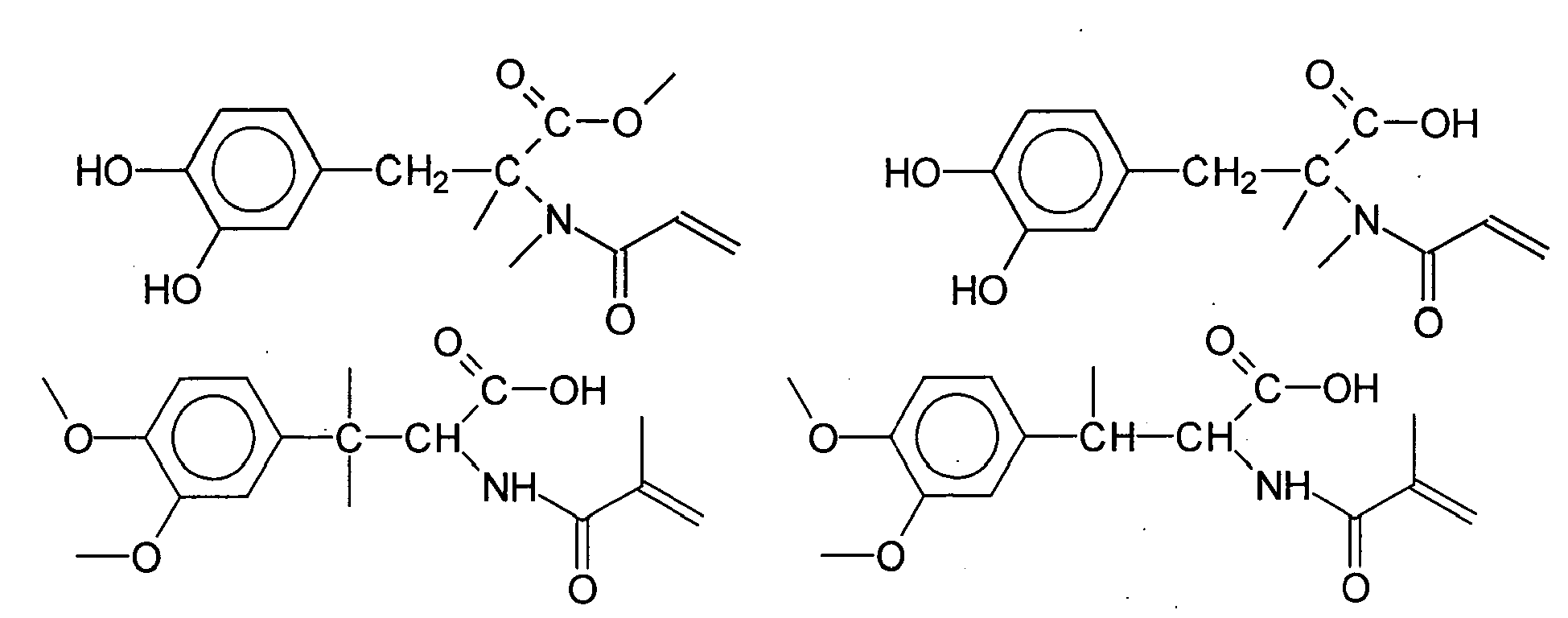


- Die polymerisationsfähigen Dihydroxyphenylalanin-Derivate gemäß Formel I sind gut in organischen Lösungsmitteln wie Aceton, Acetonitril oder Ethylacetat löslich und eignen sich somit besonders als Bestandteil von hydrophoben Kompositmatrices. Sie können daher vorteilhaft mit radikalisch polymerisierbaren Monomeren kombiniert werden.
- Die erfindungsgemässen Dentalmaterialien enthalten als radikalisch polymerisierbare Monomere vorzugsweise mono- und/oder polyfunktionelle (Meth)acrylate. Unter monofunktionellen Monomeren werden Monomere mit einer, unter polyfunktionellen Monomeren Monomere mit mehr als einer radikalisch polymerisierbaren Gruppe verstanden. Bevorzugte Beispiele sind Methyl-, Ethyl-, Hydroxyethyl-, Butyl-, Benzyl-, Tetrahydrofurfuryl- oder Isobornyl(meth)acrylat, Bisphenol-A-di(meth)acrylat, Bis-GMA (ein Additionsprodukt aus Methacrylsäure und Bisphenol-A-diglycidylether), UDMA (ein Additionsprodukt aus 2-Hydroxyethylmethacrylat und 2,2,4-Trimethylhexamethylendiisocyanat), Di-, Tri- oder Tetraethylenglycoldi(meth)acrylat, Trimethylolpropantri(meth)acrylat, Pentaerythrittetra(meth)-acrylat, sowie Glycerindi(meth)acrylat, 1,4-Butandioldi(meth)-acrylat, 1,10-Decandioldi(meth)acrylat und 1,12-Dodecandioldi-(meth)acrylat.
- Als zusätzliche Monomere lassen sich bevorzugt auch hydrolysestabile Verdünner- und/oder Vernetzermonomere einsetzen. Bevorzugte Verdünnermonomere sind hydrolysestabile Mono(meth)acrylate, z.B. Mesitylmethacrylat, oder 2-(Alkoxymethyl)acrylsäuren, z.B. 2-(Ethoxymethyl)acrylsäure, 2-(Hydroxymethyl)acrylsäure, N-mono- oder N-disubstitiuierte Acrylamide, wie z.B. N-Ethylacrylamid, N,N-Dimethacrylamid, N-(2-Hydroxyethyl)acrylamid, N-Methyl-N-(2-hydroxyethyl)acrylamid, oder N-monosubstituierte Methacrylamide, wie z.B. N-Ethylmethacrylamid oder N-(2-Hydroxyethyl)methacrylamid sowie ausserdem N-Vinylpyrrolidon und Allylether.
- Beispiele für bevorzugte hydrolysestabile Vernetzermonomere sind Urethane aus 2-(Hydroxymethyl)acrylsäureestern und Diisocyanaten, wie 2,2,4-Trimethylhexamethylendiisocyanat oder Isophorondiisocyanat, vernetzende Pyrrolidone, wie z.B. 1,6-Bis(3-vinyl-2-pyrrolidonyl)-hexan, oder kommerziell zugängliche Bisacrylamide, wie Methylen- oder Ethylenbisacrylamid, oder Bis(meth)acrylamide, wie z.B. N,N'-Diethyl-1,3-bis(acryl-amido)-propan, 1,3-Bis(methacrylamido)-propan, 1,4-Bis(acryl-amido)-butan oder 1,4-Bis(acryloyl)-piperazin, die durch Umsetzung aus den entsprechenden Diaminen mit (Meth)acrylsäurechlorid synthetisiert werden können.
- Weiterhin lassen sich als zusätzliche Monomere auch bekannte schrumpfungsarme radikalisch ringöffnend polymerisierbare Monomere, wie z.B. mono- oder multifunktionelle Vinylcyclopropane und bicyclische Cyclopropanderivate, vorzugsweise die in
DE 196 16 183 C2 undEP 03 022 855 US 6,043,361 oderUS 6,344,556 beschriebenen. Diese Monomere können vorteilhaft auch in Kombination mit den voranstehend aufgeführten Di(meth)acrylat-Vernetzern verwendet werden. - Bevorzugte ringöffnend polymerisierbare Monomere sind Vinylcyclopropane, insbesondere 1,1-Di(ethoxycarbonyl)- oder 1,1-Di(methoxycarbonyl)-2-vinylcyclopropan oder die Ester der 1-Ethoxycarbonyl- oder 1-Methoxycarbonyl-2-vinylcyclopropancarbonsäure mit Ethylenglycol, 1,1,1-Trimethylolpropan, 1,4-Cyclohexandiol oder Resorcin. Bevorzugte bicyclische Cyclopropanderivate sind 2-(Bicyclo[3.1.0]hex-1-yl)acrylsäuremethyl- oder -ethylester oder deren Disubstitutionsprodukte in 3-Stellung, wie (3,3-Bis(ethoxycarbonyl)bicyclo[3.1.0]hex-1-yl)acrylsäuremethyl- oder -ethylester. Bevorzugte cyclische Allylsulfide sind die Additionprodukte von 2-(Hydroxymethyl)-6-methylen-1,4-dithiepan oder 7-Hydroxy-3-methylen-1,5-dithiacylooctan mit 2,2,4-Trimethylhexamethylen-1,6-diisocyanat oder dem asymmetrischen Trimeren von Hexamethylendiisocyanat (Desmodur® XP2410 der Bayer AG).
- Ausserdem können als zusätzliche Monomere radikalisch polymerisierbare Polysiloxane eingesetzt werden, die aus geeigneten Methacrylsilanen, wie z.B. 3-(Methacryloyloxy)propyltrimethoxysilan, hergestellt werden können. Bevorzugt sind die in der
DE 199 03 177 C2 beschrieben Polysiloxane. - Schliesslich lassen sich als zusätzliche Monomere auch Mischungen der voranstehend genannten Monomeren mit radikalisch polymerisierbaren, säuregruppenhaltigen Monomeren, sogenannten Haftmonomeren, verwenden. Bevorzugte säuregruppenhaltige Monomere sind polymerisationsfähige Carbonsäuren, wie Maleinsäure, Acrylsäure, Methacrylsäure, 2-(Hydroxymethyl)acrylsäure, 4-(Meth)acryloyloxyethyltrimellitsäureanhydrid, 10-Methacryloyloxydecylmalonsäure, N-(2-Hydroxy-3-methacryloyloxypropyl)-N-phenylglycin und 4-Vinylbenzoesäure. Bevorzugt sind weiterhin Phosphonsäuremonomere wie Vinylphosphonsäure, 4-Vinylphenylphosphonsäure, 4-Vinylbenzylphosphonsäure, 2-Methacryloyloxyethylphosphonsäure, 2-Methacrylamidoethylphosphonsäure, 4-Methacrylamido-4-methyl-pentyl-phosphonsäure, 2-[4-(Dihydroxyphosphoryl)-2-öxa-butyl]-acrylsäure oder 2-[4-(Dihydroxyphosphoryl)-2-oxa-butyl]-acrylsäureethyl- oder - 2,4,6-trimethylphenylester. Bevorzugt sind ausserdem acide polymerisationsfähige Phosphorsäureester wie 2-Methacryloyloxypropylmono- oder -dihydrogenphosphat, 2-Methacryloyloxyethylmono- oder -dihydrogenphosphat, 2-Methacryloyloxyethylphenyl-hydrogenphosphat, Dipentaerythritolpentamethacryloyloxyphosphat, 10-Methacryloyloxydecyl-dihydrogenphosphat, Phosphorsäuremono-(1-acryloyl-piperidin-4-yl)-ester, 6-(Methacrylamido)hexyldihydrogenphosphat und 1,3-Bis-(N-acryloyl-N-propyl-amino)-propan-2-yl-dihydrogenphosphat. Weiter bevorzugte säuregruppenhaltige Monomere sind polymerisationsfähige Sulfonsäuren, wie Vinylsulfonsäure, 4-Vinylphenylsulfonsäure oder 3-(Methacrylamido)propylsulfonsäure.
- Die erfindungsgemäßen Dentalwerkstoffe enthalten vorzugsweise keine hydrophilen Monomere, wie beispielsweise Poly(ethylenglyocol)di(meth)acrylate, die zu einer Erhöhung der Wasseraufname der Materialien beitragen und damit deren Verwendbarkeit für dentale Zwecke beeinträchtigen.
- Besonders bevorzugt sind Dentalwerkstoffe, die als zusätzliches radikalisch polymerisierbares Monomer mindestens ein mono- und/oder polyfunktionelles (Meth)acrylat, Bis-GMA, UDMA, Trimethylolpropantrimethacrylat, Glycerindimethacrylat, 1,10-Decandioldimethacrylat, N,N'-Diethyl-1,3-bis(acrylamido)-propan oder eine Mischung davon enthalten.
- Dentalwerkstoffe, die als Komponente (d) mindestens ein weiteres polymerisierbares Monomer enthalten, sind bevorzugt. Besonders bevorzugt sind Werkstoffe, die 5 bis 90 Gew.-% ganz besonders bevorzugt 20 bis 80 Gew.-% ein und/oder mehrere zusätzliche radikalisch polymerisierbare mono- und/oder polyfunktionelle Verdünnner- bzw. Vernetzermonomere enthalten. Weiter bevorzugt sind Werkstoffe, die ausserdem 0 bis 50 Gew.-% ganz besonders bevorzugt 0 bis 30 Gew.-% ein und/oder mehrere radikalisch polymerisierbare, säuregruppenhaltige Monomere enthalten. Besonders bevorzugt sind Werkstoffe, die 5 bis 80 Gew.-% und ganz besonders bevorzugt 20 bis 70 Gew.-% eines oder mehrerer polyfunktioneller Monomere enthalten. Diese Mengenangaben beziehen sich auf die Masse der Monomere in den Werkstoffen.
- Der Dentalwerkstoff kann je nach Art des verwendeten Initiators heiß, kalt oder durch Licht polymerisierbar sein. Zur Initiierung der radikalischen Photopolymerisation werden Benzophenon, Benzoin sowie deren Derivate oder α-Diketone oder deren Derivate, wie 9,10-Phenanthrenchinon, 1-Phenyl-propan-1,2-dion, Diacetyl oder 4,4'-Dichlorbenzil, eingesetzt. Bevorzugt werden Campherchinon und 2,2-Dimethoxy-2-phenyl-acetophenon und besonders bevorzugt α-Diketone in Kombination mit Aminen als Reduktionsmittel, wie z.B. 4-(Dimethylamino)-benzoesäureester, N,N-Dimethylaminoethylmethacrylat, N,N-Dimethyl-sym.-xylidin oder Triethanolamin, verwendet. Besonders geeignet sind auch Norrish-Typ-I-Photoinitiatoren, vor allem Acyl- der Bisacylphosphinoxide, Monoacyltrialkyl- bzw. Diacyldialkylgermanium-Verbindungen, wie z.B. Benzoyltrimethylgermanium, Dibenzoyldiethylgermanium oder Bis(4-methoxybenzoyl)diethylgermanium. Dabei lassen sich auch Mischungen verschiedener Photoinitiatoren einsetzen, wie z.B. Dibenzoyldiethylgermanium in Kombination mit Campherchinon und 4-Dimethylaminobenzoesäureethylester.
- Als Initiatoren für die Heisshärtung eignen sich besonders Benzpinakol und 2,2'-Dialkylbenzpinakole. Als Initiatoren für eine bei Raumtemperatur durchgeführte Polymerisation werden Redox-Initiatorkombinationen, wie z.B. Kombinationen von Benzoylperoxid mit N,N-Dimethyl-sym.-xylidin oder N,N-Dimethyl-p-toluidin, verwendet. Darüber hinaus sind auch Redoxsysteme bestehend aus Peroxiden und solchen Reduktionsmitteln, wie z.B. Ascorbinsäure, Barbituraten oder Sulfinsäuren, besonders geeignet.
- Erfindungsgemäß sind solche Werkstoffe bevorzugt, die einen Photoinitiator, insbesondere einen Photoinitiator auf Basis von Campherchinon/Amin, einem Bisacylphosphinoxid, einer Diacyldialkylgermanium-Verbindung oder eine Mischung davon enthalten.
- Die erfindungsgemäßen Dentalwerkstoffe enthalten vorzugsweise 0,01 bis 10 Gew.-%, bevorzugt 0,1 bis 3,0 Gew.-% an Initiator und ggf. Aktivator.
- Weiterhin enthalten die erfindungsgemäss eingesetzten Zusammensetzungen zur Verbesserung der mechanischen Eigenschaften oder zur Einstellung der Viskosität organische oder anorganische Füllstoffpartikel. Die Füllstoffpartikel weisen vorzugsweise eine mittlere Teilchengröße [bestimmt durch Transmissions- (10-80 nm) oder Rasterelektronenmikroskopie (50 nm bis 5 µm) bzw. Laserbeugung (0,1 bis 100 µm)] von 10 nm bis 50 µm, besonders bevorzugt 10 nm bis 30 µm und ganz besonders bevorzugt 10 nm bis 5 µm auf.
- Bevorzugte anorganische partikuläre Füllstoffe sind amorphe kugelförmige Materialien auf der Basis von Oxiden, wie ZrO2 und TiO2 bzw. Mischoxiden aus SiO2, ZrO2 und/oder TiO2 mit einer mittleren Partikelgröße von 10 nm bis 1 µm, nanopartikuläre oder mikrofeine Füllstoffe, wie pyrogene Kieselsäure oder Fällungskieselsäure mit einer mittleren Partikelgröße von 10 nm bis 500 nm sowie Minifüllstoffe, wie Quarz-, Glaskeramik- oder Glaspulver mit einer mittleren Partikelgrösse von 0,1 bis 5 µm, vorzugsweise 0,2 bis 3 µm und ganz besonders bevorzugt 0,4 bis 1,5 µm, sowie röntgenopake Füllstoffe, wie Ytterbiumtrifluorid oder nanopartikuläres Tantal(V)-oxid bzw. Bariumsulfat mit einer mittleren Partikelgrösse von 10 nm bis 500 nm.
- Die erfindungsgemäßen Dentalmaterialien enthalten vorzugsweise 1 bis 90 Gew.-%, bevorzugt 1 bis 85 Gew.-% und ganz bevorzugt 1 bis 20 Gew.-% oder 20 bis 85 Gew.-% Füllstoff, wobei der Füllstoffgehalt vom gewünschten Verwendungszweck der Werkstoffe abhängt. Dabei tragen die Füllstoffe wesentlich zur Aushärtung der Materialien bei.
- Gegebenenfalls können die erfindungsgemäss eingesetzten Zusammensetzungen weitere Additive enthalten, vor allem Lösungsmittel, wie Aceton, Ethylacetat und Mischungen davon, sowie Stabilisatoren, Aromastoffe, Farbmittel, mikrobiocide Wirkstoffe, fluoridionenabgebende Additive, optische Aufheller, Weichmacher oder UV-Absorber. Die erfindungsgemäßen Dentalwerkstoffe enthalten vorzugsweise kein Wasser, d.h. maximal 0,5 Gew.-% Wasser.
- Gemäß einer weiter bevorzugten Ausführungsform enthalten die erfindungsgemässen Werkstoffe Borsäure, vorzugsweise in einer Mengen von 0 bis 2,0 Moläquivalent bezogen auf die Verbindung gemäss Formel I, besonders bevorzugt 0 bis 1,0 Moläquivalent. Es wurde gefunden, dass Borsäure, insbesondere im Falle von R3 = R4 = H, die inhibierende Wirkung von DOPA-Derivaten auf die radikalische Polymerisation verringert. Daher kann bei der Verwendung von Borsäure auf die Zugabe von Füllstoff verzichtet werden, wobei Werkstoffe, die Füllstoff und Borsäure enthalten, bevorzugt sind.
- Zusammensetzungen, die als Komponente (e) 0 bis 95 Gew.-%, besonders bevorzugt 0 bis 70 Gew.-% und ganz besonders bevorzugt 5 bis 50 Gew.-% nicht-wässeriges Lösungsmittel enthalten sind erfindungsgemäß besonders geeignet.
- Die erfindungsgemäßen Dentalwerkstoffe enthalten vorzugsweise:
- a) 0,05 bis 40 Gew.-%, bevorzugt 1 bis 30 Gew.-% und besonders bevorzugt 1 bis 20 Gew.-% mindestens einer Verbindung gemäß Formel I;
- b) 0,01 bis 10 Gew.-%, bevorzugt 0,1 bis 3,0 Gew.-% an Initiator;
- c) 1 bis 85 Gew.-%, bevorzugt 1 bis 20 Gew.-% (zur Verwendung als Beschichtungsmaterial) oder 20 bis 85 Gew.-% (zur Verwendung als Zement oder Komposit) an Füllstoff;
- d) 0 bis 90 Gew.-%, bevorzugt 0 bis 80 Gew.-% und besonders bevorzugt 5 bis 80 Gew.-% mindestens eines zusätzlichen Monomers;
- e) 0 bis 95 Gew.-%, bevorzugt 0 bis 70 Gew.-% und besonders bevorzugt 5 bis 50 Gew.-% Lösungsmittel enthält.
- Die erfindungsgemäßen Dentalwerkstoffe eignen sich besonders als Zemente, Kompositmaterialien, Füllmaterialien, Adhäsive und als Beschichtungsmaterialien.
- Die Erfindung wird im Folgenden anhand von Beispielen näher erläutert.
- Ein Gemisch aus 19,72 g (0,10 mol) DL-DOPA, 64,56 g (0,40 mol) Hexamethyldisilazan und 4,00 ml Trimethylchlorsilan wurde für 3 h bei 120 °C Badtemperatur gerührt. Flüchtige Bestandteile wurden anschliessend bei 70 °C/20 mbar entfernt. Der Rückstand wurde mit 50 ml Xylol versetzt und erneut eingeengt (70 °C/20 mbar). Die so erhaltene Zwischenstufe wurde in 200 ml Methylenchlorid gelöst, bei -70 °C mit einer Lösung von 0,10 mol Säurechlorid in 20 ml Methylenchlorid versetzt und unter langsamer Erwärmung auf Raumtemperatur 2 d gerührt. Nach dem Einengen im Vakuum (40 °C/600 mbar) wurde der Rückstand mit 500 ml tert-Butanol und 100 ml Wasser versetzt, für 30 min bei Raumtemperatur gerührt, mit Natriumsulfat getrocknet, filtriert und das Lösungsmittel abdestilliert (40 °C/20 mbar). Zur Reinigung wurde das Rohprodukt in 250 ml Ethylacetat 1 h unter Rückfluß erhitzt und von ungelöstem Material abfiltriert. Das klare, gelbe Filtrat wurde vom Lösungsmittel befreit (40 °C/180 mbar) und anschliessend bei 0.1 mbar bis zur Gewichtskonstanz getrocknet.
- Unter Verwendung von Methacrylsäurechlorid wurde MADOPA erhalten. Ausbeute: 14.8 g (56 %), gelblicher Feststoff (Schmp.: 63-65 °C). Reinheit (HPLC): 96.16 %
- 1H-NMR (400 MHz, DMSO-d6) δ = 1.79 (s, 3H, CH3), 2.76-2.92 (m, 2H, CH2), 4.30-4.36 (m, 1H, NCH), 5.31, 5.62 (2 s, je 1H, =CH2), 6.47, 6.58, 6.60-6.61 (dd, J = 8 Hz, 2 Hz, 1H; s, 1H; m, 1H, =CH'), 7.93 (d, J = 8 Hz, 1H, NH), 8.71 (br. s, 2H, OH), 12.5 (br. s, 1H, COOH).
- 13C-NMR (100 MHz, DMSO-d6) : δ = 18.5 (CH3) , 35.7 (CH2) , 54. 1 (NCH), 115.2, 116. 4, 119.8 (=CHAromat ), 119.5 (C=CH2) , 128.7, (=C Aromat ) , 139.4 (C=CH2), 143.7, 144.8 (HO-C=) , 167.5 (CONH), 173.2 (COOH).
- IR (Diamant-ATR): ∨ = 3202 (br, m, N-H, O-H), 2933 (m, CH2, CH3), 1717 (s, C=O Säure ) , 1652 (s, C=O Amid ), 1604 (s, C=C), 1532 (s, N-H), 1444 (s, Aromat), 1422 (s, CH2, CH3) , 1372 (m, CH3) , 1194 (s, C-OH), 1116 (s, C-N), 873 cm-1 (s, =CH-) .
- Unter Verwendung von Acrylsäurechlorid wurde ADOPA erhalten. Ausbeute: 14.8 g (56 %), gelblicher Feststoff (Schmp.: 143-145 °C). Reinheit (HPLC): 95.84 %.
- 1H-NMR (400 MHz, DMSO-d6) : δ = 2.69-2.92 (m, 2H, CH2), 4.39-4.44 (m, 1H, NCH), 5.57-5.60, 6.04-6.08, 6.26-6.32 (3 m, je 1H, HC=CH2), 6.47, 6.61 (d, J = 8 Hz, 1H; s, 2H, =CH Aromat ) , 8.35 (d, J = 8 Hz, 1H, NH), 8.70, 8.74 (2 br. s, je 1H, OH), 12.7 (br. s, 1H, COOH).
- 13C-NMR (100 MHz, DMSO-d6) : δ = 36.2 (CH2), 53.8 (NCH), 115.3, 116.3, 119.7 (=CH Aromat ), 125.6 (HC=CH2), 128.2, (=C Aromat ), 131.3 (HC=CH2), 143.8, 144.9 (HO-C=), 164.4 (CONH), 173.0 (COOH). IR (Diamant-ATR): v = 3300 (br, m, N-H, O-H), 2920 (m, CH2), 1717 (s, C=O Säure ) , 1653 (s, C-O Amid ), 1601 (s, C=C), 1516 (ss, N-H), 1444 (s, Aromat), 1414 (s, CH2) , 1191 (s, C-OH), 1114 (s, C-N), 969 (s, =CH), 871 cm-1 (s, =CH).
- Das Monomer MADOPA (2.0 mol/l) wurde in DMF mit 2,2'-Azobisisobutyronitril (AIBN, 2.0 mol-%) bei 65 °C polymerisiert. Nach 5 h wurde die Polymerisation abgebrochen und das Polymerisat aus der 10-fachen Menge Diethylether ausgefällt, abfiltriert und bis zur Gewichtskonstanz im Feinvakuum bei 50 °C getrocknet. Es wurde ein weisses Polymer in nahezu quantitativer Ausbeute erhalten. Die Polymerstruktur konnte mittels 1H-NMR-Spektroskopie bestätigt werden.
- NMR-Spektroskopische Daten für Poly(MADOPA):

- 1H-NMR (400 MHz, MeOD, δ in ppm) : 0.88 (Ha, Hb, 5H), 2.6-3.1 (Hg, 2H), 4.57 (He, 1H) , 6.75 (Hi, Hj , Hk, 3H) , 8.0 (HNH, 1H)
- 13C-NMR (100 MHz, MeOD, δ in ppm) : 19.4 Cb, 37.9 Cg, 46.8 Cc, 48.9 Ce, 56.2 Ca, 117.7 Cj/k, 122.3 Ci, 129.9 Ch, 145.2 Cl, 146.2 Cm, 175.1 Cf, 178.9 Cd
- Das Monomer ADOPA (0.2 mol/l) und Methylmethacrylat (MMA) (1,8 mol/l) wurden in DMF mit 2,2'-Azobisisobutyronitril (AIBN, 2.0 mol-%) bei 65 °C polymerisiert. Nach 5 h wurde die Polymerisation abgebrochen und das Polymerisat aus der 10-fachen Menge Methanol ausgefällt, abfiltriert und bis zur Gewichtskonstanz im Feinvakuum getrocknet. Es wurde ein weisses Polymer in nahezu quantitativer Ausbeute erhalten. Die Polymerstruktur konnte mittels 1H-NMR-Spektroskopie bestätigt werden. Es ergab sich eine Copolymerstruktur mit 18 mol-% ADOPA-Bausteinen.
- Entsprechend der nachfolgend aufgeführten Tabelle 1 wurden Kompositbefestigungszemente auf der Basis einer Dimethacrylat-Mischung mit dem polymerisierbaren DOPA-Derivat MADOPA (Zement A) und dem monofunktionellen Benzylmethacrylat (Zement B, Vergleichsbeispiel) sowie Bis-(4-methoxybenzoyl)diethylgermanium als Photoinitiator mittels eines Walzenstuhles "Exakt" (Exakt Apparatebau, Norderstedt) hergestellt. Von den Materialien wurden Prüfkörper (Stäbchen mit einer Länge von 25 mm und einem quadratischen Querschnitt von 2 mm x 2 mm) präpariert, die 2 mal 3 Minuten mit einer dentalen Lichtquelle (Spectramat®, Ivoclar Vivadent AG) bestrahlt und ausgehärtet wurden. Nach der ISO-Norm ISO-4049 (Dentistry - Polymer-based filling, restorative and luting materials) erfolgte die Bestimmung der Biegefestigkeit und des Biege-E-Moduls. Die Ergebnisse sind in der Tabelle 2 zusammengefasst.
- Das Beispiel zeigt, dass gefüllte DOPA-monomerhaltige Rezepturen zu Kompositzementen mit guten mechanischen Eigenschaften führen, während analoge nichtgefüllte Harze keine brauchbaren Materialien ergeben.
Tabelle 1: Zusammensetzung der Kompositzemente Komponente Zement A [Gew.-%] Harz A*) [Gew.-%] Zement B*) [Gew.-%] Bis-(4-methoxybenzoyl)diethylgermanium 0.58 1.45 0.58 UDMA1) 27.64 69.10 27.64 Triethylenglycoldimethacrylat 7.81 19.53 7.81 MADOPA (Bsp.1a) 3.90 9.92 - Benzylmethacrylat - - 3.90 pyrogene Kieselsäure2) 41.34 - 41.34 Ytterbiumtrifluorid (Rhone-Poulenc) 18.73 - 18.73 *) Vergleich
1) Additionsprodukt aus 2 mol 2-Hydroxyethylmethacrylat und 1 mol 2,2,4-Trimethylhexamethylendiisocyanat
2) Aerosil OX-50 (Degussa)Tabelle 2: Mechanische Eigenschaften der Kompositzemente Eigenschaft Zement A Harz A*) Zement B*) Biegefestigkeit (MPa) nach 24 h WL1) 114 32 109 E-Modul (MPa) nach 24 h WL1) 5280 600 5200 *) Vergleich
1) WL = Wasserlagerung der Prüfkörper bei 37°C - Unter Verwendung eines Kneters der Firma Linden wurden dentale Komposite mit der in Tabelle 3 angegebenen Zusammensetzung hergestellt. Die Untersuchung der mechanischen Eigenschaften erfolgte analog zu Beispiel 4 und sind in Tabelle 4 zusammengestellt.
Tabelle 3: Zusammensetzung der Komposite Komponente Komposit C [Gew.-%] Komposit D*) [Gew.-%] Bis-(4-methoxybenzoyl)diethylgermanium 0.22 0.22 UDMA1) 6.72 6.72 Triethylenglycoldimethacrylat 1.77 6.72 MADOPA 1.81 - Benzylmethacrylat - 1.81 Ytterbiumtrifluorid (Rhone-Poulenc) 14.89 14.89 Sphärosil, silanisiert (Tokoyama Soda) 2) 14.39 14.39 Glasfüller GM27884 (Schott) 3) 51.61 51.61 Aerosil OX-50 (Degussa) 1.00 1.00 *) Vergleich
1) Additionsprodukt aus 2 mol 2-Hydroxyethylmethacrylat und 1 mol 2,2,4-Trimethylhexamethylendiisocyanat
2) SiO2-ZrO2-Mischoxid (mittlere Primärpartikelgrösse: 250 nm)
3) Silanisierter Ba-Al-Borosilikatglasfüller mit einer mittleren Partikelgrösse von 1,5 µmTabelle 4: Mechanische Eigenschaften der Komposite Eigenschaft Komposit C Komposit D*) Biegefestigkeit (MPa) nach 24 h WL1) 158 195 E-Modul (MPa) nach 24 h WL1) 1500 16200 *) Vergleich
1) WL = Wasserlagerung der Prüfkörper bei 37°C
Claims (11)
- Polymerisierbarer Dentalwerkstoff der,a) mindestens eine radikalisch polymerisierbare Verbindung gemäß der allgemeinen Formeln I
 R1 R2 unabhängig voneinander jeweils H oder ein C1-C8-Alkyl-Rest sind,R3, R4, R5 unabhängig voneinander jeweils H oder ein C1-C4-Alkyl- Rest sind,R6 H, ein linearer oder verzweigter C1-C10-Alkylrest oder ein C1-C10-Alkanoylrest ist,R7 ein linearer oder verzweigter C1-C15-Alkylenrest ist oder entfällt, wobei die Kette der Kohlen- stoffatome des Alkylrests durch O- oder S-Atome unterbrochen sein kann, vorzugsweise entfällt oder ein linearer oder verzweigter C1-C15- Alkylenrest,X, Y unabhängig voneinander jeweils O oder NR8 sind oder entfallen,
wobei R7 nur dann entfallen kann, wenn auch X und/oder Y entfällt, und
wobei R7, X und Y nur dann gleichzeitig entfallen können, wenn PG1 = H ist,R8 H oder ein C1-C10-Alkyl-Rest ist,PG1, PG2 unabhängig voneinander jeweils H oder eine polymerisationsfähige Gruppe, insbesondere eine Vinyl-, Allyl-, (Meth)acryl-Gruppe sind, wobei die beiden Reste PG1 und PG2 nicht gleichzeitig H sein können;b) Initiator für die radikalische Polymersisation; undc) Füllstoff enthält. - Dentalwerkstoff nach Anspruch 1, der zusätzlichd) weiteres polymerisierbares Monomer enthält und/odere) Lösungsmittel enthält.
- Dentalwerkstoff nach einem der vorhergehenden Ansprüche, dera) 0,05 bis 40 Ges.-%, bevorzugt 1 bis 30 Gew.-% und besonders bevorzugt 1 bis 20 Gew.-% mindestens einer Verbindung gemäß Formel I;b) 0,01 bis 10 Gew.-%, bevorzugt 0,1 bis 3,0 Gew.-% an Initiator;c) 1 bis 85 Gew.-%, bevorzugt 1 bis 20 Gew.-% (Beschichtungsmaterial) oder 20 bis 85 Gew.-% (Zement, Komposit) an Füllstoff;d) 0 bis 90 Gew.-%, bevorzugt 0 bis 80 Gew.-% und besonders bevorzugt 5 bis 80 Gew.-% mindestens eines zusätzlichen Monomers;e) 0 bis 95 Gew.-%, bevorzugt 0 bis 70 Gew.-% und besonders bevorzugt 5 bis 50 Gew.-% Lösungsmittel enthält.
- Dentalwerkstoff nach einem der vorhergehenden Ansprüche, in dem die Variablen der Formel I die folgenden Bedeutungen haben:R1, R2 unabhängig voneinander jeweils H oder ein C1-C3- Alkyl-Rest, vorzugsweise H sind,R3 R4 unabhängig voneinander jeweils H oder Methyl, vorzugsweise H sind,R5 H oder ein C1-C3-Alkyl-Rest, vorzugsweise H ist,R6 H, ein linearer oder verzweigter C1-C2-Alkylrest oder C2- Alkanoylrest ist,R7 ein linearer C1-C4-Alkylenrest ist oder ent- fällt, wobei die Kette der Kohlenstoffatome des Alkylrests durch O-Atome unterbrochen sein kann, vorzugsweise ein linearer C1-C4-Alkylenrest,X, Y unabhängig voneinander jeweils O oder NR8 sind oder entfallen,R8 H oder C1-C2-Alkyl-Rest ist,PG1, PG2 unabhängig voneinander jeweils H oder eine (Meth)acryl-Gruppe darstellen, wobei beide Reste nicht gleichzeitig H sein können.
- Dentalwerkstoff nach einem der vorhergehenden Ansprüche, der als zusätzliches radikalisch polymerisierbares Monomer mindestens ein mono- und/oder polyfunktionelles (Meth)acrylat, Bis-GMA, UDMA, Trimethylolpropantrimethacrylat, Glycerindimethacrylat, 1,10-Decandioldimethacrylat, N,N'-Diethyl-1,3-bis(acrylamido)-propan oder eine Mischung davon enthält.
- Dentalwerkstoff nach einem der vorhergehenden Ansprüche, der frei von hydrophilen Monomeren ist.
- Dentalwerkstoff nach einem der vorhergehenden Ansprüche, der Füllstoff mit einer mittlere Teilchengröße von 10 nm bis 50 µm, bevorzugt 10 nm bis 30 µm und besonders bevorzugt 10 nm bis 5 µm enthält.
- Dentalwerkstoff nach einem der vorhergehenden Ansprüche, der als Füllstoff amorphe kugelförmige Materialien auf der Basis von Oxiden oder Mischoxiden mit einer mittleren Partikelgröße von 10 nm bis 1 µm, und/oder nanopartikuläre oder mikrofeine Füllstoffe mit einer mittleren Partikelgröße von 10 nm bis 500 nm, und/oder Minifüllstoffe mit einer mitlleren Partikelgrösse von 0,1 bis 5 µm, und/oder röntgenopake Füllstoffe mit einer mittleren Partikelgrösse von 10 nm bis 500 nm enthält.
- Dentalwerkstoff nach einem der vorhergehenden Ansprüche, der maximal 0,5 Gew.-% Wasser enthält.
- Dentalwerkstoff nach einem der vorhergehenden Ansprüche, der Borsäure enthält, vorzugsweise in einer Mengen von 0 bis 2,0 Moläquivalent bezogen auf die Verbindung gemäss Formel I, besonders bevorzugt 0 bis 1,0 Moläquivalent.
- Verwendung eines Dentalwerkstoffs gemäß einem der vorhergehenden Ansprüche zur Herstellung eines Zements, Kompositmaterials, Füllmaterials, Adhäsivs oder Beschichtungsmaterials.
Priority Applications (3)
| Application Number | Priority Date | Filing Date | Title |
|---|---|---|---|
| EP09014467.6A EP2324810B1 (de) | 2009-11-19 | 2009-11-19 | Gefüllter Dentalwerkstoff auf der Basis von polymerisationsfähigen Dihydroxyphenylalanin-Derivaten |
| US12/889,481 US8404760B2 (en) | 2009-11-19 | 2010-09-24 | Filled dental material based on polymerizable dihydroxy-phenylalanine derivatives |
| JP2010257343A JP5711506B2 (ja) | 2009-11-19 | 2010-11-17 | 重合性ジヒドロキシフェニルアラニン誘導体ベースの、充填材を含有する歯科材料 |
Applications Claiming Priority (1)
| Application Number | Priority Date | Filing Date | Title |
|---|---|---|---|
| EP09014467.6A EP2324810B1 (de) | 2009-11-19 | 2009-11-19 | Gefüllter Dentalwerkstoff auf der Basis von polymerisationsfähigen Dihydroxyphenylalanin-Derivaten |
Publications (2)
| Publication Number | Publication Date |
|---|---|
| EP2324810A1 true EP2324810A1 (de) | 2011-05-25 |
| EP2324810B1 EP2324810B1 (de) | 2014-10-29 |
Family
ID=41395582
Family Applications (1)
| Application Number | Title | Priority Date | Filing Date |
|---|---|---|---|
| EP09014467.6A Active EP2324810B1 (de) | 2009-11-19 | 2009-11-19 | Gefüllter Dentalwerkstoff auf der Basis von polymerisationsfähigen Dihydroxyphenylalanin-Derivaten |
Country Status (3)
| Country | Link |
|---|---|
| US (1) | US8404760B2 (de) |
| EP (1) | EP2324810B1 (de) |
| JP (1) | JP5711506B2 (de) |
Families Citing this family (5)
| Publication number | Priority date | Publication date | Assignee | Title |
|---|---|---|---|---|
| ES2711759T3 (es) * | 2012-04-11 | 2019-05-07 | Ivoclar Vivadent Ag | Composiciones polimerizables con profundidad de polimerización elevada |
| CN110885454B (zh) * | 2018-09-11 | 2021-10-08 | 天津大学 | 基于丙烯酰基丙氨酰胺和羟乙基丙烯酰胺的超分子水凝胶及其制备方法 |
| EP3895681A4 (de) | 2019-01-21 | 2022-01-26 | Mitsui Chemicals, Inc. | Fotopolymerisationsinitiator, fotohärtbare zusammensetzung, gehärtetes produkt und dentalmaterial |
| CN111423529B (zh) * | 2020-03-28 | 2022-05-17 | 海南师范大学 | 基于氨基酸衍生物的自由基光聚合引发体系及其引发自由基光聚合的方法 |
| JPWO2024014437A1 (de) | 2022-07-12 | 2024-01-18 |
Citations (9)
| Publication number | Priority date | Publication date | Assignee | Title |
|---|---|---|---|---|
| DE2658941A1 (de) | 1976-12-24 | 1978-07-06 | Basf Ag | Verfahren zur herstellung von optisch aktiven alpha-methyl-aryl- alaninen |
| DE19643007A1 (de) | 1996-10-18 | 1998-04-23 | Martin Dr Schaerfe | Haftvermittler oder Klebstoff mit Aminosäureanteil |
| DE19616183C2 (de) | 1996-03-20 | 1999-05-12 | Ivoclar Ag | Funktionalisiertes und polymerisierbares Polymer |
| US6043361A (en) | 1994-12-22 | 2000-03-28 | Commonwealth Scientific And Industrial Research Organisation | Polymerisable monomers and polymers |
| DE19903177C2 (de) | 1999-01-21 | 2001-07-26 | Ivoclar Ag Schaan | Dentalmaterialien auf der Basis von Polysiloxanen |
| DE10082749T1 (de) | 1999-08-04 | 2001-11-22 | Fundacao Oswaldo Cruz | Kontrollierte Freisetzung aus Copolymeren von Acryl- oder Methacrylsäure/L-Dopa, Acryl- oder Methacrylsäure/L-a-Methyldopa, Acryl- oder Methacrylsäure/Carbidopa und deren Kombinationen |
| WO2005118831A2 (en) * | 2004-02-27 | 2005-12-15 | Northwestern University | Polymeric compositions and related methods of use |
| US20060009550A1 (en) | 2001-07-20 | 2006-01-12 | Messersmith Phillip B | Polymeric compositions and related methods of use |
| WO2006045034A1 (en) | 2004-10-20 | 2006-04-27 | Pentron Clinical Technologies, Llc | Dental self-etching composition and method of use |
Family Cites Families (3)
| Publication number | Priority date | Publication date | Assignee | Title |
|---|---|---|---|---|
| US6710149B2 (en) * | 2000-04-17 | 2004-03-23 | Ivoclar Vivadent Ag | Hydrolysis-stable and polymerizable acrylophosphonic acid |
| DE10249324A1 (de) * | 2002-10-22 | 2004-06-24 | Ivoclar Vivadent Ag | Polymerisationsfähige bicyclische Cyclopropanderivate und deren Verwendung zur Herstellung von Dentalmaterialien |
| DE102005059058A1 (de) * | 2005-12-08 | 2007-06-14 | Beiersdorf Ag | Acrylatklebemasse mit wasserfesten Klebeeigenschaften |
-
2009
- 2009-11-19 EP EP09014467.6A patent/EP2324810B1/de active Active
-
2010
- 2010-09-24 US US12/889,481 patent/US8404760B2/en active Active
- 2010-11-17 JP JP2010257343A patent/JP5711506B2/ja active Active
Patent Citations (10)
| Publication number | Priority date | Publication date | Assignee | Title |
|---|---|---|---|---|
| DE2658941A1 (de) | 1976-12-24 | 1978-07-06 | Basf Ag | Verfahren zur herstellung von optisch aktiven alpha-methyl-aryl- alaninen |
| US6043361A (en) | 1994-12-22 | 2000-03-28 | Commonwealth Scientific And Industrial Research Organisation | Polymerisable monomers and polymers |
| US6344556B1 (en) | 1994-12-22 | 2002-02-05 | Commonwealth Scientific And Industrial Research Organisation | Polymerisable monomers and polymers |
| DE19616183C2 (de) | 1996-03-20 | 1999-05-12 | Ivoclar Ag | Funktionalisiertes und polymerisierbares Polymer |
| DE19643007A1 (de) | 1996-10-18 | 1998-04-23 | Martin Dr Schaerfe | Haftvermittler oder Klebstoff mit Aminosäureanteil |
| DE19903177C2 (de) | 1999-01-21 | 2001-07-26 | Ivoclar Ag Schaan | Dentalmaterialien auf der Basis von Polysiloxanen |
| DE10082749T1 (de) | 1999-08-04 | 2001-11-22 | Fundacao Oswaldo Cruz | Kontrollierte Freisetzung aus Copolymeren von Acryl- oder Methacrylsäure/L-Dopa, Acryl- oder Methacrylsäure/L-a-Methyldopa, Acryl- oder Methacrylsäure/Carbidopa und deren Kombinationen |
| US20060009550A1 (en) | 2001-07-20 | 2006-01-12 | Messersmith Phillip B | Polymeric compositions and related methods of use |
| WO2005118831A2 (en) * | 2004-02-27 | 2005-12-15 | Northwestern University | Polymeric compositions and related methods of use |
| WO2006045034A1 (en) | 2004-10-20 | 2006-04-27 | Pentron Clinical Technologies, Llc | Dental self-etching composition and method of use |
Non-Patent Citations (6)
| Title |
|---|
| A. SUAREZ; F. LOPEZ; R. S. COMPAGNONE, SYNTH. COMMUN., vol. 23, 1993, pages 1991 |
| LEE ET AL., J. BIOMATER. SCI. POLYMER EDN., vol. 15, 2004, pages 449 - 464 |
| T. KOLASA; M. J. MILLER: "Gegenwart von KI analog", J. ORG. CHEM., vol. 55, 1990, pages 4246 |
| T. OOI; M. KAMEDA; K. MARUOKA, J. AMER. CHEM. SOC., vol. 125, 2003, pages 5139 |
| T. W. GREENE: "Protective Groups in Organic Synthesis", 1980, J. WILEY&SONS |
| U. HACKSELL; T. HÖGBERG: "Protective Groups in Organic Synthesis", ACTA PHARM. SUEC., vol. 23, 1986, pages 323 - 369 |
Also Published As
| Publication number | Publication date |
|---|---|
| US20110118380A1 (en) | 2011-05-19 |
| JP5711506B2 (ja) | 2015-04-30 |
| EP2324810B1 (de) | 2014-10-29 |
| US8404760B2 (en) | 2013-03-26 |
| JP2011105722A (ja) | 2011-06-02 |
Similar Documents
| Publication | Publication Date | Title |
|---|---|---|
| EP3150641B1 (de) | Acylgermanium-photoinitiatoren und verfahren zu deren herstellung | |
| EP2823801B1 (de) | Dentalmaterialien auf der Basis von harnstoffgruppenhaltigen Monomeren | |
| EP1222910B1 (de) | Dentalmaterialien auf der Basis polyfunktioneller Amide | |
| EP1970042B1 (de) | Verwendung von polymerisierbaren Calix[n]arenen als Dentalmaterialien | |
| EP1674066B1 (de) | Selbstätzende Dentalmaterialien auf Basis von (Meth)acrylamidophosphaten | |
| EP1849450B1 (de) | Dentalwerkstoffe auf der Basis radikalisch polymerisierbarer Makromere mit antimikrobieller Wirkung | |
| EP3166568B1 (de) | Dentalmaterialien mit debonding-on-demand eigenschaften | |
| EP2753290A2 (de) | Dentalmaterialien auf basis von monomeren mit debonding-on-demand eigenschaften | |
| EP4039220B1 (de) | Dentalmaterialien auf der basis von polymerisationsfähigen thioharnstoff-derivaten | |
| EP2324810B1 (de) | Gefüllter Dentalwerkstoff auf der Basis von polymerisationsfähigen Dihydroxyphenylalanin-Derivaten | |
| US11401287B2 (en) | Long-wave absorbing photoinitiators | |
| EP3064192B1 (de) | Dentalmaterialien auf der Basis von Hybridmonomeren | |
| EP1340483B1 (de) | Dentalmaterialien auf der Basis von (Meth)acrylatsubstuierten Iminooxadiazindion-Derivaten | |
| EP2289483B1 (de) | Verwendung von polymerisierbaren makrocyclischen Polyethern und makrocyclischen heteroanalogen Polyethern in Dentalmaterialien | |
| DE102016214389B4 (de) | Dentalmaterialien auf der Basis von monofunktionellen Vinylcyclopropan-Derivaten | |
| EP2404916B1 (de) | Dentalmaterialien auf der Basis von Dimersäure-Derivaten mit ringöffnend polymerisierbaren Gruppen | |
| EP2065363B1 (de) | Dentalmaterialien auf der Basis von Alkylendiamin-N,N,N',N'-tetraessigsäure-(meth)acrylamiden | |
| EP1825843B1 (de) | Dentalmaterialien auf der Basis von multicyclischen Allylsulfiden | |
| EP3278786B1 (de) | Dentalmaterialien auf der basis von urethangruppenhaltigen vinylcyclopropan-derivaten | |
| DE102008006717B4 (de) | Polymerisierbare Phosphonsäurederivate und Klebstoffzusammensetzungen enthaltend dieselben | |
| EP2578201B1 (de) | Dentalmaterialien mit verbesserter Hydrolysestabilität auf der Basis von Phthalsäuremonomeren | |
| EP1864642B1 (de) | Dentalmaterialien auf der Basis von ringöffnend polymerisierbaren, aciden Monomeren | |
| EP2489344A1 (de) | Dentalwerkstoff auf der Basis einer antimikrobiell wirksamen Verbindung | |
| EP2883528B1 (de) | Dentalwerkstoffe auf Basis von polymerisierbaren Aziden und Alkinen |
Legal Events
| Date | Code | Title | Description |
|---|---|---|---|
| PUAI | Public reference made under article 153(3) epc to a published international application that has entered the european phase |
Free format text: ORIGINAL CODE: 0009012 |
|
| AK | Designated contracting states |
Kind code of ref document: A1 Designated state(s): AT BE BG CH CY CZ DE DK EE ES FI FR GB GR HR HU IE IS IT LI LT LU LV MC MK MT NL NO PL PT RO SE SI SK SM TR |
|
| AX | Request for extension of the european patent |
Extension state: AL BA RS |
|
| 17P | Request for examination filed |
Effective date: 20111124 |
|
| 17Q | First examination report despatched |
Effective date: 20130415 |
|
| GRAP | Despatch of communication of intention to grant a patent |
Free format text: ORIGINAL CODE: EPIDOSNIGR1 |
|
| INTG | Intention to grant announced |
Effective date: 20140606 |
|
| GRAS | Grant fee paid |
Free format text: ORIGINAL CODE: EPIDOSNIGR3 |
|
| GRAA | (expected) grant |
Free format text: ORIGINAL CODE: 0009210 |
|
| AK | Designated contracting states |
Kind code of ref document: B1 Designated state(s): AT BE BG CH CY CZ DE DK EE ES FI FR GB GR HR HU IE IS IT LI LT LU LV MC MK MT NL NO PL PT RO SE SI SK SM TR |
|
| REG | Reference to a national code |
Ref country code: GB Ref legal event code: FG4D Free format text: NOT ENGLISH |
|
| REG | Reference to a national code |
Ref country code: CH Ref legal event code: EP |
|
| REG | Reference to a national code |
Ref country code: CH Ref legal event code: NV Representative=s name: KELLER AND PARTNER PATENTANWAELTE AG, CH |
|
| REG | Reference to a national code |
Ref country code: AT Ref legal event code: REF Ref document number: 693202 Country of ref document: AT Kind code of ref document: T Effective date: 20141115 |
|
| REG | Reference to a national code |
Ref country code: IE Ref legal event code: FG4D Free format text: LANGUAGE OF EP DOCUMENT: GERMAN |
|
| REG | Reference to a national code |
Ref country code: DE Ref legal event code: R096 Ref document number: 502009010143 Country of ref document: DE Effective date: 20141211 |
|
| REG | Reference to a national code |
Ref country code: NL Ref legal event code: VDEP Effective date: 20141029 |
|
| REG | Reference to a national code |
Ref country code: LT Ref legal event code: MG4D |
|
| REG | Reference to a national code |
Ref country code: CH Ref legal event code: PCAR Free format text: NEW ADDRESS: EIGERSTRASSE 2 POSTFACH, 3000 BERN 14 (CH) |
|
| PG25 | Lapsed in a contracting state [announced via postgrant information from national office to epo] |
Ref country code: PT Free format text: LAPSE BECAUSE OF FAILURE TO SUBMIT A TRANSLATION OF THE DESCRIPTION OR TO PAY THE FEE WITHIN THE PRESCRIBED TIME-LIMIT Effective date: 20150302 Ref country code: LT Free format text: LAPSE BECAUSE OF FAILURE TO SUBMIT A TRANSLATION OF THE DESCRIPTION OR TO PAY THE FEE WITHIN THE PRESCRIBED TIME-LIMIT Effective date: 20141029 Ref country code: ES Free format text: LAPSE BECAUSE OF FAILURE TO SUBMIT A TRANSLATION OF THE DESCRIPTION OR TO PAY THE FEE WITHIN THE PRESCRIBED TIME-LIMIT Effective date: 20141029 Ref country code: FI Free format text: LAPSE BECAUSE OF FAILURE TO SUBMIT A TRANSLATION OF THE DESCRIPTION OR TO PAY THE FEE WITHIN THE PRESCRIBED TIME-LIMIT Effective date: 20141029 Ref country code: NO Free format text: LAPSE BECAUSE OF FAILURE TO SUBMIT A TRANSLATION OF THE DESCRIPTION OR TO PAY THE FEE WITHIN THE PRESCRIBED TIME-LIMIT Effective date: 20150129 Ref country code: IS Free format text: LAPSE BECAUSE OF FAILURE TO SUBMIT A TRANSLATION OF THE DESCRIPTION OR TO PAY THE FEE WITHIN THE PRESCRIBED TIME-LIMIT Effective date: 20150228 Ref country code: NL Free format text: LAPSE BECAUSE OF FAILURE TO SUBMIT A TRANSLATION OF THE DESCRIPTION OR TO PAY THE FEE WITHIN THE PRESCRIBED TIME-LIMIT Effective date: 20141029 |
|
| PG25 | Lapsed in a contracting state [announced via postgrant information from national office to epo] |
Ref country code: HR Free format text: LAPSE BECAUSE OF FAILURE TO SUBMIT A TRANSLATION OF THE DESCRIPTION OR TO PAY THE FEE WITHIN THE PRESCRIBED TIME-LIMIT Effective date: 20141029 Ref country code: SE Free format text: LAPSE BECAUSE OF FAILURE TO SUBMIT A TRANSLATION OF THE DESCRIPTION OR TO PAY THE FEE WITHIN THE PRESCRIBED TIME-LIMIT Effective date: 20141029 Ref country code: LV Free format text: LAPSE BECAUSE OF FAILURE TO SUBMIT A TRANSLATION OF THE DESCRIPTION OR TO PAY THE FEE WITHIN THE PRESCRIBED TIME-LIMIT Effective date: 20141029 Ref country code: GR Free format text: LAPSE BECAUSE OF FAILURE TO SUBMIT A TRANSLATION OF THE DESCRIPTION OR TO PAY THE FEE WITHIN THE PRESCRIBED TIME-LIMIT Effective date: 20150130 Ref country code: PL Free format text: LAPSE BECAUSE OF FAILURE TO SUBMIT A TRANSLATION OF THE DESCRIPTION OR TO PAY THE FEE WITHIN THE PRESCRIBED TIME-LIMIT Effective date: 20141029 Ref country code: CY Free format text: LAPSE BECAUSE OF FAILURE TO SUBMIT A TRANSLATION OF THE DESCRIPTION OR TO PAY THE FEE WITHIN THE PRESCRIBED TIME-LIMIT Effective date: 20141029 |
|
| PG25 | Lapsed in a contracting state [announced via postgrant information from national office to epo] |
Ref country code: BE Free format text: LAPSE BECAUSE OF NON-PAYMENT OF DUE FEES Effective date: 20141130 |
|
| REG | Reference to a national code |
Ref country code: DE Ref legal event code: R097 Ref document number: 502009010143 Country of ref document: DE |
|
| PG25 | Lapsed in a contracting state [announced via postgrant information from national office to epo] |
Ref country code: DK Free format text: LAPSE BECAUSE OF FAILURE TO SUBMIT A TRANSLATION OF THE DESCRIPTION OR TO PAY THE FEE WITHIN THE PRESCRIBED TIME-LIMIT Effective date: 20141029 Ref country code: CZ Free format text: LAPSE BECAUSE OF FAILURE TO SUBMIT A TRANSLATION OF THE DESCRIPTION OR TO PAY THE FEE WITHIN THE PRESCRIBED TIME-LIMIT Effective date: 20141029 Ref country code: EE Free format text: LAPSE BECAUSE OF FAILURE TO SUBMIT A TRANSLATION OF THE DESCRIPTION OR TO PAY THE FEE WITHIN THE PRESCRIBED TIME-LIMIT Effective date: 20141029 Ref country code: RO Free format text: LAPSE BECAUSE OF FAILURE TO SUBMIT A TRANSLATION OF THE DESCRIPTION OR TO PAY THE FEE WITHIN THE PRESCRIBED TIME-LIMIT Effective date: 20141029 Ref country code: SK Free format text: LAPSE BECAUSE OF FAILURE TO SUBMIT A TRANSLATION OF THE DESCRIPTION OR TO PAY THE FEE WITHIN THE PRESCRIBED TIME-LIMIT Effective date: 20141029 Ref country code: MC Free format text: LAPSE BECAUSE OF FAILURE TO SUBMIT A TRANSLATION OF THE DESCRIPTION OR TO PAY THE FEE WITHIN THE PRESCRIBED TIME-LIMIT Effective date: 20141029 |
|
| REG | Reference to a national code |
Ref country code: IE Ref legal event code: MM4A |
|
| PG25 | Lapsed in a contracting state [announced via postgrant information from national office to epo] |
Ref country code: IT Free format text: LAPSE BECAUSE OF FAILURE TO SUBMIT A TRANSLATION OF THE DESCRIPTION OR TO PAY THE FEE WITHIN THE PRESCRIBED TIME-LIMIT Effective date: 20141029 |
|
| PLBE | No opposition filed within time limit |
Free format text: ORIGINAL CODE: 0009261 |
|
| STAA | Information on the status of an ep patent application or granted ep patent |
Free format text: STATUS: NO OPPOSITION FILED WITHIN TIME LIMIT |
|
| 26N | No opposition filed |
Effective date: 20150730 |
|
| PG25 | Lapsed in a contracting state [announced via postgrant information from national office to epo] |
Ref country code: IE Free format text: LAPSE BECAUSE OF NON-PAYMENT OF DUE FEES Effective date: 20141119 |
|
| REG | Reference to a national code |
Ref country code: FR Ref legal event code: PLFP Year of fee payment: 7 |
|
| REG | Reference to a national code |
Ref country code: AT Ref legal event code: MM01 Ref document number: 693202 Country of ref document: AT Kind code of ref document: T Effective date: 20141119 |
|
| PG25 | Lapsed in a contracting state [announced via postgrant information from national office to epo] |
Ref country code: SI Free format text: LAPSE BECAUSE OF FAILURE TO SUBMIT A TRANSLATION OF THE DESCRIPTION OR TO PAY THE FEE WITHIN THE PRESCRIBED TIME-LIMIT Effective date: 20141029 Ref country code: AT Free format text: LAPSE BECAUSE OF NON-PAYMENT OF DUE FEES Effective date: 20141119 |
|
| PG25 | Lapsed in a contracting state [announced via postgrant information from national office to epo] |
Ref country code: SM Free format text: LAPSE BECAUSE OF FAILURE TO SUBMIT A TRANSLATION OF THE DESCRIPTION OR TO PAY THE FEE WITHIN THE PRESCRIBED TIME-LIMIT Effective date: 20141029 |
|
| PG25 | Lapsed in a contracting state [announced via postgrant information from national office to epo] |
Ref country code: BG Free format text: LAPSE BECAUSE OF FAILURE TO SUBMIT A TRANSLATION OF THE DESCRIPTION OR TO PAY THE FEE WITHIN THE PRESCRIBED TIME-LIMIT Effective date: 20141029 |
|
| PG25 | Lapsed in a contracting state [announced via postgrant information from national office to epo] |
Ref country code: HU Free format text: LAPSE BECAUSE OF FAILURE TO SUBMIT A TRANSLATION OF THE DESCRIPTION OR TO PAY THE FEE WITHIN THE PRESCRIBED TIME-LIMIT; INVALID AB INITIO Effective date: 20091119 Ref country code: TR Free format text: LAPSE BECAUSE OF FAILURE TO SUBMIT A TRANSLATION OF THE DESCRIPTION OR TO PAY THE FEE WITHIN THE PRESCRIBED TIME-LIMIT Effective date: 20141029 Ref country code: LU Free format text: LAPSE BECAUSE OF NON-PAYMENT OF DUE FEES Effective date: 20141119 Ref country code: MT Free format text: LAPSE BECAUSE OF FAILURE TO SUBMIT A TRANSLATION OF THE DESCRIPTION OR TO PAY THE FEE WITHIN THE PRESCRIBED TIME-LIMIT Effective date: 20141029 |
|
| REG | Reference to a national code |
Ref country code: FR Ref legal event code: PLFP Year of fee payment: 8 |
|
| REG | Reference to a national code |
Ref country code: FR Ref legal event code: PLFP Year of fee payment: 9 |
|
| PG25 | Lapsed in a contracting state [announced via postgrant information from national office to epo] |
Ref country code: MK Free format text: LAPSE BECAUSE OF FAILURE TO SUBMIT A TRANSLATION OF THE DESCRIPTION OR TO PAY THE FEE WITHIN THE PRESCRIBED TIME-LIMIT Effective date: 20141029 |
|
| REG | Reference to a national code |
Ref country code: FR Ref legal event code: PLFP Year of fee payment: 10 |
|
| REG | Reference to a national code |
Ref country code: DE Ref legal event code: R079 Ref document number: 502009010143 Country of ref document: DE Free format text: PREVIOUS MAIN CLASS: A61K0006083000 Ipc: A61K0006887000 |
|
| REG | Reference to a national code |
Ref country code: CH Ref legal event code: PFA Owner name: IVOCLAR VIVADENT AG, LI Free format text: FORMER OWNER: IVOCLAR VIVADENT AG, LI |
|
| P01 | Opt-out of the competence of the unified patent court (upc) registered |
Effective date: 20230607 |
|
| PGFP | Annual fee paid to national office [announced via postgrant information from national office to epo] |
Ref country code: DE Payment date: 20241121 Year of fee payment: 16 |
|
| PGFP | Annual fee paid to national office [announced via postgrant information from national office to epo] |
Ref country code: GB Payment date: 20241125 Year of fee payment: 16 |
|
| PGFP | Annual fee paid to national office [announced via postgrant information from national office to epo] |
Ref country code: FR Payment date: 20241126 Year of fee payment: 16 |
|
| PGFP | Annual fee paid to national office [announced via postgrant information from national office to epo] |
Ref country code: CH Payment date: 20241201 Year of fee payment: 16 |