EP2321371B1 - Verfahren zur herstellung von formaldehydfreien formprodukten und verwandten teilen - Google Patents
Verfahren zur herstellung von formaldehydfreien formprodukten und verwandten teilen Download PDFInfo
- Publication number
- EP2321371B1 EP2321371B1 EP08794185.2A EP08794185A EP2321371B1 EP 2321371 B1 EP2321371 B1 EP 2321371B1 EP 08794185 A EP08794185 A EP 08794185A EP 2321371 B1 EP2321371 B1 EP 2321371B1
- Authority
- EP
- European Patent Office
- Prior art keywords
- moldable mixture
- mold
- weight
- molding
- mixture
- Prior art date
- Legal status (The legal status is an assumption and is not a legal conclusion. Google has not performed a legal analysis and makes no representation as to the accuracy of the status listed.)
- Active
Links
Images



Classifications
-
- C—CHEMISTRY; METALLURGY
- C08—ORGANIC MACROMOLECULAR COMPOUNDS; THEIR PREPARATION OR CHEMICAL WORKING-UP; COMPOSITIONS BASED THEREON
- C08L—COMPOSITIONS OF MACROMOLECULAR COMPOUNDS
- C08L97/00—Compositions of lignin-containing materials
- C08L97/02—Lignocellulosic material, e.g. wood, straw or bagasse
-
- B—PERFORMING OPERATIONS; TRANSPORTING
- B27—WORKING OR PRESERVING WOOD OR SIMILAR MATERIAL; NAILING OR STAPLING MACHINES IN GENERAL
- B27N—MANUFACTURE BY DRY PROCESSES OF ARTICLES, WITH OR WITHOUT ORGANIC BINDING AGENTS, MADE FROM PARTICLES OR FIBRES CONSISTING OF WOOD OR OTHER LIGNOCELLULOSIC OR LIKE ORGANIC MATERIAL
- B27N1/00—Pretreatment of moulding material
- B27N1/003—Pretreatment of moulding material for reducing formaldehyde gas emission
-
- B—PERFORMING OPERATIONS; TRANSPORTING
- B27—WORKING OR PRESERVING WOOD OR SIMILAR MATERIAL; NAILING OR STAPLING MACHINES IN GENERAL
- B27N—MANUFACTURE BY DRY PROCESSES OF ARTICLES, WITH OR WITHOUT ORGANIC BINDING AGENTS, MADE FROM PARTICLES OR FIBRES CONSISTING OF WOOD OR OTHER LIGNOCELLULOSIC OR LIKE ORGANIC MATERIAL
- B27N3/00—Manufacture of substantially flat articles, e.g. boards, from particles or fibres
- B27N3/04—Manufacture of substantially flat articles, e.g. boards, from particles or fibres from fibres
-
- B—PERFORMING OPERATIONS; TRANSPORTING
- B27—WORKING OR PRESERVING WOOD OR SIMILAR MATERIAL; NAILING OR STAPLING MACHINES IN GENERAL
- B27N—MANUFACTURE BY DRY PROCESSES OF ARTICLES, WITH OR WITHOUT ORGANIC BINDING AGENTS, MADE FROM PARTICLES OR FIBRES CONSISTING OF WOOD OR OTHER LIGNOCELLULOSIC OR LIKE ORGANIC MATERIAL
- B27N3/00—Manufacture of substantially flat articles, e.g. boards, from particles or fibres
- B27N3/08—Moulding or pressing
-
- B—PERFORMING OPERATIONS; TRANSPORTING
- B27—WORKING OR PRESERVING WOOD OR SIMILAR MATERIAL; NAILING OR STAPLING MACHINES IN GENERAL
- B27N—MANUFACTURE BY DRY PROCESSES OF ARTICLES, WITH OR WITHOUT ORGANIC BINDING AGENTS, MADE FROM PARTICLES OR FIBRES CONSISTING OF WOOD OR OTHER LIGNOCELLULOSIC OR LIKE ORGANIC MATERIAL
- B27N5/00—Manufacture of non-flat articles
-
- B—PERFORMING OPERATIONS; TRANSPORTING
- B29—WORKING OF PLASTICS; WORKING OF SUBSTANCES IN A PLASTIC STATE IN GENERAL
- B29C—SHAPING OR JOINING OF PLASTICS; SHAPING OF MATERIAL IN A PLASTIC STATE, NOT OTHERWISE PROVIDED FOR; AFTER-TREATMENT OF THE SHAPED PRODUCTS, e.g. REPAIRING
- B29C43/00—Compression moulding, i.e. applying external pressure to flow the moulding material; Apparatus therefor
- B29C43/003—Compression moulding, i.e. applying external pressure to flow the moulding material; Apparatus therefor characterised by the choice of material
-
- B—PERFORMING OPERATIONS; TRANSPORTING
- B29—WORKING OF PLASTICS; WORKING OF SUBSTANCES IN A PLASTIC STATE IN GENERAL
- B29C—SHAPING OR JOINING OF PLASTICS; SHAPING OF MATERIAL IN A PLASTIC STATE, NOT OTHERWISE PROVIDED FOR; AFTER-TREATMENT OF THE SHAPED PRODUCTS, e.g. REPAIRING
- B29C43/00—Compression moulding, i.e. applying external pressure to flow the moulding material; Apparatus therefor
- B29C43/02—Compression moulding, i.e. applying external pressure to flow the moulding material; Apparatus therefor of articles of definite length, i.e. discrete articles
-
- B—PERFORMING OPERATIONS; TRANSPORTING
- B29—WORKING OF PLASTICS; WORKING OF SUBSTANCES IN A PLASTIC STATE IN GENERAL
- B29C—SHAPING OR JOINING OF PLASTICS; SHAPING OF MATERIAL IN A PLASTIC STATE, NOT OTHERWISE PROVIDED FOR; AFTER-TREATMENT OF THE SHAPED PRODUCTS, e.g. REPAIRING
- B29C43/00—Compression moulding, i.e. applying external pressure to flow the moulding material; Apparatus therefor
- B29C43/02—Compression moulding, i.e. applying external pressure to flow the moulding material; Apparatus therefor of articles of definite length, i.e. discrete articles
- B29C43/021—Compression moulding, i.e. applying external pressure to flow the moulding material; Apparatus therefor of articles of definite length, i.e. discrete articles characterised by the shape of the surface
-
- B—PERFORMING OPERATIONS; TRANSPORTING
- B29—WORKING OF PLASTICS; WORKING OF SUBSTANCES IN A PLASTIC STATE IN GENERAL
- B29C—SHAPING OR JOINING OF PLASTICS; SHAPING OF MATERIAL IN A PLASTIC STATE, NOT OTHERWISE PROVIDED FOR; AFTER-TREATMENT OF THE SHAPED PRODUCTS, e.g. REPAIRING
- B29C43/00—Compression moulding, i.e. applying external pressure to flow the moulding material; Apparatus therefor
- B29C43/32—Component parts, details or accessories; Auxiliary operations
- B29C43/34—Feeding the material to the mould or the compression means
-
- B—PERFORMING OPERATIONS; TRANSPORTING
- B29—WORKING OF PLASTICS; WORKING OF SUBSTANCES IN A PLASTIC STATE IN GENERAL
- B29C—SHAPING OR JOINING OF PLASTICS; SHAPING OF MATERIAL IN A PLASTIC STATE, NOT OTHERWISE PROVIDED FOR; AFTER-TREATMENT OF THE SHAPED PRODUCTS, e.g. REPAIRING
- B29C70/00—Shaping composites, i.e. plastics material comprising reinforcements, fillers or preformed parts, e.g. inserts
- B29C70/04—Shaping composites, i.e. plastics material comprising reinforcements, fillers or preformed parts, e.g. inserts comprising reinforcements only, e.g. self-reinforcing plastics
- B29C70/06—Fibrous reinforcements only
- B29C70/08—Fibrous reinforcements only comprising combinations of different forms of fibrous reinforcements incorporated in matrix material, forming one or more layers, and with or without non-reinforced layers
-
- C—CHEMISTRY; METALLURGY
- C08—ORGANIC MACROMOLECULAR COMPOUNDS; THEIR PREPARATION OR CHEMICAL WORKING-UP; COMPOSITIONS BASED THEREON
- C08L—COMPOSITIONS OF MACROMOLECULAR COMPOUNDS
- C08L99/00—Compositions of natural macromolecular compounds or of derivatives thereof not provided for in groups C08L89/00 - C08L97/00
-
- B—PERFORMING OPERATIONS; TRANSPORTING
- B29—WORKING OF PLASTICS; WORKING OF SUBSTANCES IN A PLASTIC STATE IN GENERAL
- B29C—SHAPING OR JOINING OF PLASTICS; SHAPING OF MATERIAL IN A PLASTIC STATE, NOT OTHERWISE PROVIDED FOR; AFTER-TREATMENT OF THE SHAPED PRODUCTS, e.g. REPAIRING
- B29C43/00—Compression moulding, i.e. applying external pressure to flow the moulding material; Apparatus therefor
- B29C43/02—Compression moulding, i.e. applying external pressure to flow the moulding material; Apparatus therefor of articles of definite length, i.e. discrete articles
- B29C43/021—Compression moulding, i.e. applying external pressure to flow the moulding material; Apparatus therefor of articles of definite length, i.e. discrete articles characterised by the shape of the surface
- B29C2043/023—Compression moulding, i.e. applying external pressure to flow the moulding material; Apparatus therefor of articles of definite length, i.e. discrete articles characterised by the shape of the surface having a plurality of grooves
-
- B—PERFORMING OPERATIONS; TRANSPORTING
- B29—WORKING OF PLASTICS; WORKING OF SUBSTANCES IN A PLASTIC STATE IN GENERAL
- B29C—SHAPING OR JOINING OF PLASTICS; SHAPING OF MATERIAL IN A PLASTIC STATE, NOT OTHERWISE PROVIDED FOR; AFTER-TREATMENT OF THE SHAPED PRODUCTS, e.g. REPAIRING
- B29C43/00—Compression moulding, i.e. applying external pressure to flow the moulding material; Apparatus therefor
- B29C43/32—Component parts, details or accessories; Auxiliary operations
- B29C43/34—Feeding the material to the mould or the compression means
- B29C2043/3405—Feeding the material to the mould or the compression means using carrying means
- B29C2043/3427—Feeding the material to the mould or the compression means using carrying means hopper, vessel, chute, tube, conveying screw, for material in discrete form, e.g. particles or powder or fibres
-
- B—PERFORMING OPERATIONS; TRANSPORTING
- B29—WORKING OF PLASTICS; WORKING OF SUBSTANCES IN A PLASTIC STATE IN GENERAL
- B29C—SHAPING OR JOINING OF PLASTICS; SHAPING OF MATERIAL IN A PLASTIC STATE, NOT OTHERWISE PROVIDED FOR; AFTER-TREATMENT OF THE SHAPED PRODUCTS, e.g. REPAIRING
- B29C43/00—Compression moulding, i.e. applying external pressure to flow the moulding material; Apparatus therefor
- B29C43/32—Component parts, details or accessories; Auxiliary operations
- B29C43/34—Feeding the material to the mould or the compression means
- B29C2043/3488—Feeding the material to the mould or the compression means uniformly distributed into the mould
-
- B—PERFORMING OPERATIONS; TRANSPORTING
- B29—WORKING OF PLASTICS; WORKING OF SUBSTANCES IN A PLASTIC STATE IN GENERAL
- B29K—INDEXING SCHEME ASSOCIATED WITH SUBCLASSES B29B, B29C OR B29D, RELATING TO MOULDING MATERIALS OR TO MATERIALS FOR MOULDS, REINFORCEMENTS, FILLERS OR PREFORMED PARTS, e.g. INSERTS
- B29K2311/00—Use of natural products or their composites, not provided for in groups B29K2201/00 - B29K2309/00, as reinforcement
- B29K2311/14—Wood, e.g. woodboard or fibreboard
-
- B—PERFORMING OPERATIONS; TRANSPORTING
- B29—WORKING OF PLASTICS; WORKING OF SUBSTANCES IN A PLASTIC STATE IN GENERAL
- B29K—INDEXING SCHEME ASSOCIATED WITH SUBCLASSES B29B, B29C OR B29D, RELATING TO MOULDING MATERIALS OR TO MATERIALS FOR MOULDS, REINFORCEMENTS, FILLERS OR PREFORMED PARTS, e.g. INSERTS
- B29K2711/00—Use of natural products or their composites, not provided for in groups B29K2601/00 - B29K2709/00, for preformed parts, e.g. for inserts
- B29K2711/14—Wood, e.g. woodboard or fibreboard
-
- B—PERFORMING OPERATIONS; TRANSPORTING
- B29—WORKING OF PLASTICS; WORKING OF SUBSTANCES IN A PLASTIC STATE IN GENERAL
- B29L—INDEXING SCHEME ASSOCIATED WITH SUBCLASS B29C, RELATING TO PARTICULAR ARTICLES
- B29L2031/00—Other particular articles
- B29L2031/001—Profiled members, e.g. beams, sections
- B29L2031/003—Profiled members, e.g. beams, sections having a profiled transverse cross-section
-
- B—PERFORMING OPERATIONS; TRANSPORTING
- B29—WORKING OF PLASTICS; WORKING OF SUBSTANCES IN A PLASTIC STATE IN GENERAL
- B29L—INDEXING SCHEME ASSOCIATED WITH SUBCLASS B29C, RELATING TO PARTICULAR ARTICLES
- B29L2031/00—Other particular articles
- B29L2031/001—Profiled members, e.g. beams, sections
- B29L2031/008—Profiled members, e.g. beams, sections having a longitudinal cross-section
-
- B—PERFORMING OPERATIONS; TRANSPORTING
- B29—WORKING OF PLASTICS; WORKING OF SUBSTANCES IN A PLASTIC STATE IN GENERAL
- B29L—INDEXING SCHEME ASSOCIATED WITH SUBCLASS B29C, RELATING TO PARTICULAR ARTICLES
- B29L2031/00—Other particular articles
- B29L2031/712—Containers; Packaging elements or accessories, Packages
- B29L2031/7178—Pallets
-
- B—PERFORMING OPERATIONS; TRANSPORTING
- B29—WORKING OF PLASTICS; WORKING OF SUBSTANCES IN A PLASTIC STATE IN GENERAL
- B29L—INDEXING SCHEME ASSOCIATED WITH SUBCLASS B29C, RELATING TO PARTICULAR ARTICLES
- B29L2031/00—Other particular articles
- B29L2031/772—Articles characterised by their shape and not otherwise provided for
Definitions
- the present invention relates to a method according to claim 1 using moldable materials in the construction of pallets. With greater particularity the present invention relates to the construction of pallets which are substantially free of formaldehyde.
- a pallet is a flat transport structure made of either wood, plastic paper, metal and composite material that can support a variety of goods in a stable fashion while being lifted by any mobile pallet lifting device.
- the purpose of the pallet is to improve storage and product distribution efficiency and to protect the product.
- Pallet serves equally as the interface between the packaged product and the roughness of the product distribution environment which includes many different vibrations and shocks during truck, rail or air transportation.
- ISPM 15 International Standards for Regulating Wood Packaging Material in International Trade
- plastics, metal, composite materials Due to the afore-mentioned disadvantages of using wood packaging materials, alternative materials such as plastics, metal, composite materials have been used.
- these packaging materials are neither environmental friendly nor cost-effective.
- the plastic pallet takes more than 100 years to be degraded.
- Plastic and metal pallets are also relatively more costly and heavier.
- As oil prices reach the new highs it is no longer cost-effective to use plastic and metal pallets, especially for one-way transportation of goods by air as charges are more likely directed to the weight of packed cargo, including the weight of pallet.
- a moldable composition containing agricultural fiber and an isocyanate resin used for the production of boards is described in US 2002/0162298 .
- the liquid binder used in their moldable mixture carries formaldehyde to the molded product which is known to be harmful to the environment and probably harmful to our health.
- expensive exhaust systems are required to eliminate the formaldehyde during processing under a controlled environment.
- the moldable mixture used in WO 2005/120787 and WO 2005/120967 also require the use of soya extract as a de-molding agent for ease of removing the molded product from the mold, and the use of palm fibers as an impact modifier for providing a cushioning effect for the molded product.
- the moisture content of the moldable mixture according to these methods is also relatively high because liquid binder is used.
- the products molded with wood fiber usually have lower impact and bending strength because wood fibers are relatively brittle and difficult to flow.
- the disadvantages of using large amount of liquid binder to facilitate the flow of the moldable mixture in the molding process include: a) the high content of moisture vaporized during the molding process increases the pressure in the molding mixture which in turn increases the risk of the molded product being delaminated when the mold is opened because of the sudden release of pressure; b) the high water content in the liquid binder may dilute the added adhesive to certain extend resulting in longer molding time and therefore hardener which is for the acceleration of the hardening process is needed to ensure that the molded product is fully cured in the mold before it can be ejected out; c) the high pressure generated through the moisture/liquid vaporizing process may cause mold explosion if the pressure is not released in time.
- Another alternative way to achieve a desirable molded product is to use a moldable mixture with low moisture content.
- the moldable mixture contains a material which is difficult to flow in the molding cavity with low moisture content.
- the drawing ratio is an index of how the moldable mixture can be flown in an enclosed mold.
- the present invention describes the use of a moldable mixture containing at least one kind of agricultural fiber, a binding agent that is substantially free of formaldehyde and a flow-promoting filler material but in the absence of hardening agent, impact modifier, co-solvent and de-molding agent.
- the agricultural fiber may be rape straw, rice stalk or a combination of both which contributes a large portion in the mixture.
- the percentage weight of the agricultural fiber is between 85%-95% to the total weight of the moldable mixture.
- the agricultural fiber of the moldable mixture has a moisture content of less than 8% by weight to the moldable mixture. More preferably, the moisture content of such agricultural fiber is less than 5% by weight to the moldable mixture.
- the small portion of the moldable mixture includes a substantially low percentage of binding agent which is selected from a formaldehyde-free class of chemical Diisocyanate-diphenylmethane (MDI).
- the percentage weight of the binding agent in a preferred embodiment is not more than 5% to the total weight of the moldable mixture.
- Such class of chemical can be mixed well with the agricultural fiber and improving the packing of agricultural fiber in the moldable mixture.
- a substantially low percentage of flow promoter which is also used as the filler material is also added wheat flour to mix with agricultural fibers to promote the flow of the moldable mixture, and at the same time fill up the empty space between the fiber cells during molding.
- the percentage weight of the flow-promoting filler material is less than 10% by weight to the moldable mixture.
- the molded product with the use of flow-promoting filler material is relatively much compact and it is not prompt to absorb moisture from air freely and hence it is less prompt to warp, shrinkage and fungus attack.
- One distinguishing feature of the present invention is the absence of hardener, impact modifier, de-molding agent and co-solvent in the moldable mixture.
- the moisture content of the moldable mixture of the present invention is also relatively low because not more than 5% by weight of the high viscosity binder is used and the nature of such binder is low in moisture content.
- the components for the moldable mixture of the present invention are easily accessible, simple and costeffective.
- the key features of the moldable mixture in the present invention are:
- MDI Diisocyanate-diphenylmethane
- Wheat Flour is used instead of Tapioca Flour. This is mainly due to the fact that Tapioca Flour is much costly and it is gluten-free. As tapioca flour is gluten-free, products produced are therefore much brittle. On the other hand, wheat flour contains proteins called gluten. When molded products made with wheat flour is kneaded, the gluten molecules cross-link to form a sub-microscopic network that gives the product an elastic structure. This allows the retention of gas bubbles in an intact structure, resulting in an aerated final product with a ductile texture, and the product produced is therefore less brittle.
- No de-molding agent material such as soya extract and hardener such as ammonia chloride are added to form the moldable mixture.
- the mold is coated with a layer of commercially available de-molding material and with the hydraulic ejection system incorporated in the mold and press design, and also due to the fact that the moisture content of the moldable mixture is relative low (as no more than 5 wt % of high viscosity binder, MDI is used), the molded product can be ejected out from the mold easily.
- No hardener such as ammonium chloride and demolding agent such as soya extract are added to form moldable mixture.
- the molded product takes a much shorter time to cure in the mold due to less moisture content.
- no co-solvent such as alcohol is added to facilitate the curing process in the present invention, whereas co-solvent is used to accelerate the vaporization process of the moisture in the moldable mixture when the moldable mixture used is in high content of moisture.
- Agricultural fibers such as rape straw and/or rice stalk are used as the basic materials. These materials are almost one-third lighter than wood or wood related materials.
- the present invention relates to a method of manufacturing molded products and related parts including steps of providing the materials agricultural fibers, a binding agent and a flow-promoting filler material for a moldable mixture, mixing the provided materials to form a moldable mixture, shaking the moldable mixture in preparing for compression molding and compression molding the moldable mixture to form a molded product.
- Distinguishing features of the present invention from conventional molding process include a different composition and moisture content of the moldable mixture during the providing step, a shorter and more simple mixing and molding cycle during the mixing step, a more evenly distributed and right amount of moldable mixture during the shaking step, a higher draw ratio of moldable mixture due to the use of flowpromoting filler material during the molding step, the absence of heat treatment and fumigation after molding step, and a higher density and lighter weight with greater orange of thickness of the molded product can be molded.
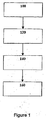
- the method of manufacturing molded products and related parts is mainly arrived by four steps mcluding a providing step (100), a mixing step (120), a shaking step (140) and a compression molding step (160).
- agricultural fibers provided to form a moldable mixture may be rape straw, rice stalk or a combination of both.
- the raw materials of agricultural fiber have to be trimmed to a length ranges from 5 to 10 mm in a trimming step (not shown) prior to mixing with other components to form a moldable mixture.
- the trimmed raw agricultural fibers are then dried in a drying step (not shown) to have less than 8% moisture content to the total weight of the moldable mixture, preferably have less than 5% moisture content to the total weight of the moldable mixture.
- the drying step of the raw materials of the agricultural fiber is followed by a weighing step (not shown) to weigh a suitable amount of substantially dry agricultural fiber prior to mixing with other components to form the moldable mixture.
- the percentage by weight of the substantially dry agricultural fiber is between 85%-95% to the total weight of the moldable mixture.
- a binding agent is also provided to form the moldable mixture.
- the binding agent is Diisocyanatediphenylmethane (MDI).
- MDI Diisocyanatediphenylmethane
- This binding agent is high viscosity, low in moisture content and free of formaldehyde.
- a flow-promoting filler material is also provided to form the moldable mixture.
- the flow-promoting filler material is wheat flour.
- the flow-promoting filler material is less than 10% by weight to the moldable mixture.
- three main materials including agricultural fibers, a binding agent and a flow-promoting filler material are provided in the providing step to form a moldable mixture, but hardening agent, impact modifier, co-solvent and a de-molding agent are, not provided in the same providing step.
- hardener such as ammonium chloride, de-molding agent such as soya extract, co-solvent such as alcohol, and impact modifier such as palm fibers are not provided in the providing step to form a moldable mixture.
- the mixing step is a two-step mixing step. In the first part of the two-step mixing step, 85%-95% by weight of the substantially dry agricultural fiber is mixed with less than 10% by weight of a flow-promoting filler material wheat flour in a mixing machine (not shown).
- the mixing machine comes with a horizontal rotating blade (#4 blades mounted on horizontal shaft) and it is rotating at about 20 to 30 rpm.
- the wheat flour of less than 10% by weight is introduced to the stirring agricultural fiber in the first part of two-step mixing step.
- a binding agent Diisocyanate-diphenylmethane (MDI) is also introduced to the mixing machine by spraying (not shown). Not more than 5% by weight of MDI is sprayed with a pressure nozzle at a pressure of around 5 to 8 bars into the stirring mixture of agricultural fibers and a flowpromoting filler material.
- MDI Diisocyanate-diphenylmethane
- the mixture of agricultural fibers, a flow-promoting filler material and a binding agent is kept stirring until such mixture is blended to form a moldable mixture.
- the whole rotating cycle for a mixing step takes less than 3 minutes.
- the moldable mixture upon completion of the mixing step (120), the moldable mixture is ready for feeding the moldable mixture to the mold in a shaking step (140).
- the moldable mixture is loaded into an Intermediate Bulk Container (IBC) (not shown) and then discharged through the weighing Hopper (not shown) into a material feeding tray at the material loading station (not shown).
- the material feeding tray filled with moldable mixture is then transferred from the material loading station to a pressing area (not shown) where compression molding (160) takes place.
- the moldable mixture has been shaking throughout the discharging of the moldable mixture from IBC through the weighing hoop into the material feeding tray.
- the material feeding tray containing the moldable mixture has also been shaking throughout the loading of the moldable mixture from the material feeding tray to the cavity of the bottom mold at the pressing area where compression molding takes place.
- the moldable mixture after shaking (140) the moldable mixture, the moldable mixture is ready for being compressed in a compression molding step (160).
- the compression molding step is performed at a single compression stroke.
- the compression molding step is carried out at a temperature between 200-230°C.
- the mold is heated up through internal heat transfer at a temperature between 200-230°C.
- the moldable mixture is compressed under a pressure between 0.30 to 0.40 kg/mm 2 for 1.5 to 2.5 minutes.
- the molded product is ejected out from the mold and then transferred to a packing area next to the pressing area.
- the molded product is not subjected to heat treatment and fumigation for killing any living pests after ejecting out from the mold.
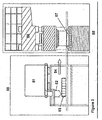
- FIG. 2 An example of mixing and shaking the moldable mixture is given in Figure 2 .
- the Intermediate Bulk Container (IBC) (81) is placed at the top of a standalone material loading station (85).
- the moldable mixture (not shown) may be discharged through a discharging screw (not shown) into a weighing hopper (82) and then further discharged into a material feeding tray (83) in a row-by-row manner.
- the material feeding tray is then transferred along the tray movement path (84) to the pressing area (88) where the compression molding step takes place.
- the moldable mixture being transferred into the mold (87) at the pressing area is compressed by the hydraulic press (86) into the molded product.
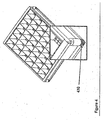
- FIG. 3 An example of a material feeding tray is given in Figure 3 .
- the top view of the material feeding tray (310) shows that it may have an average size of 1.4x1.2x0.2 meter (Length x width x height) and may be divided into 35 to 49 compartments to cater for the loading of different weight of moldable mixture for molding into product with different profile and thickness at different part of the product.
- Each compartment (320) is designed to take different weight of moldable mixture. This is to ensure that the right amount of the moldable mixture is loaded evenly into the mold at the pre-determined position for optimum molding result and material utilization. It also helps to facilitate the molding process to provide with the maximum draw ratio and enables to mold products with different profile and thickness at different sections of the product.
- compartments vary from the complexity and the size of the molded product.
- the partitions of the material feeding tray are constructed by steel sheet (not shown) in a criss cross manner to form the necessary compartments.
- the example as given in Figure 3 shows that the bottom view of the material feeding tray has a piece of wire mesh (330) welded at the bottom face of the steel partitions.
- the entire steel partition is connected to a rotating rod with a vibrator mounted (not shown).
- the steel partition together with the welded wire mesh can be used for shaking in the horizontal direction throughout the discharging of the moldable mixture, from the material feeding tray to the mold at the pressing area (not shown).
- the gate (340) mounted at the bottom of the material feeding tray is then opened by sliding movement in the horizontal direction when the material feeding tray is transferred to the mold at the pressing area.
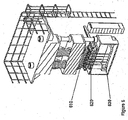
- the moldable mixture (530) is discharged into the cavity of the bottom mold (560) in an evenly dispersed manner with the aid of both the horizontal and vertical vibration motions generated by the rotating rod with a vibrator (not shown in Figure 5 ) and four additional vibrators at four corners of the material feeding tray (550) as described above prior to the compression molding step.
- This kind of shaking feature is incorporated in the present invention due to the fact that when using the conventional method, the loading of moldable mixture from the conventional material feeding tray (510) into the bottom mold without any shaking always forms a hump (520).
- the material feeding (540) of the present invention has to be leveled by four additional vibrators at four corners of the bottom side (550) to enable shaking when loading the moldable mixture from the material feeding tray into the bottom mold at the pressing area.
- Such feature can achieve the effect of optimum molding results, i.e. minimum molding pressure, minimum material use.
- Such feature also enables the moldable mixture to flow freely to the desired height which can be determined by the draw ratio. After the moldable mixture is fully loaded into the cavity of the bottom mold, the material feeding tray may be returned to the original position for re-filling.
- FIG. 6 An illustration of a hydraulic ejection system for molding is given in Figure 6 .
- the hydraulic ejectors (630) are situated below the bottom mold at the pressing area.
- the moldable mixture is molded at a pressing area at a temperature between 200-230°C.
- Both the top (610) and bottom (620) mold are fitted with various steel pipes (not shown).
- the thermal oil is electrically heated and circulating through the oil channels inside the mold. Since the mold is heated up through heat transfer within the mold, therefore it can achieve a lower energy loss.
- the moldable mixture is compressed under a pressure between 0.30 to 0.40 kg/mm 2 for 1.5 to 2.5 minutes at the pressing area.
- the compression molding is performed as a single compression stroke. There is no need to open and close the mold repeatedly nor ironing to release excess moisture to prevent possible mold explosion because the moldable mixture of the present invention has relatively low moisture content.
- the molded part is ejected out from the bottom mold with the hydraulic system (630).
- a mechanical pick and place system (not shown) is incorporated in the material feeding system to pick up the molded part and transfer the molded part to a packing area (not shown) next to the pressing area. Since the molded product has been subjected to high heat and high pressure during the molding process, further heating and fumigation steps for killing living pests in the molded product are not required.
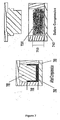
- Figure 7 illustrates the cross-section of a molding part in the mold before and after the compression in the molding step.
- the upper part of the figure shows the cross-section of the moldable mixture (720) in the cavity of bottom mold (740) before the compression molding step whereas the lower part of the figure shows the cross-section of part of the molded product (760) in the cavity between the top mold (780) and the lower mold (790) after the compression molding step.
- the top mold (780) is pressed on the moldable mixture in the cavity of the bottom mold (790) with a pressure of 0.30 to 0.40 kg/mm 2 to form molded product (760).
- the compression molding for the moldable mixture into part of a molded product is a single compression stroke without the needs of opening and closing the mold repeatedly.
- the moldable mixture after the compression flows upwards towards the horizontal molding cavity of the enclosed mold under the temperature between 200-230°C.
- the height (750) of part of the molded product (760) along the horizontal molded cavity of the enclosed mold can be determined.
- the draw ratio of the moldable mixture is obtained from dividing the height (750) of the molded part (760) in the horizontal molding cavity of the enclosed mold after compression by the height (710) of moldable mixture (720) in the cavity of bottom mold (740) before compression. Such ratio reflects the upwards flowing ability of the moldable mixture during molding.
- the molded part can be corrugated with complex profile such as runner (810) and plank (820) of a pallet (830) as shown in Figure 8 .
- the molded product is ready for use or can be used repeatedly without any post-heat treatment and fumigation.
- the present invention provides a method of manufacturing molded products and related parts based on a moldable mixture, which can be applied to the field of construction materials and manufacture of molded products such as pallets and related parts.
- the claimed method of manufacturing can be applied to making construction products or molded products with better quality.
Landscapes
- Engineering & Computer Science (AREA)
- Life Sciences & Earth Sciences (AREA)
- Chemical & Material Sciences (AREA)
- Wood Science & Technology (AREA)
- Manufacturing & Machinery (AREA)
- Forests & Forestry (AREA)
- Mechanical Engineering (AREA)
- Health & Medical Sciences (AREA)
- Chemical Kinetics & Catalysis (AREA)
- Medicinal Chemistry (AREA)
- Polymers & Plastics (AREA)
- Organic Chemistry (AREA)
- Materials Engineering (AREA)
- Composite Materials (AREA)
- Dry Formation Of Fiberboard And The Like (AREA)
- Casting Or Compression Moulding Of Plastics Or The Like (AREA)
- Compositions Of Macromolecular Compounds (AREA)
Claims (2)
- Verfahren zum Herstellen eines geformten Produkts (760) umfassend die Schritte:- Bereitstellen einer landwirtschaftlichen Faser, eines Bindemittels, und eines strömungsfördernden Füllmaterials;- Mischen (120) der landwirtschaftlichen Faser mit dem strömungsfördernden Füllmaterial und dem Bindemittel, um eine formbare Mischung (720) zu bilden;- Schütteln (140) der formbaren Mischung (720) in Vorbereitung zum Pressformen;- Pressformen (160) der formbaren Mischung (720), um das geformte Produkt (760) zu bilden, wobei das Mischen (120) ferner das Aufsprühen des Bindemittels bei einem Druck zwischen 5 bis 8 bar in die landwirtschaftliche Faser mit dem strömungsfördernden Füllmaterial umfasst, wobei das Diisocyanat-Diphenylmethan mit einer Menge von nicht mehr als 5 Gewichts-% bezogen auf die formbare Mischung (720) ist, wobei die landwirtschaftliche Faser der formbaren Mischung (720) einen Flüssigkeitsanteil von weniger als 8 Gewichts-% bezogen auf die formbare Mischung (720) hat, dadurch gekennzeichnet, dass die formbare Mischung (720) zwischen 85 - 95 Gewichts-% der landwirtschaftlichen Faser umfasst, wobei das strömungsfördernde Füllmaterial Weizenmehl, mit weniger als 10 Gewichts-% bezogen auf die formbare Mischung (720) ist, wobei das Pressformen (160) als ein einziger Pressschlag für 1,5 bis 2,5 Minuten an dem Pressbereich (88) mit einem Streckverhältnis von 1 bis 10, bei einem Druck von 0,30 bis 0,40 kg/mm2 und bei einer Temperatur von 200 bis 230 °C durchgeführt wird.
- Verfahren nach Anspruch 1, wobei das Mischen und Schütteln der formbaren Mischung ferner das Entladen der formbaren Mischung (720) durch eine Entladeschraube in eine Trichterwaage (82) und danach das weitere reihenweise Entladen dieser in eine Materialförderrinne (83, 310), die eine durchschnittliche Größe von 1,4 x 1,2 x 0,2 Meter aufweist und die in 35 bis 49 Kompartimente aufgeteilt ist, umfasst.
Applications Claiming Priority (1)
| Application Number | Priority Date | Filing Date | Title |
|---|---|---|---|
| PCT/SG2008/000265 WO2010011174A1 (en) | 2008-07-21 | 2008-07-21 | Methods of manufacturing formaldehyde-free molded products and related parts |
Publications (3)
| Publication Number | Publication Date |
|---|---|
| EP2321371A1 EP2321371A1 (de) | 2011-05-18 |
| EP2321371A4 EP2321371A4 (de) | 2012-01-04 |
| EP2321371B1 true EP2321371B1 (de) | 2016-09-07 |
Family
ID=41570491
Family Applications (1)
| Application Number | Title | Priority Date | Filing Date |
|---|---|---|---|
| EP08794185.2A Active EP2321371B1 (de) | 2008-07-21 | 2008-07-21 | Verfahren zur herstellung von formaldehydfreien formprodukten und verwandten teilen |
Country Status (10)
| Country | Link |
|---|---|
| US (2) | US20110024932A1 (de) |
| EP (1) | EP2321371B1 (de) |
| JP (1) | JP5829912B2 (de) |
| KR (2) | KR101426213B1 (de) |
| CN (1) | CN102046730B (de) |
| AU (1) | AU2008357242B2 (de) |
| ES (1) | ES2604765T3 (de) |
| TW (1) | TWI574810B (de) |
| WO (1) | WO2010011174A1 (de) |
| ZA (1) | ZA201100369B (de) |
Families Citing this family (4)
| Publication number | Priority date | Publication date | Assignee | Title |
|---|---|---|---|---|
| CN104262979A (zh) * | 2014-08-14 | 2015-01-07 | 王德善 | 制作模制品的方法所采用的压制设备及其原料混合物 |
| CN105171889A (zh) * | 2015-05-22 | 2015-12-23 | 中国装饰股份有限公司 | 地板压制设备 |
| US12157250B2 (en) * | 2016-03-21 | 2024-12-03 | Bondcore öU | Composite wood panels with corrugated cores and method of manufacturing same |
| CN111203953A (zh) * | 2020-01-07 | 2020-05-29 | 怀集宜美木业有限公司 | 一种环保阻燃型中密度纤维板 |
Family Cites Families (24)
| Publication number | Priority date | Publication date | Assignee | Title |
|---|---|---|---|---|
| DE8817014U1 (de) * | 1988-09-07 | 1991-11-21 | Heinrich Wagner Sinto Maschinenfabrik GmbH, 5928 Bad Laasphe | Formmaschine |
| US5344484A (en) * | 1992-10-08 | 1994-09-06 | Masonite Corporation | Isocyanate bonded wood composite and method of manufacturing the same |
| US5498469A (en) * | 1994-12-02 | 1996-03-12 | Howard; Robert E. | Thin panels of non-woody lignocellulosic material |
| JPH08336816A (ja) * | 1995-04-12 | 1996-12-24 | Onnetsu Kankyo Kaihatsu Kk | 板状体又は成形体及びその製法 |
| JPH10138353A (ja) * | 1996-11-07 | 1998-05-26 | Kanegafuchi Chem Ind Co Ltd | 板状体又は成形体及びその製造法 |
| US6083623A (en) * | 1997-09-19 | 2000-07-04 | Carbocol Systems Inc. | Bonding of solid lignocellulosic materials |
| EP0976790A1 (de) * | 1998-07-27 | 2000-02-02 | Cargill BV | Verfahren zur Herstellung von Verbundmaterialien |
| DK2025227T3 (da) * | 1999-06-22 | 2010-05-25 | Xyleco Inc | Teksturerede cellulose- og lignocellulosematerialer og sammensætninger og kompositmaterialer fremstillet ud fra disse |
| CA2277695C (en) * | 1999-07-19 | 2009-06-30 | Wei Sheng Jia | Disposable objects made from corn cob |
| US7074844B2 (en) * | 2000-03-17 | 2006-07-11 | Yamaha Corporation | Adhesives |
| AU2001290491A1 (en) * | 2000-09-09 | 2002-03-22 | Thiam Huay Gary Choo | Moulded product |
| US6458238B1 (en) * | 2000-12-29 | 2002-10-01 | Basf Corporation | Adhesive binder and synergist composition and process of making lignocellulosic articles |
| US6886306B2 (en) * | 2001-05-04 | 2005-05-03 | Greencor Composites, Llc | Fire-resistant material and method of manufacture |
| US6793992B2 (en) * | 2001-07-10 | 2004-09-21 | Canon Kabushiki Kaisha | Molded product for cushioning material, and production process and recovery thereof |
| US6672031B2 (en) * | 2002-01-15 | 2004-01-06 | Tse-Wei Huang | Environment protective liner plank structure |
| US20050250900A1 (en) * | 2002-05-29 | 2005-11-10 | Stofko John I | Adhesive compositions for bonding lignocellulosic materials, bonding methods and apparatus, and bonded articles |
| CA2458159A1 (en) * | 2004-01-22 | 2005-07-22 | The State Of Oregon Acting By And Through The State Board Of Higher Educ Ation On Behalf Of Oregon State University | Formaldehyde-free adhesives and lignocellulosic composites made from the adhesives |
| KR100573748B1 (ko) * | 2004-04-16 | 2006-04-25 | 황인채 | 무공해 전분용기의 제조방법 |
| WO2005113700A1 (en) * | 2004-04-20 | 2005-12-01 | State Of Oregon Acting By And Through The State Board Of Higher Education On Behalf Of Oregon State University | Formaldehyde-free lignocellulosic adhesives and composites made from the adhesives |
| SG129293A1 (en) * | 2004-06-11 | 2007-02-26 | Gpac Technology S Pte Ltd | Method to form a high strength moulded product |
| SG149671A1 (en) * | 2004-06-11 | 2009-02-27 | Gpac Technology S Pte Ltd | Pallet and method for manufacturing the same |
| US20070036975A1 (en) * | 2005-08-09 | 2007-02-15 | Miele Philip F | Glass fiber composite and method of making glass fiber composites using a binder derived from renewable resources |
| US20070135536A1 (en) * | 2005-12-14 | 2007-06-14 | Board Of Trustees Of Michigan State University | Biobased compositions from distillers' dried grains with solubles and methods of making those |
| TW200815556A (en) * | 2006-06-01 | 2008-04-01 | Akzo Nobel Coatings Int Bv | Adhesive system |
-
2008
- 2008-07-21 KR KR1020137003396A patent/KR101426213B1/ko not_active Expired - Fee Related
- 2008-07-21 JP JP2011520008A patent/JP5829912B2/ja not_active Expired - Fee Related
- 2008-07-21 AU AU2008357242A patent/AU2008357242B2/en not_active Ceased
- 2008-07-21 WO PCT/SG2008/000265 patent/WO2010011174A1/en not_active Ceased
- 2008-07-21 CN CN200880023689.2A patent/CN102046730B/zh active Active
- 2008-07-21 ES ES08794185.2T patent/ES2604765T3/es active Active
- 2008-07-21 US US12/671,649 patent/US20110024932A1/en not_active Abandoned
- 2008-07-21 EP EP08794185.2A patent/EP2321371B1/de active Active
- 2008-07-21 KR KR1020117003483A patent/KR101380426B1/ko active Active
-
2009
- 2009-07-20 TW TW098124388A patent/TWI574810B/zh not_active IP Right Cessation
-
2011
- 2011-01-14 ZA ZA2011/00369A patent/ZA201100369B/en unknown
-
2013
- 2013-04-26 US US13/871,130 patent/US20130234356A1/en not_active Abandoned
Also Published As
| Publication number | Publication date |
|---|---|
| KR20110042312A (ko) | 2011-04-26 |
| US20110024932A1 (en) | 2011-02-03 |
| AU2008357242B2 (en) | 2012-02-23 |
| KR20130029117A (ko) | 2013-03-21 |
| JP2011528750A (ja) | 2011-11-24 |
| US20130234356A1 (en) | 2013-09-12 |
| EP2321371A1 (de) | 2011-05-18 |
| CN102046730A (zh) | 2011-05-04 |
| HK1155193A1 (en) | 2012-05-11 |
| ZA201100369B (en) | 2011-11-30 |
| EP2321371A4 (de) | 2012-01-04 |
| TWI574810B (zh) | 2017-03-21 |
| CN102046730B (zh) | 2014-12-03 |
| AU2008357242A1 (en) | 2010-02-18 |
| JP5829912B2 (ja) | 2015-12-09 |
| KR101380426B1 (ko) | 2014-04-01 |
| WO2010011174A1 (en) | 2010-01-28 |
| KR101426213B1 (ko) | 2014-08-05 |
| TW201008738A (en) | 2010-03-01 |
| ES2604765T3 (es) | 2017-03-09 |
Similar Documents
| Publication | Publication Date | Title |
|---|---|---|
| TWI269758B (en) | Pallet and method for manufacturing the same | |
| EP2321371B1 (de) | Verfahren zur herstellung von formaldehydfreien formprodukten und verwandten teilen | |
| US20080179790A1 (en) | Method to Form a High Strength Moulded Product | |
| US20230013214A1 (en) | Methods of manufacturing formaldehyde-free molded products and related parts | |
| US8715550B2 (en) | Methods of manufacturing formaldehyde-free molded products and related parts | |
| RU2143972C1 (ru) | Способ изготовления композитного материала со структурой в основном в форме решетки и композитный материал, полученный этим способом | |
| HK1202129A1 (en) | Methods of manufacturing formaldehyde-free molded products and related parts | |
| HK1155193B (en) | Methods of manufacturing formaldehyde-free molded products and related parts | |
| US6830797B2 (en) | Wood strand molded part having holes with densified and thinner perimeters and method of making same | |
| CN104262979A (zh) | 制作模制品的方法所采用的压制设备及其原料混合物 | |
| CN104073006A (zh) | 制造不含甲醛的模制品及相关部件的方法 | |
| KR20250021335A (ko) | 균사를 포함하는 공급원료, 그로부터 생산된 생성물, 및 그로부터 생성물을 성형하는 방법 | |
| CA1142864A (en) | Method for molding articles having non-planar portions from matted wood flakes | |
| HK1103378A (zh) | 形成高强度模制产品的方法 | |
| JPS61149326A (ja) | 繊維生成物を製造する方法及びその装置 |
Legal Events
| Date | Code | Title | Description |
|---|---|---|---|
| PUAI | Public reference made under article 153(3) epc to a published international application that has entered the european phase |
Free format text: ORIGINAL CODE: 0009012 |
|
| 17P | Request for examination filed |
Effective date: 20110217 |
|
| AK | Designated contracting states |
Kind code of ref document: A1 Designated state(s): AT BE BG CH CY CZ DE DK EE ES FI FR GB GR HR HU IE IS IT LI LT LU LV MC MT NL NO PL PT RO SE SI SK TR |
|
| AX | Request for extension of the european patent |
Extension state: AL BA MK RS |
|
| DAX | Request for extension of the european patent (deleted) | ||
| A4 | Supplementary search report drawn up and despatched |
Effective date: 20111206 |
|
| RIC1 | Information provided on ipc code assigned before grant |
Ipc: B27N 3/04 20060101ALI20111130BHEP Ipc: B27N 5/00 20060101ALI20111130BHEP Ipc: B29C 43/02 20060101ALI20111130BHEP Ipc: C08L 97/02 20060101AFI20111130BHEP Ipc: B29C 70/08 20060101ALI20111130BHEP Ipc: B29C 43/00 20060101ALI20111130BHEP Ipc: B27N 1/00 20060101ALI20111130BHEP Ipc: B29C 43/34 20060101ALI20111130BHEP |
|
| RIC1 | Information provided on ipc code assigned before grant |
Ipc: B27N 5/00 20060101ALI20150218BHEP Ipc: B29C 43/00 20060101ALI20150218BHEP Ipc: B29K 711/14 20060101ALI20150218BHEP Ipc: B27N 3/04 20060101ALI20150218BHEP Ipc: B29L 31/00 20060101ALI20150218BHEP Ipc: B29C 43/34 20060101ALI20150218BHEP Ipc: B29K 311/14 20060101ALI20150218BHEP Ipc: C08L 99/00 20060101ALI20150218BHEP Ipc: B27N 3/08 20060101ALI20150218BHEP Ipc: B29C 70/08 20060101ALI20150218BHEP Ipc: B27N 1/00 20060101ALI20150218BHEP Ipc: B29C 43/02 20060101ALI20150218BHEP Ipc: C08L 97/02 20060101AFI20150218BHEP |
|
| 17Q | First examination report despatched |
Effective date: 20150317 |
|
| GRAP | Despatch of communication of intention to grant a patent |
Free format text: ORIGINAL CODE: EPIDOSNIGR1 |
|
| INTG | Intention to grant announced |
Effective date: 20160317 |
|
| GRAS | Grant fee paid |
Free format text: ORIGINAL CODE: EPIDOSNIGR3 |
|
| GRAA | (expected) grant |
Free format text: ORIGINAL CODE: 0009210 |
|
| AK | Designated contracting states |
Kind code of ref document: B1 Designated state(s): AT BE BG CH CY CZ DE DK EE ES FI FR GB GR HR HU IE IS IT LI LT LU LV MC MT NL NO PL PT RO SE SI SK TR |
|
| REG | Reference to a national code |
Ref country code: GB Ref legal event code: FG4D |
|
| REG | Reference to a national code |
Ref country code: CH Ref legal event code: EP |
|
| REG | Reference to a national code |
Ref country code: IE Ref legal event code: FG4D |
|
| REG | Reference to a national code |
Ref country code: AT Ref legal event code: REF Ref document number: 826845 Country of ref document: AT Kind code of ref document: T Effective date: 20161015 |
|
| REG | Reference to a national code |
Ref country code: DE Ref legal event code: R096 Ref document number: 602008046183 Country of ref document: DE |
|
| REG | Reference to a national code |
Ref country code: LT Ref legal event code: MG4D |
|
| REG | Reference to a national code |
Ref country code: NL Ref legal event code: MP Effective date: 20160907 |
|
| PG25 | Lapsed in a contracting state [announced via postgrant information from national office to epo] |
Ref country code: NO Free format text: LAPSE BECAUSE OF FAILURE TO SUBMIT A TRANSLATION OF THE DESCRIPTION OR TO PAY THE FEE WITHIN THE PRESCRIBED TIME-LIMIT Effective date: 20161207 Ref country code: HR Free format text: LAPSE BECAUSE OF FAILURE TO SUBMIT A TRANSLATION OF THE DESCRIPTION OR TO PAY THE FEE WITHIN THE PRESCRIBED TIME-LIMIT Effective date: 20160907 Ref country code: LT Free format text: LAPSE BECAUSE OF FAILURE TO SUBMIT A TRANSLATION OF THE DESCRIPTION OR TO PAY THE FEE WITHIN THE PRESCRIBED TIME-LIMIT Effective date: 20160907 |
|
| REG | Reference to a national code |
Ref country code: AT Ref legal event code: MK05 Ref document number: 826845 Country of ref document: AT Kind code of ref document: T Effective date: 20160907 |
|
| PG25 | Lapsed in a contracting state [announced via postgrant information from national office to epo] |
Ref country code: SE Free format text: LAPSE BECAUSE OF FAILURE TO SUBMIT A TRANSLATION OF THE DESCRIPTION OR TO PAY THE FEE WITHIN THE PRESCRIBED TIME-LIMIT Effective date: 20160907 Ref country code: GR Free format text: LAPSE BECAUSE OF FAILURE TO SUBMIT A TRANSLATION OF THE DESCRIPTION OR TO PAY THE FEE WITHIN THE PRESCRIBED TIME-LIMIT Effective date: 20161208 Ref country code: LV Free format text: LAPSE BECAUSE OF FAILURE TO SUBMIT A TRANSLATION OF THE DESCRIPTION OR TO PAY THE FEE WITHIN THE PRESCRIBED TIME-LIMIT Effective date: 20160907 Ref country code: NL Free format text: LAPSE BECAUSE OF FAILURE TO SUBMIT A TRANSLATION OF THE DESCRIPTION OR TO PAY THE FEE WITHIN THE PRESCRIBED TIME-LIMIT Effective date: 20160907 |
|
| REG | Reference to a national code |
Ref country code: ES Ref legal event code: FG2A Ref document number: 2604765 Country of ref document: ES Kind code of ref document: T3 Effective date: 20170309 |
|
| PG25 | Lapsed in a contracting state [announced via postgrant information from national office to epo] |
Ref country code: EE Free format text: LAPSE BECAUSE OF FAILURE TO SUBMIT A TRANSLATION OF THE DESCRIPTION OR TO PAY THE FEE WITHIN THE PRESCRIBED TIME-LIMIT Effective date: 20160907 Ref country code: RO Free format text: LAPSE BECAUSE OF FAILURE TO SUBMIT A TRANSLATION OF THE DESCRIPTION OR TO PAY THE FEE WITHIN THE PRESCRIBED TIME-LIMIT Effective date: 20160907 |
|
| PG25 | Lapsed in a contracting state [announced via postgrant information from national office to epo] |
Ref country code: CZ Free format text: LAPSE BECAUSE OF FAILURE TO SUBMIT A TRANSLATION OF THE DESCRIPTION OR TO PAY THE FEE WITHIN THE PRESCRIBED TIME-LIMIT Effective date: 20160907 Ref country code: IS Free format text: LAPSE BECAUSE OF FAILURE TO SUBMIT A TRANSLATION OF THE DESCRIPTION OR TO PAY THE FEE WITHIN THE PRESCRIBED TIME-LIMIT Effective date: 20170107 Ref country code: SK Free format text: LAPSE BECAUSE OF FAILURE TO SUBMIT A TRANSLATION OF THE DESCRIPTION OR TO PAY THE FEE WITHIN THE PRESCRIBED TIME-LIMIT Effective date: 20160907 Ref country code: BE Free format text: LAPSE BECAUSE OF FAILURE TO SUBMIT A TRANSLATION OF THE DESCRIPTION OR TO PAY THE FEE WITHIN THE PRESCRIBED TIME-LIMIT Effective date: 20160907 Ref country code: AT Free format text: LAPSE BECAUSE OF FAILURE TO SUBMIT A TRANSLATION OF THE DESCRIPTION OR TO PAY THE FEE WITHIN THE PRESCRIBED TIME-LIMIT Effective date: 20160907 Ref country code: BG Free format text: LAPSE BECAUSE OF FAILURE TO SUBMIT A TRANSLATION OF THE DESCRIPTION OR TO PAY THE FEE WITHIN THE PRESCRIBED TIME-LIMIT Effective date: 20161207 Ref country code: PL Free format text: LAPSE BECAUSE OF FAILURE TO SUBMIT A TRANSLATION OF THE DESCRIPTION OR TO PAY THE FEE WITHIN THE PRESCRIBED TIME-LIMIT Effective date: 20160907 Ref country code: PT Free format text: LAPSE BECAUSE OF FAILURE TO SUBMIT A TRANSLATION OF THE DESCRIPTION OR TO PAY THE FEE WITHIN THE PRESCRIBED TIME-LIMIT Effective date: 20170109 |
|
| REG | Reference to a national code |
Ref country code: DE Ref legal event code: R097 Ref document number: 602008046183 Country of ref document: DE |
|
| PLBE | No opposition filed within time limit |
Free format text: ORIGINAL CODE: 0009261 |
|
| STAA | Information on the status of an ep patent application or granted ep patent |
Free format text: STATUS: NO OPPOSITION FILED WITHIN TIME LIMIT |
|
| REG | Reference to a national code |
Ref country code: FR Ref legal event code: PLFP Year of fee payment: 10 |
|
| PG25 | Lapsed in a contracting state [announced via postgrant information from national office to epo] |
Ref country code: DK Free format text: LAPSE BECAUSE OF FAILURE TO SUBMIT A TRANSLATION OF THE DESCRIPTION OR TO PAY THE FEE WITHIN THE PRESCRIBED TIME-LIMIT Effective date: 20160907 |
|
| 26N | No opposition filed |
Effective date: 20170608 |
|
| PG25 | Lapsed in a contracting state [announced via postgrant information from national office to epo] |
Ref country code: SI Free format text: LAPSE BECAUSE OF FAILURE TO SUBMIT A TRANSLATION OF THE DESCRIPTION OR TO PAY THE FEE WITHIN THE PRESCRIBED TIME-LIMIT Effective date: 20160907 |
|
| REG | Reference to a national code |
Ref country code: CH Ref legal event code: PL |
|
| GBPC | Gb: european patent ceased through non-payment of renewal fee |
Effective date: 20170721 |
|
| REG | Reference to a national code |
Ref country code: IE Ref legal event code: MM4A |
|
| PG25 | Lapsed in a contracting state [announced via postgrant information from national office to epo] |
Ref country code: IE Free format text: LAPSE BECAUSE OF NON-PAYMENT OF DUE FEES Effective date: 20170721 Ref country code: LI Free format text: LAPSE BECAUSE OF NON-PAYMENT OF DUE FEES Effective date: 20170731 Ref country code: GB Free format text: LAPSE BECAUSE OF NON-PAYMENT OF DUE FEES Effective date: 20170721 Ref country code: CH Free format text: LAPSE BECAUSE OF NON-PAYMENT OF DUE FEES Effective date: 20170731 |
|
| PG25 | Lapsed in a contracting state [announced via postgrant information from national office to epo] |
Ref country code: LU Free format text: LAPSE BECAUSE OF NON-PAYMENT OF DUE FEES Effective date: 20170721 |
|
| REG | Reference to a national code |
Ref country code: FR Ref legal event code: PLFP Year of fee payment: 11 |
|
| PG25 | Lapsed in a contracting state [announced via postgrant information from national office to epo] |
Ref country code: MT Free format text: LAPSE BECAUSE OF NON-PAYMENT OF DUE FEES Effective date: 20170721 |
|
| PG25 | Lapsed in a contracting state [announced via postgrant information from national office to epo] |
Ref country code: HU Free format text: LAPSE BECAUSE OF FAILURE TO SUBMIT A TRANSLATION OF THE DESCRIPTION OR TO PAY THE FEE WITHIN THE PRESCRIBED TIME-LIMIT; INVALID AB INITIO Effective date: 20080721 Ref country code: MC Free format text: LAPSE BECAUSE OF FAILURE TO SUBMIT A TRANSLATION OF THE DESCRIPTION OR TO PAY THE FEE WITHIN THE PRESCRIBED TIME-LIMIT Effective date: 20160907 |
|
| PGFP | Annual fee paid to national office [announced via postgrant information from national office to epo] |
Ref country code: TR Payment date: 20190506 Year of fee payment: 12 |
|
| PG25 | Lapsed in a contracting state [announced via postgrant information from national office to epo] |
Ref country code: CY Free format text: LAPSE BECAUSE OF NON-PAYMENT OF DUE FEES Effective date: 20160907 |
|
| PGFP | Annual fee paid to national office [announced via postgrant information from national office to epo] |
Ref country code: ES Payment date: 20190801 Year of fee payment: 12 |
|
| REG | Reference to a national code |
Ref country code: ES Ref legal event code: FD2A Effective date: 20220103 |
|
| PG25 | Lapsed in a contracting state [announced via postgrant information from national office to epo] |
Ref country code: ES Free format text: LAPSE BECAUSE OF NON-PAYMENT OF DUE FEES Effective date: 20200722 |
|
| PG25 | Lapsed in a contracting state [announced via postgrant information from national office to epo] |
Ref country code: TR Free format text: LAPSE BECAUSE OF NON-PAYMENT OF DUE FEES Effective date: 20200721 |
|
| PGFP | Annual fee paid to national office [announced via postgrant information from national office to epo] |
Ref country code: IT Payment date: 20230724 Year of fee payment: 16 Ref country code: FI Payment date: 20230719 Year of fee payment: 16 |
|
| PGFP | Annual fee paid to national office [announced via postgrant information from national office to epo] |
Ref country code: DE Payment date: 20240725 Year of fee payment: 17 |
|
| PGFP | Annual fee paid to national office [announced via postgrant information from national office to epo] |
Ref country code: FR Payment date: 20240723 Year of fee payment: 17 |
|
| PG25 | Lapsed in a contracting state [announced via postgrant information from national office to epo] |
Ref country code: FI Free format text: LAPSE BECAUSE OF NON-PAYMENT OF DUE FEES Effective date: 20240721 |
|
| PG25 | Lapsed in a contracting state [announced via postgrant information from national office to epo] |
Ref country code: IT Free format text: LAPSE BECAUSE OF NON-PAYMENT OF DUE FEES Effective date: 20240721 |