EP2314151B3 - Schere zum Schneiden von Ästen - Google Patents
Schere zum Schneiden von Ästen Download PDFInfo
- Publication number
- EP2314151B3 EP2314151B3 EP10196294.2A EP10196294A EP2314151B3 EP 2314151 B3 EP2314151 B3 EP 2314151B3 EP 10196294 A EP10196294 A EP 10196294A EP 2314151 B3 EP2314151 B3 EP 2314151B3
- Authority
- EP
- European Patent Office
- Prior art keywords
- pulling
- roller
- traction
- shears according
- transmission
- Prior art date
- Legal status (The legal status is an assumption and is not a legal conclusion. Google has not performed a legal analysis and makes no representation as to the accuracy of the status listed.)
- Active
Links
Images


Classifications
-
- A—HUMAN NECESSITIES
- A01—AGRICULTURE; FORESTRY; ANIMAL HUSBANDRY; HUNTING; TRAPPING; FISHING
- A01G—HORTICULTURE; CULTIVATION OF VEGETABLES, FLOWERS, RICE, FRUIT, VINES, HOPS OR SEAWEED; FORESTRY; WATERING
- A01G3/00—Cutting implements specially adapted for horticultural purposes; Delimbing standing trees
- A01G3/02—Secateurs; Flower or fruit shears
- A01G3/025—Secateurs; Flower or fruit shears having elongated or extended handles
- A01G3/0255—Tree pruners, i.e. pruning shears carried at the end of a pole
Definitions
- the invention relates to a pair of scissors for cutting branches with at least two correspondingly designed scissor parts that can be moved relative to one another, at least one of which is connected to a handle device and at least one of which can be acted upon by an actuating force via a traction means that is at least partially flexible, wherein the traction means is connected to the scissor part via a traction means roller.
- the EP 0 895 712 B1 describes a pair of scissors in which a first scissor part is designed as a jaw attached to a handle part, while a second scissor part designed as a cutting blade is pivotally connected to the jaw.
- a traction roller is provided, to which a flexible traction cable engages, which is connected to an operating lever provided on the handle part and which is intended to transmit an actuating force applied by an operator.
- An eccentrically mounted chain roller is provided on the traction roller, which is at least partially wrapped by a traction chain.
- the traction chain is in turn connected to the cutting blade and thus enables the actuating force introduced onto the traction roller and the chain roller connected to it to be transmitted to the cutting blade.
- the eccentric arrangement of the chain roller relative to the traction roller enables variable force transmission, which allows adaptation to a cutting force curve that arises when cutting branches.
- the variable power transmission allows a user to comfortably operate the shears to cut branches, since an essentially constant operating force must be applied despite the change in cutting force over the course of the cut.
- a device for pruning trees in which a pair of shears is attached to the upper end of a pole.
- the shears are attached to a joint on the pole via a rotating part on a shears arm.
- the rotating part makes it possible to rotate the shears to different angular orientations around a rotation axis that is perpendicular to the pole.
- the shears mechanism can be operated from the end of the pole that is remote from the shears using a cable.
- the cable is attached directly to the shears part and is guided there via two guide rollers, with the first guide roller being mounted on the rotating part and the second on the joint.
- the diameters of the two guide rollers and the position of their axes are fixed in such a way that the part of the cable stretched between them coincides exactly with the rotation axis.
- a pair of shears comparable to this is also shown in the German patent specification DE 949 784 C
- the pull cable is attached directly to the scissor part and is guided there via a guide roller.
- the object underlying the invention is to provide a pair of scissors of the type mentioned at the beginning with improved handling.
- the traction means is operatively connected to the scissor part via a traction means roller, wherein the traction means roller is formed by an object which can be rotated about an axis of rotation and which is suitable for receiving a traction means provided for force transmission, in that the traction means is connected to the traction means roller in an end region and wraps around the traction means roller at least in sections, and in that the joint device is at least substantially formed in a cutting housing.
- the traction means is arranged at least in sections in the area of a joint device provided between the handle device and the scissor part connected to it, coaxially to a joint axis of the joint device.
- the joint device is provided to enable a cutting area formed by the two scissor parts to be angled relative to the handle device and thus to allow the scissors to be adapted to different cutting tasks.
- the joint axis is aligned essentially parallel to a cutting plane determined by the scissor parts. This allows a particularly effective bending of the cutting area relative to the handle device.
- the accommodation of the joint device in the blade housing allows a particularly cost-effective design.
- the blade housing is already provided with the for receiving the traction roller and at least one scissor part.
- a manufacturing process for the blade housing carried out in particular as a plastic injection molding process, allows the formation of the joint device without resulting in significantly higher production costs.
- the traction mechanism roller has a non-circular contour in a wrap-around surface determined by the traction mechanism.
- a traction mechanism roller is the term used to describe all objects that can be rotated about an axis of rotation and that are suitable for receiving a traction mechanism intended for power transmission.
- the term traction mechanism roller is not to be understood as restrictive; rather, the traction mechanism roller can be designed in particular as a roller, disk, cuboid, cube or a combination of such geometries.
- the traction mechanism is connected to the traction mechanism roller in an end region and wraps around the traction mechanism roller at least in sections.
- a variation in an effective radius caused by the non-circular contour of the wrap-around surface is decisive for the power transmission between the traction mechanism and the traction mechanism roller.
- the effective radius is determined by the distance between a rotation axis of the traction mechanism roller and a release point at which the traction mechanism protrudes from the traction mechanism roller and there is no further wrap or contact between the traction mechanism roller and the traction mechanism.
- a non-circular contour exists when the wrap surface has a contour that deviates from a circular shape; this can in particular be oval or polygonal.
- a wrap surface is spanned by radial vectors that run orthogonally to a rotation axis of the traction mechanism roller and are aligned perpendicularly to a central longitudinal axis of the traction mechanism.
- the effective radius forms the lever arm, which is important for introducing the actuating force onto the traction mechanism roller and thus at least partially for the force transmission of the actuating force applied by the user onto the scissor parts.
- the traction mechanism roller is only designed for incomplete wrapping by the traction mechanism; in this case, the wrapping surface can be designed as a wrapping plane.
- the traction mechanism roller is designed for more than one wrapping by the traction mechanism; in this case, the wrapping surface can be designed as a spiral surface, for example.
- the effective radius can be varied over a wide spectrum and thus enables the variable power transmission to be favorably adapted to the cutting force curve, which is essentially determined by the geometry of the scissor parts and the branches to be cut.
- the contour of the wrapping surface can in particular be designed as a polygon or a sequence of straight and curved areas.
- the decisive factor is that, due to the non-circular contour of the wrapping surface, at least two different effective radii are realized on the traction mechanism roller.
- the contour of the traction roller in the wraparound surface has a curvature with at least two different radii of curvature.
- a gear device is provided between the traction roller and the scissor part.
- a gear device enables an additional power transmission of the actuating force applied by an operator between the traction roller and the scissor part in order to increase the cutting force of the scissor part.
- the gear device can be designed in particular as a gear with a constant or varying transmission ratio.
- the gear device has a toothing attached to the traction mechanism roller and a corresponding toothing on at least one scissor part.
- the toothing on the traction mechanism roller is designed as a gear segment or gear attached coaxially to a rotation axis of the traction mechanism roller.
- a gear segment or a gear on the traction mechanism roller By using a gear segment or a gear on the traction mechanism roller, the rotational movement exerted by the traction mechanism roller about the rotation axis and an associated torque can be transmitted in a particularly advantageous manner to the at least one scissor part, which is equipped with a corresponding toothing.
- the gear segment or the gear is provided with a uniform toothing and thus ensures an essentially continuous transmission ratio between the traction mechanism roller and the operatively connected scissor part.
- the gear segment or the gear can in particular be provided in one piece on the traction mechanism roller.
- the traction mechanism roller can in particular be designed as a plastic injection-molded part, as a metal injection-molded part or as a molded part produced using powder metallurgy.
- the gear is made of a metallic material and is partially surrounded by the traction roller, which is designed as a plastic part, in a force-fitting and/or form-fitting manner, preferably overmolded as an insert part using the plastic injection molding process.
- the toothing on at least one scissor part is designed as at least a gear segment.
- the use of a toothing designed as a gear segment on the at least one scissor part is particularly suitable when the scissor part is arranged so that it can rotate relative to the second scissor part and a center point of the gear segment is arranged coaxially to an axis of rotation between the scissor parts.
- the gear segment can be integrally formed on the at least one scissor part. Punching and laser cutting are particularly suitable as manufacturing processes for the scissor part, which is designed in particular as a metal part. If particularly high demands are placed on the scissor part, production using a drop forging process or as a powder metallurgical molded part is also conceivable.
- the traction device is designed as a traction cable.
- a traction cable This allows a particularly cost-effective and advantageous design of the traction device.
- Wire ropes, plastic ropes or ropes made of natural fibers and combinations thereof are used in particular as traction cables.
- the traction cable can be held in a form-fitting and/or force-fitting manner with one end region on the traction device roller.
- the traction cable can be equipped with an operating part in the form of a rope loop, which allows the operator to easily grasp it.
- it can be connected to an operating part designed as an operating handle, which is attached to the handle device in particular in a pivotable and/or slidable manner.
- the rope loop or the operating handle enable the actuation force to be introduced from the user onto the traction cable.
- the traction means is guided essentially in an at least almost closed cavity, which is formed by the handle device and a blade housing associated with the handle device. This ensures that the traction means does not get caught in branches or thorns when the shears are used to cut branches, which would make it difficult to use the shears. In addition, by guiding the traction means in an at least almost closed cavity, the risk of the operator's fingers becoming trapped, for example, is reduced, so that particularly advantageous operating safety is guaranteed.
- the blade housing which can be manufactured in particular using a plastic injection molding process, has receptacles for the traction roller and at least one of the scissor parts.
- These receptacles can be designed in particular as axle stubs or screw receptacles.
- Appropriate receptacles in the blade housing ensure particularly advantageous and cost-effective assembly, advantageous force flow, high stability of the scissors and advantageous guidance of the scissor parts.
- the blade housing is designed in two parts, with corresponding receptacles for the traction roller and at least one scissor part being provided in each of the components in order to ensure that the operating forces and resulting reaction forces are applied as symmetrically as possible.
- the blade housing is assigned at least one deflection device for aligning the traction means coaxially to the joint axis in sections.
- the deflection device which can be designed in particular as a deflection roller mounted in the blade housing for rotation, enables the traction means to be aligned coaxially to the joint axis in a simple manner. This ensures particularly low-friction transmission of the actuating force via the traction means to the traction means roller, even in the area of the joint axis.
- Guide sections firmly connected to the blade housing, for example slide rails, on which the traction means is deflected, are also conceivable, which allows a particularly simple design of the deflection device to be implemented.
- the traction roller and the joint axis are preferably located in the cutting plane or at a short distance parallel to it.
- the axis of rotation of the traction roller is aligned perpendicular to the cutting plane.
- a housing surrounding the traction roller has an extension in the direction of the axis of the traction roller which, in a preferred embodiment of the invention, is a maximum of 50% of the maximum housing dimension in the direction of the joint axis.
- the maximum extension of the housing in the direction of the axis of the traction roller is, in a preferred embodiment, a maximum of 50% larger than the diameter of a tube serving as a handle.
- At least two gear stages are provided, which are advantageously formed by different types of gear, whereby the first gear stage can preferably implement a variable power transmission, while the second gear stage implements a constant or variable power transmission.
- the at least two gear stages achieve an effective and structurally simple transmission of the operating force applied by the operator in order to be able to apply a high cutting force to the scissor parts.
- a variable power transmission takes place, which is implemented by the non-circular contour of the traction mechanism roller.
- Either a constant or a variable power transmission can be provided for the second gear stage, this depends in particular on the type of power transmission to the scissor part. If the torque present at the traction mechanism roller is transmitted via a gear transmission, a constant transmission is recommended for the second gear stage. If power transmission in the second gear stage takes place via a lever transmission, for example, a variable transmission is easier to implement.
- the first gear stage has a gear ratio of at least 2:1 between the operating force delivered and the operating force applied.
- a range of transmission variation of at least 20% preferably occurs.
- the transmission ratio is selected so that at least a doubling of the operating force applied by the user and transmitted via the traction mechanism is achieved in the first gear stage.
- the diameter of the gear wheel attached to the traction mechanism roller is a maximum of 50% of the minimum effective radius of the non-circular traction mechanism roller.
- variable power transmission it can be provided that, due to the non-circular contour of the traction mechanism roller, a change in the effective radius and thus the transmission ratio in the first gear stage of at least 20% occurs. This means that there is a significant change in the power transmission in sections in the direction of at least a twenty percent force amplification.
- the second gear stage has a transmission ratio of at least 2:1 between the operating force delivered and the operating force applied. This means that the operating force applied is at least doubled further in the second gear stage, so that in combination with the first gear stage, the operating force applied by the user is at least quadrupled. This advantageously allows variable power transmission between an operating part to be operated by the operator and the at least one scissor part controlled by the traction means via the gear device.
- the first and second gear stages each have a transmission ratio of at least 3.5:1 between the delivered and introduced operating force, whereby with variable force transmission in the first gear stage, a transmission ratio variation range of at least 20% is provided if necessary.
- the transmission device thus enables the introduced operating force to be increased by more than 10 times.
- the variation of the operating force in the first gear stage ensures a simple design of the transmission device, since the transmission of the operating force, which is already adapted to the varying cutting force curve, to the second gear stage can preferably take place using a constant transmission ratio.
- the traction cable can advantageously be attached with its end facing the user to a pulley arrangement, which is in the EP 0 895 712 B1 As is known, it can provide a further force transmission and is preferably guided in a tube.
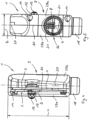
- a pair of scissors 1 for cutting branches has scissor parts 2 which delimit a cutting area 3 designed as a cutting plane, in which objects to be cut, in particular branches, can be received.
- a fixed blade 4 and a pivoting blade 5 are provided as scissor parts 2, which are pivotally connected to one another via a connecting bolt 12 provided with a lock nut 13.
- the cutting area 3 is essentially bordered by the blade areas of the fixed blade 4 and the pivoting blade 5 facing one another and describes the zone in which a relative movement of the fixed blade 4 with respect to the pivoting blade 5 can take place in order to cut objects.
- the relative movement of the scissor parts 2 to one another can be used to cut cuttings, in particular tree branches.
- the fixed blade 4 is connected via screw connections 14 to a blade housing 9, which is provided for receiving further components of the scissors and is connected to a handle device 10.
- the handle device 10 is essentially designed as a cylindrical tube and is intended for a user to grip the scissors 1 during operation.
- a designed operating handle is provided, which is connected to a traction device designed as a pull cable 7.
- the operating handle enables the user to introduce the actuating force onto the pull cable 7 by means of a linear movement, a pivoting movement or a combination thereof.
- a traction roller 6 is rotatably mounted on a bearing pin 15 and is connected to the traction cable 7.
- the traction cable 7 is deflected essentially at right angles via two deflection rollers 8 and is operatively connected to the operating handle (not shown) at an end of the handle device 10 facing away from the blade housing 9.
- the deflection rollers 8 are each rotatably mounted on bearing pins 16 and enable low-friction power transmission from the operating handle via the traction cable 7 to the deflection roller 8.
- an at least partially sectioned joint device 11 is provided, which is made up of an essentially T-shaped axle tube 17 firmly connected to the handle device 10, a locking button 18 and a sliding bearing 19 provided on the blade housing 9 corresponding to the axle tube 17.
- the joint device 11 enables the blade housing 9 to be pivoted about a joint axis 20, whereby a pivoting range of at least +/- 30 degrees relative to the Fig.1 shown starting position.
- the traction cable 7 is guided in the area of the joint device 11 through the deflection rollers 8 concentrically to the joint axis 20, so that when the blade housing 9 pivots about the joint axis 20, the traction cable 7 does not lengthen or shorten. This ensures that the same cutting area 3 is always maintained regardless of the pivot angle of the blade housing 9 relative to the handle device 10.
- one of the deflection rollers 8 is fastened in the axle tube 17, while the second deflection roller 8 is mounted in the blade housing 9.
- this torsion causes at least almost no lengthening or shortening of the traction cable 7, so that pivoting of the blade housing has no effect on the cutting area 3 of the shears 1.
- the gear 21 has a uniform toothing arranged concentrically to the bearing pin 15.
- a gear segment 22 provided in one piece on the pivoting blade 5 is in a positive operative connection with the gear 21, wherein the gear segment 22 is also equipped with a uniform toothing and is arranged concentrically to the connecting pin 12.
- a support area 23 wrapped around by the traction cable 7 has a non-circular contour in the wrapping area determined by the traction cable 7, which is designed here as a wrapping plane 24.
- the wrapping plane 24 is spanned by a family of radial vectors which extend orthogonally in the radial direction from the axis of rotation 26 and each point perpendicularly to the central longitudinal axis 27 of the traction cable 7. Examples of the radial vectors are shown in the Fig. 2 the effective radii R0, Rmax and R2 are shown.
- the non-circular contour of the support area 23 is selected so that in the Fig.1 shown rest position of the scissors 1 according to the illustration of the Fig. 2 the effective radius R0 at the detachment point 28, i.e. at the point at which the traction cable 7 protrudes from the traction roller 6 in the rest position and there is no further wrapping, is relatively small.
- a significantly increased effective radius Rmax is provided at the corresponding point of the traction roller 6, which changes into a smaller effective radius R2 in accordance with the cutting force which decreases again as the cutting process continues.
- the effective radius corresponds to the lever arm with which the tensile force transmitted from the traction cable 7 to the traction roller 6 is converted into a torque.
- This torque acts on the gear 21, which is firmly connected to the traction roller 6, is uniformly shaped and arranged concentrically to the connecting bolt 12. Since the effective radius is variable due to the non-circular contour of the support area 23, the actuating force introduced by the traction cable 7 is also transmitted to the gear 21 in different ways and thus leads to the desired variable force transmission between the actuating handle (not shown) and the pivoting blade 5.
- the blade housing 9 has two housing halves 29a and 29b, which are joined together at a joint 30 and connected to one another with screw connections 14.
- the joint 30 divides the blade housing 9 essentially symmetrically in a housing area facing away from the scissor parts 2. In the area of the scissor parts 2, however, the joint runs, as in Fig.4 shown in more detail, at the rear along the fixed blade 4, that is, the fixed blade 4 lies flat on the housing half 29b. This results in an asymmetrical division of the cutting housing 9 in this area.
- the two semi-cylindrical designed, formed on the cutting housing parts 29a and 29b The receiving socket formed by sleeve sections 31 for the tubular handle device 10 is divided in the middle by the parting line 30.
- a concave recess 32 is provided on the sleeve section 31 associated with the cutter housing part 29b, which is designed for a positive, twist-proof reception of the handle device 10 on the cutter housing 9.
- the outer diameter of the sleeve sections 31 is approximately 90% of a width extension b of the cutter housing 9.
- the Fig. 4 and 5 The handle device 10, not shown, has an outer diameter which essentially corresponds to the width b of the cutting housing 9.
- the deflection roller 8 is arranged centrally in the cutting housing 9 so that the traction cable 7, which is guided through the handle device 10, can be advantageously deflected.
- a width extension b of the blade housing 9 in the direction of the extension of the bearing bolt 15 and the connecting bolt 12 is chosen to be particularly slim for advantageous handling of the shears 1 and allows a favorable feed of the shears 1 even in dense branches.
- a height extension h of the blade housing 9 in the direction of the joint axis 20 corresponds essentially to the mouth width of the shears determined by an outer contour of the shears parts, as can also be seen from Fig.1
- the width b for the sections shown in the Fig. 4 and 5 The embodiment of the shears shown is approximately 35% of the height dimension h.
- the blade housing 9 is tapered in a wedge shape in the direction of the blade parts 2 in terms of the width dimension b in an area facing the shears parts 2, so that a particularly advantageous operation of the shears can be achieved, since the wedge shape contributes to an improved penetration of dense branches.
- the traction roller 6 and the joint axis 20 are preferably arranged in the cutting plane or at a short distance parallel to it. An axis of rotation of the traction roller 6 determined by the bearing pin 15 is aligned perpendicular to the cutting plane.
- the traction mechanism roller is attached directly to the pivoting blade or is preferably formed in one piece with the pivoting blade. This allows the traction mechanism to be directly coupled to the pivoting blade via the traction mechanism roller and there is only one gear device with one gear stage. Such an arrangement is of particular interest if a force transmission of the actuating force is provided elsewhere, for example in the area of the actuating handle. It is conceivable that the actuating force acting on the actuating handle is amplified via a gear device or a pulley and only then introduced to the traction mechanism. This allows a particularly compact and simple design of the scissors to be realized in the area of the blade housing, so that the handling of the scissors is influenced in an advantageous manner.
- both scissor parts are movably attached to the blade housing.
- a first scissor part has teeth that face radially outwards in relation to an arc-shaped toothing
- a second scissor part has an arc-shaped toothing that is concentric with the first and whose teeth face radially inwards.
- a gear wheel connected to a traction roller is arranged between the toothing of the first scissor part and the toothing of the second scissor part in such a way that rotation of the gear wheel leads to an opposite movement of the two scissor parts.
Landscapes
- Life Sciences & Earth Sciences (AREA)
- Biodiversity & Conservation Biology (AREA)
- Ecology (AREA)
- Forests & Forestry (AREA)
- Environmental Sciences (AREA)
- Scissors And Nippers (AREA)
- Polishing Bodies And Polishing Tools (AREA)
- Turning (AREA)
- Crystals, And After-Treatments Of Crystals (AREA)
Priority Applications (1)
| Application Number | Priority Date | Filing Date | Title |
|---|---|---|---|
| PL10196294T PL2314151T3 (pl) | 2005-08-05 | 2006-08-02 | Nożyce do cięcia gałęzi |
Applications Claiming Priority (3)
| Application Number | Priority Date | Filing Date | Title |
|---|---|---|---|
| DE102005039084A DE102005039084A1 (de) | 2005-08-05 | 2005-08-05 | Schere zum Schneiden von Ästen |
| EP06791556A EP1909556B1 (de) | 2005-08-05 | 2006-08-02 | Schere zum schneiden von ästen |
| PCT/EP2006/007623 WO2007017163A2 (de) | 2005-08-05 | 2006-08-02 | Schere zum schneiden von ästen |
Related Parent Applications (4)
| Application Number | Title | Priority Date | Filing Date |
|---|---|---|---|
| EP06791556 Previously-Filed-Application | 2006-08-02 | ||
| EP06791556A Division EP1909556B1 (de) | 2005-08-05 | 2006-08-02 | Schere zum schneiden von ästen |
| EP06791556A Previously-Filed-Application EP1909556B1 (de) | 2005-08-05 | 2006-08-02 | Schere zum schneiden von ästen |
| EP06791556.1 Division | 2006-08-02 |
Publications (3)
| Publication Number | Publication Date |
|---|---|
| EP2314151A1 EP2314151A1 (de) | 2011-04-27 |
| EP2314151B1 EP2314151B1 (de) | 2016-10-12 |
| EP2314151B3 true EP2314151B3 (de) | 2024-08-28 |
Family
ID=37670100
Family Applications (3)
| Application Number | Title | Priority Date | Filing Date |
|---|---|---|---|
| EP10170864.2A Active EP2258163B1 (de) | 2005-08-05 | 2006-08-02 | Schere zum Schneiden von Ästen |
| EP06791556A Not-in-force EP1909556B1 (de) | 2005-08-05 | 2006-08-02 | Schere zum schneiden von ästen |
| EP10196294.2A Active EP2314151B3 (de) | 2005-08-05 | 2006-08-02 | Schere zum Schneiden von Ästen |
Family Applications Before (2)
| Application Number | Title | Priority Date | Filing Date |
|---|---|---|---|
| EP10170864.2A Active EP2258163B1 (de) | 2005-08-05 | 2006-08-02 | Schere zum Schneiden von Ästen |
| EP06791556A Not-in-force EP1909556B1 (de) | 2005-08-05 | 2006-08-02 | Schere zum schneiden von ästen |
Country Status (6)
| Country | Link |
|---|---|
| EP (3) | EP2258163B1 (pl) |
| AT (1) | ATE528982T1 (pl) |
| DE (2) | DE102005039084A1 (pl) |
| FI (1) | FI2258163T3 (pl) |
| PL (2) | PL2258163T3 (pl) |
| WO (1) | WO2007017163A2 (pl) |
Families Citing this family (4)
| Publication number | Priority date | Publication date | Assignee | Title |
|---|---|---|---|---|
| DE102006039218A1 (de) * | 2006-08-22 | 2008-02-28 | Gardena Manufacturing Gmbh | Handhaltbares Arbeitsgerät, insbesondere Astschneider |
| DE102014016272B4 (de) * | 2014-11-04 | 2018-01-04 | Mtd Products Inc. | Schneidkopf, insbesondere für eine Baumschere |
| CN104620871B (zh) * | 2015-01-31 | 2016-11-02 | 兰州工业学院 | 一种果树枝条修剪机 |
| US12508720B2 (en) | 2022-10-07 | 2025-12-30 | Kubota Corporation | End effector including cutting blade and pulley assembly |
Family Cites Families (9)
| Publication number | Priority date | Publication date | Assignee | Title |
|---|---|---|---|---|
| US1135989A (en) * | 1911-11-29 | 1915-04-20 | Merriman Brothers | Lawn-edge trimmer. |
| DE949784C (de) | 1954-07-21 | 1956-09-27 | Georg Morell | Stielbaumschere |
| DE1911737A1 (de) | 1969-03-07 | 1970-09-24 | Leyat Pierre | Geraet zum Baumausschneiden |
| DE3925752A1 (de) * | 1989-08-03 | 1991-02-07 | Wolf Geraete Gmbh | Baumschere |
| JPH09322650A (ja) * | 1996-06-04 | 1997-12-16 | Minaminasu Seiko Kk | 樹木の枝切り具 |
| US5950315A (en) * | 1997-08-07 | 1999-09-14 | Fiskars Consumer Oy Ab | Lopper |
| US20030177644A1 (en) * | 2002-03-25 | 2003-09-25 | Kun-Chia Cheng | Tree pruner |
| US6748663B2 (en) * | 2002-08-15 | 2004-06-15 | Fiskars Consumer Oy Ab | Lopper |
| US20040045175A1 (en) * | 2002-09-05 | 2004-03-11 | Ming-Shan Jang | Tree pruner |
-
2005
- 2005-08-05 DE DE102005039084A patent/DE102005039084A1/de not_active Ceased
-
2006
- 2006-08-02 FI FIEP10170864.2T patent/FI2258163T3/en active
- 2006-08-02 EP EP10170864.2A patent/EP2258163B1/de active Active
- 2006-08-02 EP EP06791556A patent/EP1909556B1/de not_active Not-in-force
- 2006-08-02 DE DE202006021310.4U patent/DE202006021310U1/de not_active Expired - Lifetime
- 2006-08-02 WO PCT/EP2006/007623 patent/WO2007017163A2/de not_active Ceased
- 2006-08-02 EP EP10196294.2A patent/EP2314151B3/de active Active
- 2006-08-02 AT AT06791556T patent/ATE528982T1/de active
- 2006-08-02 PL PL10170864.2T patent/PL2258163T3/pl unknown
- 2006-08-02 PL PL10196294T patent/PL2314151T3/pl unknown
Also Published As
| Publication number | Publication date |
|---|---|
| ATE528982T1 (de) | 2011-11-15 |
| FI2258163T3 (en) | 2023-07-26 |
| DE202006021310U1 (de) | 2015-07-02 |
| DE102005039084A1 (de) | 2007-02-08 |
| PL2314151T3 (pl) | 2017-04-28 |
| EP1909556B1 (de) | 2011-10-19 |
| EP2314151A1 (de) | 2011-04-27 |
| PL2258163T3 (pl) | 2023-09-04 |
| EP2314151B1 (de) | 2016-10-12 |
| EP1909556A2 (de) | 2008-04-16 |
| EP2258163B1 (de) | 2023-04-26 |
| WO2007017163A3 (de) | 2007-11-29 |
| WO2007017163A2 (de) | 2007-02-15 |
| EP2258163A1 (de) | 2010-12-08 |
Similar Documents
| Publication | Publication Date | Title |
|---|---|---|
| DE102012212510B4 (de) | Endoskopisches Instrument | |
| EP0699054B1 (de) | Chirurgisches instrument mit zwei trennbaren griffbranchen | |
| EP1891853B1 (de) | Handhaltbares Arbeitsgerät, insbesondere Astschneider | |
| EP0176784B1 (de) | Astschere | |
| EP3718184B1 (de) | Klemmbacken für eine abisolierzange, sowie abisolierzange | |
| EP4376758B1 (de) | Chirurgisches instrument und lenkgetriebe dafür | |
| EP3673725A1 (de) | Schneidvorrichtung | |
| EP4277771A1 (de) | Rohrschneidegerät | |
| EP1319456B1 (de) | Kabelschneider | |
| EP2314151B3 (de) | Schere zum Schneiden von Ästen | |
| EP4376728B1 (de) | Chirurgisches instrument und lenkgetriebe dafür | |
| DE102010007917B4 (de) | Handbetätigtes Werkzeug | |
| WO2011079897A1 (de) | Steuerung eines rohrförmigen schafts eines chirurgischen instruments | |
| CH647672A5 (de) | Zur anbringung an der rueckenlehne eines zahnaerztlichen behandlungsstuhls geeignete kopfstuetze. | |
| EP3017686B1 (de) | Schneidkopf, insbesondere für eine baumschere | |
| EP0888850B1 (de) | Zange | |
| DE19926375A1 (de) | Motorbetriebenes Gartenwerkzeug, insbesondere Heckenschere | |
| DE60301613T2 (de) | Zange mit Verbindungsarmen, wobei die Länge eines Armes variierbar ist | |
| DE20001824U1 (de) | Kabelabisoliereinrichtung | |
| WO2024223573A1 (de) | Abisolierzange mit zwei zangenbacken | |
| DE19953947C2 (de) | Ausgleichsvorrichtung für ein Seilzug-Bremssystem | |
| DE3302875A1 (de) | Schere zum querunterteilen von strangfoermigem schneidgut | |
| EP3292933B1 (de) | Schneidvorrichtung | |
| DE102011000200B4 (de) | Automatik-Gripzange | |
| DE4038144C2 (de) | Vorrichtung zum Schneiden der Ummantelung eines einen Zugträger aufweisenden, insbesondere runden, Riemens |
Legal Events
| Date | Code | Title | Description |
|---|---|---|---|
| PUAI | Public reference made under article 153(3) epc to a published international application that has entered the european phase |
Free format text: ORIGINAL CODE: 0009012 |
|
| AC | Divisional application: reference to earlier application |
Ref document number: 1909556 Country of ref document: EP Kind code of ref document: P |
|
| AK | Designated contracting states |
Kind code of ref document: A1 Designated state(s): AT BE BG CH CY CZ DE DK EE ES FI FR GB GR HU IE IS IT LI LT LU LV MC NL PL PT RO SE SI SK TR |
|
| 17P | Request for examination filed |
Effective date: 20110706 |
|
| 17Q | First examination report despatched |
Effective date: 20121130 |
|
| RAP1 | Party data changed (applicant data changed or rights of an application transferred) |
Owner name: HUSQVARNA AB |
|
| GRAP | Despatch of communication of intention to grant a patent |
Free format text: ORIGINAL CODE: EPIDOSNIGR1 |
|
| INTG | Intention to grant announced |
Effective date: 20160616 |
|
| GRAS | Grant fee paid |
Free format text: ORIGINAL CODE: EPIDOSNIGR3 |
|
| GRAA | (expected) grant |
Free format text: ORIGINAL CODE: 0009210 |
|
| AC | Divisional application: reference to earlier application |
Ref document number: 1909556 Country of ref document: EP Kind code of ref document: P |
|
| AK | Designated contracting states |
Kind code of ref document: B1 Designated state(s): AT BE BG CH CY CZ DE DK EE ES FI FR GB GR HU IE IS IT LI LT LU LV MC NL PL PT RO SE SI SK TR |
|
| REG | Reference to a national code |
Ref country code: GB Ref legal event code: FG4D Free format text: NOT ENGLISH |
|
| REG | Reference to a national code |
Ref country code: CH Ref legal event code: EP |
|
| REG | Reference to a national code |
Ref country code: AT Ref legal event code: REF Ref document number: 835580 Country of ref document: AT Kind code of ref document: T Effective date: 20161015 |
|
| REG | Reference to a national code |
Ref country code: IE Ref legal event code: FG4D Free format text: LANGUAGE OF EP DOCUMENT: GERMAN |
|
| REG | Reference to a national code |
Ref country code: DE Ref legal event code: R096 Ref document number: 502006015213 Country of ref document: DE |
|
| REG | Reference to a national code |
Ref country code: LT Ref legal event code: MG4D |
|
| REG | Reference to a national code |
Ref country code: NL Ref legal event code: MP Effective date: 20161012 |
|
| PG25 | Lapsed in a contracting state [announced via postgrant information from national office to epo] |
Ref country code: LV Free format text: LAPSE BECAUSE OF FAILURE TO SUBMIT A TRANSLATION OF THE DESCRIPTION OR TO PAY THE FEE WITHIN THE PRESCRIBED TIME-LIMIT Effective date: 20161012 |
|
| PG25 | Lapsed in a contracting state [announced via postgrant information from national office to epo] |
Ref country code: GR Free format text: LAPSE BECAUSE OF FAILURE TO SUBMIT A TRANSLATION OF THE DESCRIPTION OR TO PAY THE FEE WITHIN THE PRESCRIBED TIME-LIMIT Effective date: 20170113 Ref country code: LT Free format text: LAPSE BECAUSE OF FAILURE TO SUBMIT A TRANSLATION OF THE DESCRIPTION OR TO PAY THE FEE WITHIN THE PRESCRIBED TIME-LIMIT Effective date: 20161012 Ref country code: SE Free format text: LAPSE BECAUSE OF FAILURE TO SUBMIT A TRANSLATION OF THE DESCRIPTION OR TO PAY THE FEE WITHIN THE PRESCRIBED TIME-LIMIT Effective date: 20161012 |
|
| PG25 | Lapsed in a contracting state [announced via postgrant information from national office to epo] |
Ref country code: IS Free format text: LAPSE BECAUSE OF FAILURE TO SUBMIT A TRANSLATION OF THE DESCRIPTION OR TO PAY THE FEE WITHIN THE PRESCRIBED TIME-LIMIT Effective date: 20170212 Ref country code: PT Free format text: LAPSE BECAUSE OF FAILURE TO SUBMIT A TRANSLATION OF THE DESCRIPTION OR TO PAY THE FEE WITHIN THE PRESCRIBED TIME-LIMIT Effective date: 20170213 Ref country code: NL Free format text: LAPSE BECAUSE OF FAILURE TO SUBMIT A TRANSLATION OF THE DESCRIPTION OR TO PAY THE FEE WITHIN THE PRESCRIBED TIME-LIMIT Effective date: 20161012 Ref country code: ES Free format text: LAPSE BECAUSE OF FAILURE TO SUBMIT A TRANSLATION OF THE DESCRIPTION OR TO PAY THE FEE WITHIN THE PRESCRIBED TIME-LIMIT Effective date: 20161012 |
|
| REG | Reference to a national code |
Ref country code: DE Ref legal event code: R097 Ref document number: 502006015213 Country of ref document: DE |
|
| REG | Reference to a national code |
Ref country code: FR Ref legal event code: PLFP Year of fee payment: 12 |
|
| PG25 | Lapsed in a contracting state [announced via postgrant information from national office to epo] |
Ref country code: RO Free format text: LAPSE BECAUSE OF FAILURE TO SUBMIT A TRANSLATION OF THE DESCRIPTION OR TO PAY THE FEE WITHIN THE PRESCRIBED TIME-LIMIT Effective date: 20161012 Ref country code: SK Free format text: LAPSE BECAUSE OF FAILURE TO SUBMIT A TRANSLATION OF THE DESCRIPTION OR TO PAY THE FEE WITHIN THE PRESCRIBED TIME-LIMIT Effective date: 20161012 Ref country code: DK Free format text: LAPSE BECAUSE OF FAILURE TO SUBMIT A TRANSLATION OF THE DESCRIPTION OR TO PAY THE FEE WITHIN THE PRESCRIBED TIME-LIMIT Effective date: 20161012 Ref country code: EE Free format text: LAPSE BECAUSE OF FAILURE TO SUBMIT A TRANSLATION OF THE DESCRIPTION OR TO PAY THE FEE WITHIN THE PRESCRIBED TIME-LIMIT Effective date: 20161012 Ref country code: CZ Free format text: LAPSE BECAUSE OF FAILURE TO SUBMIT A TRANSLATION OF THE DESCRIPTION OR TO PAY THE FEE WITHIN THE PRESCRIBED TIME-LIMIT Effective date: 20161012 |
|
| PLBE | No opposition filed within time limit |
Free format text: ORIGINAL CODE: 0009261 |
|
| STAA | Information on the status of an ep patent application or granted ep patent |
Free format text: STATUS: NO OPPOSITION FILED WITHIN TIME LIMIT |
|
| PG25 | Lapsed in a contracting state [announced via postgrant information from national office to epo] |
Ref country code: IT Free format text: LAPSE BECAUSE OF FAILURE TO SUBMIT A TRANSLATION OF THE DESCRIPTION OR TO PAY THE FEE WITHIN THE PRESCRIBED TIME-LIMIT Effective date: 20161012 Ref country code: BG Free format text: LAPSE BECAUSE OF FAILURE TO SUBMIT A TRANSLATION OF THE DESCRIPTION OR TO PAY THE FEE WITHIN THE PRESCRIBED TIME-LIMIT Effective date: 20170112 |
|
| 26N | No opposition filed |
Effective date: 20170713 |
|
| PG25 | Lapsed in a contracting state [announced via postgrant information from national office to epo] |
Ref country code: SI Free format text: LAPSE BECAUSE OF FAILURE TO SUBMIT A TRANSLATION OF THE DESCRIPTION OR TO PAY THE FEE WITHIN THE PRESCRIBED TIME-LIMIT Effective date: 20161012 |
|
| REG | Reference to a national code |
Ref country code: CH Ref legal event code: PL |
|
| PG25 | Lapsed in a contracting state [announced via postgrant information from national office to epo] |
Ref country code: MC Free format text: LAPSE BECAUSE OF FAILURE TO SUBMIT A TRANSLATION OF THE DESCRIPTION OR TO PAY THE FEE WITHIN THE PRESCRIBED TIME-LIMIT Effective date: 20161012 |
|
| GBPC | Gb: european patent ceased through non-payment of renewal fee |
Effective date: 20170802 |
|
| PG25 | Lapsed in a contracting state [announced via postgrant information from national office to epo] |
Ref country code: CH Free format text: LAPSE BECAUSE OF NON-PAYMENT OF DUE FEES Effective date: 20170831 Ref country code: LI Free format text: LAPSE BECAUSE OF NON-PAYMENT OF DUE FEES Effective date: 20170831 |
|
| REG | Reference to a national code |
Ref country code: IE Ref legal event code: MM4A |
|
| REG | Reference to a national code |
Ref country code: BE Ref legal event code: MM Effective date: 20170831 |
|
| PG25 | Lapsed in a contracting state [announced via postgrant information from national office to epo] |
Ref country code: LU Free format text: LAPSE BECAUSE OF NON-PAYMENT OF DUE FEES Effective date: 20170802 |
|
| REG | Reference to a national code |
Ref country code: FR Ref legal event code: PLFP Year of fee payment: 13 |
|
| PG25 | Lapsed in a contracting state [announced via postgrant information from national office to epo] |
Ref country code: GB Free format text: LAPSE BECAUSE OF NON-PAYMENT OF DUE FEES Effective date: 20170802 Ref country code: IE Free format text: LAPSE BECAUSE OF NON-PAYMENT OF DUE FEES Effective date: 20170802 |
|
| PG25 | Lapsed in a contracting state [announced via postgrant information from national office to epo] |
Ref country code: BE Free format text: LAPSE BECAUSE OF NON-PAYMENT OF DUE FEES Effective date: 20170831 |
|
| REG | Reference to a national code |
Ref country code: AT Ref legal event code: MM01 Ref document number: 835580 Country of ref document: AT Kind code of ref document: T Effective date: 20170802 |
|
| PG25 | Lapsed in a contracting state [announced via postgrant information from national office to epo] |
Ref country code: AT Free format text: LAPSE BECAUSE OF NON-PAYMENT OF DUE FEES Effective date: 20170802 |
|
| PG25 | Lapsed in a contracting state [announced via postgrant information from national office to epo] |
Ref country code: HU Free format text: LAPSE BECAUSE OF FAILURE TO SUBMIT A TRANSLATION OF THE DESCRIPTION OR TO PAY THE FEE WITHIN THE PRESCRIBED TIME-LIMIT; INVALID AB INITIO Effective date: 20060802 |
|
| PG25 | Lapsed in a contracting state [announced via postgrant information from national office to epo] |
Ref country code: CY Free format text: LAPSE BECAUSE OF NON-PAYMENT OF DUE FEES Effective date: 20161012 |
|
| PG25 | Lapsed in a contracting state [announced via postgrant information from national office to epo] |
Ref country code: TR Free format text: LAPSE BECAUSE OF FAILURE TO SUBMIT A TRANSLATION OF THE DESCRIPTION OR TO PAY THE FEE WITHIN THE PRESCRIBED TIME-LIMIT Effective date: 20161012 |
|
| P01 | Opt-out of the competence of the unified patent court (upc) registered |
Effective date: 20230419 |
|
| REG | Reference to a national code |
Ref country code: DE Ref legal event code: R055 Ref document number: 502006015213 Country of ref document: DE |
|
| PLCP | Request for limitation filed |
Free format text: ORIGINAL CODE: EPIDOSNLIM1 |
|
| PLCQ | Request for limitation of patent found admissible |
Free format text: ORIGINAL CODE: 0009231 |
|
| LIM1 | Request for limitation found admissible |
Free format text: SEQUENCE NO: 1; FILED AFTER OPPOSITION PERIOD Filing date: 20231127 Effective date: 20231127 |
|
| PLCR | Communication despatched that request for limitation of patent was allowed |
Free format text: ORIGINAL CODE: 0009245 |
|
| REG | Reference to a national code |
Ref country code: DE Ref legal event code: R056 Ref document number: 502006015213 Country of ref document: DE |
|
| PUAM | (expected) publication of b3 document |
Free format text: ORIGINAL CODE: 0009410 |
|
| STAA | Information on the status of an ep patent application or granted ep patent |
Free format text: STATUS: THE PATENT HAS BEEN LIMITED |
|
| PGFP | Annual fee paid to national office [announced via postgrant information from national office to epo] |
Ref country code: PL Payment date: 20250620 Year of fee payment: 20 |
|
| PGFP | Annual fee paid to national office [announced via postgrant information from national office to epo] |
Ref country code: FI Payment date: 20250709 Year of fee payment: 20 |
|
| PGFP | Annual fee paid to national office [announced via postgrant information from national office to epo] |
Ref country code: DE Payment date: 20250708 Year of fee payment: 20 |
|
| PGFP | Annual fee paid to national office [announced via postgrant information from national office to epo] |
Ref country code: FR Payment date: 20250707 Year of fee payment: 20 |