EP2309727A1 - Rundfunkempfangsvorrichtung und Rundfunkempfangsverfahren - Google Patents
Rundfunkempfangsvorrichtung und Rundfunkempfangsverfahren Download PDFInfo
- Publication number
- EP2309727A1 EP2309727A1 EP10175290A EP10175290A EP2309727A1 EP 2309727 A1 EP2309727 A1 EP 2309727A1 EP 10175290 A EP10175290 A EP 10175290A EP 10175290 A EP10175290 A EP 10175290A EP 2309727 A1 EP2309727 A1 EP 2309727A1
- Authority
- EP
- European Patent Office
- Prior art keywords
- tuner
- card information
- channel
- signal
- channel signal
- Prior art date
- Legal status (The legal status is an assumption and is not a legal conclusion. Google has not performed a legal analysis and makes no representation as to the accuracy of the status listed.)
- Withdrawn
Links
Images




Classifications
-
- H—ELECTRICITY
- H04—ELECTRIC COMMUNICATION TECHNIQUE
- H04N—PICTORIAL COMMUNICATION, e.g. TELEVISION
- H04N21/00—Selective content distribution, e.g. interactive television or video on demand [VOD]
- H04N21/40—Client devices specifically adapted for the reception of or interaction with content, e.g. set-top-box [STB]; Operations thereof
- H04N21/41—Structure of client; Structure of client peripherals
- H04N21/426—Internal components of the client ; Characteristics thereof
- H04N21/42607—Internal components of the client ; Characteristics thereof for processing the incoming bitstream
- H04N21/4263—Internal components of the client ; Characteristics thereof for processing the incoming bitstream involving specific tuning arrangements, e.g. two tuners
-
- H—ELECTRICITY
- H04—ELECTRIC COMMUNICATION TECHNIQUE
- H04N—PICTORIAL COMMUNICATION, e.g. TELEVISION
- H04N21/00—Selective content distribution, e.g. interactive television or video on demand [VOD]
- H04N21/40—Client devices specifically adapted for the reception of or interaction with content, e.g. set-top-box [STB]; Operations thereof
- H04N21/41—Structure of client; Structure of client peripherals
- H04N21/414—Specialised client platforms, e.g. receiver in car or embedded in a mobile appliance
- H04N21/4147—PVR [Personal Video Recorder]
-
- H—ELECTRICITY
- H04—ELECTRIC COMMUNICATION TECHNIQUE
- H04N—PICTORIAL COMMUNICATION, e.g. TELEVISION
- H04N21/00—Selective content distribution, e.g. interactive television or video on demand [VOD]
- H04N21/40—Client devices specifically adapted for the reception of or interaction with content, e.g. set-top-box [STB]; Operations thereof
- H04N21/41—Structure of client; Structure of client peripherals
- H04N21/418—External card to be used in combination with the client device, e.g. for conditional access
- H04N21/4181—External card to be used in combination with the client device, e.g. for conditional access for conditional access
-
- H—ELECTRICITY
- H04—ELECTRIC COMMUNICATION TECHNIQUE
- H04N—PICTORIAL COMMUNICATION, e.g. TELEVISION
- H04N21/00—Selective content distribution, e.g. interactive television or video on demand [VOD]
- H04N21/40—Client devices specifically adapted for the reception of or interaction with content, e.g. set-top-box [STB]; Operations thereof
- H04N21/43—Processing of content or additional data, e.g. demultiplexing additional data from a digital video stream; Elementary client operations, e.g. monitoring of home network or synchronising decoder's clock; Client middleware
- H04N21/436—Interfacing a local distribution network, e.g. communicating with another STB or one or more peripheral devices inside the home
- H04N21/43607—Interfacing a plurality of external cards, e.g. through a DVB Common Interface [DVB-CI]
-
- H—ELECTRICITY
- H04—ELECTRIC COMMUNICATION TECHNIQUE
- H04N—PICTORIAL COMMUNICATION, e.g. TELEVISION
- H04N5/00—Details of television systems
- H04N5/76—Television signal recording
-
- H—ELECTRICITY
- H04—ELECTRIC COMMUNICATION TECHNIQUE
- H04N—PICTORIAL COMMUNICATION, e.g. TELEVISION
- H04N7/00—Television systems
- H04N7/16—Analogue secrecy systems; Analogue subscription systems
- H04N7/162—Authorising the user terminal, e.g. by paying; Registering the use of a subscription channel, e.g. billing
- H04N7/163—Authorising the user terminal, e.g. by paying; Registering the use of a subscription channel, e.g. billing by receiver means only
-
- H—ELECTRICITY
- H04—ELECTRIC COMMUNICATION TECHNIQUE
- H04N—PICTORIAL COMMUNICATION, e.g. TELEVISION
- H04N21/00—Selective content distribution, e.g. interactive television or video on demand [VOD]
- H04N21/40—Client devices specifically adapted for the reception of or interaction with content, e.g. set-top-box [STB]; Operations thereof
- H04N21/47—End-user applications
- H04N21/482—End-user interface for programme selection
-
- H—ELECTRICITY
- H04—ELECTRIC COMMUNICATION TECHNIQUE
- H04N—PICTORIAL COMMUNICATION, e.g. TELEVISION
- H04N5/00—Details of television systems
- H04N5/76—Television signal recording
- H04N5/78—Television signal recording using magnetic recording
- H04N5/781—Television signal recording using magnetic recording on disks or drums
Definitions
- Embodiments described herein relate generally to a broadcast signal processing technique which decrypts an encrypted broadcast signal based on information recorded on, e.g., a B-CAS card.
- a television broadcast receiving apparatus including two tuners has become commercially available.
- Such a television broadcast receiving apparatus can screen one channel (for viewing) and record another channel or can simultaneously record two channels using the two tuners.
- Jpn. Pat. Appln. KOKAI Publication No. 2009-124379 discloses the following television broadcast receiving apparatus.
- the television broadcast receiving apparatus includes one card slot (card interface), and can decrypt an encrypted channel signal using card information (key information) on one smartcard (B-CAS card) inserted in this card slot.
- card information key information
- B-CAS card smartcard
- the aforementioned television broadcast receiving apparatus When the aforementioned television broadcast receiving apparatus simultaneously records, e.g., two channels, it cannot screen another channel (for viewing). That is, when the television broadcast receiving apparatus simultaneously records two channels, it can display only the recording channels. The user can view only recording programs, resulting in poor convenience.
- the television broadcast receiving apparatus includes another identical tuner in addition to the two tuners, and can screen another channel while simultaneously recording two channels.
- the television broadcast receiving apparatus includes three tuners, the cost of the television broadcast receiving apparatus increases.
- one B-CAS card has a constraint that it is used to decrypt only two channel signals at a maximum.
- a broadcast receiving apparatus includes a first tuner, a second tuner, a third tuner, a first reader, a second reader, and a signal processor.
- the first reader is configured to read first card information from a first card.
- the second reader is configured to read second card information from a second card of a type different from the first card.
- the signal processor is configured to decrypt a first channel signal selected by the first tuner based on the first card information, and to decrypt a second channel signal and a third channel signal respectively selected by the second tuner and the third tuner based on the second card information.
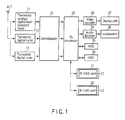
- FIG. 1 is a schematic block diagram showing the arrangement of a broadcast receiving apparatus according to a first embodiment.
- the broadcast receiving apparatus includes a terrestrial analog/digital dual-standard tuner 11, terrestrial digital tuner 12, terrestrial digital tuner 13, B-CAS card slot 21, B-CAS card slot 22, demodulator 31 (signal processor), transport stream (TS) processor 32 (signal processor), video decoder 33, audio decoder 34, HDD 35, HDD 36, display unit 37, and loudspeaker 38.
- the broadcast receiving apparatus includes the HDDs 35 and 36.
- these HDDs 35 and 36 are not indispensable components of the broadcast receiving apparatus.
- the broadcast receiving apparatus may include an interface used to connect the HDDs 35 and 36, and may be connected to the HDDs 35 and 36 via the interface.
- the first embodiment will explain a case in which the broadcast receiving apparatus includes the display unit 37.
- the display unit 37 is not an indispensable component of the broadcast receiving apparatus.
- the broadcast receiving apparatus may include an interface used to output a video signal to the display unit 37, and may be connected to the display unit 37 via this interface.
- the first embodiment will explain a case in which the broadcast receiving apparatus includes the loudspeaker 38.
- the loudspeaker 38 is not an indispensable component of the broadcast receiving apparatus.
- the broadcast receiving apparatus may include an interface used to output an audio signal to the loudspeaker 38, and may be connected to the loudspeaker 38 via this interface.
- a broadcast signal received by an antenna AT1 is input to the terrestrial analog/digital dual-standard tuner 11, and the terrestrial digital tuners 12 and 13.
- the terrestrial analog/digital dual-standard tuner 11 selects and outputs a signal of a designated channel from the broadcast signal corresponding to a terrestrial analog broadcast, or selects and outputs a signal of a designated channel from the broadcast signal corresponding to a terrestrial digital broadcast.
- the terrestrial digital tuner 12 selects and outputs a signal of a designated channel from the broadcast signal corresponding to the terrestrial digital broadcast.
- the terrestrial digital tuner 13 also selects and outputs a signal of a designated channel from the broadcast signal corresponding to the terrestrial digital broadcast.
- the demodulator 31 can demodulate a first channel signal output from the terrestrial analog/digital dual-standard tuner 11, a second channel signal output from the terrestrial digital tuner 12, and a third channel signal output from the terrestrial digital tuner 13, and can input a first TS signal corresponding to the first channel signal, a second TS signal corresponding to the second channel signal, and a third TS signal corresponding to the third channel signal to the TS processor 32. That is, the demodulator 31 can simultaneously decode three channel signals. Note that the first embodiment will explain a case in which the demodulator 31 simultaneously demodulates three channel signals. However, the demodulator 31 can demodulate only one channel signal, and can simultaneously demodulate two channel signals.
- Card slot 21 is a card interface (reader) required to communicate with inserted B-CAS card C1 or C2.
- card slot 22 is also a card interface (reader) required to communicate with inserted B-CAS card C1 or C2.
- the TS processor 32 demultiplexes a first control signal (ECM) from the first TS signal, and inputs the first control signal to B-CAS card C1 via, e.g., card slot 21 (card interface). For example, the TS processor 32 inputs the first control signal to B-CAS card C1 every 2 seconds. B-CAS card C1 decodes a first encryption key based on the first control signal. The TS processor 32 decrypts the encrypted first TS signal based on this first encryption key (card information).
- ECM control signal
- B-CAS card C1 decodes a first encryption key based on the first control signal.
- the TS processor 32 decrypts the encrypted first TS signal based on this first encryption key (card information).
- the TS processor 32 demultiplexes a second control signal (ECM) from the second TS signal, and inputs the second control signal to B-CAS card C2 via, e.g., card slot 22 (card interface). For example, the TS processor 32 inputs the second control signal to B-CAS card C2 every 2 seconds. B-CAS card C2 decodes a second encryption key based on the second control signal. The TS processor 32 decrypts the encrypted second TS signal based on this second encryption key (card information).
- ECM second control signal
- B-CAS card C2 decodes a second encryption key based on the second control signal.
- the TS processor 32 decrypts the encrypted second TS signal based on this second encryption key (card information).
- the TS processor 32 demultiplexes a third control signal (ECM) from the third TS signal, and inputs the third control signal to B-CAS card C2 via, e.g., card slot 22 (card interface). For example, the TS processor 32 inputs the third control signal to B-CAS card C2 every 2 seconds. B-CAS card C2 decodes a third encryption key based on the third control signal. The TS processor 32 decrypts the encrypted third TS signal based on this third encryption key (card information).
- ECM third control signal
- B-CAS card C2 decodes a third encryption key based on the third control signal.
- the TS processor 32 decrypts the encrypted third TS signal based on this third encryption key (card information).
- B-CAS card C1 supports simultaneous decryption of two channel signals.
- B-CAS card C2 also supports simultaneous decryption of two channel signals.
- the first embodiment has explained the case in which B-CAS card C1 is used to decrypt the first TS signal (that to be viewed), and B-CAS card C2 is used to decrypt the second and third TS signals (those to be recorded).
- the invention is not limited to such specific case.
- B-CAS card C1 may be used to decrypt the second TS signal, and B-CAS card C2 may be used to decrypt the first and third TS signals.
- B-CAS card C1 may be used to decrypt the third TS signal, and B-CAS card C2 may be used to decrypt the first and second TS signals.
- B-CAS card C1 may be used to decrypt the first and second TS signals, and B-CAS card C2 may be used to decrypt the third TS signal.
- B-CAS card C1 may be used to decrypt the second and third TS signals, and B-CAS card C2 may be used to decrypt the first TS signal.
- B-CAS card C1 may be used to decrypt the first and third TS signals, and B-CAS card C2 may be used to decrypt the second TS signal.
- the TS processor 32 when the user designates screening of one program (first channel signal) and video recording of two programs (second and third channel signals), the TS processor 32 generates a first video signal and first audio signal from the decrypted first TS signal, outputs the first video signal to the video decoder 33, and outputs the first audio signal to the audio decoder 34. Furthermore, the TS processor 32 outputs the decrypted second TS signal (partial TS signal) and the decrypted third TS signal (partial TS signal) to the HDD 35 or 36.
- the video decoder 33 decodes the first video signal, and outputs the decoded first video signal to the display unit 37.
- the display unit 37 displays a first video picture based on the decoded first video signal.
- the audio decoder 34 decodes the first audio signal, and outputs the decoded first audio signal to the loudspeaker 38.
- the loudspeaker 38 outputs a first sound based on the decoded first audio signal.
- the HDD 35 or 36 records the second TS signal (partial TS signal) and the third TS signal (partial TS signal).
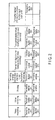
- FIG. 2 is a table that summarizes processes for screening one program and recording two programs by the broadcast receiving apparatus according to the first embodiment.
- the broadcast receiving apparatus records channel 011 of the terrestrial digital broadcast, records channel 021 of the terrestrial digital broadcast, and screens channel 031 of the terrestrial digital broadcast.
- the broadcast receiving apparatus selects a signal of channel 011 using the terrestrial digital tuner 12, selects a signal of channel 021 using the terrestrial digital tuner 13, and selects a signal of channel 031 using the terrestrial analog/digital dual-standard tuner 11.
- the broadcast receiving apparatus decrypts the signals of channels 011 and 021 using B-CAS card C2, and decrypts the signal of channel 031 using B-CAS card C1.
- the broadcast receiving apparatus records channel 011 of the terrestrial digital broadcast, records channel 021 of the terrestrial digital broadcast, and screens channel 1 of the terrestrial analog broadcast.
- the broadcast receiving apparatus selects a signal of channel 011 using the terrestrial digital tuner 12, selects a signal of channel 021 using the terrestrial digital tuner 13, and selects a signal of channel 1 using the terrestrial analog/digital dual-standard tuner 11. Then, the broadcast receiving apparatus decrypts the signals of channels 011 and 021 using B-CAS card C2.
- the broadcast receiving apparatus can simultaneously decrypt three or more digital broadcast TS signals using the two B-CAS cards, and can simultaneously screen or record three or more digital broadcast programs.
- FIG. 3 is a schematic block diagram showing the arrangement of a broadcast receiving apparatus according to a second embodiment.
- the broadcast receiving apparatus further includes digital DBS tuners 14 and 15 in addition to the arrangement of the broadcast receiving apparatus shown in FIG. 1 .
- the digital DBS tuners 14 and 15 may be dual-standard DBS tuners capable of receiving signals from purpose-designed DBS transponders on dedicated direct-broadcast satellites and from transponders repurposed for direct broadcasting on communications satellites.
- a broadcast signal received by a DBS antenna AT2 is input to digital DBS tuners 14 and 15.
- Digital DBS tuner 14 selects and outputs a signal of a designated channel from the broadcast signal corresponding to a digital DBS broadcast.
- digital DBS tuner 15 also selects and outputs a signal of a designated channel from the broadcast signal corresponding to the digital DBS broadcast.
- a demodulator 31 can demodulate, for example, three channel signals of a first channel signal output from a terrestrial analog/digital dual-standard tuner 11, a second channel signal output from a terrestrial digital tuner 12, a third channel signal output from a terrestrial digital tuner 13, a fourth channel signal output from digital DBS tuner 14, and a fifth channel signal output from digital DBS tuner 15.
- the demodulator 31 may be configured to demodulate four or more channel signals.
- the demodulator 31 can input three TS signals corresponding to the three channel signals to a TS processor 32 by the aforementioned demodulation.
- B-CAS cards C1 and C2 are used to decrypt these three encrypted TS signals.
- the decryption processing using B-CAS cards C1 and C2 is as described above.
- the first embodiment has not explained detailed roles of B-CAS cards C1 and C2.
- the second embodiment will define the detailed roles of B-CAS cards C1 and C2 as follows.
- B-CAS card C1 red card
- B-CAS card C2 blue card
- B-CAS card C1 red card
- B-CAS card C2 blue card
- B-CAS card C1 is compatible with terrestrial digital broadcasting and digital DBS, while B-CAS card C2 is exclusively used for terrestrial digital broadcasting.
- the broadcast receiving apparatus selectively uses B-CAS cards C1 and C2 depending on the situation.
- a first state will be assumed first.
- the broadcast receiving apparatus screens a first channel of the terrestrial digital broadcast, while it records second and third channels of the terrestrial digital broadcast.
- the terrestrial analog/digital dual-standard tuner 11 selects a first channel signal of the terrestrial digital broadcast
- the terrestrial digital tuner 12 selects a second channel signal of the terrestrial digital broadcast
- the terrestrial digital tuner 13 selects a third channel signal of the terrestrial digital broadcast.
- the TS processor 32 decrypts a first TS signal corresponding to the first channel signal using a first encryption key obtained from B-CAS card C1, decrypts a second TS signal corresponding to the second channel signal using a second encryption key obtained from B-CAS card C2, and decrypts a third TS signal corresponding to the third channel signal using a third encryption key obtained from B-CAS card C2. Then, the broadcast receiving apparatus can record the decrypted second and third TS signals while screening the decrypted first TS signal.
- the broadcast receiving apparatus stops the video recording of the second and third channels of the terrestrial digital broadcast, while continuing the screening of the first channel of the terrestrial digital broadcast.
- the terrestrial analog/digital dual-standard tuner 11 continues selection of the first channel signal of the terrestrial digital broadcast, and the TS processor 32 continues decryption of the first TS signal corresponding to the first channel signal using the first encryption key obtained from B-GAS card C1.
- the terrestrial digital tuners 12 and 13 can pause their operations, and need not use B-CAS card C2. Then, the broadcast receiving apparatus continues the screening of the decrypted first TS signal.
- the broadcast receiving apparatus starts video recording of a fourth channel of the digital DBS broadcast, while continuing the screening of the first channel of the terrestrial digital broadcast.
- the terrestrial analog/digital dual-standard tuner 11 continues selection of the first channel signal of the terrestrial digital broadcast, and digital DBS tuner 14 (or digital DBS tuner 15) selects a fourth channel signal of the digital DBS broadcast.
- the TS processor 32 continues decryption of the first TS signal corresponding to the first channel signal using the first encryption key obtained from B-CAS card C1, and decrypts a fourth TS signal corresponding to the fourth channel signal using a fourth encryption key also obtained from B-CAS card C1.
- B-CAS card C2 is not compatible with the digital DBS broadcast, as described above.
- the fourth TS signal of the digital DBS broadcast cannot be decrypted using B-CAS card C2.
- B-CAS card C1 is used to decrypt the two channel signals (first and fourth channel signals).
- the broadcast receiving apparatus starts another video recording of a fifth channel of the digital DBS broadcast, while continuing the screening of the first channel of the terrestrial digital broadcast and the video recording of the fourth channel of the digital DBS broadcast.
- B-CAS card C1 can be used to simultaneously decrypt two channel signals, and is compatible with the terrestrial digital broadcast and digital DBS broadcast.
- B-CAS card C2 can be used to simultaneously decrypt two channel signals, but it is compatible with only the terrestrial digital broadcast. That is, B-CAS card C2 cannot be used in decryption of the digital DBS broadcast.
- the broadcast receiving apparatus uses B-CAS card C1 to decrypt the two channel signals (first and fourth channel signals).
- the broadcast receiving apparatus has to decrypt two channel signals (fourth and fifth channel signals) of the digital DBS broadcast.
- the TS processor 32 switches decryption of the first channel signal using B-CAS card C1 to that using B-CAS card C2, and decrypts the fourth and fifth channel signals using B-CAS card C1.
- the terrestrial analog/digital dual-standard tuner 11 continues selection of the first channel signal of the terrestrial digital broadcast
- the digital DBS tuner 14 continues selection of the fourth channel signal of the digital DBS broadcast
- the digital DBS tuner 15 selects a fifth channel signal of the digital DBS broadcast.
- the TS processor 32 continues decryption of the fourth TS signal corresponding to the fourth channel signal using the fourth encryption key obtained from B-CAS card C1.
- the TS processor 32 aborts decryption of the first TS signal corresponding to the first channel signal using B-CAS card C1, and restarts decryption of the first TS signal using a first encryption key obtained from B-CAS card C2 instead.
- the TS processor 32 starts decryption of a fifth TS signal corresponding to the fifth channel signal using a fifth encryption key obtained from B-CAS card C1.
- the broadcast receiving apparatus can selectively use B-CAS cards C1 and C2 depending on the situation.
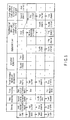
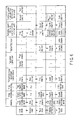
- the broadcast receiving apparatus may selectively use B-CAS cards C1 and C2, as shown in FIG. 5 or 6 .
- the terrestrial digital broadcast (first channel signal) is decrypted using B-CAS card C1, but B-CAS card C2 is not used in decryption.
- the TS processor 32 aborts decryption of the first TS signal corresponding to the first channel signal using B-CAS card C1, and restarts that of the first TS signal using the first encryption key obtained from B-CAS card C2 instead. That is, in the case of a channel signal (terrestrial digital broadcast) that can be decrypted by either B-CAS card C1 or C2, the TS processor 32 preferentially uses B-CAS card C2 to decrypt these channel signals.
- target screening and video recording processes can be executed smoothly (without any card switching process) in the fourth state.
- the cards assigned to the decryption processes may be switched at this timing. That is, in response to switching of the channel, the terrestrial analog/digital dual-standard tuner 11 aborts selection of the first channel signal of the terrestrial digital broadcast, and selects a sixth channel signal of the terrestrial digital broadcast instead. Assume that digital DBS tuner 14 continues selection of the fourth channel signal of the digital DBS broadcast.
- the TS processor 32 aborts decryption of the first TS signal corresponding to the first channel signal using B-CAS card C1, and starts decryption of a sixth TS signal corresponding to the sixth channel signal using a sixth encryption key obtained from B-CAS card C2 instead. Assume that the TS processor 32 continues decryption of the fourth TS signal corresponding to the fourth channel signal using the fourth encryption key obtained from B-CAS card C1. As described above, by switching the cards assigned to the decryption processes at the channel switching timing, the target screening and video recording processes can be executed smoothly (without any card switching process) in the fourth state.
- the broadcast receiving apparatus can selectively use B-CAS cards C1 and C2 depending on the situation.
- the broadcast receiving apparatus uses B-CAS card C2 in preference to B-CAS card C1 when it decrypts the terrestrial digital broadcast.
- Preferential use examples are as shown in FIGS. 5 and 6 .
- the broadcast receiving apparatus can simultaneously decrypt a total of three (or four) channel signals of a maximum of four channel signals corresponding to the terrestrial digital broadcast and a maximum of two channel signals corresponding to the digital DBS broadcast, and can simultaneously screen or record the total of three (or four) channel signals.
- FIG. 7 is a table that summarizes processes for screening two programs and recording two programs by the broadcast receiving apparatus of the second embodiment.
- digital DBS tuners 14 and 15 of the broadcast receiving apparatus of the second embodiment may be dual-standard tuners capable of receiving signals from purpose-designed DBS transponders on dedicated direct-broadcast satellites and from transponders repurposed for direct broadcasting on communications satellites.
- the first variant will be referred to simply as DBS, and the second as comsat-DBS; and in the description below, references to digital DBS tuners 14 and 15 encompass DBS/comsat-DBS dual-standard tuners. Note that FIG.
- the broadcast receiving apparatus records channel 011 of the terrestrial digital broadcast, records channel 021 of the terrestrial digital broadcast, and also screens a first designated channel of the terrestrial digital broadcast and a second designated channel of the digital DBS broadcast.
- the broadcast receiving apparatus selects a signal of channel 011 using the terrestrial digital tuner 12, a signal of channel 021 using the terrestrial digital tuner 13, a signal of the first designated channel using the terrestrial analog/digital dual-standard tuner 11, and a signal of the second designated channel using digital DBS tuner 14.
- the broadcast receiving apparatus decrypts the signals of channels 011 and 021 using B-CAS card C2, and decrypts the signals of the first and second designated channels using B-CAS card C1.
- the broadcast receiving apparatus decrypts the signals of channel 011 and the first designated channel using B-CAS card C2, and decrypts the signals of channel 021 and the second designated channel using B-CAS card C1.
- B-CAS cards C1 and C2 In order to allow the broadcast receiving apparatus to screen one channel and to record two channels, as descried above, B-CAS cards C1 and C2 have to be normally inserted into B-CAS card slots 21 and 22. If B-CAS cards C1 and C2 are not normally inserted or wrong cards are inserted, the broadcast receiving apparatus outputs a warning message.
- the broadcast receiving apparatus detects that it can normally communicate with B-CAS card C2 inserted in B-CAS card slot 21, and no B-CAS card is inserted in B-CAS card slot 22, it outputs a warning message (B-CAS1: normally operate/B-CAS2: no B-CAS card C1 [red card] inserted), as shown in FIG. 8 .
- B-CAS1 normally operate/B-CAS2: no B-CAS card C1 [red card] inserted
- the broadcast receiving apparatus detects that it can normally communicate with B-CAS card C1 inserted in B-CAS card slot 21, and no B-CAS card is inserted into B-CAS card slot 22, it outputs a warning message (B-CAS1: normally operate/B-CAS2: no B-CAS card C2 [blue card] inserted).
- B-CAS1 normally operate/B-CAS2: no B-CAS card C2 [blue card] inserted.
- the user can recognize, e.g., the insertion states of B-CAS cards C1 and C2.
- the broadcast receiving apparatus can output the following warning message depending on the situation.
- the broadcast receiving apparatus stores this assignment information, and can output warning information that prompts the user to insert B-CAS card C1 in B-CAS card slot 21 when no B-CAS card C1 is inserted in B-CAS card slot 21. Also, the broadcast receiving apparatus can output warning information that prompts the user to insert B-CAS card C2 in B-CAS card slot 22 when no B-CAS card C2 is inserted in B-CAS card slot 22.
- the broadcast receiving apparatus can output warning information that prompts the user to insert not B-CAS card C2 but B-CAS card C1 in B-CAS card slot 21 when B-CAS card C2 is inserted in B-CAS card slot 21.
- the broadcast receiving apparatus can output warning information that prompts the user to insert not B-CAS card C1 but B-CAS card C2 in B-CAS card slot 22 when B-CAS card C1 is inserted in B-CAS card slot 22.
- the broadcast receiving apparatus can output warning information indicating, e.g., that the card inserted in B-CAS card slot 21 or 22 has to be exchanged.
- the broadcast receiving apparatus can selectively set a first operation mode that does not accept any video recording/screening operations and a second operation mode that accepts a possible operation. For example, when the second operation mode is set, and when B-CAS card C1 is normally inserted in B-CAS card slot 21 and no B-CAS card C2 is inserted in B-CAS card slot 22, the broadcast receiving apparatus executes only video recording/screening operations using B-CAS card C1 alone, and outputs a guide message when B-CAS card C2 is required.
- FIG. 9 An example of a display screen during program recording/screening processes will be described below with reference to FIG. 9 .
- the broadcast receiving apparatus records channel 011 of the terrestrial digital broadcast, records channel 021 of the terrestrial digital broadcast, and screens channel 031 of the terrestrial digital broadcast will be explained.
- the broadcast receiving apparatus outputs first display information required to display screening information (e.g., a viewing icon) indicating screening (viewing) in progress and program information (e.g., a title) of channel 031 of the terrestrial digital broadcast.
- screening information e.g., a viewing icon
- program information e.g., a title
- the broadcast receiving apparatus outputs second display information required to display video recording information (e.g., a video recording icon) indicating video recording in progress and program information (e.g., a title) of channel 011 of the terrestrial digital broadcast. Furthermore, the broadcast receiving apparatus outputs third display information required to display video recording information (e.g., a video recording icon) indicating video recording in progress and program information (e.g., a title) of channel 021 of the terrestrial digital broadcast. As a result, as shown in FIG. 9 , the display unit 37 displays the screening information (e.g., a viewing icon) indicating screening (viewing) in progress and the program information of channel 031 of the terrestrial digital broadcast.
- video recording information e.g., a video recording icon
- program information e.g., a title
- the display unit 37 displays the video recording information (e.g., a video recording icon) indicating video recording in progress and the program information of channel 011 of the terrestrial digital broadcast. Furthermore, the display unit 37 displays the video recording information (e.g., a video recording icon) indicating video recording in progress and the program information of channel 021 of the terrestrial digital broadcast. With this display, the user can clearly distinctly recognize one program during viewing and two programs during video recording.
- video recording information e.g., a video recording icon
Landscapes
- Engineering & Computer Science (AREA)
- Multimedia (AREA)
- Signal Processing (AREA)
- Computer Security & Cryptography (AREA)
- Two-Way Televisions, Distribution Of Moving Picture Or The Like (AREA)
- Television Signal Processing For Recording (AREA)
Applications Claiming Priority (1)
| Application Number | Priority Date | Filing Date | Title |
|---|---|---|---|
| JP2009213624A JP2015039047A (ja) | 2009-09-15 | 2009-09-15 | 放送受信装置及び放送受信方法 |
Publications (1)
| Publication Number | Publication Date |
|---|---|
| EP2309727A1 true EP2309727A1 (de) | 2011-04-13 |
Family
ID=42937815
Family Applications (1)
| Application Number | Title | Priority Date | Filing Date |
|---|---|---|---|
| EP10175290A Withdrawn EP2309727A1 (de) | 2009-09-15 | 2010-09-03 | Rundfunkempfangsvorrichtung und Rundfunkempfangsverfahren |
Country Status (2)
| Country | Link |
|---|---|
| EP (1) | EP2309727A1 (de) |
| JP (1) | JP2015039047A (de) |
Cited By (1)
| Publication number | Priority date | Publication date | Assignee | Title |
|---|---|---|---|---|
| EP3288274A1 (de) * | 2016-08-26 | 2018-02-28 | TechniSat Digital GmbH | Verfahren für eine empfangseinrichtung, eine empfangseinrichtung sowie eine anordnung |
Citations (4)
| Publication number | Priority date | Publication date | Assignee | Title |
|---|---|---|---|---|
| KR20030012667A (ko) * | 2001-08-03 | 2003-02-12 | 주식회사 한단정보통신 | 다중 채널 송수신 시스템 및 그 제어방법 |
| WO2006080724A1 (en) * | 2004-10-11 | 2006-08-03 | Kaonmedia Co., Ltd. | Digital broadcasting conditional access device having multiple contents descrambling, and method for the same |
| US20080127277A1 (en) * | 2006-09-15 | 2008-05-29 | Pioneer Research Center Usa, Inc. | Networked digital tuners |
| JP2009124379A (ja) | 2007-11-14 | 2009-06-04 | Toshiba Corp | 多チャンネルの番組処理装置とその制御方法 |
-
2009
- 2009-09-15 JP JP2009213624A patent/JP2015039047A/ja active Pending
-
2010
- 2010-09-03 EP EP10175290A patent/EP2309727A1/de not_active Withdrawn
Patent Citations (4)
| Publication number | Priority date | Publication date | Assignee | Title |
|---|---|---|---|---|
| KR20030012667A (ko) * | 2001-08-03 | 2003-02-12 | 주식회사 한단정보통신 | 다중 채널 송수신 시스템 및 그 제어방법 |
| WO2006080724A1 (en) * | 2004-10-11 | 2006-08-03 | Kaonmedia Co., Ltd. | Digital broadcasting conditional access device having multiple contents descrambling, and method for the same |
| US20080127277A1 (en) * | 2006-09-15 | 2008-05-29 | Pioneer Research Center Usa, Inc. | Networked digital tuners |
| JP2009124379A (ja) | 2007-11-14 | 2009-06-04 | Toshiba Corp | 多チャンネルの番組処理装置とその制御方法 |
Non-Patent Citations (1)
| Title |
|---|
| ANONYMOUS: "User Manual: DM 8000 HD DVD", 6 February 2009 (2009-02-06), pages 1 - 91, XP002606144, Retrieved from the Internet <URL:http://www.dream-multimedia-tv.de/download/instruction_manual_dm8000_06-02-2009.pdf> [retrieved on 20101020] * |
Cited By (1)
| Publication number | Priority date | Publication date | Assignee | Title |
|---|---|---|---|---|
| EP3288274A1 (de) * | 2016-08-26 | 2018-02-28 | TechniSat Digital GmbH | Verfahren für eine empfangseinrichtung, eine empfangseinrichtung sowie eine anordnung |
Also Published As
| Publication number | Publication date |
|---|---|
| JP2015039047A (ja) | 2015-02-26 |
Similar Documents
| Publication | Publication Date | Title |
|---|---|---|
| US6298400B1 (en) | Enhancing interface device to transport stream of parallel signals to serial signals with separate clock rate using a pin reassignment | |
| JP4937415B2 (ja) | 電子機器および番組表作成方法 | |
| JP2005167782A (ja) | デジタル放送の記録方法及びデジタル放送受信装置 | |
| JP4889583B2 (ja) | 放送受信方法、放送受信システム、パーソナルコンピュータ、放送受信装置 | |
| EP2356813B1 (de) | Transportstrom-verarbeitungsvorrichtung mit der fähigkeit zum speichern des transportstroms, bevor der transportstrom entwürfelt wird, mit anschliessender entwürfelung des gespeicherten transportstroms zur wiedergabe | |
| US8059940B2 (en) | Broadcast receiving apparatus and broadcast receiving method | |
| JP2002218333A (ja) | 番組予約装置及び方法、受信装置及び方法、記録装置、及び記録媒体 | |
| JP4739708B2 (ja) | 放送番組の記録方法及び放送受信装置、並びに、そのための情報記録装置 | |
| EP2306703B1 (de) | Digitale Rundfunkempfangsvorrichtung und Signalverarbeitungsverfahren | |
| JP2011077929A (ja) | 受信装置及びcasカード制御方法 | |
| EP2421253A2 (de) | Vorrichtung zur Steuerung der Programminformationsanzeige und Verfahren zur Steuerung der Programminformationsanzeige | |
| JP2002252817A (ja) | デジタル放送受信装置 | |
| JP2010035069A (ja) | デジタル放送録画再生装置 | |
| JP4277910B2 (ja) | デジタル放送受信装置 | |
| JP4735560B2 (ja) | デジタル放送再生装置 | |
| JP2015039047A (ja) | 放送受信装置及び放送受信方法 | |
| US8478112B2 (en) | Digital broadcast recording device | |
| JP2008154014A (ja) | 受信装置 | |
| JP4305469B2 (ja) | テレビジョン受像機 | |
| JP2008301292A (ja) | デジタル放送受信機及びデジタル放送受信方法 | |
| JP2007235650A (ja) | チューナモジュールおよび放送受信装置 | |
| JP2007019906A (ja) | 放送受信装置 | |
| KR100555756B1 (ko) | 콤보 시스템의 예약 녹화 방법 | |
| EP2309728A1 (de) | Vorrichtung zur Steuerung der Programminformationsanzeige und Verfahren zur Steuerung der Programminformationsanzeige | |
| EP2071842A2 (de) | Vorrichtung und Verfahren zur Aufzeichnung von verschlüsselten Rundfunkdaten |
Legal Events
| Date | Code | Title | Description |
|---|---|---|---|
| PUAI | Public reference made under article 153(3) epc to a published international application that has entered the european phase |
Free format text: ORIGINAL CODE: 0009012 |
|
| 17P | Request for examination filed |
Effective date: 20100903 |
|
| AK | Designated contracting states |
Kind code of ref document: A1 Designated state(s): AL AT BE BG CH CY CZ DE DK EE ES FI FR GB GR HR HU IE IS IT LI LT LU LV MC MK MT NL NO PL PT RO SE SI SK SM TR |
|
| AX | Request for extension of the european patent |
Extension state: BA ME RS |
|
| STAA | Information on the status of an ep patent application or granted ep patent |
Free format text: STATUS: THE APPLICATION HAS BEEN WITHDRAWN |
|
| 18W | Application withdrawn |
Effective date: 20110519 |