EP2308676A1 - Thermal conductive silicone rubber composite sheet - Google Patents
Thermal conductive silicone rubber composite sheet Download PDFInfo
- Publication number
- EP2308676A1 EP2308676A1 EP10182085A EP10182085A EP2308676A1 EP 2308676 A1 EP2308676 A1 EP 2308676A1 EP 10182085 A EP10182085 A EP 10182085A EP 10182085 A EP10182085 A EP 10182085A EP 2308676 A1 EP2308676 A1 EP 2308676A1
- Authority
- EP
- European Patent Office
- Prior art keywords
- group
- thermal conductive
- component
- composite sheet
- silicone rubber
- Prior art date
- Legal status (The legal status is an assumption and is not a legal conclusion. Google has not performed a legal analysis and makes no representation as to the accuracy of the status listed.)
- Withdrawn
Links
- 239000002131 composite material Substances 0.000 title claims abstract description 56
- 229920002379 silicone rubber Polymers 0.000 title claims abstract description 44
- 239000004945 silicone rubber Substances 0.000 title claims abstract description 44
- 239000000203 mixture Substances 0.000 claims abstract description 60
- 239000010408 film Substances 0.000 claims abstract description 44
- 239000000463 material Substances 0.000 claims abstract description 41
- 229920001296 polysiloxane Polymers 0.000 claims abstract description 38
- XUIMIQQOPSSXEZ-UHFFFAOYSA-N Silicon Chemical group [Si] XUIMIQQOPSSXEZ-UHFFFAOYSA-N 0.000 claims abstract description 22
- 239000003795 chemical substances by application Substances 0.000 claims abstract description 20
- 125000003342 alkenyl group Chemical group 0.000 claims abstract description 19
- BASFCYQUMIYNBI-UHFFFAOYSA-N platinum Chemical group [Pt] BASFCYQUMIYNBI-UHFFFAOYSA-N 0.000 claims abstract description 17
- 239000011231 conductive filler Substances 0.000 claims abstract description 15
- 229920002050 silicone resin Polymers 0.000 claims abstract description 12
- 229920006136 organohydrogenpolysiloxane Polymers 0.000 claims abstract description 11
- 238000006243 chemical reaction Methods 0.000 claims abstract description 8
- 239000010409 thin film Substances 0.000 claims abstract description 8
- 229910052710 silicon Inorganic materials 0.000 claims abstract description 7
- 239000011248 coating agent Substances 0.000 claims abstract description 6
- 238000000576 coating method Methods 0.000 claims abstract description 6
- 125000004429 atom Chemical group 0.000 claims abstract description 4
- 239000003863 metallic catalyst Substances 0.000 claims abstract description 4
- 239000000843 powder Substances 0.000 claims description 41
- 229920003002 synthetic resin Polymers 0.000 claims description 28
- 239000000057 synthetic resin Substances 0.000 claims description 28
- 125000004432 carbon atom Chemical group C* 0.000 claims description 27
- 125000000217 alkyl group Chemical group 0.000 claims description 19
- 239000004205 dimethyl polysiloxane Substances 0.000 claims description 13
- 235000013870 dimethyl polysiloxane Nutrition 0.000 claims description 13
- 229920000435 poly(dimethylsiloxane) Polymers 0.000 claims description 13
- 125000003118 aryl group Chemical group 0.000 claims description 12
- 238000000034 method Methods 0.000 claims description 12
- 125000001931 aliphatic group Chemical group 0.000 claims description 10
- 229920001721 polyimide Polymers 0.000 claims description 9
- TWNQGVIAIRXVLR-UHFFFAOYSA-N oxo(oxoalumanyloxy)alumane Chemical compound O=[Al]O[Al]=O TWNQGVIAIRXVLR-UHFFFAOYSA-N 0.000 claims description 8
- 239000004642 Polyimide Substances 0.000 claims description 7
- XLOMVQKBTHCTTD-UHFFFAOYSA-N Zinc monoxide Chemical compound [Zn]=O XLOMVQKBTHCTTD-UHFFFAOYSA-N 0.000 claims description 7
- 150000001875 compounds Chemical class 0.000 claims description 6
- 229910052582 BN Inorganic materials 0.000 claims description 5
- PZNSFCLAULLKQX-UHFFFAOYSA-N Boron nitride Chemical compound N#B PZNSFCLAULLKQX-UHFFFAOYSA-N 0.000 claims description 5
- 229910020388 SiO1/2 Inorganic materials 0.000 claims description 5
- 229910020485 SiO4/2 Inorganic materials 0.000 claims description 5
- MXRIRQGCELJRSN-UHFFFAOYSA-N O.O.O.[Al] Chemical compound O.O.O.[Al] MXRIRQGCELJRSN-UHFFFAOYSA-N 0.000 claims description 4
- 239000004952 Polyamide Substances 0.000 claims description 4
- 239000004962 Polyamide-imide Substances 0.000 claims description 4
- PMHQVHHXPFUNSP-UHFFFAOYSA-M copper(1+);methylsulfanylmethane;bromide Chemical compound Br[Cu].CSC PMHQVHHXPFUNSP-UHFFFAOYSA-M 0.000 claims description 4
- 229910003460 diamond Inorganic materials 0.000 claims description 4
- 239000010432 diamond Substances 0.000 claims description 4
- 229920002313 fluoropolymer Polymers 0.000 claims description 4
- 239000000395 magnesium oxide Substances 0.000 claims description 4
- CPLXHLVBOLITMK-UHFFFAOYSA-N magnesium oxide Inorganic materials [Mg]=O CPLXHLVBOLITMK-UHFFFAOYSA-N 0.000 claims description 4
- AXZKOIWUVFPNLO-UHFFFAOYSA-N magnesium;oxygen(2-) Chemical compound [O-2].[Mg+2] AXZKOIWUVFPNLO-UHFFFAOYSA-N 0.000 claims description 4
- 238000004519 manufacturing process Methods 0.000 claims description 4
- 229920002647 polyamide Polymers 0.000 claims description 4
- 229920002312 polyamide-imide Polymers 0.000 claims description 4
- 229920000728 polyester Polymers 0.000 claims description 3
- HBMJWWWQQXIZIP-UHFFFAOYSA-N silicon carbide Chemical compound [Si+]#[C-] HBMJWWWQQXIZIP-UHFFFAOYSA-N 0.000 claims description 3
- 125000005369 trialkoxysilyl group Chemical group 0.000 claims description 3
- 125000001183 hydrocarbyl group Chemical group 0.000 claims 3
- 239000010410 layer Substances 0.000 description 75
- -1 polyethylene naphthalate Polymers 0.000 description 39
- 230000001070 adhesive effect Effects 0.000 description 30
- 125000002496 methyl group Chemical group [H]C([H])([H])* 0.000 description 15
- 239000000853 adhesive Substances 0.000 description 14
- 150000002430 hydrocarbons Chemical group 0.000 description 13
- VYPSYNLAJGMNEJ-UHFFFAOYSA-N Silicium dioxide Chemical compound O=[Si]=O VYPSYNLAJGMNEJ-UHFFFAOYSA-N 0.000 description 11
- 238000002156 mixing Methods 0.000 description 11
- 239000002245 particle Substances 0.000 description 11
- 125000001495 ethyl group Chemical group [H]C([H])([H])C([H])([H])* 0.000 description 10
- 229910052751 metal Inorganic materials 0.000 description 10
- 239000002184 metal Substances 0.000 description 10
- 125000001997 phenyl group Chemical group [H]C1=C([H])C([H])=C(*)C([H])=C1[H] 0.000 description 10
- YXFVVABEGXRONW-UHFFFAOYSA-N Toluene Chemical compound CC1=CC=CC=C1 YXFVVABEGXRONW-UHFFFAOYSA-N 0.000 description 9
- XAGFODPZIPBFFR-UHFFFAOYSA-N aluminium Chemical compound [Al] XAGFODPZIPBFFR-UHFFFAOYSA-N 0.000 description 9
- 239000002904 solvent Substances 0.000 description 8
- 239000003054 catalyst Substances 0.000 description 7
- 239000004020 conductor Substances 0.000 description 7
- 125000004435 hydrogen atom Chemical group [H]* 0.000 description 7
- 125000001436 propyl group Chemical group [H]C([*])([H])C([H])([H])C([H])([H])[H] 0.000 description 7
- 125000000391 vinyl group Chemical group [H]C([*])=C([H])[H] 0.000 description 7
- 238000007259 addition reaction Methods 0.000 description 6
- 229910052782 aluminium Inorganic materials 0.000 description 6
- 230000000052 comparative effect Effects 0.000 description 6
- 238000011156 evaluation Methods 0.000 description 6
- 125000004051 hexyl group Chemical group [H]C([H])([H])C([H])([H])C([H])([H])C([H])([H])C([H])([H])C([H])([H])* 0.000 description 6
- 229920001577 copolymer Polymers 0.000 description 5
- 125000000113 cyclohexyl group Chemical group [H]C1([H])C([H])([H])C([H])([H])C([H])(*)C([H])([H])C1([H])[H] 0.000 description 5
- 230000000694 effects Effects 0.000 description 5
- 125000002347 octyl group Chemical group [H]C([*])([H])C([H])([H])C([H])([H])C([H])([H])C([H])([H])C([H])([H])C([H])([H])C([H])([H])[H] 0.000 description 5
- 238000002360 preparation method Methods 0.000 description 5
- 230000001681 protective effect Effects 0.000 description 5
- 125000001731 2-cyanoethyl group Chemical group [H]C([H])(*)C([H])([H])C#N 0.000 description 4
- OKTJSMMVPCPJKN-UHFFFAOYSA-N Carbon Chemical compound [C] OKTJSMMVPCPJKN-UHFFFAOYSA-N 0.000 description 4
- UQSXHKLRYXJYBZ-UHFFFAOYSA-N Iron oxide Chemical compound [Fe]=O UQSXHKLRYXJYBZ-UHFFFAOYSA-N 0.000 description 4
- UFWIBTONFRDIAS-UHFFFAOYSA-N Naphthalene Chemical compound C1=CC=CC2=CC=CC=C21 UFWIBTONFRDIAS-UHFFFAOYSA-N 0.000 description 4
- KDLHZDBZIXYQEI-UHFFFAOYSA-N Palladium Chemical compound [Pd] KDLHZDBZIXYQEI-UHFFFAOYSA-N 0.000 description 4
- GWEVSGVZZGPLCZ-UHFFFAOYSA-N Titan oxide Chemical compound O=[Ti]=O GWEVSGVZZGPLCZ-UHFFFAOYSA-N 0.000 description 4
- 125000003710 aryl alkyl group Chemical group 0.000 description 4
- 125000004218 chloromethyl group Chemical group [H]C([H])(Cl)* 0.000 description 4
- 125000000068 chlorophenyl group Chemical group 0.000 description 4
- 125000001511 cyclopentyl group Chemical group [H]C1([H])C([H])([H])C([H])([H])C([H])(*)C1([H])[H] 0.000 description 4
- 125000002704 decyl group Chemical group [H]C([H])([H])C([H])([H])C([H])([H])C([H])([H])C([H])([H])C([H])([H])C([H])([H])C([H])([H])C([H])([H])C([H])([H])* 0.000 description 4
- 125000005388 dimethylhydrogensiloxy group Chemical group 0.000 description 4
- 125000003438 dodecyl group Chemical group [H]C([H])([H])C([H])([H])C([H])([H])C([H])([H])C([H])([H])C([H])([H])C([H])([H])C([H])([H])C([H])([H])C([H])([H])C([H])([H])C([H])([H])* 0.000 description 4
- 125000001207 fluorophenyl group Chemical group 0.000 description 4
- 238000006459 hydrosilylation reaction Methods 0.000 description 4
- 125000000956 methoxy group Chemical group [H]C([H])([H])O* 0.000 description 4
- 239000003921 oil Substances 0.000 description 4
- 239000000377 silicon dioxide Substances 0.000 description 4
- 125000003944 tolyl group Chemical group 0.000 description 4
- QYLFHLNFIHBCPR-UHFFFAOYSA-N 1-ethynylcyclohexan-1-ol Chemical compound C#CC1(O)CCCCC1 QYLFHLNFIHBCPR-UHFFFAOYSA-N 0.000 description 3
- NGNBDVOYPDDBFK-UHFFFAOYSA-N 2-[2,4-di(pentan-2-yl)phenoxy]acetyl chloride Chemical compound CCCC(C)C1=CC=C(OCC(Cl)=O)C(C(C)CCC)=C1 NGNBDVOYPDDBFK-UHFFFAOYSA-N 0.000 description 3
- 125000003903 2-propenyl group Chemical group [H]C([*])([H])C([H])=C([H])[H] 0.000 description 3
- 229920002799 BoPET Polymers 0.000 description 3
- 239000002253 acid Substances 0.000 description 3
- 230000000740 bleeding effect Effects 0.000 description 3
- 125000000484 butyl group Chemical group [H]C([*])([H])C([H])([H])C([H])([H])C([H])([H])[H] 0.000 description 3
- 125000000753 cycloalkyl group Chemical group 0.000 description 3
- 230000007423 decrease Effects 0.000 description 3
- 239000011810 insulating material Substances 0.000 description 3
- 229910044991 metal oxide Inorganic materials 0.000 description 3
- 125000001400 nonyl group Chemical group [H]C([*])([H])C([H])([H])C([H])([H])C([H])([H])C([H])([H])C([H])([H])C([H])([H])C([H])([H])C([H])([H])[H] 0.000 description 3
- 125000001147 pentyl group Chemical group C(CCCC)* 0.000 description 3
- 229920003223 poly(pyromellitimide-1,4-diphenyl ether) Polymers 0.000 description 3
- 229920001843 polymethylhydrosiloxane Polymers 0.000 description 3
- 230000005855 radiation Effects 0.000 description 3
- 239000000126 substance Substances 0.000 description 3
- 238000009736 wetting Methods 0.000 description 3
- 125000005999 2-bromoethyl group Chemical group 0.000 description 2
- 125000000094 2-phenylethyl group Chemical group [H]C1=C([H])C([H])=C(C([H])=C1[H])C([H])([H])C([H])([H])* 0.000 description 2
- WKBOTKDWSSQWDR-UHFFFAOYSA-N Bromine atom Chemical compound [Br] WKBOTKDWSSQWDR-UHFFFAOYSA-N 0.000 description 2
- ZAMOUSCENKQFHK-UHFFFAOYSA-N Chlorine atom Chemical compound [Cl] ZAMOUSCENKQFHK-UHFFFAOYSA-N 0.000 description 2
- PXGOKWXKJXAPGV-UHFFFAOYSA-N Fluorine Chemical compound FF PXGOKWXKJXAPGV-UHFFFAOYSA-N 0.000 description 2
- AFCARXCZXQIEQB-UHFFFAOYSA-N N-[3-oxo-3-(2,4,6,7-tetrahydrotriazolo[4,5-c]pyridin-5-yl)propyl]-2-[[3-(trifluoromethoxy)phenyl]methylamino]pyrimidine-5-carboxamide Chemical compound O=C(CCNC(=O)C=1C=NC(=NC=1)NCC1=CC(=CC=C1)OC(F)(F)F)N1CC2=C(CC1)NN=N2 AFCARXCZXQIEQB-UHFFFAOYSA-N 0.000 description 2
- 229910004674 SiO0.5 Inorganic materials 0.000 description 2
- WNROFYMDJYEPJX-UHFFFAOYSA-K aluminium hydroxide Chemical compound [OH-].[OH-].[OH-].[Al+3] WNROFYMDJYEPJX-UHFFFAOYSA-K 0.000 description 2
- 125000001797 benzyl group Chemical group [H]C1=C([H])C([H])=C(C([H])=C1[H])C([H])([H])* 0.000 description 2
- GDTBXPJZTBHREO-UHFFFAOYSA-N bromine Substances BrBr GDTBXPJZTBHREO-UHFFFAOYSA-N 0.000 description 2
- 229910052794 bromium Inorganic materials 0.000 description 2
- 125000005998 bromoethyl group Chemical group 0.000 description 2
- 229910052799 carbon Inorganic materials 0.000 description 2
- 239000000460 chlorine Substances 0.000 description 2
- 229910052801 chlorine Inorganic materials 0.000 description 2
- 125000004093 cyano group Chemical group *C#N 0.000 description 2
- 125000000582 cycloheptyl group Chemical group [H]C1([H])C([H])([H])C([H])([H])C([H])([H])C([H])(*)C([H])([H])C1([H])[H] 0.000 description 2
- 230000007613 environmental effect Effects 0.000 description 2
- 239000000945 filler Substances 0.000 description 2
- 229910052731 fluorine Inorganic materials 0.000 description 2
- 239000011737 fluorine Substances 0.000 description 2
- 150000008282 halocarbons Chemical group 0.000 description 2
- 125000005843 halogen group Chemical group 0.000 description 2
- 238000010438 heat treatment Methods 0.000 description 2
- 125000003187 heptyl group Chemical group [H]C([*])([H])C([H])([H])C([H])([H])C([H])([H])C([H])([H])C([H])([H])C([H])([H])[H] 0.000 description 2
- 238000009413 insulation Methods 0.000 description 2
- 239000011229 interlayer Substances 0.000 description 2
- 125000000959 isobutyl group Chemical group [H]C([H])([H])C([H])(C([H])([H])[H])C([H])([H])* 0.000 description 2
- 125000001449 isopropyl group Chemical group [H]C([H])([H])C([H])(*)C([H])([H])[H] 0.000 description 2
- 239000007788 liquid Substances 0.000 description 2
- 238000002844 melting Methods 0.000 description 2
- 230000008018 melting Effects 0.000 description 2
- 150000004706 metal oxides Chemical class 0.000 description 2
- 125000006178 methyl benzyl group Chemical group 0.000 description 2
- 125000001421 myristyl group Chemical group [H]C([*])([H])C([H])([H])C([H])([H])C([H])([H])C([H])([H])C([H])([H])C([H])([H])C([H])([H])C([H])([H])C([H])([H])C([H])([H])C([H])([H])C([H])([H])C([H])([H])[H] 0.000 description 2
- 125000001624 naphthyl group Chemical group 0.000 description 2
- 125000001971 neopentyl group Chemical group [H]C([*])([H])C(C([H])([H])[H])(C([H])([H])[H])C([H])([H])[H] 0.000 description 2
- 125000003854 p-chlorophenyl group Chemical group [H]C1=C([H])C(*)=C([H])C([H])=C1Cl 0.000 description 2
- 229910052763 palladium Inorganic materials 0.000 description 2
- 239000010702 perfluoropolyether Chemical group 0.000 description 2
- 125000000286 phenylethyl group Chemical group [H]C1=C([H])C([H])=C(C([H])=C1[H])C([H])([H])C([H])([H])* 0.000 description 2
- 125000004344 phenylpropyl group Chemical group 0.000 description 2
- CLSUSRZJUQMOHH-UHFFFAOYSA-L platinum dichloride Chemical class Cl[Pt]Cl CLSUSRZJUQMOHH-UHFFFAOYSA-L 0.000 description 2
- 229920003207 poly(ethylene-2,6-naphthalate) Polymers 0.000 description 2
- 239000011112 polyethylene naphthalate Substances 0.000 description 2
- 229920001343 polytetrafluoroethylene Polymers 0.000 description 2
- 239000004810 polytetrafluoroethylene Substances 0.000 description 2
- 230000036632 reaction speed Effects 0.000 description 2
- 239000013464 silicone adhesive Substances 0.000 description 2
- 238000003860 storage Methods 0.000 description 2
- 125000000547 substituted alkyl group Chemical group 0.000 description 2
- 125000000999 tert-butyl group Chemical group [H]C([H])([H])C(*)(C([H])([H])[H])C([H])([H])[H] 0.000 description 2
- 238000012360 testing method Methods 0.000 description 2
- OGIDPMRJRNCKJF-UHFFFAOYSA-N titanium oxide Inorganic materials [Ti]=O OGIDPMRJRNCKJF-UHFFFAOYSA-N 0.000 description 2
- 230000003245 working effect Effects 0.000 description 2
- 125000005023 xylyl group Chemical group 0.000 description 2
- FRWYFWZENXDZMU-UHFFFAOYSA-N 2-iodoquinoline Chemical compound C1=CC=CC2=NC(I)=CC=C21 FRWYFWZENXDZMU-UHFFFAOYSA-N 0.000 description 1
- XMWRBQBLMFGWIX-UHFFFAOYSA-N C60 fullerene Chemical compound C12=C3C(C4=C56)=C7C8=C5C5=C9C%10=C6C6=C4C1=C1C4=C6C6=C%10C%10=C9C9=C%11C5=C8C5=C8C7=C3C3=C7C2=C1C1=C2C4=C6C4=C%10C6=C9C9=C%11C5=C5C8=C3C3=C7C1=C1C2=C4C6=C2C9=C5C3=C12 XMWRBQBLMFGWIX-UHFFFAOYSA-N 0.000 description 1
- RYGMFSIKBFXOCR-UHFFFAOYSA-N Copper Chemical compound [Cu] RYGMFSIKBFXOCR-UHFFFAOYSA-N 0.000 description 1
- 229910003609 H2PtCl4 Inorganic materials 0.000 description 1
- 229910002621 H2PtCl6 Inorganic materials 0.000 description 1
- 229910020427 K2PtCl4 Inorganic materials 0.000 description 1
- PXHVJJICTQNCMI-UHFFFAOYSA-N Nickel Chemical compound [Ni] PXHVJJICTQNCMI-UHFFFAOYSA-N 0.000 description 1
- 229910019032 PtCl2 Inorganic materials 0.000 description 1
- 229910019029 PtCl4 Inorganic materials 0.000 description 1
- 229910052581 Si3N4 Inorganic materials 0.000 description 1
- BQCADISMDOOEFD-UHFFFAOYSA-N Silver Chemical compound [Ag] BQCADISMDOOEFD-UHFFFAOYSA-N 0.000 description 1
- LCKIEQZJEYYRIY-UHFFFAOYSA-N Titanium ion Chemical compound [Ti+4] LCKIEQZJEYYRIY-UHFFFAOYSA-N 0.000 description 1
- 239000012790 adhesive layer Substances 0.000 description 1
- 150000001336 alkenes Chemical class 0.000 description 1
- 125000003545 alkoxy group Chemical group 0.000 description 1
- PNEYBMLMFCGWSK-UHFFFAOYSA-N aluminium oxide Inorganic materials [O-2].[O-2].[O-2].[Al+3].[Al+3] PNEYBMLMFCGWSK-UHFFFAOYSA-N 0.000 description 1
- 150000001408 amides Chemical class 0.000 description 1
- 229920005601 base polymer Polymers 0.000 description 1
- LTPBRCUWZOMYOC-UHFFFAOYSA-N beryllium oxide Inorganic materials O=[Be] LTPBRCUWZOMYOC-UHFFFAOYSA-N 0.000 description 1
- 230000015572 biosynthetic process Effects 0.000 description 1
- DSVRVHYFPPQFTI-UHFFFAOYSA-N bis(ethenyl)-methyl-trimethylsilyloxysilane;platinum Chemical compound [Pt].C[Si](C)(C)O[Si](C)(C=C)C=C DSVRVHYFPPQFTI-UHFFFAOYSA-N 0.000 description 1
- 125000004369 butenyl group Chemical group C(=CCC)* 0.000 description 1
- 229940105289 carbon black Drugs 0.000 description 1
- 235000019241 carbon black Nutrition 0.000 description 1
- 239000006229 carbon black Substances 0.000 description 1
- 239000000969 carrier Substances 0.000 description 1
- 239000000919 ceramic Substances 0.000 description 1
- 229910000420 cerium oxide Inorganic materials 0.000 description 1
- 238000012512 characterization method Methods 0.000 description 1
- 238000003486 chemical etching Methods 0.000 description 1
- 125000001309 chloro group Chemical group Cl* 0.000 description 1
- 239000003086 colorant Substances 0.000 description 1
- 238000004132 cross linking Methods 0.000 description 1
- 239000003431 cross linking reagent Substances 0.000 description 1
- 239000013078 crystal Substances 0.000 description 1
- 125000000392 cycloalkenyl group Chemical group 0.000 description 1
- 125000000596 cyclohexenyl group Chemical group C1(=CCCCC1)* 0.000 description 1
- KPUWHANPEXNPJT-UHFFFAOYSA-N disiloxane Chemical class [SiH3]O[SiH3] KPUWHANPEXNPJT-UHFFFAOYSA-N 0.000 description 1
- 238000009826 distribution Methods 0.000 description 1
- 229920001971 elastomer Polymers 0.000 description 1
- 230000002708 enhancing effect Effects 0.000 description 1
- 125000003700 epoxy group Chemical group 0.000 description 1
- 125000002534 ethynyl group Chemical group [H]C#C* 0.000 description 1
- 125000000524 functional group Chemical group 0.000 description 1
- PCHJSUWPFVWCPO-UHFFFAOYSA-N gold Chemical compound [Au] PCHJSUWPFVWCPO-UHFFFAOYSA-N 0.000 description 1
- 125000006038 hexenyl group Chemical group 0.000 description 1
- 230000002209 hydrophobic effect Effects 0.000 description 1
- 125000000555 isopropenyl group Chemical group [H]\C([H])=C(\*)C([H])([H])[H] 0.000 description 1
- 238000010030 laminating Methods 0.000 description 1
- 239000011344 liquid material Substances 0.000 description 1
- 239000011159 matrix material Substances 0.000 description 1
- 238000005259 measurement Methods 0.000 description 1
- 229910000000 metal hydroxide Inorganic materials 0.000 description 1
- 150000004692 metal hydroxides Chemical class 0.000 description 1
- 238000000465 moulding Methods 0.000 description 1
- 229910017464 nitrogen compound Inorganic materials 0.000 description 1
- 150000002830 nitrogen compounds Chemical class 0.000 description 1
- JRZJOMJEPLMPRA-UHFFFAOYSA-N olefin Natural products CCCCCCCC=C JRZJOMJEPLMPRA-UHFFFAOYSA-N 0.000 description 1
- 125000000962 organic group Chemical group 0.000 description 1
- 150000002903 organophosphorus compounds Chemical class 0.000 description 1
- 150000001282 organosilanes Chemical class 0.000 description 1
- BMMGVYCKOGBVEV-UHFFFAOYSA-N oxo(oxoceriooxy)cerium Chemical compound [Ce]=O.O=[Ce]=O BMMGVYCKOGBVEV-UHFFFAOYSA-N 0.000 description 1
- RVTZCBVAJQQJTK-UHFFFAOYSA-N oxygen(2-);zirconium(4+) Chemical compound [O-2].[O-2].[Zr+4] RVTZCBVAJQQJTK-UHFFFAOYSA-N 0.000 description 1
- 125000000913 palmityl group Chemical group [H]C([*])([H])C([H])([H])C([H])([H])C([H])([H])C([H])([H])C([H])([H])C([H])([H])C([H])([H])C([H])([H])C([H])([H])C([H])([H])C([H])([H])C([H])([H])C([H])([H])C([H])([H])C([H])([H])[H] 0.000 description 1
- 125000005010 perfluoroalkyl group Chemical group 0.000 description 1
- 229910052697 platinum Inorganic materials 0.000 description 1
- 150000003058 platinum compounds Chemical class 0.000 description 1
- 239000011148 porous material Substances 0.000 description 1
- 238000001556 precipitation Methods 0.000 description 1
- 238000012545 processing Methods 0.000 description 1
- 125000004368 propenyl group Chemical group C(=CC)* 0.000 description 1
- 229920005989 resin Polymers 0.000 description 1
- 239000011347 resin Substances 0.000 description 1
- 230000000284 resting effect Effects 0.000 description 1
- 229910052703 rhodium Inorganic materials 0.000 description 1
- 239000010948 rhodium Substances 0.000 description 1
- MHOVAHRLVXNVSD-UHFFFAOYSA-N rhodium atom Chemical compound [Rh] MHOVAHRLVXNVSD-UHFFFAOYSA-N 0.000 description 1
- QBERHIJABFXGRZ-UHFFFAOYSA-M rhodium;triphenylphosphane;chloride Chemical compound [Cl-].[Rh].C1=CC=CC=C1P(C=1C=CC=CC=1)C1=CC=CC=C1.C1=CC=CC=C1P(C=1C=CC=CC=1)C1=CC=CC=C1.C1=CC=CC=C1P(C=1C=CC=CC=1)C1=CC=CC=C1 QBERHIJABFXGRZ-UHFFFAOYSA-M 0.000 description 1
- 239000005060 rubber Substances 0.000 description 1
- 229910021332 silicide Inorganic materials 0.000 description 1
- FVBUAEGBCNSCDD-UHFFFAOYSA-N silicide(4-) Chemical compound [Si-4] FVBUAEGBCNSCDD-UHFFFAOYSA-N 0.000 description 1
- HQVNEWCFYHHQES-UHFFFAOYSA-N silicon nitride Chemical compound N12[Si]34N5[Si]62N3[Si]51N64 HQVNEWCFYHHQES-UHFFFAOYSA-N 0.000 description 1
- 229910052814 silicon oxide Inorganic materials 0.000 description 1
- 239000007787 solid Substances 0.000 description 1
- 125000004079 stearyl group Chemical group [H]C([*])([H])C([H])([H])C([H])([H])C([H])([H])C([H])([H])C([H])([H])C([H])([H])C([H])([H])C([H])([H])C([H])([H])C([H])([H])C([H])([H])C([H])([H])C([H])([H])C([H])([H])C([H])([H])C([H])([H])C([H])([H])[H] 0.000 description 1
- 150000003464 sulfur compounds Chemical class 0.000 description 1
- 239000012756 surface treatment agent Substances 0.000 description 1
- 239000004094 surface-active agent Substances 0.000 description 1
- 238000003786 synthesis reaction Methods 0.000 description 1
- 229920003051 synthetic elastomer Polymers 0.000 description 1
- 239000005061 synthetic rubber Substances 0.000 description 1
- FBEIPJNQGITEBL-UHFFFAOYSA-J tetrachloroplatinum Chemical compound Cl[Pt](Cl)(Cl)Cl FBEIPJNQGITEBL-UHFFFAOYSA-J 0.000 description 1
- BFKJFAAPBSQJPD-UHFFFAOYSA-N tetrafluoroethene Chemical group FC(F)=C(F)F BFKJFAAPBSQJPD-UHFFFAOYSA-N 0.000 description 1
- 239000004408 titanium dioxide Substances 0.000 description 1
- 238000009834 vaporization Methods 0.000 description 1
- 230000008016 vaporization Effects 0.000 description 1
- 229960000834 vinyl ether Drugs 0.000 description 1
- 239000011995 wilkinson's catalyst Substances 0.000 description 1
- UTODFRQBVUVYOB-UHFFFAOYSA-P wilkinson's catalyst Chemical compound [Cl-].C1=CC=CC=C1P(C=1C=CC=CC=1)(C=1C=CC=CC=1)[Rh+](P(C=1C=CC=CC=1)(C=1C=CC=CC=1)C=1C=CC=CC=1)P(C=1C=CC=CC=1)(C=1C=CC=CC=1)C1=CC=CC=C1 UTODFRQBVUVYOB-UHFFFAOYSA-P 0.000 description 1
- 229910052724 xenon Inorganic materials 0.000 description 1
- FHNFHKCVQCLJFQ-UHFFFAOYSA-N xenon atom Chemical compound [Xe] FHNFHKCVQCLJFQ-UHFFFAOYSA-N 0.000 description 1
- 239000011787 zinc oxide Substances 0.000 description 1
- 229910001928 zirconium oxide Inorganic materials 0.000 description 1
Images

Classifications
-
- C—CHEMISTRY; METALLURGY
- C09—DYES; PAINTS; POLISHES; NATURAL RESINS; ADHESIVES; COMPOSITIONS NOT OTHERWISE PROVIDED FOR; APPLICATIONS OF MATERIALS NOT OTHERWISE PROVIDED FOR
- C09J—ADHESIVES; NON-MECHANICAL ASPECTS OF ADHESIVE PROCESSES IN GENERAL; ADHESIVE PROCESSES NOT PROVIDED FOR ELSEWHERE; USE OF MATERIALS AS ADHESIVES
- C09J183/00—Adhesives based on macromolecular compounds obtained by reactions forming in the main chain of the macromolecule a linkage containing silicon, with or without sulfur, nitrogen, oxygen, or carbon only; Adhesives based on derivatives of such polymers
- C09J183/04—Polysiloxanes
-
- C—CHEMISTRY; METALLURGY
- C08—ORGANIC MACROMOLECULAR COMPOUNDS; THEIR PREPARATION OR CHEMICAL WORKING-UP; COMPOSITIONS BASED THEREON
- C08L—COMPOSITIONS OF MACROMOLECULAR COMPOUNDS
- C08L83/00—Compositions of macromolecular compounds obtained by reactions forming in the main chain of the macromolecule a linkage containing silicon with or without sulfur, nitrogen, oxygen or carbon only; Compositions of derivatives of such polymers
- C08L83/04—Polysiloxanes
-
- C—CHEMISTRY; METALLURGY
- C08—ORGANIC MACROMOLECULAR COMPOUNDS; THEIR PREPARATION OR CHEMICAL WORKING-UP; COMPOSITIONS BASED THEREON
- C08G—MACROMOLECULAR COMPOUNDS OBTAINED OTHERWISE THAN BY REACTIONS ONLY INVOLVING UNSATURATED CARBON-TO-CARBON BONDS
- C08G77/00—Macromolecular compounds obtained by reactions forming a linkage containing silicon with or without sulfur, nitrogen, oxygen or carbon in the main chain of the macromolecule
- C08G77/04—Polysiloxanes
- C08G77/12—Polysiloxanes containing silicon bound to hydrogen
-
- C—CHEMISTRY; METALLURGY
- C08—ORGANIC MACROMOLECULAR COMPOUNDS; THEIR PREPARATION OR CHEMICAL WORKING-UP; COMPOSITIONS BASED THEREON
- C08G—MACROMOLECULAR COMPOUNDS OBTAINED OTHERWISE THAN BY REACTIONS ONLY INVOLVING UNSATURATED CARBON-TO-CARBON BONDS
- C08G77/00—Macromolecular compounds obtained by reactions forming a linkage containing silicon with or without sulfur, nitrogen, oxygen or carbon in the main chain of the macromolecule
- C08G77/04—Polysiloxanes
- C08G77/20—Polysiloxanes containing silicon bound to unsaturated aliphatic groups
Definitions
- the present invention relates to a thermal conductive silicone rubber composite sheet suitable for materials used between heat generating electronic parts and heat releasing parts such as a radiation fin, in particular a thermal conductive silicone rubber composite sheet that has strength, flexibility and adhesive properties as well as good electric insulating properties and thermal conductivity.
- thermal conductive materials having electric insulating properties are used as a heat releasing material used for heat generating electronic, electric parts such as power transistors, MOS transistors, FETs, thyristors, rectifiers and transformers.
- Thermal conductive materials having electric insulating properties include the ones wherein synthetic rubber such as a silicone rubber is combined with metallic oxide powder such as beryllium oxide, aluminum oxide, aluminum hydroxide, magnesium oxide and zinc oxide (Patent document 1), and ones wherein boron nitride is combined with silicone rubber and reinforced with a network-like insulating material (Patent document 2).
- a thermal conductive material having multilayer structure wherein as the intermediate layer, film full of heat resistance, electric insulating properties and mechanical strength such as aromatic polyimide, polyamide, polyamideimide, polyethylene naphthalate is used; and, as the outer layers, silicone rubber layers having excellent thermal conductivity and electric properties containing berillium oxide, aluminum oxide and aluminum hydroxide etc. is used.
- a thermal conductive electric insulating material composed of a complex sheet consisting of at least three layers wherein a polyimide(amide) film containing a desired amount of aluminum oxide is provided as the intermediate layer, a silicone rubber layer containing an aluminum oxide etc. is provided in both surfaces of the above intermediate layer as a pair of outer layers (Patent document 3).
- thermal conductive electric insulating materials having multilayer structure are unstable in adhesive properties between a silicone rubber layer of the outer layer part and film such as aromatic polyimide of the intermediate layer. Therefore, since their interlayer release tends to occur over time, they have the disadvantage where endurance is poor.
- a thermal conductive silicone rubber composite sheet using a cured composition for the above outer layer wherein the composition comprises silicide adhesive imparting agent having at least one kind of functional groups selected from groups such as an epoxy group, an alkoxy group, a vinyl group and a group represented by ( ⁇ SiH) (Patent document 4).
- this thermal conductive silicone rubber composite sheet has a disadvantage where the thermal conducting quality lowers as a whole composite sheet since this thermal conductive silicone rubber composite sheet is extremely poor in thermal conductivity of the film consisting of aromatic polyimide etc. of the intermediate layer, compared to the one of the thermal conductive silicone rubber layer of the outer layer.
- the object of the present invention is to provide a thermal conductive silicone rubber composite sheet full of strength and flexibility with excellent adhesive properties between layers as well as having excellent electric insulating properties and thermal conductivity.
- the present invention is a thermal conductive silicone rubber composite sheet and the method to manufacture the same.
- This thermal conductive silicone rubber composite sheet is characterized by laminating cured material layers as outer layers (B) on both surfaces of an intermediate layer (A) of an electric insulating heat resistant film layer respectively, wherein the cured material layers (B) are composed by forming a silicone composition comprising the following components (a)-(f) in the state of thin film and curing;
- the silicone resin of the above component (f) contains R 1 3 SiO 1/2 unit (R 1 indicates an unsubstituted or substituted monovalent hydrocarbon group that does not contain an aliphatic unsaturated bond) and SiO 4/2 unit and a ratio of R 1 3 SiO 1/2 unit/SiO 4/2 unit is 0.5-1.5 in mole base.
- the silicone composition further comprises, as the component (g), 0.01-50 mass parts of at least one kind selected from groups consisting of (g-1) alkoxysilane compound represented by the following general formula (1) and (g-2) dimethylpolysiloxane wherein one end of the molecular chain is terminated with a trialkoxysilyl group.
- R 2 in the above formula is independently an alkyl group having 6-15 carbon atoms
- R 3 is independently an unsubstituted or substituted monovalent hydrocarbon group having 1-8 carbon atoms
- R 4 is independently an alkyl group having 1-6 carbon atoms
- a is an integer of 1-3
- b is an integer of 0-2
- a+b is an integer of 1-3.
- R 5 in the above formula is independently an alkyl group having 1-6 carbon atoms
- c is an integer of 5-100.
- organopolysiloxane whose kinematic viscosity is 10-100,000mm 2 /s at 23°C can be contained as a component (h), which is represented by the following general formula (3).
- R 6 in the above formula is independently a monovalent hydrocarbon group having 1-18 carbon atoms and does not contain an aliphatic unsaturated bond, d is an integer of 5-2,000.
- the thermal conductive silicone rubber composite sheet of the present invention is 50-1,000 ⁇ m thick and that the intermediate layer (A) comprises a thermal conductive film whose thermal conductivity is 0.3W/mK or more, and composed of a synthetic resin and thermal conductive powder which is dispersed in the synthetic resin.
- the above synthetic resin is aromatic polyimide, polyamide, polyamideimide, polyester, fluorinated polymer or a combination of these two or more kinds.
- the thermal conductive powder dispersed in the synthetic resin of the above intermediate layer (A) is at least one kind selected from zinc oxide powder, aluminum oxide powder, magnesium oxide powder, aluminum hydroxide powder, boron nitride powder, aluminum nitride powder, silicon carbide powder or diamond powder.
- the thermal conductive silicone rubber composite sheet of the present invention which is good in thermal conductivity, has not only adhesive silicone rubber layers as outer layers but also has sufficient strength and flexibility reinforced by the intermediate layer. Therefore, it is suitable as electric insulating thermal conductive material which is used between heat generating electronic ⁇ electric parts and heat releasing parts.
- the silicone rubber layer itself has adhesive properties, therefore, the silicone rubber layer is able to attach closely to the synthetic resin film layer. As a result, the thermal conductive silicone rubber composite sheet of the present invention has excellent endurance, which is a special effect of the present invention.
- Figure 1 is a drawing to explain the procedure for evaluation of oil bleed of the test piece.
- numeral of 1 is a sample piece
- 2 is a. intermediate layer
- 3 is an adhesive layer(a silicone rubber layer)
- 4 is a separator
- 5 is a woodfree paper
- 6 is an weight.
- the thermal conductivity of the synthetic resin film layer in the present specification is measured at 25°C based on the laser flash method.
- the intermediate layer in the composite sheet of the present invention is not limited in particular as long as it is a synthetic resin film layer having high flexibility and mechanical strength as well as excellent heat resistance and electric insulating properties. It can be suitably chosen from well-known synthetic resin films.
- the above synthetic resin film layer is usually 5-40 ⁇ m thick, preferably 10-30 ⁇ m thick. If it is too thick, the thermal conductivity of the composite sheet of the present invention will be damaged. If it is too thin, the strength to work as the intermediate layer is insufficient, and sometimes, voltage endurance characteristics deteriorates and electric insulation performance may be insufficient. Further, the synthetic resin film layer is required to be the film layer with no pores which drop a voltage endurance characteristics.
- thermal conductivity-imparted thermal conductive synthetic resin film is used as the above intermediate layer. It is preferable that the thermal conductivity of this thermal conductive synthetic resin film layer is 0.3W/m ⁇ K or more, 0.4W/m ⁇ K or more is particularly preferable.
- the thermal conductive synthetic resin film layer used as the above intermediate layer is typically a layer consisting of films containing synthetic resin and thermal conductive powder dispersed in the synthetic resin.
- each synthetic resin and thermal conductive powder one kind thereof may be used alone or two or more kinds thereof may be used in combination.
- Examples of the above synthetic resin are aromatic polyimide; polyamide; polyamideimide; polyester such as polyethylene naphthalate; fluorinated polymers such as polytetrafluoroethylene (PTFE), tetrafluoroethylene ⁇ perfluoroalkyl vinylether copolymer.
- PTFE polytetrafluoroethylene
- tetrafluoroethylene ⁇ perfluoroalkyl vinylether copolymer tetrafluoroethylene
- thermal conductive powder dispersed in the synthetic resin examples include inorganic powder such as zinc oxide powder, aluminum oxide powder, aluminum hydroxide powder, boron nitride powder, aluminum nitride powder, silicon carbide powder and diamond powder.
- inorganic powder such as zinc oxide powder, aluminum oxide powder, aluminum hydroxide powder, boron nitride powder, aluminum nitride powder, silicon carbide powder and diamond powder.
- the present invention is not limited to these, but can be selected from the ones having thermal conductivity and insulation properties.
- a thermal conductive synthetic resin film may be used wherein thermal conductivity is improved by not blending the thermal conductive powder but increasing the crystal properties of the synthetic resin.
- the synthetic resin film used in the present invention is a heat resistant film whose melting point is 200°C or more, especially 250°C or more, which does not lower the mechanical strength when thermal deformation occurs.
- a specific example of heat resistant synthetic resin film whose melting point is 250°C or more is Kapton (registered trade mark) MT(Conunercial name, manufactured by DU PONT-TORAY CO. LTD.,).
- the outer layer of the thermal conductive composite of the present invention means the first cured material layer and the second cured material layer, which are each formed of compositions containing the above components (a)-(f) as an essential component.
- the compositions of the first cured material layer and the second cured material layer may be identical or different.
- the compositions of the outer layer will be described.
- the component (a) used in the present invention is an organopolysiloxane having two or more alkenyl groups bonding to silicon atoms within a molecule, and is one of main agents (base polymers) in an addition reaction curing type composition.
- This oranopolysiloxane is not limited in the molecular structure as long as it is liquid. Examples are straight chain, branched chain and straight chain having a partial branch. It is preferable in the present invention that the structure of the oranopolysiloxane is straight chain.
- the above alkenyl group means a concept including a cycloalkenyl group as well as a straight-chain alkenyl group.
- a vinyl group an allyl group, a propenyl group, an isopropenyl group, a butenyl group, a hexenyl group and a cyclohexenyl group, which have 2-8 carbon atoms.
- lower alkenyl groups having 2-3 carbon atoms such as a vinyl group and an allyl group are preferable, in particular a vinyl group is preferable.
- This alkenyl group may bond to any of silicon atoms, namely silicon atoms at the end of the molecular chain or silicon atoms in the middle of the molecular chain. From a viewpoint of enhancing the flexibility of a cured material obtained, an alkenyl group bonded only with silicon atoms at the end of the molecular chain is preferable.
- Groups in the component (a) other than an alkenyl group, which bond to silicon atoms are unsubstituted or substituted monovalent hydrocarbon groups.
- alkyl groups such as a methyl group, an ethyl group, a propyl group, an isopropyl group, a butyl group, an isobutyl group, a tert-butyl group, a pentyl group, a neopentyl group, a hexyl group, a heptyl group, an octyl group, a nonyl group, a decyl group and a dodecyl group; cycloalkyl groups such as a cyclopentyl group, a cyclohexyl group and a cycloheptyl group; aryl groups such as a phenyl group, a tolyl group, a xylyl group, a naphthyl group and
- Examples are groups having 1-10 carbon atoms, in particular having 1-6 carbon atoms, such as a chloromethyl group, a 2-bromoethyl group, a 3-chloropropyl group, a 3,3,3-trifluoropropyl group, a chlorophenyl group, a fluorophenyl group, a cyanoethyl group, a 3,3,4,4,5,5,6,6,6-nonafluorohexyl group.
- a chloromethyl group such as a 2-bromoethyl group, a 3-chloropropyl group, a 3,3,3-trifluoropropyl group, a chlorophenyl group, a fluorophenyl group, a cyanoethyl group, a 3,3,4,4,5,5,6,6,6-nonafluorohexyl group.
- unsubstituted or substituted alkyl groups having 1-3 carbon atoms such as a methyl group, an ethyl group, a propyl group, a chloromethyl group, a bromoethyl group, a 3,3,3-trifluoropropyl group and a cyanoethyl group
- unsubstituted or substituted phenyl groups such as a phenyl group, a chlorophenyl group and a fluorophenyl group are preferable in particular.
- Groups bonding to silicon atoms other than an alkenyl group may be all identical or different. It is preferable from standpoints of ease of obtaining, chemical stability and environmental load, that all of the groups are methyl groups as long as special properties such as solvent resistance properties are not required.
- the kinematic viscosity of the above organopolysiloxane at 25°C is usually 10-100,000mm 2 /s, in particular 500-50,000mm 2 /s. If the above viscosity is under 10mm 2 /s, the storage stability of the obtained composition might decline. If it is beyond 100,000mm 2 /s, the extensibility of the obtained composition might decline.
- these organopolysiloxanes are a polydimethylsiloxane wherein both ends of molecular chain are terminated with a dimethylvinylsiloxy group, a polydimethylsiloxane wherein both ends of molecular chain are terminated with a methyldivinylsiloxy group and a dimethylsiloxane ⁇ methylphenylsiloxane copolymer wherein both ends of molecular chain are terminated with a dimethylvinylsiloxy group.
- one kind of organopolysiloxane may be used alone or two or more organopolysiloxanes having different viscosities may be used in combination as the organopolysiloxane of the component (a).
- thermal conductive filler of the component (b) used in the present invention are metal powder, metal oxide powder and ceramic powder.
- specific examples are aluminum powder, copper powder, silver powder, nickel powder, gold powder, aluminum oxide powder, aluminum hydroxide powder, silicon oxide powder, zinc oxide powder, magnesium oxide powder, iron oxide powder, titanium oxide powder, zirconium oxide powder, aluminum nitride powder, boron nitride powder, silicon nitride powder, diamond powder, carbon powder, fullerene powder and carbon graphite powder.
- the present invention is not limited in these thermal conductive fillers. At least one kind of filler can be suitably selected from well-known fillers, which are commonly used as a thermal conductive filler.
- the average particle diameter of these thermal conductive fillers is 0.1-100 ⁇ m, in particular 0.5-50 ⁇ m is more preferable.
- the above average particle diameter means volume average particle diameter, which is a value measured with Microtrac Particle Size Distribution & Characterization Analyzers MT3300EX manufactured by NIKKISO CO., LTD.
- the blending amount of the thermal conductive fillers in the present invention is 100-4,000 mass parts, preferably 200-2, 000 mass parts relative to 100 mass parts of the component (a) from viewpoints of fluidity, forming properties and obtained thermal conductivity etc..
- the composition of the component (c) used in the present invention is an organohydrogenpolysiloxane having two or more, preferably 2-100 hydrogen atoms bonding to silicon atoms (namely, SiH group) within a molecule, which works as a cross-linking agent of the component (a). Namely, under the function of platinum group metal catalyst of the component (d) mentioned below, the hydrogen atoms bonding to the silicon atoms of the component (c) add to the alkenyl groups of the component (a) to carry out the hydrosilylation reaction, and a cross-linked cured material having a cross-linking three dimensional network structure is produced.
- organic groups which may bond to the silicon atoms of the component (c)
- organic groups which may bond to the silicon atoms of the component (c)
- specific examples are unsubstituted or substituted hydrocarbon groups that are the same kind as the one cited before as groups bonding to the silicon atoms other than an aliphatic unsaturated group described in the component (a).
- a methyl group is preferable from standpoints of easy synthesis and economical efficiency.
- organohydrogenpolysiloxane of the component (c) in the present invention is not limited in particular, which may be straight-chain, branched-chain or cyclic-chain, but straight chain is preferable.
- organohydrogenpolysiloxane having straight-chain is represented by the following general formula (4).
- R 7 in the above formula is each an unsubstituted or substituted monovalent hydrocarbon group other than an aliphatic unsaturated group or a hydrogen atom independently. In particular at least two of them are requested to be hydrogen atoms, n is an integer of 1 or more.
- An unsubstituted or substituted monovalent hydrocarbon group other than an aliphatic unsaturated group represented by R 7 in the above general formula (4) is the same kind of group as the monovalent hydrocarbon group other than alkenyl group, described in the section of the component (a), which bonds to silicon atoms. It is preferable that n is an integer of 2-100, but 5-50 is more preferable.
- organohydrogenpolysiloxane of the component (c) are a methylhydrogenpolysiloxane wherein both ends of molecular chain are terminated with a trimethylsiloxy group, a dimethylsiloxane ⁇ methylhydrogensiloxane copolymer wherein both ends of molecular chain are terminated with a trimethylsiloxy group, a dimethylsiloxane ⁇ methylhydrogensiloxane ⁇ methylphenylsiloxane copolymer wherein both ends of molecular chain are terminated with a trimethylsiloxy group, a dimethylpolysiloxane wherein both ends of molecular chain are terminated with a dimethylhydrogensiloxy group, a dimethylsiloxane ⁇ methylhydrogensiloxane copolymer wherein both ends of molecular chain are terminated with a dimethylhydrogensiloxy group, a dimethylsiloxane ⁇ methylhydrogensilox
- a SiH group in the component (c) should be 0.5-5.0 mol, preferably 0.8-4.0 mol relative to 1 mol of the alkenyl group of the component (a). If the amount of the SiH group of the component (c) is under 0.5 mol relative to 1 mol of the alkenyl, group of the component (a), some problems occur wherein a thermal conductive composition does not cure, the strength of the cured material is insufficient and it is impossible to treat it as a molding or a composite. On the contrary, if the amount used is beyond 5.0 mol, a problem occurs wherein the thermal conductive silicone rubber composite sheet of the present invention cannot adhere to the adherend by itself since the adhesive properties of the cured material surfaces are insufficient.
- the platinum group metal catalyst of the component (d) in the present invention is the component which is used in order to accelerate the addition reaction between the alkenyl groups of the component (a) and the hydrogen atoms bonded to the silicon atoms of the component (c) to convert the composition of the present invention to the cross-linked cured material having a three dimensional network structure.
- the above component (d) can be suitably selected from well-known catalysts used for the usual hydrosilylation reaction.
- platinum group metal simple substances such as platinum (including platinum black), rhodium and palladium
- platinum chlorides such as H 2 PtCl 4 ⁇ nH 2 O, H 2 PtCl 6 ⁇ nH 2 O, NaHPtCl 6 ⁇ nH 2 O, KHPtCl 6 ⁇ nH 2 O, Na 2 PtCl 6 ⁇ nH 2 O, K 2 PtCl 4 ⁇ nH 2 O, PtCl 4 ⁇ nH 2 O, PtCl 2 , Na 2 HPtCl 4 ⁇ nH 2 O (wherein n in the formula is an integer 0-6, preferably 0 or 6.); chloroplatinic acid and chloroplatinic acid chloride; alcohol-modified chloroplatinic acid chloride; complex of chloroplatinic acid and olefin; catalyst wherein platinum group metals such as platinum black and palladium are
- the blending amount of platinum group metal catalyst of the above component (d) is not limited in particular as long as it is the effective amount necessary to cure compositions of the present invention. Commonly it is 0.1-1,000 ppm, preferably 0.5-500 ppm by mass of platinum group metal relative to the component (a).
- the reaction control agent of the component (e) used in the present invention is for the sake of controlling the speed of a hydrosilylation reaction, which is an addition reaction of the components (a) and (c), proceeding in the presence of the component (d).
- Such reaction control agent of the component (e) can be suitably selected from well-known addition reaction control agents used for a common addition reaction curing type silicone composition. Specific examples are acetylene compounds such as 1-ethynyl-1-cyclohexanol and 3-butyn-1-ole, nitrogen compounds, organic phosphorous compounds, sulfur compounds, oxime compounds and organic chloro compounds etc.
- These addition reaction control agents may be used alone or two or more kinds may be used in combination.
- the blending amount of the above component (e) cannot be necessarily determined since it depends on the amount of the component (d) used. As long as the hydrosilylation reaction speed can be controlled to a desired reaction speed, it is sufficient as the effective amount. Generally, 10-50,000 ppm is preferable relative to the mass of the component (a). If the blending amount of the component (e) is too small, the storage stability of the composition of the present invention is insufficiant, which makes it impossible to secure sufficiently available time. If it is too large, curing properties of the composition of the present invention drop.
- the silicone resin of the component (f) used for the present invention has a function to impart adhesive properties to the surfaces of the cured material, which is obtained by curing the composition of the present invention.
- An example of such component (f) is a silicone resin of a copolymer of R 1 3 SiO 1/2 unit (M unit) and SiO 4/2 unit (Q unit) wherein the mole ratio M/Q of the M unit and Q unit is 0.5-1.5, preferably 0.6-1.4, more preferably 0.7-1.3. As long as the above M/Q is 0.5-1.5, the desired adhesive properties are obtained.
- R 1 in the general formula representing the above M unit is an unsubstituted or substituted monovalent hydrocarbon group containing no aliphatic unsaturated bond.
- R 1 s are alkyl groups such as methyl group, ethyl group, propyl group, isopropyl group, butyl group, isobutyl group, tert-butyl group, pentyl group, neopentyl group, hexyl group, heptyl group, octyl group, nonyl group, decyl group and dodecyl group; cycloalkyl groups such as cyclopentyl group, cyclohexyl group and cycloheptyl group; aryl groups such as phenyl group, tolyl group, xylyl group, naphthyl group and biphenylyl group; aralkyl groups such as benzyl group, phenylethyl group, phenylpropyl
- unsubstituted or substituted alkyl groups having 1-3 carbon atoms such as a methyl group, an ethyl group, a propyl group, a chloromethyl group, a bromoethyl group, a 3,3,3-trifluoropropyl group and a cyanoethyl group
- unsubstituted or substituted phenyl groups such as a phenyl group, a chlorophenyl group and a fluorophenyl group are preferable among them.
- All R 1 s may be identical or different. It is preferable that all R 1 are methyl groups from standpoints of cost, ease of obtaining, chemical stability and environmental load, as long as special properties such as solvent resistance properties are not required.
- the amount of the component (f) added in the present invention is 50-500 mass parts, preferably 60-350 mass parts, and more preferably 70-250 mass parts relative to 100 mass parts of the component (a). If the amount of the component (f) added is less than 50 mass parts or beyond 500 mass parts, desired adhesive properties cannot be obtained.
- the component (f), which is solid or viscous liquid itself, can be used as a solution dissolved in the solvent.
- the amount added to the composition is defined as the amount except for the solvent.
- components other than the above components (a)-(f) can be added to the silicone composition used for the outer layer, if required, within the range of not damaging the object of the present invention.
- such optional components will be described.
- the surface treating agent (wetter) can be blended with the composition of the present invention when the present composition is prepared, for the purpose of making a thermal conductive filler of the component (b) hydrophobic for improving the wetting properties using the oranopolysiloxane of the component (a) and dispersing said thermal conductive filler uniformly in the matrix consisting of the component (a) It is preferable to use the following (g-1) and (g-2) as the component (g) in particular.
- R 2 in the above formula is, independently, an alkyl group having 6-15 carbon atoms
- R 3 is, independently, an unsubstituted or substituted monovalent hydrocarbon group having 1-8 carbon atoms
- R 4 is, independently, an alkyl group having 1-6 carbon atoms
- a is an integer of 1-3
- b is an integer of 0-2
- a+b is an integer of 1-3.
- Examples of an alkyl group represented by R 2 in the above general formula (1) are a hexyl group, an octyl group, a nonyl group, a decyl group, a dodecyl group and tetradecyl group.
- the number of carbon atoms of the alkyl group represented by R 2 is within the range of 6-15, the wetting properties of the thermal conductive filler of the component (b) is improved sufficiently and working properties is also improved, therefore, low temperature quality of the composition of the present invention becomes excellent.
- Examples of an unsubstituted or substituted monovalent hydrocarbon group represented by the above R 3 are alkyl groups such as methyl group, ethyl group, propyl group, hexyl group and octyl group; cycloalkyl groups such as cyclopentyl group and cyclohexyl group; alkenyl groups such as vinyl group and allyl group; aryl groups such as phenyl group and tolyl group; aralkyl groups such as 2-phenylethyl group and 2-methyl-2-phenylethyl group; halogenated hydrocarbon groups such as 3,3,3-trifluoropropyl group, 2-(nonafluorobutyl)ethyl group, 2-(heptadecafluorooctyl)ethyl group and p-chlorophenyl group.
- methyl group and ethyl group are, in particular, preferable among these.
- Examples of an alkyl group represented by the above R 4 are alkyl groups such as methyl group, ethyl group, propyl group, butyl group, pentyl group and hexyl group. In the present invention, in particular, methyl group and ethyl group are preferable among these.
- the above component (g-1) may be used alone or two or more kinds of them may be used in combination. Even if the blending amount of the component (g-1) is beyond the after-mentioned amount, there is no further wetting effect. Therefore, it is not economical to use excess amount. Since this component is volatile, the composition and the cured material after curing become gradually hard if they are left in an open system. Therefore, it is preferable that the blending amount of the component (g-1) is within the minimum necessary amount.
- R 5 in the above formula is, independently, an alkyl group having 1-6 carbon atoms, which is the same kind of group as an alkyl group represented by R 4 in the above general formula (1).
- c is an integer of 5-100.
- the component (g-2) may be used alone or two or more kinds of them may be used in combination. If the blending amount of this component (g-2) is beyond the amount mentioned below, heat resistance and wet resistance of the cured material obtained tend to decrease.
- the surface treatment agent of the component (g) at least one kind selected from groups consisting of the above components (g-1) and (g--2) can be used in the present invention.
- the whole blending amount of the component (g) is 0.01-50 mass parts, in particular 0.1-30 mass parts relative to 100 mass parts of the component (a).
- Organopolysiloxane represented by the following general formula (3), having kinematic viscosity of 10-100,000mm 2 /s at 23°C, can be added to the composition of the outer layer used in the present invention as the additional component (h).
- This component is suitably used for the purpose of modifying the viscosity of thermal conductive compositions.
- R 6 in the above formula is, independently, an unsubstituted or substituted monovalent hydrocarbon group that has 1-18 carbon atoms and does not contain an aliphatic unsaturated bond, d is an integer of 5-2, 000.
- d is an integer of 5-2,000, in particular 10-1,000, from a viewpoint of required viscosity.
- the component (h) used in the present invention is not limited to this. This component (h) may be used alone or two kinds or more of them may be used in combination.
- R 6 examples of the above R 6 are alkyl groups such as methyl group, ethyl group, propyl group, hexyl group, octyl group, decyl group, dodecyl group, tetradecyl group, hexadecyl group and octadecyl group; cyclohexyl groups such as cyclopentyl group and cyclohexyl group; aryl groups such as phenyl group and tolyl group; aralkyl groups such as 2-phenylethyl group and 2-methyl-2-phenylethyl group; halogenated hydrocarbon groups such as 3,3,3-trifluoropropyl group, 2-(perfluorabutyl) ethyl group, 2- (perfluorooctyl) ethyl group and p-chlorophenyl group.
- methyl group, phenyl group and alkyl group having 6-18 carbon atoms
- the kinematic viscosity of the organopolysiloxane of the above component (h) at 25°C is 10-100,000mm 2 /s, in particular 100-10,000mm 2 /s. If the above kinematic viscosity is under 10mm 2 /s, the cured material obtained from the composition of the present invention tends to produce oil bleed. If the above kinematic viscosity is beyond 100,000mm 2 /s, fluidity of the thermal conductive composition of the present invention tends to be poor.
- component (h) available for the present invention are as follows.
- organopolysiloxane of the above component (h) is used for the composition of the present invention
- an addition amount is not limited in particular as long as the desired effect is obtained. Generally, it is preferably 0.1-100 mass parts, more preferably 1-50 mass parts relative to 100 mass parts of the component (a).
- the amount of the component (h) added is within this range, fluidity of the thermal conductive composition before curing is excellent. Therefore, not only working properties keeps well, but also it is easy to add the thermal conductive filler of the component (b) to the composition of the present invention.
- other optional components may be added.
- the other optional components are fluorine-modified silicone surfactant; a coloring agent such as carbonblack, titanium dioxide and ion oxide red; a flame retardance imparting agent such as platinum compound, metal oxide such as an iron oxide, titanium oxide and cerium oxide, or metal hydroxide.
- fine powder silica such as precipitated silica or fired silica and a thixotropy improver can be added in order to prevent a precipitation of thermal conductive filler and to reinforce the thermal conductive silicone rubber composite sheet of the present invention.
- Thermal conductive silicone rubber composite sheet of the present invention can be manufactured as follows.
- the silicone composition 1 containing a given amount of each component (a) - (f) is coated in the state of thin film on one surface of the electric insulating heat resistant film layer of the intermediate layer (A) and cured to form the first layer of cured material, then the silicone composition 2 containing the above components (a)-(f) is coated in the state of thin film on the other surface of the above intermediate layer and cured to form the second layer of cured material.
- the above silicone compositions 1 and 2 may be identical or different.
- the blending order of each component is not limited in particular, but the method to take the following processes (1)-(3) is preferable.
- An example of the method for coating the above composition to the electric insulating heat resistant film consisting of the intermediate layer (A) and successive forming includes the one wherein liquid materials are coated in the state of thin film on the base material by using a barcoater, knifecoater, commacoater and spincoater etc.
- the present invention is not limited to these methods.
- the temperature which can vaporize the solvent and allow the reaction between the components (a) and (c) is enough. Specifically, 50--150°C is preferred and 60-150°C is more preferable considering productivity and effects to the base material film. Curing time is usually 0.5-30 minutes, and 1-20 minutes are preferred. Heating temperature for the vaporization of the solvent and for curing may be the same each other or may be different according to stepping-up or ramping-up.
- the handling properties such as transport and a certain-length-cut become easier by attaching said outer layers to release treated films each of which functions as a protective separator film.
- the adhesive power between the separator film and the thermal conductive silicone rubber composite sheet can be controlled by changing the treated amount, type of the release agent or changing the quality of base material of separator film.
- the ones wherein surface release treatment used for silicone adhesive agents is carried out for base materials such as paper and PET film are suitable.
- surface release agents used for the surface release treatment are modified silicones having a fluorine-substituted group, such as perfluoro-alkyl group and perfluoro-polyether group, in a main chain.
- the above perfluoropolyether group can be represented by the following formulae (5) - (7) .
- modified silicones having such fluorine-substituted groups are products corresponding to X-70-201 and X-70-258 (commercial names manufactured by Shin-Etsu Chemical Co., Ltd.)
- Thermal conductive silicone rubber composite sheet obtained in this way can be put in a desired place easily regardless of thin sheet and can show excellent thermal conductive quality by releasing one of the separator films, attaching to the heat generating electronic parts or heat radiation material parts and then releasing the remaining separator film.
- adhesive properties of both surfaces differ by changing the compositions of the silicone compositions in both surfaces. Therefore, it is possible to release only weak adhesive side when reworking or releasing is done while the attachment of strong adhesive side is maintained. In this case, stress added to an adherend on the weak adhesive side is reduced, which makes it possible to prevent breakage of the adherend.
- the first and second outer layers are 10-500 ⁇ m thick, in particular 20-250 ⁇ m thick. It is preferable that the whole composite sheet is 50-1,000 ⁇ m thick, more preferably 70-500 ⁇ m thick. If it is less than 50 ⁇ m thick, adhesive properties as well as handling properties become poor. On the contrary, if it is more than 1,000 ⁇ m thick, the desired thermal conductivity cannot be achieved.
- (D-1) A dimethylpolysiloxane solution of platinum-divinyltetramethyldisiloxane complex (Both ends of the molecular chain of dimethylpolysiloxane are terminated with a dimethylvinylsylyl group, a kinematic viscosity is 600mm 2 /s at 25°C and platinum atom content is 1 percent by mass.).
- (e-1) Toluene solution of 50 percent by mass of 1-ethynyl-1-cyclohexanol.
- compositions S1-S7 According to the blending amount (mass parts) described in Table 1, components described in Table 1 are blended to prepare compositions S1-S7 as follows. Compositions S5, S6 and S7 do not satisfy the condition of the present invention.
- the components (a) and (b) are introduced into the planetary mixer with 700ml inside volume (commercial name: T . K . HIVIS MIX manufactured by Tokushu Kika Kogyo Co., Ltd.).
- the components (g) and (h) are introduced, then mixed for 60 minutes.
- the components (d) and (e) are added and mixed uniformly.
- the components (c) and (f) are added, and mixed uniformly to prepare the composition.
- the concentration of the components (d) and (e) in the Table are the ones of the components (D-1) and (E-1) relative to the mass of the component (a). Values in parentheses are the concentration as a platinum atom of the component (D-1) relative to the mass of the component (a) and the concentration of 1-ethynyl-1-cyclohexanol contained in the component (E-1) relative to the component (a).
- SiH/Vi means a number of hydrogen atoms corresponding to the SiH group in the component (B) (a hydrogen atom bonded to a silicon atom) relative to one vinyl group in the component (A) .
- the thermal conductive composite after curing was evaluated by the weight feeling when released from the protective separator film with hands (evaluation by feeling). When feeling of release is light and the composite did not change in form at all, the evaluation was "good”. When feeling of release was heavy or the composite was changed in form, the evaluation was "poor”.
- each surface of the thermal conductive composite was attached to an aluminum plate by using a 2Kg-rubber roller and after resting for 10 minutes, another surface that did not be attached to the aluminum plate was attached to the silicone adhesive tape (manufactured by Nippa Co., Ltd.) having strong adhesive strength in order to prevent the composite from changing in form. After releasing one end of it, the end was pulled to release by the tension test machine (Autograph manufactured by SHIMADZU Co.,Ltd.) in the direction of 180° at a release speed of 300mm/min. at room temperature to measure the adhesive strength ( JIS Z 0237). The measurement results are shown in Tables 2 and 3.
- a sample of 0.1mm thick was cut into 20mm-square for each base material. Each sample piece was put on the woodfree paper so that the thermal conductive cured layer faces to the woodfree paper firmly, and further a 100g-weight was put on the sample piece. After one day, the amount of oil transferred to the woodfree paper was visually estimated to evaluate.
- the obtained thermal conductive composite was put on the whole surface of a disk plate consisting of standard aluminum (purity: 99.9%, diameter: about 12.7mm, thickness: about 1.0mm) then an other standard aluminum plate was put on it. About 175.5kPa (1.80kgf/cm 2 ) pressure was applied by clipping the obtained structure to obtain a three-layered structure.
- the thickness of the thermal conductive composite was calculated by subtracting the thickness of the standard aluminum plate.
- a Micrometer manufactured by Mitutoyo Corporation, type:M82.0-25VA was used for measuring the thickness of the sample piece.
- the obtained results are shown in Tables 2 and 3.
- Heat resistance of the thermal conductive composite (cm 2 .K/W) was measured with a heat resistance measuring analyzer (manufactured by NETZSCH-Feinmahltechnik GmbH Xenon Flash Apparatus: LFA447 NanoFlash) by using the above sample piece. The obtained heat resistance is shown in Tables 2 and 3.
- Example 1 2 3 4 composition used for X1 S1 S3 S2 S4 Composition used for X2 S2 S2 S2 S4 Intermediate layer J-1 J-2 J-2 J-2 Separator film K-1 K-1 K-1 K-1 Curing conditions Heated with Oven for 20 minutes at 90°C Heated with Oven for 20 minutes at 90°C Heated with Oven for 20 minutes at 90°C Heated with Oven for 20 minutes at 90°C Heated with Oven for 20 minutes at 90°C Thickness of Y1 ( ⁇ m) 116 103 114 116 Thickness of Y2 ( ⁇ m) 201 152 200 Release properties good good good good good Treating properties after release good good good good good good Adhesive strength (N/cm) X1 side 0.7 4.6 4.2 4.8 X2 side 4.3 2.8 4.4 5.1 Bleed almost nothing almost nothing almost nothing almost nothing almost nothing almost nothing almost nothing Heat resistance (cm 2 -K/W) 3.4 2.1 2.7 1.4
- thermal conductive silicone rubber composite sheet of the present invention has no oil bleed regardless of good thermal conductivity, and it is excellent in handling properties since it has suitable adhesive strength.
- the thermal conductive silicone rubber composite sheet of the present invention is excellent in thermal conductivity and has sufficient strength and flexibility. Therefore, not only it is suitable as electric insulating thermal conductive material parts attached between heat generating electronic-electric parts and heat radiation parts, but also it is excellent in endurance since the silicone rubber layer itself has adhesive properties and is tightly attached to the synthetic resin film layer. Accordingly it is available industrially.
Landscapes
- Chemical & Material Sciences (AREA)
- Chemical Kinetics & Catalysis (AREA)
- Organic Chemistry (AREA)
- Health & Medical Sciences (AREA)
- Medicinal Chemistry (AREA)
- Polymers & Plastics (AREA)
- Compositions Of Macromolecular Compounds (AREA)
- Laminated Bodies (AREA)
- Insulating Bodies (AREA)
Abstract
This invention discloses a thermal conductive silicone rubber composite sheet, comprising of an intermediate layer (A), which is an electric insulating heat resistant film, and cured material layers as an outer layers (B) prepared on both surfaces of said intermediate layer (A), characterized in that said cured material layers (B) are prepared by curing a silicone composition in a thin film state which are formed by coating said silicone composition comprising the following components (a)-(f) on both surfaces of said intermediate layer (A) ;
(a) organopolyciloxane having two or more alkenyl groups bonding to a silicon atom within a molecule: 100 mass parts
(b) thermal conductive filler: 100-4,000 mass parts
(c) organohydrogenpolysiloxane having two or more hydrogen atoms bonding to a silicon atom within a molecule: the amount wherein the mole ratio of [the hydrogen atom bonding to a silicone atom of the present component/an alkenyl group in the component (a)] is 0.5-5.0
(d) platinum group metallic catalyst: effective amount
(e) reaction control agent: effective amount, and
(f) silicone resin: 50-500 mass parts
wherein, the outer layers provided on both surfaces of the intermediate layer (A) may be identical or different.
(b) thermal conductive filler: 100-4,000 mass parts
(c) organohydrogenpolysiloxane having two or more hydrogen atoms bonding to a silicon atom within a molecule: the amount wherein the mole ratio of [the hydrogen atom bonding to a silicone atom of the present component/an alkenyl group in the component (a)] is 0.5-5.0
(d) platinum group metallic catalyst: effective amount
(e) reaction control agent: effective amount, and
(f) silicone resin: 50-500 mass parts
wherein, the outer layers provided on both surfaces of the intermediate layer (A) may be identical or different.
Description
- The present invention relates to a thermal conductive silicone rubber composite sheet suitable for materials used between heat generating electronic parts and heat releasing parts such as a radiation fin, in particular a thermal conductive silicone rubber composite sheet that has strength, flexibility and adhesive properties as well as good electric insulating properties and thermal conductivity.
- Generally, thermal conductive materials having electric insulating properties are used as a heat releasing material used for heat generating electronic, electric parts such as power transistors, MOS transistors, FETs, thyristors, rectifiers and transformers. Thermal conductive materials having electric insulating properties include the ones wherein synthetic rubber such as a silicone rubber is combined with metallic oxide powder such as beryllium oxide, aluminum oxide, aluminum hydroxide, magnesium oxide and zinc oxide (Patent document 1), and ones wherein boron nitride is combined with silicone rubber and reinforced with a network-like insulating material (Patent document 2).
- It is thought that making the material as thin as possible is one method of improving the thermal conductivity of the above thermal conductive material having electric insulating properties. However, being too thin damages strength, durability or electric insulating properties of the heat releasing material parts.
- In order to solve this problem, a thermal conductive material having multilayer structure is proposed, wherein as the intermediate layer, film full of heat resistance, electric insulating properties and mechanical strength such as aromatic polyimide, polyamide, polyamideimide, polyethylene naphthalate is used; and, as the outer layers, silicone rubber layers having excellent thermal conductivity and electric properties containing berillium oxide, aluminum oxide and aluminum hydroxide etc. is used. Specifically, a thermal conductive electric insulating material composed of a complex sheet consisting of at least three layers are proposed wherein a polyimide(amide) film containing a desired amount of aluminum oxide is provided as the intermediate layer, a silicone rubber layer containing an aluminum oxide etc. is provided in both surfaces of the above intermediate layer as a pair of outer layers (Patent document 3).
- However, these thermal conductive electric insulating materials having multilayer structure are unstable in adhesive properties between a silicone rubber layer of the outer layer part and film such as aromatic polyimide of the intermediate layer. Therefore, since their interlayer release tends to occur over time, they have the disadvantage where endurance is poor.
- In order to solve this problem, a thermal conductive silicone rubber composite sheet using a cured composition for the above outer layer is proposed, wherein the composition comprises silicide adhesive imparting agent having at least one kind of functional groups selected from groups such as an epoxy group, an alkoxy group, a vinyl group and a group represented by (≡SiH) (Patent document 4).
- However, this thermal conductive silicone rubber composite sheet has a disadvantage where the thermal conducting quality lowers as a whole composite sheet since this thermal conductive silicone rubber composite sheet is extremely poor in thermal conductivity of the film consisting of aromatic polyimide etc. of the intermediate layer, compared to the one of the thermal conductive silicone rubber layer of the outer layer.
- Similarly, other well-known thermal conductive silicone rubber composite sheets (Patent documents 5-7) cannot satisfy both the good interlayer adhesive properties and the excellent thermal conductivity simultaneously. In addition, these well-known thermal conductive silicone rubber composite sheets have no adhesive properties on their surfaces. Therefore, it was difficult to attach the sheets easily to heat generating electric parts or heat releasing materials.
Even if adhesive properties are imparted on their surfaces by coating adhesive agents, thermal conductivity deteriorates, which was a problem. -
- [Patent document 1] Japanese Unexamined Patent Publication Tokkai-sho
47-32400 - [Patent document 2] Japanese Unexamined Utility Model Publication Jitsukai-sho
54-184074 - [Patent document 3] Japanese Unexamined Patent Publication Tokkohei
2-24383 - [Patent document 4] Japanese Unexamined Patent Publication Tokkai
2004-122664 - [Patent document 5] Japanese Unexamined Patent Publication Tokkai
2001-018330 - [Patent document 6] Japanese Unexamined Patent Publication Tokkaihei
11-157011 - [Patent document 7] Japanese Unexamined Patent Publication Tokkaihei
10-237228 - Therefore, the object of the present invention is to provide a thermal conductive silicone rubber composite sheet full of strength and flexibility with excellent adhesive properties between layers as well as having excellent electric insulating properties and thermal conductivity.
- Namely, the present invention is a thermal conductive silicone rubber composite sheet and the method to manufacture the same. This thermal conductive silicone rubber composite sheet is characterized by laminating cured material layers as outer layers (B) on both surfaces of an intermediate layer (A) of an electric insulating heat resistant film layer respectively, wherein the cured material layers (B) are composed by forming a silicone composition comprising the following components (a)-(f) in the state of thin film and curing;
- (a) organopolysiloxane having two or more alkenyl groups bonded with silicon atoms within a molecule: 100 mass parts
- (b) thermal conductive filler: 100-4,000 mass parts
- (c) organohydrogenpolysiloxane having two or more hydrogen atoms bonded with silicon atoms within a molecule: the amount wherein the mole ratio of [the hydrogen atoms bonding to silicone atoms of the present component/the alkenyl groups in the component (a)] is 0.5-5.0
- (d) platinum group metallic catalyst: effective amount
- (e) reaction control agent: effective amount, and
- (f) silicone resin: 50--500 mass parts In this regard, the outer layers provided on both surfaces of the intermediate layer (A) may be identical or different.
- In the present invention it is preferable that the silicone resin of the above component (f) contains R1 3SiO1/2 unit (R1 indicates an unsubstituted or substituted monovalent hydrocarbon group that does not contain an aliphatic unsaturated bond) and SiO4/2 unit and a ratio of R1 3SiO1/2 unit/SiO4/2 unit is 0.5-1.5 in mole base. In addition, it is preferable that the silicone composition further comprises, as the component (g), 0.01-50 mass parts of at least one kind selected from groups consisting of (g-1) alkoxysilane compound represented by the following general formula (1) and (g-2) dimethylpolysiloxane wherein one end of the molecular chain is terminated with a trialkoxysilyl group.
- (g-1) alkoxysilane compound expressed by the general formula (1):
R2 aR3 bSi(OR4)4-a-b (1)
R2 in the above formula is independently an alkyl group having 6-15 carbon atoms, R3 is independently an unsubstituted or substituted monovalent hydrocarbon group having 1-8 carbon atoms, R4 is independently an alkyl group having 1-6 carbon atoms, a is an integer of 1-3, b is an integer of 0-2 and a+b is an integer of 1-3.
(g-2) dimethylpolysiloxane expressed by the general formula (2) :
- In the present invention, organopolysiloxane whose kinematic viscosity is 10-100,000mm2/s at 23°C can be contained as a component (h), which is represented by the following general formula (3).
General formula (3):
R6-(SiR6 2O)dSiR6 2-R6 (3)
R6 in the above formula is independently a monovalent hydrocarbon group having 1-18 carbon atoms and does not contain an aliphatic unsaturated bond, d is an integer of 5-2,000. - It is preferable that the thermal conductive silicone rubber composite sheet of the present invention is 50-1,000µm thick and that the intermediate layer (A) comprises a thermal conductive film whose thermal conductivity is 0.3W/mK or more, and composed of a synthetic resin and thermal conductive powder which is dispersed in the synthetic resin.
It is preferable that the above synthetic resin is aromatic polyimide, polyamide, polyamideimide, polyester, fluorinated polymer or a combination of these two or more kinds. Furthermore, it is preferable that the thermal conductive powder dispersed in the synthetic resin of the above intermediate layer (A) is at least one kind selected from zinc oxide powder, aluminum oxide powder, magnesium oxide powder, aluminum hydroxide powder, boron nitride powder, aluminum nitride powder, silicon carbide powder or diamond powder. - The thermal conductive silicone rubber composite sheet of the present invention, which is good in thermal conductivity, has not only adhesive silicone rubber layers as outer layers but also has sufficient strength and flexibility reinforced by the intermediate layer.
Therefore, it is suitable as electric insulating thermal conductive material which is used between heat generating electronic · electric parts and heat releasing parts. In addition, the silicone rubber layer itself has adhesive properties, therefore, the silicone rubber layer is able to attach closely to the synthetic resin film layer.
As a result, the thermal conductive silicone rubber composite sheet of the present invention has excellent endurance, which is a special effect of the present invention. -
Figure 1 is a drawing to explain the procedure for evaluation of oil bleed of the test piece. In the figure, numeral of 1 is a sample piece, 2 is a. intermediate layer, 3 is an adhesive layer(a silicone rubber layer), 4 is a separator, 5 is a woodfree paper and 6 is an weight. - Hereafter, this invention will be further described precisely.
The thermal conductivity of the synthetic resin film layer in the present specification is measured at 25°C based on the laser flash method. - The intermediate layer in the composite sheet of the present invention is not limited in particular as long as it is a synthetic resin film layer having high flexibility and mechanical strength as well as excellent heat resistance and electric insulating properties. It can be suitably chosen from well-known synthetic resin films.
The above synthetic resin film layer is usually 5-40µm thick, preferably 10-30µm thick. If it is too thick, the thermal conductivity of the composite sheet of the present invention will be damaged. If it is too thin, the strength to work as the intermediate layer is insufficient, and sometimes, voltage endurance characteristics deteriorates and electric insulation performance may be insufficient.
Further, the synthetic resin film layer is required to be the film layer with no pores which drop a voltage endurance characteristics. - It is particularly preferable in the present invention that a thermal conductivity-imparted thermal conductive synthetic resin film is used as the above intermediate layer. It is preferable that the thermal conductivity of this thermal conductive synthetic resin film layer is 0.3W/m· K or more, 0.4W/m· K or more is particularly preferable.
- The thermal conductive synthetic resin film layer used as the above intermediate layer is typically a layer consisting of films containing synthetic resin and thermal conductive powder dispersed in the synthetic resin. As for each synthetic resin and thermal conductive powder, one kind thereof may be used alone or two or more kinds thereof may be used in combination.
- Examples of the above synthetic resin are aromatic polyimide; polyamide; polyamideimide; polyester such as polyethylene naphthalate; fluorinated polymers such as polytetrafluoroethylene (PTFE), tetrafluoroethylene · perfluoroalkyl vinylether copolymer. When the above fluorinated polymers are used as a synthetic resin, it is preferable from a viewpoint of improving adhesive properties that a chemical etching treatment is performed with a metal Na/naphthalene processing solvent against the surfaces of film used.
- Examples of the above thermal conductive powder dispersed in the synthetic resin are inorganic powder such as zinc oxide powder, aluminum oxide powder, aluminum hydroxide powder, boron nitride powder, aluminum nitride powder, silicon carbide powder and diamond powder. However, the present invention is not limited to these, but can be selected from the ones having thermal conductivity and insulation properties.
- In the present invention, a thermal conductive synthetic resin film may be used wherein thermal conductivity is improved by not blending the thermal conductive powder but increasing the crystal properties of the synthetic resin.
- It is preferable that the synthetic resin film used in the present invention is a heat resistant film whose melting point is 200°C or more, especially 250°C or more, which does not lower the mechanical strength when thermal deformation occurs. A specific example of heat resistant synthetic resin film whose melting point is 250°C or more is Kapton (registered trade mark) MT(Conunercial name, manufactured by DU PONT-TORAY CO. LTD.,).
- The outer layer of the thermal conductive composite of the present invention means the first cured material layer and the second cured material layer, which are each formed of compositions containing the above components (a)-(f) as an essential component. The compositions of the first cured material layer and the second cured material layer may be identical or different. Hereafter, the compositions of the outer layer will be described.
- The component (a) used in the present invention is an organopolysiloxane having two or more alkenyl groups bonding to silicon atoms within a molecule, and is one of main agents (base polymers) in an addition reaction curing type composition. This oranopolysiloxane is not limited in the molecular structure as long as it is liquid. Examples are straight chain, branched chain and straight chain having a partial branch. It is preferable in the present invention that the structure of the oranopolysiloxane is straight chain.
- The above alkenyl group means a concept including a cycloalkenyl group as well as a straight-chain alkenyl group. Specific examples are a vinyl group, an allyl group, a propenyl group, an isopropenyl group, a butenyl group, a hexenyl group and a cyclohexenyl group, which have 2-8 carbon atoms. Above all, lower alkenyl groups having 2-3 carbon atoms such as a vinyl group and an allyl group are preferable, in particular a vinyl group is preferable. This alkenyl group may bond to any of silicon atoms, namely silicon atoms at the end of the molecular chain or silicon atoms in the middle of the molecular chain. From a viewpoint of enhancing the flexibility of a cured material obtained, an alkenyl group bonded only with silicon atoms at the end of the molecular chain is preferable.
- Groups in the component (a) other than an alkenyl group, which bond to silicon atoms are unsubstituted or substituted monovalent hydrocarbon groups. Examples are alkyl groups such as a methyl group, an ethyl group, a propyl group, an isopropyl group, a butyl group, an isobutyl group, a tert-butyl group, a pentyl group, a neopentyl group, a hexyl group, a heptyl group, an octyl group, a nonyl group, a decyl group and a dodecyl group; cycloalkyl groups such as a cyclopentyl group, a cyclohexyl group and a cycloheptyl group; aryl groups such as a phenyl group, a tolyl group, a xylyl group, a naphthyl group and a biphenilyl group; aralkyl groups such as a benzyl group, a phenylethyl group, a phenylpropyl group and a methylbenzyl group; and groups wherein a part of or all of hydrogen atoms bonding to carbon atoms of these groups are substituted by halogen atoms such as fluorine, chlorine and bromine or cyano groups. Examples are groups having 1-10 carbon atoms, in particular having 1-6 carbon atoms, such as a chloromethyl group, a 2-bromoethyl group, a 3-chloropropyl group, a 3,3,3-trifluoropropyl group, a chlorophenyl group, a fluorophenyl group, a cyanoethyl group, a 3,3,4,4,5,5,6,6,6-nonafluorohexyl group.
- In the present invention, among these, unsubstituted or substituted alkyl groups having 1-3 carbon atoms such as a methyl group, an ethyl group, a propyl group, a chloromethyl group, a bromoethyl group, a 3,3,3-trifluoropropyl group and a cyanoethyl group; unsubstituted or substituted phenyl groups such as a phenyl group, a chlorophenyl group and a fluorophenyl group are preferable in particular. Groups bonding to silicon atoms other than an alkenyl group may be all identical or different. It is preferable from standpoints of ease of obtaining, chemical stability and environmental load, that all of the groups are methyl groups as long as special properties such as solvent resistance properties are not required.
- It is preferable that the kinematic viscosity of the above organopolysiloxane at 25°C is usually 10-100,000mm2/s, in particular 500-50,000mm2/s. If the above viscosity is under 10mm2/s, the storage stability of the obtained composition might decline. If it is beyond 100,000mm2/s, the extensibility of the obtained composition might decline.
- Suitably specific examples of these organopolysiloxanes are a polydimethylsiloxane wherein both ends of molecular chain are terminated with a dimethylvinylsiloxy group, a polydimethylsiloxane wherein both ends of molecular chain are terminated with a methyldivinylsiloxy group and a dimethylsiloxane·methylphenylsiloxane copolymer wherein both ends of molecular chain are terminated with a dimethylvinylsiloxy group.
- In the present invention, one kind of organopolysiloxane may be used alone or two or more organopolysiloxanes having different viscosities may be used in combination as the organopolysiloxane of the component (a).
- Examples of the thermal conductive filler of the component (b) used in the present invention are metal powder, metal oxide powder and ceramic powder. Specific examples are aluminum powder, copper powder, silver powder, nickel powder, gold powder, aluminum oxide powder, aluminum hydroxide powder, silicon oxide powder, zinc oxide powder, magnesium oxide powder, iron oxide powder, titanium oxide powder, zirconium oxide powder, aluminum nitride powder, boron nitride powder, silicon nitride powder, diamond powder, carbon powder, fullerene powder and carbon graphite powder.
However, the present invention is not limited in these thermal conductive fillers. At least one kind of filler can be suitably selected from well-known fillers, which are commonly used as a thermal conductive filler. - It is preferable that the average particle diameter of these thermal conductive fillers is 0.1-100 µm, in particular 0.5-50 µm is more preferable. In the present invention, two or more kinds of particles having different average particle diameters can be used together.
The above average particle diameter means volume average particle diameter, which is a value measured with Microtrac Particle Size Distribution & Characterization Analyzers MT3300EX manufactured by NIKKISO CO., LTD. - The blending amount of the thermal conductive fillers in the present invention is 100-4,000 mass parts, preferably 200-2, 000 mass parts relative to 100 mass parts of the component (a) from viewpoints of fluidity, forming properties and obtained thermal conductivity etc..
- The composition of the component (c) used in the present invention is an organohydrogenpolysiloxane having two or more, preferably 2-100 hydrogen atoms bonding to silicon atoms (namely, SiH group) within a molecule, which works as a cross-linking agent of the component (a). Namely, under the function of platinum group metal catalyst of the component (d) mentioned below, the hydrogen atoms bonding to the silicon atoms of the component (c) add to the alkenyl groups of the component (a) to carry out the hydrosilylation reaction, and a cross-linked cured material having a cross-linking three dimensional network structure is produced.
- Examples of organic groups, which may bond to the silicon atoms of the component (c), are unsubstituted or substituted monovalent hydrocarbon groups having no aliphatic unsaturated bond. Specific examples are unsubstituted or substituted hydrocarbon groups that are the same kind as the one cited before as groups bonding to the silicon atoms other than an aliphatic unsaturated group described in the component (a). Among them, a methyl group is preferable from standpoints of easy synthesis and economical efficiency.
- The structure of the organohydrogenpolysiloxane of the component (c) in the present invention is not limited in particular, which may be straight-chain, branched-chain or cyclic-chain, but straight chain is preferable.
Such organohydrogenpolysiloxane having straight-chain is represented by the following general formula (4).
- An unsubstituted or substituted monovalent hydrocarbon group other than an aliphatic unsaturated group represented by R7 in the above general formula (4) is the same kind of group as the monovalent hydrocarbon group other than alkenyl group, described in the section of the component (a), which bonds to silicon atoms.
It is preferable that n is an integer of 2-100, but 5-50 is more preferable. - Suitably specific examples of the organohydrogenpolysiloxane of the component (c) are a methylhydrogenpolysiloxane wherein both ends of molecular chain are terminated with a trimethylsiloxy group, a dimethylsiloxane· methylhydrogensiloxane copolymer wherein both ends of molecular chain are terminated with a trimethylsiloxy group, a dimethylsiloxane · methylhydrogensiloxane· methylphenylsiloxane copolymer wherein both ends of molecular chain are terminated with a trimethylsiloxy group, a dimethylpolysiloxane wherein both ends of molecular chain are terminated with a dimethylhydrogensiloxy group, a dimethylsiloxane· methylhydrogensiloxane copolymer wherein both ends of molecular chain are terminated with a dimethylhydrogensiloxy group, a dimethylsiloxane · methylphenylsiloxane copolymer wherein both ends of molecular chain are terminated with a dimethylhydrogensiloxy group and a methylphenylpolysiloxane wherein both ends of molecular chain are terminated with a dimethylhydrogensiloxy group. The organohydrogenpolysiloxane of the component (c) may be used alone, or two or more kinds may be used in combination.
- As for the amount of the component (c) to be added in the present invention, a SiH group in the component (c) should be 0.5-5.0 mol, preferably 0.8-4.0 mol relative to 1 mol of the alkenyl group of the component (a). If the amount of the SiH group of the component (c) is under 0.5 mol relative to 1 mol of the alkenyl, group of the component (a), some problems occur wherein a thermal conductive composition does not cure, the strength of the cured material is insufficient and it is impossible to treat it as a molding or a composite. On the contrary, if the amount used is beyond 5.0 mol, a problem occurs wherein the thermal conductive silicone rubber composite sheet of the present invention cannot adhere to the adherend by itself since the adhesive properties of the cured material surfaces are insufficient.
- The platinum group metal catalyst of the component (d) in the present invention is the component which is used in order to accelerate the addition reaction between the alkenyl groups of the component (a) and the hydrogen atoms bonded to the silicon atoms of the component (c) to convert the composition of the present invention to the cross-linked cured material having a three dimensional network structure.
- The above component (d) can be suitably selected from well-known catalysts used for the usual hydrosilylation reaction. Specific examples are platinum group metal simple substances such as platinum (including platinum black), rhodium and palladium; platinum chlorides such as H2PtCl4·nH2O, H2PtCl6· nH2O, NaHPtCl6·nH2O, KHPtCl6·nH2O, Na2PtCl6·nH2O, K2PtCl4·nH2O, PtCl4·nH2O, PtCl2, Na2HPtCl4·nH2O (wherein n in the formula is an integer 0-6, preferably 0 or 6.); chloroplatinic acid and chloroplatinic acid chloride; alcohol-modified chloroplatinic acid chloride; complex of chloroplatinic acid and olefin; catalyst wherein platinum group metals such as platinum black and palladium are supported by carriers such as alumina, silica and carbon; rhodium-olefin complex; chlorotris (triphenylphosphine) rhodium (Wilkinson's catalyst); platinum chloride; complex of chloroplatinic acid or chloroplatinic acid chloride and vinyl group-containing siloxane. These platinum group metal catalysts may be used alone or two or more kinds of them may be used in combination.
- The blending amount of platinum group metal catalyst of the above component (d) is not limited in particular as long as it is the effective amount necessary to cure compositions of the present invention. Commonly it is 0.1-1,000 ppm, preferably 0.5-500 ppm by mass of platinum group metal relative to the component (a).
- The reaction control agent of the component (e) used in the present invention is for the sake of controlling the speed of a hydrosilylation reaction, which is an addition reaction of the components (a) and (c), proceeding in the presence of the component (d). Such reaction control agent of the component (e) can be suitably selected from well-known addition reaction control agents used for a common addition reaction curing type silicone composition. Specific examples are acetylene compounds such as 1-ethynyl-1-cyclohexanol and 3-butyn-1-ole, nitrogen compounds, organic phosphorous compounds, sulfur compounds, oxime compounds and organic chloro compounds etc. These addition reaction control agents may be used alone or two or more kinds may be used in combination.
- The blending amount of the above component (e) cannot be necessarily determined since it depends on the amount of the component (d) used. As long as the hydrosilylation reaction speed can be controlled to a desired reaction speed, it is sufficient as the effective amount. Generally, 10-50,000 ppm is preferable relative to the mass of the component (a). If the blending amount of the component (e) is too small, the storage stability of the composition of the present invention is insufficiant, which makes it impossible to secure sufficiently available time. If it is too large, curing properties of the composition of the present invention drop.
- The silicone resin of the component (f) used for the present invention has a function to impart adhesive properties to the surfaces of the cured material, which is obtained by curing the composition of the present invention. An example of such component (f) is a silicone resin of a copolymer of R1 3SiO1/2 unit (M unit) and SiO4/2 unit (Q unit) wherein the mole ratio M/Q of the M unit and Q unit is 0.5-1.5, preferably 0.6-1.4, more preferably 0.7-1.3. As long as the above M/Q is 0.5-1.5, the desired adhesive properties are obtained.
- R1 in the general formula representing the above M unit is an unsubstituted or substituted monovalent hydrocarbon group containing no aliphatic unsaturated bond. Examples of such R1s are alkyl groups such as methyl group, ethyl group, propyl group, isopropyl group, butyl group, isobutyl group, tert-butyl group, pentyl group, neopentyl group, hexyl group, heptyl group, octyl group, nonyl group, decyl group and dodecyl group; cycloalkyl groups such as cyclopentyl group, cyclohexyl group and cycloheptyl group; aryl groups such as phenyl group, tolyl group, xylyl group, naphthyl group and biphenylyl group; aralkyl groups such as benzyl group, phenylethyl group, phenylpropyl group and methylbenzyl group; groups wherein a part or all of the hydrogen atoms bonded to carbon atoms of these groups are replaced with halogen atoms such as fluorine, chlorine and bromine, and cyano groups, for example, a chloromethyl group, a 2-bromoethyl group, a 3-chloropropyl group, a 3,3,3-trifluoropropyl group, a chlorophenyl group, a fluorophenyl group, a cyanoethyl group and a 3,3,4,4,5,5,6,6,6-nonafluorohexyl group which have 1-10 carbon atoms, preferably 1-6 carbon atoms.
- In the present invention, unsubstituted or substituted alkyl groups having 1-3 carbon atoms such as a methyl group, an ethyl group, a propyl group, a chloromethyl group, a bromoethyl group, a 3,3,3-trifluoropropyl group and a cyanoethyl group, and unsubstituted or substituted phenyl groups such as a phenyl group, a chlorophenyl group and a fluorophenyl group are preferable among them.
All R1s may be identical or different. It is preferable that all R1 are methyl groups from standpoints of cost, ease of obtaining, chemical stability and environmental load, as long as special properties such as solvent resistance properties are not required. - The amount of the component (f) added in the present invention is 50-500 mass parts, preferably 60-350 mass parts, and more preferably 70-250 mass parts relative to 100 mass parts of the component (a). If the amount of the component (f) added is less than 50 mass parts or beyond 500 mass parts, desired adhesive properties cannot be obtained.
- The component (f), which is solid or viscous liquid itself, can be used as a solution dissolved in the solvent. In that case the amount added to the composition is defined as the amount except for the solvent.
- In the present invention, components other than the above components (a)-(f) can be added to the silicone composition used for the outer layer, if required, within the range of not damaging the object of the present invention. Hereafter, such optional components will be described.
- The surface treating agent (wetter) can be blended with the composition of the present invention when the present composition is prepared, for the purpose of making a thermal conductive filler of the component (b) hydrophobic for improving the wetting properties using the oranopolysiloxane of the component (a) and dispersing said thermal conductive filler uniformly in the matrix consisting of the component (a) It is preferable to use the following (g-1) and (g-2) as the component (g) in particular.
- (g-1): an alkoxysilane compound represented by the following general formula (1)
R2 aR3 bSi(OR4)4-a-b (1)
R2 in the above formula is, independently, an alkyl group having 6-15 carbon atoms, R3 is, independently, an unsubstituted or substituted monovalent hydrocarbon group having 1-8 carbon atoms, R4 is, independently, an alkyl group having 1-6 carbon atoms, a is an integer of 1-3, b is an integer of 0-2 and a+b is an integer of 1-3. - Examples of an alkyl group represented by R2 in the above general formula (1) are a hexyl group, an octyl group, a nonyl group, a decyl group, a dodecyl group and tetradecyl group. As long as the number of carbon atoms of the alkyl group represented by R2 is within the range of 6-15, the wetting properties of the thermal conductive filler of the component (b) is improved sufficiently and working properties is also improved, therefore, low temperature quality of the composition of the present invention becomes excellent.
- Examples of an unsubstituted or substituted monovalent hydrocarbon group represented by the above R3 are alkyl groups such as methyl group, ethyl group, propyl group, hexyl group and octyl group; cycloalkyl groups such as cyclopentyl group and cyclohexyl group; alkenyl groups such as vinyl group and allyl group; aryl groups such as phenyl group and tolyl group; aralkyl groups such as 2-phenylethyl group and 2-methyl-2-phenylethyl group; halogenated hydrocarbon groups such as 3,3,3-trifluoropropyl group, 2-(nonafluorobutyl)ethyl group, 2-(heptadecafluorooctyl)ethyl group and p-chlorophenyl group. In the present invention, methyl group and ethyl group are, in particular, preferable among these.
- Examples of an alkyl group represented by the above R4 are alkyl groups such as methyl group, ethyl group, propyl group, butyl group, pentyl group and hexyl group. In the present invention, in particular, methyl group and ethyl group are preferable among these.
- Suitably specific examples are as follows:
- C6H13Si(OCH3)3
- C10H21Si(OCH3)3
- C12H25Si(OCH3)3
- Cl2H25Si(OC2H5)3
- C10H21Si(CH3)(OCH3)2
- C10H21Si(C6H5)(OCH3)2
- C10H21Si(CH3)(OC2H5)2
- C10H21Si(CH=CH2)(OCH3)2
- C10H21Si(CH2CH2CF3)(OCH3)2
- The above component (g-1) may be used alone or two or more kinds of them may be used in combination. Even if the blending amount of the component (g-1) is beyond the after-mentioned amount, there is no further wetting effect. Therefore, it is not economical to use excess amount. Since this component is volatile, the composition and the cured material after curing become gradually hard if they are left in an open system. Therefore, it is preferable that the blending amount of the component (g-1) is within the minimum necessary amount.
- (g-2): dimethylpolysiloxane terminated with a trialkoxysilyl group at the one end of the molecular chain, which is expressed by the following general formula (2).

- Preferred specific examples of the above component (g-2) are as follows.

- As the surface treatment agent of the component (g), at least one kind selected from groups consisting of the above components (g-1) and (g--2) can be used in the present invention. In this case, it is preferable that the whole blending amount of the component (g) is 0.01-50 mass parts, in particular 0.1-30 mass parts relative to 100 mass parts of the component (a).
- Organopolysiloxane, represented by the following general formula (3), having kinematic viscosity of 10-100,000mm2/s at 23°C, can be added to the composition of the outer layer used in the present invention as the additional component (h). This component is suitably used for the purpose of modifying the viscosity of thermal conductive compositions.
General formula (3);
R6-(SiR6 2O)dSiR6 2-R6 (3)
R6 in the above formula is, independently, an unsubstituted or substituted monovalent hydrocarbon group that has 1-18 carbon atoms and does not contain an aliphatic unsaturated bond, d is an integer of 5-2, 000. It is preferable that d is an integer of 5-2,000, in particular 10-1,000, from a viewpoint of required viscosity. The component (h) used in the present invention is not limited to this. This component (h) may be used alone or two kinds or more of them may be used in combination. - Examples of the above R6 are alkyl groups such as methyl group, ethyl group, propyl group, hexyl group, octyl group, decyl group, dodecyl group, tetradecyl group, hexadecyl group and octadecyl group; cyclohexyl groups such as cyclopentyl group and cyclohexyl group; aryl groups such as phenyl group and tolyl group; aralkyl groups such as 2-phenylethyl group and 2-methyl-2-phenylethyl group; halogenated hydrocarbon groups such as 3,3,3-trifluoropropyl group, 2-(perfluorabutyl) ethyl group, 2- (perfluorooctyl) ethyl group and p-chlorophenyl group. In particular, methyl group, phenyl group and alkyl group having 6-18 carbon atoms are preferable in the present invention.
- It is preferable that the kinematic viscosity of the organopolysiloxane of the above component (h) at 25°C is 10-100,000mm2/s, in particular 100-10,000mm2/s. If the above kinematic viscosity is under 10mm2/s, the cured material obtained from the composition of the present invention tends to produce oil bleed. If the above kinematic viscosity is beyond 100,000mm2/s, fluidity of the thermal conductive composition of the present invention tends to be poor.
- Specific examples of the component (h) available for the present invention are as follows.


- When organopolysiloxane of the above component (h) is used for the composition of the present invention, an addition amount is not limited in particular as long as the desired effect is obtained. Generally, it is preferably 0.1-100 mass parts, more preferably 1-50 mass parts relative to 100 mass parts of the component (a). When the amount of the component (h) added is within this range, fluidity of the thermal conductive composition before curing is excellent. Therefore, not only working properties keeps well, but also it is easy to add the thermal conductive filler of the component (b) to the composition of the present invention.
- In the present invention, other optional components may be added. Examples of the other optional components are fluorine-modified silicone surfactant; a coloring agent such as carbonblack, titanium dioxide and ion oxide red; a flame retardance imparting agent such as platinum compound, metal oxide such as an iron oxide, titanium oxide and cerium oxide, or metal hydroxide. In addition, fine powder silica such as precipitated silica or fired silica and a thixotropy improver can be added in order to prevent a precipitation of thermal conductive filler and to reinforce the thermal conductive silicone rubber composite sheet of the present invention.
- Thermal conductive silicone rubber composite sheet of the present invention can be manufactured as follows. The
silicone composition 1 containing a given amount of each component (a) - (f) is coated in the state of thin film on one surface of the electric insulating heat resistant film layer of the intermediate layer (A) and cured to form the first layer of cured material, then thesilicone composition 2 containing the above components (a)-(f) is coated in the state of thin film on the other surface of the above intermediate layer and cured to form the second layer of cured material. In this case theabove silicone compositions - In the above method, when the
composition - (1) The given amounts of components (a), (b) and (d) are mixed and kneaded to prepare the base composition.
- (2) Separately, a curing agent composed of a mixture of the components (c) and (e) is prepared.
- (3) Then, the above base composition is mixed uniformly with a curing agent and a silicone resin of the component (f) to prepare a composition corresponding to the outer layer in the present invention.
- An example of the method for coating the above composition to the electric insulating heat resistant film consisting of the intermediate layer (A) and successive forming includes the one wherein liquid materials are coated in the state of thin film on the base material by using a barcoater, knifecoater, commacoater and spincoater etc. However, the present invention is not limited to these methods.
- As for the heating temperature condition after coating, in the case of using a solvent, the temperature which can vaporize the solvent and allow the reaction between the components (a) and (c) is enough. Specifically, 50--150°C is preferred and 60-150°C is more preferable considering productivity and effects to the base material film. Curing time is usually 0.5-30 minutes, and 1-20 minutes are preferred. Heating temperature for the vaporization of the solvent and for curing may be the same each other or may be different according to stepping-up or ramping-up.
- In the thermal conductive silicone rubber composite sheet of the present invention after its outer layers were cured, the handling properties such as transport and a certain-length-cut become easier by attaching said outer layers to release treated films each of which functions as a protective separator film. In this case, the adhesive power between the separator film and the thermal conductive silicone rubber composite sheet can be controlled by changing the treated amount, type of the release agent or changing the quality of base material of separator film.
- As the above separator film, the ones wherein surface release treatment used for silicone adhesive agents is carried out for base materials such as paper and PET film are suitable. Examples of surface release agents used for the surface release treatment are modified silicones having a fluorine-substituted group, such as perfluoro-alkyl group and perfluoro-polyether group, in a main chain.
- The above perfluoropolyether group can be represented by the following formulae (5) - (7) . Specific examples of modified silicones having such fluorine-substituted groups are products corresponding to X-70-201 and X-70-258 (commercial names manufactured by Shin-Etsu Chemical Co., Ltd.)


- Thermal conductive silicone rubber composite sheet obtained in this way can be put in a desired place easily regardless of thin sheet and can show excellent thermal conductive quality by releasing one of the separator films, attaching to the heat generating electronic parts or heat radiation material parts and then releasing the remaining separator film. In addition, it is possible that adhesive properties of both surfaces differ by changing the compositions of the silicone compositions in both surfaces. Therefore, it is possible to release only weak adhesive side when reworking or releasing is done while the attachment of strong adhesive side is maintained. In this case, stress added to an adherend on the weak adhesive side is reduced, which makes it possible to prevent breakage of the adherend.
- In the thermal conductive silicone rubber composite sheet of the present invention, it is preferable that the first and second outer layers are 10-500µm thick, in particular 20-250µm thick. It is preferable that the whole composite sheet is 50-1,000µm thick, more preferably 70-500µm thick. If it is less than 50µm thick, adhesive properties as well as handling properties become poor. On the contrary, if it is more than 1,000µm thick, the desired thermal conductivity cannot be achieved.
- Hereafter, this invention will be further concretely described referring to the examples and comparative examples, but this invention should not be limited by these descriptions.
- The components (a)-(f) used in the following examples and comparative examples are shown below.
-
- (A-1): dimethylpolysiloxans having kinematic viscosity of 600mm2/s at 25°C, wherein both ends of the molecular chain are terminated with a dimethylvinylsiloxy group.
- (A-2): dimethylpolysiloxane having kinematic viscosity of 30,000mm2/s at 25°C, wherein both ends of the molecular chain are terminated with a dimethylvinylsiloxy group.
-
- (B-1): Almina powder having average particle diameter 10.7µm.
- (B-2): Almina powder having average particle diameter 1.1µm.
- (B-3): Zinc oxide powder having average particle diameter 0.6µm.
- (B-4): Aluminum powder having average particle diameter 10.3µm.
- (B-5) : Aluminum powder having average particle diameter 1.5µm.
- (C-1): Organohydrogenpolysiloxane represented by the following structural formula.
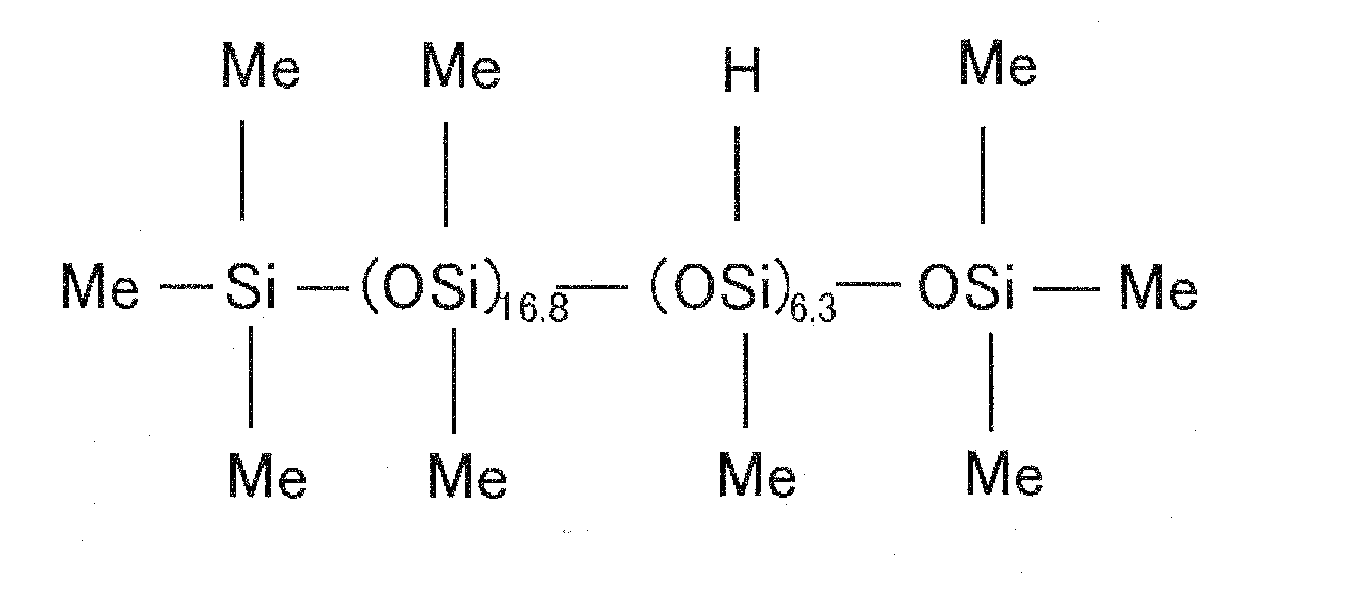
- (D-1): A dimethylpolysiloxane solution of platinum-divinyltetramethyldisiloxane complex (Both ends of the molecular chain of dimethylpolysiloxane are terminated with a dimethylvinylsylyl group, a kinematic viscosity is 600mm2/s at 25°C and platinum atom content is 1 percent by mass.).
- (e-1): Toluene solution of 50 percent by mass of 1-ethynyl-1-cyclohexanol.
-
- (F-1): Toluene solution of silicone resin, substantially consisting of only Me3SiO0.5 unit (M unit) and SiO2 unit (Q unit), wherein a mole ratio of M/Q is 1.15, nonvolatile parts are 60% by mass weight and a viscosity of the solution is 30mm2/s.
- (F-2): Toluene solution of silicone resin substantially consisting of only Me3SiO0.5 unit (M unit) and SiO2 unit (Q unit), wherein a mole ratio of M/Q is 0.85, nonvolatile parts are 70% by mass weight and a viscosity of the solution is 30mm2/s.
-
- (G-1) : Organosilane represented by C12H25Si(OC2H5)3.
- (G--2): dimethylpolysiloxane terminated with a trimethoxysilyl group at one end of the molecular chain represented by the following structural formula.

- (H-1): dimethylpolysiloxane having kinematic viscosity of 600mm2/s at 25°C represented by the following structural formula.

-
- (J-1): Aromatic polyimide film having thermal conductivity of 0.08W/m·K and 25µm thick (commercial name: Kapton 100H manufactured by DU PONT-TORAI CO., LTD.).
- (J-2): Aromatic polyimide film having thermal conductivity of 0.42W/m·K and 25µm thick (commercial name: Kapton 100MT manufactured by DU PONT-TORAI CO., LTD.).
-
- (K-1): PET film of 100µm thick coated with 1.0g/m2 X-70-201 (commercial name of fluorinated releasing agent: manufactured by Shin-Etsu Chemical Co., Ltd.).
- (K-2): Untreated PET film 100µm thick
- According to the blending amount (mass parts) described in Table 1, components described in Table 1 are blended to prepare compositions S1-S7 as follows. Compositions S5, S6 and S7 do not satisfy the condition of the present invention.
- The components (a) and (b) are introduced into the planetary mixer with 700ml inside volume (commercial name: T . K . HIVIS MIX manufactured by Tokushu Kika Kogyo Co., Ltd.). In the case that the components (g) and (h) are used additionally, the components (g) and (h) are introduced, then mixed for 60 minutes. Next, the components (d) and (e) are added and mixed uniformly. Finally the components (c) and (f) are added, and mixed uniformly to prepare the composition.
-
[Table 1] Preparation example Comparative preparation 1 2 3 4 1 2 3 S1 S2 S3 S4 S5 S6 S7 composition weight parts (a) A-1 100 - 100 - 100 100 100 A-2 - 100 - 100 - - - (b) B-1 1194 685 796 - 955 3184 1194 B-2 298 171 199 - 239 995 298 B-3 - - 113 - - - - B-4 - - - 355 - - - B-5 - - - 234 - - - (c) C-1 8.6 2.9 7 2.9 8.6 8.6 1.2 (f) «note 1» F-1 300 (180) - 320 (192) - 50 (30) 300 (180) 300 (180) F-2 - 285 (200) - 228 (160) - - - (g) G-1 - - 5 - - - - G-2 15 15 5 15 15 15 15 (h) H-1 - - 5 - - - - concentration (ppm) «note 2» (d) D-1 7000 (70) 7000 (70) 7000 (70) 7000 (70) 7000 (70) 7000 (70) 7000 (70) (e) E-1 7000 (3500) 7000 (3500) 7000 (3500) 7000 (3500) 7000 (3500) 7000 (3500) 7000 (3500) SiH/Vi «note 3» 2.2 3.1 1.8 3.1 2.2 2.2 0.3 «note 1»: Values in parentheses in the Table are mass parts of resin in the component (f) relative to the component (a) 100 mass parts.
«note 2»: The concentration of the components (d) and (e) in the Table are the ones of the components (D-1) and (E-1) relative to the mass of the component (a). Values in parentheses are the concentration as a platinum atom of the component (D-1) relative to the mass of the component (a) and the concentration of 1-ethynyl-1-cyclohexanol contained in the component (E-1) relative to the component (a).
«note 3»: SiH/Vi means a number of hydrogen atoms corresponding to the SiH group in the component (B) (a hydrogen atom bonded to a silicon atom) relative to one vinyl group in the component (A) . - After selecting one kind (X1) from the compositions obtained in the above Table 1 and coating it to one surface of an intermediate layer, curing was carried out according to the conditions described in Tables 2 and 3 to obtain the composite material (Y1) which is consisting of cured thermal conductive material and the intermediate layer. After attaching the protective separator film to the cured thermal conductive layer, one more kind (X2) were selected from the compositions described in Table 1 in order to apply it to another surface of the intermediate layer. Similarly, curing was carried out to obtain the composite material (Y2) according to the conditions described in Tables 2 and 3, then the protective separator film was attached to obtain the composite sheet described in Tables 2 and 3. Adhesive properties, bleeding properties, release properties from the base material, handling properties after release and thermal resistance of the obtained composite materials were evaluated by the following methods. Results are shown in Tables 2 and 3.
- The thermal conductive composite after curing was evaluated by the weight feeling when released from the protective separator film with hands (evaluation by feeling). When feeling of release is light and the composite did not change in form at all, the evaluation was "good". When feeling of release was heavy or the composite was changed in form, the evaluation was "poor".
- Handling properties with hands of the thermal conductive cured material after release was evaluated focusing the body form and shape. When the thermal conductive cured material, which was released from the base material film, is attached to an aluminum board, the evaluation was "good" if attaching can be carried out without difficulty. On the contrary, in the case that the thermal conductive cured material was cracked or stuck to hands tightly to change in form so that it could not return to the original form and shape, the evaluation was "poor".
- As described above, each surface of the thermal conductive composite was attached to an aluminum plate by using a 2Kg-rubber roller and after resting for 10 minutes, another surface that did not be attached to the aluminum plate was attached to the silicone adhesive tape (manufactured by Nippa Co., Ltd.) having strong adhesive strength in order to prevent the composite from changing in form. After releasing one end of it, the end was pulled to release by the tension test machine (Autograph manufactured by SHIMADZU Co.,Ltd.) in the direction of 180° at a release speed of 300mm/min. at room temperature to measure the adhesive strength ( JIS Z 0237). The measurement results are shown in Tables 2 and 3.
- A sample of 0.1mm thick was cut into 20mm-square for each base material. Each sample piece was put on the woodfree paper so that the thermal conductive cured layer faces to the woodfree paper firmly, and further a 100g-weight was put on the sample piece. After one day, the amount of oil transferred to the woodfree paper was visually estimated to evaluate.
- The obtained thermal conductive composite was put on the whole surface of a disk plate consisting of standard aluminum (purity: 99.9%, diameter: about 12.7mm, thickness: about 1.0mm) then an other standard aluminum plate was put on it. About 175.5kPa (1.80kgf/cm2) pressure was applied by clipping the obtained structure to obtain a three-layered structure.
- After measuring the thickness of the obtained sample piece, the thickness of the thermal conductive composite was calculated by subtracting the thickness of the standard aluminum plate. A Micrometer (manufactured by Mitutoyo Corporation, type:M82.0-25VA) was used for measuring the thickness of the sample piece.
The obtained results are shown in Tables 2 and 3. Heat resistance of the thermal conductive composite (cm 2 .K/W) was measured with a heat resistance measuring analyzer (manufactured by NETZSCH-Feinmahltechnik GmbH Xenon Flash Apparatus: LFA447 NanoFlash) by using the above sample piece. The obtained heat resistance is shown in Tables 2 and 3. -
[Table 2] Example 1 2 3 4 composition used for X1 S1 S3 S2 S4 Composition used for X2 S2 S2 S2 S4 Intermediate layer J-1 J-2 J-2 J-2 Separator film K-1 K-1 K-1 K-1 Curing conditions Heated with Oven for 20 minutes at 90°C Heated with Oven for 20 minutes at 90°C Heated with Oven for 20 minutes at 90°C Heated with Oven for 20 minutes at 90°C Thickness of Y1 (µm) 116 103 114 116 Thickness of Y2 (µm) 201 152 200 200 Release properties good good good good Treating properties after release good good good good Adhesive strength (N/cm) X1 side 0.7 4.6 4.2 4.8 X2 side 4.3 2.8 4.4 5.1 Bleed almost nothing almost nothing almost nothing almost nothing Heat resistance (cm2-K/W) 3.4 2.1 2.7 1.4 -
[Table 3] Comparative example 1 2 3 X1 S2 S6 S6 X2 S5 S2 S2 Intemediate layer J-1 J-2 J-2 Separator film K-1 K-1 K-2 Curing conditions Heated with Oven for 20 minutes at 90°C Heated with Oven for 1 minute at 80°C Heated with Oven for 20 minutes at 90°C Thickness of Y1 (µm) 113 Curing forming were impossible 106 Thickness of Y2 (µm) 252 Not measured since Y1 could not be formed 211 Release properties good Very heavy, composite was changed in shape Treating properties after release Cured material was fragile with crack Not measured since composite changed in shape Adhesive strength (N/cm) Strong adhesive side Cured material was cracked, Weak adhesive side unmeasurable Bleeding properties A small amount Heat resistance (cm2-K/W) 4.8 - As is clear from the results of Tables 2 and 3, it was identified that the thermal conductive silicone rubber composite sheet of the present invention has no oil bleed regardless of good thermal conductivity, and it is excellent in handling properties since it has suitable adhesive strength.
- The thermal conductive silicone rubber composite sheet of the present invention is excellent in thermal conductivity and has sufficient strength and flexibility. Therefore, not only it is suitable as electric insulating thermal conductive material parts attached between heat generating electronic-electric parts and heat radiation parts, but also it is excellent in endurance since the silicone rubber layer itself has adhesive properties and is tightly attached to the synthetic resin film layer. Accordingly it is available industrially.
Claims (9)
- A thermal conductive silicone rubber composite sheet, comprising of an intermediate layer (A), which is an electric insulating heat resistant film, and cured material layers as an outer layers (B) prepared on both surfaces of said intermediate layer (A), characterized in that said cured material layers (B) are prepared by curing a silicone composition in a thin film state which are formed by coating said silicone composition comprising the following components (a)-(f) on both surfaces of said intermediate layer (A) ;(a) organopolyciloxane having two or more alkenyl groups bonding to a silicon atom within a molecule: 100 mass parts(b) thermal conductive filler: 100-4,000 mass parts(c) organohydrogenpolysiloxane having two or more hydrogen atoms bonding to a silicon atom within a molecule: the amount wherein the mole ratio of [the hydrogen atom bonding to a silicone atom of the present component/an alkenyl group in the component (a)] is 0.5-5.0(d) platinum group metallic catalyst: effective amount(e) reaction control agent: effective amount, and(f) silicone resin: 50-500 mass partswherein, the outer layers provided on both surfaces of the intermediate layer (A) may be identical or different.
- A thermal conductive silicone rubber composite sheet according to Claim 1, wherein the silicone resin of the above component (f) contains R1 3SiO1/2 unit (R1 indicates an unsubstituted or substituted monovalent hydrocarbon group that does not contain an aliphatic unsaturated bond) and SiO4/2 unit, wherein mole ratio of R1 3SiO1/2 unit/SiO4/2 unit is 0.5-1.5.
- A thermal conductive silicone rubber composite sheet according to Claim 1 or 2, wherein the silicone composition further comprises, as a component (g), 0.01-50 mass parts of at least one kind of compounds selected from a group consisting of (g-1) alkoxysilane compounds represented by the following general formula (1) and (g-2) dimethylpolysiloxane represented by the general formula (2) wherein one end of the molecular chain is terminated with a trialkoxysilyl group:(g-1) alkoxysilane compounds
General formula (1):
R2 aR3 bSi(OR4)4-a-b (1)
wherein R2 in the above formula is independently an alkyl group having 6-15 carbon atoms, R3 is independently an unsubstituted or substituted monovalent hydrocarbon group having 1-8 carbon atoms, R4 is independently an alkyl group having 1-6 carbon atoms, a is an integer of 1-3, b is an integer of 0-2 and a+b is an integer of 1-3.(g-2) dimethylpolysiloxane
General formula (2):
- A thermal conductive silicone rubber composite sheet according to any of Claims 1-3, wherein the silicone composition further comprises an organopolysiloxane represented by the following general formula (3) whose kinematic viscosity is 10-100,000mm2/s at 23°C is contained as a component (h),
General formula (3):
R6-(SiR6 2O)dSiR6 2-R6 (3)
wherein R6 in the above formula is independently a monovalent hydrocarbon group having 1-18 carbon atoms that does not contain an aliphatic unsaturated bond, d is an integer of 5-2,000. - A thermal conductive silicone rubber composite sheet according to any of Claims 1-4 wherein the whole thickness of said composite is 50-1,000 µm.
- A thermal conductive silicone rubber composite sheet according to any of Claims 1-5, wherein the intermediate layer (A) is a thermal conductive film having thermal conductivity of 0.3W/m- K or more, which comprises of a synthetic resin and a thermal conductive powder dispersed in said synthetic resin.
- A thermal conductive silicone rubber composite sheet according to Claim 6, wherein said synthetic resin is aromatic polyimide, polyamide, polyamideimide, polyester, fluorinated polymer or a combination of these two or more kinds.
- A thermal conductive silicone rubber composite sheet according to Claim 6 or 7, wherein the thermal conductive powder dispersed in the synthetic resin is at least one kind of powder selected from a group consisting of zinc oxide powder, aluminum oxide powder, magnesium oxide powder, aluminum hydroxide powder, boron nitride powder, aluminum nitride powder, silicon carbide powder and diamond powder.
- A method for manufacturing a thermal conductive silicone rubber composite sheet according to any one of Claims 1-8 characterized in that the silicone composition 1. comprising the following components (a)-(f) is coated on one surface of the electric insulating heat resistant film of the intermediate layer (A) in a thin film state and cured to form the first layer of cured material, then the silicone composition 2 containing the above components (a)-(f) is coated on the other surface of the above intermediate layer in a thin film state and cured to form the second layer of cured material;(a) organopolysiloxane having two or more alkenyl groups bonding to a silicon atom within a molecule: 100 mass parts(b) thermal conductive filler: 100-4,000 mass parts(c) organohydrogenpolysiloxane having two or more hydrogen atoms bonding to a silicon atom within a molecule: the amount wherein the mole ratio [the hydrogen atom bonding to a silicone atom of the present component/an alkenyl group in the component (a)] is 0.5-5.0(d) platinum group metallic catalyst: effective amount(e) reaction control agent: effective amount, and(f) silicone resin: 50-500 mass parts.
Applications Claiming Priority (1)
| Application Number | Priority Date | Filing Date | Title |
|---|---|---|---|
| JP2009234273 | 2009-10-08 |
Publications (1)
| Publication Number | Publication Date |
|---|---|
| EP2308676A1 true EP2308676A1 (en) | 2011-04-13 |
Family
ID=43086496
Family Applications (1)
| Application Number | Title | Priority Date | Filing Date |
|---|---|---|---|
| EP10182085A Withdrawn EP2308676A1 (en) | 2009-10-08 | 2010-09-29 | Thermal conductive silicone rubber composite sheet |
Country Status (4)
| Country | Link |
|---|---|
| EP (1) | EP2308676A1 (en) |
| JP (1) | JP5574532B2 (en) |
| CN (1) | CN102029752B (en) |
| TW (1) | TWI540045B (en) |
Cited By (11)
| Publication number | Priority date | Publication date | Assignee | Title |
|---|---|---|---|---|
| CN103333494A (en) * | 2013-05-28 | 2013-10-02 | 东莞上海大学纳米技术研究院 | Thermal-conductive insulation silicone rubber thermal interface material and preparation method thereof |
| WO2014098204A1 (en) * | 2012-12-17 | 2014-06-26 | Dow Corning Toray Co., Ltd. | Thermally conductive silicone composition and thermally conductive member |
| WO2020154272A1 (en) * | 2019-01-23 | 2020-07-30 | Dow Silicones Corporation | Curable silicone composition and cured product thereof |
| CN111630084A (en) * | 2018-01-17 | 2020-09-04 | 信越化学工业株式会社 | Thermally conductive film-like cured product, method for producing the same, and thermally conductive member |
| US11077647B2 (en) | 2016-08-05 | 2021-08-03 | Shin-Etsu Chemical Co., Ltd. | Thermally conductive silicone rubber composite sheet |
| US11248154B2 (en) | 2016-10-18 | 2022-02-15 | Shin-Etsu Chemical Co., Ltd. | Thermoconductive silicone composition |
| US20220127500A1 (en) * | 2019-02-07 | 2022-04-28 | Shin-Etsu Chemical Co., Ltd. | Thermally conductive silicone rubber sheet comprising a thermally conductive adhesive layer |
| US11608419B2 (en) | 2017-01-26 | 2023-03-21 | Shin-Etsu Chemical Co., Ltd. | Thermally conductive sheet |
| CN116355259A (en) * | 2021-12-28 | 2023-06-30 | 天津莱尔德电子材料有限公司 | Low-oil-permeability organic silicon heat conduction gasket and preparation method thereof |
| CN116606608A (en) * | 2023-05-23 | 2023-08-18 | 江西天永诚高分子材料有限公司 | Heat conducting filler, double-component organic silicon pouring sealant containing heat conducting filler and preparation method of double-component organic silicon pouring sealant |
| CN117090060A (en) * | 2023-08-09 | 2023-11-21 | 苏州阳池科技有限公司 | A double-sided thermal conductive pad with different properties and its preparation method |
Families Citing this family (27)
| Publication number | Priority date | Publication date | Assignee | Title |
|---|---|---|---|---|
| JP2013086433A (en) * | 2011-10-20 | 2013-05-13 | Shin-Etsu Chemical Co Ltd | Thermally conductive silicone composite sheet |
| JP2014003141A (en) * | 2012-06-18 | 2014-01-09 | Shin Etsu Chem Co Ltd | Thermally conductive sheet, and electronic apparatus |
| CN103665882B (en) * | 2012-09-19 | 2016-04-20 | 浙江三元电子科技有限公司 | A kind of thermally conductive silicone rubber composite material, heat-conducting silica gel sheet and preparation method thereof |
| JP6020187B2 (en) * | 2013-01-18 | 2016-11-02 | 信越化学工業株式会社 | Thermally conductive composite sheet |
| CN103331975B (en) * | 2013-07-16 | 2016-01-06 | 苏州中垒新材料科技有限公司 | One sandblasts PET hot pressing padded coaming and preparation method thereof |
| JP2015048414A (en) * | 2013-09-02 | 2015-03-16 | 日東電工株式会社 | Insulating heat-conductive sheet |
| JP6314797B2 (en) * | 2013-11-15 | 2018-04-25 | 信越化学工業株式会社 | Thermally conductive composite sheet |
| CN104725874A (en) * | 2014-12-17 | 2015-06-24 | 苏州锦腾电子科技有限公司 | High-tear-resistance heat-conducting silicone rubber and preparation method thereof |
| JP6353811B2 (en) * | 2015-04-28 | 2018-07-04 | 信越化学工業株式会社 | Thermally conductive cured product, adhesive tape and adhesive sheet having the cured product |
| JP6323398B2 (en) * | 2015-06-10 | 2018-05-16 | 信越化学工業株式会社 | Thermally conductive silicone putty composition |
| JP6553520B2 (en) * | 2016-01-14 | 2019-07-31 | 信越化学工業株式会社 | Thermally conductive cured product, adhesive tape and adhesive sheet having the cured product |
| JP6539234B2 (en) * | 2016-07-25 | 2019-07-03 | 富士高分子工業株式会社 | Composite sheet and method for manufacturing the same |
| CN109564906B (en) * | 2016-07-26 | 2023-08-15 | 信越化学工业株式会社 | Thermally conductive sheet |
| JP6797075B2 (en) * | 2017-05-18 | 2020-12-09 | 信越化学工業株式会社 | Thermal conductivity silicone rubber composite sheet |
| JP7131016B2 (en) * | 2018-03-27 | 2022-09-06 | 三菱ケミカル株式会社 | SILICONE RUBBER COMPOSITE AND METHOD FOR MANUFACTURING MOLDED PRODUCT USING IT |
| WO2020153217A1 (en) * | 2019-01-24 | 2020-07-30 | 信越化学工業株式会社 | Highly thermally conductive silicone composition and method for producing same |
| CN114106723A (en) * | 2019-01-28 | 2022-03-01 | 东莞市博恩复合材料有限公司 | Insulation shielding composite film capable of storing heat and having high safety and application thereof |
| CN109880541A (en) * | 2019-01-28 | 2019-06-14 | 东莞市博恩复合材料有限公司 | Thermally conductive material with fast curing and high bond strength |
| MX2021011990A (en) * | 2019-04-10 | 2021-11-03 | Henkel Ag & Co Kgaa | COMPOSITION OF THERMALLY CONDUCTIVE SILICONE ENCAPSULATION. |
| JP7088123B2 (en) * | 2019-04-24 | 2022-06-21 | 信越化学工業株式会社 | Method for Producing Thermally Conductive Silicone Composition |
| WO2021200879A1 (en) * | 2020-03-30 | 2021-10-07 | 積水ポリマテック株式会社 | Silicone composition and method for manufacturing silicone composition |
| JP2020111066A (en) * | 2020-04-20 | 2020-07-27 | 東洋紡株式会社 | Polymer composite film |
| CN112194995A (en) * | 2020-09-15 | 2021-01-08 | 苏州桐力光电股份有限公司 | Low-dielectric-constant OCA optical material and preparation method thereof |
| EP4198090A4 (en) * | 2020-09-29 | 2024-02-14 | LG Energy Solution, Ltd. | CURABLE COMPOSITION AND BI-LIQUID TYPE CURABLE COMPOSITION |
| CN112175397A (en) * | 2020-10-23 | 2021-01-05 | 广东工业大学 | Insulating silicone rubber for outdoor high voltage and preparation method thereof |
| JP7626312B2 (en) * | 2020-12-21 | 2025-02-07 | モメンティブ・パフォーマンス・マテリアルズ・ジャパン合同会社 | Water-resistant adhesive polyorganosiloxane composition |
| CN115838535B (en) * | 2022-12-22 | 2023-09-01 | 广州市白云化工实业有限公司 | Two-component heat-conducting gel and preparation method thereof |
Citations (11)
| Publication number | Priority date | Publication date | Assignee | Title |
|---|---|---|---|---|
| JPS54184074U (en) | 1978-06-16 | 1979-12-27 | ||
| US4574879A (en) * | 1984-02-29 | 1986-03-11 | The Bergquist Company | Mounting pad for solid-state devices |
| JPH0224383A (en) | 1988-07-14 | 1990-01-26 | Arao Sakurai | Pocketable chemical body warmer |
| EP0581539A2 (en) * | 1992-07-30 | 1994-02-02 | General Electric Company | Organopolysiloxane compositions |
| US5373078A (en) * | 1993-10-29 | 1994-12-13 | Dow Corning Corporation | Low viscosity curable organosiloxane compositions |
| GB2287033A (en) * | 1994-03-04 | 1995-09-06 | Gen Electric | Silicone pressure sensitive adhesive compositions |
| JPH10237228A (en) | 1997-02-27 | 1998-09-08 | Hitachi Chem Co Ltd | Heat dissipating sheet and heat dissipating plate |
| JPH11157011A (en) | 1997-09-24 | 1999-06-15 | Tokai Rubber Ind Ltd | Thermal conductive composite sheet, continuous production method thereof, and plasma display using the same |
| JP2001018330A (en) | 1999-07-07 | 2001-01-23 | Shin Etsu Chem Co Ltd | Heat-resistant thermally conductive silicone rubber composite sheet and method for producing the same |
| US20040043229A1 (en) * | 2002-09-02 | 2004-03-04 | Shin-Etsu Chemical Co., Ltd. | Heat conductive composite sheet and process for producing same |
| US20040067372A1 (en) * | 2002-10-04 | 2004-04-08 | Shin-Etsu Chemical Co., Ltd. | Heat conductive silicone rubber composite sheet |
Family Cites Families (4)
| Publication number | Priority date | Publication date | Assignee | Title |
|---|---|---|---|---|
| JP3803058B2 (en) * | 2001-12-11 | 2006-08-02 | 信越化学工業株式会社 | Thermally conductive silicone composition, cured product thereof, laying method, and heat dissipation structure of semiconductor device using the same |
| JP2008038137A (en) * | 2006-07-12 | 2008-02-21 | Shin Etsu Chem Co Ltd | Thermally conductive silicone grease composition and cured product thereof |
| JP4514058B2 (en) * | 2006-08-30 | 2010-07-28 | 信越化学工業株式会社 | Thermally conductive silicone composition and cured product thereof |
| JP5233325B2 (en) * | 2008-02-29 | 2013-07-10 | 信越化学工業株式会社 | Thermally conductive cured product and method for producing the same |
-
2010
- 2010-09-16 JP JP2010207792A patent/JP5574532B2/en active Active
- 2010-09-29 EP EP10182085A patent/EP2308676A1/en not_active Withdrawn
- 2010-10-07 TW TW099134224A patent/TWI540045B/en active
- 2010-10-08 CN CN201010299839.1A patent/CN102029752B/en active Active
Patent Citations (12)
| Publication number | Priority date | Publication date | Assignee | Title |
|---|---|---|---|---|
| JPS54184074U (en) | 1978-06-16 | 1979-12-27 | ||
| US4574879A (en) * | 1984-02-29 | 1986-03-11 | The Bergquist Company | Mounting pad for solid-state devices |
| JPH0224383A (en) | 1988-07-14 | 1990-01-26 | Arao Sakurai | Pocketable chemical body warmer |
| EP0581539A2 (en) * | 1992-07-30 | 1994-02-02 | General Electric Company | Organopolysiloxane compositions |
| US5373078A (en) * | 1993-10-29 | 1994-12-13 | Dow Corning Corporation | Low viscosity curable organosiloxane compositions |
| GB2287033A (en) * | 1994-03-04 | 1995-09-06 | Gen Electric | Silicone pressure sensitive adhesive compositions |
| JPH10237228A (en) | 1997-02-27 | 1998-09-08 | Hitachi Chem Co Ltd | Heat dissipating sheet and heat dissipating plate |
| JPH11157011A (en) | 1997-09-24 | 1999-06-15 | Tokai Rubber Ind Ltd | Thermal conductive composite sheet, continuous production method thereof, and plasma display using the same |
| JP2001018330A (en) | 1999-07-07 | 2001-01-23 | Shin Etsu Chem Co Ltd | Heat-resistant thermally conductive silicone rubber composite sheet and method for producing the same |
| US20040043229A1 (en) * | 2002-09-02 | 2004-03-04 | Shin-Etsu Chemical Co., Ltd. | Heat conductive composite sheet and process for producing same |
| US20040067372A1 (en) * | 2002-10-04 | 2004-04-08 | Shin-Etsu Chemical Co., Ltd. | Heat conductive silicone rubber composite sheet |
| JP2004122664A (en) | 2002-10-04 | 2004-04-22 | Shin Etsu Chem Co Ltd | Thermal conductive silicone rubber composite sheet |
Non-Patent Citations (4)
| Title |
|---|
| "5001 (ISO 29862 - EN 1939) International Harmonized Test MEthod - Afera Test Method. Self Adhesive Tapes - Measurement of Peel Adhesion form Stainless Steel or from its own Backing", 1 October 2003, AFERA TEST METHODS MANUAL, 2008 EDITION,, PAGE(S) 7 - 18, XP001525964 * |
| "Detailed Standard Information - JIS Z 0237:2009", INTERNET ARTICLE, Retrieved from the Internet <URL:http://www.webstore.jsa.or.jp/webstore/Com/FlowControl.jsp?bunsyoId=JIS+Z+0237%3A2009&dantaiCd=JIS&status=1&pageNo=0&lang=en> [retrieved on 20160912] * |
| "JIS Z0237-2000", INTERNET ARTICLE, Retrieved from the Internet <URL:http://www.kejian-tech.com/UpLoadFiles/20150420/2015042010273509.PDF> [retrieved on 20160916] * |
| BROCKMANN W. ET AL: "Adhesion in bonded aluminium joints for aircraft construction", INT.J.ADHESION AND ADHESIVES, vol. 6, no. 3, 1 January 1986 (1986-01-01), pages 115 - 143, XP055301681 * |
Cited By (18)
| Publication number | Priority date | Publication date | Assignee | Title |
|---|---|---|---|---|
| WO2014098204A1 (en) * | 2012-12-17 | 2014-06-26 | Dow Corning Toray Co., Ltd. | Thermally conductive silicone composition and thermally conductive member |
| CN103333494B (en) * | 2013-05-28 | 2015-08-05 | 东莞上海大学纳米技术研究院 | A kind of Thermal-conductive insulation silicone rubber thermal interface material and preparation method thereof |
| CN103333494A (en) * | 2013-05-28 | 2013-10-02 | 东莞上海大学纳米技术研究院 | Thermal-conductive insulation silicone rubber thermal interface material and preparation method thereof |
| US11077647B2 (en) | 2016-08-05 | 2021-08-03 | Shin-Etsu Chemical Co., Ltd. | Thermally conductive silicone rubber composite sheet |
| US11248154B2 (en) | 2016-10-18 | 2022-02-15 | Shin-Etsu Chemical Co., Ltd. | Thermoconductive silicone composition |
| US11608419B2 (en) | 2017-01-26 | 2023-03-21 | Shin-Etsu Chemical Co., Ltd. | Thermally conductive sheet |
| CN111630084A (en) * | 2018-01-17 | 2020-09-04 | 信越化学工业株式会社 | Thermally conductive film-like cured product, method for producing the same, and thermally conductive member |
| CN111630084B (en) * | 2018-01-17 | 2023-06-02 | 信越化学工业株式会社 | Thermally conductive film-like cured product, method for producing the same, and thermally conductive member |
| WO2020154272A1 (en) * | 2019-01-23 | 2020-07-30 | Dow Silicones Corporation | Curable silicone composition and cured product thereof |
| US12104059B2 (en) | 2019-01-23 | 2024-10-01 | Dow Silicones Corporation | Curable silicone composition and cured product thereof |
| US20220127500A1 (en) * | 2019-02-07 | 2022-04-28 | Shin-Etsu Chemical Co., Ltd. | Thermally conductive silicone rubber sheet comprising a thermally conductive adhesive layer |
| US12286568B2 (en) * | 2019-02-07 | 2025-04-29 | Shin-Etsu Chemical Co., Ltd. | Thermally conductive silicone rubber sheet comprising a thermally conductive adhesive layer |
| CN116355259A (en) * | 2021-12-28 | 2023-06-30 | 天津莱尔德电子材料有限公司 | Low-oil-permeability organic silicon heat conduction gasket and preparation method thereof |
| CN116355259B (en) * | 2021-12-28 | 2025-07-04 | 天津莱尔德电子材料有限公司 | Low oil permeability organic silicon thermal conductive pad and preparation method thereof |
| CN116606608A (en) * | 2023-05-23 | 2023-08-18 | 江西天永诚高分子材料有限公司 | Heat conducting filler, double-component organic silicon pouring sealant containing heat conducting filler and preparation method of double-component organic silicon pouring sealant |
| CN116606608B (en) * | 2023-05-23 | 2024-04-05 | 江西天永诚高分子材料有限公司 | Heat conducting filler, double-component organic silicon pouring sealant containing heat conducting filler and preparation method of double-component organic silicon pouring sealant |
| CN117090060A (en) * | 2023-08-09 | 2023-11-21 | 苏州阳池科技有限公司 | A double-sided thermal conductive pad with different properties and its preparation method |
| CN117090060B (en) * | 2023-08-09 | 2026-03-17 | 苏州阳池科技有限公司 | A double-sided thermally conductive pad with different properties and its preparation method |
Also Published As
| Publication number | Publication date |
|---|---|
| JP5574532B2 (en) | 2014-08-20 |
| CN102029752A (en) | 2011-04-27 |
| TW201121784A (en) | 2011-07-01 |
| JP2011098566A (en) | 2011-05-19 |
| TWI540045B (en) | 2016-07-01 |
| CN102029752B (en) | 2015-10-14 |
Similar Documents
| Publication | Publication Date | Title |
|---|---|---|
| US8334054B2 (en) | Heat conductive cured product and making method | |
| KR101488029B1 (en) | Thermally conductive laminate and method for manufacturing the same | |
| JP5574532B2 (en) | Thermally conductive silicone rubber composite sheet | |
| US8211545B2 (en) | Heat conductive cured product and making method | |
| EP2270080A1 (en) | Heat-conductive silicone rubber composite sheet | |
| JP6662458B2 (en) | Thermal conductive silicone rubber composite sheet | |
| JP6353811B2 (en) | Thermally conductive cured product, adhesive tape and adhesive sheet having the cured product | |
| EP4333047A1 (en) | Curable organopolysiloxane composition and semiconductor device | |
| JP2009235279A (en) | Heat-conductive molding and manufacturing method therefor | |
| US20190217585A1 (en) | Anisotropic heat- conductive composite silicone rubber sheet and method for producing the same | |
| US11608419B2 (en) | Thermally conductive sheet | |
| US10676587B2 (en) | Heat conductive sheet | |
| EP4328019A1 (en) | Thermally conductive composite sheet and method for mounting heat-generating electronic component | |
| KR20200110679A (en) | Thermally conductive thin film-shaped cured product and its manufacturing method, and thermally conductive member | |
| EP3310142A1 (en) | Device heat dissipation method | |
| EP4434746A1 (en) | Thermally conductive silicone adhesive composition and thermally conductive complex | |
| WO2024053440A1 (en) | Thermally conductive millable silicone rubber composition and thermally conductive sheet | |
| WO2025258573A1 (en) | Thermally conductive sheet | |
| WO2025263443A1 (en) | Thermally conductive silicone composition |
Legal Events
| Date | Code | Title | Description |
|---|---|---|---|
| PUAI | Public reference made under article 153(3) epc to a published international application that has entered the european phase |
Free format text: ORIGINAL CODE: 0009012 |
|
| AK | Designated contracting states |
Kind code of ref document: A1 Designated state(s): AL AT BE BG CH CY CZ DE DK EE ES FI FR GB GR HR HU IE IS IT LI LT LU LV MC MK MT NL NO PL PT RO SE SI SK SM TR |
|
| AX | Request for extension of the european patent |
Extension state: BA ME RS |
|
| 17P | Request for examination filed |
Effective date: 20110919 |
|
| 17Q | First examination report despatched |
Effective date: 20130408 |
|
| STAA | Information on the status of an ep patent application or granted ep patent |
Free format text: STATUS: THE APPLICATION HAS BEEN WITHDRAWN |
|
| 18W | Application withdrawn |
Effective date: 20161122 |