EP2302255A2 - Antriebsvorrichtung für zumindest einen Nebentrieb - Google Patents
Antriebsvorrichtung für zumindest einen Nebentrieb Download PDFInfo
- Publication number
- EP2302255A2 EP2302255A2 EP10007259A EP10007259A EP2302255A2 EP 2302255 A2 EP2302255 A2 EP 2302255A2 EP 10007259 A EP10007259 A EP 10007259A EP 10007259 A EP10007259 A EP 10007259A EP 2302255 A2 EP2302255 A2 EP 2302255A2
- Authority
- EP
- European Patent Office
- Prior art keywords
- drive
- drive device
- vibration damper
- torsional vibration
- output shaft
- Prior art date
- Legal status (The legal status is an assumption and is not a legal conclusion. Google has not performed a legal analysis and makes no representation as to the accuracy of the status listed.)
- Granted
Links
Images


Classifications
-
- F—MECHANICAL ENGINEERING; LIGHTING; HEATING; WEAPONS; BLASTING
- F16—ENGINEERING ELEMENTS AND UNITS; GENERAL MEASURES FOR PRODUCING AND MAINTAINING EFFECTIVE FUNCTIONING OF MACHINES OR INSTALLATIONS; THERMAL INSULATION IN GENERAL
- F16F—SPRINGS; SHOCK-ABSORBERS; MEANS FOR DAMPING VIBRATION
- F16F15/00—Suppression of vibrations in systems; Means or arrangements for avoiding or reducing out-of-balance forces, e.g. due to motion
- F16F15/10—Suppression of vibrations in rotating systems by making use of members moving with the system
- F16F15/12—Suppression of vibrations in rotating systems by making use of members moving with the system using elastic members or friction-damping members, e.g. between a rotating shaft and a gyratory mass mounted thereon
- F16F15/131—Suppression of vibrations in rotating systems by making use of members moving with the system using elastic members or friction-damping members, e.g. between a rotating shaft and a gyratory mass mounted thereon the rotating system comprising two or more gyratory masses
- F16F15/133—Suppression of vibrations in rotating systems by making use of members moving with the system using elastic members or friction-damping members, e.g. between a rotating shaft and a gyratory mass mounted thereon the rotating system comprising two or more gyratory masses using springs as elastic members, e.g. metallic springs
- F16F15/1336—Leaf springs, e.g. radially extending
-
- F—MECHANICAL ENGINEERING; LIGHTING; HEATING; WEAPONS; BLASTING
- F02—COMBUSTION ENGINES; HOT-GAS OR COMBUSTION-PRODUCT ENGINE PLANTS
- F02B—INTERNAL-COMBUSTION PISTON ENGINES; COMBUSTION ENGINES IN GENERAL
- F02B67/00—Engines characterised by the arrangement of auxiliary apparatus not being otherwise provided for, e.g. the apparatus having different functions; Driving auxiliary apparatus from engines, not otherwise provided for
- F02B67/04—Engines characterised by the arrangement of auxiliary apparatus not being otherwise provided for, e.g. the apparatus having different functions; Driving auxiliary apparatus from engines, not otherwise provided for of mechanically-driven auxiliary apparatus
-
- F—MECHANICAL ENGINEERING; LIGHTING; HEATING; WEAPONS; BLASTING
- F16—ENGINEERING ELEMENTS AND UNITS; GENERAL MEASURES FOR PRODUCING AND MAINTAINING EFFECTIVE FUNCTIONING OF MACHINES OR INSTALLATIONS; THERMAL INSULATION IN GENERAL
- F16F—SPRINGS; SHOCK-ABSORBERS; MEANS FOR DAMPING VIBRATION
- F16F15/00—Suppression of vibrations in systems; Means or arrangements for avoiding or reducing out-of-balance forces, e.g. due to motion
- F16F15/10—Suppression of vibrations in rotating systems by making use of members moving with the system
- F16F15/12—Suppression of vibrations in rotating systems by making use of members moving with the system using elastic members or friction-damping members, e.g. between a rotating shaft and a gyratory mass mounted thereon
- F16F15/121—Suppression of vibrations in rotating systems by making use of members moving with the system using elastic members or friction-damping members, e.g. between a rotating shaft and a gyratory mass mounted thereon using springs as elastic members, e.g. metallic springs
- F16F15/1215—Leaf springs, e.g. radially extending
-
- F—MECHANICAL ENGINEERING; LIGHTING; HEATING; WEAPONS; BLASTING
- F16—ENGINEERING ELEMENTS AND UNITS; GENERAL MEASURES FOR PRODUCING AND MAINTAINING EFFECTIVE FUNCTIONING OF MACHINES OR INSTALLATIONS; THERMAL INSULATION IN GENERAL
- F16F—SPRINGS; SHOCK-ABSORBERS; MEANS FOR DAMPING VIBRATION
- F16F15/00—Suppression of vibrations in systems; Means or arrangements for avoiding or reducing out-of-balance forces, e.g. due to motion
- F16F15/10—Suppression of vibrations in rotating systems by making use of members moving with the system
- F16F15/16—Suppression of vibrations in rotating systems by making use of members moving with the system using a fluid or pasty material
Definitions
- the invention relates to a drive device for at least one secondary drive on a power output shaft of an internal combustion engine, in particular on a crankshaft, according to the preamble of claim 1.
- a torsional vibration damper with an absorber mass or a secondary part to reduce the torsional moments due to vibration.
- the secondary drive driven directly by the crankshaft may possibly have an additional torsional vibration damper.
- Such a drive device describes, for example, the DE 41 03 213 A1 with a belt drive as secondary drive.
- Such auxiliary drives by means of a spur gear with at least one directly on a journal of the crankshaft spur gear used for example to drive a water pump, a compressor, etc. and possibly require as described above an additional torsional vibration damper to create a smooth, satisfactorily low-wear secondary drive.
- the object of the invention is to propose a drive device for at least one secondary drive on a power output shaft of an internal combustion engine, which meets both criteria at a reduced construction cost, namely an adequate vibration damping of the power output shaft and at the same time providing a smooth, low-wear secondary drive.
- the at least one secondary drive-drive element is indirectly or directly coupled, in particular driven, to the secondary part of the torsional vibration damper.
- the secondary part is subject to lower angular acceleration than the power output shaft, in particular the crankshaft, the internal combustion engine, so that with a corresponding drive coupling of the secondary engine this requires no further torsional vibration damper and still works smoothly and wear.
- the "detuning" of the vibration damper resulting from the coupling of the at least one secondary drive can be adjusted by empirical tests and / or by calculations such that both criteria are satisfied satisfactorily; a possibly slightly increasing torsional load in the power output shaft is negligible.
- the at least one secondary drive drive element and / or the secondary part of the torsional vibration damper is rotatably mounted on the power output shaft, for example on a journal of the power output shaft.
- the primary part and the secondary part with the interposition of vibration damping means can be arranged radially one above the other, wherein the at least one drive element is driven via the outer ring as a secondary part.
- the at least one spur gear can be indirectly coupled to the secondary part via a preferably flexible and / or torsionally stiff force transmission and / or coupling element, in particular via a disc-shaped, radially and / or axially resilient, thin-walled driving plate. This allows a rigid in the direction of rotation drive connection, but limited to achieve a stress-free coupling of the spur gear in the axial and radial directions is limited and compensates, for example, even minor misalignment.
- the driver plate for example, can in a structurally particularly simple manner have a plurality of webs provided between a central disk ring and, if appropriate, a radially outer disk ring, which are made correspondingly yielding by their shaping (wavy) and geometry (web width, plate thickness).
- the at least one spur gear to achieve a compact, flat in the radial direction or crowded by means of at least one needle bearing on the pin of the power output shaft to be rotatably mounted.
- at least one needle bearing on the pin of the power output shaft to be rotatably mounted.
- a simple plain bearing since, for example, no speed differences occur between the bearing pin of the power output shaft and the spur gear.
- a plurality of, preferably non-rotatably coupled or connected, drive elements and / or the secondary part of the torsional vibration damper can be rotatably mounted on the power output shaft, preferably on the journal of the power output shaft.
- the secondary part on the journal The power take-off shaft can usually account for the above-mentioned driving plate.
- the bearings of the spur gears and possibly the secondary part are then preferably formed by one or more needle roller bearings or plain bearings, which form a smooth, compact storage of the immediately adjacent functional parts.
- the torsional vibration damper can be arranged at the front end of the power output shaft and / or can be positioned at least one drive element of the secondary drive between the torsional vibration damper and the housing of the internal combustion engine and thus be coupled in quasi-return to the secondary part.
- the drive element formed for example by at least one spur gear be arranged in the immediate vicinity of the housing-side mounting of the power output shaft and transmit high torques.
- the torsional vibration damper may be particularly preferably hydraulically damped to ensure a particularly quiet, low-vibration transmission of torque from the torsional vibration damper to the secondary drive.
- a preferred embodiment of the invention can be provided for this purpose between an inner ring as the primary part and a radially outer ring as a secondary part of the torsional vibration damper, a plurality of star-shaped, flexurally elastic fins, which protrude resiliently in corresponding radial slots in the circumferential direction, wherein the radial slots are filled with a damping fluid ,
- the damping fluid may be directly lubricating oil of the internal combustion engine, in particular if the torsional vibration damper is positioned with the secondary engine in a common, closed engine compartment.
- the radial slots in the outer ring of the torsional vibration damper can be formed by mutually circumferentially spaced, circular segment-shaped intermediate pieces, which are clamped between two flange rings and an outer support ring to achieve a manufacturing technology favorable design.
- the intermediate pieces are preferably fastened by means of the flange rings and the intermediate pieces penetrating screws.
- manufacturing and assembly technology can be advantageously incorporated on the inner ring axially parallel grooves, in each of which protrude the bending elastic slats. Further, it is preferably provided that the flange rings of the secondary part annularly surround the inner ring of the primary part at its end faces. This also makes a manufacturing and assembly technology is easier, more compact and cheaper construction achieved.
- the at least one secondary drive drive element is preferably formed by a drive wheel of a toothed drive, preferably by a spur gear, which enables a functionally reliable power transmission to the secondary drive, for example to a drive wheel of a water pump, etc.
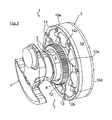
- the Fig. 1 and 2 show a first drive device 1 on a crankshaft 2 as a power output shaft of an internal combustion engine, at whose end-side end a hydraulically damped torsional vibration damper 3 is attached.
- crankshaft 2 is in a known manner via main journals 2a (it is only a main journal 2a visible) in a in Fig. 2 only indicated machine housing 4 rotatably mounted.
- a further bearing pin 5 connects with a smaller diameter guide pin 6 at.
- a spur gear 8 is rotatably supported via a needle bearing 7, which serves as a drive gear for a secondary drive of the internal combustion engine, not shown, for example, to drive a built-in machine housing water pump, a compressor, etc ..
- the torsional vibration damper 3 is composed essentially of an inner ring 9 as a primary part and an outer ring 10 as a secondary part or secondary mass, which are connected to each other via vibration damping means.
- the inner ring 9 is screwed by means of several screws 11 with the bearing pin 5 of the crankshaft 2, wherein the inner peripheral surface is centered on the guide pin 6 as can be seen.
- the outer ring 10 is provided with an annular flange 10a facing the crankshaft 2, which is fixedly connected to the spur gear 8 of the secondary drive via a torsion-resistant driving plate 12 in the circumferential direction.
- the driver plate 12 made of a thin-walled sheet steel has a radially inner disc ring 12a and an outer disc ring 12b, which are interconnected via a plurality of circumferentially distributed webs 12c.
- the disc rings 12a, 12b are screwed by means of several screws 13 with the spur gear 8 and the flange 10a firmly.
- the webs 12 c are by their geometry or by corrugated areas and by, for example, different, decreasing from the inside to the outside web widths (see Fig. 1 and 2 ) are designed so that they slight misalignment of the outer ring 10 with respect to the on the journal Balancing 5 rotatably mounted spur gear 8 and thus eliminate any possible tension.
- the Fig. 3 shows a further drive device 14, which is described only insofar as they differ from the embodiment according to the Fig. 1 and 2 different. Functionally identical parts are provided with the same reference numerals.
- the separately manufactured spur gears 8, 15 are bolted by means of several, continuous screws 17 with the flange 10a of the torsional vibration damper 3.
- a hub portion 10b is integrally formed on the flange 10a, which is rotatably mounted on the bearing journal 5 of the crankshaft 2 via further plain bearing shells 16.
- annular shoulders 8a, 8b are incorporated in the middle spur gear 8, in which the flange 10b and a smaller diameter, annular guide portion 15a of the spur gear 15 protrude.
- a common plain bearing 16 or as stated above one or more needle roller bearings 7 may be used.
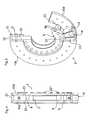
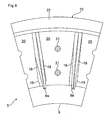
- the 4 to 6 show the construction of the hydraulic damping damper 3 according to FIGS Fig. 1 and 2 in detail.
- the inner ring 9 as a primary part on its outer circumference on a plurality of axially parallel grooves 9a, in each of which arranged in pairs, star-shaped, bending elastic fins 18 protrude.
- the slats 18 are inserted into radial slots 19 of the outer ring 10, which radial slots 19 are each formed between circular segment-shaped intermediate pieces 20 of the outer ring 10.
- the fins 18 have a greater thickness in their radially outer region and are firmly clamped in the intermediate pieces 20.
- the radially inner region of the lamellae 18 has a circumferential clearance in both directions of rotation with respect to the radial slots 19, via which the outer ring 10 can absorb torsional vibrations within the circumferential clearance relative to the inner ring 9 starting from a central basic position of the lamellae.
- the intermediate pieces 20 are firmly screwed together with the mutual flange rings 10a and 10d of the outer ring 10 by means of a plurality of screws 21, wherein they comprise the inner ring 9 and an outer support ring 22 with their radially inner and radially outer edge regions.
- the radial slots are filled with a hydraulically damping fluid which, when oscillation amplitudes occur, occurs between those formed around the disks 18 Chambers or slots is displaced back and forth accordingly.
- the radial slots 19 are sealed relative to the inner ring 9 and the flange rings 10a, 10d by means of sealing rings 23 on both sides.
- the damping fluid may be lubricating oil from the lubricating oil system of the internal combustion engine.
- the torsional vibration damper 3 according to the 4 to 6 can in adaptation to the embodiment according to Fig. 3 be executed at its flange 10a as described with a hub portion 10b.
- the described drive device 1 or 14 can also be provided at another power output shaft of the internal combustion engine, for example at an intermediate shaft or at a camshaft with coupled secondary drive.
Landscapes
- Engineering & Computer Science (AREA)
- General Engineering & Computer Science (AREA)
- Mechanical Engineering (AREA)
- Physics & Mathematics (AREA)
- Acoustics & Sound (AREA)
- Aviation & Aerospace Engineering (AREA)
- Chemical & Material Sciences (AREA)
- Combustion & Propulsion (AREA)
- Gears, Cams (AREA)
- Gear Transmission (AREA)
Abstract
Description
- Die Erfindung betrifft eine Antriebsvorrichtung für zumindest einen Nebentrieb an einer Kraftabgabewelle einer Brennkraftmaschine, insbesondere an einer Kurbelwelle, gemäß dem Oberbegriff des Patentanspruches 1.
- Bei Antriebsvorrichtungen an Brennkraftmaschinen mit relativ starken Drehungleichförmigkeiten zum Beispiel an der Kurbelwelle ist es bekannt, zur Verminderung der schwingungsbedingten Torsionsmomente stirnseitig einen Drehschwingungsdämpfer mit einer Tilgermasse bzw. einem Sekundärteil vorzusehen. Der direkt von der Kurbelwelle angetriebene Nebentrieb kann ggf. einen zusätzlichen Drehschwingungsdämpfer aufweisen. Eine solche Antriebsvorrichtung beschreibt beispielsweise die
DE 41 03 213 A1 mit einem Riementrieb als Nebentrieb. - Derartige Nebentriebe mittels eines Stirnradtriebes mit zumindest einem direkt auf einem Lagerzapfen der Kurbelwelle angeordneten Stirnzahnrad dienen zum Beispiel zum Antrieb einer Wasserpumpe, eines Kompressors, etc. und benötigen ggf. wie vorstehend beschrieben einen zusätzlichen Drehschwingungsdämpfer zur Schaffung eines laufruhigen, zufriedenstellend verschleißarmen Nebentriebes.
- Aufgabe der Erfindung ist es, eine Antriebsvorrichtung für zumindest einen Nebentrieb an einer Kraftabgabewelle einer Brennkraftmaschine vorzuschlagen, die bei einem verringerten Bauaufwand beiden Kriterien gerecht wird, nämlich einer adäquaten Schwingungsdämpfung der Kraftabgabewelle und zugleich der Bereitstellung eines laufruhigen, verschleißarmen Nebentriebes.
- Diese Aufgabe wird gelöst mit den Merkmalen des Patentanspruches 1. Voreilhafte Weiterbildungen der Erfindung sind Gegenstand der Unteransprüche.
- Erfindungsgemäß wird vorgeschlagen, dass das zumindest eine Nebentrieb-Antriebselement mit dem Sekundärteil des Drehschwingungsdämpfers mittelbar oder unmittelbar gekoppelt, insbesondere trieblich verbunden ist. Überraschend wurde erkannt, dass das Sekundärteil geringeren Winkelbeschleunigungen unterliegt als die Kraftabgabewelle, insbesondere die Kurbelwelle, der Brennkraftmaschine, so dass bei einer entsprechenden Antriebsankopplung des Nebentriebes dieser keinen weiteren Drehschwingungsdämpfer bedarf und trotzdem laufruhig und verschleißarm funktioniert. Die durch die Ankopplung des zumindest einen Nebentriebes resultierende "Verstimmung" des Schwingungsdämpfers kann ggf. durch empirische Versuche und/oder durch Berechnungen so eingestellt werden, dass beide Kriterien zufriedenstellend erfüllt sind; eine ggf. geringfügig ansteigende Torsionsbelastung in der Kraftabgabewelle ist vernachlässigbar.
- Gemäß einer hierzu konkreten, kompakten und funktionssicheren Ausführungsform ist bevorzugt vorgesehen, dass das zumindest eine Nebentrieb-Antriebselement und/oder das Sekundärteil des Drehschwingungsdämpfers drehbar an der Kraftabgabewelle gelagert ist, zum Beispiel auf einem Lagerzapfen der Kraftabgabewelle.
- Baulich und fertigungstechnisch besonders günstig können das Primärteil und das Sekundärteil unter Zwischenschaltung schwingungsdämpfender Mittel radial übereinander angeordnet sein, wobei das zumindest eine Antriebselement über den Außenring als Sekundärteil angetrieben ist.
Des Weiteren kann das zumindest eine Stirnzahnrad mittelbar über ein vorzugsweise flexibles und/oder torsionssteifes Kraftübertragungs- und/oder Kupplungselement, insbesondere über ein scheibenförmiges, radial und/oder axial nachgiebiges, dünnwandiges Mitnehmerblech, mit dem Sekundärteil gekoppelt sein. Dies ermöglicht eine in Drehrichtung steife triebliche Verbindung, die jedoch zur Erzielung einer spannungsfreien Ankopplung des Stirnzahnrades in axialer und radialer Richtung begrenzt nachgiebig ist und beispielsweise auch geringfügige Fluchtungsfehler ausgleicht. - Das zum Beispiel Mitnehmerblech kann dazu in baulich besonders einfacher Weise mehrere, zwischen einem zentralen Scheibenring und ggf. einem radial äußeren Scheibenring vorgesehene Stege aufweisen, die durch ihre Formgebung (wellenförmig) und Geometrie (Stegbreite, Blechstärke) entsprechend nachgiebig ausgeführt sind.
- Ferner kann das zumindest eine Stirnzahnrad zur Erzielung einer kompakten, in radialer Richtung flachen bzw. gedrängten Bauart mittels wenigstens eines Nadellagers auf dem Zapfen der Kraftabgabewelle verdrehbar gelagert sein. Ggf. kann aber auch eine einfache Gleitlagerung verwendet sein, da ja zum Beispiel zwischen dem Lagerzapfen der Kraftabgabewelle und dem Stirnzahnrad keine Drehzahldifferenzen auftreten.
- Bei mehreren bevorzugt parallelen Nebentrieben können auf der Kraftabgabewelle, bevorzugt auf dem Lagerzapfen der Kraftabgabewelle, mehrere, bevorzugt drehfest miteinander gekoppelte bzw. verbundene Antriebselemente und/oder das Sekundärteil des Drehschwingungsdämpfers verdrehbar gelagert sein. In Falle einer Lagerung auch des Sekundärteiles auf dem Lagerzapfen der Kraftabgabewelle kann in der Regel das vorstehend angeführte Mitnehmerblech entfallen. Die Lagerungen der Stirnzahnräder und ggf. des Sekundärteiles sind dann bevorzugt durch ein oder mehrere Nadellager oder Gleitlager gebildet, die eine leichtgängige, kompakte Lagerung der einander unmittelbar benachbarten Funktionsteile bilden.
- In vorteilhafter Weiterbildung der Erfindung kann der Drehschwingungsdämpfer am stirnseitigen Ende der Kraftabgabewelle angeordnet sein und/oder kann das zumindest eine Antriebselement des Nebentriebes zwischen dem Drehschwingungsdämpfer und dem Gehäuse der Brennkraftmaschine positioniert sein und damit quasi im Rücktrieb mit dem Sekundärteil gekoppelt sein. Damit kann in steifer Auslegung des Nebentriebes das zum Beispiel durch wenigstens ein Stirnzahnrad gebildete Antriebselement in unmittelbarer Nähe der gehäuseseitigen Lagerung der Kraftabgabewelle angeordnet sein und hohe Drehmomente übertragen.
- Der Drehschwingungsdämpfer kann besonders bevorzugt hydraulisch gedämpft sein, um eine besonders laufruhige , schwingungsarme Übertragung des Drehmomentes vom Drehschwingungsdämpfer zum Nebentrieb zu gewährleisten.
- In einer bevorzugten Ausgestaltung der Erfindung können dazu zwischen einem Innenring als Primärteil und einem radial äußeren Außenring als Sekundärteil des Drehschwingungsdämpfers mehrere, sternförmig ausgerichtete, biegeelastische Lamellen vorgesehen sein, die in korrespondierende Radialschlitze in Umfangsrichtung begrenzt federnd einragen, wobei die Radialschlitze mit einer Dämpfungsflüssigkeit befüllt sind. Die Dämpfungsflüssigkeit kann unmittelbar Schmieröl der Brennkraftmaschine sein, insbesondere wenn der Drehschwingungsdämpfer mit dem Nebentrieb in einem gemeinsamen, abgeschlossenen Triebraum positioniert ist.
- Dabei können zur Erzielung einer fertigungstechnisch günstigen Konstruktion die Radialschlitze im Außenring des Drehschwingungsdämpfer durch zueinander in Umfangsrichtung beabstandete, kreissegmentförmige Zwischenstücke gebildet sein, die zwischen zwei Flanschringen und einem äußeren Stützring eingespannt sind. Die Zwischenstücke sind bevorzugt mittels die Flanschringe und die Zwischenstücke durchdringenden Schrauben befestigt.
- Ferner können fertigungs- und montagetechnisch günstig auf dem Innenring achsparallele Nuten eingearbeitet sein, in die jeweils die biegeelastischen Lamellen einragen. Weiter ist bevorzugt vorgesehen, dass die Flanschringe des Sekundärteiles den Innenring des Primärteiles an dessen Stirnseiten ringförmig umfassen. Auch hierdurch wird ein fertigungs- und montagetechnisch einfacher, kompakter und günstiger Aufbau erzielt.
- Schließlich können zur Sicherstellung einer besonders robusten, Drehschwingungen zuverlässig und dauerhaft abstützenden Konstruktion des Drehschwingungsdämpfers je Radialschlitz im Außenring des Sekundärteiles zwei Lamellen vorgesehen sein, die in ihrem radial äußeren Bereich in den Zwischenstücken fest eingespannt sind und die im radial inneren Bereich ein Umfangsspiel in den Radialschlitzen aufweisen und somit unter Verdrängung von in den Radialschlitzen befindlicher, dämpfender Flüssigkeit eine wirksame Schwingungsdämpfung jeweils aus einer mittleren Grundstellung heraus bewirken.
- Das wenigstens eine Nebentrieb-Antriebselement ist bevorzugt durch ein Antriebsrad eines Zahntriebs, bevorzugt durch ein Stirnzahnrad gebildet, welches eine funktionssichere Kraftübertragung auf den Nebentrieb, zum Beispiel auf ein Antriebsrad einer Wasserpumpe etc., ermöglicht.
- Zwei Ausführungsbeispiele der Erfindung sind im Folgenden anhand der beiliegenden Zeichnung näher erläutert. Es zeigen:
- Fig. 1
- in raumbildlicher Darstellung einen stirnseitig an einer Kurbelwelle einer Brennkraftmaschine angeordneten Drehschwingungs- dämpfer, dessen Sekundärteil über ein Mitnehmerblech mit einem Stirnzahnrad eines Nebentriebes trieblich verbunden ist,
- Fig. 2
- einen Längsschnitt durch die Antriebsvorrichtung gemäß
Fig. 1 , - Fig. 3
- einen weiteren Längsschnitt durch eine Antriebsvorrichtung gemäß
Fig. 1 , jedoch mit zwei Stirnzahnrädern zum Antrieb zweier Nebentriebe über das Sekundärteil des Drehschwingungs- dämpfers, - Fig. 4
- einen Längsschnitt durch den hydraulisch gedämpften Dreh- schwingungsdämpfer nach den vorhergehenden Figuren im Detail,
- Fig. 5
- den Drehschwingungsdämpfer gemäß
Fig. 4 in raumbildlicher, teilweise aufgebrochener Darstellung, und - Fig. 6
- einen teilweisen Querschnitt durch den Drehschwingungsdämpfer nach den
Fig. 4 und 5 mit vergrößerter Darstellung der Zwischen- stücke, der mit Dämpfungsflüssigkeit befüllten Radialschlitze und der Lamellen. - Die
Fig. 1 und2 zeigen eine erste Antriebsvorrichtung 1 an einer Kurbelwelle 2 als Kraftabgabewelle einer Brennkraftmaschine, an deren stirnseitigem Ende ein hydraulisch gedämpfter Drehschwingungsdämpfer 3 befestigt ist. - Die nur teilweise dargestellte Kurbelwelle 2 ist in bekannter Weise über Hauptlagerzapfen 2a (es ist nur ein Hauptlagerzapfen 2a ersichtlich) in einem in
Fig. 2 nur angedeuteten Maschinengehäuse 4 drehbar gelagert. - An den Hauptlagerzapfen 2a schließt ein weiterer Lagerzapfen 5 mit einem im Durchmesser geringeren Führungszapfen 6 an. Auf dem Lagerzapfen 5 ist über ein Nadellager 7 ein Stirnzahnrad 8 verdrehbar gelagert, das als Antriebszahnrad für einen nicht weiter dargestellten Nebentrieb der Brennkraftmaschine dient, zum Beispiel zum Antrieb einer in das Maschinengehäuse integrierten Wasserpumpe, einen Kompressor, etc..
- Der Drehschwingungsdämpfer 3, der nachfolgend anhand der
Fig. 4, 5 und6 näher beschrieben ist, setzt sich im wesentlichen zusammen aus einem Innenring 9 als Primärteil und einem Außenring 10 als Sekundärteil bzw. Sekundärmasse, die über schwingungsdämpfende Mittel miteinander verbunden sind. - Dabei ist der Innenring 9 mittels mehrerer Schrauben 11 mit dem Lagerzapfen 5 der Kurbelwelle 2 fest verschraubt, wobei dessen Innenumfangsfläche auf dem Führungszapfen 6 wie ersichtlich zentriert ist.
- Der Außenring 10 ist mit einem der Kurbelwelle 2 zugewandten Ringflansch 10a versehen, der über ein in Umfangsrichtung torsionssteifes Mitnehmerblech 12 mit dem Stirnzahnrad 8 des Nebentriebes fest verbunden ist.
- Das Mitnehmerblech 12 aus einem dünnwandigen Stahlblech weist einen radial inneren Scheibenring 12a und einen äußeren Scheibenring 12b auf, die über mehrere, umfangsverteilte Stege 12c miteinander verbunden sind. Die Scheibenringe 12a, 12b sind mittels mehrerer Schrauben 13 mit dem Stirnzahnrad 8 und dem Flanschring 10a fest verschraubt.
- Die Stege 12c sind durch ihre Geometrie bzw. durch gewellte Bereiche und durch zum Beispiel unterschiedliche, von innen nach außen abnehmende Stegbreiten (vergleiche
Fig. 1 und2 ) so ausgeführt, dass sie geringfügige Fluchtungsfehler des Außenringes 10 mit Bezug zu dem auf dem Lagerzapfen 5 verdrehbar gelagerten Stirnzahnrad 8 ausgleichen und somit ggf. auftretende Verspannungen eliminieren. - Die
Fig. 3 zeigt eine weitere Antriebsvorrichtung 14, die nur soweit beschrieben ist, als sie sich von der Ausführung gemäß denFig. 1 und2 unterscheidet. Funktionell gleiche Teile sind mit gleichen Bezugszeichen versehen. - Abweichend zu den
Fig. 1 und2 sind auf dem Lagerzapfen 5 der Kurbelwelle 2 zwei Stirnzahnräder 8, 15 über Gleitlagerschalen 16 verdrehbar gelagert, die als Antriebszahnräder für zwei nicht weiter dargestellte Nebentriebe dienen. - Die getrennt gefertigten Stirnzahnräder 8, 15 sind mittels mehrerer, durchgehender Schrauben 17 mit dem Flanschring 10a des Drehschwingungsdämpfers 3 fest verschraubt.
- Ferner ist an den Flanschring 10a ein Nabenabschnitt 10b angeformt, der über weitere Gleitlagerschalen 16 auf dem Lagerzapfen 5 der Kurbelwelle 2 verdrehbar gelagert ist.
- Zur Sicherstellung eines biegesteifen Verbundes des Flanschringes 10 mit den Stirnzahnrädern 8, 15 sind in dem mittleren Stirnzahnrad 8 beidseitig Ringschultern 8a, 8b eingearbeitet, in die der Flanschabschnitt 10b und ein im Durchmesser kleinerer, ringförmiger Führungsabschnitt 15a des Stirnzahnrades 15 einragen. Anstelle der einzelnen Gleitlagerschalen 16 können auch ein gemeinsames Gleitlager 16 oder wie vorstehend ausgeführt ein oder mehrere Nadellager 7 verwendet sein.
- Durch die unmittelbare Lagerung des Außenringes 10 des Drehschwingungsdämpfers 3 über den Nabenabschnitt 10b des Flanschringes 10a auf dem Lagerzapfen 5 kann das in den
Fig. 1 und2 beschriebene Mitnehmerblech 12 entfallen und das Antriebsmoment vom Außenring 10 direkt auf die Stirnzahnräder 8, 15 geleitet werden. - Die
Fig. 4 bis 6 zeigen die Konstruktion des hydraulisch dämpfenden Schwingungsdämpfers 3 gemäß denFig. 1 und2 im Detail. - Wie insbesondere aus
Fig. 5 ersichtlich ist, weist der Innenring 9 als Primärteil an seinem Außenumfang eine Vielzahl achsparalleler Nuten 9a auf, in die jeweils paarweise angeordnete, sternförmig ausgerichtete, biegeelastische Lamellen 18 einragen. - Die Lamellen 18 (vergleiche
Fig. 6 ) sind in Radialschlitze 19 des Außenringes 10 eingesetzt, welche Radialschlitze 19 jeweils zwischen kreissegmentförmigen Zwischenstücken 20 des Außenringes 10 ausgebildet sind. Die Lamellen 18 weisen in ihrem radial äußeren Bereich eine größere Dicke auf und sind in den Zwischenstücken 20 fest eingespannt. - Der radial innere Bereich der Lamellen 18 weist mit Bezug zu den Radialschlitzen 19 wie ersichtlich ein Umfangsspiel in beiden Drehrichtungen auf, über das der Außenring 10 ausgehend von einer mittleren Grundstellung der Lamellen 18 relativ zum Innenring 9 Drehschwingungen innerhalb des Umfangsspieles aufnehmen kann.
- Die Zwischenstücke 20 sind zusammen mit den beiderseitigen Flanschringen 10a und 10d des Außenringes 10 mittels mehrerer Schrauben 21 fest verschraubt, wobei sie mit ihren radial inneren und radial äußeren Randbereichen den Innenring 9 und einen äußeren Stützring 22 umfassen.
- Zur hydraulischen Dämpfung der Drehschwingungen sind die Radialschlitze mit einer hydraulisch dämpfenden Flüssigkeit befüllt, die bei auftretenden Schwingungsamplituden zwischen den um die Lamellen 18 gebildeten Kammern oder Schlitzen entsprechend hin und her verdrängt wird. Die Radialschlitze 19 sind gegenüber dem Innenring 9 und den Flanschringen 10a, 10d mittels beidseitiger Dichtringe 23 abgedichtet. Die Dämpfungsflüssigkeit kann Schmieröl aus dem Schmierölsystem der Brennkraftmaschine sein.
- Der Drehschwingungsdämpfer 3 gemäß den
Fig. 4 bis 6 kann in Anpassung zum Ausführungsbeispiel nachFig. 3 an seinem Flanschring 10a wie beschrieben mit einem Nabenabschnitt 10b ausgeführt sein. - Die beschriebene Antriebsvorrichtung 1 oder 14 kann auch an einer anderen Kraftabgabewelle der Brennkraftmaschine vorgesehen sein, zum Beispiel an einer Zwischenwelle oder an einer Nockenwelle mit angekoppeltem Nebentrieb.
Claims (16)
- Antriebsvorrichtung für zumindest einen Nebentrieb an einer Kraftabgabewelle einer Brennkraftmaschine, insbesondere der Kurbelwelle, mit zumindest einem auf der Kraftabgabewelle angeordneten Nebentrieb-Antriebselement, insbesondere einem Antriebsrad eines Zahnradtriebes und einem am Wellenende befestigten Drehschwingungsdämpfer mit einem Primärteil und einem mit dem Primärteil schwingungsdämpfend verbundenem Sekundärteil, dadurch gekennzeichnet, dass das zumindest eine Antriebselement (8; 15) mit dem Sekundärteil (10) des Drehschwingungsdämpfers (3) mittelbar oder unmittelbar gekoppelt, insbesondere trieblich verbunden ist.
- Antriebsvorrichtung nach Anspruch 1, dadurch gekennzeichnet, dass das zumindest eine Antriebselement (8; 15) und/oder das Sekundärteil (10) des Drehschwingungsdämpfers (3) drehbar an der Kraftabgabewelle (2) gelagert ist, insbesondere auf einem Lagerzapfen (5) der Kraftabgabewelle (2) drehbar gelagert ist.
- Antriebsvorrichtung nach Anspruch 1 oder 2, dadurch gekennzeichnet, dass das Primärteil (9) und das Sekundärteil (10) unter Zwischenschaltung schwingungsdämpfender Mittel (18) radial übereinander angeordnet sind und dass das zumindest eine Antriebselement (8; 15) über den Außenring (10) als Sekundärteil angetrieben ist.
- Antriebsvorrichtung nach einem der Ansprüche 1 bis 3, dadurch gekennzeichnet, dass das zumindest eine Antriebselement (8) mittelbar über ein vorzugsweise flexibles und/oder torsionssteifes Kraftübertragungs- und/oder Kupplungselement, insbesondere über ein membranförmiges, radial und/oder axial nachgiebiges, dünnwandiges Mitnehmerblech (12), mit dem Sekundärteil (10) gekoppelt ist.
- Antriebsvorrichtung nach Anspruch 4, dadurch gekennzeichnet, dass das Mitnehmerblech (12) mehrere, zwischen einem zentralen Scheibenring (12a) und/oder einem radial äußeren Scheibenring (12b) vorgesehene Stege (12c) aufweist, die durch ihre Formgebung und Geometrie entsprechend nachgiebig ausgeführt sind.
- Antriebsvorrichtung nach einem der Ansprüche 2 bis 5, dadurch gekennzeichnet, dass das zumindest eine Antriebselement (8) mittels wenigstens eines Nadellagers (7) und/oder Gleitlagers (16) auf der Kraftabgabewelle (2) verdrehbar gelagert ist.
- Antriebsvorrichtung nach einem der vorhergehenden Ansprüche, dadurch gekennzeichnet, dass bei mehreren Nebentrieben, insbesondere bei mehreren parallelen Nebentrieben, auf der Kraftabgabewelle (2), insbesondere auf dem Lagerzapfen (5) der Kraftabgabewelle (2), mehrere bevorzugt drehfest miteinanderverbundene Antriebselemente (8, 15) und/oder das Sekundärteil (10) des Drehschwingungsdämpfers (3) verdrehbar gelagert sind.
- Antriebsvorrichtung nach Anspruch 6 und 7, dadurch gekennzeichnet, dass die Lagerungen der Antriebselemente (8, 15) und/oder des Sekundärteiles (10) auf dem Lagerzapfen (5) der Kraftabgabewelle (2) durch ein oder mehrere Nadellager (7) oder Gleitlager (16) gebildet sind.
- Antriebsvorrichtung nach einem der vorhergehenden Ansprüche, dadurch gekennzeichnet, dass der Drehschwingungsdämpfer (3) am stirnseitigen Ende der Kraftabgabewelle (2) angeordnet ist und/oder dass das zumindest eine Antriebselement (8, 15) des Nebentriebes zwischen dem Drehschwingungsdämpfer (3) und dem Gehäuse (4) der Brennkraftmaschine positioniert ist.
- Antriebsvorrichtung nach einem der vorhergehenden Ansprüche, dadurch gekennzeichnet, dass der Drehschwingungsdämpfer (3) hydraulisch gedämpft ist.
- Antriebsvorrichtung nach Anspruch 10, dadurch gekennzeichnet, dass zwischen einem Innenring (9) als Primärteil und einem radial äußeren Außenring (10) als Sekundärteil des Drehschwingungsdämpfers (3) mehrere, sternförmig ausgerichtete, biegeelastische Lamellen (18) vorgesehen sind, die in korrespondierende Radialschlitze (19) in Umfangsrichtung begrenzt federnd einragen, wobei die Radialschlitze (19) mit einer Dämpfungsflüssigkeit befüllt sind.
- Antriebsvorrichtung nach Anspruch 11, dadurch gekennzeichnet, dass die Radialschlitze (19) im Außenring (10) durch zueinander in Umfangsrichtung beabstandete, kreissegmentförmige Zwischenstücke (20) gebildet sind, die zwischen zwei Flanschringen (10a, 10d) und einem äußeren Stützring (22) eingespannt sind.
- Antriebsvorrichtung nach Anspruch 12, dadurch gekennzeichnet, dass die Zwischenstücke (20) mittels die Flanschringe (10a, 10d) und die Zwischenstücke (20) durchdringenden Schrauben (21) befestigt sind.
- Antriebsvorrichtung nach einem der Ansprüche 11 bis 13, dadurch gekennzeichnet, dass auf dem Innenring (9) achsparallele Nuten (9a) eingearbeitet sind, in die jeweils die biegeelastischen Lamellen (18) einragen.
- Antriebsvorrichtung nach einem der Ansprüche 12 bis 14, dadurch gekennzeichnet, dass die Flanschringe (10a, 10d) des Sekundärteiles (10) den Innenring (9) des Primärteiles an dessen Stirnseiten ringförmig umfassen.
- Antriebsvorrichtung nach einem der Ansprüche 12 bis 15, dadurch gekennzeichnet, dass je Radialschlitz (19) im Außenring (10) des Sekundärteiles zwei Lamellen (18) vorgesehen sind, die in ihrem radial äußeren Bereich in die Zwischenstücke (20) fest eingespannt sind und die im radial inneren Bereich ein Umfangsspiel in den Radialschlitzen (19) aufweisen.
Applications Claiming Priority (1)
| Application Number | Priority Date | Filing Date | Title |
|---|---|---|---|
| DE102009042682A DE102009042682A1 (de) | 2009-09-23 | 2009-09-23 | Antriebsvorrichtung für zumindest einen Nebentrieb |
Publications (3)
| Publication Number | Publication Date |
|---|---|
| EP2302255A2 true EP2302255A2 (de) | 2011-03-30 |
| EP2302255A3 EP2302255A3 (de) | 2017-12-20 |
| EP2302255B1 EP2302255B1 (de) | 2020-03-25 |
Family
ID=43365857
Family Applications (1)
| Application Number | Title | Priority Date | Filing Date |
|---|---|---|---|
| EP10007259.4A Active EP2302255B1 (de) | 2009-09-23 | 2010-07-14 | Antriebsvorrichtung für zumindest einen Nebentrieb |
Country Status (3)
| Country | Link |
|---|---|
| EP (1) | EP2302255B1 (de) |
| CN (1) | CN102022186B (de) |
| DE (1) | DE102009042682A1 (de) |
Families Citing this family (3)
| Publication number | Priority date | Publication date | Assignee | Title |
|---|---|---|---|---|
| US11686369B2 (en) * | 2017-03-31 | 2023-06-27 | Tmt Machinery, Inc. | Vibration damping device and bobbin holder system |
| DE102021112074A1 (de) * | 2021-05-10 | 2022-11-10 | Schaeffler Technologies AG & Co. KG | Drehschwingungsdämpfer und Verfahren zur Zentrierung und Befestigung eines Drehschwingungsdämpfers |
| CN118622893B (zh) * | 2024-07-01 | 2025-12-12 | 西安交通大学 | 用于缓冲吸能的负泊松比管状结构及制造方法 |
Citations (1)
| Publication number | Priority date | Publication date | Assignee | Title |
|---|---|---|---|---|
| DE4103213A1 (de) | 1990-02-06 | 1991-08-08 | Luk Lamellen & Kupplungsbau | Riemenscheibe |
Family Cites Families (13)
| Publication number | Priority date | Publication date | Assignee | Title |
|---|---|---|---|---|
| JPS6079124A (ja) * | 1983-10-05 | 1985-05-04 | Isuzu Motors Ltd | エンジンの騒音低減装置 |
| DE4117580C2 (de) * | 1990-05-31 | 2002-02-28 | Luk Lamellen & Kupplungsbau | Drehmomentübertragungseinrichtung |
| FR2662759B1 (fr) * | 1990-05-31 | 1996-04-12 | Luk Lamellen & Kupplungsbau | Dispositif de transmission de couple. |
| DE4225304B4 (de) * | 1991-08-07 | 2009-01-08 | Luk Lamellen Und Kupplungsbau Beteiligungs Kg | Scheibenförmiges Bauteil |
| AT398462B (de) * | 1993-07-15 | 1994-12-27 | Geislinger Co Schwingungstechn | Drehschwingungsdämpfer bzw. drehelastische kupplung |
| AT406293B (de) * | 1998-05-08 | 2000-03-27 | Ellergon Antriebstech Gmbh | Drehschwingungsdämpfer bzw. drehelastische und schwingungsdämpfende kupplung |
| FR2838490B1 (fr) * | 2002-04-10 | 2004-05-28 | Valeo | Double volant amortisseur, en particulier pour vehicule automobile |
| DE102004008154B4 (de) * | 2004-02-19 | 2010-07-01 | Audi Ag | Antriebsanordnung für Nebentriebe von Brennkraftmaschinen |
| EP1612386B1 (de) * | 2004-07-02 | 2012-01-11 | Schaeffler Technologies AG & Co. KG | Triebrad zum Antreiben eines Nebenaggregates eines Fahrzeuges |
| US7966817B2 (en) * | 2005-03-26 | 2011-06-28 | Luk Vermoegensverwaltungsgesellschaft Mbh | Compound transmission |
| JP5155174B2 (ja) * | 2005-11-04 | 2013-02-27 | ボーグワーナー インコーポレーテッド | クランクシャフトに結合されるねじり振動ダンパおよびねじり振動ダンパとクラッチとの組合せ |
| US7758465B2 (en) * | 2007-06-04 | 2010-07-20 | The Gates Corporation | Damped planetary transmission |
| CN201250877Y (zh) * | 2008-07-07 | 2009-06-03 | 奇瑞汽车股份有限公司 | 一种新型汽车发动机曲轴扭转减振器 |
-
2009
- 2009-09-23 DE DE102009042682A patent/DE102009042682A1/de not_active Withdrawn
-
2010
- 2010-07-14 EP EP10007259.4A patent/EP2302255B1/de active Active
- 2010-09-21 CN CN201010293080.6A patent/CN102022186B/zh not_active Expired - Fee Related
Patent Citations (1)
| Publication number | Priority date | Publication date | Assignee | Title |
|---|---|---|---|---|
| DE4103213A1 (de) | 1990-02-06 | 1991-08-08 | Luk Lamellen & Kupplungsbau | Riemenscheibe |
Also Published As
| Publication number | Publication date |
|---|---|
| CN102022186A (zh) | 2011-04-20 |
| CN102022186B (zh) | 2015-05-20 |
| EP2302255B1 (de) | 2020-03-25 |
| EP2302255A3 (de) | 2017-12-20 |
| DE102009042682A1 (de) | 2011-03-24 |
Similar Documents
| Publication | Publication Date | Title |
|---|---|---|
| DE10059101B4 (de) | Antriebssystem | |
| DE102007017757B4 (de) | Oszillierendes innen eingreifendes Planetengetriebesystem | |
| EP1523610B1 (de) | Vorrichtung zur veränderung der steuerzeiten einer brennkraftmaschine | |
| DE102004038681A1 (de) | Elektromotorischer Nockenwellenversteller | |
| DE4225304A1 (de) | Scheibenfoermiges bauteil | |
| WO2010043193A1 (de) | Antriebswellenanordnung für ein getriebe eines kraftfahrzeuges | |
| EP3415238B1 (de) | Vertikalmühlengetriebe | |
| EP2299071B1 (de) | Vorrichtung zur Veränderung einer relativen Drehwinkellage einer Nockenwelle gegenüber einer Kurbelwelle einer Brennkraftmaschine | |
| DE102016116438B3 (de) | Abtriebselement für ein Spannungswellengetriebe | |
| DE4321476C2 (de) | Stufenloses Reibrollengetriebe mit toroidförmigen Reibscheiben | |
| DE10344485A1 (de) | Filter für eine Kraftübertragung mit automatisiertem Gangwechsel, in kontinuierlicher oder nicht kontinuierlicher Ausführung, insbesondere für Kraftfahrzeuge | |
| EP1943437A1 (de) | Torsionsschwingungsdämpfer mit einer ankopplung an eine kurbelwelle sowie kombination aus einem torsionsschwingungsdämpfer und einer kupplung | |
| DE102004008538B4 (de) | Differential mit einer Bolzenbefestigungsbaugruppe | |
| EP3483478B1 (de) | Rädertrieb | |
| EP3050194B1 (de) | Baueinheit mit einer elektrischen maschine | |
| EP0989076B1 (de) | Rollenförderbahn | |
| EP2302255B1 (de) | Antriebsvorrichtung für zumindest einen Nebentrieb | |
| EP2530260B1 (de) | Kupplungswelle, Aktor, Nockenwellenverstellgetriebe und Nockenwellensteller | |
| DE102004041751B4 (de) | Nockenwellenversteller mit einer Kupplung zwischen einer Stellwelle und einem Verstellgetriebe | |
| DE19933822A1 (de) | Leistungsverzweigungsgetriebe | |
| EP2569525B1 (de) | Vorrichtung zum antrieb eines nebenaggregates | |
| DE10205767B4 (de) | Lamellen-Kupplungseinrichtung mit einer eingangseitigen Dämpfungs- oder/und Federelementanordnung | |
| DE102015116482B3 (de) | Zykloidgetriebe | |
| EP1756426B1 (de) | Pumpe | |
| EP1726847B1 (de) | Kombination aus einem Torsionsschwingungsdämpfer und einer Kupplung |
Legal Events
| Date | Code | Title | Description |
|---|---|---|---|
| PUAI | Public reference made under article 153(3) epc to a published international application that has entered the european phase |
Free format text: ORIGINAL CODE: 0009012 |
|
| AK | Designated contracting states |
Kind code of ref document: A2 Designated state(s): AL AT BE BG CH CY CZ DE DK EE ES FI FR GB GR HR HU IE IS IT LI LT LU LV MC MK MT NL NO PL PT RO SE SI SK SM TR |
|
| AX | Request for extension of the european patent |
Extension state: BA ME RS |
|
| PUAL | Search report despatched |
Free format text: ORIGINAL CODE: 0009013 |
|
| AK | Designated contracting states |
Kind code of ref document: A3 Designated state(s): AL AT BE BG CH CY CZ DE DK EE ES FI FR GB GR HR HU IE IS IT LI LT LU LV MC MK MT NL NO PL PT RO SE SI SK SM TR |
|
| AX | Request for extension of the european patent |
Extension state: BA ME RS |
|
| RIC1 | Information provided on ipc code assigned before grant |
Ipc: F02B 67/04 20060101ALN20171110BHEP Ipc: F16F 15/16 20060101ALI20171110BHEP Ipc: F16F 15/121 20060101ALI20171110BHEP Ipc: F16F 15/133 20060101AFI20171110BHEP Ipc: F16H 55/14 20060101ALN20171110BHEP |
|
| STAA | Information on the status of an ep patent application or granted ep patent |
Free format text: STATUS: REQUEST FOR EXAMINATION WAS MADE |
|
| 17P | Request for examination filed |
Effective date: 20180618 |
|
| STAA | Information on the status of an ep patent application or granted ep patent |
Free format text: STATUS: EXAMINATION IS IN PROGRESS |
|
| 17Q | First examination report despatched |
Effective date: 20181116 |
|
| RAP1 | Party data changed (applicant data changed or rights of an application transferred) |
Owner name: MAN TRUCK & BUS SE |
|
| RIC1 | Information provided on ipc code assigned before grant |
Ipc: F16F 15/133 20060101AFI20190917BHEP Ipc: F02B 67/04 20060101ALN20190917BHEP Ipc: F16H 55/14 20060101ALN20190917BHEP Ipc: F16F 15/121 20060101ALI20190917BHEP Ipc: F16F 15/16 20060101ALI20190917BHEP |
|
| RIC1 | Information provided on ipc code assigned before grant |
Ipc: F02B 67/04 20060101ALN20190920BHEP Ipc: F16F 15/121 20060101ALI20190920BHEP Ipc: F16F 15/16 20060101ALI20190920BHEP Ipc: F16H 55/14 20060101ALN20190920BHEP Ipc: F16F 15/133 20060101AFI20190920BHEP |
|
| GRAP | Despatch of communication of intention to grant a patent |
Free format text: ORIGINAL CODE: EPIDOSNIGR1 |
|
| STAA | Information on the status of an ep patent application or granted ep patent |
Free format text: STATUS: GRANT OF PATENT IS INTENDED |
|
| RIC1 | Information provided on ipc code assigned before grant |
Ipc: F16F 15/133 20060101AFI20191022BHEP Ipc: F16H 55/14 20060101ALN20191022BHEP Ipc: F16F 15/121 20060101ALI20191022BHEP Ipc: F02B 67/04 20060101ALN20191022BHEP Ipc: F16F 15/16 20060101ALI20191022BHEP |
|
| INTG | Intention to grant announced |
Effective date: 20191106 |
|
| GRAS | Grant fee paid |
Free format text: ORIGINAL CODE: EPIDOSNIGR3 |
|
| GRAA | (expected) grant |
Free format text: ORIGINAL CODE: 0009210 |
|
| STAA | Information on the status of an ep patent application or granted ep patent |
Free format text: STATUS: THE PATENT HAS BEEN GRANTED |
|
| AK | Designated contracting states |
Kind code of ref document: B1 Designated state(s): AL AT BE BG CH CY CZ DE DK EE ES FI FR GB GR HR HU IE IS IT LI LT LU LV MC MK MT NL NO PL PT RO SE SI SK SM TR |
|
| REG | Reference to a national code |
Ref country code: GB Ref legal event code: FG4D Free format text: NOT ENGLISH |
|
| REG | Reference to a national code |
Ref country code: AT Ref legal event code: REF Ref document number: 1248913 Country of ref document: AT Kind code of ref document: T Effective date: 20200415 Ref country code: IE Ref legal event code: FG4D Free format text: LANGUAGE OF EP DOCUMENT: GERMAN |
|
| REG | Reference to a national code |
Ref country code: DE Ref legal event code: R096 Ref document number: 502010016545 Country of ref document: DE |
|
| REG | Reference to a national code |
Ref country code: NL Ref legal event code: FP |
|
| REG | Reference to a national code |
Ref country code: SE Ref legal event code: TRGR |
|
| PG25 | Lapsed in a contracting state [announced via postgrant information from national office to epo] |
Ref country code: FI Free format text: LAPSE BECAUSE OF FAILURE TO SUBMIT A TRANSLATION OF THE DESCRIPTION OR TO PAY THE FEE WITHIN THE PRESCRIBED TIME-LIMIT Effective date: 20200325 Ref country code: NO Free format text: LAPSE BECAUSE OF FAILURE TO SUBMIT A TRANSLATION OF THE DESCRIPTION OR TO PAY THE FEE WITHIN THE PRESCRIBED TIME-LIMIT Effective date: 20200625 |
|
| PG25 | Lapsed in a contracting state [announced via postgrant information from national office to epo] |
Ref country code: LV Free format text: LAPSE BECAUSE OF FAILURE TO SUBMIT A TRANSLATION OF THE DESCRIPTION OR TO PAY THE FEE WITHIN THE PRESCRIBED TIME-LIMIT Effective date: 20200325 Ref country code: HR Free format text: LAPSE BECAUSE OF FAILURE TO SUBMIT A TRANSLATION OF THE DESCRIPTION OR TO PAY THE FEE WITHIN THE PRESCRIBED TIME-LIMIT Effective date: 20200325 Ref country code: GR Free format text: LAPSE BECAUSE OF FAILURE TO SUBMIT A TRANSLATION OF THE DESCRIPTION OR TO PAY THE FEE WITHIN THE PRESCRIBED TIME-LIMIT Effective date: 20200626 Ref country code: BG Free format text: LAPSE BECAUSE OF FAILURE TO SUBMIT A TRANSLATION OF THE DESCRIPTION OR TO PAY THE FEE WITHIN THE PRESCRIBED TIME-LIMIT Effective date: 20200625 |
|
| REG | Reference to a national code |
Ref country code: LT Ref legal event code: MG4D |
|
| PG25 | Lapsed in a contracting state [announced via postgrant information from national office to epo] |
Ref country code: SM Free format text: LAPSE BECAUSE OF FAILURE TO SUBMIT A TRANSLATION OF THE DESCRIPTION OR TO PAY THE FEE WITHIN THE PRESCRIBED TIME-LIMIT Effective date: 20200325 Ref country code: EE Free format text: LAPSE BECAUSE OF FAILURE TO SUBMIT A TRANSLATION OF THE DESCRIPTION OR TO PAY THE FEE WITHIN THE PRESCRIBED TIME-LIMIT Effective date: 20200325 Ref country code: RO Free format text: LAPSE BECAUSE OF FAILURE TO SUBMIT A TRANSLATION OF THE DESCRIPTION OR TO PAY THE FEE WITHIN THE PRESCRIBED TIME-LIMIT Effective date: 20200325 Ref country code: PT Free format text: LAPSE BECAUSE OF FAILURE TO SUBMIT A TRANSLATION OF THE DESCRIPTION OR TO PAY THE FEE WITHIN THE PRESCRIBED TIME-LIMIT Effective date: 20200818 Ref country code: LT Free format text: LAPSE BECAUSE OF FAILURE TO SUBMIT A TRANSLATION OF THE DESCRIPTION OR TO PAY THE FEE WITHIN THE PRESCRIBED TIME-LIMIT Effective date: 20200325 Ref country code: CZ Free format text: LAPSE BECAUSE OF FAILURE TO SUBMIT A TRANSLATION OF THE DESCRIPTION OR TO PAY THE FEE WITHIN THE PRESCRIBED TIME-LIMIT Effective date: 20200325 Ref country code: IS Free format text: LAPSE BECAUSE OF FAILURE TO SUBMIT A TRANSLATION OF THE DESCRIPTION OR TO PAY THE FEE WITHIN THE PRESCRIBED TIME-LIMIT Effective date: 20200725 Ref country code: SK Free format text: LAPSE BECAUSE OF FAILURE TO SUBMIT A TRANSLATION OF THE DESCRIPTION OR TO PAY THE FEE WITHIN THE PRESCRIBED TIME-LIMIT Effective date: 20200325 |
|
| REG | Reference to a national code |
Ref country code: DE Ref legal event code: R097 Ref document number: 502010016545 Country of ref document: DE |
|
| PG25 | Lapsed in a contracting state [announced via postgrant information from national office to epo] |
Ref country code: ES Free format text: LAPSE BECAUSE OF FAILURE TO SUBMIT A TRANSLATION OF THE DESCRIPTION OR TO PAY THE FEE WITHIN THE PRESCRIBED TIME-LIMIT Effective date: 20200325 Ref country code: DK Free format text: LAPSE BECAUSE OF FAILURE TO SUBMIT A TRANSLATION OF THE DESCRIPTION OR TO PAY THE FEE WITHIN THE PRESCRIBED TIME-LIMIT Effective date: 20200325 |
|
| PLBE | No opposition filed within time limit |
Free format text: ORIGINAL CODE: 0009261 |
|
| STAA | Information on the status of an ep patent application or granted ep patent |
Free format text: STATUS: NO OPPOSITION FILED WITHIN TIME LIMIT |
|
| PG25 | Lapsed in a contracting state [announced via postgrant information from national office to epo] |
Ref country code: MC Free format text: LAPSE BECAUSE OF FAILURE TO SUBMIT A TRANSLATION OF THE DESCRIPTION OR TO PAY THE FEE WITHIN THE PRESCRIBED TIME-LIMIT Effective date: 20200325 Ref country code: PL Free format text: LAPSE BECAUSE OF FAILURE TO SUBMIT A TRANSLATION OF THE DESCRIPTION OR TO PAY THE FEE WITHIN THE PRESCRIBED TIME-LIMIT Effective date: 20200325 |
|
| REG | Reference to a national code |
Ref country code: CH Ref legal event code: PL |
|
| 26N | No opposition filed |
Effective date: 20210112 |
|
| GBPC | Gb: european patent ceased through non-payment of renewal fee |
Effective date: 20200714 |
|
| REG | Reference to a national code |
Ref country code: BE Ref legal event code: MM Effective date: 20200731 |
|
| PG25 | Lapsed in a contracting state [announced via postgrant information from national office to epo] |
Ref country code: GB Free format text: LAPSE BECAUSE OF NON-PAYMENT OF DUE FEES Effective date: 20200714 Ref country code: LU Free format text: LAPSE BECAUSE OF NON-PAYMENT OF DUE FEES Effective date: 20200714 Ref country code: CH Free format text: LAPSE BECAUSE OF NON-PAYMENT OF DUE FEES Effective date: 20200731 Ref country code: LI Free format text: LAPSE BECAUSE OF NON-PAYMENT OF DUE FEES Effective date: 20200731 |
|
| PG25 | Lapsed in a contracting state [announced via postgrant information from national office to epo] |
Ref country code: SI Free format text: LAPSE BECAUSE OF FAILURE TO SUBMIT A TRANSLATION OF THE DESCRIPTION OR TO PAY THE FEE WITHIN THE PRESCRIBED TIME-LIMIT Effective date: 20200325 Ref country code: BE Free format text: LAPSE BECAUSE OF NON-PAYMENT OF DUE FEES Effective date: 20200731 |
|
| PG25 | Lapsed in a contracting state [announced via postgrant information from national office to epo] |
Ref country code: IE Free format text: LAPSE BECAUSE OF NON-PAYMENT OF DUE FEES Effective date: 20200714 |
|
| REG | Reference to a national code |
Ref country code: AT Ref legal event code: MM01 Ref document number: 1248913 Country of ref document: AT Kind code of ref document: T Effective date: 20200714 |
|
| PG25 | Lapsed in a contracting state [announced via postgrant information from national office to epo] |
Ref country code: AT Free format text: LAPSE BECAUSE OF NON-PAYMENT OF DUE FEES Effective date: 20200714 |
|
| PG25 | Lapsed in a contracting state [announced via postgrant information from national office to epo] |
Ref country code: TR Free format text: LAPSE BECAUSE OF FAILURE TO SUBMIT A TRANSLATION OF THE DESCRIPTION OR TO PAY THE FEE WITHIN THE PRESCRIBED TIME-LIMIT Effective date: 20200325 Ref country code: MT Free format text: LAPSE BECAUSE OF FAILURE TO SUBMIT A TRANSLATION OF THE DESCRIPTION OR TO PAY THE FEE WITHIN THE PRESCRIBED TIME-LIMIT Effective date: 20200325 Ref country code: CY Free format text: LAPSE BECAUSE OF FAILURE TO SUBMIT A TRANSLATION OF THE DESCRIPTION OR TO PAY THE FEE WITHIN THE PRESCRIBED TIME-LIMIT Effective date: 20200325 |
|
| PG25 | Lapsed in a contracting state [announced via postgrant information from national office to epo] |
Ref country code: MK Free format text: LAPSE BECAUSE OF FAILURE TO SUBMIT A TRANSLATION OF THE DESCRIPTION OR TO PAY THE FEE WITHIN THE PRESCRIBED TIME-LIMIT Effective date: 20200325 Ref country code: AL Free format text: LAPSE BECAUSE OF FAILURE TO SUBMIT A TRANSLATION OF THE DESCRIPTION OR TO PAY THE FEE WITHIN THE PRESCRIBED TIME-LIMIT Effective date: 20200325 |
|
| PGFP | Annual fee paid to national office [announced via postgrant information from national office to epo] |
Ref country code: NL Payment date: 20250724 Year of fee payment: 16 |
|
| PGFP | Annual fee paid to national office [announced via postgrant information from national office to epo] |
Ref country code: DE Payment date: 20250728 Year of fee payment: 16 |
|
| PGFP | Annual fee paid to national office [announced via postgrant information from national office to epo] |
Ref country code: IT Payment date: 20250721 Year of fee payment: 16 |
|
| PGFP | Annual fee paid to national office [announced via postgrant information from national office to epo] |
Ref country code: FR Payment date: 20250725 Year of fee payment: 16 |
|
| PGFP | Annual fee paid to national office [announced via postgrant information from national office to epo] |
Ref country code: SE Payment date: 20250725 Year of fee payment: 16 |