EP2298366A1 - Lineares Material für Gefässprothesen und Gefässprothesen unter anwendung derselben - Google Patents
Lineares Material für Gefässprothesen und Gefässprothesen unter anwendung derselben Download PDFInfo
- Publication number
- EP2298366A1 EP2298366A1 EP20100192696 EP10192696A EP2298366A1 EP 2298366 A1 EP2298366 A1 EP 2298366A1 EP 20100192696 EP20100192696 EP 20100192696 EP 10192696 A EP10192696 A EP 10192696A EP 2298366 A1 EP2298366 A1 EP 2298366A1
- Authority
- EP
- European Patent Office
- Prior art keywords
- blood vessel
- stent
- vessel stent
- monofilament
- linear material
- Prior art date
- Legal status (The legal status is an assumption and is not a legal conclusion. Google has not performed a legal analysis and makes no representation as to the accuracy of the status listed.)
- Granted
Links
- 210000004204 blood vessel Anatomy 0.000 title claims abstract description 110
- 239000000463 material Substances 0.000 title claims abstract description 52
- 229920001432 poly(L-lactide) Polymers 0.000 claims abstract description 71
- 229920002988 biodegradable polymer Polymers 0.000 claims abstract description 11
- 239000004621 biodegradable polymer Substances 0.000 claims abstract description 11
- 238000002513 implantation Methods 0.000 claims description 11
- 230000014759 maintenance of location Effects 0.000 claims description 9
- 238000007493 shaping process Methods 0.000 claims description 6
- 238000000113 differential scanning calorimetry Methods 0.000 claims description 5
- 230000002792 vascular Effects 0.000 claims description 3
- 210000004351 coronary vessel Anatomy 0.000 abstract description 5
- 238000007707 calorimetry Methods 0.000 abstract 1
- JVTAAEKCZFNVCJ-REOHCLBHSA-N L-lactic acid Chemical compound C[C@H](O)C(O)=O JVTAAEKCZFNVCJ-REOHCLBHSA-N 0.000 description 49
- 229910052751 metal Inorganic materials 0.000 description 20
- 239000002184 metal Substances 0.000 description 20
- 208000031481 Pathologic Constriction Diseases 0.000 description 16
- 208000037804 stenosis Diseases 0.000 description 16
- 238000000034 method Methods 0.000 description 14
- 230000002785 anti-thrombosis Effects 0.000 description 9
- 238000002399 angioplasty Methods 0.000 description 8
- 230000015572 biosynthetic process Effects 0.000 description 7
- 238000000354 decomposition reaction Methods 0.000 description 7
- 239000004744 fabric Substances 0.000 description 7
- 230000003863 physical function Effects 0.000 description 7
- 238000005452 bending Methods 0.000 description 6
- 238000009940 knitting Methods 0.000 description 6
- 230000008602 contraction Effects 0.000 description 5
- 230000001154 acute effect Effects 0.000 description 4
- JVTAAEKCZFNVCJ-UHFFFAOYSA-N lactic acid Chemical compound CC(O)C(O)=O JVTAAEKCZFNVCJ-UHFFFAOYSA-N 0.000 description 4
- 230000036262 stenosis Effects 0.000 description 4
- KKJUPNGICOCCDW-UHFFFAOYSA-N 7-N,N-Dimethylamino-1,2,3,4,5-pentathiocyclooctane Chemical compound CN(C)C1CSSSSSC1 KKJUPNGICOCCDW-UHFFFAOYSA-N 0.000 description 3
- 230000017531 blood circulation Effects 0.000 description 3
- 210000001772 blood platelet Anatomy 0.000 description 3
- 238000009998 heat setting Methods 0.000 description 3
- 238000011835 investigation Methods 0.000 description 3
- 208000007536 Thrombosis Diseases 0.000 description 2
- 230000000694 effects Effects 0.000 description 2
- 230000001747 exhibiting effect Effects 0.000 description 2
- 230000006870 function Effects 0.000 description 2
- 229920006015 heat resistant resin Polymers 0.000 description 2
- 238000010438 heat treatment Methods 0.000 description 2
- 238000003780 insertion Methods 0.000 description 2
- 230000037431 insertion Effects 0.000 description 2
- 235000014655 lactic acid Nutrition 0.000 description 2
- 239000004310 lactic acid Substances 0.000 description 2
- 230000003902 lesion Effects 0.000 description 2
- 230000007774 longterm Effects 0.000 description 2
- 238000005259 measurement Methods 0.000 description 2
- 230000002093 peripheral effect Effects 0.000 description 2
- 230000000704 physical effect Effects 0.000 description 2
- 239000002504 physiological saline solution Substances 0.000 description 2
- 229920000642 polymer Polymers 0.000 description 2
- 230000002265 prevention Effects 0.000 description 2
- GUVRBAGPIYLISA-UHFFFAOYSA-N tantalum atom Chemical compound [Ta] GUVRBAGPIYLISA-UHFFFAOYSA-N 0.000 description 2
- 230000001225 therapeutic effect Effects 0.000 description 2
- 239000002759 woven fabric Substances 0.000 description 2
- 206010061218 Inflammation Diseases 0.000 description 1
- FAPWRFPIFSIZLT-UHFFFAOYSA-M Sodium chloride Chemical compound [Na+].[Cl-] FAPWRFPIFSIZLT-UHFFFAOYSA-M 0.000 description 1
- 229920003232 aliphatic polyester Polymers 0.000 description 1
- 238000002583 angiography Methods 0.000 description 1
- 239000003146 anticoagulant agent Substances 0.000 description 1
- 230000000747 cardiac effect Effects 0.000 description 1
- 230000000052 comparative effect Effects 0.000 description 1
- 238000009833 condensation Methods 0.000 description 1
- 230000005494 condensation Effects 0.000 description 1
- 238000005336 cracking Methods 0.000 description 1
- 239000013078 crystal Substances 0.000 description 1
- 238000002425 crystallisation Methods 0.000 description 1
- 230000008025 crystallization Effects 0.000 description 1
- 230000003247 decreasing effect Effects 0.000 description 1
- 230000018044 dehydration Effects 0.000 description 1
- 238000006297 dehydration reaction Methods 0.000 description 1
- 230000001419 dependent effect Effects 0.000 description 1
- 230000002008 hemorrhagic effect Effects 0.000 description 1
- 229920006158 high molecular weight polymer Polymers 0.000 description 1
- 238000007654 immersion Methods 0.000 description 1
- 230000004054 inflammatory process Effects 0.000 description 1
- 238000004519 manufacturing process Methods 0.000 description 1
- 238000002844 melting Methods 0.000 description 1
- 230000008018 melting Effects 0.000 description 1
- 238000013508 migration Methods 0.000 description 1
- 230000005012 migration Effects 0.000 description 1
- 208000031225 myocardial ischemia Diseases 0.000 description 1
- 230000002085 persistent effect Effects 0.000 description 1
- 239000002861 polymer material Substances 0.000 description 1
- 238000006116 polymerization reaction Methods 0.000 description 1
- 229920002635 polyurethane Polymers 0.000 description 1
- 239000004814 polyurethane Substances 0.000 description 1
- 238000012545 processing Methods 0.000 description 1
- 230000002035 prolonged effect Effects 0.000 description 1
- 208000037803 restenosis Diseases 0.000 description 1
- 229920006395 saturated elastomer Polymers 0.000 description 1
- 239000011780 sodium chloride Substances 0.000 description 1
- 238000009987 spinning Methods 0.000 description 1
- 239000000126 substance Substances 0.000 description 1
- 229910052715 tantalum Inorganic materials 0.000 description 1
- 238000012360 testing method Methods 0.000 description 1
- 238000002560 therapeutic procedure Methods 0.000 description 1
- 230000002446 thrombocytic effect Effects 0.000 description 1
- 230000001732 thrombotic effect Effects 0.000 description 1
- 238000009941 weaving Methods 0.000 description 1
Images




Classifications
-
- A—HUMAN NECESSITIES
- A61—MEDICAL OR VETERINARY SCIENCE; HYGIENE
- A61F—FILTERS IMPLANTABLE INTO BLOOD VESSELS; PROSTHESES; DEVICES PROVIDING PATENCY TO, OR PREVENTING COLLAPSING OF, TUBULAR STRUCTURES OF THE BODY, e.g. STENTS; ORTHOPAEDIC, NURSING OR CONTRACEPTIVE DEVICES; FOMENTATION; TREATMENT OR PROTECTION OF EYES OR EARS; BANDAGES, DRESSINGS OR ABSORBENT PADS; FIRST-AID KITS
- A61F2/00—Filters implantable into blood vessels; Prostheses, i.e. artificial substitutes or replacements for parts of the body; Appliances for connecting them with the body; Devices providing patency to, or preventing collapsing of, tubular structures of the body, e.g. stents
- A61F2/82—Devices providing patency to, or preventing collapsing of, tubular structures of the body, e.g. stents
- A61F2/86—Stents in a form characterised by the wire-like elements; Stents in the form characterised by a net-like or mesh-like structure
- A61F2/88—Stents in a form characterised by the wire-like elements; Stents in the form characterised by a net-like or mesh-like structure the wire-like elements formed as helical or spiral coils
- A61F2/885—Stents in a form characterised by the wire-like elements; Stents in the form characterised by a net-like or mesh-like structure the wire-like elements formed as helical or spiral coils comprising a coil including a plurality of spiral or helical sections with alternate directions around a central axis
-
- A—HUMAN NECESSITIES
- A61—MEDICAL OR VETERINARY SCIENCE; HYGIENE
- A61F—FILTERS IMPLANTABLE INTO BLOOD VESSELS; PROSTHESES; DEVICES PROVIDING PATENCY TO, OR PREVENTING COLLAPSING OF, TUBULAR STRUCTURES OF THE BODY, e.g. STENTS; ORTHOPAEDIC, NURSING OR CONTRACEPTIVE DEVICES; FOMENTATION; TREATMENT OR PROTECTION OF EYES OR EARS; BANDAGES, DRESSINGS OR ABSORBENT PADS; FIRST-AID KITS
- A61F2/00—Filters implantable into blood vessels; Prostheses, i.e. artificial substitutes or replacements for parts of the body; Appliances for connecting them with the body; Devices providing patency to, or preventing collapsing of, tubular structures of the body, e.g. stents
- A61F2/82—Devices providing patency to, or preventing collapsing of, tubular structures of the body, e.g. stents
- A61F2/86—Stents in a form characterised by the wire-like elements; Stents in the form characterised by a net-like or mesh-like structure
- A61F2/88—Stents in a form characterised by the wire-like elements; Stents in the form characterised by a net-like or mesh-like structure the wire-like elements formed as helical or spiral coils
-
- A—HUMAN NECESSITIES
- A61—MEDICAL OR VETERINARY SCIENCE; HYGIENE
- A61F—FILTERS IMPLANTABLE INTO BLOOD VESSELS; PROSTHESES; DEVICES PROVIDING PATENCY TO, OR PREVENTING COLLAPSING OF, TUBULAR STRUCTURES OF THE BODY, e.g. STENTS; ORTHOPAEDIC, NURSING OR CONTRACEPTIVE DEVICES; FOMENTATION; TREATMENT OR PROTECTION OF EYES OR EARS; BANDAGES, DRESSINGS OR ABSORBENT PADS; FIRST-AID KITS
- A61F2/00—Filters implantable into blood vessels; Prostheses, i.e. artificial substitutes or replacements for parts of the body; Appliances for connecting them with the body; Devices providing patency to, or preventing collapsing of, tubular structures of the body, e.g. stents
- A61F2/82—Devices providing patency to, or preventing collapsing of, tubular structures of the body, e.g. stents
- A61F2/86—Stents in a form characterised by the wire-like elements; Stents in the form characterised by a net-like or mesh-like structure
- A61F2/90—Stents in a form characterised by the wire-like elements; Stents in the form characterised by a net-like or mesh-like structure characterised by a net-like or mesh-like structure
-
- A—HUMAN NECESSITIES
- A61—MEDICAL OR VETERINARY SCIENCE; HYGIENE
- A61F—FILTERS IMPLANTABLE INTO BLOOD VESSELS; PROSTHESES; DEVICES PROVIDING PATENCY TO, OR PREVENTING COLLAPSING OF, TUBULAR STRUCTURES OF THE BODY, e.g. STENTS; ORTHOPAEDIC, NURSING OR CONTRACEPTIVE DEVICES; FOMENTATION; TREATMENT OR PROTECTION OF EYES OR EARS; BANDAGES, DRESSINGS OR ABSORBENT PADS; FIRST-AID KITS
- A61F2/00—Filters implantable into blood vessels; Prostheses, i.e. artificial substitutes or replacements for parts of the body; Appliances for connecting them with the body; Devices providing patency to, or preventing collapsing of, tubular structures of the body, e.g. stents
- A61F2/82—Devices providing patency to, or preventing collapsing of, tubular structures of the body, e.g. stents
- A61F2/86—Stents in a form characterised by the wire-like elements; Stents in the form characterised by a net-like or mesh-like structure
- A61F2/90—Stents in a form characterised by the wire-like elements; Stents in the form characterised by a net-like or mesh-like structure characterised by a net-like or mesh-like structure
- A61F2/91—Stents in a form characterised by the wire-like elements; Stents in the form characterised by a net-like or mesh-like structure characterised by a net-like or mesh-like structure made from perforated sheets or tubes, e.g. perforated by laser cuts or etched holes
-
- A—HUMAN NECESSITIES
- A61—MEDICAL OR VETERINARY SCIENCE; HYGIENE
- A61F—FILTERS IMPLANTABLE INTO BLOOD VESSELS; PROSTHESES; DEVICES PROVIDING PATENCY TO, OR PREVENTING COLLAPSING OF, TUBULAR STRUCTURES OF THE BODY, e.g. STENTS; ORTHOPAEDIC, NURSING OR CONTRACEPTIVE DEVICES; FOMENTATION; TREATMENT OR PROTECTION OF EYES OR EARS; BANDAGES, DRESSINGS OR ABSORBENT PADS; FIRST-AID KITS
- A61F2/00—Filters implantable into blood vessels; Prostheses, i.e. artificial substitutes or replacements for parts of the body; Appliances for connecting them with the body; Devices providing patency to, or preventing collapsing of, tubular structures of the body, e.g. stents
- A61F2/82—Devices providing patency to, or preventing collapsing of, tubular structures of the body, e.g. stents
- A61F2/86—Stents in a form characterised by the wire-like elements; Stents in the form characterised by a net-like or mesh-like structure
- A61F2/90—Stents in a form characterised by the wire-like elements; Stents in the form characterised by a net-like or mesh-like structure characterised by a net-like or mesh-like structure
- A61F2/91—Stents in a form characterised by the wire-like elements; Stents in the form characterised by a net-like or mesh-like structure characterised by a net-like or mesh-like structure made from perforated sheets or tubes, e.g. perforated by laser cuts or etched holes
- A61F2/915—Stents in a form characterised by the wire-like elements; Stents in the form characterised by a net-like or mesh-like structure characterised by a net-like or mesh-like structure made from perforated sheets or tubes, e.g. perforated by laser cuts or etched holes with bands having a meander structure, adjacent bands being connected to each other
-
- A—HUMAN NECESSITIES
- A61—MEDICAL OR VETERINARY SCIENCE; HYGIENE
- A61L—METHODS OR APPARATUS FOR STERILISING MATERIALS OR OBJECTS IN GENERAL; DISINFECTION, STERILISATION OR DEODORISATION OF AIR; CHEMICAL ASPECTS OF BANDAGES, DRESSINGS, ABSORBENT PADS OR SURGICAL ARTICLES; MATERIALS FOR BANDAGES, DRESSINGS, ABSORBENT PADS OR SURGICAL ARTICLES
- A61L31/00—Materials for other surgical articles, e.g. stents, stent-grafts, shunts, surgical drapes, guide wires, materials for adhesion prevention, occluding devices, surgical gloves, tissue fixation devices
- A61L31/04—Macromolecular materials
- A61L31/06—Macromolecular materials obtained otherwise than by reactions only involving carbon-to-carbon unsaturated bonds
-
- A—HUMAN NECESSITIES
- A61—MEDICAL OR VETERINARY SCIENCE; HYGIENE
- A61L—METHODS OR APPARATUS FOR STERILISING MATERIALS OR OBJECTS IN GENERAL; DISINFECTION, STERILISATION OR DEODORISATION OF AIR; CHEMICAL ASPECTS OF BANDAGES, DRESSINGS, ABSORBENT PADS OR SURGICAL ARTICLES; MATERIALS FOR BANDAGES, DRESSINGS, ABSORBENT PADS OR SURGICAL ARTICLES
- A61L31/00—Materials for other surgical articles, e.g. stents, stent-grafts, shunts, surgical drapes, guide wires, materials for adhesion prevention, occluding devices, surgical gloves, tissue fixation devices
- A61L31/14—Materials characterised by their function or physical properties, e.g. injectable or lubricating compositions, shape-memory materials, surface modified materials
-
- A—HUMAN NECESSITIES
- A61—MEDICAL OR VETERINARY SCIENCE; HYGIENE
- A61F—FILTERS IMPLANTABLE INTO BLOOD VESSELS; PROSTHESES; DEVICES PROVIDING PATENCY TO, OR PREVENTING COLLAPSING OF, TUBULAR STRUCTURES OF THE BODY, e.g. STENTS; ORTHOPAEDIC, NURSING OR CONTRACEPTIVE DEVICES; FOMENTATION; TREATMENT OR PROTECTION OF EYES OR EARS; BANDAGES, DRESSINGS OR ABSORBENT PADS; FIRST-AID KITS
- A61F2/00—Filters implantable into blood vessels; Prostheses, i.e. artificial substitutes or replacements for parts of the body; Appliances for connecting them with the body; Devices providing patency to, or preventing collapsing of, tubular structures of the body, e.g. stents
- A61F2/82—Devices providing patency to, or preventing collapsing of, tubular structures of the body, e.g. stents
- A61F2/86—Stents in a form characterised by the wire-like elements; Stents in the form characterised by a net-like or mesh-like structure
- A61F2/90—Stents in a form characterised by the wire-like elements; Stents in the form characterised by a net-like or mesh-like structure characterised by a net-like or mesh-like structure
- A61F2/91—Stents in a form characterised by the wire-like elements; Stents in the form characterised by a net-like or mesh-like structure characterised by a net-like or mesh-like structure made from perforated sheets or tubes, e.g. perforated by laser cuts or etched holes
- A61F2/915—Stents in a form characterised by the wire-like elements; Stents in the form characterised by a net-like or mesh-like structure characterised by a net-like or mesh-like structure made from perforated sheets or tubes, e.g. perforated by laser cuts or etched holes with bands having a meander structure, adjacent bands being connected to each other
- A61F2002/91533—Stents in a form characterised by the wire-like elements; Stents in the form characterised by a net-like or mesh-like structure characterised by a net-like or mesh-like structure made from perforated sheets or tubes, e.g. perforated by laser cuts or etched holes with bands having a meander structure, adjacent bands being connected to each other characterised by the phase between adjacent bands
- A61F2002/91541—Adjacent bands are arranged out of phase
Definitions
- This invention relates to a linear material used for a stent implanted in the blood vessel of e.g., the coronary artery, and to a blood vessel stent employing this linear material.
- a so-called percutaneous transluminal angioplasty is usually applied.
- the PTA is the operation of inserting a balloon forming portion annexed to the vicinity of the distal end of a catheter in the portion of the blood vessel suffering from stenosis, and of expanding the balloon forming portion to expand the portion of the blood vessel suffering from stenosis to improve the blood flow.
- a blood vessel stent is implanted to prevent re-stenosis of the blood vessel in the site of the PTA.
- the stent serves to maintain the patency of the blood vessel for the required period, preventing re-stenosis in the site undergoing PTA.
- the coronary stent is highly promising, not only in terms of its prophylatic effect against acute closure, but also in its long-term prevention of restenosis and its therapeutic effect against lesions for which PTCA is considered inadequate.
- the coronary stent is widely used in operations such as cardiac intervention. Comparative clinical trials employing the angioplasty with only a balloon and in employing the angioplasty with both a balloon and a stent have shown that the rates of occurrence of the acute coronary closure and of re-stenosis are both lower when the angioplasty with both a balloon and a stent is employed.
- Metal stents are reliable in the short and mid-term results as disclosed in many reports. However, the possibility of unexpected events against, for example, the coronary artery has been pointed out in long term tests.
- a metal stent there is no established standard therapeutic method against re-stenosis in the stent.
- reapplication of PTCA on occurrence of re-stenosis in the stent may be one method envisaged.
- the stent since the stent is already implanted and remains in the blood vessel, it becomes difficult to expand the balloon, thus obstructing the re-application of PTCA.
- a frequently-used method is that of implanting a number of metal stents side-by-side.
- a by-pass operation for preserving blood flow by connecting a by-pass to the blood vessel so as to avoid the site of stenosis is an effective technique against in-stent re-stenosis.
- some metal stents do not show up easily in angiography and, if a metal stent remains implanted in the target portion where the bypass is to be connected, the bypass operation itself has to be abandoned. This is a significant burden for the patient.
- the main objective of implanting a stent is to avoid acute coronary closure and to reduce the frequency of the occurrence of re-stenosis. It is reported that, since acute coronary closure and re-stenosis are phenomena that relate each other for a certain period, they require only temporary treatment. It is, therefore, desirable that the function of the stent may be maintained only for a required period such that the stent will not remain in the living body as foreign substance once its role has been fulfilled. In particular, since the increase in the rate of re-stenosis wanes after about six months, the function of the stent needs to be maintained during this six-month time period.
- the inventors of the present invention have conducted persistent investigations over a long period, whose results have led to the conclusion that, by selecting a biodegradable polymer poly-(L-lactic acid) for the stent material and by optimizing its crystallinity, the physical functions and biodegradability after a certain period may be made mutually compatible.
- the present invention has been completed on the basis of this information.
- the present invention provides a linear material for a blood vessel stent, wherein the linear material is formed of a biodegradable polymer poly-(L-lactic acid) with a crystallinity as measured by differential scanning calorimetry of 15 to 60%.
- the present invention provides a blood vessel stent formed by shaping a linear material into a tubular structure.
- the linear material is formed of a biodegradable polymer poly-(L-lactic acid) having a crystallinity as measured by differential scanning calorimetry of 15 to 60%.
- the present blood vessel stent has an outer diameter of 2 to 5mm, with the thickness of the linear material being 0.08 to 0.30mm. It may be formed, for example, of a poly-(L-lactic acid) monofilament.
- the poly-(L-lactic acid) is a biodegradable polymer which, when placed in the living body, is absorbed therein, disappearing after a pre-determined time period has elapsed.
- this poly-(L-lactic acid) is significantly affected by the crystallinity. Moreover, the anti-thrombotic properties are also influenced by the crystallinity. By setting this crystallinity to 15 to 60%, the mechanical properties as well as the expansion/contraction capability and delivering capability are maintained. Furthermore by setting the crystallinity to the above range, the stent formed by employing this linear material exhibits opening radial strength over a specified period, after which it swiftly disappears.
- the linear material for a blood vessel stent according to the present invention is a filament-like product formed of poly-(L-lactic acid) and may be of any suitable configuration such as mono-filament or multi-filament. However, a monofilament configuration is preferable if the stent configuration as explained below is taken into account. Although the monofilament diameter may be set arbitrarily, it may be limited, for example, by the size of the blood vessel stent for coronary arterial implantation.
- a blood vessel stent for coronary arterial implantation is 10 to 50mm in length, formed to a tubular structure around 5mm in diameter and contractible to roughly 2mm for implantation into the blood vessel.
- the monofilament constituting the blood vessel stent which may be thus contracted to a diameter of 2mm must be no more than 0.3mm in thickness.
- the monofilament constituting the blood vessel stent requires a specific strength as explained below, and in order to be knitted or bent into a zig-zag shape to form a tubular structure, requires a specific rate of elongation and a specific elongation at rupture.
- the monofilament of poly-(L-lactic acid) constituting a blood vessel stent of the above-mentioned dimensions requires a thickness of not less than 0.08mm in diameter.
- Poly-(L-lactide), referred to below as PLLA belongs to a biodegradable aliphatic polyester, and is chemically a polymer resulting from the dehydration condensation of lactic acid, and which is obtained on polymerization of an L-optical isomer of lactic acid only.
- the weight average molecular weight of PLLA can be set arbitrarily so that it can be worked into a linear material
- the weight average molecular weight is preferably not less than 55000.
- the mechanical properties are saturated at a weight average molecular weight not less than 55000, such that poly-(L-lactic acid) remains unchanged in its strength or modulus of elasticity if the molecular weight is increased beyond this value.
- the weight average molecular weight of poly-(L-lactic acid) is 70000 to 400000 for practical application and preferably 100000 to 300000.
- the weight average molecular weight is preferably not less than 100000.
- the rate of decomposition of PLLA is determined by the above-mentioned molecular weight, crystallinity and the diameter and surface area of the monofilament.
- the crystallinity and the diameter of the monofilament significantly affect the rate of decomposition.
- the inventors formed a stent as a tubular structure 10 to 50mm in length as mentioned above and about 5mm in diameter.
- a blood vessel stent whose diameter may be contracted to about 2mm for blood vessel insertion, PLLA monofilament with a diameter of 0.3mm(A), 0.17mm(B) and 0.08mm(C) were produced.
- These PLLA monofilaments were immersed in 37°C physiological saline for 6 months and their crystallinity and breaking loads were observed. The result as shown in Fig. 1 was obtained.
- the breaking load of tantalum widely used in a metal stent is more than 6N.
- the blood vessel stent is formed as a tubular structure about 5mm in diameter and 10 to 50mm in length.
- the diameter of stent is contracted to about 2mm for insertion into a blood vessel.
- a PLLA mono-filament with bio-absorbability is implanted into the body and, as it decomposes, the degree of crystallization rises. That is, the amorphous portion decomposes first.
- Fig. 2 The relation between the crystallinity and the load on formation of each of the monofilaments A, B, and C whose diameters are shown in Fig. 1 , is shown in Fig. 2 . That is, in the monofilaments A, each of which has a diameter of 0.3mm, when immersed in a 37 °C physiolosical saline for six months, the 25% crystallinity required for a breaking load of not less than 6N was achieved. At the time of formation of the monofilaments, the crystallinity was about 15%.
- the PLLA to be used is required to display superior physical functions.
- the PLLA being a structural material of the blood vessel stent
- modulus of elasticity and strength mechanical properties
- ease of bending and workability expansion/contraction performance
- ease of warping and flexibility delivering performance
- the modulus of elasticity and strength (mechanical properties) are most crucial.
- the modulus of elasticity and strength represent the factors relevant to the force with which the blood vessel is kept open by the stent as a structural member.
- the modulus of elasticity and strength are preferably equivalent or superior to those of the metal stent.
- the breaking strength is approximately 6N, while the modulus of elasticity is approximately 50 GPa.
- the crystallinity of PLLA monofilament at time of formation needs to be not less than 15%, as explained above.
- a blood vessel stent is formed with a length of 10 to 50mm and thickness of 2 to 5mm as mentioned above and processed as a cylindrical structure by knitting into a tubular shape or bending into a zig-zag shape, the monofilament employed as the linear material must be able to be curved or bent without cracking or rupturing during processing.
- a PLLA monofilament with a diameter of 0.08 to 0.3mm is employed in order to form the blood vessel stent as described above, it has been revealed during the process of stent manufacture that not less than 15% elongation at rupture is required as curving or bending limit.
- Fig.3 shows the relationship between the crystallinity and the elongation at rupture of A, B and C PLLA monofilaments with diameters of 0.30 mm, 0.17 mm and 0.08 mm, respectively.
- the elongation at rupture changes according to the crystallinity as shown in Fig.3 . Therefore, to achieve a PLLA monofilament of not less than 15% of elongation at rupture for a diameter of 0.08 mm, the crystallinity must be 60% or less. Since in reality the PLLA monofilament at 60% or less crystallinity was actually hard and brittle, it broke easily and could not form the above-mentioned blood vessel stent.
- the cross-sectional shape of the monofilament is arbitrary and may, for example, be circular or elliptical. However, as the rate of decomposition is affected by the surface and cross-sectional shape of the monofilament, and is proportionate to its surface area, the thickness of the monofilament, along with its crystallinity, need to be taken into consideration.
- thrombocyte adhesiveness obtained by measurement with the column method.
- the stent material is of a so-called micro-domain structure in which different properties or materials are arranged alternately, the thrombocyte adhesion may be suppressed to a certain extent.
- the micro-domain structure is such a structure in which the physical properties of the material differ in the micro-units. Segmented polyurethane is known among polymers structurally exhibiting anti-thrombotic properties.
- the above-mentioned PLLA assumes the crystalline and amorphous micro-domain structure such that, in PLLA, the crystallinity is felt to be intimately related to the anti-thrombotic properties.
- the crystallinity of the PLLA used as the linear material for the blood vessel stent according to the present invention needs to be in a range from 15 to 60% at the time of formation of PLLA.
- the configuration of the blood vessel stent formed of the PLLA monofilament is hereinafter explained.
- the blood vessel stent is basically produced by knitting a single yarn, it is possible to form a cylindrical or tubular shaped blood vessel stent which is more homogeneous than a woven fabric obtained by crossing the warp and weft.
- this knitted blood vessel stent is able to pass through a meandering blood vessel to reach the target legion more easily than a metal stent or a stent formed by woven fabric. That is, the blood vessel stent formed by a knitted cloth exhibits trackability to any meandering and can be implanted in a bent portion of the blood vessel, and the knitted tubular stent has a strong expansion force wherein it is less likely to lose its hollow form..
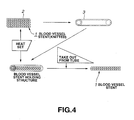
- the knitted tubular blood vessel stent with a diameter of approximately 5 mm, is heat-set by heat treatment to a diameter not larger than approximately 2 mm in order to insert and load the knitted tubular blood vessel stent in a blood vessel of finer diameter in the living body. This heat-setting process is shown in Fig.4 .
- FIG.6 An alternative method of contracting the blood vessel stent knitted from a PLLA monofilament is shown in Fig.6 .
- the advantage of the method shown in Fig.6 is that, since a tube formed of a heat-resistant resin or metal is not used, the stent can be mounted directly on the balloon forming portion in the vicinity of the distal end of the catheter.
- This blood vessel stent 1 is a blood vessel stent formed by knitting a PLLA yarn (PLLA monofilament 2) into cylindrical or tubular shape.
- PLLA yarn PLLA monofilament 2
- This knitted cloth is superior to a woven cloth in softness and shape retention characteristics to other sorts of cloths, such as a felt-like non-woven cloth or a woven cloth formed by usual warp and weft yarns.
- This knitted blood vessel stent is further heat-set to exhibit more outstanding effects in softness and shape retention characteristics.
- the tubular blood vessel stent 1, knitted from PLLA yarn, has a diameter of approximately 4 to 5 mm, and is implanted into a tube 3 of heat-resistant resin or metal with an inner diameter of approximately -1 to 3 mm; preferably, 2 mm. It is either subsequently heat-set, or heat-set during its gradual implantation in the tube 3. This yields a blood vessel stent heat-set to a diameter of approximately 2 mm (see Fig.4 ).
- the filament, yarn or loop at the terminal end of the knitted cloth shows good shape-retention performance, such that the heat-setting affords not only shape retention characteristics, but also minimizes the stress which the blood vessel stent would otherwise apply to the inner wall of the blood vessel of the living body.
- the linear material, used for knitting the blood vessel stent of the present invention can be made variable in its cross-sectional shape more easily than in the blood vessel stent formed of metal. That is, if the filament produced on spinning is of a hollow or profiled cross-section, or if a monofilament or multi-filament yarn is used, it is possible to control the affinity with the living body or its shape retention performance.
- a blood vessel stent of the present invention can be re-implanted and loaded in the same site in the blood vessel. This is because a biodegradable polymer is used.
- a thin sheet of a felt-like non-woven cloth, formed of the biodegradable polymer, and worked into a tubular shaped member exhibits shape retention characteristics and elasticity comparable with those of the knitted blood vessel stent of the present invention, it may also be used in place of the knitted product.
- a blood vessel stent 11 obtained on bending a PLLA monofilament into as zigzag shape which is subsequently formed into a cylindrical shape, is hereinafter explained.
- This blood vessel stent 11 includes a main body portion of the stent 13, obtained on bending a PLLA monofilament 12 exhibiting shape memory properties into a zigzag shape, and subsequently forming the resultant product into a tubular shape, as shown in Fig.7 .
- the PLLA monofilament 12 is coiled into a spiral shape, as it is bent into a zigzag shape to form consecutive vee shapes, to complete the main tubular body portion of the stent 13, as shown in Fig.8 .
- the monofilament 12 is wound spirally, with one side of the vee shape 14 being a short linear portion 14a and the other side being a long linear portion 14b.
- ⁇ 1 of the bent portions 14 formed in the monofilament 12 and by having approximately equal lengths of the short linear portions 14a and the long linear portion 14b, the apex points of the neighboring bent portions 14 come into mutual contact, as shown in Fig.9 .
- At least one part of the apex points of the neighboring bent portions 14 coming into mutual contact is bonded together.
- the monofilament 12, constituting the main body portion of the stent 13 retains its tubular shape by having the apex points of the bent portions 14 bonded together, as shown in Fig.9 .
- bent portions having apex points which come into mutual contact, are bonded by heating and fusing the bonding portions to be bonded to a temperature not lower than the melting point Tm.
- this stent is processed by wrapping a single yarn without knitting or weaving around the periphery of a tubular or cylindrical member to form a tube or cylinder.
- the yarn is not simply wound around the periphery of the tubular or cylindrical member.
- the PLLA monofilament 22 is allowed to meander or to form loops to form a planar mass of the PLLA monofilament 22.
- This planar article is then implanted around the peripheral surface of the tubular or cylindrical member to form a curvilinear shape.
- Fix. 11 shows one such example for the blood vessel stent 21 in which the meandering PLLA yarn is formed into a tubular shape.
- Fig.12 shows another instance of a blood vessel stent 21 in which the PLLA monofilament is formed into a stent in a non-woven non-knitted state.
- a looped PLLA monofilament 22 is shaped to a tube in a similar manner.
- the present invention is able to offer a linear material for a blood vessel stent which has suitable absorbability and superior physical functions.
- this material it is possible to provide a blood vessel stent which exhibits opening radial strength over a predetermined period, after which it swiftly disappears.
Landscapes
- Health & Medical Sciences (AREA)
- Engineering & Computer Science (AREA)
- Biomedical Technology (AREA)
- Life Sciences & Earth Sciences (AREA)
- Veterinary Medicine (AREA)
- Public Health (AREA)
- General Health & Medical Sciences (AREA)
- Animal Behavior & Ethology (AREA)
- Heart & Thoracic Surgery (AREA)
- Vascular Medicine (AREA)
- Cardiology (AREA)
- Transplantation (AREA)
- Oral & Maxillofacial Surgery (AREA)
- Surgery (AREA)
- Epidemiology (AREA)
- Physics & Mathematics (AREA)
- Optics & Photonics (AREA)
- Chemical & Material Sciences (AREA)
- Chemical Kinetics & Catalysis (AREA)
- Media Introduction/Drainage Providing Device (AREA)
- Materials For Medical Uses (AREA)
- Prostheses (AREA)
Applications Claiming Priority (2)
| Application Number | Priority Date | Filing Date | Title |
|---|---|---|---|
| JP2000073983 | 2000-03-13 | ||
| EP20010912330 EP1184008B9 (de) | 2000-03-13 | 2001-03-13 | Drahtstangen für gefässprothesen und gefässprothesen unter anwendung derselben |
Related Parent Applications (3)
| Application Number | Title | Priority Date | Filing Date |
|---|---|---|---|
| EP20010912330 Division EP1184008B9 (de) | 2000-03-13 | 2001-03-13 | Drahtstangen für gefässprothesen und gefässprothesen unter anwendung derselben |
| EP20010912330 Division-Into EP1184008B9 (de) | 2000-03-13 | 2001-03-13 | Drahtstangen für gefässprothesen und gefässprothesen unter anwendung derselben |
| EP01912330.6 Division | 2001-03-13 |
Publications (2)
| Publication Number | Publication Date |
|---|---|
| EP2298366A1 true EP2298366A1 (de) | 2011-03-23 |
| EP2298366B1 EP2298366B1 (de) | 2012-08-22 |
Family
ID=18592109
Family Applications (2)
| Application Number | Title | Priority Date | Filing Date |
|---|---|---|---|
| EP20010912330 Expired - Lifetime EP1184008B9 (de) | 2000-03-13 | 2001-03-13 | Drahtstangen für gefässprothesen und gefässprothesen unter anwendung derselben |
| EP20100192696 Expired - Lifetime EP2298366B1 (de) | 2000-03-13 | 2001-03-13 | Lineares Material für Gefässprothesen und Gefässprothesen unter anwendung derselben |
Family Applications Before (1)
| Application Number | Title | Priority Date | Filing Date |
|---|---|---|---|
| EP20010912330 Expired - Lifetime EP1184008B9 (de) | 2000-03-13 | 2001-03-13 | Drahtstangen für gefässprothesen und gefässprothesen unter anwendung derselben |
Country Status (12)
| Country | Link |
|---|---|
| US (1) | US7070615B1 (de) |
| EP (2) | EP1184008B9 (de) |
| JP (2) | JP4790960B2 (de) |
| KR (1) | KR100788336B1 (de) |
| CN (1) | CN1261084C (de) |
| AT (1) | ATE516826T1 (de) |
| AU (1) | AU780196B2 (de) |
| CA (1) | CA2373961C (de) |
| DK (1) | DK2298366T3 (de) |
| ES (2) | ES2367628T3 (de) |
| PT (1) | PT2298366E (de) |
| WO (1) | WO2001067990A1 (de) |
Families Citing this family (50)
| Publication number | Priority date | Publication date | Assignee | Title |
|---|---|---|---|---|
| DK2298366T3 (da) * | 2000-03-13 | 2012-11-26 | Kyoto Iryo Sekkei Kk | Lineært materiale til intravaskulær stent og intravaskulær stent med anvendelse deraf |
| US6527801B1 (en) | 2000-04-13 | 2003-03-04 | Advanced Cardiovascular Systems, Inc. | Biodegradable drug delivery material for stent |
| JP2005520640A (ja) * | 2002-03-20 | 2005-07-14 | アドヴァンスド カーディオヴァスキュラー システムズ, インコーポレイテッド | ステント用の生物分解性疎水性ポリマー |
| US7794494B2 (en) | 2002-10-11 | 2010-09-14 | Boston Scientific Scimed, Inc. | Implantable medical devices |
| US7976936B2 (en) * | 2002-10-11 | 2011-07-12 | University Of Connecticut | Endoprostheses |
| DE10357742A1 (de) * | 2003-06-13 | 2005-03-10 | Mnemoscience Gmbh | Temporäre Stents zur nicht-vaskulären Verwendung |
| CN100558321C (zh) * | 2003-06-16 | 2009-11-11 | 南洋理工大学 | 聚合物支架和其制造方法 |
| CA2532548A1 (en) * | 2003-07-18 | 2005-02-03 | Boston Scientific Limited | Medical devices |
| US8778256B1 (en) | 2004-09-30 | 2014-07-15 | Advanced Cardiovascular Systems, Inc. | Deformation of a polymer tube in the fabrication of a medical article |
| US7971333B2 (en) | 2006-05-30 | 2011-07-05 | Advanced Cardiovascular Systems, Inc. | Manufacturing process for polymetric stents |
| US8501079B2 (en) | 2009-09-14 | 2013-08-06 | Abbott Cardiovascular Systems Inc. | Controlling crystalline morphology of a bioabsorbable stent |
| US8012402B2 (en) * | 2008-08-04 | 2011-09-06 | Abbott Cardiovascular Systems Inc. | Tube expansion process for semicrystalline polymers to maximize fracture toughness |
| US9517149B2 (en) | 2004-07-26 | 2016-12-13 | Abbott Cardiovascular Systems Inc. | Biodegradable stent with enhanced fracture toughness |
| US8268228B2 (en) | 2007-12-11 | 2012-09-18 | Abbott Cardiovascular Systems Inc. | Method of fabricating stents from blow molded tubing |
| US20060020330A1 (en) | 2004-07-26 | 2006-01-26 | Bin Huang | Method of fabricating an implantable medical device with biaxially oriented polymers |
| US20110066222A1 (en) * | 2009-09-11 | 2011-03-17 | Yunbing Wang | Polymeric Stent and Method of Making Same |
| US8747879B2 (en) | 2006-04-28 | 2014-06-10 | Advanced Cardiovascular Systems, Inc. | Method of fabricating an implantable medical device to reduce chance of late inflammatory response |
| US8747878B2 (en) * | 2006-04-28 | 2014-06-10 | Advanced Cardiovascular Systems, Inc. | Method of fabricating an implantable medical device by controlling crystalline structure |
| US7731890B2 (en) | 2006-06-15 | 2010-06-08 | Advanced Cardiovascular Systems, Inc. | Methods of fabricating stents with enhanced fracture toughness |
| DE102004044679A1 (de) | 2004-09-09 | 2006-03-16 | Biotronik Vi Patent Ag | Implantat mit geringer Radialfestigkeit |
| US8173062B1 (en) | 2004-09-30 | 2012-05-08 | Advanced Cardiovascular Systems, Inc. | Controlled deformation of a polymer tube in fabricating a medical article |
| US8043553B1 (en) | 2004-09-30 | 2011-10-25 | Advanced Cardiovascular Systems, Inc. | Controlled deformation of a polymer tube with a restraining surface in fabricating a medical article |
| US7875233B2 (en) * | 2004-09-30 | 2011-01-25 | Advanced Cardiovascular Systems, Inc. | Method of fabricating a biaxially oriented implantable medical device |
| US8778375B2 (en) * | 2005-04-29 | 2014-07-15 | Advanced Cardiovascular Systems, Inc. | Amorphous poly(D,L-lactide) coating |
| JP5102200B2 (ja) * | 2006-03-30 | 2012-12-19 | テルモ株式会社 | 生体内留置物 |
| JP2007313009A (ja) * | 2006-05-25 | 2007-12-06 | Terumo Corp | ステント |
| US9072820B2 (en) * | 2006-06-26 | 2015-07-07 | Advanced Cardiovascular Systems, Inc. | Polymer composite stent with polymer particles |
| US7740791B2 (en) | 2006-06-30 | 2010-06-22 | Advanced Cardiovascular Systems, Inc. | Method of fabricating a stent with features by blow molding |
| US8182890B2 (en) * | 2007-01-19 | 2012-05-22 | Elixir Medical Corporation | Biodegradable endoprostheses and methods for their fabrication |
| US7666342B2 (en) * | 2007-06-29 | 2010-02-23 | Abbott Cardiovascular Systems Inc. | Method of manufacturing a stent from a polymer tube |
| US8377116B2 (en) * | 2008-03-20 | 2013-02-19 | Abbott Cardiovascular Systems Inc. | Implantable medical device coatings with improved mechanical stability |
| US9572692B2 (en) | 2009-02-02 | 2017-02-21 | Abbott Cardiovascular Systems Inc. | Bioabsorbable stent that modulates plaque geometric morphology and chemical composition |
| US20100244304A1 (en) * | 2009-03-31 | 2010-09-30 | Yunbing Wang | Stents fabricated from a sheet with increased strength, modulus and fracture toughness |
| US9309347B2 (en) | 2009-05-20 | 2016-04-12 | Biomedical, Inc. | Bioresorbable thermoset polyester/urethane elastomers |
| US8992601B2 (en) | 2009-05-20 | 2015-03-31 | 480 Biomedical, Inc. | Medical implants |
| US8888840B2 (en) * | 2009-05-20 | 2014-11-18 | Boston Scientific Scimed, Inc. | Drug eluting medical implant |
| US20110319987A1 (en) | 2009-05-20 | 2011-12-29 | Arsenal Medical | Medical implant |
| ES2968361T3 (es) | 2009-05-20 | 2024-05-09 | Lyra Therapeutics Inc | Un método para elaborar un implante autoexpandible |
| US9265633B2 (en) | 2009-05-20 | 2016-02-23 | 480 Biomedical, Inc. | Drug-eluting medical implants |
| JP5682309B2 (ja) * | 2009-06-17 | 2015-03-11 | 東レ株式会社 | 結晶化ポリエステルの製造方法 |
| US9889238B2 (en) * | 2009-07-21 | 2018-02-13 | Abbott Cardiovascular Systems Inc. | Biodegradable stent with adjustable degradation rate |
| US8889823B2 (en) * | 2009-07-21 | 2014-11-18 | Abbott Cardiovascular Systems Inc. | Method to make poly(L-lactide) stent with tunable degradation rate |
| US8372133B2 (en) * | 2009-10-05 | 2013-02-12 | 480 Biomedical, Inc. | Polymeric implant delivery system |
| WO2011042810A2 (en) | 2009-10-06 | 2011-04-14 | Arterial Remodeling Technologies, S.A. | Bioresorbable vascular implant having homogenously distributed stresses under a radial load |
| US8370120B2 (en) | 2010-04-30 | 2013-02-05 | Abbott Cardiovascular Systems Inc. | Polymeric stents and method of manufacturing same |
| US8834776B2 (en) | 2011-05-10 | 2014-09-16 | Abbott Cardiovascular Systems Inc. | Control of degradation profile of bioabsorbable poly(l-lactide) scaffold |
| US8709070B2 (en) | 2011-05-10 | 2014-04-29 | Abbott Cardiovascular Systems Inc. | Bioabsorbable scaffold with particles providing delayed acceleration of degradation |
| US8968387B2 (en) | 2012-07-23 | 2015-03-03 | Abbott Cardiovascular Systems Inc. | Shape memory bioresorbable polymer peripheral scaffolds |
| EP2994175A1 (de) | 2014-02-04 | 2016-03-16 | Abbott Cardiovascular Systems, Inc. | Arzneimittelabgabegerüst oder -stent mit einer novolimus- und lactidbeschichtung mit geringer novolimusbindung an die beschichtung |
| KR101721485B1 (ko) | 2015-09-04 | 2017-03-31 | 연세대학교 산학협력단 | 의료용 스텐트 |
Citations (1)
| Publication number | Priority date | Publication date | Assignee | Title |
|---|---|---|---|---|
| US5762625A (en) * | 1992-09-08 | 1998-06-09 | Kabushikikaisha Igaki Iryo Sekkei | Luminal stent and device for inserting luminal stent |
Family Cites Families (16)
| Publication number | Priority date | Publication date | Assignee | Title |
|---|---|---|---|---|
| US5527337A (en) | 1987-06-25 | 1996-06-18 | Duke University | Bioabsorbable stent and method of making the same |
| US5145945A (en) * | 1987-12-17 | 1992-09-08 | Allied-Signal Inc. | Homopolymers and copolymers having recurring carbonate units |
| DE4007882C2 (de) * | 1990-03-13 | 1994-03-10 | Boehringer Ingelheim Kg | Verwendung von Polyglycolsäure und ihrer Derivate als Nukleierungsmittel |
| WO1991017789A1 (en) * | 1990-05-18 | 1991-11-28 | Stack Richard S | Bioabsorbable stent |
| FI933471L (fi) * | 1991-12-19 | 1993-08-05 | Mitsui Toatsu Chemicals | Polyhydroxikarboxylsyra och foerfarande foer dess framstaellning |
| CA2087132A1 (en) * | 1992-01-31 | 1993-08-01 | Michael S. Williams | Stent capable of attachment within a body lumen |
| US5599352A (en) * | 1992-03-19 | 1997-02-04 | Medtronic, Inc. | Method of making a drug eluting stent |
| US5514378A (en) * | 1993-02-01 | 1996-05-07 | Massachusetts Institute Of Technology | Biocompatible polymer membranes and methods of preparation of three dimensional membrane structures |
| WO1994021196A2 (en) | 1993-03-18 | 1994-09-29 | C.R. Bard, Inc. | Endovascular stents |
| US5626611A (en) * | 1994-02-10 | 1997-05-06 | United States Surgical Corporation | Composite bioabsorbable materials and surgical articles made therefrom |
| EP0795336B1 (de) * | 1995-09-14 | 2003-06-11 | Takiron Co. Ltd. | Osteosynthetisches material, verbundwerkstoff für implantate und verfahren zu ihrer herstellung |
| US5980564A (en) * | 1997-08-01 | 1999-11-09 | Schneider (Usa) Inc. | Bioabsorbable implantable endoprosthesis with reservoir |
| US6245103B1 (en) | 1997-08-01 | 2001-06-12 | Schneider (Usa) Inc | Bioabsorbable self-expanding stent |
| US6626939B1 (en) | 1997-12-18 | 2003-09-30 | Boston Scientific Scimed, Inc. | Stent-graft with bioabsorbable structural support |
| DE69822470T2 (de) * | 1998-11-12 | 2005-01-20 | Takiron Co. Ltd. | Bioabbaubares, absorbierbares Formgedächtnismaterial |
| DK2298366T3 (da) * | 2000-03-13 | 2012-11-26 | Kyoto Iryo Sekkei Kk | Lineært materiale til intravaskulær stent og intravaskulær stent med anvendelse deraf |
-
2001
- 2001-03-13 DK DK10192696T patent/DK2298366T3/da active
- 2001-03-13 CN CNB01800797XA patent/CN1261084C/zh not_active Expired - Fee Related
- 2001-03-13 JP JP2001566461A patent/JP4790960B2/ja not_active Expired - Fee Related
- 2001-03-13 PT PT10192696T patent/PT2298366E/pt unknown
- 2001-03-13 KR KR1020017014272A patent/KR100788336B1/ko not_active Expired - Fee Related
- 2001-03-13 ES ES01912330T patent/ES2367628T3/es not_active Expired - Lifetime
- 2001-03-13 AU AU41123/01A patent/AU780196B2/en not_active Ceased
- 2001-03-13 WO PCT/JP2001/001983 patent/WO2001067990A1/ja not_active Ceased
- 2001-03-13 US US09/979,377 patent/US7070615B1/en not_active Expired - Lifetime
- 2001-03-13 EP EP20010912330 patent/EP1184008B9/de not_active Expired - Lifetime
- 2001-03-13 AT AT01912330T patent/ATE516826T1/de not_active IP Right Cessation
- 2001-03-13 ES ES10192696T patent/ES2392798T3/es not_active Expired - Lifetime
- 2001-03-13 CA CA002373961A patent/CA2373961C/en not_active Expired - Fee Related
- 2001-03-13 EP EP20100192696 patent/EP2298366B1/de not_active Expired - Lifetime
-
2011
- 2011-01-31 JP JP2011017582A patent/JP5059201B2/ja not_active Expired - Fee Related
Patent Citations (1)
| Publication number | Priority date | Publication date | Assignee | Title |
|---|---|---|---|---|
| US5762625A (en) * | 1992-09-08 | 1998-06-09 | Kabushikikaisha Igaki Iryo Sekkei | Luminal stent and device for inserting luminal stent |
Non-Patent Citations (1)
| Title |
|---|
| TAMAI H ET AL: "A biodegradable poly-l-lactic acid coronary stent in the porcine coronary artery", 1999, JOURNAL OF INTERVENTIONAL CARDIOLOGY 1999 US, VOL. 12, NR. 6, PAGE(S) 443 - 449, ISSN: 0896-4327, XP002485363 * |
Also Published As
| Publication number | Publication date |
|---|---|
| JP5059201B2 (ja) | 2012-10-24 |
| CA2373961C (en) | 2009-06-02 |
| EP2298366B1 (de) | 2012-08-22 |
| WO2001067990A1 (en) | 2001-09-20 |
| CA2373961A1 (en) | 2001-09-20 |
| EP1184008B1 (de) | 2011-07-20 |
| JP2011092767A (ja) | 2011-05-12 |
| KR20020013878A (ko) | 2002-02-21 |
| EP1184008A4 (de) | 2008-08-06 |
| CN1366456A (zh) | 2002-08-28 |
| AU4112301A (en) | 2001-09-24 |
| ES2392798T3 (es) | 2012-12-13 |
| CN1261084C (zh) | 2006-06-28 |
| DK2298366T3 (da) | 2012-11-26 |
| AU780196B2 (en) | 2005-03-10 |
| EP1184008B9 (de) | 2012-09-19 |
| KR100788336B1 (ko) | 2007-12-27 |
| ES2367628T3 (es) | 2011-11-07 |
| ATE516826T1 (de) | 2011-08-15 |
| EP1184008A1 (de) | 2002-03-06 |
| PT2298366E (pt) | 2012-11-20 |
| JP4790960B2 (ja) | 2011-10-12 |
| US7070615B1 (en) | 2006-07-04 |
Similar Documents
| Publication | Publication Date | Title |
|---|---|---|
| EP2298366B1 (de) | Lineares Material für Gefässprothesen und Gefässprothesen unter anwendung derselben | |
| JPWO2001067990A1 (ja) | 血管ステント用線材及びこれを用いた血管ステント | |
| JP3739411B2 (ja) | 脈管ステント及びその製造方法並びに脈管ステント装置 | |
| US10406008B2 (en) | Optimized stent jacket having single fiber mesh | |
| CA2082410C (en) | Luminal stent, holding structure therefor and device for attaching luminal stent | |
| JPWO1992015342A1 (ja) | 脈管ステントとその保持構造体および脈管ステント挿着装置 |
Legal Events
| Date | Code | Title | Description |
|---|---|---|---|
| PUAI | Public reference made under article 153(3) epc to a published international application that has entered the european phase |
Free format text: ORIGINAL CODE: 0009012 |
|
| AC | Divisional application: reference to earlier application |
Ref document number: 1184008 Country of ref document: EP Kind code of ref document: P |
|
| AK | Designated contracting states |
Kind code of ref document: A1 Designated state(s): AT BE CH CY DE DK ES FI FR GB GR IE IT LI LU MC NL PT SE TR |
|
| 17P | Request for examination filed |
Effective date: 20110421 |
|
| GRAP | Despatch of communication of intention to grant a patent |
Free format text: ORIGINAL CODE: EPIDOSNIGR1 |
|
| GRAS | Grant fee paid |
Free format text: ORIGINAL CODE: EPIDOSNIGR3 |
|
| GRAA | (expected) grant |
Free format text: ORIGINAL CODE: 0009210 |
|
| AC | Divisional application: reference to earlier application |
Ref document number: 1184008 Country of ref document: EP Kind code of ref document: P |
|
| AK | Designated contracting states |
Kind code of ref document: B1 Designated state(s): AT BE CH CY DE DK ES FI FR GB GR IE IT LI LU MC NL PT SE TR |
|
| REG | Reference to a national code |
Ref country code: GB Ref legal event code: FG4D |
|
| REG | Reference to a national code |
Ref country code: CH Ref legal event code: EP |
|
| REG | Reference to a national code |
Ref country code: IE Ref legal event code: FG4D |
|
| REG | Reference to a national code |
Ref country code: AT Ref legal event code: REF Ref document number: 571598 Country of ref document: AT Kind code of ref document: T Effective date: 20120915 |
|
| REG | Reference to a national code |
Ref country code: DE Ref legal event code: R096 Ref document number: 60147039 Country of ref document: DE Effective date: 20121018 |
|
| REG | Reference to a national code |
Ref country code: PT Ref legal event code: SC4A Free format text: AVAILABILITY OF NATIONAL TRANSLATION Effective date: 20121107 |
|
| REG | Reference to a national code |
Ref country code: DK Ref legal event code: T3 |
|
| REG | Reference to a national code |
Ref country code: NL Ref legal event code: T3 |
|
| REG | Reference to a national code |
Ref country code: SE Ref legal event code: TRGR |
|
| REG | Reference to a national code |
Ref country code: ES Ref legal event code: FG2A Ref document number: 2392798 Country of ref document: ES Kind code of ref document: T3 Effective date: 20121213 |
|
| REG | Reference to a national code |
Ref country code: GR Ref legal event code: EP Ref document number: 20120402682 Country of ref document: GR Effective date: 20130122 |
|
| PLBE | No opposition filed within time limit |
Free format text: ORIGINAL CODE: 0009261 |
|
| STAA | Information on the status of an ep patent application or granted ep patent |
Free format text: STATUS: NO OPPOSITION FILED WITHIN TIME LIMIT |
|
| 26N | No opposition filed |
Effective date: 20130523 |
|
| REG | Reference to a national code |
Ref country code: DE Ref legal event code: R097 Ref document number: 60147039 Country of ref document: DE Effective date: 20130523 |
|
| BERE | Be: lapsed |
Owner name: K.K. KYOTO IRYO SEKKEI Effective date: 20130331 |
|
| PG25 | Lapsed in a contracting state [announced via postgrant information from national office to epo] |
Ref country code: MC Free format text: LAPSE BECAUSE OF NON-PAYMENT OF DUE FEES Effective date: 20130331 Ref country code: FI Free format text: LAPSE BECAUSE OF NON-PAYMENT OF DUE FEES Effective date: 20130313 |
|
| REG | Reference to a national code |
Ref country code: CH Ref legal event code: PL |
|
| PG25 | Lapsed in a contracting state [announced via postgrant information from national office to epo] |
Ref country code: CY Free format text: LAPSE BECAUSE OF FAILURE TO SUBMIT A TRANSLATION OF THE DESCRIPTION OR TO PAY THE FEE WITHIN THE PRESCRIBED TIME-LIMIT Effective date: 20120822 |
|
| REG | Reference to a national code |
Ref country code: PT Ref legal event code: MM4A Free format text: LAPSE DUE TO NON-PAYMENT OF FEES Effective date: 20131216 |
|
| PG25 | Lapsed in a contracting state [announced via postgrant information from national office to epo] |
Ref country code: LI Free format text: LAPSE BECAUSE OF NON-PAYMENT OF DUE FEES Effective date: 20130331 Ref country code: PT Free format text: LAPSE BECAUSE OF NON-PAYMENT OF DUE FEES Effective date: 20131216 Ref country code: CH Free format text: LAPSE BECAUSE OF NON-PAYMENT OF DUE FEES Effective date: 20130331 Ref country code: BE Free format text: LAPSE BECAUSE OF NON-PAYMENT OF DUE FEES Effective date: 20130331 |
|
| PGFP | Annual fee paid to national office [announced via postgrant information from national office to epo] |
Ref country code: IE Payment date: 20140311 Year of fee payment: 14 Ref country code: SE Payment date: 20140311 Year of fee payment: 14 Ref country code: DK Payment date: 20140311 Year of fee payment: 14 |
|
| PGFP | Annual fee paid to national office [announced via postgrant information from national office to epo] |
Ref country code: TR Payment date: 20140226 Year of fee payment: 14 Ref country code: GR Payment date: 20140214 Year of fee payment: 14 Ref country code: AT Payment date: 20140226 Year of fee payment: 14 |
|
| PG25 | Lapsed in a contracting state [announced via postgrant information from national office to epo] |
Ref country code: LU Free format text: LAPSE BECAUSE OF NON-PAYMENT OF DUE FEES Effective date: 20130313 |
|
| REG | Reference to a national code |
Ref country code: DK Ref legal event code: EBP Effective date: 20150331 |
|
| REG | Reference to a national code |
Ref country code: AT Ref legal event code: MM01 Ref document number: 571598 Country of ref document: AT Kind code of ref document: T Effective date: 20150313 |
|
| PG25 | Lapsed in a contracting state [announced via postgrant information from national office to epo] |
Ref country code: SE Free format text: LAPSE BECAUSE OF NON-PAYMENT OF DUE FEES Effective date: 20150314 |
|
| REG | Reference to a national code |
Ref country code: SE Ref legal event code: EUG |
|
| REG | Reference to a national code |
Ref country code: GR Ref legal event code: ML Ref document number: 20120402682 Country of ref document: GR Effective date: 20151002 |
|
| REG | Reference to a national code |
Ref country code: IE Ref legal event code: MM4A |
|
| PG25 | Lapsed in a contracting state [announced via postgrant information from national office to epo] |
Ref country code: GR Free format text: LAPSE BECAUSE OF NON-PAYMENT OF DUE FEES Effective date: 20151002 Ref country code: IE Free format text: LAPSE BECAUSE OF NON-PAYMENT OF DUE FEES Effective date: 20150313 |
|
| REG | Reference to a national code |
Ref country code: FR Ref legal event code: PLFP Year of fee payment: 16 |
|
| PG25 | Lapsed in a contracting state [announced via postgrant information from national office to epo] |
Ref country code: AT Free format text: LAPSE BECAUSE OF NON-PAYMENT OF DUE FEES Effective date: 20150313 |
|
| PG25 | Lapsed in a contracting state [announced via postgrant information from national office to epo] |
Ref country code: DK Free format text: LAPSE BECAUSE OF NON-PAYMENT OF DUE FEES Effective date: 20150331 |
|
| REG | Reference to a national code |
Ref country code: FR Ref legal event code: PLFP Year of fee payment: 17 |
|
| PG25 | Lapsed in a contracting state [announced via postgrant information from national office to epo] |
Ref country code: TR Free format text: LAPSE BECAUSE OF NON-PAYMENT OF DUE FEES Effective date: 20150313 |
|
| REG | Reference to a national code |
Ref country code: FR Ref legal event code: PLFP Year of fee payment: 18 |
|
| PGFP | Annual fee paid to national office [announced via postgrant information from national office to epo] |
Ref country code: GB Payment date: 20190318 Year of fee payment: 19 Ref country code: IT Payment date: 20190326 Year of fee payment: 19 Ref country code: DE Payment date: 20190226 Year of fee payment: 19 |
|
| PGFP | Annual fee paid to national office [announced via postgrant information from national office to epo] |
Ref country code: NL Payment date: 20190313 Year of fee payment: 19 Ref country code: FR Payment date: 20190213 Year of fee payment: 19 |
|
| PGFP | Annual fee paid to national office [announced via postgrant information from national office to epo] |
Ref country code: ES Payment date: 20190401 Year of fee payment: 19 |
|
| REG | Reference to a national code |
Ref country code: DE Ref legal event code: R119 Ref document number: 60147039 Country of ref document: DE |
|
| REG | Reference to a national code |
Ref country code: DE Ref legal event code: R082 Ref document number: 60147039 Country of ref document: DE Representative=s name: D YOUNG & CO LLP, DE |
|
| REG | Reference to a national code |
Ref country code: NL Ref legal event code: MM Effective date: 20200401 |
|
| PG25 | Lapsed in a contracting state [announced via postgrant information from national office to epo] |
Ref country code: NL Free format text: LAPSE BECAUSE OF NON-PAYMENT OF DUE FEES Effective date: 20200401 |
|
| PG25 | Lapsed in a contracting state [announced via postgrant information from national office to epo] |
Ref country code: FR Free format text: LAPSE BECAUSE OF NON-PAYMENT OF DUE FEES Effective date: 20200331 Ref country code: DE Free format text: LAPSE BECAUSE OF NON-PAYMENT OF DUE FEES Effective date: 20201001 |
|
| GBPC | Gb: european patent ceased through non-payment of renewal fee |
Effective date: 20200313 |
|
| PG25 | Lapsed in a contracting state [announced via postgrant information from national office to epo] |
Ref country code: GB Free format text: LAPSE BECAUSE OF NON-PAYMENT OF DUE FEES Effective date: 20200313 |
|
| REG | Reference to a national code |
Ref country code: ES Ref legal event code: FD2A Effective date: 20210729 |
|
| PG25 | Lapsed in a contracting state [announced via postgrant information from national office to epo] |
Ref country code: IT Free format text: LAPSE BECAUSE OF NON-PAYMENT OF DUE FEES Effective date: 20200313 |
|
| PG25 | Lapsed in a contracting state [announced via postgrant information from national office to epo] |
Ref country code: ES Free format text: LAPSE BECAUSE OF NON-PAYMENT OF DUE FEES Effective date: 20200314 |