EP2294219B1 - Eif2 gamma gene as a diagnostic target for the identification of fungal and yeast species - Google Patents
Eif2 gamma gene as a diagnostic target for the identification of fungal and yeast species Download PDFInfo
- Publication number
- EP2294219B1 EP2294219B1 EP09761802.9A EP09761802A EP2294219B1 EP 2294219 B1 EP2294219 B1 EP 2294219B1 EP 09761802 A EP09761802 A EP 09761802A EP 2294219 B1 EP2294219 B1 EP 2294219B1
- Authority
- EP
- European Patent Office
- Prior art keywords
- seq
- eif2
- gene
- albicans
- sequence
- Prior art date
- Legal status (The legal status is an assumption and is not a legal conclusion. Google has not performed a legal analysis and makes no representation as to the accuracy of the status listed.)
- Not-in-force
Links
- 101150105775 eIF2gamma gene Proteins 0.000 title claims description 91
- 240000004808 Saccharomyces cerevisiae Species 0.000 title claims description 71
- 230000002538 fungal effect Effects 0.000 title claims description 55
- 239000000523 sample Substances 0.000 claims description 123
- 238000003556 assay Methods 0.000 claims description 109
- 125000003729 nucleotide group Chemical group 0.000 claims description 89
- 239000002773 nucleotide Substances 0.000 claims description 88
- 241000222122 Candida albicans Species 0.000 claims description 78
- 150000007523 nucleic acids Chemical class 0.000 claims description 69
- 230000003321 amplification Effects 0.000 claims description 61
- 238000003199 nucleic acid amplification method Methods 0.000 claims description 61
- 102000039446 nucleic acids Human genes 0.000 claims description 60
- 108020004707 nucleic acids Proteins 0.000 claims description 60
- 241000894007 species Species 0.000 claims description 39
- 230000000295 complement effect Effects 0.000 claims description 35
- 108020005187 Oligonucleotide Probes Proteins 0.000 claims description 29
- 238000000034 method Methods 0.000 claims description 29
- 239000002751 oligonucleotide probe Substances 0.000 claims description 29
- 238000000338 in vitro Methods 0.000 claims description 22
- 108091034117 Oligonucleotide Proteins 0.000 claims description 21
- 238000012360 testing method Methods 0.000 claims description 21
- 108020004999 messenger RNA Proteins 0.000 claims description 14
- 238000011282 treatment Methods 0.000 claims description 14
- 108091028043 Nucleic acid sequence Proteins 0.000 claims description 11
- 239000003795 chemical substances by application Substances 0.000 claims description 10
- 229910001868 water Inorganic materials 0.000 claims description 8
- 238000009007 Diagnostic Kit Methods 0.000 claims description 7
- 239000007795 chemical reaction product Substances 0.000 claims description 5
- 230000007613 environmental effect Effects 0.000 claims description 5
- 235000013305 food Nutrition 0.000 claims description 5
- 101001007348 Arachis hypogaea Galactose-binding lectin Proteins 0.000 claims description 4
- 239000003184 complementary RNA Substances 0.000 claims description 4
- 108020005544 Antisense RNA Proteins 0.000 claims description 3
- 108020004459 Small interfering RNA Proteins 0.000 claims description 3
- 238000012512 characterization method Methods 0.000 claims description 3
- 238000011109 contamination Methods 0.000 claims description 3
- XLYOFNOQVPJJNP-UHFFFAOYSA-N water Substances O XLYOFNOQVPJJNP-UHFFFAOYSA-N 0.000 claims description 3
- 238000002156 mixing Methods 0.000 claims description 2
- 238000001303 quality assessment method Methods 0.000 claims description 2
- 239000013615 primer Substances 0.000 description 111
- 108020004414 DNA Proteins 0.000 description 67
- 108010089791 Eukaryotic Initiation Factor-2 Proteins 0.000 description 64
- 241001225321 Aspergillus fumigatus Species 0.000 description 62
- 241000222120 Candida <Saccharomycetales> Species 0.000 description 62
- 102000008014 Eukaryotic Initiation Factor-2 Human genes 0.000 description 60
- 235000014680 Saccharomyces cerevisiae Nutrition 0.000 description 57
- 101100396397 Drosophila melanogaster eIF2gamma gene Proteins 0.000 description 35
- 241000228212 Aspergillus Species 0.000 description 34
- 108090000623 proteins and genes Proteins 0.000 description 33
- 238000001514 detection method Methods 0.000 description 28
- 238000003752 polymerase chain reaction Methods 0.000 description 28
- 238000003753 real-time PCR Methods 0.000 description 28
- 241000222126 [Candida] glabrata Species 0.000 description 27
- 241000222173 Candida parapsilosis Species 0.000 description 26
- 241000222178 Candida tropicalis Species 0.000 description 26
- 241000235645 Pichia kudriavzevii Species 0.000 description 26
- 241000228245 Aspergillus niger Species 0.000 description 23
- 241001465318 Aspergillus terreus Species 0.000 description 22
- 108091032973 (ribonucleotides)n+m Proteins 0.000 description 21
- 238000009396 hybridization Methods 0.000 description 21
- 241000228197 Aspergillus flavus Species 0.000 description 20
- 239000002987 primer (paints) Substances 0.000 description 19
- 229940091771 aspergillus fumigatus Drugs 0.000 description 16
- 210000004027 cell Anatomy 0.000 description 16
- 239000000203 mixture Substances 0.000 description 15
- 102100031334 Elongation factor 2 Human genes 0.000 description 14
- 238000005516 engineering process Methods 0.000 description 12
- 241000351920 Aspergillus nidulans Species 0.000 description 11
- 108091033319 polynucleotide Proteins 0.000 description 11
- 102000040430 polynucleotide Human genes 0.000 description 11
- 239000002157 polynucleotide Substances 0.000 description 11
- 241000228193 Aspergillus clavatus Species 0.000 description 10
- 206010017533 Fungal infection Diseases 0.000 description 10
- JLCPHMBAVCMARE-UHFFFAOYSA-N [3-[[3-[[3-[[3-[[3-[[3-[[3-[[3-[[3-[[3-[[3-[[5-(2-amino-6-oxo-1H-purin-9-yl)-3-[[3-[[3-[[3-[[3-[[3-[[5-(2-amino-6-oxo-1H-purin-9-yl)-3-[[5-(2-amino-6-oxo-1H-purin-9-yl)-3-hydroxyoxolan-2-yl]methoxy-hydroxyphosphoryl]oxyoxolan-2-yl]methoxy-hydroxyphosphoryl]oxy-5-(5-methyl-2,4-dioxopyrimidin-1-yl)oxolan-2-yl]methoxy-hydroxyphosphoryl]oxy-5-(6-aminopurin-9-yl)oxolan-2-yl]methoxy-hydroxyphosphoryl]oxy-5-(6-aminopurin-9-yl)oxolan-2-yl]methoxy-hydroxyphosphoryl]oxy-5-(6-aminopurin-9-yl)oxolan-2-yl]methoxy-hydroxyphosphoryl]oxy-5-(6-aminopurin-9-yl)oxolan-2-yl]methoxy-hydroxyphosphoryl]oxyoxolan-2-yl]methoxy-hydroxyphosphoryl]oxy-5-(5-methyl-2,4-dioxopyrimidin-1-yl)oxolan-2-yl]methoxy-hydroxyphosphoryl]oxy-5-(4-amino-2-oxopyrimidin-1-yl)oxolan-2-yl]methoxy-hydroxyphosphoryl]oxy-5-(5-methyl-2,4-dioxopyrimidin-1-yl)oxolan-2-yl]methoxy-hydroxyphosphoryl]oxy-5-(5-methyl-2,4-dioxopyrimidin-1-yl)oxolan-2-yl]methoxy-hydroxyphosphoryl]oxy-5-(6-aminopurin-9-yl)oxolan-2-yl]methoxy-hydroxyphosphoryl]oxy-5-(6-aminopurin-9-yl)oxolan-2-yl]methoxy-hydroxyphosphoryl]oxy-5-(4-amino-2-oxopyrimidin-1-yl)oxolan-2-yl]methoxy-hydroxyphosphoryl]oxy-5-(4-amino-2-oxopyrimidin-1-yl)oxolan-2-yl]methoxy-hydroxyphosphoryl]oxy-5-(4-amino-2-oxopyrimidin-1-yl)oxolan-2-yl]methoxy-hydroxyphosphoryl]oxy-5-(6-aminopurin-9-yl)oxolan-2-yl]methoxy-hydroxyphosphoryl]oxy-5-(4-amino-2-oxopyrimidin-1-yl)oxolan-2-yl]methyl [5-(6-aminopurin-9-yl)-2-(hydroxymethyl)oxolan-3-yl] hydrogen phosphate Polymers Cc1cn(C2CC(OP(O)(=O)OCC3OC(CC3OP(O)(=O)OCC3OC(CC3O)n3cnc4c3nc(N)[nH]c4=O)n3cnc4c3nc(N)[nH]c4=O)C(COP(O)(=O)OC3CC(OC3COP(O)(=O)OC3CC(OC3COP(O)(=O)OC3CC(OC3COP(O)(=O)OC3CC(OC3COP(O)(=O)OC3CC(OC3COP(O)(=O)OC3CC(OC3COP(O)(=O)OC3CC(OC3COP(O)(=O)OC3CC(OC3COP(O)(=O)OC3CC(OC3COP(O)(=O)OC3CC(OC3COP(O)(=O)OC3CC(OC3COP(O)(=O)OC3CC(OC3COP(O)(=O)OC3CC(OC3COP(O)(=O)OC3CC(OC3COP(O)(=O)OC3CC(OC3COP(O)(=O)OC3CC(OC3COP(O)(=O)OC3CC(OC3CO)n3cnc4c(N)ncnc34)n3ccc(N)nc3=O)n3cnc4c(N)ncnc34)n3ccc(N)nc3=O)n3ccc(N)nc3=O)n3ccc(N)nc3=O)n3cnc4c(N)ncnc34)n3cnc4c(N)ncnc34)n3cc(C)c(=O)[nH]c3=O)n3cc(C)c(=O)[nH]c3=O)n3ccc(N)nc3=O)n3cc(C)c(=O)[nH]c3=O)n3cnc4c3nc(N)[nH]c4=O)n3cnc4c(N)ncnc34)n3cnc4c(N)ncnc34)n3cnc4c(N)ncnc34)n3cnc4c(N)ncnc34)O2)c(=O)[nH]c1=O JLCPHMBAVCMARE-UHFFFAOYSA-N 0.000 description 10
- 229940095731 candida albicans Drugs 0.000 description 10
- 208000015181 infectious disease Diseases 0.000 description 10
- 241000144583 Candida dubliniensis Species 0.000 description 9
- HEMHJVSKTPXQMS-UHFFFAOYSA-M Sodium hydroxide Chemical compound [OH-].[Na+] HEMHJVSKTPXQMS-UHFFFAOYSA-M 0.000 description 9
- 241001507865 Aspergillus fischeri Species 0.000 description 8
- 241000203233 Aspergillus versicolor Species 0.000 description 8
- 241000235036 Debaryomyces hansenii Species 0.000 description 8
- 241000233866 Fungi Species 0.000 description 8
- 244000285963 Kluyveromyces fragilis Species 0.000 description 8
- 241000191353 [Candida] haemulonis Species 0.000 description 8
- 229940121375 antifungal agent Drugs 0.000 description 8
- 230000035945 sensitivity Effects 0.000 description 8
- 239000000243 solution Substances 0.000 description 8
- 208000037026 Invasive Fungal Infections Diseases 0.000 description 7
- 208000031888 Mycoses Diseases 0.000 description 7
- 230000037029 cross reaction Effects 0.000 description 7
- 238000013461 design Methods 0.000 description 7
- 230000014621 translational initiation Effects 0.000 description 7
- 241000222157 Candida viswanathii Species 0.000 description 6
- 241001508813 Clavispora lusitaniae Species 0.000 description 6
- 241000235646 Cyberlindnera jadinii Species 0.000 description 6
- 241000235048 Meyerozyma guilliermondii Species 0.000 description 6
- 206010040047 Sepsis Diseases 0.000 description 6
- FAPWRFPIFSIZLT-UHFFFAOYSA-M Sodium chloride Chemical compound [Na+].[Cl-] FAPWRFPIFSIZLT-UHFFFAOYSA-M 0.000 description 6
- 208000032343 candida glabrata infection Diseases 0.000 description 6
- 239000003153 chemical reaction reagent Substances 0.000 description 6
- 230000000843 anti-fungal effect Effects 0.000 description 5
- 239000000872 buffer Substances 0.000 description 5
- 229940055022 candida parapsilosis Drugs 0.000 description 5
- 238000006243 chemical reaction Methods 0.000 description 5
- 230000001186 cumulative effect Effects 0.000 description 5
- 230000033629 detection of yeast Effects 0.000 description 5
- 238000003745 diagnosis Methods 0.000 description 5
- 102000004169 proteins and genes Human genes 0.000 description 5
- 241001403719 Krusa Species 0.000 description 4
- TWRXJAOTZQYOKJ-UHFFFAOYSA-L Magnesium chloride Chemical compound [Mg+2].[Cl-].[Cl-] TWRXJAOTZQYOKJ-UHFFFAOYSA-L 0.000 description 4
- 102000005877 Peptide Initiation Factors Human genes 0.000 description 4
- 108010044843 Peptide Initiation Factors Proteins 0.000 description 4
- ISAKRJDGNUQOIC-UHFFFAOYSA-N Uracil Chemical compound O=C1C=CNC(=O)N1 ISAKRJDGNUQOIC-UHFFFAOYSA-N 0.000 description 4
- 238000000137 annealing Methods 0.000 description 4
- 230000001580 bacterial effect Effects 0.000 description 4
- 201000010099 disease Diseases 0.000 description 4
- 208000037265 diseases, disorders, signs and symptoms Diseases 0.000 description 4
- 238000013399 early diagnosis Methods 0.000 description 4
- 238000011156 evaluation Methods 0.000 description 4
- 108020004418 ribosomal RNA Proteins 0.000 description 4
- RWQNBRDOKXIBIV-UHFFFAOYSA-N thymine Chemical compound CC1=CNC(=O)NC1=O RWQNBRDOKXIBIV-UHFFFAOYSA-N 0.000 description 4
- 229920001817 Agar Polymers 0.000 description 3
- 241000972773 Aulopiformes Species 0.000 description 3
- 239000003298 DNA probe Substances 0.000 description 3
- KCXVZYZYPLLWCC-UHFFFAOYSA-N EDTA Chemical compound OC(=O)CN(CC(O)=O)CCN(CC(O)=O)CC(O)=O KCXVZYZYPLLWCC-UHFFFAOYSA-N 0.000 description 3
- 206010061598 Immunodeficiency Diseases 0.000 description 3
- 108010077519 Peptide Elongation Factor 2 Proteins 0.000 description 3
- 108091028664 Ribonucleotide Chemical group 0.000 description 3
- 239000008272 agar Substances 0.000 description 3
- 125000003275 alpha amino acid group Chemical group 0.000 description 3
- 230000008901 benefit Effects 0.000 description 3
- 230000003115 biocidal effect Effects 0.000 description 3
- 238000011161 development Methods 0.000 description 3
- 238000002405 diagnostic procedure Methods 0.000 description 3
- 229940079593 drug Drugs 0.000 description 3
- 239000003814 drug Substances 0.000 description 3
- 244000053095 fungal pathogen Species 0.000 description 3
- 244000052769 pathogen Species 0.000 description 3
- 229920000642 polymer Polymers 0.000 description 3
- 239000002336 ribonucleotide Chemical group 0.000 description 3
- 235000019515 salmon Nutrition 0.000 description 3
- 239000011780 sodium chloride Substances 0.000 description 3
- 229910000162 sodium phosphate Inorganic materials 0.000 description 3
- 238000001228 spectrum Methods 0.000 description 3
- 238000005406 washing Methods 0.000 description 3
- 108020004463 18S ribosomal RNA Proteins 0.000 description 2
- ASJSAQIRZKANQN-CRCLSJGQSA-N 2-deoxy-D-ribose Chemical compound OC[C@@H](O)[C@@H](O)CC=O ASJSAQIRZKANQN-CRCLSJGQSA-N 0.000 description 2
- FWMNVWWHGCHHJJ-SKKKGAJSSA-N 4-amino-1-[(2r)-6-amino-2-[[(2r)-2-[[(2r)-2-[[(2r)-2-amino-3-phenylpropanoyl]amino]-3-phenylpropanoyl]amino]-4-methylpentanoyl]amino]hexanoyl]piperidine-4-carboxylic acid Chemical compound C([C@H](C(=O)N[C@H](CC(C)C)C(=O)N[C@H](CCCCN)C(=O)N1CCC(N)(CC1)C(O)=O)NC(=O)[C@H](N)CC=1C=CC=CC=1)C1=CC=CC=C1 FWMNVWWHGCHHJJ-SKKKGAJSSA-N 0.000 description 2
- 241000894006 Bacteria Species 0.000 description 2
- 241000675278 Candida albicans SC5314 Species 0.000 description 2
- 206010007134 Candida infections Diseases 0.000 description 2
- HMFHBZSHGGEWLO-SOOFDHNKSA-N D-ribofuranose Chemical compound OC[C@H]1OC(O)[C@H](O)[C@@H]1O HMFHBZSHGGEWLO-SOOFDHNKSA-N 0.000 description 2
- 239000003155 DNA primer Substances 0.000 description 2
- 101100072149 Drosophila melanogaster eIF2alpha gene Proteins 0.000 description 2
- 101100286382 Drosophila melanogaster eIF2beta gene Proteins 0.000 description 2
- 102000004190 Enzymes Human genes 0.000 description 2
- 108090000790 Enzymes Proteins 0.000 description 2
- WQZGKKKJIJFFOK-GASJEMHNSA-N Glucose Natural products OC[C@H]1OC(O)[C@H](O)[C@@H](O)[C@@H]1O WQZGKKKJIJFFOK-GASJEMHNSA-N 0.000 description 2
- 239000012807 PCR reagent Substances 0.000 description 2
- 108091093037 Peptide nucleic acid Proteins 0.000 description 2
- 239000001888 Peptone Substances 0.000 description 2
- 108010080698 Peptones Proteins 0.000 description 2
- PYMYPHUHKUWMLA-LMVFSUKVSA-N Ribose Natural products OC[C@@H](O)[C@@H](O)[C@@H](O)C=O PYMYPHUHKUWMLA-LMVFSUKVSA-N 0.000 description 2
- 238000007792 addition Methods 0.000 description 2
- HMFHBZSHGGEWLO-UHFFFAOYSA-N alpha-D-Furanose-Ribose Natural products OCC1OC(O)C(O)C1O HMFHBZSHGGEWLO-UHFFFAOYSA-N 0.000 description 2
- 150000001413 amino acids Chemical class 0.000 description 2
- 239000003429 antifungal agent Substances 0.000 description 2
- 208000037815 bloodstream infection Diseases 0.000 description 2
- 201000003984 candidiasis Diseases 0.000 description 2
- 238000001816 cooling Methods 0.000 description 2
- OPTASPLRGRRNAP-UHFFFAOYSA-N cytosine Chemical compound NC=1C=CNC(=O)N=1 OPTASPLRGRRNAP-UHFFFAOYSA-N 0.000 description 2
- 239000005547 deoxyribonucleotide Substances 0.000 description 2
- 125000002637 deoxyribonucleotide group Chemical group 0.000 description 2
- 239000003599 detergent Substances 0.000 description 2
- 239000012634 fragment Substances 0.000 description 2
- 239000008103 glucose Substances 0.000 description 2
- UYTPUPDQBNUYGX-UHFFFAOYSA-N guanine Chemical compound O=C1NC(N)=NC2=C1N=CN2 UYTPUPDQBNUYGX-UHFFFAOYSA-N 0.000 description 2
- 238000007834 ligase chain reaction Methods 0.000 description 2
- 229910001629 magnesium chloride Inorganic materials 0.000 description 2
- 239000011159 matrix material Substances 0.000 description 2
- 244000005700 microbiome Species 0.000 description 2
- 238000012544 monitoring process Methods 0.000 description 2
- 239000002105 nanoparticle Substances 0.000 description 2
- 235000019319 peptone Nutrition 0.000 description 2
- 150000004713 phosphodiesters Chemical class 0.000 description 2
- 230000008569 process Effects 0.000 description 2
- 108090000765 processed proteins & peptides Proteins 0.000 description 2
- 239000000047 product Substances 0.000 description 2
- 108700022487 rRNA Genes Proteins 0.000 description 2
- 239000011541 reaction mixture Substances 0.000 description 2
- 125000002652 ribonucleotide group Chemical group 0.000 description 2
- 210000003705 ribosome Anatomy 0.000 description 2
- 125000006850 spacer group Chemical group 0.000 description 2
- 238000002560 therapeutic procedure Methods 0.000 description 2
- 229940113082 thymine Drugs 0.000 description 2
- 229940035893 uracil Drugs 0.000 description 2
- 238000011179 visual inspection Methods 0.000 description 2
- QKNYBSVHEMOAJP-UHFFFAOYSA-N 2-amino-2-(hydroxymethyl)propane-1,3-diol;hydron;chloride Chemical compound Cl.OCC(N)(CO)CO QKNYBSVHEMOAJP-UHFFFAOYSA-N 0.000 description 1
- UHPMCKVQTMMPCG-UHFFFAOYSA-N 5,8-dihydroxy-2-methoxy-6-methyl-7-(2-oxopropyl)naphthalene-1,4-dione Chemical compound CC1=C(CC(C)=O)C(O)=C2C(=O)C(OC)=CC(=O)C2=C1O UHPMCKVQTMMPCG-UHFFFAOYSA-N 0.000 description 1
- 108020004565 5.8S Ribosomal RNA Proteins 0.000 description 1
- 229930024421 Adenine Natural products 0.000 description 1
- GFFGJBXGBJISGV-UHFFFAOYSA-N Adenine Chemical compound NC1=NC=NC2=C1N=CN2 GFFGJBXGBJISGV-UHFFFAOYSA-N 0.000 description 1
- 241000235349 Ascomycota Species 0.000 description 1
- 201000002909 Aspergillosis Diseases 0.000 description 1
- 241000131314 Aspergillus candidus Species 0.000 description 1
- 241000711293 Aspergillus clavatus NRRL 1 Species 0.000 description 1
- 241000312072 Aspergillus fischeri NRRL 181 Species 0.000 description 1
- 241000308822 Aspergillus fumigatus Af293 Species 0.000 description 1
- 241000132177 Aspergillus glaucus Species 0.000 description 1
- 208000036641 Aspergillus infections Diseases 0.000 description 1
- 240000001009 Aspergillus oryzae RIB40 Species 0.000 description 1
- 235000013023 Aspergillus oryzae RIB40 Nutrition 0.000 description 1
- QCMYYKRYFNMIEC-UHFFFAOYSA-N COP(O)=O Chemical class COP(O)=O QCMYYKRYFNMIEC-UHFFFAOYSA-N 0.000 description 1
- 241000798862 Candida glabrata CBS 138 Species 0.000 description 1
- 108700040089 Chitin synthases Proteins 0.000 description 1
- 108091026890 Coding region Proteins 0.000 description 1
- 108020004635 Complementary DNA Proteins 0.000 description 1
- 108020004394 Complementary RNA Proteins 0.000 description 1
- 102000053602 DNA Human genes 0.000 description 1
- 108020001019 DNA Primers Proteins 0.000 description 1
- 238000007400 DNA extraction Methods 0.000 description 1
- 238000007399 DNA isolation Methods 0.000 description 1
- 241000196324 Embryophyta Species 0.000 description 1
- 101100388708 Entamoeba histolytica EF-2 gene Proteins 0.000 description 1
- 102000002639 Eukaryotic Initiation Factor-2B Human genes 0.000 description 1
- 108010082945 Eukaryotic Initiation Factor-2B Proteins 0.000 description 1
- 102100036776 Eukaryotic translation initiation factor 2 subunit 3B Human genes 0.000 description 1
- 229920001917 Ficoll Polymers 0.000 description 1
- 241000223218 Fusarium Species 0.000 description 1
- 102000018898 GTPase-Activating Proteins Human genes 0.000 description 1
- 108010027920 GTPase-Activating Proteins Proteins 0.000 description 1
- 108010033128 Glucan Endo-1,3-beta-D-Glucosidase Proteins 0.000 description 1
- 102000016285 Guanine Nucleotide Exchange Factors Human genes 0.000 description 1
- 108010067218 Guanine Nucleotide Exchange Factors Proteins 0.000 description 1
- 101000999175 Homo sapiens Eukaryotic translation initiation factor 2 subunit 3B Proteins 0.000 description 1
- 108091023242 Internal transcribed spacer Proteins 0.000 description 1
- 206010028980 Neoplasm Diseases 0.000 description 1
- 108091005461 Nucleic proteins Proteins 0.000 description 1
- 108010049977 Peptide Elongation Factor Tu Proteins 0.000 description 1
- 108010010677 Phosphodiesterase I Proteins 0.000 description 1
- 108010049395 Prokaryotic Initiation Factor-2 Proteins 0.000 description 1
- 241000132889 Scedosporium Species 0.000 description 1
- 101800002927 Small subunit Proteins 0.000 description 1
- 206010042938 Systemic candida Diseases 0.000 description 1
- RYYWUUFWQRZTIU-UHFFFAOYSA-N Thiophosphoric acid Chemical class OP(O)(S)=O RYYWUUFWQRZTIU-UHFFFAOYSA-N 0.000 description 1
- 108091023040 Transcription factor Proteins 0.000 description 1
- 102000040945 Transcription factor Human genes 0.000 description 1
- 241000223230 Trichosporon Species 0.000 description 1
- 241000700605 Viruses Species 0.000 description 1
- 238000009825 accumulation Methods 0.000 description 1
- 239000002253 acid Substances 0.000 description 1
- 150000007513 acids Chemical class 0.000 description 1
- 230000004913 activation Effects 0.000 description 1
- 229960000643 adenine Drugs 0.000 description 1
- 125000000539 amino acid group Chemical group 0.000 description 1
- 238000004458 analytical method Methods 0.000 description 1
- 239000003242 anti bacterial agent Substances 0.000 description 1
- 230000000845 anti-microbial effect Effects 0.000 description 1
- 229940088710 antibiotic agent Drugs 0.000 description 1
- 230000005875 antibody response Effects 0.000 description 1
- 238000013459 approach Methods 0.000 description 1
- 238000000376 autoradiography Methods 0.000 description 1
- 244000052616 bacterial pathogen Species 0.000 description 1
- 239000011324 bead Substances 0.000 description 1
- 238000011953 bioanalysis Methods 0.000 description 1
- 238000001574 biopsy Methods 0.000 description 1
- 239000008280 blood Substances 0.000 description 1
- 210000004369 blood Anatomy 0.000 description 1
- 238000010804 cDNA synthesis Methods 0.000 description 1
- 201000011510 cancer Diseases 0.000 description 1
- 230000003197 catalytic effect Effects 0.000 description 1
- 238000004113 cell culture Methods 0.000 description 1
- 239000013626 chemical specie Substances 0.000 description 1
- 239000002299 complementary DNA Substances 0.000 description 1
- 238000007596 consolidation process Methods 0.000 description 1
- 230000009260 cross reactivity Effects 0.000 description 1
- 230000001351 cycling effect Effects 0.000 description 1
- 229940104302 cytosine Drugs 0.000 description 1
- 238000012217 deletion Methods 0.000 description 1
- 230000037430 deletion Effects 0.000 description 1
- 238000004925 denaturation Methods 0.000 description 1
- 230000036425 denaturation Effects 0.000 description 1
- 230000001419 dependent effect Effects 0.000 description 1
- 230000010244 detection of fungus Effects 0.000 description 1
- 238000012631 diagnostic technique Methods 0.000 description 1
- 238000006073 displacement reaction Methods 0.000 description 1
- 238000000840 electrochemical analysis Methods 0.000 description 1
- 230000002255 enzymatic effect Effects 0.000 description 1
- 238000001502 gel electrophoresis Methods 0.000 description 1
- 102000034345 heterotrimeric G proteins Human genes 0.000 description 1
- 108091006093 heterotrimeric G proteins Proteins 0.000 description 1
- 229910052739 hydrogen Inorganic materials 0.000 description 1
- 239000001257 hydrogen Substances 0.000 description 1
- 238000001727 in vivo Methods 0.000 description 1
- 239000003112 inhibitor Substances 0.000 description 1
- 239000003999 initiator Substances 0.000 description 1
- 230000000977 initiatory effect Effects 0.000 description 1
- 238000003780 insertion Methods 0.000 description 1
- 230000037431 insertion Effects 0.000 description 1
- 208000036732 invasive candidiasis Diseases 0.000 description 1
- 238000002955 isolation Methods 0.000 description 1
- 238000002372 labelling Methods 0.000 description 1
- -1 labelling moieties Substances 0.000 description 1
- 239000003446 ligand Substances 0.000 description 1
- 239000006166 lysate Substances 0.000 description 1
- 108010056929 lyticase Proteins 0.000 description 1
- 238000007726 management method Methods 0.000 description 1
- 239000000463 material Substances 0.000 description 1
- 230000001404 mediated effect Effects 0.000 description 1
- 239000012528 membrane Substances 0.000 description 1
- YACKEPLHDIMKIO-UHFFFAOYSA-N methylphosphonic acid Chemical compound CP(O)(O)=O YACKEPLHDIMKIO-UHFFFAOYSA-N 0.000 description 1
- 230000000813 microbial effect Effects 0.000 description 1
- 238000009629 microbiological culture Methods 0.000 description 1
- 230000000877 morphologic effect Effects 0.000 description 1
- 210000003097 mucus Anatomy 0.000 description 1
- 230000007935 neutral effect Effects 0.000 description 1
- QJGQUHMNIGDVPM-UHFFFAOYSA-N nitrogen group Chemical group [N] QJGQUHMNIGDVPM-UHFFFAOYSA-N 0.000 description 1
- 210000000056 organ Anatomy 0.000 description 1
- 230000001717 pathogenic effect Effects 0.000 description 1
- 239000008194 pharmaceutical composition Substances 0.000 description 1
- 150000008298 phosphoramidates Chemical class 0.000 description 1
- 102000054765 polymorphisms of proteins Human genes 0.000 description 1
- 229920001184 polypeptide Chemical group 0.000 description 1
- 238000002360 preparation method Methods 0.000 description 1
- 102000004196 processed proteins & peptides Human genes 0.000 description 1
- 238000012545 processing Methods 0.000 description 1
- 230000002685 pulmonary effect Effects 0.000 description 1
- 238000000746 purification Methods 0.000 description 1
- 238000012124 rapid diagnostic test Methods 0.000 description 1
- 238000011084 recovery Methods 0.000 description 1
- 238000011160 research Methods 0.000 description 1
- 210000002345 respiratory system Anatomy 0.000 description 1
- 230000004044 response Effects 0.000 description 1
- 108091008146 restriction endonucleases Proteins 0.000 description 1
- 210000003296 saliva Anatomy 0.000 description 1
- 150000003839 salts Chemical class 0.000 description 1
- 210000004761 scalp Anatomy 0.000 description 1
- 238000012163 sequencing technique Methods 0.000 description 1
- 239000002904 solvent Substances 0.000 description 1
- 239000011550 stock solution Substances 0.000 description 1
- 238000006467 substitution reaction Methods 0.000 description 1
- 238000002626 targeted therapy Methods 0.000 description 1
- 238000012956 testing procedure Methods 0.000 description 1
- RYYWUUFWQRZTIU-UHFFFAOYSA-K thiophosphate Chemical compound [O-]P([O-])([O-])=S RYYWUUFWQRZTIU-UHFFFAOYSA-K 0.000 description 1
- 238000013518 transcription Methods 0.000 description 1
- 230000035897 transcription Effects 0.000 description 1
- 230000014616 translation Effects 0.000 description 1
- 238000013519 translation Methods 0.000 description 1
- 210000001635 urinary tract Anatomy 0.000 description 1
- 210000002700 urine Anatomy 0.000 description 1
Images







Classifications
-
- C—CHEMISTRY; METALLURGY
- C12—BIOCHEMISTRY; BEER; SPIRITS; WINE; VINEGAR; MICROBIOLOGY; ENZYMOLOGY; MUTATION OR GENETIC ENGINEERING
- C12Q—MEASURING OR TESTING PROCESSES INVOLVING ENZYMES, NUCLEIC ACIDS OR MICROORGANISMS; COMPOSITIONS OR TEST PAPERS THEREFOR; PROCESSES OF PREPARING SUCH COMPOSITIONS; CONDITION-RESPONSIVE CONTROL IN MICROBIOLOGICAL OR ENZYMOLOGICAL PROCESSES
- C12Q1/00—Measuring or testing processes involving enzymes, nucleic acids or microorganisms; Compositions therefor; Processes of preparing such compositions
- C12Q1/68—Measuring or testing processes involving enzymes, nucleic acids or microorganisms; Compositions therefor; Processes of preparing such compositions involving nucleic acids
- C12Q1/6876—Nucleic acid products used in the analysis of nucleic acids, e.g. primers or probes
- C12Q1/6888—Nucleic acid products used in the analysis of nucleic acids, e.g. primers or probes for detection or identification of organisms
- C12Q1/6895—Nucleic acid products used in the analysis of nucleic acids, e.g. primers or probes for detection or identification of organisms for plants, fungi or algae
Definitions
- the present invention relates to nucleic acid primers and probes to detect one or more fungal and yeast species. More specifically the invention relates to the eIF2 ⁇ gene (also known as the EF-2 gene), the corresponding RNA, specific probes, primers and oligonucleotides related thereto and their use in diagnostic assays to detect and/ or discriminate between fungal and yeast species as defined in the appended claims.
- the eIF2 ⁇ gene also known as the EF-2 gene
- specific probes, primers and oligonucleotides related thereto and their use in diagnostic assays to detect and/ or discriminate between fungal and yeast species as defined in the appended claims.
- Yeast and fungal infections represent a major cause of morbidity and mortality among immunocompromised patients.
- the number of immunocompromised patients at risk of yeast and fungal infection continues to increase each year, as does the spectrum of fungal and yeast agents causing disease.
- Mortality from fungal infections, particularly invasive fungal infections is 30% or greater, in certain risk groups.
- the array of available antifungal agents is growing; however, so too is the recognition of both intrinsic and emerging resistance to antifungal drugs.
- Candida spp. and Aspergillus spp. now rank as the most prominent pathogens infecting immunosupressed patients.
- infections are common in the urinary tract, the respiratory system and the bloodstream, at the site of insertion of stents, catheters and orthopaedic joints.
- 10% of the known Candida spp. have been implicated in human infection.
- Invasive candidiasis occurs when candida enters the bloodstream and it is estimated to occur at a frequency of 8/100,000 population in the US with a mortality rate of 40%.
- Candida albicans is the 4 th most common cause of bloodstream infection.
- Aspergillosis usually begins as a pulmonary infection that can progress to a life-threatening invasive infection in some patients and has a mortality rate of greater than 90%. Emerging mycoses agents include Fusarium, Scedosporium, Zygomycetes and Trichosporon spp. ( " Stakeholder Insight: Invasive fungal infections", Datamonitor, Jan 2004 ).
- Immunocompromised patients including transplant and surgical patients, neonates, cancer patients, diabetics and those with HIV/AIDs are at high risk of developing invasive fungal infections ( Datamonitor report: Stakeholder opinion -Invasive fungal infections, options outweigh replacements 2004 ). A large number of severe cases of sepsis are reported each year. Despite improvements in its medical management, sepsis still constitutes one of the greatest challenges in intensive care medicine. Microorganisms (bacteria, fungi and yeast) responsible for causing sepsis are traditionally detected in hospital laboratories with the aid of microbiological culture methods with poor sensitivity (25-82%), which are very time-consuming, generally taking from two to five days to complete, and up to eight days for the diagnosis of fungal infections.
- Definitive diagnosis of infections caused by yeast or fungi is usually based on either, the recovery and identification of a specific agent from clinical specimens or microscopic demonstration of fungi with distinct morphological features.
- these methods fail to provide conclusive proof as to the infecting agent.
- the detection of specific host antibody responses can be used, although again this can be affected by the immune status of the patient.
- Time is critical in the detection and identification of bloodstream infections typically caused by bacteria, yeasts or fungi. Effective treatment depends on finding the source of infection and making appropriate decisions about antibiotics or antifungals quickly and efficiently. Only after pathogens are correctly identified can targeted therapy using a specific antibiotic or antifungal begin.
- rRNA ribosomal RNA
- RNA transcripts RNA transcripts
- DNA / RNA regions RNA regions
- the rRNA genes are highly conserved in all fungal species and they also contain divergent and distinctive intergenic transcribed spacer regions. Ribosomal rRNA comprises three genes: the large sub-unit gene (28S), the small sub-unit gene (18S) and the 5.8S gene. The 28S and 18S rRNA genes are separated by the 5.8S rRNA and two internal transcribed spacers (ITS1 and ITS2). Because the ITS region contains a high number of sequence polymorphisms, numerous researchers have concentrated their efforts on these as targets (Atkins and Clark, 2004). rRNA genes are also multicopy genes with >10 copies within the fungal genome.
- US2004044193 relates to, amongst a number of other aspects, the transcription factor CaTEC1 of Candida albicans ; inhibitors thereof, and methods for the diagnosis and therapy of diseases which are connected with a Candida infection; and also diagnostic and pharmaceutical compositions which contain the nucleotide sequences, proteins, host cells and/or antibodies.
- WO0183824 relates to hybridization assay probes and accessory oligonucleotides for detecting ribosomal nucleic acids from Candida albicans and/or Candida dubliniensis.
- US6017699 and US5426026 relate to a set of DNA primers, which can be used to amplify and speciate DNA from five medically important Candida species.
- US 6747137 discloses sequences useful for diagnosis of Candida infections.
- EP 0422872 and US 5658726 disclose probes based on 18S rRNA genes, and US 5958693 discloses probes based on 28S rRNA, for diagnosis of a range of yeast and fungal species.
- US 6017366 describes sequences based on chitin synthase gene for use in nucleic acid based diagnostics for a range of Candida species.
- Eukaryotic initiation factor 2 is a heterotrimer composed of three subunits eIF2alpha (eIF2 ⁇ ), eIF2beta (eIF2 ⁇ ) and eIF2gamma (eIF2 ⁇ ).
- eIF2 is the eukaryotic translation initiation factor 2, which is a heterotrimeric G-protein required for GTP-dependent delivery of initiator tRNA to the ribosome.
- the eIF2 gamma subunit (eif2 ⁇ ) has a similar amino acid sequence to prokaryotic translation elongation factor EF-Tu which was patented as molecular diagnostics targets for micro-organisms (Alone and Dever, 2006; Dorris et al., 1995; Erickson et al., 1996 and 1997).
- the inventors focussed on the region of the eIF2 gamma gene equivalent to base pair (bp) position 718 to bp position 1040 in C . albicans.
- the inventors designed primers to amplify the region of the eIF2 ⁇ gene equivalent to bp position 121 to bp position 374 in Aspergillus fumigatus.
- Synthetic oligonucleotide refers to molecules of nucleic acid polymers of 2 or more nucleotide bases that are not derived directly from genomic DNA or live organisms.
- the term synthetic oligonucleotide is intended to encompass DNA, RNA, and DNA/RNA hybrids that have been manufactured chemically, or synthesized enzymatically in vitro.
- oligonucleotide is a nucleotide polymer having two or more nucleotide subunits covalently joined together. Oligonucleotides are generally about 10 to about 100 nucleotides.
- the sugar groups of the nucleotide subunits may be ribose, deoxyribose, or modified derivatives thereof such as OMe.
- the nucleotide subunits may be joined by linkages such as phosphodiester linkages, modified linkages or by non-nucleotide moieties that do not prevent hybridization of the oligonucleotide to its complementary target nucleotide sequence.
- Modified linkages include those in which a standard phosphodiester linkage is replaced with a different linkage, such as a phosphorothioate linkage, a methylphosphonate linkage, or a neutral peptide linkage.
- Nitrogenous base analogs also may be components of oligonucleotides in accordance with the invention.
- a “target nucleic acid” is a nucleic acid comprising a target nucleic acid sequence.
- a “target nucleic acid sequence,” “target nucleotide sequence” or “target sequence” is a specific deoxyribonucleotide or ribonucleotide sequence that can be hybridized to a complementary oligonucleotide.
- oligonucleotide probe is an oligonucleotide having a nucleotide sequence sufficiently complementary to its target nucleic acid sequence to be able to form a detectable hybrid probe:target duplex under high stringency hybridization conditions.
- An oligonucleotide probe is an isolated chemical species and may include additional nucleotides outside of the targeted region as long as such nucleotides do not prevent hybridization under high stringency hybridization conditions.
- Non-complementary sequences such as promoter sequences, restriction endonuclease recognition sites, or sequences that confer a desired secondary or tertiary structure such as a catalytic active site can be used to facilitate detection using the invented probes.
- oligonucleotide probe optionally may be labelled with a detectable moiety such as a radioisotope, a fluorescent moiety, a chemiluminescent, a nanoparticle moiety, an enzyme or a ligand, which can be used to detect or confirm probe hybridization to its target sequence.
- a detectable moiety such as a radioisotope, a fluorescent moiety, a chemiluminescent, a nanoparticle moiety, an enzyme or a ligand, which can be used to detect or confirm probe hybridization to its target sequence.
- Oligonucleotide probes are preferred to be in the size range of from about 10 to about 100 nucleotides in length, although it is possible for probes to be as much as and above about 500 nucleotides in length, or below 10 nucleotides in length.
- a “hybrid” or a “duplex” is a complex formed between two single-stranded nucleic acid sequences by Watson-Crick base pairings or non-canonical base pairings between the complementary bases. "Hybridization” is the process by which two complementary strands of nucleic acid combine to form a double-stranded structure (“hybrid” or “duplex”).
- a “fungus” or “yeast” is meant any organism of the kingdom Fungi, and preferably, is directed towards any organism of the phylum Ascomycota .
- “Complementarity” is a property conferred by the base sequence of a single strand of DNA or RNA which may form a hybrid or double-stranded DNA:DNA, RNA:RNA or DNA:RNA through hydrogen bonding between Watson-Crick base pairs on the respective strands.
- Adenine (A) ordinarily complements thymine (T) or uracil (U), while guanine (G) ordinarily complements cytosine (C).
- stringency is used to describe the temperature, ionic strength and solvent composition existing during hybridization and the subsequent processing steps. Those skilled in the art will recognize that “stringency” conditions may be altered by varying those parameters either individually or together. Under high stringency conditions only highly complementary nucleic acid hybrids will form; hybrids without a sufficient degree of complementarity will not form. Accordingly, the stringency of the assay conditions determines the amount of complementarity needed between two nucleic acid strands forming a hybrid. Stringency conditions are chosen to maximize the difference in stability between the hybrid formed with the target and the non-target nucleic acid.
- nucleic acid base pairing will occur only between nucleic acid fragments that have a high frequency of complementary base sequences (for example, hybridization under "high stringency” conditions, may occur between homologs with about 85-100% identity, preferably about 70-100% identity).
- medium stringency conditions nucleic acid base pairing will occur between nucleic acids with an intermediate frequency of complementary base sequences (for example, hybridization under "medium stringency” conditions may occur between homologs with about 50-70% identity).
- conditions of "weak” or “low” stringency are often required with nucleic acids that are derived from organisms that are genetically diverse, as the frequency of complementary sequences is usually less.
- High stringency' conditions are those equivalent to binding or hybridization at 42° C. in a solution consisting of 5xSSPE (43.8g/l NaCl, 6.9 g/l NaH 2 PO 4 H 2 O and 1.85 g/l EDTA, ph adjusted to 7.4 with NaOH), 0.5% SDS, 5xDenhardt's reagent and 100 ⁇ g/ml denatured salmon sperm DNA followed by washing in a solution comprising 0.1xSSPE, 1.0%SDS at 42° C. when a probe of about 500 nucleotides in length is used.
- “Medium stringency' conditions are those equivalent to binding or hybridization at 42° C. in a solution consisting of 5XSSPE (43.8 g/l NaCl, 6.9 g/l NaH 2 PO 4 H 2 O and 1.85 g/l EDTA, pH adjusted to 7.4 with NaOH), 0.5% SDS, 5xDenhardt's reagent and 100 ⁇ g/ml denatured salmon sperm DNA followed by washing in a solution comprising 1.0xSSPE, 1.0% SDS at 42° C, when a probe of about 500 nucleotides in length is used.
- 'Low stringency' conditions are those equivalent to binding or hybridization at 42° C. in a solution consisting of 5xSSPE (43.8 g/l NaCl, 6.9 g/l NaH 2 PO 4 H 2 O and 1.85 g/l EDTA, pH adjusted to 7.4 with NaOH), 0.1% SDS, 5xDenhardt's reagent [50xDenhardt's contains per 500ml: 5g Ficoll (Type 400, Pharamcia), 5 g BSA (Fraction V; Sigma)] and 100 ⁇ g/ml denatured salmon sperm DNA followed by washing in a solution comprising 5xSSPE, 0.1% SDS at 42° C, when a probe of about 500 nucleotides in length is used.
- 5xSSPE 4.3.8 g/l NaCl, 6.9 g/l NaH 2 PO 4 H 2 O and 1.85 g/l EDTA, pH adjusted to 7.4 with NaOH
- 5xDenhardt's reagent [
- stringency is achieved by applying temperature conditions and ionic buffer conditions that are particular to that in-vitro amplification technology.
- “stringency” is achieved by applying specific temperatures and ionic buffer strength for hybridisation of the oligonucleotide primers and, with regards to real-time PCR hybridisation of the probe/s, to the target nucleic acid for in-vitro amplification of the target nucleic acid.
- substantially corresponding probes of the invention can vary from the referred-to sequence and still hybridize to the same target nucleic acid sequence. This variation from the nucleic acid may be stated in terms of a percentage of identical bases within the sequence or the percentage of perfectly complementary bases between the probe and its target sequence. Probes of the present invention substantially correspond to a nucleic acid sequence if these percentages are from about 100% to about 80% or from 0 base mismatches in about 10 nucleotide target sequence to about 2 bases mismatched in an about 10 nucleotide target sequence. In preferred embodiments, the percentage is from about 100% to about 85%. In more preferred embodiments, this percentage is from about 90% to about 100%; in other preferred embodiments, this percentage is from about 95% to about 100%
- substantially complementary nucleic acids having a sufficient amount of contiguous complementary nucleotides to form, under high stringency hybridization conditions, a hybrid that is stable for detection.
- substantially complementary to can also refer to sequences with at least 90% identity to, e.g., 95, 96, 97, 98, 99, or 100% identity to, a given reference sequence.
- nucleic acids or polypeptide sequences refer to two or more sequences or subsequences that are the same or have a specified percentage of amino acid residues or nucleotides that are the same ( i.e., 90%, 91%, 92%, 93%, 94%, 95%, 96%, 97%, 98%, 99%, or higher identity over a specified region, when compared and aligned for maximum correspondence over a comparison window or designated region) as measured using a BLAST or BLAST 2.0 sequence comparison algorithms with default parameters described below, or by manual alignment and visual inspection ( see, e.g., NCBI web site at ncbi.nlm.nih.gov/BLAST/ or the like).
- sequences are then said to be “substantially identical.”
- This definition also refers to, or may be applied to, the compliment of a test sequence.
- the definition also includes sequences that have deletions and/or additions, as well as those that have substitutions.
- the preferred algorithms can account for gaps and the like.
- identity exists over a region that is at least about 25 amino acids or nucleotides in length, or more preferably over a region that is 50-100 amino acids or nucleotides in length.
- sequence comparison typically one sequence acts as a reference sequence, to which test sequences are compared.
- test and reference sequences are entered into a computer, subsequence coordinates are designated, if necessary, and sequence algorithm program parameters are designated.
- sequence algorithm program parameters Preferably, default program parameters can be used, or alternative parameters can be designated.
- sequence comparison algorithm then calculates the percent sequence identities for the test sequences relative to the reference sequence, based on the program parameters.
- a “comparison window,” as used herein, includes reference to a segment of any one of the number of contiguous positions selected from the group consisting of from 20 to 600, usually about 50 to about 200, more usually about 100 to about 150 in which a sequence may be compared to a reference sequence of the same number of contiguous positions after the two sequences are optimally aligned.
- Methods of alignment of sequences for comparison are well-known in the art. Optimal alignment of sequences for comparison can be conducted, e.g., by the local homology algorithm of Smith & Waterman, Adv. Appl. Math. 2:482 (1981 ), by the homology alignment algorithm of Needleman & Wunsch, J. Mol. Biol.
- BLAST and BLAST 2.0 are used, with the parameters described herein, to determine percent sequence identity for the nucleic acids and proteins of the invention.
- HSPs high scoring sequence pairs
- Cumulative scores are calculated using, for nucleotide sequences, the parameters M (reward score for a pair of matching residues; always > 0) and N (penalty score for mismatching residues; always ⁇ 0).
- M forward score for a pair of matching residues; always > 0
- N penalty score for mismatching residues; always ⁇ 0.
- a scoring matrix is used to calculate the cumulative score. Extension of the word hits in each direction are halted when: the cumulative alignment score falls off by the quantity X from its maximum achieved value; the cumulative score goes to zero or below, due to the accumulation of one or more negative-scoring residue alignments; or the end of either sequence is reached.
- the BLAST algorithm parameters W, T, and X determine the sensitivity and speed of the alignment.
- W wordlength
- E expectation
- B BLOSUM62 scoring matrix
- Nucleic acid refers to deoxyribonucleotides or ribonucleotides and polymers thereof in either single- or double-stranded form, and complements thereof.
- the term encompasses nucleic acids containing known nucleotide analogs or modified backbone residues or linkages, which are synthetic, naturally occurring, and non-naturally occurring, which have similar binding properties as the reference nucleic acid, and which are metabolized in a manner similar to the reference nucleotides.
- Examples of such analogs include, without limitation, phosphorothioates, phosphoramidates, methyl phosphonates, chiral-methyl phosphonates, 2-O-methyl ribonucleotides, peptide-nucleic acids (PNAs).
- nucleic acid hybrid or “probe:target duplex” is meant a structure that is a double-stranded, hydrogen-bonded structure, preferably about 10 to about 100 nucleotides in length, more preferably 14 to 50 nucleotides in length, although this will depend to an extent on the overall length of the oligonucleotide probe.
- the structure is sufficiently stable to be detected by means such as chemiluminescent or fluorescent light detection, autoradiography, electrochemical analysis or gel electrophoresis.
- hybrids include RNA:RNA, RNA:DNA, or DNA:DNA duplex molecules.
- RNA and DNA equivalents refer to RNA and DNA molecules having the same complementary base pair hybridization properties. RNA and DNA equivalents have different sugar groups (i.e., ribose versus deoxyribose), and may differ by the presence of uracil in RNA and thymine in DNA. The difference between RNA and DNA equivalents do not contribute to differences in substantially corresponding nucleic acid sequences because the equivalents have the same degree of complementarity to a particular sequence.
- oligonucleotide probes can hybridize their target nucleic acids to form stable probe:target hybrids (thereby indicating the presence of the target nucleic acids) without forming stable probe:non-target hybrids (that would indicate the presence of non-target nucleic acids from other organisms).
- the probe hybridizes to target nucleic acid to a sufficiently greater extent than to non-target nucleic acid to enable one skilled in the art to accurately detect the presence of (for example Candida) and distinguish these species from other organisms.
- Preferential hybridization can be measured using techniques known in the art and described herein.
- theranostics is meant the use of diagnostic testing to diagnose the disease, choose the correct treatment regime and monitor the patient response to therapy.
- the theranostics of the invention may be based on the use of an NAD assay of this invention on samples, swabs or specimens collected from the patient.
- the current inventors have made use of the eIF2 ⁇ gene sequence to design primers that are specific to Candida eIF2 ⁇ genes and to Aspergillus eIF2 ⁇ genes. Such primers not only allow the detection of yeast and fungal species but also allow distinction between Candida and Aspergillus spp. This has an advantage over the prior art in that if one wants to identify a fungal pathogen in a sample, which contains Candida as a commensal, the approach of using universal primers may not be successful.
- the current disclosure further provides for primers and probes that allow discrimination between different Candida species and among different Aspergillus species.
- kits nucleic acid molecules and methods of the present invention are defined in appended claims 1-9.
- the present disclosure provides for a diagnostic kit for detection and identification of yeast and/or fungal species, comprising at least one oligonucleotide probe capable of binding to at least a portion of the eIF2 ⁇ gene or its corresponding mRNA.
- the oligonucleotide probe may have a sequence substantially homologous to or substantially complementary to a portion of the eIF2 ⁇ gene or its corresponding mRNA. It will thus be capable of binding or hybridizing with a complementary DNA or RNA molecule.
- the eIF2 ⁇ gene may be a fungal eIF2 ⁇ gene.
- the eIF2 ⁇ gene may be a yeast eIF2 ⁇ gene.
- the nucleic acid molecule may be synthetic.
- the portion of the eIF2 ⁇ gene may be equivalent to a portion of the region of the gene from base pair position 718 to 1040 of C . albicans eIF2 ⁇ gene.
- the portion of the eIF2 ⁇ gene may be equivalent to a portion of the region of the gene from base pair position 790 to 934 of C . albicans eIF2 ⁇ gene.
- the portion of the eIF2 ⁇ gene may be equivalent to a portion of the region of the gene from base pair position 872 to 972 of C . glabrata eIF2 ⁇ gene.
- the portion of the eIF2 ⁇ gene may be equivalent to a portion of the region of the gene from base pair position 151 to 274 of C .
- the portion of the eIF2 ⁇ gene may be equivalent to a portion of the region of the gene from base pair position 140 to 270 of C . tropicalis eIF2 ⁇ gene.
- the portion of the eIF2 ⁇ gene may be equivalent to a portion of the region of the gene from base pair position 115 to 224 of C. krusei eIF2 ⁇ gene.
- the portion of the eIF2 ⁇ gene may be equivalent to a portion of the region of the gene from base pair position 121 to 374 of A.fumigatus eIF2 ⁇ gene.
- the portion of the eIF2 ⁇ gene may be equivalent to a portion of the region of the gene from base pair position 164 to 261 of A.fumigatus eIF2 ⁇ gene.
- the portion of the eIF2 ⁇ gene may be equivalent to a portion of the region of the gene from base pair position 155 to 252 of A. flavus eIF2 ⁇ gene.
- the portion of the eIF2 ⁇ gene may be equivalent to a portion of the region of the gene from base pair position 92 to 189 of A. niger eIF2 ⁇ gene.
- the portion of the eIF2 ⁇ gene may be equivalent to a portion of the region of the gene from base pair position 149 to 246 of A. terreus eIF2 ⁇ gene.
- sequences equivalent to these regions can be found in other organisms, but not necessarily in the same position.
- the oligonucleotide probe may have a sequence of SEQ ID NO 1, 2, 84, 85, 86, 87, 88, 108, 109, 110, 111, 125 or 138, or a sequence substantially homologous to or substantially complementary to those sequences, which can also act as a probe for the eIF2 ⁇ gene.
- the kit may comprise more than one such probe.
- the kit may comprise a plurality of such probes.
- the kit may comprise additional probes for other organisms, such as, for example, bacterial species or viruses.
- the kit may further comprise at least one primer for amplification of at least a portion of the eIF2 ⁇ gene.
- the kit may comprise at least one forward in vitro amplification primer and/ or at least one reverse in vitro amplification primer, the forward amplification primer having a sequence selected from the group comprising SEQ ID NO 3, 5, 89, 91, 93, 95, 97, 104, 105, 112, 113, 114, 115, 116, 117, 118, 119, 120, 135 or 136 or a sequence being substantially homologous or complementary thereto which can also act as a forward amplification primer for the eIF2 ⁇ gene, and/ or the reverse amplification primer having a sequence selected from the group comprising SEQ ID NO 4, 6, 90, 92, 94, 96, 98, 106, 107, 121, 122, 123, 124 or 137 or a sequence being substantially homologous or complementary thereto which can also act as a reverse amplification primer for the
- a kit useful for detecting a Candida eIF2 ⁇ polynucleotide comprises at least one oligonucleotide probe selected from the group comprising SEQ ID NOs: 1, 84, 85, 86, 87, 88 or 138 or which preferentially hybridizes to the same nucleotide sequence as is preferentially hybridized by SEQ ID NOs: 1, 84, 85, 86, 87, 88 or 138.
- the kit may further comprise at least one forward primer selected from the group comprising SEQ ID NOs: 5, 89, 91, 93, 95, 97, 135 or 136 or which preferentially hybridizes to the same nucleotide sequence as is preferentially hybridized by SEQ ID NOs: 5, 89, 91, 93, 95, 97, 135 or 136 and/or a reverse primer selected from the group comprising SEQ ID NOs: 6, 90, 92, 94, 96, 98, 137 or which preferentially hybridizes to the same nucleotide sequence as is preferentially hybridized by SEQ ID NOs: 6, 90, 92, 94, 96, 98 or 137.
- a kit for detecting or identifying a Candida alicans eIF2 ⁇ polynucleotide comprises at least one oligonucleotide probe selected from the group comprising SEQ ID NO: 1, 84 or 138 or which preferentially hybridizes to the same nucleotide sequence as is preferentially hybridized by SEQ ID NO: 1, 84 or 138 and further comprises at least one forward primer selected from the group comprising SEQ ID NO: 5, 89, 135 or 136 or which preferentially hybridizes to the same nucleotide sequence as is preferentially hybridized by SEQ ID NO: 5, 89, 135 or 136 and/or at least one reverse primer selected from the group comprising SEQ ID NO: 6, 90 or 137.or which preferentially hybridizes to the same nucleotide sequence as is preferentially hybridized by SEQ ID NO: 6, 90, or 137.
- a kit for detecting or identifying a Candida glabrata eIF2 ⁇ polynucleotide comprises at least one oligonucleotide probe selected from the group comprising SEQ ID NO: 85 or which preferentially hybridizes to the same nucleotide sequence as is preferentially hybridized by SEQ ID NO: 85 and further comprises at least one forward primer selected from the group comprising SEQ ID NO: 91 or which preferentially hybridizes to the same nucleotide sequence as is preferentially hybridized by SEQ ID NO: 91 and/or at least one reverse primer selected from the group comprising SEQ ID NO: 92 or which preferentially hybridizes to the same nucleotide sequence as is preferentially hybridized by SEQ ID NO: 92.
- a kit for detecting or identifying a Candida parapsilosis eIF2 ⁇ polynucleotide comprises at least one oligonucleotide probe selected from the group comprising SEQ ID NO: 86 or which preferentially hybridizes to the same nucleotide sequence as is preferentially hybridized by SEQ ID NO: 86 and further comprises at least one forward primer selected from the group comprising SEQ ID NO: 93 or which preferentially hybridizes to the same nucleotide sequence as is preferentially hybridized by SEQ ID NO: 93 and/or at least one reverse primer selected from the group comprising SEQ ID NO: 94. or which preferentially hybridizes to the same nucleotide sequence as is preferentially hybridized by SEQ ID NO: 94.
- a kit for detecting or identifying a Candida tropicalis eIF2 ⁇ polynucleotide comprises at least one oligonucleotide probe selected from the group comprising SEQ ID NO: 87 or which preferentially hybridizes to the same nucleotide sequence as is preferentially hybridized by SEQ ID NO: 87 and further comprises at least one forward primer selected from the group comprising SEQ ID NO: 95 or which preferentially hybridizes to the same nucleotide sequence as is preferentially hybridized by SEQ ID NO: 95 and/or at least one reverse primer selected from the group comprising SEQ ID NO: 96 or which preferentially hybridizes to the same nucleotide sequence as is preferentially hybridized by SEQ ID NO: 96.
- a kit for detecting or identifying a Candida krusei eIF2 ⁇ polynucleotide comprises at least one oligonucleotide probe selected from the group comprising SEQ ID NO: 88 or which preferentially hybridizes to the same nucleotide sequence as is preferentially hybridized by SEQ ID NO: 88 and further comprises at least one forward primer selected from the group comprising ID NO: 97 or which preferentially hybridizes to the same nucleotide sequence as is preferentially hybridized by SEQ ID NO: 97 and/or at least one reverse primer selected from the group comprising SEQ ID NO: 98 or which preferentially hybridizes to the same nucleotide sequence as is preferentially hybridized by SEQ ID NO: 98.
- a diagnostic kit for detecting or identifying an Aspergillus eIF2 ⁇ polynucleotide comprises at least one oligonucleotide probe selected from the group comprising SEQ ID NOs: 2, 108, 109, 110, 111 or 125 or which preferentially hybridizes to the same nucleotide sequence as is preferentially hybridized by SEQ ID NOs: 2, 108, 109, 110, 111 or 125.
- the kit may further comprise at least one forward primer selected from the group comprising SEQ ID NOs: 3, 104, 105, 112, 113, 114, 115, 116, 117, 118, 119 or 120 or which preferentially hybridizes to the same nucleotide sequence as is preferentially hybridized by SEQ ID NOs: 3, 104, 105, 112, 113, 114, 115, 116, 117, 118, 119 or 120 and/or at least one reverse primer selected from the group comprising SEQ ID NOs: 4, 106, 107, 121, 122, 123 or 124 or which preferentially hybridizes to the same nucleotide sequence as is preferentially hybridized by SEQ ID NOs: 4, 106, 107, 121, 122, 123 or 124.
- a kit for detecting or identifying a Aspergillus fumigatus eIF2 ⁇ polynucleotide comprises at least one oligonucleotide probe selected from the group comprising SEQ ID NO: 2, 111 or 125 or which preferentially hybridizes to the same nucleotide sequence as is preferentially hybridized by SEQ ID NO: 2, 111 or 125 and further comprises at least one forward primer selected from the group comprising SEQ ID NO: 3, 112, 113, 115, 117, 119, or 120 or which preferentially hybridizes to the same nucleotide sequence as is preferentially hybridized by SEQ ID NO: 3, 112, 113, 115, 117, 119, or 120 and/or at least one reverse primer selected from the group comprising SEQ ID NO: 4 ,106, 121, 123, 124 or which preferentially hybridizes to the same nucleotide sequence as is preferentially hybridized by SEQ ID NO: 4 ,106, 121, 123,
- a kit for detecting or identifying a Aspergillus flavus eIF2 ⁇ polynucleotide comprises at least one oligonucleotide probe selected from the group comprising SEQ ID NO: 110 or which preferentially hybridizes to the same nucleotide sequence as is preferentially hybridized by SEQ ID NO: 110 and further comprises at least one forward primer selected from the group comprising SEQ ID NO: 104 or 114 or which preferentially hybridizes to the same nucleotide sequence as is preferentially hybridized by SEQ ID NO: 104 or 114 and at least one reverse primer selected from the group comprising SEQ ID NO: 106 122, or 123 or which preferentially hybridizes to the same nucleotide sequence as is preferentially hybridized by SEQ ID NO: 106 122, or 123
- a kit for detecting or identifying a Aspergillus niger eIF2 ⁇ polynucleotide comprises at least one oligonucleotide probe selected from the group comprising SEQ ID NO: 108 or which preferentially hybridizes to the same nucleotide sequence as is preferentially hybridized by SEQ ID NO: 108 and further comprises at least one forward primer selected from the group comprising SEQ ID NO: 104, 114, 116 or which preferentially hybridizes to the same nucleotide sequence as is preferentially hybridized by SEQ ID NO: 104, 114, 116 and at least one reverse primer selected from the group comprising SEQ ID NO: 107, 122, 123 or which preferentially hybridizes to the same nucleotide sequence as is preferentially hybridized by SEQ ID NO: 107, 122, 123.
- a kit for detecting or identifying a Aspergillus terreus eIF2 ⁇ polynucleotide comprises at least one oligonucleotide probe selected from the group comprising SEQ ID NO: 109 or which preferentially hybridizes to the same nucleotide sequence as is preferentially hybridized by SEQ ID NO: 109 and further comprises at least one forward primer selected from the group comprising SEQ ID NO: 105, 115, 118 or which preferentially hybridizes to the same nucleotide sequence as is preferentially hybridized by SEQ ID NO: 105, 115, 118 and at least one reverse primer selected from the group comprising SEQ ID NO: 107, 122 or 123 or which preferentially hybridizes to the same nucleotide sequence as is preferentially hybridized by SEQ ID NO: 107, 122 or 123.
- the identified sequences are suitable not only for in vitro DNA/RNA amplification based detection systems but also for signal amplification based detection systems. Furthermore, the sequences of the diclosure identified as suitable targets provide the advantages of having significant intragenic sequence heterogeneity in some regions, which is advantageous and enables aspects of the invention to be directed towards group or species-specific targets, and also having significant sequence homogeneity in some regions, which enables aspects of the disclosure to be directed towards genus-specific yeast and fungal primers and probes for use in direct nucleic acid detection technologies, signal amplification nucleic acid detection technologies, and nucleic acid in vitro amplification technologies for yeast and fungal diagnostics.
- the eIF2 ⁇ sequences allow for multi-test capability and automation in diagnostic assays.
- eIF2 ⁇ nucleotide sequence diversity between closely related yeast and fungal species enables specific primers and probes for use in diagnostics assays for the detection of yeast and fungi to be designed.
- the eIF2 ⁇ nucleotide sequences, both DNA and RNA can be used with direct detection, signal amplification detection and in vitro amplification technologies in diagnostics assays.
- the eIF2 ⁇ sequences allow for multi-test capability and automation in diagnostic assays.
- the kit may further comprise at least one primer for amplification of at least a portion of the eIF2 ⁇ gene.
- the kit comprises a forward and a reverse primer for a portion of the eIF2 ⁇ gene.
- the portion of the eIF2 ⁇ gene may be equivalent to a portion of the region of the gene from base pair position 718 to base pair position 1040 of the eIF2 ⁇ gene in C . albicans.
- kits comprising a probe for a portion of the eIF2 ⁇ C.albicans gene and / or a probe for a portion of the region of the gene equivalent to base pair position 718 to base pair position 1040 of the eIF2 ⁇ gene in C . albicans.
- Sequences equivalent to base pair position 718 to base pair position 1040 can be found in other organisms, but not necessarily in the same position.
- the portion of the eIF2 ⁇ gene may be equivalent to a portion of the region of the gene from base pair position 121 to base pair position 374 in Aspergillus fumigatus.
- kits comprising a probe for a portion of the eIF2 ⁇ A.fumigatus gene and / or a probe for a portion of the region of the gene equivalent to base pair position 121 to base pair position 374 in Aspergillus fumigatus. Sequences equivalent to base pair position 121 to base pair position 374 can be found in other organisms, but not necessarily in the same position.
- the kit may also comprise additional primers or probes.
- the primer may have a sequence selected from the group SEQ ID NO 3 through to SEQ ID NO 6 or a sequence substantially homologous to or substantially complementary to those sequences, which can also act as a primer for the eIF2 ⁇ gene.
- the kit may comprise at least one forward in vitro amplification primer and at least one reverse in vitro amplification primer, the forward amplification primer having a sequence selected from the group consisting of SEQ ID NO 3 or SEQ ID NO 5.or a sequence being substantially homologous or complementary thereto which can also act as a forward amplification primer for the eIF2 ⁇ gene, and the reverse amplification primer having a sequence selected from the group consisting of SEQ ID NO 4 or SEQ ID NO 6 or a sequence being substantially homologous or complementary thereto which can also act as a reverse amplification primer for the eIF2 ⁇ gene.
- the diagnostic kit may be based on direct nucleic acid detection technologies, signal amplification nucleic acid detection technologies, and nucleic acid in vitro amplification technologies is selected from one or more of Polymerase Chain Reaction (PCR), Ligase Chain Reaction (LCR), Nucleic Acids Sequence Based Amplification (NASBA), Strand Displacement Amplification (SDA), Transcription Mediated Amplification (TMA), Branched DNA technology (bDNA) and Rolling Circle Amplification Technology (RCAT)), or other in vitro enzymatic amplification technologies.
- PCR Polymerase Chain Reaction
- LCR Ligase Chain Reaction
- NASBA Nucleic Acids Sequence Based Amplification
- SDA Strand Displacement Amplification
- TMA Transcription Mediated Amplification
- bDNA Branched DNA technology
- RCAT Rolling Circle Amplification Technology
- the disclosure also provides a nucleic acid molecule selected from the group consisting of SEQ ID NO.1 to SEQ ID NO. 135, preferably SEQ ID NO. 1 through to 74 and SEQ ID NO. 84 through to 135, and sequences substantially homologous thereto, or substantially complementary to a portion thereof and having a function in diagnostics based on the eIF2 ⁇ gene.
- the nucleic acid molecule may comprise an oligonucleotide having a sequence substantially homologous to or substantially complementary to a portion of a nucleic acid molecule of SEQ ID NO.1 to SEQ ID NO. 135, preferably SEQ ID NO. 1 through to 74 and SEQ ID NO. 84 through to 135.
- the disclosure also provides a method of detecting a target organism in a test sample comprising the steps of:
- the nucleic acid molecule and kits of the present disclosure may be used in a diagnostic assay to detect the presence of one or more yeast and/or fungal species, to measure yeast and/or fungal titres in a patient or in a method of assessing the efficacy of a treatment regime designed to reduce yeast and/or fungal titre in a patient or to measure yeast and/or fungal contamination in an environment.
- the environment may be a hospital, or it may be a food sample, an environmental sample e.g. water, an industrial sample such as an in-process sample or an end product requiring bioburden or quality assessment.
- kits and the nucleic acid molecule of the disclosure may be used in the identification and/or characterization of one or more disruptive agents that can be used to disrupt the eIF2 ⁇ gene function.
- the disruptive agent may be selected from the group consisting of antisense RNA, PNA, and siRNA.
- a nucleic acid molecule comprising a species-specific probe can be used to discriminate between species of the same genus.
- the oligonucleotides of the disclosure may be provided in a composition for detecting the nucleic acids of yeast and fungal target organisms.
- a composition may also comprise buffers, enzymes, detergents, salts and so on, as appropriate to the intended use of the compositions.
- the compositions, kits and methods of the disclosure while described herein as comprising at least one synthetic oligonucleotide, may also comprise natural oligonucleotides with substantially the same sequences as the synthetic nucleotide fragments in place of, or alongside synthetic oligonucleotides.
- the disclosure also provides for an in vitro amplification diagnostic kit for a target yeast and/or fungal organism comprising at least one forward in vitro amplification primer and at least one reverse in vitro amplification primer, the forward amplification primer being selected from the group consisting of one or more of a sequence being substantially homologous or complementary thereto which can also act as a forward amplification primer, and the reverse amplification primer being selected from the group consisting of one or more of or a sequence being substantially homologous or complementary thereto which can also act as a reverse amplification primer.
- the disclosure also provides for a diagnostic kit for detecting the presence of candidate yeast and/or fungal species, comprising one or more DNA probes comprising a sequence substantially complementary to, or substantially homologous to the sequence of the eIF2 ⁇ gene of the candidate yeast and/or fungal species.
- the present disclosure also provides for one or more synthetic oligonucleotides having a nucleotide sequence substantially homologous to or substantially complementary to one or more of the group consisting of the eIF2 ⁇ gene or mRNA transcript thereof, the yeast and or fungal eIF2 ⁇ gene or mRNA transcript thereof, the yeast eIF2 ⁇ gene or mRNA transcript thereof, one or more of SEQ ID NO 1-SEQ ID NO 135, preferably SEQ ID NO. 1 through to 74 and SEQ ID NO. 84 through to 135.
- the nucleotide may comprise DNA.
- the nucleotide may comprise RNA.
- the nucleotide may comprise a mixture of DNA, RNA and PNA.
- the nucleotide may comprise synthetic nucleotides.
- the sequences of the disclosure (and the sequences relating to the methods, kits compositions and assays of the disclosure may be selected to be substantially homologous to a portion of the coding region of the eIF2 ⁇ gene.
- the gene may be a gene from a target yeast or fungal organism.
- the sequences of the disclosure are preferably sufficient so as to be able form a probe:target duplex to the portion of the sequence.
- the disclosure also provides for a diagnostic kit for a target yeast or fungal organism comprising an oligonucleotide probe substantially homologous to or substantially complementary to an oligonucleotide of the invention (which may be synthetic).
- sequences suitable for use as in vitro amplification primers may also be suitable for use as oligonucleotide probes: while it is preferable that amplification primers may have a complementary portion of between about 15 nucleotides and about 30 nucleotides (more preferably about 15-about 23, most preferably about 20 to about 23), oligonucleotide probes of the disclosure may be any suitable length.
- hybridization and or annealing conditions will be required depending on the length, nature & structure (eg. Hybridization probe pairs for LightCycler, Taqman 5' exonuclease probes, hairpin loop structures etc. and sequence of the oligonucleotide probe selected.
- Kits and assays of the disclosure may also be provided wherein the oligonucleotide probe is immobilized on a surface.
- a surface may be a bead, a membrane, a column, dipstick, a nanoparticle, the interior surface of a reaction chamber such as the well of a diagnostic plate or inside of a reaction tube, capillary or vessel or the like.
- the target yeast or fungal organism may be selected from the group consisting of C . albicans, C. glabrata, C. krusei, C. parapsilosis, C. tropicalis, C. dubliniensis, C. guilliermondii, C. norvegiensis, C. famata, C. haemuloni, C. kefyr, C. utilis, C. viswanathii, C. lusitaniae and C . cifferii, A.fumigatus, N.fischeri, A .clavatus, A .niger, A. terreus, A .flavus, A .versicolor and A. nidulans..
- the target yeast organisms may be a Candida species for the given set of primers already experimentally demonstrated, and more preferably, selected from the group consisting of C . albicans, C. glabrata, C. krusei, C. parapsilosis, C. dubliniensis and C. tropicalis, C. guilliermondii, C. norvegiensis, C. famata, C. haemuloni, C. kefyr, C. utilis, C. viswanathii, C. lusitaniae and C . ciffieri
- the amplification primers and oligonucleotide probes of the disclosure may be designed to a gene specific or genus specific region so as to be able to identify one or more, or most, or substantially all of the desired organisms of the target yeast organism grouping.
- the target fungal organisms may be an Aspergillus species for given set of primers already experimentally demonstrated, and more preferably, selected from the group consisting of A.fumigatus, N.fischeri, A .clavatus, A .niger, A. terreus, A .flavus, A .versicolor and A. nidulans.
- the test sample may comprise cells of the target yeast and/or fungal organism.
- the method may also comprise a step for releasing nucleic acid from any cells of the target yeast or fungal organism that may be present in said test sample.
- the test sample is a lysate of an obtained sample from a patient (such as a swab, or blood, urine, saliva, a bronchial lavage dental specimen, skin specimen, scalp specimen, transplant organ biopsy, stool, mucus, or discharge sample).
- the test samples may be a food sample, a water sample an environmental sample, an end product, end product or in-process industrial sample.
- the disclosure also provides for the use of any one of SEQ ID NO.1 to SEQ ID NO. 135, preferably SEQ ID NO. 1 through to 74 and SEQ ID NO. 84 through to 135, in a diagnostic assay for the presence of one or more yeast or fungal species.
- the species may be selected from the group consisting of C . albicans, C. glabrata, C. krusei, C. parapsilosis, C. tropicalis, C. dubliniensis, C. guilliermondii, C. norvegiensis, C. famata, C. haemuloni, C. kefyr, C. utilis, C. viswanathii, C. lusitaniae, C. ciffieri, A.fumigatus, N.fischeri, A .clavatus, A .niger, A. terreus, A .flavus, A .versicolor and A. nidulans.
- kits for use in theranostics, food safety diagnostics, industrial microbiology diagnostics, environmental monitoring, veterinary diagnostics, bio-terrorism diagnostics comprising one or more of the synthetic oligonucleotides of the disclosure.
- the kits may also comprise one or more articles selected from the group consisting of appropriate sample collecting instruments, reagent containers, buffers, labelling moieties, solutions, detergents and supplementary solutions.
- the disclosure also provides for use of the sequences, compositions, nucleotide fragments, assays, and kits of the disclosure in clinical diagnostics, theranostics, Food safety diagnostics, Industrial microbiology diagnostics, Environmental monitoring, Veterinary diagnostics, Bio-terrorism diagnostics.
- nucleic acid molecules, composition, kits or methods may be used in a diagnostic nucleic acid based assay for the detection of yeast and/or fungal species.
- the nucleic acid molecules, composition, kits or methods may be used in a diagnostic assay to measure yeast and/or fungal titres in a patient
- the titres may be measured in vitro.
- the nucleic acid molecules, composition, kits or methods may be used in a method of assessing the efficacy of a treatment regime designed to reduce yeast and/or fungal titre in a patient comprising assessing the yeast and/or fungal titre in the patient (by in vivo methods or in vitro methods) at one or more key stages of the treatment regime. Suitable key stages may include before treatment, during treatment and after treatment.
- the treatment regime may comprise an antifungal agent, such as a pharmaceutical drug.
- the nucleic acid molecules, composition, kits or methods may be used in a diagnostic assay to measure potential yeast and/or fungal contamination, for example, in a hospital.
- the nucleic acid molecules, composition, kits or methods may be used in the identification and/or characterization of one or more disruptive agents that can be used to disrupt the eIF2 ⁇ gene function.
- Suitable disruptive agents may be selected from the group consisting of antisense RNA, PNA, siRNA.
- Candida species were cultured in Sabouraud broth (4% wt/vol glucose, 1% wt/vol peptone, 1.5 % agar) for 48 hours at 37°C in a shaking incubator.
- Aspergillus species (A.fumigatus, A.flavus, A. niger and A.terruous and other closely related species) were cultured in Sabouraud broth (4% wt/vol glucose, 1% wt/vol peptone, 1.5 % agar) or agar for 3-4 days at 25°C.
- MagNA Pure System Roche Molecular Systems
- the PCR primer set CaneIF2-F/CaneIF2-R was designed to amplify the eIF2 ⁇ gene region in Candida spp. equivalent to nucleotide position 718 to nucleotide position 1040 in C . albicans (XM_715569.1). (Table 1, Figure 1 ).
- the PCR primer set AspeIF2-F/AspeIF2-R was designed to amplify a region of the eIF2 ⁇ gene in Aspergillus species equivalent to nucleotide position 121 to nucleotide position 374 in A. fumigatus (XM_746974.2). (Table 1).
- the eIF2 gene regions were amplified in a range of Candida and Aspergillus spp.
- telomeres The PCR reaction products were purified with Roche High Pure PCR Product Purification kit or with the ExoSAP-IT kit (USB) according to the manufacturers' instructions and subsequently sequenced by Sequiserve using the forward amplification primer CaneIF2-F or AspeIF2-F.
- Table 1 PCR primers designed to amplify the eIF2 ⁇ gene regions in Candida and Aspergillus spp Primer Name Primer Sequence AspeIF2-F CTTAAGTCTGCGATGAAGA AspeIF2-R GTAATGTTACGCTCCAACTC CaneIF2-F GCTGCCATTGAAATTATGAA CaneIF2-R GAACCACCTGCAACACC
- Table 2 PCR reagents used to amplify the eIF2 ⁇ gene regions in Candida and Aspergillus spp.
- PCR Reaction Mix SAMPLE x 1 10 x Buffer 100 mM Tris HCl, 15 mM MgCl 2 , 500 mM KCl pH 8.3) 5 ⁇ l dNTP's Mix, Roche (10mM dNTP) 1 ⁇ l Primer Forward CaneIF2-F or AspeIF2-F (10 ⁇ M) 1 ⁇ l Primer Reverse CaneIF2-R or AspeIF2-R (10 ⁇ M) 1 ⁇ l Polymerase TaqPol, Roche 1U/ ⁇ l 1 ⁇ l H20 Amgen/Accugene 36-39 ⁇ l DNA Template 2- 5 ⁇ l TOTAL VOLUME 50 ⁇ l Table 3: PCR thermocycling conditions used to amplify eIF2 ⁇ gene regions in C .
- PCR Thermal profile Lid preheating was ON Step Temp Time 1 94°C 1 min 2 50 °C ,51°C 1 min X 35 3 72°C 1 min 4 72°C 7 min 5 8°C Hold Table 4: TaqMan probes (with 5'-FAM and 3'-BHQ1) based on eIF2 ⁇ gene for C . albicans and A. fumigatus.
- Table 5 Real-time PCR reagents Preparation of PCR Reaction Mix SAMPLE X 1 HybProb mix 10 x conc.(LightCycler®FastStartDNA Master HybProbe Kit) 2 ⁇ l MgCl 2 stock solution (Final conc.
- the publicly available sequences for the eIF2 ⁇ gene in Candida spp. was aligned with the newly generated sequence information for the eIF2 ⁇ gene in Candida spp. and analyzed using bioinformatics tools.
- the publicly available sequence information for the eIF2 ⁇ gene in Aspergillus spp. was aligned with the newly generated sequence information for the eIF2 ⁇ gene in Aspergillus spp. and analyzed using bioinformatics tools.
- Species-specific probes were designed based on the compiled eIF2 ⁇ sequence information for Candida albicans and Aspergillus fumigatus (Table 4).
- Figures 1-2 show the relative positions of the PCR primers and TaqMan DNA probes for the amplification and detection of C . albicans and A. fumigatus.
- the specificity of the TaqMan probes for the identification of C . albicans and A. fumigatus was demonstrated in real-time PCR assays on the LightCycler using the reagents and thermocycling conditions outlined in Tables 5 and 6.
- PCR primers CaneIF2-F/CaneIF2-R were combined with TaqMan probe, P 1-CaneIF2. The specificity of the assay for the detection of C .
- albicans was confirmed by including DNA from a range of closely related Candida species and A. fumigatus in the C . albicans real-time PCR assay.
- the assay detected three C . albicans strains tested but did not detect or cross-react with DNA from any other Candida species tested or with A. fumigatus DNA.
- Figure 3 shows the C . albicans real-time PCR assay and the specificity of the assay for C . albicans.
- A. fumigatus assay based on the eIF2 ⁇ gene PCR primers AspeIF2-F/AspeIF2-R were combined with TaqMan probe, P1-AspeIF2.
- the specificity of the assay for the detection of A. fumigatus was confirmed by including DNA from a range of closely related Aspergillus species and C . albicans in the A. fumigatus real-time PCR assay.
- the assay detected A. fumigatus but did not detect or cross-react with DNA from C . albicans or any other Aspergillus species tested.
- Figure 4 shows the A. fumigatus real-time PCR assay and the specificity of the assay for A. fumigatus.
- C . albicans assay based on the eIF2 ⁇ gene, following evaluation of the primers and probes listed in Table 7 and 8, PCR primers CEF3F/CEFR1 were combined with TaqMan probe, ALEF2.
- the specificity of the assay for the detection of C . albicans was confirmed by including DNA from a range of closely related Candida species in the C . albicans real-time PCR assay.
- the assay detected fourteen C . albicans strains tested but did not detect or cross-react with DNA from any other 19 Candida species tested. Sensitivity of the assay was tested using various inputs of template DNA from C . albicans.
- the LOD of the assay was found to be between 1-5 cell equivalents ( Fig. 10 ).
- C . glabrata assay For the C . glabrata assay based on the eIF2 ⁇ gene, PCR primers GlabF1/GlabR1 were combined with TaqMan probe, GlabA. The specificity of the assay for the detection of C . glabrata was confirmed by including DNA from a range of closely related Candida species, Saccharomyces cerevisiae and A. fumigatus in the C . glabrata real-time PCR assay. The assay detected ten C . glabrata strains tested but did not detect or cross-react with DNA from any other 19 Candida species tested or with S . cerevisiae or A. fumigatus DNA. Initial sensitivity of the assay was tested using various inputs of template DNA from C . glabrata. The LOD of the assay was found to be ⁇ 2 cell equivalents ( Fig. 11 ).
- C . parapsilosis assay based on the eIF2 ⁇ gene, PCR primers ParaF1/ParaR1 were combined with TaqMan probe, ParA.
- the specificity of the assay for the detection of C . parapsilosis was confirmed by including DNA from a range of closely related Candida species, Saccharomyces cerevisiae and A. fumigatus in the C. parapsilosis real-time PCR assay.
- the assay detected twelve C . parapsilosis strains tested but did not detect or cross-react with DNA from any other 19 Candida species tested or with S. cerevisiae or A. fumigatus DNA.
- Initial sensitivity of the assay was tested using various inputs of template DNA from C . parapsilosis.
- the LOD of the assay was found to ⁇ 10 cell equivalents ( Fig. 12 ).
- C . tropicalis assay For the C . tropicalis assay based on the eIF2 ⁇ gene, PCR primers TropicF1/TropicR1 were combined with TaqMan probe, TropicA. The specificity of the assay for the detection of C . tropicalis was confirmed by including DNA from a range of closely related Candida species, Saccharomyces cerevisiae and A. fumigatus in the C . tropicalis real-time PCR assay. The assay detected twelve C . tropicalis strains tested but did not detect or cross-react with DNA from any other 19 Candida species tested or with S. cerevisiae or A. fumigatus DNA. Initial sensitivity of the assay was tested using various inputs of template DNA from C . tropicalis. The LOD of the assay was found to ⁇ 20 cell equivalents ( Fig. 13 ).
- C . krusei assay based on the eIF2 ⁇ gene, PCR primers KmsF1/KrusR1 were combined with TaqMan probe, KrusA.
- the specificity of the assay for the detection of C . krusei was confirmed by including DNA from a range of closely related Candida species, Saccharomyces cerevisiae and A. fumigatus in the C . krusei real-time PCR assay.
- the assay detected nine C . krusei strains tested but did not detect or cross-react with DNA from any other 19 Candida species tested or with S. cerevisiae or A. fumigatus DNA.
- Initial sensitivity of the assay was tested using various inputs of template DNA from C . krusei.
- the LOD of the assay was found to ⁇ 2 cell equivalents ( Fig. 14 ).
- EF2_3_rev was designed to amplify A. flavus, A. niger and A. terreus.
- EF2_7_fow was designed to amplify A. niger and A. flavus.
- EF2_8_fow was designed to amplify A. terreus.
- EF2_9 fow was designed to amplify A. fumigatus.
- EF2_5 rev was designed to amplify A. fumigatus, A. flavus, and A. terreus.
- EF2_6_rev was designed to amplify A.niger Primers and probes used in these assays are listed in Table 11.
- the A. flavus, A. niger and A. terreus assays were tested for inclusivity with nine available in-house strains of each species.
- EF2_7_fow and EF2_5_rev were used in the A. flavus assay.
- the annealing conditions of 95 °C for 5 seconds and 60 °C for 10 seconds for 45 cycles were applied to each assay. All strains were detected by the relevant specific probe ( Fig 19 ).
- LOD of the A. fumigatus assay was performed under thermocycling conditions which included for the A. fumigatus annealing conditions of 95 °C for 10 seconds and 60 °C for 30 seconds for 50 cycles.
- the LOD for this assay was found to be 10-1 cell equivalents ( Fig. 22 ).
- the number of yeast and fungal infections among immunocomprised patients is escalating. Contributing to this increase is the growing resistance of many yeast and fungal species to antifungal drugs. There is therefore a need to develop a fast, accurate diagnostic method to enable early diagnosis of yeast and fungal species. Early diagnosis will enable the selection of a specific narrow spectrum antibiotic or antifungal to treat the infection.
- the current invention provides for sequences and/or diagnostic assays to detect and identify one or more yeast and fungal species.
- the current inventors have exploited the sequence of the eIF2 ⁇ gene in Candida and Aspergillus species to design primers and probes specific for regions of this gene.
- the eIF2 has exploited the sequence of the eIF2 ⁇ gene in Candida and Aspergillus species to design primers and probes specific for regions of this gene.
- ⁇ sequence has significant intragenic sequence heterogeneity in some regions, while having significant homogeneity in others, a trait, which makes eIF2 ⁇ an ideal candidate for the design of primers and probes directed towards the detection of yeast and fungal species specific targets and for the detection of genus specific diagnostic targets respectively.
- the current invention allows the detection of yeast and fungal species but also allows distinction between Candida and Aspergillus species. It is a further object of the invention to allow the discrimination between different Candida species and different Aspergillus species.
- the words "comprises/comprising” and the words “having/including” when used herein with reference to the present invention are used to specify the presence of stated features, integers, steps or components but does not preclude the presence or addition of one or more other features, integers, steps, components or groups thereof.
- specific degeneracy options are indicated in parenthesis: e.g.: (a/g) is either A or G.
Landscapes
- Chemical & Material Sciences (AREA)
- Life Sciences & Earth Sciences (AREA)
- Analytical Chemistry (AREA)
- Engineering & Computer Science (AREA)
- Organic Chemistry (AREA)
- Proteomics, Peptides & Aminoacids (AREA)
- Health & Medical Sciences (AREA)
- Biotechnology (AREA)
- Zoology (AREA)
- Wood Science & Technology (AREA)
- Immunology (AREA)
- Mycology (AREA)
- Microbiology (AREA)
- Molecular Biology (AREA)
- Botany (AREA)
- Biophysics (AREA)
- Physics & Mathematics (AREA)
- Biochemistry (AREA)
- Bioinformatics & Cheminformatics (AREA)
- General Engineering & Computer Science (AREA)
- General Health & Medical Sciences (AREA)
- Genetics & Genomics (AREA)
- Measuring Or Testing Involving Enzymes Or Micro-Organisms (AREA)
Description
- The present invention relates to nucleic acid primers and probes to detect one or more fungal and yeast species. More specifically the invention relates to the eIF2γ gene (also known as the EF-2 gene), the corresponding RNA, specific probes, primers and oligonucleotides related thereto and their use in diagnostic assays to detect and/ or discriminate between fungal and yeast species as defined in the appended claims.
- Yeast and fungal infections represent a major cause of morbidity and mortality among immunocompromised patients. The number of immunocompromised patients at risk of yeast and fungal infection continues to increase each year, as does the spectrum of fungal and yeast agents causing disease. Mortality from fungal infections, particularly invasive fungal infections, is 30% or greater, in certain risk groups. The array of available antifungal agents is growing; however, so too is the recognition of both intrinsic and emerging resistance to antifungal drugs. These factors are contributing to the increased need for cost containment in laboratory testing and have led to laboratory consolidation in testing procedures.
- Invasive fungal infections are on the increase. In 2003, it was estimated that there were 9 million at risk patients, of which 1.2 million developed infection. Candida spp. and Aspergillus spp. now rank as the most prominent pathogens infecting immunosupressed patients. In particular, infections are common in the urinary tract, the respiratory system and the bloodstream, at the site of insertion of stents, catheters and orthopaedic joints. Approximately, 10% of the known Candida spp. have been implicated in human infection. Invasive candidiasis occurs when candida enters the bloodstream and it is estimated to occur at a frequency of 8/100,000 population in the US with a mortality rate of 40%. Candida albicans is the 4th most common cause of bloodstream infection. Aspergillosis usually begins as a pulmonary infection that can progress to a life-threatening invasive infection in some patients and has a mortality rate of greater than 90%. Emerging mycoses agents include Fusarium, Scedosporium, Zygomycetes and Trichosporon spp. (" Stakeholder Insight: Invasive fungal infections", Datamonitor, Jan 2004).
- Immunocompromised patients, including transplant and surgical patients, neonates, cancer patients, diabetics and those with HIV/AIDs are at high risk of developing invasive fungal infections (Datamonitor report: Stakeholder opinion -Invasive fungal infections, options outweigh replacements 2004). A large number of severe cases of sepsis are reported each year. Despite improvements in its medical management, sepsis still constitutes one of the greatest challenges in intensive care medicine. Microorganisms (bacteria, fungi and yeast) responsible for causing sepsis are traditionally detected in hospital laboratories with the aid of microbiological culture methods with poor sensitivity (25-82%), which are very time-consuming, generally taking from two to five days to complete, and up to eight days for the diagnosis of fungal infections. Definitive diagnosis of infections caused by yeast or fungi is usually based on either, the recovery and identification of a specific agent from clinical specimens or microscopic demonstration of fungi with distinct morphological features. However, there are numerous cases where these methods fail to provide conclusive proof as to the infecting agent. In these instances, the detection of specific host antibody responses can be used, although again this can be affected by the immune status of the patient. Time is critical in the detection and identification of bloodstream infections typically caused by bacteria, yeasts or fungi. Effective treatment depends on finding the source of infection and making appropriate decisions about antibiotics or antifungals quickly and efficiently. Only after pathogens are correctly identified can targeted therapy using a specific antibiotic or antifungal begin. Many physicians would like to see the development of better in vitro amplification and direct detection diagnostic techniques for the early diagnosis of yeast and fungi (" Stakeholder Insight: Invasive fungal infections", Datamonitor, Jan 2004). Recently Roche™ launched a real time PCR based assay (Septifasttm), for the detection of bacterial, fungal and yeast DNA in clinical samples. Therefore, there is a clear need for the development of novel rapid diagnostic tests for clinically significant bacterial and fungal pathogens for bioanalysis applications in the clinical sector. This has led the current inventors to identify novel fungal and yeast nucleic acid targets for application in Nucleic Acid Diagnostics (NAD) tests.
- Fungal and yeast nucleic acid based diagnostics have focused heavily on the ribosomal RNA (rRNA) genes, RNA transcripts, and their associated DNA / RNA regions. The rRNA genes are highly conserved in all fungal species and they also contain divergent and distinctive intergenic transcribed spacer regions. Ribosomal rRNA comprises three genes: the large sub-unit gene (28S), the small sub-unit gene (18S) and the 5.8S gene. The 28S and 18S rRNA genes are separated by the 5.8S rRNA and two internal transcribed spacers (ITS1 and ITS2). Because the ITS region contains a high number of sequence polymorphisms, numerous researchers have concentrated their efforts on these as targets (Atkins and Clark, 2004). rRNA genes are also multicopy genes with >10 copies within the fungal genome.
- A number of groups are working on developing new assays for fungal and yeast infections.
US2004044193 relates to, amongst a number of other aspects, the transcription factor CaTEC1 of Candida albicans; inhibitors thereof, and methods for the diagnosis and therapy of diseases which are connected with a Candida infection; and also diagnostic and pharmaceutical compositions which contain the nucleotide sequences, proteins, host cells and/or antibodies.WO0183824 US6017699 andUS5426026 relate to a set of DNA primers, which can be used to amplify and speciate DNA from five medically important Candida species.US 6747137 discloses sequences useful for diagnosis of Candida infections.EP 0422872 andUS 5658726 disclose probes based on 18S rRNA genes, andUS 5958693 discloses probes based on 28S rRNA, for diagnosis of a range of yeast and fungal species.US 6017366 describes sequences based on chitin synthase gene for use in nucleic acid based diagnostics for a range of Candida species. - It is clear though, that development of faster, more accurate diagnostic methods are required, particularly in light of the selection pressure caused by modern antimicrobial treatments which give rise to increased populations of resistant virulent strains with mutated genome sequences. Methods that enable early diagnosis of microbial causes of infection enable the selection of a specific narrow spectrum antibiotic or antifungal to treat the infection (Datamonitor report: Stakeholder opinion -Invasive fungal infections, options outweigh replacements 2004; Datamonitor report: Stakeholder Opinion-Sepsis, under reaction to an overreaction, 2006). Eukaryotic initiation factor 2 (eIF2) is a heterotrimer composed of three subunits eIF2alpha (eIF2α), eIF2beta (eIF2β) and eIF2gamma (eIF2γ). eIF2 is the eukaryotic
translation initiation factor 2, which is a heterotrimeric G-protein required for GTP-dependent delivery of initiator tRNA to the ribosome. The eIF2 gamma subunit (eif2γ) has a similar amino acid sequence to prokaryotic translation elongation factor EF-Tu which was patented as molecular diagnostics targets for micro-organisms (Alone and Dever, 2006; Dorris et al., 1995; Erickson et al., 1996 and 1997). - There are currently 171 sequences of eIF2γ available in NCBI GenBank database including 3 Candida spp. including 2 annotated eIF2γ sequences for C. albicans and one hypothetical protein for C. glabrata with 78% homology to C. albicans eIF2γ and 6 Aspergillus spp. sequences, 3 annotated as eIF2γ and 3 hypothetical sequences. The published sequences are approximately 1600 base pairs in length providing a number of sequence regions that are suitable for PCR primer and probe design for species identification of Candida and Aspergillus spp. For Candida, the inventors focussed on the region of the eIF2 gamma gene equivalent to base pair (bp) position 718 to bp position 1040 in C. albicans. For Aspergillus, the inventors designed primers to amplify the region of the eIF2γ gene equivalent to bp position 121 to bp position 374 in Aspergillus fumigatus.
- "Synthetic oligonucleotide" refers to molecules of nucleic acid polymers of 2 or more nucleotide bases that are not derived directly from genomic DNA or live organisms. The term synthetic oligonucleotide is intended to encompass DNA, RNA, and DNA/RNA hybrids that have been manufactured chemically, or synthesized enzymatically in vitro.
- An "oligonucleotide" is a nucleotide polymer having two or more nucleotide subunits covalently joined together. Oligonucleotides are generally about 10 to about 100 nucleotides. The sugar groups of the nucleotide subunits may be ribose, deoxyribose, or modified derivatives thereof such as OMe. The nucleotide subunits may be joined by linkages such as phosphodiester linkages, modified linkages or by non-nucleotide moieties that do not prevent hybridization of the oligonucleotide to its complementary target nucleotide sequence. Modified linkages include those in which a standard phosphodiester linkage is replaced with a different linkage, such as a phosphorothioate linkage, a methylphosphonate linkage, or a neutral peptide linkage. Nitrogenous base analogs also may be components of oligonucleotides in accordance with the invention.
- A "target nucleic acid" is a nucleic acid comprising a target nucleic acid sequence. A "target nucleic acid sequence," "target nucleotide sequence" or "target sequence" is a specific deoxyribonucleotide or ribonucleotide sequence that can be hybridized to a complementary oligonucleotide.
- An "oligonucleotide probe" is an oligonucleotide having a nucleotide sequence sufficiently complementary to its target nucleic acid sequence to be able to form a detectable hybrid probe:target duplex under high stringency hybridization conditions. An oligonucleotide probe is an isolated chemical species and may include additional nucleotides outside of the targeted region as long as such nucleotides do not prevent hybridization under high stringency hybridization conditions. Non-complementary sequences, such as promoter sequences, restriction endonuclease recognition sites, or sequences that confer a desired secondary or tertiary structure such as a catalytic active site can be used to facilitate detection using the invented probes. An oligonucleotide probe optionally may be labelled with a detectable moiety such as a radioisotope, a fluorescent moiety, a chemiluminescent, a nanoparticle moiety, an enzyme or a ligand, which can be used to detect or confirm probe hybridization to its target sequence. Oligonucleotide probes are preferred to be in the size range of from about 10 to about 100 nucleotides in length, although it is possible for probes to be as much as and above about 500 nucleotides in length, or below 10 nucleotides in length.
- A "hybrid" or a "duplex" is a complex formed between two single-stranded nucleic acid sequences by Watson-Crick base pairings or non-canonical base pairings between the complementary bases. "Hybridization" is the process by which two complementary strands of nucleic acid combine to form a double-stranded structure ("hybrid" or "duplex"). A "fungus" or "yeast" is meant any organism of the kingdom Fungi, and preferably, is directed towards any organism of the phylum Ascomycota .
- "Complementarity" is a property conferred by the base sequence of a single strand of DNA or RNA which may form a hybrid or double-stranded DNA:DNA, RNA:RNA or DNA:RNA through hydrogen bonding between Watson-Crick base pairs on the respective strands. Adenine (A) ordinarily complements thymine (T) or uracil (U), while guanine (G) ordinarily complements cytosine (C).
- The term "stringency" is used to describe the temperature, ionic strength and solvent composition existing during hybridization and the subsequent processing steps. Those skilled in the art will recognize that "stringency" conditions may be altered by varying those parameters either individually or together. Under high stringency conditions only highly complementary nucleic acid hybrids will form; hybrids without a sufficient degree of complementarity will not form. Accordingly, the stringency of the assay conditions determines the amount of complementarity needed between two nucleic acid strands forming a hybrid. Stringency conditions are chosen to maximize the difference in stability between the hybrid formed with the target and the non-target nucleic acid.
- With "high stringency" conditions, nucleic acid base pairing will occur only between nucleic acid fragments that have a high frequency of complementary base sequences (for example, hybridization under "high stringency" conditions, may occur between homologs with about 85-100% identity, preferably about 70-100% identity). With medium stringency conditions, nucleic acid base pairing will occur between nucleic acids with an intermediate frequency of complementary base sequences (for example, hybridization under "medium stringency" conditions may occur between homologs with about 50-70% identity). Thus, conditions of "weak" or "low" stringency are often required with nucleic acids that are derived from organisms that are genetically diverse, as the frequency of complementary sequences is usually less.
- 'High stringency' conditions are those equivalent to binding or hybridization at 42° C. in a solution consisting of 5xSSPE (43.8g/l NaCl, 6.9 g/l NaH2PO4H2O and 1.85 g/l EDTA, ph adjusted to 7.4 with NaOH), 0.5% SDS, 5xDenhardt's reagent and 100µg/ml denatured salmon sperm DNA followed by washing in a solution comprising 0.1xSSPE, 1.0%SDS at 42° C. when a probe of about 500 nucleotides in length is used.
- "Medium stringency' conditions are those equivalent to binding or hybridization at 42° C. in a solution consisting of 5XSSPE (43.8 g/l NaCl, 6.9 g/l NaH2PO4H2O and 1.85 g/l EDTA, pH adjusted to 7.4 with NaOH), 0.5% SDS, 5xDenhardt's reagent and 100 µg/ml denatured salmon sperm DNA followed by washing in a solution comprising 1.0xSSPE, 1.0% SDS at 42° C, when a probe of about 500 nucleotides in length is used.
- 'Low stringency' conditions are those equivalent to binding or hybridization at 42° C. in a solution consisting of 5xSSPE (43.8 g/l NaCl, 6.9 g/l NaH2PO4H2O and 1.85 g/l EDTA, pH adjusted to 7.4 with NaOH), 0.1% SDS, 5xDenhardt's reagent [50xDenhardt's contains per 500ml: 5g Ficoll (Type 400, Pharamcia), 5 g BSA (Fraction V; Sigma)] and 100 µg/ml denatured salmon sperm DNA followed by washing in a solution comprising 5xSSPE, 0.1% SDS at 42° C, when a probe of about 500 nucleotides in length is used.
- In the context of nucleic acid in-vitro amplification based technologies, "stringency" is achieved by applying temperature conditions and ionic buffer conditions that are particular to that in-vitro amplification technology. For example, in the context of PCR and real-time PCR, "stringency" is achieved by applying specific temperatures and ionic buffer strength for hybridisation of the oligonucleotide primers and, with regards to real-time PCR hybridisation of the probe/s, to the target nucleic acid for in-vitro amplification of the target nucleic acid.
- One skilled in the art will understand that substantially corresponding probes of the invention can vary from the referred-to sequence and still hybridize to the same target nucleic acid sequence. This variation from the nucleic acid may be stated in terms of a percentage of identical bases within the sequence or the percentage of perfectly complementary bases between the probe and its target sequence. Probes of the present invention substantially correspond to a nucleic acid sequence if these percentages are from about 100% to about 80% or from 0 base mismatches in about 10 nucleotide target sequence to about 2 bases mismatched in an about 10 nucleotide target sequence. In preferred embodiments, the percentage is from about 100% to about 85%. In more preferred embodiments, this percentage is from about 90% to about 100%; in other preferred embodiments, this percentage is from about 95% to about 100%
- By "sufficiently complementary" or "substantially complementary" is meant nucleic acids having a sufficient amount of contiguous complementary nucleotides to form, under high stringency hybridization conditions, a hybrid that is stable for detection. Substantially complementary to can also refer to sequences with at least 90% identity to, e.g., 95, 96, 97, 98, 99, or 100% identity to, a given reference sequence.
- The terms "identical" or percent "identity," in the context of two or more nucleic acids or polypeptide sequences, refer to two or more sequences or subsequences that are the same or have a specified percentage of amino acid residues or nucleotides that are the same (i.e., 90%, 91%, 92%, 93%, 94%, 95%, 96%, 97%, 98%, 99%, or higher identity over a specified region, when compared and aligned for maximum correspondence over a comparison window or designated region) as measured using a BLAST or BLAST 2.0 sequence comparison algorithms with default parameters described below, or by manual alignment and visual inspection (see, e.g., NCBI web site at ncbi.nlm.nih.gov/BLAST/ or the like). Such sequences are then said to be "substantially identical." This definition also refers to, or may be applied to, the compliment of a test sequence. The definition also includes sequences that have deletions and/or additions, as well as those that have substitutions. As described below, the preferred algorithms can account for gaps and the like. Preferably, identity exists over a region that is at least about 25 amino acids or nucleotides in length, or more preferably over a region that is 50-100 amino acids or nucleotides in length.
- For sequence comparison, typically one sequence acts as a reference sequence, to which test sequences are compared. When using a sequence comparison algorithm, test and reference sequences are entered into a computer, subsequence coordinates are designated, if necessary, and sequence algorithm program parameters are designated. Preferably, default program parameters can be used, or alternative parameters can be designated. The sequence comparison algorithm then calculates the percent sequence identities for the test sequences relative to the reference sequence, based on the program parameters.
- A "comparison window," as used herein, includes reference to a segment of any one of the number of contiguous positions selected from the group consisting of from 20 to 600, usually about 50 to about 200, more usually about 100 to about 150 in which a sequence may be compared to a reference sequence of the same number of contiguous positions after the two sequences are optimally aligned. Methods of alignment of sequences for comparison are well-known in the art. Optimal alignment of sequences for comparison can be conducted, e.g., by the local homology algorithm of Smith & Waterman, Adv. Appl. Math. 2:482 (1981), by the homology alignment algorithm of Needleman & Wunsch, J. Mol. Biol. 48:443 (1970), by the search for similarity method of Pearson & Lipman, Proc. Nat'l. Acad. Sci. USA 85:2444 (1988), by computerized implementations of these algorithms (GAP, BESTFIT, FASTA, and TFASTA in the Wisconsin Genetics Software Package, Genetics Computer Group, 575 Science Dr., Madison, WI), or by manual alignment and visual inspection (see, e.g., Current Protocols in Molecular Biology (Ausubel et al., eds. 1987-2005, Wiley Interscience)).
- A preferred example of algorithm that is suitable for determining percent sequence identity and sequence similarity are the BLAST and BLAST 2.0 algorithms, which are described in Altschul et al., Nuc. Acids Res. 25:3389-3402 (1977) and Altschul et al., J. Mol. Biol. 215:403-410 (1990), respectively. BLAST and BLAST 2.0 are used, with the parameters described herein, to determine percent sequence identity for the nucleic acids and proteins of the invention.
- Software for performing BLAST analyses is publicly available through the National Center for Biotechnology Information. This algorithm involves first identifying high scoring sequence pairs (HSPs) by identifying short words of length W in the query sequence, which either match or satisfy some positive-valued threshold score T when aligned with a word of the same length in a database sequence. T is referred to as the neighborhood word score threshold (Altschul et al., supra). These initial neighborhood word hits act as seeds for initiating searches to find longer HSPs containing them. The word hits are extended in both directions along each sequence for as far as the cumulative alignment score can be increased. Cumulative scores are calculated using, for nucleotide sequences, the parameters M (reward score for a pair of matching residues; always > 0) and N (penalty score for mismatching residues; always < 0). For amino acid sequences, a scoring matrix is used to calculate the cumulative score. Extension of the word hits in each direction are halted when: the cumulative alignment score falls off by the quantity X from its maximum achieved value; the cumulative score goes to zero or below, due to the accumulation of one or more negative-scoring residue alignments; or the end of either sequence is reached. The BLAST algorithm parameters W, T, and X determine the sensitivity and speed of the alignment. The BLASTN program (for nucleotide sequences) uses as defaults a wordlength (W) of 11, an expectation (E) of 10, M=5, N=-4 and a comparison of both strands. For amino acid sequences, the BLASTP program uses as defaults a wordlength of 3, and expectation (E) of 10, and the BLOSUM62 scoring matrix (see Henikoff & Henikoff, Proc. Natl. Acad. Sci. USA 89:10915 (1989)) alignments (B) of 50, expectation (E) of 10, M=5, N=-4, and a comparison of both strands.
- "Nucleic acid" refers to deoxyribonucleotides or ribonucleotides and polymers thereof in either single- or double-stranded form, and complements thereof. The term encompasses nucleic acids containing known nucleotide analogs or modified backbone residues or linkages, which are synthetic, naturally occurring, and non-naturally occurring, which have similar binding properties as the reference nucleic acid, and which are metabolized in a manner similar to the reference nucleotides. Examples of such analogs include, without limitation, phosphorothioates, phosphoramidates, methyl phosphonates, chiral-methyl phosphonates, 2-O-methyl ribonucleotides, peptide-nucleic acids (PNAs).
- By "nucleic acid hybrid" or "probe:target duplex" is meant a structure that is a double-stranded, hydrogen-bonded structure, preferably about 10 to about 100 nucleotides in length, more preferably 14 to 50 nucleotides in length, although this will depend to an extent on the overall length of the oligonucleotide probe. The structure is sufficiently stable to be detected by means such as chemiluminescent or fluorescent light detection, autoradiography, electrochemical analysis or gel electrophoresis. Such hybrids include RNA:RNA, RNA:DNA, or DNA:DNA duplex molecules.
- "RNA and DNA equivalents" refer to RNA and DNA molecules having the same complementary base pair hybridization properties. RNA and DNA equivalents have different sugar groups (i.e., ribose versus deoxyribose), and may differ by the presence of uracil in RNA and thymine in DNA. The difference between RNA and DNA equivalents do not contribute to differences in substantially corresponding nucleic acid sequences because the equivalents have the same degree of complementarity to a particular sequence.
- By "preferentially hybridize" is meant that under high stringency hybridization conditions oligonucleotide probes can hybridize their target nucleic acids to form stable probe:target hybrids (thereby indicating the presence of the target nucleic acids) without forming stable probe:non-target hybrids (that would indicate the presence of non-target nucleic acids from other organisms). Thus, the probe hybridizes to target nucleic acid to a sufficiently greater extent than to non-target nucleic acid to enable one skilled in the art to accurately detect the presence of (for example Candida) and distinguish these species from other organisms. Preferential hybridization can be measured using techniques known in the art and described herein.
- By "theranostics" is meant the use of diagnostic testing to diagnose the disease, choose the correct treatment regime and monitor the patient response to therapy. The theranostics of the invention may be based on the use of an NAD assay of this invention on samples, swabs or specimens collected from the patient.
- It is an object of the current disclosure to provide sequences and/or diagnostic assays to detect and identify one or more yeast and fungal species. The current inventors have made use of the eIF2γ gene sequence to design primers that are specific to Candida eIF2γ genes and to Aspergillus eIF2γ genes. Such primers not only allow the detection of yeast and fungal species but also allow distinction between Candida and Aspergillus spp. This has an advantage over the prior art in that if one wants to identify a fungal pathogen in a sample, which contains Candida as a commensal, the approach of using universal primers may not be successful. There is a strong possibility that the Candida will out-compete the fungal pathogen in the amplification process and will be preferentially amplified, resulting in failure to detect the disease-causing pathogen. The current disclosure further provides for primers and probes that allow discrimination between different Candida species and among different Aspergillus species.
- The kits nucleic acid molecules and methods of the present invention are defined in appended claims 1-9. The present disclosure provides for a diagnostic kit for detection and identification of yeast and/or fungal species, comprising at least one oligonucleotide probe capable of binding to at least a portion of the eIF2γ gene or its corresponding mRNA. The oligonucleotide probe may have a sequence substantially homologous to or substantially complementary to a portion of the eIF2γ gene or its corresponding mRNA. It will thus be capable of binding or hybridizing with a complementary DNA or RNA molecule. The eIF2γ gene may be a fungal eIF2γ gene. The eIF2 γ gene may be a yeast eIF2γ gene. The nucleic acid molecule may be synthetic.
- The portion of the eIF2 γ gene may be equivalent to a portion of the region of the gene from base pair position 718 to 1040 of C. albicans eIF2 γ gene. The portion of the eIF2 γ gene may be equivalent to a portion of the region of the gene from base pair position 790 to 934 of C. albicans eIF2 γ gene. The portion of the eIF2 γ gene may be equivalent to a portion of the region of the gene from base pair position 872 to 972 of C. glabrata eIF2 γ gene. The portion of the eIF2 γ gene may be equivalent to a portion of the region of the gene from base pair position 151 to 274 of C. parapsilosis eIF2 γ gene. The portion of the eIF2 γ gene may be equivalent to a portion of the region of the gene from base pair position 140 to 270 of C. tropicalis eIF2 γ gene. The portion of the eIF2 γ gene may be equivalent to a portion of the region of the gene from base pair position 115 to 224 of C. krusei eIF2 γ gene. The portion of the eIF2 γ gene may be equivalent to a portion of the region of the gene from base pair position 121 to 374 of A.fumigatus eIF2 γ gene. The portion of the eIF2 γ gene may be equivalent to a portion of the region of the gene from base pair position 164 to 261 of A.fumigatus eIF2 γ gene. The portion of the eIF2 γ gene may be equivalent to a portion of the region of the gene from base pair position 155 to 252 of A. flavus eIF2 γ gene. The portion of the eIF2 γ gene may be equivalent to a portion of the region of the gene from
base pair position 92 to 189 of A. niger eIF2 γ gene. The portion of the eIF2 γ gene may be equivalent to a portion of the region of the gene from base pair position 149 to 246 of A. terreus eIF2 γ gene. A skilled person will appreciate that sequences equivalent to these regions can be found in other organisms, but not necessarily in the same position. - The oligonucleotide probe may have a sequence of
SEQ ID NO - The kit may comprise more than one such probe. In particular the kit may comprise a plurality of such probes. In addition the kit may comprise additional probes for other organisms, such as, for example, bacterial species or viruses.
- The kit may further comprise at least one primer for amplification of at least a portion of the eIF2 γ gene. Suitably the kit may comprise at least one forward in vitro amplification primer and/ or at least one reverse in vitro amplification primer, the forward amplification primer having a sequence selected from the group comprising
SEQ ID NO SEQ ID NO - A kit useful for detecting a Candida eIF2γ polynucleotide comprises at least one oligonucleotide probe selected from the group comprising SEQ ID NOs: 1, 84, 85, 86, 87, 88 or 138 or which preferentially hybridizes to the same nucleotide sequence as is preferentially hybridized by SEQ ID NOs: 1, 84, 85, 86, 87, 88 or 138. The kit may further comprise at least one forward primer selected from the group comprising SEQ ID NOs: 5, 89, 91, 93, 95, 97, 135 or 136 or which preferentially hybridizes to the same nucleotide sequence as is preferentially hybridized by SEQ ID NOs: 5, 89, 91, 93, 95, 97, 135 or 136 and/or a reverse primer selected from the group comprising SEQ ID NOs: 6, 90, 92, 94, 96, 98, 137 or which preferentially hybridizes to the same nucleotide sequence as is preferentially hybridized by SEQ ID NOs: 6, 90, 92, 94, 96, 98 or 137.
- A kit for detecting or identifying a Candida alicans eIF2γ polynucleotide comprises at least one oligonucleotide probe selected from the group comprising SEQ ID NO: 1, 84 or 138 or which preferentially hybridizes to the same nucleotide sequence as is preferentially hybridized by SEQ ID NO: 1, 84 or 138 and further comprises at least one forward primer selected from the group comprising SEQ ID NO: 5, 89, 135 or 136 or which preferentially hybridizes to the same nucleotide sequence as is preferentially hybridized by SEQ ID NO: 5, 89, 135 or 136 and/or at least one reverse primer selected from the group comprising SEQ ID NO: 6, 90 or 137.or which preferentially hybridizes to the same nucleotide sequence as is preferentially hybridized by SEQ ID NO: 6, 90, or 137.
- A kit for detecting or identifying a Candida glabrata eIF2γ polynucleotide comprises at least one oligonucleotide probe selected from the group comprising SEQ ID NO: 85 or which preferentially hybridizes to the same nucleotide sequence as is preferentially hybridized by SEQ ID NO: 85 and further comprises at least one forward primer selected from the group comprising SEQ ID NO: 91 or which preferentially hybridizes to the same nucleotide sequence as is preferentially hybridized by SEQ ID NO: 91 and/or at least one reverse primer selected from the group comprising SEQ ID NO: 92 or which preferentially hybridizes to the same nucleotide sequence as is preferentially hybridized by SEQ ID NO: 92.
- A kit for detecting or identifying a Candida parapsilosis eIF2γ polynucleotide comprises at least one oligonucleotide probe selected from the group comprising SEQ ID NO: 86 or which preferentially hybridizes to the same nucleotide sequence as is preferentially hybridized by SEQ ID NO: 86 and further comprises at least one forward primer selected from the group comprising SEQ ID NO: 93 or which preferentially hybridizes to the same nucleotide sequence as is preferentially hybridized by SEQ ID NO: 93 and/or at least one reverse primer selected from the group comprising SEQ ID NO: 94. or which preferentially hybridizes to the same nucleotide sequence as is preferentially hybridized by SEQ ID NO: 94.
- A kit for detecting or identifying a Candida tropicalis eIF2γ polynucleotide comprises at least one oligonucleotide probe selected from the group comprising SEQ ID NO: 87 or which preferentially hybridizes to the same nucleotide sequence as is preferentially hybridized by SEQ ID NO: 87 and further comprises at least one forward primer selected from the group comprising SEQ ID NO: 95 or which preferentially hybridizes to the same nucleotide sequence as is preferentially hybridized by SEQ ID NO: 95 and/or at least one reverse primer selected from the group comprising SEQ ID NO: 96 or which preferentially hybridizes to the same nucleotide sequence as is preferentially hybridized by SEQ ID NO: 96.
- A kit for detecting or identifying a Candida krusei eIF2γ polynucleotide comprises at least one oligonucleotide probe selected from the group comprising SEQ ID NO: 88 or which preferentially hybridizes to the same nucleotide sequence as is preferentially hybridized by SEQ ID NO: 88 and further comprises at least one forward primer selected from the group comprising ID NO: 97 or which preferentially hybridizes to the same nucleotide sequence as is preferentially hybridized by SEQ ID NO: 97 and/or at least one reverse primer selected from the group comprising SEQ ID NO: 98 or which preferentially hybridizes to the same nucleotide sequence as is preferentially hybridized by SEQ ID NO: 98.
- A diagnostic kit for detecting or identifying an Aspergillus eIF2γ polynucleotide comprises at least one oligonucleotide probe selected from the group comprising SEQ ID NOs: 2, 108, 109, 110, 111 or 125 or which preferentially hybridizes to the same nucleotide sequence as is preferentially hybridized by SEQ ID NOs: 2, 108, 109, 110, 111 or 125. The kit may further comprise at least one forward primer selected from the group comprising SEQ ID NOs: 3, 104, 105, 112, 113, 114, 115, 116, 117, 118, 119 or 120 or which preferentially hybridizes to the same nucleotide sequence as is preferentially hybridized by SEQ ID NOs: 3, 104, 105, 112, 113, 114, 115, 116, 117, 118, 119 or 120 and/or at least one reverse primer selected from the group comprising SEQ ID NOs: 4, 106, 107, 121, 122, 123 or 124 or which preferentially hybridizes to the same nucleotide sequence as is preferentially hybridized by SEQ ID NOs: 4, 106, 107, 121, 122, 123 or 124.
- A kit for detecting or identifying a Aspergillus fumigatus eIF2γ polynucleotide comprises at least one oligonucleotide probe selected from the group comprising SEQ ID NO: 2, 111 or 125 or which preferentially hybridizes to the same nucleotide sequence as is preferentially hybridized by SEQ ID NO: 2, 111 or 125 and further comprises at least one forward primer selected from the group comprising SEQ ID NO: 3, 112, 113, 115, 117, 119, or 120 or which preferentially hybridizes to the same nucleotide sequence as is preferentially hybridized by SEQ ID NO: 3, 112, 113, 115, 117, 119, or 120 and/or at least one reverse primer selected from the group comprising SEQ ID NO: 4 ,106, 121, 123, 124 or which preferentially hybridizes to the same nucleotide sequence as is preferentially hybridized by SEQ ID NO: 4 ,106, 121, 123, 124.
- A kit for detecting or identifying a Aspergillus flavus eIF2γ polynucleotide comprises at least one oligonucleotide probe selected from the group comprising SEQ ID NO: 110 or which preferentially hybridizes to the same nucleotide sequence as is preferentially hybridized by SEQ ID NO: 110 and further comprises at least one forward primer selected from the group comprising SEQ ID NO: 104 or 114 or which preferentially hybridizes to the same nucleotide sequence as is preferentially hybridized by SEQ ID NO: 104 or 114 and at least one reverse primer selected from the group comprising SEQ ID NO: 106 122, or 123 or which preferentially hybridizes to the same nucleotide sequence as is preferentially hybridized by SEQ ID NO: 106 122, or 123
- A kit for detecting or identifying a Aspergillus niger eIF2γ polynucleotide comprises at least one oligonucleotide probe selected from the group comprising SEQ ID NO: 108 or which preferentially hybridizes to the same nucleotide sequence as is preferentially hybridized by SEQ ID NO: 108 and further comprises at least one forward primer selected from the group comprising SEQ ID NO: 104, 114, 116 or which preferentially hybridizes to the same nucleotide sequence as is preferentially hybridized by SEQ ID NO: 104, 114, 116 and at least one reverse primer selected from the group comprising SEQ ID NO: 107, 122, 123 or which preferentially hybridizes to the same nucleotide sequence as is preferentially hybridized by SEQ ID NO: 107, 122, 123.
- A kit for detecting or identifying a Aspergillus terreus eIF2γ polynucleotide comprises at least one oligonucleotide probe selected from the group comprising SEQ ID NO: 109 or which preferentially hybridizes to the same nucleotide sequence as is preferentially hybridized by SEQ ID NO: 109 and further comprises at least one forward primer selected from the group comprising SEQ ID NO: 105, 115, 118 or which preferentially hybridizes to the same nucleotide sequence as is preferentially hybridized by SEQ ID NO: 105, 115, 118 and at least one reverse primer selected from the group comprising SEQ ID NO: 107, 122 or 123 or which preferentially hybridizes to the same nucleotide sequence as is preferentially hybridized by SEQ ID NO: 107, 122 or 123.
- The identified sequences are suitable not only for in vitro DNA/RNA amplification based detection systems but also for signal amplification based detection systems. Furthermore, the sequences of the diclosure identified as suitable targets provide the advantages of having significant intragenic sequence heterogeneity in some regions, which is advantageous and enables aspects of the invention to be directed towards group or species-specific targets, and also having significant sequence homogeneity in some regions, which enables aspects of the disclosure to be directed towards genus-specific yeast and fungal primers and probes for use in direct nucleic acid detection technologies, signal amplification nucleic acid detection technologies, and nucleic acid in vitro amplification technologies for yeast and fungal diagnostics. The eIF2 γ sequences allow for multi-test capability and automation in diagnostic assays.
- One of the advantages of the sequences of the present disclosure is that the intragenic eIF2 γ nucleotide sequence diversity between closely related yeast and fungal species enables specific primers and probes for use in diagnostics assays for the detection of yeast and fungi to be designed. The eIF2 γ nucleotide sequences, both DNA and RNA can be used with direct detection, signal amplification detection and in vitro amplification technologies in diagnostics assays. The eIF2 γ sequences allow for multi-test capability and automation in diagnostic assays.
- The kit may further comprise at least one primer for amplification of at least a portion of the eIF2 γ gene. Suitably the kit comprises a forward and a reverse primer for a portion of the eIF2 γ gene.
- The portion of the eIF2 γ gene may be equivalent to a portion of the region of the gene from base pair position 718 to base pair position 1040 of the eIF2 γ gene in C. albicans. Particularly preferred are kits comprising a probe for a portion of the eIF2 γ C.albicans gene and / or a probe for a portion of the region of the gene equivalent to base pair position 718 to base pair position 1040 of the eIF2 γ gene in C. albicans. Sequences equivalent to base pair position 718 to base pair position 1040 can be found in other organisms, but not necessarily in the same position. The portion of the eIF2 γ gene may be equivalent to a portion of the region of the gene from base pair position 121 to base pair position 374 in Aspergillus fumigatus. Particularly preferred, are kits comprising a probe for a portion of the eIF2 γ A.fumigatus gene and / or a probe for a portion of the region of the gene equivalent to base pair position 121 to base pair position 374 in Aspergillus fumigatus. Sequences equivalent to base pair position 121 to base pair position 374 can be found in other organisms, but not necessarily in the same position. The kit may also comprise additional primers or probes. The primer may have a sequence selected from the group
SEQ ID NO 3 through toSEQ ID NO 6 or a sequence substantially homologous to or substantially complementary to those sequences, which can also act as a primer for the eIF2 γ gene. - The kit may comprise at least one forward in vitro amplification primer and at least one reverse in vitro amplification primer, the forward amplification primer having a sequence selected from the group consisting of
SEQ ID NO 3 or SEQ ID NO 5.or a sequence being substantially homologous or complementary thereto which can also act as a forward amplification primer for the eIF2 γ gene, and the reverse amplification primer having a sequence selected from the group consisting ofSEQ ID NO 4 orSEQ ID NO 6 or a sequence being substantially homologous or complementary thereto which can also act as a reverse amplification primer for the eIF2 γ gene. The diagnostic kit may be based on direct nucleic acid detection technologies, signal amplification nucleic acid detection technologies, and nucleic acid in vitro amplification technologies is selected from one or more of Polymerase Chain Reaction (PCR), Ligase Chain Reaction (LCR), Nucleic Acids Sequence Based Amplification (NASBA), Strand Displacement Amplification (SDA), Transcription Mediated Amplification (TMA), Branched DNA technology (bDNA) and Rolling Circle Amplification Technology (RCAT)), or other in vitro enzymatic amplification technologies. - The disclosure also provides a nucleic acid molecule selected from the group consisting of SEQ ID NO.1 to SEQ ID NO. 135, preferably SEQ ID NO. 1 through to 74 and SEQ ID NO. 84 through to 135, and sequences substantially homologous thereto, or substantially complementary to a portion thereof and having a function in diagnostics based on the eIF2 γ gene. The nucleic acid molecule may comprise an oligonucleotide having a sequence substantially homologous to or substantially complementary to a portion of a nucleic acid molecule of SEQ ID NO.1 to SEQ ID NO. 135, preferably SEQ ID NO. 1 through to 74 and SEQ ID NO. 84 through to 135. The disclosure also provides a method of detecting a target organism in a test sample comprising the steps of:
- (i) mixing the test sample with at least one oligonucleotide probe as defined above under appropriate conditions; and
- (ii) hybridizing under high stringency conditions any nucleic acid that may be present in the test sample with the oligonucleotide to form a probe:target duplex; and
- (iii) determining whether a probe:target duplex is present; the presence of the duplex positively identifying the presence of the target organism in the test sample.
- The nucleic acid molecule and kits of the present disclosure may be used in a diagnostic assay to detect the presence of one or more yeast and/or fungal species, to measure yeast and/or fungal titres in a patient or in a method of assessing the efficacy of a treatment regime designed to reduce yeast and/or fungal titre in a patient or to measure yeast and/or fungal contamination in an environment. The environment may be a hospital, or it may be a food sample, an environmental sample e.g. water, an industrial sample such as an in-process sample or an end product requiring bioburden or quality assessment.
- The kits and the nucleic acid molecule of the disclosure may be used in the identification and/or characterization of one or more disruptive agents that can be used to disrupt the eIF2 γ gene function. The disruptive agent may be selected from the group consisting of antisense RNA, PNA, and siRNA.
- In some embodiments of the disclosure, a nucleic acid molecule comprising a species-specific probe can be used to discriminate between species of the same genus.
- The oligonucleotides of the disclosure may be provided in a composition for detecting the nucleic acids of yeast and fungal target organisms. Such a composition may also comprise buffers, enzymes, detergents, salts and so on, as appropriate to the intended use of the compositions. It is also envisioned that the compositions, kits and methods of the disclosure, while described herein as comprising at least one synthetic oligonucleotide, may also comprise natural oligonucleotides with substantially the same sequences as the synthetic nucleotide fragments in place of, or alongside synthetic oligonucleotides.
- The disclosure also provides for an in vitro amplification diagnostic kit for a target yeast and/or fungal organism comprising at least one forward in vitro amplification primer and at least one reverse in vitro amplification primer, the forward amplification primer being selected from the group consisting of one or more of a sequence being substantially homologous or complementary thereto which can also act as a forward amplification primer, and the reverse amplification primer being selected from the group consisting of one or more of or a sequence being substantially homologous or complementary thereto which can also act as a reverse amplification primer.
- The disclosure also provides for a diagnostic kit for detecting the presence of candidate yeast and/or fungal species, comprising one or more DNA probes comprising a sequence substantially complementary to, or substantially homologous to the sequence of the eIF2 γ gene of the candidate yeast and/or fungal species. The present disclosure also provides for one or more synthetic oligonucleotides having a nucleotide sequence substantially homologous to or substantially complementary to one or more of the group consisting of the eIF2 γ gene or mRNA transcript thereof, the yeast and or fungal eIF2 γ gene or mRNA transcript thereof, the yeast eIF2 γ gene or mRNA transcript thereof, one or more of SEQ ID NO 1-SEQ ID NO 135, preferably SEQ ID NO. 1 through to 74 and SEQ ID NO. 84 through to 135.
- The nucleotide may comprise DNA. The nucleotide may comprise RNA. The nucleotide may comprise a mixture of DNA, RNA and PNA. The nucleotide may comprise synthetic nucleotides. The sequences of the disclosure (and the sequences relating to the methods, kits compositions and assays of the disclosure may be selected to be substantially homologous to a portion of the coding region of the eIF2 γ gene. The gene may be a gene from a target yeast or fungal organism. The sequences of the disclosure are preferably sufficient so as to be able form a probe:target duplex to the portion of the sequence.
- The disclosure also provides for a diagnostic kit for a target yeast or fungal organism comprising an oligonucleotide probe substantially homologous to or substantially complementary to an oligonucleotide of the invention (which may be synthetic). It will be appreciated that sequences suitable for use as in vitro amplification primers may also be suitable for use as oligonucleotide probes: while it is preferable that amplification primers may have a complementary portion of between about 15 nucleotides and about 30 nucleotides (more preferably about 15-about 23, most preferably about 20 to about 23), oligonucleotide probes of the disclosure may be any suitable length. The skilled person will appreciate that different hybridization and or annealing conditions will be required depending on the length, nature & structure (eg. Hybridization probe pairs for LightCycler, Taqman 5' exonuclease probes, hairpin loop structures etc. and sequence of the oligonucleotide probe selected.
- Kits and assays of the disclosure may also be provided wherein the oligonucleotide probe is immobilized on a surface. Such a surface may be a bead, a membrane, a column, dipstick, a nanoparticle, the interior surface of a reaction chamber such as the well of a diagnostic plate or inside of a reaction tube, capillary or vessel or the like.
- The target yeast or fungal organism may be selected from the group consisting of C. albicans, C. glabrata, C. krusei, C. parapsilosis, C. tropicalis, C. dubliniensis, C. guilliermondii, C. norvegiensis, C. famata, C. haemuloni, C. kefyr, C. utilis, C. viswanathii, C. lusitaniae and C. cifferii, A.fumigatus, N.fischeri, A .clavatus, A .niger, A. terreus, A .flavus, A .versicolor and A. nidulans..
- The target yeast organisms may be a Candida species for the given set of primers already experimentally demonstrated, and more preferably, selected from the group consisting of C. albicans, C. glabrata, C. krusei, C. parapsilosis, C. dubliniensis and C. tropicalis, C. guilliermondii, C. norvegiensis, C. famata, C. haemuloni, C. kefyr, C. utilis, C. viswanathii, C. lusitaniae and C. cifferii
- Under these circumstances, the amplification primers and oligonucleotide probes of the disclosure may be designed to a gene specific or genus specific region so as to be able to identify one or more, or most, or substantially all of the desired organisms of the target yeast organism grouping.
- The target fungal organisms may be an Aspergillus species for given set of primers already experimentally demonstrated, and more preferably, selected from the group consisting of A.fumigatus, N.fischeri, A .clavatus, A .niger, A. terreus, A .flavus, A .versicolor and A. nidulans.
- The test sample may comprise cells of the target yeast and/or fungal organism. The method may also comprise a step for releasing nucleic acid from any cells of the target yeast or fungal organism that may be present in said test sample. Ideally, the test sample is a lysate of an obtained sample from a patient (such as a swab, or blood, urine, saliva, a bronchial lavage dental specimen, skin specimen, scalp specimen, transplant organ biopsy, stool, mucus, or discharge sample). The test samples may be a food sample, a water sample an environmental sample, an end product, end product or in-process industrial sample.
- The disclosure also provides for the use of any one of SEQ ID NO.1 to SEQ ID NO. 135, preferably SEQ ID NO. 1 through to 74 and SEQ ID NO. 84 through to 135, in a diagnostic assay for the presence of one or more yeast or fungal species. The species may be selected from the group consisting of C. albicans, C. glabrata, C. krusei, C. parapsilosis, C. tropicalis, C. dubliniensis, C. guilliermondii, C. norvegiensis, C. famata, C. haemuloni, C. kefyr, C. utilis, C. viswanathii, C. lusitaniae, C. cifferii, A.fumigatus, N.fischeri, A .clavatus, A .niger, A. terreus, A .flavus, A .versicolor and A. nidulans.
- The disclosure also provides for kits for use in theranostics, food safety diagnostics, industrial microbiology diagnostics, environmental monitoring, veterinary diagnostics, bio-terrorism diagnostics comprising one or more of the synthetic oligonucleotides of the disclosure. The kits may also comprise one or more articles selected from the group consisting of appropriate sample collecting instruments, reagent containers, buffers, labelling moieties, solutions, detergents and supplementary solutions. The disclosure also provides for use of the sequences, compositions, nucleotide fragments, assays, and kits of the disclosure in clinical diagnostics, theranostics, Food safety diagnostics, Industrial microbiology diagnostics, Environmental monitoring, Veterinary diagnostics, Bio-terrorism diagnostics.
- The nucleic acid molecules, composition, kits or methods may be used in a diagnostic nucleic acid based assay for the detection of yeast and/or fungal species.
- The nucleic acid molecules, composition, kits or methods may be used in a diagnostic assay to measure yeast and/or fungal titres in a patient The titres may be measured in vitro.
- The nucleic acid molecules, composition, kits or methods may be used in a method of assessing the efficacy of a treatment regime designed to reduce yeast and/or fungal titre in a patient comprising assessing the yeast and/or fungal titre in the patient (by in vivo methods or in vitro methods) at one or more key stages of the treatment regime. Suitable key stages may include before treatment, during treatment and after treatment. The treatment regime may comprise an antifungal agent, such as a pharmaceutical drug.
- The nucleic acid molecules, composition, kits or methods may be used in a diagnostic assay to measure potential yeast and/or fungal contamination, for example, in a hospital.
- The nucleic acid molecules, composition, kits or methods may be used in the identification and/or characterization of one or more disruptive agents that can be used to disrupt the eIF2 γ gene function. Suitable disruptive agents may be selected from the group consisting of antisense RNA, PNA, siRNA.
- The current invention will now be described with reference to the following figures. It is to be understood that the following detailed description and accompanying figures, are exemplary and explanatory only and are intended to provide a further explanation of the present invention, as claimed and not to limit the scope of the invention in any way.
-
-
Figure 1 : Primers binding sites (grey highlights) and probe (bold text) in eIF2γ of Candida albicans (XM_715569.1). The amplified region of interest is underlined. (Position of the region of interest: 718-1040). -
Figure 2 : Primers binding sites (grey highlights) and probe (bold text) in eIF2γ of Aspergillus fumigatus (XM_746974.2). The amplified region of interest is underlined. (Position of the region of interest: 121-374). -
Figure 3 : Amplification plot from Real-time PCR assay for C. albicans based on the eIF2 γ gene with TaqMan probe P1-CaneIF2. Specificity of the assay was tested using a panel of DNA from 4 other Candida species and Aspergillus fumigatus. The 3 C. albicans strains tested were detected and no cross-reaction was seen with DNA from the other Candida species and A. fumigatus. -
Figure 4 : Amplification plot from Real-time PCR assay for A. fumigatus based on the eIF2 γ gene with TaqMan probe P1-AspeIF2. Specificity of the assay was tested against a panel of DNA from 6 closely related Aspergillus species and C. albicans. The 3 A. fumigatus strains were detected and no cross-reaction was seen with DNA from the other Aspergillus spp and C. albicans. -
Figure 5 : (SEQ ID NO: 99) Primers binding sites (grey highlights) and probe (bold text) in eIF2γ of Candida albicans (XM_715569.1). The amplified region of interest is underlined. (Position of the region of interest: 664-1040). -
Figure 6 : (SEQ ID NO: 100) Primers binding sites (grey highlights) and probe (bold text) in eIF2γ of Candida glabrata (cm 447610.1). The amplified region of interest is underlined. (Position of the region of interest: 872-972) -
Figure 7 : (SEQ ID NO: 101) Primers binding sites (grey highlights) and probe (bold text) in eIF2γ of Candida parapsilosis (CBS 604 generated sequence). The amplified region of interest is underlined. (Position of the region of interest: 151-274). -
Figure 8 : (SEQ ID NO: 102) Primers binding sites (grey highlights) and probe (bold text) in elF2γ of Candida tropicalis (CBS 94 generated sequence). The amplified region of interest is underlined. (Position of the region of interest: 140-270) -
Figure 9 : (SEQ ID NO: 103) Primers binding sites (grey highlights) and probe (bold text) in eIF2γ of Candida krusei (CBS 573 generated sequence). The amplified region of interest is underlined. (Position of the region of interest: 115-224) -
Figure 10 : Amplification plot from Real-time PCR assay for C. albicans based on the eIF2 γ gene with TaqMan probe ALEF2. Specificity of the assay was tested using a panel of DNA from 14 C. albicans strains and 19 other Candida species. (a) The 14 C. albicans strains tested were detected. (b) No cross-reaction was seen with DNA from 19 the other Candida species. - Signal obtained only from (+) control. (c) Sensitivity of the assay was tested using a various inputs of template DNA from C. albicans. The LOD of the assay was found to be between 1-5 cell equivalents.
-
Figure 11 : Amplification plot from Real-time PCR assay for C. glabrata based on the eIF2γ gene with TaqMan probe GlabA. Specificity of the assay was tested using a panel of DNA from 10 C. glabrata strains, 19 other Candida species, Aspergillus fumigatus and Saccharomyces cerevisiae. (a) The 10 C. glabrata strains tested were detected. (b) No cross-reaction was seen with DNA from 19 the other Candida species or with Aspergillus fumigatus or Saccharomyces cerevisiae. Signal obtained only from (+) control. (c) The LOD of the assay was found to be ~ 2 cell equivalents. -
Figure 12 : Amplification plot from Real-time PCR assay for C. parapsilosis based on the eIF2 γ gene with TaqMan probe ParA. Specificity of the assay was tested using a panel of DNA from 12 C. parapsilosis strains, 19 other Candida species, Aspergillus fumigatus and Saccharomyces cerevisiae. (a) The 12 C. parapsilosis strains tested were detected. (b) No cross-reaction was seen with DNA from the other 19 Candida species or with Aspergillus fumigatus or Saccharomyces cerevisiae. Signal obtained only from (+) control. (c) The LOD of the assay was found to be ~ 10 cell equivalents. -
Figure 13 : Amplification plot from Real-time PCR assay for C. tropicalis based on the eIF2 γ gene with TaqMan probe TropicA. Specificity of the assay was tested using a panel of DNA from 12 C. tropicalis strains, 19 other Candida species, Aspergillus fumigatus and Saccharomyces cerevisiae. (a) The 12 C. tropicalis strains tested were detected. (b) No cross-reaction was seen with DNA from the other 19 Candida species or with Aspergillus fumigatus or Saccharomyces cerevisiae. Signal obtained only from (+) control. (c) The LOD of the assay was found to be ~ 20 cell equivalents. -
Figure 14 : Amplification plot from Real-time PCR assay for C. krusei based on the eIF2 gene with TaqMan probe KrusA. Specificity of the assay was tested using a panel of DNA from 9 C. krusei strains, 19 other Candida species, Aspergillus fumigatus and Saccharomyces cerevisiae. (a) The 9 C. krusei strains tested were detected. (b) No cross-reaction was seen with DNA from the other 19 Candida species or with Aspergillus fumigatus or Saccharomyces cerevisiae. Signal obtained only from (+) control. (c) The LOD of the assay was found to be ∼ 2 cell equivalents. -
Figure 15 : (SEQ ID NO: 50) Primers binding sites (grey highlights) and probe (bold text) in eIF2γ of Aspergillus fumigatus (7273 generated sequence). The amplified region of interest is underlined. (corresponding to base pair positions 164-261 of published sequence). -
Figure 16 : (SEQ ID NO: 122) Primers binding sites (grey highlights) and probe (bold text) in eIF2γ of Aspergillus flavus (117.62 generated sequence). The amplified region of interest is underlined. (corresponding to base pair positions 155-252 of published sequence). -
Figure 17 : (SEQ ID NO: 58) Primers binding sites (grey highlights) and probe (bold text) in eIF2γ of Aspergillus niger (6727 generated sequence). The amplified region of interest is underlined (corresponding to base pair positions 92-189 of published sequence). -
Figure 18 : (SEQ ID NO: 64) Primers binding sites (grey highlights) and probe (bold text) in eIF2γ of Aspergillus terreus (5677 generated sequence). The amplified region of interest is underlined. (corresponding to base pair positions 149-246 of published). - A collection of geographically distinct strains of clinically relevant Candida species was obtained from a number of culture collections. Candida species were cultured in Sabouraud broth (4% wt/vol glucose, 1% wt/vol peptone, 1.5 % agar) for 48 hours at 37°C in a shaking incubator. Aspergillus species (A.fumigatus, A.flavus, A. niger and A.terruous and other closely related species) were cultured in Sabouraud broth (4% wt/vol glucose, 1% wt/vol peptone, 1.5 % agar) or agar for 3-4 days at 25°C.
- Cells from Candida and Aspergillus spp. were pretreated with lyticase or zymolase enzymes prior to DNA isolation. DNA was isolated from Candida and Apergillus spp. using the MagNA Pure System (Roche Molecular Systems) in combination with the MagNA pure Yeast and Bacterial isolation kit III or with the Qiagen Plant kit-according to manufacturers instructions.
- The publicly available sequences of the eIF2 genes of Candida or Aspergillus species were acquired from the NCBI database and aligned using Clustal W.
- The PCR primer set CaneIF2-F/CaneIF2-R was designed to amplify the eIF2γ gene region in Candida spp. equivalent to nucleotide position 718 to nucleotide position 1040 in C. albicans (XM_715569.1). (Table 1,
Figure 1 ). The PCR primer set AspeIF2-F/AspeIF2-R was designed to amplify a region of the eIF2γ gene in Aspergillus species equivalent to nucleotide position 121 to nucleotide position 374 in A. fumigatus(XM_746974.2). (Table 1). The eIF2 gene regions were amplified in a range of Candida and Aspergillus spp. by conventional PCR on the iCycler BioRad PCR machine or the PTC200 Peltier thermocycler (MJ Research) using the reagents outlined in Table 2 and the thermocycling conditions described in Table 3. In order to generate sequence information, a total of 72 strains representing 20 Candida species were tested for amplification with this primer set by conventional PCR on the iCycler BioRad PCR machine. PCR products were generated for 15 Candida species. C. albicans, C. glabrata, C. krusei, C. parapsilosis, C. tropicalis, C. dubliniensis, C. guilliermondii, C. norvegiensis, C. famata, C. haemuloni, C. kefyr, C. utilis, C. viswanathii, C. lusitaniae and C. cifferii. and 7 Aspergillus species(A. fumigatus, A. clavatus, A. niger, A. terreus, A. flavus, A. versicolor, A. nidulans) and Neosartorya fischeri). The PCR reaction products were purified with Roche High Pure PCR Product Purification kit or with the ExoSAP-IT kit (USB) according to the manufacturers' instructions and subsequently sequenced by Sequiserve using the forward amplification primer CaneIF2-F or AspeIF2-F. - DNA sequence information was generated for 15 Candida species. (C. albicans, C. glabrata, C. krusei, C. parapsilosis, C. tropicalis, C. dubliniensis, C. guilliermondii, C. norvegiensis, C. famata, C. haemuloni, C. kefyr, C. utilis, C. viswanathii, C.lusitaniae and C.cifferii,- and 7 Aspergillus species(A. fumigatus, A. clavatus, A. niger, A. terreus, A. flavus, A. versicolor, A. nidulans) and Neosartorya fischeri.
Table 1: PCR primers designed to amplify the eIF2 γ gene regions in Candida and Aspergillus spp Primer Name Primer Sequence AspeIF2-F CTTAAGTCTGCGATGAAGA AspeIF2-R GTAATGTTACGCTCCAACTC CaneIF2-F GCTGCCATTGAAATTATGAA CaneIF2-R GAACCACCTGCAACACC Table 2: PCR reagents used to amplify the eIF2 γ gene regions in Candida and Aspergillus spp. PCR Reaction Mix SAMPLE x 1 10 x Buffer (100 mM Tris HCl, 15 mM MgCl2, 500 mM KCl pH 8.3) 5 µl dNTP's Mix, Roche (10mM dNTP) 1 µl Primer Forward CaneIF2-F or AspeIF2-F (10µM) 1 µl Primer Reverse CaneIF2-R or AspeIF2-R (10µM) 1 µl Polymerase TaqPol, Roche 1U/ µl 1 µl H20 Amgen/Accugene 36-39 µl DNA Template 2- 5 µl TOTAL VOLUME 50 µl Table 3: PCR thermocycling conditions used to amplify eIF2 γ gene regions in C. albicans and A. fumigatus. PCR Thermal profile Lid preheating was ON Step Temp Time 1 94° C 1 min 2 50 °C ,51° C 1 min X 35 3 72° C 1 min 4 72° C 7 min 5 8°C Hold Table 4: TaqMan probes (with 5'-FAM and 3'-BHQ1) based on eIF2 γ gene for C. albicans and A. fumigatus. Probe Name Probe Sequence P1-CaneIF2 CGATAATGCTCCGATCGTGCCTA P1-AspeIF2 CGCTCACACCTCTGTCGCCCGAA Table 5: Real-time PCR reagents Preparation of PCR Reaction Mix SAMPLE X 1 HybProb mix 10 x conc.(LightCycler®FastStartDNA Master HybProbe Kit) 2 µl MgCl2 stock solution (Final conc. in reaction is 3 mM) 1.6 µl Probe P1-CaneIF2 or P1- AspeIF2 2 µl Primer Forward CaneIF2-F or AspeIF2- F 1 µl Primer Reverse CaneIF2-R or AspeIF2- R 1 µl H2O PCR-grade 10.4 µl Template 2 µl TOTAL VOLUME 20µl Table 6:Real-time PCR thermocycling conditions PCR Thermal profile Cycle Step Temp Time Activation 1 95° C 10 min Amplification 1 95° C 10 sec X 50 2 62 or 65° C 20 sec 3 70° C 10 sec Cooling 1 40°C Hold The PCR was performed with LightCycler® Roche - The publicly available sequences for the eIF2γ gene in Candida spp. was aligned with the newly generated sequence information for the eIF2γ gene in Candida spp. and analyzed using bioinformatics tools. The publicly available sequence information for the eIF2γ gene in Aspergillus spp. was aligned with the newly generated sequence information for the eIF2γ gene in Aspergillus spp. and analyzed using bioinformatics tools. Species-specific probes were designed based on the compiled eIF2γ sequence information for Candida albicans and Aspergillus fumigatus (Table 4).
-
Figures 1-2 show the relative positions of the PCR primers and TaqMan DNA probes for the amplification and detection of C. albicans and A. fumigatus.The specificity of the TaqMan probes for the identification of C. albicans and A. fumigatus was demonstrated in real-time PCR assays on the LightCycler using the reagents and thermocycling conditions outlined in Tables 5 and 6. For the C. albicans assay based on the eIF2γ gene, PCR primers CaneIF2-F/CaneIF2-R were combined with TaqMan probe, P 1-CaneIF2. The specificity of the assay for the detection of C. albicans was confirmed by including DNA from a range of closely related Candida species and A. fumigatus in the C. albicans real-time PCR assay. The assay detected three C. albicans strains tested but did not detect or cross-react with DNA from any other Candida species tested or with A. fumigatus DNA.Figure 3 shows the C. albicans real-time PCR assay and the specificity of the assay for C. albicans. - For the A. fumigatus assay based on the eIF2γ gene PCR primers AspeIF2-F/AspeIF2-R were combined with TaqMan probe, P1-AspeIF2. The specificity of the assay for the detection of A. fumigatus was confirmed by including DNA from a range of closely related Aspergillus species and C. albicans in the A. fumigatus real-time PCR assay. The assay detected A. fumigatus but did not detect or cross-react with DNA from C. albicans or any other Aspergillus species tested.
Figure 4 shows the A. fumigatus real-time PCR assay and the specificity of the assay for A. fumigatus. - The publicly available sequences for the eIF2γ gene in Candida spp. were aligned with the newly generated sequence information for the eIF2γ gene in Candida spp. and analysed using bioinformatics tools. Species-specific probes were designed based on the compiled eIF2γ sequence information for Candida albicans, Candida glabrata, Candida krusei, Candida tropicalis and Candida parapsilosis (Table 7 and 8).
Figures 5-9 show the relative positions of the PCR primers and TaqMan DNA probes for the amplification and detection of Candida albicans, Candida glabrata, Candida krusei, Candida tropicalis and Candida parapsilosis.Table 7: Additional primer and probes designed and tested for use in C. albicans specific assay Primer Name Primer Sequence 5'->3' CEF1F 5'-ATCTATCATTCAGTTTATTAGAG-3' CEF2F 5'-CATTCAGTTTATTAGAGGTAC-3' CEFR2 5'-CAGTAAAGTCTCTCATTG-3' Probe Name Probe Sequence 5'->3' ALEF1 FAM -TGCCGATAATGCTCCGATC- BHQ1 Table 8: TaqMan probes (with 5'-FAM and 3'-BHQ1) based on eIF2γ gene for C. albicans, C. glabrata, C. parapsilosis, C. tropicalis, and C. krusei. Probe Name Probe Sequence 5'->3' ALEF2 6FAM-ATAATGCTCCGATCGTGCCTA--BHQ1 GlabA 6FAM-CAAGAGATTTCATGCTTTCTCCAC--BHQ1 ParA 6FAM-CGTAAACTCAATACCAGTTCCAGTC--BHQ1 TropicA 6FAM-TGTCAATTATATCCCAGTTCCATTGA--BHQ1 KrusA 6FAM-CATGTGTATGGTCAAGTCTATTCCT--BHQ1 Table 9: Real Time PCR primers based on eIF2 gene for C. albicans, C. glabrata, C. parapsilosis, C. tropicalis, and C. krusei. Primer Name Primer Sequence 5'->3' CEF3F 5'-TCAGCCTTGGAACAC-3' CEFR1 5'-TTGGCACAGGTATGTAG-3' GlabF1 5'-TCgTgAAgACTATCCCTgT-3' GlabR1 5'-ATCGATTTCAGCACCTGG-3' ParaF1 5'-TATCgACgCCgTCAATC-3' ParaR1 5'-ATCAACgTCAgCACCAg-3' TropicF1 5'-ACATCGATGCCGTTAACC-3' TropicR1 5'-CAAGTCTTCGACATCGGA-3' KrusF1 5'-CCCAATTTCTGCTCAGTTG-3' KrusR1 5'-CACCAGGCTTATTAACATCG-3' - The specificity of the TaqMan probes for the identification of Candida albicans, Candida glabrata, Candida krusei, Candida tropicalis and Candida parapsilosis was demonstrated in real-time PCR assays on the LightCycler using the thermocycling conditions outlined in Table 10 (a) & (b) (C. albicans).

- For the C. albicans assay based on the eIF2γ gene, following evaluation of the primers and probes listed in Table 7 and 8, PCR primers CEF3F/CEFR1 were combined with TaqMan probe, ALEF2. The specificity of the assay for the detection of C. albicans was confirmed by including DNA from a range of closely related Candida species in the C. albicans real-time PCR assay. The assay detected fourteen C. albicans strains tested but did not detect or cross-react with DNA from any other 19 Candida species tested. Sensitivity of the assay was tested using various inputs of template DNA from C. albicans. The LOD of the assay was found to be between 1-5 cell equivalents (
Fig. 10 ). - For the C. glabrata assay based on the eIF2γ gene, PCR primers GlabF1/GlabR1 were combined with TaqMan probe, GlabA. The specificity of the assay for the detection of C. glabrata was confirmed by including DNA from a range of closely related Candida species, Saccharomyces cerevisiae and A. fumigatus in the C. glabrata real-time PCR assay. The assay detected ten C. glabrata strains tested but did not detect or cross-react with DNA from any other 19 Candida species tested or with S. cerevisiae or A. fumigatus DNA. Initial sensitivity of the assay was tested using various inputs of template DNA from C. glabrata. The LOD of the assay was found to be ∼ 2 cell equivalents (
Fig. 11 ). - For the C. parapsilosis assay based on the eIF2γ gene, PCR primers ParaF1/ParaR1 were combined with TaqMan probe, ParA. The specificity of the assay for the detection of C. parapsilosis was confirmed by including DNA from a range of closely related Candida species, Saccharomyces cerevisiae and A. fumigatus in the C. parapsilosis real-time PCR assay. The assay detected twelve C. parapsilosis strains tested but did not detect or cross-react with DNA from any other 19 Candida species tested or with S. cerevisiae or A. fumigatus DNA. Initial sensitivity of the assay was tested using various inputs of template DNA from C. parapsilosis. The LOD of the assay was found to ∼10 cell equivalents (
Fig. 12 ). - For the C. tropicalis assay based on the eIF2γ gene, PCR primers TropicF1/TropicR1 were combined with TaqMan probe, TropicA. The specificity of the assay for the detection of C. tropicalis was confirmed by including DNA from a range of closely related Candida species, Saccharomyces cerevisiae and A. fumigatus in the C. tropicalis real-time PCR assay. The assay detected twelve C. tropicalis strains tested but did not detect or cross-react with DNA from any other 19 Candida species tested or with S. cerevisiae or A. fumigatus DNA. Initial sensitivity of the assay was tested using various inputs of template DNA from C. tropicalis. The LOD of the assay was found to ∼ 20 cell equivalents (
Fig. 13 ). - For the C. krusei assay based on the eIF2γ gene, PCR primers KmsF1/KrusR1 were combined with TaqMan probe, KrusA. The specificity of the assay for the detection of C. krusei was confirmed by including DNA from a range of closely related Candida species, Saccharomyces cerevisiae and A. fumigatus in the C. krusei real-time PCR assay. The assay detected nine C. krusei strains tested but did not detect or cross-react with DNA from any other 19 Candida species tested or with S. cerevisiae or A. fumigatus DNA. Initial sensitivity of the assay was tested using various inputs of template DNA from C. krusei. The LOD of the assay was found to ∼ 2 cell equivalents (
Fig. 14 ). - The publicly available sequence information for the eIF2γ gene in Aspergillus spp. was aligned with the newly generated sequence information for the eIF2γ gene in Aspergillus spp. and analyzed using bioinformatics tools (
Figure 15-18 ). Primers and probes were designed to amplify and detect Aspergillus species. Primers were designed which could amplify more than one species of interest. EF2_1_fow was designed to amplify A. fumigatus and A. terreus .EF2_2_fow was designed to amplify A. flavus and A. niger. EF2_1_rev was designed to amplify A. fumigatus. EF2_3_rev was designed to amplify A. flavus, A. niger and A. terreus. EF2_7_fow was designed to amplify A. niger and A. flavus. EF2_8_fow was designed to amplify A. terreus. EF2_9 fow was designed to amplify A. fumigatus. EF2_5 rev was designed to amplify A. fumigatus, A. flavus, and A. terreus. EF2_6_rev was designed to amplify A.niger Primers and probes used in these assays are listed in Table 11.Table 11: Probes and primers designed for real time PCR assays for the detection of EIF2 target in Aspergillus spp. Oligo name Sequence 5'-3' EF2_1_fow cagccgaagcg EF2 2 fow cagcccaagcg EF2_3_fow agccgaagcgYc EF2_4_fow agcccaagcggcc EF2_5_fow agccgaagcgtcc EF2_6_fow agccgaagcgccc EF2_7_fow agcccaagcggccaga EF2_8_fow agccgaagcgcccaga EF2_9_fow agccgaagcgtccagaac EF2_10_fow agcgccccctgctcc EF2_11_for cccgagcagcccgacc EF2_1_rev cgtgtgcgacgt EF2_3_rev cgtgagcgagtg EF2_4_rev cgtgwgcgacgt EF2 5 rev ggcctggcgcgcaat EF2_6_rev ggcttggcgcgcaat EF2_7_rev cgtgtgcgacgtgtccg A.nig_EF2_1 atccggagactctggacct A.terr_EF2_1 cgacgcttacccctctgt A.flav_EF2_1 cagaccccgctaccctt A.fum_EF2_1 acgctcacacctctgtc A.fum_EF2_2 cgacgctcacacctctgtc - Assay exclusivity was investigated with the panel outlined in Table 12.
Table 12:Panel for assay exclusivity evaluation Species name A. fumigatus 110.46 A. flavus 117.62 A. niger 2599 A. terreus 2729 A. candidus 102.13 A. clavatus 1348 A. glaucus 117314 A. nidulans 670 A. versicolor 2916 N. fischeri 211390 Table 13. Thermocycling conditions Step Temp Time UNG 50° C 2 min Denaturation 95° C 1 min Cycling 95°C 5- 10secs 40 or 45 or 50 cycles 60°C 10- 30secs Cooling 40°C 1-2mins - The initial evaluation of assay exclusivity was investigated with the panel outlined in Table 12 and the primers and probes outlined in Table 13. The results of these assays performed with annealing times of 95 °C for 10 seconds and 60 °C for 30 seconds for 50 cycles show that the assays were specific for exclusive detection of only the species for which they were designed.
- The A. flavus, A. niger and A. terreus assays were tested for inclusivity with nine available in-house strains of each species. EF2_7_fow and EF2_5_rev were used in the A. flavus assay. EF2_7_fow and EF2_6_rev primer pair for the A. niger assay and EF2_8_fow and EF2_5_rev included in the A. terreus assay. The annealing conditions of 95 °C for 5 seconds and 60 °C for 10 seconds for 45 cycles were applied to each assay. All strains were detected by the relevant specific probe (
Fig 19 ). - The same primer combinations and thermocycling conditions were used in the LOD assays for A. flavus, A .niger and A. terreus. The LOD for each of the three assays were found to be 5 cell equivalents per reaction. (
Fig 20 ) - The same assay conditions were used to test the exclusivity of the A. flavus, A. niger and A. terreus assays. Each of the three assays was found to be specific, detecting only the species of interest with no cross-reactivity with other closely related Aspergillus species included in the assay. All samples were tested in triplicate. (
Fig. 21 ). - LOD of the A. fumigatus assay was performed under thermocycling conditions which included for the A. fumigatus annealing conditions of 95 °C for 10 seconds and 60 °C for 30 seconds for 50 cycles. The LOD for this assay was found to be 10-1 cell equivalents (
Fig. 22 ). - The number of yeast and fungal infections among immunocomprised patients is escalating. Contributing to this increase is the growing resistance of many yeast and fungal species to antifungal drugs. There is therefore a need to develop a fast, accurate diagnostic method to enable early diagnosis of yeast and fungal species. Early diagnosis will enable the selection of a specific narrow spectrum antibiotic or antifungal to treat the infection. The current invention provides for sequences and/or diagnostic assays to detect and identify one or more yeast and fungal species. The current inventors have exploited the sequence of the eIF2 γ gene in Candida and Aspergillus species to design primers and probes specific for regions of this gene. The eIF2
- γ sequence has significant intragenic sequence heterogeneity in some regions, while having significant homogeneity in others, a trait, which makes eIF2 γ an ideal candidate for the design of primers and probes directed towards the detection of yeast and fungal species specific targets and for the detection of genus specific diagnostic targets respectively.
- The current invention allows the detection of yeast and fungal species but also allows distinction between Candida and Aspergillus species. It is a further object of the invention to allow the discrimination between different Candida species and different Aspergillus species. The words "comprises/comprising" and the words "having/including" when used herein with reference to the present invention are used to specify the presence of stated features, integers, steps or components but does not preclude the presence or addition of one or more other features, integers, steps, components or groups thereof.
- It is appreciated that certain features of the invention, which are, for clarity, described in the context of separate embodiments, may also be provided in combination in a single embodiment. Conversely, various features of the invention, which are, for brevity, described in the context of a single embodiment, may also be provided separately or in any suitable sub-combination.
- In so far as any sequence disclosed herein differs from its counterpart in the attached sequence listing in PatentIn3.3 software, the sequences within this body of text are to be considered as the correct version.
SEQ IDs
Sites of probes, oligonucleotides etc. are shown in bold and underlined. - N or x= any nucleotide; w=a/t, m=a/c, r=a/g, k=g/t, s=c/g, y=c/t, h=a/t/c, v=a/g/c, d=a/g/t, b=g/t/c. In some cases, specific degeneracy options are indicated in parenthesis: e.g.: (a/g) is either A or G.
- SEQ ID NO.1: P1-CaneIF2: CGATAATGCTCCGATCGTGCCTA
- SEQ ID NO.2: P1-AspeIF2: CGCTCACACCTCTGTCGCCCGAA
- SEQ ID NO.3: AspeIF2-F: CTTAAGTCTGCGATGAAGA
- SEQ ID NO.4: AspeIF2-R: GTAATGTTACGCTCCAACTC
- SEQ ID NO.5: CaneIF2-F: GCTGCCATTGAAATTATGAA
- SEQ ID NO.6: CaneIF2-R: GAACCACCTGCAACACC
- SEQ 1D NO.7:
>CA2700E4 eIF2 γ \ (CaneIF2-F) eIF2 γ sequence generated for C.albicans
- SEQ 1D NO.8:
>A765\(EF) sequence generated for C.albicans
- SEQ 1D NO.9:
>A3156\(EF) sequence generated for C.albicans
- SEQ 1D NO.10:
>A562\(EF) sequence generated for C.albicans
- SEQ ID NO. 11:
>CG3897E5\(EF)\ (CaneIF2-F) eIF2 γ sequence generated for C.glabrata
- SEQ ID NO. 12:
>CG8018E6\(EF)\ (CaneIF2-F) eIF2 γ sequence generated for C.glabrata
- SEQ ID NO. 13:
>CG4692E7\(EF) \ (CaneIF2-F) eIF2 γ sequence generated for C.glabrata
- SEQ 1D NO.14:
>G138\(EF) sequence generated for C.glabrata
- SEQ ID NO. 15:
>CK3165E9\(EF) \(CaneIF2-F) eIF2 γ sequence generated for C.krusei
- SEQ 1D NO.16:
>K9560\(EF) sequence generated for C.krusei
- SEQ 1D NO.17:
>K6055\(EF) sequence generated for C.krusei
- SEQ 1D NO.18:
>K573E\(EF) sequence generated for C.krusei
- SEQ ID NO. 19
>CP96141E14\(EF) \(CaneIF2-F) eIF2 γ sequence generated for C.parapsilosis
- SEQ ID NO. 20
>CP2194E16\(EF) \(CaneIF2-F) eIF2 γ sequence generated for C.parapsilosis
- SEQ 1D NO.21:
>P96143\(EF) sequence generated for C.parapsilosis
- SEQ 1D NO.22:
>P-604\(EF)) sequence generated for C.parapsilosis
- SEQ ID NO. 23
>CT2311E19\(EF) \(CaneIF2-F) eIF2 γ sequence generated for C.tropicalis
- SEQ 1D NO.24:
>T2424\(EF) sequence generated for C.tropicalis
- SEQ ID NO.25:
>T94\(EF) sequence generated for C.tropicalis
- SEQ 1D NO.26:
>T-3895\(EF) sequence generated for C.tropicalis
- SEQ ID NO.27
>CD3949E21\(EF) \(CaneIF2-F) eIF2 γ sequence generated for C.dubliniensis
- SEQ ID NO. 28
>CD7987E22\(EF) \(CaneIF2-F) eIF2 γ sequence generated for C.dubliniensis
- SEQ ID NO. 29
>CD8501E23\(EF) \(CaneIF2-F) eIF2 γ sequence generated for C.dubliniensis
- SEQ ID NO. 30
>CGU2672E25\(EF) \(CaneIF2-F) eIF2 γ sequence generated for C.guilliermondii
- SEQ ID NO. 31
>CGU6021E26\(EF) \(CancIF2-F) eIF2 γ sequence generated for C.guillermondii
- SEQ 1D NO.32:
>Guil8167\(EF) sequence generated for C.guillermondii
- SEQ ID NO. 33
>CN1922E33\(EF) \(CaneIF2-F) eIF2 γ sequence generated for C.norvegiensis
- SEQ ID NO.34
>FAM1E45\(EF) \(CaneIF2-F) eIF2 γ sequence generated for C.famata
- SEQ ID NO. 35
>FAM2E46\(EF) \(CaneIF2-F) eIF2 γ sequence generated for C.famata
- SEQ ID NO. 36
>FAM5E47\(EF) \(CaneIF2-F) eIF2 γ sequence generated for C.famata
- SEQ ID NO. 37
>CH53E48\(EF) \(CaneIF2-F) cIF2 γ sequence generated for C.haemuloni
- SEQ ID NO. 38
>CH54E49\(EF) \(CaneIF2-F) eIF2 γ sequence generated for C.haemuloni
- SEQ ID NO.39
>CH55E50\(EF) \(CaneIF2-F) eIF2 γ sequence generated for C. haemuloni
- SEQ ID NO. 40
>CKF57E51\(EF) \(CaneIF2-F) eIF2 γ sequence generated for C. kefyr
- SEQ ID NO. 41
>CKF60E52\(EF) \(CaneIF2-F) eIF2 γ sequence generated for C. kefyr
- SEQ ID NO. 42
>CKF3898E53\(EF) \(CaneIF2-F) eIF2 γ sequence generated for C. kefyr

- SEQ 1D NO.43:
>Lus8013\(EF) sequence generated for C.lusitaniae
- SEQ 1D NO.44:
>S.ciff-2305\(EF) sequence generated for S.cifferii
- SEQ 1D NO.45:
>S.ciff-5295\(EF) sequence generated for S.cifferii
- SEQ ID NO. 46:
>CU50E58\(EF) \(CaneIF2-F) eIF2 γ sequence generated for C. utilis
- SEQ ID NO. 47:
>CV94E62\(EF) \(CaneIF2-F) eIF2 γ sequence generated for C. viswanathii
- SEQ 1D NO.48:
>F419-64\(AspEF-F) sequence generated for A.fumigatus
- SEQ 1D NO.49:
>F483-61\(AspEF-F) sequence generated for A.fumigatus

- SEQ 1D NO.50:
>F7273\(AspEF-F) sequence generated for A.fumigatus
- SEQ 1D NO.51:
>F6951\(AspEF-F) sequence generated for A.fumigatus
- SEQ ID NO.52:
>F133-61\(AspEF-F) eIF2 γ sequence generated for A. fumigatus
- SEQ ID NO. 53:
>1085-eIF2 γ \(AspeIF2-F) eIF2 γ sequence generated for N.fischeri
- SEQ ID NO. 54:
>5138eIF2 γ \(AspeIF2-F) eIF2 γ sequence generated for A.clavatus
- SEQ 1D NO.55:
>C1348\(AspEF-F) sequence generated for A. clavatus
- SEQ 1D NO.56:
>C2391\(AspEF-F) sequence generated for A. clavatus
- SEQ 1D NO.57:
>NIG2864\(AspEF-F) sequence generated for A.niger
- SEQ 1D NO.58:
>NIG6727\(AspEF-F) sequence generated for A.niger
- SEQ 1D NO.59:
>NIG328399\(AspEF-F) sequence generated for A.niger
- SEQ 1D NO.60:
- >NIGMA5184\(AspEF-F) sequence generated for A.niger

- SEQ ID NO. 61
>118.46 eIF2 γ \(AspeIF2-F) eIF2 γ sequence generated for A.terreus
- SEQ 1D NO.62:
>T2729\(AspEF-F) sequence generated for A.terreus
- SEQ 1D NO.63:
>T601-65\(AspEF-F) sequence generated for A.terreus

- SEQ 1D NO.64:
>T5677\(AspEF_F) sequence generated for A. terreus
- SEQ 1D NO.65:
>FL625-66\(AspEF-F) sequence generated for A.flavus
- SEQ 1D NO.66:
- >FL2008\(AspEF-F) sequence generated for A.flavus

- SEQ ID NO.67:
>FL2199\(AspEF-F) sequence generated for A.flaws
- SEQ 1D NO.68:
>V2916\(AspEF-F) sequence generated for A.versicolor
- SEQ 1D NO.69:
>V1323\(AspEF-F) sequence generated for A.versicolor
- SEQ 1D NO.70:
>N100-2\(AspEF-F) sequenee generated for A.nidulans
- SEQ ID NO.71:
>N589-65\(AspEF-F) sequence generated for A.nidulans
- SEQ 1D NO.72:
>N6365\(AspEF-F) sequence generated for A.nidulans
- SEQ ID NO.73:
>N670-78\(AspEF-F) sequence generated for A.nidulans
- SEQ ID No 74:
>gi|68470315|ref|XM_715569.1| Candida albicans SC5314 putative translation initiation factor eIF2 gamma subunit (CaO19_11699), mRNA

- SEQ ID NO 75:
>gi|68470576|ref|XM_715441.1| Candida albicans SC5314 translation initiation factor eIF2 gamma subunit (CaO19_4223) partial mRNA
- SEQ ID NO 76:
>gi|50290356|ref|XM_447610.1| Candida glabrata CBS138 hypothetical protein (CAGL0I08327g) partial mRNA

- SEQ ID NO. 77:
>XM_746974.2_ Published eIF2 γ sequence for A.fumigatus: Aspergillus fumigatus Af293 translation initiation factor EF-2 gamma subunit (AFUA_4G07580), partial mRNA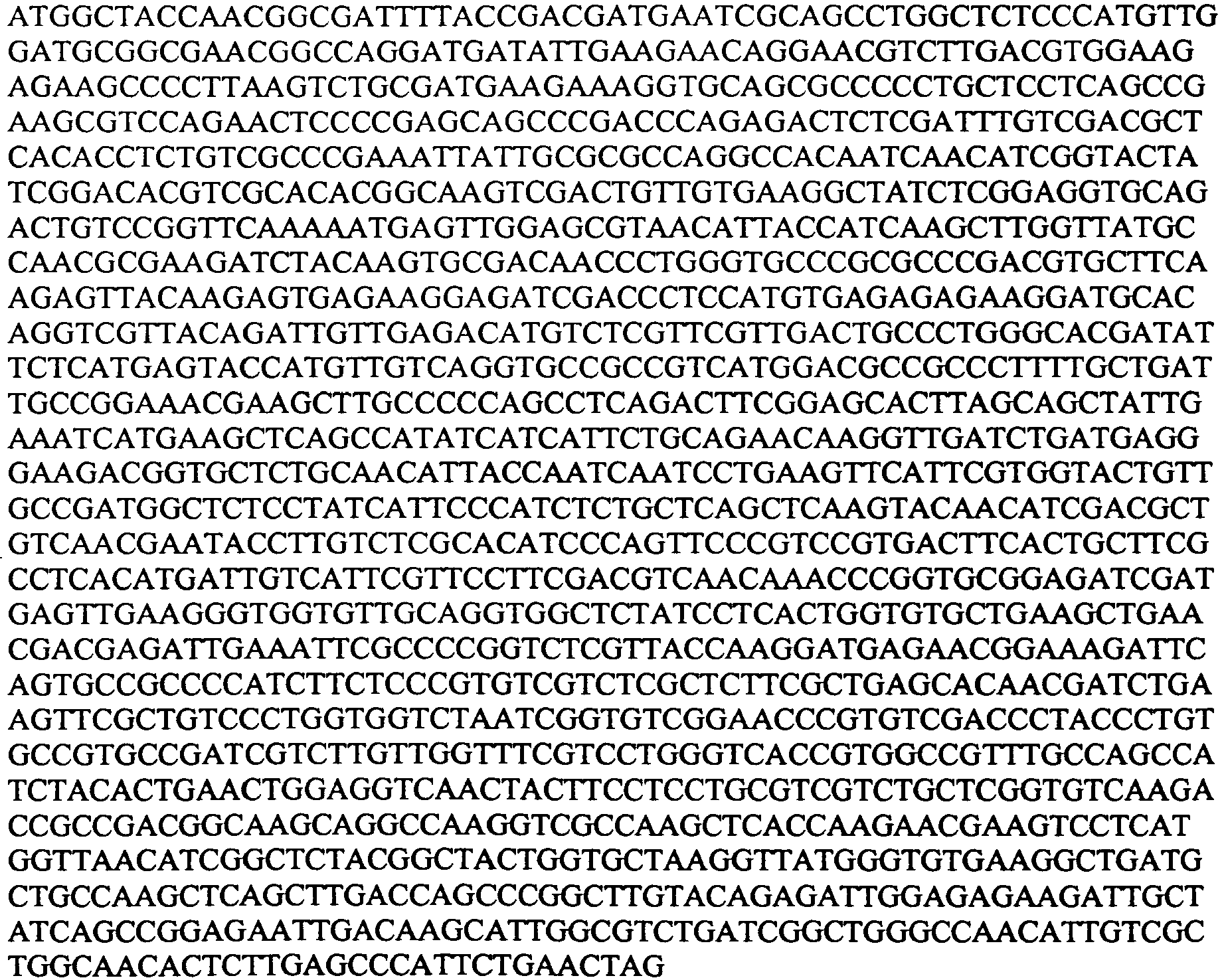
- SEQ ID NO. 78:
>XM_001267265.1_ Published eIF2 sequence for N.fischeri: Neosartorya fischeri NRRL 181 translation initiation factor EF-2 gamma subunit, putative (NFIA_108620) partial mRNA

- SEQ ID NO. 79:
>XM_001271648.1_ Published eIF2 γ sequence for A. clavatus:Aspergillus clavatus NRRL 1 translation initiation factor EF-2 gamma subunit, putative (ACLA_046890), partial mRNA
- SEQ ID NO.80:
>XM_001214623.1_ Published eIF2 sequence for A.terreus
- SEQ ID NO. 81:
>gi|169773704|ref_001821269.1| Aspergillus oryzae RIB40 hypothetical protein partial mRNA

- SEQ ID NO. 82:
>XM_001401525.1_ Published eIF2γ sequence for A. niger
- SEQ ID NO. 83:
>XM_656982.1_ Published eIF2γ sequence for A.nidulans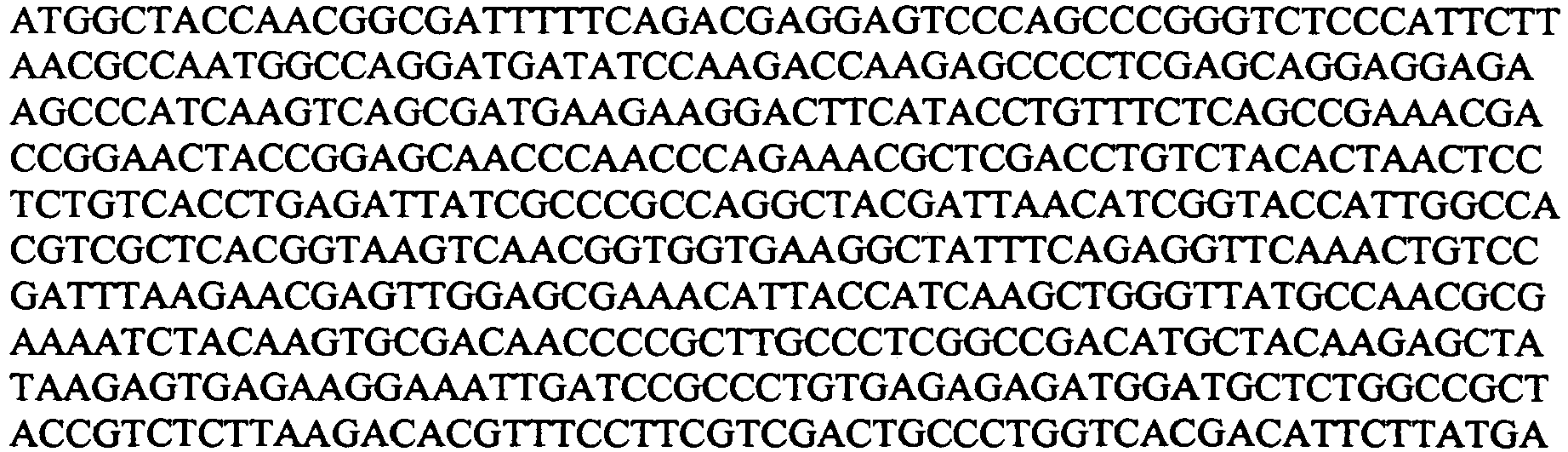

- SEQ ID NO: 84:
ALEF2
ATAATGCTCCGATCGTGCCTA - SEQ ID NO: 85:
GlabA
CAAGAGATTTCATGCTTTCTCCAC - SEQ ID NO: 86:
ParA
CGTAAACTCAATACCAGTTCCAGTC - SEQ ID NO: 87:
TropicA
TGTCAATTATATCCCAGTTCCATTGA - SEQ ID NO: 88:
KrusA
CATGTGTATGGTCAAGTCTATTCCT - SEQ ID NO: 89:
CEF3F
TCAGCCTTGGAACAC - SEQ ID NO: 90:
CEFR1
TTGGCACAGGTATGTAG - SEQ ID NO: 91:
GlabF1
TCgTgAAgACTATCCCTgT - SEQ ID NO: 92:
GlabR1 ATCGATTTCAGCACCTGG - SEQ ID NO: 93:
ParaF1
TATCgACgCCgTCAATC - SEQ ID NO: 94:
ParaR1
ATCAACgTCAgCACCAg - SEQ ID NO: 95:
TropicF1
ACATCGATGCCGTTAACC - SEQ ID NO: 96:
TropicR1
CAAGTCTTCGACATCGGA - SEQ ID NO: 97:
KrusF1
CCCAATTTCTGCTCAGTTG - SEQ ID NO: 98:
KrusR1
CACCAGGCTTATTAACATCG - SEQ ID NO: 99:
The amplified region of interest in eIF2γ of Candida albicans (XM_715569.1) is underlined. (Position of the region of interest: 790-934).

- SEQ ID NO: 100:
The amplified region of interest in eIF2γ of Candida glabrata (XM_447610.1) is underlined. (Position of the region of interest: 872-972).
- SEQ ID NO: 101:
The amplified region of interest is underlined. (151-274).
>P-604\(EF)\(CaneIF2-F) eIF2 γ sequence generated for C.parapsilosis
- SEQ ID NO: 102
The amplified region of interest is underlined. (140-270).
>T94\(EF)\(CaneIF2-F) eIF2 γ sequence generated for C.tropicalis

- SEQ ID NO: 103:
The amplified region of interest is underlined. (115-224).
>K573E\(EF)\(CancIF2-F) eIF2 γ sequence generated for C. krusei
- SEQ ID NO: 104:
EF2_7_FOW
AGCCCAAGCGGCCAGA - SEQ ID NO: 105:
EF2_8_FOW
AGCCGAAGCGCCCAGA - SEQ ID NO: 106:
EF2_5_REV
GGCCTGGCGCGCAAT - SEQ ID NO: 107:
EF2_6_REV
GGCTTGGCGCGCAAT - SEQ ID NO: 108:
A.NIG_EF2_1
ATCCGGAGACTCTGGACCT - SEQ ID NO: 109:
A.TERR_EF2_1
CGACGCTTACCCCTCTGT - SEQ ID NO: 110:
A.FLAV_EF2_1
CAGACCCCGCTACCCTT - SEQ ID NO: 111:
A.FUM_EF2_1
ACGCTCACACCTCTGTC - SEQ ID NO: 112:
EF2_9_FOW
AGCCGAAGCGTCCAGAAC - SEQ ID NO: 113:
EF2_1_fow
cagccgaagcg - SEQ ID NO: 114:
EF2_2_fow
cagcccaagcg - SEQ ID NO: 115:
EF2_3_fow
agccgaagcgYc - SEQ ID NO: 116:
EF2_4_fow
agcccaagcggcc - SEQ ID NO: 117:
EF2_5_fow
agccgaagcgtcc - SEQ ID NO: 118:
EF2_6_fow
agccgaagcgccc - SEQ ID NO: 119:
EF2_10_fow
agcgccccctgctcc - SEQ ID NO: 120:
EF2_11_fow
cccgagcagcccgacc - SEQ ID NO: 121:
EF2_1_rev
cgtgtgcgacgt - SEQ ID NO: 122:
EF2_3_rev
cgtgagcgagtg - SEQ ID NO: 123:
EF2_4_rev
cgtgwgcgacgt - SEQ ID NO: 124:
EF2_7_rev
cgtgtgcgacgtgtccg - SEQ ID NO: 125:
A.fum_EF2_2
cgacgctcacacctctgtc - SEQ ID NO: 126:
>CA3345\(EF2) eIF2 γ sequence generated for C.albicans
- SEQ ID NO: 127:
>CA16733\(EF2) eIF2 γ sequence generated for C.albicans
- SEQ ID NO: 128:
>CA1899\(EF2) eIF2 γ sequence generated for C.albicans
- SEQ ID NO: 129:
>CA1912\(EF2) eIF2 γ sequence generated for C.albicans
- SEQ ID NO: 130:
>CA2312\(EF2) eIF2 γ sequence generated for C.albicans
- SEQ ID NO: 131:
>CA2688\(EF2) eIF2 γ sequence generated for C.albicans
- SEQ ID NO: 132:
>CA2701\(EF2) eIF2 γ sequence generated for C.albicans
- SEQ ID NO: 133:
>CA15640\(EF2) eIF2 γ sequence generated for C.albicans
- SEQ ID NO: 134:
>CA1893\(EF2) eIF2 γ sequence generated for C.albicans
- SEQ ID No: 135:
CEF1F
ATCTATCATTCAGTTTATTAGAG - SEQ ID NO 136:
CEF2F
CATTCAGTTTATTAGAGGTAC - SEQ ID NO 137:
CEFR2
CAGTAAAGTCTCTCATTG - SEQ ID NO 138:
ALEF1
TGCCGATAATGCTCCGATC -
- Alone PV, Dever TE. Direct binding of translation initiation factor eIF2gamma-G domain to its GTPase-activating and GDP-GTP exchange factors eIF5 and eIF2B epsilon. J Biol Chem. 2006 May 5;281(18):12636-44. Epub 2006 .
- Dorris DR, Erickson FL, Hannig EM. Mutations in GCD11, the structural gene for eIF-2 gamma in yeast, alter translational regulation of GCN4 and the selection of the start site for protein synthesis. EMBO J. 1995 May 15;14(10):2239-49
- Erickson FL, Harding LD, Dorris DR, Hannig EM. Functional analysis of homologs of translation initiation factor 2gamma in yeast. Mol Gen Genet. 1997 Feb 27;253(6):711-9.
- Erickson FL, Hannig EM. Ligand interactions with eukaryotic translation initiation factor 2: role of the gamma-subunit. EMBO J. 1996 .
Claims (9)
- A diagnostic kit for the discrimination of C. albicans from other yeast or fungal species comprising at least one oligonucleotide probe capable of binding to at least a portion of the C. albicans eIF2 γ gene or its corresponding mRNA, wherein the at least one probe is selected from the group consisting of SEQ ID NO: 1 or 84, and sequences of between 10 and 100 nucleotides in length which preferentially hybridize to the nucleotide sequences SEQ ID NO: 1 or 84 and which are able to discriminate C. albicans from other yeast or fungal species , and sequences of between 10 and 100 nucleotides in length which are complementary thereto.
- A kit as claimed in claim 1, further comprising at least one primer for amplification of at least a portion of the C. albicans eIF2 γ gene, the primer being at least one forward and at least one reverse primer for at least a portion of the eIF2 γ gene.
- A kit as claimed in any preceding claim, comprising at least one forward in vitro amplification primer and at least one reverse in vitro amplification primer, the forward amplification primer being selected from the group consisting of SEQ ID NO 5 or 89, sequences of between 10 and 100 nucleotides in length which are complementary to sequences that preferentially hybridize to the nucleotide sequence SEQ ID NO: 5 or 89 and are able to discriminate C. albicans from other yeast or fungal species, and which can also act as a forward amplification primer for the eIF2 γ gene;
and the reverse amplification primer being selected from the group consisting of SEQ ID NO 6 or 90, sequences of between 10 and 100 nucleotides in length which are complementary to sequences that preferentially hybridize to the nucleotide sequence SEQ ID NO: 6 or 90 and are able to discriminate C. albicans from other yeast or fungal species, and which can also act as a reverse amplification primer for the C. albicans eIF2 γ gene. - A nucleic acid molecule selected from the group consisting of: SEQ ID NO 1; SEQ ID NO 5, SEQ ID NO 6, SEQ ID NO 84, SEQ ID NO 89 and SEQ ID NO 90 and sequences of between 10 and 100 nucleotides in length which preferentially hybridize to the nucleotide sequence SEQ ID NO 1; SEQ ID NO 5; SEQ ID NO 6, SEQ ID NO 84, SEQ ID NO 89 and SEQ ID NO 90 and are able to discriminate C. albicans from other yeast or fungal species, and sequences of between 10 and 100 nucleotides in length complementary thereto for the discrimination of C. albicans..
- A method of discriminating C. albicans from other yeast or fungal species in a test sample comprising the steps of(i) Mixing the test sample with at least one oligonucleotide probe capable of binding to
at least a portion of the C. albicans eIF2 γ gene or its corresponding mRNA under appropriate conditions,(ii) hybridizing under high stringency conditions any nucleic acid that may be present
in the test sample with the oligonucleotide to form a probe:target duplex; and(iii) determining whether a probe:target duplex is present; the presence of the duplex positively identifying the presence of the target organism in the test sample, wherein the probe is selected from the group comprising of SEQ ID NO: 1 or 84, sequences of between 10 and 100 nucleotides in length which preferentially hybridize to the nucleotide sequence SEQ ID NO: 1 or 84 and are able to discriminate C. albicans from other yeast or fungal species and sequences of between 10 and 100 nucleotides in length which are complementary thereto. - Use of a kit as claimed in any one of claims 1 to 3 or a nucleic acid molecule as claimed in claim 4, in a diagnostic assay to measure yeast and/or fungal titres in a patient, in a diagnostic assay to detect the presence of one or more of a yeast and/or fungal species or in a diagnostic assay to measure yeast and or fungal contamination in an environment or in the identification and/or characterization of one or more disruptive agents that can be used to disrupt the eIF2 γ gene function.
- A method of assessing the efficacy of a treatment regime designed to reduce yeast and/or fungal titre in a patient comprising use of a kit as claimed in any one of claims 1 to 3 or a nucleic acid molecule as claimed in claim 4 at one or more key stages of the treatment regime, wherein the key stages comprise before treatment, during treatment and after treatment8.
- Use as claimed in claim 6, wherein the environment is a hospital, a food sample, an environmental sample e.g. water, an industrial sample such as an in-process sample or an end product requiring bioburden or quality assessment.
- Use as claimed in claim 6, wherein the disruptive agent is selected from the group consisting of antisense RNA, PNA, siRNA.
Applications Claiming Priority (2)
| Application Number | Priority Date | Filing Date | Title |
|---|---|---|---|
| IE20080490 | 2008-06-13 | ||
| PCT/EP2009/057337 WO2009150241A2 (en) | 2008-06-13 | 2009-06-15 | EIF2γ GENE AS A DIAGNOSTIC TARGET FOR THE IDENTIFICATION OF FUNGAL AND YEAST SPECIES |
Publications (2)
| Publication Number | Publication Date |
|---|---|
| EP2294219A2 EP2294219A2 (en) | 2011-03-16 |
| EP2294219B1 true EP2294219B1 (en) | 2016-01-13 |
Family
ID=41165734
Family Applications (1)
| Application Number | Title | Priority Date | Filing Date |
|---|---|---|---|
| EP09761802.9A Not-in-force EP2294219B1 (en) | 2008-06-13 | 2009-06-15 | Eif2 gamma gene as a diagnostic target for the identification of fungal and yeast species |
Country Status (8)
| Country | Link |
|---|---|
| US (1) | US9944996B2 (en) |
| EP (1) | EP2294219B1 (en) |
| JP (1) | JP5746021B2 (en) |
| CN (1) | CN102105601A (en) |
| AU (1) | AU2009256585B2 (en) |
| IE (1) | IES20090469A2 (en) |
| WO (1) | WO2009150241A2 (en) |
| ZA (1) | ZA201009015B (en) |
Families Citing this family (3)
| Publication number | Priority date | Publication date | Assignee | Title |
|---|---|---|---|---|
| CN103882135A (en) * | 2014-03-31 | 2014-06-25 | 深圳意达凯生物科技有限公司 | Primer pair for detecting candida albicans, kit and application thereof |
| CN110546279A (en) * | 2017-04-12 | 2019-12-06 | 动力生物科学有限公司 | detection and Classification of microorganisms Using ILV3 Gene |
| CN109971883B (en) * | 2019-05-07 | 2020-07-24 | 丹娜(天津)生物科技有限公司 | Primer-probe combination, kit, detection method and application for candida species classification detection |
Family Cites Families (9)
| Publication number | Priority date | Publication date | Assignee | Title |
|---|---|---|---|---|
| US6582908B2 (en) * | 1990-12-06 | 2003-06-24 | Affymetrix, Inc. | Oligonucleotides |
| US6747137B1 (en) * | 1998-02-13 | 2004-06-08 | Genome Therapeutics Corporation | Nucleic acid sequences relating to Candida albicans for diagnostics and therapeutics |
| US7504490B1 (en) * | 1998-10-16 | 2009-03-17 | Oscient Pharmaceuticals Corporation | Nucleic acid and amino acid sequences relating to Apergillus fumigatus for diagnostics and therapeutics |
| JP2002142775A (en) * | 2000-11-14 | 2002-05-21 | Ss Pharmaceut Co Ltd | Nucleic acid for detecting Candida fungi and method for detecting Candida fungus using the same |
| US20030180953A1 (en) * | 2000-12-29 | 2003-09-25 | Elitra Pharmaceuticals, Inc. | Gene disruption methodologies for drug target discovery |
| JP2005522980A (en) * | 2001-04-23 | 2005-08-04 | エリトラ ファーマシューティカルズ,インコーポレイテッド | Identification and use of Aspergillus fumigatus essential genes |
| JP2004201641A (en) * | 2002-12-26 | 2004-07-22 | Mitsubishi Kagaku Bio-Clinical Laboratories Inc | Fungus detection method |
| JP2004201636A (en) * | 2002-12-26 | 2004-07-22 | Toyobo Co Ltd | Method for detecting pathogenic fungus gene and oligonucleotide for identification of strain of fungus |
| JP4936278B2 (en) * | 2006-09-12 | 2012-05-23 | 良治 坪井 | Diagnosis of onychomycosis |
-
2009
- 2009-06-15 AU AU2009256585A patent/AU2009256585B2/en not_active Ceased
- 2009-06-15 EP EP09761802.9A patent/EP2294219B1/en not_active Not-in-force
- 2009-06-15 CN CN2009801294103A patent/CN102105601A/en active Pending
- 2009-06-15 US US12/997,479 patent/US9944996B2/en not_active Expired - Fee Related
- 2009-06-15 WO PCT/EP2009/057337 patent/WO2009150241A2/en not_active Ceased
- 2009-06-15 JP JP2011513002A patent/JP5746021B2/en not_active Expired - Fee Related
- 2009-06-15 IE IE20090469A patent/IES20090469A2/en not_active IP Right Cessation
-
2010
- 2010-12-14 ZA ZA2010/09015A patent/ZA201009015B/en unknown
Also Published As
| Publication number | Publication date |
|---|---|
| CN102105601A (en) | 2011-06-22 |
| ZA201009015B (en) | 2012-03-28 |
| JP2011524746A (en) | 2011-09-08 |
| US20110218335A1 (en) | 2011-09-08 |
| EP2294219A2 (en) | 2011-03-16 |
| WO2009150241A2 (en) | 2009-12-17 |
| US9944996B2 (en) | 2018-04-17 |
| AU2009256585B2 (en) | 2015-02-19 |
| WO2009150241A3 (en) | 2010-04-08 |
| IES20090469A2 (en) | 2010-03-03 |
| JP5746021B2 (en) | 2015-07-08 |
| AU2009256585A1 (en) | 2009-12-17 |
Similar Documents
| Publication | Publication Date | Title |
|---|---|---|
| AU2007331059B2 (en) | Nucleic acids probes for detection of yeast and fungal species | |
| US9745636B2 (en) | SWI5 gene as a diagnostic target for the identification of fungal and yeast species | |
| US9944996B2 (en) | eIF2γ gene as a diagnostic target for the identification of fungal and yeast species | |
| EP2294221B1 (en) | Ace2 as a target gene for the molecular identification of yeast and fungal species | |
| EP2294220B1 (en) | P2/p2a/p2b gene sequences as diagnostic targets for the identification of fungal and yeast species | |
| IES85514Y1 (en) | Ace2 as a target gene for the molecular identification of yeast and fungal species. | |
| IES85506Y1 (en) | P2/P2A/P2B gene sequences as diagnostic targets for the identification of fungal and yeast species. | |
| IE20090466U1 (en) | P2/P2A/P2B gene sequences as diagnostic targets for the identification of fungal and yeast species. | |
| IE20090464U1 (en) | SWI5 gene as a diagnostic target for the identification of fungal and yeast species | |
| IE20090467U1 (en) | Ace2 as a target gene for the molecular identification of yeast and fungal species. | |
| IES85507Y1 (en) | EIF2y gene as a diagnostic target for the identification of fungal and yeast species | |
| IES85505Y1 (en) | SWI5 gene as a diagnostic target for the identification of fungal and yeast species |
Legal Events
| Date | Code | Title | Description |
|---|---|---|---|
| PUAI | Public reference made under article 153(3) epc to a published international application that has entered the european phase |
Free format text: ORIGINAL CODE: 0009012 |
|
| 17P | Request for examination filed |
Effective date: 20101214 |
|
| AK | Designated contracting states |
Kind code of ref document: A2 Designated state(s): AT BE BG CH CY CZ DE DK EE ES FI FR GB GR HR HU IE IS IT LI LT LU LV MC MK MT NL NO PL PT RO SE SI SK TR |
|
| AX | Request for extension of the european patent |
Extension state: AL BA RS |
|
| DAX | Request for extension of the european patent (deleted) | ||
| 17Q | First examination report despatched |
Effective date: 20120105 |
|
| GRAP | Despatch of communication of intention to grant a patent |
Free format text: ORIGINAL CODE: EPIDOSNIGR1 |
|
| INTG | Intention to grant announced |
Effective date: 20150805 |
|
| GRAS | Grant fee paid |
Free format text: ORIGINAL CODE: EPIDOSNIGR3 |
|
| GRAA | (expected) grant |
Free format text: ORIGINAL CODE: 0009210 |
|
| AK | Designated contracting states |
Kind code of ref document: B1 Designated state(s): AT BE BG CH CY CZ DE DK EE ES FI FR GB GR HR HU IE IS IT LI LT LU LV MC MK MT NL NO PL PT RO SE SI SK TR |
|
| REG | Reference to a national code |
Ref country code: GB Ref legal event code: FG4D |
|
| REG | Reference to a national code |
Ref country code: CH Ref legal event code: EP |
|
| REG | Reference to a national code |
Ref country code: IE Ref legal event code: FG4D |
|
| REG | Reference to a national code |
Ref country code: AT Ref legal event code: REF Ref document number: 770566 Country of ref document: AT Kind code of ref document: T Effective date: 20160215 |
|
| REG | Reference to a national code |
Ref country code: DE Ref legal event code: R096 Ref document number: 602009035850 Country of ref document: DE |
|
| REG | Reference to a national code |
Ref country code: LT Ref legal event code: MG4D |
|
| REG | Reference to a national code |
Ref country code: NL Ref legal event code: MP Effective date: 20160113 |
|
| REG | Reference to a national code |
Ref country code: AT Ref legal event code: MK05 Ref document number: 770566 Country of ref document: AT Kind code of ref document: T Effective date: 20160113 |
|
| REG | Reference to a national code |
Ref country code: FR Ref legal event code: PLFP Year of fee payment: 8 |
|
| PG25 | Lapsed in a contracting state [announced via postgrant information from national office to epo] |
Ref country code: NL Free format text: LAPSE BECAUSE OF FAILURE TO SUBMIT A TRANSLATION OF THE DESCRIPTION OR TO PAY THE FEE WITHIN THE PRESCRIBED TIME-LIMIT Effective date: 20160113 |
|
| PG25 | Lapsed in a contracting state [announced via postgrant information from national office to epo] |
Ref country code: GR Free format text: LAPSE BECAUSE OF FAILURE TO SUBMIT A TRANSLATION OF THE DESCRIPTION OR TO PAY THE FEE WITHIN THE PRESCRIBED TIME-LIMIT Effective date: 20160414 Ref country code: FI Free format text: LAPSE BECAUSE OF FAILURE TO SUBMIT A TRANSLATION OF THE DESCRIPTION OR TO PAY THE FEE WITHIN THE PRESCRIBED TIME-LIMIT Effective date: 20160113 Ref country code: ES Free format text: LAPSE BECAUSE OF FAILURE TO SUBMIT A TRANSLATION OF THE DESCRIPTION OR TO PAY THE FEE WITHIN THE PRESCRIBED TIME-LIMIT Effective date: 20160113 Ref country code: IT Free format text: LAPSE BECAUSE OF FAILURE TO SUBMIT A TRANSLATION OF THE DESCRIPTION OR TO PAY THE FEE WITHIN THE PRESCRIBED TIME-LIMIT Effective date: 20160113 Ref country code: NO Free format text: LAPSE BECAUSE OF FAILURE TO SUBMIT A TRANSLATION OF THE DESCRIPTION OR TO PAY THE FEE WITHIN THE PRESCRIBED TIME-LIMIT Effective date: 20160413 Ref country code: HR Free format text: LAPSE BECAUSE OF FAILURE TO SUBMIT A TRANSLATION OF THE DESCRIPTION OR TO PAY THE FEE WITHIN THE PRESCRIBED TIME-LIMIT Effective date: 20160113 |
|
| PG25 | Lapsed in a contracting state [announced via postgrant information from national office to epo] |
Ref country code: SE Free format text: LAPSE BECAUSE OF FAILURE TO SUBMIT A TRANSLATION OF THE DESCRIPTION OR TO PAY THE FEE WITHIN THE PRESCRIBED TIME-LIMIT Effective date: 20160113 Ref country code: IS Free format text: LAPSE BECAUSE OF FAILURE TO SUBMIT A TRANSLATION OF THE DESCRIPTION OR TO PAY THE FEE WITHIN THE PRESCRIBED TIME-LIMIT Effective date: 20160513 Ref country code: AT Free format text: LAPSE BECAUSE OF FAILURE TO SUBMIT A TRANSLATION OF THE DESCRIPTION OR TO PAY THE FEE WITHIN THE PRESCRIBED TIME-LIMIT Effective date: 20160113 Ref country code: PT Free format text: LAPSE BECAUSE OF FAILURE TO SUBMIT A TRANSLATION OF THE DESCRIPTION OR TO PAY THE FEE WITHIN THE PRESCRIBED TIME-LIMIT Effective date: 20160513 Ref country code: PL Free format text: LAPSE BECAUSE OF FAILURE TO SUBMIT A TRANSLATION OF THE DESCRIPTION OR TO PAY THE FEE WITHIN THE PRESCRIBED TIME-LIMIT Effective date: 20160113 Ref country code: LV Free format text: LAPSE BECAUSE OF FAILURE TO SUBMIT A TRANSLATION OF THE DESCRIPTION OR TO PAY THE FEE WITHIN THE PRESCRIBED TIME-LIMIT Effective date: 20160113 Ref country code: LT Free format text: LAPSE BECAUSE OF FAILURE TO SUBMIT A TRANSLATION OF THE DESCRIPTION OR TO PAY THE FEE WITHIN THE PRESCRIBED TIME-LIMIT Effective date: 20160113 |
|
| REG | Reference to a national code |
Ref country code: DE Ref legal event code: R097 Ref document number: 602009035850 Country of ref document: DE |
|
| PG25 | Lapsed in a contracting state [announced via postgrant information from national office to epo] |
Ref country code: EE Free format text: LAPSE BECAUSE OF FAILURE TO SUBMIT A TRANSLATION OF THE DESCRIPTION OR TO PAY THE FEE WITHIN THE PRESCRIBED TIME-LIMIT Effective date: 20160113 Ref country code: DK Free format text: LAPSE BECAUSE OF FAILURE TO SUBMIT A TRANSLATION OF THE DESCRIPTION OR TO PAY THE FEE WITHIN THE PRESCRIBED TIME-LIMIT Effective date: 20160113 |
|
| PLBE | No opposition filed within time limit |
Free format text: ORIGINAL CODE: 0009261 |
|
| STAA | Information on the status of an ep patent application or granted ep patent |
Free format text: STATUS: NO OPPOSITION FILED WITHIN TIME LIMIT |
|
| PG25 | Lapsed in a contracting state [announced via postgrant information from national office to epo] |
Ref country code: CZ Free format text: LAPSE BECAUSE OF FAILURE TO SUBMIT A TRANSLATION OF THE DESCRIPTION OR TO PAY THE FEE WITHIN THE PRESCRIBED TIME-LIMIT Effective date: 20160113 Ref country code: RO Free format text: LAPSE BECAUSE OF FAILURE TO SUBMIT A TRANSLATION OF THE DESCRIPTION OR TO PAY THE FEE WITHIN THE PRESCRIBED TIME-LIMIT Effective date: 20160113 Ref country code: SK Free format text: LAPSE BECAUSE OF FAILURE TO SUBMIT A TRANSLATION OF THE DESCRIPTION OR TO PAY THE FEE WITHIN THE PRESCRIBED TIME-LIMIT Effective date: 20160113 |
|
| 26N | No opposition filed |
Effective date: 20161014 |
|
| PG25 | Lapsed in a contracting state [announced via postgrant information from national office to epo] |
Ref country code: BE Free format text: LAPSE BECAUSE OF FAILURE TO SUBMIT A TRANSLATION OF THE DESCRIPTION OR TO PAY THE FEE WITHIN THE PRESCRIBED TIME-LIMIT Effective date: 20160113 |
|
| PG25 | Lapsed in a contracting state [announced via postgrant information from national office to epo] |
Ref country code: MC Free format text: LAPSE BECAUSE OF FAILURE TO SUBMIT A TRANSLATION OF THE DESCRIPTION OR TO PAY THE FEE WITHIN THE PRESCRIBED TIME-LIMIT Effective date: 20160113 |
|
| REG | Reference to a national code |
Ref country code: CH Ref legal event code: PL |
|
| PG25 | Lapsed in a contracting state [announced via postgrant information from national office to epo] |
Ref country code: SI Free format text: LAPSE BECAUSE OF FAILURE TO SUBMIT A TRANSLATION OF THE DESCRIPTION OR TO PAY THE FEE WITHIN THE PRESCRIBED TIME-LIMIT Effective date: 20160113 Ref country code: BG Free format text: LAPSE BECAUSE OF FAILURE TO SUBMIT A TRANSLATION OF THE DESCRIPTION OR TO PAY THE FEE WITHIN THE PRESCRIBED TIME-LIMIT Effective date: 20160413 |
|
| PG25 | Lapsed in a contracting state [announced via postgrant information from national office to epo] |
Ref country code: CH Free format text: LAPSE BECAUSE OF NON-PAYMENT OF DUE FEES Effective date: 20160630 Ref country code: LI Free format text: LAPSE BECAUSE OF NON-PAYMENT OF DUE FEES Effective date: 20160630 |
|
| REG | Reference to a national code |
Ref country code: FR Ref legal event code: PLFP Year of fee payment: 9 |
|
| PG25 | Lapsed in a contracting state [announced via postgrant information from national office to epo] |
Ref country code: CY Free format text: LAPSE BECAUSE OF FAILURE TO SUBMIT A TRANSLATION OF THE DESCRIPTION OR TO PAY THE FEE WITHIN THE PRESCRIBED TIME-LIMIT Effective date: 20160113 Ref country code: HU Free format text: LAPSE BECAUSE OF FAILURE TO SUBMIT A TRANSLATION OF THE DESCRIPTION OR TO PAY THE FEE WITHIN THE PRESCRIBED TIME-LIMIT; INVALID AB INITIO Effective date: 20090615 |
|
| REG | Reference to a national code |
Ref country code: FR Ref legal event code: PLFP Year of fee payment: 10 |
|
| PG25 | Lapsed in a contracting state [announced via postgrant information from national office to epo] |
Ref country code: MT Free format text: LAPSE BECAUSE OF NON-PAYMENT OF DUE FEES Effective date: 20160630 Ref country code: MK Free format text: LAPSE BECAUSE OF FAILURE TO SUBMIT A TRANSLATION OF THE DESCRIPTION OR TO PAY THE FEE WITHIN THE PRESCRIBED TIME-LIMIT Effective date: 20160113 Ref country code: TR Free format text: LAPSE BECAUSE OF FAILURE TO SUBMIT A TRANSLATION OF THE DESCRIPTION OR TO PAY THE FEE WITHIN THE PRESCRIBED TIME-LIMIT Effective date: 20160113 Ref country code: LU Free format text: LAPSE BECAUSE OF NON-PAYMENT OF DUE FEES Effective date: 20160615 |
|
| PGFP | Annual fee paid to national office [announced via postgrant information from national office to epo] |
Ref country code: IE Payment date: 20180618 Year of fee payment: 10 Ref country code: DE Payment date: 20180621 Year of fee payment: 10 |
|
| PGFP | Annual fee paid to national office [announced via postgrant information from national office to epo] |
Ref country code: FR Payment date: 20180620 Year of fee payment: 10 |
|
| PGFP | Annual fee paid to national office [announced via postgrant information from national office to epo] |
Ref country code: GB Payment date: 20180618 Year of fee payment: 10 |
|
| REG | Reference to a national code |
Ref country code: DE Ref legal event code: R119 Ref document number: 602009035850 Country of ref document: DE |
|
| GBPC | Gb: european patent ceased through non-payment of renewal fee |
Effective date: 20190615 |
|
| PG25 | Lapsed in a contracting state [announced via postgrant information from national office to epo] |
Ref country code: GB Free format text: LAPSE BECAUSE OF NON-PAYMENT OF DUE FEES Effective date: 20190615 Ref country code: DE Free format text: LAPSE BECAUSE OF NON-PAYMENT OF DUE FEES Effective date: 20200101 Ref country code: IE Free format text: LAPSE BECAUSE OF NON-PAYMENT OF DUE FEES Effective date: 20190615 |
|
| PG25 | Lapsed in a contracting state [announced via postgrant information from national office to epo] |
Ref country code: FR Free format text: LAPSE BECAUSE OF NON-PAYMENT OF DUE FEES Effective date: 20190630 |