EP0422872A2 - Nucleic acid probes and methods for detecting fungi - Google Patents
Nucleic acid probes and methods for detecting fungi Download PDFInfo
- Publication number
- EP0422872A2 EP0422872A2 EP90311003A EP90311003A EP0422872A2 EP 0422872 A2 EP0422872 A2 EP 0422872A2 EP 90311003 A EP90311003 A EP 90311003A EP 90311003 A EP90311003 A EP 90311003A EP 0422872 A2 EP0422872 A2 EP 0422872A2
- Authority
- EP
- European Patent Office
- Prior art keywords
- probe
- probes
- nucleic acid
- fungal
- rrna
- Prior art date
- Legal status (The legal status is an assumption and is not a legal conclusion. Google has not performed a legal analysis and makes no representation as to the accuracy of the status listed.)
- Granted
Links
- 241000233866 Fungi Species 0.000 title claims abstract description 35
- 238000000034 method Methods 0.000 title claims description 25
- 108020004711 Nucleic Acid Probes Proteins 0.000 title abstract description 10
- 239000002853 nucleic acid probe Substances 0.000 title abstract description 10
- 239000000523 sample Substances 0.000 claims abstract description 197
- 230000002538 fungal effect Effects 0.000 claims abstract description 32
- 241000282414 Homo sapiens Species 0.000 claims abstract description 14
- 230000000295 complement effect Effects 0.000 claims abstract description 6
- 239000002773 nucleotide Substances 0.000 claims description 25
- 125000003729 nucleotide group Chemical group 0.000 claims description 25
- 150000007523 nucleic acids Chemical group 0.000 claims description 21
- 108020004463 18S ribosomal RNA Proteins 0.000 claims description 11
- 102000039446 nucleic acids Human genes 0.000 claims description 11
- 108020004707 nucleic acids Proteins 0.000 claims description 11
- 108090000623 proteins and genes Proteins 0.000 claims description 9
- 108091034117 Oligonucleotide Proteins 0.000 claims description 6
- 241000894006 Bacteria Species 0.000 claims description 5
- 241000209140 Triticum Species 0.000 claims description 5
- 235000021307 Triticum Nutrition 0.000 claims description 5
- 238000003752 polymerase chain reaction Methods 0.000 claims description 5
- 102000040430 polynucleotide Human genes 0.000 claims description 4
- 108091033319 polynucleotide Proteins 0.000 claims description 4
- 239000002157 polynucleotide Substances 0.000 claims description 4
- 238000002360 preparation method Methods 0.000 claims description 3
- 239000012634 fragment Substances 0.000 claims 3
- 230000008878 coupling Effects 0.000 claims 2
- 238000010168 coupling process Methods 0.000 claims 2
- 238000005859 coupling reaction Methods 0.000 claims 2
- 229920002477 rna polymer Polymers 0.000 abstract description 36
- 206010017523 Fungaemia Diseases 0.000 abstract description 10
- 238000001514 detection method Methods 0.000 abstract description 10
- 241000894007 species Species 0.000 abstract description 8
- 239000003795 chemical substances by application Substances 0.000 abstract description 6
- 235000013305 food Nutrition 0.000 abstract description 5
- 238000003759 clinical diagnosis Methods 0.000 abstract description 4
- 206010040047 Sepsis Diseases 0.000 abstract description 3
- 208000013223 septicemia Diseases 0.000 abstract description 3
- 241001465754 Metazoa Species 0.000 abstract description 2
- 238000012408 PCR amplification Methods 0.000 abstract description 2
- 235000013361 beverage Nutrition 0.000 abstract 1
- 201000010099 disease Diseases 0.000 abstract 1
- 208000037265 diseases, disorders, signs and symptoms Diseases 0.000 abstract 1
- 238000011156 evaluation Methods 0.000 abstract 1
- 238000009396 hybridization Methods 0.000 description 36
- 108020004414 DNA Proteins 0.000 description 24
- 102000053602 DNA Human genes 0.000 description 24
- 238000003556 assay Methods 0.000 description 20
- 230000010244 detection of fungus Effects 0.000 description 18
- 230000000692 anti-sense effect Effects 0.000 description 17
- 240000004808 Saccharomyces cerevisiae Species 0.000 description 10
- 241000222120 Candida <Saccharomycetales> Species 0.000 description 9
- 230000006399 behavior Effects 0.000 description 7
- 230000009977 dual effect Effects 0.000 description 7
- 210000003705 ribosome Anatomy 0.000 description 7
- 230000009260 cross reactivity Effects 0.000 description 6
- 230000009885 systemic effect Effects 0.000 description 6
- 108091028043 Nucleic acid sequence Proteins 0.000 description 5
- 230000001580 bacterial effect Effects 0.000 description 5
- 239000011324 bead Substances 0.000 description 5
- 244000053095 fungal pathogen Species 0.000 description 5
- 241000196324 Embryophyta Species 0.000 description 4
- 238000004458 analytical method Methods 0.000 description 4
- 239000008280 blood Substances 0.000 description 4
- 210000004369 blood Anatomy 0.000 description 4
- 210000004027 cell Anatomy 0.000 description 4
- 230000001413 cellular effect Effects 0.000 description 4
- 238000011161 development Methods 0.000 description 4
- 230000001717 pathogenic effect Effects 0.000 description 4
- 238000012360 testing method Methods 0.000 description 4
- 206010036790 Productive cough Diseases 0.000 description 3
- 241000251539 Vertebrata <Metazoa> Species 0.000 description 3
- JLCPHMBAVCMARE-UHFFFAOYSA-N [3-[[3-[[3-[[3-[[3-[[3-[[3-[[3-[[3-[[3-[[3-[[5-(2-amino-6-oxo-1H-purin-9-yl)-3-[[3-[[3-[[3-[[3-[[3-[[5-(2-amino-6-oxo-1H-purin-9-yl)-3-[[5-(2-amino-6-oxo-1H-purin-9-yl)-3-hydroxyoxolan-2-yl]methoxy-hydroxyphosphoryl]oxyoxolan-2-yl]methoxy-hydroxyphosphoryl]oxy-5-(5-methyl-2,4-dioxopyrimidin-1-yl)oxolan-2-yl]methoxy-hydroxyphosphoryl]oxy-5-(6-aminopurin-9-yl)oxolan-2-yl]methoxy-hydroxyphosphoryl]oxy-5-(6-aminopurin-9-yl)oxolan-2-yl]methoxy-hydroxyphosphoryl]oxy-5-(6-aminopurin-9-yl)oxolan-2-yl]methoxy-hydroxyphosphoryl]oxy-5-(6-aminopurin-9-yl)oxolan-2-yl]methoxy-hydroxyphosphoryl]oxyoxolan-2-yl]methoxy-hydroxyphosphoryl]oxy-5-(5-methyl-2,4-dioxopyrimidin-1-yl)oxolan-2-yl]methoxy-hydroxyphosphoryl]oxy-5-(4-amino-2-oxopyrimidin-1-yl)oxolan-2-yl]methoxy-hydroxyphosphoryl]oxy-5-(5-methyl-2,4-dioxopyrimidin-1-yl)oxolan-2-yl]methoxy-hydroxyphosphoryl]oxy-5-(5-methyl-2,4-dioxopyrimidin-1-yl)oxolan-2-yl]methoxy-hydroxyphosphoryl]oxy-5-(6-aminopurin-9-yl)oxolan-2-yl]methoxy-hydroxyphosphoryl]oxy-5-(6-aminopurin-9-yl)oxolan-2-yl]methoxy-hydroxyphosphoryl]oxy-5-(4-amino-2-oxopyrimidin-1-yl)oxolan-2-yl]methoxy-hydroxyphosphoryl]oxy-5-(4-amino-2-oxopyrimidin-1-yl)oxolan-2-yl]methoxy-hydroxyphosphoryl]oxy-5-(4-amino-2-oxopyrimidin-1-yl)oxolan-2-yl]methoxy-hydroxyphosphoryl]oxy-5-(6-aminopurin-9-yl)oxolan-2-yl]methoxy-hydroxyphosphoryl]oxy-5-(4-amino-2-oxopyrimidin-1-yl)oxolan-2-yl]methyl [5-(6-aminopurin-9-yl)-2-(hydroxymethyl)oxolan-3-yl] hydrogen phosphate Polymers Cc1cn(C2CC(OP(O)(=O)OCC3OC(CC3OP(O)(=O)OCC3OC(CC3O)n3cnc4c3nc(N)[nH]c4=O)n3cnc4c3nc(N)[nH]c4=O)C(COP(O)(=O)OC3CC(OC3COP(O)(=O)OC3CC(OC3COP(O)(=O)OC3CC(OC3COP(O)(=O)OC3CC(OC3COP(O)(=O)OC3CC(OC3COP(O)(=O)OC3CC(OC3COP(O)(=O)OC3CC(OC3COP(O)(=O)OC3CC(OC3COP(O)(=O)OC3CC(OC3COP(O)(=O)OC3CC(OC3COP(O)(=O)OC3CC(OC3COP(O)(=O)OC3CC(OC3COP(O)(=O)OC3CC(OC3COP(O)(=O)OC3CC(OC3COP(O)(=O)OC3CC(OC3COP(O)(=O)OC3CC(OC3COP(O)(=O)OC3CC(OC3CO)n3cnc4c(N)ncnc34)n3ccc(N)nc3=O)n3cnc4c(N)ncnc34)n3ccc(N)nc3=O)n3ccc(N)nc3=O)n3ccc(N)nc3=O)n3cnc4c(N)ncnc34)n3cnc4c(N)ncnc34)n3cc(C)c(=O)[nH]c3=O)n3cc(C)c(=O)[nH]c3=O)n3ccc(N)nc3=O)n3cc(C)c(=O)[nH]c3=O)n3cnc4c3nc(N)[nH]c4=O)n3cnc4c(N)ncnc34)n3cnc4c(N)ncnc34)n3cnc4c(N)ncnc34)n3cnc4c(N)ncnc34)O2)c(=O)[nH]c1=O JLCPHMBAVCMARE-UHFFFAOYSA-N 0.000 description 3
- 229940121375 antifungal agent Drugs 0.000 description 3
- 238000002820 assay format Methods 0.000 description 3
- 238000006243 chemical reaction Methods 0.000 description 3
- 208000015181 infectious disease Diseases 0.000 description 3
- 239000012528 membrane Substances 0.000 description 3
- 238000012986 modification Methods 0.000 description 3
- 230000004048 modification Effects 0.000 description 3
- 238000007899 nucleic acid hybridization Methods 0.000 description 3
- 244000052769 pathogen Species 0.000 description 3
- 230000009467 reduction Effects 0.000 description 3
- 108020004418 ribosomal RNA Proteins 0.000 description 3
- 238000012163 sequencing technique Methods 0.000 description 3
- 239000007787 solid Substances 0.000 description 3
- 210000003802 sputum Anatomy 0.000 description 3
- 208000024794 sputum Diseases 0.000 description 3
- YBJHBAHKTGYVGT-ZKWXMUAHSA-N (+)-Biotin Chemical compound N1C(=O)N[C@@H]2[C@H](CCCCC(=O)O)SC[C@@H]21 YBJHBAHKTGYVGT-ZKWXMUAHSA-N 0.000 description 2
- 241000228212 Aspergillus Species 0.000 description 2
- 241001337994 Cryptococcus <scale insect> Species 0.000 description 2
- 241000206602 Eukaryota Species 0.000 description 2
- 239000004677 Nylon Substances 0.000 description 2
- 241000228143 Penicillium Species 0.000 description 2
- FAPWRFPIFSIZLT-UHFFFAOYSA-M Sodium chloride Chemical compound [Na+].[Cl-] FAPWRFPIFSIZLT-UHFFFAOYSA-M 0.000 description 2
- 241000235015 Yarrowia lipolytica Species 0.000 description 2
- 230000003321 amplification Effects 0.000 description 2
- 230000000843 anti-fungal effect Effects 0.000 description 2
- 210000001175 cerebrospinal fluid Anatomy 0.000 description 2
- 238000002512 chemotherapy Methods 0.000 description 2
- 238000010367 cloning Methods 0.000 description 2
- 230000002380 cytological effect Effects 0.000 description 2
- 230000009089 cytolysis Effects 0.000 description 2
- 230000001419 dependent effect Effects 0.000 description 2
- 230000007613 environmental effect Effects 0.000 description 2
- 239000011521 glass Substances 0.000 description 2
- 229920001519 homopolymer Polymers 0.000 description 2
- 238000000338 in vitro Methods 0.000 description 2
- 239000006249 magnetic particle Substances 0.000 description 2
- 239000011159 matrix material Substances 0.000 description 2
- 239000000203 mixture Substances 0.000 description 2
- 238000003199 nucleic acid amplification method Methods 0.000 description 2
- 229920001778 nylon Polymers 0.000 description 2
- 108700022487 rRNA Genes Proteins 0.000 description 2
- 238000012216 screening Methods 0.000 description 2
- 238000011895 specific detection Methods 0.000 description 2
- 238000007920 subcutaneous administration Methods 0.000 description 2
- 239000000126 substance Substances 0.000 description 2
- 230000009897 systematic effect Effects 0.000 description 2
- 210000001519 tissue Anatomy 0.000 description 2
- 108091032973 (ribonucleotides)n+m Proteins 0.000 description 1
- 102000040650 (ribonucleotides)n+m Human genes 0.000 description 1
- 108020004465 16S ribosomal RNA Proteins 0.000 description 1
- SNJPVNBCEVUTJX-UHFFFAOYSA-N 3-(diaminophosphorylamino)propanenitrile Chemical class NP(N)(=O)NCCC#N SNJPVNBCEVUTJX-UHFFFAOYSA-N 0.000 description 1
- -1 32-P Chemical compound 0.000 description 1
- 108020004565 5.8S Ribosomal RNA Proteins 0.000 description 1
- 235000001674 Agaricus brunnescens Nutrition 0.000 description 1
- 241000335423 Blastomyces Species 0.000 description 1
- 241000228405 Blastomyces dermatitidis Species 0.000 description 1
- 241000222173 Candida parapsilosis Species 0.000 description 1
- 241000222178 Candida tropicalis Species 0.000 description 1
- 241000223205 Coccidioides immitis Species 0.000 description 1
- 201000007336 Cryptococcosis Diseases 0.000 description 1
- 241000221204 Cryptococcus neoformans Species 0.000 description 1
- 241000195493 Cryptophyta Species 0.000 description 1
- 239000003298 DNA probe Substances 0.000 description 1
- KCXVZYZYPLLWCC-UHFFFAOYSA-N EDTA Chemical compound OC(=O)CN(CC(O)=O)CCN(CC(O)=O)CC(O)=O KCXVZYZYPLLWCC-UHFFFAOYSA-N 0.000 description 1
- 102100031780 Endonuclease Human genes 0.000 description 1
- 241000588724 Escherichia coli Species 0.000 description 1
- 206010017533 Fungal infection Diseases 0.000 description 1
- 241000228404 Histoplasma capsulatum Species 0.000 description 1
- 241001123674 Metschnikowia Species 0.000 description 1
- 208000031888 Mycoses Diseases 0.000 description 1
- 239000000020 Nitrocellulose Substances 0.000 description 1
- 101710163270 Nuclease Proteins 0.000 description 1
- 108020005187 Oligonucleotide Probes Proteins 0.000 description 1
- 240000007594 Oryza sativa Species 0.000 description 1
- 235000007164 Oryza sativa Nutrition 0.000 description 1
- 241000526686 Paracoccidioides brasiliensis Species 0.000 description 1
- ISWSIDIOOBJBQZ-UHFFFAOYSA-N Phenol Chemical compound OC1=CC=CC=C1 ISWSIDIOOBJBQZ-UHFFFAOYSA-N 0.000 description 1
- 241000235648 Pichia Species 0.000 description 1
- 108020004518 RNA Probes Proteins 0.000 description 1
- 239000003391 RNA probe Substances 0.000 description 1
- 108010092799 RNA-directed DNA polymerase Proteins 0.000 description 1
- 241000235070 Saccharomyces Species 0.000 description 1
- 241000589970 Spirochaetales Species 0.000 description 1
- 241001149962 Sporothrix Species 0.000 description 1
- 241000235013 Yarrowia Species 0.000 description 1
- 240000008042 Zea mays Species 0.000 description 1
- 235000005824 Zea mays ssp. parviglumis Nutrition 0.000 description 1
- 235000002017 Zea mays subsp mays Nutrition 0.000 description 1
- 230000000844 anti-bacterial effect Effects 0.000 description 1
- 230000003466 anti-cipated effect Effects 0.000 description 1
- 239000003429 antifungal agent Substances 0.000 description 1
- 230000000890 antigenic effect Effects 0.000 description 1
- 238000013459 approach Methods 0.000 description 1
- 238000000376 autoradiography Methods 0.000 description 1
- 230000001588 bifunctional effect Effects 0.000 description 1
- 238000010170 biological method Methods 0.000 description 1
- 230000005540 biological transmission Effects 0.000 description 1
- 229960002685 biotin Drugs 0.000 description 1
- 235000020958 biotin Nutrition 0.000 description 1
- 239000011616 biotin Substances 0.000 description 1
- 210000001124 body fluid Anatomy 0.000 description 1
- 230000015556 catabolic process Effects 0.000 description 1
- 230000003197 catalytic effect Effects 0.000 description 1
- 230000006037 cell lysis Effects 0.000 description 1
- 210000002421 cell wall Anatomy 0.000 description 1
- 238000005119 centrifugation Methods 0.000 description 1
- 235000013339 cereals Nutrition 0.000 description 1
- RJYSYRSELCQCSO-UHFFFAOYSA-M cesium;2,2,2-trifluoroacetate Chemical compound [Cs+].[O-]C(=O)C(F)(F)F RJYSYRSELCQCSO-UHFFFAOYSA-M 0.000 description 1
- 230000003196 chaotropic effect Effects 0.000 description 1
- 238000012512 characterization method Methods 0.000 description 1
- 239000003153 chemical reaction reagent Substances 0.000 description 1
- 230000000052 comparative effect Effects 0.000 description 1
- 238000012790 confirmation Methods 0.000 description 1
- 239000000470 constituent Substances 0.000 description 1
- 235000005822 corn Nutrition 0.000 description 1
- 230000037029 cross reaction Effects 0.000 description 1
- DMSZORWOGDLWGN-UHFFFAOYSA-N ctk1a3526 Chemical compound NP(N)(N)=O DMSZORWOGDLWGN-UHFFFAOYSA-N 0.000 description 1
- 235000013365 dairy product Nutrition 0.000 description 1
- 230000003247 decreasing effect Effects 0.000 description 1
- 230000007812 deficiency Effects 0.000 description 1
- 230000002950 deficient Effects 0.000 description 1
- 238000006731 degradation reaction Methods 0.000 description 1
- 238000012217 deletion Methods 0.000 description 1
- 230000037430 deletion Effects 0.000 description 1
- 238000004925 denaturation Methods 0.000 description 1
- 230000036425 denaturation Effects 0.000 description 1
- 238000013461 design Methods 0.000 description 1
- 230000033629 detection of yeast Effects 0.000 description 1
- 239000003599 detergent Substances 0.000 description 1
- 238000003745 diagnosis Methods 0.000 description 1
- 238000000605 extraction Methods 0.000 description 1
- 239000012530 fluid Substances 0.000 description 1
- GNBHRKFJIUUOQI-UHFFFAOYSA-N fluorescein Chemical compound O1C(=O)C2=CC=CC=C2C21C1=CC=C(O)C=C1OC1=CC(O)=CC=C21 GNBHRKFJIUUOQI-UHFFFAOYSA-N 0.000 description 1
- 235000011389 fruit/vegetable juice Nutrition 0.000 description 1
- 230000002068 genetic effect Effects 0.000 description 1
- ZJYYHGLJYGJLLN-UHFFFAOYSA-N guanidinium thiocyanate Chemical compound SC#N.NC(N)=N ZJYYHGLJYGJLLN-UHFFFAOYSA-N 0.000 description 1
- 229910052739 hydrogen Inorganic materials 0.000 description 1
- 239000001257 hydrogen Substances 0.000 description 1
- 230000003100 immobilizing effect Effects 0.000 description 1
- 230000001900 immune effect Effects 0.000 description 1
- 238000007901 in situ hybridization Methods 0.000 description 1
- 238000011065 in-situ storage Methods 0.000 description 1
- 239000012678 infectious agent Substances 0.000 description 1
- 239000003999 initiator Substances 0.000 description 1
- 238000003780 insertion Methods 0.000 description 1
- 230000037431 insertion Effects 0.000 description 1
- 238000002372 labelling Methods 0.000 description 1
- 239000003446 ligand Substances 0.000 description 1
- 238000009630 liquid culture Methods 0.000 description 1
- 239000000463 material Substances 0.000 description 1
- 235000013372 meat Nutrition 0.000 description 1
- 238000002844 melting Methods 0.000 description 1
- 230000008018 melting Effects 0.000 description 1
- 230000002906 microbiologic effect Effects 0.000 description 1
- 238000012544 monitoring process Methods 0.000 description 1
- 229920001220 nitrocellulos Polymers 0.000 description 1
- 235000014571 nuts Nutrition 0.000 description 1
- 239000002751 oligonucleotide probe Substances 0.000 description 1
- 230000003071 parasitic effect Effects 0.000 description 1
- 230000007170 pathology Effects 0.000 description 1
- 238000010837 poor prognosis Methods 0.000 description 1
- 238000012545 processing Methods 0.000 description 1
- 102000004169 proteins and genes Human genes 0.000 description 1
- 108091008146 restriction endonucleases Proteins 0.000 description 1
- 235000009566 rice Nutrition 0.000 description 1
- 210000003296 saliva Anatomy 0.000 description 1
- 239000012266 salt solution Substances 0.000 description 1
- 150000003839 salts Chemical class 0.000 description 1
- 238000004062 sedimentation Methods 0.000 description 1
- 230000035945 sensitivity Effects 0.000 description 1
- 238000007390 skin biopsy Methods 0.000 description 1
- 239000011780 sodium chloride Substances 0.000 description 1
- 229910000162 sodium phosphate Inorganic materials 0.000 description 1
- 239000001488 sodium phosphate Substances 0.000 description 1
- 239000000243 solution Substances 0.000 description 1
- 238000000527 sonication Methods 0.000 description 1
- 239000012128 staining reagent Substances 0.000 description 1
- 210000001179 synovial fluid Anatomy 0.000 description 1
- 229940104230 thymidine Drugs 0.000 description 1
- 231100000331 toxic Toxicity 0.000 description 1
- 230000002588 toxic effect Effects 0.000 description 1
- 238000013518 transcription Methods 0.000 description 1
- 230000035897 transcription Effects 0.000 description 1
- 238000012546 transfer Methods 0.000 description 1
- RYFMWSXOAZQYPI-UHFFFAOYSA-K trisodium phosphate Chemical compound [Na+].[Na+].[Na+].[O-]P([O-])([O-])=O RYFMWSXOAZQYPI-UHFFFAOYSA-K 0.000 description 1
- 210000002700 urine Anatomy 0.000 description 1
- 238000003260 vortexing Methods 0.000 description 1
- 238000005406 washing Methods 0.000 description 1
Images

Classifications
-
- C—CHEMISTRY; METALLURGY
- C12—BIOCHEMISTRY; BEER; SPIRITS; WINE; VINEGAR; MICROBIOLOGY; ENZYMOLOGY; MUTATION OR GENETIC ENGINEERING
- C12Q—MEASURING OR TESTING PROCESSES INVOLVING ENZYMES, NUCLEIC ACIDS OR MICROORGANISMS; COMPOSITIONS OR TEST PAPERS THEREFOR; PROCESSES OF PREPARING SUCH COMPOSITIONS; CONDITION-RESPONSIVE CONTROL IN MICROBIOLOGICAL OR ENZYMOLOGICAL PROCESSES
- C12Q1/00—Measuring or testing processes involving enzymes, nucleic acids or microorganisms; Compositions therefor; Processes of preparing such compositions
- C12Q1/68—Measuring or testing processes involving enzymes, nucleic acids or microorganisms; Compositions therefor; Processes of preparing such compositions involving nucleic acids
- C12Q1/6876—Nucleic acid products used in the analysis of nucleic acids, e.g. primers or probes
- C12Q1/6888—Nucleic acid products used in the analysis of nucleic acids, e.g. primers or probes for detection or identification of organisms
- C12Q1/6895—Nucleic acid products used in the analysis of nucleic acids, e.g. primers or probes for detection or identification of organisms for plants, fungi or algae
Definitions
- This invention relates to the detection of fungal organisms. More specifically, it provides nucleic acid probes and compositions along with methods for their use for the specific detection of yeasts and molds in clinical, food, environmental and other samples.
- the fungi are a diverse collection of cell-wall enclosed eukaryotes either saprophytic or parasitic and may be morphologically described as yeasts, molds, mushrooms, or by other names. They are ubiquitous organisms, mostly innocuous, sometimes used for commercial purposes, and occasionally pathogenic.
- the pathogenic fungi are included within the domain of medical mycology.
- This medical field recognizes categories of fungal pathogens (see Rippon, J.W., Medical Mycology, Saunders Co., Philadelphia, 1988, for example) including superficial, cutaneous, subcutaneous, and systemic infection.
- pathology caused by the fungi that clinicians face are the systemic infections.
- Deep tissue and systemic fungemia claim high mortality rates, particularly among immune comprised populations.
- the pathogenic fungi include Coccidioides immitis , Histoplasma capsulatum , Blastomyces dermatitidis , Paracoccidioides brasiliensis , and the subcutaneous pathogen, Sporothrix schenkii .
- the important opportunistic fungi include the Candidas -- particularly C . al- bicans , C . tropicalis , C .
- Toruipsis (Candida ) glabrata -- Cryptococcus neoformans , members of the genus Aspergillus , and to a lesser extent, practically any fungus that can survive at host physiological temperatures.
- nucleic acid probes to fungal rRNA sequences useful as the basis for rapid diagnostic assays for assessing the presence of these organisms in a clinical sample.
- Hogan, et al International Patent Application, Publication Number WO 88/03957
- Ribosomes are of profound importance to all organisms because they serve as the only known means of translating genetic information into cellular proteins, the main structural and catalytic elements of life. A clear manifestation of this importance is the observation that all cells have ribosomes.
- RNA molecules which, at least in Escherichia coli , are referred to as 5S, 16S and 23S rRNAS.
- 5S, 16S and 23S rRNAS In eukaryotic organisms, there are four distinct rRNA species, generally referred to as 5S, 18S, 28S, and 5.8S. These names historically are related to the size of the RNA molecules, as determined by their sedimentation rate. In actuality, however, ribosomal RNA molecules vary substantially in size betveen organisms. Nonetheless, 5S, 18S, 28S, and 5.8S rRNA are commonly used as generic names for the homologous RNA molecules in any eukaryote, and this convention will be continued herein.
- rRNA ribosomal ribonucleic acid
- probe(s) refer to synthetic or biologically produced nucleic acids (DNA or RNA) which, by design or selection, contain specific nucleotide sequences that allow them to hybridize under defined predetermined stringencies, specifically (i.e., preferentially, see next paragraph) to target nucleic acid sequences.
- probes also may contain certain constituents that pertain to their proper or optimal functioning under particular assay conditions. For example, probes may be modified to improve their resistance to nuclease degradation (e.g. by end capping), to carry detection ligands (e.g. fluorescein, 32-P, biotin, etc.), or to facilitate their capture onto a solid support (e.
- Hybridization traditionally is understood as the process by which, under predetermined reaction conditions, two partially or completely complementary strands of nucleic acid are allowed to come together in an antiparallel fashion (one oriented 5' to 3', the other 3 to 5') to form a double-stranded nucleic acid with specific and stable hydrogen bonds, following explicit rules pertaining to which nucleic acid bases may pair with one another.
- the high specificity of probes relies on the low statistical probability of unique sequences occurring at random as dictated by the multiplicative product of their individual probabilities.
- the stringency of a particular set of hybridization conditions is determined by the base composition of the probe/target duplex, as well as by the level and geometry of mispairing between the two nucleic acids.
- Stringency may also be governed by such reaction parameters as the concentration and type of ionic species present in the hybridization solution, the types and concentrations of denaturing agents present, and the temperature of hybridization. Generally, as hybridization conditions become more stringent, longer probes are preferred if stable hybrids are to be formed. As a corollary, the stringency of the conditions under which a hybridization is to take place (e. g., based on the type of assay to be performed) will dictate certain characteristics of the preferred probes to be employed. Such relationships are well understood and can be readily manipulated by those skilled in the art.
- nucleic acid probes and probe sets comprising deoxyribonucleic acid (DNA) or ribonucleic acid (RNA) sequences which hybridize, under specific conditions, to the ribosomal RNA molecules (rRNA), specifically 18S rRNA molecules, or rRNA genes (rDNA) of fungi but which do not hybridize, under the same conditions, to the rRNA or rDNA of bacteria or the host or environmental matrix which may be present in test samples.
- the probes of the present invention now permit the development of a valuable nucleic acid hybridization assay for the specific detection of fungemia or its etiological agents.
- This assay may advantageously be used to test for yeasts and molds in clinical samples of blood, urine, cerebrospinal fluid, skin biopsy, saliva, synovial fluid, sputum, bronchial wash, bronchial lavage, or other tissue or fluid samples from human patients or veterinary subjects.
- the probes of the present invention also provide the basis for the development of valuable nucleic acid hybridization assays capable of detecting yeasts and molds associated with food spoilage. Most preferred probes of the present invention can hybridize to a diverse collection of fungi while not cross-reacting, at predetermined conditions, with meats, dairy products, grains, nuts, juices, and other commercial food matrices.
- Nucleic acid hybridization based assays have been discovered to impart enhanced performance capabilities with respect to most currently available, microbiological or immunological methods for detection of fungi in test samples, generally including:
- rRNAs detected constitute a significant component of cellular mass.
- estimates of cellular ribosome content vary, actively growing fungal cells may contain upwards of 100,000 ribosomes per cell, and therefore 100,000 copies of each of the rRNAs (present in a 1:1:1:1 stiochiometry in ribosomes).
- other potential cellular target molecules such as genes or RNA transcripts thereof, are less ideal since they are present in much lower abundance.
- the rRNAS (and the genes specifying them) appear not to be subject to lateral transfer between contemporary organisms.
- the rRNA primary structure provides an organism-specific molecular target, rather than a gene-specific target as would likely be the case, for example of a plasmid-borne gene or product thereof which may be subject to lateral transmission between contemporary organisms.
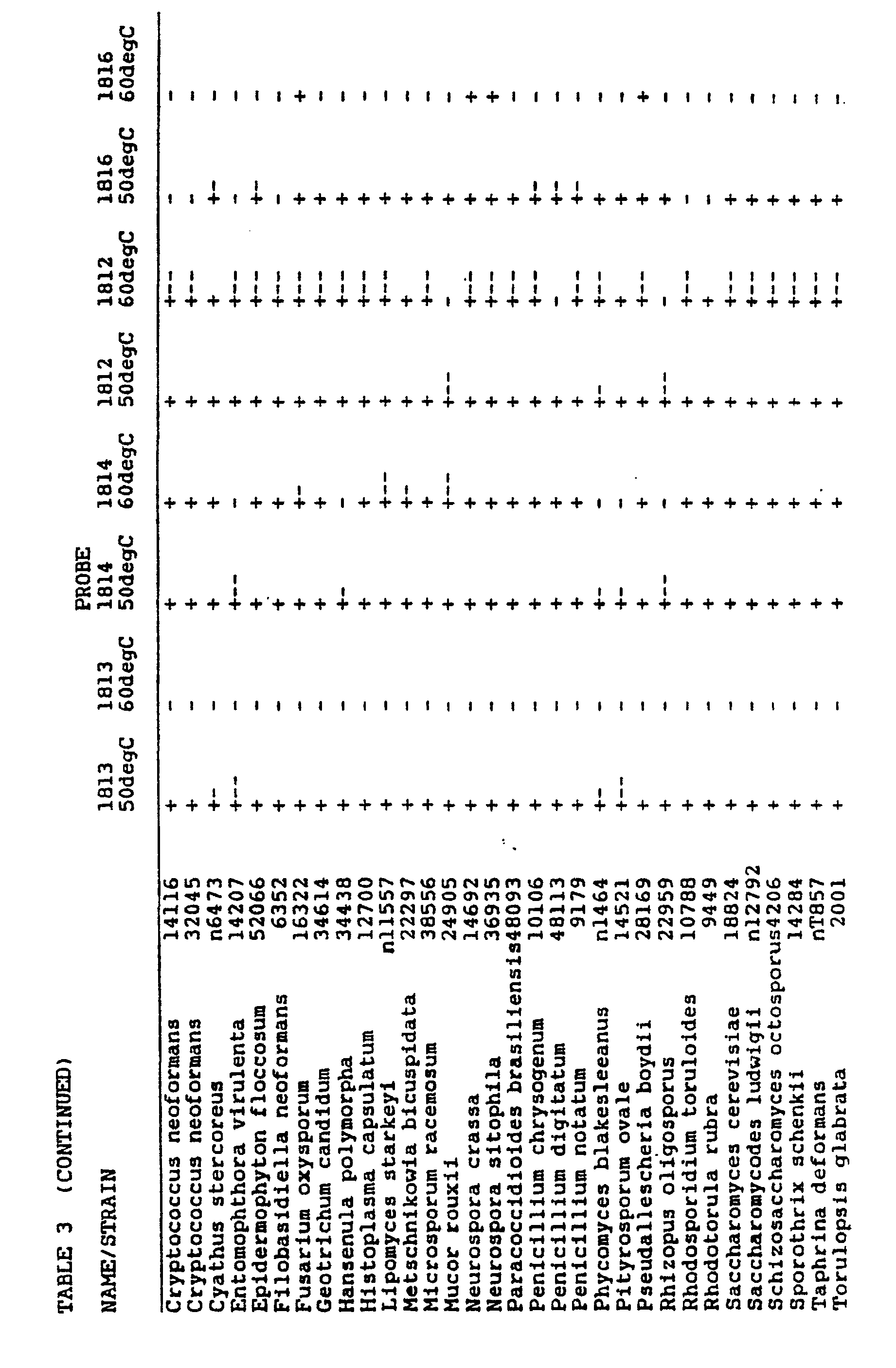
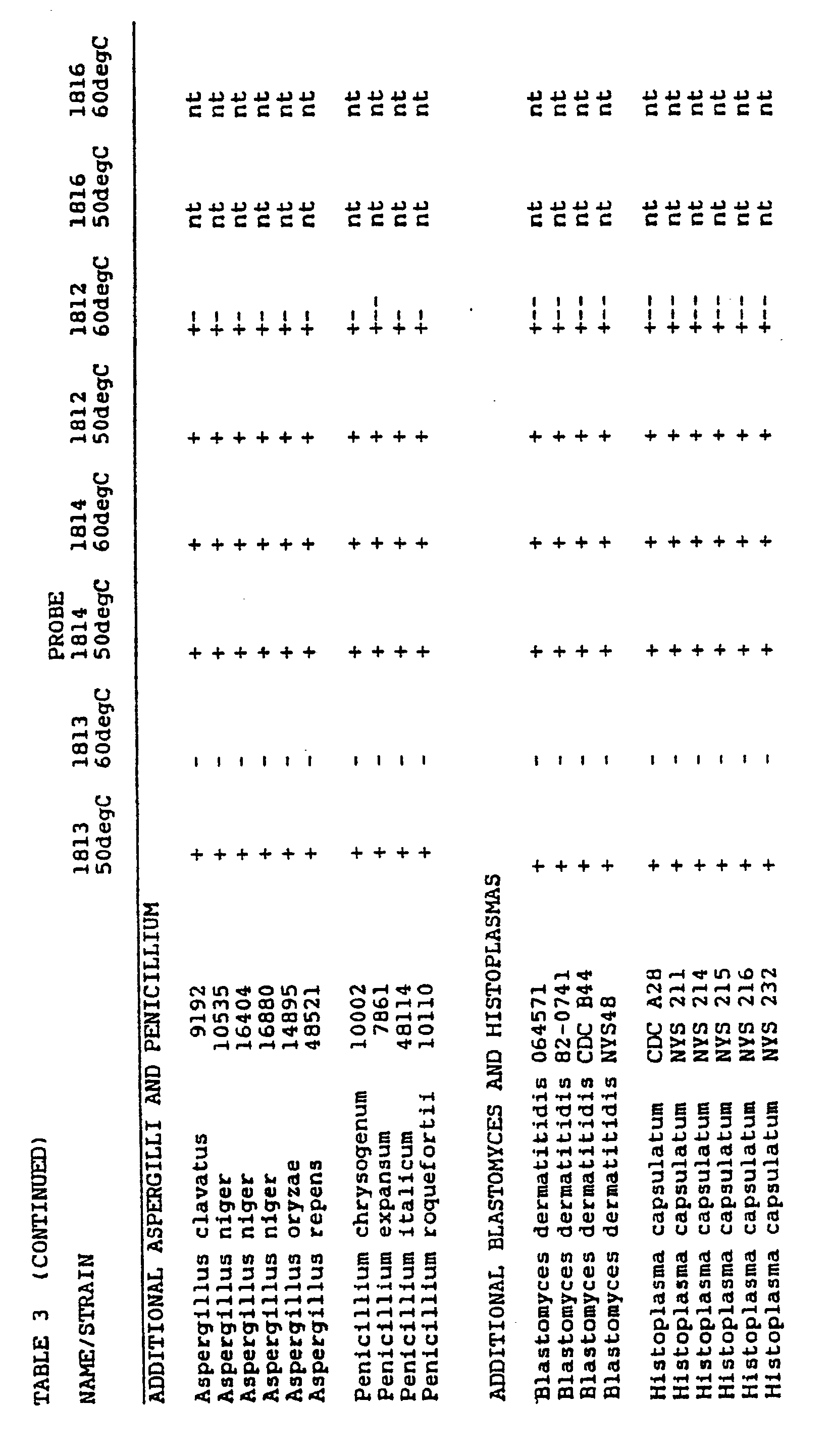
- Probes were 32-Phosphorous labelled, hybridized to panels under standard conditions, at the temperatures indicated, and autoradiographically evaluated. "+” represents strong hybridization signal after three hours exposure, “+-” is a weak signal, “+ __01 is virtually absent, and “-” is indicative of no hybridization of probe to target. "NT” indicates that a particular probe was not tested against the designated strain.
- the first step taken in the development of the probes of the present invention involved identification of regions of the 18S rRNA which potentially could serve as target sites for fungal specific nucleic acid probes. This entailed finding sites which are:
- 18S rRNA sequences were determined as part of this effort. Such nucleotide sequences were determined by standard laboratory protocols either by cloning and sequencing of genes specifying rRNAS or by direct sequencing of the rRNAs themselves using reverse transcriptase (Lane, et al , 1985, Proceedings of the National Academy of Sciences, USA 82:6955-6959).
- a computer algorithm operating on the aligned set of 18S rRNA sequences, was used to identify regions of greatest similarity among the fungi. Nucleic acid probes to such regions will hybridize most widely among diverse fungi. Additional information was gained by comparing these fungal conserved regions to known 18S rRNA sequences from human, rat, mouse, corn, so y , rice, bacteria, protozoa, algae, etc.
- probes were identified, based on these analyses.
- the discovery of a specific type of non-fungal cross-reactivity does not necessarily render a probe uninteresting.
- cross-reaction of a probe with the plant kingdom does not detract from the probe's usefulness in screening vertebrate blood for fungemia.
- Other probes described herein are known to cross-react, but they were designed to be employed in dual probe assays (see Figure and Example 2).
- Probes may be synthesised by any suitable chemical or biological method.
- DNA probes may be synthesised by automated phosphoramide chemistry using cyanoethyl phosphoramides (Beaucage and Carruthers Tetrahedron Letters 24, 245 (1981)).
- RNA probes can be made by transcription of the corresponding DNA sequences. screening vertebrate blood for fungemia.
- Other probes described herein are known to cross-react, but they were designed to be employed In dual probe assays (see the Figure and Example 2).
- probe selection strategy yielded fifteen probes useful for hybridization to fungi in samples comprising:
- the specific behaviors of the aforementioned probes are dependent to a significant extent on the assay format in which they are employed. Conversely, the assay format will dictate certain of the optimal features of particular probes.
- the "essence" of the probes of the invention is not to be construed as restricted to the specific string of nucleotides in the named probes. For example, the length of these particular oligonucleotides was optimized for use in the dot blot assay (and certain other anticipated assays) described below. It is well known to those skilled in the art that optimal probe length will be a function of the stringency of the hybridization conditions chosen and hence the length of the instant probes may be altered accordingly. Also, in considering sets comprised of more than one probe, it is desirable that all probes behave in a compatible manner in any particular format in which they are employed. Thus, the exact length of a particular probe will to a certain extent, reflect its specific intended use.
- the probes of the present invention are useful as oligonucleotide probes and can also be incorporated into larger polynucleotides of either ribonucleic acid or deoxyribonucleic acid. Sequences complimentary to the probes described herein can be used as probes to rRNA genes. The preferred probes or their compliments also can be employed as chain elongation initiators for polymerase chain reaction, sequencing or other applications.
- Probe/Primer 936 is designed to hybridize to the 18S rDNA gene strand complimentary to fungal 18S rRNA. Oligonucleotides 935 and 936 are designed for and most preferred for use in assays employing amplification, by the polymerase chain reaction method, of almost the entire 18S rRNA gene (rDNA) of fungi and relatives. The target specific "essence" of these two probe/primers resides in the portions of these oligonucleotides not included within the parenthesis. The nucleotides within the parentheses are preferably included since they add useful restriction endonuclease recognition (cloning) sites to the amplified products.
- Probe 1417 100% inclusive for tested fungi, with negligible cross-reactivity to human RNA at 60 C. At 65 C (hybridization temperature) signal is decreased for 2 of the 171 fungi, all others still strongly hybridize, and the human cross-reactivity is removed. Strong hybridization to wheat rRNA is evident.
- Probe 1418 100% inclusive for all tested fungi, with no cross-reactivity to human RNA.
- Probe 1417 Is a subsequence of 1418, that is, it is a shorter version of the same probe.
- Probe 1415 Inclusive for a subset of fungi, not including any Candida yeasts, but including the important pathogenic yeast, Cryptococcus .
- Probe 1416 Inclusive of all of the tested strains from the genus Candida (Torulopsis) except for the species Yarrowia (Candida ) lipolytica . Also inclusive for Hansenula , Metschnikowia , and Sac- charomyces --all close evolutionary relatives of Candida yeasts. One Penicillium species yields a weak signal with this probe in this assay format.
- Probe IG707 100% inclusive for Yarrowia lipolytica
- Probes 1415, 1416, and IG707 are homologous, that is, they all hybridize to the same region of the 185 rRNA.
- Probe 1542 100% inclusive for all. tested fungi plus human RNA. Designed as a companion probe for 1417 or 1418 in a dual probe (sandwich type) hybridization scheme.
- Probe 1545 100% inclusive for all tested fungi plus human RNA. Designed as a companion probe for 1417 or 1418 in a dual probe (sandwich type) hybridization scheme.
- Probe 1814 Broadly fungal inclusive, particularly under 50 °C hybridization conditions.
- Probe 1816 Broadly fungal inclusive at 50° C.
- Probe 1857 Broadly inclusive with slight hybridization to non-fungi at 50 ° C.
- Probe 1813 Broadly inclusive at 50 C.
- Probe 1860 Broadly inclusive at 50 C or 60 C hybridization.
- Probe 1813 Is a subsequence of Probe 1860.
- Probe 1812 Very broadly inclusiveat 50 C, with no cross-reactivity to human or wheat germ RNA.
- Probe 1858 Designed to hybridize to Zygomycetes , and thus complements the hybridizing behavior of Probe 1812.
- Probe 1859 Designed to hybridize to Yarrowia lipolytica , and thus complements the hybridizing behavior of Probe 1812.
- Probes 1812, 1858, and 1859 are a homologous set--that is they all hybridize to an identical location on the 185 rRNA molecule. As a set, they fail to hybridize strongly to only two strains (see Tables 2 and 3).
- Non-homologous probes such as Probes 1857 and 1860 are designed to be used together in dual probe assays as described in example 2.
- Probe/primers 935 and 936 have been used to amplify 185 rDNA from all fungal taxa tested, including Aspergillus , Candida , Penicillium , Cryptococcus , and Blastomyces .
- Dot-blot analysis involves immobilizing a nucleic acid or a population of nucleic acids on a filter such as nitrocellulose, nylon, or other derivatized membranes which can readily be obtained commercially, specifically for this purpose.
- a filter such as nitrocellulose, nylon, or other derivatized membranes which can readily be obtained commercially, specifically for this purpose.
- Either DNA or RNA can be easily immobilized on such a filter and subsequently can be probed or tested for hybridization under any of a variety of conditions (i.e., stringencies) with nucleotide sequences or probes of interest. Under stringent conditions, probes whose nucleotide sequences have greater complementarity to the target. will exhibit a higher level of hybridization than probes containing less complementarity.
- Probes of the present invention were tested in a dot-blot format.
- Probes were isotopically labelled with the addition of a 32-Phosphorous moiety to the 5 end of the oligonucleotide.
- Bybridization of probes occurred, at temperatures indicated, in the presence of 1.08 M sodium chloride, 60 mM sodium phosphate, and 6 mM ethylenediamine tetraacetic acid, pH 7.4. Unhybridized probe was removed by washing at a salt concentration one-third of the hybridization condition. The filters were exposed to X-ray film and the intensity of hybridization signals was evaluated after three hours of exposure.
- the capture probe l2 ideally would be a bifunctional polynucleotide manufactured by adding a homopolymeric 3 tail to a probe vith high target specificity. The tail would, in turn, hybridize to the complimentary homopolymer" on a solid surface 10 , such as a glass bead or a filter disc. Hybridization of the capture probe l2 to its target 15 , in this case Fungal spirochete 18S rRNA, would complex the target 15 with the solid support 10 .
- the detector probe 13 advantageously also with some degree of specificity, would be part of a preferred detection scheme relying on radioactivity, fluorescence, chemiluminescence, color, etc. (detection moiety' 4 ) which would report the presence of the entire hybridization complex.
- the clinical sample is ideally processed so as to liberate the total nucleic acid content such as by sonication, vortexing with glass beads, detergent lysis using an agent such as SDS or by chemical treatment.
- fungal cells may be partially purified by, for example, the Dupont Isolator System, followed by cell lysis.
- the sample, containing disrupted fungi is then incubated in the presence of capture probe, detector probe, and ideally magnetic particle beads which have been derivatized with oligo-Thymidine (see also Example 2) in a chaotropic buffer such as guanidinium isothiocyanate described by Gillespie et al USSN 299,150.
- a chaotropic buffer such as guanidinium isothiocyanate described by Gillespie et al USSN 299,150.
- a Bead + Capture Probe + Target + Detector Probe hybridization complex is formed.
- the exterior presence of a magnet near the bottom of the reaction tube will cause the magnetic particle - hybridization complex to adhere to the interior side of the tube thereby advantageously enabling removal of the unreacted components such as sample matrix, unbound probe, etc.
- Repeated rehydration and denaturation of the bead-probe-target complex would enable significant background reduction (as more fully described in Collins et al, USSN 922,155, EPA 87309308.2 and USSN 136,920, EPA 88312135.2).
- final detection could entail spotting the beads on membrane and assaying by autoradiography.
- Sample processing such as provided in Example 3 is ideally designed so as to yield DNA.
- the DNA is further treated to make it single stranded (e.g. by melting) in preparation for polymerase chain reaction (“PCR") amplification.
- Probe/Primer 936 and Probe/Primer 935 are ideally employed in conjunction with the clinical sample in the standard PCR procedures. Resultant material may then be suitably assayed utilizing the "sandwich” hybridization procedures of Example 2 with any of the probes described herein.
- the polymerase chain reaction can, itself, be made highly specific by employing Probe/Primer 936 in conjunction with, for example, Probe 1812. Detection is advantageously accomplished using Probe 1814 for capture and Probes 1415 and 1416 for detection.
- the probes of the present invention can also be advantageously employed as cytological staining reagents.
- a sputum sample is applied to a microscope slide. After appropriate fixation and lysis, hybridization with the probes of the present invention is carried out in situ . In this manner, fungi could be visualized in a specimen by fluorescently labelling Probe 1416 and examining the slide using a fluorescent microscope.
Landscapes
- Chemical & Material Sciences (AREA)
- Life Sciences & Earth Sciences (AREA)
- Engineering & Computer Science (AREA)
- Analytical Chemistry (AREA)
- Proteomics, Peptides & Aminoacids (AREA)
- Organic Chemistry (AREA)
- Health & Medical Sciences (AREA)
- Biotechnology (AREA)
- Zoology (AREA)
- Wood Science & Technology (AREA)
- Microbiology (AREA)
- Biochemistry (AREA)
- Biophysics (AREA)
- Molecular Biology (AREA)
- Physics & Mathematics (AREA)
- Mycology (AREA)
- Botany (AREA)
- Immunology (AREA)
- Bioinformatics & Cheminformatics (AREA)
- General Engineering & Computer Science (AREA)
- General Health & Medical Sciences (AREA)
- Genetics & Genomics (AREA)
- Measuring Or Testing Involving Enzymes Or Micro-Organisms (AREA)
- Saccharide Compounds (AREA)
Abstract
Description
- This invention relates to the detection of fungal organisms. More specifically, it provides nucleic acid probes and compositions along with methods for their use for the specific detection of yeasts and molds in clinical, food, environmental and other samples.
- The fungi are a diverse collection of cell-wall enclosed eukaryotes either saprophytic or parasitic and may be morphologically described as yeasts, molds, mushrooms, or by other names. They are ubiquitous organisms, mostly innocuous, sometimes used for commercial purposes, and occasionally pathogenic.
- The pathogenic fungi are included within the domain of medical mycology. This medical field recognizes categories of fungal pathogens (see Rippon, J.W., Medical Mycology, Saunders Co., Philadelphia, 1988, for example) including superficial, cutaneous, subcutaneous, and systemic infection. By far the most serious pathology caused by the fungi that clinicians face are the systemic infections. Deep tissue and systemic fungemia claim high mortality rates, particularly among immune comprised populations.
- Among the fungi capable of causing systemic fungemia, there is a dichotomy between the so- called "pathogenic" fungi and the "opportunistic" fungi. It is a deceptive nomenclature; the opportunists are the killers, and the pathogenic fungi are often self-limiting. The pathogenic fungi include Coccidioides immitis , Histoplasma capsulatum , Blastomyces dermatitidis , Paracoccidioides brasiliensis , and the subcutaneous pathogen, Sporothrix schenkii . The important opportunistic fungi include the Candidas -- particularly C . al- bicans , C . tropicalis , C . parapsilosis , and Toruipsis (Candida ) glabrata -- Cryptococcus neoformans , members of the genus Aspergillus , and to a lesser extent, practically any fungus that can survive at host physiological temperatures.
- Clinical diagnosis and treatment of systemic fungemia suffers several shortcomings compared to bacterial septicemia (which of ten occurs in the same immune-deficient population). First, antifungal chemotherapy is more toxic to the patient than analogous antibacterial chemotherapy. As a result, clinicians desire a more reliable demonstration of fungemia before prescribing antifungal agents. Second, fungemic patients have a poor prognosis, unless diagnosed early in infection. Third, fungi generally grow slower than the major bacteremic organisms, and consequently diagnosis requiring an in vitro culture step is time consuming. And fourth, some of the fungi (again in diagnoses requiring in vitro cultivation) will not yield colonies on synthetic media for weeks, if at all. All of these factors, plus the fact that a vide array of fungi are potential systemic pathogens, point to the need for a direct method of fungal detection inclusive for virtually all fungi.
- It is an aspect of the present invention to provide nucleic acid probes capable of detecting fungi.
- It is another aspect of the present invention to provide nucleic acid probes which can hybridize to target regions which can be rendered accessible to probes under normal assay conditions.
- It is yet another aspect to provide nucleic acid probes to fungal rRNA sequences useful as the basis for rapid diagnostic assays for assessing the presence of these organisms in a clinical sample.
- While Kohne et al . (Biophysical Journal 8:1104-1118, 1968) discuss one method for preparing probes to rRNAsequences, they do not provide the teaching necessary to make probes to detect fungi. Pace and Campbell (Journal of Bacteriology 107:543-547, 1971) discuss the homology of ribosomal ribonucleic acids from diverse bacterial species and a hybridization method for quantitating such homology levels. Similarly, Sogin, Sogin and Woese (Journal of Molecular Evolution 1:173-184, 1972) discuss the theoretical and practical aspects of using primary structural characterization of different ribosomal RNA molecules for evaluating phylogenetic relationships. Pox, Pechman and Woese (International Journal of Systematic Bacteriology 27:44-57, 1977) discuss the comparative cataloging of 16S ribosomal RNAs as an approach to prokaryotic systematics. These references, hov- ever, fail to relieve the deficiency of Kohne's teaching vith respect to fungi, and in particular, do not provide specific probes useful in assays for detecting fungemia or its etiological agents, a broad spectrum of yeast and molds.
- Hogan, et al (International Patent Application, Publication Number WO 88/03957) describe four putative fungal specific probes. None of them appear widely inclusive for fungi, nor are they related to the probes of the present invention.
- Ribosomes are of profound importance to all organisms because they serve as the only known means of translating genetic information into cellular proteins, the main structural and catalytic elements of life. A clear manifestation of this importance is the observation that all cells have ribosomes.
- Bacterial ribosomes contain three distinct RNA molecules which, at least in Escherichia coli , are referred to as 5S, 16S and 23S rRNAS. In eukaryotic organisms, there are four distinct rRNA species, generally referred to as 5S, 18S, 28S, and 5.8S. These names historically are related to the size of the RNA molecules, as determined by their sedimentation rate. In actuality, however, ribosomal RNA molecules vary substantially in size betveen organisms. Nonetheless, 5S, 18S, 28S, and 5.8S rRNA are commonly used as generic names for the homologous RNA molecules in any eukaryote, and this convention will be continued herein.
- It is another aspect of the present invention to provide nucleic acid probes complimentary to unique nucleic acid sequences within the 18S ribosomal ribonucleic acid (rRNA) of fungal pathogens.
- As used herein, probe(s) refer to synthetic or biologically produced nucleic acids (DNA or RNA) which, by design or selection, contain specific nucleotide sequences that allow them to hybridize under defined predetermined stringencies, specifically (i.e., preferentially, see next paragraph) to target nucleic acid sequences. In addition to their hybridization properties, probes also may contain certain constituents that pertain to their proper or optimal functioning under particular assay conditions. For example, probes may be modified to improve their resistance to nuclease degradation (e.g. by end capping), to carry detection ligands (e.g. fluorescein, 32-P, biotin, etc.), or to facilitate their capture onto a solid support (e. g., polydeox- yadenosine "tails"). Such modifications are elabo- rations on the basic probe function which is its ability to usefully discriminate betveen target and non-target organisms in a hybridization assay.
- Hybridization traditionally is understood as the process by which, under predetermined reaction conditions, two partially or completely complementary strands of nucleic acid are allowed to come together in an antiparallel fashion (one oriented 5' to 3', the other 3 to 5') to form a double-stranded nucleic acid with specific and stable hydrogen bonds, following explicit rules pertaining to which nucleic acid bases may pair with one another. The high specificity of probes relies on the low statistical probability of unique sequences occurring at random as dictated by the multiplicative product of their individual probabilities. These concepts are well understood by those skilled in the art.
- The stringency of a particular set of hybridization conditions is determined by the base composition of the probe/target duplex, as well as by the level and geometry of mispairing between the two nucleic acids.
- Stringency may also be governed by such reaction parameters as the concentration and type of ionic species present in the hybridization solution, the types and concentrations of denaturing agents present, and the temperature of hybridization. Generally, as hybridization conditions become more stringent, longer probes are preferred if stable hybrids are to be formed. As a corollary, the stringency of the conditions under which a hybridization is to take place (e. g., based on the type of assay to be performed) will dictate certain characteristics of the preferred probes to be employed. Such relationships are well understood and can be readily manipulated by those skilled in the art.
- As a general matter, dependent upon probe length, such persons understand stringent conditions to mean approximately 35 C-65 C in a salt solution of approximately 0.9 molar NaCI.
- All references made herein are fully incorporated by reference.
- In accordance with the various principles and aspects of the present invention, there are provided nucleic acid probes and probe sets comprising deoxyribonucleic acid (DNA) or ribonucleic acid (RNA) sequences which hybridize, under specific conditions, to the ribosomal RNA molecules (rRNA), specifically 18S rRNA molecules, or rRNA genes (rDNA) of fungi but which do not hybridize, under the same conditions, to the rRNA or rDNA of bacteria or the host or environmental matrix which may be present in test samples. The probes of the present invention now permit the development of a valuable nucleic acid hybridization assay for the specific detection of fungemia or its etiological agents. This assay may advantageously be used to test for yeasts and molds in clinical samples of blood, urine, cerebrospinal fluid, skin biopsy, saliva, synovial fluid, sputum, bronchial wash, bronchial lavage, or other tissue or fluid samples from human patients or veterinary subjects.
- The probes of the present invention also provide the basis for the development of valuable nucleic acid hybridization assays capable of detecting yeasts and molds associated with food spoilage. Most preferred probes of the present invention can hybridize to a diverse collection of fungi while not cross-reacting, at predetermined conditions, with meats, dairy products, grains, nuts, juices, and other commercial food matrices.
- Nucleic acid hybridization based assays have been discovered to impart enhanced performance capabilities with respect to most currently available, microbiological or immunological methods for detection of fungi in test samples, generally including:
- a) increased sensitivity; i.e., the ability to detect yeast or mold in a given sample more frequently;
- b) potentially significant reductions in assay cost due to the use of inexpensive reagents and reduced labor;
- c) accurate identification of even biochemically unusual strains of the target organism, or isolates with dramatically different antigenic properties;
- d) direct assay for the presence of the yeast or mold and consequent potential to quantify the etiological agents;
- e) direct testing allows the monitoring of the efficacy of an antifungal regime; and f) potentially significant reductions in the exposure of laboratory technologists to bodily fluid specimens harboring infectious agents.
- It has been discovered that other advantages incurred by directing the probes of the present invention against rRNA include the fact that the rRNAs detected constitute a significant component of cellular mass. Although estimates of cellular ribosome content vary, actively growing fungal cells may contain upwards of 100,000 ribosomes per cell, and therefore 100,000 copies of each of the rRNAs (present in a 1:1:1:1 stiochiometry in ribosomes). In contrast, other potential cellular target molecules such as genes or RNA transcripts thereof, are less ideal since they are present in much lower abundance. A further unexpected advantage is that the rRNAS (and the genes specifying them) appear not to be subject to lateral transfer between contemporary organisms. Thus, the rRNA primary structure provides an organism-specific molecular target, rather than a gene-specific target as would likely be the case, for example of a plasmid-borne gene or product thereof which may be subject to lateral transmission between contemporary organisms.
- The discovery that probes could be generated with the extraordinary inclusivity and exclusivity characteristics of those of the present invention with respect to the detection of virtually all fungal organism, without necessarily incurring cross-reactivity to animal, plant, or bacterial genomes was unpredictable and unexpected.
- Further understanding of the principles and aspects of the present invention may be made by reference to the tables wherein:
- Tables 1, 2, and 3 display the hybridization behavior of fifteen probes toward a panel of clinically and environmentally representative fungal species. Additional fungi were added to the panel in order to represent the breadth of known fungal taxa. Approximately eighty fungal species are represented, and the highest prevalence pathogens are represented by numerous strains. In addition, nucleic acids from a variety of non-fungal organisms are included for comparison including RNAs from human, wheat, normal human stool, and two ubiquitous bacterial species. Those skilled in the art understand that bacteria are so evolutionarily distant as to not generally cross-react with the types of probes described herein. It will be further recognized that the sequence variation among vertebrate animals and among higher plants is sufficiently narrow that an individual sample, such as wheat, has high predictive value.
- All species on the panel are represented by 100 ng of purified, denatured RNA. Probes were 32-Phosphorous labelled, hybridized to panels under standard conditions, at the temperatures indicated, and autoradiographically evaluated. "+" represents strong hybridization signal after three hours exposure, "+-" is a weak signal, "+ __01 is virtually absent, and "-" is indicative of no hybridization of probe to target. "NT" indicates that a particular probe was not tested against the designated strain.
- Still further understanding may be had by study of the accompanying Figure which shows a schematic representation of a dual probe capture/detector assay.
- The first step taken in the development of the probes of the present invention involved identification of regions of the 18S rRNA which potentially could serve as target sites for fungal specific nucleic acid probes. This entailed finding sites which are:
- 1) highly conserved (few nucleotide changes, deletions, or insertions) among the fungal rRNA sequences, and
- 2) substantially different in non-fungal (bacteria, human, or plant) rRNA sequences.
- For this analysis, precise alignments of available 18S rRNA sequences were developed. A number of 18S rRNA sequences were determined as part of this effort. Such nucleotide sequences were determined by standard laboratory protocols either by cloning and sequencing of genes specifying rRNAS or by direct sequencing of the rRNAs themselves using reverse transcriptase (Lane, et al , 1985, Proceedings of the National Academy of Sciences, USA 82:6955-6959).
- A computer algorithm, operating on the aligned set of 18S rRNA sequences, was used to identify regions of greatest similarity among the fungi. Nucleic acid probes to such regions will hybridize most widely among diverse fungi. Additional information was gained by comparing these fungal conserved regions to known 18S rRNA sequences from human, rat, mouse, corn, soy, rice, bacteria, protozoa, algae, etc.
- Fifteen probes were identified, based on these analyses. The discovery of a specific type of non-fungal cross-reactivity does not necessarily render a probe uninteresting. For example, cross-reaction of a probe with the plant kingdom does not detract from the probe's usefulness in screening vertebrate blood for fungemia. Other probes described herein are known to cross-react, but they were designed to be employed in dual probe assays (see Figure and Example 2).
- Probes may be synthesised by any suitable chemical or biological method. In particular, DNA probes may be synthesised by automated phosphoramide chemistry using cyanoethyl phosphoramides (Beaucage and Carruthers Tetrahedron Letters 24, 245 (1981)). RNA probes can be made by transcription of the corresponding DNA sequences. screening vertebrate blood for fungemia. Other probes described herein are known to cross-react, but they were designed to be employed In dual probe assays (see the Figure and Example 2).
- As indicated, the above probe selection strategy yielded fifteen probes useful for hybridization to fungi in samples comprising:


- The specific behaviors of the aforementioned probes are dependent to a significant extent on the assay format in which they are employed. Conversely, the assay format will dictate certain of the optimal features of particular probes. The "essence" of the probes of the invention is not to be construed as restricted to the specific string of nucleotides in the named probes. For example, the length of these particular oligonucleotides was optimized for use in the dot blot assay (and certain other anticipated assays) described below. It is well known to those skilled in the art that optimal probe length will be a function of the stringency of the hybridization conditions chosen and hence the length of the instant probes may be altered accordingly. Also, in considering sets comprised of more than one probe, it is desirable that all probes behave in a compatible manner in any particular format in which they are employed. Thus, the exact length of a particular probe will to a certain extent, reflect its specific intended use.
- The probes of the present invention are useful as oligonucleotide probes and can also be incorporated into larger polynucleotides of either ribonucleic acid or deoxyribonucleic acid. Sequences complimentary to the probes described herein can be used as probes to rRNA genes. The preferred probes or their compliments also can be employed as chain elongation initiators for polymerase chain reaction, sequencing or other applications.
- Two additional preferred probes useful in this regard comprise:
- Probe/Primer 936: 5' -(CCGAATTCGTCGACAAC)-CTGGTTGATCCTGCCAGT-3' (SEQ ID 16)
- Probe/Primer 935: 5'-(CCCGGGATCGAAGCT)-TGATCCTTCTGCAGGTTCACCTAC-3' (SEQ ID 17)
- Probe/Primer 936 is designed to hybridize to the 18S rDNA gene strand complimentary to fungal 18S rRNA. Oligonucleotides 935 and 936 are designed for and most preferred for use in assays employing amplification, by the polymerase chain reaction method, of almost the entire 18S rRNA gene (rDNA) of fungi and relatives. The target specific "essence" of these two probe/primers resides in the portions of these oligonucleotides not included within the parenthesis. The nucleotides within the parentheses are preferably included since they add useful restriction endonuclease recognition (cloning) sites to the amplified products.
- The experimental specificity of the preferred probes, as further documented in Example 1 and Tables 1, 2, and 3, may be summarized as follows: Probe 1417: 100% inclusive for tested fungi, with negligible cross-reactivity to human RNA at 60 C. At 65 C (hybridization temperature) signal is decreased for 2 of the 171 fungi, all others still strongly hybridize, and the human cross-reactivity is removed. Strong hybridization to wheat rRNA is evident.
- Probe 1418: 100% inclusive for all tested fungi, with no cross-reactivity to human RNA.
- Probe 1417: Is a subsequence of 1418, that is, it is a shorter version of the same probe. Probe 1415: Inclusive for a subset of fungi, not including any Candida yeasts, but including the important pathogenic yeast, Cryptococcus . Probe 1416: Inclusive of all of the tested strains from the genus Candida (Torulopsis) except for the species Yarrowia (Candida ) lipolytica . Also inclusive for Hansenula , Metschnikowia , and Sac- charomyces --all close evolutionary relatives of Candida yeasts. One Penicillium species yields a weak signal with this probe in this assay format. Probe IG707: 100% inclusive for Yarrowia lipolytica
- . Combined with probe 1416, these two are fully inclusive for the Candidas tested.
- Probes 1415, 1416, and IG707: are homologous, that is, they all hybridize to the same region of the 185 rRNA.
- Probe 1542: 100% inclusive for all. tested fungi plus human RNA. Designed as a companion probe for 1417 or 1418 in a dual probe (sandwich type) hybridization scheme.
- Probe 1545: 100% inclusive for all tested fungi plus human RNA. Designed as a companion probe for 1417 or 1418 in a dual probe (sandwich type) hybridization scheme.
- Probe 1814: Broadly fungal inclusive, particularly under 50 °C hybridization conditions.
- Probe 1816: Broadly fungal inclusive at 50° C. Probe 1857: Broadly inclusive with slight hybridization to non-fungi at 50 ° C.
- Probe 1813: Broadly inclusive at 50 C.
- Probe 1860: Broadly inclusive at 50 C or 60 C hybridization.
- Probe 1813: Is a subsequence of Probe 1860. Probe 1812: Very broadly inclusiveat 50 C, with no cross-reactivity to human or wheat germ RNA. Probe 1858: Designed to hybridize to Zygomycetes , and thus complements the hybridizing behavior of Probe 1812.
- Probe 1859: Designed to hybridize to Yarrowia lipolytica , and thus complements the hybridizing behavior of Probe 1812.
- Probes 1812, 1858, and 1859: Are a homologous set--that is they all hybridize to an identical location on the 185 rRNA molecule. As a set, they fail to hybridize strongly to only two strains (see Tables 2 and 3).
- Non-homologous probes, such as Probes 1857 and 1860 are designed to be used together in dual probe assays as described in example 2.
- Probe/primers 935 and 936 have been used to amplify 185 rDNA from all fungal taxa tested, including Aspergillus , Candida , Penicillium , Cryptococcus , and Blastomyces .
- Dot-blot analysis, in accordance with well known procedures, involves immobilizing a nucleic acid or a population of nucleic acids on a filter such as nitrocellulose, nylon, or other derivatized membranes which can readily be obtained commercially, specifically for this purpose. Either DNA or RNA can be easily immobilized on such a filter and subsequently can be probed or tested for hybridization under any of a variety of conditions (i.e., stringencies) with nucleotide sequences or probes of interest. Under stringent conditions, probes whose nucleotide sequences have greater complementarity to the target. will exhibit a higher level of hybridization than probes containing less complementarity.
- Probes of the present invention were tested in a dot-blot format. One hundred nanograms of target RNA, purified by phenol extraction and centrifugation through cesium trifluoroacetate gradients, vas denatured and spotted on a nylon membrane. Probes were isotopically labelled with the addition of a 32-Phosphorous moiety to the 5 end of the oligonucleotide. Bybridization of probes occurred, at temperatures indicated, in the presence of 1.08 M sodium chloride, 60 mM sodium phosphate, and 6 mM ethylenediamine tetraacetic acid, pH 7.4. Unhybridized probe was removed by washing at a salt concentration one-third of the hybridization condition. The filters were exposed to X-ray film and the intensity of hybridization signals was evaluated after three hours of exposure.
- Tables 1, 2, and 3 summarize the behavior of the probes as tested by the above procedure and documents the specificity summarized above.
- In actual practice, many applications of these probes would employ a pair of probes being used simultaneously in a "sandwich" hybridization scheme of "capture" probe and "detector" probe as shown in figure. The capture probel2 ideally would be a bifunctional polynucleotide manufactured by adding a homopolymeric 3 tail to a probe vith high target specificity. The tail would, in turn, hybridize to the complimentary homopolymer" on a solid surface10, such as a glass bead or a filter disc. Hybridization of the capture probel2 to its target15, in this case Fungal spirochete 18S rRNA, would complex the target15 with the solid support10. The detector probe13, advantageously also with some degree of specificity, would be part of a preferred detection scheme relying on radioactivity, fluorescence, chemiluminescence, color, etc. (detection moiety'4) which would report the presence of the entire hybridization complex.
- The clinical sample is ideally processed so as to liberate the total nucleic acid content such as by sonication, vortexing with glass beads, detergent lysis using an agent such as SDS or by chemical treatment. Alternatively, fungal cells may be partially purified by, for example, the Dupont Isolator System, followed by cell lysis. The sample, containing disrupted fungi is then incubated in the presence of capture probe, detector probe, and ideally magnetic particle beads which have been derivatized with oligo-Thymidine (see also Example 2) in a chaotropic buffer such as guanidinium isothiocyanate described by Gillespie et al USSN 299,150.
- If yeast or mold 185 rRNA target molecules are present, a Bead + Capture Probe + Target + Detector Probe hybridization complex is formed. The exterior presence of a magnet near the bottom of the reaction tube will cause the magnetic particle - hybridization complex to adhere to the interior side of the tube thereby advantageously enabling removal of the unreacted components such as sample matrix, unbound probe, etc. Repeated rehydration and denaturation of the bead-probe-target complex would enable significant background reduction (as more fully described in Collins et al, USSN 922,155, EPA 87309308.2 and USSN 136,920, EPA 88312135.2). In this example, final detection could entail spotting the beads on membrane and assaying by autoradiography.
- For such assays, the following capture and detector probe combinations are examples of the preferred pairs:
- Probes 1417+1542, Probes 1417+1545, Probes 1418+1542, Probes 1418+1545, Probes 1416 + 1812, Probes 1812+1860, Probes 1857+1860.
- Sample processing such as provided in Example 3 is ideally designed so as to yield DNA. The DNA is further treated to make it single stranded (e.g. by melting) in preparation for polymerase chain reaction ("PCR") amplification. Probe/Primer 936 and Probe/Primer 935 are ideally employed in conjunction with the clinical sample in the standard PCR procedures. Resultant material may then be suitably assayed utilizing the "sandwich" hybridization procedures of Example 2 with any of the probes described herein. The polymerase chain reaction can, itself, be made highly specific by employing Probe/Primer 936 in conjunction with, for example, Probe 1812. Detection is advantageously accomplished using Probe 1814 for capture and Probes 1415 and 1416 for detection.
- The probes of the present invention can also be advantageously employed as cytological staining reagents. For example, a sputum sample is applied to a microscope slide. After appropriate fixation and lysis, hybridization with the probes of the present invention is carried out in situ . In this manner, fungi could be visualized in a specimen by fluorescently labelling Probe 1416 and examining the slide using a fluorescent microscope.
- Following a standard cultivation step utilizing the Bactec, Roche Septi-Chek, or DuPont Isolator, a colony or liquid culture is tested for fungal presence employing Probes 1418 and 1542 in the procedures described in Example 2. Of good advantage is that pure culture is not necessary.
- It will be readily appreciated by those skilled in the art that various modifications to the procedures or probes set forth herein may be made without departing from either the spirit or scope of the present invention. In particular, when modifications of the probes such as by deleting one or two end nucleotides with accompanying adjustments in hybridization conditions are to be deemed equivalent.




- SEQ ID NO.1
- SEQUENCE TYPE: Nucleotide
- SEQUENCE LENGTH: 27 bases
- STRANDEDNESS: single
- TOPOLOGY: Linear
- MOLECULAR TYPE: Synthetic or biological DNA or RNA
- HYPOTHETICAL?: No
- SENSE OR ANTI-SENSE?: Sense
- FEATURES: Referred to in the specification as probe 1417
- PROPERTIES: Probe for selective detection of fungus.
- SEQUENCE:
- TGTCTGGACC TGGTGAGTTT CCCCGTG
- SEQ ID NO.2
- SEQUENCE TYPE: Nucleotide
- SEQUENCE LENGTH: 39 bases
- STRANDEDNESS: single
- TOPOLOGY: Linear
- MOLECULAR TYPE: Synthetic or biological DNA or RNA
- HYPOTHETICAL?: No
- SENSE OR ANTI-SENSE?: Sense
- FEATURES: Referred to in the specification as probe 1418
- PROPERTIES: Probe for selective detection of fungus.
- SEQUENCE:
- TGTCTGGACC TGGTGAGTTT CCCCGTGTTG AGTCAAATT
- SEQ ID NO.3
- SEQUENCE TYPE: Nucleotide
- SEQUENCE LENGTH: 37 bases
- STRANDEDNESS: single
- TOPOLOGY: Linear
- MOLECULAR TYPE: Synthetic or biological DNA or RNA
- HYPOTHETICAL?: No
- SENSE OR ANTI-SENSE?: Sense
- FEATURES: Referred to in the specification as probe 1415
- PROPERTIES: Probe for selective detection of fungus.
- SEQUENCE:
- TCCTCGTTAA GGGATTTAAA TTGTACTCAT TCCAATT
- SEQ ID NO.4
- SEQUENCE TYPE: Nucleotide
- SEQUENCE LENGTH: 37 bases
- STRANDEDNESS: single
- TOPOLOGY: Linear
- MOLECULAR TYPE: Synthetic or biological DNA or RNA
- HYPOTHETICAL?: No
- SENSE OR ANTI-SENSE?: Sense
- FEATURES: Referred to in the specification as probe 1416
- PROPERTIES: Probe for selective detection of fungus.
- SEQUENCE:
- TCCTCGTTAA GGTATTTACA TTGTACTCAT TCCAATT
- SEQ ID NO.5
- SEQUENCE TYPE: Nucleotide
- SEQUENCE LENGTH: 37 bases
- STRANDEDNESS: single
- TOPOLOGY: Linear
- MOLECULAR TYPE: Synthetic or biological DNA or RNA
- HYPOTHETICAL?: No
- SENSE OR ANTI-SENSE?: Sense
- FEATURES: Referred to in the specification as probe IG707
- PROPERTIES: Probe for selective detection of fungus.
- SEQUENCE:
- TCCTCGTTAA GGTGTTTAAA TTGTACTCAT TCCAATT
- SEQ ID NO.6
- SEQUENCE TYPE: Nucleotide
- SEQUENCE LENGTH: 26 bases
- STRANDEDNESS: single
- TOPOLOGY: Linear
- MOLECULAR TYPE: Synthetic or biological DNA or RNA
- HYPOTHETICAL?: No
- SENSE OR ANTI-SENSE?: Sense
- FEATURES: Referred to in the specification as probe 1542
- PROPERTIES: Probe for selective detection of fungus.
- SEQUENCE:
- AACTAAGAAC GGCCATGCAC CACCAT
- SEQ ID NO.7
- SEQUENCE TYPE: Nucleotide
- SEQUENCE LENGTH: 40 bases
- STRANDEDNESS: single
- TOPOLOGY: Linear
- MOLECULAR TYPE: Synthetic or biological DNA or RNA
- HYPOTHETICAL?: No
- SENSE OR ANTI-SENSE?: Sense
- FEATURES: Referred to in the specification as probe 1545
- PROPERTIES: Probe for selective detection of fungus.
- SEQUENCE:
- TGGTGCCCTT CCGTCAATTT CTTTAAGTTT CAGCCTTGCG
- SEQ ID NO.8
- SEQUENCE TYPE: Nucleotide
- SEQUENCE LENGTH: 48 bases
- STRANDEDNESS: single
- TOPOLOGY: Linear
- MOLECULAR TYPE: Synthetic or biological DNA or RNA
- HYPOTHETICAL?: No
- SENSE OR ANTI-SENSE?: Sense
- FEATURES: Referred to in the specification as probe 1814
- PROPERTIES: Probe for selective detection of fungus.
- SEQUENCE:
- TCGCTGGCGC AAGGCCATGC GATTCGAGAG GTTATTATGA ATCATCAG
- SEQ ID NO.9
- SEQUENCE TYPE: Nucleotide
- SEQUENCE LENGTH: 30 bases
- STRANDEDNESS: single
- TOPOLOGY: Linear
- MOLECULAR TYPE: Synthetic or biological DNA or RNA
- HYPOTHETICAL?: No
- SENSE OR ANTI-SENSE?: Sense
- FEATURES: Referred to in the 'specification as
- probe 1816
- PROPERTIES: Probe for selective detection of fungus.
- SEQUENCE:
- CAAGCTGATG ACTTGTGCTT ACTAGGGATT
- SEQ ID NO.10
- SEQUENCE TYPE: Nucleotide
- SEQUENCE LENGTH: 37 bases
- STRANDEDNESS: single
- TOPOLOGY: Linear
- MOLECULAR TYPE: Synthetic or biological DNA or RNA
- HYPOTHETICAL?: No
- SENSE OR ANTI-SENSE?: Sense
- FEATURES: Referred to in the specification as probe 1857
- PROPERTIES: Probe for selective detection of fungus.
- SEQUENCE:
- TCGGCATAGT TTGTGGTTAA GACTACGACG GTATCTT
- SEQ ID NO.11
- SEQUENCE TYPE: Nucleotide
- SEQUENCE LENGTH: 25 bases
- STRANDEDNESS: single
- TOPOLOGY: Linear
- MOLECULAR TYPE: Synthetic or biological DNA or RNA
- HYPOTHETICAL?: No
- SENSE OR ANTI-SENSE?: Sense
- FEATURES: Referred to in the specification as probe 1813
- PROPERTIES: Probe for selective detection of fungus.
- SEQUENCE:
- AAATGCTTTC GCAGTAGTTG GTCTT
- SEQ ID NO.12
- SEQUENCE TYPE: Nucleotide
- SEQUENCE LENGTH: 49 bases
- STRANDEDNESS: single
- TOPOLOGY: Linear
- MOLECULAR TYPE: Synthetic or biological DNA or RNA
- HYPOTHETICAL?: No
- SENSE OR ANTI-SENSE?: Sense
- FEATURES: Referred to in the specification as
- probe 1860
- PROPERTIES: Probe for selective detection of fungus.
- SEQUENCE:
- AAATGCTTTC GCAGTAGTTG GTCTTCGGTA AATCCAAGAA TTTCACCTT
- SEQ ID NO.13
- SEQUENCE TYPE: Nucleotide
- SEQUENCE LENGTH: 28 bases
- STRANDEDNESS: single
- TOPOLOGY: Linear
- MOLECULAR TYPE: Synthetic or biological DNA or RNA
- HYPOTHETICAL?: No
- SENSE OR ANTI-SENSE?: Sense
- FEATURES: Referred to in the specification as probe 1812
- PROPERTIES: Probe for selective detection of fungus.
- SEQUENCE:
- ACGTCCTATT TTATTATTCC ATGCTAAT
- SEQ ID NO.14
- SEQUENCE TYPE: Nucleotide
- SEQUENCE LENGTH: 29 bases
- STRANDEDNESS: single
- TOPOLOGY: Linear
- MOLECULAR TYPE: Synthetic or biological DNA or RNA
- HYPOTHETICAL?: No
- SENSE OR ANTI-SENSE?: Sense
- FEATURES: Referred to in the specification as probe 1858
- PROPERTIES: Probe for selective detection of fungus.
- SEQUENCE:
- AAGTCATATT TCATTATTCC ATGCTAACT
- SEQ ID NO. 15
- SEQUENCE TYPE: Nucleotide
- SEQUENCE LENGTH: 28 bases
- STRANDEDNESS: single
- TOPOLOGY: Linear
- MOLECULAR TYPE: Synthetic or biological DNA or RNA
- HYPOTHETICAL?: No
- SENSE OR ANTI-SENSE?: Sense
- FEATURES: Referred to in the specification as
- probe 1859
- PROPERTIES: Probe for selective detection of fungus.
- SEQUENCE:
- TCGTCGAGTT ATGTTATTCC ATGCAAAT
- SEQ ID NO. 16
- SEQUENCE TYPE: Nucleotide
- SEQUENCE LENGTH: 35 bases
- STRANDEDNESS: single
- TOPOLOGY: Linear
- MOLECULAR TYPE: Synthetic or biological DNA or RNA
- HYPOTHETICAL?: No
- SENSE OR ANTI-SENSE?: Sense
- FEATURES: Referred to in the specification as probe/primer 936
- PROPERTIES: Probe for selective detection of fungus.
- SEQUENCE:
- CCGAATTCGT CGACAACCTG GTTGATCCTG CCAGT
- SEQ ID NO. 17
- SEQUENCE TYPE: Nucleotide
- SEQUENCE LENGTH: 39 bases
- STRANDEDNESS: single
- TOPOLOGY: Linear
- MOLECULAR TYPE: Synthetic or biological DNA or RNA
- HYPOTHETICAL?: No
- SENSE OR ANTI-SENSE?: Sense
- FEATURES: Referred to in the specification as probe/primer 935
- PROPERTIES: Probe for selective detection of fungus.
- SEQUENCE:
- CCCGGGATCC AAGCTTGATC CTTCTGCAGG TTCACCTAC
Claims (10)
Applications Claiming Priority (2)
| Application Number | Priority Date | Filing Date | Title |
|---|---|---|---|
| US42057789A | 1989-10-12 | 1989-10-12 | |
| US420577 | 1989-10-12 |
Publications (3)
| Publication Number | Publication Date |
|---|---|
| EP0422872A2 true EP0422872A2 (en) | 1991-04-17 |
| EP0422872A3 EP0422872A3 (en) | 1994-01-05 |
| EP0422872B1 EP0422872B1 (en) | 2006-04-05 |
Family
ID=23667037
Family Applications (1)
| Application Number | Title | Priority Date | Filing Date |
|---|---|---|---|
| EP90311003A Expired - Lifetime EP0422872B1 (en) | 1989-10-12 | 1990-10-08 | Nucleic acid probes and methods for detecting fungi |
Country Status (7)
| Country | Link |
|---|---|
| US (1) | US5324632A (en) |
| EP (1) | EP0422872B1 (en) |
| JP (1) | JP3155992B2 (en) |
| AT (1) | ATE322552T1 (en) |
| AU (1) | AU6390490A (en) |
| CA (1) | CA2025181A1 (en) |
| DE (1) | DE69034219T2 (en) |
Cited By (14)
| Publication number | Priority date | Publication date | Assignee | Title |
|---|---|---|---|---|
| US5489513A (en) * | 1992-10-30 | 1996-02-06 | Bayer Akteingesellschaft | Specific gene probes and processes for the diagnostic investigation of Candida albicans |
| WO1996021741A1 (en) * | 1995-01-13 | 1996-07-18 | Chiron Diagnostics Corporation | Nucleic acid probes for the detection and identification of fungi |
| US5580971A (en) * | 1992-07-28 | 1996-12-03 | Hitachi Chemical Company, Ltd. | Fungal detection system based on rRNA probes |
| US5639612A (en) * | 1992-07-28 | 1997-06-17 | Hitachi Chemical Company, Ltd. | Method for detecting polynucleotides with immobilized polynucleotide probes identified based on Tm |
| US5656462A (en) * | 1992-01-29 | 1997-08-12 | Hitachi Chemical Co., Ltd. | Method for synthesizing cDNA using a polynucleotide immobilized support |
| WO2000077259A1 (en) * | 1999-06-15 | 2000-12-21 | Boston Probes, Inc. | Probes, probe sets, methods and kits pertaining to the detection, identification and/or enumeration of yeast; particularly in wine |
| US6180339B1 (en) | 1995-01-13 | 2001-01-30 | Bayer Corporation | Nucleic acid probes for the detection and identification of fungi |
| WO2000066789A3 (en) * | 1999-05-03 | 2001-05-03 | Gen Probe Inc | Polynucleotide matrix-based method of identifying microorganisms |
| US6300058B1 (en) | 1992-01-29 | 2001-10-09 | Hitachi Chemical Research Center, Inc. | Method for measuring messenger RNA |
| US6821770B1 (en) | 1999-05-03 | 2004-11-23 | Gen-Probe Incorporated | Polynucleotide matrix-based method of identifying microorganisms |
| US7060432B1 (en) | 1999-06-15 | 2006-06-13 | Applera Corporation | Methods for the detection, identification, and/or enumeration of yeast, particularly in wine |
| EP1925678A1 (en) * | 1999-05-03 | 2008-05-28 | Gen-Probe Incorporated | Polynucleotide matrix-based method of identifying microorganisms |
| WO2011098907A2 (en) | 2010-02-15 | 2011-08-18 | Council Of Scientific & Industrial Research | Method for detecting fungal pathogens |
| EP2527462A2 (en) | 2006-12-15 | 2012-11-28 | National University of Ireland, Galway | Nucleic acids probes for detection of yeast and fungal species |
Families Citing this family (25)
| Publication number | Priority date | Publication date | Assignee | Title |
|---|---|---|---|---|
| US5700636A (en) * | 1990-10-19 | 1997-12-23 | Becton Dickinson And Company | Methods for selectively detecting microorganisms associated with vaginal infections in complex biological samples |
| US5558990A (en) * | 1991-12-18 | 1996-09-24 | Gen-Probe Incorporated | Nucleic acid probes to blastomyces dermatitidis and paracoccidioides brasiliensis |
| US5585238A (en) * | 1994-04-25 | 1996-12-17 | Ciba-Geigy Corporation | Detection of fungal pathogens using the polymerase chain reaction |
| US5707802A (en) * | 1995-01-13 | 1998-01-13 | Ciba Corning Diagnostics Corp. | Nucleic acid probes for the detection and identification of fungi |
| FR2734844B1 (en) * | 1995-06-02 | 1997-08-22 | Unir | PROCESS FOR EVIDENCE OF HEAT-RESISTANT MICROORGANISMS THAT CAN CONTAMINATE CERTAIN FOODSTUFFS |
| US5824478A (en) * | 1996-04-30 | 1998-10-20 | Vysis, Inc. | Diagnostic methods and probes |
| US5792611A (en) * | 1996-05-23 | 1998-08-11 | Natural Resources Canada, Canadian Forest Service | Detection of plant pathogenic fungi |
| US5800997A (en) * | 1996-11-01 | 1998-09-01 | Novartis Finance Corporation | Detection of maize fungal pathogens using the polymerase chain reaction |
| AU2733300A (en) * | 1999-02-02 | 2000-08-25 | Yechezkel Kashi | Nucleic acid-based assay and kit for the detection of (alternaria) contaminationin food products |
| DE10050135A1 (en) * | 2000-10-11 | 2002-04-18 | Biochem Labor Fuer Biolog Und | Method for testing the sterility of, in particular, liquid media |
| US7052837B2 (en) * | 2001-03-13 | 2006-05-30 | The Board Of Trustees Of The University Of Arkansas | Histoplasma capsulatum catalase sequences and their use in the detection of Histoplamsa capsulatum and histoplasmosis |
| US20030175709A1 (en) * | 2001-12-20 | 2003-09-18 | Murphy George L. | Method and system for depleting rRNA populations |
| US8383342B2 (en) | 2002-04-24 | 2013-02-26 | The University Of North Carolina At Greensboro | Compositions, products, methods and systems to monitor water and other ecosystems |
| US9126165B1 (en) | 2002-04-24 | 2015-09-08 | The University Of North Carolina At Greensboro | Nucleic acid arrays to monitor water and other ecosystems |
| US8048623B1 (en) | 2002-04-24 | 2011-11-01 | The University Of North Carolina At Greensboro | Compositions, products, methods and systems to monitor water and other ecosystems |
| US7217519B1 (en) | 2002-11-21 | 2007-05-15 | The Board Of Trustees Of The University Of Arkansas | Histoplasma capsulatum chitin synthase sequences and their use for detection of Histoplasma capsulatum and histoplasmosis |
| EP1869219A4 (en) * | 2005-03-31 | 2010-06-23 | Perkinelmer Las Inc | Multiplex assay systems |
| US20090137415A1 (en) * | 2005-08-05 | 2009-05-28 | Euclid Diagnostics Llc | SUBTRACTIVE SEPARATION AND AMPLIFICATION OF NON-RIBOSOMAL TRANSCRIBED RNA (nrRNA) |
| JP5409005B2 (en) * | 2005-10-27 | 2014-02-05 | ロゼッタ インファーマティックス エルエルシー | Nucleic acid amplification using non-random primers |
| US20070141604A1 (en) * | 2005-11-15 | 2007-06-21 | Gormley Niall A | Method of target enrichment |
| ATE488587T1 (en) | 2005-12-06 | 2010-12-15 | Ambion Inc | RETRANSMISSION PRIMERS AND METHOD OF DESIGN THEREOF |
| WO2008045158A1 (en) | 2006-10-10 | 2008-04-17 | Illumina, Inc. | Compositions and methods for representational selection of nucleic acids fro complex mixtures using hybridization |
| WO2014071070A1 (en) * | 2012-11-01 | 2014-05-08 | Pacific Biosciences Of California, Inc. | Compositions and methods for selection of nucleic acids |
| CN109628625B (en) * | 2018-12-07 | 2022-08-12 | 东莞东阳光保健品研发有限公司 | Specific primer, kit and method for identifying morchella esculenta and application of specific primer, kit and method |
| CN112210619B (en) * | 2020-10-21 | 2023-05-05 | 沈阳农业大学 | Primer pair and application thereof for detecting Metchiella bitipina |
Family Cites Families (13)
| Publication number | Priority date | Publication date | Assignee | Title |
|---|---|---|---|---|
| DE3486488T2 (en) * | 1983-01-10 | 2003-04-03 | Gen-Probe Inc., San Diego | Methods for the detection, identification and quantification of organisms and viruses |
| AU573883B2 (en) * | 1984-07-20 | 1988-06-23 | Celltech Limited | Vectors |
| US4810643A (en) * | 1985-08-23 | 1989-03-07 | Kirin- Amgen Inc. | Production of pluripotent granulocyte colony-stimulating factor |
| JPH01500483A (en) * | 1986-08-11 | 1989-02-23 | シタス コーポレイション | Expression of G-CSF and its muteins |
| WO1988003957A1 (en) * | 1986-11-24 | 1988-06-02 | Gen-Probe Incorporated | Nucleic acid probes for detection and/or quantitation of non-viral organisms |
| GB8721023D0 (en) * | 1987-09-07 | 1987-10-14 | Lepetit Spa | Modified plasminogen activators |
| US5089386A (en) * | 1987-09-11 | 1992-02-18 | Gene-Trak Systems | Test for listeria |
| EP0389564B1 (en) * | 1987-12-01 | 1996-01-24 | Amoco Corporation | Detection of salmonella |
| EP0395731A4 (en) * | 1988-01-11 | 1993-12-01 | Microprobe Corporation | Oligonucleotide probes for detection of periodontal pathogens |
| DE68922428T2 (en) * | 1988-03-28 | 1996-01-25 | Amoco Corp | Detection of eukaryotic microorganisms. |
| US5087617A (en) * | 1989-02-15 | 1992-02-11 | Board Of Regents, The University Of Texas System | Methods and compositions for treatment of cancer using oligonucleotides |
| DE69018961T2 (en) * | 1989-08-11 | 1995-11-23 | Amoco Corp | DETECTION OF PNEUMOCYSTIS CARINII BY USING NUCLEIC ACID PROBE. |
| CA2025178A1 (en) * | 1989-10-02 | 1991-04-03 | William G. Weisburg | Nucleic acid probes for the detection of lyme disease spirochetes |
-
1990
- 1990-09-12 CA CA002025181A patent/CA2025181A1/en not_active Abandoned
- 1990-10-08 AT AT90311003T patent/ATE322552T1/en not_active IP Right Cessation
- 1990-10-08 DE DE69034219T patent/DE69034219T2/en not_active Expired - Lifetime
- 1990-10-08 EP EP90311003A patent/EP0422872B1/en not_active Expired - Lifetime
- 1990-10-09 AU AU63904/90A patent/AU6390490A/en not_active Abandoned
- 1990-10-12 JP JP27513790A patent/JP3155992B2/en not_active Expired - Fee Related
-
1991
- 1991-10-22 US US07/780,800 patent/US5324632A/en not_active Expired - Lifetime
Cited By (23)
| Publication number | Priority date | Publication date | Assignee | Title |
|---|---|---|---|---|
| US5656462A (en) * | 1992-01-29 | 1997-08-12 | Hitachi Chemical Co., Ltd. | Method for synthesizing cDNA using a polynucleotide immobilized support |
| US6300058B1 (en) | 1992-01-29 | 2001-10-09 | Hitachi Chemical Research Center, Inc. | Method for measuring messenger RNA |
| US5580971A (en) * | 1992-07-28 | 1996-12-03 | Hitachi Chemical Company, Ltd. | Fungal detection system based on rRNA probes |
| US5639612A (en) * | 1992-07-28 | 1997-06-17 | Hitachi Chemical Company, Ltd. | Method for detecting polynucleotides with immobilized polynucleotide probes identified based on Tm |
| EP0652971A4 (en) * | 1992-07-28 | 1998-12-02 | Hitachi Chemical Co Ltd | Gene detection system. |
| US5489513A (en) * | 1992-10-30 | 1996-02-06 | Bayer Akteingesellschaft | Specific gene probes and processes for the diagnostic investigation of Candida albicans |
| WO1996021741A1 (en) * | 1995-01-13 | 1996-07-18 | Chiron Diagnostics Corporation | Nucleic acid probes for the detection and identification of fungi |
| US5763169A (en) * | 1995-01-13 | 1998-06-09 | Chiron Diagnostics Corporation | Nucleic acid probes for the detection and identification of fungi |
| US5958693A (en) * | 1995-01-13 | 1999-09-28 | Bayer Corporation | Extraction of DNA by boiling cells in an alkaline phenol/guanidine thiocyanate solution |
| US6180339B1 (en) | 1995-01-13 | 2001-01-30 | Bayer Corporation | Nucleic acid probes for the detection and identification of fungi |
| WO2000066789A3 (en) * | 1999-05-03 | 2001-05-03 | Gen Probe Inc | Polynucleotide matrix-based method of identifying microorganisms |
| US6821770B1 (en) | 1999-05-03 | 2004-11-23 | Gen-Probe Incorporated | Polynucleotide matrix-based method of identifying microorganisms |
| EP1925678A1 (en) * | 1999-05-03 | 2008-05-28 | Gen-Probe Incorporated | Polynucleotide matrix-based method of identifying microorganisms |
| US7449328B2 (en) | 1999-05-03 | 2008-11-11 | Gen-Probe Incorporated | Probe matrix-based device for identifying microorganisms |
| WO2000077259A1 (en) * | 1999-06-15 | 2000-12-21 | Boston Probes, Inc. | Probes, probe sets, methods and kits pertaining to the detection, identification and/or enumeration of yeast; particularly in wine |
| US7060432B1 (en) | 1999-06-15 | 2006-06-13 | Applera Corporation | Methods for the detection, identification, and/or enumeration of yeast, particularly in wine |
| EP2527462A2 (en) | 2006-12-15 | 2012-11-28 | National University of Ireland, Galway | Nucleic acids probes for detection of yeast and fungal species |
| EP2527463A2 (en) | 2006-12-15 | 2012-11-28 | National University of Ireland, Galway | Nucleic acids probes for detection of yeast and fungal species |
| EP2527465A2 (en) | 2006-12-15 | 2012-11-28 | National University of Ireland, Galway | Nucleic acids probes for detection of yeast and fungal species |
| EP2527461A2 (en) | 2006-12-15 | 2012-11-28 | National University of Ireland, Galway | Nucleic acids probes for detection of yeast and fungal species |
| EP2527464A2 (en) | 2006-12-15 | 2012-11-28 | National University of Ireland, Galway | Nucleic acids probes for detection of yeast and fungal species |
| US9458514B2 (en) | 2006-12-15 | 2016-10-04 | National University Of Ireland, Galway | Nucleic acids probes for detection of yeast and fungal |
| WO2011098907A2 (en) | 2010-02-15 | 2011-08-18 | Council Of Scientific & Industrial Research | Method for detecting fungal pathogens |
Also Published As
| Publication number | Publication date |
|---|---|
| DE69034219D1 (en) | 2006-05-18 |
| EP0422872A3 (en) | 1994-01-05 |
| AU6390490A (en) | 1991-04-18 |
| ATE322552T1 (en) | 2006-04-15 |
| JP3155992B2 (en) | 2001-04-16 |
| EP0422872B1 (en) | 2006-04-05 |
| CA2025181A1 (en) | 1991-04-13 |
| JPH03168085A (en) | 1991-07-19 |
| DE69034219T2 (en) | 2007-01-04 |
| US5324632A (en) | 1994-06-28 |
Similar Documents
| Publication | Publication Date | Title |
|---|---|---|
| EP0422872B1 (en) | Nucleic acid probes and methods for detecting fungi | |
| EP0422869A2 (en) | Nucleic acid probes and methods for detecting pathogenic candida yeasts | |
| EP0431149B1 (en) | Universal eubacteria nucleic acid probes and methods | |
| JP5317430B2 (en) | Probe set, probe carrier, and fungal discrimination identification method | |
| JP3749540B2 (en) | Nucleic acid probe for detection of bacteria belonging to the genus PEDIOCOCCUS and LACTOBACILLUS, and method for detecting bacterial substances causing malt rot | |
| EP0421725B1 (en) | Nucleic acid probes for the detection of Lyme disease spirochetes | |
| EP0438587B1 (en) | Nucleic acid probes for the detection of pneumocystis carinii | |
| US5552279A (en) | Nucleic acid probes for the detection of mycoplasma pneumoniae and mycoplasma genitalium | |
| US8119788B2 (en) | Compositions and methods for the detection of Candida species | |
| US6482589B1 (en) | Nucleic acid probes for the detection of genital mycoplasmas | |
| US20110287965A1 (en) | Methods and compositions to detect clostridium difficile | |
| EP0422873B1 (en) | Nucleic acid probes and methods for detecting cryptococcus neoformans | |
| EP0572735B1 (en) | Nucleic acid probes for the detection of Mycoplasma fermentans | |
| EP0576743B1 (en) | Nucleic acid probes for the detection of mycoplasma pneumoniae | |
| JP2003061675A (en) | Nucleic acid probe for detecting genus selenomonas bacterium, and method for detecting beer-contaminating bacterium | |
| EP0576742B1 (en) | Nucleic acid probes for the detection of genital mycoplasmas | |
| IE20060925A1 (en) | Nucleic acids probes for detection of yeast and fungal species | |
| US20020172945A1 (en) | Materials and methods for detection of pathogenic guignardia citricarpa | |
| JPH0630795A (en) | Nucleic acid probe for detecting mycoplasma pneumoniae | |
| JP2001145492A (en) | Nucleic acid probe for detecting bacteria of the genus Pectinatus and method for detecting beer turbidity causing bacteria | |
| WO2002040663A1 (en) | Nucleic acids for detecting fungi and method of detecting fungi by using the same |
Legal Events
| Date | Code | Title | Description |
|---|---|---|---|
| PUAI | Public reference made under article 153(3) epc to a published international application that has entered the european phase |
Free format text: ORIGINAL CODE: 0009012 |
|
| AK | Designated contracting states |
Kind code of ref document: A2 Designated state(s): AT BE CH DE DK ES FR GB GR IT LI LU NL SE |
|
| PUAL | Search report despatched |
Free format text: ORIGINAL CODE: 0009013 |
|
| AK | Designated contracting states |
Kind code of ref document: A3 Designated state(s): AT BE CH DE DK ES FR GB GR IT LI LU NL SE |
|
| 17P | Request for examination filed |
Effective date: 19940701 |
|
| 17Q | First examination report despatched |
Effective date: 19951113 |
|
| GRAP | Despatch of communication of intention to grant a patent |
Free format text: ORIGINAL CODE: EPIDOSNIGR1 |
|
| GRAS | Grant fee paid |
Free format text: ORIGINAL CODE: EPIDOSNIGR3 |
|
| GRAA | (expected) grant |
Free format text: ORIGINAL CODE: 0009210 |
|
| AK | Designated contracting states |
Kind code of ref document: B1 Designated state(s): AT BE CH DE DK ES FR GB GR IT LI LU NL SE |
|
| PG25 | Lapsed in a contracting state [announced via postgrant information from national office to epo] |
Ref country code: IT Free format text: LAPSE BECAUSE OF FAILURE TO SUBMIT A TRANSLATION OF THE DESCRIPTION OR TO PAY THE FEE WITHIN THE PRE;WARNING: LAPSES OF ITALIAN PATENTS WITH EFFECTIVE DATE BEFORE 2007 MAY HAVE OCCURRED AT ANY TIME BEFORE 2007. THE CORRECT EFFECTIVE DATE MAY BE DIFFERENT FROM THE ONE RECORDED.SCRIBED TIME-LIMIT Effective date: 20060405 Ref country code: BE Free format text: LAPSE BECAUSE OF FAILURE TO SUBMIT A TRANSLATION OF THE DESCRIPTION OR TO PAY THE FEE WITHIN THE PRESCRIBED TIME-LIMIT Effective date: 20060405 Ref country code: NL Free format text: LAPSE BECAUSE OF FAILURE TO SUBMIT A TRANSLATION OF THE DESCRIPTION OR TO PAY THE FEE WITHIN THE PRESCRIBED TIME-LIMIT Effective date: 20060405 Ref country code: AT Free format text: LAPSE BECAUSE OF FAILURE TO SUBMIT A TRANSLATION OF THE DESCRIPTION OR TO PAY THE FEE WITHIN THE PRESCRIBED TIME-LIMIT Effective date: 20060405 Ref country code: LI Free format text: LAPSE BECAUSE OF FAILURE TO SUBMIT A TRANSLATION OF THE DESCRIPTION OR TO PAY THE FEE WITHIN THE PRESCRIBED TIME-LIMIT Effective date: 20060405 Ref country code: CH Free format text: LAPSE BECAUSE OF FAILURE TO SUBMIT A TRANSLATION OF THE DESCRIPTION OR TO PAY THE FEE WITHIN THE PRESCRIBED TIME-LIMIT Effective date: 20060405 |
|
| REG | Reference to a national code |
Ref country code: GB Ref legal event code: FG4D |
|
| REG | Reference to a national code |
Ref country code: CH Ref legal event code: EP |
|
| REF | Corresponds to: |
Ref document number: 69034219 Country of ref document: DE Date of ref document: 20060518 Kind code of ref document: P |
|
| PG25 | Lapsed in a contracting state [announced via postgrant information from national office to epo] |
Ref country code: DK Free format text: LAPSE BECAUSE OF FAILURE TO SUBMIT A TRANSLATION OF THE DESCRIPTION OR TO PAY THE FEE WITHIN THE PRESCRIBED TIME-LIMIT Effective date: 20060705 Ref country code: SE Free format text: LAPSE BECAUSE OF FAILURE TO SUBMIT A TRANSLATION OF THE DESCRIPTION OR TO PAY THE FEE WITHIN THE PRESCRIBED TIME-LIMIT Effective date: 20060705 |
|
| PG25 | Lapsed in a contracting state [announced via postgrant information from national office to epo] |
Ref country code: ES Free format text: LAPSE BECAUSE OF FAILURE TO SUBMIT A TRANSLATION OF THE DESCRIPTION OR TO PAY THE FEE WITHIN THE PRESCRIBED TIME-LIMIT Effective date: 20060716 |
|
| NLV1 | Nl: lapsed or annulled due to failure to fulfill the requirements of art. 29p and 29m of the patents act | ||
| REG | Reference to a national code |
Ref country code: CH Ref legal event code: PL |
|
| ET | Fr: translation filed | ||
| PLBE | No opposition filed within time limit |
Free format text: ORIGINAL CODE: 0009261 |
|
| STAA | Information on the status of an ep patent application or granted ep patent |
Free format text: STATUS: NO OPPOSITION FILED WITHIN TIME LIMIT |
|
| 26N | No opposition filed |
Effective date: 20070108 |
|
| PG25 | Lapsed in a contracting state [announced via postgrant information from national office to epo] |
Ref country code: GR Free format text: LAPSE BECAUSE OF FAILURE TO SUBMIT A TRANSLATION OF THE DESCRIPTION OR TO PAY THE FEE WITHIN THE PRESCRIBED TIME-LIMIT Effective date: 20060706 |
|
| PG25 | Lapsed in a contracting state [announced via postgrant information from national office to epo] |
Ref country code: LU Free format text: LAPSE BECAUSE OF NON-PAYMENT OF DUE FEES Effective date: 20061008 |
|
| PGFP | Annual fee paid to national office [announced via postgrant information from national office to epo] |
Ref country code: GB Payment date: 20090914 Year of fee payment: 20 |
|
| PGFP | Annual fee paid to national office [announced via postgrant information from national office to epo] |
Ref country code: DE Payment date: 20091030 Year of fee payment: 20 |
|
| PGFP | Annual fee paid to national office [announced via postgrant information from national office to epo] |
Ref country code: FR Payment date: 20091020 Year of fee payment: 20 Ref country code: IT Payment date: 20091013 Year of fee payment: 20 |
|
| REG | Reference to a national code |
Ref country code: GB Ref legal event code: PE20 Expiry date: 20101007 |
|
| PG25 | Lapsed in a contracting state [announced via postgrant information from national office to epo] |
Ref country code: GB Free format text: LAPSE BECAUSE OF EXPIRATION OF PROTECTION Effective date: 20101007 |
|
| PG25 | Lapsed in a contracting state [announced via postgrant information from national office to epo] |
Ref country code: DE Free format text: LAPSE BECAUSE OF EXPIRATION OF PROTECTION Effective date: 20101008 |