EP2290543A2 - Aufgabenverwaltung in einem Mehrprozessorsystem - Google Patents
Aufgabenverwaltung in einem Mehrprozessorsystem Download PDFInfo
- Publication number
- EP2290543A2 EP2290543A2 EP10187459A EP10187459A EP2290543A2 EP 2290543 A2 EP2290543 A2 EP 2290543A2 EP 10187459 A EP10187459 A EP 10187459A EP 10187459 A EP10187459 A EP 10187459A EP 2290543 A2 EP2290543 A2 EP 2290543A2
- Authority
- EP
- European Patent Office
- Prior art keywords
- task
- secondary processing
- code
- data
- spu
- Prior art date
- Legal status (The legal status is an assumption and is not a legal conclusion. Google has not performed a legal analysis and makes no representation as to the accuracy of the status listed.)
- Granted
Links
Images




Classifications
-
- G—PHYSICS
- G06—COMPUTING OR CALCULATING; COUNTING
- G06F—ELECTRIC DIGITAL DATA PROCESSING
- G06F9/00—Arrangements for program control, e.g. control units
- G06F9/06—Arrangements for program control, e.g. control units using stored programs, i.e. using an internal store of processing equipment to receive or retain programs
- G06F9/46—Multiprogramming arrangements
- G06F9/50—Allocation of resources, e.g. of the central processing unit [CPU]
- G06F9/5005—Allocation of resources, e.g. of the central processing unit [CPU] to service a request
- G06F9/5027—Allocation of resources, e.g. of the central processing unit [CPU] to service a request the resource being a machine, e.g. CPUs, Servers, Terminals
-
- G—PHYSICS
- G06—COMPUTING OR CALCULATING; COUNTING
- G06F—ELECTRIC DIGITAL DATA PROCESSING
- G06F9/00—Arrangements for program control, e.g. control units
- G06F9/06—Arrangements for program control, e.g. control units using stored programs, i.e. using an internal store of processing equipment to receive or retain programs
- G06F9/46—Multiprogramming arrangements
- G06F9/48—Program initiating; Program switching, e.g. by interrupt
- G06F9/4806—Task transfer initiation or dispatching
- G06F9/4843—Task transfer initiation or dispatching by program, e.g. task dispatcher, supervisor, operating system
- G06F9/4881—Scheduling strategies for dispatcher, e.g. round robin, multi-level priority queues
-
- G—PHYSICS
- G06—COMPUTING OR CALCULATING; COUNTING
- G06F—ELECTRIC DIGITAL DATA PROCESSING
- G06F9/00—Arrangements for program control, e.g. control units
- G06F9/06—Arrangements for program control, e.g. control units using stored programs, i.e. using an internal store of processing equipment to receive or retain programs
- G06F9/46—Multiprogramming arrangements
- G06F9/50—Allocation of resources, e.g. of the central processing unit [CPU]
- G06F9/5005—Allocation of resources, e.g. of the central processing unit [CPU] to service a request
- G06F9/5027—Allocation of resources, e.g. of the central processing unit [CPU] to service a request the resource being a machine, e.g. CPUs, Servers, Terminals
- G06F9/5033—Allocation of resources, e.g. of the central processing unit [CPU] to service a request the resource being a machine, e.g. CPUs, Servers, Terminals considering data affinity
-
- G—PHYSICS
- G06—COMPUTING OR CALCULATING; COUNTING
- G06F—ELECTRIC DIGITAL DATA PROCESSING
- G06F2209/00—Indexing scheme relating to G06F9/00
- G06F2209/48—Indexing scheme relating to G06F9/48
- G06F2209/483—Multiproc
-
- G—PHYSICS
- G06—COMPUTING OR CALCULATING; COUNTING
- G06F—ELECTRIC DIGITAL DATA PROCESSING
- G06F2212/00—Indexing scheme relating to accessing, addressing or allocation within memory systems or architectures
- G06F2212/25—Using a specific main memory architecture
- G06F2212/251—Local memory within processor subsystem
-
- G—PHYSICS
- G06—COMPUTING OR CALCULATING; COUNTING
- G06F—ELECTRIC DIGITAL DATA PROCESSING
- G06F2212/00—Indexing scheme relating to accessing, addressing or allocation within memory systems or architectures
- G06F2212/25—Using a specific main memory architecture
- G06F2212/253—Centralized memory
Definitions
- This invention generally relates to parallel processing and more particularly to managing tasks in cell processors.
- a typical cell processor has a power processor unit (PPU) and up to 8 additional processors referred to as synergistic processing units (SPU).
- PPU power processor unit
- SPU synergistic processing units
- Each SPU is typically a single chip or part of a single chip containing a main processor and a co-processor. All of the SPUs and the PPU can access a main memory, e.g., through a memory flow controller (MFC).
- MFC memory flow controller
- the SPUs can perform parallel processing of operations in conjunction with a program running on the main processor.
- a small local memory typically about 256 kilobytes is associated with each of the SPUs. This memory must be managed by software to transfer code and data to/from the local SPU memories.
- the SPU have a number of advantages in parallel processing applications.
- the SPU are independent processors that can execute code with minimal involvement from the PPU.
- Each SPU has a high direct memory access (DMA) bandwidth to RAM.
- An SPU can typically access the main memory faster than the PPU.
- each SPU has relatively fast access to its associated local store.
- the SPU also have limitations that can make it difficult to optimize SPU processing. For example, the SPU cannot implement symmetric multiprocessing (SMP), have no shared memory and no hardware cache.
- SMP symmetric multiprocessing
- common programming models do not work well on SPU.
- a typical SPU process involves retrieving code and/or data from the main memory, executing the code on the SPU to manipulate the data, and outputting the data to main memory or, in some cases, another SPU.
- To achieve high SPU performance it is desirable to optimize the above SPU process in relatively complex processing applications. For example, in applications such as computer graphics processing SPUs typically execute tasks thousands of times per frame. A given task may involve varying SPU code, vary data block numbers and sizes. For high performance, it is desirable to manage the transfer of SPU code and data from SPU software with little PPU software involvement.
- There are many techniques for managing code and data from the SPU Often, different techniques for managing code and data from the SPU need to operate simultaneously on a cell processor.
- SPU Threads One prior art task management system used for cell processors is known as SPU Threads.
- a "thread” generally refers to a part of a program that can execute independently of other parts. Operating systems that support multithreading enable programmers to design programs whose threaded parts can execute concurrently.
- SPU Threads operates by regarding the SPUs in a cell as processors for threads.
- a context switch may swap out the contents of an SPU's local storage to the main memory and substitute 256 kilobytes of data and/or code into the local storage from the main memory where the substitute data and code are processed by the SPU.
- a context switch is the computing process of storing and restoring the state of a SPU or PPU (the context) such that multiple processes can share a single resource. Context switches are usually computationally intensive and much of the design of operating systems is to optimize the use of context switches.
- SPU Threads Unfortunately, interoperating with SPU Threads is not an option for high-performance applications. Applications based on SPU Threads have large bandwidth requirements and are processed from the PPU. Consequently SPU-threads based applications are not autonomous and tend to be slow. Because SPU Threads are managed from the PPU, SPU context switching (swapping out the current running process on an SPU to another waiting process) takes too long. Avoiding PPU involvement in SPU management can lead to much better performance for certain applications
- SPURS SPU Runtime System
- the memory of each SPU has loaded into it a kernel that performs scheduling of tasks handled by the SPU.
- SPURS like SPU Threads, uses context switches to swap work in and out of the SPUs. The work is performed on the SPUs rather than the PPU so that unlike in SPU Threads there is autonomy of processing.
- SPURS suffers from the same overhead of context switches as SPU Threads. Thus, although SPURS provides autonomy it is not suitable for many use cases.
- SPURS is just one example of an SPU task system. Middleware and applications will require various task systems for various purposes. Currently, SPURS runs as a group of SPU Threads, so that it can interoperate with other SPU Threads. Unfortunately, as stated above, SPU Threads has undesirable overhead, so using it for the interoperation of SPU task systems is not an option for certain high-performance applications.
- Embodiments of the present invention are directed to a cell processor task management in a cell processor having a main memory, one or more power processor units (PPU) and one or more synergistic processing units (SPU), each SPU having a processor and a local memory, a method for managing tasks to be executed by the one or more ofthe SPUs.
- An SPU task manager (STM) running on one or more ofthe SPUs reads one or more task definitions stored in the main memory into the local memory of a selected SPU. Based on information contained in the task definitions the SPU loads code and/or data related to the task definitions from the main memory into the local memory associated with the selected SPU. The selected SPU then performs one or more tasks using the code and/or data.
- STM SPU task manager
- SPU task management is complete, i.e., it works for all use cases and is scalable, i.e., performance scales with the number of SPUs.
- SPU task management it is desirable for embodiments of the present invention to implement SPU task management efficiently, with low PPU usage, low memory useage and low DMA bandwidth usage.
- FIG. 1 is a schematic depiction of a cell processor 100.
- the cell processor 100 generally includes a power processor unit (PPU) 102 and several synergistic processing units (SPU) 104.
- PPU power processor unit
- SPU synergistic processing units
- FIG. 1 a single PPU 102 and eight SPU 104 are shown for the sake of example.
- Cell processors having two or more PPU and a greater or lesser number of SPU may be used in conjunction with embodiments of the present invention.
- the PPU 102 acts as a controller for the SPUs 104, which handle most of the computational workload.
- the PPU 102 may also be used to run conventional operating systems if it is sufficiently similar to other 64-bit PowerPC processors, and if the SPUs 104 are designed for vectorized floating point code execution.
- the PPU 102 may contain a 32 KiB instruction and data Level 1 cache and a 512 KiB Level 2 cache.
- the PPU 102, SPUs 104 and main memory 106 can exchange code and data with each other over an exchange interface bus (EIB) 103.
- the PPU 102 and SPUS 104 can also exchange code and data stored in a main memory 106, e.g., via the EIB 103 and a memory flow controller (MFC) 108 such as a digital memory access (DMA) unit or the like.
- the EIB 103 may be a circular bus having two channels in opposite directions.
- the EIB 103 may also be connected to the Level 2 cache, the MFC 108, and a system interface 105 such as a FlexIO for external communications.
- Each SPU 104 includes a local memory 110. Code and data obtained from the main memory 106 can be loaded into the local memory 110 so that the SPU 104 can process tasks.
- a software manager referred to herein as an SPU Task Manager (STM) 112 resides in the local memory 110 of each SPU 104.
- STM 112 takes up only a small fraction of the total memory space available in each local memory 110.
- the heart of SPMM 112 is referred to as an "STM Kernel", which typically takes up about 16 KB resident on each SPU. For a 256K local storage, this represents about 6% SPU Local Store usage.
- policy modules and work queues may be associated as follows.
- the main memory 106 may contain a task set 114 having a set of task queues 116.
- Each task queue 116 includes one or more task queue elements, which include pointers to one or more task definitions 118.
- the PPU 102 can add new task queues to the task set 114 but has little other involvement with the management of the task set 114.
- Tasks may be added to the task queue 116 from the application running on the PPU 102.
- An operating system mutex such as a Lv2OS mutex may be used for PPU thread contention.
- the SPU 104 can also schedule new tasks.
- the PPU 102 Each time a task is added to a task queue, it will execute once without interruption.
- the PPU 102 typically does not interrupt a task while it is being processed.
- the PPU application may poll the task queue 116 for completion of tasks. For example, when a "checked" task completes, the STM kernel 112 set a bit in an atomic. The bit can be polled from the PPU 102 using the API.
- the SPU kernel on each SPU 104 waits on an atomic reservation lost event.
- the SPUs 104 notify the atomic mutex 117 of completion of "checked" tasks.
- the atomic mutex may include 4 bytes of atomic used for a lock state, 2 bytes used for a completed task count and 122 bytes containing states for up to 488 tasks.
- the 122 bytes may include two bits per task: 1 for reservation, 1 for the state (e.g., waiting, processing or completed). Notification should be used sparingly.
- STM tasks can optionally notify a waiting PPU thread using the SPU Threads event queue. The latency for this technique (the time it takes from when the SPU sends the event to when the PPU thread is notified) however, can be significantly longer, e.g., about 100 times longer, than atomic notification.
- the task definitions 118 may include pointers to memory locations containing task parameters 120 and SPU task code image 122.
- the code image 122 may be in the form of one or more executable linkable format (ELF) images of the requisite code.
- the task parameters 120 may include information related to the task, including, but not limited to input/output (I/O) addresses, I/O sizes, addresses for input and output task data 123 and the like.
- the STM kernel 112 loads code 124 into the SPU 104 using the code image 122 and parameters 120 the SPU 104 where they are stored as context data 126.
- the SPU 104 can then run the code 124 to load and process the task data 123.
- the main memory 106 may include an optional shared output buffer 115 to accommodate SPU programs having varying output data size. When such a task completes, the PPU 102 can retrieve its output data through the STM PPU application programming interface (API).
- API application programming interface
- the STM kernel 112 gets task definitions 118 from the shared task queues 116 in main memory 106.
- the size of a task queue 116 varies depending on usage. Each time a task is added to a queue, it will execute once without interruption. Multiple task queues 116 can be created and grouped into one or more task sets 114. Each task queue 116 can be assigned a priority.
- the STM kernel 112 can select higher priority queues for processing before lower priority queues. When processing queues of equal priority, the SPUs will try to work on different queues to reduce contention. If a higher priority queue becomes ready, the next available SPU will begin processing it.
- Table I represents one possible task definition, among others. The particular contents of work definitions data structures may vary from that of Table I.
- the Task parameters are optional.
- barrier tag group information is not required. TABLE I Bytes Task Queue Element 4 SPU Program Address 3 SPU Program Local Store Usage 1 Task Type (ex: task or barrier) 4 Task Definition Address or Barrier Mask 3 Task ID 1 Barrier Tag Group 48 Task Parameters - configurable by application - e.g., I/O addresses, arguments of associated functions (optional)
- the SPU Kernel 116 When the SPU Kernel 116 needs more tasks, it DMAs a number of Task Definitions from the front of the task queue.
- the task queues 116 may be circular, and can dynamically grow when tasks are added from the PPU 102 or SPU 104. In a circular queue, tasks are added to the end of the queue and taken from the beginning. The tasks fill up the space available and then "wrap around" to occupy memory space that becomes available as tasks are removed from the end of the queue.
- the task queue may use an atomic mutex 117 to synchronize access to each queue.
- the atomic mutex may be a 128-byte atomic mutex. Pointers and indices for the task queue 116 can be stored in this atomic.
- the atomic mutex 117 generally includes one or more bits that indicate whether access to the task queue 116 is locked or not.
- the mutex 117 may also include one or more bytes of data that provide information about what other tasks in the task queue are in progress and/or the location of those tasks.
- the mutex 117 may also include one or more bytes for a counter that can be incremented or decremented to notify other SPU 104 or the PPU 102 which tasks in the task queue 116 have been taken.
- the performance of the processor 100 tends to scale linearly with the number of SPUs 104. No change to application data management is necessary when changing the number of allocated SPUs 104.
- the SPUs 104 automatically load balance by getting more tasks whenever they run out. With multiple task queues 116, contention overhead is reduced.
- FIG. 2 is a flow diagram illustrating a method 200 of processing with the cell processor 100 of FIG. 1 .
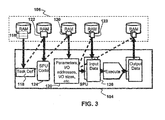
- FIG. 3 is a schematic diagram illustrating in block form certain components of the cell processor 100. Operation of the cell processor 100 may be understood with reference to FIG. 1 and FIG. 3 .
- the STM kernel 112 running on one of the SPUs 104 selects a task queue 116 from the task set 114. Selection of the task queue may be based on priority, with higher priority queues being processed before lower priority queues.
- the STM kernel 112 reads a task definition 118 from the task queue 116 at step 204.
- Task definitions may be taken in an order determined by the task queue.
- the STM skips task definitions that have already been taken by other SPUs.
- Information in the task definition 118 directs the STM to main memory addresses corresponding to the SPU task parameters 120 and task code image 122.
- the SPU loads the SPU task code 124.
- the SPU 104 can use the parameters 120 and code 124 to load the task data 123 in the SPU local store 110 as input data 126.
- the SPU 104 uses the code 124 to process the input data 126 and generate output data 128.
- the output data 128 may be stored at an address in the main memory 106 or may be transferred to another SPU 104 for further processing.
- the code 124 may include one or more SPU programs.
- an SPU program refers to code that can be used by the SPU to implement one or more SPU tasks.
- multiple SPU programs can be cached for use by the SPU 104 in processing the data 123 or for processing data for subsequent tasks. Such caching of programs can be used to optimize DMA use and reduce the number of times that the SPU 104 must access the main memory 106 to load code.
- SPU Programs may be dynamically loaded into main memory from through a PPU API.
- SPU Program ELF data may be loaded from memory (as a PPU symbol) 106 or from a file.
- the SPU task definition 118 can be created with reference SPU programs Loaded in main memory. The SPU programs are loaded into main memory once, at the start of the application. They can then be transferred by DMA to SPU local store 110 as needed by tasks.
- SPU programs may be characterized as being of one of two types, referred to herein as Type-1 and Type-2 respectively.
- Type-1 SPU programs utilize Position Independent Code (PIC), i.e., code that can execute at different locations in memory.
- PIC Position Independent Code
- programs may be further characterized by static local store usage, i.e., the Type-1 code does not allocate memory for use during runtime.
- FIG. 4A for Type-1 programs are managed in a local store 310 of an SPU Type-1 by the STM kernel. As shown in FIG.
- Type-1 programs 324 can be loaded simultaneously on the SPU local store 310.
- Type-1 programs may also be characterized by a stack 311 having a constant stack limit.
- Type-1 program code and context data reside in the remaining space in the LS 310 that is not occupied by the STM kernel 312 or the stack 311.
- Type-1 programs 324 can cache data 326 to share between programs and tasks.
- Type-1 programs are higher performance use programs, though they tend to have more restrictions.
- An example of a Type-1 program 324 that can be cached is a MEM COPY program. This program takes advantage of the fact that memory transfers can be handled much faster by DMA using the SPU 104 than by the PPU 102.
- the MEM COPY takes advantage of this by using an available SPU to transfer data from one location in the main memory 106 to another location.
- SPU-based main memory management is particularly advantageous, e.g., where data needs to be aligned before DMA transfer from the main memory to an SPU or elsewhere.
- Type-2 programs are characterized by the fact that they may use non-position independent code (non-PIC) and may dynamically allocate local store space at SPU runtime. Typically, only one Type-2 program is loaded on one SPU at a time, although exceptions to this feature are within the scope of embodiments of the present invention.
- the local store 310 includes an area of memory that is dynamically allocated by the program at runtime. As shown in FIG. 4E , this area may include Type-2 SPU program code 325 and context data 326.
- the dynamically allocated area of the local store 310 may also contain malloc data 327. The malloc function is used to dynamically allocate memory space in the programming language known as C.
- the malloc function accesses this block of memory via a pointer.
- the pointer is passed to "free" and the memory can be reused by the system.
- Type-2 programs determine how the leftover local store space is allocated among globals, stack, and/or malloc. Furthermore, unlike the Type-1 program the size of the stack 311 for a Type-2 program is variable. Type-2 programs are particularly suitable for situations where it is desired to load the program code on the SPU and then select tasks that match the program code. The STM kernel 312 can load another program if it looks far ahead in the task queues and finds nothing that matches.
- FIG. 4G depicts a memory map of local storage 320 for an SPU in which the STM kernel 312 is implemented as a policy under SPMM 313.
- the STM kernel 312 manages an SPU program 324 and data 326 for one or more tasks.
- Running the STM kernel as a policy under SPMM allows flexibility where other policies, such as SPURS or SPU threads or developer-designed custom policies are also to be implemented.
- SPMM is described in detail in commonly assigned US Patent Application Serial No. 11/238,077 entitled "CELL PROCESSOR METHODS AND APPARATUS" to John P. Bates, Payton R. White and Attila Vass, which is filed the same day as the present application, the entire disclosures of which are incorporated herein by reference.
- SPU programs of type-1 and type-2 have some common features. Specifically, the size of task definitions 118 must be specified. In addition, the maximum local store space required for I/O DMA data must be specified. This enables the kernel 112 to manage the local store context data for tasks. SPU Tasks typically share a context buffer for task definitions 118 and I/O data.
- Type-1 and/or Type-2 programs may written in any suitable language, e.g., C or C++. Programs may be linked and undefined symbols in SPU Programs that exist in the SPU Kernel can be linked at runtime to the kernel symbols.
- SPU Programs can have four customizable callbacks referred to herein as prefetch, start , spumain and finish .
- the prefetch callback has the syntax prefetch(SpuTaskContext*), where the quantity in parentheses is a pointer to the information about the task, including the main memory address of the task definition and a DMA tag for I/O data transfers 118.
- the SpuTaskContext is a local pointer to information about the current task. This data is necessary for the SPU Program to perform the task.
- the STM Kernel 112 prepares this data and delivers it to each callback in the SPU Program.
- SpuTaskContext contains the address in main memory 106 of this task's Task Definition.
- the task can use that address to DMA the task definition 118.
- SpuTaskContext may also contain a temporary Local Store buffer that the SPU Program can use in each of the 4 stages of the task.
- This callback directs the SPU 104 to start DMA transfer of the task definition 118 from the task queue.
- the start callback has the syntax: start (SpuTaskContext*).
- This callback causes the SPU 104 to wait for completion of task definition DMA and to start input DMA of code and/or data as determined by the task definition 118.
- the spumain callback has the syntax spumain (SpuTaskContext*), where the quantity in parentheses refers to the same data as the previous callback..
- This callback causes the SPU 104 to wait for completion of the input DMA, process the input data and start DMA of corresponding output data.
- the finish callback has the syntax: finish (SpuTaskContext*), where the quantity in parentheses refers to the same data as the previous callback.
- Embodiments of the present invention allow efficient management of code and data through a process referred to herein as multi buffering.
- Multi buffering takes advantage of certain characteristics of the SPU. Specifically, an SPU can perform more than one DMA operation at a time and can perform DMA operations while the SPU program is executing.
- the STM Kernel interleaves task callbacks so that DMA operations will be in progress during main execution.
- FIG. 5 illustrates an example of multi buffering. In this example a single SPU performs 5 tasks. For each task, the SPU must prefetch the task definition, start DMA of the requisite data and/or code, execute the main SPU code to generate output and finish by transferring the output by DMA.
- the middle chart shows the order in which the callbacks are initiated and the bottom chart illustrates the overlap in time of the different tasks as they execute. It can be seen from the middle chart, for example that the prefetch commands for the first two tasks (prefetch1, prefetch2) are called first followed by the start command for the first task (start1) and prefetch3, start2 and main1.
- the upper lower charts show that the greatest overlap occurs near the middle of the queue when portions the prefetch, start , main and finish callbacks of four different tasks are running in parallel.
- Such task synchronization is useful where one task set must be completed before a subsequent task set can begin, e.g., when output data from a first set of tasks is used as input data for the following set.
- a barrier command can be inserted into the task queue to ensure that the former tasks are completed before the following tasks begin.
- FIG. 6A illustrates an example of the use of task synchronization with barrier commands.
- a first task set 601 produces output 602 that is to be used as input 604 for a second task set 603.
- the output 602 is stored as data 606, e.g., in main memory.
- a barrier command 608 is placed between the two task sets 601, 603.
- the barrier command 608 may be a task in either the first task set 601 or the second task set 603.
- the barrier command 608 prevents the SPUS from working on tasks in the second task 603 set before the tasks from the first task set 601 have been completed.
- a barrier command may be characterized by a tag mask that identifies those task sets that need to be synchronized.
- the barrier command only synchronizes those tasks that are included in the tag mask.
- a barrier mask of OxFFFFFFF may affect all tasks, while a barrier mask of 1 ⁇ 2(0x4) only affects tasks characterized by a tag value of 2.
- FIG. 6B illustrates an example of the use of barrier tag masks to selectively synchronize multiple task sets. As in FIG.
- a first task set 601 produces generates data 606 that serves as input for a second task set 603.
- other task sets 611, 612 are being processed in parallel with the first task set 601.
- the output of the first task set 601 need not be synchronized with the input to task set 612.
- the barrier command 608 between the first and second task sets 601, 602 has a tag mask that restricts its affect to the first task set 601.
- An SPU will be prevented from working on tasks in the second task set 602 until the first task set 601 has been completed.
- an SPU can do work on other tasks sets not covered by the tag mask of the barrier command 608.
- code affinity refers to a situation where an SPU already has loaded in its associated local store the program code associated with a particular task. Where an SPU has code affinity with a particular task, it only has to DMA transfer the requisite data for the task.
- data affinity refers to a situation where an SPU already has loaded in its associated local store the data associated with a particular task. Where an SPU has data affinity with a particular task it need only DMA transfer the requisite code. Since it is more efficient to process a task where SPU Kernels choose tasks that match their current SPU code. This reduces the occurrence of code switching. Please note that it is possible to cache several Type-1 programs in local store associated with an SPU and access them as needed. In such a case, code affinity is less important.
- FIG. 7A illustrates the use of code affinity.
- a certain code 701 is loaded on a local store 702 associated with an SPU.
- Main memory 704 includes a task queue 706 having multiple task definitions.
- the SPU loads a portion 707 of the task queue 706 into the local store 702.
- the task queue 706 includes definitions for tasks 708 that require the SPU's current code 701 and other tasks 710 that do not (indicated by different shading in FIG. 7 ).
- the STM kernel (not shown) selects the tasks 708 having code affinity with the current program 701 and skips the tasks 710 that do not.
- the kernel directs the SPU to DMA transfers the skipped tasks 710 back to main memory 706 so that the task queue 706 remains contiguous.
- the SPU can then process the selected tasks 708 without having to change the code 701. It should be noted that during this process, the task queue atomic mutex is locked.
- the SPU can switch the program code. This is the situation illustrated in FIG. 7B .
- the portion 705 of the task queue 706 contains tasks 710 that do not have code affinity with the current code 701.
- the kernel 712 frees the old code 701 and allocates space in the local store 702 space for new code 703 and DMA.
- the kernel 712 DMA transfers an ELF image of the new code 703 from main memory 704.
- any task or barrier can be assigned an ID that can later be polled for completion from the PPU 102.
- a barrier with a task ID determines when a task group is complete.
- SPU tasks can also be configured to send a PPU interrupt upon finishing.
- the overhead associated with the STM kernel may be about 650 SPU cycles per task. This includes an averaged cost of retrieving task definitions 118 from the shared task queue 116. Once definitions are retrieved, overhead is typically minimal although it can increase if the application uses many barriers.
- code switch is dependent on the size of code being switched. For example a 200 KB code switch may require about 48,000 cycles, a 100 KB code switch may require about 27,000 cycles, a 50 KB code switch may require about 17,000 cycles and a 1 KB code switch may require about 2,400 cycles.
- the overhead of such code switches is also partly dependent on the configuration of the task queue and the number of SPU assigned to the task queue.
- the worst case Tasks in queue use alternating code.
- the worst case scenario is one where tasks requiring different code alternate in the task queue.
- the overhead may be about 1,840 cycles per task for a 200 KB code, about 1,520 cycles per task for a 100 KB code, about 1,360 cycles per task for a 50 KB code and about 1,200 cycles per task for a 1 KB code.
- the code switching overhead is about 820 cycles per task for 200 KB, 100 KB, 50 KB and 1 KB code. It would appear that optimal performance may be achieved where the number of SPUs assigned to a given task queue is equal to the number of different codes in that task queue.
- FIGs. 9A-9C provide C code listings of examples of STM usage Although the examples depicted in FIGs. 9A-9C are written in C code, those of skill in the art will recognize that, any programming language could be used, including assembly language.
- the code listing in FIG. 9A is an example of initialization.
- a PPU process initializes an STM instance.
- STM Kernels are launched and the PPU process adds SPU Program images.
- FIG. 9B is an example of a runtime (frame-based) graphics process. In this example, a new frame is started. The PPU adds SPU tasks to a queue and a barrier with an ID. The PPU does other work, such as drawing a previous frame and blocks processing of the output data until the tasks covered by the barrier are complete. The process is then repeated for another frame.
- FIG. 9C illustrates an example of STM usage on an SPU.
- the SPU program code follows the typical sequence of prefeteh((7), start(%),spumain((7), and finish().
- the prefetch(That command starts the task definition DMA.
- the start(%) command causes the SPU to wait for task definition DMA to complete and begin input DMA as determined by the task definition.
- the spumain((7) command causes the SPU to wait for the input DMA(s) to finish; process the input data and start DMA of the output.
- the finish(%) command tells the SPU to wait for output DMA(s).
- FIG. 10 The advantages of embodiments of the present invention can be seen by comparison of task contention overhead for SPURS-based and STM-based handling of comparable task queues as shown, e.g., in FIG. 10 .
- a SPURS-based system operated on a task queue having four tasks.
- the SPURS-based system operated on this task queue using code 1002.
- code 1002 As can be seen from the code, switching the tasks requires a yield call, i.e., an operation that gives another task a chance to work.
- the graph 1004 shows the performance of the SPURS-based system in terms of the average number of SPURS cycles per yield call. As the number of SPUs involved in the system increased from four to six, the average number of SPU cycles per yield nearly quadrupled.
- a STM-based system operated on a task queue containing 4 STM SPU programs using an STM-based code 1006.
- the task queue was configured according to two different scenarios. In a worst case queue 1008 the four programs alternated such that no two successive tasks used the same code. In a best case queue 1010 tasks requiring the same program were always grouped together.
- the graph 1004 shows that even for the worst case queue 1008 the STM-based system required less than one third the number of cycles per yield call as the SPURS-based system. For the best case queue 1010 the STM-based system required less than a tenth as many cycles per yield. Furthermore, for both best and worst case queues, the number of cycles per yield call remained relatively constant.
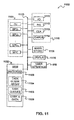
- the system 1100 may include a cell processor module 1101 and a memory 1102 (e.g., RAM, DRAM, ROM, and the like).
- the processing system 1100 may have multiple cell processor modules 1101.
- the cell processor module 1101 generally includes one or more main processors PPU and one or more SPUs SPU 1 , SPU 2 ... SPU N which may be configured to operate under the control of an SPMM as described above.
- the processor module 1101 may also include a memory flow controller MFC.
- the cell processor module 1101 may be a cell processor, e.g., of the type depicted in FIG. 1 .
- the memory 1102 includes data and code configured as described above. Specifically, the memory includes one or more task sets 1104, task queues 1106 and code and data 1108 as described above.
- the system 1100 may also include well-known support functions 1110, such as input/output (I/O) elements 1111, power supplies (P/S) 1112, a clock (CLK) 1113 and cache 1114.
- the system 1100 may optionally include a mass storage device 1115 such as a disk drive, CD-ROM drive, tape drive, or the like to store programs and/or data.
- the controller may also optionally include a display unit 1116 and user interface unit 1118 to facilitate interaction between the controller 1100 and a user.
- the display unit 1116 may be in the form of a cathode ray tube (CRT) or flat panel screen that displays text, numerals, graphical symbols or images.
- the user interface 1118 may include a keyboard, mouse, joystick, light pen or other device.
- the cell processor module 1101, memory 1102 and other components of the system 1100 may exchange signals (e.g., code instructions and data) with each other via a system bus 1120 as shown in FIG. 11 .
- I/O generally refers to any program, operation or device that transfers data to or from the system 1100 and to or from a peripheral device. Every transfer is an output from one device and an input into another.
- Peripheral devices include input-only devices, such as keyboards and mouses, output-only devices, such as printers as well as devices such as a writable CD-ROM that can act as both an input and an output device.
- peripheral device includes external devices, such as a mouse, keyboard, printer, monitor, external Zip drive or scanner as well as internal devices, such as a CD-ROM drive, CD-R drive or internal modem or other peripheral such as a flash memory reader/writer, hard drive.
- the processor module 1101 may manage the performance of tasks in the task queues 1106 in response to data and program code instructions of a main program 1103 stored and retrieved by the memory 1102 and executed by the PPU or SPU of the processor module 1101. Code portions of the program 1103 may conform to any one of a number of different programming languages such as Assembly, C++, JAVA or a number of other languages.
- the processor module 1101 forms a general-purpose computer that becomes a specific purpose computer when executing programs such as the program code 1103.
- the program code 1103 is described herein as being implemented in software and executed upon a general purpose computer, those skilled in the art will realize that the method of SPU task management could alternatively be implemented using hardware such as an application specific integrated circuit (ASIC) or other hardware circuitry.
- ASIC application specific integrated circuit
- the program code 1103 may include a set of processor readable instructions that implement a method having features in common with the method 200 of FIG. 2 and/or the code listings of FIGs. 9A-9C ..
- Embodiments of the present invention provide a lower overhead of context switches, allow for parallel DMA and task execution and use code affinity to choose new tasks that match current SPU code and reduce DMA usage.
- Embodiments of the present invention provide developers with a high performance, intuitive SPU Programming model. This program model allows many different tasks to be executed efficiently without as much context switch overhead as SPURS and SPU Threads.
- Embodiments of the present invention provide SPU Task Management methods and systems that can run on a varying number of SPUs without modifying application code. Embodiments of the invention are particularly useful in situations requiring many short tasks many small SPU programs where there is shared data between programs and tasks. SPU code caching is also useful to optimize performance. Examples of situations where SPU task management according to embodiments of the invention may be useful include encoding or decoding of audio in situations requiring many different filter codes that must be swapped in and out ofthe SPU dynamically. Each filter code works on one or more data blocks from RAM. In some cases these cannot be statically defined with overlays. In such a case, the group of tasks may create a tree. Outputs from tasks lower down in the tree can become inputs for following tasks as described herein.
Landscapes
- Engineering & Computer Science (AREA)
- Software Systems (AREA)
- Theoretical Computer Science (AREA)
- Physics & Mathematics (AREA)
- General Engineering & Computer Science (AREA)
- General Physics & Mathematics (AREA)
- Stored Programmes (AREA)
- Memory System Of A Hierarchy Structure (AREA)
- Multi Processors (AREA)
- Image Processing (AREA)
Applications Claiming Priority (3)
| Application Number | Priority Date | Filing Date | Title |
|---|---|---|---|
| US11/238,087 US8037474B2 (en) | 2005-09-27 | 2005-09-27 | Task manager with stored task definition having pointer to a memory address containing required code data related to the task for execution |
| PCT/US2006/037338 WO2007038457A1 (en) | 2005-09-27 | 2006-09-25 | Spu task manager for cell processor |
| EP06815385A EP1934739A1 (de) | 2005-09-27 | 2006-09-25 | Spu-task-manager für einen zellenprozessor |
Related Parent Applications (2)
| Application Number | Title | Priority Date | Filing Date |
|---|---|---|---|
| EP06815385.7 Division | 2006-09-25 | ||
| EP06815385A Division EP1934739A1 (de) | 2005-09-27 | 2006-09-25 | Spu-task-manager für einen zellenprozessor |
Publications (3)
| Publication Number | Publication Date |
|---|---|
| EP2290543A2 true EP2290543A2 (de) | 2011-03-02 |
| EP2290543A3 EP2290543A3 (de) | 2012-06-06 |
| EP2290543B1 EP2290543B1 (de) | 2018-12-26 |
Family
ID=37671907
Family Applications (2)
| Application Number | Title | Priority Date | Filing Date |
|---|---|---|---|
| EP10187459.2A Active EP2290543B1 (de) | 2005-09-27 | 2006-09-25 | Aufgabenverwaltung in einem Mehrprozessorsystem |
| EP06815385A Withdrawn EP1934739A1 (de) | 2005-09-27 | 2006-09-25 | Spu-task-manager für einen zellenprozessor |
Family Applications After (1)
| Application Number | Title | Priority Date | Filing Date |
|---|---|---|---|
| EP06815385A Withdrawn EP1934739A1 (de) | 2005-09-27 | 2006-09-25 | Spu-task-manager für einen zellenprozessor |
Country Status (4)
| Country | Link |
|---|---|
| US (1) | US8037474B2 (de) |
| EP (2) | EP2290543B1 (de) |
| JP (1) | JP4712877B2 (de) |
| WO (1) | WO2007038457A1 (de) |
Families Citing this family (45)
| Publication number | Priority date | Publication date | Assignee | Title |
|---|---|---|---|---|
| US7346664B2 (en) * | 2003-04-24 | 2008-03-18 | Neopath Networks, Inc. | Transparent file migration using namespace replication |
| US8539081B2 (en) * | 2003-09-15 | 2013-09-17 | Neopath Networks, Inc. | Enabling proxy services using referral mechanisms |
| US8190741B2 (en) * | 2004-04-23 | 2012-05-29 | Neopath Networks, Inc. | Customizing a namespace in a decentralized storage environment |
| US8195627B2 (en) * | 2004-04-23 | 2012-06-05 | Neopath Networks, Inc. | Storage policy monitoring for a storage network |
| WO2006027639A1 (en) * | 2004-09-09 | 2006-03-16 | Pirelli Tyre S.P.A. | Method for allowing a control of a vehicle provided with at least two wheels in case of puncture of a tyre |
| US8832697B2 (en) * | 2005-06-29 | 2014-09-09 | Cisco Technology, Inc. | Parallel filesystem traversal for transparent mirroring of directories and files |
| US7522168B2 (en) * | 2005-09-27 | 2009-04-21 | Sony Computer Entertainment Inc. | Cell processor task and data management |
| US8316220B2 (en) * | 2005-09-27 | 2012-11-20 | Sony Computer Entertainment Inc. | Operating processors over a network |
| US7975269B2 (en) | 2005-09-27 | 2011-07-05 | Sony Computer Entertainment Inc. | Parallel processor methods and apparatus |
| US7734827B2 (en) * | 2005-09-27 | 2010-06-08 | Sony Computer Entertainment, Inc. | Operation of cell processors |
| US7506123B1 (en) * | 2005-09-27 | 2009-03-17 | Sony Computer Entertainment Inc. | Method and system for performing memory copy function on a cell processor |
| US8131689B2 (en) * | 2005-09-30 | 2012-03-06 | Panagiotis Tsirigotis | Accumulating access frequency and file attributes for supporting policy based storage management |
| US8595747B2 (en) * | 2005-12-29 | 2013-11-26 | Sony Computer Entertainment Inc. | Efficient task scheduling by assigning fixed registers to scheduler |
| US7647483B2 (en) * | 2007-02-20 | 2010-01-12 | Sony Computer Entertainment Inc. | Multi-threaded parallel processor methods and apparatus |
| GB0703974D0 (en) * | 2007-03-01 | 2007-04-11 | Sony Comp Entertainment Europe | Entertainment device |
| US8589943B2 (en) * | 2007-08-15 | 2013-11-19 | Sony Computer Entertainment Inc. | Multi-threaded processing with reduced context switching |
| CN101373434B (zh) * | 2007-08-22 | 2012-01-25 | 国际商业机器公司 | 在多处理器系统中快速加载和运行程序映像的方法和系统 |
| WO2009029549A2 (en) * | 2007-08-24 | 2009-03-05 | Virtualmetrix, Inc. | Method and apparatus for fine grain performance management of computer systems |
| US8387041B2 (en) * | 2008-01-09 | 2013-02-26 | International Business Machines Corporation | Localized multi-element processor resource sharing among logical partitions |
| JP5067282B2 (ja) * | 2008-06-27 | 2012-11-07 | ソニー株式会社 | 物体検出制御装置、物体検出システム、物体検出制御方法およびプログラム |
| US8732716B2 (en) | 2008-09-30 | 2014-05-20 | International Business Machines Corporation | Virtualization across physical partitions of a multi-core processor (MCP) |
| US8438404B2 (en) * | 2008-09-30 | 2013-05-07 | International Business Machines Corporation | Main processing element for delegating virtualized control threads controlling clock speed and power consumption to groups of sub-processing elements in a system such that a group of sub-processing elements can be designated as pseudo main processing element |
| US20100257529A1 (en) * | 2009-04-06 | 2010-10-07 | Christopher Wilkerson | Efficient systems and methods for consuming and providing power |
| US8782653B2 (en) * | 2010-03-26 | 2014-07-15 | Virtualmetrix, Inc. | Fine grain performance resource management of computer systems |
| US8677071B2 (en) * | 2010-03-26 | 2014-03-18 | Virtualmetrix, Inc. | Control of processor cache memory occupancy |
| US9645854B2 (en) * | 2010-12-15 | 2017-05-09 | Advanced Micro Devices, Inc. | Dynamic work partitioning on heterogeneous processing devices |
| US10795722B2 (en) * | 2011-11-09 | 2020-10-06 | Nvidia Corporation | Compute task state encapsulation |
| US9229847B1 (en) | 2012-04-18 | 2016-01-05 | Open Invention Network, Llc | Memory sharing for buffered macro-pipelined data plane processing in multicore embedded systems |
| US9122401B2 (en) * | 2012-08-23 | 2015-09-01 | Apple Inc. | Efficient enforcement of command execution order in solid state drives |
| US9146777B2 (en) * | 2013-01-25 | 2015-09-29 | Swarm Technology Llc | Parallel processing with solidarity cells by proactively retrieving from a task pool a matching task for the solidarity cell to process |
| US9158698B2 (en) | 2013-03-15 | 2015-10-13 | International Business Machines Corporation | Dynamically removing entries from an executing queue |
| US9588813B1 (en) * | 2013-06-07 | 2017-03-07 | Amazon Technologies, Inc. | Determining cost of service call |
| US9501321B1 (en) * | 2014-01-24 | 2016-11-22 | Amazon Technologies, Inc. | Weighted service requests throttling |
| JP6740210B2 (ja) * | 2014-07-24 | 2020-08-12 | アリフォンソ イニゲス, | 動的に構成可能な先回りコプロセッシングセルを用いる並列処理のためのシステムおよび方法 |
| CN106537343A (zh) * | 2014-07-24 | 2017-03-22 | 阿方索·伊尼格斯 | 使用动态可配置主动协同处理单元的并行处理的系统和方法 |
| KR101638136B1 (ko) * | 2015-05-14 | 2016-07-08 | 주식회사 티맥스 소프트 | 멀티 스레드 구조에서 작업 분배 시 스레드 간 락 경쟁을 최소화하는 방법 및 이를 사용한 장치 |
| CN105373430A (zh) * | 2015-10-13 | 2016-03-02 | 惠州Tcl移动通信有限公司 | 一种动态分配编译机的系统及其方法 |
| US10409560B1 (en) * | 2015-11-18 | 2019-09-10 | Amazon Technologies, Inc. | Acceleration techniques for graph analysis programs |
| US10949251B2 (en) | 2016-04-01 | 2021-03-16 | Intel Corporation | System and method to accelerate reduce operations in graphics processor |
| US10552212B2 (en) * | 2016-11-28 | 2020-02-04 | Arm Limited | Data processing |
| KR102442921B1 (ko) * | 2017-12-11 | 2022-09-13 | 삼성전자주식회사 | 디지털 시그널 프로세서(dsp)의 태스크 관리 효율을 높일 수 있는 전자 장치 |
| JP7042105B2 (ja) * | 2018-02-16 | 2022-03-25 | 日立Astemo株式会社 | プログラム実行制御方法および車両制御装置 |
| US11487573B2 (en) * | 2018-05-08 | 2022-11-01 | Thomson Reuters Enterprise Centre Gmbh | Systems and method for automating security workflows in a distributed system using encrypted task requests |
| US20210149719A1 (en) * | 2019-11-15 | 2021-05-20 | Nvidia Corporation | Techniques for modifying executable graphs to perform different workloads |
| US20240303120A1 (en) * | 2023-03-12 | 2024-09-12 | Maurice Hendrikus Paulus van Putten | Method for high-throughput load balanced data-processing in distributed heterogeneous computing |
Family Cites Families (66)
| Publication number | Priority date | Publication date | Assignee | Title |
|---|---|---|---|---|
| US3496551A (en) * | 1967-07-13 | 1970-02-17 | Ibm | Task selection in a multi-processor computing system |
| US3596257A (en) * | 1969-09-17 | 1971-07-27 | Burroughs Corp | Method and apparatus for allocating small memory spaces to a computer program |
| US5047923A (en) * | 1987-08-21 | 1991-09-10 | Siemens Aktiengesellschaft | Modularly structured digital communication system for interconnecting terminal equipment and public networks |
| JPH01258135A (ja) | 1988-04-08 | 1989-10-16 | Nec Corp | トランザクション実行制御方式 |
| US5185694A (en) * | 1989-06-26 | 1993-02-09 | Motorola, Inc. | Data processing system utilizes block move instruction for burst transferring blocks of data entries where width of data blocks varies |
| US5136712A (en) * | 1989-06-29 | 1992-08-04 | Digital Equipment Corporation | Temporary object handling system and method in an object based computer operating system |
| EP0416767A3 (en) * | 1989-09-08 | 1992-04-29 | Digital Equipment Corporation | Position independent code location system |
| US5109512A (en) * | 1990-05-31 | 1992-04-28 | International Business Machines Corporation | Process for dispatching tasks among multiple information processors |
| US5452452A (en) * | 1990-06-11 | 1995-09-19 | Cray Research, Inc. | System having integrated dispatcher for self scheduling processors to execute multiple types of processes |
| JPH04123234A (ja) * | 1990-09-14 | 1992-04-23 | Hitachi Ltd | マルチプロセッサのプロセススケジューリング方式及びメモリ管理方式 |
| JPH05216844A (ja) * | 1991-07-17 | 1993-08-27 | Internatl Business Mach Corp <Ibm> | マルチプロセッサデータ処理システムにおける改良されたタスク分散のための方法および装置 |
| JP2809962B2 (ja) * | 1993-03-02 | 1998-10-15 | 株式会社東芝 | 資源管理方式 |
| US5528513A (en) * | 1993-11-04 | 1996-06-18 | Digital Equipment Corp. | Scheduling and admission control policy for a continuous media server |
| US5745778A (en) * | 1994-01-26 | 1998-04-28 | Data General Corporation | Apparatus and method for improved CPU affinity in a multiprocessor system |
| US5794017A (en) * | 1995-02-06 | 1998-08-11 | International Business Machines Corporation | Method and system of updating graphics memory in a graphics display system through multiple address transferring of pixel data |
| US6728959B1 (en) | 1995-08-08 | 2004-04-27 | Novell, Inc. | Method and apparatus for strong affinity multiprocessor scheduling |
| US5832262A (en) * | 1995-09-14 | 1998-11-03 | Lockheed Martin Corporation | Realtime hardware scheduler utilizing processor message passing and queue management cells |
| US6341324B1 (en) * | 1995-10-06 | 2002-01-22 | Lsi Logic Corporation | Exception processing in superscalar microprocessor |
| US5978843A (en) * | 1995-12-06 | 1999-11-02 | Industrial Technology Research Institute | Scalable architecture for media-on-demand servers |
| EP0888585A1 (de) * | 1996-03-19 | 1999-01-07 | Massachusetts Institute Of Technology | Rechnervorrichtung und rechnerimplementierter prozess zur darstellung von softwaresystembeschreibungen und zur erzeugung ausführbarer rechnerprogramme und rechnersystemkonfiguration aus softwaresystembeschreibungen |
| US5826081A (en) * | 1996-05-06 | 1998-10-20 | Sun Microsystems, Inc. | Real time thread dispatcher for multiprocessor applications |
| US6144986A (en) * | 1997-03-27 | 2000-11-07 | Cybersales, Inc. | System for sorting in a multiprocessor environment |
| US6003112A (en) * | 1997-06-30 | 1999-12-14 | Intel Corporation | Memory controller and method for clearing or copying memory utilizing register files to store address information |
| US6378072B1 (en) * | 1998-02-03 | 2002-04-23 | Compaq Computer Corporation | Cryptographic system |
| US6295598B1 (en) * | 1998-06-30 | 2001-09-25 | Src Computers, Inc. | Split directory-based cache coherency technique for a multi-processor computer system |
| US6289369B1 (en) * | 1998-08-25 | 2001-09-11 | International Business Machines Corporation | Affinity, locality, and load balancing in scheduling user program-level threads for execution by a computer system |
| JP3993342B2 (ja) | 1999-06-24 | 2007-10-17 | 株式会社日立製作所 | 電子計算機における処理の中断/再開方法 |
| US6463457B1 (en) * | 1999-08-26 | 2002-10-08 | Parabon Computation, Inc. | System and method for the establishment and the utilization of networked idle computational processing power |
| US6665699B1 (en) * | 1999-09-23 | 2003-12-16 | Bull Hn Information Systems Inc. | Method and data processing system providing processor affinity dispatching |
| DE60033615T2 (de) * | 1999-10-21 | 2007-10-31 | International Business Machines Corp. | Verfahren und System, um das Verteilen von IP-Datagrammen auf mehrere Server gemäß einer definierten Strategie zu erzwingen |
| GB2394336B (en) | 1999-11-19 | 2004-09-08 | Gen Dynamics Decisions Systems | Method of allocating memory |
| US7058750B1 (en) * | 2000-05-10 | 2006-06-06 | Intel Corporation | Scalable distributed memory and I/O multiprocessor system |
| US6981260B2 (en) * | 2000-05-25 | 2005-12-27 | International Business Machines Corporation | Apparatus for minimizing lock contention in a multiple processor system with multiple run queues when determining the threads priorities |
| US7565651B1 (en) * | 2000-05-25 | 2009-07-21 | Oracle International Corporation | Parallel task scheduling system for computers |
| US20030154284A1 (en) * | 2000-05-31 | 2003-08-14 | James Bernardin | Distributed data propagator |
| JP2002007364A (ja) | 2000-06-22 | 2002-01-11 | Fujitsu Ltd | 並列計算機システムのジョブスケジューリングを行うスケジューリング装置 |
| US6986052B1 (en) | 2000-06-30 | 2006-01-10 | Intel Corporation | Method and apparatus for secure execution using a secure memory partition |
| US6502170B2 (en) * | 2000-12-15 | 2002-12-31 | Intel Corporation | Memory-to-memory compare/exchange instructions to support non-blocking synchronization schemes |
| US6526491B2 (en) * | 2001-03-22 | 2003-02-25 | Sony Corporation Entertainment Inc. | Memory protection system and method for computer architecture for broadband networks |
| US7233998B2 (en) * | 2001-03-22 | 2007-06-19 | Sony Computer Entertainment Inc. | Computer architecture and software cells for broadband networks |
| US6785756B2 (en) * | 2001-05-10 | 2004-08-31 | Oracle International Corporation | Methods and systems for multi-policy resource scheduling |
| US6738378B2 (en) * | 2001-08-22 | 2004-05-18 | Pluris, Inc. | Method and apparatus for intelligent sorting and process determination of data packets destined to a central processing unit of a router or server on a data packet network |
| CA2411294C (en) * | 2001-11-06 | 2011-01-04 | Everyware Solutions Inc. | A method and system for access to automatically synchronized remote files |
| CN1322385C (zh) | 2002-08-13 | 2007-06-20 | 诺基亚有限公司 | 用于提供数据安全性的电路系统和方法 |
| US7089547B2 (en) * | 2002-09-13 | 2006-08-08 | International Business Machines Corporation | Firmware updating |
| US7039736B2 (en) * | 2003-01-15 | 2006-05-02 | Hewlett-Packard Development Company, L.P. | Systems and methods for accessing bus-mastered system resources |
| JP3848268B2 (ja) | 2003-02-14 | 2006-11-22 | 株式会社東芝 | 計算機システム、計算機装置、計算機システムにおけるデータアクセス方法及びプログラム |
| JP2004287801A (ja) | 2003-03-20 | 2004-10-14 | Sony Computer Entertainment Inc | 情報処理システム、情報処理装置、分散情報処理方法及びコンピュータプログラム |
| JP2004320174A (ja) | 2003-04-11 | 2004-11-11 | Matsushita Electric Ind Co Ltd | 認証システム、認証装置、認証方法 |
| US20050022173A1 (en) * | 2003-05-30 | 2005-01-27 | Codito Technologies Private Limited | Method and system for allocation of special purpose computing resources in a multiprocessor system |
| US7236738B2 (en) * | 2003-08-01 | 2007-06-26 | Pathfire, Inc. | Multicast control systems and methods for dynamic, adaptive time, bandwidth,frequency, and satellite allocations |
| US7523157B2 (en) * | 2003-09-25 | 2009-04-21 | International Business Machines Corporation | Managing a plurality of processors as devices |
| US7478390B2 (en) * | 2003-09-25 | 2009-01-13 | International Business Machines Corporation | Task queue management of virtual devices using a plurality of processors |
| US7516456B2 (en) * | 2003-09-25 | 2009-04-07 | International Business Machines Corporation | Asymmetric heterogeneous multi-threaded operating system |
| US7236998B2 (en) * | 2003-09-25 | 2007-06-26 | International Business Machines Corporation | System and method for solving a large system of dense linear equations |
| US7321958B2 (en) * | 2003-10-30 | 2008-01-22 | International Business Machines Corporation | System and method for sharing memory by heterogeneous processors |
| US7614053B2 (en) | 2004-02-20 | 2009-11-03 | Sony Computer Entertainment Inc. | Methods and apparatus for task management in a multi-processor system |
| US7565653B2 (en) * | 2004-02-20 | 2009-07-21 | Sony Computer Entertainment Inc. | Methods and apparatus for processor task migration in a multi-processor system |
| US8028292B2 (en) * | 2004-02-20 | 2011-09-27 | Sony Computer Entertainment Inc. | Processor task migration over a network in a multi-processor system |
| US7298377B2 (en) * | 2004-06-24 | 2007-11-20 | International Business Machines Corporation | System and method for cache optimized data formatting |
| US7304646B2 (en) * | 2004-08-19 | 2007-12-04 | Sony Computer Entertainment Inc. | Image data structure for direct memory access |
| US7522168B2 (en) * | 2005-09-27 | 2009-04-21 | Sony Computer Entertainment Inc. | Cell processor task and data management |
| US7734827B2 (en) * | 2005-09-27 | 2010-06-08 | Sony Computer Entertainment, Inc. | Operation of cell processors |
| US8141076B2 (en) | 2005-09-27 | 2012-03-20 | Sony Computer Entertainment Inc. | Cell processor methods and apparatus |
| US7506123B1 (en) * | 2005-09-27 | 2009-03-17 | Sony Computer Entertainment Inc. | Method and system for performing memory copy function on a cell processor |
| US7975269B2 (en) * | 2005-09-27 | 2011-07-05 | Sony Computer Entertainment Inc. | Parallel processor methods and apparatus |
-
2005
- 2005-09-27 US US11/238,087 patent/US8037474B2/en active Active
-
2006
- 2006-09-25 EP EP10187459.2A patent/EP2290543B1/de active Active
- 2006-09-25 JP JP2008533495A patent/JP4712877B2/ja active Active
- 2006-09-25 WO PCT/US2006/037338 patent/WO2007038457A1/en not_active Ceased
- 2006-09-25 EP EP06815385A patent/EP1934739A1/de not_active Withdrawn
Also Published As
| Publication number | Publication date |
|---|---|
| WO2007038457A1 (en) | 2007-04-05 |
| EP2290543A3 (de) | 2012-06-06 |
| JP4712877B2 (ja) | 2011-06-29 |
| US8037474B2 (en) | 2011-10-11 |
| JP2009510613A (ja) | 2009-03-12 |
| EP2290543B1 (de) | 2018-12-26 |
| EP1934739A1 (de) | 2008-06-25 |
| US20070074207A1 (en) | 2007-03-29 |
Similar Documents
| Publication | Publication Date | Title |
|---|---|---|
| US8037474B2 (en) | Task manager with stored task definition having pointer to a memory address containing required code data related to the task for execution | |
| US7647483B2 (en) | Multi-threaded parallel processor methods and apparatus | |
| JP6649267B2 (ja) | タスク間通信をサポートするためのハードウェアベースのアトミック動作 | |
| JP5939524B2 (ja) | サブバッファオブジェクト | |
| US9928109B2 (en) | Method and system for processing nested stream events | |
| US7975269B2 (en) | Parallel processor methods and apparatus | |
| JP4964243B2 (ja) | プロセッサ方法と装置 | |
| US8984511B2 (en) | Visibility ordering in a memory model for a unified computing system | |
| US20130166887A1 (en) | Data processing apparatus and data processing method | |
| US7890740B2 (en) | Processor comprising a first and a second mode of operation and method of operating the same | |
| EP4632560A1 (de) | Burstverarbeitung | |
| US20250322483A1 (en) | Burst Processing | |
| JP4631442B2 (ja) | プロセッサ | |
| CN111831331B (zh) | 用于分形智能处理器的分形可重配指令集 | |
| JP2008033490A (ja) | マルチスレッドプロセッサ |
Legal Events
| Date | Code | Title | Description |
|---|---|---|---|
| PUAI | Public reference made under article 153(3) epc to a published international application that has entered the european phase |
Free format text: ORIGINAL CODE: 0009012 |
|
| AC | Divisional application: reference to earlier application |
Ref document number: 1934739 Country of ref document: EP Kind code of ref document: P |
|
| AK | Designated contracting states |
Kind code of ref document: A2 Designated state(s): AT BE BG CH CY CZ DE DK EE ES FI FR GB GR HU IE IS IT LI LT LU LV MC NL PL PT RO SE SI SK TR |
|
| PUAL | Search report despatched |
Free format text: ORIGINAL CODE: 0009013 |
|
| AK | Designated contracting states |
Kind code of ref document: A3 Designated state(s): AT BE BG CH CY CZ DE DK EE ES FI FR GB GR HU IE IS IT LI LT LU LV MC NL PL PT RO SE SI SK TR |
|
| RIC1 | Information provided on ipc code assigned before grant |
Ipc: G06F 9/50 20060101AFI20120503BHEP Ipc: G06F 9/48 20060101ALI20120503BHEP |
|
| 17P | Request for examination filed |
Effective date: 20121206 |
|
| RAP1 | Party data changed (applicant data changed or rights of an application transferred) |
Owner name: SONY COMPUTER ENTERTAINMENT INCORPORATED |
|
| RAP1 | Party data changed (applicant data changed or rights of an application transferred) |
Owner name: SONY COMPUTER ENTERTAINMENT INC. |
|
| 17Q | First examination report despatched |
Effective date: 20160104 |
|
| RAP1 | Party data changed (applicant data changed or rights of an application transferred) |
Owner name: SONY INTERACTIVE ENTERTAINMENT INC. |
|
| RAP1 | Party data changed (applicant data changed or rights of an application transferred) |
Owner name: SONY INTERACTIVE ENTERTAINMENT INC. |
|
| GRAP | Despatch of communication of intention to grant a patent |
Free format text: ORIGINAL CODE: EPIDOSNIGR1 |
|
| STAA | Information on the status of an ep patent application or granted ep patent |
Free format text: STATUS: GRANT OF PATENT IS INTENDED |
|
| INTG | Intention to grant announced |
Effective date: 20180711 |
|
| RIN1 | Information on inventor provided before grant (corrected) |
Inventor name: STENSON, RICHARD, B. Inventor name: BERKEY, HOWARD Inventor name: CERNY, MARK Inventor name: BATES, JOHN, P. Inventor name: VASS, ATTILA Inventor name: WHITE, PAYTON, R. Inventor name: MORGAN, JOHN |
|
| GRAS | Grant fee paid |
Free format text: ORIGINAL CODE: EPIDOSNIGR3 |
|
| GRAA | (expected) grant |
Free format text: ORIGINAL CODE: 0009210 |
|
| STAA | Information on the status of an ep patent application or granted ep patent |
Free format text: STATUS: THE PATENT HAS BEEN GRANTED |
|
| AC | Divisional application: reference to earlier application |
Ref document number: 1934739 Country of ref document: EP Kind code of ref document: P |
|
| AK | Designated contracting states |
Kind code of ref document: B1 Designated state(s): AT BE BG CH CY CZ DE DK EE ES FI FR GB GR HU IE IS IT LI LT LU LV MC NL PL PT RO SE SI SK TR |
|
| REG | Reference to a national code |
Ref country code: GB Ref legal event code: FG4D |
|
| REG | Reference to a national code |
Ref country code: CH Ref legal event code: EP |
|
| REG | Reference to a national code |
Ref country code: DE Ref legal event code: R096 Ref document number: 602006057171 Country of ref document: DE |
|
| REG | Reference to a national code |
Ref country code: AT Ref legal event code: REF Ref document number: 1082353 Country of ref document: AT Kind code of ref document: T Effective date: 20190115 |
|
| REG | Reference to a national code |
Ref country code: IE Ref legal event code: FG4D |
|
| PG25 | Lapsed in a contracting state [announced via postgrant information from national office to epo] |
Ref country code: LV Free format text: LAPSE BECAUSE OF FAILURE TO SUBMIT A TRANSLATION OF THE DESCRIPTION OR TO PAY THE FEE WITHIN THE PRESCRIBED TIME-LIMIT Effective date: 20181226 Ref country code: FI Free format text: LAPSE BECAUSE OF FAILURE TO SUBMIT A TRANSLATION OF THE DESCRIPTION OR TO PAY THE FEE WITHIN THE PRESCRIBED TIME-LIMIT Effective date: 20181226 Ref country code: BG Free format text: LAPSE BECAUSE OF FAILURE TO SUBMIT A TRANSLATION OF THE DESCRIPTION OR TO PAY THE FEE WITHIN THE PRESCRIBED TIME-LIMIT Effective date: 20190326 Ref country code: LT Free format text: LAPSE BECAUSE OF FAILURE TO SUBMIT A TRANSLATION OF THE DESCRIPTION OR TO PAY THE FEE WITHIN THE PRESCRIBED TIME-LIMIT Effective date: 20181226 |
|
| REG | Reference to a national code |
Ref country code: NL Ref legal event code: MP Effective date: 20181226 |
|
| REG | Reference to a national code |
Ref country code: LT Ref legal event code: MG4D |
|
| PG25 | Lapsed in a contracting state [announced via postgrant information from national office to epo] |
Ref country code: GR Free format text: LAPSE BECAUSE OF FAILURE TO SUBMIT A TRANSLATION OF THE DESCRIPTION OR TO PAY THE FEE WITHIN THE PRESCRIBED TIME-LIMIT Effective date: 20190327 Ref country code: SE Free format text: LAPSE BECAUSE OF FAILURE TO SUBMIT A TRANSLATION OF THE DESCRIPTION OR TO PAY THE FEE WITHIN THE PRESCRIBED TIME-LIMIT Effective date: 20181226 |
|
| REG | Reference to a national code |
Ref country code: AT Ref legal event code: MK05 Ref document number: 1082353 Country of ref document: AT Kind code of ref document: T Effective date: 20181226 |
|
| PG25 | Lapsed in a contracting state [announced via postgrant information from national office to epo] |
Ref country code: NL Free format text: LAPSE BECAUSE OF FAILURE TO SUBMIT A TRANSLATION OF THE DESCRIPTION OR TO PAY THE FEE WITHIN THE PRESCRIBED TIME-LIMIT Effective date: 20181226 |
|
| PG25 | Lapsed in a contracting state [announced via postgrant information from national office to epo] |
Ref country code: PL Free format text: LAPSE BECAUSE OF FAILURE TO SUBMIT A TRANSLATION OF THE DESCRIPTION OR TO PAY THE FEE WITHIN THE PRESCRIBED TIME-LIMIT Effective date: 20181226 Ref country code: CZ Free format text: LAPSE BECAUSE OF FAILURE TO SUBMIT A TRANSLATION OF THE DESCRIPTION OR TO PAY THE FEE WITHIN THE PRESCRIBED TIME-LIMIT Effective date: 20181226 Ref country code: ES Free format text: LAPSE BECAUSE OF FAILURE TO SUBMIT A TRANSLATION OF THE DESCRIPTION OR TO PAY THE FEE WITHIN THE PRESCRIBED TIME-LIMIT Effective date: 20181226 Ref country code: PT Free format text: LAPSE BECAUSE OF FAILURE TO SUBMIT A TRANSLATION OF THE DESCRIPTION OR TO PAY THE FEE WITHIN THE PRESCRIBED TIME-LIMIT Effective date: 20190426 Ref country code: IT Free format text: LAPSE BECAUSE OF FAILURE TO SUBMIT A TRANSLATION OF THE DESCRIPTION OR TO PAY THE FEE WITHIN THE PRESCRIBED TIME-LIMIT Effective date: 20181226 |
|
| PG25 | Lapsed in a contracting state [announced via postgrant information from national office to epo] |
Ref country code: EE Free format text: LAPSE BECAUSE OF FAILURE TO SUBMIT A TRANSLATION OF THE DESCRIPTION OR TO PAY THE FEE WITHIN THE PRESCRIBED TIME-LIMIT Effective date: 20181226 Ref country code: IS Free format text: LAPSE BECAUSE OF FAILURE TO SUBMIT A TRANSLATION OF THE DESCRIPTION OR TO PAY THE FEE WITHIN THE PRESCRIBED TIME-LIMIT Effective date: 20190426 Ref country code: SK Free format text: LAPSE BECAUSE OF FAILURE TO SUBMIT A TRANSLATION OF THE DESCRIPTION OR TO PAY THE FEE WITHIN THE PRESCRIBED TIME-LIMIT Effective date: 20181226 Ref country code: RO Free format text: LAPSE BECAUSE OF FAILURE TO SUBMIT A TRANSLATION OF THE DESCRIPTION OR TO PAY THE FEE WITHIN THE PRESCRIBED TIME-LIMIT Effective date: 20181226 |
|
| REG | Reference to a national code |
Ref country code: DE Ref legal event code: R097 Ref document number: 602006057171 Country of ref document: DE |
|
| PG25 | Lapsed in a contracting state [announced via postgrant information from national office to epo] |
Ref country code: DK Free format text: LAPSE BECAUSE OF FAILURE TO SUBMIT A TRANSLATION OF THE DESCRIPTION OR TO PAY THE FEE WITHIN THE PRESCRIBED TIME-LIMIT Effective date: 20181226 Ref country code: AT Free format text: LAPSE BECAUSE OF FAILURE TO SUBMIT A TRANSLATION OF THE DESCRIPTION OR TO PAY THE FEE WITHIN THE PRESCRIBED TIME-LIMIT Effective date: 20181226 |
|
| PLBE | No opposition filed within time limit |
Free format text: ORIGINAL CODE: 0009261 |
|
| STAA | Information on the status of an ep patent application or granted ep patent |
Free format text: STATUS: NO OPPOSITION FILED WITHIN TIME LIMIT |
|
| 26N | No opposition filed |
Effective date: 20190927 |
|
| PG25 | Lapsed in a contracting state [announced via postgrant information from national office to epo] |
Ref country code: SI Free format text: LAPSE BECAUSE OF FAILURE TO SUBMIT A TRANSLATION OF THE DESCRIPTION OR TO PAY THE FEE WITHIN THE PRESCRIBED TIME-LIMIT Effective date: 20181226 |
|
| PG25 | Lapsed in a contracting state [announced via postgrant information from national office to epo] |
Ref country code: TR Free format text: LAPSE BECAUSE OF FAILURE TO SUBMIT A TRANSLATION OF THE DESCRIPTION OR TO PAY THE FEE WITHIN THE PRESCRIBED TIME-LIMIT Effective date: 20181226 |
|
| PG25 | Lapsed in a contracting state [announced via postgrant information from national office to epo] |
Ref country code: MC Free format text: LAPSE BECAUSE OF FAILURE TO SUBMIT A TRANSLATION OF THE DESCRIPTION OR TO PAY THE FEE WITHIN THE PRESCRIBED TIME-LIMIT Effective date: 20181226 |
|
| REG | Reference to a national code |
Ref country code: CH Ref legal event code: PL |
|
| PG25 | Lapsed in a contracting state [announced via postgrant information from national office to epo] |
Ref country code: LI Free format text: LAPSE BECAUSE OF NON-PAYMENT OF DUE FEES Effective date: 20190930 Ref country code: CH Free format text: LAPSE BECAUSE OF NON-PAYMENT OF DUE FEES Effective date: 20190930 Ref country code: IE Free format text: LAPSE BECAUSE OF NON-PAYMENT OF DUE FEES Effective date: 20190925 Ref country code: LU Free format text: LAPSE BECAUSE OF NON-PAYMENT OF DUE FEES Effective date: 20190925 |
|
| REG | Reference to a national code |
Ref country code: BE Ref legal event code: MM Effective date: 20190930 |
|
| PG25 | Lapsed in a contracting state [announced via postgrant information from national office to epo] |
Ref country code: BE Free format text: LAPSE BECAUSE OF NON-PAYMENT OF DUE FEES Effective date: 20190930 |
|
| PG25 | Lapsed in a contracting state [announced via postgrant information from national office to epo] |
Ref country code: CY Free format text: LAPSE BECAUSE OF FAILURE TO SUBMIT A TRANSLATION OF THE DESCRIPTION OR TO PAY THE FEE WITHIN THE PRESCRIBED TIME-LIMIT Effective date: 20181226 |
|
| PG25 | Lapsed in a contracting state [announced via postgrant information from national office to epo] |
Ref country code: HU Free format text: LAPSE BECAUSE OF FAILURE TO SUBMIT A TRANSLATION OF THE DESCRIPTION OR TO PAY THE FEE WITHIN THE PRESCRIBED TIME-LIMIT; INVALID AB INITIO Effective date: 20060925 |
|
| P01 | Opt-out of the competence of the unified patent court (upc) registered |
Effective date: 20230519 |
|
| PGFP | Annual fee paid to national office [announced via postgrant information from national office to epo] |
Ref country code: DE Payment date: 20250820 Year of fee payment: 20 |
|
| PGFP | Annual fee paid to national office [announced via postgrant information from national office to epo] |
Ref country code: GB Payment date: 20250822 Year of fee payment: 20 |
|
| PGFP | Annual fee paid to national office [announced via postgrant information from national office to epo] |
Ref country code: FR Payment date: 20250820 Year of fee payment: 20 |