EP2285270B1 - Method and system for determining a physiological condition - Google Patents
Method and system for determining a physiological condition Download PDFInfo
- Publication number
- EP2285270B1 EP2285270B1 EP09742479.0A EP09742479A EP2285270B1 EP 2285270 B1 EP2285270 B1 EP 2285270B1 EP 09742479 A EP09742479 A EP 09742479A EP 2285270 B1 EP2285270 B1 EP 2285270B1
- Authority
- EP
- European Patent Office
- Prior art keywords
- determining
- person
- dimensional representation
- ellipse
- entries
- Prior art date
- Legal status (The legal status is an assumption and is not a legal conclusion. Google has not performed a legal analysis and makes no representation as to the accuracy of the status listed.)
- Active
Links
Images
Classifications
-
- A—HUMAN NECESSITIES
- A61—MEDICAL OR VETERINARY SCIENCE; HYGIENE
- A61B—DIAGNOSIS; SURGERY; IDENTIFICATION
- A61B5/00—Measuring for diagnostic purposes; Identification of persons
- A61B5/02—Detecting, measuring or recording for evaluating the cardiovascular system, e.g. pulse, heart rate, blood pressure or blood flow
- A61B5/024—Measuring pulse rate or heart rate
- A61B5/02438—Measuring pulse rate or heart rate with portable devices, e.g. worn by the patient
-
- A—HUMAN NECESSITIES
- A61—MEDICAL OR VETERINARY SCIENCE; HYGIENE
- A61B—DIAGNOSIS; SURGERY; IDENTIFICATION
- A61B5/00—Measuring for diagnostic purposes; Identification of persons
- A61B5/02—Detecting, measuring or recording for evaluating the cardiovascular system, e.g. pulse, heart rate, blood pressure or blood flow
- A61B5/024—Measuring pulse rate or heart rate
- A61B5/02405—Determining heart rate variability
-
- A—HUMAN NECESSITIES
- A61—MEDICAL OR VETERINARY SCIENCE; HYGIENE
- A61B—DIAGNOSIS; SURGERY; IDENTIFICATION
- A61B5/00—Measuring for diagnostic purposes; Identification of persons
- A61B5/16—Devices for psychotechnics; Testing reaction times ; Devices for evaluating the psychological state
-
- A—HUMAN NECESSITIES
- A61—MEDICAL OR VETERINARY SCIENCE; HYGIENE
- A61B—DIAGNOSIS; SURGERY; IDENTIFICATION
- A61B5/00—Measuring for diagnostic purposes; Identification of persons
- A61B5/48—Other medical applications
- A61B5/486—Biofeedback
-
- A—HUMAN NECESSITIES
- A61—MEDICAL OR VETERINARY SCIENCE; HYGIENE
- A61B—DIAGNOSIS; SURGERY; IDENTIFICATION
- A61B5/00—Measuring for diagnostic purposes; Identification of persons
- A61B5/24—Detecting, measuring or recording bioelectric or biomagnetic signals of the body or parts thereof
- A61B5/316—Modalities, i.e. specific diagnostic methods
- A61B5/318—Heart-related electrical modalities, e.g. electrocardiography [ECG]
- A61B5/346—Analysis of electrocardiograms
- A61B5/349—Detecting specific parameters of the electrocardiograph cycle
- A61B5/352—Detecting R peaks, e.g. for synchronising diagnostic apparatus; Estimating R-R interval
Definitions
- the present invention generally relates to a method for determining a physiological condition of a person, and more specifically to an improved method for detecting emotionally related events using heart rate variability (HRV).
- HRV heart rate variability
- the present invention also relates to a corresponding system making use of such a determination method.
- Measurements generally include measuring involuntary functions such as heartbeat, digestion and respiration. Whenever the brain detects a change, the autonomic nervous system produces immediate physical responses, and the person's blood pressure, heart rate and skin moisture level change. Biofeedback uses electronic instruments to make a person aware of these changes and to teach how to better control them, and thus identify and measure how that person's body responses to stress.
- respiration modulates the heart rate (respiratory sinus arrhythmia, RSA), and meditation techniques such as yoga make use of this principle.
- HRV heart rate or heart rate variability
- ANS autonomous nervous system
- An increase in heart rate is attributed to the parasympathic (vagal) nervous system while a decrease in heart rate is attributed to the sympathetic nervous system.
- Zen meditation the low frequency part of the spectrum of the heart rate variability is increased with respect to the high frequency part of the spectrum. This is regarded as beneficial (relaxing) for the well-being of the meditator.
- a method using the heart rate variability for determining the physiological condition for a person is disclosed in US 6,358,201 .
- the method uses a frequency based analysis of the heart rate variability and generates a measure for the so-called coherence, meaning that the person being measured is breathing in a coherent way and is getting relaxed.
- the telltale sign for coherence is a single peak in the frequency spectrum of the heart rate variability.
- a quantitative two-dimensional vector analysis of a Poincaré plot was used by measuring separately the standard deviation of instantaneous beat-to-beat R-R interval variability (SD1) and the standard deviation of continuous long-term R-R interval variability (SD2) as well as the SD1/SD2 ratio by fitting an ellipse to the Poincaré plot, with its center coinciding with the center point of the plotted data points.
- Quantitative Poincaré measures were compared with linear measures of HR variability (HRV) and with approximate entropy (ApEn) at rest and during exercise. A linear progressive reduction was observed in SD1 during atropine administration, and it remained almost at the zero level during exercise after a parasympathetic blockade.
- Atropine resulted in more variable changes in SD2 and the SD1/SD2 ratio, but during exercise after parasympathetic blockade, a progressive increase was observed in the SD1/SD2 ratio until the end of exercise.
- the SD1/SD2 ratio had no significant correlations with the frequency domain measures of HRV.
- the above object is met by a method for determining a physiological condition of a person as defined in claim 1.
- the general concept of the present invention is based on the fact that it is possible to determine a physiological condition, such as the coherence, of a person by performing a time based analysis of the heart rate variability, i.e. of a plurality of cardiac R-R intervals (i.e. the time elapsing between two consecutive R waves, also denoted as "interbeat interval", IBI) extracted from a plurality of heart beat samples.
- IBI interbeat interval
- Modeling of subsequent R-R intervals as a delay map for example essentially as a Poincaré model (i.e.
- the n:th measured R-R interval is plotted on the x-axis versus the n+i:th measured R-R interval on the y-axis
- an elliptic representation of the entries generally results in an elliptic representation of the entries.
- the physiological condition of the person can be determined. It should however be noted that a proper ellipse forming the contour of the two-dimensional representation of the entries (or circle after rescaling) is generally only measured when the person is breathing coherently.
- the present invention solves the problem of determining a coherent state of the person without having to reside to a frequency analysis of the heart rate variability of the person. That is, the more homogeneous the entries of two-dimensional representation are arranged, the more coherent is the person being measured.
- An advantage with the present invention following from this solution is thus that the time it takes for determining the coherent state of the person is minimized at the same time as it is possible to quickly detect a change in the state as each of the entries are directly related to the ellipse. Additionally, as each entry is analyzed individually due to the time based analysis (in comparison to the averaging used in the frequency based analysis used in prior art) it is possible to in real time individually analyze the location of each new entry with respect to each of the prior entries. It should be noted that a physically young and fit person generally will have a larger radius, whereas an older physically ill person will have a smaller radius. It should be noted that the method may include determining r and ⁇ for the plurality of entries in the two-dimensional representation.
- the step of determining includes the step of determining the variance between of the plurality of entries in the two-dimensional representation in relation to a determined average radius of the ellipse. Accordingly, it is thus possible to easily determine a relation between the different entries and the variance and/or radius of the elliptic representation, also including the possibility to determine if the distance and/or variance is above or below a predetermined first threshold, which thereby could raise an alarm to the person.
- the alarm can for example include at least one of an audio stimulus, visual stimulus, haptic stimulus, and such stimuli can also be used for guiding the person such that the distance/variance is minimized.
- the variance may include the determination of both radius dr and deviation d ⁇ in angle based on the determinined r and ⁇ for the plurality of entries. This concept is further elaborated below.
- the step of providing a two-dimensional representation of subsequent R-R intervals comprises the step of transforming the two-dimensional representation of entries to coincide with a circle, i.e. a transformation from an ellipse to a circle. Further discussing relating to the circle transformation will be made in the detailed description of the present invention.
- the physiological condition is determined for a plurality of persons for measuring at least one of indifference, true attention and anger of the persons during a time of decision taking.
- Such an embodiment may for example be used for acceptance monitoring of a group of persons, for monitoring the emotional reaction to ideas and (political) proposals presented to the public, and thus obtain objective measurements on the emotional impact of the proposed ideas. Additional possibilities include trends analysis of certain proposals. Accordingly, new proposals might evoke strong emotional reactions the first time they are presented, either in positive or in negative sense. However, after one has become more familiar with the proposal, these strong first reactions might wear out (not always, but sometimes), and maybe a more balanced view surfaces. That is, collective parameters, such as coherent responses provide information on which factions in the group show similar attitudes.
- the gathered information can be used either by the group or by a process facilitator to guide the decision taking process.
- a process facilitator for additionally increasing the reliability of such measurements, it is possible to include the determination of the galvanic skin response for the plurality of persons, and use the resulting response in measuring the indifference, the true attention and the anger.
- At least one of the persons are located remotely from the reminder of the persons, and the measurement results from that person's sensor for sampling a plurality of heart beats and/or means for determining the galvanic skin response are transmitted to the control unit over a network such as the Internet.
- a network such as the Internet
- the method according to the invention may be implemented as a computer program (computer software) running on for example a microprocessor (e.g. general purpose computer) or a similar device such as a set-top box, part of a television set (built-in), a DVD player, or a portable device.
- a microprocessor e.g. general purpose computer
- a similar device such as a set-top box, part of a television set (built-in), a DVD player, or a portable device.
- this novel system provides a plurality of advantages over prior art due to the fact it solves the averaging and reliability problem in prior art that are due to the frequency analysis of the heart rate variability.
- the at least one sensor for sampling a plurality of heart beats is at least one of a photoplethysmograph, an ECG recorder, or a device for measuring a ballistocardiogram.
- a photoplethysmograph an ECG recorder
- a device for measuring a ballistocardiogram a device for measuring a ballistocardiogram.
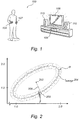
- FIG. 1 a block diagram of a system 100 according to an embodiment of the present invention, and a two-dimensional graphical representation of subsequent R-R intervals determined by the system 100, respectively.
- Figure 1 and 2 will be discussed simultaneously.
- the system 100 measures, compares and gives feedback on the HRV signals acquired by the system 100 via sensors 102 and 104.
- Each sensor 102 and 104 measures the heart beat of a person, i.e. are arranged such that they can detect the heart beat of the person.
- An advantage of using multiple sensors is that it is possible to combine the data of the different sensors and improve reliability, e.g. reducing motion artifacts.
- sensors that can detect heart beat are a photoplethysmograph, an ECG recorder, or a device for measuring a ballistocardiogram (e.g. Emfit sensor, MyHeart project).
- the system 100 additionally comprises a control unit 106 which receives the heart beat samples from the sensors 102 and 104, such as a microprocessor or the like, for extracting a series of cardiac R-R intervals (or "interbeat interval", IBI) from the heart beat samples, i.e. the heart rate variability (HRV) of the person, and for providing a two-dimensional representation of subsequent R-R intervals, wherein two subsequent R-R interval forms an entry 200 in the two-dimensional representation.
- the control unit 106 preferably comprises wireless capabilities for the reception of the heart beat measurements. The connection can however of course be provided by means of wire.
- the two-dimensional representation is preferably essentially a Poincaré model of subsequent R-R intervals, i.e.
- control unit 106 is preferably further adapted to determining a centroid 202 and an average radius 204 for the plurality of entries in the two-dimensional representation, i.e. the center of the entries represented as a two-dimensional plot where essentially the contour has the form of an ellipse and from which the centroid to the ellipse essentially represents the radius 204. That is, one average radius may generally only be determined after conversion from ellipse to circle.
- control unit 106 is adapted to determine a distance 206 between the centroid 202 and each of the entries in the two-dimensional representation, wherein the distance for each of the entries thus individually can be analyzed and compared with the average radius 204 for the entries. The result of the analysis, which also is performed by the control unit 106, can then be used for determining the physiological condition of the person.
- the system 100 can also provide stimulus and feedback possibilities, wherein the stimulus for example may include the rendering of an audio-visual (e.g. audio and/or video) experience by means of a TV set 108 and speakers 110 specifically adapted for providing such stimulus, including a breathing pacer stimulus shown to the person.
- the ambilight lighting concept can be used for further enhancing the audio-visual experience.
- Other additional arrangements are of course possible, including for example haptic stimulation of the person, using different types of actuators arranged in the close vicinity of the person, for example embedded into a textile garment being worn by the person or a sofa/chair having embedded actuators.
- the TV set need not necessary have to be specifically adapted, and for example a set-top box or DVD player may instead be adapted for providing the above mentioned stimulus, including a specifically adapted DVD disc for the DVD player (or similar portable or fixed storage device) having stored thereon an information pattern for providing stimulation and guidance for the person such that the person quickly can reach a state of coherence (e.g. quickly de-stress).
- a specifically adapted DVD disc for the DVD player or similar portable or fixed storage device having stored thereon an information pattern for providing stimulation and guidance for the person such that the person quickly can reach a state of coherence (e.g. quickly de-stress).
- the TV set 108 and/or the above mentioned DVD player may for example be adapted in accordance to the concept of Relax TV which provides a slow down experience that allows a person to easily relax in the comfort of their home.
- the person using the system 100 can just lean back in the sofa, hold a sensor 102, 104 in each hand, breathe in pace with a movie clip displayed on the TV set 108, and witness his or her relaxation level rise by means of for example a graphical feedback interface displayed on the TV set 108.
- After a few minutes the user achieves a relaxed state by following a tailored breathing rhythm exercise which is visualized on the TV set 108, comprising special audiovisual content and/or ambilight (as discussed above) with account taken to the heart rhythm and relaxation performance of the user.
- An example the Relax TV concept is disclosed in the European patent application no. 08152732.7 published as EP 2100556 A1 .
- the slow down experience is not limited to the TV 108 only, but may be provided by other rendering devices as well.
- a biofeedback relaxation experience can be integrated in a lighting system or music player. Alternatively, it could be used to facilitate the process of falling asleep by integrating it into an alarm clock or Wake-up Light.
- i circle T pacer IBI average / 4 where T pacer is the period of the pacer in seconds and IBI average is the average IBI in seconds.
- the ratio T pacer /IBI average is the number of datapoints for one pass of the ellipse. Dividing this number by 4 as shown in the equation above gives the 90 degrees phase factor to turn the ellipse into a circle.
- the feedback to the user is in this case the ellipse (circle).
- an opener and thinner ellipse represents a more "coherent state", i.e. good syncing between breathing pace and heart rate.
- the radius of the ellipse i.e. size
- HRV heart rate variability
- the thickness of the line of the ellipse i.e. the variation in radius
- Breaks of the coherence state as the result of getting distracted or startled, result in abrupt and immediate deviation from the ellipsoidal path. This allows fast detection of an event and also fast visualization. If as determined above the radius 204 of the circle has a certain distribution with an average radius r average , and a width dr it is possible to set a measure for when a point is an abrupt deviation from the circular path.
- F the difference (also called “distance” hereinafter) between the distance d of an entry and the closed curve 204.
- the criteria for when a point deviates significantly can be set manually by the user of the system 100 or automatically by the system 100 (based on the radii distribution and statistical theory).
- the ellipsoidal visualization method according to the present invention detect events in about one second (i.e. on the timescale of an IBI measurement). Fast detection is advantageous, because feedback and corrective measures, such as respiration pacing can be much faster, leading to a speedy recovery of the coherent state. Thus, the experience of the person trying to de-stress is enhanced.
- the method for determining a physiological condition of a person also may be used in relation to decision taking by a group of persons.
- the psychophysiological response to propositions may be monitored for all persons in the group, and individual parameters, such as indifference, true attention and anger can be discriminated by interpretation of heart rate variability (HRV) and/or galvanic skin response can be determined.
- HRV heart rate variability
- Collective parameters, such as coherent responses provide information on which factions in the group show similar attitudes.
- the psychophysiological response of the persons in the group can be done with or without the inclusion of the specific HRV method discussed above.
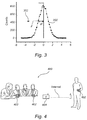
- FIG 4 an example of a decision taking system 400 is illustrated.
- Each of the persons in the group for example in relation to a meeting, is provided with at least one sensor for measuring the heart beat and/or the skin conductance.
- the sensor arrangement i.e. both heart beat and skin conductance
- the sensor arrangement is integrated into a single sensor device 402, further comprising wireless capability for communicating with a central control unit 404.
- an additional person/participant is arranged remotely from the remainder of the persons, for example by means of teleconference or video conferencing.
- a sensor device 402 which is connected to the control unit 404 by means of a network connection, such as the Internet.
- the system 400 records a timestamp for each measurement. Accordingly, if a distance D between the level of acceptance of a person and the official outcome of the decision is defined, then this distance will be a function of the overall outcome of the decision, the individual, personal vote, the measured physiological data at the moment the person voted and the measured physiological data at the moment the person becomes aware of the official outcome.
- D f vote person ⁇ outcome total + g measdata after ⁇ measdata voting
- a sub-function, f is defined to determines how far the person's vote, vote person , differs from the total outcome outcome total and a sub-function, g to determines how far the measured data at official outcome, measdata after , differs from the measured data during voting measdata voting .
- the distance function D can then be regarded as a kind of weighting factor. The larger the distance the more the person disagrees with the official outcome. To get a reliability measure we can discern the following four situations as shown in the table below. Outcome of functions (f + g) Distance (D) Level of agreement f small + g small small Strongly agrees f large + g small medium Doubts f small + g large medium Doubts f large + g large large Strongly disagrees
- the heart rate variability analysis algorithm as described above for attention lapses and shifts can be used to analyze the data. Utilization of such an algorithm in the setting of a meeting where a proposal is presented allows indifference to be discriminated from interest for the participants. In the above described manner individual parameters, such as indifference, true attention and anger can be discriminated by interpretation of heart rate variability and galvanic skin response. Collective parameters, such as coherent responses provide information on which factions in the group show similar attitudes. The gathered information can be used either by the group or by a process facilitator to guide the decision taking process.
- the above described system 400 is especially useful in relation to acceptance monitoring for decision taking, as a feedback tool for the decision taking process, in conjunction with e-voting (e.g. tele-voting).
- the centre of mass i.e. centroid
- the angle ( ⁇ ) with respect to a horizontal axis and the distance (r) with respect to the centre of mass coordinate is determined for each entry which yields a new coordinate (r, ⁇ ).
- the angle is plotted as a function of time, and a linear fit is made to this curve.
- deviations dr in the distance r or the deviations d ⁇ in the angle ⁇ can be used as a measure for the coherence. In the latter case the deviations d ⁇ are compared to the average rotation frequency f. For the deviation in r it is possible to use a similar measure as described above ( dr / r ).
Landscapes
- Health & Medical Sciences (AREA)
- Life Sciences & Earth Sciences (AREA)
- Cardiology (AREA)
- Engineering & Computer Science (AREA)
- General Health & Medical Sciences (AREA)
- Public Health (AREA)
- Pathology (AREA)
- Physics & Mathematics (AREA)
- Biomedical Technology (AREA)
- Heart & Thoracic Surgery (AREA)
- Medical Informatics (AREA)
- Molecular Biology (AREA)
- Surgery (AREA)
- Animal Behavior & Ethology (AREA)
- Veterinary Medicine (AREA)
- Biophysics (AREA)
- Physiology (AREA)
- Biodiversity & Conservation Biology (AREA)
- Child & Adolescent Psychology (AREA)
- Developmental Disabilities (AREA)
- Educational Technology (AREA)
- Hospice & Palliative Care (AREA)
- Psychiatry (AREA)
- Psychology (AREA)
- Social Psychology (AREA)
- Measuring Pulse, Heart Rate, Blood Pressure Or Blood Flow (AREA)
- Measurement Of The Respiration, Hearing Ability, Form, And Blood Characteristics Of Living Organisms (AREA)
- Measurement And Recording Of Electrical Phenomena And Electrical Characteristics Of The Living Body (AREA)
Priority Applications (1)
| Application Number | Priority Date | Filing Date | Title |
|---|---|---|---|
| EP09742479.0A EP2285270B1 (en) | 2008-05-08 | 2009-04-24 | Method and system for determining a physiological condition |
Applications Claiming Priority (3)
| Application Number | Priority Date | Filing Date | Title |
|---|---|---|---|
| EP08155890 | 2008-05-08 | ||
| EP09742479.0A EP2285270B1 (en) | 2008-05-08 | 2009-04-24 | Method and system for determining a physiological condition |
| PCT/IB2009/051688 WO2009136306A1 (en) | 2008-05-08 | 2009-04-24 | Method and system for determining a physiological condition |
Publications (2)
| Publication Number | Publication Date |
|---|---|
| EP2285270A1 EP2285270A1 (en) | 2011-02-23 |
| EP2285270B1 true EP2285270B1 (en) | 2016-04-20 |
Family
ID=40849219
Family Applications (1)
| Application Number | Title | Priority Date | Filing Date |
|---|---|---|---|
| EP09742479.0A Active EP2285270B1 (en) | 2008-05-08 | 2009-04-24 | Method and system for determining a physiological condition |
Country Status (6)
| Country | Link |
|---|---|
| US (1) | US8880156B2 (enExample) |
| EP (1) | EP2285270B1 (enExample) |
| JP (2) | JP5619728B2 (enExample) |
| KR (1) | KR101542733B1 (enExample) |
| CN (1) | CN102014738B (enExample) |
| WO (1) | WO2009136306A1 (enExample) |
Cited By (1)
| Publication number | Priority date | Publication date | Assignee | Title |
|---|---|---|---|---|
| WO2022064464A1 (en) * | 2020-09-25 | 2022-03-31 | Analytics For Life Inc. | Method and system to assess disease using multi-sensor signals |
Families Citing this family (18)
| Publication number | Priority date | Publication date | Assignee | Title |
|---|---|---|---|---|
| KR101630864B1 (ko) | 2008-05-09 | 2016-06-16 | 코닌클리케 필립스 엔.브이. | 감정을 전달하는 방법 및 시스템 |
| EP2299902A1 (en) * | 2008-06-06 | 2011-03-30 | Koninklijke Philips Electronics N.V. | Method and system for maintaining a state in a subject |
| WO2010100588A2 (en) | 2009-03-05 | 2010-09-10 | Koninklijke Philips Electronics N.V. | System, method and computer program product for indicating stimulation signals to a user |
| US9357921B2 (en) * | 2009-10-16 | 2016-06-07 | At&T Intellectual Property I, Lp | Wearable health monitoring system |
| ES2361686B2 (es) * | 2009-11-16 | 2011-11-16 | Universidad Politécnica de Madrid | Dispositivo y método de detección de estrés mediante señales fisiológicas. |
| US8798732B2 (en) | 2010-08-05 | 2014-08-05 | Lev-El Diagnostics of Heart Diseases Ltd. | Apparatus, system and method of determining a heart rate variability value |
| US20120302897A1 (en) * | 2011-05-24 | 2012-11-29 | Vicon Healthcare International Inc. | Heart rate variability device and cloud health management system |
| EP2726161B1 (en) * | 2011-06-30 | 2018-08-22 | Innovaid A/S | Stand-alone therapeutical training device |
| CN102523493A (zh) * | 2011-12-09 | 2012-06-27 | 深圳Tcl新技术有限公司 | 电视节目心情评分的方法及系统 |
| US8977347B2 (en) * | 2012-06-25 | 2015-03-10 | Xerox Corporation | Video-based estimation of heart rate variability |
| WO2015000158A1 (en) * | 2013-07-04 | 2015-01-08 | Hewlett-Packard Development Company, L.P. | Determining legitimate access point response |
| US10542961B2 (en) | 2015-06-15 | 2020-01-28 | The Research Foundation For The State University Of New York | System and method for infrasonic cardiac monitoring |
| US10758185B2 (en) | 2015-11-25 | 2020-09-01 | Texas Instruments Incorporated | Heart rate estimation apparatus using digital automatic gain control |
| US10321831B2 (en) | 2015-11-25 | 2019-06-18 | Texas Instruments Incorporated | Heart rate estimation apparatus with state sequence optimization |
| CN106175800A (zh) * | 2016-07-10 | 2016-12-07 | 北京工业大学 | 一种基于人体运动状态数据的心境状态量化评估方法 |
| CN109922726A (zh) * | 2016-09-20 | 2019-06-21 | 夏普株式会社 | 状态取得计算机、状态取得方法以及信息处理系统 |
| CN114343638B (zh) * | 2022-01-05 | 2023-08-22 | 河北体育学院 | 一种基于多模态生理参数信号的疲劳程度评估方法及系统 |
| WO2023234840A1 (en) * | 2022-06-02 | 2023-12-07 | Linkura Ab | A method, software product, and system for determining respiration quality |
Family Cites Families (29)
| Publication number | Priority date | Publication date | Assignee | Title |
|---|---|---|---|---|
| WO1995003739A1 (en) * | 1993-08-03 | 1995-02-09 | Peter Walter Kamen | A method of measuring autonomic activity of a patient |
| US5565840A (en) * | 1994-09-21 | 1996-10-15 | Thorner; Craig | Tactile sensation generator |
| EP0864145A4 (en) | 1995-11-30 | 1998-12-16 | Virtual Technologies Inc | TACTILE FEEDBACK FOR HUMAN / MACHINE INTERFACE |
| JPH09322943A (ja) * | 1996-06-06 | 1997-12-16 | Matsushita Electric Ind Co Ltd | 生体刺激装置 |
| US6358201B1 (en) * | 1999-03-02 | 2002-03-19 | Doc L. Childre | Method and apparatus for facilitating physiological coherence and autonomic balance |
| US6611673B1 (en) * | 1999-07-12 | 2003-08-26 | Oliver T. Bayley | Radio frequency-controlled telecommunication device |
| DE10163348A1 (de) * | 2001-12-21 | 2003-07-10 | Hans D Esperer | Verfahren und Vorrichtung zur automatisierten Detektion und Differenzierung von Herzrhythmusstörungen |
| US7920827B2 (en) * | 2002-06-26 | 2011-04-05 | Nokia Corporation | Apparatus and method for facilitating physical browsing on wireless devices using radio frequency identification |
| US7098776B2 (en) * | 2003-04-16 | 2006-08-29 | Massachusetts Institute Of Technology | Methods and apparatus for vibrotactile communication |
| EP1509042A1 (en) | 2003-08-19 | 2005-02-23 | Sony Ericsson Mobile Communications AB | System and method for a mobile phone for classifying a facial expression |
| US7966034B2 (en) * | 2003-09-30 | 2011-06-21 | Sony Ericsson Mobile Communications Ab | Method and apparatus of synchronizing complementary multi-media effects in a wireless communication device |
| EP1524586A1 (en) * | 2003-10-17 | 2005-04-20 | Sony International (Europe) GmbH | Transmitting information to a user's body |
| KR100581060B1 (ko) * | 2003-11-12 | 2006-05-22 | 한국전자통신연구원 | 오감 데이터 동기화 전송 장치 및 그 방법과 그를 이용한실감형 멀티미디어 데이터 제공 시스템 및 그 방법 |
| US20050181827A1 (en) * | 2004-02-13 | 2005-08-18 | Nokia Corporation | Touch for feel device for communicating with mobile wireless phone or terminal |
| CN100372499C (zh) * | 2004-02-26 | 2008-03-05 | 阮炯 | 一种心率变异性的c0模式度指标检测分析方法及仪器 |
| US20060221935A1 (en) * | 2005-03-31 | 2006-10-05 | Wong Daniel H | Method and apparatus for representing communication attributes |
| GB0516615D0 (en) | 2005-08-12 | 2005-09-21 | Nokia Corp | Automatic change of image display |
| US20070063849A1 (en) * | 2005-09-02 | 2007-03-22 | Francesca Rosella | Wearable haptic telecommunication device and system |
| JP2007105131A (ja) * | 2005-10-12 | 2007-04-26 | Nippon Telegr & Teleph Corp <Ntt> | 脈波診断装置及び脈波診断装置制御方法 |
| CA2631870C (en) * | 2005-11-29 | 2021-07-06 | Venture Gain, L.L.C. | Residual-based monitoring of human health |
| US20070150916A1 (en) * | 2005-12-28 | 2007-06-28 | James Begole | Using sensors to provide feedback on the access of digital content |
| WO2007105132A1 (en) | 2006-03-15 | 2007-09-20 | Koninklijke Philips Electronics N.V. | Remote control pointing technology |
| KR101384434B1 (ko) | 2006-04-06 | 2014-04-10 | 임머숀 코퍼레이션 | 햅틱 효과 개선을 위한 시스템들 및 방법들, 및 기록 매체 |
| US8306610B2 (en) | 2006-04-18 | 2012-11-06 | Susan Mirow | Method and apparatus for analysis of psychiatric and physical conditions |
| US8201080B2 (en) * | 2006-05-24 | 2012-06-12 | International Business Machines Corporation | Systems and methods for augmenting audio/visual broadcasts with annotations to assist with perception and interpretation of broadcast content |
| JP2008167933A (ja) * | 2007-01-11 | 2008-07-24 | Terumo Corp | 状態監視装置および情報処理方法 |
| EP2100556A1 (en) | 2008-03-14 | 2009-09-16 | Koninklijke Philips Electronics N.V. | Modifying a psychophysiological state of a subject |
| EP2286573A1 (en) | 2008-05-09 | 2011-02-23 | Koninklijke Philips Electronics N.V. | Generating a message to be transmitted |
| KR101630864B1 (ko) | 2008-05-09 | 2016-06-16 | 코닌클리케 필립스 엔.브이. | 감정을 전달하는 방법 및 시스템 |
-
2009
- 2009-04-24 WO PCT/IB2009/051688 patent/WO2009136306A1/en not_active Ceased
- 2009-04-24 EP EP09742479.0A patent/EP2285270B1/en active Active
- 2009-04-24 CN CN200980116467XA patent/CN102014738B/zh active Active
- 2009-04-24 US US12/990,977 patent/US8880156B2/en active Active
- 2009-04-24 JP JP2011508014A patent/JP5619728B2/ja active Active
- 2009-04-24 KR KR1020107027352A patent/KR101542733B1/ko active Active
-
2014
- 2014-09-17 JP JP2014188821A patent/JP5899289B2/ja active Active
Cited By (1)
| Publication number | Priority date | Publication date | Assignee | Title |
|---|---|---|---|---|
| WO2022064464A1 (en) * | 2020-09-25 | 2022-03-31 | Analytics For Life Inc. | Method and system to assess disease using multi-sensor signals |
Also Published As
| Publication number | Publication date |
|---|---|
| JP5899289B2 (ja) | 2016-04-06 |
| JP2011519653A (ja) | 2011-07-14 |
| EP2285270A1 (en) | 2011-02-23 |
| JP5619728B2 (ja) | 2014-11-05 |
| WO2009136306A1 (en) | 2009-11-12 |
| KR20110004899A (ko) | 2011-01-14 |
| US20110060235A1 (en) | 2011-03-10 |
| CN102014738B (zh) | 2013-08-14 |
| KR101542733B1 (ko) | 2015-08-07 |
| CN102014738A (zh) | 2011-04-13 |
| JP2015027532A (ja) | 2015-02-12 |
| US8880156B2 (en) | 2014-11-04 |
Similar Documents
| Publication | Publication Date | Title |
|---|---|---|
| EP2285270B1 (en) | Method and system for determining a physiological condition | |
| US11123562B1 (en) | Pain quantification and management system and device, and method of using | |
| US12390115B2 (en) | Photoplethysmography based detection of transitions between awake, drowsiness, and sleep phases of a subject | |
| US8979730B2 (en) | Method and system for providing behavioural therapy for insomnia | |
| EP2265173B1 (en) | Method and system for sleep/wake condition estimation | |
| US7621871B2 (en) | Systems and methods for monitoring and evaluating individual performance | |
| EP2291114B1 (en) | Synchronising a heart rate parameter of multiple users | |
| US20070032733A1 (en) | Method and apparatus for ECG-derived sleep disordered breathing monitoring, detection and classification | |
| US11540769B2 (en) | System and method for tracking sleep dynamics using behavioral and physiological information | |
| Choi et al. | Removal of respiratory influences from heart rate variability in stress monitoring | |
| TWI671706B (zh) | 生物回饋系統及其運作方法 | |
| Hernández et al. | Pasithea: An integrated monitoring and therapeutic system for sleep apnea syndromes based on adaptive kinesthetic stimulation | |
| Poli | Measurement and processing of multimodal physiological signals in response to external stimuli by wearable devices and evaluation of parameters influencing data acquisition | |
| KR101526144B1 (ko) | 휴대용 자율신경계 반응 모니터링 장치 | |
| Zschocke | Time series analysis of wrist accelerometry and cardiorespiratory signals during sleep | |
| Neira Lagos | Preliminary Investigation on Sleep Quality: An Integrated Approach for Home Monitoring | |
| Myers et al. | Parsimonious identification of physiological indices for monitoring cognitive fatigue | |
| Johnson | Utilizing Image Segmentation for the Extraction of Heart Rate Variability in the Pursuit of Updating Mental Health Therapeutic Validity Processes | |
| US20190150827A1 (en) | Wearable device capable of recognizing doze-off stage and recognition method thereof |
Legal Events
| Date | Code | Title | Description |
|---|---|---|---|
| PUAI | Public reference made under article 153(3) epc to a published international application that has entered the european phase |
Free format text: ORIGINAL CODE: 0009012 |
|
| 17P | Request for examination filed |
Effective date: 20101208 |
|
| AK | Designated contracting states |
Kind code of ref document: A1 Designated state(s): AT BE BG CH CY CZ DE DK EE ES FI FR GB GR HR HU IE IS IT LI LT LU LV MC MK MT NL NO PL PT RO SE SI SK TR |
|
| AX | Request for extension of the european patent |
Extension state: AL BA RS |
|
| DAX | Request for extension of the european patent (deleted) | ||
| 17Q | First examination report despatched |
Effective date: 20130416 |
|
| RAP1 | Party data changed (applicant data changed or rights of an application transferred) |
Owner name: KONINKLIJKE PHILIPS N.V. |
|
| GRAP | Despatch of communication of intention to grant a patent |
Free format text: ORIGINAL CODE: EPIDOSNIGR1 |
|
| INTG | Intention to grant announced |
Effective date: 20151105 |
|
| GRAS | Grant fee paid |
Free format text: ORIGINAL CODE: EPIDOSNIGR3 |
|
| GRAA | (expected) grant |
Free format text: ORIGINAL CODE: 0009210 |
|
| AK | Designated contracting states |
Kind code of ref document: B1 Designated state(s): AT BE BG CH CY CZ DE DK EE ES FI FR GB GR HR HU IE IS IT LI LT LU LV MC MK MT NL NO PL PT RO SE SI SK TR |
|
| REG | Reference to a national code |
Ref country code: GB Ref legal event code: FG4D |
|
| REG | Reference to a national code |
Ref country code: FR Ref legal event code: PLFP Year of fee payment: 8 |
|
| REG | Reference to a national code |
Ref country code: CH Ref legal event code: EP |
|
| REG | Reference to a national code |
Ref country code: AT Ref legal event code: REF Ref document number: 791441 Country of ref document: AT Kind code of ref document: T Effective date: 20160515 |
|
| REG | Reference to a national code |
Ref country code: IE Ref legal event code: FG4D |
|
| REG | Reference to a national code |
Ref country code: DE Ref legal event code: R096 Ref document number: 602009037946 Country of ref document: DE |
|
| REG | Reference to a national code |
Ref country code: LT Ref legal event code: MG4D |
|
| PG25 | Lapsed in a contracting state [announced via postgrant information from national office to epo] |
Ref country code: BE Free format text: LAPSE BECAUSE OF NON-PAYMENT OF DUE FEES Effective date: 20160430 |
|
| REG | Reference to a national code |
Ref country code: AT Ref legal event code: MK05 Ref document number: 791441 Country of ref document: AT Kind code of ref document: T Effective date: 20160420 |
|
| REG | Reference to a national code |
Ref country code: NL Ref legal event code: MP Effective date: 20160420 |
|
| PG25 | Lapsed in a contracting state [announced via postgrant information from national office to epo] |
Ref country code: NL Free format text: LAPSE BECAUSE OF FAILURE TO SUBMIT A TRANSLATION OF THE DESCRIPTION OR TO PAY THE FEE WITHIN THE PRESCRIBED TIME-LIMIT Effective date: 20160420 Ref country code: PL Free format text: LAPSE BECAUSE OF FAILURE TO SUBMIT A TRANSLATION OF THE DESCRIPTION OR TO PAY THE FEE WITHIN THE PRESCRIBED TIME-LIMIT Effective date: 20160420 Ref country code: LT Free format text: LAPSE BECAUSE OF FAILURE TO SUBMIT A TRANSLATION OF THE DESCRIPTION OR TO PAY THE FEE WITHIN THE PRESCRIBED TIME-LIMIT Effective date: 20160420 Ref country code: NO Free format text: LAPSE BECAUSE OF FAILURE TO SUBMIT A TRANSLATION OF THE DESCRIPTION OR TO PAY THE FEE WITHIN THE PRESCRIBED TIME-LIMIT Effective date: 20160720 Ref country code: FI Free format text: LAPSE BECAUSE OF FAILURE TO SUBMIT A TRANSLATION OF THE DESCRIPTION OR TO PAY THE FEE WITHIN THE PRESCRIBED TIME-LIMIT Effective date: 20160420 |
|
| PG25 | Lapsed in a contracting state [announced via postgrant information from national office to epo] |
Ref country code: HR Free format text: LAPSE BECAUSE OF FAILURE TO SUBMIT A TRANSLATION OF THE DESCRIPTION OR TO PAY THE FEE WITHIN THE PRESCRIBED TIME-LIMIT Effective date: 20160420 Ref country code: SE Free format text: LAPSE BECAUSE OF FAILURE TO SUBMIT A TRANSLATION OF THE DESCRIPTION OR TO PAY THE FEE WITHIN THE PRESCRIBED TIME-LIMIT Effective date: 20160420 Ref country code: GR Free format text: LAPSE BECAUSE OF FAILURE TO SUBMIT A TRANSLATION OF THE DESCRIPTION OR TO PAY THE FEE WITHIN THE PRESCRIBED TIME-LIMIT Effective date: 20160721 Ref country code: PT Free format text: LAPSE BECAUSE OF FAILURE TO SUBMIT A TRANSLATION OF THE DESCRIPTION OR TO PAY THE FEE WITHIN THE PRESCRIBED TIME-LIMIT Effective date: 20160822 Ref country code: AT Free format text: LAPSE BECAUSE OF FAILURE TO SUBMIT A TRANSLATION OF THE DESCRIPTION OR TO PAY THE FEE WITHIN THE PRESCRIBED TIME-LIMIT Effective date: 20160420 Ref country code: LV Free format text: LAPSE BECAUSE OF FAILURE TO SUBMIT A TRANSLATION OF THE DESCRIPTION OR TO PAY THE FEE WITHIN THE PRESCRIBED TIME-LIMIT Effective date: 20160420 Ref country code: ES Free format text: LAPSE BECAUSE OF FAILURE TO SUBMIT A TRANSLATION OF THE DESCRIPTION OR TO PAY THE FEE WITHIN THE PRESCRIBED TIME-LIMIT Effective date: 20160420 |
|
| REG | Reference to a national code |
Ref country code: CH Ref legal event code: PL |
|
| PG25 | Lapsed in a contracting state [announced via postgrant information from national office to epo] |
Ref country code: IT Free format text: LAPSE BECAUSE OF FAILURE TO SUBMIT A TRANSLATION OF THE DESCRIPTION OR TO PAY THE FEE WITHIN THE PRESCRIBED TIME-LIMIT Effective date: 20160420 Ref country code: BE Free format text: LAPSE BECAUSE OF FAILURE TO SUBMIT A TRANSLATION OF THE DESCRIPTION OR TO PAY THE FEE WITHIN THE PRESCRIBED TIME-LIMIT Effective date: 20160420 |
|
| REG | Reference to a national code |
Ref country code: DE Ref legal event code: R097 Ref document number: 602009037946 Country of ref document: DE |
|
| REG | Reference to a national code |
Ref country code: IE Ref legal event code: MM4A |
|
| PG25 | Lapsed in a contracting state [announced via postgrant information from national office to epo] |
Ref country code: LI Free format text: LAPSE BECAUSE OF NON-PAYMENT OF DUE FEES Effective date: 20160430 Ref country code: SK Free format text: LAPSE BECAUSE OF FAILURE TO SUBMIT A TRANSLATION OF THE DESCRIPTION OR TO PAY THE FEE WITHIN THE PRESCRIBED TIME-LIMIT Effective date: 20160420 Ref country code: DK Free format text: LAPSE BECAUSE OF FAILURE TO SUBMIT A TRANSLATION OF THE DESCRIPTION OR TO PAY THE FEE WITHIN THE PRESCRIBED TIME-LIMIT Effective date: 20160420 Ref country code: EE Free format text: LAPSE BECAUSE OF FAILURE TO SUBMIT A TRANSLATION OF THE DESCRIPTION OR TO PAY THE FEE WITHIN THE PRESCRIBED TIME-LIMIT Effective date: 20160420 Ref country code: RO Free format text: LAPSE BECAUSE OF FAILURE TO SUBMIT A TRANSLATION OF THE DESCRIPTION OR TO PAY THE FEE WITHIN THE PRESCRIBED TIME-LIMIT Effective date: 20160420 Ref country code: CZ Free format text: LAPSE BECAUSE OF FAILURE TO SUBMIT A TRANSLATION OF THE DESCRIPTION OR TO PAY THE FEE WITHIN THE PRESCRIBED TIME-LIMIT Effective date: 20160420 Ref country code: MC Free format text: LAPSE BECAUSE OF FAILURE TO SUBMIT A TRANSLATION OF THE DESCRIPTION OR TO PAY THE FEE WITHIN THE PRESCRIBED TIME-LIMIT Effective date: 20160420 Ref country code: CH Free format text: LAPSE BECAUSE OF NON-PAYMENT OF DUE FEES Effective date: 20160430 |
|
| PLBE | No opposition filed within time limit |
Free format text: ORIGINAL CODE: 0009261 |
|
| STAA | Information on the status of an ep patent application or granted ep patent |
Free format text: STATUS: NO OPPOSITION FILED WITHIN TIME LIMIT |
|
| 26N | No opposition filed |
Effective date: 20170123 |
|
| REG | Reference to a national code |
Ref country code: FR Ref legal event code: PLFP Year of fee payment: 9 |
|
| PG25 | Lapsed in a contracting state [announced via postgrant information from national office to epo] |
Ref country code: IE Free format text: LAPSE BECAUSE OF NON-PAYMENT OF DUE FEES Effective date: 20160424 Ref country code: SI Free format text: LAPSE BECAUSE OF FAILURE TO SUBMIT A TRANSLATION OF THE DESCRIPTION OR TO PAY THE FEE WITHIN THE PRESCRIBED TIME-LIMIT Effective date: 20160420 |
|
| REG | Reference to a national code |
Ref country code: FR Ref legal event code: PLFP Year of fee payment: 10 |
|
| PG25 | Lapsed in a contracting state [announced via postgrant information from national office to epo] |
Ref country code: HU Free format text: LAPSE BECAUSE OF FAILURE TO SUBMIT A TRANSLATION OF THE DESCRIPTION OR TO PAY THE FEE WITHIN THE PRESCRIBED TIME-LIMIT; INVALID AB INITIO Effective date: 20090424 Ref country code: CY Free format text: LAPSE BECAUSE OF FAILURE TO SUBMIT A TRANSLATION OF THE DESCRIPTION OR TO PAY THE FEE WITHIN THE PRESCRIBED TIME-LIMIT Effective date: 20160420 |
|
| PG25 | Lapsed in a contracting state [announced via postgrant information from national office to epo] |
Ref country code: LU Free format text: LAPSE BECAUSE OF NON-PAYMENT OF DUE FEES Effective date: 20160424 Ref country code: MK Free format text: LAPSE BECAUSE OF FAILURE TO SUBMIT A TRANSLATION OF THE DESCRIPTION OR TO PAY THE FEE WITHIN THE PRESCRIBED TIME-LIMIT Effective date: 20160420 Ref country code: TR Free format text: LAPSE BECAUSE OF FAILURE TO SUBMIT A TRANSLATION OF THE DESCRIPTION OR TO PAY THE FEE WITHIN THE PRESCRIBED TIME-LIMIT Effective date: 20160420 Ref country code: MT Free format text: LAPSE BECAUSE OF NON-PAYMENT OF DUE FEES Effective date: 20160430 Ref country code: IS Free format text: LAPSE BECAUSE OF FAILURE TO SUBMIT A TRANSLATION OF THE DESCRIPTION OR TO PAY THE FEE WITHIN THE PRESCRIBED TIME-LIMIT Effective date: 20160420 |
|
| PG25 | Lapsed in a contracting state [announced via postgrant information from national office to epo] |
Ref country code: BG Free format text: LAPSE BECAUSE OF FAILURE TO SUBMIT A TRANSLATION OF THE DESCRIPTION OR TO PAY THE FEE WITHIN THE PRESCRIBED TIME-LIMIT Effective date: 20160420 |
|
| PGFP | Annual fee paid to national office [announced via postgrant information from national office to epo] |
Ref country code: DE Payment date: 20250428 Year of fee payment: 17 |
|
| PGFP | Annual fee paid to national office [announced via postgrant information from national office to epo] |
Ref country code: GB Payment date: 20250422 Year of fee payment: 17 |
|
| PGFP | Annual fee paid to national office [announced via postgrant information from national office to epo] |
Ref country code: FR Payment date: 20250424 Year of fee payment: 17 |